


Abstract
Hydrothermal activity plays a critical role in ancient oceanic environments, organic matter accumulation, and metallic ore deposit formation. During the Early Cambrian, the development of hydrothermal systems in the southern Anhui Province of the Lower Yangtze Block has long attracted geological attention. This study focuses on the Lower Cambrian black shales of the Hongtaocun (HTC) section in the southern Anhui Province, employing major- and trace-element analyses, rare earth element (REE) geochemistry, and field-emission scanning electron microscopy (FE-SEM) observations to identify evidence for Early Cambrian hydrothermal activity on the Yangtze Platform and its controls on mineralization. Our results demonstrate that major-element proxies classify the HTC samples as biogenic, but this classification is demonstrably incorrect given the mineralogical and REE evidence, which highlights the limitations of major-element discrimination alone. Hyalophane (Hy) occurrence records Ba-rich hydrothermal fluids, while positive Eu anomalies in the REE patterns further corroborate hydrothermal influence. We, therefore, emphasize that major-element chemistry alone is insufficient to reliably identify hydrothermal processes. These findings substantially advance the discrimination criteria for ancient seafloor hydrothermal activity.
1. Introduction
In ancient marine settings, hydrothermal activity constitutes one of the principal metallogenic processes. Among the diverse styles of mineralization, hydrothermal deposits represent a major source of metals such as Au, Ag, Cu, Pb, Pt, and U. Precipitation of hydrothermal fluids produces abundant sulfide ore bodies that define a key subclass of hydrothermal mineralization [1]. These deposits are not only valuable mineral resources today, but also provide critical clues for deciphering the geological evolution of ancient oceans [2]. Hydrothermal activity injects substantial volumes of volatile species and metal ions (e.g., H2, H2S, Fe2+, Cu2+) into seawater [3]. Such inputs alter the chemical composition of seawater, thereby influencing the survival and evolution of marine organisms [4]. Moreover, hydrothermal circulation enhances the cycling of elements such as Fe and Mn [5], exerting a moderating effect on the stability of ancient marine ecosystems. Ancient hydrothermal vent sites commonly hosted unique chemosynthetic communities whose constituents adapted to extreme conditions (high temperature, high pressure, and elevated H2S), which provide key analogues for investigating the origin and evolution of life [4].
A geological analysis of ancient marine successions allows for the recognition of hydrothermal signatures. Features such as stratiform hydrothermal ore horizons and fossil vent chimneys serve as robust indicators of past seafloor hydrothermal activity [6]. Geochemical analytical methods can be employed to determine the elemental compositions and isotopic signatures of ancient marine sediments and rocks, thereby assessing the occurrence of hydrothermal activity. For instance, positive europium (Eu) anomalies in rare earth elements (REE) are commonly used as indicators of hydrothermal fluid activity. A comprehensive analysis of major, trace, and rare earth elements in samples can reveal characteristic signatures of hydrothermal processes [7]. Chemosynthetic communities that thrived around ancient vents may be preserved in the fossil record. A palaeontological investigation of such vent-associated biota thereby provides an independent line of evidence for identifying hydrothermal activity in past oceans [8]. During the Early Cambrian, large-scale transgression led to the widespread development of organic-rich black shales across the entire Yangtze Platform, ranging from shallow shelves to deep-water slopes and basinal settings [9].
The Cambrian black shales extensively distributed across the Yangtze Block provide a unique opportunity to investigate the marine environment during a critical period of Earth’s history [10,11]. In this study, a major element analysis was employed to determine the depositional environment of the Early Cambrian black shales in the southern Anhui Province. The results suggest a biogenic origin, in contrast to a hydrothermal origin indicated by other lines of evidence. Therefore, we propose that major elements exhibit uncertainty in identifying hydrothermal activity. Based on mineralogical evidence such as the presence of Hy and trace element geochemistry, this study confirms that hydrothermal activity occurred in the southern Anhui Province during the Early Cambrian, which has implications for the exploration of hydrothermal ore deposits.
2. Geological Setting
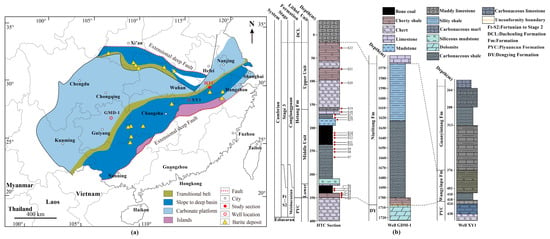
The Lower Yangtze region occupies the eastern segment of the Yangtze Block. It is bounded to the northwest by the Tan–Lu Fault, to the north by the southern margin of the North China Block, to the south by the Jiangshan–Shaoxing Fault against the Cathaysia Block, to the east by the Circum-Pacific belt, and to the west by the Tethyan domain [12,13]. It preserves one of the most complete and best-preserved marine Middle–Palaeozoic successions in South China. The HTC study area lies in the southern Anhui Province and is situated within the Lower Yangtze Block (Figure 1a).
Figure 1.
(a) Paleogeographic map of the early Cambrian Yangtze plate (modified from [7]). (b) Stratigraphic comparison columns of the Low Cambrian in the Yangtze Area, including the sampled HTC section, GMD-1 Well [7], and XY1 Well. Locations of these typical sections are shown in Figure 1a.
The tectonic evolution of the Lower Yangtze region and the development of its basin basement were intimately linked to the overall evolutionary history of the Yangtze Block. The Ediacaran–Cambrian interval represents a critical transition in the Earth-system evolution. After four phases of rifting, the Yangtze Block evolved into a continental-margin basin [14], with platform carbonates and basinal carbonaceous–siliceous deposits blanketing the entire block (Figure 1b) [15,16]. Early Cambrian rifting of the southern continent caused the break-up of Pannotia; the southern landmass split into the Yangtze and Cathaysia blocks. The unified Cathaysia–South China Ocean plate then subducted beneath the Yangtze Block, generating a trench–arc–basin system along its southeastern margin [17]. Palaeogeographic reconstructions indicate that the Yangtze Block hosted a NW-to-SE transect from shallow-marine shelf through shelf, slope, and basin facies during the Early Cambrian [18,19]. During the Early Cambrian, a major transgression flooded the entire Yangtze Platform, leading to widespread deposition of organic-rich black shales that extended from the shallow shelf to deep-water slopes and basins [10,20]. Along the continental-margin slope-to-basin transition, a thick, belt-like black-shale succession—comprising black shale (mudstone), carbonate, chert, and sandstone—accumulated and is notably organic-rich [21,22,23]. The study area lies within the platform-margin slope between the palaeo-Yangtze and palaeo-Cathaysia continents [24]. In the HTC section, the Lower Cambrian Hetang Formation is overlain by the Dachenling limestone and underlain by the Piyuancun chert (Figure 1b). The lower Hetang Member at HTC consists of siliceous and carbonaceous shales with intercalated skeletal coal beds, whereas the upper member is dominated by chert and siliceous shale (Figure 1b).
3. Samples and Methods
3.1. Samples
A total of 22 samples were collected from the Early Cambrian Hetang Formation at the HTC section in the southern Anhui Province. All samples were analyzed for major, trace, and rare earth elements. In addition, five samples were examined via field emission scanning electron microscopy (FE-SEM).
3.2. Major, Trace, and Rare Earth Elements
Determinations of major, trace, and rare earth elements were conducted at the Langfang Branch of the PetroChina Research Institute of Petroleum Exploration and Development (CNPC). Major-element oxides were determined by classical wet chemical titration. Taking SiO2 as an example, powdered samples were fused with Na2CO3 flux, leached with HCl, and evaporated with polyethylene glycol to obtain a small volume of condensed silicate. After filtration and heating, the solid residue was weighed as M1. The SiO2 was then dissolved in hot HF–H2SO4 to volatilize SiF4, and the remaining solid was weighed as M2. The residue was refused with K2S2O4 flux and extracted with distilled water. The resulting solution was combined with the previous HCl filtrate. After decomposition, the residual SiO2 in the filtrate was determined by molybdenum-blue spectrophotometry as M3. The total SiO2 content was finally calculated as (M1 − M2 + M3). Duplicate analyses following the Chinese National Standard GB/T 14506.3-2010 [25] yielded an analytical precision of ±0.1% for SiO2. Oxide concentrations of Al, Fe, Mn, K, and Na were determined by analogous procedures in accordance with GB/T 14506, with the same precision of ±0.1% [25].
Trace-element compositions were determined using an Optimass 9500 inductively coupled plasma time-of-flight mass spectrometer (ICP-TOF-MS; GBC Scientific Equipment Pty Ltd, Dandenong, Victoria, Australia). Approximately 50 mg of powdered sample was weighed into a PTFE high-pressure vessel, moistened with a few drops of ultrapure water, and 1 mL of HNO3 plus 1 mL of HF were added. The sealed vessel was heated at 190 °C for >48 h. After cooling, the vessel was opened, and the contents evaporated to incipient dryness at 115 °C. In total, 1 mL of HNO3 was then added, and the solution re-evaporated to incipient dryness. The residue was redissolved in 3 mL of 30% HNO3, the vessel resealed, and heated at 190 °C for ≥12 h. Finally, the concentrate was transferred to a polyethylene bottle and diluted to 100 g with 2% HNO3 (dilution factor 1: 2000).
In this study, the following parameters are adopted for the geochemical analysis of major and rare earth elements, and their calculation methods are given below.
Eu anomalies were calculated using the following equation:
where subscript N denotes concentrations normalized to Post-Archean Australian Shale (PAAS) [26].
Eu/Eu* = EuN/(SmN × GdN)0.5
To estimate the non-terrigenous input component of a given element (X), the terrigenous detrital contribution must be subtracted from the total concentration of X. Al, as an element with dominant terrigenous detritus [27], is commonly used to subtract the terrigenous input component. The calculation formula is as follows:
Xex = Xsample − (Alsample × (X/Al) PAAS)
Here, Xex is non-terrigenous X. Xsample, Alsample, XPAAS, and AlPAAS are as defined above [26].
3.3. FE-SEM Observation
FE-SEM observations were carried out at the Laboratory of the School of Ocean Sciences, China University of Geosciences (Beijing), using a Thermo Fisher Helios G5 CX field-emission scanning electron microscope (FE-SEM) equipped with secondary-electron (SE), backscattered-electron (BSE), and energy-dispersive X-ray spectroscopy (EDS) detectors (Thermo Fisher Scientific, Waltham, MA, USA).
To obtain ultrasmooth surfaces, the samples were polished by Ar-ion milling using an IM4000 ion-milling system (Hitachi High-Tech Corporation, Tokyo, Japan) prior to FE-SEM observation. EDS analyses were performed at an accelerating voltage of 15 kV and a beam current of 1.6 nA, with a working distance of 10 mm. These operating conditions provide sufficient overvoltage ratios for the excitation of Ba Lα (4.47 keV), Al Kα (1.49 keV), Si Kα (1.74 keV), and other target characteristic X-ray lines. Spectra were collected with a live time of 60 s and a take-off angle of 35°.
EDS data were ZAF-corrected using the built-in algorithm of Aztec 5.0 software (Oxford Instruments, Abingdon, Oxfordshire, UK), which incorporates atomic number (Z), X-ray absorption (A), and fluorescence (F) corrections. Quantitative calibration was performed using mineral external standards, including albite (Na), corundum (Al), diopside (Si, Ca, Mg), hematite (Fe), rutile (Ti), and barite (Ba, S). Based on repeated measurements of the barite standard, the analytical precision is estimated at ±2% relative for major elements (wt% > 5%) and ±5% relative for minor elements (wt% < 5%).
4. Results
4.1. Petrological and Mineralogical Characteristics
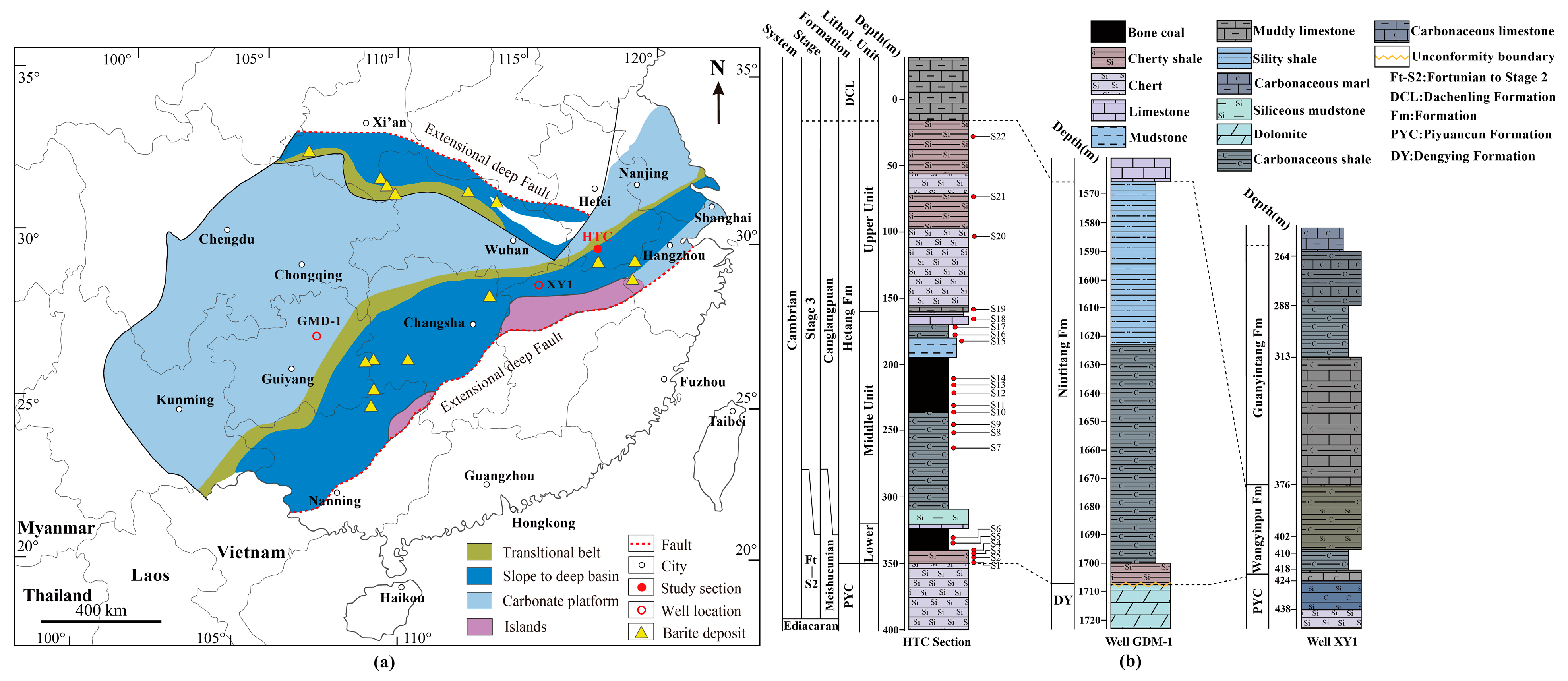
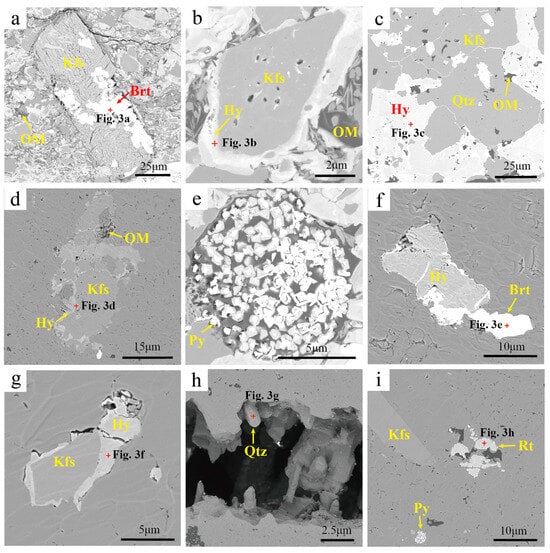
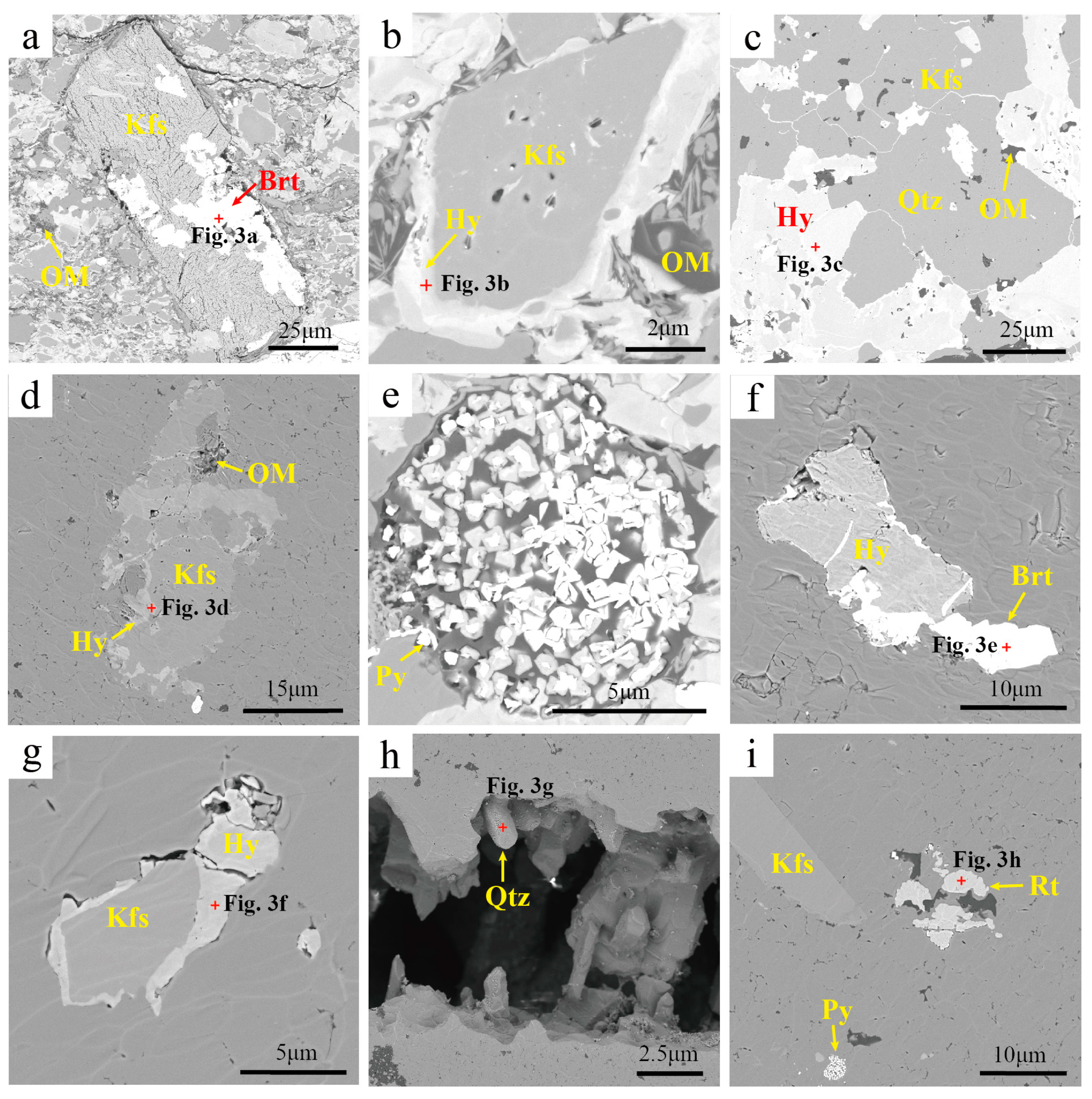
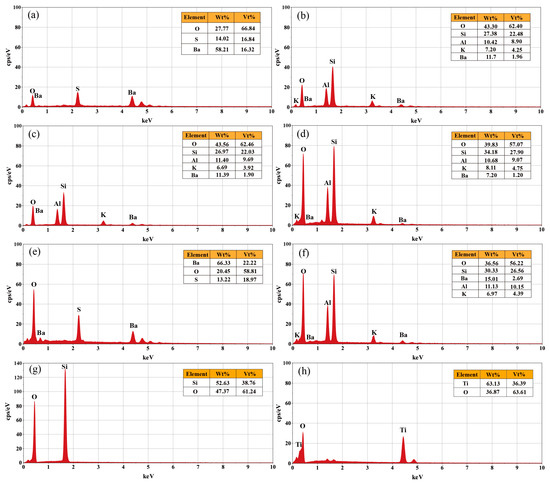
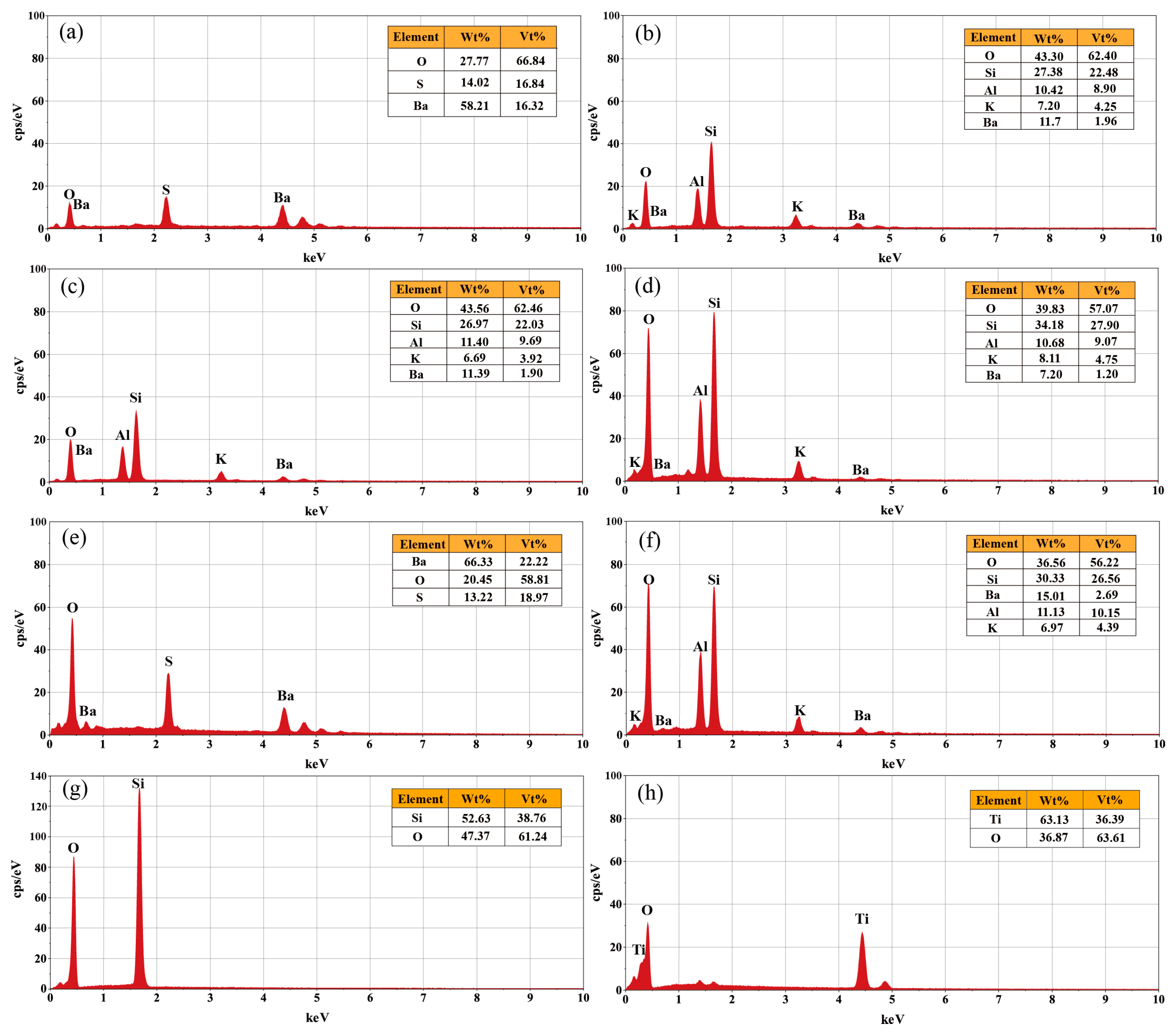
The lithology of the Early Cambrian Hetang Formation in the HTC section is dominated by chert, siliceous shale, and carbonaceous shale (Figure 1b). FE-SEM observations reveal that, in addition to K-feldspar (Figure 2a), Hy is also present (Figure 2b–d,g). Hy grows along the margins of K-feldspar grains, forming zoned structures (Figure 2b,g). Meanwhile, barite (Figure 2a and Figure 3a,e), quartz (Figure 2h and Figure 3g), and rutile (Figure 2i and Figure 3h) are also observed as associated minerals in some samples.
Figure 2.
FE-SEM images of the Early Cambrian HTC samples. (a) shows obvious barite in sample S6. (b,d,g) show banded Hy formed by metasomatism of K-feldspar, occurring in samples S6, S8, and S21, respectively. (c) shows Hy in sample S21. (e) shows pyrite (Py) and Hy in sample S6. (f) shows that Hy formed by complete metasomatism of K-feldspar in sample S21. (h) displays quartz with smooth, clean, and uneroded surfaces in sample S8. (i) shows rutile in sample S8. OM = organic matter; Qtz = quartz; Kfs = K-feldspar; Py = Pyrite; Hy = Hyalophane; Brt = barite; Rt = rutile.
Figure 3.
Energy dispersive spectrometer (EDS) spectra of representative minerals. (a,e): barite; (b–d,f): Hy; (g): quartz; (h): rutile.
Hy occurs as well-formed, colorless, and transparent crystals. Due to the high atomic weight of barium, it exhibits high brightness under scanning electron microscopy (SEM) (Figure 2b,c). In addition, K-feldspar grains that have been almost completely replaced by Hy can also be observed (Figure 2f). Combined with the results of an energy-dispersive spectroscopy (EDS) analysis, the elemental composition of Hy, (K, Ba) Al2Si2O8, is clearly exhibited in the EDS spectra (Figure 3b–d,f), thus confirming the presence of Hy and the replacement of K-feldspar by Hy. Hy is recognized as a typical hydrothermal indicator mineral [6,7], and its discovery indicates widespread hydrothermal activity in the southern Anhui Province during the Early Cambrian (see Section 4.2).
4.2. Elemental Geochemistry
4.2.1. Major-Element Characteristics
Major-element data for the HTC samples are listed in Table S1. SiO2, Al2O3, and Fe2O3 dominate the bulk composition, ranging from 46.01 wt% to 90.67 wt% (average of 70.34 wt%), 0.80 wt% to 16.01 wt% (average of 8.21 wt%), and 0.58 wt% to 9.68wt % (average of 3.67 wt%), respectively. Together, these three oxides account for >80% of the total volatile-free budget on average.
4.2.2. Rare-Earth Elements
Rare-earth-element (REE) concentrations and fractionation indices are listed in Table 1. Total REE (ΣREE) contents vary from 12.51 to 435.56 µg g−1, with an average of 132.70 µg g−1. The light- to heavy-REE ratio (LREE/HREE) ranges from 0.27 to 5.58, with an average of 1.32). PAAS-normalized REE patterns are slightly left-sloping, with variable Eu anomalies (Eu/Eu* = 0.73–2.64, average of 1.12).
Table 1.
Hydrothermal discrimination indicators.
5. Discussion
5.1. Uncertainty of Major-Element Proxies in Identifying Hydrothermal Input
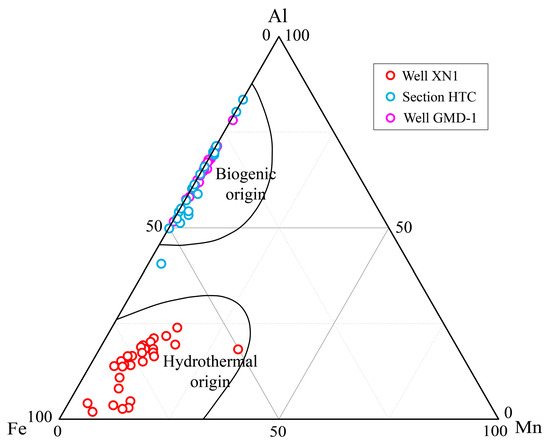
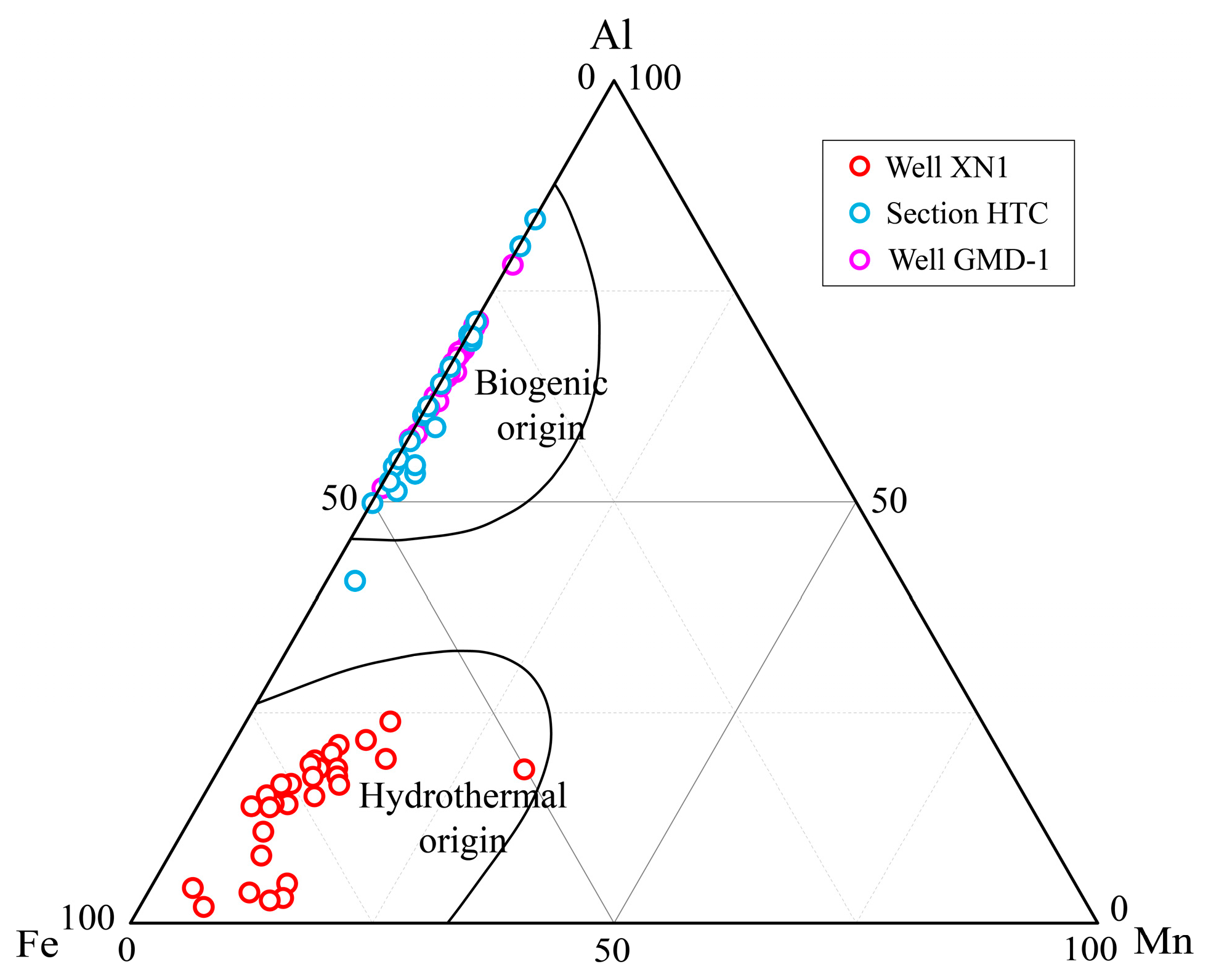
Major elements, such as Al, Fe, and Mn, in sedimentary rocks are widely used to discriminate sediment provenance. An enrichment in Al2O3 and TiO2 generally indicates terrigenous detrital input, whereas Fe and Mn accumulation is commonly attributed to hydrothermal contribution [28,29,30]. The ratio Al/(Al + Fe + Mn) is, therefore, employed as a hydrothermal indicator: values decrease with increasing hydrothermal precipitates, with < 0.35 suggesting significant hydrothermal influence, ≈ 0.01 for end-member hydrothermal deposits, and ≈0.60 for purely biogenic sediments [28]. The Al/(Al + Fe + Mn) ratio of HTC’s Hetang Formation samples is shown in Table 1 as 0.41~0.84, with an average value of 0.61, which is similar to the biogenic origin. When plotted on the Al–Fe–Mn ternary diagram, the data clustered within the biogenic domain (Figure 4). However, this interpretation conflicts with (i) the presence of Hy, a mineralogical proxy unequivocally linked to hydrothermal activity, and (ii) REE signatures that likewise support a hydrothermal origin (see Section 4.2). Thus, major-element discrimination diagrams alone appear insufficient to identify hydrothermal components in the HTC section, emphasizing the need for multi-proxy approaches.
Figure 4.
The Al–Fe–Mn triangular diagram of HTC, XN1 well, and GMD-1 well in the Early Cambrian.
To better interpret this phenomenon, geochemical data from Well GMD-1 in the Guizhou Province [7] and Well XN1 in the Jiangxi Province [30] were compiled for comparative analysis. The results show that although both wells have been previously interpreted as hydrothermal deposits [7,30], their samples exhibit distinctly different distribution characteristics in the Fe–Mn–Al ternary diagram. Samples from Well XN1 clearly plot within the hydrothermal domain (Figure 4), which is consistent with the hydrothermal genetic conclusion proposed by Liu et al. [31]. Conversely, samples of Well GMD-1, which were also regarded as hydrothermal in previous studies [7], entirely fall into the biogenic domain in the ternary diagram (Figure 4), showing a similar distribution pattern to that of this study. Such an obvious discrepancy in ternary diagram discrimination is inconsistent with other independent geochemical evidence for hydrothermal activity. Accordingly, major elements exhibit uncertainty in identifying hydrothermal origin via the Fe–Mn–Al ternary diagram.
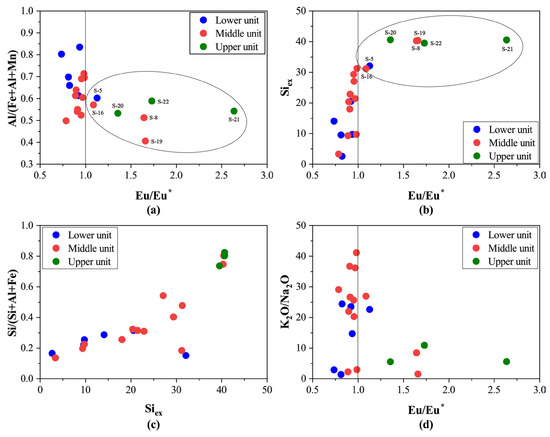
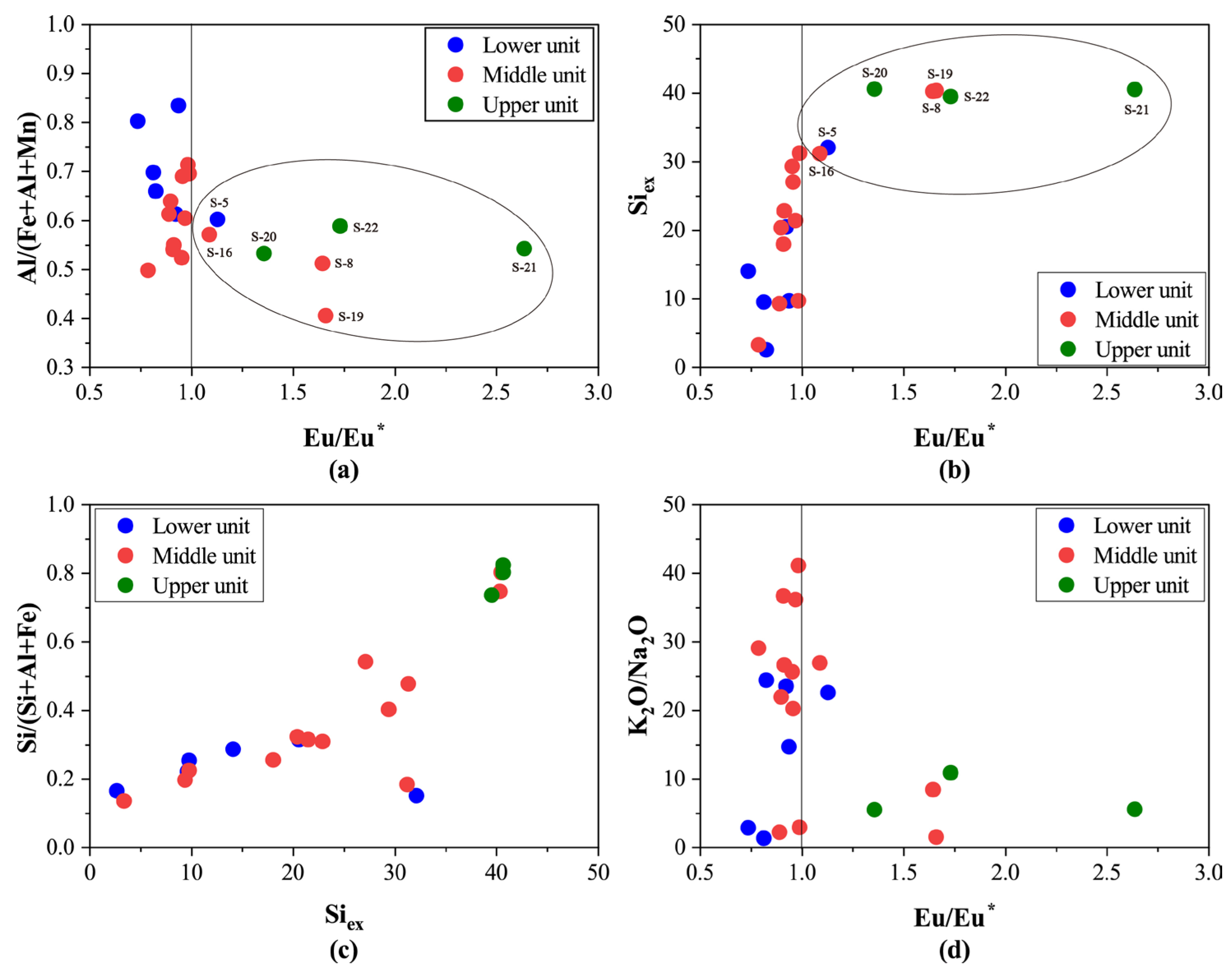
In the Al/(Al + Fe + Mn)–Eu/Eu* diagram (Figure 5a), most samples are concentrated in the normal sedimentary area with low Eu/Eu* (<1.0) and high Al/(Al + Fe + Mn) (0.5–0.8). Some samples such as S-5, S-8, S-16, S-19, S-20, S-2, and S-22 deviate obviously from the main group. These samples fall into the hydrothermal characteristic area with high Eu/Eu* (>1.0) and low Al/(Al + Fe + Mn) (0.4–0.6) (Figure 5a). Under high-temperature reducing conditions, hydrothermal fluids preferentially dissolve and transport Eu2+, resulting in positive Eu anomalies. Meanwhile, hydrothermal fluids are rich in Fe, Mn, and other metal elements, and they reduce the Al/(Al + Fe + Mn) ratio of sediments. The coupling of the above two characteristics is an important geochemical indicator of hydrothermal activity.
Figure 5.
Geochemical discrimination diagrams for hydrothermal influence in the HTC section. (a) Al/(Fe + Al + Mn) vs. Eu/Eu*; (b) Siex vs. Eu/Eu*; (c) Si/(Si + Al + Fe) vs. Siex; and (d) K2O/Na2O vs. Eu/Eu*. The dashed ellipse in (a,b) outlines samples with hydrothermal signatures.
The relationship between Siex and Eu/Eu* (Figure 5b) further supports this understanding. The abnormal samples mentioned above show high excess silica with Siex > 30%. Overall, the Siex content increases with the rise of Eu/Eu* values (Figure 5b). The input of siliceous fluids during hydrothermal activity can greatly increase the excess silica content of sediments. The coupling feature of “positive Eu anomaly (Eu/Eu* > 1) and high excess silica (Siex > 30%)” indicates that normal sedimentary rocks have been strongly modified by hydrothermal activity.
The Si/(Si + Al + Fe) ratio indicates the “silica purity” of cherts [28]. Hydrothermal cherts are typically Si-enriched (low Al and Fe) and positively correlated with Siex. Lower and Middle unit samples show low Si/(Si + Al + Fe) (<0.4) and Siex < 30, consistent with normal sedimentary cherts. Upper unit samples clustered in the upper-right corner, with Si/(Si + Al + Fe) > 0.7 and Siex > 35, confirming their hydrothermal high-silica signature (Figure 5c).
The K2O/Na2O ratio is controlled by diagenesis, alteration, and fluid activity. Hydrothermal alteration commonly causes Na leaching and relative K enrichment [32]. Lower and Middle unit samples have high K2O/Na2O (10–40) with Eu/Eu* ≈ 1, possibly reflecting diagenetic alteration or alkali metal fractionation (Figure 5d). Upper unit samples show significantly lower K2O/Na2O (<10), corresponding to positive Eu anomalies, likely linked to hydrothermal alteration.
It follows that the Fe–Mn–Al diagram has limitations in identifying hydrothermal activity. We speculate that the above phenomenon can be explained by three aspects. (1) In the Early Cambrian of the study area, hydrothermal activity exhibited episodic features controlled by the Jiangnan ancient fault [33]. The study section shows dual attributes of normal sedimentation overprinted by hydrothermal modification. Samples from the upper interval and partial samples from the lower interval exhibit positive Eu anomalies (Figure 1b and Figure 5), low Al/(Al + Fe + Mn) values (<0.6), and high Siex values. These features provide direct geochemical evidence for the existence of hydrothermal activity. (2) Under intermittent hydrothermal activity, iron oxides in sediments can act as electron acceptors. When hydrogen sulfide (H2S) in hydrothermal fluids reacts with iron ions in sediments, pyrite (FeS2) is formed [34]. Distinctly developed pyrite is observed in the FE-SEM images of Samples S6 (Figure 2e) and S8 (Figure 2i) from the HTC section, providing direct evidence for H2S reduction. This process reduces the content of Fe2O3 in the study area, thereby increasing the Al/(Al + Fe + Mn) ratio and causing the samples to plot within the biogenic domain. (3) The HTC section is located on the platform-to-basin transition zone, separated from the northern carbonate platform (Figure 1a); sediment supply was, therefore, most likely derived from the Jiangnan palaeo-island arc to the south, diluting the hydrothermal Fe signal [35]. Erosional detritus from the Jiangnan palaeo-island arc was transported to the southern Anhui Province, imparting a continentally derived component to the source rocks of the study area. Consequently, bulk Al concentrations increased, driving the Al/(Al + Fe + Mn) ratio to higher values. The precise mechanism requires further investigation; nevertheless, both scenarios underscore the unreliability of major-element ratios for identifying hydrothermal input. Hence, more robust proxies are required to ascertain the presence of hydrothermal activity.
5.2. Mineralogical Evidence for Hydrothermal Activity
Hy is a barium-rich feldspar with the ideal formula (K,Ba)\[Al2Si2O8]. Hy is generally associated with barium-rich hydrothermal fluids. Barium is mainly derived from deep hydrothermal fluids, with a formation temperature of medium to low temperature (150–350 °C) [7]. When hydrothermal fluids infiltrate along fractures and bedding planes, Ba2+ enters the lattice of K-feldspar. It replaces K+, accompanied by the substitution of Al3+ for Si4+, and then forms Hy. Hy commonly shows zonal textures (Figure 2b,f,g) or metasomatic pseudomorphs [7,36,37,38]. Therefore, Hy is generally regarded as evidence of hydrothermal activity. It has been widely reported in hydrothermal sedimentary deposits and is considered an indicator mineral of hydrothermal origin [36,37,38]. For example, Hy has been discovered in the Dahebian barite deposit of Tianzhu, Guizhou, in the Early Cambrian Yangtze Plate, confirming its hydrothermal origin [39,40,41]. Abundant Hy occurs in the black rock series vanadium deposit of Zhangcun–Zhengfang, Jiangxi. It indicates that the vanadium deposit of the black rock series is also of hot-water origin [38].
FE-SEM observations of HTC samples show well-developed Hy rims. These rims pseudomorphically replace K-feldspar and display clear oscillatory zoning (Figure 2). As a typical mineral formed by hydrothermal activity, Hy forms when K-feldspar is altered by Ba2+-rich hydrothermal fluids. Ba2+, carried by hydrothermal fluids, reacts with K-feldspar, forming Hy through metasomatic replacement [10,36,42,43]. The reaction is expressed as:
2KAlSi3O8(K-feldspar) + Ba2+ = (K, Ba)Al2Si2O8(hyalophane) + 2K2+ + 4SiO2
Relative to element analyses, which can be overprinted by multiple secondary processes, Hy provides direct mineralogical evidence that survives over geological time, offering superior temporal and spatial constraints and a more reliable record of hydrothermal activity.
Hy was discovered in siliceous mudstone, carbonaceous shale, and siliceous rock from the bottom to the top of the HTC section in the study area (Figure 1b and Figure 2b,d,g). This indicates that hydrothermal activity occurred during the deposition of the Hetang Formation. Combined with the distribution of Eu/Eu* and Siex values, the upper section (0–155 m) (Figure 1b) is dominated by siliceous rocks, with obvious Eu anomalies (Figure 5a) and high Siex contents (Figure 5b). The lower section (155–400 m) has diverse lithologies and is mainly composed of siliceous shale and carbonaceous shale, with a relatively low Si content and no or weak Eu anomalies (Figure 5). It suggests that the study section experienced weak hydrothermal reformation in the early stage and intense hydrothermal activity in the late stage. Hydrothermal activity in this area is closely related to the movement of the Jiangnan Paleofault [33].
Rutile, an important TiO2-bearing mineral with metallic to sub-metallic luster, was identified in the HTC samples (Figure 2i). Previous studies discriminate magmatic, metamorphic, and hydrothermal rutile [44,45,46], and its chemistry can provide clues to ore-forming processes, e.g., the Nb mineralization in the Miaoya alkaline complex, Hubei [47]. In conjunction with Hy, the rutile is interpreted as hydrothermal in origin. Their coexistence constitutes strong mineralogical evidence for past hydrothermal activity.
Additionally, SEM imaging reveals smooth, pristine quartz grains that retain primary pore morphologies (Figure 2h). Their detrital origin is unlikely, further supporting a hydrothermal imprint [48].
Barite was also identified in the HTC samples (Figure 2a,f). Composed mainly of BaSO4 [49], and together with the other hydrothermal minerals described above, this barite is classified as hydrothermal in origin. The presence of hydrothermal barite within the sediments indicates active hydrothermal discharge [50] and enhances our understanding of Early Cambrian paleomarine environments [51].
5.3. REE Evidence for Hydrothermal Identification
Rare-earth elements (REE) are largely immobile during diagenesis and constitute robust geochemical tracers [52]. Sediments of different origins display distinct REE signatures, facilitating the identification of depositional environments and processes [53]. For example, marine and continental deposits differ in REE patterns. A REE analysis can, therefore, distinguish marine from terrestrial settings and detect overprints such as hydrothermal or biological activity. REE abundances provide effective criteria for discriminating hydrothermal from non-hydrothermal sediments. Hydrothermal ore deposits are characterized by low ΣREE, relative heavy-REE (HREE) enrichment, pronounced negative Ce anomalies, and weak negative to positive Eu anomalies.
Non-hydrothermal mineralized sequences, in contrast, show no HREE enrichment. Eu/Eu* ratios are particularly useful environmental indicators [54] as hydrothermal influx commonly produces positive Eu anomalies [55], which are, therefore, employed as evidence of hydrothermal input [2,10,56]. ΣREEs of samples from the HTC section range from 12.51 to 435.56 μg/g, with an average of 132.70 μg/g. The LREE/HREE ratio varies from 0.27 to 5.58, with a mean value of 1.32 (Table 1). Except for sample S18 with an LREE/HREE ratio of 12.75, all other samples have ratios lower than the Post-Archean Australian Shale (PAAS) standard value of 7.96.
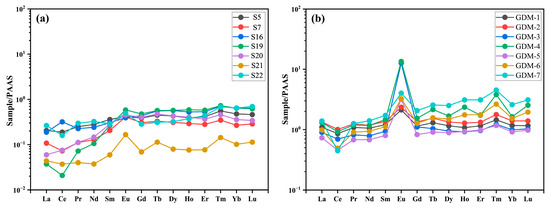
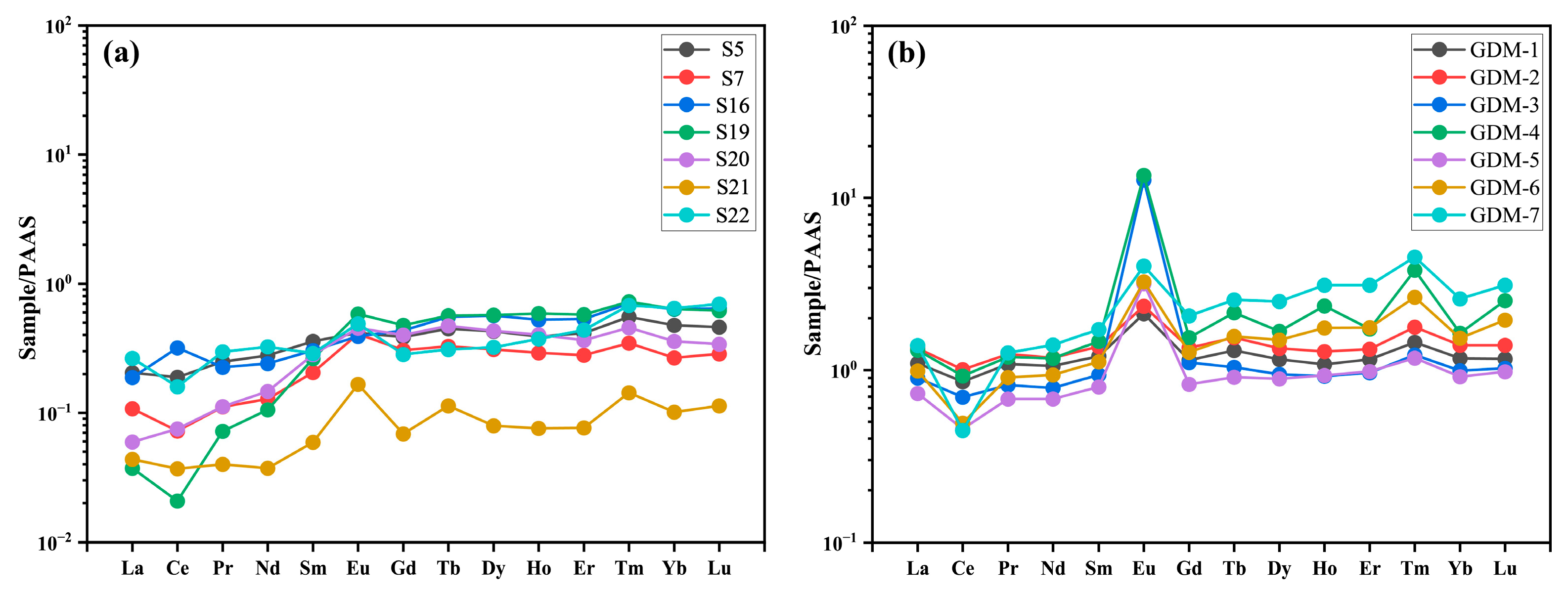
PAAS-normalized REE patterns of the samples display a left-sloping trend, indicating significant heavy rare earth element enrichment in the HTC section (Figure 6a). When compared with the hydrothermal well GMD-1, the two exhibit nearly consistent left-sloping variations (Figure 6b). Only the Eu anomaly magnitude of the HTC section is lower than that of well GMD-1. It can be inferred that the formation of sedimentary rocks in the study area is closely associated with hydrothermal activity. Well GMD-1 shows pronounced positive Eu anomalies (Figure 6b), indicative of intense hydrothermal activity. In contrast, hydrothermal activity during the deposition of HTC sedimentary rocks was relatively weak and exhibited distinct episodic characteristics (Figure 5).
Figure 6.
PAAS-normalized rare earth element patterns of the analyzed samples. (a) HTC section; (b) GDM-1 well [7].
5.4. Implications for Ore-Genesis Discrimination
Numerous ore deposits occur within Early Cambrian black shales, and Hy has been documented in many of them. Because it is invariably associated with Ba-rich hydrothermal fluids, Hy is widely used as a diagnostic indicator of hydrothermal ore genesis. Examples include the Dachang Sn-polymetallic deposit [37], the Lifang barite deposit in Fujian [57], and the Xinhuang–Tianzhu barite district of Hunan–Guizhou, where Hy occurrences confirm a hydrothermal origin [58]. In the HTC section, Hy is intergrown with barite (Figure 2f), allowing its use as a reliable tracer of hydrothermal mineralisation. Hydrothermal rutile can likewise be employed to fingerprint ore-forming processes [47].
Moreover, hydrothermal barite is an excellent substrate for Sr–S isotope analyses and fluid-inclusion thermometry, providing robust constraints on the geochemical signature of ore-forming fluids [49,51]. Consequently, as a common accessory phase in volcanic-hosted massive sulphide and sedimentary-exhalative deposits, hydrothermal barite enhances understanding of ore-forming processes and can guide exploration for associated sulphide ores [59,60].
6. Conclusions
- (1)
- The occurrence of Hy in the study area indicates that hydrothermal discharge occurred during the Early Cambrian. Hydrothermal activity exhibits obvious stratigraphic differentiation within the studied succession. The upper unit, dominated by chert, displays prominent positive Eu/Eu* anomalies, implying longer duration and greater intensity of hydrothermal activity compared with the middle and lower intervals.
- (2)
- The discrimination of petrogenesis, solely based on major elements (Fe, Mn, and Al), carries inherent uncertainties. Thus, integrated constraints from mineralogical evidence and rare earth element signatures are indispensable for reliable petrogenetic interpretation.
- (3)
- Intergrowth of Hy with barite in the HTC section, together with its documented role as a tracer of hydrothermal ore systems elsewhere, allows Hy to be employed as a prospecting indicator for hydrothermal ore deposits.
Integrated analysis of geological, geochemical, and palaeontological evidence provides an effective approach to identify and reconstruct ancient hydrothermal events. Future technological and methodological improvements will further deepen our understanding of ancient hydrothermal processes and offer critical insights into the evolutionary mechanism of early oceans as well as the coeval biological origin.
Supplementary Materials
The following supporting information can be downloaded at: https://www.mdpi.com/article/10.3390/min16050525/s1, Table S1: Table of Chemical Elements and Geochemical Indices for HTC Section.
Author Contributions
Conceptualization, D.Z.; Methodology, D.Z.; Software, L.H., Y.L., A.T. and H.D.; Validation, D.Z.; Formal analysis, L.H. and H.Z.; Investigation, L.H., Y.L., A.T., H.Z., H.D., X.H. and D.Z.; Resources, D.Z.; Data curation, Y.L. and X.H.; Writing—original draft, L.H.; Writing—review & editing, D.Z.; Visualization, L.H.; Supervision, D.Z.; Project administration, D.Z.; Funding acquisition, D.Z. All authors have read and agreed to the published version of the manuscript.
Funding
This research was funded by the National Natural Science Foundation of China (grant number: 42572196).
Data Availability Statement
The data presented in this study are openly available in Table S1 Main elemental data and rare earth element data for HTC samples at 10.5281/zenodo.17790417.
Acknowledgments
The authors are grateful to editor and three anonymous reviewers for their careful reviews and detailed comments, which helped to substantially improve the manuscript.
Conflicts of Interest
The authors declare no conflict of interest.
References
- Eyuboglu, Y.; Santosh, M.; Yi, K.; Tuysuz, N.; Korkmaz, S.; Akaryali, E.; Dudas, F.O.; Bektas, O. The Eastern Black Sea-Type Volcanogenic Massive Sulfide Deposits: Geochemistry, Zircon U–Pb Geochronology and an Overview of the Geodynamics of Ore Genesis. Ore Geol. Rev. 2014, 59, 29–54. [Google Scholar] [CrossRef] [Scilit]
- Zhou, D.S.; Dong, H.Z.; Huang, X.W.; Liang, Y.F.; Deng, Z.Y.; Huang, L.; Jiang, S. The Paleo-Oceanic Environment and Organic Matter Enrichment Mechanism of the Early Cambrian in the Southern Lower Yangtze Platform, China. Mar. Pet. Geol. 2024, 170, 107119. [Google Scholar] [CrossRef] [Scilit]
- Yang, W.; Tao, C.; Liao, S.; Liang, J.; Li, W.; Ding, T.; Dias, Á.A.; Wang, X.; Wang, L. Record of Hydrothermal Activity in the Yuhuang Hydrothermal Field and Its Implications for the Southwest Indian Ridge: Evidence from Sulfide Chronology. Acta Oceanol. Sin. 2023, 42, 59–68. [Google Scholar] [CrossRef] [Scilit]
- Früh-Green, G.L.; Kelley, D.S.; Lilley, M.D.; Cannat, M.; Chavagnac, V.; Baross, J.A. Diversity of Magmatism, Hydrothermal Processes and Microbial Interactions at Mid-Ocean Ridges. Nat. Rev. Earth Environ. 2022, 3, 852–871. [Google Scholar] [CrossRef] [Scilit]
- Gartman, A.; Findlay, A.J. Impacts of Hydrothermal Plume Processes on Oceanic Metal Cycles and Transport. Nat. Geosci. 2020, 13, 396–402. [Google Scholar] [CrossRef] [Scilit]
- Han, S.; Hu, K.; Cao, J.; Pan, J.; Xia, F.; Wu, W. Origin of Early Cambrian Black-Shale-Hosted Barite Deposits in South China: Mineralogical and Geochemical Studies. J. Asian Earth Sci. 2015, 106, 79–94. [Google Scholar] [CrossRef] [Scilit]
- Wu, Y.; Tian, H.; Gong, D.; Li, T.; Zhou, Q. Paleo-Environmental Variation and Its Control on Organic Matter Enrichment of Black Shales from Shallow Shelf to Slope Regions on the Upper Yangtze Platform during Cambrian Stage 3. Paleogeogr. Paleoclimatol. Paleoecol. 2020, 545, 109653. [Google Scholar] [CrossRef] [Scilit]
- Takai, K.; Nakagawa, S.; Reysenbach, A.-L.; Hoek, J. Microbial Ecology of Mid-Ocean Ridges and Back-Arc Basins. In Back-Arc Spreading Systems: Geological, Biological, Chemical, and Physical Interactions; Geophysical Monograph Series; Christie, D.M., Fisher, C.R., Lee, S.-M., Givens, S., Eds.; American Geophysical Union: Washington, DC, USA, 2006; Volume 166, pp. 185–213. [Google Scholar]
- Feng, L.; Li, C.; Huang, J.; Chu, X. A Sulfate Control on Marine Mid-Depth Euxinia on the Early Cambrian (ca. 529–521Ma) Yangtze Platform, South China. Precambrian Res. 2014, 246, 123–133. [Google Scholar] [CrossRef] [Scilit]
- Gao, P.; He, Z.; Li, S.; Lash, G.G.; Li, B.; Huang, B.; Yan, D. Volcanic and Hydrothermal Activities Recorded in Phosphate Nodules from the Lower Cambrian Niutitang Formation Black Shales in South China. Paleogeogr. Paleoclimatol. Paleoecol. 2018, 505, 381–397. [Google Scholar] [CrossRef] [Scilit]
- Li, C.; Jin, C.; Planavsky, N.J.; Algeo, T.J.; Cheng, M.; Yang, X.; Zhao, Y.; Xie, S. Coupled Oceanic Oxygenation and Metazoan Diversification during the Early–Middle Cambrian? Geology 2017, 45, 743–746. [Google Scholar] [CrossRef] [Scilit]
- Yao, H.S.; He, X.P.; Wang, K.M. Geochemical characteristics and significance of the shale of Lower Cambrian Hetang Formation in the southern Anhui Province of Lower Yangtze area. Mar. Geol. Front. 2022, 38, 32–41. [Google Scholar]
- Jiang, G.; Shi, X.; Zhang, S.; Wang, Y.; Xiao, S. Stratigraphy and Paleogeography of the Ediacaran Doushantuo Formation (ca. 635–551Ma) in South China. Gondwana Res. 2011, 19, 831–849. [Google Scholar] [CrossRef] [Scilit]
- Wang, J.; Li, Z.X. History of Neoproterozoic Rift Basins in South China: Implications for Rodinia Break-Up. Precambrian Res. 2003, 122, 141–158. [Google Scholar] [CrossRef] [Scilit]
- Hicks, M.; Rowland, S.M. Early Cambrian Microbial Reefs, Archaeocyathan Inter-Reef Communities, and Associated Facies of the Yangtze Platform. Paleogeogr. Paleoclimatol. Paleoecol. 2009, 281, 137–153. [Google Scholar] [CrossRef] [Scilit]
- Torsvik, T.H.; Cocks, L.R.M. New Global Palaeogeographical Reconstructions for the Early Palaeozoic and Their Generation. Geol. Soc. Lond. Mem. 2013, 38, 5–24. [Google Scholar] [CrossRef] [Scilit]
- Wu, Y.D. Sequence Stratigraphy of the Cambrian in the Dongzhi Region of Southern Anhui Province. J. Palaegeogr. 2001, 3, 55–62. [Google Scholar]
- Zhang, H.; Liang, J.; Azmy, K.; Zhong, Y.; Jiang, H.; Wen, H. Carbon-Isotope Stratigraphy of the Lower Cambrian (Cambrian Explosion) in Northwestern Yangtze Platform, China: Implications for Global Correlation. Mar. Pet. Geol. 2024, 166, 106909. [Google Scholar] [CrossRef] [Scilit]
- Zhu, M.Y.; Zhang, J.M.; Steiner, M.; Yang, A.H.; Li, G.X.; Erdtmann, B.D. Sinian-Cambrian Stratigraphic Framework for-Shallow- to Deep-Water Environments of the Yangtze Platform: An Integrated Approach. Prog. Nat. Sci. 2003, 13, 951–960. [Google Scholar] [CrossRef] [Scilit]
- Chen, D.; Wang, J.; Qing, H.; Yan, D.; Li, R. Hydrothermal Venting Activities in the Early Cambrian, South China: Petrological, Geochronological and Stable Isotopic Constraints. Chem. Geol. 2009, 258, 168–181. [Google Scholar] [CrossRef] [Scilit]
- Zhang, Y.; Fang, W.X.; Xu, L.G.; Chen, W.; Zhang, Z.B.; Ye, H.S.; Liu, L.; Wang, W.; Zhao, X.; Wu, H. Reviews of Important Elements in Sedimentary Minerals Deposited Around Yangtze Block from Neoproterozoic to Early Paleozoic and Their Relationship to Old Ocean. Geol. Rev. 2024, 70, 679–704. [Google Scholar] [CrossRef]
- Liu, S.C.; Ning, Y.Y.; Zheng, S.D. Petrogenesis and Sedimentary Environment of Black Rock Series of the Lower Cambrian Shuigoukou Formation in South Qinling. Acta Geol. Sin. 2021, 95, 549–564. [Google Scholar] [CrossRef]
- Wang, Y.; Liu, P.; Chang, C.; Cao, L.J.; Jiang, C.Y.; Zhao, F.S.; Han, G.; Zhang, X. Research progress, problems and prospects of barite deposits around Yangtze Platform. Miner. Depos. 2025, 44, 733–755. [Google Scholar] [CrossRef]
- Zhao, G.L.; Zhao, C.L.; Wang., D.A.; Li, R.W.; Wei, J.Z. Origins and Environment Types of Chert in Western Zhejiang and Southern Anhui from Late Sinian to Early Cambrian. Geoscience 2001, 4, 370–376. [Google Scholar]
- GB/T 14506.3-2010; Methods for Chemical Analysis of Silicate Rocks—Part 3: Determination of Main Components by Wet Chemical Method. Standards Press of China: Beijing, China, 2010.
- Taylor, S.R.; McLennan, S.M. The Continental Crust: Its Composition and Evolution; Blackwell Scientific Publications: Oxford, UK, 1985; 312p. [Google Scholar]
- Holdaway, H.K.; Clayton, C.J. Preservation of shell microstructure in silicified brachiopods from the Upper Cretaceous Wilmington Sands of Devon. Geol. Mag. 1982, 119, 371–382. [Google Scholar] [CrossRef] [Scilit]
- Adachi, M.; Yamamoto, K.; Sugisaki, R. Hydrothermal chert and associated siliceous rocks from the northern Pacific their geological significance as indication od ocean ridge activity. Sediment. Geol. 1986, 47, 125–148. [Google Scholar] [CrossRef] [Scilit]
- Boström, K.; Kraemer, T.; Gartner, S. Provenance and accumulation rates of opaline silica, Al, Fe, Ti, Mn, Cu, Ni and Co in Pacific pelagic sediments. Chem. Geol. 1973, 11, 123–148. [Google Scholar] [CrossRef] [Scilit]
- Yamamoto, K. Geochemical characteristics and depositional environments of cherts and associated rocks in the Franciscan and Shimanto Terranes. Sediment. Geol. 1987, 52, 65–108. [Google Scholar] [CrossRef] [Scilit]
- Liu, T.L.; Jiang, Z.X.; Liu, W.W.; Zhang, K.; Xie, X.L.; Yin, L.; Huang, Y.Z. Effect of hydrothermal activity on the enrichment of sedimentary organic matter at Early Cambrian in the Xiuwu Basin. Pet. Geol. Recovery Effic. 2018, 25, 68–76. [Google Scholar]
- Nesbitt, H.W.; Young, G.M. Prediction of some weathering trends of plutonic and volcanic rocks based on thermodynamic and kinetic considerations. Geochim. Cosmochim. Acta 1984, 48, 1523–1534. [Google Scholar] [CrossRef] [Scilit]
- Dong, H.Z.; Zhou, D.S.; Liang, Y.F.; Huang, L. Oxygen Levels Regulate the Co-Evolution of Non-Terrigenous Silica and Organic Matter in Deep- to Semi-Deep Waters during the Ediacaran-Cambrian Transition. Palaeogeogr. Palaeoclimatol. Palaeoecol. 2025, 679, 113301. [Google Scholar] [CrossRef] [Scilit]
- Yang, T.; Dekkers, M.J.; Zhao, X.; Petronotis, K.E.; Chou, Y.M. Greigite Formation Modulated by Turbidites and Bioturbation in Deep-Sea Sediments Offshore Sumatra. J. Geophys. Res.-Solid Earth 2022, 127, e2022JB024734. [Google Scholar] [CrossRef] [Scilit]
- Dong, H.Z.; Zhou, D.S.; Huang, X.W.; Liang, Y.F.; Huang, L.; Xu, J. Do Hydrothermal Fluids Cause a Dilution Effect on Organic Matter in the Early Cambrian Marine Black Shales? Mar. Pet. Geol. 2025, 176, 107361. [Google Scholar] [CrossRef] [Scilit]
- Yang, Z.Y.; Sun, J.W.; Lawrence, J.D. Hyalophane Series from Bayan Obo and Barium Metasomatism. Contrib. Geol. Miner. Resour. Res. 1993, 8, 89–94. [Google Scholar]
- Han, F.; Shen, J.Z.; Richard, W.H. Adularia—An Important Indicator Mineral of Syngenetic Origin for Stratiform Mineralization at the Dachang Tin-Polymetallic Deposit. Miner. Depos. 1993, 12, 330–336. [Google Scholar] [CrossRef]
- Long, H.B.; Long, J.C.; Zhong, Y.R. Discovery of Adularite (Barium-Adularia Rock) in the Vanadium Deposit of the Black Rock Series, Zhangcun-Zhengfang Area. Chin. Sci. Bull. 1994, 39, 636–638. [Google Scholar]
- Xia, F.; Ma, D.S.; Pan, J.Y.; Chen, S.H.; Cao, S.L.; Sun, Z.X.; Liu, C.D.; Guo, L.L. EMP Study of Early Cambrian Barite Deposits in Eastern Guizhou, China. Acta Mineral. Sin. 2005, 25, 289–294. [Google Scholar]
- Yang, R.D.; Wei, H.R.; Bao, M.; Wang, W.; Wang, Q. Submarine Hydrothermal Venting—Flowing Sedimentary Characters of the Cambrian Shanggongtang and Dahebian Barite Deposits Tianzhu County Guizhou Province. Geol. Rev. 2007, 53, 675–680. [Google Scholar]
- Han, S.C.; Hu, K.; Cao, J. First Discovery of Zoned Hyalophane in the Barite Deposits Hosted in Early Cambrian Black Shales of South China and Its Geological Implications. Geol. Rev. 2013, 59, 1143–1149. [Google Scholar]
- Mu, B.L.; Shao, J.A.; Zhang, H.; Lin, B.; Yan, G.H. The Chemical Composition and Texture of the Multicomponents Feldspar in the Fanshan Complex, and Their Im plications. Bull. Mineral. Petrol. Geochem. 2013, 32, 70–80. [Google Scholar]
- Luo, H.; Shao, D.Y.; Meng, K.; Zhang, Y.; Song, H.; Yan, J.P.; Zhang, T.W. Origin of excess barium in the Camrian shale of Yichang area, western Hubei, and its implication for organic matter accumulation. Earth Sci. Front. 2023, 30, 066–082. [Google Scholar]
- Chen, Q.; Wang, C.; Bagas, L.; Du, B.; Shi, K.; Zhu, J. Hydrothermal Fluid Signatures of the Yulong Porphyry Cu-Mo Deposit: Clues from the Composition and U-Pb Dating of W-Bearing Rutile. Am. Miner. 2023, 108, 1092–1108. [Google Scholar] [CrossRef] [Scilit]
- Meinhold, G. Rutile and Its Applications in Earth Sciences. Earth-Sci. Rev. 2010, 102, 1–28. [Google Scholar] [CrossRef] [Scilit]
- Zheng, J.; Chen, B.; Liu, S.; Bao, C. A Triassic Orogenic Gold Mineralization Event in the Paleoproterozoic Metamorphic Rocks: Evidence from Two Types of Rutile in the Baiyun Gold Deposit, Liaodong Peninsula, North China Craton. Econ. Geol. 2022, 117, 1657–1673. [Google Scholar] [CrossRef] [Scilit]
- Ying, Y.C.; Chen, W.; Liu, J.J.; Yan, F.; Jiang, S.Y. Niobium Mineralization in the Miaoya Alkaline Complex, Hubei Province: Constraints from Rutile Mineralogy and Geochronology. Geol. J. Chin. Univ. 2024, 30, 345–361. [Google Scholar]
- Maciel, I.B.; Balsamo, F.; Bezerra, F.H.R.; Nogueira, F.C.C.; Berio, L.R.; Brod, J.A.; Souza, Z.S.; Matos-Pimentel, H.L.S.; Carvalho, B.R.B.M.; Souza, J.A.B. Hydrothermal Silicification along Rift Border Faults in the Rio Do Peixe Basin, Brazil. Mar. Pet. Geol. 2024, 168, 107025. [Google Scholar] [CrossRef] [Scilit]
- Pan, Z.F.; Fu, Y.; Guo, C.; Shi, C.H.; Liu, L.; Liu, Y.; Long, Z.; Luo, P.Q.; Liu, G.D.; Yao, L. Geological characteristics, mineralization and metallogenic mechanism of barite mineralization. Miner. Depos. 2023, 42, 90–115. [Google Scholar]
- Lin, D.; Xi, Z.; Tang, S.; Lash, G.G.; Li, J.; Gou, Q.; Zhang, K.; Mei, X.; Wang, K. Enrichment Mechanism of Organic Matter and Silicon in Lower Cambrian Shale of the Yangtze Platform. Paleogeogr. Paleoclimatol. Paleoecol. 2024, 648, 112282. [Google Scholar] [CrossRef] [Scilit]
- Zhou, X.Q.; Yu, H.; Huang, T.Y.; Zhang, L.Y.; Zhang, G.J.; Fu, Y.; Chen, D.Z. Genetic Classification of Sedimentary Barites and Discussion on the Origin of the Lower Cambrian Barite-rich Deposits in the Yangtze Block, South China. Acta Sedimentol. Sin. 2016, 34, 1044–1056. [Google Scholar]
- Wei, S.C.; Chen, Q.F.; Fu, Y.; Cui, T.; Liang, H.P.; Ge, Z.H.; Zhang, P.; Zhang, Y. Origin of Cherts during the Ediacaran-Cambrian Transition in Hunan and Guizhou Provinces, China: Evidences from REE and Ge/Si. Acta Sci. Nat. Univ. Pekin. 2018, 54, 1010–1020. [Google Scholar]
- Armstrong, H.A.; Owen, A.W.; Floyd, J.D. Rare Earth Geochemistry of Arenig Cherts from the Ballantrae Ophiolite and Leadhills Imbricate Zone, Southern Scotland: Implications for Origin and Significance to the Caledonian Orogeny. J. Geol. Soc. 1999, 156, 549–560. [Google Scholar] [CrossRef] [Scilit]
- Blanco, G.; Abre, P.; Ferrizo, H.; Gaye, M.; Gamazo, P.; Ramos, J.; Alvareda, E.; Saracho, A. Revealing Weathering, Diagenetic and Provenance Evolution Using Petrography and Geochemistry: A Case of Study from the Cretaceous to Cenozoic Sedimentary Record of the SE Chaco-Parana’ Basin in Uruguay. J. S. Am. Earth Sci. 2021, 105, 102974. [Google Scholar] [CrossRef] [Scilit]
- Dias, Á.S.; Früh-Green, G.L.; Bernasconi, S.M.; Barriga, F.J.A.S. Geochemistry and Stable Isotope Constraints on High-Temperature Activity from Sediment Cores of the Saldanha Hydrothermal Field. Mar. Geol. 2011, 279, 128–140. [Google Scholar] [CrossRef] [Scilit]
- Wang, J.; Chen, D.; Yan, D.; Wei, H.; Xiang, L. Evolution from an Anoxic to Oxic Deep Ocean during the Ediacaran–Cambrian Transition and Implications for Bioradiation. Econ. Geol. 2012, 306–307, 129–138. [Google Scholar] [CrossRef] [Scilit]
- Li, D.P.; Luo, K.; Xiao, A.F.; Kong, L.T. The new cognition of the genesis of the Lifang barite deposit in Fujian province: Evidence from ore structure, mineralogy and fluid inclusions. Acta Geol. Sin. 2019, 93, 3095–3110. [Google Scholar]
- Sun, Z.H. The Ore-Forming Environment and Mineralization of the Barite Deposits in Xinhuang and Tianzhu of the West Hunan and East Guizhou Province. Master’s Thesis, Nanjing University, Nanjing, China, 2016; pp. 1–99, (In Chinese with English abstract). [Google Scholar]
- Kelley, K.D. A Special Issue Devoted to Barite and Zn-Pb-Ag Deposits in the Red Dog District, Western Brooks Range, Northern Alaska (Preface). Econ. Geol. 2004, 99, 1267–1270. [Google Scholar] [CrossRef]
- Johnson, C.A.; Kelley, K.D.; Leach, D.L. Sulfur and Oxygen Isotopes in Barite Deposits of the Western Brooks Range, Alaska, and Implications for the Origin of the Red Dog Massive Sulfide Deposits. Econ. Geol. 2004, 99, 1435–1462. [Google Scholar] [CrossRef]

Disclaimer/Publisher’s Note: The statements, opinions and data contained in all publications are solely those of the individual author(s) and contributor(s) and not of MDPI and/or the editor(s). MDPI and/or the editor(s) disclaim responsibility for any injury to people or property resulting from any ideas, methods, instructions or products referred to in the content. |
© 2026 by the authors. Licensee MDPI, Basel, Switzerland. This article is an open access article distributed under the terms and conditions of the Creative Commons Attribution (CC BY) license.