


Abstract
Mafic ultrapotassic volcanics (kamafugites, mafurites) are the youngest eruptives in the Bunyaruguru volcanic field, which is part of the Toro Ankole Province at the northernmost reach of the West Branch of the East African Rift Valley. We obtained new data using LA-ICP-MS on the trace element contents (rare earth, large ion lithophile, high field strength and compatible elements) in clinopyroxene phenocrysts from mafurite lava of the Bunyaruguru volcanic field. The clinopyroxenes are notable for their anomalously high zirconium contents (up to 800–1000 ppm), which is unusual in mafic silicate magmas but typical for clinopyroxenes from carbonatite lavas. This distinctive signature is not found in clinopyroxene in coeval mafic lavas from neighboring vents. Carbonate is also found in the Bunyaruguru volcanic rocks in the form of inclusions in high-Mg olivine phenocrysts, suggesting carbonated material exists in the source of kamafugite magmas. Carbonatites are widespread in the neighboring Fort Portal volcanic field, and we interpret the high-zirconium clinopyroxene as evidence for mixing of mafurite magmas with carbonatite melts.
1. Introduction
The study of rock-forming minerals is an important part of geochemical research into magmatic processes, helping to better understand magma formation and evolution. Young volcanic rocks are valuable objects for geochemical research due to the well-preserved nature of their samples, unaffected by secondary alteration. Volcanic rocks of the northern part of the West Branch of the East African Rift are the youngest formations in the entire Rift structure, a classic region for ultrapotassic magmatism [1,2,3,4]. The significant enrichment of ultrapotassic rocks in lithophile elements indicates their formation from a metasomatized mantle source. The agents of mantle metasomatism can be fluids (CO2, H2O, F) and/or low-grade mantle melts of silicate or carbonate composition [2,4,5,6,7,8]. Carbonatite melts are active agents of mantle metasomatism [9,10,11,12], enhancing melt production at temperatures lower than the melting point of anhydrous peridotite.
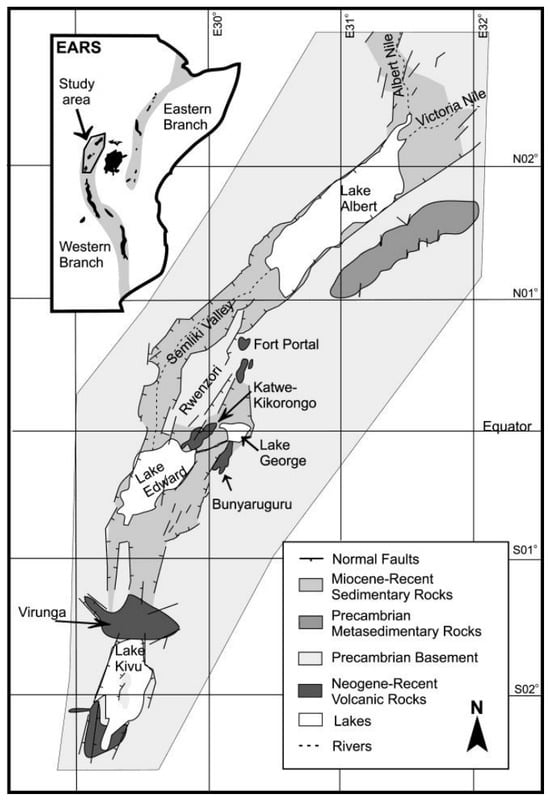
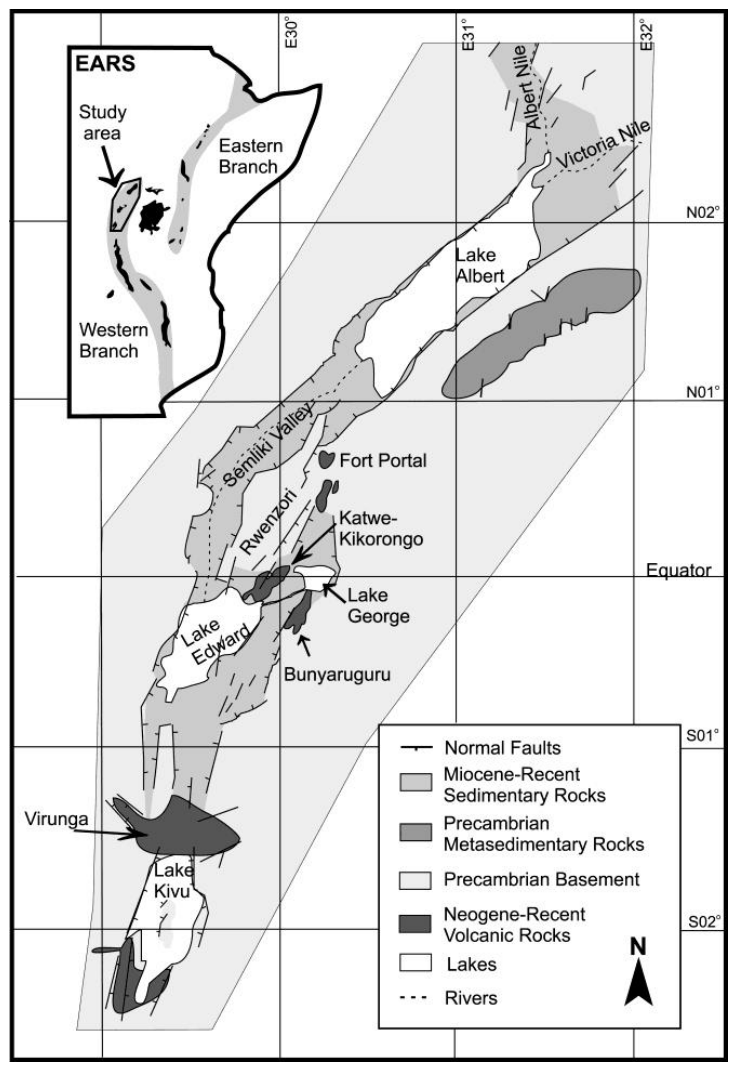
In the Fort Portal volcanic field (northernmost extent of the Western Rift), carbonatites form extrusive outcrops in the form of explosion craters [13]. The Fort Portal volcanic province in Western Uganda (Figure 1) is a rare Quaternary-aged (~4000–4700 years old) field known for its unusual extrusive carbonatite lavas and ruff cones. Covering 145 sq km with over 50 vents near the Ruwenzori Mountains, it features calcite-rich, low-alkali lava. Further south, mafic alkaline volcanic rocks of the Bunyaruguru field, known collectively as kamafugites, record the effects of mantle metasomatism by both volatile-rich silicate melts preserved in MARID-type metasomes and by carbonate-rich melts/fluids; these effects are apparent in the composition of lavas, their phenocrysts and mantle xenoliths. The Bunyaruguru volcanic field lacks carbonatite lavas, but widespread kamafugites (ugandites, mafurites) display carbonate both as inclusions in olivines and clinopyroxenes and as independent segregations [14].
Figure 1.
Simplified map showing the Kivu–Edward–Albert–Western Rift Zone in the East African Rift System. The top inset shows a section of East Africa with the location of the two rift branches [15]. The Nyungu crater is located within the Bunyaruguru volcanic field.
Early-formed clinopyroxene and olivine provide important information about the composition of mantle-derived parental melts and, consequently, the source of these magmas. Our preliminary studies have identified elevated Zr and Hf contents in the green cores clinopyroxene from the Nyungu crater. This geochemical signature, similar to those of carbonatites, is absent in all other mafic lavas from throughout the Bunyaruguru area. Here we present new trace element data on clinopyroxenes from Nyungu crater lavas, obtained by laser ablation at the Vernadsky Institute of Geochemistry and Analytical Chemistry, Russian Academy of Sciences. We use these data to document contributions from carbonatitic melts and to infer the source region from which the carbonate was formed.
Volcanism in the Western Rift is limited to four main regions in addition to isolated small areas where volcanic intrusions are present; from north to south these are Toro Ankole, Virunga, South Kivu and Rungwe. In general, the volcanics form spatially isolated rock units that occur in conjunction with the rift grabens. Volcanism in the Toro Ankole province at the northern end of the Western Rift appears to be restricted to the past 1 million years [16,17]. K-Ar and 40Ar/39Ar ages indicate that volcanism is at most 50,000 years old [18]. The explosive eruptions that occurred within this region continued until about 4000 years ago [19].
The Toro Ankole province consists of three volcanic fields: Fort Portal, Katwe-Kikorongo and Bunyaruguru. The Bunyaruguru volcanic field—the focus of this research—is located south of Lake George and east of Lake Edward (Figure 1). It consists of numerous explosion craters of Late Pleistocene through the Quaternary age, many of which presently have crater lakes. Most of the volcanics are tuffs; lavas are scarce. Bunyaruguru magmatism is generally similar to that of the neighboring Katwe-Kikorongo province, but the volcanic rocks are characterized by higher Mg# [where Mg# = Mg/(Mg + Fe2+)] in moles, with Fe2+ = 0.85 total Fe, corresponding to redox conditions for the QFM buffer] and a wider distribution of olivine phenocrysts.
In this paper we focus on green-core clinopyroxenes from the Nyungu crater within the Bunyaruguru volcanic field. Detailed trace element analysis of these samples reveals unusually high abundances of Sr, Zr and Hf which are classic signatures of carbonatitic eruptive rocks. This study investigates the role of carbonatite melts in modifying the mantle beneath Bunyaruguru as reflected in the presence of anomalous pyroxenes.
2. Materials and Methods
We studied the trace element composition of clinopyroxene phenocrysts from mafurite lavas from the Nyungu crater, located in the center of the Bunyaruguru volcanic field (Figure 1). The mafurite (sample 11503) was collected west of Nyungu crater from a 10 m thick, ~100 m long lava flow.
Major elements abundances for whole-rock samples were analyzed by X-ray fluorescence with a Phillips PW-1600 instrument at the Vernadsky Institute of Geochemistry and Analytical Chemistry RAS, Moscow, Russia. Details of the analytical techniques can be found in reference [20]. Trace elements were determined by ICP-MS at the Baikal Analytical Center, Irkutsk, Russia, which is a joint facility of the Institute of the Earth’s Crust SB RAS, the A.P. Vinogradov Institute of Geochemistry SB RAS and the Limnological Institute SB RAS. Analyses were conducted using a VG PlasmaQuad 2+ quadrupole mass spectrometer. Details of the analytical techniques can be found in references [21,22]. Analytical accuracy and precision based on repeated analyses of BHVO-1 is estimated to be better than 4.5% (1 sd) with exception for Ho, Sm (5%–7%), Tm, Yb, Pb (8%–10%) and V, Cr, Ni, Zn (10%–15%).
Samples were prepared for analysis as transparent-polished thin sections. Major element contents in the clinopyroxenes were determined by electron probe micro-analysis using a CAMECA SX 100 X-ray microanalyzer at the Vernadsky Institute of Geochemistry and Analytical Chemistry, Russian Academy of Sciences, Moscow, Russia (method described in [23]). Both the central and rim portions of each zoned pyroxene grain were analyzed.
Trace element contents in mineral phases were determined by LA-ICP-MS on an Element-XR inductively coupled plasma ionization mass spectrometer with an LSX-213 G2+ laser attachment (Teledyne Photon Machines, Bozeman, MT, USA). The following parameters were used for analysis: crater diameter—40 μm, laser pulse frequency—8 Hz, laser beam speed—1 μm/s, analyzed area length—100 μm, gas flow rates: helium—1.0—0.9 L/min, argon: working gas—0.925 L/min, auxiliary gas—1.9 L/min, cooling gas—16.0 L/min. Measurements were performed at low resolution (R = 300).
NIST-610 synthetic glass was used as a calibration standard for elemental content determination by LA-ICP-MS. Quality control of the measurements was performed using the ML3B natural glass standard and the NIST-610 synthetic glass standard, with concentration values for the standards taken from the MPH GeoRem Database (http://georem.mpch-mainz.gwdg.de accessed 14 October 2024) [24]; Relative deviations of trace element contents in the NIST SRM 610 standard, determined from a set of measurements over several analytical sessions, are within 3 rel.%, and for the ML3B glass standard, from 10 to 30 rel.%. Si was chosen as the internal standard for the calculations, as it is an element with high concentrations relative to background values and is most homogeneously distributed across the phases. Data were processed using the Glitter program [25] following the approach of [26].
3. Results
3.1. Petrographic Features
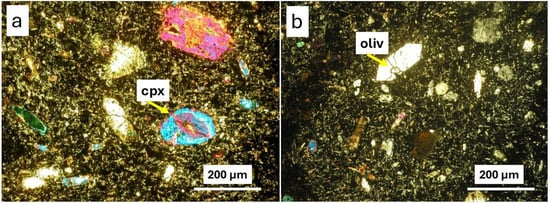
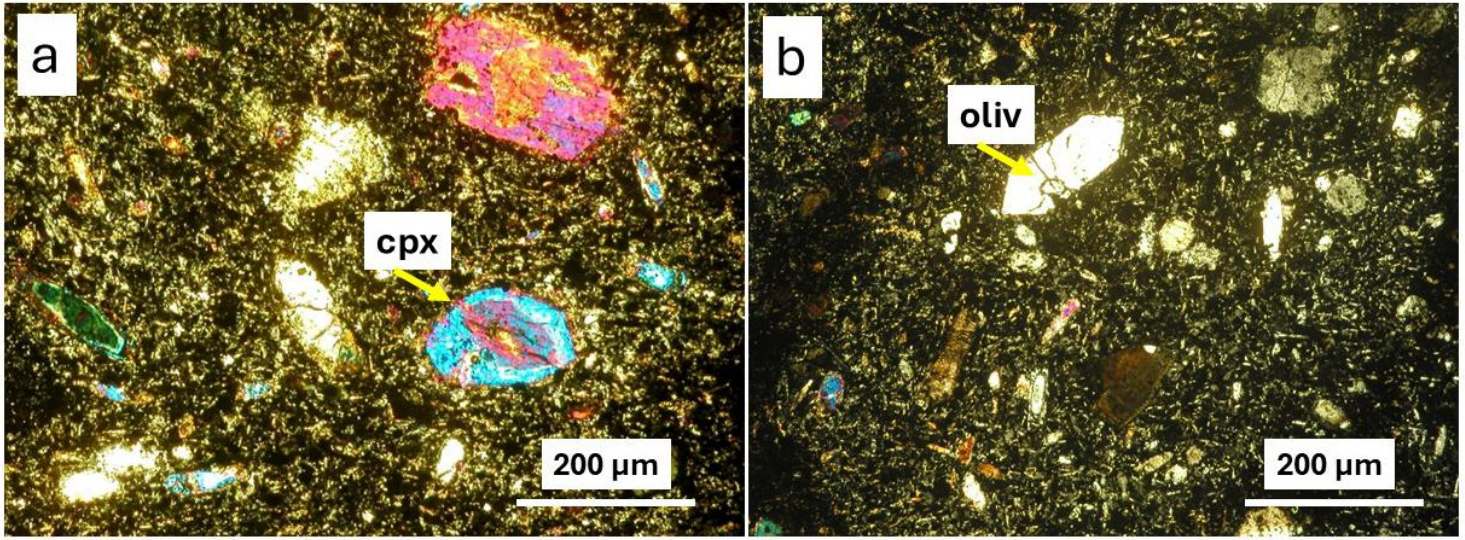
The lava is mafurite in composition (Table 1) and contains sparse inequigranular phenocrysts of olivine, clinopyroxene, perovskite, and titanomagnetite in a matrix of fresh and devitrified glass (Figure 2). Olivine (50–700 μm) is rare; clinopyroxene is abundant (100 µm–3 mm) and grains are generally zoned. Perovskite (20–200 μm) exhibits cyclic zonation. Mica is very rare. Crystalline segregations of Sr-calcite (450 μm × 300 μm), dolomite (250 μm × 250 μm), and barite (300 μm × 100 μm) are present in, and possibly syngenetic with, the groundmass. Dolomite and barite occur as inclusions in olivine.
Table 1.
Major and trace element composition of the Nyungu mafurite.
Figure 2.
Mafurite sample 11503 from Nyungu crater. Selected areas of representative thin sections showing microlitic textures and (a) zoned clinopyroxene (crossed polars); (b) euhedral olivine (plane polarized light).
3.2. Mineral Major Element Compositions
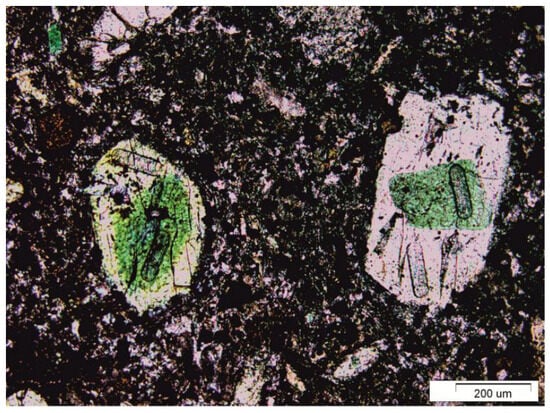
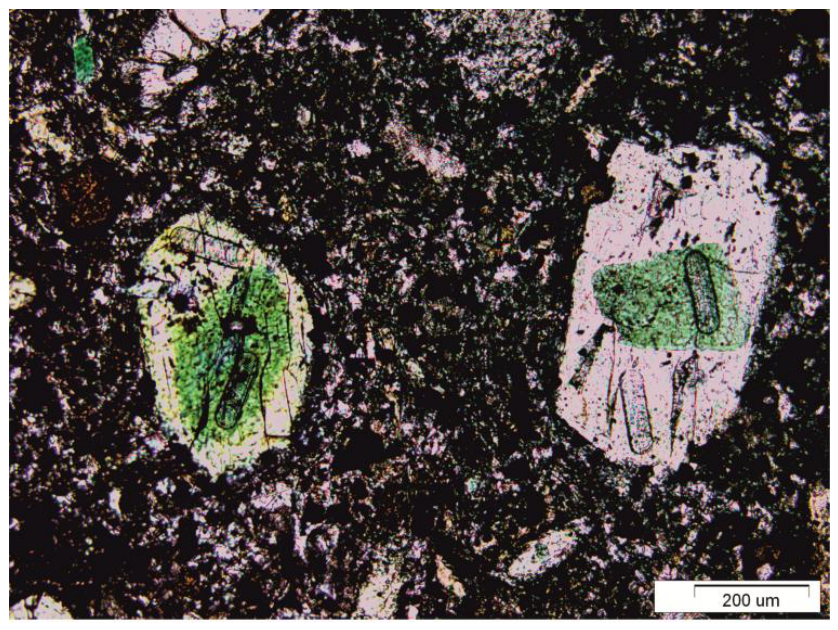
Analysis of clinopyroxene phenocrysts revealed numerous grains with reverse zoning (Figure 2 and Figure 3; Table S1), i.e., grains in which the central zones, sometimes with angular, irregular outlines, are enriched in iron (≤17 wt.% FeO) and sodium (≤2.5 wt.% Na2O), compared to the marginal zones, which have rounded boundaries and elevated magnesium content (≤16.3 wt.% MgO). A common feature of the major-element composition of clinopyroxenes is their high Mg# (in most cases, Mg# > 0.8), low Cr2O3 ≤ 0.2 wt.% Cr2O3, Al2O3 (0.8–1.9 wt.%) contents, and ~1–1.5 wt.% TiO2. Reversely zoned clinopyroxenes in mafurites from this region were described previously [23,27], but their trace and minor element compositions were not determined. In addition to clinopyroxene, the mafurite contains homogeneous phenocrysts of high-magnesian olivine (Mg# = 0.85–87) with NiO (0.06–1.18 wt.%) and CaO (0.31–1.2 wt.%), which are in equilibrium with the host rock, supporting a mantle origin for the parent melt. An indicator of chemical equilibrium between crystals and melt is their compositional homogeneity, whereas phenocryst zoning indicates the absence of long-term equilibrium. We focus on Mg# as the indicator for zoning in the studied minerals, as this parameter decreases from core to rim during normal melt evolution [23]. The Mg# of the marginal zones of clinopyroxenes corresponds with the Mg# of the olivine phenocrysts. In mafurites of the Nyungu crater, signs of carbonate enrichment are evident in all three objects: lava, phenocrysts, and xenolith.
Figure 3.
Polarized light image of reverse-zoned clinopyroxene phenocrysts in mafurite. The green cores are enriched in sodium, iron, and zirconium relative to the clear overgrowths. The image shows areas analyzed by laser ablation for trace element abundances.
3.3. Mineral Trace Element Compositions
All studied clinopyroxene phenocrysts have elevated strontium contents (400–600 ppm), similar to levels described for clinopyroxenes in carbonatites [28] and mantle xenoliths, e.g., xenoliths sampled in primary nephelinite magmas of the North Tanzanian Divergence [29].
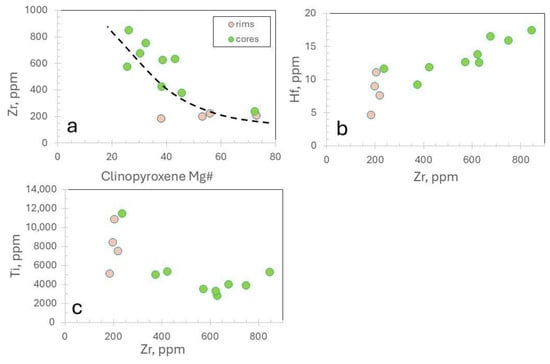
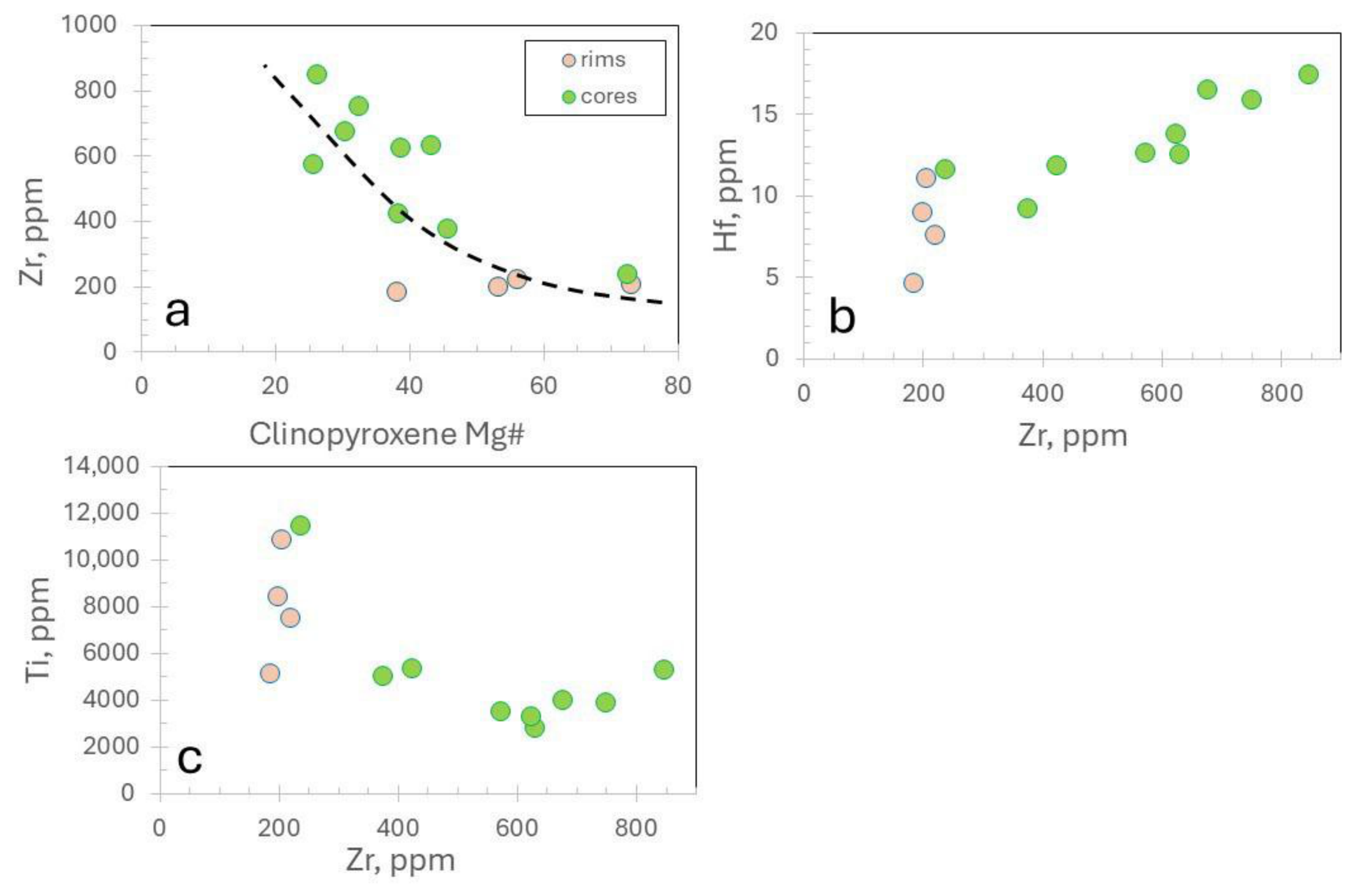
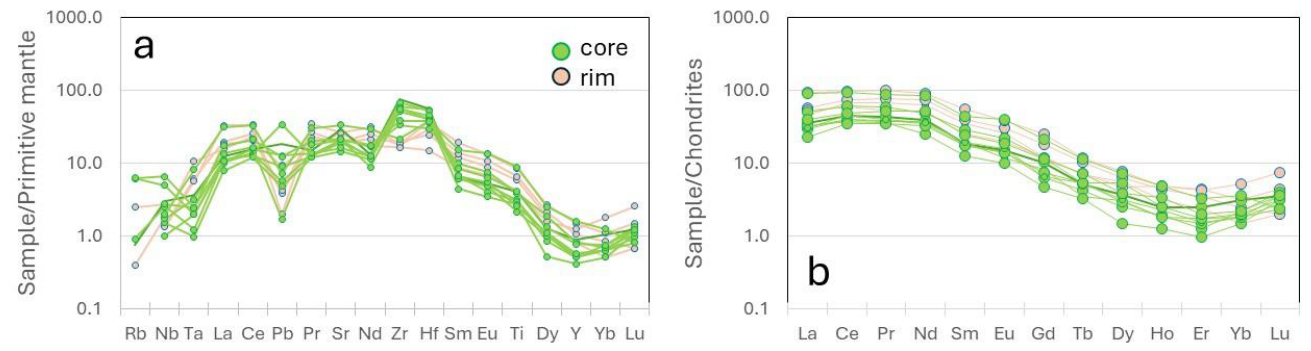
The high zirconium and hafnium contents in the Nyungu crater clinopyroxenes are noteworthy (Figure 4; Table S1). In most mafic lavas from this region, negative Zr-Hf anomalies are observed in the spidergrams of clinopyroxenes [30,31], whereas clinopyroxenes from the Nyungu crater mafurite display elevated Zr and Hf abundances (Figure 5). In the central parts of the phenocrysts, Zr contents reach ~800–1000 ppm, compared to the marginal zones (90–220 ppm) which are in equilibrium with the host melt. High Zr contents (up to 1300 ppm) were also described in green-core pyroxenes in alkaline basalts of Cantal, France [32]. We note that elevated zirconium contents (up to 2365 ppm) are characteristic of pyroxenes in carbonatites from various carbonatite provinces [33].
Figure 4.
Trace element characteristics of mafurite clinopyroxene. (a) Relationship between Zr and Mg#; (b) Zr-Hf correlations; (c) Zr-Ti correlations.
Figure 5.
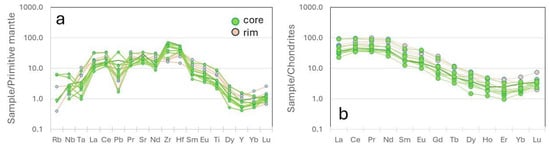
Trace element contents of clinopyroxene phenocrysts from Nyungu carter mafurite. (a) Incompatible element contents normalized to the primitive mantle composition [34]; (b) rare earth element contents normalized to CI chondrite [34]. Filled black symbols indicate the central phenocryst zone, and open symbols indicate the phenocryst rims.
4. Discussion
“Green-core” clinopyroxenes have been described in many continental alkaline basalt provinces, including Uganda [35], the French Massif Central [32], the Western Eifel [36], Italy [33,37,38], Brazil [39] and Western Yunnan, China [40], as well as the Cameroon Line [41,42]. They are most commonly associated with potassic to ultrapotassic magmatism. The bright green coloration of the crystal cores (e.g., Figure 3) results from elevated abundances of Fe2+, as they lack entirely the high Cr contents which lead to a deeper green color in chrome diopside, such as those in mantle xenoliths in alkaline basalts from Tokinsky Stanovik Mountains, Baikal Rift Zone, which contain 0.7–2.3 wt.% Cr2O3 [43,44].
The high Na and Fe2+ contents of green-core clinopyroxenes relative to their compositionally distinct overgrowths has led to the suggestion that they nucleate in magmas that are differentiated relative to the carrier basalt, e.g., [37,38]. However, clinopyroxenes of similar composition (poor in Al2O3, rich in Na2O) were obtained in melting experiments conducted at 30 kbar and 1230 °C using mantle xenoliths from the Toro Ankole province in Uganda [45], raising the possibility that they grew from primitive melts at a depth prior to transport to the surface, see also [36,42,43]. Thus, while there is consensus that the green-core pyroxenes record open-system behavior within periods of growth in two chemically distinct magmas, the details of this process remain enigmatic and may indeed differ between localities.
The ultrapotassic nature of the carrier melts provides strong evidence for sampling of a metasomatized mantle source, e.g., [32], consistent with the melting of the thick cratonic lithosphere or contributions from subducted slab materials, e.g., Leucite Hills, Uganda, Italian volcanic province [37,45,46]. This geodynamic scenario allows for location-specific chemical differences between green-core clinopyroxenes, as the materials involved are by their very nature heterogeneous. For example, clinopyroxenes from potassic syenites of southern Brazil [39] exhibit significantly elevated rare earth element contents compared to those studied here, but their zirconium contents do not exceed 200 ppm. The potassic Cantalian basalts [32] carry green-core clinopyroxenes that exhibit Nb-Ta enrichment, attributed to local percolation of Si-alkaline metasomatic melts.
The high Zr-Hf contents of Nyungu green-core clinopyroxenes are unusual; they likely reflect elevated carbonatite content in the melt and, presumably, in their mantle source [12], thereby providing new insight into their origins. Since kamafugitic magmas do not undergo differentiation in mid-crustal chambers during their rapid ascent to the surface, only the marginal zones of the phenocrysts reach equilibrium with the host melt, while their cores retain their original composition. We suggest that a plausible explanation for the reversely zoned overgrowths in the Nyungu crater clinopyroxenes involves mixing of the carrier mafurite melt with a melt of a different composition, enriched in zirconium and hafnium, from which the cores of clinopyroxene formed. During rapid ascent, kamafugitic magmas likely captured some melt from small chambers located in the lateral zones of the magma conduit. The melt composition in such chambers can differ significantly from the primary mantle magma; we suggest they could be carbonatite melts, which are characterized by a high zirconium content of 415–667 ppm [13]. The different shapes of the core and the final crystal indicate their disequilibrium but do not constrain the time of core formation (from the same melt or primary to that melt) beyond requiring that they are not cognate to the carrier mafurite melt.
All clinopyroxenes are enriched in light rare earth elements relative to heavy elements, with La/Yb = 21.55 and 37.93 for cores and rims, respectively, and 189.76 for whole rock (Table 1 and Table S1), indicating that the ultrapotassic, high-magnesian magmas of this region are formed from an enriched (metasomatized) mantle source. The contents of lithophile elements (Table S1) indicate an enriched distribution pattern (Figure 5), where elevated Zr and Hf contents are also observed in the central parts of phenocrysts with reverse zoning (a “green core”). Average Zr/Hf values of clinopyroxene are 46.31 and 22.25 for core and rim of grains, respectively, while measuring 37.11 for the bulk rock. These data confirm the metasomatized mantle source of the mafurite magma.
Radiogenic Sr-Nd-Pb isotopic data determined in whole rocks and clinopyroxene phenocrysts from the Bunyaruguru volcanic field [23] provide further support for this mechanism. The results revealed systematic Sr-Nd isotopic disequilibrium between clinopyroxene and whole rocks: pyroxenes are typically depleted in 87Sr/86Sr compared to the host lava [23]. In contrast, for the Nyungu crater mafurite studied here (sample 11503), the whole-rock isotopic value is 87Sr/86Sr = 0.70463, while clinopyroxenes are enriched in radiogenic strontium (87Sr/86Sr = 0.704725 ± 10). All isotope data for the clinopyroxenes investigated in [23] plot at the high-Sr/low-Nd end of the East African Carbonatite Line [47], which suggests a close genetic relationship between kamafugite and carbonatite melts in the Toro Ankole Province. All clinopyroxene phenocrysts are also in disequilibrium with the whole rock in the U-Pb systematics: for sample 11503—WR: 206Pb/204Pb = 19.350, 207Pb/204Pb = 15.703, 208Pb/204Pb = 39.958; clinopyroxene: 206Pb/204Pb = 18.1705, 207Pb/204Pb = 15.5840, and 208Pb/204Pb = 38.2308 [23]. These findings are consistent with the scenario of mixing between mafurite magma and carbonatite melt.
Additional evidence of carbonatite metasomatism includes carbonate segregations in the rock groundmass, specifically the presence of strontium-enriched calcite, dolomite, and barite. Similar formations were also found in a pyroxenite xenolith from the same sample. Taken together, the geochemical and petrographic evidence indicates that the mafurite from Nyungu crater had a complex history of formation: genesis of primary melt at a great depth (~120 km [45,48]), i.e., close to the lithosphere–asthenosphere boundary, rapid ascent to the surface and mixing with the carbonatite melts during crustal transit.
This interpretation is consistent with the occurrence of carbonatitic tuffs and explosion craters in the Toro Ankole province, suggesting abundant small melt pockets of carbonated magma in close proximity to primitive ultrapotassic mafic silicate melts. The unique occurrence of green-core clinopyroxene at the Nyungu crater—distinct from neighboring craters—helps constrain the scale and nature of metasomatism and mantle heterogeneity beneath the Western Rift. As the craton undergoes extension, carbonatitic melts mingle with silicate products of deep lithospheric melting that produce eruptive heterogeneity over scales of 1–10 km. Further study of the clinopyroxene cargo in Bunyaruguru volcanics may help resolve the timing of metasomatism, melting and extension.
5. Conclusions
The study of rock-forming minerals is an important part of geochemical research into magmatic processes, helping to better understand magma formation and evolution. Young volcanic rocks are valuable objects for geochemical research due to the well-preserved nature of their samples, unaffected by secondary alteration. Volcanic rocks of the northern part of the West Branch of the East African Rift are the youngest formations in the entire Rift structure.
Our LA-ICP-MS study of trace element contents in clinopyroxenes from mafurite in the Bunyaruguru volcanic field showed that clinopyroxene-bearing magmas formed from an enriched (metasomatized) mantle source. The elevated Zr-Hf contents found in this mineral, uncharacteristic of most magmatic clinopyroxenes, suggests a genetic link to carbonatite melts. Similar (but less pronounced) zircon-rich pyroxenes have been described in sodium-rich lavas of the Hanang volcano on the East Branch of the East African Rift, where both carbonatite and silicate lava flow and tuffs are found in a single volcanic edifice [49]. This association supports our interpretation about the significance of elevated zirconium contents in clinopyroxene in indicating a connection with carbonatite melts.
Our results demonstrate how studying trace element contents in minerals (clinopyroxenes) can help construct a petrological model for magmas of different compositions. This study, conducted on young, fresh lavas, could be useful for researchers studying older volcanic rocks in different areas (rift zones) of Earth.
Supplementary Materials
The following supporting information can be downloaded at: https://www.mdpi.com/article/10.3390/min16050495/s1, Table S1: Major and trace element compositions of clinopyroxene in mafurite.
Author Contributions
Conceptualization, N.S.M.; methodology, N.S.M. and M.O.A.; formal analysis, N.S.M.; investigation by LA-ICP-MS, M.O.A.; resources, N.S.M.; data curation, N.S.M. and M.O.A.; writing—original draft preparation, N.S.M.; writing—review and editing, N.S.M. and T.F.; project administration, N.S.M.; funding acquisition, N.S.M. All authors have read and agreed to the published version of the manuscript.
Funding
This work was supported by ongoing institutional funding for Vernadsky Institute of Geochemistry and Analytical Chemistry, Russian Academy of Sciences (GEOKhI RAS).
Data Availability Statement
Data are contained within the article and Supplementary Materials.
Acknowledgments
Sample collection was carried out by V.I. Gerasimovskii and A.I. Polyakov during the International Geophysical Project for the Study of the Upper Mantle in 1968–1969. We also express our gratitude to V.G. Senin for determining the contents of major elements in minerals with microbeam. We are grateful to the academic editor and two anonymous reviewers whose comments helped us to strengthen the manuscript.
Conflicts of Interest
The authors declare no conflicts of interest. The funders had no role in the design of the study; in the collection, analyses, or interpretation of data; in the writing of the manuscript; or in the decision to publish the results.
References
- Bailey, D.K. Continental rifting and alkaline magmatism. In The Alkaline Rocks; Sorensen, H., Ed.; John Wiley and Sons: London, UK; New York, NY, USA; Sidney, Australia; Toronto, ON, Canada, 1974; pp. 148–159. [Google Scholar]
- Eby, G.N.; Lloyd, F.E.; Woolley, A.R.; Stoppa, F.; Weaver, S.D. Geochemistry and mantle source(s) for carbonatitic and potassic lavas, Western Branch of the East-African Rift System, SW Uganda. Geolines 2003, 15, 23–27. [Google Scholar]
- Foley, S.F.; Venturelli, G.; Green, D.H.; Toscani, L. The ultrapotassic rocks: Characteristics, classification, and constraints for petrogenetic models. Earth Sci. Rev. 1987, 24, 81–134. [Google Scholar] [CrossRef] [Scilit]
- Rosenthal, A.; Foley, S.F.; Pearson, D.G.; Nowell, G.M.; Tappe, S. Petrogenesis of strongly alkaline primitive volcanic rocks at the propagating tip of the Western Branch of the East African Rift. Earth Planet. Sci. Lett. 2009, 284, 236–248. [Google Scholar] [CrossRef] [Scilit]
- Furman, T. Melting of metasomatized subcontinental lithosphere: Undersaturated mafic lavas from Rungwe, Tanzania. Contrib. Mineral. Petrol. 1995, 122, 97–115. [Google Scholar] [CrossRef] [Scilit]
- Furman, T.; Graham, D. Erosion of lithospheric mantle beneath the East African Rift system: Geochemical evidence from the Kivu volcanic province. Lithos 1999, 48, 237–262. [Google Scholar] [CrossRef] [Scilit]
- Lloyd, F.E.; Woolley, A.R.; Stoppa, F.; Eby, G.N. Rift valley magmatism—Is there evidence for laterally variable alkali clinopyroxenite mantle. Geolines 1999, 9, 76–83. [Google Scholar]
- Thibault, Y.; Edgar, A.D.; Lloyd, F.E. Experimental investigation of melts from a carbonated phlogopite lherzolite: Implications for metasomatism in the continental lithospheric mantle. Am. Min. 1992, 77, 784–794. [Google Scholar]
- Ionov, D.A.; Dupuy, C.; O’Reilly, S.Y.; Kopylova, M.G.; Genshaft, Y.S. Carbonated peridotite xenoliths from Spitsbergen: Implication for trace element signature of mantle carbonate metasomatism. Earth Planet. Sci. Lett. 1993, 119, 283–297. [Google Scholar] [CrossRef] [Scilit]
- Rudnick, R.L.; McDonough, W.F.; Chappell, B.W. Carbonatite metasomatism in the northern Tanzanian mantle: Petrographic and geochemical characteristics. Earth Planet. Sci. Lett. 1993, 114, 463–475. [Google Scholar] [CrossRef] [Scilit]
- Kogarko, L.N.; Kononova, V.A.; Orlova, M.P.; Woolley, A.R. Alkaline Rocks and Carbonatites of the World. Part 2: Former USSR; Chapman & Hall: London, UK, 1995; 226p. [Google Scholar]
- Kogarko, L.N. Features of the geochemistry of zirconium and hafnium in the processes of mantle carbonate metasomatism. Proc. Fersman Sci. Sess. Geol. Inst. Kola Sci. Cent. Russ. Acad. Sci. 2018, 15, 192–195. [Google Scholar] [CrossRef] [Scilit]
- Eby, G.N.; Lloyd, F.E.; Woolley, A.R. Geochemistry and petrogenesis of the Fort Portal, Uganda, extrusive carbonatite. Lithos 2009, 113, 785–800. [Google Scholar] [CrossRef] [Scilit]
- Murav’eva, N.S.; Senin, V.G. Carbonate–silicate equilibria in the high-magnesia ultrapotassic volcanics of the Toro-Ankole province (Eastern African Rift zone). Geochem. Int. 2009, 47, 882–900. [Google Scholar] [CrossRef] [Scilit]
- Lærdal, T.; Talbot, M.R. Basin neotectonics of Lakes Edward and George, East African Rift. Palaeogeogr. Palaeoclimatol. Palaeoecol. 2002, 187, 213–232. [Google Scholar] [CrossRef] [Scilit]
- Ebinger, C.J. Tectonic development of the western branch of the East African rift system. Geol. Soc. Am. Bull. 1989, 102, 885–903. [Google Scholar] [CrossRef] [Scilit]
- Nyblade, A.A.; Brazier, R.A. Precambrian lithospheric controls on the development of the East African rift system. Geology 2002, 30, 755–758. [Google Scholar] [CrossRef] [Scilit]
- Boven, A.; Pasteels, P.; Punzalan, L.E.; Yamba, T.K.; Musisi, J.H. Quaternary perpotassic magmatism in Uganda (Toro-Ankole Volcanic Province): Age assessment and significance for magmatic evolution along the East African Rift. J. Afr. Earth Sci. 1998, 26, 463–476. [Google Scholar] [CrossRef] [Scilit]
- Logatchev, N.A.; Beloussov, V.V.; Milankovsky, E.E. East African rift development. Tectonophys 1972, 15, 71–81. [Google Scholar] [CrossRef] [Scilit]
- Roshchina, I.A.; Shevaleevsky, I.D.; Korovkina, N.A.; Maiorov, A.P. X-ray fluorescence analysis of rock samples of variable composition. J. Anal. Chem. 1982, 37, 1611–1618. (In Russian) [Google Scholar]
- Ivanov, A.V.; Rasskazov, S.V.; Chebykin, E.P.; Markova, M.E.; Saranina, E.V. Y/Ho ratios in the Late Cenozoic basalts from the eastern Tuva, Russia: An ICP-MS study with enhanced data quality. Geostand. Newsletters. Geostand. Geoanal. Res. 2000, 24, 197–204. [Google Scholar] [CrossRef] [Scilit]
- Yasnygina, T.A.; Rasskazov, S.V.; Markova, M.E.; Ivanov, A.V.; Demonterova, E.I. Determination of trace elements in volcanic rocks of basic and intermediate composition by ICP-MS method using microwave oven acid decomposition technique. Appl. Geochem. Issue 4 Anal. Stud. 2003, 48, 48–56. (In Russian) [Google Scholar]
- Muravyeva, N.S.; Belyatsky, B.V.; Senin, V.G.; Ivanov, A.V. Sr–Nd–Pb isotope systematics and clinopyroxene-host disequilibrium in ultra-potassic magmas from Toro-Ankole and Virunga, East-African Rift: Implications for magma mixing and source heterogeneity. Lithos 2014, 210, 260–277. [Google Scholar] [CrossRef] [Scilit]
- Jochum, K.P.; Nohl, U.; Herwig, K.; Lammel, E.; Stoll, B.; Hofmann, A.W. GeoReM: A new geochemical database for reference materials and isotopic standards. Geostand. Geoanal. Res. 2005, 29, 333–338. [Google Scholar] [CrossRef] [Scilit]
- Griffin, W.L.; Powell, W.J.; Pearson, N.J.; O’Reilly, S.Y. Appendix A2: Glitter: Data Reduction Software for Laser Ablation ICP–MS; Mineralogical Association of Canada Short Course 40: Vancouver, BC, Canada, 2008; pp. 308–311. [Google Scholar]
- van Achterbergh, E.; Griffin, W.L.; Stiefenhofer, J. Metasomatism in mantle xenoliths from the Letlhakane kimberlites: Estimation of element fluxes. Contrib. Mineral. Petrol. 2001, 141, 397–414. [Google Scholar] [CrossRef] [Scilit]
- Tappe, S.; Foley, S.F.; Pearson, D.G. The kamafugites of Uganda: A mineralogical and geochemical comparison with their Italian and Brazilian analogues. Period. Mineral. 2003, 72, 51–77. [Google Scholar]
- Kapustin, Y.L. Composition of pyroxenes from carbonatites. New Data Miner. 1987, 34, 63–70. [Google Scholar]
- Baudouin, C.; Parat, F. Phlogopite-olivine nephelinites erupted during early stage rifting, North Tanzanian divergence. Front. Earth Sci. 2020, 8, 277–292. [Google Scholar] [CrossRef] [Scilit]
- Beccaluva, L.; Blanchini, G.; Natali, C.; Siena, F. Continental flood basalts and mantle plumes: A study of the Northern Ethiopian Plateau. J. Petrol. 2009, 50, 1377–1403. [Google Scholar] [CrossRef] [Scilit]
- Princivalle, F.; DeMina, A.; Lenaz, D.; Scarbolo, M.; Zanetti, A. Ultramafic xenoliths from Damaping (Hannuoba region, NE-China): Petrogenetic implications from crystal chemistry of pyroxenes, olivine and Cr-spinel and trace element content of clinopyroxene. Lithos 2014, 188, 3–14. [Google Scholar] [CrossRef] [Scilit]
- Pilet, S.; Hernandez, J.; Villemant, B. Evidence for high silicic melt circulation and metasomatic events in the mantle beneath alkaline provinces: The Na–Fe–augitic green-core pyroxenes in the tertiary alkali basalts of the Cantal massif (French Massif Central). Mineral. Petrol. 2002, 76, 39–62. [Google Scholar] [CrossRef]
- Reguir, E.P.; Chakhmouradian, A.R.; Pisiak, L.; Halden, N.M.; Yang, P.; Xu, C.; Kynický, J.; Couëslan, C.G. Trace element composition and zoning in clinopyroxene- and amphibole-group minerals: Implications for element partitioning and evolution of carbonatites. Lithos 2012, 128, 27–45. [Google Scholar] [CrossRef] [Scilit]
- McDonough, W.F.; Sun, S.S. The composition of the Earth. Chem. Geol. 1995, 120, 223–253. [Google Scholar] [CrossRef] [Scilit]
- Lloyd, F.E. Upper-mantle metasomatism beneath a continental rift: Clinopyroxenes in alkaline mafic lavas and nodules from South-West Uganda. Min. Mag. 1981, 44, 315–323. [Google Scholar] [CrossRef] [Scilit]
- Duda, A.; Schmincke, H.-U. Polybaric differentiation of alkali basaltic magmas: Evidence from green-core clinopyroxenes (Eifel, FRG). Contrib. Mineral. Petrol. 1985, 91, 340–353. [Google Scholar] [CrossRef] [Scilit]
- Barton, M.; Varekamp, J.C.; Bergen, M.J. Complex zoning of clinopyoxenes in the lavas of Vulsini, Latium, Italy: Evidence for magma mixing. J. Volcan. Geotherm. Res. 1982, 14, 361–388. [Google Scholar] [CrossRef] [Scilit]
- Natale, J.; Vitale, S.; Giordano, G.; Fedele, L.; Lucci, F.; Vona, A.; Prinzi, E.P.; D’Assisi Tramparulo, F.; Isaia, R.; Ciarcia, S. The Taverna San Felice dike (NE of Roccamonfina Volcano): Unraveling magmatic intrusion processes and volcano-tectonics in the Tyrrhenian margin of the Southern Apennines. Geochem. Geophys. Geosyst. 2023, 24, e2023GC010994. [Google Scholar] [CrossRef] [Scilit]
- Pla Cid, J.; Nardi, L.V.S.; Gisbert, P.E.; Merlet, C.; Boyer, B. SIMS analyses on trace and rare earth elements in coexisting clinopyroxene and mica from minette mafic enclaves in potassic syenites crystallized under high pressures. Contrib. Mineral. Petrol. 2005, 148, 675–688. [Google Scholar] [CrossRef] [Scilit]
- Xu, Y.; Huang, X.; Menzies, M.A.; Wang, G.R. Highly magnesian olivines and green core clinopyroxenes in ultrapotassic lavas from western Yunnan, China: Evidence for a complex hybrid origin. Eur. J. Mineral. 2003, 15, 965–975. [Google Scholar] [CrossRef] [Scilit]
- Njongfang, E.; Tchoneng, G.T.; Cozzupoli, D.; Lucci, F. Petrogenesis of the Sabonfari alkaline complex, Cameroon line (central Africa): Preliminary petrological and geochemical constraints. J. Afr. Earth Sci. 2013, 83, 25–54. [Google Scholar] [CrossRef] [Scilit]
- Bidias, L.A.Z.; Chauhan, H.; Mekala, R.M.; Chalapathi Rao, N.V. Green core clinopyroxenes from basanites of Petpenoun volcanoes, Noun Plain, Cameroon volcanic line: Chemistry and genesis. Bull. Volcan. 2021, 83, 13. [Google Scholar] [CrossRef] [Scilit]
- Muravyeva, N.S. Mantle xenoliths from alkaline basalts of Tokinsky Stanovik Mountains (Baikal Rift Zone). TERRA abstracts; Abstract supplements N1. Terra Nova 1995, 7. [Google Scholar]
- Ionov, D.A.; Chanefo, I.; Bodinier, J.-L. Origin of Fe-rich lherzolites and wehrlites from Tok, SE Siberia by reactive melt percolation in refractory mantle peridotites. Contrib. Mineral. Petrol. 2005, 150, 335–353. [Google Scholar] [CrossRef] [Scilit]
- Lloyd, F.E.; Arima, M.; Edgar, A.D. Partial melting of a phlogopite-clinopyroxenite nodule from south-west Uganda: An experimental study bearing on the origin of highly potassic continental rift volcanics. Contrib. Mineral. Petrol. 1985, 91, 321–329. [Google Scholar] [CrossRef] [Scilit]
- Rogers, N.W.; Hawkesworth, C.J.; Parker, R.J.; Marsh, J.S. The geochemistry of potassic lavas from Vulsini, central Italy and implications for mantle enrichment processes beneath the Roman region. Contrib. Mineral. Petrol. 1985, 90, 244–257. [Google Scholar] [CrossRef] [Scilit]
- Bell, K.; Blenkinsop, J. Nd and Sr isotopic compositions of East African carbonatites: Implications for mantle heterogeneity. Geology 1987, 15, 99–102. [Google Scholar] [CrossRef] [Scilit]
- Muravyeva, N.S.; Senin, V.G. Xenoliths from Bunyaruguru volcanic field: Some insights into lithology of East African Rift upper mantle. Lithos 2018, 296, 17–36. [Google Scholar] [CrossRef] [Scilit]
- Baudouin, C.; Parat, F.; Denis, C.M.M.; Mangasini, F. Nephelinite lavas at early stage of rift initiation (Hanang volcano, North Tanzanian Divergence). Contrib. Mineral. Petrol. 2016, 171, 64. [Google Scholar] [CrossRef] [Scilit]

Disclaimer/Publisher’s Note: The statements, opinions and data contained in all publications are solely those of the individual author(s) and contributor(s) and not of MDPI and/or the editor(s). MDPI and/or the editor(s) disclaim responsibility for any injury to people or property resulting from any ideas, methods, instructions or products referred to in the content. |
© 2026 by the authors. Licensee MDPI, Basel, Switzerland. This article is an open access article distributed under the terms and conditions of the Creative Commons Attribution (CC BY) license.