


Abstract
The Xiangshan ore field is characterized by extensive alkali metasomatism, which represents the early-stage hydrothermal event before the acidic metasomatism during major U mineralization. However, the mineralogical and geochemical characteristics of alkali metasomatism, as well as its association with uranium mineralization, remain poorly understood. This study evaluates these scientific problems by conducting petrographic and geochemical analyses on feldspar, together with thermodynamic modeling. Hydrothermal feldspars are present as veinlets, differing from the magmatic ones with granular and subhedral structures. Hydrothermal albites have lower Na but higher K content than magmatic ones, while hydrothermal K-feldspars have lower K but higher Na content than magmatic ones. In addition, hydrothermal feldspars are significantly depleted in Ca and Sr, likely associated with the consumption of Ca in fluids by fluorite and calcite precipitation. Furthermore, alkali metasomatism is accompanied by intense hematitization, indicating the oxidized properties of ore fluids that are favorable for uranium transport. Thermodynamic modeling further demonstrates that continuous K+ consumption during fluid–rock interaction leads to a pH increase in the fluid, which is buffered by quartz–muscovite–K-feldspar (QMF). Given that quartz solubility is positively correlated with pH, this process induces extensive quartz dissolution in the host rocks. Such dissolution significantly enhances the porosity and permeability of the host rocks, creating ideal physical traps for the subsequent accumulation of uranium-bearing fluids. Consequently, alkali-metasomatized rocks associated with quartz dissolution and hematitization serve as critical indicators for regional uranium exploration.
1. Introduction
Alkali metasomatism is present in many mineralization systems, such as hydrothermal uranium, porphyry copper and orogenic gold deposits [1,2,3]. Such alteration is produced through fluid–rock interaction, which results in the formation of hydrothermal feldspar, as well as chlorite, epidote and calcite [4,5]. Alkali metasomatism can be further divided into potassic and sodic metasomatism based on the dominance of hydrothermal feldspar (K-feldspar vs. albite) [6,7]. Alkali metasomatism can be formed at both pre- and syn-mineralization stages [3,8]. Among them, syn-ore alkali metasomatism could lead to a porosity increase in the host rocks, which is favorable for subsequent fluid localization [3]. Specifically, the coupled process of albitization and quartz dissolution is widely recognized to create vuggy reservoirs that act as structural traps for fluids [9,10,11,12], while the syn-ore one demonstrates changes in the physiochemical properties in fluids, which facilitates metal precipitation [13,14,15].
Many types of hydrothermal uranium deposits are associated with alkali metasomatism [3], with representative ones being the high-temperature (HT) Na-metasomatic (>400 °C) and low-temperature (LT) Na-metasomatic (about 250 °C) types [16]. Apart from Na-metasomatism, K-metasomatism is also present in many hydrothermal uranium deposits [3]. In addition, many volcanic- and granite-related uranium deposits also feature alkali metasomatism [17,18]. Previous research indicates that alkali metasomatism in these deposits is mainly associated with hydrothermal albite and K-feldspar and is closely correlated with the mobilization and enrichment of uranium [19]. The Xiangshan uranium ore field is the largest proven volcanic-related uranium reserve in China [3,8]. Previous studies demonstrate that the Xiangshan ore field was produced by early-stage sodic metasomatism and late-stage acidic mineralization [20,21,22]. However, the detailed petrographic characteristics of alkali metasomatism and its association with uranium mineralization are still unclear.
In this study, detailed petrographic observations and Tescan Integrated Mineral Analyzer (TIMA) analyses are conducted to identify the characteristics of magmatic and hydrothermal K-feldspar and albite and therefore examine their spatial–temporal associations with uranium mineralization. Then, the major and trace element concentrations of K-feldspar and albite are analyzed through electron probe microanalysis (EPMA) and laser ablation inductively coupled plasma mass spectrometry (LA-ICP-MS), which is used to compare the chemical compositions of K-feldspar and albite of different genetic types and therefore evaluate the properties of ore-forming fluids. Based on these analyses, thermodynamic modeling is conducted to elucidate the physicochemical conditions of alkali metasomatism and its association with uranium mineralization. Finally, the significance of alkali metasomatism in uranium mineralization and its scientific implications for uranium exploration work are discussed.
2. Regional Geology
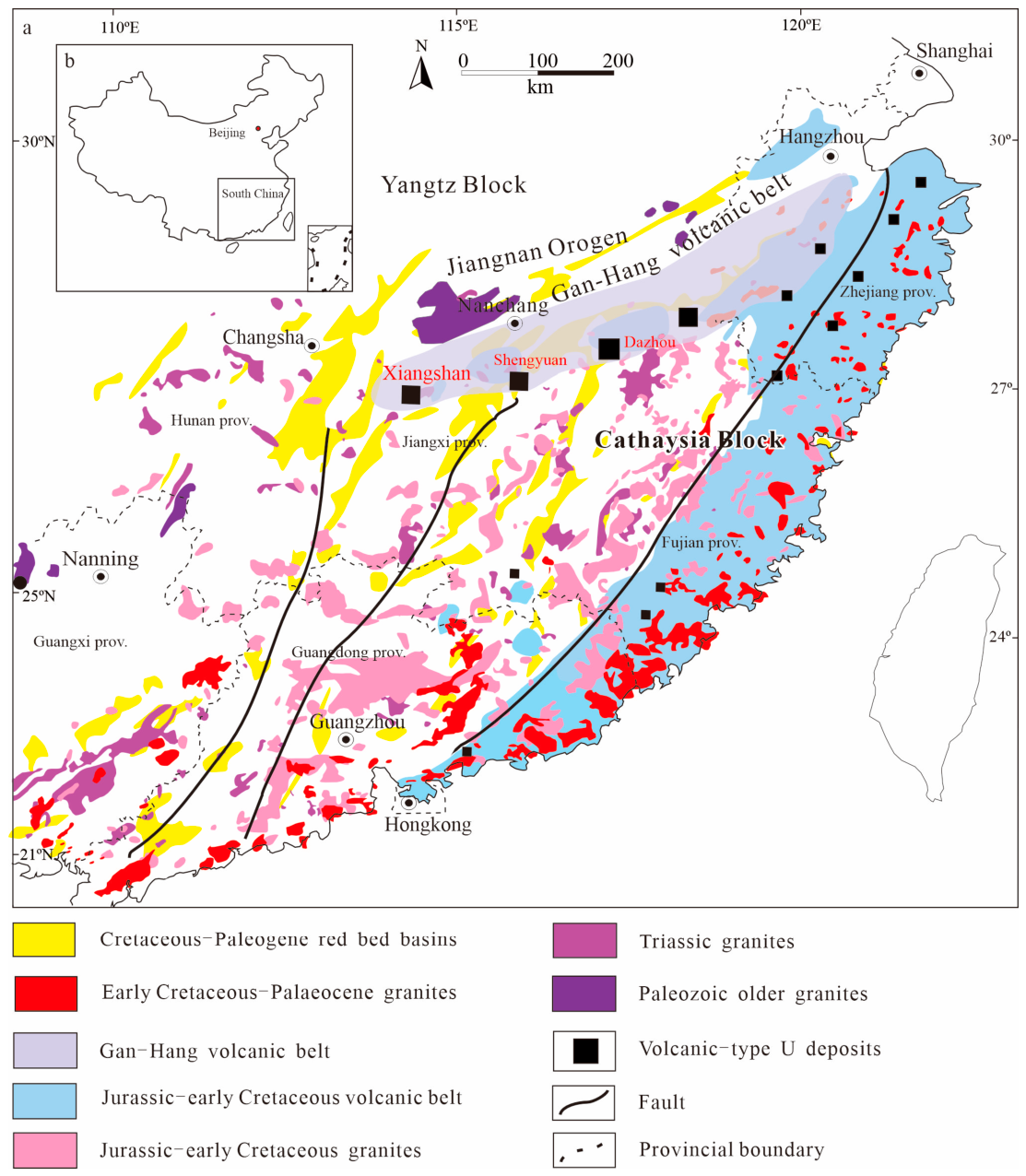
During the late Mesozoic, the South China Block went through a transformation from intracontinental compression to extensional rifting, due to the subduction and subsequent rollback of the Paleo-Pacific plate beneath the Eurasian continent [23,24] (Figure 1). Under the extensional tectonic setting, a series of volcanic–intrusive basins were formed in South China [25,26]. Among them, the Gan-Hang volcanic belt, extending approximately 600 km along an NE 45° strike with a width of 30~50 km, hosts many uranium ore fields and therefore is the most important region for volcanic-related uranium deposits in South China [27,28].
The Xiangshan volcanic basin is located in the southwestern segment of the Gan-Hang volcanic belt. Its basement is composed of Precambrian metamorphic rocks [13,29,30], overlain by two sets of late Mesozoic volcanic–sedimentary rocks, i.e., the Lower Daguding (K1d) and the Upper Ehuling (K1e) Formations [31,32]. The Daguding Formation mainly consists of terrigenous clastic rocks, rhyodacite and rhyolitic ignimbrite [33,34], and the Upper Ehuling Formation is dominated by thick porphyritic lava [35]. Furthermore, a set of Cretaceous–Neogene continental red-bed successions overlies the volcanic rocks in the northwestern part of the basin, and these red beds provide a crucial oxidizing environment for regional uranium mineralization [34,36,37].
The structures in the Xiangshan Basin primarily include NE-, NW- and NS-trending faults, as well as caldera-related ring and radial faults [38,39]. Among these, the regional NE-trending faults (e.g., the Zoujiashan-Shidong fault) predominate in the volcanic basin and control the emplacement of magmatic rocks and hydrothermal mineralization [40]. The NW- and NS-trending faults also exert certain control on the local enrichment of uranium mineralization [37,38,39]. Geophysical exploration further indicates that deep high-angle faults are linked to the shallow structures, facilitating fluid circulation and leading to uranium mineralization [41,42].
Apart from the large-scale volcanic rocks, many intrusions are also present in the Xiangshan Basin, occurring as dykes and stocks in the volcanic rocks or metamorphic rocks in the basement [43]. Among them, granitic porphyry dykes are the predominant intrusive rocks, which are generally present along ring or radial faults. The granites formed coevally with or slightly later than the volcanic rocks [27,44,45]. Other felsic intrusions include quartz porphyry and syenite porphyry. In addition, mafic intrusions represented by mafic dykes such as diabase and lamprophyre are also developed in the basin, spatially characterized by the distribution of diabase in the north and lamprophyre in the southwest, all intruding into the volcanic rocks and metamorphic rocks of the basement [43,46]. These mafic rocks formed at approximately 128–85 Ma [43]. They may have served as a heat source for uranium mineralization, driving the convection of hydrothermal fluids in the basin [13,30].
There are many uranium deposits in the Xiangshan Basin, with representative ones being the Zoujiashan, Shazhou, Yunji and Julongan deposits [30,47]. These deposits are mainly located in the western section, but recent exploration has achieved some progress in the eastern part of the Xiangshan Basin. Wall rock alteration types are diverse, including illitization, hematitization, silicification, carbonatization, sericitization and chloritization [48]. The U minerals are mainly pitchblende, brannerite, uranothorite and Th-bearing pitchblende. There are abundant metal sulfides in the Xiangshan Basin, including galena, sphalerite, chalcopyrite and pyrite, which constitute U-polymetallic mineralization. The gangue minerals mainly consist of illite, fluorite, calcite, apatite, chlorite and quartz [49].
Figure 1.
Geological map of the uranium metallogenic area in South China. (a) Simplified geological map of China, showing the location of South China. (b) Geological map of South China (modified after Chi et al. 2020 [50]).
3. Ore Deposit Geology
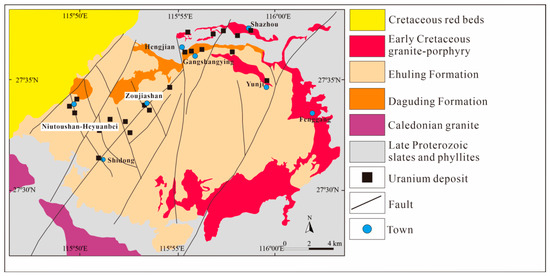
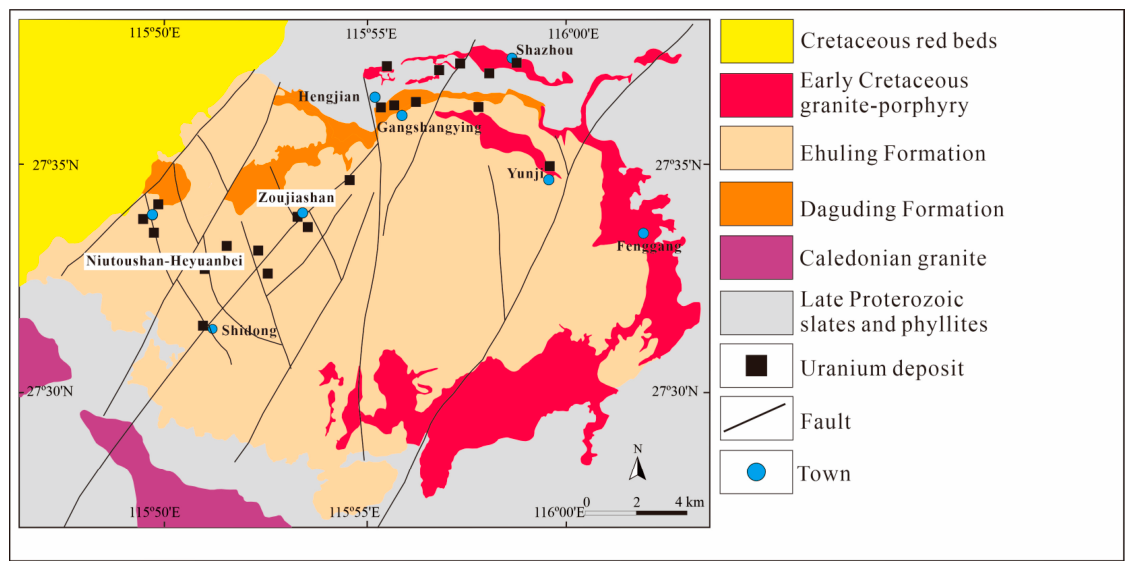
The Zoujiashan deposit, located in the northwestern part of the Xiangshan Basin (Figure 2), is the largest volcanic-related uranium deposit in China, with the total uranium resource amounting to over 1000 t and an average grade of about 3.06‰ [34,51]. The basement consists of low-grade metamorphic rocks, primarily composed of biotite quartz schist and sericite schist, with local intercalations of slate and metamorphic sandstone [29,35]. The overlying rocks are the rhyodacite and crystal tuff of the Daguding Formation and the porphyritic lava of the Ehuling Formation [34,37]. Among the three dominant volcanic–sedimentary succussions, only the Ehuling Formation is exposed, while the other two units are underlying beneath. The mafic rocks in the Zoujiashan deposit are dominated by ca. 125–85 Ma lamprophyre, emplaced in the volcanic rocks and the basement as dykes [30,52]. The granitoids are mainly granite porphyry and rhyodacitic porphyry, attributed to the subvolcanic facies [37].
Figure 2.
Geological map of the Xiangshan region (modified after Chi et al. 2020 [50]).
The NE-trending Zoujiashan-Shidong fault is the predominant structure in the Zoujiashan deposit, which strikes NE 50°~65° and dips northwest at 30°~45° [34]. This fault was formed by the reactivation of basement faults and has undergone multi-stage deformation [38]. The NNE-, NS- and NNW-trending faults are all secondary structures of the major NE-trending fault [47]. Temporally, the NE-trending main faults formed first, followed by the overprint of NW- and NS-trending faults [38,39]. The structural system was generally produced under an extensional setting during the Early Cretaceous, affected by the superposition of multi-stage stresses and coupled with volcanic–intrusive activities [35].
The Zoujiashan deposit is characterized by distinct structural control over mineralization, and the orebodies are constrained by the Zoujiashan-Shidong fault zone and associated secondary fault network [53,54]. They are present in the porphyritic lava of the Ehuling Formation, with the lithological contact transition zone as the favorable mineralization site [13,35]. In addition, minor uranium mineralization also occurs in the Precambrian metamorphic basement [55]. In the Zoujiashan deposit, hydrothermal alteration is common and well developed, mainly including hematitization, fluoritization, illitization, chloritization and alkali metasomatism. The uranium minerals in the ores are dominated by pitchblende and brannerite, while the gangue minerals mainly include fluorite, calcite and quartz [37]. The quartz grains are generally black or grey in uranium-rich ores.
Both albitization and K-feldspathization are produced during alkali metasomatism in the Zoujiashan deposit. Hydrothermal albite replaces primary K-feldspar phenocrysts, and the grains have polysynthetic twins [7,56]. Pitchblende occurs locally in the hydrothermal albites. Hydrothermal K-feldspar is turbid and distinctly different from magmatic K-feldspar [8]. Previous research demonstrates that alkali metasomatism represents the first stage of hydrothermal activity in Xiangshan, which pre-dates the major uranium mineralization with acidic metasomatism [57].
4. Samples and Analytical Methods
Twenty-one uranium ore samples were collected from the Zoujiashan waste rock dump within the Xiangshan uranium orefield. All samples were prepared into polished thin sections for a series of analyses, including petrographic observations, Tescan Integrated Mineral Analyzer (TIMA) (TESCAN, Brno, Czech Republic) analysis, electron probe microanalysis (EPMA) and laser ablation inductively coupled plasma mass spectrometry (LA-ICP-MS). Petrographic observations of the thin sections were conducted using a Leica DM2700P microscope (Leica, Wetzlar, Germany). The mineral assemblages and microstructural characteristics were examined under transmitted plane-polarized light (PPL) and cross-polarized light (XPL).
4.1. SEM
Micro-area analyses were conducted at the State Key Laboratory of Nuclear Resources and Environment, East China University of Technology (ECUT). Micro-morphology and composition analyses were carried out using a Zeiss Sigma 300 field emission scanning electron microscope (SEM) (Carl Zeiss, Oberkochen, Germany) equipped with an Oxford AZtec X-Max 80 energy-dispersive spectrometer (EDS) (Oxford Instruments, Abingdon, UK). Before SEM analysis, the thin sections were carbon-coated (10–20 nm thickness) to enhance the conductivity. The instrument operating parameters were set as follows: an acceleration voltage of 5–20 kV, a carbon coating current of 24 mA, a resolution of 1.0 nm and a single-image electron beam exposure time of 60 s.
4.2. TIMA
The Tescan Integrated Mineral Analyzer (TIMA) analysis of shallow uranium ore and deep lead–zinc ore samples from the Xiangshan Basin was performed at Guangzhou Tuoyan Analytical Technology Co., Ltd. (Guangzhou, China), using a TESCAN MIRA3 SEM (TESCAN, Brno, Czech Republic). Prior to the experiment, polished thin sections (or mounts) were carbon-coated. During the test, the instrument operating parameters were set to an acceleration voltage of 25 kV, a beam current of 8.24 nA and a working distance of 15 mm. To ensure data accuracy, the current, backscattered electron (BSE) signal intensity and EDS signal were automatically calibrated using a platinum Faraday cup and Mn standard, respectively. The analysis employed the liberation mode, synchronously collecting BSE images and EDS spectral data, with the single-point X-ray count set to 1000 and the pixel resolution and energy spectrum step size set to 3 μm and 9 μm, respectively.
4.3. EPMA
Major element compositions of feldspars (K-feldspar and albite) in the porphyritic lava were analyzed at Guangzhou Tuoyan Analytical Technology Co., Ltd. The instrument used was a JXA-iSP100 Electron Probe Microanalyzer (EPMA) (JEOL Ltd., Tokyo, Japan). Operating conditions were set as follows: an acceleration voltage of 15 kV, a beam current of 20 nA and a beam spot diameter of 5~10 μm. The analyzed elements included Si, Al, Na, K, Ca, Fe, P, Ba, Sr and Rb, with a detection limit of 0.01 wt%. Peak counting times of 10~30 s and background counting times of 5–40 s were used for different elements. All major element data were corrected for matrix effects using the ZAF program.
4.4. LA-ICP-MS
In situ trace element analysis was performed on both magmatic and hydrothermal feldspars at the Advanced Institute of Resources and Environment, East China University of Technology. To avoid signal interference from the carbon film, the carbon coating on the sample surface was removed prior to analysis. The analysis was conducted using an ESI NWR 193 HE excimer laser ablation system coupled with a PerkinElmer NexION 1000 quadrupole ICP-MS (PerkinElmer, Waltham, MA, USA). Helium was used as the laser ablation carrier gas, with an energy density of 5 J/cm2, frequency of 4 Hz and spot size of 30 μm. For trace element quantification, NIST 610 was used as the external standard, NIST 612 as the monitoring standard and 29Si as the internal standard (calibrated against EPMA data). Two NIST 610 standards and one NIST 612 standard were inserted after every 6 sample points to monitor instrument drift. Data processing was completed using the Iolite 4 software.
4.5. Thermodynamic Modeling
Geochemical thermodynamic modeling was conducted using the Geochemist’s Workbench® (GWB) software version 2025 (Aqueous Solutions LLC, Champaign, IL, USA). The thermodynamic database utilized in this study was based on the default thermo.com.v8.r6+ database, supplemented with the latest compiled thermodynamic data for U-bearing species from Deng et al. (2023) [58]. As recent studies have indicated that carbonate complexation with UO22+ is weak at temperatures above 100 °C [59,60], U-CO3-bearing complexes were suppressed during the simulations. The REACT module was used to simulate fluid–rock interactions between ore-forming fluids and feldspar in the wall rocks within the U-Na-K-Ca-Mg-Fe-Cl-F-C-H-O system, while the PHASE2 module was employed to construct pH-fO2 solubility diagrams for the Na-Cl-Si-H-O system. The initial composition of the mineralizing fluids was primarily constrained by the LA-ICP-MS analysis results of fluid inclusions in fluorite and quartz from the metallogenic stage of the Zoujiashan deposit, as reported by Yu et al. (2019) [61]. Fluid salinity and the concentrations of key anions (e.g., SO42−, HCO3− and F−) were constrained by reference to data from Deng et al. (2023) [58], ensuring that the simulated fluids exhibited ionic strengths and complexing environments consistent with those of natural fluid inclusions at mineralization temperatures.
5. Results
5.1. Petrographic Characteristics
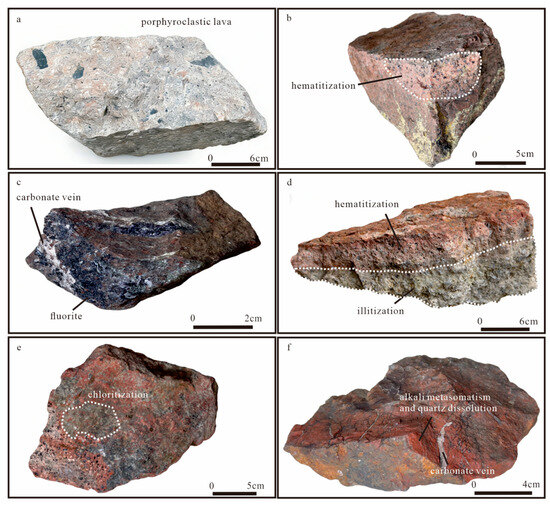
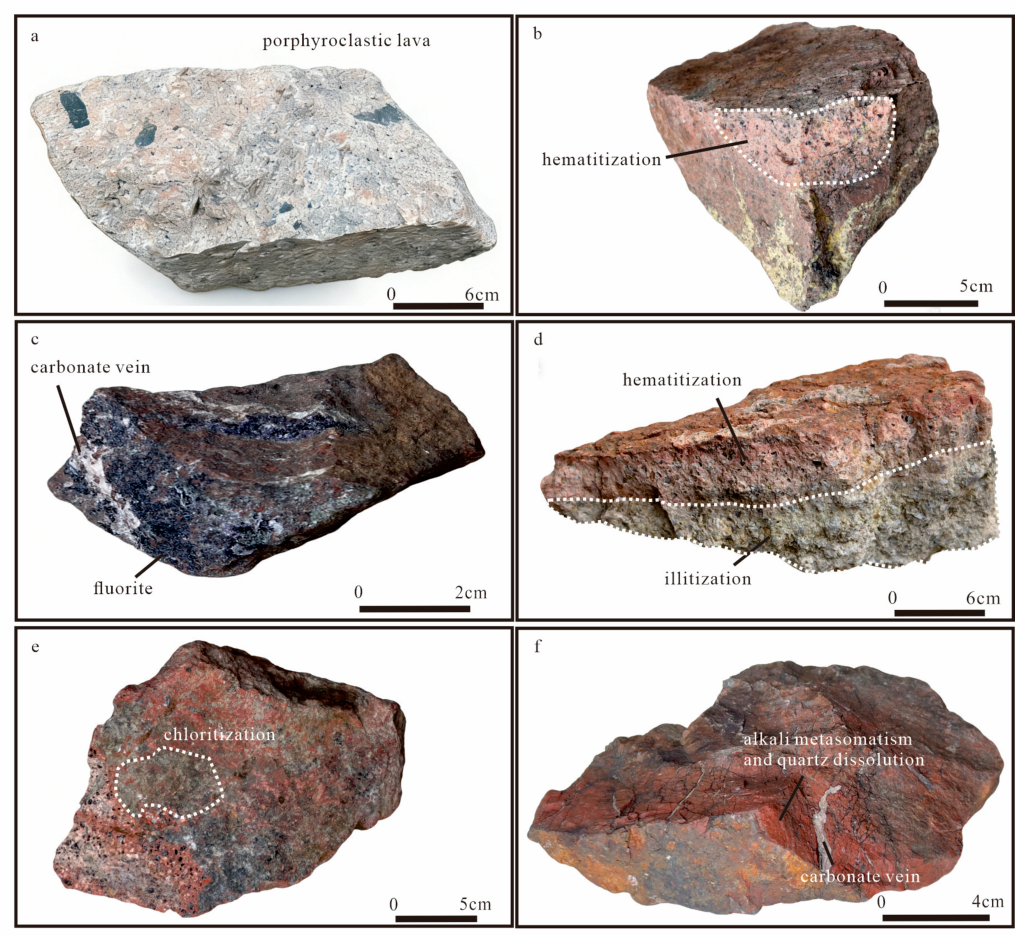
Macroscopic observations of hand specimens reveal distinct hydrothermal alteration features in the Zoujiashan deposit (Figure 3). The host rock is primarily porphyroclastic lava (Figure 3a). Hematitization is widely developed, characterized by flesh-red or purplish-red colors in altered rocks (Figure 3b). Fluorite typically occurs as purple veins, which are commonly associated with calcite veins (Figure 3c). In some altered rocks, hematitization is closely accompanied by illitization (Figure 3d). Additionally, chloritization is present as featured green patches (Figure 3e). Furthermore, macroscopic alkali metasomatism (Figure 3f) is prominently accompanied by significant quartz dissolution, which is different from hematitization.
Figure 3.
Hand specimens showing host rocks and major hydrothermal alterations in the Zoujiashan uranium ore field. (a) Porphyroclastic lava; (b) hematite-type ore; (c) fluorite-type ores; (d) hematitization and illitization; (e) chloritization; (f) alkali metasomatism with quartz dissolution.
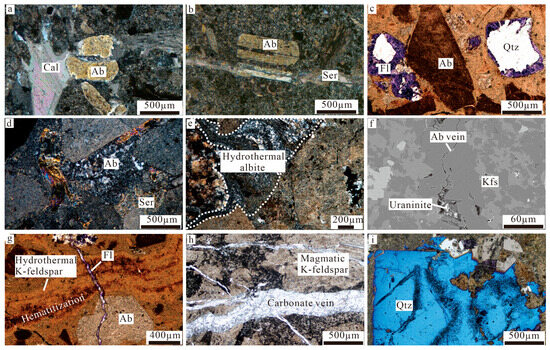
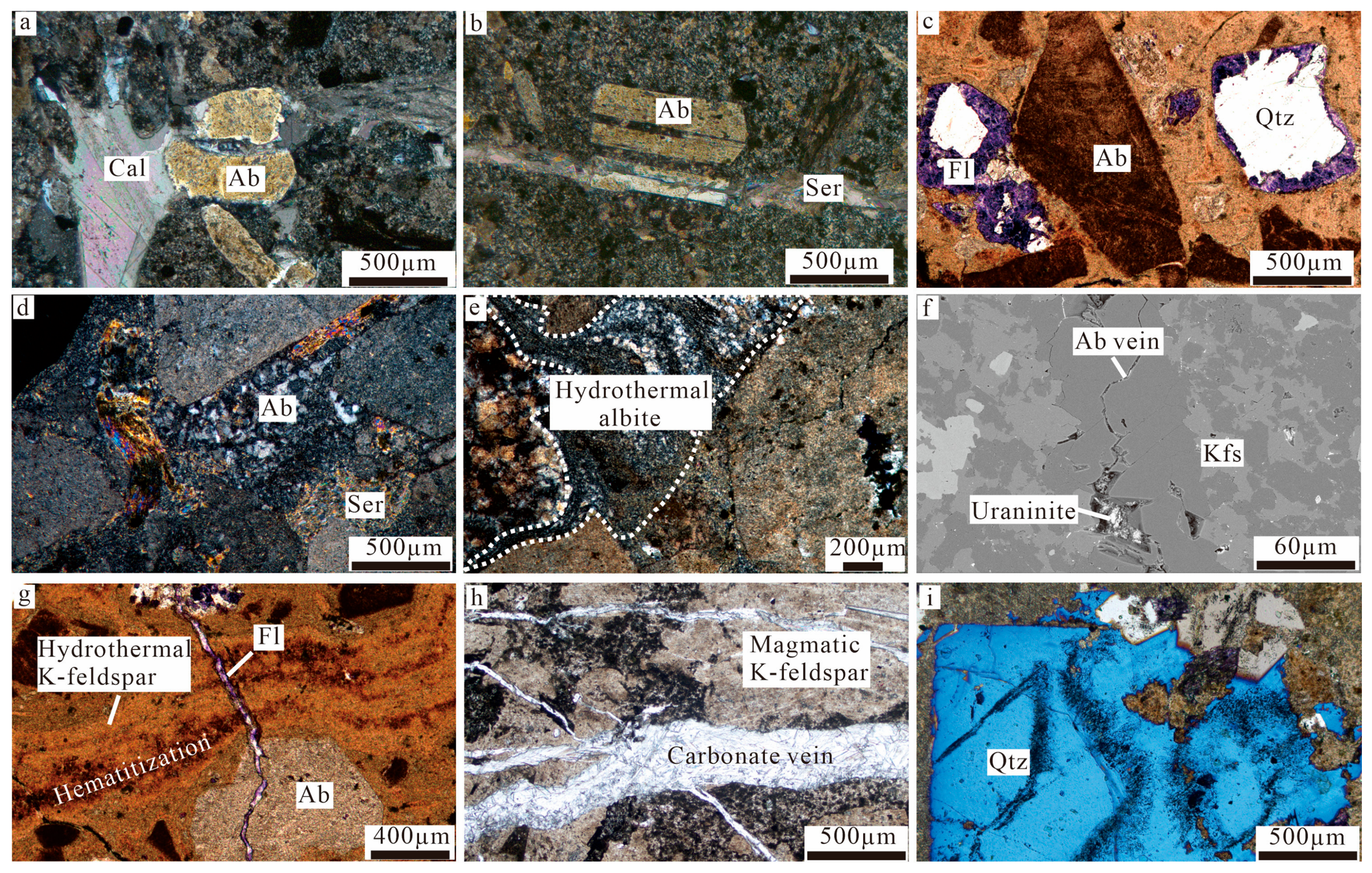
Microscopic and SEM observations reveal that both magmatic and hydrothermal feldspars are present in the Zoujiashan deposit. Among them, magmatic albite mainly occurs as euhedral granular and subhedral fine-grained forms with sizes of 0.4–1.5 mm (Figure 4a–c). Some albite grains have typical polysynthetic twinning (Figure 4b) and commonly occur in intergrowth with muscovite and quartz (Figure 4d). Hydrothermal albite appears as turbid, anhedral granular crystals with sizes of less than 50 µm, which generally replace the magmatic matrix or phenocrysts (Figure 4e). Magmatic K-feldspar grains are mostly characterized by anhedral to subhedral fine- or coarse-grained textures, with a wide range of grain sizes (0.7–1.7 mm) (Figure 4h). Hydrothermal albite and K-feldspar mainly occur as veins. Hydrothermal K-feldspar occurs as fine-grained anhedral aggregates (<50 µm) and is commonly associated with hematitization (Figure 4g). The dissolution of quartz grains is quite common in the alkali-metasomatized rock (Figure 4i).
Figure 4.
Photomicrographs of alteration features in the Xiangshan uranium ore field. (a) Albite and calcite (cross-polarized light); (b) sericite replacing albite (cross-polarized light); (c) quartz and fluorite surrounding albite phenocryst (plane-polarized light); (d) sericite and albite (cross-polarized light); (e) hydrothermal albite (cross-polarized light); (f) uraninite occurring in albite vein (backscattered electron image); (g) fluorite cutting through hematite veins, K-feldspar and albite (plane-polarized light); (h) carbonate vein cutting through K-feldspar (plane-polarized light); (i) quartz dissolution (cross-polarized light with sensitive tint plate). Cal, calcite; Ab, albite; Ser, sericite; Fl, fluorite; Qtz, quartz; Kfs, K-feldspar.
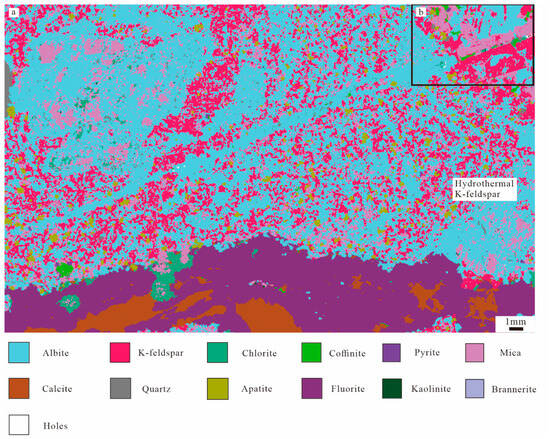
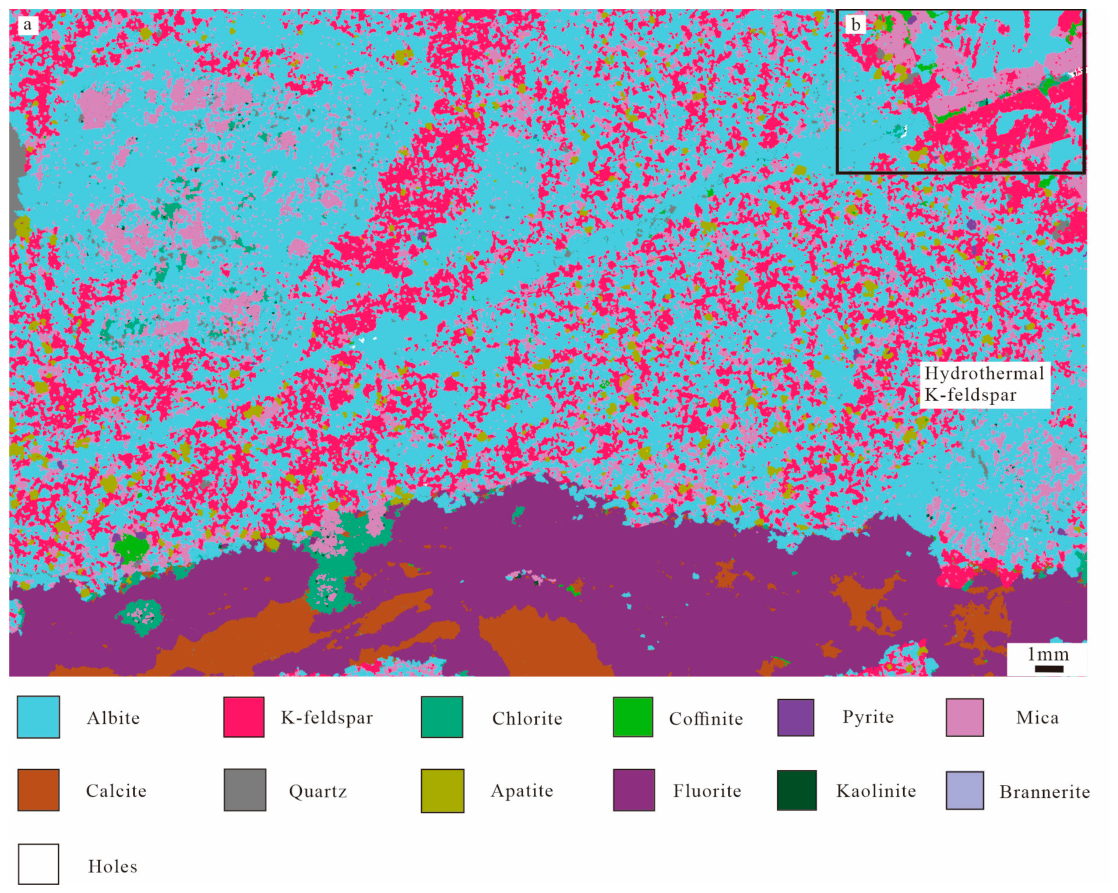
The results of TIMA mapping quantitatively indicate the spatial distribution features of the modal mineralogy from the fluorite–carbonate vein to the alkali-metasomatized rock (Figure 5a). The major minerals of the fluorite–carbonate vein are fluorite (3.59 vol%) and calcite (2.41 vol%), with minor chlorite (1.17 vol%). The alkali-metasomatized rock is dominated by albite (37.05 vol%), K-feldspar (25.47 vol%) and mica (14.27 vol%). Hydrothermal albite locally replaces magmatic K-feldspar (Figure 5b), while quartz (11.43 vol%) is distributed as irregular lumps throughout the entire zone. In addition, minor apatite (3.90 vol%), coffinite (0.39 vol%) and pyrite (0.22 vol%) are also recognized, together with some kaolinite (0.04 vol%) and brannerite (0.03 vol%) occurring between feldspar and mica.
Figure 5.
(a) TIMA mineral-phase maps of hydrothermal alteration in porphyritic lava from the Zoujiashan deposit. (b) Albitization of magmatic K-feldspar.
5.2. Major Elements
The major element compositions of the albite and K-feldspar samples are summarized in Tables S1 and S3, respectively. The hydrothermal and magmatic albite samples display similar content of SiO2 (67.79–68.84 wt% and 67.70–69.34 wt%, respectively), Na2O (11.34–11.52 wt% and 11.27–11.83 wt%) and Al2O3 (19.09–19.36 wt% and 18.99–19.92 wt%). However, compared to its magmatic counterpart, the hydrothermal albite is enriched in FeO (0.37–0.46 wt% and 0–0.35 wt%, respectively) and K2O (0.07–0.24 wt% and 0.03–0.45 wt%) but depleted in CaO (0.01–0.05 wt% and 0.01–0.28 wt%, respectively).
Similarly, the hydrothermal and magmatic K-feldspars exhibit comparable concentrations of SiO2, K2O and Al2O3. Relative to the magmatic K-feldspar, the hydrothermal K-feldspar has higher content of CaO (0.03–0.18 wt%), Na2O (0.19–0.34 wt%), FeO (0.05–0.32 wt%) and Fe2O3 (0.05–0.17 wt%). Conversely, it contains lower amounts of BaO (0.19–0.34 wt%) and RbO (0.01–0.08 wt%) compared to the magmatic samples (0–0.25 wt% and 0.02–0.24 wt%, respectively).
5.3. Trace Elements
The trace element compositions of the albite and K-feldspar samples are listed in Tables S2 and S4, respectively. For albite, the hydrothermal samples are distinctly enriched in Pb, V, Y, Zr, Th and Hf compared to the magmatic albite. For instance, the hydrothermal albite exhibits higher content of Pb (0–25.71 ppm) and Th (0–97.74 ppm), whereas the magmatic albite contains lower concentrations of these elements (Pb: 0–1.77 ppm; Th: 0–0.62 ppm). In contrast, the hydrothermal albite has lower content of Li (0.35–31.49 ppm), U (0–6919 ppm) and Zn (0–3.53 ppm) relative to the magmatic type (Li: 0.42–76.86 ppm; U: 0.2–7652.11 ppm; Zn: 0–6.7 ppm).
Regarding K-feldspar, the hydrothermal samples generally display lower trace element concentrations than their magmatic counterparts. Specifically, the hydrothermal K-feldspar shows lower content of Sr (0–236.01 ppm), U (0–195.88 ppm) and Cs (0–13.5 ppm) compared to the magmatic K-feldspar, which exhibits wider and elevated ranges for Sr (55.7–2472.92 ppm), U (6.85–7221.22 ppm) and Cs (11.98–102.57 ppm).
5.4. Fluid–Rock Interaction and Quartz Solubility
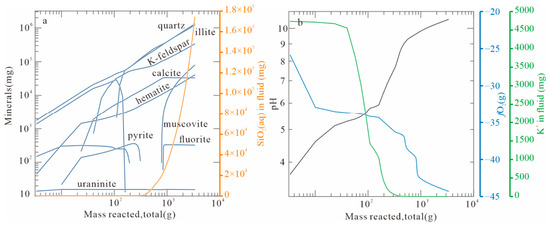
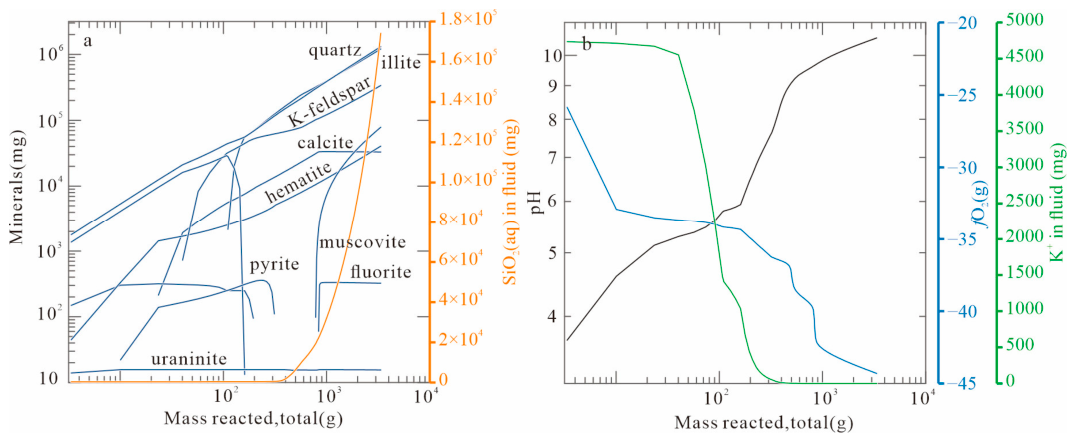
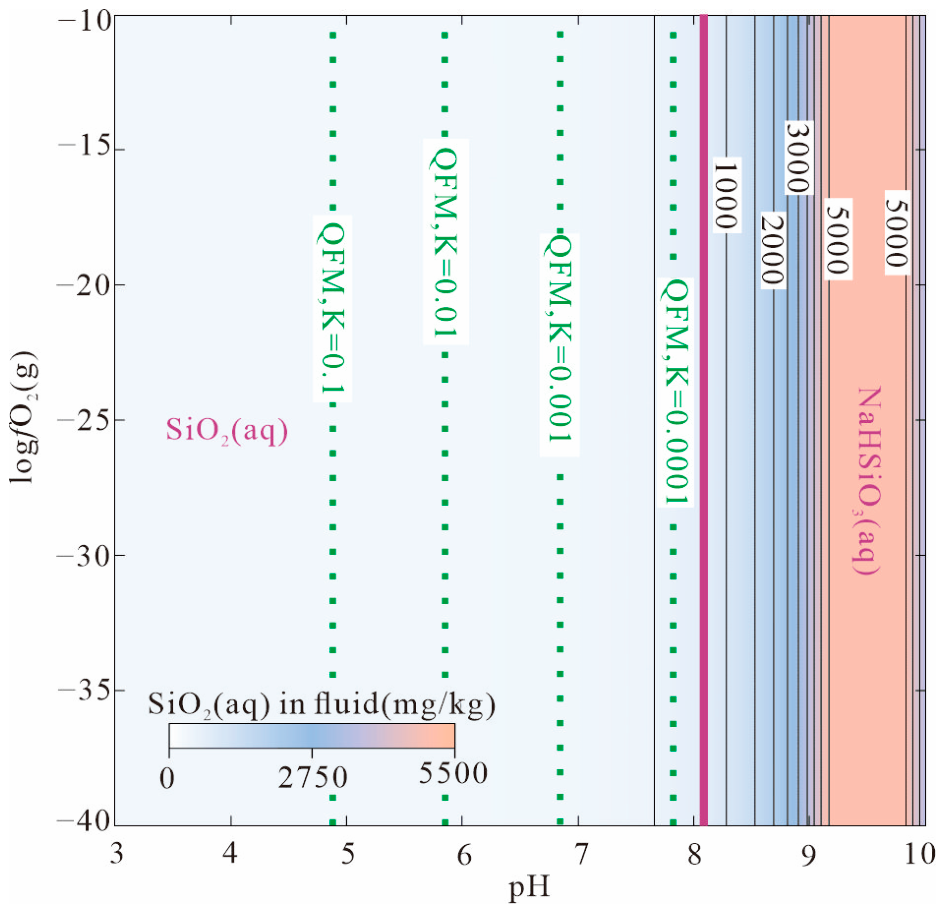
Fluid–rock reaction path modeling is conducted to determine the fluid evolution and mineral precipitation during alkali metasomatism. A quartz solubility diagram is constructed to evaluate the physiochemical conditions that trigger the quartz dissolution that accompanies alkali metasomatism. The results of the fluid–rock reaction path modeling show that there is a general trend of increasing pH and decreasing fO2(g) with increasing degrees of fluid–rock reaction (Figure 6). Reactions of the fluid with the rock cause hematite, illite and uraninite to begin precipitating when the pH increases to above ~4 and the log fO2(g) decreases to lower than ~−28. Subsequently, pyrite, calcite, quartz, illite and K-feldspar are precipitated after the pH increases to ~5.5 and the log fO2(g) decreases to ~−34. Fluorite and muscovite begin precipitating when the pH increases to ~9.2 and log fO2(g) decreases to −43. It is noteworthy that, if the pH exceeds ~7.5, the dissolved Si content in the fluid begins to increase, while the K content decreases sharply, and the log fO2(g) also decreases precipitously during this stage.
Figure 6.
Diagrams illustrating the progress of reactions involving 1 kg of a moderate-salinity hydrothermal fluid to which a mineral is added in successive 1 g aliquots. (a) Minerals-SiO2(aq); (b) pH-fO2(g)-K+.
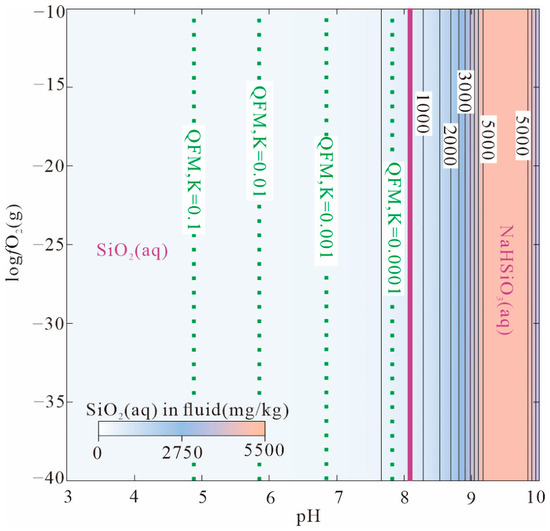
The modeling results show that the speciation of Si depends mainly on the pH, regardless of the fO2(g) (Figure 7). At pH < 8.1, The dominant Si-bearing aqueous species in the fluid is SiO2(aq), whereas, at pH > 8.1, the dominant species is NaHSiO3. Meanwhile, the dissolved Si content increases with increasing pH, accompanied by a decrease in K content and an increase in quartz solubility, which is consistent with the observations in Figure 6. Furthermore, the shift of the QFM line to the right indicates that, with a decrease in K, the fluid–rock reaction must reach equilibrium under more alkaline conditions.
Figure 7.
pH–log fO2(g) solubility phase diagram of quartz. Green dashed lines indicate the pH positions corresponding to different K activities (K = 0.1, 0.01, 0.001, 0.0001) under QFM buffer conditions.
6. Discussion
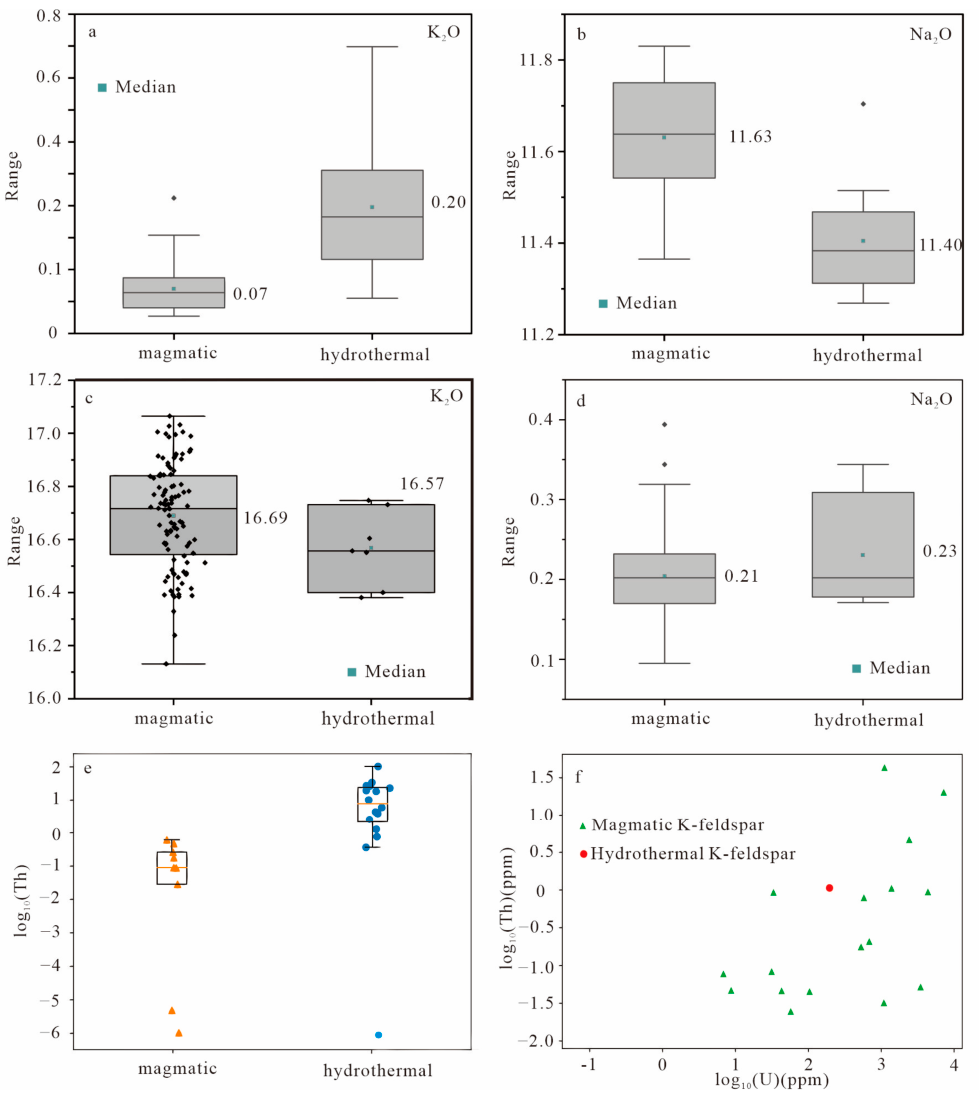
Hydrothermal albite exhibits lower Na but higher K content relative to magmatic albite (Figure 8a,b). Based on the major and trace element data, these grains are confirmed as true albites rather than intermediate Na-K feldspar phases. Complemented by petrographic observations (Figure 4e and Figure 5b), this compositional shift is primarily controlled by the mineral replacement process [62]—specifically, the incomplete replacement of primary magmatic K-feldspar. The relatively higher K content in hydrothermal albite is likely attributed to K inheritance from the precursor mineral or the presence of sub-microscopic K-feldspar relicts. Similarly, hydrothermal K-feldspar is characterized by lower K but higher Na concentrations than its magmatic counterpart (Figure 8c,d), a feature that is also ascribed to the incomplete transformation of primary albite into hydrothermal K-feldspar.
Figure 8.
Box-and-whisker plots of major and trace elements for K-feldspar and albite, and U-Th covariation diagram. (a) K2O content in albite; (b) Na2O content in albite; (c) K2O content in K-feldspar; (d) Na2O content in K-feldspar; (e) Th content in albite; (f) U-Th covariation diagram for K-feldspar.
Mineralogical changes during albitization-dominated alkali metasomatism are closely linked to the mobility of major and trace elements. Specifically, the incomplete replacement between magmatic K-feldspar and albite provides the main sources and sinks for K and Na, leading to the observed compositional shifts in hydrothermal feldspars. In addition, the extensive precipitation of calcite and fluorite serves as the primary sink for Ca and Sr, driving the depletion of these elements in both hydrothermal fluids and feldspars. Iron is largely sequestered by the intense hematitization that accompanies the metasomatism. Furthermore, extensive quartz dissolution acts as the major source of Si, releasing it into the evolving hydrothermal fluids under conditions of increasing pH.
Notably, the intense metasomatic processes in the Xiangshan ore field may have also induced the remobilization of major and trace elements conventionally considered immobile (e.g., Al, Ti and Zr). Although whole-rock data are not presented in this study, in situ LA-ICP-MS results reveal that hydrothermal albite is distinctly enriched in high-field-strength elements (HFSEs, e.g., Zr, Hf and Y) relative to magmatic albite. This partial-to-complete remobilization is highly likely facilitated by the F-rich nature of the primary ore-forming fluids. The widespread precipitation of fluorite in the altered host rocks indicates high fluorine activity; as a strong complexing agent, fluorine can significantly enhance the solubility and mobility of Al, Ti and Zr during intense fluid–rock interaction [63].
The alkali metasomatism in Xiangshan is characterized by abundant hematite and a red color, indicating that the associated fluids are oxidized. Such fluids are favorable for uranium transportation. The hydrothermal hematite is likely produced by the interaction between oxidized ore fluids and Fe-bearing minerals (such as biotite) in the volcanic rocks. Alternatively, oxidized U-bearing ore fluids could dissolve high concentrations of Fe2+ if the initial fluids for alkali metasomatism have low pH values [58]. Similarly to U, hydrothermal feldspars have higher Th content than magmatic ones, which is consistent with the widespread Th enrichment in the Xiangshan ore field. Due to the current lack of sufficient thermodynamic data for Th-bearing aqueous species and minerals [64], the genesis of Th enrichment during alkali metasomatism needs further research.
Alkali metasomatism is a typical hydrothermal alteration, and its formation is closely associated with fluid–rock interactions and mass–volume redistribution [65,66]. The genesis of alkali metasomatism is primarily driven by pH increases during chemical reactions and is relatively insensitive to oxygen fugacity. Consequently, alkali metasomatism is not requisitely accompanied by hematitization, such as the potassic alteration in porphyry copper deposits [67]. In addition, the fluid responsible for alkali metasomatism could be initially acidic and oxidized, which could be favorable for uranium transport, as is the case in the Xiangshan ore field. However, for weakly acidic–alkaline fluids and low oxygen fugacity, high concentrations of uranium cannot be transported. Under this scenario, alkali metasomatism is merely a pre-ore alteration without significant uranium mineralization, as is the case in the Lagoa Real uranium deposit [68,69].
With the progress of alkali metasomatism, the K concentrations in the fluid decrease. Considering that the fluid pH is controlled by the QMF buffer (reaction 1), a continuous decrease in the K concentrations in fluids would cause a pH increase, buffered by the QMF assemblage. Since quartz solubility is closely associated with pH, such a pH increase would induce significant quartz dissolution, which is similar to the situation regarding the lack of quartz grains in extensively alkali-metasomatized rocks. Furthermore, assuming that this metasomatic process occurs under constant-volume conditions after rock crystallization, extensive quartz dissolution would directly generate significant porosity, thereby providing favorable spaces for subsequent metal precipitation [70].
Although alkali metasomatism is generally considered a pre-mineralization alteration, our mineralogical observations directly link this process to subsequent uranium precipitation. The uranium in this deposit predominantly occurs as independent minerals, mainly uraninite, brannerite and coffinite. As shown in our BSE and TIMA results (e.g., Figure 4f), uraninite is spatially hosted within hydrothermal albite veins. Furthermore, previous studies and our petrographic evidence indicate that alkali metasomatism generally represents a pre-ore or early-stage alteration (Figure 4g) that temporally precedes the main-stage uranium mineralization [51,57]. This spatial and temporal association indicates that the high-porosity structural traps formed by alkali metasomatism are closely related to the precipitation of independent uranium minerals. Additionally, the detection of trace U in hydrothermal feldspars (Tables S2 and S4) implies that minor amounts of uranium were also incorporated into the lattice or as nano-inclusions within the metasomatic minerals during fluid–rock interactions.
This study demonstrates that alkali metasomatism is associated with a pH increase during fluid–rock interaction, which could destroy the original physical integrity of the host rocks and therefore constitutes an ideal physicochemical trap for mineralization. Indeed, such a mechanism has been widely recognized in various magmatic–hydrothermal systems and is particularly crucial for hydrothermal uranium deposits [9,70,71], such as the Ukrainian Shield [72,73]. We believe that the findings of this study may be applicable to similar volcanic-related uranium deposits worldwide. In addition, given the oxidized properties of ore fluids in uranium deposits, alkali metasomatism is associated with hematitization and characterized by a red color, which are important indicators for mineral exploration.
7. Conclusions
(1) Significant alkali metasomatism is present in the Xiangshan volcanic-related uranium ore field, which represents an important hydrothermal event predating the major uranium mineralization with acidic metasomatism. The hydrothermal feldspars are mainly present as veinlets and replace the primary magmatic ones. In addition, the hydrothermal feldspars have different K and Na content compared to the magmatic ones. Specifically, hydrothermal feldspars are characterized by significant Ca and Sr depletion, which is attributed to the extensive consumption of Ca from fluids during fluorite and calcite precipitation. Furthermore, hydrothermal feldspars are generally Fe-rich and associated with widespread hematitization, consistent with the high oxygen fugacity of fluids.
(2) The development of alkali metasomatism is primarily controlled by the increase in fluid pH. Thermodynamic modeling shows that the continuous consumption of K+ from the fluids causes a gradual increase in the fluid pH, buffered by the QMF assemblage. As quartz solubility is positively correlated with pH, this change in physicochemical conditions promotes extensive quartz dissolution (desilicification) in the altered rocks. This quartz dissolution greatly increases the porosity and permeability of the host rocks, forming favorable physicochemical traps for the subsequent focusing, trapping and precipitation of U-bearing fluids. This mechanism is similar to those documented in many hydrothermal uranium deposits worldwide. In summary, alkali-metasomatized rocks characterized by intense quartz dissolution and hematitization not only record the evolutionary pathways of ore-forming fluids but also act as key exploration guides for regional volcanic-hosted uranium deposits.
(3) Uranium is mainly present as independent minerals, including uraninite, brannerite and coffinite. The alkali metasomatism preceding uranium mineralization, together with associated quartz dissolution, formed essential high-permeability structural traps. Ultimately, changes in physicochemical conditions (e.g., pH increase and fO2 decrease) during continuous fluid–rock interactions contributed significantly to the extensive precipitation of these independent uranium minerals within the hydrothermal albite veins and dissolution cavities.
Supplementary Materials
The following supporting information can be downloaded at: https://www.mdpi.com/article/10.3390/min16050432/s1. Table S1: Electron microprobe analysis of major element composition of albite (wt%). Table S2: LA-ICP-MS analysis of trace element composition of albite (ppm). Table S3: Electron microprobe analysis of major element composition of K-feldspar (wt%). Table S4: LA-ICP-MS analysis of trace element composition of K-feldspar (ppm).
Author Contributions
Conceptualization, T.D., Y.H. and L.C.; methodology, Y.H.; software, H.S.; validation, X.W., L.Z. and W.S.; formal analysis, L.X.; investigation, M.Z.; resources, T.D.; data curation, L.C.; writing—original draft preparation, Y.H.; writing—review and editing, T.D.; visualization, H.T.; supervision, Hongmei Tang; project administration, T.D.; funding acquisition, T.D. and H.T. All authors have read and agreed to the published version of the manuscript.
Funding
This work was co-founded by the 2025 Jiangxi Talent Support Program: Youth Science and Technology Talent Development Project (2025QT10); the Self-Deployment Project of the National Key Laboratory of Uranium Resources Exploration—Mining and Nuclear Remote Sensing (2024QZ-TD-05); Uranium Mining Research of the CNNC Geological Bureau (202438-6); the National Natural Science Foundation of China (42562005, 42362012); and the Jiangxi Provincial Natural Science Foundation (20232BAB213060, 20242BAB25179, 20242BAB20136).
Data Availability Statement
The raw data supporting the conclusions of this article will be made available by the authors on request.
Acknowledgments
We are grateful for the assistance from the reviewers. Particular thanks are given to the No. 270 Research Institute of Nuclear Industry for their help in the field investigation.
Conflicts of Interest
The authors declare that the research was conducted in the absence of any commercial or financial relationships that could be construed as a potential conflict of interest.
References
- Sazonov, A.M.; Romanovsky, A.E.; Gertner, I.F.; Zvyagina, E.A.; Krasnova, T.S.; Grinev, O.M.; Silyanov, S.A.; Kolmakov, Y.V. Genesis of precious metal mineralization in intrusions of ultramafic, alkaline rocks and carbonatites in the north of the Siberian platform. Minerals 2021, 11, 354. [Google Scholar] [CrossRef] [Scilit]
- Li, J.; Liu, W.; Su, L.; Li, D.; Zhang, S.; Chen, H. Porphyry copper mineralization triggered by sulfate reduction and alkali metasomatism: Constraints from an experimental investigation. GSA Bull. 2023, 135, 2407–2427. [Google Scholar] [CrossRef] [Scilit]
- Zhao, F. Alkali-metasomatism and uranium mineralization. In Mineral Deposit Research: Meeting the Global Challenge; Springer: Berlin/Heidelberg, Germany, 2005; pp. 343–346. [Google Scholar]
- Xue, W. Geological Characteristics and Metallogenic Regularity of Uranium Deposits in the Middle Segment of Guyuan-Hongshanzi Uranium Metallogenic Belt. Ph.D. Thesis, China University of Geosciences, Wuhan, China, 2019; pp. 1–147. [Google Scholar]
- Richard, A.; Rozsypal, C.; Mercadier, J.; Banks, D.A.; Cuney, M.; Boiron, M.C.; Cathelineau, M. Giant uranium deposits formed from exceptionally uranium-rich acidic brines. Nat. Geosci. 2012, 5, 142–146. [Google Scholar] [CrossRef] [Scilit]
- Giggenbach, W.F. Mass transfer in hydrothermal alteration systems-a conceptual approach. Geochim. Cosmochim. Acta 1984, 48, 2693–2711. [Google Scholar] [CrossRef] [Scilit]
- Duan, G.; Ram, R.; Xing, Y.; Etschmann, B.; Brugger, J. Kinetically driven successive sodic and potassic alteration of feldspar. Nat. Commun. 2021, 12, 4435. [Google Scholar] [CrossRef] [Scilit]
- Wang, Y.; Hu, B.; Sun, Z.; Li, X.; Guo, G.; Rao, M. The geochemical characteristics of alkali metasomatic ore and its ore-forming significance at Zoujiashan deposit, Xiangshan uranium field. Uranium Geol. 2012, 28, 281–289. [Google Scholar]
- Cathelineau, M. The Hydrothermal Alkali Metasomatism Effects on Granitic Rocks: Quartz Dissolution and Related Subsolidus Changes. J. Petrol. 1986, 27, 945–965. [Google Scholar] [CrossRef] [Scilit]
- Petersson, J.; Eliasson, T. Mineral evolution and element mobility during episyenitization (dequartzification) and albitization in the postkinematic Bohus granite, southwest Sweden. Lithos 1997, 42, 123–146. [Google Scholar] [CrossRef] [Scilit]
- Petersson, J.; Fallick, A.E.; Broman, C.; Eliasson, T. Imprints of multiple fluid regimes on episyenites in the Bohus granite, Sweden. Lithos 2014, 196–197, 99–114. [Google Scholar] [CrossRef] [Scilit]
- Jaques, L.; Noronha, F.; Liewig, N.; Bobos, I. Paleofluids circulation associated with the Gerês late-orogenic granitic massif, northern Portugal. Geochemistry 2016, 76, 659–676. [Google Scholar] [CrossRef] [Scilit]
- Deng, T.; Chi, G.; Zhang, X.; Li, Z.; Xu, D.; Li, S.; Du, P.; Shang, P.; Zou, S.; Zhou, W.; et al. Mass Transfer during Hematitization and Implications for Uranium Mineralization in the Zoujiashan Deposit, Xiangshan Volcanic Basin. J. Earth Sci. 2022, 33, 422–434. [Google Scholar] [CrossRef] [Scilit]
- Yuan, G.; Cao, Y.; Schulz, H.M.; Hao, F.; Gluyas, J.; Liu, K.; Yang, T.; Wang, Y.; Xi, K.; Li, F. A review of feldspar alteration and its geological significance in sedimentary basins: From shallow aquifers to deep hydrocarbon reservoirs. Earth-Sci. Rev. 2019, 191, 114–140. [Google Scholar] [CrossRef] [Scilit]
- Palhano, L.C.; Nogueira, F.C.; Marques, F.O.; Vasconcelos, D.L.; Bezerra, F.H.; Souza, J.A.; Nicchio, M.A.; Perez, Y.A.R.; Balsamo, F. Influence of hydrothermal silicification on the physical properties of a basin-boundary fault affecting arkosic porous sandstones, Rio do Peixe Basin, Brazil. Mar. Pet. Geol. 2023, 148, 106062. [Google Scholar] [CrossRef] [Scilit]
- Cuney, M. The extreme diversity of uranium deposits. Miner. Depos. 2009, 44, 3–9. [Google Scholar] [CrossRef] [Scilit]
- González-Esvertit, E.; Prieto-Torrell, C.; Bons, P.D.; Canals, À.; Casas, J.M.; Elburg, M.A.; Gomez-Rivas, E. A review of the granite concept through time. Earth-Sci. Rev. 2025, 261, 105008. [Google Scholar] [CrossRef] [Scilit]
- Cuney, M.; Emetz, A.; Mercadier, J.; Mykchaylov, V.; Shunko, V.; Yuslenko, A. Uranium deposits associated with Na-metasomatism from central Ukraine: A review of some of the major deposits and genetic constraints. Ore Geol. Rev. 2012, 44, 82–106. [Google Scholar] [CrossRef] [Scilit]
- Cathelineau, M. U-Th-REE mobility during albitization and quartz dissolution in granitoids: Evidence from south-east French Massif Central. Bull. Minéralogie 1987, 110, 249–259. [Google Scholar] [CrossRef] [Scilit]
- Wu, D.; Xia, F.; Pan, J.; Liu, G.; Huang, G.; Liu, W.; Wu, J. Hydrothermal alteration and material migration of the Mianhuakeng uranium deposit in northern Guangdong. Acta Petrol. Sin. 2019, 35, 2745–2764. [Google Scholar]
- Wang, Y.; Nie, J.; Lin, J.; Pang, Y.; Wang, Z.; Qin, K. Alkali metasomatic uranium mineralization alteration and component migration law of the Yunji deposit in the Xiangshan uranium ore field. Acta Petrol. Sin. 2022, 38, 2865–2888. [Google Scholar]
- Petrov, V.A.; Pek, A.A.; Malkovsky, V.I. Uranium Sources and Fluid Transport in Volcanic Mineralized Systems: An Example of Streltsovka Caldera, Russia with Reflection on Dornot, Mongolia. J. Volcanol. Seismol. 2022, 16, 472–497. [Google Scholar] [CrossRef] [Scilit]
- Zhang, K.; Wan, Z.; Ma, X.; Yang, Y.; Hu, H. Electrical Imaging Across Eastern South China: New Insights into the Intracontinental Tectonic Process During Mesozoic. Minerals 2025, 15, 1035. [Google Scholar] [CrossRef] [Scilit]
- Cao, X.; Zahirovic, S.; Li, S.; Suo, Y.; Wang, P.; Liu, J.; Müller, R.D. A deforming plate tectonic model of the South China Block since the Jurassic. Gondwana Res. 2022, 102, 3–16. [Google Scholar] [CrossRef] [Scilit]
- Xing, G.; Chen, R.; Yang, Z.; Zhou, Y.; Li, L.; Jiang, Y.; Chen, Z. Characteristics and tectonic setting of Late Cretaceous volcanic magmatism in the coastal Southeast China. Acta Petrol. Sin. 2009, 25, 77–91. [Google Scholar]
- Zhong, J.; Pirajno, F.; Chen, Y.J. Epithermal deposits in South China: Geology, geochemistry, geochronology and tectonic setting. Gondwana Res. 2017, 42, 193–219. [Google Scholar] [CrossRef] [Scilit]
- Wang, Y.; Fan, H.; Pang, Y.; Xiao, W. Geochemical characteristics of chlorite in Xiangshan uranium ore field, South China and its exploration implication. Minerals 2022, 12, 693. [Google Scholar] [CrossRef] [Scilit]
- Wang, X.; Zhang, W.; Cheng, S.; Wang, B.; Tang, Y.; Li, W. Geological characteristics of early cretaceous volcanic rocks and analysis of metallogenic potential of uranium mineralization in Moganshan basin, northern Zhejiang province, China. Front. Earth Sci. 2024, 12, 1399836. [Google Scholar] [CrossRef] [Scilit]
- Yu, X.; Su, X.; Wang, Z.; Hou, Z.; Li, B.; Deng, T.; Yan, Z. Genesis of the Xiangshan Uranium Ore Field: Implications from Tescan Integrated Mineral Analyzer and Micro-X-Ray Fluorescence Mapping and Thermodynamic Modeling. Minerals 2024, 15, 5. [Google Scholar] [CrossRef] [Scilit]
- Guo, F.; Li, Z.; Deng, T.; Qu, M.; Zhou, W.; Huang, Q.; Shang, P.; Zhang, C.; Yan, Z. Key factors controlling volcanic-related uranium mineralization in the Xiangshan Basin, Jiangxi Province, South China: A review. Ore Geol. Rev. 2020, 122, 103517. [Google Scholar] [CrossRef] [Scilit]
- Yang, S.; Jiang, S.; Zhao, K.; Jiang, Y.; Ling, H.; Chen, P. Chronological framework and geological significance of volcanic rocks in the Ruyiting section of the Xiangshan uranium ore field, Jiangxi Province. Acta Petrol. Sin. 2013, 29, 4362–4372. [Google Scholar]
- Yang, S.; Jiang, S.; Zhao, K.; Jiang, Y.; Fan, H. Zircon U-Pb chronology, petrogeochemistry and Sr-Nd-Hf isotopic compositions of rhyolite porphyry in the Zoujiashan deposit, Xiangshan uranium ore field, Jiangxi Province. Acta Petrol. Sin. 2012, 28, 3915–3928. [Google Scholar]
- Yang, S.; Jiang, S.; Jiang, Y.; Zhao, K.; Fan, H. Zircon U-Pb chronology and Hf isotopic compositions of dacite and dacite porphyry in the Xiangshan area, Jiangxi Province and their geological implications. Sci. China Earth Sci. 2010, 40, 953–969. [Google Scholar]
- Wang, Y. Study on the Occurrence Characteristics and Enrichment Mechanism of Heavy Rare Earth Elements in the Zoujiashan Uranium Deposit, Jiangxi Province. Ph.D. Thesis, Chengdu University of Technology, Chengdu, China, 2019; pp. 1–124. [Google Scholar]
- Guo, F.; Yang, H.; Hou, Z.; Wu, Z.; Lin, Z.; Wang, G.; Xue, L.; Guan, Y.; Zhou, W. Structural setting of the Zoujiashan-Julong’an region, Xiangshan volcanic basin, China, interpreted from modern CSAMT data. Ore Geol. Rev. 2022, 150, 105180. [Google Scholar]
- Yang, Q. Magmatism and Uranium-Polymetallic Mineralization in the Xiangshan Ore Field, Jiangxi Province. Ph.D. Thesis, China University of Geosciences (Beijing), Beijing, China, 2015; pp. 1–192. [Google Scholar]
- Zhou, L. Spatial Differentiation Mechanism of Uranium and Pb-Zn Mineralization in the Xiangshan Volcanic Basin, Jiangxi Province. Master’s Thesis, East China University of Technology, Nanchang, China, 2025; pp. 1–106. [Google Scholar]
- Chen, Z.; Yang, N.; Wang, P.; Gong, H.; Han, F.; Zhou, Y.; Shao, F.; Tang, X.; Xu, J.; Yu, J. Analysis of tectonic stress field in the Xiangshan uranium ore field, Linchuan area, Jiangxi Province. Geol. Bull. China 2011, 30, 514–531. [Google Scholar]
- Chen, Z.; Wang, P.; Wang, Y.; Shao, F.; Tang, X.; Xu, J.; Yu, J.; Han, F.; Sun, Y. Analysis of ore-controlling structures and prospecting prediction in the Shannan mining area of the Xiangshan uranium ore field, Jiangxi Province. J. Earth Sci. Environ. 2013, 35, 8–18. [Google Scholar]
- Feng, M.; Deng, J.; Yu, H.; Chen, H.; Wei, Y.; Wang, Y.; Chen, X.; Ai, H.; Su, K. Volcanic-intrusive system controls on the uranium metallogenesis in the Xiangshan volcanic basin based on 3-D joint inversion of gravity and magnetic data. Geophys. J. Int. 2025, 243, ggaf370. [Google Scholar] [CrossRef] [Scilit]
- Hu, B.; Qiu, L.; Li, M.; Sun, Z.; Huang, Z.; Wang, Q. The Evolution of Uranium Mineralization in Xiangshan Ore-Field. Acta Geol. Sin. 2014, 88, 1618–1619. [Google Scholar] [CrossRef] [Scilit]
- Guo, J.; Li, Z.Y.; Nie, J.T.; He, S.; Si, Z.F. In-situ sulfur isotope characteristics and their indicative significance of polymetallic mineralization in the Heyuanbei area, western Xiangshan uranium ore field. Uranium Geol. 2025, 41, 424–433. [Google Scholar]
- Yang, S.; Shao, Y.; Jiang, Y.; Zhao, K.; Fan, H. Geochemical, zircon U-Pb dating and Sr-Nd-Hf isotopic constraints on the age and petrogenesis of an Early Cretaceous volcanic-intrusive complex at Xiangshan, Southeast China. Mineral. Petrol. 2011, 101, 21–48. [Google Scholar] [CrossRef] [Scilit]
- Wang, Y.; Fan, H.; Qin, K.; Evans, N.J.; Zhang, C.; Zou, X.; Pang, Y.; Zhang, H. Mineralization age of the Xiangshan uranium ore field, South China redefined by hydrothermal apatite U-Pb geochronology. Ore Geol. Rev. 2023, 160, 105586. [Google Scholar] [CrossRef] [Scilit]
- Zhao, K.D.; Liu, G.Q.; Jiang, S.Y. Petrogenesis and Tectonic Implications of the Yuhuashan A-Type Volcanic-Intrusive Complex and Mafic Microgranular Enclaves in the Gan-Hang Volcanic Belt, Southeast China. J. Geol. 2019, 127, 37–59. [Google Scholar] [CrossRef] [Scilit]
- Zhao, S.; Xia, Y.; Xu, X.; Zhao, K. Timescale of magma recharge for a crystal-rich mush: Perspectives from the compositional zoned quartz in Xiangshan caldera, SE China. Lithos 2023, 456–457, 107288. [Google Scholar] [CrossRef] [Scilit]
- Hu, B.Q.; Qiu, L.F.; Li, M.G.; Sun, Z.X.; Lv, G.X.; Zhou, Y.P.; Bai, L.H. Tectono-magmatic evolution and metallogenic regularity of the Xiangshan uranium ore field, Jiangxi Province. Earth Sci. Front. 2015, 22, 29–36. [Google Scholar]
- Guo, J.; Li, Z.; Nie, J.; He, S.; Wang, J.; Khan, W. Uranium-polymetallic mineralization relationship and comprehensive mineralization model in the Xiangshan ore field, South China: Constraints from H-O-S-Pb-Sr multi-isotope data. Front. Earth Sci. 2025, 13, 1604873. [Google Scholar] [CrossRef] [Scilit]
- Zhang, J.D.; Dai, M.Z.; Shao, F.; Zhu, L.J. Geological Records of Uranium Deposits in East China; China National Nuclear Geology Bureau: Beijing, China, 2005; pp. 1–152. [Google Scholar]
- Chi, G.; Ashton, K.; Deng, T.; Xu, D.; Li, Z.; Song, H.; Liang, R.; Kennicott, J. Comparison of granite-related uranium deposits in the Beaverlodge district (Canada) and South China—A common control of mineralization by coupled shallow and deepseated geologic processes in an extensional setting. Ore Geol. Rev. 2020, 117, 103319. [Google Scholar] [CrossRef] [Scilit]
- Bonnetti, C.; Liu, X.; Cuney, M.; Mercadier, J.; Riegler, T.; Yu, C. Evolution of the uranium mineralisation in the Zoujiashan deposit, Xiangshan ore field: Implications for the genesis of volcanic-related hydrothermal U deposits in South China. Ore Geol. Rev. 2020, 122, 103514. [Google Scholar] [CrossRef] [Scilit]
- Jiang, Y.; Ling, H.; Jiang, S.; Shen, W.; Fan, H.; Ni, P. Trace element and Sr-Nd isotope geochemistry of fluorite from the Xiangshan uranium deposit, southeast China. Econ. Geol. 2006, 101, 1613–1622. [Google Scholar] [CrossRef] [Scilit]
- Wei, X.R.; Lin, G.; Long, Q.H.; Zhou, Y. The Zoujiashan-Shidong fault zone and its ore-controlling role in the Xiangshan area, Jiangxi Province. Uranium Geol. 2006, 22, 281–289. [Google Scholar]
- Hu, R.Q.; Xu, J.S.; Jia, Z.Y.; Wang, Y.J.; Yu, S. A brief discussion on metallogenic conditions and ore-controlling characteristics of the Zoujiashan-Shidong fault zone. J. East China Univ. Technol. (Nat. Sci. Ed.) 2013, 36, 113–119. [Google Scholar]
- Guo, F.; Shi, G.; Yang, Q.; Zhang, W.; Xie, C.; Zhou, W.; Zhang, J. Timing of Metamorphism and Provenance of the Metamorphic Basement of the Xiangshan Uranium Orefield, Jiangxi Province, China. Acta Geol. Sin. 2018, 92, 34–55. [Google Scholar] [CrossRef] [Scilit]
- Hellmann, R.; Zhai, Y.; Robin, E.; Findling, N.; Mayanna, S.; Wirth, R.; Schreiber, A.; Cabié, M.; Zeng, Q.; Liu, S.; et al. The hydrothermal alkaline alteration of potassium feldspar: A nanometer-scale investigation of the orthoclase interface. Chem. Geol. 2021, 569, 120133. [Google Scholar] [CrossRef] [Scilit]
- Shen, F.; Chen, R.; Li, F. Metallogenetic conditions and prospects of the Xiangshan uranium ore field in South China. Uranium Geol. 1995, 11, 257–265. [Google Scholar]
- Deng, T.; Chi, G.; Williams-Jones, A.E.; Li, Z.; Wang, Y.; Xu, D.; Wang, Z. Re-evaluation of equilibrium relationships involving U6+/U4+ and Fe3+/Fe2+ in hydrothermal fluids and their implications for U mineralization. Chem. Geol. 2023, 625, 121432. [Google Scholar] [CrossRef] [Scilit]
- Götz, C.; Geipel, G.; Bernhard, G. The influence of the temperature on the carbonate complexation of uranium (VI): A spectroscopic study. J. Radioanal. Nucl. Chem. 2011, 287, 961–969. [Google Scholar] [CrossRef] [Scilit]
- Kalintsev, A.; Migdisov, A.; Alcorn, C.; Baker, J.; Brugger, J.; Mayanovic, R.A.; Akram, N.; Guo, X.; Xu, H.; Boukhalfa, H.; et al. Uranium carbonate complexes demonstrate drastic decrease in stability at elevated temperatures. Commun. Chem. 2021, 4, 120. [Google Scholar] [CrossRef] [Scilit]
- Yu, Z.Q.; Ling, H.F.; Mavrogenes, J.; Chen, P.R.; Chen, W.F.; Fang, Q.C. Metallogeny of the Zoujiashan uranium deposit in the Mesozoic Xiangshan volcanic-intrusive complex, southeast China: Insights from chemical compositions of hydrothermal apatite and metal elements of individual fluid inclusions. Ore Geol. Rev. 2019, 113, 103085. [Google Scholar] [CrossRef] [Scilit]
- Merino, E. Mineral replacement and dynamics of metasomatism: The blind spot of geochemists as illustrated by the brucite-for-periclase replacement in magnesian marbles. In Proceedings of the 15th Water-Rock Interaction International Symposium, Evora, Portugal, 16–21 October 2016. [Google Scholar]
- Salvi, S.; Williams-Jones, A.E. The role of hydrothermal processes in concentrating high-field strength elements in the Strange Lake peralkaline complex, northeastern Canada. Geochim. Cosmochim. Acta 1996, 60, 1917–1932. [Google Scholar] [CrossRef] [Scilit]
- Migdisov, A.; Guo, X.; Nisbet, H.; Xu, H.; Williams-Jones, A.E. Fractionation of REE, U, and Th in natural ore-forming hydrothermal systems: Thermodynamic modeling. J. Chem. Thermodyn. 2019, 128, 305–319. [Google Scholar] [CrossRef] [Scilit]
- Gresens, R.L. Composition-volume relationships of metasomatism. Chem. Geol. 1967, 2, 47–65. [Google Scholar] [CrossRef] [Scilit]
- Carmichael, D.M. Induced Stress and Secondary Mass Transfer: Thermodynamic Basis for the Tendency toward Constant-Volume Constraint in Diffusion Metasomatism. In Chemical Transport in Metasomatic Processes; Springer: Dordrecht, The Netherlands, 1987; pp. 239–264. [Google Scholar]
- Watanabe, Y.; Sato, R.; Sulaksono, A. Role of Potassic Alteration for Porphyry Cu Mineralization: Implication for the Absence of Porphyry Cu Deposits in Japan. Resour. Geol. 2018, 68, 195–207. [Google Scholar] [CrossRef] [Scilit]
- Lobato, L.M.; Pimentel, M.M.; Cruz, S.C.; Machado, N.; Noce, C.M.; Alkmim, F.F. U-Pb geochronology of the Lagoa Real uranium district, Brazil: Implications for the age of the uranium mineralization. J. S. Am. Earth Sci. 2015, 58, 129–140. [Google Scholar] [CrossRef] [Scilit]
- Marques, C.; Cabral, A.R.; Rios, F.J. Whole-rock chemistry of the Gameleira I uranium deposit, Lagoa Real, Brazil. Geochemistry 2021, 81, 125677. [Google Scholar] [CrossRef] [Scilit]
- Charoy, B.; Pollard, P.J. Albite-rich, silica-depleted metasomatic rocks at Emuford, Northeast Queensland; mineralogical, geochemical, and fluid inclusion constraints on hydrothermal evolution and tin mineralization. Econ. Geol. 1989, 84, 1850–1874. [Google Scholar] [CrossRef] [Scilit]
- González-Esvertit, E.; Canals, À.; Prieto-Torrell, C.; Bons, P.D.; Llorens, M.-G.; Casas, J.M.; Aguilar, C.; Neilson, J.; Elburg, M.A.; Gomez-Rivas, E. Granitoid Metasomatism and Giant Quartz Vein Formation by Mineral Replacement: Insights from the Canigó Massif, Eastern Pyrenees. J. Petrol. 2025, 66, egaf007. [Google Scholar] [CrossRef] [Scilit]
- Kalashnyk, A.A. Geological and structural features of exogenous-infi ltration uranium deposits in the Ingulo-Inguletsky uranium ore region of the Ukrainian shield. Sci. Bull. Natl. Min. Univ. 2013, 11–18. [Google Scholar]
- Dagelaysky, V.B. Ukrainian shield. Dev. Econ. Geol. 1997, 30, 107–153. [Google Scholar]
Disclaimer/Publisher’s Note: The statements, opinions and data contained in all publications are solely those of the individual author(s) and contributor(s) and not of MDPI and/or the editor(s). MDPI and/or the editor(s) disclaim responsibility for any injury to people or property resulting from any ideas, methods, instructions or products referred to in the content. |
© 2026 by the authors. Licensee MDPI, Basel, Switzerland. This article is an open access article distributed under the terms and conditions of the Creative Commons Attribution (CC BY) license.