Article

Selective Extraction of Nickel and Cobalt from Limonitic Laterite via Optimized Sulfation Roasting–Water Leaching and Solvent Extraction


1
Department of Metallurgy and Materials Engineering, Iran University of Science and Technology, Tehran 1684613114, Iran
2
Department of Mining and Explosives Engineering, Missouri University of Science and Technology, Rolla, MO 65409, USA
3
Department of Advanced Technologies, Iran University of Science and Technology, Tehran 1684613114, Iran
4
Department of Industrial Engineering, University of Padova, Via Marzolo 9, 35131 Padova, Italy
5
Department of Materials Science, Faculty of Engineering, University of Zanjan, Zanjan 4537138791, Iran
6
Department of Metallurgy and Materials Engineering, Hamedan University of Technology, Hamedan 6516913733, Iran
*
Authors to whom correspondence should be addressed.
Minerals 2026, 16(5), 431; https://doi.org/10.3390/min16050431
Submission received: 27 February 2026 / Revised: 9 April 2026 / Accepted: 17 April 2026 / Published: 22 April 2026

Abstract

Limonitic laterites typically contain low Ni and Co contents and significant impurities, making the development of technical and economically feasible processes challenging. To address this challenge, this study investigates and evaluates an integrated hydrometallurgical process comprising sulfation roasting, water leaching, and solvent extraction (SX) for the selective recovery of Ni and Co from limonite-type laterite. Response Surface Methodology coupled with a Central Composite Design (RSM-CCD) was employed as a statistical experimental design tool to efficiently optimize the sulfation roasting conditions. Under the optimal sulfation roasting conditions (temperature 703 °C), selective leaching efficiencies of 87.2% for Ni and 96.6% for Co were achieved, with only 3.8% Fe co-leaching. A multi-stage SX scheme was subsequently applied to purify the pregnant leach solution (PLS) of water leaching. In the first SX step, D2EHPA at pH 2.8 selectively removed more than 95% of the impurities, including Mn, Zn, Al, Ca, and Fe. In the second SX step, Cyanex 272 at pH 5.8 enabled the extraction of more than 99.9% of Co and 86.0% of Mg into the organic phase, and Ni remained in the raffinate. Subsequent stripping with H2SO4 enabled the recovery of 99.9% of both Co and Mg from the loaded organic phase. Finally, selective carbonate precipitation is proposed as a potential downstream recovery method for Ni after enrichment. This approach is considered relatively less energy-intensive than sulfate crystallization. The process developed in this study was benchmarked against similar processes reported in the literature, and a conceptual flowsheet for the selective extraction and separation of Ni and Co from limonitic laterite was proposed. Findings demonstrated the feasibility of the integrated sulfation roasting-water leaching, solvent extraction process for treating impurity-rich laterite leach solutions.

1. Introduction

As an essential element for modern industries, Ni is widely used in rechargeable batteries, stainless steel, and the aerospace industries [1,2]. Nickel is commonly found in the form of sulfide and laterites (oxide-based). Laterite deposits account for approximately 70% of Ni reserves, while 40% of worldwide Ni production comes from laterites [3,4]. Nickel laterites are split into saprolite (silicates) and limonite (oxide) types. Limonitic laterites are characterized by high Fe levels (>40%) in the form of goethite and a low amount of Ni (0.5–1.5%), mainly as a substitute for Fe in the goethite lattice [5,6].
Both hydrometallurgical and pyrometallurgical methods are employed for the extraction of Ni and Co from laterite ores. However, direct pyrometallurgical techniques are associated with significant environmental impacts and high energy consumption, although they remain suitable for processing high-grade laterite ores, particularly saprolites. Some hydrometallurgical technologies, including high-pressure acid leaching (HPAL), atmospheric leaching (AL), ammonia-ammonium carbonate leaching (Caron process), and heap leaching, were employed to dissolve the limonitic laterites [4,7]. The HPAL process is well known for achieving high Ni and Co recoveries (>90%) while exhibiting low co-leaching of impurities. However, this process has high capital and operating costs, high equipment requirements (titanium-lined autoclaves), and scale formation issues under harsh operating conditions (250–270 °C; 4–5 MPa) [8,9]. Heap leaching has also been investigated as a low-cost alternative for laterite processing; however, it is generally associated with slow kinetics and high acid consumption, which limits its application [10]. The main advantages of AL using sulfuric acid, hydrochloric acid, and nitric acid are their simple operation and low equipment cost. However, owing to the association of Ni and Fe, achieving high Ni dissolution along with high Fe yield results in much acid consumption and complications in the downstream processes [11,12,13]. The partial neutralization method is usually used and reported [14]. Ni and Co losses during partial neutralization vary remarkable across multiple studies, reaching as high as 26% [15].
Therefore, the implementation of selective Ni and Co leaching with the sulfation-roasting-leaching process is essential for the recovery of Ni and Co while minimizing the leaching of Fe from limonitic laterite ores, and it will significantly reduce the consumption of additives and the production of neutralizing sludge in the current industrial process. [16,17,18]. The process usually begins with the sulfation of the ore sample using a sulfate-based agent (e.g., H2SO4 or (NH4)2SO4). The sulfate sample is then heated in the presence of air or nitrogen, resulting in the decomposition of sulfates into oxide-based compounds. Finally, the roasted sample is leached with water, allowing the water-soluble sulfates (e.g., Ni and Co) to dissolve, while the Fe oxides, which have low water solubility, remain in the leaching residue [19]. For example, Guo et al. (2009) studied the behavior of limonitic laterite through sulfation with sulfuric acid, followed by roasting and water leaching [16]. Their findings indicated that over 88% of Ni and 93% of Co were leached, while less than 4% of Fe was recovered. Despite extensive research on Ni and Co recovery from limonitic laterites, a significant gap remains in the systematic evaluation of downstream purification and separation steps using real leach solutions. The literature review shows that various solvent extractants have been developed for recovering Ni and Co from impurity-rich solutions containing metals such Fe, Al, Mg, Mn, and Zn. Organophosphorus compounds, including phosphoric acids (D2EHPA, di(2-ethylhexyl)phosphoric acid) [20], phosphonic acids (PC 88A, 2-ethylhexyl 2-ethylhexylphosphonic acid) [21], and phosphinic acids (Cyanex 272, bis(2,4,4-trimethylpentyl)phosphinic acid) [22], are commonly used for Ni extraction. Among these, Cyanex 272 and D2EHPA were selected as the primary extractants in this study due to their high and strong industrial applicability [23,24]. Although sulfation roasting-leaching and solvent extraction for Ni and Co recovery have been widely studied, most previous studies have focused on individual unit operations and often used synthetic aqueous solutions for solvent extraction studies.
To address this gap, the present study investigates both upstream (sulfation roasting and water leaching) and downstream (purification by solvent extraction (SX)) processes using real feed (limonitic laterite) and actual leach solutions instead of synthetic tests. The main contribution of this study is the development and evaluation of an integrated hydrometallurgical process including sulfation roasting, selective water leaching, impurity removal, and Ni–Co separation by solvent extraction applied to real laterite leach solutions.
Moreover, to evaluate the applicability of conventional processing routes for this specific lateritic feed, direct atmospheric leaching followed by Fe precipitation was initially investigated (conventional). Due to high acid consumption and significant Ni loss during downstream iron removal, atmospheric leaching was found to be unsuitable for this ore. Therefore, sulfation roasting followed by water leaching was investigated as an alternative processing route. Another highlight of this study is the determination of optimal conditions for sulfation roasting and water leaching using a statistical experimental design tool, Response Surface Methodology coupled with a Central Composite Design (RSM–CCD), enabling efficient optimization while minimizing the number of experimental runs. The further purification of the pregnant leach solution (PLS) using two-stage solvent extraction (SX) is comprehensively discussed, including the behavior of various impurities (Zn, Mn, Al, Ca, and Fe) with different extractants (e.g., D2EHPA, Cyanex 272) and the corresponding stripping conditions. Although extractants such as D2EHPA and Cyanex 272 are widely used in industrial solvent extraction processes, their performance in laboratory studies is often evaluated using simplified synthetic aqueous solutions containing only target metals. In contrast, real leach liquors contain multiple impurities such as Fe, Al, Mg, Ca, Mn, and silica, as well as varying ionic strength and metal speciation, which can significantly affect extraction selectivity, co-extraction behavior, and phase separation. Therefore, evaluating these extractants using real impurity-rich leach solutions is essential to assess their practical applicability and to develop robust process flowsheets. In addition, solvent extraction has been reported for Ni recovery from relatively dilute leach solutions in previous studies, indicating that SX can also be applied for metal separation in low-concentration, impurity-rich systems [25].
Finally, the recovery of Ni as carbonate proposed as a potential downstream recovery method in the overall process flowsheet based on theoretical study and literature review [26].

2. Experimental

2.1. Materials, Reagents, and Characterization

The laterite sample used in this study was obtained from the Sarchahan deposit in Fars province, Iran. The as-received sample was crushed, milled, and ground. The particle size distribution was measured using static light scattering (SLS), and the D80 value was found to be less than 70 µm. The inductively coupled plasma-atomic emission spectroscopy (ICP-OES, Agilent, Santa Clara, CA, USA) and X-ray diffractometry (XRD (ARL Equinox 1000, Thermo Fisher Scientific, Waltham, MA, USA), PANanalytical X’pert pro-MPD powder diffractometer with Cu Kα radiation) were employed to determine the elemental and mineralogical composition, respectively [27]. To find more insight into the sulfation roasting process, simultaneous thermogravimetry (TG, Seiko SII Exstar 6300, Chiba, Japan) and differential thermal analysis (DTA) on raw and roasted samples were performed.
Sulfuric acid (98.0%, Merck, Germany), D2EHPA (97.0%, Bayer, Germany), Cyanex 272 (97.0%, Solay, Woodland Park, NJ, USA) were used as received without further purification. The organic solution of solvent extraction experiments was prepared by mixing D2EHPA/Cyanex 272 in kerosene as a diluent. The pH adjustment was carried out using NaOH solution prepared at 3 M concentration. Deionized (DI) water was used throughout all experiments.

2.2. Atmospheric Leaching and Fe Precipitation

Leaching experiments were conducted in a 500 mL three-necked round-bottomed flask placed on a magnetic stirrer equipped with a temperature controller. The experiment was carried out at 10% (wt/v) pulp density by adding a 10 g ore sample to the reactor containing 100 mL leaching solution (2 M H2SO4). The temperature was kept at 90 °C as suggested in the literature for similar systems [28,29] and the slurry was stirred for 6 h at a stirring rate of 600 rpm. After the leaching was completed, the filtrate was separated from the leaching residue using vacuum filtration. To remove Fe from the leachate after the atmospheric leaching step, jarosite precipitation was carried out using NaOH at pH 3.5–4, 95 °C, for 5 h. After the precipitation, the residue was washed three times with deionized water. The leaching efficiency and precipitation percentage of Fe were calculated using the following Equations (1) and (2), respectively.
Leaching   efficiency   % = C m × V M × wt . % ×   100
Precipitation   efficiency   ( % ) = C i , m   -   C f , m C i , m ×   100
where Cm is the concentration of metal m in the leachate, g/L; V is the volume of leaching solution, 0.1 L; M (g) and wt.% are mass and mass fraction of different metals in the ore, respectively. Furthermore, Ci,m and Cf,m are the initial and final metal concentrations in the solution (g/L), before and after the precipitation, respectively.

2.3. Roasting Procedures

2.3.1. Sulfation-Roasting-Water Leaching

In this set of experiments, a 10 g laterite sample was mixed with varying concentrations of sulfuric acid and 10 wt.% deionized (DI)water in an alumina crucible. Adding water was necessary to achieve uniform mixing and to improve the progress of the sulfation reaction. This mixture was then dried at 110 °C for 2 h using a conventional static-air oven. After cooling, the samples were roasted at different temperatures for various times. The roasted sample was then subjected to water leaching at 80 °C for 30 min with a solid-to-liquid ratio of 1:20 [16]. Once the leaching process was completed, the slurry was filtered, and the leachate was analyzed using ICP-OES to measure the elemental composition.

2.3.2. Design of Experiments and Statistical Modeling

Response Surface Methodology coupled with Central Composite Design (RSM-CCD) was employed to design and analyze the experimental matrix. A total of 17 experiments were designed using three independent variables—acid concentration, time, and temperature- each evaluated at 3 levels using Minitab software (V. 19) as shown in Table 1. A second-order polynomial model was developed using Equation (3) to predict the response variables [30]:
Y = α 0 + i = 1 k α i X i + i = 1 k α ii X i 2 + i = 1 k - 1 j = 2 k α ij X i X j
where Y is the response (Ni, Co, and Fe recoveries); α0, αi, αii, and αij stand for the constant, linear, quadratic, and interaction coefficients, respectively. k indicates the number of factors. Also, Xi and Xj present the independent variable. The adequacy of the developed model was analyzed using the analysis of variance (ANOVA), and the significance of the model terms was evaluated at the significance level of 5% (p-value = 0.05).

2.4. Solvent Extraction (SX)

For the solvent extraction tests, the feed solution was obtained from sulfation roasting followed by water leaching under optimal conditions, containing Ni, Co, Mg, Zn, Mn, Al, Ca, and Fe, with an initial pH of approximately 1. A two-stage SX process was employed to separate Ni from impurities using D2EHPA and Cyanex 272 diluted in kerosene. In the first stage, D2EHPA was used to separate Ni, Co, and Mg from other impurities (Mn, Zn, Al, Ca, and Fe) [31], followed by Cyanex 272 in the second stage to separate Ni from Co and Mg. All SX experiments were conducted in a 1 L glass funnel in a temperature-controlled water bath. The pH of the solutions was adjusted between 1 and 7 [32], while the A/O ratio was maintained at 1. The solutions were mixed using an Ika RW 20 N model (Staufen, Germany) with a marine-type impeller for 10 min, followed by a 5 min waiting period for phase disengagement. Based on preliminary tests, a 10 min extraction time was selected for the solvent extraction experiments, as equilibrium was reached within this period. Similar contact times have also been reported in previous studies [33]. The pH was monitored using a Hanna model HI9025 (Hanna Instruments, Woonscket, RI, USA) pH electrode with a temperature probe. Once equilibrium was reached, the organic phase was separated and subjected to stripping. Stripping experiments were conducted at an A/O ratio of 1 and a contact time of 10 min. After phase disengagement, the aqueous phase was separated and analyzed using ICP-OES. The concentration of metals in the organic phase was calculated by mass-balance differences. The metal extraction efficiency was calculated using Equation (4)
Extraction   efficiency   ( % ) = [ M ] i   -   [ M ] e [ M ] i × 100
where [ M ] i , and [ M ] e are the initial and equilibrium concentrations of metal ions in the aqueous phase.

3. Results and Discussion

3.1. Characterization Studies

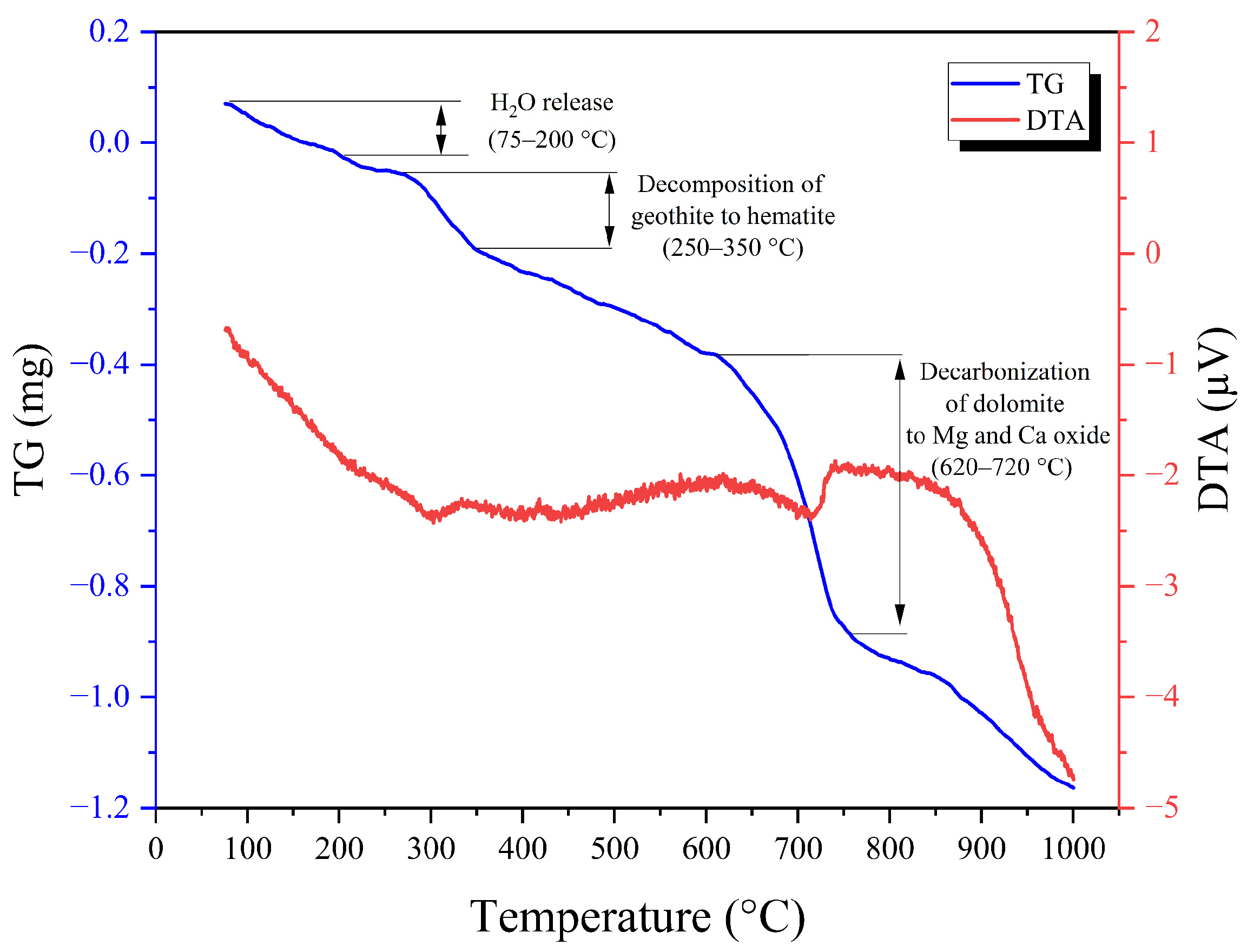
Characterization studies indicated that the sample contained 22.4 wt.% Fe, 4.37 wt.% Mg, and 0.84 wt.% Ni and 0.05 wt.% Co (as seen in Table 2), confirming high impurity content and the relatively low concentrations of the valuable metals Ni and Co. The XRD pattern of the raw laterite in Figure 1 showed that goethite and silica were the main minerals. Accordingly, the sample could be classified as limonitic laterite. The thermogravimetric–differential thermal analysis (TG–DTA) results of the raw laterite are shown in Figure 2. As seen, there are three prominent degradation steps, including mass loss at approximately 100 °C, 299 °C, and 720 °C. The first degradation, which occurred between 75 and 200 °C, was attributed to the release of adsorbed water from raw laterite samples. The second, which occurred between 250 and 350 °C, can be attributed to the dihydroxylation of goethite (FeOOH) to hematite (Fe2O3). The third step in the 620–720 °C region is associated with the decarbonization of dolomite (CaMg(CO3)2) to MgO and CaO, along with CO2 emission [34].

3.2. Leaching Studies

3.2.1. Direct Atmospheric Leaching and Fe Precipitation Studies

The atmospheric leaching experiments were conducted to evaluate the applicability of direct sulfuric acid leaching for this specific lateritic feed. Initial experiments were conducted to determine the feasibility of leaching Ni and Co from laterite ore in sulfuric acid media (H2SO4 concentration of 2 M, temperature of 90 °C, time of 6 h, pulp density of 10 wt.%, and stirring speed of 600 rpm). The leaching results are listed in Table 3. This method achieved leaching efficiencies of 87.5% and 91.0% for Ni and Co, respectively; however, significant Fe co-leaching (90.0%) was also observed. Owing to the high Fe concentration in the solution, further purification is required to avoid operational issues during solvent extraction. For Fe removal, the jarosite precipitation method was utilized to separate Fe from the pregnant leach solution (PLS) [35]. Table 4 shows the precipitation process results. As seen, despite removing up to 86.0% of Fe, a large amount of Ni (42.5%) co-precipitated with Fe. Therefore, the sulfation roasting-water leaching route was investigated as an alternative approach for selective Ni and Co recovery.

3.2.2. Sulfation Roasting and Selective Ni/Co Leaching Studies

Development of Statistical Models
The recoveries of Ni, Co, and Fe from the proposed sulfation roasting-water leaching experiments designed using RSM-CCD are presented in Table S1 (see Supplementary Information). Among the experimental runs in the CCD design, Co and Ni exhibited their highest efficiencies at 94.2% and 91.6%, respectively, under the conditions of 60 wt.% H2SO4, a temperature of 700 °C, and a duration of 45 min. It should be noted that this condition corresponds to the highest recovery observed among the experimental runs and does not necessarily represent the overall optimum condition predicted by the RSM model, which is discussed in the following section. Additionally, the dissolution efficiency of the primary impurity linked to these elements, Fe, remained below 5.9%. This finding confirms the effectiveness of the sulfation-roasting-water leaching process in selectively leaching Ni and Co over Fe. Overall, the dissolution of Ni and Co increased with higher H2SO4 concentrations and longer roasting times, whereas it decreased at elevated temperatures during sulfate roasting. The complete transformation of Ni phases in laterite from oxide to sulfate was facilitated by high concentrations of H2SO4, extended durations, and low temperatures, consistent with previous studies [17,19,36]. More detailed explanations for these observations will be provided in the following sections.
The result of the analysis of variance (ANOVA) is presented in Table S2 (see Supplementary Information). As observed, at a significant level of 5% (p-value < 0.05), all the linear and interactive terms of parameters are statistically significant. In addition, the quadratic terms of H2SO4 and temperature are significant parameters and affect the Ni, Co, and Fe recoveries.
By ignoring the statistically insignificant terms (p-value > 0.05), three polynomial models were developed as Equations (5)–(7).
Ni recovery (%) = 79.08 + 10.60[H2SO4] − 15.64T − 2.91time − 2.76[H2SO4]2 − 9.56 T2 + 4.56 [H2SO4] × T + 3.89 [H2SO4] × time − 3.91T × time
Co recovery (%) = 81.87 + 10.62[H2SO4] − 15.67T − 2.91time − 2.72[H2SO4]2 − 9.48T2 + 4.59[H2SO4] × T + 3.89[H2SO4] × time − 3.81T × time
Fe recovery (%) = 1.695 + 0.3792[H2SO4] − 1.4588T − 0.2659time − 0.1755[H2SO4]2 + 0.2865T2 0.4384[H2SO4] × T + 0.2206[H2SO4] × time + 0.2244T × time
The coded polynomial model can make it easier to compare and understand the effects of parameters and their interactions. In other words, based on Equation (5), temperature (T) is the most significant factor influencing the recovery of Ni, as it has the highest first-order regression coefficient (15.64) compared to the other factors. Following T, H2SO4 concentration has the next most substantial impact on the response.
Based on the ANOVA results presented in Table S2 (see Supplementary Information), the p-value for lack of fit is not significant (>0.05), indicating that the developed model adequately describes the responses.
Analysis of Parameter Interaction Effects
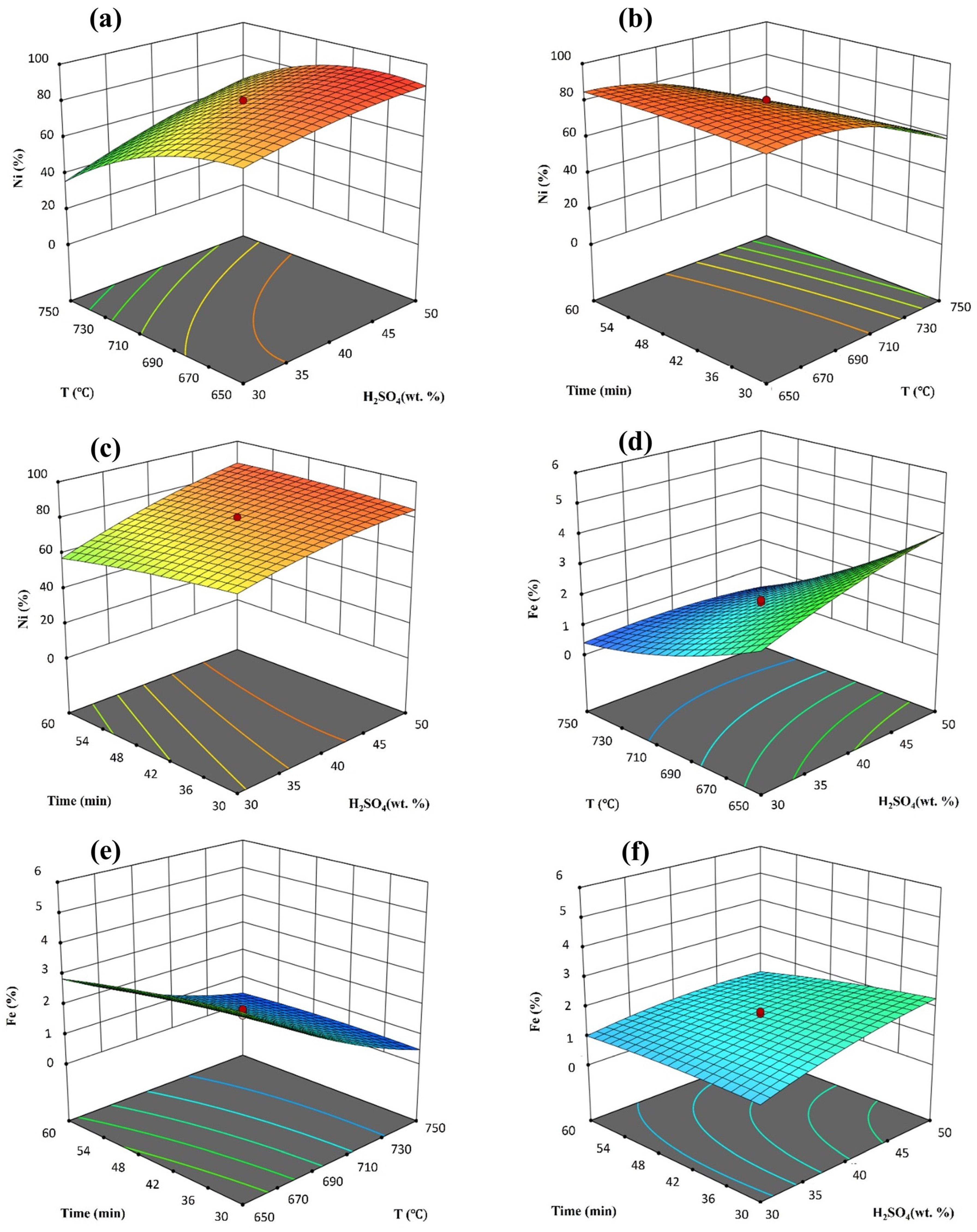
Given the similar response of Ni and Co to the investigated parameters, only Ni results are presented here, while Co data are included in the Supplementary Information (Figure S1). The surface plots presented in this section were used to study the effect of significant interaction on responses. As depicted in Figure 3a, at an H2SO4 concentration of 50 wt.%, increasing the roasting temperature from 650 to 710 °C resulted in Ni recoveries of approximately 90%. However, further increasing the temperature from 710 °C to 750 °C, led to a significant decrease in Ni recovery to about 65%. This behavior is consistent with findings from P.P. M. Ribeiro et al. [18] who reported that increasing the roasting temperature to near 700 °C favors Ni extraction due to the stabilization of Ni as Ni sulfate. At higher temperatures, Ni recovery declines as Ni sulfate thermally decomposes to Ni oxide, with decomposition initiating at approximately 758 °C and reaching a maximum near 828 °C [18]. For Fe, increasing the roasting temperature within the studied range (650–750 °C) at an H2SO4 concentration of 50 wt.% (acid-to-solid mass ratio = 0.5:1) resulted in a pronounced decrease in recovery from approximately 4% to 0.4% (Figure 3d). A similar temperature-dependent trend is observed for Ni. As shown in Figure 3b, increasing both roasting time and temperature led to a reduction in Ni recovery; for instance, at a fixed roasting time of 54 min, increasing the temperature from 700 to 750 °C resulted in a decrease in Ni recovery from 83 to 60%. Similar behavior exists for Fe, with recovery decreasing to about 0.4% as roasting temperature increased from 700 to 750 °C at fixed roasting times of 30–60 min (Figure 3e). In contrast, roasting time and acid concentration exerted a positive influence on Ni recovery. As illustrated in Figure 3c, increasing the roasting time from 30 to 50 min at 50 wt.% H2SO4 enhanced Ni recovery to approximately 88%. Similarly, Fe recovery increased to about 2% under the same conditions (Figure 3f), likely due to prolonged reaction time allowing greater interaction between sulfuric acid and laterite particles during roasting. Overall, these results showed that temperature plays a substantial role in the sulfation roasting process. A roasting temperature of 700 °C yields the highest recovery for Ni and Co, while minimizing Fe dissolution.
Optimization of Sulfation Roasting Conditions
Validation experiments were performed to evaluate the validity of the developed second-order polynomial model (Equation (3)) for maximizing Ni and Co recoveries while minimizing Fe recovery. Based on the model prediction, maximum recoveries of 88.8% Ni and 92.0% Co, with only 1.5% Fe recovery, could be achieved at the optimum conditions of 50 wt.% H2SO4, a roasting temperature of 703 °C, and a roasting time of 54 min. A validation experiment was subsequently performed under these optimum conditions, and the results are summarized in Table 5. The experimentally obtained recoveries were 87.2% for Ni, 96.6% for Co, and 3.8% for Fe. Comparison of the experimental and predicted values indicates good agreement, with all results falling within the 95% confidence interval, thereby confirming the developed model’s adequacy. Moreover, when compared with atmospheric leaching (Table 3), the substantially lower Fe co-leaching (3.8%) demonstrates the high selectivity of the sulfation roasting-water leaching process for Ni and Co over Fe. Despite the relatively high roasting temperature (703 °C), this condition minimizes Fe dissolution during leaching, thereby reducing downstream processing requirements, reducing reagent consumption, and limiting Ni and Co losses.

3.2.3. Mechanism of Sulfation Roasting

Insights from XRD Analyses
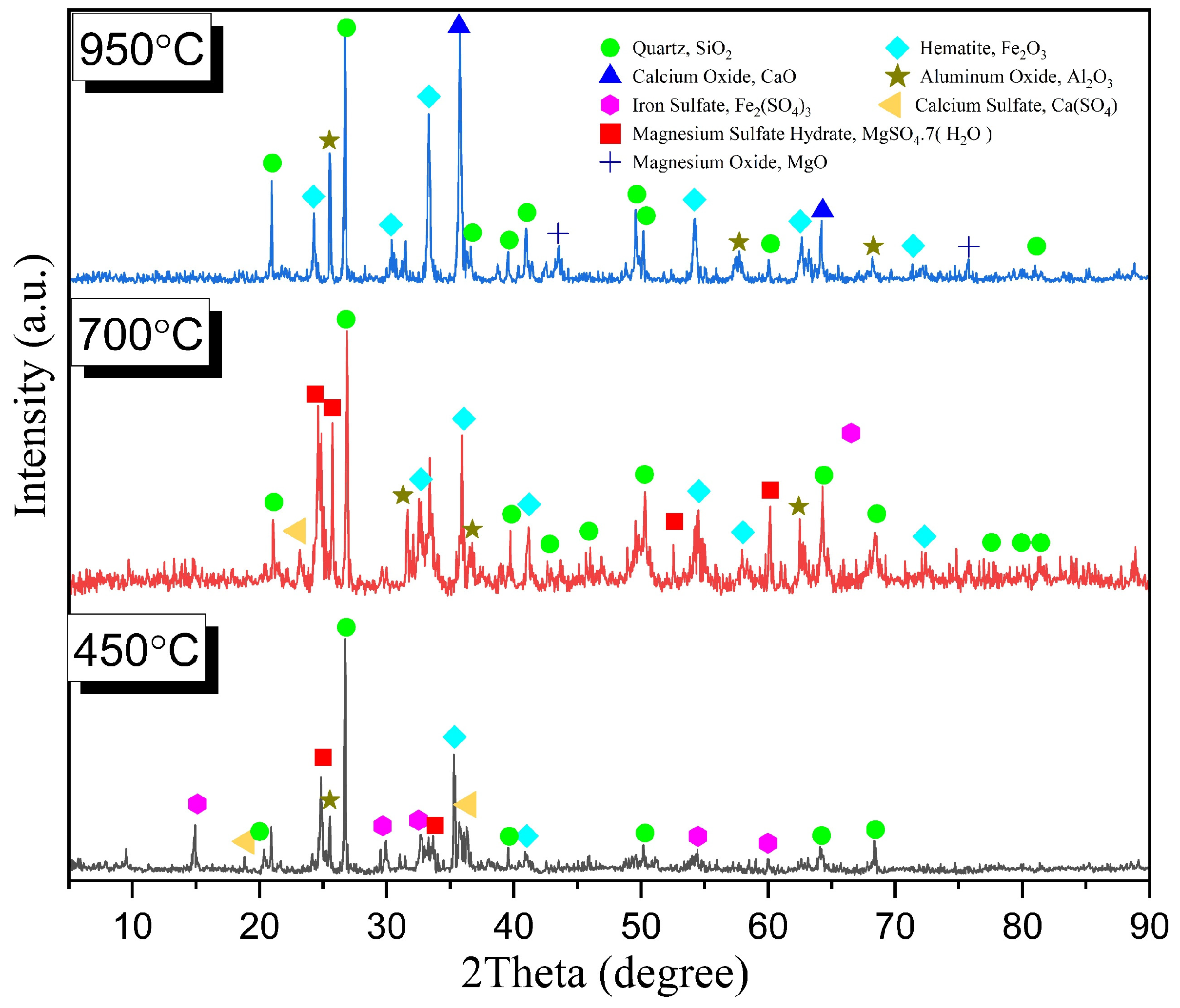
The decomposition of sulfate elements relates to their ionic charge, which is connected to their stability constants, ionic radius, hydration energy, and coordination number, among other factors. Therefore, elements with higher ionic charges are less stable and more likely to decompose at lower temperatures compared to those with lower ionic charges. Thus, the decomposition of Fe3+ occurs at a lower temperature than that of Ni and Co [37]. To investigate the phase transformations during sulfation roasting, additional roasting experiments were conducted at selected temperatures of 450 °C, 700 °C, and 950 °C. In these experiments, the laterite sample was mixed with 50 wt.% sulfuric acid, homogenized, and dried prior to roasting. The prepared samples were then roasted in a muffle furnace at the target temperatures for the 54 min, followed by cooling to room temperature. The roasted solids were subsequently analyzed by X-ray diffraction (XRD) to identify the mineralogical phase changes during sulfation roasting. The XRD patterns are shown in Figure 4. At a temperature of 450 °C, the sample mainly consisted of SiO2, Fe2(SO4)3, Al2O3, MgSO4, and partially of Fe2O3. This Fe2O3 originated from the dihydroxylation of goethite. Therefore, Fe and Mg completely reacted with H2SO4. Although Ni and Co are incorporated into the newly formed sulfates, these phases could not be identified or quantified due to their low abundance and poor crystallinity [38]. As the temperature increased to 700 °C, the Fe2(SO4)3 peaks disappeared, and Fe2O3 peaks became stronger, indicating the complete decomposition of Fe sulfate to Fe oxide. On the other hand, Mg remains as Mg (SO)4 during the roasting at 700 °C. These phase transformations are consistent with the experimental results, confirming that around 700 °C is the optimal roasting temperature to minimize Fe dissolution while enabling selective leaching of Ni and Co over Fe.
Insights from Thermogravimetric Differential Thermal Analysis
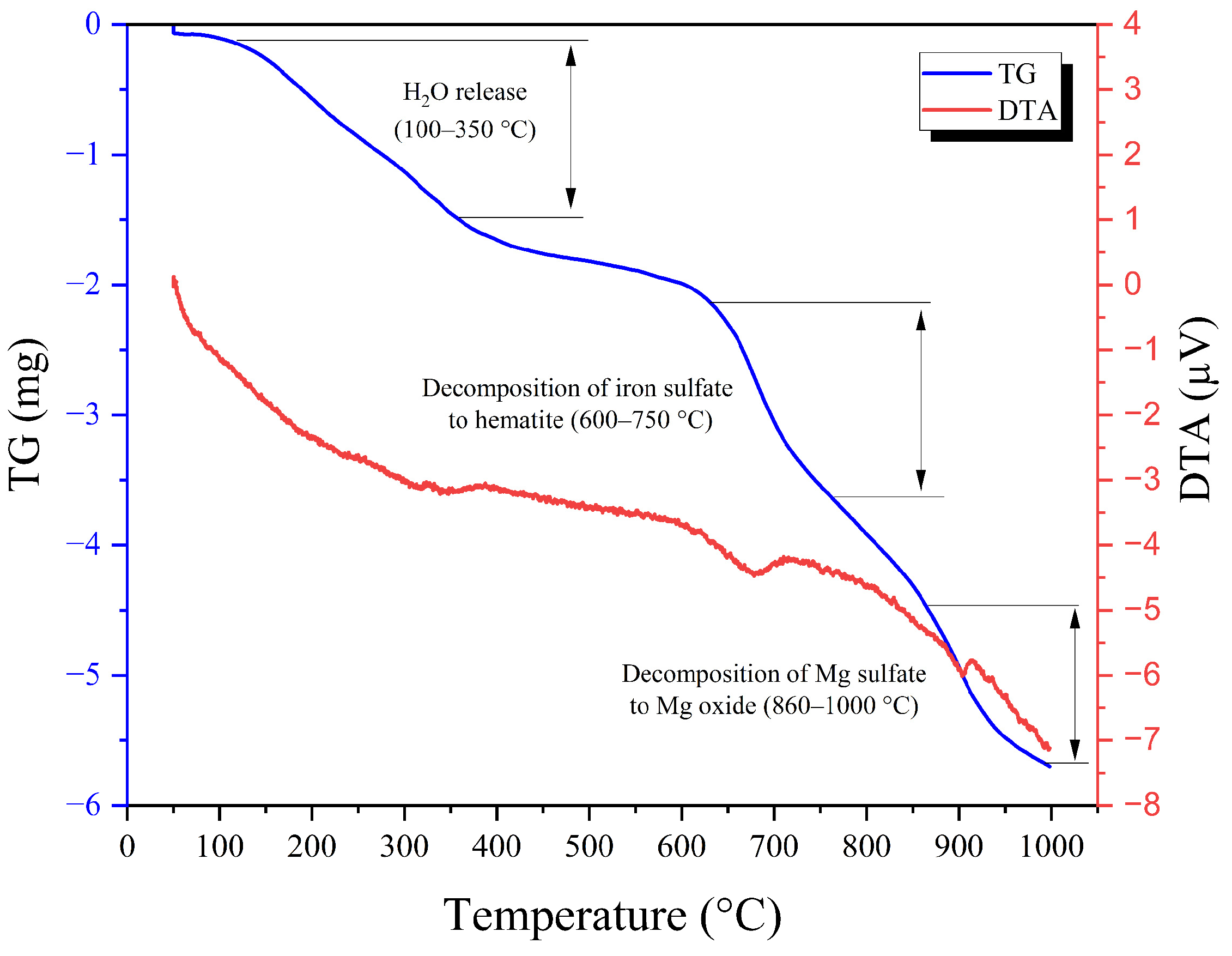
TG-DTA was conducted on the sulfated laterite sample to gain insight into the sulfation mechanism and sulfate decomposition behavior. The sample was prepared by mixing the laterite with 50 wt.% H2SO4, corresponding to the optimum sulfation conditions identified in this study. The mixture was homogenized and dried prior to thermal analysis. Figure 5 shows the thermal behavior of the sulfated sample. The temperature ranges from 100 to 350 °C indicating the release of physically adsorbed water, dehydration of hydrated sulfate phases, and the dehydroxylation of goethite to hematite. The temperature range between 650 °C and 750 °C shows a peak (approximately at 690 °C) related to the decomposition of ferric sulfates into hematite and SO3, according to the reaction of Equation (8) [39]. Above 750 °C, the observed behavior can be attributed to the onset of Ni and Co sulfate decomposition [25], as described by Equation (9). This interpretation is consistent with the leaching results, which show that increasing the sulfation temperature beyond 700 °C leads to a decrease in Ni recovery [40]. The mass loss starting at 860 °C, with a maximum at 903 °C, can be associated with the decomposition of Mg sulfate, which is more stable than the other sulfates under investigation, according to Equation (10) [41]. This finding matches the XRD results in Figure 4. When the temperature increased to 950 °C, the remaining CaSO4 and MgSO4 were converted to CaO and MgO, respectively.
Fe 2 ( SO 4 ) 3 ( s )     Fe 2 O 3 ( s ) + 3 SO 3 ( g )
NiSO 4 ( s )     NiO ( s ) + SO 3 ( g )
MgSO 4 ( s )     MgO ( s ) + SO 3 ( g )
Insights from Scanning Electron Microscope (SEM)
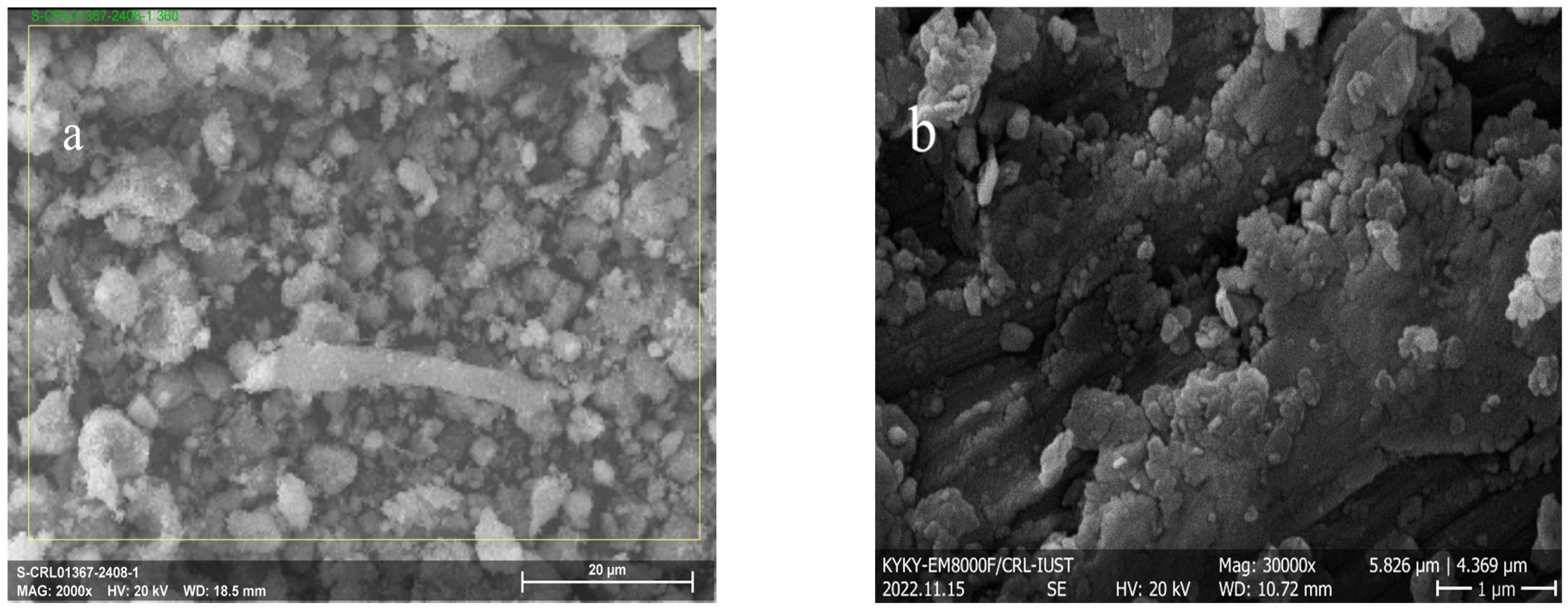
Studies were conducted to gain further insights into the morphological changes in the laterite sample following sulfation roasting. Figure 6 displays the microstructures before and after roasting, respectively. Prior to sulfation roasting (Figure 6a), the particles appear relatively coarse, compact, and agglomerated, with an average size of about 1 µm. After roasting (Figure 6b), the morphology becomes finer and more porous, and the mean particle size decreases to approximately 0.2 µm. This reduction in particle size and the appearance of porous, fragmented structures can be attributed to the decomposition of goethite and the formation of hematite, accompanied by the release of structural water and SO3 gases during sulfation. Similar morphological changes have been reported in previous studies on laterite sulfation roasting. Ref. [18] observed the development of porous hematite matrices populated with fine sulfate particles after roasting at 780 °C, resulting from the breakdown of goethite and the nucleation of Fe oxides on sulfate surfaces.

3.3. Solvent Extraction (SX)

3.3.1. Reaction Mechanisms

The extraction of metal ions from sulfate solutions using di-(2-ethylhexyl) phosphoric acid (D2EHPA) and bis(2,4,4-trimethylpentyl)phosphinic acid (Cyanex 272) occurs through a cation-exchange mechanism. In this process, metal ions M2+ and M3+ in the aqueous phase react with the acidic form of the extractant (HR) to form metal-extractant complexes in the organic phase. The following reactions (Equations (11) and (12)) describe the procedure for extracting divalent and trivalent metals using D2EHPA and Cyanex [42,43]:
M 2 +   +   n RH 2   MH 2 n - 1 R 2 n   +   2 H +
M 3 + +   n ( RH ) 2   MH 3 ( n - 1 ) R 2 n + 3 H +
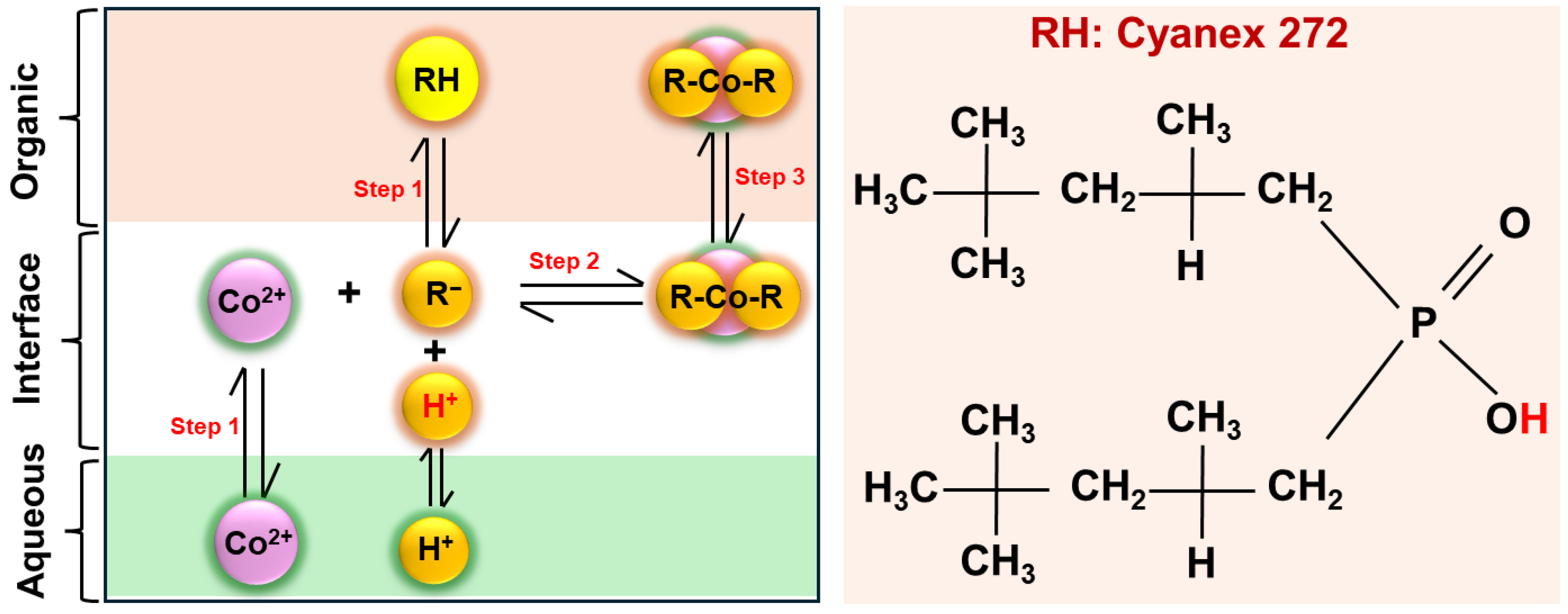
where Mn+ denotes the metal cation (Al, Mn, Zn, Fe), and (RH)2 refers to the dimeric form of the extractant that mainly exists in aliphatic diluents. The variable n indicates the number of extractant molecules participating in the metal extraction process. The hypothesized reaction mechanism between Co and Cyanex 272 is illustrated in Figure 7.
The selective extraction of Co over Ni by Cyanex 272 has been widely reported in the literature. For example, Lu et al. [33] demonstrated that Cyanex 272 can effectively separate Co from Ni, achieving approximately 98% Co extraction while limiting Ni co-extraction to below 10% under appropriate pH conditions.
This behavior can be further explained using the concept of half-extraction pH (pH50), defined as the pH at which 50% of a metal is extracted. Reported pH50 values by Liu et al. [44] indicate that Co2+ is extracted at significantly lower pH compared to Ni2+, with typical values of approximately pH50(Co) ≈ 4.1 and pH50(Ni) ≈ 6.0, corresponding to a separation window (ΔpH50) of nearly 2 pH units.
This difference indicates that, under the operating pH conditions used in this study, Co2+ is preferentially extracted into the organic phase, while Ni2+ remains predominantly in the aqueous phase. This behavior is attributed to the stronger interaction of Cyanex 272 with Co2+ compared to Ni2+, leading to selective Co extraction.

3.3.2. Removal of Impurities by D2EHPA

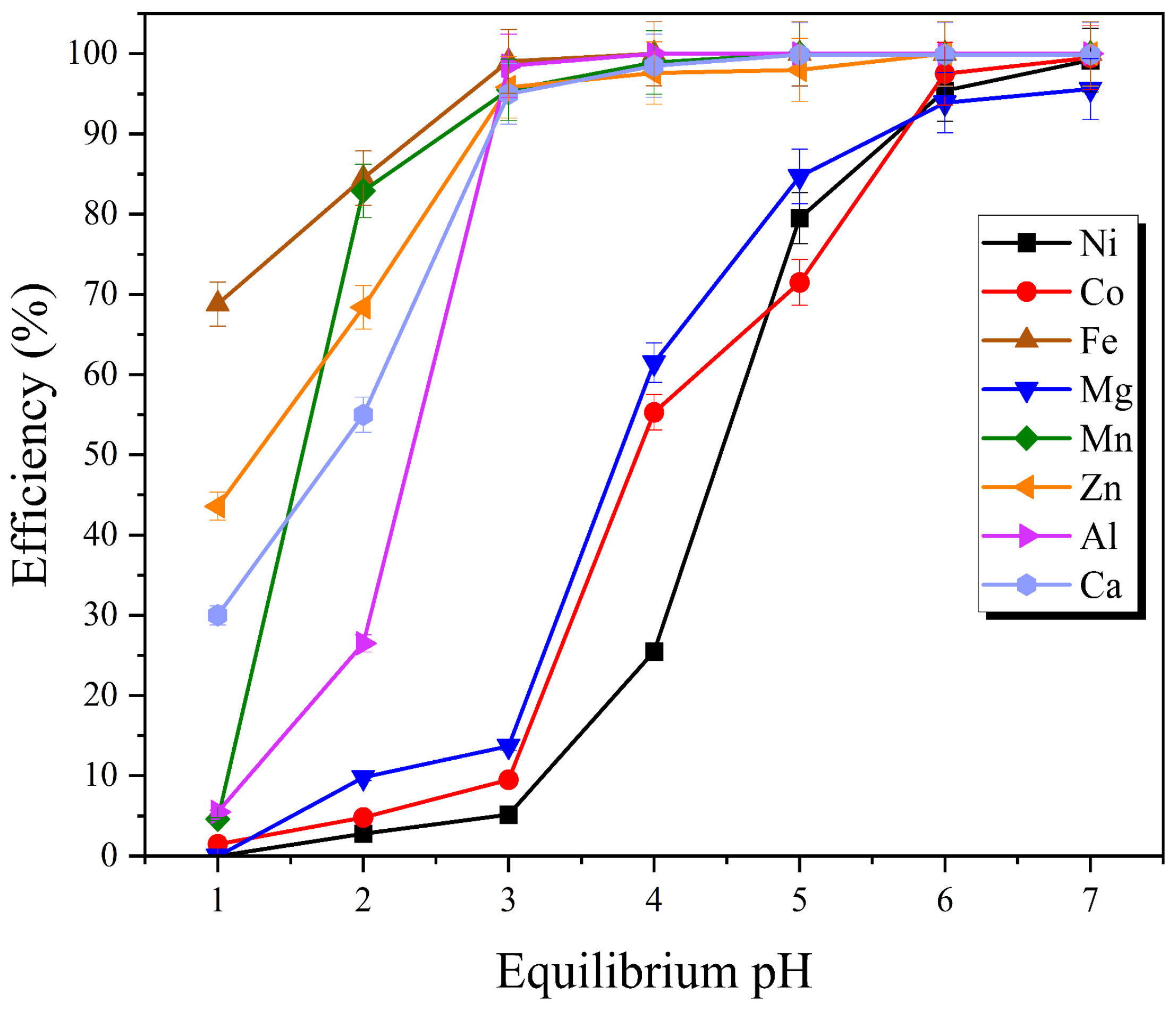
Previous studies on Ni-Co separation have demonstrated that D2EHPA can selectively remove impurity metals (Zn, Mn, Ca, Al, and Fe) from leach solutions containing those metals with Co and Ni [45].Therefore, the leach solution obtained from the optimum condition of the sulfation-roasting-water leaching stage was subjected to an SX process using D2EHPA as extractant. The effect of pH on the separation of Zn, Ca, Fe, Al, and Mn from Ni and Co at an O/A ratio of 1, 10% v/v D2EHPA in kerosene, the temperature of 40 °C, and a contact time of 10 min was shown in Figure 8. As seen in Figure 8, at pH = 2.8, the extraction efficiency of Fe, Zn, Ca, Al, and Mn were found at 98.0, 97.0, 99.0, 95.0, and 99.0%, respectively; meanwhile, the extraction efficiency of Ni and Co was less than 10%.
The extraction behavior of metal ions is influenced by their ionic radius, charge density, and hydration energy, which together govern their interaction with extractants such as D2EHPA. In general, smaller ions possess higher charge density and stronger hydration shells, making dehydration more difficult prior to complex formation. In contrast, larger ions with lower hydration energies can more readily lose their hydration shell and interact with the extractant, leading to higher extractability [46]. The high extractability of Fe3+ at low pH is due to its high charge density, which leads to strong electrostatic interactions with the phosphoryl oxygen atoms of D2EHPA. This enables Fe3+ to form stable ferric phosphate complexes even in strongly acidic conditions (pH < 2) [47,48]. Similarly, the Cheng study on impurity separation from synthesis laterite leach liquor found that the D2EHPA extraction isotherm order is as follows [20]:
Fe3+ > Zn2+ > Ca2+ > Mn2+ > Cu2+ > Co2+ > Ni2+ > Mg2+
Which reflects differences in ionic radius, field strength, and hydration enthalpy among the cations. Metals like Zn2+, Ca2+, and Mn2+, with lower hydration energies, are more easily dehydrated and can coordinate more readily with D2EHPA’s phosphoryl oxygen. In contrast, Ni2+, Co2+, and Mg2+, with higher hydration enthalpies, are less extracted under these acidic conditions. Therefore, D2EHPA enabled the selective removal of impurities over Ni, Co, and Mg.

3.3.3. Separation of Ni and Co by Cyanex 272

It has been proven that Cyanex 272 could separate the Co and Mg from Ni [49]. Therefore, the raffinate from Section 3.3.1 containing Ni (302 mg/L), Co (19 mg/L), and Mg (1450 mg/L) was subjected to Co separation by Cyanex 272. To separate Ni from Co and Mg, different levels of parameters, including pH (1–7), Cyanex 272 (10%–30% v/v), and temperature (30–50 °C), were investigated as discussed in the following sections. The primary objective of the Cyanex 272 stage was to achieve selective separation of Co from Ni, rather than to produce a high-purity Co solution in a single extraction–stripping step. In solvent extraction systems, high-purity products are typically obtained through multistage extraction and scrubbing circuits. The presence of minor amounts of Ni in the strip liquor indicates that further purification—via additional scrubbing or staged extraction—would be required to achieve complete Co purification.
Effect of pH and Cyanex 272 Concentration
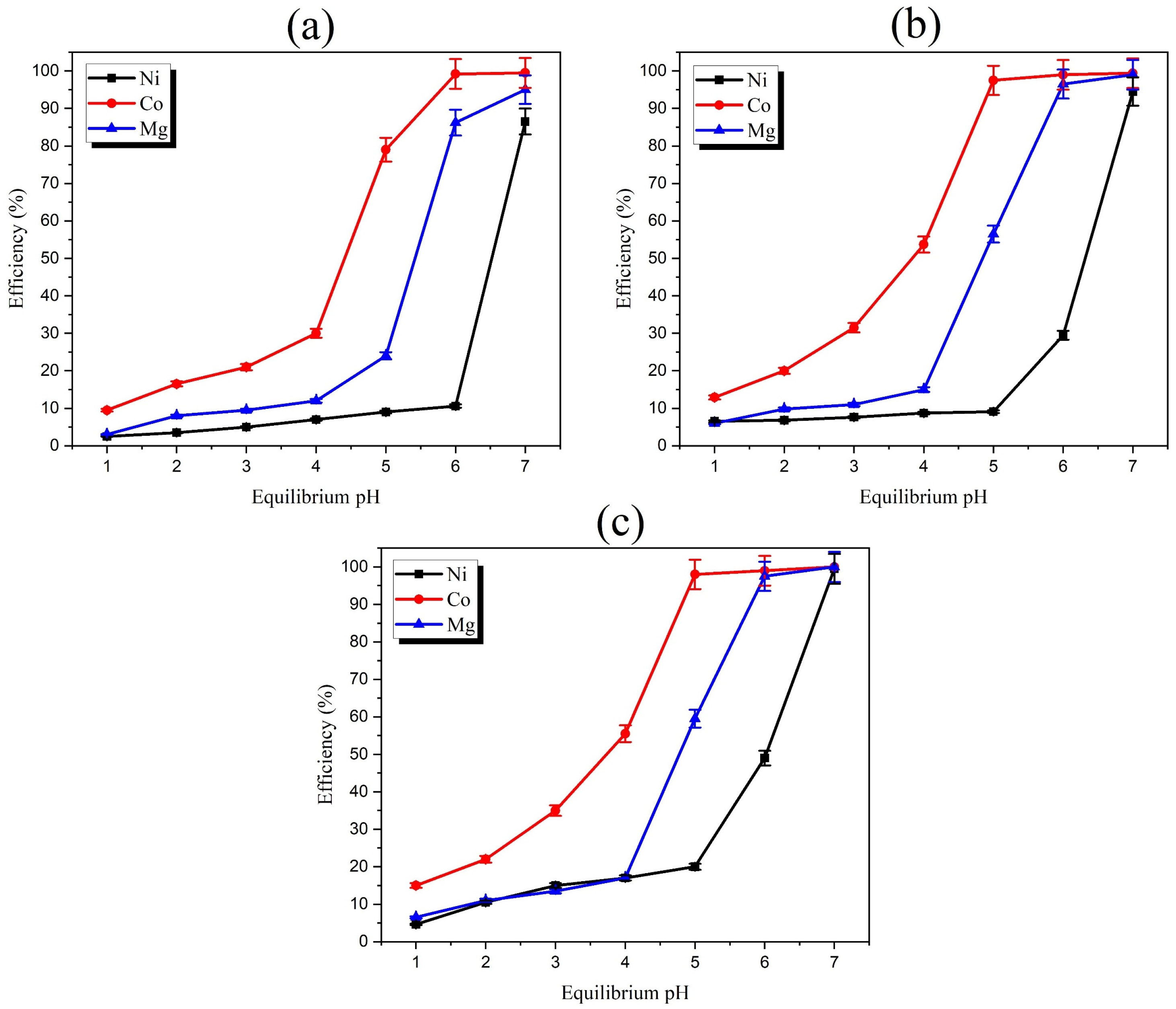
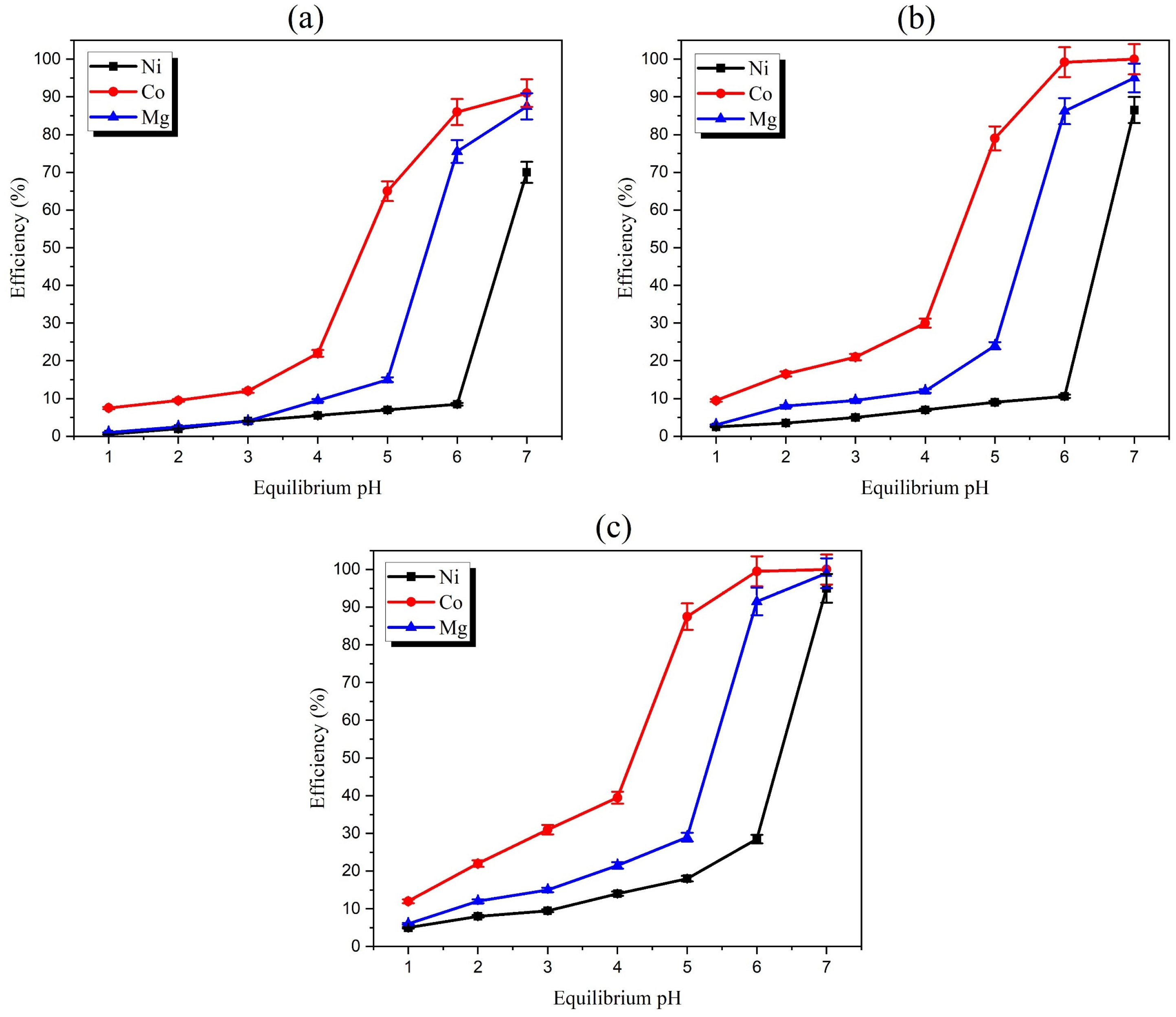
The effect of Cyanex 272 concentration on extraction efficiency was determined at a pH range of 1–7, an A/O ratio of 1:1, a contact time of 10 min, and a temperature of 40 °C (Figure 9). Based on the results presented in Figure 9a–c, the sequence of ionic extraction follows Co > Mg > Ni, and this order is consistent with previous research on synthetic solutions [50]. According to Equation (11), when the pH of the aqueous phase increases, the concentration of the species decreases, and the equilibrium shifts to the right, which promotes the formation of the neutral metal-extractant complex in the organic phase. Thus, extraction efficiency increases with pH until it plateaus when nearly all extractable metal has transferred to the organic phase [46,48].
Figure 9a shows that with Cyanex 272 at a concentration of 10% v/v, with pH increasing from 1 to 5.8, the Co and Mg extraction efficiency increased from 14 to 99.9%, and from 9 to 86.0%, respectively. Under the same conditions, the Ni extraction efficiency gradually increased to 10%. Through increasing Cyanex 272 concentration to 30% v/v (Figure 9b,c), the extraction efficiency of metals increased, and the extraction curves shifted to low pHs, which resulted in 97.5 and 90.2% extraction of Co and Mg at pH of 5.8, respectively. Simultaneously, the co-extraction of Ni at pH of 5.8 reaches 35%, which leads to much Ni loss to the organic phase. Equation (11) indicates that increasing the concentration of the extractant [HR] drives the reaction toward the right, resulting in the formation of more metal extractant complexes in the organic phase. Thus, higher Cyanex 272 concentrations provide a greater number of reactive extractant molecules available for coordination with metal ions, which contributes to increased Ni co-extraction.
From the obtained results, it can be concluded that Cyanex 272 at a concentration of 10% v/v, O/A ratio of 1, temperature of 40 °C, and contact time of 10 min can effectively separate Ni as raffinate from Co and Mg.
Effect of Temperature
The effect of temperature on the separation of Ni from Co and Mg was investigated at a temperature range of 30 to 50 °C using Cyanex 272 concentration of 10% v/v, pH 1–7, O/A ratio of 1, and contact time of 10 min. As illustrated in Figure 10, increasing temperature enhanced the extraction efficiency, resulting in higher metal loadings of Co, Mg, and Ni in the organic phase Figure 10a,b indicated that at pH = 5.8, by increasing temperature from 30 to 40 °C, the extraction efficiency of Co and Mg increased from 80.0 to 99.9% and 72.0 to 86.0%, respectively. Under the same conditions, the Ni extraction remained constant (10%). For temperatures above 40 °C, the Mg and Ni extraction efficiencies increased to 90.0 and 28%, respectively (Figure 10c). The extraction reaction between divalent metal ions and Cyanex 272 follows a cation exchange mechanism that is slightly exothermic [51]. At moderate temperature (≈40 °C), lower phase viscosity and faster mass transfer promote complex formation, resulting in higher extraction efficiency. However, since the formation of metal extractant complexes releases heat, further temperature increase shifts the equilibrium slightly toward the aqueous phase, limiting any additional improvement. Similar temperature-dependent behavior has been reported by Sole [47] and Yun [48], who noted that Co and Ni extraction by Cyanex 272 is exothermic and that extraction efficiencies increase up to 40 °C before stabilizing or slightly declining at higher temperatures. The results confirm that 40 °C offers the best balance between enhanced kinetics and favorable equilibrium for efficient separation of Co, Mg, and Ni. Therefore, 40 °C was selected as the optimal temperature.

3.3.4. Stripping of Co and Mg

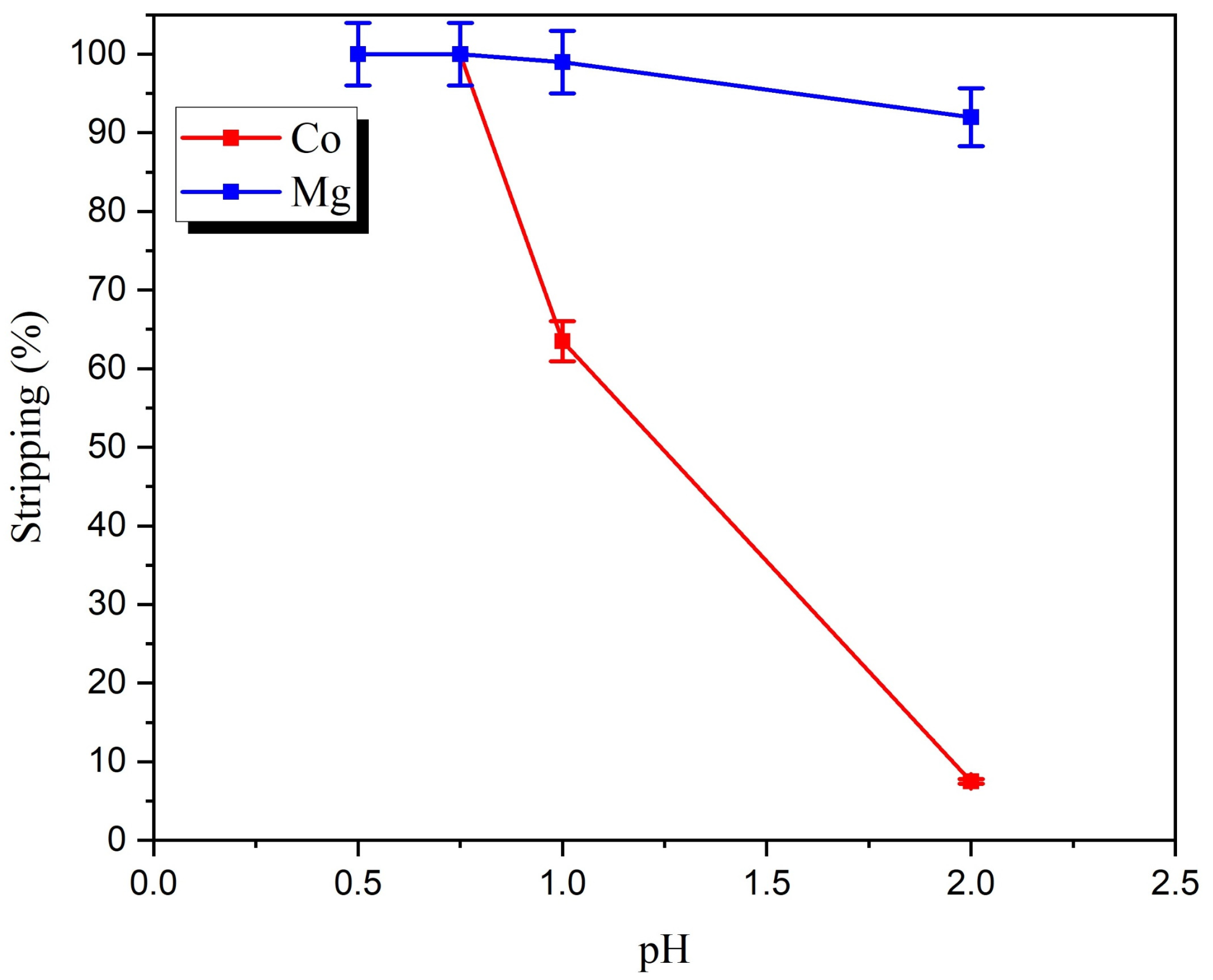
The organic phase obtained from optimum conditions of Cyanex 272 solvent extraction (Cyanex 272 = 10% v/v, pH = 5.8, T = 40 °C, t = 10 min, A/O = 1) contained a remarkable amount of Co (18.8 mg/L) and a significant concentration of Mg (1249 mg/L). Accordingly, for Co and Mg recovery, the organic solution was subjected to stripping using dilute sulfuric acid solutions with pH values of 0.5, 0.75, 1.0, 2.0, and 3.0, and an A/O ratio of 1.0 at ambient temperature. The efficiency of metal stripping from the loaded organic solution is shown in Figure 11. The results demonstrate that at a pH of 0.75, Co and Mg can be completely stripped from the loaded organic phase. However, with increasing pH, the stripping efficiency of Co significantly decreased, while the decrease in Mg was only slight.
The stability and reusability of Cyanex 272 in sulfate media have been widely reported in previous studies, demonstrating minimal degradation and stable extraction efficiency over multiple extraction-stripping cycles, confirming its suitability for repeated industrial use [8].

3.4. Proposed Process: Comparison, Flowchart, and Mass Balance

3.4.1. Comparison with Previous Studies

The unique aspect of the current study lies in its integration of all stages into a single optimized process. After controlled sulfation roasting and subsequent water leaching, the purified leach liquor underwent solvent extraction, which facilitated the selective separation of Ni and Co into two distinct, impurity-free aqueous phases. This method not only achieved high recoveries of Ni (87.2%) and Co (96.6%) but also resulted in two solutions suitable for further enrichment, precipitation, or crystallization into battery-grade precursors. into battery-grade precursors. Consequently, this work extends beyond traditional leaching optimization, demonstrating a comprehensive, closed-loop process that achieves high recovery rates while selectively separating metals.
The sulfation roasting–water leaching conditions and process steps reported in previous studies, together with those investigated in the present work, are summarized in Table 6. The table highlights whether experimental design optimization, impurity removal via solvent extraction, and Ni–Co separation were incorporated into each process flowsheet. As shown in Table 6, many previous studies have explored sulfation roasting followed by water leaching for Ni and Co recovery, often reporting comparable roasting temperatures and leaching efficiencies. However, most prior work has focused on individual unit operations—such as roasting–leaching optimization, solvent extraction, or experimental design—considered in isolation. In contrast, the present study integrates sulfation roasting, selective water leaching, impurity removal using D2EHPA, and Co/Ni separation using Cyanex 272 within a unified process flowsheet. Accordingly, the key contribution of this work lies not in the roasting step alone, but in the development and evaluation of a fully integrated hydrometallurgical process for Ni and Co recovery from laterite ores.

3.4.2. Proposed Flowchart

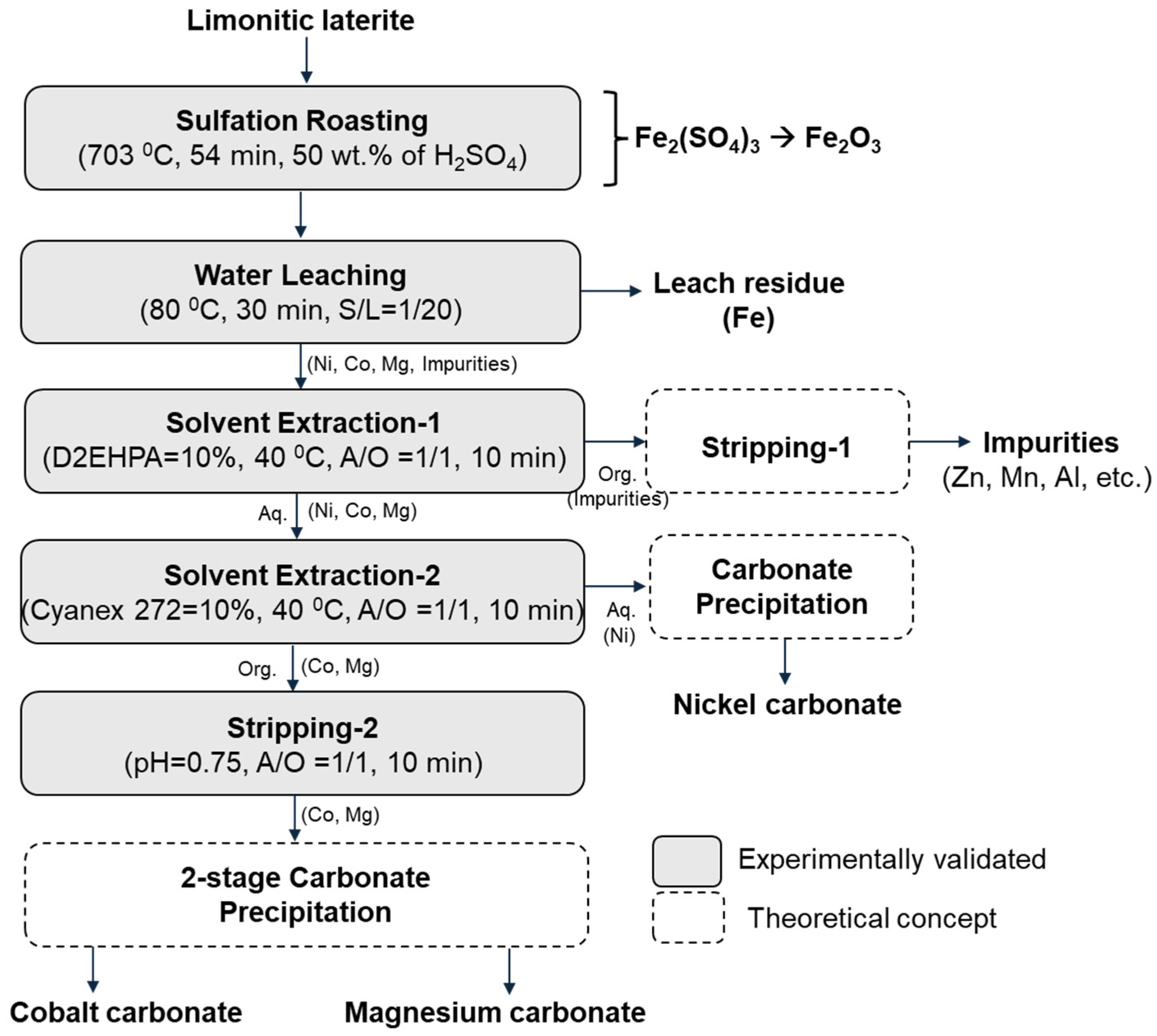
In the present study, an integrated flowsheet was developed for the recovery and separation of Ni and Co from limonite-type laterite. The proposed process, along with mass balance, is illustrated in Figure 12. As shown, the sulfation roasting-water leaching stage enabled the dissolution of more than 80% of both Ni and Co into the pregnant leach solution, while the co-dissolution of Fe, the principal impurity in downstream hydrometallurgical processing, was limited to approximately 3%. The resulting leachate, obtained under the optimum sulfation roasting–leaching conditions (50 wt.% H2SO4, 703 °C, and 54 min), was subsequently treated using a two-stage solvent extraction (SX) circuit for impurity removal and Ni-Co separation. In the first SX stage, D2EHPA was employed to selectively extract Fe, Zn, Al, Ca, and Mn from the leach solution, while retaining Ni, Co, and Mg in the aqueous phase under optimized conditions (O/A = 1, 10 vol.% D2EHPA, pH ≈ 3, 40 °C, and 10 min contact time). In the second SX stage, the raffinate was treated with 10 vol.% Cyanex 272 to separate Ni from Co and Mg. Under these conditions, Co and Mg were preferentially extracted into the organic phase, while Ni remained in the aqueous phase. Finally, Co and Mg were stripped from the loaded organic phase in a single step using 1 M H2SO4, yielding a purified Co- and Mg-rich strip solution suitable for carbonate precipitation. It should be noted that the objective of this stage was the separation of Co from Ni rather than complete purification in a single extraction-stripping step. Additional scrubbing or multistage solvent extraction would be required to obtain high-purity Co and Mg products.

3.4.3. Mass Balance

Under the optimized conditions for each stage, a comprehensive mass balance was conducted for Ni, Co, Fe, and Mg based on 10 g of limonite feed material. The overall mass balance closure was within 100 ± 2%, indicating good agreement between input and output measurements and confirming the reliability of the experimental data.
The material balances were calculated according to Equation (14):
Mass   balance   closure   =     Total   output   mass Total   input   mass × 100
The mass balance results indicate that most Fe was rejected during sulfation roasting and water leaching, resulting in a low-impurity leachate suitable for downstream solvent extraction. More than 87% of Ni, 96% of Co, and 88% of Mg were leached and subsequently distributed through the solvent extraction stages. The detailed mass balance table is provided in the Supplementary Information (Table S3).

4. Conclusions

A robust integrated process for the recovery and separation of Ni and Co from limonitic laterite was developed based on sulfation roasting followed by water leaching. Optimization using response surface methodology with a central composite design (RSM-CCD) identified the optimal roasting conditions as 50 wt.% H2SO4, 703 °C, and 54 min. Under these conditions, 87.2% of Ni and 96.6% of Co were converted to water-soluble sulfates, while Fe dissolution remained limited to 3.8% during water leaching at 80 °C, a solid-to-liquid ratio of 5%, and a leaching time of 30 min.
ANOVA results indicated that acid concentration and roasting temperature were the most significant parameters affecting Ni and Co recovery and Fe rejection, with their interaction exerting the strongest combined influence on the leaching performance.
The pregnant leach solution obtained under these optimized conditions was further treated to separate Ni through a two-stage solvent extraction process. In the first stage, 10 vol.% D2EHPA at pH 2.8 and 40 °C selectively removed major impurities (Fe, Zn, Al, Ca, and Mn) while limiting Ni losses to below 10%. In the second stage, 10 vol.% Cyanex 272 at pH 5.8 selectively extracted Co and Mg, leaving Ni in the aqueous phase. The loaded organic phase was subsequently stripped using sulfuric acid (pH 0.75, A/O = 1) at room temperature.
Overall, the results demonstrate the feasibility of an integrated process combining selective sulfation roasting, water leaching, and solvent extraction for the efficient recovery and separation of Ni and Co from limonitic laterite. The main contribution of this study is the integrated evaluation of upstream sulfation roasting-water leaching and downstream solvent extraction using real impurity-rich leach solutions, providing insight into impurity behavior and metal separation under realistic process conditions. The primary objective of this process was to minimize Fe dissolution during leaching, as Fe can complicate downstream processing. The proposed approach enables effective extraction of Ni and Co while limiting Fe co-leaching, thereby improving overall process selectivity and efficiency.
Future work should focus on achieving higher purity of the final Ni and Co products, process scale-up, evaluation of extractant stability, and techno-economic assessment to further evaluate the practical applicability of the proposed flowsheet.

Supplementary Materials

The following supporting information can be downloaded at: https://www.mdpi.com/article/10.3390/min16050431/s1, Figure S1: Interaction plots for Co recovery with respect to (a) [H2SO4] and T, (b) T and time, (c) [H2SO4] and time; Table S1: Experimental design (CCD) and measured recoveries of Ni, Co, and Fe in sulfation roasting–water leaching; Table S2: Analysis of Variance (ANOVA) results for Ni, Co, and Fe recoveries; Table S3: Mass balance of Ni, Co, Fe, and Mg is defined for the treatment of a 10 g limonite sample.

Author Contributions

Conceptualization, M.O. and J.M.; Methodology, M.O., F.A., M.A., J.M. and S.K.; Software, M.O.; Validation, M.O., F.A. and M.R.A.; Formal analysis, M.O.; Investigation, M.O., F.A. and L.A.; Data curation, M.O., M.A. and J.M.; Writing—original draft, M.O., F.A. and M.R.A.; Writing—review & editing, M.O., M.R.A., M.A., J.M., S.K., J.J.W. and L.A.; Visualization, M.O., F.A. and M.R.A.; Supervision, M.R.A., M.A. and J.M.; Funding acquisition, S.K. All authors have read and agreed to the published version of the manuscript.

Funding

This research received no external funding.

Data Availability Statement

The original contributions presented in this study are included in the article/Supplementary Material. Further inquiries can be directed to the corresponding authors.

Conflicts of Interest

The authors declare no conflict of interest.

References

  1. Stopić, S.R.; Friedrich, B.G. Hydrometallurgical Processing of Nickel Lateritic Ores. Vojnoteh. Glas. 2016, 64, 1033–1047. [Google Scholar] [CrossRef] [Scilit]
  2. Sadigh, M.; Noaparast, M.; Shafaei, S.Z.; Amini, A. Comparison of Leaching and Heavy Liquid Separation Methods for Low Grade Nickel Lateritic Ore. Miner. Process. Extr. Metall. 2016, 125, 57–63. [Google Scholar] [CrossRef] [Scilit]
  3. Lv, X.; Lv, W.; Liu, M.; You, Z.; Lv, X.; Bai, C. Effect of Sodium Sulfate on Preparation of Ferronickel from Nickel Laterite by Carbothermal Reduction. ISIJ Int. 2018, 58, 799–807. [Google Scholar] [CrossRef] [Scilit]
  4. Cheng, C.Y.; Urbani, M. The Recovery of Nickel and Cobalt from Leach Solutions by Solvent Extraction: Process Overview, Recent Research and Development. In Proceedings of ISEC 2005; ISEC: Fargo, ND, USA, 2005. [Google Scholar]
  5. Liu, Z.G.; Sun, T.C.; Wang, X.P.; Gao, E.X. Generation Process of FeS and Its Inhibition Mechanism on Iron Mineral Reduction in Selective Direct Reduction of Laterite Nickel Ore. Int. J. Miner. Metall. Mater. 2015, 22, 901–906. [Google Scholar] [CrossRef] [Scilit]
  6. Wijenayake, J.J.; Lee, S.Y.; Park, S.H.; Sohn, H.S. Production of Ferronickel from Limonitic Laterite Ore Using Hydrogen Reduction and Cementation. Hydrometallurgy 2021, 203, 105662. [Google Scholar] [CrossRef] [Scilit]
  7. Hosseini Nasab, M.; Noaparast, M.; Abdollahi, H. Dissolution of Nickel and Cobalt from Iron-Rich Laterite Ores Using Different Organic Acids. J. Min. Environ. 2020, 11, 779–797. [Google Scholar] [CrossRef]
  8. Park, K.-H.; Mohapatra, D. Process for Cobalt Separation and Recovery in the Presence of Nickel from Sulphate Solutions by Cyanex 272. Met. Mater. Int. 2006, 12, 441–446. [Google Scholar] [CrossRef] [Scilit]
  9. Zhang, W.; Ma, B.; Wang, C.; Chen, Y. Study on the Treatment of Pyrolysis Products from the Nitric Acid Pressure Leach Liquor of Laterite. Sep. Purif. Technol. 2024, 350, 127780. [Google Scholar] [CrossRef] [Scilit]
  10. Oxley, A.; Smith, M.E.; Caceres, O. Why Heap Leach Nickel Laterites? Miner. Eng. 2016, 88, 53–60. [Google Scholar] [CrossRef] [Scilit]
  11. Prasetya, A.; Putera, A.D.P.; Sujoto, V.S.H.; Zaidan, M.H.; Abdurrahman, M.T.; Andriani, A.; Astuti, W.; Sutijan; Petrus, H.T.B.M. Enhanced Recovery of Nickel and Cobalt from Limonitic Laterite Ore: Optimization and Kinetics of Atmospheric Sulfuric Acid Leaching. J. Sustain. Metall. 2025, 11, 4127–4140. [Google Scholar] [CrossRef] [Scilit]
  12. Shi, L.; Ma, B.; Cao, Z.; Yu, J.; Liu, Y.; Li, X.; Wang, C. Understanding the Differences between Nitric Acid Pressure Leaching and Atmospheric Leaching of Saprolitic Laterite: Leaching Behavior, Kinetics Investigation and Mechanism. J. Ind. Eng. Chem. 2025, 156, 828–841. [Google Scholar] [CrossRef] [Scilit]
  13. Li, J.; Yu, T.; Li, C.; Han, X.; Gao, J. Efficient and Selective Leaching of Nickel and Cobalt from Nickel Laterite Ore by a Combined Atmospheric Acid Leaching-Ferric Chloride Solution Leaching Process: Optimization and Mechanism. RSC Adv. 2025, 15, 29176–29189. [Google Scholar] [CrossRef] [Scilit] [PubMed]
  14. de Fátima da Silva, M.; de Sousa Oliveira, M.R.; dos Santos, I.D.; Radino-Rouse, P.; Mansur, M.B. Iron Precipitation Strategies from Nickel Laterite Ore Sulfuric Acid Leach Liquor. Miner. Process. Extr. Metall. Rev. 2022, 43, 28–39. [Google Scholar] [CrossRef] [Scilit]
  15. Faris, N.; Fischmann, A.J.; Assmann, S.; Jones, L.A.; Tardio, J.; Madapusi, S.; Grocott, S.; Bhargava, S. A Study into the Behaviour of Nickel, Cobalt and Metal Impurities during Partial Neutralisation of Synthetic Nickel Laterite Pressure Leach Solutions and Pulps. Hydrometallurgy 2021, 202, 105604. [Google Scholar] [CrossRef] [Scilit]
  16. Guo, X.; Li, D.; Park, K.H.; Tian, Q.; Wu, Z. Leaching Behavior of Metals from a Limonitic Nickel Laterite Using a Sulfation-Roasting-Leaching Process. Hydrometallurgy 2009, 99, 144–150. [Google Scholar] [CrossRef] [Scilit]
  17. Basturkcu, H.; Acarkan, N. Separation of Nickel and Iron from Lateritic Ore Using a Digestion-Roasting-Leaching-Precipitation Process. Physicochem. Probl. Miner. Process. 2016, 52, 564–574. [Google Scholar] [CrossRef] [Scilit]
  18. Ribeiro, P.P.M.; De Souza, L.C.M.; Neumann, R.; Dos Santos, I.D.; Dutra, A.J.B. Nickel and Cobalt Losses from Laterite Ore after the Sulfation-Roasting-Leaching Processing. J. Mater. Res. Technol. 2020, 9, 12404–12415. [Google Scholar] [CrossRef] [Scilit]
  19. Guo, X.Y.; Li, D.; Wu, Z.; Tian, Q.H. Application of Response Surface Methodology in Optimizaing the Sulfation-Roasting-Leaching Process of Nickel Laterite. Int. J. Miner. Metall. Mater. 2012, 19, 199–204. [Google Scholar] [CrossRef] [Scilit]
  20. Cheng, C.Y. Purification of Synthetic Laterite Leach Solution by Solvent Extraction Using D2EHPA. Hydrometallurgy 2000, 56, 369–386. [Google Scholar] [CrossRef] [Scilit]
  21. Cheng, C.Y.; Barnard, K.R.; Zhang, W.; Robinson, D.J. Synergistic Solvent Extraction of Nickel and Cobalt: A Review of Recent Developments. Solvent Extr. Ion Exch. 2011, 29, 719–754. [Google Scholar] [CrossRef] [Scilit]
  22. Stefaniak, J.; Karwacka, S.; Janiszewska, M.; Dutta, A.; Rene, E.R.; Regel-Rosocka, M. Co(II) and Ni(II) Transport from Model and Real Sulfate Solutions by Extraction with Bis(2,4,4-Trimethylpentyl)Phosphinic Acid (Cyanex 272). Chemosphere 2020, 254, 126869. [Google Scholar] [CrossRef] [Scilit] [PubMed]
  23. Gharabaghi, M.; Irannajad, M.; Azadmehr, A.R. Separation of Nickel and Zinc Ions in a Synthetic Acidic Solution by Solvent Extraction Using D2EHPA and Cyanex 272. Physicochem. Probl. Miner. Process. 2013, 49, 233–242. [Google Scholar] [CrossRef]
  24. Olivier, M.C.; Dorfling, C.; Eksteen, J.J. Evaluating a Solvent Extraction Process Route Incorporating Nickel Preloading of Cyanex 272 for the Removal of Cobalt and Iron from Nickel Sulphate Solutions. Miner. Eng. 2012, 27–28, 37–51. [Google Scholar] [CrossRef] [Scilit]
  25. Zhang, N.; Yang, R.; Huang, H.D.; Meng, J.; Zhang, W.; Park, A.H.A.; Moment, A. Integrated Recovery of Iron and Nickel from Olivine Ores Using Solvent Extraction: Synergistic Production of Amorphous Silica and Carbonates through PH Adjustment and Carbon Mineralization. ACS EST Eng. 2025, 5, 103–114. [Google Scholar] [CrossRef] [Scilit]
  26. Ilyas, S.; Srivastava, R.R.; Singh, V.K.; Chi, R.; Kim, H. Recovery of Critical Metals from Spent Li-Ion Batteries: Sequential Leaching, Precipitation, and Cobalt–Nickel Separation Using Cyphos IL104. Waste Manag. 2022, 154, 175–186. [Google Scholar] [CrossRef] [Scilit]
  27. Asadrokht, M.; Zakeri, A. Chemo-Physical Concentration of a Low-Grade Nickel Laterite Ore. Miner. Eng. 2022, 178, 107398. [Google Scholar] [CrossRef] [Scilit]
  28. Kursunoglu, S.; Kaya, M. Atmospheric Pressure Acid Leaching of Caldag Lateritic Nickel Ore. Int. J. Miner. Process. 2016, 150, 1–8. [Google Scholar] [CrossRef] [Scilit]
  29. Hosseini Nasab, M.; Noaparast, M.; Abdollahi, H. Selective Precipitation of Iron from Multi-Element PLS Produced by Atmospheric Leaching of Ni-Co Bearing Laterite. Int. J. Min. Geo-Eng. 2022, 56, 309–313. [Google Scholar] [CrossRef]
  30. Montgomery, D.C. Design and Analysis of Experiments; John Wiley & Sons: Hoboken, NJ, USA, 2017. [Google Scholar]
  31. Ahn, J.; Kim, K.H.; Cho, Y.C.; Hong, Y.; Kim, B.; Lee, G.G.; Ahn, J. Solvent Extraction of Critical Minerals from the Leachate of High-Nickel Black Mass Using Nickel-Preloaded Extractants. Minerals 2025, 15, 1221. [Google Scholar] [CrossRef] [Scilit]
  32. Santanilla, A.J.M.; Aliprandini, P.; Benvenuti, J.; Tenorio, J.A.S.; Espinosa, D.C.R. Structure Investigation for Nickel and Cobalt Complexes Formed during Solvent Extraction with the Extractants Cyanex 272, Versatic 10 and Their Mixtures. Miner. Eng. 2021, 160, 106691. [Google Scholar] [CrossRef] [Scilit]
  33. Lu, J.; Chen, S.; Du, X.; Shang, Y.; Love, J.B.; Lin, M. Sequential Separation and Recovery of Li, Mn, Co, and Ni from Spent Lithium-Ion Batteries Using Integrated Solvent Extraction and Precipitation. Chem. Eng. Sci. 2026, 321, 122703. [Google Scholar] [CrossRef] [Scilit]
  34. Gunasekaran, S.; Anbalagan, G. Thermal Decomposition of Natural Dolomite. Bull. Mater. Sci. 2007, 30, 339–344. [Google Scholar] [CrossRef] [Scilit]
  35. Khanmohammadi Hazaveh, P.; Karimi, S.; Rashchi, F.; Sheibani, S. Purification of the Leaching Solution of Recycling Zinc from the Hazardous Electric Arc Furnace Dust through an As-Bearing Jarosite. Ecotoxicol. Environ. Saf. 2020, 202, 110893. [Google Scholar] [CrossRef] [Scilit] [PubMed]
  36. Li, J.; Chen, Z.; Shen, B.; Xu, Z.; Zhang, Y. The Extraction of Valuable Metals and Phase Transformation and Formation Mechanism in Roasting-Water Leaching Process of Laterite with Ammonium Sulfate. J. Clean. Prod. 2017, 140, 1148–1155. [Google Scholar] [CrossRef] [Scilit]
  37. Zhao, Z.; Cui, L.; Guo, Y.; Li, H.; Cheng, F. Recovery of Gallium from Sulfuric Acid Leach Liquor of Coal Fly Ash by Stepwise Separation Using P507 and Cyanex 272. Chem. Eng. J. 2020, 381, 122699. [Google Scholar] [CrossRef] [Scilit]
  38. Zhao, Z.; Li, H.; Wang, C.; Xing, P. Transformation Mechanism and Selective Leaching of Nickel and Cobalt from Limonitic Laterite Ore Using Sulfation-Roasting-Leaching Process. J. Clean. Prod. 2024, 445, 141327. [Google Scholar] [CrossRef] [Scilit]
  39. Masset, P.; Poinso, J.; Poignet, J. TG/DTA/MS Study of the Thermal Decomposition of FeSO4 6H2O. J. Therm. Anal. Calorim. 2006, 83, 457–462. [Google Scholar] [CrossRef] [Scilit]
  40. Onuki, K.; Shimizu, S.; Nakajima, H.; Ikezoe, Y.; Sato, S. Kinetics of the Thermal Decomposition of Nickel Sulfate. Bull. Chem. Soc. Jpn. 1983, 56, 3294–3296. [Google Scholar] [CrossRef] [Scilit]
  41. Scheidema, M.N.; Taskinen, P. Decomposition Thermodynamics of Magnesium Sulfate. Ind. Eng. Chem. Res. 2011, 50, 9550–9556. [Google Scholar] [CrossRef] [Scilit]
  42. Correa, M.M.J.; Silvas, F.P.C.; Aliprandini, P.; de Moraes, V.T.; Dreisinger, D.; Espinosa, D.C.R. Separation of Copper from a Leaching Solution of Printed Circuit Boards by Using Solvent Extraction with D2EHPA. Braz. J. Chem. Eng. 2018, 35, 919–930. [Google Scholar] [CrossRef] [Scilit]
  43. Guimarães, A.S.; de Fátima da Silva, M.; de Souza Resende, G.P.; dos Santos, I.D.; Mansur, M.B. Solvent Extraction of Metals from a Brazilian Nickel Lateritic Liquor with D2EHPA and Cyanex 272. Braz. J. Chem. Eng. 2023, 40, 599–606. [Google Scholar] [CrossRef] [Scilit]
  44. Liu, W.; Zhang, J.; Xu, Z.; Liang, J.; Zhu, Z. Study on the Extraction and Separation of Zinc, Cobalt, and Nickel Using Ionquest 801, Cyanex 272, and Their Mixtures. Metals 2021, 11, 401. [Google Scholar] [CrossRef] [Scilit]
  45. Andriyanto, V.D.; Ichlas, Z.T.; Mubarok, M.Z. Removal of Impurities from Nickel and Cobalt in Mixed Hydroxide Precipitate with Solvent Extraction Using Di (2-Ethylhexyl) Phosphoric Acid. Miner. Process. Extr. Metall. Rev. 2025, 46, 821–831. [Google Scholar] [CrossRef] [Scilit]
  46. Jha, M.K.; Kumar, V.; Jeong, J.; Lee, J.C. Review on Solvent Extraction of Cadmium from Various Solutions. Hydrometallurgy 2012, 111–112, 1–9. [Google Scholar] [CrossRef] [Scilit]
  47. Sole, K.C.; Hiskey, J.B. Solvent Extraction Characteristics of Thiosubstituted Organophosphinic Acid Extractants. Hydrometallurgy 1992, 30, 345–365. [Google Scholar] [CrossRef] [Scilit]
  48. Lee, M.S.; Yun, S.H.; Wen, J.X. Separation of Co(II), Mn(II), and Ni(II) by Solvent Extraction with Cyanex 272 and D2EHPA from the Sulfuric Acid Leaching Solution of Spent Lithium-Ion Batteries. Physicochem. Probl. Miner. Process. 2024, 60, 193742. [Google Scholar] [CrossRef] [Scilit]
  49. Ichlas, Z.T.; Ibana, D.C. Process Development for the Direct Solvent Extraction of Nickel and Cobalt from Nitrate Solution: Aluminum, Cobalt, and Nickel Separation Using Cyanex 272. Int. J. Miner. Metall. Mater. 2017, 24, 37–46. [Google Scholar] [CrossRef] [Scilit]
  50. Tsakiridis, P.E.; Agatzini-Leonardou, S. Solvent Extraction of Aluminium in the Presence of Cobalt, Nickel and Magnesium from Sulphate Solutions by Cyanex 272. Hydrometallurgy 2005, 80, 90–97. [Google Scholar] [CrossRef] [Scilit]
  51. Ramachandra Reddy, B.; Rajesh Kumar, J.; Varada Reddy, A. Liquid-Liquid Extraction of Tetravalent Zirconium from Acidic Chloride Solutions Using Cyanex 272. Anal. Sci. 2004, 20, 501–505. [Google Scholar] [CrossRef] [Scilit] [PubMed]
  52. Ribeiro, P.P.M.; Neumann, R.; dos Santos, I.D.; Rezende, M.C.; Radino-Rouse, P.; Dutra, A.J.B. Nickel Carriers in Laterite Ores and Their Influence on the Mechanism of Nickel Extraction by Sulfation-Roasting-Leaching Process. Miner. Eng. 2019, 131, 90–97. [Google Scholar] [CrossRef] [Scilit]
  53. Hariyanto, R.K.S.; Tomas Da Rocha, L.; Kim, S.J.; Jung, S.M. Extraction Behavior of Nickel and Cobalt From Serpentine-Rich Ore Through Sulfation–Roasting–Leaching Process. Metall. Mater. Trans. B 2023, 54, 2915–2928. [Google Scholar] [CrossRef] [Scilit]
  54. Li, D.; Park, K.H.; Wu, Z.; Guo, X.Y. Response Surface Design for Nickel Recovery from Laterite by Sulfation-Roasting-Leaching Process. Trans. Nonferrous Met. Soc. China 2010, 20, s92–s96. [Google Scholar] [CrossRef] [Scilit]
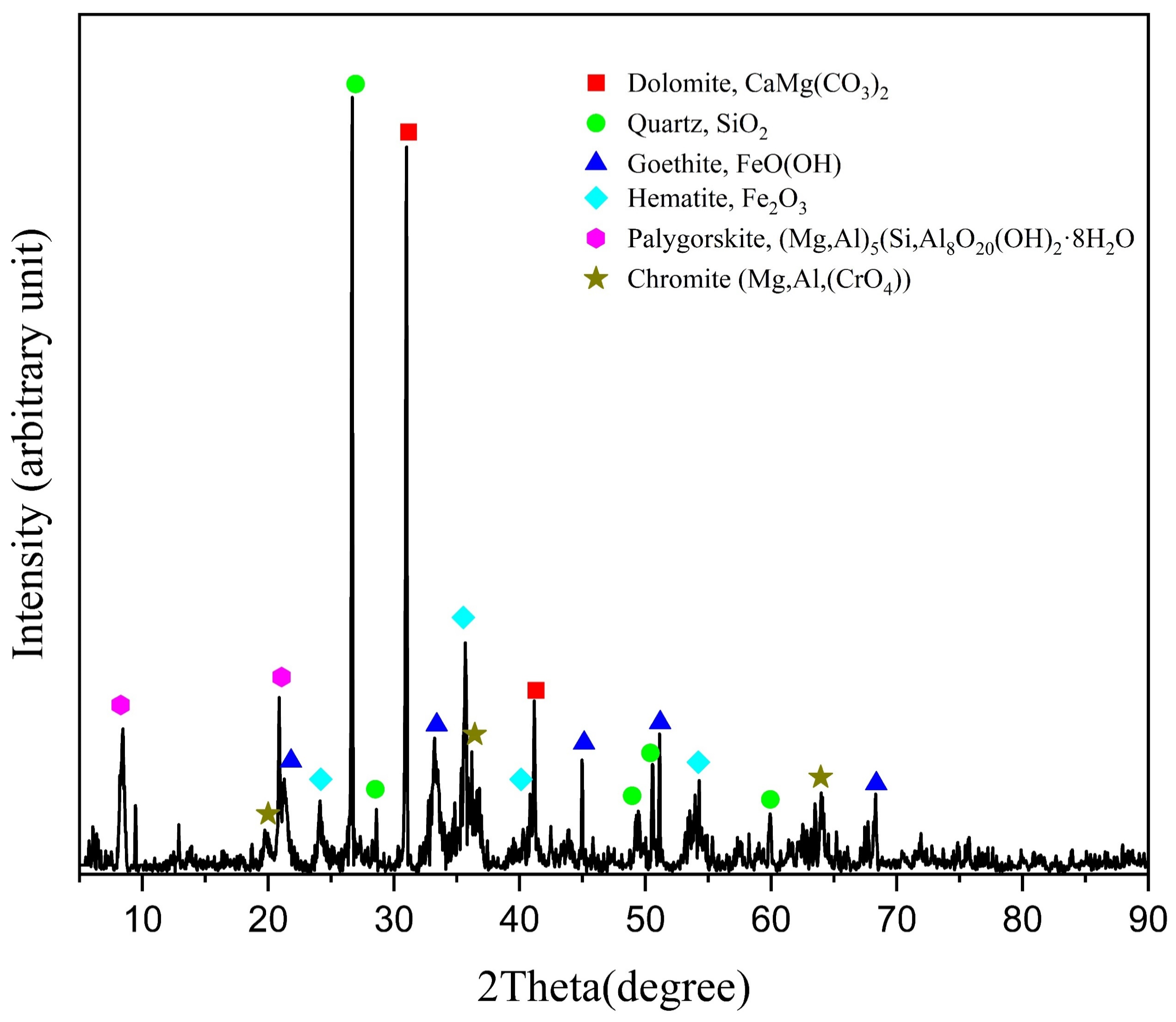
Figure 1. The XRD patterns of the limonitic-laterite sample used in this study.
Minerals 16 00431 g001
Figure 2. Thermogravimetric Differential Thermal Analysis (TG-DTA) of the raw laterite sample.
Minerals 16 00431 g002
Figure 3. Interaction plots for Ni recovery with respect to (a) [H2SO4] and temperature (T), (b) T and time, (c) [H2SO4] and time, and Fe recovery with respect to (d) [H2SO4] and T, (e) T and time, (f) [H2SO4] and time.
Minerals 16 00431 g003
Figure 4. XRD patterns of the laterite sample after sulfation roasting at different temperatures.
Minerals 16 00431 g004
Figure 5. Thermogravimetric Differential Thermal Analysis (TG-DTA) of sulfated Limonitic Laterite.
Minerals 16 00431 g005
Figure 6. SEM images of limonite-type laterite sample, (a) before and (b) after sulfation roasting.
Minerals 16 00431 g006
Figure 7. Proposed reaction mechanism of Co extraction using Cyanex 272.
Minerals 16 00431 g007
Figure 8. Effect of pH on the extraction efficiency of Ni, Co, Fe, Ca, Mg, Mn, and Zn with D2EHPA = 10 (% v/v), A/O = 1, T = 40 °C.
Minerals 16 00431 g008
Figure 9. Effect of pH on the extraction efficiency of Ni, Co, and Mg, at A/O = 1, T = 40 °C with different Cyanex 272 concentrations (a) 10 (% v/v), (b) 20 (% v/v), (c) 30 (% v/v).
Minerals 16 00431 g009
Figure 10. Effect of temperature on the extraction efficiency of Ni, Co, and Mg at pH range of 1 to 7, A/O = 1, Cyanex 272 = 10% v/v (a) T = 30 °C, (b) T = 40 °C, and (c) T = 50 °C.
Minerals 16 00431 g010
Figure 11. Effect of pH on the stripping efficiency of Co and Mg from loaded Cyanex 272 organic phase at A/O = 1 and T = 25 °C.
Minerals 16 00431 g011
Figure 12. Proposed integrated flowsheet for Ni and Co recovery from limonitic laterite under optimized operating conditions.
Minerals 16 00431 g012
Table 1. Experimental ranges and levels of the variables used in this study.
ParameterUnitLevels
−10+1
H2SO4wt.%304050
Temp°C650700750
timemin304560
Table 2. Chemical composition of the limonitic laterite sample used in this study.
ElementFeMgAlNiCrZnMnCoSiCaLOI
wt.%22.44.371.00.842.140.030.270.0512.35.1419.92
Table 3. Leaching efficiencies and concentration of selected elements in the leachate after atmospheric leaching.
ComponentNiCoFeMnMgZnAlCaCr
Leaching efficiency (%)87.591.090.065.999.999.949.430.724.5
Concentration (g/L)0.730.04520.160.184.360.030.491.580.52
Table 4. Precipitation efficiencies of elements using jarosite precipitation.
ComponentNiCoFeMnMgZnAlCaCr
Precipitation efficiency (%)42.535.286.012.85.518.543.68.589.1
Table 5. Leaching efficiency of selected elements at optimum conditions (H2SO4 concentration 50wt.%, roasting temperature 703 °C, and roasting time 54 min).
ParameterNiCoFeMgZnMnCaAlCr
Leaching efficiency (%)87.296.63.888.492.085.28.911.51.7
Concentration (mg/L)318.5213701680121002005016
Table 6. Benchmarking of sulfation roasting-water leaching performance of laterite processing across various published studies.
Roasting ConditionLeaching Efficiency (%)Comparison of Key ContentsReference
Design of ExperimentImpurity Removal by SXNi and Co
Separation by SX
T = 703 °C, time = 54 min, acid = 50 wt.%Ni = 87.2%, Co = 96.6%, Fe = 3.8%Current study
T = 725 °C, time = 90 min acid = 80 wt.%Ni = 91.1%, Co = 91.5%, Fe = 3.3%[27]
T = 700 °C, time = 30–60 min acid = 40 wt.%Ni = 80.6%, Co = 93.3%, Fe = 5.5%[18]
T = 700 °C, time = 60 min acid= 40 wt.%Ni = 88%, Co = 93%, Fe < 4%[16]
T = 700 °C, time = 30 min acid = 40 wt.%Ni = 82.5%, Co = 83.5%, Fe = 9.2%[52]
T = 700 °C, time = 30 min acid = 80 wt.%Ni = 70, Co = 68, Fe = N.R.[53]
T = 705–725 °C, time = 50 min acid = 50–55 wt.%Ni = 80–83, Co = N.R., Fe ≤ 5[19]
T = 700 °C, time = 51 min acid = 40 wt.%Ni = 75%–78%, Co = N.R., Fe = 5%–10%[54]
N.R.: not reported; ☑ Done; ☒ Not Done.
Disclaimer/Publisher’s Note: The statements, opinions and data contained in all publications are solely those of the individual author(s) and contributor(s) and not of MDPI and/or the editor(s). MDPI and/or the editor(s) disclaim responsibility for any injury to people or property resulting from any ideas, methods, instructions or products referred to in the content.