


Abstract
The Jiangnan Orogenic Belt is a world-renowned metallogenic region for Au-W-Sb mineralization, with the Wangu deposit being a representative one. Previous research has demonstrated that tungsten in this Au-W-Sb deposit is sourced from the hosting metasedimentary rocks, but the specific mineral that provides tungsten is still unclear. This study evaluates the tungsten source by conducting petrographic observations and geochemical and geochronological analyses on the rutile from the host slate the Wangu deposit. The results show that rutile from wall rocks of the Wangu deposit yields an age of 955 ± 13 Ma, which is older than both the ore-forming age of the deposit and the age of the host strata. Electron microprobe analyses (EMPA) and laser ablation–inductively coupled plasma–mass spectrometry (LA-ICP-MS) elemental analyses show that detrital rutile is enriched in elements such as Fe, Cr, V, and W, as well as high-field-strength elements (HFSE) including Nb, Ta, Zr, and Hf. The total rare earth element (ΣREE) ranges from 3.37 ppm to 156.85 ppm. The samples are generally enriched in light rare earth elements (LREEs) and exhibit distinct negative Eu anomalies. These geochemical features and a geochronological age of 955 ± 13 Ma suggest that the rutile is of detrital origin and they are possibly derived from the Grenvillian rocks. It is concluded that the detrital rutile in the metasediments could be an important source for hydrothermal tungsten enrichment.
1. Introduction
Many hydrothermal gold deposits are characterized by significant tungsten mineralization, with the most representative ones being the Au-W(-Sb) deposits in Jiangnan Orogen, South China [1]; Val-d’Or district, Canada [2]; Mt. Charlotte, Australia [3]; and Charmitan, Uzbekistan [4]. The tungsten mineralization in hydrothermal gold deposits is mainly present as scheelite, as well as minor wolframite [5]. Numerous studies have revealed that scheelite formed at pre- or syn-ore stages [6], indicating a close genetic correlation between tungsten and gold mineralization [7]. Scheelite in hydrothermal gold deposits has been widely used to evaluate the mineralization temperature and redox state of ore fluids [8,9]. It is generally accepted that tungsten is sourced from the host rocks of the Au-W(-Sb) deposits [10,11], and detrital rutile in the hosting metasediments is one of the major tungsten sources [12].
The Jiangnan Orogen is a world-renowned metallogenic belt for hydrothermal Au-W(-Sb) and W deposits, with a total tungsten resource of over 6.06 million tonnes [13]. The representative deposits are the Wangu, Woxi and Huangjindong Au-W-Sb deposits [11,14], Baojinshan Au-W deposits [15], and Zhuxi, Dahutang and Shizhuyuan W deposits [16,17,18]. Geochemical characteristics of scheelite from the Au-W(-Sb) deposit demonstrate that the fluids from orogenic gold deposits are different from skarn or porphyry deposits in terms of elemental composition, oxygen fugacity, fluid properties, and fluid sources [19]. Based on elemental compositions and Sr isotopic data, it is concluded that ore material sources of scheelite are from deep-crustal origin [20] or from wall rock [21]. However, the contributing tungsten source in terms of minerals is still unclear.
The Wangu gold deposit is one of the typical Au-Sb-W deposits in the Jiangnan Orogenic Belt, with significant tungsten resources and reserves [22]. The Wangu gold deposit is hosted in the low-grade metamorphic rocks of the Neoproterozoic Lengjiaxi Group [23], with its mineral assemblage characterized by pyrite, arsenopyrite, scheelite, stibnite and native gold [24]. Stable isotopes (S-Pb-H-O-He-Ar-Sr) and trace element geochemistry of scheelite (low Mo contents and negative Eu anomalies) consistently indicate that ore-forming materials were mainly derived from the basement strata and subsequently mobilized and enriched by metamorphic/magmatic hydrothermal fluids during Yanshanian Orogeny [25,26]. Combined with previous studies indicating that detrital rutile represents the source of tungsten in orogenic gold deposits [13], this study presents U-Pb geochronological and geochemical analyses of detrital rutile from the ore-hosting Lengjiaxi Group in the Wangu Au-W-Sb deposit. These data are used to constrain the origin, nature, and formation timing of the rutile, with the aim of clarifying the tungsten source of this individual deposit within the Jiangnan Orogenic Belt.
2. Regional Geology
The Jiangnan Orogenic Belt is a continent–continent collision zone striking NEE–NE, formed by the collision of the Yangtze and Cathaysia blocks during the Neoproterozoic [27]. As an important gold polymetallic metallogenic belt in South China, it hosts a series of Au-Sb-W, Au-W and monometallic W deposits [28]. This belt has undergone a complex tectonic evolution involving multiple successive tectonic events, including the Grenvillian collisional orogeny in the Mesoproterozoic, Caledonian intracontinental extension, Indosinian intracontinental convergence, and intense Yanshanian intracontinental deformation coupled with magmatic activities [29]. Among them, the Yanshanian intracontinental orogeny constitutes the main tectonic event of the mineralization period since Mesozoic [1]. This tectonic event completely reworked the pre-existing structures, forming a large-scale NE–NNE-trending thrust-nappe fault system and an associated network of secondary faults, including the Xuefeng Mountain Tectonic Belt in western Hunan and the southern extension of the Tan-Lu Fault Zone in northern Jiangxi [30]. These deep and large faults acted not only as ore-conducting pathways, but their derived interlayer detachments and fault intersections also served as favorable locations for orebody emplacement [31].
The Precambrian basement strata of the Jiangnan Orogen are dominated by Neoproterozoic low-grade metamorphic rocks and a small amount of Mesoproterozoic metamorphic rocks. The two sets of Neoproterozoic metasediments are the predominant rocks in the Jiangnan Orogen. The lower unit is the Lengjiaxi Group in Hunan and the equivalents in other provinces, such as Shuangqiaoshan in Jiangxi, Shangxi in Anhui, Fanjingshan in Guizhou and Sipu in Guangxi. The upper unit is the Banxi Group in Hunan, as well as the Xiaojiang in Guihzou, Dengshan in Jiangxi, Danzhou in Guangxi and Likou in Anhui [32,33,34,35,36]. The cover strata of the Jiangnan Orogen are mainly Paleozoic and Mesozoic successions. Paleozoic strata are poorly exposed in this region, and the most important rocks are the Devonian clastic sedimentary rocks deposited in a coastal-shallow marine sedimentary environment [37,38,39,40]. The Mesozoic sediments constitute the red-bed basins, which are composed of red sandstones, conglomerates and mudstones [41,42]. The magmatic rocks of the Jiangnan Orogen are mainly associated with four phases of tectonic movements, including the Neoproterozoic collision and the Caledonian, Indosinian and Yanshanian intracontinental orogenies. Previous studies have indicated that the Neoproterozoic felsic intrusive and volcanic rocks are dominated by S-type granites. A large number of I-type and S-type granodiorites were emplaced during the Early Paleozoic, with an age range of approximately 507~402 Ma. Their formation was related to the Caledonian orogeny of this period [43,44,45]. The scale of the magmatic rocks in the Indosinian period is small, and the S-type granite is the main type, which is mainly distributed in the southeast margin of Xuefeng Mountain in western Hunan [46,47,48,49,50]. Yanshanian magmatic rocks are extensively exposed in this region and even in South China, including S-type, A-type and I-type granites, as well as some mafic rocks, with ages ranging from 180 to 67 Ma [51,52].
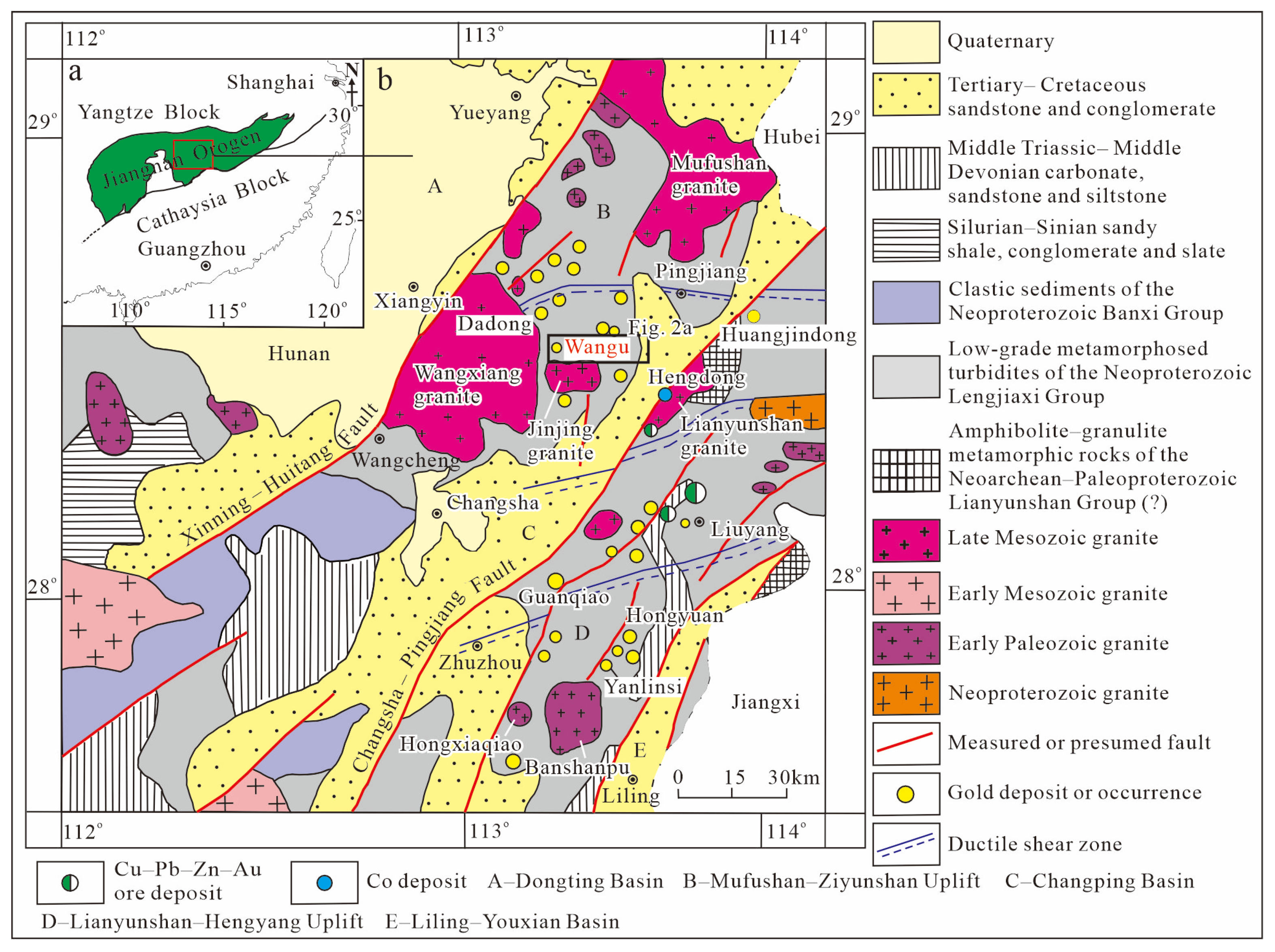
The strata in the central part of the Jiangnan Orogen in northeastern Hunan (Figure 1) include the Neoproterozoic Lengjiaxi and Banxi Groups, the Sinian Liantang Group and the Cretaceous Daijiaping Group [53,54]. The predominant structures in northeastern Hunan are the three regional NE-trending faults, i.e., Changsha–Pingjiang, Xinning–Huitang and Liling–Hengdong strike-slip faults. In addition, there are also many local WNW-, NE- and NS-trending faults along the regional faults [55,56]. The fault system may have been initially formed during Neoproterozoic and reactivated at Caledonian, Indosinian and Yanshanian. Four periods of magmatism have been discovered in this region, with the Yanshanian S-type granites as the predominant one [14]. The representative Yanshanian granites are the Lianyunshan, Jinjing and Mufushan granites. Many deposits have been discovered in northeastern Hunan, and they are formed during Caledonian, Indosinian and Yanshanian. The representative deposits are the Wangu and Huangjindong Au-W-Sb deposits, Shi’ao Gold Deposit, Renli Nb-Ta deposit and Jingchong and the Hengdong Cu-Co deposits [57].
Figure 1.
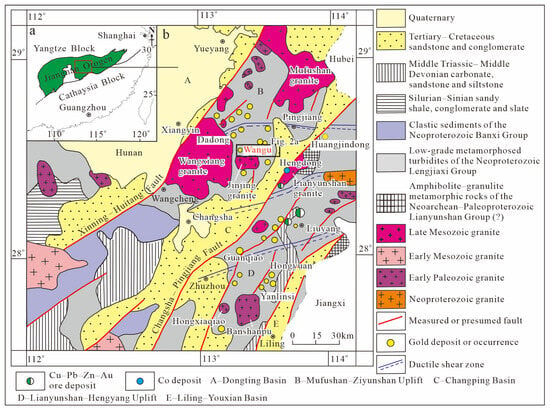
(a) Simplified geotectonic map of South China indicating the position of the Jiangnan Orogenic Belt; (b) geological map of eastern Hunan showing the distribution of structures, lithologies and major intrusions of different ages, and different types of ore deposits [58].
3. Ore Deposit Geology
The Wangu Au-W-Sb deposit is located to the northwest side of the NE-trending Changsha–Pingjiang Fault in northeastern Hunan [22]. The metasediments in the Wangu deposit include the Pingyuan Formation of the Neoproterozoic Lengjiaxi Group and the Cretaceous Daijiaping Formation, as well as some Quaternary sediments. Among them, the Pingyuan Formation is a suite of low-grade metamorphic clastic rocks and it can be divided into three lithologic sections from bottom to top based on sedimentary cycles and lithological assemblages [59]. The first section is dominated by siltstone slate, sandstone slate, and metamorphic conglomerate. The second section mainly consists of siltstone slate, with local occurrence of striated bedding and banding structures. The third section is primarily composed of siltstone slate and metamorphic fine sandstone [60]. The Cretaceous Daijiaping Formation mainly consists of sandstones, and conglomerates. No magmatic plutons having been discovered in the mining area, even though geophysical exploration indicated the possible existence of concealed intrusions [61].
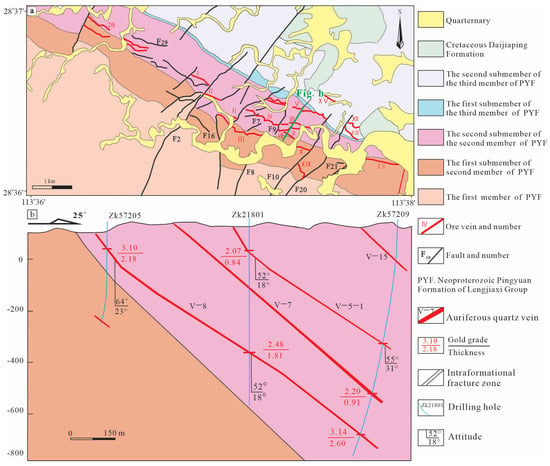
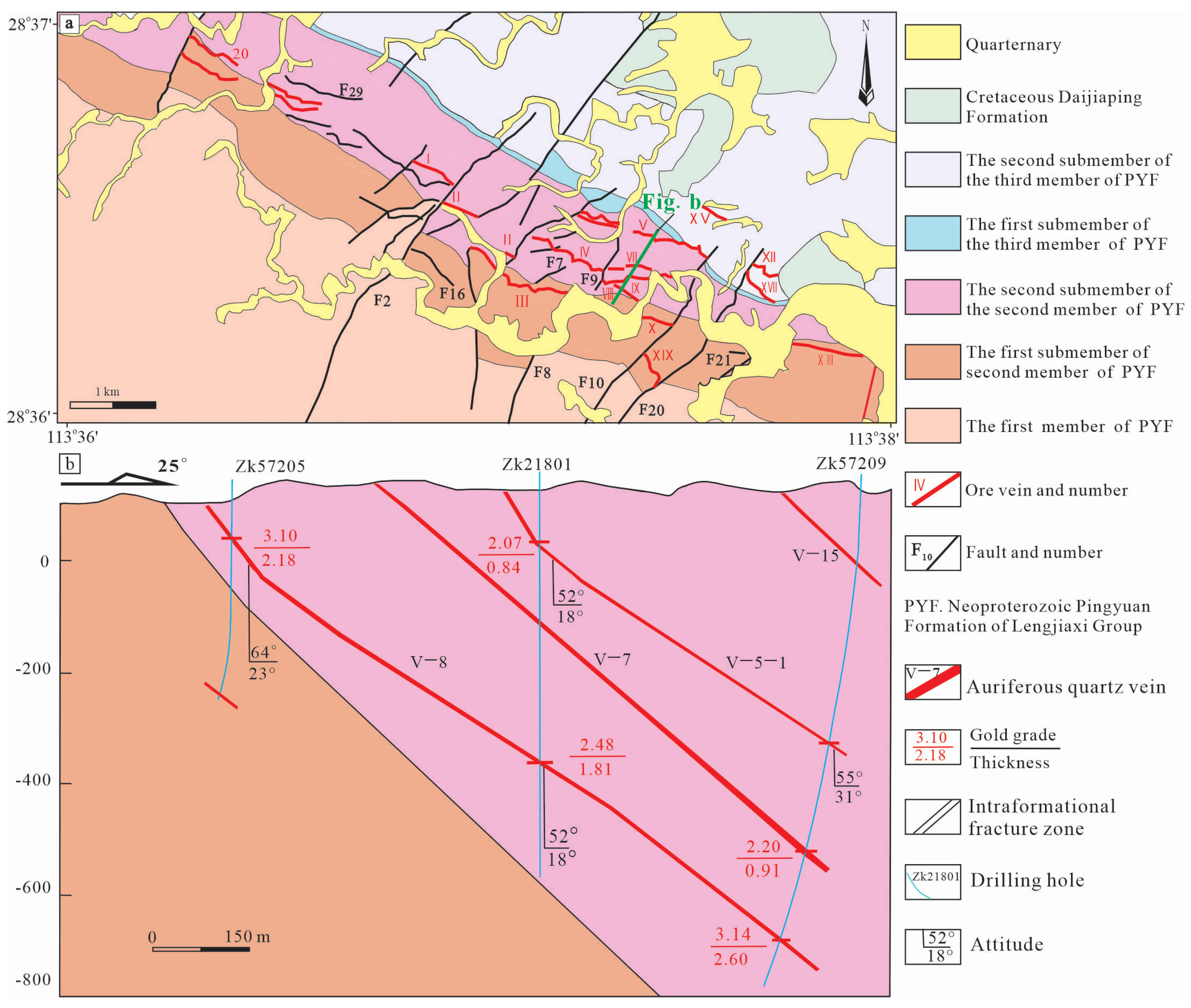
The Wangu deposit is located in the northeast part of the regional Fushoushan anticline, and two major sets of faults are present in the mining area (Figure 2). The E–W to NWW-striking faults are the major ore-controlling structures, and they are partly interlayer faults [1,14,62]. Another set is the NE-trending faults, which generally crosscut the ore-bearing EW- to NWW-striking faults. Previous structural and geochronological studies demonstrate that the ore-bearing faults are initially formed by a nearly N–S compressional stress during the Caledonian Orogeny, and then reworked during the Indosinian. During the Yanshannian, the transformation from the EW-trending compression to NW-trending extension leads to the fluid influx and caused gold mineralization.
Figure 2.
(a) Geological map and (b) ore deposit profile of the Wangu deposit [13].
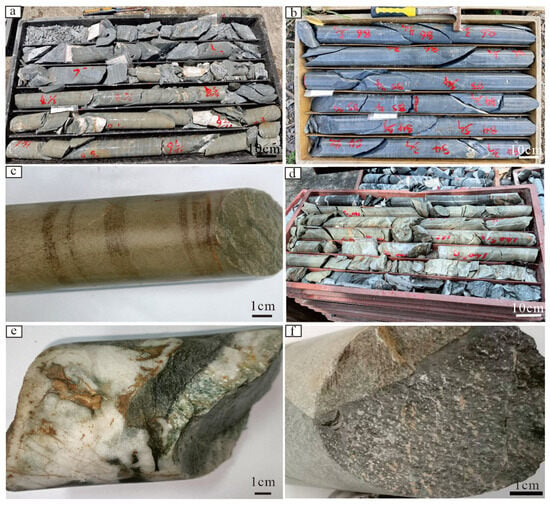
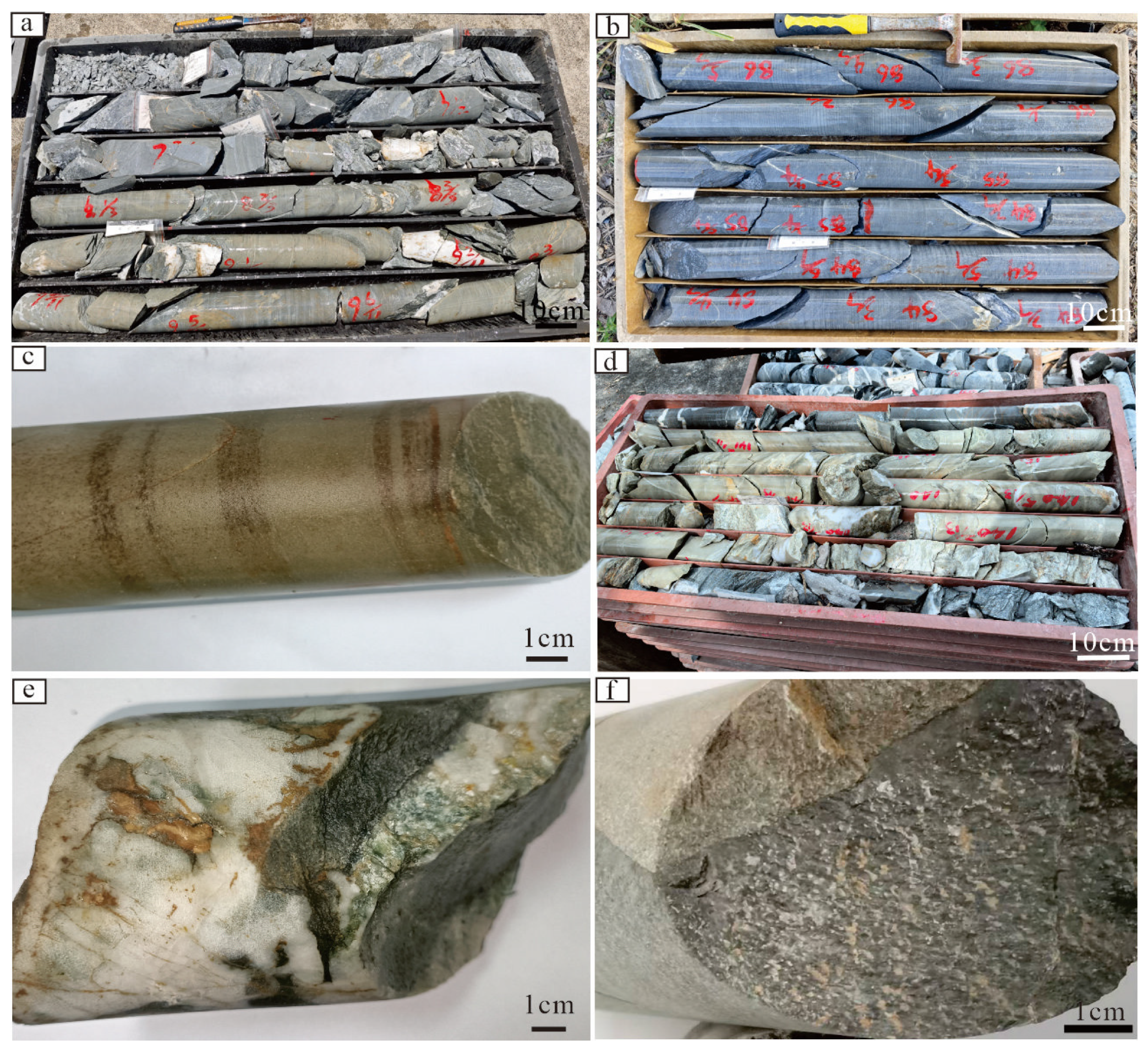
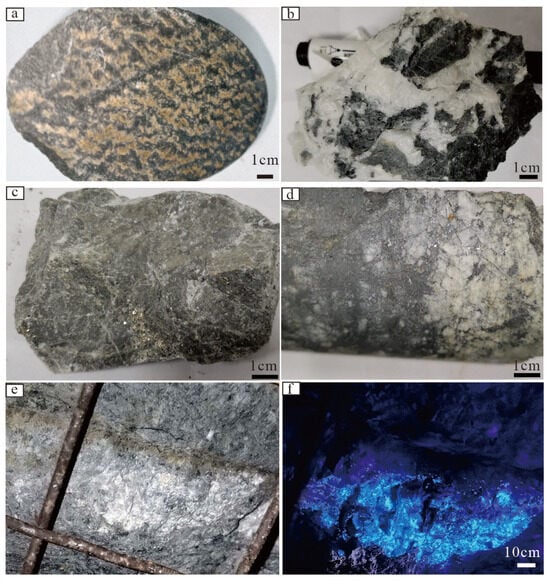
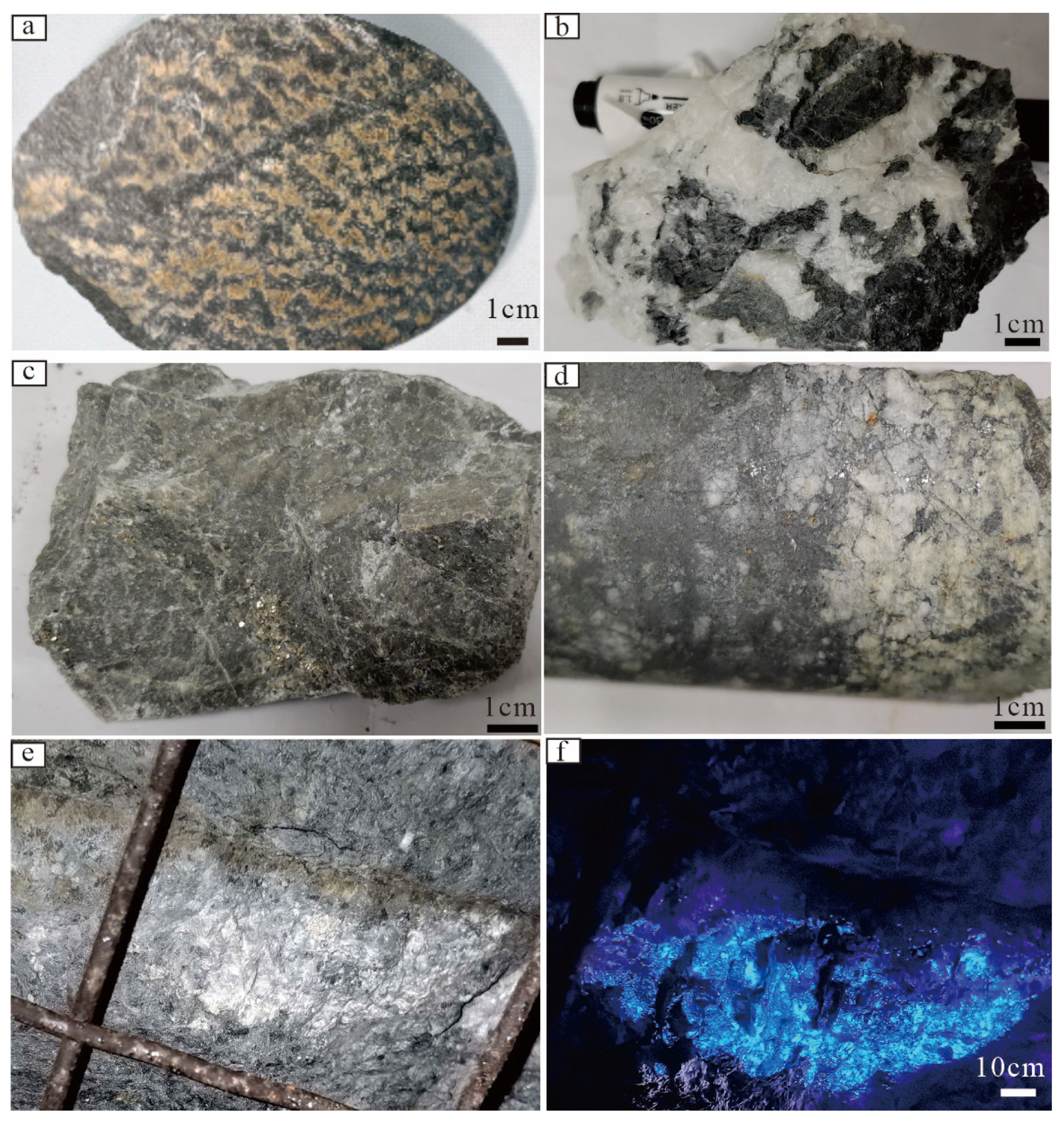
The ore types of the Wangu deposit are present as quartz veins and altered slate (Figure 3a,d), as well as minor structural breccia [12,62,63]. Among them, the quartz vein-type ores are mainly hosted in fault fracture zones and exhibit banded and stockwork structures (Figure 4b). Altered rock-type ores are mainly developed on both sides of gold-bearing quartz veins. Based on the types of altered minerals and unaltered minerals, the wall rock alteration types in this area can be classified into sericitization, carbonatization, silicification, sulfidation and chloritization (Figure 3a–e). The altered host rocks in the mining area feature bleaching, with colors ranging from gray-green to gray-white/gray-yellow [63]. Previous studies have revealed that the width of alteration halos varies from a few centimeters to several hundred meters, which may be related to the properties of the surrounding rock and the physicochemical characteristics of the fluids [64]. The W orebody is primarily composed of scheelite, appearing as lens-shaped or vein-like deposits with clearly defined boundaries with the surrounding rock (Figure 4e,f).
Figure 3.
Field and hand specimen photographs of the Wangu deposit: (a) altered slate with bleaching; (b) carbonaceous slate; (c) intensive bleaching alteration; (d) silicification; (e) chloritization; (f) sharp contact between argillaceous and carbonaceous slates.
Figure 4.
Selected field and hand specimen photographs of ore bodies and wall rocks in the Wangu deposit: (a) carbonaceous slate with carbonate spots; (b) unbleached altered slate with quartz veins; (c) altered rock with sulfides; (d) quartz veins with stibnite; (e) tungsten ore body; (f) tungsten ore body under ultraviolet light.
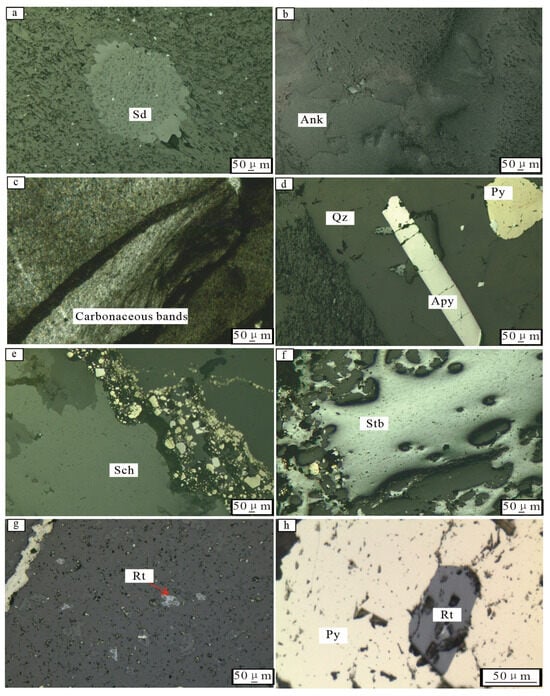
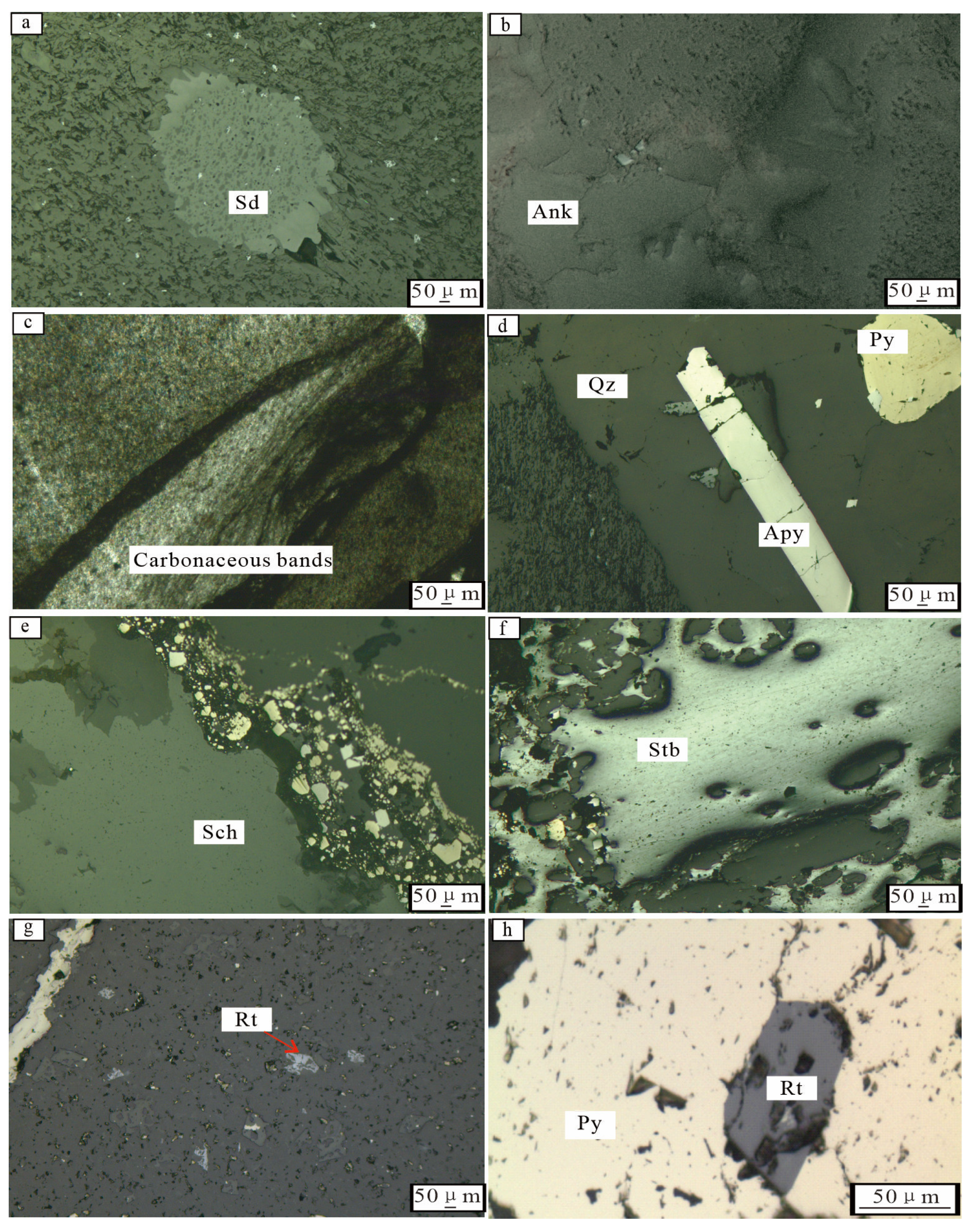
The ore minerals primarily consist of pyrite, arsenopyrite, scheelite and stibnite (Figure 5d,e,f), as well as minor galena, sphalerite, chalcopyrite and native gold. The gangue minerals are mainly quartz, siderite, rutile and ankerite (Figure 5a,b,g,h). As an important gold-bearing mineral, arsenopyrite occurs predominantly as euhedral–subhedral acicular and granular crystals. As another significant gold-bearing mineral, pyrite is mostly euhedral or subhedral, occurring as aggregates or granular grains, and is widely hosted in smoky gray quartz veins, carbonaceous slates and altered slates. Carbonaceous bands are locally visible (Figure 5c). Scheelite is predominantly euhedral–subhedral and massive (Figure 5e), with parts metasomatized or enclosed by late-stage sulfides, indicating that its formation predates the sulfide stage. Abundant rutile occurs in many unaltered and mineralized slates, and some of them are present as small granular clusters with no significant association with hydrothermal minerals (Figure 5g,h).
Figure 5.
Selected photomicrographs of thin sections from the Wangu deposit: (a) silty slate with carbonate spots; (b) ankerite in wall rocks; (c) carbonaceous bands; (d) quartz+ arsenopyrite + pyrite; (e) scheelite+sulfide vein; (f) stibnite; (g) anhedral–subhedral rutile; (h) rutile intergrown with pyrite. Sd, siderite; Ank, ankerite; Qz, quartz; Apy, arsenopyrite; Py, pyrite; Sch, scheelite; Stb, stibnite; Rt, rutile.
4. Materials and Analytical Methods
In this study, detailed field geological surveys and investigations were carried out on the Wangu Au-Sb-W deposit, with 142 samples collected from the ultra-deep drill hole ZK808. All rutile samples selected in this study were collected from unaltered and unmineralized slates. Systematic sampling of rutile-bearing samples was carried out in the metamorphic siltstones of the Lengjiaxi Group, and targeted sampling was performed on tungsten-bearing mineral veins. Some of the samples were prepared into polished thin sections for petrographic observation, U-Pb dating and whole-rock major and trace element analyses. The remaining samples were used for single mineral separation and mount preparation to select rutile for U-Pb dating experiments, aiming to clarify the genetic relationship between rutile and scheelite and the migration regularity of trace elements. All petrographic analyses of the polished thin sections were completed using a Leica DM2700P microscope (Leica, Wetzlar, Germany) at the School of Earth Sciences, East China University of Technology.
4.1. U-Pb Dating Analysis
Rutile U-Pb dating analyses were performed at Guangzhou Tuoyan Analytical Technology Co., Ltd., Guangzhou, China, using a laser ablation inductively coupled plasma mass spectrometer (LA-ICP-MS) under the following laser parameters: a spot diameter of 40 μm, an energy density of 3 J/cm2, and an ablation frequency of 5 Hz. Data processing was performed with the Iolite 4 software [65], with rutile RMJG serving as the calibration standard [66]. Two RMJG standard spots were analyzed for every 8–10 sample spots. A gas blank of 20 s was typically collected, and the signal interval of 35–40 s was used for data processing. Depth fractionation correction was carried out via an exponential equation, and common Pb correction was performed using 207Pb. BCR was employed as the monitoring standard, and 49Ti was used as the internal standard for calculating trace element contents.
4.2. In Situ Major and Trace Element Analyses
Major element analyses were conducted at Guangzhou Tuoyan Testing Technology Co., Ltd., with a JEOL-JXA-ISP100 electron probe microanalyzer (EPMA) (Tokyo, Japan) employed for the experiments. The analytical conditions were set as follows: an accelerating voltage of 15 kV, a beam current of 20 An, and a beam spot diameter of 3–5 μm. The concentrations of major elements were determined using X-ray fluorescence spectrometry (Rigaku 100e, Tokyo, Japan), with analytical uncertainties of less than 1% for all measured oxides. Rutile was the primary target for the analyses, and matrix correction of all acquired data was performed using the ZAF method. The analyzed elements included Na, Al, K, V, Nb, Sn, Ca, Mg, Si, Fe, Mn, Cr, Ti and W, with a detection limit of 0.01 wt%. British MAC mineral/metal standards and Chinese national standard reference materials (GSB) were used as the standard samples, and all analyses were strictly conducted in accordance with the national standard of the People’s Republic of China (GB/T 15246-2002) [67].
Element analysis of minerals in thin sections was conducted by LA-ICP-MS at Nanjing FocuMS Technology Co. Ltd. Teledyne Cetac Technologies Analyte Excite laser ablation system (Bozeman, MT, USA) and Agilent Technologies 7700x quadrupole ICP-MS (Hachioji, Tokyo, Japan) were combined for the experiments. The 193 nm ArF excimer laser, homogenized by a set of beam delivery systems, was focused on rutile surface with fluence of 6.0 J/cm2. Each acquisition incorporated 20 s background (gas blank), followed by spot diameter of 40 μm at 5 Hz repetition rate for 40 s. Helium (370 mL/min) was applied as carrier gas to efficiently transport aerosol out of the ablation cell, and was mixed with argon (~1.15 L/min) via T-connector before entering ICP torch. NIST SRM 612 and 610 glasses were used as external calibration standards. Raw data reduction was performed off-line by ICPMSDataCal 10.2 software using 100–normalization strategy without applying internal standard [68].
5. Results
5.1. Geochronology of Rutile
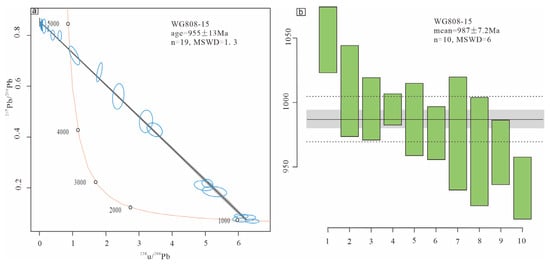
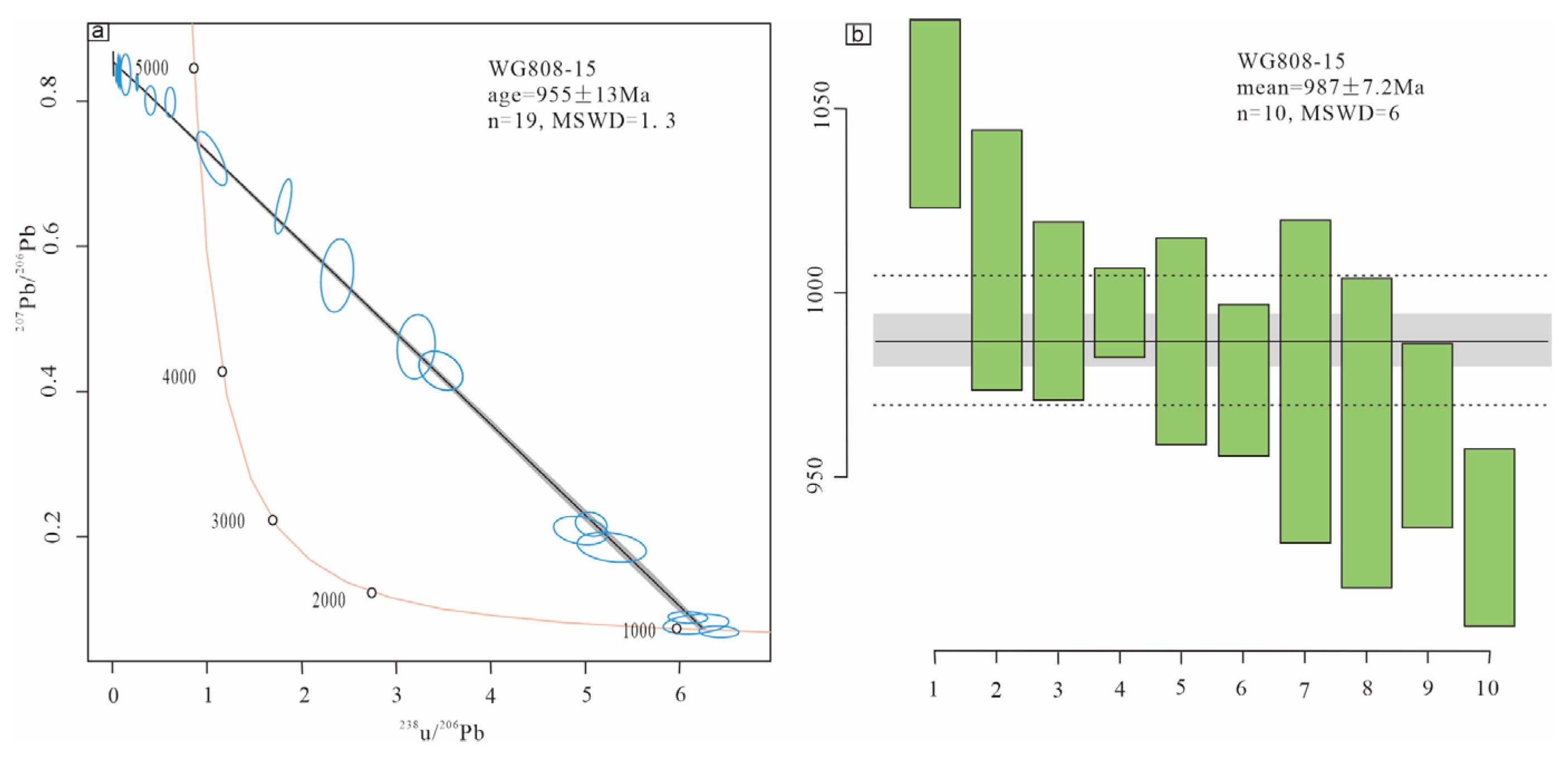
In the present study, rutile samples from the Wangu Au-Sb-W deposit were selected for U-Pb dating analysis. A total of 32 rutile grains were tested, and four anomalous spots with extremely large errors were excluded; the remaining analytical results are presented in Table S1. The selected rutile grains are partially columnar, and their back-scattered electron (BSE) images reveal a homogeneous texture. The U contents of rutile range from 0.7 ppm to 36.99 ppm with an average of 22.23 ppm, and the Pb contents vary from 11.69 ppm to 129.08 ppm with a mean value of 47.01 ppm. Analysis via the Tera–Wasserburg concordia diagram yielded a regressed lower intercept age of 955 ± 13 Ma (MSWD = 1.3; Figure 6a) for the rutile data points from the Wangu Au-Sb-W deposit, with a weighted mean age of 987.0 ± 7.2 Ma (Figure 6b).
Figure 6.
(a) Tera–Wasserburg concordia diagram; (b) weighted mean age plot.
5.2. Geochemical Composition of Rutile
Major and trace element compositions were analyzed to evaluate the genesis, and the data are presented in Tables S2 and S3. The test results show that the value of Ti ranges from 96.81 wt% to 99.7 wt%. This is followed by elements such as W, Fe, Nb, Zr, Cr and V. The content of W ranges from 19.28 ppm to 3704.79 ppm, exhibiting a large variation yet a relatively high overall level. In addition, the data are presented in Table S3: the total rare earth element (REE) contents vary widely (3.37 to 156.85 ppm), showing intense enrichment of light rare earth elements (LREEs) and relatively flat heavy rare earth elements (HREEs). REEs are generally enriched over primitive chondritic abundances, with a prominent negative Eu anomaly (Figure 7d).
Rutile grains have Fe (850 to 6280 ppm), Cr (0 to 5659.74 ppm) and V (153.51 to 2622.15 ppm). The values of 1000 × W and 100 × (Fe + Cr + V) range from 19,284.96 ppm to 3,704,785.49 ppm and 307,000 ppm to 1,211,000 ppm, respectively [69]. As shown in Figure 7a, some of these rutile grains fall within the field for unaltered wall rock rutile, representing detrital rutile, while the remaining rutile grains plot in the field for hydrothermal rutile. The rutile grains all have relatively high Fe, Cr and V contents (Figure 7b) [70].
Figure 7.
(a) Genetic discrimination diagram of rutile [69]; (b) Fe, V and Cr elements plot [71]; (c) interpretation of Nb, Ta and Hf, Zr elements correlation plots [12]; (d) chondrite-normalized rare earth element (REE) spider diagram (normalized values according to [72]).
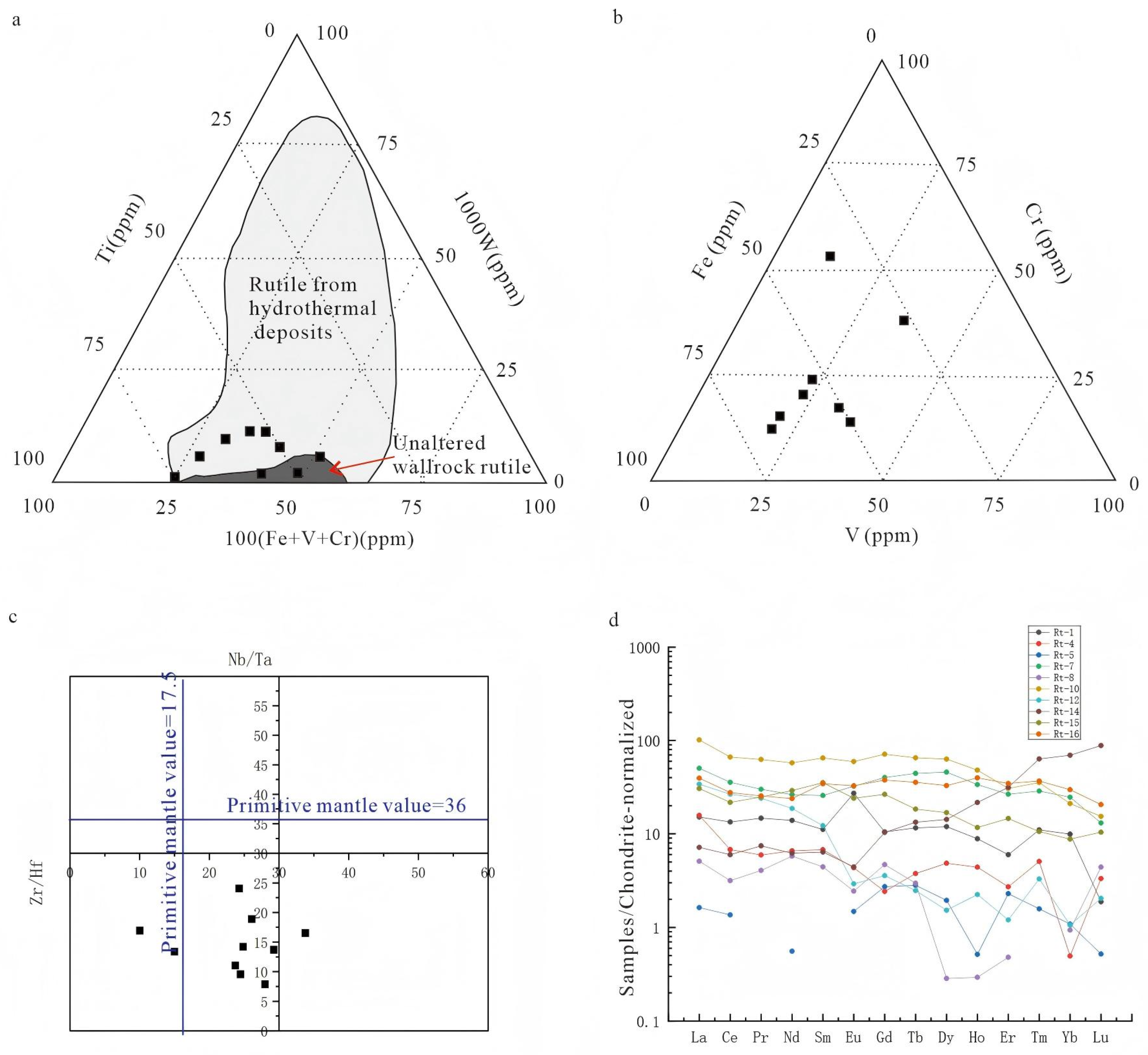
The Nb and Ta contents range from 324.52 ppm to 2761.01 ppm and 23.7 ppm to 219.69 ppm, while the Zr and Hf concentrations range from 23.5 ppm to 2202.74 ppm and 0.96 ppm to 92.84 ppm. The Nb and Zr contents are positively corelated with Ta and Hf, respectively. The Nb/Ta and Zr/Hf values range from 7.85 ppm to 24.04 ppm and 10.01 ppm to 33.78 ppm. As shown in Figure 7c, the consistent low Nb/Ta (10–25, < primitive mantle value of 36) and Zr/Hf (< 36) ratios of rutile clearly indicate an enriched continental crustal source, recording intense continental crustal partial melting.
6. Discussion
The samples selected in this study are from weakly altered slate of the Neoproterozoic Pingyuan Formation, so the influence of hydrothermal alteration is not significant. LA-ICP-MS U-Pb dating of rutile from the wall rocks of the Wangu gold deposit yields an age of 955 ± 13 Ma. This age is significantly older than all previously reported hydrothermal/mineralization ages for the deposit, including the apatite LA-ICP-MS U-Pb age of 147 ± 0.7 Ma [73], the quartz fission track age of 160–100 Ma, and fluid inclusions Rb-Sr isochron ages of about 70 Ma and 462 ± 18 Ma [74]. Therefore, we infer that the rutile analyzed here is of detrital origin, representing the provenance age of the stratigraphic metasedimentary rocks. This conclusion can be further verified by the Ti-1000W-100(Fe + Cr + V) and Fe-V-Cr plot based on the geochemical compositions of rutile (Figure 7a–c).
Previous studies on the Lengjiaxi Group and its equivalents in the Jiangnan Orogen show that the youngest detrital zircons are ~820 Ma [75], corresponding to the post-collisional rifting process between the Yangtze and Cathaysia blocks [76]. The detrital zircon age spectrum features a prominent peak at ca. 1000 Ma, correlating with the global assembly of Rodinia and the associated Grenvillian orogeny and magmatism [77]. The 955 Ma detrital rutile grains in this study were likely derived from Grenvillian rocks, and the genesis of rutile could be magmatic or hydrothermal, as indicated by geochemical plot (Figure 7a,b). After weathering and erosion, these source materials were transported to northeastern Hunan, where they were deposited, metamorphosed, and ultimately formed the ore-bearing wall rocks [56]. The rutile derived from Grenvillian rocks (involving intense crust–mantle interaction) and subsequently underwent sedimentary and metamorphic processes [77,78].
Previous studies have documented intense tectonic activity during the early Neoproterozoic, accompanied by extensive magmatism. The U-Pb age spectra of detrital rutile and detrital zircon from previous studies both show a prominent peak at 960–940 Ma. Additionally, ages of 990–950 Ma and 1100 Ma have been reported from the southern Cathaysia Block and the southeastern Yangtze Block, respectively [79]. These data suggest that the source region was likely affected by the Grenvillian orogenic event. The tectono-magmatic activity during this period provided favorable conditions for rutile formation. The Grenvillian orogeny caused crustal thickening, partial melting, and magmatic differentiation, which promoted the crystallization of rutile from Ti-rich parental magmas [78]. Rutile was subsequently eroded, transported, and deposited. This complex geological history indicates that rutile not only inherits the geochemical characteristics of the source rocks but also records critical information about regional tectonic evolution, although it may have been modified by later hydrothermal alteration. During this period, abundant rutile-bearing magmatic rocks formed and underwent long-term weathering, erosion, and sedimentation, constituting a material source for subsequent mineralization. In the Phanerozoic, multiple episodes of regional tectono-magmatic activity (e.g., Caledonian, Indosinian, and Yanshanian) further reworked the early-formed ore-bearing sequences. Tungsten was released from rutile via hydrothermal leaching or metamorphic dehydration, and precipitated to form ore deposits under favorable physicochemical conditions [12,70].
Numerous studies have suggested that the tungsten in hydrothermal Au-W-Sb deposits is primarily sourced from metamorphosed strata [9], although the specific mineral phase for the W source remains unidentified. This study reports the first discovery of Proterozoic detrital rutile within the mineralized Precambrian metamorphic basement of the Jiangnan Orogenic Belt, highlighting its potential role as a source of W for such deposits.
Previous research on Au-W-Sb deposits in the Jiangnan Orogenic Belt demonstrates that mineralization likely occurred during the Caledonian, Indosinian and Yanshanian Orogenies [62], with each phase potentially involving W mineralization processes [22,59]. These processes may have been controlled by multiple geological mechanisms, including metamorphism magmatism and ductile–brittle tectonic activities [80]. Since the formation of W-supplying rutile predates these mineralization events [12], it can provide a crucial material source for the various ore-forming stages. During later metallogenic processes, W may have been extracted from rutile either by magmatic–hydrothermal fluids or through metamorphic dehydration, releasing W into fluid phases [13]. These W-bearing fluids likely migrated and subsequently precipitated to form tungsten orebodies, such as those in the Wangu deposit, under favorable physicochemical conditions including temperature, pressure, redox state and reactive wall rocks.
7. Conclusions
- (1)
- Rutile grains from the host slate of the Wangu Au-W-Sb deposit yield a LA-ICP-MS U-Pb age of 955 ± 13 Ma, which is markedly older than the mineralization age of the Wangu deposit and other Au-W-Sb deposits in the Jiangnan Orogen.
- (2)
- The age and key geochemical characteristics (including Fe, Cr, V, W, HFSE, and REE compositions) indicate that the rutile is of detrital origin, and the source rocks are featured with mixed lithospheric mantle and crustal origins.
- (3)
- Rutile-bearing Precambrian metasedimentary rocks may serve as an important W reservoir and provide a significant metal source for the subsequent Au-W-Sb mineralization in the study area.
Supplementary Materials
The following supporting information can be downloaded at https://www.mdpi.com/article/10.3390/min16040363/s1, Table S1: U238-Pb206 table of isotope ratio analyses. Table S2: Electron microprobe analysis of major element composition of rutile (wt%). Table S3: LA-ICP-MS analysis of trace element composition of rutile (ppm).
Author Contributions
Conceptualization, M.Y., T.D. and Z.W.; methodology, T.D.; software, M.Y. and Y.X.; validation, M.Y., T.D. and H.T.; formal analysis, Y.Z.; investigation, Z.W. and H.C.; resources, T.D. and Z.W.; data curation, M.Y.; writing—original draft preparation, M.Y.; writing—review and editing, T.D. and Z.W.; visualization, M.Y.; supervision, T.D. and H.T.; project administration, T.D.; funding acquisition, T.D. and H.T. All authors have read and agreed to the published version of the manuscript.
Funding
This work was co-founded by the Jiangxi Provincial Natural Science Foundation (20232BAB213060, 20242BAB25179, 20242BAB20136) and the National Natural Science Foundation of China (42562005, 42362012).
Data Availability Statement
The original contributions presented in this study are included in the article. Further inquiries can be directed to the corresponding authors.
Acknowledgments
We are thankful for the assistance from reviewers. Particular thanks is given to the No. 270 Research Institute of Nuclear Industry for their help in the field investigation.
Conflicts of Interest
The authors declare no conflicts of interest. The funders had no role in the design of the study.
References
- Xu, D.; Chi, G.; Zhang, Y.H.; Zhang, Z.C.; Sun, W.D. Yanshanian (Late Mesozoic) ore deposits in China—An introduction to the special issue. Ore Geol. Rev. 2017, 88, 481–490. [Google Scholar]
- Beaudoin, G.; David, P. Stable isotope geochemistry of the Archean Val-d‘ Or (Canada) orogenic gold vein field. Miner. Depos. 2005, 40, 59–75. [Google Scholar] [CrossRef] [Scilit]
- Mueller, A.G. Structure, alteration, and geochemistry of the Charlotte quartz vein stockwork, Mt Charlotte gold mine, Kalgoorlie, Australia: Time constraints, down-plunge zonation, and fluid source. Miner. Depos. 2015, 50, 221–244. [Google Scholar] [CrossRef] [Scilit]
- Graupner, T.; Niedermann, S.; Rhede, D.; Kempe, U.; Seltmann, R.; Williams, C.T.; Klemd, R. Multiple sources for mineralizing fluids in the Charmitan gold (-tungsten) mineralization (Uzbekistan). Miner. Depos. 2010, 45, 667–682. [Google Scholar] [CrossRef] [Scilit]
- Li, W.J.; Xie, J.; Huang, R.; Chen, W.; Du, H.H. Molecular characteristics of dissolved organic matter regulate the binding and migration of tungsten in porous media. Sci. Total Environ. 2024, 954, 176670. [Google Scholar] [CrossRef] [Scilit]
- Goldfarb, R.J.; Hart, C.J.; Marsh, E.E. Orogenic gold and evolution of the Cordilleran orogen. Ariz. Geol. Soc. Dig. 2008, 22, 311–323. [Google Scholar]
- Li, W.S.; Ni, P.; Pan, J.Y.; Albanese, S.; B De, V.; Esposito, R.; Ding, J.Y. The genetic association between vein and skarn type tungsten mineralization in the Yaogangxian tungsten deposit, South China: Constraints from LA-ICP-MS analysis of individual fluid inclusion. Ore Geol. Rev. 2023, 159, 105544. [Google Scholar] [CrossRef] [Scilit]
- Brugger, J.; Etschmann, B.; Pownceby, M.; Liu, W.H.; Grundler, P.; Brewe, D. Oxidation state of europium in scheelite: Tracking fluid–rock interaction in gold deposits. Chem. Geol. 2008, 257, 26–33. [Google Scholar] [CrossRef] [Scilit]
- Sciuba, M.; Beaudoin, G.; Grzela, D.; Makvandi, S. Trace element composition of scheelite in orogenic gold deposits. Miner. Depos. 2020, 55, 1149–1172. [Google Scholar] [CrossRef] [Scilit]
- Weng, G.M.; Liu, J.J.; Carranza, E.J.; Zhai, D.G.; Wang, J.P.; Wang, H.; Zhang, B.; Zhang, F.F.; Wang, Y.H.; Jiang, D.X.; et al. Scheelite texture and geochemistry as a recorder of nature and timing of metallogenesis: An example from the Zhaishang Au–Sb–W deposit, western Qinling, central China. Contrib. Mineral. Petrol. 2024, 179, 14. [Google Scholar] [CrossRef] [Scilit]
- Li, W.; Xie, G.Q.; Mao, J.W.; Cook, N.J.; Wei, H.T.; Ji, Y.H.; Fu, B. Precise age constraints for the Woxi Au-Sb-W deposit. Econ. Geol. 2023, 118, 509–518. [Google Scholar] [CrossRef] [Scilit]
- Cave, B.J.; Pitcairn, I.K.; Craw, D.; Large, R.R.; Thompson, J.M.; Johnson, S.C. A metamorphic mineral source for tungsten in the turbidite-hosted orogenic gold deposits of the Otago Schist, New Zealand. Miner. Depos. 2017, 52, 515–537. [Google Scholar] [CrossRef] [Scilit]
- Mao, J.; Wu, S.; Song, S.; Dai, P.; Xie, G.; Su, Q.; Tang, W. The world-class Jiangnan tungsten belt: Geological characteristics, metallogeny, and ore deposit model. Chin. Sci. Bull. 2020, 65, 3746–3762, (In Chinese with English abstract). [Google Scholar] [CrossRef] [Scilit]
- Deng, T.; Xu, D.; Chi, G.; Wang, Z.; Chen, G.; Zhou, Y.; Li, Z.; Ye, T.; Yu, D. Caledonian (Early Paleozoic) veins overprinted by Yanshanian (Late Mesozoic) gold mineralization in the Jiangnan Orogen: A case study on gold deposits in northeastern Hunan, South China. Ore Geol. Rev. 2020, 124, 103586. [Google Scholar] [CrossRef] [Scilit]
- Lu, Y.; Zhang, Q.; Wang, P.; Huang, J.; Peng, J.; Ding, H.; Wang, F.; Wen, C. The mechanism of gold-tungsten paragenesis and separation in the Baojinshan gold (tungsten) deposit, Hunan Province. Acta Petrol. Sin. 2025, 41, 1977–1998, (In Chinese with English abstract). [Google Scholar] [CrossRef] [Scilit]
- Yang, Y.; Yang, Z.; Pan, X.; Li, X.; Hou, Z. Zircon petrochronology and chemistry reveal the formation of the giant tungsten deposit at Dahutang in South China by multi-stage tungsten enrichments. Miner. Depos. 2025, 60, 999–1018. [Google Scholar] [CrossRef] [Scilit]
- Hu, D.; Jiang, S.; Xiong, S.; Dong, J.; Wang, K. Genesis of the Maogongdong deposit in the Dahutang W-Cu-(Mo) ore field of northern Jiangxi Province, South China: Constraints from mineralogy, fluid inclusions, and HOCS isotopes. Miner. Depos. 2022, 57, 1449–1468. [Google Scholar] [CrossRef] [Scilit]
- Leng, J.; Lu, Y.; Li, X.; Zhao, X.; Liu, Y. Tungsten–gold metallogenetic potential of the Ziyunshan pluton in Central Hunan, South China: Insights from element geochemistry of granites. Minerals 2023, 13, 144. [Google Scholar] [CrossRef] [Scilit]
- Luemba, M.; Huan, L.; Nzolang, C.; Kampata, D.; Ntibahanana, J. Geochemistry and petrogenesis of rare-metal pegmatites: A case study of Lemera Sn ore deposits in Kivu region of Karagwe-Ankole Belt, DR Congo. Trans. Nonferrous Met. Soc. China 2023, 33, 1873–1892. [Google Scholar]
- Song, S.; Mao, J.; Romer, R.L.; Jian, W.; Ouyang, Y. Hosts of Sn in reduced deep-seated W skarn systems: A case study on the world-class scheelite skarn deposit, Zhuxi, South China. Miner. Depos. 2024, 59, 1433–1454. [Google Scholar] [CrossRef] [Scilit]
- Scanlan, E.J.; Scott, J.M.; Wilson, V.J.; Stirling, C.H.; Reid, M.R.; Le Roux, P.J. In situ 87Sr/86Sr of scheelite and calcite reveals proximal and distal fluid-rock interaction during orogenic W-Au mineralization, Otago Schist, New Zealand. Econ. Geol. 2018, 113, 1571–1586. [Google Scholar] [CrossRef] [Scilit]
- Yin, F.; Li, W.; Xie, G.; Cai, L.; Zhou, Y.; Wu, J.; Meng, Y. Genesis of the Wangu Au deposit in the Jiangnan orogenic belt: Constraints from texture, trace element, and in-situ Sr isotope of scheelite. Ore Geol. Rev. 2025, 176, 106375. [Google Scholar] [CrossRef] [Scilit]
- Deng, T.; Zhou, L.; Li, Z. Fe-bearing minerals and implications for gold mineralization for the Wangu deposit in Central Jiangnan Orogen. Acta Geochim. 2023, 42, 552–571. [Google Scholar] [CrossRef] [Scilit]
- Nguimatsia, F.W.; Bolarinwa, A.T.; Yongue, R.F.; De Dieu Ndikumana, J.; Olajide-Kayode, J.O.; Olisa, O.G.; Abdu-Salam, M.O.; Kamga, M.A.; Djou, E. Diversity of gold deposits, geodynamics and conditions of formation: A perspective view. Open J. Geol. 2017, 7, 1690–1709. [Google Scholar] [CrossRef]
- Cao, J.; Yang, X.; Zhang, D.; Yan, F. In situ trace elements and Sr isotopes in scheelite and S-Pb isotopes in sulfides from the Shiweidong W–Cu deposit, giant Dahutang ore field: Implications to the fluid evolution and ore genesis. Ore Geol. Rev. 2020, 125, 103696. [Google Scholar] [CrossRef] [Scilit]
- Wang, P.; Liang, T.; Jiang, H.; Xiang, X.; Zhong, B. Trace Elements and Pb-O Isotopes of Scheelite: Metallogenic Implications for the Shimensi W-Polymetallic Deposit in South China. Minerals 2022, 12, 1461. [Google Scholar] [CrossRef] [Scilit]
- Zhao, J.H.; Yang, T.; Wang, W. Orogenic belt resulting from ocean-continent collision. Geology 2022, 50, 1266–1269. [Google Scholar] [CrossRef] [Scilit]
- Xu, D.; Deng, T.; Chi, G.; Wang, Z.; Zou, F.; Zhang, J.; Zou, S. Gold mineralization in the Jiangnan Orogenic Belt of South China: Geological, geochemical and geochronological characteristics, ore deposit-type and geodynamic setting. Ore Geol. Rev. 2017, 88, 565–618. [Google Scholar] [CrossRef] [Scilit]
- Yan, J.; Chen, H.; Deng, J.; Yu, H.; You, Y.; Wen, Y.; Feng, M. Lithospheric conductivity structure in the middle segment of the Jiangnan Orogenic Belt: Insights into Neoproterozoic tectonic–magmatic processes. Lithosphere 2024, 2023, 325. [Google Scholar] [CrossRef] [Scilit]
- Wang, D.; Zhang, X.; Yang, L.; Chen, X.; Ma, S.; Wu, Z. Influence of pre-existing faults on Cenozoic structures in the Chengbei sag and the Wuhaozhuang area, Bohai Bay Basin, East China. Mar. Pet. Geol. 2022, 138, 105539. [Google Scholar] [CrossRef] [Scilit]
- Zhou, K.; Tan, Q.; Xie, Z.; Xia, Y.; Zheng, L.; Lu, Y.; Ren, T.; Xiao, J. Ore fluid pathways at the giant Lannigou Carlin-type gold deposit, SW Guizhou, China. Ore Geol. Rev. 2025, 179, 106523. [Google Scholar] [CrossRef] [Scilit]
- Wang, H.; Zhou, J.; Xu, Q.; Liu, C.; Zhu, M. Very low-grade metamorphism of the Meso-Neoproterozoic and the Lower Paleozoic along the profile from Huangtu-dian to Xianxi in the central-northern part of Hunan Province, China. Sci. China Ser. D Earth Sci. 2003, 46, 672–682. [Google Scholar] [CrossRef] [Scilit]
- Cai, X.; Wang, W.; Tian, Y. Neoproterozoic Tectonic Evolution in the Middle Segment of the Jiangnan Orogenic Belt: Implications from detrital zircon U-Pb and Lu-Hf isotopes. Acta Sedimentol. Sin. 2024, 42, 1986–2005, (In Chinese with English abstract). [Google Scholar]
- Li, H.; Zhou, Z.; Algeo, T.J.; Wu, J.H.; Jiang, W.C. Geochronology and geochemistry of tuffaceous rocks from the Banxi Group: Implications for Neoproterozoic tectonic evolution of the southeastern Yangtze Block, South China. J. Asian Earth Sci. 2019, 177, 152–176. [Google Scholar] [CrossRef] [Scilit]
- Geng, Y.S. Neoproterozoic Era of south China craton. In Precambrian Geology of China; Springer: Berlin/Heidelberg, Germany, 2015; pp. 263–301. [Google Scholar]
- Gao, L.; Chen, J.; Ding, X.; Liu, Y.; Zhang, C.; Zhang, H.; Liu, Y.; Pang, W.; Zhang, Y. Zircon Shrimp U-Pb dating of the tuff bed of Lengjiaxi and Banxi groups, northeastern Hunan: Constraints on the Wuling Movement. Geol. Bull. China 2011, 30, 1001–1008, (In Chinese with English abstract). [Google Scholar]
- Muhtar, M.N.; Wu, C.Z.; Brzozowski, M.J.; Zhang, W.F.; Chen, B.Y.; Lei, R.X.; Xiao, W.J. Age and genesis of the Jinshan gold deposit in the Chinese North Tianshan: A link to large-scale strike–slip shearing events. Ore Geol. Rev. 2022, 142, 104734. [Google Scholar] [CrossRef] [Scilit]
- Faure, M.; Shu, L.; Wang, B.; Charvet, J.; Choulet, F.; Monie, P. Intracontinental subduction: A possible mechanism for the Early Palaeozoic Orogen of SE China. Terra Nova 2009, 21, 360–368. [Google Scholar] [CrossRef] [Scilit]
- Shu, L.; Wang, B.; Cawood, P.A.; Santosh, M.; Xu, Z. Early Paleozoic and Early Mesozoic intraplate tectonic and magmatic events in the Cathaysia Block, South China. Tectonics 2015, 34, 1600–1621. [Google Scholar] [CrossRef] [Scilit]
- Bai, D.; Li, B.; Jiang, W.; Li, Y.M.; Jiang, Q.S. Tectonic Framework Controlling Characteristics and Dynamic Mechanisms of Main Endogenous Mineralization Events in Hunan Province, China. J. Earth Sci. Environ. 2020, 42, 49–70, (In Chinese with English abstract). [Google Scholar]
- Li, Y.; Li, F.; Kershaw, S.; Burne, R.; Wang, X.; Lu, C.; Liao, J.; Li, Y.; Wang, Z.; Li, Y. Extensive occurrences of lower Cambrian red beds in South China: Composition, characteristics, and implications for global environmental change. Mar. Pet. Geol. 2023, 157, 106475. [Google Scholar] [CrossRef] [Scilit]
- Wang, X.; Yue, D.; Zhao, J.; Yang, Y. Sedimentary characteristics and paleoclimatic significance of the lower cretaceous red sandstone in the Central Ordos Basin. Environ. Earth Sci. 2024, 83, 46. [Google Scholar] [CrossRef] [Scilit]
- Le, W.; Kusky, T.M.; Wei, J.; Jie, Y.; Zuoxun, Z. Neoproterozoic tectonics of the Jiangnan orogen: The magmatic record of continental growth by arc and slab-failure magmatism from 1000 to 780 Ma. Precambrian Res. 2021, 362, 106319. [Google Scholar] [CrossRef] [Scilit]
- Wang, Y.; Zheng, Y. Origin and genesis of intracontinental orogens. Sci. China Earth Sci. 2025, 68, 4005–4032. [Google Scholar] [CrossRef] [Scilit]
- Wang, X.L.; Zhou, J.C.; Chen, X.; Zhang, F.F.; Sun, Z.M. Formation and evolution of the Jiangnan Orogen. Bull. Mineral. Petrol. Geochem. 2017, 36, 714–735. [Google Scholar]
- Liu, H.; Wang, Y.; Li, Z.; Zi, J.W.; Huang, F.P. Geodynamics of the Indosinian orogeny between the South China and Indochina blocks: Insights from latest Permian–Triassic granitoids and numerical modeling. Bulletin 2018, 130, 1289–1306. [Google Scholar] [CrossRef] [Scilit]
- Liu, J.; Wang, S.; Wang, X.L.; Du, D.H.; Xing, G.F.; Fu, J.M.; Chen, X.; Sun, Z.M. Refining the spatio-temporal distributions of Mesozoic granitoids and volcanic rocks in SE China. J. Asian Earth Sci. 2020, 201, 104503. [Google Scholar] [CrossRef] [Scilit]
- Li, X.H.; Li, Z.X.; Li, W.X.; Wang, Y. Initiation of the Indosinian Orogeny in South China: Evidence for a Permian magmatic arc on Hainan Island. J. Geol. 2006, 114, 41–53. [Google Scholar] [CrossRef] [Scilit]
- Mao, J.; Pirajno, F.; Cook, N. Mesozoic metallogeny in East China and corresponding geodynamic settings—An introduction to the special issue. Ore Geol. Rev. 2011, 43, 1–7. [Google Scholar] [CrossRef] [Scilit]
- Zhao, L.F.; Xie, X.B.; He, J.K.; Tian, X.; Yao, Z.X. Crustal flow pattern beneath the Tibetan Plateau constrained by regional Lg-wave Q tomography. Earth Planet. Sci. Lett. 2013, 383, 113–122. [Google Scholar] [CrossRef] [Scilit]
- Li, X.; Li, W.; Li, Z.X. On the genetic classification and tectonic implications of the Early Yanshanian granitoids in the Nanling Range. South China. Chin. Sci. Bull. 2007, 52, 1873–1885. [Google Scholar] [CrossRef] [Scilit]
- Xu, H.; Ma, C.; Zhao, J.; Zhang, J. Magma mixing generated Triassic I-type granites in South China. J. Geol. 2014, 122, 329–351. [Google Scholar] [CrossRef] [Scilit]
- Wang, H.; Yuan, L.; Wang, L.; Zhou, Z.; An, J. Very low-grade metamorphism of clastic rocks from the meso-Neoproterozoic and the Paleozoic along the profile Yueyang-Linxiang in northeastern Hunan Province and its geological implications. Acta Geol. Sin.-Engl. Ed. 2016, 90, 1743–1753. [Google Scholar] [CrossRef] [Scilit]
- Su, J.; Dong, S.; Zhang, Y.; Li, Y.; Chen, X.; Cui, J. Detrital zircon geochronology of pre-Cretaceous strata: Tectonic implications for the Jiangnan Orogen, South China. Geol. Mag. 2014, 151, 975–995. [Google Scholar] [CrossRef] [Scilit]
- Zou, S.; Zou, F.; Ning, J.; Deng, T.; Yu, D.; Ye, T.; Xu, D.; Wang, Z. A stand-alone Co mineral deposit in northeastern Hunan Province, South China: Its timing, origin of ore fluids and metal Co, and geodynamic setting. Ore Geol. Rev. 2018, 92, 42–60. [Google Scholar] [CrossRef] [Scilit]
- Xu, D.; Zhou, F.H.; Ning, J.T.; Deng, T.; Wang, Z.; Chen, G.; Zhang, J.; Dong, G. Discussion on geological and structural characteristics and associated metallogeny in northeastern Hunan Province, South China. Acta Petrol. Sin. 2017, 33, 695–715. [Google Scholar]
- Madayipu, N.; Li, H.; Ghaderi, M.; Tamehe, L.S.; Zhou, H.X.; Wu, Q.H.; Zheng, H.; Chen, Y.L.; Kang, F. Contrasting Nb-Ta mineralization between the Mufushan and Lianyunshan granites, South China: Evidence from whole-rock and zircon geochemistry and geochronology. Ore Geol. Rev. 2023, 158, 105487. [Google Scholar] [CrossRef] [Scilit]
- Mao, J.; Hedrick, R.P.; Chinchar, V.G. Molecular characterization, sequence analysis, and taxonomic position of newly isolated fish iridoviruses. Virology 1997, 229, 212–220. [Google Scholar] [CrossRef] [Scilit]
- Mao, J. Metallogenic Speciality of Super Giant Polymetallic Tungsten Deposit: Taking the Shizhuyuan Deposit as An Example. Chin. J. Geol. 1997, 32, 351–363, (In Chinese with English abstract). [Google Scholar]
- Deng, T.; Xu, D.; Chi, G.; Zhu, Y.; Wang, Z.; Chen, G.; Li, Z.; Zhang, J.; Ye, T.; Yu, D. Revisiting the ca. 845–820-Ma S-type granitic magmatism in the Jiangnan Orogen: New insights on the Neoproterozoic tectono-magmatic evolution of South China. Int. Geol. Rev. 2019, 61, 383–403. [Google Scholar] [CrossRef] [Scilit]
- Ma, C.; Li, Y. Incremental growth of granitoid plutons and highly crystalline magmatic differentiation. Acta Petrol. Sin. 2017, 33, 1479–1488. [Google Scholar]
- Deng, T.; Xu, D.; Chi, G.; Wang, Z.; Jiao, Q.; Ning, J.; Dong, G.; Zou, F. Geology, geochronology, geochemistry and ore genesis of the Wangu gold deposit in northeastern Hunan Province, Jiangnan Orogen, South China. Ore Geol. Rev. 2017, 88, 619–637. [Google Scholar] [CrossRef] [Scilit]
- Zhou, Y.; Xu, D.; Dong, G.; Chi, G.; Deng, T.; Cai, J.; Ning, J.; Wang, Z. The role of structural reactivation for gold mineralization in northeastern Hunan Province, South China. J. Struct. Geol. 2021, 145, 104306. [Google Scholar] [CrossRef] [Scilit]
- Ma, W.; Deng, T.; Xu, D.; Chi, G.; Li, Z.; Zhou, Y.; Dong, G.; Wang, Z.; Zou, S.; Qian, Q.; et al. Geological and geochemical characteristics of hydrothermal alteration in the Wangu deposit in the central Jiangnan Orogenic Belt and implications for gold mineralization. Ore Geol. Rev. 2021, 139, 104479. [Google Scholar] [CrossRef] [Scilit]
- Paton, C.; Hellstrom, J.; Paul, B.; Woodhead, J.; Hergt, J. Iolite: Freeware for the visualisation and processing of mass spectrometric data. J. Anal. At. Spectrom. 2011, 26, 2508–2518. [Google Scholar] [CrossRef] [Scilit]
- Corbett, K.S.; Edwards, D.K.; Leist, S.R.; Abiona, O.M.; Boyoglu-Barnum, S.; Gillespie, R.A.; Himansu, S.; Schäfer, A.; Ziwawo, C.T.; DiPiazza, A.T.; et al. SARS-CoV-2 mRNA vaccine design enabled by prototype pathogen preparedness. Nature 2020, 586, 567–571. [Google Scholar] [CrossRef] [Scilit]
- GB/T 15246-2002; Quantitative Analysis of Sulfide Minerals by Electron Probe Microanalysis. AQSIQ: Beijing, China, 2002.
- Liu, L. Best: Bayesian estimation of species trees under the coalescent model. Bioinformatics 2008, 24, 2542–2543. [Google Scholar] [CrossRef] [Scilit]
- Huirao, S.; Teng, D.; Deru, X.; Tang, X.S.; Lv, C.; Chen, X.; Zhou, L.Y.; Wang, Q.X.; Xu, X.S. Geology and geochronology of the Yingqian granite-type uranium deposit in the Taoshan-Zhuguang Belt, South China. Ore Geol. Rev. 2024, 167, 105982. [Google Scholar] [CrossRef] [Scilit]
- Sciuba, M.; Beaudoin, G. Texture and Trace Element Composition of Rutile in Orogenic Gold Deposits. Econ. Geol. 2021, 116, 1865–1892. [Google Scholar] [CrossRef] [Scilit]
- Zack, T.; Von Eynatten, H.; Kronz, A. Rutile geochemistry and its potential use in quantitative provenance studies. Sediment. Geol. 2004, 171, 37–58. [Google Scholar] [CrossRef] [Scilit]
- Sun, S.-S.; McDonough, W.F. Chemical and isotopic systematics of oceanic basalts: Implications for mantle composition and processes. Geol. Soc. Lond. Spec. Publ. 1989, 42, 313–345. [Google Scholar] [CrossRef] [Scilit]
- Huang, Z.; Shao, Y.; Liu, Q.; Zhang, Y.; Yuan, Z.; Wang, R.; Hu, L. Genesis of the Jiangdong gold deposit in northeast Hunan, Jiangnan Orogen: Constraints from in situ trace element, S-pb isotope, and apatite U-pb dating. Ore Geol. Rev. 2025, 25, 107013. [Google Scholar] [CrossRef] [Scilit]
- Wang, C.; Shao, Y.J.; Goldfarb, R.; Tan, S.M.; Sun, J.; Zhou, C.; Zheng, H.; Liu, Q.Q.; Xiong, Y.Q. Superimposed gold mineralization events in the Tuanshanbei orogenic gold deposit, central Jiangnan orogen, South China. Econ. Geol. 2024, 119, 113–137. [Google Scholar] [CrossRef] [Scilit]
- Yao, J.; Cawood, P.A.; Shu, L.; Zhao, G. Jiangnan orogen, South China: A ~970–820 Ma Rodinia margin accretionary belt. Earth-Sci. Rev. 2019, 196, 102872. [Google Scholar] [CrossRef] [Scilit]
- Li, Q.W.; Zhao, J.H. Amalgamation between the Yangtze and Cathaysia blocks in South China: Evidence from the ophiolite geochemistry. Precambrian Res. 2020, 350, 105893. [Google Scholar] [CrossRef] [Scilit]
- Li, J.; Huang, X.L.; Fu, Q.; Li, W.X. Tungsten mineralization during the evolution of a magmatic-hydrothermal system: Mineralogical evidence from the Xihuashan rare-metal granite in South China. Am. Mineral. 2021, 106, 443–460. [Google Scholar] [CrossRef] [Scilit]
- Pereira, I.; Storey, C.D. Detrital rutile: Records of the deep crust, ores and fluids. Lithos 2023, 438, 107010. [Google Scholar] [CrossRef] [Scilit]
- Zou, H.; Li, H.; Li, Z.; Wang, D.; Safonova, I.; Cao, H.; Jin, X.; Chen, H.; Huang, C. Integrated detrital rutile and detrital zircon ages: A new perspective on the tectonic evolution of South China. Natl. Sci. Rev. 2024, 11, 356. [Google Scholar] [CrossRef] [Scilit]
- Qiu, J.; Li, J.; Song, M.; Long, T.; Bao, J.; Wang, X.; Li, S. U-Pb Dating and Geochemical Characteristics of Rutile from the Jinxiantou Au-Cu Deposit, Wulian, Shandong Province. Acta Geosci. Sin. 2026, 47, 205–219, (In Chinese with English abstract). [Google Scholar]
Disclaimer/Publisher’s Note: The statements, opinions and data contained in all publications are solely those of the individual author(s) and contributor(s) and not of MDPI and/or the editor(s). MDPI and/or the editor(s) disclaim responsibility for any injury to people or property resulting from any ideas, methods, instructions or products referred to in the content. |
© 2026 by the authors. Licensee MDPI, Basel, Switzerland. This article is an open access article distributed under the terms and conditions of the Creative Commons Attribution (CC BY) license.