


Abstract
This study investigates the long-term durability performance of Portland cement mortars incorporating 5% and 10% Ca-rich fly ash under 24 months of natural marine atmospheric exposure. An integrated experimental methodology was applied, combining gravimetric steel mass loss, half-cell potential monitoring (SCE), water-soluble chloride determination at reinforcement depth, carbonation depth evaluation interpreted through the diffusion-based square-root model (x = k√t), and pore structure characterization by MIP and SEM. After 24 months, cumulative steel mass loss decreased by 26.6% (FA5) and 33.6% (FA10) relative to the reference mortar. The water-soluble chloride concentration at reinforcement depth was reduced from 976 mg/L in CM-REF to 875 mg/L (−10.2%) and 805 mg/L (−17.5%) in CM-FA5 and CM-FA10, respectively. Carbonation depth after 24 months decreased from 5.97 mm in the reference mortar to 4.56 mm (−23.6%) and 2.48 mm (−58.5%) for FA5 and FA10, confirming a transport-controlled mitigation of carbonation progression. Within the investigated replacement range, moderate Ca-rich fly ash incorporation produces measurable reductions in chloride availability, carbonation rate, and cumulative corrosion damage under realistic coastal exposure conditions, demonstrating that limited clinker substitution can yield substantial long-term durability benefits. These findings demonstrate that Ca-rich fly ash incorporation (5%–10%) effectively enhances resistance to chloride ingress, carbonation progression, and reinforcement corrosion under natural marine exposure, supporting its use as a performance-oriented strategy for durable, low-clinker mortar design in coastal infrastructure.
1. Introduction
The long-term durability of reinforced cementitious materials under aggressive marine exposure remains a critical challenge in civil engineering, particularly for coastal infrastructure such as piers, seawalls, and bridges [1,2,3]. In these environments, structures are continuously exposed to chloride-rich seawater, fluctuating humidity, and atmospheric CO2, which accelerate various degradation mechanisms, including reinforcement corrosion, matrix carbonation, and microstructural deterioration [4,5,6].
Chloride ions penetrate the concrete and destroy the passive oxide layer on the embedded steel, initiating localized corrosion, while carbonation reduces the alkalinity of the pore solution, thereby promoting further depassivation. The combined effect of these processes can lead to premature loss of serviceability, often requiring costly maintenance or, in severe cases, full structural replacement [7]. As a result, the development of cementitious composites with enhanced resistance to chemical and physical attack is essential for extending the service life of marine structures and minimizing life-cycle costs.
Supplementary cementitious materials (SCMs), such as FA, are widely recognized for their ability to enhance both the chemical and microstructural durability of cement-based systems. FA reacts with portlandite (Ca(OH)2) generated during ordinary Portland cement (OPC) hydration, forming secondary calcium silicate hydrate (C–S–H) and reactive aluminate phases, such as Friedel’s salt [8,9]. These reactions serve two main purposes: the additional C–S–H gel refines the pore structure, while the aluminate phases chemically bind chloride ions, thereby reducing the fraction of free, electrochemically active chlorides at the reinforcement interface and delaying corrosion initiation [10].
Consequently, the pozzolanic reactions promoted by FA lead to the precipitation of secondary C–S–H within the capillary pores, subdividing larger pores into finer gel pores and increasing tortuosity [11]. This microstructural refinement reduces the connectivity of open channels, limiting the effective transport pathways for aggressive species such as chloride ions and CO2 [12,13]. Numerous studies show that, although total porosity may slightly increase with FA addition, this change is largely due to an increase in microporosity (<0.1 μm), which does not compromise durability but rather enhances diffusion resistance [14,15,16]. As a result, FA-modified systems evolve from capillary-dominated, hydration-controlled matrices into diffusion-controlled, chemically stabilized composites, in which physical and chemical mechanisms act synergistically to improve long-term performance.
Despite extensive research on FA-modified cements, significant knowledge gaps remain in the fundamental understanding of their coupled long-term chemical, electrochemical, and microstructural evolution under natural marine exposure. Most prior studies have focused on isolated durability aspects, typically under controlled laboratory conditions [17,18,19], whereas other investigations combine gravimetric mass loss, electrochemical monitoring, chloride profiling, carbonation assessment, and detailed microstructural characterization to establish causal links between mix composition, pore structure refinement, and reinforcement performance over extended periods [7,20,21]. Closing this gap is essential for optimizing FA incorporation in a rational and performance-based manner, particularly at moderate replacement levels typical of structural practice (approximately 5%–15%). At these levels, durability enhancement must be achieved without compromising mechanical properties or early-age performance. Although higher FA contents have been extensively studied, comparatively fewer investigations have systematically evaluated whether modest substitutions can produce measurable long-term benefits under natural marine exposure. Resolving this issue is critical for reliable service-life prediction and for ensuring the durable performance of reinforced mortars under realistic field conditions.
The electrochemical response of embedded steel in cementitious matrices provides a key indicator of corrosion kinetics and passive layer development. Early electropositive shifts in corrosion potential are typically associated with the onset of passivation, promoted by FA-induced matrix densification and the formation of protective surface films on the steel. Intermediate electronegative trends may reflect transient corrosion activity, often linked to localized microstructural heterogeneities such as interfacial transition zones or microcracks. In contrast, long-term stabilization of the corrosion potential captures the cumulative effect of sustained pozzolanic reactions and progressive pore structure refinement over time [22].
Building on this electrochemical insight, gravimetric measurements of steel mass loss offer a direct, time-integrated quantification of net material degradation. These data complement electrochemical monitoring by accounting for the combined influence of ionic transport, chloride binding capacity, and ongoing microstructural evolution within the matrix [23,24]. Integrating electrochemical and gravimetric approaches enables a more robust assessment of corrosion progression and the long-term stability of the passive layer.
Furthermore, chemical profiling of free chloride content at the reinforcement depth and carbonation depth mapping further connects microstructural and compositional changes to durability performance. These measurements allow correlation between chemical ingress, matrix transformations, and the actual corrosion state of the steel, thereby providing a comprehensive evaluation of FA’s effectiveness in mitigating aggressive environmental actions, such as chloride-induced corrosion and carbonation [25,26].
Microstructural characterization, particularly via mercury intrusion porosimetry (MIP), reveals the physical basis for the enhanced durability of composite mortars. The precipitation of secondary C–S–H gel refines capillary porosity, increases transport tortuosity, and shifts the pore size distribution toward finer gel pores, thereby restricting the effective transport of aggressive species. Concurrently, chemically active hydration products, including C–S–H and aluminate phases, immobilize chlorides and contribute to the long-term stability of the matrix [27]. This dual physical–chemical protection mechanism lies at the heart of the improved long-term performance observed in mortars with 5% and 10% FA replacement, directly linking microstructural refinement to reduced corrosion rates and delayed depassivation of the embedded steel reinforcement.
From a sustainability standpoint, the incorporation of FA into cementitious systems offers substantial environmental benefits by reducing the clinker content of ordinary Portland cement (OPC) and associated CO2 emissions, without compromising mechanical strength or long-term durability [28]. Even moderate FA replacements (5%–10%) can produce mortars with enhanced resistance to chloride ingress and carbonation, while simultaneously lowering the carbon footprint of the construction materials. This strategy is particularly advantageous for coastal infrastructure, where environmental exposure is severe and the costs of long-term maintenance and repair are considerable.
These benefits arise from synergistic physical and chemical mechanisms. Pozzolanic reactions consume portlandite and generate additional C–S–H gel and reactive aluminate phases, enhancing chloride binding and densifying the microstructure. The resulting refinement of capillary porosity, increased tortuosity, and reduced pore connectivity limit the transport of aggressive species, thereby stabilizing the passive state of the embedded steel. By explicitly linking in situ field exposure data with electrochemical responses and microstructural evolution, this study provides mechanistic validation for the durability enhancement achieved through moderate FA incorporation and offers practical guidance for optimizing reinforced mortar mix designs destined for long-term service in aggressive coastal environments.
The present study provides a systematic and field-oriented evaluation of Portland cement mortars incorporating 5% and 10% FA as partial cement replacement under natural marine exposure conditions. In contrast to the predominant reliance on accelerated laboratory testing reported in the literature, this investigation integrates long-term environmental exposure with coupled gravimetric, electrochemical, chemical, and microstructural analyses. This combined methodology enables direct correlation between chloride ingress, carbonation progression, pore structure refinement, and reinforcement corrosion behavior.
The selected moderate FA replacement levels are intentionally representative of practical structural applications, where limited substitution is often preferred to maintain mechanical performance while enhancing durability and reducing clinker content. By elucidating how even modest FA incorporation modifies the coupled chemical and transport processes governing marine degradation, the study establishes mechanistic links between binder chemistry, microstructural evolution, and macroscopic durability performance. This integrated, multi-scale framework contributes to a more reliable understanding of FA-modified mortars under realistic exposure conditions and supports rational mix design for durable coastal infrastructure.
2. Experimental Procedure
2.1. Materials
The present study employs ordinary Portland cement (CEM I 32.5 N), calcareous sand and potable water sourced from the Attica region. To systematically investigate the pozzolanic and microstructural effects of a supplementary cementitious material, Ca-rich FA was incorporated as a partial cement replacement at levels of 5% and 10% by cement mass. This substitution aims to evaluate FA’s contribution to microstructural refinement, chemical stabilization of the matrix and the potential improvement of durability-related properties.
The chemical composition of the fly ash (FA) used in this study is summarized in Table 1. The material exhibits a relatively high calcium oxide (CaO) content, which is characteristic of Ca-rich fly ashes typically derived from lignite combustion. The combined content of SiO2 + Al2O3 + Fe2O3 is approximately 60 wt.%, which does not meet the ≥70 wt.% threshold required for Class F fly ash according to ASTM C618. Based on its chemical composition and elevated CaO content, the investigated material is therefore consistent with a high-calcium (Class C-type) fly ash.
Table 1.
Chemical composition of fly ash and Bogue-calculated clinker phase composition of Portland cement (CEM I 32.5 N) used for mortar preparation.
The present study did not aim at formal compliance certification under EN 450-1 or ASTM C618. Standardized strength activity index or calorimetric testing was not conducted. Instead, the contribution of FA reactivity was assessed indirectly through microstructural observations (MIP and SEM) and through durability-related performance indicators under natural marine exposure conditions.
The elevated calcium content of the FA is expected to contribute not only to pozzolanic reactions but also to latent hydraulic activity, potentially enhancing early-stage hydration kinetics and contributing to matrix densification. Furthermore, partial replacement of Portland cement with FA supports sustainability objectives by reducing clinker consumption and associated CO2 emissions, while maintaining satisfactory long-term durability performance.
2.2. Specimen Preparation and Curing
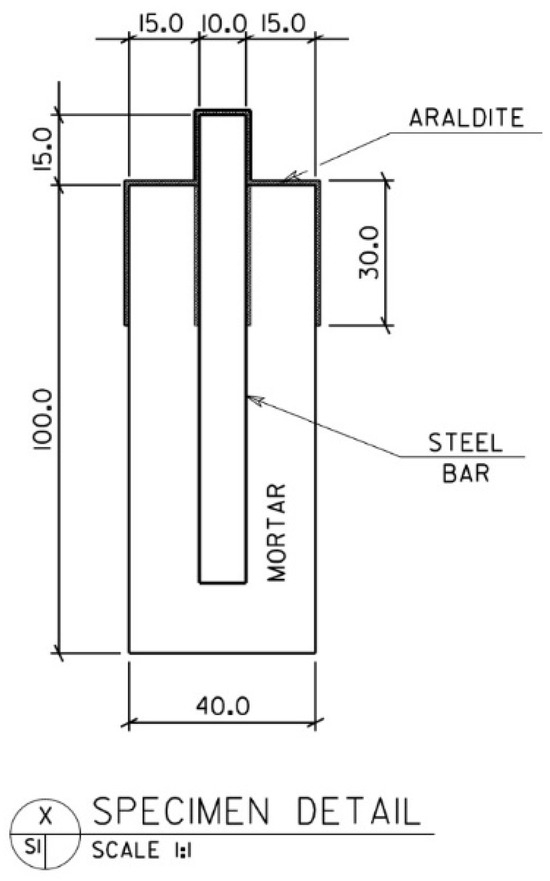
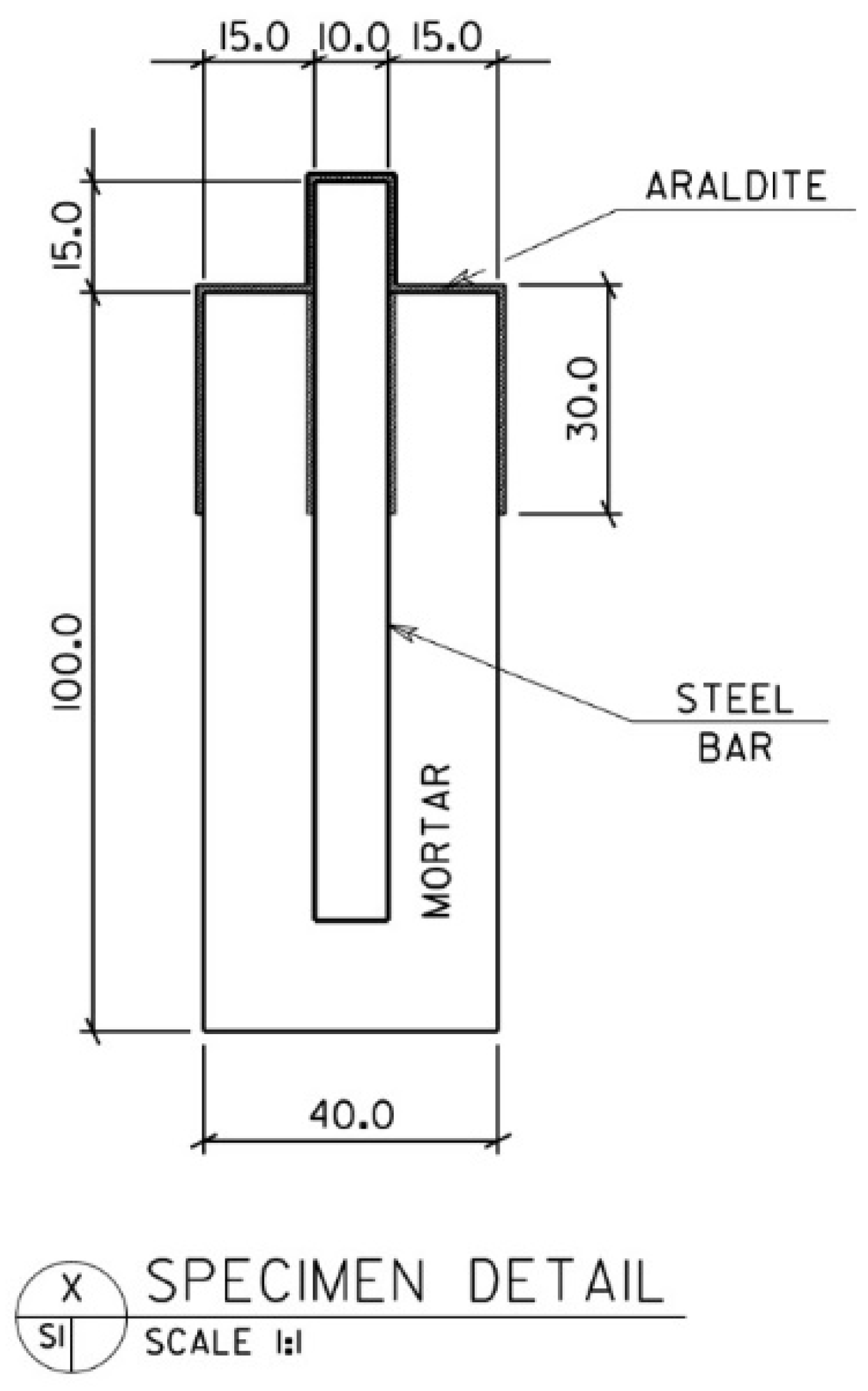
For each mortar composition, fifteen cylindrical specimens (100 mm in height and 50 mm in diameter) were prepared, providing sufficient samples for the experimental measurements conducted during the exposure period (Figure 1). In each specimen, a steel reinforcement bar (10 mm in diameter and 100 mm in length) was embedded coaxially, resulting in a nominal mortar cover of approximately 15 mm. Prior to casting, the steel bars were subjected to a standardized surface pre-treatment consisting of sequential cleaning in a dilute acid solution, acetone, and deionized water. This procedure was implemented to remove surface oxides and contaminants and to ensure uniform initial electrochemical conditions across all specimens.
Figure 1.
Mortar specimen used in the study for the experiments.
The mortar mix design was based on a cement-to-sand ratio of 1:2.6 by mass, with a constant water-to-cement ratio (w/c) of 0.54 for all mixtures. No coarse aggregate was used, as the investigated materials correspond to mortar compositions. FA was used as a partial cement replacement, introduced at the specified replacement levels on a mass basis. The target mass per specimen was 410 g (excluding the mass of the embedded steel bar). The mix proportions, calculated for a single specimen of each mortar group, are reported in Table 2. These proportions were kept constant throughout the experimental campaign to ensure consistency and reproducibility in the evaluation of microstructural evolution and durability-related performance.
Table 2.
Properties of constituent materials and mortar mix proportions used in the study.
All dry constituents were initially mixed for 2–3 min to achieve a homogeneous blend. Water was then added gradually until a workable, homogeneous mortar was obtained. The fresh mortar was cast into cylindrical molds, with the steel bars positioned centrally before final filling. During casting, mild vibration was applied to minimize air entrapment and void formation, and the exposed surface was subsequently leveled with a trowel.
After casting, the specimens were sealed with plastic film and cured under controlled laboratory conditions (20 ± 2 °C, 95% relative humidity) for 28 days. This curing regime allowed sufficient hydration of the Portland cement and promoted the initiation of pozzolanic reactions between FA and portlandite. Upon demolding, the specimens were weighed to verify compliance with the target mass and then stored under controlled conditions prior to exposure in the coastal environment.
After the 28-day curing period, the specimens were transferred to a natural coastal exposure site located in the Halyvourgiki industrial zone (Elefsina, Attica, Greece), approximately 10 m from the shoreline. The exposure conditions correspond to a severe marine atmospheric environment directly influenced by sea spray and chloride-laden winds, combined with industrial atmospheric activity. The specimens were placed inside a specially constructed shaded shelter that prevented direct rainfall while allowing free air circulation and marine aerosol ingress. They were positioned above ground level to avoid capillary interaction with soil moisture and remained fully subjected to ambient temperature and relative humidity fluctuations typical of Mediterranean coastal climates, including cyclic wetting–drying effects induced by marine aerosol deposition.
The selected fly ash replacement levels (5% and 10% by mass of cement) were deliberately chosen to investigate the durability performance of mortars incorporating moderate amounts of Ca-rich fly ash under natural marine exposure. These replacement levels allow assessment of microstructural and transport-related effects while maintaining matrix chemistry and alkalinity conditions comparable to conventional Portland cement systems. The objective was to evaluate whether limited clinker substitution can provide measurable improvements in long-term durability without introducing major compositional shifts associated with higher replacement levels.
2.3. Experimental Procedures
2.3.1. Mass Loss Measurements
Gravimetric measurements were performed to quantify the cumulative corrosion-induced mass loss of embedded steel reinforcement in mortar specimens exposed to aggressive environmental conditions. Mass loss determination provides a direct, time-integrated measure of total metal dissolution and complements electrochemical monitoring by reflecting the net corrosion damage accumulated over the exposure period.
At predetermined exposure intervals, the reinforced mortar specimens were carefully split, and the steel rebars were extracted with particular care to avoid mechanical damage or artificial mass loss. Removal of corrosion products was conducted in accordance with ISO 8407. Initially, the rebars were rinsed with distilled water to eliminate loosely adhered deposits. Subsequently, corrosion products were removed by immersion for 15 min in an inhibited hydrochloric acid solution consisting of 500 mL concentrated HCl (density 1.19 g/mL) diluted in 1000 mL distilled water, with the addition of 3.5 g hexamethylenetetramine per liter as an organic corrosion inhibitor.
The immersion duration was strictly controlled and limited to the minimum time required for complete removal of corrosion products. The use of an inhibited acid solution and controlled exposure time minimizes dissolution of the base metal, in accordance with ISO 8407 recommendations. All specimens were subjected to identical cleaning conditions to ensure consistency and comparability of results.
After chemical cleaning, the rebars were thoroughly rinsed with distilled water to remove residual acid and inhibitor traces, followed by acetone drying to prevent flash rusting. The cleaned specimens were then weighed with a precision of ±0.1 mg. The corrosion-related mass loss was calculated as the difference between the initial pre-exposure mass and the final mass after cleaning, representing the cumulative anodic metal dissolution that occurred during the exposure period.
The corrosion-related mass loss of each steel bar was calculated by comparing its initial mass (recorded prior to embedding) with its final mass after exposure and cleaning. Consequently, the obtained values represent the cumulative anodic metal dissolution that occurred during the exposure period.
2.3.2. Half-Cell Potential Measurements
Electrochemical behavior of the embedded steel reinforcement was evaluated through periodic half-cell potential measurements, following standard procedures for corrosion risk assessment in cementitious materials. A saturated calomel electrode (SCE) was used as the reference electrode, providing a stable and reproducible potential baseline for the comparative evaluation of the steel potential over time.
Measurements were performed using a precision digital multimeter capable of resolving small potential differences, with the steel reinforcement acting as the working electrode and the SCE in contact with the mortar surface at a fixed location. Electrical continuity was ensured, and a thin layer of electrolyte was maintained at the surface to improve electrode contact without compromising the specimen integrity.
Half-cell potentials were recorded at 30-day intervals throughout the entire exposure period, enabling detailed temporal monitoring of passive layer formation, transient anodic dissolution, and the long-term stabilization of the reinforcement. The resulting potential profiles were analyzed to identify distinct phases of corrosion behavior, including initial stabilization, intermediate fluctuations (attributed to environmental aggressors or microstructural heterogeneities), and the establishment of a steady-state electrochemical condition. This systematic monitoring enabled a direct correlation between FA content, microstructural modifications, and the electrochemical response of the steel, thereby accurately reflecting the cumulative influence of the mortar’s chemical and physical properties under aggressive coastal exposure conditions.
2.3.3. Free Chloride Content Determination (Mohr Titration Method)
The free chloride content at the depth of the reinforcement was determined using a water-extraction procedure followed by Mohr titration. The method targets water-soluble (pore-solution-accessible) chlorides and does not include acid-soluble or chemically bound chloride fractions.
Mortar specimens were crushed and ground to obtain a homogeneous fine powder. Approximately 5 g of the powdered mortar were dispersed in deionized water at room temperature under continuous stirring to extract the water-soluble chloride fraction. No acid digestion, heating, or aggressive chemical treatment was applied, in order to avoid dissolution of chemically bound chloride phases (e.g., Friedel’s salt). After sufficient mixing, the suspension was filtered to remove insoluble solids, and the filtrate was used for chloride quantification.
The extracted solution was titrated with standardized 0.1 N silver nitrate (AgNO3) using potassium chromate (K2CrO4) as an endpoint indicator. Silver ions react with chloride ions to form insoluble silver chloride (AgCl); upon complete precipitation of chlorides, the formation of reddish-brown silver chromate (Ag2CrO4) indicates the titration endpoint. The consumed volume of AgNO3 was used to calculate the water-soluble chloride concentration through stoichiometric relationships. Results are reported as water-soluble chloride content, expressed in mg/L of extract and normalized to mortar mass where applicable.
By limiting the procedure to simple water extraction under ambient conditions, the measured values correspond to chlorides that are readily soluble and potentially available for steel depassivation. The procedure was applied consistently to all specimens to ensure comparability across mixtures and exposure durations.
2.3.4. Phenolphthalein Test
The progression of carbonation in cement mortar specimens was assessed using the phenolphthalein indicator method, a widely adopted technique for the semi-quantitative evaluation of alkalinity reduction within cementitious matrices. In carbonated systems, the reaction of atmospheric CO2 with portlandite (C–H) and calcium silicate hydrate (C–S–H) phases leads to the formation of calcium carbonate (CaCO3), accompanied by a progressive decrease in pore solution pH, which may compromise the passive state of embedded steel reinforcement.
To evaluate carbonation depth, the specimens were carefully fractured to expose fresh and representative cross-sectional surfaces. Immediately thereafter, a 1% (w/v) phenolphthalein solution in ethanol was uniformly sprayed onto the exposed surfaces. The indicator exhibits a distinct color response as a function of alkalinity: non-carbonated regions, characterized by pH values above approximately 9.5, developed a pink coloration due to the formation of the phenolphthalein anion, whereas carbonated zones with reduced alkalinity remained colorless.
Subsequently, the depth of the colorless region measured from the exposed surface was determined at multiple locations along each cross-section using a calibrated caliper. The average value of these measurements was reported as the carbonation depth for each specimen. In order to enhance statistical reliability and account for potential heterogeneity in the advancement of the carbonation front, multiple measurements were performed on each cross-section.
For each specimen, carbonation depth was measured at three evenly distributed points along the fractured cross-section using a calibrated digital caliper. Three independent specimens were tested per mixture and exposure duration, resulting in a total of nine measurements per mixture for each evaluation age. The reported carbonation depth corresponds to the average value obtained from these measurements, thereby improving precision and reducing potential operator-related variability.
Overall, the phenolphthalein test provides a rapid and visually unambiguous assessment of carbonation penetration in cement-based materials. When considered alongside electrochemical indicators, mass loss measurements, and microstructural observations, carbonation depth data contribute to a comprehensive evaluation of mortar durability. In particular, this method enables the assessment of the effectiveness of supplementary cementitious materials, such as FA, in delaying alkalinity loss and sustaining reinforcement passivity under aggressive exposure conditions.
2.3.5. Mercury Intrusion Porosimetry
The pore structure characteristics of the cement mortar specimens were evaluated using Mercury Intrusion Porosimetry (MIP), a well-established method for the quantitative characterization of porosity and pore size distribution in cementitious materials. For each measurement, approximately 5 g of mortar material was obtained by carefully crushing and grinding cured specimens, ensuring representative sampling while minimizing structural disturbance such as microcrack formation. During the analysis, mercury was progressively forced into the pore network under increasing pressure, up to approximately 60,000 psi, allowing the quantification of the mercury-accessible pore volume.
Based on the intrusion data, the total porosity was calculated as the ratio of the cumulative intruded pore volume to the bulk volume of the specimen, in accordance with Equation (1). In this context, total porosity provides a quantitative measure of the open pore space that governs fluid transport within the mortar matrix. Moreover, MIP enables the determination of pore size distribution and offers indirect insight into pore network connectivity, which are critical parameters for interpreting transport phenomena and assessing durability-related performance.
MIP is particularly valuable for probing a wide range of pore sizes relevant to diffusion, permeability, and ion transport in cement-based materials. The resulting porosity values, corresponding to the volume of pores accessible to mercury under the applied pressure range, are therefore representative of the effective porosity controlling mass transport in the cementitious matrix. However, careful sample preparation is essential to limit potential experimental artifacts, such as microcracks induced during crushing, which may artificially increase the measured porosity. For this reason, controlled sample handling and preparation procedures were strictly followed to ensure that the porosity data reliably reflect the intrinsic microstructural characteristics of the mortars under study.
where
P: Total porosity of the sample (%).
Vp: Volume of mercury intruded into the pores (mm3).
Vd: Apparent volume of the sample (mm3).
2.3.6. Scanning Electron Microscopy (SEM)
The microstructural characterization of the cement mortars and raw FA were carried out by Scanning Electron Microscopy (SEM) to evaluate matrix morphology, pore refinement, and the formation of secondary hydration products. Fractured surfaces of the CM-REF, CM-FA5, and CM-FA10 specimens were carefully selected to expose internal regions representative of the bulk material. The samples were sputter-coated with a thin layer of gold to ensure surface conductivity and were examined under high-vacuum conditions. Imaging was performed at multiple magnifications to capture both macrostructural heterogeneities and nanoscale features, with special emphasis on the steel–mortar interface.
All experimental measurements were conducted on three independent specimens per mixture and exposure duration. For carbonation depth determination, three measurements were taken per specimen, resulting in nine measurements per mixture at each evaluation age. The reported values correspond to the arithmetic mean of replicate measurements. Standard deviation was calculated for each dataset and was consistently low (generally below 5% of the mean value), indicating high reproducibility. Due to the limited variability and for graphical clarity, error bars were not included in the corresponding figures; however, statistical dispersion was considered in the interpretation of results.
3. Experimental Results and Discussion
3.1. Mass Loss of Steel Rebars
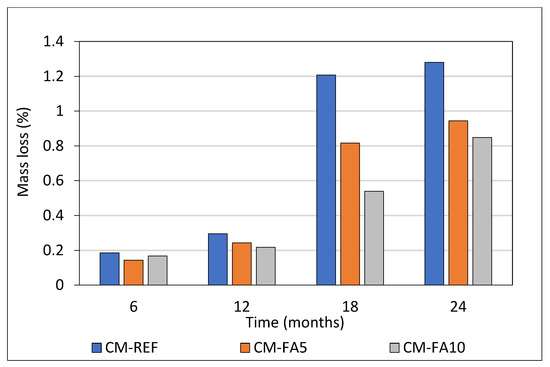
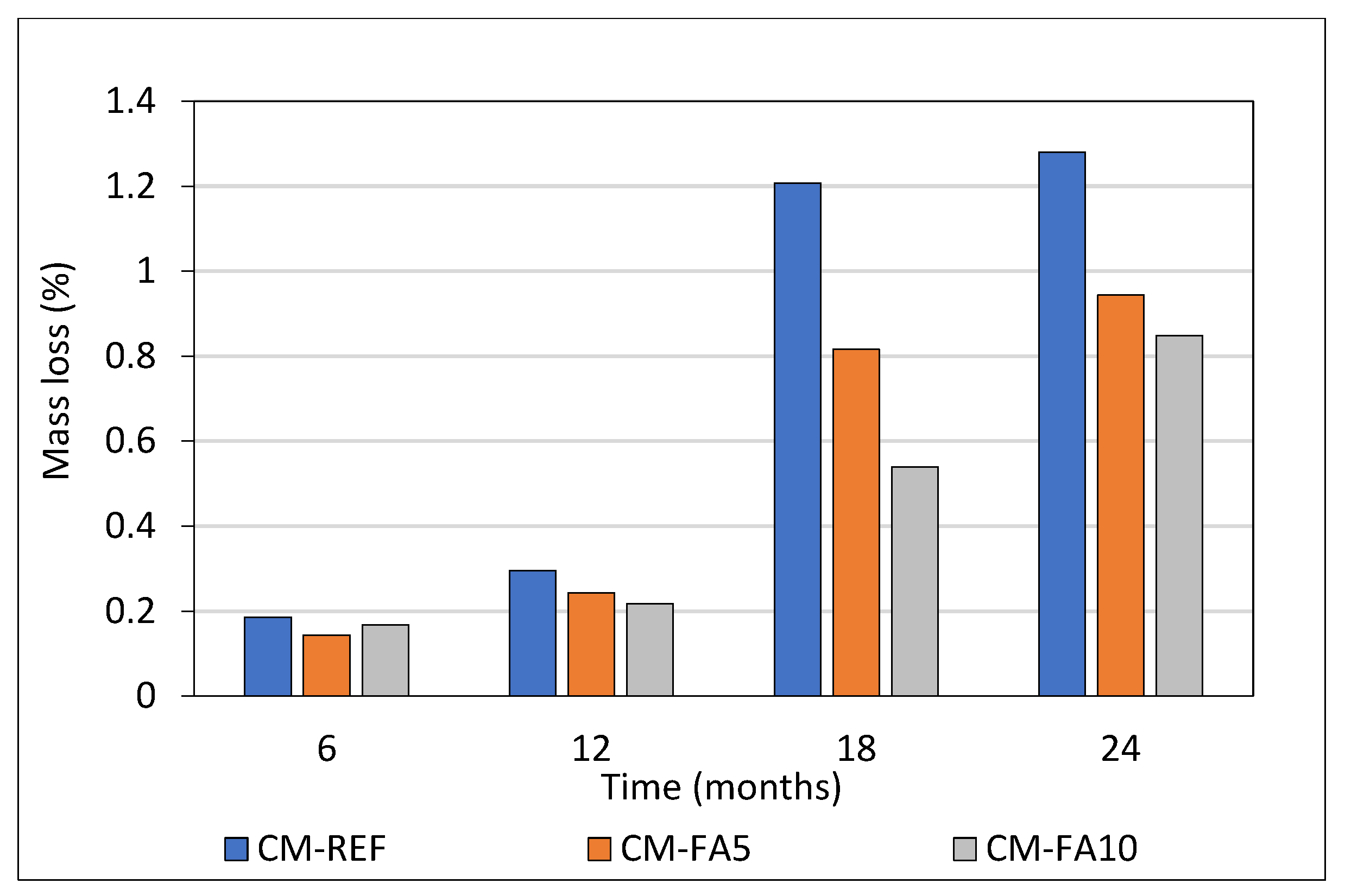
Figure 2 illustrates the gravimetric mass loss of steel reinforcement embedded in cement mortars with and without FA incorporation as a function of exposure time. Gravimetric assessment provides a direct, time-integrated quantification of corrosion severity, reflecting the cumulative metal loss associated with electrochemical degradation processes within the mortar matrix. In this context, the measured mass loss inherently integrates the combined influence of pore structure characteristics, ionic transport properties, and the chemical stabilization induced by supplementary cementitious materials.
Figure 2.
Mass loss (%) of steel rebars embedded in cement mortars exposed to marine environment.
As shown in Figure 2, a clear and consistent hierarchy in corrosion performance is observed across all exposure durations. The reference mortar (CM-REF) exhibits the highest mass loss at each monitoring interval, reaching approximately 1.28% after 24 months of exposure. In contrast, partial replacement of cement with FA leads to a systematic reduction in corrosion-induced mass loss. Specifically, the CM-FA5 mixture achieves a reduced mass loss of approximately 0.94% at 24 months, while the CM-FA10 system demonstrates the highest protective efficiency, limiting steel mass loss to approximately 0.85%.
This progressive improvement in corrosion resistance closely correlates with the pore structure characteristics derived from MIP analysis. In particular, the superior performance of the CM-FA10 mortar is associated with pronounced pore structure refinement, characterized by increased tortuosity and a reduced fraction of interconnected capillary pores. These microstructural features are known to govern ionic transport and, consequently, the kinetics of corrosion in cementitious systems.
In the CM-REF system, the predominance of larger, interconnected capillary pores facilitates rapid chloride ingress and accumulation at the steel–mortar interface. Enhanced ionic mobility under these conditions promotes depassivation and anodic dissolution of the steel reinforcement. Moreover, the formation of expansive corrosion products is expected to induce localized microcracking, further increasing pore connectivity and establishing a self-accelerating degradation mechanism dominated by capillary-driven diffusion processes.
By contrast, FA-modified mortars exhibit a fundamentally different degradation response. Owing to pozzolanic reactions, the formation of secondary C–S–H gel refines the pore network, subdividing larger capillary pores into finer, more tortuous channels. This refinement effectively restricts the transport of chlorides and moisture, thereby maintaining a more chemically and electrochemically stable environment at the steel surface over prolonged exposure periods. In parallel, the densified matrix is associated with increased bulk electrical resistivity, further suppressing corrosion current density and slowing steel oxidation rates.
Overall, the gravimetric results highlight the synergistic action of chemical and physical mechanisms induced by FA incorporation. The consumption of portlandite reduces the volume of chemically vulnerable phases, while the concurrent formation of additional C–S–H gel enhances pore refinement and tortuosity. Consequently, microstructural modification is translated directly into measurable engineering benefits, including prolonged maintenance of steel passivity, reduced corrosion propagation, and enhanced long-term durability of cementitious composites exposed to aggressive environments.
3.2. Electrochemical Monitoring
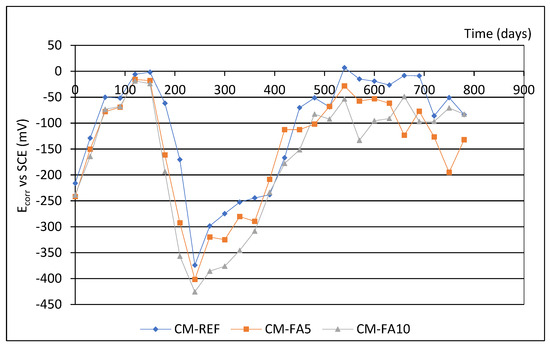
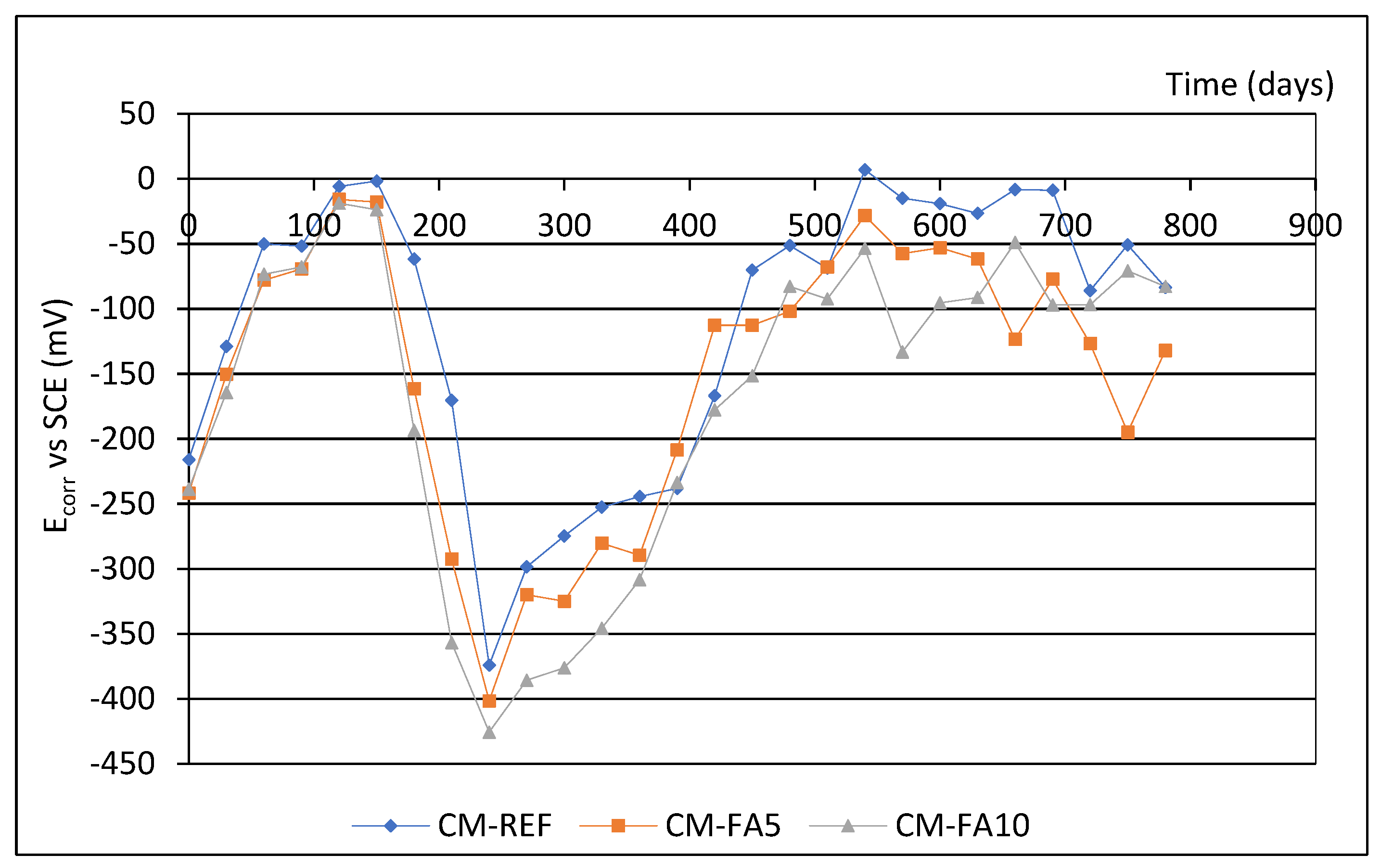
Figure 3 presents the evolution of the corrosion potential over time for specimens incorporating Ca-rich FA. The potential profiles reveal several distinct phases, reflecting the dynamic electrochemical behavior of the materials and the influence of additive content on corrosion processes.
Figure 3.
Half-cell potential (mV) of steel embedded in cement mortars against exposure time (days).
During the initial period (0–150 days), corrosion potentials progressively shifted toward more electropositive values, ranging from −239 mV to −2 mV. This trend indicates early surface stabilization, likely associated with the formation of nascent passive layers on the steel surface, which reduce the active dissolution of metallic species and, consequently, the overall corrosion rate. Notably, specimens containing FA exhibited more pronounced initial stabilization, suggesting that the Ca-rich additive promotes the early development of protective layers, potentially through matrix densification or pozzolanic reactions that restrict ionic transport.
Between 150 and 240 days, a shift toward more electronegative potentials was observed, reaching −374 mV for the reference specimens and −402 mV and −426 mV for the 5% and 10% FA mixtures, respectively. Although more negative potentials are commonly associated with increased corrosion probability, half-cell potential measurements reflect thermodynamic tendency rather than actual corrosion rate. Therefore, the transient electronegative shift observed in FA-modified mortars should not be interpreted as evidence of intensified corrosion activity. This intermediate behavior is more plausibly attributed to microstructural and electrochemical readjustments occurring during ongoing hydration and pozzolanic reactions. The progressive refinement of the pore structure, combined with changes in pore solution chemistry and oxygen availability, may temporarily modify the electrochemical equilibrium at the steel–mortar interface. Importantly, gravimetric mass loss results and chloride profiling data do not indicate increased corrosion severity in FA-containing systems during this period. On the contrary, long-term measurements confirm reduced cumulative metal dissolution in CM-FA5 and CM-FA10 compared to the reference mortar. Thus, the intermediate electronegative shift is interpreted as a transient electrochemical adjustment rather than a sustained increase in corrosion rate. The subsequent stabilization toward more electropositive values supports the establishment of a durable passive state, particularly in mortars incorporating fly ash.
From 240 to 540 days, corrosion potentials gradually shifted back toward more electropositive values across all specimen groups. This trend highlights the long-term benefits of the additive, as continued pozzolanic reactions and progressive matrix densification promote the formation of thicker, more uniform passive films, thereby reducing ionic mobility and decreasing the overall corrosion rate. The effect is more pronounced in specimens with 5% and 10% fly ash, underscoring the additive’s role in enhancing long-term durability.
In the subsequent period (540–600 days), a minor shift toward more electronegative potentials occurred; however, the magnitude was limited, indicating that corrosion processes were largely controlled. This plateau phase likely corresponds to a quasi-steady-state condition in which mature passive layers balance ongoing corrosion with the gradual formation of protective reaction products. Finally, between 600 and 780 days, corrosion potentials stabilized within the range of −8 mV to −132 mV, suggesting the establishment of a stable, long-term electrochemical state. Specimens with higher FA content stabilized at slightly more electronegative values, likely reflecting a trade-off between initial microstructural heterogeneity and the eventual effect of matrix densification.
Overall, the temporal evolution of the corrosion potential demonstrates the complex interplay between material composition, additive dosage, and exposure conditions. The early electropositive shifts reflect the onset of passivation, the intermediate electronegative trends capture transient corrosion activity, and the long-term stabilization highlights the effectiveness of the Ca-rich FA in improving the durability of the cementitious system. These results emphasize that careful optimization of the additive content is essential to simultaneously achieve favorable early-age performance and sustained corrosion resistance in aggressive exposure environments.
3.3. Chloride Content
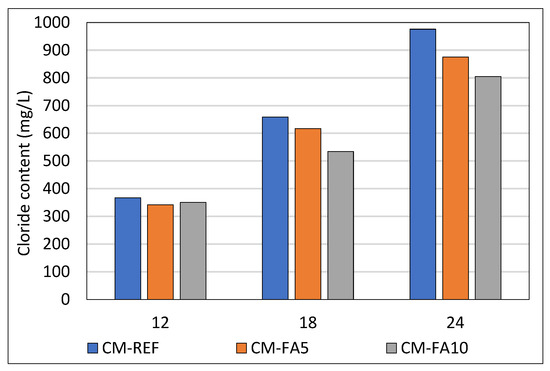
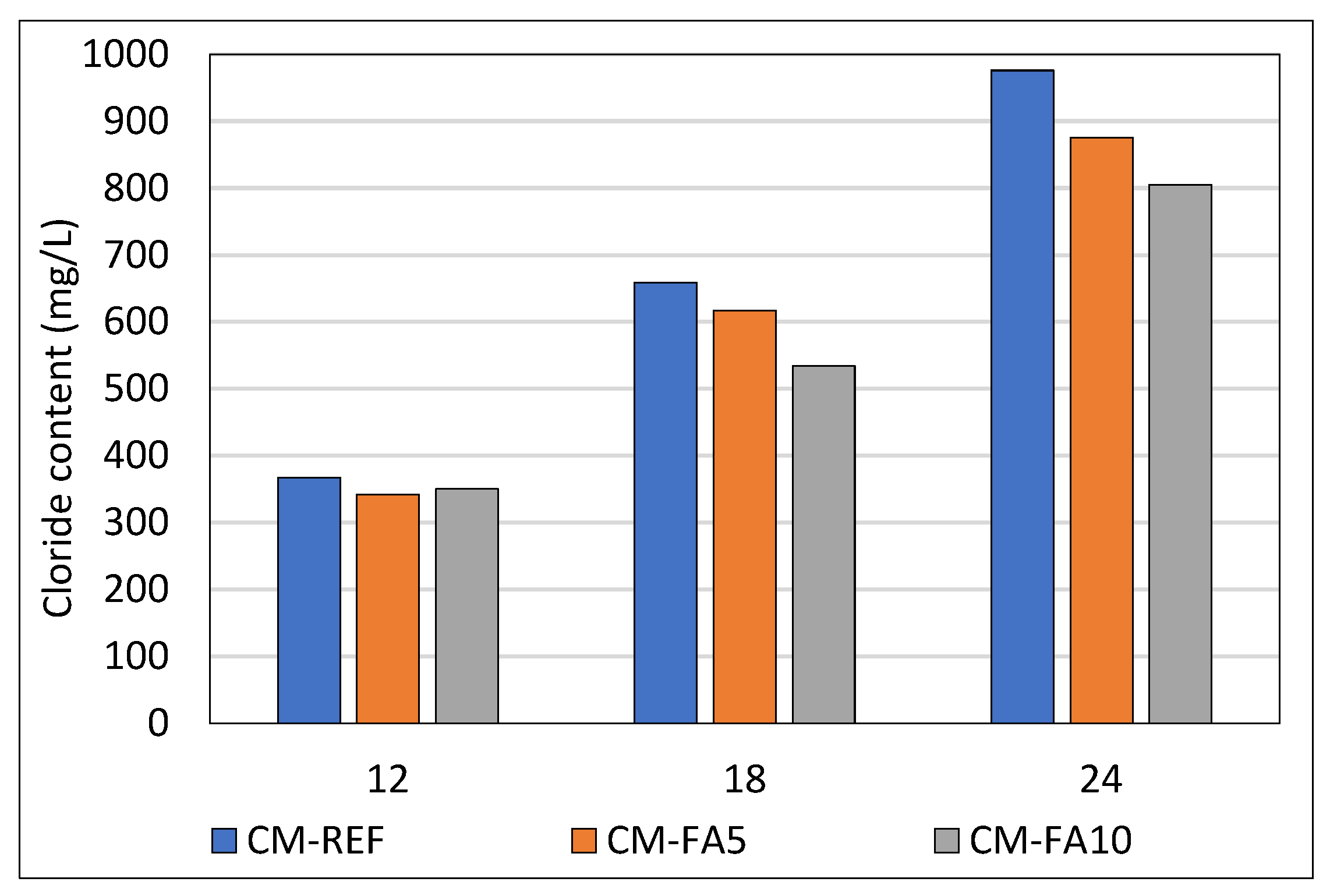
The quantification of free chloride content at the reinforcement depth (Figure 4) provides a mechanistic basis for the electrochemical behavior observed in the tested mortars. Free chlorides—unbound chloride ions in the pore solution—are the primary species responsible for steel depassivation and corrosion initiation. Their concentration thus serves as a sensitive indicator of the mortar’s ability to resist chloride ingress and maintain the passive state of the embedded reinforcement under aggressive exposure conditions.
Figure 4.
Chloride content (mg/L) of mortars with and without FA addition.
Across the 12-, 18-, and 24-month exposure periods, a consistent performance hierarchy is observed. The reference mortar (CM-REF) exhibits the highest free chloride concentration, reaching approximately 980 mg/L after 24 months, reflecting its coarse, highly interconnected capillary network and limited chloride immobilization capacity. Partial replacement of cement with 5% FA (CM-FA5) reduces free chloride levels to ~875 mg/L, while the CM-FA10 system maintains the lowest concentration (~805 mg/L), indicating an optimal balance between physical diffusion resistance and chemical chloride binding.
The reduction in free chloride content in pozzolanic mortars can be attributed to the synergistic action of physical and chemical mechanisms. Physically, pozzolanic reactions generate additional secondary C–S–H gel, which fills and subdivides capillary pores into a dense, tortuous micropore network. Chemically, pozzolanic reactions produce secondary hydration products, including C–S–H and aluminate phases such as Friedel’s salt, which immobilize chloride ions through adsorption and lattice incorporation, thereby reducing the fraction of free, electrochemically active chlorides. The CM-FA10 system exemplifies an optimal balance between matrix densification and chemical chloride binding, yielding the lowest free chloride concentrations across all exposure durations.
Mechanistically, initial OPC hydration forms a network of capillary pores that dominates early-stage diffusion. Subsequent pozzolanic reactions consume portlandite and generate secondary C–S–H, subdividing capillary pores, increasing tortuosity, and simultaneously enabling chloride binding through reactive aluminate phases. This dual mechanism progressively reduces the free chloride fraction at the steel–mortar interface below the critical depassivation threshold, thereby enhancing corrosion resistance and sustaining steel passivity over extended periods.
In conclusion, the synergy between microstructural refinement and chemical chloride immobilization transforms pozzolanic mortars from capillary-dominated, diffusion-prone systems into diffusion-controlled, chemically stabilized composites. These findings directly link microstructural and chemical modifications to enhanced durability and underscore the importance of carefully selected supplementary cementitious materials for the design of reinforced mortars with robust resistance to chloride ingress.
3.4. Carbonation of Mortars
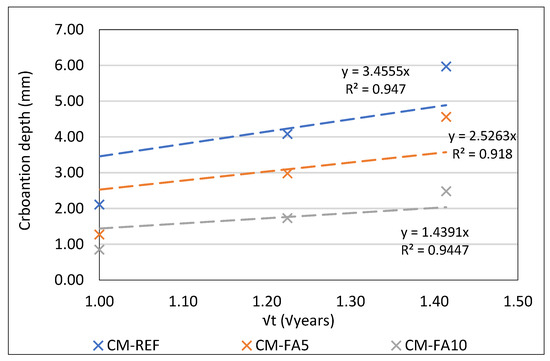
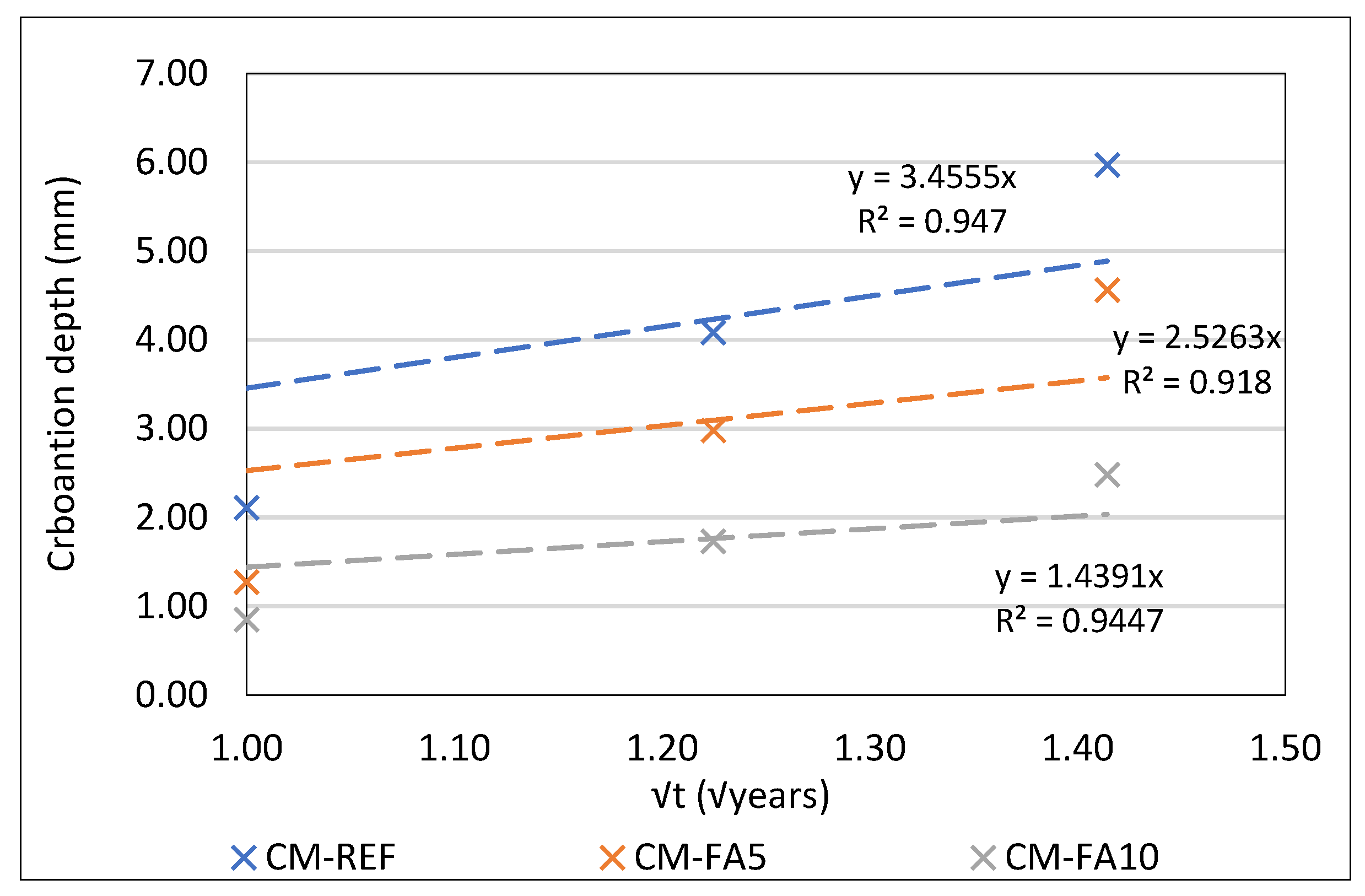
The evolution of carbonation depth in the investigated mortars (CM-REF, CM-FA5, CM-FA10) as a function of exposure time is presented in Figure 5. To ensure physical consistency with diffusion-controlled carbonation in cementitious materials, the experimental data were interpreted using the square-root relationship: x = k√t, where x is the carbonation depth (mm), t is the exposure time (years), and k is the carbonation coefficient (mm/√year). Linear regression of carbonation depth versus √t, with the intercept constrained to zero, yielded satisfactory correlation for all mixtures, consistent with diffusion-controlled carbonation under the examined natural exposure conditions.
Figure 5.
Carbonation depth (mm) of mortars versus square root of time (√years) of exposure in marine environment.
The reference mortar (CM-REF) exhibited the highest carbonation coefficient (k ≈ 3.46 mm/√year). Partial replacement with fly ash significantly reduced the carbonation rate. The CM-FA5 mixture showed a carbonation coefficient of approximately 2.53 mm/√year, corresponding to a reduction of about 27% relative to CM-REF. The CM-FA10 system demonstrated the most pronounced improvement (k ≈ 1.44 mm/√year), representing a reduction of nearly 58% compared with the reference mortar. This systematic decrease in k establishes a clear hierarchy of carbonation resistance: CM-REF > CM-FA5 > CM-FA10.
From a microstructural perspective, the improved performance of the fly ash-modified mortars is primarily attributed to pore structure refinement induced by the combined pozzolanic and latent hydraulic activity of the Ca-rich fly ash. The formation of additional secondary C–S–H gel subdivides capillary pores, increases tortuosity, and reduces pore connectivity, thereby decreasing the effective diffusivity of CO2 within the hardened matrix. Although fly ash incorporation reduces portlandite content—which may theoretically diminish the alkaline buffering capacity—the dominant effect observed in the present study is the reduction in gas transport rate. The net effect is a lower carbonation coefficient, indicating that transport limitation outweighs the reduced alkalinity reserve under the examined exposure conditions.
The enhanced resistance observed in CM-FA10 further suggests a synergistic microstructural densification mechanism that contributes to limiting CO2 penetration and stabilizing the matrix during long-term exposure.
From a durability standpoint, the reduced carbonation coefficients indicate a delayed progression of the carbonation front and therefore a longer time to potential depassivation of embedded steel reinforcement and extended time to corrosion initiation. This effect is particularly relevant in coastal and urban environments, where carbonation constitutes a critical service-life limit state.
3.5. Mercury Porosimetry Results (MIP)
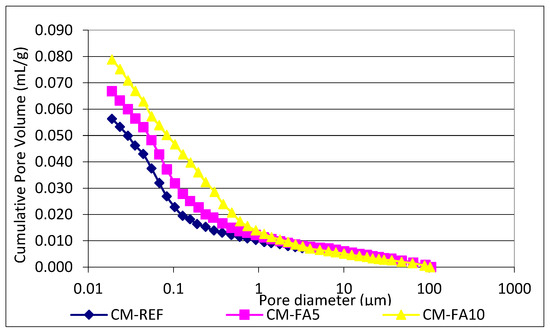
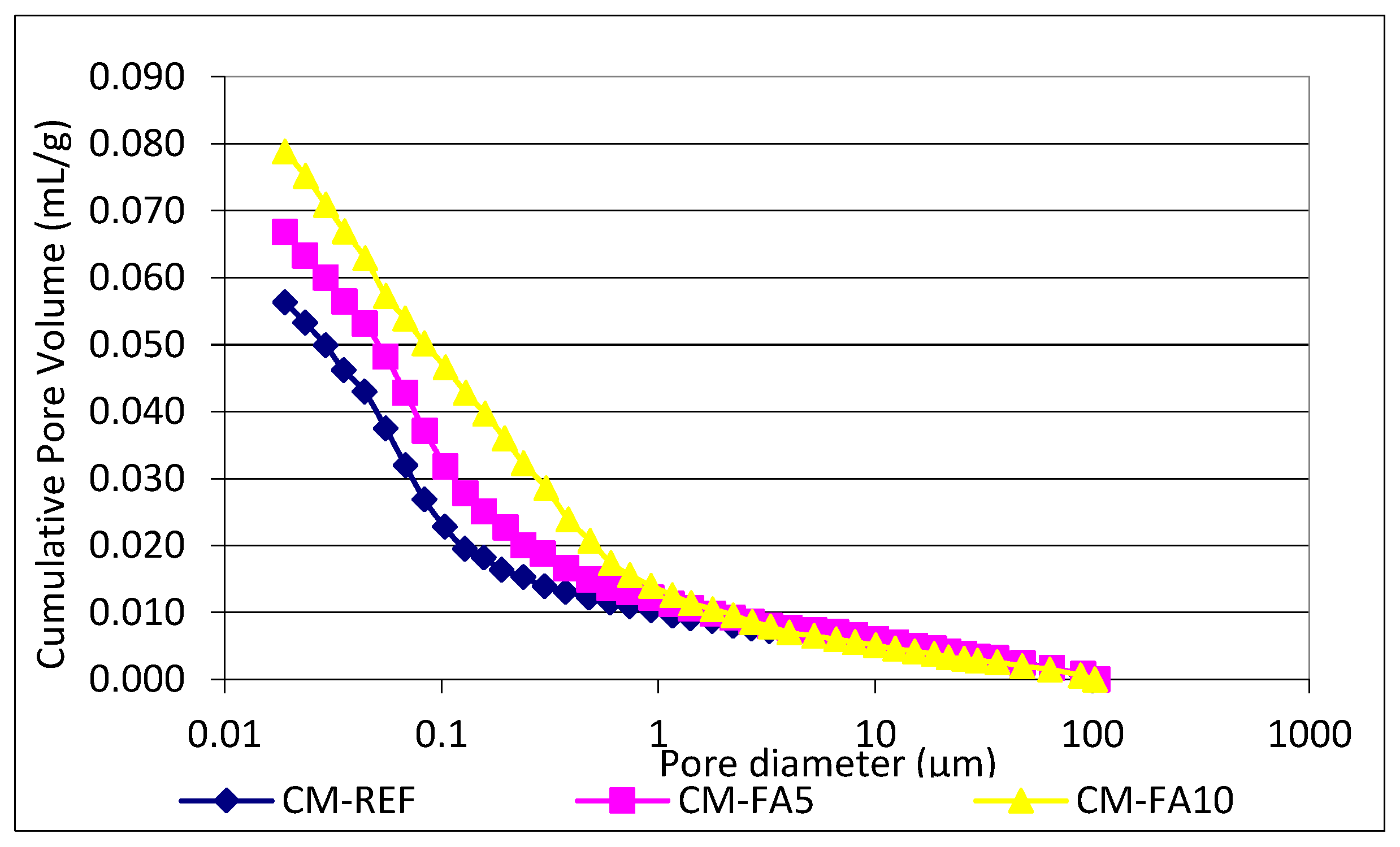
The microstructural characteristics of the mortars were evaluated using Mercury Intrusion Porosimetry (MIP), as shown in Figure 6. MIP provides quantitative information on cumulative intrusion volume and apparent pore size distribution, allowing comparative assessment of capillary and mesopore domains within the investigated systems.
Figure 6.
Cumulative pore volumes (mL/g) of mortars evaluated by MIP technique.
The reference cement mortar (CM-REF) exhibited the lowest cumulative intrusion volume (~0.056 mL/g). In contrast, FA incorporation at 5% and 10% resulted in increased cumulative intrusion volumes (~0.067 mL/g for CM-FA5 and ~0.078 mL/g for CM-FA10). At first glance, this increase could be interpreted as reduced compactness. However, analysis of the pore size distribution indicates that the additional intrusion volume is primarily associated with pores in the finer range (<0.1 μm), while the relative contribution of larger capillary pores decreases.
These results suggest a redistribution of pore sizes rather than a straightforward increase in transport-relevant porosity. The observed shift toward smaller apparent pore diameters is consistent with morphological changes commonly associated with pozzolanic systems. However, MIP alone does not provide direct measurement of permeability or diffusivity, and therefore transport properties cannot be quantitatively derived from intrusion data.
It should also be noted that MIP measurements involve high-pressure mercury intrusion and require specimen drying and fracture, processes that may introduce microcracking and influence measured intrusion volumes. Furthermore, due to ink-bottle effects and the limited accessibility of nanometric gel pores, MIP does not fully capture the finest pore fractions. Consequently, the reported values represent apparent intrusion porosity and should be interpreted comparatively rather than as absolute total porosity.
Within these methodological constraints, the finer pore size distribution observed in FA-modified mortars is consistent with the improved durability indicators measured independently in this study, including lower carbonation coefficients and reduced free chloride concentrations. The interpretation of reduced effective transport is therefore based on correlation with experimentally measured durability parameters, rather than on direct transport measurements.
Overall, FA incorporation results in a modification of pore size distribution toward finer ranges. This pore redistribution, together with the independently observed reductions in chloride content and carbonation rate, supports the conclusion that moderate FA replacement enhances durability performance under the investigated exposure conditions.
3.6. Microscopical Observations
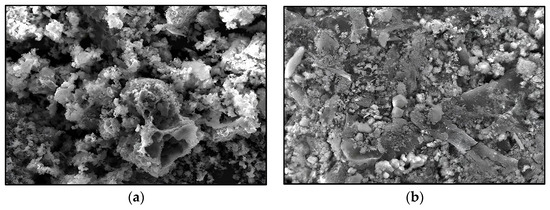
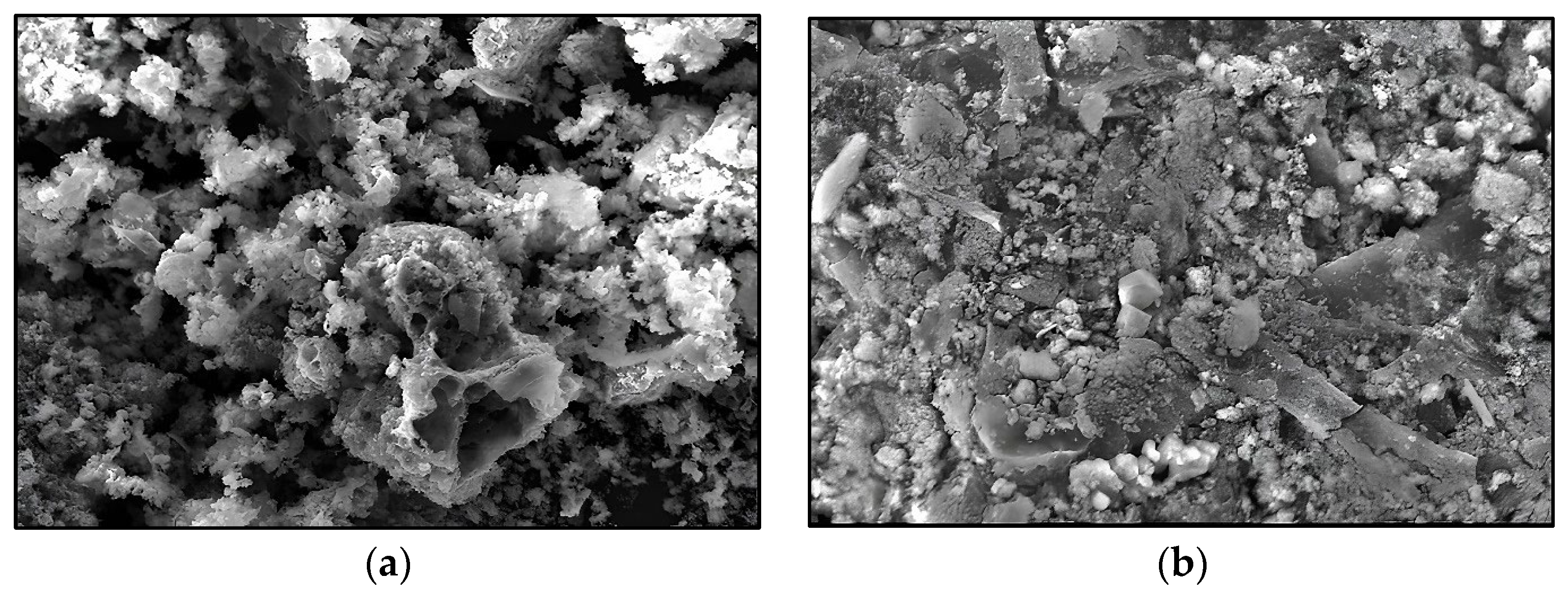
The SEM micrographs (Figure 7) acquired at magnifications of ×1000 and ×500 exhibit the characteristic microstructural features of a Ca-rich fly ash. The material is predominantly composed of irregularly shaped, partially fragmented particles that assemble into loosely bound agglomerates. Although collapsed or distorted spherical morphologies—typical of fly ash generated during coal combustion—can be locally distinguished, the overall texture is governed by angular to sub-angular particles with rough, heterogeneous surfaces. A number of particles display internal porosity and microcavities, which are indicative of gas evolution during the rapid cooling of molten ash droplets.
Figure 7.
SEM micrographs of the Ca-rich fly ash used as cement replacement: (a) ×1000 magnification and (b) ×500 magnification.
The frequent occurrence of fine particles adhering to larger ash fragments denotes a broad particle size distribution, a feature commonly reported for lignite-derived Ca-rich fly ashes. This microstructural assemblage is consistent with a predominantly amorphous aluminosilicate glassy phase, locally accompanied by crystalline remnants such as quartz and mullite. Such features are typically associated with enhanced reactivity, as the irregular geometry, surface roughness, and internal porosity increase the effective surface area accessible to dissolution processes under alkaline conditions.
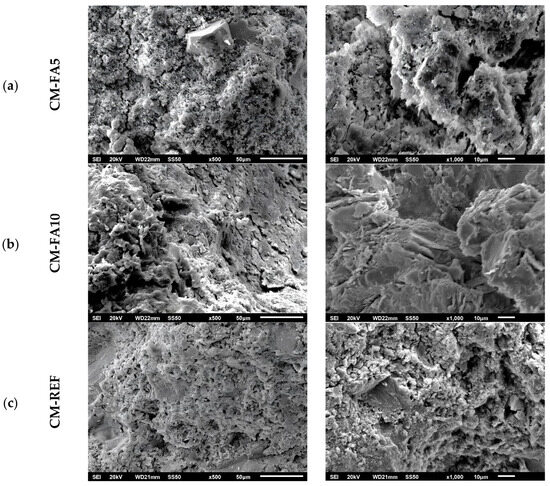
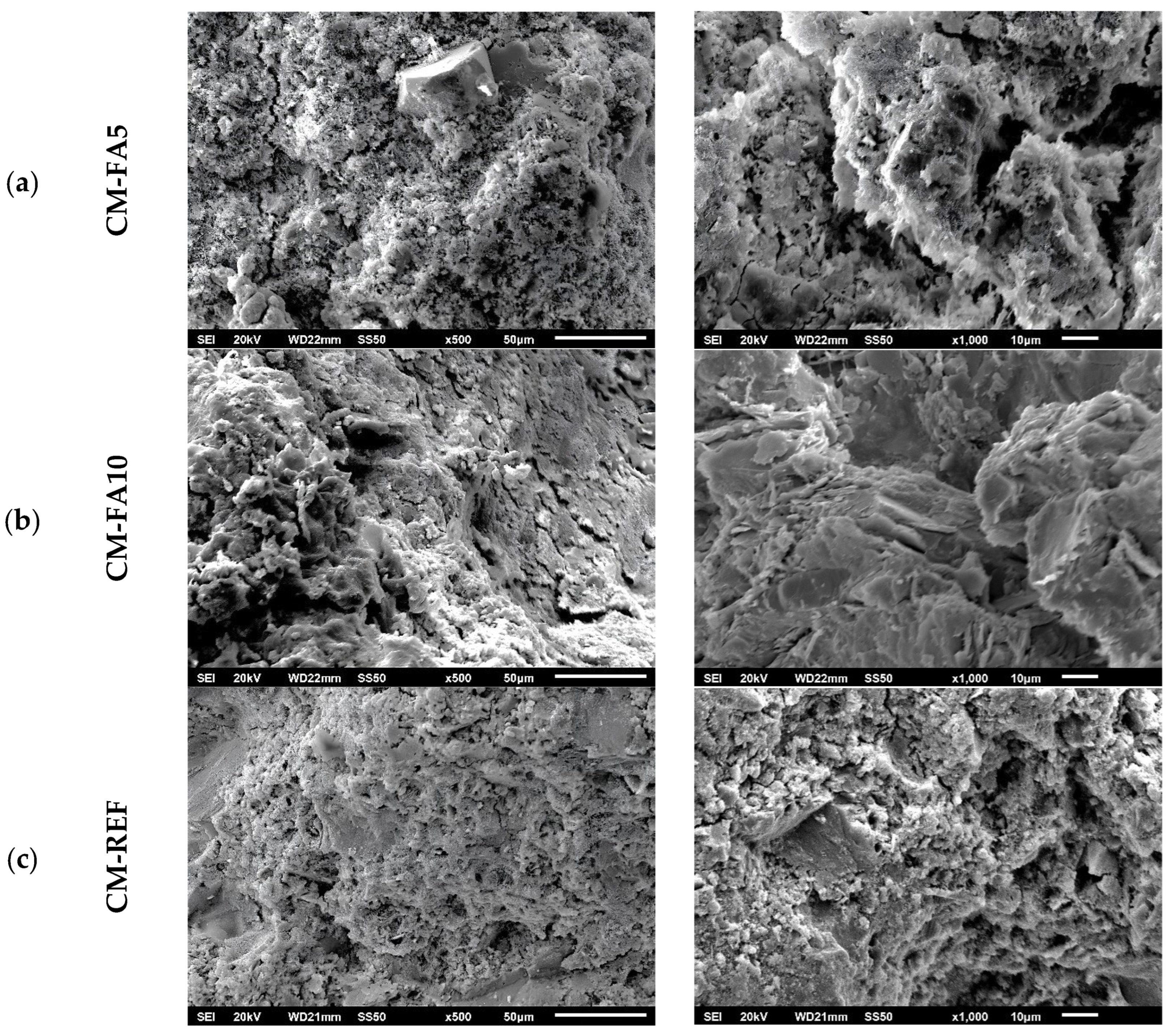
Figure 8 illustrates the microstructure of the cement mortars with and without fly ash (FA) addition. In the reference mortar (CM-REF), the SEM images reveal a relatively open and heterogeneous capillary network, characterized by loosely packed hydration products and discontinuous gel-like regions. Large, well-connected capillary pores and occasional microcracks are evident, and the interfacial transition zones (ITZs) around aggregates appear porous and less integrated with the surrounding paste. At the steel–mortar interface, hydration products provide partial and discontinuous coverage, forming a limited physical barrier against the ingress of chlorides and carbon dioxide. This morphology is consistent with the higher free chloride contents, greater carbonation depths, and increased corrosion activity measured for CM-REF.
Figure 8.
SEM micrographs of (a) CM-FA5, (b) CM-FA10, and (c) CM-REF mortars after 12 months of marine exposure (magnification ×500, ×1000).
In contrast, the mortars modified with fly ash exhibit a more homogeneous and compact microstructure, the degree of densification depending on the FA replacement level. In CM-FA5, finely dispersed FA particles contribute to improved packing of the binder phase and appear to act as nucleation sites for hydration products. The matrix displays a more continuous gel-like morphology and reduced apparent capillary pore size. Pore domains appear smaller and less interconnected, and the ITZs are less distinct. The steel–mortar interface is more uniformly covered by hydration products compared to CM-REF, suggesting improved physical continuity at the interface.
These trends are further accentuated in CM-FA10, which exhibits the most uniform and compact morphology among the investigated mixes. The fracture surfaces show a more continuous gel-like matrix with fewer large capillary voids. Residual pores appear finer and less interconnected, and visible microcracking is limited. The steel–mortar interface is covered by a denser layer of hydration products compared with the reference mortar.
It should be noted that the SEM observations presented here are qualitative and were not supported by quantitative phase analysis (e.g., EDX mapping or compositional measurements). Therefore, interpretations regarding hydration product development and phase assemblage are based on morphological features and consistency with independently measured durability indicators (chloride content, carbonation coefficient, and mass loss), rather than direct compositional quantification.
Overall, the SEM analysis indicates a progressive modification of pore morphology and interface continuity with increasing FA content. These qualitative observations are consistent with the MIP results showing pore size redistribution toward finer ranges and with the improved durability performance measured in FA-modified mortars.
4. Discussion
The present study offers a comprehensive assessment of the durability performance of cement mortars partially replaced with fly ash (CM-FA5 and CM-FA10) during 24 months of aggressive coastal exposure. Multiple complementary techniques—gravimetric, electrochemical, chemical, and microstructural analyses—consistently demonstrate that fly ash incorporation markedly improves corrosion resistance of embedded steel, restricts chloride ingress, retards carbonation progression, and densifies the pore structure. These results link pozzolanic reactivity and pore structure modification to measurable improvements in long-term durability under marine exposure.
The interpretation of microstructural and chemical mechanisms is based on consistency between experimental trends and established literature, as direct phase quantification techniques (e.g., XRD or TGA) were not employed in the present study.
Gravimetric evaluation of steel corrosion reveals a clear performance hierarchy: CM-REF > CM-FA5 > CM-FA10. After 24 months of exposure, mass loss values were 1.28% for CM-REF, 0.94% for CM-FA5 (26.6% reduction), and 0.85% for CM-FA10 (33.6% reduction) relative to the reference mortar. Electrochemical monitoring confirms these observations, identifying three distinct phases: (i) initial surface stabilization, (ii) transient corrosion acceleration linked to early-age microstructural heterogeneities, and (iii) long-term stabilization with sustained protection. It should be emphasized that half-cell potential measurements reflect the thermodynamic tendency for corrosion rather than the actual corrosion rate. In FA-modified mortars, reduced pore connectivity and increased matrix resistivity may influence potential readings through ohmic effects and localized polarization phenomena. Consequently, more electronegative potentials may be recorded without a proportional increase in corrosion kinetics. In contrast, gravimetric mass loss represents time-integrated anodic dissolution and provides a direct measure of cumulative corrosion damage. The lower mass loss observed in CM-FA10 therefore confirms improved long-term corrosion resistance despite transient variations in potential values. These findings align with extensive literature evidence that fly ash-modified systems promote passive film stabilization, increased electrical resistivity of the matrix, and reduced corrosion activity, as widely reported in the literature [29,30,31].
Chloride ingress measurements reveal a similar trend. The free chloride concentration at the reinforcement depth decreases progressively with increasing fly ash content. After 24 months, CM-FA5 and CM-FA10 reduce chloride levels by approximately 10.7% and 17.8%, respectively, compared to CM-REF. This reduction is governed by a dual mechanism: (i) physical hindrance due to the development of a dense, tortuous micropore network from secondary C–S–H and (ii) chemical immobilization mechanisms commonly associated with aluminate-containing hydration phases (e.g., Friedel’s salt), as widely reported in the literature. Previous studies have demonstrated that pozzolanic supplementary cementitious materials reduce free chloride content and improve chloride binding capacity, consistent with the beneficial role of FA observed in this work [27,32,33].
Carbonation resistance further illustrates the beneficial effects of fly ash. Regression analysis based on the square-root diffusion model (x = k√t) shows a sequential reduction in carbonation depth (CM-REF > CM-FA5 > CM-FA10). After 24 months, carbonation depth is reduced by approximately 23.6% for CM-FA5 and 58.5% for CM-FA10 relative to the reference mortar. These improvements arise from combined effects: although portlandite consumption reduces the alkaline buffering capacity, the dominant mechanism is transport limitation. Reduced pore connectivity increases tortuosity and restricts CO2 diffusion, thereby slowing carbonation front propagation. In earlier work, the beneficial effect of pozzolanic reactions on carbonation resistance has been reported, particularly in systems with moderate FA replacement, and the present study extends these findings to natural marine exposure conditions [34,35,36,37].
Microstructural characterization by Mercury Intrusion Porosimetry (MIP) supports these observations. Although cumulative pore volume slightly increases with fly ash content (CM-FA5: +19.6%; CM-FA10: +39.3% relative to CM-REF), this increment is predominantly confined to the micropore range (<0.1 μm). This indicates a shift in pore size distribution toward finer pores rather than a deterioration in transport-relevant structure. In agreement with previous MIP and transport studies on FA-modified systems, the total porosity increase is largely microporosity, which does not compromise but rather enhances diffusion resistance [38,39,40]. Consequently, CM-FA5 and CM-FA10 exhibit diffusion-controlled behavior with improved resistance to chloride penetration and carbonation.
The observed durability enhancement arises from coupled chemical and transport-related effects associated with the pozzolanic reaction. Portlandite consumption modifies phase assemblage, while secondary hydration products and reduced pore connectivity collectively limit ionic and CO2 transport. These combined effects explain the lower chloride availability, reduced carbonation rate, and decreased cumulative corrosion damage measured in FA-modified mortars [41,42].
Optimization across exposure durations reveals that CM-FA10 consistently outperforms CM-FA5. Early improvements (12 months) already show a ~12.3% reduction in chloride content and a ~40% reduction in carbonation depth for CM-FA10, along with corresponding reductions in steel mass loss. These beneficial effects accumulate over time, highlighting the cumulative contribution of ongoing pozzolanic reactions and gradual pore structure modification. In the literature, similar cumulative benefits have been reported for supplementary cementitious materials in marine environments, where long-term pore refinement and chemical stabilization lead to increasing differences from ordinary Portland cement-based systems over time [43,44].
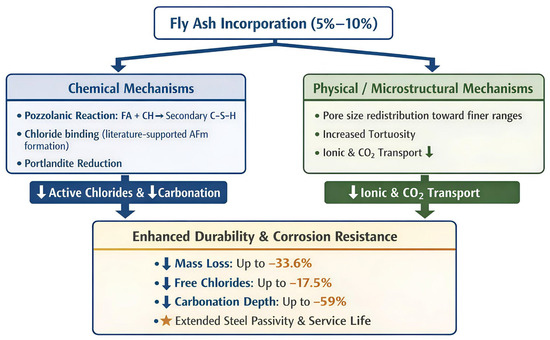
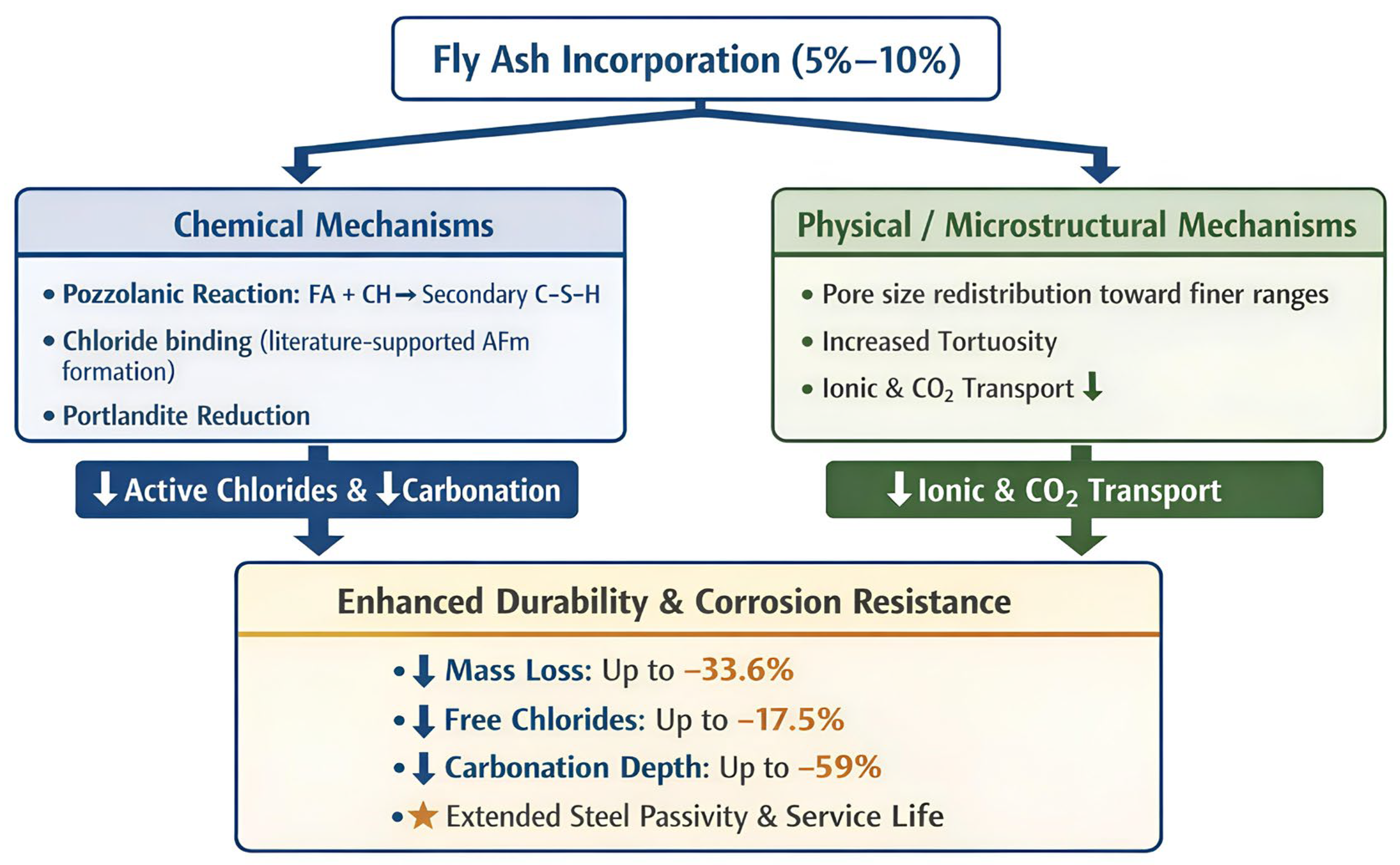
Figure 9 schematically illustrates the principal mechanisms responsible for the enhanced durability observed in mortars incorporating fly ash (5%–10%). At the chemical level, the pozzolanic reaction between the amorphous aluminosilicate phases of fly ash and portlandite produced during cement hydration leads to the formation of additional secondary C–S–H. This process modifies the hydrate assemblage and contributes to a denser and more stable cementitious matrix. Simultaneously, the alumina-bearing components of fly ash favor the formation of AFm-type phases capable of chemically binding chloride ions, thereby reducing the availability of free chlorides within the pore solution.
Figure 9.
Diagram of fly ash improving mortar durability: pozzolanic reaction, pore refinement & ion transport reduction.
These chemical transformations are accompanied by important microstructural modifications. The presence of fine fly ash particles and the progressive development of secondary hydration products promote a redistribution of the pore system toward finer pores and increase the tortuosity of transport pathways. As a result, the connectivity of the pore network decreases and the transport of aggressive species through the matrix becomes more restricted.
The combined action of these mechanisms ultimately limits both ionic and gaseous transport within the cementitious material. Consequently, the ingress of chlorides and CO2 is reduced, leading to lower chloride availability at reinforcement depth, slower carbonation propagation, and improved corrosion resistance of the embedded steel. The schematic representation therefore provides a conceptual framework linking the physicochemical processes associated with fly ash incorporation to the experimentally observed improvements in durability performance.
5. Limitations and Future Perspectives
The study was conducted under controlled coastal exposure and does not account for extreme environmental variability, cyclic wetting–drying conditions, or service lives beyond 24 months. Future work should investigate synergistic effects of multiple supplementary cementitious materials (e.g., silica fume, slag) and nano-additives, as well as long-term multi-species transport modeling. Advanced 3D imaging of pore networks and microstructural evolution could provide predictive insights for tailored mortar design. Additionally, more systematic integration of SEM observations would allow direct verification of microstructural homogeneity, pore refinement, and secondary phase distribution, further strengthening the mechanistic understanding of FA-modified systems.
In summary, the integration of gravimetric, electrochemical, chemical, and microstructural data demonstrates that fly ash incorporation significantly enhances the durability of cement mortars exposed to aggressive environments. The synergy between chemical stabilization and physical pore refinement transforms conventional OPC-based mortars into diffusion-controlled, chemically stabilized composites. CM-FA5 offers a cost-effective improvement, while CM-FA10 provides optimal long-term protection, particularly in coastal or chloride-rich environments. These findings provide a robust framework for the design of durable, high-performance cementitious materials.
6. Conclusions
This study assessed the long-term durability performance of Portland cement mortars incorporating moderate Ca-rich fly ash replacement levels (5% and 10%) under 24 months of natural marine exposure. Based on the experimental results, the following conclusions can be drawn:
- Moderate fly ash incorporation (5%–10%) reduced cumulative steel mass loss by up to 33.6% compared with the reference mortar after 24 months of exposure, confirming improved long-term corrosion resistance under field conditions.
- The carbonation coefficient, determined using the diffusion-based square-root model (x = k√t), decreased from 3.46 mm/√year for CM-REF to 2.53 mm/√year (CM-FA5) and 1.44 mm/√year (CM-FA10), indicating transport-controlled mitigation of carbonation progression.
- Free chloride concentration at reinforcement depth was reduced by up to 17.5% in FA-modified mortars relative to the reference mixture, demonstrating the combined influence of pore structure refinement and literature-supported chloride-binding mechanisms.
- MIP analysis revealed a redistribution of porosity toward the micropore range (<0.1 μm), suggesting reduced effective transport connectivity despite a moderate increase in total porosity.
Within the investigated replacement range and exposure environment, the results demonstrate that limited clinker substitution with Ca-rich fly ash can enhance transport resistance and corrosion performance without fundamentally altering matrix chemistry. These findings are specifically valid for moderate replacement levels (5%–10%) under natural marine atmospheric exposure and should not be extrapolated to higher substitution ratios without further investigation.
Funding
This research received no external funding.
Data Availability Statement
Data are contained within the article.
Acknowledgments
No acknowledgments are applicable. No generative AI tools were used in the preparation of this manuscript.
Conflicts of Interest
The authors declare no conflict of interest.
References
- Castañeda Valdés, A.; Corvo Pérez, F.; Pech Pech, I.; Marrero Águila, R.; Bastidas-Arteaga, E. Durability Requirements for Reinforced Concrete Structures Placed in a Hostile Tropical Coastal Environment. Buildings 2024, 14, 2494. [Google Scholar] [CrossRef] [Scilit]
- Galli, L.; Suraneni, P. Durability and damage resistance of sustainable Portland limestone cement-based (ultra) high-performance concrete in seawater. Mater. Struct. 2025, 58, 310. [Google Scholar] [CrossRef] [Scilit]
- Sun, J.; Jin, Z.; Chang, H.; Zhang, W. A review of chloride transport in concrete exposed to the marine atmosphere zone environment: Experiments and numerical models. J. Build. Eng. 2024, 84, 108591. [Google Scholar] [CrossRef] [Scilit]
- Zhang, M.; Du, L.; Xu, R. Verification of Interaction Between Cl− Erosion and Carbonation in Marine Concrete. J. Mar. Sci. Eng. 2025, 13, 97. [Google Scholar] [CrossRef] [Scilit]
- Ma, J.; Yang, Q.; Peng, X.; Xia, K. Review on durability deterioration and mitigation of concrete structures. Coatings 2025, 15, 982. [Google Scholar] [CrossRef] [Scilit]
- Hasan, M.; Fonna, S.; Saidi, T.; Hasibuan, P.; Bukhary, F.; Dawood, R.; Mahlil; Mubarak, A. Carbonation Depth, Corrosion Assessment, Repairing, and Strengthening of 49-Year-Old Marine Reinforced Concrete Structures. Buildings 2025, 15, 4088. [Google Scholar] [CrossRef] [Scilit]
- Kim, S.; Choi, J.K. Electrochemical and Gravimetric Assessment of Steel Rebar Corrosion in Chloride-and Carbonation-Induced Environments. Buildings 2025, 15, 3647. [Google Scholar] [CrossRef] [Scilit]
- Chang, H.; Guo, Z.; Fan, S.; Li, Z.; Guo, F.; Feng, P. Chloride Binding Capacity of Calcium Silicate Hydrates and Friedel’s Salt Influenced by Fly Ash, Slag, and Silica Fume. J. Mater. Civ. Eng. 2024, 36, 04024128. [Google Scholar] [CrossRef] [Scilit]
- De Weerdt, K. Chloride binding in concrete: Recent investigations and recognised knowledge gaps: RILEM Robert L’Hermite Medal Paper 2021. Mater. Struct. 2021, 54, 214. [Google Scholar] [CrossRef] [Scilit]
- Ying, J.; Xi, X. Microstructure and chloride diffusion properties of hardened fly ash cement paste with three-dimensional graphene. Int. J. Concr. Struct. Mater. 2022, 16, 8. [Google Scholar] [CrossRef] [Scilit]
- Ding, X.; Du, H.; Wu, E.; Yi, P.; Li, Y.; Luo, Y.; Liu, W. Investigating the hydration, mechanical properties, and pozzolanic activity of cement paste containing co-combustion fly ash. Buildings 2024, 14, 1305. [Google Scholar] [CrossRef] [Scilit]
- Huang, L.; Tang, L.; Löfgren, I.; Olsson, N.; Yang, Z.; Li, Y. Moisture and ion transport properties in blended pastes and their relation to the refined pore structure. Cem. Concr. Res. 2022, 161, 106949. [Google Scholar] [CrossRef] [Scilit]
- Keulen, A.; Yu, Q.; Zhang, S.; Grünewald, S. Effect of admixture on the pore structure refinement and enhanced performance of alkali-activated fly ash-slag concrete. Constr. Build. Mater. 2018, 162, 27–36. [Google Scholar] [CrossRef] [Scilit]
- Cui, Y.; Liu, J.; Wang, L.; Liu, R.; Pang, B. Effect of fly ash with different particle size distributions on the properties and microstructure of concrete. J. Mater. Eng. Perform. 2020, 29, 6631–6639. [Google Scholar] [CrossRef] [Scilit]
- Malek, R.; Roy, D.; Fang, Y. Pore Structure, Permeability, and Chloride Diffusion in Fly Ash-and Slag-Containing Pastes and Mortars. MRS Online Proc. Libr. (OPL) 1988, 136, 255. [Google Scholar] [CrossRef] [Scilit]
- Ram, K.; Serdar, M.; Londono-Zuluaga, D.; Scrivener, K. The effect of pore microstructure on strength and chloride ingress in blended cement based on low kaolin clay. Case Stud. Constr. Mater. 2022, 17, e01242. [Google Scholar] [CrossRef] [Scilit]
- Zuschlag, P.; Machner, A.; Hemstad, P.; Kjellsen, K.O.; Zajac, M.; Haha, M.B.; Danner, T.; Justnes, H.; Weerdt, K.D.; Geiker, M.R. Hydration of composite cements containing novel SCMs. Nord. Concr. Res. 2024, 70, 77–97. [Google Scholar] [CrossRef] [Scilit]
- von Greve-Dierfeld, S.; Lothenbach, B.; Vollpracht, A.; Wu, B.; Huet, B.; Andrade, C.; Medina, C.; Thiel, C.; Gruyaert, E.; Vanoutrive, H. Understanding the carbonation of concrete with supplementary cementitious materials: A critical review by RILEM TC 281-CCC. Mater. Struct. 2020, 53, 136. [Google Scholar] [CrossRef] [Scilit]
- Das, C.S.; Zheng, H.; Dai, J.-G. A review of chloride-induced steel corrosion in coastal reinforced concrete structures: Influence of micro-climate. Ocean. Eng. 2025, 325, 120794. [Google Scholar] [CrossRef] [Scilit]
- Sirivivatnanon, V.; Xue, C.; Khatri, R. Long-term reinforcement corrosion in low carbon concrete with a high volume of SCMs exposed to NaCl solutions and field marine environment. Constr. Build. Mater. 2023, 393, 132071. [Google Scholar] [CrossRef] [Scilit]
- Anjos, M.A.S.d.; Camões, A.; Malheiro, R.; Maia Pederneiras, C.; Peixoto, L.K. Experimental Study of Carbonation and Chloride Resistance of Self-Compacting Concretes with a High Content of Fly Ash and Metakaolin, with and Without Hydrated Lime. Materials 2025, 18, 422. [Google Scholar] [CrossRef] [Scilit]
- Hoque, K.N.; Presuel-Moreno, F. Long-Term Corrosion Behavior of Reinforced Concrete: Impact of Supplementary Cementitious Materials and Reservoir Size Under Accelerated Chloride Ingress. Constr. Mater. 2025, 5, 33. [Google Scholar] [CrossRef] [Scilit]
- Xu, Q.; Liu, B.; Dai, L.; Yao, M.; Pang, X. Factors influencing chloride ion diffusion in reinforced concrete structures. Materials 2024, 17, 3296. [Google Scholar] [CrossRef] [Scilit]
- Tarmizi, M.I.M.; Hamid, R.; Radzi, N.A.M.; Osman, S.A.; Husairrie, M.E. Factors Affecting Corrosion Rates of Steel Reinforcement Bar in Concrete. J. Kejuruter. 2025, 37, 3125–3134. [Google Scholar] [CrossRef] [Scilit]
- Liu, J.; Qiu, Q.; Chen, X.; Wang, X.; Xing, F.; Han, N.; He, Y. Degradation of fly ash concrete under the coupled effect of carbonation and chloride aerosol ingress. Corros. Sci. 2016, 112, 364–372. [Google Scholar] [CrossRef] [Scilit]
- McCarthy, M.; Tittle, P.; Dhir, R. Corrosion of reinforcement in concrete containing wet-stored fly ash. Cem. Concr. Compos. 2019, 102, 71–83. [Google Scholar] [CrossRef] [Scilit]
- Lv, J.; Li, D.; Yang, X.; Rong, H.; Xian, C.; Zhang, Z.; Huang, W.; Li, S. Chloride ion binding in cementitious materials: A review of influencing factors and control methods. Case Stud. Constr. Mater. 2025, 22, e04201. [Google Scholar] [CrossRef] [Scilit]
- Hawileh, R.A.; Shaw, S.K.; Assad, M.; Dey, A.; Abdalla, J.A.; Kim, J.H. Influence of Fly Ash on the Compressive Strength of Ultrahigh-Performance Concrete: A State-of-the-art Review Towards Sustainability. Int. J. Concr. Struct. Mater. 2025, 19, 25. [Google Scholar] [CrossRef] [Scilit]
- Geng, Z.; Yao, N.; Zhou, X.; Shi, J. Understanding the intrinsic effect of fly ash on passivity and chloride-induced corrosion of carbon steel and stainless steel in cement extract solutions. Cem. Concr. Compos. 2023, 143, 105236. [Google Scholar] [CrossRef] [Scilit]
- Zhu, P.; Zhou, X.; Liu, X.; Liang, N.; Wang, L.; Li, L. Corrosion Resistance Mechanism of Concrete Containing Modified Fly Ash and Modified Zeolite Powder in a Wet–Dry Cyclic Sulfate Environment. J. Mater. Civ. Eng. 2025, 37, 04025270. [Google Scholar] [CrossRef] [Scilit]
- Zaki, A.; Syah, F.A.; Rosyidi, S.A.P.; Nindhita, K.W.; Ibrahim, Z. Corrosion Evaluation on Fly Ash and Silica Fume Concrete Using NDT Methods. IIUM Eng. J. 2025, 26, 16–40. [Google Scholar] [CrossRef] [Scilit]
- Abd El-Fattah, H.; Abd El-Zaher, Y.; Kohail, M. A study of chloride binding capacity of concrete containing supplementary cementitious materials. Sci. Rep. 2024, 14, 12970. [Google Scholar] [CrossRef] [Scilit]
- Su, P.; Dai, Q.; Kane, E.S. Predicting chloride ingression in concrete containing different SCMs based on chloride binding and electrical resistivity. Constr. Build. Mater. 2024, 414, 134928. [Google Scholar] [CrossRef] [Scilit]
- Lye, C.-Q.; Dhir, R.K.; Ghataora, G.S. Carbonation resistance of fly ash concrete. Mag. Concr. Res. 2015, 67, 1150–1178. [Google Scholar] [CrossRef] [Scilit]
- Papadakis, V.G. Effect of supplementary cementing materials on concrete resistance against carbonation and chloride ingress. Cem. Concr. Res. 2000, 30, 291–299. [Google Scholar] [CrossRef] [Scilit]
- Andrade Perdrix, C.; Buják, R. Effects of some mineral additions to Portland cement on reinforcement corrosion. Cem. Concr. Res. 2013, 53, 59–67. [Google Scholar] [CrossRef] [Scilit]
- Huang, C.H.; Geng, G.L.; Lu, Y.S.; Bao, G.; Lin, Z.R. Carbonation depth research of concrete with low-volume fly ash. Appl. Mech. Mater. 2012, 155, 984–988. [Google Scholar] [CrossRef] [Scilit]
- Wang, L.; Zhou, S.; Shi, Y.; Huang, Y.; Zhao, F.; Huo, T.; Tang, S. The influence of fly ash dosages on the permeability, pore structure and fractal features of face slab concrete. Fractal Fract. 2022, 6, 476. [Google Scholar] [CrossRef] [Scilit]
- Yu, Z.; Ye, G. Chloride penetration and microstructure development of fly ash concrete. In Proceedings of the Second International Conference on Microstructural-Related Durability of Cementitious Composites, Amsterdam, The Netherlands, 11–13 April 2012. [Google Scholar]
- Zhu, J.; Yang, Y.; Shao, T.; Li, J.; Chen, Z.; Cheng, Z. Strength, permeability and Multiscale pore characteristics of cement-based materials with high-volume fly ash contents and different water-binder ratios. Arab. J. Sci. Eng. 2024, 49, 13671–13684. [Google Scholar] [CrossRef] [Scilit]
- Al-Sodani, K.A.A.; Al-Zahrani, M.M.; Maslehuddin, M.; Al-Amoudi, O.S.B.; Al-Dulaijan, S.U. Chloride diffusion models for Type I and fly ash cement concrete exposed to field and laboratory conditions. Mar. Struct. 2021, 76, 102900. [Google Scholar] [CrossRef] [Scilit]
- Sugandhini, H.; Nayak, G.; Shetty, K.K.; Kudva, L.P. The durability of high-volume fly ash-based cement composites with synthetic fibers in a corrosive environment: A long-term study. Sustainability 2023, 15, 11481. [Google Scholar] [CrossRef] [Scilit]
- Moffatt, E.G.; Thomas, M.D.; Fahim, A. Performance of high-volume fly ash concrete in marine environment. Cem. Concr. Res. 2017, 102, 127–135. [Google Scholar] [CrossRef] [Scilit]
- Li, H.; Liu, F.; Pan, Z.; Li, H.; Wu, Z.; Li, L.; Xiong, Z. Use of supplementary cementitious materials in seawater–sea sand concrete: State-of-the-art review. Constr. Build. Mater. 2024, 425, 136009. [Google Scholar] [CrossRef] [Scilit]

Disclaimer/Publisher’s Note: The statements, opinions and data contained in all publications are solely those of the individual author(s) and contributor(s) and not of MDPI and/or the editor(s). MDPI and/or the editor(s) disclaim responsibility for any injury to people or property resulting from any ideas, methods, instructions or products referred to in the content. |
© 2026 by the author. Licensee MDPI, Basel, Switzerland. This article is an open access article distributed under the terms and conditions of the Creative Commons Attribution (CC BY) license.