


Abstract
Late Cretaceous plutonic rocks are commonly observed along the Southeastern Anatolian Orogenic Belt (SAOB), which constitutes a significant part of the Alpine–Himalayan Orogenic Belt. Here, we present new whole-rock geochemical analyses, zircon U–Pb ages, and zircon trace element data of plutonic rocks located in the SAOB (eastern Türkiye). This study aims to determine the petrogenesis of the studied plutonic rocks in light of new data and to contribute to the tectonic evolution of the SAOB. Geochemical data demonstrate that the studied granodiorites, diorites, and gabbros are tholeiitic–calc–alkaline in composition, metaluminous, and I-type granite. Zircon U-Pb ages yielded crystallisation ages of 73.52 ± 0.24 Ma for the studied granodiorites and 78.86 ± 0.39 Ma for the diorites. These age data indicate that the studied plutonic rocks represent the youngest granodiorite and diorite formations observed around the study area. High Th/U ratios (granodiorite: 0.15–0.29; diorite: 0.31–0.96) and positive Ce/Ce* (granodiorite: 8.11 to 609.86; diorite: 58.07 to 564.31) and negative Eu/Eu* (granodiorite: 0.49 to 0.62; diorite: 0.59–0.97) values obtained in zircon grains suggest that they are of magmatic origin. Geochemical data indicate that the studied diorites and gabbros originate from a spinel-bearing source representing shallow depths. In light of all the data, the studied plutonic rocks are products of arc magmatism resulting from the subduction of the NeoTethys Oceanic lithosphere along the SAOB.
1. Introduction
Earth is the only planet in the Solar System with a continental crust. Studies of the petrogenesis of granitoids, the dominant components of the continental crust, will play a crucial role in revealing Earth’s unique nature and the fundamental processes that shaped the planet [1,2,3]. Previous studies have shown that granitoids formed in different phases of an orogenesis, including continent–continent collision, ocean subduction, and post-collision environments.
Two main mechanisms explain the formation processes of granitoids: (i) fractional crystallisation of mantle-derived magmas [4,5] and (ii) partial melting of pre-existing continental or oceanic crust [5,6]. Various genetic types of granites are commonly observed in collisional orogenic belts, making these regions excellent natural laboratories for studying continental crust growth [5]. Some researchers [5,7,8] have indicated in their studies on collisional orogenic belts that granitoids emplaced during subduction and/or collision phases contribute to the growth of continental crust. For these reasons, granitoids offer important clues for elucidating the evolutionary history of orogenic belts [1,9,10,11].
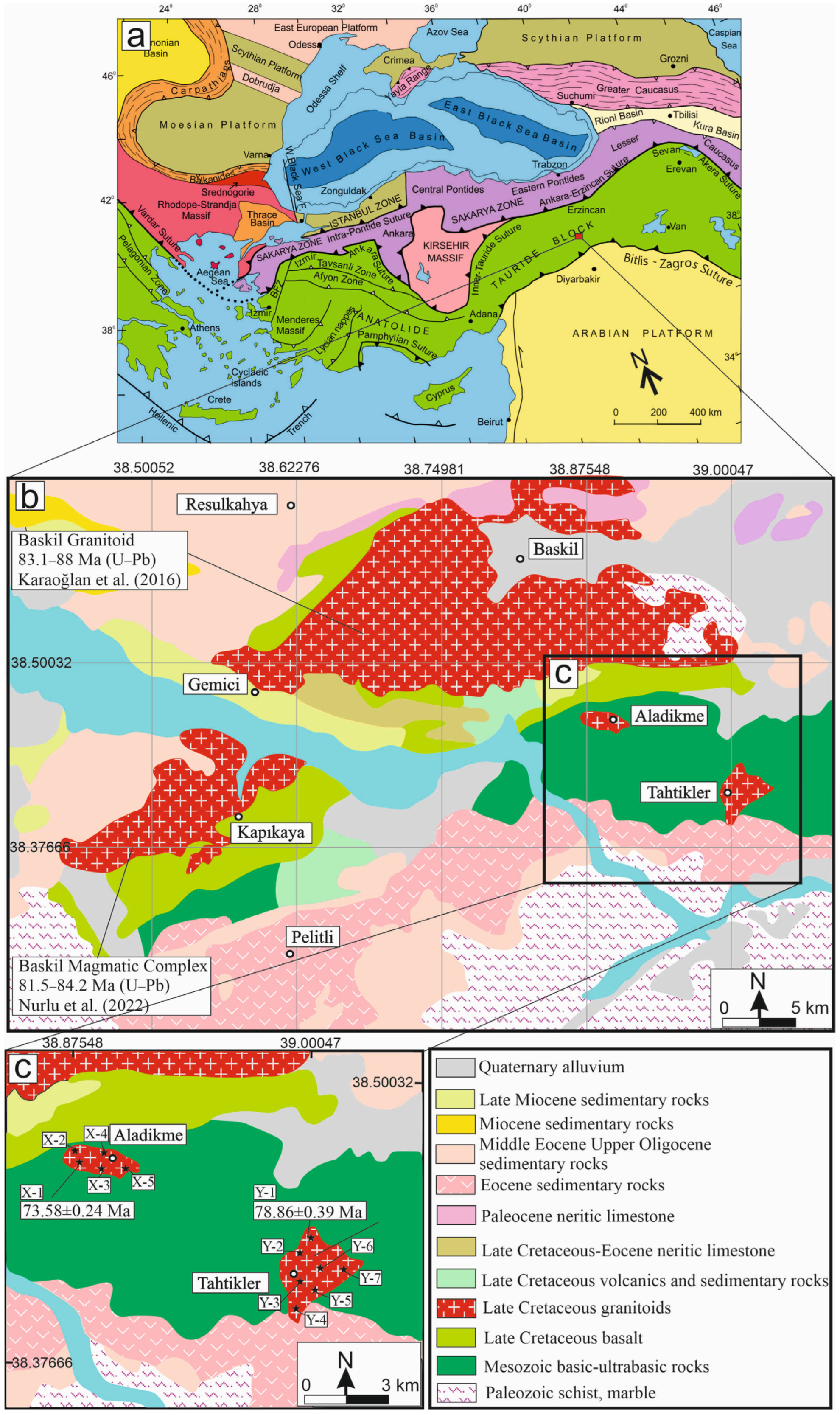
The study area is located within the Southeastern Anatolian Orogenic Belt (SAOB), in the southwest of Elazığ (Türkiye), around the villages of Aladikme and Tahtikler (Figure 1a). Many researchers have shown that the granitoids observed along the SAOB [12,13,14,15], which formed as a result of the collision of the Arabian and Anatolian plates, were formed during the Palaeozoic–Mesozoic periods [16,17,18,19,20,21,22,23]. It is generally accepted that the Late Cretaceous granitoids in the SAOB formed as a result of the northward subduction of the southern branch of the NeoTethys Oceanic lithosphere, and these rocks are commonly observed along the belt in the Tunceli, Elazığ, Malatya, and Kahramanmaraş regions.
The Late Cretaceous I- and S-type granitoids exposed around the study area in the SAOB have been studied by different researchers. Beyarslan and Bingöl [19] suggested that the Late Cretaceous I-type magmatic rocks (Elazığ Magmatites) exposed around Elazığ (eastern Türkiye) formed in three phases. They stated that the first phase is represented by gabbro- and diorite-type rocks (84–80 Ma), the second phase by granite and granodiorite (78–77 Ma), and the third phase by quartz monzonite and syenite-type rocks (74–72 Ma). Similarly, Sar et al. [20] identified the Late Cretaceous I-type magmatic rocks in the Pertek/Tunceli (eastern Türkiye) region as the Elazığ Magmatic Complex (80–77 Ma). They suggested that these rocks formed geochemically in three phases. Researchers have stated that the first and second phases formed in an intra-oceanic arc environment, while the third phase is a collisional product. Ertürk et al. [23] stated that the Late Cretaceous rocks around Keban/Elazığ (eastern Türkiye) are A-type, peraluminous, and shoshonitic. They stated that the unit, which they named the Keban Magmatites, consists of syenite- and quartz monzonite (77–76 Ma)-type rocks. Researchers [19,20,23] reported that the final closure of the southern branch of the NeoTethys Ocean occurred in the Late Cretaceous. Rızaoğlu et al. (2009) [17] stated that the Late Cretaceous I-type Baskil Magmatites (85–82 Ma) exposed around Baskil/Elazığ (eastern Türkiye) are represented by diorite, granite, granodiorite, and mafic and felsic dikes cutting through them, suggesting that these rocks formed in an intra-oceanic arc environment. New findings from this study show that there are 73.5 Ma granitoid and 78.8 Ma diorite emplacements along the SAOB.
This study presents new whole-rock major and trace element analyses, zircon U–Pb ages, and zircon trace element analyses of Late Cretaceous granodiorite and diorite/gabbro samples exposed in the Aladikme and Tahtikler regions of southwestern Elazığ (eastern Türkiye) Province. The studied plutons were dated for the first time using the zircon U–Pb method. This study aims to contribute to elucidating the tectonic evolution of the SAOB by determining the crystallisation ages, magma-chamber processes, and petrogenesis of plutonic rocks around the villages of Aladikme and Tahtikler (Elazığ, eastern Türkiye) using new data.
Figure 1.
(a) Tectonic map of Türkiye and the surrounding areas [24]. (b,c) Geological map of the study area (Elazığ, eastern Türkiye) (simplified from [25]).
2. Regional Geology and Petrography
The SAOB, which includes the study region, was formed as a result of the collision of the Arabian and Anatolian plates [12,13,14,15]. Yılmaz [15] divided the SAOB into three zones trending east–west. These zones, separated by large thrusts, are, from south to north, the Arabian Platform, the Imbrication Zone, and the nappes. The nappe zone, in which the study area is located, is divided into lower and upper nappes. The upper nappe is defined by the Malatya, Keban, Bitlis, Pütürge, Engizek, and Binboğa metamorphic massifs; the lower nappe consists of the Maden Group and metamorphosed ophiolitic units [13,15,17,26].
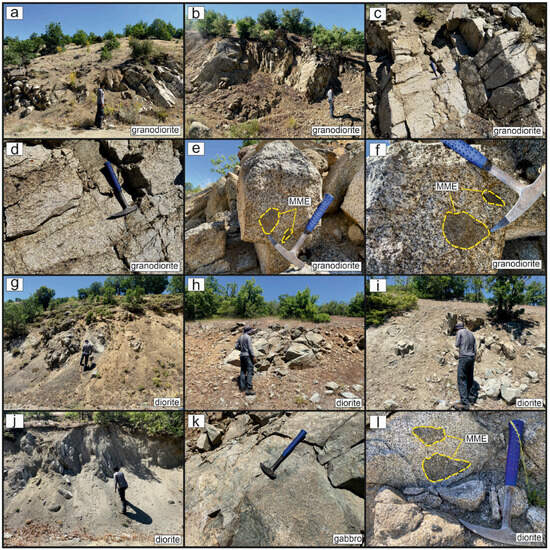
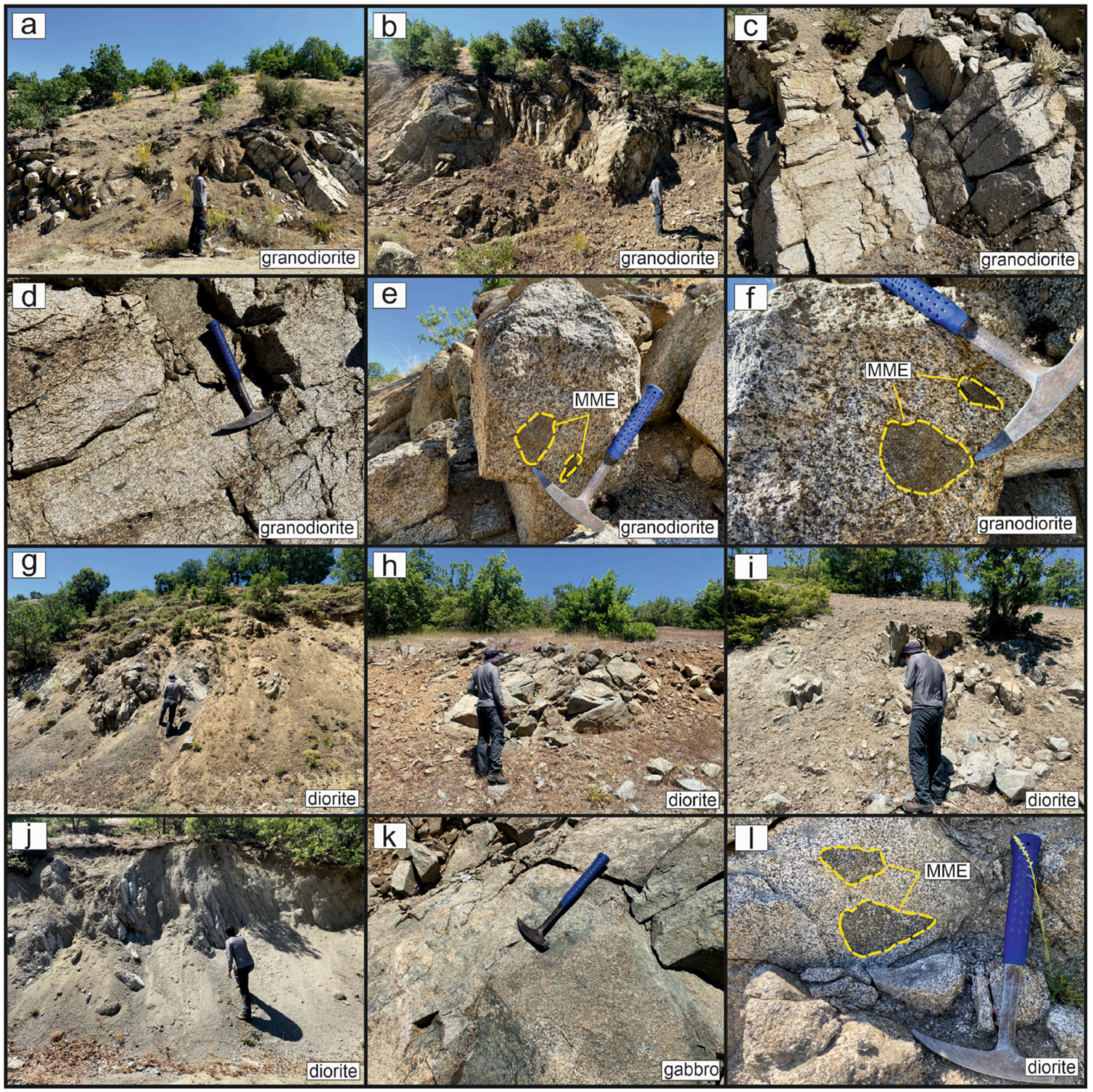
The lithological units observed in the study area include Palaeozoic metamorphic rocks, Late Cretaceous basic and ultrabasic rocks, Late Cretaceous magmatic rocks, Eocene volcanic rocks, Middle Eocene–Late Oligocene sedimentary rocks, Miocene sedimentary rocks, and Quaternary alluvium. Palaeozoic metamorphic rocks in the study area include schists and marbles. The Late Cretaceous granodiorite and gabbro/diorites are observed in contact with ophiolitic rocks. The Middle Eocene–Late Oligocene sedimentary rocks (Kırkgeçit Formation) are lithologically represented by flysch, pebbly sandstone, sandstone, shale–marl, and lenticular laterally transitional limestones [27]. Granodiorites exposed around Aladikme village (Elazığ, eastern Türkiye) are observed in the study area as medium- to coarse-grained, pinkish-brown rocks (Figure 2a–f). Porphyritic biotite minerals are found within the unit (Figure 2f). Alteration is at medium-high levels. Mafic microgranular enclaves (MMEs) of different sizes and shapes are observed within the main mass (Figure 2e,f). The MMEs show alterations at medium-high levels, similar to those in the main mass. Diorites and gabbros located around Tahtikler village (Elazığ, eastern Türkiye) are observed in the study area in grey to dark grey colours and with medium grain sizes (Figure 2g–l). The rate of alteration is lower than that of the granodiorites. MMEs of different shapes and sizes are observed within the unit (Figure 2l).
Figure 2.
Representative field photographs of the Late Cretaceous plutonic rocks (eastern Türkiye). (a–d) Granodiorites around Aladikme village. (e,f) Mafic microgranular enclaves around Aladikme (Elazığ) village. (g–j) Diorites around Tahtikler (Elazığ) village. (k) Gabbros around Tahtikler (Elazığ) village. (l) Mafic microgranular enclaves around Tahtikler (Elazığ) village (MMEs: mafic microgranular enclaves).
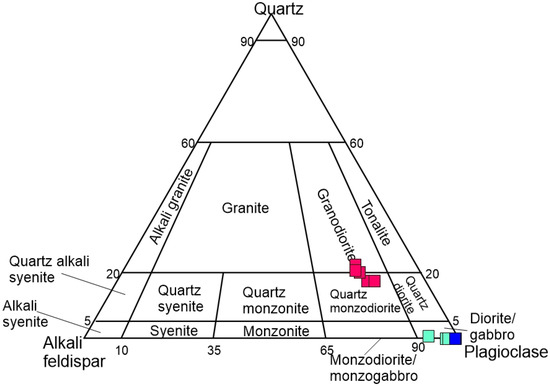
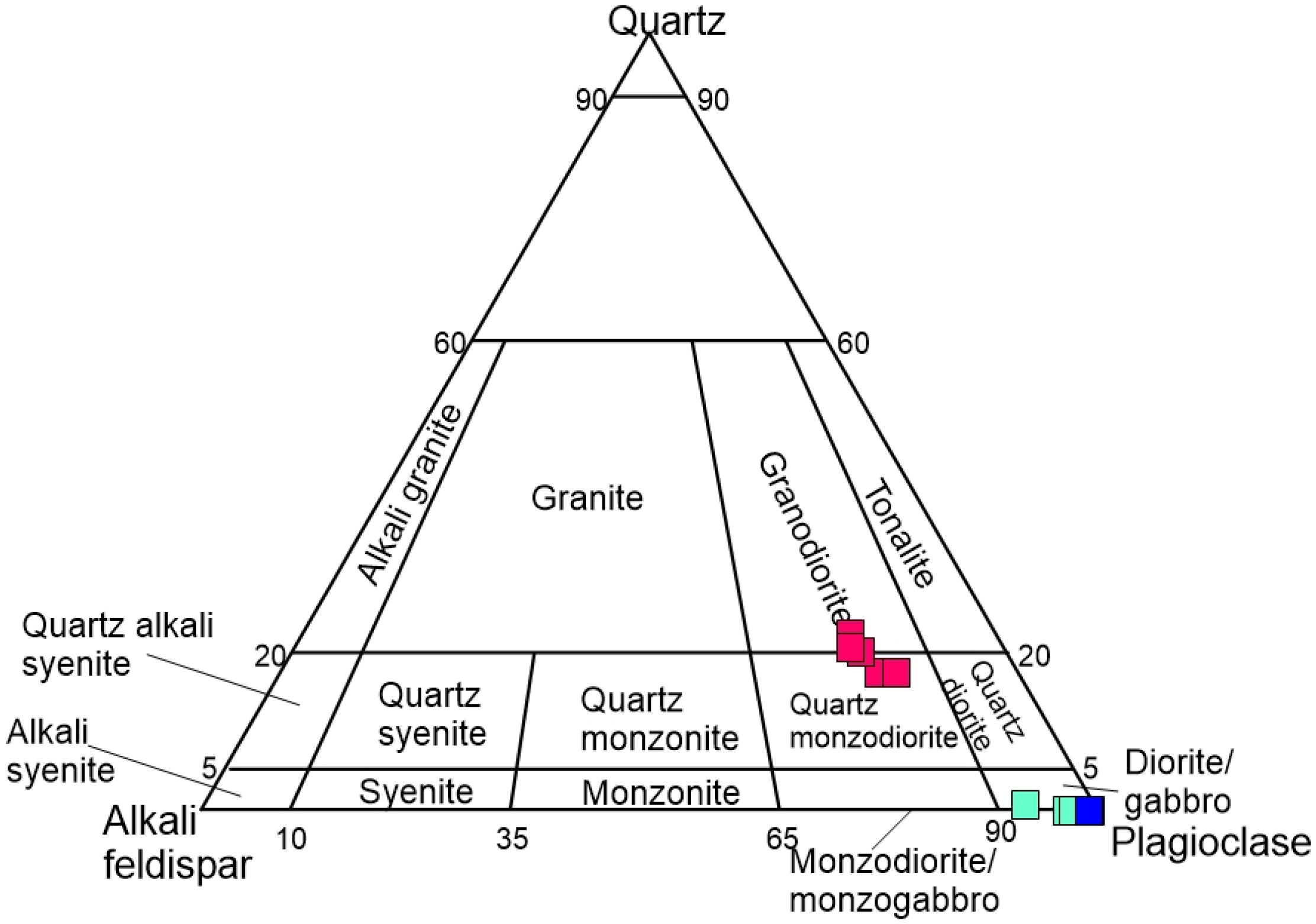
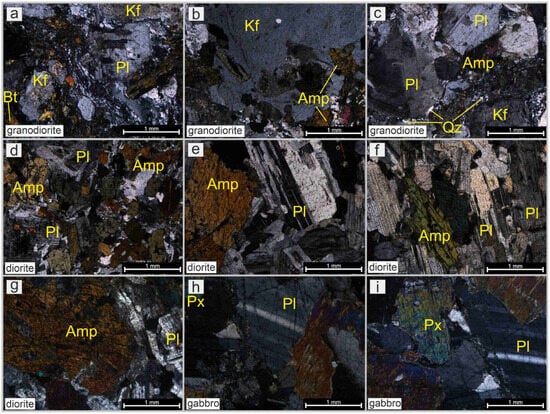
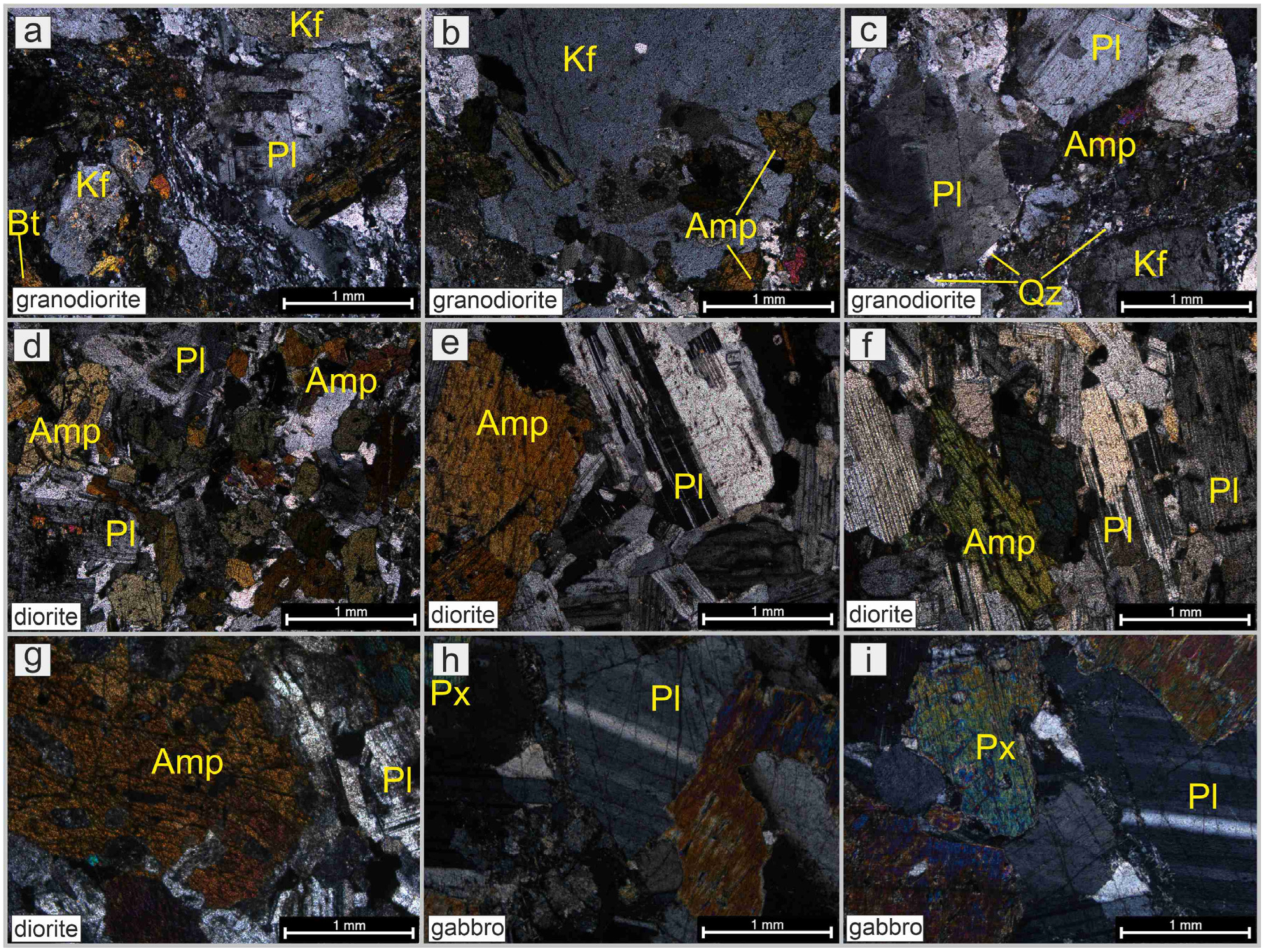
The granodiorites are observed in hand samples with pinkish-brown colours. In the granodiorites, the felsic mineral phase consists of plagioclase (40%–45%), K-feldspar (18%–25%), and quartz (20%–25%) (Figure 3). Biotite (7%–10%), amphibole (5%–10%), and opaque minerals (1%–2%) are observed as mafic minerals (Figure 3). Texturally, the studied granodiorites have granular, porphyritic, holocrystalline, and poikilitic textures (Figure 4a–c). Plagioclase is generally prismatic and shows albite twinning. Zoning is observed in some plagioclase minerals. Alteration is at medium-high levels, and sericitisation and carbonisation are observed in plagioclases. K-feldspars have grey-toned interference colours. Biotite, amphibole, and plagioclase inclusions are observed in some K-feldspars (Figure 4b). Quartz is generally seen in euhedral forms. Amphiboles exhibit vibrant interference colours and occur in both prismatic and euhedral forms. Biotites are characterised by unidirectional cleavage and platy crystal forms. Diorites contain plagioclase (50%–60%) as the main mineral (Figure 3), and amphibole (35%–40%) and opaque minerals (1%–5%) as mafic minerals (Figure 4d–g). Textural holocrystalline and poikilitic textures are observed in these rocks (Figure 4d–g). Plagioclase occurs as prismatic crystals and is characterised by albite twinning. Alteration is moderate in plagioclase minerals, and sericitisation and carbonation are observed. Amphiboles are observed both as prismatic crystals and in euhedral forms. Plagioclase inclusions are observed within some amphibole minerals (Figure 4g), resulting in a poikilitic texture. Gabbros have plagioclase (60%–65%) as the main mineral (Figure 3) and amphibole (8%–13%) and pyroxene (15%–20%) as mafic minerals. Plagioclase is characterised by albite twinning. Pyroxenes exhibit vibrant interference colours and well-developed cleavages (Figure 4h,i).
Figure 3.
QAP diagram.
Figure 4.
Photomicrographs of the Late Cretaceous plutonic rocks (eastern Türkiye); (a) holocrystalline texture in granodiorite. (b) Poikilitic texture in granodiorite. (c) Plagioclase minerals in granodiorite. (d–f) Holocrystalline texture in diorite. (g) Poikilitic texture in diorite. (h,i) Holocrystalline texture in gabbro (Amp: amphibole, Bt: biotite, Kf: K-feldispar, Pl: plagioclase, Qz: quartz, Px: pyroxene).
3. Materials and Methods
The detailed analytical methods used in this study are provided in Supplementary Material File S1. A brief overview is presented here. Zircons from two magmatic samples (X-1: granodiorite, Y-1: diorite) were analysed for U–Pb dating at the Nanjing Hongchuang Geological Exploration Technical Services Co., Ltd., Nanjing, China. The Resolution SE model laser ablation system (Applied Spectra, West Sacramento, CA, USA) was equipped with an ATL (ATLEX 300) excimer laser and a Two Volume S155 ablation cell. The laser ablation system was coupled to an Agilent 8900 ICP-MS (Agilent, Santa Clara, CA, USA).
Whole-rock major element and trace element data for 12 samples were analysed at Nanjing Hongchuang Geological Exploration Technical Services Co., Ltd., Nanjing, China. Major elements (lithium metaborate alkali melt–ICP–OES internal standard method) were determined using an ICP-OES instrument from HORIBA. Trace element analysis (Acid Dissolution-ICP-MS with Internal Standard Method) was performed using an Agilent 7900 ICP-MS instrument.
4. Results
4.1. Whole-Rock Major and Trace Elements
The results of the whole-rock geochemistry analyses of 12 samples collected from Late Cretaceous plutonic rocks exposed around Aladikme and Tahtikler villages in the southwest of Elazığ (eastern Türkiye) province are listed in Table S1. While the plutonic rocks around Aladikme village fall into the granodiorite area in the SiO2 vs. Na2O + K2O diagram [28], the plutonic rocks around Tahtikler village fall into the gabbro and diorite field (Figure 5a).
The SiO2 and Al2O3 values of the studied granodiorites range from 61.9 to 66.2 and from 16 to 16.9, respectively, and the K2O/Na2O ratios range from 0.43 to 0.54. Mg# (molar 100 × (MgO/MgO + ∑Fe2O3)) varies between 33.1 and 39.2, indicating a low Mg#. They fall into the mid-K region in the SiO2 vs. K2O diagram [29] (Figure 5b). In the Nb vs. 10,000 × Ga/Al diagram [30] (Figure 5c), granodiorites fall within the I-type granite field. In the A/NK vs. A/CNK diagram, they exhibit a metaluminous composition [31] (Figure 5d).
The SiO2 values of the studied diorites and gabbros ranged from 47.8 to 49.7 and from 49.4 to 50.2, respectively, while the Al2O3 values ranged from 18.5 to 20.3 and from 16.3 to 18.4, respectively. The K2O/Na2O ratios vary from 0.08 to 0.26 and from 0.03 to 0.04, respectively. Mg# ranged from 41.9 to 45 in diorites and from 70.5 to 79 in gabbros. In the SiO2–K2O diagram (Figure 5b), diorites and gabbros fall within the low-K region [29]. In the Nb vs. 10,000 × Ga/Al diagram [30], diorites and gabbros fall within the I-type granite field (Figure 5c), similar to granodiorites. In the A/CNK vs. A/NK diagram (Figure 5d), they exhibit a metaluminous composition [31].
In Harker diagrams (Figure 6), as SiO2 values increase from gabbro/diorite to granodiorite, negative trends are observed in TiO2, CaO, Fe2O3, Al2O3, and MgO. In contrast, a positive trend is observed in K2O, Na2O, and Rb values. The observed positive and negative trends are related to fractional crystallisation processes.
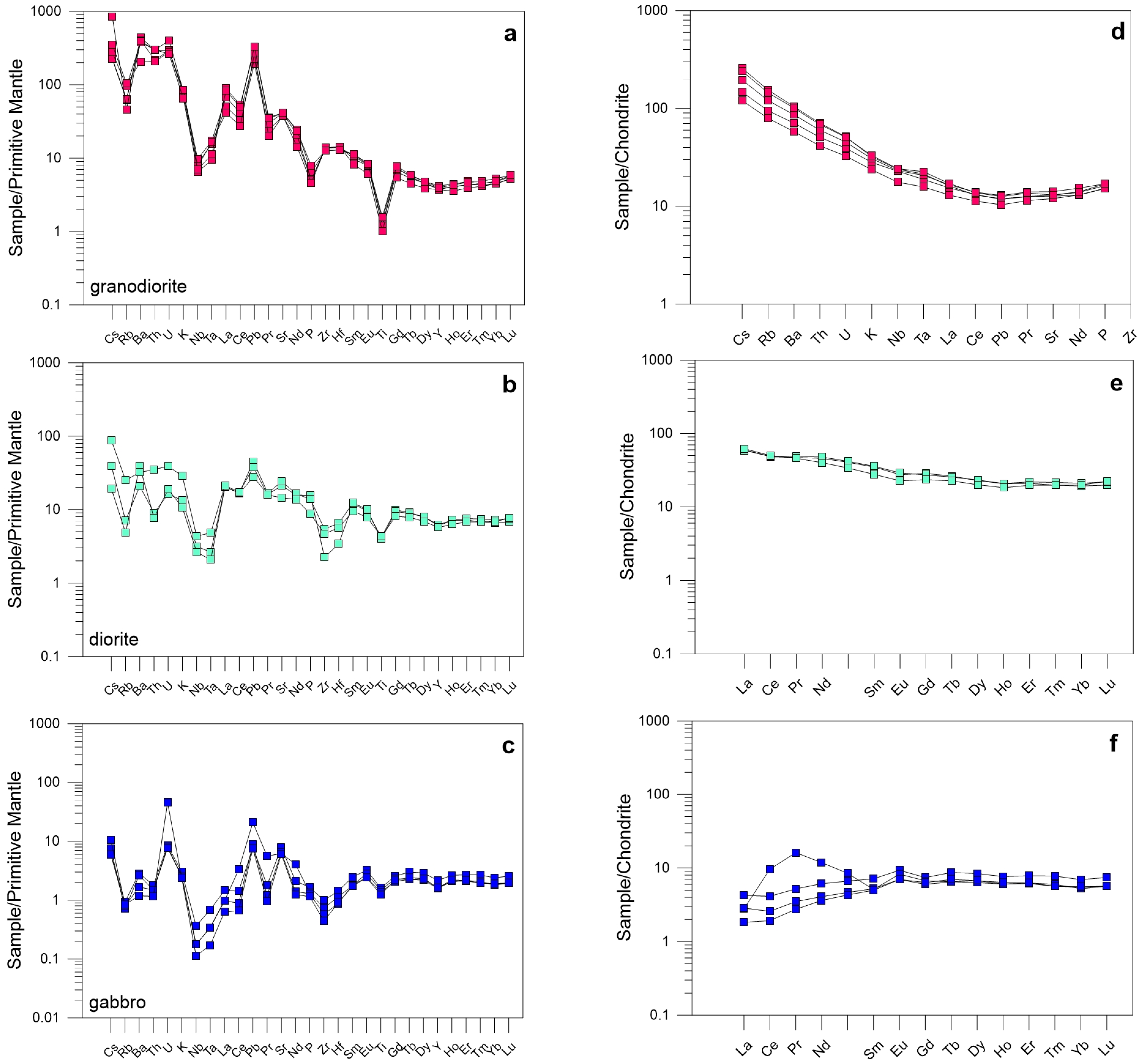
Trace element variation diagrams (Figure 7a–c) normalised to the primitive mantle [32] show negative anomalies in Nb, Ta, and Ti values in both granodiorites and gabbro/diorites.
In the chondrite-normalised trace element variation diagram [32] (Figure 7d–f), it is observed that in granodiorites, light rare earth elements (LREEs) show a greater enrichment than heavy rare earth elements (HREEs). In gabbros, LREEs are depleted compared to HREEs, while in diorites, LREEs show a low enrichment compared to HREEs. The LaN/LuN ratios of the studied granodiorites range from 7.90 to 16.93, indicating high fractionation. The Eu/Eu* values of granodiorites range from 0.29 to 0.32. The LaN/LuN ratios of diorites range from 2.67 to 3.02, and those of gabbros range from 0.32 to 0.57. The Eu/Eu* values for diorites and gabbros range from 0.28 to 0.30 and from 0.41 to 0.46, respectively.
Figure 5.
(a) Na2O + K2O vs. SiO2 (TAS) classification diagram [28]. (b) K2O vs. SiO2 discrimination diagram [29]. (c) Nb vs. 10,000 × Ga/Al diagram [30]. (d) Molar Al2O3/(CaO + Na2O + K2O) (A/CNK) vs. A/NK diagram [31].
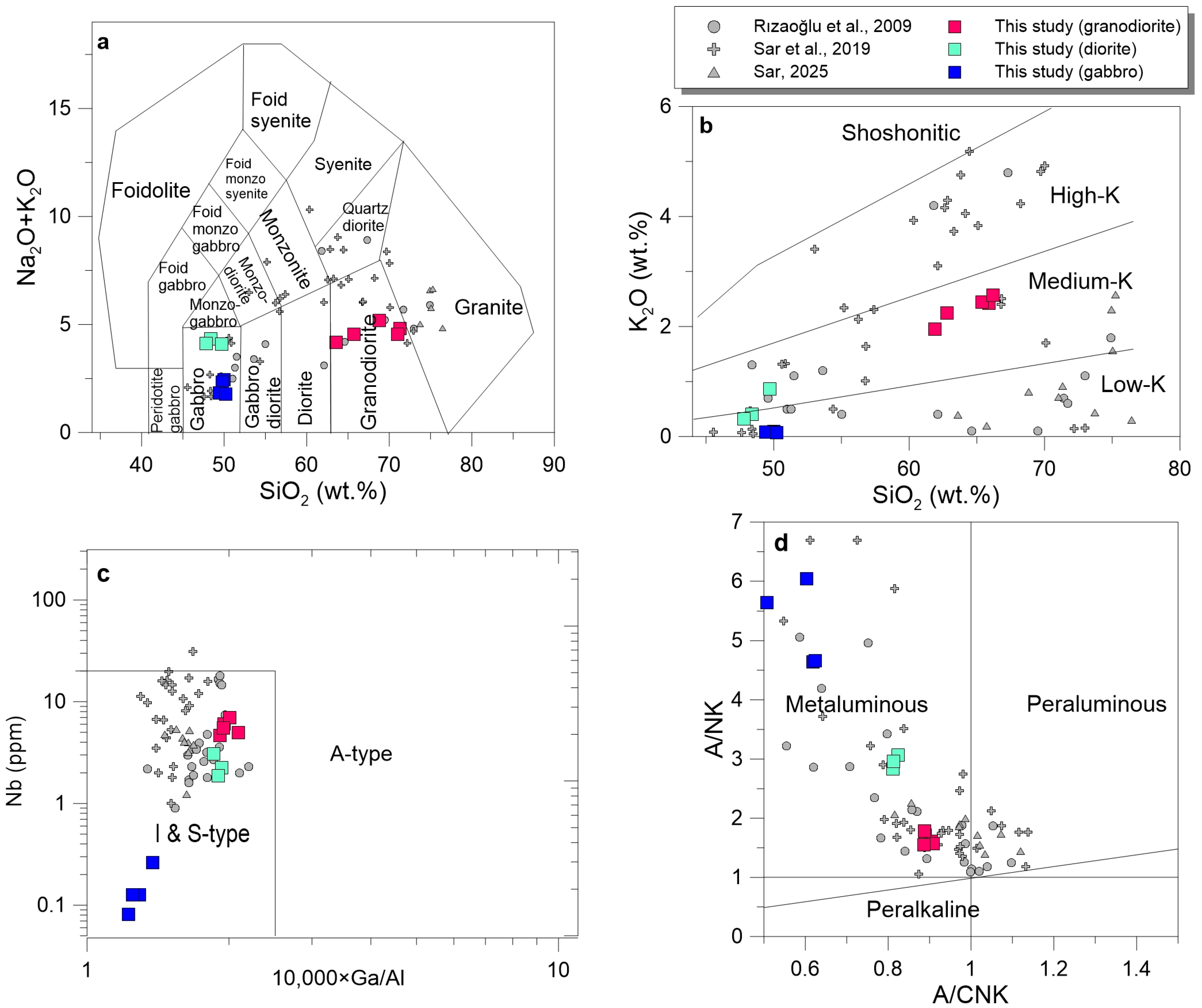
Figure 6.
Major oxides (wt%) and trace elements (ppm) vs. SiO2 (wt%) for the Late Cretaceous plutonic rocks (eastern Türkiye) [17,20,33].
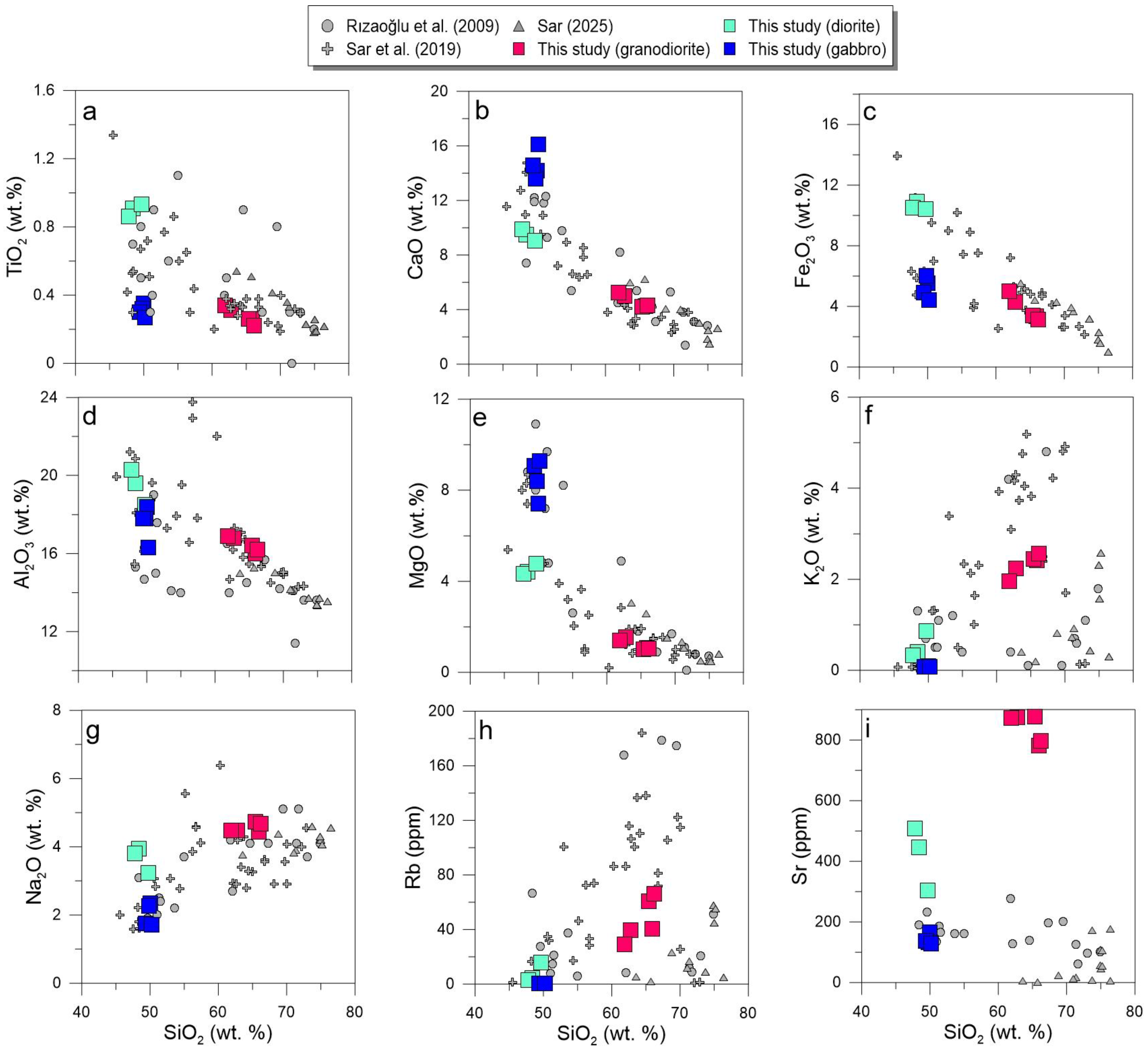
Figure 7.
(a–c) Spider diagram normalised to the primitive mantle [32]. (d–f) Spider diagram normalised to chondrite [32].
4.2. Zircon U–Pb Data
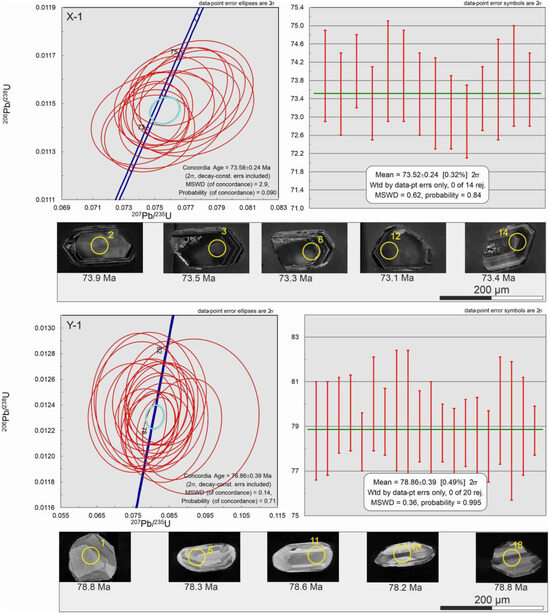
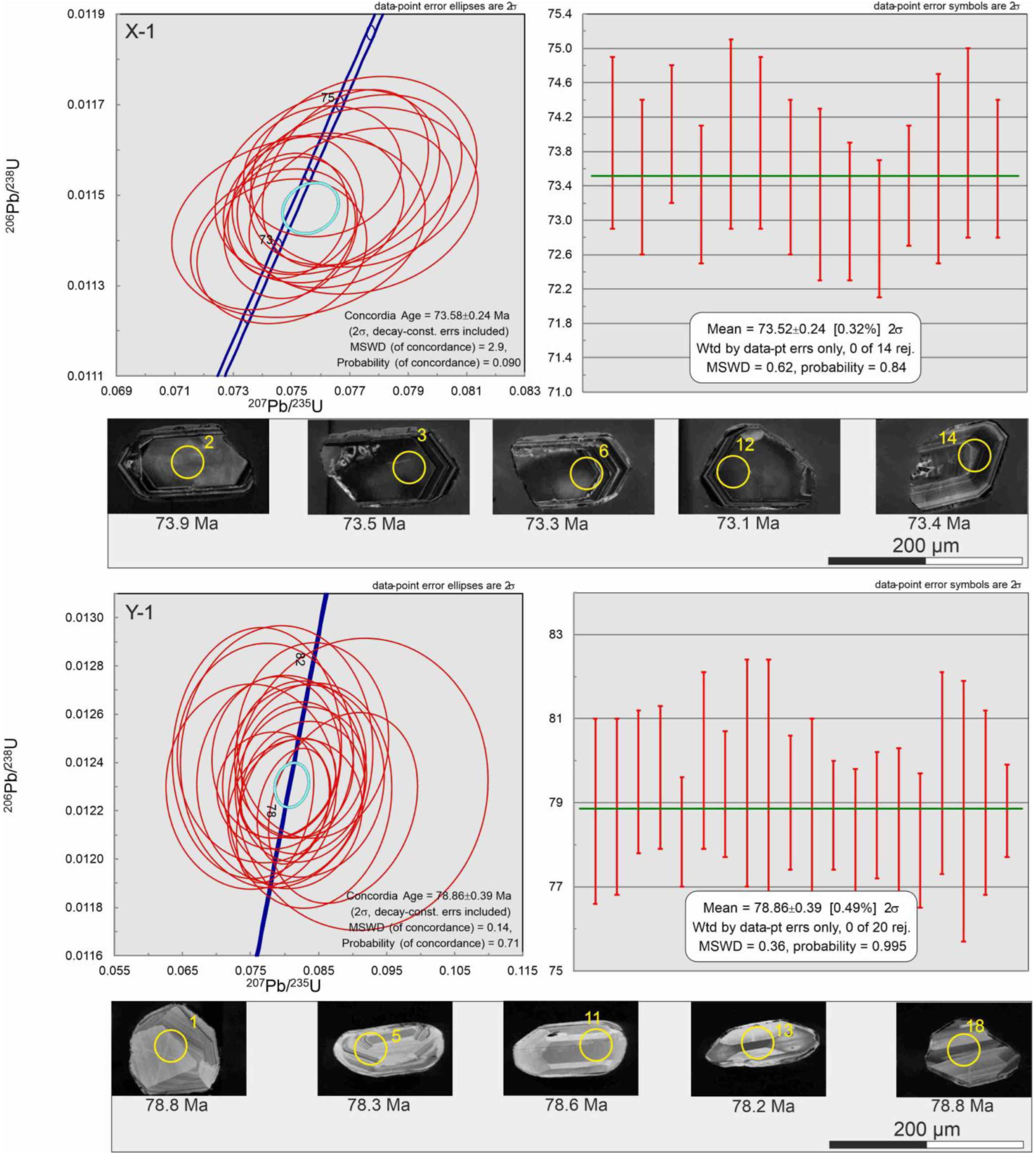
Zircon U–Pb data were obtained from sample X-1 (granodiorite) exposed around the Aladikme (Elazığ) village, using LA-ICP-MS to determine its crystallisation age (Table S2). The zircon grains of sample X-1 (granodiorite) are mostly semi-euhedral, with a small number of euhedral forms, and contain inclusions. The average size of the zircons selected for measurement was 100 μm. Cathodoluminescence (CL) images show oscillatory zoning or growth, indicating magmatic origin and growth through magmatic processes (Figure 8). The Th and U values and Th/U ratios of the zircons from sample X-1 range from 346 to 1528, 2158 to 6362, and 0.15 to 0.29, respectively. The 206Pb/238U ages of zircons in the granodiorite (X-1) vary from 72.9 to 74.0 Ma, with a weighted mean age of 73.58 ± 0.24 Ma (n = 14, MSWD = 2.9).
Figure 8.
Concordia diagrams, U–Pb dating of zircons, and representative CL images of X-1 (granodiorite) and Y-1 (diorite) zircons.
To determine the crystallisation age of sample Y-1 from the diorite exposed around Tahtikler (Elazığ) village, zircon U–Pb ages were obtained using LA-ICP-MS (Table S2). The zircon grains of sample Y-1 (diorite) are mostly semi-euhedral, with a small number of euhedral forms, similar to the zircons of sample X-1, and contain inclusions. The average size of the zircons selected for measurement is 100 μm. CL images show oscillatory zoning or growth, indicating magmatic origin and growth through magmatic processes (Figure 8). The Th and U values and Th/U ratios of the zircons of sample Y-1 range from 30 to 1029, 77 to 1230, and 0.31 to 0.96. The 206Pb/238U ages of zircons in the granodiorite (Y-1) vary from 78.1 to 80 Ma, with a weighted mean age of 78.86 ± 0.39 Ma (n = 20, MSWD = 0.14).
4.3. Zircon Trace Elements
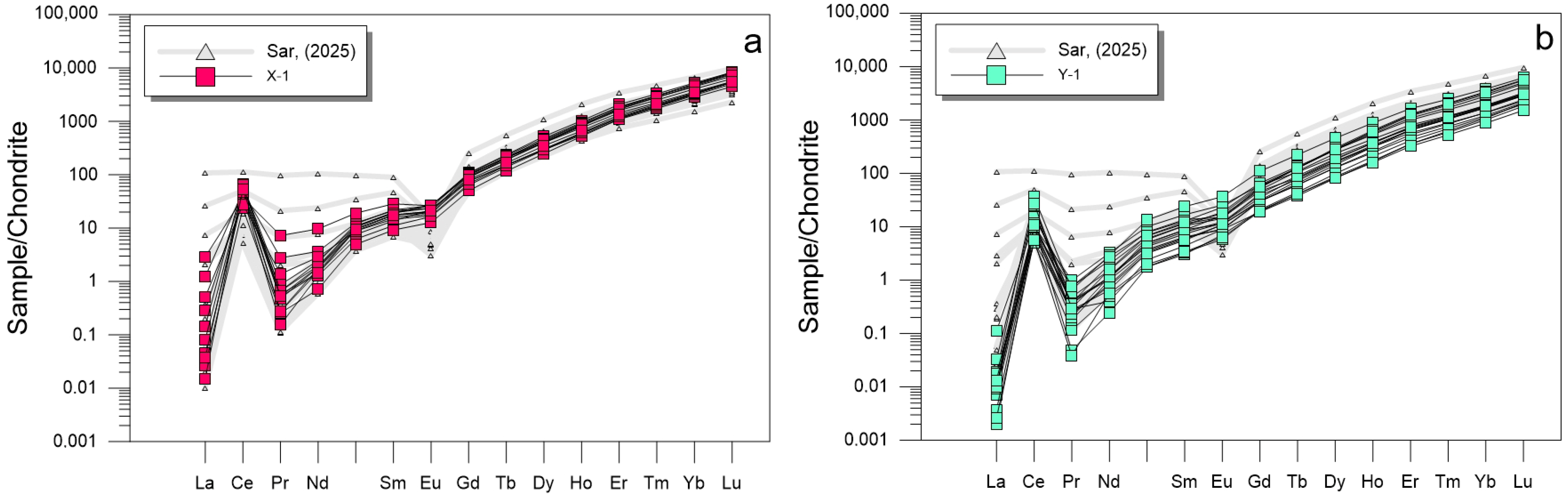
The zircon trace element analysis results of the studied X-1 (granodiorite) and Y-1 (diorite) samples are shown in Table S3. The Hf and Y values of the zircon grains of the X-1 (granodiorite) sample range from 10,802 to 12,275 and 1135 to 2103, respectively, showing high Hf and Y values. In the chondrite-normalised rare-earth-element diagram (Figure 9a), the zircon grains of the X-1 sample show a decrease in LREEs and a relative enrichment in HREEs and Ce. The high Th/U ratios of the zircons of the X-1 sample indicate a magmatic origin [34,35]. The Ce/Ce* (CeN/(√(LaN×PrN)) values vary from 8.11 to 609.86. The Eu/Eu* values range from 0.49 to 0.62.
The Hf and Y values of the zircon grains from the Y-1 (diorite) sample range from 8193 to 11,840 and 312 to 1688, showing high Hf and Y values similar to the X-1 sample. In the chondrite-normalised rare-earth-element diagram (Figure 9b), the zircon grains from the Y-1 sample show a decrease in LREEs and an enrichment in HREEs and Ce. The high Th/U ratios of the zircons from the Y-1 sample indicate a magmatic origin [34,35]. The Ce/Ce* values range from 58.07 to 564.31. The Eu/Eu* values range from 0.59 to 0.97. The positive Ce and negative Eu values observed in both the X-1 and Y-1 samples are related to unaltered magmatic zircons [35,36].
Figure 9.
Chondrite-normalised REE diagrams for the analysed zircon grains [33].
5. Discussion
5.1. Petrogenesis and Source Characteristics
Petrographic and geochemical data provide important information on the nature of magma sources and the petrogenetic processes of the studied granodiorites and diorite/gabbros. The studied plutons are composed of granodiorite, diorite, and gabbro. Petrographically, the granodiorites contain plagioclase (40%–45%), K-feldspar (18%–25%), quartz (20%–25%), amphibole (5%–10%), and biotite (7%–10%) minerals; the diorites contain plagioclase (50%–60%) and amphibole (35%–40%); and the gabbros contain plagioclase (60%–65%), pyroxene (15–20), and amphibole (8–13) minerals. The studied plutonic rocks are tholeiitic–calc–alkaline in composition, typically originate in the mantle, form in an active subduction zone environment with I-type granite characteristics, and are subsequently modified by crustal assimilation. The studied granodiorites exhibit low Sr (796–877 ppm), high Ba (1438–3090 ppm), Rb (29–65 ppm) values, and high Rb/Sr (0.03–0.08) and Ba/Rb (21–94) ratios. These values reflect crustal contamination of mantle-derived magmas. Gabbros show low Sr (127–166 ppm), Ba (8–19 ppm), and Rb (0.4–0.5 ppm) values and Rb/Sr (0.003–0.004) and Ba/Rb (15–40) ratios, while diorites have low Sr (303–509 ppm), moderate Ba (145–272 ppm) and Rb (3–15 ppm) values, with low Rb/Sr (0.01–0.006) and variable Ba/Rb (14–89) ratios. These values indicate that the studied gabbros have a mantle origin and that crustal contamination was limited during the evolution of the diorites [37].
Trace element variation diagrams normalised to the primitive mantle reveal pronounced negative Nb, Ta, and Ti anomalies in both granodiorites and diorite/gabbros, reflecting the characteristic features of magmas associated with subduction zones. Ti anomalies generally result from the early crystallisation of titanium-bearing minerals (rutile, ilmenite, and sphene). The negative anomalies observed in Nb and Ta are typically associated with the retention of Nb and Ta in residual phases during plate melting or in the mantle wedge region [37]. These anomalies, along with the presence of amphibole and sphene, also reflect a convergent edge environment under hydrated conditions [37].
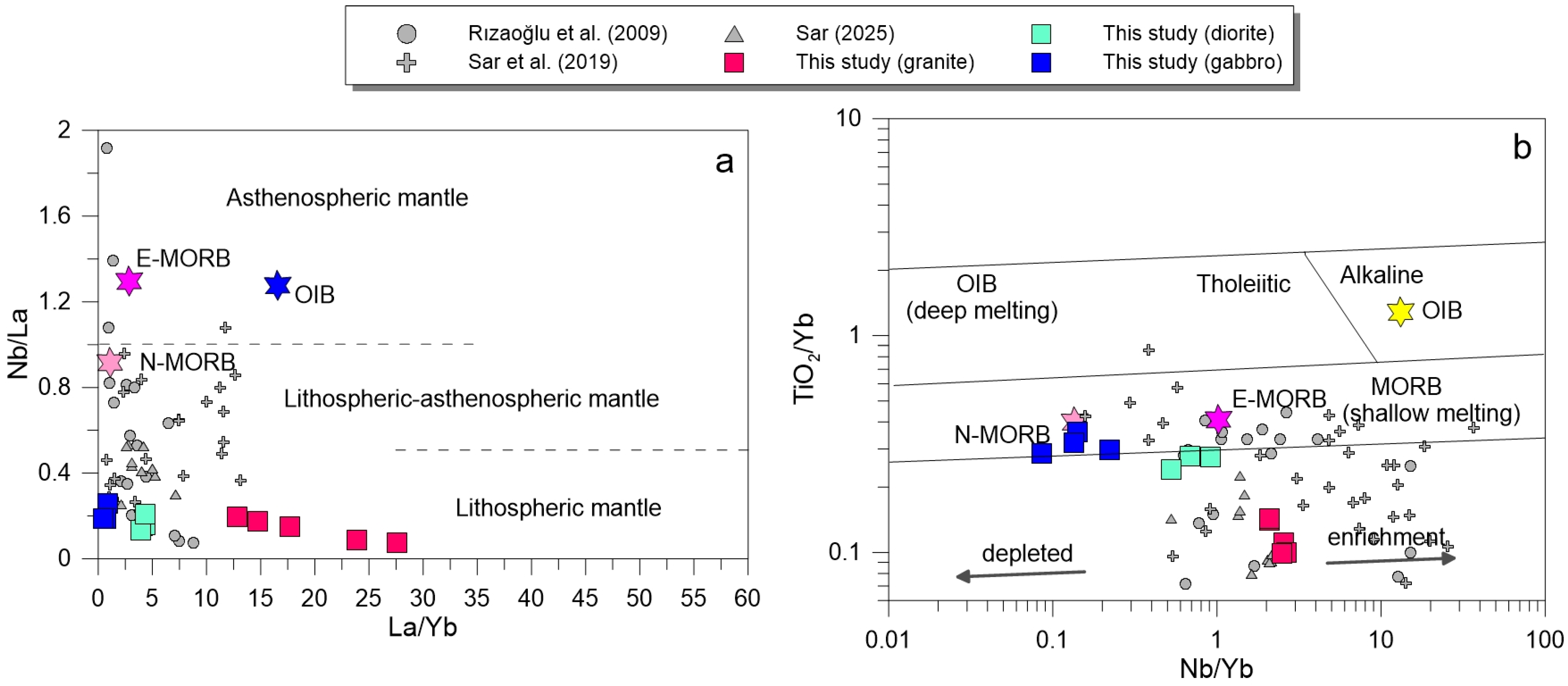
Trace element ratios such as Rb/Nb, Th/U, Nb/La, and Th/La have been used to understand the nature of magma source regions. The Rb/Nb ratio of the primitive mantle is 0.89 [32], while in the subcontinental crust it is 2.2 [38]. The Rb/Nb ratios of the studied granodiorites range from 5.8 to 11.9. For diorites and gabbros, the Rb/Nb ratios range from 1.6 to 5.1 and 2.2 to 6.6, respectively. The Th/U ratios of granodiorite, diorite, and gabbro vary between 2.9 and 4.6, 1.6–3.6, and 0.1–0.8, respectively. The average Nb/La ratio of the primitive mantle is 1.01 [39]. This ratio averages 0.46 for continental crust [40]. While the Nb/La ratios of the studied granodiorites ranged from 0.07 to 0.19, the Nb/La ratios of diorites and gabbros ranged from 0.13 to 0.20 and 0.18 to 0.25, respectively. In the Nb/La vs. La/Yb diagram [41], granodiorites, diorites, and gabbros reflect a lithospheric mantle origin (Figure 10a). In the TiO2/Yb vs. Nb/Yb diagram [42], granodiorites exhibit enrichment, while diorites are arranged in an area close to E-MORB and gabbros in an area close to N-MORB origin (Figure 10b). Trace element ratios indicate that crustal influence played a role in the formation of the studied rocks.
Figure 10.
(a) Nb/La vs. La/Yb diagram [17,20,33,41], (b) TiO2/Yb vs. Nb/Yb diagram [17,20,33,42].
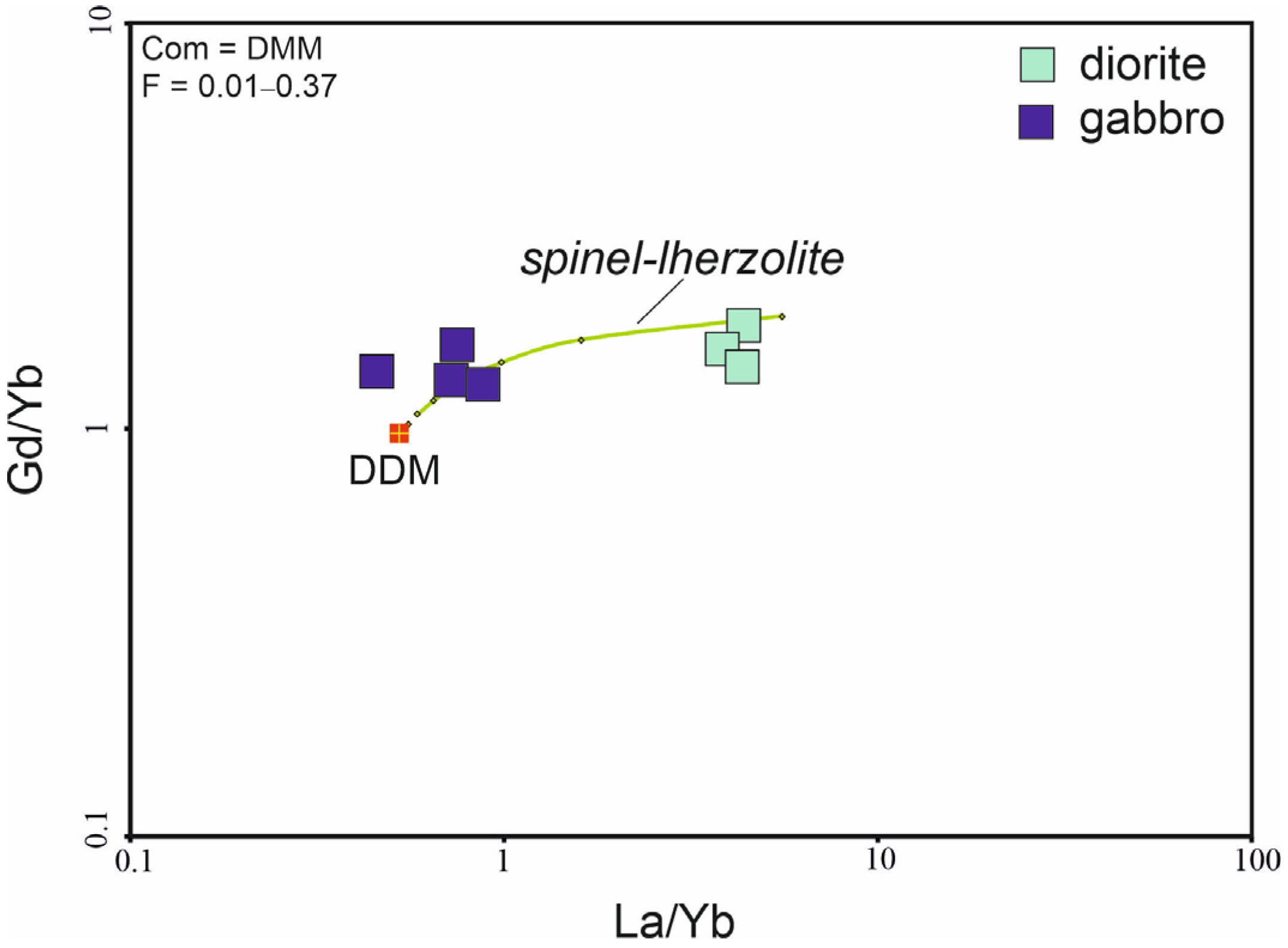
A petrogenesis modelling diagram was used to define the depth, source mineralogy, and partial melting points of the diorites and gabbros exposed around the village of Tahtikler. La, Dy, and Yb elements were used in the modelling. These elements are not significantly affected by changes in the source mineralogy, such as spinel and garnet, and provide important clues to the source’s chemical composition [43]. The Yb element is compatible with garnet and is present in its crystal structure [43]. Ref. [44] suggested that garnet-bearing mantle mineralogy indicates a deeper source and that it contains high Dy/Yb ratios (Dy/Yb > 2.5). The La/Yb and Dy/Yb ratios of the diorites range from 3.90 to 4.34 and 1.50–1.77, respectively. In gabbros, La/Yb ratios range from 0.45 to 0.85, while Gd/Yb ratios range from 1.80 to 1.82. The data obtained indicate that the studied diorite and gabbros originated from a spinel-bearing source representing shallow depths (Figure 11).
Figure 11.
La/Yb vs. Gd/Yb diagram (closed system non-modal fractional melting (critical melting porosity 1%) for spinel lherzolite (Ol 0.53/0.06 + Opx 0.27/0.28 + Cpx 0.17/0.67 + Spl 0.03/0.11; [45])). The fractional melting coefficients were taken from [46,47]. Non-modal fractional melting curves were calculated using the Petromodeler software program [48].
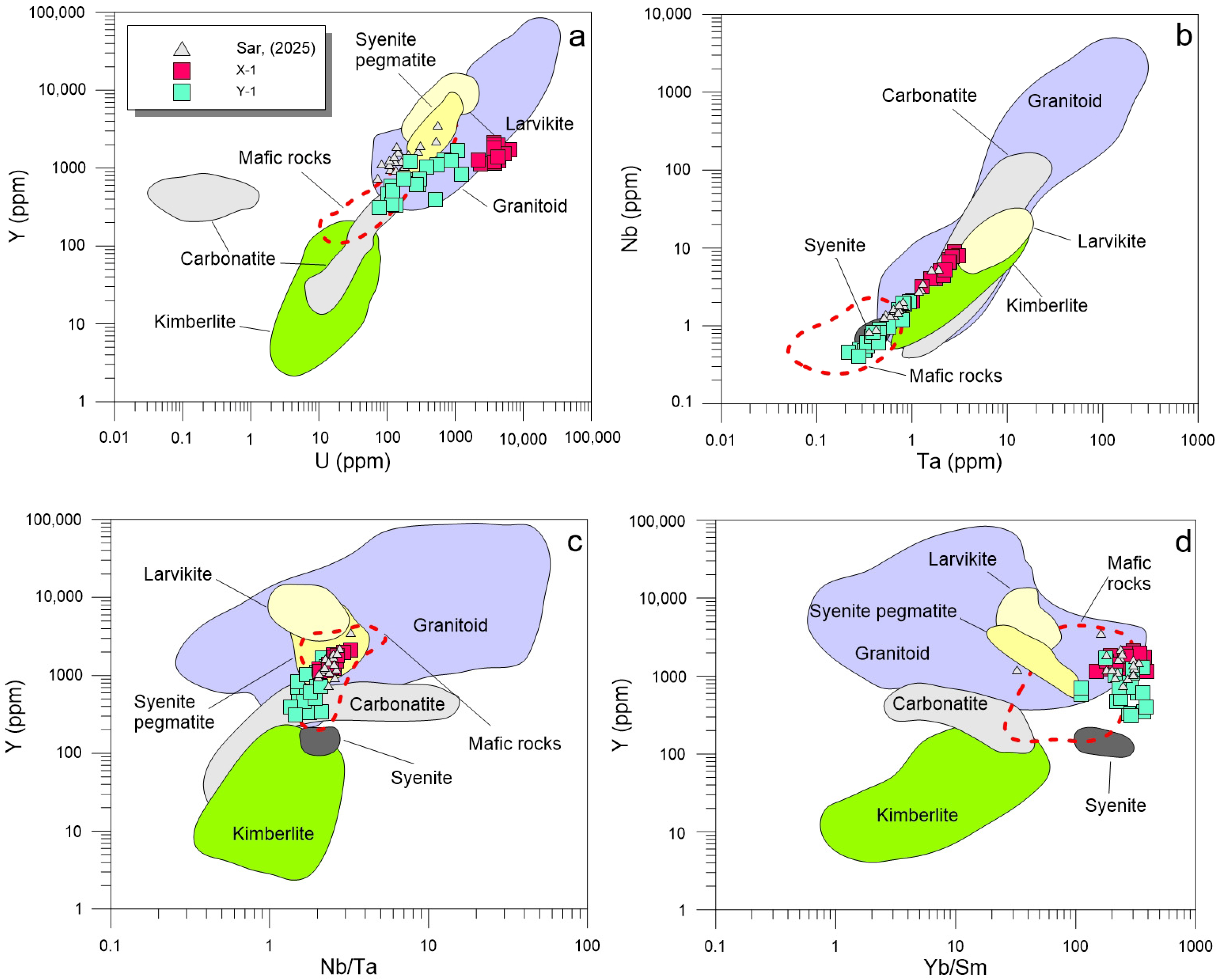
In recent years, zircon trace elements have been effectively used to determine the tectonic setting and evolutionary processes of the parent magma [35,36,49,50]. The Th/U ratios of samples X-1 (granodiorite) and Y-1 (diorite) are 0.15–0.29 and 0.31–0.96, respectively. These ratios indicate that the studied rocks are of magmatic origin [34,35]. Trace elements Y, U, Ta, and Nb, along with the Nb/Ta and Yb/Sm trace element ratios, were used to determine the magma source areas. Zircon grains from samples X-1 and Y-1 fall within the granitoid region in the U vs. Y diagram (Figure 12a). In the Ta vs. Nb diagram (Figure 12b), X-1 samples are located in the granitoid region, while Y-1 samples are located in the granitoid, syenite, and mafic rock regions. Similarly, in the Nb/Ta vs. Y (Figure 12c) and Yb/Sm vs. Y (Figure 12d) diagrams, they fall within the granitoid and mafic rock regions. Therefore, it is thought that the zircons in the studied plutonic rocks originate from a magmatic source.
Figure 12.
(a) Y vs. U diagram, (b) Nb vs. Ta diagram, (c) Y vs. Nb/Ta diagram, and (d) Y vs. Yb/Sm diagram of the analysed zircon grains [33,49].
5.2. Processes in Magma Chamber
Harker diagrams, which track changes in selected major oxides and trace elements with increasing SiO2 content, are among the most common methods used to determine fractional crystallisation (FC) processes. In plutonic rocks studied with increasing SiO2 content, negative trends are observed in CaO, TiO2, Fe2O3, Al2O3, and MgO values, while positive trends are observed in K2O, Na2O, and Rb values. The negative trends observed in TiO2 are related to the crystallisation processes of Fe-Ti oxides. The negative trends observed in CaO values are related to plagioclase fractionation. The negative trends observed in Al2O3, Fe2O3, and MgO are related to the FC of olivine, pyroxene, and amphibole. The positive trends observed in K2O, Na2O, and Rb values are related to the fractional crystallisation of sodium plagioclase and K-feldspars.
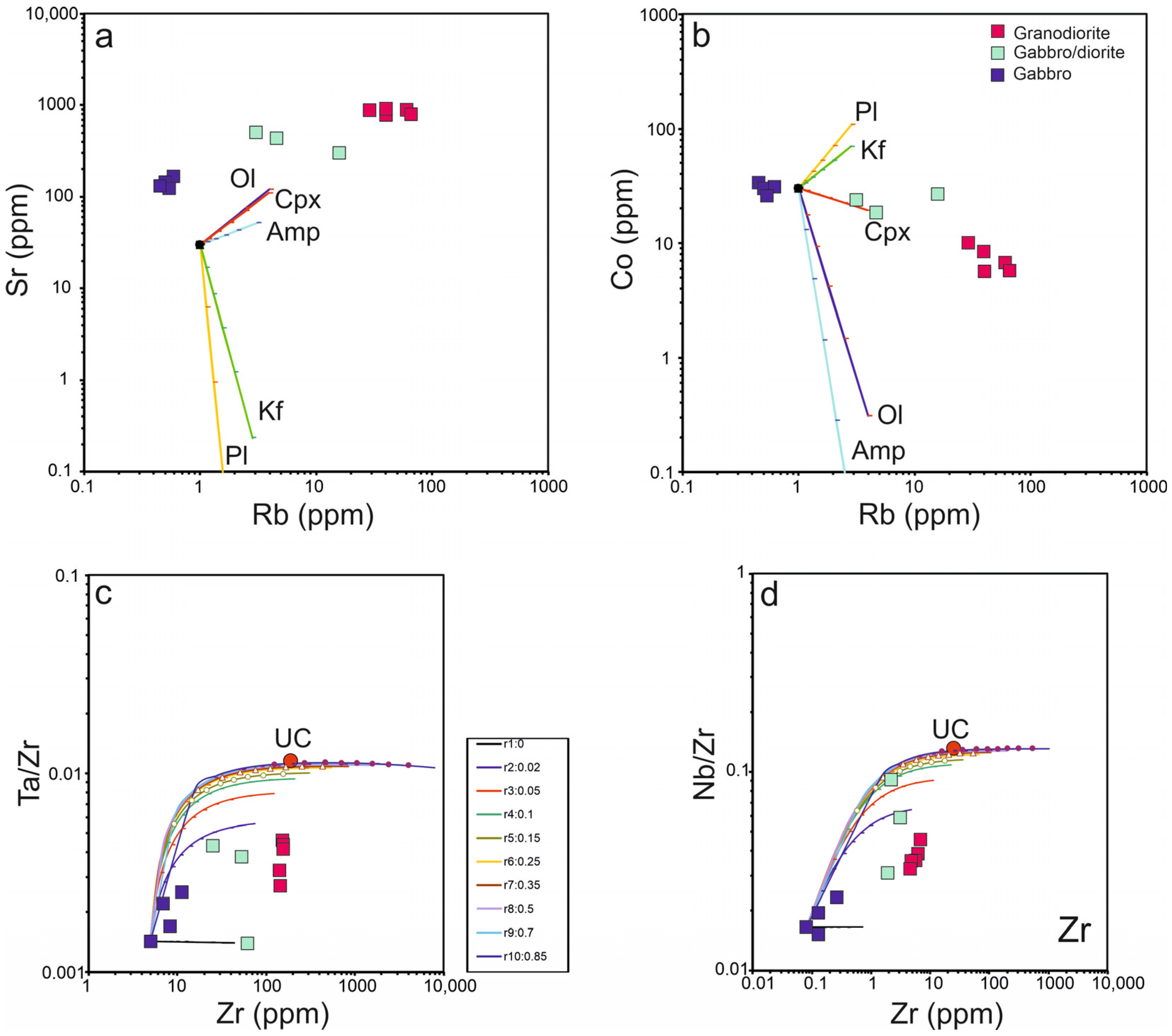
Modelling diagrams were created to reveal the FC and assimilation fractional crystallisation (AFC) processes in the magma chamber. The FC-Modeller program [51] was used to determine the FC processes. Rb, Sr, and Co minerals were used in this context. The models utilised vectors representing different mineralogical compositions. Log–log diagrams were created in which Sr and Co were plotted against Rb. In the Rb vs. Sr diagram (Figure 13a), the samples show a positive trend and are not consistent with the plagioclase vector. This indicates that plagioclase fractionation does not play an active role in magma evolution. In the Rb-Co diagram (Figure 13b), the samples show a negative trend and are aligned along the clinopyroxene vector. Clinopyroxene fractionation is active during rock evolution.
The AFC-Modeller program [52] was used to determine the AFC processes. The modelling aimed to identify the potential effects of crustal contamination or magma replenishment on a magma system using [53] equations. The Zr element fractionation index and Ta/Zr and Nb/Zr ratios were selected as assimilation indices (Figure 13c,d). “r” represents the ratio of assimilation to fractional crystallisation. The main magma composition was represented by the Y-7 (gabbro) sample. The “r” values of the granodiorite, diorite, and gabbro ranged from 0 to 0.02. These values indicate that the assimilation effect on the studied plutonic rocks is minimal.
Figure 13.
(a) Sr vs. Rb and (b) Co vs. Rb log–log variation diagrams for FC processes. (c) Zr vs. Ta/Zr norm–norm diagram for AFC processes. (d) Zr vs. Nb/Zr norm–norm diagram for AFC processes [52]. According to Rayleigh crystallisation, each vector modelled and plotted in the diagrams represents up to 100% crystallisation of the mineral assemblages shown in the diagram. UC: upper continental crust [54]. GERM Partition Coefficient (Kd) Database (https://earthref.org/).
5.3. Tectonic Setting
Late Cretaceous plutonic rocks, formed by the northward subduction of the southern branch of the NeoTethys Oceanic lithosphere, are observed along the SAOB in the Tunceli, Elazığ, Malatya, and Kahramanmaraş regions. Many researchers have suggested that the SAOB experienced the fourth stage of the Wilson cycle, where a collision between the Tauride Platform and the Arabian Platforms occurred during the Late Cretaceous–Miocene period [55,56,57,58]. Many researchers widely accept that the NeoTethys Ocean began to open during the Triassic period [17,23,26,33,58]. To explain the formation of granitoids observed along the belt, researchers have proposed single-, double-, or multifaceted formation models [17,23,26,33,58].
The Late Cretaceous plutonic rocks outcropped along the SAOB have been studied by numerous researchers [17,18,19,20,23,26,33,58,59]. In their study on the Baskil Granitoid (Elazığ), Rızaoğlu et al. [17] suggested that the granite granodiorites and diorites and quartz diorites in the region were emplaced between 81.5 and 82.9 Ma and between 83.2 Ma and 81.5 Ma, respectively. Nurlu et al. [26] named the unit the Baskil Arc Complex (Elazığ, eastern Türkiye). The researchers suggested that the granodiorites exposed in the Malatya region formed at 84 Ma, and the tonalites at 81.5 Ma. Sar [33] stated that the granodiorites belonging to the Baskil Magmatites exposed in the Gemici region of Elazığ (eastern Türkiye) formed at 78 Ma. Beyarslan and Bingöl [19] noted that the magmatic rocks exposed in the Elazığ (eastern Türkiye) region, which they named the Elazığ Magmatites, formed in three phases. They suggested that gabbro and diorite formed in the first phase at 84–80 Ma, granite and granodiorite in the second phase at 77–78 Ma, and syenite and quartz monzonite in the third phase at 72–74 Ma. Sar et al. [20] named the magmatic rocks exposed in the Elazığ (eastern Türkiye) region the Elazığ Magmatic Complex. The researchers stated that the unit was formed in three phases. They suggested that the diorites belonging to the Elazığ Magmatic Complex were emplaced at 80 Ma, while the granites and granodiorites were emplaced at 77–78 Ma. Rızaoğlu et al. [17] suggested that the Late Cretaceous Baskil Granitoid rocks located around Baskil/Elazığ (eastern Türkiye) formed along an active continental margin due to the northward subduction of the southern branch of the NeoTethys Ocean. Beyarslan and Bingöl [19] and Sar et al. [20] stated that the Late Cretaceous magmatic rocks around Elazığ–Tunceli (eastern Türkiye) formed in three phases. They indicated that the rocks of the first and second phases were formed in an intra-oceanic arc environment. In contrast, the quartz monzonite and syenite rocks of the third phase are post-collisional products. In this study, the magmatic rocks around the villages of Aladikme and Tahtikler, located southwest of Elazığ (eastern Türkiye) within the SAOB, were dated using the zircon U–Pb method. It was found that the granodiorites around Aladikme village yielded a crystallisation age of 73.5 Ma, while the diorites around Tahtikler village yielded a crystallisation age of 78 Ma. In light of previous studies, these age data indicate that the studied granodiorites and diorites represent the youngest granodiorite and diorite emplacements along the SAOB.
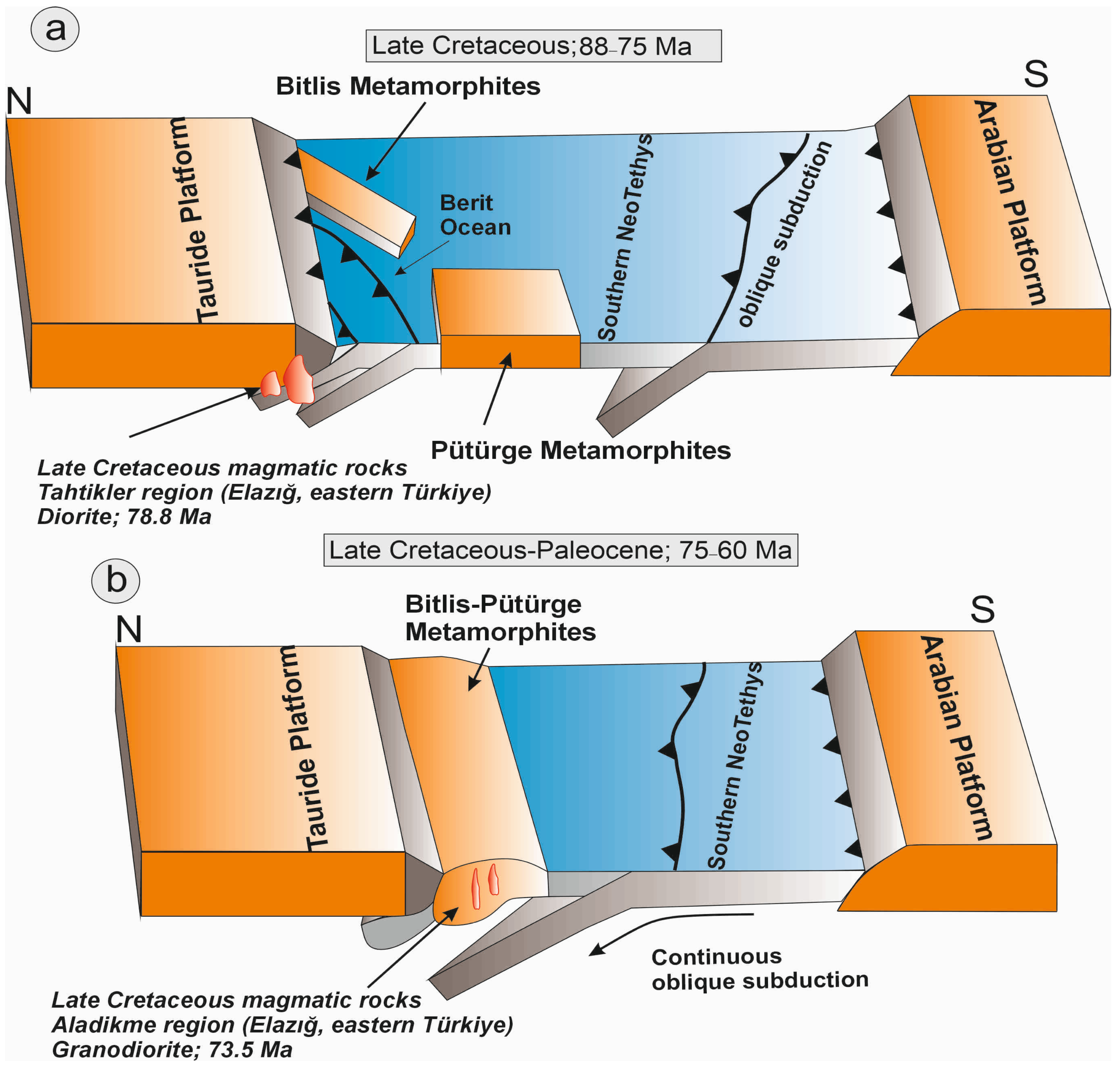
Beyarslan and Bingöl [19], Sar et al. [20], and Ertürk et al. [23] stated that the Late Cretaceous magmatic rocks exposed along the SAOB were formed as a result of the northward subduction of the southern branch of the NeoTethys Ocean. The researchers suggested that the final closure of the NeoTethys Ocean between the Tauride and Arabian Platforms occurred during the Late Cretaceous. Karaoğlan et al. [58] stated that the Late Cretaceous magmatic rocks exposed along the SAOB (Baskil/Elazığ; Esence/Kahramanmaraş, Türkiye) were formed as a result of two different spreading centres that occurred in the southern branch of the NeoTethys Ocean during the Late Cretaceous period. They suggested that these spreading centres could be divided into two east–west-oriented oceanic regions. The researcher stated that the northern zone is called the Berit Ocean and that it lies between the Bitlis–Pütürge micro-continent to the south and the Tauride Platform to the north. The researcher also stated that the southern ocean zone lies between the Arabian Platform to the south and the Bitlis–Pütürge micro-continent to the north. Late Cretaceous granitoids in the SAOB formed immediately after the formation of SSZ-type oceanic crust in the Berit Ocean and the convergence of the continental platform at 88–82 Ma [58]. In this study, the model proposed by Karaoğlan et al. [58] is adopted. It is shown that the diorites and gabbros in the Tahtikler (Elazığ, eastern Türkiye) region were formed in Tauride active continental margin at 78.8 Ma (Figure 14a). Karaoğlan et al. [58] reported that convergence within the Berit Ocean continued, causing the Bitlis–Pütürge micro-continent to subduct under the Tauride Platform (84–69 Ma) [60] and to undergo metamorphism under blueschist facies conditions [60]. The researcher further stated that the ongoing subduction consumed the oceanic lithosphere and that the continental collision between the Bitlis–Pütürge micro-continent and the Arabian Platforms transformed the composition of Late Cretaceous magmatic rocks from gabbro-diorite to monzodiorite–monzonite between 84 and 72 Ma. The granodiorites around Aladikme (Elazığ, eastern Türkiye) have a crystallisation age of 73.5 Ma. Field observations and petrographic analyses of the studied granodiorites indicate low metamorphic grade (Figure 4b). It is thought that the granodiorites around Aladikme formed during the Late Cretaceous as a result of the subduction of the Bitlis–Pütürge micro-continent beneath the Tauride Platform.
Figure 14.
The geodynamic model for the evolution of the southeast Anatolian Orogenic Belt. (a) Late Cretaceous. (b) Late Cretaceous to Paleocene (the geodynamic model used was revised from Karaoğlan et al. [58]).
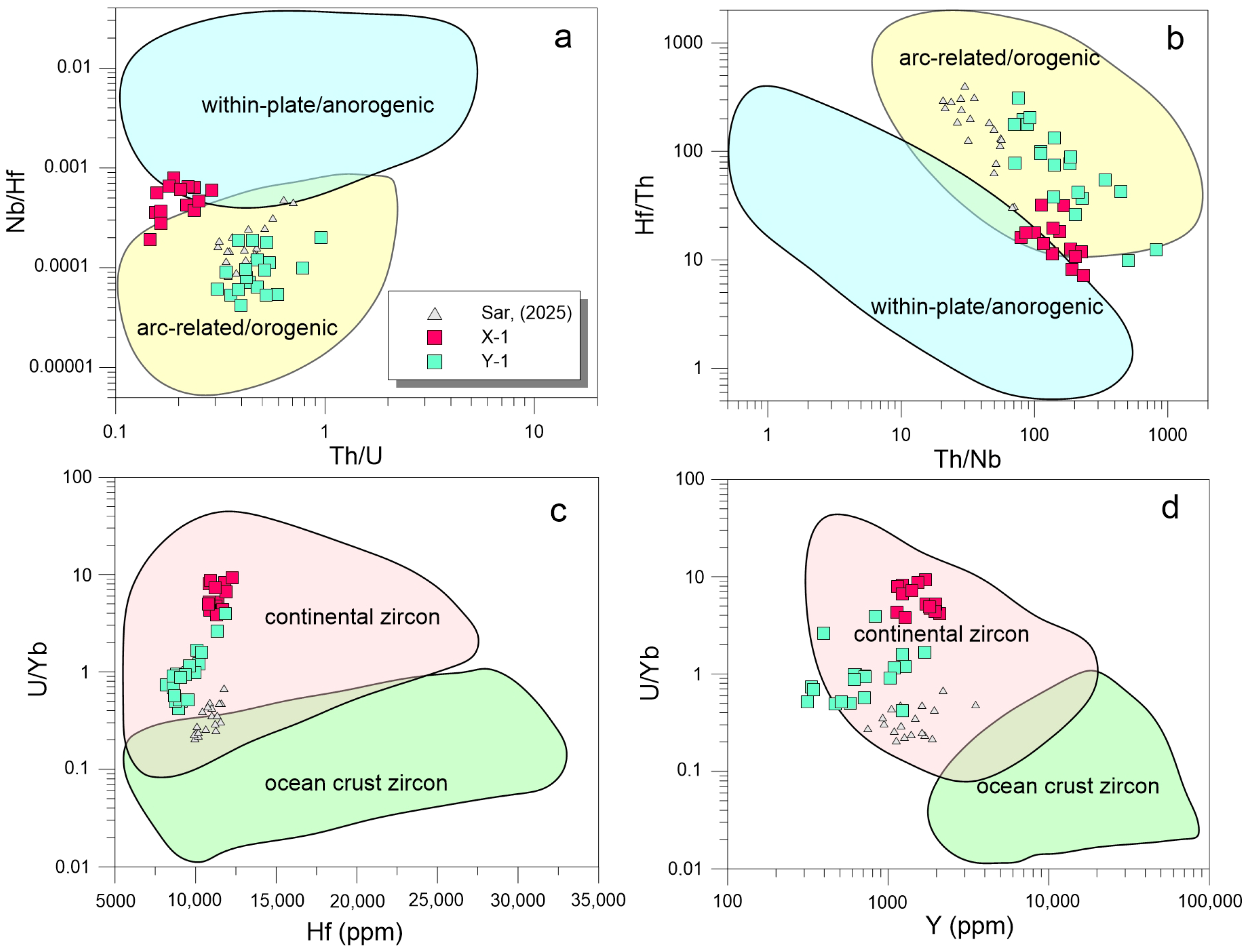
The studied diorites and gabbros fall within the volcanic arc granite field in the Y + Nb vs. Rb diagram [61] (Figure 15a), whereas the granodiorites are located in the post-COLG field [62]. In the (La/Yb)N vs. YbN diagram (Figure 15b), all samples fall into the arc magmatic rock field. However, in the U/Yb vs. Nb/Yb diagram (Figure 15c) obtained from the trace element ratios of zircon grains of samples X-1 (granodiorite) and Y-1 (diorite), all zircon grains are located in the magmatic arc area. In the Th/U vs. Nb/Hf and Th/Nb vs. Hf/Th diagrams (Figure 16a,b), it is observed that the zircon grains of samples X-1 and Y-1 fall into the arc-related/orogenic field. In the Hf vs. U/Yb and Y vs. U/Yb diagrams (Figure 16c,d), the zircon grains are seen to be located in the continental zircon area. Based on all the data, the studied plutonic rocks are arc magmatic rocks formed by the northward subduction of the southern branch of the NeoTethys Oceanic lithosphere.
Figure 15.
(a) Y/Nb vs. Rb diagram [17,20,33,61] and the field of post-collisional granites (circle; [62]), (b) (La/Nb)N vs. YbN diagram [17,20,33,63], (c) U/Yb vs. Nb/Yb diagram [17,20,33,64].
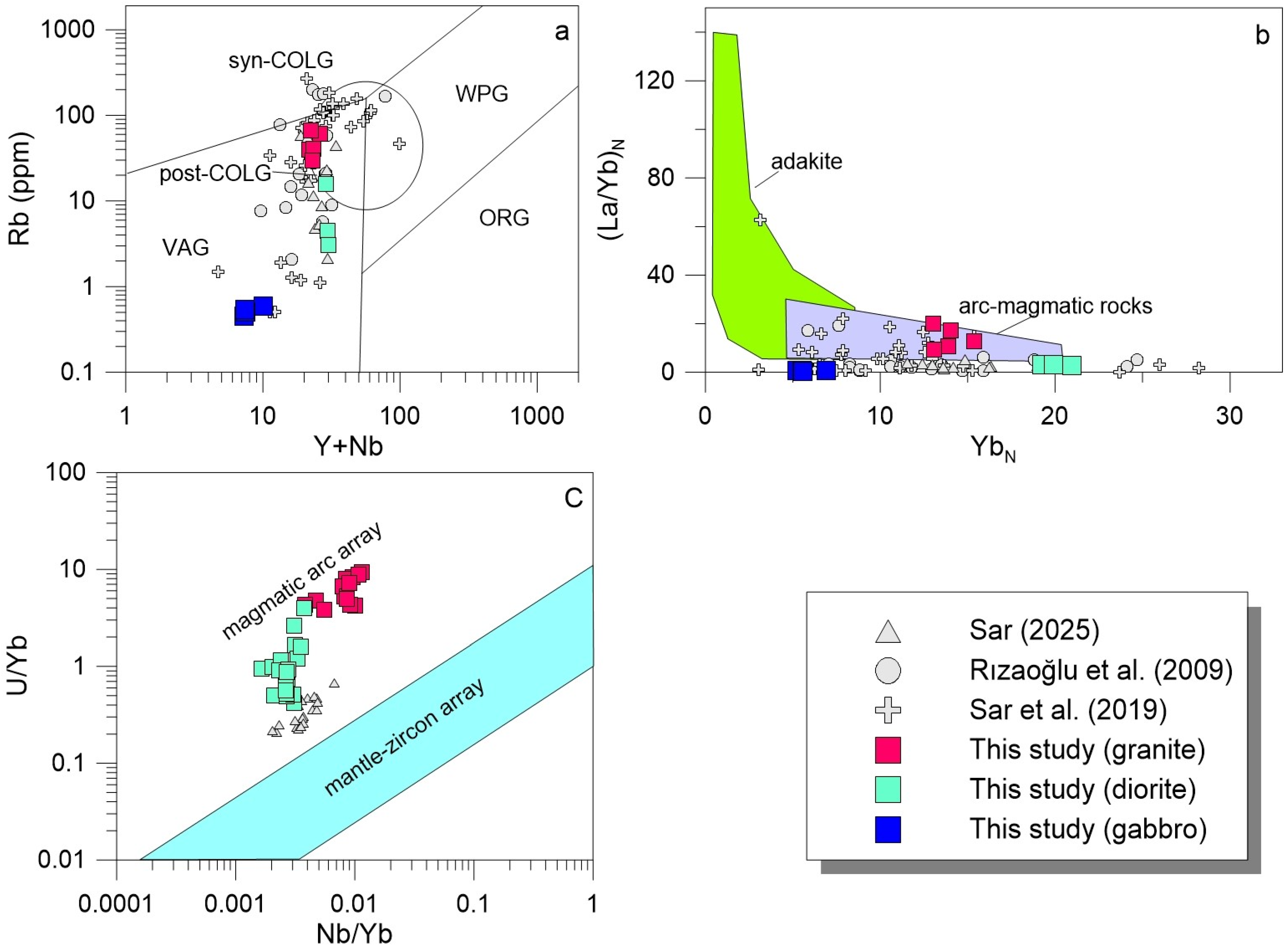
Figure 16.
(a) Nb/Hf vs. Th/U diagram and (b) Hf/Th vs. Th/Nb diagram for within-plate and arc-related zircon classification. (c) U/Yb vs. Hf diagram and (d) U/Yb vs. Y diagram for continental and ocean crust zircon classification [17,20,33,49].
6. Conclusions
- ✓
- The Late Cretaceous plutonic rocks studied comprise granodiorites around Aladikme (Elazığ) and diorite- and gabbro-type rocks around Tahtikler (Elazığ). Geochemical data indicate that these rocks have a tholeiitic to calc–alkaline composition and are of I-type granite character.
- ✓
- Zircon U–Pb data demonstrate that the studied granodiorites are emplaced at 73.52 ± 0.24 Ma and the diorites at 78.86 ± 0.39 Ma. The age data show that the studied granodiorites and diorites are the youngest granodiorite and diorite emplacements exposed along the SAOB in the study area.
- ✓
- Whole-rock geochemistry (trace element) data demonstrate that the studied diorites and gabbros originate from a spinel–lherzolitic magma representing shallow depths.
- ✓
- Whole-rock geochemistry and zircon trace-element data support the conclusion that the studied rocks are products of arc magmatism formed in a subduction-zone environment.
Supplementary Materials
The following supporting information can be downloaded at https://www.mdpi.com/article/10.3390/min16020173/s1, Supplementary Material File S1 [65,66]; Table S1: Whole-rock major oxides and trace element data for the Late Cretaceous plutonic rocks, eastern Türkiye; Table S2: Zircon U-Pb data for the X-1 and Y-1 samples from Late Cretaceous plutonic rocks, eastern Türkiye; Table S3: Zircon trace element data for X-1 (granodiorite) and Y-1 (diorite) samples.
Author Contributions
Conceptualization, A.S. and M.E.R.; methodology, A.S. and M.E.R.; software, A.S.; validation, A.S. and M.E.R.; formal analysis, A.S.; investigation, A.S. and M.E.R.; resources, A.S. and M.E.R.; data curation, A.S.; writing—original draft preparation, A.S. and M.E.R.; writing—review and editing, A.S. and M.E.R.; visualisation, A.S. and M.E.R.; supervision, A.S.; project administration, A.S.; funding acquisition, A.S. All authors have read and agreed to the published version of the manuscript.
Funding
This research was funded by Fırat University Scientific Research Projects Coordination Unit (FUBAP) of Fırat University, Elazığ/Türkiye, grant number MF.24.63.
Data Availability Statement
Data are contained within the article.
Acknowledgments
This study was supported by the Firat University Scientific Research Projects (FUBAP) grant number MF.24.63. We thank FUBAP for their contributions. We also thank Yuan QIUYUN, from Nanjing Hongchuang Geological Exploration Technical Services Co., Ltd., China, for his assistance in conducting the analyses. The authors are grateful to the anonymous reviewers who provided helpful suggestions for improving this article.
Conflicts of Interest
The authors declare no conflicts of interest.
References
- Moyen, J.F.; Martin, H.; Jayananda, M.; Auvray, B. Late Archaean granites: A typology based on the Dharwar Craton (India). Precambrian Res. 2003, 127, 103–123. [Google Scholar] [CrossRef] [Scilit]
- Moyen, J.F.; Martin, H. Forty years of TTG research. Lithos 2012, 148, 312–336. [Google Scholar] [CrossRef] [Scilit]
- Lv, P.; Yu, S.; Peng, Y.; Yin, L.; Xu, B.; Liu, Y.; Li, S.; Gao, X.; Jiang, X.; Li, C. Petrogenesis of late Paleoproterozoic I- and A-type granitoids in the southwestern Tarim Craton, NW China: Implications for post-collisional magmatism and tectonic evolution. Precambrian Res. 2025, 418, 107698. [Google Scholar] [CrossRef] [Scilit]
- Jagoutz, O.E.; Burg, J.P.; Hussain, S.; Dawood, H.; Pettke, T.; Iizuka, T.; Maruyama, S. Construction of the granitoid crust of an island arc part I: Geochronological and geochemical constraints from the plutonic Kohistan (NW Pakistan). Contrib. Mineral. Petrol. 2009, 158, 739–755. [Google Scholar] [CrossRef] [Scilit]
- Yan, M.; Wei, J.; Zhang, D.; Zhao, Z.; Turlin, F.; Li, H.; Li, G.; Xu, C.; Zhang, X.; Moritz, R. Petrogenesis of Late Devonian I- and A-type granitoids, and associated mafic microgranular enclaves in the northwestern North Qaidam Orogenic Belt, China: Implications for continental crust growth during the post-collisional stage. Lithos 2022, 430, 106857. [Google Scholar] [CrossRef] [Scilit]
- Atherton, M.P.; Petford, N. Generation of sodium-rich magmas from newly underplated basaltic crust. Nature 1993, 362, 144–146. [Google Scholar] [CrossRef] [Scilit]
- Mo, X.X.; Niu, Y.L.; Dong, G.C.; Zhao, Z.D.; Hou, Z.Q.; Zhou, S.; Ke, S. Contribution of syncollisional felsic magmatism to continental crust growth: A case study of the Paleogene Linzizong volcanic Succession in southern Tibet. Chem. Geol. 2008, 250, 49–67. [Google Scholar] [CrossRef] [Scilit]
- Niu, Y.L.; Zhao, Z.D.; Zhu, D.C.; Mo, X.X. Continental collision zones are primary sites for net continental crust growth—A testable hypothesis. Earth Sci. Rev. 2013, 127, 96–110. [Google Scholar] [CrossRef] [Scilit]
- Barbarin, B. A review of the relationships between granitoid types, their origins and their geodynamic environments. Lithos 1999, 46, 605–626. [Google Scholar] [CrossRef] [Scilit]
- Song, S.G.; Niu, Y.L.; Su, L.; Zhang, C.; Zhang, L.F. Continental orogenesis from ocean subduction, continent collision/subduction, to orogen collapse, and orogeny recycling: The example of the North Qaidam UHPM belt, NW China. Earth Sci. Rev. 2014, 129, 59–84. [Google Scholar] [CrossRef] [Scilit]
- Zheng, Y.F.; Gao, P. The production of granitic magmas through crustal anatexis at convergent plat boundaries. Lithos 2021, 119, 106232. [Google Scholar] [CrossRef] [Scilit]
- Şengör, A.M.C.; Yılmaz, Y. Tethyan Evolution of Turkey: A Plate Tectonic Approach. Tectonophysics 1981, 75, 181–241. [Google Scholar] [CrossRef] [Scilit]
- Yılmaz, Y. New evidence and model on the evolution of the southeast Anatolian orogen. Geol. Soc. Am. Bull. 1993, 105, 251–271. [Google Scholar] [CrossRef] [Scilit]
- Robertson, A.H.F.; Parlak, O.; Ustaömer, T. Overview of the Palaeozoic Neogene evolution of NeoTethys in the Eastern Mediterranean region (southern Turkey, Cyprus, Syria). Pet. Geosci. 2012, 18, 381–404. [Google Scholar] [CrossRef] [Scilit]
- Yılmaz, Y. Southeast Anatolian Orogenic Belt revisited (geology and evolution). Can. J. Earth Sci. 2019, 56, 1163–1180. [Google Scholar] [CrossRef] [Scilit]
- Ustaömer, P.A.; Ustaömer, T.; Collins, A.S.; Robertson, A.H.F. Cadomian (Ediacaran–Cambrian) arc magmatism in the Bitlis Massif, SE Turkey: Magmatism along the developing northern margin of Gondwana. Tectonophysics 2009, 473, 99–112. [Google Scholar] [CrossRef] [Scilit]
- Rızaoğlu, T.; Parlak, O.; Höck, V.; Koller, F.; Hames, W.E.; Billor, Z. Andean-type active margin formation in the eastern Taurides: Geochemical and geochronological evidence from the Baskil granitoid (Elazığ, SE Turkey). Tectonophysics 2009, 473, 188–207. [Google Scholar] [CrossRef] [Scilit]
- Karaoğlan, F.; Parlak, O.; Robertson, A.; Thöni, M.; Klötzli, U.; Koller, F.; Okay, A.İ. Evidence of Eocene high-temperature/high-pressure metamorphism of ophiolitic rocks and granitoid intrusion related to Neo-Tethyan subduction processes (Doğanşehir area, SE Anatolia). Geol. Soc. Spec. 2013, 372, 249–272. [Google Scholar] [CrossRef] [Scilit]
- Beyarslan, M.; Bingöl, A.F. Zircon U-Pb age and geochemical constraints on the origin and tectonic implications of late cretaceous intra-oceanic arc magmatics in the Southeast Anatolian Orogenic Belt (SE-Turkey). J. Afr. Earth Sci. 2018, 147, 477–497. [Google Scholar] [CrossRef] [Scilit]
- Sar, A.; Ertürk, M.A.; Rizeli, M.E. Genesis of late cretaceous intra-oceanic arc intrusions in the Pertek area of Tunceli Province, eastern Turkey, and implications for the geodynamic evolution of the southern neo-tethys: Results of zircon U-Pb geochronology and geochemical and Sr–Nd isotopic analyses. Lithos 2019, 350, 105263. [Google Scholar] [CrossRef] [Scilit]
- Rizeli, M.E.; Beyarslan, M.; Wang, K.-L.; Bingöl, A.F. Mineral chemistry and petrology of mantle peridotites from the Guleman ophiolite (SE Anatolia, Turkey): Evidence of a forearc setting. J. Afr. Earth Sci. 2016, 123, 392–402. [Google Scholar] [CrossRef] [Scilit]
- Rizeli, M.E.; Bingöl, A.F.; Wang, K.-L.; Lee, H.-Y. Abyssal and forearc features of mantle peridotites in the Guleman ophiolite in SE Turkey. Lithos 2023, 436, 106958. [Google Scholar] [CrossRef] [Scilit]
- Ertürk, M.A.; Sar, A.; Rizeli, M.E. Petrology, zircon U–Pb geochronology and tectonic implications of the A1-type intrusions: Keban region, eastern Turkey. Geochemistry 2022, 82, 125882. [Google Scholar] [CrossRef] [Scilit]
- Okay, A.; Tüysüz, O. Tethyan sutures of northern Turkey. In The Mediterranean Basins: Tertiary Extension Within the Alpine Orogen; Durand, B., Jolivet, L., Horvath, F., Serane, M., Eds.; Geological Society of London: London, UK, 1999. [Google Scholar]
- MTA. 1/500,000 Türkiye Jeoloji Haritasi. In General Directorate of Mineral Research and Exploration; General Directorate of Mineral Research and Exploration (MTA): Ankara, Turkey, 2002. [Google Scholar]
- Nurlu, N.; Köksal, S.; Kohut, M. Late Cretaceous volcanic arc magmatism in southeast Anatolian Orogenic Belt: Constraints from whole-rock, mineral chemistry, Sr–Nd isotopes and U–Pb zircon ages of the Baskil Intrusive Complex (Malatya, Turkey). Geol. J. 2022, 57, 3048–3073. [Google Scholar] [CrossRef] [Scilit]
- Alkaç, O.; Aksoy, E. The provenance of coarse-grained turbidite sandstones in the Kırkgeçit Formation (western part of the Elazığ Basin-east Turkey). Turk. J. Earth Sci. 2022, 31, 153–177. [Google Scholar] [CrossRef] [Scilit]
- Cox, K.G.; Bell, J.D.; Pankhurst, R.J. The Interpretation of Igneous Rocks; Allen and Unwin: London, UK, 1979. [Google Scholar]
- Peccerillo, A.; Taylor, S.R. Geochemistry of Eocene Calc-Alkaline Volcanic Rocks from the Kastamonu Area, Northern Turkey. Contrib. Mineral. Petrol. 1976, 58, 63–81. [Google Scholar] [CrossRef] [Scilit]
- Whalen, J.B.; Currie, K.I.; Chappel, B.W. A-type granites; geochemical characteristic, discrimination and petrogenesis. Contrib. Min. Petrol. 1987, 95, 407–419. [Google Scholar] [CrossRef] [Scilit]
- Shand, S.J. Eruptive Rocks: Their Genesis, Composition, Classification, and Their Relation to Oredeposites with a Chapter on Meteorite; John Wiley & Sons: New York, NY, USA, 1943. [Google Scholar]
- Sun, S.; McDonough, W.F. Chemical and Isotopic Systematic of Oceanic Basalts. Implications for Mantle Compositional Processes. In Magmatism in the Ocean Basins; Saunders, A.D., Norry, M.J., Eds.; Geological Society of London: London, UK, 1989. [Google Scholar] [CrossRef] [Scilit]
- Sar, A. Petrogenesis of late Cretaceous granitoids in Gemici (Elazığ-Türkiye): Evidence from whole-rock geochemistry, Sr–Nd isotopes, zircon U–Pb dating, and trace elements. J. Afr. Earth Sci. 2025, 231, 105782. [Google Scholar] [CrossRef] [Scilit]
- Corfu, F. A century of U-Pb geochronology: The long quest towards concordance. Geol. Soc. Am. Bull. 2013, 125, 33–47. [Google Scholar] [CrossRef] [Scilit]
- Wang, T.; Ran, B.; Liu, S.; Santosh, M.; Li, Z.; Han, Y.; Ye, Y. Zircon U-Pb ages, trace elements, and Hf isotopes establish a genetic link between volcanic ash beds and porphyritic intrusions during early Silurian in the South China Block. Lithos 2025, 494, 107890. [Google Scholar] [CrossRef] [Scilit]
- Hoskin, P.W.O.; Schaltegger, U. The composition of zircon and igneous and metamorphic petrogenesis. Rev. Mineral. Geochem. 2003, 53, 27–62. [Google Scholar] [CrossRef] [Scilit]
- Abakar, M.; Wadjou, J.W.; Kepnamou, A.D.; Fodoue, Y.; Essi, J.M.A.; Dagwai, N.; Isamaila, N. Petrogenetic evolution of I-type granitoids in the Gouna region, Northern Cameroon: Geochemical evidence for subduction-related to post-collisional magmatism during the Pan-African orogeny. Geosyst. Geoenviron. 2026, 5, 100485. [Google Scholar] [CrossRef] [Scilit]
- Rudnick, R.L.; Gao, S. Composition of the continental crust. In Treatise on Geochemistry: The Crust; Rudnick, R.L., Ed.; Elsevier: Amsterdam, The Netherlands, 2003. [Google Scholar]
- McDonough, W.F.; Sun, S.; Ringwood, A.E.; Jagoutz, E.; Hofmann, A.W. K, Rb and Cs in the earth and moon and the evolution of the earth’s mantle. Geochem. Cosmochim. Acta 1992, 56, 1001–1012. [Google Scholar] [CrossRef] [Scilit]
- Weaver, B.L.; Tarney, J. Empirical approach to estimating the composition of the continental crust. Nature 1984, 310, 575–577. [Google Scholar] [CrossRef] [Scilit]
- Smith, E.I.; Sánchez, A.; Walker, J.D.; Wang, K. Geochemistry of Mafic Magmas in the Hurricane Volcanic Field, Utah: Implications for Small- and Large-Scale Chemical Variability of the Lithospheric Mantle. J. Geol. 1999, 107, 433–448. [Google Scholar] [CrossRef] [Scilit]
- Pearce, J.A. Geochemical fingerprinting of oceanic basalts with applications to ophiolite classification and the search for Archean oceanic crust. Lithos 2008, 100, 14–48. [Google Scholar] [CrossRef] [Scilit]
- Aldanmaz, E.; Pearce, J.A.; Thirlwall, M.F.; Mitchell, J.G. Petrogenetic evolution of late Cenozoic, post-collision volcanism in western Anatolia, Turkey. J. Volcanol. Geotherm. 2000, 102, 67–95. [Google Scholar] [CrossRef] [Scilit]
- Yang, W.; Niu, H.; Shan, Q.; Luo, Y.; Sun, W.; Li, C.; Li, N.; Yu, X. Late Paleozoic calcalkaline to shoshonitic magmatism and its geodynamic implications, Yuximolegai area, western Tianshan, Xinjiang. Gondwana Res. 2012, 22, 325–340. [Google Scholar] [CrossRef] [Scilit]
- Kinzler, R.J. Melting of mantle peridotite at pressures approaching the spinel to garnet transition: Application to mid-ocean ridge basalt petrogenesis. J. Geophys. Res. 1997, 102, 853–874. [Google Scholar] [CrossRef] [Scilit]
- McKenzie, D.; O’nions, R.K. Partial melt distributions from inversion of rare earth element concentrations. J. Petrol. 1991, 32, 1021–1091. [Google Scholar] [CrossRef] [Scilit]
- Adam, J.; Green, T. Trace element partitioning between mica- and amphibole-bearing garnet lherzolite and hydrous basanitic melt: 1. Experimental results and the investigation of controls on partitioning behavior. Contrib. Mineral. Petrol. 2006, 152, 1–17. [Google Scholar] [CrossRef] [Scilit]
- Ersoy, E.Y. PETROMODELER (Petrological Modeler): A Microsoft® Excel© spreadsheet program for modelling melting, mixing, crystallisation and assimilation processes in magmatic systems. Turk. J. Earth Sci. 2013, 22, 115–125. [Google Scholar] [CrossRef] [Scilit]
- Belousova, E.; Griffin, W.; O’Reilly, S.Y.; Fisher, N. Igneous zircon: Trace element composition as an indicator of source rock type. Contrib. Mineral. Petrol. 2002, 143, 602–622. [Google Scholar] [CrossRef] [Scilit]
- Grimes, C.B.; John, B.E.; Kelemen, P.B.; Mazdab, F.K.; Wooden, J.L.; Cheadle, M.J.; Hanghøj, K.; Schwartz, J.J. Trace element chemistry of zircons from oceanic crust: A method for distinguishing detrital zircon provenance. Geology 2007, 35, 643. [Google Scholar] [CrossRef] [Scilit]
- Keskin, M. FC-Modeler: A Microsoft® Excel© Spreadsheet Program for Modeling Rayleigh Fractionation Vectors in Closed Magmatic Systems. Comput. Geosci. 2002, 28, 919–928. [Google Scholar] [CrossRef] [Scilit]
- Keskin, M. AFC-Modeler: A Microsoft® Excel© Workbook Program for Modeling Assimilation Combined with Fractional Crystallisation (AFC) Process in Magmatic Systems by Using Equations of DePaolo (1981). Turk. J. Earth Sci. 2012, 22, 304–319. [Google Scholar] [CrossRef] [Scilit]
- DePaolo, D.J. Neodymium Isotopes in the Colorado Front Range and Crust–Mantle Evolution in the Proterozoic. Nature 1981, 291, 193–196. [Google Scholar] [CrossRef] [Scilit]
- Taylor, S.R.; Mclennan, S.M. The Continental Crust: Its Composition and Evolution; Geoscience Texts; Blackwell Scientific: London, UK, 1985. [Google Scholar]
- Aktaş, G.; Robertson, A.H.F. The Maden complex, SE Turkey: Evolution of a Neotethyan continental margin. In The Geological Evolution of the Eastern Mediterranean; Dixon, J.E., Robertson, A.H.F., Eds.; Geological Society of London: London, UK, 1984; pp. 375–402. [Google Scholar]
- Parlak, O. Geodynamic significance of granitoid magmatism in the southeast Anatolian orogen: Geochemical and geochronogical evidence from Göksun–Afşin (Kahramanmaraş, Turkey) region. Int. J. Earth Sci. 2006, 95, 609–627. [Google Scholar] [CrossRef] [Scilit]
- Rolland, Y.; Perincek, D.; Kaymakci, N.; Sosson, M.; Barrier, E.; Avagyan, A. Evidence for ~80–75 Ma subduction jump during Anatolide–Tauride–Armenian block accretion and ~48 Ma Arabia–Eurasia collision in Lesser Caucasus–East Anatolia. J. Geodyn. 2012, 56, 76–85. [Google Scholar] [CrossRef] [Scilit]
- Karaoğlan, F.; Parlak, O.; Hejl, E.; Neubauer, F.; Klötzli, U. The temporal evolution of the active margin along the Southeast Anatolian Orogenic Belt (SE Turkey): Evidence from U-Pb, Ar-Ar and fission track chronology. Gondwana Res. 2016, 33, 190–208. [Google Scholar] [CrossRef] [Scilit]
- Ertürk, M.A. Geochronology and petrology of Late Cretaceous subduction-related volcanics from Elazığ, SE Türkiye: Insights into deciphering petrogenesis and magma generation processes. Geochemistry 2025, 85, 126234. [Google Scholar] [CrossRef] [Scilit]
- Oberhänsli, R.; Koralay, E.; Candan, O.; Pourteau, A.; Bousquet, R. Late Cretaceous eclogitic high-pressure relics in the Bitlis massif. Geodin. Acta 2014, 26, 175–190. [Google Scholar] [CrossRef] [Scilit]
- Pearce, J.A.; Harris, N.B.W.; Tindle, A.G. Trace element discrimination diagrams for the tectonic interpretation of granitic rocks. J. Petrol. 1984, 25, 956–983. [Google Scholar] [CrossRef] [Scilit]
- Pearce, J.A. Sources and settings of granitic rocks. Episodes 1996, 19, 120–125. [Google Scholar] [CrossRef] [Scilit]
- Defant, M.J.; Drummond, M.S. Derivation of Some Modern Arc Magmas by Melting of Young Subducted Lithosphere. Nature 1990, 347, 662–665. [Google Scholar] [CrossRef] [Scilit]
- Grimes, C.B.; Wooden, J.L.; Cheadle, M.J.; John, B.E. “Fingerprinting” tectono-magmatic provenance using trace elements in igneous zircon. Contrib. Mineral. Petrol. 2015, 170, 46. [Google Scholar] [CrossRef] [Scilit]
- Thompson, J.M.; Meffre, S.; Danyushevsky, L. Impact of air, laser pulse width and fluence on U–Pb dating of zircons by LA-ICPMS. J. Anal. At. Spectrom. 2018, 33, 221–230. [Google Scholar] [CrossRef] [Scilit]
- Paton, C.; Woodhead, J.D.; Hellstrom, J.C.; Hergt, J.M.; Greig, A.; Maas, R. Improved laser ablation U-Pb zircon geochronology through robust downhole fractionation correction. Geochem. Geophys. Geosyst. 2010, 11, Q0AA06. [Google Scholar] [CrossRef] [Scilit]
Disclaimer/Publisher’s Note: The statements, opinions and data contained in all publications are solely those of the individual author(s) and contributor(s) and not of MDPI and/or the editor(s). MDPI and/or the editor(s) disclaim responsibility for any injury to people or property resulting from any ideas, methods, instructions or products referred to in the content. |
© 2026 by the authors. Licensee MDPI, Basel, Switzerland. This article is an open access article distributed under the terms and conditions of the Creative Commons Attribution (CC BY) license.