


Abstract
The North China Craton (NCC) has long been regarded as tectonically quiescent during the Cambrian, yet detrital zircons of the early Cambrian to earliest Ordovician age are widespread in Cambrian strata across the craton, and their provenance remains controversial. This study presents new zircon U–Pb geochronological, trace-element and Lu–Hf isotopic data, together with whole-rock geochemical data, for a basaltic andesite (informally named the Xiaowenzhigou Andesite) near Xiaowenzhigou Village in eastern Liaoning, northeastern NCC. The unit was previously mapped as a volcanic interlayer within the Lower Cretaceous Lishugou Formation. Five euhedral, oscillatory-zoned magmatic zircons yield a weighted mean 206Pb/238U age of 528.4 ± 5.6 Ma (2σ; MSWD = 0.51, n = 5), corroborated by a concordia age of 529.3 ± 5.4 Ma (2σ), providing, to our knowledge, the first direct evidence of early Cambrian magmatism in the northeastern NCC. Consequently, the unit is distinguished from the Lishugou Formation. The rock is a metaluminous, high-K calc-alkaline pyroxene basaltic andesite, enriched in large-ion lithophile elements and light rare earth elements and depleted in Nb–Ta, with high Sr contents and only weak negative Eu anomalies. Magmatic zircons have negative εHf(t) values of −3.5 to −0.9 and Paleoproterozoic two-stage Hf model ages of 1.54–1.71 Ga, and abundant inherited zircons (1.82–2.69 Ga) correspond to the Archean–Paleoproterozoic basement of the northeastern craton. These characteristics indicate that the parental magma was primarily generated by partial melting of Paleoproterozoic lower crust, accompanied by assimilation of local basement during ascent. The Xiaowenzhigou Andesite is identified as a potential local source for the early Cambrian detrital zircons found in Paleozoic strata of the craton, challenging the prevailing view that the northeastern craton was magmatically inactive during the early Paleozoic. We acknowledge that our conclusions are necessarily preliminary, as our understanding of this unit is constrained by the presence of only one small outcrop and the limited number of zircon grains recovered (n = 5). The primary objective of this initial documentation is to draw attention to the unit and to stimulate further investigation.
1. Introduction
The early Cambrian (ca. 541–509 Ma) [1] marks the transition from the Proterozoic to the Phanerozoic, and was a period of profound global tectonic reorganization, encompassing the final stages of Gondwana assembly and the dispersal of continental fragments from the Rodinia supercontinent. The North China Craton (NCC), a cratonic block of significant geologic age, has been subject to a complex evolutionary history since the Precambrian period. This includes the growth of Neoarchean crust at ca. 2.7–2.5 Ga and Paleoproterozoic tectono-thermal events at ca. 2.2–1.85 Ga [2,3]. Conversely, the early Paleozoic record of the NCC is conspicuously sparse. The craton has long been regarded as tectonically quiescent during the Cambrian, with coeval magmatism largely confined to its margins [4,5,6].
Nonetheless, indirect evidence suggests the presence of cryptic early Cambrian magmatism within the craton. Cambrian–earliest Ordovician detrital zircons (ca. 488–540 Ma) have been identified in Cambrian strata across the NCC, including the Xuzhuang Formation in the Western Hills of Beijing [7], the Mantou Formation in western Liaoning [8], the black clastic series at the base of the Cambrian in the southeastern craton [9], the basal Cambrian sandstone unit in the craton interior [10], and multiple Cambrian units in the Xuhuai region [11]. Given the paucity of coeval magmatic rocks within the craton, these grains have commonly been attributed to distant sources along the craton margins or to exotic blocks, such as the early Paleozoic magmatic provinces of NE Gondwana [12]. However, the abundance of these minerals suggests the presence of a proximate but concealed magmatic source, an interpretation consistent with detrital zircon age spectra of the basal Cambrian Liguan Formation in western Shandong—among the oldest Cambrian clastic units of the craton—which likewise indicate an intra-cratonic provenance [13]. This interpretation is consistent with the presence of inherited zircons with an age peak of ca. 520 Ma in the Jurassic Nandaling basalt of the Western Hills of Beijing [14].
One such candidate locality is the Wenzhigou area of the Hongmiaozi Basin in eastern Liaoning, where regional mapping has reported an andesite unit at the top of the Lishugou Formation [15,16], although direct contact between the andesite and the Lishugou Formation was never identified. The Lishugou Formation is a fossiliferous lacustrine unit from which the present authors previously discovered the clam shrimp Yanjiestheria huanrenensis and the osteoglossiform fish Huashia sp. at Xiaowenzhigou [17,18,19]. Zircon U–Pb dating of tuffs from the correlative Binggou Formation in western Liaoning has yielded an age of 106.5 ± 1.9 Ma (Albian) [20], constraining the depositional age of the Lishugou Formation to the late Aptian–middle Albian. If the topmost andesite truly belonged to the Lishugou volcanic-sedimentary succession, it should be approximately contemporaneous (ca. 110 Ma) or younger; a markedly older age would instead indicate an unrecognized magmatic unit in the northeastern NCC.
In this contribution, we address the question of whether cryptic early Cambrian magmatism is preserved within the concealed basement of the northeastern NCC, using the andesite near Xiaowenzhigou Village in eastern Liaoning as a test case. This rock was previously mapped as a volcanic interlayer within the Lower Cretaceous Lishugou Formation, but no direct contact with that formation has ever been documented, leaving its age and stratigraphic affinity unresolved. We present zircon U–Pb geochronological, trace-element, and Lu–Hf isotopic data, together with whole-rock geochemical data (samples WLtw1 and YQ1–YQ3), with the aims of (1) constraining the crystallisation age of the unit and thereby testing its assignment to the Lishugou Formation, (2) characterising its petrogenesis and magma source, and (3) evaluating its implications for the early Paleozoic tectonic evolution of the northeastern NCC and for the provenance of early Cambrian detrital zircons in Cambrian strata of the craton. The analytical methods employed are described in Section 3.
2. Geological Background
2.1. Regional Geological Setting
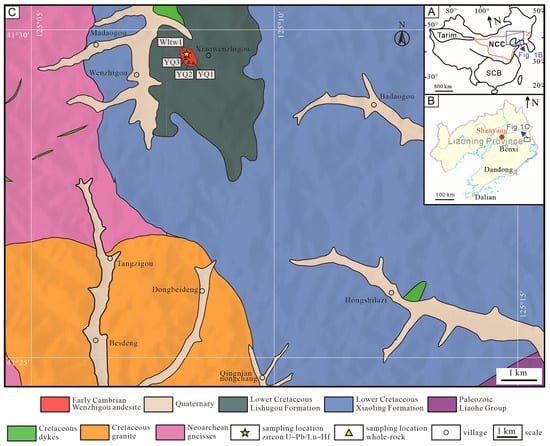
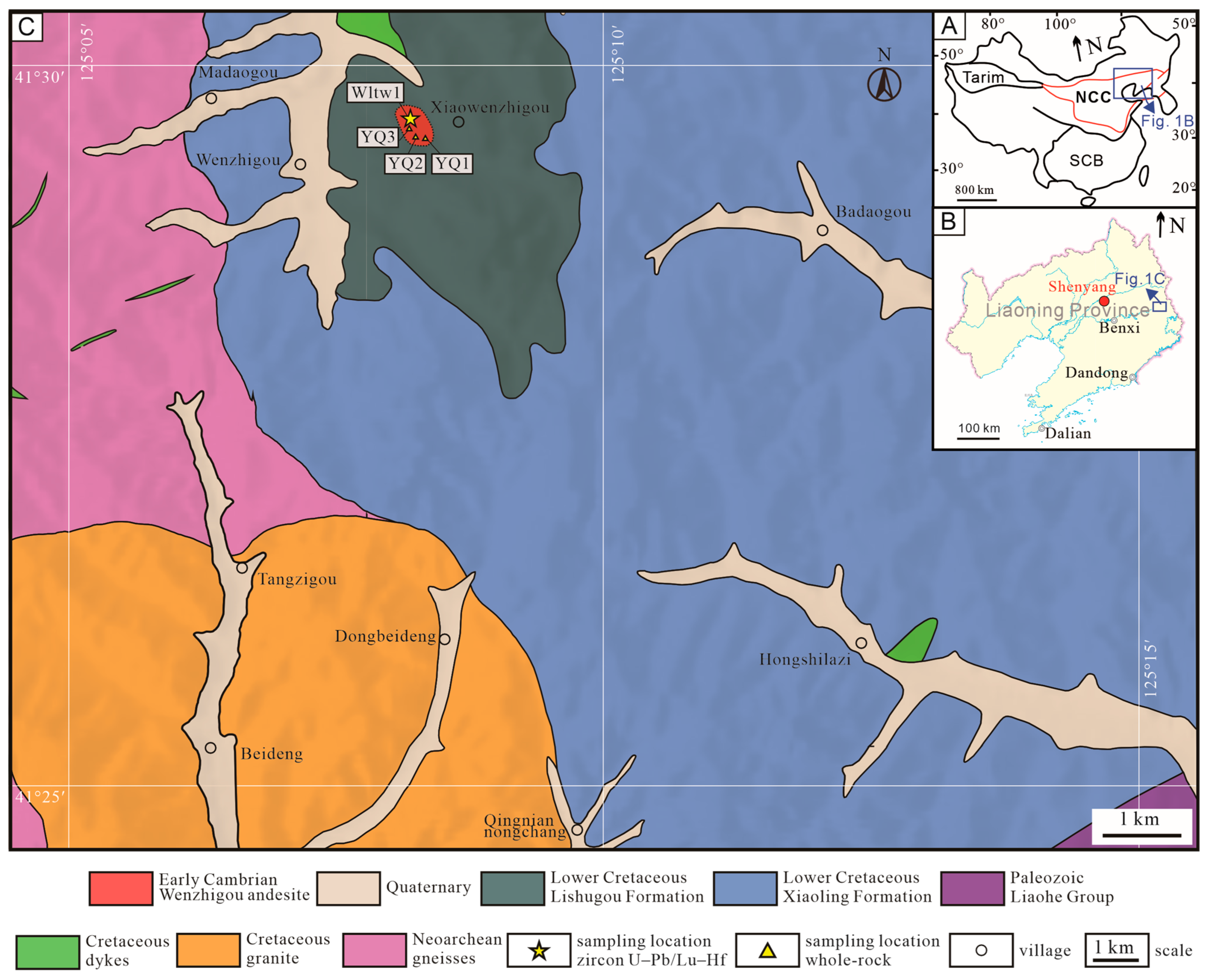
The study area is located at Xiaowenzhigou, Wenzhigou Village, Hualai Town, Huanren Manchu Autonomous County, Benxi City, Liaoning Province, in the foothills of the Changbai Mountains (Figure 1). Tectonically, the area lies along the northeastern margin of the NCC, within the confines of the Hongmiaozi Basin. The basin is a Mesozoic faulted basin located in eastern Liaoning. The regional basement comprises the Neoarchean Anshan Group and the Paleoproterozoic Liaohe Group. The latter records 2.2–1.9 Ga magmatism and the 1.95–1.80 Ga Jiao–Liao–Ji orogeny [2,3]. These units are overlain by Cambrian–Ordovician marine carbonates and clastic rocks, Carboniferous–Permian paralic deposits, Mesozoic terrestrial clastic and volcanic successions, and Quaternary cover [15,16,21].
Figure 1.
Geological sketch map of the Xiaowenzhigou area, Huanren Manchu Autonomous County, eastern Liaoning, showing the distribution of the Precambrian basement, Cambrian-Ordovician cover and Mesozoic basin fill, the occurrence of the Xiaowenzhigou Andesite, and the locations of samples WLtw1 and YQ1–YQ3. Inset shows the location of the study area within the North China Craton. (A) Location of Liaoning Province within China; (B) location of the study area within Liaoning Province; (C) geological sketch map of the study area.
The Mesozoic basin fill comprises, in ascending order, the Lower Cretaceous Xiaoling, Lishugou, and Nieerku formations and the Upper Cretaceous Dayu Formation. The Lishugou Formation, which was named by the First Regional Geological Survey Team of Liaoning Province in 1975, consists primarily of tuffaceous shale, tuffaceous siltstone, tuffaceous sandstone and tuff deposited in a lacustrine setting [16,21]. The formation is found to rest unconformably on the Xiaoling Formation, with the Nieerku Formation conformably overlying it [16,21]. During the 1:50,000 regional geological survey of the Pingdingshan area [16], the present authors discovered clam shrimp, fish, and gastropod fossils in the Lishugou Formation at Xiaowenzhigou. The clam shrimp was first identified as Eosestheria sp. [17] and was later revised to Yanjiestheria huanrenensis [19]. The fish, initially assigned to the genus Lycoptera, was subsequently re-classified as Huashia [18]. Zircon U–Pb dating of tuffs from the correlative Binggou Formation in western Liaoning has constrained the depositional age of the Lishugou Formation to the late Aptian–middle Albian (ca. 110–100 Ma) [20]. The Yanjiestheria–Huashia assemblage is interpreted as marking the terminal stage of the late Jehol Biota. In the Wenzhigou area, regional mapping has documented andesite at the top of the Lishugou Formation [15,16], although direct contact between the andesite and the Lishugou Formation was never identified. A comparable andesite in the vicinity of the Yalu River estuary in Dandong has been dated to the Cretaceous period [22].
2.2. The Xiaowenzhigou Andesite
The andesite occurs as a small, isolated body on a forested hilltop approximately 600 m west of Xiaowenzhigou (Figure 1), with a mapped outcrop area of only ca. 0.03 km2; it has not been recognized at any other locality in the surrounding region. The presence of dense vegetation and limited exposure in the foothills of the Changbai Mountains poses a significant challenge to the establishment of field relationships. The interaction between the andesite and the Lishugou Formation has not been detected, and consequently, the andesite was formerly identified as a volcanic interlayer at the summit of the Lishugou Formation [15,16]. However, several field observations suggest that this interpretation is incorrect. The bedding attitudes measured at scattered outcrops of the Lishugou Formation around the andesite body are inconsistent with the attitude of the andesite. This observation precludes the possibility of a simple conformable relationship. The andesite is also a coherent, porphyritic lava that is petrographically distinct from the tuffaceous lacustrine shale–siltstone–sandstone succession of the Lishugou Formation, in which volcanic material occurs as tuffs and tuffaceous beds rather than as coherent lava flows. These field relations are permissive rather than conclusive; the decisive evidence for distinguishing the two units is geochronological (see Section 4.3 and Section 5.1): the andesite crystallised at ca. 528 Ma, whereas the Lishugou Formation was deposited at ca. 110–100 Ma (Albian) [20]. Consequently, the basaltic andesite is regarded as a distinct magmatic unit, informally designated the Xiaowenzhigou Andesite after its type locality. We follow the informal nomenclature practice of the Chinese Stratigraphic Guide and the regional geological surveys [15,16], in which this rock was mapped as “andesite”; we retain the name for continuity with regional mapping usage, while noting that the whole-rock TAS classification (Section 4.2) places it at the basaltic andesite–andesite boundary. The designation remains provisional pending formal lithostratigraphic delineation contingent on the identification of additional exposures.
3. Sampling and Methodology
3.1. Sampling
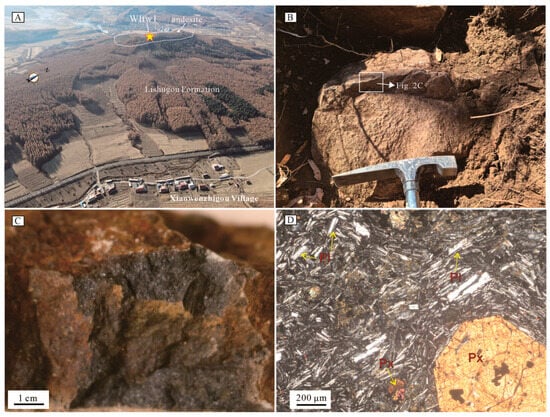
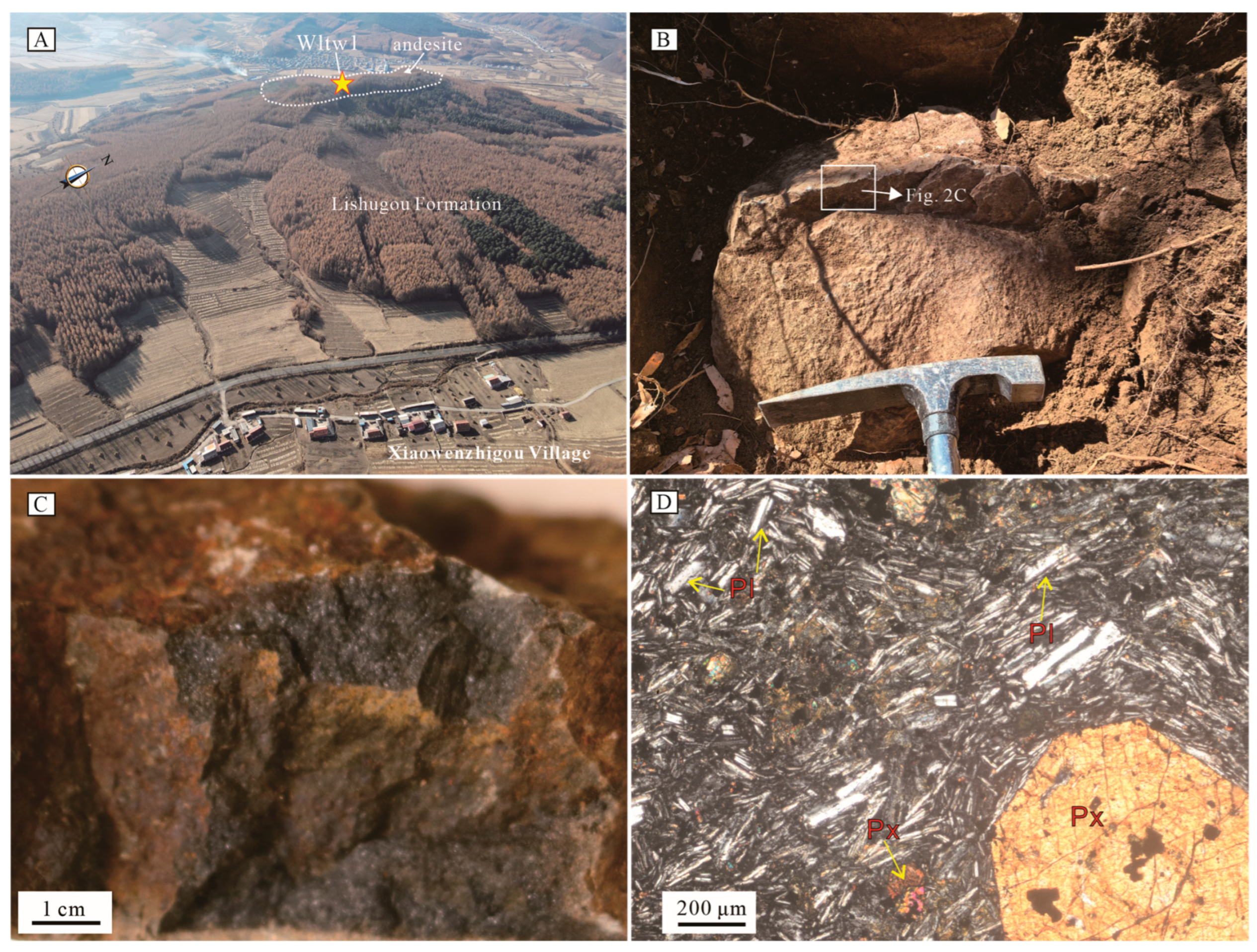
All samples were collected from a hilltop situated approximately 600 m west of Xiaowenzhigou (see Figure 1). Due to the outcrop’s diminutive size (approximately 0.03 km2), its remote location, and the absence of any prior knowledge of the surrounding region, it was only possible to collect a single sample for isotopic analysis, WLtw1 (125°08′09.3″ E, 41°29′28.0″ N), which was utilized for zircon CL imaging, LA-ICP-MS U–Pb dating and trace-element analysis, and LA-MC-ICP-MS Lu–Hf isotope analysis (Tables S2–S4). The andesite is zircon-poor, and zircon separation yielded only a limited number of grains, of which just six gave Cambrian ages (Section 4.3); all isotopic data in this study therefore derive from this single sample. We explicitly acknowledge this limitation. Our study documents this newly recognized magmatic unit for the first time and aims to draw attention to its significance. Three whole-rock samples were collected for major- and trace-element analyses (see Table S1). YQ1 (125°08′17.3″ E, 41°29′14.0″ N) and YQ2 (125°08′11.3″ E, 41°29′16.3″ N) from adjacent sites, and YQ3 is from the same site as WLtw1 (125°08′09.3″ E, 41°29′28.0″ N). Note that all coordinates refer to the CGCS2000 datum. The field occurrence and petrographic features are illustrated in Figure 2.
Figure 2.
Field occurrence and petrography of the Xiaowenzhigou Andesite. (A) Outcrop photograph of the andesite (the star marks the sampling location of the isotope sample WLtw1); (B) hand specimen; (C) hand specimen photograph showing the porphyritic texture with plagioclase and pyroxene phenocrysts; (D) photomicrograph (cross-polarized light) showing plagioclase and pyroxene phenocrysts set in an intersertal groundmass of plagioclase microlites, pyroxene, opaque minerals and iron oxides; note the saponitized pyroxene phenocryst in (D). Pl = plagioclase; Px = pyroxene.
3.2. Whole-Rock Major and Trace Element Analyses
Three whole-rock samples (YQ1–YQ3) were analyzed at Beijing GeoAnalysis Co., Ltd. (Beijing, China). The major-element oxides were determined by X-ray fluorescence (XRF) spectrometry on fused glass discs using an Axios Max spectrometer (PANalytical B.V., Almelo, The Netherlands), with total iron reported as TFe2O3; FeO was determined separately by wet-chemical titration, and loss on ignition (LOI) was measured gravimetrically. Trace elements, including rare earth elements (REE), Y and Th, were analyzed using an iCAP Q inductively coupled plasma mass spectrometer (ICP-MS; Thermo Fisher Scientific, Waltham, MA, USA), with the exception of Cr, for which an iCAP 6300 inductively coupled plasma optical emission spectrometer (ICP-OES; Thermo Fisher Scientific, Waltham, MA, USA) was utilized. The gravimetric method was employed for the determination of H2O+ and H2O−. The results of the whole-rock analyses are presented in Table S1.
3.3. Zircon CL Imaging and LA-ICP-MS U–Pb Dating
Zircon grains from sample WLtw1 were mounted in epoxy, polished to expose their interiors. The grains were ultrasonically cleaned in ultrapure water and rinsed with methanol prior to analysis. Cathodoluminescence (CL) images were acquired at Beijing GeoAnalysis Co., Ltd. using a JEOL IT-500 tungsten-filament scanning electron microscope equipped with a DELMIC CL detection system. The accelerating voltage was set to 10 kV, the working distance to 16.7 mm, and the probe current to 63 nA. The dwell time was set to 12 μs per pixel (~59 s per image). These images were utilized to characterize internal textures and zoning, and to guide the placement of analytical spots.
Zircon U–Pb dating and trace-element analyses were conducted by LA-ICP-MS at Beijing GeoAnalysis Co., Ltd., using an NWR193UC 193 nm excimer laser-ablation system (Elemental Scientific Lasers LLC, Bozeman, MT, USA) coupled to an Agilent 7900 ICP-MS (Agilent Technologies, Santa Clara, CA, USA). The detailed tuning parameters can be found in [23]. Prior to analysis, each spot was pre-ablated using five laser pulses to remove an approximately 0.3 μm thick surface layer and minimize surface contamination. The analyses were performed with a 30 μm spot diameter, a repetition rate of 6 Hz and an energy density of approximately 5 J/cm2. The data reduction process employed Iolite v4.9 [24], utilizing zircon 91500 as the external standard and zircon Plešovice as the monitor standard. Two analyses of zircon 91500, one of Plešovice and one of NIST 610 glass, were measured after every eight sample spots. Each analysis comprised 25 s of gas-background measurement followed by 45 s of sample signal. Down-hole fractionation was corrected using the exponential function of Paton et al. [24]. The calibration of trace-element concentrations was conducted against NIST 610 glass, with 29 Si serving as the internal standard element. During this analytical batch, zircon 91500 yielded a 206Pb/238U age of 1061.5 ± 3.2 Ma (2σ), consistent with the recommended value of 1062.4 ± 0.4 Ma [25], and Plešovice gave a weighted mean 206Pb/238U age of 337.5 ± 1.5 Ma (n = 11, 2σ), consistent with the recommended value of 337.13 ± 0.37 Ma [26]. The 206Pb/238U age is adopted for grains younger than 1000 Ma and the 207Pb/206Pb age for older grains. Individual age uncertainties are reported at 1σ in Table S2, whereas weighted mean and concordia ages are quoted at 2σ. Weighted mean and concordia ages were calculated with IsoplotR v7.0 [27], the concordia age following the maximum-likelihood approach of [28]. Concordance was calculated as:
where t(206/238) and t(207/235) denote the 206Pb/238U and 207Pb/235U ages, respectively. Analyses with concordance <90% were excluded from interpretation. The analytical results are documented in Tables S2 and S3.
Conc = 100 × (1 − |t(206/238) − t(207/235)|/mean[t(206/238), t(207/235)])
3.4. Zircon Lu–Hf Isotope Analyses
In situ zircon Lu–Hf isotope analyses were performed at Beijing GeoAnalysis Co., Ltd. using a Resolution SE 193 nm excimer laser-ablation system (Australian Scientific Instruments, Canberra, Australia) coupled to a Neptune Plus multi-collector ICP-MS (MC-ICP-MS; Thermo Fisher Scientific, Bremen, Germany). Analyses targeted the dated zircon domains, guided by CL images, with ablated material transported to the plasma in high-purity He. A 45 μm spot diameter, 10 Hz repetition rate and energy density of 7–8 J/cm2 were used. The Faraday collector array simultaneously monitored 172Yb (L4), 173Yb (L3), 175Lu (L2), 176(Yb + Lu + Hf) (L1), 177Hf (C), 178Hf (H1), 179Hf (H2), 180Hf (H3) and 182W (H4).
Mass fractionation was corrected by exponential normalization using 179Hf/177Hf = 0.7325. Isobaric interferences of 176Lu and 176Yb on 176Hf were corrected using 176Lu/175Lu = 0.02655 and 176Yb/172Yb = 0.5887, with the Yb mass-bias coefficient (βYb) obtained from concurrently measured Yb signals (173Yb/172Yb = 1.35274) during each ablation. Because 176Lu/177Hf in zircon is typically <0.002, the isobaric interference on 176Hf is dominated by 176Yb. Detailed analytical procedures follow [29]. Zircon standard Plešovice was analyzed after every ten samples to monitor accuracy and stability, yielding 176Hf/177Hf = 0.282480 ± 0.000016 (2σ), in agreement with the recommended value [26]. The εHf(t) values were calculated using the decay constant 1.867 × 10⁻¹¹ yr−1 [30], present-day CHUR values of 176Lu/177Hf = 0.0332 and 176Hf/177Hf = 0.282772 [31], and depleted-mantle values of 176Lu/177Hf = 0.0384 and 176Hf/177Hf = 0.28325 [32]. Single-stage (TDM) and two-stage (TDMc) Hf model ages were calculated assuming 176Lu/177Hf = 0.015 for average continental crust [33]. The results of this study are reported in Table S4.
4. Results
4.1. Petrography
The rock displays a porphyritic texture, with phenocrysts (~25 vol.%) set in an intersertal groundmass (Figure 2D). Phenocrysts (0.2–1.3 mm) comprise plagioclase and pyroxene. Plagioclase is subhedral to euhedral and zoned, predominantly andesine with minor labradorite. Pyroxene occurs as prismatic to granular crystals and is locally saponitized, indicating a partial replacement of pyroxene by saponite. The groundmass is composed of plagioclase (0.05–0.2 mm), pyroxene, opaque minerals and disseminated iron oxides. The groundmass plagioclase forms fine laths to microlites arranged in subparallel, flow-aligned bundles; fine-grained pyroxene, subhedral to euhedral opaque minerals, and iron oxides occupy the interstices between plagioclase laths, defining a typical intersertal texture. The rock has undergone only weak saponitization, largely confined to pyroxene, and the primary igneous textures are well preserved. In accordance with the mineral assemblage, the rock is classified as a pyroxene basaltic andesite.
4.2. Whole-Rock Geochemistry
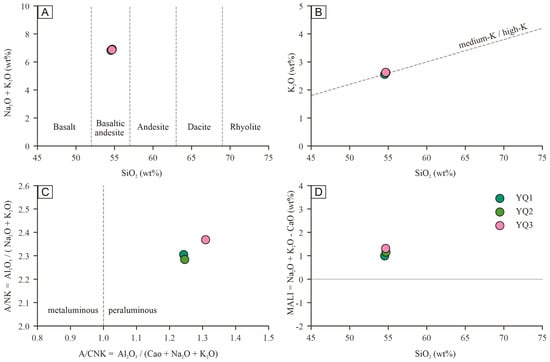
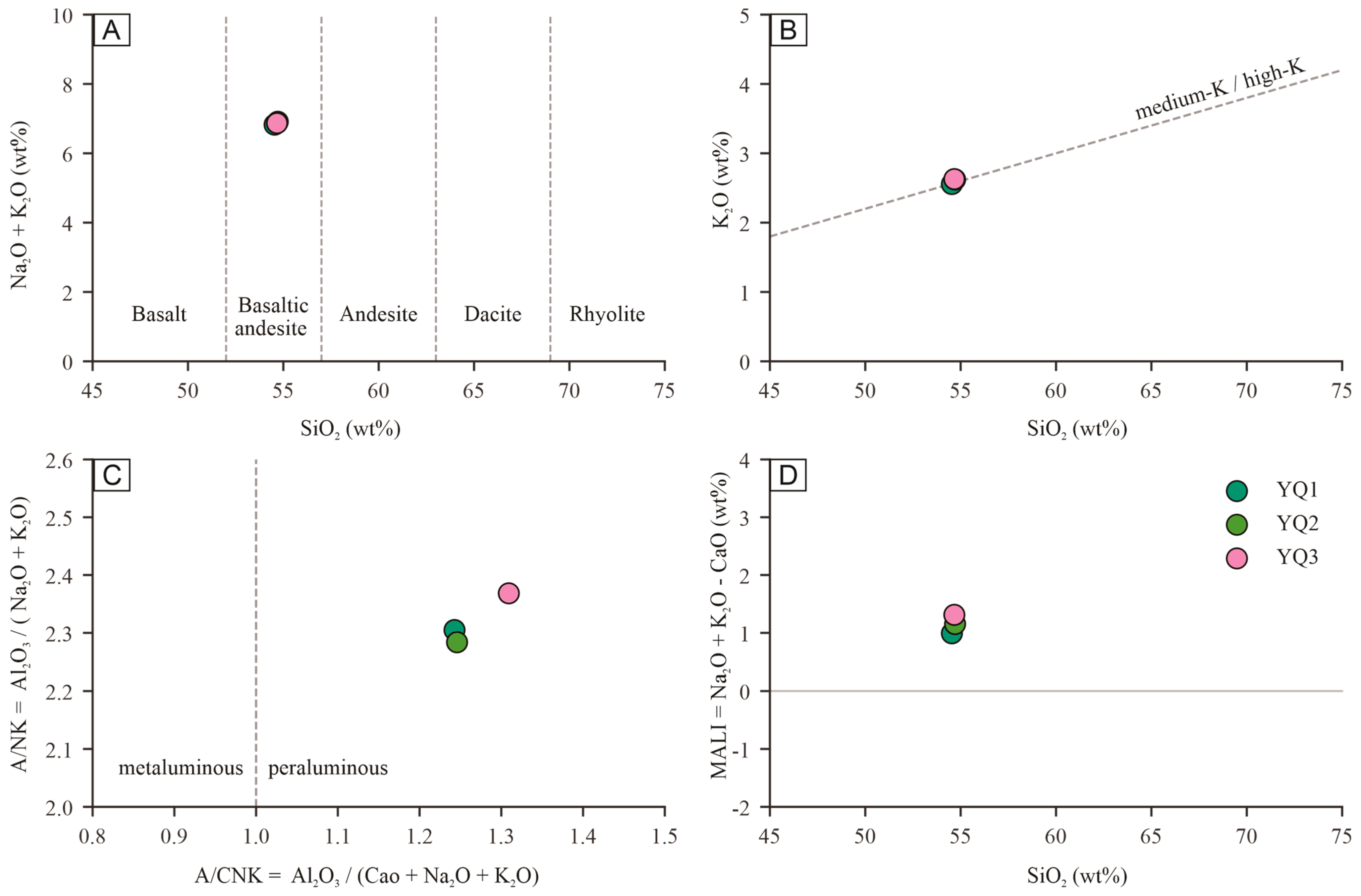
Three whole-rock samples (YQ1–YQ3) have been found to have restricted major-element compositions, with SiO2 = 54.54–54.71 wt%, Al2O3 = 15.73–16.27 wt%, total alkalis (Na2O + K2O) = 6.83–6.91 wt%, K2O = 2.56–2.63 wt%, Na2O = 4.24–4.29 wt%, CaO = 5.56–5.83 wt%, MgO = 2.78–4.06 wt%, TFe2O3 = 9.34–9.58 wt%, TiO2 = 1.06–1.10 wt%, P2O5 = 0.89–0.94 wt%, and LOI = 1.25–1.79 wt% (Table S1). In the total alkali-silica diagram, the samples are located in the basaltic-andesite field, in close proximity to the andesite boundary (see Figure 3A). The samples are metaluminous, with molar Al2O3/(CaO + Na2O + K2O) ratios (A/CNK) of 0.77–0.82 and Al2O3/(Na2O + K2O) ratios (A/NK) of 1.60–1.66 (Figure 3C). The modified alkali–lime indices (MALI = Na2O + K2O − CaO) range from 0.99 to 1.31 (Figure 3D).
Figure 3.
Major-element classification diagrams for whole-rock samples YQ1–YQ3. (A) Total alkali–silica diagram with SiO2 field boundaries; (B) K2O versus SiO2 with medium-K/high-K field boundaries after [34]; (C) A/NK versus A/CNK (molar ratios: A/NK = Al2O3/(Na2O + K2O)); A/CNK = Al2O3/(CaO + Na2O + K2O); (D) modified alkali–lime index (MALI = Na2O + K2O − CaO) versus SiO2. Data are listed in Table S1.
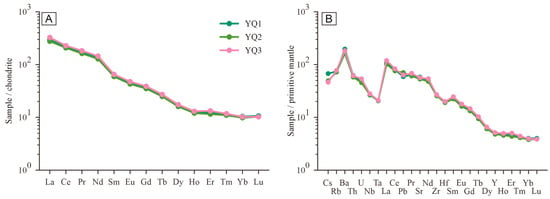
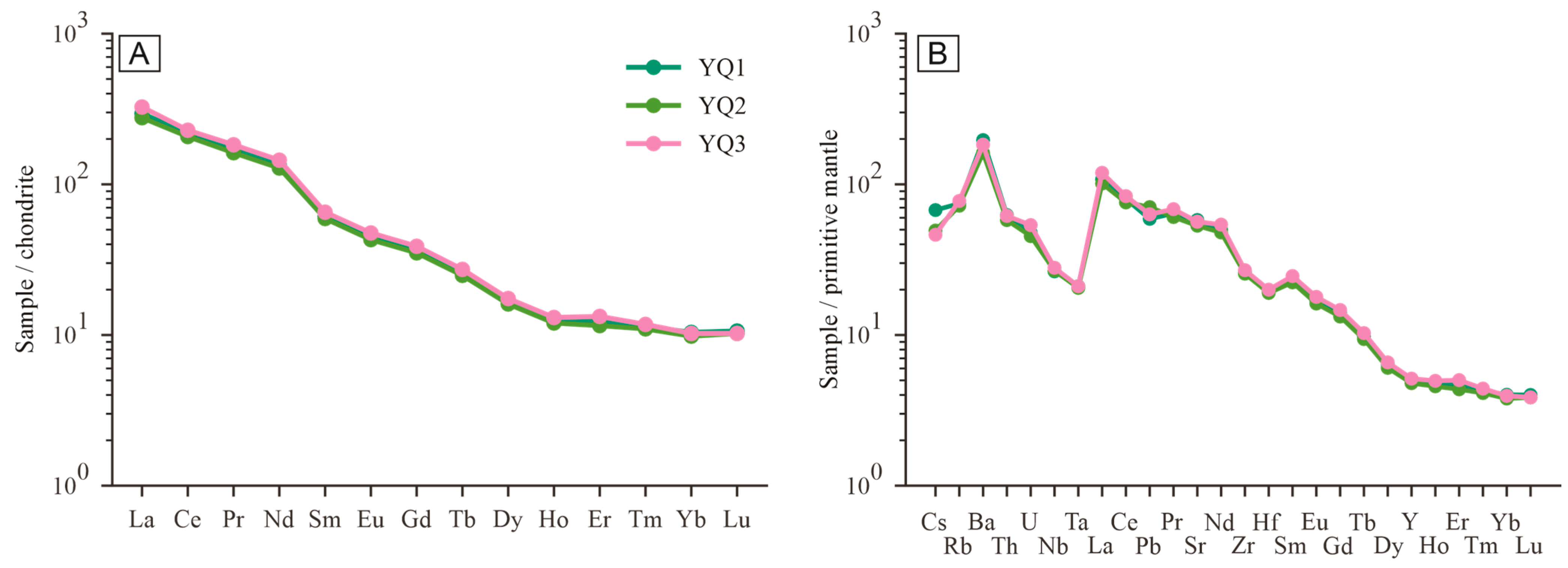
The samples plot within the high-K calc-alkaline field of the K2O–SiO2 diagram (Figure 3B). The samples are enriched in large-ion lithophile elements (LILE), with Rb = 45.8–49.3 ppm, Ba = 1067–1298 ppm and Sr = 1057–1154 ppm, and with Zr = 268–283 ppm, Nb = 17.4–18.4 ppm, Ta = 0.76–0.78 ppm, Hf = 5.38–5.66 ppm, Th = 4.60–4.97 ppm, U = 0.92–1.09 ppm and Pb = 8.85–10.60 ppm (Table S1). Key ratios are Rb/Sr = 0.041–0.044, Ba/Nb = 60.6–74.6, La/Nb = 3.73–4.20, Nb/Ta = 22.3–23.6, Zr/Hf = 49.3–50.0, Th/U = 4.50–5.12 and Ce/Pb = 12.0–15.1. Total REE contents are elevated (296–334 ppm). Chondrite-normalized patterns show marked LREE enrichment and HREE depletion, with (La/Sm)N = 4.67–4.99, (La/Yb)N = 28.2–31.9 and (Gd/Yb) N = 3.55–3.79, accompanied by only weak negative Eu anomalies (Eu/Eu* = 0.941–0.945, where Eu/Eu* = EuN/√ (SmN × GdN); Figure 4A). Primitive mantle-normalized patterns decrease from LILE and LREE towards HREE, with marked negative Nb–Ta anomalies relative to Th and La (Nb/Nb* = 0.32–0.35, where Nb/Nb* = NbN/√ (ThN × LaN)), and no significant Sr or Pb anomalies (Figure 4B).
Figure 4.
(A) Chondrite-normalized REE patterns and (B) primitive mantle-normalized multi-element patterns for whole-rock samples YQ1–YQ3. Normalization values are after [35,36]. Data are listed in Table S1.
4.3. Zircon Morphology, U–Pb Isotopes, and REE Geochemistry
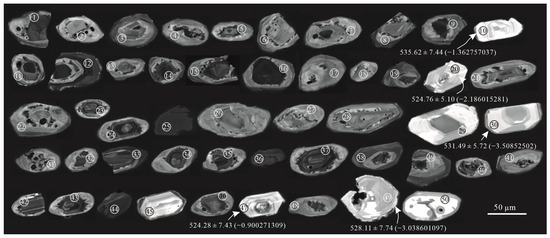
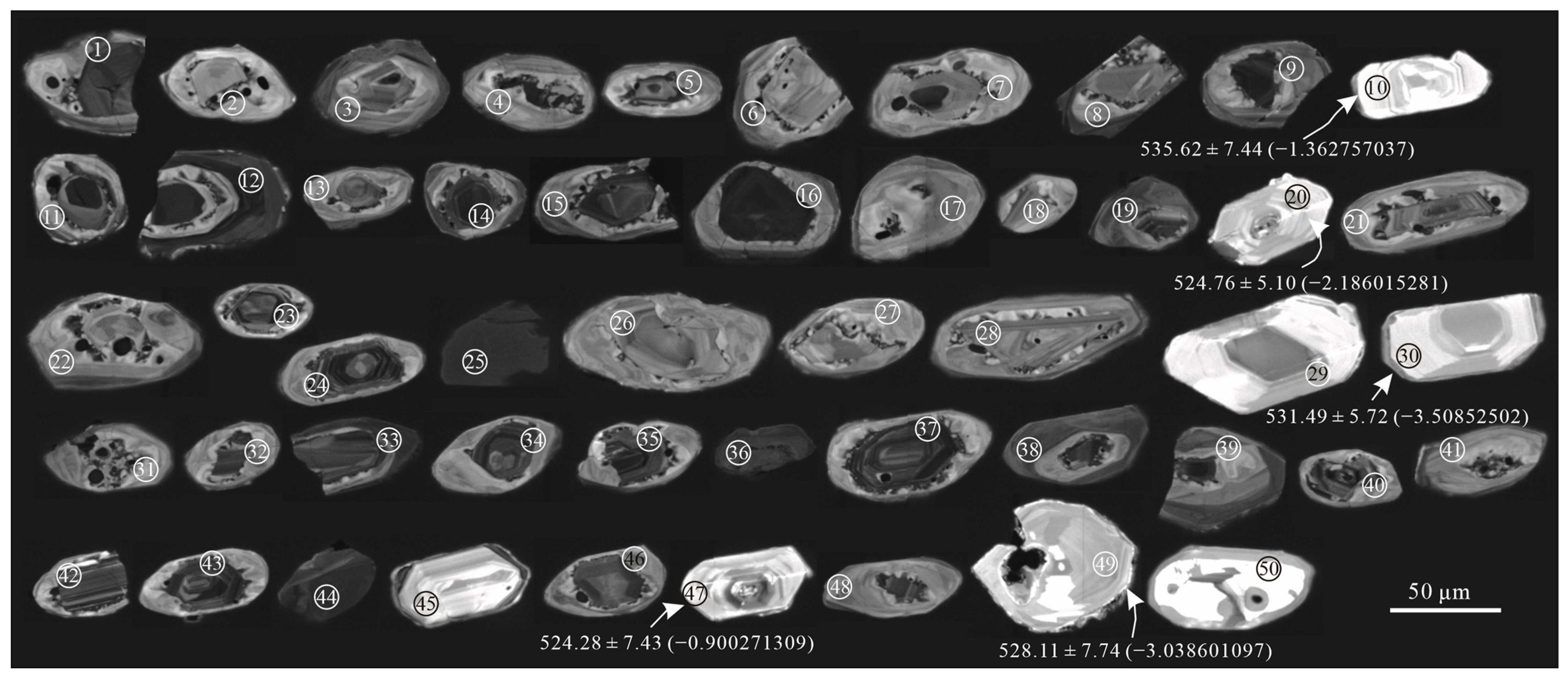
Fifty zircon analyses were obtained from sample WLtw1, of which 48 with concordance ≥90% are used for interpretation and plotting (Table S2). In CL images, the concordant grains comprise two distinct populations: an inherited/detrital population and a Cambrian magmatic population (see Figure 5). Inherited grains manifest as rounded to subhedral, commonly exhibiting core–rim textures, truncated oscillatory zoning, or homogeneous to weakly zoned domains. The Cambrian grains manifest as euhedral to subhedral prisms with sharp, concentric oscillatory zoning; grain WLtw1-29 is distinguished by a bright rim in which primary zoning is locally obliterated by patchy recrystallization.
Figure 5.
Representative cathodoluminescence (CL) images of zircon grains from basaltic andesite sample WLtw1. Numbers correspond to analytical spots in Tables S2–S4. For the five Cambrian magmatic grains, the 206Pb/238U ages (Ma) are shown below the spot numbers and the εHf(t) values in parentheses. Ages are quoted at 1σ. The bright, patchily recrystallized rim of grain WLtw1-29 is the domain that yielded the younger 488.5 Ma age.
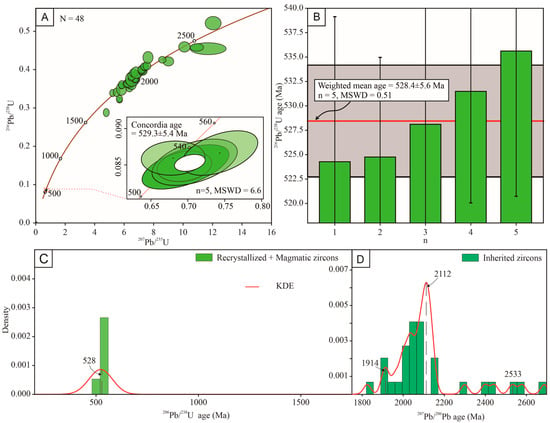
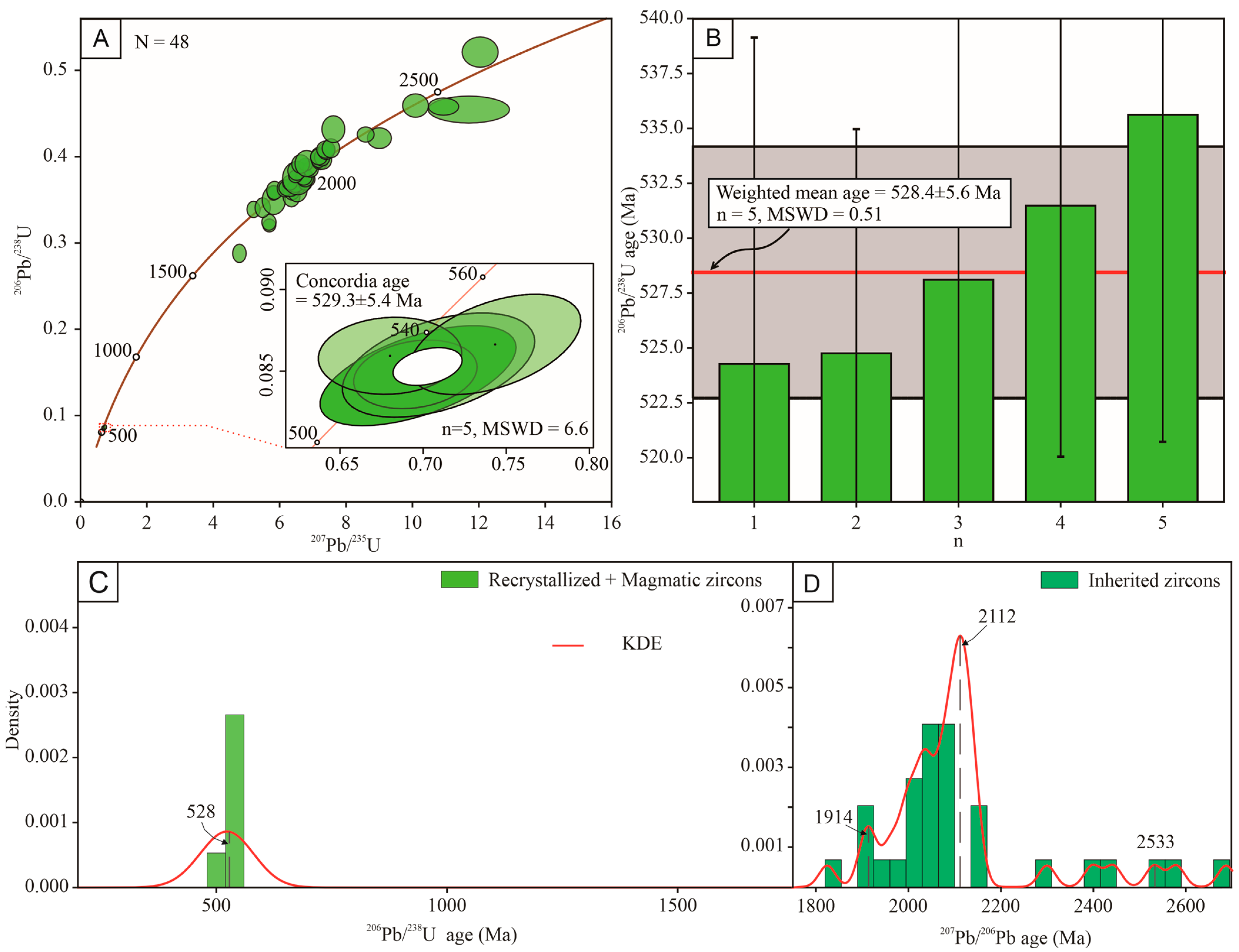
The five Cambrian magmatic zircons yield 206Pb/238U ages of 524.3–535.6 Ma (see Table S2 for details of the 1σ uncertainties associated with each measurement). The analyses are 94%–99% concordant, with Th/U ratios of 0.57–1.58, typical of magmatic zircon, and U contents of 162–547 ppm (Table S2). The five analyses yielded a weighted mean 206Pb/238U age of 528.4 ± 5.6 Ma (2σ; MSWD = 0.51, n = 5; Figure 6A,B) and a concordia age of 529.3 ± 5.4 Ma (2σ; MSWD = 6.6; Figure 6A inset). The latter is the maximum-likelihood age obtained by jointly fitting the 206Pb/238U and 207Pb/235U ratios of the five grains under the constraint of concordance [27,28]. The two estimates overlap within uncertainty, thus confirming a single concordant population. The weighted mean age is adopted as the most reliable estimate of zircon crystallisation (see Section 5.1). Grain WLtw1-29 is concordant (98%) and has a magmatic Th/U ratio (1.28), but yields a younger 206Pb/238U age of 488.5 Ma and anomalously high U (980 ppm); its U–Pb systematics appear to have been disturbed during recrystallization (Section 5.1), and it is therefore treated separately from the main cluster. Two analyses with concordance <90% (WLtw1-25, 78%; WLtw1-45, 88%, 206Pb/238U age 215.4 Ma) are excluded from further interpretation. The remaining 42 concordant grains are inherited, with adopted ages of 1824–2687 Ma (see Figure 6C,D). Thirty-seven of these fall between 1.82 and 2.30 Ga and produce peaks at ca. 1.91 and 2.11 Ga; the remaining five grains are 2.40–2.69 Ga, including a subordinate peak at ca. 2.53 Ga. The majority of the Th/U ratios are greater than 0.1, with four grains exhibiting lower values ranging from 0.011 to 0.067.
Figure 6.
Zircon U–Pb results for sample WLtw1. (A) Concordia diagram for concordant analyses (concordance ≥90%); the inset shows the five-grain Cambrian magmatic group, with the concordia age quoted at 2σ. (B) Weighted mean 206Pb/238U age of the five-grain Cambrian magmatic group; error bars and the weighted-mean band are shown at 2σ (individual 1σ uncertainties are listed in Table S2). (C,D) Histograms and kernel-density estimates for the Cambrian (206Pb/238U) and inherited (207Pb/206Pb) populations. Data are listed in Table S2.
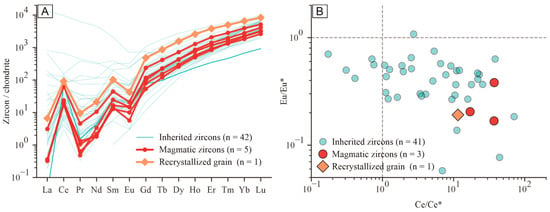
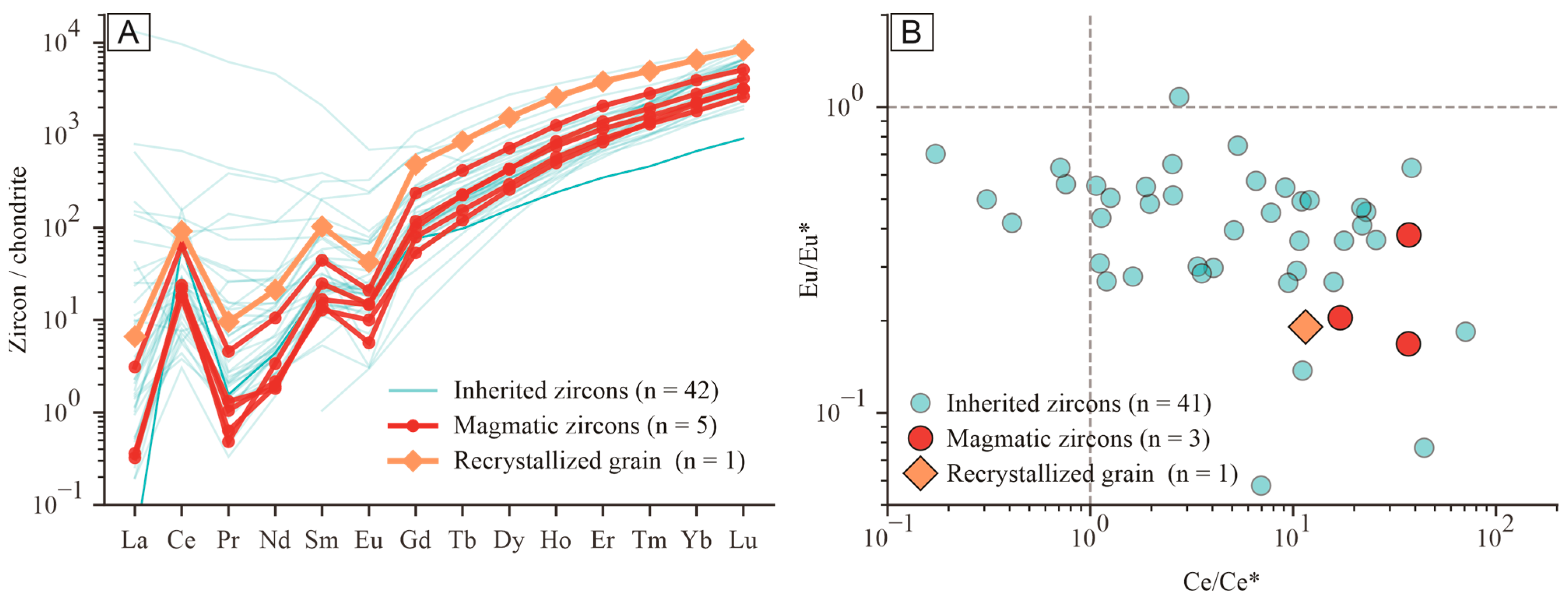
The trace-element compositions of zircon are listed in Table S3 and illustrated in Figure 7. The five magmatic zircons exhibited ∑REE contents ranging from 708 to 1591 ppm, exhibiting notable HREE enrichment (YbN = 1833–3947; LuN = 2628–5122). La was detected at or below the limit of quantification in two grains (LaN ≤ 3.11, where measurable). In instances where Ce anomalies can be calculated (n = 3), they exhibit a strong positive trend (Ce/Ce* = 17.1–37.2), while Eu anomalies demonstrate a negative correlation (Eu/Eu* = 0.17–0.38). The recrystallized grain WLtw1-29 exhibits higher ∑REE (2845 ppm) and remains HREE-enriched (YbN = 6545; LuN = 8379), with Ce/Ce* = 11.5 and Eu/Eu* = 0.19. Inherited zircons demonstrate a significantly broader range (∑REE = 326–13,641 ppm); the majority are HREE-enriched, though a number exhibit elevated LREE contents. Excluding grains with La below detection, inherited grains have Ce/Ce* = 0.17–70.9 and Eu/Eu* = 0.06–1.08.
Figure 7.
(A) Chondrite-normalized REE patterns and (B) Ce/Ce* versus Eu/Eu* diagram for zircons from sample WLtw1. Grains with La below detection are omitted from panel B. Normalization values are after [36]; data are listed in Table S3.
4.4. Zircon Lu–Hf Isotopes
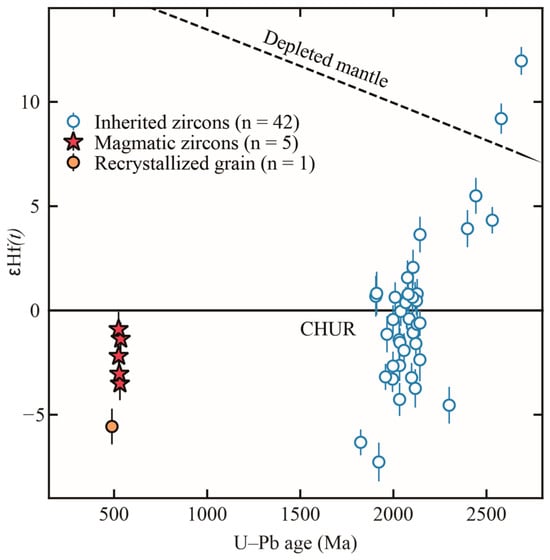
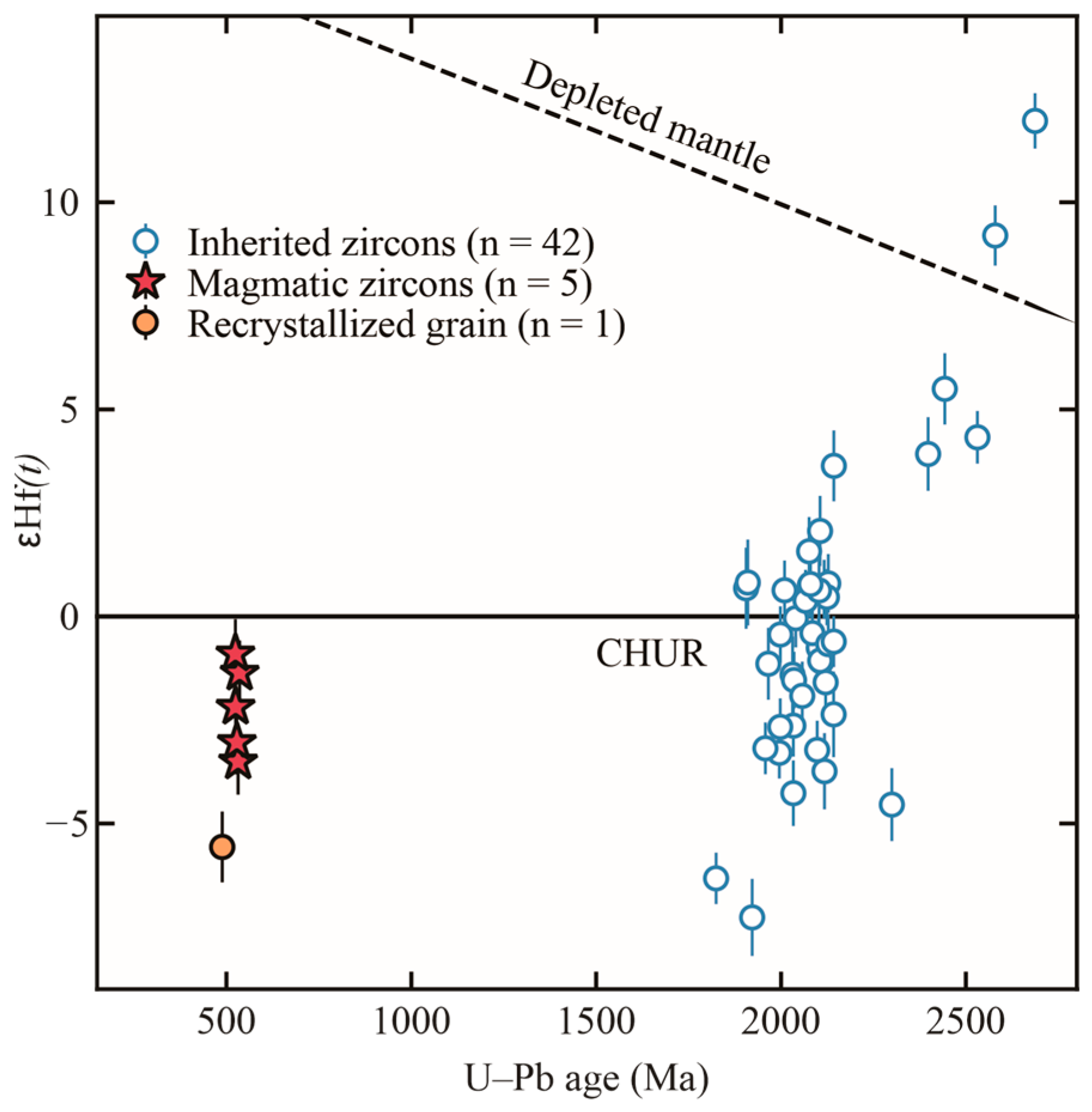
The five magmatic zircons have measured 176Hf/177Hf ratios of 0.282368–0.282449 and negative εHf(t) values of −3.51 to −0.90, with TDM of 1197–1304 Ma and TDMc of 1543–1713 Ma (Table S4, Figure 8). The recrystallized grain WLtw1-29 has a slightly lower 176Hf/177Hf ratio (0.282352), with εHf(t) = −5.57 and TDMc = 1810 Ma. The inherited zircons span 176Hf/177Hf ratios of 0.281246–0.281735 and εHf(t) values of −7.27 to +11.97; 24 grains have negative and 18 positive εHf(t) values. The majority of inherited grains cluster around or below CHUR, whereas two late Neoarchean grains, WLtw1-11 (εHf(t) = +11.97 at 2687 Ma) and WLtw1-42 (+9.20 at 2579 Ma), approach the depleted-mantle reference line. The single-stage and two-stage model ages of the inherited population are TDM = 2306–2820 Ma and TDMc = 2413–3124 Ma, respectively.
Figure 8.
Zircon Lu–Hf isotope compositions for sample WLtw1. CHUR and depleted-mantle (DM) reference lines are shown; data are listed in Table S4.
5. Discussion
5.1. Crystallisation Age of the Xiaowenzhigou Andesite
Five Cambrian zircons from the Xiaowenzhigou Andesite (sample WLtw1) are euhedral with sharp oscillatory zoning, magmatic Th/U ratios (0.57–1.58) and high concordance (94%–99%), and define a tight 206Pb/238U age cluster (524.3–535.6 Ma) with no resolvable internal scatter (MSWD = 0.51). Their weighted mean 206Pb/238U age of 528.4 ± 5.6 Ma (2σ, n = 5) is corroborated by an independently calculated concordia age of 529.3 ± 5.4 Ma (2σ; MSWD = 6.6; Figure 6A inset) and is interpreted as the crystallisation age of the zircons and, given the lack of evidence for a substantial pre-eruptive magma residence, provides a close maximum estimate for the emplacement of the unit.
The concordia age merits further discussion, as it has been demonstrated to constrain the reliability of this five-grain age in a manner that the weighted mean alone cannot. The weighted mean considers only the 206Pb/238U ratios, whereas the concordia age is a maximum-likelihood estimate that jointly fits the 206Pb/238U and 207Pb/235U ratios of all five grains under the constraint of concordance [27,28]. Its associated MSWD simultaneously tests whether the grains form an equivalent (single-age) population and whether their U–Pb systematics are concordant. Two points can be deduced from this. Firstly, the concordia age (529.3 ± 5.4 Ma) is indistinguishable from the weighted mean 206Pb/238U age (528.4 ± 5.6 Ma). It can therefore be concluded that the two decay chains record the same age, and the population is free of resolvable Pb loss or common-Pb disturbance. The decay chain of uranium-235 (235U) thus independently reproduces the age based on uranium-238 (238U), thereby materially strengthening an estimate that is based on only five grains. Secondly, the elevated MSWD of the concordia age (6.6) does not reflect scatter within the 206Pb/238U system (MSWD = 0.51), but rather arises from the concordance component of the joint test: the weighted mean 207Pb/235U age of the same grains (540.1 ± 10.3 Ma, 2σ; MSWD = 1.45) is slightly, though systematically, older than their 206Pb/238U age. At ca. 530 Ma the accumulated radiogenic 207Pb signal is small, so 207Pb/235U ratios carry proportionally larger relative uncertainties and are more sensitive to minor Pb loss; a modest offset of this kind is expected for grains that are 94%–99% concordant and does not indicate geologically meaningful open-system behavior. Because the 206Pb/238U system is intrinsically the most precise U–Pb chronometer for zircons younger than ca. 1 Ga, we retain the weighted mean 206Pb/238U age as the primary estimate and use the concordia age as independent validation of concordance.
Given the well-developed oscillatory zoning and lack of evidence for antecrysts, this age is regarded as a precise proxy for the emplacement age. Nevertheless, emplacement may have occurred at a slightly younger date. We note, however, that the age is based on only five analyses from a single sample. As outlined in Section 3.1, the unit is presently recognized from a single (ca. 0.03 km2), isolated outcrop and is zircon-poor; consequently, no further isotopic samples could be obtained. The reported age is the most accurate estimate currently available, and it is presented here explicitly as a preliminary record that will be subject to future testing through additional sampling should new exposures be identified. Within the 2σ uncertainty range of the crystallisation (522.8–534.0 Ma), it is constrained to the early Cambrian (Terreneuvian, tentatively assigned to Cambrian Stage 2) [1]. We note that this 2σ interval straddles the Fortunian–Cambrian Stage 2 boundary (ca. 529 Ma) [1]; accordingly, assignment to Cambrian Stage 2 should be regarded as tentative.
A sixth grain, designated WLtw1-29, yielded a nominally concordant (98%) but markedly younger 206Pb/238U age of 488.5 Ma. In CL images, the analytical spot is located within a bright, highly luminescent rim, where primary oscillatory zoning is obliterated by patchy, structureless recrystallization textures that truncate the darker euhedral core (Figure 5). The U content of this particular specimen (980 ppm) is 1.8–6 times that of the other Cambrian grains. These observations indicate that the dated domain underwent recrystallization, most plausibly accompanied by fluid-mediated disturbance of the U–Pb system, and its 488.5 Ma age is therefore not interpreted as a crystallisation age of the andesite. The age of the specimen is indeterminate, as it cannot be resolved from a single grain whether the age records a post-magmatic thermal or fluid event, or instead a slightly younger xenocrystic component. Consequently, it is excluded from the calculation of age, thus avoiding further speculation. The εHf(t) value of −5.57 is broadly consistent with the evolved Hf signature of the main cluster.
The inherited zircons (n = 42) are predominantly Paleoproterozoic (1.82–2.30 Ga), with peaks at ca. 1.91 and 2.11 Ga; the remainder are Neoarchean to earliest Paleoproterozoic (2.40–2.69 Ga). This spectrum closely matches the basement of the northeastern NCC, where ca. 2.5 Ga TTG gneisses are extensively overprinted by 2.2–1.9 Ga magmatism within the Jiao–Liao–Ji belt [2,3], indicating assimilation of local basement during magma ascent. In accordance with this, the negative εHf(t) values (−3.51 to −0.90) and Paleoproterozoic model ages (TDMc = 1543–1713 Ma) of the Cambrian magmatic zircons indicate a parental magma derived primarily from remelting of Paleoproterozoic crust. The Xiaowenzhigou Andesite is therefore one of the few directly dated early Cambrian magmatic rocks within the NCC, and it offers a potential local source for the early Cambrian detrital zircons that are pervasive in the Cambrian strata of the craton (Section 5.2).
5.2. Early Cambrian Magmatism Within the NCC: A Local Source for Early Cambrian Detrital Zircons in Paleozoic Strata
As outlined in Section 1, Cambrian–earliest Ordovician detrital zircons (ca. 488–540 Ma) are prevalent in Cambrian strata across the NCC, and their provenance—i.e., whether they originate from local magmatism or from distant Pan-African orogens of East Gondwana [12]—has long been debated. This controversy directly impacts the early Paleozoic paleogeographic position of the craton [8,10].
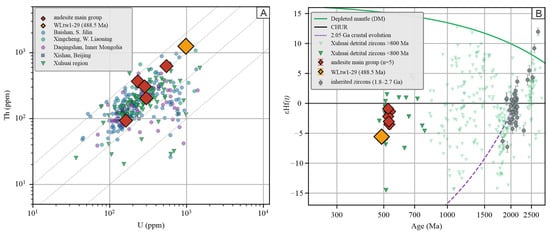
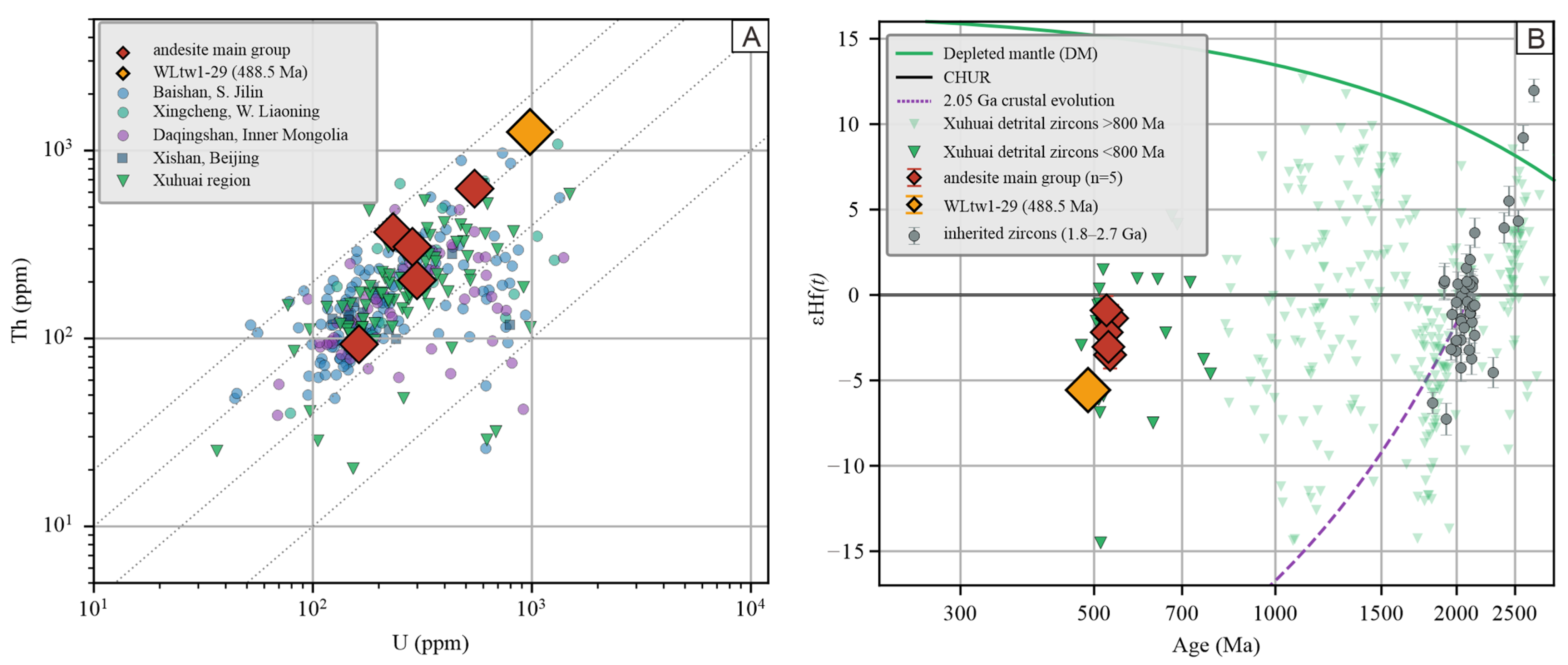
The Xiaowenzhigou Andesite (528.4 ± 5.6 Ma) provides, to our knowledge, the first direct magmatic constraint on this debate in the northeastern NCC. Cambrian detrital zircons from the NCC strata exhibit a close match in age, Th/U ratio and, where available, Hf isotopic composition (Table S2; Figure 9). The temporal range of magmatic grains from the Xuzhuang Formation has been determined to be 489.1–524.5 Ma [7]. In the Xuhuai region, 38 concordant grains span 488–540 Ma, the majority exhibiting magmatic Th/U ratios [11]. In that study, seven of the ten Cambrian detrital zircons with Hf isotope data from Xuhuai exhibited εHf(t) values ranging from −6.9 to −0.5, exhibiting significant similarity to and overlap with those of the andesite (εHf(t) = −3.51 to −0.90; TDMc = 1543–1713 Ma). This observation suggests that there has been a derivation from crustal sources that are broadly similar and remelted during the Paleoproterozoic era. However, the limited number of magmatic analyses conducted thus far precludes the establishment of a definitive provenance link. The remaining three grains (εHf(t) = −14.5 to +1.5) record additional evolved and mildly juvenile inputs, indicating source heterogeneity within rather than beyond the craton. Caution is nevertheless required when interpreting the youngest detrital ages (488–490 Ma) as a discrete magmatic pulse. As illustrated by grain WLtw1-29, concordant ca. 488 Ma ages can also arise from the disturbance of older magmatic zircons. The differentiation of these alternatives for detrital grains necessitates the analysis of textural and isotopic data, which is not always available.
Figure 9.
Comparison of Cambrian zircons from the North China Craton with magmatic zircons of the Xiaowenzhigou basaltic andesite (this study). (A) Th versus U contents (450–800 Ma grains); (B) εHf(t) versus U–Pb age. Data for the Xiaowenzhigou Andesite are from sample WLtw1 (this study; Tables S2 and S4). Detrital zircon data sources: Mantou Formation at Baishan (southern Jilin), Xingcheng (western Liaoning) and Daqingshan (Inner Mongolia) [37]; Xuzhuang Formation, Xishan, Beijing [7]; Xuhuai region [11,38].
Independent records corroborate such concealed early Cambrian magmatism within the craton: inherited zircons with a ca. 520 Ma age peak occur in the Jurassic Nandaling basalt of the Western Hills of Beijing [14], and a ca. 526 Ma detrital zircon fission-track peak in the Bohai Bay Basin records an early Cambrian uplift event [9]. Phanerozoic (ca. 100–500 Ma) detrital zircons of the eastern craton likewise record post-Precambrian magmatic activity in this region [39], and Ordovician kimberlite magmatism at Mengyin and Fuxian demonstrates that the craton interior itself was magmatically active during the early Paleozoic [40]. Coeval detrital populations have also been identified in the Taebaeksan Basin of Korea, thereby supporting the hypothesis that this basin is closely linked to the North China platform during the Cambrian [41,42,43]. When considered as a whole, these records suggest that the NCC was host to early Paleozoic (ca. 530–480 Ma) magmatism, characterized by crustal reworking, and the Xiaowenzhigou Andesite is recognized as one of the first dated exposures along the northeastern craton margin. This magmatism, whether exposed or concealed beneath the Cambrian cover, is capable of supplying at least part of the early Cambrian detrital-zircon budget of Paleozoic strata of the craton, thereby substantially reducing—though not eliminating—the need to invoke transport from East Gondwana. This in turn supports an early Paleozoic NCC whose own marginal magmatic systems, rather than exotic orogens, controlled the detrital budget of its interior basins.
5.3. Petrogenesis and Magma Source
The low LOI values (1.25–1.79 wt%), weak saponitization and restricted compositional range of samples YQ1–YQ3 indicate limited post-magmatic alteration and a cogenetic origin, so that high-field-strength elements (HFSE) and REE, which are essentially immobile during low-temperature alteration, can be used reliably to constrain petrogenesis.
Distinct compositional characteristics distinguish the Xiaowenzhigou Andesite from typical mantle-derived arc magmas. The samples are metaluminous (molar A/CNK = 0.77–0.82) but markedly enriched in LILE and LREE, with pronounced negative Nb–Ta anomalies (Nb/Nb* = 0.32–0.35), high La/Nb (3.73–4.20) and Ba/Nb (60.6–74.6), elevated Th/U (4.50–5.12) and low Ce/Pb (12.0–15.1). Such signatures are characteristic of continental crust rather than of slab- or mantle-derived melts, and the superchondritic Nb/Ta (22.3–23.6) and high Zr/Hf (49.3–50.0) ratios are likewise consistent with derivation from, and differentiation within, continental crust. Together with the uniformly negative εHf(t) values of the magmatic zircons and the abundant basement-aged inherited zircons (Section 4.3 and Section 4.4), these characteristics indicate a predominantly crustal origin for the parental magma.
The rare-earth systematics provide further constraints on the depth of melting. The samples are characterized by a significant depletion of HREE, with (La/Yb)N ratios ranging from 28.2 to 31.9 and (Gd/Yb)N ratios from 3.55 to 3.79. These samples also exhibit high concentrations of Sr (1057–1154 ppm), in conjunction with the absence of Sr anomalies and the presence of only weakly negative Eu anomalies (Eu/Eu* = 0.941–0.945). This phenomenon can be most readily explained by the partial melting of rocks at lower crustal pressures, where garnet and/or amphibole remained residual but plagioclase did not, a process analogous to the conditions that generate adakite-like melts. The hypothesis that shallow fractional crystallization of a mantle-derived basaltic parent, dominated by plagioclase, would produce complementary Sr and Eu depletion is not supported by the observed data. The presence of pyroxene-dominated fractionation or minor plagioclase accumulation cannot be excluded on geochemical grounds alone; however, the restricted whole-rock compositions and the lack of petrographic evidence for feldspar accumulation argue against a major accumulated component. We propose that partial melting of the thickened or foundered lower crust of the NCC was the dominant process.
The Cambrian magmatic zircons have negative εHf(t) values (−3.51 to −0.90), well below the depleted-mantle reference, and Paleoproterozoic two-stage model ages (TDMc = 1543–1713 Ma), indicating that the parental magma was derived predominantly from remelting of Paleoproterozoic crust rather than from the contemporaneous depleted mantle. The abundant inherited zircons (1.82–2.69 Ga; εHf(t) = −7.27 to +11.97) yield an age spectrum that closely matches the ca. 2.5 Ga TTG basement and the 2.2–1.9 Ga Jiao–Liao–Ji magmatism of the northeastern NCC [2,3,39,44], providing direct evidence for the assimilation of such basement during magma ascent and storage. The strongly positive Ce anomalies (Ce/Ce* = 17.1–37.2; n = 3) and negative Eu anomalies (Eu/Eu* = 0.17–0.38) of the magmatic zircons indicate crystallisation from oxidized, feldspar-saturated crustal melts, consistent with the whole-rock signature.
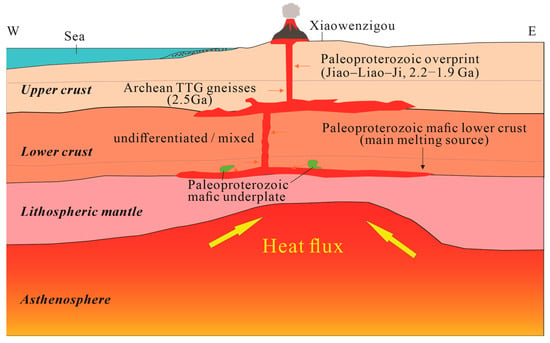
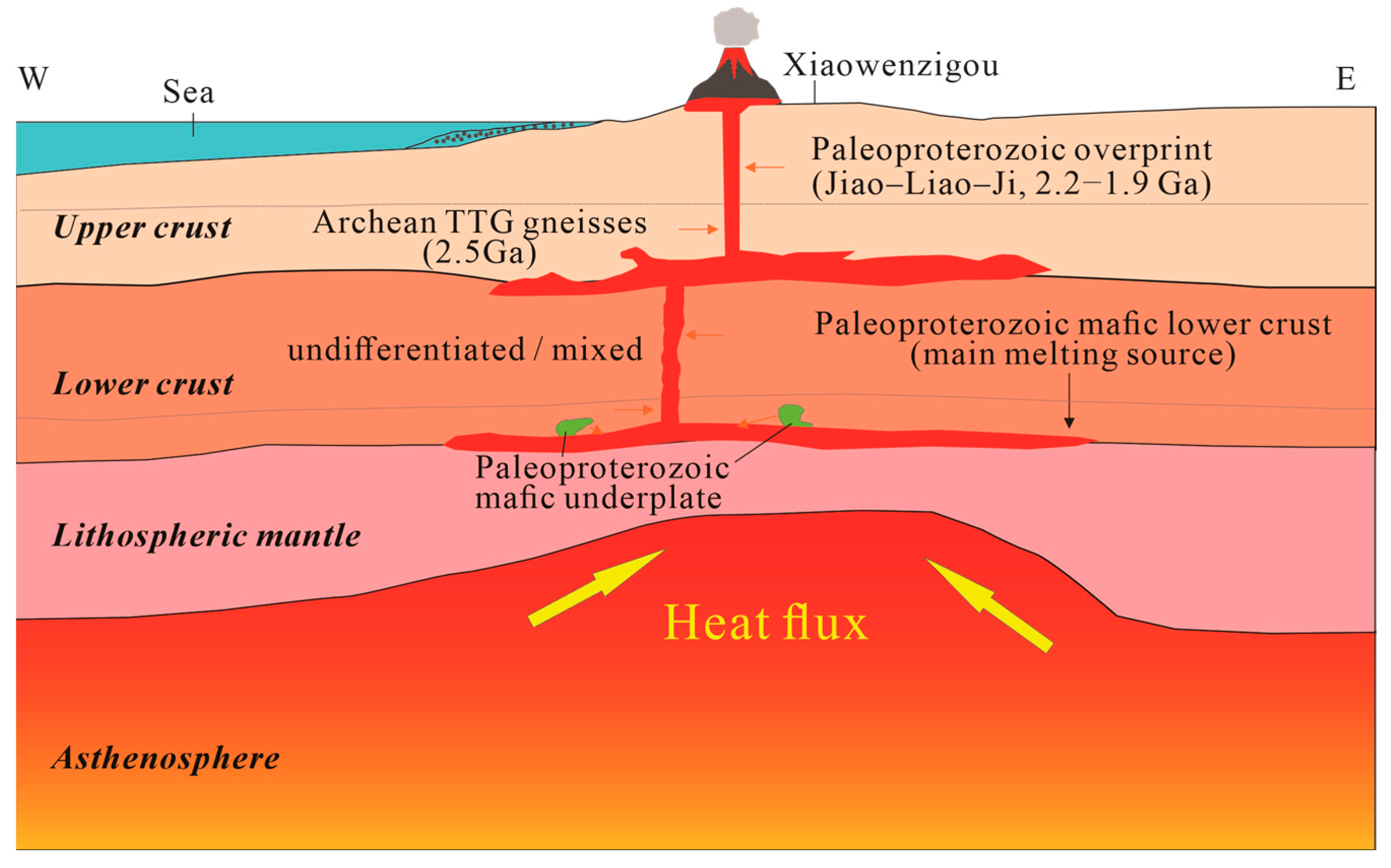
The petrogenetic model proposed here is as follows. During the early Cambrian period, a significant increase in thermal activity beneath the northeastern NCC (most likely attributable to the influx of heat and magma from the mantle) led to the partial melting of Paleoproterozoic mafic lower crust. This process resulted in the generation of a high-Sr, HREE-depleted andesitic melt, characterized by an inherited crustal trace-element and Hf-isotope signature. During the ascent, the melt assimilated Archean–Paleoproterozoic basement, a process that has now been recorded by the inherited zircon cargo. The melt underwent only limited differentiation prior to eruption, as indicated by the restricted whole-rock compositions and the preservation of oscillatory-zoned magmatic zircons. Minor juvenile input cannot be excluded, as indicated by the least negative εHf(t) value of −0.90, which approaches CHUR, but the majority of the magma budget was crustal. Integrating the whole-rock geochemical, zircon U-Pb geochronological, and Lu-Hf isotopic data presented above, we propose a crustal melting model for the genesis of the Xiaowenzhigou basaltic andesite, as illustrated in Figure 10.
Figure 10.
Cartoon cross-section model (W–E) illustrating the petrogenesis of the Xiaowenzhigou high-K basaltic andesite (ca. 528 Ma).
5.4. Tectonic Implications
The recognition of early Cambrian magmatism at Xiaowenzhigou challenges the long-held view that the interior of the NCC was magmatically quiescent throughout the Cambrian. The arc-like trace-element signature of the andesite is best explained as an inheritance from its Paleoproterozoic crustal source, rather than as a fingerprint of a contemporaneous subduction system. Consequently, geochemistry alone is insufficient for determining the tectonic setting. The tectonic driver of this magmatism must instead be assessed from its regional and temporal context. Two non-exclusive scenarios are plausible. Firstly, the early Cambrian thermal event may record far-field reactivation of the northeastern craton margin in response to plate-boundary processes then operating along the margins of the craton [4,5,6,45]. These processes were transmitted into the weakened Paleoproterozoic lithosphere of the Jiao–Liao–Ji belt. Secondly, the phenomenon may be indicative of localized lithospheric extension and decompression along reactivated Paleoproterozoic sutures. Such a development would promote lower-crustal melting through mantle upwelling and provide pathways for magma ascent. The data presented herein are consistent with the hypothesis that the ancient sutures of the northeastern NCC remained zones of lithospheric weakness susceptible to reactivation long after their Paleoproterozoic formation.
Furthermore, the Xiaowenzhigou Andesite suggests that the distribution of Cambrian magmatic rocks within the NCC may be more extensive than their limited exposure suggests. A substantial portion of the craton is covered by Cambrian–Ordovician marine strata and younger deposits, beneath which coeval intrusions and volcanics may be concealed. The ca. 520 Ma inherited zircons in the Jurassic Nandaling basalt [14] and the ca. 526 Ma detrital zircon fission-track peak in the Bohai Bay Basin [9] may record erosion or assimilation of such concealed magmatic bodies. The andesite, erroneously categorized as a Cretaceous unit in previous classifications, serves to illustrate the ease with which early Cambrian magmatism can evade recognition in regions of poor exposure.
This finding is directly relevant to the early Paleozoic paleogeographic position of the NCC. The data presented herein are consistent with the hypothesis that the craton hosted its own early Cambrian magmatic systems. The presence of detrital zircons from the early Cambrian in its Cambrian strata [7,8,9,10,11] may not require long-distance transport from Pan-African orogens of East Gondwana. The coeval populations in the Taebaeksan Basin of Korea are consistent with derivation from the same North China magmatic systems [41,42,43]. It is therefore suggested that, at the least, the margins of the early Cambrian NCC—and potentially parts of its interior—were subject to magmatic and tectonic activity. In order to test this suggestion, further targeted dating of unclassified volcanic units along the northeastern margin is required.
6. Conclusions
(1) Zircon U–Pb dating of the basaltic andesite near Xiaowenzhigou Village in eastern Liaoning yielded a weighted mean 206Pb/238U age of 528.4 ± 5.6 Ma, corroborated by a concordia age of 529.3 ± 5.4 Ma, which confirms that the grains form a single concordant population unaffected by resolvable Pb loss. Although based on only five zircons from a single sample—an unavoidable limitation imposed by the small, isolated outcrop and the zircon-poor nature of the rock—this result provides, to our knowledge, the first direct evidence for early Cambrian (Terreneuvian) magmatism in the northeastern North China Craton. The unit is therefore distinguished from the Lower Cretaceous Lishugou Formation, with which it was previously associated, and is informally named the Xiaowenzhigou Andesite.
(2) The basaltic andesite is a weakly altered, metaluminous, high-K calc-alkaline pyroxene basaltic andesite, enriched in LILE and LREE and depleted in Nb–Ta, with high Sr contents, strong HREE depletion, and only weak negative Eu anomalies. Combined with negative zircon εHf(t) values (−3.51 to −0.90) and Paleoproterozoic Hf model ages (TDMc = 1543–1713 Ma), these features indicate that the parental magma was generated mainly by partial melting of Paleoproterozoic lower crust, accompanied by assimilation of Archean–Paleoproterozoic basement as recorded by abundant inherited zircons (1.82–2.69 Ga; εHf(t) = −7.27 to +11.97). The inherited zircons further suggest that the concealed basement beneath eastern Liaoning comprises Archean TTG gneisses extensively overprinted by Paleoproterozoic magmatism, similar to the exposed rocks of the Jiao–Liao–Ji belt.
(3) The Xiaowenzhigou Andesite demonstrates that at least localized early Cambrian magmatism occurred in the northeastern NCC, challenging the view that the craton was magmatically quiescent at that time, and represents a plausible local source for some of the widespread early Cambrian detrital zircons in Paleozoic strata of the craton, reducing the need to invoke detrital supply from East Gondwanan orogens. Comparable early Cambrian magmatic units may remain concealed beneath the Cambrian cover or misclassified elsewhere in the craton. In view of the limited data, these conclusions are necessarily provisional. The principal aim of this preliminary documentation is to emphasize the significance of this unit and to encourage further sampling and analysis.
Supplementary Materials
The following supporting information can be downloaded at: https://www.mdpi.com/article/10.3390/min16111105/s1, Table S1: Whole-rock major- and trace-element compositions; Table S2: Zircon U–Pb isotope ratios and ages for sample WLtw1; Table S3: Zircon trace-element compositions for sample WLtw1; Table S4: Zircon Lu–Hf isotope compositions for sample WLtw1.
Author Contributions
Conceptualization, Z.W.; methodology, Z.W., S.D. and Y.Q.; investigation, Z.W., S.D., Y.Q., H.Z., W.M. and M.Z.; data curation, S.D. and Y.Q.; writing—original draft preparation, Z.W.; writing—review and editing, Z.W., Y.Q., H.Z. and M.Z.; supervision, Z.W.; project administration, Z.W.; funding acquisition, Z.W. All authors have read and agreed to the published version of the manuscript.
Funding
This research was funded by the Natural Science Foundation of Inner Mongolia Autonomous Region (Grant No. 2026MS0444) and the High-level Talent Torch Program of Inner Mongolia University of Science and Technology (Grant No. 2025KJJH2025908).
Institutional Review Board Statement
Not applicable.
Informed Consent Statement
Not applicable.
Data Availability Statement
Data supporting this study are provided in the Supplementary Tables (Tables S1–S4).
Acknowledgments
We are grateful to the editorial team for their efficient handling of this manuscript. Constructive comments from anonymous reviewers significantly improved the quality and clarity of this paper.
Conflicts of Interest
Author Wenpo Ma was employed by the company Liaoning Institute of Geological Exploration Co., Ltd. The remaining authors declare that the research was conducted in the absence of any commercial or financial relationships that could be construed as a potential conflict of interest.
References
- Cohen, K.M.; Finney, S.C.; Gibbard, P.L.; Fan, J.-X. The ICS international chronostratigraphic chart. Episodes 2013, 36, 199–204. [Google Scholar] [CrossRef] [Scilit]
- Zhao, G.C.; Sun, M.; Wilde, S.A.; Li, S.Z. Late archean to Paleoproterozoic evolution of the North China Craton: Key issues revisited. Precambrian Res. 2005, 136, 177–202. [Google Scholar] [CrossRef] [Scilit]
- Lu, X.P.; Wu, F.Y.; Guo, J.H.; Wilde, S.A.; Yang, J.H.; Liu, X.M.; Zhang, X.O. Zircon U–Pb geochronological constraints on the Paleoproterozoic crustal evolution of the eastern block in the North China Craton. Precambrian Res. 2006, 146, 138–164. [Google Scholar] [CrossRef] [Scilit]
- Zhao, G.C.; Cawood, P.A.; Li, S.Z.; Wilde, S.A.; Sun, M.; Zhang, J.; He, Y.H.; Yin, C.Q. Amalgamation of the North China Craton: Key issues and discussion. Precambrian Res. 2012, 222, 55–76. [Google Scholar] [CrossRef] [Scilit]
- Chen, Y.; Zhang, Z.; Qian, X.; Li, J.; Ji, Z.; Wu, T. Early to Mid-Paleozoic magmatic and sedimentary records in the Bainaimiao arc: An advancing Subduction-induced terrane accretion along the northern margin of the North China Craton. Gondwana Res. 2020, 79, 263–282. [Google Scholar] [CrossRef] [Scilit]
- Zeng, H.; Song, D.; Xiao, W.; Li, P. Accretion of an early Paleozoic Alaska-type arc onto northern North China: Implications for continental growth of the central asian orogenic belt. GSA Bull. 2023, 135, 2621–2647. [Google Scholar] [CrossRef] [Scilit]
- Hu, B.; Zhai, M.G.; Peng, P.; Liu, F.; Diwu, C.R.; Wang, H.Z.; Zhang, H.D. Late Paleoproterozoic to Neoproterozoic geological events of the North China Craton: Evidence from LA-ICP-MS U–Pb geochronology of detrital zircons from the Cambrian and Jurassic sedimentary rocks in western hills of Beijing. Acta Petrol. Sin. 2013, 29, 2508–2536, (In Chinese with English abstract). [Google Scholar]
- Liu, J.; Dong, Y.C.; Liu, Z.H.; Liu, J.L.; Li, W.Q.; Li, G.; Dong, X.J.; Gao, Y.; Zhang, H.X. Detrital zircon U–Pb ages for the lower Cambrian Mantou formation in Liaoning, northeastern China: Implications for sediment provenance and the early palaeozoic palaeogeographic position of the North China Craton with respect to East Gondwana. Geosyst. Geoenviron. 2023, 2, 100215. [Google Scholar] [CrossRef] [Scilit]
- Li, L.; Zhong, D.L. Tectonic uplift recorded by detrital zircon fission track age in Jiyang depression, Bohai bay basin. Acta Petrol. Sin. 2018, 34, 483–494, (In Chinese with English abstract). [Google Scholar]
- Wei, R.H.; Duan, L.; Zhang, X.L.; Meng, Q.R.; Zhan, R.R.; Ma, C.X.; Xu, J.; Shi, Y.; Zhang, X.Y. Detrital zircon age signatures of the basal Cambrian sandstone unit in North China: Implications for drainage divides during global Sauk transgression and separation from Gondwanaland. Int. Geol. Rev. 2023, 65, 1524–1540. [Google Scholar] [CrossRef] [Scilit]
- Li, Z.S.; Zhang, Y.; Tan, M.Z.; An, W.; Lan, Z.W.; Ma, X.T.; Zhang, J.D. Cambrian provenance transition in the southeastern North China Craton and its tectonic implications: Detrital zircon U–Pb–Hf signatures from the Xuhuai region. Gondwana Res. 2025, 147, 233–259. [Google Scholar] [CrossRef] [Scilit]
- Dan, W.; Murphy, J.B.; Tang, G.J.; Zhang, X.Z.; White, W.M.; Wang, Q. Cambrian–ordovician magmatic Flare-up in NE Gondwana: A silicic large igneous province? GSA Bull. 2023, 135, 1618–1632. [Google Scholar] [CrossRef] [Scilit]
- Li, G.J.; Chen, L.; Pang, K.; Han, C.M.; Yang, L.; Wan, B.; Yang, F.J. The characteristics of LA-ICP-MS detrital zircon U–Pb age spectrum from the Cambrian Liguan formation in western Shandong and their geological significance. J. Stratigr. 2020, 44, 115–135, (In Chinese with English abstract). [Google Scholar]
- Zhao, Y.; Song, B.; Zhang, S.H.; Liu, J. Geochronology of the inherited zircons from the changcheng system in the Yanqing basin, Beijing. Geol. Rev. 2006, 52, 35–43, (In Chinese with English abstract). [Google Scholar]
- LPIGE (Liaoning Provincial Institute of Geological Exploration). Geological Map of Dandong K-51-C-004003, Scale 1:250,000, 1 Sheet, 2003; Liaoning Provincial Institute of Geological Exploration: Dalian, China, 2003. (In Chinese) [Google Scholar]
- LPIGE (Liaoning Provincial Institute of Geological Exploration). Geological Map of Erhulai K-51-E-016021, Scale 1:50,000, 1 Sheet, 2013; Liaoning Provincial Institute of Geological Exploration: Dalian, China, 2013. (In Chinese) [Google Scholar]
- Wu, Z.J.; Wang, H.P.; Gao, F.L.; Zhang, G.R.; Wang, M.C.; Luo, N.G. The first discovery of Eosestheria in eastern liaoning, China. Acta Geol. Sin.—Engl. Ed. 2019, 93, 479–480. [Google Scholar] [CrossRef] [Scilit]
- Wu, Z.J.; Gao, F.L.; Qiu, L.W.; Wang, H.P.; Zhong, M.S.; Gao, Y.Z. First report of osteoglossiform fish Huashia from the Cretaceous of eastern liaoning, China. Acta Geol. Sin.—Engl. Ed. 2021, 95, 1406–1408. [Google Scholar] [CrossRef] [Scilit]
- Li, G.; Wu, Z. Early Cretaceous clam shrimp Yanjiestheria (Spinicaudata, Crustacea) from eastern liaoning, northeastern China. Cretac. Res. 2021, 128, 104962. [Google Scholar] [CrossRef] [Scilit]
- Tan, X.; Feng, Y.; Liang, F.; Li, Y.; Sun, C.; Sun, G. Lower Cretaceous palynoflora from the Binggou Formation of Jianchang Basin, western Liaoning, NE China and its U–Pb zircon age. Cretac. Res. 2026, 179, 106247. [Google Scholar] [CrossRef] [Scilit]
- LBGMR (Liaoning Bureau of Geology and Mineral Resources). Regional Geology of Liaoning Province; Geological Publishing House: Beijing, China, 1989; 856p, (In Chinese with English abstract). [Google Scholar]
- Chang, S.C.; Hemming, S.R.; Gao, K.Q.; Zhou, C.F. 40ar/39ar age constraints on Cretaceous Fossil-bearing formations near the china–north Korea border. Palaeogeogr. Palaeoclimatol. Palaeoecol. 2014, 396, 93–98. [Google Scholar] [CrossRef] [Scilit]
- Thompson, J.M.; Meffre, S.; Danyushevsky, L.V. Impact of air, laser pulse width and fluence on U–Pb dating of zircons by LA-ICPMS. J. Anal. At. Spectrom. 2018, 33, 221–230. [Google Scholar] [CrossRef] [Scilit]
- Paton, C.; Woodhead, J.D.; Hellstrom, J.C.; Hergt, J.M.; Greig, A.; Maas, R. Improved laser ablation U–Pb zircon geochronology through robust downhole fractionation correction. Geochem. Geophys. Geosyst. 2010, 11, Q0AA06. [Google Scholar] [CrossRef] [Scilit]
- Wiedenbeck, M.; Allé, P.; Corfu, F.; Griffin, W.L.; Meier, M.; Oberli, F.; von Quadt, A.; Roddick, J.C.; Spiegel, W. Three natural zircon standards for u–th–pb, lu–hf, trace element and REE analyses. Geostand. Newsl. 1995, 19, 1–23. [Google Scholar] [CrossRef] [Scilit]
- Sláma, J.; Košler, J.; Condon, D.J.; Crowley, J.L.; Gerdes, A.; Hanchar, J.M.; Horstwood, M.S.A.; Morris, G.A.; Nasdala, L.; Norberg, N.; et al. Plešovice zircon—A new natural reference material for U–Pb and Hf isotopic microanalysis. Chem. Geol. 2008, 249, 1–35. [Google Scholar] [CrossRef] [Scilit]
- Vermeesch, P. Isoplotr: A free and open toolbox for geochronology. Geosci. Front. 2018, 9, 1479–1493, Correction in Geosci. Front. 2021, 12, 101227. [Google Scholar] [CrossRef] [Scilit]
- Ludwig, K.R. On the treatment of concordant uranium–lead ages. Geochim. Cosmochim. Acta 1998, 62, 665–676. [Google Scholar] [CrossRef] [Scilit]
- Wu, F.Y.; Yang, Y.H.; Xie, L.W.; Yang, J.H.; Xu, P. Hf isotopic compositions of the standard zircons and baddeleyites used in U–Pb geochronology. Chem. Geol. 2006, 234, 105–126. [Google Scholar] [CrossRef] [Scilit]
- Scherer, E.; Münker, C.; Mezger, K. Calibration of the lutetium–hafnium clock. Science 2001, 293, 683–687. [Google Scholar] [CrossRef] [Scilit]
- Blichert-Toft, J.; Albarède, F. The Lu–Hf isotope geochemistry of chondrites and the evolution of the mantle–crust system. Earth Planet. Sci. Lett. 1997, 148, 243–258. [Google Scholar] [CrossRef] [Scilit]
- Griffin, W.L.; Pearson, N.J.; Belousova, E.; Jackson, S.E.; van Achterbergh, E.; O’Reilly, S.Y.; Shee, S.R. The Hf isotope composition of cratonic mantle: Lam-mc-icpms analysis of zircon megacrysts in kimberlites. Geochim. Cosmochim. Acta 2000, 64, 133–147. [Google Scholar] [CrossRef] [Scilit]
- Griffin, W.L.; Wang, X.; Jackson, S.E.; Pearson, N.J.; O’Reilly, S.Y.; Xu, X.; Zhou, X. Zircon chemistry and magma mixing, SE China: In-situ analysis of Hf isotopes, Tonglu and Pingtan igneous complexes. Lithos 2002, 61, 237–269. [Google Scholar] [CrossRef] [Scilit]
- Peccerillo, A.; Taylor, S.R. Geochemistry of eocene Calc-alkaline volcanic rocks from the kastamonu area, northern turkey. Contrib. Mineral. Petrol. 1976, 58, 63–81. [Google Scholar] [CrossRef] [Scilit]
- McDonough, W.F.; Sun, S.-S. The composition of the earth. Chem. Geol. 1995, 120, 223–253. [Google Scholar] [CrossRef] [Scilit]
- Sun, S.-S.; McDonough, W.F. Chemical and isotopic systematics of oceanic basalts: Implications for mantle composition and processes. Geol. Soc. Lond. Spec. Publ. 1989, 42, 313–345. [Google Scholar] [CrossRef] [Scilit]
- Dong, Y.C. Detrital Zircon U–Pb Ages of the Cambrian Mantou Formation on the Northern Margin of North China: Constraints on the Early Paleozoic Affinity Between the North China Block and East Gondwana. Master’s Thesis, Jilin University, Changchun, China, 2025. (In Chinese with English abstract). [Google Scholar]
- Wan, B.; Tang, Q.; Pang, K.; Wang, X.; Bao, Z.; Meng, F.; Zhou, C.; Yuan, X.; Hua, H.; Xiao, S. Repositioning the great unconformity at the southeastern margin of the North China Craton. Precambrian Res. 2019, 324, 1–17. [Google Scholar] [CrossRef] [Scilit]
- Geng, X.L.; Gao, S.; Chen, C. Crustal growth of the eastern North China Craton and sulu orogen as revealed by U–Pb dating and Hf isotopes of detrital zircons from modern rivers. Earth Sci. 2011, 36, 483–499, (In Chinese with English abstract). [Google Scholar]
- Li, Q.L.; Wu, F.Y.; Li, X.H.; Qiu, Z.L.; Liu, Y.; Yang, Y.H.; Tang, G.Q. Precisely dating Paleozoic kimberlites in the North China Craton and Hf isotopic constraints on the evolution of the subcontinental lithospheric mantle. Lithos 2011, 126, 127–134. [Google Scholar] [CrossRef] [Scilit]
- Kim, H.S.; Hwang, M.-K.; Ree, J.-H.; Yi, K. Tectonic linkage between the korean peninsula and mainland Asia in the Cambrian: Insights from U–Pb dating of detrital zircon. Earth Planet. Sci. Lett. 2013, 368, 204–218. [Google Scholar] [CrossRef] [Scilit]
- Cho, M.; Cheong, W.; Ernst, W.G.; Kim, Y.; Yi, K. U–pb detrital zircon ages of cambrian–ordovician sandstones from the taebaeksan basin, Korea: Provenance variability in platform shelf sequences and paleogeographic implications. GSA Bull. 2021, 133, 488–504. [Google Scholar] [CrossRef] [Scilit]
- Kang, D.; Woo, J. Fine-scale provenance variability during the initial Cambrian transgression on the Peri-gondwana margin: Detrital zircon geochronology of the basal Taebaek group, eastern North China platform. Gondwana Res. 2026, 149, 412–428. [Google Scholar] [CrossRef] [Scilit]
- Zhang, J.; Yang, C.; Zhao, L.; Zhang, C.; Yang, H.; Lu, T.; Feng, J.; Hao, R.; Chen, X.; Liu, J. Hot orogenesis in the Paleoproterozoic: Insights from granitic gneiss domes within the Jiao–Liao–Ji belt, North China Craton. GSA Bull. 2024, 136, 261–276. [Google Scholar] [CrossRef] [Scilit]
- Zhang, Y.S.; Zhang, Y.M.; Gu, X.X.; Wang, J.L.; Yao, B.; Sui, H.P. Two-stage crust–mantle interactions from oceanic subduction to Post-collisional extension in the northern margin of the North China Craton: Insights from Paleozoic to Mesozoic granitoids in the Alxa block. Lithos 2024, 448–449, 107150. [Google Scholar]
Disclaimer/Publisher’s Note: The statements, opinions and data contained in all publications are solely those of the individual author(s) and contributor(s) and not of MDPI and/or the editor(s). MDPI and/or the editor(s) disclaim responsibility for any injury to people or property resulting from any ideas, methods, instructions or products referred to in the content. |
© 2026 by the authors. Licensee MDPI, Basel, Switzerland. This article is an open access article distributed under the terms and conditions of the Creative Commons Attribution (CC BY) license.