


Abstract
Lead (Pb) and zinc (Zn) are critical base metals whose sedimentary basin-hosted mineral systems form major exploration targets worldwide. Mississippi Valley-type (MVT) deposits represent one of the most important subtypes of sediment-hosted Zn-Pb mineralization and are concentrated within the Tethyan orogenic domain, where ore formation is commonly associated with fold–thrust belts and foreland basins developed along continental collision zones. The Southwestern Tianshan belongs to the southern Central Asian Orogenic Belt (Altaids). Although it is not part of the Tethyan domain, it experienced significant late-stage overprinting driven by far-field Tethyan tectonism that modulated regional ore formation. It hosts two types of sedimentary basins: Late Paleozoic remnant marine basins and Meso-Cenozoic foreland–intermontane basins. These contain Zn-Pb deposits hosted respectively in carbonate rocks (e.g., Hoxbulak) and clastic rocks (e.g., Uragen). This paper systematically reviews the geological and geochemical characteristics of these two deposit types, with emphasis on comparing their metal sources, ore-fluid properties, and mineralization ages. Carbonate-hosted Zn–Pb deposits include a Late Paleozoic sub-type (~258–260 Ma) and a Paleogene main stage (~55–45 Ma), whereas the clastic-hosted Uragen deposit formed mainly in the Paleogene (~55–45 Ma). The Paleogene event is broadly coeval with the India–Asia collision, while the Late Paleozoic sub-type may be related to the closure of the Paleo-Asian Ocean. Both are epigenetic MVT-type systems, but they represent distinct tectonic episodes. Mineralization represents a response to large-scale basinal fluid mobilization during continental collision. However, the two types differ systematically in metal sources: carbonate-hosted deposits derive Pb, Zn, and S mainly from the host carbonate strata themselves (stratabound), whereas the clastic-hosted deposit derives metals mainly from crustal materials supplied by orogenic denudation. Ore fluids in both types are dominated by basinal brines with participation of oil–gas fluids, but carbonate-hosted systems have moderate salinities (2.90–21.82 wt% NaCl eq.) with carbon from host carbonates, whereas clastic-hosted systems have higher salinities (7.22–20.29 wt% NaCl eq.) with carbon from organic matter. Carbonate-hosted deposits are primarily controlled by thrust fault systems and karst breccias, whereas the clastic-hosted deposit is controlled by synclinal structures and “source–reservoir–cap” assemblages. A four-element conceptual framework (tectonic activation, fault conduits, ore-hosting construction, and oil–gas reduction) is developed to organize the regional evidence and to generate testable exploration criteria. This framework is not presented as a validated predictive model, but as a working synthesis that links far-field collisional tectonics, basinal fluid flow, favorable host-rock traps, and hydrocarbon-driven sulfate reduction to Zn–Pb mineralization. Integrated exploration criteria are established, and favorable areas are delineated for future exploration in the Meso-Cenozoic foreland basins on the northwestern Tarim margin and the carbonate-dominated tracts in the South Tianshan margin and Kalpin uplift. The Southwestern Tianshan provides a key case for understanding the spatiotemporal coupling between continental collision and MVT mineralization in the Tethyan domain, with implications for exploration of similar deposits globally.
1. Introduction
Global Zn-Pb deposits are classified into several major types according to host-rock lithologies and ore-forming processes, including sedimentary exhalative (SEDEX), Mississippi Valley-type (MVT), volcanic-hosted massive sulfide (VMS), sandstone-hosted syngenetic deposits, metamorphosed sedimentary deposits, and magmatic-related deposits (skarn, vein-type, etc.) [1,2]. Sediment-hosted Zn-Pb deposits represent the dominant reservoir of global Zn-Pb resources. Within sediment-hosted systems, SEDEX and MVT deposits are the two most economically important subtypes, together accounting for more than half of global Zn-Pb reserves; MVT deposits constitute a major fraction of these sediment-hosted resources [1,3,4]. Both types also host significant by-products including Ag, Cd, Ge, and In, adding substantially to their economic value.
From a tectonic perspective, the formation of global MVT deposits is closely linked to major orogenic events. Geochronological studies indicate that MVT mineralization occurred predominantly during discrete episodes of large-scale compressional tectonics through Earth’s history, with the Devonian–Permian representing the most important period, corresponding to Pangean assembly [5,6]. MVT deposits typically occur in foreland basins and fold–thrust belts adjacent to orogens, where basinal fluids were driven by gravity flow from the uplifting orogenic belt into the foreland, precipitating metal sulfides upon changes in physicochemical conditions [7,8]. The Tethyan domain is the world’s premier MVT province, with deposits widely distributed in fold–thrust belts and foreland zones flanking continent–continent collisional orogens [5,9]. Mineralization generally occurred during or after the late-stage collisional compression. Geochronological data demonstrate that MVT deposits within the Tethyan domain predominantly formed during the late-stage continental convergence of Tethyan evolution [5,10]. Thus, the Tethyan domain not only hosts the world’s most abundant MVT Zn-Pb resources but also provides a natural laboratory for investigating basinal fluid activity and metal mineralization during continental collision.
The Southwestern Tianshan lies in the southern part of the Central Asian Orogenic Belt (Altaids), whose tectonic framework was primarily shaped by the evolution of the Paleo-Asian Ocean. This orogen was subsequently overprinted by far-field tectonic effects of the Tethyan orogeny, which exerted important controls on the regional Zn-Pb mineralization [11,12]. It is an important polymetallic belt in northwestern China. The region has experienced a complex tectonic evolution, including Precambrian basement formation, Paleozoic ocean opening and closure, Mesozoic intracontinental basin development, and Cenozoic intense intracontinental orogenesis [11,13], providing favorable conditions for multistage mobilization, migration, and enrichment of Pb and Zn. In recent years, increased exploration efforts have led to the discovery of the Uragen super-large Zn-Pb deposit, the Kangxi large-scale deposit, and a series of other deposits and occurrences including Hoxbulak, Shalitashi, Kangling, and Qiongchatbei [14,15]. The Uragen deposit, with ore reserves of 980 million tonnes at 0.45% Pb and 2.61% Zn, ranks among the largest Zn-Pb deposits in China [14].
Notably, the Zn-Pb deposits in the Southwestern Tianshan exhibit significant differences in host-rock ages and lithologies, geological characteristics, and mineralization ages, allowing them to be clearly divided into two types. One type is hosted in Late Paleozoic carbonate strata, represented by Hoxbulak (Upper Devonian limestone), Shalitashi (Middle Devonian dolostone), Kangling, and Qiongchatbei (Upper Cambrian–Ordovician carbonates), with mineralization related to the remnant marine basins developed before and after closure of the South Tianshan Ocean. The other type is hosted in Meso-Cenozoic terrestrial clastic successions, represented by Uragen, where ore bodies are mainly hosted in sandstones and conglomerates of the Lower Cretaceous Kizilsu (Kezilesu) Group, with subordinate mineralization in the overlying Palaeocene Aertashi Formation [16]. These deposits occur in post-orogenic foreland–intermontane basins. These two types differ systematically in host rocks, orebody morphology, fluid properties, and mineralization ages, reflecting different basin evolutionary stages and tectonic dynamic settings [15,17,18,19]. Two mineralization episodes are recognized. A Late Paleozoic sub-type of carbonate-hosted mineralization is dated at ~258–260 Ma, whereas the main Paleogene event (~55–45 Ma) affected both carbonate- and clastic-hosted systems. The Paleogene event is interpreted as a far-field response to the India–Asia collision. The Late Paleozoic sub-type predates this collision and may instead be linked to the final closure of the Paleo-Asian Ocean. The relationship between these two episodes is addressed in Section 4.3.2. This indicates that the Southwestern Tianshan MVT deposits are not Late Paleozoic syngenetic products as previously thought, but rather epigenetic products of large-scale basinal fluid mobilization during Cenozoic continental collision. This timing is comparable to that of other Tethyan MVT deposits (e.g., in Iran and Pakistan [9,10]), providing key evidence for understanding the spatiotemporal coupling between continental collision and MVT mineralization in the Tethyan domain.
Previous studies have addressed various aspects of these deposits, including geology, fluid inclusions, isotope geochemistry, and geochronology [15,16,17,18,19,20]. However, most studies focused on single deposits or individual types, lacking a systematic comparison of the two types within a unified tectonic–basin evolutionary framework. The differences and similarities in metal sources, fluid evolution, and ore-controlling factors remain inadequately understood, limiting the overall synthesis of regional metallogeny and the precision of exploration targeting. Moreover, as an important component of MVT mineralization at the northern margin of the Tethyan domain, the Southwestern Tianshan has significant implications for understanding global Tethyan MVT metallogeny and exploration models.
In this paper, a systematic review of the geological settings, deposit geology, and geochemical characteristics of the Late Paleozoic carbonate-hosted and Meso-Cenozoic clastic-hosted Zn-Pb deposits in the Southwestern Tianshan is presented. This study focuses on comparing their mineralization ages, fluid properties, metal sources, and key ore-controlling factors, with the aims of (1) synthesizing regional metallogenic regularities, (2) establishing integrated exploration criteria, and (3) proposing targeted exploration directions. This review addresses three questions: (1) How did tectonic activation, fault conduits, ore-hosting construction, and oil–gas reduction jointly control Zn–Pb mineralization in the Southwestern Tianshan? (2) Can these four elements explain the systematic differences between carbonate-hosted and clastic-hosted deposits? (3) What testable exploration criteria can be derived from their spatial and temporal coupling?
To address these questions, a four-element conceptual framework is adopted. The term “framework” is used here in a descriptive and interpretive sense: it organizes the available geological, geochemical, geochronological, and fluid-inclusion evidence, and it yields predictions that can be tested by future mapping, dating, and drilling. It is not intended as a fully validated metallogenic model. These findings contribute to a deeper understanding of the genesis of Zn-Pb deposits in the Southwestern Tianshan, provide a scientific basis for deep and peripheral exploration in the region, and offer new case material for global correlation and metallogenic modeling of MVT deposits in the Tethyan domain.
2. Geological Setting
The Southwestern Tianshan is located at the northwestern Tarim Basin at the tectonic junction between the western Tianshan orogen, the Western Kunlun orogen, and the northern margin of the Tethyan domain. The regional tectonic evolution comprises four stages: Precambrian basement formation, Paleozoic ocean opening and closure, Mesozoic intracontinental basin development, and Cenozoic intense intracontinental orogenesis [11,12]. The four stages are each supported by independent structural, geochronological, and stratigraphic evidence: (1) Precambrian basement formation: zircon U–Pb and Hf-isotope data document crustal growth as old as ~3.3 Ga, 2.7–2.6 Ga magmatism, and Paleoproterozoic (2.0–1.8 Ga) amalgamation of the Tarim Block [21,22]. (2) Paleozoic ocean opening and closure: ophiolitic mélanges in the South Tianshan yielded zircon U–Pb ages of 516–392 Ma, recording prolonged oceanic spreading; HP–UHP metamorphism at ca. 325–310 Ma and a 285 Ma dike crosscutting the suture constrain the final closure of the South Tianshan Ocean and Tarim–Central Tianshan collision to the late Carboniferous [23,24,25]. (3) Mesozoic intracontinental basin development: residual-thickness, seismic, and paleomagnetic reconstructions show a Triassic syn-collisional thrust basin, Early–Middle Jurassic extensional faulted basins, and a Late Jurassic–Cretaceous downwarped basin receiving red-bed clastics [26]. (4) Cenozoic intense intracontinental orogenesis: apatite fission-track thermochronology indicates that shortening and rapid exhumation of the SW Tianshan initiated at ca. 30 Ma and continued through the Neogene, driven by the far-field effects of the India–Asia collision [27,28,29,30]. The major tectonic units from north to south include the North Tianshan Early Paleozoic orogen, the South Tianshan Late Paleozoic orogen, and the northwestern Tarim foreland basin. The transitional zone between the South Tianshan orogen and the Tarim foreland basin hosts the principal Zn-Pb deposits. The paleogeographic evolution of the SW Tianshan–NW Tarim region provides the framework for the basin-type comparison in this study. During the late Early to Middle Paleozoic, the Tarim Block occupied the northern margin of the Paleo-Tethys, and the study area evolved from a passive continental margin to an arc-related setting, hosting widespread marine carbonate deposition [31]. In the Late Paleozoic, regional proto-basin and tectono-paleogeographic reconstructions show that the NW margin of the Tarim Basin developed as a remnant marine basin with thick platform carbonate sedimentation before the final withdrawal of seawater in the late Permian [32]. From the Paleogene onward, the region was transformed into a foreland–intermontane setting: Paleogene lithofacies-paleogeographic analysis indicates terrigenous clastic supply from the adjacent Tianshan and Kunlun orogens [33], and Cenozoic proto-basin reconstructions document a rejuvenated foreland basin in the SW Tarim Depression, accumulating thick (>6000 m) wedge-shaped clastic deposits adjacent to the SW Tianshan thrust front [34]. The superposition and transition of these two basin types provided fundamental geological conditions for the formation of different Zn-Pb deposit types (Figure 1).
Figure 1.
Tectonic Sketch Map of Central Asia showing the location of the study area. F1: Taras-Fergana right-lateral strike–slip fault zone, generally striking NW–SE (approximately N45°E in the regional framework, but locally ~300° in the Wuqia–Tuoyun area of China), with variable dip directions (west-dipping in the southern segment and east-dipping in the northern segment) and dip angles of 25–80°. F2: Tashkurgan right-lateral strike–slip fault zone, striking NNW–SSE and dipping steeply eastward at 55–85°. F3: Alqin left-lateral strike–slip fault zone, striking NEE and dipping generally to the SE, with marked segmentation (SE-dipping in the eastern and western segments, north-dipping in the central segment, and the fault plane swinging N–S in section), at high to nearly vertical dip angles of 60–80° (average >70°). F4: South Tianshan frontal thrust nappe zone, striking nearly E–W to NEE and dipping mainly to the north (NNW–N) at 30–80°. F5: Pamir–Kunlun frontal thrust nappe zone, showing an arcuate trace (nearly E–W in the western Pamir segment, changing to NWW–NW in the central–eastern segments) and dipping mainly to the south, with a typical listric geometry (steep at shallow levels and gentle at depth, detaching along Paleogene gypsum–salt layers); the frontal main fault (e.g., the Wuboer fault, PFT) is steeper at shallow levels and flattens with depth, with a maximum vertical displacement of ~10 km, whereas high-angle thrusts dominate in the root zone (e.g., the Tiekelike fault, with surface dip angles of 40–75° and southward dip), and the frontal listric faults are gentle (e.g., the Kazke’ate fault, 15–30°).
The tectonic evolution of the Southwestern Tianshan is closely linked to the subduction and closure of the Paleo-Asian and Tethyan oceans. In the Early Paleozoic, the South Tianshan Ocean, as part of the Paleo-Asian Ocean, separated the Tarim Block from the Central Tianshan Block [13]. During the Carboniferous–Permian, the South Tianshan Ocean subducted northward and finally closed, leading to collision and amalgamation of the Tarim Block with the Central Tianshan Block and the formation of the South Tianshan Late Paleozoic orogen [11,12]. The timing of this closure remains controversial. Most studies favor a Late Carboniferous to Early Permian closure [35], whereas some early interpretations proposed a Late Permian–Triassic collision based on ultrahigh-pressure metamorphic records [36]. Subsequent re-evaluation of these metamorphic data, including work by the same research group, revised this earlier tectonic model. In this study, the widely accepted Late Carboniferous–Early Permian closure framework is adopted. Accordingly, mineralization at ca. 258–260 Ma occurred in an intracontinental setting after ocean closure, so no temporal conflict exists between oceanic closure and ore formation. This orogenic process produced a foreland basin system on the southern margin of the South Tianshan orogen. In its early stage (Late Paleozoic), it was a remnant marine basin with carbonate-dominated marine sediments; after orogenesis (Meso-Cenozoic), it was converted to an intracontinental foreland–intermontane basin with clastic-dominated continental to paralic sediments. Thus, the sedimentary basins of the Southwestern Tianshan underwent a tectonic–sedimentary transition from a Late Paleozoic remnant marine basin to a Meso-Cenozoic foreland–intermontane basin, which directly controlled the host-rock types and spatial distribution of the two Zn-Pb deposit types.
Since the Cenozoic, the far-field effects of the India–Asia collision (~55 Ma) have strongly influenced the Southwestern Tianshan region [16,37]. This collision resulted in the docking of the Pamir frontal fault with the South Tianshan orogen, triggering intense regional tectonic reactivation and forming a series of thrust fault zones and Jura-type folds [11]. This tectonic event not only reshaped the regional structural framework but also drove large-scale basinal fluid migration, serving as the key trigger for the main Zn-Pb mineralization episode (Paleogene) in the Southwestern Tianshan. Major regional faults include the Wuqia–Artux fault, the Kalpin fault, and the Uragen fault. These faults are not only loci of tectonic activity but also main conduits for ore-fluid migration [14,38], exerting important controls on both deposit types. Secondary faults and folds provided favorable sites for Zn-Pb sulfide precipitation [39].
The Southwestern Tianshan has a complete stratigraphic record from Proterozoic to Cenozoic. The strata most closely related to Zn-Pb mineralization can be divided into two distinct ore-hosting constructions, corresponding to the two basin types described above.
Late Paleozoic remnant marine basin carbonate construction: The Cambrian–Ordovician and Devonian–Carboniferous carbonate rocks are the main host strata for the Late Paleozoic carbonate-hosted deposits. The Cambrian–Ordovician Qiulitage Formation carbonates, consisting mainly of limestone and dolostone, are exposed in the Kalpin uplift and host the Kangling and Qiongchatbei deposits [15,18]. The Middle Devonian Tuogemaiti Formation and Upper Devonian Tangaitaer Formation, composed of limestone and dolostone, are distributed in the South Tianshan Late Paleozoic continental-margin basin and host the Shalitashi and Hoxbulak deposits [17,18]. Proterozoic–Paleozoic metamorphic rocks (metasandstone, slate, schist) provided the initial metal endowment [17].
Meso-Cenozoic foreland–intermontane basin clastic construction: The Jurassic coal-bearing clastic sequence, distributed along the northwestern Tarim margin, constitutes the principal hydrocarbon source rocks, providing reducing agents for mineralization [20,40]. The Lower Cretaceous Kizilsu Group (K1kz) sandstones and conglomerates are the main reservoir strata for the Uragen deposit, with high porosity and permeability favorable for fluid migration and metal precipitation [41]. The Paleogene Aertashi Formation (E1a) consists of mudstone, gypsum, and basal collapse breccia, serving both as a regional cap rock and locally as an ore-hosting lithology [15,39]. The Paleogene–Neogene mudstone and gypsum layers constitute an effective regional seal, preventing upward escape of ore fluids and creating closed conditions for metal concentration [15,39]. In this context, the Jurassic coal-bearing sequence served as the hydrocarbon source providing reducing agents; the Cretaceous Kizilsu Group sandstones acted as the reservoir for metal precipitation; and the Paleogene Aertashi Formation mudstone–gypsum sequence functioned as the cap rock preventing fluid escape. This ‘source–reservoir–cap’ assemblage, borrowed from petroleum geology, is fundamental to the clastic-hosted mineralization.
In summary, the Southwestern Tianshan developed two distinct ore-hosting constructions: a Late Paleozoic carbonate construction (Cambrian–Ordovician, Devonian–Carboniferous) and a Meso-Cenozoic clastic construction (Jurassic–Cretaceous–Paleogene). The former records carbonate sedimentation in a remnant marine basin, while the latter records clastic accumulation in a foreland–intermontane basin. The spatial configuration of these two constructions directly influences deposit size and grade [19].
Magmatism in the Southwestern Tianshan is relatively weak, with no large-scale intrusions directly related to Zn-Pb mineralization discovered to date. The exposed igneous rocks are mainly Permian alkaline granites and minor mafic dikes within the South Tianshan orogen [17]. Geological and geochemical evidence indicates that Zn-Pb mineralization has no direct genetic link with magmatism, but belongs to sediment-hosted hydrothermal (MVT) deposits [3,38]. Nevertheless, regional tectonic thermal events from the Late Paleozoic to Mesozoic, together with deep heat-flow anomalies, may have provided necessary thermal driving forces for ore-fluid mobilization and migration [42].
Regional fluid activity, dominated by basinal brines and oil–gas fluids, was the key factor in the formation of both deposit types. Deep basinal brines enriched in Pb and Zn migrated upward along fault conduits driven by tectonic stress [19,20,40]. Oil–gas fluids generated from Jurassic source rocks, during their migration, acted as reducing agents participating in redox reactions that promoted Zn-Pb mobilization and precipitation [19,20,40]. Organic geochemical analyses of ores show organic carbon contents, total sulfur, and Fe2+/Fe3+ ratios indicative of oil–gas fluid involvement [4,20]. Additionally, the widespread red beds (purplish-red sandstones and conglomerates) display “sandstone bleaching” upon interaction with ore fluids, serving as an important indicator of ore-fluid activity [20,40].
3. Deposit Geology
The Zn-Pb deposits in the Southwestern Tianshan can be divided into two types based on host-rock ages and lithologies: Late Paleozoic carbonate-hosted and Meso-Cenozoic clastic-hosted. These two types exhibit systematic differences in host strata, orebody morphology, ore composition, wall-rock alteration, and geochemical features, reflecting different metallogenic responses under different basin settings.
3.1. Deposit Types and Representative Deposits
Following the widely adopted global classification scheme of sediment-hosted Pb-Zn deposits [1], the sediment-hosted Zn-Pb deposits in this study are divided into carbonate-hosted and clastic-hosted subgroups. This international framework uses host-rock lithology as the primary criterion for subdivision, including the well-established carbonate-hosted MVT type, clastic-dominated (CD) SEDEX type, and sandstone-type (SST) Pb-Zn deposits. Although lithology serves as the classification boundary, each subgroup corresponds to distinct basin setting, metal source, fluid regime, and ore-forming processes. Therefore, this lithology-based grouping is consistent with the standard global nomenclature, and the systematic differences in mineralization age, metal sources and fluid properties described later in this paper represent the inherent genetic distinctions between these two subgroups, rather than a simple descriptive lithological sorting.
Isotopic datasets for the four major deposits (Uragen, Hoxbulak, Shalitashi, Kangling) are compiled from published sources [17,43,44,45,46,47,48,49]. Complete raw isotopic values, sample descriptions and reference sources are provided in Supplementary Materials Tables S1–S15. Analytical precisions are reported as 2σ: δ34S ± 0.2‰; δ13C/δ18O ± 0.2‰; δD ± 2‰; and Pb-isotope external reproducibility ± 0.003.
Carbonate-hosted deposits are mainly distributed in the South Tianshan Late Paleozoic continental-margin basin and the Kalpin uplift, hosted in Cambrian–Ordovician and Devonian–Carboniferous carbonate rocks (limestone, dolostone). Representative deposits include Hoxbulak, Shalitashi, Kangling, and Qiongchatbei [15,18]. Hoxbulak is hosted in the Upper Devonian Tangaitaer Formation limestone; Shalitashi in the Middle Devonian Tuogemaiti Formation dolostone; and Kangling and Qiongchatbei in the Upper Cambrian–Ordovician and Upper Cambrian–Lower Ordovician Qiulitage Formation carbonates, respectively [15,17,18].
The clastic-hosted deposit is represented by Uragen, located in the Meso-Cenozoic foreland basin on the northwestern margin of the Tarim Basin, hosted in the Lower Cretaceous Kizilsu Group (K1kz) sandstones and conglomerates and the Paleocene Uragen Formation sandstones and conglomerates ([14,50]; Figure 2).
Figure 2.
Distribution map of lead–zinc deposits in the Southwestern Tianshan area. The thick black dashed lines denote basin boundaries. The red lines denote major regional faults: F1 (Keping–Shajingzi fault), F2 (Talas–Fergana fault) and F3 (Wuqia–Korla fault). Circles = carbonate-hosted Zn–Pb deposits; squares = clastic-hosted Zn–Pb deposits; orange = magmatic rocks. Two types of basins are distinguished: (1) Late Paleozoic remnant marine basins (Keping marginal basin), bounded by faults F2/F3 to the north and F1 to the south, hosting the Qiongchatbei, Kangling and Hoxbulak deposits, and (2) Meso-Cenozoic foreland–intermontane basins (Kashgar Depression), located west of fault F2 around Kashgar, hosting the Saritashi and Uragen deposits. The main ore-bearing strata include the Lower Paleozoic (Kangling, Qiongchatbei; more precisely Upper Cambrian–Lower Ordovician), Devonian (Hoxbulak, Shalitashi), and Cretaceous–Paleogene (Uragen). The main ore-bearing lithologies are carbonate rocks, clastic rocks, and their transitional strata.
3.2. Characteristics of Carbonate-Hosted Deposits
The Hoxbulak deposit occurs in the middle of the Kuokesale Late Paleozoic continental-margin basin in the South Tianshan. Its host strata are the Upper Devonian Tangaitaer Formation upper member limestone, locally with Lower Carboniferous Bashisugong Formation carbonates. Orebodies are stratiform, stratabound, and tabular, generally concordant with bedding, controlled by fold axes and interlayer faults. The average orebody thickness is 7.46 m, with an extension of up to 350 m ([51]; Figure 3 and Figure 4).
Figure 3.
The thick black dashed lines denote basin boundaries. The red lines denote major regional faults: F1 (Keping–Shajingzi fault), F2 (Talas–Fergana fault) and F3 (Wuqia–Korla fault). Circles = carbonate-hosted Zn–Pb deposits; squares = clastic-hosted Zn–Pb deposits; orange = magmatic rocks. Two types of basins are distinguished: (1) Late Paleozoic remnant marine basins (Keping marginal basin), bounded by faults F2/F3 to the north and F1 to the south, hosting the Qiongchatbei, Kangling and Hoxbulak deposits, and (2) Meso-Cenozoic foreland–intermontane basins (Kashgar Depression), located west of fault F2 around Kashgar, hosting the Shalitashi and Uragen deposits. The main ore-bearing strata include the Lower Paleozoic (Kangling, Qiongchatbei; more precisely Upper Cambrian–Lower Ordovician), Devonian (Hoxbulak, Shalitashi), and Cretaceous–Paleogene (Uragen). The main ore-bearing lithologies are carbonate rocks, clastic rocks, and their transitional strata.
Figure 4.
Geological cross-section of the Hoxbulak Zn-Pb deposit. The deposit comprises two main stratabound orebodies, both conformable with the host strata. The upper Orebody I forms a 350-m-long, 7.5-m-thick zone of massive and vein-type high-grade Zn-Pb ores extending over 300 m down-dip. The lower Orebody II, separated by a calcareous shale layer, consists of 300-m-long disseminated and laminated zinc-dominated mineralization in silicified limestone and foliated calcareous siltstone.
The Shalitashi deposit is situated in the Maidan–Akesale Paleozoic continental-margin basin of the South Tianshan orogen, hosted in the Middle Devonian Tuogemaiti Formation. Mineralization occurs mainly on the dolostone side of the dolostone–sandstone transitional zone, with well-developed schistosity and tectonic breccias due to tectonic deformation. The exposed strata in the mining area primarily consist of the Lower Devonian Shaer Formation, the Middle Devonian Togemaiti Formation, the Lower Carboniferous Bashisugong Formation, and the Middle-Lower Jurassic Series. The lithology of the Lower Devonian Shaer Formation is characterized by light brown quartz sandstone and quartz fine sandstone, with clasts primarily composed of quartz, exhibiting good roundness and sorting, and cement primarily consisting of calcareous and argillaceous materials. The Middle Devonian Togemaiti Formation can be divided into three sections from bottom to top: the first section consists of conglomerate and grayish-green sandstone, distributed in the central part of the mining area and in contact with the overlying strata fault; the second section mainly consists of alternating layers of limestone and shale, distributed in the southern part of the mining area and in contact with the overlying strata fault; the third section is the main ore-bearing horizon, which can be further divided into five layers from bottom to top: (1) grayish-white sandstone, (2) dolomitized massive limestone, (3) shale interbedded with dolomitized limestone, (4) dolomite and foliated dolomite, and (5) shale [17,18]. The ore bodies are primarily hosted in the fourth layer, which is foliated and located in the core of the small syncline in the northern part of Shalitashi; the Lower Carboniferous Bashisugong Formation is mainly composed of thick-bedded recrystallized bioclastic conglomeratic limestone in grayish-black color, with the lower section consisting of massive limestone and the upper section consisting of marlstone; the Middle-Lower Jurassic Series consists of clastic rock formations, primarily including sandstone, mudstone, and shale, distributed in the northern and southern parts of the mining area; the Quaternary System is primarily composed of alluvial–proluvial deposits. Individual orebodies occur as lenses, nests, and pipes within dolostone tectonic breccia zones [17,52]. Primary ore minerals are galena and sphalerite, with subordinate pyrite and chalcopyrite. Gangue minerals consist of dolomite, calcite, minor quartz and barite. Ore-fabric/mineralization types: Three main mineralization types are recognized: (1) disseminated ore in fractured dolostone; (2) breccia-type ore filling tectonic breccia interstices; and (3) thin-vein stockwork ore along fractures. Oxidized ores with cerussite, smithsonite, limonite are locally developed in shallow levels.
The Kangling deposit occurs in the Kalpin uplift on the northwestern margin of the Tarim Basin, hosted mainly in Upper Cambrian–Ordovician carbonate rocks. Orebodies are mainly vein-like, stratabound, and lenticular, controlled by structures and host rocks. Primary metallic minerals are galena and sphalerite, accompanied by variable amounts of pyrite; minor chalcopyrite and tetrahedrite can be observed locally. Gangue minerals are dominated by dolomite and calcite, with trace barite.
Mineralization types include: (1) stratiform-like disseminated ore within dolostone; (2) fracture-controlled vein-and-disseminated ore along thrust fracture zones; and (3) karst-cavity filling breccia ore. Near-surface parts are strongly oxidized, forming cerussite, smithsonite, anglesite and goethite.
Wall-rock alteration: Hydrothermal alteration is weak. The principal alteration is dolomitization, accompanied by local calcitization and weak silicification. Alteration zones are narrow and closely bound to ore-bearing fracture systems.
The Qiongchatbei deposit is located in the Kalpin continental-margin basin on the northwestern margin of the Tarim Block, hosted in the Upper Cambrian–Lower Ordovician Qiulitage Formation upper member carbonates, with karst breccia as the ore-hosting lithology. Orebodies are stratabound and irregularly lenticular within karst breccias [15,53,54].
The ore minerals in this type are predominantly galena and sphalerite, with minor chalcopyrite; gangue minerals are mainly calcite, dolomite, and quartz, locally with barite. Sphalerite occurs as spherulitic aggregates, irregular granules, and rounded grains. Individual spherulites are generally 0.1–1.0 mm in size, whereas aggregates are mostly >1.0 mm. It is present as dense dissemination, radiating, dendritic, vermicular, and spotted forms, with well-developed colloform textures. Sphalerite is distributed within pyrite and gangue minerals, and local replacement and crosscutting of pyrite are observed [54]. Ore textures are mainly granular and replacement textures; ore structures are mainly massive, banded, and brecciated. Both macroscopic and microscopic features indicate epigenetic mineralization [55].
In the Shalitashi deposit, ore minerals include sphalerite, galena, pyrite, chalcopyrite, and tetrahedrite; gangue minerals are mainly dolomite, calcite, and quartz, with minor barite. Mineralization occurs as replacement and infill within brecciated dolostone [17].
Wall-rock alteration in this type is generally weak and limited in extent. At Hoxbulak, alteration mainly comprises silicification, carbonatization (dolomitization and calcitization), and pyritization, locally with diopsidization and wollastonitization, closely related to hydrothermal fluid activity [55]. At Shalitashi, alteration is mainly dolomitization, locally with silicification, baritization, and calcitization, extending only 3–5 m from individual orebodies and locally reaching 10–20 m [17].
The carbonate-hosted deposits show consistent geochemical features. At Hoxbulak, hydrothermal calcite and dolomite have δ13C (V-PDB, n = 14) values of −1.9‰ to 2.6‰ and δ18O (V-SMOW, n = 14) values of 22.41‰ to 24.67‰; fluid inclusions have δDV-SMOW values of −102‰ to −77‰ and calculated δ18OH2O (V-SMOW, n = 6) values of 9.97‰ to 13.35‰, indicating that the ore fluids were mainly basinal brines and that carbon was mainly derived from host carbonates [56]. Sulfide δ34S (V-CDT, n = 12) values are mostly 16–24‰, suggesting that sulfur primarily originates from the thermochemical sulfate reduction (TSR) process of marine sulfates, but the influence of bacterial reduction mode cannot be ruled out [56]. Lead isotope ratios (n = 8, 206Pb/204Pb = 17.847–18.173, 207Pb/204Pb = 15.586–15.873, 208Pb/204Pb = 37.997–38.905) are comparable to those of host carbonates (206Pb/204Pb = 18.060~18.875, 207Pb/204Pb = 15.396~15.885, 208Pb/204Pb = 37.631~38.967) but distinctly different from nearby Permian intrusions (206Pb/204Pb = 18.885~20.245, 207Pb/204Pb = 15.592~15.659, 208Pb/204Pb = 38.794~40.266), indicating that the host strata supplied the ore metals; the lead isotope parameters point to an upper crustal source [56]. At Shalitashi, sulfide δ34S (V-CDT, n = 7) values range from −3.6‰ to −12.0‰, also indicating sulfur from marine sulfate reduction [17]; lead isotope ratios (n = 6, 206Pb/204Pb = 17.8979–17.9625, 207Pb/204Pb = 15.5981–15.6023, 208Pb/204Pb = 38.1863–38.1971), combined with trace and rare earth element (REE) features of ores and host rocks, indicate that lead was mainly derived from the Middle Devonian Tuogemaiti Formation [57]. At Kangling, δ34S (V-CDT, n = 16) values range from −1‰ to 12.2‰, indicating sulfur from both deep mantle and sedimentary sources; lead isotope ratios (n = 7, 206Pb/204Pb = 17.262–17.269, 207Pb/204Pb = 15.571–15.675, 208Pb/204Pb = 38.062–38.396) indicate metals mainly from sedimentary strata [17]. The marked variation in sulfur isotopes among the carbonate-hosted deposits (−12‰ to +24‰) likely reflects differences in sulfate reduction pathways (BSR vs. TSR), variable degrees of isotopic fractionation under different fluid–rock interaction conditions, and possible mixing of multiple sulfur sources [58,59]. Combined geological and geochemical features classify these as MVT deposits.
Fluid inclusion studies at Hoxbulak show homogenization temperatures of 130–390 °C (mainly 150–250 °C, exhibiting a distinct bimodal distribution in Supplementary Martials) and salinities of 2.90–21.82 wt% NaCl eq., indicating medium- to low-temperature, moderate-salinity fluids. Gas phases contain CH4, C2H6, and minor H2S and CO2, indicating mixed basinal brine and organic fluids [17,55]. Ores are enriched in Pb and Zn with associated Ag, Cd, and Ge; the Zn2+–Fe2+–Mn2+ substitution in sphalerite reflects compositional variations in ore fluids.
The mineralization age of the Hoxbulak deposit was long debated. Recently, Wang et al. [60] obtained a sphalerite–calcite Sm–Nd isochron age of ~55 Ma, demonstrating that the deposit actually formed in the Paleogene rather than the Late Paleozoic. This age coincides with the India–Asia collision, indicating that Hoxbulak is not a syngenetic sedimentary deposit but an epigenetic MVT deposit formed by large-scale basinal fluid mobilization and migration driven by orogenic thrusting.
3.3. Characteristics of the Clastic-Hosted Uragen Deposit
The Uragen Zn-Pb deposit is located in the northwestern Kashi depression on the northwestern margin of the Tarim Basin, controlled by the east–west-trending Uragen syncline. Host strata are mainly the Lower Cretaceous Kizilsu Group (K1kz) sandstones and conglomerates and the Paleocene Uragen Formation sandstones and conglomerates. Orebodies are stratiform, stratabound, and lenticular, concordant with bedding, controlled by both lithology and faults. The main orebody is 5–20 m thick and extends for several kilometers [61,62]. Mineralization is controlled by both stratigraphic horizons and structures, divided into northern and southern ore zones; the northern zone is dominated by breccia-type mineralization and the southern zone by sandstone-type. The south ore belt is approximately 4.5 km long and about 150 m wide on average, extending from northeast to southwest and dipping towards the northwest. The south ore belt features two nearly parallel layers of ore bodies, mainly occurring in the grayish-white glutenite of the fifth lithological section of the Lower Cretaceous Kizilsu Group. The average grade of the south ore belt is 0.23%–0.89% for lead and 1.69%–3.64% for zinc, with zinc mineralization being predominant. Two mineralization enrichment areas can be delineated, namely the eastern section (~1800 m) and the western section (~800 m). Additionally, two ore bodies can be separately delineated.
The north ore belt is approximately 5 km long and has an average width of about 100~270 m, extending in a northwest–southeast direction. The ore bodies are primarily hosted in the grayish-white glutenite of the fifth lithological section (K1kz5) of the Lower Cretaceous Kizilsu Group and the breccia limestone at the bottom of the Paleocene Aertashi Formation (E1a). The occurrence of the ore bodies is consistent with that of the strata. The average grades of Pb and Zn in the north ore belt are 0.03%–0.47% and 2.24%–3.41%, respectively ([14]; Figure 5 and Figure 6).
Figure 5.
Geologic map of the Uragen Zn-Pb deposit and surrounding area. The Uragen region is characterized by a series of composite anticlines and synclines, with the W-N-W-striking Kushiweike composite syncline as the main one. The deposit is hosted in the two limbs of the Uragen syncline on the tilted side of the composite syncline. No igneous rocks are exposed in this area. The orebodies are mostly hosted in the K1kz, with minor occurrence in the Palaeocene Aertashi Formation (E1a). K1kz discordantly overlies the Chak and is divided into five units (from bottom to top: K1kz1 to K1kz5) by local geologists.
Figure 6.
A cross-section of the Uragen Zn-Pb deposit. The ore body is generally controlled by the Uragen syncline and occurs on both limbs of the syncline. Divided by the syncline axis, it can be divided into two ore zones, the northern and southern zones. In recent years, lead–zinc mineralization has also been discovered deep within the core of the syncline, indicating that the northern and southern ore zones may be connected in depth. The ore body occurs in stratified and stratoid forms, with a small amount in lenticular shapes, and its occurrence is generally parallel to the strata. There are primarily two types of mineralization: the upper part is characterized by pebbly carbonate mineralization, while the lower part exhibits sandy conglomerate mineralization.
The ore types are mainly disseminated, with subordinate massive, vein, and breccia types. Major metal minerals are sphalerite, galena, and pyrite, with minor arsenopyrite and chalcopyrite; supergene minerals include smithsonite and hemimorphite; gangue minerals include dolomite, calcite, quartz, celestite, and gypsum [14,39].
Wall-rock alteration is characterized by pyritization, celestitization, gypsification, and dolomitization. Because obvious vein-like crosscutting relationships are absent at Uragen, it is difficult to establish an accurate mineral paragenetic sequence or to divide the mineralization into distinct stages. A preliminary mineralization sequence has nevertheless been proposed: formation of the host sedimentary rocks → precipitation of calcite, gypsum, and celestine during early diagenesis → disseminated mineralization (pyrite + white iron ore + galena ± gypsum and celestine) → open-space filling mineralization (sphalerite + galena ± gypsum and celestine) → vein-like calcite, gypsum, and celestine [63]. “Sandstone bleaching” (red-bed bleaching) is well developed, and its alteration extent closely matches the orebody distribution [40]. Sandstone bleaching is a direct indicator of ore-fluid activity and serves as an important exploration guide [20].
At Uragen, ore-stage calcite has δ13C (V-PDB, n = 10) values of −7.8‰ to −4.4‰ (average −5.64‰) and δD (V-SMOW, n = 6) values of −90.2‰ to −76.6‰, indicating that ore fluids were mainly basinal brines. The carbon isotope values are consistent with a predominantly organic carbon source, but may also reflect marine carbonate dissolution or mixing between organic and inorganic carbon [64]. Sulfide δ34S (V-CDT, n = 21) values range widely from −26.09‰ to +15.0‰ [43,65,66,67], showing enrichment in both light and heavy sulfur, which is most consistent with sulfur derived from marine sulfate reduction via both bacterial sulfate reduction (BSR) and thermochemical sulfate reduction (TSR), although contributions from multiple sulfur sources (e.g., magmatic, sedimentary, diagenetic) or open-system behavior cannot be excluded. The abundant gypsum and celestite in Cenozoic sediments of the western Tarim Basin provided sufficient sulfur sources. Lead isotope ratios (n = 8, 206Pb/204Pb = 18.528–18.663, 207Pb/204Pb = 15.611–15.669, 208Pb/204Pb = 38.616–38.839) are remarkably uniform and consistent with an upper crustal source for the ore metals, most likely related to orogenic denudation. However, these ratios are relatively radiogenic and overlap with many crustal reservoirs, so this interpretation is not unique [64,68]. Fluid inclusions show homogenization temperatures of 100–250 °C and salinities of 7.22–20.29 wt% NaCl eq., indicating medium- to low-temperature, high-salinity basinal brines. Hydrogen and oxygen isotopes (δ18O = −8‰ to +2‰; δD = −120‰ to −80‰) indicate fluids dominated by basinal brines with minor meteoric water input [19]. Ores have Pb and Zn contents significantly above crustal averages, with associated Ag, Cd, and In; Ag locally reaches economic grades [69].
The Uragen deposit has been well dated. Wang et al. [16] obtained a Rb–Sr isochron age of 55.1 ± 1.6 Ma on coexisting sphalerite and galena, and a Sm–Nd isochron age of 55.4 ± 2.2 Ma on coexisting galena and calcite. Xie et al. [50] obtained Pb isotope model ages of 45.4–54.0 Ma. These ages consistently indicate a Paleogene main mineralization episode (~55–45 Ma). In addition, recent calcite U–Pb dating yielded lower-intercept ages of 11.80 ± 0.4 Ma, 10.9 ± 0.3 Ma, and 10.6 ± 0.2 Ma [44], indicating Late Miocene hydrothermal overprint. Paleomagnetic studies also yielded a mineralization age of 47.5 ± 3.5 Ma [70]. This age is derived from chemical remanent magnetization (CRM) carried by authigenic magnetic minerals formed during ore-related alteration. Unlike primary remanence, CRM records the geomagnetic field at the time of mineral precipitation. This dating approach relies on the assumption that magnetic minerals grew synchronously with mineralization and have not been overprinted by later thermal or fluid events. Despite uncertainties related to potential remagnetization, this paleomagnetic result provides an independent age constraint for the Uragen ore-forming event. Collectively, the main mineralization age of Uragen is Paleogene (~55–45 Ma), coinciding with the India–Asia collision (~55 Ma).
Significant contrasts in ore-body dimension and metal endowment exist between carbonate-hosted deposits (Hoxbulak, Shalitashi, Kangling, Qiongchatbei) and the giant clastic-hosted Uragen deposit [17,64]. Carbonate-hosted orebodies are commonly characterized by limited thickness (mostly 3–15 m) and restricted along-strike extension (hundreds to ~3000 m), forming medium- or small-size Pb-Zn deposits. In marked contrast, the Uragen deposit develops thick, laterally extensive orebodies hosted in the porous Kezilesu Group clastic sequence, forming a super-large mineral system.
This size discrepancy is not primarily controlled by differences in metal–fluid sources, but governed by a combination of basin-scale geological factors: (1) the lateral continuity and volume of permeable host reservoir rocks; (2) the areal extent of effective reservoir-cap rock assemblages; (3) the scale of fluid migration pathways and trap geometries provided by regional foreland-basin structures; and (4) post-mineralization preservation conditions. The Uragen deposit benefited from a large-scale, stable foreland–intermontane basin framework, with widely distributed porous sandstone reservoirs and continuous low-permeability cap sequences, which permitted large-scale focusing and accumulation of ore-forming brines. By comparison, most carbonate-hosted deposits in this region are confined to local fault-fracture zones and discontinuous carbonate lens, limiting the space for massive metal precipitation.
3.4. Comparison and Summary of the Two Deposit Types
The systematic differences between the two deposit types are summarized in Table 1.
Table 1.
Comparison of geological features between the two Zn-Pb deposit types in the Southwestern Tianshan.
Despite the clear differences in host rocks and occurrence features, both types are epigenetic MVT deposits. Both have ore fluids dominated by basinal brines with oil–gas fluid participation, and both have mineralization ages concentrated in the Paleogene, closely linked to the tectonic reactivation triggered by the India–Asia collision. These commonalities indicate that the two types are products of different basin types and host-rock conditions under the same tectonic dynamic setting; their differences reflect systematic variations in basin evolution stages and fluid–rock interaction styles. Notably, the carbonate-hosted deposits can be further subdivided based on mineralization ages: a Late Paleozoic sub-type (Shalitashi, Kangling, Qiongchatbei, ~258–260 Ma) related to the closure of the South Tianshan Ocean, and a Cenozoic sub-type (Hoxbulak, ~55 Ma) related to the India–Asia collision. This polyphase nature is critical for understanding the long-lived metallogenic history of the region.
4. Discussion
4.1. Sources of Ore Metals
The two Zn-Pb deposit types in the Southwestern Tianshan share common features but also show systematic differences in metal sources, reflecting constraints imposed by different host-rock lithologies and basin settings on the modes of metal supply.
For the carbonate-hosted deposits, lead isotope compositions provide the most direct tracer of metal sources. At Hoxbulak, lead isotope ratios (206Pb/204Pb = 17.847–18.173, 207Pb/204Pb = 15.586–15.873, 208Pb/204Pb = 37.997–38.905) are comparable to those of host carbonates but distinctly different from nearby Permian intrusions, indicating that metals were mainly derived from host strata rather than magmatic rocks [56]. At Shalitashi, lead isotope compositions (206Pb/204Pb = 17.8979–17.9625, 207Pb/204Pb = 15.5981–15.6023, 208Pb/204Pb = 38.1863–38.1971), combined with trace and REE features of ores and host rocks, further constrain lead to the Middle Devonian Tuogemaiti Formation [57]. Kangling lead isotopes (206Pb/204Pb = 17.262–17.269, 207Pb/204Pb = 15.571–15.675, 208Pb/204Pb = 38.062–38.396) likewise indicate metals from sedimentary strata [17]. Carbon–oxygen isotope compositions (δ13CV-PDB = −1.9‰ to 2.6‰; δ18OV-SMOW = 22.41‰ to 24.67‰) confirm that carbon in the fluids was mainly derived from dissolution of host carbonates [56]. Sulfur isotopes at Hoxbulak (δ34S = mostly 16–24‰), Shalitashi (−3.6‰ to −12.0‰), and Kangling (−1‰ to 12.2‰) all indicate sulfur mainly from TSR of marine sulfates rather than magmatic sulfur [17,56]. These lines of evidence consistently indicate that the carbonate-hosted deposits derived their ore metals (Pb, Zn, S, C) mainly from the host sedimentary strata themselves, making them stratabound epigenetic MVT deposits.
For the clastic-hosted Uragen deposit, lead isotope ratios are remarkably uniform (206Pb/204Pb = 18.528–18.663, 207Pb/204Pb = 15.611–15.669, 208Pb/204Pb = 38.616–38.839), indicating a highly homogeneous metal source from the upper crust and orogenic denudation areas [64,68]. Rb–Sr and Sm–Nd isotopic analyses were performed on 14 and 9 sulfide samples, respectively; after excluding altered samples, the initial ratios are 87Sr/86Sr = 0.710322 ± 0.000075 (n = 10) and 143Nd/144Nd = 0.512081 ± 0.000010 (n = 7) [64]. Carbon isotopes (δ13CV-PDB = −7.8‰ to −4.4‰) are significantly lighter than marine carbonates, indicating organic carbon sources [64]. The wide range of sulfur isotopes (δ34S = −26.09‰ to +15.0‰), showing both light and heavy sulfur enrichment, is difficult to explain by a single sulfate reduction process and more likely reflects mixing of TSR and BSR, or mixing of multiple sulfur sources [68]. Unlike the carbonate-hosted deposits, Uragen metals were not derived from the host sandstones themselves but from detrital materials supplied by orogenic denudation, subsequently dissolved, transported, and precipitated by basinal fluids.
In comparison, the carbonate-hosted deposits are stratabound (metals from host strata), whereas the clastic-hosted Uragen deposit mainly derived metals from externally sourced, orogenically denuded crustal materials. This fundamental difference stems from the different provenance systems of the two basins: the Late Paleozoic remnant marine basin carbonates were themselves enriched in Pb and Zn [17], whereas the Meso-Cenozoic foreland–intermontane basin clastics were derived from erosion of the South Tianshan orogen, inheriting the metal compositions of orogenic rocks [64]. A Pb isotope tectonic discrimination diagram (207Pb/204Pb vs. 206Pb/204Pb [71]) further confirms that the Uragen samples fall within the upper crustal evolution field, whereas the carbonate-hosted deposit samples plot closer to the orogenic or sedimentary rock fields, consistent with their different metal sources.
4.2. Ore-Fluid Properties and Evolution
The properties of ore fluids directly controlled metal transport and precipitation mechanisms, and the fluid differences between the two deposit types reflect different fluid evolution paths.
For the carbonate-hosted deposits, fluid inclusions at Hoxbulak show homogenization temperatures of 130–390 °C (mainly 150–250 °C) and salinities of 2.90–21.82 wt% NaCl eq., indicating medium- to low-temperature, moderate-salinity fluids [17,55]. Hydrogen and oxygen isotopes (δDV-SMOW = −102‰ to −77‰; δ18OV-SMOW = 9.97‰ to 13.35‰) indicate basinal brines [56]. Gas phases contain CH4, C2H6, and minor H2S and CO2, indicating mixed basinal brine and organic fluids [17]. Pyrite Co/Ni ratios < 1 further indicate basinal brine affinity rather than magmatic–hydrothermal origin. Carbon isotopes (δ13C = −1.9‰ to 2.6‰) close to marine carbonate values confirm extensive fluid–rock interaction with carbonates during fluid migration [56].
For the clastic-hosted Uragen deposit, fluid inclusions show homogenization temperatures of 100–250 °C and salinities of 7.22–20.29 wt% NaCl eq., indicating medium- to low-temperature, high-salinity basinal brines [19]. Hydrogen and oxygen isotopes (δ18O = −8‰ to +2‰; δD = −120‰ to −80‰) indicate brines with minor meteoric water input [19]. Carbon isotopes (δ13CV-PDB = −7.8‰ to −4.4‰) are significantly light, indicating carbon from organic matter maturation and cracking [64]. The δD values of ore-stage calcite (−90.2‰ to −76.6‰) are consistent with organic fluids, further supporting oil–gas fluid participation [64].
Comparison of fluid properties shows that both types have basinal brine-dominated fluids with oil–gas fluid participation, reflecting the unity of the regional fluid system. However, differences are equally significant: (1) Salinity: carbonate-hosted fluids have moderate salinities (2.90–21.82 wt% NaCl eq.), whereas clastic-hosted fluids have higher salinities (7.22–20.29 wt% NaCl eq.), the latter reflecting stronger brine evaporation and concentration. (2) Temperature: carbonate-hosted fluids have higher temperature maxima (390 °C), suggesting deeper fluid circulation or local thermal anomalies, whereas clastic-hosted fluids (100–250 °C) have narrower ranges, possibly indicating shallower circulation depths. (3) Carbon source: carbon in carbonate-hosted deposits came mainly from host carbonate dissolution, whereas in clastic-hosted deposits, it came mainly from organic matter, reflecting different fluid–rock interaction pathways.
4.3. Mineralization Ages
4.3.1. Mineralization Ages and Tectonic Setting
Mineralization ages provide a critical link between deposit genesis and regional tectonic evolution. Important advances in geochronology of the Southwestern Tianshan deposits have provided key constraints for understanding the coupling between mineralization and tectonics.
For the carbonate-hosted deposits, the mineralization age of Hoxbulak was long debated, with early workers assigning it a Late Paleozoic syngenetic origin based on host-strata ages [72]. However, Wang et al. [60] obtained a sphalerite–calcite Sm–Nd isochron age of ~55 Ma, demonstrating a Paleogene rather than Late Paleozoic age. This age coincides precisely with the main India–Asia collision at ~55 Ma [37], indicating that Hoxbulak is not syngenetic but an epigenetic MVT deposit formed by large-scale basinal fluid mobilization driven by orogenic thrusting.
Shalitashi and Kangling are less well dated, with existing Rb–Sr isochron ages of 258.2 ± 2.8 Ma, 256.1 ± 7.1 Ma, and 260.8 ± 7.3 Ma, respectively [64], corresponding to the Late Paleozoic closure and collision of the South Tianshan Ocean. These ages contrast sharply with the ~55 Ma age of Hoxbulak, indicating that even within the “Late Paleozoic carbonate-hosted” type, different deposits may have formed at different times. Accordingly, it is proposed that the carbonate-hosted deposits should be further subdivided into two sub-types based on mineralization age: (1) a Late Paleozoic sub-type (Shalitashi, Kangling, ~258–261 Ma), which formed in response to the closure and collision of the South Tianshan Ocean, and (2) a Cenozoic sub-type (Hoxbulak, ~55 Ma), which formed in response to the far-field effects of the India–Asia collision. This subdivision has important implications for both metallogenic theory and exploration targeting. Shalitashi and Kangling may indeed have formed during the Late Paleozoic orogeny, whereas Hoxbulak represents a Cenozoic overprint. This reveals that Zn-Pb mineralization in the Southwestern Tianshan is polyphase rather than single-stage.
For the clastic-hosted Uragen deposit, precise geochronology has been obtained. Wang et al. [16] obtained a Rb–Sr isochron age of 55.1 ± 1.6 Ma on coexisting sphalerite and galena, and a Sm–Nd isochron age of 55.4 ± 2.2 Ma on galena and calcite. Xie et al. [50] obtained Pb isotope model ages of 45.4–54.0 Ma. These consistently indicate a Paleogene main mineralization episode (~55–45 Ma). Recent calcite U–Pb dating has also documented Late Miocene hydrothermal overprint at ~11–10 Ma [44]. The Rb-Sr and Sm-Nd isochron ages of 55.1 ± 1.6 Ma and 55.4 ± 2.2 Ma [16] record the main Paleogene mineralization that formed the primary Zn-Pb orebodies. The calcite U-Pb ages of 11.80 ± 0.4 Ma, 10.9 ± 0.3 Ma and 10.6 ± 0.2 Ma [44] represent a Late Miocene fluid–thermal overprint. This Miocene event is interpreted as post-ore fluid overprint with local remobilization of pre-existing ore metals, rather than a separate episode of new mineralization. The key evidence includes: (1) the Miocene-dated calcite occurs as late cross-cutting veins, without associated massive precipitation of new sulfide ores; (2) primary sulfide minerals retain Paleogene Rb-Sr and Sm-Nd isochron ages, showing that the main ore-forming isotopic system was not fully reset; and (3) stable and radiogenic isotope signatures indicate reworking of pre-deposited metals, rather than input of large volumes of newly sourced metals.
The main mineralization ages of both types (~55 Ma) coincide with the India–Asia collision. This collision not only caused uplift of the Tibetan Plateau but also had far-field effects on the Southwestern Tianshan, triggering intense regional tectonic reactivation and forming thrust fault zones and Jura-type folds [11]. Tectonic reactivation drove large-scale mobilization of basinal brines, which migrated upward along fault conduits and precipitated in suitable structural–lithological traps. Thus, Zn-Pb mineralization in the Southwestern Tianshan is a direct product of basinal fluid responses during continental collision, representing an important expression of Tethyan MVT mineralization at the northwestern margin of the Tarim Basin.
4.3.2. Temporal Framework: Late Paleozoic Sub-Type Versus Paleogene Main Stage
Two distinct mineralization episodes are recognized in the Southwestern Tianshan.
- (1)
- Late Paleozoic sub-type (~258–260 Ma).
This episode is recorded only in some carbonate-hosted deposits, e.g., Shalitashi and Kangling. It is characterized by a simple sulfide assemblage dominated by sphalerite and galena, with subordinate pyrite, chalcopyrite, and tetrahedrite, and gangue minerals including dolomite, calcite, quartz, and barite. Fluid inclusion data for these deposits remain limited, but carbonate-hosted deposits in the region generally record homogenization temperatures of 130–390 °C (mainly 150–250 °C) and moderate salinities. Sulfur isotope compositions range from −3.6‰ to −12.0‰ at Shalitashi and from −1‰ to 12.2‰ at Kangling, indicating sulfur derived from marine sulfate reduction and mixed deep/sedimentary sources, respectively. Lead isotope ratios (Shalitashi: 206Pb/204Pb = 17.8979–17.9625, 207Pb/204Pb = 15.5981–15.6023, 208Pb/204Pb = 38.1863–38.1971; Kangling: 206Pb/204Pb = 17.262–17.269, 207Pb/204Pb = 15.571–15.675, 208Pb/204Pb = 38.062–38.396) indicate that ore metals were mainly derived from the host sedimentary strata. The timing overlaps with the final closure of the Paleo-Asian Ocean and associated collisional processes. Whether this sub-type represents a separate MVT event or a precursor to the Paleogene event remains uncertain because of limited dating.
- (2)
- Paleogene main stage (~55–45 Ma).
This is the dominant mineralization event in both carbonate-hosted and clastic-hosted deposits. It is constrained by Sm–Nd, Rb–Sr, and paleomagnetic ages [16,60,70]. The Paleogene ages overlap with the India–Asia collision, consistent with far-field tectonic reactivation, fault conduit development, and basinal fluid migration. The Uragen clastic-hosted deposit formed mainly during this stage.
The two episodes should not be conflated. The Late Paleozoic sub-type is not the main mineralization stage, and the Paleogene event is not the only mineralization event. Future dating should test whether the Late Paleozoic sub-type is genetically independent or was overprinted during the Paleogene.
4.4. Mineralization Processes and Regional Metallogenic Model
Based on the foregoing discussion of metal sources, fluid properties, and mineralization ages, the mineralization processes of the two deposit types can be synthesized into a unified tectonic–fluid–mineralization framework.
4.4.1. Mineralization Process of Carbonate-Hosted Deposits
The carbonate-hosted deposits, represented by Hoxbulak, underwent multi-stage evolution:
Pre-enrichment stage (Proterozoic to Late Paleozoic): During the Proterozoic–Silurian, stable passive continental margin sedimentation formed high-Pb-Zn marine carbonate and clastic source beds, laying the material foundation for regional lead–zinc mineralization. Devonian–Carboniferous tectonic collision and post-collisional rifting developed abundant fault structures that provided initial fluid migration pathways. Limited medium- and small-scale granite-related lead–zinc mineralization occurred in regional suture zones and island arc settings during this period [73]. Late Permian post-collisional magmatism supplied magmatic sulfur and ore-forming fluids, driving the main metallogenic epoch of the Qiongchatbei, Kangling and Shalitashi deposits, and forming early-stage ore bodies of the Hoxbulak deposit. During the Devonian–Carboniferous, the Southwestern Tianshan was in a remnant marine basin environment, with deposition of carbonate strata enriched in background Pb and Zn (Upper Devonian Tangaitaer Formation, Middle Devonian Tuogemaiti Formation, etc.). These metals existed as isomorphous substitutions or trace minerals, forming initial metal source beds [17,18]. The derivation of lead from the Middle Devonian Tuogemaiti Formation at Shalitashi indicates that initial Pb enrichment had already been achieved at this stage [57]. The Qiongchatbei, Kangling and Shalitashi lead–zinc deposits were predominantly formed in the late Permian, while partial mineralization of the Hoxbulak lead–zinc deposit also occurred during this period.
Superimposed mineralization and final metallogenic stage (Cenozoic): The India–Asia collision triggered intense regional tectonic reactivation, and thrusting of the South Tianshan orogen caused large-scale mobilization and long-distance migration of basinal brines [11,60]. Zn-Pb-rich basinal brines migrated upward along the Kalatieke fault, the Hoxbulak thrust fault, and other conduits into the Upper Devonian Tangaitaer limestone reservoirs. The ore fluids reacted with carbonate host rocks, as confirmed by carbon isotopes (δ13C = −1.9‰ to 2.6‰ [56]), producing silicification, carbonatization (dolomitization and calcitization), and pyritization. Due to changes in P–T conditions (150–250 °C) and availability of reduced sulfur (H2S from TSR), Zn-Pb sulfides precipitated in structural fractures, interlayer breccia zones, and karst breccias [17]. Mineralization at Shalitashi occurred mainly in fault breccia zones on the dolostone side of the dolostone–sandstone contact, and at Qiongchatbei in karst breccias, reflecting combined fault and lithological controls. Multi-stage fluid activities and tectonic superposition produced different mineralization styles in different host-rock systems: they formed the clastic-hosted Uragen deposit in the Meso-Cenozoic foreland basin while simultaneously inducing reactivation and superimposed mineralization of the carbonate-hosted Hoxbulak deposit.
Post-mineralization modification stage (Neogene to present): Regional tectonic activities continued, causing only minor structural modification of pre-existing ore bodies, without large-scale remobilization and depletion of ore-forming materials (Figure 7).
Figure 7.
Genetic model showing the multi-stage mineralization process of the carbonate-hosted Zn-Pb deposits (Hoxbulak, Southwestern Tianshan). (a) Pre-enrichment stage (Proterozoic–Silurian): passive continental-margin sedimentation formed marine carbonate and clastic sequences with elevated background Pb and Zn (Upper Devonian Tangaitaer Fm. limestone, Middle Devonian Tuogemaiti Fm.), constituting the initial metal source beds. (b) Tectonic preparation and early mineralization (Devonian–Carboniferous to Late Permian): collisional and post-collisional rifting generated fault networks; Late Permian post-collisional magmatism supplied magmatic sulfur and ore fluids, forming the Qiongchatbei, Kangling and Shalitashi deposits and the early-stage Hoxbulak ore bodies. (c) Main mineralization (Paleogene, ~55 Ma): India–Asia collision induced thrusting, driving Zn-Pb-rich basinal brines upward along faults into the Tangaitaer limestone reservoirs; fluid–carbonate interaction Zn-Pb and TSR-derived H2S triggered sulfide precipitation in fractures and breccias at 150–250 °C. (d) Post-mineralization modification (Neogene–Present): continued tectonism caused only minor structural offset of orebodies, without large-scale remobilization.
4.4.2. Mineralization Process of the Clastic-Hosted Uragen Deposit
The Uragen deposit underwent similar multi-stage tectonic and metallogenic evolution:
Pre-enrichment stage (Mesozoic): During the Jurassic–Cretaceous, the Southwestern Tianshan was in an intracontinental foreland–intermontane basin setting, evolving in an intracontinental foreland and intermontane basin setting. Continuous sedimentation formed a complete ore-hosting succession: the Jurassic coal-bearing clastics (source rocks), Lower Cretaceous Kizilsu Group sandstones (reservoir), and Paleogene Aertashi Formation mudstone–gypsum (cap), forming a complete “source–reservoir–cap” ore-hosting construction assemblage, consisting of Jurassic coal-bearing clastic source rocks, Lower Cretaceous Kizilsu Group porous sandstone reservoirs, and Paleogene Aertashi Formation mudstone–gypsum cap rocks [15,39]. Jurassic source rocks generated abundant oil–gas fluids during burial, progressive burial and thermal maturation, providing critical reducing agents for subsequent mineralization.
Main mineralization stage (Paleogene, ~55–45 Ma): The far-field tectonic effects of the India–Asia collision caused thrusting of both the South Tianshan and Western Kunlun orogens, driving large-scale basinal fluid migration [16,19]. Deep brines enriched in Pb and Zn migrated upward along the Wuqia–Artux fault, Uragen fault, and other conduits, while oil–gas fluids from Jurassic source rocks also migrated along fault systems, acting as dominant reducing agents in redox reactions [20,40]. C–H–O isotope evidence (δ13C = −7.8‰ to −4.4‰; δD = −90.2‰ to −76.6‰) indicates that the ore fluids were mainly basinal brines with carbon from sedimentary organic matter [64]. Upon entering the Lower Cretaceous Kizilsu Group sandstone reservoirs, Zn-Pb sulfides precipitated as disseminations in clastic pore spaces and cements due to changes in P–T conditions (100–250 °C) and the reducing environment provided by oil–gas fluids. Lead–zinc sulfides mainly occurred as disseminated pore-fillings and grain cements. Sandstone bleaching is a direct indicator of ore-fluid activity, with its distribution closely matching orebodies [20,40].
Tectonic overprint and modification stage (Late Miocene, ~11–10 Ma): Calcite U–Pb dating has documented distinct Late Miocene hydrothermal overprinting, with local modification of early orebodies. In addition, supergene oxidation also converted some primary sulfides to smithsonite and hemimorphite in the shallow deposit (Figure 8).
Figure 8.
Genetic model for the sandstone-hosted Uragen Zn-Pb deposit, Ulugqat (Wuqia) basin, southwestern Tianshan, NW margin of the Tarim craton. Conceptual four-element framework for Zn–Pb mineralization in the Southwestern Tianshan. The framework links Paleogene tectonic activation, fault conduits, ore-hosting construction, and oil–gas reduction. It is a working synthesis based on available evidence, not a validated predictive model. (a) Basin-fill and hydrocarbon-charging stage (Jurassic–earliest Paleogene): Jurassic coal-bearing clastics Zn-Pb generated hydrocarbons (blue arrows); Lower Cretaceous Kizilsu Group sandstones provided porous reservoir; and Paleogene Aertashi Formation gypsum–mudstone served as cap rock. (b) Main ore-forming stage (late Paleocene–Eocene, ca. 55–45 Ma): India–Asia collision drove Zn-Pb-bearing basinal brines (red arrows) and oil–gas fluids (blue arrows) upward along thrust faults; mixing within the K1kz5 reservoir, with sulfate reduction, triggered sulfide precipitation as disseminations and pore-fillings. (c) Overprinting and supergene oxidation stage (Late Miocene–present): fault reactivation and hydrothermal overprinting locally modified orebodies; supergene oxidation generated smithsonite, hemimorphite, anglesite, and limonite.
4.4.3. Regional Metallogenic Model
The regional metallogenic model of the Southwestern Tianshan must be understood within the long-term tectonic evolution of the northern Tethyan margin. In the Late Paleozoic, the South Tianshan Ocean, as part of the Paleo-Asian Ocean, separated the Tarim Block from the Central Tianshan Block. During the Carboniferous–Permian, the South Tianshan Ocean subducted northward and finally closed, leading to collision and amalgamation of the Tarim Block with the Central Tianshan Block and the formation of the South Tianshan Late Paleozoic orogen. This orogenic process produced a foreland basin system on its southern margin, whose early stage was a remnant marine basin that received thick Cambrian–Ordovician and Devonian–Carboniferous carbonate deposits. These carbonate strata not only provided chemically reactive host rocks for later mineralization but were themselves enriched in Pb and Zn, constituting important metal source beds. The Late Paleozoic mineralization ages (258–260 Ma) of the Shalitashi, Kangling, and Qiongchatbei deposits record the metallogenic response to this tectonic–fluid event, representing epigenetic MVT deposits precipitated in carbonate strata by orogen-driven fluids during the closure and collision of the South Tianshan Ocean.
In the Mesozoic, the Southwestern Tianshan underwent a tectonic transition from compressional orogenesis to intracontinental extension, developing Jurassic coal-bearing clastic and Cretaceous–Paleogene continental to paralic clastic deposits, forming the complete “Jurassic source–Cretaceous reservoir–Paleogene cap” ore-hosting construction. In the Cenozoic, the far-field effects of the India–Asia collision (~55 Ma) strongly influenced the region, serving as the critical trigger for regional mineralization. The collision caused the Pamir frontal fault to dock with the South Tianshan orogen, triggering intense tectonic reactivation with southward thrusting of the South Tianshan orogen, forming a series of thrust fault zones and Jura-type folds on the northwestern Tarim margin. Under this tectonic drive, basinal brines were massively mobilized. Deep brines enriched in Pb and Zn migrated upward along the Wuqia–Artux fault, Kalatieke fault, and other major faults and their secondary systems. Concurrently, oil–gas fluids generated from Jurassic source rocks also migrated upward, providing abundant reducing agents. The mixed fluids (brine + oil–gas), upon entering different reservoirs, produced different mineralization styles due to contrasting host-rock properties: when entering Late Paleozoic carbonates, the fluids reacted extensively with chemically reactive carbonates, precipitating Zn-Pb sulfides in structural fractures, interlayer breccias, and karst breccias under medium- to low-temperature (150–250 °C) conditions, forming carbonate-hosted deposits—the ~55 Ma age of Hoxbulak precisely records this event; when entering the high-porosity Lower Cretaceous Kizilsu Group sandstone reservoirs, Zn-Pb sulfides precipitated as disseminations in clastic pore spaces under reducing conditions provided by oil–gas fluids, forming the clastic-hosted Uragen deposit. The Uragen ages (55.1 ± 1.6 Ma to 45.4 Ma) are within error of the Hoxbulak age, indicating that the two deposit types are products of different reservoir conditions under the same tectonic dynamic setting, jointly constituting a Paleogene large-scale mineralization event in the Southwestern Tianshan. In summary, Zn-Pb mineralization in the Southwestern Tianshan is the integrated product of tectonic–fluid–mineralization responses at different stages of the complete tectonic evolutionary chain from Late Paleozoic South Tianshan Ocean closure to Cenozoic India–Asia collision. The metallogenic model can be summarized as a four-element framework of “tectonic activation–fault conduits–ore-hosting construction–oil-gas reduction.”
4.5. A Four-Element Conceptual Framework for Zn–Pb Mineralization
4.5.1. Definition and Rationale
The four-element framework consists of tectonic activation, fault conduits, ore-hosting construction, and oil–gas reduction (Table 2). These elements are not independent factors. Fault conduits are treated as a structural expression of tectonic activation, rather than as a separate tectonic factor. The framework is considered valid only if the four elements are spatially and temporally coupled in known mineralized systems, and if their combined absence or weakening corresponds to barren or weakly mineralized areas.
Table 2.
Definition, key evidence, testable criteria, and limitations of the four-element framework.
4.5.2. Tectonic Activation
Definition. Tectonic activation refers to far-field stress and thermal perturbation caused by the India–Asia collision during the Paleogene, which reactivated pre-existing structures in the Southwestern Tianshan and drove basinal fluid migration.
Evidence. Regional structures such as the Taras–Fergana right-lateral strike–slip fault zone (F1), the Tashkurgan right-lateral strike–slip fault zone (F2), the Alqin left-lateral strike–slip fault zone (F3), the South Tianshan frontal thrust nappe zone (F4), and the Pamir–Kunlun frontal thrust nappe zone (F5) record multiphase reactivation [37,74,75,76]. Mineralization ages of ~55–45 Ma from Sm–Nd, Rb–Sr, and paleomagnetic dating [60,70] overlap with the India–Asia collisional orogeny.
Testable criterion. If tectonic activation controlled mineralization, then mineralized districts should cluster along reactivated fault zones, and barren areas should lack evidence of Paleogene reactivation and fluid flow.
4.5.3. Fault Conduits
Definition. Fault conduits are the permeable structural pathways that focused metal-bearing basinal brines from deep basins to shallower carbonate and clastic traps.
Evidence. The Hoxbulak and Uragen deposits are located near the major regional faults F1–F5. Fault geometry, strike, dip, and slip sense are summarized in the caption of Figure 1. Fluid inclusion data indicate homogenization temperatures of 130–390 °C (carbonate-hosted deposits) and 100–250 °C (Uragen), with salinities of 2.90–21.82 wt% NaCl eq. and 7.22–20.29 wt% NaCl eq., respectively, consistent with upward fluid migration along these structures.
Testable criterion. If fault conduits were essential, then ore bodies should be spatially associated with fault intersections, damage zones, and dilational jogs, and should show evidence of multiple fluid pulses.
4.5.4. Ore-Hosting Construction
Definition. Ore-hosting construction refers to the lithological and structural traps that localize ore precipitation, including carbonate reefs, dolostone–sandstone transition zones, anticlines, synclines, and clastic reservoirs.
Evidence. In carbonate-hosted deposits (e.g., Shalitashi), mineralization is preferentially developed on the dolostone side of the dolostone–sandstone transition zone, and many such deposits are controlled by anticlines, highlighting the fundamental role of structure in localizing the ore [16,17]. In the clastic-hosted Uragen deposit, orebodies are controlled by syncline [14,16]. The contrast in host-rock lithology explains differences in metal sources, fluid–rock interaction, and ore grades.
Testable criterion. If ore-hosting construction controlled mineralization, then favorable traps should contain ore even where fault conduits are present, whereas identical structures without favorable host rocks should be barren.
4.5.5. Oil–Gas Reduction
Definition. Oil–gas reduction refers to the involvement of hydrocarbons and organic matter in thermochemical sulfate reduction (TSR), which produces reduced sulfur and favorable redox conditions for Zn–Pb sulfide precipitation.
Evidence. Sulfide δ34S values range from −26.09‰ to +15.0‰ in the Uragen deposit and 16–24‰ in carbonate-hosted deposits, indicating both bacterial sulfate reduction (BSR) and TSR [56]. Oil–gas inclusions, bitumen, and organic geochemical data [20,40] support the presence of hydrocarbons during mineralization.
Testable criterion. If oil–gas reduction was essential, then ore-bearing horizons should coincide with paleo-oil–gas accumulations or residual bitumen, and sulfate-rich but hydrocarbon-poor intervals should be barren.
4.5.6. Testing the Framework and Limitations
The framework is tested here by retrospective application to known deposits. In the Hoxbulak and Uragen systems, all four elements are present: Paleogene tectonic activation, reactivated fault conduits, favorable host-rock traps, and oil–gas reduction. In contrast, areas where one or more elements are missing are either barren or only weakly mineralized. This supports the framework as a working hypothesis.
However, the framework remains conceptual. The geochronological database is sparse, and some ages are controversial [44,70]. Fluid-inclusion data lack full petrography and pressure corrections. The relative importance of each element cannot yet be quantified. Future work should test the framework by: (1) high-precision dating of additional deposits; (2) structural mapping of fault conduits; (3) systematic fluid-inclusion and organic geochemical studies; and (4) regional prospectivity mapping using the four elements as weighted layers.
4.6. Implications for Global MVT Metallogeny and Exploration
The Southwestern Tianshan Zn-Pb deposits have multiple implications for global MVT metallogeny and exploration practice.
Globally, MVT deposits mainly occur in foreland basins and fold–thrust belts adjacent to orogens, with mineralization ages concentrated in the Devonian–Permian (Pangean assembly) and Cenozoic (Tethyan closure) [3,5]. The main mineralization period of the Southwestern Tianshan deposits (~55 Ma) is comparable to that of other Cenozoic MVT deposits in the Tethyan domain (e.g., Yazd area in Iran, Balochistan in Pakistan [9,10]), providing a key case for understanding the spatiotemporal coupling between continental collision and MVT mineralization in the Tethyan domain. Located at the northern margin of the Tethyan domain, the Southwestern Tianshan demonstrates that the northern Tethyan collisional orogen also generated strong metallogenic responses, expanding the spatial extent of Tethyan MVT mineralization.
The Southwestern Tianshan example validates the classic MVT model of “gravity-driven fluid flow from adjacent orogens” [6,8]. The tectonic stress generated by the India–Asia collision was transmitted through thrusting to the Tarim foreland basin, driving large-scale basinal fluid migration and precipitation in suitable reservoirs. This process clearly demonstrates the complete chain of “orogenic event → tectonic reactivation → fluid drive → mineralization response.”
The presence of both Late Paleozoic (~258–260 Ma) and Paleogene (~55 Ma) mineralization ages in the carbonate-hosted deposits of the Southwestern Tianshan indicates that multiple episodes of tectonic–fluid–mineralization events may be superimposed within the same metallogenic belt. This polyphase nature challenges the common assumption that MVT mineralization in a given district is restricted to a single event, and has significant implications for both metallogenic theory and exploration strategy.
The metallogenic model of the Southwestern Tianshan offers three lessons for exploration of MVT deposits in similar tectonic settings globally: (1) priority should be given to areas with complete “source–reservoir–cap” assemblages in foreland basins adjacent to orogens; (2) regional major faults and their secondary systems are core conduits for fluid migration, and intersections between faults and reservoir strata are the most favorable positions for mineralization; and (3) “sandstone bleaching” in clastic-hosted deposits is a low-cost, high-efficiency direct exploration indicator that can be applied in similar red-bed basins.
5. Implications for Exploration
Based on the above metallogenic regularities and ore-controlling factors, exploration of Zn-Pb deposits in the Southwestern Tianshan should follow a progressive approach “from macro to local, from known to peripheral and deep.” Based on the integrated analysis, the following priority areas are delineated for further exploration: (1) the Uragen–Kangxi metallogenic belt and its eastern extension; (2) the western extension of the Uragen–Kangxi belt; (3) carbonate-hosted tracts in the South Tianshan Late Paleozoic continental-margin basin; and (4) the Kalpin uplift karst breccia zones.
At the regional scale, two main directions should be emphasized. First, the Meso-Cenozoic foreland basin on the northwestern Tarim margin with complete “source–reservoir–cap” assemblages, especially the Uragen–Kangxi metallogenic belt and its eastern and western extensions, where the Lower Cretaceous Kizilsu Group sandstones and conglomerates are developed together with Jurassic source rocks and Paleogene cap rocks, and which lie in regional gravity gradient zones and fault-developed areas, constitute the most favorable exploration targets for clastic-hosted deposits. Second, the overlapping zones between Cambrian–Ordovician and Devonian carbonate rocks and thrust fault systems in the South Tianshan Late Paleozoic continental-margin basin and the Kalpin uplift, especially karst breccia zones and structural fracture zones, represent potential areas for carbonate-hosted deposits. At the medium-to-local scale, secondary fault zones flanking major regional faults (Wuqia–Artux fault, Kalatieke fault, Uragen fault, etc.), fault intersections, and fold axes should be targeted; these structural conduits intersecting with reservoir strata are the main sites of ore-fluid discharge and tend to form rich orebodies. At the deposit scale, deep and peripheral exploration of known deposits (Uragen, Hoxbulak, etc.) should be emphasized. With increasing depth, better cap-rock sealing and potentially stronger tectonic–fluid activity favor the discovery of deep blind orebodies.
In terms of exploration criteria, the “source–reservoir–cap” assemblage composed of Lower Cretaceous Kizilsu Group sandstones and conglomerates, Jurassic source rocks, and Paleogene cap rocks is the most important exploration horizon for clastic-hosted deposits; “sandstone bleaching” zones in red beds are direct indicators of ore-fluid activity. Upper Cambrian–Ordovician and Devonian carbonates are key exploration horizons for carbonate-hosted deposits. Surface exposures of galena and sphalerite oxidation products (cerussite, smithsonite, hemimorphite, etc.) and associated mineral assemblages of pyrite, celestite, and barite are direct mineral indicators; silicification, carbonatization (dolomitization and calcitization), pyritization, celestitization, and gypsification are important alteration indicators. Geochemical indicators include Zn-Pb element anomalies (high anomaly values, large extent, clear concentration zonation, associated Ag, Cd, Ge anomalies) as core stream-sediment survey targets. Lead isotope ratios (206Pb/204Pb = 18.35–18.62, 207Pb/204Pb = 15.58–15.72, 208Pb/204Pb = 38.45–38.82) can serve as auxiliary indicators for discriminating metal sources, and fluid inclusion P–T conditions (100–250 °C) together with hydrogen–oxygen isotopes (δ18O = −8‰ to +2‰; δD = −120‰ to −80‰) provide references for rapid fluid-type discrimination. For sulfide δ34S values, Hoxbulak-type carbonate-hosted deposits typically show 16–24‰, whereas Uragen-type clastic-hosted deposits show a wider range of −26‰ to +15‰, reflecting different sulfur sources and reduction pathways; these can serve as auxiliary discrimination indicators for deposit type.
6. Conclusions
The Zn-Pb deposits of the Southwestern Tianshan provide a natural laboratory for understanding the interplay between continental collision, basinal fluid migration, and MVT mineralization in the northern Tethyan domain. The synthesis demonstrates that the Late Paleozoic carbonate-hosted deposits (Hoxbulak, Shalitashi, Kangling) and the Meso-Cenozoic clastic-hosted Uragen deposit, despite their contrasting host lithologies and orebody morphologies, share fundamental attributes as epigenetic MVT deposits formed by basin-scale fluid flow. The available geochronological data suggest that main mineralization ages (~55–45 Ma) overlap with the India–Asia collisional orogeny, consistent with a temporal link between far-field tectonic reactivation and metal precipitation. However, because the dating database is limited and partly controversial, this link should be regarded as plausible rather than established.
The four-element framework (tectonic activation, fault conduits, ore-hosting construction, and oil–gas reduction) provides a testable synthesis of the regional evidence. It should not be viewed as a validated predictive model. Future work should test its predictions through additional dating, structural analysis, fluid-inclusion studies, and regional exploration drilling.
The Paleogene main stage (~55–45 Ma) overlaps with the India–Asia collisional orogeny and is interpreted as a far-field tectonic response. A Late Paleozoic sub-type (~258–260 Ma) is also present in some carbonate-hosted deposits and may be related to the closure of the Paleo-Asian Ocean. The two episodes are distinct, and the Late Paleozoic sub-type should not be grouped with the Paleogene main stage. The available geochronological data support a plausible, but not yet fully established, link between Paleogene tectonic reactivation and large-scale Zn–Pb precipitation.
The carbonate-hosted deposits can be further subdivided into two sub-types based on mineralization age: a Late Paleozoic sub-type (Shalitashi, Kangling, Qiongchatbei, ~258–260 Ma) related to the closure of the South Tianshan Ocean and a Cenozoic sub-type (Hoxbulak, ~55 Ma) related to the India–Asia collision. This polyphase nature reveals that multiple mineralization episodes can be superimposed within the same metallogenic belt, a critical insight for both genetic models and exploration strategies.
The two deposit types diverge systematically in metal sources and fluid evolution. The carbonate-hosted deposits are strictly stratabound, with Pb, Zn, S, and C sourced predominantly from the host carbonate strata themselves through fluid–rock interaction. In contrast, the clastic-hosted Uragen deposit has metals derived from orogenic denudation materials and carbon from organic matter, precipitated in high-porosity sandstone reservoirs under reducing conditions provided by oil–gas fluids. These differences reflect the two distinct basin types that successively developed in the region and collectively define a “tectonic activation–fault conduits–ore-hosting construction–oil-gas reduction” framework for MVT mineralization in collisional settings.
From an exploration perspective, the Meso-Cenozoic foreland basins on the northwestern Tarim margin, especially the Uragen–Kangxi belt and its extensions, together with carbonate-dominated tracts in the South Tianshan margin and Kalpin uplift, represent the most promising directions for future exploration. Target criteria for prospecting in these areas include: (1) lithological indicators: porous sandstone aquifers and competent carbonate host rocks overlain by low-permeability cap rocks; (2) structural controls: thrust faults, fault-related folds and karst zones that act as fluid migration conduits and trap sites; (3) alteration signatures: carbonate dissolution, calcite veining and weak pyrite–bitumen alteration; and (4) geochemical anomalies: coupled Pb, Zn, Ba and Sr geochemical halos in stream sediment or soil surveys.
Beyond the well-known Uragen–Kangxi mineralized belt, several frontier prospective areas are tentatively proposed along the western segment of the South Tianshan foreland. These prospective areas are inferred from integrated evidence of favorable basin architecture, comparable stratigraphic sequences, regional thrust systems, and hydrocarbon–fluid interaction signals. Nevertheless, significant exploration risks in these less-studied zones should be acknowledged, including limited subsurface constraints, possible weak fluid–rock interaction, and incomplete metal accumulation.
The polyphase mineralization history recorded in the Southwestern Tianshan serves as a cautionary reminder that in long-lived orogenic belts, multiple mineralization episodes may be superimposed, and exploration models should not assume single-stage formation.
Recommendations for future work include: (1) high-precision geochronology to refine the timing of polyphase mineralization and its coupling with collisional orogeny; (2) detrital zircon provenance analysis to constrain metal sources for the two deposit types; and (3) combined fluid and isotopic studies to improve the existing metallogenic conceptual model.
Supplementary Materials
The following supporting information can be downloaded at: https://www.mdpi.com/article/10.3390/min16111097/s1, Figure S1. Homogenization of fluid inclusions in V+L phase of Hoxbulak deposit Temperature histogram; Table S1. Sr, C and O isotopic results of the Uragen Pb-Zn deposit.; Table S2. Sulfur isotopic compositions of the Uragen Pb-Zn deposit.; Table S3. Pb isotopic compositions of the Uragen Pb-Zn deposit.; Table S4. Compositional analytical results and physicochemical parameters of mineral inclusions in the Uragen Pb-Zn deposit.; Table S4. (continued). Physicochemical parameters of mineral inclusions in the Uragen Pb-Zn deposit.; Table S5. C and O isotopic results of the Hoxbulak Pb-Zn deposit.; Table S6. Sulfur isotopic compositions of the Hoxbulak Pb-Zn deposit.; Table S7. Pb isotopic compositions of the Hoxbulak Pb-Zn deposit.; Table S8. Microthermometric data of vapor-liquid (V+L) fluid inclusions from the Hoxbulak deposit.; Table S9. C, H and O isotopic data of carbonate minerals in ores from the Shalitashi Pb-Zn deposit.; Table S10. Sulfur isotopic compositions of the Shalitashi Pb-Zn deposit.; Table S11. Pb isotopic compositions of the Shalitashi Pb–Zn deposit; Table S12. C, H and O isotopic data of carbonate minerals in ores from the Kangling Pb-Zn deposit.; Table S13. Sulfur isotopic compositions of the Kangling Pb-Zn deposit.; Table S14. Pb isotopic compositions of the Kangling Pb-Zn deposit.; Table S15. Microthermometric data of fluid inclusions from the main Pb-Zn deposits.
Author Contributions
Conceptualization, Z.Z. and Y.W.; methodology, Z.Z.; software, S.Z. and H.H.; validation, Z.C., Y.W. and S.Z.; formal analysis, S.Z.; investigation, Z.C.; resources, Z.Z.; data curation, S.Z.; writing—original draft preparation, Y.W.; writing—review and editing, Z.Z.; visualization, Y.W.; supervision, Z.Z.; project administration, Z.Z.; funding acquisition, Z.Z. All authors have read and agreed to the published version of the manuscript.
Funding
This research was funded by the Deep Earth Probe and Mineral Resources Exploration–National Science and Technology Major Project, grant number 2024ZD1003402; National Natural Science Foundation of China, grant number 92479210, and Research Project on Ore-controlling Regularity and Deep Prospecting Prediction of Gold Deposits in the Yili Shenquan-Bogutu Area, grant number YZD2025Z02.
Data Availability Statement
Data are contained within the article and Supplementary Materials.
Acknowledgments
The authors sincerely thank the two anonymous reviewers for their valuable comments and constructive suggestions, which have greatly improved the quality of this manuscript. The authors also thank Lei Ye and his colleagues of Geological Survey Center of Non-ferrous Mineral Resources Xinjiang Geological Survey for the support during their field trip.
Conflicts of Interest
The authors declare no conflict of interest.
References
- Leach, D.L.; Sangster, D.F.; Kelley, K.D.; Large, R.R.; Garven, G.; Allen, C.R.; Gutzmer, J.; Walters, S. Sediment-hosted lead-zinc deposits: A global perspective. Econ. Geol. 2005, 100, 561–607. [Google Scholar]
- Wilkinson, J.J. Sediment-hosted zinc-lead mineralization: Processes and perspectives. In Treatise on Geochemistry, 2nd ed.; Holland, H.D., Turekian, K.K., Eds.; Elsevier: Amsterdam, The Netherlands, 2014; Volume 13, pp. 219–250. [Google Scholar]
- Leach, D.L.; Sangster, D.F. Mississippi Valley-type lead-zinc deposits: A global perspective. Econ. Geol. 1993, 88, 1955–1983. [Google Scholar]
- Goodfellow, W.D. Sediment-hosted lead-zinc deposits: A global synthesis. Miner. Depos. 2007, 42, 763–780. [Google Scholar]
- Leach, D.L.; Bradley, D.C.; Huston, D.; Pisarevsky, S.A.; Taylor, R.D.; Gardoll, S.J. Sediment-hosted lead-zinc deposits in Earth history. Econ. Geol. 2010, 105, 593–625. [Google Scholar] [CrossRef] [Scilit]
- Bradley, D.C.; Leach, D.L. Tectonic controls of Mississippi Valley-type lead-zinc mineralization in orogenic forelands. Miner. Depos. 2003, 38, 652–667. [Google Scholar] [CrossRef] [Scilit]
- Garven, G. Continental-scale groundwater flow and geologic processes. Annu. Rev. Earth Planet. Sci. 1995, 23, 89–117. [Google Scholar] [CrossRef] [Scilit]
- Appold, M.S.; Garven, G. Reactive flow models of ore formation in the Southeast Missouri district. Econ. Geol. 2000, 95, 1605–1626. [Google Scholar] [CrossRef] [Scilit]
- Khan, M.A.; Ali, S.; Shah, S.M. A preliminary review on the metallogeny of sediment-hosted Pb-Zn deposits in Balochistan. J. Asian Earth Sci. 2021, 207, 104789. [Google Scholar]
- Rajabi, A.; Rastad, E.; Canet, C. Metallogeny of Permian–Triassic carbonate-hosted Zn–Pb and F deposits of Iran: A review for future mineral exploration. Aust. J. Earth Sci. 2013, 60, 197–216. [Google Scholar] [CrossRef] [Scilit]
- Xiao, W.J.; Shu, L.S.; Gao, J.; Xiong, X.L.; Wang, J.B.; Guo, Z.J.; Li, J.Y.; Sun, M. Continental dynamics of the Central Asian Orogenic Belt and its metallogeny. Xinjiang Geol. 2008, 26, 4–8. (In Chinese) [Google Scholar]
- Zhang, N.; Zhang, Z.; Li, S.; Guan, G.; Yan, P.P.; Wang, Y.Q. Geological characteristics and metallogenic regularities of typical Pb-Zn deposits in the Southwestern Tianshan. Geol. Rev. 2017, 63. (In Chinese) [Google Scholar]
- Gao, J.; Long, L.L.; Qian, Q.; Huang, D.; Su, W.; Klemd, R. South Tianshan: A Late Paleozoic or Triassic collisional orogen? Acta Petrol. Sin. 2006, 22, 1049–1061. (In Chinese) [Google Scholar]
- Liu, Z.R.; Qi, S.J.; Tian, P.R.; Chen, Z.L.; Ye, L.; Yu, Z.C.; Han, F.B. Geological characteristics and prospecting target optimization of the Uragen Pb-Zn metallogenic belt, Xinjiang. Miner. Explor. 2014, 5, 689–698. (In Chinese) [Google Scholar]
- Liu, Z.R.; Zhu, H.Y.; Jia, R.X.; Shuai, L.; Tang, H. Metallogenic regularity of Mesozoic–Cenozoic strata-bound glutenite-type Cu-Pb-Zn deposits in the Southwestern Tianshan. J. Geomech. 2022, 28, 50–66. (In Chinese) [Google Scholar] [CrossRef]
- Wang, Y.; Zhang, Z.C.; Zhang, S.; Cheng, Z.G.; Huang, H.; Ye, J.C.; Zhao, Z.Y.; Ma, Y.; Santosh, M. Palaeogene sediment-hosted Pb-Zn deposits in SE Asia: The Uragen example. Int. Geol. Rev. 2017, 59, 2065–2077. [Google Scholar] [CrossRef] [Scilit]
- Zhang, S. Geologic and Geochemical Characteristics and Genesis of Representative Pb-Zn Deposits in the South Tianshan. Master’s Thesis, China University of Geosciences, Beijing, China, 2010. (In Chinese) [Google Scholar]
- Li, Z.D.; Xue, C.J.; Wu, Y.; Dong, X.F. Metallogenic series of the main ore deposits in the South Tianshan: Basic characteristics and spatiotemporal distribution. Miner. Depos. 2012, 31, 13–14. (In Chinese) [Google Scholar]
- Zhao, L.T.; Wang, J.B.; Wang, Y.W. Research progress on metallogenic characteristics and mineralization of continental glutenite-type Cu-Pb-Zn deposits in the Southwestern Tianshan. J. Jilin Univ. (Earth Sci. Ed.) 2024, 54, 1177–1198. (In Chinese) [Google Scholar] [CrossRef]
- Han, F.B.; Chen, Z.L.; Liu, Z.R.; Chen, B.L.; Cui, L.L.; Ding, W.J.; Jiang, B.R.; Li, L. Organic geochemical characteristics of the Uragen Pb-Zn deposit in the Southwestern Tianshan and their geological significance. Miner. Depos. 2013, 32, 591–602. (In Chinese) [Google Scholar]
- Long, X.P.; Yuan, C.; Sun, M.; Zhao, G.C.; Xiao, W.J.; Wang, Y.J.; Yang, Y.H.; Hu, A.Q. Archean Crustal Evolution of the Northern Tarim Craton, NW China: Zircon U–Pb and Hf Isotopic Constraints. Precambrian Res. 2010, 180, 272–284. [Google Scholar] [CrossRef] [Scilit]
- Zhang, C.L.; Li, H.K.; Santosh, M.; Li, E.S. Precambrian Evolution and Cratonization of the Tarim Block, NW China: Petrology, Geochemistry, Nd-Isotopes and U-Pb Zircon Geochronology from Archaean Gabbro-TTG-Potassic Granite Suite and Paleoproterozoic Metamorphic Belt. J. Asian Earth Sci. 2012, 47, 5–20. [Google Scholar] [CrossRef] [Scilit]
- Han, B.F.; He, G.Q.; Wang, X.C.; Guo, Z.J. Late Carboniferous Collision between the Tarim and Kazakhstan–Yili Terranes in the Western Segment of the South Tianshan Orogen, Central Asia, and Implications for the Northern Xinjiang, Western China. Earth-Sci. Rev. 2011, 109, 74–93. [Google Scholar] [CrossRef] [Scilit]
- Gao, J.; Klemd, R.; Qian, Q.; Zhang, X.; Li, J.L.; Jiang, T.; Yang, Y.Q. The Collision between the Yili and Tarim Blocks of the Southwestern Altaids: Geochemical and Age Constraints of a Leucogranite Dike Crosscutting the HP–LT Metamorphic Belt in the Chinese Tianshan Mountains. Lithos 2011, 126, 247–255. [Google Scholar] [CrossRef] [Scilit]
- Wang, X.S.; Klemd, R.; Gao, J.; Jiang, T.; Li, J.L.; Xue, S.C. Final Assembly of the Southwestern Central Asian Orogenic Belt as Constrained by the Evolution of the South Tianshan Orogen: Links with Gondwana and Pangea. J. Geophys. Res. Solid Earth 2018, 123, 7361–7377. [Google Scholar] [CrossRef] [Scilit]
- Li, X.; Chang, H.; Huang, S.; Luo, C.; Duan, Y.; Zhang, H.; Xia, J.; Zhong, Z.; Wei, L. Reconstruction of the Proto-Type Basin and Tectono-Paleogeography of Tarim Block in the Mesozoic. Front. Earth Sci. 2023, 11, 1121428. [Google Scholar] [CrossRef] [Scilit]
- Molnar, P.; Tapponnier, P. Cenozoic Tectonics of Asia: Effects of a Continental Collision. Science 1975, 189, 419–426. [Google Scholar] [CrossRef] [Scilit] [PubMed]
- Sobel, E.R.; Dumitru, T.A. Thrusting and Exhumation around the Margins of the Western Tarim Basin during the India–Asia Collision. J. Geophys. Res. Solid Earth 1997, 102, 5043–5063. [Google Scholar] [CrossRef] [Scilit]
- Sobel, E.R.; Chen, J.; Heermance, R.V. Late Oligocene–Early Miocene Initiation of Shortening in the Southwestern Chinese Tianshan: Implications for Neogene Shortening Rate Variations. Earth Planet. Sci. Lett. 2006, 247, 70–81. [Google Scholar] [CrossRef] [Scilit]
- Laborde, A.; Barrier, L.; Simoes, M.; Li, H.; Coudroy, T.; Van Der Woerd, J.; Tapponnier, P.; Arnaud, N. Cenozoic Deformation of the Tarim Basin and Surrounding Ranges (Xinjiang, China): A Regional Overview. Earth Sci. Rev. 2019, 197, 102891. [Google Scholar] [CrossRef] [Scilit]
- He, B.Z.; Jiao, C.L.; Xu, Z.Q.; Cai, Z.H.; Zhang, J.X.; Liu, S.L.; Li, H.B.; Chen, W.W.; Yu, Z.Y. The Paleotectonic and Paleogeography Reconstructions of the Tarim Basin and Its Adjacent Areas (NW China) during the Late Early and Middle Paleozoic. Gondwana Res. 2016, 30, 191–206. [Google Scholar] [CrossRef] [Scilit]
- Xia, J.K.; Zhong, Z.Q.; Huang, S.Y.; Luo, C.M.; Lou, H.; Chang, H.N.; Li, X.; Wei, L.Y. The Proto-Type Basin and Tectono-Paleogeographic Evolution of the Tarim Basin in the Late Paleozoic. Front. Earth Sci. 2023, 11, 1097101. [Google Scholar] [CrossRef] [Scilit]
- Shao, L.Y.; He, Z.P.; Gu, J.Y.; Luo, W.L.; Jia, J.H.; Liu, Y.T.; Zhang, L.J.; Zhang, P.F. Lithofacies Palaeogeography of the Paleogene in Tarim Basin. J. Palaeogeogr. (Chin. Ed.) 2006, 8, 353–364, (In Chinese with English Abstract). [Google Scholar]
- Wei, L.Y.; Huang, S.Y.; Luo, C.M.; Duan, Y.J.; Xia, J.K.; Zhong, Z.Q.; Li, X.; Chang, H.N. Reconstruction of the Proto-Type Basin and Tectono-Paleogeographical Evolution of Tarim in the Cenozoic. Front. Earth Sci. 2023, 11, 1095002. [Google Scholar] [CrossRef] [Scilit]
- Xiao, W.J.; Windley, B.F.; Allen, M.B.; Han, C.M. Paleozoic multiple accretionary and collisional tectonics of the Chinese Tianshan orogenic collage. Gondwana Res. 2013, 23, 1316–1341. [Google Scholar] [CrossRef] [Scilit]
- Zhang, L.F.; Ai, Y.L.; Li, Q.L.; Liou, J.G. Triassic collision of southwestern Tianshan, China: Evidence from the UHP eclogites. Terra Nova 2007, 19, 472–479. [Google Scholar] [CrossRef] [Scilit]
- Yin, A.; Harrison, T.M. Geologic evolution of the Himalayan-Tibetan orogen. Annu. Rev. Earth Planet. Sci. 2000, 28, 211–280. [Google Scholar] [CrossRef] [Scilit]
- Zhu, X.Y.; Wang, J.B.; Liu, Z.R.; Fang, T.H. Geological characteristics and genesis of the Uragen Pb-Zn deposit, Xinjiang. Acta Geol. Sin. 2010, 84, 694–702. (In Chinese) [Google Scholar]
- Zhang, Z.H.; Li, X.J.; Hu, B.J.; Que, C.Y.; Li, X.X.; Mi, X.W. Geological characteristics and ore-controlling conditions of the Uragen sandstone-hosted Pb-Zn deposit, Xinjiang. Geol. Bull. China 2019, 38, 1888–1898. (In Chinese) [Google Scholar]
- Liu, Z.R.; Chen, Z.L.; Han, F.B.; Chen, B.L.; Zhou, Y.G.; Cui, L.L.; Jiang, R.B.; Li, L. Preliminary analysis of the relationship between oil-gas reduction and mineralization of the Uragen Pb-Zn deposit, Kashi, Xinjiang. Miner. Depos. 2010, 29, 1049–1050. (In Chinese) [Google Scholar]
- Guo, X.P. Study on the division of the marine Cretaceous–Tertiary boundary in the western Tarim Basin. Earth Sci. (J. China Univ. Geosci.) 1990, 15, 325–335. (In Chinese) [Google Scholar]
- Wang, J.B.; Xu, X. Metallogenic characteristics and resource potential of the Central Asian metallogenic domain. Acta Geol. Sin. 2006, 80, 1733–1744. (In Chinese) [Google Scholar]
- Chen, X.; Xue, C.J. Origin of H2S in the large-scale Uragen Zn-Pb mineralization, western Tianshan: Constraints from bacteriogenic structures and sulfur isotopes. Acta Petrol. Sin. 2016, 32, 1301–1314. (In Chinese) [Google Scholar]
- Zhao, L.T.; Zhou, G.C.; Gao, R.Z.; Tang, Y.W. Application of calcite U-Pb geochronology in sandstone-hosted Pb-Zn deposits: A case study of the giant Uragen deposit, NW China. J. Asian Earth Sci. 2022, 237, 105371. [Google Scholar] [CrossRef] [Scilit]
- Li, F.S.; Wang, W.; Yang, J.M. Geological and geochemical characteristics and genesis of the Wulagen Pb-Zn deposit in Wuqia County, Xinjiang. Miner. Resour. Geol. 2005, 19, 335–340. (In Chinese) [Google Scholar]
- Li, Z.D.; Xue, C.J.; Zhang, S.; Shi, H.G.; Wang, S.C. Geology, geochemistry and genesis of the Huoshibulak Pb-Zn deposit in the Southwestern Tianshan, Xinjiang. Miner. Depos. 2010, 29, 983–998. (In Chinese) [Google Scholar]
- Kang, Y.L.; Ouyang, Y.F.; Fan, J.C.; Liu, W.Y. An approach to genesis of the Wulagen lead-zinc deposit in Wuqia, Xinjiang. Sichuan Geol. J. 2009, 29, 400–405. [Google Scholar]
- Peng, S.J. Geological characteristics and genesis discussion of major lead–zinc deposits in Kashi area. Xinjiang Nonferrous Met. 1990, 13, 8–16. [Google Scholar]
- Deng, G.A.; Cai, H.Y. Genetic study of the Hoxbulak lead-zinc deposit. Miner. Resour. Geol. 2003, 17, 687–691. [Google Scholar]
- Xie, S.Y.; Mo, J.P.; Yang, J.G.; Yang, J.M. Geological characteristics and metallogenic model of the Cenozoic hot-brine exhalative-sedimentary Pb-Zn deposit at Uragen, Wuqia County, Xinjiang. Miner. Depos. 2002, 21, 495–498. (In Chinese) [Google Scholar]
- Zhao, R.F.; Wen, Z.L.; Yang, P.F.; Guo, Z.P.; Li, C.A.; Li, L. Metallogenic geological characteristics and prospecting potential of the Sawayaerdun Pb-Zn deposit, Wuqia, Xinjiang. Northwest. Geol. 2007, 40, 56–69. (In Chinese) [Google Scholar]
- Gao, Z.; Liu, J.; Shu, G.; Kuang, W.; Hu, J. Geologic conditions and genesis of lead-zinc deposits in Wuqia, Xinjiang. J. Cent. South Univ. Technol. 2002, 33, 116–120. (In Chinese) [Google Scholar]
- Wang, F.; Zhou, B.; Pan, L.; Han, X. Geological Characters and Genesis of the Northern Qiongqiate Lead-Zinc Deposit in Xinjiang. Northwest. Geol. 2018, 51, 215–226. (In Chinese) [Google Scholar]
- Zhou, B. Genesis and Metallogenic Model of the Qiongchatbei Pb-Zn Deposit in the Southwestern Tianshan. Master’s Thesis, Chang’an University, Xi’an, China, 2018. (In Chinese) [Google Scholar]
- Zhang, Z.B. Study on the Geological and Geochemical Characteristics and Mineralization of the Major Pb-Zn Deposits in the South Tianshan Orogenic Belt. Ph.D. Thesis, Guangzhou Institute of Geochemistry, Chinese Academy of Sciences, Guangzhou, China, 2007. (In Chinese) [Google Scholar]
- Li, Z.D. Study on Two Important Types of Zn–Pb Deposits in Sedimentary Environments of the Southern Tianshan Basin, Xinjiang. Master’s Thesis, China University of Geosciences (Beijing), Beijing, China, 2011. (In Chinese with English Abstract). [Google Scholar]
- Zhang, S.; Zhang, Z.C.; Huang, H.; Zhang, D.Y.; Xue, C.J. Geological characteristics and S-Pb isotopic features of the Shalitashi Pb-Zn deposit, South Tianshan. Geoscience 2010, 24, 856–865. (In Chinese) [Google Scholar]
- Ohmoto, H.; Rye, R.O. Isotopes of sulfur and carbon. In Geochemistry of Hydrothermal Ore Deposits, 2nd ed.; Barnes, H.L., Ed.; John Wiley & Sons: New York, NY, USA, 1979; pp. 509–567. [Google Scholar]
- Seal, R.R., II. Sulfur isotope geochemistry of sulfide minerals. Rev. Mineral. Geochem. 2006, 61, 633–677. [Google Scholar] [CrossRef] [Scilit]
- Wang, Y.; Zhang, Z.C.; Zhang, S.; Cheng, Z.G.; Huang, H. Sm-Nd geochronology of the Hoxbulak Zn-Pb deposit in Xinjiang (NW China) and its link to Paleogene Mississippi Valley-type mineralization in the Tethyan domain. Ore Geol. Rev. 2026, 189, 107092. [Google Scholar] [CrossRef] [Scilit]
- Cai, H.Y.; Deng, G.A.; Zheng, Y.P. Discussion on the genesis of the Uragen Pb-Zn deposit, Xinjiang. Miner. Resour. Geol. 2002, 16, 1–5. (In Chinese) [Google Scholar]
- Bai, H.H.; Nian, W.Q.; Quman, G.L. Geological characteristics and prospecting model of the Wulagen Pb-Zn deposit, Wuqia County, Xinjiang. Xinjiang Nonferr. Met. 2008, 31, 1–4. (In Chinese) [Google Scholar]
- Xue, C.J.; Chi, G.X.; Li, Z.D.; Dong, X. Geology, geochemistry and genesis of the Cretaceous and Paleocene sandstone- and conglomerate-hosted Uragen Zn-Pb deposit, Xinjiang, China: A review. Ore Geol. Rev. 2014, 63, 328–342. [Google Scholar] [CrossRef] [Scilit]
- Wang, Y. Study on Regional Mineralization of Pb-Zn Deposits in the Southwestern Tianshan Area, Xinjiang. Ph.D. Thesis, China University of Geosciences, Beijing, China, 2017. (In Chinese) [Google Scholar]
- Li, Z.D.; Xue, C.J.; Dong, X.F.; Liu, Z.R.; Zhong, T.Z.; Qi, S.J. Geological characteristics and S-Pb isotopic compositions of the Uragen Pb-Zn deposit, Wuqia County, Xinjiang. Earth Sci. Front. 2013, 20, 40–54. (In Chinese) [Google Scholar]
- Han, F.B.; Chen, Z.L.; Liu, Z.R.; Chen, B.L.; Cui, L.L.; Ding, W.J.; Jiang, R.B.; Li, L.; Zhou, Y.G.; Wang, Y. S-Pb isotopic characteristics of the Uragen Pb-Zn deposit in the Wuqia area, northwestern margin of the Tarim Basin, and their geological significance. Geol. Bull. China 2012, 31, 783–793. (In Chinese) [Google Scholar]
- Dong, C.Q.; Hu, Y.Z.; Ren, T.; Zhang, Y.H.; He, A.B.; Liu, C.W. Sulfur isotopic geochemical characteristics of the Taxi Uragen Pb-Zn deposit. Acta Mineral. Sin. 2017, 37, 653–660. (In Chinese) [Google Scholar]
- Han, F.B.; Liu, Z.R.; Chen, Z.L.; Chen, B.L.; Cui, L.L.; Ding, W.J.; Zhou, Y.G.; Wang, Y. S and Pb isotopic characteristics of the Uragen Pb-Zn deposit, Xinjiang, and their geological significance. Miner. Depos. 2010, 29, 441–442. (In Chinese) [Google Scholar]
- Ye, L.; Liu, Z.R.; Qi, S.J.; Yu, Z.C.; Han, Y.S.; Xi, W.L. Geological characteristics and metallogenic potential of the Kangxi Pb-Zn deposit, Xinjiang. Miner. Explor. 2014, 5, 422–430. (In Chinese) [Google Scholar]
- Yalikun, Y.; Hou, D.F.; Brzozowski, M.J.; Wumaier, A.; Tuniyazi, Y.; Shi, S.D. Paleomagnetic dating and geological significance of the Uragen Zn-Pb deposit, Xinjiang, NW China. Ore Geol. Rev. 2025, 180, 106574. [Google Scholar] [CrossRef] [Scilit]
- Zartman, R.E.; Doe, B.R. Plumbotectonics—The model. Tectonophysics 1981, 75, 135–162. [Google Scholar] [CrossRef] [Scilit]
- Li, H.Q.; Chen, F.W. Chronology of Regional Mineralization in Xinjiang, China; Geological Publishing House: Beijing, China, 2004; p. 492. (In Chinese) [Google Scholar]
- Li, B.Q.; Wang, J.B. Lead-Zinc Deposits in Xinjiang, China; Geological Publishing House: Beijing, China, 2006; pp. 1–171. (In Chinese) [Google Scholar]
- Yin, A.; Nie, S.; Craig, P.; Harrison, T.M.; Ryerson, F.J.; Xianglin, Q.; Geng, Y. Late Cenozoic tectonic evolution of the southern Chinese Tianshan. Tectonics 1998, 17, 1–27. [Google Scholar] [CrossRef] [Scilit]
- Liu, H.F.; Liang, H.S.; Cai, L.G.; Xia, Y.P.; Liu, L.Q. Structural styles of the foreland thrust systems on both sides of the Tianshan and the evolution of foreland basins. Earth Sci. (J. China Univ. Geosci.) 1994, 19, 727–741. (In Chinese) [Google Scholar]
- Li, X.D.; Wang, K.Z. Tethyan framework and tectonic significance of the southwestern Tarim Basin and adjacent areas. Xinjiang Geol. 2000, 18, 113–120. (In Chinese) [Google Scholar]
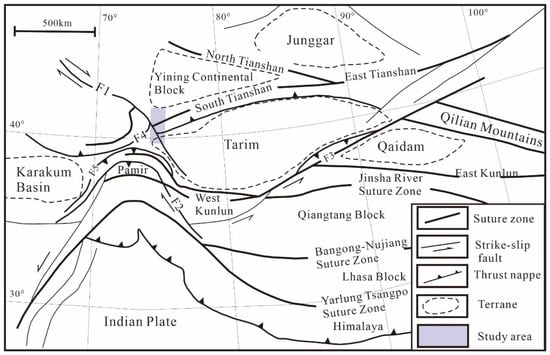
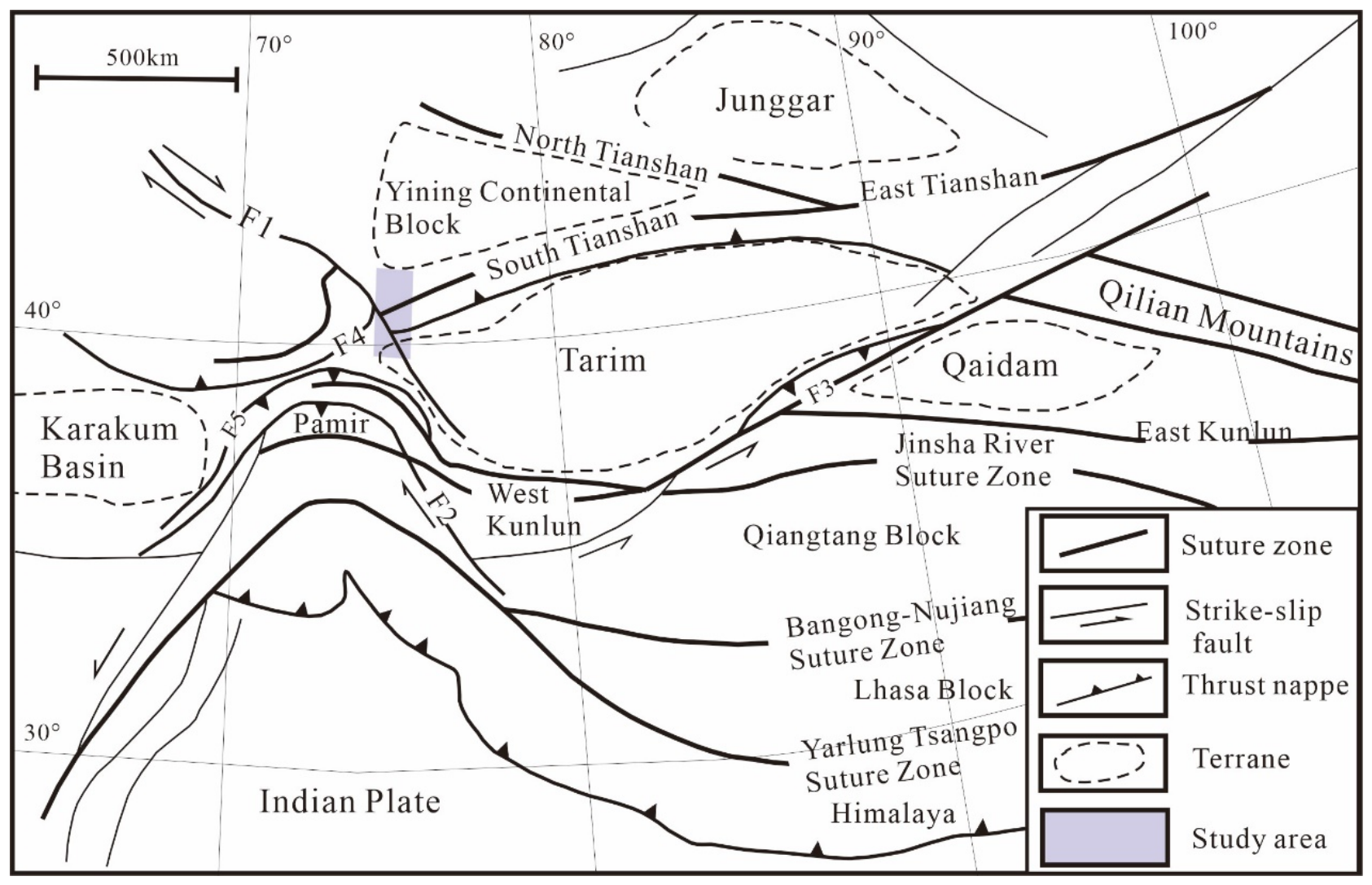
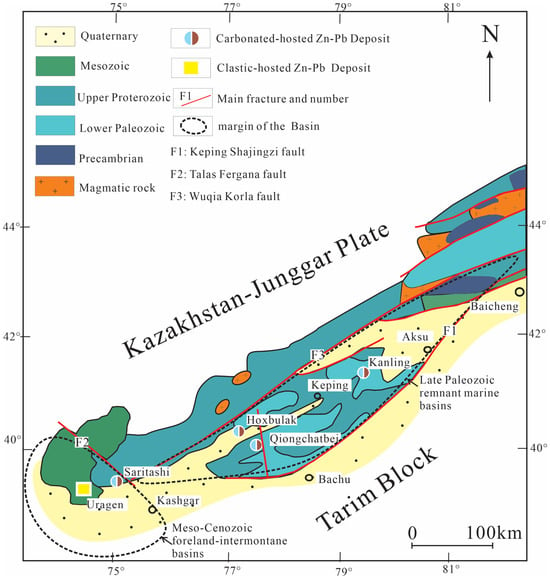
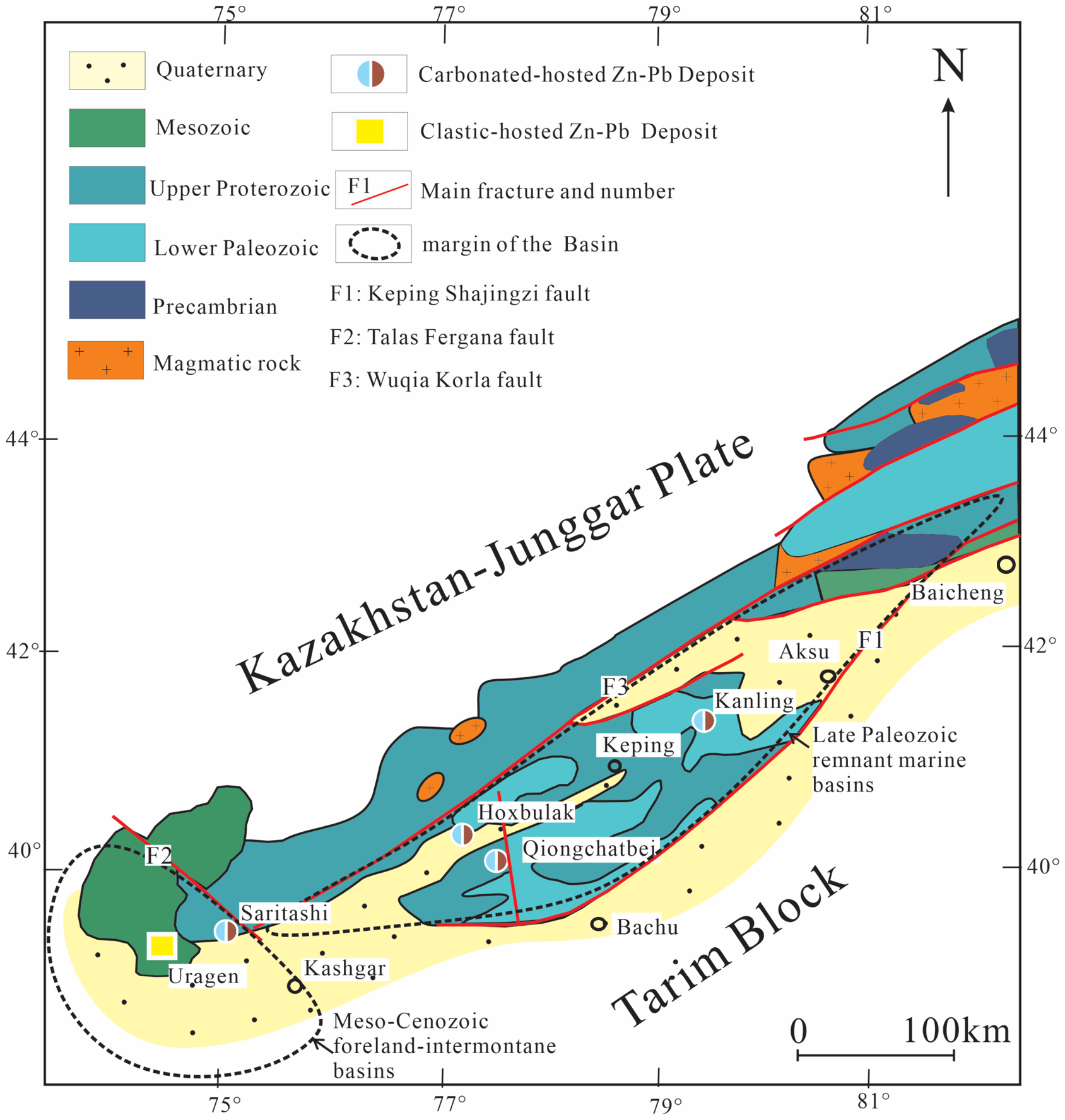
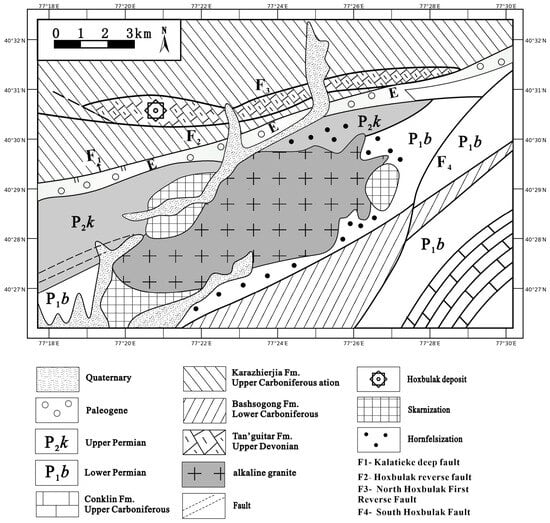
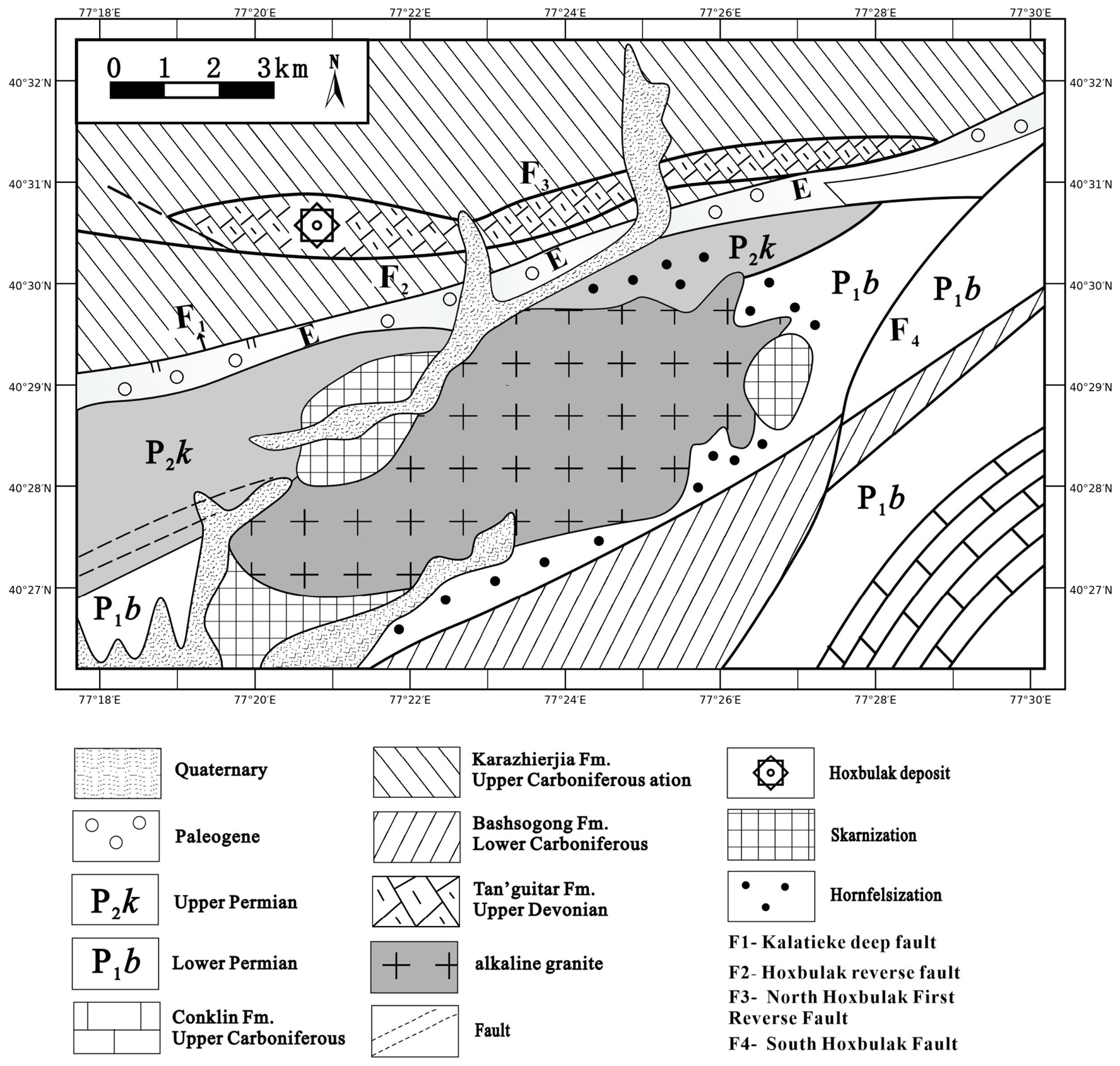
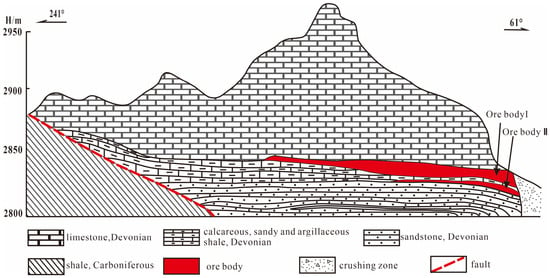
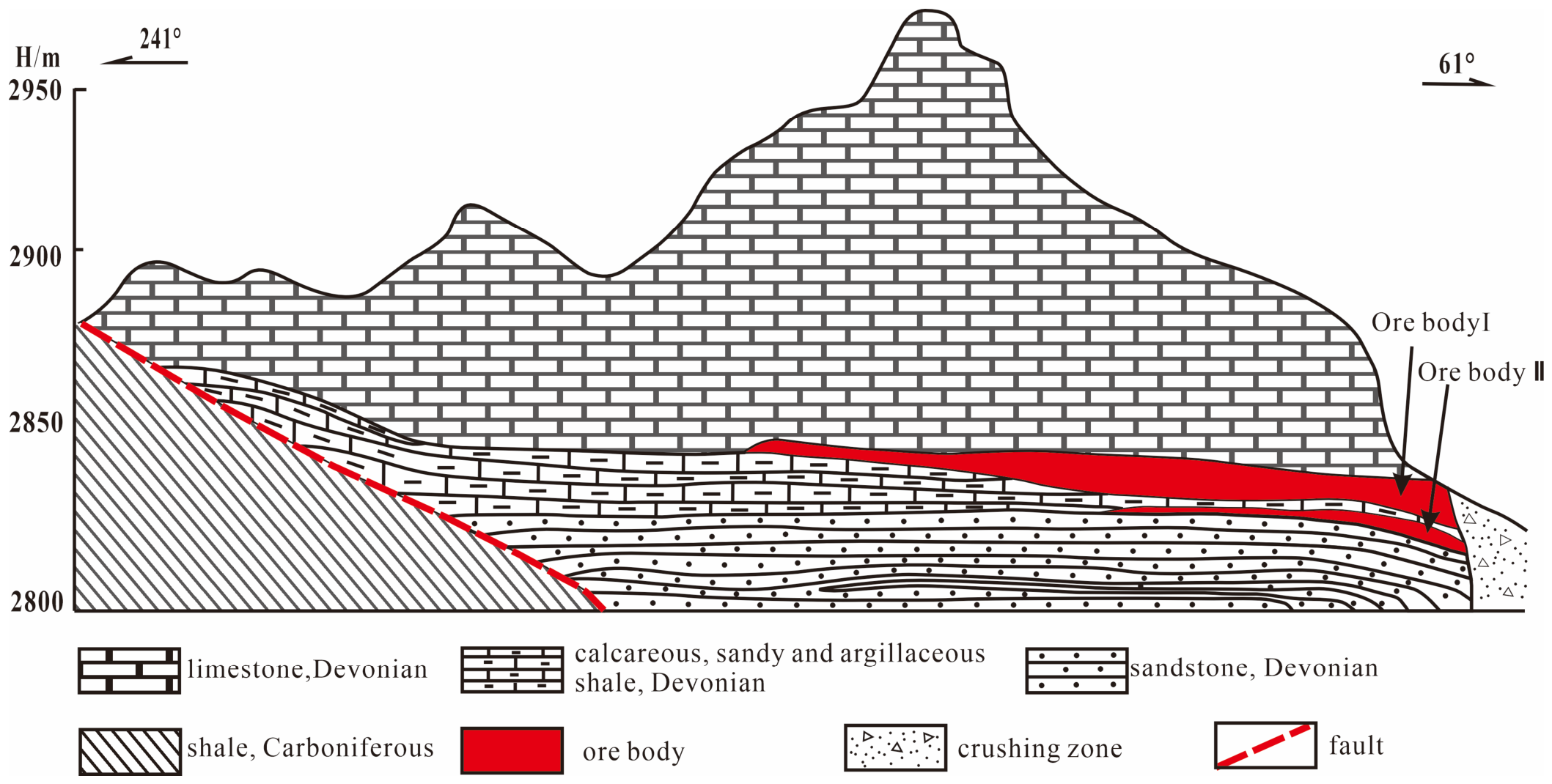
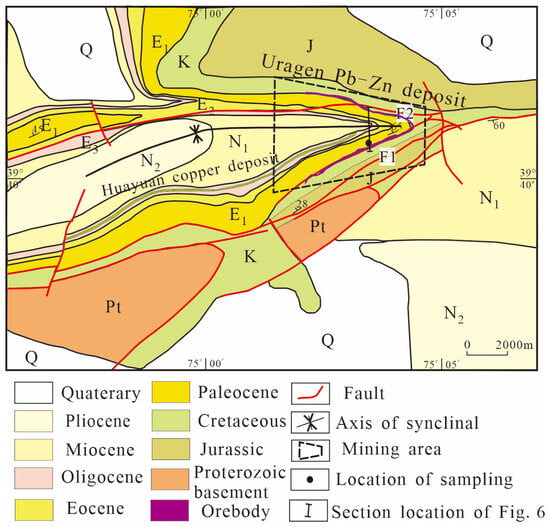
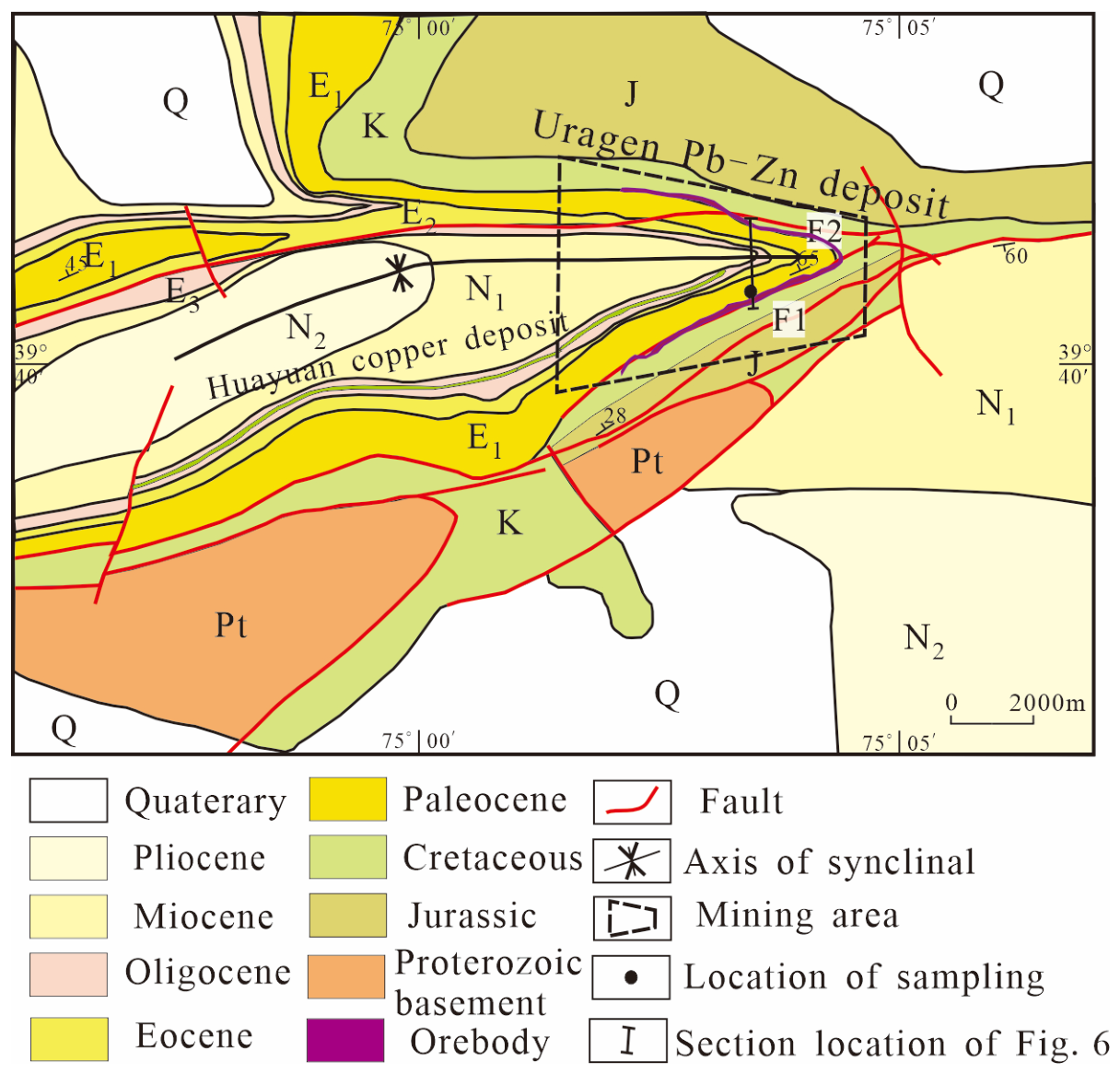
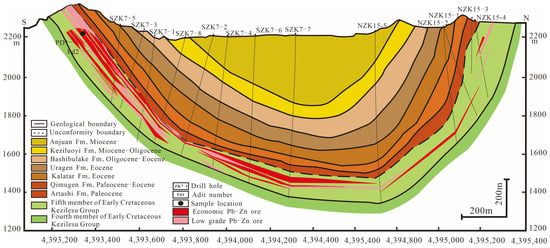
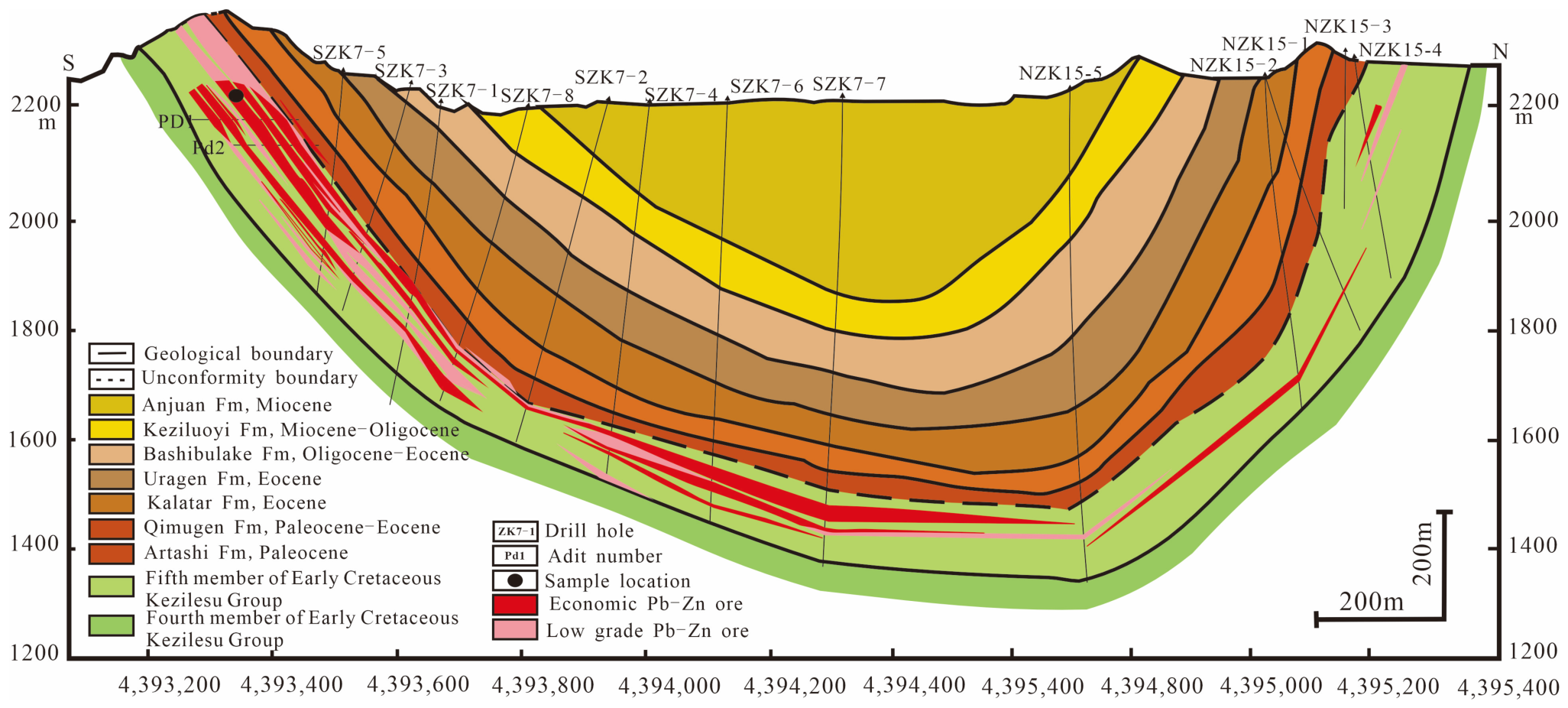
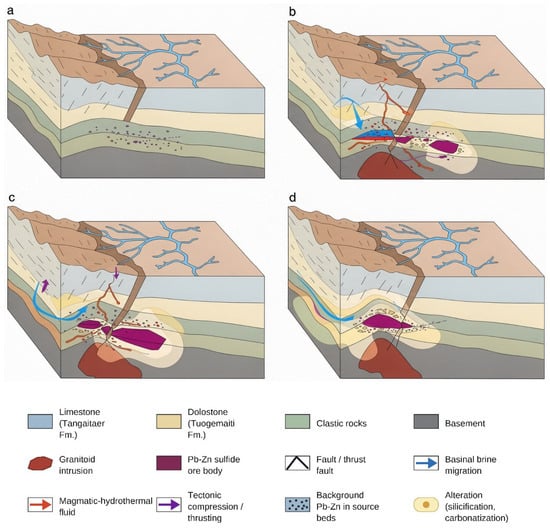
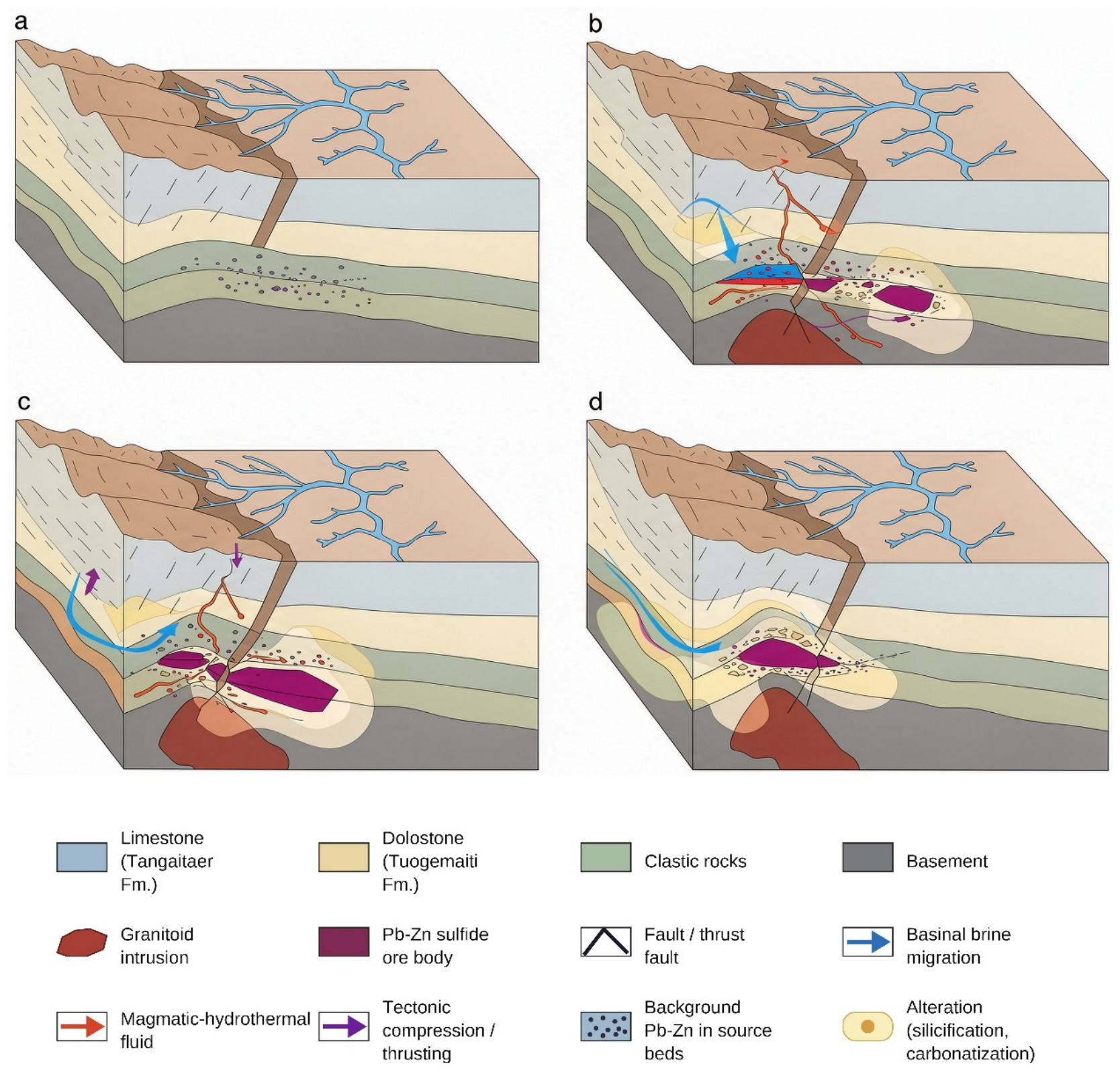
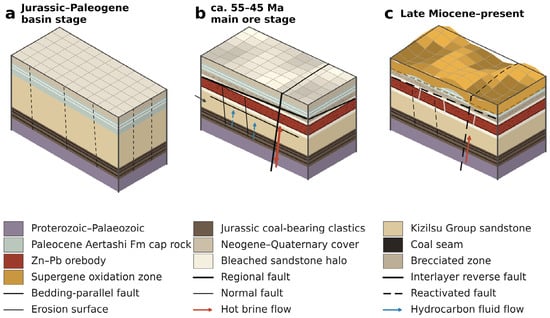
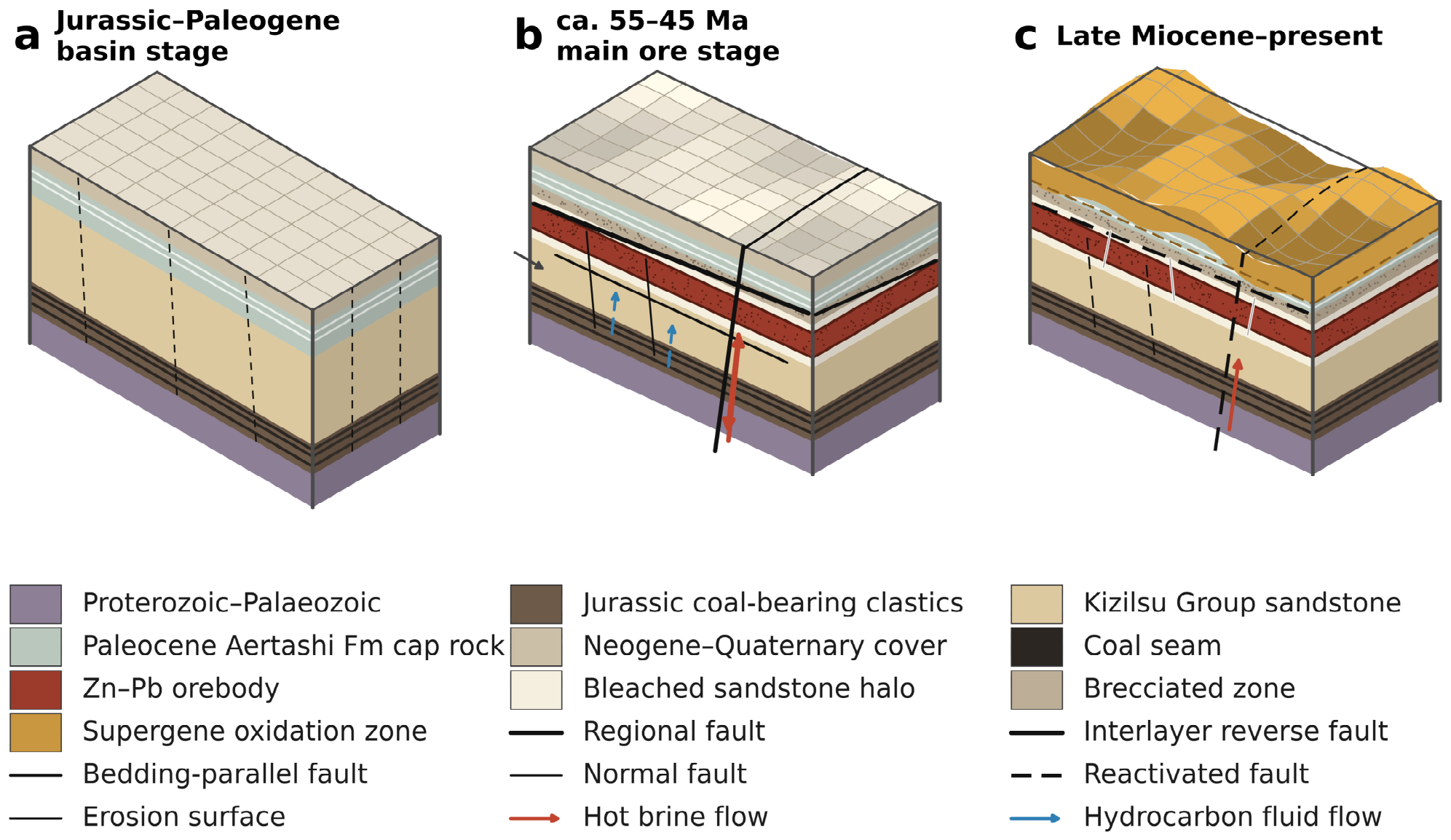

Disclaimer/Publisher’s Note: The statements, opinions and data contained in all publications are solely those of the individual author(s) and contributor(s) and not of MDPI and/or the editor(s). MDPI and/or the editor(s) disclaim responsibility for any injury to people or property resulting from any ideas, methods, instructions or products referred to in the content. |
© 2026 by the authors. Licensee MDPI, Basel, Switzerland. This article is an open access article distributed under the terms and conditions of the Creative Commons Attribution (CC BY) license.