


Abstract
The crustal domains of the southern Araguaia Belt in Brazil reveal a complex history of crustal growth and reworking during West Gondwana assembly. While some of these domains show an affinity with the Amazonian Craton, the tectonic evolution of others remains poorly understood. To address this issue, we present U–Pb and Lu–Hf zircon data from gneisses of the Rio dos Mangues and Porto Nacional complexes. The eastern part of the Rio dos Mangues Complex records ages of 1.90–1.91 Ga and 2.51 Ga and a Lu–Hf isotopic signature suggesting derivation from long-lived ancient crustal reservoirs (strongly negative ƐHf(t) values and Hf-TDMC ages of 3.69–4.32 Ga). This contrasts with the ca. 2.06 Ga age and Lu-Hf signature (possible mixing of Paleoproterozoic juvenile material with a Mesoarchean crustal source) of its western portion. We recognize an isotopically distinct Orosirian crustal domain containing Neoarchean remnants, herein referred to as the Pau D’Arco Complex. Gneisses of the Porto Nacional Complex are ca. 2.15 Ga and have a Lu–Hf isotopic signature indicating Paleo- to Mesoarchean crustal sources, consistent with previously reported data for the associated granulites. Therefore, our geochronological and isotopic dataset indicates three distinct crustal domains in the southern Araguaia Belt.
1. Introduction
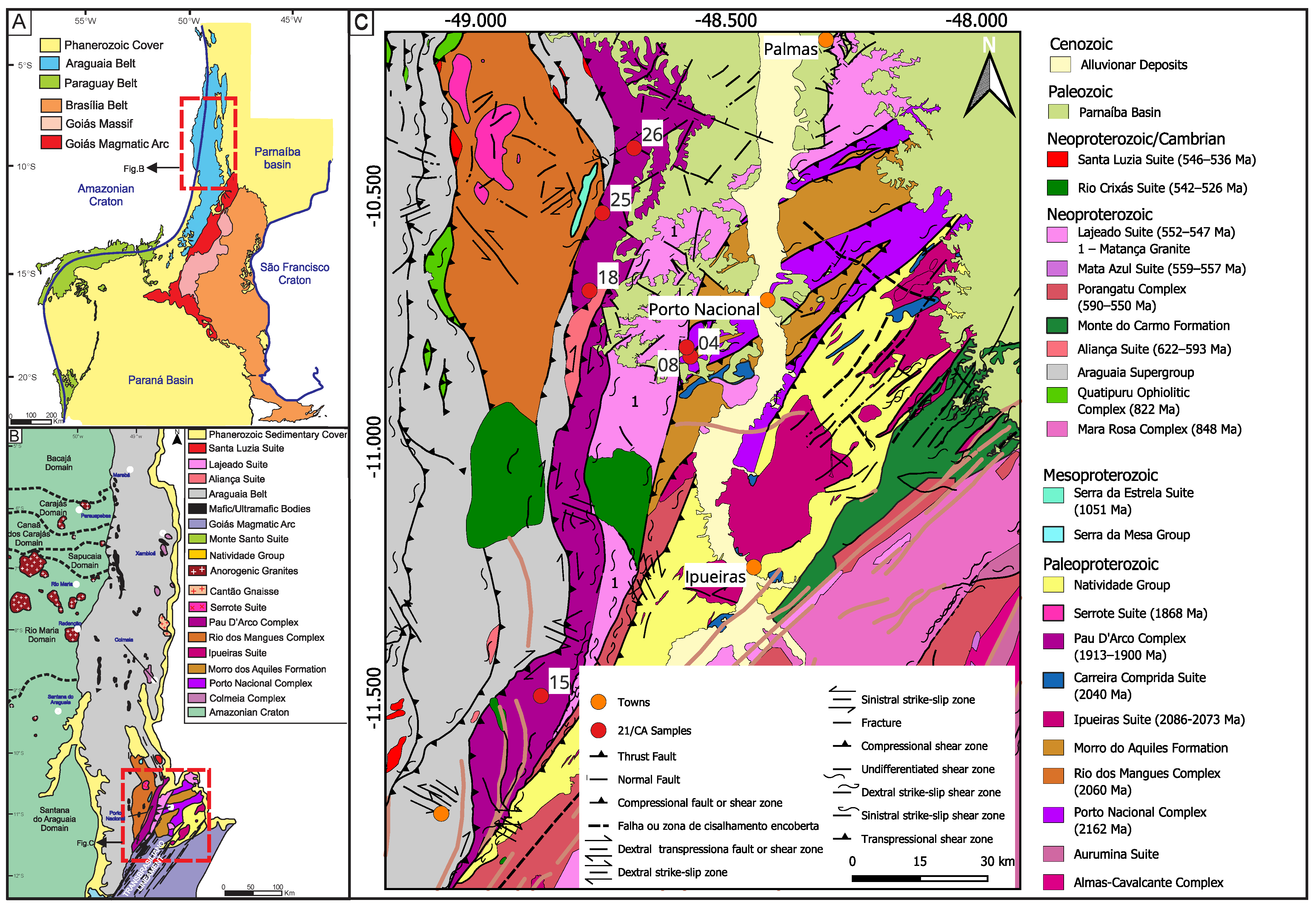
Understanding continental crust formation and reworking is essential for reconstructing the geodynamic evolution of Precambrian supercontinents. Neoproterozoic orogenic systems associated with the assembly of West Gondwana usually record complex interactions among Archean and Paleoproterozoic crustal blocks, providing key insights into continental growth and tectonic patterns [1,2,3,4]. In this context, the Tocantins Province [5] (Figure 1A), composed mainly of Neoproterozoic fold belts in central Brazil, between the Amazonian and São Francisco cratons, records the amalgamation that formed West Gondwana during the Brasiliano–Pan-African Orogeny [6,7,8,9,10] (Figure 1B).
North of the Tocantins Province, in contact with the Amazonian Craton, lies the Araguaia Belt, which has a Mesoarchean–Paleoproterozoic basement. Exposures of this basement are found along the belt, including Mesoarchean tonalite–trondhjemite–granodiorite (TTG) gneisses (2.87–2.93 Ga; Colmeia Complex) that occur in the northern sector of the belt, confined to cores of dome-like structures and intruded by granitoids at ca. 1.86 Ga [11,12,13]. In the south, the basement is extensively exposed and comprises the Paleoproterozoic Rio dos Mangues Complex (2.06 Ga), consisting of ortho- and paragneisses intruded by Serrote Suite granitoids (ca. 1.87 Ga) [12,14].
Although the Hf-TDMC ages and ƐHf values indicate different origins for the northern (Colmeia Complex) and southern (Rio dos Mangues Complex) basement domains of the Araguaia Belt, they formed a single crustal segment since at least the Orosirian, as both the Mesoarchean and Rhyacian gneisses are intruded by ca. 1.87 Ga granitoid intrusions [12]. This Orosirian granitic magmatism (1.88–1.86 Ga) is widespread in the southeastern Amazonian Craton [15,16,17,18,19,20,21,22]. Therefore, by comparing the U–Pb ages and zircon Hf isotopic signatures of the Amazonian Craton and the Araguaia Belt basement rocks, the Colmeia Complex (Figure 1B) was correlated with the Mesoarchean rocks of the Rio Maria Domain (Carajás Province) (Figure 1B) and the Rio dos Mangues Complex with the Santana do Araguaia Domain [12]. Furthermore, it was suggested that the Rio dos Mangues Complex was accreted to the Amazonian Craton during the Rhyacian [12].
While the basement in the northern part of the Araguaia Belt is relatively well studied [11,12,13], as described above, questions remain about the geological relationships in the southern basement. Structural complexity and the lack of geochronological and isotopic datasets are the main reasons for this situation, particularly regarding the eastern portion of the Rio dos Mangues Complex. This portion has been mapped as an orthoderived subunit [23], although no geochronological data were available. Most available data, including those used for correlations with the Amazonian Craton, come from its western portion. Consequently, the tectonic affinity of its eastern orthoderived portion remains uncertain. Three possibilities can be considered: (i) this segment is associated with the Amazonian Craton, despite the apparent absence of the ca. 1.88–1.86 Ga anorogenic magmatic event; (ii) it is part of the Porto Nacional Domain located to the east [24]; or (iii) it constitutes a distinct crustal domain.
These questions motivated the sampling of orthogneisses and metagranitoids from the southwestern part of the Porto Nacional Complex and from an area previously interpreted as the eastern portion of the Rio dos Mangues Complex. Therefore, this report presents U–Pb zircon ages, Hf-TDMC ages, and ƐHf(t) values for these rocks to investigate relationships among these geological domains to better define the basement units of the southern portion of the Araguaia Belt. As a result, we restrict the term Rio dos Mangues Complex herein to the western portion of the area previously assigned to this unit and propose recognizing a distinct unit for the orthoderived eastern portion, referred to as the Pau D’Arco Complex, as discussed later in this paper.
Figure 1.
(A) Neoproterozoic Araguaia, Paraguay, and Brasília belts of the Tocantins Province, along with nearby cratonic areas and sedimentary basins (modified after [25]). (B) Simplified geological map of the Araguaia Belt highlighting the distribution of major lithostratigraphic units, with emphasis on the southern segment where the study area is located. Modified after [26]. (C) Detailed geological map of the study area, including lithological units, structural features, and sampling locations. Modified after [27].
2. Geological Setting
2.1. Tocantins Province
The Tocantins Province, located in central Brazil, comprises three Neoproterozoic orogens: the Araguaia, Brasília, and Paraguay belts. These belts formed during the assembly of West Gondwana, resulting from the convergence of the Amazonian and São Francisco cratons, and possibly Paranapanema and Parnaíba blocks, during the Pan-African/Brasiliano orogeny [6,7,8,9,10].
2.2. Araguaia Belt
The Araguaia Belt is situated in the northern part of the Tocantins Province. The belt displays a north–south regional trend and extends for about 1200 km, with an average width of roughly 100 km [26]. Along its entire western border, it overlies the Archean and Paleoproterozoic units of the Amazonian Craton. In its northern and eastern regions, sedimentary rocks of the Parnaíba Basin cover the Araguaia Belt. To the south and southeast, where its basement is most exposed, it is in contact with the Porto Nacional Domain and the Goiás Magmatic Arc [24,25].
The Araguaia Belt consists of metasedimentary rocks, divided into the Tocantins (west) and Estrondo (east) groups [26,28]. Metamorphic grade increases from west to east. Neoproterozoic magmatic rocks, ranging from mafic-ultramafic to granitoid, occur throughout the belt [29,30,31,32,33].
2.3. Araguaia Belt Basement
Archean and Paleoproterozoic basement rocks are exposed in the eastern portion of the Araguaia Belt. In the northern segment of the belt, this basement occurs as tectonic inliers cropping out in the cores of dome-like structures [11,12,13,34,35,36,37]. It is represented by the TTG orthogneisses (2.87 Ga–2.93 Ga) of the Colmeia Complex, and the Cantão Granitoid (1857 ± 23 Ma), which intrudes the Archean TTG [11,12,13].
The southern part of the Araguaia Belt basement is widely exposed and consists mainly of Paleoproterozoic gneisses and granitoids, with local occurrences of Mesoproterozoic alkaline rocks. The Rio dos Mangues Complex is the main unit, and its southern and southeastern boundaries originally extended to the Transbrasiliano Lineament [26]. This complex includes tonalitic, granodioritic, and granitic gneisses, as well as paragneisses, mainly calc–silicate rocks, associated with quartzites, mica schists, and amphibolites [14]. Geochronological data from the orthogneisses indicate Rhyacian ages (2.05–2.08 Ga) [12,14]. Lu-Hf zircon data, showing negative ƐHf(t) values and mostly Neoarchean Hf-TDMc model ages (2.68–2.86 Ga), suggest that the orthogneisses may have formed from mixing magmas derived from both the Mesoarchean crust and Paleoproterozoic juvenile sources [12].
Intruding the gneisses of the Rio dos Mangues Complex, there is a group of granitic bodies known as the Serrote Suite, with varying sizes and compositions, mostly syenogranitic [14,38]. Among these bodies, a batholith stands out, measuring approximately 20 km long and 11 km wide [24,39]. U-Pb zircon dating of this batholith defined a crystallization age of 1.87 Ga [12], similar to the age of the Cantão Granitoid located in the northern basement of the belt [11,12,13]. Data from Lu-Hf zircon analyses, including negative ƐHf values (−8.3 to −6.1) and Neoarchean Hf-TDMc model ages (2.68 to 2.86 Ga), closely resemble those of the host gneisses in the Rio dos Mangues Complex, indicating a common source or that the granitoids formed by melting of the host gneisses [12].
2.4. Porto Nacional Domain
Toward the eastern portion of the Araguaia Belt, the Porto Nacional Domain [24] occurs. The main unit is a high-grade metamorphic terrane called the Porto Nacional Complex [24,38,40,41], which includes enderbites, mafic granulites, garnet-sillimanite-kyanite-bearing aluminous gneisses, tonalitic orthogneisses, and ultramafic rocks [24,38]. Zircon ages from mafic granulites and enderbites, ranging from 2.12 to 2.16 Ga, are interpreted as the crystallization ages of the igneous protolith [24,41]. Meanwhile, the 2.09 Ga age of monazite crystals from paragneisses is considered the metamorphic age [24]. These events are linked to crustal accretion and collisional stages during the Transamazonian Orogeny [24].
Associated with the high-grade rocks of the Porto Nacional Complex, is a metavolcano-sedimentary sequence known as the Morro do Aquiles Formation. It consists of micaschists with garnet and staurolite, quartz micaschists, aluminous paragneisses, garnet quartzites, graphitic schists, and acid and basic metavolcanic rocks [38]. This rock assemblage was subjected to high-grade metamorphic conditions at low- to middle-pressure levels [41].
Magmatic rocks of the Ipueiras Suite and the Carreira Comprida Suite also occur in the eastern part of the Porto Nacional Domain. The Paleoproterozoic Ipueiras Suite comprises four syenogranite to monzogranite plutons: Areias, Ipueiras, Itália, and Carmo. Single zircon Pb-evaporation ages for the Areias, Ipueiras, and Itália granites are 2086 ± 5 Ma, 2073 ± 2 Ma, and 2078 ± 4 Ma, respectively [42]. In contrast, the Carmo Granite has a U–Pb zircon age of 2048 ± 13 Ma [43].
Another significant magmatic body in the Porto Nacional Domain is the Carreira Comprida Anorthosite. It is elongated NNE–SSW, measuring about 25 km long and 8–10 km wide [38]. Locally, the rocks are transformed into metanorthosites and mylonitic anorthosites, and U–Pb zircon dating yielded 2084 ± 4 Ma for this unit [44].
3. Materials and Methods
3.1. Sampling
During fieldwork, six samples were collected for zircon geochronological analyses: two from the Porto Nacional Complex and four from the Pau D’Arco Complex (Figure 1C). In the Porto Nacional Complex, samples 21/CA-04 and 21/CA-08 were taken from the southwest end of the unit, where tonalitic rocks are reported [38]. In the Pau D’Arco Complex, sampling was conducted along a north–south axis. A tonalitic gneiss (sample 21/CA-18) was collected near the contact with a tonalitic body of the Aliança Suite. In the northeastern part of the complex, a biotite metasyenogranite (sample 21/CA-26) and a garnet-biotite granodioritic gneiss (sample 21/CA-25) were sampled. A garnet–biotite tonalitic gneiss (sample 21/CA-15) was collected in the southern portion of this unit.
3.2. Sample Preparation
The method described below [45] for separating zircon crystals was applied to all samples in this study. First, the samples were crushed and ground, then sieved to a size range of 125–175 μm. The heavy minerals were separated from these fractions through panning and magnetic separation, and the zircon grains were handpicked under a stereomicroscope. Finally, the zircon grains were assembled on double-sided tape, cold-mounted with epoxy resin, and polished to reveal the zircon sections.
3.3. Scanning Electron Microscope (SEM)
Cathodoluminescence images were obtained at the Microanalysis Laboratory of the Institute of Geosciences (IG) at the Federal University of Pará (UFPA), using a Zeiss Sigma VP scanning electron microscope (SEM) (Carl Zeiss Microscopy GmbH, Oberkochen, Germany) equipped with a Gatan Chroma CL2 cathodoluminescence system (Gatan UK, Abingdon, United Kingdom). The SEM was set to an electron beam current of 20 μA and a constant acceleration voltage of 20 kV.
3.4. U-Pb Zircon Analyses
U-Pb analyses were conducted at the Isotopic Geology Laboratory (Pará-Iso Laboratory) of IG/UFPA, using a Thermo Finnigan iCAP Q-ICPMS ((Thermo Fisher Scientific, Bremen, Germany)connected to a Nd:YAG 213 nm laser ablation microprobe model LSX-213 G2 (Teledyne CETAC Technologies, Omaha, NE, USA) from CETAC. The operating conditions of the Q-ICPMS and laser ablation (LA) are summarized in Supplementary Table S1. Analytical procedures followed the protocols routinely adopted at Pará-Iso Laboratory [45].
To correct elemental fractionation and instrumental mass discrimination, we used the GJ-1 zircon standard (609 Ma) [46] as the primary reference material. Analyses of the GJ-1 zircon yielded weighted mean values of 0.09870 ± 0.0014 (n = 48, MSWD = 15) and 0.06014 ± 0.00043 (n = 48, MSWD = 0.18) for the 206Pb/238U and 207Pb/206Pb ratios, respectively. As a secondary reference material, we employed the Sri Lankan BB zircon standard (562 Ma) [47], with a weighted mean 206Pb/238U age of 550 ± 5 Ma (n = 14, MSWD = 0.78).
The two-stage Pb evolution model was used to perform corrections for common Pb (204Pb) [48]. The isotopic ratios 206Pb/238U, 207Pb/235U, and 207Pb/206Pb, as well as the ages, were calculated from values corrected for background and 204Hg interference on 204Pb [45].
3.5. Zircon Lu-Hf Analyses
The zircon Lu-Hf analyses were carried out at Pará-Iso (IG-UFPA) using a Thermo Finnigan Multi-Collector Inductively Coupled Plasma Mass Spectrometer (MC-ICPMS) model Neptune (Thermo Fisher Scientific, Bremen, Germany), connected to a Teledyne Analyte Excite 193 nm ArF Excimer Laser (Teledyne CETAC Technologies, Omaha, NE, USA). This system includes nine Faraday collectors and four ion counters. The operating conditions of the MC-ICPMS and laser ablation (LA) are summarized in Supplementary Table S2. Analytical procedures followed the protocols routinely adopted at Pará-Iso Laboratory [45].
The 176Hf/177Hf mean value for reference zircon GJ-1 was 0.281861 ± 0.000011 (2SD; n = 12). The 176Hf/177Hf vs. 176Yb/177Hf diagram [49] shows that the isotopic ratios of each zircon crystal are independent across all samples (Supplementary Figure S1), indicating that the Yb corrections were effective.
4. Results
4.1. Field Aspects and Petrography
4.1.1. Porto Nacional Complex
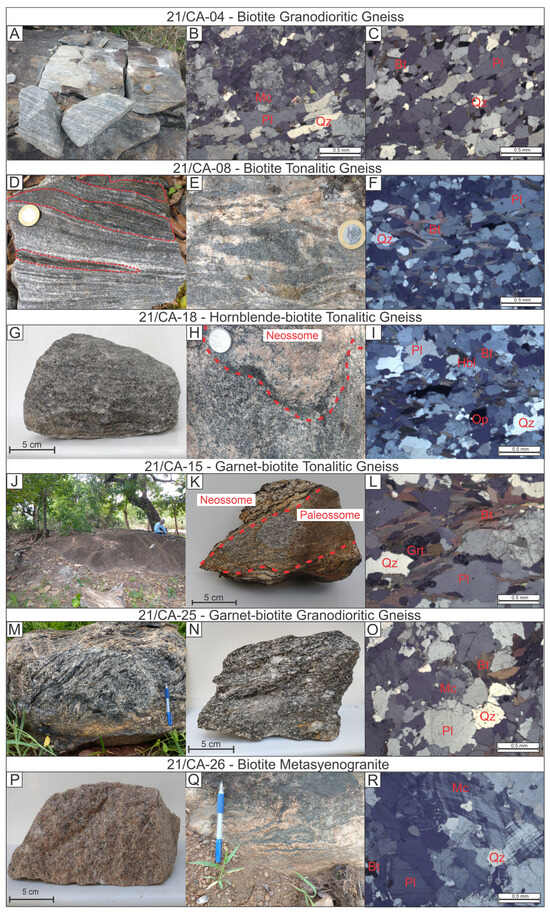
Biotite granodioritic gneiss (sample 21/CA-04) crops out as medium-grained, whitish-gray, and strongly foliated rock, characterized by alternating thin bands dominated by either mafic or felsic minerals (Figure 2A). The essential minerals are plagioclase, quartz, and microcline, with biotite being the type mineral. The rock texture is granoblastic, with quartz and plagioclase appearing as elongated and oriented crystals (Figure 2B,C).
Figure 2.
Field, macroscopic, and microscopic features of rocks sampled in the study area. (A) Gray-colored rock showing well-defined foliation, cropping out as blocks. (B) Dominance of altered microcline crystals, with elongated and oriented quartz and plagioclase crystals also visible in the lower part of the image. (C) Granoblastic texture characterized by anhedral feldspar and quartz crystals. (D) Well-defined gneissic banding with alternating mafic and felsic layers. Red dashed lines outline the mafic enclaves. (E) Migmatization features with segregation of leucosome and melanosome. (F) Granoblastic texture characterized by mostly anhedral crystals. (G) Hand specimen of gneiss. (H) Migmatized areas showing a granitic neosome outlined by red dashed lines. (I) Granoblastic texture characterized by mainly anhedral crystals. (J) Rock outcrop in the southern part of the study area. (K) Hand specimen demonstrating segregation of neosome and paleosome. Red dashed lines mark the boundary between the neosome and paleosome. (L) Biotite-rich layer within quartz-feldspar bands. (M) Small dark-gray block of gneiss with migmatitic features. (N) Hand specimen of the gneiss. (O) Granoblastic texture mainly composed of anhedral felsic mineral crystals with dispersed biotite crystals. (P) Hand specimen of a pink-colored rock with a massive-looking surface and no obvious foliation. (Q) Migmatized portion of the rock, with the neosome displaying schlieren structures. (R) Anhedral feldspar and quartz crystals forming the granoblastic texture of the rock.
Biotite tonalitic gneiss (sample 21/CA-08) crops out as medium-grained and dark gray rock, exhibiting varying degrees of migmatization. The best-preserved parts of the rock generally display strong foliation, with some amphibolite enclaves (Figure 2D). In contrast, the migmatitic areas show a schlieren structure, marked by segregation between the granitic leucosome and the biotite-rich melanosome (Figure 2E). Plagioclase and quartz are the essential minerals, with biotite as a type mineral. Zircon, opaque minerals, apatite, and muscovite are accessory minerals.
These minerals are mostly anhedral and form a granoblastic texture. Biotite lamellae, which display well-defined orientation, are dispersed throughout the rock, forming its banding (Figure 2F). Elongated quartz and plagioclase crystals often show moderate to strong undulose extinction. In some regions, triple junction contacts indicate static recrystallization under equilibrium conditions.
4.1.2. Pau D’Arco Complex
Hornblende-biotite tonalitic gneiss (sample 21/CA-18) is a medium-grained and dark gray rock with weak foliation (Figure 2G). Migmatitic features are observed at several points on the outcrop (Figure 2H). Quartz and plagioclase are essential minerals, with minor microcline. Biotite and hornblende are present as type minerals. Zircon, apatite, epidote, opaque minerals, allanite, and titanite are accessory minerals. These minerals are mostly anhedral and form a granoblastic texture (Figure 2I).
Garnet-biotite tonalitic gneiss (sample 21/CA-15) (Figure 2J) is heavily migmatized, clearly showing a distinction between paleosome and neosome (Figure 2K). The paleosome appears whitish gray and fine-grained, with no obvious separation between mafic and felsic minerals. The neosome is mainly white and coarse-grained. Both the neosome and the paleosome contain plagioclase and quartz as essential minerals, with biotite and garnet as type minerals. Zircon, apatite, titanite, epidote, and allanite are accessory minerals. The dominant rock texture is granoblastic, composed mainly of anhedral crystals (Figure 2L).
Garnet-biotite granodioritic gneiss (sample 21/CA-25) appears as small rock blocks (Figure 2M), is dark gray, medium-grained, and shows some signs of migmatization (Figure 2N). Thin bands of concentrated mafic minerals are present, but overall, there is no strong segregation between mafic and felsic minerals; small folds are observed. The rock is composed of microcline, plagioclase, and quartz, with biotite as a type mineral. Muscovite, zircon, epidote, and opaque minerals are accessory minerals. The rock has a granoblastic texture (Figure 2O).
Biotite metasyenogranite (sample 21/CA-26) is a medium-grained, whitish-pink rock that generally maintains a massive appearance with no obvious foliation (Figure 2P). However, schlieren structures are visible in areas where partial melting occurred (Figure 2Q). Microcline, plagioclase, and quartz are the essential minerals, with biotite as a type mineral. Zircon, apatite, opaque minerals, and epidote are accessory minerals. The rock has a granoblastic texture (Figure 2R).
4.2. U-Pb Dating, and Lu-Hf Isotope Geochemistry
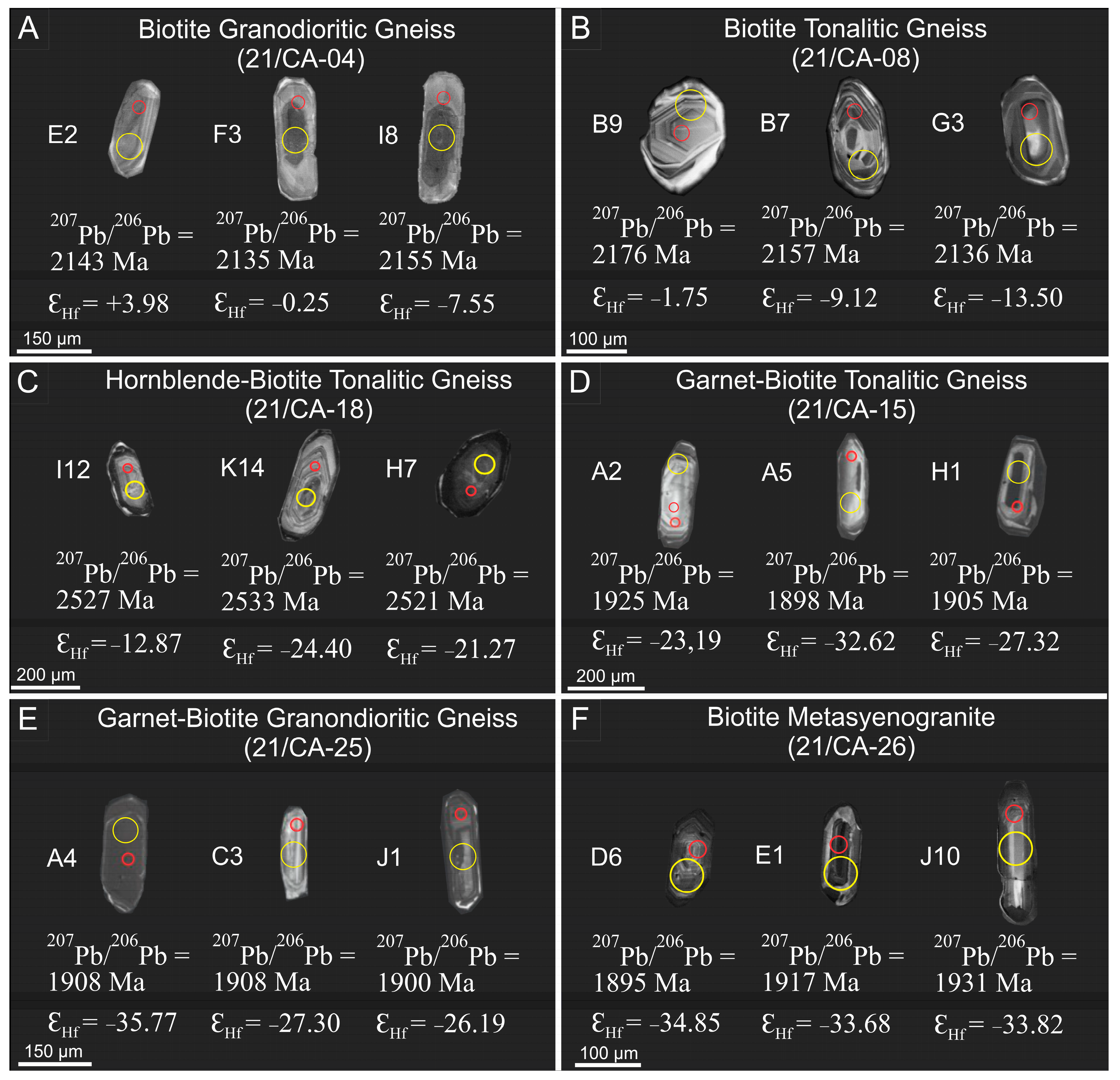
U-Pb zircon analyses were performed on zircon crystals from six samples, with 40 to 44 spots analyzed per sample. For upper intercept and concordia ages, we selected results with low analytical errors in the Pb/U ratios (≤3% at 1σ) and low common-Pb contributions, indicated by f206 values <1.5%. Specifically, only analyses with discordance values of less than 2% were included in the concordia age calculations (Supplementary Table S3). Representative SEM-CL images of the analyzed zircon crystals are illustrated in Figure 3.
Figure 3.
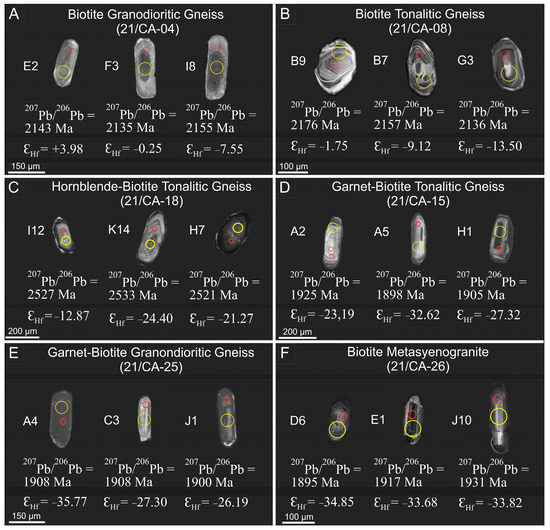
Cathodoluminescence (CL) images showing analyzed zircon crystals. Red circles indicate U-Pb spot analyses (25 µm), while yellow circles mark Lu-Hf spot analyses (50 μm). 207Pb/206Pb ages and ƐHf(t) values are also included. (A,B) refer to Porto Nacional Complex; (C–F) refer to Pau D’Arco Complex.
Lu-Hf isotope analyses were preferentially conducted on concordant zircon crystals and within the same domains analyzed for U-Pb dating. However, in samples with few concordant crystals or crystals too small for Lu-Hf analyses, alternative selection criteria were adopted. Priority was given to zircon crystals used in the upper intercept age calculations, with low discordance, suitable crystal size, and domains corresponding to those analyzed for U-Pb dating. When no suitable alternatives were available, Lu-Hf analyses were performed on domains different from those targeted for U-Pb dating, and the results were interpreted considering potential differences between the analyzed domains. The Lu-Hf zircon isotope data used to calculate the Hf-TDMC model ages and ƐHf(t) are provided in Supplementary Table S4.
4.2.1. Biotite Granodioritic Gneiss (21/CA-04) (Porto Nacional Complex)
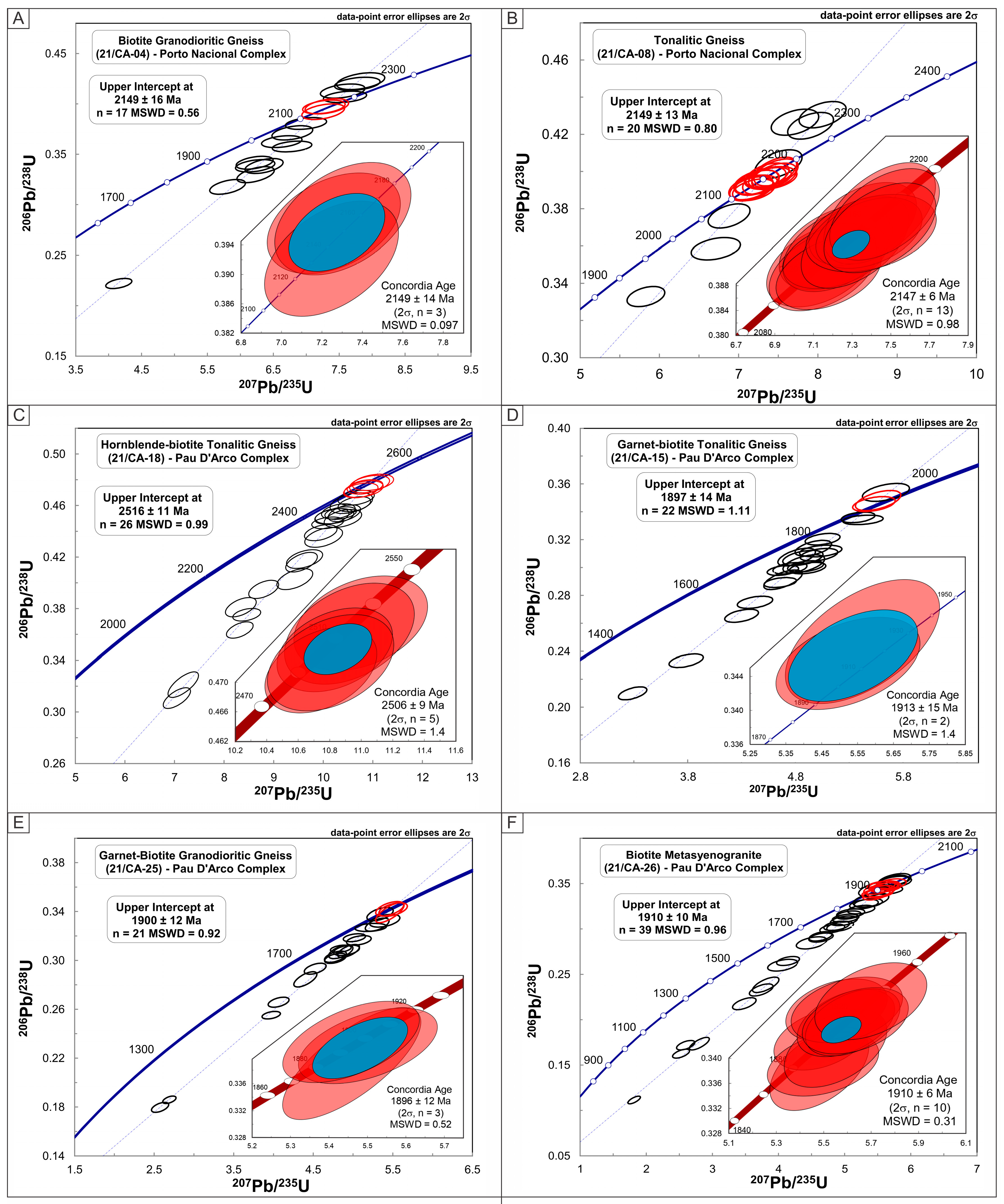
Zircon crystals are subhedral and prismatic with rounded edges, with length/width ratios mostly around 3:1. Oscillatory zoning is rare; several crystals display homogeneous textures, as seen in the CL images (Figure 3). Seventeen zircon analyses yielded an upper intercept age of 2149 ± 16 Ma (n = 17; MSWD = 0.56) (Figure 4A), and three of these analyses indicated a concordia age of 2149 ± 14 Ma (n = 3; MSWD = 0.097) (Figure 4A-inset). Despite the limited number of concordant analyses, the concordia and upper intercept ages overlap within uncertainty. Eight inherited zircon crystals were identified; seven yielded 207Pb/206Pb ages around 2.20–2.26 Ga, and one yielded 2448 Ma. Lu-Hf isotope analyses were performed on ten zircon crystals, and seven yielded reliable results with calculations using the crystallization age of 2149 Ma. Five of these analyses were performed on crystal cores, which exhibit homogeneous textures and darker CL responses than the rims, where the U-Pb analyses were conducted. Considering zircon concordance, for the three concordant crystals (E2, F3 and G5), the ƐHf(2.15Ga) values ranged from +3.62 to −5.88, and Hf-TDMC model ages ranged from 2.44 Ga to 2.96 Ga. For the four zircon crystals that contributed to the upper intercept age calculation, the ƐHf(2.15Ga) values ranged from −0.95 to −9.24 and Hf-TDMC model ages ranged from 2.44 Ga to 2.96 Ga. In general, ƐHf(2.15Ga) values ranged from +3.62 to −9.24, and Hf-TDMC model ages ranged from 2.44 Ga to 3.14 Ga.
Figure 4.
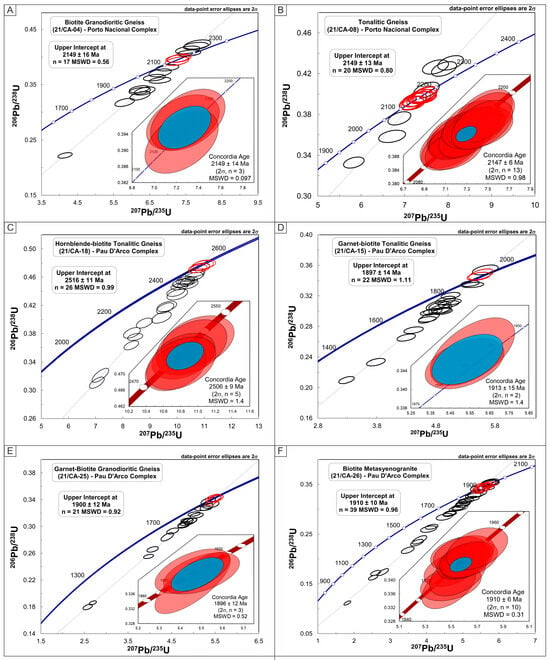
Concordia diagrams displaying the upper intercept ages and concordant ages (insets) determined for the rocks sampled in the study area. (A) Biotite granodioritic gneiss (21/CA-04); (B) Biotie tonalitic gneiss (21/CA-08); (C) hornblende-biotite tonalitic gneiss (21/CA-18); (D) garnet-biotite tonalitic gneiss (21/CA-15); (E) garnet-biotite granodioritic gneiss (21/CA-25); and (F) biotite metasyenogranite (21/CA-26).
4.2.2. Biotite Tonalitic Gneiss (21/CA-08) (Porto Nacional Complex)
Zircon crystals are subhedral and prismatic, with rounded edges and length-to-width ratios ranging from 1.5:1 to 3:1. CL images reveal predominant oscillatory zoning (Figure 3). Twenty analyses of zircon crystals yielded an upper intercept age of 2149 ± 13 Ma (n = 20; MSWD = 0.80) (Figure 4B), while thirteen analyses defined a concordia age of 2147 ± 6 Ma (n = 13; MSWD = 0.98) (Figure 4B-inset). Four inherited zircon crystals were identified, showing 207Pb/206Pb ages of approximately 2.19–2.21 Ga. Lu-Hf isotope analyses were performed on ten zircon crystals, and nine yielded reliable results using a crystallization age of 2147 Ma. Six crystals produced ƐHf(2.15Ga) values ranging from −8.46 to −13.50, with Hf-TDMC model ages from 3.09 Ga to 3.36 Ga. The remaining three crystals contain partially resorbed inner domains that may have influenced their ƐHf(2.15Ga) values, which range from −1.75 to −4.12, and their Hf-TDMC model ages, which range from 2.73 Ga to 2.86 Ga.
4.2.3. Hornblende–Biotite Tonalitic Gneiss (21/CA-18) (Pau D’Arco Complex)
Zircon crystals are mainly prismatic with rounded edges; a few are rounded. CL images show oscillatory to irregular zoning (Figure 3C). Twenty-six zircon analyses indicate an upper intercept age of 2516 ± 11 Ma (n = 26; MSWD = 0.99) (Figure 4C), while five analyses yielded a concordia age of 2506 ± 9 Ma (n = 5; MSWD = 1.4) (Figure 4C-inset). Lu-Hf isotope analyses were performed on ten zircon crystals, and eight yielded reliable results with calculations based on a crystallization age of 2506 Ma. Two crystals are concordant with ƐHf(2.51Ga) values of −15.1 and −21.3, and Hf-TDMC model ages of 3.74 Ga and 4.07 Ga. The other six crystals contributed to the upper intercept age calculation (discordance ranging from 3% to 13%) and ƐHf(2.51Ga) values ranging from −16.9 to −24.40, and Hf-TDMC model ages from 3.83 Ga to 4.23 Ga. Overall, the results are consistent regardless of zircon concordance, yielding ƐHf(2.51Ga) values ranging from −15.1 to −24.40, and Hf-TDMC model ages from 3.74 Ga to 4.23 Ga.
4.2.4. Garnet-Biotite Tonalitic Gneiss (21/CA-15) (Pau D’Arco Complex)
Zircon crystals from less migmatized portions are euhedral to subhedral, prismatic, with some elongated. CL images show different textures, including oscillatory zoning, irregular, and homogeneous domains (Figure 3D). Twenty-two zircon analyses produced an upper intercept age of 1897 ± 14 Ma (n = 22; MSWD = 1.11) (Figure 4D), and two of them give a concordia age of 1913 ± 15 Ma (n = 2; MSWD = 1.4) (Figure 4D-inset). Despite the limited number of concordant analyses, the concordia and upper intercept ages overlap within uncertainty. Two inherited zircon crystals were identified, with 207Pb/206Pb ages of 2488 Ma and 2570 Ma. Lu-Hf analyses of ten zircon crystals (one concordant and nine contributed for upper intercept calculation) showed ƐHf(1.91Ga) values ranging from −23.19 to −32.62, with Hf-TDMC model ages from 3.69 Ga to 4.19 Ga.
4.2.5. Garnet-Biotite Granodioritic Gneiss (21/CA-25) (Pau D’Arco Complex)
Zircon crystals are euhedral to subhedral, prismatic, and some are elongated. They display oscillatory zoning, irregular zoning, or homogeneous domains in CL images (Figure 3E). Twenty-one analyses of zircon crystals provided an upper intercept age of 1900 ± 12 Ma (n = 21; MSWD = 0.92) (Figure 4E), and three spots yielded a concordia age of 1896 ± 12 Ma (n = 3; MSWD = 0.52) (Figure 4E-inset). Although there are few concordant analyses, the concordia and upper intercept ages are consistent within the margin of error. Twelve inherited zircon crystals were identified, with 207Pb/206Pb ages ranging from 2114 Ma to 3669 Ma. Two metamorphic zircon crystals (232Th/238U < 0.1) provided a concordia age of 547 ± 7 Ma (n = 2; MSWD = 1.11). Lu-Hf isotope analyses were performed on ten zircon crystals; eight yielded reliable results, calculated using a crystallization age of 1900 Ma. Three were concordant, and five were used for upper intercept calculation, with ƐHf(1.90Ga) values ranging from −23.47 to −35.77 and Hf-TDMC ages from 3.70 Ga to 4.34 Ga.
4.2.6. Biotite Metasyenogranite (21/CA-26) (Pau D’Arco Complex)
Zircon crystals are euhedral to subhedral, prismatic, and some are elongated. CL images show different textures, including oscillatory zoning and irregular and homogeneous domains (Figure 3F). Thirty-nine zircon analyses yielded an upper intercept age of 1910 ± 10 Ma (n = 39; MSWD = 0.96) (Figure 4F), and ten of these showed a concordia age of 1910 ± 6 Ma (n = 10; MSWD = 0.31) (Figure 4F-inset). Lu-Hf analyses were performed on seven zircon crystals: four concordant and three used for upper intercept calculations. The ƐHf(1.91Ga) values ranged from −32.99 to −35.19, with Hf-TDMC model ages from 4.21 Ga to 4.32 Ga.
5. Discussion
5.1. U-Pb Zircon Ages of the Southern Basement of the Araguaia Belt and Adjacent Crustal Domains
Among samples from the Pau D’Arco Complex, the oldest age is 2506 ± 9 Ma, obtained from a hornblende–biotite tonalitic gneiss (sample 21/CA-18). This result indicates a previously unreported Neoarchean crustal component in the region. However, its regional extent remains unconstrained because only one sample preserves this Neoarchean crystallization age. Other rocks from this area yield similar Paleoproterozoic ages of 1913 ± 15 Ma for the garnet–biotite tonalitic gneiss (sample 21/CA-15), 1896 ± 12 Ma for the garnet–biotite granodioritic gneiss (sample 21/CA-25), and 1910 ± 6 Ma for the biotite metasyenogranite (sample 21/CA-26). The U-Pb zircon ages identified in this study correlate well with previously reported geochronological data from the same region [14]. Near sample 21/CA-26 (1.91 Ga), a 207Pb/206Pb zircon age of 1.82 Ga was previously reported. Similarly, a 207Pb/206Pb zircon age of 1.85 Ga was obtained near sample 21/CA-25 (1.90 Ga). These 207Pb/206Pb zircon ages were interpreted as intrusions into the Rio dos Mangues Complex [14].
In any case, these ages differ significantly from those reported for the western portion of the Rio dos Mangues Complex located in the Paraíso do Tocantins region, where single zircon Pb-evaporation 207Pb/206Pb ages of 2.05–2.08 Ga [14] and a U–Pb zircon age of 2060 ± 6 Ma [12] have been documented. Previous studies also highlighted differences between the western and eastern regions of the Rio dos Mangues Complex, characterizing the eastern part (Pau D’Arco Complex) as an orthoderived subunit composed of tonalitic, granodioritic, and granitic gneisses [23]. The investigated samples further indicate that the age populations identified in the Pau D’Arco Complex (ca. 1.90–1.91 Ga and 2.51 Ga) are also clearly distinct from those reported for the Porto Nacional Complex (ca. 2.15 Ga), separated by the ca. 550 Ma Matança Granite [50].
5.2. Lu-Hf Isotopic Data of the Southern Basement of the Araguaia Belt and Adjacent Crustal Domains
The two samples from the Porto Nacional Complex reveal similar Lu-Hf isotopic signatures. Most analyses display negative ƐHf(2.15Ga) values, with some close to zero, while only one zircon grain from the biotite tonalitic gneiss (sample 21/CA-04) shows a positive value (Table 1 and Supplementary Table S4). These signatures suggest predominant crustal reworking with only minor juvenile input. Two-stage Hf model ages (TDMc) indicate Meso- to Paleoarchean crustal sources, although some Neoarchean ages may result from mixing with juvenile components. These results align with those reported for mafic granulites from the same unit, which show two populations of two-stage Hf model ages (3.01–2.52 Ga and 2.48–2.40 Ga) [24]. These are interpreted as reflecting contributions from Neo- to Mesoarchean and Siderian sources, respectively. ƐHf(t) values ranging from −4.6 to +5.2 suggest mixing between Mesoarchean crustal and juvenile Rhyacian material [24].
Table 1.
Zircon LA-Q-ICPMS U-Pb concordant ages and Lu-Hf data for the rocks of Pau D’Arco and Porto Nacional Complexes. U-Pb and Lu-Hf isotopic data used in this paper are in Supplementary Tables S3 and S4.
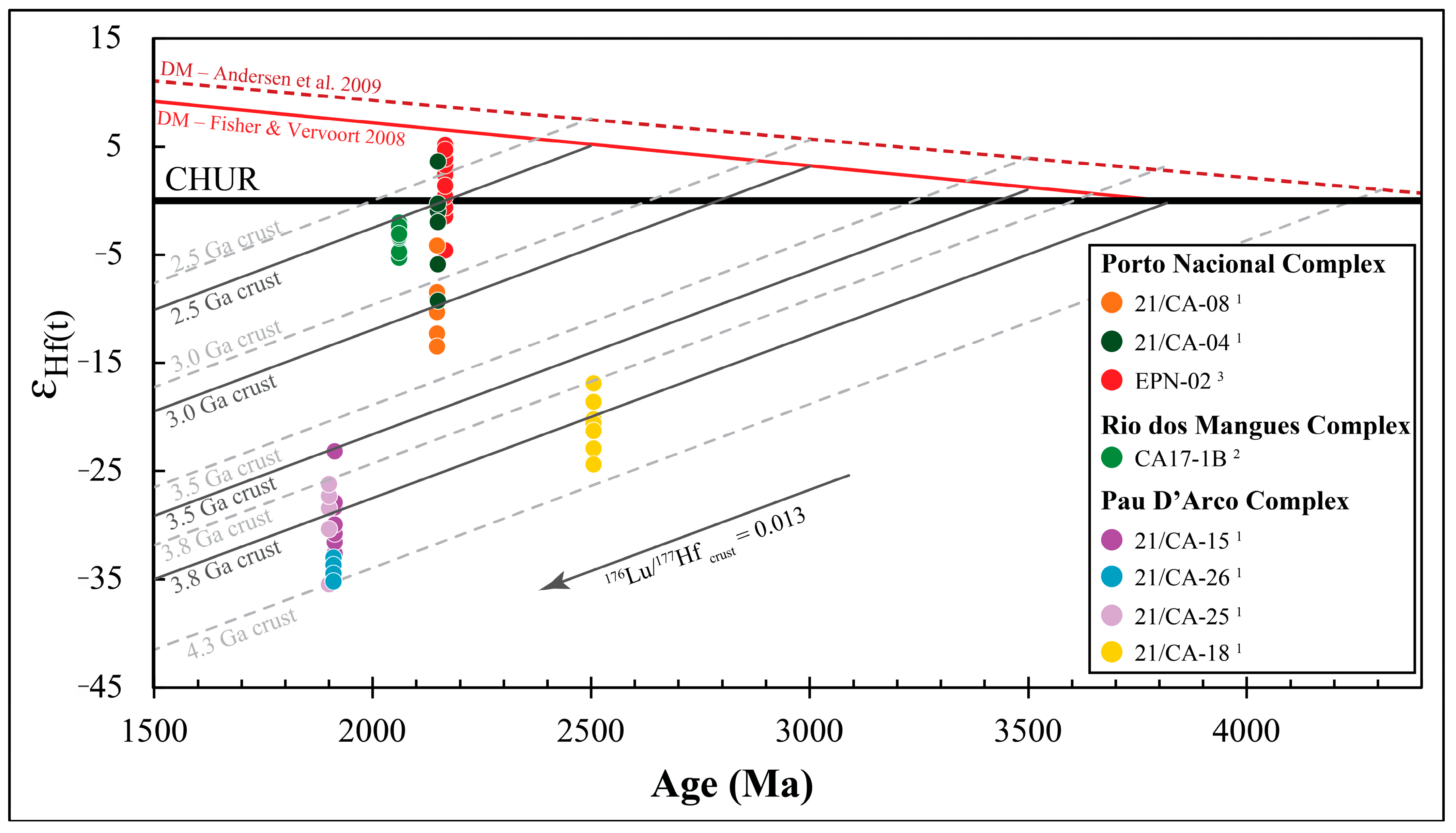
For the rocks from the Pau D’Arco Complex, the ƐHf(t) values and two-stage Hf-TDMc model ages fall within similar ranges for both the 1.90–1.91 Ga bodies (samples 21/CA-15, 21/CA-25 and 21/CA-26) and the oldest rock (2.51 Ga), which is the hornblende–biotite tonalitic gneiss (sample 21/CA-18), as shown in Table 1. The strongly negative ƐHf(t) values suggest significant crustal reworking from sources with long crustal residence times, with no evidence of juvenile crustal input [51,52]. Corresponding model ages suggest derivation from long-lived ancient crustal reservoirs. In the Rio dos Mangues Complex, two-stage Hf-TDMc model ages range from 2.65 to 2.83 Ga with negative ƐHf(t) values (−4.8 to −1.6) in an orthogneiss [12]. These findings are interpreted as a possible mixing of Paleoproterozoic juvenile material with a Mesoarchean crustal source, consistent with Sm-Nd model ages (TDM) of 2.21–2.35 Ga for the Rio dos Mangues Complex and 2.43–2.50 Ga for the Serrote Suite [14].
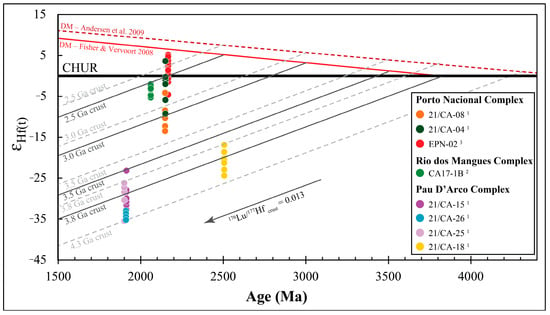
The Lu-Hf isotopic evidence presented here demonstrates that the Pau D’Arco Complex, which occurs between the Rio dos Mangues and Porto Nacional complexes, has a distinct Lu-Hf isotopic signature, due to its unique evolutionary history, including a record of older crustal components (Figure 5). Therefore, these data, combined with U-Pb geochronology, support our interpretation that the eastern part of the Rio dos Mangues Complex, represented by the orthoderived subunit, is a different crustal domain. Given that the rocks in this region were previously assigned as a subunit of a Complex (the Rio dos Mangues), we propose that this subunit should be individualized as a distinct lithostratigraphic unit, the Pau D’Arco Complex, named after a stream near sample 21/CA-26.
Figure 5.
εHf(t) versus age (Ma) diagram for the rocks in this study. Hf isotopic data from rocks of the Rio dos Mangues [12] and Porto Nacional [24] complexes are plotted for comparison. The dotted lines represent crust-evolution trends, calculated using a 176Lu/177Hf ratio of 0.013 for average continental crust [53,54]. 1—this study, 2—[12], 3—[24].
Additional support for this interpretation comes from the absence of ca. 1.87 Ga anorogenic magmatism, a geological feature typical of the basement of the Araguaia Belt [12], further indicating that the Pau D’Arco Complex may represent a distinct crustal domain compared to the Rio dos Mangues Complex (Amazonia Craton) and Porto Nacional Complex (Goiás Massif). This newly proposed unit includes rocks dated at 1.90–1.91 Ga and 2.51 Ga. However, further studies, especially involving geochemistry and geological mapping, should be carried out to better constrain the tectonic setting of these rocks, lithostratigraphic definition, and the spatial extent of the Neoarchean crustal remnant.
5.3. A Tectonic Interpretation of Distinct Crustal Blocks in the Southern Araguaia Belt
Based on the discussions above, the U-Pb zircon geochronological and zircon Lu-Hf isotopic data obtained in this study allow recognition of three distinct crustal domains in the region between the southern Araguaia Belt and the northern Goiás Magmatic Arc. These domains correspond to the Rio dos Mangues Complex, the Porto Nacional Domain, and the herein proposed Pau D’Arco Complex. The latter lies between the other two domains and is characterized by a predominance of Orosirian meta-igneous rocks (ca. 1.90–1.91 Ga), a Neoarchean component, and isotopic signatures indicating derivation from ancient, long-lived crustal reservoirs, distinguishing it from the adjacent domains.
These domains are located within a region associated with the assembly of West Gondwana in the Neoproterozoic, resulting from the convergence of the Amazonian, West African, and São Francisco-Congo cratons [55,56]. This process led to the closure of the Goiás-Pharusian Ocean through accretionary processes involving the docking of several intra-oceanic, transitional magmatic arcs and ancient crustal blocks [55,56]. As a result, several Neoproterozoic orogenic belts were formed, including the Araguaia Belt. Associated magmatic rocks preserve evidence of a variety of tectonic processes, including subduction, collision, and strike-slip shear zones, throughout this evolution [57].
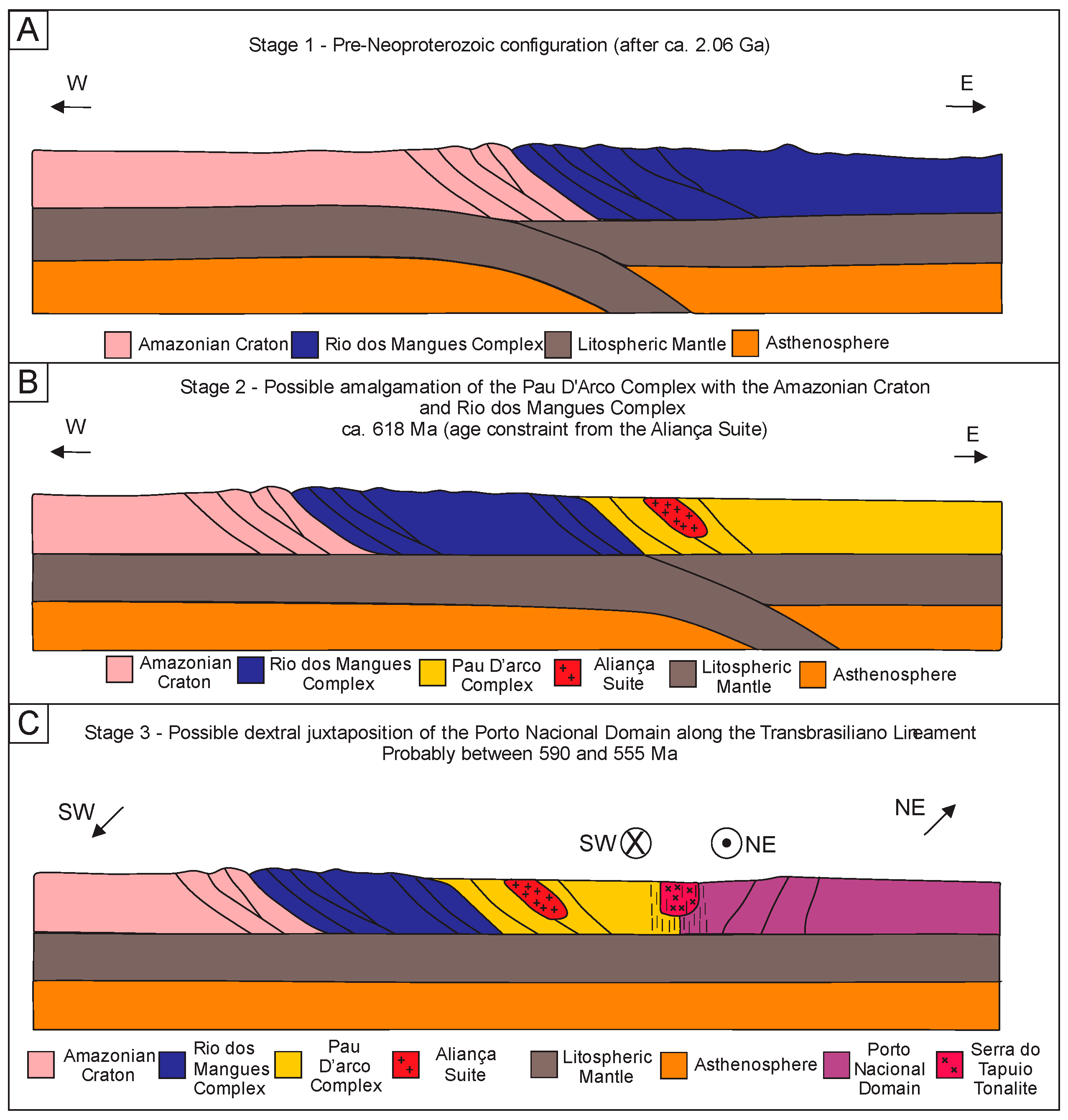
Given the current configuration of these domains, their distinct crustal affinities, and their involvement in the Neoproterozoic geodynamic evolution of the region, it is important to investigate the processes that led to their amalgamation. However, the dataset presented in this study is not sufficient on its own to constrain a comprehensive tectonic model. Therefore, based on the regional geological framework and previous studies, this section presents a preliminary working hypothesis to explain the amalgamation of these different crustal domains. Future studies and additional datasets will be required to better constrain their geodynamic evolution and to test whether the hypothesis proposed here is valid. Regarding the pre-collage configuration of these crustal domains, the Rio dos Mangues Complex is viewed as part of the Amazonian Craton since at least the Orosirian, as supported by geological, geochronological, and isotopic evidence [12] (Figure 6A). The Pau D’Arco Complex, defined here, is characterized by Eoarchean to Hadean Hf-TDMC model ages and strongly negative ƐHf(t) values, indicating that its Orosirian and Neoarchean rocks were formed through the reworking of very old crustal sources. These features suggest that these rocks represent reworked crustal material from an ancient continental fragment. The Porto Nacional Domain includes a heterogeneous crustal segment with high-grade metamorphic lithologies (Porto Nacional Complex), interpreted as the northernmost extension of the Goiás Massif [24].
Figure 6.
Conceptual and simplified schematic model showing a possible tectonic evolution of the southern basement of the Araguaia belt and accreted crustal domains. (A) Stage one is the pre-Neoproterozoic configuration after the accretion of the Rio dos Mangues crustal domain to the Amazonian Craton. (B) Stage two is the possible amalgamation involving the Pau D’Arco Complex with the Amazonian Craton (Rio dos Mangues Complex at the front) during the Neoproterozoic. (C) Stage three is the possible juxtaposition of the Porto Nacional Domain with the Pau D’Arco Complex, which is interpreted as possibly related to dextral displacement along the Transbrasiliano Lineament.
The first stage may have involved the amalgamation of the Orosirian domain with Neoarchean remnants, the Pau D’Arco Complex, with the Amazonian Craton (Rio dos Mangues Complex), possibly in a subduction-related setting (Figure 6B). The environment and timing of this event are inferred from the emplacement of the Aliança Suite plutons, which are located near the boundary between these two domains and spatially associated with shear zones (Figure 1C). This unit has a zircon U-Pb age of 618 ± 2 Ma [58] and geochemical signatures suggesting a calc-alkaline affinity, typical of a magmatic arc at an active continental margin [23]. However, this magmatic age must be treated only as a minimum temporal constraint for interaction between these crustal domains and does not necessarily date the proposed amalgamation event itself.
The age determined for the Aliança Suite aligns with the continental phase of the Goiás Magmatic Arc, which is located southeast of the Araguaia Belt. Based on positive Bouguer gravity anomalies, a northward extension of the Goiás Magmatic Arc beneath the Parnaíba Basin was proposed, following a N-S trend similar to the Araguaia Belt and its basement [59]. In this model, the arc would be positioned between the basement of the Araguaia Belt and the Parnaíba Block. However, because robust data are lacking, it is not possible to definitively link the Aliança Suite to the Goiás Magmatic Arc, and it may instead be part of a different magmatic arc.
In the context of cratonic blocks convergence, the Transbrasiliano Lineament developed as a major dextral shear zone system, characterized by significant strike-slip motion [8]. This crustal-scale discontinuity defines a few-hundred-kilometer tectonic corridor [8], with numerous terrane-boundary shear zones. Part of the study area is affected by the Transbrasiliano Lineament [24], particularly the Porto Nacional Domain (Figure 1B). Furthermore, the Matança Granite, Serra do Tapuio Tonalite, and Porangatu Complex, which occur between the Porto Nacional Domain and the Pau D’Arco Complex, are structurally aligned with the Transbrasiliano Lineament and exhibit elongated, narrow geometries.
Therefore, we also propose an interpretation of the amalgamation of the Porto Nacional Domain to the Pau D’Arco Complex. In this scenario, dextral displacement along the Transbrasiliano Lineament may have juxtaposed the Porto Nacional Domain with the crustal block represented by the Pau D’Arco Complex (Figure 6C). The timing of this second stage is inferred from the ages of the Serra do Tapuio Tonalite (590 ± 5 Ma—conventional U–Pb in zircon) [58], granulites of the Porangatu Complex granulites (580 ± 7 Ma—U–Pb SHRIMP) [60] and Matança Granite (554 ± 4 Ma—single zircon Pb evaporation) that records late-stage reactivation along this strike-slip zone [50]. Therefore, the contiguous positioning of the Porto Nacional Domain and the Pau D’Arco Complex may have occurred approximately between 590 and 555 Ma, as both units are intruded by granitoids of the Lajeado Suite (554–542 Ma) and by mafic–ultramafic rocks of the Rio Crixás Gabbro–Anorthositic Suite (526–542 Ma). These magmatic suites are interpreted as a post-orogenic AII-type Anorthosite–Mangerite–Charnockite–Granite (AMCG) association [27].
Previous studies describe the Transbrasiliano Lineament as a 4000 km transcontinental dextral strike-slip system that crosscuts South America and extends into Africa as the Hoggar 4º50′ and Kandi lineaments [8]. However, Neoproterozoic displacement magnitudes remain poorly quantified. Approximately 60 km of Cretaceous offset along the Transbrasiliano Lineament has been documented, associated with Atlantic Ocean opening [61]. Given the magnitude of the Brasiliano/Pan African Orogeny, Neoproterozoic displacements were likely even greater.
Similarly, the Borborema Province, located northeast of the Tocantins Province and formed within the same tectonic framework, is interpreted as the result of two collisional events [62]. The first occurred around 620–610 Ma and involved the Parnaíba Block and the ancient basement of the Borborema Province. Later, the second collision (ca. 590–580 Ma) took place between the Borborema Province and the São Francisco Craton, caused by the reactivation of the suture zone from the previous collision through the Transbrasiliano Lineament.
6. Conclusions
Integrating U–Pb zircon geochronology and Lu–Hf isotopic data constrains the geological framework of the crustal domains southeast of the Araguaia Belt. The results reveal significant age and isotopic differences among the units investigated. The eastern portion of the Rio dos Mangues Complex is characterized by Orosirian (1.90–1.91 Ga) and Neoarchean (2.51 Ga) ages, with Lu-Hf isotopic signatures indicating the reworking of long-lived ancient crustal reservoirs. These features contrast with the Rhyacian age (2.06 Ga) and Lu-Hf isotopic signatures of the western portion of the Rio dos Mangues Complex, which suggest mixing between juvenile Paleoproterozoic material and a Mesoarchean crustal source. They also differ from the Porto Nacional Domain, which records a crystallization age of ca. 2.15 Ga and Lu-Hf signatures indicative of predominant reworking of Meso- to Paleoarchean crustal sources, with only minor juvenile input.
Based on the geochronological and isotopic evidence currently available, we interpret three distinct crustal domains in the southern Araguaia Belt. Therefore, we propose the Pau D’Arco Complex designation for the Orosirian domain containing a Neoarchean component, adjacent to the Rhyacian Rio dos Mangues Complex and the Porto Nacional Domain.
Supplementary Materials
The following supporting information can be downloaded at https://www.mdpi.com/article/10.3390/min16100986/s1: Figure S1: Diagram of Yb interference correction; Table S1: Operating conditions of U-Pb zircon analyses by LA-Q-ICPMS; Table S2: Operating conditions of Lu-Hf zircon analyses by LA-MC-ICPMS; Table S3: U-Pb Zircon data; Table S4: Lu-Hf Zircon data.
Author Contributions
Conceptualization, C.A.V.M.; methodology, C.R.d.F.A.; software, C.R.d.F.A. and J.A.E.P.; validation, P.S.d.S.G.; formal analysis, C.R.d.F.A. and J.A.E.P.; investigation, C.R.d.F.A.; resources, C.A.V.M.; data curation, P.S.d.S.G., J.A.E.P. and A.N.C.D.; writing—original draft preparation, C.R.d.F.A.; writing—review and editing, C.A.V.M. and C.R.d.F.A.; visualization, C.R.d.F.A. and J.A.E.P.; supervision, C.A.V.M. and P.S.d.S.G.; funding acquisition, C.A.V.M. All authors have read and agreed to the published version of the manuscript.
Funding
This research was partially funded by the Brazilian Federal Agency for Support and Evaluation of Graduate Education (CAPES; grant no. 88887.628623/2021-00 to C.R.F. Assis) and National Council for Scientific and Technological Development (CNPq), grant number 308922/2022-0 awarded to Candido A. V. Moura.
Data Availability Statement
Data can be found in this article and its Supplementary Materials.
Acknowledgments
The authors thank the Isotope Geology Laboratory (Pará-Iso Laboratory), the Graduate Program in Geology and Geochemistry (PPGG), and the Microanalysis and Thin Section Laboratories at the Institute of Geosciences, UFPA.
Conflicts of Interest
The authors declare no conflicts of interest.
References
- Pimentel, M.M.; Rodrigues, J.B.; DellaGiustina, M.E.S.; Junges, S.; Matteini, M.; Armstrong, R. The Tectonic Evolution of the Neoproterozoic Brasília Belt, Central Brazil, Based on SHRIMP and LA-ICPMS U–Pb Sedimentary Provenance Data: A Review. J. S. Am. Earth Sci. 2011, 31, 345–357. [Google Scholar] [CrossRef] [Scilit]
- Pimentel, M.M. The Tectonic Evolution of the Neoproterozoic Brasília Belt, Central Brazil: A Geochronological and Isotopic Approach. Braz. J. Geol. 2016, 46, 67–82. [Google Scholar] [CrossRef] [Scilit]
- McGee, B.; Babinski, M.; Trindade, R.I.F.; Collins, A.S. Tracing Final Gondwana Assembly: Age and Provenance of Key Stratigraphic Units in the Southern Paraguay Belt, Brazil. Gondwana Res. 2018, 58, 1–19. [Google Scholar] [CrossRef] [Scilit]
- Heilbron, M.; Valeriano, C.M.; Peixoto, C.; Tupinambá, M.; Neubauer, F.; Dussin, I.; Corrales, F.; Bruno, H.; Lobato, M.; Almeida, J.C.H.; et al. Neoproterozoic Magmatic Arc Systems of the Central Ribeira Belt, SE-Brazil, in the Context of the West-Gondwana Pre-Collisional History: A Review. J. S. Am. Earth Sci. 2021, 112, 103548. [Google Scholar]
- Almeida, F.F.M.; Hasui, Y.; Brito Neves, B.B.; Fuck, R.A. Brazilian structural provinces: An introduction. Earth-Sci. Rev. 1981, 17, 1–29. [Google Scholar] [CrossRef] [Scilit]
- Valeriano, C.M.; Pimentel, M.M.; Heilbron, M.; Almeida, J.C.H.; Trouw, R.A. Tectonic evolution of the Brasília Belt, Central Brazil, and early assembly of Godwana. Geol. Soc. Spe. Publ. 2008, 294, 197–210. [Google Scholar] [CrossRef] [Scilit]
- Vaughan, A.P.M.; Pankhurst, R.J. Tectonic overview of the West Gondwana margin. Gondwana Res. 2008, 13, 150–162. [Google Scholar] [CrossRef] [Scilit]
- Cordani, U.G.; Pimentel, M.M.; Araujo, C.E.G.; Fuck, R.A. The significance of the Transbrasiliano-Kandi tectonic corridor for the amalgamation of West Gondwana. Braz. J. Geol. 2013, 43, 583–597. [Google Scholar] [CrossRef] [Scilit]
- Oriolo, S.; Oyhantçabal, P.; Wemmer, K.; Siegesmund, S. Contemporaneous assembly of Western Gondwana and final Rodinia break-up: Implications for the supercontinent cycle. Geosci. Front. 2017, 8, 1431–1445. [Google Scholar] [CrossRef] [Scilit]
- Hodel, F.; Trindade, R.I.F.; Macouin, M.; Meira, V.T.; Dantas, E.L.; Paixão, M.A.P.; Rosbapé, M.; Castro, M.P.; Queiroga, G.N.; Aalkmim, A.R.; et al. A Neoproterozoic hyper-extended margin associated with Rodinia’s demise and Gondwana’s build-up: The Araguaia Belt, central Brazil. Gondwana Res. 2019, 66, 43–62. [Google Scholar] [CrossRef] [Scilit]
- Dias, A.N.C.; Moura, C.A.V.; Milhomem Neto, J.M.; Chemale, F., Jr.; Girelli, T.J.; Masuyama, K.M. Geochronology and thermochronology of the gneisses of the Brasiliano/Pan-African Araguaia Belt: Records of exhumation of West Gondwana and Pangea break up. J. S. Am. Earth Sci. 2017, 80, 174–191. [Google Scholar] [CrossRef] [Scilit]
- Assis, C.R.F.; Moura, C.A.V.; Milhomem Neto, J.M.; Gorayeb, P.S.S.; Dias, A.N.C. Zircon U-Pb geochronology and Lu-Hf isotope systematics of the Araguaia Belt basement rocks: Evidence of links with the southeastern Amazonian Craton, Brazil. Precambrian Res. 2021, 356, 10609. [Google Scholar] [CrossRef] [Scilit]
- Moura, C.A.V.; Gaudette, H.E. Zircon ages of basement orthogneisses from the northern segment of the Araguaia Belt, Brazil. In Basement Tectonics 13: Proceedings of the International Conferences on Basement Tectonics; Sinha, A.K., Ed.; Springer: Dordrecht, The Netherlands, 1999; pp. 155–178. [Google Scholar]
- Arcanjo, S.H.S.; Abreu, F.A.M.; Moura, C.A.V. Evolução geológica das sequências do embasamento da Faixa Araguaia na região de Paraíso do Tocantins (TO), Brasil. Braz. J. Geol. 2013, 43, 501–514. [Google Scholar] [CrossRef] [Scilit]
- Leite, A.A.S.; Dal’lAgnol, R.; Macambira, M.J.B.; Althoff, F.J. Geologia e geocronologia dos granitoides arqueanos da região de Xinguara (PA) e suas implicações na evolução do terreno granito-greenstone de Rio Maria. Rev. Bras. Geociências 2004, 34, 447–458. [Google Scholar] [CrossRef] [Scilit]
- Silva, A.C.; Oliveira, D.C.; Macambira, M.J.B. Individualização e geocronologia de granitóides do Complexo Xingu, região de Vila Jussara, município de Água Azul do Norte—PA, Província Mineral de Carajás. In 45° Congresso Brasileiro de Geologia, Resumos; SBG: Belém, Brazil, 2010. [Google Scholar]
- Almeida, J.A.C.; Dall’Agnol, R.; Oliveira, M.A.; Macambira, M.J.B.; Pimentel, M.M.; Rämö, O.T.; Guimarães, F.V.; Leite, A.A.S. Zircon geochronology, geochemistry and origin of the TTG suites of the Rio Maria granite-greenstone terrane: Implications for the growth of the Archean crust of the Carajás Province, Brazil. Precambrian Res. 2011, 187, 201–220. [Google Scholar] [CrossRef] [Scilit]
- Almeida, J.A.C.; Dall’Agnol, R.; Leite, A.A.S. Geochemistry and zircon geochronology of the Archean granite suites of the Rio Maria granite-greenstone terrane, Carajás Province, Brazil. J. S. Am. Earth Sci. 2013, 42, 103–126. [Google Scholar] [CrossRef] [Scilit]
- Feio, G.R.L.; Dall’Agnol, R.; Dantas, E.L.; Macambira, M.J.B.; Santos, J.O.S.; Althoff, F.J.; Soares, J.E.B. Archean granitoid magmatism in the Canaã dos Carajás area: Implications for crustal evolution of the Carajás province, Amazonian craton, Brazil. Precambrian Res. 2013, 227, 157–185. [Google Scholar] [CrossRef] [Scilit]
- Teixeira, M.F.B.; Dall’Agnol, R.; Santos, J.O.S.; Sousa, L.A.M.; Lafon, J.-M. Geochemistry, geochronology and Nd isotopes of the Gogó da Onça Granite: A new Paleoproterozoic A-type granite of Carajás Province, Brazil. J. S. Am. Earth Sci. 2017, 80, 47–65. [Google Scholar] [CrossRef] [Scilit]
- Teixeira, M.F.; Dall’Agnol, R.; Schneider Santos, J.O.; Carvalho de Oliveira, D.; Lamarão, C.N.; McNaughton, N.J. Crystallization ages of Paleoproterozoic A-type granites of Carajás province, Amazon craton: Constraints from U-Pb geochronology of zircon and titanite. J. S. Am. Earth Sci. 2018, 88, 312–331. [Google Scholar] [CrossRef] [Scilit]
- Marangoanha, B.; de Oliveira, D.C.; Dall’Agnol, R. The Archean granulite-enderbite complex of the northern Carajás province, Amazonian craton (Brazil): Origin and implications for crustal growth and cratonization. Lithos 2019, 350–351, 105275. [Google Scholar] [CrossRef] [Scilit]
- Ribeiro, P.S.E.; Alves, C.L. Geologia e Recursos Minerais Da Região de Palmas-Folhas Miracema Do Norte SC. 22-XD, Porto Nacional SC.22-ZB e Santa Teresinha SC. 22-ZA: Estado Do Tocantins; Serviço Geológico do Brasil (SGB): Goiânia, Brazil, 2017.
- Gorayeb, P.S.S.; Galarza, M.A.; Menezes, E.O. Rhyacian evolution of high-grade metamorphic rocks of the Porto Nacional Granulite Complex, based on geocronological data U-Pb-Hf in zircon and U- Pb in monazite. J. S. Am. Earth Sci. 2023, 121, 104093. [Google Scholar] [CrossRef] [Scilit]
- Hasui, Y. Sistema orogênico Tocantins. In Geologia Do Brasil; Hasui, Y., Ed.; Beca: São Paulo, Brazil, 2012; pp. 289–325. [Google Scholar]
- Alvarenga, C.J.S.; Moura, C.A.V.; Gorayeb, P.S.S.; Abreu, F.A.M. Paraguay and Araguaia belts. In Tectonic Evolution of South America; Cordani, U.G., Milani, E.J., Filho, T., Campos, A., Eds.; 31st International Geological Congress: Rio de Janeiro, Brazil, 2000; pp. 183–193. [Google Scholar]
- Ribeiro, P.S.E.; Frasca, A.A.S.; Carneiro, J.S.M.; Hattingh, K.; Rezende, E.S.; Martins, F.R. Mapa Geológico e de Recursos Minerais Do Estado Do Tocantins; Serviço Geológico do Brasil (SGB/CPRM): Goiânia, Brazil, 2022.
- Abreu, F.A.M. O Supergrupo Baixo Araguaia. In Anais Do 30° Congresso Brasileiro de Geologia; Sociedade Brasileira de Geologia: Recife, Brazil, 1978; pp. 539–545. [Google Scholar]
- Paixão, M.A.P.; Nilson, A.A.; Dantas, E.L. The Neoproterozoic Quatipuru ophiolite and the Araguaia fold belt, central-northern Brazil, compared with correlatives in NW Africa. In West Gondwana: Pre-Cenozoic Correlations Across the South Atlantic Region; Pankhurst, R.J., Trouw, R.A.J., de Brito Neves, B.B., De Wit, M., Eds.; Geological Society, Special Publications: London, UK, 2008; Volume 294, pp. 297–318. [Google Scholar]
- Miyagawa, L.J.P.P.; Gorayeb, P.S.S. Basaltos almofadados da Suíte Ofiolítica Morro do Agostinho: Registros de fundo oceânico na porção centro-oeste do Cinturão Araguaia. Geol. USP Sér. Cient. 2013, 13, 111–124. [Google Scholar] [CrossRef] [Scilit]
- Paixão, M.A.P.; Gorayeb, P.S.S. Metalogênese da Faixa Araguaia. In Metalogênese Das Províncias Tectônicas Brasileiras; Silva, M.G., Ed.; CPRM: Belo Horizonte, Brazil, 2014; pp. 468–488. [Google Scholar]
- Alves, P.V.F.S.; Botelho, N.F.; Dantas, E.L.; Federico, A.; Cuadros, F.A. The Cambrian peraluminous Santa Luzia granite suite in the Araguaia Belt, central Brazil: Evidence for closure of the Clymene Ocean based on zircon and monazite U-Pb data. J. S. Am. Earth Sci. 2019, 92, 116–133. [Google Scholar] [CrossRef] [Scilit]
- Souza, C.S.M.; Hauser, N.; Dantas, E.L.; Reimold, W.U.; Schmitt, R.T.; Chaves, J.G.S.; Osorio, L.F.B. Does the metavolcanic-sedimentary Rio do Coco Group, Araguaia Belt, Brazil, represent a continuity of the Quatipuru ophiolitic complex?—Constraints from U-Pb and Sm-Nd isotope data. J. S. Am. Earth Sci. 2019, 94, 102233. [Google Scholar] [CrossRef] [Scilit]
- Costa, J.B.S. Estratigrafia da Região de Colméia, GO. In 31° Congresso Brasileiro de Geologia; Balneário de Camboriú, Brazil, 1980; pp. 720–728. [Google Scholar]
- Santos, M.D.; Macambira, J.B.; Kotschoubey, B. Uma proposta para a origem das braquianticlinais de Xambioá e Lontra (GO)—Possíveis domos gnáissicos. In Proceedings of the 33° Congresso Brasileiro de Geologia, Rio de Janeiro, Brazil, 28 October–4 November 1984; pp. 3400–3414. Available online: https://www.sbgeo.org.br/anais_digitalizados/1984-RIO%20DE%20JANEIRO/CBG.1984.vol.11.pdf (accessed on 20 July 2026).
- Teixeira, N.P. Geologia e Petrologia da Região Central da Serra das Cordilheiras–GO. Master’s Thesis, Instituto de Geociências, Universidade Federal do Pará, Belém, Brazil, 1984; 216p. [Google Scholar]
- Dall’Agnol, R.; Teixeira, N.P.; Macambira, J.B.; Kotschoubey, B.; Gorayeb, P.S.S.; Santos, M.D. Petrologia dos gnaisses e micaxistos da porção norte da Faixa de Dobramentos Araguaia, Goiás, Brasil. In Proceedings of the 7° Congresso Latino-Americano de Geologia, Belém, Brazil, 14 November 1988; pp. 1–19. Available online: https://www.sbgeo.org.br/anais_digitalizados/nucleonorte/Annais%20VII%20Congresso%20Latino-Americano%20Geologia%20Nov%201988.pdf (accessed on 20 July 2026).
- Gorayeb, P.S.S. Petrologia e Evolução Crustal das Rochas de alto Grau de Porto Nacional-TO. Ph.D. Thesis, Instituto de Geociências, Programa de Pós-Graduação em Geologia e Geoquímica, Universidade Federal do Pará, Belém, Brazil, 1996. [Google Scholar]
- Sousa, D.J.L.; Moura, C.A.V. Estudo geocronológico do Granito Serrote, Paraíso do Tocantins. In Proceedings of the V Congresso Brasileiro de Geoquímica e III Congresso de Geoquímica Dos Países de Língua Portuguesa, Niterói, Brazil, 23–27 October 1995. [Google Scholar]
- Costa, J.B.S.; Gorayeb, P.S.S.; Bemerguy, R.L.; Gama, T.; Kotschoubey, B. Projeto Paraíso Do Norte; DNPM/UFPA: Belém, Brazil, 1983; 125p.
- Gorayeb, P.S.S.; Moura, C.A.V.; Barros, G.R. Pb-Pb zircon ages of the Porto Nacional high-grade metamorphic terrain, northern portion of the Goiás Massif, Central Brazil. Rev. Bras. Geociências 2000, 30, 190–194. [Google Scholar] [CrossRef] [Scilit]
- Chaves, C.L.; Gorayeb, P.S.S.; Moura, C.A.V. Geologia, geocronologia e litoquímica dos granitos paleoproterozoicos do tipo A no setor setentrional da Província Tocantins. Rev. Bras. Geociências 2008, 38, 366–378. [Google Scholar] [CrossRef] [Scilit]
- Sabóia, A.M.; Dardenne, M.A.; Junqueira-Brod, T.C.; Dantas, E.L.; Palermo, N. Dados isotópicos e geocronológicos da região de Monte do Carmo, TO. In 11° Simpósio de Geologia Da Amazônia; SBG-NO: Manaus, Brazil, 2009. [Google Scholar]
- Gorayeb, P.S.S.; Galarza, M.A. Geology, geochronology and tectonic context of the Carreira Comprida Anorthosite in the evolution of the Goiás Massif, Porto Nacional Domain—Tocantins Province. J. S. Am. Earth Sci. 2024, 143, 104982. [Google Scholar] [CrossRef] [Scilit]
- Milhomem Neto, J.M.; Lafon, J.M. Zircon U-Pb and Lu-Hf Isotope Constraints on Archean Crustal Evolution in Southeastern Guyana Shield. Geosci. Front. 2019, 10, 1477–1506. [Google Scholar] [CrossRef] [Scilit]
- Jackson, S.E.; Pearson, N.J.; Griffin, W.L.; Belousova, E.A. The application of laser ablation inductively coupled plasma-mass spectrometry to in situ U-Pb zircon geochronology. Chem. Geol. 2004, 211, 47–69. [Google Scholar] [CrossRef] [Scilit]
- Santos, M.M.; Lana, C.; Scholz, R.; Buick, I.; Schmitz, M.D.; Kamo, S.L.; Gerdes, A.; Corfu, F.; Tapster, S.; Lancaster, P.; et al. A New Appraisal of Sri Lankan BB Zircon as Reference Material for LA-ICP-MS U-Pb Geochronology and Lu-Hf Isotope Tracing. Geostand. Geoanal. Res. 2017, 41, 335. [Google Scholar] [CrossRef] [Scilit]
- Stacey, J.S.; Kramers, J.D. Approximation of Terrestrial Lead Isotope Evolution by a Two-Stage Model. Earth Planet. Sci. Lett. 1975, 26, 207–221. [Google Scholar] [CrossRef] [Scilit]
- Fisher, C.M.; Vervoort, J.D.; Hanchar, J.M. Guidelines for reporting zircon Hf isotopic data by LA-MC-ICPMS and potential pitfalls in the interpretation of these data. Chem. Geol. 2014, 363, 125–133. [Google Scholar] [CrossRef] [Scilit]
- Gorayeb, P.S.S.; Chaves, C.L.; Moura, C.A.V.; Lobo, L.R.S. Neoproterozoic Granites of the Lajeado Intrusive Suite, North-Center Brazil: A Late Ediacaran Remelting of a Paleoproterozoic Crust. J. S. Am. Earth Sci. 2013, 45, 278–292. [Google Scholar] [CrossRef] [Scilit]
- Griffin, W.L.; Belousova, E.A.; Shee, S.R.; Pearson, N.J.; O’Reilly, S.Y. Archean Crustal Evolution in the Northern Yilgarn Craton: U-Pb and Hf-Isotope Evidence from Detrital Zircons. Precambrian Res. 2004, 131, 231–282. [Google Scholar] [CrossRef] [Scilit]
- Belousova, E.A.; Kostitsyn, Y.A.; Griffin, W.L.; Begg, G.C.; O’Reilly, S.Y.; Pearson, N.J. The Growth of the Continental Crust: Constraints from Zircon Hf-Isotope Data. Lithos 2010, 119, 457–466. [Google Scholar] [CrossRef] [Scilit]
- Taylor, S.R.; McLennan, S.M. The Continental Crust: Its Composition and Evolution; Blackwell Scientific Publications: Oxford, UK, 1985; 312p. [Google Scholar]
- Zeh, A.; Gerdes, A.; Klemd, R.; Barton, J.M., Jr. Archaean to Proterozoic crustal evolution in the Central Zone of the Limpopo Belt (South Africa–Botswana): Constraints from combined U–Pb and Lu–Hf isotope analyses of zircon. J. Petrol. 2007, 48, 1605–1639. [Google Scholar] [CrossRef] [Scilit]
- Cordani, U.G.; Pimentel, M.M.; De Araújo, C.E.G.; Basei, M.A.S.; Fuck, R.A.; Girardi, V.A.V. Was there an Ediacaran Clymene Ocean in central South America? Am. J. Sci. 2013, 313, 517–539. [Google Scholar] [CrossRef] [Scilit]
- Caxito, F.A.; Santos, L.C.M.L.; Ganade, C.E.; Bendaoud, A.; Fettous, E.-H.; Bouyo, M.H. Toward an Integrated Model of Geological Evolution for NE Brazil–NW Africa: The Borborema Province and Its Connections to the Trans-Saharan (Benino-Nigerian and Tuareg Shields) and Central African Orogens. Braz. J. Geol. 2020, 50, e20190122. [Google Scholar] [CrossRef] [Scilit]
- Brito Neves, B.B.; Fuck, R.; Pimentel, M.M. The Brasiliano collage in South America: A review. Braz. J. Geol. 2014, 44, 493–518. [Google Scholar] [CrossRef] [Scilit]
- Frasca, A.A.S.; Lima, H.A.; Moraes, L.L.; Ribeiro, P.S.E. Geologia e Recursos Minerais Da Folha Gurupi: Folha SC.22-Z-D: Estado de Tocantins; Serviço Geológico do Brasil (SGB): Goiânia, Brazil, 2010.
- Castro, D.L.; Fuck, R.A.; Phillips, J.D.; Vidotti, R.M.; Bezerra, F.H.R.; Dantas, E.L. Crustal structure beneath the Paleozoic Parnaíba Basin revealed by airborne gravity and magnetic data, Brazil. Tectonophysics 2014, 614, 128–145. [Google Scholar] [CrossRef] [Scilit]
- Gorayeb, P.S.S.; Pimentel, M.M.; Armstrong, R.; Galarza, M.A. Granulite-facies metamorphism at ca. 570-580 Ma in the Porangatu Granulite Complex, central Brazil: Implications for the evolution of the Transbrasiliano Lineament. Braz. J. Geol. 2017, 47, 327–344. [Google Scholar] [CrossRef] [Scilit]
- Moulin, M.; Aslanian, D.; Unternehr, P. A new starting point for the South and Equatorial Atlantic Ocean. Earth-Sci. Rev. 2010, 98, 1–37. [Google Scholar] [CrossRef] [Scilit]
- Ganade de Araujo, C.E.; Weinberg, R.F.; Cordani, U.G. Extruding the Borborema Province (NE-Brazil): A two-stage Neoproterozoic collision process. Terra Nova 2014, 26, 157–168. [Google Scholar] [CrossRef] [Scilit]

Disclaimer/Publisher’s Note: The statements, opinions and data contained in all publications are solely those of the individual author(s) and contributor(s) and not of MDPI and/or the editor(s). MDPI and/or the editor(s) disclaim responsibility for any injury to people or property resulting from any ideas, methods, instructions or products referred to in the content. |
© 2026 by the authors. Licensee MDPI, Basel, Switzerland. This article is an open access article distributed under the terms and conditions of the Creative Commons Attribution (CC BY) license.