


Abstract
Orogenic gold deposits represent the most important gold resource globally after Witwatersrand-style conglomerate-hosted gold systems and have remained a major focus of economic geological research and mineral exploration over the past few decades. This review systematically summarizes the spatiotemporal distribution, geological characteristics, tectonic controls, ore-forming material sources, and genetic models of orogenic gold deposits. Orogenic gold mineralization is closely genetically related to the assembly and evolution of global supercontinents, exhibiting three prominent episodic mineralization periods at 2.8–2.55 Ga, 2.1–1.8 Ga, and 600–50 Ma. These deposits are widely developed in Precambrian cratons and Phanerozoic orogenic belts and display strong diversity in host-rock lithologies, including greenstone belts, turbidite sequences, carbonate strata, and intermediate-felsic intrusions. Corresponding mineralization styles, wall-rock alteration assemblages, and trace element zoning vary systematically with formation depth, temperature, and pressure, forming a classic epizonal–mesozonal–hypozonal crustal-continuum metallogenic framework. Compressional settings dominate traditional orogenic mineralization, with ore formation controlled by ductile–brittle shear transition, crack–seal cycles, and fluid-stress coupling at different crustal levels. Increasing evidence suggests the gold deposits may also form in post-orogenic settings under extensional conditions, where tectonic activities can reactivate pre-existing orogenic structures and facilitate fluid migration and superimposed mineralization, although this category remains debated and represents an expanded interpretation of orogenic gold systems. In terms of ore genesis, three prevailing models, namely the crustal metamorphic devolatilization model, the basin-scale two-stage carbonaceous sediment-source model, and the deep-seated metamorphic metallogenic model, have been proposed. Meanwhile, increasing evidence also indicates that magmatic–hydrothermal fluids provide indispensable material and fluid contributions to some orogenic gold systems, although metamorphic fluids remain the widely invoked fluid source for most orogenic gold deposits. This contribution provides a comprehensive theoretical review for further genetic research of global orogenic gold deposits.
1. Introduction
Orogenic gold deposits, aside from the conglomerate-hosted gold deposits of the Witwatersrand Basin in South Africa, are the most important type of gold deposit in the world. They hold significant industrial value and have been one of the most critical targets for global mineral exploration over the past two decades. They also represent a major frontier research area in international economic geology over the last twenty years. The term “orogenic gold deposit” was first formally proposed by David Groves in 1998, encompassing deposit types previously described in the literature as greenstone belt-hosted gold deposits, turbidite-hosted gold deposits, ductile shear zone-hosted gold deposits, lode gold deposits, and metamorphic hydrothermal gold deposits [1]. The quartz-vein-type and altered-rock-type gold deposits, long widely used by academic and industrial communities, were also reclassified under the orogenic gold deposit category. The orogenic gold deposits are primarily distributed in Precambrian cratons and Phanerozoic orogenic belts. Typical examples of the former include the Superior Craton in North America, the Yilgarn Craton in Australia, São Francisco Craton in South America, and the West African Craton, while representative examples of the latter include the Central Asian Orogenic Belt, the North American Cordillera, the Lachlan Orogen in Australia, the Otago Orogen in New Zealand, and the West Qinling Orogen in China [2,3,4,5]. Some scholars also classify intrusion-related gold deposits within orogenic belts, those genetically associated with intrusions and temporally coincident with orogenesis, as orogenic gold deposits. Typical examples include intrusion-hosted gold deposits in the Alaska–Yukon region [2,4] and gold deposits associated with Late Devonian intrusions in the Stawell Mineral Field within the Lachlan Orogen, eastern Australia [6,7].
The researchers have conducted extensive studies on the orogenic gold deposits in the context of geological characteristics, geochronology, geochemistry, and metallogenesis. This paper provides a comprehensive review of the spatial and temporal distribution, mineralization styles, structural controls on mineralization, and genetic models of orogenic gold deposits [3,8,9,10,11,12,13,14,15]. This work synthesizes the supercontinent-controlled episodic peaks of orogenic and post-orogenic gold mineralization, contrasts compressional and extensional metallogenic regimes controlling gold mineralization, summarizes three dominant genetic models, and emphasizes the key role of magmatic–hydrothermal fluids in the formation of some orogenic gold deposits.
2. Definition of Orogenic Gold Deposits
Orogenic gold deposits refer to a class of gold deposits hosted in regional metamorphic terranes of various ages, formed during compressional to transpressional deformation processes at convergent plate margins, and genetically related to accretionary or collisional orogenesis (Figure 1; [1]). Accretionary orogens were formed during the subduction of oceanic crust beneath continental crust, whereas collision orogens generated by the amalgamation of continental blocks following the complete closure of intervening ocean basins. From an evolutionary perspective, both types of orogens mark the terminal stage of a crustal tectonic evolutionary cycle. Continental collision presupposes the closure of an ocean basin and represents the final stage in the evolution of accretionary orogens. It should be emphasized that orogenic gold deposits not only include those formed during orogenic processes, but also encompass those formed during terrane amalgamation processes in the Archean, at a time when modern plate tectonics had not yet been fully developed [13]. The term “orogenic gold deposit” unified various deposit types that had been confusingly used in earlier literature, including shear zone-hosted gold deposits, greenstone-hosted gold deposits, turbidite/slate-hosted gold deposits, and mesothermal lode gold deposits.
Figure 1.
Tectonic setting of orogenic gold mineralization systems (modified from [16]).
3. Spatiotemporal Distribution of Orogenic Gold Deposits
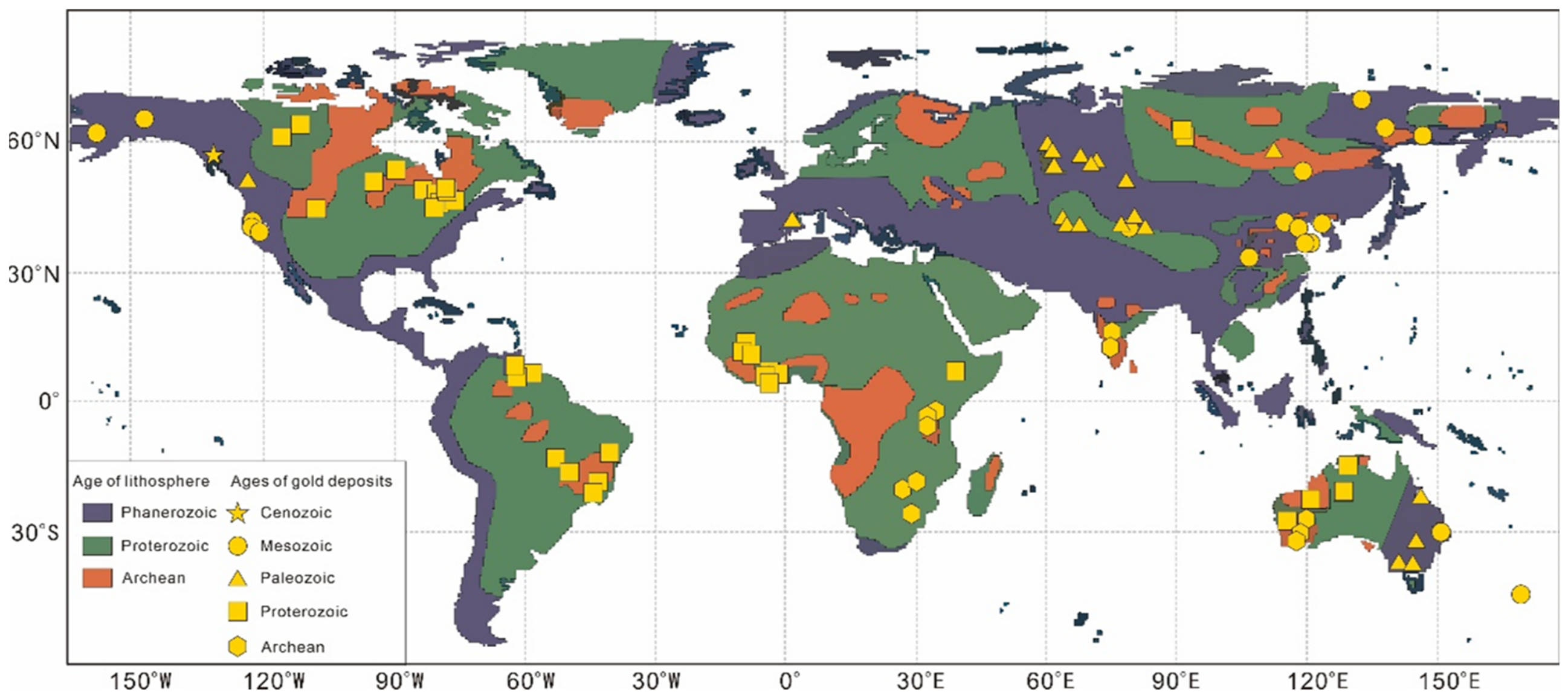
Orogenic gold deposits exhibit significant temporal heterogeneity in their metallogenic epochs, characterized overall by episodic mineralization. Throughout Earth’s long geological history, orogenic gold deposits were concentrated in three key periods: 2.8–2.55 Ga, 2.1–1.8 Ga, and 600–50 Ma (Figure 2). These mineralization peaks coincide closely with episodes of rapid continental crust growth and are intimately related to the assembly and evolution of global supercontinents [2,17].
Figure 2.
Temporal distribution of orogenic gold deposits in Earth’s history (after [5,18]). The colored shaded bands denote the periods of continental breakup events corresponding to the supercontinents including Ur, Kenorland, Columbia, Rodinia, and Gondwana/Pangea.
Currently, several orogenic gold deposits with formation ages older than 2.55 Ga (mainly 2.8 to 2.55 Ga) have been identified. They occur sporadically only in a few ancient geological units, such as the Barberton Greenstone Belt of the Kaapvaal Craton, the Ukrainian Shield, the São Francisco Craton [4,5], and the Pilbara Craton (Figure 3). Notably, the Barberton Greenstone Belt in South Africa hosts the oldest documented orogenic gold deposits (represented by the Fairview and New Consort deposits), which formed prior to ca. 3 Ga.
Orogenic gold deposits formed during the Paleoproterozoic (2.1–1.8 Ga) are linked to the assembly of the Columbia supercontinent. Orogenic gold deposits of this period occur both within cratonic greenstone belts and in metasedimentary sequences of craton-margin fold belts, including the Eburnean orogen of the West African Craton (Ashanti gold deposit) and the Trans-Hudson orogen of the North American Platform (Homestake gold deposit) (Figure 3).
During the prolonged period from the late Paleoproterozoic to the Neoproterozoic (1.8–0.6 Ga), spanning approximately 1.2 billion years, no economically significant orogenic gold deposits have been discovered globally, despite the occurrence of the Rodinia supercontinent assembly event. Only several orogenic gold deposits have been identified in the Jiangnan Orogen and Sunsás orogen during this period [19,20,21]. It remains challenging to interpret the scarcity of orogenic gold deposits during 1.7–0.75 Ga, which was termed as Earth’s middle age, using conventional accretionary-orogen uniformitarian models [2]. Well-established convergent boundaries along the margins of Laurentia and Baltica would have provided favorable, metal-enriched upper-mantle sources for forming these ore types. Long-term shifts in the occurrence of these deposits may stem from evolving lithospheric interactions linked to secular mantle cooling. Neoproterozoic and post-Neoproterozoic orogenic gold deposits formed via modern-type orogenic processes. By comparison, pre-1.7 Ga deposits originated in shallow-subduction settings; shear zones fragmented the mechanically weak lithosphere and served as principal conduits for gold-rich hydrothermal fluids [22].
Phanerozoic orogenic gold mineralization extended continuously from the late Neoproterozoic to the Eocene (600–50 Ma). In the early stage of Phanerozoic mineralization, orogenic gold deposits formed during collisional orogenesis along the active margins of Gondwana and Laurentia following the breakup of Rodinia. These deposits are mainly distributed in the Arabian–Nubian Shield [23], the Trans-Saharan Orogen of West Africa, the Brasília Fold Belt of the São Francisco Craton, the Siberian Platform, and the Paterson Orogen in Australia (e.g., the Telfer gold deposit) (Figure 3).
The episodic and heterogeneous distribution of orogenic gold deposits through geological time is primarily controlled by two key factors: crustal growth and evolution, and post-mineralization preservation conditions [17]. During the two major mineralization peaks at 2.8–2.55 Ga and 2.1–1.8 Ga, widespread mantle plume activity and mantle overturn events drove episodic rapid growth of Precambrian crust, providing the material and tectonic foundation for large-scale gold mineralization [2,3,8]. Moreover, the greenstone belts formed during these periods are mostly hosted within near-equidimensional, stable cratons, allowing them to be well preserved during subsequent long-term tectonic evolution without suffering intense erosion and destruction, thereby ensuring the preservation of the deposits.
Figure 3.
Global distribution map of orogenic gold deposits with gold reserves exceeding 70 tonnes, modified after [24,25].
4. Characteristics of Orogenic Gold Deposits
Systematic studies of global orogenic gold metallogenic belts/provinces have shown that orogenic gold deposits from different geological time periods and tectonic units exhibit strong similarities in terms of metallogenic tectonic setting, ore-forming geological conditions, ore mineral assemblages, alteration and mineralization characteristics, composition and properties of ore-forming fluids, and ore precipitation mechanisms [1,3,26,27]. However, many orogenic gold belts/provinces also display remarkable diversity in aspects such as host rock types and mineralization styles.
4.1. Crustal-Continuum Model
Based on long-term investigations of Archean gold mineralization in the Yilgarn Block, Western Australia, Groves [28] formally proposed the crustal-continuum model for orogenic gold systems. This empirical model was established on the widespread observation that orogenic gold deposits are not restricted to a single metamorphic environment but occur continuously across variable metamorphic grades, ranging from sub-greenschist facies to granulite facies. Accordingly, genetically linked orogenic gold deposits can form over a broad P–T range of 180–700 °C and 1–5 kbar, constituting a unified cogenetic metallogenic suite. Groves [28] summarized five key lines of evidence supporting the crustal-continuum model: (1) stable high-temperature and high-pressure metamorphic mineral assemblages; (2) zoned high-temperature minerals (e.g., diopside) in veins indicative of high-fluid-flux conditions; (3) complex morphological and textural variations of vein quartz and diopside; (4) consistent temporal relationships between host-rock metamorphism and gold mineralization in many districts; and (5) systematic vertical transitions in vein styles, wall-rock alteration, and mineral assemblages, reflecting continuous crustal metallogenic evolution. On the basis of formation depth and P–T conditions, orogenic gold deposits are further classified into three classical subtypes: epizonal deposits formed at depths <6 km and temperatures of 150–300 °C, mesozonal deposits at 6–12 km and 300–475 °C, and hypozonal deposits at depths >12 km and temperatures >475 °C.
Nevertheless, the crustal-continuum model has been questioned from a thermodynamic perspective. Phillips and Powell [9] argued that metamorphosed volcanic rocks may undergo partial melting at temperatures higher than 650 °C under hydrous conditions, whereas anhydrous metamorphic rocks are difficult to melt and cannot generate ore-forming fluids at high metamorphic grades. This mechanism challenges the feasibility of forming hypozonal orogenic gold deposits within granulite-facies terranes, implying that some high-grade metamorphic gold occurrences may represent overprinted rather than primary mineralization.
Despite its theoretical limitations in explaining ultrahigh-grade metamorphic mineralization, the crustal-continuum model remains the fundamental framework for understanding regional metallogenic zoning of orogenic gold deposits. From deep hypozonal to shallow epizonal levels, host-rock metamorphic grade, mineralization styles, wall-rock alteration, sulfide assemblages, and characteristic element associations exhibit continuous and regular transitions. This sequence corresponds to regional metamorphism within collisional orogens. With decreasing temperature and pressure, metamorphic facies shift from granulite and amphibolite facies through greenschist facies to prehnite–pumpellyite facies. Correspondingly, ore styles evolve from ductile-domain foliation-parallel deformed veins and coarse disseminated ores, through brittle–ductile crack–seal banded veins and en echelon vein arrays, to shallow brittle stockwork veins and hydrothermal breccia ores. Ore elemental associations also vary systematically from deep Au–As assemblages, through intermediate Au–As–Te–W associations, to shallow Au–Sb–Hg signatures, with Hg–Sb-dominated mineralization occurring at the shallowest crustal levels. The brittle–ductile transition at approximately 10 km depth represents the critical boundary corresponding to the greenschist–amphibolite facies transition. Importantly, this model describes regional-scale spatial metallogenic patterns rather than vertical zoning within individual ore districts, providing critical guidance for evaluating denudation degrees and regional exploration targeting [29].
4.2. Subtypes of Orogenic Gold Deposits Based on Host-Rock Type
Consistent with the crustal-continuum metallogenic framework, orogenic gold deposits develop in diverse lithological hosts, mainly including metamorphosed volcanic rocks, metasedimentary sequences, banded iron formations (BIFs) and granitic rocks [30]. Most gold mineralization is temporally and spatially coupled with greenschist-facies regional metamorphism, occurring synchronously with or shortly after peak metamorphism [10]. For example, the Mesozoic orogenic gold deposits in the Juneau gold belt (North America) are strictly hosted in greenschist-facies metamorphic belts, benefiting from the optimal matching between greenschist-facies P–T conditions and ore-fluid generation [31,32]. In contrast, individual deposits form in higher-grade metamorphic terranes, such as the Musselwhite amphibolite-facies-hosted gold deposit in the Abitibi Greenstone Belt. Additionally, carbonaceous and iron-rich strata act as effective chemical traps for hydrothermal metal precipitation, facilitating the formation of high-grade gold orebodies [10,30]. Based on previous classification criteria [33] and global comprehensive research, Wang [30] divided orogenic gold deposits into four lithology-based genetic types (Table 1), covering greenstone-hosted, turbidite-hosted, carbonate-hosted, and intrusion-hosted deposits, which fully reflect the lithological diversity of global orogenic gold systems.
Table 1.
Characteristics of host-rock formation types for orogenic gold deposits (after [30]).
4.2.1. Greenstone-Hosted Gold Deposits
Greenstone-hosted gold deposits occur within Archean to Paleoproterozoic granite–greenstone metamorphic terranes and formed in the course of greenstone-belt development, evolution and subsequent tectonic reactivation. They can be further subdivided into three subtypes based on host rock association: (1) greenschist, (2) BIF, and (3) granite–gneiss. The greenschist subtype is dominated by mafic to ultramafic metamorphosed volcanic rocks. Prograde metamorphism from greenschist to amphibolite facies triggers large-scale devolatilization, releasing CO2-rich fluids that mobilize gold from the strata. Typical examples include the Yilgarn Craton in Western Australia and the Abitibi Belt in Canada [34]. The BIF subtype exhibits strong stratigraphic control; iron oxides and sulfides in the BIF act as highly efficient geochemical barriers, capable of forming giant gold deposits such as Homestake and Geita. Orebodies are typically distributed along fold hinges and interlayer detachment zones [35]. The granite–gneiss subtype is hosted in TTG (Tonalite–Trondhjemite–Granodiorite) gneisses, amphibolites, and migmatites, with mineralization temperatures and pressures reaching 450–600 °C and 0.3–0.5 GPa. This type is developed in craton reactivation zones such as the Jiaodong and Xiaoqinling regions in China, where the time gap between regional metamorphism and gold mineralization can reach up to 2 billion years, and the ore-forming fluids contain contributions from mantle-derived components [36]. The contributions from mantle-derived components can also well explained their high formation temperature. Overall, greenstones exhibit significantly elevated background gold concentrations and constitute one of the most important primary gold source rock associations globally.
4.2.2. Turbidite-Hosted Gold Deposits
The host strata of turbidite-hosted gold deposits are dominated by Neoproterozoic–Paleozoic low-greenschist-facies carbonaceous slates, phyllites and meta-siltstones. Volcanic materials are extremely poorly developed. The organic-carbon contents of these strata generally range from 2% to 10%. Carbonaceous matter and syngenetic pyrite pre-concentrate gold during sedimentation and can serve as reducing agents for fluid-mediated gold precipitation during metamorphism. Orebodies mostly occur along bedding-parallel shear zones and fold detachment zones. The diagnostic element assemblage is Au-As-Sb-W. These deposits mostly occur within Phanerozoic collisional orogens. Their host rocks consist mainly of Neoproterozoic and Paleozoic shallow-marine turbidite successions. Compared with the host rocks of greenstone-belt gold deposits, they are characterized by scarce volcanic rocks and low metamorphic grades. Representative ore districts include Muruntau in Uzbekistan, Kumtor in Kyrgyzstan, the Sawayaerdun deposit in West Qinling and Southwest Tianshan of China, and Rodruin in Egypt [37,38,39]. Thick voluminous turbidite sequences constitute a material prerequisite for the formation of giant gold deposits. The total thickness of turbidites in the Muruntau ore district exceeds 4800 m, corresponding to gold resources of more than 6000 t [40].
4.2.3. Carbonate-Hosted Gold Deposits
Carbonate-hosted gold deposits are hosted in marine impure carbonate rocks intercalated with fine clastic strata. They experienced weak regional metamorphism and represent the shallow end-member (<6 km) of the crustal-continuum metallogenic model. Gold mainly occurs as fine-grained invisible gold within As-bearing pyrite, accompanied by the low-temperature element assemblage of As, Sb, Hg and Tl. Mineralization is jointly controlled by high-angle faults, anticline domes and breccia pipes. Ore-forming materials are all derived from the underlying Precambrian turbidite basement. Large-scale mineralization can hardly form without carbon-rich clastic source layers. Typical ore districts include the Carlin ore district in Nevada, USA, and the Youjiang Basin of the Yunnan–Guizhou–Guangxi region, China [41,42]. Such deposits commonly occur adjacent to turbidite-hosted gold deposits within the same orogenic belt and share identical metallogenic ages.
4.2.4. Intrusion-Hosted Gold Deposits
For intrusion-hosted gold deposits, ore-hosting media consist mostly of granite (porphyry), feldspar porphyry, feldspar–quartz porphyry, granodiorite (porphyry), diorite, diorite porphyry dikes, plutons or batholiths. Although these bodies do not belong to conventional strata, they are incorporated into the metallogenic spectrum as a special ore-hosting formation. K-feldspathization and albitization constitute diagnostic wall-rock alterations. Mixing between magmatic exsolved fluids and regional metamorphic fluids collectively drives mineralization. Orebodies are strictly confined within the plutons and their contact zones. These deposits frequently coexist with shear-zone-hosted vein-type gold deposits, and they serve as mutual exploration indicators. Typical examples are Omai and Aurora in Guyana, Yu’erya and Zaozigou in China, as well as Rodruin in Egypt. The “thermal-engine effect” induced by magmatic intrusion can enhance wall-rock permeability and promote gold remobilization from gold-source strata, acting as a critical overprinting condition for the generation of giant gold deposits [38,43].
4.3. Mineralization Styles
Orogenic gold deposits are mainly represented by quartz-vein and altered-rock types. Taking the Jiaodong gold province in China as an example, disseminated altered-rock-type deposits are predominantly distributed in northwestern Jiaodong. They are characterized by sericitization, silicification, sulfidation and K-feldspathization, with minor carbonate alteration, and are hosted within alteration zones along major regional faults. Gold-bearing quartz–sulfide vein-type deposits mostly occur in northeastern Jiaodong, hosted within distal NNE-NE-trending secondary faults parallel to the major regional faults [38,44,45,46,47,48,49].
In orogenic gold deposits, gold occurs dominantly as native gold, electrum, calaverite, and petzite, or as invisible gold in the form of solid-solution (Au+) or nanoscale native gold (Au0) hosted within pyrite [25,49,50,51,52]. Pyrite is the principal gold-bearing mineral, and gold is mostly concentrated in its microfractures [51,53,54,55]. Common ore minerals include pyrite, chalcopyrite, galena and sphalerite, which are closely associated with the main mineralization stage [40]. Gangue minerals mainly consist of quartz, carbonates, micas, albite, chlorite, pyrite, scheelite and tourmaline. The characteristic element assemblage is Au-Ag (As-Sb-Te-W-Mo), with generally low contents of Cu, Pb and Zn [10,25,56].
Apart from conventional vein-type and structural altered-rock-type gold deposits, other varieties may also develop, such as finely disseminated, breccia-type, carbonate-replacement-type, and intrusion-related gold deposits [3,57,58,59]. Such diversity of mineralization styles, especially the coexistence of multiple styles within a single district, has given rise to extensive controversies over the genesis of many orogenic gold deposits. A typical example is the Dashui gold deposit in the West Qinling orogenic belt. The alteration and mineralization features of the Dashui deposit differ markedly from most gold deposits in the West Qinling. For instance, its dominant ore mineral is hematite; ore grades are extremely high, with multiple high-grade ore intervals grading from hundreds up to several thousands of grams per tonne, and visible gold is abundant, whereas sulfides are extremely scarce. Alterations typical for orogenic gold deposits, such as clay alteration, K-feldspathization, sericitization, chloritization and iron carbonatization, are absent or poorly developed. Owing to these distinct mineralization features compared with classic orogenic gold deposits, substantial debate persists regarding its genetic type, ore-forming material sources and metallogenic epoch [60,61,62,63,64].
Variable mineralization styles of orogenic gold deposits within an orogen can reflect lithological differences in host rocks and local changes in metallogenic environments. They also constitute a direct manifestation of the diversity in ore-forming fluids and material sources for orogenic gold systems. In addition to widespread orogenic gold deposits, orogens host diverse types of metallic mineral deposits to varying degrees [65]. As exemplified by the West Qinling orogenic belt, besides gold deposits, it also contains Pb-Zn, Hg-Sb, Ba, U, Mo, W-Cu and other polymetallic mineral resources. Genetic types of these deposits cover orogenic, Carlin- and Carlin-like, porphyry, skarn, and SEDEX types [66,67,68]. Having undergone long-term accretionary orogenic evolution, the Central Asian Orogenic Belt hosts abundant orogenic, gold-rich porphyry, skarn, epithermal gold deposits and VMS-type gold-rich polymetallic deposits [69,70,71]. Unraveling the temporal–spatial relationships and potential genetic links between orogenic gold deposits and other gold deposit types represent an essential approach to constrain ore-forming material sources and metallogenic mechanisms, and to establish robust genetic models consistent with realistic geological constraints [65,72]. Nevertheless, research on this topic remains relatively limited and has not received sufficient attention.
The diversity of mineralization styles for orogenic gold deposits is closely linked to pronounced variations in metallogenic settings and physicochemical conditions. Based on metallogenic depth and P-T conditions, orogenic gold deposits can be further subdivided into three subtypes: epizonal (low-temperature, shallow), mesozonal (moderate-temperature, intermediate-depth), and hypozonal (high-temperature, deep). Their corresponding metallogenic depths are <6 km, 6–12 km and >12 km, with formation temperatures of 150–300 °C, 300–475 °C and >475 °C, respectively. Orogenic gold deposits formed under different depths and P-T conditions show systematic differences in alteration signatures, mineral assemblages, gold occurrence states, trace-element signatures of ores, and P-T constraints from fluid inclusions, and accordingly exhibit varied mineralization styles [1,3,28,65]. These diverse mineralization types can originate from a single regional metallogenic event at different crustal levels and be exhumed to a similar crustal level via post-mineralization differential crustal uplift; alternatively, they may result from superposition of multi-stage mineralization events. Accurately discriminating gold-deposit types with markedly different alteration–mineralization signatures is a critical unresolved issue for gold-deposit research in orogenic belts [19,62,73,74,75,76].
5. Tectonic Controls on Orogenic and Post-Orogenic Gold Deposits
5.1. Ore-Controlling Tectonic Regularities of Orogenic Gold Deposits Under Compressional Regimes
Groves [28] proposed the crustal-continuum metallogenic model, which argues that various metamorphic rocks ranging from sub-greenschist facies to granulite facies can generate cogenetic orogenic gold deposits. This model describes the overall regional-scale distribution of deposits rather than vertical mineralization zonation within a single ore district [29]. Based on this theoretical framework, orogenic gold deposits formed under compressional settings can be classified into deep-, intermediate- and shallow-level subtypes according to differences in tectonic deformation, P-T conditions, and fluid–rock coupling. Ore-controlling structures, alteration–mineralization features, and fluid evolution of deposits at different depths display a complete and continuously gradational sequence.
Hypozonal orogenic gold deposits (metallogenic depth > 12 km, temperature > 475 °C, ductile–brittle deformation): these deposits are hosted in amphibolite- to granulite-facies metamorphic rocks. Regional major thrust shear zones act as the primary ore-transmitting and ore-hosting structures. Orebodies are dominated by thick bedding-parallel lenses and large quartz veins. Wall-rock alteration is restricted to narrow zones, with an assemblage consisting of biotite, hornblende, plagioclase and quartz. Pyrrhotite, pyrite and chalcopyrite are diagnostic metallic minerals [77,78,79] (Figure 4).
Mineralization relies on the combined effect of super-lithostatic fluids with a high fluid factor (λv ≥ 1) and regional differential stress. K-feldspathization and silicification induce rock hardening, shift the rock failure envelope upward, and facilitate the generation of subhorizontal tensile fractures. Periodic hydraulic fracturing takes place via crack–seal cycles, and abrupt fluid-pressure drop triggers the synchronous precipitation of sulfides and quartz [80,81]. The Renco gold deposit in Zimbabwe is controlled by gently dipping, subhorizontal thrust shear zones [82], whereas the Hutti gold deposit in India preserves complete records of such crack–seal mineralization cycles [83,84,85]. Both are typical representatives of this deposit type.
Mesozonal orogenic gold deposits (metallogenic depth of 6–12 km, temperature of 300–475 °C, brittle–ductile transitional deformation): Orebodies are hosted in greenschist-facies strata at the critical brittle–ductile transition zone of the crust. After long-distance transport along deep major faults, fluids are emplaced in hinge voids of folds and R/R′/P Riedel-shear-derived fracture networks [86,87]. Orebodies are mostly saddle-shaped or pod-like, characterized by coexisting bedding-parallel veins and stockwork mineralization. Alteration zones show moderate widths, with a typical assemblage of chlorite–calcite–sericite–pyrite–pyrrhotite [88,89]. Sericitization softens wall rocks and reduces the rock failure threshold, thus shifting the rock failure envelope downward [80,81]. Fluid pressure drives the Mohr stress circle to shift leftward, and gold complexes decompose and precipitate within extensional-shear dilational spaces. The Betam gold deposit in Egypt is hosted in secondary shear fractures [88,90], whereas the Bendigo–Ballarat gold deposits in Australia formed within hinge voids of folds [87]. They serve as diagnostic examples of mesozonal deposits (Figure 4).
Figure 4.
Tectonic ore-controlling styles of orogenic gold deposits under compressional regimes (after [85]).
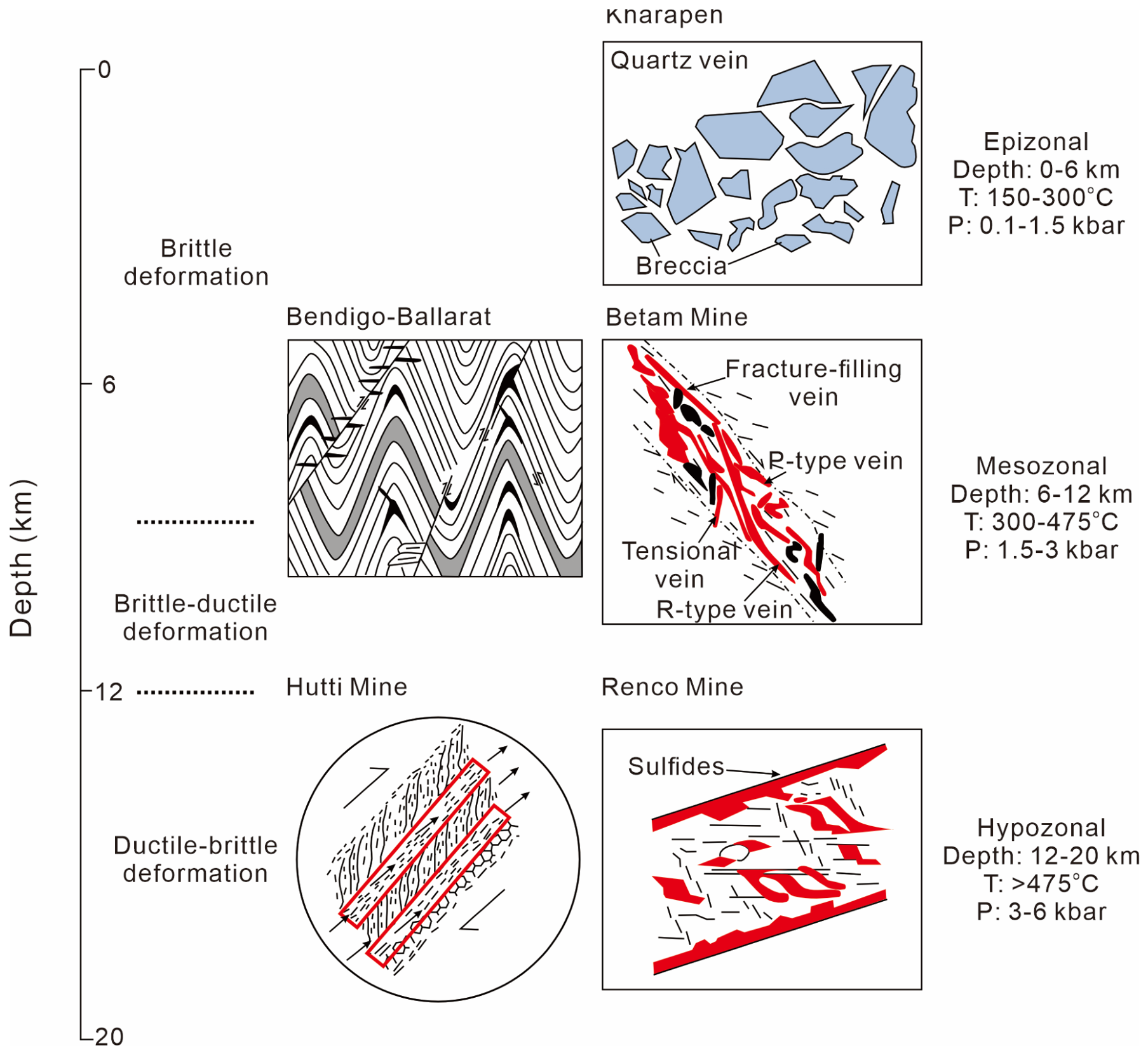
Epizonal orogenic gold deposits (metallogenic depth < 6 km, temperature of 150–300 °C, brittle deformation): These deposits are hosted in low-grade sub-greenschist-facies metamorphic rocks and are dominated by brittle fracture systems. Fold hinges, interlayer detachment zones and hydraulic breccia fracture zones constitute the main hosting spaces [86]. Orebodies occur as tabular and lenticular bodies, with breccia-type and disseminated mineralization as key features. Wall-rock alteration develops on a large scale, ranging from tens of meters up to one-thousand meters in width, typified by the sericite–carbonate–pyrite–arsenopyrite assemblage [29,79,91,92]. At shallow levels, fluids approach hydrostatic pressure with low migration rates, leading to sufficient water–rock interaction. Progressive sericitization weakens rock strength and shifts the failure envelope downward, triggering large-scale hydraulic fracturing and forming network-like and brecciated fluid-reservoir channels [80,81]. The Kharapeh gold deposit in Iran represents this deposit type [92] (Figure 4).
From deep to shallow metallogenic levels, orogenic gold deposits record a continuously transitional tectonic–mineralization–fluid sequence. Tectonic deformation evolves from deep ductile–brittle thrust–shear systems to shallow brittle-fracture and interlayer-detachment systems. Wall-rock alteration evolves from narrow high-temperature silicate alteration zones to broad low-temperature carbonate–sulfide alteration zones. Mineralization styles change sequentially from massive veins, through stockworks, to breccia-disseminated ores. Fluid processes transition from strong tectonic driving with weak water–rock reaction at depth toward weak tectonic constraint with intense water–rock interaction at shallow crustal levels. Three fluid-stress coupling mechanisms, namely crack–seal cycles, Riedel shearing and shallow-level hydraulic fracturing, control deposit emplacement at different crustal levels and collectively constitute the complete tectono-metallogenic system for orogenic gold deposits under compressional regimes [28,93].
5.2. Ore-Controlling Tectonic Regularities of Post-Orogenic Gold Deposits Under Extensional Regimes
The traditional view holds that orogenic gold deposits predominantly form under compressional and transpressional tectonic settings, and large-scale mineralization hardly occurs in purely extensional backgrounds [94]. Nevertheless, numerous case studies in recent years have demonstrated that fracture networks generated during the orogenic stage can be reworked and reactivated by later extensional tectonism, forming favorable sites for the migration and emplacement of ore-forming fluids [95,96]. According to rock-failure criteria, pre-existing fractures under extensional backgrounds follow two reactivation modes: preferentially oriented reactivation and differentially oriented hydraulic fracturing. Fluid pressure constitutes the key factor controlling fracture opening and fluid migration. On the basis of metallogenic depth, P-T conditions and deformation levels, orogenic gold deposits in extensional regimes can be divided into deep-, intermediate- and shallow-level subtypes. Typical examples include the Danba gold deposit along the western Yangtze margin, the Jiaodong ore district, Alaska-Juneau in Alaska, the Mingsai deposit in southern Tibet, and the Daqiao deposit in the West Qinling [55,88,97,98,99,100,101].
Hypozonal post-orogenic gold deposits (12–20 km, >475 °C, ductile–brittle deformation): Hypozonal gold deposits are hosted in amphibolite- and granulite-facies metamorphic rocks. Regional deep major faults serve as long-distance fluid migration channels, and secondary ductile–brittle shear zones govern orebody emplacement. Veins range from several meters to tens of meters in thickness and occur as stratiform-like and banded massive quartz veins. Wall-rock alteration is dominated by biotite, hornblende and plagioclase, with narrow alteration zones. Deep-seated fluids feature high pressure and rapid migration rates but weak water–rock interaction [77,79,97,98]. During the tectonic transition from compression to extension, the combined action of fluid pressure and differential stress shifts the Mohr-stress circle leftward, giving rise to preferentially oriented reactivation of pre-existing thrust faults [97]. Overpressured fluids migrate upward along lithosphere-scale faults via the crack-jump mechanism and precipitate ores within secondary fractures [95,102]. The Danba gold deposit on the western margin of the Yangtze Block represents a typical example of this subtype [97,98] (Figure 5).
Figure 5.
Tectonic ore-controlling styles of post-orogenic gold deposits under extensional regimes (after [81]).
Mesozonal post-orogenic gold deposits (6–12 km, 300–475 °C, brittle–ductile deformation): Mesozonal gold deposits are hosted in greenschist-facies strata and controlled by reactivated normal faults, extensional tensile fractures and dilational jogs along fault bends. Veins are several meters to tens of meters wide, dominated by vein-type, fault-fill and stockwork orebodies, associated with moderately wide alteration zones comprising K-feldspar, sericite and pyrite [47,77,81,90,100,103]. In extensional settings, the maximum principal stress is nearly vertical (σ1 = σv). Fluid pressure induces leftward shift of the Mohr-stress circle. When the Mohr circle becomes tangential to the failure envelope, two metallogenic paths are possible. First, pre-existing fractures undergo preferentially oriented reactivation; fluids trigger extensive alteration and precipitation at fault bends and discontinuities. The Xinli gold deposit in Jiaodong belongs to this category [47,103]. Second, elevated fluid pressure generates new vertical tensile-fracture networks, where fluids concentrate and form orebodies. The Alaska-Juneau gold deposit in Alaska serves as a representative case [85,100]. Sericitization reduces rock tensile strength and shifts the failure envelope downward, promoting fracture reactivation and fluid-driven mineralization [81,85] (Figure 5).
Epizonal post-orogenic gold deposits (2–6 km, 150–300 °C, brittle deformation): Epizonal gold deposits occur in sub-greenschist-facies or unmetamorphosed sedimentary rocks under dominantly brittle deformation. Fold hinges, interlayer detachments and hydraulic-breccia fracture zones constitute major ore-hosting structures. Orebodies are stratiform-like, tabular and lenticular, accompanied by broad-scale alteration assemblages of carbonate, muscovite and pyrite, characterized by breccia-type and disseminated mineralization [28,29,79,101,104,105,106]. Early silicified zones exhibit low permeability, leading to continuous fluid accumulation and pressure build-up. When fluid pressure exceeds the sum of the minimum principal stress σ3 and rock tensile strength T, the Mohr circle shifts leftward and triggers hydraulic fracturing [98]. Fluids flow into breccia zones and rapidly decompress, resulting in gold unloading and precipitation. After fractures are cemented and sealed, fluids build pressure again. Repeated fracturing and superposition produce veinlet and breccia-style ores. The Daqiao deposit in the West Qinling and the Costerfield gold deposit are typical representatives [81,101,107,108] (Figure 5).
All gold deposits within extensional systems form by reactivation of pre-existing tectonic frameworks established during the compressional phase. Where the orientation of pre-existing fractures matches regional stress, reactivation and infill can take place under relatively low fluid pressure. Where orientations are mismatched, overpressured fluids are required to generate new fractures. With decreasing metallogenic burial depth, tectonic deformation transitions from brittle–ductile to brittle regimes, and mineralization styles evolve from thick massive quartz veins at depth, through stockworks at intermediate levels, to breccia-disseminated ores in shallow crust. Deep fluids are overpressured, strongly tectonically driven and marked by weak water–rock reaction, whereas shallow fluids approach hydrostatic pressure with markedly intensified metasomatic alteration.
6. Sources of Ore-Forming Materials and Genetic Models of Orogenic Gold Deposits
Numerous fluid-inclusion studies have demonstrated that ore-forming fluids of orogenic gold deposits are near-neutral, moderate-to-low-salinity C-H2O fluids, generally with minor methane and nitrogen, and this property has reached a broad consensus [3,10,26,27,109]. Constraints on the origin of ore-forming fluids are mainly obtained by analyzing H-O-C isotopic compositions of hydrothermal gangue minerals equilibrated with ore-forming fluids. Bulk fluid-inclusion analyses (crushing or thermal decrepitation methods) yield a very wide range of hydrogen-isotope values of −179 to +7‰ [32]. However, these experimental techniques commonly extract fluid inclusions of multiple generations, and the obtained data represent mixed signals of multistage fluids, which cannot precisely characterize the hydrogen-isotope composition of primary fluids from the main mineralization stage [108]. Analyses of hydrogen isotopes from structural water in hydrous hydrothermal alteration minerals formed during ore deposition provide a more consistent range for ore-forming fluids: −80 to −20‰ [20,32]. In addition, some fluid-inclusion hydrogen-isotope values lower than −80‰ most likely reflect substantial enrichment of CH4 in fluids [110,111,112,113,114].
Published isotopic statistics show that oxygen-isotope values of ore-forming fluids for Precambrian orogenic gold deposits cluster at 6‰–11‰ [26], whereas Phanerozoic deposits mostly yield δ18O values of 7‰–13‰ [32]. Such differences indicate distinctions in fluid source regions and rock geochemical properties of wall rocks traversed by migrating fluids. Carbon-isotope compositions of carbonate minerals and fluid inclusions from most orogenic gold deposits range from −11‰ to +2‰ [26]. Moreover, a considerable number of deposits show marked enrichment of 12C, which is widely interpreted as mixing with reduced organic carbon components [115,116].
Nitrogen isotopes constitute an effective tracer for constraining fluid sources. The most commonly analyzed minerals are muscovite, biotite and K-feldspar, in which nitrogen-bearing ammonium ions substitute for potassium within crystal lattices [3,10]. Available datasets yield nitrogen-isotope values of 10‰–24‰ for Neoarchean orogenic gold deposits [117,118], 6.5‰–12‰ for Paleoproterozoic gold deposits [119], and 1.5‰–5.5‰ for Phanerozoic orogenic gold deposits [120,121]. Radiogenic isotopes (Pb, Sr, Os), noble-gas isotopes and halogens have also been applied for fluid tracing, though far less widely than C-H-O stable isotopes. Furthermore, low abundances of these elements in ore-forming fluids leave their tracing reliability to be further validated and improved [10].
During mineralization of orogenic gold deposits, gold migrates dominantly as sulfur-bearing aqueous complexes [122,123]. Accordingly, Au and S are generally considered cogenetic. Gold has no stable isotopes, so sulfur isotopes are routinely used to constrain gold sources. Overall, orogenic gold deposits exhibit a wide scatter in sulfur-isotope values, yet the δ34S values of most deposits cluster within 0‰–10‰ [3,10]. The sulfur-isotope evolutionary trend of Phanerozoic orogenic gold deposits correlates well with coeval seawater sulfate in host strata, implying that sulfur was derived from reduction of marine sulfate in sedimentary sequences and pyrite desulfurization during sedimentary diagenesis [31,124,125].
Three dominant genetic models have been proposed: crustal metamorphic devolatilization model [7], basin-scale two-stage mineralization model (carbonaceous sediment-source model; [126]), and deep-seated metamorphic metallogenic model [12]. Additionally, contributions of magmatic–hydrothermal fluids to orogenic gold mineralization have been increasingly reported in recent years [127,128,129] (Table 2).
Table 2.
Diverse genetic models for orogenic gold deposits.
6.1. Crustal Metamorphic Devolatilization Model
With the continuous accumulation of global case studies, the crustal metamorphic devolatilization model (metamorphic devolatilization model; [7]) has gained increasing recognition. The core viewpoint of this model is that ore-forming fluids and metallogenic materials are derived from regional metamorphism of source rocks, which mostly refer to metamorphosed volcanic and sedimentary rocks without pre-enrichment signatures. During greenschist- to amphibolite-facies metamorphism, rocks release volatiles including H2O, CO2 and CH4 as well as metallogenic elements such as Au and S to form metal-rich hydrothermal fluids. Gold precipitation and emplacement predominantly occur at greenschist-facies P-T conditions and at crustal depths corresponding to the brittle–ductile transition (Figure 6; [7,19,130,131,132]).
Figure 6.
Crustal metamorphic devolatilization model (after [12]).
This model is consistent with field observations that many deposits are hosted in medium-to-high-grade metamorphic terranes. A typical example is the Bendigo gold deposit in the Victoria metallogenic province, Australia, which is hosted within greenschist-facies metamorphosed turbidites. Ore-forming materials and fluids originated from metamorphic devolatilization of a ca. 35 km thick meta-volcanic–sedimentary succession [133,134]. High-precision trace-element analyses of rocks with varying metamorphic grades from global metallogenic belts provide additional field geochemical evidence from the perspective of element mobility [135,136,137,138].
In the Otago–Alpine sedimentary–metamorphic belt of the South Island, New Zealand, the outer part consists of low-grade prehnite–laumontite-facies rocks, which grade inwards into pumpellyite–actinolite facies, lower greenschist facies, medium–high greenschist facies and lower amphibolite facies. Systematic analyses reveal that with increasing metamorphic grade from the periphery toward the core, rocks show progressive depletion in Au, Ag, As, Sb, Hg, Mo and W. The magnitude of depletion is tightly coupled with the breakdown of pyrite, sphalerite, galena and cobaltite. This indicates that metamorphic heating drives phase transformation and decomposition of sulfides, leading to trace-element remobilization. Regional gold deposits are concentrated within schist belts, and the trace-element assemblages of ores match well with components leached from wall rocks, demonstrating that metamorphically remobilized metals migrated along faults to form deposits. Metasedimentary rocks in the Superior metallogenic belt of the Canadian Shield also display decreasing whole-rock gold contents at higher metamorphic grades, supporting gold remobilization during prograde metamorphism [128].
Analyses of basaltic rocks from the Otago–Alpine belt show that meta-basites have comparable gold-release capacities relative to metasedimentary rocks, but cannot supply arsenic. Studies on volcanic rocks from the La Grande metallogenic province in Canada and the Central Lapland greenstone belt in Finland demonstrate that 77% and 59% of primary gold was released respectively during amphibolite-facies metamorphism, confirming metamorphosed volcanic rocks as high-quality source rocks [138]. Petrological experimental data provide further support: simulations by Phillips [139] indicated that devolatilization of greenstone-belt meta-basites at amphibolite facies could supply CO2, K, S, H2O and Au required by the Golden Mile deposit in the Kalgoorlie goldfield. Using the CaO-MgO-FeO-Al2O3-SiO2-H2O-CO2 system, Powell [140] modeled meta-basic and meta-ultrabasic rocks and found that high-greenschist- to low-amphibolite-facies metamorphism can generate low-salinity CO2-rich fluids, which perfectly match fluid signatures of greenstone-belt gold deposits. The Archean crust was characterized by relatively small thickness, high heat flow and widespread volcanic rocks, which provided favorable prerequisites for mineralization from metamorphosed volcanic rocks. Meanwhile, the Archean atmosphere was anoxic with weak continental weathering, so clastic sedimentation was far less extensive than in the Phanerozoic [141,142,143].
Several deposits hosted within high-grade metamorphic terranes, including Big Bell and Griffin’s Find in Western Australia, Renco in Zimbabwe, Challenger in South Australia and Hemlo in Canada, cannot be explained by the crustal-continuum metallogenic model. According to the metamorphic devolatilization model, these deposits initially formed under greenschist-facies conditions and both orebodies and wall rocks were subsequently overprinted by granulite-facies metamorphism. Thermodynamic modeling by Tomkins [143] illustrated gold mobility within Fe-bearing sulfides during prograde and retrograde metamorphism. The results verify that gold deposits within high-amphibolite- to granulite-facies rocks of the Gawler Craton represent products of early-stage mineralization overprinted by later high-grade metamorphism.
6.2. Basin-Scale Two-Stage Mineralization Model (Carbonaceous Sediment-Source Model)
Large [144] performed LA-ICP-MS in situ analyses on pyrite of diverse genetic origins from the Sukhoi Log gold deposit in the Russian Far East. Sediment-derived pyrite is markedly enriched in Au, Mo, Sb, Ni, Co, Se, Te, Ag, Cu, Pb and Zn. Trace-element contents decrease progressively in diagenetic, metamorphic and hydrothermal pyrite generations, which commonly contain inclusions of native gold and sulfide minerals. Subsequent studies refined the two-stage metallogenic theory: pyrite pre-concentrates metals during sedimentary–early diagenetic stages, and regional deformation and metamorphism trigger desulfurization of pyrite to form pyrrhotite, releasing metallogenic materials for ore emplacement [145,146].
This model involves two evolutionary steps: (1) Sedimentary–diagenetic stage: Within reduced, anoxic epicontinental basins, organic matter adsorbs Au, As, V, Ni, Se, Ag, Zn, Mo, Cu and U from water columns. These elements are concentrated in fine-grained black mudstone and siltstone of slope and basinal facies. During early diagenesis, Au, Ni, Se, Te, Ag, Mo, and Cu (accompanied by PGEs) are incorporated into arsenian pyrite, forming extensive Au-As-rich source beds. Rock Au concentrations generally range from 5 to 100 ppb, and As from 10 to 200 ppm. Local arsenian pyrite can contain up to 1–2 ppm Au and 1000 ppm As, and may host nanoscale native gold. During late diagenesis to early metamorphism, fine-grained arsenian pyrite recrystallizes, and organic matter transforms into bitumen. (2) Metamorphic remobilization stage: Under P-T conditions of lower greenschist facies and above, arsenian pyrite converts to pyrrhotite and releases Au, As, Sb, Te, Cu, Zn, Mo, Bi, Tl and Pb. Hydrothermal fluids transport these components and concentrate them along favorable structures to form economic orebodies.
Strong depletion of Au and As in deep-seated pyrrhotite from the Bendigo mining district, Victoria, is consistent with predictions of this model [147]. With the widespread application of in situ microanalytical techniques, pre-enrichment of ore-forming elements in pyrite from carbonaceous clastic rocks has been documented in many typical global mining districts: Bodaybo in Russia [148], Homestake in USA [149], Yukon in Canada [150], Golden Mile in Australia [151], Otago in New Zealand [152], and Carbon Leader in South Africa [153].
In situ S- and Pb-isotope measurements and quantitative fluid-inclusion analyses continuously support this model. Chang [125] analyzed sulfur isotopes of multistage pyrite from the Sukhoi Log gold deposit. Early-stage values show scattered distributions, whereas late-stage data converge toward a stable mean, indicating sulfur derived from seawater sulfate reduction and isotopic homogenization driven by metamorphism. Sulfur-isotope signatures of global sediment-hosted gold deposits correlate well with coeval seawater sulfur evolution, corroborating that sulfur (gold migrates as bisulfide complexes) originates from sedimentary–diagenetic pyrite. In situ Pb-isotope data from Meffre [154] also support the two-stage evolutionary model. Gaboury [155,156] compiled fluid compositions of typical global deposits, where CH4, C2H6, CO2, SO2 and H2S are widely detected. These species correspond to thermal degradation, hydrolysis and oxidation of organic matter, confirming the suitability of organic-rich sedimentary rocks as source rocks.
Limitations in applicability: This model targets sediment-hosted gold deposits and does not cover greenstone-belt-type deposits [145]. The Second Great Oxidation Event (635–510 Ma) increased the solubility of deep-ocean sulfate and gold. Bacterial sulfate reduction generated Au-rich pyrite and formed large-scale Phanerozoic source beds [9]. Studies of the Ballachulish metamorphic aureole in Scotland demonstrate that metamorphism from greenschist to amphibolite facies remobilizes Au-As-Bi-Sb-Mn-W, while Ni-Co-Mo-V-Cr-Cu-Pb-Zn remain retained within neoformed minerals. Sulfur released during pyrite-to-pyrrhotite conversion preferentially combines with Fe in silicates, and meta-basic–ultrabasic rocks yield limited sulfur [157]. Thermodynamic simulations supplement mechanistic understanding: chlorite decomposition produces water and increases fluid demand, facilitating pyrite phase transformation and sulfur release. Mudrocks preferentially release Au and minor base metals during metamorphism, which accounts for the general low base-metal signatures of orogenic gold deposits [84,94].
The key differences between the two dominant models are as follows [146]: (1) Material source: The two-stage model advocates primary gold enrichment within sedimentary basins; the metamorphic devolatilization model argues that source rocks lack pre-enrichment and metals are remobilized integrally during metamorphism. (2) Role of carbonaceous rocks: The former considers organic-rich sedimentary rocks as the material source; the latter treats them as carriers for metal precipitation. (3) Metallogenic timing: The former involves early sedimentary pre-enrichment followed by remobilization and ore emplacement during metamorphism; the latter features one-shot ore formation during late orogenic metamorphism.
6.3. Deep-Seated Metamorphic Metallogenic Model
The metamorphic devolatilization model assumes that gold deposits within high-grade metamorphic facies initially formed under greenschist-facies conditions and were subsequently overprinted. However, several deposits including New Consort, Renco, Hutti and Navachab demonstrably formed under amphibolite- to granulite-facies conditions [158,159]. Phanerozoic deep-seated gold deposits such as Danba along the western Yangtze margin, Beaver Dam in Canada’s Meguma Belt, and deposits in the French Massif Central exhibit primary high-temperature signatures and are not products of prograde metamorphic devolatilization of wall rocks. Some deposits formed after high-grade metamorphism of their host rocks; the wall rocks had already completed devolatilization and could no longer supply ore-forming materials (e.g., Cenozoic gold deposits in the Mexican Megashear Belt). Certain deposits in West Qinling, the Huangjindong deposit in the Jiangnan Orogen, and parts of the Ailaoshan metallogenic belt also cannot be interpreted by the former two models. Building on research results from the Jiaodong gold province [36], Groves [12] proposed the deep-seated metamorphic metallogenic model. In this model, subducted oceanic crust, overlying Au-rich pyritic sedimentary sequences, and metasomatized lithospheric mantle/mantle wedge represent the ultimate sources of ore-forming fluids and metals. This model can theoretically account for the genesis of orogenic gold deposits worldwide (Figure 7; [96]).
Figure 7.
Deep-seated metamorphic metallogenic model (after [14]). The diagram showing the major host-rock types of orogenic gold deposits (modified from [30]).
6.4. Contribution of Magmatic–Hydrothermal Fluids into the Orogenic Gold Mineralization
Magmatic–hydrothermal fluids cannot act as a universal ore-fluid source on a global scale; nevertheless, numerous case studies confirm the involvement of magmatic components in mineralization within individual mining districts [16]. Os-He isotopes of arsenopyrite from the Muruntau gold deposit in Central Asia (with reserves exceeding 6000 t) indicate mixing of mantle-derived magmatic fluids [126,127,128]. Ore-forming fluids in the Loulo goldfield of West Africa show mixed signatures of metamorphic and magmatic end-members [116,156]. Mass-independent fractionation signatures in pyrite from Archean mining districts imply that sulfur and gold were sourced from deep magmatic chambers or the mantle [159,160,161]. Noble-gas isotopes from the St Ives gold deposit in Western Australia demonstrate fluid links with crust-derived magmas [162]. Mineralization temperatures at the Satinoco gold deposit in Brazil were controlled by granitic magma emplacement, with direct participation of magmatic–hydrothermal fluids in ore formation [162]. Pre-existing mineralization at the Hope Bay Madrid gold deposit in Canada was overprinted by magmatic fluids to form high-grade orebodies, though it remains unclear whether metals were remobilized in situ or supplied by magmatic transport [163]. Goldfarb and Groves [10] concluded that magmatic–hydrothermal involvement in mineralization is real under specific tectonic settings, and fluids exsolved from upper-to-middle crustal magma chambers as well as deep-seated fluids can provide metallogenic materials [5,40,163,164,165,166,167,168].
A commonly confused deposit type also occurs within accretionary orogens: intrusion-related gold deposits. Representative examples include Cretaceous deposits such as Fort Knox and Donlin Creek along the Tintina fault zone of the Cordilleran orogen, and Late Devonian intrusion-associated gold deposits in the Stawell goldfield of the Lachlan Orogen, Australia [56,57,165]. Their key diagnostic features are summarized below: (1) Tectonic setting: Accreted terranes at convergent continental margins, located toward the intracontinental side rather than in island-arc belts. (2) Associated mineralization: Frequently co-occur with W-Sn mineralization within the same igneous province. (3) Intrusion characteristics: Granodioritic-to-granitic subalkaline rocks ranging from metaluminous to weakly peraluminous. Crustal components increase magma reducibility and favor gold enrichment. (4) Zonation pattern: A complete elemental zonation from high-temperature magmatic to low-temperature hydrothermal conditions centered on the intrusive body. (5) Ore styles: Greisen-type, disseminated, sheeted-vein, stockwork and breccia-hosted mineralization developed inside plutons; vein-type, disseminated and replacement orebodies formed in wall rocks. (6) Alteration assemblages: Quartz, K-feldspar, albite, sericite and carbonatization. (7) Sulfide characteristics: Low total sulfide contents with depleted base metals; mineral assemblages dominated by pyrrhotite, pyrite, loellingite and arsenopyrite. (8) Characteristic elements: Enrichment in Bi, W, As, Sn, Mo, Te and Sb; gold is commonly associated with Bi-tellurides, accompanied by molybdenite and scheelite. (9) Fluid properties: Wide salinity range and overall CO2-rich signatures.
7. Conclusions
Orogenic gold deposits are universally formed during accretionary and collisional orogenic processes and constitute a continuous crustal-scale metallogenic system spanning sub-greenschist to granulite metamorphic facies. Their global spatiotemporal distribution is episodic and controlled jointly by crustal growth events, supercontinent assembly, and post-mineralization preservation conditions. Significant metallogenic diversity is manifested by variable host rock associations, mineralization styles, alteration sequences, and element geochemical signatures, which correspond to distinct physicochemical conditions at shallow, intermediate, and deep crustal levels. Tectonic deformation and fluid–rock coupling are the core controls on gold precipitation. In compressional orogenic environments, systematic transitions from deep ductile–brittle shear mineralization to shallow brittle fracture and breccia-hosted mineralization form a complete vertical metallogenic zoning sequence. In extensional tectonic settings, reactivation of inherited orogenic structures and fluid overpressure-driven fracturing trigger superimposed gold mineralization, greatly expanding the metallogenic potential of traditional orogenic belts. Currently, three mainstream genetic models have been proposed. The metamorphic devolatilization model emphasizes in situ fluid and metal release from regional metamorphism; the two-stage sedimentary source model highlights early diagenetic metal pre-enrichment in carbonaceous basins followed by metamorphic remobilization; and the recently proposed deep-seated metamorphic model integrates subducted oceanic crust, sedimentary sequences, and metasomatized mantle wedge materials to explain high-grade metamorphic and supergene orogenic gold mineralization. In addition, magmatic–hydrothermal fluids are increasingly recognized as important auxiliary metallogenic components in specific accretionary orogens. Future research should focus on finely characterizing the coupling mechanisms between multistage tectonic transitions and fluid evolution, identifying the key controlling factors of mineralization style diversity, clarifying the material contributions of deep mantle sources and magmatic overprinting, and establishing unified genetic criteria to distinguish diverse orogenic gold subtypes. The integrated application of petrology, geochemistry, and in situ isotopic constraints will further refine the metallogenic theory of orogenic gold systems and provide guidance for future regional gold exploration. This study systematically summarizes the metamorphic facies, vein styles and elemental signatures of different orogenic gold deposit types formed at varying crustal levels. These discriminative criteria enable precise discrimination of deposit genetic type and mineralization crustal level. Together with regional geological constraints for targeting favorable ore-forming sites and denudation assessment to evaluate ore preservation, they offer clear theoretical guidance for delineating regional exploration targets and vectoring toward high-grade mineralized zones.
Author Contributions
Conceptualization, S.-Y.L. and R.-Y.W.; Methodology, S.-Y.L.; Software, S.-Y.L.; Validation, S.-Y.L.; formal analysis, S.-Y.L.; Investigation, S.-Y.L.; Data curation, S.-Y.L.; Writing—original draft preparation, S.-Y.L.; Writing—review and editing, S.-Y.L., R.-Y.W., T.H. and S.-Y.C.; Visualization, S.-Y.L.; Supervision, R.-Y.W.; Project administration, T.H.; funding acquisition, R.-Y.W. All authors have read and agreed to the published version of the manuscript.
Funding
This research was financially supported by the Deep Earth Probe and Mineral Resources Exploration—National Science and Technology Major Project (2025ZD1007206); Open Fund Project of the First Geological Brigade, Shandong Provincial Bureau of Geological Mineral Exploration and Development (2024DW03); China Geological Survey Project (DD202402015); Research Program of Ministry of Natural Resources (ZKKJ202404).
Data Availability Statement
No new data were created or analyzed in this study. Data sharing is not applicable to this article.
Conflicts of Interest
Authors Ruo-Yu Wu and Tao Huang were employed by the companies Hubei United Investment Co., Ltd., Hubei Natural Resources Asset Operation Co., Ltd., and Hubei Mineral Resources Investment and Development Co., Ltd., respectively. The remaining authors declare that the research was conducted in the absence of any commercial or financial relationships that could be construed as potential conflicts of interest.
References
- Groves, D.I.; Goldfarb, R.J.; Gebre-Mariam, M.; Hagemann, S.; Robert, F. Orogenic gold deposits: A proposed classification in the context of their crustal distribution and relationship to other gold deposit types. Ore Geol. Rev. 1998, 13, 7–27. [Google Scholar] [CrossRef] [Scilit]
- Goldfarb, R.J.; Groves, D.I.; Gardoll, S. Orogenic gold and geologic time: A global synthesis. Ore Geol. Rev. 2001, 18, 1–75. [Google Scholar] [CrossRef] [Scilit]
- Goldfarb, R.J.; Baker, T.; Dubé, B.; Groves, D.I.; Hart, C.J.R.; Gosselin, P. Distribution, character and genesis of gold deposits in metamorphic terranes. Econ. Geol. 2005, 100, 407–450. [Google Scholar]
- Fernandes, R.d.C.; Roncato, J.; de Paula, R.S. Structural Evolution of the Rio das Velhas Greenstone Belt, Quadrilátero Ferrífero, Brazil: Influence of Proterozoic Orogenies on Its Western Archean Gold Deposits. Minerals 2020, 10, 983. [Google Scholar] [CrossRef] [Scilit]
- Vial, D.S.; DeWitt, E.; Lobato, L.M.; Thorman, C.H. The Geology of the Morro Velho Gold Deposit in the Archean Rio das Velhas Greenstone Belt, Quadrilátero Ferrífero, Brazil. Ore Geol. Rev. 2007, 32, 511–542. [Google Scholar] [CrossRef] [Scilit]
- Lang, J.R.; Baker, T. Intrusion-related gold systems: The present level of understanding. Miner. Depos. 2001, 36, 477–489. [Google Scholar] [CrossRef] [Scilit]
- Bierlein, F.P.; Groves, D.I.; Goldfarb, R.J.; Dubé, B. Lithospheric controls on the formation of provinces hosting giant orogenic gold deposits. Miner. Depos. 2006, 40, 874–886. [Google Scholar] [CrossRef] [Scilit]
- Groves, D.I.; Goldfarb, R.J.; Robert, F.; Hart, C.J.R. Gold deposits in metamorphic belts: Overview of current understanding, outstanding problems, future research, and exploration significance. Econ. Geol. 2003, 98, 1–29. [Google Scholar] [CrossRef] [Scilit]
- Phillips, G.N.; Powell, R. Formation of gold deposits: Review and evaluation of the continuum model. Earth-Sci. Rev. 2009, 94, 1–21. [Google Scholar] [CrossRef] [Scilit]
- Phillips, G.N.; Powell, R. Formation of gold deposits: A metamorphic devolatilization model. J. Metamorph. Geol. 2010, 28, 689–718. [Google Scholar] [CrossRef] [Scilit]
- Tomkins, A.G. On the source of orogenic gold. Geology 2013, 41, 1255–1256. [Google Scholar] [CrossRef] [Scilit]
- Goldfarb, R.J.; Groves, D.I. Orogenic gold: Common or evolving fluid and metal sources through time. Lithos 2015, 233, 2–26. [Google Scholar] [CrossRef] [Scilit]
- Gaboury, D. Parameters for the formation of orogenic gold deposits. Appl. Earth Sci. 2019, 128, 124–133. [Google Scholar] [CrossRef] [Scilit]
- Groves, D.I.; Santosh, M.; Deng, J.; Wang, Q.F.; Yang, L.Q.; Zhang, L. A holistic model for the origin of orogenic gold deposits and its implications for exploration. Mineral. Depos. 2020, 55, 275–292. [Google Scholar] [CrossRef] [Scilit]
- Hagemann, S.G.; Cassidy, K.F. Archean orogenic lode gold deposits. Rev. Econ. Geol. 2000, 13, 9–68. [Google Scholar] [CrossRef] [Scilit]
- Chen, Y.J.; Ni, P.; Hu, F.R.; Pirajno, F.; Lai, Y.; Su, W.C.; Zhang, H. Diagnostic fluid inclusions of different types hydrothermal gold deposits. Acta Petrol. Sin. 2007, 23, 2085–2108. [Google Scholar]
- Goldfarb, R.J.; Groves, D.I.; Gardoll, S. Rotund versus skinny orogens: Well-nourished or malnourished gold? Geology 2001, 29, 539–542. [Google Scholar] [CrossRef] [Scilit]
- Tomkins, A.G. A biogeochemical influence on the secular distribution of orogenic gold. Econ. Geol. 2013, 108, 193–197. [Google Scholar] [CrossRef] [Scilit]
- Luo, W.; Wu, S.; Li, C.; Tan, D.; Chen, J. Gold Mineralization Related to Rifting of the Rodinia Supercontinent: As Gauged from the Dongyuan Au Deposit, Jiangnan Orogen, China. Ore Geol. Rev. 2024, 164, 105773. [Google Scholar] [CrossRef] [Scilit]
- Chen, M.; Shao, Y.; Li, Y.; Liu, Z.; Chen, K.; He, M.; Chen, Z. Ore Forming Process and Ore Genesis of the Wangu Gold Deposit in the Jiangnan Orogenic Belt, South China: Constraints from Pyrite Textures, Trace Elements and In Situ Sulfur Isotopes Composition. Ore Geol. Rev. 2025, 178, 106485. [Google Scholar] [CrossRef] [Scilit]
- Quadros, M.L.d.E.S.; Giustina, M.E.S.D.; Rodrigues, J.B.; Souza, V.d.S. Geology and LA ICP MS U–Pb Geochronology of the Nova Brasilândia Belt, SW Amazonian Craton: New Ages, Re Evaluation of Existing Geochronological Data, and Implications for the Evolution of the Sunsás Orogen. J. S. Am. Earth Sci. 2021, 109, 103220. [Google Scholar] [CrossRef] [Scilit]
- Cawood, P.A.; Hawkesworth, C.J. Earth’s Middle Age. Geology 2014, 42, 503–506. [Google Scholar] [CrossRef] [Scilit]
- Mahmoud, A.S.; El-Dokouny, H.A.; Ghoneim, M.M.; Dyakonov, V.V.; Vikent’ev, I.V.; El-Lithy, M.A.; Dawoud, M. Origin and Characteristics of Ore-Forming Fluids of the Abu Gaharish Orogenic Gold Deposits, Central Eastern Desert, Egypt. Arab. J. Sci. Eng. 2024, 50, 6745–6778. [Google Scholar] [CrossRef] [Scilit]
- Goldfarb, R.J. Lode Gold Deposits in Time and Space. In Encyclopedia of Geology, 2nd ed.; Elsevier: Amsterdam, The Netherlands, 2021; pp. 663–679. [Google Scholar]
- Wang, Z.C.; Xu, Z.; Cheng, H.; Zou, Y.; Guo, J.; Liu, Y.; Yang, J.; Zong, K.; Xiong, L.; Hu, Z. Precambrian metamorphic crustal basement cannot provide much gold to form giant gold deposits in the Jiaodong Peninsula, China. Precambrian Res. 2021, 354, 106045. [Google Scholar] [CrossRef] [Scilit]
- McCuaig, T.C.; Kerrich, R. P-T-t-deformation-fluid characteristics of lode gold deposits: Evidence from alteration systematics. Ore Geol. Rev. 1998, 12, 381–454. [Google Scholar] [CrossRef] [Scilit]
- Ridley, J.R.; Diamond, L.W. Fluid chemistry of orogenic lode gold deposits and implications for genetic models. Rev. Econ. Geol. 2000, 13, 141–162. [Google Scholar] [CrossRef] [Scilit]
- Groves, D.I. The crustal continuum model for Late-Archaean lode-gold deposits of the Yilgarn Block, Western Australia. Miner. Depos. 1993, 28, 366–374. [Google Scholar] [CrossRef] [Scilit]
- Wang, Q.F.; Deng, J.; Zhao, H.S.; Yang, L.; Ma, Q.Y.; Li, H.J. Review on orogenic gold deposits. Earth Sci. 2019, 44, 2155–2186, (In Chinese with English abstract). [Google Scholar]
- Wang, J.B.; Wang, Y.W.; Li, Q.Z.; Lin, S.H.; Wang, C.S.; Zhang, H.Q.; Li, D.D. Classification of host-rock formation, metallogenic model, and exploration of orogenic gold deposits. Acta Geol. Sin.-Engl. Ed. 2024, 98, 898–919. [Google Scholar]
- Goldfarb, R.J.; Miller, L.D.; Leach, D.L.; Snee, L.W. Gold deposits in metamorphic rocks of Alaska. In Mineral Deposits of Alaska: Economic Geology Monograph; Goldfarb, R.J., Miller, L.D., Eds.; Kensington Mines Company: Juneau, AK, USA, 1997; Volume 9, pp. 151–190. [Google Scholar]
- Bierlein, F.P.; Crowe, D.E. Phanerozoic orogenic lode gold deposits. Rev. Econ. Geol. 2000, 13, 103–139. [Google Scholar] [CrossRef] [Scilit]
- Robert, F.; Brommecker, R.; Bourne, B.T.; Dobak, P.J.; McEwan, C.J.; Rowe, R.R.; Zhou, X. Models and exploration methods for major gold deposit types. In Proceedings of Exploration 2007: 5th Decennial International Conference on Mineral Exploration; Milkereit, B., Ed.; DMEC: San Diego, CA, USA, 2007; pp. 691–711. [Google Scholar]
- Groves, D.I.; Phillips, G.N.; Ho, S.E. Controls on distribution of Archaean hydrothermal gold deposits in Western Australia. In Gold 82: The Geology, Geochemistry and Genesis of Gold Deposits; Foster, R.P., Ed.; A. A. Balkema: Rotterdam, The Netherlands, 1984; pp. 689–712. [Google Scholar]
- Peck, D.L. The Homestake Gold Mine, an Early Proterozoic Iron-Formation-Hosted Gold Deposit, Lawrence County, South Dakota. United States Geological Survey Bulletin, 1 January 1991; pp. 1–76.
- Goldfarb, R.J.; Santosh, M. The dilemma of the Jiaodong gold deposits:are they unique? Geosci. Front. 2014, 5, 139–153. [Google Scholar] [CrossRef] [Scilit]
- Yang, F.Q.; Mao, J.W.; Wang, Y.T.; Zhao, C.S.; Zhang, Y.; Liu, Y.L. Major types, characteristics and metallogenesis of gold deposits in southwest Tianshan Mountains, Xinjiang. Miner. Depos. 2007, 26, 361–379, (In Chinese with English abstract). [Google Scholar]
- Mahmoud, A.S.; El-Dokouny, H.A.; El-Lithy, M.A.; Shebl, A.; Dawoud, M.; Sayed, F.; Ghoneim, M.M. Genesis of Gold Mineralization at Rodruin Prospect, Eastern Desert, Egypt: Evaluating Metamorphic vs. Magmatic Fluid Contributions. Resources 2026, 15, 29. [Google Scholar] [CrossRef] [Scilit]
- Xue, C.J.; Zhao, X.B.; Zhang, G.Z.; Mo, X.X.; Gu, X.X.; Dong, L.H.; Zhao, S.M.; Mi, D.J.; Bakhtiar, N.; Nikolay, P.; et al. Metallogenic environments, ore-forming types and prospecting potential of Au-Cu-Zn-Pb resources in western Tianshan Mountains. Geol. China 2015, 42, 381–410, (In Chinese with English abstract). [Google Scholar]
- Frimmel, H.E. Earth’s continental crustal gold endowment. Earth-Sci. Planet. Lett. 2008, 267, 45–55. [Google Scholar] [CrossRef] [Scilit]
- Hu, R.Z.; Fu, S.L.; Huang, Y.; Zhou, M.F.; Fu, S.H.; Zhao, C.H.; Wang, Y.J.; Bi, X.W.; Xiao, J.F. The giant South China Mesozoic low-temperature metallogenic domain: Reviews and a new geodynamic model. J. Asian Earth Sci. 2017, 137, 9–34. [Google Scholar] [CrossRef] [Scilit]
- Radtke, A.S.; Rye, R.O.; Dickson, F.W. Geology and stable isotope studies of the Carlin gold deposit, Nevada. Econ. Geol. 1980, 75, 641–672. [Google Scholar] [CrossRef] [Scilit]
- Goldfarb, R.J.; Pitcairn, I. Orogenic gold: Is a genetic association with magmatism realistic? Mineral. Depos. 2023, 58, 5–35. [Google Scholar] [CrossRef] [Scilit]
- Mao, J.W.; Xie, G.Q.; Bierlein, F.; Qü, W.; Du, A.; Ye, H.; Pirajno, F.; Li, H.; Guo, B.; Li, Y.; et al. Tectonic implications from Re–Os dating of Mesozoic molybdenum deposits in the East Qinling–Dabie orogenic belt. Geochim. Cosmochim. Acta 2008, 72, 4607–4626. [Google Scholar] [CrossRef] [Scilit]
- Tan, J.; Wei, J.H.; Audétatb, A.; Pettke, T. Source of metals in the Guocheng gold deposit, Jiaodong Peninsula, North China Craton: Link to early Cretaceous mafic magmatism originating from Paleoproterozoic metasomatized lithospheric mantle. Ore Geol. Rev. 2012, 48, 70–87. [Google Scholar] [CrossRef] [Scilit]
- Guo, P.; Santosh, M.; Li, S. Geodynamics of gold metallogeny in the Shandong Province, NE China: An integrated geological, geophysical and geochemical perspective. Gondwana Res. 2013, 24, 1172–1202. [Google Scholar] [CrossRef] [Scilit]
- Deng, J.; Wang, C.; Bagas, L.; Carranza, E.J.M.; Lu, Y. Cretaceous–Cenozoic tectonic history of the Jiaojia Fault and gold mineralization in the Jiaodong Peninsula, China: Constraints from zircon U-Pb, illite K-Ar, and apatite fission track thermochronometry. Miner. Depos. 2015, 50, 987–1006. [Google Scholar] [CrossRef] [Scilit]
- Deng, J.; Qiu, K.F.; Wang, Q.F.; Goldfarb, R.; Yang, L.-Q.; Zi, J.-W.; Geng, J.-Z.; Ma, Y. In situ dating of hydrothermal monazite and implications for the geodynamic controls on ore formation in the Jiaodong gold province, eastern China. Econ. Geol. 2020, 115, 671–684. [Google Scholar] [CrossRef] [Scilit]
- Yang, L.Q.; Deng, J.; Wang, Z.L.; Guo, L.-N.; Li, R.-H.; Groves, D.I.; Danyushevsky, L.V.; Zhang, C.; Zheng, X.-L.; Zhao, H. Relationships Between Gold and Pyrite at the Xincheng Gold Deposit, Jiaodong Peninsula, China: Implications for Gold Source and Deposition in a Brittle Epizonal Environment. Econ. Geol. 2016, 111, 105–126. [Google Scholar] [CrossRef] [Scilit]
- Bi, S.J.; Li, J.W.; Zhou, M.F.; Li, Z.-K. Gold distribution in As-deficient pyrite and telluride mineralogy of the Yangzhaiyu gold deposit, Xiaoqinling district, southern North China craton. Miner. Depos. 2011, 46, 925–941. [Google Scholar] [CrossRef] [Scilit]
- Mills, S.E.; Tomkins, A.G.; Weinberg, R.F.; Fan, H.-R. Anomalously silver-rich vein-hosted mineralisation in disseminated-style gold deposits, Jiaodong gold district, China. Ore Geol. Rev. 2015, 68, 127–141. [Google Scholar] [CrossRef] [Scilit]
- Feng, K.; Fan, H.R.; Hu, F.F.; Yang, K.-F.; Liu, X.; Shangguan, Y.-N.; Cai, Y.-C.; Jiang, P. Involvement of anomalously As-Au-rich fluids in the mineralization of the Heilan’gou gold deposit, Jiaodong, China: Evidence from trace element mapping and in-situ sulfur isotope composition. J. Asian Earth Sci. 2017, 160, 304–321. [Google Scholar] [CrossRef] [Scilit]
- Li, J.W.; Vasconcelos, P.M.; Zhang, J.; Zhou, M.; Zhang, X.; Yang, F. 40Ar/39Ar Constraints on a Temporal Link between Gold Mineralization, Magmatism, and Continental Margin Transtension in the Jiaodong Gold Province, Eastern China. J. Geol. 2003, 111, 741–751. [Google Scholar] [CrossRef] [Scilit] [PubMed]
- Li, J.W.; Bi, S.J.; Selby, D.; Chen, L.; Vasconcelos, P.; Thiede, D.; Zhou, M.-F.; Zhao, X.-F.; Li, Z.-K.; Qiu, H.-N. Giant Mesozoic gold provinces related to the destruction of the North China craton. Earth-Sci. Planet. Lett. 2012, 349-350, 26–37. [Google Scholar] [CrossRef] [Scilit]
- Zhang, L.; Weinberg, R.F.; Yang, L.Q.; Groves, D.I.; Deng, J. Mesozoic orogenic gold mineralization in the Jiaodong Peninsula, China: A focused event at 120 ± 2 Ma during cooling of pregold granite intrusions. Econ. Geol. 2020, 115, 415–441. [Google Scholar] [CrossRef] [Scilit]
- Zhao, S.R.; Li, J.W.; Lentz, D.; Bi, S.-J.; Zhao, X.-F.; Tang, K.-F. Discrete mineralization events at the Hongtuling Au-(Mo) vein deposit in the Xiaoqinling district, southern North China Craton: Evidence from monazite U-Pb and molybdenite Re-Os dating. Ore Geol. Rev. 2019, 109, 413–425. [Google Scholar] [CrossRef] [Scilit]
- Sillitoe, R.H.; Thompson, J.F.H. Intrusion-related vein gold deposits: Types, tectono-magmatic settings and difficulties of distinction from orogenic gold deposits. Resour. Geol. 1998, 48, 237–250. [Google Scholar] [CrossRef] [Scilit]
- Bierlein, F.P.; McKnight, S. Possible intrusion-related gold systems in the western Lachlan Orogen, southeast Australia. Econ. Geol. 2005, 100, 385–398. [Google Scholar] [CrossRef] [Scilit]
- Thiessen, E.J.; Gleeson, S.A.; Bennett, V.; Creaser, R.A. The Tiger deposit: A carbonate-hosted, magmatic-hydrothermal gold deposit, Central Yukon, Canada. Econ. Geol. 2016, 111, 421–446. [Google Scholar] [CrossRef] [Scilit]
- Yan, S.H.; Wang, A.J.; Gao, L.; Zhao, Y.Q.; Hu, C.J.; Chen, G.Z. Geological characteristics and genesis of Dashui-type gold deposits. Miner. Depos. 2000, 19, 126–137, (In Chinese with English abstract). [Google Scholar]
- Han, C.M.; Yuan, W.M.; Yu, F.S.; Tang, Y.H.; Bao, Z.K. Geochemistry of the Dashui gold deposit in West Qinling Mountains, Gansu Province. Acta Geosci. Sin. 2004, 25, 127–132, (In Chinese with English abstract). [Google Scholar]
- Zeng, Q.T.; Evans, N.J.; McInnes, B.I.A.; Batt, G.E.; McCuaig, C.; Bagas, L.; Tohver, E. Geological and thermochronological studies of the Dashui gold deposit, West Qinling Orogen, Central China. Miner. Depos. 2013, 48, 397–412. [Google Scholar] [CrossRef] [Scilit]
- Peng, X.H.; Yang, H.; Zhang, J.S. Geology, geochemistry, and genesis of the Dashui Carlin-type gold deposit in the West Qinling orogenic belt, Gansu Province, China. Geol. J. 2018, 53, 835–856. [Google Scholar] [CrossRef] [Scilit]
- Li, N.; Yang, L.Q.; Groves, D.I.; Li, H.-X.; Liu, X.-W.; Liu, J.; Ye, Y.; Li, H.-R.; Liu, C.-X.; Yin, C. Tectonic and district to deposit-scale structural controls on the Ge’erke orogenic gold deposit within the Dashui-Zhongqu District, West Qinling Belt, China. Ore Geol. Rev. 2020, 120, 103436. [Google Scholar] [CrossRef] [Scilit]
- Chen, Y.J. The development of continental collision metallogeny and its application. Acta Petrol. Sin. 2013, 29, 1–17, (In Chinese with English abstract). [Google Scholar]
- Zhu, L.M.; Zhang, G.W.; Li, B.; Guo, B. Major geological events, deposit types and continental geodynamic setting of metallogenesis in the Qinling orogenic belt. Bull. Mineral. Petrol. Geochem. 2008, 27, 384–390, (In Chinese with English abstract). [Google Scholar]
- Chen, Y.J. Indosinian tectonic setting, magmatism and metallogenesis in Qinling Orogen. Geol. China 2010, 37, 854–865, (In Chinese with English abstract). [Google Scholar]
- Liu, J.J.; Liu, C.H.; Wang, J.P.; Zhu, L.M.; Zhang, J.; Zhai, D.G.; Wang, Y.H.; Liu, Z.J.; Zhang, F.F. Classification and mineralization of the gold deposits in the western Qinling region, China. Earth Sci. Front. 2019, 26, 1, (In Chinese with English abstract). [Google Scholar]
- Yakubchuk, A.; Stein, H.; Wilde, A. Results of pilot Re–Os dating of sulfides from the Sukhoi Log and Olympiada orogenic gold deposits, Russia. Ore Geol. Rev. 2014, 59, 21–28. [Google Scholar] [CrossRef] [Scilit]
- Goldfarb, R.J.; Taylor, R.D.; Collins, G.S.; Goryachev, N.A.; Orlandini, O.F. Phanerozoic continental growth and gold metallogeny of Asia. Gondwana Res. 2014, 25, 48–102. [Google Scholar] [CrossRef] [Scilit]
- Seltmann, R.; Porter, T.M.; Pirajno, F. Geodynamics and metallogeny of the central Eurasian porphyry and related epithermal mineral systems: A review. J. Asian Earth Sci. 2014, 79, 810–841. [Google Scholar] [CrossRef] [Scilit]
- Kerrich, R.; Goldfarb, R.J.; Groves, D.I.; Garwin, S.; Jia, Y.F. The characteristics, origins, and geodynamic settings of supergiant gold metallogenic provinces. Sci. China Ser. D-Earth Sci. 2000, 43, 1–68. [Google Scholar] [CrossRef] [Scilit]
- Liu, X.; Fan, H.R.; Evans, N.J.; Batt, G.E.; McInnes, B.I.A.; Yang, K.F.; Qin, K.Z. Cooling and exhumation of the mid-Jurassic porphyry copper systems in Dexing City, SE China: Insights from geo-and thermochronology. Miner. Depos. 2014, 49, 809–819. [Google Scholar] [CrossRef] [Scilit]
- Liu, X.; Fan, H.R.; Evans, N.J.; Yang, K.F.; Danišík, M.; McInnes, B.I.A.; Qin, K.Z.; Yu, X.F. Exhumation history of the Sanshandao Au deposit, Jiaodong: Constraints from structural analysis and (U-Th)/He thermochronology. Sci. Rep. 2017, 7, 7787. [Google Scholar] [CrossRef] [Scilit] [PubMed]
- Leng, C.B.; Cooke, D.R.; Hou, Z.Q.; Evans, N.J.; Zhang, X.C.; Chen, W.T.; Danišík, M.; McInnes, B.I.A.; Yang, J.H. Quantifying exhumation at the giant Pulang porphyry Cu-Au deposit using U-Pb-He dating. Econ. Geol. 2018, 113, 1077–1092. [Google Scholar] [CrossRef] [Scilit]
- Gong, L.; Kohn, B.P.; Zhang, Z.Y.; Xiao, B.; Wu, L.; Chen, H.Y. Exhumation and preservation of Paleozoic porphyry Cu deposits: Insights from the Yandong deposit, southern Central Asian orogenic belt. Econ. Geol. 2021, 116, 607–628. [Google Scholar] [CrossRef] [Scilit]
- Groves, D.I.; Barnicoat, A.C.; Barley, M.; Cassidy, K.F.; Fare, R.J.; Hagemann, S.G.; Ho, S.E.; Hronsky, J.M.A.; Mikucki, E.J.; Mueller, A.G.; et al. Sub-Greenschist to Granulite-Hosted Archaean Lode-Gold Deposits: A Depositional Continuum from Deep-Sourced Hydrothermal Fluids in Crustal-Scale Plumbing Systems; Glover, J.E., Ho, S.E., Eds.; The University of Western Australia: Perth, Australia, 1992; pp. 325–338. [Google Scholar]
- Kolb, J.; Rogers, A.; Meyer, F.M.; Vennemann, T.W. Development of fluid conduits in the auriferous shear zones of the Hutti gold mine, India: Evidence for spatially and temporally heterogeneous fluid flow. Tectonophysics 2004, 378, 65–84. [Google Scholar] [CrossRef] [Scilit]
- Li, B.; Xu, D.R.; Bai, D.Y.; Chi, G.X.; Dai, J.F.; Gao, C.; Deng, T.; Zou, S.H.; Ma, W.; Wang, G.J.; et al. Structural deformation, metallogenic epoch and genetic mechanism of the Woxi Au-Sb-W deposit, Western Hunan Province, South China. Sci. Sin. Terrae 2022, 52, 2479–2505. (In Chinese) [Google Scholar]
- Wintsch, R.P.; Yeh, M.W. Oscillating brittle and viscous behavior through the earthquake cycle in the Red River Shear Zone: Monitoring flips between reaction and textural softening and hardening. Tectonophysics 2013, 587, 46–62. [Google Scholar] [CrossRef] [Scilit]
- Yang, L.; Zhao, R.; Wang, Q.F.; Liu, X.F.; Carranza, E.J.M. Fault geometry and fluid-rock reaction: Combined controls on mineralization in the Xinli gold deposit, Jiaodong Peninsula, China. J. Struct. Geol. 2018, 111, 14–26. [Google Scholar] [CrossRef] [Scilit]
- Kolb, J.; Kisters, A.F.M.; Hoernes, S.; Meyer, F.M. The origin of fluids and nature of fluid-rock interaction in mid-crustal auriferous mylonites of the Renco mine, southern Zimbabwe. Miner. Depos. 2000, 35, 109–125. [Google Scholar] [CrossRef] [Scilit]
- Kolb, J.; Rogers, A.; Meyer, F.M. Alteration characteristics of the world-class Archaean orogenic Hutti gold deposit, southern India. In Mineral Deposits at the Beginning of the 21st Century; Piestrzynski, A., Ed.; CRC Press: London, UK, 2001; pp. 771–774. [Google Scholar]
- Kolb, J.; Dziggel, A.; Bagas, L. Hypozonal lode gold deposits: A genetic concept based on a review of the New Consort, Renco, Hutti, Hira Buddini, Navachab, Nevoria and The Granites deposits. Precambrian Res. 2015, 262, 20–44. [Google Scholar] [CrossRef] [Scilit]
- Yang, L.; Wang, Q.F.; Zhao, S.Y.; Li, H.J.; Zhao, H.S.; Dong, C.Y.; Liu, X.F.; Deng, J. Structural controls on orogenic gold deposits. Acta Petrol. Sin. 2023, 39, 277–292, (In Chinese with English abstract). [Google Scholar] [CrossRef] [Scilit]
- Cox, S.F.; Wall, V.J.; Etheridge, M.A.; Potter, T.F. Deformational and metamorphic processes in the formation of mesothermal vein-hosted gold deposits-examples from the Lachlan Fold Belt in central Victoria, Australia. Ore Geol. Rev. 1991, 6, 391–423. [Google Scholar] [CrossRef] [Scilit]
- Tchalenko, J.S. Similarities between shear zones of different magnitudes. GSA Bull. 1970, 81, 1625–1640. [Google Scholar]
- Sibson, R.H.; Scott, J. Stress/fault controls on the containment and release of overpressured fluids: Examples from gold-quartz vein systems in Juneau, Alaska; Victoria, Australia and Otago, New Zealand. Ore Geol. Rev. 1998, 13, 293–306. [Google Scholar] [CrossRef] [Scilit]
- Zohair, B.A. Structural controls, temperature-pressure conditions and fluid evolution of orogenic gold mineralisation at the Betam mine, South Eastern Desert, Egypt. Miner. Depos. 2008, 43, 79–95. [Google Scholar] [CrossRef] [Scilit]
- Li, Y.J.; Zhu, G.; Su, N.; Xiao, S.Y.; Zhang, S.; Liu, C.; Xie, C.L.; Yin, H.; Wu, X.D. The Xiaoqinling metamorphic core complex: A record of Early Cretaceous backarc extension along the southern part of the North China Craton. GSA Bull. 2020, 132, 617–637. [Google Scholar] [CrossRef] [Scilit]
- Chi, G.X.; Guha, J. Microstructural analysis of sub-horizontal gold-bearing quartz veins at the Donalda gold deposit, Abitibi greenstone belt, Canada: Implications for ore-forming fluid dynamics. Earth Sci. Front. 2011, 18, 43–54, (In Chinese with English abstract). [Google Scholar]
- Niromand, S.; Goldfarb, R.J.; Moore, F.; Mohajjel, M.; Marsh, E.E. The Kharapeh orogenic gold deposit: Geological, structural, and geochemical controls on epizonal ore formation in West Azerbaijan Province, northwestern Iran. Miner. Depos. 2011, 46, 409–428. [Google Scholar] [CrossRef] [Scilit]
- Sibson, R.H. Brittle failure mode plots for compressional and extensional tectonic regimes. J. Struct. Geol. 1998, 20, 655–660. [Google Scholar] [CrossRef] [Scilit]
- Tomkins, A.G. Windows of metamorphic sulfur liberation in the crust: Implications for gold deposit genesis. Geochim. Cosmochim. Acta 2010, 74, 3246–3259. [Google Scholar] [CrossRef] [Scilit]
- Wang, Q.F.; Deng, J.; Weng, W.J.; Li, H.J.; Wang, X.; Li, G.J. Cenozoic orogenic gold system in Tibet. Acta Petrol. Sin. 2020, 36, 1315–1353, (In Chinese with English abstract). [Google Scholar] [CrossRef] [Scilit]
- Wang, Q.F.; Yang, L.; Zhao, H.S.; Groves, D.I.; Weng, W.J.; Xue, S.C.; Li, H.J.; Dong, C.Y.; Yang, L.Q.; Li, D.P.; et al. Towards a universal model for orogenic gold systems: A perspective based on Chinese examples with geodynamic, temporal, and deposit-scale structural and geochemical diversity. Earth-Sci. Rev. 2022, 224, 103861. [Google Scholar] [CrossRef] [Scilit]
- Zhao, H.S.; Wang, Q.F.; Groves, D.I.; Deng, J. A rare Phanerozoic amphibolite-hosted gold deposit at Danba, Yangtze Craton, China: Significance to fluid and metal sources for orogenic gold systems. Miner. Depos. 2019, 54, 133–152. [Google Scholar] [CrossRef] [Scilit]
- Zhao, H.S.; Wang, Q.F.; Kendrick, M.A.; Groves, D.I.; Fan, T.; Deng, J. Metasomatized mantle lithosphere and altered ocean crust as a fluid source for orogenic gold deposits. Geochim. Cosmochim. Acta 2022, 334, 316–337. [Google Scholar] [CrossRef] [Scilit]
- Wang, Q.F.; Yang, L.; Xu, X.J.; Santosh, M.; Wang, Y.N.; Wang, T.Y.; Chen, F.G.; Wang, R.X.; Gao, L.; Liu, X.F.; et al. Multi-stage tectonics and metallogeny associated with Phanerozoic evolution of the South China Block: A holistic perspective from the Youjiang Basin. Earth-Sci. Rev. 2020, 211, 103405. [Google Scholar] [CrossRef] [Scilit]
- Miller, L.D.; Barton, C.C.; Fredericksen, R.S.; Bressler, J.R. Structural evolution of the Alaska-Juneau lode gold deposit, southeastern Alaska. Can. J. Earth Sci. 1992, 29, 865–878. [Google Scholar] [CrossRef] [Scilit]
- Wu, Y.F.; Li, J.W.; Evans, K.; Koenig, A.E.; Li, Z.K.; O’Brien, H.; Lahaye, Y.; Rempel, K.; Hu, S.Y.; Zhang, Z.P.; et al. Ore-forming processes of the Daqiao epizonal orogenic gold deposit, West Qinling Orogen, China: Constraints from textures, trace elements, and sulfur isotopes of pyrite and marcasite, and Raman spectroscopy of carbonaceous material. Econ. Geol. 2018, 113, 1093–1132. [Google Scholar] [CrossRef] [Scilit]
- Caputo, R.; Hancock, P.L. Crack-jump mechanism of microvein formation and its implications for stress cyclicity during extension fracturing. J. Geodyn. 1998, 27, 45–60. [Google Scholar] [CrossRef] [Scilit]
- Zhang, L.; Yang, L.Q.; Wang, Y.; Weinberg, R.F.; An, P.; Chen, B.Y. Thermochronologic constraints on the processes of formation and exhumation of the Xinli orogenic gold deposit, Jiaodong Peninsula, eastern China. Ore Geol. Rev. 2017, 81, 140–153. [Google Scholar] [CrossRef] [Scilit]
- Liu, Y.H.; Han, Y.X.; Wei, J.Z.; Teng, F.; Tian, R.Q.; Gao, Z.Y. Geological and geochemical characteristics and prospecting potential of the Daqiao hot-spring-type gold deposit in the West Qinling Orogen. Geol. J. 2018, 53, 136–146. [Google Scholar] [CrossRef] [Scilit]
- Wilson, C.J.L.; Moore, D.H.; Luzin, V.; Salvemini, F. Costerfield antimony-gold deposit, southeast Australia: Coupling between brittle deformation and dissolution-precipitation reactions in the Melbourne Zone. Ore Geol. Rev. 2017, 91, 741–764. [Google Scholar] [CrossRef] [Scilit]
- Sibson, R.H. Controls on maximum fluid overpressure defining conditions for mesozonal mineralisation. J. Struct. Geol. 2004, 26, 1127–1136. [Google Scholar] [CrossRef] [Scilit]
- Hodkiewicz, P.F.; Groves, D.I.; Davidson, G.J.; Weinberg, R.F.; Hagemann, S.G. Influence of structural setting on sulphur isotopes in Archaean orogenic gold deposits, Eastern Goldfields Province, Yilgarn, Western Australia. Miner. Depos. 2009, 44, 129–150. [Google Scholar] [CrossRef] [Scilit]
- Groves, D.I.; Santosh, M.; Goldfarb, R.J.; Zhang, L. Structural geometry of orogenic gold deposits: Implications for exploration of world-class and giant deposits. Geosci. Front. 2018, 9, 1163–1177. [Google Scholar] [CrossRef] [Scilit]
- Garofalo, P.S.; Fricker, M.B.; Gunther, D.; Bersani, D.; Lottici, P.P. Physical-chemical properties and metal budget of Au-transporting hydrothermal fluids in orogenic deposits. Geol. Soc. Lond. Spec. Publ. 2014, 402, 71–102. [Google Scholar] [CrossRef] [Scilit]
- Goldfarb, R.J.; Leach, D.L.; Pickthorn, W.J.; Paterson, C.J. Origin of lode-gold deposits of the Juneau gold belt, southeastern Alaska. Geology 1988, 16, 440–443. [Google Scholar] [CrossRef] [Scilit]
- Rye, D.M.; Rye, R.O. Homestake gold mine, South Dakota: I. Stable isotope studies. Econ. Geol. 1974, 69, 293–317. [Google Scholar] [CrossRef] [Scilit]
- Sheppard, S.M.F. Characterization and isotopic variations in natural waters. Rev. Mineral. Geochem. 1986, 16, 165–183. [Google Scholar] [CrossRef] [Scilit]
- Craw, D. Geochemistry of late metamorphic hydrothermal alteration and graphitisation of host rock, Macraes gold mine, Otago Schist, New Zealand. Chem. Geol. 2002, 191, 257–275. [Google Scholar] [CrossRef] [Scilit]
- Tarantola, A.; Mullis, J.; Vennemann, T.; Dubessy, J.; de Capitani, C. Oxidation of methane at the CH4/H2O-(CO2) transition zone in the external part of the Central Alps, Switzerland: Evidence from stable isotope investigations. Chem. Geol. 2007, 237, 329–357. [Google Scholar] [CrossRef] [Scilit]
- Kontak, D.J.; Kerrich, R. An isotopic (C, O, Sr) study of vein gold deposits in the Meguma Terrane, Nova Scotia: Implication for source reservoirs. Econ. Geol. 1997, 92, 161–180. [Google Scholar] [CrossRef] [Scilit]
- Lawrence, D.M.; Treloar, P.J.; Rankin, A.H.; Boyce, A.; Harbidge, P. A fluid inclusion and stable isotope study at the Loulo mining district, Mali, West Africa: Implications for multifluid sources in the generation of orogenic gold deposits. Econ. Geol. 2013, 108, 229–257. [Google Scholar] [CrossRef] [Scilit]
- Jia, Y.; Kerrich, R. Nitrogen isotope systematics of mesothermal lode-gold deposits: Metamorphic, granitic, meteoric water, or mantle origin? Geology 1999, 27, 1051–1054. [Google Scholar] [CrossRef] [Scilit]
- Kerrich, R.; Polat, A. Archean greenstone-tonalite duality: Thermochemical mantle convection models or plate tectonics in the early Earth global dynamics? Tectonophysics 2006, 415, 141–165. [Google Scholar] [CrossRef] [Scilit]
- Jia, Y.; Kerrich, R. Nitrogen-15-enriched Precambrian kerogen and hydrothermal systems. Geochem. Geophys. Geosyst. 2004, 5, Q07005. [Google Scholar] [CrossRef] [Scilit]
- Jia, Y.; Li, X.; Kerrich, R. Stable isotope (O, H, S, C, and N) systematics of quartz vein systems in the turbidite-hosted Central and North Deborah gold deposits of the Bendigo gold field, Central Victoria, Australia: Constraints on the origin of ore-forming fluids. Econ. Geol. 2001, 96, 705–721. [Google Scholar] [CrossRef] [Scilit]
- Jia, Y.; Kerrich, R.; Goldfarb, R.J. Metamorphic origin of ore-forming fluids for orogenic gold-bearing quartz vein systems in the North American Cordillera: Constraints from a reconnaissance study of δ15N, δD, and δ18O. Econ. Geol. 2003, 98, 109–123. [Google Scholar] [CrossRef] [Scilit]
- Stefánsson, A.; Seward, T.M. Gold(I) complexing in aqueous sulphide solutions to 500 °C at 500 bar. Geochim. Cosmochim. Acta 2004, 68, 4121–4143. [Google Scholar] [CrossRef] [Scilit]
- Williams-Jones, A.E.; Bowell, R.J.; Migdisov, A.A. Gold in Solution. Elements 2009, 5, 281–287. [Google Scholar] [CrossRef] [Scilit]
- Goldfarb, R.J.; Leach, D.L.; Rose, S.C.; Landis, G.P. Fluid inclusion geochemistry of gold-bearing quartz veins of the Juneau gold belt, southeastern Alaska: Implications for ore genesis. Econ. Geol. Monogr. 1989, 6, 363–375. [Google Scholar] [CrossRef] [Scilit]
- Chang, Z.S.; Large, R.R.; Maslennikov, V. Sulfur isotopes in sediment-hosted orogenic gold deposits: Evidence for an early timing and a seawater sulfur source. Geology 2008, 36, 971–974. [Google Scholar] [CrossRef] [Scilit]
- Large, R.R.; Bull, S.W.; Maslennikov, V.V. A carbonaceous sedimentary source-rock model for Carlin-type and orogenic gold deposits. Econ. Geol. 2011, 106, 331–358. [Google Scholar] [CrossRef] [Scilit]
- Wilde, A.R.; Layer, P.; Mernagh, T.; Foster, J. The giant Muruntau gold deposit: Geologic, geochronologic, and fluid inclusion constraints on ore genesis. Econ. Geol. 2001, 96, 633–644. [Google Scholar] [CrossRef] [Scilit]
- Graupner, T.; Niedermann, S.; Kempe, U.; Klemd, R.; Bechtel, A. Origin of ore fluids in the Muruntau gold system: Constraints from noble gas, carbon isotope and halogen data. Geochim. Cosmochim. Acta 2006, 70, 5356–5370. [Google Scholar] [CrossRef] [Scilit]
- Morelli, R.; Creaser, R.A.; Seltmann, R.; Stuart, F.M.; Selby, D.; Graupner, T. Age and source constraints for the giant Muruntau gold deposit, Uzbekistan, from coupled Re-Os-He isotopes in arsenopyrite. Geology 2007, 35, 795–798. [Google Scholar] [CrossRef] [Scilit]
- Mumin, A.H.; Fleet, M.E.; Chryssoulis, S.L. Gold mineralization in As-rich mesothermal gold ores of the Bogosu-Prestea mining district of the Ashanti gold belt, Ghana: Remobilization of “invisible” gold. Miner. Depos. 1994, 29, 445–460. [Google Scholar] [CrossRef] [Scilit]
- Genkin, A.D.; Bortnikov, N.S.; Cabri, L.J.; Wagner, F.E.; Stanley, C.J.; Safonov, Y.G.; McMahon, G.; Friedl, J.; Kerzin, A.L.; Gamyanin, G.N. A multidisciplinary study of invisible gold in arsenopyrite from four mesothermal gold deposits in Siberia, Russian Federation. Econ. Geol. 1998, 93, 463–487. [Google Scholar] [CrossRef] [Scilit]
- Bark, G.; Boyce, A.J.; Fallick, A.E.; Weihed, P. Fluid and metal sources in the Fäboliden hypozonal orogenic gold deposit, Sweden. Miner. Depos. 2021, 56, 425–440. [Google Scholar] [CrossRef] [Scilit]
- Willman, C.E.; Korsch, R.J.; Moore, D.H.; Cayley, R.A.; Lisitsin, V.A.; Rawling, T.J.; Morand, V.J.; O’Shea, P.J. Crustal-scale fluid pathways and source rocks in the Victorian gold province, Australia: Insights from deep seismic reflection profiles. Econ. Geol. 2010, 105, 895–915. [Google Scholar] [CrossRef]
- Wilson, C.J.L.; Schaubs, P.M.; Leader, L.D. Mineral precipitation in the quartz reefs of the Bendigo gold deposit, Victoria, Australia. Econ. Geol. 2013, 108, 259–278. [Google Scholar] [CrossRef] [Scilit]
- Pitcairn, I.K.; Teagle, D.A.H.; Craw, D.; Olivo, G.R.; Kerrich, R.; Brewer, T.S. Sources of metals and fluids in orogenic gold deposits: Insights from the Otago and Alpine Schists, New Zealand. Econ. Geol. 2006, 101, 1525–1546. [Google Scholar] [CrossRef] [Scilit]
- Pitcairn, I.K.; Craw, D.; Teagle, D.A.H. Metabasalts as sources of metals in orogenic gold deposits. Miner. Depos. 2015, 50, 373–390. [Google Scholar] [CrossRef] [Scilit]
- Pitcairn, I.K.; Leventis, N.; Beaudoin, G.; Faure, S.; Guilmette, C.; Dubé, B. A metasedimentary source of gold in Archean orogenic gold deposits. Geology 2021, 49, 862–866. [Google Scholar] [CrossRef] [Scilit]
- Patten, C.G.C.; Pitcairn, I.K.; Molnár, F.; Kolb, J.; Beaudoin, G.; Guilmette, C.; Peillod, A. Gold mobilization during metamorphic devolatilization of Archean and Paleoproterozoic metavolcanic rocks. Geology 2020, 48, 1110–1114. [Google Scholar] [CrossRef] [Scilit]
- Phillips, G.N.; Groves, D.I.; Brown, I.J. Source requirements for the Golden Mile, Kalgoorlie-significance to the metamorphic replacement model for Archean gold deposits. Can. J. Earth Sci. 1987, 24, 1643–1651. [Google Scholar] [CrossRef] [Scilit]
- Powell, R.; Will, T.M.; Phillips, G.N. Metamorphism in Archaean greenstone belts: Calculated fluid compositions and implications for gold mineralization. J. Metamorph. Geol. 1991, 9, 141–150. [Google Scholar] [CrossRef] [Scilit]
- Swager, C.P.; Goleby, B.R.; Drummond, B.J.; Rattenbury, M.S.; Williams, P.R. Crustal structure of granite-greenstone terranes in the Eastern Goldfields, Yilgarn craton, as revealed by seismic reflection profiling. Precambrian Res. 1997, 83, 43–56. [Google Scholar] [CrossRef] [Scilit]
- Herzberg, C.; Condie, K.; Korenaga, J. Thermal history of the earth and its petrological expression. Earth-Sci. Planet. Lett. 2010, 292, 79–88. [Google Scholar] [CrossRef] [Scilit]
- Tomkins, A.G.; Mavrogenes, J.A. Redistribution of gold within arsenopyrite and lollingite during pro- and retrograde metamorphism: Application to timing of mineralization. Econ. Geol. 2001, 96, 525–534. [Google Scholar] [CrossRef]
- Large, R.R.; Maslennikov, V.V.; Robert, F.; Danyushevsky, L.V.; Chang, Z.S. Multistage sedimentary and metamorphic origin of pyrite and gold in the giant Sukhoi Log deposit, Lena gold province, Russia. Econ. Geol. 2007, 102, 1233–1267. [Google Scholar] [CrossRef] [Scilit]
- Large, R.R.; Danyushevsky, L.V.; Hollit, C.; Maslennikov, V.; Meffre, S.; Gilbert, S.; Bull, S.; Scott, R.; Emsbo, P.; Thomas, H.; et al. Gold and trace element zonation in pyrite using a laser imaging technique: Implications for the timing of gold in orogenic and Carlin-style sediment-hosted deposits. Econ. Geol. 2009, 104, 635–668. [Google Scholar] [CrossRef] [Scilit]
- Thomas, H.V.; Large, R.R.; Bull, S.W.; Maslennikov, V.; Berry, R.F.; Fraser, R.; Froud, S.; Moye, R. Pyrite and pyrrhotite textures and composition in sediments, laminated quartz veins, and reefs at Bendigo gold mine, Australia: Insights for ore genesis. Econ. Geol. 2011, 106, 1–31. [Google Scholar] [CrossRef] [Scilit]
- Palenova, E.E.; Belogub, E.V.; Plotinskaya, O.Y.; Novoselov, K.A.; Maslennikov, V.V.; Kotlyarov, V.A.; Blinov, I.A.; Kuzmenko, A.A.; Griboedova, I.G. Chemical evolution of pyrite at the Kopylovsky and Kavkaz black shale-hosted gold deposits, Bodaybo District, Russia: Evidence from EPMA and LA-ICP-MS data. Geol. Ore Depos. 2015, 57, 64–84. [Google Scholar] [CrossRef] [Scilit]
- Steadman, J.A.; Large, R.R. Synsedimentary, diagenetic, and metamorphic pyrite, pyrrhotite, and marcasite at the Homestake BIF-hosted gold deposit, South Dakota, USA: Insights on Au-As ore genesis from textural and LA-ICP-MS trace element studies. Econ. Geol. 2016, 111, 1731–1752. [Google Scholar] [CrossRef] [Scilit]
- Sack, P.J.; Danyushevsky, L.V.; Large, R.R.; Gilbert, S.E.; Gregory, D.D. Sedimentary Pyrite as a Gold-Source in Sediment-Hosted Gold Occurrences in the Selwyn Basin Area, Eastern Yukon. In Yukon Exploration and Geology 2013; MacFarlane, K.E., Nordling, M.G., Sack, P.J., Eds.; Yukon Geological Survey: Whitehorse, YT, Canada, 2014; pp. 195–220. Available online: https://api.semanticscholar.org/CorpusID:130028053 (accessed on 20 August 2026).
- Steadman, J.A.; Large, R.R.; Meffre, S.; Olin, P.H.; Danyushevsky, L.V.; Gregory, D.D.; Belousov, I.; Lounejeva, E.; Ireland, T.R.; Holden, P. Synsedimentary to early diagenetic gold in black shale-hosted pyrite nodules at the Golden Mile deposit, Kalgoorlie, Western Australia. Econ. Geol. 2015, 110, 1157–1191. [Google Scholar] [CrossRef] [Scilit]
- Large, R.R.; Thomas, H.; Craw, D.; Henne, A.; Henderson, S. Diagenetic pyrite as a source for metals in orogenic gold deposits, Otago Schist, New Zealand. N. Z. J. Geol. Geophys. 2012, 55, 137–149. [Google Scholar] [CrossRef] [Scilit]
- Large, R.R.; Meffre, S.; Burnett, R.; Guy, B.; Bull, S.; Gilbert, S.; Goemann, K.; Danyushevsky, L. Evidence for an intrabasinal source and multiple concentration processes in the formation of the Carbon Leader Reef, Witwatersrand Supergroup, South Africa. Econ. Geol. 2013, 108, 1215–1241. [Google Scholar] [CrossRef] [Scilit]
- Meffre, S.; Large, R.R.; Scott, R.; Woodhead, J.; Chang, Z.S.; Gilbert, S.E.; Danyushevsky, L.V.; Maslennikov, V.; Hergt, J.M. Age and pyrite Pb-isotopic composition of the giant Sukhoi Log sediment-hosted gold deposit, Russia. Geochim. Cosmochim. Acta 2008, 72, 2377–2391. [Google Scholar] [CrossRef] [Scilit]
- Gaboury, D. Does gold in orogenic deposits come from pyrite in deeply buried carbon-rich sediments?: Insight from volatiles in fluid inclusions. Geology 2013, 41, 1207–1210. [Google Scholar] [CrossRef] [Scilit]
- Gaboury, D.; MacKenzie, D.; Craw, D. Fluid volatile composition associated with orogenic gold mineralization, Otago Schist, New Zealand: Implications of H2 and C2H6 for fluid evolution and gold source. Ore Geol. Rev. 2021, 133, 104086. [Google Scholar] [CrossRef] [Scilit]
- Finch, E.G.; Tomkins, A.G. Pyrite-pyrrhotite stability in a metamorphic aureole: Implications for orogenic gold genesis. Econ. Geol. 2017, 112, 661–674. [Google Scholar] [CrossRef] [Scilit]
- Zhong, R.C.; Brugger, J.; Tomkins, A.G.; Chen, Y.J.; Li, W.B. Fate of gold and base metals during metamorphic devolatilization of a pelite. Geochim. Cosmochim. Acta 2015, 171, 338–352. [Google Scholar] [CrossRef] [Scilit]
- Lawrence, D.M.; Treloar, P.J.; Rankin, A.H.; Harbidge, P.; Holliday, J. The geology and mineralogy of the Loulo mining district, Mali, West Africa: Evidence for two distinct styles of orogenic gold mineralization. Econ. Geol. 2013, 108, 199–227. [Google Scholar] [CrossRef] [Scilit]
- Xue, Y.X.; Campbell, I.; Ireland, T.R.; Holden, P.; Armstrong, R. No mass-independent sulfur isotope fractionation in auriferous fluids supports a magmatic origin for Archean gold deposits. Geology 2013, 41, 791–794. [Google Scholar] [CrossRef] [Scilit]
- Kendrick, M.A.; Honda, M.; Walshe, J.; Petersen, K. Fluid sources and the role of abiogenic-CH4 in Archean gold mineralization: Constraints from noble gases and halogens. Precambrian Res. 2011, 189, 313–327. [Google Scholar] [CrossRef] [Scilit]
- Fabricio-Silva, W.; Frimmel, H.E.; Shutesky, M.E.; Rosière, C.A.; Massucatto, A.J. Temperature-controlled ore evolution in orogenic gold systems related to synchronous granitic magmatism: An example from the Iron Quadrangle Province, Brazil. Econ. Geol. 2021, 116, 937–962. [Google Scholar] [CrossRef] [Scilit]
- Kerr, M.J.; Hanley, J.J.; Kontak, D.J.; Morrison, G.G.; Petrus, J.; Fayek, M.; Zajacz, Z. Evidence of upgrading of gold tenor in an orogenic quartz-carbonate vein system by late magmatic-hydrothermal fluids at the Madrid Deposit, Hope Bay Greenstone Belt, Nunavut, Canada. Geochim. Cosmochim. Acta 2018, 241, 180–218. [Google Scholar] [CrossRef] [Scilit]
- Perring, C.S.; Barley, M.E.; Cassidy, K.F.; Groves, D.I.; Hallberg, J. The association of linear orogenic belts, mantle-crustal magmatism and Archaean gold mineralization in the Eastern Yilgarn Block of Western Australia. Econ. Geol. 1989, 6, 571–584. [Google Scholar] [CrossRef] [Scilit]
- Thompson, J.F.H.; Sillitoe, R.H.; Baker, T.; Lang, J.R.; Mortensen, J.K. Intrusion-related gold deposits associated with tungsten-tin provinces. Miner. Depos. 1999, 34, 323–334. [Google Scholar] [CrossRef] [Scilit]
- Qiu, K.F.; Romer, R.L.; Long, Z.Y.; Williams-Jones, A.E.; Yu, H.C.; Turner, S.; Wang, Q.F.; Li, S.S.; Zhang, J.Y.; Duan, H.R.; et al. The Role of an Oxidized Lithospheric Mantle in Gold Mobilization. Sci. Adv. 2024, 10, eado6262. [Google Scholar] [CrossRef] [Scilit] [PubMed]
- Spence-Jones, C.; Jenkin, G.R.T.; Boyce, A.J.; Hill, N.J.; Sangster, C.J.S. Tellurium, magmatic fluids and orogenic gold: An early magmatic fluid pulse at Cononish gold deposit. Ore Geol. Rev. 2018, 101, 826–845. [Google Scholar] [CrossRef] [Scilit]
- Hou, Z.Q.; Wang, Q.F.; Zhang, H.J.; Xu, B.; Yu, N.; Wang, R.; Groves, D.I.; Zheng, Y.C.; Han, S.C.; Gao, L.; et al. Lithosphere architecture characterized by crust–mantle decoupling controls the formation of orogenic gold deposits. Nat. Sci. Rev. 2023, 10, nwac257. [Google Scholar] [CrossRef] [Scilit] [PubMed]
- Jin, X.Y.; Li, J.W.; Hofstra, A.H. Magmatic-hydrothermal origin of the early Triassic Laodou lode gold deposit in the Xiahe-Hezuo district, West Qinling orogen, China: Implications for gold metallogeny. Miner. Depos. 2017, 52, 883–902. [Google Scholar] [CrossRef] [Scilit]
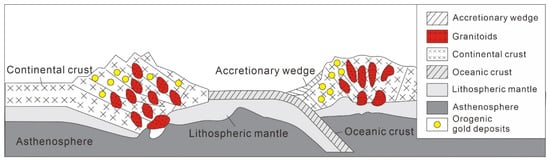
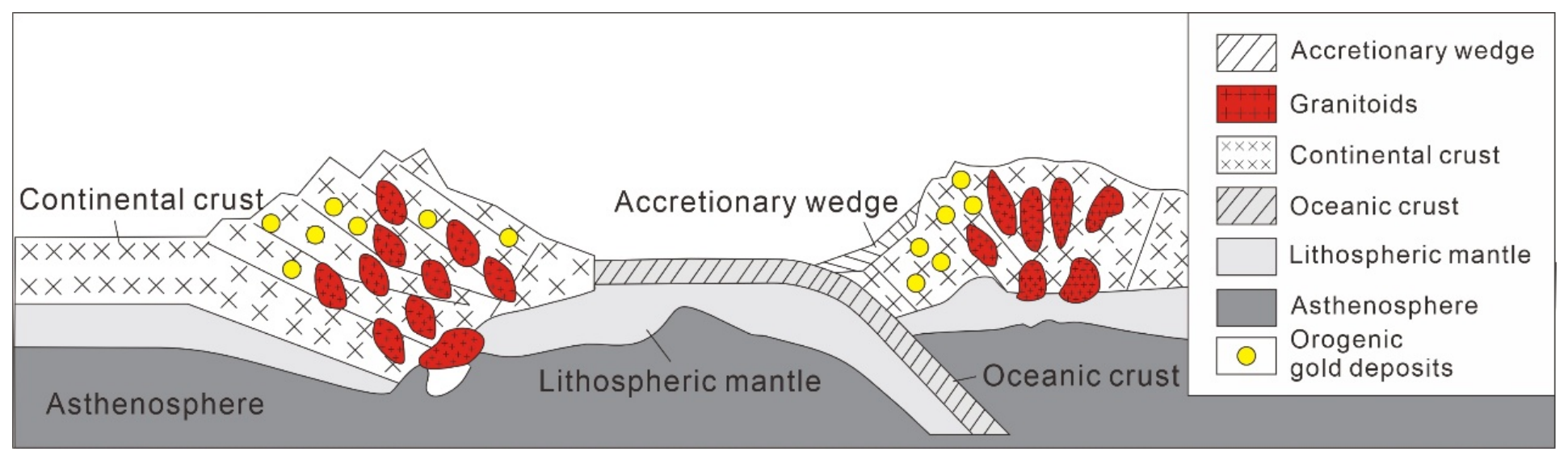
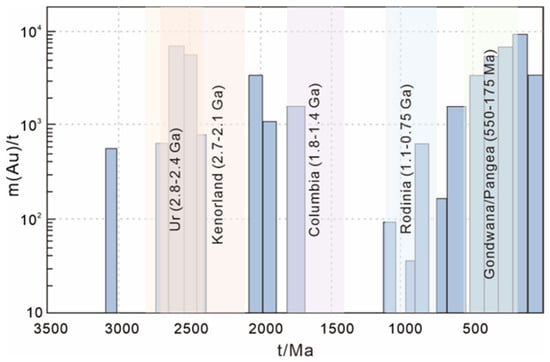
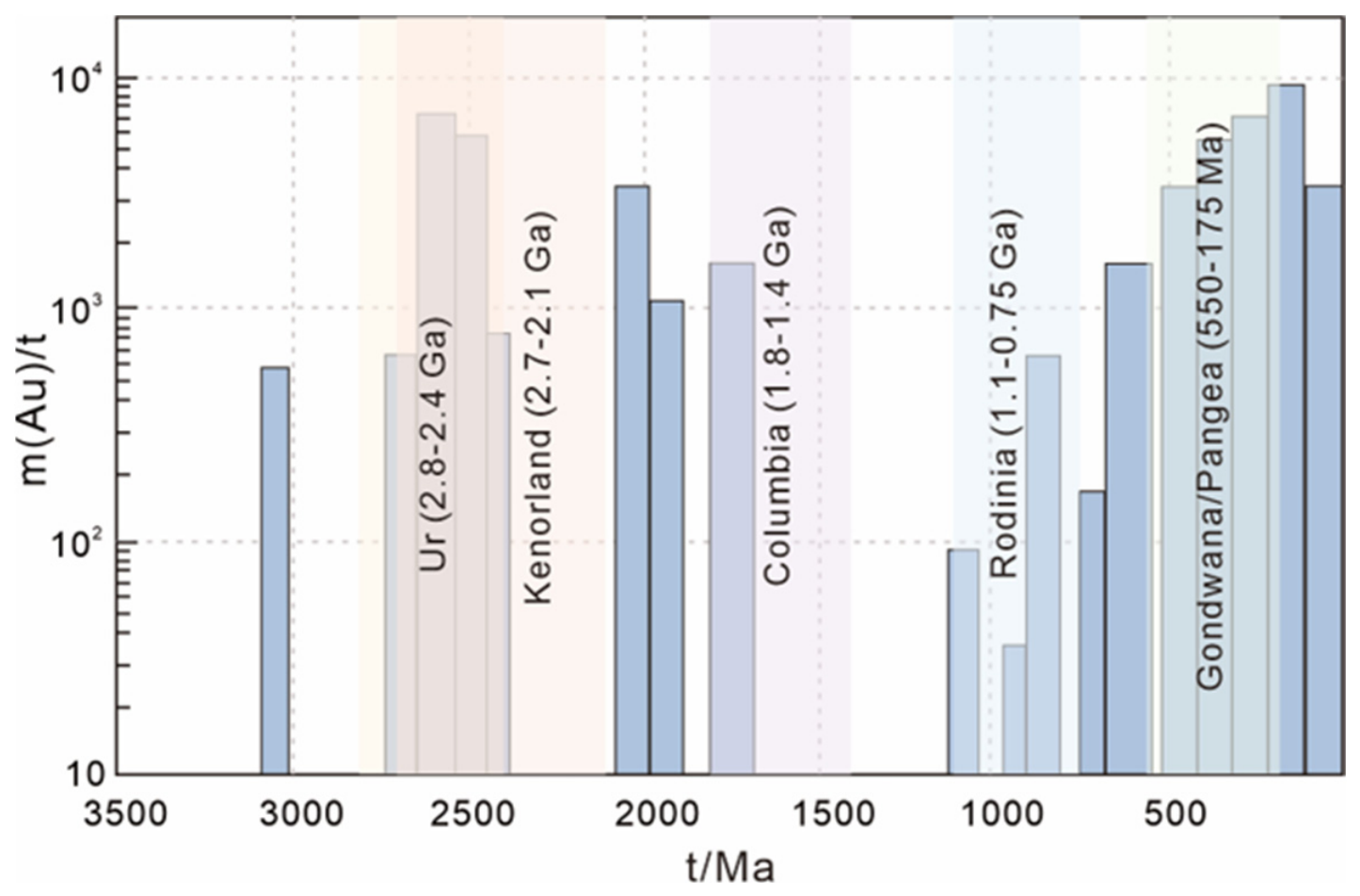
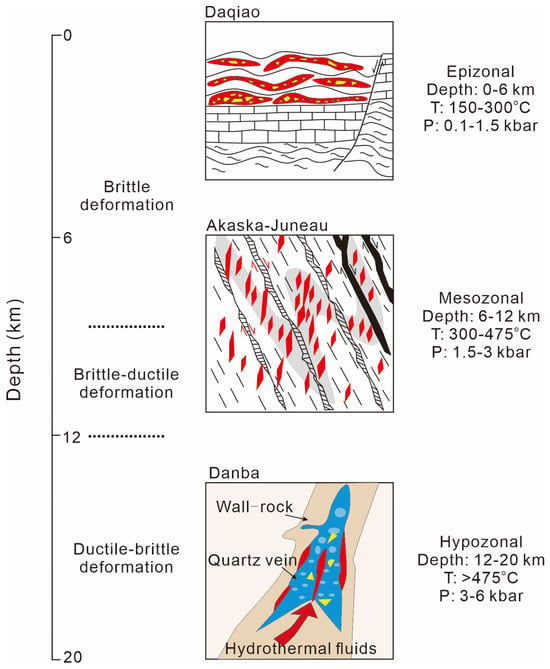
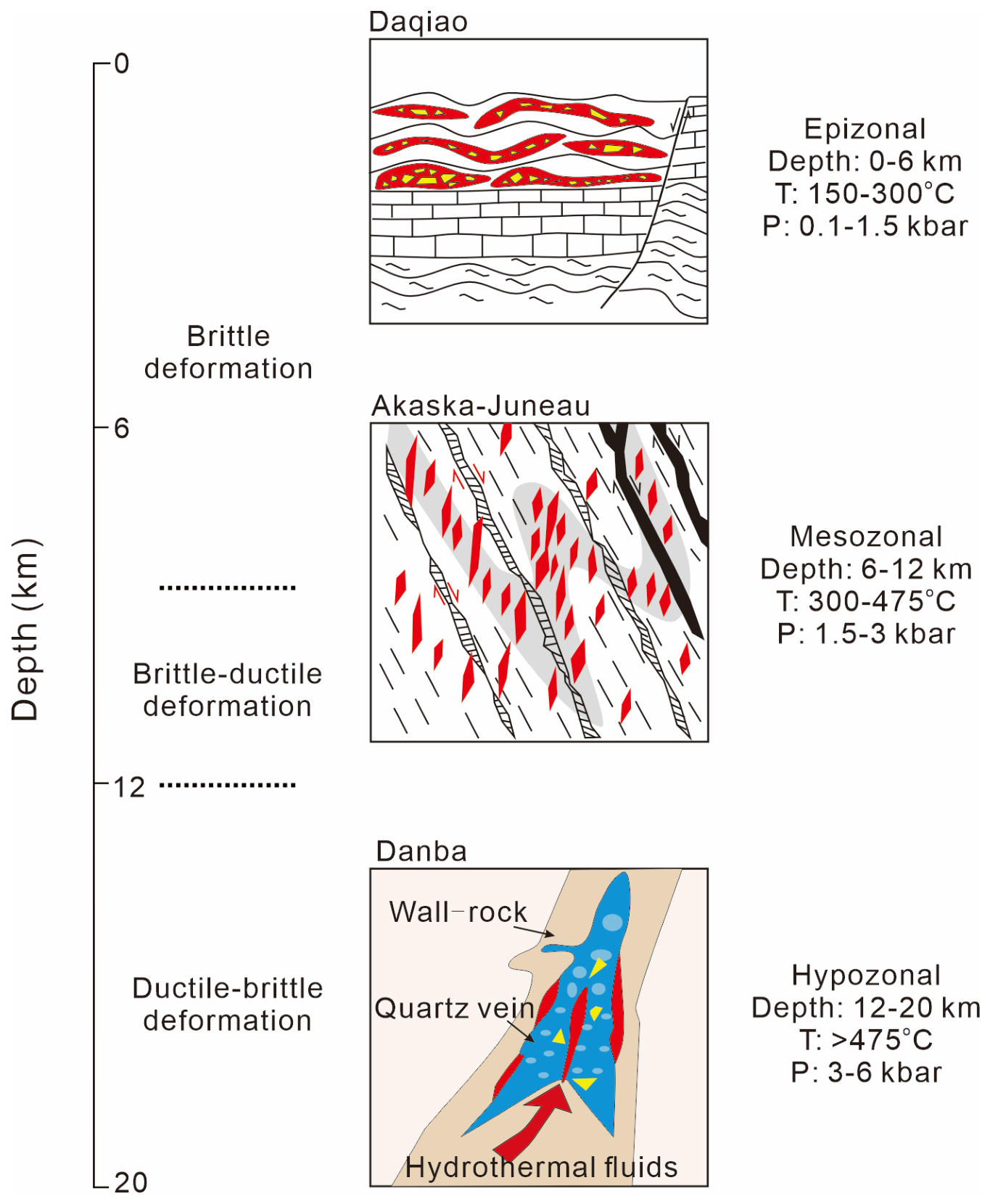
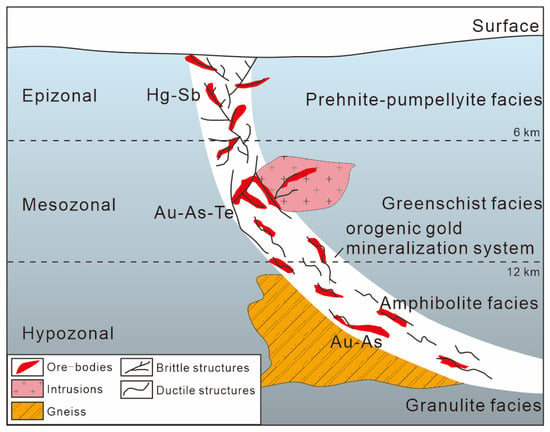
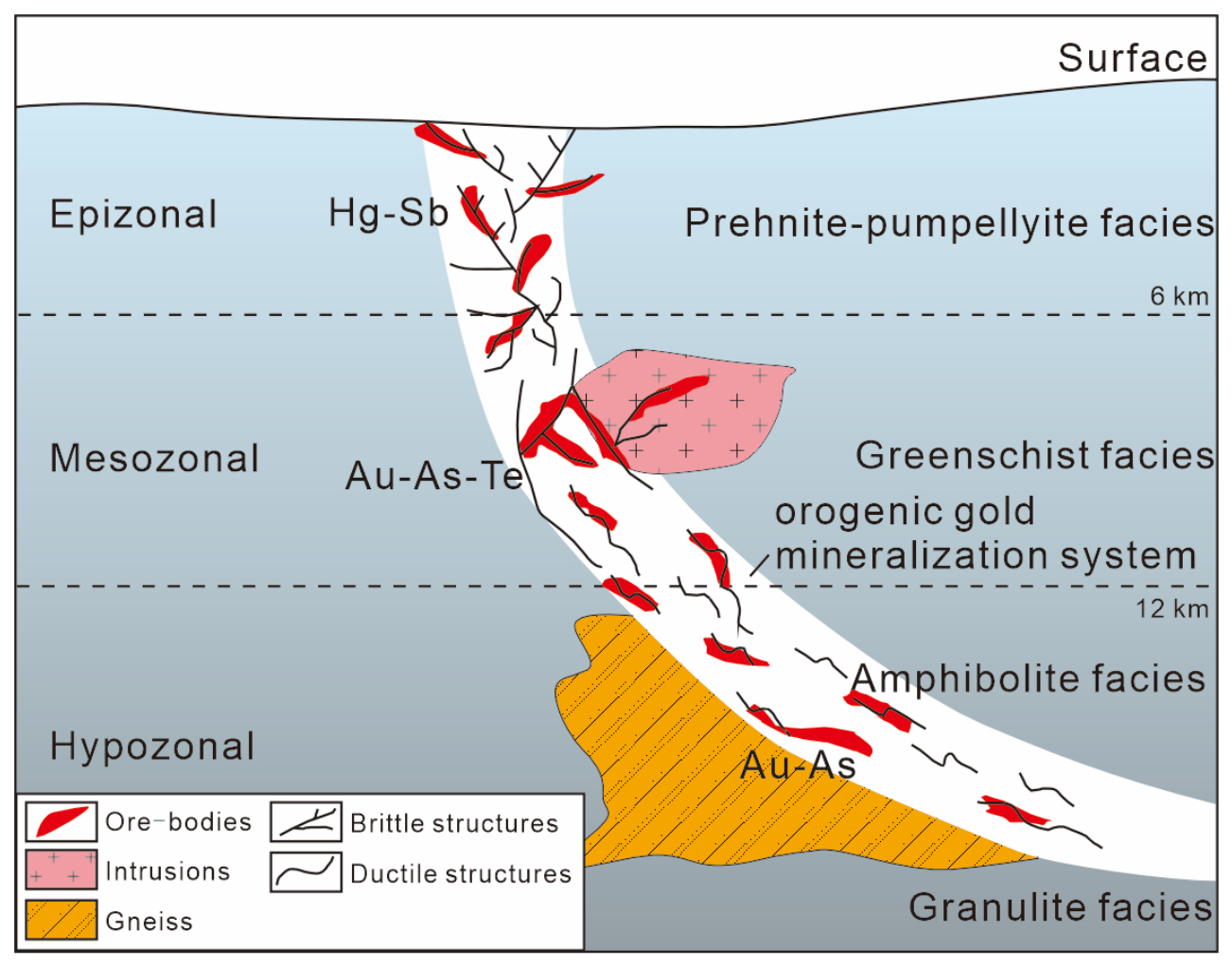
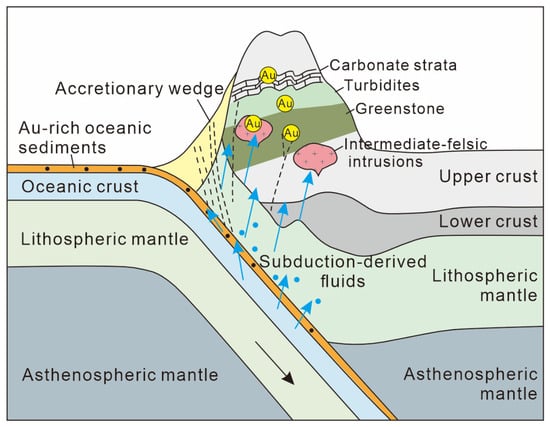
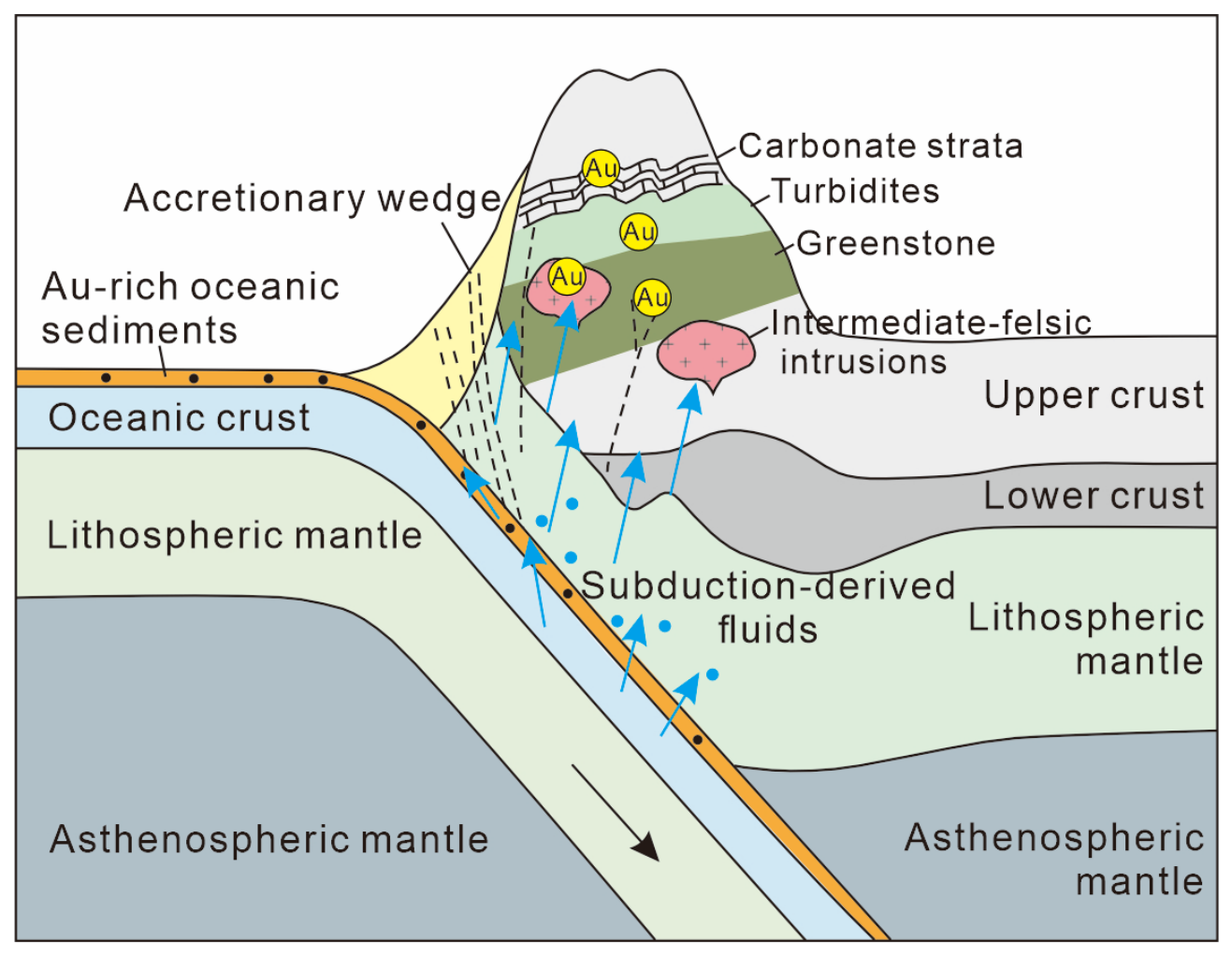

Disclaimer/Publisher’s Note: The statements, opinions and data contained in all publications are solely those of the individual author(s) and contributor(s) and not of MDPI and/or the editor(s). MDPI and/or the editor(s) disclaim responsibility for any injury to people or property resulting from any ideas, methods, instructions or products referred to in the content. |
© 2026 by the authors. Licensee MDPI, Basel, Switzerland. This article is an open access article distributed under the terms and conditions of the Creative Commons Attribution (CC BY) license.