


Abstract
The Qin-Hang Metallogenic Belt (QHMB) of South China includes abundant structurally controlled hydrothermal vein-type Pb–Zn deposits, which are predominantly hosted within low-grade metamorphosed sedimentary sequences. However, due to the lack of effective constraints on the sources of ore-forming materials and ore fluid physicochemical conditions, their genesis remains unknown. The Qingshuitang, as a representative Pb–Zn deposit in the center of the QHMB, is characterized by multi-phase alteration/mineralization. The in situ Pb isotopes of multi-phase galena (206Pb/204Pb: 18.368–18.416, 207Pb/204Pb: 15.697–15.721, 208Pb/204Pb: 38.741–38.829) at Qingshuitang suggest that the ore lead is primarily sourced from the upper crust, and regional Cambrian–Ordovician sedimentary strata represent one possible source of metals, although contributions from basement and local granitoids cannot be ruled out. Fluid inclusions (FIs) preserved within mineralization Stages II, III and IV are primarily liquid-rich, and the observed eutectic-melting temperature is approximately −21.8 °C, which suggest that the ore-forming fluid is dominated by the H2O-NaCl aqueous system. FI microthermometric data obtained for Stages II–IV reveal that the fluids have a wide ranges of temperatures (102–395 °C) and salinities (0.71–19.45 wt% NaCl equiv.). For sphalerite-hosted fluid inclusions, salinity, density, and pressure show an overall decreasing trend from Stage II through Stage III to Stage IV, while a prominent temperature drop occurs from Stage II to Stage III, and a relatively stable low-temperature hydrothermal condition is maintained in Stage IV. No valid primary fluid inclusion microthermometric data are available for Stage I, which consists primarily of barren quartz veins. Fluid mixing, coupled with decreases in temperature, may have controlled Pb–Zn precipitation, based on the large variations in temperatures and salinities of FIs. Integrating previous research data, we propose the deposit is a sedimentary-hosted deposit similar to CD Pb–Zn systems that is controlled by crosscutting faults and related to hot brines with possible magmatic–hydrothermal contributions.
1. Introduction
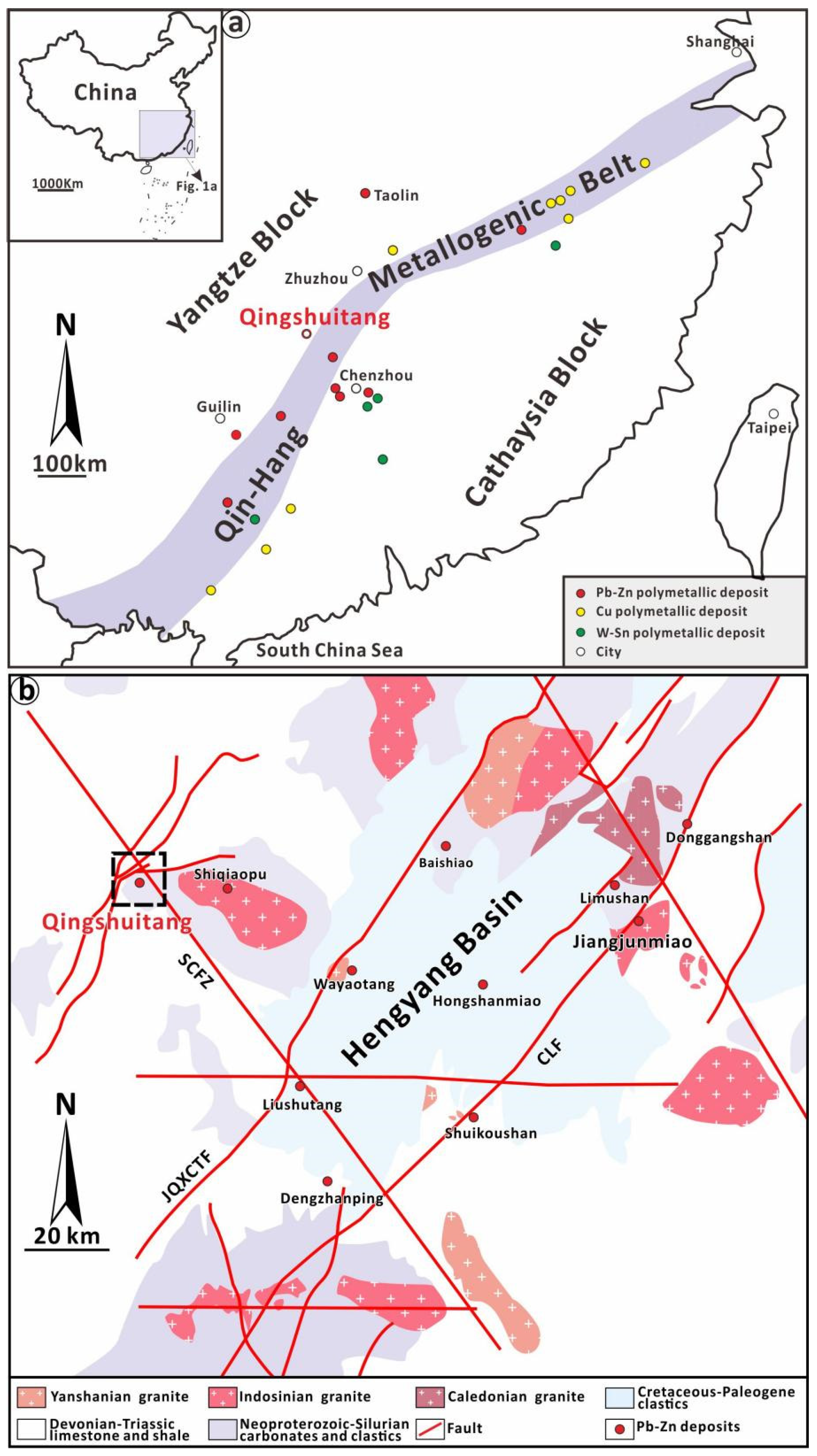
The Qin-Hang Metallogenic Belt (QHMB) of South China includes abundant economically significant porphyry, skarn, and hydrothermal vein deposits, representing an important Mesozoic polymetallic metallogenic province enriched in Cu, W, Sn, Pb, and Zn resources [1,2,3]. Located in the central area of the QHMB, the Hengyang Basin (Figure 1b) preserves numerous large Pb–Zn ore deposits, including the Shuikoushan, Liushutang, and Qingshuitang deposits, and so on [4,5,6]. Although extensive geological and geochemical investigations have been conducted on these Pb–Zn mineralization systems in recent decades, their detailed metallogenic mechanisms remain poorly constrained. Currently, two primary metallogenic interpretations have been widely adopted for these Pb–Zn deposits, namely, magmatic–hydrothermal [7,8,9,10] and MVT origin [6,11,12]. The magmatic–hydrothermal hypothesis is supported by trace element S, C, and H-O isotopic data, which are interpreted to reflect magmatic–hydrothermal fluid contributions [7,8,9,10]. By contrast, the MVT-type model is favored by evidence including strata-bound metal enrichment within sedimentary sequences, basinal formation water signatures from H-O isotopes, and weak wall-rock alteration [6,11,12].
Situated on the western margin of the Hengyang Basin, the Qingshuitang lead–zinc deposit contains 0.426 Mt proven ores at mean grades of 3.65% Zn and 1.94% Pb [13]. Previous studies on the Qingshuitang deposit were relatively limited, mainly focusing on alteration and mineralization characteristics [11], fluid inclusion microthermometry [13], and S-C-H-O isotopic analysis [10,13]. Furthermore, the previously determined fluid inclusion and isotopic data are not differentiated according to the different mineralization stages [10]. In this study, we report new information on the in situ Pb isotope of galena and fluid inclusions obtained from the different ore-forming stages at Qingshuitang. Using these data, we discuss the evolution of ore fluid physicochemical conditions and source of ore-forming metals for the Qingshuitang Pb–Zn deposit. Additionally, this contribution will further constrain the vein-type Pb–Zn metallogenic origin of the QHMB.
2. Geological Background
2.1. Regional Geology
The Hengyang Basin, situated in the central part of the QHMB, lies within the tectonic junction zone separating the Yangtze Block from the Cathaysia Block (Figure 1a). Regional sedimentary successions are composed of Neoproterozoic–Silurian carbonates and clastic rocks, Devonian–Triassic limestones and shales, and Cretaceous–Paleogene clastics [5,8] (Figure 1b). Its basement is dominated by Mesoproterozoic muddy–sandy clastic and volcaniclastic rocks. These basement units are unconformably covered by Devonian–Permian carbonate sequences, which represent the major Pb–Zn ore host strata across this region [14,15]. The Hengyang Basin has experienced multi-phase intense tectonism accompanied by extensive magmatism. The key tectonic structures in this region are dominated by three major fault systems (Figure 1b). Triassic Indosinian and Jurassic Early Yanshanian granitoids display widespread distribution along regional faults and their intersecting zones (Figure 1b). These granitoids record three major emplacement episodes, namely, Triassic (ca. 251–201 Ma) [16,17,18], Middle–Late Jurassic (ca. 180–142 Ma) [19,20], and Cretaceous (ca. 140–66 Ma) [21]. Indosinian granites (230–210 Ma) are generally linked to W–Sn–Nb–Ta mineralization, whereas Early Yanshanian granitoids have been determined to have genetic connections with regional Cu–W–Sn polymetallic ore formation in South China [22,23].
Figure 1.
(a) Spatial distribution of the Hengyang Basin within the QHMB (modified after [22]). (b) Regional geological diagram of the Hengyang Basin (modified after [8]). Abbreviations: CLF—Chenzhou–Linwood Fault; CACF—Changde–Anren Converted Fault; SCFZ—Shaoyang–Chenzhou Fault Zone; and JQXCTF—Jiangyong–Qidong–Xiangxiang Concealed Thrust Fault.
2.2. Local Geology
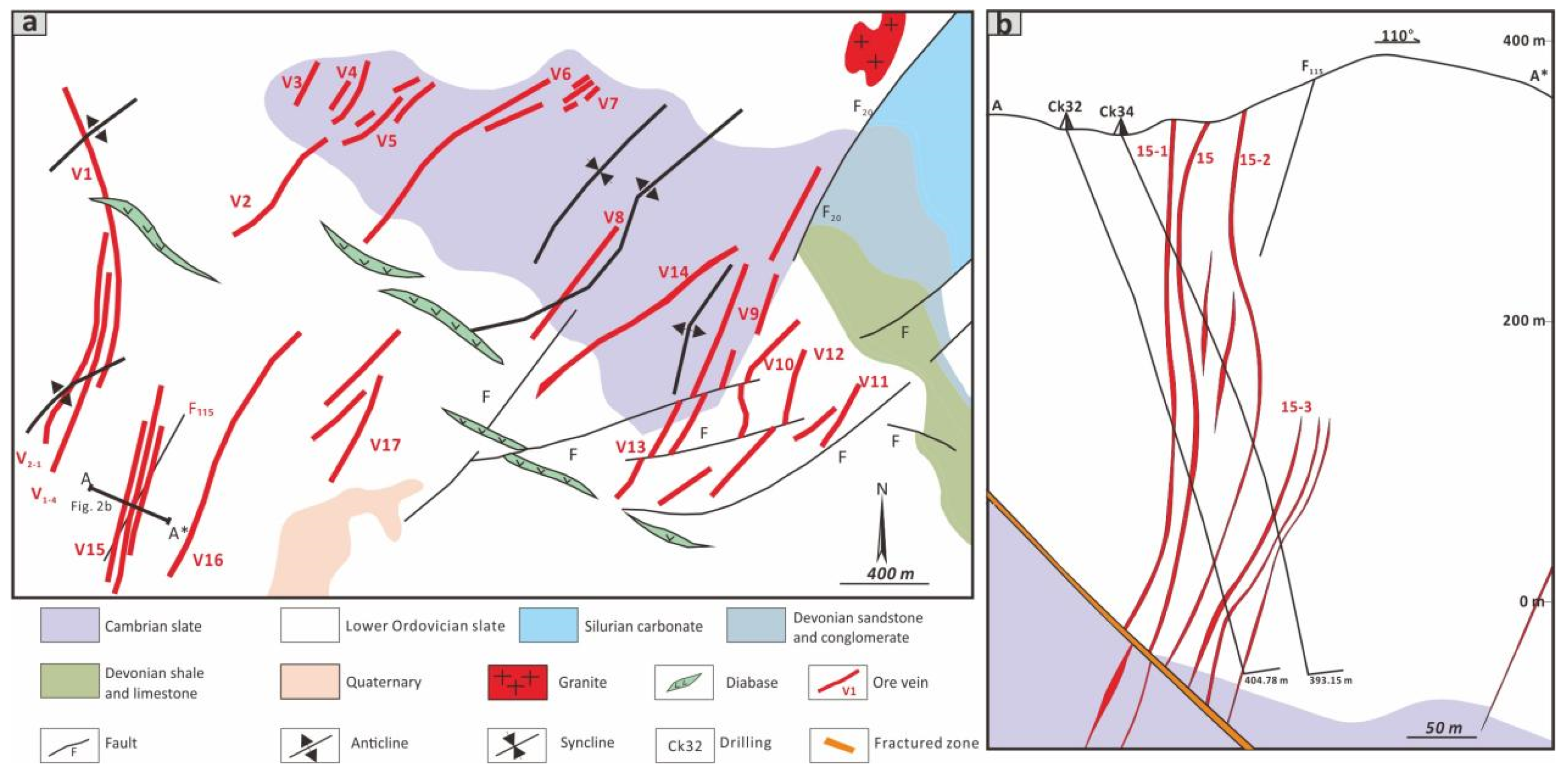
The Qingshuitang Pb–Zn deposit occupies the western edge of the Hengyang Basin, at the intersection between the Guandimiao pluton and the NW-striking Shaoyang–Chenzhou fault zone (Figure 1b). Stratigraphic units exposed in the mining area consist of Upper Cambrian slates and limestones, Lower Ordovician slates and sandstones, Silurian carbonates, and Middle Devonian shale–limestone–sandstone successions. Ore-hosting rocks for Pb–Zn mineralization are mainly represented by muddy slates of the Upper Cambrian and Lower Ordovician. Structural frameworks of the Qingshuitang deposit are dominated by NEE-/NE-oriented faults and fold assemblages. The most prominent fold is the Qingshuitang anticline, accompanied by a set of subordinate NW- and NE-trending anticlines and synclines. Ore emplacement of the deposit is largely constrained by these faults and fold structures. Igneous rocks are infrequent within the deposit domain, comprising only a small-scale Zhoujialing biotite granite dike and few lamprophyre veins (Figure 2a) [6,15,24].
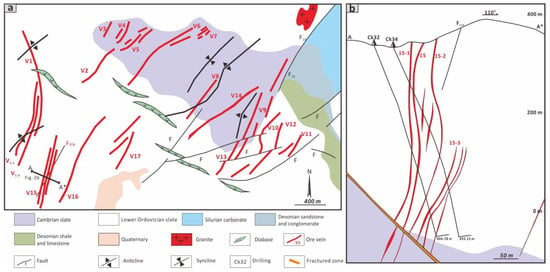
Figure 2.
(a) Geological sketch map and (b) A-A* geological cross-section of the Qingshuitang deposit (modified from [10]).
Twenty orebodies have been delineated at Qingshuitang; the most economically significant orebodies include V1, V8, V9, V10, V12, V14, and V15. These orebodies mostly appear as parallel veins hosted within silicified fracture zones, with lengths of 40–200 m, thicknesses of 1–2 m, and burial depths ranging from 400 to 550 m. These vein-type orebodies crosscut the Upper Cambrian and Lower Ordovician muddy slates. Their overall strikes vary from NE-NNE (dipping NE or NW) to NE-NNW (dipping SE or NE) (Figure 2a,b) [10]. Sphalerite, galena, chalcopyrite, and pyrite constitute the principal ore minerals. The dominant non-ore minerals comprise quartz, barite, and calcite, with minor sericite. Wall-rock alteration is poorly developed and mainly includes silicification (dominant), baritization, and carbonatization.
3. Materials and Methods
Seventeen representative ore samples covering four hydrothermal mineralization stages were systematically obtained from orebodies groups (V1, V6, V9, V10, V14, V15, and V16) at Qingshuitang. The detailed samplings include DTC5-1-a and DTC5-1-b (V1 orebody group); HQK10-2-a and HQK10-2-b (V6 orebody group); HQK1-2-a, HQK1-2-b, HQK1-3-a, HQK1-3-b, HQK4-3-a, and HQK4-3-b (V9 orebody group); HQK3-2-1-a (V10 orebody group); HQK7-1-a and HQK7-1-b (V14 orebody group); DTC9-3-a and DTC9-3-b (V15 orebody group); and ZK002-a and ZK002-b (V16 orebody group). Considering the barren characteristics of Stage I veins, the obtained samples are predominantly sourced from Stage II to Stage IV mineralization. All collected specimens were processed into standard 30 μm thick polished sections for microscopic observation. Mineral textures, paragenetic relationships, and crosscutting characteristics were comprehensively identified through transmitted/reflected light microscopy, coupled with scanning electron microscopy backscattered electron (SEM-BSE) imaging. Inclusion-free and coarse-grained galena grains spanning three generations (Gn1-Gn3) were carefully screened and selected for subsequent LA-MC-ICP-MS testing. After completing microstructural observation and mineral selection, the samples were disassembled and reprocessed into thin wafers for fluid inclusion analysis.
3.1. LA-MC-ICP-MS Pb Isotope Measurements
Pb isotopic testing of galena grains was analyzed at Wuhan SampleSolution Analytical Technology Co., Ltd., Wuhan, China. All isotopic measurements were performed via a Coherent 193 nm Excimer Laser Ablation system (GeoLas HD) coupled with a multi-collector ICP-MS (Neptune Plus). Helium (He) was adopted as the carrier gas with a constant flow rate of 500 mL/min. The laser analytical parameters were set as follows: a repetition rate of 2 Hz, laser fluence of 6 J/cm2, and a fixed laser spot diameter of 10 μm with no interval between scanning lines. To correct mass fractionation during testing, the USGS standard MASS-1 and an in-house sphalerite standard (Sph-HYLM) were utilized to calibrate the thallium–lead (Tl-Pb) isotopic fractionation, and an optimized 205Tl/203Tl ratio was established for high-precision Pb isotopic determination of natural sulfide minerals. Moreover, the Sph-HYLM with certified Pb isotope ratios of 208Pb/204Pb = 38.51943434, 207Pb/204Pb = 15.76402576, and 206Pb/204Pb = 18.21690646 that served as an external standard can be used to monitor long-term analytical accuracy. Repeated analyses of the USGS standard MASS-1 and Sph-HYLM standard yielded external reproducibility, confirming analytical accuracy for galena in situ Pb isotope determination.
3.2. Fluid Inclusion (FI) Microthermometry
Eight representative ore vein samples formed during Stage II to Stage IV were subjected to systematic fluid inclusion microthermometric measurements. All temperature testing procedures were conducted utilizing a Linkam THMS600 heating–freezing system (Linkam Scientific Instruments Ltd., Redhill, UK). The instrument operational temperature range was calibrated from −196 °C to 600 °C, with distinct temperature detection accuracies: ±0.2 °C for temperatures below 30 °C, ±0.5 °C within the range of 0–100 °C, and ±2 °C for high-temperature of 100–600 °C. To reach ice-melting and fluid homogenization temperatures, a moderate heating rate of 0.5–1.0 °C/min was consistently applied to ensure accurate testing. To obtain reliable data, secondary fluid inclusions distributed along healed microfractures in linear arrays were strictly excluded. In contrast, primary fluid inclusions used for statistical analysis were screened based on widely accepted petrographic criteria, namely, inclusions randomly hosted within mineral crystals or those trapped along mineral growth zones [25,26]. Salinities were calculated from ice-melting temperatures using the H2O-NaCl system equation [27].
4. Results
4.1. Alteration Characteristics and Mineral Paragenesis
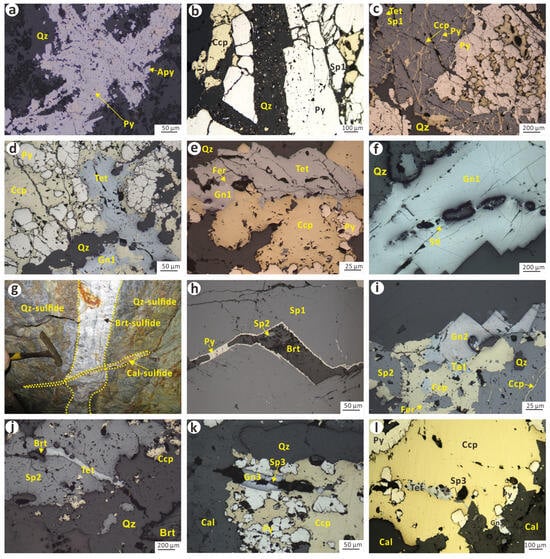
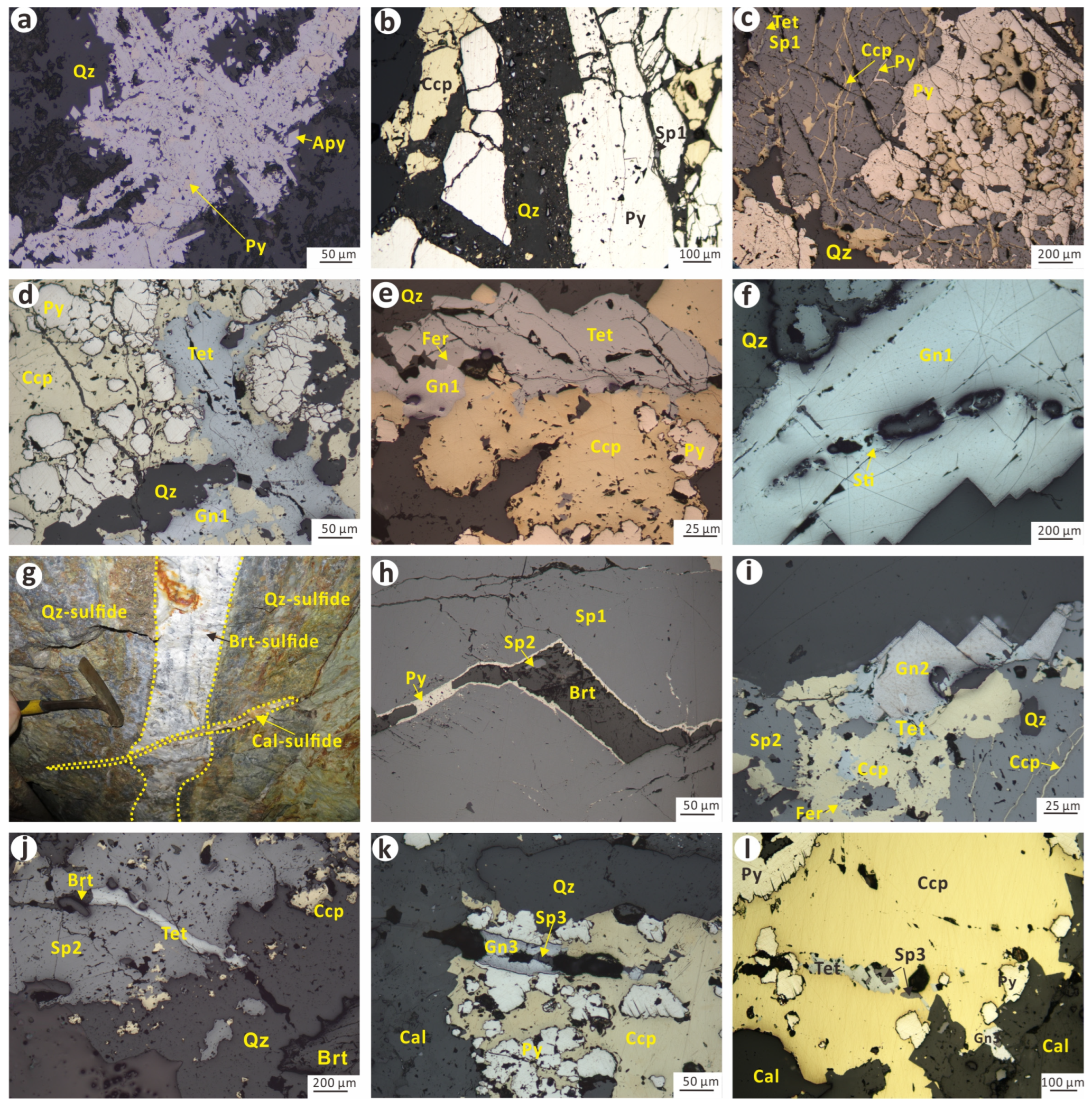
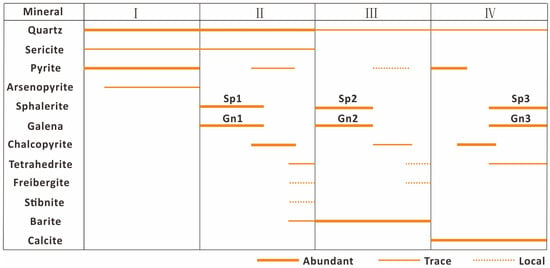
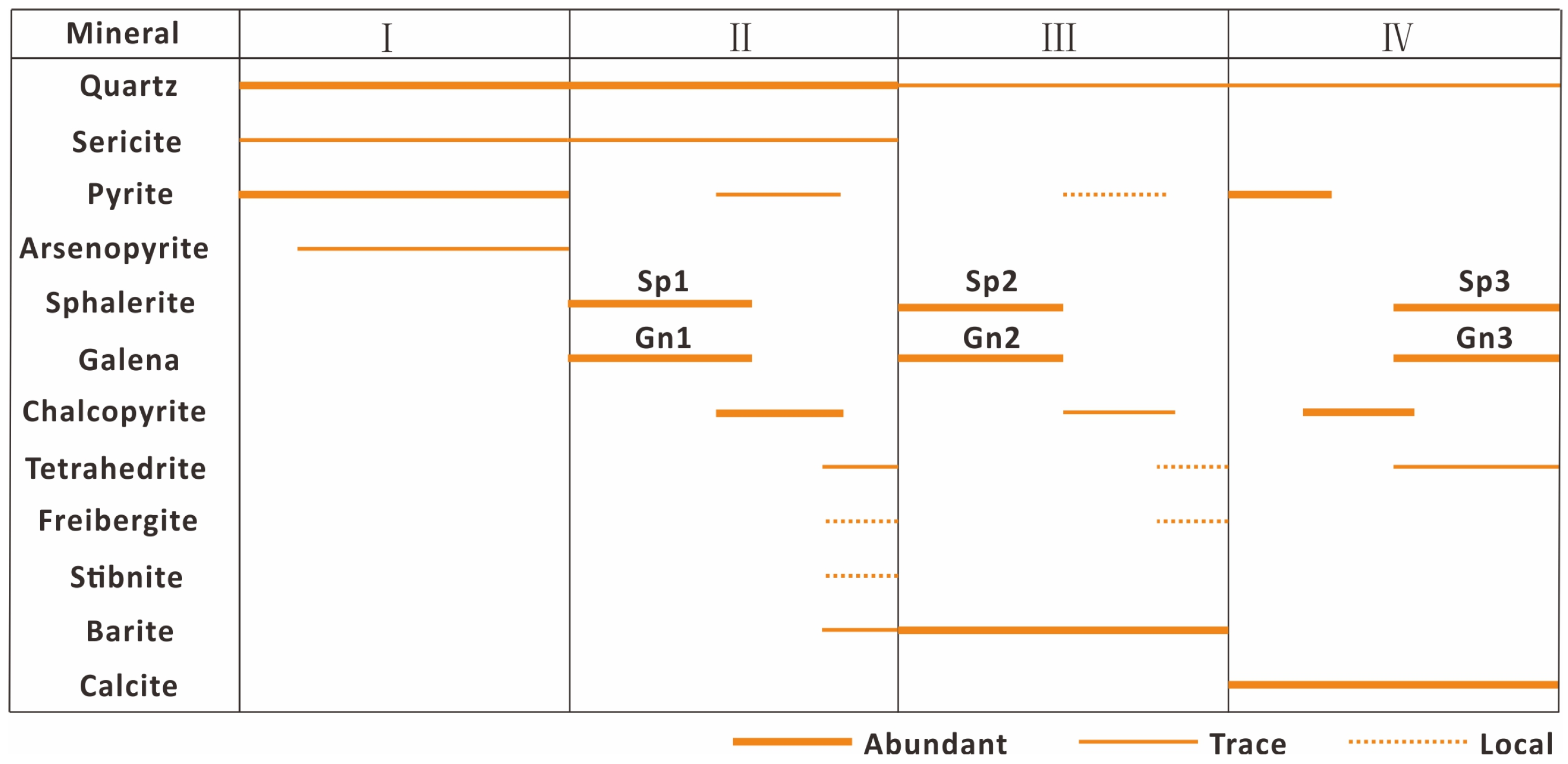
Combined with mineral paragenesis and structural textures (containing vein crosscutting) relationships (Figure 3), the hydrothermal alteration and mineralization processes of the Qingshuitang Pb-Zn deposit can be classified into four stages (Figure 4). These stages include the quartz–pyrite–arsenopyrite stage (Stage I), quartz–galena–sphalerite–pyrite stage (Stage II), barite–quartz–galena–sphalerite–pyrite stage (Stage III), and calcite–quartz–galena–sphalerite–pyrite stage (Stage IV). Notably, sphalerite and galena continuously precipitate throughout the mineralization process, forming multiple generations, including Sp1 and Gn1 in Stage II, Sp2 and Gn2 in Stage III, and Sp3 and Gn3 in Stage IV. The detailed characteristics of each mineralization stage are elaborated below.
Figure 3.
Macro- and micro-characteristics of ore textures and mineral paragenesis in the Qingshuitang deposit: (a) arsenopyrite replacing early pyrite; (b) Stage I pyrite replaced by sphalerite (Sp1), with interstitial chalcopyrite; (c) Stage II pyrite and chalcopyrite crosscut pre-existing Sp1 and galena (Gn1); (d) tetrahedrite replacing chalcopyrite and pyrite; (e) coexistence of tetrahedrite and freibergite; (f) stibnite veins cutting Gn1; (g) Stage II quartz–galena–sphalerite veins crosscut by late Stage III barite-galena-sphalerite veins, and both generations are further intersected by calcite–galena–sphalerite veinlets; (h) Stage III barite–pyrite–sphalerite veins crosscut Sp1 grains; (i) euhedral galena (Gn2) occurs alongside sphalerite (Sp2), where Sp2 is locally replaced by fine chalcopyrite veinlets; (j) tetrahedrite veinlets crosscut Sp2; (k) early pyrite overprinted by chalcopyrite and subsequently intruded by galena (Gn3) veins; (l) chalcopyrite coexists with Sp3 and is partially replaced by tetrahedrite. All microscopic photographs were obtained under reflected light. Abbreviations: Qz-sulfide—quartz-sulfide; Brt-sulfide—barite-sulfide; Cal-sulfide—calcite-sulfide; Qz—quartz; Brt—barite; Cal—calcite; Sp—sphalerite; Gn—galena; Ccp—chalcopyrite; Py—pyrite; Tet—tetrahedrite; Apy—arsenopyrite; Sti—stibnite; Fre—freibergite.
Figure 4.
Hydrothermal mineralization paragenesis and wall-rock alteration characteristics of the Qingshuitang Pb–Zn deposit, illustrating the successive formation of Sp1 to Sp3 and Gn1 to Gn3 over different hydrothermal stages.
Stage I is characterized by abundant thick and mineral-barren quartz veins, which host plenty of pyrite, trace arsenopyrite, and sericite (Figure 3a,b).
Stage II is dominated by quartz–galena–sphalerite veins with variable thicknesses. The dominant mineral assemblage consists of abundant quartz, early-generation sphalerite (Sp1), and galena (Gn1), as well as widespread chalcopyrite, accompanied by trace amounts of barite, pyrite, tetrahedrite, freibergite, and stibnite. Galena formed in this stage (Gn1) exhibits euhedral–anhedral with particle sizes varying from 50 μm to 2 mm. Under reflected light, Gn1 shows a grayish-white and high reflectivity, with typical surface scratches and black triangular pore structures widely developed (Figure 3c–f). Coexisting with Gn1, Stage II sphalerite (Sp1) is predominantly anhedral and variable in grain size (20 μm to 3 mm) (Figure 3c). Textural observations reveal that Sp1 is locally replaced by late pyrite and chalcopyrite, and these secondary sulfides are further partially replaced by anhedral tetrahedrite and freibergite (Figure 3d,e). In addition, fine stibnite veinlets commonly crosscut pre-existing anhedral Gn1 grains (Figure 3f).
Stage III mineralization is characterized by barite-rich vein systems composed predominantly of barite, late-stage sphalerite (Sp2), and galena (Gn2), accompanied by subordinate quartz, chalcopyrite, pyrite, tetrahedrite, and freibergite. Field and microscopic evidence indicates that Stage III sulfide veins distinctly crosscut and replace the preformed Stage II sulfide veins (Figure 3g,h). The euhedral–subhedral pyrite commonly coexists with chalcopyrite and locally replaces Sp2 (Figure 3i). Furthermore, Sp2 coexists with Gn2, and is typically replaced by tetrahedrite and freibergite (Figure 3i,j). Stage III galena (Gn2) is characterized by variability in size (50–2000 μm) and is subhedral–anhedral in shape, showing a grayish-white reflection color, and its surface has scratches, with many black “triangular holes” (Figure 3i,j). Stage III sphalerite (Sp2) is usually a light-gray reflecting color with a relatively obvious internal reflection and subhedral–anhedral grains with particle sizes varying from 50 μm to 2 mm (Figure 3i,j).
Stage IV calcite–galena–sphalerite veins are indicative of the final stage of mineralization in the Qingshuitang deposit. This stage is dominated by calcite, sphalerite (Sp3), galena (Gn3), chalcopyrite, and pyrite, accompanied by minor quartz and tetrahedrite. Microscopic observations confirm that Stage IV veinlets clearly crosscut the earlier Stage II and Stage III ore-bearing sulfide veins (Figure 3g). Texturally, anhedral pyrite grains formed in Stage IV are first overprinted by chalcopyrite, and the altered chalcopyrite is subsequently replaced by late-generation Gn3, Sp3 (Figure 3k), and tetrahedrite (Figure 3i). Stage IV galena (Gn3) commonly features a grayish-white reflection color and a subhedral–anhedral grain, locally veined in shape (Figure 3k,i). Stage IV sphalerite (Sp3) exhibits variable grain sizes varying from 50 μm to 1 mm and predominantly develops a subhedral–anhedral crystal lattice (Figure 3k,i).
4.2. Pb Isotopes Composition of Galena
A total of 18 LA-MC-ICP-MS point analyses were analyzed on 12 galena specimens (6 points each for Gn1, Gn2, and Gn3). The results are presented in Table 1.
The 206Pb/204Pb, 207Pb/204Pb, and 208Pb/204Pb of multi-phase galena at Qingshuitang, characterized by relative homogeneity with a very small variation range, is 18.368–18.416 (avg. 18.387, CV = 0.26%), 15.697–15.721 (avg. 15.705, CV = 0.16%), and 38.741–38.829 (avg. 38.780, CV = 0.23%), respectively, and enriched in radiogenic Pb (206Pb/204Pb > 18.000). With the help of Geokit software [28], the parameters of the Pb isotope of Qingshuitang galena calculated reveal that the μ values (238U/204Pb) and ω values (232Th/204Pb), ranging from 9.66 to 9.71 (avg. 9.67) and from 38.89 to 39.42 (avg. 39.06), respectively, are slightly higher than those of the common Pb (μ: 8.686–9.238 or 8.99 ± 0.07, ω: 35.55 ± 0.59), while the K values (232Th/238U), varying from 3.90 to 3.93 (avg. 3.91), are similar to those of the common Pb (3.92 ± 0.09).
Table 1.
Lead isotope composition by LA-MC-ICP-MS and parameters of galena (Gn1-Gn3) in the Qingshuitang Pb–Zn deposit.
4.3. Fluid Inclusion Types
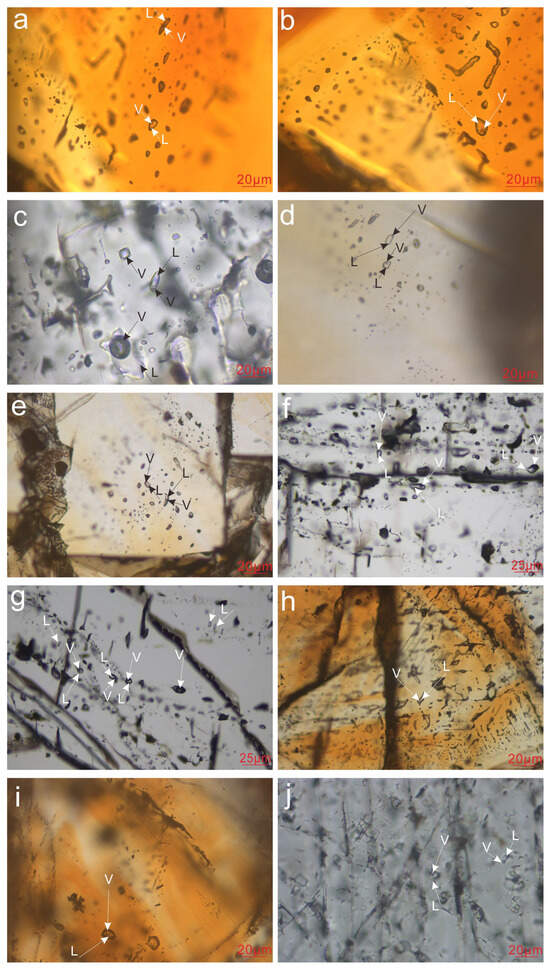
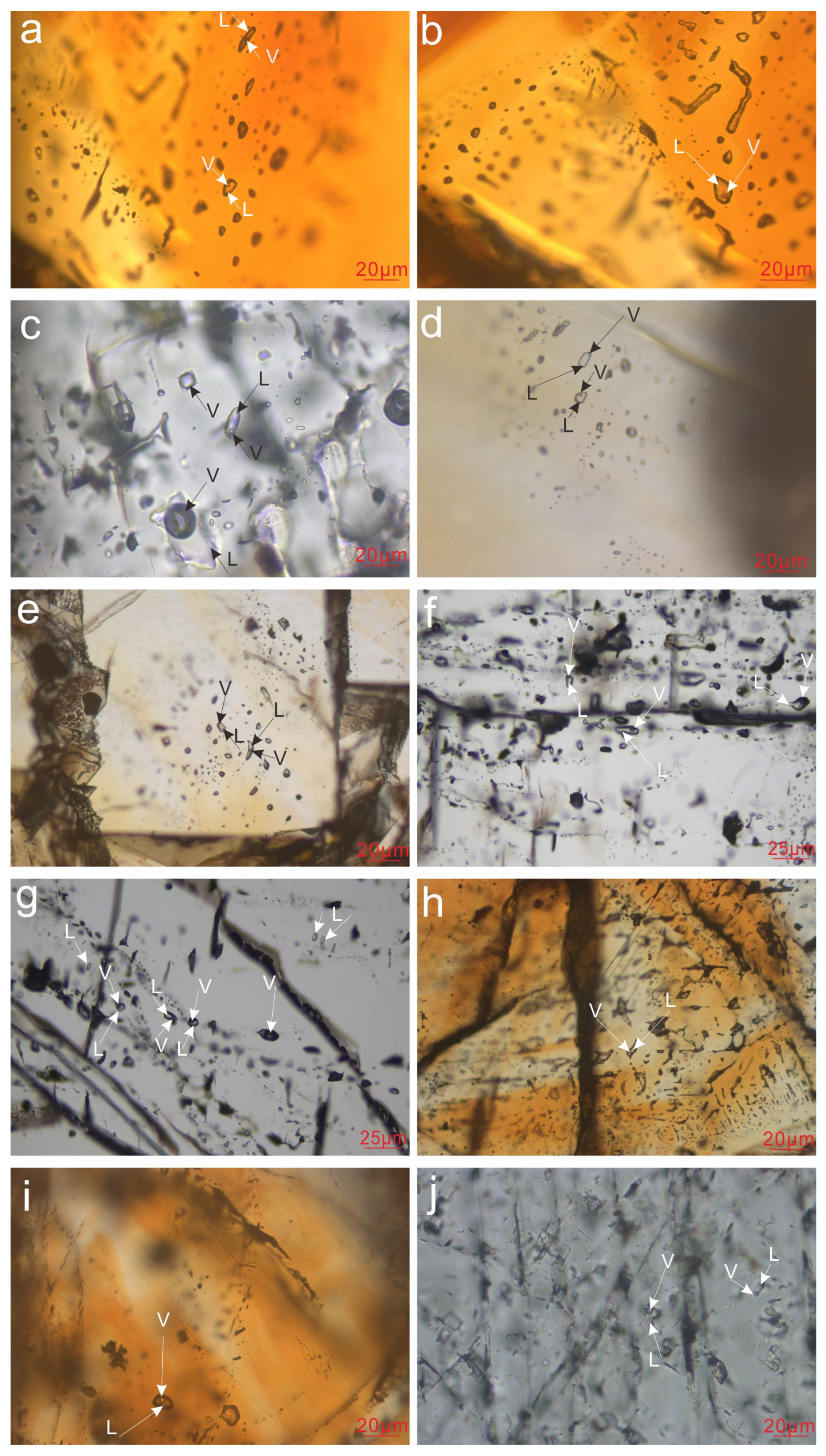
Liquid-rich (L-type) fluid inclusions are dominant in ore veins of the Qingshuitang deposit. These inclusions display particle sizes varying from 5 to 30 μm, with a vapor phase proportion lower than 30%. They primarily present rounded, elliptical, quadrangular, or irregular outlines (Figure 5), and all homogenize to a single liquid phase during continuous heating. Although numerous secondary L-type fluid inclusions with typical necking-down structures were observed in mineral crystals, they were excluded from subsequent statistical analysis. Vapor-rich (V-type) FIs are infrequent and occur mainly in Stage II and Stage III at Qingshuitang. They consist of H2O vapor and an aqueous liquid phase (Figure 5c,g). The primary V-type inclusions have grain sizes of 5–20 μm and are quadrangular, elliptical, or irregular in shape, with complete homogenization toward the vapor phase under heating conditions. Most V-type inclusions occur as isolated individuals instead of occurring within well-defined fluid inclusion assemblages (FIAs).
Figure 5.
Representative photomicrographs of fluid inclusions in the Qingshuitang deposit: (a,b) fluid inclusions in sphalerite at Stage II; (c) fluid inclusions in barite at Stage II; (d,e) fluid inclusions in barite at Stage III; (f,g) fluid inclusions in sphalerite at Stage III; (h,i) fluid inclusions in sphalerite at Stage IV; (j) fluid inclusions in calcite at Stage IV. Abbreviations: L—liquid phase; V—vapor phase.
4.4. Microthermometric Features
The fluid inclusions in Qingshuitang are predominantly L-type inclusions. Microthermometry yields eutectic (initial melting) temperatures (Te) of approximately −21.8 °C, close to the theoretical eutectic (−20.8 °C) of the H2O-NaCl system. This indicates that the ore-forming fluid contains minor cations other than Na+ but generally belongs to the H2O-NaCl fluid system [31]. All microthermometric results are summarized in Table 2 and visualized in Figure 6.
Table 2.
Microthermometric characteristics of fluid inclusions from the Qingshuitang deposit.
Figure 6.
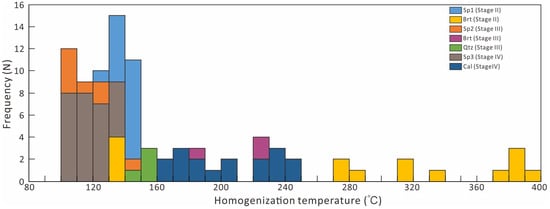
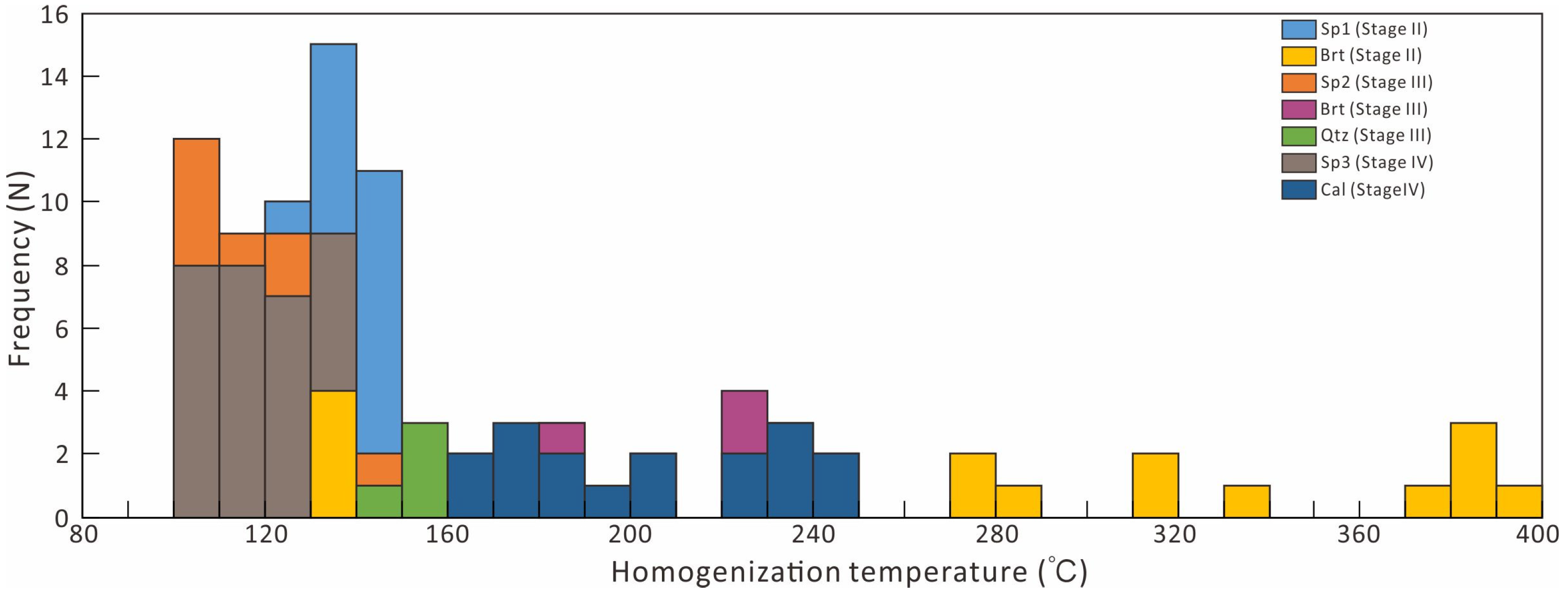
Histograms of homogenization temperatures for fluid inclusions hosted in ore-vein samples at Stages II, III, and IV.
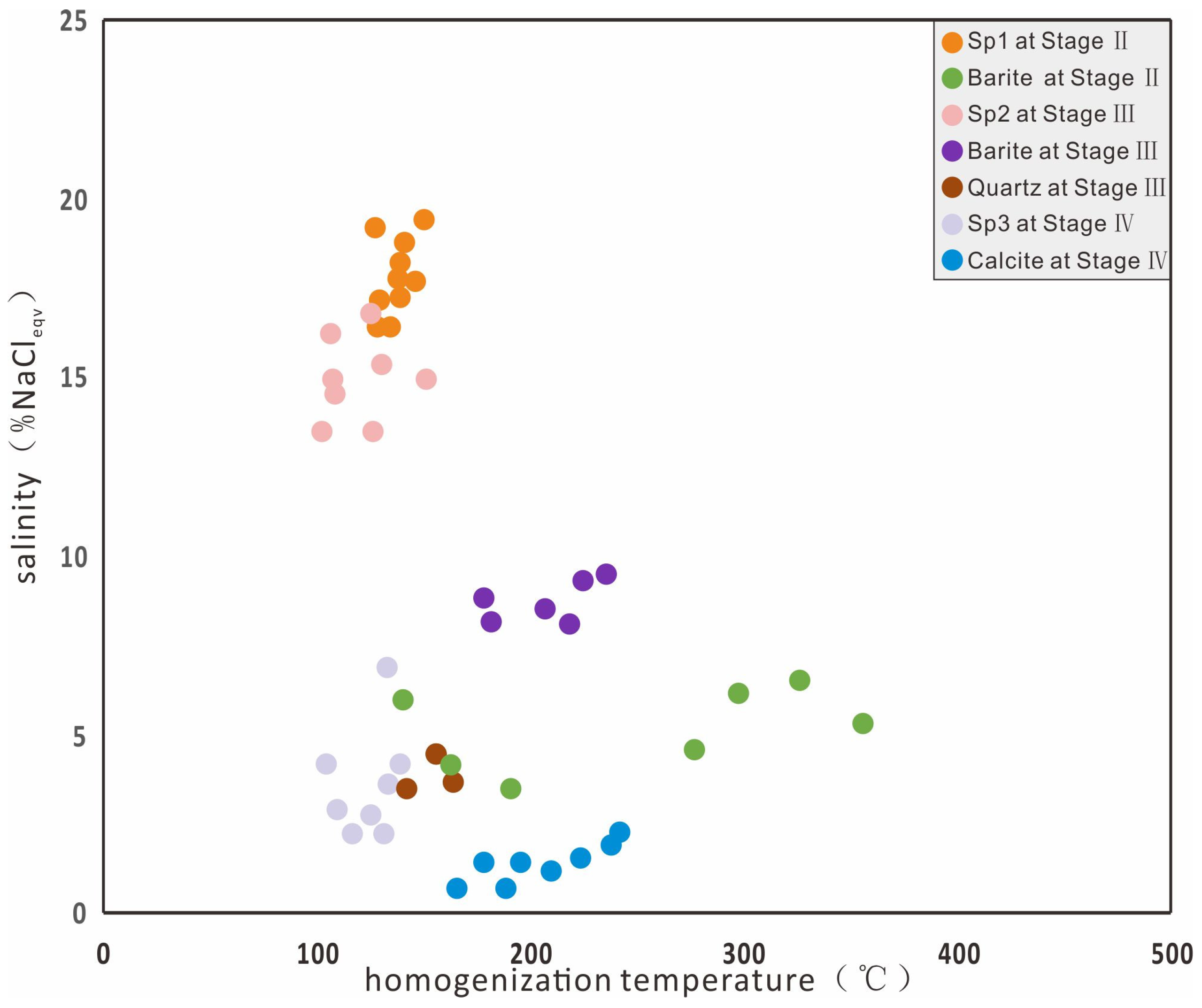
In Stage II, L-type fluid inclusions hosted in sphalerite (Sp1) exhibited ice-melting temperatures ranging from −15.7 to −12.4 °C, corresponding to salinities of 16.21–19.45 wt% (avg. 17.72 wt%). Their homogenization temperatures (Th) were relatively concentrated, varying from 125 to 150 °C (avg. 136 °C). In Stage II barite crystals, the fluid inclusions are predominantly L-type with minor occurrences of V-type inclusions. The L-type fluid inclusions record ice-melting temperatures ranging from −4.3 to −2.1 °C, with salinities varying between 3.55 and 6.88 wt% NaCl equiv. Their Th values vary from 139 to 395 °C (avg. 272 °C), which are separated into medium-temperature (276–400 °C) and low-temperature (mostly 139–190 °C) intervals, corresponding to salinities of 4.18–6.88 wt% and 3.55–6.01 wt% NaCl equiv, respectively, and the low-homogenization temperature range is consistent with those of sphalerite.
In Stage III, primary L-type fluid inclusions trapped in sphalerite (Sp2) record ice-melting temperatures ranging from −13.9 to −9.6 °C, corresponding to fluid salinities of 13.51–17.70 wt% NaCl equiv. (avg. 15.03 wt%). These inclusions yield homogenization temperatures spanning 102–151 °C, which are predominantly concentrated within 110–130 °C (avg. 118 °C). For coexisting barite in Stage III veins, hosted L-type fluid inclusions exhibit ice-melting temperatures of −6.2 to −1.5 °C, yielding salinities of 2.57–9.47 wt% NaCl equiv. (avg. 6.67 wt%). The FIs are totally homogenized to liquid at 177–253 °C (avg. 214 °C), and are also divided into medium-temperature (mostly 206–253 °C) and low-temperature (mostly 177–181 °C) intervals, possibly corresponding to the early and late generation of this mineralization stage, respectively. Additionally, L-type fluid inclusions developed in Stage III quartz grains display ice-melting temperatures of −2.7 to −2.1 °C, corresponding to relatively low salinities of 3.55–4.49 wt% NaCl equiv. (avg. 3.92 wt%). Their Th values range from 141 to 163 °C (avg. 153 °C). The low homogenization temperature ranges of the barite fluid inclusions are in good agreement with those of sphalerite and quartz.
In Stage IV, primary fluid inclusions hosted in sphalerite (Sp3) exhibit full liquid-phase homogenization temperatures of 104–139 °C, which are mainly concentrated between 115 and 135 °C (avg. 122 °C). These Sp3-hosted inclusions yield ice-melting temperatures ranging from −4.3 to −1.3 °C, corresponding to fluid salinities of 2.24–6.88 wt% NaCl equiv. (avg. 3.50 wt%). Coexisting Stage IV calcite hosts primary fluid inclusions with ice-melting temperatures of −1.2 to −0.4 °C, which correspond to low salinities of 0.71–2.07 wt% NaCl equiv. (avg. 1.38 wt%). These calcite-hosted inclusions are completely homogenized into a single liquid phase ranging from 165 to 241 °C (avg. 204 °C).
No available coeval pairs of L-type and V-type inclusions data within a single FIA, which are critical evidence for fluid boiling or immiscibility, were obtained in this study.
5. Discussion
5.1. Origin of Ore-Forming Materials
A range of studies have demonstrated that the common Pb isotopic composition in minerals without or with minor U and Th (such as sulfides and feldspar) can be successfully used to trace the initial material source [32,33]. The contents of U and Th in the metal sulfides of the Qingshuitang deposit are extremely low [6,34]. Therefore, the radioactive Pb content produced by the decay of U and Th after sulfide crystallization is negligible, and the Pb isotope composition of the sulfides can directly represent the initial Pb isotope composition of the ore-forming fluid without requiring correction [35].
Previous studies have shown that the characteristic values (μ, ω, K) of Pb isotopes, especially the variations in the μ value, can provide valuable information for the inversion of geological processes and revealing Pb sources. The in situ Pb isotope compositions of galena in the three stages of the Qingshuitang deposit are relatively homogeneous, with a very narrow variation range of μ, ω, and K values, indicating that ore lead likely originated from a single ore-forming hydrothermal fluid or experienced high homogenization [36]. It is generally believed that Pb with a high μ value (μ > 9.58) derived from the upper crust where U and Th are relatively abundant [37], while the Pb coming from the upper mantle has low μ (8–9) and ω values and the lower crustal Pb shows low μ but high ω values. Ore lead isotopes from the Qingshuitang Pb–Zn deposit display highly concentrated μ values (9.66–9.71, avg. 9.67), slightly greater than 9.58, and K values ranging from 3.90 to 3.93 (avg. 3.91), which are higher than those of the upper continental crust (avg. 3.47) and continental mantle (avg. 3.60) in China [38] but significantly lower than the lower continental crust (avg. 5.48). These comprehensively indicate a predominantly upper crustal origin for the Pb in Qingshuitang.
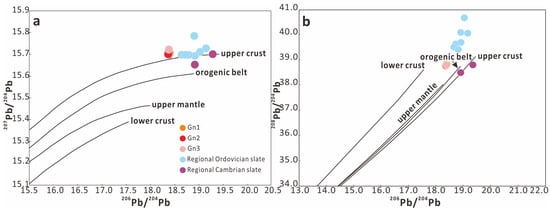
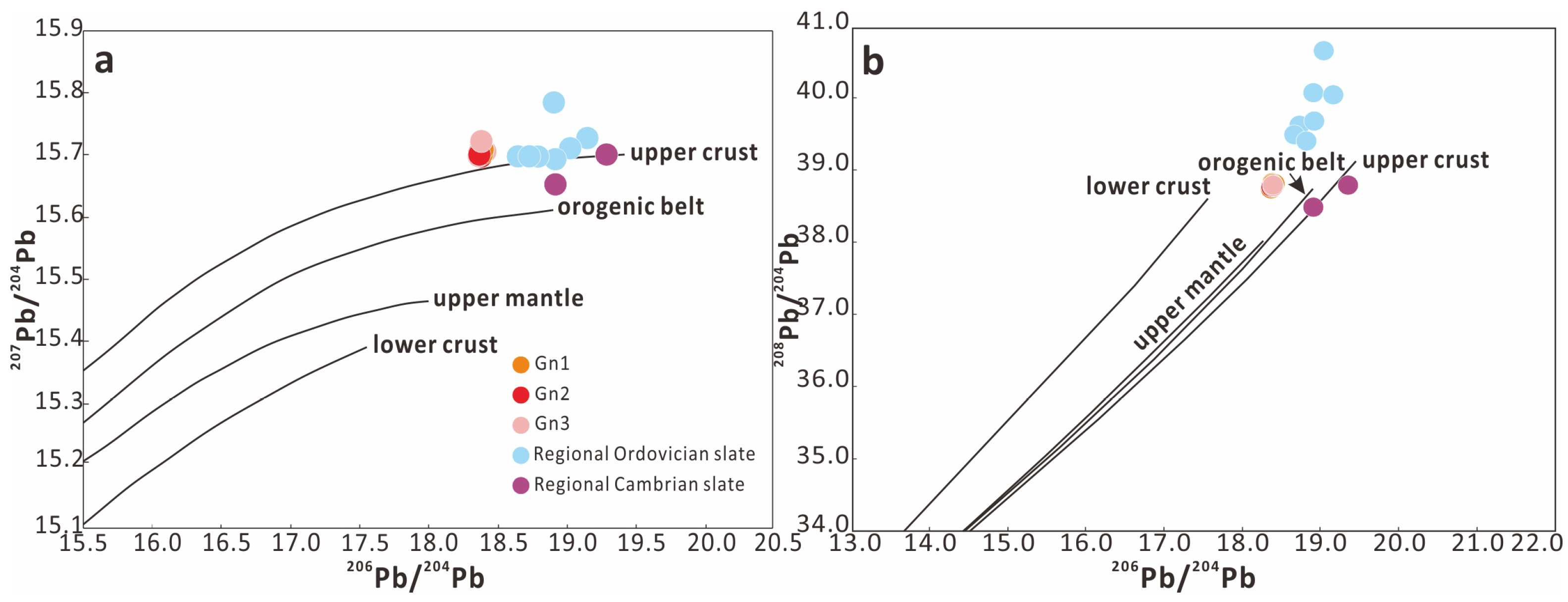
In the 206Pb/204Pb vs. 207Pb/204Pb tectonic classification diagram (Figure 7a), the Qingshuitang galena data plots above the upper crustal average evolution curve, indicating that the Pb may originate from a geochemically mature upper crustal. In the 206Pb/204Pb vs. 208Pb/204Pb correlation diagram (Figure 7b), the Pb isotope points are distributed between the lower crust and orogenic belt evolution lines, and with a closer affinity to the orogenic trend, which is usually regarded as the possible product of crustal remelting or crust-mantle interaction in orogeny [39]. Integrated interpretation reveals that the ore lead was dominantly sourced from the upper crust, with minor mantle-derived contributions.
Figure 7.
Zartman diagram of lead isotopic compositions for galena samples (Gn1-Gn3) and regional Cambrian–Ordovician sedimentary rock samples [29] from the Qingshuitang deposit (after [35]): (a) 206Pb/204Pb vs. 207Pb/204Pb diagram; (b) 206Pb/204Pb vs. 208Pb/204Pb diagram.
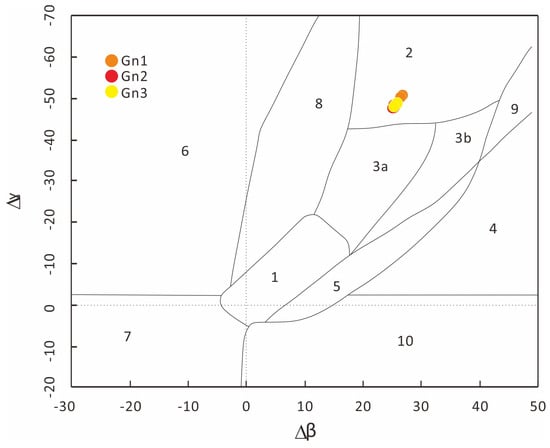
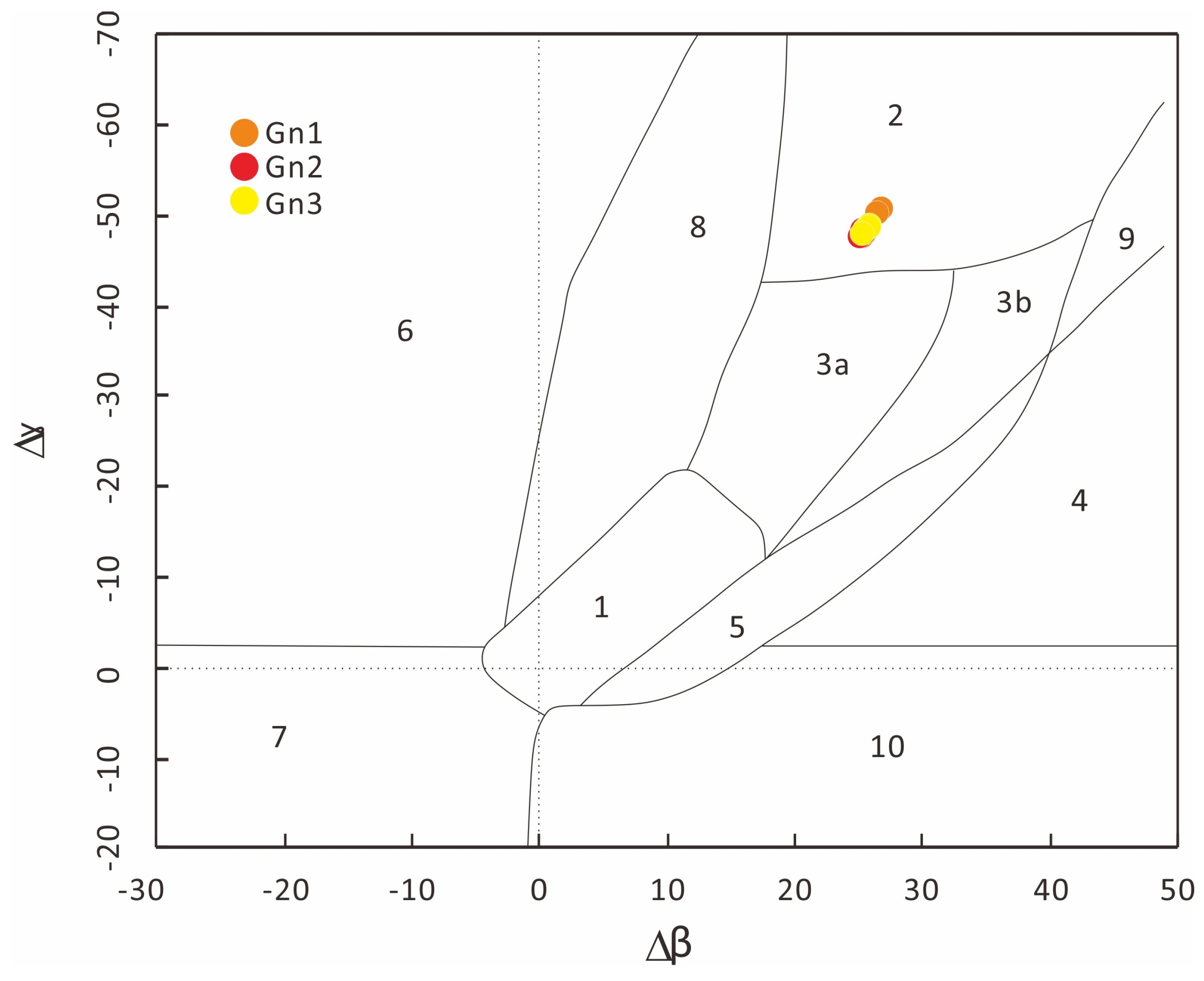
On the basis of comprehensively collecting Pb isotope data all over the world (including China), Zhu et al. (1998) [40] developed the △β−△γ genetic classification diagram (where △β = Δ(207Pb/204Pb), △γ = Δ(208Pb/204Pb)) for tracing ore lead sources. This diagram theoretically provides enhanced discriminatory power compared to global evolution curves by effectively minimizing temporal overprints on isotopic signatures. Galena samples from three mineralization stages in the Qingshuitang Pb–Zn deposit yield △β (24.98–26.73, avg. 25.54) and △γ (47.63–50.80, avg. 48.61), which are greater than those of the upper crust, respectively, suggesting that the ore lead was mainly derived from the upper crust. When plotting on the △β vs. △γ genetic classification diagram (Figure 8), all Qingshuitang data points are concentratedly distributed and presented as a steep linear array within the upper crustal field, which is consistent with a crustal Pb affinity [41].
Figure 8.
△β−△γ genetic classification diagram of galena (Gn1-Gn3) from the Qingshuitang deposit (after [40]). 1—Mantle lead; 2—Upper crust lead; 3—Subduction zone lead mixed from upper crust and mantle (3a: magmatism; 3b: sedimentation); 4—Chemically sedimentary lead; 5—Submarine hydrothermal lead; 6—Medium-deep metamorphic lead; 7—Deep metamorphic lower crust lead; 8—Orogenic belt lead; 9—Ancient shale upper crust lead; 10—Retrograde metamorphic lead. The △β−△γ genetic classification parameters are calculated following Zhu (1998) [40].
Published Pb isotopic data for regional Cambrian and Ordovician argillaceous slates [29] show partial isotopic overlap with Qingshuitang galena (Figure 7). However, notable isotopic offsets also exist: the ore galena exhibits a narrow 206Pb/204Pb range (18.368–18.416), whereas the Cambrian–Ordovician samples extend toward more radiogenic 206Pb/204Pb values; some Ordovician slate samples yield distinctly higher 208Pb/204Pb ratios. Therefore, Cambrian–Ordovician sedimentary sequences represent one possible lead source, but contributions from pre-Cambrian basement and local granitoids cannot be excluded.
5.2. Evolution of Physicochemical Conditions for Qingshuitang Pb–Zn Mineralization
The research of fluid inclusions microthermometric features has become an indispensable method to trace the ore fluid physicochemical conditions [41,42,43,44,45].
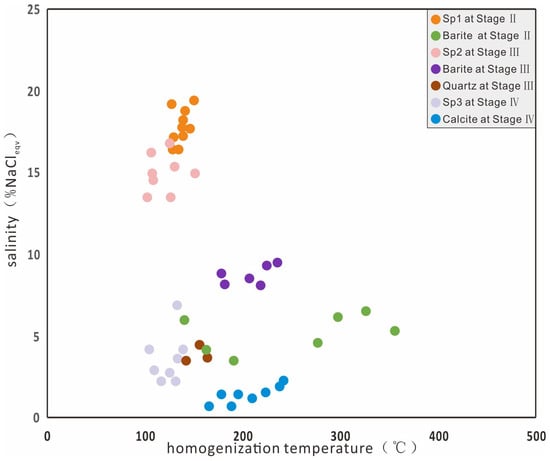
It should be noted that in the Qingshuitang deposit, no reliable primary fluid inclusion data were acquired for Stage I, so our fluid evolution discussion is restricted to Stage II–IV. Primary L-type fluid inclusions dominate in the three mineralization stages, and the observed eutectic melting temperature is approximately −21.8 °C, which indicates that the ore-forming fluid is primarily an H2O-NaCl system. Microthermometric results reveal that the fluids system is characterized by wide ranges of homogenization temperatures (102–395 °C) and salinities (0.71–19.45 wt% NaCl equiv.) (Table 2, Figure 9). For primary fluid inclusions trapped in sphalerite, the average homogenization temperature decreases from Sp1 (136 °C, Stage II) to Sp2 (118 °C, Stage III), followed by a slight rebound to 122 °C for Sp3 (Stage IV). The salinities of sphalerite-hosted fluid inclusion exhibit a decreasing trend from Stage II (avg. 17.72 wt% NaCl equiv.) via Stage III (avg. 15.03 wt% NaCl equiv.) to Stage IV (avg. 3.50 wt% NaCl equiv.) (Figure 9). A pronounced salinity drop occurs in Stage IV, which is speculated to be caused by the continuous addition of low-salinity meteoric water. Moreover, fluid inclusions with high homogenization temperatures and low salinities are identified in three mineralization stages, which exhibit a striking contrast against contemporaneous sphalerite fluid inclusions characterized by low temperature and medium salinities (Table 2, Figure 9).
Figure 9.
Diagram showing variations in homogenization temperature and salinity of fluid inclusions with hydrothermal fluid evolution.
Based on the empirical formula of fluid density proposed by Liu (1999) [46] and Lu et al. (2004) [47], and simultaneously using the homogeneous temperature–salinity–density distribution map of sphalerite-hosted fluid inclusion [48], it is calculated that the densities of ore-forming fluids predominantly range from 1.00 to 1.10 g/cm3 at Stage II and Stage III, and from 0.95 to 1.00 g/cm3 at Stage IV. Overall, the ore-forming fluid of the Qingshuitang deposit is characterized by a medium–low density hydrothermal system, with fluid density displaying a progressive decrease through the mineralization process.
Trapping pressures were calculated from sphalerite-hosted fluid inclusion data using the empirical formula of Shao (1988) [49], yielding estimated pressure ranges of 15.8–19.8 MPa (avg. 17.4 MPa) for Stage II, 11.7–18.0 MPa (avg. 14.2 MPa) for Stage III, and 8.0–12.1 MPa (avg. 9.6 MPa) for Stage IV. It should be noted that these pressure estimates are derived from empirical calculations, without constraints from fluid isochores, confirmed fluid boiling assemblages, or independent geobarometers; therefore, substantial uncertainty must be taken into account, and these values should be treated as rough approximate estimates. The gradually decreasing trend of the calculated pressure from Stage II through Stage III to Stage IV indicates that the physicochemical evolution observed during the migration of hydrothermal fluids is closely related to local tectonic activities. Using the empirical formula proposed by Sun et al. (2000) [50], the corresponding estimated mineralization depth ranges from 0.80 to 1.98 km.
In conclusion, the microthermometric analyses on sphalerite-hosted fluid inclusion reveal that the salinity, density, and pressure of ore-forming fluids exhibit a gradual decreasing trend from Stage II through Stage III to Stage IV. However, a prominent temperature drop takes place from Stage II to Stage III, and a relatively stable low-temperature hydrothermal condition is maintained in Stage IV.
5.3. Metallogenic Implications
Combined with our investigations and previous research findings, the geological–geochemical characteristics of the Qingshuitang Pb–Zn deposit are compared with classic MVT Pb–Zn deposits as follows. Features comparable to MVT systems include (1) Pb isotope results indicating that ore-forming lead is predominantly sourced from the upper crust sedimentary sequences; (2) published H-O isotopic data of ore bearing quartz (δDSMOW: −98.9 to −79.3‰, δ18OH2O: −4.00 to 0.63‰) [24] implying that basinal formation water constitutes an important component of ore-forming fluids [51]; and (3) ore body occurrence being structurally controlled by faults and fractures on the margin of the Hengyang Basin [52,53]. Nevertheless, multiple critical features deviate from classic MVT deposits: (1) Orebodies are fracture-controlled crosscutting veins hosted within Cambrian–Ordovician muddy slates, instead of strata-bound orebodies hosted in carbonate sequences [52,53]. (2) Wall-rock alteration is poorly developed and dominated by silicification and baritization, without the widespread dolomitization that is typical of MVT deposits. (3) Fluid inclusion data show a broad homogenization temperature range (102–395 °C), with maximum temperatures distinctly higher than the typical MVT temperature range (50–250 °C). Salinities vary from 0.71 to 19.45 wt% NaCl equiv., including abundant low-salinity fluids inconsistent with the concentrated basinal brines of classic MVT [54]. (4) Sulfur isotope data of ores (δ34S: 2.97 to −7.41‰, avg. −1.93‰) [10] suggest the possible input of magmatic–hydrothermal fluids, which is atypical for classical MVT deposits. (5) The estimated mineralization depth ranges from 0.80 to 1.98 km, corresponding to epithermal conditions shallower than most MVT systems.
Despite some similarities between the veined Pb–Zn mineralization at Qingshuitang and epithermal base metal deposits, multiple lines of evidence rule out an epithermal origin [55,56]. Classic epithermal Pb–Zn mineralization generally develops in volcanic or volcaniclastic sequences at shallow crustal depths (<1.5 km) and 100–300 °C, with ore-forming fluids dominated by low-salinity meteoric water, commonly accompanied by advanced argillic or sericitic alteration [57,58]. In contrast, mineralization at Qingshuitang is hosted by sedimentary clastic rocks, and our fluid inclusion data show some homogenization temperatures above 300 °C and moderate-salinity basinal brines rather than dilute epithermal fluids. No typical epithermal alteration assemblages (e.g., adularia, alunite) or abundant Ag–sulphosalts are observed in the Qingshuitang ores. Moreover, epithermal deposits are spatially and temporally linked to coeval volcanic/subvolcanic intrusions [58]. No contemporaneous volcanic rocks are documented in the Qingshuitang ore district, and mineralization is hosted by fault fractures instead of volcanic breccias or dome-related structures. Therefore, although a thermal magmatic contribution is invoked, the deposit cannot be classified as an epithermal system.
Clastic-dominated (CD-type) sediment-hosted Pb–Zn systems are epigenetic to syndiagenetic veins and replacement orebodies hosted mainly in fine-grained clastic rocks (shale, slate, siltstone) rather than carbonates and are generally attributed to basinal brine circulation [53,59]. The slate host rocks, structurally controlled vein geometry, basinal formation water H-O isotope, and isotopically homogeneous crustal Pb at Qingshuitang are broadly compatible with CD-type Pb–Zn deposits.
Although researchers have proposed a magmatic–hydrothermal metallogenic model for the Qingshuitang deposit, our new data indicate that a purely magmatic–hydrothermal system cannot fully account for all the geological and geochemical features of the deposit. Instead, we propose that Qingshuitang is best classified as a sedimentary-hosted deposit similar to CD Pb–Zn, which is controlled by crosscutting faults, and related to hot brines with possible magmatic–hydrothermal contributions [60]. In this model, the principal ore-forming fluids are basinal brines mobilized from sedimentary sequences of the Hengyang Basin. These brines extract most Pb and Zn from clastic host rocks through fluid–rock interactions. The magmatic–hydrothermal contribution is probably predominantly thermal energy from a concealed regional magmatic event. This magmatic heat sustains large-scale fluid circulation and promotes metal leaching from sedimentary strata. Small quantities of magmatic sulfur and/or metals may have been added to the basinal brines through deep-seated faults. This interpretation reasonably reconciles our fluid inclusion and isotopic datasets. The deposit preserves the typical basin fluid signatures of CD deposits and also records a discernible magmatic signal, which well explains the magmatic-related geochemical phenomena observed in previous studies.
In addition, primary fluid inclusion data exhibit wide ranges of homogenization temperature and salinity across mineralization stages. This may reflect fluid mixing [61], but definitive FIA datasets on the same mineral and coeval minerals recording clear mixing trends are absent in our study. Therefore, fluid mixing represents our preferred working hypothesis, though other mechanisms cannot be excluded. Although V-type inclusions were occasionally observed in Stage II and Stage III, definitive petrographic and microthermometric evidence for fluid boiling or immiscibility is absent in our datasets. Therefore, fluid boiling cannot be confirmed, and our preferred explanation for the wide spread of temperature–salinity data remains fluid mixing.
No precise metallogenic age has yet been determined for the Qingshuitang Pb–Zn deposit. Previous studies have demonstrated that the metallogenic ages of Pb–Zn deposits in southeastern Hunan are predominantly concentrated in the Early Yanshanian (160–151 Ma) [7,8]. Nevertheless, the Qingshuitang Pb–Zn deposit markedly differs from the Shuikoushan and Huangshaping Pb–Zn deposits—which are genetically linked to Early Yanshanian magmatism—in terms of regional geological setting, ore-hosting strata, occurrence characteristics, and ore types. Notably, no Yanshanian intrusions have been identified within or adjacent to the mining area; only a small-scale Zhoujialing dike (203.0 ± 1.4 Ma) [16] occurs in the northeastern mining area. Drilling data reveal that the Zhoujialing dike and V20 orebodies are both controlled by the F20 fault, and the V20 orebodies cut across the Zhoujialing dike (Figure 2a).
In this study, we attempted to use the Middle–Late Triassic (late Indosinian) to discuss the ore-forming processes of the deposit. We propose that ore-bearing hot brine fluids [24] ascended and migrated along regional deep faults and simultaneously continuously extracted Pb–Zn elements from the strata in an extensional tectonic setting in the Middle–Late Triassic. As the subsidiary NE- and NEE-trending faults decompress, accompanied by fluid mixing and decreasing hydrothermal fluid temperature, the metal minerals are precipitated at the appropriate structural locations, thereby forming the Qingshuitang Pb–Zn deposit. Definitive validation of this tectonometallogenic explanation requires future studies to obtain the direct mineralization ages of the Qingshuitang deposit.
6. Conclusions
(1) The in situ Pb isotope features of galena from three mineralization stages indicate an upper crustal origin for ore lead. Regional Cambrian–Ordovician sedimentary strata constitute one possible metal source, yet potential contributions from pre-Cambrian basement and local granitoids cannot be excluded.
(2) Fluid inclusions characteristics from Qingshuitang indicate that the ore-forming hydrothermal fluid is dominated by the H2O-NaCl system. Microthermometric analyses of fluid inclusions suggest that the ore-forming fluids record wide ranges of homogenization temperatures (102–395 °C) and salinities (0.71–19.45 wt% NaCl equiv). Moreover, the homogeneous temperature and salinities of the FIs hosted in sphalerite range from 102 to 151 °C, 2.24 to 19.45 wt% NaCl equiv., respectively, which reveals an overall decreasing trend in salinity, density, and pressure from Stage II through Stage III to Stage IV. Meanwhile, a prominent temperature drop takes place between Stage II and Stage III, and Stage IV maintains relatively stable low-temperature hydrothermal conditions.
(3) The Qingshuitang deposit is interpreted as a sedimentary-hosted deposit similar to CD Pb–Zn systems; it is controlled by crosscutting faults and is related to the activity of hot brines with possible magmatic–hydrothermal contributions. Fluid mixing and fluid cooling are likely the critical mechanisms driving ore precipitation.
Author Contributions
Conceptualization, S.L.; Data curation, Y.Z. and Z.Z.; Formal analysis, H.L. (Hongbin Li) and H.L. (Hongsheng Liu); Funding acquisition, S.L. and H.L. (Hongbin Li); Investigation, G.A.; Methodology, H.L. (Hongsheng Liu) and H.L. (Hongbin Li); Resources, H.L. (Hongbin Li); Software, Y.Z. and Z.Z.; Writing—original draft, S.L.; Writing—review and editing, S.L. and H.L. (Hongbin Li). All authors have read and agreed to the published version of the manuscript.
Funding
This research was funded by the Scientific Research Fund of Hunan Provincial Education Department (Grant No. 23B0399), Open Research Fund Program of Key Laboratory of Metallogenic Prediction of Nonferrous Metals and Geological Environment Monitoring (Central South University), Ministry of Education (Grant No. 2024YSJS05), and the Regional (Hengyang City) Joint Fund of the Natural Science Foundation of Hunan Province, China (Grant No. 2026JJ80181). We thank the remote sensing geological survey and monitor institute of Hunan Province for their field assistance.
Data Availability Statement
The original contributions presented in this study are included in the article. Further inquiries can be directed to the corresponding author.
Acknowledgments
We are grateful to the Editor-in-Chief and reviewers.
Conflicts of Interest
The authors declare no conflicts of interest.
References
- Mao, J.W.; Chen, M.H.; Yuan, S.D.; Guo, C.L. Geological Characteristics of the Qinhang (or Shihang) Metallogenic Belt in South China and Spatial-Temporal Distribution Regularity of Mineral Deposits. Acta Geol. Sin. 2011, 85, 636–658, (In Chinese with English abstract). [Google Scholar]
- Zhang, Y.; Shao, Y.J.; Liu, Q.Q.; Chen, H.Y.; Quan, W.; Sun, A.X. Jurassic magmatism and metallogeny in the eastern Qinhang Metallogenic. J. Geochem. Explor. 2018, 186, 281–297. [Google Scholar] [CrossRef] [Scilit]
- Yu, D.S.; Xu, D.R.; Zhao, Z.X.; Zhao, D.R.; Huang, Q.Y.; Wang, Z.L.; Deng, T.; Zou, S.H. Genesis of the Taolin Pb-Zn deposit in northeastern Hunan Province, South China: Constraints from trace elements and oxygen-sulfur-lead isotopes of the hydrothermal minerals. Miner. Depos. 2020, 55, 1467–1488. [Google Scholar] [CrossRef] [Scilit]
- Li, X.F.; Huang, C.; Wang, C.Z.; Wang, L.F. Genesis of the Huangshaping W–Mo–Cu–Pb–Zn polymetallic deposit in Southern Hunan Province, China: Constraints from fluid inclusions, trace elements, and isotopes. Ore Geol. Rev. 2016, 79, 1–25. [Google Scholar] [CrossRef] [Scilit]
- Li, D.F.; Tan, C.Y.; Miao, F.Y.; Liu, Q.F.; Zhang, Y.; Sun, X.M. Initiation of Zn–Pb mineralization in the Pingbao Pb–Zn skarn district, South China: Constraints from U-Pb dating of grossular-rich garnet. Ore Geol. Rev. 2019, 107, 587–599. [Google Scholar] [CrossRef] [Scilit]
- Liu, S.; Zhang, Y.; Ai, G.L.; Xue, X.L.; Li, H.B.; Sajjad, A.S.; Wang, N.H.; Chen, X. LA-ICP-MS trace element geochemistry of sphalerite: Metallogenic constraints on the Qingshuitang Pb-Zn deposit in the Qinhang Ore Belt, South China. Ore Geol. Rev. 2022, 141, 104659. [Google Scholar] [CrossRef] [Scilit]
- Shen, H.J.; Zhang, Y.; Feng, Y.Z.; Shao, Y.J.; Tan, H.J.; Liang, Y.M.; Liao, J.H. Origin of Pb–Zn deposits in the Hengyang Basin in the central part of the Qin-Hang metallogenic belt (South China): An example from the Yantianqiao deposit. J. Asian Earth Sci. 2025, 294, 106824. [Google Scholar] [CrossRef] [Scilit]
- Shen, H.J.; Zhang, Y.; Zuo, C.H. Ore-forming process revealed by sphalerite texture and geochemistry: A case study at the Kangjiawan Pb-Zn deposit in Qin-Hang Metallogenic Belt, South China. Ore Geol. Rev. 2022, 150, 105153. [Google Scholar] [CrossRef] [Scilit]
- Shen, H.J.; Zhang, Y.; Tan, H.J.; Shao, Y.J.; Wang, X.; Liang, Y.M.; Zhao, L.J. Early Cretaceous magmatic-hydrothermal Pb–Zn mineralization in the Liushutang deposit, Hengyang Basin, South China. J. Geochem. Explor. 2026, 290, 108165. [Google Scholar] [CrossRef] [Scilit]
- Lu, R.; Miao, B.H.; Xu, Z.W.; Lu, J.J.; Wang, R.C.; Zuo, C.H.; Qu, J.B.; Zhao, Z.X. Isotopic trace of ore–forming material source from the Qingshuitang Lead-Zinc deposit, Qidong county, Hunan province. Acta Geol. Sin. 2017, 91, 1285–1298, (In Chinese with English abstract). [Google Scholar]
- Song, H.B. Formation mechanism of polygenetic Pb–Zn deposit in Qingshuitang, Hunan. Hun. Metall. 1993, 4, 35–38, (In Chinese with English abstract). [Google Scholar]
- Zou, Z.G. Mineralogical characteristics of Taolin sphalerite. Hun. Geol. 1993, 12, 102–106, (In Chinese with English abstract). [Google Scholar]
- Xu, Z.W.; Miu, B.H.; Zuo, C.H.; Qu, J.B.; Zhao, Z.X.; Lu, R.; Wang, S.H. Study of the fluid inclusions from the Qingshuitang Pb–Zn deposit, Qidong country, Hunan Province. Geol. Rev. 2017, 63, 207–218, (In Chinese with English abstract). [Google Scholar]
- Ting, S.Y.; Bowen, G.J.; Koch, P.L.; Wang, Y.Q.; Wang, Y.; Mckenna, M.C. Biostratigraphic, chemostratigraphic, and magnetostratigraphic study across the Paleocene-Eocene boundary in the Hengyang Basin, Hunan, China. Geol. Soc. Am. Spec. Pap. 2003, 369, 521–535. [Google Scholar]
- Li, S.B.; Cao, Y.H.; Song, Z.Y.; Xiao, D. Zircon U-Pb and Pyrite Re–Os Isotope Geochemistry of ‘Skarn-Type’ Fe–Cu Mineralization at the Shuikoushan Polymetallic Deposit, South China: Implications for an Early Cretaceous Mineralization Event in the Nanling Range. Minerals 2021, 11, 480. [Google Scholar] [CrossRef] [Scilit]
- Miu, B.H.; Zuo, C.H.; Zhao, Z.X.; Xu, Z.W.; Lu, J.J.; Lu, R.; Chen, J.Q. Forming age and material source of the Zhoujialing granite in Qingshuitang orefield, Qidong County, Hunan Province. Geol. Rev. 2014, 60, 611–623, (In Chinese with English abstract). [Google Scholar]
- Chen, W.F.; Chen, P.R.; Zhou, X.M.; Huang, H.Y.; Ding, X.; Sun, T. Single-zircon LA-ICP-MS U-Pb dating of the Yangmingshan granitic pluton in Hunan, South China and its petrogenetic study. Acta Geol. Sin. 2006, 80, 1065–1077, (In Chinese with English abstract). [Google Scholar]
- Li, X.Y.; Yi, L.W.; Chen, D.; Wen, C.H.; Tang, F.P.; Zhang, X.Y.; An, J.H.; Deng, L. Petrogenesis of the Jiangjunmiao Granitic Pluton in Hunan Province: Constraints from Petrochemistry, Zircon U-Pb Dating, and Sr–Nd–Hf Isotopes. Bull. Mineral. Petrol. Geochem. 2020, 39, 726–740, (In Chinese with English abstract). [Google Scholar]
- Li, J.F.; Lu, Y.Y.; Zhang, Z.Z.; Fu, J.M.; Qin, Z.W. Research and prospecting progress of Dayishan pluton in Nanling Range. Earth Sci. 2022, 48, 3707–3724, (In Chinese with English abstract). [Google Scholar]
- Li, Y.S.; Zhen, S.M.; Yu, X.F.; Gong, F.Y.; Du, Z.Z. Zircon U-Pb geochronology and Hf isotopic compositions of igneous rocks from the Shuikoushan Pb–Zn deposit, Hunan Province and their geological significance. Earth Sci. Front. 2020, 27, 332–352, (In Chinese with English abstract). [Google Scholar]
- Song, Z.Y.; Feng, Y.Z.; Shao, Y.J.; Li, J.; Liu, Z.F.; Feng, Y.L.; Tan, H.J.; Zhou, H.D. Geochemistry, zircon U-Pb geochronogy and Hf isotopes of Baishifeng pluton in Dangjiachong Cu deposit, Hunan. Chin. J. Nonferrous Met. 2020, 30, 1942–1956, (In Chinese with English abstract). [Google Scholar]
- Zhao, L.J.; Zhang, Y.; Shao, Y.J.; Li, H.B.; Shah, S.A.; Zhou, W.J. Using garnet geochemistry discriminating different skarn mineralization systems: Perspective from Huangshaping W–Mo–Sn–Cu polymetallic deposit, South China. Ore Geol. Rev. 2021, 138, 104412. [Google Scholar] [CrossRef] [Scilit]
- Mao, J.W.; Cheng, Y.B.; Chen, M.H.; Pirajno, F. Major types and time-space distribution of Mesozoic ore deposits in South China and their geodynamic settings. Miner. Depos. 2013, 48, 267–294. [Google Scholar] [CrossRef] [Scilit]
- Miu, B.H.; Xu, Z.W.; Zuo, C.H.; Lu, R.; Zhao, Z.X.; Yue, N. Physical and chemical conditions of the formation of the Qingshuitang Pb–Zn deposit, Qidong County, Hunan Province. J. Minerals. 2017, 586–587, (In Chinese with English abstract). [Google Scholar]
- Roedder, E. Fluid inclusions. Rev. Mineral. 1984, 12, 644. [Google Scholar]
- Goldstein, R.H. Petrographic analysis of fluid inclusions. Mineral. Assoc. Can. Short Course 2003, 32, 9–54. [Google Scholar] [CrossRef] [Scilit]
- Bodnar, R.J.; Lecumberri-Sanchez, P.; Moncada, D.; Steele-MacInnis, M. Fluid inclusions in hydrothermal ore deposits. Treatise Geochem. 1993, 13, 119–142. [Google Scholar]
- Lu, Y.F. GeoKit: A geochemical toolkit built with VBA. Geochimica 2004, 33, 459–464, (In Chinese with English abstract). [Google Scholar]
- Cheng, S.B.; Wu, Z.H.; Liu, C.P.; Liu, A.J.; Ma, L.Y.; Lu, Y.Y. Sulfur and lead isotope characteristics and their significance of the Liushutang lead-zinc deposit in Hunan Province. Geol. Bull. China 2017, 36, 846–856, (In Chinese with English abstract). [Google Scholar]
- Faure, G.; Mensing, T.M. Isotopes: Principles and Applications; John Wiley & Sons: New York, NY, USA, 2005; pp. 103–110. [Google Scholar]
- Shepherd, T.J.; Rankin, A.H.; Alderton, D.H.M. A Practical Guide to Fluid Inclusion Studies; Blackie: London, UK, 1985; pp. 1–154. [Google Scholar]
- Woodhead, J.; Hergt, J.; Meffre, S.; Large, R.R.; Danyushevsky, L.; Gilbert, S. In situ Pb-isotope analysis of pyrite by laser ablation (multi-collector and quadrupole) ICPMS. Chem. Geol. 2009, 262, 344–354. [Google Scholar] [CrossRef] [Scilit]
- Darling, J.R.; Storey, C.D.; Hawkesworth, C.J.; Lightfoot, P.C. In-situ Pb isotope analysis of Fe-Ni-Cu sulphides by laser ablation multi-collector ICPMS: New insights into ore formation in the Sudbury impact melt sheet. Geochim. Cosmochim. Acta 2012, 99, 1–17. [Google Scholar] [CrossRef] [Scilit]
- Liu, S. Genesis of the Qingshuitang Veined Pb–Zn Deposit in Southern Hunan, South China. Doctoral Thesis, Central South University, Changsha, China, 2023. [Google Scholar]
- Zartman, R.E.; Doe, B.R. Plumbotectonics-the model. Tectonophysics 1981, 75, 135–162. [Google Scholar] [CrossRef] [Scilit]
- Jiang, Y.G.; Cui, Y.L.; Nian, H.L.; Yang, C.H.; Zhang, Y.H.; Liu, M.Y.; Xu, H.; Cai, J.J.; Liu, H.S. The Origin of the Caiyuanzi Pb–Zn Deposit in SE Yunnan Province, China: Constraints from In Situ S and Pb Isotopes. Minerals 2022, 13, 238. [Google Scholar] [CrossRef] [Scilit]
- Wu, K.X.; Hu, R.Z.; Bi, X.W.; Peng, J.T.; Tang, Q.L. A review of ore lead isotope tracing for the source of ore-forming materials. Geol.-Geochem. 2002, 30, 73–81, (In Chinese with English abstract). [Google Scholar]
- Zhao, S.R.; Li, Z.K.; Li, J.W.; Zhao, X.F.; Jiang, S.Y.; Lin, H.T.; Du, S.G. Trace element and S-Pb isotopic compositions of pyrite from the Precambrian metamorphic rocks and their derivative pegmatites in the Xiaoqinling district, southern North China Craton: Implications for possible gold source of the Early Cretaceous gold deposits. Precambrian Res. 2022, 377, 106739. [Google Scholar] [CrossRef] [Scilit]
- Doe, B.R.; Zartman, R.E. Plumbotectonics, the Phanerozoic. In Geochemistry of Hydrothermal Ore Deposits, 2nd ed.; Barnes, H.L., Ed.; Wiley Interscience: New York, NY, USA, 1979; pp. 22–70. [Google Scholar]
- Zhu, B.Q. Theory and Application of Isotope Systems in Earth Sciences—With a Discussion on the Evolution of the Continental Crust and Mantle in China; Science Press: Beijing, China, 1998; pp. 60–71. [Google Scholar]
- Xie, H.J.; Sun, G.Y.; Baima, Q.Z.; Gao, X.Y.; Yang, Z.W.; Tian, R.; Li, Z.P. Genesis of the Jiawula Pb–Zn–Ag deposit in the Great Xing’an Range, NE China: Constraints from fluid inclusions and S–Pb isotopes. J. Asian Earth Sci. 2026, 312, 107313. [Google Scholar] [CrossRef] [Scilit]
- Changkakoti, A.; Gray, J.; Krstie, D.; Gumming, G.L.; Morton, R.D. Determination of radiogenic isotope (Rb/Sr, An example from the Bluebell Ph-Zn deposit, British Columbia, Canada. Geochim. Cosmo. Acta 1988, 52, 961–967. [Google Scholar] [CrossRef] [Scilit]
- Thomas, A.Y.; Spooner, E.T.C. Distinguishing between Archaean fuids of dillerent origins: An example using volatile analyses of fuid in.clusions from the Tanco pegmatite, SE, Manitoba. In Greenstone Gold and Crustal Evolution. Proceedings of a Workshop, Val-d’Or, QC, Canada, 24–27 May 1990; Robert, F., Sheahan, P.A., Green, S.B., Eds.; Geological Association of Canada: St. John’s, NL, Canada, 1991; p. 217. [Google Scholar]
- Bowers, T.S. The deposition of gold and other metals: Pressure induced fluid immiscibility and associated stable isotope signatures. Geochim. Cosmochim. Acta 1991, 55, 2417–2434. [Google Scholar] [CrossRef] [Scilit]
- Lu, H.Z.; Guo, D.J. Research Progress and Directions of Fluid Inclusions. Geol. Rev. 2000, 46, 385–392. [Google Scholar]
- Liu, B. Thermodynamics of Fluid Inclusions; Geological Publishing House: Beijing, China, 1999; pp. 57–59. [Google Scholar]
- Lu, H.Z. Fluid Inclusions; Science Press: Beijing, China, 2004; pp. 78–80. [Google Scholar]
- Ahmad, S.N.; Rose, A.W. Fluid inclusions in porphyry and skarn ore at Santa Rita, New Mexico. Econ. Geol. 1980, 75, 229–250. [Google Scholar] [CrossRef] [Scilit]
- Shao, J.L. Mineralogy for Gold Prospecting; China University of Geosciences Press: Wuhan, China, 1988; pp. 32–35. [Google Scholar]
- Sun, F.Y.; Jin, W.; Li, B.L. Reflections on the metallogenic depth of vein-type hydrothermal gold deposits. J. Chang. Univ. Sci. Technol. Suppl. 2000, 30, 27–30, (In Chinese with English abstract). [Google Scholar]
- Chen, X.S.; Sun, F.Y.; Li, W.; Yuan, K.Q.; Yan, Z.P.; Chen, H.F.; Wan, W. Geology, Geochronology, Geochemistry, fluid inclusions and H-O isotopic compositions of the newly discovered Tesiketu fluorite deposit, North Qaidam, Qinghai Province, NW China. Ore Geol. Rev. 2026, 194, 107347. [Google Scholar] [CrossRef] [Scilit]
- Sangster, D.F. The role of dense brines in the formation of vent-distal sedimentaryexhalative (SEDEX) lead-zinc deposits: Field and laboratory evidence. Miner. Depos. 2002, 37, 149–157. [Google Scholar] [CrossRef] [Scilit]
- Leach, D.L.; Sangster, D.F.; Kelley, K.D.; Large, R.R.; Garven, G.; Allen, C.R.; Gutzmer, J.; Walters, S. Sediment-hosted lead-zinc deposits: A global perspective. Econ. Geol. 2005, 100, 561–607. [Google Scholar]
- Basuki, N.I.; Spooner, E.T.C. A review of fluid inclusion temperatures and salinities in Mississippi Valley-type Zn–Pb deposits: Identifying thresholds for metal transport. Explor. Min. Geol. 2004, 11, 1–17. [Google Scholar]
- Hedenquist, J.W.; Lowenstern, J.B. The role of magmas in the formation of hydrothermal ore deposits. Nature 1994, 370, 519–527. [Google Scholar] [CrossRef] [Scilit]
- Çiçek, M.; Oyman, T. Origin and evolution of hydrothermal fluids in epithermal Pb–Zn–Cu±Au±Ag deposits at Koru and Tesbihdere mining districts, Çanakkale, Biga Peninsula, NW Turkey. Ore Geol. Rev. 2016, 78, 176–195. [Google Scholar] [CrossRef] [Scilit]
- Peng, Y.W.; Gu, X.X.; Su, J.; Zhang, Y.M.; Wang, J.L. Geology, geochemistry and genesis of Tabei: A newly identified intermediate-sulphidation epithermal Pb–Zn deposit adjacent to low-sulphidation Au deposit in the Tulasu Basin, Chinese Western Tianshan. Geol. J. 2022, 58, 583–604. [Google Scholar] [CrossRef] [Scilit]
- Kouhestani, H.; Mokhtari, A.; Chang, Z.S.; Qin, K.Z.; Aghajani, M. Fluid inclusion, zircon U-Pb geochronology, and O-S isotopic constraints on the origin and evolution of ore-forming fluids of the Tashvir and Varmazyar epithermal base metal deposits, NW Iran. Front. Earth Sci. 2022, 10, 990761. [Google Scholar] [CrossRef] [Scilit]
- Leach, D.L.; Bradley, D.C.; Huston, D.L.; Pisarevsky, S.A.; Taylor, R.D.; Gardoll, S.J. Sediment-hosted lead-zinc deposits in Earth history. Econ. Geol. 2010, 105, 593–625. [Google Scholar] [CrossRef] [Scilit]
- Hoggard, M.J.; Czarnota, K.; Richards, F.D.; Huston, D.L.; Jaques, A.L.; Ghelichkhan, S. Global distribution of sediment-hosted metals controlled by craton edge stability. Nat. Geosci. 2020, 13, 504–510. [Google Scholar] [CrossRef] [Scilit]
- Zhang, W.H.; Zhang, Z.J.; Wu, G. Ore-forming fluid and mineralization mechanism. Earth Sci. Front. 1996, 3, 245–252. [Google Scholar]

Disclaimer/Publisher’s Note: The statements, opinions and data contained in all publications are solely those of the individual author(s) and contributor(s) and not of MDPI and/or the editor(s). MDPI and/or the editor(s) disclaim responsibility for any injury to people or property resulting from any ideas, methods, instructions or products referred to in the content. |
© 2026 by the authors. Licensee MDPI, Basel, Switzerland. This article is an open access article distributed under the terms and conditions of the Creative Commons Attribution (CC BY) license.