


Abstract
Lacustrine fine-grained sediments commonly exhibit well-developed laminations, with significant variations in structural characteristics such as thickness and continuity, which are closely related to depositional environments and genetic processes. This paper focuses on the characteristics and formation mechanisms of the upper Es4 to lower Es3 members of the Shahejie Formation in the Dongying Sag. Through polarized light microscopy, field-emission environmental scanning electron microscopy (FE-SEM), electron probe microanalysis (EPMA), and X-ray diffraction (XRD), we systematically analyzed the types, characteristics, and genetic mechanisms of laminations in fine-grained sedimentary rocks. Results indicate that the mineral composition of these rocks is dominated by carbonates and clay minerals, allowing classification into calcareous and argillaceous mudstones. The types of laminae include calcareous laminae, argillaceous laminae, and silty laminae, which are formed by chemical precipitation, suspension settling, and low-density turbidity currents, respectively. The primary lamination associations are argillaceous–calcareous interbeds and argillaceous–silty interbeds, exhibiting rhythmic cyclicity. In the upper Es4 member, variations in climate, sediment supply, and seasonal factors caused fine-grained sediments to transition from flocculent suspension settling to chemical precipitation, forming periodic intercalations of argillaceous and calcareous laminae. In the lower Es3 member, seasonal turbidity currents triggered the deposition of normally graded silty layers and fine-silty laminae, followed by a return to suspension deposition, resulting in argillaceous–silty interbeds. This study reveals diverse transport and depositional mechanisms of fine-grained sediments under varying hydrodynamic conditions. It provides a new case for understanding the genesis of fine-grained sedimentary rocks and offers geological insights for shale oil exploration and development in the Dongying Sag.
1. Introduction
Fine-grained sediments, defined as clay and silt sized particles smaller than 62 μm, consist primarily of clay minerals, silt, carbonates, and dispersed organic matter. They are widespread, constituting approximately two-thirds of global sedimentary rocks [1,2]. Fine-grained sedimentary rocks encompass not only siltstones and shales but also other sedimentary rock types with fine textures, such as carbonate and siliceous rocks. Among the diverse types of sedimentary rocks, mudstones are the most abundant, making fine-grained sediments represented by mudstones the most prevalent in nature [3]. Research on fine-grained sediments was initiated as early as the 1930s [4]. However, due to the complexity of sedimentary formation mechanisms, limitations in research techniques, and incomplete understanding of economic importance, a comprehensive sedimentary theory system has yet to be established, leaving numerous unresolved issues. Controversies persist regarding the nomenclature and terminology, classification, sedimentary processes, formation conditions, and distribution patterns of fine-grained sediments [5,6,7,8]. Fine-grained sedimentary rocks host vast unconventional hydrocarbon resources and serve as crucial archives for reconstructing paleoclimate, Earth’s magnetic field, ecological environments, and early life evolution. Consequently, their study remains a major focus of research [9,10,11]. Since the 21st century, with the extensive exploration and development of shale oil and gas, it has been increasingly recognized that lacustrine deep-water fine-grained sedimentary rocks, once thought to be relatively homogeneous, exhibit strong heterogeneity in terms of petrography, porosity types, and geochemical characteristics [10]. They are characterized by fine grain size, complex mineral composition, and diverse rock types and associations [10]. This diversity in association is primarily manifested in the types and structures of laminae within fine-grained sedimentary rocks.
In recent years, the large-scale exploration and development of unconventional hydrocarbon resources have significantly advanced research on fine-grained sedimentary rocks. It is now recognized that fine-grained sediments can develop under relatively strong hydrodynamic conditions through various gravity flow processes [2]. This challenges the classical assumption that they deposit predominantly through suspension settling in quiescent settings [12], overlooking other depositional parameters e.g., depositional potential under more energetic conditions. Mudstones are compositionally more heterogeneous and depositionally more dynamic than previously thought [13]. Recent studies reveal that fine-grained sediments can indeed deposit under stronger hydrodynamics. Notably, flocculated particles formed via bio-chemical processes can be transported as bedload for kilometers into deep-water basins before deposition [2]. Previous studies have proposed that lacustrine deep-water fine-grained mixed sedimentation involves multiple types often controlled concurrently by several factors. Climate and hydrodynamic conditions are the primary controls on the development of fine-grained mixed sedimentary rocks, with mixing processes differing under various fluid actions [10]. Climate-induced changes in lake water properties and water column stratification control the flocculent settling and chemical deposition of different fine-grained materials. Silty laminae, widely observed in fine-grained sedimentary rocks, may relate to weak bottom undercurrents in lakes [9,10]. Scholars through flume experiments demonstrated that under sufficiently low flow velocities, flocs of silt and clay can settle to the bottom and ultimately form silty laminae under current influence [14]. Wang Mingqian (2024) [9] have suggested that temperature, by influencing water column stratification, affects lamina continuity, morphology, and composition. Previous studies have proposed that uniformly massive fine-grained mixed sedimentary rocks containing a certain amount of fine silt are co-products of deep-water turbidity currents and biochemical deposition, typically developing in anoxic semi-deep to deep lacustrine environments. While previous studies have extensively investigated the causes of fine-grained rock deposition, analyses have often focused on single factors, lacking comprehensive comparative studies integrating multiple influences. Therefore, this study synthesizes multiple factors to investigate the formation mechanisms of fine-grained sedimentary rocks.
Currently, the lack of standardized understanding regarding lamina development patterns and characterization methods in fine-grained sedimentary rocks leads to significant uncertainty in evaluating lamination structures, reservoir properties, and petroleum occurrence states across different basins [9]. Within the Dongying Sag, the Upper Es4 to Lower Es3 Sub-members of the Shahejie Formation host abundant laminated lithofacies. However, research on their lamination types and sedimentary dynamic mechanisms remains insufficient. Detailed investigations into lithofacies classification and distribution patterns of fine-grained sedimentary rocks in the Lower Es3 Sub-member of the Dongying Sag have been conducted [15,16]. Nevertheless, studies on lamination types, depositional and chemical characteristics, and their genesis within the Dongying Sag are not comprehensive, and the sedimentary mechanisms governing lamina formation in this area require in-depth investigation. This paper focuses on the Upper Es4 to Lower Es3 Sub-members of the Shahejie Formation in the Dongying Sag as an example, combining traditional and modern analytical methods including polarized light microscopy, field-emission environmental scanning electron microscopy (FE-SEM), electron probe microanalysis (EPMA), and X-ray diffraction (XRD), systematically analyzed the types, characteristics, and formation mechanisms of laminae in fine-grained sedimentary rocks. This research aims to provide a new case for understanding the genesis of fine-grained sedimentary rocks and a geological basis for shale oil exploration and development.
2. Geological Setting
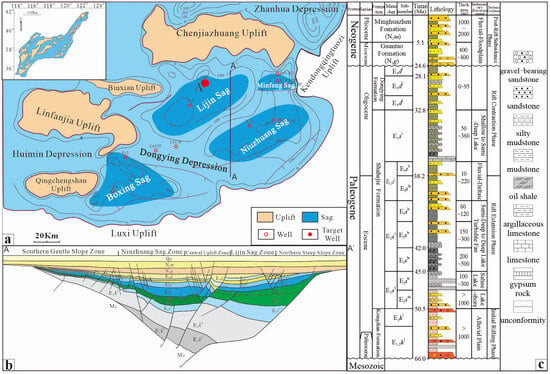
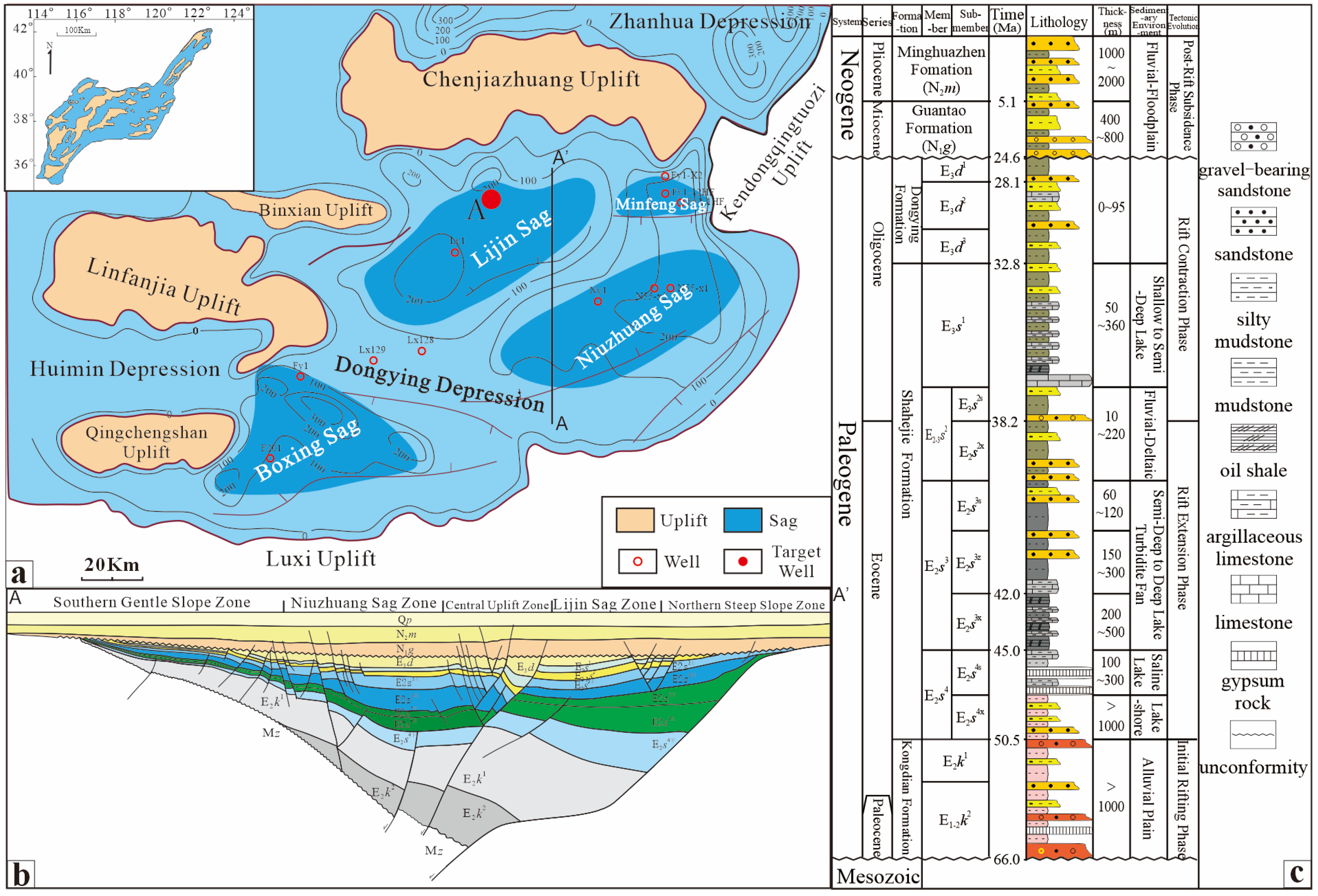
The Dongying Sag, situated in the southern part of the Jiyang Depression, represents a third-order subsiding tectonic unit within the Bohai Bay Meso-Cenozoic rift basin and a classic example of a terrestrial faulted-lacustrine basin in eastern China, which features an asymmetric of faulted in the north and overlapped in the south, steep in the north and gentle in the south (Figure 1a). The Lijin Sub-sag is located in the western section of the northern zone of the Dongying Sag. It exhibits a parallelogram shape in the plane view, oriented roughly east–west, and serves as one of the primary sub-sags and major hydrocarbon accumulation areas within the Dongying Sag. Controlled by tectonic stress and the basement fault system, the Lijin Sub-sag underwent evolutionary stages of transtensional rifting and transpressional downwarping. The evolution can be divided into an initial subsidence stage, an accelerated subsidence stage, and a lacustrine basin shrinking stage during the Paleogene (Figure 1b). The target intervals of this study, the Upper Es4 to Lower Es3 Sub-members, were deposited during the peak period of basin rifting and expansion [1,16,17] (Figure 1). Stratigraphically, the sequence gradually uplifts from east to west and south to north, overlapping the Archean basement of the Chenjiazhuang Uplift. The Paleogene succession comprises, from bottom to top, the Kongdian Formation, Shahejie Formation, and Dongying Formation. The Shahejie Formation is subdivided into the Es4, Es3, Es2, and Es1 members (Figure 1c). The Es4 Member is further divided into the Upper Es4 and Lower Es4 Sub-members. Paleoenvironmental analysis using geochemical methods by Yang Wanqin (2015) [18] indicates that the climate during the deposition of the Upper Es4 to Lower Es3 Sub-members in the Dongying Sag ranged from dry to semi-dry to semi-humid, within a semi-deep to deep lacustrine environment. During the Upper Es4 Sub-member deposition, the overall basin water depth was relatively shallow, transitioning upwards from shallow lacustrine to semi-deep lacustrine and deep lacustrine facies [19]. The Upper Es4 Sub-member records two climatic cycles (semi-humid to humid) from bottom to top, showing an overall trend from arid to humid [8]. The Es3 Member is subdivided into Upper, Middle, and Lower sub-members. During the Lower Es3 Sub-member deposition, the sedimentary basement experienced continuous subsidence. The paleoclimate shifted from relatively arid towards more humid conditions, accompanied by a gradual expansion of the lake basin extent [8]. Rapid basin rifting and intensified faulting occurred, resulting in freshwater to brackish lacustrine deposition. Influenced by climatic factors, lake levels fluctuated, causing corresponding contraction and expansion of the water body and triggering systematic variations in sedimentation [19,20,21,22].
Figure 1.
Schematic diagram of the geological structure and stratigraphy of the Lijin Sub-sag, Dongying Sag (modified from Wang et al. [9], Ye et al. [17]). (a) Main structural units of the Dongying Sag; (b) North–South section of the Dongying Sag; (c) Comprehensive stratigraphic column of the Dongying Sag.
3. Samples and Methods
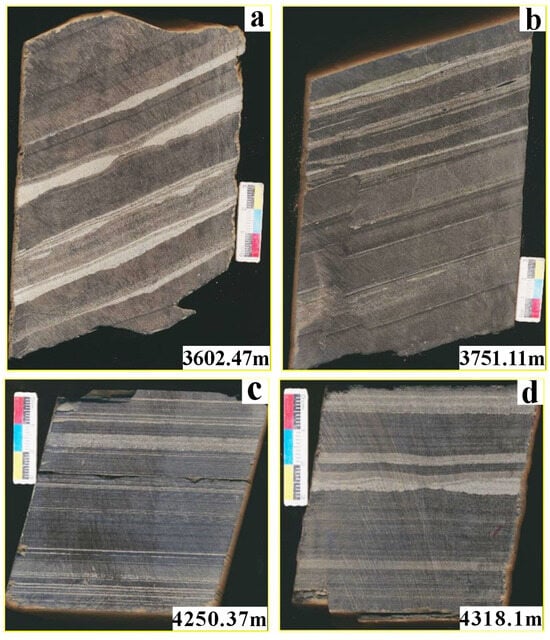
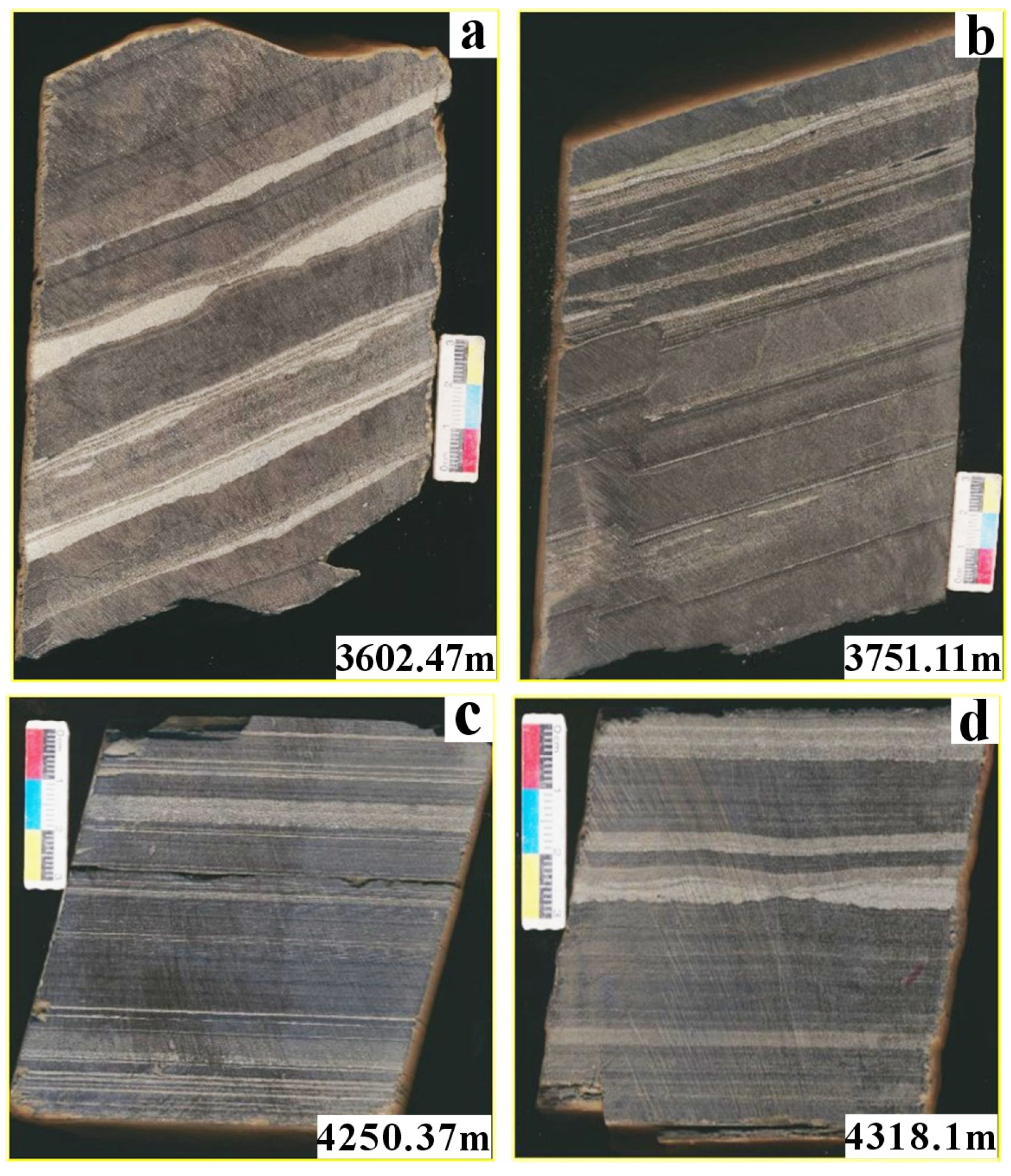
The 13 samples utilized in this study were obtained from mudstones within a drill core from the Lijin Sub-sag (Figure 2). These samples comprehensively cover major intervals of the Upper Es4 to Lower Es3 Sub-members, spanning a depth range of 4420 m to 3557.46 m. Specifically, 8 samples were collected from the Lower Es3 Sub-member and 5 samples from the Upper Es4 Sub-member. A total of 82.2 cm of thin sections were prepared from these samples, encompassing various lamina types. Furthermore, to observe the lamina types and structural characteristics more clearly, not only small thin sections (2.5 cm × 7.5 cm) but also large thin sections (5 cm × 7.5 cm) were prepared for observation and identification. Based on the prepared thin sections, first, a Nikon E600 POL polarizing microscope (Nikon Corporation, Toyko, Japan) equipped with a photography system was used to observe the thin sections, analyzing mineral composition, lamina structure, and microstructures. Both large and small thin sections were identified and photographed; subsequently, the thin section images were stitched and restored using Photoshop Version 2021, and lamina classification, statistics, and thickness measurement were conducted with the measurement tool. After that, to describe the lamina characteristics and their mineral content more accurately, an EPMA-1720H electron probe microanalyzer (Shimadzu Corporation, Toyko, Japan) was employed to perform elemental mapping analysis, so as to reveal the mineral distribution features. A FEI Quanta250FEG (FEI Company, Waltham, MA, USA) field-emission environmental scanning electron microscope was used to observe the morphological characteristics of different types of laminae. All the analytical work was carried out at the State Key Laboratory of Oil and Gas Reservoir Geology and Exploitation (Chengdu University of Technology).
Figure 2.
Some core photos of the target well. (a) SL and AL are mainly developed (yellow arrows indicate SL, green arrows indicate AL, and the abbreviations of the laminae are shown in Table 2); (b) AL and SCL are mainly developed (red arrows indicate AL); (c) AL alternates with both SCL and MCL (orange arrows indicate MCL); (d) AL and MCL are mainly developed.
4. Petrological Characteristics and Types and Features of Laminae
4.1. Petrological Characteristics and Types and Features of Laminae
XRD analysis results indicate that the mineral composition of the fine-grained sedimentary rocks in the area where the target well is located primarily comprises felsic, carbonate and clay minerals, and pyrite. In the Upper Es4 Sub-member, felsic minerals are dominated by quartz with an average content of 25%, followed by feldspar; carbonate minerals, including calcite and dolomite, are dominated by calcite averaging 44%; clay mineral content averages 10%. In the Lower Es3 Sub-member, feldspar is dominant at 25%, followed by quartz at 19%; carbonate minerals are also dominated by calcite at 35%, with dolomite being secondary. Overall, the mudstones and shales of the Upper Es4 to Lower Es3 Sub-members in the Lijin Sub-sag are characterized by high carbonate content (averaging nearly 50%), followed by felsic mineral content.
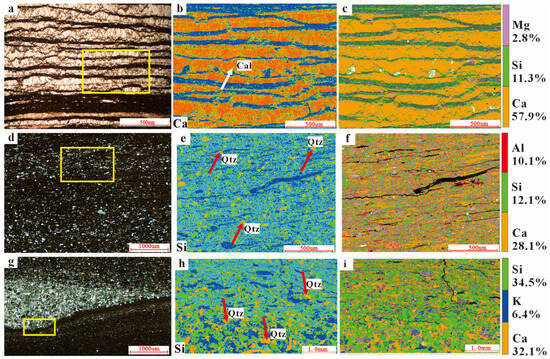
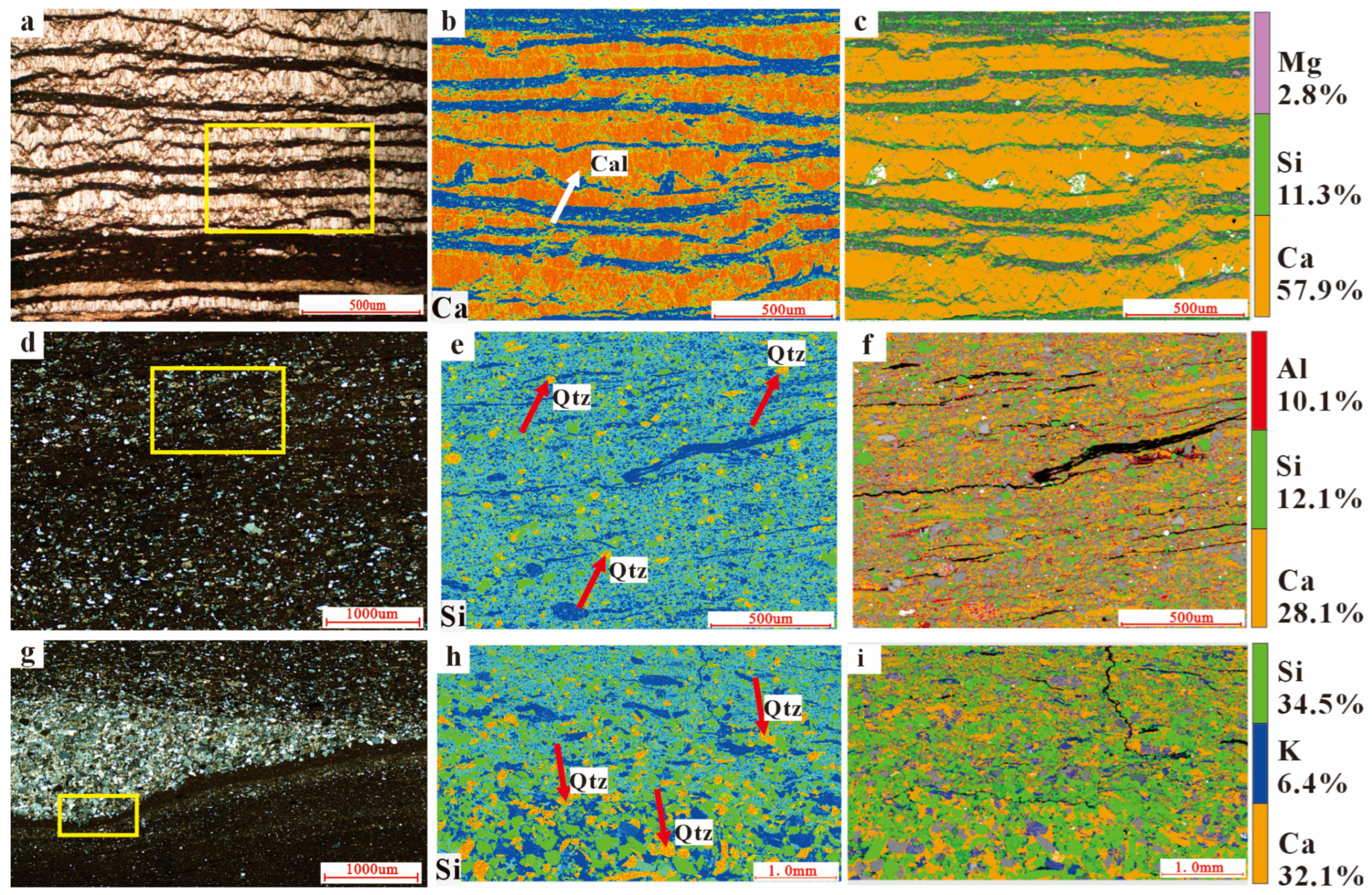
Electron probe microanalyzer (EPMA) elemental mapping and field-emission environmental scanning electron microscopy (FE-SEM) (Figure 3) indicate that within the Upper Es4 Sub-member, terrigenous clastics are dominated by quartz, primarily occurring as silt-sized particles with a grain size range of 0.05–0.3 mm and an average content of 22%; feldspar averages 11.2%, predominantly plagioclase with subordinate K-feldspar; carbonate minerals are dominated by calcite averaging 47%, including sparite calcite and micrite calcite, with sparite typically exhibiting columnar and horse-tooth shaped while micrite is predominantly granular; dolomite content is 5%, and minor pyrite is observed; clay mineral content is 15%. In the Lower Es3 Sub-member, terrigenous clastics are dominated by feldspar, with plagioclase at 22% and K-feldspar at 11%; quartz is subordinate, averaging 19%; carbonate minerals are dominated by calcite averaging 28%, with dolomite at 5%; clay mineral content averages 22%.
Figure 3.
EPMA mapping for different elements of laminae in fine-grained sedimentary rocks from Well A, Lijin Sub-sag, Dongying Sag. (a) Interbedded calcareous and argillaceous laminae with yellow box indicating mapped area, 4333 m; plane-polarized light; (b) EPMA elemental map for Ca: Calcareous laminae dominated by calcite (the white arrows denote calcite); (c) Composite map for Mg-Si-Ca elements; (d) Argillaceous lamina, 3602.47 m; orthogonal polarized light; (e) EPMA elemental map for Si: Quartz grains highlighted (the red arrows denote quartz); (f) Composite map for Al-Si-Ca elements: Argillaceous lamina containing felsic minerals and micritic calcite; (g) Silty lamina, 3602.47 m; orthogonal polarized light; (h) EPMA elemental map for Si: Silty lamina dominated by felsic minerals (the red arrows denote quartz); (i) Composite map for Si-K-Ca elements.
4.2. Laminae Types
Current research on laminated fine-grained sedimentary rocks has extensively explored their characteristics and classification, formation processes and mechanisms, sedimentary environments and influencing factors, as well as reservoir properties and controlling factors. Scholars have proposed various schemes for lamina division and lamina associations within fine-grained sedimentary rocks across different basins. Most researchers classify fine-grained sedimentary rocks into laminated, bedded, and massive types based primarily on structure and thickness [11,15]. Others categorize laminae according to compositional variations and structure within specific study areas, identifying types such as silty laminae, argillaceous laminae, carbonate laminae, organic-rich laminae, and mixed laminae [22,23]. Further classifications exist based on dominant mineralogy and organic matter abundance. Currently, no unified standard exists for lamina division and association schemes in fine-grained sedimentary rocks. Therefore, building upon previous classification criteria, this study proposes a lamina division and association scheme for the fine-grained sedimentary rocks within the target well in the study area, integrating their mineral composition, structural characteristics, and lamina thickness. While no unified classification standard exists for laminae division and associations in fine-grained sedimentary rocks, most researchers categorize them based on mineral composition and lamina thickness [15,24,25,26,27] (Table 1).
Table 1.
Classification schemes for laminae in fine-grained sedimentary rocks by different researchers.
Laminae, also termed sub-layers, constitute the most fundamental units of bedding, typically measuring millimeters or less than 1 mm in thickness, with 1 cm generally recognized as the upper boundary [28]. Three key attributes—continuity, shape, and geometry—govern laminae characteristics, all intrinsically linked to sedimentary hydrodynamic conditions, redox intensity, sediment supply, and terrigenous clast grain size [9]. The laminae in the target well of the study area are classified by thickness into: laminated (<1 mm), bedded (≥1 mm <1 cm), and massive (≥1 cm); Compositionally, laminae are categorized into three types: calcareous laminae (hereinafter referred to as CL), argillaceous laminae (hereinafter referred to as AL), and silty laminae (hereinafter referred to as SL), with calcareous laminae further subdivided into sparry calcareous laminae (hereinafter referred to as SCL) and micritic calcareous laminae (hereinafter referred to as MCL) (Table 2).
Table 2.
Lamination types and characteristic descriptions.
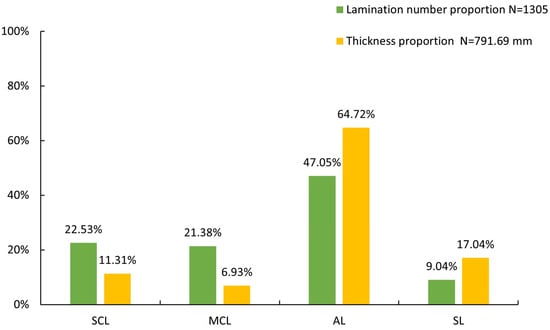
Laminated structures dominate, with bedded structures locally well-developed and massive structures being subordinate. These features exhibit stable thickness, high continuity, and regular geometry. The thickness of the laminated structure is all less than 1 mm, with the thinnest being 0.05 mm and the average thickness around 0.3 mm, displaying straight to weakly undulating forms with rare discontinuities, cumulatively measuring 324.05 mm across 1124 laminae. Bedded structures maximum thickness can reach 9.75 mm, with an average thickness of 2.41 mm, totaling 178 layers with a cumulative thickness of 428.78 mm. Massive structures are the least common, with a total thickness of 38.86 mm, a maximum thickness of 16 mm, and only 3 layers in total.
4.2.1. Calcareous Laminae
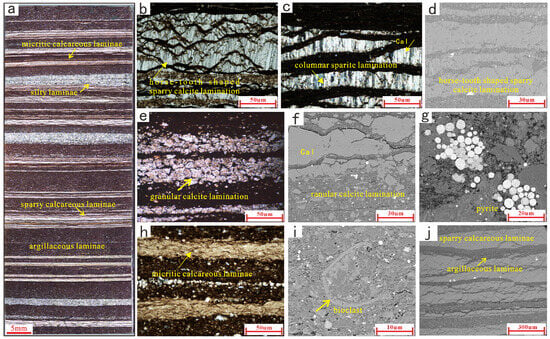
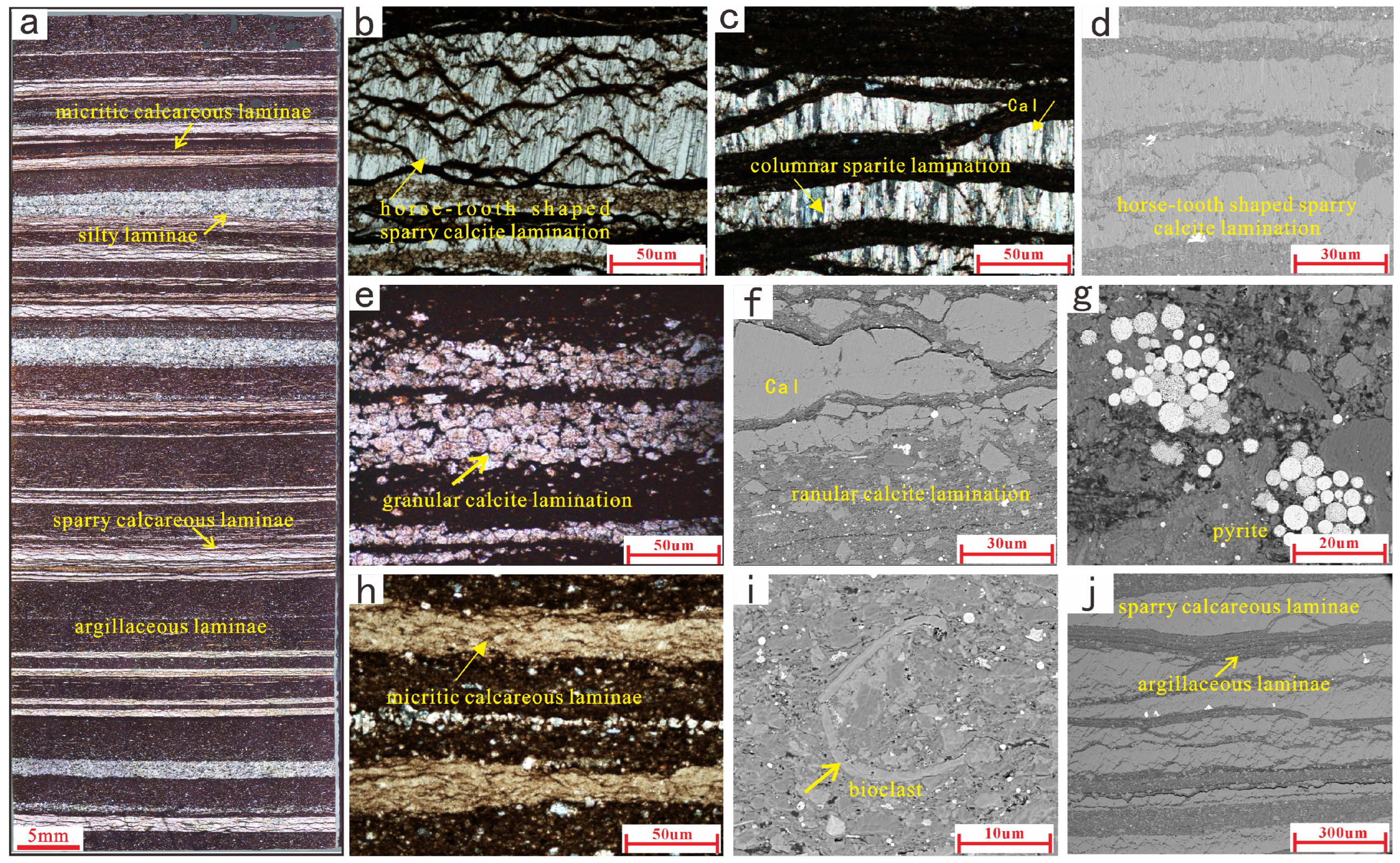
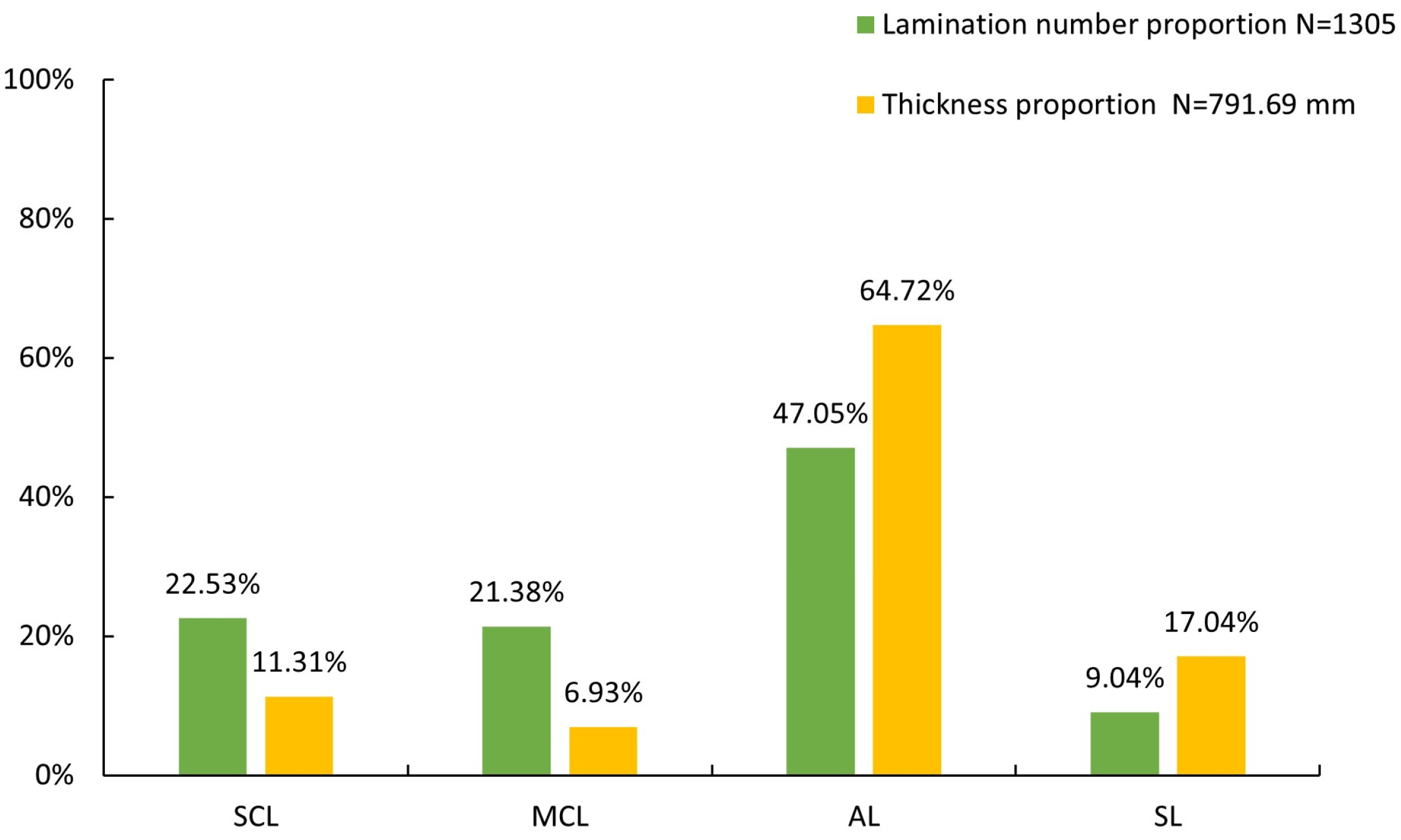
Based on the statistics of lamina thickness and quantity obtained by Photoshop, as well as the electron probe microanalysis mapping analysis, CL comprise SCL and MCL (Figure 4a), totaling 573 layers with a cumulative thickness of 144.38 mm (Figure 5). SCL (294 layers) exhibit a maximum thickness of 1.8 mm and an average thickness of 0.3 mm. They are dominantly composed of sparry calcite (up to 90%), with subordinate dolomite (5%), quartz and feldspar (2%–7%), and argillaceous material (10%). These laminae demonstrate stable thickness and high continuity, predominantly displaying horizontal bedding (Figure 2b). Sparry calcite crystals exhibit horse-tooth shaped, columnar, or granular morphologies (Figure 4b–f), with their long axes perpendicular to bedding. Minor argillaceous material occurs locally within some laminae.
Figure 4.
Microstructural characteristics of different lamina types. (a) Thin-section mosaic: Interbedded calcareous and argillaceous laminae with intercalated silty layers, 3557.46 m, orthogonal polarized light; (b) Close-up of horse-tooth shaped sparry calcareous lamina, 3557.46 m, plane-polarized light; (c) Interlayered columnar spar calcareous lamina and argillaceous lamina, 4333.00 m, orthogonal polarized light; (d) Dog-tooth spar calcareous lamina with argillaceous infill in intercrystalline pores, 4333.00 m, SEM; (e) Granular crystalline calcareous lamina interbedded with argillaceous lamina, 3602.47 m, plane-polarized light; (f) Detail of granular calcite lamina, 3680.90 m, SEM; (g) Framboidal pyrite clusters, 3602.47 m, SEM; (h) Interbedded micritic calcareous lamina and argillaceous lamina with fine-silty intercalations, 3602.47 m, plane-polarized light; (i) Micritic calcareous lamina containing bioclasts, 3680.9 m, SEM; (j) Sparry calcareous laminae and argillaceous laminae, 3680.90 m, SEM.
Figure 5.
Thickness distribution and layer proportion of laminae in fine-grained sedimentary rocks, the target well in the study area.
MCL (279 layers) (Figure 5) reach a maximum thickness of 0.94 mm (average 0.2 mm). They consist primarily of micritic calcite (45%–60%, locally up to 90%), with minor dolomite, quartz and feldspar (5%–30%), and argillaceous material (10%). Most exhibit stable thickness and high continuity, though discontinuous distributions occur occasionally. Bedding types include horizontal and weakly undulatory lamination, with sporadic organic-rich bands (Figure 4h–j).
4.2.2. Argillaceous Laminae
The samples analyzed contain 614 AL with a cumulative thickness of 512.4 mm (Figure 5). These are predominantly laminated (<1 mm thick), supplemented by bedded structures (>1 mm thick; 134 layers) reaching a maximum thickness of 16.1 mm (average 0.83 mm). Compositionally, AL consist mainly of clay minerals and micritic calcite (Figure 3e–f), with clay minerals constituting 60% of the volume. Subordinate components include microcrystalline dolomite and felsic minerals (10%–25%). Locally, banded distributions of silty minerals and sparry calcite occur within these laminae. Framboidal pyrite is sporadically dispersed throughout the layers (Figure 4g), accompanied by traces of organic matter. These laminae exhibit stable thickness and high continuity, displaying horizontal bedding, fine lamination, and micro-wavy bedding (Figure 2c).
4.2.3. Silty Laminae
A total of 118 silty laminae exhibit a cumulative thickness of 134.9 mm (Figure 5), with individual layers reaching up to 7.82 mm (average 1.14 mm). These laminae are dominated by quartz and feldspar detrital grains (60% volume), displaying a primary grain size range of 0.03–0.07 mm with subangular-rounded and moderate sorting. Interstitial materials consist predominantly of argillaceous matrix and calcite cement, supplemented by subordinate dolomite (Figure 3g–i). Thin-section observations confirm stable thickness and high continuity, though lateral thickness variations occur locally alongside micro-scale basal scour structures (Figure 2a,d). The laminae universally exhibit normal grading. Some laminae contain low-angle ripple cross-lamination and micro-scale horizontal bedding.
4.3. Lamina Associations
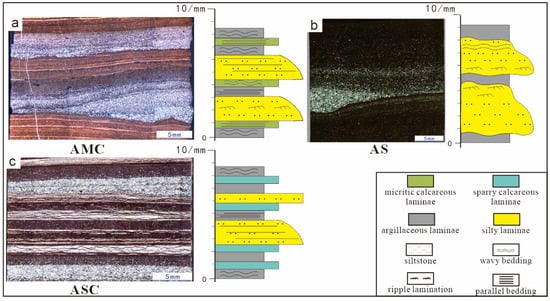
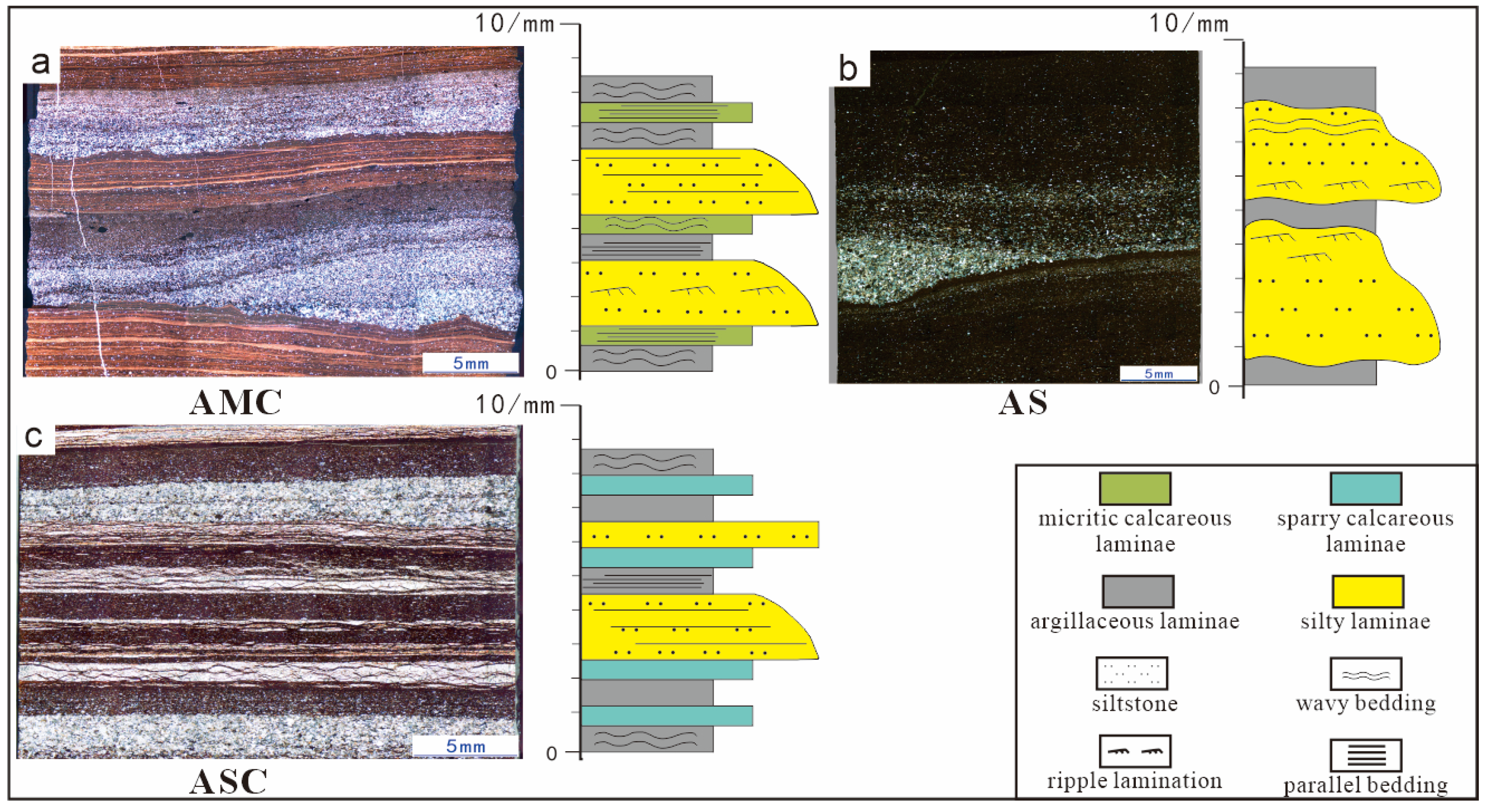
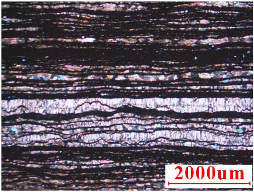
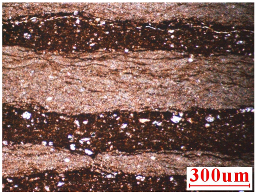
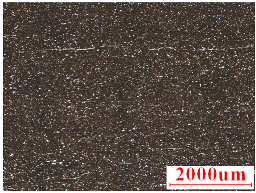
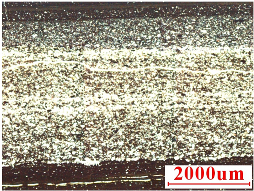
The shale lamina associations in the Upper Es4 to Lower Es3 Sub-members of the Dongying Sag comprise two principal types (Figure 6): argillaceous-calcareous interlamination (hereinafter referred to as AC) and argillaceous-silty interlamination (hereinafter referred to as AS). The former can be further subdivided into argillaceous-sparry calcareous interlamination (hereinafter referred to as ASC) and argillaceous- micritic calcareous interlamination (hereinafter referred to as AMC).
Figure 6.
Schematic diagram of lamina associations in the Lower Es3 to Upper Es4 Sub-members, Dongying Sag. (a) Interlaminated argillaceous and micritic calcareous laminae (AMC) (4318.1 m); (b) Interlaminated argillaceous and silty laminae (AS) (3602.47 m); (c) Interlaminated argillaceous and sparry calcareous laminae (ASC) (3557.46 m).
At the bottom of Upper Es4 Sub-member, the lamina associations are characterized by the alternating occurrence of AMC (Figure 6a) and AS (Figure 6b), showing rhythmic bedding. In the upper part, they are manifested as the alternation between AMC and ASC.
At the bottom of the Lower Es3 Member, the sedimentary succession consists of AS (Figure 6b); while in the upper part, it is characterized by the alternating occurrence of AS (Figure 6b) and ASC (Figure 6c).
The lamina association types in the target well of the study area exhibit a rhythmically alternating pattern: starting from the AC, they gradually transition to the AS, then further shift back to the AC, with these three interlamination patterns repeating alternately.
5. Depositional Processes of Fine-Grained Sedimentary Laminae
5.1. Genesis of Different Lamina Types
Lamina genesis and variations are jointly controlled by multiple sedimentary mechanisms: depositional environment fluctuations, material provenance variations, hydrodynamic condition changes, and diagenetic mineral transformations [23]. Accurately distinguishing the origin of laminae based solely on sedimentary structures is unreliable. A comprehensive assessment requires integrating multiple lines of evidence, including material composition, bioturbation, and geological context [9,11]. Suspension settling is not the sole mechanism for lamina formation in lacustrine fine-grained sedimentary rocks. Distal dilution and flow regime transformation of gravity flows, volcanic-hydrothermal activity, and microbial processes can also facilitate the migration and accumulation of fine-grained material to form laminae [29]. Lamina formation is closely linked to sedimentation rate, depositional hiatuses, material supply, and flow regime transformation. Its controlling factors—such as climate, geomorphology, wind fields, basin morphology, hydrology, and tectonics—are diverse and interrelated.
5.1.1. Genesis of Calcareous Laminae
The Upper Es4 to Lower Es3 Sub-members were deposited in a semi-deep to deep lacustrine environment during the early rift expansion phase of the Dongying Sag [8]. An arid climate prevailed, resulting in elevated lake water salinity that facilitated evaporite minerals formation and chemical carbonate precipitation. In semi-deep lacustrine zones, seasonal climatic controls governed carbonate deposition through flocculation processes [8,30]. CL primarily formed under heat and high salinity conditions in summer, in which the primitive carbonates originated from carbonate precipitation in the upper water column, generally associated with planktonic algal productivity [27].
Wu Kerui [31] suggests that CL typically form in low-energy, quiescent, high-salinity water conditions, frequently developing as mixed fine-grained laminae such as calcareous-argillaceous or calcareous-organic associations, within semi-deep to deep lacustrine settings. Most researchers suggest that calcite in SCL originates from diagenetic recrystallization, while that in MCL is attributed to seasonal biochemical deposition triggered by algal blooms [32,33] or evaporative precipitation under arid climatic conditions with concentrated brines [23,32,34]. The morphology of CL reflects their depositional hydrodynamic environment: horizontal planar laminae indicate quiescent water conditions, whereas undulatory forms suggest current influence.
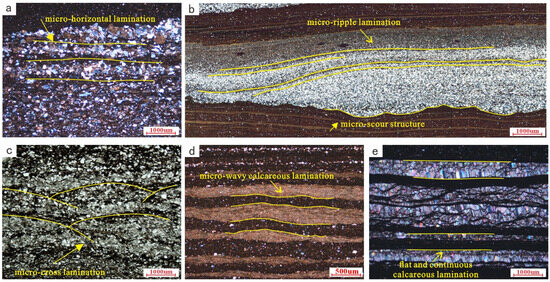
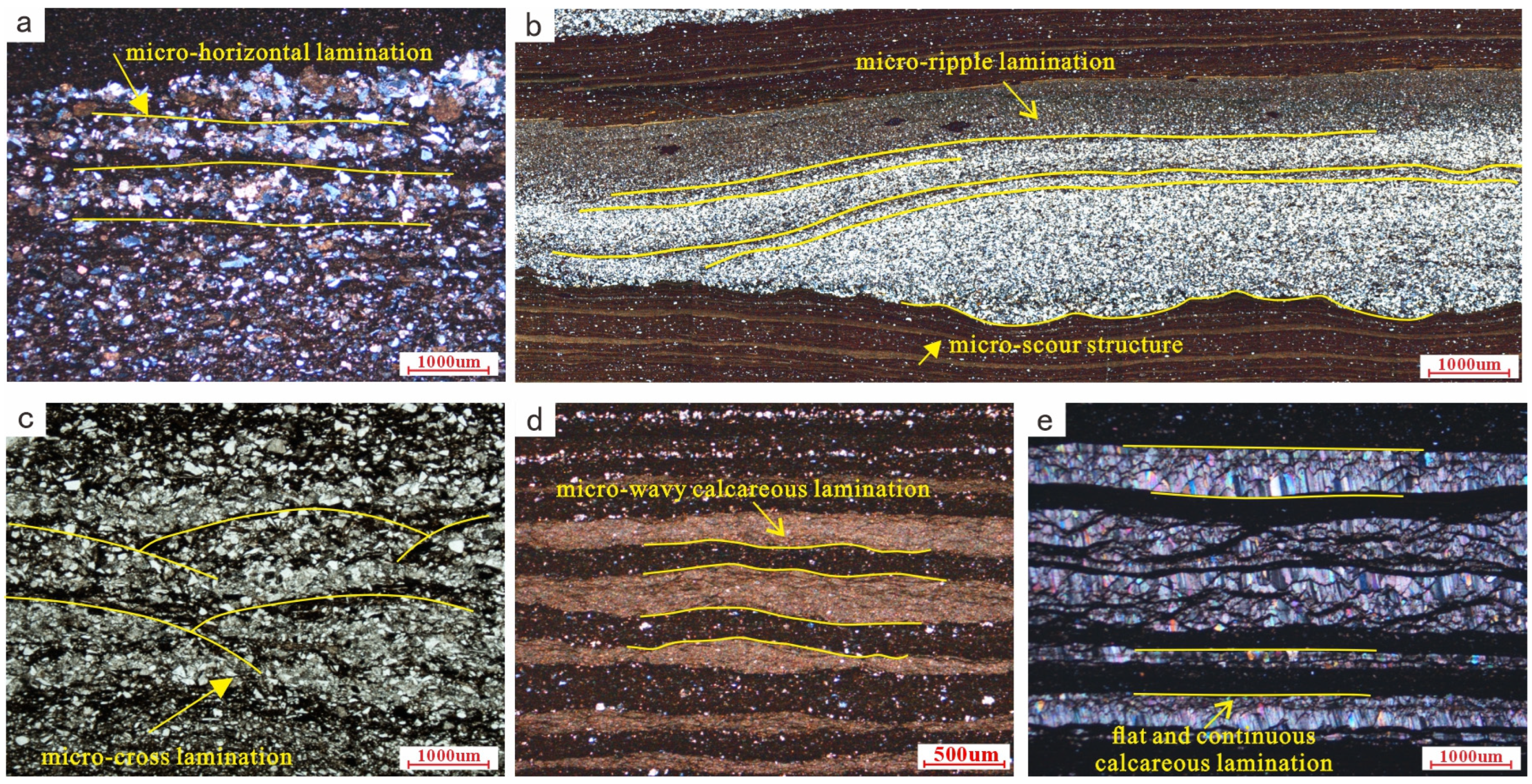
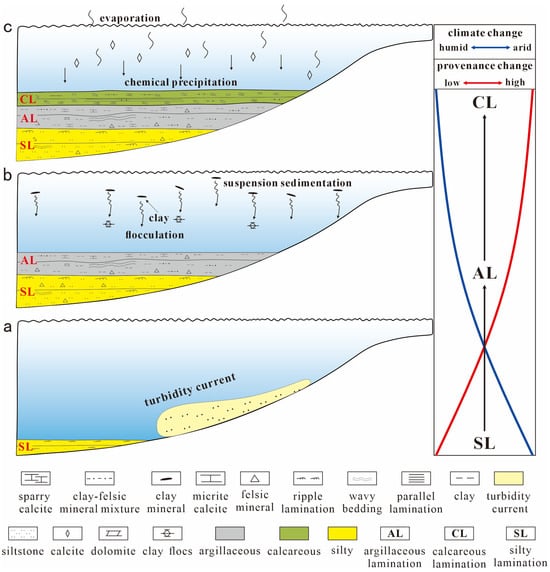
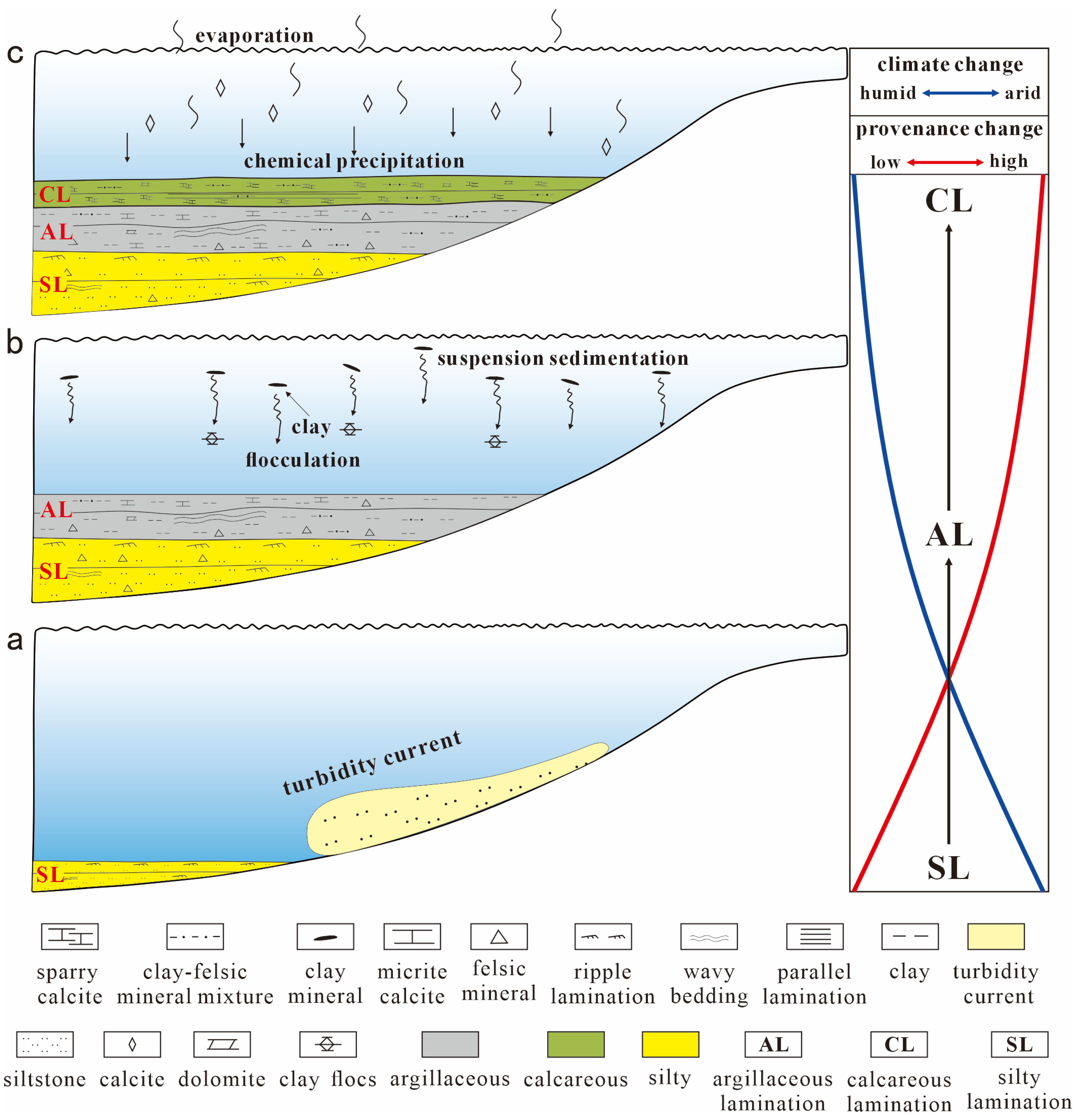
CL predominantly exhibit horizontal bedding structures. SCL primarily composed of sparry calcite, display uniform thickness with sharply defined boundaries and lateral continuous extensions (Figure 7e), indicating their chemical precipitation in low-energy, quiescent depositional environments under arid climatic conditions. MCL dominated by micritic calcite with subordinate quartz, maintain relatively consistent thickness (average 0.2 mm) but exhibit poorer continuity. They mainly manifest horizontal bedding with minor weakly undulatory bedding, all featuring distinct boundaries (Figure 7d), having precipitated chemically in dry, high-salinity quiescent water settings (Figure 8c).
Figure 7.
Photomicrograph showing microstructures of different lamina. (a) Micro-horizontal bedding in silty laminae, 4420 m; (b) Micro-scour structure and micro-ripple bedding in silty lamination, 4318 m; (c) Micro-cross bedding in silty lamination, 3680.9 m; (d) Micro-wavy calcareous lamination, 4420 m; (e) Flat and continuous calcareous lamination, 3680.9 m.
Figure 8.
Schematic Diagram of Sedimentary Model for the Upper Es4 to Lower Es3 Sub-members in the Lijin Subsag, Dongying Sag. (a) The formation process of SL; (b) The formation process of AL; (c) The formation process of CL.
5.1.2. Genesis of Argillaceous Laminae
Through flume experiments demonstrated that argillaceous rocks can develop wavy laminated structures under relatively high-energy hydrodynamic conditions [35,36,37]. Clay-sized particles remain suspended and resist deposition but undergo flocculation with fine-grained sediments in flowing water, forming aggregated floccules. The size and shape of fine particles influence interparticle attraction and repulsion forces within flocs, accelerating settling velocities and enabling transport as suspended loads [38]. AL typically exhibit sharp or gradational basal contacts but predominantly gradational top boundaries, resulting from seasonal progradation of sediment sources into the lake basin. Their formation has a strong relationship with water column stratification, which triggers seasonal deposition of suspended fines at density interfaces [38,39].
Laminated structures arise from the fragmentation of mud flocs within turbulent boundary layers beneath dilute suspensions. Coarse flocs are deposited first, followed by gradual settling of finer muds, eventually suppressing turbulence and enabling rapid mud accumulation—a cyclic process forming layered sequences [40,41,42,43,44]. Argillaceous layers form through sustained terrigenous suspension settling or distal fine-grained unloading of gravity flows. Influenced by sorting under moderate hydrodynamic conditions and stratified anoxic water, these processes generate relatively thick bedded structures with uniform composition [2,38,39], they may also be the product of floc suspension settling under low-energy conditions [42,45,46], massive mudstones form in environments with relatively turbulent water and strong terrigenous input. Various fine-grained sediments are deposited rapidly, leaving insufficient time for lamination to develop, thereby resulting in a massive structure [40,47,48].
AL exhibit stable thickness and predominantly develop continuous, planar horizontal bedding, indicating quiescent bottom-water conditions devoid of strong currents. Fine-grained sediments undergo flocculation to form aggregates, which are transported via suspension settling into deep-lacustrine quiescent-water environments, ultimately generating AL. Significant water column stratification in deep-lake settings establishes anoxic bottom conditions that suppress bioturbation, facilitating the preservation of argillaceous material and the formation of continuous horizontal laminae. Occasional occurrence of wave-like argillaceous laminae interbedded with fine-silty laminae suggest intermittent weak current activity rather than persistent quiescence. In the Lower Es3 Sub-member, massive argillaceous layers occur rarely, while the Upper Es4 Sub-member locally contains bedded and massive argillaceous units. The sediments in the target well formed in a semi-deep to deep lacustrine sedimentary environment, where laminated and massive argillaceous beds are mostly distributed in the deep-to-semi-deep lacustrine transition zone. Therefore, the layered structures in this zone are affected by sorting under a moderate hydrodynamic environment: after fine-grained sediments form flocs, coarser flocs are deposited first, followed by the gradual settlement of finer flocs, resulting in argillaceous beds with uniform composition and stable thickness. In contrast, massive structures are formed by the suspension settling of fine-grained sediments under low-energy conditions (Figure 8b).
5.1.3. Genesis of Silty Laminae
Lacustrine turbidites predominantly comprise siltstones and fine sandstones, usually occur as thin layers of sand and mud interbedding with incomplete Bouma sequences [49]. In a deep lake environment where the water body is very quiet, fluctuation in the relative abundance of the different components results from sequential sedimentation under the control of a fluctuating sedimentary environment, i.e., the differences in sedimentary components are affected by the sediment transport process and sedimentation mechanisms [40]. Flume experiments by Zalmai Yawar (2017) [14] on silty laminae genesis demonstrate that rhythmic alternations of AL and SL in shales result from spontaneous segregation during bedload transport: coarse silt forms distinct ripple laminae, whereas fine silt embeds within clay flocs. Synchronous migration of both particle types drives alternating lamina deposition. Laminated silt-bearing mudstones are interpreted as deposits of waning, dilute high-density flows or low-density turbidity currents, requiring hydrodynamic separation of silt from mud for lamina formation [40,42].
SL in the target well of the study area universally exhibit normal grading, with thicknesses predominantly ranging from 0.1 to 0.2 mm and lateral variations in thickness, accompanied by micro-horizontal (Figure 7a), micro-cross bedding (Figure 7c), micro-ripple lamination and micro-scale basal scours (Figure 7b). The SL formed through dynamic sorting and alternating deposition during turbidity current events [40]. At the outset of turbidity current deposition, coarser silt particles segregate from clay flocs due to their higher density, generating normally graded layers with micro-scale basal scours [42]. As the turbidity currents wane, finer-grained sediments carried at the tail end of it deposit as fine-silty laminae.
5.2. Sedimentary Dynamic Mechanism
The sedimentary environments of fine-grained sedimentary rocks are diverse. Analyzing their sedimentary environments and mechanisms is not only helpful for reconstructing the original sedimentary conditions of argillaceous rocks [50] but also of great significance for exploring high-quality lithofacies and high-quality reservoirs. Chen Shiyue (2017) [10] pointed out that the cyclic interbedding of SL and CL is a common type of mixed sedimentation in faulted lacustrine basins. Du Yushan (2024) [22] argued that the stratification of paleo-lacustrine water is conducive to the formation of laminae; seasonal changes can cause variations in the input amounts of organic matter, carbonate minerals, clay minerals, and felsic minerals, thereby leading to the formation of argillaceous-sandy laminae and carbonate laminae. Based on the previous classification and assemblage of lamina types of fine-grained sedimentary rocks from the Upper Es4 to Lower Es3 Sub-members of Shahejie Formation in the area where the target well is located, it can be concluded that the fine-grained sedimentary rocks generally exhibit AL-CL-SL rhythmic changes. Such changes are comprehensively influenced by paleoclimate, paleogeomorphology, paleowater depth, and provenance supply during sedimentation.
Based on the relationship between shale lithofacies and sedimentary environments, previous studies have identified that the sedimentary environment characteristics of the Upper Fourth Member-Lower Third Member of the Shahejie Formation in the Dongying Sag are as follows: the climate changed from arid → semi-arid → semi-humid, the water depth evolved from semi-deep water to deep water, and the salinity varied from saline water → brackish water → mesohaline water [18]. The fine-grained sedimentary rocks in the study interval formed under paleoenvironmental conditions of semi-deep to deep lakes and brackish to saline water, experiencing an evolutionary process of deepening water, climate shifting from arid to humid, and terrigenous supply changing from high → low → high [51]. Previous studies have shown that the development environment of fine-grained sedimentary rocks in the upper Es4 sub-member exhibits phased and cyclic changes [1]. During the deposition of the upper Es4 sub-member, the climate generally transitioned from semi-humid to humid, with three terrigenous supply cycles (from low to high) from bottom to top and deepening water [8]. During the deposition of the lower Es3 sub-member, the paleosalinity showed a variation trend of increasing → significant decreasing → increasing → continuous decreasing → significant increasing from bottom to top, the terrigenous input displayed cyclic changes of low → high → low → high, and the paleoclimate was characterized by warm-humid → relatively humid-cold → warm-humid → relatively arid-cold → relatively warm-humid [52].
Previous studies have shown that during the depositional period of the Upper Es4 Sub-member of Shahejie Formation, the target well was in a semi-deep to deep lacustrine environment. In the nearly north–south extensional direction, fault activity alternates between strong and weak. Influenced by the large-scale inherited activities of NW-SE, NE-SW and W-E-trending faults, the uplifts on the northern, southern, and eastern sides of the Dongying Sag provided the clastic material basis for the formation of fine-grained sedimentary rocks [17,19]. Previous studies have mostly employed geochemical methods to reconstruct the sedimentary environment of this area: a decrease in the Sr/Mg ratio indicates elevated temperature, while increases in the Mg/Ca and Sr/Ca ratios correspond to reduced paleotemperature, and the paleoclimate is comprehensively determined using multiple elemental ratios [18]. By introducing the concept of paleoclimate index C and conducting quantitative analysis of paleoclimate changes, it is concluded that the larger the C value, the more humid and warm the climate. Therefore, the paleoclimate of the Upper Es4 Sub-member is judged to have shifted from arid to humid [18]. Similarly, the Fe/Co ratio combined with the regional average water depth is used to infer the paleowater depth during different sedimentary periods. It is found that in the area where the target well is located, a decrease in the Fe/Co ratio indicates an increase in water depth. The changes in provenance supply are analyzed through the Th/U, Ti, and Al/Ca ratios combined with regional tectonic changes [1,18]. During this depositional period, the climate was generally semi-humid to humid, transitioning from arid to humid. Meanwhile, the input of provenance increased and the water depth expanded. From bottom to top, two climate cycles (semi-humid to humid) and three provenance supply cycles (low to high provenance input) were developed [8]. At this time, the water flow at the lake bottom was relatively stable, and sedimentation was dominated by suspended transport deposition and chemical precipitation. In the deep lacustrine quiescent environment with relatively low or normal salinity, argillaceous flocs of different particle sizes were deposited sequentially. Moreover, the significant water stratification in the deep lacustrine environment was conducive to the preservation of argillaceous materials, thus forming continuous and flat AL. Numerous scholars have reconstructed the paleo-salinity changes by synthesizing variations in the Sr/Ba and Th/U ratios, as well as changes in elements such as Al, Ca, and Mg [18,52]. During the Upper Es4 period, the paleoclimate generally transitioned from arid to humid. When climate changes led to an increase in lake water salinity and a decrease in terrigenous argillaceous supply, chemical precipitation became dominant, resulting in the formation of CL. The periodic changes in lake water salinity led to the cyclic interbedding of AC. In addition, seasonally triggered low-density turbidity currents formed silty interbeds, which were compatible with climate and provenance variations. As a result, the Upper Es4 Sub-member is characterized by the alternating occurrence of AL-CL-SL, with the lamina assemblage mainly consisting of AC.
During the depositional period of the Lower Es3 Sub-member of Shahejie Formation, the basin underwent rapid rifting and was in the main stage of basin rifting and expansion. The climate gradually transitioned from relatively arid to warm and humid [10,17]. Overall, the climate during this depositional period was semi-humid to humid, shifting from arid to moist. Meanwhile, the input of provenance increased, and the water depth gradually deepened. From bottom to top, two provenance supply cycles (from low to high provenance input) were developed. The overall lake water salinity showed a trend of increasing from the early to the late stage of this period, which included two secondary cyclic variations [52]. Flocculent suspension settling and low-density turbidity currents dominated this depositional period. In the quiescent water environment with relatively low or normal salinity, argillaceous flocs of different particle sizes were deposited sequentially, forming argillaceous layers. With the gradual changes in climate and salinity, seasonally triggered low-density turbidity currents became dominant, forming silty layers; the tail parts of the low-density turbidity currents caused fine-grained sediments to form SL. When the lake water salinity increased and the provenance input decreased, chemical precipitation resumed its dominant role, forming CL. Adapted to the changes in climate and provenance supply, the Lower Es3 Sub-member developed a lamina assemblage consisting of argillaceous layers—silty layers—AL-CL.
6. Conclusions
- The lacustrine fine-grained sedimentary rocks from the Upper Es4 to Lower Es3 Sub-members of Shahejie Formation in the Dongying Sag mainly include three types of laminae: CL, AL, and SL. Among them, the CL can be further subdivided into SCL and MCL.
- The laminated fine-grained deposits occur in rhythmic cycles, and there are differences in lamina associations among different sub-members. The Upper Es4 Sub-member is characterized by the alternation of AL → CL → SL, with the lamina association mainly consisting of AC. The Lower Es3 Sub-member develops a lamina association of argillaceous layers → silty layers → AL → CL. Overall, the rocks show the alternation of AL → SL → AL → CL.
- Different lamina types and their associations reveal distinct formation mechanisms. Calcareous laminae are mainly formed by chemical precipitation, argillaceous laminae are formed by flocculation and suspension settling, and silty laminae are formed by low-density turbidity currents. Specifically, fine-grained sediments form argillaceous laminae through flocculation and suspension settling; due to variations in multiple factors such as season, climate, water depth, salinity, and provenance supply, the sedimentation process gradually shifts from suspension settling to being dominated by chemical precipitation, leading to the formation of calcareous laminae. Seasonally triggered low-density turbidity currents form silty layers, and as the low-density turbidity currents gradually diluted, silty laminae are further formed. With changes in salinity and provenance input, suspension settling becomes dominant again, forming argillaceous laminae. Adapted to the variations in provenance supply and climate, this process occurs periodically.
Author Contributions
Conceptualization, W.M. and S.F.; methodology, W.M., M.F. and S.F.; validation, M.F., W.Z. and Y.G.; formal analysis, W.Z. and S.F.; investigation, S.F.; resources, M.F. and W.M.; data curation, S.F.; writing—original draft preparation, S.F.; writing—review and editing, W.M.; visualization, S.F. and W.Z. All authors have read and agreed to the published version of the manuscript.
Funding
This article was funded by the National Science and Technology Major Project of New Oil and Gas Exploration and Development (2024ZD1405100-002).
Data Availability Statement
The data presented in this study are available on request from the authors.
Acknowledgments
We sincerely appreciate the assistance provided by the State Key Laboratory of Oil and Gas Reservoir Geology and Exploitation of Chengdu University of Technology in the analysis of experimental instruments.
Conflicts of Interest
The authors declare no conflicts of interest.
References
- Wu, J.; Jiang, Z.X.; Tong, J.; Yang, L.; Li, J.; Nie, H. Sedimentary Environment and Control Factors of Fine-Grained Sedimentary Rocks in the Upper Fourth Member of Paleogene Shahejie Formation, Dongying Sag. Acta Pet. Sin. 2016, 37, 464–473. [Google Scholar] [CrossRef]
- Yang, T.; Cao, Y.C.; Wang, J.; Tian, J.C.; Cai, L.X.; Yu, W.Q. Deep-Water Deposition for Transitional Flow from Turbidity Current to Muddy Debris Flow in Lacustrine Basins and Its Sedimentological Significance. Acta Sedimentol. Sin. 2023, 41, 1295–1310. [Google Scholar]
- Hu, Z.W.; Hou, M.C.; Liu, Y.B. Fine-Grained Sedimentary Petrology; Geological Publishing House: Beijing, China, 2021; 267p. [Google Scholar]
- Krumbein, W.C. The Mechanical Analysis of Fine-Grained Sediments. J. Sediment. Res. 1932, 2, 140–149. [Google Scholar] [CrossRef] [Scilit]
- Jiang, Z.X.; Liang, C.; Wu, J.; Zhang, J.G.; Zhang, W.Z.; Wang, Y.S.; Liu, H.M.; Chen, X. Several Issues in Sedimentological Studies on Hydrocarbon-Bearing Fine-Grained Sedimentary Rocks. Acta Pet. Sin. 2013, 34, 1031–1039. [Google Scholar] [CrossRef]
- Zhou, L.H.; Pu, X.G.; Deng, Y.; Chen, S.Y.; Yan, J.H.; Han, W.Z. Several Issues in Study on Fine-Grained Sedimentary Rocks. Lithol. Reserv. 2016, 28, 6–15. [Google Scholar]
- Zhou, L.H.; Pu, X.G.; Chen, C.W.; Yang, F.; Xia, J.; Guan, Q.S.; Huang, C.Y. Concept, Characteristics and Prospecting Significance of Fine-Grained Sedimentary Oil Gas in Terrestrial Lake Basin: A Case Study from the Second Member of Paleogene Kongdian Formation of Cangdong Sag, Bohai Bay Basin. Earth Sci. 2018, 43, 3625–3639. [Google Scholar]
- Liu, H.M.; Wang, Y.; Yang, Y.H.; Zhang, S. Sedimentary Environment and Lithofacies of Fine-Grained Hybrid Sedimentary in Dongying Sag: A Case of Fine-Grained Sedimentary System of the Es4. Earth Sci. 2020, 45, 3543–3555. [Google Scholar]
- Wang, M.Q.; Zhang, Y.Y.; Zhu, R.K.; Guo, S.J.; Li, Z.Y.; Wang, J.F. Progress and Perspective on the Characteristics and Formation Mechanism of Laminae in Lacustrine Fine-Grained Sedimentary Rocks. Acta Sedimentol. Sin. 2025, 1–20. [Google Scholar] [CrossRef]
- Chen, S.Y.; Zhang, S.; Liu, H.M.; Yan, J.H. Discussion on Mixing of Fine-Grained Sediments in Lacustrine Deep Water. J. Palaeogeogr. 2017, 19, 271–284. [Google Scholar]
- Zhu, X.M.; Wang, X.L.; Zhang, M.Z.; Lin, X.Y.; Zhang, Q. Sedimentary Environments and Lithofacies Characteristics of Fine-Grained Sediments in Typical Continental Basins in China. Pet. Geol. Exp. 2024, 45, 873–892. [Google Scholar]
- Sageman, B.B.; Murphy, A.E.; Werne, J.P.; Ver Straeten, C.A.; Hollander, D.J.; Lyons, T.W. A Tale of Shales: The Relative Roles of Production, Decomposition, and Dilution in the Accumulation of Organic-Rich Strata, Middle-Upper Devonian, Appalachian Basin. Chem. Geol. 2003, 195, 229–273. [Google Scholar] [CrossRef] [Scilit]
- Biddle, S.K.; LaGrange, M.T.; Harris, B.S.; Egenhoff, S.; Gingras, M.K. Current Concepts in Mudstone Description and Deposition: A Synthesis for Mudstone Initiates. Sedimentologika 2025, 3, 1–36. [Google Scholar] [CrossRef] [Scilit]
- Zalmai, Y.; Schieber, J. On the Origin of Silt Laminae in Laminated Shales. Sediment. Geol. 2017, 360, 22–34. [Google Scholar] [CrossRef] [Scilit]
- Jin, Z.H. The Study on Sedimentary Environment of Fine-Grained Rocks of the Upper Fourth Member of Paleogene Shahejie Formation, Dongying Sag; China University of Geosciences: Beijing, China, 2017. [Google Scholar]
- Liu, S.J. Sedimentation and Its Motivation of the Paleogene Fine-Grained Sedimentary Rocks in Dongying Sag—Taking the Es4s-Es3x as an Example. In School of Geosciences; China University of Petroleum (East China): Qingdao, China, 2019. [Google Scholar]
- Ye, X.S.; Wang, W.F.; Chen, S.Y.; Dai, J.S. Characteristics of the Fault Activities in Dongying Depression and Their Controlling Effects on Sediment. J. Xi’an Shiyou Univ. Nat. Sci. Ed. 2006, 5, 29–33. [Google Scholar]
- Yang, W.Q.; Jiang, Y.L.; Wang, Y. Study on Shale Facies Sedimentary Environment of Lower Es3—Upper Es4 in Dongying Sag. J. China Univ. Pet. Ed. Nat. Sci. 2015, 39, 19–26. [Google Scholar]
- Yang, B.L.; Qiu, L.W.; Yang, Y.Q.; Wang, Y.L.; Nan, J.M.; Xu, N.N.; Xu, S.; Zhang, H.F. Sediment Transport Mechanism and Development Characteristics of Subaqueous Fan in the Northern Steep Slope Zone of Lijin Sag. J. China Univ. Pet. (Ed. Nat. Sci.) 2022, 46, 25–37. [Google Scholar]
- Sun, H.M. Division and Stratigraphic Characteristics of the Fourth Member of Shahejie Formation in Lijin Sag. Inner Mong. Petrochem. Ind. 2009, 35, 140–141. [Google Scholar]
- Ma, Y.Q. Lacustrine Shale Stratigraphy and Eocene Climate Recorded in the Jiyang Depression in East China; China University of Geosciences: Beijing, China, 2017. [Google Scholar]
- Du, Y.S.; Jiang, L.; Ni, L.T.; Zhang, Y.J.; Wang, G.M.; Ren, M.H.; Cheng, Z.Y. Genesis and Reservoir Significance of Lamellar Sparry CLialcites of Shahejie Formation Shales in Dongying Sag. Pet. Geol. Recov. Eff. 2024, 31, 1–15. [Google Scholar]
- Li, J.L.; Wang, M.; Qin, F.; Wang, Y.; Wei, X.L.; Meng, W.; Shen, A.C.; Song, Z.J.; Yu, C.Q.; Li, J.Q.; et al. Controlling Effects of Lamina Assemblages on Shale Oil Enrichment for Lacustrine Carbonate-Rich Shales: A Case Study of Shales in the Paleogene Shahejie Formation, Jiyang Depression, Bohai Bay Basin. Oil Gas Geol. 2025, 46, 392–406. [Google Scholar]
- Niu, X.B.; Lü, C.F.; Feng, S.B.; Zhou, Q.S.; Xin, H.G.; Xiao, Y.Y.; Li, C.; Dan, W.D. Lamina Combination Characteristics and Differential Shale Oil Enrichment Mechanisms of Continental Organic-Rich Shale: A Case Study of Triassic Yanchang Formation Chang 73 Sub-member, Ordos Basin, NW China. Pet. Explor. Dev. 2025, 52, 279–291. [Google Scholar] [CrossRef] [Scilit]
- Wang, G.M.; Bai, Y.; Jiang, L.; Zhang, Y.J.; Meng, W.X.; Ren, M.H.; Xiong, Z.H. Relationship Between Composition and Lamination Structure of Fine-Grained Sedimentary Rocks in the Upper Fourth Member to Lower Third Member of Shahejie Formation in Niuzhuang Dpression. J. China Univ. Pet. Ed. Nat. Sci. 2024, 48, 1–10. [Google Scholar]
- Liu, Y.D.; Liang, C.; Cao, Y.C.; Wu, J.; Han, Y.; Xie, H.R.; Luo, Z.L.; Ma, X.Y. Shale Facies Characteristics and Sedimentation of the Wufeng Formation-Longmaxi Formation in the Southern Sichuan Basin. Acta Sedimentol. Sin. 2024, 42, 1832–1848. [Google Scholar]
- Wang, M.; Lu, J.L.; Zuo, Z.X.; Li, H.; Wang, B.H. Characteristics and Dominating Factors of Lamellar Fine-Grained Sedimentary Rocks: A Case Study of the Upper Es4 Member-Lower Es3 Member, Dongying Sag, Bohai Bay Basin. Pet. Geol. Exp. 2018, 40, 470–478. [Google Scholar] [CrossRef]
- Zhu, R.K.; Li, M.Y.; Yang, J.R.; Zhang, S.R.; Cai, Y.; Cao, Y.; Kang, Y. Advances and Trends of Fine-Grained Sedimentology. Oil Gas Geol. 2022, 43, 251–264. [Google Scholar]
- Wang, Y. Evidence of Paleogene Saline Lake Basin in the 3rd and 4th Members of Shahejie Formation in Jiyang Depression and Geological Significance of Shale Oil and Gas. J. China Univ. Pet. Ed. Nat. Sci. 2024, 48, 27–36. [Google Scholar]
- Wang, G.M. Laminae Combination and Genetic Classification of Eogene Shale in Jiyang Depression. J. Jilin Univ. Earth Sci. Ed. 2012, 42, 666–671, 680. [Google Scholar]
- Wu, K.R.; Yan, B.Q.; Sun, Y.; Yu, L.M.; Wang, X.R. Research Progress on the Formation Mechanism and Influencing Factors of Fine-Grained Sedimentary Rock Laminae in Lake Basins. Acta Sedimentol. Sin. 2024, 42, 1164–1184. [Google Scholar]
- Wang, Y.; Liu, H.M.; Song, G.Q.; Hao, X.F.; Zhu, D.S.; Zhu, D.Y.; Ding, J.H.; Yang, W.Q.; Yin, Y. Carbonate Genesis and Geological Significance of Shale Hydrocarbon in Lacustrine Facies Mud Shale: A Case Study of Source Rocks in the Upper Submember of Member 4 and Lower Submember of Member 3 of Shahejie Formation, Dongying Sag. Acta Pet. Sin. 2017, 38, 1390–1400. [Google Scholar] [CrossRef]
- Ni, L.T.; Du, Y.S.; Jiang, L.; Sun, H.X.; Cheng, Z.Y.; Ren, M.H.; Sun, N.; Yang, Y.Q.; Peng, X.G. Differences in Lamellar Structure of Carbonate-Rich Shale and Its Effects on Reservoir Quality in Jiyang Depression: A Case Study of Shahejie Formation Shale in Dongying Sag. Acta Pet. Sin. 2024, 45, 1621–1637. [Google Scholar]
- Liu, Q.; Zeng, X.; Wang, X.J.; Cai, J.G. Lithofacies of Mudstone and Shale Deposits of the Es3z-Es4s Formation in Dongying Sag and Their Depositional Environment. Mar. Geol. Quat. Geol. 2017, 37, 147–156. [Google Scholar]
- Schieber, J.; Southard, J.B.; Thaisen, K. Accretion of Mudstone Beds from Migrating Floccule Ripples. Science 2007, 318, 1760–1763. [Google Scholar] [CrossRef] [Scilit]
- Schieber, J. Facies and Origin of Shales from the Mid-Proterozoic Newland Formation, Belt Basin, Montana, USA. Sedimentology 1989, 36, 203–219. [Google Scholar] [CrossRef] [Scilit]
- Schieber, J.; Southard, J.B.; Schimmelmann, A. Lenticular Shale Fabrics Resulting from Intermittent Erosion of Water-Rich Muds--Interpreting the Rock Record in the Light of Recent Flume Experiments. J. Sediment. Res. 2010, 80, 119–128. [Google Scholar] [CrossRef] [Scilit]
- Zhu, G.Y.; Jin, Q.; Zhang, S.C.; Dai, J.X.; Wang, G.M.; Zhang, L.Y.; Li, J. Characteristics and Origin of Deep Lake Oil Shale of the Shahejie Formation of Paleogene in Dongying Sag, Jiyang Depression. J. Palaeogeogr. 2005, 7, 59–69. [Google Scholar]
- Hao, Y.Q.; Wang, P.; Liu, H.M.; Xie, H.Z.; Bi, C.Q.; Teng, J.B.; Fang, Z.W. Genetic Facies Classification of Paleogene Mudstones in Jiyang Depression. Acta Petrol. Miner. 2016, 35, 981–990. [Google Scholar]
- Yu, W.; Wang, F.; Tian, J.-C.; Wang, J.; Kneller, B.; Yang, T.; Chen, W.-Z. Sedimentary Dynamics and Depositional Model for Mud Accumulation in Deep Lake Basins: A Case Study in the Upper Triassic Chang-7 Member, Ordos Basin, Northern China. J. Palaeogeogr. 2024, 13, 775–792. [Google Scholar] [CrossRef] [Scilit]
- Stow, D.A.V.; Bowen, A.J. A Physical Model for the Transport and Sorting of Fine-Grained Sediments by Turbidity Currents. Sedimentology 1980, 27, 31–46. [Google Scholar] [CrossRef] [Scilit]
- Talling, P.J.; Masson, D.G.; Sumner, E.J.; Malgesini, G. Subaqueous Sediment Density Flows: Depositional Processes and Deposit Types. Sedimentology 2012, 59, 1937–2003. [Google Scholar] [CrossRef] [Scilit]
- Stow, D.A.V.; Bowen, A.J. Origin of Lamination in Deep Sea, Fine-Grained Sediments. Nature 1978, 274, 324–328. [Google Scholar] [CrossRef] [Scilit]
- Boulesteix, K.; Poyatos-More, M.; Flint, S.S.; Taylor, K.G.; Hodgson, D.M.; Hasiotis, S.T. Transport and Deposition of Mud in Deep-Water Environments: Processes and Stratigraphic Implications. Sedimentology 2019, 66, 2894–2925. [Google Scholar] [CrossRef] [Scilit]
- McAnally, W.H.; Friedrichs, C.; Hamilton, D.; Hayter, E.; Shrestha, P.; Rodriguez, H.; Sheremet, A.; Teeter, A. Management of Fluid Mud in Estuaries, Bays, and Lakes. I: Present State of Understanding on Character and Behavior. J. Hydraul. Eng. 2007, 133, 9–22. [Google Scholar] [CrossRef] [Scilit]
- Biddle, S.K.; LaGrange, M.T.; Harris, B.S.; Fiess, K.; Terlaky, V.; Gingras, M.K. A Fine Detail Physico-Chemical Depositional Model for Devonian Organic-Rich Mudstones: A Petrographic Study of the Hare Indian and Canol Formations, Central Mackenzie Valley, Northwest Territories. Sediment. Geol. 2021, 414, 105838. [Google Scholar] [CrossRef] [Scilit]
- McCave, I.N.; Jones, K.P.N. Deposition of Ungraded Muds from High-Density Non-Turbulent Turbidity Currents. Nature 1988, 333, 250–252. [Google Scholar] [CrossRef] [Scilit]
- Normark, W.R.; Piper, D.J.W.; Posamentier, H.; Pirmez, C.; Migeon, S. Variability in Form and Growth of Sediment Waves on Turbidite Channel Levees. Mar. Geol. 1988, 192, 23–58. [Google Scholar] [CrossRef] [Scilit]
- Cao, Y.C.; Yang, T.; Wang, Y.Z.; Zhang, S.M.; Wang, S.J.; Zhang, Q.Q.; Wang, X.Y. Types and Genesis of Deep-Water Hybrid Event Beds Comprising Debris Flow and Turbidity Current. Earth Sci. Front. 2017, 24, 234–248. [Google Scholar]
- O’Brien, N.R. Shale Lamination and Sedimentary Processes. Geol. Soc. Spéc. Publ. 1996, 116, 23–36. [Google Scholar] [CrossRef] [Scilit]
- Pang, S.Y.; Cao, Y.C.; Liang, C. Lithofacies Characteristics and Sedimentary Environment of Es4U and Es3L: A Case Study of Well FY1 in Dongying Sag, Bohai Bay Basin. Oil Gas Geol. 2019, 40, 799–809. [Google Scholar]
- Hai, Q.; Liang, C.; Yang, B.; Han, Y.; Han, W.L. Paleosalinity Control on Development of Lacustrine Shale: An Example of Shale from the Lower Submember of Member 3 of Paleogene Shahejie Formation, Dongying Sag. J. Palaeogeogr. 2024, 26, 1140–1151. [Google Scholar]

Disclaimer/Publisher’s Note: The statements, opinions and data contained in all publications are solely those of the individual author(s) and contributor(s) and not of MDPI and/or the editor(s). MDPI and/or the editor(s) disclaim responsibility for any injury to people or property resulting from any ideas, methods, instructions or products referred to in the content. |
© 2025 by the authors. Licensee MDPI, Basel, Switzerland. This article is an open access article distributed under the terms and conditions of the Creative Commons Attribution (CC BY) license (https://creativecommons.org/licenses/by/4.0/).