Article

Comparison of Quantitative X-ray Diffraction Mineral Analysis Methods

1
State Key Laboratory of Loess and Quaternary Geology, Institute of Earth Environment, Chinese Academy of Sciences, Xi’an 710061, China
2
University of Chinese Academy of Sciences, Beijing 100049, China
*
Author to whom correspondence should be addressed.
Minerals 2023, 13(4), 566; https://doi.org/10.3390/min13040566
Submission received: 10 March 2023 / Revised: 11 April 2023 / Accepted: 12 April 2023 / Published: 18 April 2023

Abstract

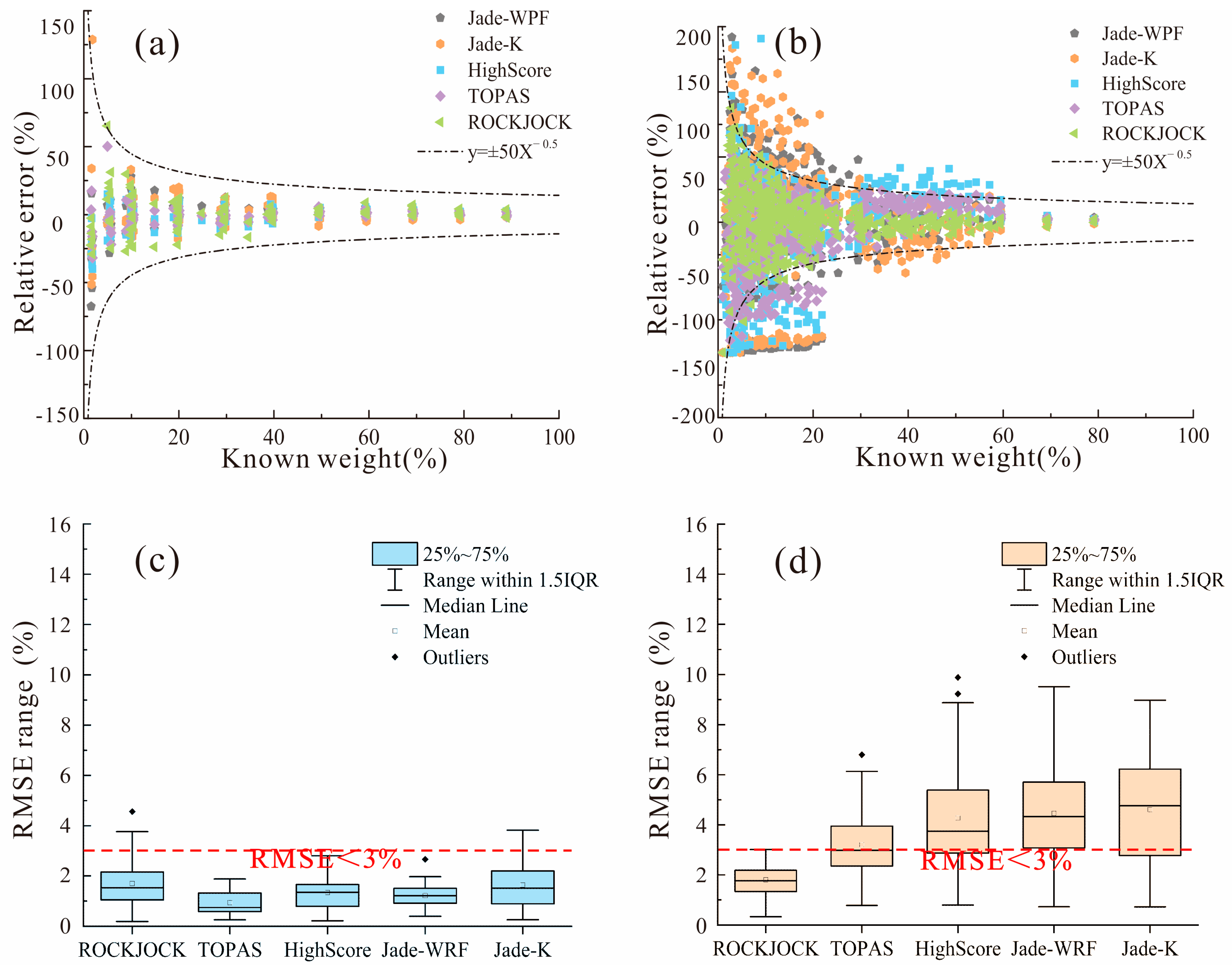
X-ray diffraction (XRD) analysis, as one of the most powerful methods, has been widely used to identify and quantify minerals in earth science. How to improve the precision of mineral quantitative analysis is still a hot topic. To date, several quantitative methods have been proposed for different purposes and accompanied by diverse software. In this study, three quantitative mineral analysis methods, including the reference intensity ratio (RIR), Rietveld, and full pattern summation (FPS) methods, are compared and evaluated to systematically investigate their accuracy and applicability. The results show that the analytical accuracy of these methods is basically consistent for mixtures free from clay minerals. However, there are significant differences in accuracy for clay-mineral-containing samples. In comparison, it seems that the FPS method has wide applicability, which is more appropriate for sediments. The Rietveld method has been shown to be capable of quantifying complicated non-clay samples with a high analytical accuracy; nevertheless, most conventional Rietveld software fails to accurately quantify phases with a disordered or unknown structure. The RIR method represents a handy approach but with lower analytical accuracy. Overall, the present results are expected to provide a potentially important reference for the quantitative analysis of minerals in sediments.
Keywords: limit of detection; Rietveld; reference intensity ratio; full pattern summation methods limit of detection; Rietveld; reference intensity ratio; full pattern summation methods