

You are currently viewing a new version of our website. To view the old version click .

Minerals, Volume 10, Issue 7

July 2020 - 68 articles

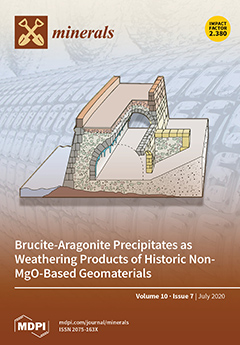
Cover Story: This paper analyses the mineralogical composition, texture and structure of a stalactite sampled from the city-wall storerooms of the Nueva Tabarca fortress (SE Spain). This speleothem presents an uncommon mineral assemblage: aragonite, brucite, gypsum, silica and halite. Internally, it shows a complex structure: 1) a central soda-straw composed by aragonite; 2) an external puff-pastry cone-crust formed preferentially by aragonite and brucite; and 3) an internal branching of coralloids, showing a subtle layering between brucite and aragonite. PHREEQC calculations showed that interaction between pore waters and the minerals of mortar aggregates of the city-wall (dolomite, pyroxene and amphibole) leads to rich-magnesium solutions. Evaporation modelling of lixiviated waters describes the precipitation of the mineral assemblage of the brucite–aragonite speleothems. View this paper
  • Issues are regarded as officially published after their release is announced to the table of contents alert mailing list .
  • You may sign up for email alerts to receive table of contents of newly released issues.
  • PDF is the official format for papers published in both, html and pdf forms. To view the papers in pdf format, click on the "PDF Full-text" link, and use the free Adobe Reader to open them.

Articles (68)

  • Article
  • Open Access
9 Citations
3,682 Views
16 Pages

Phosphorus Species in Deep-Sea Carbonate Deposits: Implications for Phosphorus Cycling in Cold Seep Environments

  • Junlie Zhou,
  • Mengran Du,
  • Jiwei Li,
  • Hengchao Xu,
  • Kaiwen Ta,
  • Shun Chen and
  • Xiaotong Peng

21 July 2020

Phosphorus (P) is an important nutrient for biological communities in cold seeps. However, our knowledge on the source, species, and cycling of P in cold seep environments is limited. In this study, the concentration, species, and micro to nanometer...

  • Article
  • Open Access
5 Citations
5,658 Views
17 Pages

21 July 2020

Different techniques (chemical analysis, X-ray diffraction, Mössbauer spectroscopy, UV-Vis-NIR spectrophotometry and chromaticity measurements) were used to study the color variation of feldspathic raw materials after firing at 1200 °C. Two...

  • Article
  • Open Access
16 Citations
4,892 Views
19 Pages

The State of Trace Elements (In, Cu, Ag) in Sphalerite Studied by X-Ray Absorption Spectroscopy of Synthetic Minerals

  • Nikolay D. Trofimov,
  • Alexander L. Trigub,
  • Boris R. Tagirov,
  • Olga N. Filimonova,
  • Polina V. Evstigneeva,
  • Dmitriy A. Chareev,
  • Kristina O. Kvashnina and
  • Maximilian S. Nickolsky

20 July 2020

The oxidation state and local atomic environment of admixtures of In, Cu, and Ag in synthetic sphalerite crystals were determined by X-ray absorption spectroscopy (XAS). The sphalerite crystals doped with In, Cu, Ag, In–Cu, and In–Ag were...

  • Article
  • Open Access
11 Citations
4,870 Views
19 Pages

20 July 2020

The investigations focused on the façade of the 17th-century Myszkowskis chapel at the 13th-century Church of the Holy Trinity in Cracow, Poland. Most of the chapel’s façade is made of rusticated limestone blocks, but its lower pa...

  • Article
  • Open Access
10 Citations
4,368 Views
15 Pages

Comparison of Detrital Zircon U-Pb and Muscovite 40Ar/39Ar Ages in the Yangtze Sediment: Implications for Provenance Studies

  • Xilin Sun,
  • Klaudia F. Kuiper,
  • Yuntao Tian,
  • Chang’an Li,
  • Zengjie Zhang and
  • Jan R. Wijbrans

20 July 2020

Detrital zircon U-Pb and muscovite 40Ar/39Ar dating are useful tools for investigating sediment provenance and regional tectonic histories. However, the two types of data from same sample do not necessarily give consistent results. Here, we compare p...

  • Article
  • Open Access
14 Citations
3,933 Views
19 Pages

20 July 2020

Whole-rock and apatite geochemical analyses and zircon U–Pb dating were carried out on the lamprophyres in the world-class Zhuxi W–Cu skarn deposit in northern Jiangxi, South China, in order to understand their origin of mantle sources an...

  • Article
  • Open Access
4,651 Views
16 Pages

Ti-Magnetite Crystallization in Melt Inclusions of Trachytic Rocks from the Dokdo and Ulleung Islands, South Korea: Implications for Hydrous and Oxidized Magmatism

  • Inkyeong Moon,
  • Hyunwoo Lee,
  • Jonguk Kim,
  • Jihye Oh,
  • Donghoon Seoung,
  • Chang Hwan Kim,
  • Chan Hong Park and
  • Insung Lee

20 July 2020

The Dokdo and Ulleung islands (Korea) are volcanic islands in the East Sea (Sea of Japan), formed in the late Cenozoic. These volcanic islands, in the back-arc basin of the Japanese archipelago, provide important information about magma characteristi...

  • Article
  • Open Access
2 Citations
3,085 Views
17 Pages

19 July 2020

The present study demonstrates the capabilities of the Rietveld procedure to track the structural transformations and framework flexibility on the example of the natural water-containing zirconosilicate elpidite, subjected (in bulk) to thermal treatm...

  • Article
  • Open Access
6 Citations
3,767 Views
21 Pages

18 July 2020

The Sisson Brook deposit is a low-grade, large-tonnage W-Mo deposit with notable Cu located in west-central New Brunswick, Canada, and is one of several W-Mo deposits in New Brunswick associated with fluids sourced from granitic plutons emplaced duri...

  • Article
  • Open Access
7 Citations
5,877 Views
20 Pages

18 July 2020

Field, petrological and mineral chemistry for meta-volcanic rocks from the Aravalli sequence (Aravalli Craton, India) are presented. Field evidence such as volcanic flows and suspect pillow lava structures, dominant Fe-tholeiite lava flows intercalat...

of 7

Get Alerted

Add your email address to receive forthcoming issues of this journal.

XFacebookLinkedIn
Minerals - ISSN 2075-163X