


Abstract
Graph labeling is an important area of graph theory that studies the assignment of integers to the vertices or edges of a graph according to specific rules. Among these labeling methods, distance magic labeling has attracted considerable attention due to its interesting combinatorial structure and applications in network design and communication systems. A distance magic labeling of a graph is a bijection from the vertex set to the set such that the sum of the labels of the neighbors of each vertex is equal to a constant called the magic constant. This paper investigates the existence and construction of distance magic labelings for certain families of complete bipartite graphs. Two principal cases are studied, namely graphs of the form and . For graphs of the form , an explicit construction is developed showing that these graphs admit a distance magic labeling for every integer . The corresponding magic constant is derived as and the validity of the construction is verified by proving bijectivity of the labeling function and equality of vertex weights. A similar constructive approach is applied to graphs of the form , where distance magic labelings are obtained using structured arithmetic label distributions. These constructions are further extended by applying vertex swapping techniques and block-based arguments to generate complete bipartite graphs that preserve the same magic constant for certain values of p and q. These findings contribute to the understanding of how arithmetic structure and partition properties influence the existence of distance magic labelings and suggest several directions for further research in graph labeling theory.
1. Introduction
A graph consists of a set of vertices V and a set of edges E, and it serves as a powerful tool for modeling a wide variety of systems. Various graph labeling schemes have been studied extensively because of their mathematical significance, practical applications in communication networks and coding theory.
Among the many labeling schemes that have been studied, magic-type labelings occupy a special place because of their connection to the much older idea of magic square-grids of numbers in which every row, column, and diagonal sum to the same value. The mathematician Jiri Sedlacek was the first to translate this idea into graph theory, introducing magic labelings of graph edges in 1976 [1]. His work inspired a series of related concepts, including vertex-magic and edge-magic total labelings developed by Kotzig and Rosa [2] and by MacDougall [3]. Graph labeling more broadly traces back to Rosa’s introduction of graceful labelings [4], and has since grown into one of the most active areas of graph theory, with surveys such as Gallian’s regularly updated catalogue of results attesting to its continued vitality [5].
This research focuses on distance magic labeling. A distance magic labeling of a graph is a one-to-one assignment of integers to its vertices such that the sum of the labels of the neighbors of each vertex is equal to a fixed constant, called the magic constant. This magic constant reflects a kind of local balance across the entire network; every vertex, in a sense, sees the same total weight in its immediate surroundings. The concept was introduced independently by Vilfred, who called it -labeling [6], and by Miller and others, who used the term 1-vertex-magic vertex labeling [7]. This dual origin is itself a small illustration of how ideas in mathematics often arise from different directions before being recognized as the same underlying structure. Because the weight condition depends only on immediate neighbors, distance magic labelings are closely tied to a graph’s connectivity pattern, making them a natural tool for studying how information or load might be balanced across the nodes of a network. It was shown that regular graphs of odd degree and even order can never be distance magic and complete graphs, paths, cycles, and wheels have all been shown to be distance magic only in very restrictive, small cases, while complete multipartite graphs with equal-sized parts admit a clean parity characterization [8]. In contrast, later work by Kovář and others fully resolved which even orders admit regular distance magic graphs of a given degree [9]. Beyond the basic definition, researchers have proposed several variants, including D-distance magic labeling, which uses closed neighborhoods and oriented and different versions of distance magic labeling [10]; and distance antimagic labeling, in which vertex weights are required to be distinct rather than constant [11]. These variants reflect an underlying disagreement in the field about “neighborhood” and “balance” is most natural or most useful for applications, and different authors have argued for different choices depending on whether the goal is closer to modeling communication load, error-correcting distance, or purely combinatorial symmetry.
Relationship to Previous Results and Novelty of the Present Work
In the literature, distance magic graphs are also referred to as graphs. Acharya et al. [12] showed that every graph is an induced subgraph of a graph and established necessary and sufficient conditions for a complete bipartite graph to be a graph. Subsequently, Beena [13] provided a characterization of complete bipartite graphs that admit a labeling, using an approach that differs from that of Acharya et al. [12]. More specifically, for a complete bipartite graph , where , both studies established necessary and sufficient conditions for to be a graph. Although the conditions are expressed in somewhat different forms, both results involve congruence conditions on the part sizes, particularly , together with additional restrictions involving m and n. These results therefore provide characterizations of the existence of distance magic labelings for the corresponding families of complete bipartite graphs.
The novelty of the present work lies in its constructive approach to distance magic labeling. While the previous studies primarily establish necessary and sufficient conditions for the existence of such labelings, they do not provide the explicit labeling constructions developed in this paper. We construct explicit distance magic labelings for the complete bipartite graphs and . These constructions are then used as building blocks for obtaining labelings of additional complete bipartite graphs through a label-sum-preserving partition modification. In particular, the proposed modification changes the sizes of the two vertex partitions while preserving the distance magic property and the associated magic constant. Thus, the contribution of the present work is complementary to the existing characterization results. The proposed constructive framework provides a practical way of obtaining labelings from known base constructions and may also serve as a basis for extending explicit labeling techniques to broader classes of complete multipartite graphs.
2. Definitions and Terminology
We begin by considering several standard definitions and notations from graph theory that are used throughout this research. A graph is an ordered pair consisting of a nonempty set V (called the vertices) and set E (called the edges). Apart from that, if two vertices in a graph are connected by an edge, we say that the vertices are adjacent. The set of vertices adjacent to v is called the neighborhood of v, denoted as . This is sometimes called the open neighborhood of v to distinguish it from the closed neighborhood.
Definition 1.
Graph labeling is the assignment of labels, represented by integers, to edges or vertices of a graph. Formally, given a graph , a vertex labeling is a function of V to a set of labels; a graph with such a function defined is called a vertex-labeled graph. Likewise, an edge labeling is a function of E to a set of labels.
Definition 2.
Distance magic labeling of a graph G of order n is a bijection with the property that there is a positive integer k such that
for every . The constant k is called the magic constant of the labeling f. The sum is called the weight of the vertex v and is denoted by .
In this research, we begin with the distance magic labelings of the complete bipartite graphs and . Using these constructions as the foundation, we obtain distance magic labelings for for certain values of p and q.
Block Decomposition
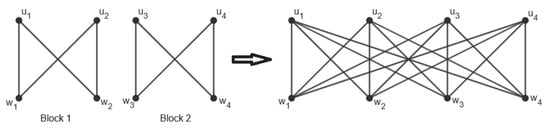
We view as the fundamental building block for constructing larger complete bipartite graphs . In particular, may be regarded as being assembled from two blocks, with the appropriate inter-block edges preserving the complete bipartite structure as shown in Figure 1.
Figure 1.
Construction of using two blocks.
This perspective naturally extends to , which can be constructed recursively using as the basic block.
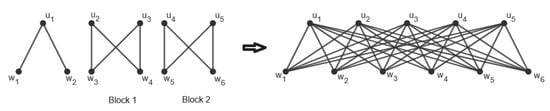
We regard and as the fundamental building blocks in our construction of larger complete bipartite graphs . Specifically, is obtained by combining and two blocks, together with the inter-block edges required to preserve the complete bipartite structure as shown in Figure 2.
Figure 2.
Construction of using and two blocks.
More generally, is viewed as being formed from one block and , blocks, which provides the basis for our labeling construction.
3. Results
3.1. Labeling of and
First we present a distance magic labeling for the complete bipartite graph, , where .
Theorem 1.
For , let be the complete bipartite graph with bipartition of the vertex set V, where and . Then, admits a distance magic labeling with magic constant .
Proof of Theorem 1.
We construct an explicit distance magic labeling,
as follows for :
For vertices in U, the odd-indexed vertices receive labels and even-indexed vertices receive labels . For vertices in W, the odd-indexed vertices receive labels and even-indexed vertices receive labels . Since all four sets containing the labels are pairwise disjoint with distinct elements, f is injective.
The labels assigned to the vertices in U, , and the labels assigned to the vertices in W, , cover all integers from 1 to ; so, f is surjective. Therefore, f is a bijection.
To show that f is distance magic, first, observe that the construction partitions the labels into the two sets, each having equal sums .
Now, consider an arbitrary vertex for some . is complete bipartite, and is adjacent to all vertices in W. Therefore, the .
Similarly, for any vertex , the .
Since all vertices have weight , the labeling f is distance magic with magic constant . □
Now, we consider the family and show that it also admits a distance magic labeling.
Theorem 2.
For , let be the complete bipartite graph with bipartition of the vertex set V, where and . Then, admits a distance magic labeling with magic constant .
Proof of Theorem 2.
We construct an explicit distance magic labeling,
as follows:
For , define:
For vertices in U, the odd-indexed vertices receive labels and even-indexed vertices receive labels . For vertices in W, the odd-indexed vertices receive labels and even-indexed vertices receive labels .
Since all four sets containing the labels are pairwise disjoint with distinct elements, f is injective.
The labels assigned for vertices in U and W cover all integers from 1 to ; hence, f is surjective. Therefore, f is a bijection.
To show that f is distance magic, first, observe that the construction partitions the labels into the two sets, each having equal sums .
Now, consider an arbitrary vertex for some . is complete bipartite, and is adjacent to all vertices in W. Therefore, the .
Similarly, for , where , the .
Since all vertices have a weight of , the labeling f is distance magic with magic constant . □
Using the distance magic labelings of and , we construct distance magic labelings of for certain values of p and q while preserving the same magic constant by means of a vertex-swapping technique, more precisely, a label-sum-preserving partition modification.
3.2. Label-Sum Preserving Partition Modification
Let be the partition of vertex set V of and with the labeling given in Theorem 1 and Theorem 2, respectively.
Take r number of labels of consecutive vertices starting with in U and find a vertex in W, when possible, with the label that is the same as the sum of the labels of r vertices chosen from U, and then swap the r number vertices in U with the corresponding vertex in W.
The new graph with , obtained by swapping vertices in and is distance magic and retains the same magic constant as and .
Similarly, sum up r labels of consecutive vertices starting with in W and find a vertex with the label that is the same as the calculated sum, in U, and then swap the vertices in W with in U, constructing with , , where retains the same magic constant corresponding to or .
3.3. Distance Magic Graphs Derived from
The graph is regarded as being assembled from m blocks of , as explained in the Block Decomposition Section.
Theorem 3.
- (I)
- For , the complete bipartite graph admits a distance magic labeling when and , where a is either 2 or 3.
- (II)
- For , the complete bipartite graph admits a distance magic labeling when and , where a is either 1 or 2.
Proof of Theorem 3.
First, consider the graph with the distance magic labeling given in Theorem 1.
Consider n consecutive blocks, starting with the first block, and take the summation of all the labels of the vertices in U in each of those blocks.
The labels of vertices of W are of the form and .
Hence, two cases arise.
Case : so that ; since k is an integer, it follows that .
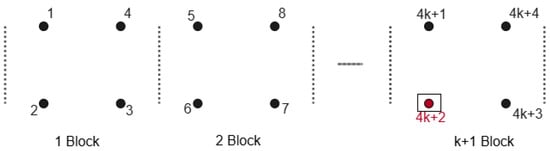
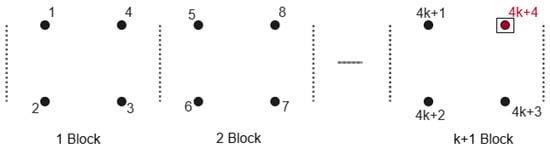
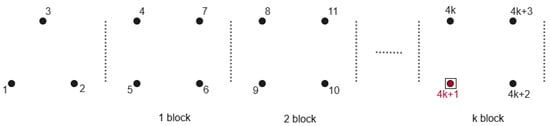
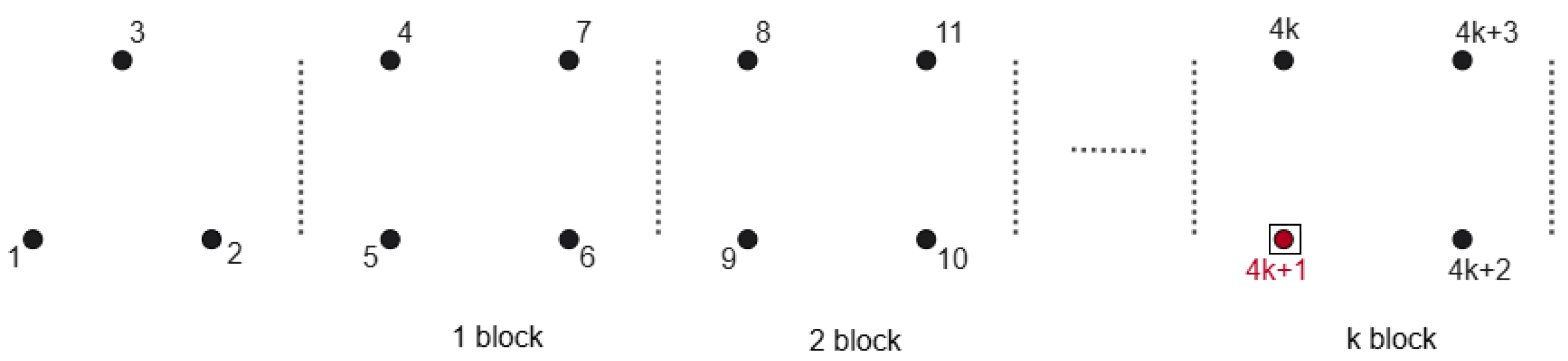
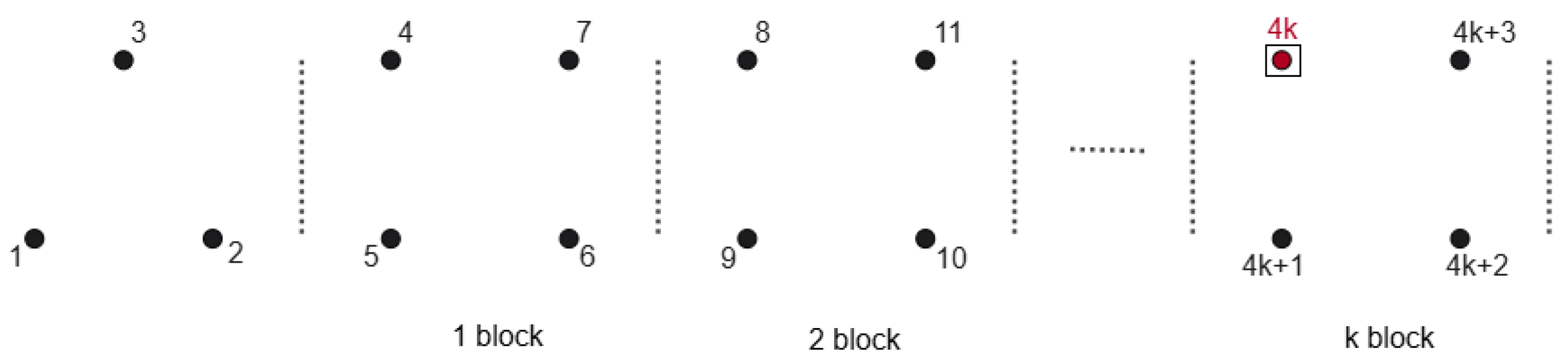
Now, observe that the vertex labeled is in the block as shown in Figure 3; hence, to find m of corresponding to the above-given n, it follows that , so that
Figure 3.
Vertex labeled in the block.
Let denote the vertex in W with label , which is shown in Figure 3. The first vertices in U, starting from , are swapped with the vertex in W, resulting in the complete bipartite graph .
Here, .
Therefore, the complete bipartite graph has the same weight, for each vertex, retaining a distance magic labeling with the same magic constant as in .
Case : so that ; since k, is an integer, it follows that .
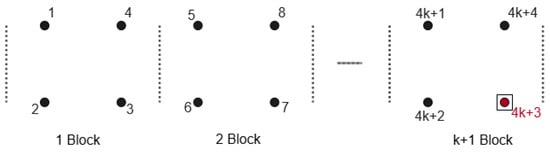
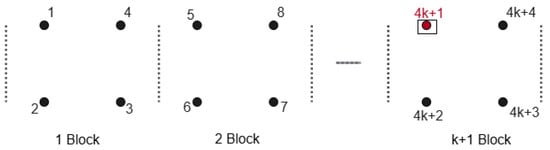
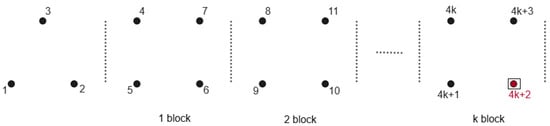
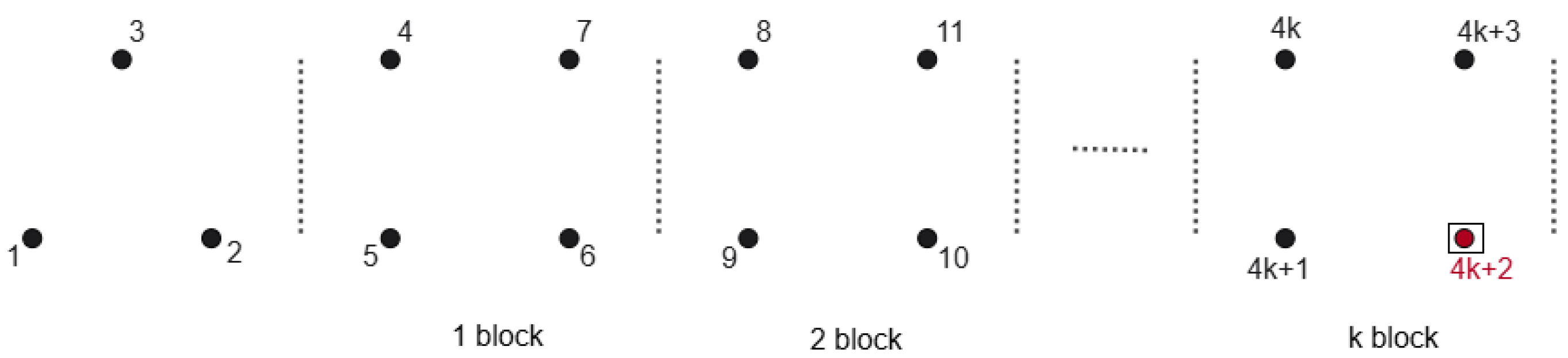
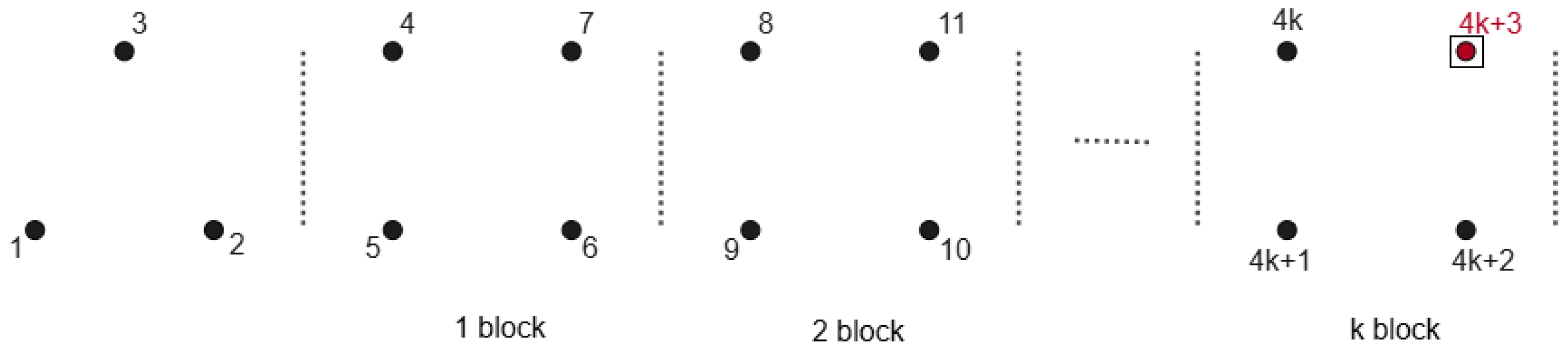
Now, observe that the vertex labeled is in the block, as shown in the Figure 4; hence, to find m of corresponding to the above-given n, it follows that so that
Figure 4.
Vertex labeled in the block.
Let denote the vertex in W with label , which is shown in Figure 4. The first vertices starting from in U are swapped with the vertex in W, resulting in the complete bipartite graph .
Here, . Therefore, the complete bipartite graph has the same weight, for each vertex, retaining a distance magic labeling with the same magic constant as in .
This concludes the proof of part (I); now, to prove part (II) of the theorem, consider n consecutive blocks, starting with the first, and then consider the vertex with label from the block in W.
The sum of the labels of the selected vertices in U:
The labels of vertices of W are of the form or .
Hence, two cases arise.
Case (1): so that ; since k is an integer, it follows that .
Now, observe that the vertex labeled is in the block, as shown in Figure 3; hence, to find m of corresponding to the above-given n, it is implied that ; hence,
Let denote the vertex in W with label . The first vertices, starting from in U, are swapped with the vertex in W, resulting in the complete bipartite graph .
Here, .
Therefore the complete bipartite graph has the same weight, for each vertex, retaining a distance magic labeling with the same magic constant as in .
Case (2): so that ; since k is an integer, it follows that .
Now, observe that the vertex labeled is in the block, as shown in Figure 4; hence, to find m of corresponding to the above-given n, it is implied that so that .
Let denote the vertex in W with label . The first vertices, starting from in U, are swapped with the vertex in W, resulting in the complete bipartite graph .
Here, .
Therefore, the complete bipartite graph , has the same weight, for each vertex, retaining a distance magic labeling with the same magic constant as in . □
Corollary 1.
- (I)
- For , the complete bipartite graph admits a distance magic labeling when and with and , where a is either 2 or 3.
- (II)
- For , the complete bipartite graph admits a distance magic labeling when and with and , where a is either 1 or 2.
Proof of Corollary 1.
To prove part (I) of the corollary, let , and corresponding to this n, let . By Theorem 3, it follows the complete bipartite graph to admit a distance magic labeling, which is constructed out of by swapping the first consecutive vertices in U of the bipartition with the one vertex in W of the bipartition, where its label is the same as the sum of the labels of the vertices.
Now, let m be a positive integer such that . Observe that is contained in , retaining the same labeling of its vertices due to our construction of the distance magic labeling in Theorem 1. Taking to be the bipartition of , swapping the first consecutive vertices in with the one vertex in , gives the complete bipartite graph , which admits a distance magic labeling. Hence, the complete bipartite graph admits a distance magic labeling for any , where with and .
Now, let with , where a is either 2 or 3. Then, clearly . Take . By Theorem 3, the complete bipartite graph admits a distance magic labeling. Since and , it follows and, by the above proof, the complete bipartite graph admits a distance magic labeling. Therefore, for any , it follows the complete bipartite graph to admit a distance magic labeling.
Hence, for , the complete bipartite graph admits a distance magic labeling when and with and , where a is either 2 or 3.
Following a similar argument as above, the result of part (II) also holds. □
Similar results can be obtained by swapping vertices of W with a corresponding vertex in U.
Theorem 4.
- (I)
- For , the complete bipartite graph admits a distance magic labeling when and , where a is either 0 or 1.
- (II)
- For , the complete bipartite graph admits a distance magic labeling when
- 1.
- and
- 2.
- and
Proof of Theorem 4.
First, consider the graph with the distance magic labeling given in Theorem 1.
Consider n consecutive blocks, starting with the first block, and take the summation of all the labels of the vertices in W in each of those blocks:
The labels of vertices of U are of the form or .
Hence, two cases arise. Case : so that ; since k is an integer, it follows that .
Now, observe that the vertex labeled is in the block, as shown in Figure 5; hence, to find m of corresponding to the above-given n, it is implied that , so that
Figure 5.
Vertex labeled in the block.
Let denote the vertex in U with label , which is shown in Figure 5. The first vertices, starting from in W, are swapped with the vertex in U, resulting in the complete bipartite graph .
Here, .
Therefore the complete bipartite graph has the same weight for each vertex, retaining a distance magic labeling with the same magic constant as in .
Case (2): so that ; since k is an integer, it follows that .
Now, observe that the vertex labeled is in the block, as shown in the Figure 6; hence, to find m of corresponding to the above-given n, it is implied that so that
Figure 6.
Vertex labeled in the block.
Let denote the vertex in U with label , which is shown in Figure 6. The first vertices, starting from in W, are swapped with the vertex in U, resulting in the complete bipartite graph .
Here, .
Therefore, the complete bipartite graph has the same weight, , for each vertex, retaining a distance magic labeling with the same magic constant as in .
This concludes the proof of part (I); now, to prove part (II) of the theorem, consider n consecutive blocks, starting with the first, and then consider the vertex with label from the block in W.
The sum of the labels of the selected vertices in W:
The labels of vertices of U are of the form or .
Hence, two cases arise.
Case (1): so that ; since k is an integer, it follows that .
Now, observe that the vertex labeled is in the block, as shown in Figure 5; hence, to find m of corresponding to the above-given n, it is implied that ; hence,
Let denote the vertex in U with label . The first vertices, starting from in W, are swapped with the vertex in U, resulting in the complete bipartite graph .
Here, .
Therefore, the complete bipartite graph , has the same weight, , for each vertex, retaining a distance magic labeling with the same magic constant as in .
Case (2): so that ; since k is an integer, it follows that .
Now, observe that the vertex labeled is in the block, as shown in Figure 6; hence, to find m of corresponding to the above-given n, it is implied that so that .
Let denote the vertex in U with label . The first vertices, starting from in W, are swapped with the vertex in U, resulting in the complete bipartite graph .
Here, .
Therefore, the complete bipartite graph , has the same weight, for each vertex, retaining a distance magic labeling with the same magic constant as in . □
Corollary 2.
- (I)
- For , the complete bipartite graph admits a distance magic labeling when and with and , where a is either 0 or 1.
- (II)
- For , the complete bipartite graph admits a distance magic labeling when:
- (a)
- and with and .
- (b)
- and with and .
Proof of Corollary 2.
Following a similar argument as in the proof of Corollary 1 and by Theorem 3, the result is immediate. □
3.4. Distance Magic Graphs Derived from
The graph is regarded as being assembled from and blocks of , as explained in the Block Decomposition Section.
Theorem 5.
- (I)
- For , the complete bipartite graph admits a distance magic labeling when and , where a is either 1 or 2.
- (II)
- For , the complete bipartite graph admits a distance magic labeling when:
- (a)
- and
- (b)
- and
Proof of Theorem 5.
First, consider the graph with the distance magic labeling given in Theorem 2.
Consider the first vertex labeled as 3 and n consecutive blocks, starting with the first block, and take the summation of all the labels of the vertices in U in each of those blocks.
The labels of vertices of W are of the form or .
Hence, two cases arise.
Case (1): so that ; since k is an integer, it follows that .
Now, observe that the vertex labeled is in the block, as shown in Figure 7; hence, to find m of corresponding to the above-given n, it is implied that , so that
Figure 7.
Vertex labeled in the block.
Let denote the vertex in W with label , which is shown in Figure 7. The first vertices in U are swapped with the vertex in W, resulting in the complete bipartite graph .
Here, .
Therefore the complete bipartite graph has the same weight, for each vertex, retaining a distance magic labeling with the same magic constant as in .
Case (2): so that ; since k is an integer, it follows that .
Now, observe that the vertex labeled is in the block, as shown in Figure 8; hence, to find m of corresponding to the above-given n it is implied that so that
Figure 8.
Vertex labeled in the block.
Let denote the vertex in W with label , which is shown in Figure 8. The first vertices in U are swapped with the vertex in W, resulting in the complete bipartite graph .
Here, .
Therefore, the complete bipartite graph has the same weight, , for each vertex, retaining a distance magic labeling with the same magic constant as in .
This concludes the proof of part (I); now, to provepart (II) of the theorem, consider the vertex labeled 3, vertices in the n consecutive blocks of , and the vertex with label from the block in U.
The sum of the labels of the selected vertices in U:
The labels of vertices of W are of the form or .
Hence, two cases arise.
Case : so that ; since k is an integer, it follows that .
Now, observe that the vertex labeled is in the block, as shown in Figure 7; hence, to find m of corresponding to the above-given n, it is implied that ; hence,
Let denote the vertex in W with label , which is shown in Figure 7. The first vertices in U are swapped with the vertex in W, resulting in the complete bipartite graph .
Here, .
Therefore the complete bipartite graph has the same weight, , for each vertex, retaining a distance magic labeling with the same magic constant as in .
Case : so that ; since k is an integer, it follows that .
Now, observe that the vertex labeled is in the block, as shown in Figure 8; hence, to find m of corresponding to the above-given n, it is implied that so that
Let denote the vertex in W with label , which is shown in Figure 8. The first vertices in U are swapped with the vertex in W, resulting in the complete bipartite graph .
Here, .
Therefore, the complete bipartite graph has the same weight, , for each vertex, retaining a distance magic labeling with the same magic constant as in . □
Corollary 3.
- (I)
- For , the complete bipartite graph admits a distance magic labeling when and with and , where a is either 1 or 2.
- (II)
- For , the complete bipartite graph admits a distance magic labeling when:
- (a)
- and with and .
- (b)
- and with and .
Proof of Corollary 3.
Following a similar argument as in the proof of Corollary 1 with the labeling given in Theorem 2 and by Theorem 5, the result is immediate. □
Similar results can be obtained by swapping vertices of W with a corresponding vertex in U.
Theorem 6.
- (I)
- For , the complete bipartite graph admits a distance magic labeling when and , where a is either 0 or 3.
- (II)
- For , the complete bipartite graph admits a distance magic labeling when:
- 1.
- and
- 2.
- and
Proof of Theorem 6.
First, consider the graph with the distance magic labeling given in Theorem 2.
Consider the vertices labeled 1, 2 and vertices in the n consecutive blocks of in W, and take the summation of all the labels of the vertices.
The labels of vertices of U are of the form or .
Hence, two cases arise.
Case (1): so that ; since k is an integer, it follows that .
Now, observe that the vertex labeled is in the block, as shown in Figure 9; hence, to find m of corresponding to the above-given n, it is implied that so that
Figure 9.
Vertex labeled in the block.
Let denote the vertex in U with label , which is shown in Figure 9. The first vertices in W are swapped with the vertex in U, resulting in the complete bipartite graph .
Here, .
Therefore, the complete bipartite graph has the same weight, , for each vertex, retaining a distance magic labeling with the same magic constant as in .
Case (2): so that ; since k is an integer, it follows that .
Now, observe that the vertex labeled is in the block, as shown in Figure 9; hence, to find m of corresponding to the above-given n, it is implied that so that
Let denote the vertex in U with label , which is shown in Figure 10. The first vertices in W are swapped with the vertex in U, resulting in the complete bipartite graph .
Figure 10.
Vertex labeled in the block.
Here, .
Therefore, the complete bipartite graph has the same weight, , for each vertex, retaining a distance magic labeling with the same magic constant as in .
This concludes the proof of part (I); now, to prove part (II) of the theorem, we consider the vertices labeled 1, 2, the vertices in the n consecutive blocks of , and the vertex with label from the block in W.
The sum of the labels of the selected vertices in W:
The labels of vertices of U are of the form or .
Hence, two cases arise.
Case (1): so that ; since k is an integer, it follows that .
Now, observe that the vertex labeled is in the block, as shown in Figure 9; hence, to find m of corresponding to the above-given n, it is implied that ; hence, .
Let denote the vertex in U with label , which is shown in Figure 9. The first vertices in W are swapped with the vertex in U, resulting in the complete bipartite graph .
Here, .
Therefore, the complete bipartite graph has the same weight, for each vertex, retaining a distance magic labeling with the same magic constant as in .
Case (2): so that ; since k is an integer, it follows that .
Now, observe that the vertex labeled is in the block, as shown in Figure 10; hence, to find m of corresponding to the above-given n, it is implied that so that .
Let denote the vertex in U with label . The first vertices in W are swapped with the vertex in U, resulting in the complete bipartite graph .
Here, .
Therefore, the complete bipartite graph has the same weight, , for each vertex, retaining a distance magic labeling with the same magic constant as in . □
Corollary 4.
- (I)
- For , the complete bipartite graph admits a distance magic labeling when and with and , where a is either 0 or 3.
- (II)
- For , the complete bipartite graph admits a distance magic labeling when:
- (a)
- and with and .
- (b)
- and with and .
Proof of Corollary 4.
Following a similar argument as in the proof of Corollary 1 with the labeling given in Theorem 2 and by Theorem 6, the result is immediate. □
4. Discussion
Complete bipartite graphs provide a natural and important setting for investigating distance magic labeling. However, despite their fundamental role in graph theory, explicit labeling constructions for these graphs have remained relatively scarce. In this study, we developed explicit distance magic labelings for the complete bipartite graphs and , with corresponding magic constants and , respectively. These constructions establish concrete labeling schemes for two broad families of complete bipartite graphs and contribute to the growing body of results on distance magic labelings.
Building on these constructions, we introduced a vertex-swapping technique that extends the labelings to additional complete bipartite graphs for specific values of p and q. A key feature of this approach is that the vertex swaps preserve the distance magic property and the associated magic constant while allowing the sizes of the two partitions to change. This demonstrates that a single explicit labeling can serve as the foundation for generating new families of distance magic graphs through carefully designed structural transformations.
The vertex-swapping approach also suggests a broader research direction. Rather than constructing distance magic labelings independently for each graph, it may be possible to begin with a multipartite graph possessing a known distance magic labeling and systematically extend that labeling to other multipartite graphs through analogous partition-swapping operations. Investigating the conditions under which such transformations preserve the distance magic property could lead to a more general framework for constructing distance magic labelings across wider classes of multipartite graphs.
Author Contributions
Conceptualization, K.V.S., S.W. and S.A.; methodology, K.V.S., S.W. and S.A.; validation, S.W. and S.A.; investigation, K.V.S., S.W. and S.A.; writing—original draft preparation, K.V.S.; writing—review and editing, S.W. and S.A.; visualization, K.V.S.; supervision, S.W. and S.A.; project administration, S.W. and S.A. All authors have read and agreed to the published version of the manuscript.
Funding
This research received no external funding.
Data Availability Statement
The original contributions presented in this study are included in the article. Further inquiries can be directed to the corresponding author.
Conflicts of Interest
The authors declare no conflicts of interest.
References
- Sedláček, J. On magic graphs. Math. Slovaca 1976, 26, 329–335. [Google Scholar]
- Kotzig, A.; Rosa, A. Magic Valuations of Finite Graphs. Can. Math. Bull. 1970, 13, 451–461. [Google Scholar] [CrossRef] [Scilit]
- MacDougall, J.; Miller, M.; Slamin, S. Vertex-magic total labelings of graphs. Util. Math. 2002, 61, 3–21. [Google Scholar]
- Rosa, A. On certain valuations of the vertices of a graph. In Theory of Graphs (International Symposium, Rome); Dunod Gordon & Breach Science Publishers, Inc.: New York, NY, USA, 1966; pp. 349–355. [Google Scholar]
- Gallian, J. A Dynamic Survey of Graph Labeling. Electron. J. Comb. 2022, 25, 1–623. [Google Scholar] [CrossRef] [Scilit]
- Vilfred, V. Σ- Labelled Graph and Circulant Graphs; University of Kerala: Thiruvananthapuram, India, 1994. [Google Scholar]
- Miller, M.; Rodger, C.; Simanjuntak, R. Distance magic labelings of graphs. Australas. J. Comb. 2003, 28, 305–315. [Google Scholar]
- Rupnow, R. A Survey of Distance Magic Graphs. Master’s Thesis, Michigan Technological University, Houghton, MI, USA, 2014. [Google Scholar]
- Kovár, P.; Kabelík–Hrušková, A.S.; Kravčenko, M. On regular distance magic graphs of odd order. J. Comb. Math. Comb. Comput. 2012, 117, 55–64. [Google Scholar]
- Altman, K.; Calzado, L.; Freyberg, B.; Kovář, P.; Lewis, E.; Marr, A.; Ross, L.; Via, R. Difference distance magic oriented graphs. Res. Math. Sci. 2024, 11, 67. [Google Scholar] [CrossRef] [Scilit]
- Arumugam, S.; Kamatchi, N.; Vijayakumar, G.R. On the uniqueness of D-vertex magic constant. Discuss. Math. Graph Theory 2014, 34, 279–286. [Google Scholar] [CrossRef] [Scilit]
- Acharya, B.D.; Rao, S.B.; Singh, T.; Parameswaran, V. Neighborhood magic graphs. In Proceedings of the National Conference on Graph Theory, Combinatorics and Algorithm, Krishnankovil, India, 25–29 November 2004. [Google Scholar]
- Beena, S. On Σ and Σ′ labelled graphs. Discret. Math. 2009, 309, 1783–1787. [Google Scholar]
Disclaimer/Publisher’s Note: The statements, opinions and data contained in all publications are solely those of the individual author(s) and contributor(s) and not of MDPI and/or the editor(s). MDPI and/or the editor(s) disclaim responsibility for any injury to people or property resulting from any ideas, methods, instructions or products referred to in the content. |
© 2026 by the authors. Licensee MDPI, Basel, Switzerland. This article is an open access article distributed under the terms and conditions of the Creative Commons Attribution (CC BY) license.