


Abstract
Maintaining stability during walking requires rapid reactive adjustments to unexpected perturbations. Although repeated perturbations are known to induce locomotor adaptations, it remains unclear whether these changes reflect a generalized habituation of the locomotor system or selective modifications of specific biomechanical mechanisms. The aim of this study was to investigate changes in lower-limb kinematics, joint torques, and ground reaction force amplitudes during five consecutive treadmill-induced perturbations applied during the pre-swing phase of gait. Twenty-one healthy young women walked on an instrumented split-belt treadmill while five unilateral perturbations were applied to the left belt. For each perturbation, amplitudes of ankle, knee, and hip joint angles, joint torques, and ground reaction force components were calculated. Differences across perturbations were evaluated using Friedman repeated-measures analysis of variance followed by Bonferroni-corrected Wilcoxon tests. Significant effects of perturbation number were observed for hip joint angle amplitude, ankle joint torque amplitude, and anterior–posterior ground reaction force amplitude, whereas a weaker overall effect was detected for vertical ground reaction force amplitude. Hip angle amplitude decreased during later perturbations, whereas ankle torque and anterior–posterior ground reaction force amplitudes increased. No significant changes were found for knee and ankle joint angles, hip and knee joint torques, or mediolateral ground reaction force amplitude. These findings are consistent with the concept of locomotor symmetry as a theoretical framework for interpreting adaptive locomotor responses rather than as a directly measured outcome.
1. Introduction
Maintaining stability during walking requires continuous integration of sensory information and rapid adjustments of motor output. Although human gait is often considered an automated locomotor task [1], it remains highly sensitive to unexpected disturbances that challenge dynamic balance. Recent advances in gait analysis have highlighted the importance of biomechanical approaches for characterizing gait patterns and improving the understanding of locomotor control mechanisms in both sports and clinical applications [2]. Such perturbations frequently occur in everyday environments and may arise from slips, trips, uneven terrain, or sudden changes in surface properties. The ability to effectively respond to these disturbances is therefore essential for safe locomotion and fall prevention [3,4].
Human locomotion is characterized by a highly coordinated organization of movement that exhibits functional symmetry between the lower limbs and contributes to efficient progression and dynamic stability. Although perfect bilateral symmetry is rarely observed during natural gait, the nervous system continuously regulates motor output to maintain coordinated locomotor behavior in the presence of internal and external disturbances. Unexpected perturbations transiently challenge this organization and require rapid adaptive responses to restore stable walking. Therefore, investigating how repeated perturbations differentially modify biomechanical responses provides insight into the mechanisms by which the locomotor system preserves coordinated gait control during reactive adaptation, consistent with symmetry-related principles of locomotor organization.
Recovery from gait perturbations involves complex interactions between biomechanical and neural control mechanisms. Following an unexpected disturbance, the central nervous system must rapidly reorganize muscle activation patterns and joint mechanics to restore stability while preserving forward progression [5]. These corrective responses are reflected in modifications of lower-limb kinematics, joint torques, and ground reaction forces, which together contribute to successful balance recovery [6].
Repeated exposure to perturbations has been shown to induce postural adaptations, with numerous studies demonstrating that individuals can improve their ability to recover from gait perturbations [3,7,8]. This process is commonly interpreted as a form of task-specific motor learning, in which the nervous system optimizes reactive control strategies based on previous experiences. Importantly, contemporary evidence suggests that these adaptations do not necessarily manifest as a generalized reduction in response magnitude. Instead, adaptation may involve specific modifications of specific biomechanical components that most effectively maintain dynamic stability [9,10]. Recent investigations indicate that adaptation to repeated perturbations is dependent on perturbation characteristics, including their direction, magnitude, predictability, and timing within the gait cycle [11]. Consequently, different kinematic and kinetic variables may exhibit distinct adaptation profiles. Some parameters change rapidly after initial perturbations, whereas others remain relatively stable despite repeated exposure. These findings suggest that repeated perturbations may induce a selective reorganization of reactive gait control rather than a uniform habituation of the entire locomotor system [12,13].
Despite growing interest in adaptations to gait perturbations, relatively little is known about how repeated perturbations applied during the pre-swing phase of gait affect lower-limb joint mechanics and ground reaction force characteristics [14]. Understanding these responses may improve our knowledge of the mechanisms underlying reactive gait stability and provide useful information for the development of perturbation-based assessment and training protocols. Although symmetry was not directly quantified using biomechanical symmetry indices, the concept of symmetry provides a theoretical framework for interpreting how the locomotor system preserves coordinated bilateral organization despite unilateral perturbations. Therefore, repeated perturbations provide an experimental model for examining whether adaptation is achieved through global reorganization of gait mechanics or through selective modifications that preserve coordinated locomotor control.
Therefore, the aim of this study was to investigate changes in the amplitude of lower-limb kinematics, joint torques, and ground reaction forces during five consecutive treadmill-induced gait perturbations applied during the pre-swing phase of the gait cycle. Based on previous evidence indicating task-specific adaptation and selective modification of balance recovery mechanisms [15,16,17], it was hypothesized that repeated perturbations would induce adaptive changes in selected biomechanical variables rather than uniform modifications across all measured variables.
2. Materials and Methods
2.1. Participants and Eligibility Criteria
An a priori sample size calculation was performed using G*Power software (v.3.1.9.7, University of Kiel, Kiel, Germany) [18] for a repeated-measures ANOVA with within-subject factors. Assuming a moderate effect size (f = 0.30), a significance level of α = 0.05, statistical power of 0.80, a correlation among repeated measures of 0.50, and a nonsphericity correction of ε = 0.75, the required sample size was estimated at 18 participants. To account for potential dropouts and ensure adequate statistical power, 21 healthy young women were recruited for the study (age: 21.38 ± 1.32 years; body mass: 61.38 ± 6.48 kg; height: 165.9 ± 4.53 cm) [19].
Participants were eligible if they engaged in regular physical activity at least twice per week, had prior experience with treadmill walking, and reported no history of neurological or musculoskeletal disorders or lower-limb injuries within the previous six months. Only individuals with right-leg dominance were included. Lower-limb dominance was determined using a standardized ball-kicking test [20].
Exclusion criteria comprised self-reported balance disorders, lack of treadmill walking experience, and the use of medications known to affect nervous system function.
All participants provided written informed consent prior to enrollment. The study protocol was approved by the University Review Committee (approval no. SKE01-15/2023) and was conducted in accordance with the ethical standards outlined in the Declaration of Helsinki.
2.2. Experimental Setup and Gait Perturbation Protocol
Gait perturbations were induced using the GRAIL system (Gait Real-time Analysis Interactive Lab; Motek Medical BV, Amsterdam, The Netherlands), which integrates a dual-belt instrumented treadmill, two force plates embedded beneath the treadmill belts (1000 Hz), a three-dimensional motion capture system consisting of 10 infrared cameras (Vicon Bonita, Vicon Metrics Ltd., Oxford, UK; 100 Hz), and a 180° virtual reality projection screen (5.0 × 2.9 m) [21].
To record whole-body kinematics, 25 passive reflective markers were attached to anatomical landmarks according to the Human Body Model 2 (HBM2) marker set. All participants performed the walking trials wearing their own comfortable athletic footwear.
The experimental protocol consisted of a 30 s walking trial on the dual-belt treadmill at a constant speed of 1.2 m·s−1. During the trial, five unilateral gait perturbations were applied to the left treadmill belt at approximately 10 s intervals. Perturbations were triggered during the pre-swing (PSw) phase of the gait cycle, defined as 50–60% of the gait cycle [22].
Perturbation onset was automatically controlled using D-Flow software (v.3.26; Motek Medical BV, Amsterdam, The Netherlands). The software continuously monitored gait events and triggered the perturbation when the gait cycle entered the predefined PSw time window, thereby ensuring consistent perturbation timing regardless of individual walking cadence.
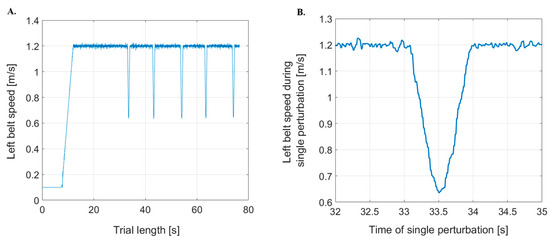
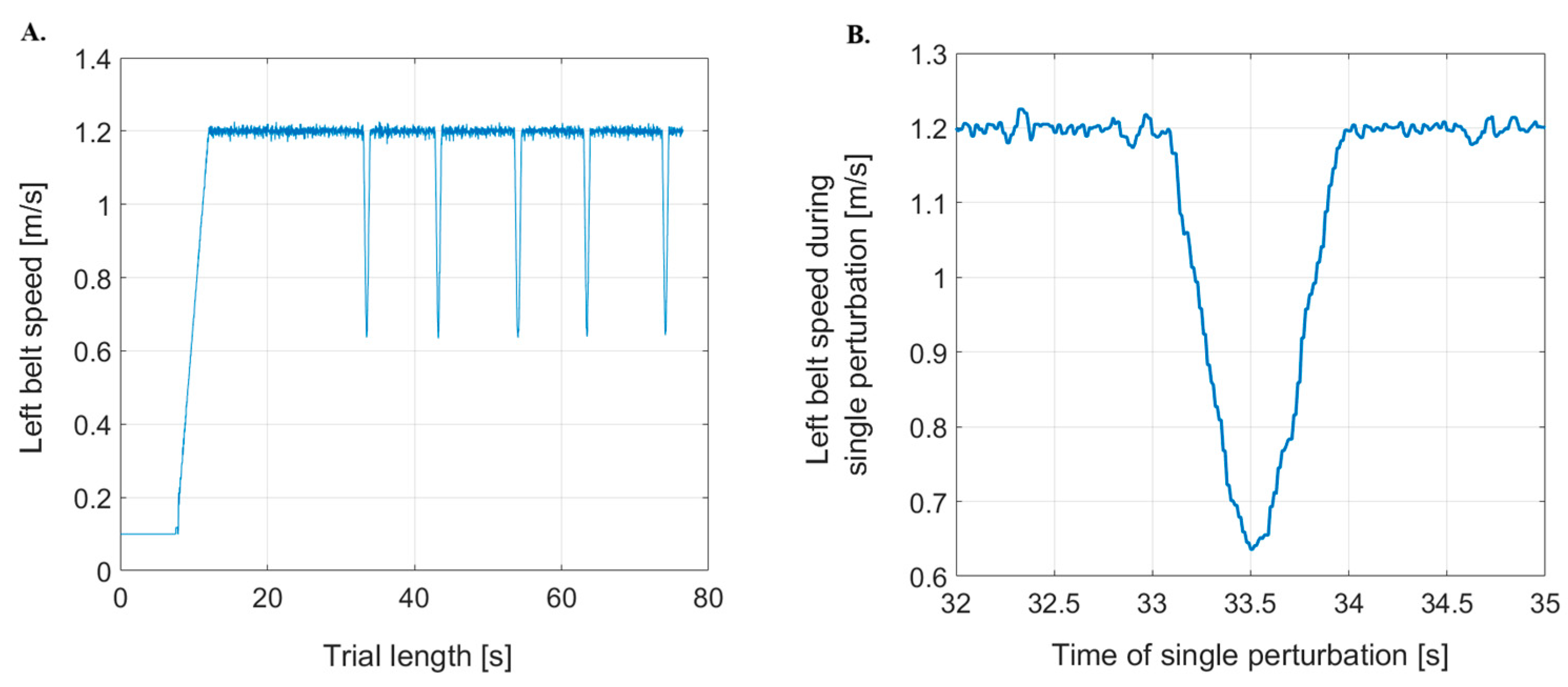
Each perturbation consisted of a sudden reduction in left-belt speed of approximately 0.5–0.6 m·s−1, which was maintained for approximately 0.82 s before the belt returned to the baseline walking speed (Figure 1).
Figure 1.
Graphical representation of changes in the treadmill’s left belt speed: (A) during the length of one trial; (B) during the first perturbation [21].
2.3. Data Processing and Statistical Analysis
Marker trajectory and ground reaction force data were automatically filtered during acquisition using D-Flow software (v.3.26, Motek Medical BV, Amsterdam, The Netherlands). In the first stage of data processing, gait cycles containing perturbations of the perturbed (left) limb were identified using a threshold-based algorithm based on ground reaction force data [23]. For each participant, the five gait cycles corresponding to the five perturbation events (P1–P5) were extracted for further analysis. Because the perturbation was applied exclusively to the left treadmill belt, subsequent biomechanical analyses were intentionally restricted to the perturbed limb in order to characterize the primary biomechanical responses to the perturbation. Accordingly, the present study was not designed to quantify bilateral gait symmetry or interlimb coordination, but rather to characterize the primary biomechanical responses of the perturbed limb.
Subsequently, all identified gait cycles were time-normalized to 100% of the gait cycle using MATLAB’s resample function, which performs sample-rate conversion through polyphase FIR filtering and interpolation. This enabled direct comparisons between perturbation trials and across participants. All data processing procedures, including gait cycle detection, time normalization, and parameter extraction, were performed in MATLAB R2021a (MathWorks Inc., Natick, MA, USA), ensuring consistency and reproducibility of the computational workflow.
For each normalized gait cycle, kinematic variables consisting of sagittal-plane joint angles of the ankle, knee, and hip, as well as kinetic variables including joint torques at the ankle, knee, and hip, and the anterior–posterior (AP), mediolateral (ML), and vertical (v) components of the ground reaction force (GRF), were analyzed. For each variable and perturbation trial, the minimum (MIN) and maximum (MAX) values were identified. To quantify the magnitude of the biomechanical response, an amplitude measure was calculated as the absolute difference between the maximum and minimum values:
Amplitude = |Max − Min|
The amplitude values obtained for each participant across the five perturbation conditions (P1–P5) were subsequently used for statistical analyses.
The normality of data distribution was assessed using the Shapiro–Wilk test. As the majority of variables violated the assumption of normality, differences between perturbation conditions were evaluated using Friedman’s repeated-measures analysis of variance by ranks (Friedman ANOVA). When a significant main effect was detected, post hoc pairwise comparisons were performed using the Wilcoxon signed-rank test. To control for Type I errors associated with multiple comparisons, the Bonferroni correction was applied. Since five perturbation conditions were compared, ten pairwise comparisons were conducted, resulting in an adjusted significance threshold of p < 0.005.
Descriptive statistics are presented as median values with interquartile ranges (Q1–Q3). Inferential statistics are reported as χ2 values, p-values, and Kendall’s coefficient of concordance (W) as a measure of effect size. Effect sizes were interpreted according to the thresholds proposed by Ortloff et al. [24]: W = 0.08–0.19, small effect; W = 0.20–0.50, moderate effect; and W ≥ 0.51, large effect. All statistical analyses were performed using Statistica 13.3 (TIBCO Software Inc., Palo Alto, CA, USA). The nominal level of statistical significance was set at p < 0.05.
3. Results
3.1. Overall Effects of Repeated Perturbations
Descriptive statistics and results of the Friedman ANOVA are presented in Table 1. Significant effects of perturbation number were observed for hip joint angle amplitude (χ2(4) = 17.07, p = 0.0019, W = 0.203), ankle joint torque amplitude (χ2(4) = 29.71, p < 0.001, W = 0.354), anterior–posterior ground reaction force amplitude (AP GRF; χ2(4) = 40.84, p < 0.001, W = 0.486), and vertical ground reaction force amplitude (vGRF; χ2(4) = 12.00, p = 0.017, W = 0.143).
Table 1.
Median (Q1–Q3) amplitudes of lower-limb joint angles, torques and ground reaction forces during five consecutive perturbations (P1–P5). Differences between perturbation conditions were assessed using Friedman ANOVA followed by Wilcoxon signed-rank tests with Bonferroni correction. Significant pairwise comparisons are reported after Bonferroni correction (adjusted α = 0.005).
No significant effects of perturbation number were found for knee joint angle amplitude, ankle joint angle amplitude, hip joint torque amplitude, knee joint torque amplitude, or mediolateral ground reaction force amplitude (all p > 0.05).
3.2. Kinematic Responses
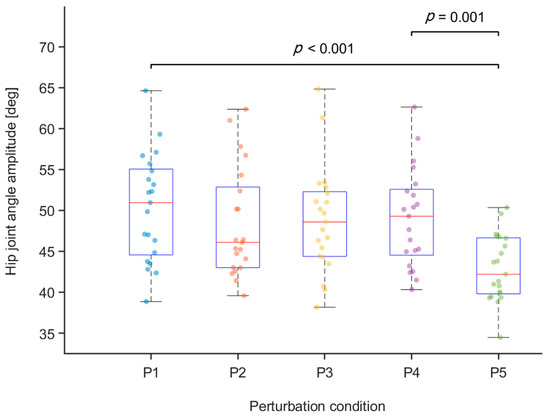
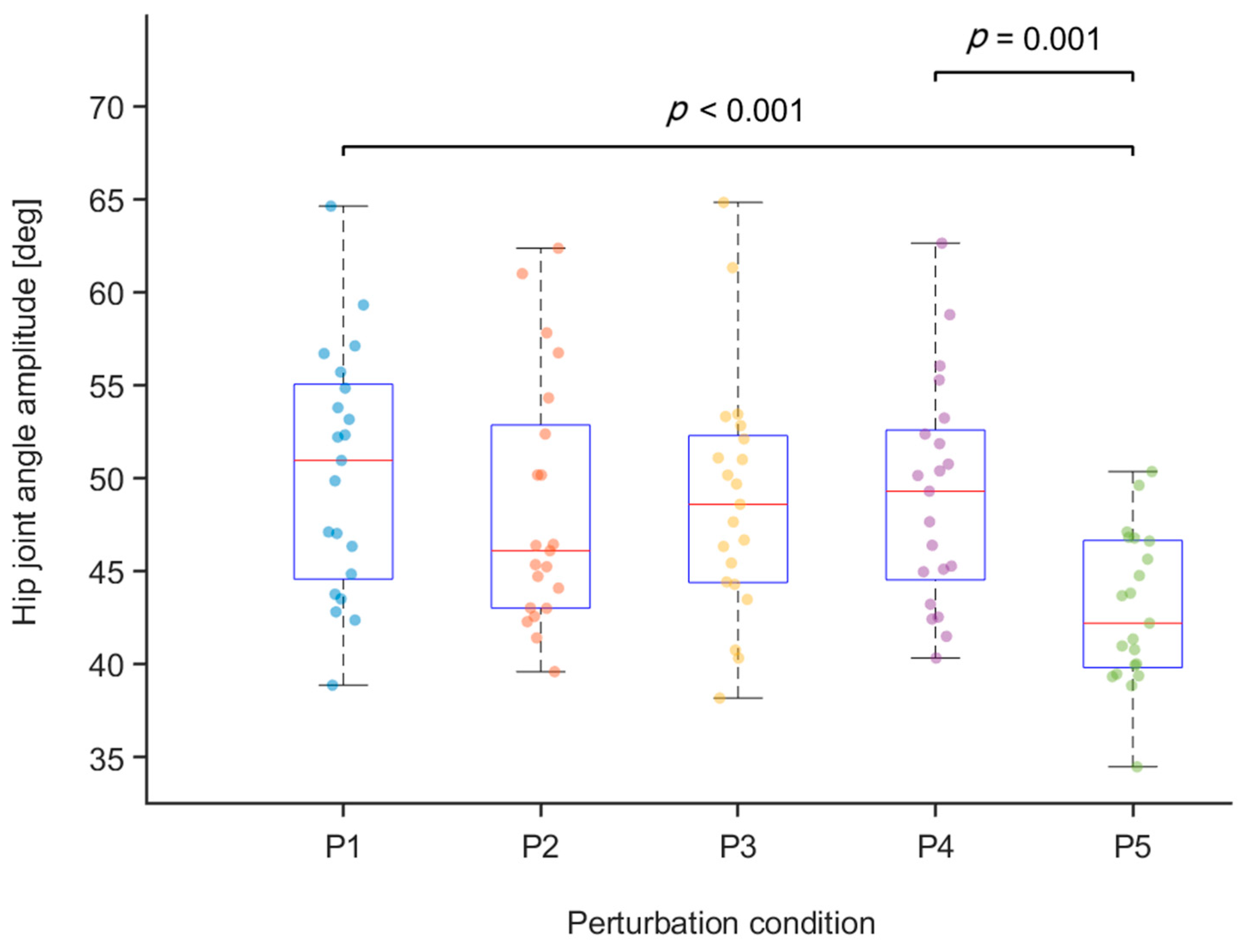
Among the analyzed kinematic variables, only hip joint angle amplitude was significantly affected by perturbation number (Table 1). Post hoc analysis revealed lower amplitudes during the fifth perturbation compared with both the first (p < 0.001) and fourth perturbation (p = 0.001). The median amplitude decreased from 50.95° during P1 to 42.20° during P5 (Figure 2).
Figure 2.
Boxplots of hip joint angle amplitude across five consecutive perturbations (P1–P5). Horizontal lines within boxes indicate median values, boxes represent interquartile ranges, and whiskers denote minimum and maximum values. Individual dots represent participant data. Significant pairwise differences after Bonferroni correction are indicated by brackets and corresponding p-values.
Neither knee joint angle amplitude nor ankle joint angle amplitude demonstrated significant changes across perturbation conditions (Table 1).
3.3. Kinetic Responses
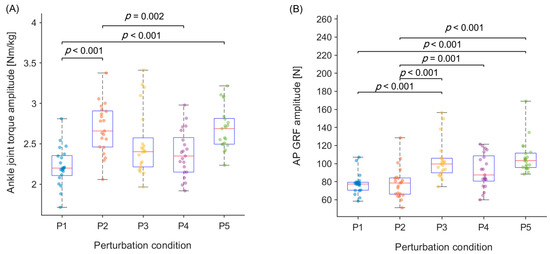
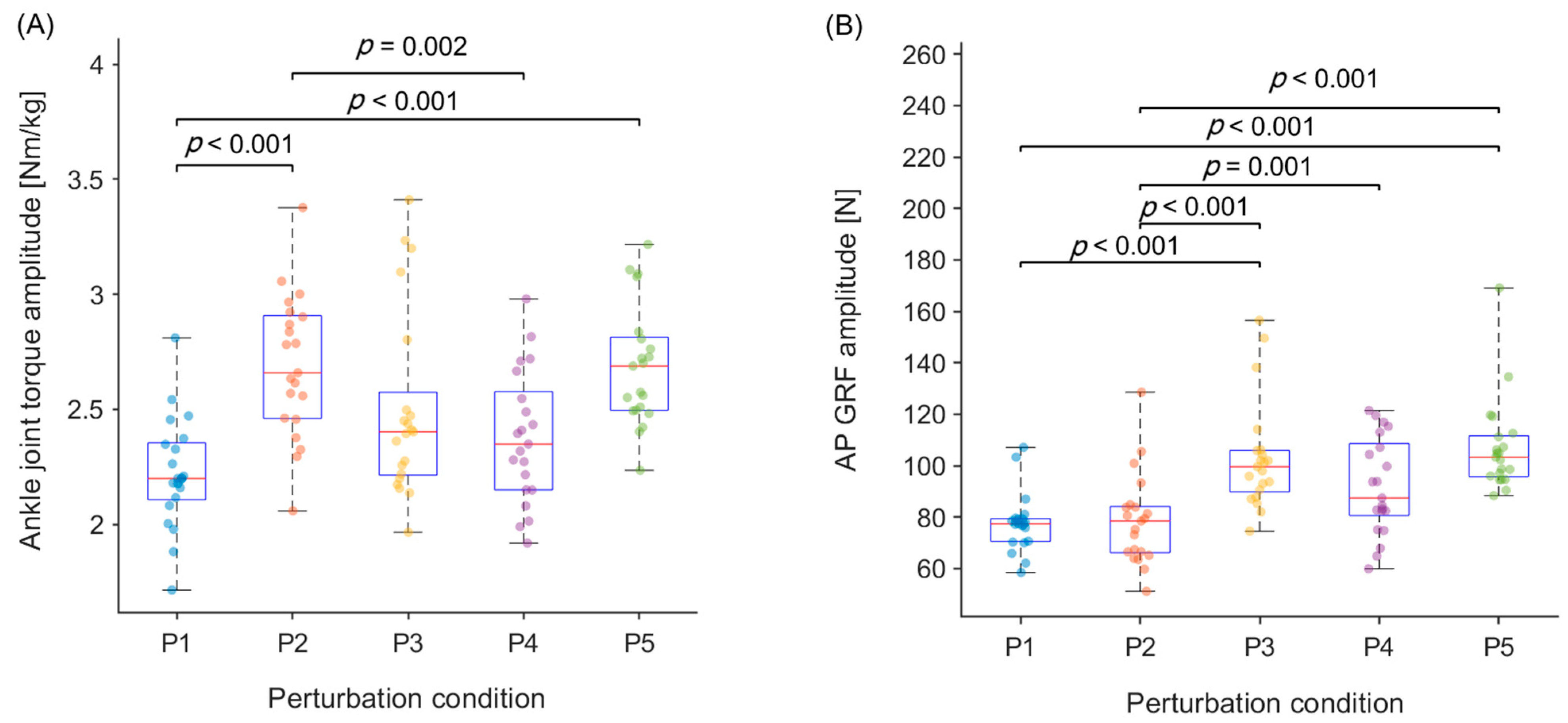
Significant perturbation-related changes were observed for ankle joint torque amplitude and AP GRF amplitude (Table 1). Ankle joint torque amplitude increased significantly between P1 and P2 (p < 0.001), between P1 and P5 (p < 0.001), and differed between P2 and P4 (p = 0.002). Median values increased from 2.20 Nm/kg during P1 to 2.69 Nm/kg during P5 (Figure 3A).
Figure 3.
Boxplots of ankle joint torque amplitude (A) and AP GRF amplitude (B) across five consecutive perturbations. Horizontal lines indicate median values, boxes represent interquartile ranges, and whiskers denote minimum and maximum values. Significant pairwise differences identified by Wilcoxon signed-rank tests with Bonferroni correction are indicated.
The strongest effect of perturbation number was observed for AP GRF amplitude (W = 0.486). Significant pairwise differences were identified between P1 and P3, P1 and P5, P2 and P3, P2 and P4, and P2 and P5 (all p ≤ 0.001). Median AP GRF amplitudes increased from 77.38 N during P1 to 103.32 N during P5 (Figure 3B).
Although Friedman ANOVA revealed a significant effect for vGRF amplitude, only one pairwise comparison (P2 vs. P3) remained significant after Bonferroni correction. No significant effects were observed for hip joint torque, knee joint torque, or ML GRF amplitudes.
4. Discussion
The present study investigated whether repeated treadmill-induced perturbations applied during the pre-swing phase of gait would induce progressive changes in lower-limb kinematics, joint torques, and ground reaction forces. Consistent with the proposed hypothesis, repeated perturbations resulted in significant modifications only in selected biomechanical variables. In the present study, the term “reactive gait control” refers specifically to the biomechanical manifestations of reactive locomotor responses rather than to direct neural control mechanisms. Significant effects were observed for hip joint angle amplitude, ankle joint torque amplitude, and anterior–posterior ground reaction force (AP GRF) amplitude, whereas most remaining kinematic and kinetic variables remained unchanged across perturbation conditions. Although a significant overall effect was also detected for vertical GRF amplitude, only one pairwise comparison remained significant following correction for multiple testing. Collectively, these findings support the concept that repeated perturbations induce selective reorganization of reactive gait control rather than generalized habituation of biomechanical responses.
The present findings may be interpreted within the theoretical framework of locomotor symmetry rather than as direct evidence of biomechanical symmetry. Since symmetry was not directly quantified using conventional symmetry indices, our interpretation focuses on the preservation of coordinated locomotor organization despite localized adaptive changes induced by unilateral perturbations. Although repeated exposure did not produce widespread modifications across all analyzed variables, adaptive changes were confined to selected biomechanical parameters. This pattern is consistent with the concept that the locomotor control system primarily modifies those mechanisms most directly involved in balance recovery while preserving coordinated gait organization.
Contrary to the concept of progressive habituation [3], repeated perturbations in the present study did not lead to a uniform reduction in the magnitude of biomechanical responses. Significant changes were observed only in selected variables, whereas the majority of kinematic and kinetic parameters remained relatively stable across perturbation conditions. Similar observations have been reported in previous studies demonstrating that improvements in perturbation recovery are often achieved through task-specific modifications of selected movement strategies rather than global changes throughout the locomotor system [13,25,26]. From a motor control perspective, such adaptations may reflect optimization of those biomechanical components that contribute most effectively to maintaining dynamic stability while minimizing unnecessary alterations in other aspects of gait [27]. Accordingly, the present findings indicate that adaptation to repeated perturbations was confined to a limited set of biomechanical variables, suggesting optimization of the mechanisms most directly involved in balance recovery while preserving the overall organization of locomotion. Such rapid adjustments in motor responses likely reflect efficient sensorimotor processing and reaction capabilities, which have previously been associated with superior motor performance outcomes [28].
The most pronounced adaptations were observed in ankle joint torque amplitude and AP GRF amplitude. In particular, AP GRF demonstrated the largest effect size among all analyzed variables, indicating substantial changes in braking and propulsive force regulation during repeated perturbations. The increase in ankle torque amplitude may indicate a greater contribution of distal control mechanisms during perturbation recovery. Because the ankle joint is the first segment directly involved in regulating forces transmitted between the body and the support surface, altered ankle torque generation may provide an efficient means of counteracting perturbation-induced instability. Similarly, the observed changes in AP GRF likely reflect adjustments in force application strategies developed through repeated exposure to the perturbation. These adaptations may enhance the ability to regulate whole-body momentum and maintain forward progression following unexpected disturbances. This interpretation is consistent with previous studies highlighting the importance of ankle control and ground reaction force modulation in maintaining dynamic stability during perturbed walking [6,29]. Specifically, the observed adaptation of ankle torque generation and anterior–posterior ground reaction forces may represent useful biomechanical markers for evaluating early reactive adaptation during perturbation-based gait assessment and training protocols.
Among the analyzed kinematic variables, only hip joint angle amplitude exhibited significant perturbation-related changes. Hip angle amplitude decreased during later perturbations and reached its lowest values during the final perturbation. Although the magnitude of this change was moderate, it may indicate refinement of the recovery strategy following repeated exposure to perturbations. Reduced hip motion could reflect more efficient control of proximal body segments, limiting excessive compensatory movements while preserving stability and forward progression. Such an interpretation is consistent with the notion that locomotor adaptation involves exploration and optimization of movement patterns rather than simple suppression of reactive responses [30]. Interestingly, no significant changes were observed in knee or ankle joint angle amplitudes, suggesting that kinematic adaptations were localized and did not involve a global restructuring of lower-limb movement patterns.
The preservation of most kinematic and kinetic variables despite repeated perturbations suggests that reactive adaptation is constrained by an underlying tendency to maintain coordinated locomotor organization. Rather than globally reorganizing movement patterns, the central nervous system appears to optimize only those biomechanical components necessary for restoring stability. This interpretation should be understood within the conceptual framework of locomotor symmetry and not as direct evidence of preserved biomechanical symmetry.
Although Friedman ANOVA revealed a significant overall effect for vertical GRF amplitude, post hoc analyses identified only a single significant pairwise comparison after Bonferroni correction. This finding suggests that vertical loading responses may exhibit some sensitivity to repeated perturbations; however, the pattern of adaptation appears less robust and less systematic than that observed for ankle torques and AP GRF. Consequently, vertical force regulation may play a secondary role in the early adaptive responses observed in the present study.
From a practical perspective, the observed selective adaptations suggest that early responses to repeated perturbations primarily involve distal joint mechanics and anterior–posterior force regulation. These findings may be relevant for the design of perturbation-based balance assessment and rehabilitation protocols, where repeated exposure could be used to target specific reactive control mechanisms. However, additional studies are required to determine whether similar adaptation patterns occur following longer perturbation protocols and in populations with impaired balance control.
Finally, several limitations should be considered when interpreting the present findings. First, the study included only healthy young women, which limits the generalizability of the findings to other populations. Second, only five perturbations were analyzed. The aim of the present study was to characterize the initial biomechanical responses to repeated perturbations rather than long-term locomotor adaptation or motor learning. Therefore, the observed changes should be interpreted as early adaptive responses. Third, the biomechanical response was quantified using the MAX–MIN amplitude, providing a measure of the overall response magnitude but not distinguishing whether the observed changes resulted primarily from alterations in peak or minimum values. Moreover, this approach did not account for temporal changes occurring throughout the gait cycle. Future studies should therefore analyze peak and minimum values separately together with the temporal characteristics of the biomechanical responses. Fourth, only the perturbed limb was analyzed because the aim of the present study was to characterize the primary biomechanical responses of the limb directly exposed to the unilateral perturbation. Consequently, bilateral coordination and gait symmetry were not directly quantified using symmetry indices. Future studies should include analyses of both lower limbs together with appropriate symmetry indices to determine whether repeated unilateral perturbations modify interlimb coordination and locomotor symmetry. Finally, although the repeated-measures design reduced the influence of inter-individual variability by treating each participant as her own control, future studies should investigate whether anthropometric characteristics, habitual physical activity, or other individual factors influence adaptive responses to repeated perturbations. Larger cohorts including both sexes, older adults, and clinical populations should also be investigated to determine the generalizability of the present findings. Moreover, studies incorporating a greater number of perturbations and follow-up retention sessions would help determine whether the observed early adaptive responses evolve into long-term locomotor learning and whether the overall functional organization of locomotor control is preserved over prolonged exposure.
5. Conclusions
In healthy young women, repeated treadmill-induced perturbations applied during the pre-swing phase of gait produced specific early adaptations in reactive locomotor control rather than generalized adaptations across biomechanical variables. Significant changes were observed only in hip joint angle amplitude, ankle joint torque amplitude, and anterior–posterior ground reaction force amplitude, whereas most analyzed variables remained unchanged across repeated perturbations. The preservation of most biomechanical variables is consistent with the concept that adaptive responses preserve overall locomotor control despite repeated unilateral perturbations. Although symmetry was not directly measured, the observed pattern of selective adaptation is consistent with the concept that the central nervous system preserves the coordinated functional organization of gait by modifying only those biomechanical mechanisms that are essential for balance recovery. These findings may provide a basis for future perturbation-based gait assessment and training studies; however, their clinical relevance requires confirmation in larger and more diverse populations.
Author Contributions
Conceptualization, R.B. and M.B.; methodology, R.B. and M.B.; software, R.B. and M.B.; validation, R.B. and M.B.; formal analysis, R.B. and M.B.; investigation, R.B. and M.B.; resources, R.B. and M.B.; data curation, R.B. and M.B.; writing—original draft preparation, R.B. and M.B.; writing—review and editing, R.B. and M.B.; visualization, R.B. and M.B.; supervision, M.B.; project administration, R.B. and M.B.; funding acquisition, M.B. All authors have read and agreed to the published version of the manuscript.
Funding
This research received no external funding.
Institutional Review Board Statement
The study was conducted in accordance with the Declaration of Helsinki and approved by the Institutional Ethics Committee of Józef Piłsudski University of Physical Education in Warsaw (protocol code: SKE01-15/2023; date of approval: 24 March 2023).
Informed Consent Statement
Informed consent for participation was obtained from all subjects involved in the study.
Data Availability Statement
The measurement data used to support the findings of this study are available from the corresponding author upon request.
Acknowledgments
During the preparation of this manuscript/study, the authors used ChatGPT (OpenAI, GPT-5.5) for the purposes of language editing, text drafting, and improving clarity and readability of the manuscript. The authors have reviewed and edited the output and take full responsibility for the content of this publication.
Conflicts of Interest
The authors declare no conflicts of interest.
References
- Winter, D.A. Human balance and posture control during standing and walking. Gait Posture 1995, 3, 193–214. [Google Scholar] [CrossRef] [Scilit]
- Xu, D.; Zhou, H.; Quan, W.; Jiang, X.; Liang, M.; Li, S.; Ugbolue, U.C.; Baker, J.S.; Gusztav, F.; Ma, X.; et al. A new method proposed for realizing human gait pattern recognition: Inspirations for the application of sports and clinical gait analysis. Gait Posture 2024, 107, 293–305. [Google Scholar] [CrossRef] [Scilit] [PubMed]
- McCrum, C.; Karamanidis, K.; Willems, P.; Zijlstra, W.; Meijer, K. Retention, savings and interlimb transfer of reactive gait adaptations in humans following unexpected perturbations. Commun. Biol. 2018, 1, 230. [Google Scholar] [CrossRef] [Scilit] [PubMed]
- Čuj, J.; Gajdoš, M.; Nechvátal, P.; Grus, C.; Macej, M.; Kendrová, L. Changes in muscle activity of selected muscles during walking in high-heeled shoes on a treadmill. Phys. Act. Rev. 2025, 13, 14–25. [Google Scholar] [CrossRef] [Scilit]
- Ferreira, R.N.; Ribeiro, N.F.; Figueiredo, J.; Santos, C.P. Provoking Artificial Slips and Trips towards Perturbation-Based Balance Training: A Narrative Review. Sensors 2022, 22, 9254. [Google Scholar] [CrossRef] [Scilit] [PubMed]
- Reimann, H.; Fettrow, T.; Thompson, E.D.; Jeka, J.J. Neural Control of Balance During Walking. Front. Physiol. 2018, 9, 1271. [Google Scholar] [CrossRef] [Scilit] [PubMed]
- Mansfield, A.; Wong, J.S.; Bryce, J.; Knorr, S.; Patterson, K.K. Does perturbation-based balance training prevent falls? Systematic review and meta-analysis of preliminary randomized controlled trials. Phys. Ther. 2015, 95, 700–709. [Google Scholar] [CrossRef] [Scilit] [PubMed]
- Okubo, Y.; Brodie, M.A.; Sturnieks, D.L.; Hicks, C.; Lord, S.R. A pilot study of reactive balance training using trips and slips with increasing unpredictability in young and older adults: Biomechanical mechanisms, falls and clinical feasibility. Clin. Biomech. 2019, 67, 171–179. [Google Scholar] [CrossRef] [Scilit] [PubMed]
- Gerards, M.; Marcellis, R.; Senden, R.; Poeze, M.; de Bie, R.; Meijer, K.; Lenssen, A. The effect of perturbation-based balance training on balance control and fear of falling in older adults: A single-blind randomised controlled trial. BMC Geriatr. 2023, 23, 305. [Google Scholar] [CrossRef] [Scilit] [PubMed]
- Hadamus, A.; Gulatowska, M.; Ferenc, A.; Shahnazaryan, K.; Brzuszkiewicz-Kuźmicka, G.; Błażkiewicz, M. Influence of leg dominance on the symmetry in body balance measurements. Phys. Act. Rev. 2025, 13, 88–96. [Google Scholar] [CrossRef] [Scilit]
- Chodkowska, K.; Borkowski, R.; Błażkiewicz, M. Perturbations During Gait on a Split-Belt Treadmill: A Scoping Review. Appl. Sci. 2024, 14, 9852. [Google Scholar] [CrossRef] [Scilit]
- Debelle, H.; Maganaris, C.N.; O’Brien, T.D. Biomechanical Mechanisms of Improved Balance Recovery to Repeated Backward Slips Simulated by Treadmill Belt Accelerations in Young and Older Adults. Front. Sports Act. Living 2021, 3, 708929. [Google Scholar] [CrossRef] [Scilit] [PubMed]
- Debelle, H.; Harkness-Armstrong, C.; Hadwin, K.; Maganaris, C.N.; O’Brien, T.D. Recovery From a Forward Falling Slip: Measurement of Dynamic Stability and Strength Requirements Using a Split-Belt Instrumented Treadmill. Front. Sports Act. Living 2020, 2, 82. [Google Scholar] [CrossRef] [Scilit] [PubMed]
- Taylor, Z.; Walsh, G.S.; Hawkins, H.; Inacio, M.; Esser, P. Perturbations during Gait: A Systematic Review of Methodologies and Outcomes. Sensors 2022, 22, 5927. [Google Scholar] [CrossRef] [Scilit] [PubMed]
- Dusane, S.; Bhatt, T. Can prior exposure to repeated non-paretic slips improve reactive responses on novel paretic slips among people with chronic stroke? Exp. Brain Res. 2022, 240, 1069–1080. [Google Scholar] [CrossRef] [Scilit] [PubMed]
- Kao, P.-C.; Pierro, M.A. Motor adaptation to cognitive challenges and walking perturbations in healthy young adults. Gait Posture 2022, 92, 167–175. [Google Scholar] [CrossRef] [Scilit] [PubMed]
- Wang, S.; Pai, Y.C.; Bhatt, T. Neuromuscular mechanisms of motor adaptation to repeated gait-slip perturbations in older adults. Sci. Rep. 2022, 12, 19851. [Google Scholar] [CrossRef] [Scilit] [PubMed]
- Faul, F.; Erdfelder, E.; Lang, A.G.; Buchner, A. G*Power 3: A flexible statistical power analysis program for the social, behavioral, and biomedical sciences. Behav. Res. Methods 2007, 39, 175–191. [Google Scholar] [CrossRef] [Scilit] [PubMed]
- Chodkowska, K.; Błażkiewicz, M.; Kędziorek, J.; Ortenburger, D.; Wąsik, J. How Does Induced Deceleration of One Treadmill’s Belt in the Pre-Swing Gait Phase Change Gait Pattern? Appl. Sci. 2024, 14, 11456. [Google Scholar] [CrossRef] [Scilit]
- van Melick, N.; Meddeler, B.M.; Hoogeboom, T.J.; Nijhuis-van der Sanden, M.W.G.; van Cingel, R.E.H. How to determine leg dominance: The agreement between self-reported and observed performance in healthy adults. PLoS ONE 2017, 12, e0189876. [Google Scholar] [CrossRef] [Scilit] [PubMed]
- Borkowski, R.; Błażkiewicz, M. Reactive Muscle Force Modulation Following Induced Belt Deceleration in Treadmill Gait. Phys. Act. Rev. 2026, 14, 90–102. [Google Scholar] [CrossRef] [Scilit]
- Perry, J.; Burnfield, J.M. Gait Analysis: Normal and Pathological Function, 2nd ed.; Slack: Thorofare, NJ, USA, 2010. [Google Scholar]
- Feldhege, F.; Richter, K.; Bruhn, S.; Fischer, D.C.; Mittlmeier, T. MATLAB-based tools for automated processing of motion tracking data provided by the GRAIL. Gait Posture 2021, 90, 422–426. [Google Scholar] [CrossRef] [Scilit] [PubMed]
- Ortloff, A.-M.; Martius, F.; Meier, M.; Raimbault, T.; Geierhaas, L.; Smith, M. Small, Medium, Large? A Meta-Study of Effect Sizes at CHI to Aid Interpretation of Effect Sizes and Power Calculation. In Proceedings of the 2025 CHI Conference on Human Factors in Computing Systems, Yokohama, Japan, 26 April–1 May 2025; p. 483. [Google Scholar]
- Lee, B.C.; Kim, C.S.; Seo, K.H. The Body’s Compensatory Responses to Unpredictable Trip and Slip Perturbations Induced by a Programmable Split-Belt Treadmill. In IEEE Transactions on Neural Systems and Rehabilitation Engineering; IEEE: Piscataway, NJ, USA, 2019; Volume 27, pp. 1389–1396. [Google Scholar] [CrossRef] [Scilit] [PubMed]
- Hirata, K.; Kokubun, T.; Taku, M.; Hanawa, H.; Kubota, K.; Yokoyama, M.; Fujino, T.; Kanemura, N. Relationship Between the Walking Velocity Relative to the Slip Velocity and the Corrective Response. J. Med. Biol. Eng. 2020, 41, 25–33. [Google Scholar] [CrossRef] [Scilit]
- Wolpert, D.M.; Miall, R.C. Forward Models for Physiological Motor Control. Neural Netw. Off. J. Int. Neural Netw. Soc. 1996, 9, 1265–1279. [Google Scholar] [CrossRef] [Scilit] [PubMed]
- Berdowska, A.; Dusiński, D.; Bandurska, K.; Tsos, A. Effort and reaction time in weightlifters, manual workers, and students—A pilot study. Phys. Act. Rev. 2025, 13, 97–105. [Google Scholar] [CrossRef] [Scilit]
- Vlutters, M.; van Asseldonk, E.H.; van der Kooij, H. Center of mass velocity-based predictions in balance recovery following pelvis perturbations during human walking. J. Exp. Biol. 2016, 219, 1514–1523. [Google Scholar] [CrossRef] [Scilit] [PubMed]
- Davids, K.; Glazier, P.; Araújo, D.; Bartlett, R. Movement systems as dynamical systems: The functional role of variability and its implications for sports medicine. Sports Med. 2003, 33, 245–260. [Google Scholar] [CrossRef] [Scilit] [PubMed]

Disclaimer/Publisher’s Note: The statements, opinions and data contained in all publications are solely those of the individual author(s) and contributor(s) and not of MDPI and/or the editor(s). MDPI and/or the editor(s) disclaim responsibility for any injury to people or property resulting from any ideas, methods, instructions or products referred to in the content. |
© 2026 by the authors. Licensee MDPI, Basel, Switzerland. This article is an open access article distributed under the terms and conditions of the Creative Commons Attribution (CC BY) license.