


Abstract
As image data are shared ever more openly, they increasingly leak privacy-sensitive information, yet existing detectors seldom model how the text embedded in an image relates to its visual content and tend to fail precisely when the two modalities disagree. We note that the conventional softmax attention used for multimodal fusion carries an implicit sign symmetry: Every source token contributes only additively, so conflicting evidence is averaged away rather than resolved. We propose a symmetric dual-source fusion framework whose decoder deliberately breaks this sign symmetry. Image and text are first encoded by a Swin Transformer and a policy knowledge-enhanced BERT (KL-BERT) and projected into a common space to form a permutation-symmetric dual-source memory. A Signed Cross-attention Auto-compressing Decoder (SCAD) then fuses the two sources through an attention map that factorizes into a sign-symmetric (even) magnitude term and a sign-antisymmetric (odd) polarity term, allowing the model to either reinforce or actively subtract cross-modal evidence. Experiments on a self-constructed privacy-sensitive image dataset show that the proposed method attains an accuracy of and an F1-score of , with its largest gains on the face category, the most conflict-prone class in our data, suggesting that controlled symmetry breaking is an effective principle for cross-modal fusion.
1. Introduction
The internet has transformed how information circulates, and what now travels across networks is no longer text alone but images in enormous variety. Once such images are shared or released openly, they frequently expose privacy-sensitive material (names, dates of birth, identity-card numbers, home addresses, telephone numbers, faces, and credentials), and the resulting attack surface keeps widening. In response, governments have rolled out a succession of data-security laws, regulations, and technical standards that spell out concrete protection requirements. Detecting sensitive information in images before they are shared has therefore become a pressing concern [1,2].
In practice, sensitive content usually travels as text and imagery together, so treating either carrier in isolation no longer meets real needs. The words embedded inside an image and the high-level meaning of its visual content tend to complement one another, and it is precisely their relationship that decides whether detection succeeds. This argues for a multimodal model that fuses the two streams. Any such fusion, however, runs into a structural question that is at bottom one of symmetry: How ought two heterogeneous sources be combined, and how should the model act when they agree as opposed to when they conflict?
We organize our treatment of this question around symmetry, which supplies the conceptual backbone of the paper. At the architectural level, a faithful multimodal model ought to handle its two sources symmetrically; the image and text encoders are mapped into a shared representation space and gathered into one memory bank, so that neither modality is favored by construction and the fusion does not depend on the order in which the sources are presented. A second, subtler symmetry lives in the fusion operator itself. The softmax attention at the heart of almost every modern fusion module forces each attention weight to be non-negative, so a source token can only ever add evidence to the prediction, a property we call the sign symmetry of attention. Under this constraint, when the visual and textual streams emit contradictory signals, the model can do no better than merely average them, which blends correct evidence with incorrect evidence and leaves the underlying conflict unresolved.
The central claim of this paper is that resolving cross-modal conflict calls for deliberately breaking that sign symmetry. We introduce a fusion decoder that permits negative attention weights, so a source token can subtract or suppress conflicting evidence instead of only reinforcing it. What makes this tractable is that the signed attention splits cleanly into two parts of opposite symmetry: a sign-symmetric (even) magnitude term governing how strongly a token participates, and a sign-antisymmetric (odd) polarity term governing whether it supports or opposes the prediction. This even–odd decomposition is, to our knowledge, a new lens on conflict-aware multimodal fusion, and it is the formal statement of the symmetry breaking. Recent work in language modeling points in the same direction: signed attention weights [3] and differential attention [4] both report that relaxing the non-negativity constraint improves expressiveness. Both operate within a single sequence, however, whereas the conflict we target arises between two heterogeneous sources.
Concretely, we extract image features with a Swin Transformer (SWT) and text features (recovered from the image by OCR) with a policy knowledge-enhanced BERT, denoted KL-BERT. The two encoders are projected to a common dimension and concatenated into a symmetric dual-source memory. A Signed Cross-attention Auto-compressing Decoder (SCAD) then performs the symmetry-breaking fusion through a cross-depth query composer, the signed dual-source cross-attention described above, and an auto-compressing read-out that aggregates evidence from all decoder layers. The main contributions of this paper are as follows:
- We identify a sign symmetry in the softmax attention used for multimodal fusion: because every attention weight is non-negative, agreeing and conflicting evidence can only be averaged, never subtracted, which is why the fusion breaks down when the two modalities disagree. We recast conflict-aware fusion as a problem of controlled symmetry breaking.
- We propose the SCAD decoder, whose signed cross-attention factorizes each attention weight into a sign-symmetric (even) magnitude and a sign-antisymmetric (odd) polarity, so the model can either reinforce or actively suppress cross-modal evidence while operating on a permutation-symmetric dual-source memory that treats the two modalities on an equal footing.
- We build KL-BERT, a Chinese BERT continue-pretrained on a curated corpus of data-security policies and regulations, which gives the text branch a vocabulary adapted to the sensitivity domain.
- We construct a privacy-sensitive image dataset and, through a component ablation, a direct comparison against standard softmax cross-attention under identical encoders, and a decoder-depth study, show that the signed formulation is what drives the improvement, and that its gains are largest precisely where the two modalities most often disagree.
The remainder of this paper is organized as follows: Section 2 reviews related work. Section 3 presents the symmetric dual-source framework, the SCAD decoder, and a symmetry analysis of the signed attention. Section 4 reports the experimental results, Section 5 discusses where the gains originate together with the computational cost and limitations, and Section 6 concludes.
2. Related Work
Early sensitive-information detection methods were mainly based on Chinese sensitive-word recognition. Commonly used algorithms include single-pattern matching, such as the Knuth–Morris–Pratt algorithm [5], and multi-pattern matching, such as the Aho–Corasick automaton [6], which determine the presence of sensitive information by comparing the text with a sensitive-word lexicon. Xu et al. [7] proposed the SW-LDA model, a sensitive-word weighted LDA for topic recognition of network sensitive information. Zhou et al. [1] studied the improvement of mass multimedia information filtering under multi-data-inflow conditions. Ding et al. [2] proposed a BERT-based automatic sensitive-information detection method trained on a Chinese corpus. Liu et al. [8] proposed a graph-convolutional-network-based sensitive-information detection algorithm. Zhang et al. [9] proposed a dual-channel semantic enhancement-based convolutional neural network for text classification. Zhang et al. [10] proposed a character-level convolutional network for text classification. These methods improve the efficiency and accuracy of sensitive-word detection, but simple sensitive-word matching can no longer satisfy the requirements of network security, and newly emerging sensitive content requires other detection methods.
With the development of computer vision, the detection of sensitive content has expanded from the text domain to the image domain. Convolutional neural networks (CNNs) [11] are trained on large amounts of data to exploit the input features, and architectures such as AlexNet [12], VGGNet [13], and ResNet [14] have driven the rapid development of deep learning in image classification. Guo et al. [15] proposed a multi-information detection model for violent images built on YOLOv3-SPP [16] and DenseNet [17]. Hu et al. [18] proposed squeeze-and-excitation networks that adaptively recalibrate channel-wise feature responses to strengthen representational power. Zhang et al. [19] proposed a deep relational reasoning graph network for arbitrary-shape text detection. Liao et al. [20] proposed TextBoxes++, a single-shot-oriented scene text detector in the SSD [21] family, often paired with lightweight backbones such as MobileNetV2 [22], and Zhang et al. [23] proposed S3FD, a single-shot scale-invariant face detector.
These approaches, however, either concentrate solely on sharpening image recognition or decide sensitivity purely from the text read off the image, and in doing so they overlook the deeper semantics that emerge when picture and text appear together, and above all what should happen when the two modalities disagree. Transformer-based fusion [24] together with vision transformers such as ViT [25] and the Swin Transformer [26] offer strong encoders, but the ordinary attention used to combine modalities inherits the non-negativity (the sign symmetry) examined in Section 3, and therefore cannot actively suppress contradictory evidence. Our signed cross-attention is related to, but distinct from, several existing attention variants. Gated attention rescales non-negative weights but never changes their sign; signed graph attention assigns polarity to fixed graph edges rather than to learned query–key interactions; and inhibitory or contrastive fusion schemes act on the training objective rather than on the attention operator itself. In contrast, SCAD produces the polarity per query–key pair at inference through an odd sign term, so a source token can be actively subtracted rather than merely down-weighted. The relationship between image and text information, and the principled handling of their disagreement, is the focus of this paper.
Since 2023 the vision–language literature has moved quickly, and two strands are directly relevant here. The first is large-scale vision–language pre-training. BLIP-2 [27] bridges frozen image encoders and large language models through a lightweight querying transformer; SigLIP [28] replaces the softmax contrastive objective of CLIP [29] with a pairwise sigmoid loss that scales more gracefully; and InternVL [30] scales the visual foundation model to billions of parameters and aligns it with an LLM for generic visual–linguistic tasks. Li and Tang [31] survey the alignment and fusion strategies these models rely on. These systems are optimized for open-ended captioning, retrieval, and instruction following rather than for fixed-label detection, and Baia et al. [32] report that on image-privacy classification specifically, zero-shot vision–language models do not uniformly outperform compact task-specialized detectors. This is why we retain a closed-label, task-adapted design and benchmark against the CLIP-style contrastive baseline, which is the member of this family that transfers directly to our label set.
The second strand concerns the attention operator itself, and it has converged on the same constraint we identify. Lv et al. [3] propose Cog Attention, which multiplies the sign of the query–key inner product by the softmax of its absolute value, and show for language modeling and diffusion that permitting negative weights raises expressiveness and mitigates representational collapse. Ye et al. [4] reach a related conclusion from a different direction with the Differential Transformer, which subtracts one softmax map from another so that shared attention noise cancels. We regard these results as independent evidence that the non-negativity of softmax attention is a genuine limitation rather than an incidental one. Our contribution is complementary and specific in three respects: The signed operator is applied across two heterogeneous sources over a permutation-symmetric dual-source memory rather than within one sequence; we give an explicit even–odd symmetry decomposition of the signed weight into a magnitude and a polarity term; and we tie the mechanism to a concrete failure mode, cross-modal conflict, and measure it directly by ablating the negative branch alone.
3. Materials and Methods
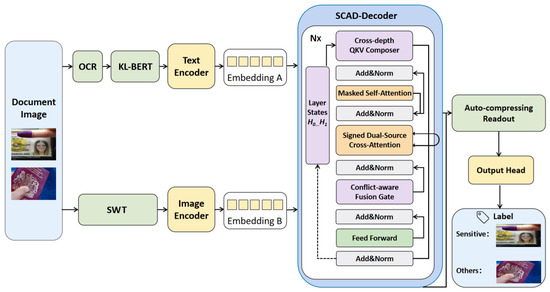
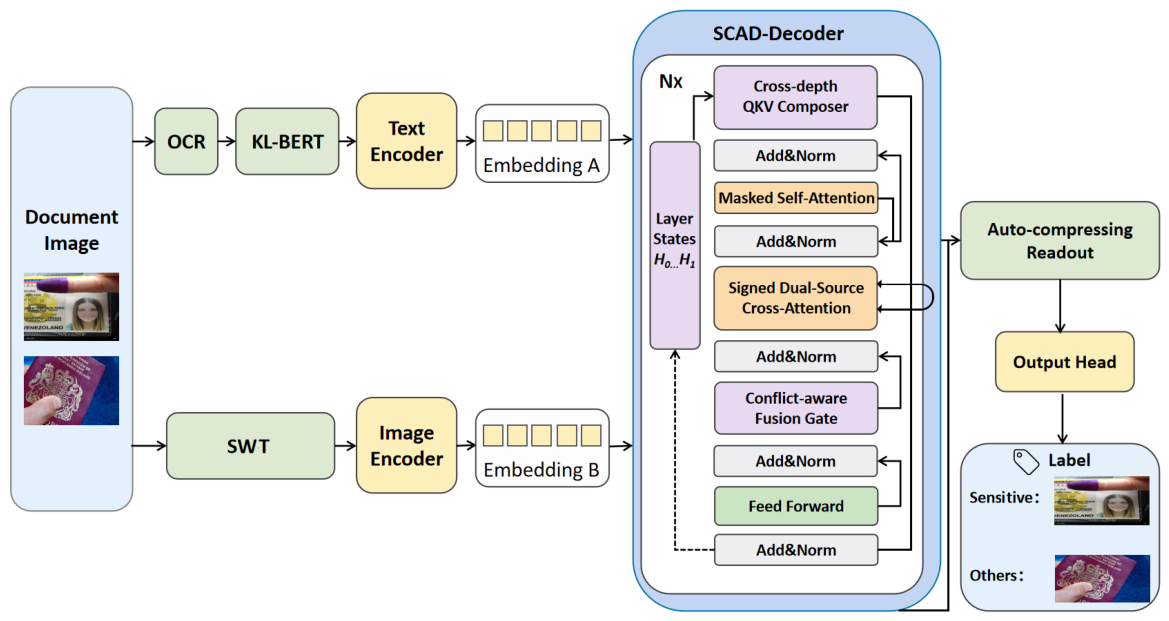
The overall pipeline of the proposed detector is shown in Figure 1, and the detailed architecture is shown in Figure 2. The text inside an image is first recovered by optical character recognition (OCR); the textual data are then processed by KL-BERT and the visual data by the Swin Transformer. The OCR step uses a standard scene text recognition engine applied to each image; because the quality of the recovered text bounds the text branch, we quantify the downstream effect of OCR through the “w/o OCR” ablation.
Figure 1.
General pipeline of image sensitive-information detection. Text is extracted from the image and processed by KL-BERT, while the image is processed by the Swin Transformer (SWT). The two outputs are combined in a symmetric fusion block and used by the classification module.
Figure 2.
Architecture of the proposed model; each module (OCR, the KL-BERT and Swin-Transformer encoders, the permutation-symmetric dual-source memory, and the SCAD decoder) is described in the main text of Section 3.
We specify the OCR stage precisely, since the recovered text bounds everything downstream. Detection and recognition are performed by the open-source PaddleOCR engine, a CRNN-style pipeline [33] run with its default Chinese model; each image is passed at its native resolution, the detected boxes are sorted in reading order, and the recognized strings are concatenated into a single sequence that is truncated to 128 WordPiece tokens. The corpus carries no ground-truth transcriptions, so we do not report an on-dataset recognition rate; what we characterize instead is where the engine fails and how the failures propagate. Errors concentrate on low-resolution screen photographs with moiré patterns, on strongly perspective-distorted identity documents, and on decorative or handwritten fonts, and they take two forms with different consequences: Missed text weakens the text branch and pushes the model toward its visual backbone, whereas hallucinated text, typically fragments read out of watermarks, background signage, or interface chrome, actively injects misleading evidence. The second failure mode is precisely the one the signed attention is designed to absorb, since a spurious token can be assigned a negative weight and subtracted rather than averaged in. The two encoder outputs are merged in the SCAD decoder, which integrates the features extracted from the two modalities, and the fused representation is used by the classification head to produce the prediction.
3.1. Symmetric Dual-Source Design
The framework is guided throughout by a single principle: the two modalities are handled symmetrically. A source-specific projection sends each encoder into a shared hidden space, a learnable source identifier is attached, and the two memories are then concatenated into one bank. The result is permutation-symmetric: exchanging the two sources along with their identifiers leaves both the fused memory and the prediction untouched. No modality is favoured in advance; whatever asymmetry ends up mattering is learned rather than wired in. The symmetry breaking that actually resolves conflict comes later and lives only inside the attention weights, as Section 3.4.4 explains.
3.2. Feature Extraction
3.2.1. Text Feature Extraction (KL-BERT)
Pre-trained language models such as BERT [34] do well on generic tasks, but the corpora they are built on look little like the data-security and policy setting, where normative phrases such as “involves personal information” or “sensitive field” recur constantly. To close this gap we continue pre-training a Chinese BERT with a policy knowledge objective. Our corpus gathers 52 policy and regulation documents spanning eight regulated industry sectors together with cross-sector general data-security policies, and nearly 4700 sensitive personal information text samples drawn from 52 typical application scenarios, which we denote . Two distinct collections of 52 items are involved. The 52 policy and regulation documents comprise the data security policies of eight regulated sectors, (i) government affairs, (ii) industry and information technology, (iii) telecommunications, (iv) finance, (v) transportation, (vi) energy, (vii) healthcare, and (viii) education, together with cross-sector data security policies that apply to all industries. The 52 typical application scenarios are the consumer- and service-facing settings in which personal information is produced, stored, or exchanged, and from which the sensitive-text samples were drawn: map navigation, ride-hailing, instant messaging, online communities, online payment, online shopping, food delivery, mail and express delivery, transport ticketing, matchmaking, job recruitment, online lending, housing rental and sale, used car trading, online medical registration, travel services, hotel services, online gaming, online education, local life services, women’s health, car services, investment and wealth management, mobile banking, e-mail and cloud storage, remote conferencing, live streaming, online video and music, short video, news and information, sports and fitness, web browsing, input methods, security management, e-books, photo shooting and editing, app stores, utility tools, show ticketing, telephone and cable television subscription, telecom service usage, security surveillance, utility bill payment, customer service, campus services, smart home, autonomous driving, remote diagnosis, virtual reality, online voting, home repair, and pet care. Each scenario is characterized by the personal-information fields it exposes (a payment scenario, for instance, involves bank card and order fields, while ride-hailing involves location traces and license plate numbers), and the sensitive-text samples are instances of those fields in context, so the corpus is aligned with the regulatory vocabulary that signals sensitivity in practice. On top of bert-base-chinese we use the masked language-modeling (MLM) objective: Given a policy text with masked token set M,
where is the i-th masked token, and the context with that token removed. We denote the resulting encoder KL-BERT and use its global representation
as the text feature. A fully connected layer is appended before the output to reduce the feature dimension and match it to the image features. We deliberately use this policy-adapted encoder rather than a general Chinese BERT because in the data security setting, sensitivity is signaled by regulatory phrasing; the ablation in Section 4 confirms the benefit, as removing the policy pre-training lowers the F1-score from to .
3.2.2. Image Feature Extraction
The Swin Transformer (SWT) [26] introduces hierarchical feature representations and a shifted-window attention mechanism, solving the excessive complexity that ViT [25] incurs on high-resolution images. An input image is split into patches, each projected into a C-dimensional space; four stages progressively halve the spatial size and double the channels. The core mechanism alternates Window Multi-Head Self-Attention (W-MSA) and Shifted-Window Multi-Head Self-Attention (SW-MSA): W-MSA computes attention within windows, reducing the complexity from to with window size M, while SW-MSA shifts the windows by to allow cross-window interaction. A relative position bias replaces absolute positional encoding for robustness to input size. We adopt the Swin Transformer as the visual backbone because its locality-aware, hierarchical attention suits privacy-sensitive imagery, where the decisive cue is often a small region (a face, an identity-card field, or a few license plate characters) rather than a global scene property.
3.3. Input Representation and Feature Fusion
The SCAD decoder receives two source embeddings and . They are mapped into the same hidden space:
where are source-specific projections, are learnable source identifiers, and is layer normalization. The two memories are then concatenated into a unified, permutation-symmetric bank:
The target-side input is the shifted target sequence in embedding form,
where P is the positional encoding.
3.4. SCAD Decoder
3.4.1. Decoder Architecture
The decoder has L stacked layers. Layer l takes the previous hidden state while retaining access to all earlier states and is composed of masked self-attention (MSA), a cross-depth composer, signed dual-source cross-attention (SDCA), and a feed-forward update:
The causal mask prevents each position from accessing future target tokens, while the SDCA block reads and fuses the two source memories.
3.4.2. Cross-Depth QKV Composer
Rather than forming its query from the most recent state only, the decoder builds a depth-aware query from the preceding layers:
where is a small trained scoring function. The query is then projected, and the key and value are taken from the dual-source memory:
3.4.3. Signed Dual-Source Cross-Attention
The query–key logits for a single head are
where is the head dimension. The key departure from ordinary cross-attention is that the attention weights are allowed to be negative. The decoder separates the magnitude and the sign of the logits:
Equivalently, for query position i and memory position j,
and the head output is
In these expressions, , , and are the query, key, and value projections; M is the dual-source memory; collects the scaled query–key logits; is the resulting signed attention weight; is the fused output of decoder layer l; and LN denotes layer normalization. Positive weights contribute source evidence to the target representation, while negative weights remove or damp conflicting evidence. The decoder can accordingly do more than pick which source token to attend to: it can also judge whether that token supports or opposes the current prediction, something non-negative attention simply cannot express.
The absolute value in Equation (12) is non-differentiable only on the measure-zero set , which is essentially never reached exactly during training; where it is, automatic differentiation supplies the standard subgradient ( at the origin). Because the non-smooth factor is piecewise constant and carries no gradient, learning flows through the smooth magnitude branch , whose outputs are bounded in ; the signed weights therefore stay bounded, and gradients do not blow up at initialization. In practice we apply global-norm gradient clipping and a short learning rate warm-up, and training is stable from the first epochs. If a fully smooth operator is preferred, can be replaced by with negligible effect.
3.4.4. Symmetry Analysis of the Signed Attention
The construction in Equation (12) admits a clean symmetry interpretation that motivates the whole design. Consider how the attention weight responds to a sign flip of its logit, . The magnitude factor depends only on and is therefore invariant, an even (sign-symmetric) function of the logit, whereas the prefactor flips sign and is odd (sign-antisymmetric). The signed attention is thus the product of an even and an odd component,
so that . The even part encodes how strongly a source token participates, and the odd part encodes its polarity, whether it reinforces or opposes the prediction. Standard softmax attention is the special case in which the odd part is clamped to : every weight is non-negative, the operator is invariant under the sign of the logits, and the model retains a sign symmetry that forbids subtraction. Allowing the odd component to take the value breaks this symmetry in a controlled way; the broken symmetry is exactly what enables conflict-aware fusion. Since the symmetry breaking is confined to the polarity term while the permutation symmetry of the dual-source memory (Equation (4)) is preserved, the two design choices are complementary: The architecture remains agnostic to the ordering of the modalities, while the attention becomes sensitive to their agreement.
3.4.5. Feed-Forward Update and Auto-Compressing Read-Out
After cross-attention, each position is processed by a position-wise feed-forward network,
where is GELU or SiLU, and the output is stored as layer memory. The final prediction is not produced by the last layer alone; instead, the decoder aggregates all intermediate states and applies the task head:
with learnable read-out weights . The training objective is
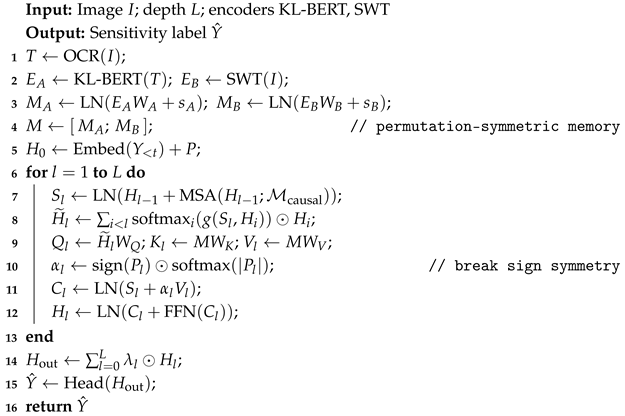
This read-out gives each layer a direct path to the supervision signal, so the model learns to concentrate useful information into the layers the task actually requires (automatic compression). The complete inference procedure is summarized in Algorithm 1.
| Algorithm 1: SCAD-Detector inference. |
 |
4. Results
4.1. Experimental Setup
Hardware and implementation. All experiments were conducted on a workstation running Ubuntu 22.04.5 LTS with an Intel® Xeon® Platinum 8470Q CPU (Intel, Santa Clara, CA, USA) and an NVIDIA GeForce RTX 5090 GPU (NVIDIA, Santa Clara, CA, USA), using PyTorch 2.6.0. The visual branch adopts the Swin-Tiny configuration (patch size 4, window size 7, embedding dimension ) initialized from ImageNet weights; images are resized to and augmented with random flipping, cropping, and color jittering. KL-BERT is obtained by continued pre-training of bert-base-chinese for 10 epochs (masking ratio , learning rate , batch size 32), with inputs padded to 128 tokens. Both encoders are projected to a common dimension , and the SCAD decoder uses layers, 8 heads, and a feed-forward dimension of 1024. The full model is optimized with AdamW (weight decay ) for 100 epochs using an initial learning rate of with cosine annealing, a 5-epoch warm-up, a batch size of 16, and dropout .
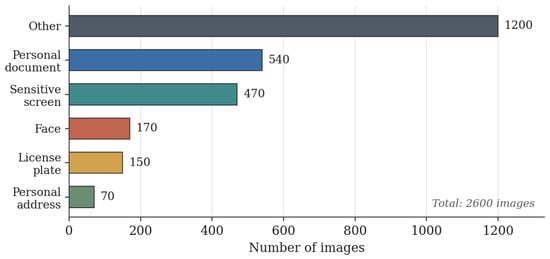
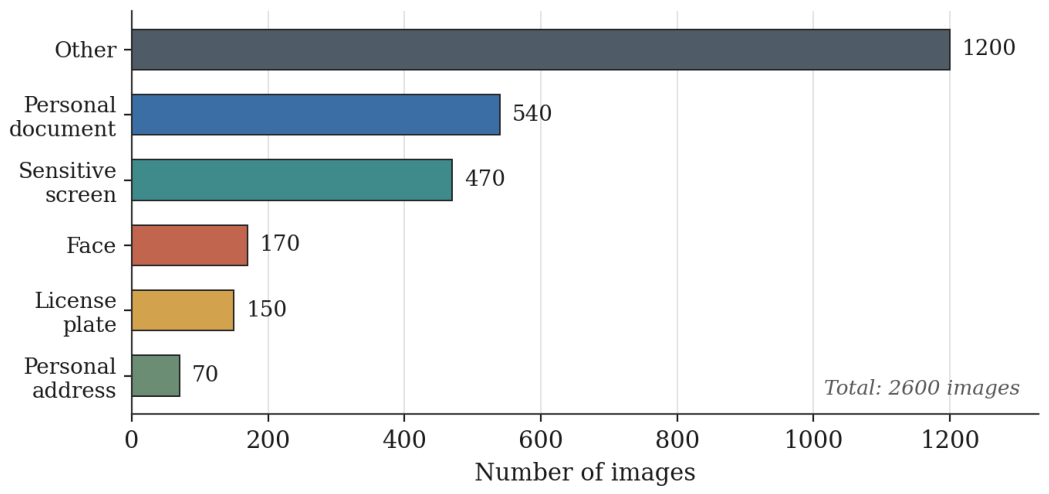
Dataset. We use a self-constructed image privacy-sensitive target detection dataset of 2600 images covering diverse scenes and sources, organized into six categories: face (170), license plate (150), sensitive personal address (70), sensitive electronic screen (470), sensitive personal document (540), and other (1200). The distribution is shown in Figure 3; the data are split 8:2 (train:test) in a stratified manner. The strong imbalance toward “other” reflects the realistic prior that most shared images are benign, which makes recall a demanding metric. The images were gathered from publicly accessible web sources and open repositories that reflect realistic data-sharing scenarios, supplemented with desensitized internal compliance material; a candidate image was retained only when two independent annotators could label its sensitive content (or its absence) unambiguously, with a third annotator resolving disagreements. The “sensitive personal document” category comprises identity cards, household registration pages, passports, driver’s licenses, bank cards, and official certificates, and an image is treated as sensitive when it exposes at least one protected field: name, national identity number, date of birth, home address, or account number. On ethics and data handling, all images were drawn from publicly available or consented sources, every personally identifying region in the examples shown in this paper was masked, and the data were processed solely for research on protective detection under the institution’s data-security procedure. The “sensitive electronic screen” category covers photographs of displays (phone, computer, or ATM screens) that expose chat records, verification codes, account pages, or transaction details, and the “other” category collects benign images with no sensitive content (ordinary scenes, objects, and non-sensitive documents), which act as the negative class.
Figure 3.
Category distribution of the privacy-sensitive image dataset (2600 images). The imbalance toward the “other” category mirrors the realistic prior that benign images dominate shared data.
To make the benchmark reconstructible, we set out the collection protocol step by step. (i) Sourcing. Candidate images were gathered from three streams: keyword and reverse-image search over publicly accessible web pages, open image repositories with permissive licenses, and desensitized material from internal data-security compliance tests. The search terms were built from the category definitions above, in both Chinese and English. (ii) Filtering. We discarded very low-resolution images, near-duplicates of already accepted images (screened with a perceptual hash), synthetic renderings and clip-art, and any image whose provenance or licence could not be established. (iii) Selection. A candidate was retained only if two independent annotators could assign it to exactly one of the six categories without qualification; ambiguous images, for instance a document photographed so obliquely that no field is legible, were dropped rather than guessed at. (iv) Annotation. The two annotators labeled every retained image independently and a third annotator resolved disagreements. (v) Splitting. The final 2600 images were split 8:2 into training and test sets, stratified by category, with near-duplicate groups kept entirely on one side of the split so that no test image has a near-copy in training. Quantitative logs of the pipeline (crawl dates, per-category query counts, rejection rates, and pre-adjudication agreement statistics) were not recorded at collection time and are therefore not reported. The protocol and category definitions above suffice to construct a comparable benchmark; the dataset itself is available to researchers on reasonable request.
Evaluation metrics. Sensitive images are positive samples and ordinary images are negative samples. Concretely, the five sensitive categories are pooled as the positive class and “other” as the negative class, so the accuracy, precision, recall, and F1-score reported in Table 1, Table 2, Table 3 and Table 4 are those of this binary sensitive detection task; the per-category results in Section 5 additionally report the four metrics for each of the six classes. To keep the dominant “other” class from swamping the minority categories during training, we use a class-balanced weighted cross-entropy, and we treat recall and F1 as the primary metrics because accuracy is easily inflated on an imbalanced test set. We adopt accuracy, precision, recall, and F1-score:
where , , , and are the numbers of true positives, true negatives, false positives, and false negatives, respectively.
Table 1.
Performance comparison of different models. All values are in percent (%); the best in each column is in bold.
Table 2.
Component-wise ablation of the proposed model. Values are in percent (%); the best in each column is in bold.
Table 3.
Component ablation on the test split; each row disables one component. Values are in percent (%); the best in each column is in bold.
Table 4.
Fusion-operator comparison under identical encoders. Values are in percent (%); the best in each column is in bold.
4.2. Comparison with State-of-the-Art Models
Table 1 compares the proposed method with representative classification models. Our fused model leads on all four metrics: accuracy , precision , recall , and F1-score . Among the single-backbone models the strongest is SWT (accuracy , F1 ), which edges out ResNet and ViT and bears out the value of hierarchical window attention. Adding our components to ViT (ViT+KL-BERT+SCAD) raises accuracy from to and recall from to , evidence that semantic enrichment and symmetry-breaking fusion offset the weaker local features of ViT.
4.3. Ablation Study
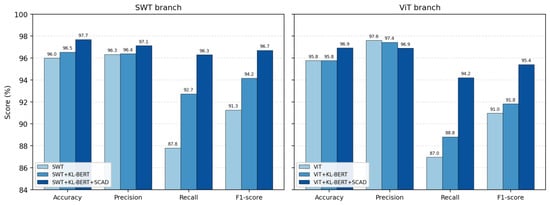
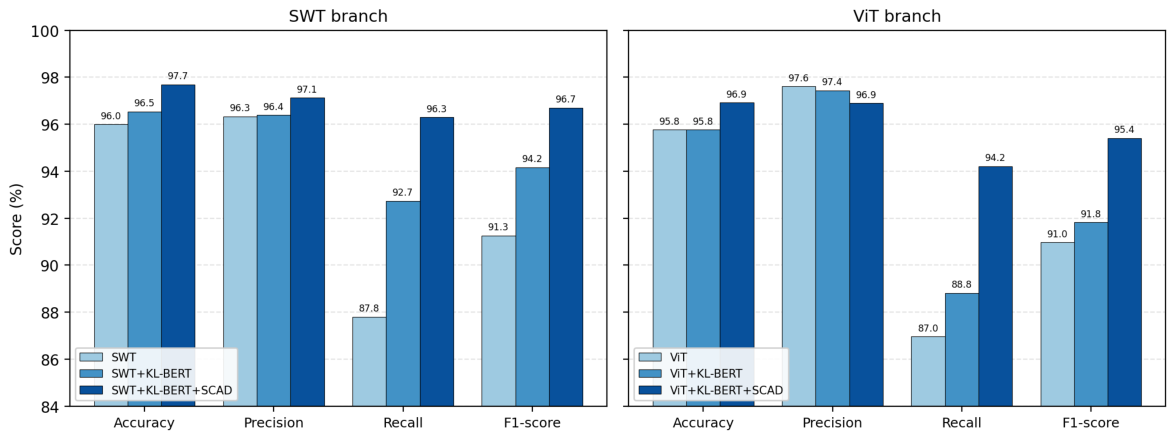
Table 2 and Figure 4 separate out what each component contributes. Against the bare SWT model, the full system gains points of accuracy and points of recall. KL-BERT helps recall the most (SWT: ), whereas the symmetry-breaking SCAD module lifts accuracy from to . The ViT series behaves identically: ViT + KL-BERT + SCAD adds points of recall and points of F1 over ViT, which tells us the fusion strategy carries across backbones.
Figure 4.
Ablation progression, shown as grouped bar charts, for the SWT branch (left) and the ViT branch (right). KL-BERT chiefly boosts recall, while the SCAD decoder lifts all three metrics, with the largest cumulative gain in recall.
4.4. Component Ablation and Design Analysis
To isolate the contribution of each part of the framework, Table 3 switches off one component at a time on the same test split. Removing the OCR text stream causes the largest drop (F1 ), confirming that the embedded text carries decisive evidence. Removing the policy pre-training of KL-BERT lowers F1 to . Most relevant to our central claim, replacing the signed attention with ordinary softmax attention costs F1 points, and clamping only the negative weights to zero, so the operator becomes non-negative again, removes points of recall while leaving the magnitude term unchanged. Since these two variants differ only in whether subtraction is allowed, the comparison isolates the symmetry-breaking mechanism itself. Table 3 does not include a row for the cross-depth QKV composer of Section 3.4.2, as the corresponding isolation run (forming the query from the most recent layer state alone, ) has not been performed. The composer is therefore treated as a query-refinement design choice, with no measured gain claimed for it.
We further compare the fusion operator against two standard alternatives, an MLP fusion and a conventional softmax cross-attention decoder, under identical encoders (Table 4). With everything else fixed, moving from standard cross-attention to signed cross-attention raises F1 from to on the SWT backbone, which we attribute to the polarity term rather than to added capacity.
Finally, Table 5 varies the number of decoder layers. Performance improves up to and then declines, consistent with mild over-fitting of a deeper decoder on a modestly sized dataset; we therefore use four layers. More generally, because the dataset is modest in size, we take several steps to limit over-fitting: both encoders are initialized from pre-trained weights (Swin-T on ImageNet and KL-BERT from bert-base-chinese) and only lightly adapted, so few parameters are trained from scratch; the images are augmented with random flipping, cropping, and color jittering; and we apply weight decay, dropout, a stratified 8:2 split, and early stopping. The stable margin between our model and the baselines on the held-out test set indicates that the network is not simply memorizing the training data.
Table 5.
Effect of the decoder depth L. Values are in percent (%); the best in each column is in bold.
4.5. Statistical Caveats of the Single-Run Protocol
All results are from single training runs under one fixed random seed, with the same stratified split, schedule, and hyper-parameters for every model and ablation variant, so no method benefits from a more favorable draw; single-run reporting of this kind is still common in applied vision–language studies. As a single run cannot bound run-to-run variance, no claim of statistical significance is made for the reported margins. Three observations nevertheless suggest that the margins are not artifacts of a favorable run: The gains over the strongest fusion baseline ( F1, Table 4) and over the non-negative variant ( F1, Table 3) are consistent across all four metrics; the operator ordering (MLP, standard cross-attention, signed SCAD) recurs on both visual backbones; and both sign-related ablations degrade performance as the theory predicts. Multi-seed replication with paired significance testing is left to future work.
4.6. Cross-Modal Conflict: Definition and Indirect Evidence
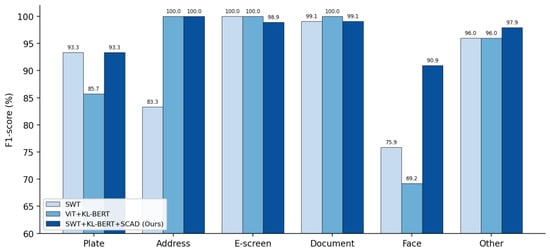
Our central claim concerns behavior under cross-modal conflict. The direct test would be a conflict-annotated split of the test set, an image counting as conflicting when its OCR-recovered text and visual content support different labels: benign imagery carrying incidental sensitive-looking text (watermarks, captions, background signage) or genuinely sensitive imagery whose embedded text is absent, illegible, or innocuous. Such an annotation requires two independent annotators with third-annotator adjudication and is left to future work, so the evidence offered here is indirect. First, in the face category, where this conflict is most frequent, naive fusion falls below the visual-only baselines (ViT + KL-BERT, F1) while the signed decoder reaches ; text–visual conflict under a purely additive weighting explains this, whereas visual difficulty alone does not. Second, clamping only the negative branch (Table 3) costs recall points, indicating that the subtractive path acts where evidence must be suppressed. Third, the “w/o OCR” ablation bounds the total contribution of the text stream. A direct conflict-vs-non-conflict breakdown, with visualization of the signed attention weights, would complete this analysis.
5. Discussion
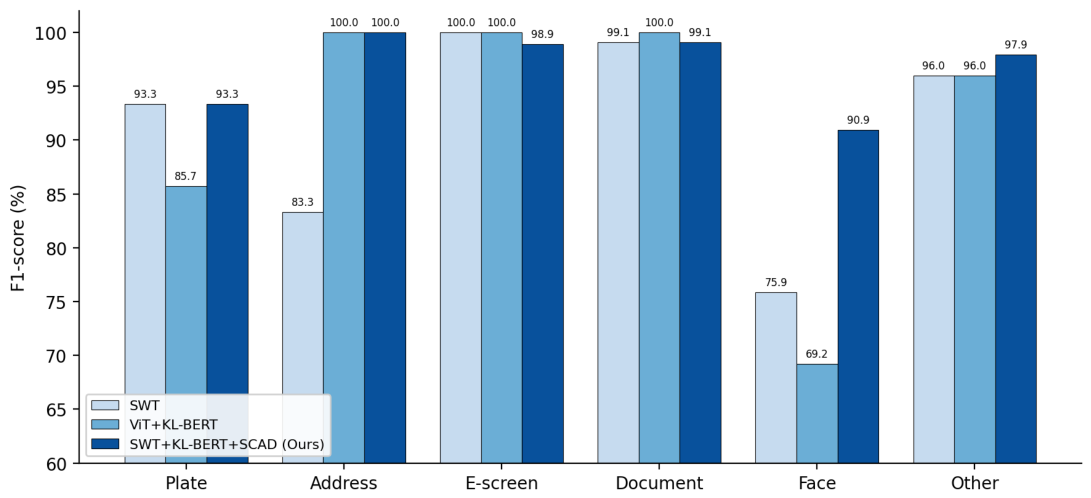
Where the gains come from, and why symmetry breaking matters. Figure 5 gives the per-category F1-score for representative models. The visually regular categories (electronic screen, document, license plate) are already served well by ordinary backbones, so there is little headroom. Faces are the hard case; small objects, occlusion, and wide intra-class variation keep the visual-only and naively fused baselines below . Tellingly, naive fusion can even hurt (ViT+KL-BERT falls to ) because stray OCR text (watermarks, background captions) misleads a rule that can only average the modalities, which is exactly the breakdown the sign symmetry of softmax attention predicts. Once that symmetry is broken through the signed (odd) polarity term, the model can subtract the misleading text and pushes face F1 to , about 15 points above the best visual baseline. That the improvement lands precisely where the modalities most often disagree is direct support for the symmetry-breaking hypothesis of Section 3.4.4. The face category is, of course, also intrinsically hard for reasons unrelated to fusion, such as small faces, occlusion, and pose variation, but these affect every method equally; the extra gain of SCAD over the strong visual baselines here, together with the fact that naive fusion actually degrades this category, isolates the part of the difficulty that is due to text-visual conflict rather than to visual difficulty alone.
Figure 5.
Per-category F1-score (%) across representative models. The proposed model (bottom row) delivers its largest gains on the most difficult “face” category, where the two modalities most often disagree.
Although we frame the task as binary sensitive-vs-benign detection, the per-category outputs also support a graded, risk-based reading: high-risk classes such as identity documents and faces, medium-risk classes such as addresses and licence plates, and low-risk incidental screen content can each be routed to a different downstream policy. A full multi-level severity model is left to future work.
Positioning against large vision–language models. We position the method against recent large vision–language models: CLIP is included in Table 1 as a representative contrastive model that adapts to a fixed label set, whereas generative or retrieval models such as BLIP, SigLIP, Qwen-VL, and Florence-2 are pre-trained mainly on English web data and would need prompt engineering or heavy fine-tuning to fit this closed six-way Chinese task; we therefore take CLIP as the fair reference point and leave the adaptation of larger multilingual models to future work.
5.1. Computational Cost
Table 6 lists the parameter budget and theoretical cost. The Swin-T backbone is modest (28.3 M parameters, 4.5 GFLOPs at ), on par with ResNet-50 and lighter than ViT-B/16. Bringing in the KL-BERT branch and the SCAD decoder pushes the total to roughly 150 M parameters, heavier than a purely visual classifier, but paid only once per image, and the auto-compressing read-out lets inference run at a shallower effective depth. As the two encoders can run in parallel, wall-clock latency is dominated by the slower branch rather than their sum.
Table 6.
Model size and theoretical cost. FLOPs are for the visual backbone at ; the fused model also includes the KL-BERT text encoder and SCAD decoder.
Failure cases and category-level errors. Averaged scores hide where the model actually breaks, so we inspected the misclassified test images. The errors fall into four recurring patterns, which we characterize qualitatively: The misclassification set of a 520-image split is too small for per-pattern counts to be meaningful under a single-run protocol. False negatives on partially occluded or very small faces: When the face occupies a small fraction of the frame and the image carries no informative text, neither branch has much to contribute and the fused prediction reverts to the visual backbone. False negatives from OCR failure occur on documents photographed at an angle or on low-quality screen captures where the protected field is not recovered; these are the cases the “w/o OCR” ablation isolates in aggregate. False positives on benign images carrying sensitive-looking text are the residue of the conflict problem: the negative branch suppresses most watermark and signage text, but a fragment that is both legible and regulatory in phrasing can still tip the decision. Category confusions among the sensitive classes are dominated by the electronic screen versus document boundary, since a photograph of an identity document displayed on a screen legitimately belongs to both. In deployment terms the third group is the costly one because a detector that over-flags benign images will be switched off; we therefore report precision alongside recall throughout and note that the operating threshold should be tuned to the reviewing capacity of the deployment rather than left at .
5.2. Limitations
Two limitations remain. First, the framework depends on OCR quality; when the embedded text is heavily distorted or absent, the textual branch contributes little and the model falls back to its visual backbone. Second, the present study is confined to Chinese policy-domain text and a single, modestly sized dataset, so generalization to other languages and open-world sensitive categories is not yet established. Robust scene text recognition, larger corpora, and multilingual policy pre-training are natural directions for future work. Beyond these, annotation reliability (mitigated here by dual annotation with third-annotator adjudication), dataset bias toward Chinese policy-domain content, residual OCR errors on distorted in-image text, and the gap between benchmark accuracy and real deployment all warrant caution when generalizing the reported numbers. Several validations are left to future work: multi-seed replication with paired significance testing, an ablation isolating the cross-depth composer, a conflict-annotated breakdown with visualization of the signed attention weights, measurement of the on-dataset OCR recognition rate, and extension of the binary formulation to a graded risk model.
6. Conclusions
We have presented a symmetric dual-source vision–language framework whose decoder, SCAD, performs conflict-aware fusion by deliberately breaking the sign symmetry of conventional attention. A Swin Transformer and a policy knowledge-enhanced BERT encode image and text and assemble them into a permutation-symmetric memory; the signed cross-attention then splits into a sign-symmetric magnitude term and a sign-antisymmetric polarity term, so the model can both reinforce and suppress cross-modal evidence. On a self-constructed privacy-sensitive image dataset it reaches an accuracy of and an F1-score of , with its gains concentrated on the most conflict-prone categories, indicating that controlled symmetry breaking is an effective and interpretable principle for multimodal fusion. In practice, the framework applies directly to privacy screening on data-sharing and content moderation platforms, where images must be checked for exposed identity documents, faces, screens, or license plates before release, and its per-category outputs support graded, risk-based handling in compliance auditing.
Author Contributions
Conceptualization, M.L.; Methodology, M.L., Y.L. and T.L.; Software, T.L.; Validation, M.L.; Formal analysis, M.L.; Investigation, M.L. and T.L.; Resources, Y.L.; Data curation, M.L.; Writing—original draft, M.L.; Writing—review and editing, M.L. and Y.L.; Supervision, Y.L. and T.L.; Project administration, Y.L. and T.L.; Funding acquisition, M.L., Y.L. and T.L. All authors have read and agreed to the published version of the manuscript.
Funding
This work was supported in part by the National Natural Science Foundation of China under Grant 62576005 and K110168019, and in part by the project of Excellent Research and Innovation Teams in Anhui Province’s Universities under Grant 2024AH010030.
Data Availability Statement
The dataset consists of privacy-sensitive images, whose public deposit would itself constitute the disclosure the detector is designed to prevent; it is therefore available from the corresponding author on reasonable request for non-commercial research purposes, subject to a data-use agreement. The collection protocol and category definitions needed to construct a comparable benchmark are given in Section 4.1.
Acknowledgments
During the preparation of this manuscript, the authors used GPT-5.5 solely to improve the language and readability of author-written text (grammar, spelling, punctuation, and phrasing). The tool was not used to generate scientific content, data, analyses, interpretations, or references. The authors have reviewed and edited the output and take full responsibility for the content of this publication.
Conflicts of Interest
The authors declare no conflict of interest.
Abbreviations
The following abbreviations are used in this manuscript:
| OCR | Optical Character Recognition |
| SWT | Swin Transformer |
| BERT | Bidirectional Encoder Representations from Transformers |
| KL-BERT | Knowledge-enhanced (policy-Legislation) BERT |
| SCAD | Signed Cross-attention Auto-compressing Decoder |
| MSA | Masked Self-Attention |
| SDCA | Signed Dual-source Cross-Attention |
| MLM | Masked Language Modeling |
| ViT | Vision Transformer |
References
- Zhou, B.; Shi, Y.; Li, C. Research on Improvement of Mass Multimedia Information Filtering Technology Under Multi-Data Inflow. In Proceedings of the 2019 International Conference on Intelligent Transportation, Big Data & Smart City (ICITBS); IEEE: Piscataway, NJ, USA, 2019; pp. 438–442. [Google Scholar] [CrossRef] [Scilit]
- Ding, M.; Wang, X.; Wu, C.; Wang, K.; Yang, X. Research on Automated Detection of Sensitive Information Based on BERT. J. Phys. Conf. Ser. 2021, 1757, 012088. [Google Scholar] [CrossRef] [Scilit]
- Lv, A.; Xie, R.; Li, S.; Liao, J.; Sun, X.; Kang, Z.; Wang, D.; Yan, R. More Expressive Attention with Negative Weights. arXiv 2024, arXiv:2411.07176. [Google Scholar] [CrossRef] [Scilit]
- Ye, T.; Dong, L.; Xia, Y.; Sun, Y.; Zhu, Y.; Huang, G.; Wei, F. Differential Transformer. In Proceedings of the International Conference on Learning Representations (ICLR), Singapore, 24–28 April 2025. [Google Scholar]
- Knuth, D.E.; Morris, J.H., Jr.; Pratt, V.R. Fast Pattern Matching in Strings. SIAM J. Comput. 1977, 6, 323–350. [Google Scholar] [CrossRef] [Scilit]
- Aho, A.V.; Corasick, M.J. Efficient String Matching: An Aid to Bibliographic Search. Commun. ACM 1975, 18, 333–340. [Google Scholar] [CrossRef] [Scilit]
- Xu, G.; Wu, X.; Yao, H.; Li, F.; Yu, Z. Research on Topic Recognition of Network Sensitive Information Based on SW-LDA Model. IEEE Access 2019, 7, 21527–21538. [Google Scholar] [CrossRef] [Scilit]
- Liu, Y.; Yang, C.Y.; Yang, J. A Graph Convolutional Network-Based Sensitive Information Detection Algorithm. Complexity 2021, 2021, 6631768. [Google Scholar] [CrossRef] [Scilit]
- Zhang, K.; Liu, X.; Zhao, N.; Liu, S.; Li, C. Dual channel semantic enhancement-based convolutional neural networks model for text classification. Int. J. Mod. Phys. C 2025, 36, 2442012. [Google Scholar] [CrossRef] [Scilit]
- Zhang, X.; Zhao, J.; LeCun, Y. Character-Level Convolutional Networks for Text Classification. In Advances in Neural Information Processing Systems (NeurIPS); Curran Associates, Inc.: Red Hook, NY, USA, 2015; Volume 28, pp. 649–657. [Google Scholar]
- LeCun, Y.; Bottou, L.; Bengio, Y.; Haffner, P. Gradient-Based Learning Applied to Document Recognition. Proc. IEEE 1998, 86, 2278–2324. [Google Scholar] [CrossRef] [Scilit]
- Krizhevsky, A.; Sutskever, I.; Hinton, G.E. ImageNet Classification with Deep Convolutional Neural Networks. In Advances in Neural Information Processing Systems (NeurIPS); Curran Associates, Inc.: Red Hook, NY, USA, 2012; Volume 25, pp. 1097–1105. [Google Scholar]
- Simonyan, K.; Zisserman, A. Very Deep Convolutional Networks for Large-Scale Image Recognition. In Proceedings of the International Conference on Learning Representations (ICLR), San Diego, CA, USA, 7–9 May 2015. [Google Scholar]
- He, K.; Zhang, X.; Ren, S.; Sun, J. Deep Residual Learning for Image Recognition. In Proceedings of the 2016 IEEE Conference on Computer Vision and Pattern Recognition (CVPR), Las Vegas, NV, USA, 27–30 June 2016; pp. 770–778. [Google Scholar]
- Guo, R.; Li, W.; Wang, H.; Zhang, X. A Multi-Information Detection Model for Violent Images Based on YOLOv3-SPP and DenseNet. In Proceedings of the 2022 11th International Conference of Information and Communication Technology (ICTech); IEEE: Piscataway, NJ, USA, 2022; pp. 529–532. [Google Scholar] [CrossRef] [Scilit]
- Redmon, J.; Farhadi, A. YOLOv3: An Incremental Improvement. arXiv 2018, arXiv:1804.02767. [Google Scholar]
- Huang, G.; Liu, Z.; van der Maaten, L.; Weinberger, K.Q. Densely Connected Convolutional Networks. In Proceedings of the IEEE Conference on Computer Vision and Pattern Recognition (CVPR), Honolulu, HI, USA, 21–26 July 2017; pp. 4700–4708. [Google Scholar]
- Hu, J.; Shen, L.; Sun, G. Squeeze-and-Excitation Networks. In Proceedings of the IEEE Conference on Computer Vision and Pattern Recognition (CVPR); IEEE: Piscataway, NJ, USA, 2018; pp. 7132–7141. [Google Scholar] [CrossRef] [Scilit]
- Zhang, S.X.; Zhu, X.; Hou, J.B.; Liu, C.; Yang, C.; Wang, H.; Yin, X.C. Deep Relational Reasoning Graph Network for Arbitrary Shape Text Detection. In Proceedings of the IEEE/CVF Conference on Computer Vision and Pattern Recognition (CVPR); IEEE: Piscataway, NJ, USA, 2020; pp. 9699–9708. [Google Scholar] [CrossRef] [Scilit]
- Liao, M.; Shi, B.; Bai, X. TextBoxes++: A Single-Shot Oriented Scene Text Detector. IEEE Trans. Image Process. 2018, 27, 3676–3690. [Google Scholar] [CrossRef] [Scilit] [PubMed]
- Liu, W.; Anguelov, D.; Erhan, D.; Szegedy, C.; Reed, S.; Fu, C.Y.; Berg, A.C. SSD: Single Shot MultiBox Detector. In Proceedings of the 14th European Conference on Computer Vision (ECCV); Springer International Publishing: Amsterdam, The Netherlands, 2016; pp. 21–37. [Google Scholar]
- Sandler, M.; Howard, A.; Zhu, M.; Zhmoginov, A.; Chen, L.C. MobileNetV2: Inverted Residuals and Linear Bottlenecks. In Proceedings of the 2018 IEEE Conference on Computer Vision and Pattern Recognition (CVPR), Salt Lake City, UT, USA, 18–22 June 2018; pp. 4510–4520. [Google Scholar]
- Zhang, S.; Zhu, X.; Lei, Z.; Shi, H.; Wang, X.; Li, S.Z. S3FD: Single Shot Scale-Invariant Face Detector. In Proceedings of the 2017 IEEE International Conference on Computer Vision (ICCV); IEEE: Piscataway, NJ, USA, 2017; pp. 192–201. [Google Scholar] [CrossRef] [Scilit]
- Vaswani, A.; Shazeer, N.; Parmar, N.; Uszkoreit, J.; Jones, L.; Gomez, A.N.; Kaiser, L.; Polosukhin, I. Attention Is All You Need. In Advances in Neural Information Processing Systems (NeurIPS); Curran Associates, Inc.: Red Hook, NY, USA, 2017; Volume 30, pp. 5998–6008. [Google Scholar]
- Dosovitskiy, A.; Beyer, L.; Kolesnikov, A.; Weissenborn, D.; Zhai, X.; Unterthiner, T.; Dehghani, M.; Minderer, M.; Heigold, G.; Gelly, S.; et al. An Image is Worth 16 × 16 Words: Transformers for Image Recognition at Scale. In Proceedings of the 9th International Conference on Learning Representations (ICLR 2021), Virtual, 3–7 May 2021. [Google Scholar]
- Liu, Z.; Lin, Y.; Cao, Y.; Hu, H.; Wei, Y.; Zhang, Z.; Lin, S.; Guo, B. Swin Transformer: Hierarchical Vision Transformer Using Shifted Windows. In Proceedings of the 2021 IEEE/CVF International Conference on Computer Vision (ICCV), Virtual, 11–17 October 2021; IEEE: Piscataway, NJ, USA, 2021; pp. 10012–10022. [Google Scholar]
- Li, J.; Li, D.; Savarese, S.; Hoi, S. BLIP-2: Bootstrapping Language-Image Pre-training with Frozen Image Encoders and Large Language Models. In Proceedings of the 40th International Conference on Machine Learning (ICML), Honolulu, HI, USA, 23–29 July 2023; Volume 202, pp. 19730–19742. [Google Scholar]
- Zhai, X.; Mustafa, B.; Kolesnikov, A.; Beyer, L. Sigmoid Loss for Language Image Pre-Training. In Proceedings of the 2023 IEEE/CVF International Conference on Computer Vision (ICCV), Paris, France, 1–6 October 2023; IEEE: Piscataway, NJ, USA, 2023; pp. 11975–11986. [Google Scholar]
- Radford, A.; Kim, J.W.; Hallacy, C.; Ramesh, A.; Goh, G.; Agarwal, S.; Sastry, G.; Askell, A.; Mishkin, P.; Clark, J.; et al. Learning Transferable Visual Models From Natural Language Supervision. In Proceedings of the 38th International Conference on Machine Learning (ICML), Virtual, 18–24 July 2021; pp. 8748–8763. [Google Scholar]
- Chen, Z.; Wu, J.; Wang, W.; Su, W.; Chen, G.; Xing, S.; Zhong, M.; Zhang, Q.; Zhu, X.; Lu, L.; et al. InternVL: Scaling up Vision Foundation Models and Aligning for Generic Visual-Linguistic Tasks. In Proceedings of the 2024 IEEE/CVF Conference on Computer Vision and Pattern Recognition (CVPR), Seattle, WA, USA, 16–22 June 2024; pp. 24185–24198. [Google Scholar]
- Li, S.; Tang, H. Multimodal Alignment and Fusion: A Survey. Int. J. Comput. Vis. 2026, 134, 103. [Google Scholar] [CrossRef] [Scilit]
- Baia, A.E.; Xompero, A.; Cavallaro, A. Zero-shot Image Privacy Classification with Vision-Language Models. arXiv 2025, arXiv:2510.09253. [Google Scholar] [CrossRef] [Scilit]
- Shi, B.; Bai, X.; Yao, C. An End-to-End Trainable Neural Network for Image-Based Sequence Recognition and Its Application to Scene Text Recognition. IEEE Trans. Pattern Anal. Mach. Intell. 2017, 39, 2298–2304. [Google Scholar] [CrossRef] [Scilit] [PubMed]
- Devlin, J.; Chang, M.W.; Lee, K.; Toutanova, K. BERT: Pre-training of Deep Bidirectional Transformers for Language Understanding. In Proceedings of the 2019 Annual Conference of the North American Chapter of the Association for Computational Linguistics (NAACL), Minneapolis, MN, USA, 2–7 June 2019; pp. 4171–4186. [Google Scholar]



Disclaimer/Publisher’s Note: The statements, opinions and data contained in all publications are solely those of the individual author(s) and contributor(s) and not of MDPI and/or the editor(s). MDPI and/or the editor(s) disclaim responsibility for any injury to people or property resulting from any ideas, methods, instructions or products referred to in the content. |
© 2026 by the authors. Licensee MDPI, Basel, Switzerland. This article is an open access article distributed under the terms and conditions of the Creative Commons Attribution (CC BY) license.