


Abstract
This article uses the enhanced direct algebraic method (EDAM) to study the exact traveling wave solutions of the paraxial wave equation with conformable fractional derivative. This method is selected due to its algorithmic simplicity, computational efficiency, and unique capability to yield diverse solution types within a unified algebraic framework. Firstly, the paraxial wave equation with conformable fractional derivative is transformed into an ordinary differential equation through traveling wave transformation. Then, the EDAM is systematically applied to construct accurate traveling wave solutions including twisted solitons, bell-shaped solitons, singular solitons, Weierstrass elliptic function solutions, and Jacobi elliptic function solutions, demonstrating the method’s superiority in handling complex nonlinear structures compared to standard expansion techniques. Finally, based on Matlab software to draw three-dimensional and two-dimensional graphs of partial solutions, these graphs intuitively demonstrate the regulatory effect of the fractional-order parameter on waveform localization and amplitude. Specifically, as increases, the soliton localization weakens and the wave packet broadens, providing insights into the dispersion management in optical fibers. The method used in this article is characterized by simple operation and rich solution types, providing an effective approach for studying fractional nonlinear partial-differential equations.
1. Introduction
The origin of fractional derivative can be traced back to 1695, when Leibniz and L’Hôpital discussed the concept of fractional-order derivatives [1]. After more than three centuries of development, fractional calculus has become an important branch of mathematical physics [2,3,4]. Compared with traditional integer-order models, fractional-order models can more accurately describe memory effects, hereditary properties and nonlocal responses in complex systems. In recent years, fractional nonlinear models have attracted considerable attention due to their broad applications in fluid mechanics, viscoelastic materials, biological systems, signal processing, and financial mathematics. In nonlinear optics, the propagation of light pulses in media such as optical fibers and liquid crystals is affected by diffraction, dispersion, and Kerr nonlinearity. The evolution of this phenomenon can usually be described by the fractional-order nonlinear Schrödinger equation.
However, it is important to acknowledge that there exist multiple definitions of fractional derivatives (e.g., Riemann–Liouville, Caputo, conformable derivatives and M-truncated), each with distinct mathematical properties and physical interpretations. In this study, we adopt the conformable fractional derivative. Despite the ongoing debate regarding its classification as a “genuine” fractional operator—due to its local nature and satisfaction of the standard chain rule—the conformable derivative has been widely and successfully employed in recent years for constructing traveling wave solutions of various fractional nonlinear partial-differential equations [5,6,7,8]. While it is true that the conformable derivative does not capture long-range memory effects in the same sense as nonlocal operators, it offers a significant computational advantage: the chain rule, product rule, and quotient rule remain valid. This property makes it uniquely suitable for algebraic solution methods, as it allows the traveling wave reduction to proceed without the intricate complications typically associated with nonlocal fractional operators. In this work, we treat the conformable derivative not as a claim of novel fractional modeling, but as a pragmatic and efficient computational tool that enables the construction of exact traveling wave solutions, where the parameter still provides meaningful physical insight into scaling and localization behavior. From a mathematical physics perspective, the conformable derivative corresponds to an ordinary derivative under a power-law coordinate deformation , making it suitable for describing systems with local scaling behavior, where serves as a measure of the underlying space-time distortion.
In recent years, solving fractional nonlinear partial-differential equations (FNL PDEs) has become a research hotspot. Numerous analytical methods have been proposed, including the planar dynamical system analysis [9,10], the -expansion method [11], the neural network method [12], the auxiliary equation method [13], the extended modified F-expansion technique [14,15], and the Ansatz method [16]. Complementing these analytical approaches, efficient numerical methods have also seen significant progress. For instance, the time two-mesh mixed finite element method for fractional hyperbolic wave models [17] offers a robust numerical perspective for handling such fractional systems.
In this study, the paraxial wave equation with conformable fractional derivative is described as follows [5]:
where the real constants , , denote the coefficients of the dispersal effect, the diffraction effect and the Kerr nonlinearity effect, respectively. The complex wave solution depends on the transverse coordinate x, the longitudinal coordinate y and the temporal variable t, while the symbol denotes the modulus of the complex amplitude.
Numerous analytical methods have been developed to obtain exact traveling wave solutions. For instance, in reference [5], Luo and Li analyzed dynamical behaviors and optical solitons under the M-truncated fractional derivative. Rehman et al. constructed bright, dark, and singular solitons using the -model expansion technique [6]. Khan et al. used the rational -expansion method to study bifurcation, quasi-periodic, and chaotic behaviors of the conformable fractional paraxial wave equation [7]. Roshid et al. employed a unified technique to derive abundant optical soliton solutions, including periodic waves, breather waves, and rogue waves [8,18]. In reference [19], Mannaf et al. obtained lump waves, rough waves, and periodic solitons via the extended tanh method and modified extended tanh method. Bashar et al. explored optical soliton solutions using the advanced exp -expansion method and the modified extended auxiliary mapping method, respectively [20,21]. Additionally, Arnous et al. investigated solitary wave solutions for extended Sakovich equations using an enhanced algebraic method, demonstrating the power of such techniques for fluid dynamics models [22]. Furthermore, Khalifa et al. studied highly dispersive solitons for a nonlinear Schrödinger equation with higher-order nonlinearities, providing insights into modulation instability [23].
Despite these fruitful results, most existing studies [5,7,8] have focused on obtaining only one or two specific types of solutions for the conformable fractional paraxial wave equation—typically either bright/dark solitons or periodic wave solutions—depending on the particular algebraic ansatz employed. While each of these individual results is valuable, the literature lacks a unified analytical framework capable of simultaneously generating a comprehensive spectrum of solution types, ranging from localized solitary waves to periodic elliptic functions and highly localized Weierstrass elliptic structures. Moreover, the systematic regulatory mechanism of the fractional-order parameter on different wave structures remains to be further elucidated.
Motivated by the above facts, this paper applies the EDAM to establish comprehensive exact traveling wave solutions of Equation (1). The method is selected for three reasons: (i) it requires only straightforward algebraic manipulations without solving complex auxiliary equations; (ii) it yields a broader variety of solution forms than the -expansion or -expansion methods; and (iii) it accommodates the conformable derivative’s chain rule naturally, making the traveling wave reduction particularly efficient. The novelty and main contributions of this work are threefold:
- (i)
- By applying the EDAM, various exact traveling wave solutions, including bell-shaped, kink-shaped, singular, Jacobi elliptic function, and Weierstrass elliptic function solutions, are constructed for the conformable fractional paraxial wave equation for the first time within a unified framework. This extends previous studies that obtained only isolated solution types.
- (ii)
- Through numerical simulations, the regulatory effects of the fractional-order parameter on wave localization are systematically revealed, filling a gap in the systematic comparison of fractional-order effects in existing studies.
- (iii)
- We demonstrate that the EDAM, when combined with the conformable derivative as a computational tool, offers an efficient and versatile approach that can be readily extended to other fractional nonlinear systems, providing a practical alternative to more computationally intensive methods.
The remaining part of this article is arranged as follows: Section 2 outlines the EDAM with conformable derivatives, Section 3 derives explicit traveling wave solutions and analyzes the fractional-order effect, Section 4 validates these solutions via numerical simulations with 3D and 2D plots illustrating waveform evolution under varying fractional orders, and Section 5 concludes the method’s effectiveness and proposes future extensions.
2. The Enhanced Direct Algebraic Method
The conformable derivative of a function of order is defined as [7]
A fundamental property of the conformable derivative is for , which will be used throughout this work.
Assume an FNLPDE
where denotes a wave profile and x, y, and t represent the space and time variables, respectively. The solution of Equation (3) is assumed to be expressed as
where is the wave’s amplitude component. k, , , , m, , , and are the constants. Then Equation (3) condenses to
Furthermore, the solution of can be expressed in the following form [22,24]
where satisfies
The essential algorithmic procedure of the EDAM is summarized as follows.
Step 1. Apply the traveling wave transformation Equation (4) to reduce the given FNLPDE Equation (3) into a nonlinear ordinary differential Equation (5).
Step 2. Determine the balance number N by equating the highest order derivative term and the highest order nonlinear term in the resulting Equation (5).
Step 3. Assume the solution structure as the rational expansion Equation (6), where the function satisfies the first-order integrable ordinary differential Equation (7).
3. Traveling Wave Solutions of Equation (1)
This section will construct the exact traveling wave solution of Equation (1) based on the enhanced algebraic method (see Refs. [22,24]) mentioned in the second section.
Substituting Equation (4) into Equation (1), using the chain rule stated in Section 2, we can obtain
Since is independent of the phase factor, the nonlinear term becomes simply , with no cross-phase coupling. Substituting Equations (8) and (9) into Equation (1), we obtain the imaginary component
and the real component
where and .
From Equation (10), we have
Balancing the highest-order derivative term with the nonlinear term we obtain the balance number as . According to the proposed method and Equation (6), the solution structure is selected in the form
Substituting Equations (13) and (7) into Equation (11), we obtain a polynomial in terms of . In this polynomial, setting the coefficients of similar powers of to zero yields an over-determined system of equations:
By solving this over-determined system, the unknown parameters in Equation (14) can be expressed by the coefficients in Equation (4), and thus the exact solutions can be derived.
3.1. Case 1:
The solutions and correspond to bell-shaped solitary waves and singular solitons, respectively. The bell-shaped soliton represents a localized wave packet that propagates without changing its shape, describing optical pulses in Kerr media where the balance between dispersion (or diffraction) and nonlinearity prevents the pulse from spreading. The singular soliton , while mathematically valid, typically describes extreme localization phenomena near the singularity. The fractional-order parameter controls the steepness of the pulse envelope: smaller yields sharper localization, while larger produces smoother and more delocalized structures.
3.2. Case 2:
Result 1: .
when .
when .
The solutions and correspond to kink-type waves and singular solitons, respectively. The kink-shaped solution describes a smooth transition between two different asymptotic states, which are commonly observed in plasma physics and nonlinear optics as domain walls or shock waves. The singular soliton , while mathematically valid, typically represents extreme localization phenomena near the singularity. The fractional parameter regulates the steepness of the kink transition: larger yields a wider and smoother transition layer, while smaller produces a sharper transition.
Result 2: .
where solution is combined of kink-type wave and singular soliton solutions.
3.3. Case 3:
Result 1: (i) .
(ii) .
(iii) .
Result 2:
(i) .
(ii) .
(iii) .
The Jacobi elliptic function solutions – represent periodic wave trains that generalize ordinary trigonometric periodic waves. Specifically, , , and correspond to the cn-type, sn-type, and dn-type Jacobi elliptic solutions, respectively, while , , and are composite solutions consisting of these elliptic functions and their reciprocals. These solutions describe nonlinear wave patterns in periodic media, such as photonic crystals or Bose–Einstein condensates in optical lattices. The modulus parameter n controls the degree of nonlinearity: recovers trigonometric (linear) waves, while recovers localized soliton structures. The fractional parameter modulates the spatial periodicity and oscillation frequency of these wave trains.
3.4. Case 4:
Result 1: .
(i) When , we obtain the solution of Equation (1),
(ii) When , we obtain the solution of Equation (1),
Result 2:
By solving the over-determined algebraic Equation (14) for this case, we obtain the following relations among the parameters: .
(i) When , we obtain the solution of Equation (1),
(ii) When , we obtain the solution of Equation (1),
The Weierstrass elliptic function solutions – describe highly localized periodic structures with sharp pulse trains. These solutions are particularly relevant for describing extreme localization phenomena, such as rogue waves in deep water or extreme optical pulses in nonlinear fibers. The doubly periodic nature of these solutions enables complex spatiotemporal patterns that cannot be captured by simpler trigonometric or hyperbolic functions.
3.5. Case 5:,
(i) When , we obtain the solution of Equation (1),
(ii) When , we obtain the solution of Equation (1),
(iii) When , we obtain the solution of Equation (1),
(iv) When , we obtain the solution of Equation (1),
4. Visualization of Results
In this section, we will use Matlab mathematical software to draw some 3D and 2D graphs of Equation (1). By drawing these graphs, we can further understand the specific forms and evolution processes of various types of solutions to Equation (1).
- (i)
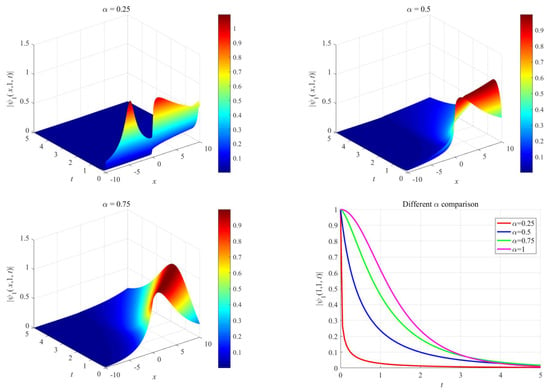
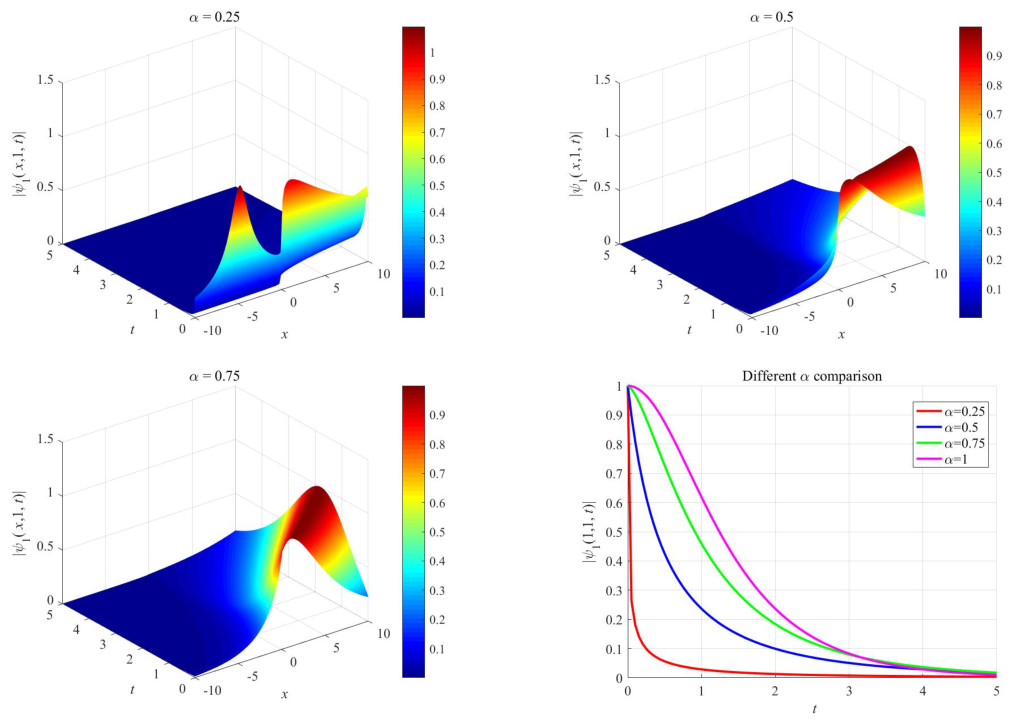
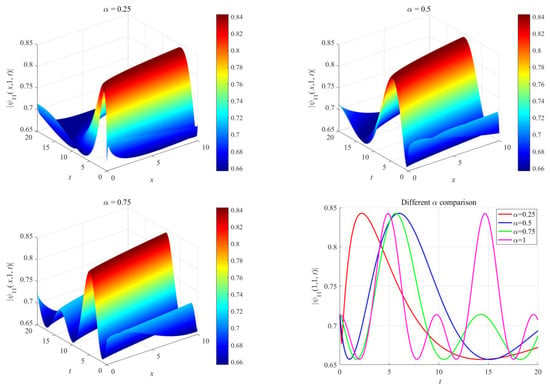
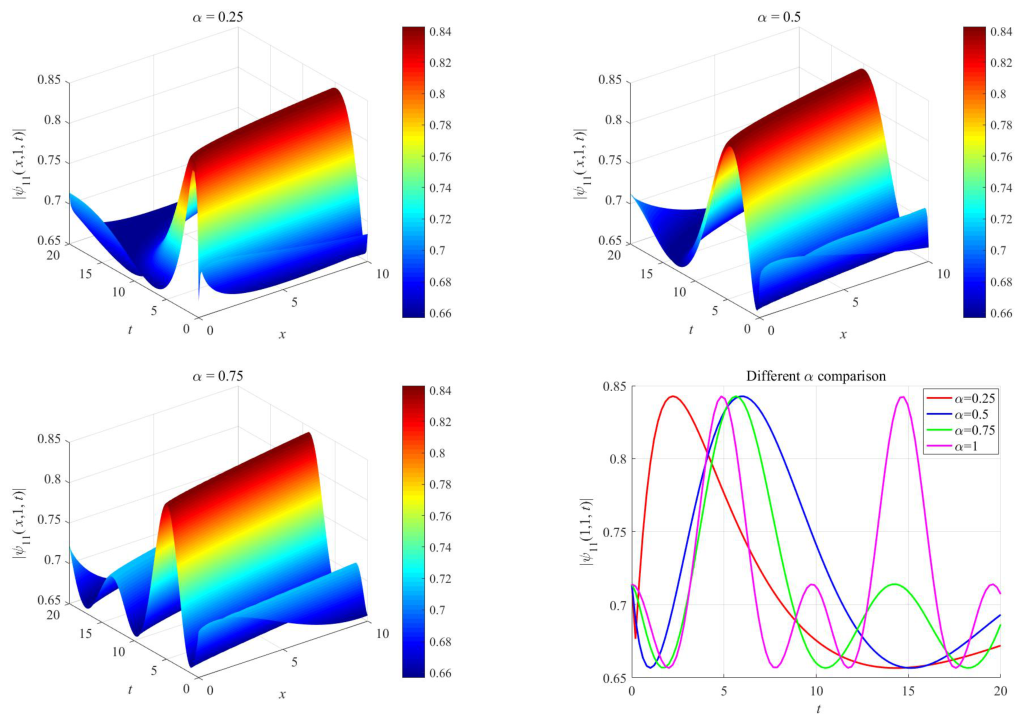
- Figure 1 shows a bell-shaped soliton solution. We draw three-dimensional and two-dimensional graphs of solutions under different fractional derivatives. The structure of the bell-shaped local solitary wave solution can be seen from Figure 1. As the fractional derivative increases, the peak of the soliton gradually becomes effective and the wave packet widens, indicating that the soliton decays rapidly with the increase in the fractional derivative.Figure 1. 3D and 2D amplitude plots of bell-shaped soliton with and .
- (ii)
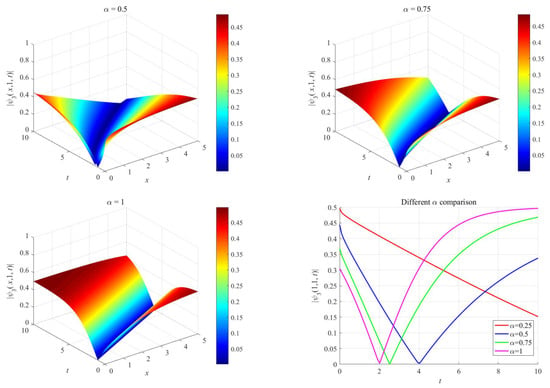
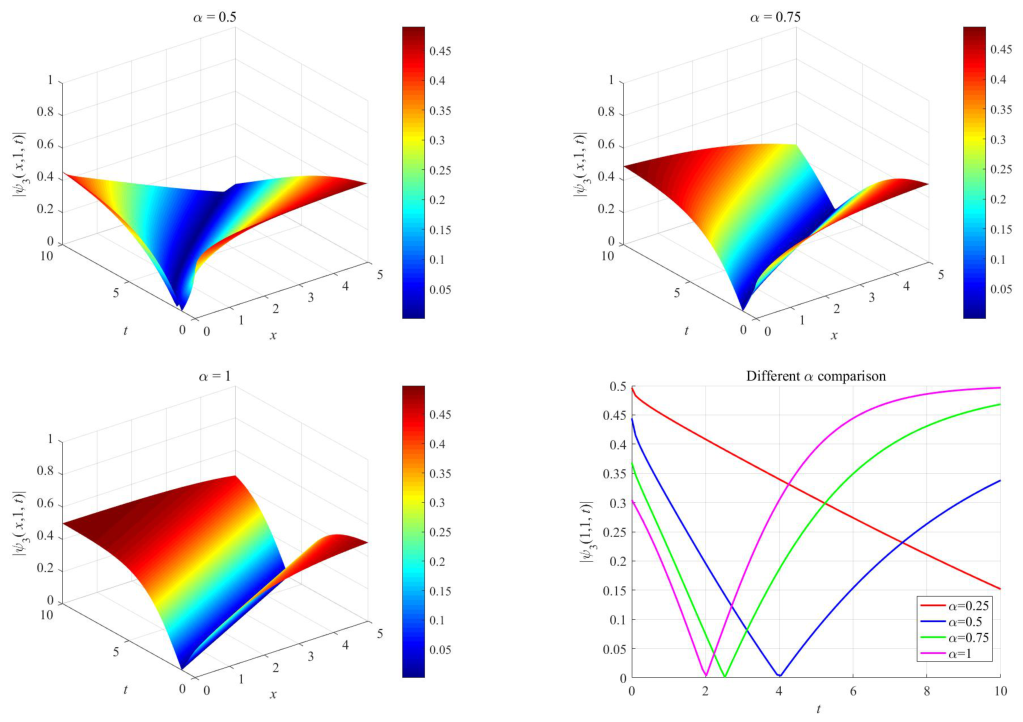
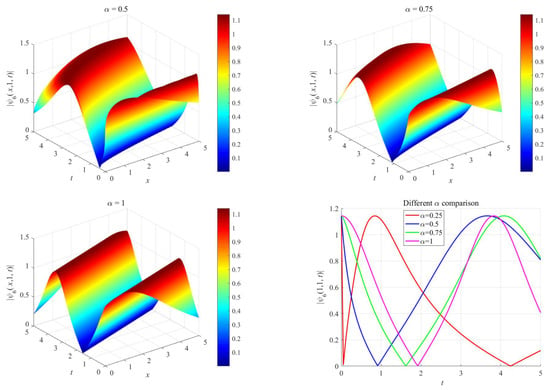
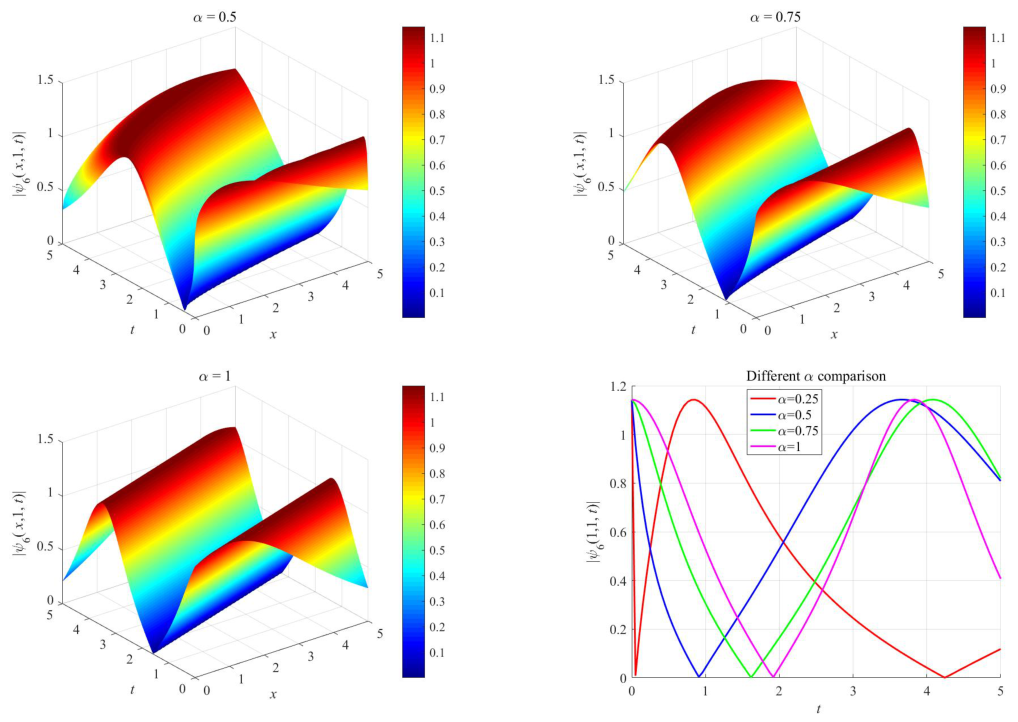
- Figure 2 shows a twisted soliton solution. From Figure 2, it can be seen that as the fractional derivative increases, the transition interval of the twisted soliton becomes wider, smoother, and the amplitude decreases. This indicates that the oscillation behavior of twisted solitons can be adjusted with fractional derivatives. The two-dimensional graph in Figure 3 shows the time evolution with fixed and . The three-dimensional diagram in Figure 3 indicates that fractional derivatives can be used to control the periodicity of the solution.Figure 2. 3D and 2D plots of kink-shaped soliton with and .Figure 3. Jacobi cn-type periodic solution : and .
- (iii)
- Figure 4 is the multi-dimensional spatial characteristics of the integer-order elliptic function solutions. The 3D image in Figure 4 shows the stable periodic wave structures in the x and y directions. The two-dimensional representation in Figure 4 shows that the waves maintain consistent periodicity, reflecting the directional propagation characteristics of elliptic function waves in multidimensional space.Figure 4. Jacobi sn-type periodic solution : and .
- (iv)
- Figure 5 is the periodic singular wave solutions given by in Equation (26), which consists of a combination of the Jacobi elliptic function and its reciprocal .Figure 5. Composite dn-type Jacobi solution : = 1, = = 1, and .
- (v)
- From the Figure 5, it can be seen that as the fractional order increases, the amplitude of the singular peak decreases, while the background oscillation becomes more regular and the peak width widens.
- (vi)
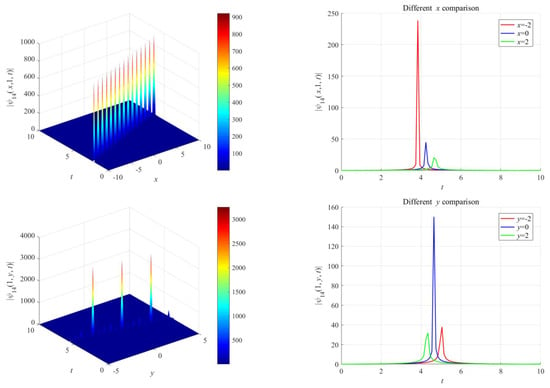
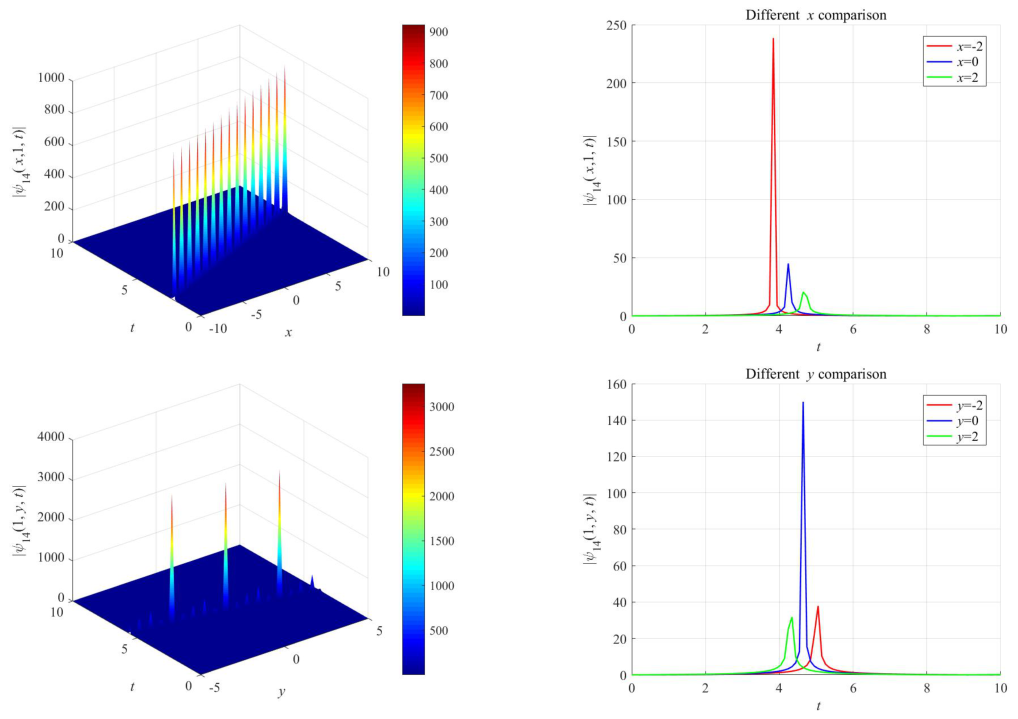
- Figure 6 is the Weierstrass function solutions for integer order . From Figure 6, it can be seen that the Weierstrass function solution exhibits a highly localized sharp pulse structure with extremely high peak amplitude and narrow spatial distribution. The 3D image shows dense periodic pulse trains in the x and y directions. The two-dimensional graph also indicates that pulses at different spatial positions have significant amplitude differences, and wave energy is highly concentrated at specific spatial points.Figure 6. Weierstrass doubly periodic pulse solution : and .
- (vii)
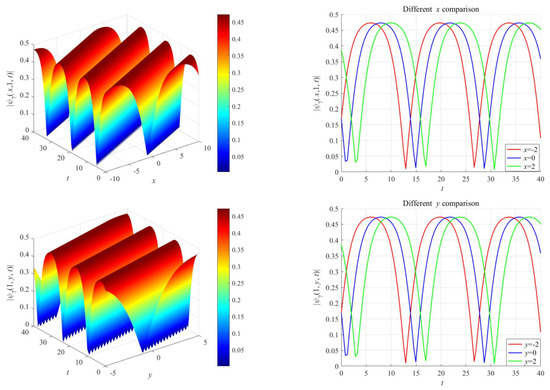
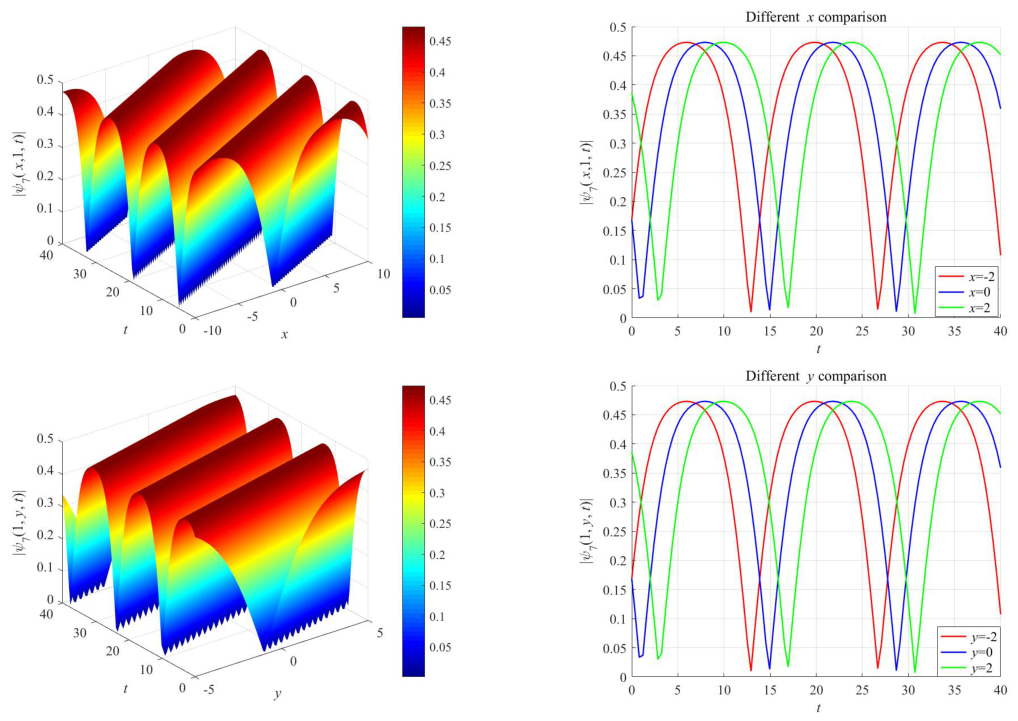
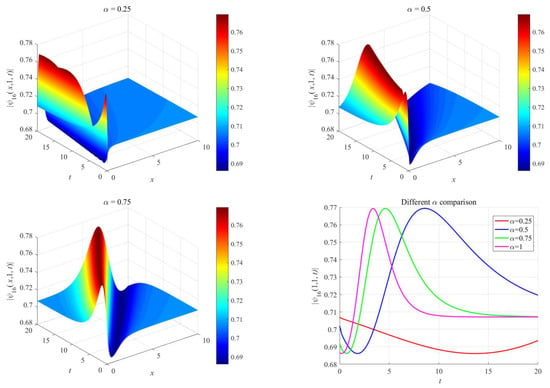
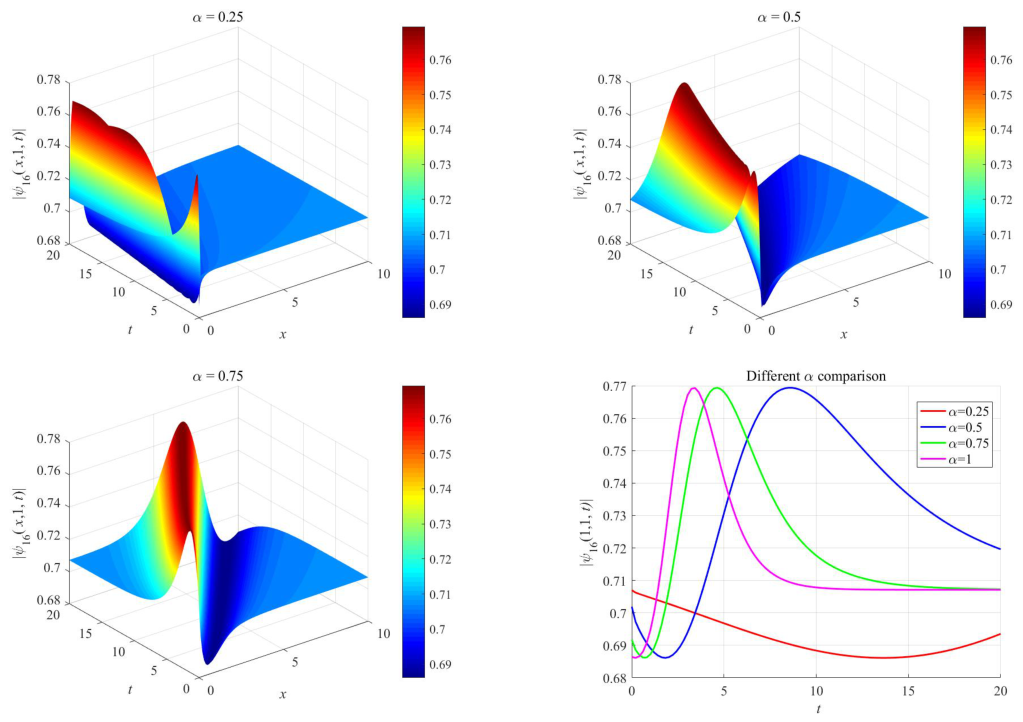
- Figure 7 is the stable low-variation soliton solutions under different fractional orders. The 3D plot in (v) reflects the slight spatiotemporal variations of at , and its 2D curve depicts the slow amplitude evolution at .Figure 7. Compound background soliton : and .
To quantitatively validate the accuracy of the obtained solutions, we compute the residual error by substituting each solution back into the original Equation (1). The residual is defined as the absolute value of the left-hand side of Equation (1)
The reference point is . The filtered statistics exclude the top 5% of outliers to remove numerical artifacts near the singular points.
Table 1 reports the maximum residual errors for three representative solutions: the bell-shaped soliton , the kink-shaped soliton , and the Jacobi dn-type elliptic solution . The residuals are all on the order of , confirming that all obtained solutions satisfy the original equation with reasonable accuracy. The small nonzero residuals are attributable to the finite-difference discretization error in the numerical computation of the conformable derivatives.
Table 1.
Maximum residual errors for representative solutions.
The EDAM is computationally efficient. The entire solution procedure reduces to solving the over-determined algebraic Equation (14), which involves only seven polynomial equations in the unknown parameters. This system can be solved manually. No numerical iteration or time-stepping is required. The residual verification in Table 1 was performed using MATLAB R2016a on a laptop (Intel Core i5-7200U, 8 GB RAM), with CPU times of 3.73 s, 3.48 s, and 4.50 s for , , and , respectively.
The five types of solution exhibit distinct structures. Bell-shaped solitons () and kink-shaped solitons () arise from sech and tanh profiles. Jacobi elliptic function solutions () generalize periodic waves with modulus n, which degenerate into solitons as . Weierstrass function solutions () describe doubly periodic sequences of sharp pulses.
The fractional-order parameter represents a power-law coordinate deformation: . As shown in Figure 1, Figure 2, Figure 3, Figure 4, Figure 5, Figure 6 and Figure 7, increasing weakens soliton localization and broadens wave packets, corresponding to enhanced dispersion in optical fibers, while for periodic solutions, modulates spatial periodicity and oscillation frequency.
Therefore, the EDAM offers a practical and efficient alternative for constructing exact traveling wave solutions of fractional nonlinear systems.
5. Conclusions
In the paper, we successfully apply the EDAM to the fractional paraxial wave equation with conformable fractional derivatives. By using this method, various types of accurate traveling wave solutions were systematically constructed. To highlight the advantages of the proposed method over existing approaches, Table 2 summarizes the types of solutions obtained by different methods for this equation. As shown, while the -model expansion technique [6], the -expansion method [7], and the unified technique [8] yield only limited classes of solutions, the EDAM simultaneously produces all five solution types within a single unified framework. In particular, the Jacobi elliptic, Weierstrass elliptic, and combined soliton solutions are obtained exclusively by the EDAM and have not been reported in previous studies for the conformable fractional paraxial wave equation. This demonstrates the superiority and versatility of the EDAM in handling complex fractional nonlinear systems.
Table 2.
Comparison of solution types obtained by different methods.
We also used Matlab mathematical software to draw three-dimensional and two-dimensional graphs of partial solutions. Through detailed numerical simulations, we systematically analyzed the influence of fractional-order parameter on waveform evolution. The numerical results indicate that increasing weakens the localization of wave packets and significantly improves the stability of soliton propagation. For periodic solutions, effectively modulates the oscillation frequency and spatial periodicity.
In summary, this study not only demonstrates the powerful ability of the EDAM to solve complex FNL PDEs, but it also provides valuable theoretical references for the study of traveling wave solutions of more general fractional-order nonlinear partial-differential equations. In future work, we will strive to extend this method to higher dimensional fractional systems and explore the combination of symbolic computation and machine learning to discover traveling wave solutions for more complex FNL PDEs.
Funding
This research was supported by the Open Fund Project of the University Key Laboratory of Pattern Recognition and Intelligent Information Processing (Grant No. MSSB-2024-11) and the Open Research Project of the Key Laboratory of Sichuan Provincial Department of Culture and Tourism for Digital Innovation of Tianfu Culture (Grant No. TFWH-2024-25).
Data Availability Statement
The original contributions presented in this study are included in the article. Further inquiries can be directed to the author.
Conflicts of Interest
The author declares no conflicts of interest.
Abbreviations
| EDAM | Enhanced Direct Algebraic Method |
| FNL PDE | Fractional Nonlinear Partial-Differential Equation |
References
- Jornet, M. On the Cauchy-Kovalevskaya theorem for Caputo fractional differential equations. Phys. D 2024, 462, 134139. [Google Scholar] [CrossRef] [Scilit]
- Katugampola, U.N. A new approach to generalized fractional derivatives. Appl. Math. Comput. 2011, 218, 860–865. [Google Scholar] [CrossRef] [Scilit]
- Li, Z. Solving the exactly explicit solutions of the conformable space-time fractional Phi-4 equation via neural networks method. Phys. Lett. A 2026, 581, 131535. [Google Scholar] [CrossRef] [Scilit]
- Tang, L. Dynamical behavior and multiple optical solitons for the fractional Ginzburg–Landau equation with β-derivative in optical fibers. Opt. Quantum Electron. 2024, 56, 175. [Google Scholar] [CrossRef] [Scilit]
- Luo, J.; Li, Z. Dynamic behavior and optical soliton for the M-truncated fractional Paraxial wave equation arising in a liquid crystal model. Fractal Fract. 2024, 8, 348. [Google Scholar] [CrossRef] [Scilit]
- Rehman, H.U.; Awan, A.U.; Allahyani, S.A.; Tag-ElDin, E.M.; Binyamin, M.A.; Yasin, S. Exact solution of paraxial wave dynamical model with kerr media by using ϕ6-model expansion technique. Results Phys. 2022, 42, 105975. [Google Scholar] [CrossRef] [Scilit]
- Khan, S.; Gepreel, K.A.; Khatun, M.; Akbar, M.A. Bifurcation, quasi-periodic, and chaotic analysis of the conformable fractional paraxial wave equation using the rational expansion method. AIP Adv. 2025, 15, 055323. [Google Scholar] [CrossRef] [Scilit]
- Roshid, M.M.; Uddin, M.; Mostafa, G. Dynamical structure of optical solution for M-fractional paraxial wave equation by using unified technique. Results Phys. 2023, 51, 106632. [Google Scholar] [CrossRef] [Scilit]
- Li, Z.; Hussain, E. Bifurcation analysis and chaotic behaviors of and a traveling-wave solution to the Zhiber–Shabat Equation with a truncated M-Fractional derivative. Fractal Fract. 2026, 10, 335. [Google Scholar] [CrossRef] [Scilit]
- Han, T.; Zhang, K.; Jiang, Y.; Rezazadeh, H. Chaotic pattern and solitary solutions for the (2+1)-dimensional beta-fractional Double-Chain DNA system. Fractal Fract. 2024, 8, 415. [Google Scholar] [CrossRef] [Scilit]
- Khan, A.G.; Muddassar, M.; Shoaib, S.; Rehman, Z.U.; Zahid, M. Dynamical systems with fractional derivatives: Focus on phase portraits and plasma wave propagation using Lakshmanan-Porsezian-Daniel model. Axioms 2025, 14, 405. [Google Scholar] [CrossRef] [Scilit]
- Li, Z.; Wu, M.; Hussain, E.; Yildirim, Y. Exactly explicit solutions of (2+1)-dimensional conformable fractional diffusive Predator–Prey model via neural networks method. Front. Phys. 2026, 14, 1824530. [Google Scholar] [CrossRef] [Scilit]
- Hussain, A.; Ibrahim, T.F.; Birkea, F.M.O.; Yahya, M.S.; Hassaballa, A.A.; Mukalazi, H. Abundant different types of soliton solutions for fractional modified KdV equation using auxiliary equation method. Sci. Rep. 2025, 14, 43518. [Google Scholar] [CrossRef] [Scilit] [PubMed]
- Abdeljabbar, A.; Roshid, M.M.; Ullah, M.S. Chaotic behaviors, stability, and solitary wave propagations of M-fractional LWE equation in magneto-electro-elastic circular rod. Nonlinear Eng. 2025, 14, 20250115. [Google Scholar] [CrossRef] [Scilit]
- Naseem, A.; Hussain, R. Investigating novel soliton solutions and chaotic Structures for the (3+1)-dimensional fractional q-deformed tanh-Gordon model. AIMS Math. 2025, 10, 17779–17800. [Google Scholar] [CrossRef] [Scilit]
- Bilal, M.; Rehman, S.U.; Younas, U.; Mohammad, A.; Rezapour, S.; Inc, M. Dynamical analyses and dispersive soliton solutions to the nonlinear fractional model in stratified fluids. Open Phys. 2025, 23, 20250218. [Google Scholar] [CrossRef] [Scilit]
- Yang, Y.; Cao, W.; Liu, Y.; Li, H.; Wang, J. Optimal time two-mesh mixed finite element method for a nonlinear fractional hyperbolic wave model. Commun. Anal. Mech. 2024, 16, 24–52. [Google Scholar] [CrossRef] [Scilit]
- Roshid, M.M.; Alam, M.N.; İlhan, O.A.; Rahim, M.A.; Tuhin, M.M.H.; Rahman, M.M. Modulation instability and comparative observation of the effect of fractional parameters on new optical soliton solutions of the paraxial wave model. Opt. Quantum Electron. 2024, 56, 1010. [Google Scholar] [CrossRef] [Scilit]
- Mannaf, M.A.; Islam, M.E.; Bashar, H.; Basak, U.S.; Akbar, M.A. Dynamic behavior of optical self-control soliton in a liquid crystal model. Results Phys. 2024, 57, 107324. [Google Scholar] [CrossRef] [Scilit]
- Bashar, M.H.; Ghosh, S.; Rahman, M.M. Dynamical exploration of optical soliton solutions for M-fractional paraxial wave equation. PLoS ONE 2024, 0299573. [Google Scholar] [CrossRef] [Scilit] [PubMed]
- Bashar, M.H.; Mannaf, M.A.; Rahman, M.M.; Khatun, M.T. Optical soliton solutions of the M-fractional paraxial wave equation. Sci. Rep. 2025, 15, 1416. [Google Scholar] [CrossRef] [Scilit] [PubMed]
- Arnous, A.H.; Hashemi, M.S.; Nisar, K.S.; Shakeel, M.; Ahmad, J.; Ahmad, I.; Jan, R.; Ali, A.; Kapoor, M.; Shah, N.A. Investigating solitary wave solutions with enhanced algebraic method for new extended Sakovich equations in fluid dynamics. Results Phys. 2024, 57, 107369. [Google Scholar] [CrossRef] [Scilit]
- Khalifa, A.S.; Ahmed, H.M.; Badra, N.M.; Rabie, W.B.; Al-Askar, F.M.; Mohammed, W.W. New soliton wave structure and modulation instability analysis for nonlinear Schrödinger equation with cubic, quintic, septic, and nonic nonlinearities. AIMS Math. 2024, 9, 26166–26181. [Google Scholar] [CrossRef] [Scilit]
- Han, T.; Liang, Y.; Fan, W. Dynamics and soliton solutions of the perturbed Schrödinger-Hirota equation with cubic-quintic-septic nonlinearity in dispersive media. AIMS Math. 2025, 10, 754–776. [Google Scholar] [CrossRef] [Scilit]

Disclaimer/Publisher’s Note: The statements, opinions and data contained in all publications are solely those of the individual author(s) and contributor(s) and not of MDPI and/or the editor(s). MDPI and/or the editor(s) disclaim responsibility for any injury to people or property resulting from any ideas, methods, instructions or products referred to in the content. |
© 2026 by the author. Licensee MDPI, Basel, Switzerland. This article is an open access article distributed under the terms and conditions of the Creative Commons Attribution (CC BY) license.