


Abstract
Old film restoration remains challenging because archival footage often combines scratches, blotches, flicker, blur, and temporal artifacts, disrupting the balance among structural recovery, regional texture repair, and fine artifact suppression. We propose Multi-Granularity Feature Decomposition with Ranking-Aware Regularization for Old Film Restoration (MgfrOFR), a multi-granularity extension of a Mamba-based old film restoration backbone. MgfrOFR first decomposes propagated features into coarse-to-fine restoration branches and feeds branch summaries back through channel-wise recalibration so different degradation scales can be represented without competing in a single feature stream. It then introduces a ranking-aware triplet regularizer that penalizes correlated temporal-similarity rankings across branches during training while preserving the baseline inference interface. Experiments on the Synthetic/Real-World Old Video (SRWOV) benchmark show statistically significant fidelity gains on synthetic clips, favorable no-reference naturalness on real-world archival footage, and a bounded perceptual-quality trade-off. These results indicate that representation-level branch balance is an effective inductive bias for old film restoration under heterogeneous and asymmetric degradation.
1. Introduction
Old films preserve cinematic heritage and historical documentary material and form large archival collections, yet the film stock that stores this material continues to decay. Digital restoration offers a practical route to revitalize such material [1]. A central difficulty is that aged footage is rarely damaged in only one way. Scratches, dust, blotches, flicker, blur, grain, and fading can accumulate within the same clip and act on very different spatial scales, from large structural damage to thin local artifacts. This range of scales sets old film restoration apart from generic video enhancement. A successful restoration model must keep coarse structural recovery, regional texture repair, and fine artifact suppression in balance—a representation-level symmetry that asymmetric, heterogeneous degradation continually disrupts.
Learning-based old film restoration has advanced through end-to-end video restoration frameworks. The recurrent transformer network (RTN) pioneered bidirectional recurrent propagation with a learnable defect mask, but its restoration evidence still flows through a single recurrent stream [2]. The Recursive Recurrent Transformer Network (RRTN) added recursive transformer propagation for stronger temporal alignment, yet structural recovery and fine artifact suppression remain jointly encoded [3]. MambaOFR introduced state space models to old film restoration, improving efficiency and establishing the Synthetic/Real-World Old Video (SRWOV) benchmark [4,5,6]. Even so, it routes every degradation scale through a single propagated feature pathway. These methods share a common limitation: when heterogeneous signals compete in one latent space, coarse recovery can overwrite fine evidence, and local artifact suppression can distort global structure.
Here, symmetry operates at the representation level rather than as an object-level shape constraint. A symmetric representation keeps restoration evidence balanced across granularity-specific branches while maintaining consistent temporal correspondence across frames. Because our branch-diversity objective is invariant under permutations of the granularity branches (the symmetric group ), this balance is a permutation symmetry in the machine-learning sense—a standard group-symmetry principle—rather than a visible geometric one, placing our framework within symmetry-driven representation learning for image restoration. This interpretation fits old film restoration because its degradation space is hierarchical. Missing regions and large blotches require global context, grain and flicker require regional modeling, and fine scratches or dust require local precision. Existing multi-granularity designs mainly target detection or recognition [7,8,9,10,11]. Naive multi-branch extensions can still collapse into correlated features unless branch diversity is explicitly enforced. This gap motivates explicit granularity-separated restoration branches.
We propose Multi-Granularity Feature Decomposition with Ranking-Aware Regularization for Old Film Restoration (MgfrOFR), which augments MambaOFR with two complementary components (Figure 1). The Multi-Granularity Feature Extractor (MGFE) reorganizes propagated Mamba features into coarse-to-fine restoration branches so that structural completion, regional repair, and fine-detail suppression are carried by dedicated descriptors instead of competing in one hidden stream. It also feeds branch summaries back into the spatial stream through channel-wise recalibration. Ranking-Aware Triplet Regularization (RATR) complements this decomposition by discouraging redundant branch behavior: it penalizes correlated rankings of temporal correspondences rather than imposing identity-label supervision, making the regularizer suited to restoration.
Figure 1.
Overview of the Multi-Granularity Feature Decomposition with Ranking-Aware Regularization for Old Film Restoration (MgfrOFR) framework. The Multi-Granularity Feature Extractor (MGFE) decomposes propagated features into multi-granularity restoration-token branches for channel-wise recalibration. Ranking-Aware Triplet Regularization (RATR) is used only during training to penalize redundant temporal-ranking correlations and produce and . Solid black arrows denote the inference-time restoration path, light-red dashed arrows denote the training-only RATR connections, and dashed black boxes group the state space model (SSM) and degradation-aware prompt block (DPB) units into each MambaBlock. The deformable convolutional network (DCN) performs the gated aggregation labeled in the diagram, and “Concat” denotes channel concatenation.
Using a unified reproduction protocol on SRWOV, MgfrOFR preserves the efficient Mamba backbone of MambaOFR while adding explicit granularity control at modest overhead. The main contributions are summarized as follows:
- 1.
- We formulate old film restoration through representation-level symmetry under heterogeneous degradation, treating coarse structural recovery, regional texture repair, and fine artifact suppression as complementary feature components that remain balanced despite spatial and temporal asymmetry.
- 2.
- We design MGFE, a multi-granularity feature decomposition for Mamba-based old film restoration that inserts learnable restoration tokens into propagated features, aggregates them into coarse-to-fine branches, and feeds branch summaries back to the spatial stream through channel-wise recalibration.
- 3.
- We introduce RATR, a ranking-aware triplet regularizer that penalizes correlated temporal-similarity rankings across granularity branches using differentiable rank correlation, improving branch complementarity and reducing redundancy while preserving the original baseline inference interface.
- 4.
- We evaluate MgfrOFR on the SRWOV synthetic and real-world benchmark; statistical tests, ablations, and complexity analysis show improved restoration fidelity and no-reference naturalness at modest additional computational cost.
2. Related Work
2.1. Old Film and Video Restoration
Old film restoration differs from general video restoration because it must jointly address structured artifacts (scratches, dust, blotches), photometric degradation (flicker, grain, fading), and quality degradation (blur, noise). Traditional approaches decompose the problem into detection and inpainting stages, relying on hand-crafted features with interpolation-based filling [12] or sparse collaborative filtering [13,14]. Although computationally efficient, these methods lack semantic understanding of video content and leave photometric degradations largely unaddressed. Deep learning has shifted old film restoration toward end-to-end frameworks: DeepRemaster [1] processes spatiotemporal volumes with 3D convolutions, RTN [2] introduces bidirectional recurrent propagation with a learnable soft defect mask, and RRTN [3] strengthens alignment via recursive transformer networks with second-order grid propagation. MambaOFR [4] replaces computationally expensive blocks with MambaIR-style [6] state-space modules and establishes the SRWOV benchmark for dedicated old film restoration evaluation.
General video restoration methods such as video restoration with enhanced deformable convolutions (EDVR) [15], BasicVSR [16], BasicVSR++ [17], the Video Restoration Transformer (VRT) [18], and the Recurrent Video Restoration Transformer (RVRT) [19] provide strong temporal modeling, but they do not include defect handling tailored to old film restoration. Recent diffusion and foundation-prior restoration systems, including DiffBIR [20], SUPIR [21], and SeeSR [22], improve perceptual detail for blind image restoration or real-world super-resolution, but they are not designed for temporal old-film defects or SRWOV-style video restoration protocols. Despite this progress, existing old film restoration methods still encode structural completion, regional repair, and fine-detail suppression through a single propagated latent space. This motivates our multi-granularity decomposition approach.
2.2. State Space Models for Vision
The computational cost of self-attention scales quadratically with sequence length, posing a practical barrier for high-resolution video processing. Structured state space sequence models [23] reformulate sequence modeling through continuous-time state transitions, reducing complexity from to while maintaining a global receptive field. Mamba [5] further introduces selective state transitions with hardware-aware recurrence, enabling content-dependent filtering. Adaptations of state space models (SSMs) to visual domains have produced strong baselines: MambaIR [6] demonstrates 2D selective scanning for image restoration, VMamba [24] builds hierarchical feature pyramids with four scanning routes, and VSRM [25] alternates spatial and temporal Mamba blocks for video super-resolution at linear cost.
These properties are well suited to old film restoration, which couples long temporal dependencies, large spatial damage, and high-resolution input. MambaOFR [4] shows that Mamba-based propagation can improve both efficiency and restoration quality relative to transformer counterparts. However, linear-cost long-range aggregation alone does not determine what restoration evidence each feature position retains; the backbone treats all degradation scales uniformly. Our work augments the SSM feature flow with explicit multi-granularity descriptors rather than replacing the backbone.
2.3. Multi-Scale and Multi-Branch Representations
A single feature scale often cannot encode global structure and fine-grained local evidence simultaneously. Feature Pyramid Networks [7] and the High-Resolution Network (HRNet) [8] show that explicit multi-scale decomposition improves dense prediction, while MIRNet-v2 [26] shows that complementary multi-scale context enhances low-level reconstruction quality. In person re-identification, the Part-based Convolutional Baseline (PCB) [9] decomposes features along spatial stripes, the Multiple Granularity Network (MGN) [10] combines global and local branches at different partition granularities, and ReIDMamba [11] adapts this paradigm to state space models. These methods demonstrate that structured branches can expose complementary evidence, but their supervision and feature semantics target recognition rather than restoration.
2.4. Diversity and Ranking Regularization
A consistent lesson across these works is that extra branches help only when they capture complementary cues rather than correlated copies of the same evidence. Contrastive learning [27] provides a general diversity mechanism, but it does not directly regulate pairwise ordering behavior across branches: two branches can produce different feature magnitudes yet rank all candidates identically, yielding diversity in norm but redundancy in discriminative structure. Differentiable Kendall’s Tau [28] enables gradient-based penalization of correlated rankings, a property that naturally applies to flow-guided temporal correspondences in old film restoration.
2.5. Representation Symmetry in Restoration
In artificial intelligence (AI)-based image processing, symmetry can be interpreted beyond visible object geometry. A learned representation may be symmetric when complementary evidence sources remain balanced, comparable, and consistently organized across samples; asymmetry appears when optimization favors one dominant cue. Feature-fusion and correlation-based representation studies show that multi-view or multi-branch features need explicit organization rather than simple concatenation [29,30], and feature-wise modulation provides a practical way to inject conditioning signals into image-processing networks [31]. For old film restoration, this view is useful because film damage is inherently asymmetric across regions and frames. In MgfrOFR, this representation symmetry is made precise as two group invariances of the training objective—branch-permutation invariance under the symmetric group and direction-exchange invariance under the bidirectional action (Section 3.7).
Our design is inspired by this line of work, but restoration changes the formulation in three important ways. First, the branch tokens are inserted into propagated restoration features rather than identity-oriented recognition embeddings. Second, the branch summaries are fed back into the restoration stream through channel-wise recalibration, so they affect reconstruction rather than only auxiliary supervision. Third, positives and negatives are defined by temporal correspondence within and across clips rather than by person identities. This discussion highlights two gaps in old film restoration: the absence of explicit multi-granularity feature decomposition within the temporal propagation pipeline, and the lack of diversity regularization that keeps parallel feature branches complementary. Unlike multi-scale pyramids, token/stripe recognition models, and generic diversity losses, MgfrOFR is the only design considered here whose branch structure carries an explicit permutation-and-exchange symmetry rather than acting on feature magnitude alone. MgfrOFR addresses both gaps within a unified framework, as detailed in Section 3.
3. Methods
3.1. Problem Setup
Given a degraded old-film clip , we aim to recover a clean clip with restored image content and reduced structured film defects and photometric degradation. Synthetic SRWOV clips provide paired clean frames for direct supervision. Real-world archival clips have no ground truth, so we evaluate them with no-reference quality metrics and qualitative inspection. Old-film degradations vary over both spatial scale and time, and a restoration model must remove them without breaking temporal consistency.
3.2. Input Representation
Each input frame is a red–green–blue (RGB) image, and the baseline propagation module converts the clip into backward and forward feature streams. At each time step t, motion-aware propagation yields aligned feature maps . MgfrOFR operates entirely on these propagated maps: MGFE takes each map, returns a recalibrated map with the same spatial size and channel count, and produces the branch descriptors used by RATR during training.
MgfrOFR retains the bidirectional propagation framework of MambaOFR [4] but replaces its single-granularity restoration view with an explicit coarse-to-fine pipeline. Given the degraded clip , the baseline first propagates content backward and forward so that neighboring frames are motion-aligned before restoration, and MgfrOFR builds on these aligned features. Old-film damage is spatially and temporally asymmetric: a scratch may cover one region in one frame and vanish in the next, yet restoration should still balance coarse, medium, and fine evidence. This cross-granularity balance is the feature space symmetry targeted by our design.
MGFE turns each propagated feature map into a token sequence, inserts learnable restoration tokens, and reads branch descriptors from progressively fused token groups; their summaries flow back to the propagated feature through channel-wise recalibration. RATR acts only during training, where it discourages branches from inducing the same temporal rankings, and is disabled at inference. The reconstruction head is inherited unchanged from MambaOFR and outputs the restored frame. Figure 1 shows how these components fit together.
3.3. Pipeline Overview
At time step t, the baseline provides propagated maps , and MGFE maps each one to a recalibrated feature map together with a set of branch descriptors:
where d indexes the propagation direction, is the branch-descriptor tensor, and in this work. The reconstruction head keeps the original MambaOFR interface and combines the two recalibrated directional features:
where is the unchanged reconstruction head of MambaOFR and denotes channel concatenation. Averaging the two directional descriptors before RATR, as in Equation (2), lets the diversity regularizer operate on a single descriptor tensor per frame instead of two nearly identical streams. Figure 1 traces this data flow, and Algorithm 1 summarizes the forward pass.
| Algorithm 1 MgfrOFR forward pass for a clip of length T. |
|
3.4. Baseline Interface and Preserved Components
MgfrOFR leaves the MambaOFR backbone, propagation order, reconstruction head, and training loop unchanged. At inference, the only addition is MGFE, which maps to without changing the tensor shape; RATR is an auxiliary loss on the branch descriptors and plays no role once training ends. The reconstruction head therefore behaves as in the baseline, still taking the concatenated backward and forward features together with the current degraded frame.
3.5. Multi-Granularity Feature Extractor (MGFE)
Old films are damaged at very different scales: large missing regions, mid-scale blotches, and thin scratches each require a different aggregation range. A single restoration feature must serve all of them at once, so fine detail and coarse structure compete inside the same channels. MGFE addresses this conflict by keeping the propagated feature as a shared spatial carrier while exposing several restoration-token branches that aggregate at different rates; the branch summaries are fed back to the carrier as a recalibration signal. Each damage scale therefore receives a dedicated branch, while reconstruction still reads from one common feature. Figure 2 details the design.
Figure 2.
Detailed Multi-Granularity Feature Extractor (MGFE) module. Propagated features are decomposed into restoration-token branches. The yellow, amber, and peach shaded regions denote the fine-, medium-, and coarse-granularity branches, respectively, and the red dashed path denotes the training-only connection to Ranking-Aware Triplet Regularization (RATR). learnable restoration tokens are inserted into image tokens, fused by progressive average fusion, and summarized into descriptors that generate scale/shift parameters for channel-wise recalibration.
Since MGFE processes each propagation direction identically, we drop the direction superscript d and write for brevity. We first flatten it into an image-token sequence
where preserves raster order and stacks spatial positions as tokens. We append M learnable restoration tokens and insert them into the image-token stream through an operator . The restoration-token matrix is initialized from a truncated normal distribution with standard deviation 0.02 and optimized jointly with the restoration network:
The insertion partitions the N image tokens into approximately equal chunks and places one restoration token after each of the first M chunks, keeping the original image-token order. Each chunk receives or image tokens, so the total remains exactly N. For example, with and the four chunks hold image tokens, and the three restoration tokens land at cumulative positions in the 12-token interleaved sequence. Spacing the tokens uniformly in this way gives them balanced receptive ranges over the full spatial support.
MGFE then builds G granularity branches by progressively fusing restoration tokens, following the progressive fusion scheme introduced in ReIDMamba [11] and adapting it to spatial restoration features. To make every branch well defined, the number of restoration tokens must satisfy the divisibility constraint
so that every branch size is an integer for . We use and () throughout; see Section 4.5 for alternative configurations.
For branch , MGFE fuses restoration tokens with a sampling rate of . The fused restoration tokens are defined as
where denotes an element-wise average over all tokens in the fusion group:
The average is taken channel-wise. We use average fusion in the main MgfrOFR configuration because it keeps all restoration tokens contributing to the branch descriptor and prevents a single high-response token from dominating the recalibration signal. The max-fusion variant is retained as a control in Section 4.4; its lower full-reference scores motivate average fusion as the default. A smaller g keeps more tokens and preserves fine local detail; a larger g pools a wider support and emphasizes coarse context.
The fused tokens are re-inserted into the same image-token sequence using the same uniform-spacing insertion rule:
and the resulting sequence is processed by a lightweight branch-specific token mixer :
where . Each consists of two sequential linear-complexity token blocks, and each block contains a context-augmented projection sublayer and a feed-forward sublayer. The projection sublayer first applies LayerNorm (LN), computes a global context vector by mean pooling over the token dimension, and adds it (through a learned linear projection) to the per-token linear projection, followed by a residual connection. The feed-forward sublayer applies LN followed by a two-layer multilayer perceptron (MLP) with Gaussian error linear unit (GELU) activation and hidden dimension , again with a residual connection. Formally, for input tokens , each block computes
where denotes mean pooling over the token dimension, are learned projections, and MLP consists of . The global context term gives every token an inexpensive summary of the whole sequence, so tokens exchange information at linear cost. Each branch owns its pair of token blocks and can specialize to its granularity; because the blocks are small, the extra parameter count remains modest.
After branch processing, we summarize each branch by averaging the updated restoration-token positions:
where denote the uniformly spaced insertion positions for tokens, and . Stacking all branch descriptors gives
Because all descriptors come from the same propagated feature but at different fusion rates, they remain semantically aligned while differing in granularity. RATR later operates on this descriptor tensor .
MGFE further converts the branch descriptors into a channel-wise recalibration signal. We first average the branch context,
where is a projection head consisting of that outputs concatenated scale and shift vectors. The recalibrated propagated feature is then
where the vectors from Equation (13) are broadcast over the spatial dimensions. The multiplicative term starts near unity, and the small additive coefficient caps the shift at about of the tanh range, following the conservative residual scaling of FiLM-style modulation [31]. The recalibrated feature therefore stays close to the propagated feature while the branch context remains uninformative, allowing the model to reproduce baseline behavior early in training. As the descriptors sharpen, the coarse branches emphasize global structure and the fine branches highlight local damage.
MGFE produces two outputs from the same propagated feature: the branch descriptors and the recalibration signal . The descriptors feed the ranking regularizer of Section 3.6, while the recalibration modulates the propagated feature by granularity. Keeping them separate lets us switch off recalibration without changing the descriptors, as in the RATR-only configuration of Section 4.4. Explicit branches, however, do not guarantee complementary features. If every branch ranks samples in the same order, the branches collapse into redundant descriptors, which motivates the regularizer below.
3.6. Ranking-Aware Triplet Regularization (RATR)
RATR keeps the branches from collapsing by penalizing how strongly their rankings agree. Descriptor orthogonality alone is insufficient: two branches can be orthogonal yet still order the same samples identically, leaving them redundant and undermining the balance created by MGFE. The ordering is therefore the target. For an anchor frame compared with nearby positives and harder negatives, RATR measures whether two branches rank that candidate set alike, using Kendall’s [32] rank correlation coefficient made differentiable by DiffKendall [28]. Figure 3 shows the workflow.
Figure 3.
RATR (Ranking-Aware Triplet Regularization) compares branch-specific ranking sequences from temporal correspondences using differentiable Kendall’s Tau. The cyan and pink panels denote the positive and negative candidate sets, respectively. Neighboring frames define positives, while distant same-video frames and cross-video centroids define negatives, producing and during training only. The ellipses in the negative-set box indicate additional candidate samples omitted from the schematic for visual clarity; they do not represent missing processing steps or data.
Let the averaged branch descriptors from Equation (2) be organized as a 4D tensor of shape , where is the batch size. We flatten batch and time into samples and normalize the descriptors branch-wise:
For each branch g, we compute a cosine-similarity matrix
This matrix supplies the rankings rather than serving as a supervision target itself: each anchor draws one positive ranking sequence and one negative ranking sequence from it, forming the anchor-positive-negative triplet that RATR regularizes.
For anchor i, the positive set is defined from temporal correspondences within the same clip:
where and are the clip and frame indices of sample i. Adjacent frames are natural positives because the flow-guided deformable alignment in MambaOFR has already warped neighboring frames onto the anchor before MGFE runs; after alignment, they are the most reliable feature-domain proxy for true correspondences. Because (at most one predecessor and one successor), boundary frames have only a single positive neighbor, and we compute the intra-ranking term only on anchors that have at least two positives:
For the seven-frame clips used in training, this excludes only the first and last frame of each clip, and every interior anchor contributes one pairwise ordering comparison to . In practice, is averaged over many valid anchors per batch, while adds a complementary signal from the richer negative set.
Negative evidence is drawn from two harder sources: temporally distant frames inside the same clip and clip-level representatives from other clips. The same-video negatives are
and the clip-level centroid for another video is
where denotes the set of frame indices in clip v. We then construct the negative ranking sequence as
where ⊕ denotes sequence concatenation. Distant frames from the same clip are hard negatives: they share content and degradation with the anchor but are no longer immediate neighbors. Using one centroid per other clip gives a stable clip-level negative and keeps the cost linear instead of incurring the cost of comparing every cross-clip frame pair.
To compare how two branches rank the same candidate set, we adopt a differentiable version of Kendall’s Tau. For sequences , the differentiable statistic is
where is a temperature parameter. As , Equation (22) approaches the hard sign comparison used in the exact Kendall coefficient; as becomes too large, pairwise order differences are oversmoothed and gradients vanish. We set (see Section 4.5 for the sensitivity to this choice). A lower value of indicates weaker ranking correlation between branches and therefore stronger branch complementarity.
Using Equation (22), we compute the positive-ranking correlation loss as
and the negative-ranking correlation loss as
The final ranking-aware regularizer is
Equations (23)–(25) are complementary: the intra term prevents two branches from ordering the most reliable temporal correspondences the same way, and the inter term prevents the same collapse on harder negatives. Neither term drives the branches toward meaningless disagreement, because the reconstruction losses still tie every branch to the same target through MGFE.
3.7. Symmetry Property of the Regularizer
The representation symmetry introduced in Section 1 has a concrete meaning in MgfrOFR. It is not a geometric symmetry of the image content but an invariance of the diversity objective under group actions that relabel branches or exchange propagation directions. Two such invariances hold, and together they explain why the constraint is a symmetry principle rather than a balancing heuristic, as discussed in Section 2.5.
Property 1
(Branch-permutation invariance). Both the intra term in Equation (23) and the inter term sum the differentiable Kendall statistic over unordered branch pairs , and Equation (22) is symmetric in its arguments, . Permuting the branch index of every descriptor by the same π therefore leaves the regularizer unchanged:
where is the symmetric group on the G branches. In other words, depends only on the unordered set of pairwise branch relations, not on any branch ordering or index. Because has no privileged element, the objective does not assign a preferred role to any branch.
Property 2
(Direction-exchange invariance). The two propagation streams enter the regularizer only through the average in Equation (2), which is invariant under the action that swaps the backward and forward descriptors, . The objective thus treats the two temporal directions symmetrically and inherits the bidirectional symmetry of the backbone.
Symmetry versus balancing. These two invariances separate our constraint from a tuned balancing term. Balancing targets an outcome(branches that end up contributing comparably) and is usually enforced by an asymmetric, hand-weighted penalty on individual branch magnitudes. RATR instead is built from group-invariant quantities ( on branches and on directions) and applies the identical constraint to every branch by construction. Balanced, complementary branches follow as a consequence of optimizing this symmetric objective, not as a separately weighted goal.
Scope of the claim. The symmetry here is functional and representation-level: an invariance of the learning objective under permutation and exchange group actions, both standard symmetry principles in machine learning, rather than a visible geometric symmetry of the restored frames. We keep this reading deliberately narrow, and Section 2.5 relates it to the broader use of symmetry in representation learning.
3.8. Training Objective
The generator objective combines the standard old film restoration losses used by the MambaOFR baseline with our ranking-aware regularizer. We use an pixel reconstruction loss , whose robustness for image restoration is analyzed in [33], a Visual Geometry Group (VGG)-based perceptual loss [34], an adversarial loss [35], and the ranking regularizer :
Because MGFE only augments the propagated feature stream and RATR is a pure auxiliary term, Equation (27) fits into the baseline training loop without any other change. We set and , following RTN [2] and MambaOFR [4], and use , , and for the ranking term (see Section 4.5). The smaller weight on reflects the coarser ordering signal from clip-centroid negatives. Unless stated otherwise, the full model uses feature dimension , branches, restoration tokens, channel-wise average fusion in Equation (7), and differentiable Kendall temperature .
4. Experiments
We evaluate MgfrOFR under two complementary settings. Synthetic clips include ground truth and therefore support full-reference fidelity and perceptual metrics. Real archival footage lacks ground truth, so only no-reference naturalness metrics apply. We keep these settings separate throughout this section because a single merged score would mask the fidelity–naturalness trade-off that defines old film restoration.
4.1. Datasets and Evaluation Metrics
4.1.1. Datasets
We evaluate MgfrOFR on the SRWOV benchmark introduced with MambaOFR [4], a dedicated old film restoration benchmark that provides both synthetic and real-world test sets.
For training, we use the REalistic and Dynamic Scenes (REDS) training split [36], which contains 240 video sequences, each with 100 frames at resolution. Clean REDS frames are degraded on the fly with the synthetic degradation pipeline from MambaOFR, which simulates scratches, dust, blotches, flicker, and grain and produces paired degraded and clean training samples.
The synthetic test set contains 30 clips rendered with the same degradation pipeline on held-out REDS sequences. Each clip has 100 frames at with paired ground truth, enabling full-reference scoring. The real-world set contains 216 clips of archival footage from the 1920s to the 1960s, with authentic mixed degradations and no ground truth. We follow the original 216-clip SRWOV protocol [4]. It spans indoor portraits, newsreel footage, conversations, and multi-person scenes and totals 29,256 frames for a broad naturalness assessment.
4.1.2. Evaluation Metrics
Seven metrics cover three complementary dimensions. On synthetic data with ground truth, we report peak signal-to-noise ratio (PSNR) and structural similarity index (SSIM) [37] for pixel fidelity (higher is better), learned perceptual image patch similarity (LPIPS) [38] for learned perceptual distance (lower is better), and deep image structure and texture similarity (DISTS) [39] for joint structure-texture similarity (lower is better). On real data without ground truth, we use natural image quality evaluator (NIQE) [40] and blind/referenceless image spatial quality evaluator (BRISQUE) [41] for statistical naturalness (lower is better), together with CLIP-based image quality assessment (CLIP-IQA+) [42], which evaluates contrastive language–image pre-training (CLIP) [43] features through learnable quality-aware prompts (higher is better). These groups probe pixel fidelity, perceptual quality, and naturalness in turn.
4.2. Implementation Details
4.2.1. Training Details
We train MgfrOFR on the REDS training split [36] with the synthetic degradation pipeline from Section 4.1.1. The optimizer is Adam [44] with and , an initial learning rate of , and a MultiStep schedule with milestones at 50 K, 100 K, and 150 K iterations (). Training runs for 200 K iterations on 4 NVIDIA A100 graphics processing units (GPUs; NVIDIA Corporation, Santa Clara, CA, USA), each with 80 GB of memory, one clip per GPU per mini-batch. Each sample is consecutive frames cropped to . We use PyTorch 2.7 with Compute Unified Device Architecture (CUDA) 12.4 and fix the random seed to 42. At inference, RATR is off and frames are processed at full resolution without cropping.
4.2.2. Baseline Adaptation Protocol
The comparison reuses released implementations and published settings in one unified environment. For clarity, we make each baseline’s adaptation explicit along four axes.
Retraining and computational budget. Dedicated old film restoration methods (RTN, RRTN, MambaOFR) are retrained under the same REDS-based synthetic film degradation pipeline as MgfrOFR. In particular, MambaOFR—our primary baseline—and MgfrOFR are trained with an identical 200 K-iteration schedule on the same A100-class hardware, so their computational budget for old film restoration adaptation is matched; RTN and RRTN are reproduced under the same degradation pipeline with a comparable training budget.
Hyper-parameter tuning. We retain each baseline’s published architecture-specific hyper-parameters rather than performing exhaustive per-baseline re-tuning. Re-tuning every method to convergence on old film restoration would be computationally prohibitive and could bias the comparison toward whichever baseline received the most tuning effort.
Degradation adaptation. Generic video restoration methods (VRT, RVRT, ShiftNet) keep their published architecture and default optimization recipe; we replace only the task-specific degradation generation so that they can be trained on old film restoration inputs, and we report them as faithfully reproduced references whose training budget follows each released recipe.
Reference systems. Enhancement-oriented methods (DeOldify, OldPhoto, DeepRemaster) are not designed for paired old film restoration and are not retrained on the old film restoration pipeline; we include them strictly as reference systems to contextualize perceptual trade-offs, not as task-matched old film restoration baselines.
The comparison is therefore a unified reproduction study under a shared degradation protocol, with a budget-matched tier for dedicated old film restoration methods. It does not claim that every baseline has been exhaustively re-optimized for old film restoration.
4.3. Comparison with State-of-the-Art
We compare MgfrOFR against nine baselines spanning dedicated old film restoration methods, general video restoration models, and image/video enhancement approaches. The dedicated old film restoration baselines are RTN [2], RRTN [3], and MambaOFR [4]; the general video restoration baselines are VRT [18], RVRT [19], and ShiftNet [45]; and the enhancement-oriented references are DeOldify [46], OldPhoto [47], and DeepRemaster [1]. No-reference metrics are computed using the pyiqa library (https://github.com/chaofengc/IQA-PyTorch, accessed on 8 July 2026) under the same software environment.
4.3.1. Quantitative Comparison on Synthetic Data
On the SRWOV synthetic benchmark with full-reference metrics (Table 1), MgfrOFR ranks first on all four reported metrics. It reaches 27.86 dB PSNR and improves on the same-protocol MambaOFR baseline by +1.02 dB with the final average-fusion configuration. The ranking is consistent with the architectural gap between method families: generic video restoration models include no defect handling specific to old film restoration, while frame-wise enhancement methods can break temporal consistency.
Table 1.
Quantitative comparison of Synthetic/Real-World Old Video (SRWOV) synthetic full-reference results under the unified reproduction protocol. The reported metrics are peak signal-to-noise ratio (PSNR), structural similarity index (SSIM), learned perceptual image patch similarity (LPIPS), and deep image structure and texture similarity (DISTS). Within this first comparison table, RTN denotes recurrent transformer network, RRTN denotes Recursive Recurrent Transformer Network, VRT denotes Video Restoration Transformer, and RVRT denotes Recurrent Video Restoration Transformer. Best results are shown in red and second-best results in blue. An upward arrow indicates that a higher value is better, whereas a downward arrow indicates that a lower value is better.
A single average score can hide clip-level variance, so we include the paired, two-sided Wilcoxon signed-rank test over the 30 per-clip means as supporting evidence. For the final average-fusion configuration, MgfrOFR obtains significant paired improvements over MambaOFR on all four full-reference metrics (PSNR ; SSIM ; LPIPS ; DISTS ). Per-clip evidence further shows that PSNR and DISTS improve on 29 of 30 clips, while SSIM and LPIPS improve on all 30 clips.
4.3.2. Quantitative Comparison on Real-World Data
Table 2 reports no-reference quality on the 216 real-world clips. No real-world clip has a reference, and all methods are evaluated in the same pyiqa-based metric environment on the full 216-clip set. NIQE and BRISQUE measure statistical naturalness, while CLIP-IQA+ reflects CLIP-aligned perceptual quality; because they capture different attributes, we report each one individually instead of merging them into a single score.
Table 2.
Real-world evaluation of no-reference quality metrics on SRWOV real footage under the same pyiqa-based metric environment. The reported metrics are natural image quality evaluator (NIQE), blind/referenceless image spatial quality evaluator (BRISQUE), and CLIP-based image quality assessment (CLIP-IQA+). Best results are shown in red and second-best results in blue. An upward arrow indicates that a higher value is better, whereas a downward arrow indicates that a lower value is better.
MgfrOFR obtains the best NIQE (5.12) and the second-best BRISQUE (24.79) among all compared methods, improving over MambaOFR on both NIQE (5.12 vs. 5.34) and BRISQUE (24.79 vs. 29.79). Its CLIP-IQA+ (0.4092) remains below OldPhoto (0.4503), MambaOFR (0.4351), and RTN (0.4163). This gap is consistent with CLIP-IQA+’s tendency to favor sharper, enhancement-oriented outputs, whereas our granularity recalibration remains conservative and favors statistical naturalness. We analyze this naturalness-versus-enhancement trade-off in Section 4.7.4.
4.3.3. Qualitative Comparison
Figure 4 compares four representative synthetic scenes derived from the REalistic and Dynamic Scenes (REDS) dataset using full-frame degraded inputs and enlarged region-of-interest (ROI) crops. The colored boxes in the input row mark local regions, and subsequent rows compare the corresponding crops across restoration methods and the ground truth. The method families fail in different ways. General video restoration removes part of the photometric degradation but leaves structured defects largely intact. Enhancement baselines raise contrast, yet blur or hallucinate local texture. RTN and MambaOFR clear many visible defects but still lose fine structure inside damaged regions. MgfrOFR stays closest to the ground-truth edges and textures around scratches, blotches, and high-contrast damage while suppressing residual old-film artifacts. This behavior is consistent with the PSNR advantage in Table 1. Supplementary Video S1 provides side-by-side temporal comparisons in two parts: a synthetic part against the ground truth on REDS-based clips with per-frame PSNR, followed by a real-world part on SRWOV archival clips annotated with the overall no-reference NIQE and BRISQUE.
Figure 4.
Qualitative comparison on four representative synthetic scenes derived from the REalistic and Dynamic Scenes (REDS) dataset. The top row shows full degraded input frames with colored region-of-interest (ROI) boxes, and the following rows compare enlarged ROI crops. Orange and blue boxes mark the first and second ROI crops, respectively, and the bottom row is the ground truth (GT). Crops from DeOldify, OldPhoto, ShiftNet, VRT, RVRT, DeepRemaster, RTN, RRTN, MambaOFR, MgfrOFR (Ours), and the ground truth. The comparison shows that MgfrOFR better preserves local edges and texture details around scratches while reducing visible old-film artifacts across the selected scenes.
Figure 5 compares three representative RealFilm-SRWOV real-world clips covering facial close-ups, indoor scenes, and high-contrast local structures. Because no ground truth is available, the comparison focuses on visible artifact suppression, structural preservation, naturalness, and local texture in the enlarged ROI crops. General video restoration clears part of the photometric degradation but leaves residual scratches, stains, or contrast shifts. Enhancement baselines sharpen texture, yet can over-enhance faces, clothing, and high-contrast boundaries. MgfrOFR maintains facial structure, fabric texture, object boundaries, and local contrast more consistently than MambaOFR and the other old film restoration baselines, while suppressing residual old-film artifacts. These observations are consistent with the best NIQE and the BRISQUE improvement over MambaOFR in Table 2, while CLIP-IQA+ reflects a separate sharpness-oriented trade-off. Two failure modes remain: MgfrOFR can over-smooth very fine texture under extreme degradation. Severe motion blur still causes flow-alignment errors. Both are examined in Section 4.7.4.
Figure 5.
Qualitative comparison on three representative RealFilm-SRWOV real-world clips. The input row shows degraded frames with colored region-of-interest (ROI) boxes, and the following rows compare enlarged ROI crops. Orange and blue boxes mark the first and second ROI crops, respectively. The text “PATHÉ” visible in the first input frame is an archival source watermark retained from the original footage, not a restoration artifact. ROI crops from DeOldify, OldPhoto, DeepRemaster, ShiftNet, VRT, RVRT, RTN, RRTN, MambaOFR, and MgfrOFR (Ours). Because these clips have no ground truth, the crops compare visible local restoration details across methods. The comparison shows that MgfrOFR suppresses residual old-film artifacts while preserving natural structure and local texture without relying on ground-truth references.
4.4. Ablation Study
Table 3 isolates the two contributions, MGFE recalibration and RATR regularization. These ablation values are used only for module analysis and do not replace the main comparison in Table 1. Setting names match Figure 6. The +RATR-only row is a partial control: MGFE branch descriptors still serve as RATR ranking targets, but channel-wise recalibration is switched off.
Table 3.
Ablation study on the SRWOV synthetic benchmark. The setting names follow Figure 6, with max fusion retained as a tabular control; “MGFE” denotes channel-wise recalibration in this table. Best results are shown in red and second-best results in blue. An upward arrow indicates that a higher value is better, whereas a downward arrow indicates that a lower value is better.
Figure 6.
Visual ablation on REDS-based SRWOV synthetic data. (Top row): full frames with red and green crop boxes marking the zoom regions. (Middle and bottom rows): zoomed patches from the marked regions. The restoration columns compare the MambaOFR baseline, +MGFE only, +RATR only, and MgfrOFR with average fusion, with the degraded input and ground truth included as references. The max-fusion control is omitted for visual clarity. The comparison shows that combining MGFE with RATR under average fusion yields the cleanest local restoration among the ablated configurations in Table 3.
Discussion. Within this ablation protocol, the full model achieves the best values for all four metrics and improves the MambaOFR baseline by +1.02 dB PSNR. Each component helps on its own, but neither is sufficient. MGFE-only recalibration lifts the baseline yet trails the full model on LPIPS and DISTS, so recalibration alone does not deliver the best fidelity–perception balance. RATR-only regularization gives a similar PSNR gain with a better perceptual balance than MGFE-only recalibration, showing that ranking diversity is beneficial even before channel-wise feedback is enabled. Average fusion combines the two into the strongest result. The max-fusion control shows negative synergy on all four full-reference metrics and justifies average fusion as the default.
4.5. Hyper-Parameter Sensitivity
We report sensitivity and design-control entries only for configurations with complete evaluation records under the stated protocol. The main MgfrOFR configuration uses average restoration-token fusion, while the earlier max-fusion configuration is retained as a fusion control. Table 4 covers granularity controls, a lower-temperature ranking control, token-insertion control, and branch-aggregation control. The token-insertion and branch-aggregation settings are treated as predefined max-fusion controls rather than alternatives to the average-fusion main configuration.
Table 4.
Sensitivity and design-control results on REDS synthetic data. The table combines a granularity sweep and fixed-size controls under the stated evaluation protocol; M denotes the number of restoration tokens and G denotes the number of granularity branches. MgfrOFR denotes the average-fusion main configuration, while the control rows are retained only for diagnostic comparison. Best results are shown in red and second-best results in blue. An upward arrow indicates that a higher value is better, whereas a downward arrow indicates that a lower value is better.
The granularity controls reveal a clear fidelity–perception split. The one-branch setting achieves the highest PSNR and SSIM but much worse LPIPS and DISTS, indicating that pixel fidelity alone does not imply perceptual balance. The average-fusion main configuration is not the PSNR maximum; however, it is the only setting here that pairs near-best fidelity with the best LPIPS and DISTS. Thus, the perceptual gain should be attributed to the interaction among branch decomposition, token configuration, average fusion, and RATR, not to branch count alone. The lower-temperature control stays competitive on LPIPS and DISTS but drops fidelity, so we keep . The token-insertion and branch-aggregation controls both beat the max-fusion control on REDS synthetic data, yet neither overturns the average-fusion selection under the full-reference criterion. The max-aggregation control was also run on Densely Annotated VIdeo Segmentation (DAVIS) synthetic data (26.4473 PSNR, 0.9067 SSIM, 0.0963 LPIPS, 0.0952 DISTS) and on RealFilm_SRWOV (5.0988 NIQE, 26.1518 BRISQUE, 0.4268 CLIP-IQA+); these real-world values are mixed, so we report them as control-scope evidence rather than as a new main-configuration claim.
4.6. Complexity Analysis
Table 5 reports a cross-method complexity benchmark on seven-frame clips. The DeepRemaster, RTN, RRTN, and MambaOFR rows reuse frozen measurements from an earlier unified BasicOFR benchmark, whereas the MgfrOFR row was newly measured with the final average-fusion configuration. Both sets follow the same NVIDIA L40 protocol (NVIDIA Corporation, Santa Clara, CA, USA), including the same input shape, 32-bit floating-point (FP32) precision, batch size, warm-up count, and timing count; thus, the comparison is protocol-aligned but does not represent a single contemporaneous run. Floating-point operations (FLOPs) and latency are reported per seven-frame clip. The flow-based methods include the executable optical-flow front end; DeepRemaster uses none.
Table 5.
Computational complexity comparison under the NVIDIA L40 32-bit floating-point (FP32) unified benchmark protocol (, batch size 1, three warm-up and ten timed runs). The DeepRemaster/RTN/RRTN/MambaOFR rows reuse frozen measurements from an earlier unified BasicOFR benchmark, whereas the MgfrOFR row was newly measured under the same input-shape, FP32, batch-size, warm-up, and timing protocol using the final average-fusion configuration. Parameter counts are reported in millions (M), floating-point operations (FLOPs) in billions (G), latency in milliseconds per seven-frame clip (ms/clip), throughput in frames per second (FPS), and peak memory in gigabytes (GB). An upward arrow indicates that a higher value is better, whereas a downward arrow indicates that a lower value is better.
A separate matched baseline–full-model sanity benchmark isolates the architectural overhead of the proposed design: MgfrOFR adds only 0.012 M parameters over the matched MambaOFR baseline (8.754 M vs. 8.742 M) and 14.094 G FLOPs per seven-frame clip (3107.781 G vs. 3093.687 G). In this paired sanity run, the matched MambaOFR baseline and the final MgfrOFR configuration were measured under the same L40 FP32 protocol. These paired values are distinct from the frozen cross-method MambaOFR row reported in Table 5.
4.7. Analysis and Limitations
4.7.1. Comparison with the Closest Prior Work
MgfrOFR is built directly on top of MambaOFR [4], so its contribution should be distinguished from the baseline backbone. We do not claim originality for bidirectional Mamba propagation, the degradation-aware prompt block, or the original reconstruction head. The contribution lies in how propagated features are reorganized and regularized before reconstruction.
Compared with MambaOFR, MgfrOFR differs in four aspects. First, the propagated feature is no longer treated as a single restoration carrier; MGFE exposes explicit coarse-to-fine branches. Second, these branches are summarized and fed back through channel-wise recalibration rather than being used only for auxiliary supervision. Third, branch diversity is constrained by ranking correlation on temporal correspondences, rather than by an identity-based objective inherited from recognition tasks. Fourth, RATR is used only during training, so the deployment interface remains compatible with the baseline inference pipeline.
The key value of this design is representation-level symmetry. MgfrOFR does not make object-level geometric regularity its target; instead, it examines how an AI restoration model can maintain balanced coarse-to-fine feature spaces under asymmetric film degradation. MGFE separates evidence by restoration granularity, while RATR keeps temporal-similarity rankings from becoming redundant across branches. This provides a concrete symmetry-related mechanism without overstating the mathematical scope of the method.
4.7.2. MGFE–RATR Synergy for Branch Balance
The ablation study indicates that MGFE and RATR play different roles in the full model. MGFE creates the coarse-to-fine branch structure and provides channel-wise recalibration, while RATR acts as a diversity regularizer that makes the branches more complementary (Table 3). In the RATR-only configuration, MGFE branch descriptors are still computed and used as multi-granularity ranking targets; only the channel-wise scale/shift feedback is disabled. Thus, MGFE supplies the branch structure needed for coarse-to-fine feature balance, whereas RATR suppresses redundant temporal-ranking behavior.
The asymmetric ablation behavior in Table 3 shows that MGFE recalibration alone improves the baseline but does not reach the fidelity–perception balance of the full model. This is consistent with the perception–distortion trade-off [48], which establishes that optimizing a distortion measure such as PSNR does not by itself guarantee the best perceptual behavior. The channel-wise recalibration in Equation (14) is conditioned on an averaged branch context and is driven mainly by the pixel reconstruction loss. Without a diversity constraint, the granularity branches can converge toward similar low-frequency corrections, so the MGFE-only variant remains less effective than the full model on LPIPS and DISTS. RATR mitigates this effect by acting on branch-ranking structure rather than on pixel error. Penalizing correlated temporal rankings across branches (Equations (23)–(25)) prevents the branches from collapsing onto a single fidelity-oriented direction and preserves complementary fine-grained evidence. The full model, therefore, gives the strongest combined fidelity and full-reference perceptual result in this protocol.
The real-world results are consistent with this interpretation but do not prove content fidelity without ground truth. On the SRWOV real-world test set (Table 2), MgfrOFR achieves the best NIQE (5.12) and improves BRISQUE relative to MambaOFR (24.79 vs. 29.79), while RTN keeps the best BRISQUE score and MgfrOFR’s CLIP-IQA+ (0.4092) is lower than OldPhoto, MambaOFR, and RTN. This pattern suggests that the multi-granularity decomposition transfers useful restoration structure beyond the synthetic training distribution, but the no-reference gains should be interpreted as evidence of statistical naturalness rather than definitive perceptual superiority.
4.7.3. Branch Balance Analysis
To verify that the three granularity branches capture complementary restoration cues rather than correlated copies of the same evidence, we analyze the pairwise cosine similarity between branch descriptors across the SRWOV synthetic test set. This analysis probes the feature space symmetry claim: balanced branches should remain comparable but not redundant.
The full model yields lower inter-branch similarity than the MGFE-only variant (Figure 7 and Figure 8), supporting the role of RATR as the mechanism that keeps the granularity branches functionally distinct. The RATR-only variant remains closer to the full model than to MGFE-only, showing that ranking diversity regularization already suppresses collapse even before the recalibration feedback is enabled.
Figure 7.
Branch balance analysis from the 30-clip REDS synthetic protocol. Panels (a,b) show the final 200 K pairwise branch cosine-similarity matrices for the MGFE-only configuration and the full MgfrOFR model; panel (c) reports mean off-diagonal similarity with standard deviation over 30 clips across the 50–200 K checkpoints. At 200 K, RATR reduces the mean off-diagonal similarity from to , and final pairwise off-diagonal entries drop from 0.846–0.896 to 0.226–0.310. This supports the conclusion that ranking-aware regularization prevents granularity branches from collapsing into correlated descriptors.
Figure 8.
Pixel-wise absolute-error comparison on four representative synthetic frames. Mean absolute error (MAE) is reported inside each error map. The (left and middle columns) compare |MambaOFR − ground truth (GT)| and |MgfrOFR − GT|; the (right column) illustrates their difference, where red indicates regions in which MgfrOFR reduces the reconstruction error. The error maps indicate that lower branch correlation translates into spatially broader restoration gains rather than isolated local fixes.
Figure 7 summarizes this contrast using the actual 30-clip branch-similarity sweep. The heatmaps report the final 200 K pairwise branch-similarity matrices, and the checkpoint curve reports mean off-diagonal similarity with standard deviation at 50 K, 100 K, 150 K, and 200 K iterations. In the MGFE-only configuration, the off-diagonal similarities remain high, indicating that the branches still encode nearly the same restoration evidence. In the full model, these off-diagonal values stay much lower across checkpoints, showing that RATR produces a more differentiated and balanced branch geometry.
Building on the similarity analysis, we qualitatively observe a consistent specialization pattern. The fine-grained branch is most sensitive to localized defects such as scratches and pixel-level noise; the coarse branch emphasizes broader structural corruption such as blotches and cracks; and the medium branch occupies an intermediate role. This behavior is consistent with progressive token fusion, where fewer surviving tokens aggregate over wider spatial support. The pixel-domain error maps in Figure 8 further indicate that this branch decorrelation translates into spatially broader restoration gains rather than isolated local fixes.
4.7.4. When Does MgfrOFR Struggle?
MgfrOFR’s advantage is not uniform across all degradation conditions. The ablation and sensitivity results indicate that the full model is most useful when heterogeneous degradation is present, such as structural damage co-occurring with fine scratches in the same frame. On clips dominated by a single degradation type, such as uniform flicker without spatial damage, the multi-granularity decomposition can add representational overhead without proportional benefit, and the baseline or RATR-only variant may match the full model’s fidelity.
The real-world CLIP-IQA+ result highlights a trade-off between naturalness and enhancement-oriented perceptual quality. MgfrOFR’s CLIP-IQA+ (0.4092) is below OldPhoto (0.4503), MambaOFR (0.4351), and RTN (0.4163), while MgfrOFR achieves the best NIQE (5.12) and improves BRISQUE relative to MambaOFR (24.79 vs. 29.79). This pattern reflects the fact that different no-reference metrics measure distinct aspects of restoration quality. CLIP-IQA+ is trained on human quality annotations that correlate with sharp textures and high-contrast details [42], favoring methods that enhance perceptual sharpness through learned global priors. NIQE and BRISQUE instead measure statistical deviation from natural image distributions and penalize artifacts introduced by texture hallucination. MgfrOFR’s granularity-based recalibration operates conservatively on the propagated feature stream, which appears to preserve statistical naturalness while providing less texture enhancement than the stronger CLIP-IQA+ baselines. For archival restoration, NIQE/BRISQUE may be more relevant proxies when content fidelity is prioritized, but human evaluation is needed to validate that preference.
4.7.5. Limitations, Threats to Validity, and Future Work
Threats to Validity
Five threats affect the interpretation of the results. Dataset threat: all training uses synthetic degradation applied to REDS clips, which introduces a synthetic-to-real domain gap and may limit generalization to archival footage with correlated degradation chains not modeled by the pipeline. Metric threat: evaluation relies on PSNR/SSIM/LPIPS/DISTS for synthetic full-reference assessment and no-reference metrics for real-world assessment; these metrics emphasize different aspects of quality and may not fully align with human perceptual judgments. Human-evaluation threat: the study does not include an expert reader study with film-restoration practitioners or archivists, so the practical value of improvements on authentic footage is inferred from proxy metrics and qualitative inspection. Baseline threat: three baselines (VRT, RVRT, ShiftNet) required adaptation from video restoration to old-film-specific degradation, which preserves their architectures but may not reflect their optimal performance under a different training regime. Synthetic-to-real threat: the real-world evaluation lacks ground truth, so improvements in NIQE/BRISQUE reflect statistical naturalness rather than verified content fidelity, and the absence of external validation on additional datasets limits the generalization claim.
Limitations and Future Work
RATR adds training-time cost because it requires branch-wise similarity matrices over the batch-time descriptor set . Its dominant cost therefore grows approximately quadratically in . Longer clips or larger effective batch-time products would make this quadratic term more pronounced, so gradient checkpointing or selective ranking construction, such as sampling a subset of anchors per iteration, will be needed for larger training settings. The second limitation is the synthetic-to-real domain gap caused by REDS-based training degradation. Although the real-world NIQE/BRISQUE results are encouraging, authentic archival footage can contain correlated degradation chains that synthetic pipelines do not model. The third limitation is evaluation scope: validation is limited to SRWOV, and additional archival datasets plus human evaluation would strengthen claims about generalization.
Promising extensions include adaptive branch activation conditioned on degradation severity, frequency-aware branch specialization that assigns structural recovery and texture restoration to dedicated branches, and joint old film restoration and colorization frameworks for archival digitization and cultural heritage restoration workflows [12].
5. Conclusions
We presented MgfrOFR, a Mamba-based old film restoration framework that augments MambaOFR with explicit multi-granularity feature balancing. The Multi-Granularity Feature Extractor (MGFE) reorganizes propagated features into coarse-to-fine restoration-token branches and recalibrates the spatial stream through channel-wise feedback, while Ranking-Aware Triplet Regularization (RATR) discourages branch collapse by penalizing correlated temporal-similarity rankings during training.
With the final average-fusion configuration on the synthetic benchmark, MgfrOFR achieves the strongest full-reference scores among the tested baselines, improving PSNR by 1.02 dB over MambaOFR (27.86 dB vs. 26.84 dB). On 216 real-world archival clips, MgfrOFR obtains the lowest NIQE (5.12), improves BRISQUE over MambaOFR (24.79 vs. 29.79), and shows a lower CLIP-IQA+ value (0.4092) than the sharper enhancement-oriented references and old film restoration baselines. Because the real-world setting lacks ground truth, these no-reference gains should be interpreted as evidence of improved statistical naturalness rather than definitive proof of perceptual superiority. The ablation study further shows that MGFE and RATR are complementary: MGFE alone improves the baseline but remains weaker than the full model on full-reference perceptual metrics, whereas the full model gives the best combined result when branch diversity is explicitly enforced through RATR and average fusion.
These results suggest that representation-level branch balance is a useful inductive bias for heterogeneous-degradation video restoration and practical archival digitization workflows. The main implication is that feature space symmetry and temporally coordinated ranking behavior can improve restoration under degradation-induced asymmetry without changing the baseline inference interface. Several limitations remain: the method inherits the synthetic-to-real domain gap of REDS-based training; RATR adds a training-time cost whose dominant batch-time ranking term grows approximately quadratically with the descriptor set; and evaluation is limited to the SRWOV benchmark and no-reference proxies on authentic footage. Future work will focus on adaptive branch activation conditioned on degradation severity, frequency-aware branch specialization for structural recovery and texture restoration, lighter ranking constructions such as selective anchor sampling, human-in-the-loop evaluation, and broader validation on additional archival benchmarks.
Supplementary Materials
The following supporting information can be downloaded at: https://www.mdpi.com/article/10.3390/sym18071172/s1, Video S1: side-by-side old-film restoration comparison in two parts. The first part uses REDS-synthetic clips with paired ground truth (GT) and per-frame PSNR (Input, MambaOFR, MgfrOFR, GT); the second part uses real-world SRWOV archival clips annotated with the overall no-reference NIQE/BRISQUE (Input, MambaOFR, MgfrOFR).
Author Contributions
Conceptualization, F.C. and Y.D.; methodology, F.C.; software, F.C.; validation, F.C. and Q.Z.; formal analysis, F.C.; investigation, F.C.; resources, K.Y., L.C. and Y.D.; data curation, F.C.; writing—original draft preparation, F.C.; writing—review and editing, Q.Z., K.Y., L.C. and Y.D.; visualization, F.C.; supervision, Y.D.; project administration, Y.D.; funding acquisition, Y.D. All authors have read and agreed to the published version of the manuscript.
Funding
This research received no external funding.
Institutional Review Board Statement
Not applicable.
Informed Consent Statement
Not applicable.
Data Availability Statement
The training data follow the public REDS benchmark and the SRWOV protocol described by MambaOFR. The manuscript source and figures are included in this submission package. Code, configurations, and evaluation scripts for this study are publicly available at https://github.com/wscffaa/MgfrOFR (accessed on 8 July 2026). Public benchmark data should be obtained from the original REDS and SRWOV/MambaOFR sources; no new dataset is redistributed in this work.
Acknowledgments
The authors thank the developers of MambaOFR for releasing their code and pretrained models. During the preparation of this manuscript, the authors used OpenAI Codex (GPT-5; https://openai.com/codex/; accessed on 1 July 2026) solely for language polishing, including grammar, spelling, punctuation, and wording clarity. The authors reviewed and edited the output and take full responsibility for the content of this publication.
Conflicts of Interest
The authors declare no conflicts of interest.
Abbreviations
The following key abbreviations are used in this manuscript:
| MgfrOFR | Multi-Granularity Feature Decomposition with Ranking-Aware Regularization for Old Film Restoration |
| MGFE | Multi-Granularity Feature Extractor |
| RATR | Ranking-Aware Triplet Regularization |
| RTN | Recurrent Transformer Network |
| RRTN | Recursive Recurrent Transformer Network |
| SSM | State Space Model |
| DPB | Degradation-Aware Prompt Block |
| DCN | Deformable Convolutional Network |
| PSNR | Peak Signal-to-Noise Ratio |
| SSIM | Structural Similarity Index |
| LPIPS | Learned Perceptual Image Patch Similarity |
| DISTS | Deep Image Structure and Texture Similarity |
| NIQE | Natural Image Quality Evaluator |
| BRISQUE | Blind/Referenceless Image Spatial Quality Evaluator |
| CLIP | Contrastive Language–Image Pre-Training |
| CLIP-IQA+ | CLIP-based Image Quality Assessment (enhanced) |
| SRWOV | Synthetic/Real-World Old Video |
| REDS | REalistic and Dynamic Scenes |
| DAVIS | Densely Annotated VIdeo Segmentation |
| AI | Artificial Intelligence |
| RGB | Red–Green–Blue |
| ROI | Region of Interest |
| LN | Layer Normalization |
| MLP | Multilayer Perceptron |
| GELU | Gaussian Error Linear Unit |
| VGG | Visual Geometry Group |
| CUDA | Compute Unified Device Architecture |
| FLOPs | Floating-Point Operations |
| FPS | Frames per Second |
| GT | Ground Truth |
| GPU | Graphics Processing Unit |
References
- Iizuka, S.; Simo-Serra, E. DeepRemaster: Temporal Source-Reference Attention Networks for Comprehensive Video Enhancement. ACM Trans. Graph. 2019, 38, 1–13. [Google Scholar] [CrossRef] [Scilit]
- Wan, Z.; Zhang, B.; Li, D.; Liu, Y.; Chen, J.; Loy, C.C. Bringing Old Films Back to Life. In Proceedings of the IEEE/CVF Conference on Computer Vision and Pattern Recognition (CVPR), New Orleans, LA, USA, 18–24 June 2022; IEEE: New York, NY, USA, 2022; pp. 17694–17703. [Google Scholar] [CrossRef] [Scilit]
- Lin, S.; Simo-Serra, E. Restoring Degraded Old Films with Recursive Recurrent Transformer Networks. In Proceedings of the Proceedings of the IEEE/CVF Winter Conference on Applications of Computer Vision, Waikoloa, HI, USA, 3–8 January 2024; pp. 6704–6714. [Google Scholar] [CrossRef] [Scilit]
- Mao, T.; Zhang, L.; Wan, Z.; Li, G.; Loy, C.C. MambaOFR: Old Film Restoration with State Space Model. In Proceedings of the IEEE/CVF Conference on Computer Vision and Pattern Recognition (CVPR), Nashville, TN, USA, 10–17 June 2025; IEEE: New York, NY, USA, 2025; pp. 4622–4630. [Google Scholar] [CrossRef] [Scilit]
- Gu, A.; Dao, T. Mamba: Linear-Time Sequence Modeling with Selective State Spaces. In Proceedings of the Conference on Language Modeling (COLM), Philadelphia, PA, USA, 7–9 October 2024. [Google Scholar] [CrossRef] [Scilit]
- Guo, H.; Li, J.; Dai, T.; Ouyang, Z.; Ren, X.; Xia, S.T. MambaIR: A Simple Baseline for Image Restoration with State-Space Model. In Proceedings of the European Conference on Computer Vision (ECCV), Milan, Italy, 29 September–4 October 2024; Springer: Cham, Switzerland, 2024; pp. 222–241. [Google Scholar] [CrossRef] [Scilit]
- Lin, T.Y.; Dollár, P.; Girshick, R.; He, K.; Hariharan, B.; Belongie, S. Feature Pyramid Networks for Object Detection. In Proceedings of the IEEE/CVF Conference on Computer Vision and Pattern Recognition (CVPR), Honolulu, HI, USA, 21–26 July 2017; IEEE: New York, NY, USA, 2017; pp. 936–944. [Google Scholar] [CrossRef] [Scilit]
- Wang, J.; Sun, K.; Cheng, T.; Jiang, B.; Deng, C.; Zhao, Y.; Liu, D.; Mu, Y.; Tan, M.; Wang, X.; et al. Deep High-Resolution Representation Learning for Visual Recognition. IEEE Trans. Pattern Anal. Mach. Intell. 2021, 43, 3349–3364. [Google Scholar] [CrossRef] [Scilit] [PubMed]
- Sun, Y.; Zheng, L.; Yang, Y.; Tian, Q.; Wang, S. Beyond Part Models: Person Retrieval with Refined Part Pooling. In Proceedings of the European Conference on Computer Vision (ECCV); Springer: Cham, Switzerland, 2018; pp. 480–496. [Google Scholar] [CrossRef] [Scilit]
- Wang, G.; Yuan, Y.; Chen, X.; Li, J.; Zhou, X. Learning Discriminative Features with Multiple Granularities for Person Re-Identification. In Proceedings of the ACM International Conference on Multimedia (MM); Association for Computing Machinery: New York, NY, USA, 2018; pp. 274–282. [Google Scholar] [CrossRef] [Scilit]
- Gu, H.; Yang, Q.; Pu, L.; Han, S.; Ding, Y. ReIDMamba: Learning Discriminative Features with Visual State Space Model for Person Re-Identification. IEEE Trans. Multimed. 2026; Early access. [CrossRef] [Scilit]
- Kokaram, A.C. On Missing Data Treatment for Degraded Video and Film Archives: A Survey and a New Bayesian Approach. IEEE Trans. Image Process. 2004, 13, 397–415. [Google Scholar] [CrossRef] [Scilit] [PubMed]
- Dabov, K.; Foi, A.; Katkovnik, V.; Egiazarian, K. Image Denoising by Sparse 3-D Transform-Domain Collaborative Filtering. IEEE Trans. Image Process. 2007, 16, 2080–2095. [Google Scholar] [CrossRef] [Scilit] [PubMed]
- He, K.; Sun, J.; Tang, X. Guided Image Filtering. IEEE Trans. Pattern Anal. Mach. Intell. 2013, 35, 1397–1409. [Google Scholar] [CrossRef] [Scilit] [PubMed]
- Wang, X.; Chan, K.C.; Yu, K.; Dong, C.; Loy, C.C. EDVR: Video Restoration with Enhanced Deformable Convolutional Networks. In Proceedings of the IEEE/CVF Conference on Computer Vision and Pattern Recognition Workshops, Long Beach, CA, USA, 16–17 June 2019; pp. 1954–1963. [Google Scholar] [CrossRef] [Scilit]
- Chan, K.C.; Wang, X.; Yu, K.; Dong, C.; Loy, C.C. BasicVSR: The Search for Essential Components in Video Super-Resolution and Beyond. In Proceedings of the IEEE/CVF Conference on Computer Vision and Pattern Recognition, Nashville, TN, USA, 20–25 June 2021; pp. 4945–4954. [Google Scholar] [CrossRef] [Scilit]
- Chan, K.C.; Zhou, S.; Xu, X.; Loy, C.C. BasicVSR++: Improving Video Super-Resolution with Enhanced Propagation and Alignment. In Proceedings of the IEEE/CVF Conference on Computer Vision and Pattern Recognition, New Orleans, LA, USA, 18–24 June 2022; pp. 5962–5971. [Google Scholar] [CrossRef] [Scilit]
- Liang, J.; Cao, J.; Fan, Y.; Zhang, K.; Ranjan, R.; Li, Y.; Timofte, R.; Van Gool, L. VRT: A Video Restoration Transformer. IEEE Trans. Image Process. 2024, 33, 2171–2182. [Google Scholar] [CrossRef] [Scilit] [PubMed]
- Liang, J.; Fan, Y.; Xiang, X.; Ranjan, R.; Ilg, E.; Green, S.; Cao, J.; Zhang, K.; Timofte, R.; Van Gool, L. Recurrent Video Restoration Transformer with Guided Deformable Attention. In Proceedings of the Neural Information Processing Systems (NeurIPS); Neural Information Processing Systems Foundation, Inc. (NeurIPS): Red Hook, NY, USA, 2022; pp. 378–393. [Google Scholar] [CrossRef] [Scilit]
- Lin, X.; He, J.; Chen, Z.; Lyu, Z.; Dai, B.; Yu, F.; Qiao, Y.; Ouyang, W.; Dong, C. DiffBIR: Toward Blind Image Restoration with Generative Diffusion Prior. In Proceedings of the European Conference on Computer Vision (ECCV); Springer: Cham, Switzerland, 2024. [Google Scholar] [CrossRef] [Scilit]
- Yu, F.; Gu, J.; Li, Z.; Hu, J.; Kong, X.; Wang, X.; He, J.; Qiao, Y.; Dong, C. Scaling Up to Excellence: Practicing Model Scaling for Photo-Realistic Image Restoration in the Wild. In Proceedings of the IEEE/CVF Conference on Computer Vision and Pattern Recognition (CVPR), Seattle, WA, USA, 16–22 June 2024; pp. 25669–25680. [Google Scholar]
- Wu, R.; Yang, T.; Sun, L.; Zhang, Z.; Li, S.; Zhang, L. SeeSR: Towards Semantics-Aware Real-World Image Super-Resolution. In Proceedings of the IEEE/CVF Conference on Computer Vision and Pattern Recognition (CVPR), Seattle, WA, USA, 16–22 June 2024; pp. 25456–25467. [Google Scholar]
- Gu, A.; Goel, K.; Ré, C. Efficiently Modeling Long Sequences with Structured State Spaces. In Proceedings of the International Conference on Learning Representations (ICLR), Virtual, 25–29 April 2022. [Google Scholar] [CrossRef] [Scilit]
- Liu, Y.; Tian, Y.; Zhao, Y.; Yu, X.; Xie, L.; Wang, Y.; Ye, Q.; Liu, Y. VMamba: Visual State Space Model. In Proceedings of the Neural Information Processing Systems (NeurIPS); Neural Information Processing Systems Foundation, Inc. (NeurIPS): Red Hook, NY, USA, 2024; pp. 103089–103122. [Google Scholar] [CrossRef] [Scilit]
- Tran, D.P.; Dao, D.H.; Kim, D. VSRM: A Robust Mamba-Based Framework for Video Super-Resolution. In Proceedings of the IEEE/CVF International Conference on Computer Vision (ICCV), Honolulu, HI, USA, 19–25 October 2025; IEEE: New York, NY, USA, 2025. [Google Scholar] [CrossRef] [Scilit]
- Zamir, S.W.; Arora, A.; Khan, S.; Hayat, M.; Khan, F.S.; Yang, M.H.; Shao, L. Learning Enriched Features for Fast Image Restoration and Enhancement. IEEE Trans. Pattern Anal. Mach. Intell. 2023, 45, 1934–1948. [Google Scholar] [CrossRef] [Scilit] [PubMed]
- Chen, X.; Fan, H.; Girshick, R.; He, K. Improved Baselines with Momentum Contrastive Learning. arXiv 2020, arXiv:2003.04297. [Google Scholar] [CrossRef] [Scilit]
- Zheng, Z.; Zheng, L.; Yang, Y. DiffKendall: A Novel Approach for Few-Shot Learning with Differentiable Kendall’s Rank Correlation. In Proceedings of the Neural Information Processing Systems (NeurIPS); Neural Information Processing Systems Foundation, Inc. (NeurIPS): Red Hook, NY, USA, 2023; pp. 72895–72913. [Google Scholar] [CrossRef] [Scilit]
- Yu, L.; Zhang, D.; Liu, N.; Zhou, W. A Multi-View Fusion Method via Tensor Learning and Gradient Descent for Image Features. IEEE Access 2021, 9, 79389–79399. [Google Scholar] [CrossRef] [Scilit]
- Qian, D.; Yu, L.; Tang, H.; Zhao, J. Multiview Feature Fusion Optimization Method for Image Retrieval Based on Matrix Correlation. J. Electron. Imaging 2020, 29, 053007. [Google Scholar] [CrossRef] [Scilit]
- Perez, E.; Strub, F.; de Vries, H.; Dumoulin, V.; Courville, A. FiLM: Visual Reasoning with a General Conditioning Layer. In Proceedings of the AAAI Conference on Artificial Intelligence, New Orleans, LA, USA, 2–7 February 2018; AAAI Press: Washington, DC, USA, 2018. [Google Scholar] [CrossRef] [Scilit]
- Kendall, M.G. A New Measure of Rank Correlation. Biometrika 1938, 30, 81–93. [Google Scholar] [CrossRef] [Scilit]
- Zhao, H.; Gallo, O.; Frosio, I.; Kautz, J. Loss Functions for Image Restoration with Neural Networks. IEEE Trans. Comput. Imaging 2017, 3, 47–57. [Google Scholar] [CrossRef] [Scilit]
- Johnson, J.; Alahi, A.; Li, F.F. Perceptual Losses for Real-Time Style Transfer and Super-Resolution. In Proceedings of the European Conference on Computer Vision (ECCV); Springer: Cham, Switzerland, 2016; pp. 694–711. [Google Scholar] [CrossRef] [Scilit]
- Goodfellow, I.; Pouget-Abadie, J.; Mirza, M.; Xu, B.; Warde-Farley, D.; Ozair, S.; Courville, A.; Bengio, Y. Generative Adversarial Nets. In Proceedings of the Advances in Neural Information Processing Systems (NeurIPS); Curran Associates, Inc.: Red Hook, NY, USA, 2014; Volume 27, pp. 2672–2680. [Google Scholar]
- Nah, S.; Baik, S.; Hong, S.; Moon, G.; Son, S.; Timofte, R.; Lee, K.M. NTIRE 2019 Challenge on Video Deblurring and Super-Resolution: Dataset and Study. In Proceedings of the IEEE/CVF Conference on Computer Vision and Pattern Recognition Workshops (CVPRW), Long Beach, CA, USA, 16–17 June 2019; IEEE: New York, NY, USA, 2019; pp. 1996–2005. [Google Scholar] [CrossRef] [Scilit]
- Wang, Z.; Bovik, A.C.; Sheikh, H.R.; Simoncelli, E.P. Image Quality Assessment: From Error Visibility to Structural Similarity. IEEE Trans. Image Process. 2004, 13, 600–612. [Google Scholar] [CrossRef] [Scilit] [PubMed]
- Zhang, R.; Isola, P.; Efros, A.A.; Shechtman, E.; Wang, O. The Unreasonable Effectiveness of Deep Features as a Perceptual Metric. In Proceedings of the IEEE/CVF Conference on Computer Vision and Pattern Recognition (CVPR), Salt Lake City, UT, USA, 18–23 June 2018; IEEE: New York, NY, USA, 2018; pp. 586–595. [Google Scholar] [CrossRef] [Scilit]
- Ding, K.; Ma, K.; Wang, S.; Simoncelli, E.P. Image Quality Assessment: Unifying Structure and Texture Similarity. IEEE Trans. Pattern Anal. Mach. Intell. 2022, 44, 2567–2581. [Google Scholar] [CrossRef] [Scilit] [PubMed]
- Mittal, A.; Soundararajan, R.; Bovik, A.C. Making a “Completely Blind” Image Quality Analyzer. IEEE Signal Process. Lett. 2013, 20, 209–212. [Google Scholar] [CrossRef] [Scilit]
- Mittal, A.; Moorthy, A.K.; Bovik, A.C. No-Reference Image Quality Assessment in the Spatial Domain. IEEE Trans. Image Process. 2012, 21, 4695–4708. [Google Scholar] [CrossRef] [Scilit] [PubMed]
- Wang, J.; Chan, K.C.; Loy, C.C. Exploring CLIP for Assessing the Look and Feel of Images. In Proceedings of the AAAI Conference on Artificial Intelligence; AAAI Press: Washington, DC, USA, 2023; pp. 2555–2563. [Google Scholar] [CrossRef] [Scilit]
- Radford, A.; Kim, J.W.; Hallacy, C.; Ramesh, A.; Goh, G.; Agarwal, S.; Sastry, G.; Askell, A.; Mishkin, P.; Clark, J.; et al. Learning Transferable Visual Models from Natural Language Supervision. In Proceedings of the 38th International Conference on Machine Learning (ICML); PMLR: Cambridge, MA, USA, 2021; Volume 139, pp. 8748–8763. [Google Scholar] [CrossRef] [Scilit]
- Kingma, D.P.; Ba, J. Adam: A Method for Stochastic Optimization. In Proceedings of the International Conference on Learning Representations (ICLR), San Diego, CA, USA, 7–9 May 2015. [Google Scholar] [CrossRef] [Scilit]
- Li, D.; Zhang, Y.; Cheung, K.C.; Wang, X.; Qin, H.; Li, H. A Simple Baseline for Video Restoration with Grouped Spatial-Temporal Shift. In Proceedings of the IEEE/CVF Conference on Computer Vision and Pattern Recognition (CVPR), Vancouver, BC, Canada, 17–24 June 2023; IEEE: New York, NY, USA, 2023; pp. 9822–9832. [Google Scholar] [CrossRef] [Scilit]
- Antic, J. DeOldify. 2019. Available online: https://github.com/jantic/DeOldify (accessed on 1 April 2026).
- Wan, Z.; Zhang, B.; Chen, D.; Zhang, P.; Chen, D.; Liao, J.; Wen, F. Old Photo Restoration via Deep Latent Space Translation. IEEE Trans. Pattern Anal. Mach. Intell. 2023, 45, 2071–2087. [Google Scholar] [CrossRef] [Scilit] [PubMed]
- Blau, Y.; Michaeli, T. The Perception-Distortion Tradeoff. In Proceedings of the IEEE Conference on Computer Vision and Pattern Recognition, Salt Lake City, UT, USA, 18–23 June 2018; pp. 6228–6237. [Google Scholar] [CrossRef] [Scilit]
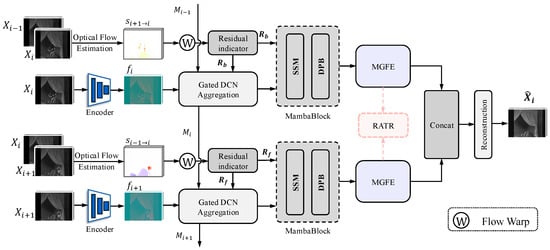
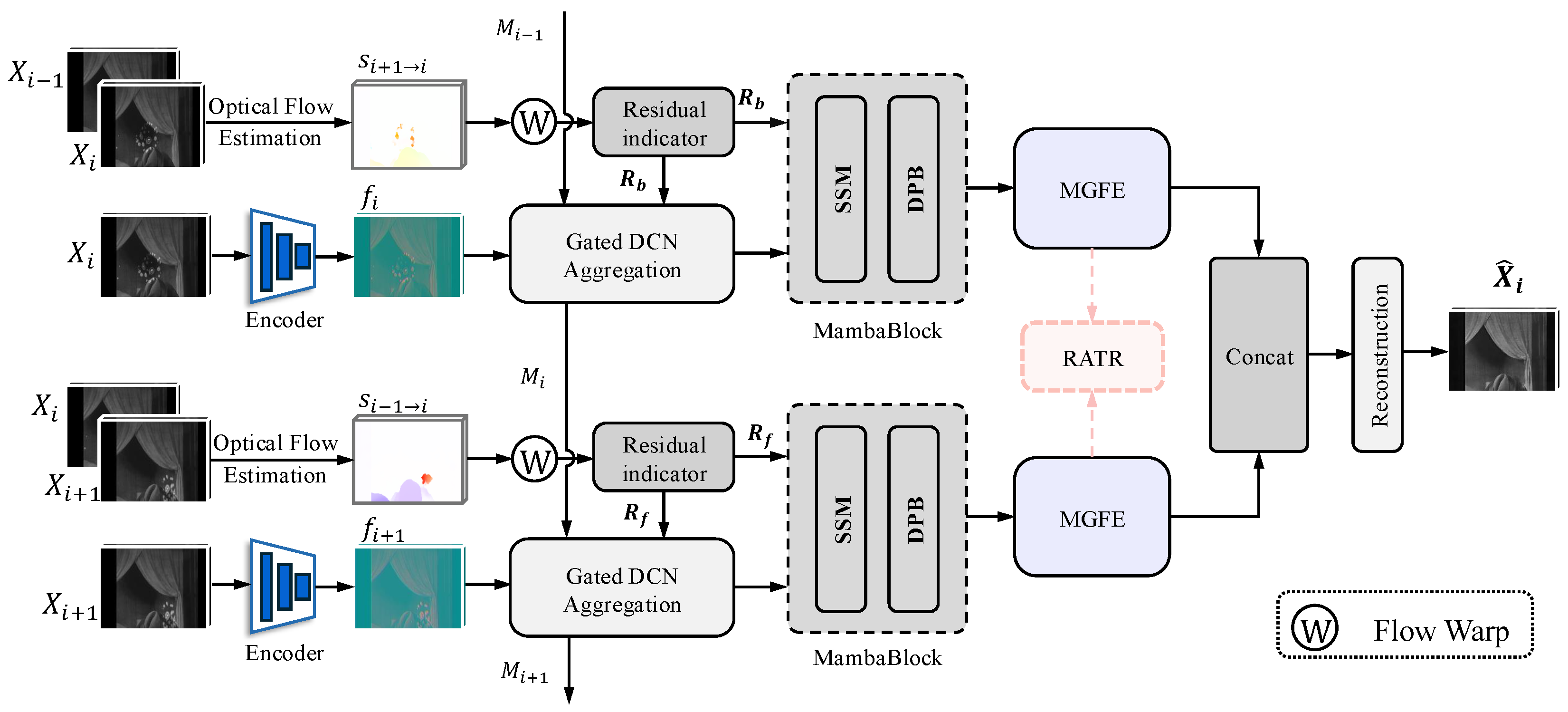
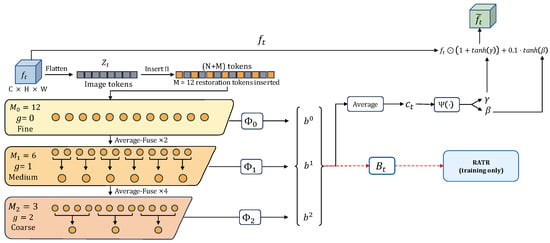
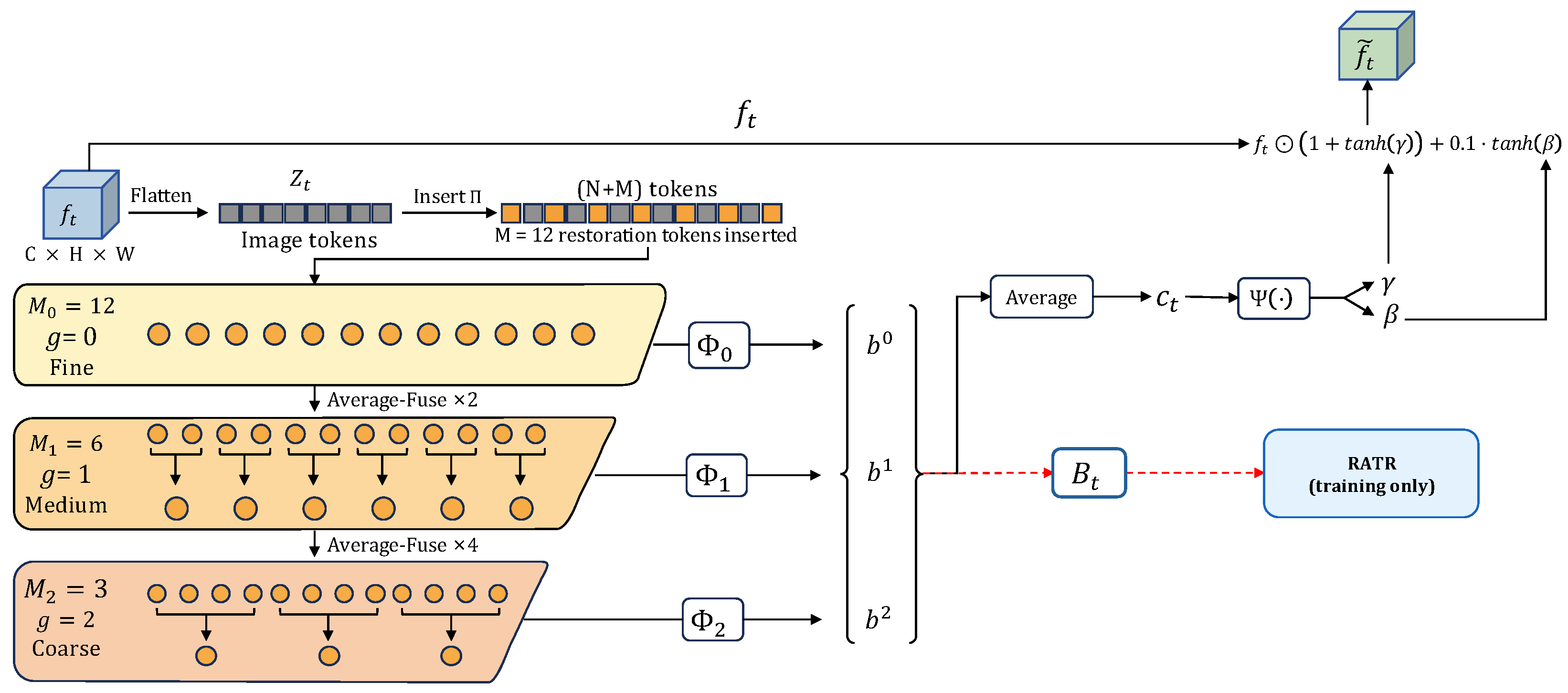
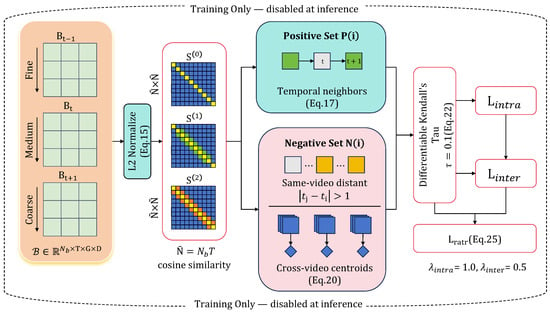
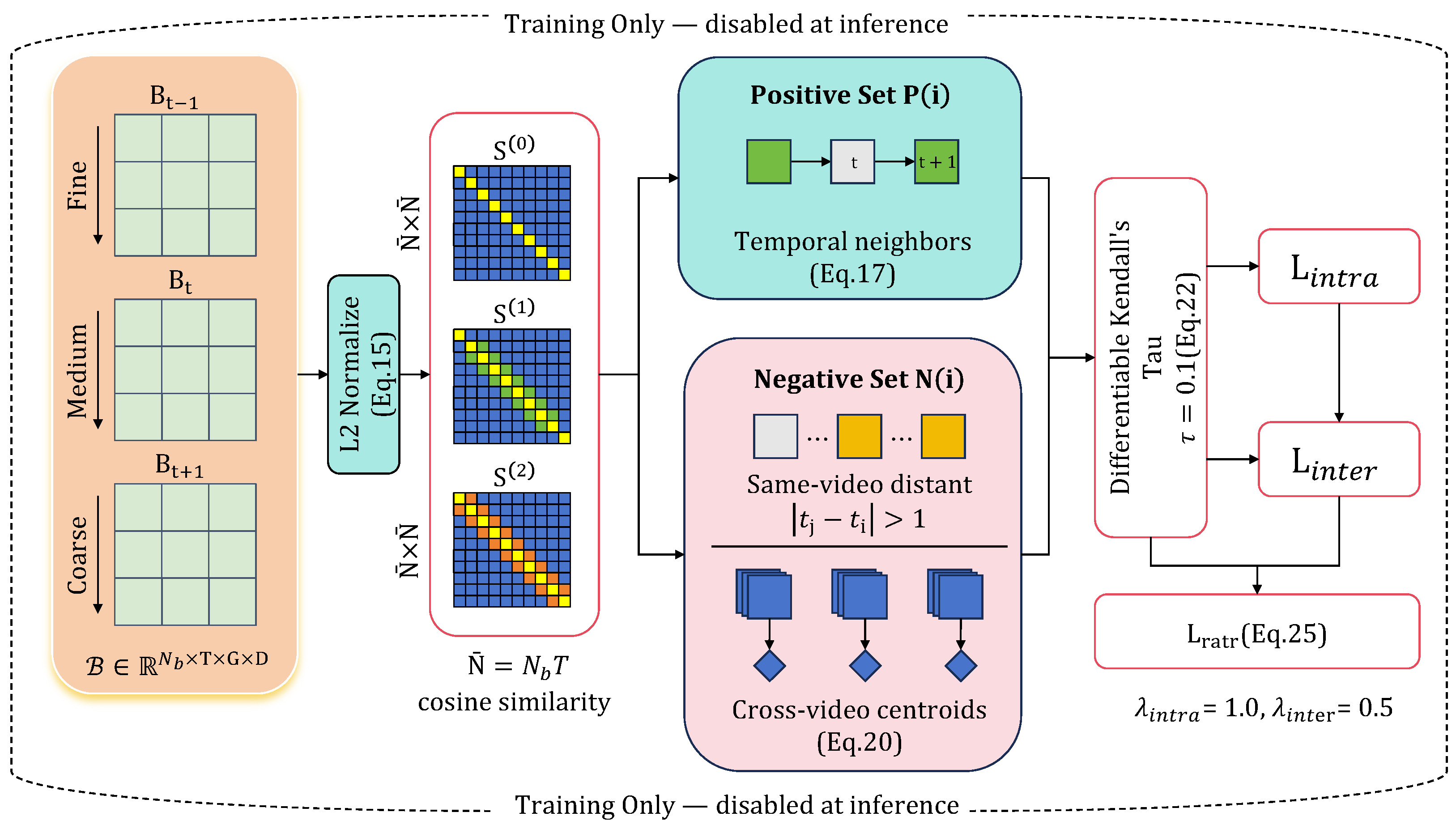
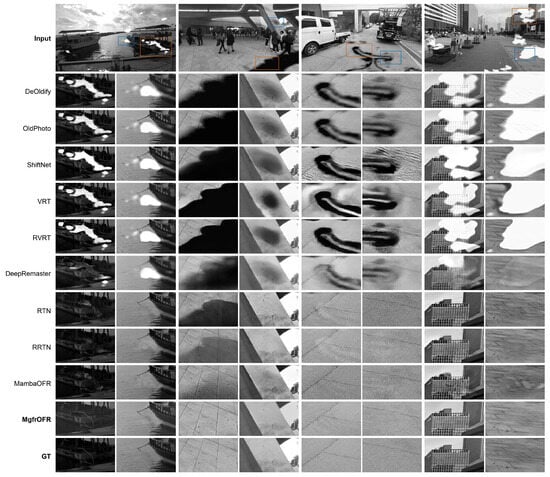
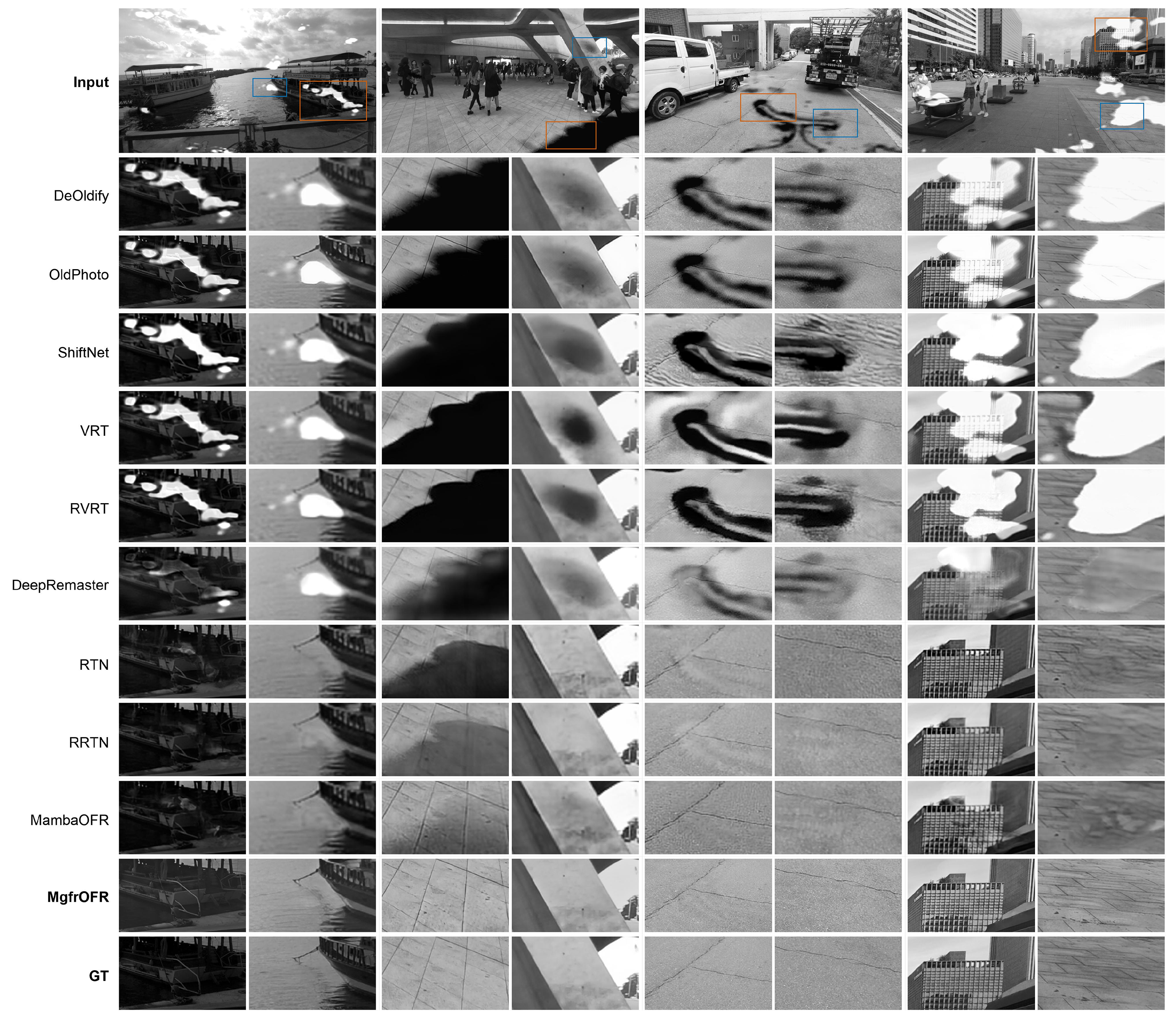
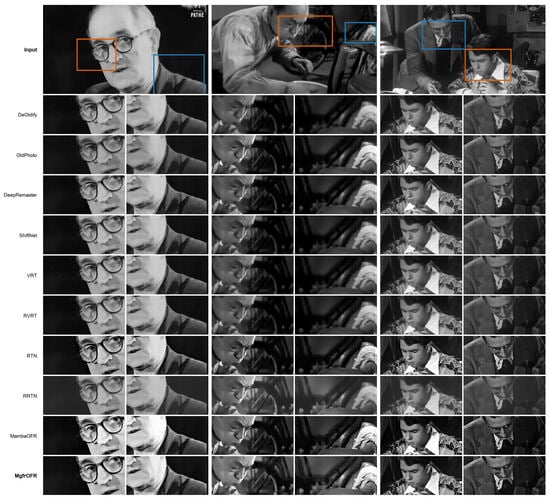
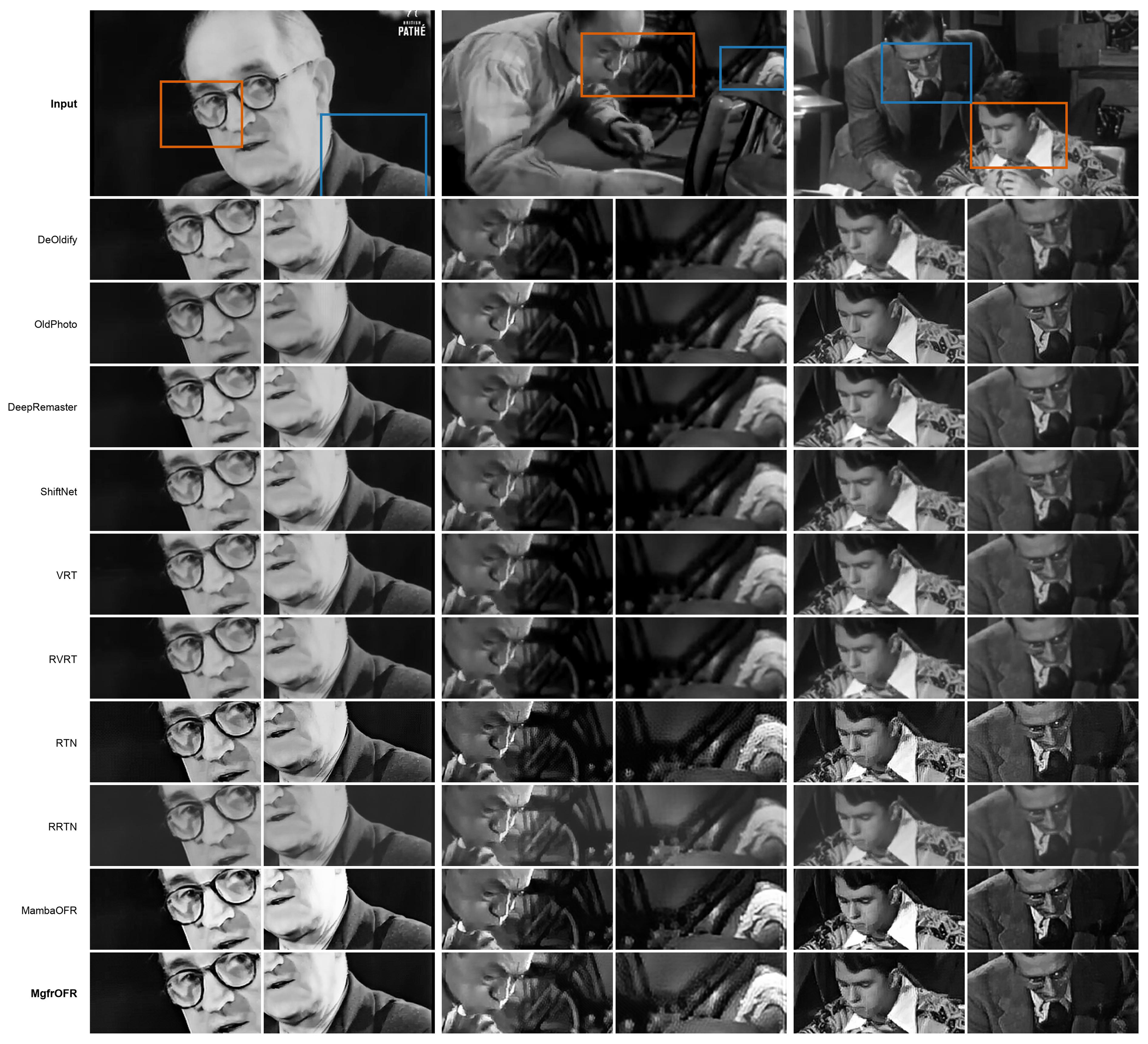
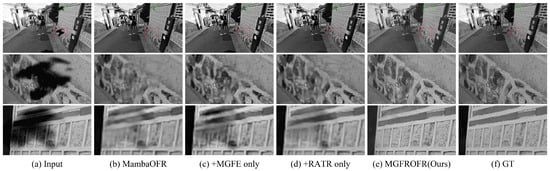
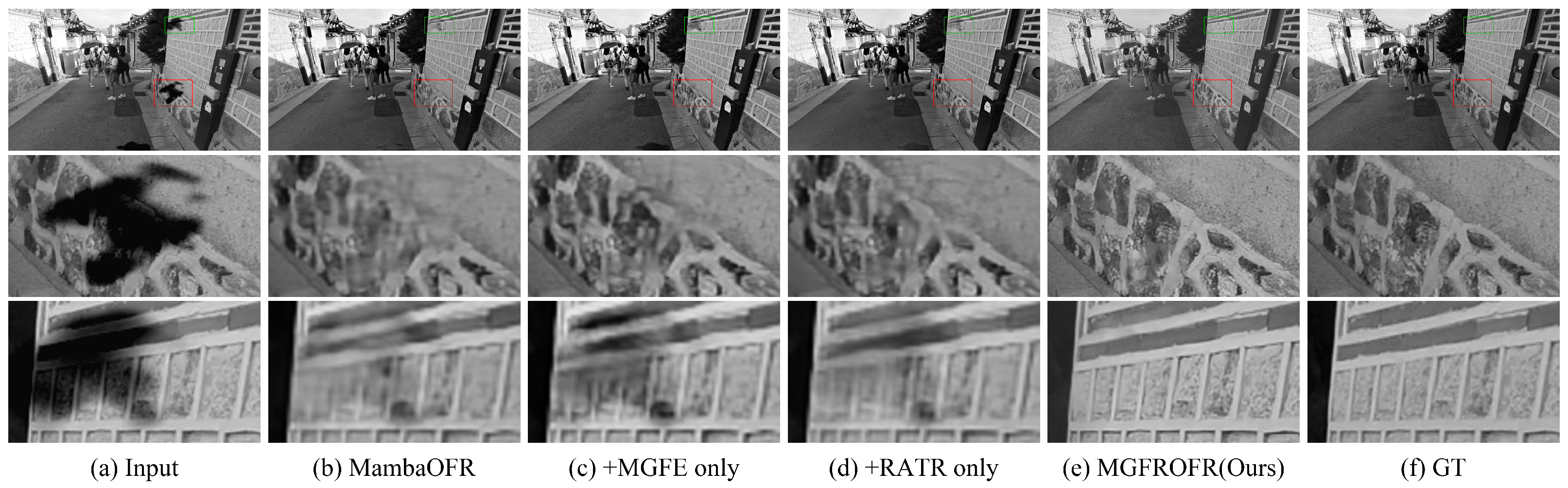
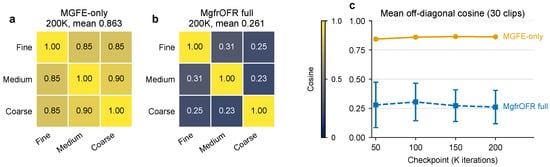
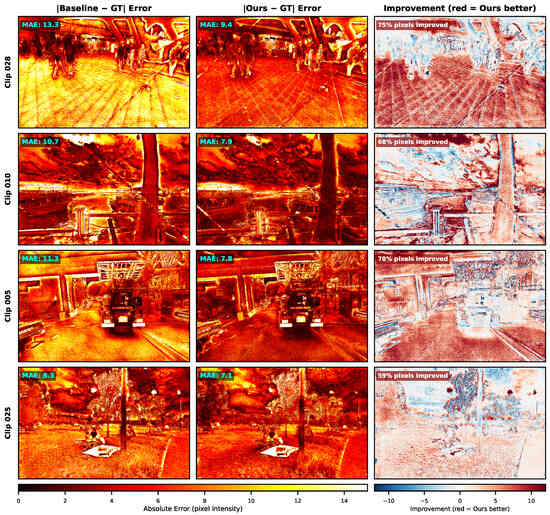

Disclaimer/Publisher’s Note: The statements, opinions and data contained in all publications are solely those of the individual author(s) and contributor(s) and not of MDPI and/or the editor(s). MDPI and/or the editor(s) disclaim responsibility for any injury to people or property resulting from any ideas, methods, instructions or products referred to in the content. |
© 2026 by the authors. Licensee MDPI, Basel, Switzerland. This article is an open access article distributed under the terms and conditions of the Creative Commons Attribution (CC BY) license.