


Abstract
Symmetry and structural balance play a fundamental role in the collective behavior of networked agent systems (NASs). In particular, cluster formation tracking, representing the emergence and maintenance of symmetric group structures, has attracted significant attention due to its wide applications in robotics and autonomous systems. However, most existing approaches assume autonomous leaders, which may not be applicable in scenarios where human intervention is required. With this in mind, this paper addresses the cluster formation tracking problem for NASs with collision avoidance, where the leader receives control inputs from a human-in-the-loop (HiTL), making the leader a non-autonomous system. A distributed control protocol is developed so that followers can track the trajectories of their designated leaders using only relative information from neighboring agents. Sufficient conditions are established to guarantee collision-free cluster formation tracking, and Lyapunov-based analysis is employed to prove the asymptotic convergence of the subgroup tracking errors. In the proposed framework, human intervention is incorporated through external commands applied to the leaders, which makes the leader dynamics non-autonomous while preserving the distributed nature of the follower controllers. Simulation studies on a 13-agent network with three subgroups show that all followers achieve the desired time-varying cluster formations under HiTL-driven leader motions, with convergence times ranging from 4.21 s to 5.12 s. Moreover, the final tracking errors of all followers are reduced below , while the minimum pairwise distances within each subgroup remain strictly above the prescribed safety threshold. These quantitative results verify both the effectiveness of the proposed protocol and the practical feasibility of integrating HiTL commands into collision-free cluster formation tracking.
1. Introduction
Cooperative control of networked agent systems (NASs) has attracted significant attention over the past decade due to its broad applicability across diverse domains, including formation flight of unmanned aerial vehicles (UAVs) [1], intelligent transportation systems [2], opinion dynamics [3], distributed localization [4] and smart grids [5], among others. Among the various cooperative behaviors, formation control represents a fundamental and extensively studied problem that has witnessed substantial progress in recent decades [6]. Formation strategies not only provide a theoretical foundation for collective coordination but also offer great potential for practical deployment in safety-critical and large-scale systems. In particular, the research on formations is of high practical value, with direct applications to UAV swarms [7,8], multi-robot systems [9,10,11], and other autonomous networked platforms. These applications highlight both the theoretical richness and the practical relevance of cooperative formation control in advancing the autonomy and resilience of large-scale NASs.
Early studies on formation control were primarily conducted within the framework of consensus theory. For example, Ren [12] proposed a consensus algorithm for multi-vehicle systems subject to time-varying reference signals, where the desired relative state deviations among vehicles were achieved by extending the conventional consensus protocol, thereby enabling cooperative formation control. While such consensus-based approaches established a fundamental paradigm for coordinating agent states, they are inherently limited to maintaining static or pre-specified formation patterns. In practical missions such as cooperative attack or target encirclement, however, achieving a fixed formation shape alone is inadequate. These tasks require NASs capable of tracking the dynamic trajectories of designated leaders in order to accomplish more sophisticated and time-varying formation objectives. Motivated by these demands, subsequent research has shifted toward formation tracking with improved robustness and adaptability. For instance, Ding et al. [13] proposed an observer-based control algorithm to address the prescribed-time formation tracking problem over directed graphs, thereby ensuring both transient performance and finite-time convergence. In addition, Li et al. [14] investigated the time-varying formation tracking problem under uncertain actuator failures, and developed an adaptive fault-tolerant control scheme that not only guarantees desired formation tracking but also incorporates collision-avoidance mechanisms. These advancements mark a clear evolution from consensus-based static formations toward dynamic, task-oriented formation tracking, reflecting the growing complexity and realism of multi-agent cooperative applications.
It is worth noting that the aforementioned literature predominantly addresses formation control under a single-leader framework. Nevertheless, in many practical missions, the assumption of a unique leader is restrictive, as multiple leaders may be required to guide different subgroups of agents [15,16,17]. For example, in maritime search-and-rescue operations and military reconnaissance missions, NASs are often decomposed into several subgroups, each coordinated under the supervision of distinct leaders, in order to satisfy complex engineering demands. To this end, multi-leader formation control has received increasing attention. In [18], the authors employed parameter estimation techniques to handle unknown nonlinearities within the system, thereby achieving time-varying cluster formation for second-order NASs. Extending this line of work, time-varying cluster formation of heterogeneous NASs, arising naturally due to the presence of agents with diverse dynamics in real-world applications, was investigated in [19]. A consensus-based distributed controller was developed to realize cluster formation in heterogeneous settings, and sufficient conditions for stability were rigorously established through theoretical analysis. These results underline the growing importance of multi-leader frameworks in enabling flexible, scalable, and practically relevant formation behaviors.
In addition, most existing studies on formation control assume that the leader is either fully autonomous or follows a prescribed trajectory. However, in practical operations, unexpected events or severe external disturbances may drive the system into unsafe conditions, potentially leading to loss of control. To mitigate such risks, incorporating human decision-making into the loop, commonly referred to as human-in-the-loop (HiTL) control [20,21,22], has emerged as an effective approach to enhance safety and adaptability. By allowing human operators to intervene and issue corrective commands, HiTL schemes provide an additional safeguard against unpredictable scenarios and improve the resilience of NASs. Motivated by these considerations, a number of HiTL-based formation control frameworks have been proposed in recent years. For example, Ma et al. [23] developed a HiTL framework for the time-varying formation tracking problem of NASs, where operators can regulate the overall system by issuing commands to the leader in real time. In a related work, Ma et al. [24] designed a control scheme that integrates a local observer with a distributed input reconstruction mechanism, thereby enabling HiTL formation control in the presence of unknown perturbations. Furthermore, Guo et al. [25] proposed a gesture-recognition-based interface that allows human operators to issue commands directly to leader UAVs, significantly improving the safety, reliability, and flexibility of the overall system. These efforts underscore the growing importance of HiTL paradigms in bridging autonomous decision-making and human supervision for robust multi-agent coordination. In practical HiTL-enabled multi-agent missions, human participation typically appears in a supervisory rather than a fully manual form. More specifically, the operator does not directly generate the distributed control input of each follower but instead provides high-level corrective commands to one or more leaders when the autonomous evolution of the group needs to be adjusted. Such intervention is particularly relevant in situations involving task reassignment, unexpected environmental changes, temporary safety risks, or mission-level maneuver updates. In this paper, the considered HiTL interaction is modeled as an external command acting on the leader dynamics. Therefore, the operator commands are interpreted as supervisory reference-adjustment signals rather than low-level actuation commands for all agents. This modeling choice allows the effect of human intervention on cluster formation tracking to be analyzed within a distributed multi-leader framework while keeping the follower-side control law fully distributed.
Moreover, once a HiTL framework is embedded into the system, collision avoidance among agents becomes a critical requirement to guarantee both operator safety and reliable operation of NASs, thereby enabling safety-oriented formation control. To address this issue, several collision-avoidance strategies have been investigated in the literature. For instance, An et al. [26] incorporated motion conflict considerations into a distributed optimization framework for multi-Euler–Lagrangian systems. Their proposed control protocol ensures that each agent accomplishes the prescribed optimization task while simultaneously avoiding collisions with neighboring agents. In another line of work, Pang et al. [27] proposed an improved artificial potential field (APF) approach for collision-avoidance formation control of second-order NASs. Unlike conventional distance-based APF methods, their approach explicitly accounts for both relative distance and velocity, thereby providing a more accurate criterion for predicting and preventing potential collisions. In addition, comprehensive surveys have been conducted to synthesize progress in this area. For example, Tang et al. [28] presented a systematic review of formation control strategies with embedded collision-avoidance mechanisms, highlighting the advantages and limitations of various approaches. Collectively, these studies underscore that collision avoidance is not only an auxiliary feature but also an integral component in the design of HiTL-enabled formation control, ensuring the overall safety and resilience of large-scale multi-agent coordination.
According to the above discussion, this paper investigates the collision-free cluster formation tracking problem for NASs under a HiTL framework. Specifically, multiple leaders are allowed to evolve under external human commands, while the followers in each subgroup are required to achieve the desired formation tracking objective and maintain prescribed intra-subgroup safety distances. The main contributions of this paper are summarized as follows:
(1) The formation tracking problem is studied under a multi-leader framework, where NASs are decomposed into several subgroups, and the followers in each subgroup track their corresponding leader to accomplish cluster formation. In contrast to prior studies [29,30,31] that primarily focused on single-leader scenarios, the proposed framework enhances scalability and task flexibility by enabling the system to execute more complex and heterogeneous missions.
(2) A HiTL framework is introduced for cluster formation tracking, in which human operators influence the collective motion by issuing corrective commands to the leaders rather than directly controlling all followers. This formulation captures practical scenarios such as task updates, safety-oriented maneuver adjustment, and disturbance-induced trajectory correction, while preserving the distributed nature of the follower-side coordination law.
(3) To ensure collision-free operation, specific control strategies are developed to guarantee both stability and safety of the cluster formation. Compared with existing formation control schemes [32,33,34], the proposed approach explicitly integrates collision avoidance into the control protocol, thereby enhancing resilience and ensuring safe coordination of large-scale multi-agent systems.
The remainder of this paper is organized as follows. Section 2 introduces the notations and formulates the main research problem. Section 3 presents the principal theoretical results. Section 4 provides simulation studies that demonstrate the effectiveness of the proposed time-varying formation controller. Finally, Section 5 concludes the paper with a summary of the main findings and a discussion of possible directions for future research.
2. Preliminaries and Problem Formulation
This section first introduces the notation used throughout the paper and then formulates the cluster formation control problem.
2.1. Notations
The following notational conventions are used throughout this paper. Let denote the column vector with all entries equal to one, and let denote the n-dimensional identity matrix. The symbol ⊗ stands for the Kronecker product. For a diagonal block matrix, represents a matrix whose i-th diagonal block is . Throughout this paper, denotes the standard Euclidean norm of a vector x. For an array, the operators and return its minimum and maximum entries, respectively. Given a real symmetric matrix , we use and to represent its extreme eigenvalues. The notation stands for the exponential mapping.
2.2. Problem Description
Consider a NAS consisting of M follower agents and N leader agents. For analytical purposes, the agents are partitioned into N subgroups, denoted by , . Each subgroup includes a unique leader and followers, where . Define as the follower index set and as the leader index set. The follower set is further divided into N mutually exclusive subsets such that for all j, , and whenever . Thus, the k-th subgroup is composed of the k-th leader together with the follower set assigned to it.
The evolution of the follower is governed by
where and represent the state vector and the control input of follower agent i, respectively. The constant matrices satisfy and , with .
The evolution of the j-th leader is described by
where denotes the state vector of leader agent j, and represents its control input, which may originate from supervisory HiTL commands. Such commands are intended to modify the motion of the leader at the mission level when necessary, rather than to replace the distributed coordination mechanism of the followers. Typical situations include formation redirection, local trajectory correction under unexpected disturbances, emergency maneuver adjustment, and task-dependent regrouping. Accordingly, the human operator acts on the leaders only, while the followers respond through the distributed protocol based on local relative information.
It is worth noting that both leaders and followers share the same system matrices A and B. The essential distinction lies in the actuation: leaders are driven by external or HiTL inputs, whereas followers employ distributed control laws to accomplish coordinated formation tracking. The assumption that both leaders and followers share identical linear dynamics is mainly adopted to capture homogeneous networked agent systems and to make the distributed cluster formation analysis tractable. This setting is practically relevant in many multi-UAV or multi-robot applications where the agents are built on the same platform or can be represented by a common linearized model around the operating condition. In the present paper, the essential difference between leaders and followers is not in their intrinsic dynamics, but in the way their inputs are generated: leaders are influenced by external or supervisory HiTL commands, whereas followers employ distributed control laws for cluster formation tracking.
Assumption 1.
For each leader , the HiTL command is assumed to be bounded and piecewise continuously differentiable on . Moreover, its rate of variation is bounded.
Remark 1.
The HiTL mechanism considered in this paper belongs to a supervisory interaction mode. The operator commands are modeled as externally supplied leader-level inputs, rather than direct actuation signals for all agents. Therefore, the role of the operator is to adjust the collective motion indirectly through the leaders, while the distributed follower controllers remain autonomous. In this paper, the HiTL commands are understood as admissible supervisory signals with bounded magnitude and limited variation rate, rather than arbitrary impulsive, discontinuous, or adversarial actions. This setting is particularly suitable for applications in which human supervision is required intermittently, such as mission updates, safety correction, or environment-driven maneuver modification.
This paper focuses on the problem of time-varying cluster formation tracking subject to collision-avoidance constraints. Consider a subgroup with index . For each agent i within this subgroup, a formation reference is assigned, where is assumed to be piecewise continuously differentiable with respect to time. In addition, to describe the subgroup structure and the signed interactions among agents, the present paper adopts a signed graph representation, which has been widely used in the related literature [35,36,37]. This modeling framework provides a convenient basis for characterizing cooperative/competitive couplings and hierarchical subgroup interactions in the considered cluster formation problem. To guarantee that the formation objectives are well defined and that inter-agent collisions are precluded, a set of standing assumptions is introduced on both the admissible formation vectors and the separation requirements among agents.
Assumption 2.
Each leader agent is assumed to possess a predefined reference trajectory that is known a priori. As a result, possible collisions are restricted to occur only among followers within the same subgroup. Collisions between leaders, or between agents belonging to different subgroups, are precluded by design.
Assumption 3.
Consider the k-th subgroup with . Assume that the reference formation vectors are arranged such that
for some constant satisfying , where specifies the minimum allowable inter-agent distance. This requirement guarantees that the target formation pattern inherently maintains safe spacing so that followers within the same subgroup never come closer than .
Remark 2.
Assumption 2 excludes cross-subgroup collision configurations at the problem-formulation level by prescribing non-overlapping leader trajectories. Assumption 3 specifies that the desired formation of each subgroup is designed with an inherent geometric safety margin; i.e., the spacing between any two reference formation vectors is always no smaller than . From an implementation viewpoint, collision avoidance during transient motion is maintained not only by this formation-level spacing requirement but also by selecting admissible initial conditions and ensuring that the subgroup tracking errors remain within the allowable bound derived in the subsequent analysis. Under these conditions, the deviation of the actual follower states from the desired formation is sufficiently limited, and hence the pairwise distances remain above the prescribed threshold throughout the evolution.
Building upon Assumptions 2 and 3, the notion of cluster formation tracking with collision avoidance can be rigorously stated as follows:
Definition 1.
For the NAS described by (1) and (2), we say that the subgroup-based formation tracking with safety constraints is achieved if one can design a distributed control input for every follower in each partition , , such that the following requirements are satisfied:
Remark 3.
Condition (4) specifies that the tracking errors associated with the formation control scheme vanish asymptotically, thereby guaranteeing that each subgroup of followers achieves the desired time-varying formation while following the motion of its designated leader. Meanwhile, condition (5) imposes a strict separation requirement, ensuring that the pairwise distances among followers within the same subgroup are always larger than the prescribed safety margin , and thus precluding intra-subgroup collisions.
Remark 4.
It should be noted that the safety guarantee established in this paper is strictly imposed at the intra-subgroup level. More specifically, the distributed controller ensures collision avoidance only among followers belonging to the same subgroup, whereas the separation between different subgroups is handled through the mission-level assumption of non-overlapping leader trajectories in Assumption 1. Therefore, the proposed formulation is particularly suitable for hierarchical multi-leader cluster-coordination scenarios in which different subgroups operate along sufficiently separated leader paths or in distinct task regions. If explicit inter-cluster proximity or cross-subgroup collision avoidance must be addressed, additional safety constraints and corresponding coupling terms need to be introduced into the problem formulation and controller design.
According to the above discussion, the main challenges of this paper are as following three aspects: (i) coupled analysis under a multi-leader and multi-follower architecture, requiring scalable stability conditions derived from local relative information over directed and block-structured graphs; (ii) treatment of HiLT commands while preserving closed-loop stability and performance; and (iii) distributed collision avoidance, enforced by maintaining minimum inter-agent separation via forward-invariant safety sets and by quantifying admissible initial conditions so that safety constraints and time-varying formation objectives are met simultaneously.
3. Main Results
This section develops the main theoretical results. The analysis is carried out under the following standing assumptions:
Assumption 4.
For any , the pair is assumed to be stabilizable. This condition ensures the feasibility of designing stabilizing control laws for the follower dynamics.
Assumption 5.
The partition of the follower set is acyclic, i.e., there are no directed cycles among the follower subgroups.
Assumption 6.
For every subgroup with index , it is assumed that the communication topology among the followers forms a connected graph, which implies the existence of a spanning tree rooted at the corresponding leader.
Let denote the directed graph among the followers, where is the set of nodes, is the set of directed edges, and is the weighted adjacency matrix with entries defined as if , and otherwise. The pinning gains from the k-th leader to follower i are denoted by , where if the information from leader k is accessible to follower i, and otherwise. The Laplacian matrix of the overall NAS, incorporating both the follower–follower interactions and the leader–follower pinning, is defined as
where with
and .
It follows from Assumptions 4 and 5 that can be expressed in the following block lower-triangular form [38]:
where denotes the Laplacian block describing the interactions among the followers within subgroup , and represents the coupling block corresponding to the interactions from subgroup to subgroup .
Assumption 7.
For all distinct subgroup pairs and with , the coupling matrix is assumed to have zero row sums, which ensures that the total influence from subgroup to each agent in is balanced.
We next recall several structural properties of and , which will serve as preliminaries for the forthcoming analysis.
Lemma 1
([39]). Subject to Assumptions 5–7, all eigenvalues of lie strictly in the open right half-plane.
Lemma 2
([38]). Given Assumptions 5–7, one can find a diagonal matrix with strictly positive entries for , such that
Lemma 3
([40]). Under Assumptions 5–7, the matrix is block diagonal and satisfies
where denotes the -dimensional column vector of ones, for .
Then, a distributed strategy is introduced to realize subcluster formation tracking while ensuring that agents within the same cluster remain safely separated. For each cluster with index , the input signal assigned to any follower is specified as
where the disagreement vector is defined by
where
with being a control gain, denoting feedback gain matrices, and representing a yet-to-be-defined formation adjustment term.
Remark 5.
The discontinuous sign function in the distributed control protocol is introduced to compensate for the effect of the leader input. Nevertheless, it is well known that such discontinuous control terms may lead to chattering in practical implementations due to actuator dynamics, sampling effects, and unmodeled high-frequency behavior [41]. In practical applications, this issue can be alleviated by replacing the sign function with a continuous approximation, such as a saturation function, a boundary-layer function, or a smooth nonlinear approximation like . Such modifications can reduce chattering while preserving the overall control objective in an approximate sense.
In this control framework, a multi-leader–multi-follower architecture is adopted, allowing each subgroup to follow its designated leader and thereby pursue heterogeneous objectives. The coexistence of several leaders inevitably introduces extra difficulties in both modeling and stability analysis. The proposed distributed cooperative control approach is well tailored for scenarios such as multi-target containment and decentralized area surveillance, where scalability and safety requirements play a critical role.
Given that has full column rank with , one can construct two matrices ( and ) such that . By stacking them together, we obtain an invertible transformation:
This coordinate decomposition serves as a convenient tool for assigning the design parameters of the cluster formation control law (7), which are then explicitly computed following the steps in Algorithm 1.
Remark 6.
Algorithm 1 provides a systematic procedure for designing the cluster formation tracking protocol. Specifically, Step 1 checks the feasibility of the prescribed formation vectors to ensure that they are compatible with the agent dynamics. Step 2 introduces the compensation term , which eliminates the mismatch between the follower dynamics and the desired formation trajectories. Step 3 solves an algebraic Riccati equation to guarantee the existence of a stabilizing Lyapunov function, while Step 4 computes the feedback gain matrix , where the parameter γ accounts for the communication topology through the Laplacian structure. Collectively, these steps ensure both the feasibility of the cluster formation tracking objective and the stability of the closed-loop multi-agent system.
Remark 7.
The proposed distributed protocol differs from conventional multi-leader or collision-free formation controllers in two aspects. First, the reference motions of the leaders are not assumed to be autonomous or preassigned but are allowed to be affected by external human commands, which makes the cluster tracking objective inherently HiTL-driven. Second, the control design explicitly incorporates intra-subgroup safety requirements through the collision-avoidance mechanism so that formation tracking and safety preservation are addressed simultaneously within the same distributed framework.
| Algorithm 1 Design of the HiTL-based cluster formation Tracking Protocol |
|
The validity of the proposed cluster formation tracking protocol with guaranteed collision avoidance is summarized below.
Theorem 1.
Consider the NAS governed by (1) and (2). Assume that Assumptions 2–7 are satisfied. If the feasibility requirement (9) holds and the initial tracking error of subgroup fulfills
where collects the initial tracking errors of the followers in , and
then the cluster formation tracking problem with collision-avoidance constraints, as formulated in Definition 1, is achieved by the distributed control law (7) constructed through Algorithm 1. Specifically, each follower in every subgroup converges to the prescribed time-varying formation relative to its leader, while maintaining inter-agent distances above the safety margin.
Proof.
The proof of Theorem 1 is organized into two main steps: (i) demonstrating that the cluster formation tracking errors converge to zero asymptotically, and (ii) confirming that, during the process of attaining the desired formation, inter-agent collisions within each subgroup are precluded.
(i) For each follower , introduce the error variable
By applying the control strategy (7) to the agent dynamics in (1), the error system can be expressed as
By combining the feasibility condition (9) with the compensation term (10), it follows that
Let , , , , , and .
From Lemma 3, one obtains
It then follows from (15) and (16) that
Consider the Lyapunov candidate
whose derivative satisfies
Recalling that with
and using Lemma 2, we obtain
Next, define
Since is chosen such that
the last term in (19) can be rewritten as
Noting that
we have
where denotes the i-th component of . Therefore,
Moreover, since
it follows that
Substituting this into (22) yields
Thus, by (20), (23), and the Riccati Equation (11), it follows that
Hence, exponentially. Since and is nonsingular, it follows that exponentially, i.e., the cluster formation tracking condition (4) is achieved.
(ii) The second part of the proof establishes that collisions among the followers will not occur. Recall that . By (24) and Theorem 4.10 in [42], the tracking error satisfies
where
From (25), one has for each subgroup . In addition, under Assumptions 2 and 3, the distance between any two followers satisfies
which further yields the subgroup-level lower bound
By Hardy’s inequality together with (25), one obtains
Consequently, invoking the feasibility condition (13), it holds that
Inequality (27) guarantees that the minimum inter-agent distance within each cluster always exceeds , thereby ensuring collision-free trajectories for all followers. This completes the proof. □
Remark 8.
To clarify the derivation from (19) to (24), we note that the right-hand side of (19) consists of three parts. The first term is the standard quadratic term associated with the matrix pair and the Riccati Equation (11). The second term is upper bounded by (20) due to the particular choice of together with Lemma 2. For the third term, the introduction of allows the nonsmooth sign term to be converted into a weighted -norm expression. Since , the discontinuous term can be rewritten as in (21). Then, by using the bound the negative contribution generated by the sign feedback dominates the term induced by the leader input, which yields (23). Therefore, combining (20), (23), and the Riccati Equation (11) gives (24), from which the exponential convergence of and then follows.
Remark 9.
The convergence analysis in this subsection is valid for leader inputs satisfying Assumption 1, namely, bounded and piecewise continuously differentiable HiTL supervisory signals with bounded variation rate. Moreover, the control coefficient is not chosen arbitrarily. As indicated by the above derivation, is selected to satisfy , that the leader-input-related term can be properly compensated in the Lyapunov analysis, which guarantees that the derivative of the Lyapunov function remains non-positive under the stated conditions. Therefore, the asymptotic convergence result does not rely on an implicit restriction on HiTL inputs, but on the explicitly stated admissible input class and gain-selection condition.
Remark 10.
The proof of Theorem 1 proceeds in two steps. The first step establishes the exponential convergence of the cluster formation tracking errors, which ensures that each follower asymptotically achieves the prescribed formation relative to its leader. The second step leverages this convergence property together with the feasibility condition on the minimum inter-agent distance. Specifically, by bounding the cumulative error using Hardy’s inequality, it is shown that the separation between any two followers within the same cluster always remains strictly larger than . Hence, the combined arguments guarantee both formation convergence and collision avoidance.
Remark 11.
Existing studies on multi-leader coordination, human-in-the-loop control, and collision-free formation tracking have provided important foundations for the distributed control of networked agent systems. However, these directions are often treated separately. In particular, most multi-leader formation approaches assume autonomous or preassigned leader dynamics; existing HiTL-related studies usually do not explicitly address cluster formation tracking with multiple subgroups, and many collision-avoidance schemes are not developed in a unified framework with HiTL-driven multi-leader coordination. Therefore, this paper focuses on a more specific problem, namely collision-free cluster formation tracking under a HiTL framework, where multiple leaders evolve under external human commands and subgroup followers are required to achieve the desired formation while maintaining prescribed intra-subgroup safety distances.
Remark 12.
Different from existing studies in [20,21,22,23,24,25], the novelty of the present work lies in the unified treatment of three aspects. First, the considered cluster formation tracking problem is established under a multi-leader HiTL setting, where human intervention affects the leader dynamics through supervisory commands rather than direct low-level actuation of all agents. Second, the followers are organized into multiple subgroups and are required to accomplish distributed cluster formation tracking while preserving the distributed nature of the follower-side control law. Third, intra-subgroup collision avoidance is further incorporated into the HiTL-driven multi-leader cluster formation framework, and corresponding stability and safety conditions are derived. Therefore, the proposed approach is not a simple combination of existing cluster formation and HiTL schemes, but a distributed control framework that integrates supervisory human intervention, multi-leader cluster tracking, and subgroup-level safety preservation into a unified formulation.
Remark 13.
This paper considers a fixed communication topology. In practical multi-agent systems, communication delays may introduce outdated neighbor information and affect the convergence speed and tracking accuracy, while switching or time-varying topologies may further complicate the stability analysis due to time-dependent interaction structures. Extending the present framework to delay-affected and switching signed networks is an interesting topic for future research, which may require delay-dependent Lyapunov analysis and switching-system tools under suitable connectivity conditions [43,44].
In this section, a distributed control protocol is developed to enable each follower to track the leader’s trajectory using only relative information from neighboring agents. Theoretical analysis establishes sufficient conditions for collision-free formation tracking. By constructing a suitable Lyapunov function, the convergence of the tracking error dynamics is guaranteed, thereby ensuring the stability of the proposed protocol and confirming that the desired formation can be achieved without collisions. Moreover, the framework is extended to incorporate HiTL control, where human decisions are modeled as external inputs. The resulting analysis shows that human intervention can be seamlessly integrated without compromising stability, while enhancing the adaptability and flexibility of the formation tracking process.
4. Simulation Results
This section presents simulation results to demonstrate the effectiveness of the proposed cluster formation tracking protocol as well as the feasibility of the collision avoidance conditions.
4.1. Verification of the Proposed Formation Control Scheme
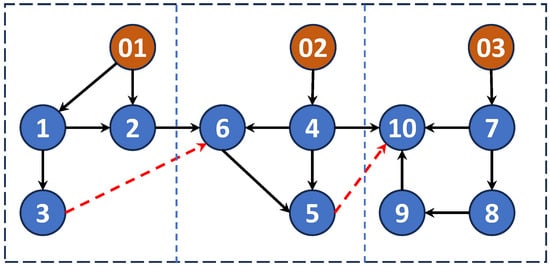
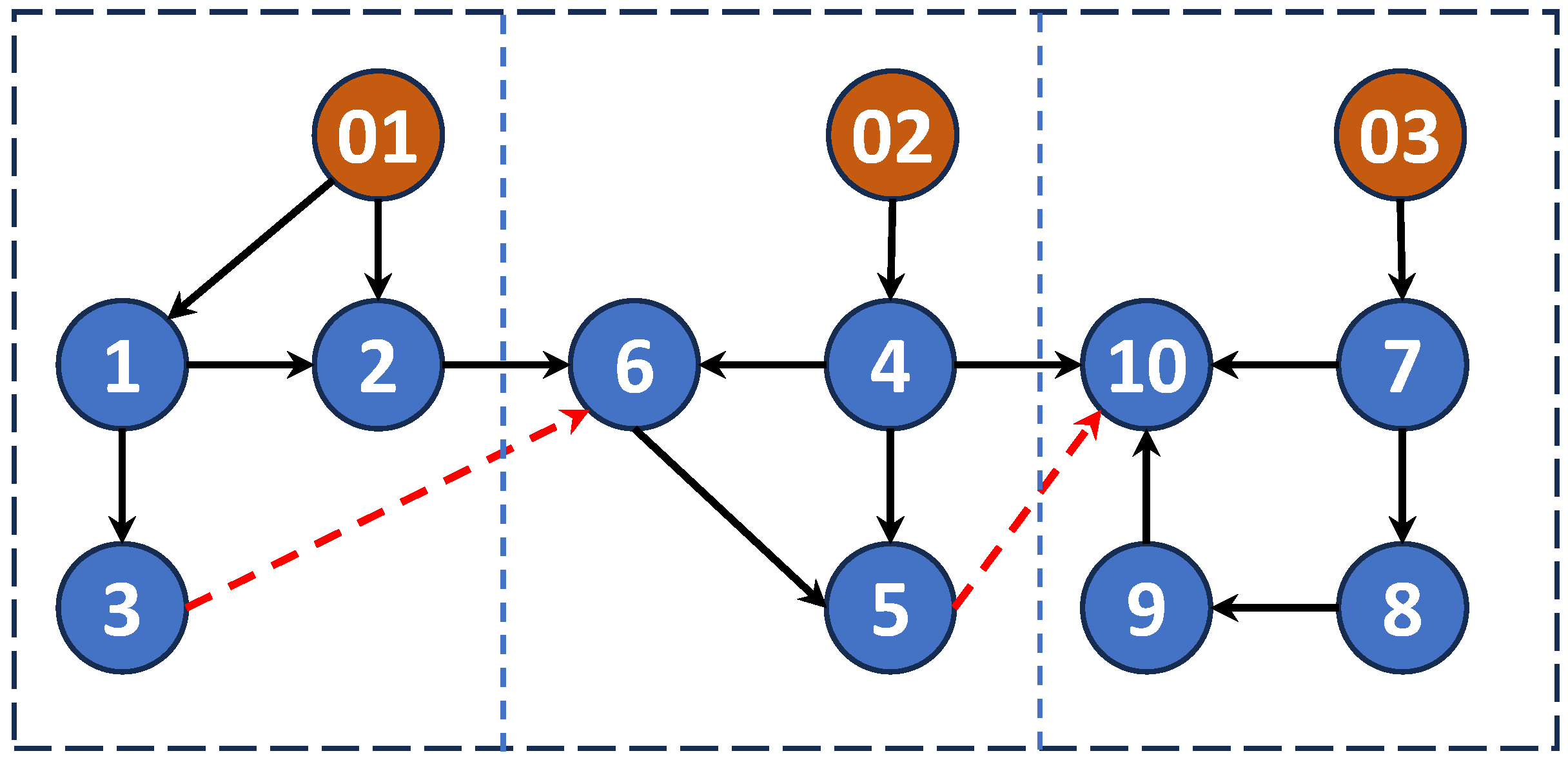
In this example, we consider that there are 13 agents, where the population is divided into three distinct clusters. The associated communication topology is depicted in Figure 1. Specifically, the first two clusters each comprise a leader accompanied by three followers, whereas the last cluster consists of one leader together with four followers.
Figure 1.
Communication topology of the NAS. Leaders are marked in orange and followers in blue. The followers are partitioned into three subgroups, namely, , , and . Black solid edges denote positive interaction links, while red dashed edges denote negative interaction links with . The dashed rectangular boxes only indicate the subgroup partition.
Furthermore, the system matrix A and input matrix B of agents are denoted as follows, respectively:
The desired time-varying formation vectors of all agents can be compactly expressed as
where the amplitude and phase shift are determined by the subgroup membership:
It follows that the feasibility requirements of cluster formation tracking in (9) are fulfilled, and the corresponding compensation terms are obtained via (10). The control actions for the leader agents are then defined as , , . Moreover, the design parameter selected as . According to Theorem 1, one feasible choice of the Lyapunov matrix and the corresponding state-feedback gain is
where the entries have been rounded to two decimal places for presentation.
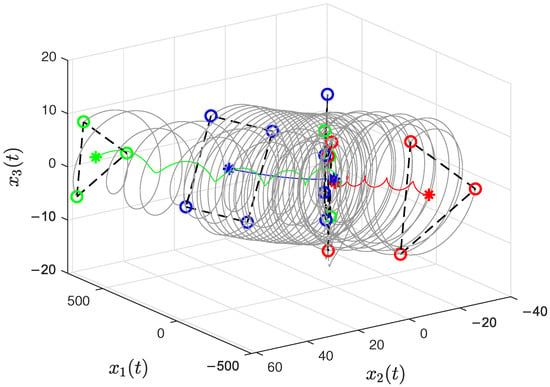
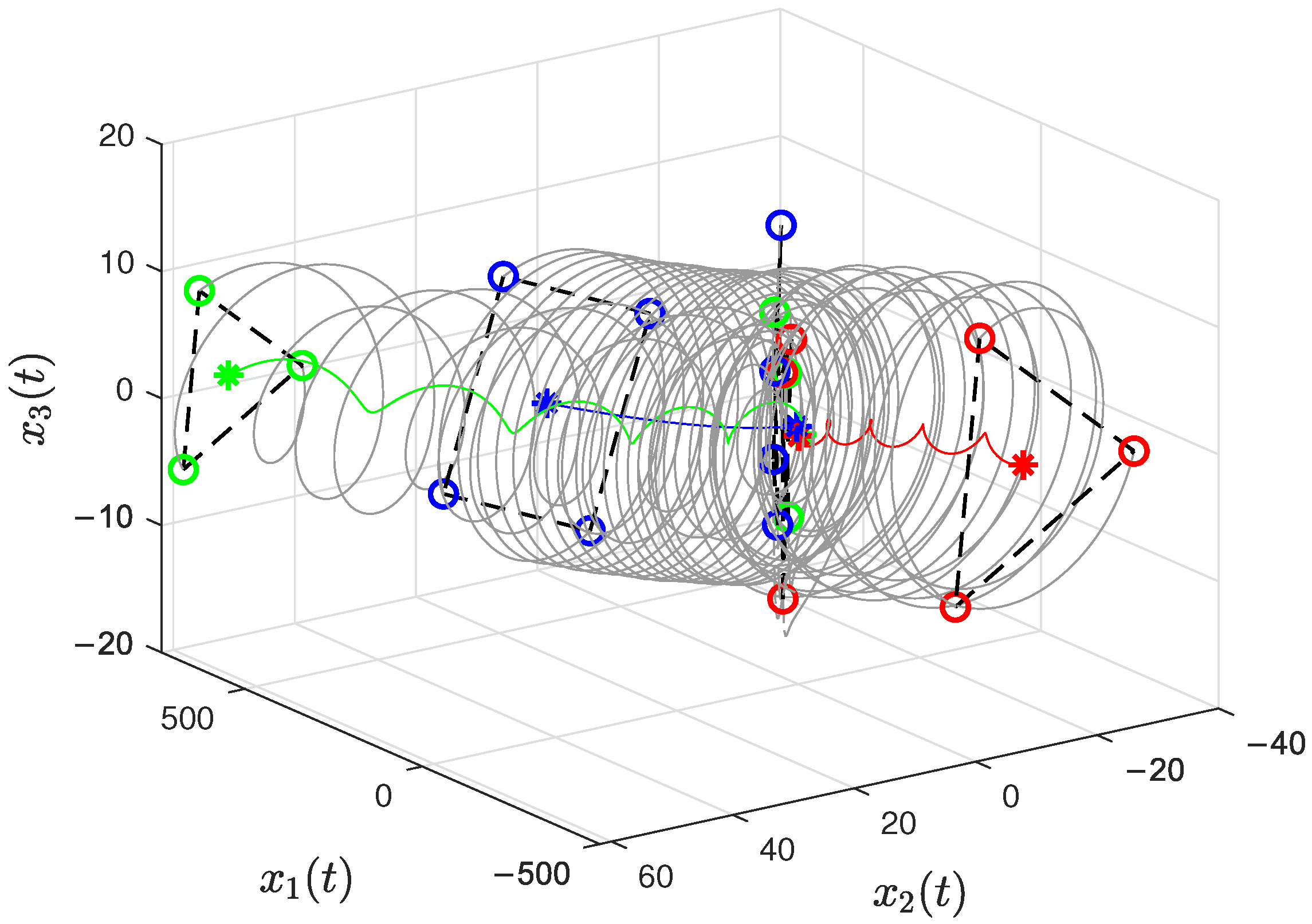
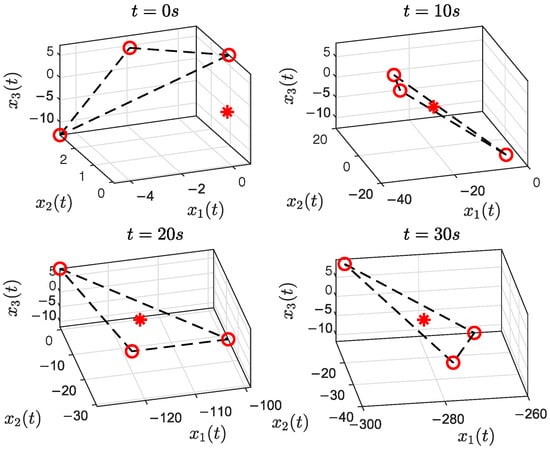
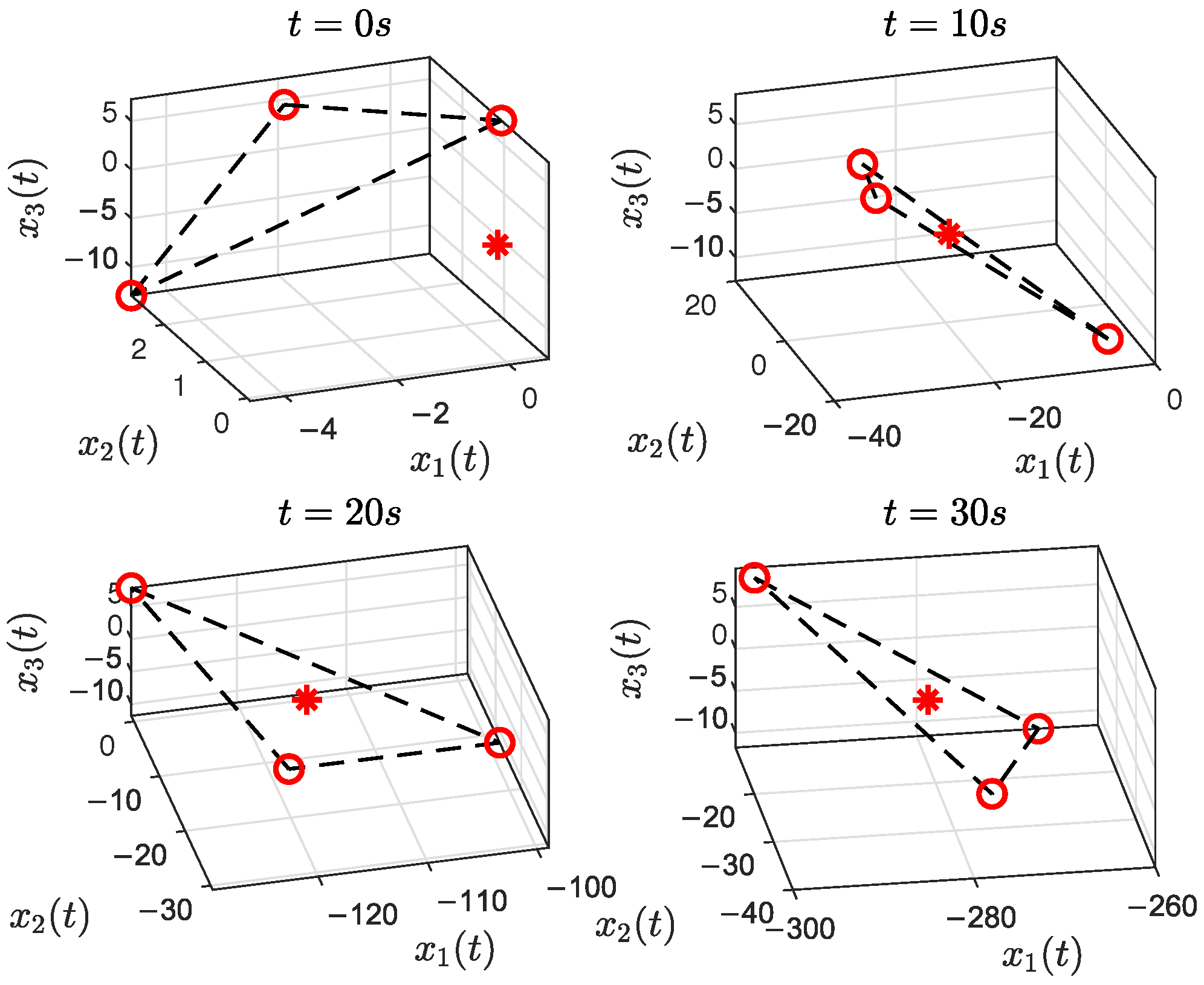
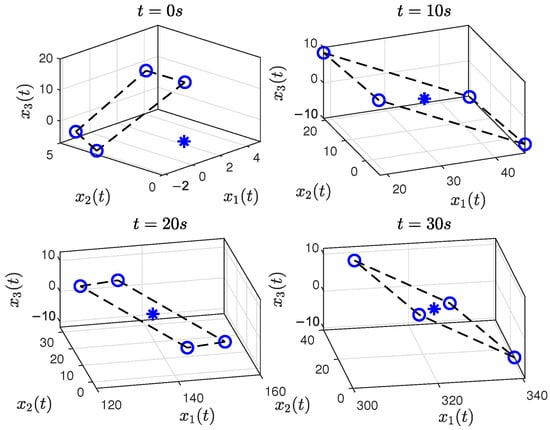
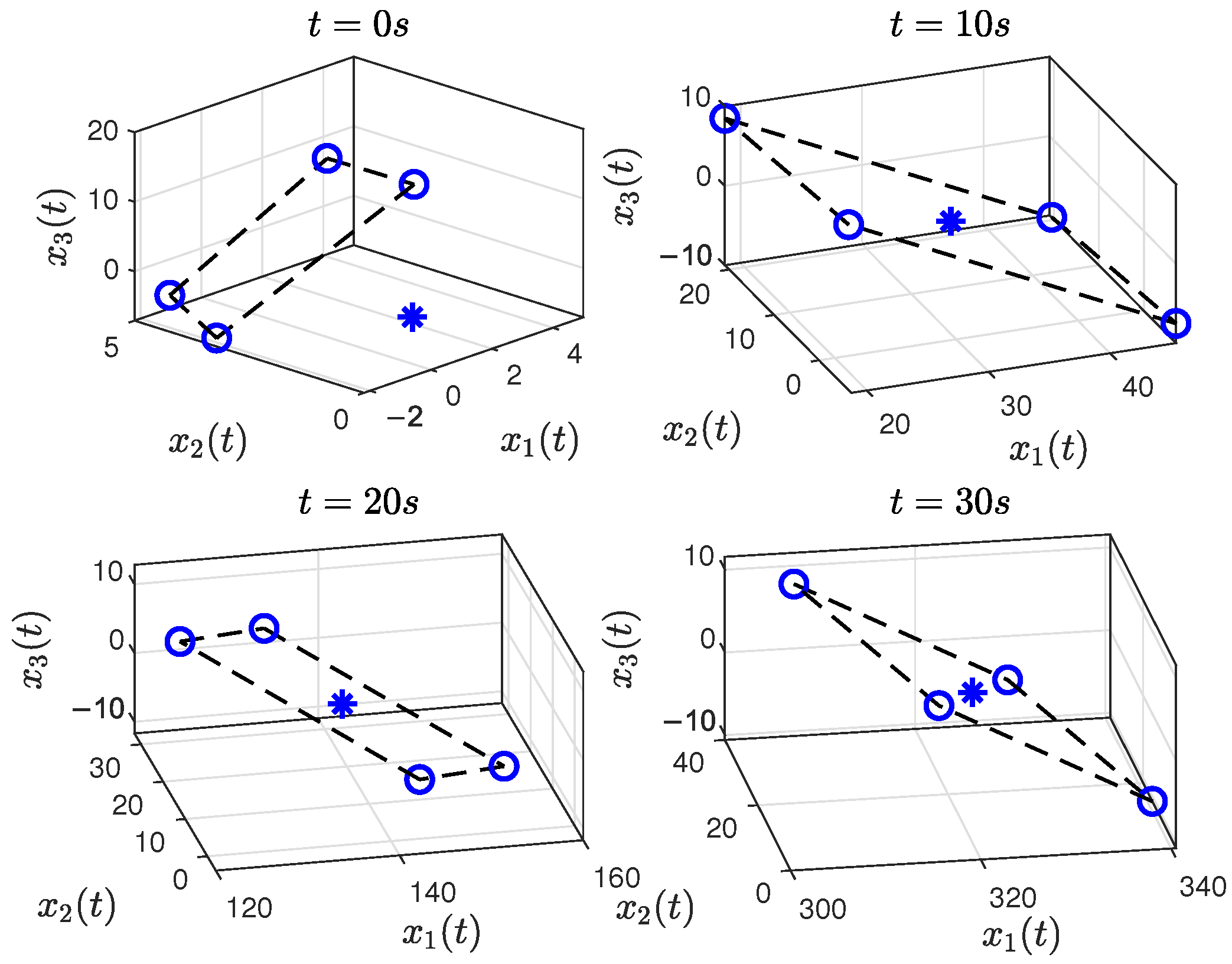
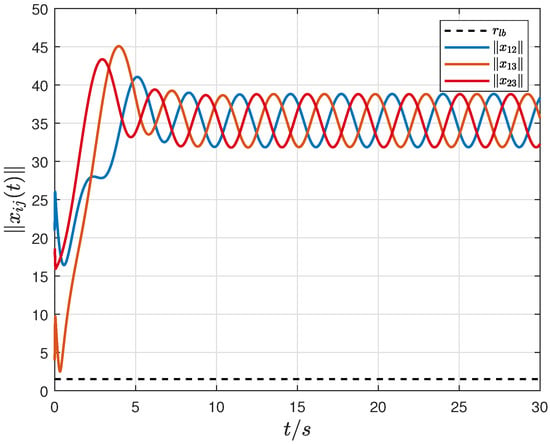
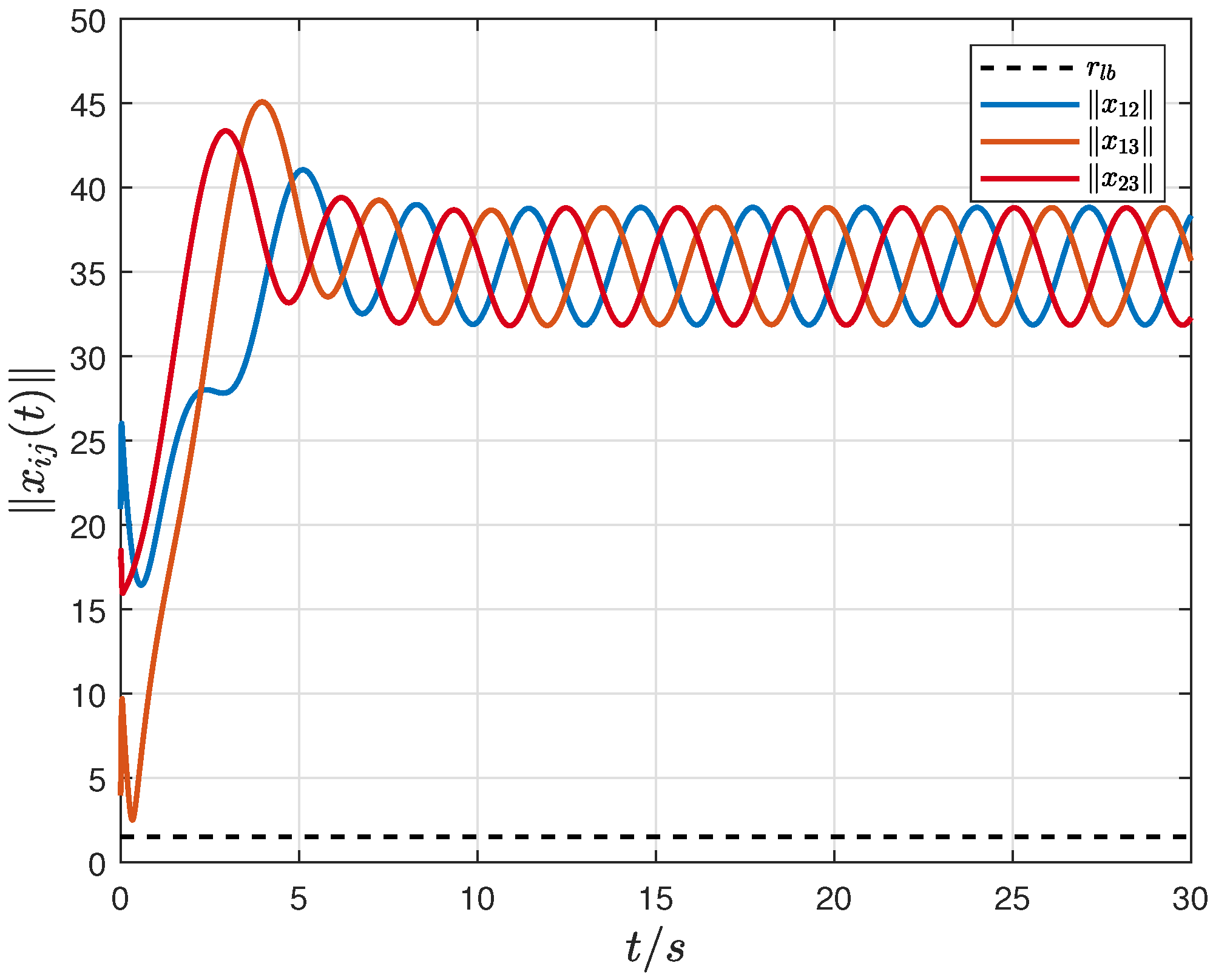
The simulation results are presented in Figure 2, Figure 3, Figure 4, Figure 5, Figure 6, Figure 7, Figure 8 and Figure 9. Specifically, Figure 2 illustrates the overall trajectories of the 10 follower agents, each of which achieves cluster formation tracking with respect to its designated leader according to the prescribed structure. To provide a more detailed perspective, Figure 3, Figure 4 and Figure 5 depict the instantaneous positions of the leaders and their associated followers at four representative time instants. It can be observed that the followers in each subgroup converge to and maintain the desired rotating formation pattern, while the geometric center of the formation coincides precisely with the trajectory of the corresponding leader. Furthermore, Figure 6, Figure 7 and Figure 8 present the inter-agent distances among all followers within the three subgroups. These plots clearly demonstrate that the distance between any two followers remains above the prescribed safety threshold, thereby verifying the effectiveness of the proposed collision avoidance mechanism. Finally, Figure 9 highlights the relative position evolution of the followers in subgroup , which further confirms that, under the derived feasibility conditions, no collisions occur throughout the entire tracking process.
Figure 2.
Trajectories of leader and follower agents, where red, green, and blue markers correspond to clusters , , and , respectively.
Figure 3.
State trajectories of agents belonging to subgroup .
Figure 4.
State trajectories of agents belonging to subgroup .
Figure 5.
State trajectories of agents belonging to subgroup .
Figure 6.
Relative distances among follower agents in subgroup .
Figure 7.
Relative distances among follower agents in subgroup .
Figure 8.
Relative distances among follower agents in subgroup .
Figure 9.
The relative distances among three follower agents of subgroup .
In addition to the qualitative distance trajectories shown in Figure 6, Figure 7, Figure 8 and Figure 9, a quantitative verification of collision-free behavior is further provided in Table 1. Specifically, the minimum pairwise distances within subgroups , , and over the entire simulation interval are 5.3522, 4.8999, and 4.9881, respectively. Since all these values remain well above the prescribed safety threshold (), the results quantitatively confirm that the proposed method guarantees collision-free evolution within each subgroup throughout the simulation.
Table 1.
Minimum pairwise distances within each subgroup during the simulation.
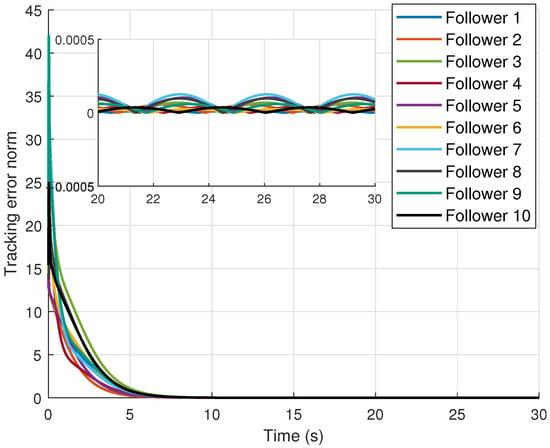
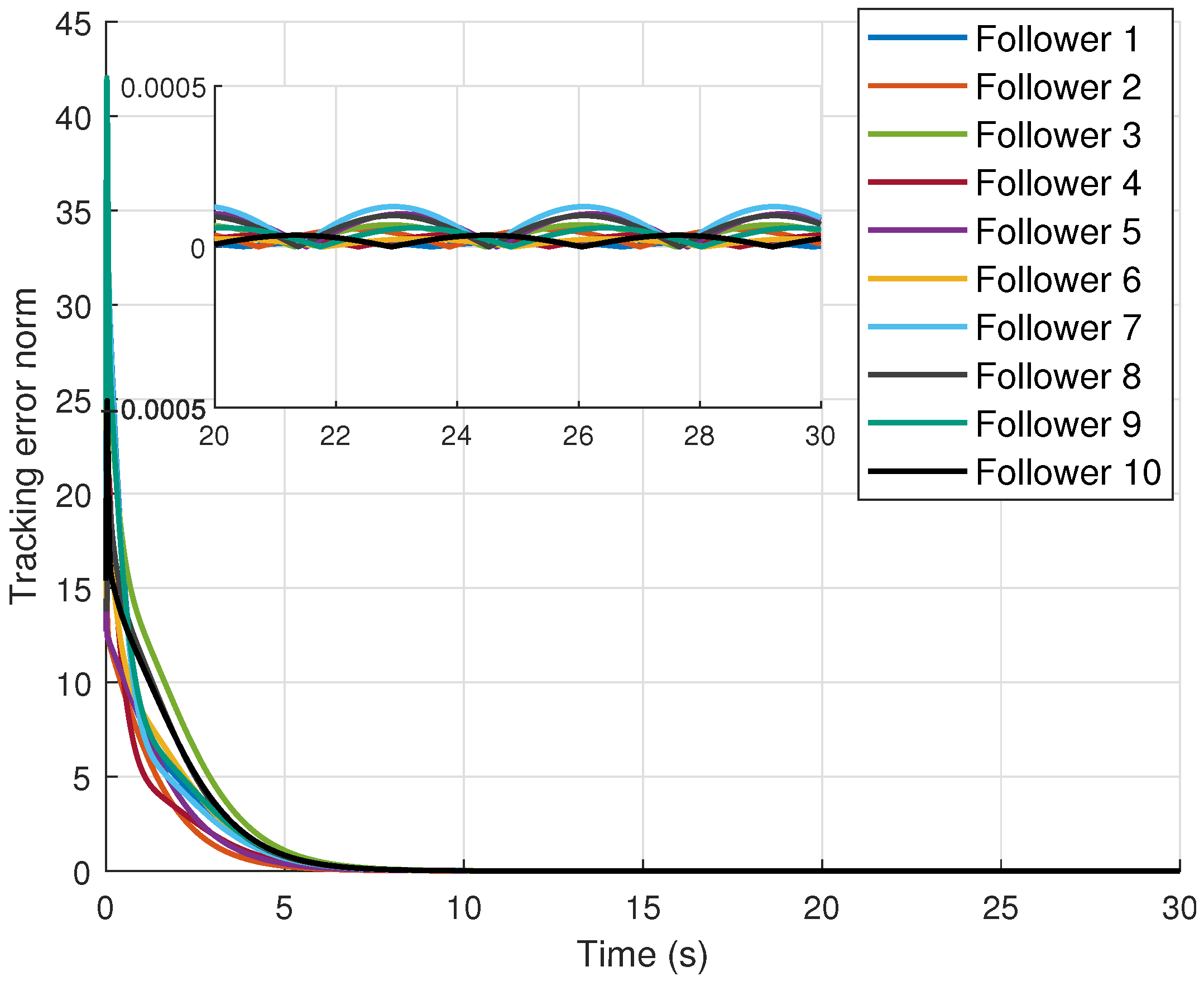
Moreover, To quantitatively evaluate the tracking performance of the proposed method, we further examine the tracking error of each follower. Recall that the tracking error of follower i is defined as in the previous section. Based on , the corresponding error norm is given by . In this simulation, the follower set is divided into three subgroups with sizes 3, 3, and 4, respectively, and each subgroup tracks its corresponding leader while maintaining the prescribed time-varying formation. The simulation time is set to with integration step size . To provide more quantitative evidence beyond the trajectory plots and minimum pairwise distances, we report the following performance metrics for each follower: , , . Moreover, the convergence time is defined as the first instant at which the error norm enters and thereafter remains within of its initial value, i.e., . The detailed quantitative results are reported in Table 2.
Table 2.
Per-agent tracking performance metrics.
To further examine the influence of external disturbances on the proposed control scheme, an additional comparative simulation is carried out by introducing an additive disturbance into each follower dynamics. Specifically, the follower model is modified as
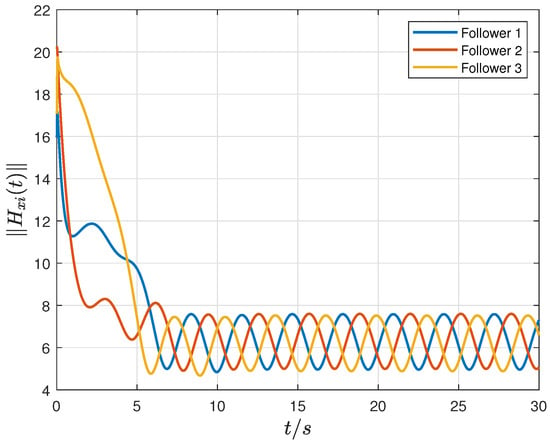
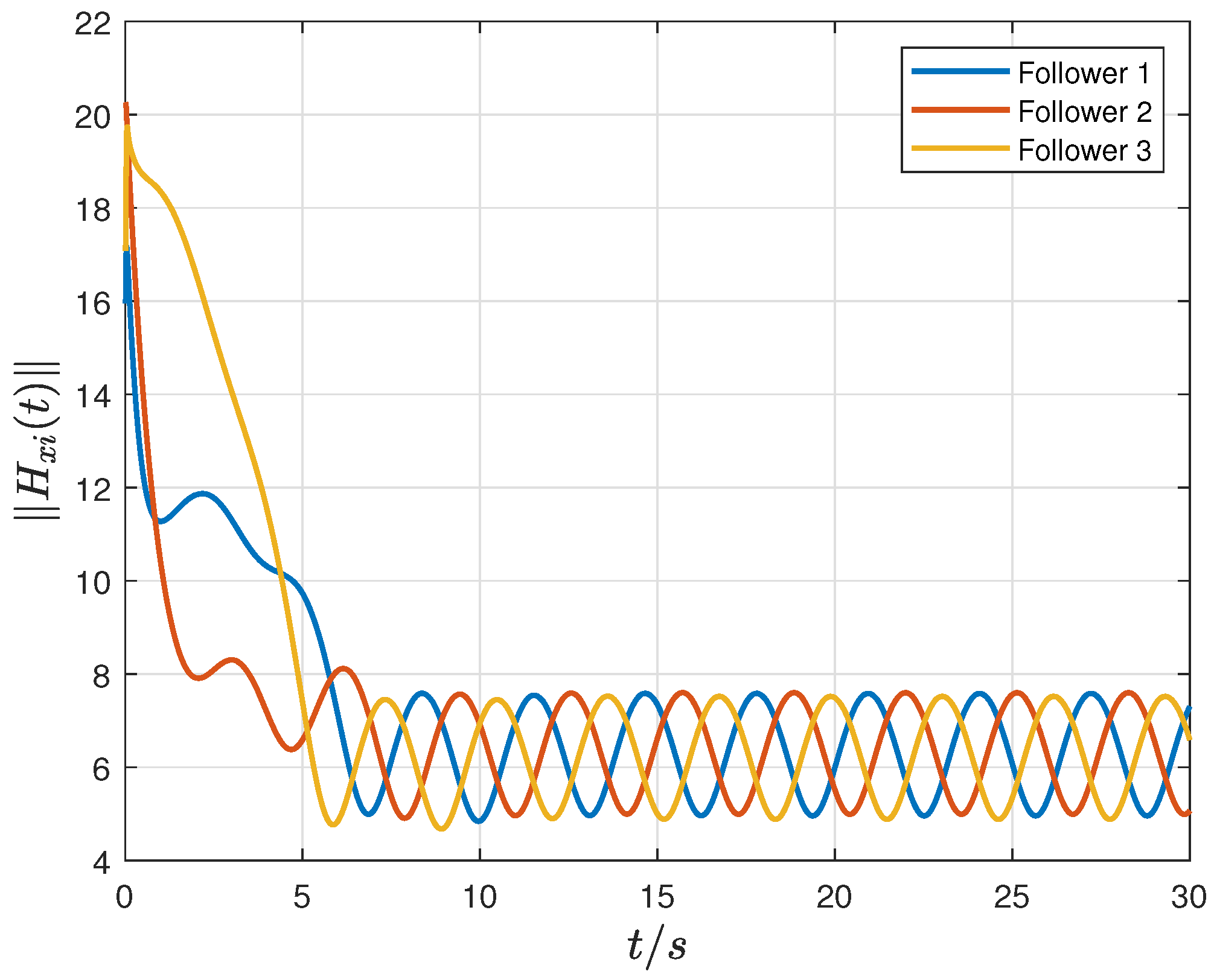
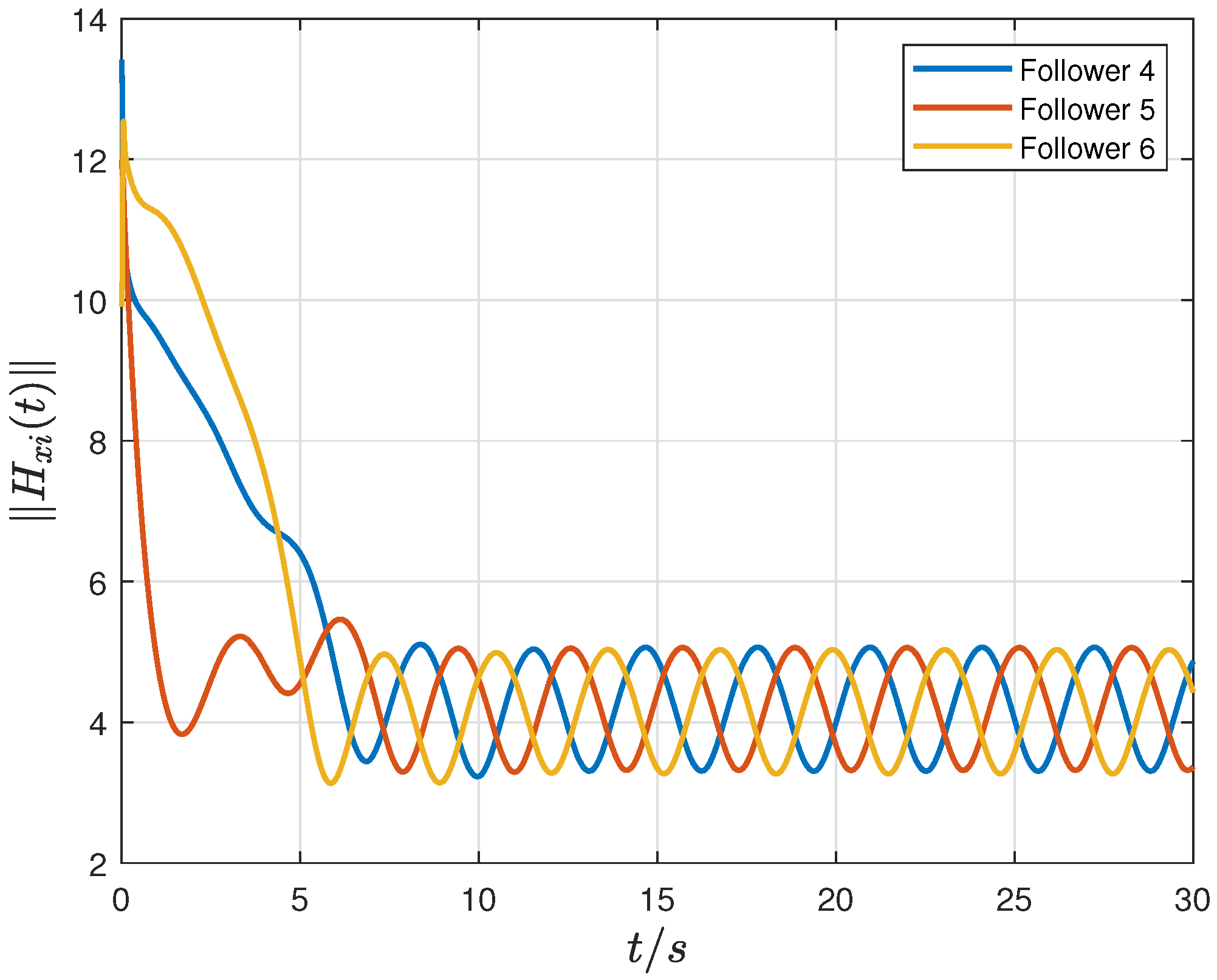
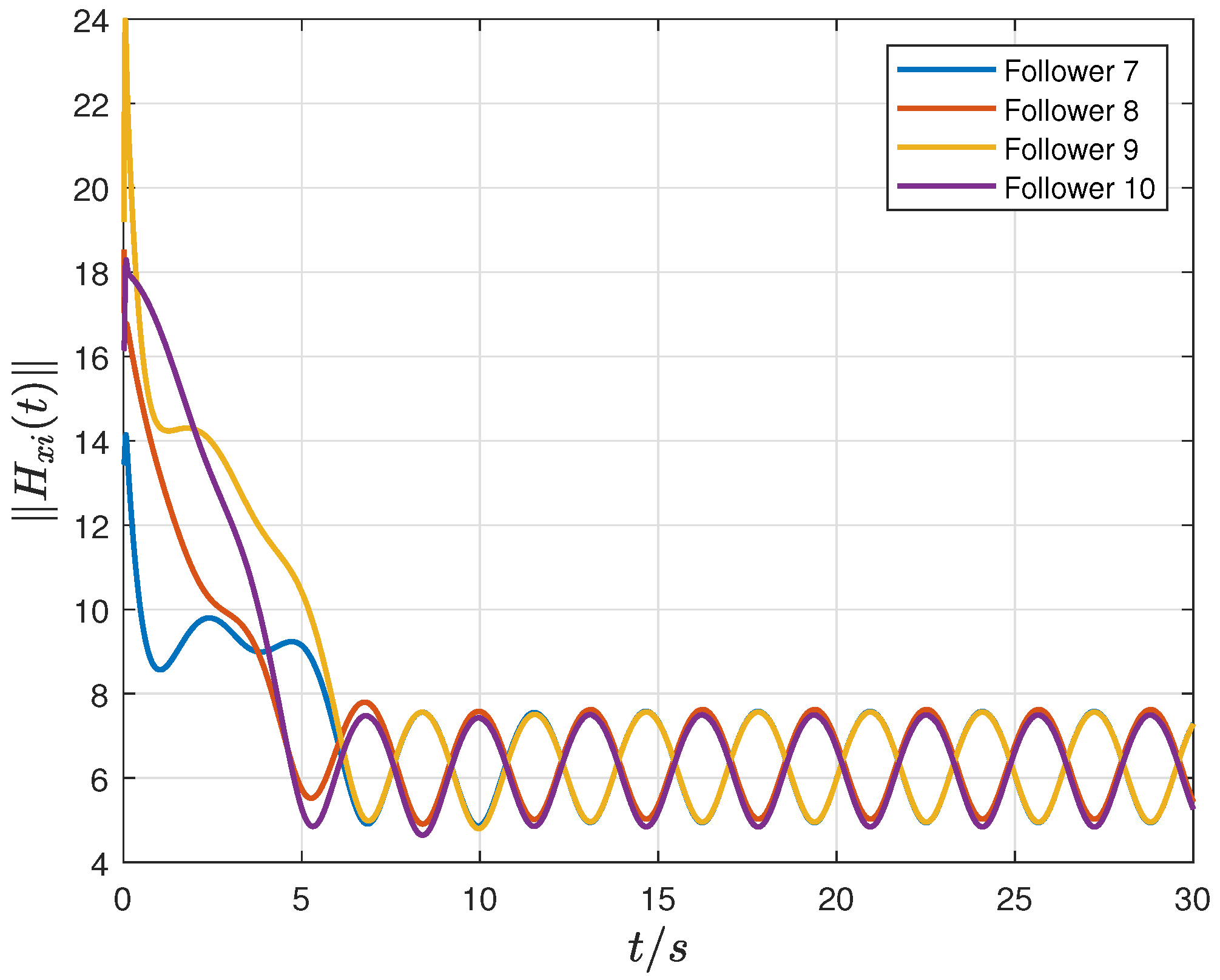
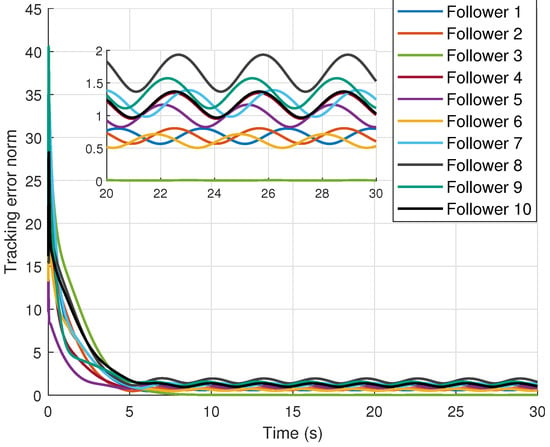
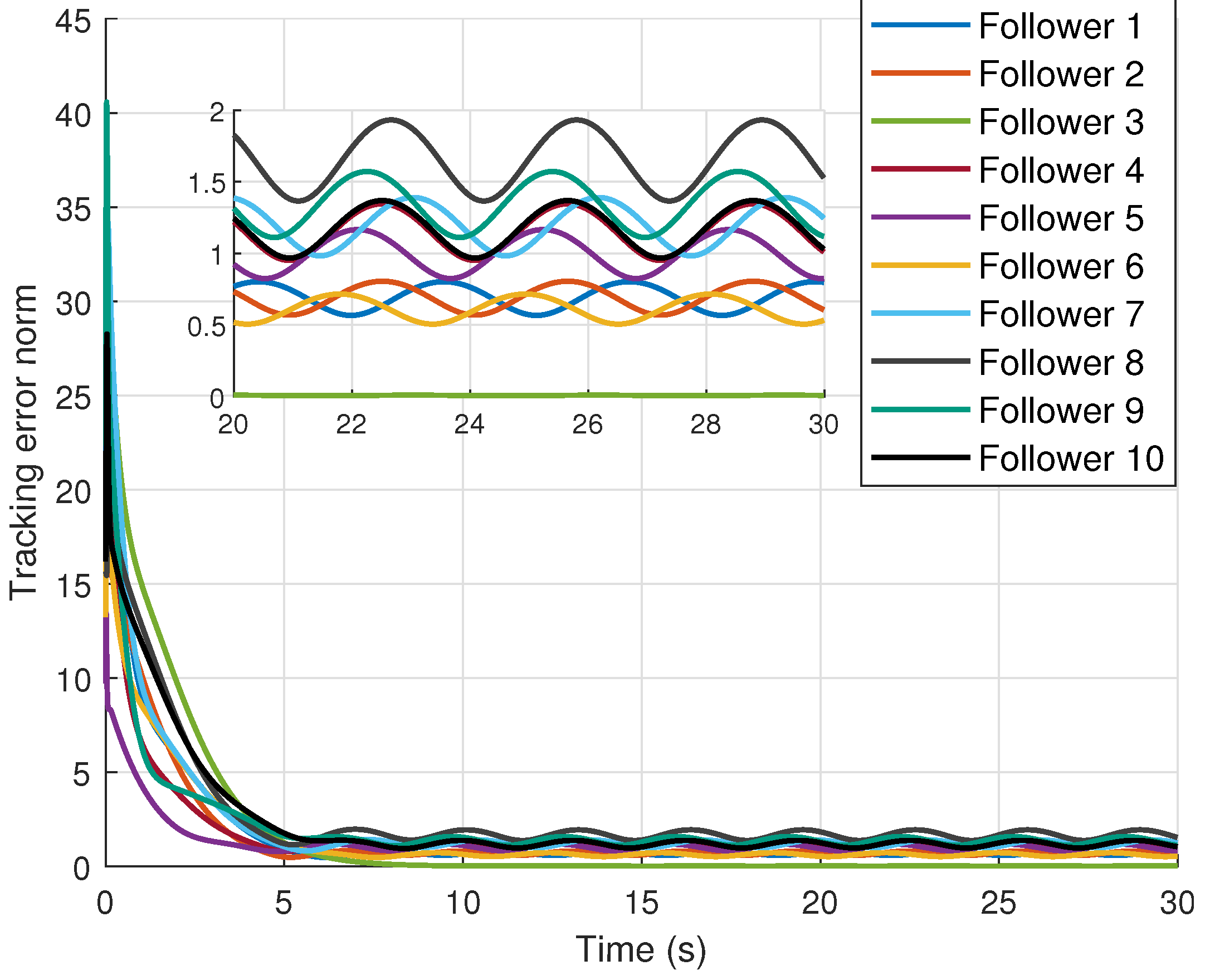
where the disturbance is chosen as . Unless otherwise stated, all the other simulation settings, including the communication topology, controller parameters, and initial conditions, are kept the same as those in the nominal case. Figure 10 and Figure 11 show the tracking error norms of all followers without and with external disturbances, respectively. In the nominal case, all tracking errors decrease rapidly and converge to a very small neighborhood of zero. By contrast, after the sinusoidal disturbance is introduced, the tracking errors become significantly larger and exhibit persistent oscillations, indicating that the disturbance degrades the tracking accuracy and transient performance of the closed-loop system. This comparative result shows that, although the proposed method performs well under the nominal setting, its tracking performance is sensitive to external disturbances when no dedicated robustness mechanism is incorporated. Therefore, it is meaningful to further extend the current framework by integrating disturbance-rejection or robust-control techniques, such as disturbance observers, adaptive compensation, or sliding-mode-based robust terms, which will be considered in our future work.
Figure 10.
Tracking error norms of all followers in the nominal case.
Figure 11.
Tracking error norms of all followers under external disturbances.
4.2. Cluster Formation Tracking for Multi-UAV Systems
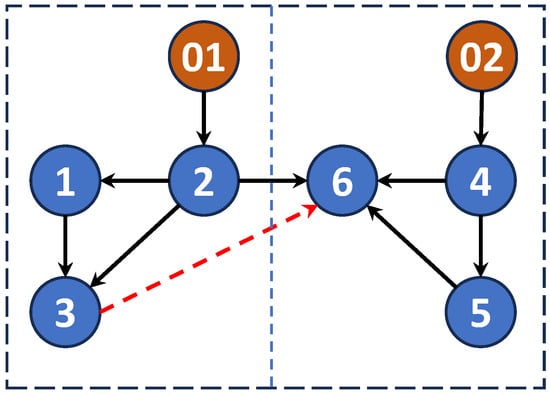
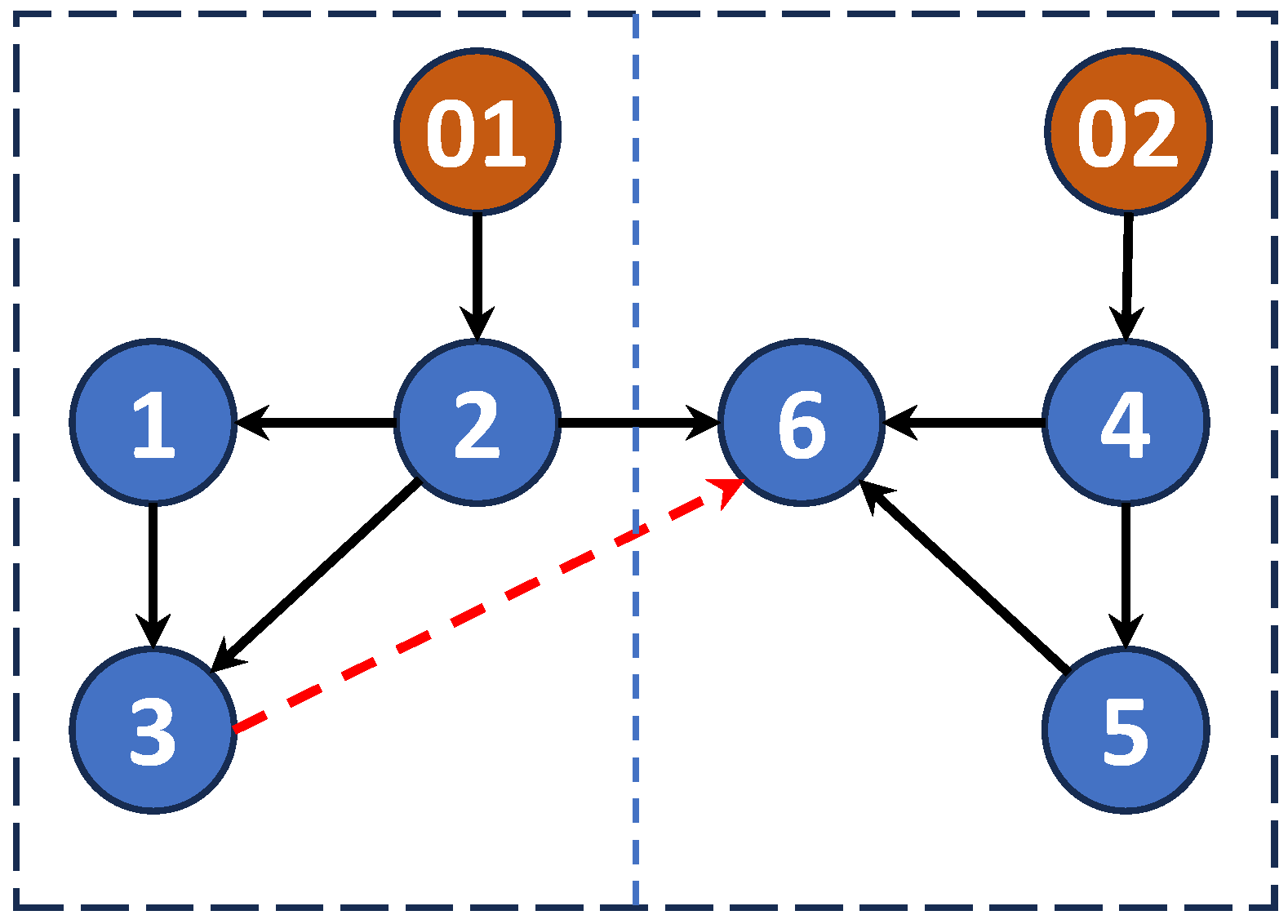
To further examine the effectiveness of the proposed control strategy beyond the original simulation setting, an additional numerical example is conducted for a reduced multi-UAV system composed of eight agents, including two leaders and six followers. The followers are partitioned into two subgroups, denoted by and , with three followers in each subgroup. The corresponding communication topology is shown in Figure 12, where the solid black edges represent positive interaction links, while the red dashed edges denote negative interaction links.
Figure 12.
Communication topology of the multi-UAV systems. Leaders are marked in orange and followers in blue. The followers are partitioned into two subgroups, namely, and . Black solid edges denote positive interaction links, while red dashed edges denote negative interaction links with .
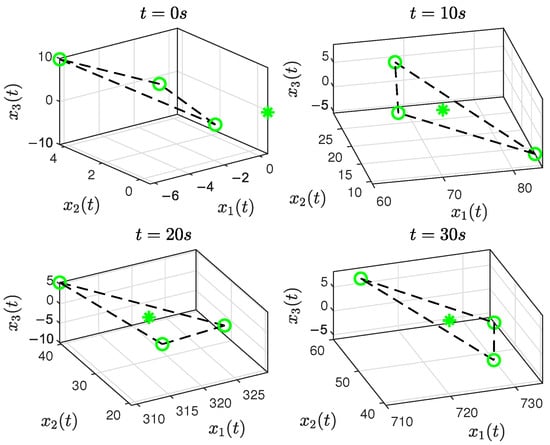
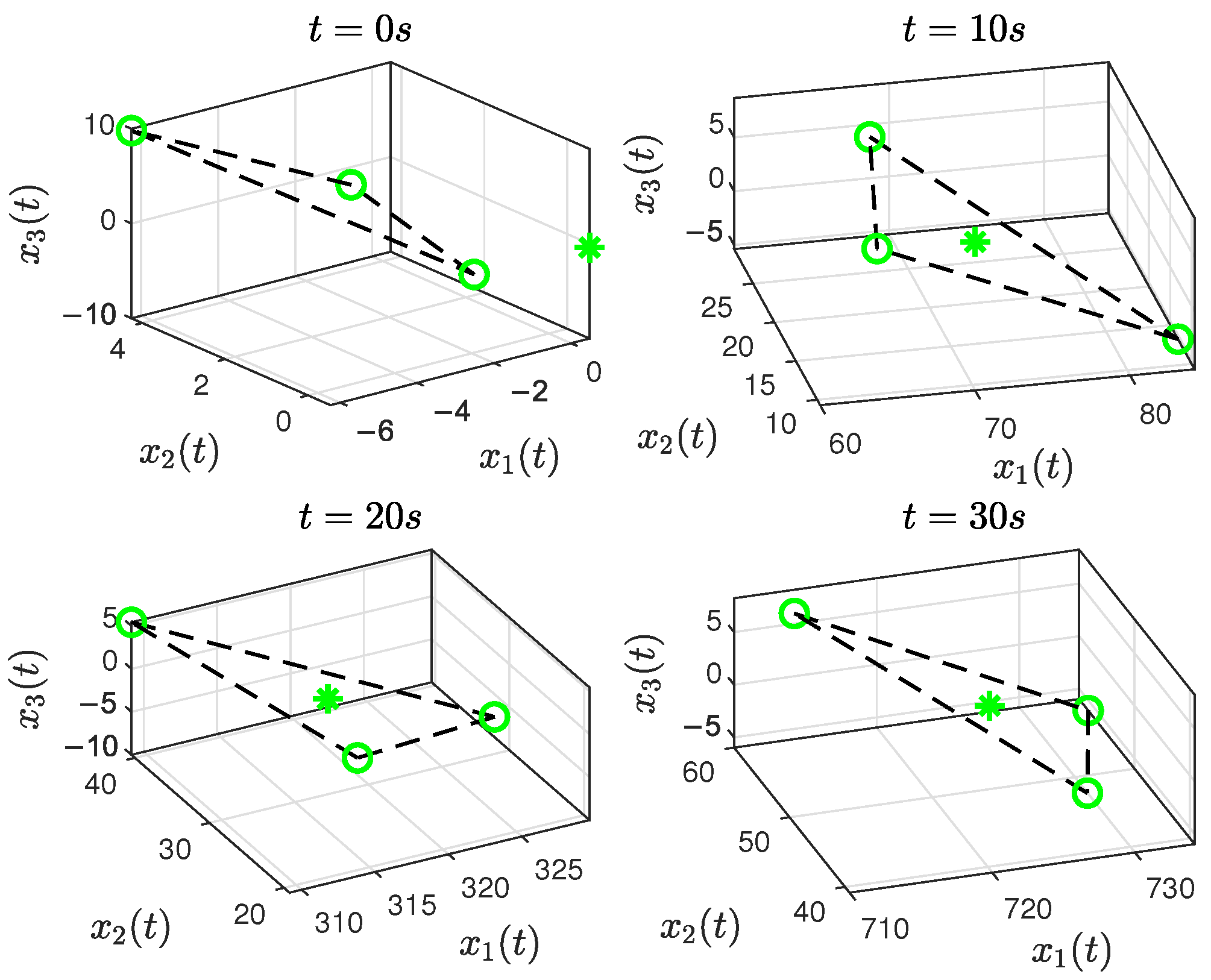
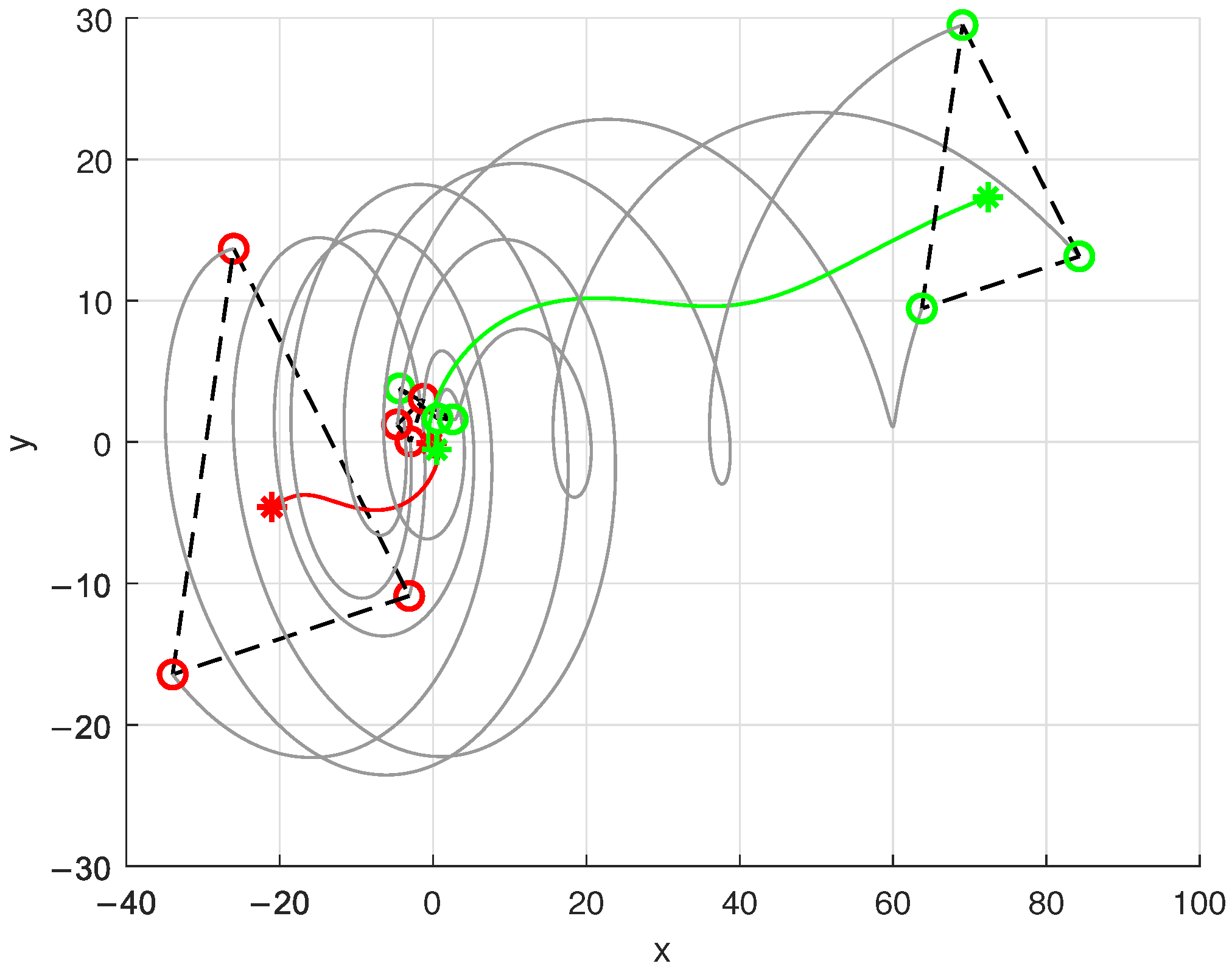
In this additional case, the objective is to verify whether the proposed distributed protocol can still accomplish the desired time-varying cluster formation tracking when the overall network size and cluster structure are changed. Similar to the previous example, each leader provides the motion reference for its associated subgroup, and the followers are required to maintain the prescribed formation geometry relative to the corresponding leader while preserving the subgroup-level safety requirement. Figure 13 presents the trajectories of the agents in the two-subgroup scenario. The red and green markers correspond to clusters and , respectively. It can be observed that, despite the modified topology and reduced number of agents, the followers in both subgroups still converge to the desired time-varying formations under the leader motions. Moreover, the geometric structure of each subgroup is preserved during the evolution, which further demonstrates the adaptability of the proposed method to different network configurations.
Figure 13.
Trajectories of leader and follower agents, where red and green markers correspond to clusters and , respectively.
Overall, the simulation results corroborate the theoretical analysis by showing that the proposed distributed control protocol achieves accurate cluster formation tracking and guarantees collision-free behavior within each subgroup.
5. Conclusions
This paper investigated the HiTL-based cluster formation tracking problem for networked agent systems with multiple leaders. A distributed control protocol was developed so that the followers in each subgroup can track their designated leader using only local relative information. Under the admissible HiTL command condition and the assumed subgroup partition and leader-trajectory separation setting, Lyapunov-based analysis established sufficient conditions for asymptotic subgroup tracking and intra-subgroup collision avoidance. Simulation studies on a 13-agent networked system with three subgroups further confirmed that the desired cluster formations can be achieved under HiTL-driven leader motions while maintaining the prescribed safety distances within each subgroup.
It should be emphasized that the safety guarantee established in this paper is imposed at the intra-subgroup level, whereas the separation between different subgroups is handled through the assumed non-overlapping leader trajectories in the problem formulation. Therefore, the present results are particularly suitable for hierarchical multi-leader mission scenarios in which different subgroups operate along sufficiently separated paths or in distinct task regions. Future work will consider several practically relevant extensions, including the treatment of heterogeneous or nonlinear agent dynamics, switching interaction topologies, communication delays, and asynchronous information exchange. In particular, an important next step is to extend the present framework to explicitly address inter-cluster proximity and cross-subgroup collision avoidance by incorporating additional safety constraints and coupling mechanisms into the distributed control design. Such extensions will further improve the reliability, adaptability, and practical applicability of the proposed framework in more general multi-agent scenarios.
Author Contributions
Conceptualization, J.L.; Methodology, J.L.; Validation, K.Q. and M.S.; Formal analysis, M.S.; Investigation, J.L. and M.S.; Writing—review & editing, K.Q. and M.S.; Supervision, M.S. All authors have read and agreed to the published version of the manuscript.
Funding
This work was supported by the Natural Science Foundation of Sichuan Province (2026NSFSC0317 and 2024NSFSC0021), the Sichuan Science and Technology Programs (MZGC20240139), and the Fundamental Research Funds for the Central Universities (ZYGX2024K028 and ZYGX2025K028).
Data Availability Statement
No new data were created or analyzed in this study.
Conflicts of Interest
The authors declare no conflicts of interest.
References
- Liu, D.; Zong, Q.; Zhang, X.; Zhang, R.; Dou, L.; Tian, B. Game of drones: Intelligent online decision making of multi-uav confrontation. IEEE Trans. Emerg. Top. Comput. Intell. 2024, 8, 2086–2100. [Google Scholar] [CrossRef] [Scilit]
- Huang, D.; Zhu, L.; Zhang, Z.; Na, Y.; Li, Z.; Fang, X. Dynamic Splitting and Merging Control Strategy for Vehicle Platoon Based on Trust Evaluation in a Zero-Trust Environment. IEEE Trans. Autom. Sci. Eng. 2025, 22, 12693–12709. [Google Scholar] [CrossRef] [Scilit]
- Shi, L.; Zhou, Y.; Fu, L.; Ning, N.; Yan, J.; Qiu, Q. Reaching opinion consensus on leader-follower signed social networks with communication delays. IEEE Trans. Autom. Control 2025, 70, 5561–5567. [Google Scholar] [CrossRef] [Scilit]
- Shi, L.; Chen, X.; Zhou, Y. Barycentric Coordinate-Based Distributed Localization for Wireless Sensor Networks Under False-Data-Injection Attacks. IEEE Trans. Cybern. 2025, 55, 1568–1579. [Google Scholar] [CrossRef] [Scilit] [PubMed]
- Wang, Y.; Hu, W.; Cao, D.; Zhao, P.; Abulanwar, S.; Chen, Z.; Blaabjerg, F. Local Distribution Voltage Control Using Large-Scale Coordinated PV Inverters: A Novel Multi-Agent Deep Reinforcement Learning-Based Approach. IEEE Trans. Smart Grid 2025, 16, 2683–2686. [Google Scholar] [CrossRef] [Scilit]
- Liu, Y.; Liu, J.; He, Z.; Li, Z.; Zhang, Q.; Ding, Z. A survey of multi-agent systems on distributed formation control. Unmanned Syst. 2024, 12, 913–926. [Google Scholar] [CrossRef] [Scilit]
- Xiao, R.; Wang, S.; Xie, Y.; Zhang, Y.; Xie, S.Q. Safety-Aware UAV Formation Scheme for Guiding UGVs Through Obstacle-Laden Environments. IEEE Robot. Autom. Lett. 2025, 10, 6999–7006. [Google Scholar] [CrossRef] [Scilit]
- Ren, J.; Wen, G.; Fang, X.; Huang, T. Fully Distributed Formation Control of Autonomous Surface Vessels via Non-Cooperative Game Approach. IEEE Trans. Emerg. Top. Comput. Intell. 2026, 10, 168–180. [Google Scholar] [CrossRef] [Scilit]
- Huang, J.; Yang, C.; Wu, S.; Liu, Q. Distributed Aggregative Optimization Algorithm for Solving Multi-Robot Formation Problem. IEEE Trans. Control Netw. Syst. 2025, 12, 2102–2114. [Google Scholar] [CrossRef] [Scilit]
- Xue, D.; Zhou, X.; Wang, M.; Liu, F. Formation control and path planning of multi-robot systems via large language models. Sci. China Inf. Sci. 2025, 68, 150205. [Google Scholar] [CrossRef] [Scilit]
- Chen, L.; Liang, C.; Yuan, S.; Cao, M.; Xie, L. Relative localizability and localization for multi-robot systems. IEEE Trans. Robot. 2025, 41, 2931–2949. [Google Scholar] [CrossRef] [Scilit]
- Ren, W. Multi-vehicle consensus with a time-varying reference state. Syst. Control Lett. 2007, 56, 474–483. [Google Scholar] [CrossRef] [Scilit]
- Ding, T.F.; Ge, M.F.; Xiong, C.; Liu, Z.W.; Ling, G. Prescribed-time formation tracking of second-order multi-agent networks with directed graphs. Automatica 2023, 152, 110997. [Google Scholar] [CrossRef] [Scilit]
- Li, Y.; Dong, S.; Li, K.; Tong, S. Fuzzy adaptive fault tolerant time-varying formation control for nonholonomic multirobot systems with range constraints. IEEE Trans. Intell. Veh. 2023, 8, 3668–3679. [Google Scholar] [CrossRef] [Scilit]
- Tan, C.; Zhang, T.; Li, Y.; Liu, G.P. Time-varying group formation tracking control for uncertain nonlinear high-order fully actuated multiagent systems. Nonlinear Dyn. 2025, 113, 2293–2314. [Google Scholar] [CrossRef] [Scilit]
- Hua, Y.; Shu, P.; Hu, C.; Dong, X.; Lu, J.; Wang, D. Theory and Experiment on Adaptive Group Time-Varying Formation Tracking Control for Unmanned Swarm Systems via Networked Game. IEEE Trans. Ind. Electron. 2025, 72, 14147–14155. [Google Scholar] [CrossRef] [Scilit]
- Ren, H.; Long, Y.; Li, H.; Huang, T. Data-Driven Group Formation Control of Cyber-Physical Systems via Distributed Cloud Computing. IEEE Trans. Ind. Cyber-Phys. Syst. 2025, 3, 341–350. [Google Scholar] [CrossRef] [Scilit]
- Lu, Y.; Dong, X.; Li, Q.; Lü, J.; Ren, Z. Time-varying group formation-containment tracking control for general linear multiagent systems with unknown inputs. IEEE Trans. Cybern. 2021, 52, 11055–11067. [Google Scholar] [CrossRef] [Scilit]
- Yang, P.; Zhang, A.; Bi, W.; Li, M. Cooperative group formation control for multiple quadrotors system with finite-and fixed-time convergence. ISA Trans. 2023, 138, 186–196. [Google Scholar] [CrossRef] [Scilit]
- Chen, L.; Liang, H.; Pan, Y.; Li, T. Human-in-the-loop consensus tracking control for UAV systems via an improved prescribed performance approach. IEEE Trans. Aerosp. Electron. Syst. 2023, 59, 8380–8391. [Google Scholar] [CrossRef] [Scilit]
- Lin, G.; Li, H.; Ma, H.; Yao, D.; Lu, R. Human-in-the-loop consensus control for nonlinear multi-agent systems with actuator faults. IEEE/CAA J. Autom. Sin. 2020, 9, 111–122. [Google Scholar] [CrossRef] [Scilit]
- Chen, J.; Xie, J.; Li, J.; Chen, W. Human-in-the-loop fuzzy iterative learning control of consensus for unknown mixed-order nonlinear multi-agent systems. IEEE Trans. Fuzzy Syst. 2023, 32, 255–265. [Google Scholar] [CrossRef] [Scilit]
- Ma, L.; Zhu, F. Human-in-the-loop formation control for multi-agent systems with asynchronous edge-based event-triggered communications. Automatica 2024, 167, 111744. [Google Scholar] [CrossRef] [Scilit]
- Ma, L.; Zhu, F.; Zhao, X. Human-in-the-loop formation-containment control for multiagent systems: An observer-based distributed unknown input reconstruction method. IEEE Trans. Control Netw. Syst. 2023, 10, 2178–2189. [Google Scholar] [CrossRef] [Scilit]
- Guo, H.; Chen, M.; Jiang, Y.; Lungu, M. Distributed adaptive human-in-the-loop event-triggered formation control for QUAVs with quantized communication. IEEE Trans. Ind. Inform. 2022, 19, 7572–7582. [Google Scholar] [CrossRef] [Scilit]
- An, L.; Yang, G.H. Collisions-free distributed optimal coordination for multiple Euler-Lagrangian systems. IEEE Trans. Autom. Control 2021, 67, 460–467. [Google Scholar] [CrossRef] [Scilit]
- Pang, Z.H.; Zheng, C.B.; Sun, J.; Han, Q.L.; Liu, G.P. Distance-and velocity-based collision avoidance for time-varying formation control of second-order multi-agent systems. IEEE Trans. Circuits Syst. II Express Briefs 2020, 68, 1253–1257. [Google Scholar] [CrossRef] [Scilit]
- Tang, J.; Lao, S.; Wan, Y. Systematic review of collision-avoidance approaches for unmanned aerial vehicles. IEEE Syst. J. 2021, 16, 4356–4367. [Google Scholar] [CrossRef] [Scilit]
- Zhang, X.; Wu, J.; Zhan, X.; Han, T.; Yan, H. Event-triggered adaptive time-varying formation tracking of multi-agent system with a leader of nonzero input. IEEE Trans. Circuits Syst. II Express Briefs 2022, 70, 2016–2020. [Google Scholar] [CrossRef] [Scilit]
- Wang, C.; Ji, J.; Miao, Z.; Zhou, J. Formation tracking of multi-robot systems with switching directed topologies based on Udwadia-Kalaba approach. Appl. Math. Model. 2024, 126, 147–158. [Google Scholar] [CrossRef] [Scilit]
- Su, P.; Yu, J.; Hua, Y.; Li, Q.; Dong, X.; Ren, Z. Distributed time-varying formation optimal tracking for uncertain Euler–Lagrange systems with time-varying cost functions. Aerosp. Sci. Technol. 2023, 132, 108019. [Google Scholar] [CrossRef] [Scilit]
- Yu, J.; Dong, X.; Li, Q.; Lü, J.; Ren, Z. Adaptive practical optimal time-varying formation tracking control for disturbed high-order multi-agent systems. IEEE Trans. Circuits Syst. I Regul. Pap. 2022, 69, 2567–2578. [Google Scholar] [CrossRef] [Scilit]
- Huang, S.; Zong, G.; Niu, B.; Xu, N.; Zhao, X. Dynamic Self-Triggered Fuzzy Bipartite Time-Varying Formation Tracking for Nonlinear Multi-Agent Systems With Deferred Asymmetric Output Constraints. IEEE Trans. Fuzzy Syst. 2024, 32, 2700–2712. [Google Scholar] [CrossRef] [Scilit]
- Liang, Z.; Tang, Z.; Feng, J. Parameter variational based adaptive bipartite formation control of second-order multi-agent systems with antagonistic interactions. J. Frankl. Inst. 2024, 361, 106830. [Google Scholar] [CrossRef] [Scilit]
- Li, W.; Shi, L.; Shi, M.; Lin, B.; Qin, K. Cooperative Formation Tracking of Multi-Agent Systems over Switching Signed Networks. IEEE Trans. Control Netw. Syst. 2025, 12, 2581–2591. [Google Scholar] [CrossRef] [Scilit]
- Shi, L.; Yan, S.; Li, W. Consensus and products of substochastic matrices: Convergence rate with communication delays. IEEE Trans. Syst. Man Cybern. Syst. 2025, 55, 4752–4761. [Google Scholar] [CrossRef] [Scilit]
- Li, W.; Yan, S.; Shi, L.; Yue, J.; Shi, M.; Lin, B.; Qin, K. Multiagent consensus tracking control over asynchronous cooperation–competition networks. IEEE Trans. Cybern. 2025, 55, 4347–4360. [Google Scholar] [CrossRef] [Scilit]
- Lu, Y.; Dong, X.; Li, Q.; Lv, J.; Ren, Z. Time-varying group formation-tracking control for general linear multi-agent systems with switching topologies and unknown input. Int. J. Robust Nonlinear Control 2022, 32, 1925–1940. [Google Scholar] [CrossRef] [Scilit]
- Ren, W.; Beard, R.W. Consensus seeking in multiagent systems under dynamically changing interaction topologies. IEEE Trans. Autom. Control 2005, 50, 655–661. [Google Scholar] [CrossRef] [Scilit]
- Hu, J.; Bhowmick, P.; Lanzon, A. Distributed adaptive time-varying group formation tracking for multi-agent systems with multiple leaders on directed graphs. IEEE Trans. Control Netw. Syst. 2019, 7, 140–150. [Google Scholar] [CrossRef] [Scilit]
- Li, W.; Qin, K.; Li, G.; Shi, M.; Zhang, X. Robust bipartite tracking consensus of multi-agent systems via neural network combined with extended high-gain observer. ISA Trans. 2023, 136, 31–45. [Google Scholar] [CrossRef] [Scilit] [PubMed]
- Khalil, H.K. Nonlinear Systems; Prentice-Hall: Upper Saddle River, NJ, USA, 2002. [Google Scholar]
- Dong, X.; Sun, C.; Hu, G. Time-varying output formation control for linear multi-agent systems with switching topologies. Int. J. Robust Nonlinear Control 2016, 26, 3558–3579. [Google Scholar] [CrossRef] [Scilit]
- de Oliveira Souza, F.; Torres, L.A.B.; Mozelli, L.A.; Neto, A.A. Stability and formation error of homogeneous vehicular platoons with communication time delays. IEEE Trans. Intell. Transp. Syst. 2019, 21, 4338–4349. [Google Scholar] [CrossRef] [Scilit]

Disclaimer/Publisher’s Note: The statements, opinions and data contained in all publications are solely those of the individual author(s) and contributor(s) and not of MDPI and/or the editor(s). MDPI and/or the editor(s) disclaim responsibility for any injury to people or property resulting from any ideas, methods, instructions or products referred to in the content. |
© 2026 by the authors. Licensee MDPI, Basel, Switzerland. This article is an open access article distributed under the terms and conditions of the Creative Commons Attribution (CC BY) license.