


Abstract
The paper proposes a completely new geometric interpretation of intuitionistic fuzzy sets for confidence-aware decision making. Instead of directly using ordered pairs of membership and non-membership degrees, we reinterpret the intuitionistic fuzzy triangle as a structured coordinate framework that simultaneously represents the evaluation outcomes and the evaluators’ expertise in the following manner: experts’ confidence levels are modelled with line segments parallel to the hypotenuse, while evaluation scores are represented by line segments radiating from the origin of the coordinate system toward the hypotenuse. Their intersections form a finite lattice of points whose total number depends on the chosen confidence and assessment scales. The proposed construction preserves the semantic foundations of intuitionistic fuzziness: points closer to the origin reflect higher uncertainty in the evaluator’s confidence, while points onto the hypotenuse represent determinate judgments (with varying degrees of positivity or negativity) based on the complete evaluator’s confidence. The geometric distances between intersections provide a formal explanation of varying discriminative power: assessments from highly confident reviewers are more distinguishable than those from less confident ones. In addition, a colour-based visualization further supports the intuitive interpretation of confidence-weighted evaluations. The proposed framework offers an alternative yet fully consistent way to model expertise-dependent decision processes within the intuitionistic fuzzy setting, bridging geometric insight and practical evaluation scenarios via a structured system of parallels and meridians.
Keywords:
intuitionistic fuzzy sets; intuitionistic fuzzy interpretational triangle; decision making; expert evaluation; aggregation of intuitionistic fuzzy values; computational geometry; centroid MSC:
03E72; 51F99; 52B55
1. Introduction
Decision making research has long recognized that information is rarely perfectly reliable. Foundational works in statistical decision theory and Bayesian reasoning explicitly incorporate uncertainty in measurements and judgments as an integral part of rational choice. Developments in fields like multi-criteria decision analysis (MCDA), risk analysis, and expert elicitation have further emphasized that evaluation inputs often carry varying levels of credibility.
The explicit idea of confidence-aware decision making gained attention in the second half of 20th and early 21st centuries, stemming from advances in probabilistic reasoning frameworks influenced by researchers like Judea Pearl [1], and fuzzy set theory proposed by Lotfi Zadeh [2].
While fuzzy set theory extends classical set theory by allowing gradual rather than binary membership, it was further elaborated by the intuitionistic fuzzy set theory introduced by Krassimir Atanassov, which brought uncertainty modelling to a next level. Zadeh’s framework represents vagueness through a single membership degree , expressing how strongly an element belongs to a set. Atanassov extended this idea by introducing a second, independent degree representing non-membership, , where both degrees are constrained by the condition , thus leaving the possibility of a complementary “hesitation margin” , [3,4].
A traditional graphical representation of intuitionistic fuzzy sets is in the so-called interpretational triangle, a right isosceles unit triangle with vertices in the points . Research related to the geometrical aspect of intuitionistic fuzziness started as early as 1989 [5] and was substantially developed in Atanassov’s monographs [6,7] and by other researchers [8,9,10,11]. Some more recent contributions in this direction that deepen and streamline our understanding on this aspect are [12,13].
Each point inside the IF interpretational triangle corresponds to one intuitionistic fuzzy evaluation and is defined by coordinates , where denotes the degree of membership and denotes the degree of non-membership. The triangular boundary enforces the fundamental constraint . The remaining portion represents the hesitation (or indeterminacy) degree, capturing the amount of uncertainty that cannot be assigned to either membership or non-membership. Thus, every point in the triangle encodes three components—membership, non-membership, and hesitation—whose sum equals one, providing a geometric interpretation of intuitionistic fuzzy information.
Taking into account the distinctive and extended characteristics of IFSs relative to fuzzy sets, the authors continue their recent research direction (see [14,15]) of harnessing ideas and concepts from the geometry of triangle to revisit certain theoretical and practical aspects of intuitionistic fuzziness.
In the present paper, we revamp this classical geometric interpretation of intuitionistic fuzzy sets in attempt to give a new perspective to confidence-aware decision making. To illustrate the approach and clarify its motivation, in Section 2 we examine the editorial process of scientific peer review as a representative decision-making scenario. In this setting, multiple experts contribute assessments with varying levels of confidence and expertise, and interim evaluations may contain degrees of membership, non-membership, and uncertainty in different proportions. At the same time, the final outcome remains binary in nature, since a manuscript is ultimately either accepted for publication or rejected from the scientific journal.
Essentially, instead of orienting our model with respect to the degrees of membership and non-membership degrees and the usual coordinate system axes, we re-tailor the intuitionistic fuzzy interpretational triangle as a framework structured around the triangle’s hypotenuse and the origin of the coordinate system in point , metaphorically mapped to the geographical concepts of the Equator and an Earth’s Pole. Our aim is to simultaneously represent the evaluation outcomes and the evaluators’ confidence levels in the form of a structured system of parallels and meridians, as it will be carefully presented in details in Section 3 that contains our main results and discussions.
2. Initial Problem Statement
In the usual setting, a scientific journal invites a set of qualified researchers (reviewers, evaluators) to evaluate whether a submitted scientific manuscript merits publication. In addition to a set of predefined evaluation criteria (whose specifics are irrelevant in the current scope of discussion), reviewers are given a set of predefined assessment scores to choose from when formulating their recommendation regarding the manuscript. On the basis of these individual recommendations the journal determines the editorial decision to be communicated to the authors of the submitted manuscript. In drawing this final decision, the journal usually renders account of the assigned (or self-assigned) level of confidence of each reviewer with respect to their competence to evaluate the manuscript under review. The usual assumption is that the journal invites as evaluators only scientists who are considered completely competent in the area of the paper under review, but some allow/request reviewers to indicate their level of self-confidence on the topic, which then serves as a weight coefficient against which their assessment is regarded and weighed up (rectified). Acknowledging that self-assessed confidence is often noisy, biased, or poorly calibrated, we leave it to the decision maker to decide, for a particular implementation of the proposed approach, what additional measures would be taken to address issues like potential inflation of self-reported confidence, and similar, as this matter is currently beyond the scope of the present research.
For instance, a typical scale for the reviewer’s assessment contains seven scores and ranges from “strong reject”, through “reject”, “weak reject”, 0 “borderline”, 1 “weak accept”, 2 “accept” to 3 “strong accept”. A typical scale for Reviewer’s confidence ranges from 0 “none”, through 1 “low”, 2 “medium”, 3 “high” to 4 “expert”.
Finally, the possible outcomes of the editorial decision, as communicated to the authors (in linguistic variables), can also be graded from the worst to the best, for example: “Rejection”, “Major revision and reevaluation”, “Acceptance with major revisions”, “Acceptance with minor revisions”, “Acceptance (as is)”.
3. Interpretation of the Problem Statement Within the Intuitionistic Fuzzy Sets: Parallels and Meridians in the Interpretational Triangle
The essence of using intuitionistic fuzzy sets for solving a real-life decision making problem is in interpreting relevant aspects of the problem as the functions of membership and non-membership or as intuitionistic fuzzy pairs exhibiting these two degrees as ordered tuples of numbers from the interval. A standard way of graphical interpretation then is in the form of points within the intuitionistic fuzzy interpretational triangle, where the abscissa represents the domain of the membership function, the ordinate–respectively represents the domain of the non-membership function, and the triangle’s hypotenuse reflects the IFS-specific limitation that the sum of both functions obtains values again in the interval.
Here we will propose a different interpretation, but we will justify why it is again relevant to intuitionistic fuzziness despite not employing the well-known pair of membership and non-membership values per se. For the sake of our problem interpretation, we will benefit from the so called intuitionistic fuzzy interpretational triangle.
Let us assume that the Reviewer’s confidence level is expressed by the p-point scale as shown in the example above as from “none” to “expert”. Let us divide the triangle’s cathetus collinear with the abscissa into equal segments, where the lowest expertise, numerically expressed as “0” coincides with the point of the triangle, and the highest expertise, numerically expressed as “” coincides with the point of the triangle. For the time being, let us consider these segments be equal in length, but later we will discuss the scenario when they are intentionally different. Starting from the so determined points on the cathetus, let us draw the segments parallel to the hypotenuse that belong to the interior of the triangle. For brevity, let us refer to these lines as to “parallels” analogous to the geographic lines of latitude parallel to the Equator: we have parallels including the triangle’s hypotenuse itself and the zeroth parallel degenerates into the point .
Now, let us assume that the scale of Reviewer’s assessment is plotted along the hypotenuse, stretching from the point representing the most negative score (or in IFSs terms, the complete “Falsity”) to the point representing the most positive score (or in IFS terms, the complete “Truth”). If in our evaluation scale the m possible assessments are , this means that the hypotenuse is divided into segments by the m equidistant points, two of which coincide with the two vertices of the interpretational triangle with coordinates and and are thus already connected to the origin of the coordinate system. Let us connect the thereby determined remaining points on the hypotenuse with the point of origin, as well. Let us call these lines radiating from the point “meridians”, by analogy with the geographic lines of longitude running from the North Pole southwards: we have m meridians including the two catheti of the intuitionistic fuzzy interpretational triangle.
Then, the number of intersecting points onto the triangle is , with m points plotted along each of the parallels, and the m points on the 0-th parallel merged into a single point, namely the origin of the coordinate system .
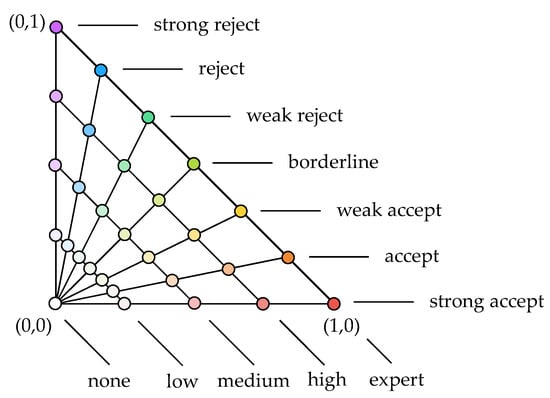
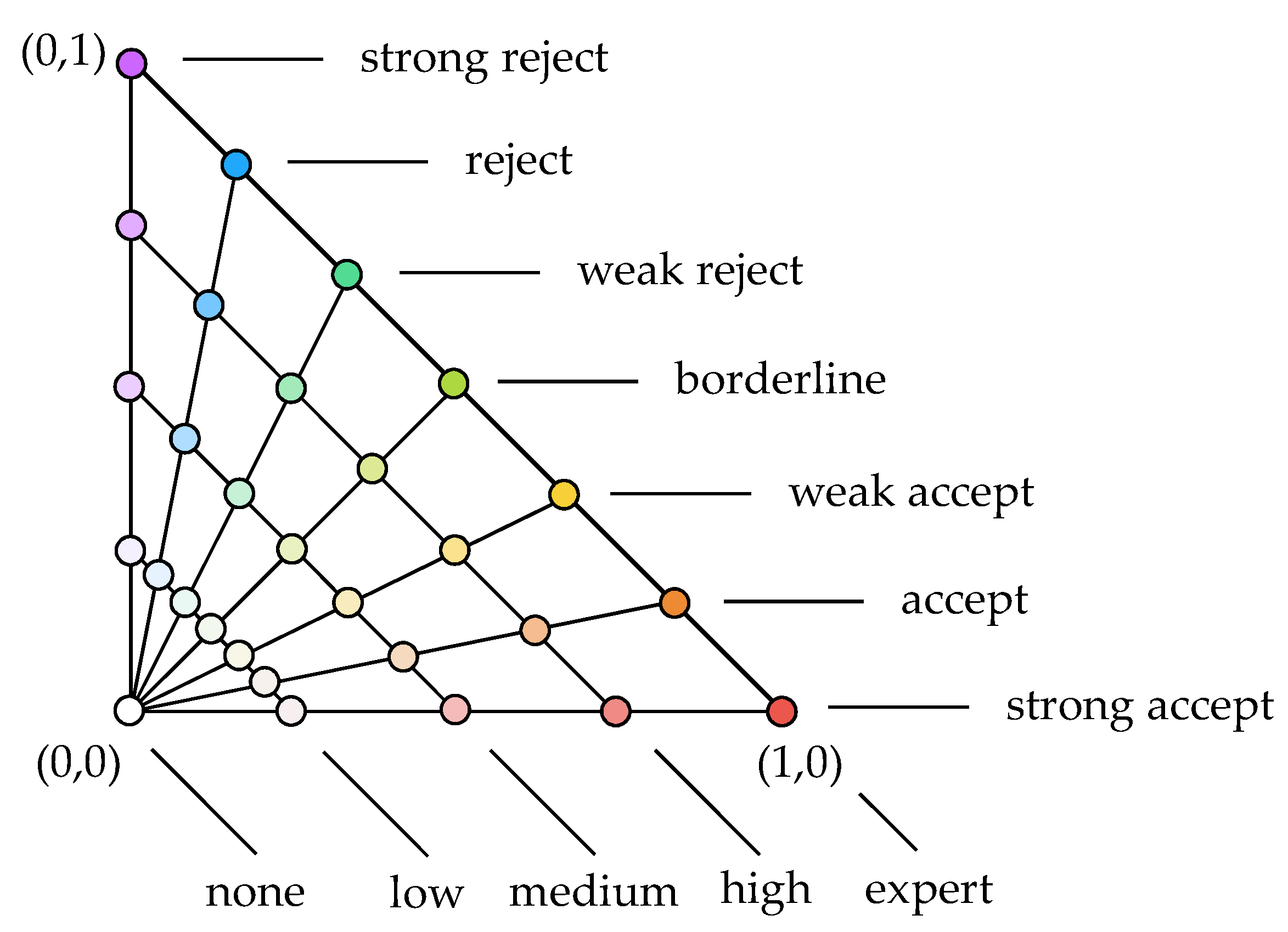
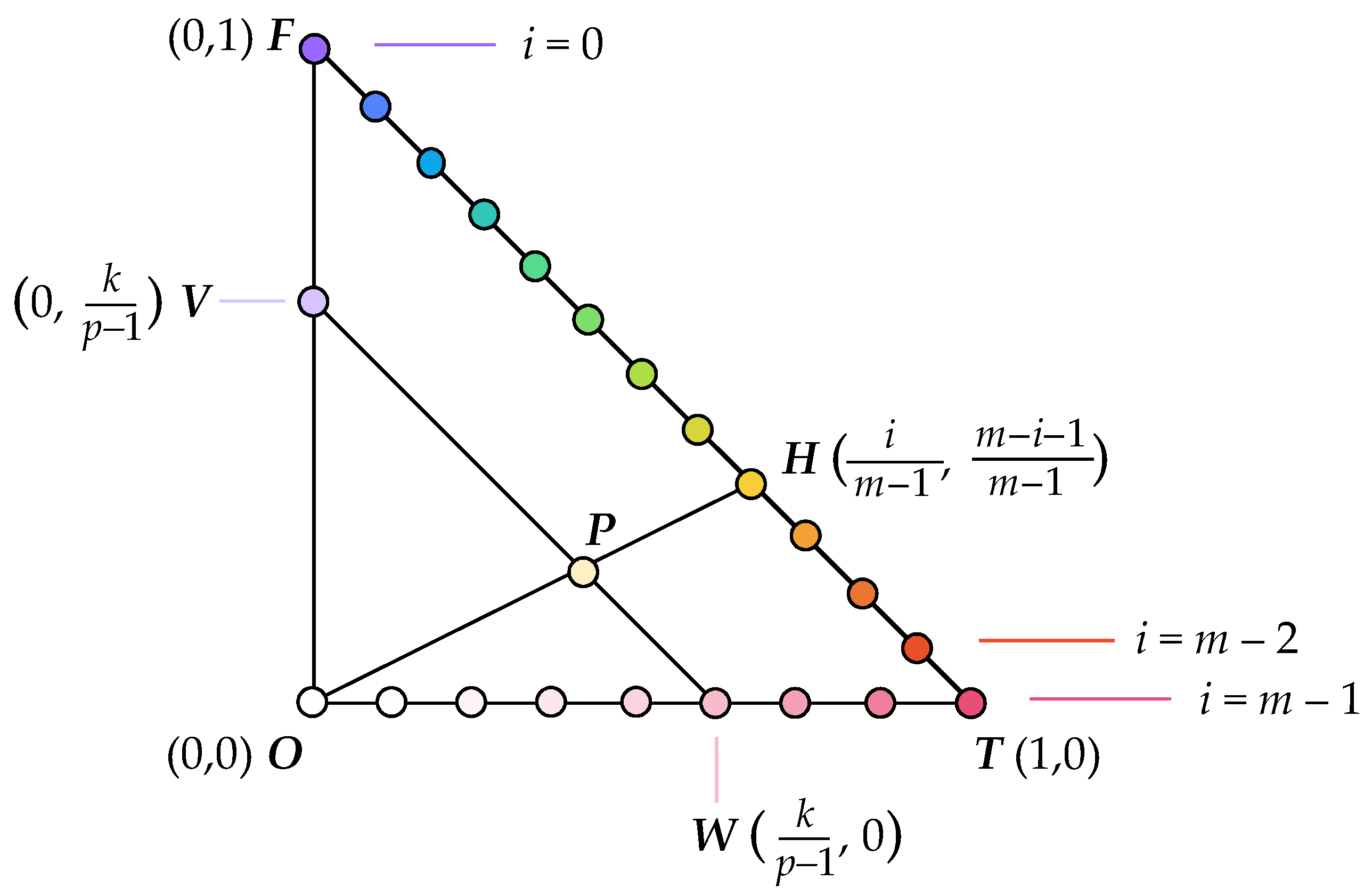
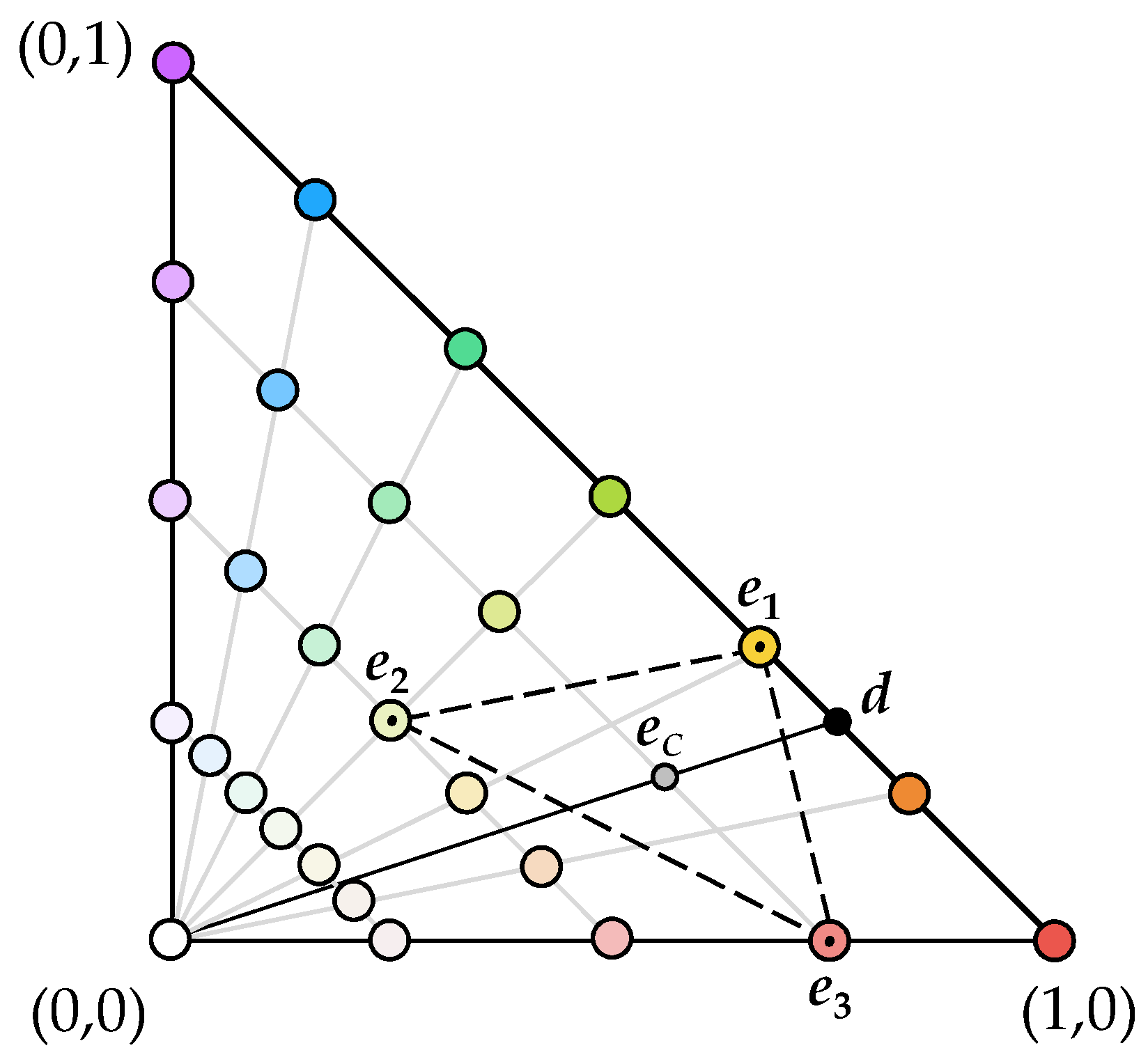
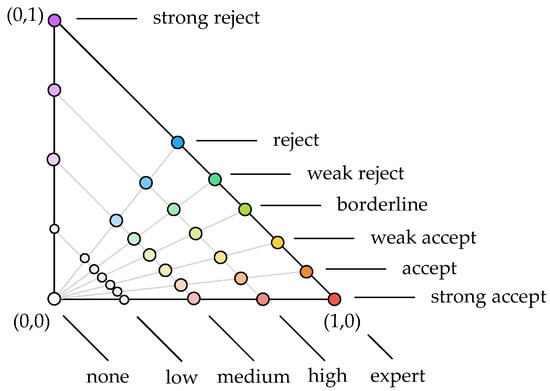
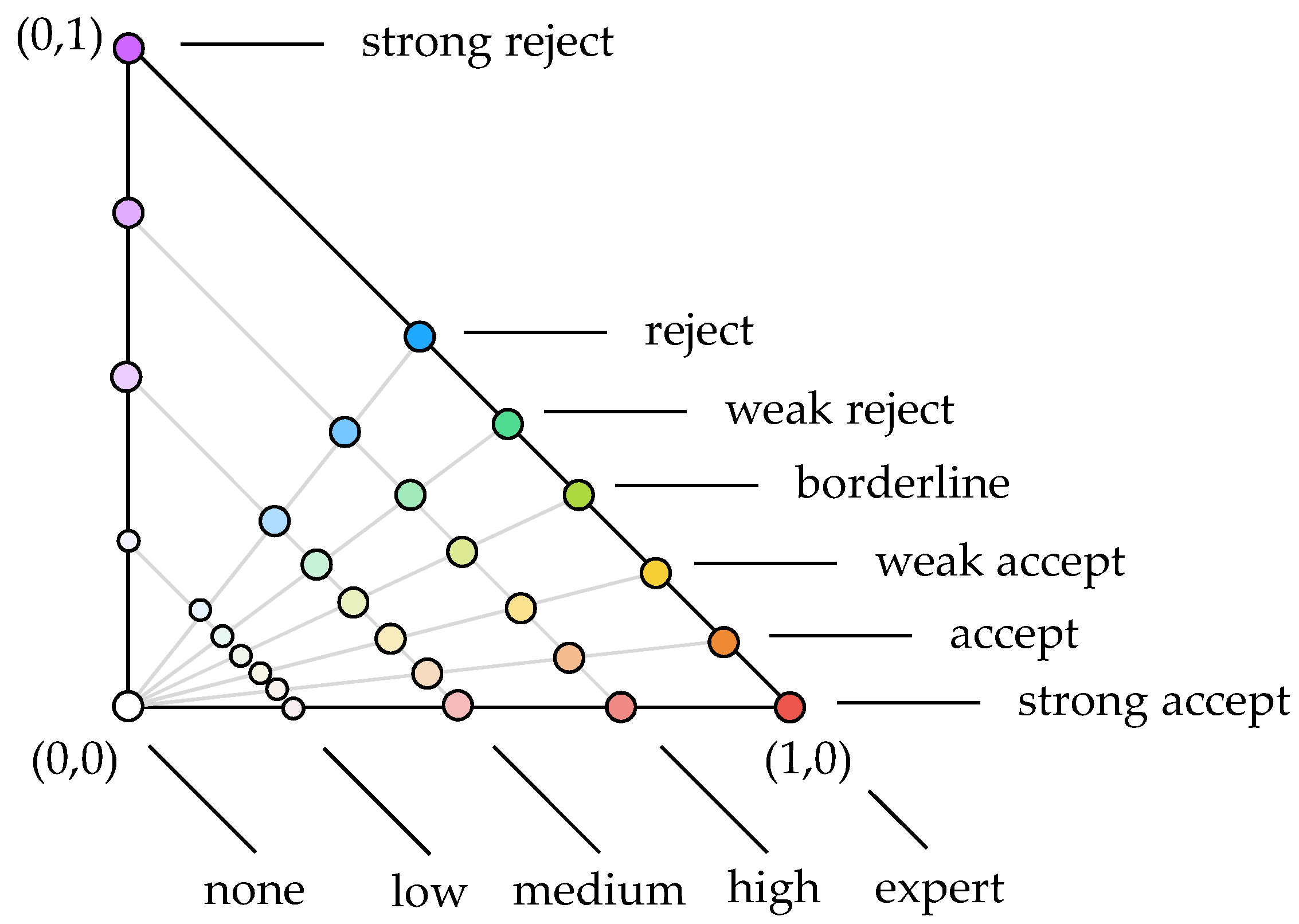
The resultant drawing is the one presented in the next Figure 1, as exemplified with the above discussed scenario where and . We have additionally coloured all 29 intersecting points in different hues and levels of saturation/lightness. While intuitive, let us shortly discuss our idea behind the illustration and the adopted colouring scheme, which will be used throughout the paper.
Figure 1.
Reviewer evaluations (meridian-wise) and reviewer confidence levels (parallel-wise) as plotted onto the intuitionistic fuzzy interpretational triangle. The points on a given meridian are coloured in the same hue with varying levels of saturation to indicate reviewer’s confidence level from expert (most intenstive colour hue) to none (least intenstive colour, white), and the points on a given parallel are of the same level of saturation with varying hues to indicate the range of reviewer’s evaluations from most negative (purple) to the most positive one (red).
Let us first observe the assessments of the Reviewers whose level of confidence is the highest one, in our example the 4-th “expert” level, as the points plotted onto the hypotenuse. They are assigned the saturated shades of the seven hues which were selected to visually denote the range from “” to “”. The less expert the reviewer is, the lighter and less saturated is the respective hue of the point denoting their evaluation, with the least degree of expertise being colour defined in counterpoint as “white” ( saturation, lightness). The higher the evaluator’s confidence, the greater the difference between the (fully saturated) colour codes of one’s evaluations, respectively, the less the evaluator’s expertise, the blander the points’ shades and closer to white would they be. The human reasoning conveyed here is that, if the chosen reviewer’s confidence as an expert in the area is low, then there would not be much difference in whether their evaluation would be very positive, very negative or anything in between.
While the adopted colour scheme in the Figure 1 is rather intuitive and self-explanatory, we are armed with one more—formal—weapon to work with, which is geometric distances.
The sets of points plotted onto each of the parallels are obviously equidistant, but when we compare the lengths of the parallel segments intersected by any two meridians their length varies depending on their position from the point to the hypotenuse. Let us now remind the reader that in IFS theory, the point is interpreted as the absolute “Uncertainty” constant, and the hypotenuse is the locus of the points of zero uncertainty, where the sum of membership and non-membership degrees equals 1. Back to our problem setting and example, we thus illustrate that the discriminative power of a top expert reviewer’s opinion is greater than that of a reviewer who has self-identified (or has been identified) as an expert of lower confidence.
3.1. Calculation of Coordinates
While in the so constructed framework, it makes sense to continue working with the ordinary Cartesian coordinates that denote IF membership and non-membership, in addition to the adopted parallel-and-meridian pairs , denoting the evaluation score of the and the confidence of the n-th evaluator. We make here the assumption that all evaluation scores are equidistant along the hypotenuse and all confidence levels are equidistant along the catheti.
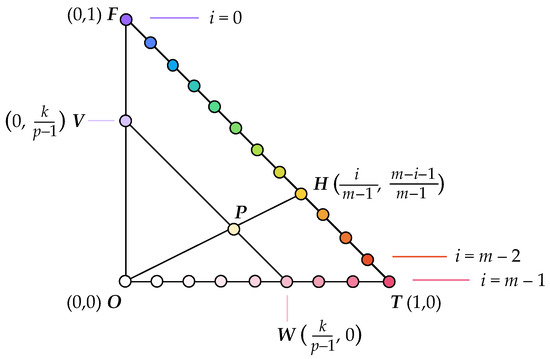
As illustrated on the next Figure 2, for any arbitrary point P of the triangular lattice that belongs to the i-th meridian and k-th parallel and corresponds to the evaluation , its Cartesian coordinates are
and the length of the segment is (the part of the parallel (or, segment ), limited by the point P and the abscissa, where . Then P’s projection onto the hypotenuse in point H has the Cartesian coordinates
and the length of the segment is (the part of the hypotenuse limited by the projection point H and the point of intuitionistic fuzzy “Truth” ). Respectively, the length of the segment connecting the projection point H with the point of the intuitionistic fuzzy “Falsity” is .
Figure 2.
Points in Cartesian coordinates.
Having these formulas handy is necessary for the easy calculation of the aggregated evaluations, and finding their projections onto the hypotenuse, as will be discussed in the next subsections.
3.2. Aggregation of Expert Evaluations
A crucial role in decision-making procedures is played by the aggregation of expert evaluations, as it transforms the natural divergence of individual judgments into a structured convergence toward a coherent and actionable outcome. Since experts may differ not only in their opinions but also in their levels of confidence, a sound aggregation approach should be capable of appropriately accounting for these variations—ensuring that more strongly supported or better-substantiated assessments are weighted accordingly, without disregarding minority perspectives. By transparently integrating diverse views and heterogeneous confidence levels, such a method should enhance the reliability, fairness, and defensibility of decisions, particularly in complex and uncertain contexts.
In our real-life application, it is the usual case that a scientific manuscript is being peer evaluated by at least two or three, and sometimes even four or five peer reviewers. As a general rule, the Journal would aim to invite only reviewers who have a proven expertise in the field of the manuscript, yet it may be the case that some reviewers feel themselves less confident in the specific topic and opt to indicate so if provided an opportunity; or it may be the case that the top experts in the field are not available or willing to commit to review, so the Journal editors are forced to use the services of reviewers with more general, less specific background. Whatever the reason, it can often happen that a manuscript will be evaluated by individuals with different level of expertise or confidence, and it also happens a way too often that the same manuscript is being assessed rather differently by different reviewers. (In addition, different reviewers would have different evaluation criteria, different biases, varying tolerance for the detected flaws, approaches to communicate their assessment, etc.) These and many more of the aspects involved in evaluating a research work motivate the need of having a larger number of (subjective) individual evaluations that upon aggregation help devising one (objectivized) aggregated evaluation that justifies/directs the particular actions that the Journal should take with respect to the evaluated manuscript.
This being said, in our intuitionistic fuzzy geometrical interpretation with points along the intersections of parallels and meridians, we need to introduce the operation aggregation, and it will differ from operations in the regular intuitionistic fuzzy geometry. In addition, as the aggregated evaluation should serve to indicate a particular Journal’s editorial decision to be communicated to the manuscript’s authors, this aggregated evaluation is supposed to be projected onto the intuitionistic fuzzy triangle’s hypotenuse, which is the locus of points of zero uncertainty but variable proportions of negative to positive evaluation, expressed as a point between the coordinates and . Then, depending on the Journal’s policies and practices, this projection of the aggregated evaluation will correspond to a decision ranging, e.g., from “Rejection” (with no opportunity for revision and resubmission), through “Major revision and re-evaluation”, through “Acceptance with minor revision”, to “Acceptance (as is)”.
Let us consider several scenarios depending on the number of peer reviewers involved, and our operation of aggregation will be applied over two, three and four individual expert evaluations. We will omit the trivial cases when two or more of the points on the intuitionistic fuzzy interpretational triangle coincide, that is the individual experts’ have the same levels of confidence and the same evaluations of the manuscript. We will only discuss the non-trivial cases when the experts’ individual evaluations and/or levels of confidence are different from one another.
3.2.1. Scenario with Two Evaluations
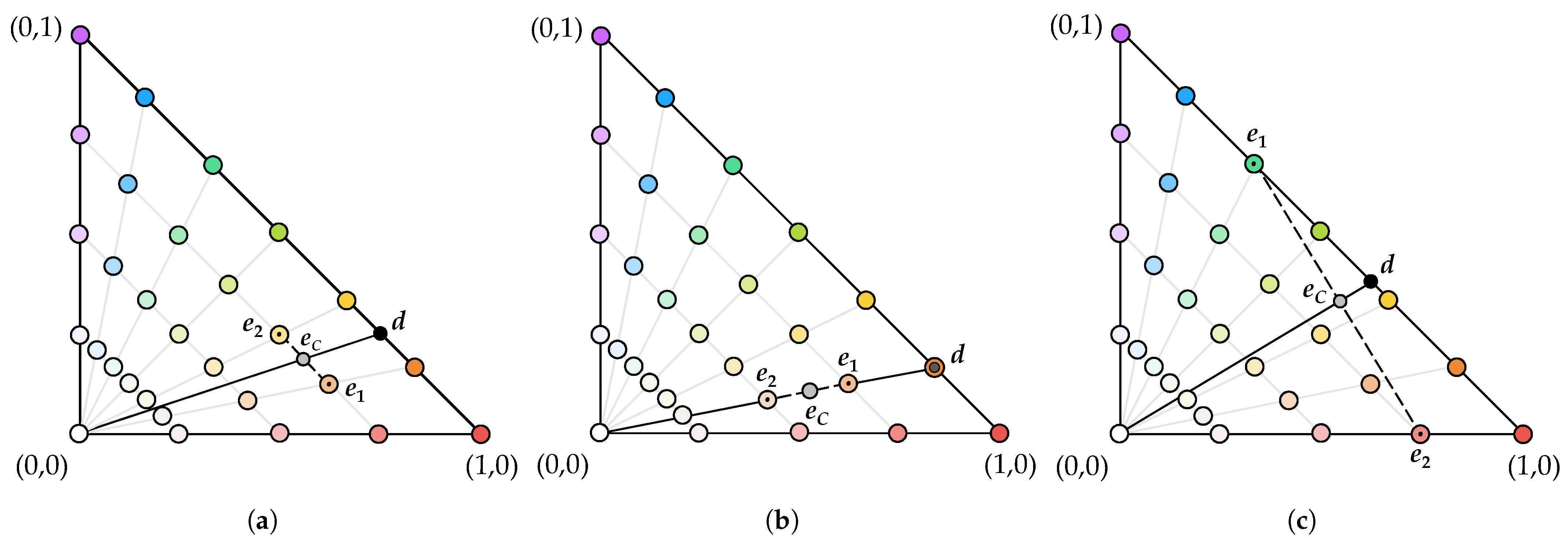
- Case 1.1. Two points on the same parallel: Same level of expertise, different evaluations (Figure 3a)The easiest case is when the two evaluations are provided by experts of the same level of expertise. Let us skip the most obvious case when they are on the top expert level, i.e., when their evaluations are represented as points plotted onto the hypotenuse. We are challenged to discuss the case of one level of expertise less, because this will result effectively in discussion of how the aggregated evaluation is plotted onto the hypotenuse, which in practice is our “interface” for the editorial decision to be communicated to the authors. Then, the aggregated evaluation () is the center of the segment between the two points.Now, if both experts’ level of confidence was the highest and their evaluations were points on the hypotenuse, then the aggregated evaluation would also be a point on the hypotenuse, hence, we would not bother with the question of where the projection lies. However, in the case of the individual evaluations and of their aggregation being plotted within the interior of the intuitionistic fuzzy triangle, the question of projection onto the hypotenuse arises, with two discussible options:
- –
- orthogonal projection, or
- –
- projection formed by the intersection of the hypotenuse with the line connecting the aggregated point with the origin , i.e., a “sub-meridian” passing through the aggregation.
In our understanding, given that the whole geometric representation adopted in our approach involves the concept of the hypotenuse as a locus of points of zero IF uncertainty, as opposed to the point of ultimate IF uncertainty , with the parallels as loci of points with a constant degree of IF uncertainty, and meridians as loci of points with a constant ratio of IF membership to IF non-membership, then it is the most natural approach to consider projection in the so constructed universe as the place of intersection of the hypotenuse with the respective line emanating from the origin .We explicitly remark that because of the property of similar triangles (see Figure 3a), in this scenario, the projection d of the aggregated point will coincide with the point of aggregation of the two projections of the individual experts’ evaluations and , therefore, the order of operations “aggregation” and “projection” in this case can be reversed and will still produce identical results. - Case 1.2. Two points on the same meridian: Different levels of expertise, same evaluations (Figure 3b)The other easy scenario is when the two experts have different levels of expertise but have given the same numerical evaluations. Then, the aggregated evaluation coincides with the middle of the segment formed by the two points representing both experts’ evaluations (), and it belongs to the same meridian formed by these two initial points. Hence, by the above adopted and justified understanding of projection in this setting, the aggregated evaluation is projected on the hypotenuse in the point d which coincides with the point of intersection of that meridian with the hypotenuse. Or in other words, all three points are projected on the hypotenuse into a single point. Again, no surprise.
- Case 1.3. Different parallels, different meridians: Different levels of expertise, different evaluations (Figure 3c)The most interesting case in this scenario is when both reviewers exhibit different levels of expertise and give different scores for their evaluations. This is the case when both points are plotted onto different parallels and different meridians in the IF interpretational triangle. Again, geometry dictates that the aggregation of these two expert evaluations shall be represented as the center point of the segment connecting the two respectively plotted points. Once the aggregated point has been determined as a point within the IF interpretational triangle, its projection is constructed as the intersection of the hypotenuse and the line connecting the origin and the aggregated point.Notably, this time the projection of the aggregated point on the hypotenuse does not coincide with the aggregation of the projections of the two initial points (of expert evaluations), which means that the order of conducting the operations “aggregation” and “projection” is to be observed. This is the natural result of the greater discriminative power of the more competent and confident evaluator’s assessments, observed in the different lengths of the segments locked between two meridians on the hypotenuse compared to any other parallel within the IF triangle. As illustrated on Figure 3c, we will finally remark that, in line with our intuition of the problem setting, the decision to be communicated to the authors (d) should be—and, under this construction, is—closer to the projection of the evaluation of the expert exhibiting higher confidence (in this case, the projection of ) than to the projection of the evaluation of the expert () with lower confidence.
Figure 3.
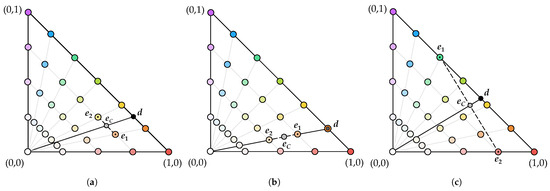
Illustration of the three cases, with denoting the two reviewers’ evaluations, denoting the aggregated evaluation and d denoting the projection of onto the hypotenuse as the editorial decision to be communicated to the authors. (a) Case 1.1: Two points on the same parallel. (b) Case 1.2: Two points on the same meridian. (c) Case 1.3: Two points on different parallels and different meridians.
3.2.2. Scenario with Three Evaluations
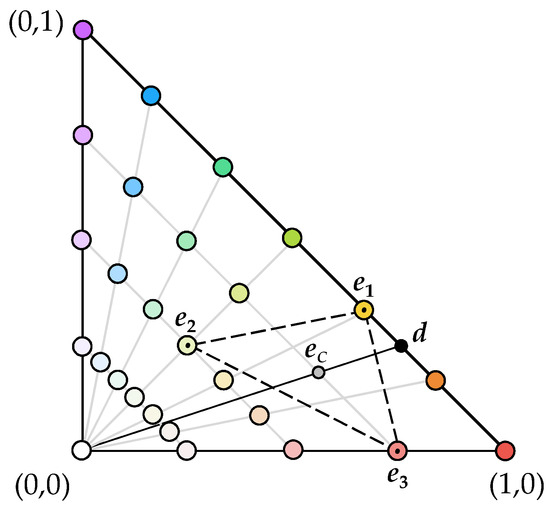
Having justified the method of aggregation of two evaluations and of its projection onto the hypotenuse, we will consider the case of three evaluations. With the above categorisation of cases, we will not further discuss the different cases of the mutual position of the three points within the triangle, and we can consider the most general case where all three evaluators’ scores and confidences define the three points in different parallels and different meridians, and will apply the method from Case 1.3 from the previous section. Here is the place to remind the reader of the well-known fact that a triangle T and its medial triangle (the one formed by the midpoints of the T’s sides) share the same centroid (medicenter). Hence, without loss of generality, for any triangle formed of three experts’ evaluations , their aggregated point is the centroid of the triangle and it is projected onto the hypotenuse in a point d where the line connecting and intersects the triangle’s hypotenuse. The result is illustrated in the next particular Example 1 and next Figure 4.
Figure 4.
Illustration of the most general case of aggregation of three experts’ evaluations in the centroid point .
Example 1.
In the above discussed scale of 5 equidistant levels of evaluator’s confidence from “0: none” to “4: expert” and a scale of 7 equidistant degrees of evaluation from “0: strong reject” to “6: strong accept”, let us have the three reviewers hl’ evaluations:
- (weak accept, expert confidence) and Cartesian coordinates, respectively, ,
- (borderline, medium confidence) and Cartesian coordinates, respectively, ,
- (strong accept, high confidence) and Cartesian coordinates, respectively, .
Then the coordinates of the centroid of the resultant triangle are computed as and the coordinates of the projection point d on the hypotenuse are This point is projected between the evaluations “Weak accept” and “Accept”, which quite naturally interprets to “Major revision” as the editorial decision for communicating to the authors.
We will further note that it is a very probable situation that two of the three points coincide, i.e., two evaluators of the same confidence level share the same evaluation, which results in a degenerate triangle with all vertices being collinear. We will remind that in such a case the centroid formula still works as the average of the three vertex coordinates.
3.2.3. Scenario with n Evaluations
We are now proceed with the scenario when the decision making involves n different evaluators. Even for the simplest case of , we observe that in comparison with the scenario with three evaluations, which would naturally aggregate into a single point, in the general case of four points there are two different methods of determining the quadrilateral’s centroid [16] and they produce different results. As we will see, similar and even more complicated problems are likely to arise for depending on the general positions of the n points.
To enhance the exposition, in what follows, we will compare the two centroid formulations and will establish the advantages of the vertex-centroid method over the area-centroid method, illustrating our analytical justification with appropriate examples.
The vertex centroid is a function solely of the n points’ coordinates [17,18]. In the simplest case of , this is the point of intersection of the quadrilateral’s bimedians, also known as the centre of its Varignon’s parallelogram. The formula in the general case for n points holds true regardless of the form of the polygon: convex, concave or self-intersecting, thus producing unambiguous and consistent results for any n points involved in our decision making procedure:
The second method of obtaining the polygon’s centroid is the so called area centroid or lamina centroid (for the simplest case of this is also termed as the centre of the Wittenbauer’s parallelogram). The method is much more computationally heavy compared to the vertex centroid method, as it requires the calculation of the polygon’s area, which—given that we have only the points’ coordinates as an input—requires the use of the so-called shoelace formula [19]:
which holds true only if the polygon is simple (i.e., non-self-intersecting). All of these additional considerations imply that there exists a specific predefined order in which the points are traversed to construct the n-sided polygon, and for the shoelace formula to produce a positive polygon area, this is the counter-clockwise order of the vertices [20].
Thus, finally, the coordinates of the area centroid of a simple planar n-sided polygon with vertices are defined by the pair of formulas [17,21]:
where A is the polygon’s area, and and . To facilitate the reader in applying both methods, we refer to the freely available peer-reviewed online tool [22].
Therefore, we are faced with the challenge to choose which of the vertex or area centroid to work with. To support the decision maker, let us make here several additional but important remarks regarding the relevance of these geometrical concepts and constructions to our decision making procedure in the intuitionistic fuzzy interpretational triangle.
Remark 1.
The vertex and the area centroids coincide only for the very partial case of 4 points forming a parallelogram (a result by Arnold Kirsch from 1987, see [23,24]), while for any other quadrilateral, and for a general n-sided polygon, they are distinct, non-coinciding points. We can make the general observation that in a non-parallelogram, the area centroid is generally closer to the side with greater area, while the vertex centroid depends only on the locations of the vertices.
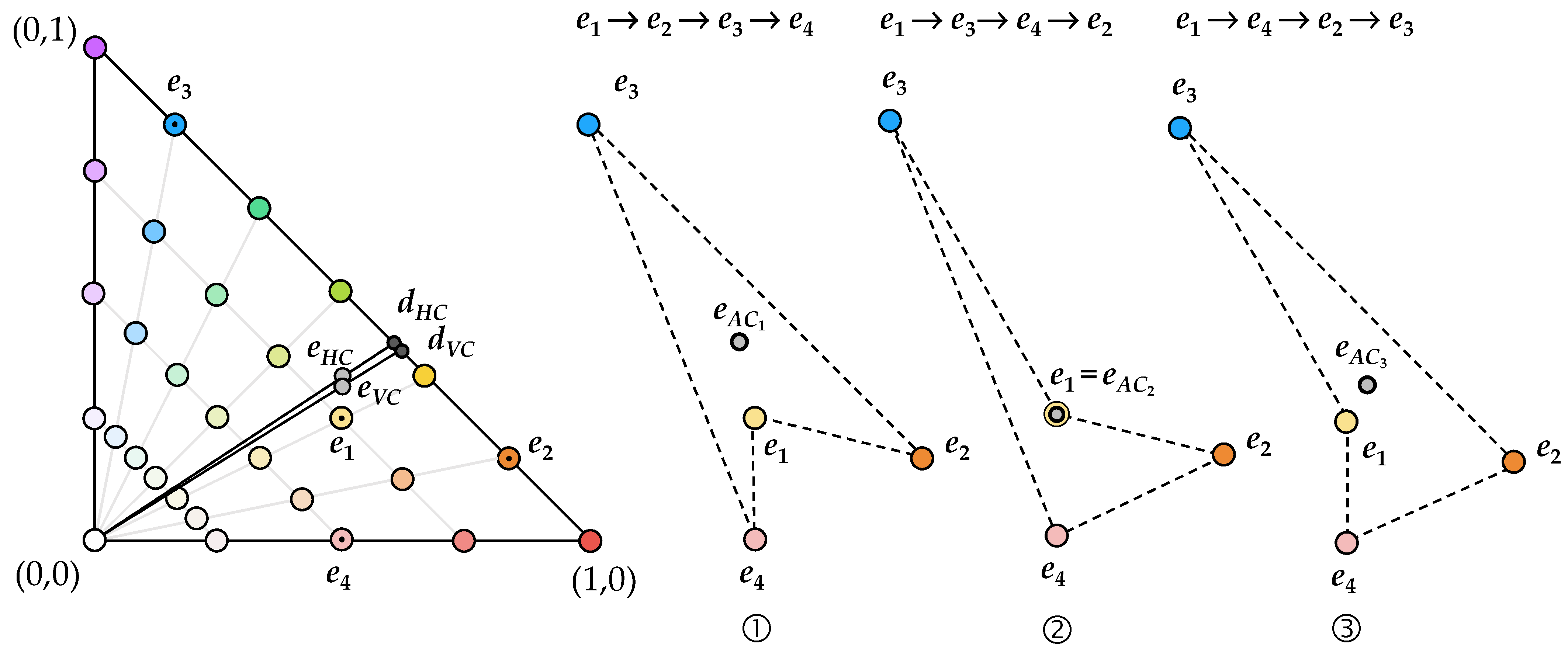
Another subtlety concerning the area centroid method is related to the resultant polygon’s convexity or concavity. Even in the simplest case of four arbitrary points, one of which lies inside the interior of their (triangular) convex hull (see [25] and Remark 2), there would be three possible concave quadrilaterals formed by the points, each having its distinct area centroid (in addition to the unambiguously defined vertex centroid), as illustrated below in Example 2 and Figure 5.
Figure 5.
Three different concave quadrilaterals defined by the same set of four points. On the triangle to the left, only the vertex centroid and the convex hull’s centroid are plotted with their respective projections on the hypotenuse, and for each resultant concave quadrilateral (1)–(3) (to the right), its respective area centroid is plotted separately.
Remark 2.
Regarding the construction of the convex hull of a set of n points, there are several known algorithms (like Graham scan, Jarvis march, and others, ([26] Chapter 26, pp. 687–699)) that compute it, and they produce the same result but differ in their computational cost, ordering of vertices, and whether collinear boundary points are included.
Example 2.
In the above discussed scale of 5 equidistant levels of evaluator’s confidence from “0: none” to “4: expert” and a scale of 7 equidistant degrees of evaluation from “0: strong reject” to “6: strong accept”, let us have the four reviewer evaluations:
- (weak accept, high confidence) and Cartesian coordinates, respectively, ,
- (accept, expert confidence) and Cartesian coordinates, respectively, ,
- (reject, expert confidence) and Cartesian coordinates, respectively, ,
- (strong accept, medium confidence) and Cartesian coordinates, respectively, .
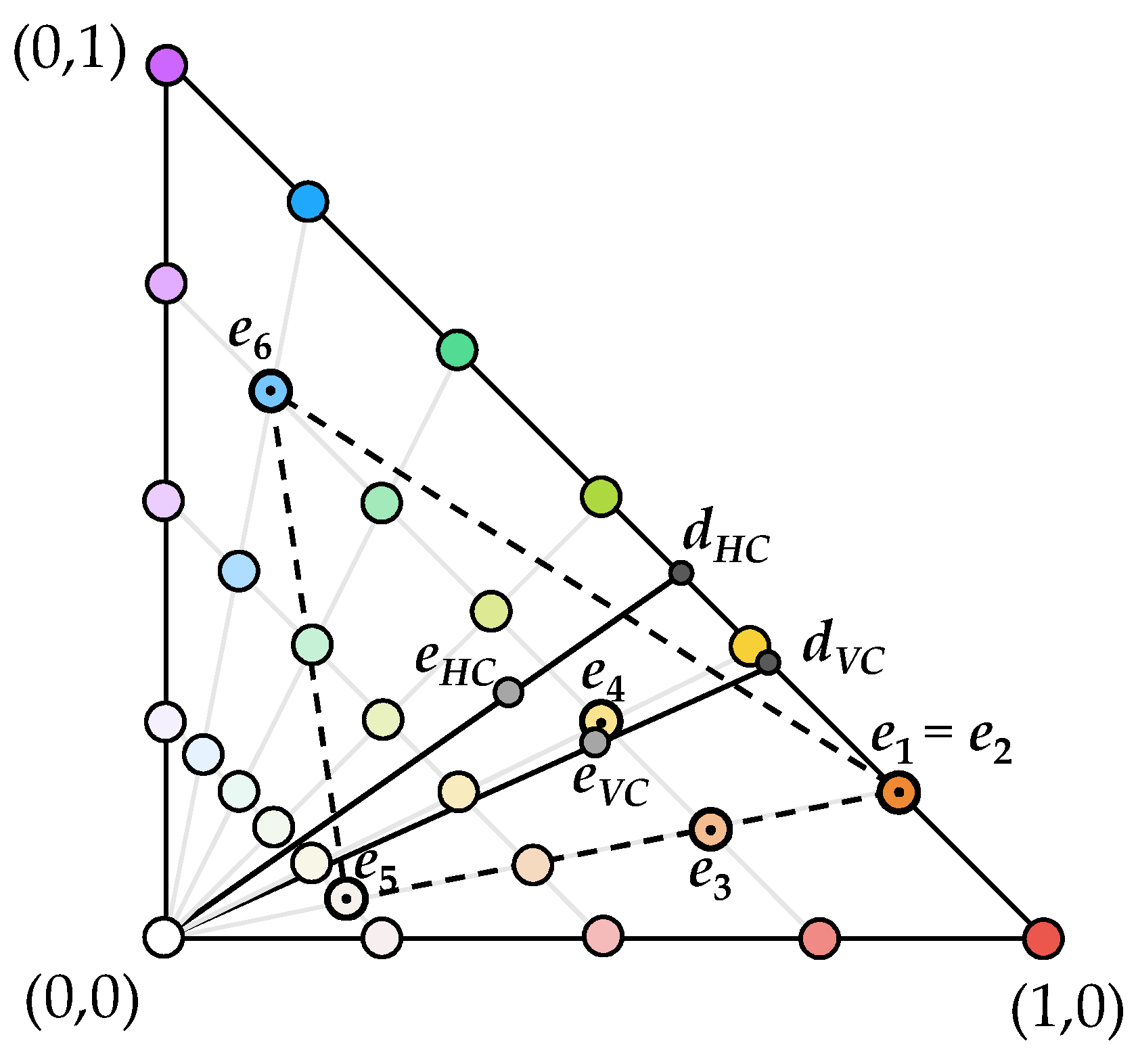
For the vertex centroid calculated by the Formula (3) (with ), the computed coordinates are . The projection point on the hypotenuse of the submeridian passing through is .
The three concave quadrilaterals constructible from these four points following the counter-clockwise ordering rule, produce the following three different candidates for area centroid, namely:
- (1)
- For the polygon the area centroid is with coordinates ,
- (2)
- For the polygon the area centroid is with coordinates (which coincides with the point ),
- (3)
- For the polygon the area centroid is with coordinates .
The (artificially introduced) order among the points has produced three distinct candidates for the area centroid, of which, therefore, none can be authentically considered as representable of the whole set. For this reason, we will not further take into further consideration where the projections of these points lie on the hypotenuse.
Finally, if we consider the convex hull formed by the points , and choose to ignore the interior point , then the coordinates of the hull’s centroid are computed as (since the convex hull is a triangle, its vertex centroid and area centroid coincide). The projection point on the hypotenuse of the submeridian passing through is .
So, both centroids are projected between the “Borderline” and the “Weak accept” evaluations on the hypotenuse, which would usually translate to the editorial decision of “Major revision”.
We can remark that while the decision maker has the freedom to choose in such cases which centroid or to take as the aggregation of the four evaluations, both have produced almost identical results and would lead to identical decision to be communicated to the authors. This being said, we will later consider one more example where the difference between the vertex centroid and the area centroid of the convex hull would be much more expressed, which will lead to our final conclusive recommendation.
Evidently, such a situation is even more likely to occur in the general case , which additionally burdens the decision making problem with the multitude of potential candidates for the area centroid if all different n-sided concave polygons are to be considered. Yet this complexity results from the additional assumption that there must be a specific order of traversal of the n points, which assumption is not authentically a part of our original decision making procedure as described in Section 2, where evaluators are identified with the numbers but this enumeration serves the purpose of identification, and not ordering in the sense implied by the shoelace Formula (4).
To simplify things, we can opt to work only with a subset of points, the ones that form the set’s convex hull [25], which is by definition the smallest convex polygon containing all points from the set, and, hence, the unique figure with this property. We apply the Formulas (5) and (6) for only the t points belonging to the convex hull of the original set of n points. In Remark 2 we will give details about the methods of construction of a polygon’s convex hull.
Naturally, the question arises, how removing some of the points (the from the interior of the convex hull) affects our decision making procedure, as this effectively means that the evaluations of some of the evaluators are not to be taken into consideration when shaping the final decision.
Obviously, a situation where would mean discarding the majority of our experts’ evaluations, and this essentially seems too reckless if missing a strong justification, and none of the technical considerations above, stemming from the peculiarities of the area centroid method of aggregating their evaluations, could be regarded as such.
The opposite situation is where , i.e., the interior points for discarding are significantly less than the t points on the convex hull. The arguments for safely discarding this minority are generally that, for these evaluations to not belong to the convex hull:
- either their position with respect to the meridians would tend to be less expressive but closer to the neutral (hesitant) scores,
- or/and with respect to the parallels would indicate that the evaluators who gave them were assigned relatively lower levels of confidence than those on the hull siding the hypotenuse.
And yet, as our numerical Example 3 and Figure 6 show, such an exclusion, only for the purpose of using the area centroid method, can sometimes be counter-productive, and given its numerous identified shortcomings, is one more argument in favour of applying the vertex centroid method.
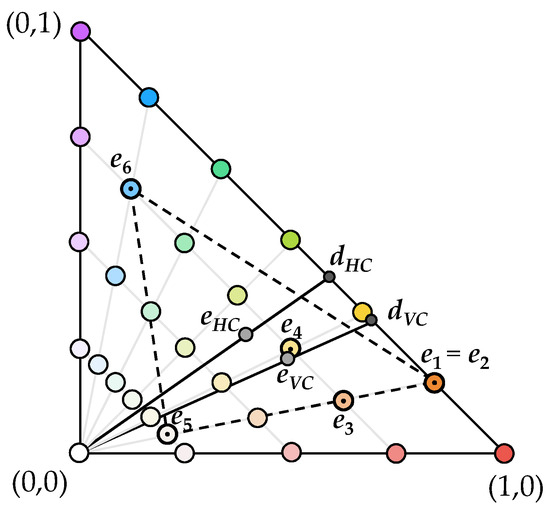
Figure 6.
An example with six evaluations, one of which incident to a vertex of the convex hull, another incident to an edge of the convex hull, and one completely belonging to the interior.
Example 3.
Again, in the above discussed scale of 5 equidistant levels of evaluator’s confidence from “0: none” to “4: expert” and a scale of 7 equidistant degrees of evaluation from “0: strong reject” to “6: strong accept”, let us have the following six reviewer evaluations:
- (accept, expert confidence) and Cartesian coordinates, respectively, ,
- (accept, high confidence) and Cartesian coordinates, respectively, ,
- (weak accept, high confidence) and Cartesian coordinates, respectively, ,
- (weak accept, low confidence) and Cartesian coordinates, respectively, ,
- (reject, high confidence) and Cartesian coordinates, respectively, .
Notably, in this example, we have two different evaluators of the same confidence level who gave identical evaluations () and a situation where the convex hull of the six points consists of just three of them () with one point completely interior (), one point () incident to a vertex of the convex hull and one point () incident to the hull’s edge connecting and .
The calculated vertex centroid by Formula (3) produces the point with Cartesian coordinates and the hull’s centroid is the point with Cartesian coordinates . Accordingly, their projections on the hypotenuse are the points and , respectively. The hull centroid’s projection marks exactly the middle between the evaluations “Borderlne” and “Weak accept”, while the vertex centroid’s projection is near the “Weak accept” evaluation from the side towards “Accept”. This better reflects the evaluations given by the majority of more confident reviewers.
As we already discussed earlier in our exposition, we will only consider the vertex centroid based on all six points’ coordinates, and the convex hull’s centroid based on the coordinates of three of the points. However, this effectively means that in the latter case three (or exactly, half) of the reviewers’ evaluations will be disregarded from the final decision, and, furthermore, in our chosen example these would be two reviewers of high and one of expert-level confidence.
3.3. De-i-Fuzzification and Defuzzification
The ultimate goal of the so described decision making process is for the Journal to communicate to the Authors a confident, non-hesitant decision regarding the manuscript’s future, which, after a finite number of iterations (discussions, revisions) in the end of all ends shall result in the ultimately binary decision for either rejection or publication of the manuscript.
In terms of IFSs, a number of points in the triangle are aggregated into one point, which gets projected onto the hypotenuse (which is the triangle’s locus of zero uncertainty), and then that projection point is attributed to either the point of IF “Falsity” (locus of complete non-membership) or the point of IF “Truth” (locus of complete membership). This effectively means that an intuitionistic fuzzy value gets subsequently de-i-fuzzified (to become fuzzy), and then defuzzified (to become crisp).
On the basis of our hitherto considerations and reasoning regarding the methods of aggregation of the n points, and supported by the provided illustrative examples, we can conclude that while decision makers can choose among two distinct methods for aggregation of n points, they would preferably opt for the vertex centroid method. The alternative method of area (lamina) centroid, is more computationally heavy and in the general case requires presupposed ordering of the points, which does not naturally stem from the decision making procedure but burdens it with geometrically-motivated specifics.
We will further note that regardless of the chosen aggregation method, the projection of the aggregated point in the intuitionistic fuzzy triangle is not the orthogonal projection but the “submeridian”, i.e., the point of intersection of the hypotenuse with the line connecting the aggregated point with the origin . Hence, for an aggregated (centroid) point with coordinates , the projection point on the hypotenuse of the triangle has coordinates .
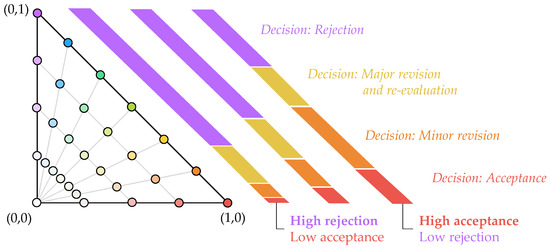
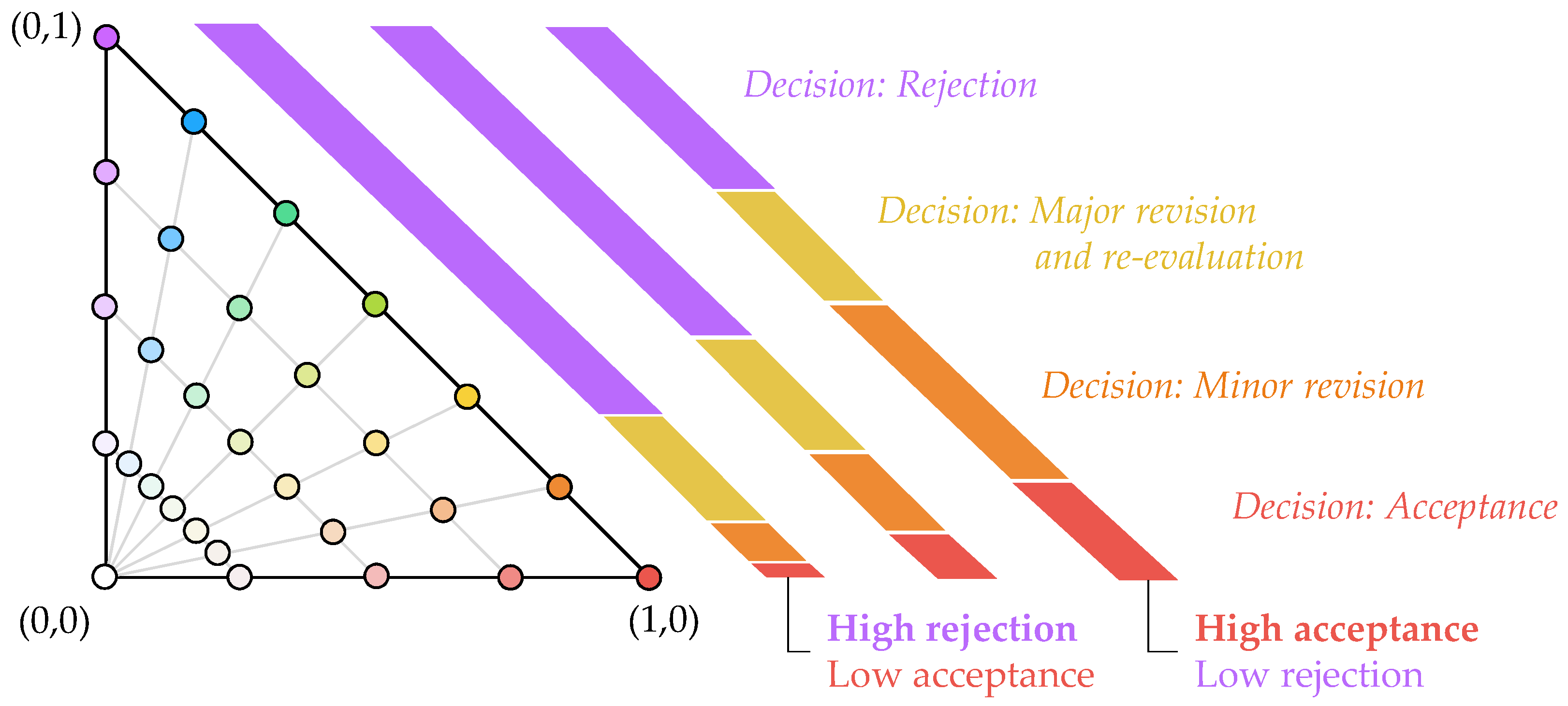
Practically, how will the location of the projection point be interpreted as the editorial decision for communicating to the authors, completely depends on the Journal’s policies and maintained acceptance vs. rejection rates. More selective journals maintain higher rejection and lower acceptance rates, more inclusive ones–vice versa. Three possible options are illustrated in the next Figure 7.
Figure 7.
Interpretation of the position of the point on the hypotenuse into a final editorial decision depending on the acceptance vs. rejection rate of a Journal.
A possible way of determining these thresholds is, for instance, starting with the rejection rate, taken as the absolute value instead of percentage. This corresponds to such a portion of the hypotenuse starting from the point downwards which is of its length, or this is the fuzzy point with coordinates , meaning that manuscripts whose aggregated evaluations are projected as points on the hypotenuse with the x-coordinate less than r and the y-coordinate greater than would qualify for rejection. Alternatively, if the target acceptance rate s is known, this corresponds to a portion of the hypotenuse starting from the point upwards which is of its length, or this is the fuzzy point with coordinates . In other words, manuscripts whose aggregated evaluations are projected as points on the hypotenuse with the x-coordinate greater than and the y-coordinate less than s would qualify for acceptance.
3.4. Algorithm and Flowchart
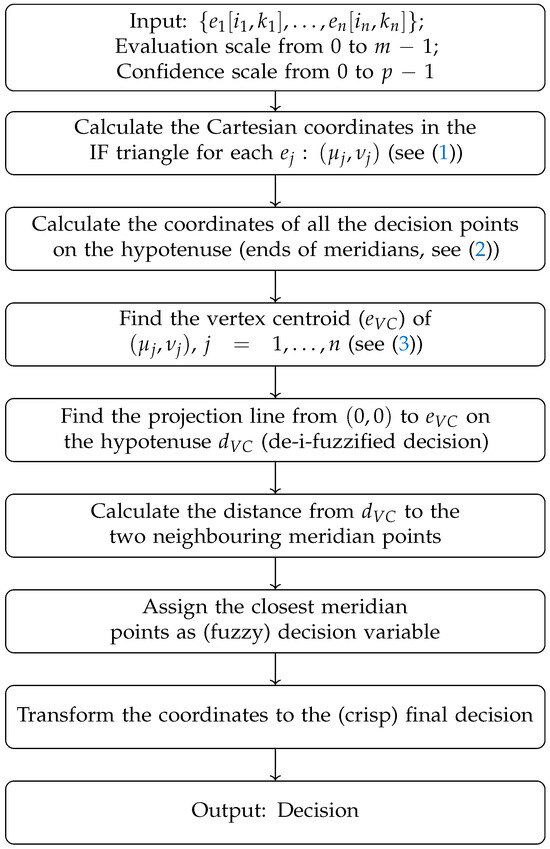
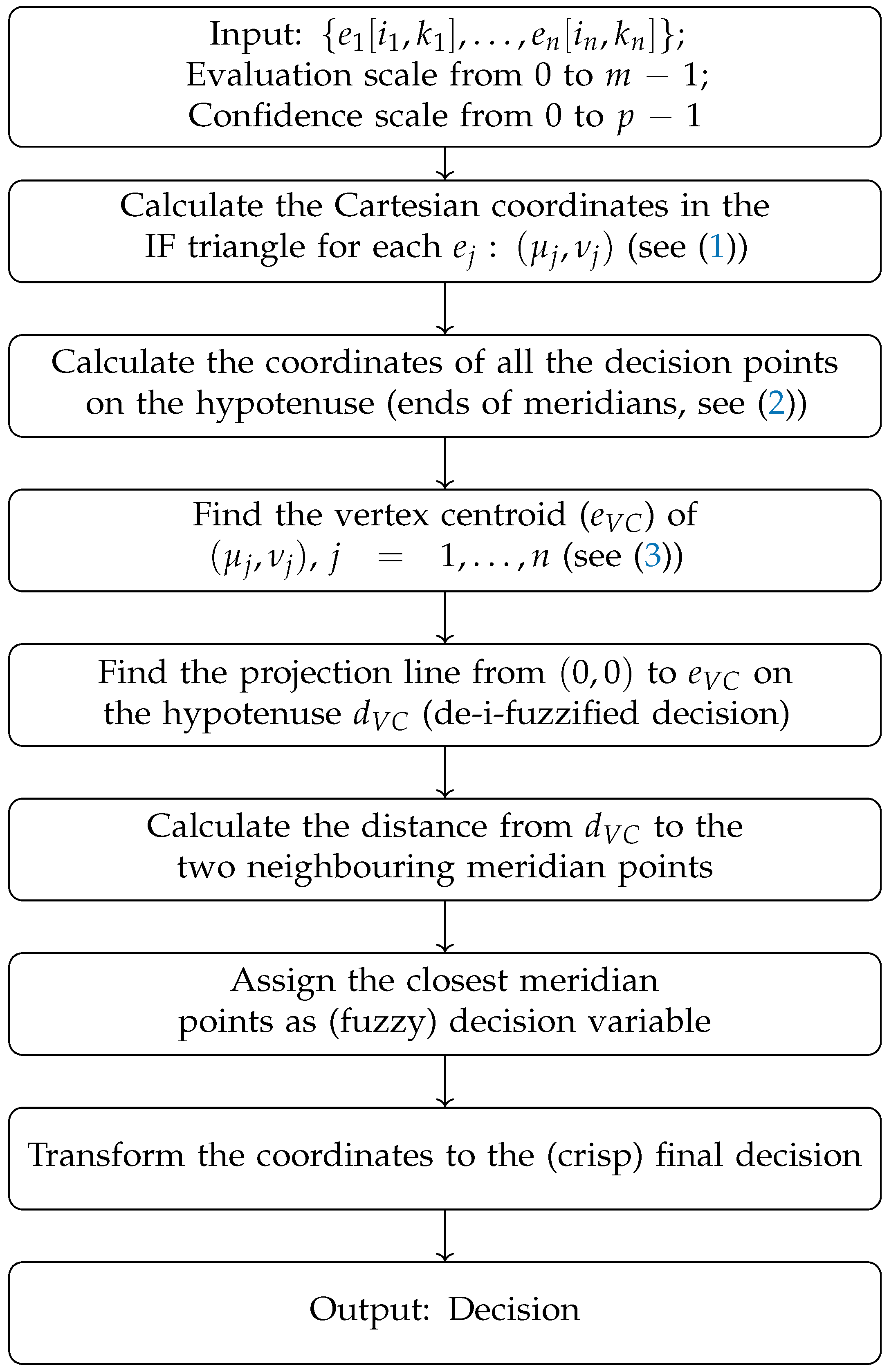
Here we distil the geometry-intensive discussion of the previous sections into a concise flowchart that captures our decision-making procedure, see Figure 8. Importantly, the flowchart no longer centers on the specific example of a scientific journal’s editorial process, but instead describes a more general framework.
Figure 8.
Flowchart of the confidence-aware framework for decision making, using the intuitionistic fuzzy interpretational triangle augmented with parallels and meridians.
In this broader setting, multiple experts—each with different levels of confidence—provide evaluations modelled as intuitionistic fuzzy points. These evaluations lead to intermediate decisions characterized by fuzzy degrees of membership and non-membership (with no residual uncertainty), and ultimately culminate in crisp outcomes.
4. Non-Equidistant and Asymmetrical Variations
In this section, we outline several possible variations of our approach in which the assumptions of equidistance and symmetry—previously taken as given—are relaxed.
4.1. Non-Equidistant Meridians
To continue our reasoning from the previous section, let us remark that it is possible to employ a non-equidistant, asymmetrical distribution of the evaluation scores onto the hypotenuse, which define the “meridians” in our intuitionistic fuzzy triangle, as shown in the next Figure 9. Basically, such a non-equidistant distribution of the “meridians” can either complement, or even replace, the need to interpret the acceptance vs. rejection rates in the manner employed in Figure 7. Notably, the color codes of the points in Figure 9 are intentionally preserved despite the chosen non-equidistant distirbution.
Figure 9.
Non-equidistant evaluation scores along the triangle’s hypotenuse.
4.2. Non-Equidistant Parallels
If we approach from another angle, it is possible to take the evaluators’ levels of expertise to be non-equidistant, that is, the intervals between the abscissa points, which define the “parallels” in our intuitionistic fuzzy triangle and represent confidence levels from “none” to “expert”, may not be obligatory equally long, as we originally assumed.
For the purpose of illustrating our idea, let us stick with the simpler scenario with three evaluations and relax the assumption of equidistant confidence levels from Example 1 and Figure 4. We will remark that the formulas from Section 3.1 will be adapted.
Example 4.
Let us discuss two possible variants where the triangle’s cathetus (of unit length) is sequentially bisectored from left to right (a), and from right to left (b) as demonstrated in Figure 10. Obviously, the second distribution, where the points are denser near the end and sparser near the end, reflects the idea that in this decision making setting the higher the evaluator’s confidence is, the more weight and importance is attributed to their evaluations.
The three evaluations plotted as points have the same meaning as in Figure 4 but their Cartesian coordinates are different, as well are the forms of the resultant triangles connecting them, and respectively their centroids. The precise coordinates of the points, their centroids and the respective projections on the hypotenuse are given in Table 1.
Table 1.
Calculated aggregated evaluations (centroids) and projections on the hypotenuse.
Figure 10.
Non-equidistant levels of confidence by bisectoring the intuitionistic fuzzy interpretational triangle’s cathetus: (a) from left to right and (b) from right to left.
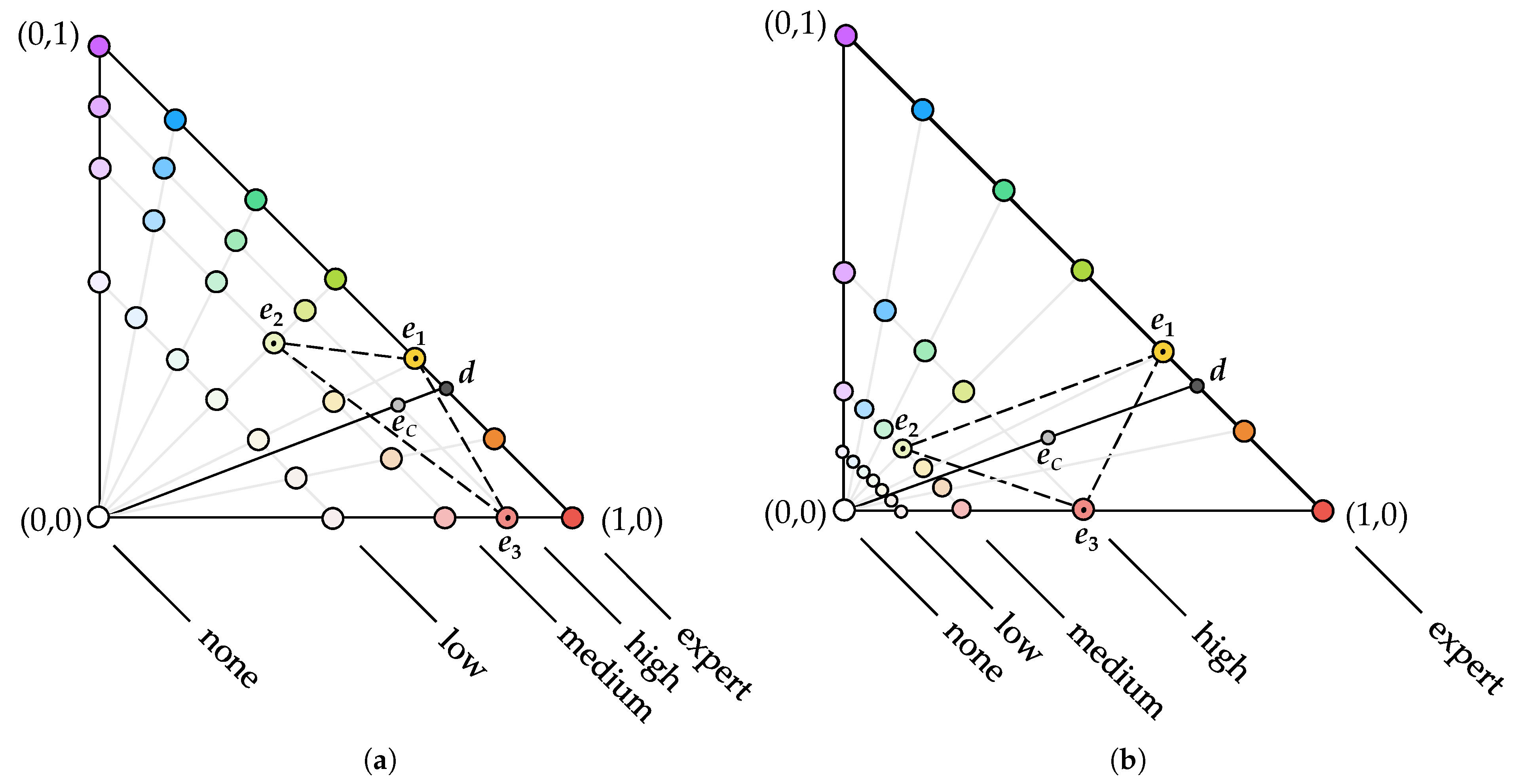
We will note that despite the distinct locations of the centroids in both discussed cases, the centroids’ projections on the hypotenuses seem located quite closely. Mathematical accuracy requires us to remark that the three points are different, although very slightly (see Table 1).
5. Conclusions
The proposed idea of fragmenting the intuitionistic fuzzy interpretational triangle by “parallels” and “meridians” represents a new and different perspective on confidence-aware frameworks for decision making. For us it was a curious observation that such a simple and intuitive construction had not been a subject of earlier exploration, so this geometric–semantic partitioning adds a new layer of abstraction and interpretation to the otherwise well investigated field of intuitionistic fuzzy sets-based decision making. Yet, it would be a mistake to consider the proposed approach universal, as the application discussed in the paper seems to be well fitting the scope and the mechanics, but comes with certain limitations that would essentially not hold true in other decision making problems.
More specifically, the discussed approach would be applicable when, first, multiple experts with varying levels of confidence contribute assessments that can be represented as intuitionistic fuzzy points, second, the interim decisions for communicating may contain degrees of membership and non-membership, but should be certain (i.e., exhibit zero uncertainty), and, third and final, the ultimate outcome of the decision making procedure is inherently binary in nature. Such is our illustrative decision making example of the editorial process in a scientific journal, where the reviewers’ evaluations of a manuscript are first regarded as intuitionistic fuzzy points (specifically exhibiting levels of uncertainty when the reviewers have been assigned or have declared lower-than-expert confidence in the subject matter), then aggregated into a single point which is projected onto the hypotenuse as the locus of points of zero uncertainty, representing the interim decision for communication to the authors, and ultimately being either accepted and published or rejected after one or more rounds of evaluation.
The method required the introduction of a well justified method for finding the aggregation of n points. In the course of discussing various scenarios and considerations, we reach the conclusion that the rational choice for calculating that is the vertex centroid of the n-sided polygon, which is not only the more feasible and computationally cheaper method, but it also involves no artificial additional assumptions, compared to the alternative method of area (lamina) centroid.
In a future leg of the present research, some additional aspects can be further elaborated. For instance, it would be worth to “zoom in” on the decision making process and analyse the complete set of decision making criteria and the evaluator’s confidence levels with respect to each individual criterion from this set. In the particular explored example with editorial decision making, a reviewer may feel completely confident regarding the specific problem area of the manuscript being assessed, and thus qualify as “expert” with respect to the questions related to methods, data, research design, significance of the results and conclusions, but if not being a native English speaker, their confidence level regarding the manuscript’s readability and language might be lower. Thus, while we considered so far the reviewer’s assessment score and confidence as defining a single point plotted in the intuitionistic fuzzy interpretational triangle, we can further inspect this single point and decompose it into a set of intuitionistic fuzzy points each representing the evaluator’s assessment against a particular criterion from the set of evaluation criteria with their particular confidence level regarding this criterion. Clearly, in such a “zoomed in” scenario, all the separate rating scales for all the criteria in the set should be normalized to fit the IF triangle’s hypotenuse from to and the evaluator’s confidence levels for all the criteria should also be normalized to the triangle’s cathetus from to .
Author Contributions
Conceptualization, V.A.; methodology, V.A., P.V.; formal analysis, P.V.; investigation, V.A., P.V.; resources, P.V.; writing—original draft preparation, V.A.; writing—review and editing, V.A., P.V.; visualization, V.A.; project administration, P.V. All authors have read and agreed to the published version of the manuscript.
Funding
This research was funded by the Bulgarian National Science Fund, Grant number KP-06-N72/8 from 14 December 2023.
Data Availability Statement
Data are contained within the article.
Acknowledgments
The authors are thankful to Krassimir Atanassov for the fruitful discussions in the initial stage of research. The authors are grateful to the reviewers for the valuable suggestions and insightful comments that led to a substantial improvement of the depth and quality of the paper.
Conflicts of Interest
The authors declare no conflicts of interest.
References
- Pearl, J. Probabilistic Reasoning in Intelligent Systems: Networks of Plausible Inference; Morgan Kaufmann Publishers: San Francisco, CA, USA, 1988. [Google Scholar]
- Zadeh, L.A. Fuzzy sets. Inf. Control 1965, 8, 338–353. [Google Scholar] [CrossRef] [Scilit]
- Atanassov, K.T. Intuitionistic fuzzy sets. In Proceedings of the VII ITKR Session, Sofia, Bulgaria, 20–23 June 1983. Deposed in Central Science and Technology Library of the Bulgarian Academy of Sciences, 1697/84. (In Bulgarian). Reprinted in: Int. J. Bioautomation 2016, 20, S1–S6. (In English) [Google Scholar]
- Atanassov, K. Intuitionistic fuzzy sets. Fuzzy Sets Syst. 1986, 20, 87–96. [Google Scholar] [CrossRef] [Scilit]
- Atanassov, K.T. Geometrical interpretation of the elements of the intuitionistic fuzzy objects. In Mathematical Foundations of Artificial Intelligence Seminar, Sofia; Institute of Mathematics and Informatics, Bulgarian Academy of Sciences: Sofia, Bulgaria, 1989; Preprint IM-MFAIS-1-89; Reprinted in Int. J. Bioautomation 2016, 20, S27–S42. [Google Scholar]
- Atanassov, K.T. Intuitionistic Fuzzy Sets: Theory and Applications; Springer: Heidelberg, Germany, 1999. [Google Scholar]
- Atanassov, K.T. On Intuitionistic Fuzzy Sets Theory; Springer: Berlin, Germany, 2012. [Google Scholar]
- Dantchev, S. A new geometrical interpretation of some concepts in the intuitionistic fuzzy logics. Notes Intuitionistic Fuzzy Sets 1995, 1, 116–118. [Google Scholar]
- Georgiev, P.; Atanassov, K. On the geometrical interpretations of the operations over intuitionistic fuzzy sets. Notes Intuitionistic Fuzzy Sets 1998, 4, 28–34. [Google Scholar]
- Tasseva, V.; Szmidt, E.; Kacprzyk, J. On one of the geometrical interpretations of the intuitionistic fuzzy sets. Notes Intuitionistic Fuzzy Sets 2005, 11, 21–27. [Google Scholar]
- Atanassova, V.; Doukovska, L. Compass-and-straightedge constructions in the intuitionistic fuzzy interpretational triangle: Two new intuitionistic fuzzy modal operators. Notes Intuitionistic Fuzzy Sets 2017, 23, 1–7. [Google Scholar]
- Atanassova, V.; Vardeva, I.; Sotirova, E.; Doukovska, L. Traversing and ranking of elements of an intuitionistic fuzzy set in the intuitionistic fuzzy interpretation triangle. Adv. Intell. Syst. Comput. 2016, 401, 161–174. [Google Scholar]
- Szmidt, E.; Kacprzyk, J.; Bujnowski, P.; Starczewski, J.T.; Siwocha, A. Ranking of alternatives described by Atanassov’s intuitionistic fuzzy sets – Reconciling some misunderstandings. J. Artif. Intell. Soft Comput. Res. 2024, 14, 237–250. [Google Scholar] [CrossRef] [Scilit]
- Atanassov, K.; Vassilev, P.; Atanassova, V. Geometrical interpretations of interval-valued intuitionistic fuzzy sets: Reconsiderations and new results. Mathematics 2025, 13, 1967. [Google Scholar] [CrossRef] [Scilit]
- Vassilev, P.; Zhivkova, K.; Atanassova, V.; Todorova, L.; Petkova, D. On some new geometrically motivated operators over intuitionistic fuzzy sets. Notes Intuitionistic Fuzzy Sets 2025, 31, 448–457. [Google Scholar] [CrossRef] [Scilit]
- Alsina, C.; Nelsen, R.B. Simple Quadrilaterals (Chapter 1). In Cornucopia of Quadrilaterals; MAA Press: Providence, RI, USA, 2020; pp. 5–7. [Google Scholar]
- Weisstein, E.W. Geometric Centroid. MathWorld–A Wolfram Resource. Available online: https://mathworld.wolfram.com/GeometricCentroid.html (accessed on 27 February 2026).
- Honsberger, R. Episodes in Nineteenth and Twentieth Century Euclidean Geometry; The Mathematical Association of America: Washington, DC, USA, 1995; pp. 36–37, 39–40. [Google Scholar]
- Weisstein, E.W. Shoelace Formula. MathWorld—A Wolfram Resource. Available online: https://mathworld.wolfram.com/ShoelaceFormula.html (accessed on 27 February 2026).
- Stone, M.G. A mnemonic for areas of polygons. Am. Math. Mon. 1986, 93, 479–480. [Google Scholar] [CrossRef] [Scilit]
- Bourke, P. Calculating the Area and Centroid of a Polygon. 1988. Available online: https://paulbourke.net/geometry/polygonmesh/ (accessed on 27 February 2026).
- Pamula, H. Centroid Calculator. Available online: https://www.omnicalculator.com/math/centroid (accessed on 27 February 2026).
- Walser, H. Symmetry; Hilton, P.; Pedersen, J., Translators; Mathematical Association of America: Washington, DC, USA, 2000. [Google Scholar]
- Humenberger, J. Centroids of quadrilaterals and a peculiarity of parallelograms. Right Angl. A Resour. Sch. Math. 2023, 17, 90–98. [Google Scholar]
- Weisstein, E.W. Convex Hull. MathWorld–A Wolfram Resource. Available online: https://mathworld.wolfram.com/ConvexHull.html (accessed on 27 February 2026).
- Goodman, J.E.; O’Rourke, J.; Tóth, C.D. Handbook of Discrete and Computational Geometry, 3rd ed.; Chapman and Hall/CRC: New York, NY, USA, 2017. [Google Scholar]

Disclaimer/Publisher’s Note: The statements, opinions and data contained in all publications are solely those of the individual author(s) and contributor(s) and not of MDPI and/or the editor(s). MDPI and/or the editor(s) disclaim responsibility for any injury to people or property resulting from any ideas, methods, instructions or products referred to in the content. |
© 2026 by the authors. Licensee MDPI, Basel, Switzerland. This article is an open access article distributed under the terms and conditions of the Creative Commons Attribution (CC BY) license.