


Abstract
In this work, we examine the prospects of matching the Kadomtsev–Petviashvili (pKP) equation with the B-type Kadomtsev–Petviashvili (BKP) equation, which we will call the pKP-BKP equation. The resulting model gives a rigorous mathematical framework for describing long wave phenomena in oceans, impoundments and estuaries and for forecasting tsunamis; river, tide and irrigation flows; and wave patterns in the atmosphere. Using a consolidated method of analysis based on symmetry reductions and rational function transformations, we obtain several classes of exact solutions composed of rational, periodic, breather and kink-wave structures. These methods shed light on the interplay between symmetries that control the formation of soliton solutions, hence allowing the construction of new families of analytical soliton solutions. The solutions obtained are linked together through spectral degeneracies and reductions in symmetry. These methodologies are presented in a systematic way, emphasizing their applicability to a general class of nonlinear evolution equations. The results of the analysis are substantiated through direct substitution, and the structural characteristics of the solutions are discussed in detail. As a result, these results expand the solution space of the pKP–BKP equation and provide better analytical insights into Kadomtsev–Petviashvili-type nonlinear evolution equations.
1. Introduction
Solitons are localized, self-reinforcing wave packets that retain their shape when moving at a constant velocity [1]. This behavior is a result of the equilibrium between nonlinearity and dispersion. The first observation of a soliton was made in 1834 by John Scott Russell, who noticed it in a canal. A more serious mathematical description emerged in the 60s with exact solutions of nonlinear partial differential equations, e.g., Korteweg–De Vries (KdV) and Nonlinear Schrodinger (NLS) equations [2].
Since then, solitons have been found in numerous physical systems: fluid dynamics, plasma physics, optics, biophysics, and cosmology. They have important applications in fiber optic communications, where they overcome dispersion and make possible long-distance signal transmission. Solitons provide insights into such phenomena as the formation of tsunamis, superconductivity, nerve pulse propagation and the dynamics of plasma in fusion reactors.
Owing to their robustness, stability and particle-like interaction properties, solitons have remained a dynamic topic of inquiry in several scientific fields [3,4].
The complex behavior of many real-life systems can be well described in the form of nonlinear partial differential equations (NLPDEs) [5]. The quest for exact solutions of NLPDEs continues to be among the most difficult and important areas of research in the fields of applied mathematics, computational engineering, astrophysics, chemistry, control theory and physics. Despite the complexity of the space, it still receives a considerable amount of scholarly attention because of its foundational character and vast applicability. Within the realm of physics, NLPDEs form the basis of the theoretical frameworks of physics which describe fluid dynamics, quantum particle motion, electromagnetic field and cosmological expansion. Beyond physics, of course, these equations play important roles in the field of engineering, including in the disciplines of control systems, fluid mechanics, heat transfer, and structural analysis, and they are of increasing interest in applied mathematics, including in integral structures and their functionality. Further afield from physics, in fact, these equations are widely used and employed in the field of engineering, in several disciplines, such as control systems, fluid mechanics, heat transfer, structural analysis, etc., and as key tools in modeling and problem solving. They are also used in functional integral structures and their functionality.
Finding analytical solutions of nonlinear partial differential equations (NLPDEs) is of great importance. Over the past several decades, physicists have focused their work on reference physical physics in the study of optical solitons. To solve NLPDEs, many techniques have been developed to compute the model widely, namely Kudryashov’s method [6], the method of multivariate generalized exponential, rational integral function [7], extended trial equation method [8], extended (G′/G) expansion method [9], modified sub-equation method [10], Darboux Transformations [11], Jacobi elliptic wave function method, a new direct extended algebraic method, unified method, general integral method, generalized Riccati equation mapping method, rational sine-Gordon expansion method, modified F-exponential method, generalized exponential rational function method (nGERFM), and modified generalized exponential rational function method. Ref. [12] provides a rigorous framework for energy stability and discrete maximum principles in nonlinear partial differential equations, offering strong theoretical support for the stability analysis and potential numerical validation of the exact wave solutions derived in the manuscript. Ref. [13] introduces structure-preserving digital integrators based on trigonometric quadrature rules, which are highly relevant for the accurate numerical realization and time integration of the continuous wave models investigated in the manuscript.
The primary aim of this article is to analyze the (3+1)-dimensional pKP–BKP equation by employing several analytical techniques, including the M-shaped rational solution, homoclinic breather solution, multiwave solution, and periodic cross-kink wave solution. In addition, a stability analysis of the obtained solutions has been conducted to examine their physical reliability and dynamical behavior. To our knowledge, the (3+1)-dimensional pKP–BKP equation has not previously been analyzed or solved using these specific approaches, highlighting the novelty and research gap addressed in the present study. This study analyzes the (3+1)-dimensional pKP–BKP equation recently proposed by Abdul Majid Wazwaz [14], which is given by
The potential function that depends on the temporal variable t and the spatial variables is denoted by . In addition to incorporating a number of physical factors, such as nonlinearity, dispersion, and cross-interaction between spatial dimensions, this equation describes the nonlinear wave dynamics in a (3+1)-dimensional framework. represents the wave potential that is dependent on time t and the three spatial variables . The term is a mixed derivative representing the temporal evolution of wave propagation along the x-direction. The expression represents nonlinear and dispersive effects. Here, corresponds to nonlinear wave interactions, indicates the self-interaction of the wave profile, and denotes a higher-order dispersion term that influences the wave’s stability and shape. The entire expression is differentiated with respect to x, emphasizing its role in spatial evolution. Furthermore, the nonlinear dispersive term includes two significant effects: describes the interplay between wave amplitude and curvature, whereas the fourth-order dispersion parameter controls the wave’s stability and steepness. Lastly, is where the associated cross-dimensional effects are found. is a mixed spatial derivative that connects the x and y directions, whereas denotes the nonlinear interaction between wave propagation along x and disturbances in y. Equation (1) incorporates features of both the pKP and BKP equations and provides a framework for studying nonlinear fluctuation phenomena in optics, plasma physics, and hydrodynamics [15,16]. Its integrability has been established in [14], where lump solutions based on a positive quadratic function, together with one-, two-, and three-soliton solutions, were also derived. Additional results include breathing wave solutions [16], soliton fission solutions, and multiwave interaction solutions [17].
Symmetry is essential to soliton theory and nonlinear dynamical systems. The integrability of the (3+1)-dimensional combined potential KP equation with a BKP structure is based on the fact that it is invariant under translations in space and time, under parity operations, and under the so-called gauge transformations. These symmetries determine the conserved quantities associated with the system and integrable dynamics which lead to an often diverse repertoire of nonlinear wave configurations.
Previous studies of the (3+1)-dimensional pKP–BKP equation have mostly concentrated on a small number of solutions. Although important families of solutions have been found, some important solution families are still unexplored, such as homoclinic breathers, multi-peak rational waves, multiwave structures, periodic cross-rational waves, and periodic cross-kink waves. These classes of solutions are of considerable significance because they represent a wide range of nonlinear phenomena. They include localized oscillatory structures, manifestations of rational-type rogue waves, multi-soliton interactions and periodic wave structures. A better understanding of solutions to these equations would strengthen the theoretical underpinnings of integrable systems and allow for a crucial understanding of practical applications in fluid dynamics, nonlinear optics, plasma physics and other fields.
Section 2 in this study is dedicated to deriving the ordinary differential equation (ODE) for the pKP–BKP equation and its bilinear, respectively. Section 3 discusses several types of analytical solutions, such as homoclinic breathers, M-shaped rational solutions, multiwave solutions, periodic cross-kink waves, and periodic cross-rational waves. A detailed review of the graphical results is presented in Section 4. A stability analysis is given in Section 5. Section 6 is the conclusion of the study where the main result and contribution are accepted.
2. Reduction of Governing Model
Consider the following traveling wave transformation [18]:
where denotes the solution function, while represents the wave speed. The parameters are constants whose values will be determined in subsequent analysis. Upon substituting Equation (2) into Equation (1) and integrating, the following expression is obtained by setting the constant of integration to zero, consistent with soliton boundary conditions where the solution vanishes at infinity.
Bilinear Form
The bilinear form [19] is obtained by the following transformation and is a fundamental tool for constructing diverse solution types, including breather, rational, and multiwave solutions.
where is the converted coordinate and is a function that generates soliton solutions. In addition to revealing underlying symmetries and simplifying the nonlinear structure, this formulation guarantees transparent and reproducible solutions. Using Equation (4) in Equation (3), we get the following bilinear form:
The equation is constructed from a combination of algebraic and differential expressions equated to zero. The function f, its square , and its derivatives , , and are all combined in it. The D-operator form allows it to be expressed as
and the definition of the Hirota bilinear operator is as follows:
3. Rational, Breather and Periodic Solutions
In this section, we use the Hirota bilinear form to study the M-shaped rational solution, homoclinic breather, multiwave, periodic cross-rational, and periodic cross-kink wave solutions.
3.1. M-Shaped Rational Solution
In this subsection, we look at M-shaped rational solutions for quadratic functions. The study of M-shaped rational solutions aims to characterize double-peak localized wave patterns caused by nonlinear dispersion effects. These answers offer useful analytical standards for comprehending complex wave dynamics in nonlinear systems and aid in the explanation of energy splitting inside a pulse. M-shaped soliton is obtained through the transformation presented in [20].
However, the are constants. By inserting Equation (7) into Equation (5) using Mathematica and equating the coefficients of all powers of , we obtain a system of equations that provides the following values of parameters.
- Case 1:
- Case 2:
3.2. Homoclinic Breather Solution
In this subsection, the following transformation is employed to construct the breather solution [20].
In the above expression, , along with , , p, and , denote the real coefficients that must be determined. By substituting Equation (16) with Equation (5) and collecting all terms corresponding to the powers of , as well as the exponential terms and , a system of algebraic equations is obtained. Solving this system determines the values of the parameters involved in the transformation.
Substituting Equation (17) into Equation (16) yields the following expression:
Upon substituting Equation (18) into Equation (4), we get
Now, inserting Equation (19) into Equation (2), we get the Homoclinic breather solution corresponding to Equation (1).
3.3. Multiwave Solution
We build the multiwave solution in this part, which includes both trigonometric and hyperbolic functions. The following transformations are introduced in order to arrive at this solution.
where for and for are parameters with real values. Substituting Equation (21) into Equation (5) and collecting the coefficients of the resulting terms—including , , , , , , , , , , and , along with other similar mixed trigonometric–hyperbolic combinations—leads to a system of algebraic equations among the parameters. We derive a system of equations that generates the following parameter values:
Substituting Equation (22) into Equation (21), we get
By applying Equation (23) to Equation (4), the following expression is obtained:
Inserting Equation (24) into Equation (2) yields the explicit multiwave solution corresponding to Equation (1).
3.4. Periodic Cross-Kink Wave Solution
In the following discussion, we examine the periodic cross-kink wave solution, which is characterized by the interrelation of hyperbolic functions, trigonometric functions and exponential functions involving arbitrary coefficients. The derivation of this family of solutions is made possible by the use of the ensuing transformation [21].
where and are real parameters. Put Equation (26) in Equation (5) and collecting all powers of , , , , , , , , , , , , etc., a series of algebraic relations is obtained, from which the corresponding coefficient values are determined.
By inserting these values of parameter into Equation (26), we get the following expression:
Substitute Equation (28) into Equation (4), we get
Substituting Equation (29) into Equation (2), we obtain the periodic cross-kink wave solution of Equation (1), which takes the following form:
3.5. Periodic Cross-Rational Solution
In this subsection, we investigate the periodic cross-rational solution that is characterized by the presence of quadratic, trigonometric, and hyperbolic trigonometric functions with free coefficients. To derive this class of solutions, we employ the following transformation [22]:
where and are all real parameters. By substituting f into Equation (5) and systematically collecting terms with respect to the independent functions , , , , , , , , , , , , , and other similar terms, we obtain a system of algebraic equations. Solving this system yields the corresponding values of the coefficients.
By substituting Equation (32) into Equation (31) and simplifying, we obtain the following expression:
Now, putting Equation (33) into Equation (4), we get
By substituting Equation (34) into Equation (2), we derive the periodic cross-rational solution of Equation (1), which can be expressed as follows:
4. Graphical Analysis
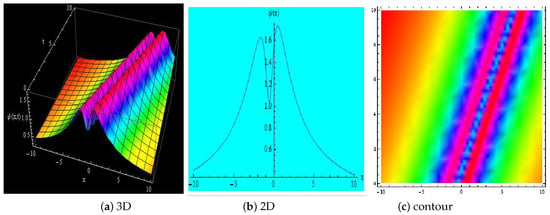
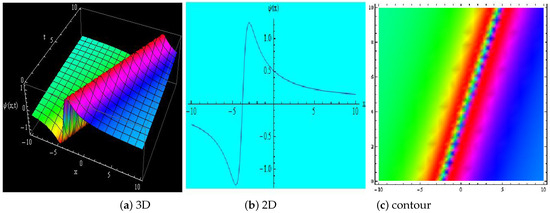
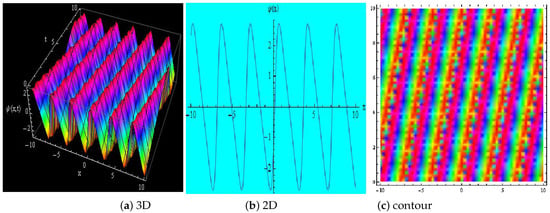
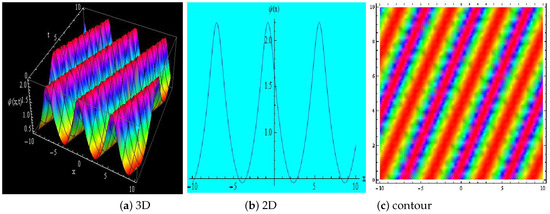
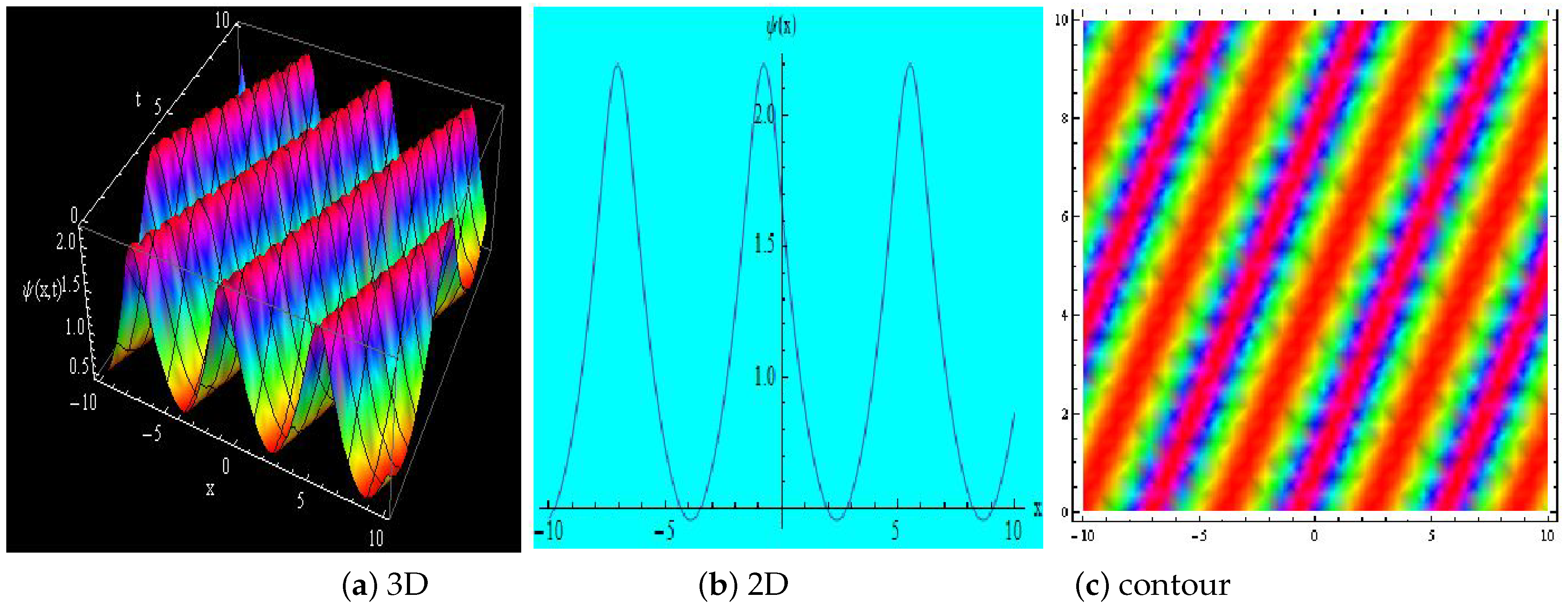
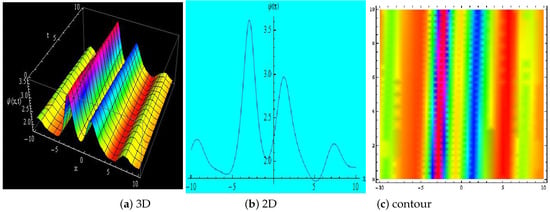
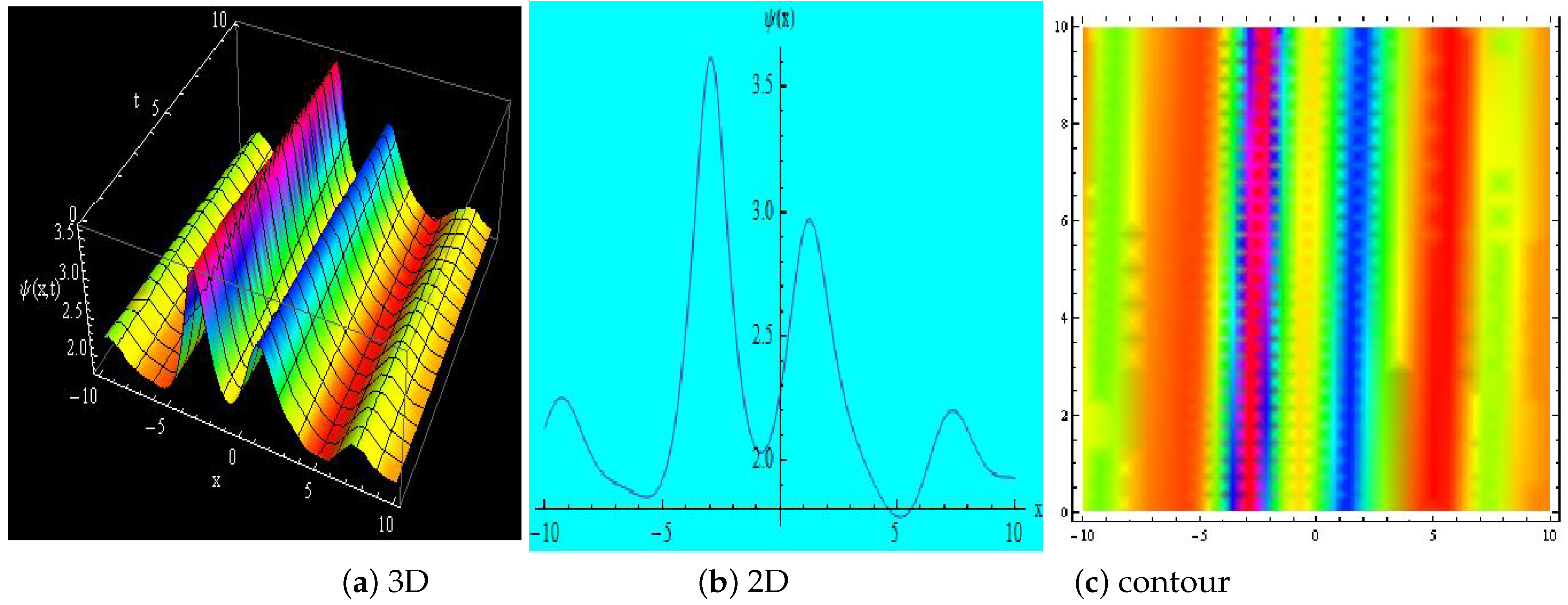
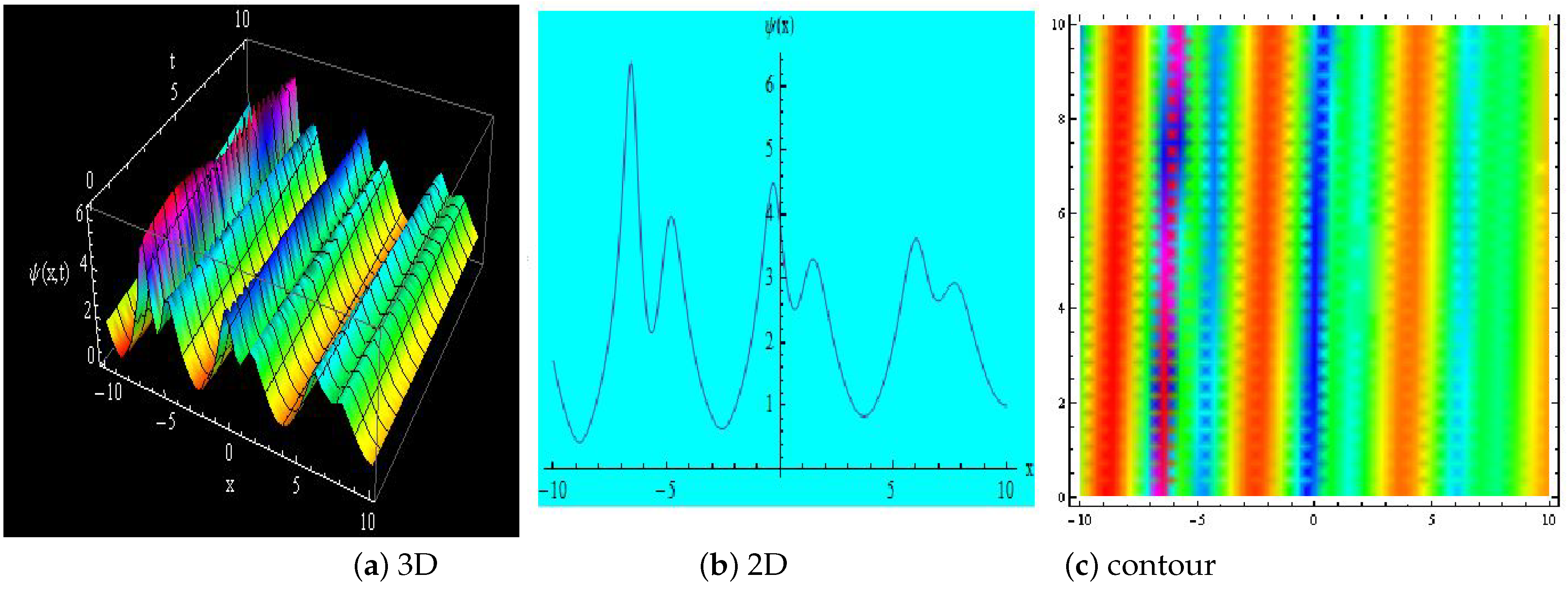
The results offered in this work on the pKP–BP equation have important physical implications. The soliton solutions built here enclose the nonlinear wave patterns that keep their structure intact during evolution and that are the property of many wave structures that are important in the study of optical solitons in telecommunications. In addition, the M -shaped rational solution, the homoclinic breather solution, the multiwave solution, the periodic cross-kink wave solution, and the periodic cross-rational solution, which are explicit constructs typically used in the exploration of and understanding of nonlinear systems, offer new insights into the complexity inherent in these structures. To accentuate the empirical relevance of the model, the study provides a large range of portrayals, encompassing a contour plot along with two- and three-dimensional graphical representations of the derived solutions. These portrayals are produced with Mathematica 2024 with the use of parameter selections that have been specially formulated to maximize the clarity and interpretability of the subsequent visualizations. Figure 1, using the comorbidities and statistics plots, show the three-dimensional (3D), two-dimensional (2D) and contour plots of the M-shaped rational solution described by Equation (11) The surface shows a strongly localized wave structure of an “M” shape having two peaks beside one another contrasting to a shallow depression. This type of configuration is a rational-type soliton; these models are typically used for rogue-wave-like localized events in nonlinear media such as optical fibers or shallow water waves. In the solution, the amplitude and profile of the wave do not change during the propagation, which means that there is a balance between nonlinear and dispersion effects. The good variation in the contour map attests the stability and symmetric localization of the wave energy. Figure 2 corresponds to the second parameter set of the M-shaped rational solution which is expressed in Equation (15). Compared with Figure 1, the amplitude and spatial extent of the peaks are different due to the modified parameters. The Martian two peaks are more widely separated and the central depression deepens, which represents increased self-interaction effects. A homoclinic solution of Equation (20) is shown in Figure 3 as the breather solution. The breather structure contains periodic oscillations in space and time, which is the sign of energy exchange between localized and extended modes. The amplitude is oscillating around a constant background and is a pulsating solitary wave. Such a breather is often related to unstable wave packets in fluids and optical systems that frequently experience periods of limitation and expansion. The 3D surface shows oscillatory humping, with the 2D and contour plots showing the repeating structure and symmetric modulation in the propagation direction. A visualization of the multiwave solution that is given by Equation (25) is presented in Figure 4. In one type of pattern, the superposition of multiple waves of interacting solitons can be revealed due to the combination of trigonometric and hyperbolic functions in the analytical form. Physically, this structure is a model for multi-soliton interactions or collisions where a number of solitary waves are present and do not lose their identities after interacting (this statement is a fundamental property of integrable systems). The periodic modulations found in the contour map are an example of wave interference and coherent energy transfer between the interacting solitons. The periodic cross-kink wave solution determined from Equation (30) is given in Figure 5. The 3D plot shows intersecting kink-type wave fronts that are arranged in a cross shape in a periodic pattern. The solution has hybrid nonlinear characteristics with both kink and periodic annular features. Physically, such cross-kink structures represent photo-physics of domain-wall collisions, cross-phase interaction of nonlinear optical fibers, plasma waves, and fluid surfaces. The contour pattern shows the repetitive and symmetric spatial periodicity and confirms the existence of stable and recurring nonlinear interactions. The corresponding periodic cross-rational solution is given by Figure 6, which is defined by Equation (29). This structure combines rational, trigonometric and hyperbolic behaviors, resulting in a periodic behavior having localized peaks. The surface and contour plots show alternating ridges and valleys with a crosswise periodic distribution, indicating that there is interference between periodic and localized modes. Physically, this solution is a periodic rogue wave-like phenomena, where energy focuses at some spatial points periodically before dispersing. Such solutions are relevant to the study of waves—including the modulation instability and recurrence of energy in nonlinear dispersive media.
Figure 1.
The 3D, 2D and contour structures of the M-shaped rational solution (Equation (11)) for , , , , , , , , , , 10 to 10 and t = 0 to 10.
Figure 2.
The 3D, 2D and contour structures of the M-shaped rational solution (Equation (15)) for , , , , , , , , , , 10 to 10 and t = 0 to 10.
Figure 3.
The 3D, 2D and contour structures of the homoclinic breather solution (Equation (20)) for , , , , , , , , , and , 10 to 10 and t = 0 to 10.
Figure 4.
The 3D, 2D and contour structures of the multiwave solution (Equation (25)) for , , , , , , , , , , , and , 10 to 10 and t = 0 to 10.
Figure 5.
The 3D, 2D and contour structures of the periodic cross-kink wave solution (Equation (30)) for , , , , , , , , , , and , 10 to 10 and t = 0 to 10.
Figure 6.
The 3D, 2D and contour structures of the periodic cross-rational solution (Equation (35)) for , , , , , , , , , , , , 10 to 10 and t = 0 to 10.
5. Stability Analysis of Equation (1)
Examine the perturbed solution of a particular structure [23,24]:
A constant value signifies an equilibrium solution for Equation (1). Substituting Equation (36) into Equation (1) yields a result, where and represents a small disturbance. We compute the derivatives:
The nonlinear terms become
Since is very small, we neglect higher-order terms:
Thus, all nonlinear interaction terms vanish in the linear approximation. Keeping only first-order terms in , we obtain
Dividing by , the final linearized form is
Dispersion Relation via Linear Stability Analysis
Suppose that the following is the solution to Equation (38):
where k, l, and m are wave numbers and is the frequency.
Substituting all derivatives into Equation (38), the following result is obtained:
Factoring out , we obtain
Dispersion Relation. Solving for , the dispersion relation becomes
From Equation (42), it is clear that the real part is always negative for all values, indicating a decaying trend for any solution combination, thus ensuring stable dispersion. Because of this, the real nature of makes sure that small changes do not get bigger or louder over time. They move instead as limited oscillatory waves. As a result, the equilibrium solution stays fixed even when the amplitude changes slightly. In addition, the stability is neutral (marginal stability) because the dispersion relation does not have any imaginary parts that would cause exponential instability. So, dispersive effects, not dissipative or enhancing ones, are the only ones that control the stability behavior.
6. Conclusions
In this study, we created various distinctive types of rigorously derived solutions to the pKP-BKP problem, such as M-shaped rational solutions, homoclinic breather solutions, multiwave solutions, periodic cross-rational solutions, and periodic cross-kink wave solutions. These results plot the known solution space of the equation and give a more precise picture of the nonlinear wave dynamics of the equation. The obtained solutions show a variety of localization and oscillatory phenomena and, in this way, demonstrate robustness during propagation. Periodic soliton solutions are particularly important for periodically constrained systems, while M-shaped rational solutions are of interest for modeling sharply localized events. Collectively, these results provide feedback on mechanisms like energy localization, nonlinear interactions and recurrence phenomena of nonlinear media.
Beyond mathematical interest, there is potential applicability in various situations that involve nonlinear optical fibers, the curvature theory of surfaces, and the analysis of trajectories using the solutions via soliton-like structures being of importance. The impact of adjustable parameters on the characteristics of the solution enables the model to cover various physical scenarios.
All analytical solutions have been carefully verified by direct substitution using Mathematica. Consequently, we expect that the foregoing results will provide a strong basis for more detailed studies of the pKP-BKP equation along with integrable systems, which will encourage research into nonlinear wave phenomena in both theory and practice.
Author Contributions
Conceptualization, N.R.; Methodology, N.R.; Software, A.H.T. and E.H.; Validation, E.H. and M.A.S.M.; Formal Analysis, E.H. and M.A.S.M.; Investigation, A.H.T. and M.A.S.M.; Resources, E.H.; Writing—Original Draft, N.R.; Writing—Review and Editing, A.H.T. and M.A.S.M.; Supervision, N.R.; Funding Acquisition, A.H.T. All authors have read and agreed to the published version of the manuscript.
Funding
This work was supported and funded by the Deanship of Scientific Research at Imam Mohammad Ibn Saud Islamic University (IMSIU) (grant number IMSIU-DDRSP2602).
Data Availability Statement
The original contributions presented in this study are included in the article. Further inquiries can be directed to the corresponding author.
Conflicts of Interest
The authors declare no conflicts of interest.
References
- Scott, A.C.; Chu, F.Y.F.; McLaughlin, D.W. The soliton: A new concept in applied science. Proc. IEEE 1973, 61, 1443–1483. [Google Scholar] [CrossRef] [Scilit]
- Farooq, K.; Abdullah, A.R.; Hussain, E.; Murad, M.A.S. Chaos, Lyapunov exponent, and sensitivity demonstration of the coupled nonlinear integrable model with soliton solutions. AIMS Math. 2025, 10, 22929–22957. [Google Scholar] [CrossRef] [Scilit]
- Kaya, S.F.N.; Kopçasız, B. Multi-Wave, Breather, and Interaction Solutions to Akbota Equation for The Heisenberg Ferromagnet-Type Model Arising in Nonlinear Physical Sciences. Int. J. Appl. Comput. Math. 2025, 11, 107. [Google Scholar] [CrossRef] [Scilit]
- Seadawy, A.R.; Iqbal, M. Propagation of the nonlinear damped Korteweg-de Vries equation in an unmagnetized collisional dusty plasma via analytical mathematical methods. Math. Methods Appl. Sci. 2021, 44, 737–748. [Google Scholar] [CrossRef] [Scilit]
- Wazwaz, A.M. Partial Differential Equations and Solitary Waves Theory; Springer Science & Business Media: Berlin/Heidelberg, Germany, 2010. [Google Scholar] [CrossRef] [Scilit]
- Ray, S.S. New analytical exact solutions of time fractional KdV–KZK equation by Kudryashov methods. Chin. Phys. B 2016, 25, 040204. [Google Scholar] [CrossRef] [Scilit]
- Hussain, E.; Abdullah, A.R.; Farooq, K.; Shah, S.A.A. Lie Symmetry Analysis, Rogue Waves, and Lump Waves of Nonlinear Integral Jimbo–Miwa Equation. Symmetry 2025, 17, 1717. [Google Scholar] [CrossRef] [Scilit]
- Gurefe, Y.; Misirli, E.; Sonmezoglu, A.; Ekici, M. Extended trial equation method to generalized nonlinear partial differential equations. Appl. Math. Comput. 2013, 219, 5253–5260. [Google Scholar] [CrossRef] [Scilit]
- Tahir, M.; Awan, A.U.; Rehman, H.U. Dark and singular optical solitons to the Biswas-Arshed model with Kerr and power law nonlinearity. Optik 2019, 185, 777–783. [Google Scholar] [CrossRef] [Scilit]
- Raees, N.; Mahmood, I.; Hussain, E.; Younas, U.; Elansary, H.O.; Mumtaz, S. Dynamics of optical solitons and sensitivity analysis in fiber optics. Phys. Lett. A 2024, 528, 130031. [Google Scholar] [CrossRef] [Scilit]
- Pal, N.K.; Chatterjee, P.; Wazwaz, A.M.; Raut, S. Lax pairs, infinite conservation laws of stochastic potential Korteweg–de Vries equation and their solutions by using Darboux transformation. Pramana—J. Phys. 2024, 99, 5. [Google Scholar] [CrossRef] [Scilit]
- Bo, Y.; Tian, D.; Liu, X.; Jin, Y. Discrete maximum principle and energy stability of the compact difference scheme for two-dimensional Allen–Cahn equation. J. Funct. Spaces 2022, 2022, 8522231. [Google Scholar] [CrossRef] [Scilit]
- Ali, T.A.A.; Xiao, Z.; Jiang, H.; Li, B. A class of digital integrators based on trigonometric quadrature rules. IEEE Trans. Ind. Electron. 2023, 71, 6128–6138. [Google Scholar] [CrossRef] [Scilit]
- Wazwaz, A.J. New Painlevé integrable (3+1)-dimensional combined pKP–BKP equation: Lump and multiple soliton solutions. Chin. Phys. Lett. 2023, 40, 120501. [Google Scholar] [CrossRef] [Scilit]
- Zhang, L.; Zhao, Z.; Zhang, Y. Dynamics of transformed nonlinear waves for the (2+1)-dimensional pKP–BKP equation: Interactions and molecular waves. Phys. Scr. 2024, 99, 075220. [Google Scholar] [CrossRef] [Scilit]
- Wazwaz, A.M. Breather wave solutions for an integrable (3+1)-dimensional combined pKP–BKP equation. Chaos Solitons Fractals 2024, 182, 114886. [Google Scholar] [CrossRef] [Scilit]
- Saifullah, S.; Ahmad, S.; Khan, M.A.; Rahman, M. Multiple solitons with fission and multi waves interaction solutions of a (3+1)-dimensional combined pKP–BKP integrable equation. Phys. Scr. 2024, 99, 065242. [Google Scholar] [CrossRef] [Scilit]
- Khalifa, A.S.; Ahmed, H.M.; Badra, N.M.; Manafian, J.; Mahmoud, K.H.; Nisar, K.S.; Rabie, W.B. Derivation of some solitary wave solutions for the (3+1)-dimensional pKP-BKP equation via the IME tanh function method. AIMS Math. 2024, 9, 27704–27720. [Google Scholar] [CrossRef] [Scilit]
- Yang, J.-Y.; Ma, W.-X.; Qin, Z. Lump and lump-soliton solutions to the (2+1)-dimensional Ito equation. Anal. Math. Phys. 2018, 8, 427–436. [Google Scholar] [CrossRef] [Scilit]
- Rizvi, S.T.R.; Seadawy, A.R.; Ashraf, M.A.; Younis, M.; Khaliq, A.; Baleanu, D. Rogue, multi-wave, homoclinic breather, M-shaped rational and periodic-kink solutions for a nonlinear model describing vibrations. Results Phys. 2021, 29, 104654. [Google Scholar] [CrossRef] [Scilit]
- Seadawy, A.R.; Younis, M.; Althobaiti, A. Various forms of M-shaped rational, periodic cross kink waves and breathers for Bose–Einstein condensate model. Opt. Quantum Electron. 2022, 54, 152. [Google Scholar] [CrossRef] [Scilit]
- Seadawy, A.R.; Rizvi, S.T.R.; Zahed, H. Stability analysis of the rational solutions, periodic cross-rational solutions, rational kink cross-solutions, and homoclinic breather solutions to the KdV dynamical equation with constant coefficients and their applications. Mathematics 2023, 11, 1074. [Google Scholar] [CrossRef] [Scilit]
- Hussain, E.; Mahmood, I.; Shah, S.A.A.; Khatoon, M.; Az-Zo’bi, E.A.; Ragab, A.E. The study of coherent structures of combined KdV–mKdV equation through integration schemes and stability analysis. Opt. Quantum Electron. 2024, 56, 723. [Google Scholar] [CrossRef] [Scilit]
- Hussain, E.; Mutlib, A.; Li, Z.; Adham, E.R.; Shah, S.A.A.; Az-Zo’bi, E.A.; Raees, N. Theoretical examination of solitary waves for Sharma–Tasso–Olver Burger equation by stability and sensitivity analysis. Z. Für Angew. Math. Und Phys. 2024, 75, 96. [Google Scholar] [CrossRef] [Scilit]
Disclaimer/Publisher’s Note: The statements, opinions and data contained in all publications are solely those of the individual author(s) and contributor(s) and not of MDPI and/or the editor(s). MDPI and/or the editor(s) disclaim responsibility for any injury to people or property resulting from any ideas, methods, instructions or products referred to in the content. |
© 2026 by the authors. Licensee MDPI, Basel, Switzerland. This article is an open access article distributed under the terms and conditions of the Creative Commons Attribution (CC BY) license.