


Abstract
Dynamic compression tests were conducted on coal–siltstone composites using a split Hopkinson pressure bar (SHPB) system at impact velocities of 6, 8, 10, 12, and 14 m/s to investigate the nonlinear effects of impact velocity on their dynamic mechanical response, with a particular focus on the asymmetric evolution of deformation, energy distribution and fracture propagation that breaks the initial structural symmetry of composite specimens. The dynamic mechanical properties, energy evolution, and fragmentation characteristics were analyzed to reveal the symmetry-breaking mechanism of layered coal–rock structures under dynamic loading. The results show that the following: (1) The composites exhibit pronounced nonlinear dynamic mechanical responses to increasing impact velocity. Over the velocity range of 6–14 m/s, the average dynamic compressive strength increases from 26.46 to 72.47 MPa, whereas the average peak strain exhibits a nonmonotonic trend, increasing from 0.045 to 0.091 before decreasing to 0.057. Increasing impact velocity shortens the initial compaction stage, increases the proportion of the plastic deformation stage, and accelerates the post-peak stress drop. (2) As incident energy increases, the reflected energy proportion decreases exponentially, the absorbed energy proportion increases exponentially, and the transmitted energy proportion increases monotonically, indicating a shift in energy partitioning toward greater absorption and transmission. (3) Fragmentation becomes progressively more severe with increasing impact velocity. The mass fraction of fragments larger than 9.5 mm decreases from 72.94% to 46.24%, indicating progressive fragment refinement. The coal component predominantly breaks into fine fragments, whereas the siltstone component primarily undergoes crack propagation and coalescence followed by block disintegration. Coarse fragments consist mainly of siltstone. With increasing impact velocity, the failure mode of the siltstone component evolves from a single mode to more complex mixed-mode failure. (4) The average fragment size decreases linearly with increasing impact velocity, incident energy, and absorbed energy. The fractal dimension increases monotonically with impact velocity and follows increasing power-law relationships with incident and absorbed energies. The increase in fractal dimension becomes less pronounced when the incident and absorbed energies reach 348.64 and 87.16 J, respectively.
1. Introduction
During deep coal mining, roof fracturing, blasting disturbances, and mining-induced dynamic loads can trigger dynamic disasters, including coal bursts and coal and gas outbursts. During these events, dynamic loads are jointly sustained by the coal and surrounding rock. Investigating the dynamic mechanical properties and fragmentation characteristics of coal–rock composites at different impact velocities is therefore essential for understanding the mechanisms underlying these disasters and supporting safe coal extraction at depth.
Extensive research using split Hopkinson pressure bar (SHPB) systems has investigated the dynamic mechanical response, energy evolution, fragmentation, and damage characteristics of coal, rock, and coal–rock composites. Regarding dynamic mechanical properties, Li et al. [1] investigated loading-rate effects in granite, while Wang et al. [2] examined the dynamic compressive behavior of UR50 ultra-early-strength cement-based concrete under high-strain-rate loading. Considering the inherent heterogeneity of coal and rock, Liu et al. [3] and Li et al. [4] compared the dynamic responses of specimens with different bedding orientations. They found that specimens loaded perpendicular to the bedding exhibited the most favorable mechanical properties, highlighting the mechanical anisotropy of bedded coal and rock under dynamic loading. For coal–rock composite structures commonly encountered in engineering, Gong et al. [5] identified double peaks in the stress–strain curves at high loading rates and a linear evolution of absorbed energy. Focusing on interface effects, He et al. [6] performed physical similarity simulation tests and revealed the asymmetric cumulative failure evolution of roadway surrounding rock subjected to dynamic disturbance, and proposed an energy-absorbing support strategy. Wang et al. [7] and Zhao et al. [8] elucidated the competing failure mechanisms of the coal and rock components and established a compression–shear failure criterion incorporating interfacial cohesive strength. Su et al. [9] conducted dynamic tests on sandstone containing weakly filled joints and found that dynamic strength initially decreased and subsequently increased with increasing joint inclination. A critical inclination of approximately 45° corresponded to the highest energy reflection coefficient and the lowest absorbed energy density. Through triaxial SHPB tests, Gu et al. [10] and Gong et al. [11] demonstrated that confinement and prestress could enhance dynamic strength and suppress pulverization. Ai et al. [12] and Hao et al. [13] investigated dynamic tensile fracture in coal and rock and found that dynamic tensile strength could be several times its static counterpart. Increasing axial static stress initially enhanced dynamic strength but reduced it beyond a critical level.
From an energy perspective, dynamic disasters in coal and rock result from the combined effects of internal energy accumulation, dissipation, and rapid release. Xie et al. [14] established criteria for rock strength degradation and structural failure based on energy dissipation and release, providing a theoretical basis for energy-based analyses of dynamic instability. Gong et al. [15] reproduced the complete process of rockbursts induced by spalling of the rock surrounding deep roadways and demonstrated the suppressive effect of lateral stress on rockburst intensity. Li et al. [16] developed an elastoplastic–brittle catastrophe model for coal bursts in coal and rock containing discontinuities, revealing cascading energy-driven instability across the scales of material elements, regions, and the overall system. Coupled geological and environmental conditions further complicate energy evolution. For gas-bearing coal, Kong et al. [17], Yin et al. [18], and Wang et al. [19] showed that increasing gas pressure reduced dynamic strength and elastic modulus, while shear stresses generated by gas escaping along fracture surfaces contributed substantially to coal fracturing. Under coupled water–rock conditions, Wang et al. [20], Gu et al. [21], and Gong et al. [22] examined the effects of water–ice phase transitions at low temperatures and water-induced deterioration. Their findings demonstrated that moisture conditions substantially altered crack propagation paths and fracture energy dissipation. He et al. [23] conducted CO2 phase-transition fracturing tests at different pressures and revealed the exponential enhancement law of coal permeability induced by fracture propagation. To investigate fatigue disturbances associated with mining, Song et al. [24] and Zhang et al. [25] conducted cyclic impact tests and identified the coal component as the primary control on the instability of coal–rock composites. They also found that the accumulation of elastic and dissipated energies followed quadratic relationships and that final failure was abrupt and violent.
Fragment morphology and size distribution provide observable evidence of energy dissipation in coal and rock under dynamic loading. Fractal geometry has therefore been widely used to quantify fragmentation, fracture surface morphology, and crack propagation. Gong et al. [26] and Ai et al. [27] demonstrated that bedding inclination and loading rate controlled dynamic crack propagation, with both crack propagation velocity and fractal dimension increasing under high-velocity impact. Friesen et al. [28] applied fractal geometry to characterize coal pore structures via mercury intrusion porosimetry and identified multi-regime fractal dimensions corresponding to different pressure ranges. Wang et al. [29] reconstructed coal macropore structures by X-ray CT and calculated volume and tortuosity fractal dimensions to reveal correlations between fractal parameters, porosity and permeability. Zhang et al. [30] combined multiple pore testing methods and multifractal theory to reveal the heterogeneity evolution of multi-scale fracture-pore systems in coal after CO2 phase-transition fracturing. Feng et al. [31] introduced multifractal theory to establish a quantitative relationship between fracture surface roughness and macroscopic fracture direction. In studies of cumulative damage, Li et al. [32] and Sha et al. [33] revealed a staged damage evolution process in which cracks progressively developed from preferential propagation to coalescence under repeated impacts. They also developed statistical damage constitutive models based on the Weibull distribution. Zhang et al. [34] adopted CT scanning and fractal theory to characterize the evolution of three-dimensional fracture networks of coal after CO2 phase-transition fracturing. Li et al. [35] reported that the coupled effects of a critical strain rate and confining pressure promoted the transformation of micropores into medium-sized and large pores. By combining digital image correlation (DIC) measurements with stress-wave attenuation analysis, Li et al. [36] demonstrated that nonlinear stress-wave propagation within coal directly contributed to large surface deformations and displacements.
These studies have provided substantial insight into strain-rate effects, interfacial failure mechanisms, energy evolution, and fractal fragmentation characteristics through dynamic tests on individual rock specimens, coal–rock composites, and rock masses containing discontinuities. In mining practice, however, coal–siltstone composite structures often exhibit low burst proneness, while the mechanisms through which they contribute to dynamic disasters remain difficult to identify. Their dynamic mechanical response has received limited attention, particularly under different incident energy levels. Accordingly, this study conducts dynamic compression tests on coal–siltstone composites using an SHPB system at impact velocities ranging from 6 to 14 m/s. The dynamic stress–strain responses at different impact velocities are systematically analyzed, together with energy absorption, dissipation, and transfer under different incident energy levels. Sieve analysis and fractal theory are combined to quantify fragment size distributions and elucidate the dynamic instability mechanisms of coal–siltstone composites. The findings provide a theoretical basis for controlling the stability of rock surrounding deep roadways subjected to dynamic loading and for the proactive prevention and mitigation of coal bursts.
2. Experimental Setup and Procedure
2.1. Preparation of Coal–Siltstone Composite Specimens
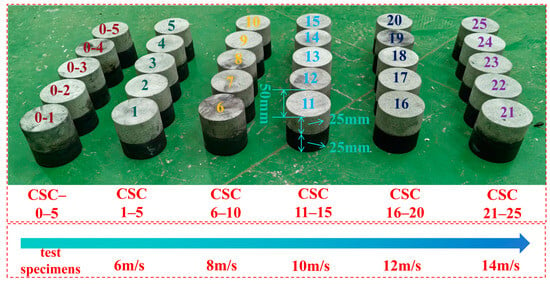
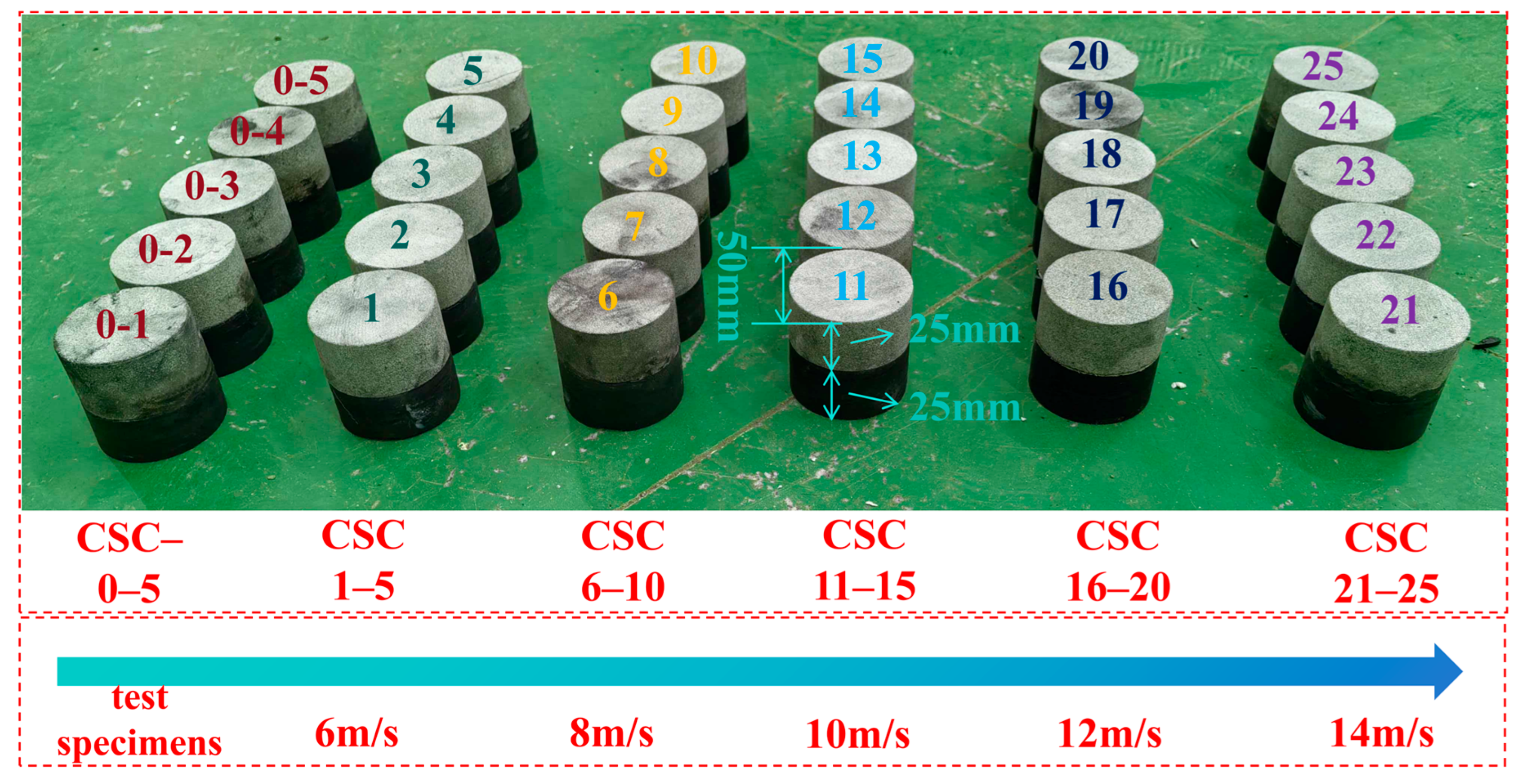
Coal and siltstone samples were collected from the coal seam and rock strata of a mine in Dongsheng District, Ordos, China. Each material was machined into cylindrical specimens measuring 50 mm in diameter and 25 mm in height. One coal specimen and one siltstone specimen were then bonded using epoxy resin to form a cylindrical composite measuring 50 mm in diameter and 50 mm in height. Following the methods suggested by the International Society for Rock Mechanics and Rock Engineering (ISRM), the composite specimens were ground and polished to ensure that the end-face roughness and deviation from parallelism did not exceed 0.05 and 0.02 mm, respectively [37]. All specimens were cored such that bedding planes were parallel to the circular end-faces of cylinders, and specimens were maintained under natural air-dry laboratory conditions before testing. A thin uniform epoxy layer was applied between contact surfaces; the adhesive-layer thickness was manually controlled to be less than 0.2 mm by strictly controlling the dosage of epoxy resin. All coal–siltstone composite specimens were cured at constant temperature of 25 °C and relative humidity of 50 ± 5% RH for 72 h prior to SHPB tests. The prepared specimens are shown in Figure 1.
Figure 1.
Coal–siltstone composite specimens for dynamic loading tests.
In accordance with the above standards, uniaxial compression test specimens of siltstone, coal, and coal–siltstone composites with a diameter of 50 mm and a height of 100 mm were prepared. Five specimens were prepared for each material type, as shown in Figure 2. The specific uniaxial test data are presented in Table 1.
Figure 2.
Specimen preparation.
Table 1.
Uniaxial compression test results of specimens.
2.2. Experimental Setup
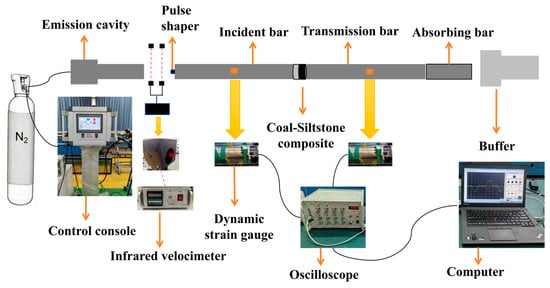
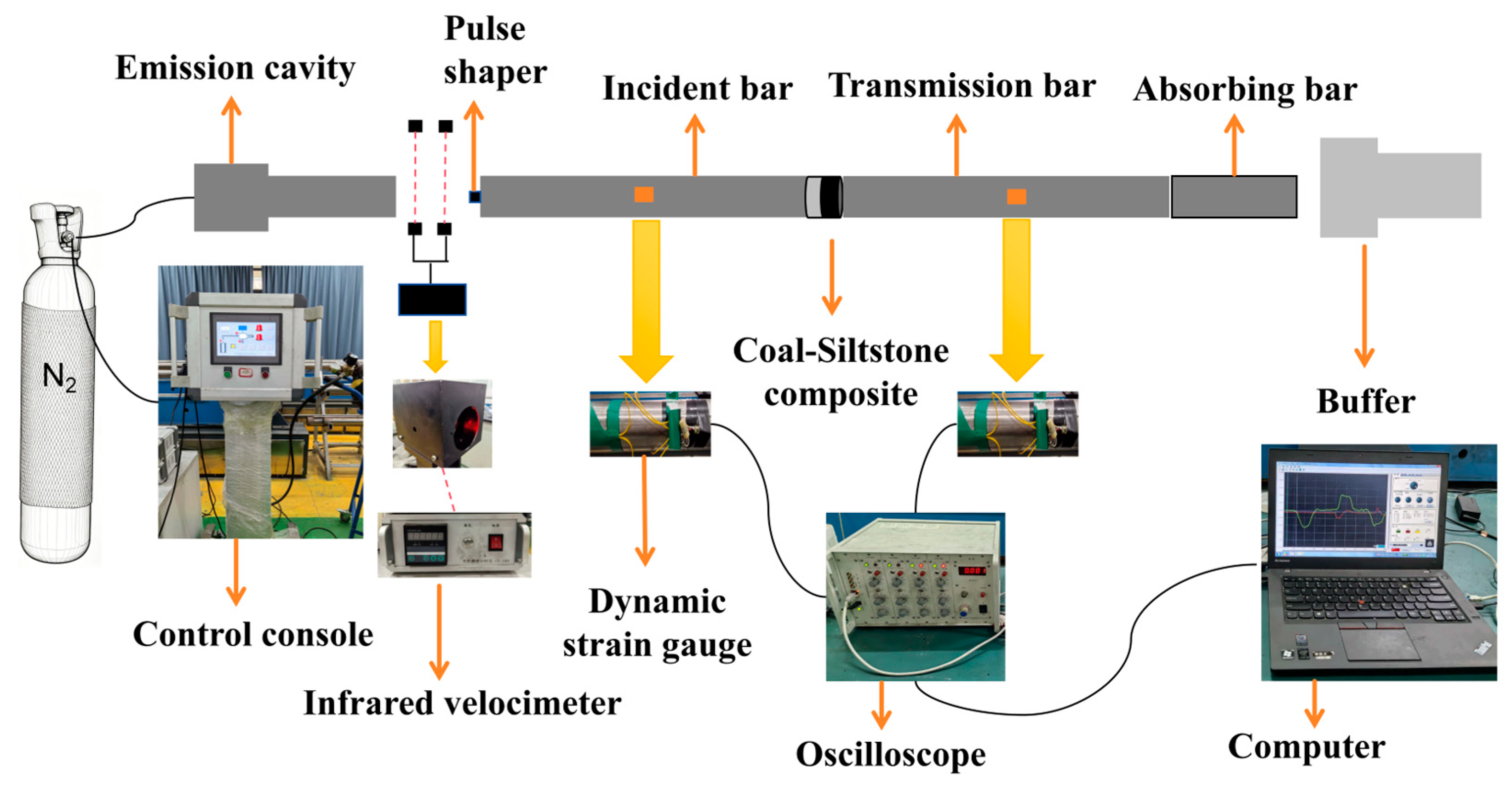
Dynamic compression tests on the coal–siltstone composites were conducted using an SHPB system at China University of Mining and Technology, Xuzhou, China, as shown in Figure 3. The system primarily comprised a loading device, an incident bar, a transmission bar, an absorbing bar, and a data acquisition system. The bars and striker were made of high-strength alloy steel with a density of 7740 kg/m3, an elastic modulus of 210 GPa, and a longitudinal wave velocity of 5158 m/s. The bars were 50 mm in diameter.
Figure 3.
Experimental system for dynamic loading tests.
Before testing, a small amount of petroleum jelly was applied to the impact face of the incident bar, and a circular black rubber disc was attached as a pulse shaper to produce a half-sine incident pulse and facilitate dynamic stress equilibrium within the specimens during loading. A thin layer of petroleum jelly was also applied uniformly to the contact surfaces between the specimen ends and the bars to minimize the influence of end friction on the test results.
2.3. Experimental Procedure
Impact velocity was selected as the experimental variable to investigate its effects on the dynamic mechanical response and failure characteristics of coal–siltstone composites. Before the main tests, preliminary impact tests were conducted on five specimens in the CSC-0-5 group to determine an appropriate loading range based on the extent of specimen damage and the recoverability of fragments. At an impact velocity of 4 m/s, the specimen sustained only minor damage and remained largely intact. At 6 m/s, substantial damage occurred, although the resulting fragments were predominantly large blocks. Increasing the impact velocity to 12 m/s produced more extensive fragmentation. At 14 m/s, the siltstone component fractured substantially, with an increased number of small fragments and pronounced refinement of the coal fragments. At 16 m/s, severe fragmentation caused substantial loss of fine particles, making adequate fragment recovery difficult and compromising subsequent fragment size analysis. Based on these preliminary results, five impact velocities—6, 8, 10, 12, and 14 m/s—were selected for the main tests. Five specimens were tested at each velocity, giving a total of 25 dynamic compression tests.
2.4. Verification of Dynamic Stress Equilibrium
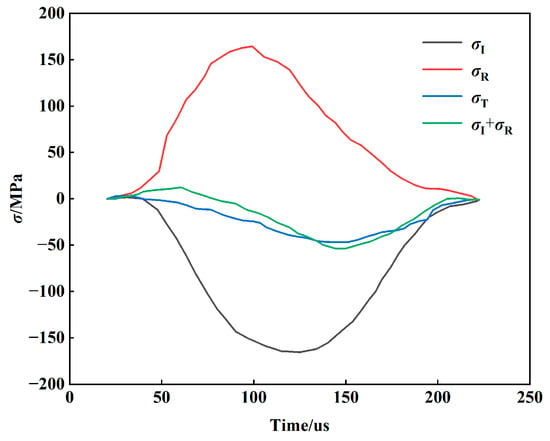
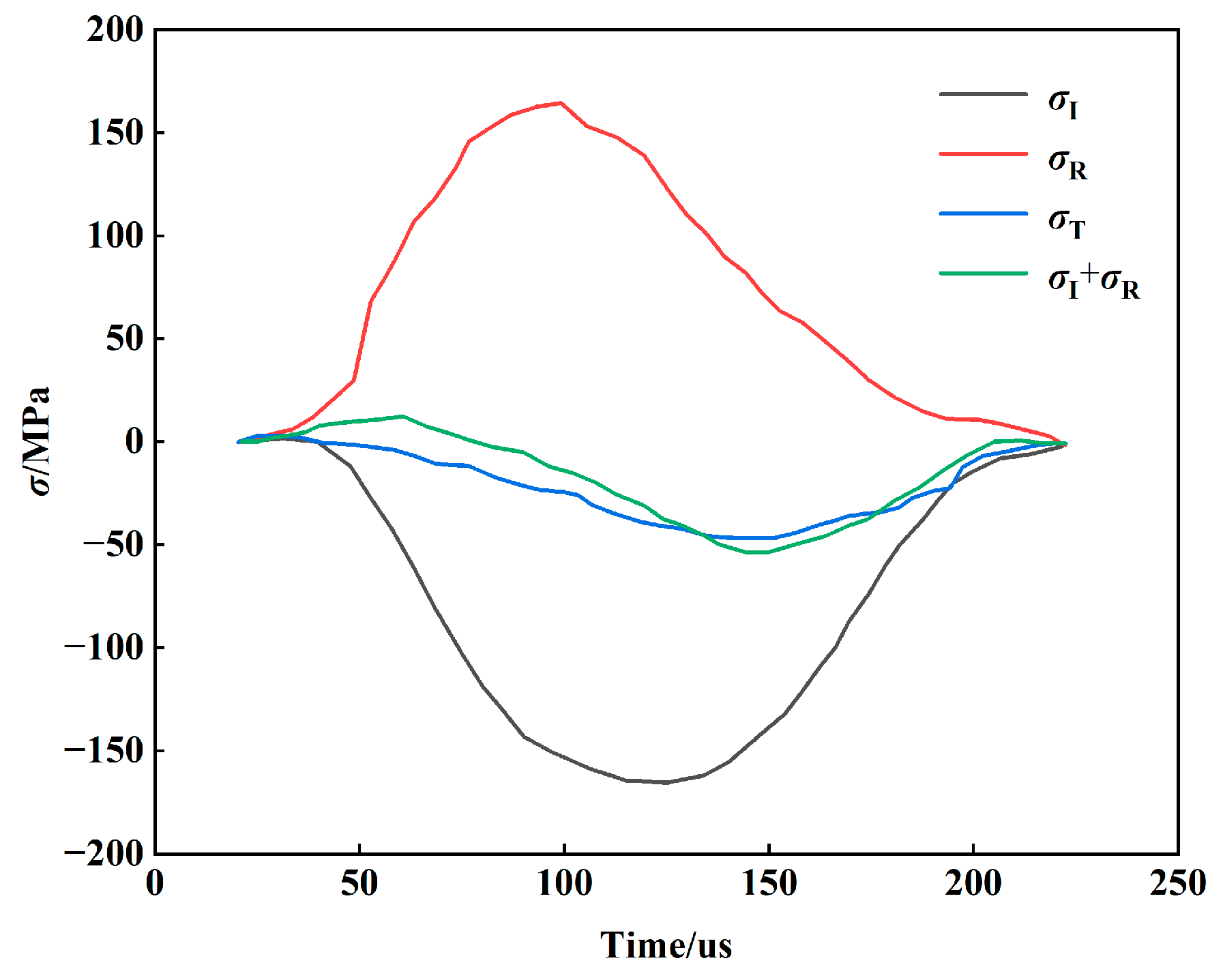
Dynamic stress equilibrium was verified using the incident, reflected, and transmitted waves to assess the force balance at the two specimen ends during dynamic loading. For incident and transmission bars with identical material properties and cross-sectional areas, approximate force equilibrium is achieved when the sum of the incident and reflected stresses, σI + σR, closely matches the transmitted stress, σT. Figure 4 presents a representative stress equilibrium check, and all 25 tested specimens satisfy this equilibrium criterion. The superimposed incident and reflected stress history closely follows the transmitted stress history throughout the main loading stage, indicating that the specimen approximately satisfied the dynamic stress equilibrium condition during this stage.
Figure 4.
Verification of dynamic stress equilibrium.
3. Nonlinear Dynamic Mechanical Characteristics of Coal–Siltstone Composites at Different Impact Velocities
3.1. Stress–Strain Curve Analysis
Based on one-dimensional stress wave theory, the strain signals from strain gauges attached to the incident and transmission bars were processed by the three-wave method in the SHPB data processing software to acquire the stress, strain and strain rate of coal–siltstone composites.
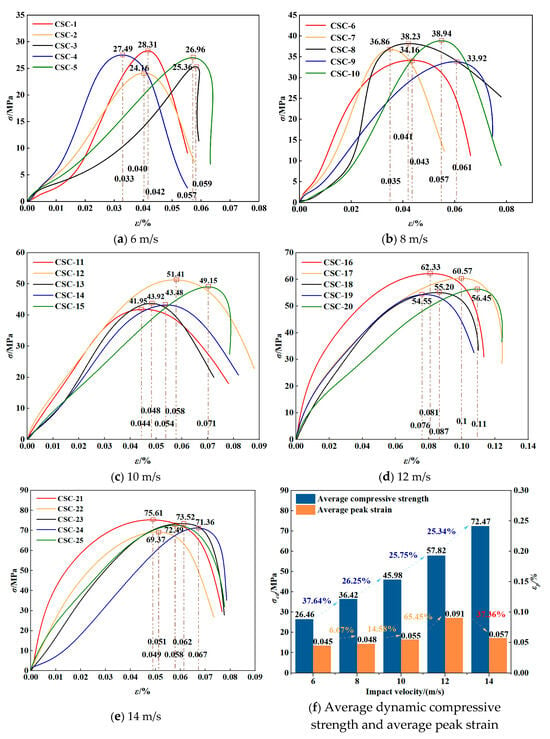
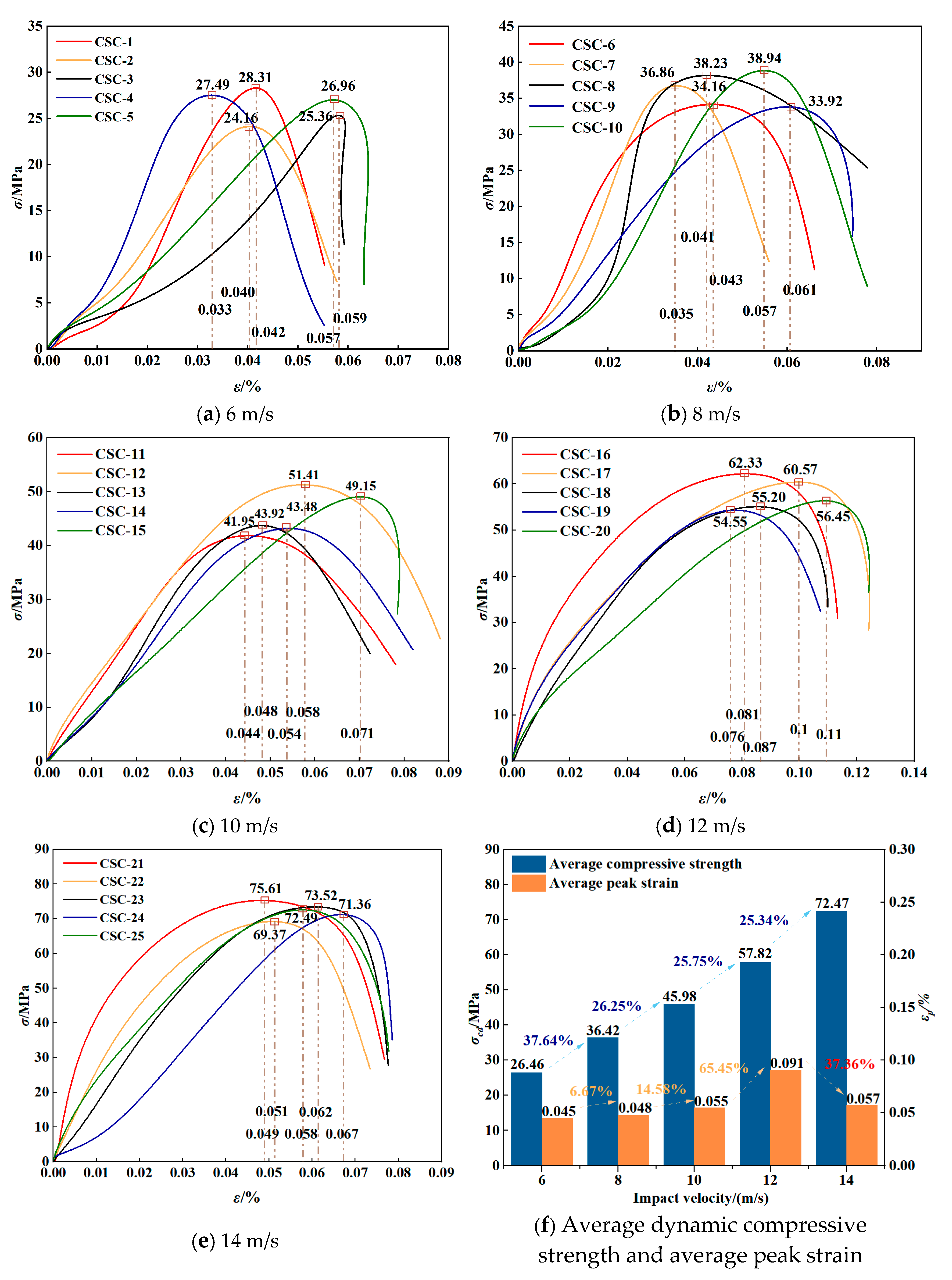
Figure 5 presents the stress–strain responses of the coal–siltstone composites at different impact velocities. Figure 5a–e show the stress–strain curves at 6, 8, 10, 12, and 14 m/s, respectively, illustrating the dynamic mechanical response of the composites. Figure 5f summarizes the variations in average dynamic compressive strength and average peak strain with impact velocity, which are calculated to minimize the influence of individual differences and random errors and to reflect the overall evolution of the dynamic characteristics.
Figure 5.
Dynamic stress–strain characteristics of coal–siltstone composites under different impact velocities.
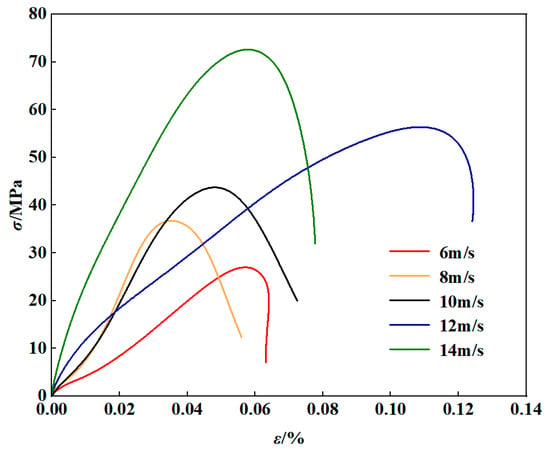
As shown in Figure 5, the dynamic compressive strength ranges from 24.16 to 28.31 MPa at 6 m/s, with an average of 26.46 MPa. At 8 m/s, it ranges from 33.92 to 38.94 MPa, with an average of 36.42 MPa. At 10 m/s, it ranges from 41.95 to 51.41 MPa, with an average of 45.98 MPa. At 12 m/s, it ranges from 54.55 to 62.33 MPa, with an average of 57.82 MPa. At 14 m/s, it ranges from 69.37 to 75.61 MPa, with an average of 72.47 MPa. The average dynamic compressive strength increases by 37.64%, 26.25%, 25.75%, and 25.34% as the impact velocity increases from 6 to 8, 8 to 10, 10 to 12, and 12 to 14 m/s, respectively. These results indicate that both the lower and upper bounds of dynamic compressive strength, together with its average value, increase with impact velocity.
The peak strain ranges from 0.033 to 0.059 at 6 m/s, with an average of 0.045. At 8 m/s, it ranges from 0.035 to 0.061, with an average of 0.048. At 10 m/s, it ranges from 0.044 to 0.071, with an average of 0.055. At 12 m/s, it ranges from 0.076 to 0.110, with an average of 0.091. At 14 m/s, it ranges from 0.049 to 0.067, with an average of 0.057. The average peak strain increases by 6.67%, 14.58%, and 65.45% as the impact velocity increases from 6 to 8, 8 to 10, and 10 to 12 m/s, respectively, before decreasing by 37.36% from 12 to 14 m/s. Both the lower and upper bounds of peak strain increase over the velocity range of 6–12 m/s and subsequently decrease at 14 m/s. The average peak strain increases gradually from 6 to 10 m/s, rises sharply at 12 m/s, and then decreases at 14 m/s to a value close to that at 10 m/s. This nonmonotonic response suggests that an optimal impact velocity may exist at which the peak strain of the coal–siltstone composites is maximized. This phenomenon may be similar to the enhanced response of materials near their natural frequency under resonance conditions, but its underlying mechanism remains to be further verified.
Figure 6 compares representative stress–strain curves at different impact velocities. For each velocity, the specimen whose dynamic compressive strength is closest to the corresponding group average was selected from the five tested specimens. Specifically, the representative specimens selected at impact velocities of 6, 8, 10, 12, and 14 m/s are CSC-5, CSC-7, CSC-13, CSC-20, and CSC-25, respectively. These representative curves are utilized to comparatively analyze the response characteristics of the stress–strain relationship of the coal–siltstone composite under varying impact velocities. As shown in Figure 6, a distinct initial compaction stage is observed at 6, 8, and 10 m/s but is no longer discernible at 12 and 14 m/s. With increasing impact velocity, the relative extent of the elastic stage decreases, that of the plastic deformation stage increases, and the post-peak stage progressively shortens. These observations suggest that, at higher impact velocities, new cracks initiate and propagate before pre-existing cracks have fully closed, and a greater proportion of the impact loading contributes to irreversible deformation of the composites. Meanwhile, the shorter post-peak stage indicates a more rapid stress drop, enhanced strain softening, and more pronounced brittle failure characteristics.
Figure 6.
Comparison of stress–strain curves under different impact velocities.
3.2. Strain-Rate Analysis
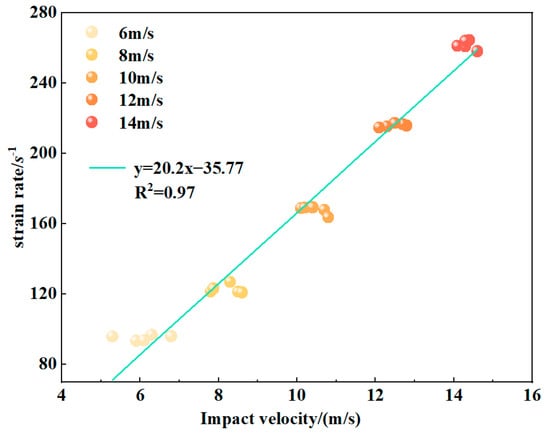
The impact velocity is a controllable external loading condition of the SHPB test system, whereas the strain rate is an inherent deformation response parameter of coal–rock masses under dynamic loading, which can better reflect the evolution law of the dynamic mechanical behavior of materials. Therefore, the average strain rates of coal–siltstone composites corresponding to each impact velocity were calculated, and the correlation between impact velocity and average strain rate was established, as shown in Figure 7.
Figure 7.
Relationship between impact velocity and strain rate.
The average strain rates of coal–siltstone composites under the impact velocity of 6 m/s are 96.70, 95.73, 93.36, 93.47 and 95.83 s−1; those under 8 m/s are 121.29, 126.83, 121.16, 123.08 and 120.77 s−1; those under 10 m/s are 168.80, 167.84, 168.98, 169.24 and 163.55 s−1; those under 12 m/s are 215.71, 216.56, 215.30, 214.63 and 217.09 s−1; and those under 14 m/s are 257.98, 261.01, 264.25, 260.69 and 263.83 s−1. It can be seen from Figure 7 that there is a significant linear relationship between impact velocity and average strain rate, with a coefficient of determination (R2) of 0.97. This indicates that impact velocity and strain rate exhibit high stability and equivalence within the scope of this test. Therefore, strain rate can be adopted instead of impact velocity as the core variable to accurately characterize the influence of loading rate on the dynamic mechanical properties of coal–rock masses.
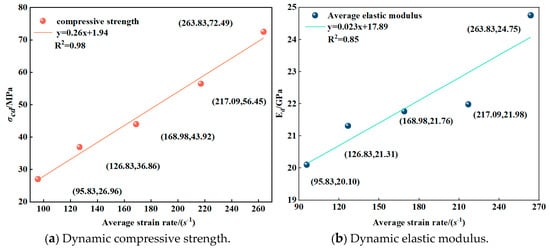
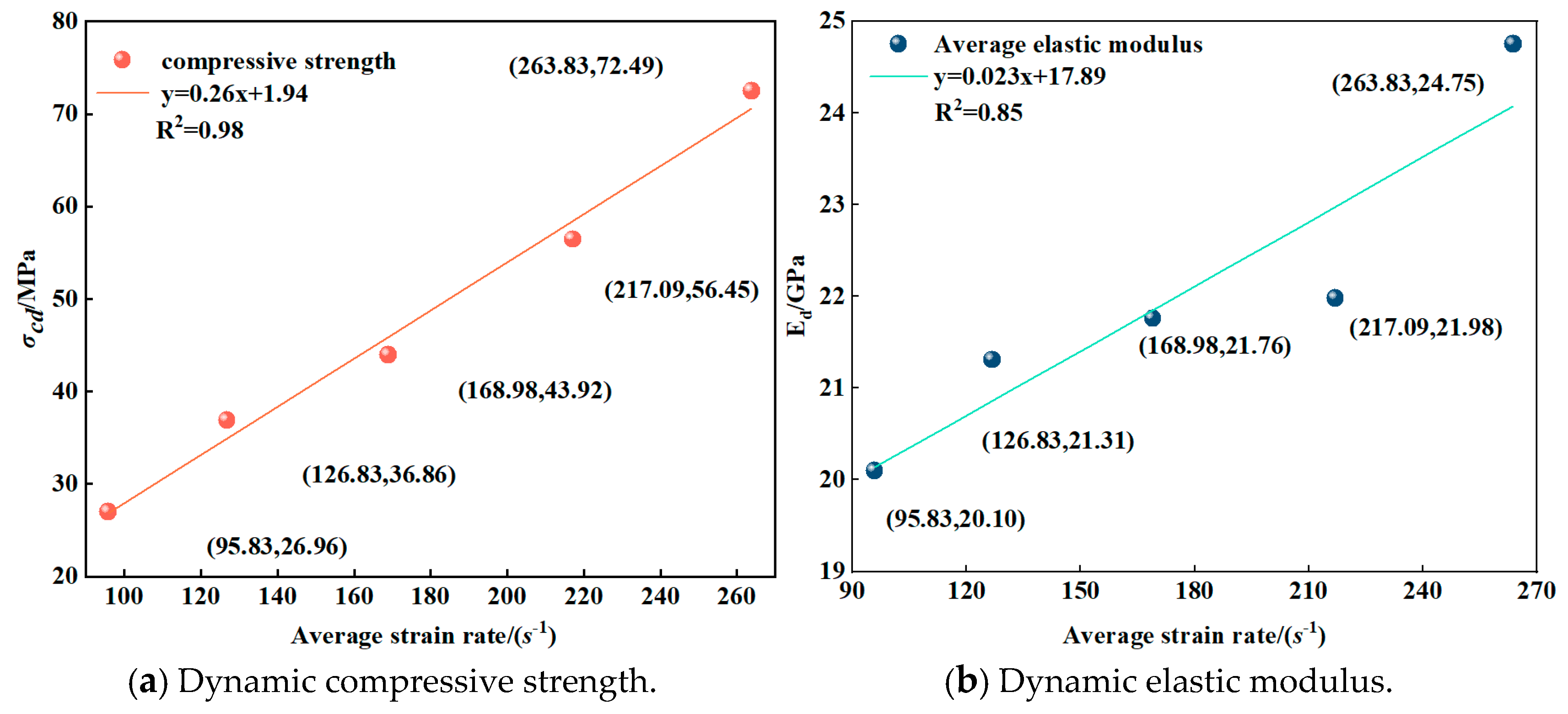
Figure 8 shows the relationships between average strain rate and mechanical parameters for the five representative specimens (CSC-5, CSC-7, CSC-13, CSC-20, and CSC-25): (a) dynamic compressive strength and (b) dynamic elastic modulus. It can be observed that both dynamic compressive strength and dynamic elastic modulus exhibit linear correlations with average strain rate. The coefficient of determination (R2) for the fitting curve of dynamic compressive strength is 0.98, while that for dynamic elastic modulus is 0.85. The fitting performance of dynamic compressive strength is better than that of dynamic elastic modulus, indicating that dynamic compressive strength is more sensitive to the change in average strain rate. The linear trends of these mechanical parameters reveal a remarkable strain-rate strengthening effect, namely that the mechanical parameters increase with rising average strain rate.
Figure 8.
Relationship between strain rate and mechanical parameters.
4. Energy Dissipation Characteristics of Coal–Siltstone Composites at Different Impact Velocities
4.1. Energy Evolution
The failure of coal–siltstone composites under dynamic loading is fundamentally an energy-driven instability process involving energy accumulation, release, and dissipation. Neglecting heat loss and electromagnetic energy, the energy carried by the stress waves can be expressed using Equations (4)–(6). Analyzing energy dissipation under dynamic loading provides insight into the underlying failure mechanisms during deformation of the composites.
where WI, WR and WT denote the energies carried by the incident, reflected, and transmitted waves, respectively; εI(t), εR(t) and εT(t) represent the corresponding wave strains at time (t); and A, E, CB are the cross-sectional area, Young’s modulus, and longitudinal wave velocity of the pressure bars, respectively.
According to the law of energy conservation, and neglecting frictional energy losses during impact, the energy absorbed by the coal–siltstone composite can be expressed as:
WA = WI − WR − WT
Here, the control volume is the specimen itself, and the integration window covers the full duration of stress wave propagation. WA represents the total apparent absorbed energy, which collectively includes fracture surface energy, fragment kinetic energy, remaining stored elastic energy, and thermal energy. Therefore, WA serves as a macroscopic indicator of the overall thermodynamic driving force for damage and fragmentation, rather than a direct quantitative measure of pure fracture-energy efficiency.
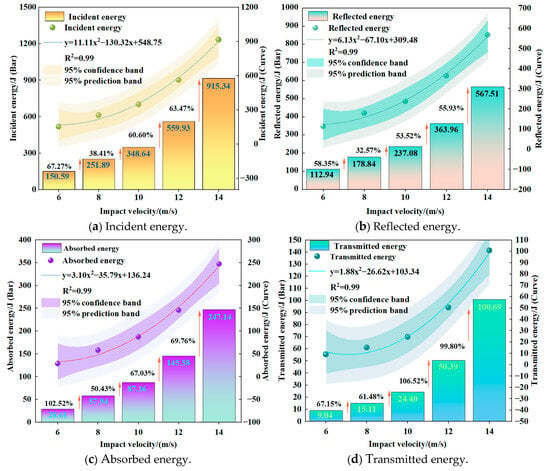
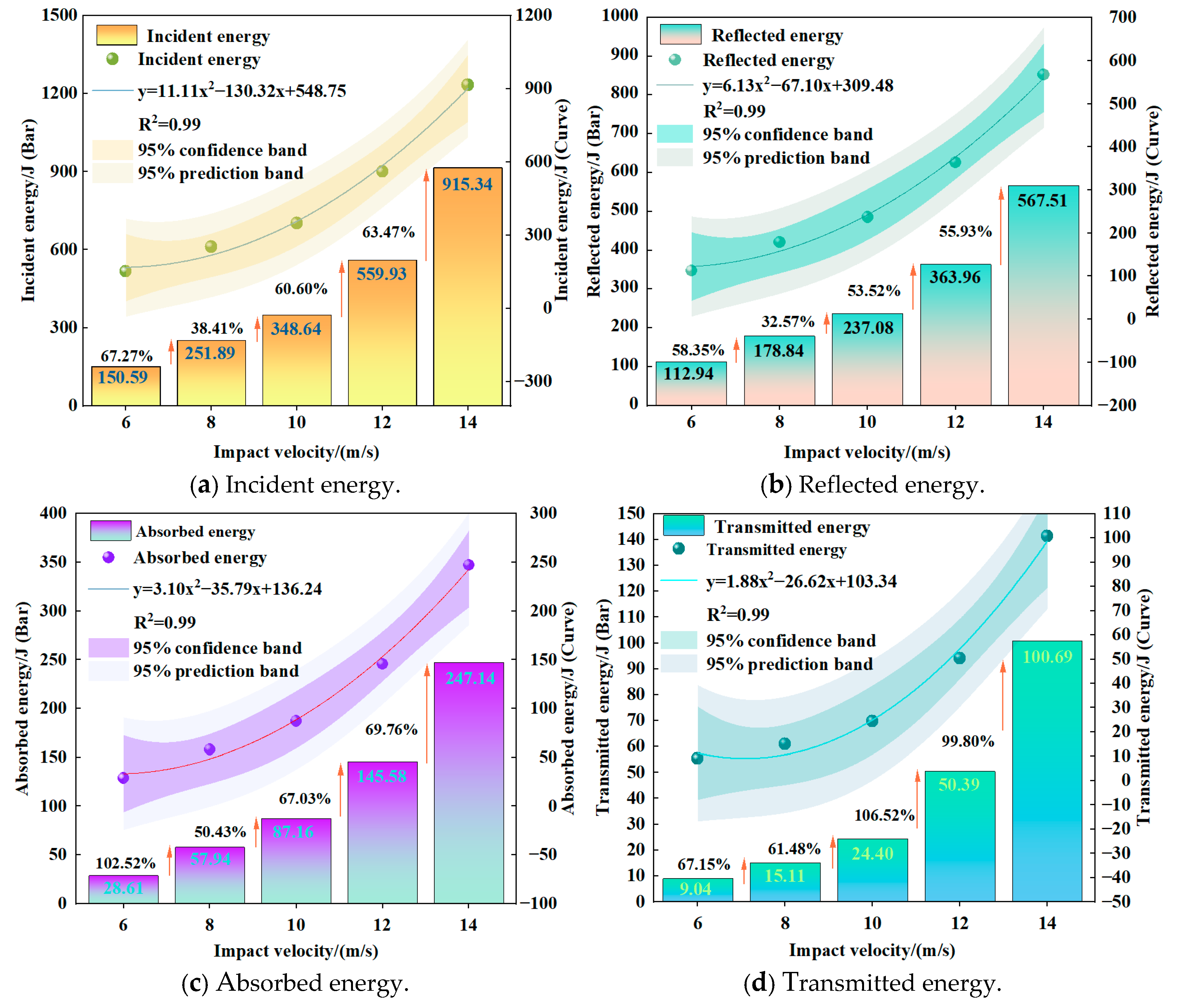
Figure 9 illustrates the relationships between impact velocity and incident, reflected, absorbed, and transmitted energies for the five representative specimens (CSC-5, CSC-7, CSC-13, CSC-20, and CSC-25), together with the corresponding fitted curves. All four fits yield a high coefficient of determination (R2) of 0.99. The left axis corresponds to the bar chart, while the right axis corresponds to the scatter points and the fitted curve. The figure displays 95% confidence bands and prediction bands. The confidence bands represent the statistical uncertainty of the fitted mean, reflecting the reliability of the regression trend, whereas the prediction bands depict the distribution of individual data points, indicating sample dispersion. Together, they assess the significance of the overall mechanical trend under varying impact velocities, quantify data dispersion, and identify outliers deviating from the general law. Specifically, narrower bands indicate better experimental repeatability within the impact velocity range, whereas wider bands suggest enhanced heterogeneity in the coal–rock mechanical response.
Figure 9.
Energy evolution relationship under different impact velocities.
At an impact velocity of 6 m/s, the incident, reflected, absorbed, and transmitted energies are 150.59, 112.94, 28.61, and 9.04 J, respectively. The corresponding values are 251.89, 178.84, 57.94, and 15.11 J at 8 m/s; 348.64, 237.08, 87.16, and 24.40 J at 10 m/s; 559.93, 363.96, 145.58, and 50.39 J at 12 m/s; and 915.34, 567.51, 247.14, and 100.69 J at 14 m/s. As the impact velocity increases from 6 to 14 m/s, all four energy components increase monotonically and are well described by quadratic functions of impact velocity.
Relative to the preceding velocity level, the incident, reflected, absorbed, and transmitted energies increase by 67.27%, 58.35%, 102.49%, and 67.15%, respectively, at 8 m/s. The corresponding increases are 38.41%, 32.57%, 50.44%, and 61.48% at 10 m/s; 60.60%, 53.52%, 67.03%, and 106.52% at 12 m/s; and 63.47%, 55.93%, 69.76%, and 99.82% at 14 m/s. Although all four energy components exhibit similar increasing trends, their relative increases differ, indicating changes in energy partitioning. Reflected energy increases less rapidly than incident energy, whereas absorbed and transmitted energies generally increase more rapidly. Thus, increasing incident energy is accompanied by greater energy absorption associated with damage and fragmentation of the coal–siltstone composites, as well as increased energy transfer through the specimens to the transmission bar.
4.2. Energy Transmission and Dissipation
To investigate the effects of incident energy on energy transmission and dissipation, the absorbed, reflected, and transmitted energy proportions are defined as the ratios of absorbed, reflected, and transmitted energies to incident energy, respectively. These proportions are used to quantify differences in energy reflection, absorption, and transmission in the coal–siltstone composites.
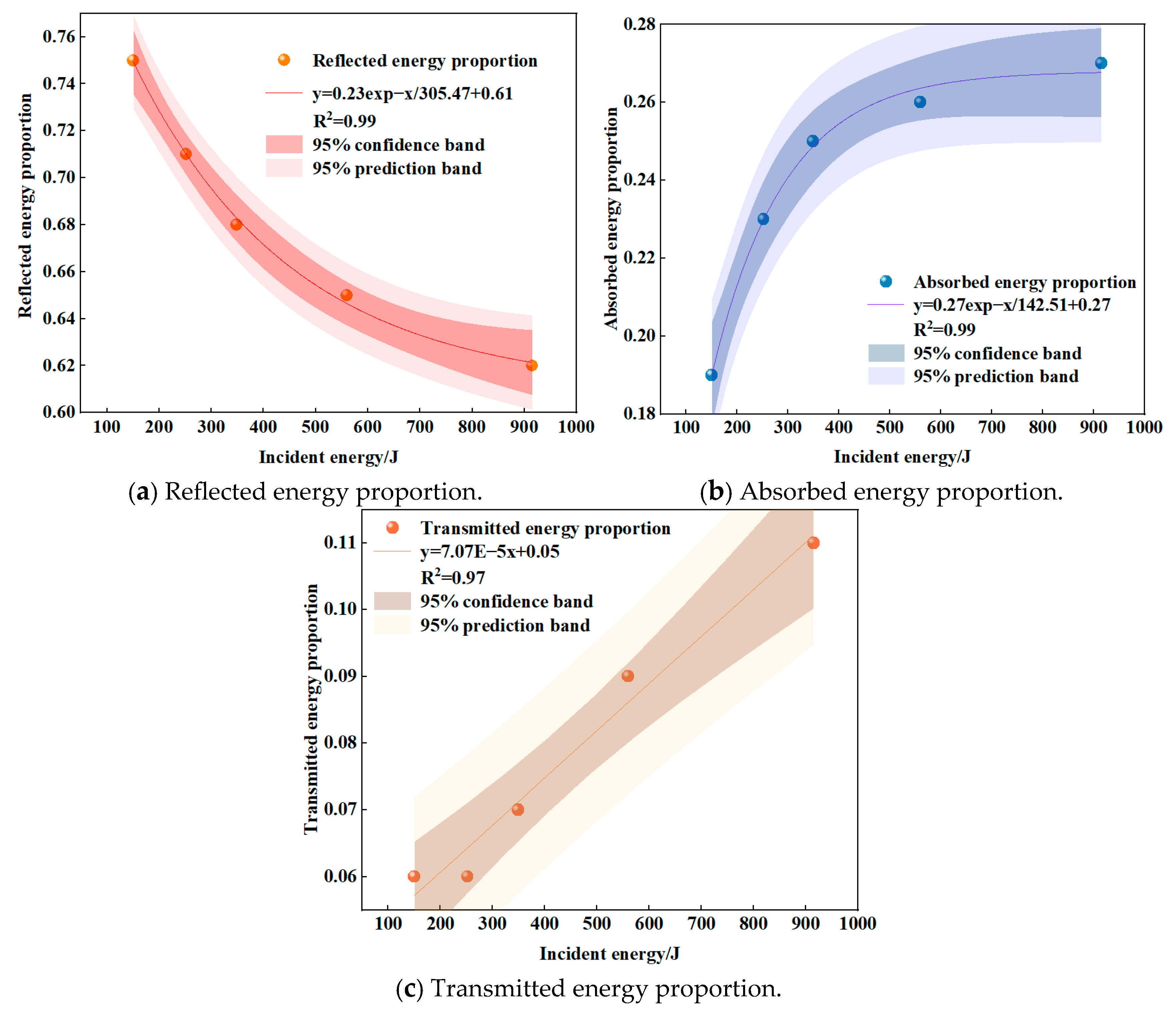
Figure 10 illustrates energy transmission and dissipation for the five representative specimens (CSC-5, CSC-7, CSC-13, CSC-20, and CSC-25) at different incident energy levels. The reflected, absorbed, and transmitted energy proportions are fitted separately, yielding coefficients of determination (R2) of 0.99, 0.99, and 0.97, respectively. As shown in Figure 10, when incident energy increases from 150.59 to 915.34 J, the reflected energy proportion decreases exponentially from approximately 75% to 62%, whereas the absorbed energy proportion increases from approximately 19% to 27%, following an exponential trend toward a plateau. Meanwhile, the transmitted energy proportion increases monotonically from 6% to 11%. The opposing trends in the reflected and absorbed energy proportions indicate a progressive redistribution of incident energy from reflection toward absorption.
Figure 10.
Energy transmission and dissipation under different incident energy levels.
These trends suggest that increasing incident energy facilitates stress-wave penetration into the coal–siltstone composites, reducing the relative contribution of reflection at the specimen surface. Consequently, a greater proportion of incident energy is absorbed by the composites, contributing to internal crack initiation, propagation, and structural damage. Beyond an incident energy of 348.64 J, corresponding to an impact velocity of 10 m/s, both the decrease in the reflected energy proportion and the increase in the absorbed energy proportion become less pronounced. The transmitted energy proportion remains approximately constant up to 251.89 J and then increases rapidly at higher incident energy levels.
5. Macroscopic Failure Characteristics of Coal–Siltstone Composites at Different Impact Velocities
5.1. Fragmentation Characteristics
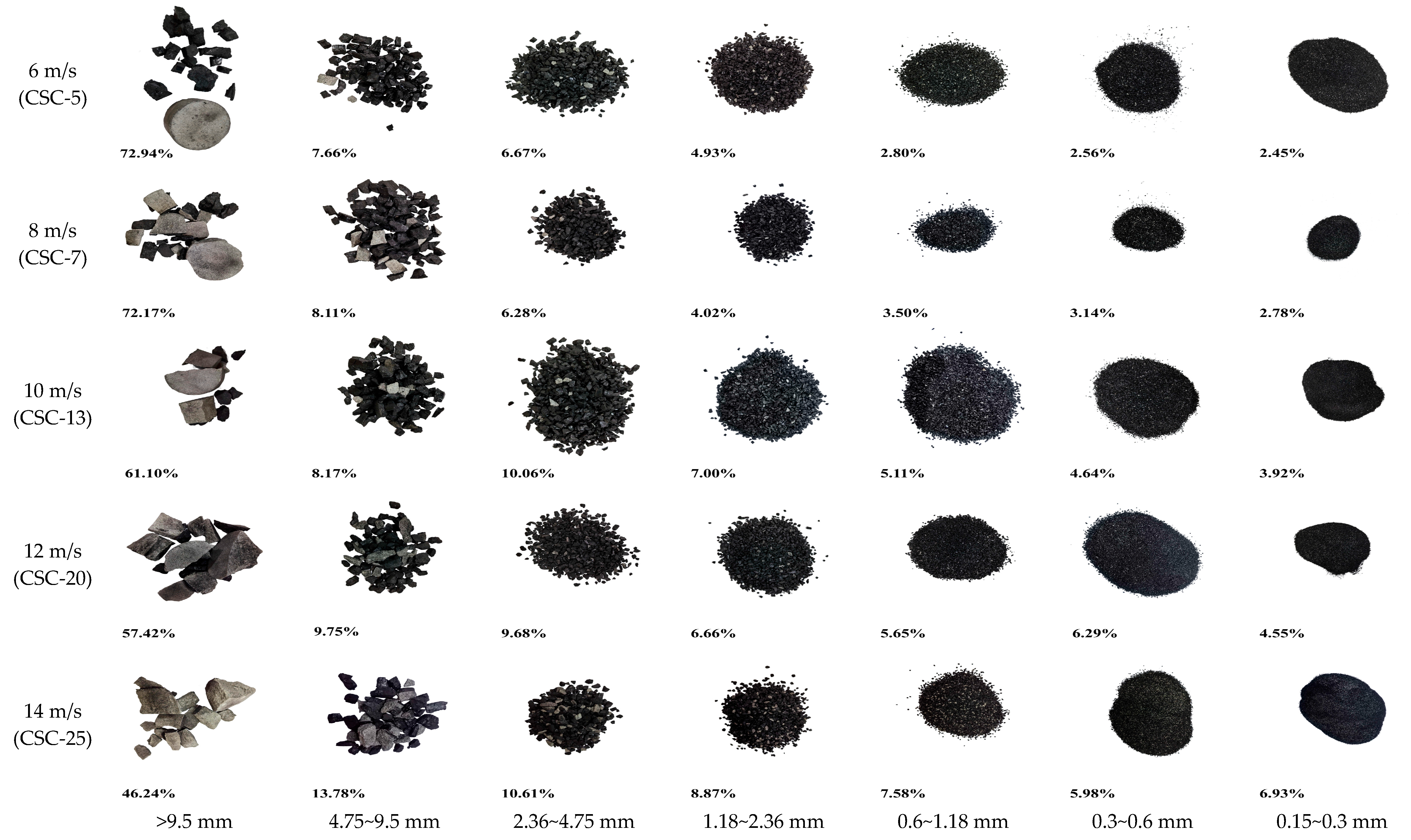
To investigate the effects of impact velocity on the fragmentation characteristics of coal–siltstone composites, representative specimens (CSC-5, CSC-7, CSC-13, CSC-20, and CSC-25, selected as their dynamic compressive strength was closest to the group-averaged value under each impact-velocity condition) were adopted in this test. Fragments recovered after impact testing were sieved using mesh openings of 9.5, 4.75, 2.36, 1.18, 0.6, 0.3, and 0.15 mm. The fragments in each size fraction were weighed to determine their mass fractions. The results are presented in Figure 11.
Figure 11.
Fragmentation characteristics of coal–siltstone composites under different impact velocities.
As shown in Figure 11, increasing impact velocity produces progressively finer fragments, with an increasing proportion of small fragments. The coal component exhibits substantially finer fragmentation than the siltstone component. Examination of the coarse fragments indicates that those larger than 9.5 mm consist predominantly of siltstone. Although fragments larger than 9.5 mm constitute the largest size fraction at all tested impact velocities, their mass fraction decreases with increasing impact velocity, while that of fragments smaller than 9.5 mm increases, indicating progressively more severe fragmentation.
At an impact velocity of 6 m/s, the siltstone component largely retains its original cylindrical shape, with a flat end face and good overall structural integrity. Only minor chipping occurs along its edges. In contrast, the coal component undergoes substantial fragmentation, producing several angular fragments with considerable variation in size. At 8 m/s, the siltstone component still consists predominantly of large blocks, but its original cylindrical outline is damaged. Pronounced edge chipping and a small number of surface cracks indicate reduced structural integrity. Meanwhile, the coal component produces more fragments with a smaller average size and a greater proportion of fine angular fragments. At 10 m/s, the original cylindrical structure of the siltstone component is completely disrupted. The larger fragments are predominantly semicylindrical or irregular angular blocks with rough fracture surfaces. The proportion of coal fragments decreases substantially, while overall fragmentation becomes more severe. At 14 m/s, the siltstone component breaks into irregular blocks of further reduced size, and no large intact coal blocks remain. Fragmentation is most extensive at this velocity.
These observations indicate that impact velocity is a key factor controlling the fragmentation of coal–siltstone composites. At 6, 8, and 10 m/s, localized damage and edge chipping are the predominant features, with comparatively limited fragmentation. As impact velocity and incident energy increase, the failure pattern evolves from localized damage to overall fragmentation. The two components exhibit distinctly different fragmentation responses: coal is more sensitive to impact velocity and more susceptible to extensive fragmentation, whereas siltstone fragmentation is primarily governed by crack development, coalescence, and subsequent block disintegration.
5.2. Failure Characteristics
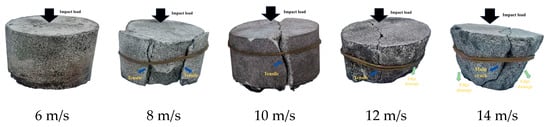
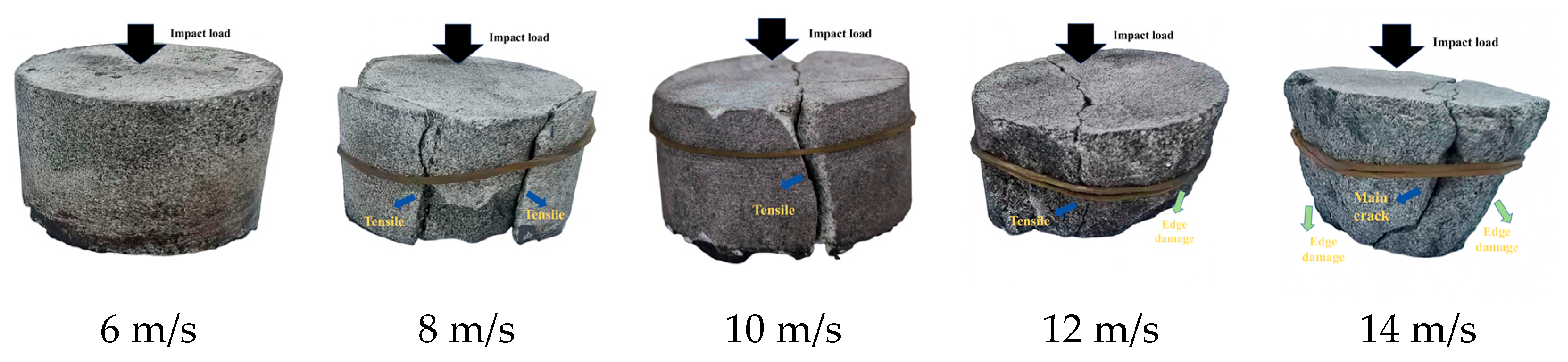
Over the impact velocity range of 6–14 m/s, the coal component undergoes complete fragmentation, whereas the siltstone component exhibits distinct failure characteristics at different velocities. This section therefore focuses on the failure characteristics of the siltstone component from representative specimens (CSC-5, CSC-7, CSC-13, CSC-20, and CSC-25), which were selected because their dynamic compressive strength was closest to the group-averaged value under each impact-velocity condition, as illustrated in Figure 12.
Figure 12.
Failure characteristics of the siltstone component under different impact velocities.
With increasing impact velocity, the surface crack morphology of the siltstone component progressively changes. Initially inconspicuous fine cracks develop into through-going fractures, while their orientations and spatial distributions become increasingly complex. At 6 m/s, the siltstone component remains intact, with no visible cracks. At 8 m/s, two longitudinal cracks extend through the siltstone component along its lateral surface, accompanied by minor localized chipping. At 10 m/s, a through-going tensile crack develops in the central region, together with localized fine cracks, splitting the siltstone component into large blocks and causing it to lose its load-bearing capacity. At 12 m/s, an irregular main tensile crack develops on the upper surface and propagates toward the edges, while localized cracking and damage are visible on the lateral and lower surfaces. At 14 m/s, the main crack extends obliquely from the central region to the lower surface and is accompanied by pronounced shear displacement. Edge spalling becomes more extensive, resulting in a more complex failure pattern.
5.3. Fragment Size and Fractal Dimension
To further analyze energy partitioning and size-dependent fragmentation characteristics of the coal–siltstone composites, the sieved fragments in each size class were weighed, and their mass percentages were calculated. The average fragment size, (Ds), was introduced to characterize the overall fineness of the recovered fragments and evaluate the influence of impact velocity on the degree of fragmentation.
where βi is the mass fraction of the fragmented coal–siltstone composite in the corresponding sieve size class, and Di the average fragment size within that class.
In the calculations, the representative sizes for the fractions were assigned as 9.5, 7.125, 3.555, 1.77, 0.89, 0.45, and 0.225 mm, respectively, and the total mass was defined by the actual recovered mass of the fragments. The fraction smaller than 0.15 mm was excluded from the analysis, given its negligible mass proportion and the experimental difficulty in complete recovery.
The fractal dimension, (D), was calculated from the relationship between fragment mass and equivalent edge length to characterize the size distribution of the fragmented coal–siltstone composite, as follows:
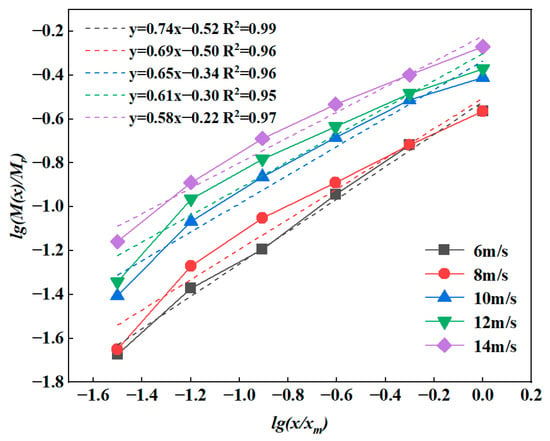
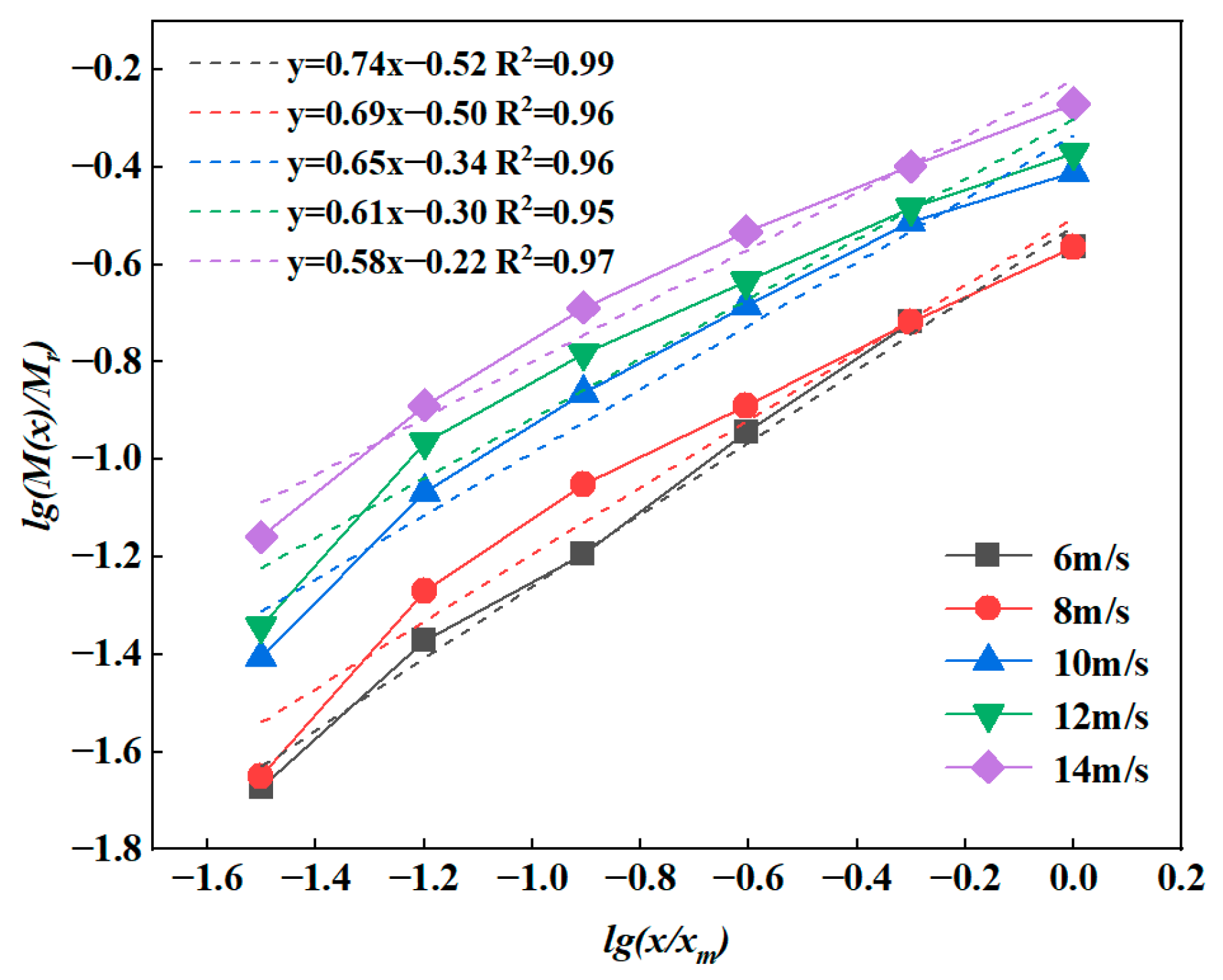
where (M(x)) and (Mr) denote the cumulative fragment mass corresponding to sieve size (x) and the total fragment mass, respectively; (x) and (xm) are the fragment size and maximum fragment size after fragmentation, respectively; and (α) is the slope of the fitted straight line.
D = 3 − α
lg[M(x)/Mr] = (3 − D)lg(x/xm)
Figure 13 shows that the logarithmic plots of the cumulative mass ratio M(x)/Mr against the normalised fragment size x/xm are linear for all impact velocities, with coefficients of determination (R2) exceeding 0.95 in every case. This pronounced linearity indicates a clear fractal character of the fragment size distributions under all tested impact velocities, confirming that these results are suitable for fractal analysis.
Figure 13.
Double-logarithmic linear fitting of fragment size distribution for coal–siltstone composites at different impact velocities.
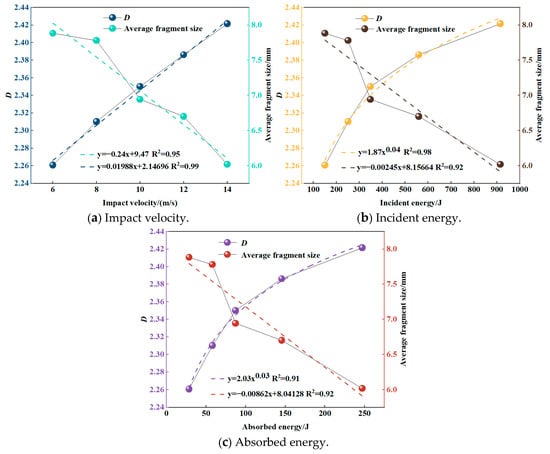
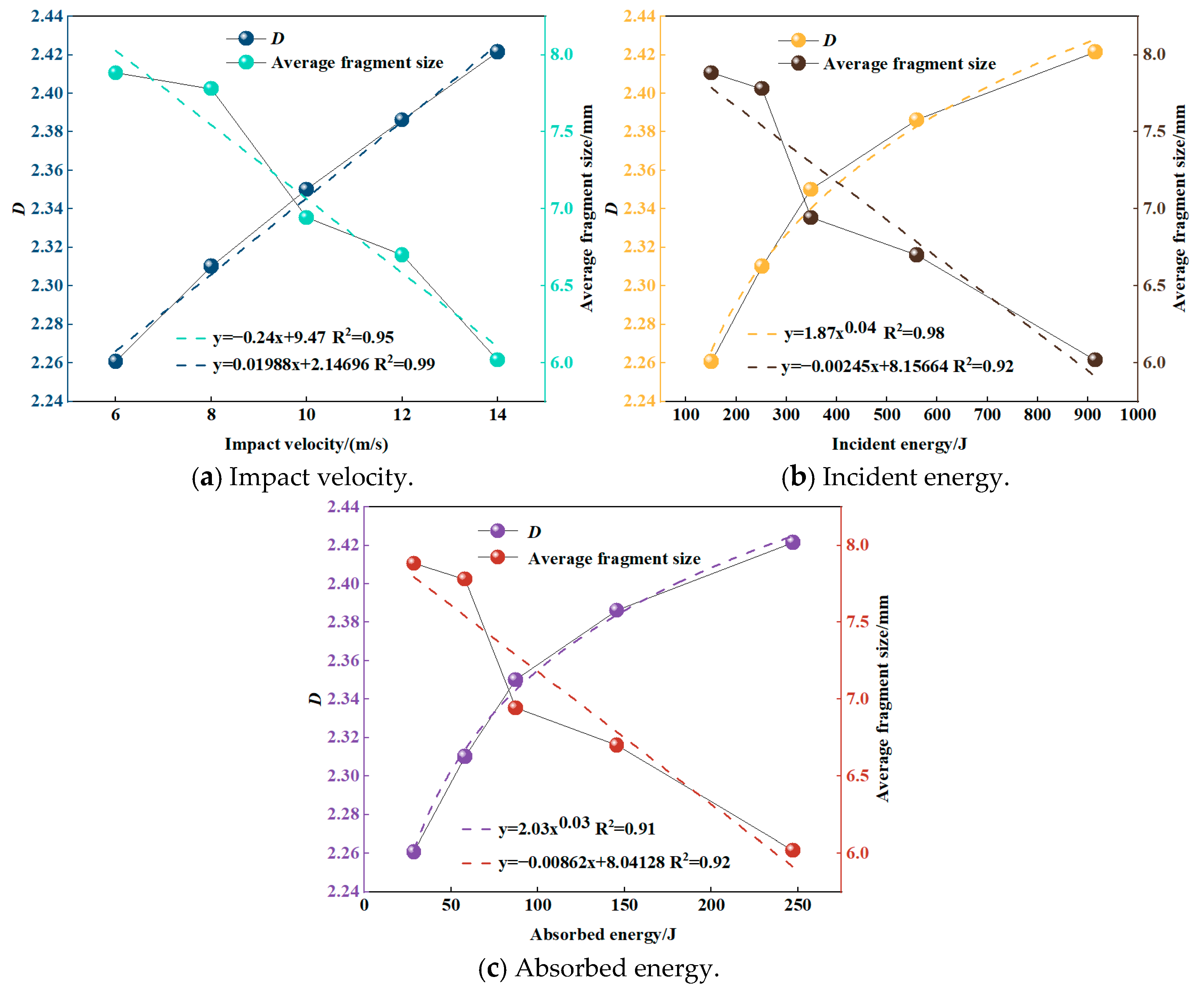
Based on the five representative specimens (CSC-5, CSC-7, CSC-13, CSC-20, and CSC-25), Figure 14a–c present the relationships of average fragment size and fractal dimension (D) with impact velocity, incident energy, and absorbed energy, respectively. Establishing these relationships links fragmentation characteristics to impact velocity and energy parameters, providing quantitative insight into the mechanisms underlying the dynamic fragmentation of coal–siltstone composites.
Figure 14.
Relationships of average fragment size and fractal dimension with different parameters.
As shown in Figure 14, the average fragment size decreases linearly with increasing impact velocity, incident energy, and absorbed energy, exhibiting consistent trends across all three parameters. Increasing impact velocity intensifies the impact loading applied to the specimens, resulting in progressively smaller fragments. Similarly, as incident and absorbed energies increase, more energy contributes to internal crack initiation, propagation, and coalescence, thereby reducing the average fragment size.
In contrast to average fragment size, the fractal dimension (D) increases monotonically with impact velocity. This indicates that stronger impact loading increases the proportion of small fragments and the overall degree of fragmentation. The fractal dimension follows increasing power-law relationships with both incident and absorbed energies, and its growth rate varies at around an incident energy of 348.64 J and an absorbed energy of 87.16 J within the tested range. Before these values, the fractal dimension rises rapidly with the increase in incident and absorbed energy; after these values, the growth rate of fractal dimension slows down obviously. Within the investigated loading conditions, the enhancement effect of energy on fragmentation is more prominent before these characteristic points, while further energy input yields a less evident promotion of fragmentation after these points.
To quantify test variability and ensure full traceability of the experimental data, detailed specimen-level results for all 25 coal–siltstone composite specimens are compiled in Table 2. Five impact velocity levels (6, 8, 10, 12 and 14 m/s) are included, with five parallel specimens tested under each condition. For each specimen, the table lists dynamic mechanical properties (dynamic compressive strength, average strain rate, peak strain and dynamic elastic modulus), energy evolution parameters (incident, reflected, absorbed and transmitted energy), fragment mass of each sieve fraction, total recovered mass, average fragment size and mass fractal dimension. The representative specimens used for curve analysis in the main text (CSC-5, CSC-7, CSC-13, CSC-20 and CSC-25) are those with dynamic compressive strength closest to the corresponding group mean at each velocity level.
Table 2.
Detailed SHPB test results of coal–siltstone composite specimens.
6. Discussion
(1) Interface Effects and Stress-Wave Propagation
The nonuniform deformation of coal–siltstone composites is closely associated with differences in constituent stiffness and interfacial constraints. The static elastic moduli of coal and siltstone are 9.22 and 26.32 GPa, respectively, indicating greater axial compliance in coal. Under approximate axial force equilibrium, coal contributes more to the overall deformation, whereas interfacial bonding constrains differential lateral deformation, potentially inducing additional shear stresses and local stress redistribution. The impedance discontinuity also causes stress-wave reflection and transmission at the internal interface, modifying the loading history experienced by each constituent. Ji et al. [38] found that changing the coal–rock arrangement altered both the transmitted waves and dynamic strength, demonstrating the combined influence of boundary contact and internal propagation paths on composite load-bearing behavior.
An intact epoxy layer maintains load transfer between the constituents, whereas local shear deformation or debonding modifies interfacial constraints and energy partitioning. The decreasing reflected-energy proportion and increasing absorbed- and transmitted-energy proportions observed here indicate a redistribution of incident energy with increasing loading intensity. The absorbed-energy balance includes contributions from constituent cracking, adhesive deformation, interfacial friction, fragment kinetic energy, and energy remaining stored at the end of the integration interval. Xie et al. [39] further showed that pre-existing crack distributions and interfacial contact conditions influence crack propagation paths in specimens with natural and artificial interfaces. Accordingly, the behavior reported here represents the global response arising from coupled constituent deformation, interface interaction, and stress-wave propagation under the specified artificial bonding conditions.
(2) Weak-Component Control of Load-Bearing Capacity and Failure
The static compressive strength of the composite is 23.19 MPa, close to that of coal at 21.90 MPa and substantially lower than that of siltstone at 66.68 MPa. This indicates a pronounced influence of the weaker constituent on global load-bearing capacity. The lower stiffness of coal promotes deformation accumulation, while its lower strength allows damage conditions to be reached earlier. As damage develops within coal, the continuity of the overall load-transfer path deteriorates, allowing local integrity in siltstone to coexist with global composite instability. Interfacial confinement may enhance the local load-bearing capacity of adjacent coal, but the overall response still depends on whether the weaker regions can sustain continuous load transfer. This interpretation also accounts for the contrasting post-impact fragmentation patterns, with coal forming fine fragments and siltstone predominantly retaining larger blocks.
Published single-material tests provide corresponding strength comparisons. Zhang et al. [40] measured a dynamic peak stress of 77.56 MPa for siltstone at 98.97 s−1, whereas the composite investigated here exhibits a mean strength of 26.46 MPa at a mean strain rate of approximately 95.02 s−1. Wang et al. [41] reported hard-coal peak stresses of 25.999 and 30.152 MPa at maximum strain rates of 90.090 and 97.434 s−1, respectively, which are comparable in magnitude to the present composite strength. These relationships are consistent with weak-component control of load-bearing capacity. The comparisons emphasize response characteristics, while the absolute strength levels also depend on material origin, strain-rate definition, and waveform conditions. For the single coal type and siltstone lithology investigated here, constituent strength and stiffness ratios, together with pore and fracture structures, provide the material basis for the observed behavior.
(3) Competition Between Loading Rate and Peak Deformation
The increase in dynamic strength and the nonmonotonic evolution of peak strain reflect different relationships between load-bearing enhancement and deformation instability. Crack propagation occurs over a finite timescale. Under faster loading, a specimen may sustain higher stress before through-going failure develops, producing an apparent rate-strengthening response. Peak strain additionally depends on the spatial distribution of damage and the timing of local load-path failure. Distributed damage can accommodate continued global deformation, whereas localized crack coalescence may terminate this process earlier. Consequently, an extended nonlinear deformation segment may include contributions from microcracking and relative interfacial displacement, and its evolution need not coincide with changes in global strength.
The relatively high peak strain at 12 m/s may correspond to more extensive pre-peak deformation accumulation. The reduction in peak strain, shorter post-peak softening segment, and more severe fragmentation at 14 m/s are consistent with damage localization restricting further global deformation. The DIC observations of Ji et al. [38] revealed localized deformation on the coal side, while Li et al. [36] showed that successive stress-wave passages continued to modify coal-surface displacement. Cheng et al. [42] observed decreasing dynamic strength and deformation modulus as damage accumulated under high static stress and repeated impacts, further illustrating the influence of loading history and damage state. The interpretation proposed here is based on mean strain rates of approximately 95–262 s−1, global stress–strain curves, and post-test morphology. Local deformation-field measurements would further resolve the temporal relationship between constituent damage and global instability. Within this framework, 12 m/s denotes the tested loading condition with the highest mean peak strain among the five velocity levels.
From an engineering perspective, the laboratory results provide experimental references for dynamic disaster prevention in deep coal mining. For on-site coal–rock composite structures, reasonable impact loading and input energy levels should be determined to avoid large-span roof collapse induced by intensive mining disturbance. The peak strain range obtained from laboratory tests can offer conditional guidance for rock burst risk assessment. Direct engineering application requires further verification in combination with geological conditions, in-situ stress and natural interface characteristics.
(4) Fragmentation Evolution and Mixed Fractal Characteristics
Composite refinement results from different degrees of fragmentation in the two constituents. At lower impact velocities, coal is already extensively fragmented, whereas siltstone retains relatively good block integrity. As loading intensity increases, siltstone crack patterns become more complex, subdividing larger blocks and shifting mass toward smaller size fractions. The decrease in the mass fraction of fragments larger than 9.5 mm from 72.94% to 46.24% reflects this grading evolution as siltstone becomes increasingly involved in overall fragmentation. Composite fragmentation therefore comprises both extensive coal comminution and the progression of siltstone from cracking to block disintegration.
The decreasing mean fragment size and increasing mass fractal dimension describe this process through weighted size and cumulative mass distribution, respectively. The relationship between energy and mass fractal dimension reported by Ji et al. [38] is consistent with the overall trend observed here. Nevertheless, the mixed mass fractal dimension incorporates both constituent fragmentation and changes in grading composition, and describes a different physical quantity from the surface-crack box-counting dimension employed by Xie et al. [39].Similarly, Liu et al. [43] investigated the fractal characteristics of rock failure under true triaxial unloading and demonstrated that the evolution of crack fractal dimensions is closely related to the macroscopic and microscopic failure modes (e.g., the transition from tension to shear failure) under complex stress states. As additional energy is partitioned into further cracking, interfacial sliding, and fragment motion, the sensitivity of grading composition to energy input can change. The rate of increase in fractal dimension and the efficiency of energy dissipation through fracture therefore describe different aspects of the response.
The energy–fractal relationships established from the five representative specimens describe continuous empirical trends within the tested range. Fine-particle recovery losses, the 0.15 mm lower sieving cutoff, and the representative size assigned to the open-ended coarse fraction jointly define the statistical scope of the particle-size indicators. Taken together, the mechanical, energy, and fragmentation results support an interpretation of composite dynamic failure as a coupled process involving weak-component damage, interfacial load transfer, and progressive fragmentation of the stronger constituent. These findings provide experimental evidence for characterizing differential damage in layered coal–rock structures.
7. Conclusions
(1) The dynamic mechanical response of coal–siltstone composites exhibits pronounced nonlinear dependence on impact velocity. Over the velocity range of 6–14 m/s, the average dynamic compressive strength increases steadily from 26.46 to 72.47 MPa, whereas the average peak strain follows a nonmonotonic trend, increasing from 0.045 to 0.091 before decreasing to 0.057. Increasing impact velocity shortens the initial compaction stage, increases the relative extent of the plastic deformation stage, and accelerates the post-peak stress drop, indicating greater irreversible deformation and more abrupt unstable failure.
(2) Incident, reflected, absorbed, and transmitted energies increase with impact velocity according to quadratic relationships, although their relative increases differ substantially. Reflected energy increases less rapidly than incident energy, whereas absorbed energy increases more rapidly. With increasing incident energy, the reflected energy proportion decreases exponentially, the absorbed energy proportion increases toward a plateau following an exponential relationship, and the transmitted energy proportion increases monotonically. These trends indicate a shift in energy partitioning toward greater absorption and transmission. The increase in absorbed energy depends on both the increase in incident energy and its partitioning into reflected and transmitted components, which together govern the energy balance of the composites under impact loading.
(3) Fragmentation becomes progressively more severe with increasing impact velocity. The mass fraction of fragments larger than 9.5 mm decreases from 72.94% to 46.24%, indicating progressive fragment refinement. The coal component predominantly breaks into fine fragments, whereas the siltstone component primarily undergoes crack propagation and coalescence followed by block disintegration. Coarse fragments consist mainly of siltstone. With increasing impact velocity, the siltstone component evolves from a largely intact state to longitudinal tensile cracking and subsequently to mixed tensile–shear failure. Pronounced shear displacement occurs at 14 m/s, reflecting a transition from relatively simple to more complex failure modes.
(4) The average fragment size decreases linearly with increasing impact velocity, incident energy, and absorbed energy. The fractal dimension increases monotonically with impact velocity and follows increasing power-law relationships with incident and absorbed energies. These results suggest threshold energy levels below which increasing energy has a pronounced effect on fragmentation. Beyond these levels, the fractal dimension continues to increase, but at a diminishing rate. Specifically, its increase becomes less pronounced when incident energy reaches 348.64 J and absorbed energy reaches 87.16 J.
Author Contributions
Conceptualization, J.P., H.Z. and Z.W.; Methodology, J.P. and L.F.; Software, H.Z.; Validation, J.P.; Formal Analysis, J.P. and J.X.; Investigation, J.P. and H.Z.; Resources, J.P. and J.X.; Data Curation, H.Z.; Writing—Original Draft, H.Z. and L.F.; Writing—Review & Editing, J.P. and L.F.; Visualization, H.Z.; Supervision, J.P. and Z.W.; Project Administration, J.P., Z.W. and J.X.; Funding Acquisition, J.P. All authors have read and agreed to the published version of the manuscript.
Funding
This research was supported by the Fundamental Research Program of Shanxi Province (No. 202303021222168), the Key Research and Development Program of Shanxi Province (No. 202402090301014), and the Shanxi Key Laboratory of Dust Occupational Hazard Prevention and Intelligent Equipment Research for Coal Mine Safety (No. 202504010932032).
Data Availability Statement
The original contributions presented in this study are included in the article. Further inquiries can be directed to the corresponding authors.
Conflicts of Interest
The authors declare no conflict of interest.
References
- Li, X.B.; Lok, T.S.; Zhao, J. Dynamic characteristics of granite subjected to intermediate loading rate. Rock Mech. Rock Eng. 2005, 38, 21–39. [Google Scholar] [CrossRef] [Scilit]
- Wang, W.; Zhang, Z.; Huo, Q.; Song, X.; Yang, J.; Wang, X.; Wang, J.; Wang, X. Dynamic compressive mechanical properties of UR50 ultra-early-strength cement-based concrete material under high strain rate on SHPB test. Materials 2022, 15, 6154. [Google Scholar] [CrossRef] [Scilit]
- Liu, X.; Dai, F.; Zhang, R.; Liu, J. Static and dynamic uniaxial compression tests on coal rock considering the bedding directivity. Environ. Earth Sci. 2015, 73, 5933–5949. [Google Scholar] [CrossRef] [Scilit]
- Li, M.; Liang, W.; Yue, G.; Zheng, X.; Liu, H. Dynamic mechanical properties of structural anisotropic coal under low and medium strain rates. PLoS ONE 2020, 15, e0236802. [Google Scholar] [CrossRef] [Scilit]
- Gong, F.; Ye, H.; Luo, Y. The effect of high loading rate on the behaviour and mechanical properties of coal-rock combined body. Shock Vib. 2018, 2018, 4374530. [Google Scholar] [CrossRef] [Scilit]
- He, Y.; Li, Z.; Zhang, Z.; Qian, R.; Fu, Y.; Ma, K. Physical simulation of roadway surrounding rock cumulative failure characteristics under dynamic loading and energy-absorbing support solutions. Sci. Rep. 2026, 16, 22345. [Google Scholar] [CrossRef] [Scilit]
- Wang, K.; Fu, Q.; Xu, C.; Ai, Z.; Li, D.; Shu, L. The strength characteristics and competitive failure mechanism of primary coal-rock combination considering interface damage quantity. Fuel 2023, 352, 129057. [Google Scholar] [CrossRef] [Scilit]
- Zhao, Z.; Wang, W.; Wang, L.; Dai, C. Compression–shear strength criterion of coal–rock combination model considering interface effect. Tunn. Undergr. Space Technol. 2015, 47, 193–199. [Google Scholar] [CrossRef] [Scilit]
- Su, Q.; Ma, Q.; Ma, D.; Yuan, P. Dynamic mechanical characteristic and fracture evolution mechanism of deep roadway sandstone containing weakly filled joints with various angles. Int. J. Rock Mech. Min. Sci. 2021, 137, 104552. [Google Scholar] [CrossRef] [Scilit]
- Gu, Z.; Shen, R.; Liu, Z.; Zhao, E.; Chen, H.; Yuan, Z.; Chu, X.; Tian, J. Dynamic characteristics of coal under triaxial constraints based on the Split–Hopkinson pressure bar test system. Nat. Resour. Res. 2023, 32, 587–601. [Google Scholar] [CrossRef] [Scilit]
- Gong, F.-Q.; Si, X.-F.; Li, X.-B.; Wang, S.-Y. Dynamic triaxial compression tests on sandstone at high strain rates and low confining pressures with split Hopkinson pressure bar. Int. J. Rock Mech. Min. Sci. 2019, 113, 211–219. [Google Scholar] [CrossRef] [Scilit]
- Ai, D.; Zhao, Y.; Wang, Q.; Li, C. Crack propagation and dynamic properties of coal under SHPB impact loading: Experimental investigation and numerical simulation. Theor. Appl. Fract. Mech. 2020, 105, 102393. [Google Scholar] [CrossRef] [Scilit]
- Hao, X.; Chen, B.; Pan, G.; Zhang, Q.; Chen, Y.; Wei, Y. Testing and comparative analysis of dynamic and quasi-static compressive and tensile properties of hard coal. Int. J. Oil Gas Coal Technol. 2023, 33, 37–54. [Google Scholar] [CrossRef] [Scilit]
- Xie, H.; Li, L.; Peng, R.; Ju, Y. Energy analysis and criteria for structural failure of rocks. J. Rock Mech. Geotech. Eng. 2009, 1, 11–20. [Google Scholar] [CrossRef] [Scilit]
- Gong, F.-Q.; Luo, Y.; Li, X.-B.; Si, X.-F.; Tao, M. Experimental simulation investigation on rockburst induced by spalling failure in deep circular tunnels. Tunn. Undergr. Space Technol. 2018, 81, 413–427. [Google Scholar] [CrossRef] [Scilit]
- Li, X.; Chen, S.; Wang, E.; Li, Z. Rockburst mechanism in coal rock with structural surface and the microseismic (MS) and electromagnetic radiation (EMR) response. Eng. Fail. Anal. 2021, 124, 105396, Corrigendum in Eng. Fail. Anal. 2021, 128, 105523. [Google Scholar] [CrossRef] [Scilit]
- Kong, X.; Wang, E.; Li, S.; Lin, H.; Zhang, Z.; Ju, Y. Dynamic mechanical characteristics and fracture mechanism of gas-bearing coal based on SHPB experiments. Theor. Appl. Fract. Mech. 2020, 105, 102395. [Google Scholar] [CrossRef] [Scilit]
- Yin, Z.; Chen, W.; Hao, H.; Chang, J.; Zhao, G.; Chen, Z.; Peng, K. Dynamic compressive test of gas-containing coal using a modified split Hopkinson pressure bar system. Rock Mech. Rock Eng. 2020, 53, 815–829. [Google Scholar] [CrossRef] [Scilit]
- Wang, C.; Xu, X.; Zhang, Y.; Arif, M.; Wang, Q.; Iglauer, S. Experimental and numerical investigation on the dynamic damage behavior of gas-bearing coal. Geomech. Geophys. Geo-Energy Geo-Resour. 2022, 8, 49. [Google Scholar] [CrossRef] [Scilit]
- Wang, Y.; Yang, Y.; Zhang, Y.; Wang, J. Dynamic Mechanical Properties of Coals Subject to the Low Temperature-Impact Load Coupling Effect. Sci. Rep. 2019, 9, 20218. [Google Scholar] [CrossRef] [Scilit]
- Gu, H.; Tao, M.; Li, X.; Li, Q.; Cao, W.; Wang, F. Dynamic response and failure mechanism of fractured coal under different soaking times. Theor. Appl. Fract. Mech. 2018, 98, 112–122. [Google Scholar] [CrossRef] [Scilit]
- Gong, S.; Zhou, L.; Wang, W.; Wang, C. Investigation of dynamic fracture behavior and energy dissipation of water-bearing coal under impact load. Eng. Fract. Mech. 2022, 275, 108793. [Google Scholar] [CrossRef] [Scilit]
- He, Y.; Li, Z.; Zhang, Z.; Liu, G.; Barakos, G.; Chang, P. Fracture Evolution Characteristics and Permeability of Coal Treated with CO2 Phase Transition Fracturing. Energies 2026, 19, 3569. [Google Scholar] [CrossRef] [Scilit]
- Song, S.; Liu, X.; Tan, Y.; Fan, D.; Ma, Q.; Wang, H. Study on failure modes and energy evolution of coal-rock combination under cyclic loading. Shock Vib. 2020, 2020, 5731721. [Google Scholar] [CrossRef] [Scilit]
- Zhang, G.; Wang, L.; Qin, T.; Li, J.; Liu, G.; Li, Y. The failure characteristics and energy evolution pattern of compound coal–rock under the action of cyclic loading. Sustainability 2023, 15, 4133. [Google Scholar] [CrossRef] [Scilit]
- Gong, S.; Jiang, Y.; Zhang, Z.; Zhang, C.; Zhao, Y. Fractal characteristics of crack propagation in coal under impact loading. Fractals 2018, 26, 1840014. [Google Scholar] [CrossRef] [Scilit]
- Ai, D.; Zhao, Y.; Wang, Q.; Li, C. Experimental and numerical investigation of crack propagation and dynamic properties of rock in SHPB indirect tension test. Int. J. Impact Eng. 2019, 126, 135–146. [Google Scholar] [CrossRef] [Scilit]
- Friesen, W.I.; Mikula, R.J. Fractal dimensions of coal particles. J. Colloid Interface Sci. 1987, 120, 263–271. [Google Scholar] [CrossRef] [Scilit]
- Wang, G.; Shen, J.; Liu, S.; Jiang, C.; Qin, X. Three-dimensional modeling and analysis of macro-pore structure of coal using combined X-ray CT imaging and fractal theory. Int. J. Rock Mech. Min. Sci. 2019, 123, 104082. [Google Scholar] [CrossRef] [Scilit]
- Zhang, Z.; Liu, G.; He, Y.; Wang, X.; Barakos, G.; Chang, P. Multifractal Evolution Characteristics of Multiscale Fracture-Pore Structures in Coal under CO2 Phase-Transition Fracturing. Energy Fuels 2026, 40, 23684–23700. [Google Scholar] [CrossRef] [Scilit]
- Feng, J.; Wang, E.; Huang, Q.; Ding, H.; Ma, Y. Study on coal fractography under dynamic impact loading based on multifractal method. Fractals 2020, 28, 2050006. [Google Scholar] [CrossRef] [Scilit]
- Li, S.H.; Zhu, W.C.; Niu, L.L.; Yu, M.; Chen, C.F. Dynamic characteristics of green sandstone subjected to repetitive impact loading: Phenomena and mechanisms. Rock Mech. Rock Eng. 2018, 51, 1921–1936. [Google Scholar] [CrossRef] [Scilit]
- Sha, Z.; Pu, H.; Xu, J.; Ni, H.; Guo, S. Effects of accumulated damage on the dynamic properties of coal measures sandstone. Minerals 2022, 12, 810. [Google Scholar] [CrossRef] [Scilit]
- Zhang, Z.; Liu, G.; Lin, J.; Barakos, G.; Chang, P. Fractal Evolution Characteristics on the Three-Dimensional Fractures in Coal Induced by CO2 Phase Transition Fracturing. Fractal Fract. 2024, 8, 273. [Google Scholar] [CrossRef] [Scilit]
- Li, P.; Luo, N.; Suo, Y.; Zhai, C.; Sun, W. Research on petrophysical properties and porosity evolution of fractured coal mass under cyclic impact for coalbed methane exploitation. Geomech. Energy Environ. 2024, 37, 100533. [Google Scholar] [CrossRef] [Scilit]
- Li, X.; Zhao, E.; Liu, Z.; Liu, Y.; Feng, X.; Gu, Z. Experimental study on multiple propagation characteristics of stress wave and surface displacement behavior in coal based on SHPB and DIC. Bull. Eng. Geol. Environ. 2023, 82, 246. [Google Scholar] [CrossRef] [Scilit]
- Yu, X.; Shi, K.; Wang, Y.; Liu, T.; Tang, W. Fracture toughness and failure mode of Wufeng–Longmaxi shale under explosion load impact. J. China Coal Soc. 2023, 48, 4322–4335. [Google Scholar] [CrossRef]
- Ji, D.; Vanapalli, S.K.; Zhao, H.; Yue, Z. Dynamic response and constitutive model for coal-rock composite material subjected to impact loading. Eng. Fract. Mech. 2024, 312, 110616. [Google Scholar] [CrossRef] [Scilit]
- Xie, B.; Luan, Z.; Wang, Q.; Yao, C.; Zhong, S. Effect of Primary/Artificial Interface on Dynamic Failure Behavior of Combined Coal and Rock: Monitoring by High-Speed Imaging and Scanning Electron Microscopy. ACS Omega 2024, 9, 43593–43608. [Google Scholar] [CrossRef] [Scilit]
- Zhang, G.; Jia, H.; Wu, S. Study on Dynamic Mechanical Properties and Damage Evolution Model of Siltstone. Shock Vib. 2019, 2019, 5174579. [Google Scholar] [CrossRef] [Scilit]
- Wang, H.; Xu, W.; Cheng, B.; Zong, Q. Research on Particle Size and Energy Consumption Law of Hard Coal Crushing under Impact Load Based on SHPB Test. Appl. Sci. 2023, 13, 3298. [Google Scholar] [CrossRef] [Scilit]
- Cheng, L.; Wang, C.; Tang, L.; Wang, C.; Xiong, Z.; Wei, S.; Chen, Y.; Liu, T.; Wei, Y. Study on Dynamic Characteristics of Deep Siltstone under High Static Stress and Frequent Dynamic Disturbance. Adv. Civ. Eng. 2019, 2019, 2087684. [Google Scholar] [CrossRef] [Scilit]
- Liu, C.Y.; Zhao, G.M.; Pan, C.; Meng, X.R.; Xu, W.S. Experimental study of rock failure and fractal characteristics under true triaxial unloading. Fractal Fract. 2025, 9, 182. [Google Scholar] [CrossRef] [Scilit]



Disclaimer/Publisher’s Note: The statements, opinions and data contained in all publications are solely those of the individual author(s) and contributor(s) and not of MDPI and/or the editor(s). MDPI and/or the editor(s) disclaim responsibility for any injury to people or property resulting from any ideas, methods, instructions or products referred to in the content. |
© 2026 by the authors. Licensee MDPI, Basel, Switzerland. This article is an open access article distributed under the terms and conditions of the Creative Commons Attribution (CC BY) license.