


Abstract
The ever-increasing complexity of mining processes and increasingly stringent requirements for efficiency, safety, and environmental performance drive mining companies’ need for comprehensive decision support tools that address the multi-criteria nature of asset management tasks. Existing approaches to belt conveyor maintenance, as key equipment in this industry, are often based on isolated indicators or subjective experience, preventing the identification of a globally optimal solution balancing economic and technical parameters. Therefore, in the context of the development of Industry 4.0, the concept of a digital twin for belt conveyor modeling is gaining significant practical significance. The objective of this study is to investigate a methodology for multi-criteria optimization of the operational condition of belt conveyors based on their digital twin. This study explored NSGA-II Pareto multi-criteria optimization methods to find a compromise between parameters for a PI controller of a belt conveyor electric drive that could reduce net electrical energy consumption. The simulation results obtained during the adjustment of the cascade control system regulators demonstrated the efficiency and practical significance of the proposed belt conveyor design methodology.
1. Introduction
The modern mining industry is characterized by the increasing complexity of technological processes and increasingly stringent requirements for their efficiency, safety, and environmental friendliness [1,2,3]. Moreover, the operation of key equipment, such as belt conveyors, is associated with the need to make management decisions under conflicting criteria. The desire to maximize productivity may conflict with the requirements to reduce energy consumption, increase intervals between repairs, and minimize operating costs [4,5,6]. The current level of technological development does not always allow for the prompt and affordable conduct of a full-scale experiment that can change the operating modes of such a large-scale and inertial object in order to evaluate the consequences of such decisions [7,8,9]. Its use allows for in-depth analysis, virtual testing, and process optimization without interfering with real production, which is especially valuable for facilities operating in extreme or difficult-to-simulate conditions [10,11,12].
The relevance of this study stems from the growing need of mining companies for comprehensive decision support tools that account for the multi-criteria nature of production asset management tasks [13,14,15]. Existing approaches to conveyor maintenance are often based on single metrics (e.g., mean time between failures) or subjective experience, which prevents finding a globally optimal solution that balances economic and technical parameters [16,17,18].
Existing approaches to conveyor operation often lack an integrated balance between energy consumption and control performance, preventing the identification of optimal parameters for electric drives under dynamic loads. Therefore, the concept of a digital twin for modeling belt conveyor control systems is gaining practical significance. The objective of this study is to investigate a multi-criteria optimization methodology for the operational parameters of belt conveyor electric drives based on a digital twin simulation model. To achieve this goal, the following objectives are addressed:
- Formalization of optimization criteria for the belt conveyor drive system (minimization of energy losses and dynamic speed control error).
- Study of the architecture of a digital twin integrating simulation modules for drive control and performance forecasting.
- Comparison of discrete MCDM methods with continuous multi-objective evolutionary optimization (NSGA-II) for tuning drive controller parameters.
- Demonstration of the practical applicability of the proposed methodology using simulations of conveyor startup and load scenarios.
Digital twins have already been explored as a basis for optimizing belt conveyor systems. Chen et al. [19], for instance, built a digital twin of an intelligent conveyor to predict cleaning force online and to schedule the cleaning mechanism accordingly. Their study deals with material adhesion, dust, and spillage after discharge, using OS-ELM for prediction and IWOA for dispatching the cleaning actuators. Our study shares the general digital twin idea but addresses a different part of the conveyor. What we optimize is not an operational schedule but the parameters of the electric drive control system, and we do it offline. The two objectives—energy loss and speed tracking error—pull in opposite directions, which is why the problem is treated as a multi-objective one. The two lines of research are therefore complementary rather than overlapping: Chen et al. keep the belt mechanically clean during operation, while our method keeps speed control accurate and energy-efficient during startup and load changes.
The practical significance of this work lies in the development of tools that enable the informed selection of rational operating modes and maintenance strategies for mining and transport equipment, which ultimately contributes to improving the overall efficiency and competitiveness of mining enterprises.
2. Analysis of Subject Activity
2.1. Overall System Design
Criteria: Actual (operating time), Residual (remaining life), and Efficiency (factory life coefficient). Data were taken from mining operations as of 1 January 2023 (Table 1).
Table 1.
Multi-criteria optimization methods for belt conveyors.
2.2. Normalization of Criteria
In machine learning, normalization is a method of preprocessing numerical features in training datasets to bring them to a common scale without losing information about range differences. Linear normalization of a set of arbitrary data is performed using Formula (1):
In the formula, the following apply:
xij—the original data set;
rij—the transformed data set;
min and max—the operations for calculating the minimum and maximum values.
Normalization (invert) for the minimization criterion:
2.3. Multi-Criteria Optimization Methods
The weighted sum method transforms a multi-objective optimization problem into a single-objective one through a linear combination of normalized criteria with weighting coefficients.
The key step is normalizing the original criteria to a single dimensionless scale. Weights are determined by expert assessment, the analytic hierarchy process, or objective procedures, with mandatory weight normalization to unity.
Practical applications include engineering design, project management, financial analysis, and healthcare. Advantages include computational simplicity and versatility. Limitations include subjectivity in weight assignment, incomplete coverage of the set of Pareto-optimal solutions, and criteria compensation.
Description: The method aggregates normalized criteria into a single linear combination with expertly assigned weights. This is convenient for making quick decisions and generating an ordered list of alternatives.
Weighted sum:
The key steps for implementing multi-criteria optimization using a digital twin are as follows:
- Data reading and cleaning: importing source data for belt conveyor parameters, checking for missing values and outliers.
- Normalization: converting criteria to dimensionless form according to Formulas (1) and (2), ensuring comparability of indicators of different nature.
- Method evaluation: sequentially applying all four multi-criteria optimization methods to the normalized data.
- Results export: generating summary tables with ranks and alternative scores for each method.
- Visualization: constructing comparison charts and 3D graphs of alternative distribution in the criteria space and visualizing the Pareto front.
2.4. Limitations of Classical MCDM Methods in Parametric Optimization of a Digital Twin
The Weighted Sum, AHP, and TOPSIS methods are inherently focused on ranking alternatives from a predetermined finite list. In the problem of tuning a digital twin of a belt conveyor, the PI controller parameter space (Kp_i, Ki_i, Kp_n, Ki_n) is continuous, meaning an exhaustive search of the options is impossible. Add to this the need to specify criterion weights a priori (with an unknown Pareto frontier shape) and the high computational cost of each simulation model run in MATLAB (R2025b) Simulink.
Another important factor is that the optimization criteria—energy consumption and control error—are in conflict. The decision maker seeks not a single optimal solution, but a multitude of compromise options. Therefore, the NSGA-II algorithm is used in this study, which does not require weights, constructs a Pareto frontier approximation, and efficiently explores a continuous parameter space. A comparison of the approaches is provided in Table 2.
Table 2.
Sensitivity of selected compromise solution to MCDM weights.
Scheduling-oriented digital twin applications tend to rely on single-objective metaheuristics that converge quickly enough for real-time use, as with the IWOA in Chen et al. The tuning problem considered here is different in kind. It is offline, and it is multi-objective by nature: the controller parameters form a continuous space, and energy consumption conflicts with control quality. A Pareto-based approach is therefore more appropriate than a single-objective one.
Classical MCDM methods and NSGA-II solve different problems: the former are suitable for choosing from a finite set of alternatives, while the latter is suitable for parametric optimization of a digital twin. Hybrid approaches are promising, such as using TOPSIS to select a solution from the resulting NSGA-II Pareto frontier.
3. Digital Twin Research
3.1. Fundamentals of Digital Twin Technology
Three factors are important for digital twins [20,21,22]. First, the digital twin must be visually and behaviorally similar to the physical object, although this is not a determining criterion. Second, the digital twin must exhibit behavior identical to the real object during inspections. Third, it must be possible to obtain information about the object’s state using artificial intelligence [23,24].
When creating simulation models, it is important to address several issues to make this method more productive. First, it is necessary to develop simple and scientifically sound methods and programs that will help quickly process data and generate observation sequences with the desired characteristics.
Second, it is necessary to implement a method for choosing between a standard or specialized simulation model, taking into account the costs of time, money, and resources.
Third, mathematical models must be theoretically justified. Digital twins are most effective in areas where proven mathematical descriptions exist, such as in aircraft manufacturing. However, testing remains necessary to make changes to the model. This problem arises with systems that lack a clear mathematical description, such as in mineral processing technologies, where complex processes depend on the properties of the raw materials. Even in the absence of a precise theory, digital twins can find application, as exemplified by examples in telecommunications and digital services [25,26].
Thus, the foundation of a digital twin is a simulation model, and information technology is merely a tool for its creation. The performance of digital twins depends on the quality of this model.
This requires the following:
- ✓
- Automating statistical analysis with clearly presented results;
- ✓
- Assessing the usefulness of the tools used;
- ✓
- Continuously adjusting the digital twin’s performance based on operational data.
3.2. Types of Digital Twins and Their Impact on Production Efficiency
The first type is product digital twins. They are used in the pre-production phase to analyze the model’s behavior in various scenarios. This enables the timely identification and elimination of defects, improvement in technological processes, cost reduction, acceleration of product time-to-market, and improvement in product quality.
The second type is process digital twins. They simulate production processes, allowing for testing of different options and identification of the best solutions.
The third type is system digital twins. They simulate the operation of the entire system by collecting data from products and devices. Based on these data, bottlenecks are identified and measures are developed to improve the efficiency of the entire production chain [27].
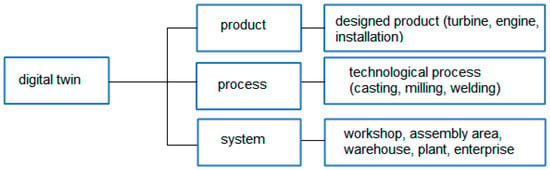
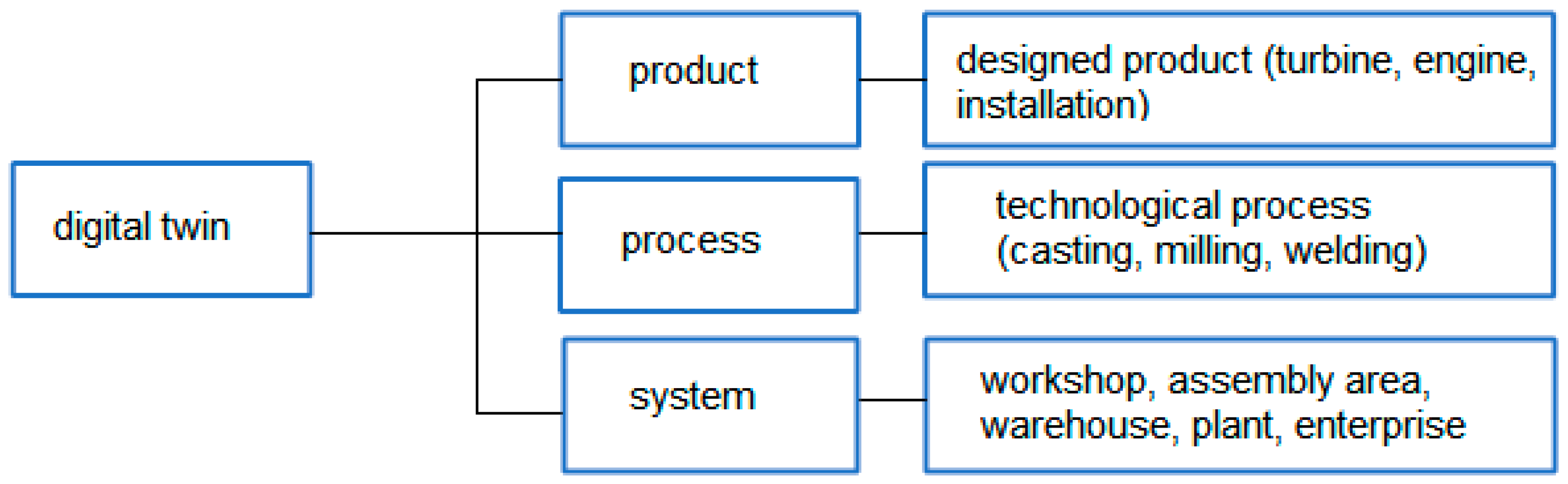
The figure presents a more practical classification of digital twins, which differs from Greaves’s classification.
As Figure 1 shows, digital twins can be applied to a variety of objects: from a single product or operation to an entire system, such as a plant. This classification emphasizes the scalability of the digital twin concept, allowing it to address both specific tasks and manage the entire enterprise’s production [28].
Figure 1.
Classification of digital twins.
Note: The vertical line extending below the “System” level in Figure 1 reproduces the hierarchical classification structure adopted in the original source [29] and indicates that a system digital twin can integrate multiple process twins, which in turn can integrate product twins. The figure is reproduced in its entirety according to the original source.
3.3. Current Use of Digital Twins
The concept of creating a mathematical model prior to the physical implementation of an object is widely used in knowledge-intensive industries [30]. In aerospace, the design of complex propulsion systems requires a detailed mathematical description of the operating processes. Directly reproducing a physical object without the use of validated mathematical models generally fails to achieve the specified design characteristics.
Various tools can be used to create a digital twin: CAD systems for architects, CAD systems for circuit designers, and Matlab for describing processes in mathematical formulas.
Virtualization improves the observability of production processes, facilitating safe manufacturing.
In mining, digital twins help model and manage drilling using borehole data. And smart cities, such as Singapore, have a digital twin used for planning, maintenance, and emergency preparedness [31].
The pace of development of digital twin technology is steadily accelerating as modeling tools become more sophisticated, data becomes more plentiful, and all of this works better with IoT sensors. Today, digital twins are built using data from LIDAR, FLIR, and IoT sensors. This allows for real-time monitoring of objects and the verification of parameters that cannot be easily measured.
IoT sensors are becoming smaller, more accurate, and cheaper [32,33]. Network technologies and cybersecurity make it possible to obtain more accurate information about equipment status and incorporate it into digital models. Clouds, data storage, and analytics services are becoming more accessible, leading to the emergence of digital twins in ever-increasing industries. Software development companies are investing heavily to enable this technology to be applied in various areas of life [34,35,36].
4. Implementation of Multi-Criteria Optimization on a Digital Twin of a Belt Conveyor
4.1. Multi-Criteria Optimization
Multi-criteria optimization involves the simultaneous optimization of two or more parameters to find the best compromise among given objectives.
The NSGA-II algorithm was studied to address the shortcomings of the first version and other evolutionary methods [37]. Issues addressed included the computational complexity of sorting, the lack of elitism (loss of best solutions), the need to tune parameters to preserve diversity, and so on. The computational complexity of NSGA was O (MN3), where M is the number of criteria and N is the population size, making the algorithm unsuitable for large population sizes. In NSGA-II, the Fast Nondominated Sorting Approach enabled a computational complexity of O (MN2). Elitism prevents the loss of good intermediate solutions and significantly accelerates computation. Solution diversity in NSGA was assessed using a sharing mechanism, which required additional parameter settings and complicated the solution. NSGA-II, on the other hand, relies on crowding distance, which measures how close solutions are to each other.
The main advantage of the NSGA-II method over classical optimization methods is its ability to find a set of optimal solutions that form the Pareto frontier. Based on this principle, levels of non-dominated solutions are identified.
A solution xa dominates xb if
In the formula, the following apply:
fi(x)—the value of the i-th criterion;
m—the number of criteria.
4.2. MATLAB Program
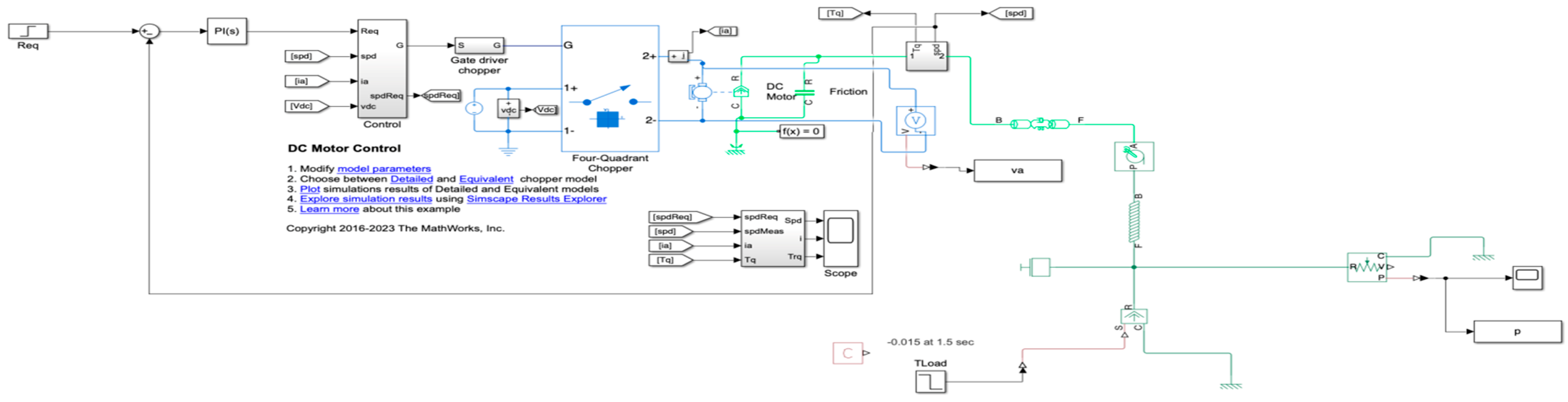
The initial simulation model as the imitation of digital twin was built in the MATLAB Simulink environment (Figure 2).
Figure 2.
Digital Model in MATLAB Simulink.
A simulation model is a mathematical representation of a physical system that enables the analysis of its behavior under specified operating conditions. Unlike digital twin, it does not involve a digital representation connected to a physical asset through data exchange.
The model is based on the DC Motor Control example from MATLAB, with the addition of a flexible shaft, wheel and axle, force source, and translational sensor to simulate a conveyor.
The model includes a cascaded DC speed control system: an outer speed loop and an inner current loop. A PI controller is used for both loops, the parameters of which must be selected to ensure both minimal energy loss and high belt speed control accuracy.
The main model parameters are as follows:
- Inductance, L = 170 mH;
- Active resistance, Ra = 4.67 Ω;
- Back-EMF constant, Kb = 14.7 mV·s/rad.
Using the built-in gamultiobj function, the program selects the proportional and integral current coefficients (Kp_i, Ki_i) and the speed loop coefficients (Kp_n, Ki_n).
The objective function is formulated as a vector criterion with two components. The first component is the energy loss, calculated using the integral of the square of the armature current.
The second component is the root mean square control error relative to the given speed profile.
Thus, the program seeks a compromise between energy savings and control quality.
Initial parameter values: Kp_i = 0.8, Ki_i = 5, Kp_n = 0.1, Ki_n = 0.3.
Lower search bounds: Kp_i = 0.05, Ki_i = 0.1, Kp_n = 0.05, Ki_n = 0.2. Upper search bounds: Kp_i = 5.0, Ki_i = 20.0, Kp_n = 0.3, Ki_n = 0.5.
Genetic algorithm parameters:
Population size: 40;
Maximum generations: 30.
Optimized parameters: Kp_i = 2.38, Ki_i = 9.6062, Kp_n = 0.1438, Ki_n = 0.2183.
The selected results are the optimal solutions selected by the program itself.
The simulation runs for 4 s due to the starting and dynamic characteristics of the electric drive circuit being studied. Testing in operation mode requires a more complex digital model, as well as more computational resources and simulation time due to the iterative search for solutions. The selected interval includes the acceleration process from 1000 rpm to 2000 rpm, the system’s response to a step load 1.5 s after startup as the signal changes from 0 to −0.015, and subsequent speed stabilization.
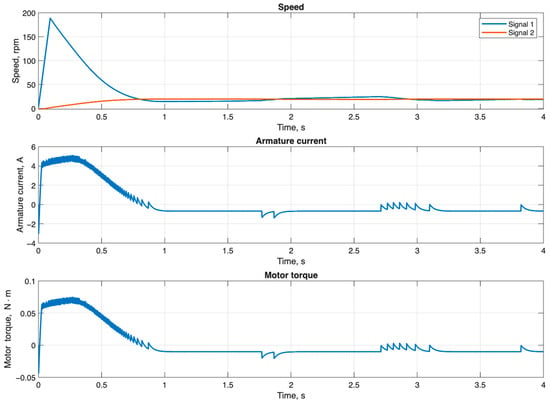
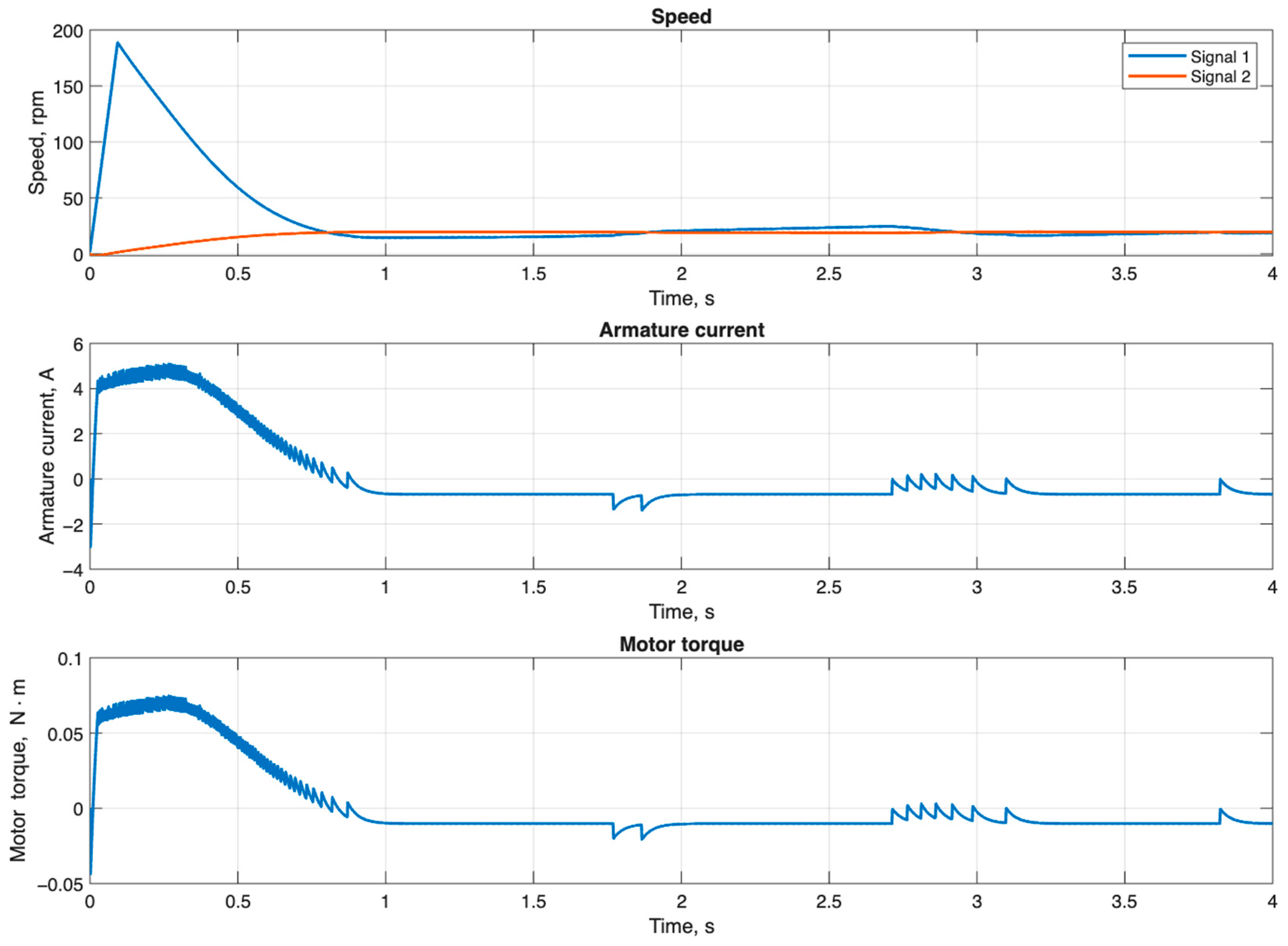
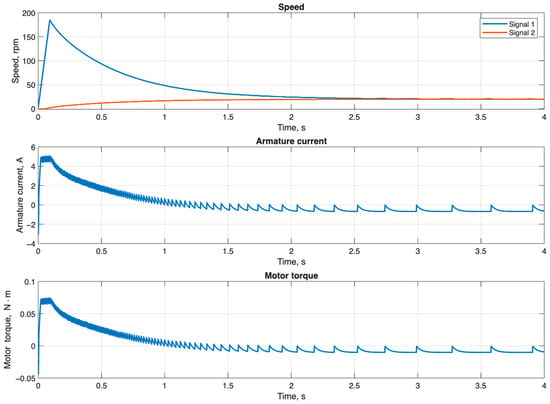
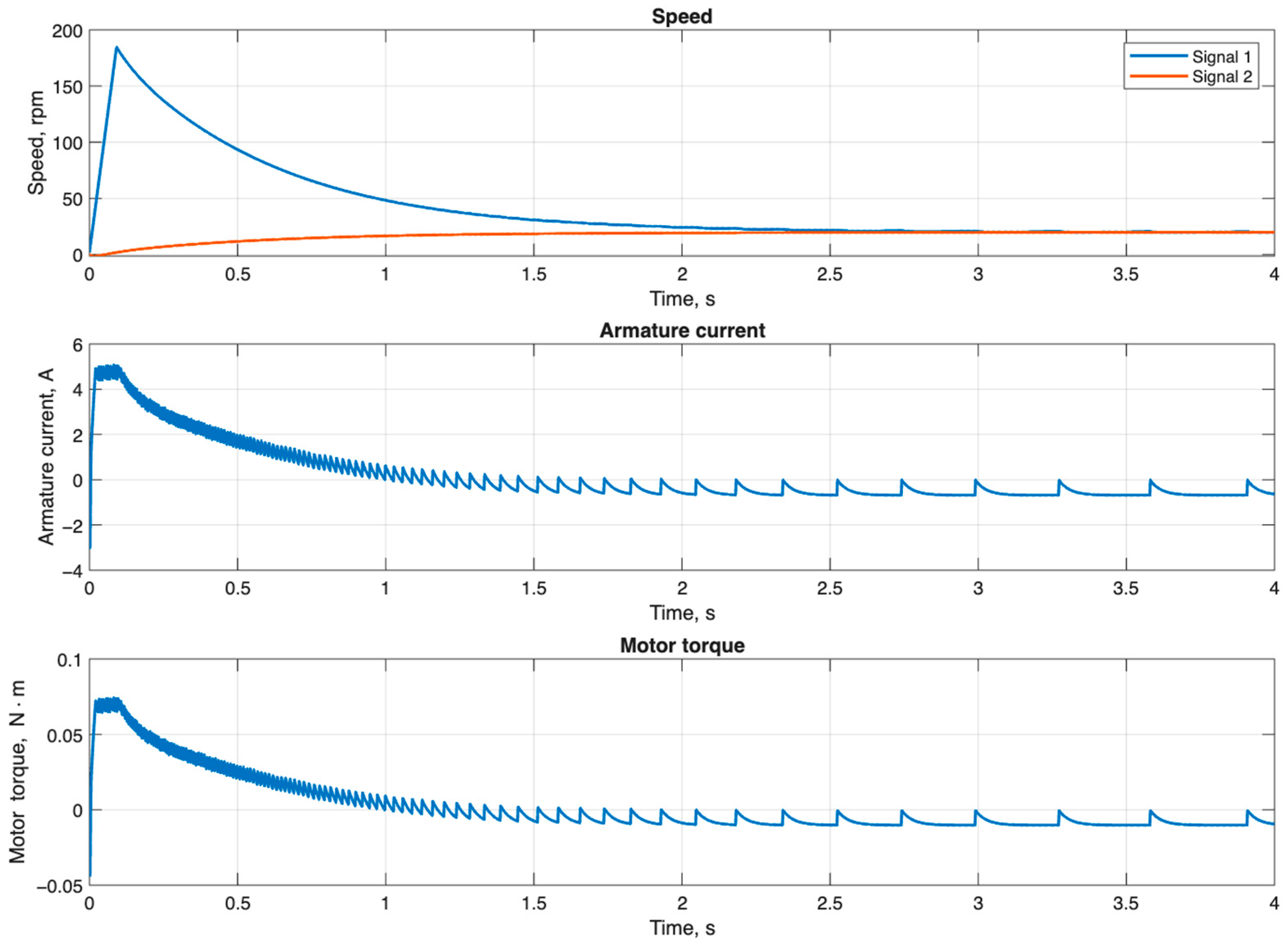
Figure 3 and Figure 4 compare the speed (rpm), armature current (A), and motor torque (Nm) waveforms of the Simulink model for startups before and after optimization, respectively.
Figure 3.
Oscillograms of motor speed, armature current and torque before optimization.
Figure 4.
Oscillograms of motor speed, armature current and torque after optimization.
The velocities converge around 0.6 s. During the first second of the simulation, the current frequently pulsates. It begins to drop sharply around 0.3 s and levels off at 1 s. However, sudden surges are observed closer to 2 and 4 s, and between them, there is a period of frequent pulsations (Figure 4).
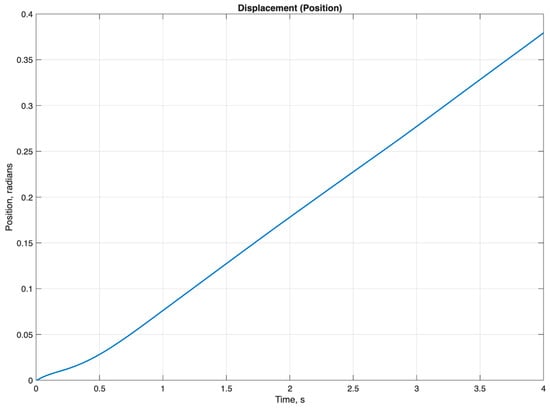
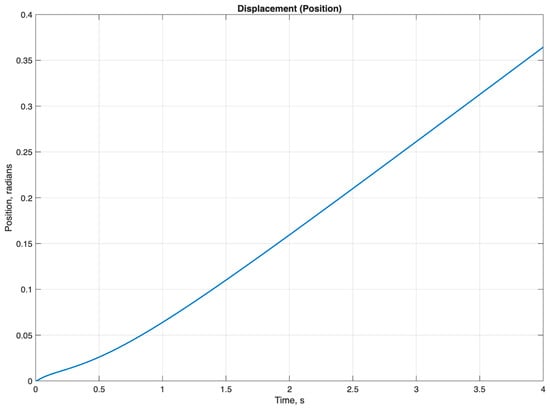
After optimization, the speeds converge more slowly. Current pulsations are more stable, and the sharp drop from Figure 3 is now smoother. Figure 5 and Figure 6 similarly show shaft/belt displacement oscillograms.
Figure 5.
Oscillograms of shaft/belt displacement before optimization.
Figure 6.
Oscillograms of shaft/belt displacement after optimization.
Here, we see that the dependence is linear, and with greater accuracy the graph will straighten out.
After optimization, the bias values as a function of time became lower, demonstrating the forced optimization tradeoff.
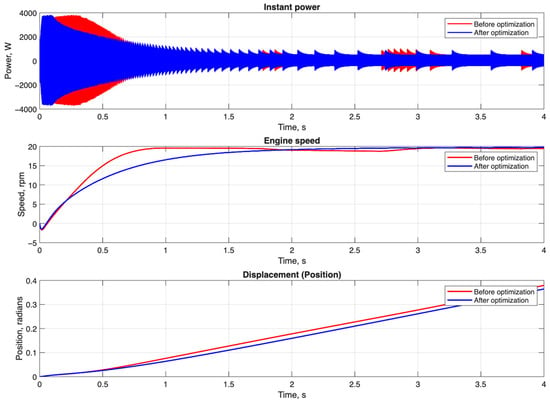
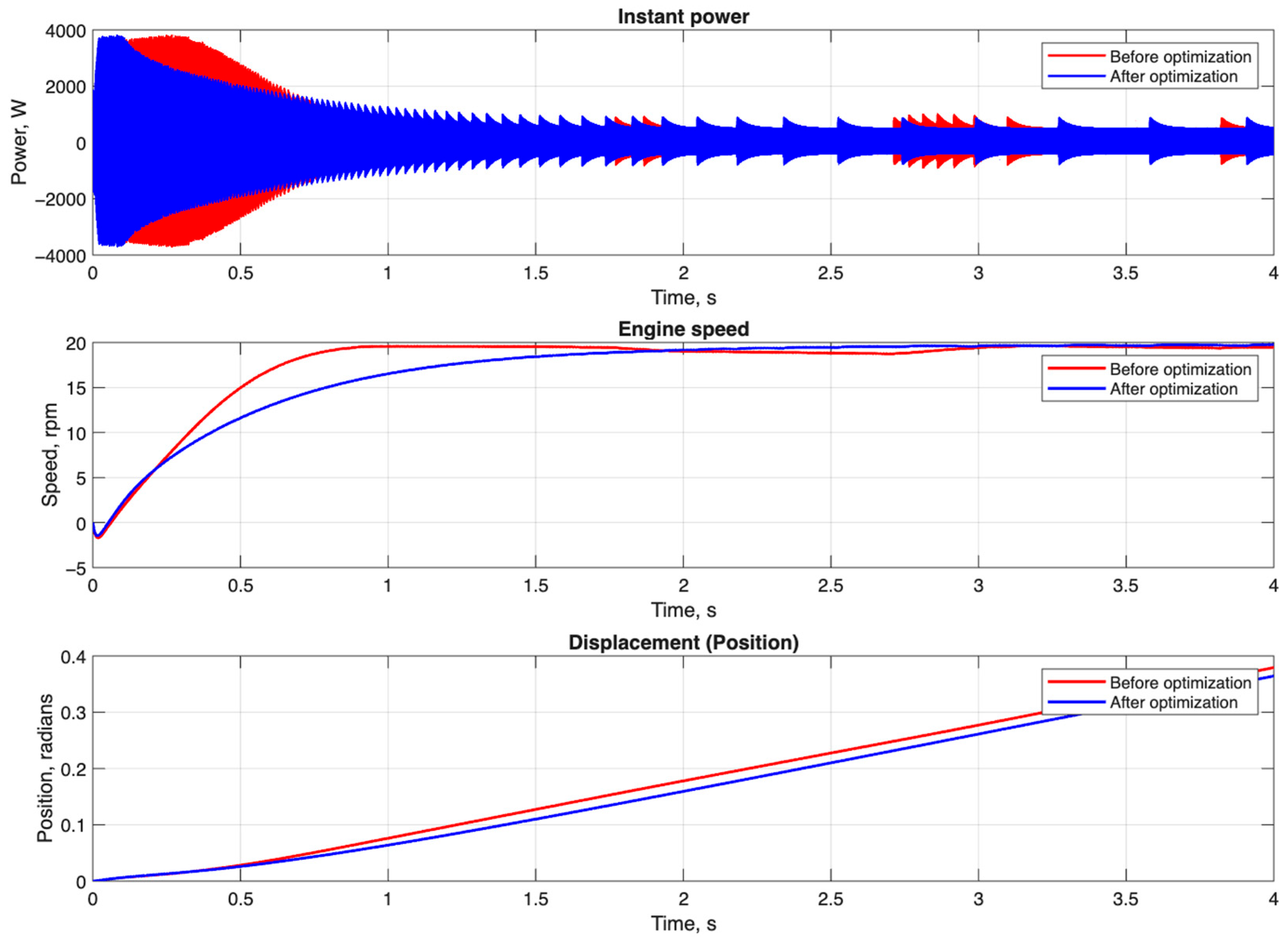
Using an additional program for comparing runs with the initial and optimized parameters, we obtain the energy consumed over a 4 s simulation, as well as graphs of instantaneous motor power and bias (Figure 7).
Figure 7.
Comparison of instantaneous motor power and displacement before and after optimization.
The graphs clearly demonstrate a tradeoff between performance and energy savings. Power decreases, speed drops between 0.25 s and 2 s, and the bias graph demonstrates a less favorable result. However, near the end of the simulation, motor achieves the same speed as the startup with the initial parameters. Negative instantaneous power values correspond to short intervals of regenerative braking: when the load decreases, the motor switches to generator mode and returns energy back to the supply circuit, which is a physically justified behavior of electric machines in dynamic operating modes.
The maximum speed deviation decreased from 1981.262 to 1980.555 rpm, corresponding to a reduction of approximately 0.04%. The maximum armature current decreased from 5.092 to 5.071 A (0.41%), while the RMS armature current decreased from 1.684 to 1.290 A, representing a reduction of 23.39%.
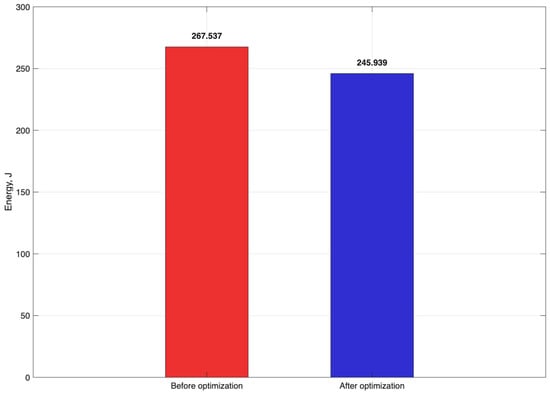
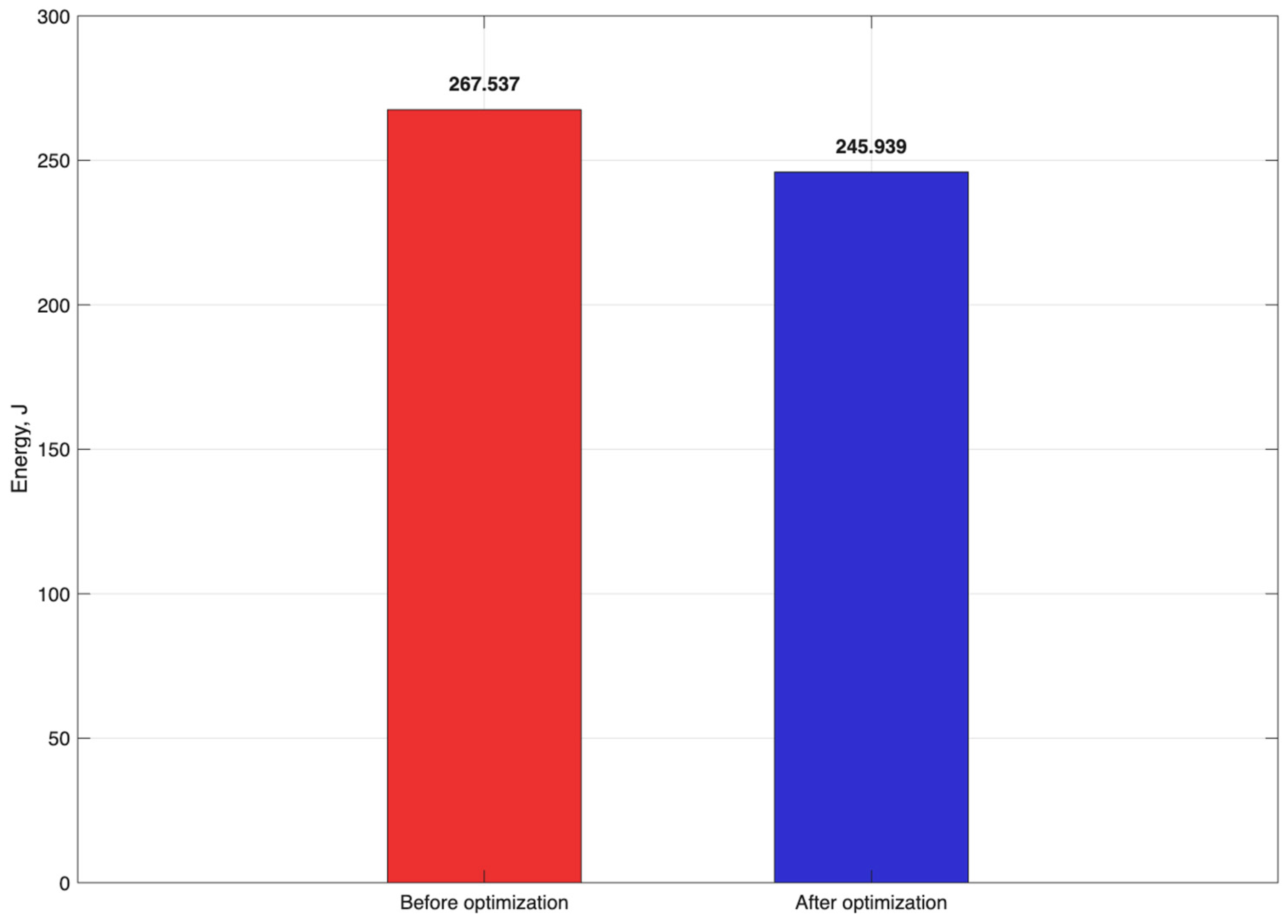
Figure 8 shows a comparison of net electrical energy for two configurations.
Figure 8.
Comparison of net electrical energy before and after optimization.
The NSGA-II algorithm minimizes two objective functions: the integral of the squared armature current, which is related to resistive losses in the motor winding, and the root mean square speed-tracking error. The electrical energy exchanged over the simulation interval is calculated separately by integrating the instantaneous armature power and is used to compare the baseline and optimized controller configurations. Therefore, this energy metric is evaluated separately and is not directly optimized by the NSGA-II algorithm.
The 8% advantage is achieved through smoother engine acceleration (Figure 7). With the initial parameter values, the DC motor accelerates to steady-state speed in approximately 0.8 s, while after optimization, it accelerates to steady-state speed in 1.6 s.
These results indicate that the optimized controller parameters substantially reduced the RMS armature current, while the maximum current and maximum speed deviation remained nearly unchanged. Thus, under the considered simulation conditions, the optimization primarily improved the current-related performance of the drive without a substantial change in the maximum speed deviation. The results are specific to the simulated model and operating conditions.
Table 2 presents the results of the sensitivity analysis performed to evaluate how the weight assigned to the energy-related criterion affects the selection of the compromise solution from the Pareto-optimal set obtained using NSGA-II. The weight w was varied from 0 to 1 in increments of 0.1, while the weight of the second objective function was set to .
The sensitivity analysis complements the NSGA-II optimization by examining how the relative importance assigned to the energy-related objective affects the selection of a compromise controller configuration from the Pareto-optimal set.
As the weight assigned to the energy-related criterion increased, the selected value of the loss criterion decreased from 60,040 to 55,376, corresponding to a reduction of approximately 7.77%. This trend is consistent with the increased priority given to minimizing the energy-related objective. However, the controller parameters did not change uniformly. The proportional gain of the speed controller, Kp_n increased from 0.0537 to 0.1896, whereas the integral gain, Ki_n, remained nearly constant at approximately 0.203. The current-controller gains also varied, although their changes were less pronounced overall.
These results indicate that the selected compromise solution depends on the relative importance assigned to the objective functions. Although the energy-related criterion improves as its weight increases, the corresponding controller gains may differ considerably. Therefore, the choice of weights should reflect the intended operating priorities of the drive. The analysis is limited to the Pareto-optimal set obtained in a single NSGA-II run and does not assess the repeatability of the optimization algorithm across independent runs.
As part of the current study, the digital model is being used to evaluate the optimization program before commissioning on real equipment. The results obtained from running the program on the ideal model demonstrate the system’s performance. Further scaling and verification on a digital twin with real data are planned as the next stage of the work.
5. Conclusions
This study investigated the use of multi-objective optimization to improve the energy efficiency of a belt conveyor electric drive. The analysis was carried out using a MATLAB/Simulink model in combination with the NSGA-II algorithm, which was used to determine the PI controller parameters. Electrical energy and control performance were considered simultaneously, as improving one of these criteria could affect the other. The simulation results showed that the optimized controller reduced net electrical energy by approximately 8%. This improvement was accompanied by a slower transient response: the drive reached its steady-state speed at 1.6 s, compared with 0.8 s for the reference controller. At the same time, the maximum speed deviation changed by less than 0.04%, indicating that the optimization had little effect on this aspect of the system’s response. A more pronounced difference was observed in the armature current. Its RMS value decreased from 1.684 A to 1.290 A, corresponding to a reduction of approximately 23.39%. The maximum armature current also decreased, although only slightly, from 5.092 A to 5.071 A. Taken together, these results suggest that the proposed parameter tuning can reduce net electrical energy and RMS current in the simulated drive, although the improvement comes at the expense of a longer settling time.
Several limitations should be considered when interpreting these results. First, the simulation covered only 4 s of operation, including startup, the application of a step load at 1.5 s, and the subsequent stabilization period. The optimization was performed for a single operating scenario and involved only one NSGA-II run. Consequently, the repeatability of the optimization results and the stability of the resulting Pareto set remain unverified. In addition, the controller configuration was restricted to cascaded PI loops; alternative control structures were not investigated. The proposed approach has also not yet been tested experimentally on an industrial conveyor system. The reported improvements therefore describe the behavior of the model under the specified simulation conditions rather than demonstrating equivalent gains in practical applications. Further studies are needed to determine whether similar results can be obtained for conveyor systems operating under different loads and with different control configurations.
For the problem studied here, NSGA-II provided a means of examining the trade-off between net electrical energy and control performance and identifying alternative PI controller settings. The results establish a basis for further investigation, but additional validation is necessary before the approach can be recommended for practical implementation. Future work will therefore focus on testing the method against real operational data, assessing the repeatability of the optimization, and evaluating its performance under a wider range of operating conditions.
Author Contributions
Conceptualization, E.O. and V.P.; Methodology, Y.K. and O.G.; Software, Y.K. and E.S.; Validation, V.C. and O.G.; Formal analysis, I.K. and V.P.; Investigation, Y.K.; Resources, V.B.; Data curation, V.C. and Y.K.; Writing—original draft, E.O. and Y.K. All authors have read and agreed to the published version of the manuscript.
Funding
This research received no external funding.
Data Availability Statement
The original contributions presented in the study are included in the article, further inquiries can be directed to the corresponding authors.
Conflicts of Interest
Author Elina Sitzhanova was employed by the Mediar LLC. The remaining authors declare that the research was conducted in the absence of any commercial or financial relationships that could be construed as a potential conflict of interest.
References
- Zemenkova, M.Y.; Chizhevskaya, E.L.; Zemenkov, Y.D. Intelligent monitoring of the condition of hydrocarbon pipeline transport facilities using neural network technologies. J. Min. Inst. 2022, 258, 933–944. [Google Scholar] [CrossRef] [Scilit]
- Nevskaya, M.; Sharapova, A.; Kosovtseva, T.; Nikolaychuk, L. Applications of simulation modeling in mining project risk management: Criteria, algorithm, evaluation. J. Infrastruct. Policy Dev. 2024, 8, 5375. [Google Scholar] [CrossRef] [Scilit]
- Ovchinnikova, E.; Kozhubaev, Y.; Wu, Z.; Sabbaghan, A.; Ershov, R. Modeling of Multifunctional Gas-Analytical Mine Control Systems and Automatic Fire Extinguishing Systems. Symmetry 2025, 17, 1432. [Google Scholar] [CrossRef] [Scilit]
- Kazanin, O.I. Promising technology trends in underground coal mining in Russia. Gorn. Zhurnal. 2023, 9, 4–11. [Google Scholar] [CrossRef] [Scilit]
- Koteleva, N.; Valnev, V. Automatic detection of maintenance scenarios for equipment and control systems in industry. Appl. Sci. 2023, 13, 12997. [Google Scholar] [CrossRef] [Scilit]
- Singh, M.; Fuenmayor, E.; Hinchy, E.P.; Qiao, Y.; Murray, N.; Devine, D. Digital Twin: Origin to Future. Appl. Syst. Innov. 2021, 4, 36. [Google Scholar] [CrossRef] [Scilit]
- Kamble, S.S.; Gunasekaran, A.; Parekh, H.; Mani, V.; Belhadi, A.; Sharma, R. Digital twin for sustainable manufacturing supply chains: Current trends, future perspectives, and an implementation framework. Technol. Forecast. Soc. Change 2022, 176, 121448. [Google Scholar] [CrossRef] [Scilit]
- Tsinarakis, G.; Sarantinoudis, N.; Arampatzis, G. A discrete process modelling and simulation methodology for industrial systems within the concept of digital twins. Appl. Sci. 2022, 12, 870. [Google Scholar] [CrossRef] [Scilit]
- Pervukhin, D.A.; Tang, T.A. Multi-objective ε-Constraint Optimization of Coal Supply Chain Performance Considering Customer Satisfaction in Multi-layer Logistics Networks. Int. J. Eng. Trans. B Appl. 2026, 39, 1716–1729. [Google Scholar] [CrossRef] [Scilit]
- Khokhlov, S.V. Application of digital simulation methods for predicting parameters of blasted rock muckpile. J. Min. Inst. 2025, 275, 196–204. [Google Scholar]
- Makhovikov, A.B.; Filyasova, Y.A. Digital technologies in the extraction of solid minerals in the Arctic. Sustain. Dev. Mt. Territ. 2024, 16, 1110–1117. [Google Scholar] [CrossRef] [Scilit]
- You, X.; Ge, S. Research on Decision-Making and Control Technology for Hydraulic Supports Based on Digital Twins. Symmetry 2024, 16, 1316. [Google Scholar] [CrossRef] [Scilit]
- Nikitin, V.I.; Dvoynikov, M.V.; Kupavykh, K.S.; Panteleeva, T.A. Application of machine learning to modeling Herschel–Bulkley drilling fluid parameters for optimizing wellbore cleaning. J. Min. Inst. 2025, 275, 70–80. [Google Scholar]
- Deryabin, S.A.; Temkin, I.O. Ontological modeling and management of digital transformation of mining enterprises architecture. J. Min. Inst. 2025, 275, 130–144. [Google Scholar]
- Materova, E.S.; Aksenova, Z.A.; Sharafullina, R.R.; Galimova, G.A.; Shilov, M.L. Digitalization of operations in the Russian mining companies. Ugol’ 2024, 11, 117–121. [Google Scholar]
- Deng, T.; Zhang, K.; Shen, Z.-J.M. A systematic review of a digital twin city: A new pattern of urban governance toward smart cities. J. Manag. Sci. Eng. 2021, 6, 125–134. [Google Scholar] [CrossRef] [Scilit]
- Yitmen, I.; Alizadehsalehi, S.; Akıner, İ.; Akıner, M.E. An adapted model of cognitive digital twins for building lifecycle management. Appl. Sci. 2021, 11, 4276. [Google Scholar] [CrossRef] [Scilit]
- Jia, Y.; Cheng, W.; Meng, L.; Zhang, C. Statistical Learning-Assisted Evolutionary Algorithm for Digital Twin-Driven Job Shop Scheduling with Discrete Operation Sequence Flexibility. Symmetry 2025, 17, 1614. [Google Scholar] [CrossRef] [Scilit]
- Chen, W.; Li, J.; Shi, Q.; Liu, J.; Li, H. Construction and application of a digital twin model for multi-objective optimization of intelligent tape conveyor system. Coal Sci. Technol. 2024, 52, 287–299. [Google Scholar] [CrossRef]
- Hasankhani, A.; Hakimi, S.M. Stochastic energy management of smart microgrid with intermittent renewable energy resources in electricity market. Energy 2021, 219, 119668. [Google Scholar] [CrossRef] [Scilit]
- Shishehgarkhaneh, B.M.; Keivani, A.; Moehler, R.C.; Jelodari, N.; Roshdi Laleh, S. Internet of Things (IoT), Building Information Modeling (BIM), and Digital Twin (DT) in Construction Industry: A Review, Bibliometric, and Network Analysis. Buildings 2022, 12, 1503. [Google Scholar] [CrossRef] [Scilit]
- López Martínez, P.; Dintén, R.; Drake, J.M.; Zorrilla, M. A big data-centric architecture metamodel for Industry 4.0. Future Gener. Comput. Syst. 2021, 125, 263–284. [Google Scholar] [CrossRef] [Scilit]
- Kajba, M.; Obrecht, M.; Ojsteršek, T.C. Digital twins for sustainability purposes in logistics industry: A literature review. LogForum 2023, 19, 611–625. [Google Scholar] [CrossRef] [Scilit]
- Heluany, J.B.; Gkioulos, V. A review on digital twins for power generation and distribution. Int. J. Inf. Secur. 2023, 2, 1171–1195. [Google Scholar] [CrossRef] [Scilit]
- Sircar, A.; Yadav, K.; Rayavarapu, K. Application of machine learning and artificial intelligence in oil and gas industry. Pet. Res. 2021, 6, 379–391, Correction in Pet. Res. 2023, 8, 283–284. [Google Scholar] [CrossRef] [Scilit]
- Akpan, I.J.; Etti, G.E. Computer Simulation Everywhere: Mapping Fifteen Years Evolutionary Expansion of Discrete-Event Simulation and Integration with Digital Twin and Generative Artificial Intelligence. Symmetry 2025, 17, 1272. [Google Scholar] [CrossRef] [Scilit]
- Totay, A.V.; Nagorkin, M.N. Integral criterion of the state of physical parameters of the surface layer of machine parts. IOP Conf. Ser. Mater. Sci. Eng. 2021, 1061, 012040. [Google Scholar] [CrossRef] [Scilit]
- Pipiya, G.T.; Chernenkaya, L.V. Features of constructing the Pareto region in two-level optimization problems. Comput. Methods Program. Proc. SPbPU 2023, 1, 183–187. [Google Scholar] [CrossRef]
- Şenel, G. An Innovative Algorithm Based on Octahedron Sets via Multi-Criteria Decision Making. Symmetry 2024, 16, 1107. [Google Scholar] [CrossRef] [Scilit]
- Pantusin, F.J.; Ortiz, J.S.; Carvajal, C.P.; Andaluz, V.H.; Yar, L.G.; Roberti, F.; Gandolfo, D. Digital Twin Integration for Active Learning in Robotic Manipulator Control Within Engineering 4.0. Symmetry 2025, 17, 1638. [Google Scholar] [CrossRef] [Scilit]
- Kravchenko, A.A. Nature, essence, and classification of digital twins. Econ. Manag. 2025, 31, 125–134. (In Russian) [Google Scholar] [CrossRef] [Scilit]
- Benhamaid, S.; Bouabdallah, A.; Lakhlef, H. Recent advances in energy management for Green-IoT: An up-to-date and comprehensive survey. J. Netw. Comput. Appl. 2022, 198, 103257. [Google Scholar] [CrossRef] [Scilit]
- Alsharif, M.H.; Jahid, A.; Kelechi, A.H.; Kannadasan, R. Green IoT: A Review and Future Research Directions. Symmetry 2023, 15, 757. [Google Scholar] [CrossRef] [Scilit]
- Guseynov, R.V.; Guseynova, M.R.; Alieva, K.A. Some issues of multicriteria optimization of parameters of complex systems. Herald of Daghestan State Technical University. Tech. Sci. 2023, 50, 67–75. [Google Scholar] [CrossRef] [Scilit]
- Nogin, V.D.; Baskov, O.V. Second-order fuzzy sets and their application in decision making. General concepts. Sci. Tech. Inf. Process. 2022, 49, 283–291. [Google Scholar] [CrossRef] [Scilit]
- Otchere, D.; Ganata, T.; Gholami, R.; Ridha, S. Application of supervised machine learning paradigms in the prediction of petroleum reservoir properties: Comparative analysis of ANN and SVM models. J. Pet. Sci. Eng. 2021, 200, 108182. [Google Scholar] [CrossRef] [Scilit]
- Aleksandrova, A.A.; Koledin, S.N. Calculation of the optimal temperature for multi-criteria optimization of the hydrogenation process of polycyclic aromatic hydrocarbons using the NSGA-II method. Adv. Eng. Res. 2024, 1, 109–118. [Google Scholar] [CrossRef] [Scilit]

Disclaimer/Publisher’s Note: The statements, opinions and data contained in all publications are solely those of the individual author(s) and contributor(s) and not of MDPI and/or the editor(s). MDPI and/or the editor(s) disclaim responsibility for any injury to people or property resulting from any ideas, methods, instructions or products referred to in the content. |
© 2026 by the authors. Licensee MDPI, Basel, Switzerland. This article is an open access article distributed under the terms and conditions of the Creative Commons Attribution (CC BY) license.