


Abstract
The (3 + 1)-dimensional Hirota-Satsuma-Ito (HSI) equation is systematically investigated based on the Hirota bilinear method. Starting from the bilinear form, multi-soliton solutions are constructed, and a general multi-order lump wave is derived by taking the long-wave limit under complex conjugate parameter constraints. By fixing particular parameters in the multi-order lumps, the lump wave is characterized by spatial localization and localized energy in a small area. The interactions between multi-solitons and multi-order lumps are constructed by representative parameter choices. We obtain the phenomenon that a lump wave retains its shape after collision, while two solitons merge into one during the collision. These results extend the explicit lump and hybrid solutions of the HSI equation and illustrate the coexistence of lump preservation and soliton fusion in a high-dimensional nonlinear wave model.
PACS:
02.30.Ik; 05.45.Yv
1. Introduction
Nonlinear evolution equations have significant implications for nonlinear optics, condensed matter physics, plasma physics, fluid dynamics and ocean engineering [1,2,3,4]. A (1 + 1)-dimensional Hirota-Satsuma-Ito (HSI) equation is derived from one of several bilinear equations that appear in the Jimbo-Miwa classification [5,6]. It describes the unidirectional propagation of shallow water waves in one space and one time dimension. An integrable (2 + 1)-dimensional extension of the HSI equation is proposed by means of a Bäcklund transformation of the Boussinesq equation [7,8,9]. The nonlinear transformed waves of the (2 + 1)-dimensional HSI equation are generated by the breathers under specific conditions [10]. Through symbolic computations, lump-soliton, lump-kink, and lump-periodic solutions to the (2 + 1)-dimensional HSI equation are given in [11]. The lump-off solution and rogue waves for the (2 + 1)-dimensional HSI equation are derived by exponentially localizing the plane solitons [12]. There is a growing body of work devoted to higher-dimensional completely integrable models, since they exhibit essential features in a wide range of physical fields [13]. Lump waves and breather solutions of the (3 + 1)-dimensional nonlinear models are given by the Hirota bilinear technique [14,15]. The goal of this work is to study the (3 + 1)-dimensional HSI equation. The (3 + 1)-dimensional HSI equation reads
where and are arbitrary constants. The (3 + 1)-dimensional HSI Equation (1) will reduce to the (2 + 1)-dimensional HSI equation with . The Wronskian determinant solutions are constructed by the Wronskian technique [16].
The primary purpose of the work is to explore the multi-solitons, multi-order lumps, and interactions between solitons and lumps of the (3 + 1)-dimensional HSI equation. The structure of this paper is as follows. In Section 2, the multi-order lumps of the HSI equation are constructed based on the long-wave limit method. The dynamics of the one-order lump, two-order lumps, and three-order lumps are illustrated under the particular parameters. In Section 3, the interactions between a one-order lump and two solitons are investigated by selecting the appropriate parameters. Upon collision, two kink-solitons merge into a single kink-soliton, whereas the one-order lump retains its amplitude and shape. Section 4 is devoted to conclusions.
2. Multi-Order Lumps of the HSI Equation
In this section, we construct multi-order lump solutions of the (3 + 1)-dimensional HSI equation by combining the Hirota bilinear method and the long =-wave limit technique. The construction begins with the multi-soliton solutions and yields rational solutions through appropriate limits of the wave number parameters. One-, two-, and three-order lump cases are presented explicitly to illustrate the resulting wave structures. The Hirota bilinear method provides a systematic framework for constructing exact solutions of the nonlinear evolution equations. Based on the Hirota bilinear method [17], the bilinear derivative operators are defined as
Using , the required identities are
Based on the above analysis, the bilinear form of the (3 + 1)-dimensional HSI equation reads as
where and are the bilinear derivative operators. The relationship between u and f reads as
By solving the above bilinear form (4), the multi-soliton solutions of the HSI Equation (1) are written as
where and . Here, and are the wave number parameter and a phase constant, respectively. By substituting (6) into (4) and balancing the powers of exponential terms, we get
A lump wave is a special type of solution that is rationally localized in the spatial directions. Lump solutions have drawn much attention via the Hirota bilinear method and the Darboux transformation [18,19,20,21,22,23,24]. Combining symbolic computation and the Hirota bilinear method yields one-order lump [18], while the general multi-order lumps are constructed by performing the long-wave limit procedure [25]. Lump surge propagations are analyzed by using a positive quadratic function [26]. This part is devoted to examining the multi-order lumps of the HSI equation by the long-wave limit approach. In order to employ the long-wave limit approach, taking yields the function as
with . By taking the limit and dropping the constant factor for simplicity, in (7) reduces to the form as
where
stands for the summation over all possible combinations of , which are assigned different values from . Under the conditions that the parameters satisfy the condition and , where the asterisk “∗” refers to the complex conjugation, the general M-lump solutions can be derived via the long-wave limit procedure.
Setting and omitting the factor in (8), we have
where , and . Here, we will examine the evolution of the lump in the plane . To track the moving path of the one-order lump wave, we calculate the critical point by taking . The approximate moving path of the lump wave is written as
Then, the traveling path of the lump wave is along a straight line in the plane. The path reads as
To illustrate the dynamics of the one-order lump, the parameters are selected as
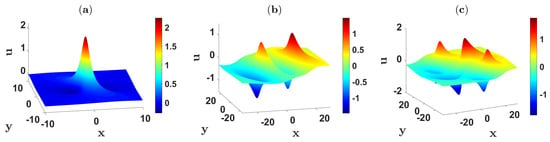
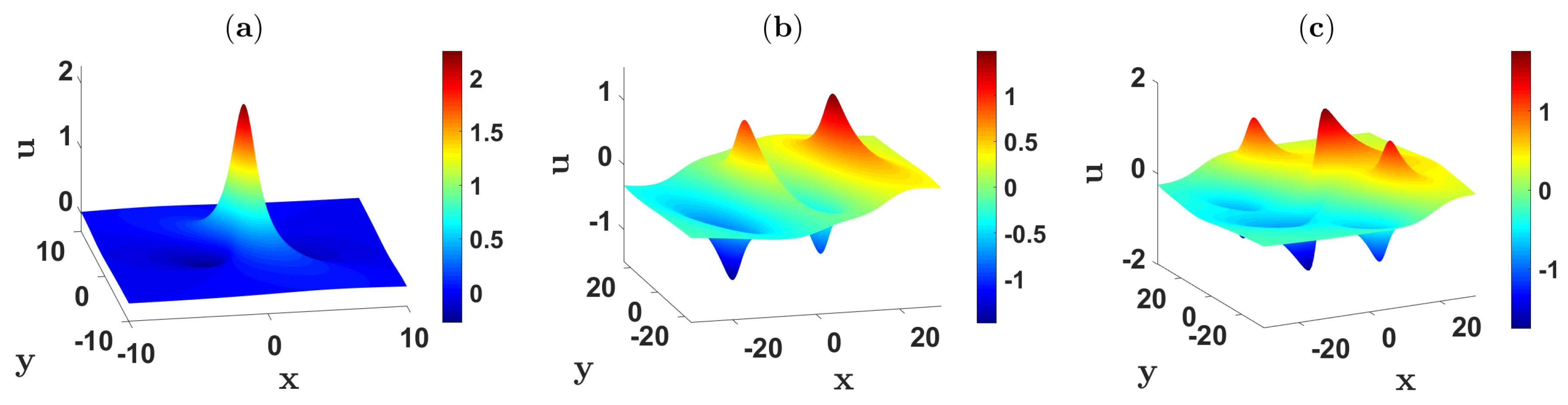
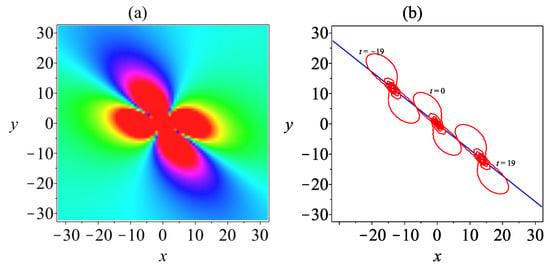
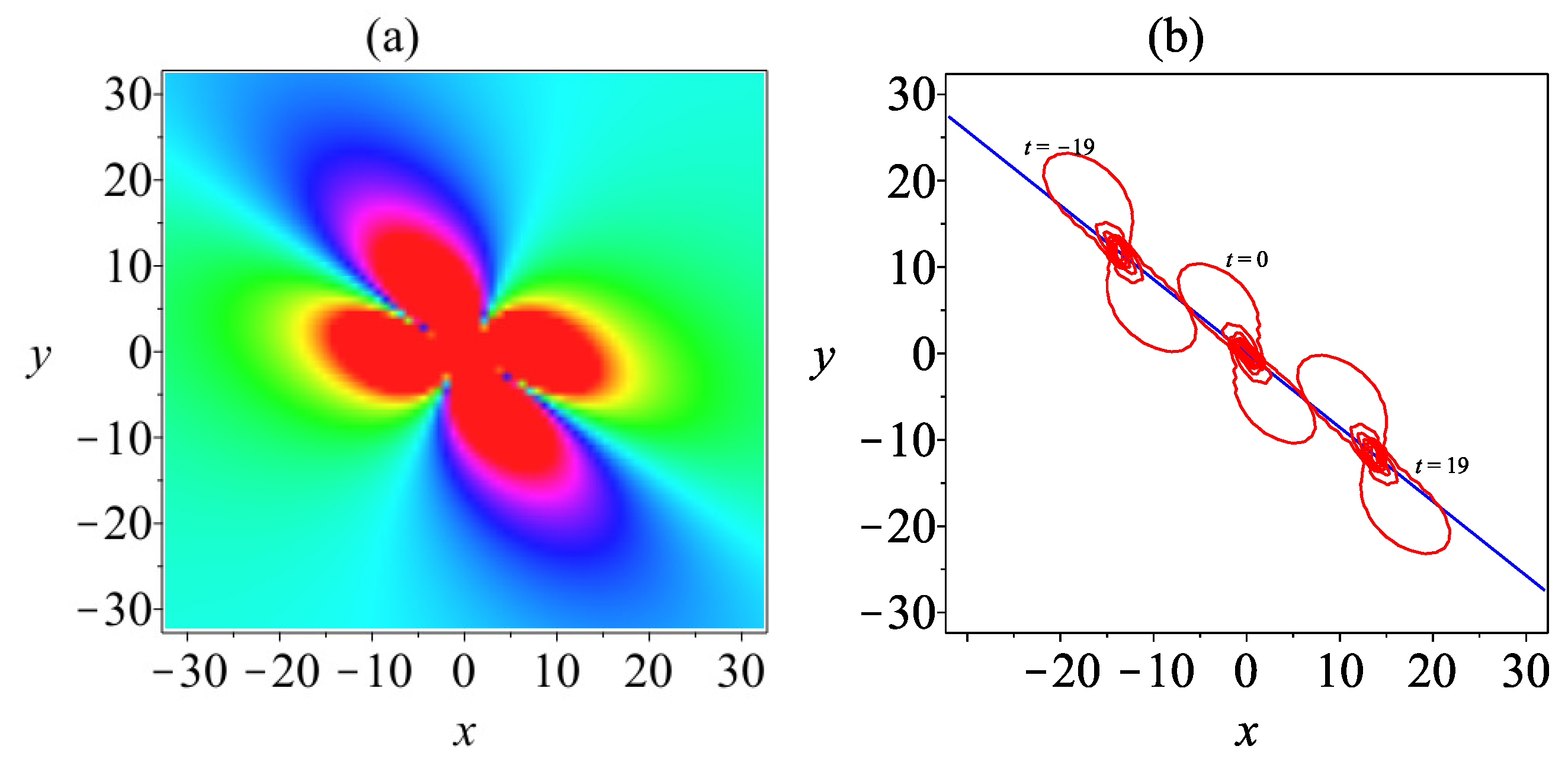
The profile of the one-order lump solution is shown in Figure 1a with . Figure 2a represents the density plot of the corresponding lump wave. Figure 2b shows the contour plot of the lump wave at , and the blue line is the relevant moving progress (12), i.e., .
Figure 1.
(a–c) Three-dimensional plots of one-order, two-order and three-order lumps are shown at , respectively.
Figure 2.
(a) The corresponding density plot for Figure 1a. (b) The contour plots for different time and the moving path described by the straight line .
With in (8), two-order lumps read as
with and satisfy (9). By taking and substituting (14) into (5), two-order lumps are derived. The parameters for two-order lumps are used as . The three-dimensional structure is given in Figure 1b with .
With in (8), one can get three-order lumps
where and obey (9). By taking and substituting (15) into (5), three-order lumps are given. The parameters of three-order lumps are . The three-dimensional figure is plotted in Figure 1c. The lump wave is spatially localized as , with its energy concentrated in a small area in Figure 1. Here, we construct the multi-order lumps instead of merely a one-order lump by means of the long-wave limit approach [11].
3. Interactions Between Multi-Order Lumps and Multi-Solitons of the HSI Equation
To describe the complicated physical phenomena, the solitary waves interacting with other waves are considered. The interactions among various nonlinear excitations have been widely explored in nonlinear science [27,28,29,30,31]. We attempt to calculate the interactions between the multi-solitons and multi-order lumps in this section.
Taking the long-wave limit part , the interactions between m-order lumps and n solitons can be given by
The interaction between one-order lump and two solitons is constructed by taking and in (6). Equation (6) becomes the following form as
where
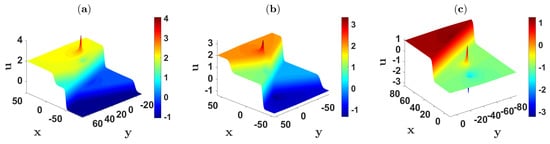
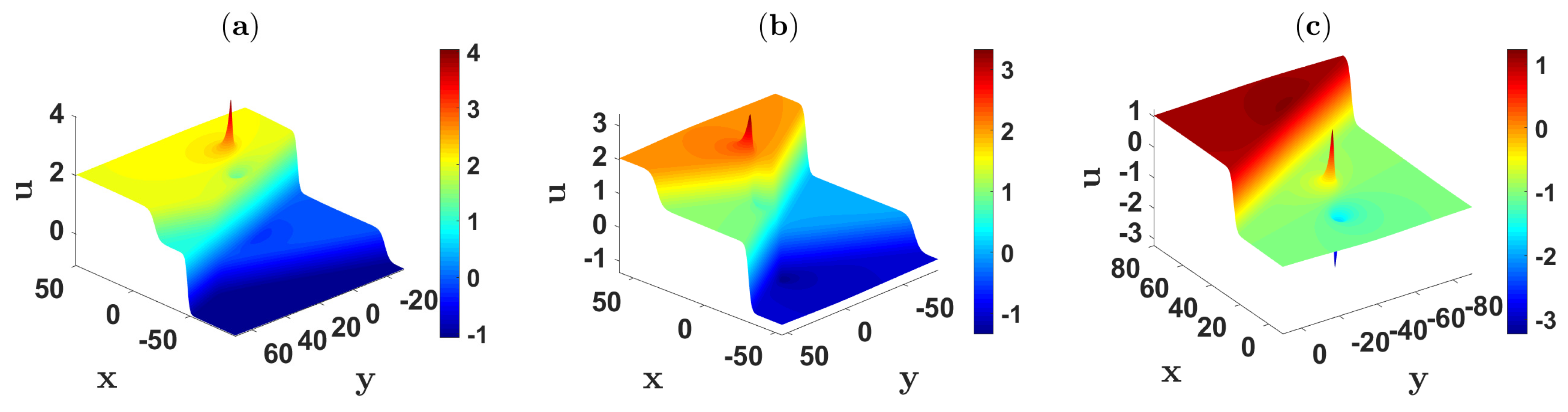
The interaction between one-order lump wave and two solitons is given by substituting (17) into (5). The parameters are selected as in Figure 3. One-order lump and two solitons will take place around in Figure 3. Two kink solitons fuse into a single kink soliton after the collision, while the one-order lump preserves its original state.
Figure 3.
The interactions between one-order lump and two solitons are shown at time and in Figures (a), (b) and (c), respectively.
4. Conclusions
In this work, we have investigated the multi-order lump solutions and their hybrid interactions with solitons for the (3 + 1)-dimensional HSI equation. Using the logarithmic dependent-variable transformation, the corresponding Hirota bilinear form and its multi-soliton solutions are given. Applying the long-wave limit approach to the multi-soliton solutions yields the multi-order lumps. Explicit one-order, two-order and three-order lumps are presented, and their spatial profiles are displayed by choosing the parameters appropriately. To account for the complex phenomena, the interactions between the lump and solitons are explored by combining the long-wave limit approach with the Hirota bilinear direct method. The interactions between one lump and two solitons are depicted for suitable parameter values at several times. A special collision occurs in which the lump remains unchanged in shape, and the two solitons merge into one soliton. The obtained results are expected to have potential applications in physics and engineering. In the meanwhile, other hybrid structures involving lumps, rogue waves and Jacobi elliptic functions are systematic studied [32,33]. The future work will address these issues.
Author Contributions
Formal analysis, software, writing—review and editing, W.Z.; conceptualization, formal analysis, software, writing—original draft, writing—review and editing, B.R. All authors have read and agreed to the published version of the manuscript.
Funding
This work is supported by the National Natural Science Foundation of China Grant Nos. 12675008 and 12375006.
Data Availability Statement
The data presented in this study are available on request from the corresponding author.
Conflicts of Interest
The authors declare no competing interests.
References
- Si, Z.Z.; Wang, D.L.; Zhu, B.W.; Ju, Z.; Wang, X.; Liu, W.; Malomed, B.A.; Wang, Y.; Dai, C. Deep learning for dynamic modeling and coded information storage of vector-soliton pulsations in mode-locked fiber lasers. Laser Photonics Rev. 2024, 18, 2400097. [Google Scholar] [CrossRef] [Scilit]
- Fang, P.P.; Lin, J. Soliton in Bose-Einstein condensates with helicoidal spin-orbit coupling under a Zeeman lattice. Phys. Rev. E 2024, 109, 064219. [Google Scholar] [CrossRef] [Scilit] [PubMed]
- Solli, D.R.; Ropers, C.; Koonath, P.; Jalali, B. Optical rogue waves. Nature 2007, 450, 1054–1057. [Google Scholar] [CrossRef] [Scilit] [PubMed]
- Liu, Y.Q.; Guo, B.L.; Wang, D.S. Patterns of emergent nonlinear waves in an initial discontinuity problem of the bad Jaulent-Miodek equation. Acta Math. Appl. Sin. Engl. Ser. 2026, 42, 582–607. [Google Scholar] [CrossRef] [Scilit]
- Hietarinta, J. Introduction to the Hirota bilinear method. In Integrability of Nonlinear Systems; Lecture Notes in Physics; Springer: Berlin/Heidelberg, Germany, 1997; pp. 95–103. [Google Scholar]
- Ito, M. An extension of nonlinear evolution equations of the KdV (mKdV) type to higher orders. J. Phys. Soc. Jpn. 1980, 49, 771–778. [Google Scholar] [CrossRef] [Scilit]
- Zakharov, V.E. On stochastization of one-dimensional chains of nonlinear oscillators. Sov. Phys. JETP 1974, 38, 108–110. [Google Scholar]
- McKean, H.P. Boussinesq’s equation on the circle. Commun. Pure Appl. Math. 1981, 34, 599–691. [Google Scholar] [CrossRef] [Scilit]
- Deift, P.; Tomei, C.; Trubowitz, E. Inverse scattering and the Boussinesq equation. Commun. Pure Appl. Math. 1982, 35, 567–628. [Google Scholar] [CrossRef] [Scilit]
- An, Y.N.; Guo, R. The mixed solutions of the (2+1)-dimensional Hirota-Satsuma-Ito equation and the analysis of nonlinear transformed waves. Nonlinear Dyn. 2023, 111, 18291–18311. [Google Scholar] [CrossRef] [Scilit]
- Ma, W.X. Interaction solutions to Hirota-Satsuma-Ito equation in (2+1)-dimensions. Front. Math. China 2019, 14, 619–629. [Google Scholar] [CrossRef] [Scilit]
- Zhang, L.D.; Tian, S.F.; Peng, W.Q.; Zhang, T.-T.; Yan, X.-J. The dynamics of lump, lumpoff and rogue wave solutions of (2+1)-dimensional Hirota-Satsuma-Ito equations. East Asian J. Appl. Math. 2020, 10, 243–255. [Google Scholar] [CrossRef] [Scilit]
- Song, H.F.; Lin, J.; Ren, B. Diverse rogue waves and their predictions in the space shifted nonlocal Zakharov equation. Nucl. Phys. B 2026, 1029, 117594. [Google Scholar] [CrossRef] [Scilit]
- Hossen, M.B.; Towhiduzzaman, M.; Khatun, M.S.; Roshid, H.-O.; Ullah, A. Intrinsic dynamics of lumps and multi-soliton solutions to the higher dimensional Boussinesq model. Partial. Differ. Equ. Appl. Math. 2025, 16, 101320. [Google Scholar] [CrossRef] [Scilit]
- Hossen, M.B.; Akter, S.; Towhiduzzaman, M.; Roshid, H.O. Lumps, breathers and interaction solution to the (3+1)-dimensional modified Korteweg de Vries-Zakharov-Kuznetsov (mKdV-ZK) model. Int. J. Comput. Math. 2026; in press. [CrossRef] [Scilit]
- Tan, W.; Wang, Y.H.; Zhou, Y.Z. Wronskian determinant solutions for the (3+1)-dimensional Hirota-Satsuma-Ito-like equation. Eur. Phys. J. Spec. Top. 2025, 234, 5653–5664. [Google Scholar] [CrossRef] [Scilit]
- Hirota, R. Exact solution of the Korteweg-de Vries equation for multiple collisions of solitons. Phys. Rev. Lett. 1971, 27, 1192–1194. [Google Scholar] [CrossRef] [Scilit]
- Ma, W.X. Lump solutions to the Kadomtsev-Petviashvili equation. Phys. Lett. A 2015, 379, 2305–2310. [Google Scholar] [CrossRef] [Scilit]
- Dai, C.Q.; Liu, J.; Fan, Y.; Yu, D.G. Two-dimensional localized Peregrine solution and breather excited in a variable-coefficient nonlinear Schrödinger equation with partial nonlocality. Nonlinear Dyn. 2017, 88, 1373–1383. [Google Scholar] [CrossRef] [Scilit]
- Huang, L.L.; Yue, Y.F.; Chen, Y. Localized waves and interaction solutions to a (3+1)-dimensional generalized KP equation. Comput. Math. Appl. 2018, 76, 831–844. [Google Scholar] [CrossRef] [Scilit]
- Ren, B.; Lin, J.; Lou, Z.M. Consistent Riccati expansion and rational solutions of the Drinfel’d-Sokolov-Wilson equation. Appl. Math. Lett. 2020, 105, 106326. [Google Scholar] [CrossRef] [Scilit]
- Zhao, Z.L.; He, L.C. M-lump, high-order breather solutions and interaction dynamics of a generalized (2+1)-dimensional nonlinear wave equation. Nonlinear Dyn. 2020, 100, 2753–2765. [Google Scholar] [CrossRef] [Scilit]
- Rao, J.G.; He, J.S.; Mihalache, D.; Cheng, Y. PT-symmetric nonlocal Davey-Stewartson I equation: General lump soliton solutions on a background of periodic line waves. Appl. Math. Lett. 2020, 104, 106246. [Google Scholar] [CrossRef] [Scilit]
- Estévez, P.G.; Prada, J.; Villarroel, J. On an algorithmic construction of lump solutions in a 2+1 integrable equation. J. Phys. A Math. Theor. 2007, 40, 7213. [Google Scholar] [CrossRef] [Scilit]
- Ablowitz, M.J.; Satsuma, J. Solitons and rational solutions of nonlinear evolution equations. J. Math. Phys. 1978, 19, 2180. [Google Scholar] [CrossRef] [Scilit]
- Abdeljabbar, A.; Hossen, M.B.; Roshid, H.O.; Aldurayhim, A. Interactions of rogue and solitary wave solutions to the (2+1)-D generalized Camassa-Holm-KP equation. Nonlinear Dyn. 2022, 110, 3671–3683. [Google Scholar] [CrossRef] [Scilit]
- Ren, B.; Lin, J. Soliton molecules, nonlocal symmetry and CRE method of the KdV equation with higher-order corrections. Phys. Scr. 2020, 95, 075202. [Google Scholar] [CrossRef] [Scilit]
- Ren, B.; Lin, J.; Liu, P. Soliton molecules and the CRE method in the extended mKdV equation. Commun. Theor. Phys. 2020, 72, 055005. [Google Scholar] [CrossRef] [Scilit]
- Zhang, Z.; Yang, X.Y.; Li, B. Soliton molecules and novel smooth positons for the complex modified KdV equation. Appl. Math. Lett. 2020, 103, 106168. [Google Scholar] [CrossRef] [Scilit]
- Cui, C.J.; Tang, X.Y.; Cui, Y.J. New variable separation solutions and wave interactions for the (3+1)-dimensional Boiti-Leon-Manna-Pempinelli equation. Appl. Math. Lett. 2020, 102, 106109. [Google Scholar] [CrossRef] [Scilit]
- Jin, X.W.; Lin, J. Rogue wave, interaction solutions to the KMM system. J. Magn. Magn. Mater. 2020, 502, 166590. [Google Scholar] [CrossRef] [Scilit]
- Hossen, M.B.; Towhiduzzaman, M.; Roshid, H.O.; Woadud, K.M.A.A. Mathematical analysis of shallow water wave and the generalized Hirota-Satsuma-Ito models: Soliton solutions and their interactions. Res. Appl. Math. 2025, 28, 100641. [Google Scholar] [CrossRef] [Scilit]
- Hossen, M.B.; Akter, S.; Towhiduzzaman, M.; Ullah, M.A. Multi-soliton and lump dynamics with sensitivity and multistability analysis in (2+1)D Caudrey-Dodd-Gibbon-Kotera-Sawada model. Fundam. Plasma Phys. 2026, 18, 100115. [Google Scholar] [CrossRef] [Scilit]
Disclaimer/Publisher’s Note: The statements, opinions and data contained in all publications are solely those of the individual author(s) and contributor(s) and not of MDPI and/or the editor(s). MDPI and/or the editor(s) disclaim responsibility for any injury to people or property resulting from any ideas, methods, instructions or products referred to in the content. |
© 2026 by the authors. Licensee MDPI, Basel, Switzerland. This article is an open access article distributed under the terms and conditions of the Creative Commons Attribution (CC BY) license.