


Abstract
Offset boosting enables spatial regulation of chaotic attractors, yet interactions among jointly regulated states and their computational value remain insufficiently explored. To connect correlated state regulation with intelligent search, this study develops a competitive offset regulation mechanism in a four-dimensional chaotic system. Numerical analysis reveals symmetric chaotic evolution, continuous attractor translation, and infinitely many homogeneous coexisting attractors. Competitive–compensatory interactions between the regulated states further enable coupling-dependent waveform overlap and separation. The principal dynamical behaviors are reproduced on an STM32H750 microcontroller, verifying the feasibility of digital implementation. To exploit the differentiated state information, single-state driving, fixed dual-state fusion, and adaptive regulation strategies are introduced to reconstruct the escaping-energy perturbation in Harris Hawks Optimization while preserving its original position-update mechanism. Comparative experiments and ablation studies demonstrate improved path quality and search stability in complex grid environments, particularly those containing narrow passages and multiple local optima. These findings connect competitive offset regulation with chaos-driven optimization and demonstrate the value of coordinated chaotic-state utilization for constrained path search.
1. Introduction
Research on chaos in physical systems, including molecules in electromagnetic fields and laser systems, has expanded from generating complex dynamics to regulating and exploiting chaotic states [1]. How to achieve more structured state regulation while preserving the principal dynamical properties of a system has therefore become an important issue in nonlinear dynamics [2,3,4]. Compared with bifurcation-based regulation, non-bifurcation approaches can modify attractor position, amplitude range, and state distribution without inducing significant transitions in the underlying dynamical regime [5,6,7]. Among these approaches, offset boosting provides an effective means of directly regulating the spatial distribution of chaotic states and can be further combined with multistability and coexisting attractors [8,9,10].
Recent studies have explored different approaches to chaotic-system construction, including nonlinear feedback design, discrete memristive coupling, and memristive neural networks [11,12,13]. These approaches provide different mechanisms for generating complex dynamics, including hyperchaos, multi-scroll structures, and coexisting attractors.
Their applications include video and image encryption, time-series forecasting, intelligent computation, and population-based optimization [14,15]. Representative studies have employed memristive hyperchaotic maps for image encryption, regulated chaotic signals for neural network optimization and medical image classification, and chaotic evolution mechanisms for population-based search [16,17,18]. These developments further highlight the importance of connecting dynamical regulation with the functional use of chaotic states. In particular, integrating offset-regulated chaotic states into optimization algorithms motivates a closer examination of both individual-state regulation and the interactions among jointly regulated states [19].
Existing studies on offset boosting have mainly focused on attractor translation, state shifting, amplitude regulation, and multistability construction [20,21]. However, most of these studies treat individual states as independent regulation targets, while the interactions that arise when multiple states are simultaneously subjected to offset regulation have received considerably less attention [22,23,24]. Under such conditions, the regulated states may no longer evolve independently but instead exhibit competitive, compensatory, and coupled behaviors [25,26,27]. Offset boosting therefore extends beyond simple spatial translation and becomes a problem of correlated state regulation [28,29]. Revealing the underlying mechanisms of such competitive offset behavior remains an important issue that has not yet been fully addressed.
The significance of this correlated regulation is not limited to generating new state distributions. Competitive, compensatory, and coupling effects can alter the relative relationships among chaotic states, leading to dynamically distinct yet mutually related responses and, consequently, complementary dynamical information [30,31]. However, current studies have largely focused on describing these differences from a dynamical perspective, while their potential value in computation remains insufficiently explored. How to extract and exploit the state differences induced by competitive offset regulation therefore provides a natural link between chaotic regulation and intelligent optimization [32,33,34].
Metaheuristic algorithms provide diverse search strategies for complex optimization problems by balancing global exploration and local exploitation [35,36]. Chaotic sequences have been widely introduced into intelligent optimization algorithms to replace random parameters, perturb search processes, or improve population initialization, thereby enhancing search diversity and reducing the likelihood of premature convergence [37,38]. However, most chaos-based optimization methods still rely on a single chaotic map or a single state sequence and therefore use only one source of dynamical information to modify the original stochastic search mechanism [39]. Even when high-dimensional chaotic systems are adopted, the differences, correlations, and potential complementarity among their internal states are often not fully exploited. Rather than simply increasing the number of chaotic sequences, a more meaningful direction is to select, fuse, and adaptively regulate different chaotic states according to their dynamical characteristics so that heterogeneous chaotic information can participate in different stages of the optimization process [40,41].
In HHO, the escaping-energy mechanism directly controls the transition between global exploration and local exploitation, making it a suitable entry point for incorporating differentiated chaotic information [42,43]. However, the standard escaping energy follows a predefined evolution pattern and may provide limited adaptability to changing search demands in complex environments. Introducing chaotic states with distinct dynamical characteristics into this mechanism may improve the dynamic coordination of the search process. Complex path optimization problems, which typically involve obstacle constraints, multiple local optima, and conflicting search requirements, provide an appropriate application scenario for evaluating global exploration, local-optimum escape, and operational stability [44,45,46].
Accordingly, this study develops a competitive offset regulation framework that reveals competitive–compensatory dynamics, coupled-state regulation, and coexisting behaviors, with key dynamical features validated on STM32H750 hardware. The resulting state-dependent chaotic information is further integrated into the HHO escaping-energy mechanism to construct single-state, coupled-state, and adaptive strategies for complex path optimization. The main contributions are summarized as follows:
- (1)
- A competitive offset regulation method is developed to extend conventional offset boosting from independent state regulation to correlated state regulation characterized by competitive interactions, while enabling continuous attractor translation and infinitely many homogeneous coexisting attractors.
- (2)
- The competitive–compensatory relationship and coupling regulation among chaotic states are revealed, and the principal dynamical behaviors are further verified through digital hardware experiments.
- (3)
- The differentiated chaotic information generated by competitive offset regulation is used to reconstruct the escaping-energy mechanism of HHO, leading to several chaos-driven strategies that are evaluated in complex path optimization in terms of search performance and operational stability.
The remainder of this paper is organized as follows. Section 2 presents the proposed chaotic system and investigates its offset-boosting behavior, multistability, and competitive regulation dynamics. Section 3 describes its digital implementation on the STM32H750 platform and experimentally verifies the principal dynamical characteristics. Section 4 develops the chaos-driven HHO strategies and evaluates their path-optimization performance and underlying mechanisms. Finally, Section 5 summarizes the main conclusions and discusses directions for future work.
2. Competitive Offset Regulation and Associated Dynamics
2.1. Mechanism of Competitive Offset Regulation
To investigate correlated state regulation under offset boosting, a chaotic system incorporating nonlinear feedback and cross-state coupling is constructed as follows:
A constant parameter d is introduced into the third equation of system (1), yielding
Let (x, y, z, u) be a solution of Equation (1). Introduce the translations , with y and z unchanged. Substitution into the third equation of Equation (2) gives
provided that d = d2 − d1. The other three equations remain unchanged. Therefore, with correspondingly translated initial conditions, Equation (2) generates a translated trajectory of Equation (1), preserving its time evolution.
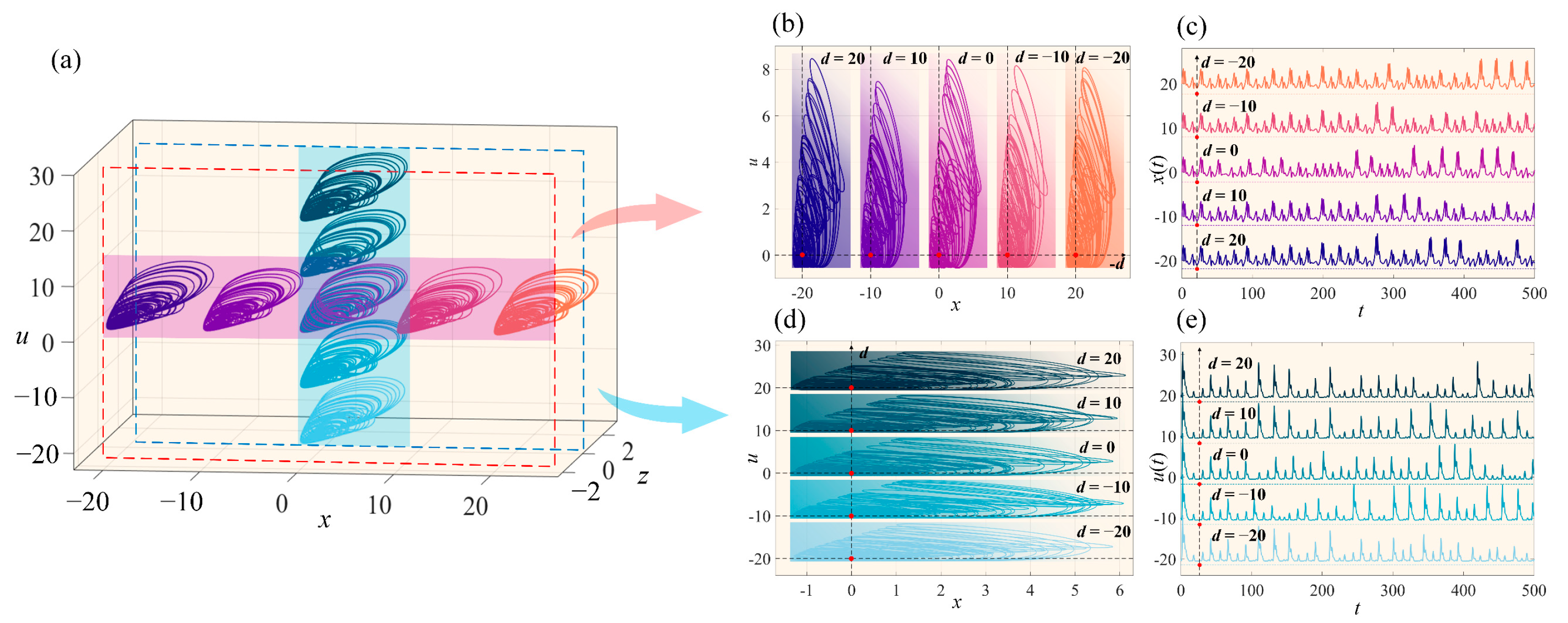
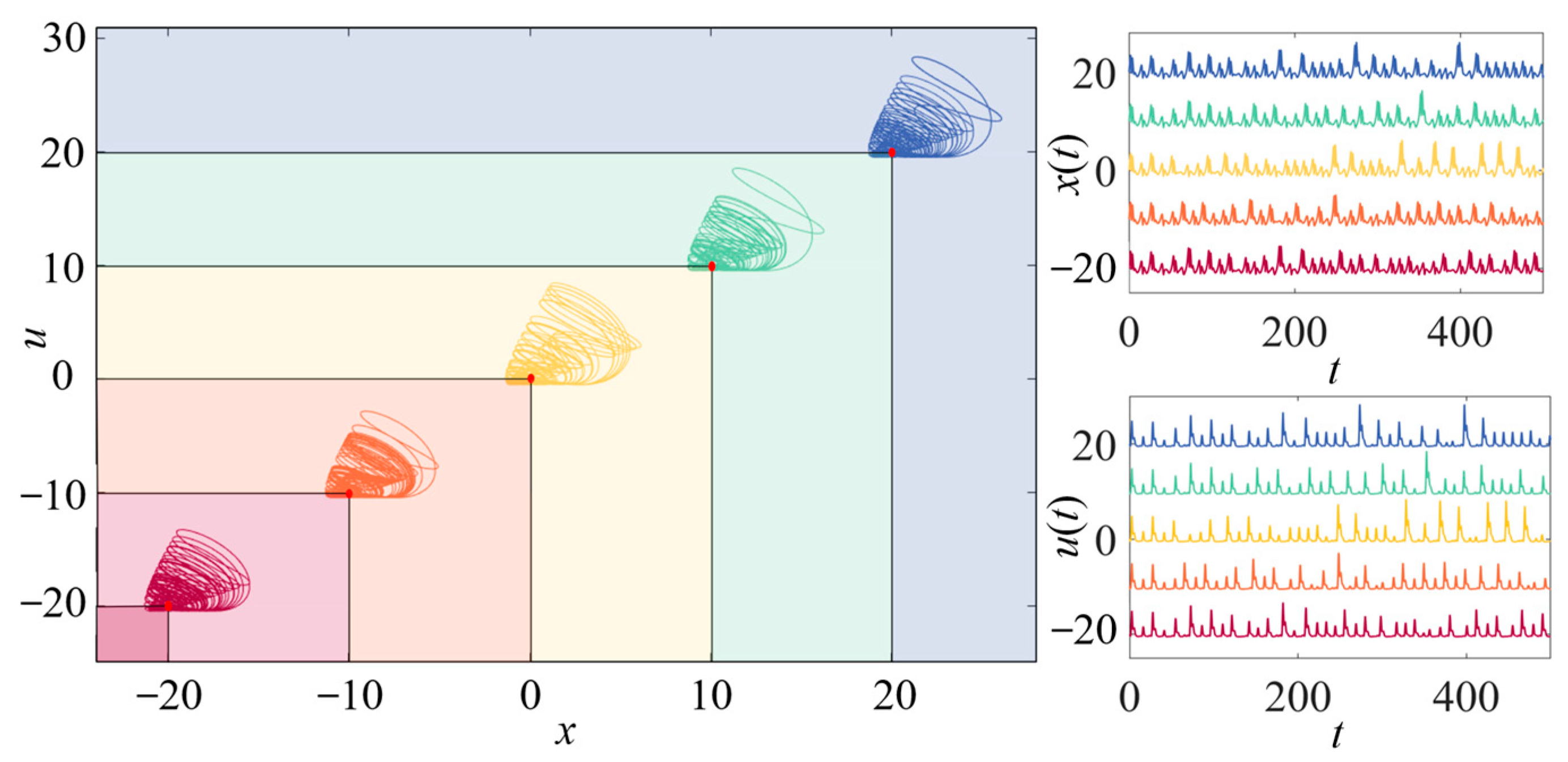
As shown in Figure 1, d independently shifts the attractor along the x- or u-direction under the initial conditions [-d, −1, 1, 0] and [1, −1, 1, d], respectively. Figure 2 further shows that decomposing d into -d1 + d2 = d enables coordinated offset regulation of x and u with independently adjustable displacement components.
Figure 1.
Effect of the offset-boosting parameter d in system (2): (a) phase trajectories for [−d, −1, 1, 0] and [1, −1, 1, d]; (b,c) trajectory and x(t) for [−d, −1, 1, 0]; (d,e) trajectory and u(t) for [1, −1, 1, d].
Figure 2.
Joint offset-boosting regulation of x and u by the parameter d in Equation (2) for the initial condition [d1, −1, 1, d2], where −d1 + d2 = d; the waveform displacement verifies the regulation.
2.2. Homogeneous Multistability Under Initial-State Regulation
For d = 0, the translation condition becomes d1 = d2 = c. Thus, simultaneously adding the same constant to x and u leaves Equation (1) unchanged. The trajectory initialized at (c, −1, 1, c) therefore satisfies
while yc(t) = y(t) and zc(t) = z(t), where the reference initial condition is (0, −1, 1, 0). This translation symmetry permits continuous displacement along the common x- and u-direction.
xc(t) = x(t) + c, uc(t) = u(t) + c
Equation (1) admits the conserved quantity
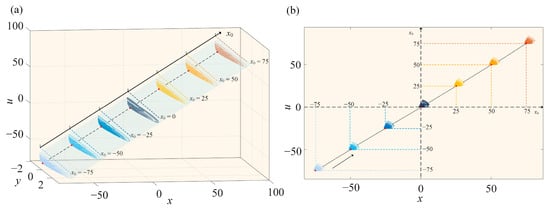
Consequently, each trajectory remains on an invariant hypersurface u − y2/2 = C. For the initial condition (c, −1, 1, c), C = c − 1/2. Continuous variation of c therefore generates a family of translated chaotic invariant sets on distinct hypersurfaces, as illustrated in Figure 3. Attraction to each set, if established, is understood relative to its corresponding hypersurface.
Figure 3.
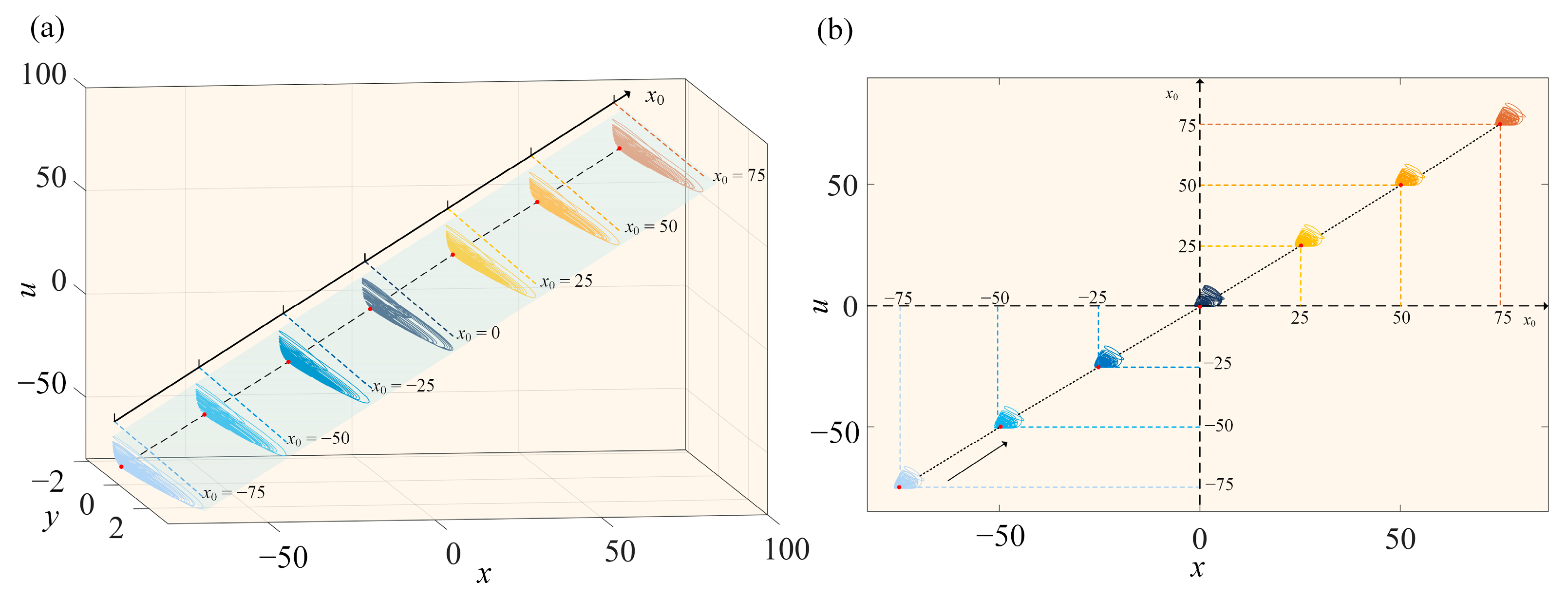
Initial-condition-dominated offset-boosted attractors of system (1) for [x0, −1, 1, x0]: (a) offset-boosted attractors in the x − y − u state space; (b) offset-boosted attractors in the x − u plane. x0 = −75 (light blue), x0 = −50 (blue), x0 = −25 (medium blue), x0 = 0 (dark blue), x0 = 25 (yellow), x0 = 50 (orange), and x0 = 75 (brown).
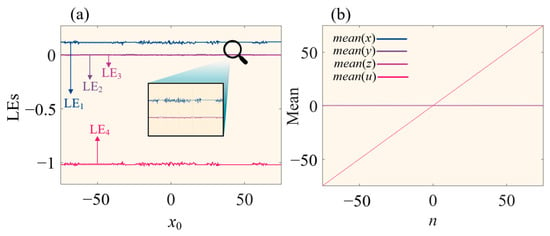
Along translation-related trajectories, y and z are unchanged. Since the Jacobian depends only on y and z, the variational equations are identical and therefore yield identical Lyapunov spectra. This is an analytical statement for the specified trajectory correspondence. Figure 3 illustrates wide translations with c ∈ [−75, 75], whereas Figure 4a presents a representative local spectrum over c ∈ [−75, 75] and Figure 4b displays state means over its plotted interval [−75, 75]. These numerical windows serve different illustrative purposes; the translation identity does not depend on a finite scan. The spectrum in Figure 4a contains one positive exponent and is described as chaotic.
Figure 4.
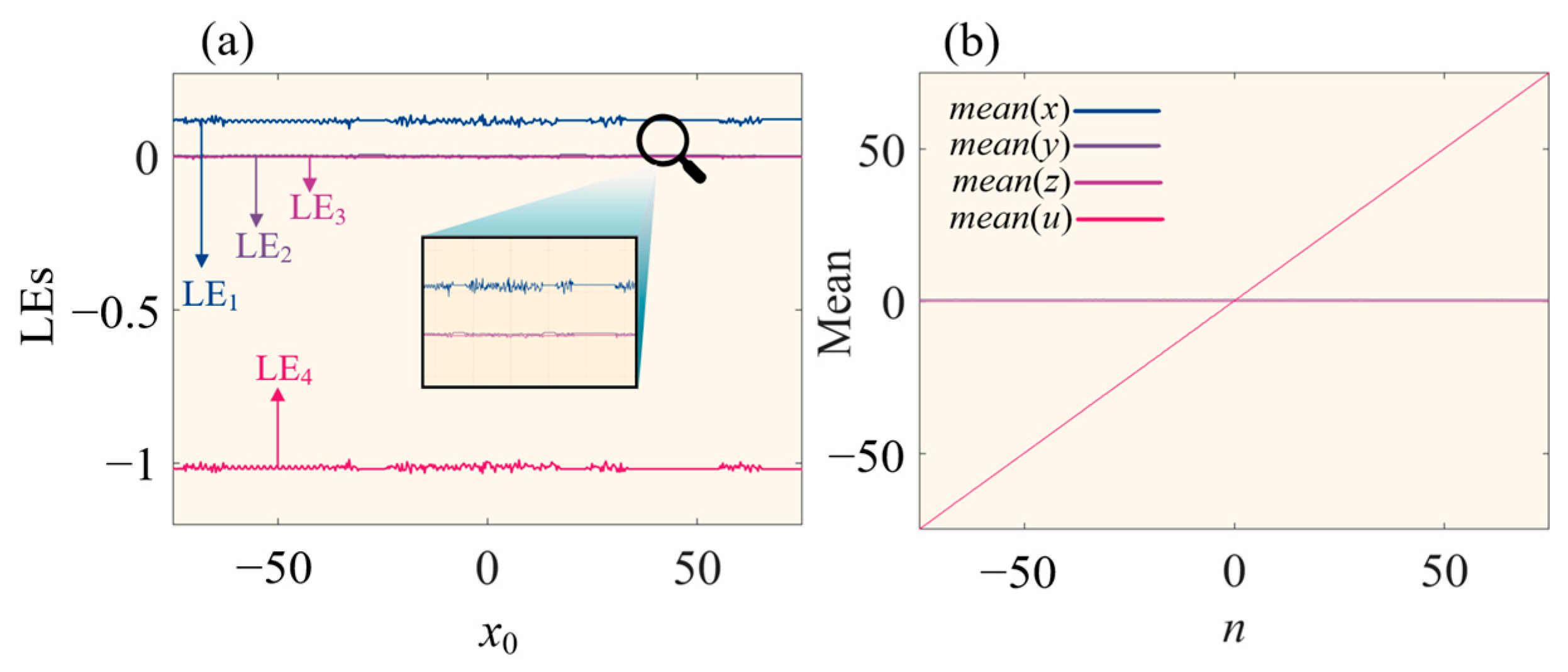
Dynamical evolution of system (1) with x0 under the initial condition [x0, −1, 1, x0]: (a) Lyapunov exponents; (b) mean values of all state variables.
2.3. Parametric Evolution of Dynamical and Offset States
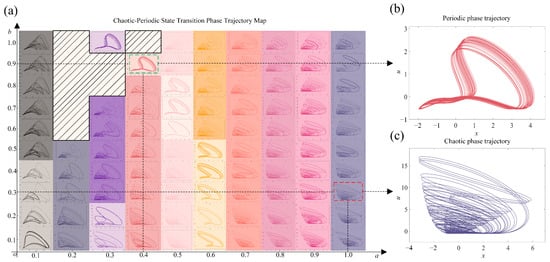
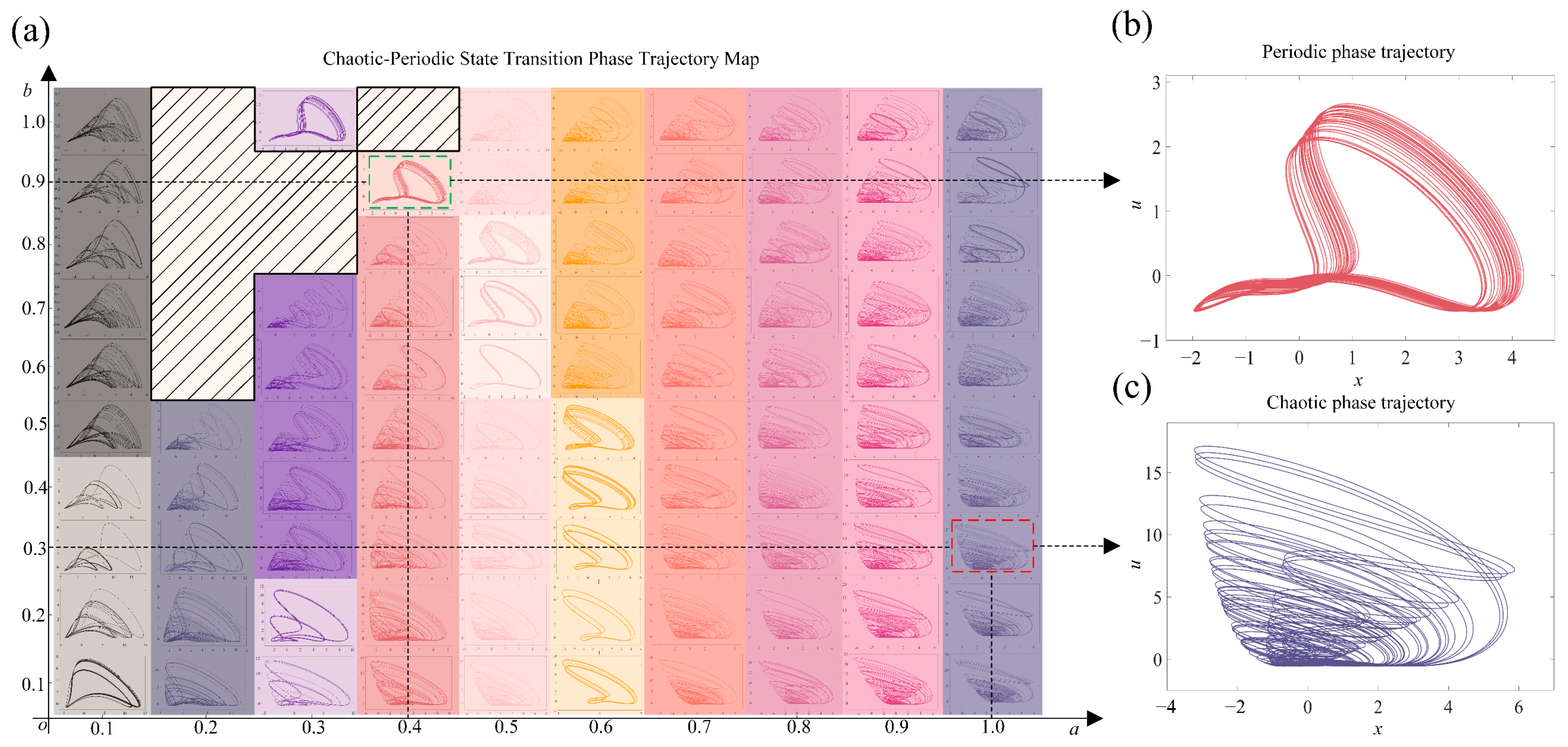
Extensive numerical simulations show that the weighting parameters a and b play important roles in regulating both the system dynamics and the offset distributions of x and u. Continuous variation of either parameter can induce evident changes in the attractor structure, dynamical regime, and offset level. Moreover, the regulation effects show no clear dependence on the ratio a/b, but are mainly determined by the individual magnitudes of a and b.
As a and b are varied continuously, the phase trajectories alternate between periodic and chaotic regimes. The topology, spatial extent, and offset-boosting levels of the attractors in the x-u plane evolve accordingly, while a strong coupling relationship between x and u is retained. Within specific amplitude ranges of a and b, the system exhibits regular periodic motion, with stable offset boosting of x and u and trajectories converging to closed orbits. Once critical thresholds are crossed, the system enters a chaotic regime characterized by stretching-and-folding structures, broader offset-boosting ranges, and aperiodic oscillations. Thus, a and b jointly regulate the dynamical regime and the offset-boosting levels of x and u.
The shaded regions in Figure 5 correspond to parameter combinations for which the dynamical equations do not admit stable numerical evolution. No stably evolving periodic or chaotic attractors are therefore displayed in these regions.
Figure 5.
Phase-trajectory map of chaotic-periodic state transitions: (a) attractors generated by system parameters a and b over the range 0–1; (b) periodic attractor for (a, b) = (0.4, 0.9); (c) chaotic attractor for (a, b) = (1.0, 0.3).
2.4. Compensation Dynamics and Coupled-State Regulation
The four-dimensional chaotic system constructed above is considered, and its governing equations can be written as
where x, y, z, and u are the four state variables, and a, b, and d are adjustable control parameters. The term ax − bu couples the first and fourth state variables. The compensation discussed below concerns their contributions to the combined output under the specified parameter and initial-condition settings.
To fuse multidimensional chaotic information, a linearly coupled waveform of the two state variables is defined as
s(t) = αx(t) + βu(t)
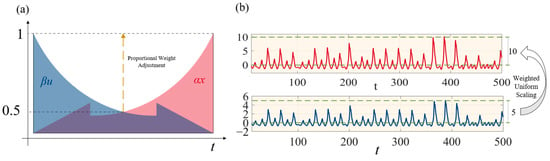
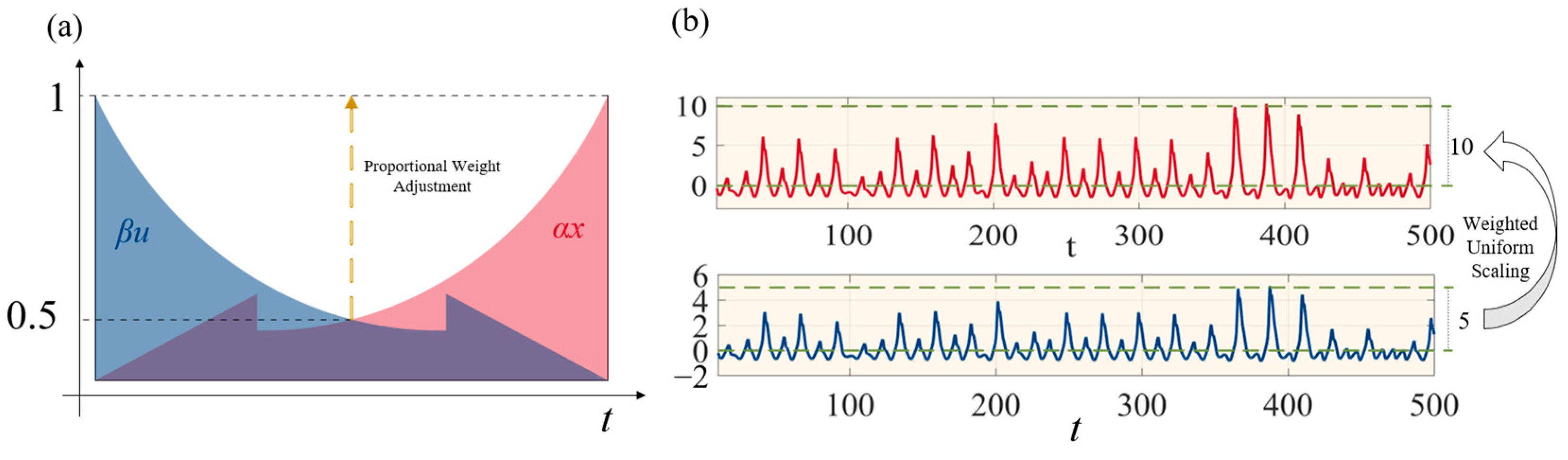
Here, α and β denote the coupling weights associated with x and u, respectively. Figure 6 illustrates the weighting configuration and the amplitude scaling of the combined output. The waveform-overlap conditions are examined below.
Figure 6.
Illustration of weight variation: (a) inverse-compensation relationship between the weighting parameters α and β; (b) overall waveform scaling as the coupling weight is varied from 0.5 to 1.
When equal weighting is adopted in the time domain, x and u contribute equally to the dual-variable coupling. A weight of 1 yields clearer observations than 0.5 while preserving the dynamical characteristics. Accordingly, α = 1 and β = 1 are selected in the numerical analysis, and the coupled waveform reduces to
s(t) = x(t) + u(t)
Equal weighting defines the combined output s(t) = x(t) + u(t), without imposing x(t) = −u(t). For trajectories related to a common reference solution by the translations x = xref + d1 and u = uref + d2, the combined output satisfies
s(t) = sref(t) + d1 + d2
Consequently, two such trajectories produce identical combined outputs when their offset sums are equal. This conclusion requires the corresponding parameter and initial-condition relations, rather than equal weighting alone.
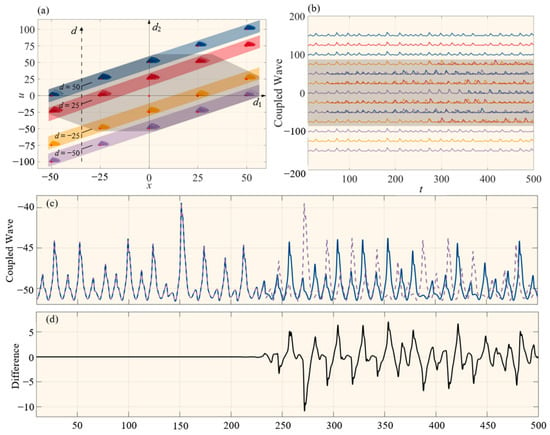
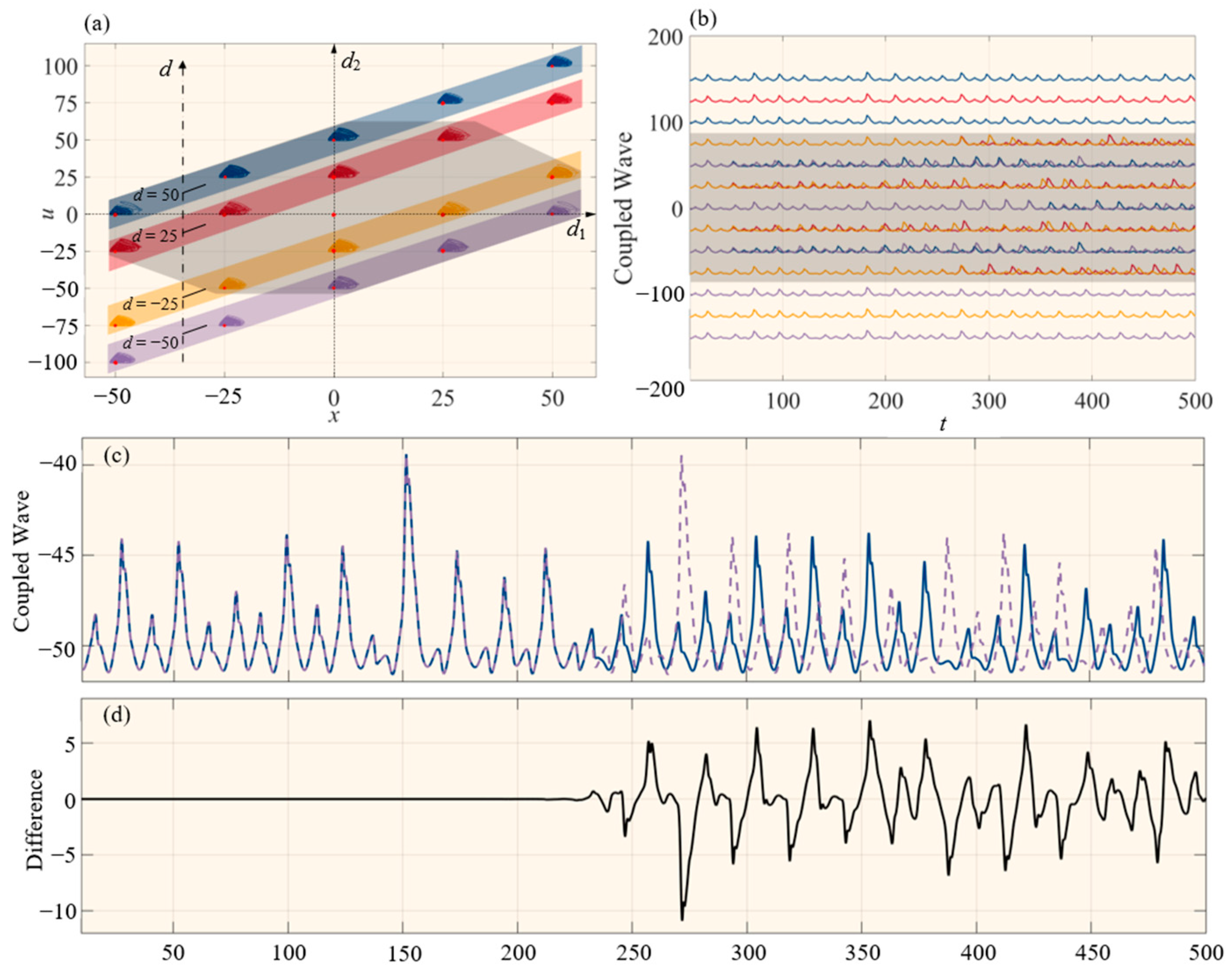
To characterize the spatial relationship, a Cartesian coordinate system is constructed in the x-u phase plane using d1 and d2 as the horizontal and vertical coordinates, respectively, subject to −d1 + d2 = d, as shown in Figure 7. The trajectories generated for different values of d can therefore be parameterized by d1 and d2, which jointly describe their positions and offset-boosting characteristics.
Figure 7.
Phase trajectories and coupled waveforms represented in the (d1, d2) coordinate system subject to −d1 + d2 = d: (a) trajectories for different d with d1 ∈ (−50, 50), where the shaded regions indicate waveform overlap; (b) corresponding coupled waveform, with the overlapping regions shaded; (c) Equal-weight coupled outputs for (d1, d2) = (−50, 0) (blue) and (0, −50) (purple); (d) corresponding difference between the two outputs.
The two cases were independently integrated using ode113 over t ∈ [0, 500], with relative and absolute tolerances of 10−12 and 10−14, respectively, and a maximum internal step size of 0.02. Outputs were sampled at intervals of 0.005, with approximately the first 10 time units discarded as transients.
Figure 7 illustrates waveform overlap between translation-related trajectories with equal offset sums. For a = b = 1, the offset pairs (d1, d2) = (−50, 0) and (0, −50) correspond to d = 50 with initial condition (−50, −1, 1, 0) and d = −50 with initial condition (0, −1, 1, −50), respectively. Both satisfy d1 + d2 = −50, although their spatial positions differ. Under the corresponding parameter and initial-condition settings, their equal-weight combined outputs therefore coincide in exact arithmetic. The shaded regions identify the illustrated pairs satisfying this compensation condition. Figure 7c,d show close early agreement followed by later separation, with a full-interval RMSE of 1.883 and a maximum absolute difference of 10.9. Thus, exact offset compensation does not guarantee long-term numerical agreement.
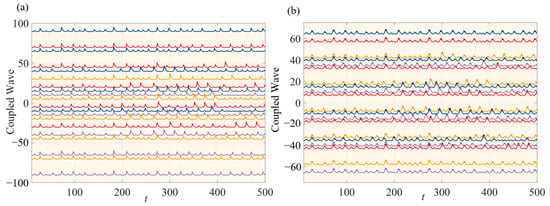
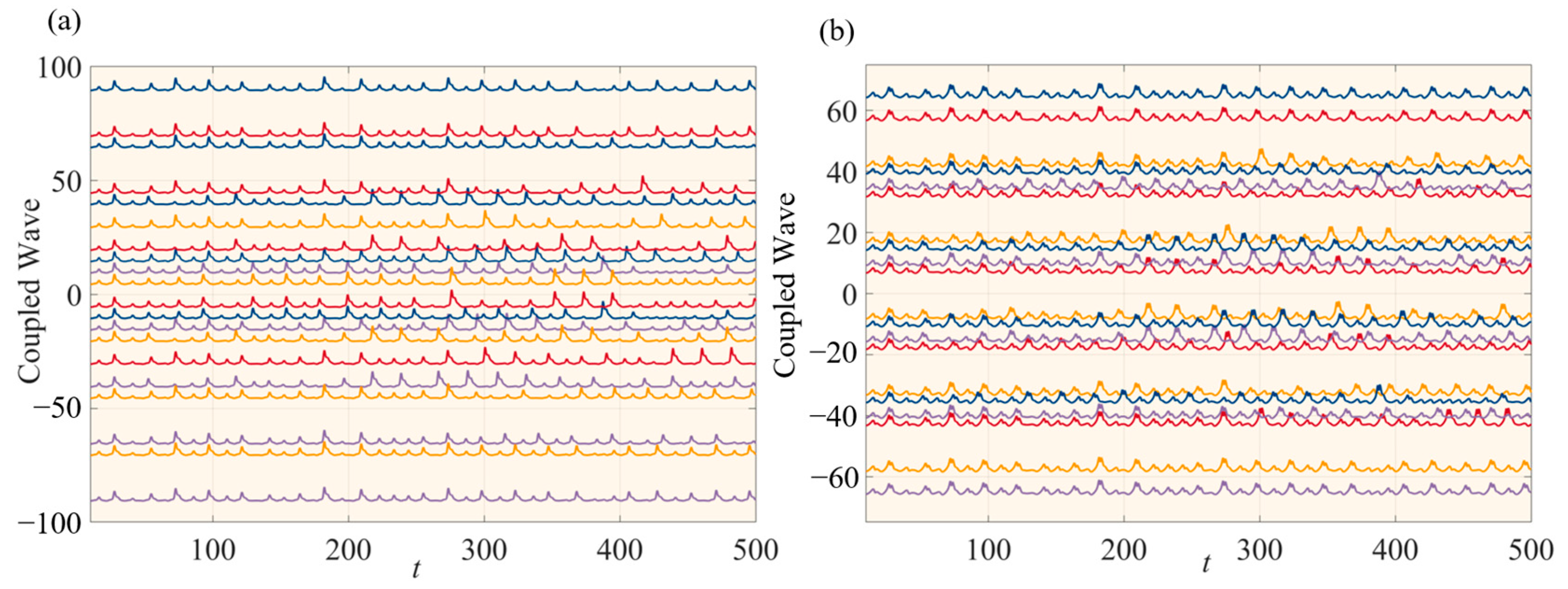
When the weights are set to α = 0.5 and β = 0.5, the coupled waveform is reduced only in overall amplitude, whereas the inverse balance between the two variables remains unchanged and waveform overlap persists under different conditions. To distinguish the waveforms, unequal weighting combinations, such as α = 0.2, β = 0.8 or α = 0.7, β = 0.3, can be employed to weaken mutual cancellation. As demonstrated in Figure 8, this treatment produces clear waveform separation among different states. In summary, equal-weight combinations such as (0.5, 0.5) and (1, 1) tend to promote waveform overlap, whereas asymmetric weighting separates the coupled states.
Figure 8.
Coupled waveforms under different weighting combinations: (a) α = 0.2, β = 0.8; (b) α = 0.7, β = 0.3.
3. Digital Implementation and Visualization on STM32H750
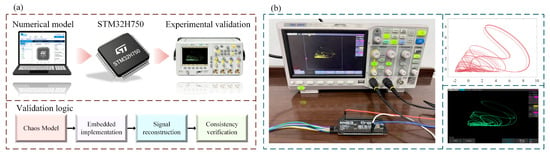
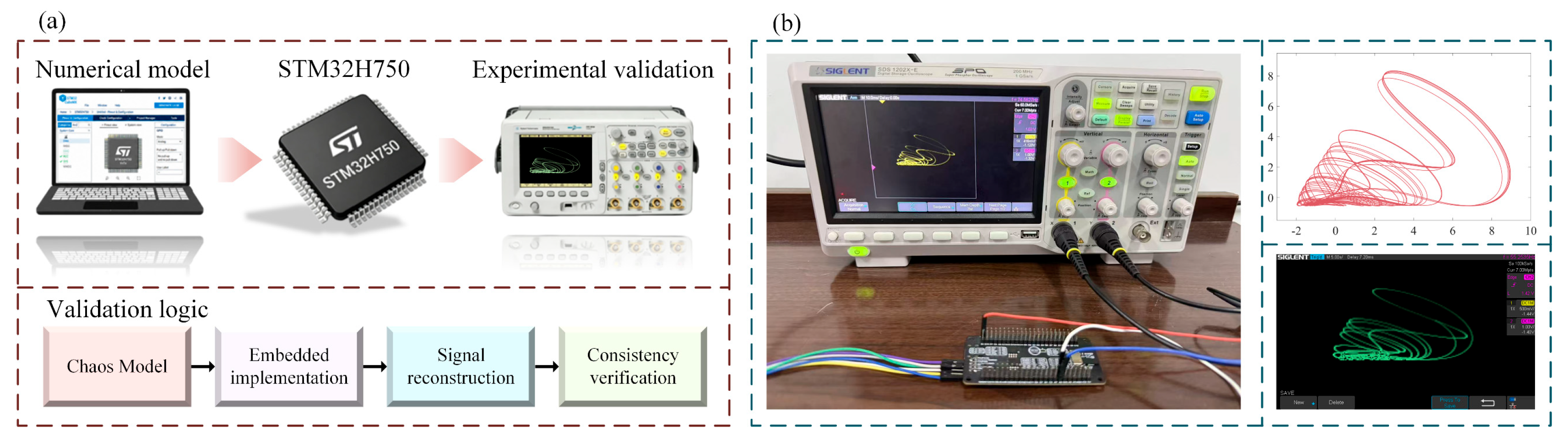
An STM32H750VBT6-based digital platform, as shown in Figure 9, is employed to verify the finite-precision implementation of the proposed system. The four state equations are iterated using single-precision floating-point arithmetic and an explicit Euler scheme with a step size of h = 0.001, with the first 500 samples discarded as transients. The resulting xn and un sequences are linearly scaled to the on-chip 12-bit dual-channel DAC and recorded by a digital oscilloscope in X–Y mode. The conversion uses nearest-integer rounding and clipping to the 12-bit code range of 0–4095, introducing finite quantization resolution and possible saturation of out-of-range values. The DAC values are updated in the main loop without a prescribed fixed update period; the numerical integration step h therefore does not specify the physical output interval. Under the same parameters and initial conditions as the numerical simulations, the measured trajectories and waveforms closely reproduce the simulated results. For d1 ∈ (−50, 50), the expected attractor translations and waveform overlaps are observed, while asymmetric weights α = 0.7 and β = 0.3 effectively separate the overlapping signals.
Figure 9.
Basic framework of the digital experimental platform: (a) experimental architecture; (b) representative outputs from the major stages of the implementation.
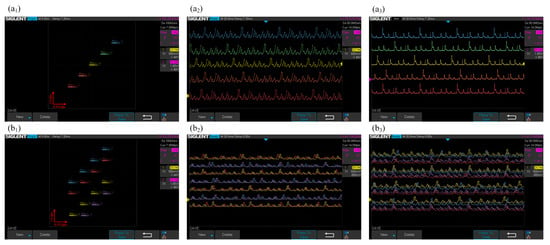
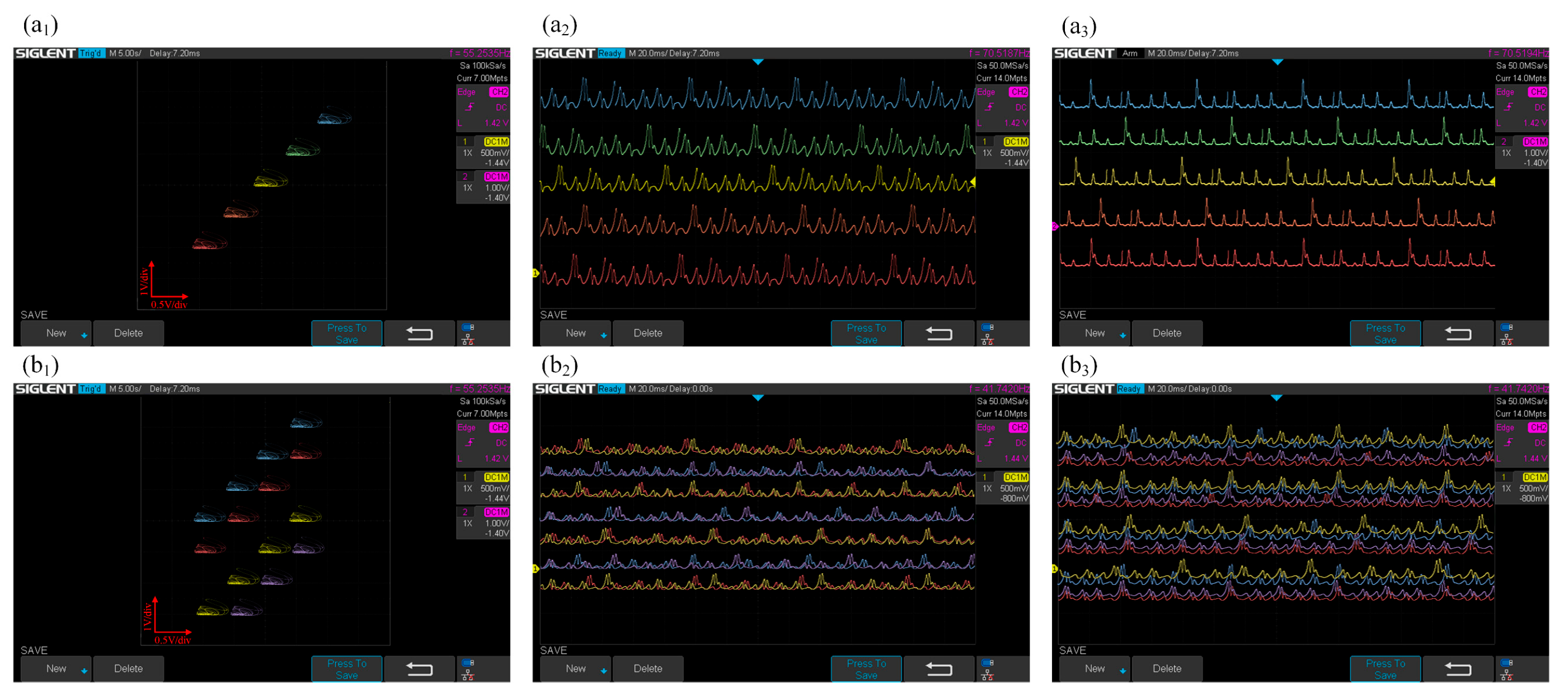
Using the same parameters and initial conditions as in Figure 2, Figure 10 presents the corresponding hardware phase portraits and time series. The results closely reproduce the simulated offset-regulation behavior. To further verify the competitive relationship between x and u, the coupling function s(t) is implemented on the STM32H750 platform. Varying d produces the expected phase-space translations, while the coupled waveforms retain the inverse-compensation behavior observed in Figure 7. These observations demonstrate the feasibility of digital sequence generation and DAC visualization of the proposed system. The experiment provides a qualitative demonstration rather than a quantitative assessment of software–hardware agreement.
Figure 10.
Oscilloscope results of the STM32H750 implementation: (a1) phase trajectory; (a2) x(t) waveform; (a3) u(t) waveform; (b1) phase trajectories with waveform overlap for different d; (b2) overlapping waveforms; (b3) separated coupled waveforms for α = 0.7 and β = 0.3.
4. Chaos-Driven HHO and Path Optimization
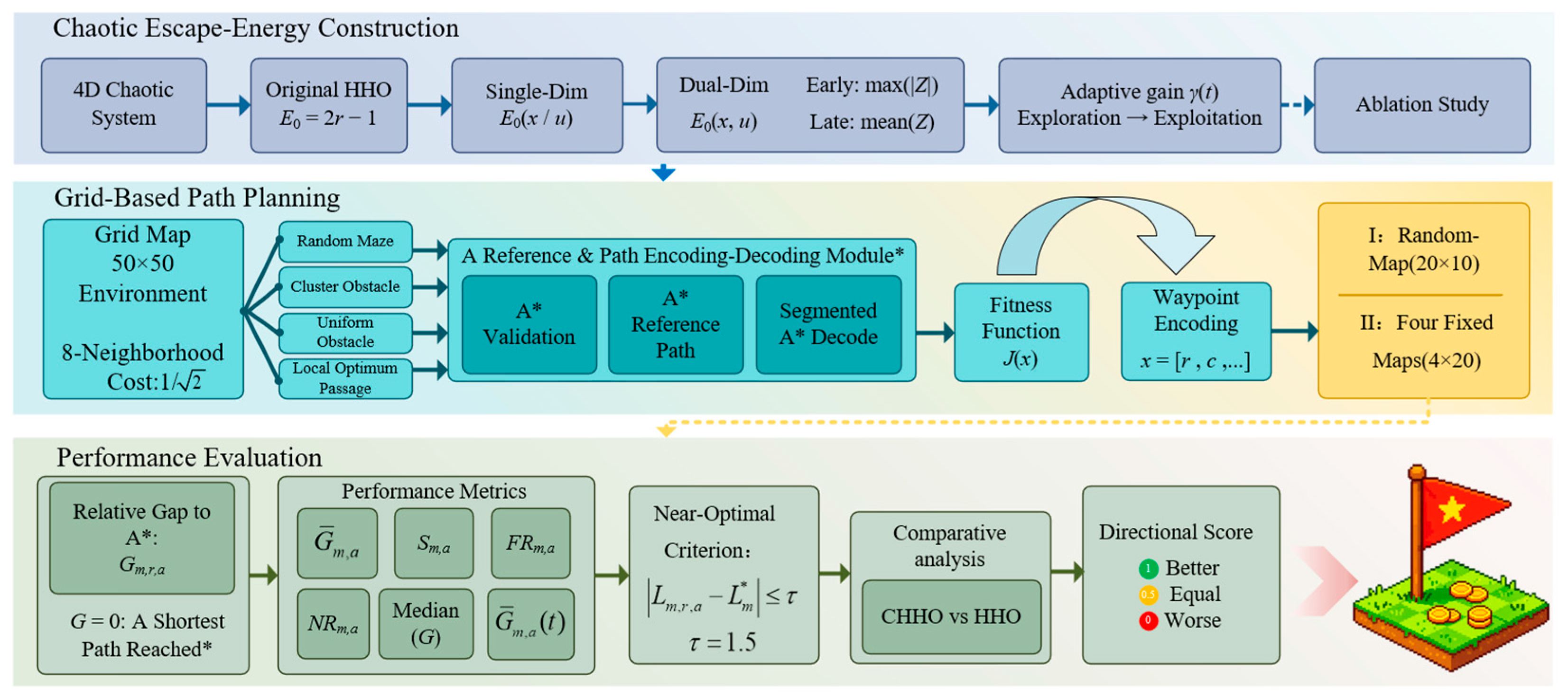
Based on the differentiated chaotic information revealed above, a chaos-driven HHO framework is developed for grid-based path optimization. As illustrated in Figure 11, the overall procedure consists of three stages: chaotic escaping-energy construction, grid-based path planning and performance evaluation, and ablation-based mechanism analysis.
Figure 11.
Overall framework of the chaos-driven HHO and its application to grid-based path optimization. A* denotes the A-star search algorithm, and represents the reference path length obtained using A*.
4.1. Chaotic-State-Based Escaping-Energy Reconstruction
HHO coordinates global exploration and local exploitation through the prey-escaping energy, in which E0 provides the stochastic perturbation. Based on the competitive–compensatory dynamics revealed above, the regulated chaotic states are introduced to reconstruct E0, while the original HHO position-update mechanism remains unchanged.
The total escaping energy of HHO is defined as
where the decay factor is given by
where t denotes the current iteration, and T is the maximum number of iterations. E0 represents the initial prey escaping-energy perturbation. In the original HHO, it is generated from a uniformly distributed random variable:
E(t) = E1(t) E0(t)
E0 = 2r − 1, r ~ U(0, 1)
Accordingly, E0 ∈ [−1,1]. However, independent random perturbations provide limited structured exploration and may promote premature convergence in multimodal environments.
To alleviate these limitations, the state sequences generated by the proposed four-dimensional chaotic system are introduced to reconstruct the escaping-energy factor E0. For the following optimization experiments, the system is operated with a = 1, b = 1, and d = 0. Here, d = 0 is adopted to exclude additional spatial offsets from the sequence construction, allowing the intrinsic state differences to be exploited independently of attractor translation. An explicit Euler scheme with a step size of h = 0.001 is employed for numerical discretization. To reduce the influence of transient responses on the statistical properties of the generated sequences, the first 3000 iterations are discarded. The resulting state sequences are then extracted and denoted by Sx and Su, respectively.
Because the extracted state sequences exhibit different amplitude ranges and statistical distributions, they cannot be directly used to replace E0. Therefore, for each sequence Sj = {S(j, 1), S(j, 2), …, S(j, N)}, where j ∈ {x, u}, a min-max normalization is first applied:
where sj,min and sj,max denote the minimum and maximum values of the j-th-dimensional sequence, respectively, and ε = 2.2204 × 10⁻¹⁶ is the machine epsilon of double-precision floating-point arithmetic (i.e., the built-in eps in MATLAB R2018a), introduced to prevent a zero denominator. After normalization, both sequences are mapped to [0, 1], thereby eliminating differences in numerical range and amplitude scale between the state variables.
To further reduce the influence of nonuniform probability distributions in the original sequences on the escaping-energy values, a rank-based uniform mapping is subsequently applied. Let rank() denote the ascending rank of the i th element within the corresponding sequence. The mapped sequence is then expressed as
where Cj,i ∈ (0, 1). This transformation renders the x- and u-dimensional sequences approximately uniform over (0, 1) while retaining their temporal arrangement. The processed x- and u-dimensional sequences are finally linearly mapped to (−1, 1):
Zj,1 = 2Cj,1 − 1, j ∈ {x, u}
Based on the processed chaotic sequences, two single-state driving strategies are first constructed by directly replacing the original random escaping-energy perturbation with the corresponding chaotic state sequence. Accordingly,
These two cases correspond to CHHO-x and CHHO-u, respectively, and introduce chaotic temporal information without altering the original HHO parameter range or search structure.
To further exploit the complementary information carried by the two regulated chaotic states, a fixed dual-state fusion strategy is constructed by equal-weight combination:
This strategy corresponds to CHHO-xu and incorporates information from both chaotic states without iteration-dependent regulation.
Although equal-weight fusion incorporates dual-state information, the inverse-compensation relationship between the two states may partially suppress the perturbation amplitude. To alleviate this effect while coordinating exploration and exploitation, an adaptive dual-state regulation strategy is further developed.
The state component with the larger absolute magnitude is selected as the exploration component, whereas the mean of the two states is used as the exploitation component:
The former preserves the stronger chaotic perturbation and reduces excessive cancellation during early exploration, whereas the latter compresses the perturbation amplitude to support stable local exploitation.
w(t) = [1 − τ(t)]2
A monotonically decreasing weight is introduced to shift the dominant contribution from exploration-oriented selection to mean-based exploitation as the iteration proceeds.
g(t) = 1.20 − 0.35τ(t)
The gain gradually decreases from 1.20 to 0.85, providing stronger perturbation in the early stage while avoiding excessive search fluctuations in the later stage.
This adaptive construction corresponds to CHHO-xu-Pro. The magnitude-based selection in Equation (20) preserves stronger perturbations by limiting cancellation between oppositely signed states, but may introduce abrupt changes when their absolute magnitudes are close. As iterations proceed, the decreasing selection weight and gain reduce the influence of this component, while the mean component increasingly contributes to local exploitation. This gradual transition refers to the changing contributions of exploration and exploitation rather than strict continuity of the perturbation sequence or search trajectory.
Finally, after E0 has been reconstructed using the single- and dual-variable chaotic sequences, the total escaping energy of the improved CHHO can be written uniformly as
Accordingly, the compared strategies form a progressive hierarchy from random perturbation to single-state chaotic driving, fixed dual-state fusion, and adaptive dual-state regulation. All variants modify only the construction of E0, while the original HHO position-update mechanism remains unchanged. These strategies are subsequently evaluated under a unified grid-based path-planning framework.
4.2. Path-Planning Model and Performance Evaluation
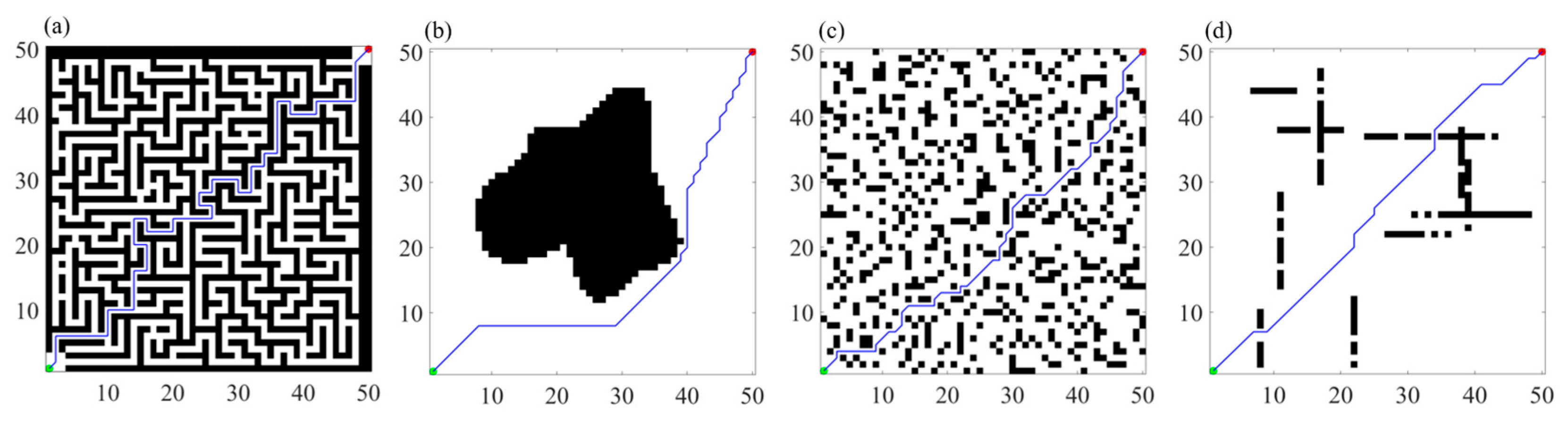
A two-dimensional 50 × 50 grid environment is adopted, where 0 denotes free space, and 1 denotes an obstacle cell. The start and goal are fixed at ps = (1, 1) and pg = (50, 50), respectively. As shown in Figure 12, four map classes are considered: a random maze, a 25% clustered-obstacle map, a 25% block-wise obstacle map, and a narrow-passage map with multiple local optima. The last case contains several competing routes and is used to increase the difficulty of path selection. Each generated map is checked for start-to-goal connectivity using A*. Maps without feasible paths are discarded and regenerated. Obstacle-free regions are also reserved around the start and goal to avoid complete local blockage and ensure valid test environments.
Figure 12.
Four standardized test maps, where the blue trajectory denotes the reference shortest path obtained by A*: (a) random maze; (b) 25% clustered-obstacle map; (c) 25% block-wise uniformly distributed obstacle map; (d) narrow-passage map with multiple local optima.
An eight-neighbor grid-motion model is adopted, allowing horizontal, vertical, and diagonal movements. Horizontal and vertical moves are assigned a cost of 1, whereas diagonal moves are assigned a cost of . To prevent a path from cutting through the shared corner of two obstacle cells, a diagonal move is permitted only when both corresponding orthogonally adjacent cells are free.
In HHO and its three improved variants, a candidate path is represented by K = 8 intermediate control points. Each control point contains row and column coordinates; therefore, the dimension of a candidate solution is D = 2K = 16. The i th candidate solution is expressed as
xi = [r1, c1, r2, c2, …, rK, cK]T
Because HHO updates positions in a continuous search space whereas grid coordinates must be integers, each candidate solution is first rounded and clipped to the map boundaries. If a control point falls inside an obstacle cell, it is repaired by moving it to the nearest free cell. The start point, repaired intermediate control points, and goal point are then assembled into an ordered key-point sequence.
= {ps, p1, …, pK, pg}
Adjacent key points are subsequently connected by A* in the order ps → p1 → … → pK → pg, and the segment paths are concatenated to form the complete route. Because this A* reconnection is identical to the procedure that produces the reference path, it inherits the same collision-avoidance rules: besides rejecting any obstacle-occupied cell, the neighbor expansion forbids a diagonal transition from cell (r, c) to (r + Δr, c + Δc) with |Δr| = |Δc| = 1 unless both orthogonally adjacent cells (r, c + Δc) and (r + Δr, c) are free. Hence, corner cutting is computationally excluded from every generated path regardless of where the continuous control points are placed, and any pair of control points for which no collision-free connection exists is treated as an infeasible segment and penalized accordingly. A candidate is regarded as infeasible if any adjacent pair cannot be connected. To reduce repeated A* computations, shortest-path distances between previously evaluated node pairs are cached and directly reused. This strategy improves computational efficiency without affecting the resulting path length or evaluation outcome. The grid model, A* reference, path length, and reward–penalty objective are unified as follows.
where M(i, j) denotes the grid state; G(n) is the accumulated path cost from the start to the current node; H(n) is the Euclidean heuristic distance from the current node to the goal; dA* denotes the A* shortest-path distance between adjacent key points; Nfail is the number of infeasible path segments; Θ is the cumulative turning angle of the key-point sequence; and Nrep is the number of repeated control points.
The reward–penalty mechanism consists of four components: path-length reward, penalty for unreachable segments, turning-angle penalty, and repeated-control-point penalty.
J(x) = 2L(x) + 3000Nfail + 0.01Θ(x) + 2Nrep
Shorter routes receive lower fitness values and are therefore implicitly favored. If adjacent control points cannot be connected by A*, the segment cost is approximated as 20 times their Euclidean distance, with an additional penalty of 3000 per unreachable segment. Turning-angle and repeated-control-point terms further suppress excessive tortuosity and redundant search. Finite penalties are retained during optimization so infeasible candidates still provide search information. After termination, complete segment-wise A* decoding is performed, and only solutions with all segments reachable are accepted as feasible paths.
A* provides the shortest-path reference under eight-neighbor motion, with costs of 1 and for orthogonal and diagonal moves, respectively, while corner cutting is forbidden. Its path length is used as the lower-bound benchmark, whereas HHO optimizes only the intermediate waypoints and A* decodes the resulting segments. A two-stage evaluation is adopted: Stage I tests robustness on multiple random maps from each class, while Stage II performs repeated runs on four fixed representative maps to obtain stable statistical comparisons between HHO and the three chaotic variants.
Both stages use identical motion rules, path encoding, A* references, and objective functions to compare HHO, CHHO-x, CHHO-u, and CHHO-xu. For each map, all algorithms share the same initial population and random-number stream, isolating the effect of E0 construction. In Stage I, 20 random maps per type are each tested 10 times. In Stage II, four fixed maps of different types are each tested 20 times per algorithm. Mean performance metrics are then computed for comparison.
Because obstacle distributions and A* shortest-path lengths differ among maps, raw path lengths are not compared directly. Instead, normalized evaluation metrics are defined relative to the A* shortest path of each map:
In Equation (27), the quantities represent the A* shortest-path reference, the path length obtained in each run, the relative optimality gap, the corresponding standard deviation, the feasibility rate, and the near-optimal rate, respectively. The threshold is set to τ = 1.5. A smaller Gap indicates a path closer to the A* optimum, while a smaller standard deviation reflects greater stability. The near-optimality threshold of 1.5 applies to the absolute path-length difference |L − L*|, measured in grid-length units, rather than to the percentage Gap or the composite objective. A run is successful only if its final path is feasible and satisfies this tolerance. Mean, median, best, worst, and convergence curves are also used to evaluate overall performance.
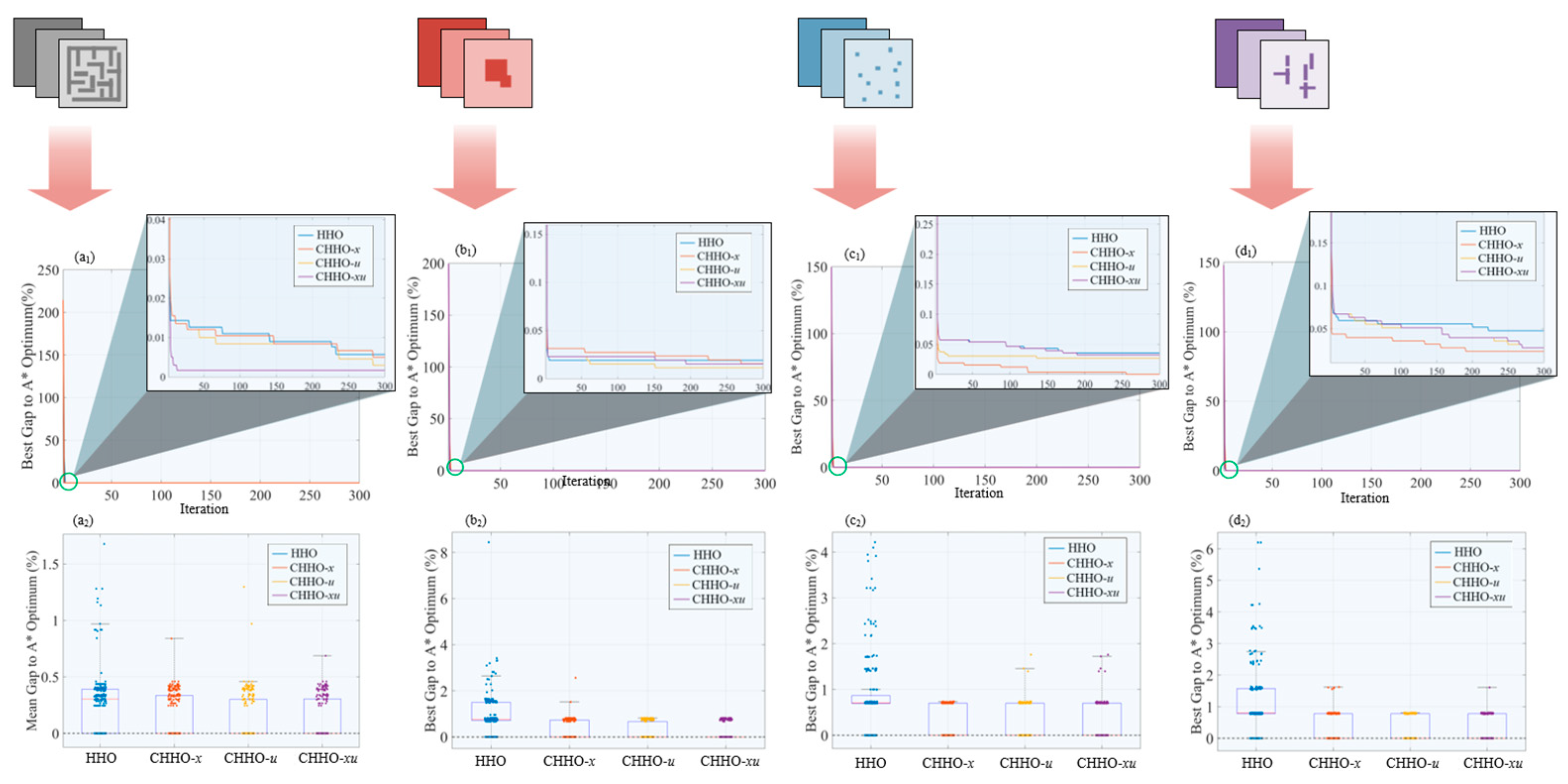
Stage I evaluates robustness across four map classes. For each class, 20 feasible random maps are generated and tested 10 times independently, yielding 200 samples per class and 800 per algorithm. For each map, all methods share the same initial population, random-number stream, and A* reference for paired comparison. The A* shortest path is recalculated for normalization. Figure 13 summarizes the convergence behavior and performance distributions across the four map classes.
Figure 13.
Convergence curves and box plots obtained over large sets of randomly generated maps: (a1,a2) random maze; (b1,b2) 25% clustered-obstacle map; (c1,c2) 25% block-wise uniformly distributed obstacle map; (d1,d2) narrow-passage map with multiple local optima. A* denotes the A-star search algorithm.
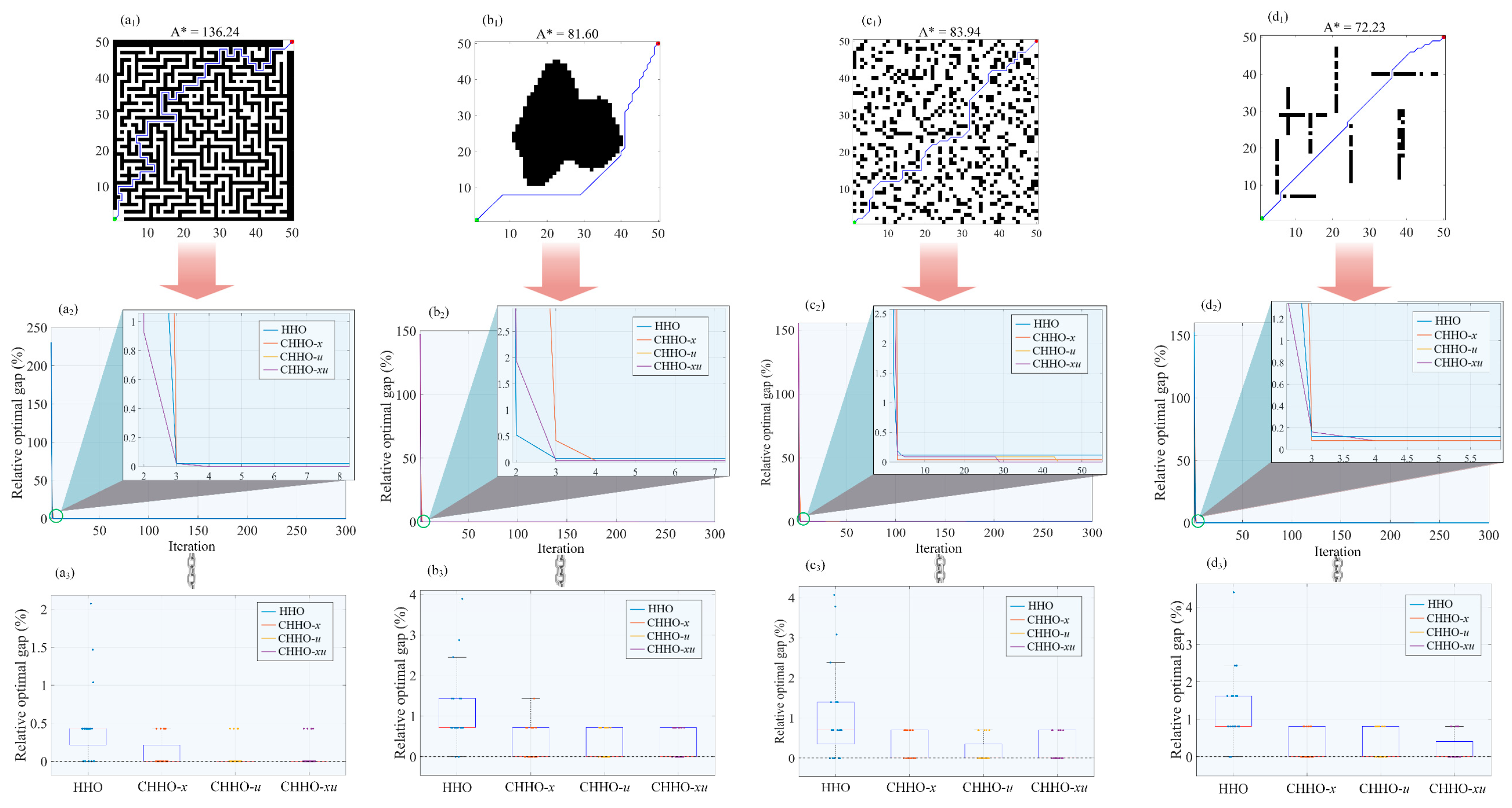
Although Stage I provides broad map coverage, repeated runs per map are limited. Therefore, Stage II fixes one representative map from each of the four classes and independently evaluates each algorithm 20 times, yielding 80 samples per method. This design reduces stochastic variability and provides more reliable estimates of the mean, standard deviation, median, and significance-related statistics, as shown in Figure 14.
Figure 14.
Convergence curves and box plots obtained from repeated runs on four fixed map classes: (a1–a3) random maze; (b1–b3) 25% clustered-obstacle map; (c1–c3) 25% block-wise uniformly distributed obstacle map; (d1–d3) narrow-passage map with multiple local optima.
In the second-stage experiments, the four algorithms are evaluated on the same maps using identical initial populations and common random numbers; the resulting observations are therefore paired. A two-sided paired randomization test is employed to compare CHHO-x, CHHO-u, and CHHO-xu against the original HHO. Because a conventional p-value indicates only whether a difference is statistically significant and does not convey the direction of superiority, a directional paired significance score is further defined as
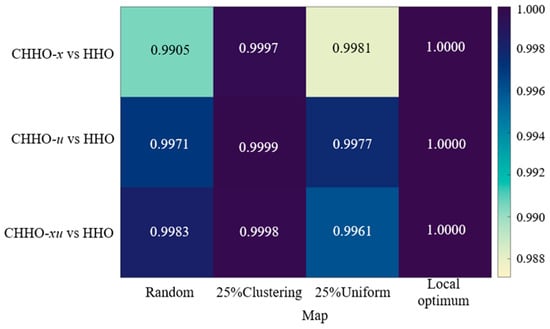
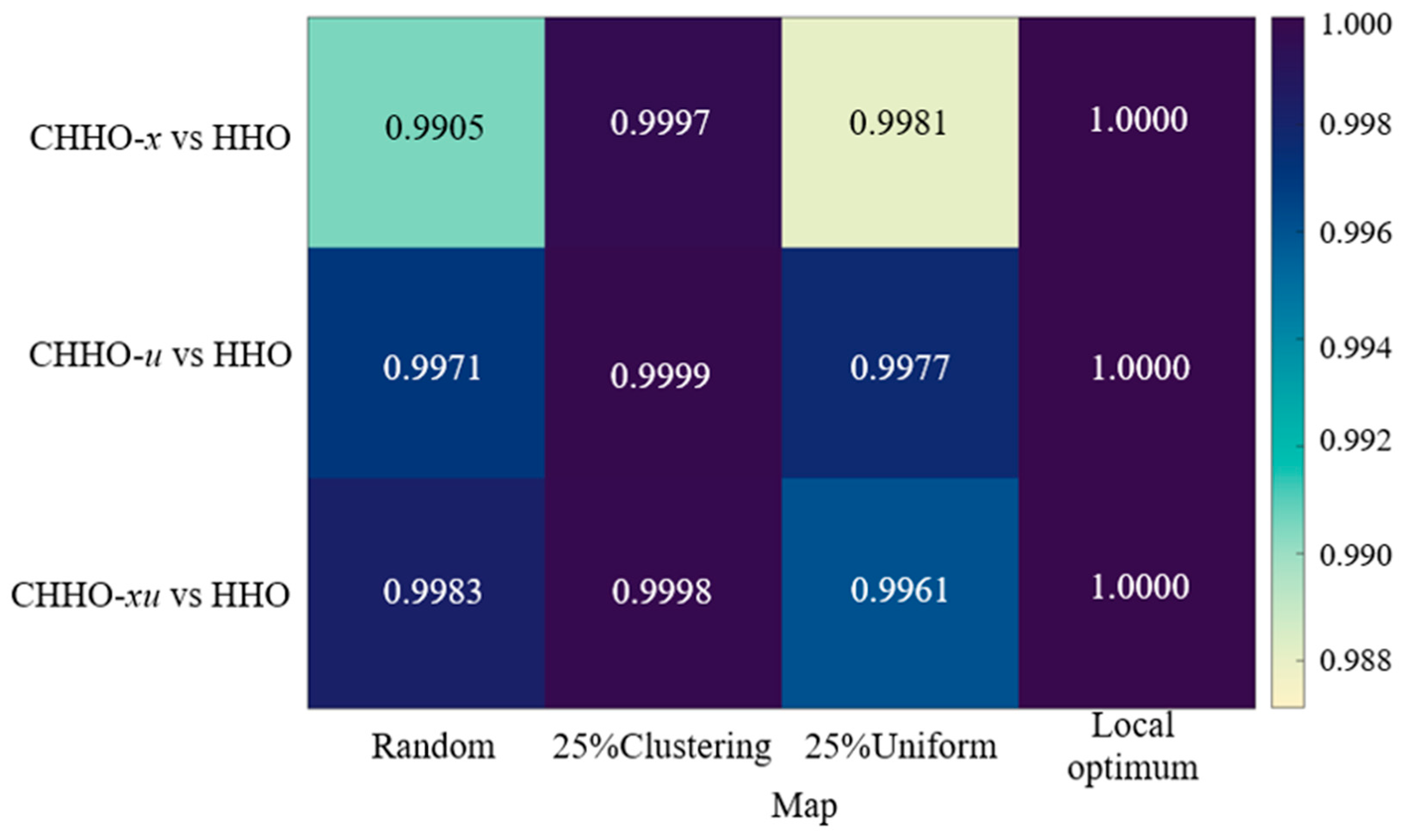
The corresponding terms in Equation (31) represent the mean relative gaps of the improved algorithm and the original HHO. A directional significance score closer to 1 provides stronger evidence in favor of the improved method, whereas a value closer to 0 favors the original HHO. The directional paired significance scores of the three chaotic variants across the four map classes are visualized as a heat map in Figure 15.
Figure 15.
Heat map of the directional paired significance score. Values closer to 1 indicate stronger paired evidence that the corresponding chaos-driven variant outperforms the original HHO.
The directional significance scores remain close to unity across all map classes, providing consistent paired evidence in favor of the chaos-driven variants. These results confirm the effectiveness of chaotic escaping-energy reconstruction. The contribution of each component is further examined through ablation analysis.
4.3. Computational Complexity and Execution-Time Analysis
This section analyzes both the computational complexity and the actual execution time to verify that the mapping and sorting operations do not slow down the algorithm.
Let N = MaxIter × Npop = 1.5 × 10⁴. The proposed algorithm adds three kinds of cost. First, the chaotic sequence is prepared once before the search. This preparation uses Euler integration with fivefold oversampling, then min–max normalization, then rank-uniform sorting. The integration and normalization cost O(N), and the sorting costs O(N log N). The sorting is the only super-linear step, and it runs once before the search rather than inside the loop. Second, the per-iteration fusion, adaptive gain, and clipping cost O(1) per hawk, or O(N) over a whole run. Third, each fitness evaluation repairs the control points and performs eight A* reconnections, with the distance cache turning repeated point pairs into constant-time lookups. This third part is identical for all five algorithms and dominates the total cost. The overall cost is therefore O(N log N) for the one-time preparation plus O(N·CA*) for the search, where CA** is the map-dependent A* cost.
Execution time. We timed the preparation (Tprep) and search (Tsearch = population init + random bank + repair + A* decoding) separately over 50 independent paired runs on random narrow-passage maps: Npop = 50, MaxIter = 300, 8 control points; one warm-up excluded, algorithm order rotated, A* cache reset per algorithm, sequential single-threaded, map generation and reference A* excluded. Table 1 reports the results.
Table 1.
Average per-run execution time, in seconds, over 50 runs.
The full chaotic pipeline, from integration through normalization and sorting, costs 0.0151 ± 0.0023 s. This is only 0.46% of the proposed algorithm’s total runtime. The A* reconnection occupies the remaining 99.5%. The preparation cost is also recovered during the search. Compared with HHO, the search stage of the proposed variant falls from 3.563 to 3.303 s, a drop of 0.26 s, because the structured E0 stabilizes the population and increases cache reuse. The net end-to-end change is −0.245 s, about 6.9% faster. All four chaotic variants run no slower than HHO.
In summary, the mapping and sorting add a small one-time cost that is negligible on its own and is offset by the search-time savings. The improved path quality is therefore obtained without any meaningful increase in execution time.
4.4. Ablation Study and Mechanism Analysis
To quantify the independent contributions of different chaotic sequences and their fusion mechanisms to HHO path-planning performance, five configurations-HHO, CHHO-x, CHHO-u, CHHO-xu, and CHHO-xu-Pro are included in an ablation study. Only the generation mechanism of the escaping-energy perturbation E0 is varied; population initialization, position updating, boundary handling, path encoding, and fitness evaluation are kept identical. This design follows the principle adopted above of replacing only E0 while preserving the original HHO search mechanism, thereby minimizing confounding effects. The module composition of the ablation variants is summarized in the following Table 2.
Table 2.
Component configurations of the ablation variants.
The five configurations form a progressive ablation chain from the original random perturbation to single-state chaotic driving, fixed dual-state fusion, and adaptive dual-state regulation. Their escaping-energy constructions follow the definitions given in Section 4.1, while population initialization, position updating, path encoding, and fitness evaluation remain unchanged.
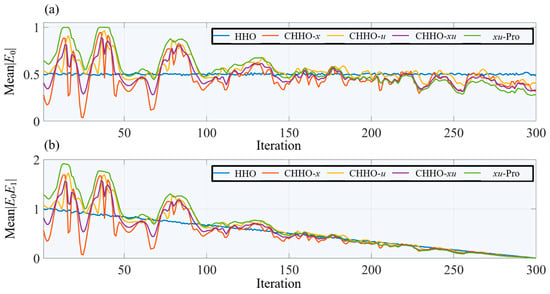
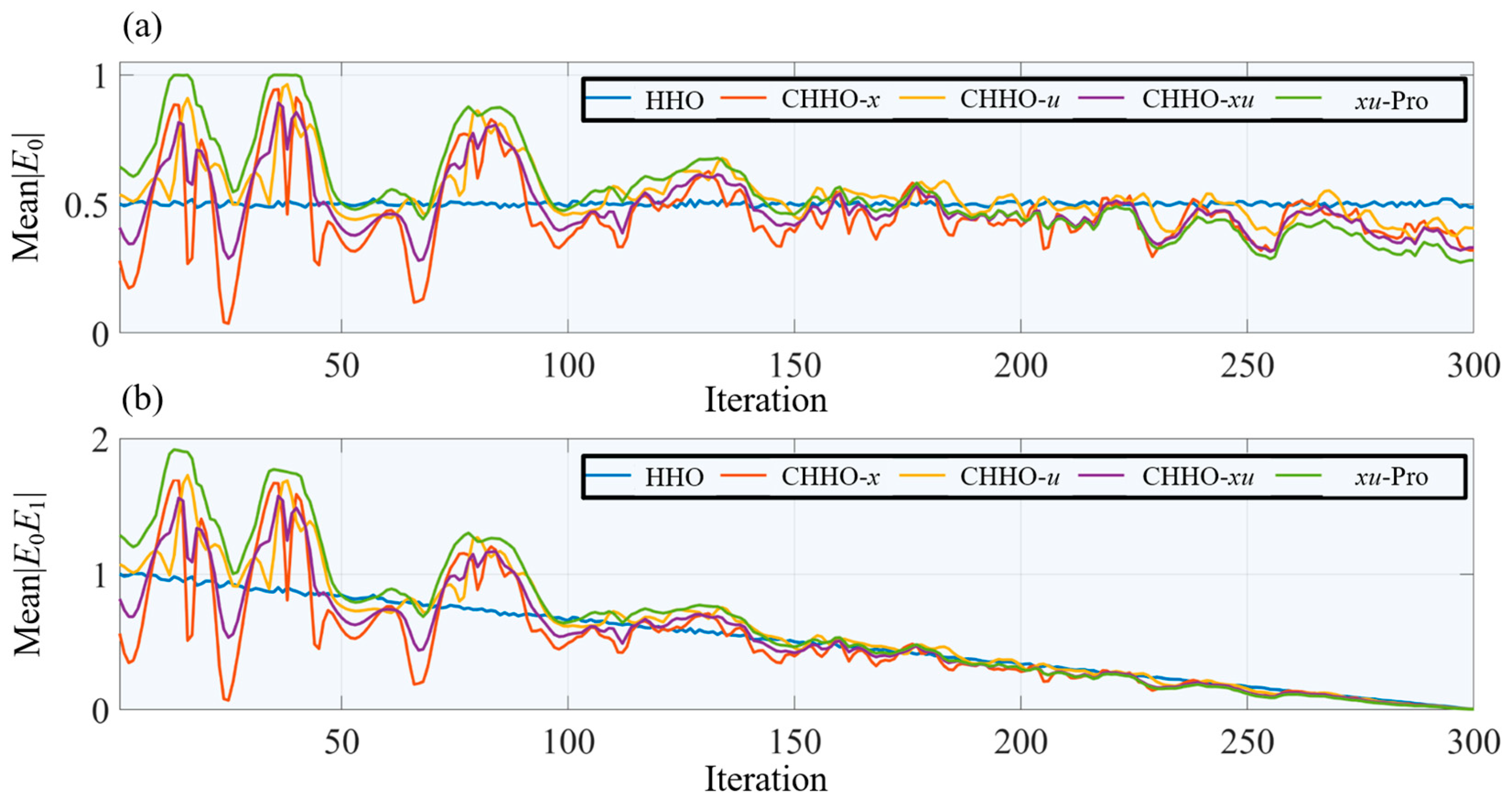
To illustrate how the different ablation strategies regulate the search state, Figure 16 presents the evolution of E0 over the iteration process for all five algorithms. The figure highlights the differences among random perturbation, single-variable chaotic driving, dual-variable fusion, and adaptive regulation, and provides a mechanistic interpretation for the subsequent convergence analysis.
Figure 16.
Dynamic evolution of the escaping-energy mechanisms with iteration: (a) escaping-energy perturbation E0; (b) corresponding total escaping energy.
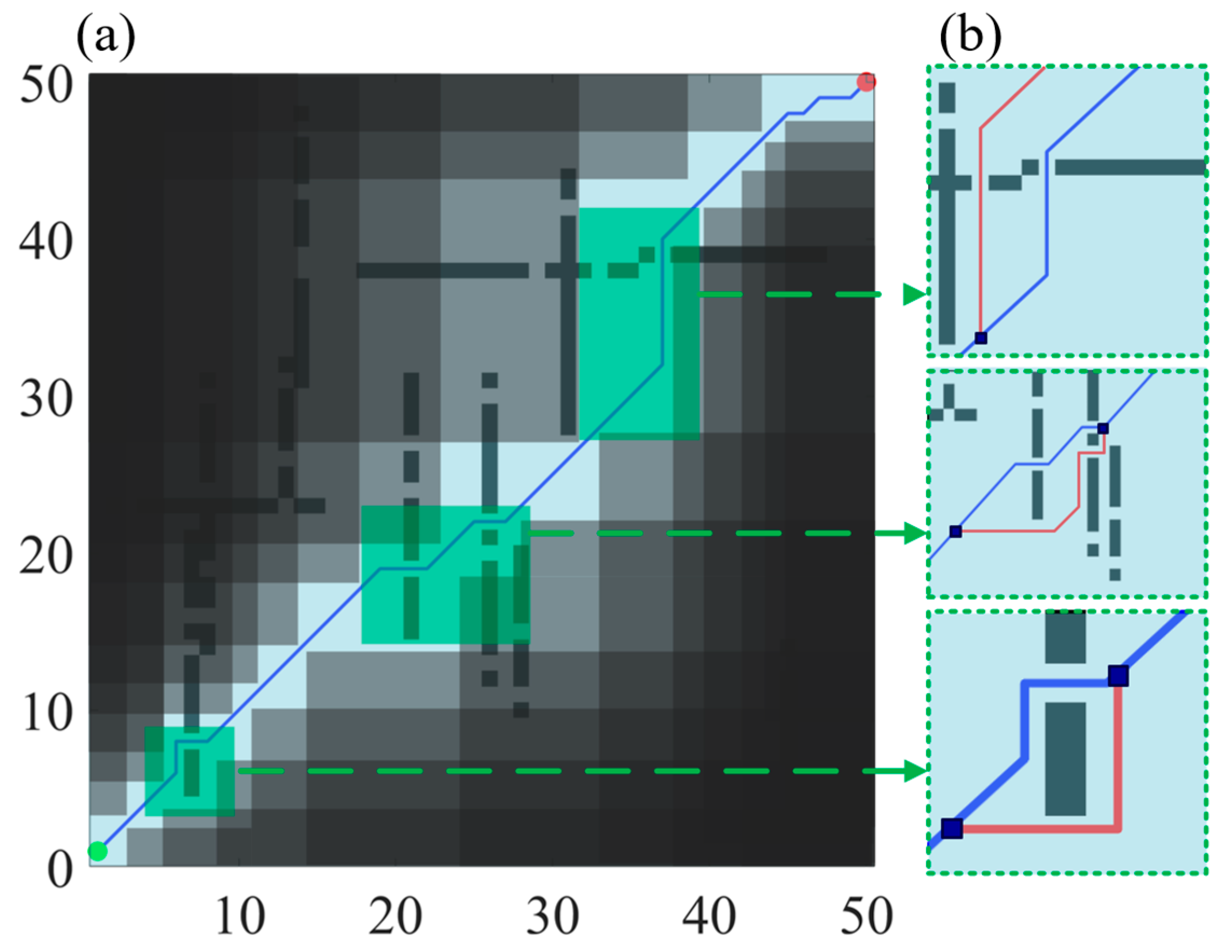
The five variants are further evaluated through ablation on the fixed narrow-passage map with multiple local optima shown in Figure 17. All algorithms adopt the same path representation, decoding mechanism, and evaluation criteria as in Section 4.2: the population size is fixed at 50, the maximum number of iterations is set to 300, and each candidate path is represented by eight intermediate control points, yielding a 16-dimensional search space. To ensure a fair and statistically reliable comparison, all methods are independently executed 50 times on the same map under identical conditions; within every run, the five algorithms share the same initial population, so the resulting per-run observations are paired across algorithms.
Figure 17.
Multi-local-optimum map and representative competing paths: (a) overall map; (b) enlarged local regions.
The reported performance metrics include Mean Gap, Std Gap, Best Gap, and Success Rate, which jointly quantify path quality, stability, and optimization reliability. A run is regarded as successful when the difference between the obtained path length and the corresponding A* reference length does not exceed 1.5, thereby indicating a near-optimal solution.
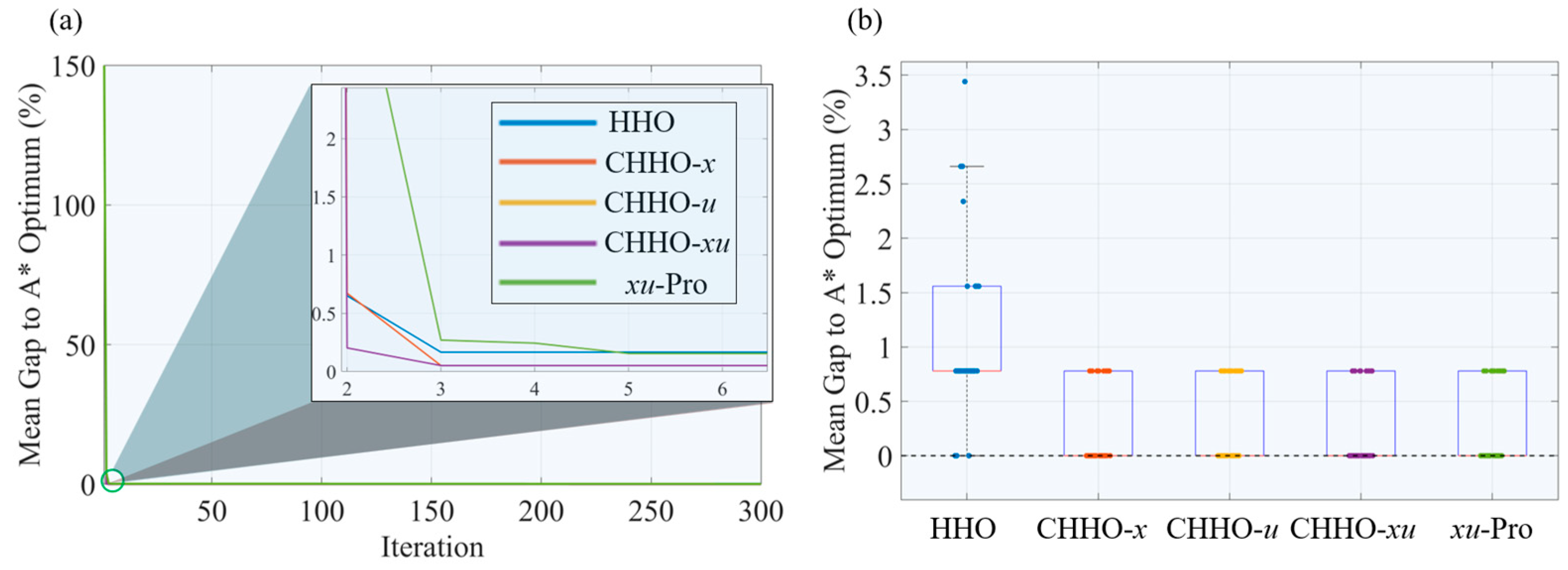
Note that the convergence curves in Figure 18 drop to a near-optimal level within the first few iterations. This is an expected consequence of the two-level encoding used here: a candidate solution specifies only the waypoints, whereas each segment between consecutive waypoints is re-optimized by A*, which always returns the shortest obstacle-avoiding connection. Consequently, the global optimum is not an isolated point but a broad manifold—any configuration whose waypoints lie, in order, on the A* shortest path yields the same optimal path length—so the objective landscape is smooth and the near-optimal basin is large. With a population of 50 and the large Levy-based jumps of the HHO exploration phase, at least one agent typically enters this basin within the first iteration, after which the A* reconstruction immediately snaps the path to the optimum. Since all five algorithms share the identical initial population and objective, this property is common to them; the meaningful comparisons in Figure 18 and Table 3 are therefore the final Gap, the success rate, and the early-iteration ordering. Relative to the original HHO, the chaotic escaping-energy construction reaches this near-optimal plateau earlier and with a higher success rate and a smaller stabilized Gap, because the temporally structured E0 sequence provides more directed early exploration than the uniform perturbation of the original HHO.
Figure 18.
Path-optimization performance under different escaping-energy construction strategies: (a) mean Gap convergence curves; (b) distribution of the final Gap values. A* denotes the A-star search algorithm.
Table 3.
Ablation Results of Different HHO Variants.
Figure 18 presents the mean Gap convergence curves and final Gap box plots for the five algorithms over 50 independent runs. Relative to the original HHO, both CHHO-x and CHHO-u exhibit improved convergence behavior, indicating that a single chaotic sequence can effectively regulate the search process. CHHO-xu further reduces the final Gap, demonstrating the complementary contribution of dual-variable information. Compared with the original HHO, CHHO-xu-Pro exhibits improved convergence behavior and achieves a lower mean Gap and standard deviation. Its distinctive feature is the iteration-dependent regulation of state-component contributions and perturbation gain. CHHO-xu achieves the lowest final mean Gap and standard deviation among the tested variants in this experiment.
To evaluate the performance differences between each chaotic variant and the original HHO, two paired tests were applied to the per-run Gap values. A two-sided paired Wilcoxon signed-rank test yields p = 4.79 × 10⁻⁷, 1.02 × 10⁻⁷, 3.50 × 10⁻⁸, and 6.69 × 10⁻⁸ for CHHO-x, CHHO-u, CHHO-xu, and CHHO-xu-Pro against HHO, respectively, and a two-sided paired randomization test with 20,000 sign-flip samples gives p < 5 × 10⁻⁵ for every variant. The corresponding directional paired significance scores in Equation (28) are 0.7933, 0.8416, 0.8626, and 0.8520, all well above 0.5, confirming that the chaotic escaping-energy reconstruction consistently outperforms the original HHO. The 100% Success Rate and the 0.000000 Best Gap in Table 3 reflect the near-optimal criterion and the A*-based decoding, respectively, because A* reconnects consecutive control points; any in-order waypoint configuration lying on the shortest path maps to the exact optimal length, so at least one of the 50 runs recovers a zero Gap for every algorithm—including the baseline HHO—while the nonzero standard deviation confirms genuine run-to-run variability. The corresponding statistical results are summarized in Table 3.
Results over 50 independent runs on the fixed narrow-passage map in Figure 17, with all five algorithms sharing the same initial population in every run. A run is successful if its final path is feasible and its absolute path-length difference from the A* reference does not exceed 1.5 grid-length units; “Best Gap” is the minimum final Gap over the 50 runs. The p-value column reports the two-sided paired Wilcoxon signed-rank test versus HHO; a two-sided paired randomization test gives p < 5 × 10⁻⁵ for all variants, and the directional paired significance scores in Equation (28) are 0.7933, 0.8416, 0.8626, and 0.8520 for CHHO-x, CHHO-u, CHHO-xu, and CHHO-xu-Pro, respectively.
To verify that the differences reported in Table 3 are statistically reliable rather than artifacts of stochasticity, the 50 paired runs were analyzed with a two-sided paired Wilcoxon signed-rank test and a two-sided paired permutation test. Because a conventional p-value indicates only significance without direction, the directional significance score of Equation (28) is reported as well. The results are summarized in Table 3 and Table 4.
Table 4.
Paired significance tests of each chaotic variant against the baseline HHO.
Overall, the ablation results confirm that single-state chaotic driving provides the primary performance improvement, dual-state fusion further exploits complementary state information, and adaptive regulation modifies the temporal search behavior without altering the underlying HHO structure.
4.5. Parameter Sensitivity and Clipping Analysis
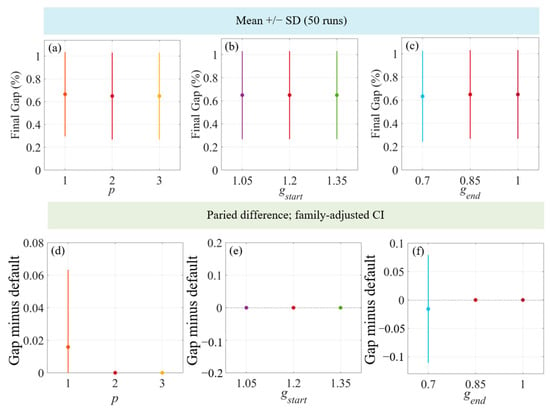
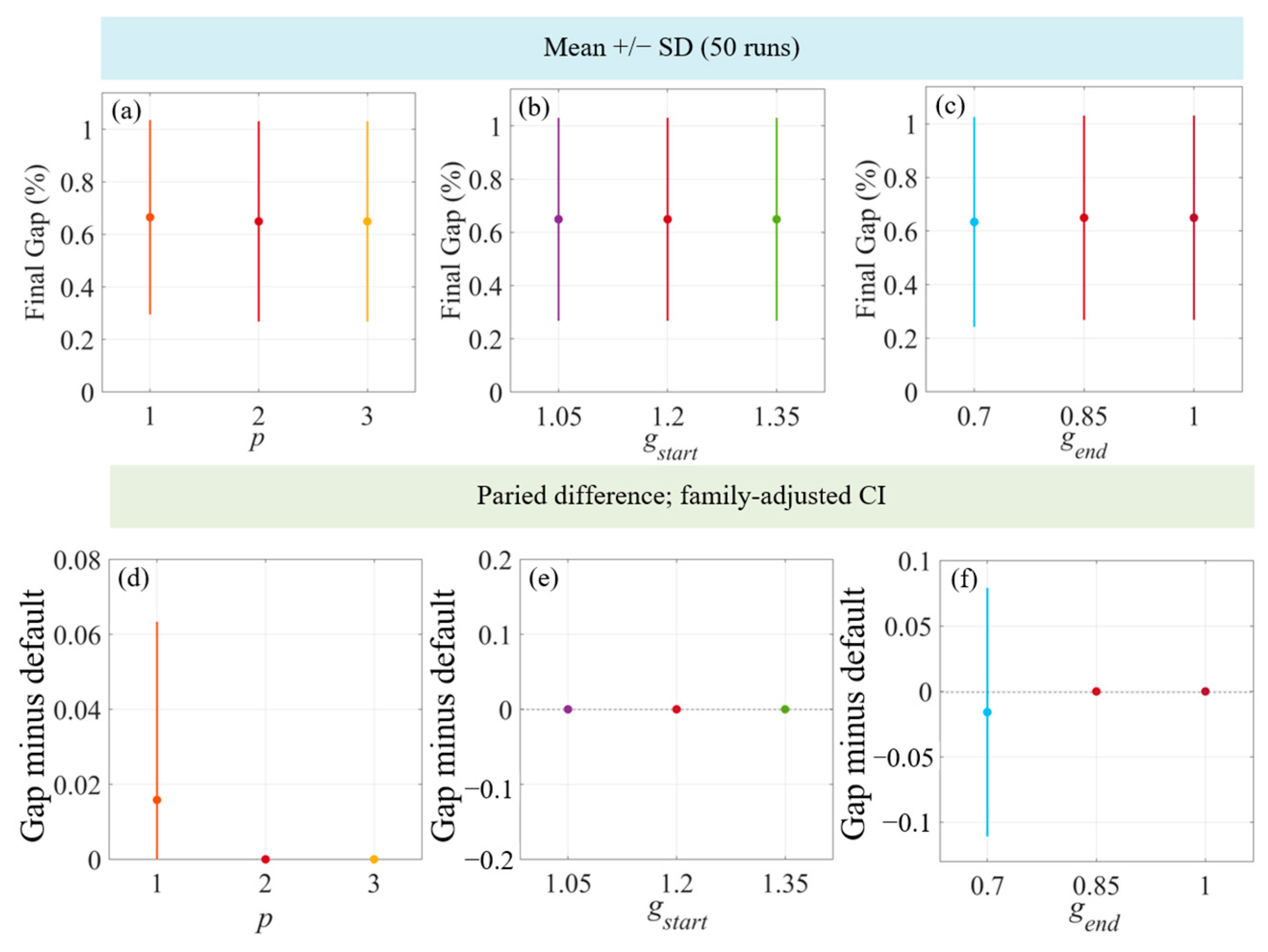
A local sensitivity analysis was conducted on an additional fixed 50 × 50 grid map, varying p, gstar, and gend one at a time around the default setting (2,1.20, 0.85). Each configuration was evaluated over 50 paired runs with shared initial populations, chaotic inputs, and random-number banks. As shown in Figure 19, the mean final path-length Gap remains approximately 0.64–0.67% across the tested settings, indicating limited variation in this experiment. This observation is restricted to the tested parameter ranges and map and does not establish the optimality of the default setting.
Figure 19.
Local parameter sensitivity of CHHO-xu-Pro over 50 paired runs. (a–c): mean final path-length Gap ± standard deviation. (d–f): paired Gap differences relative to the default setting, with family-adjusted 95% bootstrap confidence intervals. Differences are expressed in percentage points.
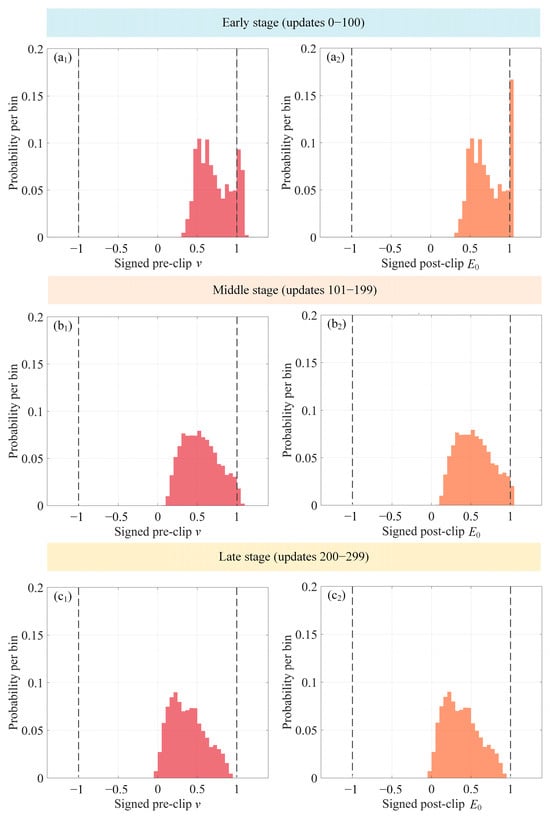
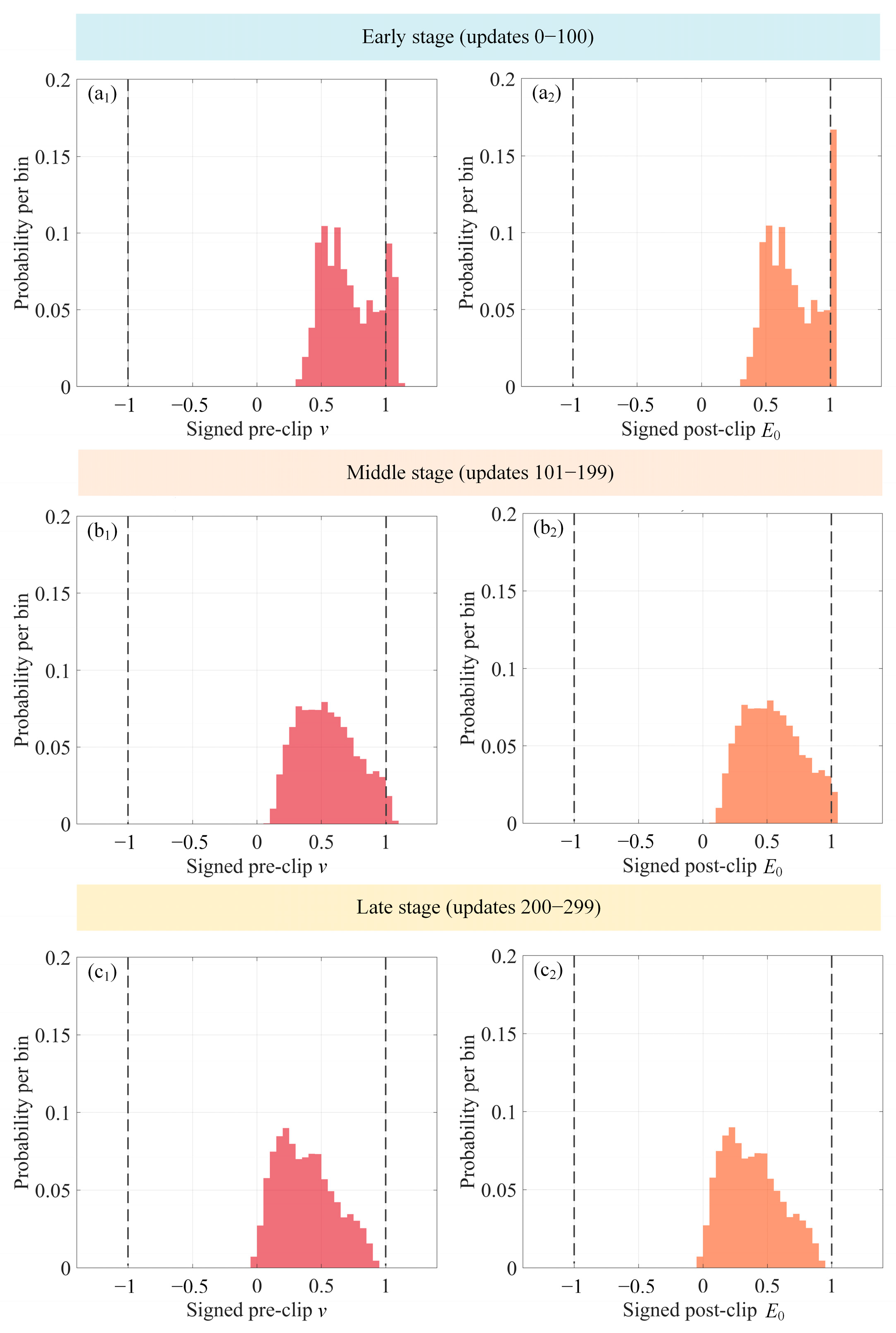
Figure 20 quantifies the distributional effect of clipping. The probability mass at E0 = 1 decreases from approximately 16.7% in the early stage to 2.0% in the middle stage, with no boundary saturation observed in the late stage. Thus, clipping produces upper-boundary accumulation during early updates, and its influence decreases subsequently. The consumed inputs are positively biased; therefore, these results characterize the implemented sequence-generation and control pipeline without assuming a symmetric or uniform input distribution.
Figure 20.
Signed distributions of the pre-clipping variable v and post-clipping control E0 during early, middle, and late updates.
5. Conclusions
This study developed a competitive offset regulation mechanism to extend conventional offset boosting from independent state regulation to correlated regulation among chaotic states. The proposed system realizes arbitrary attractor translation and infinitely many homogeneous coexisting attractors, while revealing a competitive–compensatory relationship and coupling-dependent waveform regulation. The principal dynamical behaviors were further reproduced on an STM32H750 platform, confirming the feasibility of the proposed mechanism. Based on the differentiated information provided by the regulated chaotic states, single-state, coupled-state, and adaptive chaos-driven strategies were introduced into the escaping-energy mechanism of HHO. Path optimization experiments showed that the proposed strategies can improve search performance and operational stability, particularly in environments with multiple local optima. These results demonstrate that competitive offset regulation not only enriches the regulation mechanisms of chaotic systems but also provides useful complementary dynamical information for intelligent optimization. Future work will investigate more general competitive regulation mechanisms involving multiple chaotic states. The adaptive utilization of differentiated chaotic information in other optimization and control tasks will also be explored.
Author Contributions
M.W.: Investigation, Software, Circuit simulation, Writing—original draft. H.W.: Conceptualization; Methodology, Writing—review & editing, Project administration, Funding acquisition. Y.Y.: Validation, Circuit implementation. J.Q.: Formal analysis, Data curation. Y.L.: Data analysis. All authors have read and agreed to the published version of the manuscript.
Funding
This research received no external funding.
Data Availability Statement
The data that support the findings of this study are available from the corresponding author upon reasonable request.
Acknowledgments
The authors gratefully acknowledge the technical support provided by Zaozhuang University.
Conflicts of Interest
The authors declare no conflicts of interest.
References
- Glushkov, A.V.; Buyadzhi, V.V.; Kvasikova, A.S.; Ignatenko, A.V.; Kuznetsova, A.A.; Prepelitsa, G.P.; Ternovsky, V.B. Non-Linear chaotic dynamics of quantum systems: Molecules in an electromagnetic field and laser systems. In Quantum Systems in Physics, Chemistry, and Biology: Advances in Concepts and Applications; Springer International Publishing: Cham, Switzerland, 2017; pp. 169–180. [Google Scholar]
- Tian, H.; Wang, J.; Ma, J.; Li, X.; Zhang, P.; Li, J. Improved energy-adaptive coupling for synchronization of neurons with nonlinear and memristive membranes. Chaos Solitons Fractals 2025, 199, 116863. [Google Scholar] [CrossRef] [Scilit]
- Zhao, H.; Yan, L.; Hou, Z.; Lin, J.; Zhao, Y.; Ji, Z.; Wang, Y. Error analysis strategy for long-term correlated network systems: Generalized nonlinear stochastic processes and dual-layer filtering architecture. IEEE Internet Things J. 2025, 12, 33731–33745. [Google Scholar] [CrossRef] [Scilit]
- Fu, B.; Li, Y.; Li, Z.; Yao, Y.; Lei, T.; Xu, H. Controllable attractor dynamics in a memristive Hide dynamo. Chaos Solitons Fractals 2026, 213, 119328. [Google Scholar] [CrossRef] [Scilit]
- Zhang, X.; Li, C.; Moroz, I.; Huang, K.; Liu, Z. Non-bifurcation regulation of chaos in a memristive Hopfield neural network. Nonlinear Dyn. 2025, 113, 15487–15502. [Google Scholar] [CrossRef] [Scilit]
- Li, C.; Sprott, J.C.; Liu, W. Finding More Chaotic Flows with Complete Control. Int. J. Bifurc. Chaos 2026, 36, 2650164. [Google Scholar] [CrossRef] [Scilit]
- Zhang, S.; He, D.; Li, Y.; Lu, D.; Li, C. Dual memristor-coupled Hopfield neural network with any multi-scroll amplitude control and its application for medical image classification. IEEE Trans. Autom. Sci. Eng. 2025, 22, 17828–17840. [Google Scholar] [CrossRef] [Scilit]
- Li, C.; Yu, W.; Moroz, I.; Li, Y.; Zheng, Y. Hybrid offset boosting in a hyperchaotic map. Chaos Solitons Fractals 2026, 204, 117735. [Google Scholar] [CrossRef] [Scilit]
- Chen, X.; Li, C.; Liu, W.; Zhang, H.; Lei, T. Dynamics editing of the Hopfield neural network. Chaos Solitons Fractals 2026, 209, 118463. [Google Scholar] [CrossRef] [Scilit]
- Li, Y.; Li, C.; Lei, T.; Yang, Y.; Chen, G. Offset boosting-entangled complex dynamics in the memristive Rulkov neuron. IEEE Trans. Ind. Electron. 2023, 71, 9569–9579. [Google Scholar] [CrossRef] [Scilit]
- Lin, H.; Wang, C.; Yu, F.; Sun, J.; Du, S.; Deng, Z.; Deng, Q. A review of chaotic systems based on memristive Hopfield neural networks. Mathematics 2023, 11, 1369. [Google Scholar] [CrossRef] [Scilit]
- Lin, H.; Wang, C.; Deng, Q.; Xu, C.; Deng, Z.; Zhou, C. Review on chaotic dynamics of memristive neuron and neural network. Nonlinear Dyn. 2021, 106, 959–973. [Google Scholar] [CrossRef] [Scilit]
- Lai, Q.; Lai, C.; Kuate, P.D.K.; Li, C.; He, S. Chaos in a simplest cyclic memristive neural network. Int. J. Bifurc. Chaos 2022, 32, 2250042. [Google Scholar] [CrossRef] [Scilit]
- Wang, X.; Xie, D.; Li, Y.; Liu, C.; Hu, X. An Improved Copula-Based Test Selection Design Strategy for Fault Detection and Isolation Based on PSO. Instrumentation 2025, 12, 48–59. [Google Scholar]
- Yu, F.; Guo, R.; Zheng, M.; Yao, W.; Zhang, D.; Cai, S. Novel approach to time series forecasting based on memristive Hopfield Neural Network with hidden heterogeneous and homogeneous extreme multistability. Chaos Solitons Fractals 2026, 210, 118626. [Google Scholar] [CrossRef] [Scilit]
- Yan, M.; Hu, R. Construction of multi-scroll memristive neural networks and their FPGA implementation for video encryption. Eur. Phys. J. Plus 2025, 140, 727. [Google Scholar] [CrossRef] [Scilit]
- Mabrouk, A.; Dahou, A.; Elaziz, M.A.; Redondo, R.P.D.; Kayed, M. Medical image classification using transfer learning and chaos game optimization on the internet of medical things. Comput. Intell. Neurosci. 2022, 2022, 9112634. [Google Scholar] [CrossRef] [Scilit] [PubMed]
- Cui, C.; Feng, W.; Tang, J.; Gan, Y.; Gao, Z.; Wen, H. Efficient and robust image cryptosystem utilizing a fractional-order discrete cross-coupled map and fractal dragon curve. Fractal Fract. 2026, 10, 479. [Google Scholar] [CrossRef] [Scilit]
- Zhang, Z.; Li, Y.; Yao, Y.; Xu, W.; Lei, T.; Liu, Q. Offset-boosted reconfigurable multiscroll attractors in memristive Chua system for robot path planning. Chaos Solitons Fractals 2026, 213, 119228. [Google Scholar] [CrossRef] [Scilit]
- Wu, T.Y.; Li, H.; Chu, S.C. CPPE: An improved phasmatodea population evolution algorithm with chaotic maps. Mathematics 2023, 11, 1977. [Google Scholar] [CrossRef] [Scilit]
- Ma, C.; Mou, J.; Xiong, L.; Banerjee, S.; Liu, T.; Han, X. Dynamical analysis of a new chaotic system: Asymmetric multistability, offset boosting control and circuit realization. Nonlinear Dyn. 2021, 103, 2867–2880. [Google Scholar] [CrossRef] [Scilit]
- Lai, Q.; Zhu, C.; Zhao, X.W.; Sun, X.; Hua, J. A unified framework for generating 4-D discrete memristive hyperchaotic maps with complex dynamics and application to encryption. IEEE Internet Things J. 2025, 12, 40934–40943. [Google Scholar] [CrossRef] [Scilit]
- Pan, G.; Li, C.; Liu, W.; Xue, Y.; Qi, X. Countless coexisting chaotic attractors: From system construction to FPGA-based observation. Chaos Solitons Fractals 2025, 198, 116610. [Google Scholar] [CrossRef] [Scilit]
- Li, Y.; Zhang, S.; Wang, Y.; Lei, T.; Liu, Q.; Yao, Y.; Chen, B. Offset boosting-dominated on-demand multistability editing in memristive neural network. Chaos Solitons Fractals 2026, 208, 118267. [Google Scholar] [CrossRef] [Scilit]
- Wang, M.; An, M.; Zhang, X.; Iu, H.H.-C. Two-variable boosting bifurcation in a hyperchaotic map and its hardware implementation. Nonlinear Dyn. 2023, 111, 1871–1889. [Google Scholar] [CrossRef] [Scilit]
- Silva, J.A.L.; Hallam, T.G. Compensation and stability in nonlinear matrix models. Math. Biosci. 1992, 110, 67–101. [Google Scholar] [CrossRef] [Scilit] [PubMed]
- Ruks, L.; Van Gorder, R.A. On the inverse problem of competitive modes and the search for chaotic dynamics. Int. J. Bifurc. Chaos 2017, 27, 1730032. [Google Scholar] [CrossRef] [Scilit]
- Kuznetsov, A.P.; Sedova, Y.V.; Stankevich, N.V. Coupled systems with quasi-periodic and chaotic dynamics. Chaos Solitons Fractals 2023, 169, 113278. [Google Scholar] [CrossRef] [Scilit]
- Bao, H.; Hua, M.; Ma, J.; Chen, M.; Bao, B. Offset-control plane coexisting behaviors in two-memristor-based Hopfield neural network. IEEE Trans. Ind. Electron. 2022, 70, 10526–10535. [Google Scholar] [CrossRef] [Scilit]
- Li, C.; Yi, C.; Li, Y.; Mitro, S.; Wang, Z. Offset boosting in a discrete system. Chaos Interdiscip. J. Nonlinear Sci. 2024, 3, 031102. [Google Scholar] [CrossRef] [Scilit] [PubMed]
- Stenuit, B.; Agathos, S.N. Deciphering microbial community robustness through synthetic ecology and molecular systems synecology. Curr. Opin. Biotechnol. 2015, 33, 305–317. [Google Scholar] [CrossRef] [Scilit] [PubMed]
- Crutchfield, J.P.; Young, K. Computation at the onset of chaos. Entropy Complex. Phys. Inf. 1990, 8, 223. [Google Scholar]
- Dong, Y.; Zhang, S.; Zhang, H.; Zhou, X.; Jiang, J. Chaotic evolution optimization: A novel metaheuristic algorithm inspired by chaotic dynamics. Chaos Solitons Fractals 2025, 192, 116049. [Google Scholar] [CrossRef] [Scilit]
- Liu, B.; Wang, L.; Jin, Y.H.; Tang, F.; Huang, D.-X. Improved particle swarm optimization combined with chaos. Chaos Solitons Fractals 2005, 25, 1261–1271. [Google Scholar] [CrossRef] [Scilit]
- Li, Y.; Li, C.; Zhang, S.; Zheng, Y.; Chen, G. Offset boosting-oriented construction of multi-scroll attractor via a memristor model. IEEE Trans. Circuits Syst. I Regul. Pap. 2024, 72, 918–931. [Google Scholar] [CrossRef] [Scilit]
- Rajwar, K.; Deep, K.; Das, S. An exhaustive review of the metaheuristic algorithms for search and optimization: Taxonomy, applications, and open challenges. Artif. Intell. Rev. 2023, 56, 13187–13257. [Google Scholar] [CrossRef] [Scilit] [PubMed]
- Tian, D. Particle swarm optimization with chaos-based initialization for numerical optimization. Intell. Autom. Soft Comput. 2018, 24, 331–342. [Google Scholar] [CrossRef] [Scilit]
- Abro, G.E.M.; Mahmoud, E. A Hybrid PSO-ACO Algorithm for Precise Localization and Geometric Error Reduction in Industrial Robots. Instrumentation 2025, 12, 70–76. [Google Scholar]
- Limane, A.; Zitouni, F.; Harous, S.; Lakbichi, R.; Ferhat, A.; Almazyad, A.S.; Jangir, P.; Mohamed, A.W. Chaos-enhanced metaheuristics: Classification, comparison, and convergence analysis. Complex Intell. Syst. 2025, 11, 177. [Google Scholar] [CrossRef] [Scilit]
- Sayed, G.I.; Darwish, A.; Hassanien, A.E. A new chaotic whale optimization algorithm for features selection. J. Classif. 2018, 35, 300–344. [Google Scholar] [CrossRef] [Scilit]
- Yassen, M.T. Adaptive chaos control and synchronization for uncertain new chaotic dynamical system. Phys. Lett. A 2006, 350, 36–43. [Google Scholar] [CrossRef] [Scilit]
- Feng, W.; Tang, Z.; Zhao, X.; Qin, Z.; Chen, Y.; Cai, B.; Zhu, Z.; Qian, K.; Wen, H. Two-dimensional coupling-enhanced cubic hyperchaotic map with exponential parameters: Construction, analysis, and application in hierarchical significance-aware multi-image encryption. Axioms 2025, 14, 901. [Google Scholar] [CrossRef] [Scilit]
- Alabool, H.M.; Alarabiat, D.; Abualigah, L.; Heidari, A.A. Harris hawks optimization: A comprehensive review of recent variants and applications. Neural Comput. Appl. 2021, 33, 8939–8980. [Google Scholar] [CrossRef] [Scilit]
- Heidari, A.A.; Mirjalili, S.; Faris, H.; Aljarah, I.; Mafarja, M.; Chen, H. Harris hawks optimization: Algorithm and applications. Future Gener. Comput. Syst. 2019, 97, 849–872. [Google Scholar] [CrossRef] [Scilit]
- Abdulsaheb, J.A.; Kadhim, D.J. Classical and heuristic approaches for mobile robot path planning: A survey. Robotics 2023, 12, 93. [Google Scholar] [CrossRef] [Scilit]
- Ali, Z.A. Cutting-Edge Trends of Ground Robots Transforming Traditional Agriculture: An Overview and Case Studies. Instrumentation 2025, 12, 15–30. [Google Scholar]

Disclaimer/Publisher’s Note: The statements, opinions and data contained in all publications are solely those of the individual author(s) and contributor(s) and not of MDPI and/or the editor(s). MDPI and/or the editor(s) disclaim responsibility for any injury to people or property resulting from any ideas, methods, instructions or products referred to in the content. |
© 2026 by the authors. Licensee MDPI, Basel, Switzerland. This article is an open access article distributed under the terms and conditions of the Creative Commons Attribution (CC BY) license.