


Abstract
We study the undirected power congruence graph on vertex set in which two distinct vertices are adjacent whenever or , where are distinct primes with and is fixed. While the single-prime moduli set decomposes into a disjoint union of complete graphs, we show that two coprime prime moduli produce a fundamentally different structure: the non-degenerate part of the graph is a blow-up of the rook graph on a grid, where and . We give explicit block sizes via the Chinese Remainder Theorem, describe the three degenerate residue classes and their gluing to the main rook graph, and derive the adjacency and Laplacian spectra through an equitable partition. Explicit formulas for the Kirchhoff index, Estrada index and graph energy in terms of the spectrum of a quotient matrix of size follow. Three worked examples (; ; ) illustrate the uniform and non-uniform cases. The row/column permutation symmetry of the base grid is inherited by the blow-up and underlies the equitable partition.
Keywords:
power congruence graph; rook graph; equitable partition; Kirchhoff index; Estrada index; spectral graph theory MSC:
05C50; 05C25; 11A07
1. Introduction
Graphs defined by number-theoretic congruence relations have a long history, beginning with the study of directed power graphs associated with the congruence [1,2]. Classical undirected congruence graphs connect when ; replacing the linear congruence by the power congruence introduces genuine algebraic structure governed by the k-th power map on the multiplicative group [3,4].
The study of number-theoretic graphs has proceeded in several related strands. The directed power graph on , with an edge whenever , was analyzed by Somer and Křížek, who classified its cycles and components for prime-power moduli and identified the role of the k-th power map on the cyclic group [1]. Deng and Yuan later exploited the symmetry between the image and kernel of this map to decompose the digraph into isomorphic subgraphs [2]. An undirected counterpart was introduced by Malik and Mahmood, who studied the simple graph on in which a and b are joined whenever the exponential congruence is solvable, and showed that for this graph has exactly components, with a tree component rooted at zero in the prime-square case [3]. The same fibre–cycle anatomy appears in the iteration digraphs of the quadratic square mapping on prime fields [5], of powers modulo a prime [6], and of quadratic congruences with composite moduli [7,8].
A parallel, group-theoretic strand studies power graphs of semigroups and groups: in the undirected power graph of a finite group, two distinct elements are adjacent when one is a power of the other [9], a line of research surveyed in [10]. Our construction is number-theoretic rather than group-theoretic (adjacency is governed by the k-th power map on the residue rings and , not by the multiplicative relation “is a power of”), but the two strands share the central phenomenon that power maps impose a rigid, highly symmetric clique structure on their domain, which is precisely the structure that the present paper exploits.
More recent work has considered moduli sets containing several moduli simultaneously rather than a single integer [4], and the power congruence graph over the prime-power hierarchy was introduced and analyzed in [11], where it was shown to decompose into disjoint complete graphs. This paper lies at the intersection of these strands: we replace the single-prime moduli set by two distinct primes and observe that the disjoint cliques of [11] combine into a connected rook graph blow-up. Throughout we impose the standing assumption , so that at least one complete Chinese-remainder period is present and every block is non-empty. Because adjacency is an or condition ( or ), the two equivalence relations generated by p and q are not independent: vertices connected through either modulus end up in the same component. The resulting structure is not a disjoint union of cliques but a blow-up of a rook graph, and the graph becomes connected rather than disconnected. This single-prime two-prime transition, driven purely by the number of coprime moduli, is the phenomenon that motivates the paper: it is invisible in the defining congruences, yet it completely reorganizes the global structure, and the row/column permutation symmetry of the emerging grid is the symmetry that makes the graph analytically tractable. We carry out the full structural and spectral analysis and derive explicit formulas for the Kirchhoff index, Estrada index and graph energy in terms of the spectrum of a quotient matrix of size .
The main contributions are:
- a complete structural description of : the CRT block decomposition , explicit block sizes including the residue corrections when , and the gluing of the three degenerate residue classes to the main rook grid (Theorems 1–4);
- a spectral reduction: the adjacency and Laplacian spectra, and with them the Kirchhoff, Estrada and Laplacian–Estrada indices, the graph energy and the spanning-tree count, are determined by a quotient matrix of size , with closed forms in the uniform-cell case and the exact formula for the spectral radius (Theorems 5 and 6, Corollaries 7 and 8, Section 5.1);
- exact values of global invariants: algebraic connectivity, clique, chromatic, domination and independence numbers, diameter 2, and the automorphism group (Section 3.1, Section 3.2, Section 3.3 and Section 3.4).
2. Structure of ({})
2.1. Preliminaries
Let , let be distinct primes with , and fix . For distinct define
and set (the graph has no loops). Write
and similarly , . The k-th power map , , is a group endomorphism of a cyclic group of order . Its image has size , and every image point has exactly preimages. Denote the image by
Partition V according to divisibility by p and q. We use congruence notation, in which the negation stroke crosses the whole symbol, so that the four cases are unmistakable:
Equivalently, collect the vertices divisible by both primes, by p only, by q only, and by neither prime; the four cases are summarized in Table 1. The non-degenerate part is the main object; are the degenerate classes.
Table 1.
The four residue classes according to divisibility by p and q.
2.2. Structure of the Main Graph
By the Chinese Remainder Theorem, . Partition into blocks
Definition 1
(Rook graph blow-up). The (unweighted) rook graph has vertices with , , and edges between and whenever or (but not both). Its blow-up replaces each vertex by a clique of size and joins two cliques completely whenever the corresponding rook-graph vertices are adjacent.
We fix the following convention for the block indices: in the prime follows the column index (j is replaced by ), while in it follows the row index (i is replaced by ).
Theorem 1
(Rook graph structure). The graph induced on is the blow-up of [12]:
- 1.
- each block induces a complete graph;
- 2.
- and (; same row i) are fully joined;
- 3.
- and (; same column j) are fully joined;
- 4.
- and () have no edges between them;
- 5.
- under the weaker assumption , every is non-empty and is connected (in particular under the standing assumption ).
Proof.
(i) For , , hence . (ii) For , , again . (iii) Symmetrically, . (iv) If and , then modulo both p and q, so neither adjacency condition holds. (v) Because , the first CRT period lies in V. Among these integers exactly are coprime to , and CRT identifies them with the pairs . On the cyclic group of order the kernel of the k-th power map has order , so every image point has exactly preimages (and every has exactly preimages modulo q); hence every pair has exactly preimages in the first period, and each contains vertices. Given and with and , the intermediate block (the block in row i and column ) satisfies by (ii) and by (iii). Thus all blocks lie in one connected component. □
Remark 1
(The case ). The connectivity argument in (v) uses the fact that every intermediate block is non-empty, which is guaranteed as soon as the first CRT period is present in V, i.e., when . If , some blocks are empty and the rook graph breaks into several components. For a concrete counterexample, take , , , . Then , , and
The non-degenerate vertices split into three singleton blocks
Blocks and share the row index and are therefore adjacent, giving the component ; but shares neither a row nor a column with either of them, so vertex 2 is isolated inside . The degenerate vertices 0 and 3 attach to each other (since is joined to ) but to no block, because the column required by has no non-degenerate vertex below . The full graph thus has three connected components , and , illustrating that the period hypothesis cannot be dropped.
For the picture is completely described by the following sharp criterion.
Proposition 1
(Sharp connectivity criterion).
- 1.
- If , every block is non-empty and is connected.
- 2.
- If , the main graph is connected if and only if the index set is connected under the relation .
Proof.
Part (a) is Theorem 1(v). For (b), each non-empty block is a clique, and two blocks are fully joined exactly when their indices share a row or a column (Theorem 1); hence is connected precisely when S is connected in the relation ∼. □
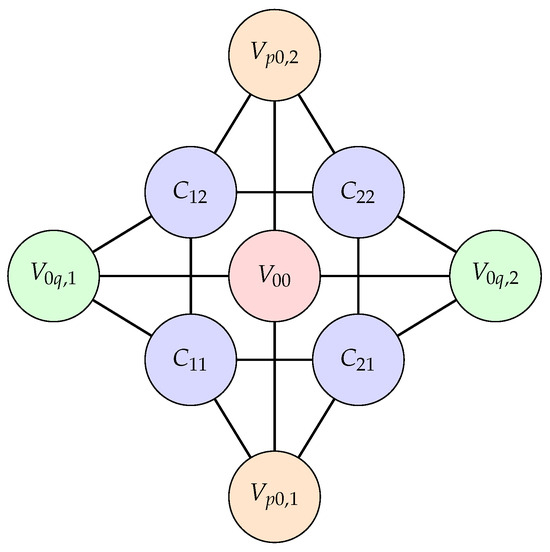
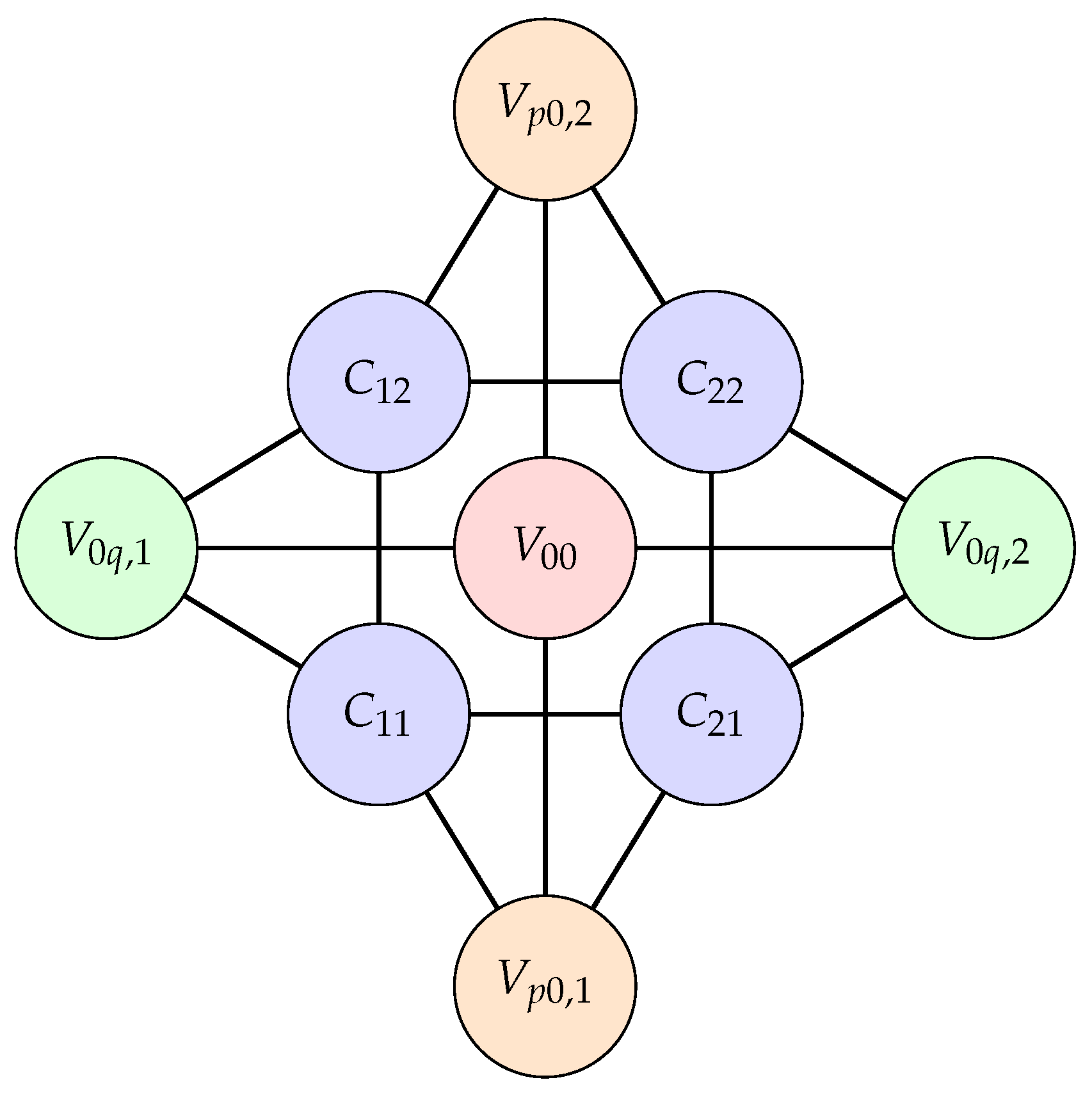
A concrete illustration of this blow-up structure for is shown in Figure 1.
Figure 1.
Schematic of the rook graph blow-up for . Blue nodes are the main blocks ; orange nodes attach to columns; green nodes attach to rows; the red node sits at the center and joins all degenerate blocks. Diagonal blocks and (as well as and ) have no direct edge. Edges within the cliques and (between and , and between and ) are omitted for clarity.
2.3. Block Sizes
Write with .
Theorem 2.
In each complete period of length , every block contains exactly vertices. More generally,
where
Proof.
By CRT, a vertex with corresponds to a pair . The fiber over has size because each has preimages modulo p and each has preimages modulo q. Summing over all gives , as required. □
2.4. Gluing the Degenerate Classes
Theorem 3.
- 1.
- is a clique. Split it by , . Then is fully joined to every block () and to , and has no edges to with nor to .
- 2.
- Symmetrically, is a clique; split it by . Each is fully joined to every block () and to , and has no edges to with nor to .
- 3.
- is a clique fully joined to and , but has no edges to .
- 4.
- There are no edges between and .
Consequently, under the assumption , the whole graph is connected (and in particular under the standing assumption ).
Proof.
(i) Any satisfy , so they are adjacent. For and , modulo p we have , so that modulus does not contribute. Modulo q, by definition and ; hence adjacency holds exactly when . The remaining claims follow by the same case check. (iv) For , , while , and while ; neither modulus gives adjacency. Connectivity: is connected by Theorem 1(v); each attaches to column j of ; each attaches to row i; and attaches to and . □
Corollary 1.
In contrast to the single-prime case , which is disconnected for sufficiently large n, the two-prime graph is connected whenever .
Theorem 4.
The degenerate block sizes are
where the residue correction terms are
Proof.
Each period of length contributes exactly vertices to : write with , . Since and p is invertible modulo q, the condition is equivalent to . Because lies in the image of the k-th power map and the image is a subgroup of , the element also lies in the image, and the congruence has exactly solutions b modulo q. Finally, consists of the multiples of in , namely , together with when ; hence if and if , which is precisely . The other formulas follow symmetrically. □
3. Spectra and Graph Invariants
3.1. Equitable Partition and Spectra
The partition
is equitable. We use the following indexing convention throughout: is numbered by the column j it attaches to (), and by the row i it attaches to (); with this convention the degenerate blocks are indexed consistently with the rows and columns of the extended grid of Remark 6. Write
All blocks are cliques. Let B be the quotient matrix: is the number of neighbors in block of a vertex in block L. The diagonal entries are ; the off-diagonal entries are when blocks are fully joined and 0 otherwise, according to Theorem 3.
Remark 2
(Real spectrum of B). The quotient matrix B need not be symmetric, because while . Nevertheless, let S be the matrix whose column indexed by L is the normalized indicator vector . Then is symmetric, and a direct computation gives
Thus B is similar to the symmetric matrix , and all eigenvalues of B are real.
Remark 3
(Cauchy interlacing). Since the columns of S are orthonormal, the symmetric matrix is a principal compression of A. By the Cauchy interlacing theorem, the eigenvalues of B interlace the eigenvalues of A:
In particular, the Perron root satisfies (the partition is equitable), and each quotient eigenvalue satisfies .
Theorem 5.
The adjacency spectrum of G consists of:
- 1.
- the eigenvalues of B;
- 2.
- the value with multiplicity for each .
Proof.
For a vector x supported on a single block L with , the internal clique contributes , and every neighbor outside L lies on a block where . Hence . The remaining invariant vectors are constant on each block and are exactly the eigenvectors of B. □
The degree of a vertex in block L is constant within L. Write it . Directly from the adjacency pattern:
Theorem 6.
The Laplacian spectrum [13] of G consists of:
- 1.
- the eigenvalues of ;
- 2.
- the value with multiplicity for each .
Proof.
For the same block-supported, sum-zero vector x, . □
3.2. Graph Invariants
Let and .
Corollary 2
(Kirchhoff index [14]).
Corollary 3
(Estrada index [15,16]).
Corollary 4
(Graph energy).
Corollary 5
(Number of edges).
where we write for the number of edges to avoid confusion with the graph energy , and the second sum runs over unordered pairs of blocks that are fully joined.
Corollary 6
(Laplacian Estrada index).
Corollary 7
(Number of spanning trees). By the Matrix-Tree theorem,
where are the non-zero Laplacian eigenvalues of (excluding the zero eigenvalue ) and the second product collects the internal Laplacian eigenvalues , each with multiplicity (Theorem 6).
Corollary 8
(Closed spectrum of the main graph in the uniform-cell case). Assume , so that every main block has the same size
every degenerate block has size , and every has size . The main graph is the blow-up of the rook graph with uniform cell size h. Its adjacency spectrum is
together with the internal clique value of multiplicity . In particular the Perron eigenvalue of is
Proof.
The rook graph has adjacency eigenvalues , , , with multiplicities 1, , , respectively [12]. Blowing up each vertex to a clique of size h replaces an eigenvalue of the base rook graph by , and contributes the internal eigenvalue with multiplicity per cell. Substituting the four base eigenvalues gives the stated values. □
The full graph additionally contains the degenerate blocks, whose sizes differ from h. Their adjacency to the main grid follows the same rook pattern on an extended grid; the precise statement is given in Remark 6. Since is an induced subgraph of the connected graph G, the Perron value of G strictly exceeds .
3.3. Clique Number, Chromatic Number, Domination Number
We record three further invariants that follow directly from the block structure.
Proposition 2
(Clique number). The clique number of is
Proof.
A clique cannot contain vertices from two main blocks that differ in both row and column (Theorem 1(iv)). The largest main-block clique is therefore an entire row or column, of sizes and respectively. A block is fully joined to row i, so vertices form a clique; similarly joins column j. Finally, joins all of and all of , but and are mutually non-adjacent, so the largest clique involving is or , of sizes and . Taking the maximum gives the formula. □
Proposition 3
(Chromatic number). In the uniform-cell case (), the main graph is perfect and
Proof.
The rook graph is the line graph of the complete bipartite graph : the vertices of are the edges of , i.e., the pairs , and two of them are adjacent precisely when the corresponding edges share an endpoint, i.e., when or , exactly the adjacency rule of [12,17]. The rook graph is perfect (being the line graph of a bipartite graph), with chromatic number (an edge-coloring of ). A proper coloring of the base rook graph with colors lifts to a coloring of with colors, by assigning each cell h private colors within its base color class; conversely . Clique blow-ups preserve perfection, so . □
Proposition 4
(Domination number). Under the standing assumption ,
Proof.
Assume without loss of generality that . Place one dominator in each main block for (i.e., the entire first column), and one additional dominator in . We verify that every vertex is dominated:
- Every main block shares row i with , hence every vertex of is adjacent to the dominator in .
- Every is fully joined to row i, hence adjacent to the dominator in .
- Every is fully joined to , hence adjacent to the dominator in .
- The block is dominated by its own dominator.
The total number of dominators is ; under the standing assumption every block is non-empty by Theorems 2 and 4, so the dominators can indeed be placed. The case is symmetric, using the first row instead of the first column. □
Remark 4
(Eulerian property). The graph is Eulerian precisely when all vertex degrees share the same parity. From the degree formulas in Section 3.1 this is a congruence condition on ; e.g., in the example below the degrees are , which are not all of one parity, so the graph is not Eulerian.
3.4. Automorphism Group
The main graph is the blow-up of the rook graph (Theorem 1). The automorphism group of the Cartesian product is (row and column permutations), with an additional factor (grid transposition) when [12].
Proposition 5.
Assume the uniform-cell hypothesis , so that all , and . Then
of order , with an additional factor (grid transposition) when .
Proof.
The h vertices within each cell have identical neighborhoods and may be permuted independently, so embeds in as a normal subgroup. Conversely, for the rook graph has no true twins: distinct vertices have distinct closed neighborhoods. Hence the cells are precisely the maximal classes of pairwise indistinguishable vertices, and every automorphism permutes the cells. The induced action on the grid is an automorphism of , i.e., an element of , together with the grid transposition when . The group is therefore the wreath product as stated. □
Remark 5
(The cases or ). If (and symmetrically for ), any two cells share the unique column and are therefore fully joined; since each cell is a clique, is the complete graph on vertices and
which is strictly larger than , the value the wreath-product formula of Proposition 5 would suggest: the extra joins destroy the cell structure as a system of blocks of imprimitivity, so arbitrary permutations of all vertices become available. When , and . When the cell sizes are unequal (e.g., the example), only the permutations within each cell and the row/column permutations preserving the size pattern survive, and the automorphism group shrinks accordingly; when or , the corresponding factor or is trivial, and only the other direction contributes.
Remark 6.
The quotient graph of the full partition is itself a rook graph : placing at the grid point , at , at and at , two blocks are fully joined exactly when their grid points share a row or a column, and have no edges otherwise (Theorems 1 and 3). This extended grid, rather than the main graph itself, is the origin of the dimensions and in the quotient matrix.
3.5. Relation to Cayley Graphs
A graph on is a Cayley graph if its adjacency is invariant under translation: for all t. The single-prime power congruence graph decomposes into cliques on the fibers of the k-th power map, i.e., the sets , each of which is a coset of in ; being complete on vertices, each such clique is isomorphic to a Cayley graph on the additive group .
In the two-prime setting, the full graph is not a Cayley graph in general. A Cayley graph is vertex-transitive, but the degree formulas show that vertices in different blocks have different degrees: for instance differs from in general (concretely, in the example of Section 4.1). At the level of the defining relation, the translation action does not preserve the partition by k-th power residues, because in general, and the zero residue classes modulo p and q defining are not translation invariant. This is consistent with Proposition 5: the cells form a system of blocks of imprimitivity for rather than cosets of a regular subgroup.
In the extreme case , i.e., and (note that by definition), the main graph reduces to the single clique and is Cayley. The full graph, however, is still not Cayley in general, since has no edges to (Theorem 3(iii)).
3.6. Diameter and Independence Number
We record two further graph-theoretic invariants that follow directly from the block structure.
Proposition 6
(Diameter). Under the standing assumption , the graph has diameter
Proof.
We exhibit a walk of length at most 2 between any two vertices.
- Two vertices in the same block: distance 1 (every block is a clique).
- Vertices in blocks joined directly by Theorem 1 or Theorem 3: distance 1.
- A vertex and a vertex with , : , distance 2.
- A vertex in and a vertex in : , distance 2.
- A vertex in and a vertex in : , distance 2.
- A vertex in and a vertex in with : , distance 2.
- The remaining pairs are symmetric to one of the above.
Since is not adjacent to any (Theorem 3(iii)), the graph is not complete, so the diameter is exactly 2. □
Proposition 7
(Independence number). Under the standing assumption ,
Proof.
Each block is a clique, so an independent set contains at most one vertex from each block. Within the main rook blow-up, two selected blocks must share neither a row nor a column; hence at most main blocks contribute, giving a rook-graph independent set of size . The vertex is adjacent to no block (Theorem 3(iii)), so one additional vertex may be chosen from , giving the lower bound .
For the upper bound, let S be an independent set. If S contains a vertex of , then it contains no vertex of or , and its intersection with is an independent set of the rook blow-up of size at most . If S contains no vertex of , then it may contain at most one vertex from (which occupies one column) and at most one from (which occupies one row); the remaining main blocks form a rook graph, contributing at most . The total is at most
(when this is ; the other case is symmetric). Combining both cases gives . □
As a check, in the worked example of Section 4.1 we have , so : indeed, one may choose one vertex from and one from , and no larger independent set exists.
3.7. Algebraic Connectivity
The algebraic connectivity (Fiedler value) is the second smallest Laplacian eigenvalue. By Theorem 6, the internal Laplacian eigenvalues are with multiplicity on each block L, and the remaining Laplacian eigenvalues come from the quotient matrix ; hence
Fiedler’s inequality [13,18] gives, for every block L,
in which the first inequality is strict because exceeds by exactly 1. Hence every internal Laplacian eigenvalue is strictly larger than , and the minimum is always attained by the quotient eigenvalue:
When and , every block has size , a vertex of block L has degree , and ; hence , t times the Laplacian of the extended rook grid of Remark 6, and exactly
4. Worked Examples
4.1. Worked Example: , , ,
Here , , , , and . The four blocks are
with sizes , , , . The degrees are respectively. The quotient matrix, with rows and columns ordered as , is
Its eigenvalues are
The value occurs with multiplicity . The Laplacian quotient matrix
has eigenvalues . Together with the internal Laplacian eigenvalues 20 (multiplicity 8) and 25 (multiplicity 18), the Kirchhoff index is
and the graph energy is
Finally, the Estrada index evaluates in closed form to
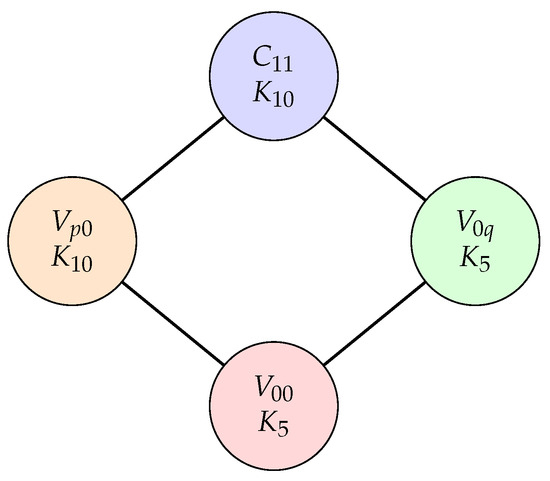
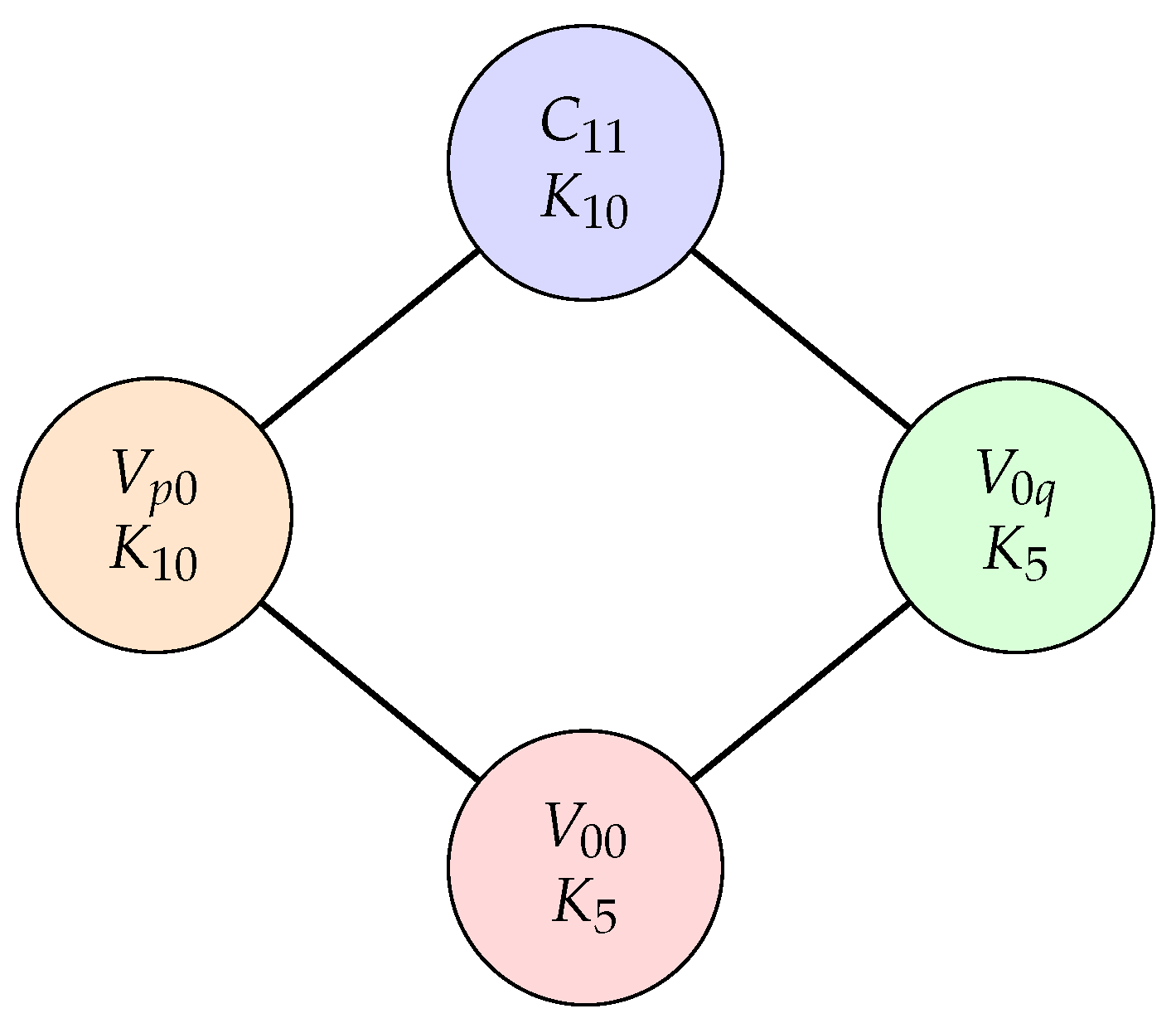
The connection diagram of this worked example, showing the four blocks , , and and their gluing, is depicted in Figure 2.
Figure 2.
Block connection diagram for the worked example , , , (). Each circle represents a clique; edges denote that every vertex in one clique is adjacent to every vertex in the other. The block has no edge to . Since in this example, and .
4.2. Example with a Non-Trivial Remainder: , , ,
This example illustrates the residue correction terms when n is not a multiple of . Here and , so , . We have , , and , . The images are and .
In the complete period each main block has vertices, each has vertices, and has vertices. The remaining five residues contribute the correction terms
The actual blocks are
The block sizes and vertex degrees are
The quotient matrix, with rows and columns ordered as to match the table above, is
Its characteristic polynomial is
The polynomial is irreducible over (it has no rational root and no factor of degree 2 or 3 over ; by Gauss’s lemma both are finite checks among the candidate integer factorizations), so its roots admit no simpler closed form; its largest root is the Perron value. The internal eigenvalue has multiplicity 14. The Kirchhoff index and graph energy are
This example shows that the correction terms do not vanish when , and that the quotient-matrix method still handles them directly without any modification.
4.3. Non-Trivial Example: , , ,
Here , , and , . The images are and . Write . The nine blocks have sizes
and the vertex degrees are
The quotient matrix B (ordered as in the size table) is
Its Perron value is the largest root of the characteristic polynomial of the displayed matrix B, and the internal value has multiplicity 91. The non-zero eigenvalues of admit no closed form, but the sum entering the Kirchhoff index can be computed exactly without solving for them: if
then Vieta’s formulas give and , hence
where and are obtained from by exact integer arithmetic (Faddeev–LeVerrier, or fraction-free Gaussian elimination on ), so no numerical root-finding is involved. This gives ; for transparency, the eigenvalues themselves are approximately
and their reciprocals sum to . The internal contribution is , a direct rational computation from the block table. The Kirchhoff index is therefore
and the graph energy is
This example demonstrates that the quotient matrix remains small even when : the full adjacency matrix is reduced to a computation.
The structural and spectral invariants of the three worked examples are collected and compared in Table 2.
Table 2.
Comparison of the three worked examples.
5. Asymptotics and Discussion
5.1. Asymptotic Spectral Radius
As with fixed and , Theorems 2 and 4 give the asymptotic block sizes
Hence every entry of B satisfies as , where is the fixed quotient matrix of the weighted extended rook grid of Remark 6 with cell weights
that is, and when share a row or a column. In fact, under the present assumption , the remainder is exact. Writing and comparing entries gives the matrix identity
because on the diagonal and, for fully joined blocks, . Since B is similar to the symmetric matrix (Section 3.1), the spectrum of B is , and the Perron root satisfies the exact formula
in which the error term is identically (so is trivially attained and sharp). For general n (not necessarily a multiple of ), writing with uniformly bounded residue corrections E and conjugating by gives the symmetric matrix ; the size is fixed and the ratios are bounded away from 0 and ∞, so , and Weyl’s inequality yields
where depends only on . For instance, in the example (, ) the Perron value of B agrees with up to an difference (as , the exact identity does not apply here). In the special case all block sizes are exactly , so and , giving the exact closed form
This linear growth contrasts with the single-prime graph, whose components are cliques of size and hence Perron value . The two-prime graph spreads the edges over a connected rook grid rather than isolating cliques.
5.2. Replacing by the Composite Modulus
One may ask what happens if the moduli set is the single composite integer rather than the two primes separately. By the Chinese Remainder Theorem,
Thus the graph has the adjacency relation
whereas our graph uses the weaker condition
Therefore is a spanning subgraph of : two vertices are adjacent in the composite-modulus graph only if they agree in both power-residue coordinates, which means they lie in the same block . Hence decomposes into the disjoint union of the cliques (plus the degenerate blocks), with no row or column joins. This recovers the disconnected-union-of-cliques phenomenon of the single-prime case, now with cliques instead of . The connected rook blow-up structure is therefore a consequence of the disjunction (or) across two moduli, rather than of the composite modulus alone.
The block decomposition derived above has several practical consequences.
- Computational complexity. A naive spectral computation on the full n-vertex adjacency matrix costs . The equitable partition reduces this to a quotient matrix of size plus work to collapse each block. Since and , the quotient matrix has size , independent of n. The total cost is therefore dominated by the degree-vector construction plus spectral work, a speed-up of order over the naive approach. This is consistent with the observation of [11] that block decomposition accelerates spectral computations for congruence graphs.
- Network symmetry and modular clustering. The rook graph blow-up exhibits a high degree of structural symmetry: rows and columns of the grid are interchangeable under relabeling of the image points and . In a network setting, the blocks correspond to tightly knit clusters (cliques), and the row/column joins correspond to dense inter-cluster links. The independence number gives the maximum size of a set of mutually non-adjacent nodes, which is relevant to placement of monitoring or intrusion-detection points.
- Cryptographic interpretation. The adjacency relation groups vertices by the image of the k-th power map rather than by its preimage. The connectivity of the two-prime graph, in contrast to the disconnected single-prime graph, means that any two residues are linked through a chain of power-equivalence relations modulo one of the two primes; this may be relevant when analyzing the mixing properties of hash-based identification protocols built on modular exponentiation.
6. Concluding Remarks
Replacing a single prime power hierarchy by two distinct primes changes the power congruence graph from a disconnected union of cliques into a connected rook graph blow-up. The main technical achievements of the paper are: (i) a complete structural description: the CRT block decomposition , explicit block sizes including the residue corrections when (Theorems 2 and 4), and the gluing of the three degenerate classes to the main grid (Theorem 3); (ii) a spectral reduction: the adjacency and Laplacian spectra, and with them the Kirchhoff, Estrada and Laplacian–Estrada indices, the graph energy and the spanning-tree count, are determined by a quotient matrix of size (Theorems 5 and 6, Corollaries 7 and 8), with the exact spectral radius in the uniform-cell case (Section 5.1); (iii) exact global invariants: algebraic connectivity, clique, chromatic, domination and independence numbers, diameter 2, and the automorphism group. We emphasize that the construction itself (CRT decomposition, rook blow-up, equitable partition, small quotient matrix) is the paper’s principal contribution: it is a clean instance of the symmetry-exploitation pipeline used to analyze complex symmetric networks, and it is the source of every closed formula above.
We close by outlining several natural directions for further work.
- (i)
- Three or more prime moduli. For a moduli set with , CRT identifies the non-degenerate vertices with tuples in , and the image of the k-th power map splits this product into blocks. Two blocks are joined whenever their coordinates agree in at least one modulus; this is the r-dimensional analogue of a rook graph, sometimes called a generalized rook graph. The equitable partition argument survives verbatim, but the quotient matrix grows to size , and the internal eigenvalue is still on each clique. The case admits exact spectral formulas precisely because the block-adjacency graph is a Cartesian product, , whose adjacency matrix is the Kronecker sum , with spectrum . For this structure breaks down: if two tuples agree in two coordinates, the natural sum of the coordinate-cylinder adjacency matrices counts the pair twice, and an inclusion–exclusion correction destroys the Kronecker-sum form: two blocks can agree in two coordinates simultaneously, so the adjacency pattern is no longer a simple Cartesian product. Exact eigenvalue formulas beyond are an open question. Two partial structures are available: in the uniform-cell case the block adjacency is determined by the set of coordinates in which two tuples agree, so it belongs to a natural association scheme generated by the “agreement in coordinate i” operators, whose spectrum is computable from the scheme’s parameters; and when all are equal, the generalized rook graph is a common refinement of quotients of the Hamming scheme.
- (ii)
- Composite moduli and prime powers. The present paper treats two primes . The next case is replacing one prime by a prime power, say with . The ring is no longer cyclic when , so the image of the k-th power map must be described through its 2-primary and odd components separately. This changes the number of image points and hence the grid dimensions , but the structural argument (CRT decomposition, clique blocks, equitable partition) should remain intact.
- (iii)
- Directed power congruence graphs. Throughout we used the undirected condition . The directed version, iff , is the classical power digraph studied by Somer–Křížek and others. The two-moduli directed version composes two functional graphs; their interaction under CRT is substantially more complex because edges are no longer symmetric, and spectral analysis must use the Jordan decomposition of the non-symmetric adjacency matrix rather than the real symmetric spectrum used here.
- (iv)
- Uniform-cell limit and graph energy asymptotics. When n is a multiple of , all cells have equal size , so the main rook blow-up has uniform cell sizes. In this uniform-cell case the Perron eigenvalue of the main rook blow-up admits a closed form. The full graph is not regular, because the degenerate blocks have different sizes; nevertheless both the energy and the Kirchhoff index grow linearly in n: the number of blocks is fixed, each non-zero quotient eigenvalue is , each internal Laplacian eigenvalue is while the internal adjacency eigenvalue is , so and . Characterizing the asymptotic regime as with fixed would connect the present spectral formulas to the broader literature on graph energy asymptotics.
- (v)
- Generalized k. We fixed k globally. An interesting variant allows a modulus-dependent exponent , so that adjacency requires or . The image dimensions then differ by modulus, and the CRT pairing restricts to a grid whose two sides are no longer controlled by the same exponent. The equitable partition argument still applies, but the quotient matrix loses the symmetry exploited in the example.
Algebraic-geometric perspective. The dimensions also have a natural interpretation outside graph theory: is the index of the image of the k-th power map in the cyclic group , and subgroups of index dividing k in cyclic groups are the Galois groups of the Kummer cyclic extensions from which cyclic branched covers of the projective line (superelliptic and generalized Fermat curves ) are built. In this sense the grid of image points is a discrete shadow of the period coordinate grids that arise for such covers and their Jacobians [19]. A dictionary from this combinatorial shadow to moduli spaces of curves, their compactifications, or their tropical stable reductions is not available at present; building even a partial one is an attractive direction for future work.
Funding
This research was funded by the Natural Science Foundation of Jiangsu Province (Grants No. BK20220790).
Data Availability Statement
No new data were created or analyzed in this study. Data sharing is not applicable to this article.
Conflicts of Interest
The author declares no conflicts of interest.
References
- Somer, L.; Křížek, M. On a connection of number theory with graph theory. Czechoslov. Math. J. 2004, 54, 465–485. [Google Scholar] [CrossRef] [Scilit]
- Deng, G.; Yuan, P. Symmetric digraphs from powers modulo n. Open J. Discret. Math. 2011, 1, 103–107. [Google Scholar] [CrossRef]
- Malik, M.A.; Mahmood, M.K. On simple graphs arising from exponential congruences. J. Appl. Math. 2012, 2012, 292895. [Google Scholar] [CrossRef] [Scilit]
- Asif, S.; Mahmood, M.K.; Alali, A.S.; Zaagan, A.A. Structures and applications of graphs arising from congruences over moduli. AIMS Math. 2024, 9, 21786–21798. [Google Scholar] [CrossRef] [Scilit]
- Rogers, T.D. The graph of the square mapping on the prime fields. Discret. Math. 1996, 148, 317–324. [Google Scholar] [CrossRef] [Scilit]
- Lucheta, C.; Miller, E.; Reiter, C. Digraphs from powers modulo p. Fibonacci Quart. 1996, 34, 229–239. [Google Scholar] [CrossRef] [Scilit]
- Somer, L.; Křížek, M. Structure of digraphs associated with quadratic congruences with composite moduli. Discret. Math. 2006, 306, 2174–2185. [Google Scholar] [CrossRef] [Scilit]
- Somer, L.; Křížek, M. The structure of digraphs associated with the congruence xk ≡ y (mod n). Czechoslov. Math. J. 2011, 61, 337–358. [Google Scholar] [CrossRef] [Scilit]
- Chakrabarty, I.; Ghosh, S.; Sen, M.K. Undirected power graphs of semigroups. Semigroup Forum 2009, 78, 410–426. [Google Scholar] [CrossRef] [Scilit]
- Abawajy, J.; Kelarev, A.; Chowdhury, M. Power graphs: A survey. Electron. J. Graph Theory Appl. 2013, 1, 125–147. [Google Scholar] [CrossRef] [Scilit]
- Raza, M.A.; Mahmood, M.K.; Almutlg, A. Symmetry and structural analysis of power congruence graphs over a set of moduli. Symmetry 2026, 18, 582, Correction in Symmetry 2026, 18, 1296. https://doi.org/10.3390/sym18081296. [Google Scholar] [CrossRef] [Scilit]
- Biggs, N. Algebraic Graph Theory, 2nd ed.; Cambridge University Press: Cambridge, UK, 1993. [Google Scholar] [CrossRef] [Scilit]
- Merris, R. A survey of graph Laplacians. Linear Multilinear Algebra 1995, 39, 19–31. [Google Scholar] [CrossRef] [Scilit]
- Gutman, I.; Mohar, B. The quasi-Wiener and the Kirchhoff indices coincide. J. Chem. Inf. Comput. Sci. 1996, 36, 982–985. [Google Scholar] [CrossRef] [Scilit]
- Estrada, E. Characterization of 3D molecular structure. Chem. Phys. Lett. 2000, 319, 713–718. [Google Scholar] [CrossRef] [Scilit]
- de la Peña, J.A.; Gutman, I.; Rada, J. Estimating the Estrada index. Linear Algebra Appl. 2007, 427, 70–76. [Google Scholar] [CrossRef] [Scilit]
- Godsil, C.; Royle, G. Algebraic Graph Theory; Springer: New York, NY, USA, 2001. [Google Scholar] [CrossRef] [Scilit]
- Fiedler, M. Algebraic connectivity of graphs. Czechoslov. Math. J. 1973, 23, 298–305. [Google Scholar] [CrossRef] [Scilit]
- Malmendier, A.; Shaska, T. From hyperelliptic to superelliptic curves. Albanian J. Math. 2019, 13, 107–200. [Google Scholar] [CrossRef] [Scilit]

Disclaimer/Publisher’s Note: The statements, opinions and data contained in all publications are solely those of the individual author(s) and contributor(s) and not of MDPI and/or the editor(s). MDPI and/or the editor(s) disclaim responsibility for any injury to people or property resulting from any ideas, methods, instructions or products referred to in the content. |
© 2026 by the author. Licensee MDPI, Basel, Switzerland. This article is an open access article distributed under the terms and conditions of the Creative Commons Attribution (CC BY) license.