


Abstract
In this paper, we consider the problem of classifying commutative rings according to the genus number of its associating zero-divisor graphs. The zero-divisor graph of R, where R is a commutative ring with nonzero identity, denoted by , is the undirected graph whose vertices are the nonzero zero-divisors of R, and the distinct vertices x and y are adjacent if and only if . Here, we classify the local rings with genus three zero-divisor graphs.
MSC:
13A15; 13M05; 05C75; 05C25
1. Introduction
Studying algebraic structures using graph theory properties has been an exciting research topic in the last two decades. Beck [1], who created the concept of a zero-divisor graph of a commutative ring with identity, established the connection between algebra and graph theory by linking a graph with a ring in 1988. In Beck’s definition, the vertices of the graph are the elements of the ring and two distinct vertices x and y are adjacent if and only if . Beck’s graph had edges between zero-divisors to emphasize them, but it also had an edge connecting each element to zero. Later, Anderson and Livingston [2] in 1999 made a slight modification to this concept by only taking into account the nonzero zero-divisors of a ring as vertices of the graph with the same adjacency criterion. For more details on zero-divisor graphs, one may refer to [3].
In recent decades, many geometrical properties of graphs were widely investigated. More precisely, the study focused on the oriented and non-oriented genus of graphs that originate from algebraic ones. The question of which commutative rings have planar zero-divisor graphs was raised by Anderson et al. [4] in 2001. Since then, the literature has been keenly interested in zero-divisor graph embedding. Numerous academics have so far classified all commutative rings with zero-divisor graphs having a genus less than or equal to two in several research articles. The planar zero-divisor graphs were explicitly characterized by Smith [5,6] and Belshoff [7], while the characterization of commutative rings with genus one zero-divisor graphs was obtained by Chiang-Hsieh et al. in [8] and local rings with genus two zero-divisor graphs were characterized by Bloomfied et al. in [9]. Furthermore, Asir et al. [10] have determined all non-local commutative rings with genus two zero-divisor graphs. All commutative rings with projective (non-oriented genus one) zero-divisor graphs were characterized by Chiang-Hsieh [11]. Moreover, Asir et al. [12] determined all commutative rings with crosscap two zero-divisor graphs. One may refer to Chapter 4 of [3] for the complete literature evaluation.
This paper aims to investigate the problem of embedding zero-divisors on higher-genus orientable surfaces. This paper is structured as follows: In Section 2, definitions and tools are developed to aid classification. In Section 3 and Section 4, all commutative rings with genus three zero-divisor graphs are determined.
Let R be a commutative ring with nonzero identity and be its set of zero-divisors for the course of this paper. We use to represent the ring of integers modulo n, to represent the finite field with q elements, to represent the cardinality of the set A and to represent the set of all non-zero elements of A. We denote the complete bipartite graph with parts of size m and n by , and the complete graph with n vertices by . is the complement of the complete graph . The notation and indicate the degree of a vertex v in a graph G and the minimum degree of G, respectively. The Cartesian product is a graph with vertex set , and two distinct vertices and of G are adjacent if and only if either and or and . The join of graphs and with disjoint vertex sets and and edge sets and is the graph union and union together with all the edges joining and .
For non-negative integers ℓ and k, let denote the sphere with ℓ handles and denote a sphere with k crosscaps attached to it. For a simple graph G, the minimum ℓ such that G can be embedded in is its genus which is denoted by . Similarly, the minimum k such that G can be embedded in is , or crosscap number (non-orientable genus). Planar, toroidal and double toroidal graphs are the terms used to refer to the graphs of genus 0, 1 and 2, respectively. The graph that is obtained from by identifying vertices x and y to create a new vertex z incident with all edges of G that were incident with either x or y is known as the contraction of e in G, denoted as . This is the case if . If H can be obtained from G by deleting vertices, edges and contracting edges, then H is a minor of G, written . The graph denotes the induced subgraph of G induced by the vertices where and we call this graph the reduction in G. It is clear that for any graph G. For details on the notion of embedding of graphs on a surface, we refer to White [13].
For convenience, we denote the elements of the ring simply by . In other words, we avoid writing the fixed last term in each element of the ring. Similarly, the ring simply by .
2. Genus Properties of Graphs
We now state a few results regarding the genus of the graph which will be used to prove the main results of this paper.
Proposition 1
([14]). Let be a positive integer and, for any real number x, the ceiling function is the least integer that is greater than or equal to x. Then, .
Proposition 2
([14]). Let be positive integers. Then, if .
Proposition 3
([14] (Euler formula)). If G is a finite connected graph with n vertices and m edges; then,
where the graph is embedded upon a surface with genus γ and f is the number of faces created when G is embedded on .
Remark 1
([15]). For any embedded graph G with v vertices, e edges and f faces, we have where denotes the girth of G (i.e., the length of the shortest cycle in .
By Proposition 3 and Remark 3, one can obtain the following result.
Remark 2.
If G is a triangle-free graph with n vertices and m edges, then
Proposition 4
([16], Theorem 2). The complete bipartite graph has a two-cell embedding on a compact orientable two-manifold of genus γ if and only if
Proposition 5
([13], Proposition 2.1). If G is a graph with n vertices and genus γ, then
Proposition 6
([9], Lemma 4). Let be a local ring with principal and with an index of nilpotency n, and let . For every , .
Proposition 7
([9], Lemma 5). Let be a local ring such that and for some . Then, there exist elements such that and .
Proposition 8
([9], Lemma 6). Let be a local ring such that and for some . Then, there exist elements such that and .
3. Classification of Genus Three Zero-Divisor Graphs
We will now state a few results regarding the genus properties of a zero-divisor graph of a commutative ring which will be further used to prove the main result.
Theorem 1
([8], Theorem 3.5.1). Let be a finite local ring which is not a field. Then, is planar if and only if R is isomorphic to one of the following 29 rings:
Theorem 2
([8], Theorem 3.5.2). Let ( be a finite local ring which is not a field. Then, if and only if R is isomorphic to one of the following 17 rings:
As mentioned earlier, Bloomfield and Wickham [9] enumerated the local commutative rings whose zero-divisor graphs have genus two. The relevant result is stated below.
Theorem 3
([9], Theorem 1). Let ( be a finite local ring which is not a field. Then, if and only if R is isomorphic to one of the following 14 local rings.
First, we provide some results needed to classify the genus three zero-divisor graphs.
Theorem 4.
Let be a finite local ring. If , then ; and the following holds:
- (i)
- If , then and ;
- (ii)
- If , then and ;
- (iii)
- If , then and or 32.
Proof.
Assume that . Since R is local, there is a prime power q and integers such that , and . Let t be a largest positive integer such that . Therefore, .
Suppose that . Then, . Since , we have for every . Therefore, the subgraph induced by in is complete and so . Thus, by Proposition 2, is a contradiction. Hence, .
Case 1: Suppose . The possibilities for q are or 9. If , then and . Since , every element of is adjacent to all the elements of in So and by Proposition 2, we obtain . Therefore, . That is, . If , then . Since the collection of non-zero elements of form a complete graph in and , we have , a contradiction. Therefore, is a principal ideal and . In this case, . The assumption implies that , a contradiction.
Case 2: Suppose . If , then . This statement implies that and . Since , so that , a contradiction. Thus, . That is, .
Moreover, suppose that for some . Here, . If , then the subgraph induced by forms a complete graph in , which leads to , a contradiction. If , then and . This implies that , a contradiction. Therefore, means that . But by Theorems 1 and 2, the zero-divisor graph of any local ring of order less than or equal to 16 has a genus less than 2. Thus, .
Case 3: Suppose . If , then and . Since , a contradiction. Therefore, . Hence, .
Suppose that for some . This implies that .
Case 3.1: If , then the subgraph induced by is complete in , leading to , a contradiction.
Case 3.2: If , then . Let . Since , we have , a contradiction. Therefore, and so . Now, by Proposition 2.8 [17], for some . Without loss of generality, we may assume that either or .
Assume that . Then by Proposition 7, for . Since and , we have the sets and which form in . Therefore .
Assume that . Since any element of generates , we may assume that . Now, the cosets and are mutually disjoint. In particular, and . Let , and so that , and . Therefore, in , the subgraph induced by the set A is isomorphic to , and the subgraph induced by the sets B and C is isomorphic to . Thus, so that .
Case 3.3: If , then and . Let . Then, contains as a subgraph, a contradiction. Therefore, and . Consequently, . Then, by Proposition 2.8 [17], for some . So we may assume that or .
Assume that . Then, by Proposition 7, for every i. Notice that the cosets and are mutually disjoint and every element in is adjacent to all the elements of in . So contains as a subgraph and thus .
Assume that . Since any element of generates , we may assume that . Clearly, . If and , then for some . Since and , we have . Therefore, the subgraph induced by contains in and so .
Thus, with . But by Theorems 1 and 3, for all local rings R of order less than or equal to 27. Hence, .
Case 4: Suppose . If , then and . Since , we have so that , a contradiction. Therefore, , which leads to .
Suppose that for some . Notice that .
Case 4.1: If , then , a contradiction.
Case 4.2: If , then . Let . Then, contains as a subgraph, a contradiction. Therefore, and so This implies that for and without loss of generality, we may assume or .
Assume that . Then, by Proposition 7, we have . Let and . Then, for every , so that , a contradiction.
Assume . Then, by Proposition 8, for . Also, any element of generates and so we may assume that . Now, let and let . Then, for every and therefore , a contradiction.
Case 4.3: If , then and . Let . Then, contains as a subgraph, a contradiction. Therefore, and . Consequently, Now, by Proposition 2.8 [17], for some , and without loss of generality, let or . In either case, by Propositions 7 and 8, we have for . Since and , we can choose two non-zero elements such that . Let and Clearly for every so that . By Proposition 2, , a contradiction.
A similar proof technique is valid for the cases or .
Thus, . But by Theorems 1 and 2, for all local rings R of order less than or equal to 16. Hence, or 64. □
Lemma 1
([8] (Proposition 7.1), [5] (Proposition 5)). Let R be a local ring with maximal ideal . Then, there are 54 local commutative rings with order 32.
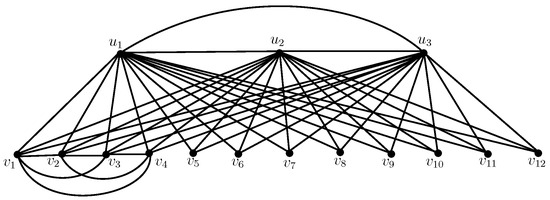
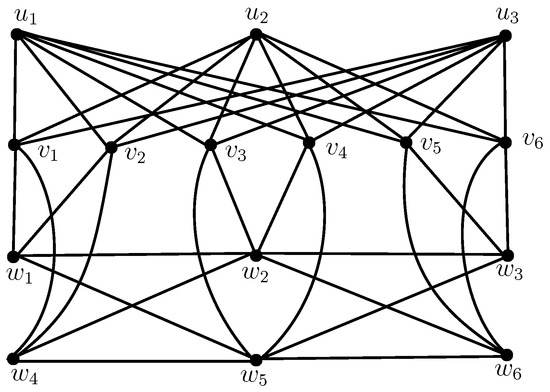
The graph given in Figure 1 plays a vital role in characterizing local rings with genus three zero-divisor graphs. Therefore, we find its genus value in the following result.
Figure 1.
Graph H.
Lemma 2.
For a graph H as shown in Figure 1, we have .
Proof.
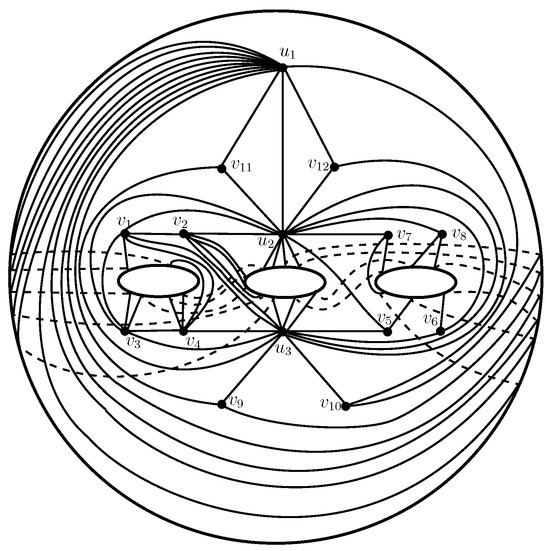
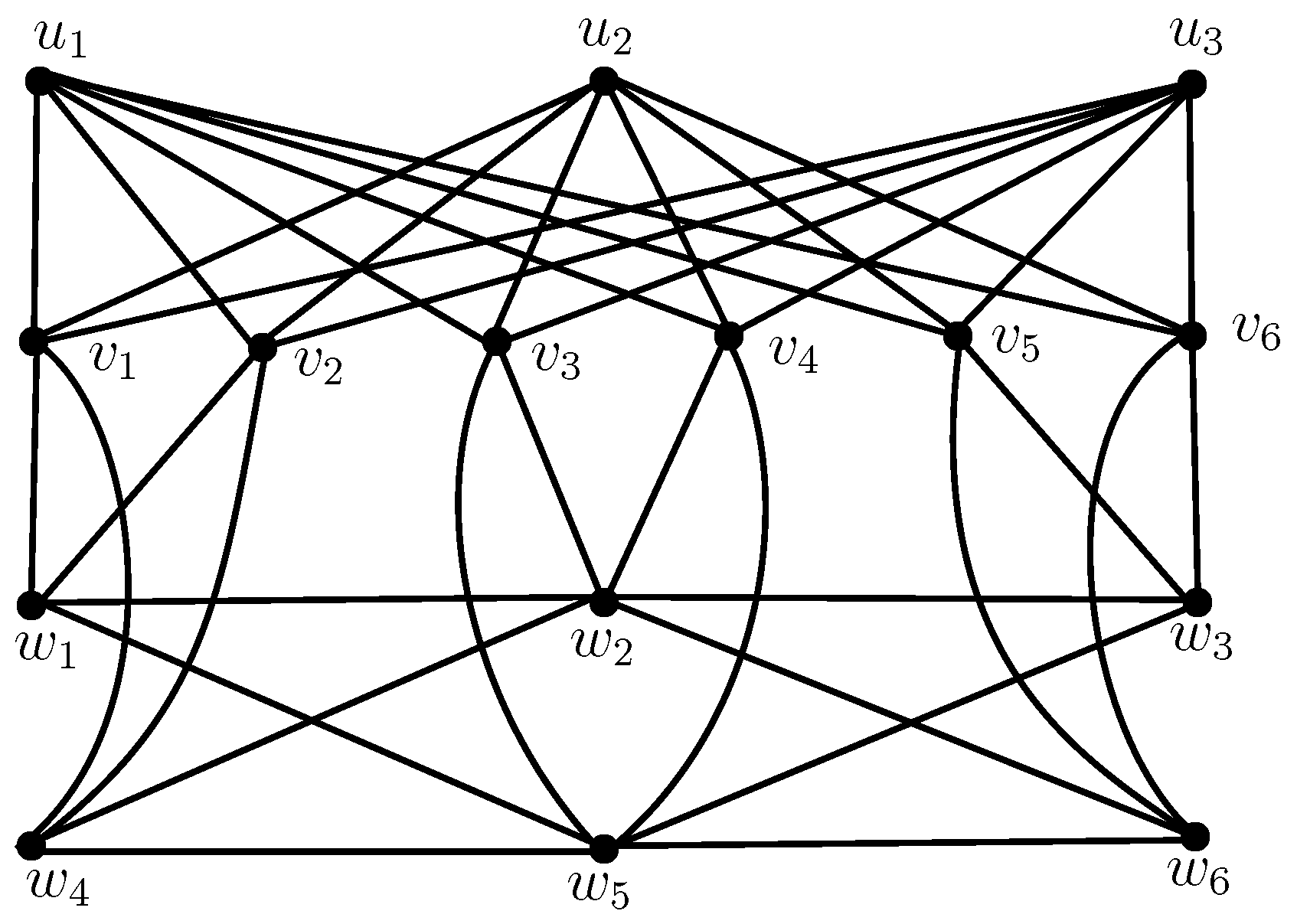
In Figure 2, we provide an embedding of the graph H in the surface of . Thus, . □
Figure 2.
The graph H can be embedded in the surface .
Lemma 3.
Let be a finite local ring and . Then, if and only if and has a nilpotency index of 3.
Proof.
(⇒): Suppose that Then, by Theorem 4, we have and . It follows that . If , then any two non-zero element of is adjacent in and so contains as a subgraph. Therefore, , a contradiction. Thus, the nilpotency index of is 3.
(⇐): Let and the nilpotency index of be 3. This implies that and . The facts , and imply that, in , the subgraph induced by the set is empty, every element in is adjacent to all the element of and the subgraph induced by is complete. Therefore, is isomorphic to . So is a subgraph of the graph H given in Figure 1. Thus, by Lemma 2, . □
Lemma 4.
Let be a finite local ring and . Then, .
Proof.
Assume to the contrary that . Then, by Theorem 4, and . Note that R is isomorphic to one of the following 22 commutative local rings [18].
(1) If , then the zero-divisor graph is empty, a contradiction.
(2) Let R be isomorphic to any one of the following seven rings:
Then, by Theorem 3, , a contradiction.
(3) If , then every vertex of the set is adjacent to all the vertices of the set . Therefore, contains as a subgraph and so, by Proposition 2, .
(4) If , then the subgraph induced by the set forms in and so, by Proposition 1, .
(5) If , then the partite sets and form in , which implies that .
(6) If , then the partite sets and form as a subgraph in . Therefore, .
(7) Let R be isomorphic to any one of the following five rings:
Then, the partite sets and form a subgraph in . Hence, .
(8) Let or or . Then, contains a subgraph , where the partite sets are and . Thus, .
(9) Let or . Then, contains as a subgraph with the bipartite sets and . Thus, .
Hence, for all the 22 local rings of order 81 with , which is in contradiction to our assumption. □
Theorem 5.
Let be a local ring. Then, the genus of the zero-divisor graph of R is 3 if and only if one of the following conditions hold:
- (i)
- The residue field with , and
- (ii)
- The residue field with , , and .
- (iii)
- Any one of the local rings of order 32.
Proof.
Let be a local ring. Suppose Then, by Theorem 4, the number of elements in the residue field is 2 or 3 or 4.
If , then, by Lemma 3, we have and also has a nilpotency index of 3. This implies that , and
If , then, by Lemma 4, we obtain a contradiction.
Let . By Theorem 4, we have or 32 with .
Case 1: Suppose with . Then, .
We claim that the nilpotency index of is 6. In order to prove this claim, assume to the contrary that for some
Case 1.1: If , then the 31 non-zero elements in together form a complete graph in . So, by Proposition 1, we have , a contradiction.
Case 1.2: Suppose . If , then contains as a subgraph and so, by Proposition 2, . Therefore, . This implies that . So we assume for some . Without loss of generality, we may assume that or .
Case 1.2.1: Assume that . Then, by Proposition 7, we have .
(i). If for all , then , where the bipartite sets are and . Therefore, .
(ii). Suppose exactly one element of is non-zero, say . That is, . Let and . Clearly, for all and and so . Thus .
(iii). Suppose exactly two elements of are non-zero. If and , then . This implies that . Let us take . Clearly, and so Therefore, . Similarly, if and , then , so that . Let , and we have and . So .
Case 1.2.2: Assume that . Then, none of and are in . Thus, . By Proposition 8, we obtain . If necessary, replacing by and by , we have . Now, let and . Then, for every , so that . Therefore, .
Case 1.3: Suppose . Then, and . If , then contains as a subgraph and so . Therefore, and . Consequently, . So, let for some , and without loss of generality, assume or .
First, assume that . Then, . Since , we let . This implies that . Let and Since for every , we have so that .
Second, assume that . Then, by Lemma 8, we have . Moreover, we may assume that each of and are in . However, , a contradiction.
Case 1.4: Suppose . Then, , and . If , then Since , we have contains as a subgraph and so , a contradiction. Therefore, . Consequently, . Thus, just two cases can occur: either or .
First, suppose that . Then, , and we have for some . Without loss of generality, or . Let . Then, and so . Clearly, and are mutually disjoint sets. Note that, in , every elements in the set is adjacent to all the elements of so that . Therefore, . Let . Since the cosets and are mutually disjoint and since , we have the sets , and which are mutually disjoint. Then, in , every element in is adjacent to every element of so that . Therefore, .
Second, suppose that . Then, and so is principal. Therefore, is principal for every i. This implies that for all , which contradicts the fact that .
Case 1.5: Suppose . Then, . Consequently, for all and ’s are the principal ideal for all . Note that, in , the subgraph induced by is complete, every element in is adjacent to all the vertices of and every element in is adjacent to the single non-zero element of By labeling the vertices of by , and , it follows that is isomorphic to the graph given in Figure 1. Thus, by Lemma 2, we obtain .
Hence, in Case 1, if and only if such that , and .
Case 2: Suppose with . This implies that . Then, by Lemma 1, there exist 53 (non-field) local rings.
(1). Assume that R is isomorphic to any one of the following eight rings:
Then, by Theorem 2, we have as toroidal.
(2). Assume that R is isomorphic to one of the following five rings:
Then, by Theorem 3, we have that is double toroidal.
(3). Assume that R is isomorphic to one of the following 19 rings:
Then, the corresponding zero-divisor graphs of R are provided in a tabular format.
Thus, all the zero-divisor graphs displayed in Table 1 are either the graph H (refer Figure 1) or a subgraph of H. Hence, by Lemma 2, in this case, for all the 17 local rings.
Table 1.
Zero-divisor graphs of certain rings.
(4). Let and . Then, and . It is clear that and are isomorphic to and so .
(5). Assume that R is isomorphic to one of the following three rings:
If , then the partite sets and forms in . Therefore, .
If , then the partite sets and forms in . Therefore, .
If , then every vertex in the set is adjacent to all the vertices of in . So , a contradiction.
If , then contains , as a subgraph with bipartite sets and , a contradiction.
(6). Assume that R is isomorphic to one of the following three rings:
Note that the number of vertices and number of edges in is and , respectively. If , then, by Proposition 3, there are 43 faces in any -embedding of . So the average length of the faces is , which is less than the girth value(=3) of , a contradiction.
(7). Assume that R is isomorphic to one of the following five rings:
Let . Then, in , every vertex of the set is adjacent to all the vertices of . Therefore, is a subgraph of . Clearly, . By Euler’s formula, there are 17 faces when drawing on . Fix a representation of -embedding of and denote it as L. Let be the number of i-gons of corresponding to the representation L. Since , we have . Therefore, and . This implies that there are fifteen rectangular and two hexagonal faces in L. Note that, in each vertex in is adjacent to all the four vertices in . If , then we have to embed all these 12 edges into L. Choose an arbitrary . Then, and so v is a part of exactly three faces of L. Notice that any rectangular face can adopt at most one new edge into it and any hexagonal face can adopt at most three edges between the vertices of . So to embed the four edges between v and a vertex of B, two rectangular and one hexagonal face are required. Therefore, to embed all the edges between A and B, six rectangular and three hexagonal faces are required, a contradiction to L which has two hexagonal faces.
If , , or , then it is not hard to verify that the graph is isomorphic to a subgraph of so that
(8). Assume that R is isomorphic to one of the following five rings:
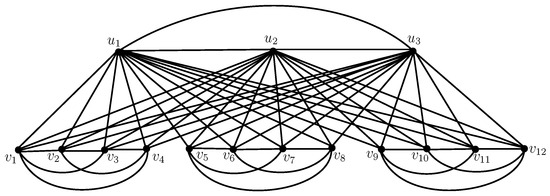
Let . Then, consider the subgraph . The diagrammatic representation of is given in Figure 3. Note that is a triangle-free graph and the number vertices and edges of is and , respectively. Therefore, by Remark 2, we obtain . Suppose that . Then, and also, by Euler’s formula, there are 19 faces in any -embedding of . Let be the number of i-gons in a -embedding of . Then, and This implies that all the faces in any -embedding of are rectangular. Now, to recover a -embedding of from a -embedding of , we have to embed all the 15 omitted edges of into a -embedding of . Notice that each rectangular face can adapt at most one edge into it. So to embed the eight edges incident with the vertex , namely and , eight rectangular faces which contain are required. But . This implies that is a part of exactly six rectangular faces of any -embedding of , a contradiction. Therefore, .
Figure 3.
The triangle-free subgraph of .
If or or or , then and so .
(9). Assume that R is isomorphic to one of the following four rings:
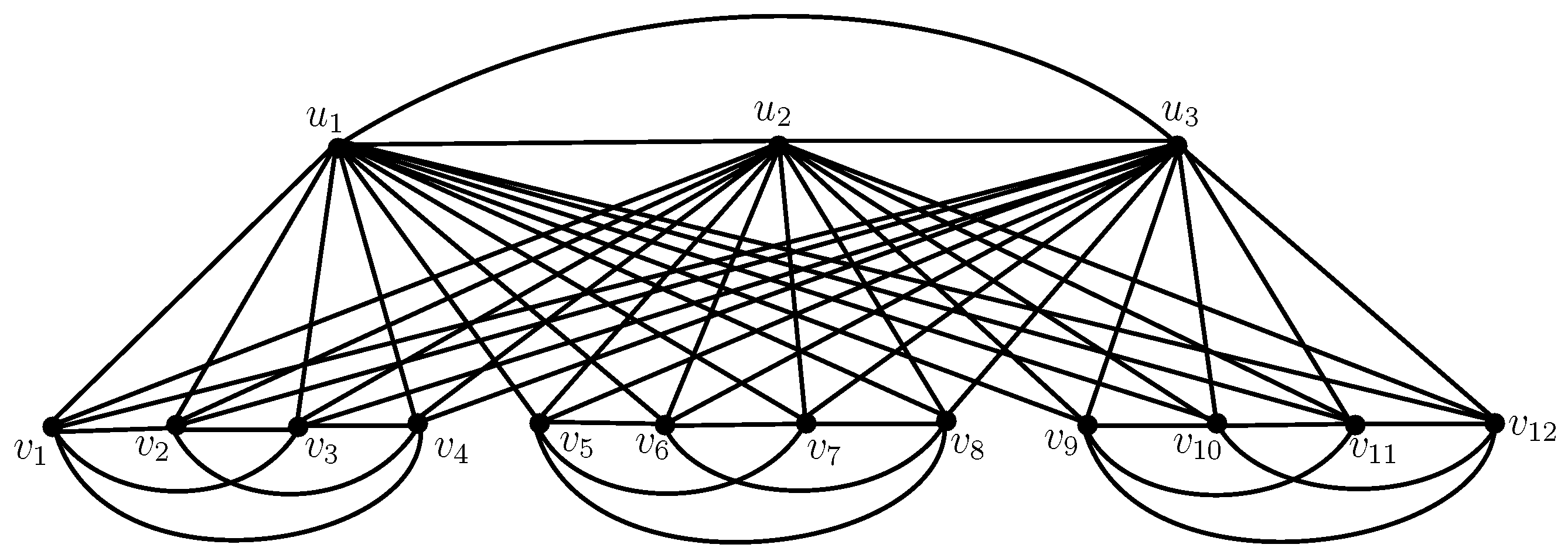
Let . Take and . Then, is isomorphic to Figure 4 and , since a copy of is contained in . Suppose that . Consider the subgraph . Then, is isomorphic to and clearly .
Figure 4.
.
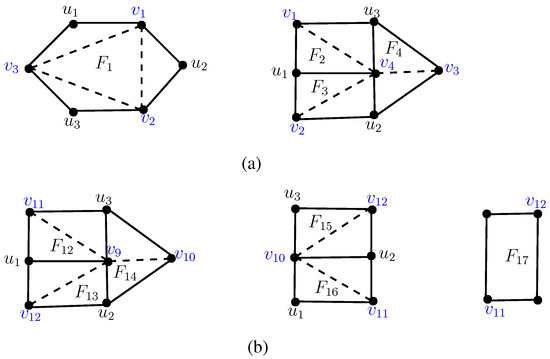
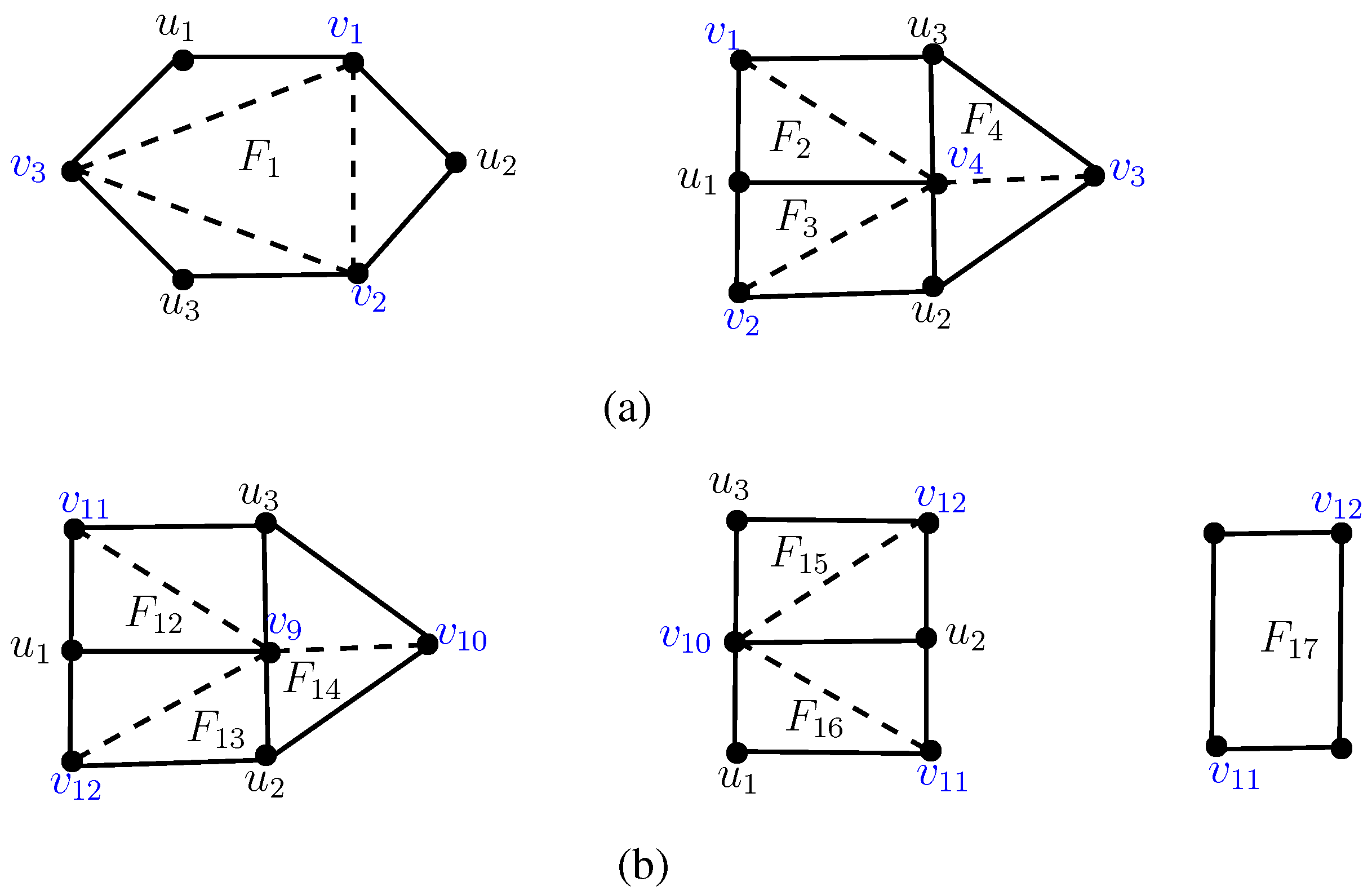
By the Euler formula, the faces of any -embedding of have fifteen rectangular and two hexagonal faces. Now, we try to embed the 21 omitted edges of into an arbitrary -embedding of .
First, we try to insert the edges into a -embedding of . To embed edges, we require one hexagonal and three rectangular faces, which we name as (see Figure 5a). Similarly, to embed the next six edges , we require another one hexagonal and three rectangular faces, which we name as . Here, we notice that the vertices , for and are placed in two faces of . Since , one more face should have ’s and those which form three rectangular faces, we name as , and . The edges and can be embedded in the , respectively.
Figure 5.
Face distribution of -embedding of .
Next, to embed the three edges , we requires three rectangular faces, which we name as and , all of which contain (Figure 5b). Furthermore, to embed two edges , two rectangular faces are required, which we name as , all of which contain (Figure 5b). Since and 17 faces are in -embedding of , exactly one more face should have , and we shall denote it as . Notice that, in any -embedding, every edge of a graph is in exactly two faces. Here, the edges and are used twice in the faces . Now, the choices for another one diagonal of are in . Obviously, we have to select distinct vertices for in which one is from or . This is a contradiction to the fact that the edges and are used twice in the faces . Therefore, .
Furthermore, if or , then and so . □
4. Conclusions
Over the last twenty years, a number of research studies have identified all commutative rings with zero-divisor graphs with genus equal to or less than 2. This work lists all isomorphism classes of local commutative rings with identities whose zero-divisor graphs have genus three. Which non-local commutative rings have genus three zero-divisor graphs is, at this time, an open question.
Author Contributions
Conceptualization, T.A. (Thangaraj Asir); methodology, T.A. (Thangaraj Asir) and K.M.; investigation, K.M.; writing original draft preparation, T.A. (Thangaraj Asir) and K.M.; writing review and editing, T.A. (Thangaraj Asir) and T.A. (Turki Alsuraiheed); supervision, T.A. (Thangaraj Asir); project administration, T.A. (Turki Alsuraiheed); funding acquisition, T.A. (Turki Alsuraiheed). All authors have read and agreed to the published version of the manuscript.
Funding
This research project was funded by Researchers Supporting Project at King Saud University, under grant no. RSPD2023R934. The first and third authors, therefore, acknowledge with thanks King Saud University for financial support.
Institutional Review Board Statement
Not applicable.
Data Availability Statement
Data sharing not applicable to this work as no datasets were generated or analysed during the current study.
Conflicts of Interest
The authors declare no conflict of interest.
References
- Beck, I. Coloring of commutative rings. J. Algebra 1988, 116, 208–226. [Google Scholar] [CrossRef] [Scilit]
- Anderson, D.F.; Livingston, P.S. The zero-divisor graph of a commutative ring. J. Algebra 1999, 217, 434–447. [Google Scholar] [CrossRef] [Scilit]
- Anderson, D.F.; Asir, T.; Badawi, A.; Chelvam, T.T. Graphs from Rings; Springer: Berlin/Heidelberg, Germany, 2021. [Google Scholar]
- Anderson, D.F.; Frazier, A.; Lauve, A.; Livingston, P.S. The zero-divisor graph of a commutative ring—II. Lect. Notes Pure Appl. Math. 2001, 220, 61–72. [Google Scholar]
- Smith, N.O. Planar zero-divisor graphs. Int. J. Commut. Rings 2003, 2, 177–188. [Google Scholar]
- Smith, N.O. Infinite planar zero-divisor graphs. Comm. Algebra 2007, 35, 171–180. [Google Scholar] [CrossRef] [Scilit]
- Belshoff, R.; Chapman, J. Planar zero-divisor graphs. J. Algebra 2007, 316, 471–480. [Google Scholar] [CrossRef] [Scilit]
- Chiang-Hsieh, H.-J.; Smith, N.O.; Wang, H.-J. Commutative rings with toroidal zero-divisor graphs. Houston J. Math. 2010, 36, 1–31. [Google Scholar]
- Bloomfield, N.; Wickham, C. Local rings with genus two zero-divisor graph. Comm. Algebra 2010, 38, 2965–2980. [Google Scholar] [CrossRef] [Scilit]
- Asir, T.; Mano, K. Classification of non-local rings with genus two zero-divisor graphs. Soft Comput. 2020, 24, 237–245. [Google Scholar] [CrossRef] [Scilit]
- Chiang-Hsieh, H.-J. Classification of rings with projective zero-divisor graphs. J. Algebra 2008, 319, 2789–2802. [Google Scholar] [CrossRef] [Scilit]
- Asir, T.; Mano, K. Classification of rings with crosscap two class of graphs. Discrete Appl. Math. 2019, 265, 13–21. [Google Scholar] [CrossRef] [Scilit]
- Wickham, C. Classification of rings with genus one zero-divisor graphs. Comm. Algebra 2008, 36, 325–345. [Google Scholar] [CrossRef] [Scilit]
- White, A.T. Graphs, Groups and Surfaces; North-Holland: Amsterdam, The Netherlands, 1973. [Google Scholar]
- Chen, J. Minimum and maximum imbeddings. In Handbook of Graph Theory; Gross, J.L., Yellen, J., Eds.; CRC Press: Boca Raton, FL, USA, 2004; Chapter 7.2. [Google Scholar]
- Ringeisen, R.D. Determining all compact orientable 2-manifolds upon which Km,n has 2-cell imbeddings. J. Comb. Theory B 1972, 12, 101–104. [Google Scholar] [CrossRef] [Scilit]
- Atiyah, M.; MacDonald, I. Introduction to Commutative Algebra; Addison-Wesley Publishing Co.: Boston, MA, USA, 1969. [Google Scholar]
- Nowicki. Tables of Finite Commutative Local Rings of Small Orders. 2018. Available online: https://api.semanticscholar.org/CorpusID:201747066 (accessed on 18 January 2023).

Disclaimer/Publisher’s Note: The statements, opinions and data contained in all publications are solely those of the individual author(s) and contributor(s) and not of MDPI and/or the editor(s). MDPI and/or the editor(s) disclaim responsibility for any injury to people or property resulting from any ideas, methods, instructions or products referred to in the content. |
© 2023 by the authors. Licensee MDPI, Basel, Switzerland. This article is an open access article distributed under the terms and conditions of the Creative Commons Attribution (CC BY) license (https://creativecommons.org/licenses/by/4.0/).