


Abstract
Background/Objectives: Rituximab is widely used in primary glomerular diseases, but treatment may fail for several reasons, including primary non-response, incomplete response, relapse, intolerance or anti-rituximab antibodies. We assessed within-patient efficacy and safety after switching to another anti-CD20 antibody, considering the reason for switching. Methods: PubMed and Scopus were searched from inception to 15 May 2026 without language restrictions. Eligible reports included adults with primary glomerular disease treated with a non-rituximab anti-CD20 antibody after rituximab and reporting within-patient outcomes. Risk of bias was assessed with design-specific JBI tools and certainty with GRADE. Heterogeneity precluded meta-analysis, and findings were synthesized narratively. Results: A total of 309 patients were included across 43 studies: 283 had membranous nephropathy (MN), 18 had minimal change disease (MCD), 6 had focal segmental glomerulosclerosis (FSGS), and 2 had IgA nephropathy (IgAN). Obinutuzumab was the principal drug used, and the main reasons for switching were primary non-response, with immunization, relapse, or intolerance occurring less frequently. In MN, among the 262 patients with available response data, 217 achieved complete or partial remission, and relapse was rare. For MCD, 17 of 18 patients with active disease attained remission, and only one relapsed during follow-up. On the other hand, five out of the six FSGS patients responded, but three of them relapsed. The two patients with IgAN achieved either complete or partial remission. Notably, these results may not apply to conventional IgAN, since one biopsy showed contextually MCD and the other was proliferative and crescentic. Infusion-related reactions were the most frequent adverse events and were generally mild, while infections were the main issue during the follow-up. Evidence certainty for all outcomes was very low. Conclusions: Switching to a non-rituximab anti-CD20 antibody may be a feasible rescue strategy, most convincingly after intolerance, rituximab immunization, or relapse. The uncontrolled, very-low-certainty evidence precludes firm recommendations, and controlled studies are warranted.
1. Introduction
Anti-CD20 monoclonal antibodies have changed the treatment of several hematological malignancies and autoimmune diseases [1]. Their effects are not limited to reducing circulating antibodies; they also include the immunomodulation of B cells, which contribute to antigen presentation, cytokine production, co-stimulation, and regulation of T-cell responses. This broader immunological role provides the rationale for B-cell depletion in selected immune-mediated glomerular diseases [1,2,3].
Rituximab, a chimeric type I anti-CD20 monoclonal antibody, remains the most widely used B-cell-depleting therapy in nephrology [4,5]. It acts through complement-dependent cytotoxicity, antibody-dependent cellular cytotoxicity, and direct induction of cell death [6]. In primary membranous nephropathy, rituximab is now one of the main immunosuppressive options for patients at risk of disease progression [4,7,8,9]. It is also used in selected patients with frequently relapsing or steroid-dependent minimal change disease and, less consistently, in focal segmental glomerulosclerosis [10]. Evidence supporting its use in IgA nephropathy remains limited [11,12,13]. In membranoproliferative patterns of injury, treatment is guided by the underlying pathogenic mechanism. Evidence supporting anti-CD20 therapy remains poor, particularly in primary complement-mediated forms, for which current therapeutic strategies increasingly target complement inhibition. Despite its clinical value, rituximab is not effective or suitable for every patient. Some patients fail to achieve remission, whereas others relapse after an initial response. Treatment may also need to be discontinued because of severe infusion reactions or the development of anti-rituximab antibodies [14]. These situations are often grouped under the broad definition of “rituximab failure”, although they do not share the same underlying mechanisms. Several factors may contribute to an inadequate response. In patients with nephrotic syndrome, urinary loss of rituximab may reduce systemic drug exposure [15]. Other proposed mechanisms include incomplete or short-lived B-cell depletion, CD20 internalization or loss, trogocytosis, variability in Fcγ receptor-mediated effector functions, and advanced irreversible glomerular injury [1,16]. Rituximab may also cause clinically significant infusion-related reactions, including fever, chills, rash, dyspnea, and hypotension, which can prevent further administration [14].
The clinical implications vary depending on the underlying mechanisms. Failure to respond to rituximab does not necessarily imply that B-cell depletion is no longer a useful therapeutic strategy [17]. In some patients, the problem may instead be related to the pharmacokinetic, immunogenic, or structural properties of rituximab itself. Another anti-CD20 antibody with distinct biological characteristics may therefore remain effective when rituximab has proven inadequate or can no longer be administered.
Newer anti-CD20 monoclonal antibodies, including ofatumumab, obinutuzumab, ocrelizumab, and ublituximab, differ from rituximab in their degree of humanization, epitope recognition, molecular structure, Fc engineering, and relative recruitment of complement-dependent and cellular effector mechanisms [1]. These differences may influence the depth and duration of B-cell depletion, immunogenicity, and tolerability. They provide a biological rationale for switching to another anti-CD20 agent in patients with an inadequate response to rituximab, treatment-limiting intolerance, or documented anti-rituximab antibodies.
Evidence on this sequential approach remains limited but has grown in recent years. Early reports mainly described individual patients who received another anti-CD20 antibody after rituximab resistance or intolerance. More recently, case series and observational cohorts have reported similar sequential treatment approaches. Most published experience concerns obinutuzumab in primary membranous nephropathy, whereas evidence for other anti-CD20 agents and other primary glomerular diseases remains limited. Although clinical and immunological responses have been reported after switching, the number of treated patients is still small, and the evidence is largely uncontrolled. These observations therefore raise, but do not prove, the possibility that inadequate efficacy may be agent-specific rather than target-specific in selected patients.
Recent systematic reviews have begun to consolidate the evidence for obinutuzumab in membranous nephropathy. Lurie et al. compared obinutuzumab and rituximab in parallel-group cohorts and excluded studies without a control group and those in which obinutuzumab was administered after rituximab [18]. Their analysis therefore addressed the relative efficacy of the two antibodies in independent treatment groups rather than the outcome of sequential treatment in the same patient. Atay et al. used pooled case-level extraction to examine outcomes among patients with membranous nephropathy treated with obinutuzumab [19]. Although this approach provided a more detailed description of individual patients and their previous treatments, it remained limited to obinutuzumab and membranous nephropathy and was not specifically structured around within-patient comparisons by reason for switching from rituximab.
An important clinical question, therefore, remains incompletely answered: what evidence supports the efficacy and safety of switching to another anti-CD20 antibody in a patient who has not responded adequately to rituximab or can no longer receive it because of intolerance or immunogenicity?
We conducted a systematic review of the efficacy and reported safety of non-rituximab anti-CD20 monoclonal antibodies in adults with primary glomerular diseases who had previously received rituximab. The primary synthesis focused on within-patient sequential evidence, defined as the administration of another anti-CD20 antibody after rituximab in the same patient. Outcomes were examined according to the reason for switching, including inadequate efficacy, treatment-limiting intolerance, and documented anti-rituximab antibodies. We considered all eligible non-rituximab anti-CD20 agents and all primary glomerular diseases represented in the available literature. By examining different agents and diseases according to the reason for switching from rituximab, this review addresses a clinical question that previous single-agent, single-disease reviews have not fully answered.
2. Materials and Methods
This systematic review was conducted and reported according to the Preferred Reporting Items for Systematic Reviews and Meta-Analyses 2020 statement [20]; the completed checklist is provided in Appendix A. The protocol was prospectively registered in the Open Science Framework (OSF; website https://osf.io/psdk6 accessed on 6 June 2026).
Studies were included if they met the following PICO (population, intervention, comparison, outcome) criteria.
The following eligibility criteria were applied:
- Participants: Adults aged ≥18 years with a primary glomerular disease were eligible, namely membranous nephropathy (MN), minimal change disease (MCD), primary focal segmental glomerulosclerosis (FSGS), IgA nephropathy (IgAN), membranoproliferative glomerulonephritis (MPGN), and C3 glomerulopathy. Mixed-age populations were eligible only when adult data could be extracted separately. Two categories of patients were excluded a priori: secondary forms of glomerular disease and kidney transplant recipients, including patients with recurrent or de novo glomerular disease in the allograft, because the concomitant maintenance immunosuppression and the allograft-specific determinants of proteinuria and graft function would not allow the within-patient comparison of interest to be attributed to the anti-CD20 antibody.
- Intervention: Eligible interventions were anti-CD20 monoclonal antibodies other than rituximab, namely obinutuzumab, ofatumumab, ocrelizumab, ublituximab, veltuzumab, and zuberitamab.
- Comparator. The comparator was previous rituximab treatment in the same patient. Only reports providing a within-patient comparison between the response to rituximab and the response to a subsequently administered non-rituximab anti-CD20 antibody were therefore included. Specifically, comparison between rituximab and new generation of anti-CD20 Ab in different patient groups were not eligible.
- Outcomes: Each report had to provide at least one clinical, biochemical, immunological, or safety outcome measured after the non-rituximab anti-CD20 antibody. Primary efficacy outcomes were complete remission (CR), partial remission (PR), relapse, and treatment resistance. Secondary outcomes were changes in proteinuria, serum albumin, serum creatinine or estimated glomerular filtration rate (eGFR), peripheral B-cell count. In MN, anti-PLA2R antibody titers were also collected when available. Safety outcomes comprised infusion-related reactions, infections and severe infections, hypogammaglobulinemia, neutropenia, hospitalization, treatment discontinuation, serious adverse events, and death. CR and PR were defined according to the definition suggested by KDIGO guidelines [21,22], see further paragraph of outcomes.
Study Designs: Case report, case series, observational studies (prospective cohort studies, retrospective studies) and randomized controlled trials (RCTs), which provided that within-patient data comparing previous treatment with subsequent non-rituximab anti-CD20 therapy were retrievable.
No language restrictions were imposed, and translations were attempted for non-English published articles. No time restriction was applied.
Notably, reports were excluded for any of the following reasons: previous rituximab exposure could not be confirmed; adult data could not be separated from pediatric data; the glomerular disease was secondary; the patient was a kidney transplant recipient; or clinical outcome data following the non-rituximab anti-CD20 treatment were insufficient to classify the response.
2.1. Identification and Management of Overlapping Reports
To avoid double-counting, potentially overlapping study populations were identified by comparing study settings, recruitment periods, participating centers, authorship, sample sizes, and participant characteristics. When multiple reports described the same or overlapping case, the most informative report was selected based on completeness of outcome reporting, sample size, and follow-up duration. When overlap was plausible but could not be confirmed, both reports were retained and the uncertainty was flagged in the notes of the Supplementary Materials.
2.2. Electronic Searches
The search strategy was developed by FKM and edited by LFS and FN. A search was conducted in PubMed and Scopus (inception to 15 May 2026, with no language restrictions) to identify eligible reports. Reference lists of relevant studies were screened.
Search terms included in Scopus: (TITLE-ABS-KEY (obinutuzumab OR ofatumumab OR ocrelizumab OR ublituximab OR veltuzumab OR zuberitamab) AND (TITLE-ABS-KEY (“membranous nephropathy” OR “membranous glomerulonephritis” OR “minimal change disease” OR “minimal change nephropathy” OR “focal segmental glomerulosclerosis” OR “FSGS” OR “IgA nephropathy” OR “Berger disease” OR “membranoproliferative glomerulonephritis” OR “MPGN” OR “C3 glomerulopathy” OR “primary glomerulonephritis” OR “glomerular disease” OR “glomerulonephritis”)).
2.3. Study Selection
Records from both databases were imported into reference manager (EndNote 25, Clarivate, London, UK) and automatically deduplicated. Three independent reviewers (L.F.S, L.C. and A.B.) screened titles and abstracts and independently inspected the full texts of all potentially eligible reports to determine eligibility.
2.4. Data Collection
Two reviewers (F.K.M. and L.F.S.) independently extracted data. Disagreements were resolved by discussion and, when necessary, by consultation with a third reviewer (F.N.). Extracted variables covered study identification (first author, year, country, design), disease characteristics (glomerular diagnosis, biopsy findings, baseline eGFR, proteinuria, serum albumin, peripheral B-cell count, anti-rituximab titers, and anti-PLA2R titers (where applicable), previous and concomitant immunosuppressive and supportive treatment, the rituximab regimen and the response to it, the duration of the rituximab response, clinical status before switching, the reason for switching and the possible mechanism of rituximab failure, the non-rituximab anti-CD20 agent and its regimen, follow-up, adverse events, efficacy outcomes and their duration. Antibody assays and their positivity thresholds were recorded as reported in each source publication.
The unit of extraction depended on how the source reported its data: we extracted individual patient data for case reports and case series reporting patients separately, and aggregate data when individual values were unavailable; for cohort and comparative studies, we supplemented aggregate data with any within-patient results reported. For each case or subgroup, we recorded clinical response and its duration after the rituximab course and after the subsequent non-rituximab anti-CD20 treatment. We compared outcomes after the non-rituximab anti-CD20 antibody descriptively with the patient’s previously reported response to rituximab, providing a within-person sequential comparison rather than a controlled crossover comparison. To separate the concise synthesis in the main text from the full extraction dataset, the main outcome tables were limited to the number of eligible patients achieving complete remission, partial remission, no clinical remission, and relapse and, for membranous nephropathy, immunological remission. For safety results only, we reported information from the full cohort when subgroup data were unavailable, but this was clearly identified in the table. We retained detailed baseline and end-of-follow-up values for kidney function, proteinuria, serum albumin, peripheral B-cell counts, anti-PLA2R antibodies, anti-rituximab antibodies, follow-up duration, and time to response in the Supplementary Materials. We did not attribute outcome data from the full study cohort to the rituximab-pretreated subgroup unless subgroup-specific results could be explicitly separated. When a publication reported only a combined CR or PR outcome, the result was retained as combined clinical remission and was not assigned to either CR or PR. Missing or non-evaluable observations were reported as NR and were not included in outcome denominators.
2.5. Outcome Definitions
Outcomes were defined or reclassified using KDIGO 2021 [21] and KDIGO 2025 thresholds [22]. The full set of definitions is given in Table 1. Where an original publication applied a different definition, we reclassified the outcome according to the prespecified review definitions; where reclassification was impossible, the study was analyzed according to the original definition, and this was noted in the evidence tables.
Table 1.
Prespecified disease-specific definitions of treatment response.
For MN, immunological remission was treated as a binary outcome and was defined as anti-PLA2R antibody negativity according to the assay-specific threshold used in each source publication. It was summarized as the number achieving immunological remission over the number of evaluable patients who had positive anti-PLA2R antibodies before the non-rituximab anti-CD20 treatment and an available follow-up measurement. For MPGN and C3 glomerulopathy, no single categorical definition could be applied consistently across the different subtypes; remission, relapse, and resistance were therefore recorded as defined in each original report, and changes in proteinuria, serum albumin, serum creatinine, and eGFR were extracted in parallel to allow a descriptive comparison.
2.6. Reasons for Switching from Rituximab
The reason for switching was assigned to one of the following prespecified categories:
- Rituximab primary non-response defined by absence of PR after an adequately delivered rituximab course and an adequate response-assessment interval.
- Rituximab partial or incomplete response defined by attainment of PR without CR after an adequately delivered rituximab course and an adequate response-assessment interval.
- Relapse after rituximab response defined by recurrence of active disease after a documented response to rituximab.
- Rituximab immunization—Detection of anti-rituximab antibodies, with or without impaired B-cell depletion, accelerated drug clearance, infusion reaction, or loss of clinical efficacy.
- Rituximab intolerance—A serious or clinically relevant adverse reaction precluding further rituximab administration.
- Mixed reasons two or more categories in the same group without any detail about their distribution.
- Other or unclear—A reason outside the preceding categories, or one described too incompletely to be classified.
We extracted and categorized potential biological correlates of rituximab failure, when reported, as failure to achieve peripheral B-cell depletion, early CD19+ B-cell reconstitution, persistent active disease despite sustained or profound peripheral B-cell depletion, or anti-rituximab antibodies. We interpreted these findings as possible mechanisms rather than proven causal explanations. When data were insufficient to assign a mechanism, we classified the case as unclassifiable for mechanism.
2.7. Assessment of Heterogeneity
Heterogeneity was assessed by comparing, across studies, the variables listed in the Data Collection section, with particular attention to the underlying glomerular disease, the non-rituximab anti-CD20 agent and its regimen, the reason for switching, the outcome definitions applied, and the duration of follow-up. Given the substantial heterogeneity across the included studies, quantitative synthesis was not performed; findings were synthesized narratively with a table.
2.8. Quality and Relevance Assessment
Each report was appraised with the design-specific JBI critical appraisal tool [23]: the checklist for case reports, for case series, for cohort studies, or the relevant quasi-experimental or RCT checklist, as appropriate to the design. Two reviewers, drawn from A.B., L.C., and L.F.S., appraised each study independently, classifying each item as “Yes,” “No,” “Unclear,” or “Not applicable” according to JBI guidance.
No unvalidated numerical summary score was computed, since composite scores conflate items of unequal importance and are not recommended by JBI. Individual checklist judgements were instead reported descriptively and summarized in a dedicated table.
2.9. Certainty Assessment
The certainty of evidence was assessed using the GRADE approach for each clinically relevant outcome and separately for each glomerular disease [24]. GRADE judgments were made at the level of the overall body of evidence rather than for individual studies. Evidence derived from observational studies, case series, and case reports started at low certainty and was assessed for risk of bias, inconsistency, indirectness, imprecision, and publication bias. The judgments were based on the direction and consistency of the reported effects, the number of contributing studies and patients, the completeness and duration of follow-up, the comparability of outcome definitions, and the availability of within-patient data after rituximab and subsequent non-rituximab anti-CD20 treatment. Inconsistency was not considered a reason for downgrading when only one study contributed to an outcome or when the available evidence was insufficient to assess between-study variability. Potential overlap between GRADE domains was considered to avoid double downgrading for the same limitation. No upgrading was applied because the uncontrolled study designs, concomitant therapies, selected populations, and potential publication bias precluded a confident attribution of the observed effects to the non-rituximab anti-CD20 agent. Certainty was classified as high, moderate, low, or very low.
2.10. Data Synthesis
Studies were grouped by glomerular disease, non-rituximab anti-CD20 agent, reason for switching from rituximab, study design, and level of outcome reporting. Table 2 summarizes the study design, glomerular disease subtype, overall series size, and number of eligible cases, whereas Table 3 summarizes the non-rituximab anti-CD20 regimen, prior and concomitant immunosuppression, rituximab exposure, and the reason for switching. Disease-specific main-text tables provide a concise synthesis of clinical outcomes for membranous nephropathy (Table 4), minimal change disease (Table 5), and focal segmental glomerulosclerosis (Table 6). Detailed clinical and laboratory trajectories are provided in Supplementary Tables S1–S4. Safety outcomes are summarized in Table 7, and GRADE certainty judgments in Table 8.
JBI appraisals and GRADE certainty judgements are presented in separate summary tables.
3. Results
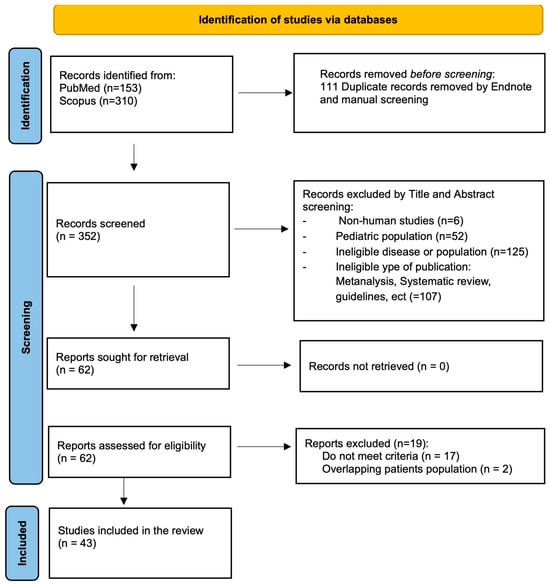
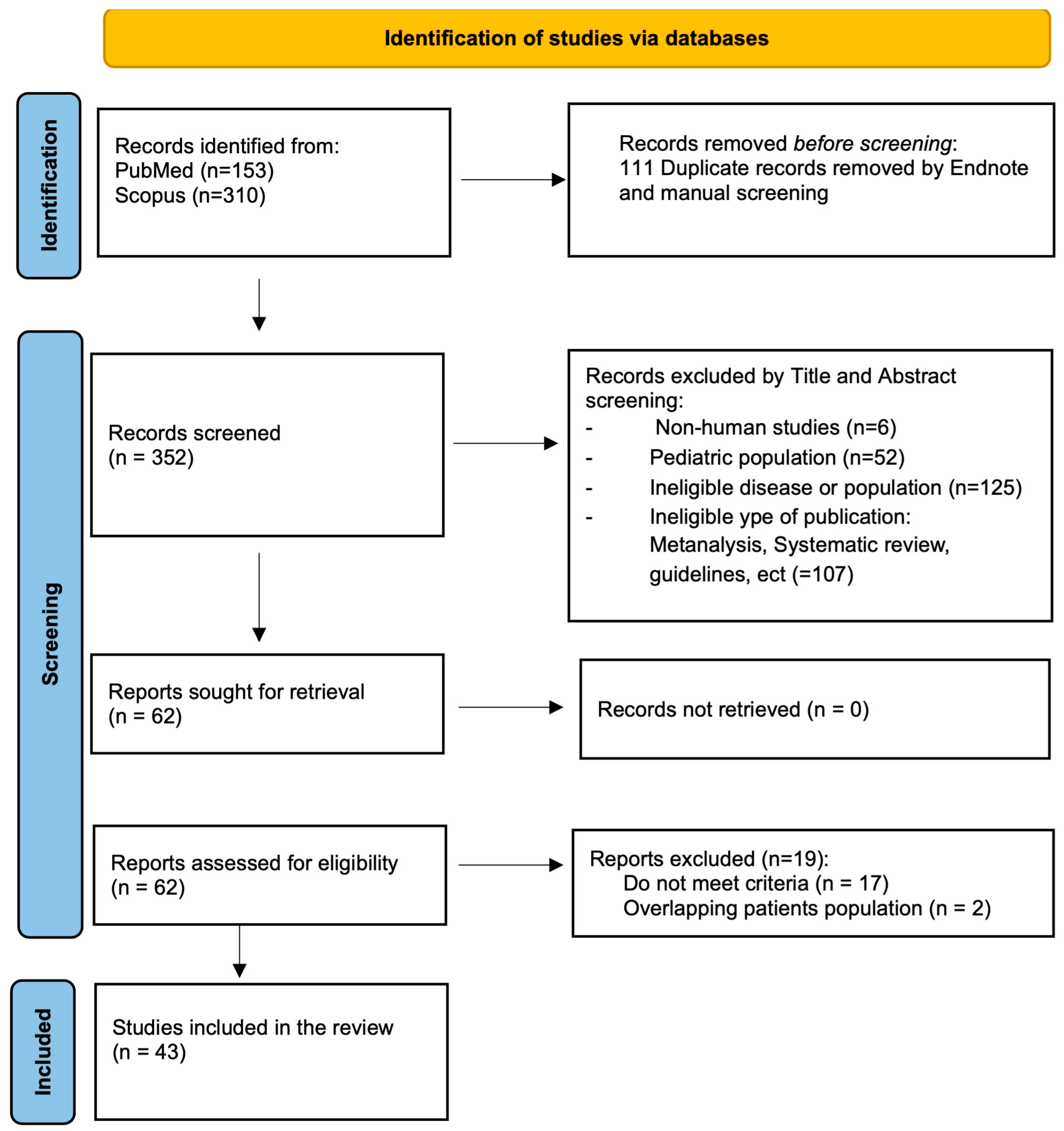
Initially, we excluded duplicates as determined using EndNote 2025 and manual screening. In total, 352 manuscripts were identified and screened; 107 were excluded due to the type of publication, 183 were excluded for ineligible population or kidney disease. A total of 62 full-text articles were identified in accordance with the screening criteria, of which 43 were relevant to our focus. Notably, two studies that referred to the same sample were counted only once. The specific procedure for the literature screening is presented in Figure 1.
Figure 1.
Screening procedure of manuscripts.
3.1. Study Description
Forty-three studies met the eligibility criteria, comprising 14 retrospective cohort studies, 16 case series, 12 case reports, and one prospective, single-center, single-arm, open-label pilot interventional study. Across these reports, 309 adult patients or individually eligible cases were included in the within-patient synthesis.
We classified patients according to their biopsy-defined glomerular diagnosis. Accordingly, we retained the patient with coexisting IgAN and an MCD-like podocytopathy phenotype within the IgAN group rather than reclassifying them as MCD, to preserve this distinct clinicopathological presentation. We nevertheless considered the MCD-like phenotype separately when interpreting treatment response. Table 2 reports the main characteristics of all included studies.
Table 2.
Principal characteristics of the studies.
3.2. Other Immunosuppressive Therapy and Reason for Switching to Non-Rituximab Anti-CD20 Antibody
At the patient level, the principal reason for replacing rituximab with a non-rituximab anti-CD20 antibody was classified as primary non-response in 183/309 (59.2%), partial or incomplete response in 4/309 (1.3%), relapse after previous response 29/309 (9.4%) anti-rituximab immunization in 34/309 (11%), mixed or heterogeneous indications in 11/309 (3.6%), rituximab intolerance in 11/309 (3.6%), and unclear or other reason in 37/309 (12%). Table 3 reports previous and concomitant immunosuppression, rituximab response and duration, the clinical phenotype of failure, available biological correlates, and the reason for switching.
Table 3.
Previous and/or concomitant immunosuppressive treatment and reason for switching from rituximab.
3.3. Efficacy Results
3.3.1. Membranous Nephropathy
MN represented the largest body of evidence, including seven case reports [31,35,37,48,59,62,64], 11 case series [27,38,40,44,47,50,52,63,66,68,69] 14 retrospective observational cohort studies [11,26,28,29,33,41,43,49,51,53,54,56,57,60], and one prospective single-center, single-arm interventional pilot study [58] for a total of 283 patients. Thirty of 33 reports (90.9%) documented at least one patient achieving CR or PR after switching from rituximab to a non-rituximab anti-CD20 monoclonal antibody.
A sufficiently reliable link between the clinical phenotype that led to stopping rituximab and the outcome after treatment with a non-rituximab anti-CD20 agent can be established based on 148 patient observations from 22 MN reports. Of the 103 patients with a primary non-response to rituximab, 21 had a CR and 53 had a PR. Four more patients achieved a CR or PR but were not reported separately, and 25 did not reach formal clinical remission. One subsequent relapse was recorded. The only patient with a clearly identifiable partial or incomplete response to rituximab achieved a PR after switching treatment. All three patients treated after relapse following an earlier response to rituximab attained a CR. Of the 33 patients switched due to immunization to rituximab, 2 achieved a CR and 29 had a PR, while 2 did not achieve remission. Six further relapses were documented. Of the eight patients switched due to intolerance to rituximab, seven achieved a CR or PR, though the two remission categories could not be distinguished, and one did not achieve formal remission. In other MN studies, either the previous rituximab phenotype was not adequately described, or the post-switch outcomes could not be reliably assigned and were therefore excluded from this phenotype-specific account. Most patients received obinutuzumab, whereas smaller numbers received ofatumumab or zuberitamab. Table 4 summarizes the available clinical and immunological outcomes according to the level of reporting. Detailed patient-level or eligible-subgroup data are presented in Supplementary Table S1, whereas aggregate cohort data are presented in Supplementary Table S2.
Table 4.
Clinical outcomes after non-rituximab anti-CD20 in MN.
3.3.2. Minimal Change Disease
In minimal change disease (MCD) we identified only 18 patients from eight reports [25,27,34,45,46,61,63,70], predominantly case reports and small case series. The median follow-up was 12 months, with reported follow-up ranging from 6 to 36 months. In total, 17 of 18 patients with active disease attained remission: CR was reported in 14/17 patients (83.3%) and partial remission in 3/17 (16.7%), while one maintained the previous CR. Among the nine patients for whom this information was available, the median time to response was 1 month (range, 1–6 months). For eight patients, a reliable connection could be made between the clinical phenotype that led to switching from rituximab and the outcome after treatment with the non-rituximab anti-CD20 agent. The patient with primary non-response to rituximab attained a PR [25]. The one with a partial or incomplete response to rituximab achieved a CR [39]. Of the four patients treated after relapse [27,61] following a previous response to rituximab, all achieved a CR. One of them later relapsed during follow-up [27], corresponding to 5.6% of the overall MCD population and 6.7% of complete responders. The patient who switched due to intolerance to rituximab also achieved a CR [46]. In one case, the patient switched because of rituximab immunization while already in CR and remained in CR after receiving obinutuzumab. This case illustrates maintenance of a pre-existing remission rather than induction of a new remission [34]. In the other ten patients, as reported in the Lin Yuxin [45] and Zamora [63] series, outcomes after switching were favourable, but the individual rituximab phenotypes before the switch could not be reliably linked to disease-specific outcomes. Thus, although all patients with active disease and a definable rituximab phenotype responded after switching, the small number of patients in each phenotype-specific subgroup and incomplete patient-level linkage in the larger series prevent comparison of response rates between phenotypes. Table 5 summarizes the clinical outcomes in MCD. Detailed patient-level baseline and follow-up data, including kidney function, proteinuria, serum albumin, B-cell counts, time to response, and relapse, are provided in Supplementary Table S3.
Table 5.
Clinical outcomes after non-rituximab anti-CD20 in MCD.
3.3.3. Focal Segmental Glomerulosclerosis
Evidence in FSGS was restricted to six patients reported across four case reports [30,36] or case series [45,63], with a median follow-up of 15 months (range, 11–26 months). Five of six patients achieved at least an initial clinical response, corresponding to an overall response rate of 83.3%. CR was reported in 4/6 patients (66.7%), while 1/6 (16.7%) achieved partial remission; and no clinical remission in 1/6 (16.6%). Three of the five responders subsequently relapsed [45,63]. In FSGS, the phenotype-based interpretation was more restricted. We could reliably connect the rituximab phenotype that led to treatment switching with the outcome in only two of the six patients. The patient with a primary non-response to rituximab did not achieve a CR or PR after receiving obinutuzumab, despite reduced proteinuria. The patient with a partial or incomplete response to rituximab achieved a CR within about two months and remained in remission during follow-up. Table 6 summarizes the clinical outcomes in FSGS. Detailed patient-level baseline and follow-up data are provided in Supplementary Table S4.
Table 6.
Clinical outcomes after non-rituximab anti-CD20 in FSGS.
3.3.4. Immunoglobulin A Nephropathy
Only two reports [32,67] illustrated the use of a non-rituximab anti-CD20 antibody in IgAN with 12 months of follow-up. One patient [67] had an MCD-like nephrotic phenotype and achieved CR within approximately 1 month, with consistent drop in proteinuria from 3.8 to 0.3 g/day, serum albumin improvement from 23.7 to 45 g/L, and serum creatinine decreasing from 1.38 to 0.81 mg/dL at first posttreatment assessment. The second case [32] had a proliferative, crescentic IgAN phenotype with partial foot-process effacement and achieved PR approximately 6 months after obinutuzumab with a significant decrease in proteinuria from 4.19 to 0.94 g/day, serum albumin improvement from 33.5 to 37.1 g/L, serum creatinine remained almost stable (from 109 to 97 μmol/L). No relapse was reported during follow-up. Therefore, MDC phenotype should be interpreted as evidence relating to an IgAN-associated podocytopathy and should not be extrapolated to conventional IgAN, while the second one showed a proliferative, crescentic IgAN on a biopsy performed 9 years before anti-CD20 treatment, and should therefore be regarded as anecdotal according to current KDIGO Guidelines [21,22].
3.3.5. Membranoproliferative Glomerulonephritis or C3 Glomerulopathy
No reports were found.
3.4. Safety
Safety during administration was reported in 38 of the 43 included reports, whereas five reports provided no information on infusion-related events. In total, 20 reports described infusion reactions, while 18 reports explicitly stated that none occurred. Most reactions were mild or moderate and included chills, fever, rash, pruritus, sweating, nausea, tachycardia or palpitations, throat tightness, rhinitis, dyspnea, wheezing, and bronchospasm. Hypotension and oedema were reported less frequently. Overall, infusion reactions were generally transient and manageable, with no consistent evidence of treatment discontinuation or severe acute toxicity across the available reports.
During follow-up, potentially treatment-related adverse events were reported in 19 studies, two additional studies described events considered unlikely to be treatment-related, 15 reported no events, and seven provided inadequate information. Infections were the most frequently described complications and included upper respiratory and urinary tract infections, pneumonia, COVID-19, bronchitis, herpes zoster or genital herpes, soft-tissue infection, and tuberculosis-test conversion. Hematological or immunological abnormalities included leukopenia, neutropenia, lymphopenia, and hypogammaglobulinemia. Other reported events comprised transient liver dysfunction, gastrointestinal symptoms, musculoskeletal pain, asthenia, and elevated D-dimer levels. Two events—recurrent urinary tract infections in a patient receiving dapagliflozin and coronary artery disease requiring angioplasty—were considered unlikely to be related to anti-CD20 therapy. One cohort also reported deaths during follow-up, although their relationship to treatment was not clearly established. Notably, when subgroup-specific safety data were unavailable, full-cohort safety data were kept as background information and are indicated in Table 7.
Table 7.
Safety report of new generation anti-CD20 Ab.
3.5. Quality Assessment
3.5.1. Case Reports
Twelve case reports were appraised with the JBI checklist for case reports. Overall reporting quality was moderate to high: most reports adequately described patient demographics, clinical history, and current condition, and presented objective, longitudinal outcomes following the non-rituximab anti-CD20 antibody, with several providing biopsy confirmation and extended follow-up [36,37,46,67]. The most consistent methodological weakness was incomplete or unsystematic adverse-event reporting (Q7), which was rated unclear in several reports [30,61,62,67]. Causal attribution was further limited across the group by concomitant immunosuppression—most often corticosteroids or calcineurin inhibitors administered alongside or shortly before obinutuzumab—by pre-emptive or early retreatment, and by the absence of anti-rituximab antibody testing, all of which make it difficult to isolate the effect of the anti-CD20 switch. A minority showed more substantive limitations: Zhang 2024 [64] had diagnostic ambiguity, selective outcome emphasis, and internal inconsistencies between narrative and figures; and Xu 2024 [62] emphasized efficacy despite the absence of a conventional complete or partial remission. The intrinsic single-patient design limited evidentiary weight.
3.5.2. Case Series
Sixteen case series were appraised with the JBI checklist for case series. Reporting of outcomes was generally objective and, in the better series, standardized and longitudinal [40,52,53], but the domains governing internal validity were weak across almost the entire group. Consecutive and complete inclusion (Q4–Q5) were frequently unclear, indicating uncertain patient selection and probable selection bias. Prior therapies and concomitant immunosuppression were heterogeneous and often incompletely reported, and follow-up duration was variable and sometimes short. Several series carried additional, specific threats to validity: Sethi et al. [50] pooled native-kidney and transplant disease with incomplete treatment detail and only partial rituximab exposure; Teisseyre et al. [55] used non-consecutive, biomarker-guided allocation and likely contained two duplicate cases; Chen et al. [71] included two minors; Ding 2025 [32] included only one rituximab-exposed patient; and Zheng et al. [66] had substantial missing outcome and treatment data with internal inconsistencies in age and serologic time points. Safety ascertainment was generally limited. These reports had high susceptibility to selection and reporting bias.
3.5.3. Observational Studies
Fourteen observational studies were appraised with the JBI checklist for cohort studies. These were the methodologically strongest reports in the review, and the best of them combined standardized outcome measurement, complete screening for secondary causes, and adjusted or multivariable analyses [28,49,53]. Nonetheless, all shared the limitations inherent to retrospective, predominantly single-center designs. Recurrent weaknesses were baseline imbalance between groups, incomplete confounding control, and exclusion of patients lost to follow-up, which together bias effect estimates. Identification and handling of confounders (Q4) and completeness of follow-up (Q9) were the domains most often rated unclear or no. The within-patient comparison was weakened in several cohorts by short follow-up after the switch and, in studies enrolling mixed populations, by a rituximab-exposed subgroup whose individual data could not be separated from the overall cohort [28,43,44]. In the multicenter studies, treatment allocation depended on the treating nephrology center and drugs were pooled across agents, introducing center effects and unadjusted confounding that substantially weaken the comparative conclusions [56]. Boyer-Suavet et al. [26] additionally classified exposure after baseline and provided only highly uncertain ofatumumab evidence. Overall, the observational studies were methodologically stronger than the case-level reports, although residual confounding and selection bias remained substantial.
3.5.4. Prospective (Quasi-Experimental) Study
A single prospective study was appraised with the JBI checklist for quasi-experimental studies [58]. Its prospective design, consecutive enrolment, complete follow-up, and objective, repeatedly measured outcomes place it well above the rest of the evidence base in methodological rigor. The principal limitations are structural rather than related to conduct: the uncontrolled single-arm design provides no concurrent comparator (Q4), and the small sample and reliance on historical assumptions about the expected remission rate preclude causal or comparative conclusions. This was the methodologically strongest study included in the review, although its uncontrolled single-arm design precluded causal or comparative conclusions.
All results of JBI checklist were reported in Appendix B.
3.6. Certainty
The certainty of evidence was rated as very low for all outcomes. However, the evidence base was substantially more extensive and methodologically developed for membranous nephropathy than for the other glomerular diseases. In MN, clinical and immunological remission were supported by multiple retrospective cohorts and one prospective single-arm study, in addition to case series and case reports. Nevertheless, the absence of a concurrent comparator, residual confounding, heterogeneous follow-up, and potential publication bias prevented a higher certainty rating. Evidence for MCD, FSGS, and IgAN was further limited by very small sample sizes and reliance predominantly on case-level reports. Imprecision was particularly serious for MCD, FSGS, and IgAN because the evidence was based on very small numbers of patients. Publication bias was considered likely because successful or otherwise clinically unusual cases may have been preferentially reported. Evidence concerning relapse and safety was also of very low certainty because follow-up was inconsistent and adverse-event surveillance was frequently incomplete or not systematically reported. Table 8 summarized the GRADE certainty according to the type of nephropathy and to the results.
Table 8.
Certainty according to GRADE assessment.
4. Discussion
The present systematic review examined the sequential use of non-rituximab anti-CD20 monoclonal antibodies in 309 adults with primary glomerular diseases previously treated with rituximab. The evidence was heavily concentrated in MN, which accounted for 283 patients, and most patients received obinutuzumab. At the report level, 30 of the 33 studies in MN documented at least one CR or PR. The results outside MN were based on much smaller numbers. Among the 17 patients with active MCD, all achieved a clinical response; the remaining patient received obinutuzumab while already in complete remission. Five of six patients with FSGS achieved an initial response, including four complete and one partial remission; three of the five responders subsequently relapsed. One reported patient with IgA nephropathy had contextually MCD with sign of podocytopathy at biopsy and improved after obinutuzumab with CR outcome. While the other had proliferative and crescentic disease at biopsy with partial foot-process effacement and achieved only PR. These observations therefore cannot be considered evidence of efficacy in conventional IgAN, according to KDIGO guidelines [21,22]. The safety findings were broadly consistent with the known effects of B-cell depletion. Infusion reactions were usually mild or moderate and manageable, while infections were the most frequently reported events during follow-up. These apparently favorable results need to be balanced by the quality of evidence. About the quality of the evidence, we highlight certainty remained very low according to GRADE in all nephropathies, but the evidence base was not equally limited across diseases: MN was supported by a substantially larger number of patients, several retrospective cohorts, and one prospective single-arm study, whereas evidence for MCD, FSGS, and IgAN were supported by small case series and individual reports. Thus, the GRADE category should not be interpreted as indicating equivalent evidentiary support across all glomerular diseases. Rather, MN represents the most developed, although still uncontrolled and potentially biased, body of evidence.
The present review differs from the available evidence syntheses in a fairly important way. Lurie et al. [18] compared obinutuzumab and rituximab in parallel treatment groups and excluded studies in which obinutuzumab was administered after rituximab. Their meta-analysis therefore addressed whether the two drugs produced different outcomes in different patients, rather than whether changing the antibody could rescue the same patient after rituximab failure [19]. Atay et al. used pooled case-level data, which allowed a more detailed description of individual responses, but their analysis remained restricted to obinutuzumab in membranous nephropathy. Earlier reviews of second- and third-generation anti-CD20 antibodies had an even broader immunological scope and were not built around the clinical problem of treatment sequencing in glomerular disease. Our eligibility framework covered the major primary glomerular diseases and all available non-rituximab anti-CD20 antibodies. In practice, eligible evidence was found only for membranous nephropathy, minimal change disease, focal segmental glomerulosclerosis, and IgA nephropathy. More importantly, the previous rituximab course was the comparator for each patient. This within-patient approach does not replace a randomized comparison, but it answers a different question: what clinical and safety outcomes have been reported after sequential switching from rituximab to another anti-CD20 antibody?
An important feature of this review was the explicit separation of clinically distinct reasons for switching from rituximab. We specifically retained primary non-response, partial/incomplete response, relapse after a previous response, immunization, and intolerance as different phenotypes. This distinction is clinically relevant because the meaning of a post-switch CR or PR depends on the pre-switch state. Thus, our analysis may provide a clinical framework for interpreting the rationale for switching from Rituximab. Unfortunately, the available data seem fragmentary regarding the underlying mechanisms and provide little support for guiding clinical decisions according to the different rituximab-response phenotypes. However, patients who stopped rituximab because of intolerance showed particularly consistent responses after another anti-CD20 antibody. In Podesta et al. [49], all seven rituximab-intolerant patients achieved CR or PR after ofatumumab, compared with three of ten patients with primary non-response. A complete remission was also reported by Loeffler et al. [46] after life-threatening laryngospasm during rituximab infusion. Rituximab immunization is a clinical situation in which switching to a different anti-CD20 antibody may be considered. Among 33 patients with MN who switched because of anti-rituximab antibodies, 31 achieved clinical remission after receiving a non-rituximab anti-CD20 agent, although some patients later relapsed. These findings suggest that rituximab immunization may represent a clinically relevant reason for treatment change. However, the presence of anti-rituximab antibodies does not necessarily imply a neutralizing mechanism or indicate that immunization is the sole cause of rituximab failure. Finally, patients who switched after relapse following a previous rituximab response also appeared to respond favorably to alternative anti-CD20 therapy. All three MN patients with a reliable phenotype–outcome linkage achieved CR after switching. This may reflect preserved sensitivity to CD20-directed therapy, while differences in their pharmacological properties and mechanisms of B-cell depletion could also contribute, although the available data do not allow us to distinguish these possibilities. These observations are based on small numbers and do not provide a reliable comparative estimate; future reports should take this aspect into account.
In cases of primary non-response after a properly administered course of rituximab, the situation was more complicated. Responses after switching were variable but observed in several cohorts, especially among patients with MN who received obinutuzumab. The pharmacological properties of obinutuzumab could contribute to more extensive or qualitatively different B-cell depletion [72,73,74,75]. However, delayed effects of rituximab, retreatment intensity, concomitant immunosuppression, and spontaneous variation in proteinuria could also explain the observations. Furthermore, in many cases, researchers did not measure anti-rituximab antibody levels, serum rituximab concentration, or duration of B-cell depletion, making clinical conclusions difficult.
The safety signal was reassuring in some respects but not strong enough to establish that newer antibodies are safer than rituximab. Among the 38 reports providing infusion-safety information, 20 described infusion reactions, which were generally transient and manageable. Infections were the main events during follow-up. Hypogammaglobulinemia, neutropenia, lymphopenia, herpes virus infections, pneumonia, and urinary tract infections were reported, although not consistently sought or defined. Several publications offered little more than a statement that no adverse events occurred. This is not equivalent to structured safety surveillance. It is particularly relevant in patients receiving repeated anti-CD20 courses, concomitant corticosteroids or calcineurin inhibitors, and in those with reduced kidney function. The available data therefore support feasibility, but they do not allow a reliable comparison of severe infection, persistent hypogammaglobulinemia, or late adverse events between obinutuzumab, ofatumumab, and rituximab.
Important limitations stemmed from both the underlying evidence base and the review process itself. No randomized trial examined switching from rituximab to another anti-CD20 antibody. Most evidence came from retrospective cohorts, case series, and selected case reports, with a considerable risk of publication bias. The literature was dominated by obinutuzumab and MN, while information on other antibodies and glomerular diseases was limited. There were substantial differences in doses used, retreatment strategies, rituximab failure phenotypes, and length of follow-up. Concomitant immunosuppression was frequently used. At the review stage, aggregate reporting often made it impossible to reclassify patients individually. Different phenotypes could not always be distinguished, and some residual overlap between reports cannot be ruled out. The biological features of rituximab failure could not be fully characterized because anti-rituximab antibodies, drug exposure, urinary loss, and the extent and duration of B-cell depletion were seldom assessed together. Due to these limitations, it is not possible to draw causal conclusions about why switching succeeded or failed in individual patients.
Future studies should separate rituximab intolerance, immunization, incomplete B-cell depletion, relapse after response, and true refractory disease from the outset. These categories should not be pooled under a generic definition of rituximab failure. Prospective multicenter studies should use disease-specific KDIGO outcomes, predefined response intervals, standardized anti-PLA2R and B-cell monitoring, and longer safety follow-up. Measurement of anti-rituximab antibodies and, where feasible, rituximab exposure would also help to identify patients in whom changing the antibody is more rational than abandoning CD20-directed therapy altogether.
5. Conclusions
Non-rituximab anti-CD20 antibodies may represent an option in selected patients previously treated with rituximab, although the available evidence remains of very low certainty. In rituximab-intolerant patients, early reports suggest that switching to another anti-CD20 antibody can be effective when further rituximab treatment is not feasible, but supporting evidence remains limited. Favorable responses have also been reported in patients with anti-rituximab immunization and in those who relapsed after a previous rituximab response. However, these observations are based on small numbers and low-certainty evidence. Primary non-response remains the most uncertain setting, with variable outcomes after switching and limited information on the mechanisms underlying rituximab failure. Relapses after newer anti-CD20 antibodies were also observed, indicating that an initial response does not necessarily translate into durable disease control; overall, the current data suggest that the reason for switching may be clinically relevant, but are insufficient to define clear phenotype-based treatment recommendations.
Supplementary Materials
The following supporting information can be downloaded at: https://www.mdpi.com/article/10.3390/antib15050095/s1, Table S1: Patient-level and eligible-subgroup clinical and laboratory outcomes in membranous nephropathy; Table S2: Aggregate clinical and laboratory outcomes in membranous nephropathy cohort studies; Table S3: Patient-level clinical and laboratory outcomes in minimal change disease; Table S4: Patient-level clinical and laboratory outcomes in focal segmental glomerulosclerosis.
Author Contributions
Conceptualization, F.K.M.; methodology, F.K.M.; software, F.K.M. and F.N.; validation, all authors; formal analysis, F.K.M.; investigation, L.F.S., A.B. and L.C.; resources, L.F.S., A.B. and L.C.; data curation, F.K.M. and F.N.; writing—original draft preparation, F.K.M.; writing—review and editing, all authors; visualization, all authors; supervision, all authors; project administration, F.K.M.; funding acquisition, F.K.M. and F.N. All authors have read and agreed to the published version of the manuscript.
Funding
This research received no external funding.
Institutional Review Board Statement
Not applicable.
Informed Consent Statement
Not applicable.
Data Availability Statement
All data extracted for this systematic review are reported in the article and its Supplementary Materials.
Conflicts of Interest
The authors declare no conflicts of interest.
Abbreviations
The following abbreviations are used in this manuscript:
| MN | Membranous nephropathy |
| MCD | Minimal change disease |
| FSGS | Focal segmental glomerulosclerosis |
| IgAN | IgA nephropathy |
| MPGN | Membranoproliferative glomerulonephritis |
| CR | Complete remission |
| PR | Partial remission |
| eGFR | Estimated glomerular filtration rate |
| UPCR | Urinary protein-to-creatinine ratio |
| NR | Not reported |
| CS | Corticosteroids |
| CNI | Calcineurin inhibitors |
| MMF | Mycophenolate mofetil |
| RTX | Rituximab |
| F-U | Follow-up |
Appendix A
Table A1.
Prisma Checklist.
Appendix B
Table A2.
Quality assessment for case report according to JBI CHECKLIST.
Table A3.
Quality assessment for case series according to JBI CHECKLIST.
Table A4.
Quality assessment for observational studies according to JBI CHECKLIST.
Table A5.
Quality assessment for Prospective (quasi-experimental) study according to JBI CHECKLIST.
References
- Yandian, F.; Sethi, S.; Fervenza, F.C.; Caravaca-Fontán, F. Targeting CD20 for B-cell Depletion in Autoimmune Kidney Disease: Next Generation. BioDrugs 2025, 39, 841–855. [Google Scholar] [CrossRef] [Scilit] [PubMed]
- Gopal, A.K.; Press, O.W. Clinical applications of anti-CD20 antibodies. J. Lab. Clin. Med. 1999, 134, 445–450. [Google Scholar] [CrossRef] [Scilit] [PubMed]
- Santos, J.E.; Fiel, D.; Santos, R.; Vicente, R.; Aguiar, R.; Santos, I.; Amoedo, M.; Pires, C. Rituximab use in adult glomerulopathies and its rationale. J. Bras. Nefrol. 2020, 42, 77–93. [Google Scholar] [CrossRef] [Scilit] [PubMed] [PubMed Central]
- Leget, G.A.; Czuczman, M.S. Use of rituximab, the new FDA-approved antibody. Curr. Opin. Oncol. 1998, 10, 548–551. [Google Scholar] [CrossRef] [Scilit] [PubMed]
- Onrust, S.V.; Lamb, H.M.; Balfour, J.A. Rituximab. Drugs 1999, 58, 79–88; discussion 9–90. [Google Scholar] [CrossRef] [Scilit] [PubMed]
- Schilder, R. Rituximab immunotherapy. Cancer Biother. Radiopharm. 1999, 14, 237–240. [Google Scholar] [CrossRef] [Scilit] [PubMed]
- Zhang, J.; Bian, L.; Ma, F.Z.; Jia, Y.; Lin, P. Efficacy and safety of rituximab therapy for membranous nephropathy: A meta-analysis. Eur. Rev. Med. Pharmacol. Sci. 2018, 22, 8021–8029. [Google Scholar] [CrossRef] [PubMed]
- Zhang, Y.; Chen, H.; Zhang, H.; Huang, Y. Evaluating rituximab against cyclophosphamide or cyclosporine in idiopathic membranous nephropathy: A meta-analysis. Eur. J. Med. Res. 2025, 30, 1228. [Google Scholar] [CrossRef] [Scilit] [PubMed] [PubMed Central]
- Huang, L.; Dong, Q.R.; Zhao, Y.J.; Hu, G.C. Rituximab for the management of idiopathic membranous nephropathy: A meta-analysis. Int. Urol. Nephrol. 2021, 53, 111–119. [Google Scholar] [CrossRef] [Scilit] [PubMed]
- Hansrivijit, P.; Cheungpasitporn, W.; Thongprayoon, C.; Ghahramani, N. Rituximab therapy for focal segmental glomerulosclerosis and minimal change disease in adults: A systematic review and meta-analysis. BMC Nephrol. 2020, 21, 134. [Google Scholar] [CrossRef] [Scilit] [PubMed] [PubMed Central]
- Li, J.; Nie, Z.; Li, G.; Bao, B. Efficacy and safety of rituximab in primary IgA nephropathy: A retrospective study. Clin. Exp. Nephrol. 2025, 29, 616–623. [Google Scholar] [CrossRef] [Scilit] [PubMed] [PubMed Central]
- Cheng, Y.; Fu, Q.; Cui, X.; Hu, M.; Chang, M.; Jiang, Y.; Wang, H. The successful use of rituximab in children with IgA nephropathy and minimal change-like lesions: A case series. Ren. Fail. 2026, 48, 2662109. [Google Scholar] [CrossRef] [Scilit] [PubMed] [PubMed Central]
- Sun, M.; Wang, L.; Liu, X.; Xiao, F.; Dai, H. The successful use of rituximab in IgA nephropathy patients with podocytopathy: A case series. Clin. Kidney J. 2024, 17, sfae178. [Google Scholar] [CrossRef] [Scilit] [PubMed] [PubMed Central]
- Chiarenza, D.S.; Verrina, E.E.; Bigatti, C.; Caridi, G.; Spennacchio, A.; Kajana, X.; De Bortoli, M.; Cravedi, P.; Angeletti, A. B-Cell Depletion in Glomerular Diseases: Not Always as Safe as We May Think. Kidney Med. 2026, 8, 101268. [Google Scholar] [CrossRef] [Scilit] [PubMed] [PubMed Central]
- Hartinger, J.M.; Kratky, V.; Hruskova, Z.; Slanar, O.; Tesar, V. Implications of rituximab pharmacokinetic and pharmacodynamic alterations in various immune-mediated glomerulopathies and potential anti-CD20 therapy alternatives. Front. Immunol. 2022, 13, 1024068. [Google Scholar] [CrossRef] [Scilit] [PubMed] [PubMed Central]
- Cartron, G.; Dacheux, L.; Salles, G.; Solal-Celigny, P.; Bardos, P.; Colombat, P.; Watier, H. Therapeutic activity of humanized anti-CD20 monoclonal antibody and polymorphism in IgG Fc receptor FcgammaRIIIa gene. Blood 2002, 99, 754–758. [Google Scholar] [CrossRef] [Scilit] [PubMed]
- Kaegi, C.; Wuest, B.; Crowley, C.; Boyman, O. Systematic Review of Safety and Efficacy of Second- and Third-Generation CD20-Targeting Biologics in Treating Immune-Mediated Disorders. Front. Immunol. 2021, 12, 788830. [Google Scholar] [CrossRef] [Scilit] [PubMed] [PubMed Central]
- Lurie, A.; Daneii, P.; Khan, S.; Khan, Z.; Mansuri, H.; Bizanti, A. Obinutuzumab Versus Rituximab for the Treatment of Primary Membranous Nephropathy: A Systematic Review and Meta-Analysis. Life 2026, 16, 434. [Google Scholar] [CrossRef] [Scilit] [PubMed] [PubMed Central]
- Atay, I.; Eroz, E.; Korucu, B.; Oktan, M.A.; Bildaci, Y.D.; Deger, S.M.; Cavdar, C.; Heybeli, C. Obinutuzumab for membranous nephropathy: A systematic review using pooled case-level extraction analysis. Acta Clin. Belg. 2026, 81, 280–292. [Google Scholar] [CrossRef] [Scilit] [PubMed]
- Page, M.J.; McKenzie, J.E.; Bossuyt, P.M.; Boutron, I.; Hoffmann, T.C.; Mulrow, C.D.; Shamseer, L.; Tetzlaff, J.M.; Akl, E.A.; Brennan, S.E.; et al. The PRISMA 2020 statement: An updated guideline for reporting systematic reviews. BMJ 2021, 372, n71. [Google Scholar] [CrossRef] [Scilit] [PubMed] [PubMed Central]
- KDIGO 2021 Clinical Practice Guideline for the Management of Glomerular Diseases. Kidney Int. 2021, 100, S1–S276. [CrossRef] [Scilit] [PubMed]
- Rovin, B.H.; Barratt, J.; Cook, H.T.; Noronha, I.L.; Reich, H.N.; Suzuki, Y.; Tang, S.C.; Trimarch, H.; Floege, J. KDIGO 2025 Clinical Practice Guideline for the Management of Immunoglobulin A Nephropathy (IgAN) and Immunoglobulin A Vasculitis (IgAV). Kidney Int. 2025, 108, S1–S71. [Google Scholar] [CrossRef] [Scilit] [PubMed]
- Moola, S.; Munn, Z.; Tufanaru, C.; Aromataris, E.; Sears, K.; Sfetcu, R.; Currie, M.; Qureshi, R.; Mattis, P.; Mu, P. Chapter 7: Systematic reviews of etiology and risk. In JBI Manual for Evidence Synthesis; Aromataris, E.M.Z., Ed.; JBI: Adelaide, Australia, 2020. [Google Scholar]
- Alper, B.S.; Oettgen, P.; Kunnamo, I.; Iorio, A.; Ansari, M.T.; Murad, M.H.; Meerpohl, J.J.; Qaseem, A.; Hultcrantz, M.; Schünemann, H.J.; et al. Defining certainty of net benefit: A GRADE concept paper. BMJ Open 2019, 9, e027445. [Google Scholar] [CrossRef] [Scilit] [PubMed] [PubMed Central]
- Angeletti, A.; Caridi, G.; Kajana, X.; Bigatti, C.; Spennacchio, A.; Chiarenza, D.S.; Mortari, G.; Cravedi, P.; Verrina, E.E. Obinutuzumab in Rituximab-Resistant Podocytopathies: A Single-Center Experience. Kidney Int. Rep. 2025, 10, 2873–2874. [Google Scholar] [CrossRef] [Scilit] [PubMed] [PubMed Central]
- Boyer-Suavet, S.; Andreani, M.; Lateb, M.; Savenkoff, B.; Brglez, V.; Benzaken, S.; Bernard, G.; Nachman, P.H.; Esnault, V.; Seitz-Polski, B. Neutralizing Anti-Rituximab Antibodies and Relapse in Membranous Nephropathy Treated with Rituximab. Front. Immunol. 2019, 10, 3069. [Google Scholar] [CrossRef] [Scilit] [PubMed] [PubMed Central]
- Chen, Z.; Xu, D.; Wu, S.; Liu, W.; Wu, J.; Yu, S.; Dai, B.; Mao, Z.; Gao, X. The role of obinutuzumab in rituximab-refractory membranous nephropathy and minimal change disease. Clin. Kidney J. 2025, 18, sfaf039. [Google Scholar] [CrossRef] [Scilit] [PubMed] [PubMed Central]
- Cheng, X.; Zheng, Z.-F.; Qi, Y.; Cao, X.; Gao, X.-Q.; Fang, Y.-X.; Wei, L.; Shang, W.-Y.; Yan, T.-K.; Jia, J.-Y.; et al. Efficacy and safety of obinutuzumab in primary membranous nephropathy: A real-world retrospective study. Front. Immunol. 2025, 16, 1650054. [Google Scholar] [CrossRef] [Scilit] [PubMed] [PubMed Central]
- Cheng, X.; Zhou, M.; Chen, C.; Xue, J.; Liu, B.; Zhang, Z.; Zhang, X.; Zhou, L.; Cai, T.; Huang, B.; et al. Clinical study of PLA2R epitope spreading for predicting proteinuria remission in primary membranous nephropathy. Front. Immunol. 2025, 16, 1685738. [Google Scholar] [CrossRef] [Scilit] [PubMed] [PubMed Central]
- Morales, B.C.; Garrote, P.S.; Gómez, A.R.; Varas, C.M.; Gutiérrez, P.G.; González, A.S.; García, L.C.; Alonso, C.S.; Martínez, C.M.; de la Rosa, N.L.; et al. Obinutuzumab in focal segmental glomerulonephritis resistant to treatment. Nefrologia (Engl. Ed.) 2025, 45, 348–350. [Google Scholar] [CrossRef] [Scilit] [PubMed]
- de la Prada Álvarez, F.J.; Cintra Cabrera, M.; Almenara Tejederas, M.; Burgos Martin, J.; Alonso García, F.; Salgueira Lazo, M. Obinutuzumab in the treatment of PLA2R-positive membranous glomerulonephritis resistant to treatment. Nefrologia (Engl. Ed.) 2024, 44, 306–307. [Google Scholar] [CrossRef] [Scilit] [PubMed]
- Ding, Q.; Xue, C.; Gao, X.; Tang, X.; Zhang, S.; Liu, Y.; Dai, B. Efficacy and safety of obinutuzumab on progressive IgA nephropathy: A case series. J. Nephrol. 2025, 38, 2997–3004. [Google Scholar] [CrossRef] [Scilit] [PubMed]
- Dong, R.; Guo, M.N.; Sun, J.; Li, S.X.; Bian, Q.; Xu, J. Obinutuzumab in treating refractory primary membranous nephropathy: A single-center study. Acad. J. Nav. Med. Univ. 2025, 46, 1042–1048. [Google Scholar] [CrossRef]
- Gauci, P.-A.; Cremoni, M.; Delotte, J.; Vocila, F.; Esnault, V.L.M.; Seitz-Polski, B.; Teisseyre, M. Treatment of nephrotic syndrome with anti-CD20 therapies in pregnancy: A case series and review of the literature. Ren. Fail. 2025, 47, 2481201. [Google Scholar] [CrossRef] [Scilit] [PubMed] [PubMed Central]
- Guo, J.; Zhong, A.; Wu, D.; Liu, Y.; Chen, Y.; Xu, Y.; Xu, R.; Wan, Q. Obinutuzumab after anti-rituximab antibody-associated treatment failure in membranous nephropathy: A case report. Front. Immunol. 2026, 17, 1758250. [Google Scholar] [CrossRef] [Scilit] [PubMed] [PubMed Central]
- Henriques, A.R.; Venda, J.; Ferreira, E.; Oliveira, N.; Sá, H. Successful use of obinutuzumab in focal segmental glomerulosclerosis with inadequate response to rituximab: A case report. Front. Nephrol. 2026, 6, 1772736. [Google Scholar] [CrossRef] [Scilit] [PubMed] [PubMed Central]
- Hudson, R.; Rawlings, C.; Mon, S.Y.; Jefferis, J.; John, G.T. Treatment resistant M-type phospholipase A2 receptor associated membranous nephropathy responds to obinutuzumab: A report of two cases. BMC Nephrol. 2022, 23, 134. [Google Scholar] [CrossRef] [Scilit] [PubMed] [PubMed Central]
- Jha, V.K.; Panda, S.K.; Rai, S.K.; Srivastava, A.K. Obinutuzumab in Difficult to Treat Phospholipase A2 Receptor Positive Membranous Nephropathy: Our Experience at a Tertiary Care Center in North India. Indian J. Nephrol. 2025, 35, 91–96. [Google Scholar] [CrossRef] [Scilit] [PubMed] [PubMed Central]
- Jin, L.; Liu, X.; Li, H.; Dang, X.; Wang, Z.; Niu, D.; Zhang, X.; Sun, J.; Hao, D.; Lu, W. Obinutuzumab is effective for the treatment of frequently-relapsing/steroid-dependent minimal change disease in adults. Nephrol. Dial. Transplant. 2024, 39, 1364–1367. [Google Scholar] [CrossRef] [Scilit] [PubMed]
- Klomjit, N.; Fervenza, F.C.; Zand, L. Successful Treatment of Patients with Refractory PLA(2)R-Associated Membranous Nephropathy with Obinutuzumab: A Report of 3 Cases. Am. J. Kidney Dis. 2020, 76, 883–888. [Google Scholar] [CrossRef] [Scilit] [PubMed]
- Li, H.; Jin, L.; Xie, X.; Sun, J.; Niu, D.; Feng, J.; Xu, G.; Zhang, X.; Khalaf, A.M.S.; Lu, W. Additive Obinutuzumab Achieves High Remission Rates in Rituximab-Refractory Membranous Nephropathy. Am. J. Nephrol. 2026, 57, 21–29. [Google Scholar] [CrossRef] [Scilit] [PubMed] [PubMed Central]
- Li, L.; Wang, S.; Wei, M.; Zhang, Q.; Fang, L.; Fan, X.; Cheng, M.; Zhang, C.; Liang, H.; Xiao, X.; et al. Observation of the efficacy and safety of obinutuzumab in the treatment of refractory idiopathic membranous nephropathy. Int. Urol. Nephrol. 2025, 57, 2603–2611. [Google Scholar] [CrossRef] [Scilit] [PubMed]
- Li, X.Q.; Liu, Y.; Cai, Z.Y.; Lv, T.G.; Hao, J. Obinutuzumab is Effective as an Initial Treatment for PLA2R-Associated Primary Membranous Nephropathy: A Retrospective, Single-Center Trial. Drug Des. Devel Ther. 2025, 19, 5961–5972. [Google Scholar] [CrossRef] [Scilit] [PubMed] [PubMed Central]
- Lin, Y.; Han, Q.; Chen, L.; Wang, Y.; Ren, P.; Liu, G.; Lan, L.; Lei, X.; Chen, J.; Han, F. Obinutuzumab in Refractory Membranous Nephropathy: A Case Series. Kidney Med. 2024, 6, 100853. [Google Scholar] [CrossRef] [Scilit] [PubMed] [PubMed Central]
- Lin, Y.; Pan, Y.; Han, Q.; Xu, J.; Wang, J.; Lei, X.; Chen, L.; Wang, Y.; Ren, P.; Lan, L.; et al. Obinutuzumab May Be an Effective and Safe Option for Adult Minimal Change Disease and Focal Segmental Glomerulosclerosis Patients after Multitarget Therapy Including Rituximab. Am. J. Nephrol. 2025, 56, 111–120. [Google Scholar] [CrossRef] [Scilit] [PubMed]
- Loeffler, T.; Flahault, A.; Alla, A.; Frimat, L.; Kormann, R. Obinutuzumab, an Anti-CD20, in Refractory Adult Autoimmune Podocytopathies: Report of 2 Cases. Kidney Med. 2025, 7, 101057. [Google Scholar] [CrossRef] [Scilit] [PubMed] [PubMed Central]
- Liu, Y.; Wu, D.; Xue, R.; Chen, Y.; Wan, Q. Obinutuzumab as a Rescue Therapy in Anti-Rituximab Antibody-Positive Primary Membranous Nephropathy. Kidney Int. Rep. 2026, 11, 103690. [Google Scholar] [CrossRef] [Scilit]
- Naik, S.; Shukla, S.; Av, N.; Kumar, V.; Sekar, A.; Nada, R.; Rathi, M.; Kohli, H.S.; Ramachandran, R. Obinutuzumab in Refractory Phospholipase A2 receptor-Associated Membranous Nephropathy with Severe CKD. Kidney Int. Rep. 2023, 8, 942–943. [Google Scholar] [CrossRef] [Scilit] [PubMed] [PubMed Central]
- Podestà, M.A.; Trillini, M.; Portalupi, V.; Gennarini, A.; Tomatis, F.; Villa, A.; Perna, A.; Rubis, N.; Remuzzi, G.; Ruggenenti, P. Ofatumumab in Rituximab-Resistant and Rituximab-Intolerant Patients with Primary Membranous Nephropathy: A Case Series. Am. J. Kidney Dis. 2024, 83, 340–349.e1. [Google Scholar] [CrossRef] [Scilit] [PubMed]
- Sethi, S.; Kumar, S.; Lim, K.; Jordan, S.C. Obinutuzumab is Effective for the Treatment of Refractory Membranous Nephropathy. Kidney Int. Rep. 2020, 5, 1515–1518. [Google Scholar] [CrossRef] [Scilit] [PubMed] [PubMed Central]
- Shi, G.Q.; Yu, R.; Wu, Y.; Zhou, H.; Zhao, Z.X.; Zheng, X.M.; Wang, Y.Q.; Zhang, B.R.; Zhang, Y.Z. Obinutuzumab for PLA2R-associated membranous nephropathy. Nephrol. Dial. Transplant. 2025, 40, 2401–2403. [Google Scholar] [CrossRef] [Scilit] [PubMed]
- Sridharan, K.; Gopal, B.; Wilson, S.; Pham, A.; Hutton, H. Obinutuzumab in Rituximab-resistant and recurrent membranous nephropathy: A case-series. J. Nephrol. 2025, 38, 1809–1818. [Google Scholar] [CrossRef] [Scilit] [PubMed] [PubMed Central]
- Su, W.; Li, J.; Men, J.; Zhong, S.; Wang, Y.; Zhang, Y.; Xu, L.; Gao, J.; Liu, D.; Wang, R.; et al. Obinutuzumab is effective for the treatment of rituximab-refractory PLA2R-associated membranous nephropathy. Clin. Kidney J. 2025, 18, sfaf026. [Google Scholar] [CrossRef] [Scilit] [PubMed] [PubMed Central]
- Su, X.; Wu, B.; Tie, X.; Guo, X.; Feng, R.; Qiao, X.; Wang, L. Obinutuzumab as Initial or Second-Line Therapy in Patients with Primary Membranous Nephropathy. Kidney Int. Rep. 2024, 9, 2386–2398. [Google Scholar] [CrossRef] [Scilit] [PubMed] [PubMed Central]
- Teisseyre, M.; Boyer-Suavet, S.; Crémoni, M.; Brglez, V.; Esnault, V.; Seitz-Polski, B. Analysis and Management of Rituximab Resistance in PLA2R1-Associated Membranous Nephropathy. Kidney Int. Rep. 2021, 6, 1183–1188. [Google Scholar] [CrossRef] [Scilit] [PubMed] [PubMed Central]
- Teisseyre, M.; Allinovi, M.; Audard, V.; Cremoni, M.; Belvederi, G.; Karamé, A.; Accinno, M.; Duquesne, J.; Sharma, V.; Fernandez, C.; et al. Obinutuzumab and Ofatumumab are More Effective Than Rituximab in the Treatment of Membranous Nephropathy Patients with Anti-Rituximab Antibodies. Kidney Int. Rep. 2025, 10, 753–761. [Google Scholar] [CrossRef] [Scilit] [PubMed] [PubMed Central]
- Tian, L.; Pei, H.; Dong, T.; Zhou, M.; Li, S.; Zhao, X.; Liang, X.; Xing, L. Efficacy and safety of obinutuzumab as rescue therapy for rituximab-resistant and rituximab-recurrent primary membranous nephropathy: A retrospective cohort study. Open Med. 2026, 21, 20261440. [Google Scholar] [CrossRef] [Scilit] [PubMed] [PubMed Central]
- Trillini, M.; Portalupi, V.; Gennarini, A.; Surdi, L.; Currado, A.; Marasà, M.; Podestà, M.A.; Villa, A.; Peracchi, T.; Fidone, D.; et al. Prospective Cohort Study of Obinutuzumab in Rituximab-Resistant Primary Membranous Nephropathy. Kidney Int. Rep. 2026, 11, 103728. [Google Scholar] [CrossRef] [Scilit] [PubMed] [PubMed Central]
- Wang, J.; Wu, W.; Wu, H. Obinutuzumab for treatment of membranous nephropathy in patients positive and negative for the phospholipase A(2) receptor antibody: Case reports. Front. Immunol. 2025, 16, 1561638. [Google Scholar] [CrossRef] [Scilit] [PubMed] [PubMed Central]
- Wang, L.; Yang, M.; Yan, L.; Shao, F. First-line and Second-line Therapy of Zuberitamab in Idiopathic Membranous Nephropathy: A Single-center Retrospective Study. Kidney Med. 2026, 8, 101182. [Google Scholar] [CrossRef] [Scilit]
- Wang, Q.; Lin, L.; Zhen, J.; Jiang, B.; Liu, G. Case report: Effective treatment of rituximab-resistant minimal change disease with obinutuzumab in an adult. Front. Immunol. 2024, 15, 1407461. [Google Scholar] [CrossRef] [Scilit] [PubMed] [PubMed Central]
- Xu, Q.Y.; Chen, G.; Yang, C.H.; Zheng, K.; Ma, J.; Li, C.; Fan, X.H.; Ye, W.; Wen, Y.B.; Chen, L.M.; et al. The 508th case: Recurrent edema of bilateral lower extremities with proteinuria. Zhonghua Nei Ke Za Zhi 2024, 63, 816–820. [Google Scholar] [CrossRef] [Scilit] [PubMed]
- Zamora, J.I.; López-Martínez, M.; Ramos, N.; Bermejo, S.; Agraz, I.; García-Carro, C.; Patricio, M.; León, J.C.; Toapanta, N.; Bestard, O.; et al. Experience with new anti-CD20 monoclonal antibodies for immune-mediated glomerulopathies in a tertiary hospital. Nefrologia (Engl. Ed.) 2025, 45, 501372. [Google Scholar] [CrossRef] [Scilit] [PubMed]
- Zhang, Y.; Sun, J.; Gao, J.; Sun, W.; Xu, L.; Zhai, C.; Su, W.; Wang, H. Case report: One case of refractory membranous nephropathy with hypokalemia after rituximab infusion was switched to obinutuzumab without recurrence of hypokalemia. Front. Pharmacol. 2024, 15, 1347880. [Google Scholar] [CrossRef] [Scilit] [PubMed] [PubMed Central]
- Zhao, X.; Chang, X.; Wang, Y.; Chen, D.; Yu, M.; Zhao, J.; Zhu, H.; Mao, Y.; Juan, C. Obinutuzumab in the treatment of idiopathic refractory membranous nephropathy: An observational case series. Front. Med. 2026, 13, 1704970. [Google Scholar] [CrossRef] [Scilit]
- Zheng, Z.; Cheng, X.; Qi, Y.; Shang, W.; Wei, L.; Li, D.; Jia, J.; Yan, T. Three cases of obinutuzumab treatment for rituximab-resistant phospholipase A2 receptor-associated membranous nephropathy. Chin. J. Nephrol. 2023, 39, 293–297. [Google Scholar] [CrossRef]
- Zhu, S.; Chen, D.; Xu, F.; Li, Z.; Tu, Y. A Decade-Long Journey of Steroid-Dependent IgA Nephropathy with Minimal Change Disease from Immunosuppressants to Rituximab and then to Obinutuzumab: A Case Report. Case Rep. Nephrol. Dial. 2026, 16, 35–45. [Google Scholar] [CrossRef] [Scilit] [PubMed] [PubMed Central]
- Teisseyre, M.; Cremoni, M.; Boyer-Suavet, S.; Ruetsch, C.; Graça, D.; Esnault, V.L.M.; Brglez, V.; Seitz-Polski, B. Advances in the Management of Primary Membranous Nephropathy and Rituximab-Refractory Membranous Nephropathy. Front. Immunol. 2022, 13, 859419. [Google Scholar] [CrossRef] [Scilit] [PubMed] [PubMed Central]
- Zhao, N.; Chen, P.; Chen, J.; Wang, B.; Tang, X.; Tang, L.; Wang, Z.; Zhang, Y. Obinutuzumab is effective for refractory primary membranous nephropathy. BMC Nephrol. 2026, 27, 458. [Google Scholar] [CrossRef] [Scilit] [PubMed]
- Jin, Y.; Huang, Y.; He, X. Obinutuzumab-induced acute thrombocytopenia and leukopenia in ANCA-associated glomerulonephritis: Case report and literature review. Front. Immunol. 2026, 17, 1845580. [Google Scholar] [CrossRef] [Scilit] [PubMed] [PubMed Central]
- Chen, J.; Li, D.T.; Feng, X.; Zhang, B.R. Case Report: Subcutaneous ofatumumab for patients with immunosuppressant-dependent or ineffective primary membranous nephropathy. Front. Immunol. 2025, 16, 1610530. [Google Scholar] [CrossRef] [Scilit] [PubMed] [PubMed Central]
- Zhang, Y.; Guo, M.; Bian, Q.; Li, S.; Sun, J.; Qin, Z.; Xu, J.; Dong, R. Comparison of the efficacy of obinutuzumab versus rituximab combined with tacrolimus in the treatment of refractory membranous nephropathy. BMC Nephrol. 2026, 27, 318. [Google Scholar] [CrossRef] [Scilit] [PubMed] [PubMed Central]
- Sessa, C.; Galeano, D.; Zanoli, L.; Delsante, M.; Rossi, G.M.; Morale, W. Obinutuzumab in membranous nephropathy: A potential game-changer in treatment. Drugs Context 2025, 14, 2024-9-1. [Google Scholar] [CrossRef] [Scilit] [PubMed] [PubMed Central]
- Beers, S.A.; French, R.R.; Chan, H.T.C.; Lim, S.H.; Jarrett, T.C.; Vidal, R.M.; Wijayaweera, S.S.; Dixon, S.V.; Kim, H.; Cox, K.L.; et al. Antigenic modulation limits the efficacy of anti-CD20 antibodies: Implications for antibody selection. Blood 2010, 115, 5191–5201. [Google Scholar] [CrossRef] [Scilit] [PubMed]
- Lim, S.H.; Vaughan, A.T.; Ashton-Key, M.; Williams, E.L.; Dixon, S.V.; Chan, H.T.C.; Beers, S.A.; French, R.R.; Cox, K.L.; Davies, A.J.; et al. Fc gamma receptor IIb on target B cells promotes rituximab internalization and reduces clinical efficacy. Blood 2011, 118, 2530–2540. [Google Scholar] [CrossRef] [Scilit] [PubMed]

Disclaimer/Publisher’s Note: The statements, opinions and data contained in all publications are solely those of the individual author(s) and contributor(s) and not of MDPI and/or the editor(s). MDPI and/or the editor(s) disclaim responsibility for any injury to people or property resulting from any ideas, methods, instructions or products referred to in the content. |
© 2026 by the authors. Licensee MDPI, Basel, Switzerland. This article is an open access article distributed under the terms and conditions of the Creative Commons Attribution (CC BY) license.