


Abstract
Digital technology has been recognized as a pivotal force in optimizing land use patterns, particularly in enhancing the green utilization efficiency of urban land. In this study, panel data from 219 cities across China covering the 2013–2023 period are used to investigate the impact of urban digital transformation (UDT) on land green use efficiency (LGUE) and the underlying mechanisms involved. The spatiotemporal evolution of LGUE demonstrates a clear upward trend over time and hot spots of LGUE are mainly concentrated in coastal cities. The findings reveal that UDT significantly enhances LGUE, a conclusion that remains robust across multiple checks and an instrumental variable approach. Mechanism analyses indicate that a market-oriented allocation of data elements, green technological innovation, and optimization of the labor skill structure serve as plausible channels driving this improvement. Importantly, spatial Durbin model analysis confirms a significant positive spatial spillover effect, indicating that local digital transformation also radiates to benefit the green land utilization of neighboring cities. Finally, heterogeneity analyses reveal that the positive effects of digital transformation on LGUE are notably more pronounced in larger cities and those with advanced internet development. Furthermore, the impacts exhibit structural divergence across specific digital dimensions, with economic digitalization significantly driving LGUE, whereas social digitalization exerts a negative effect.
1. Introduction
Amid China’s rapid economic growth and swift urbanization, the extent of urban built-up land has consistently expanded. However, this prolonged reliance on land-driven development has led to several significant challenges. According to statistical data from the Ministry of Natural Resources of China, during the 14th Five-Year Plan period, the government reclaimed more than 5 million mu of idle land and redeveloped approximately 1.71 million mu of inefficient land. This development underscores the widespread imbalance in land resource allocation and highlights the inefficiencies in urban land use across China [1]. Moreover, the rate of land consumption significantly exceeds population growth, resulting in increasing pressure on energy resources and environmental carrying capacity. This situation contributes to illegal encroachment on arable lands and the degradation of ecological spaces in urban China. Concurrently, adverse externalities such as industrial pollution and carbon emissions undermine both the ecological service functions of the land system and the effectiveness of green carbon development initiatives [2]. Therefore, it is imperative to reform the traditional extensive land use practices and promote a green transition in urban land utilization, thus facilitating high-quality urban development while ensuring ecological security.
As China has formulated a series of stringent environmental governance policies recently, advancing the transition of land use toward sustainability has emerged as a key strategic objective at the national level. This transition is characterized by greenness, low carbon emissions, and intensification. According to the report on the overall layout plan for digital China issued by the central government, digitalization as a factor of production can serve as a catalyst for the shift to green production, lifestyles and governance practices. Meanwhile, as China transitions its urban development from incremental expansion to stock renewal, digital technology plays a vital role in enhancing efficient land use and management through three dimensions: precise allocation, intelligent monitoring, and innovative development. The advancement of UDT, which is characterized by low costs and high productivity, has demonstrated significant potential in reducing environmental pollutants and optimizing resource allocation [3].
The existing literature has focused primarily on the influence of socioeconomic factors on land use efficiency, such as economic development, urbanization, industrial advancement and spatial organization [1,4,5,6]. However, these studies often regard technology as an external factor or incorporate it into total factor productivity without adequately addressing the significant impact of the information technology on land use efficiency. As a result, several scholars have sought to evaluate how the digital economy enhances urban land utilization efficiency. Lu et al. (2025) have indicated that the digital economy improves urban land use efficiency through two primary mechanisms: industrial agglomeration and technological innovation [7]. Furthermore, infrastructure development has been found to negatively mediate the relationship between the digital economy and LGUE [8]. The threshold effects of the digital economy on LGUE have also been identified in recent studies, confirming its positive influence [9]. Decision makers can improve urban land use efficiency by optimizing spatial layouts in both urban and rural areas while utilizing big data-based simulation and planning tools to more accurately forecast urban growth [10]. Additionally, digital platforms may facilitate market-oriented land allocation by reducing information asymmetry and improving inputs within the land use system [11].
In summary, although current research has preliminarily examined the association between the digital economy and urban land use efficiency, critical limitations remain. First, existing studies predominantly focus on the economic-centric concept of the digital economy, overlooking the holistic paradigm shift of UDT. This broader transformation encompasses not only the digital economy but also digital government and digital society. Specifically, digital government introduces top-down governance capacities, such as transparent digital land trading platforms and smart environmental monitoring networks, which directly reduce land misallocation and enhance precise environmental regulations. Simultaneously, digital society fosters bottom-up public engagement, lowering the threshold for environmental supervision and promoting green lifestyles. Second, while most literature emphasizes localized intensive land use, the spatial spillover effects and the underlying transmission mechanisms through which UDT influences LGUE, remain insufficiently investigated both theoretically and empirically. Therefore, this article extends the focus to the evolving process of UDT across 219 prefecture-level cities in China, constructing a comprehensive framework based on three key dimensions: the digital economy, digital government, and digital society. Furthermore, this paper establishes a theoretical framework and empirically investigates both the spatial spillover effects and the underlying mechanisms through which UDT reshapes LGUE.
2. Literature Review and Research Hypothesis
2.1. The Impact of UDT on LGUE
The essence of UDT lies in the reconfiguration of socioeconomic development and resource allocation strategies through emerging digital technologies, including the Internet of Things, big data, artificial intelligence, and cloud computing [12]. These advancements enhance factor mobility and facilitate dynamic resource optimization, ultimately expediting resource allocation [13]. UDT can improve land use efficiency through the following two key dimensions as below:
From a technological perspective, UDT has the potential to optimize the precise allocation of land resources, facilitate intelligent land management, and enhance the cyclical value of spatial utilization through the application of digital technology [14]. Under the conventional land use model, the allocation of land resources is often determined by static planning and traditional statistical data. Land functions are frequently unique and unchangeable, resulting in the misallocation of resources and a reduction in land use efficiency. Digital transformation also makes it possible to integrate data from multiple diverse sources and promote real-time dynamic monitoring of land, resulting in increases in both the intelligence and the transparency of land management [15]. Simultaneously, digital transformation has the ability to overcome the limitations of time, space, and informational barriers, providing data-driven support and intelligent decision-making assistance for efficient and sustainable land use [16].
From an economic perspective, UDT may optimize land use patterns, which in turn significantly increases economic value and land output productivity [17]. In terms of land transfers, digital platforms can eliminate geographical barriers, achieve precise supply–demand matching, and encourage the modernization of production technology [18]. They can also facilitate intensive, large-scale farming and an improvement in efficient agricultural land use [19]. Another advantage of digital transformation is its ability to facilitate information transfer, which plays a crucial role in shaping concepts such as efficient and intensive land use, as well as sustainable land development. This shift in essence driven by digital transformation, encourages a transition in land use behavior from extensive practices to more sustainable approaches, ultimately improving the efficiency of green land utilization over the long term [20]. Therefore, Hypothesis 1 is proposed as below:
Hypothesis 1.
UDT has the potential to directly improve the efficiency of green land use.
2.2. The Multiple Mechanisms of UDT on LGUE
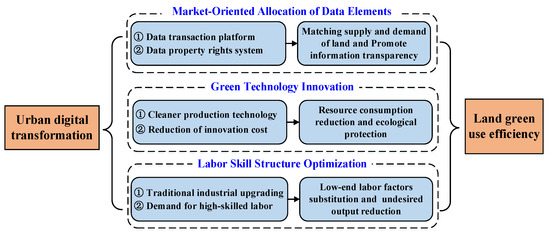
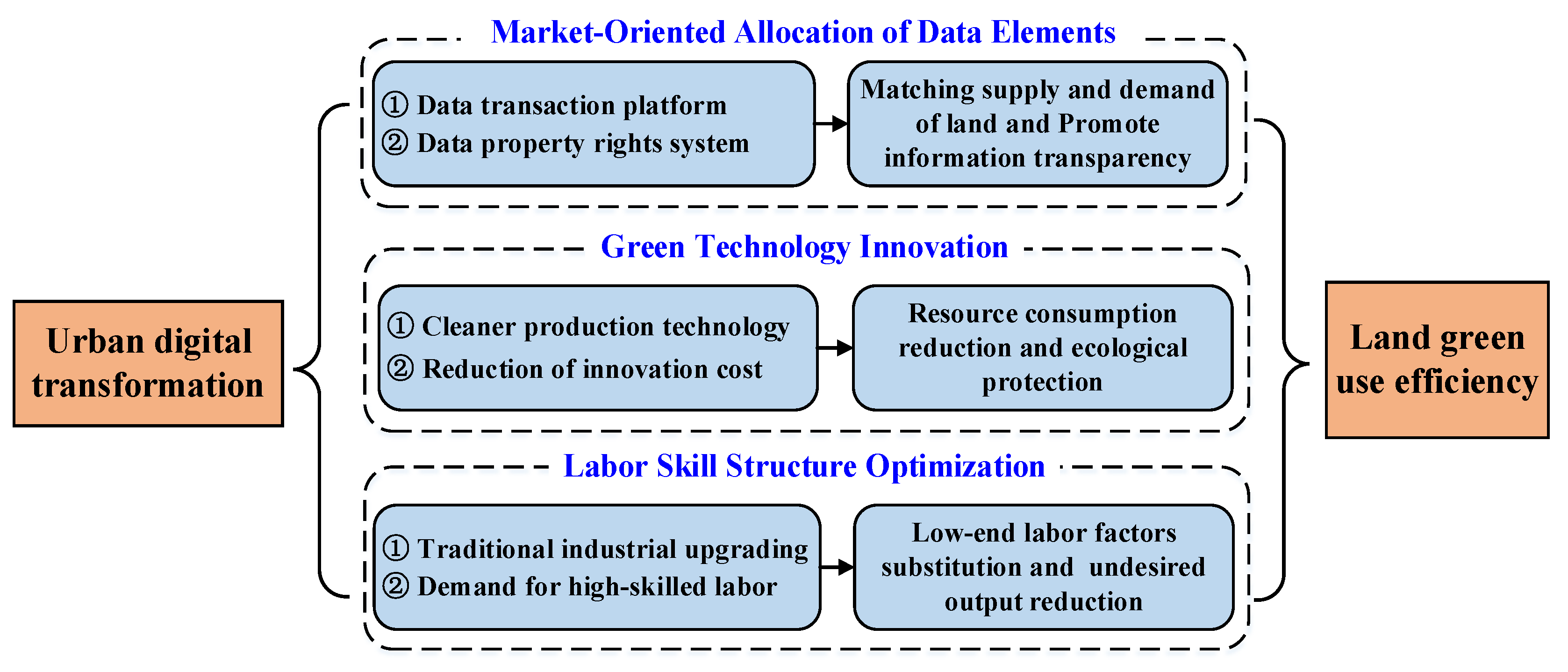
As a novel factor of production, data exert a significant value-enhancing effect. They integrate traditional elements through marketization by promoting a free market economy and facilitating open market transactions [21]. Data elements serve as the fundamental drivers of UDT. The market-driven allocation of these data elements has been significantly advanced through the establishment of data-trading platforms and the reinforcement of data property rights. Within the conventional economic framework, data are often partitioned among various government agencies and commercial entities, which hinders cross-departmental collaboration and cross-industry resource sharing [22]. The application of digital technology provides essential technical support for data verification, pricing, and trade; concurrently, the market-driven circulation of data elements enhances their sharing and integration. On the one hand, this market-driven allocation effectively addresses issues related to information asymmetry. Data-trading platforms, along with information-sharing mechanisms, can enhance transparency concerning land supply and demand dynamics, environmental carrying capacity assessments, and investment return expectations. This improvement facilitates a reallocation of land resources from less efficient sectors to more productive sectors while also mitigating the prevalence of “zombie enterprises” that hoard land or contribute to misallocation [23]. On the other hand, the market-driven allocation of data elements turns technical potential into market realities, eliminates technical obstacles to data sharing, and assists governments and enterprises in precisely forecasting the evolving trends of land demand, thereby offering a scientific basis for spatial planning, urban renewal and industrial site selection [24]. Therefore, as shown in Figure 1, Hypothesis 2a is proposed as follows:
Figure 1.
The mechanism framework of this study.
Hypothesis 2a.
UDT can promote land market supply and demand and also information transparency through data transaction platform and data property rights system, thereby enhancing LGUE.
UDT serves as a significant facilitator of green technological innovation. It enables firms to obtain information from various sources by creating an open and collaborative innovation platform while simultaneously reducing the barriers and costs related to green technological innovation for enterprises [25]. Furthermore, digital transformation can unify financial and innovative resources for enterprises, redefine their manufacturing procedures, shorten the innovation lifecycle, and promote green technology research and development [26]. Advanced green technologies not only alleviate the detrimental environmental effects associated with land use but also diminish the intensity of resource use, including energy and land use. For example, within the industrial sector, the implementation of clean production technologies and circular economy practices supports waste minimization, improves resource efficiency, and encourages sustainable waste management, thereby reducing land resource consumption and pollution caused by manufacturing activities [27]. Thus, as shown in Figure 1, Hypothesis 2b is proposed as follows:
Hypothesis 2b.
UDT can help resource consumption reduction and ecological protection through cleaner production technology and reducing innovation costs, thereby increasing LGUE.
Not only has UDT led to a variety of new job opportunities, but it has also promoted traditional industrial upgrading and structural transformation [28]. This process transforms the labor skill structure and increases enterprises’ demand for high-tech and highly educated professionals. First, as the primary carrier of knowledge development and technology usage, highly-skilled labor generally produces substantial effects from economies of scale in knowledge-intensive R&D activities. The agglomeration effect has the potential to enhance the structural allocation of labor and land resources, significantly increasing economic output per unit of land area [29]. Second, employees who are equipped with digital literacy and advanced skills can more effectively leverage big data and market information to optimize factor allocation decisions by directing land resources toward emerging industries that offer the highest rates of return [30]. Third, the transformation of the labor skill structure shifts regional economic activities from traditional land-intensive manufacturing sectors—characterized by substantial pollution and high energy consumption—to knowledge-intensive modern service industries, which contribute greater value added while minimizing environmental impact. The upgrading of industrial structures holds promise for reducing environmental pollution and other adverse consequences associated with land use activities [31]. Therefore, as shown in Figure 1, Hypothesis 2c is proposed as follows:
Hypothesis 2c.
UDT can stimulate traditional industrial upgrading and high-skilled labor demand through low-end labor factors substitution and undesired output reduction, thereby improving LGUE.
2.3. The Spatial Spillover Effects of UDT on LGUE
From the perspective of spatial externality theory, the spatial distribution of economic activity is highly interconnected, so local economic behavior inevitably generates positive or negative externalities for neighboring regions. On the one hand, by breaking down spatial barriers and reducing information frictions, digital transformation accelerates the efficient transmission of knowledge and the diffusion of green technologies. Successful green land management practices and advanced pollution-reduction technologies in highly digitalized cities can spread rapidly through regional networks, generating positive spillover effects that help neighboring areas lower their trial-and-error costs and enhance their green efficiency [32]. On the other hand, the spatial agglomeration effect induced by digitalization may enable a local city to rapidly develop competitive advantages. This agglomeration can generate a siphon effect that draws superior production factors—such as high-tech talent and green capital—away from adjacent areas and may even shift pollution-intensive activities to nearby regions [33]. This process reduces the resources available for green land development in neighboring cities, generating a negative spatial spillover effect on their green performance [34]. Although there is a theoretical tension between the positive radiation effect and the negative siphon effect, both phenomena demonstrate that the spatial externality of digital transformation objectively exists. Accordingly, Hypothesis 3 is proposed as follows:
Hypothesis 3.
UDT exerts a significant spatial spillover effect on LGUE.
3. Data and Methodology
3.1. Data Sources
This study draws on a balanced panel dataset covering 219 prefecture-level cities in China from 2013 to 2023. The year 2013 is chosen as the starting point because it is widely regarded as a pivotal moment in the development of China’s digital economy. Specifically, the State Council officially issued the Broadband China Strategy and Implementation Plan in that year, elevating digital infrastructure construction to a national strategy and directly spurring the digital transformation of local cities. Therefore, using 2013 as the baseline offers a logical and precise starting point for assessing the impacts of urban digitalization. In terms of sample selection, approximately one-third of Chinese cities, primarily newly established municipalities and those in remote western regions (e.g., Tibet, Xinjiang, and Qinghai), were excluded due to severe missing data for critical indicators, notably the digital inclusive finance index, artificial intelligence enterprise registrations, and industrial pollution emissions. Excluding these cities avoids estimation biases from excessive data interpolation. The remaining 219 cities encompass all major economic zones and urban agglomerations, ensuring the final sample remains highly representative of China’s broader urban development and digital transformation trends.
The data for this study are drawn from several sources. Digital patent application data and green technological innovation data are obtained from the patent search portal of the China National Intellectual Property Administration. Data on environmental regulation and government digital procurement come from government work reports and government procurement websites. Information on artificial intelligence enterprises is extracted from the Tianyancha database. The digital inclusive finance index is provided by Peking University. Data for calculating LGUE and control variables related to socioeconomic conditions are drawn mainly from the China City Statistical Yearbook. To ensure data reliability and comparability, all nominal economic variables are deflated to 2006 constant prices using respective price indices. Furthermore, missing values in the panel dataset are imputed via linear interpolation.
3.2. Variable Descriptions
3.2.1. The Dependent Variable
LGUE measures the input–output efficiency of urban resources and reflects the capacity of urban land systems to maximize socio-economic outputs while simultaneously minimizing physical land inputs and negative environmental externalities. Given the pronounced heterogeneity in economic scale and resource endowments across cities, this study employs a non-oriented super-efficiency SBM model with undesired outputs under the assumption of variable returns to scale (VRS). The adoption of the VRS assumption effectively eliminates the influence of scale efficiency differences among cities, allowing for a more accurate measurement of pure technical efficiency in urban land green use, while an alternative measure using constant returns to scale (CRS) is employed for subsequent robustness tests. We developed an indicator system comprising three dimensions: inputs, expected outputs, and unexpected outputs, as shown in Table 1. This framework enables the reassessment and analysis of the most efficient decision-making unit based on its efficiency value. In this way, it reduces potential information loss during evaluation and more accurately captures the complexities of actual land-use practices [35].
Table 1.
The index system for LGUE.
3.2.2. The Key Independent Variable
UDT is the core independent variable in this study. This paper develops a comprehensive index system that encompasses three key dimensions (Table 2). In this framework, economic digitalization denotes the deep integration of digital technologies into corporate operations and market activities, as well as their innovative application within these domains. Government digitalization denotes an institutional transition toward the systematic use of digital technologies to improve administrative efficiency, expand data openness, and strengthen public governance capacity. Social digitalization captures the widespread integration of digital infrastructure and digitally mediated lifestyles into residents’ everyday urban life. To address potential measurement biases mechanically related to city size or document length, absolute counts and textual keywords are systematically normalized by urban population, budgetary expenditure, or total document word counts. Subsequently, all indicators are processed using mean normalization to eliminate dimensional differences. Finally, the entropy-weighted TOPSIS method is utilized to objectively calculate a composite UDT score for each city.
Table 2.
The indicator system for UDT.
3.2.3. Mechanism Variables
(1) The market-oriented allocation of data elements (MAD). The market circulation of data elements is fundamentally driven by the contractual trading of digital technologies, algorithms, and data services [36]. This paper employs the ratio of technology market contract turnover to regional GDP as the proxy variable for MAD. A higher ratio indicates a more active and mature market mechanism for the pricing and allocation of data elements.
(2) Substantive green innovation (SBGI) and strategic green innovation (SRGI). The quantity of green patent applications effectively reflects the development of innovation and sustainable technologies. In this paper, green technological innovation is divided into substantive innovation and strategic innovation. Substantive innovation represents essential advances that deliver considerable ecological benefits, whereas strategic innovation often involves more superficial modifications that primarily serve immediate gains or regulatory compliance [37].
(3) Labor skill structure (LSS). Digital transformation can reshape the distribution of skills and the market demand for labor [38]. This study employs the labor skill structure (LSS) as a key variable, measured by the share of employees engaged in information transmission, computer services, and software in the total national population. A higher LSS value indicates a greater concentration of high-skilled labor.
3.2.4. Control Variables
In this study, six categories of control variables are included: foreign investment, economic development, household consumption, industrial structure, fiscal pressure, and environmental regulation. The specific measurement of each control variable is defined as follows:
- (1)
- Foreign investment (FI) is measured as the ratio of actually utilized foreign investment to regional GDP;
- (2)
- Economic development (ED) is proxied by the logarithm of per capita GDP;
- (3)
- Household consumption (HC) is captured by the logarithm of total retail sales of consumer goods;
- (4)
- The industrial structure (IS) is represented by the share of the secondary industry in regional GDP;
- (5)
- Fiscal pressure (FP) is defined as the ratio of government expenditure to government revenue;
- (6)
- Environmental regulation (ER) is quantified as the proportion of sentences containing environment-related keywords in government work reports relative to the total number of sentences.
3.3. Methodology
3.3.1. The Benchmark Regression Model
In this study, a city-year fixed effects regression model is developed to assess the impact of digital transformation on the efficiency of green land utilization. The benchmark regression model is articulated as follows:
where denotes the land green use efficiency; represents the level of digital transformation; signifies a vector of control variables; and denote city and year fixed effects, respectively; and is the idiosyncratic error term.
3.3.2. The Mediating Effect Model
Consistent with the theoretical analysis, this paper extends the benchmark model in Equation (1) to investigate the mediating pathways through which UDT influences LGUE. Specifically, because existing theories and empirical studies have already established the positive effects of the selected mediators on LGUE, this study concentrates on estimating the impact of UDT on the mediating variables, as specified below:
where the mediating variable refers to the market-driven allocation of data elements (MAD), substantive green technological innovation (SBGI), strategic green technological innovation (SRGI), and the labor skill structure (LSS).
3.3.3. The Spatial Durbin Model (SDM)
To verify the spatial spillover effect of UDT on LGUE, this paper constructs the SDM with two-way fixed effects. The equation is specified as follows:
where is the spatial weight matrix; is the spatial autoregressive coefficient; is the spatial lag term of the dependent variable; is the estimated coefficient of the core independent variable; is the spatial lag term of the core independent variable, with as its coefficient; and represents the control variables, with and being the coefficients of the control variables and their spatial lag terms, respectively.
4. Results Analysis
4.1. The Spatiotemporal Trend of LGUE in Prefecture-Level China
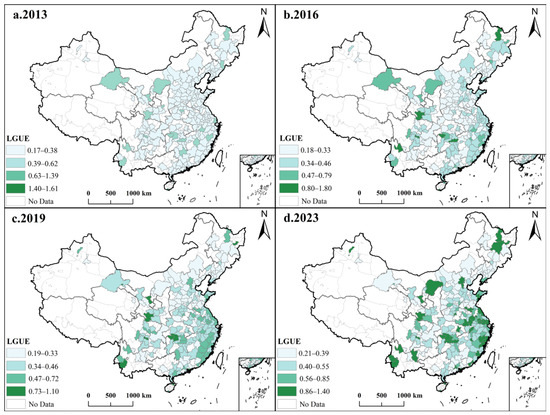
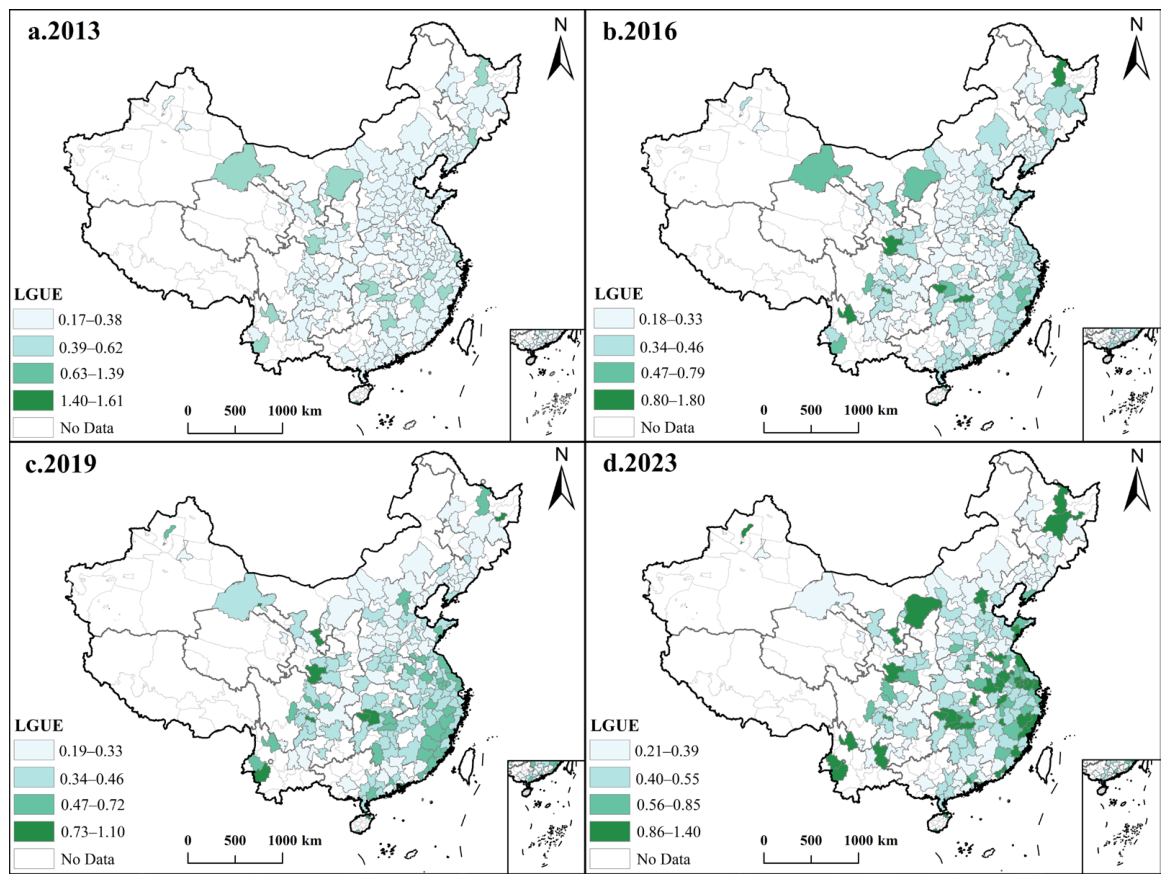
The spatiotemporal evolution of LGUE across China is presented in Figure 2. At the national scale, LGUE exhibits a clear upward trajectory, rising from 0.46 in 2013 to 0.56 in 2023. Spatially, this trend forms a distinct pattern, with higher efficiency in the eastern region and lower efficiency in the western region, accompanied by a pronounced core–periphery structure.
Figure 2.
The temporal trend of LGUE in prefecture-level China: (a) 2013; (b) 2016; (c) 2019; (d) 2023.
In coastal regions, LGUE exhibits pronounced spatial clustering. Major coastal urban agglomerations, including the Beijing–Tianjin–Hebei region, the Yangtze River Delta, and the Pearl River Delta, generally display high levels of LGUE. In contrast, while the overall performance of inland areas lags behind the coast, provincial capital cities such as Chengdu, Chongqing, Wuhan, and Changsha serve as regional growth poles, driving the emergence of high-value clusters in the central and southern regions. This pattern underscores a clear spatial polarization of LGUE.
Notably, the number of cities with low LGUE declined continuously, with the decrease becoming particularly pronounced during 2019–2023. One plausible explanation is the combined effect of multiple policy initiatives and innovation-driven mechanisms. The national dual-carbon strategy proposed in 2020 clarified the pathway for green transformation in land use and set stringent constraints on urban energy conservation, emission reduction and low-carbon development. Within this framework, green technological innovation has become the primary engine for resolving the tension between land use and ecological protection. Leveraging digital technologies, including energy-saving, recycling and ecological restoration techniques, green innovation has reduced resource consumption and environmental costs, while simultaneously optimizing land spatial configurations and enhancing ecological productivity.
4.2. Benchmark Regression and Endogeneity Tests
Table 3 reports the benchmark regression results with both city and year fixed effects. Column (1) presents the estimates without control variables and shows that UDT exerts a positive effect on LGUE, significant at the 5% level. Column (2) reports the estimates with all control variables and yields a significantly positive coefficient of 0.273 for UDT. Substantively, this coefficient implies that, holding all other factors constant, a one-unit increase in UDT is associated with a 0.273-unit increase in LGUE. Taken together, these results demonstrate a robust and economically meaningful positive effect of digital transformation on LGUE, thereby supporting Hypothesis 1.
Table 3.
Results of the benchmark regression and endogeneity tests.
This article further employs a two-stage least squares (2SLS) instrumental variable approach to mitigate potential endogeneity arising from bidirectional causality or omitted variables. Specifically, this study constructs an instrumental variable for UDT by interacting the city’s terrain undulation with the lagged national number of internet users. The validity of this instrument is justified through both relevance and exogeneity. In terms of relevance, terrain undulation represents a natural geographical barrier that significantly increases the engineering difficulty and physical construction costs of laying optical cables, building base stations, and deploying digital networks. As a result, regions with more rugged terrain experience greater physical resistance and a slower pace of digital infrastructure deployment in response to national internet expansion. Regarding exogeneity, terrain undulation is a strictly exogenous, time-invariant geographical endowment formed over millions of years. By interacting this invariant natural feature with the time-varying national macroeconomic indicator, we obtain a panel instrumental variable that effectively captures temporal variation without being contaminated by local economic conditions. Furthermore, because this purely physical geographical characteristic is entirely independent of contemporary industrial manufacturing, resource consumption, and environmental governance policies, it cannot directly affect current land green use efficiency (LGUE) through confounding economic channels, thereby strictly satisfying the exclusion restriction. As shown in the first-stage results in Column (3) of Table 3, this instrumental variable is strongly and negatively associated with UDT, aligning perfectly with theoretical expectations. Building upon this validated first stage, the second-stage results demonstrate that after addressing endogeneity, the estimated effect of UDT on LGUE remains significantly positive with a coefficient of 0.518, which is consistent with the benchmark regression findings.
The following diagnostic tests were conducted to assess the validity of the instrumental variable. First, the Kleibergen-Paap Wald rk F statistic for this instrumental variable in the first-stage regression is 16.492, which surpasses the critical value of 16.38 at the 10% bias level according to the Stock–Yogo weak identification test. This finding confirms that there is no issue related to weak instruments. Second, the Kleibergen-Paap rk LM statistic in the first stage is 17.856, which rejects the hypothesis of invalid instruments at a significance level of 1%.
4.3. Robustness Tests
4.3.1. Alternative Core Variables
To ensure the reliability of the findings, this paper re-estimates the models by replacing the core variables. In Column (1) of Table 4, the dependent variable is substituted with an alternative measure of LGUE calculated under the constant returns to scale (CRS) assumption. The results indicate that the coefficient of UDT remains significantly positive at the 1% level. Furthermore, to alleviate concerns that the entropy-weighted UDT index might be sensitive to specific weighting algorithms, an alternative measure of urban digitalization utilizing the CRITIC (Criteria Importance Through Intercriteria Correlation) method is introduced in Column (2). The CRITIC method objectively assigns weights by simultaneously accounting for both the contrast intensity (standard deviation) and the conflict (correlation) among indicators. Re-estimating the model with this CRITIC-based UDT index yields a significantly positive coefficient at the 5% level. These results consistently confirm that the baseline regression is highly robust to alternative measurement strategies and index construction techniques.
Table 4.
Results of the robustness tests.
4.3.2. Province-by-Year Fixed Effects
To rigorously address potential omitted-variable bias, this paper introduces province-by-year fixed effects into the baseline regression. These high-dimensional fixed effects systematically absorb any time-varying, province-specific characteristics and unobservable macro-trends during the sample period. As shown in Column (3) of Table 4, even after controlling for these stringent fixed effects, the coefficient of UDT remains significantly positive at the 5% level, thereby further corroborating the robustness of the baseline estimates.
4.3.3. Policy Pilots
To rule out the interference of concurrent policies and further mitigate endogeneity concerns, this study treats the “Broadband China” pilot policy as an identifiable exogenous shock, constructing a quasi-natural experiment. Specifically, the continuous UDT index is replaced with a difference-in-differences (DID) estimator to isolate the net policy impact. As presented in Column (4) of Table 4, the coefficient of the DID variable is significantly positive at the 5% level. This causal evidence confirms that the promoting effect of UDT on LGUE is not mechanically driven by other overlapping macro-initiatives.
4.3.4. Alternative Estimation Models
Because UDT is an ongoing process rather than a static event, its effect on LGUE inherently exhibits intertemporal dynamics. Consequently, it is crucial to distinguish between the short-term impacts of initial infrastructure implementation and the long-term environmental benefits of a mature digital ecosystem. To capture these dynamic, path-dependent effects while addressing potential endogeneity, this paper introduces a one-period lagged dependent variable (L.LGUE) into the baseline model, re-estimating it via the System Generalized Method of Moments (SYS-GMM). As shown in Column (5) of Table 4, the coefficient of L.LGUE is significantly positive at the 1% level, establishing a strong path dependence in LGUE. Furthermore, the core explanatory variable (UDT) maintains a significantly positive impact at the 1% level. These findings collectively confirm that as the digital ecosystem matures, UDT exerts a robust and continuous long-term positive effect on LGUE, thereby validating the reliability of the baseline conclusions.
4.4. Heterogeneity Analysis
4.4.1. Heterogeneity Analysis by City Size
Table 5 (Columns 1 and 2) reveals that the impact of UDT on LGUE differs markedly across city sizes. To prevent classification bias caused by contemporaneous demographic shifts induced by digital transformation, this study adopts a strict time-invariant baseline. Applying the 2014 official city-size standards issued by the Chinese central government, the sample is categorized into two fixed groups: large cities (urban permanent population exceeding 1 million) and small-to-medium-sized cities (population below 1 million). The estimations indicate that UDT exerts a significantly positive effect on LGUE in large cities but a significantly negative impact in their smaller counterparts. The empirical p-value (0.024) from Fisher’s permutation test confirms the statistical significance of this spatial divergence.
Table 5.
Heterogeneity results across various city sizes and levels of internet development.
This heterogeneity is primarily driven by the resource and agglomeration advantages inherent to large cities. Endowed with abundant digital talent, robust R&D capabilities, and advanced IT infrastructure, large municipalities are better positioned to harness the scale effects and knowledge spillovers of UDT for optimal land allocation. Conversely, small-to-medium-sized cities often grapple with weaker fiscal capacities and severe talent deficits. In these regions, premature or disproportionate investments in digital infrastructure may crowd out traditional green investments and exacerbate resource misallocation. Consequently, rather than yielding immediate environmental dividends, UDT may temporarily hinder LGUE in these less-developed urban settings.
4.4.2. Heterogeneity Analysis by Level of Internet Development
The internet is a critical cornerstone of digital transformation. This study investigates how the effect of UDT on LGUE differs across cities with varying levels of internet development. To preclude the possibility of the classification being influenced by contemporaneous digital transformation, this analysis employs a strict time-invariant baseline. Specifically, using 2013 as the baseline year, the sample is evenly divided into two groups based on the median number of broadband internet users: cities with high internet development and cities with low internet development. According to Columns (3) and (4) of Table 5, UDT significantly increases LGUE in cities with advanced internet development, whereas it exerts a significantly negative impact in cities with limited internet development. The empirical p-value (0.036) from Fisher’s permutation test verifies that this cross-group difference is statistically significant.
This divergence suggests that cities with a robust initial internet infrastructure possess the necessary prerequisites to build integrated digital ecosystems and support smart infrastructure investments. Such conditions foster a modern IT environment, enabling digital transformation to effectively optimize green land management and smart land-use planning. By contrast, cities with a weak initial internet foundation face substantial hurdles, including inadequate digital infrastructure, limited service coverage, and low penetration rates. Under these constraints, the steep initial costs of initiating digital transformation can severely deplete local fiscal resources, diverting crucial funds away from direct environmental protection and land optimization. As a result, the premature deployment of UDT in these underdeveloped cities may temporarily aggravate resource misallocation and impede LGUE improvements.
4.4.3. Heterogeneity Analysis by Dimensions of Digital Transformation
Digital transformation is a multi-dimensional process encompassing various socio-economic spheres. To accurately identify the specific mechanisms influencing land-use efficiency, this study disaggregates the overall UDT index into three distinct dimensions: economic digitalization (EUDT), government digitalization (GUDT), and social digitalization (SUDT). As presented in Table 6, these dimensions exert highly heterogeneous effects on LGUE. Column (1) shows that EUDT has a significantly positive impact on LGUE. In contrast, Column (2) reveals that the effect of GUDT is negative and statistically insignificant. Notably, Column (3) demonstrates that SUDT exerts a significantly negative impact on LGUE.
Table 6.
The impacts of different dimensions of digital transformation on LGUE.
This structural divergence indicates that the impact of digital transformation on green land utilization depends strictly on its specific application domain. The positive effect of economic digitalization suggests that the deep integration of digital technologies within the productive sector effectively drives industrial structural upgrading, optimizes resource allocation, and promotes green manufacturing, thereby directly yielding land-use dividends. In contrast, the insignificant impact of government digitalization implies a potential institutional lag. Although local governments have advanced digital administrative tools to streamline public services, these e-governance platforms may not yet be sufficiently coupled with complex environmental regulation and spatial land-use planning to produce observable ecological benefits. Furthermore, the significantly negative impact of social digitalization highlights the environmental costs associated with the rapid transition toward consumer-oriented digital lifestyles. The booming demand for online consumption and digital services inevitably drives the extensive construction of logistics infrastructure and massive data centers, which require substantial land occupation and energy consumption. Without stringent green spatial planning, this aggressive physical expansion temporarily exacerbates urban sprawl and carbon emissions, thereby hindering the improvement of LGUE.
4.5. Analysis of Potential Mechanisms
The study explores the potential mechanisms through three key avenues: the market-oriented allocation of data elements, the green technological innovation of enterprises, and the structure of labor skills, as delineated in the theoretical framework presented in Section 2. Table 7 illustrates the regression results derived from the tests of these potential channels.
Table 7.
Results of the mechanism tests.
Column (1) reports a positive coefficient of 0.041 that is statistically significant at the 1% level, providing empirical evidence that UDT is positively associated with the market-oriented allocation of data elements, which is consistent with Hypothesis 2a. The widespread deployment of digital technologies, including big data, cloud computing, and the Internet of Things, has substantially reduced the costs of data collection, circulation, and transactions, and has simultaneously enhanced information transparency and the efficiency of resource allocation in UDT. In addition, the effective marketization of data elements has improved the allocation of land resources among market participants, thereby promoting the reallocation of land to sectors that operate more efficiently and are more environmentally sustainable.
Columns (2) and (3) show that the estimated coefficients are 7.741 and 8.636, respectively, and both are statistically significant at the 1% level. These results indicate that UDT exhibits a strong positive correlation with both substantive and strategic green technological innovation among enterprises. Together, these two forms of green technological innovation constitute a core potential channel supporting Hypothesis 2b. On the one hand, digital technologies provide key technical support for substantive green technological innovation through the industrial internet, artificial intelligence, and big data analytics. Through targeted research and development efforts, enterprises can design eco-friendly processes and products that curb the negative environmental externalities of land use rights at their source. On the other hand, enterprises may also advance strategic green technological innovation, which can indirectly improve land use and development by driving green upgrading in equipment manufacturing and end-of-pipe treatment solutions.
As reported in Column (4), the estimated coefficient of LSS is 0.048 and is statistically significant at the 1% level. This result highlights the positive relationship between UDT and the optimization and upgrading of the labor skill structure, providing evidence consistent with improving LGUE. Accordingly, Hypothesis 2c is supported. The continuous expansion of digitalization has sharply increased demand for high-skilled positions such as data analysts and research and development personnel, pushing the labor market toward a more skill-intensive profile and raising the overall level of urban human capital. High-skilled workers generally exhibit stronger capabilities in green technological innovation and advanced management practices, and their expertise allows for the effective integration of digital technologies into each stage of land use planning, monitoring, and evaluation. This integration encourages a pattern of land resource allocation that prioritizes intensification, efficiency, and sustainability, ultimately enhancing LGUE.
4.6. Spatial Effect Analysis
To ensure the validity of the empirical analysis, a series of diagnostic tests were conducted to identify the appropriate spatial econometric specification before estimating the regression model. LM, LR, and Wald tests were applied to compare the relative suitability of the Spatial Autoregressive (SAR), Spatial Error (SEM), and Spatial Durbin (SDM) models. Accordingly, the Spatial Durbin Model (SDM) with two-way fixed effects was selected for the final analysis. Furthermore, the SDM is estimated using Maximum Likelihood Estimation (MLE) to account for the inherent endogeneity introduced by the spatially lagged dependent variable by incorporating the Jacobian determinant into the log-likelihood function. The corresponding results are reported in Table 8.
Table 8.
Spatial econometric model selection.
To comprehensively capture spatial dependence, this study constructs three distinct spatial weight matrices: (1) a combined economic-geographic matrix, serving as the benchmark specification, which incorporates the reciprocal of great-circle geographic distances between city centers and disparities in economic development (per capita GDP); (2) a binary contiguity matrix; and (3) an economic-distance matrix. All matrices are row-standardized.
Using these spatial weight matrices, the spatial spillover effects of UDT on LGUE are estimated, with the results reported in Table 9. Under the benchmark combined matrix, the spatial autoregressive coefficient (ρ) is 0.193 and significant at the 5% level, indicating a strong positive spatial dependence in LGUE. The partial derivative method is further employed to decompose the marginal spillover effects. The results show that the direct effect of UDT is 1.149, confirming that higher local levels of digitalization promote LGUE. The indirect effect is 1.355, indicating a pronounced positive spatial spillover. This positive spillover effect is closely associated with the network externalities inherent in digital technologies. Unlike traditional physical infrastructure, digital networks transcend geographic boundaries, facilitating regional information sharing and coordinated environmental governance. Consequently, UDT in neighboring cities can exert a favorable radiation effect on local LGUE, ultimately fostering a win-win configuration for regional green land development.
Table 9.
Spatial spillover effect test.
To verify the sensitivity of these spatial patterns to the choice of matrix specifications, Table 9 also reports the effect decompositions under the alternative contiguity and economic-distance matrices. The indirect effects of UDT remain significantly positive across all specifications (0.555 under the contiguity matrix and 1.473 under the economic-distance matrix). These consistent results confirm that the positive spatial radiation driven by digitalization exists fundamentally, irrespective of whether the spatial dependence is defined by pure geographical proximity or economic linkage.
5. Discussion
The empirical results of this study indicate a significant and positive association between UDT and LGUE, aligning with recent literature emphasizing the environmental dividends of digitalization [39]. Importantly, our findings suggest that the core value of this transformation extends beyond the conventional digital economy. Rather than functioning solely as an economic driver, the comprehensive reform of government governance, public services, and social behavior emerges as a crucial institutional and societal factor in advancing LGUE. This aligns with the perspective that digital governance improves natural resource efficiency through enhanced regulatory capacity [40], and that the digital transformation of social behavior—such as smart logistics—indirectly optimizes transportation and reduces emissions [41].
Furthermore, the mechanism analysis identifies three transmission pathways through which UDT impacts LGUE: the market-oriented allocation of data elements, green technological innovation, and the upgrading of the labor skill structure. First, as a virtual and intangible production factor, data elements demonstrate eco-friendly characteristics and can be integrated with traditional factors to substitute physical inputs and reduce natural resource consumption [42]. Second, as society entered the industrial era, technology gradually replaced manpower and capital, breaking the constraints of the finite nature of natural resources such as labor and land and becoming the key factor of production for economic development [43]. Theoretically, green technological innovation drives LGUE through three mechanisms: the recombination of production factors, digital governance transformation and industrial structure upgrading [44]. Third, this paper confirms the importance of human capital for LGUE, suggesting that government strategies should promote the development of advanced human capital, particularly within the environmental protection sector [45]. Contemporary human capital theory underscores the crucial importance of human capital for improving economic efficiency and offers innovative perspectives for achieving sustainable development.
Moving beyond localized impacts, the spatial Durbin model results confirm that UDT exerts a significant positive spatial spillover effect on LGUE. This indicates that digitalized cities successfully generate beneficial effects, diffusing green technologies and advanced management practices to neighboring regions. However, to provide a more dialectical and comprehensive perspective, it is crucial to acknowledge that this positive spatial synergy may be constrained by potential negative boundary conditions, such as the digital divide and resource siphoning. While the net spatial effect is positive, highly asymmetric digital development can inadvertently trigger a localized “siphon effect,” where advanced core cities attract premium green capital and highly skilled talent away from less-developed neighbors [46]. Furthermore, if peripheral cities lack foundational digital infrastructure or sufficient absorptive capacity, the “digital divide” may prevent them from fully capitalizing on these positive spillovers, thereby risking the exacerbation of the “Matthew effect” in regional green development [47]. Consequently, although digital transformation predominantly fosters regional green synergy, policymakers must proactively mitigate these latent negative boundaries to ensure an equitable green transition space for all cities.
6. Conclusions and Implications
6.1. Conclusions
This paper investigates the impact of UDT on LGUE and its underlying mechanisms, using a panel dataset of 219 prefecture-level cities in China from 2013 to 2023. Drawing on a fixed effects model, mediation analysis, and a spatial Durbin model, the study yields four main results. (1) UDT exerts a significant and positive effect on LGUE, and this result remains robust after addressing endogeneity and conducting multiple robustness checks. (2) UDT enhances LGUE through three mediating channels: market-oriented allocation of elements, green technological innovation, and optimization of the labor skill structure. (3) The influence of UDT on LGUE exhibits a significant spatial spillover effect, which suggests that local digital transformation not only fosters local green development but also generates a positive radiation effect on the green use of land in neighboring cities. (4) The heterogeneous effects of UDT on LGUE are confirmed across cities of different sizes, with varying levels of internet development, and across distinct dimensions of digital transformation. Specifically, the positive impact is more pronounced in large cities and those with advanced internet development. Structurally, economic digitalization significantly enhances LGUE, whereas social digitalization exhibits a negative effect.
6.2. Policy Implications
Based on the empirical findings, this study proposes several policy implications to enhance land green use efficiency. First, it is essential to advance the market-oriented reform of data elements by establishing a comprehensive framework for defining data property rights, promoting data circulation, and ensuring equitable revenue sharing. Building upon this digital foundation, policymakers should develop a dynamic, categorized land management system that seamlessly integrates diverse information sources, spanning territorial spatial planning, land use monitoring, and environmental governance. Second, the government should prioritize the deep integration of digital technologies with sustainable, low-carbon industrial development. Simultaneously, fostering a collaborative digital innovation ecosystem is crucial to support the green transformation of high-tech sectors, such as advanced manufacturing and high-end services. Third, upgrading the digital talent cultivation system is vital to secure adequate human capital for efficient land use. To achieve this, tailored evaluation and incentive frameworks must be implemented to steer highly skilled professionals toward key domains, particularly intelligent environmental conservation and spatial planning. Fourth, strengthening cross-regional collaborative governance is imperative to fully leverage the positive spatial spillover effects of urban digital transformation. Policymakers should adopt a systemic approach to dismantle administrative barriers, thereby establishing mechanisms for the free flow of digital resources and coordinated land governance across city borders. Furthermore, maximizing the leading role of core cities can drive the development of less-developed regions. By amplifying the spatial radiation and trickle-down effects of digital technologies, core cities can effectively transfer digital dividends to neighboring areas, ultimately achieving a coordinated regional enhancement in land green use efficiency. Finally, given the pronounced regional and structural heterogeneities, targeted policies must be tailored to both local capacities and specific digital dimensions. Specifically, while large, internet-advanced cities should leverage their agglomeration advantages to advance smart land supervision, small-to-medium-sized and internet-lagging regions must prioritize gradual infrastructure upgrades to prevent aggressive investments from crowding out environmental expenditures. Furthermore, differentiated strategies are essential across digital dimensions: harnessing economic digitalization to drive green industrial upgrading; deeply embedding e-governance into spatial planning to overcome institutional lag; and strictly regulating the land-use intensity of social digitalization to curb digital sprawl and its associated ecological penalties.
6.3. Limitations
While this study provides valuable insights into the spatial effects and mechanisms of UDT on LGUE, it has certain limitations that warrant future research. (1) Regarding variable measurement, due to the unavailability of comprehensive micro-level statistics across all sample cities, the labor skill structure is measured by the share of employees in IT-related sectors. Although this proxy adequately captures the macro-level demand for digital talent, future studies could utilize more granular data, such as educational attainment or professional certifications, to better reflect the multidimensional characteristics of high-skilled labor. (2) Concerning the complexity of spatial externalities, while the spatial Durbin model identifies a net positive spillover effect, the potential non-linear transition between the negative siphon effect and the positive radiation effect remains unexplored. Future studies could employ spatial panel threshold models to identify the exact tipping points of digital development that trigger these distinct spatial dynamics. (3) In terms of the research scope, the empirical sample is currently restricted to 219 prefecture-level cities. As digital infrastructure increasingly penetrates lower-tier regions, examining the heterogeneous impacts of digitalization on land use efficiency at the county level or in rural areas, where the “digital divide” may be more pronounced, represents a promising direction for future studies.
Author Contributions
Conceptualization, L.M. and K.Y.; methodology, L.M.; software, M.Y.; validation, T.W.; formal analysis, L.M. and M.Y.; data curation, M.Y.; writing—original draft preparation, L.M.; writing—review and editing, K.Y.; visualization, T.W.; supervision, K.Y. and S.H.; funding acquisition, S.H. All authors have read and agreed to the published version of the manuscript.
Funding
This research was funded by the National Natural Science Foundation of China, grant number 42071207 and the Research Project of Humanities and Social Sciences of Ministry of Education, grant number 21YJC790160.
Data Availability Statement
Publicly available datasets were analyzed in this study. Digital patent application and green technological innovation data are available from the patent search portal of the China National Intellectual Property Administration; data on environmental regulation and government digital procurement are available from government work reports and government procurement websites; information on artificial intelligence enterprises is available from the Tianyancha database; the digital inclusive finance index is provided by Peking University; and data for calculating LGUE and control variables related to socioeconomic conditions are available from the China City Statistical Yearbook. The processed panel data and analysis outputs are available from the corresponding authors upon reasonable request.
Conflicts of Interest
The authors declare no conflicts of interest.
References
- Yi, C.; Xu, B.; Shi, X.; Li, R.; Chen, J. Exploring the spatial effects of rapid urbanization on land use efficiency in China under Low-Carbon constraints. Ecol. Indic. 2025, 174, 113442. [Google Scholar] [CrossRef] [Scilit]
- Chen, X.; He, L.; Luo, F.; He, Z.; Bai, W.; Xiao, Y.; Wang, Z. Dynamic characteristics and impacts of ecosystem service values under land use change: A case study on the Zoigê plateau, China. Ecol. Inform. 2023, 78, 102350. [Google Scholar] [CrossRef] [Scilit]
- Jiang, W.; Li, J. Digital transformation and its effect on resource allocation efficiency and productivity in Chinese corporations. Technol. Soc. 2024, 78, 102638. [Google Scholar] [CrossRef] [Scilit]
- Irwin, E.G. New directions for urban economic models of land use change: Incorporating spatial dynamics and heterogeneity. J. Reg. Sci. 2010, 50, 65–91. [Google Scholar] [CrossRef] [Scilit]
- Zhu, D.; Wang, Y.; Peng, S.; Zhang, F. Influence mechanism of polycentric spatial structure on urban land use efficiency: A moderated mediation model. Int. J. Environ. Res. Public Health 2022, 19, 16478. [Google Scholar] [CrossRef] [Scilit]
- Liu, J.; Hou, X.; Wang, Z.; Shen, Y. Study the effect of industrial structure optimization on urban land-use efficiency in China. Land Use Policy 2021, 105, 105390. [Google Scholar] [CrossRef] [Scilit]
- Lu, N.; Shan, T.; Li, W.; Liu, X.; Wang, W. Does the Digital Economy Promote Green Land Use Efficiency? Sustainability 2025, 17, 7171. [Google Scholar] [CrossRef] [Scilit]
- Wang, S.; Zhai, C.; Zhang, Y. Evaluating the impact of urban digital infrastructure on land use efficiency based on 279 cities in China. Land 2024, 13, 404. [Google Scholar] [CrossRef] [Scilit]
- Liu, Q.; Jiang, H.; Li, J.; Song, J.; Zhang, X. Antidote or poison? Digital economy and land-use. Land Use Policy 2024, 139, 107083. [Google Scholar] [CrossRef] [Scilit]
- Hammond, E.B.; Coulon, F.; Hallett, S.H.; Thomas, R.; Dick, A.; Hardy, D.; Dickens, M.; Washbourn, E.; Beriro, D.J. The development of a novel decision support system for regional land use planning for brownfield land. J. Environ. Manag. 2024, 349, 119466. [Google Scholar] [CrossRef] [Scilit]
- Goertler, T.; Papert, M.; Fischer, I.; Schmidt, M. Building digital platform ecosystems: A synthetization of fundamental design topics from a literature review. Digit. Bus. 2025, 5, 100109. [Google Scholar] [CrossRef] [Scilit]
- Goldfarb, A.; Tucker, C. Digital economics. J. Econ. Lit. 2019, 57, 3–43. [Google Scholar] [CrossRef] [Scilit]
- Lyu, Y.; Ge, Y.; Zhang, J. The impact of digital economy on capital misallocation: Evidence from China. Econ. Change Restruct. 2023, 56, 3475–3499. [Google Scholar] [CrossRef] [Scilit]
- Bibri, S.E.; Krogstie, J. Smart sustainable cities of the future: An extensive interdisciplinary literature review. Sustain. Cities Soc. 2017, 31, 183–212. [Google Scholar] [CrossRef] [Scilit]
- Wang, J.; Wu, H.; Xiao, D.; Luo, X.; Liu, Y.; Wang, W. Can the digital economy address the loss of green development efficiency due to resource mismatch? Evidence from China’s land transaction markets. J. Environ. Plan. Manag. 2025, 68, 406–436. [Google Scholar] [CrossRef] [Scilit]
- Fan, X.; Lu, X.; Liu, J. Effects of digital economy development on the urban land green use efficiency: Based on the moderating effect of infrastructure construction. China Land Sci. 2023, 37, 79–89. [Google Scholar]
- Yin, C.; Chen, X.; Tan, J. How does the digital economy development promote urban land green utilization efficiency? A perspective of land resource misallocation. Discov. Sustain. 2025, 6, 916. [Google Scholar] [CrossRef] [Scilit]
- Deng, X.; Peng, J.; Wan, C. The impact of internet use on land productivity: Evidence from China land economy survey. Land 2024, 13, 262. [Google Scholar] [CrossRef] [Scilit]
- Tian, M.; Hong, M.; Wang, J. Land resources, market-oriented reform and high-quality agricultural development. Econ. Change Restruct. 2023, 56, 4165–4197. [Google Scholar] [CrossRef] [Scilit]
- Li, B.; Wang, Z.; Xu, F. Exploring the effects of market-oriented reforms on industrial land use eco-efficiency in China: Evidence from a spatial and non-linear analysis. Environ. Impact Assess. Rev. 2023, 102, 107211. [Google Scholar] [CrossRef] [Scilit]
- Veldkamp, L.; Chung, C. Data and the aggregate economy. J. Econ. Lit. 2024, 62, 458–484. [Google Scholar] [CrossRef] [Scilit]
- Zhou, Y.; Li, G.; Sun, T.; Huo, W. The Impact of Market-Oriented Allocation of Data Elements on Enterprises’ New Quality Productive Forces. Sustainability 2025, 17, 8262. [Google Scholar] [CrossRef] [Scilit]
- Wang, M.; Yu, Y.; Liu, F. Does digital transformation curb the formation of zombie firms? A machine learning approach. Technol. Anal. Strateg. Manag. 2025, 37, 810–826. [Google Scholar] [CrossRef] [Scilit]
- Bibri, S.E. Data-driven smart sustainable cities of the future: An evidence synthesis approach to a comprehensive state-of-the-art literature review. Sustain. Futures 2021, 3, 100047. [Google Scholar] [CrossRef] [Scilit]
- Mubarak, M.F.; Tiwari, S.; Petraite, M.; Mubarik, M.; Raja Mohd Rasi, R.Z. How Industry 4.0 technologies and open innovation can improve green innovation performance? Manag. Environ. Qual. Int. J. 2021, 32, 1007–1022. [Google Scholar] [CrossRef] [Scilit]
- Ghobakhloo, M. Industry 4.0, digitization, and opportunities for sustainability. J. Clean. Prod. 2020, 252, 119869. [Google Scholar] [CrossRef] [Scilit]
- Tseng, M.-L.; Tan, R.R.; Chiu, A.S.; Chien, C.-F.; Kuo, T.C. Circular economy meets industry 4.0: Can big data drive industrial symbiosis? Resour. Conserv. Recycl. 2018, 131, 146–147. [Google Scholar] [CrossRef] [Scilit]
- Frey, C.B.; Osborne, M.A. The future of employment: How susceptible are jobs to computerisation? Technol. Forecast. Soc. Change 2017, 114, 254–280. [Google Scholar] [CrossRef] [Scilit]
- Bresnahan, T.F.; Brynjolfsson, E.; Hitt, L.M. Information technology, workplace organization, and the demand for skilled labor: Firm-level evidence. Q. J. Econ. 2002, 117, 339–376. [Google Scholar] [CrossRef] [Scilit]
- Akerman, A.; Gaarder, I.; Mogstad, M. The skill complementarity of broadband internet. Q. J. Econ. 2015, 130, 1781–1824. [Google Scholar] [CrossRef] [Scilit]
- Hao, X.; Li, Y.; Ren, S.; Wu, H.; Hao, Y. The role of digitalization on green economic growth: Does industrial structure optimization and green innovation matter? J. Environ. Manag. 2023, 325, 116504. [Google Scholar] [CrossRef] [Scilit]
- Ren, S.; Hao, Y.; Xu, L.; Wu, H.; Ba, N. Digitalization and energy: How does internet development affect China’s energy consumption? Energy Econ. 2021, 98, 105220. [Google Scholar] [CrossRef] [Scilit]
- Li, X.; Chen, Z.; Chen, Y. The impact of digital talent inflow on the co-agglomeration of the digital economy industry and manufacturing. Systems 2024, 12, 317. [Google Scholar] [CrossRef] [Scilit]
- Ma, D.; Zhu, Q. Innovation in emerging economies: Research on the digital economy driving high-quality green development. J. Bus. Res. 2022, 145, 801–813. [Google Scholar] [CrossRef] [Scilit]
- Tone, K. A slacks-based measure of efficiency in data envelopment analysis. Eur. J. Oper. Res. 2001, 130, 498–509. [Google Scholar] [CrossRef] [Scilit]
- Ma, Y.; Yu, Z.; Liu, W.; Ren, Q. Exploring the coupling coordination relationship and obstacle factors of rural revitalization, new-type urbanization, and digital economy in China. PLoS ONE 2025, 20, e0313125. [Google Scholar] [CrossRef] [Scilit]
- Li, L.; Gan, Y.; Bi, S.; Fu, H. Substantive or strategic? Unveiling the green innovation effects of pilot policy promoting the integration of technology and finance. Int. Rev. Financ. Anal. 2025, 97, 103781. [Google Scholar] [CrossRef] [Scilit]
- Balsmeier, B.; Woerter, M. Is this time different? How digitalization influences job creation and destruction. Res. Policy 2019, 48, 103765. [Google Scholar] [CrossRef] [Scilit]
- Cai, Z.; Song, G.; Li, W. Does digital economy promote urban land green use efficiency? Environ. Dev. Sustain. 2025, 27, 8043–8064. [Google Scholar] [CrossRef] [Scilit]
- Xu, J.; Yang, B.; Yuan, C. Enhancing natural resource efficiency through digital government: Evidence from the utilization of energy, water, and land resources. Resour. Policy 2024, 94, 105117. [Google Scholar] [CrossRef] [Scilit]
- Yang, S.; Zhou, L.; Liu, C.; Guo, Y.; Sun, S.; Guo, L.; Sun, X. Reducing automobile commuting in inner-city and suburban: Integrating land-use and management intervention. Transp. Res. Part D Transp. Environ. 2024, 136, 104460. [Google Scholar] [CrossRef] [Scilit]
- Dong, L.; Zhu, X.; Yang, L.; Jiang, G. Unleashing the power of data element markets: Driving urban green growth through marketization, innovation, and digital finance. Int. Rev. Econ. Financ. 2025, 99, 104070. [Google Scholar] [CrossRef] [Scilit]
- Chu, Z.; Chen, X.; Yang, J. Impact of data factor and data integration on economic development: Empirical insights from China. Telecommun. Policy 2025, 49, 103004. [Google Scholar] [CrossRef] [Scilit]
- Chen, Y.; Zhao, Y.; Wang, L.; Shi, J. How does digital technology innovation improve land green use efficiency? Evidence from NCA and dynamic fsQCA method. In Environment, Development and Sustainability; Springer: Berlin/Heidelberg, Germany, 2025; pp. 1–34. [Google Scholar]
- Peng, W.; Xu, J.; He, Z. The impact of human capital on green economic efficiency: Evidence from 280 prefectural cities in China. Environ. Sci. Pollut. Res. 2023, 30, 72415–72429. [Google Scholar] [CrossRef] [Scilit]
- Li, T.; Li, R.; Liu, Y.; Wei, G.; Li, S.; He, B.-J. Does enhanced land use efficiency promote ecological resilience in China’s urban agglomerations? Environ. Impact Assess. Rev. 2025, 115, 108047. [Google Scholar] [CrossRef] [Scilit]
- Zhao, X.; Weng, Z. Digital dividend or divide: The digital economy and urban entrepreneurial activity. Socio-Econ. Plan. Sci. 2024, 93, 101857. [Google Scholar] [CrossRef] [Scilit]

Disclaimer/Publisher’s Note: The statements, opinions and data contained in all publications are solely those of the individual author(s) and contributor(s) and not of MDPI and/or the editor(s). MDPI and/or the editor(s) disclaim responsibility for any injury to people or property resulting from any ideas, methods, instructions or products referred to in the content. |
© 2026 by the authors. Licensee MDPI, Basel, Switzerland. This article is an open access article distributed under the terms and conditions of the Creative Commons Attribution (CC BY) license.