


Abstract
Redevelopment of inefficient land constitutes an important pathway for urban renewal and facilitates high-quality urban development. This study combines the traditional difference-in-differences (DID) framework with the state-of-the-art Causal Random Forests (CRF) approach to systematically evaluate the impact of China’s pilot policy targeting inefficient land redevelopment on urban green innovation, using data spanning from 2009 to 2023. The DID results indicate that, on average, exposure to the pilot policy significantly increases the number of green patents at the city level, with supporting evidence for the parallel trends assumption. Further analysis using CRF reveals substantial heterogeneity in policy effects across cities. In particular, cities with larger populations and higher levels of economic development experience more pronounced increases in green innovation following policy implementation. The mechanism analysis further indicates that the pilot policy promotes the development of nationally certified high-tech enterprises, providing evidence consistent with the proposed high-tech enterprise development channel. This study contributes to the literature by introducing a land policy perspective to the analysis of urban green innovation and by uncovering the heterogeneous impacts of policy interventions. The findings provide empirical evidence for refining place-based land redevelopment policies and coordinating land governance with green innovation in urban renewal.
1. Introduction
Against the backdrop of a global transition toward sustainable development and the shift from high-speed economic growth to high-quality development, land resources have increasingly become a binding constraint on urban development [1]. Intensifying global competition among cities [2] further underscores the importance of efficient land use. With limited scope for further land expansion, urban development has gradually shifted from incremental expansion to the redevelopment of existing land stock [3].
Owing to factors such as historical legacy issues and lagging industrial restructuring [4], inefficient land characterized by low development intensity and poor utilization efficiency is widespread. Such underutilized land occupies valuable urban space [5] and constrains the optimization of urban spatial structure [6]. To revitalize these land resources, policies promoting the redevelopment of inefficient land have been progressively introduced, injecting new momentum into urban renewal and high-quality development. Using the case of a developing country as an illustration, China issued the Guiding Opinions on Carrying Out Pilot Programs for the Redevelopment of Inefficient Urban Land in 2013 [7], designating ten provinces across eastern, central, and western China as pilot regions to explore policy implementation and accumulate experience.
Green innovation constitutes an essential pathway to achieving high-quality development [8]. Compared with general technological innovation, green innovation places greater emphasis on resource conservation and pollution reduction, and is widely regarded as a key driver for jointly advancing economic growth and environmental protection. In this context, the redevelopment of inefficient land may create favorable conditions for urban green innovation. On the one hand, the redevelopment process is subject to stricter planning constraints [9], which directly induces firms to increase investment in green research and development in response to the evolving institutional environment. On the other hand, land redevelopment facilitates the reallocation of land resources toward high-tech enterprises [10], thereby strengthening agglomeration effects and promoting green innovation. However, despite its potential to foster green innovation, the overall effect of exposure to the 2013 pilot policy remains unclear and calls for systematic empirical analysis and robust evidence.
Building on the above context, this study exploits the 2013 pilot policy on the redevelopment of inefficient land of China as a quasi-natural experiment to systematically evaluate its impact on urban green innovation. Specifically, we implement a difference-in-differences (DID) framework to identify the average effect of exposure to the pilot policy on green innovation, controlling for city and year fixed effects. The parallel trends test provides support for the key identifying assumption of the DID design. Given substantial heterogeneity in development stages across cities [11], the effects of policy implementation may vary markedly. To account for such heterogeneity, we extend the DID framework by incorporating Causal Random Forests (CRF), a machine learning approach [12], which enables us to estimate heterogeneous treatment effects and characterize differential outcomes across cities with varying attributes.
This study contributes to the existing literature in three main respects. First, from a research perspective, it bridges the literature on land policy and that on green innovation, thereby enriching the understanding of both the performance evaluation of land policies and the determinants of green innovation. It also examines the development of nationally certified high-tech enterprises as a potential channel through which the pilot policy affects urban green innovation. Second, methodologically, this study integrates the traditional DID framework with the emerging CRF approach, addressing the limitations of average treatment effect estimation in land policy analysis while preserving credible causal identification. Third, this study provides empirical insights for tailoring land redevelopment policies to local conditions across cities.
2. Literature Review and Theoretical Analysis
2.1. Literature Review
This study first builds on the literature on urban renewal and its impact on urban development. As a broader concept encompassing land redevelopment, urban renewal refers to the systematic adjustment of existing land, built environments, and related institutional arrangements [13]. Aiming to enhance urban development across multiple dimensions including economic, social, and environmental aspects, urban renewal integrates measures such as land reallocation, industrial transformation, and institutional reform. The redevelopment of shantytowns [14] represents one form of renewal in urban living space, involving comprehensive interventions in residential areas with poor living conditions to improve the quality of the human living environment. The restructuring of public green space systems, in turn, constitutes an important dimension of ecological space renewal [15], focusing on the construction, upgrading, and connectivity of various types of public green spaces to enhance urban ecological functions. The transformation of old industrial areas [16] reflects the renewal of urban production space, referring to spatial restructuring initiatives targeting early-developed and underperforming industrial zones, with the aim of achieving industrial upgrading, more efficient resource allocation, and environmental improvement.
Existing studies on how urban renewal affects urban development have primarily focused on two dimensions: economic performance and the ecological environment. With regard to economic performance, urban renewal facilitates the reallocation of land resources toward high value-added industries and modern service sectors [17], thereby increasing output per unit of land. The industrial agglomeration and improved supporting infrastructure generated during the renewal process also help attract capital investment [18] and high-skilled labor [19], thereby enhancing urban economic vitality. In terms of the ecological environment, urban renewal improves environmental quality through two main channels. On the one hand, it directly enhances ecological conditions through the renewal of urban ecological spaces [20]. On the other hand, the relocation or exit of highly polluting industries contributes to pollution reduction and emission abatement [21].
Second, this study relates to the literature on the drivers of urban green innovation. Related research on urban environmental performance has examined the driving factors and pathways of carbon emission mitigation [22], providing a broader environmental context for understanding the role of technological and policy responses. Within the literature on green innovation, government fiscal incentives have been considered an important instrument for stimulating green technological innovation [23]. Trade openness has been examined in relation to urban green innovation through financial agglomeration and human capital accumulation [24], while the construction of innovative cities represents another policy approach to promoting urban green innovation [25]. At the firm level, environmental investment [26] and green finance [27] have also been investigated as determinants of green innovation. Taken together, this literature highlights the importance of fiscal, financial, and innovation-oriented policy instruments, but pays relatively limited attention to land policy and to whether stock-based land governance reshapes the spatial allocation of urban innovation actors.
Finally, this study relates to the literature on heterogeneous policy effects in urban studies. As disparities in urban development continue to widen, it has become widely recognized that cities respond differently to the same policy shock. In terms of empirical strategies for identifying heterogeneous effects, subgroup regressions and interaction-term specifications are commonly employed. For example, Liu, et al. [28] classify cities into small and medium-sized versus large cities, and compare the differential effects of New Energy Demonstration City Policy on carbon emission reduction across city size categories. Tang, et al. [29] construct interaction terms between green finance and digital economy to examine how variations in green finance shape the impact of digital economy on carbon emission. While these approaches are straightforward and intuitive, their treatment of heterogeneity relies on ex ante classifications, which may limit their ability to inform place-based policy design. In recent years, a growing strand of research has introduced CRF from the machine learning literature to analyze urban heterogeneity. For instance, Yan, et al. [30] apply CRF to investigate the heterogeneous effects of clean heating policy on urban energy efficiency. Compared with subgroup or interaction-based approaches, causal random forests adopt a data-driven strategy that allows for a more systematic examination of heterogeneity arising from city characteristics and facilitates comparisons across different dimensions of urban attributes.
Taken together, while the existing literature has documented the impacts of urban renewal, relatively little attention has been paid to its effects on urban innovation. Moreover, within the literature on urban green innovation, few studies examine the role of land policy. In addition, the potential mechanism through which stock-based land governance influences urban green innovation remains insufficiently examined. Leveraging the 2013 pilot policy on the redevelopment of inefficient land in China as a quasi-natural experiment, this study links urban renewal to green innovation and conducts a systematic analysis by integrating a DID framework with a CRF approach, while further examining the development of nationally certified high-tech enterprises as a potential channel of policy influence.
2.2. Theoretical Analysis and Research Hypotheses
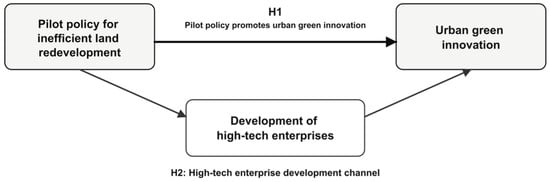
The pilot policy on the redevelopment of inefficient land may promote urban green innovation by alleviating land-use constraints and improving the spatial allocation of urban resources. Inefficient land occupies valuable urban space [5], while regulatory delays and the spatial heterogeneity of redevelopment may prevent such land from being converted to more productive uses [7]. By revitalizing underutilized parcels and reorganizing the existing land stock, the pilot policy can release development space and improve the matching of land resources with urban development needs. Studies of brownfield redevelopment, industrial land development, and urban renewal have further highlighted the implications of land redevelopment for resource-use efficiency and urban sustainability [9,13]. More efficient spatial organization can facilitate the concentration and mobility of innovation factors, reduce the spatial constraints faced by research and development activities, and provide more favorable conditions for the generation and application of green technologies. Accordingly, this study proposes the following hypothesis:
H1.
The pilot policy on the redevelopment of inefficient land promotes urban green innovation.
A further channel may operate through the development of high-tech enterprises. The redevelopment of inefficient land can reshape industrial space and facilitate the reallocation of land resources toward technology-intensive activities [10]. By increasing the availability of industrial space and improving its spatial organization, policy implementation may create more favorable conditions for the entry, expansion, and agglomeration of high-tech enterprises. Related research suggests that the provision and spatial organization of industrial zones may facilitate agglomeration [18], while the spatial sorting and selection of economic actors further affect the geographic distribution of productive activities [19]. Recent evidence on industry agglomeration indicates that knowledge spillovers have become increasingly important in shaping agglomeration patterns [31]. Technological knowledge spillovers are also geographically localized, meaning that spatial proximity can facilitate the diffusion and application of knowledge [32]. Because high-tech enterprises are closely associated with research and development, skilled labor, and knowledge-intensive activities, their development may strengthen the urban innovation base and provide technological support for green innovation. On this basis, this study proposes the following hypothesis:
H2.
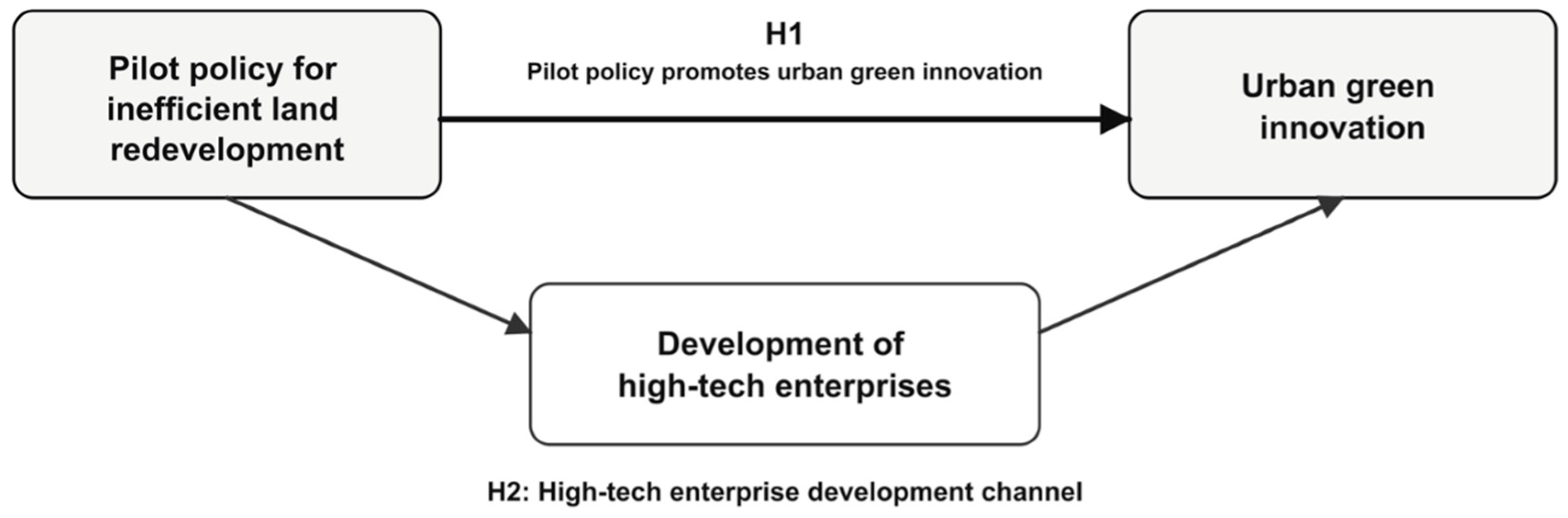
Figure 1 summarizes the theoretical framework and the hypotheses developed above. It presents the proposed direct effect of the pilot policy on urban green innovation (H1) and the potential channel through which the policy may promote green innovation by fostering the development of high-tech enterprises (H2).The pilot policy promotes urban green innovation by fostering the development of high-tech enterprises.
Figure 1.
Research framework.
3. Data and Methods
3.1. Data
3.1.1. Pilot Policy on the Redevelopment of Inefficient Land
This study constructs a quasi-natural experiment based on the Guiding Opinions on Carrying Out Pilot Programs for the Redevelopment of Inefficient Urban Land, issued by China in 2013. The policy designated ten provinces—including Zhejiang, Jiangxi, and Shaanxi—as pilot regions to explore effective approaches to the redevelopment of inefficient land. Accordingly, cities located in these pilot provinces are defined as the treatment group, while the remaining cities serve as the control group. This treatment assignment therefore captures cities’ exposure to the pilot policy. It does not measure the actual amount or intensity of inefficient land redevelopment in individual cities. The policy treatment begins in 2014, one year after the policy was announced.
3.1.2. Urban Green Innovation
This study measures urban green innovation (GInno) using the number of green invention patents at the city level. Patent data capture the intensity of innovative activity from an output perspective and are widely used as a proxy for innovation at both the firm and regional levels. An additional advantage of patent data is their strong comparability across time and space, making them well suited for panel data analysis. Specifically, we obtain data on the annual number of green invention patents granted in each city from the China Research Data Service Platform (CNRDS) [33].
3.1.3. Control Variables and Study Period
Following previous studies [34,35], this study controls for a set of city-level characteristics, including the level of economic development (GDP), foreign direct investment (FDI), population size (POP), environmental regulation (ENR), and infrastructure (ROAD). These variables capture key aspects of urban development conditions and the institutional environment, both of which are important determinants of green innovation, and are therefore included as controls. The data for these variables are obtained from the China Stock Market & Accounting Research Database (CSMAR).
The study period spans from 2009 to 2023, and descriptive statistics are reported in Table 1. The starting year is set to 2009 to mitigate potential biases arising from the 2008 Global Financial Crisis, which had a significant and heterogeneous impact on urban economic activity, and may otherwise violate the parallel trends assumption. The end year is primarily determined by data availability in the most recent editions of the urban statistical yearbooks in China.
Table 1.
Descriptive statistics.
3.2. Methods
This study integrates a Difference-in-Differences (DID) framework with a Causal Random Forests (CRF) approach to evaluate the average and heterogeneous effects of exposure to the pilot policy for inefficient land redevelopment. The DID model is well suited for estimating the average effect of the policy shock and the baseline specification is given by the following:
where indexes cities and indexes years. The dependent variable denotes the level of green innovation in city at time . is a binary indicator equal to one if the city is located in a pilot province and zero otherwise, while is a post-policy indicator equal to one for years from 2014 onward and zero otherwise. represents a vector of city-level control variables, and and denote city and year fixed effects, respectively. The coefficient captures the average effect of the policy on green innovation. The error term reflects unobserved determinants of urban green innovation.
To assess the validity of the identification strategy, we conduct a parallel trends test using the following event study specification:
where denotes event time relative to the policy implementation. If the coefficients for are statistically indistinguishable from zero, this provides evidence in support of the parallel trends assumption. To address potential multicollinearity, the period is omitted and used as the reference period.
Building on the DID framework, we further introduce a CRF model, specified as follows:
where is the treatment indicator, equal to one if a city is exposed to the policy shock and zero otherwise. The conditional average treatment effect captures the heterogeneous impact of the redevelopment policy on urban green innovation conditional on city characteristics . For details on the CRF methodology, see Wager and Athey [36]. For the mechanism analysis, the DID and event study specifications are re-estimated using the number of nationally certified high-tech enterprises and their logarithmic transformation as the dependent variables.
4. Results and Discussion
4.1. Baseline Results and Parallel Trends Test
Table 2 reports the estimation results based on the Difference-in-Differences (DID) model. Column (1) includes only the policy treatment indicator, showing a positive and statistically significant coefficient for exposure to the pilot policy. Columns (2)–(4) sequentially incorporate control variables, year fixed effects, and city fixed effects. Across all specifications, the coefficient on the key interaction term remains positive and statistically significant, indicating that exposure to the pilot policy has a positive effect on urban green innovation. Quantitatively, holding other factors constant, cities exposed to the policy experience an average increase of 29 green patents following policy implementation.
Table 2.
Baseline results.
Column (5) of Table 2 reports the results of the parallel trends test. In the three, two, and one periods prior to policy implementation, the coefficients on the key interaction terms are small in magnitude and statistically insignificant, indicating no significant differences in green innovation between pilot and non-pilot cities before the policy. This provides support for the parallel trends assumption and lends credibility to the DID estimates. In the contemporaneous period of policy implementation, the estimated coefficient remains statistically insignificant. In contrast, in the first, second, and third periods following the policy, the coefficients become positive and statistically significant. These findings suggest that the estimated effect of exposure to the pilot policy emerges with a lag and increases over subsequent periods. By the third post-policy period, holding other factors constant, the estimated effect reaches approximately 52 additional green invention patents relative to the omitted pre-policy reference period.
4.2. Estimation of Heterogeneous Treatment Effects
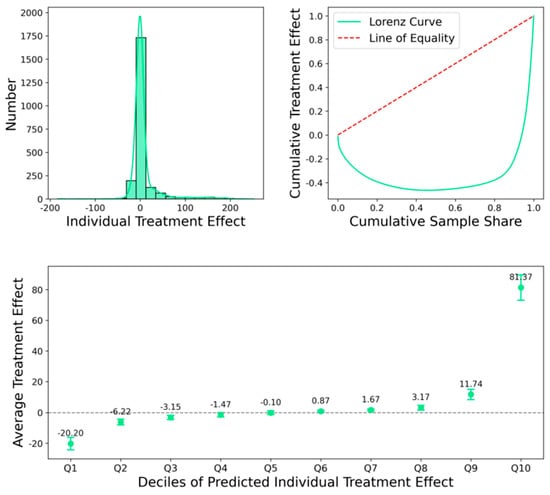
Figure 2 presents the distribution of conditional average treatment effects estimated using the Causal Random Forests (CRF) approach. The CRF results indicate that exposure to the pilot policy produces an average increase of approximately 6 green invention patents, with a 95% confidence interval ranging from 5 to 10 patents. Although the magnitude differs from the DID estimate, both methods indicate a statistically significant positive average policy effect on urban green innovation. At the same time, substantial heterogeneity is observed across cities. Most estimated treatment effects are concentrated around zero, with 45% of the sample exhibiting negative effects and 55% showing positive effects. Approximately 95% of the estimates lie within the range of −18 to 120 patents.
Figure 2.
Individual treatment effect estimates based on Causal Random Forests.
To assess whether the negative point estimates are statistically distinguishable from zero, we further sort cities into deciles according to their predicted individual treatment effects and estimate the average treatment effect and corresponding confidence interval within each decile. As shown in the lower panel of Figure 2, the estimated average effects increase monotonically from −20.20 patents in the lowest decile to 81.37 patents in the highest decile. Importantly, the average treatment effects for the bottom four deciles are statistically significantly negative, whereas the effect for the fifth decile is close to zero and statistically indistinguishable from zero. The upper deciles, by contrast, exhibit increasingly positive treatment effects. These findings imply that, although the pilot policy has a significantly positive average effect on green innovation, this average effect masks substantial heterogeneity across cities, including statistically significant negative effects in the lower part of the treatment effect distribution and particularly large positive effects in the upper tail. The right panel of Figure 2 further quantifies this heterogeneity using a Lorenz curve, revealing a Gini coefficient as high as 1.67 for the distribution of treatment effects. Because the estimates include negative values, the Gini coefficient is interpreted only as a descriptive measure of concentration. Overall, these results provide bottom–up empirical support for the use of the CRF approach, which complements the DID framework by capturing heterogeneity beyond average treatment effects.
4.3. Drivers of Heterogeneous Treatment Effects
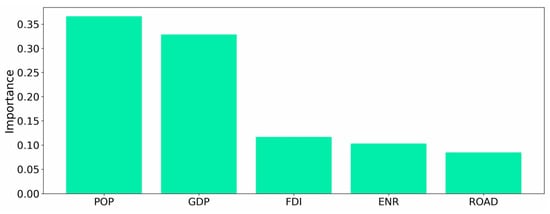
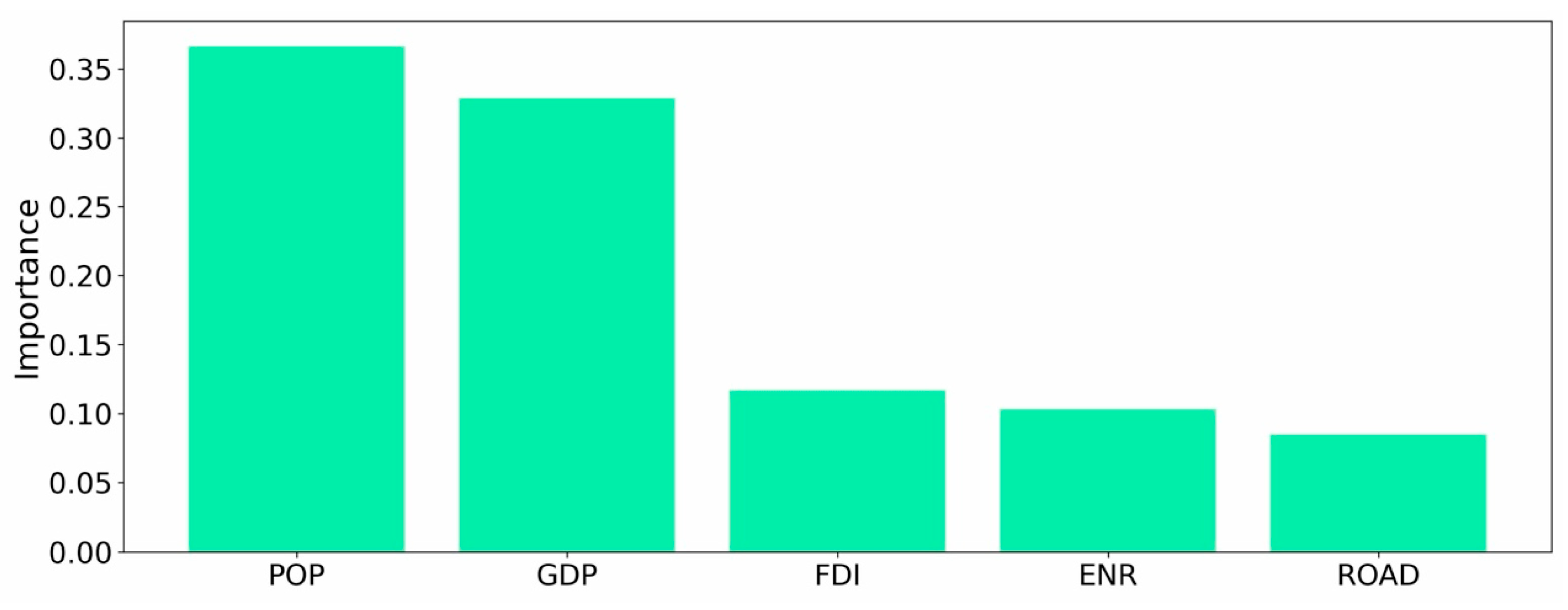
Building on the heterogeneity in policy effects documented in Section 4.2, this section examines which city characteristics are most strongly associated with variation in the estimated policy effects. Figure 3 reports the relative importance of city-level characteristics in explaining variation in the conditional average treatment effects estimated by CRF. The results indicate that population size (POP) and economic development (GDP) are among the most important determinants, whereas foreign direct investment (FDI), environmental regulation (ENR), and infrastructure (ROAD) play relatively less important roles.
Figure 3.
Relative importance of city characteristics in explaining treatment effect heterogeneity.
Cities with higher levels of economic development tend to possess more advanced industrial systems and innovation networks, which may enable them to translate spatial restructuring into increased R&D investment and patent output. Larger cities, characterized by stronger factor agglomeration and knowledge spillovers, may therefore be better positioned to amplify the positive effects of exposure to the pilot policy on green innovation. The relatively low importance of FDI, environmental regulation, and infrastructure suggests that these variables contribute less to explaining variation in the estimated treatment effects within the sample; it does not imply that they are unimportant for urban development or green innovation.
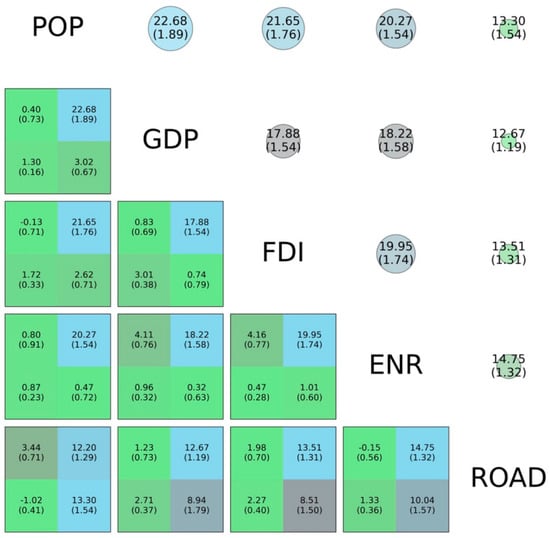
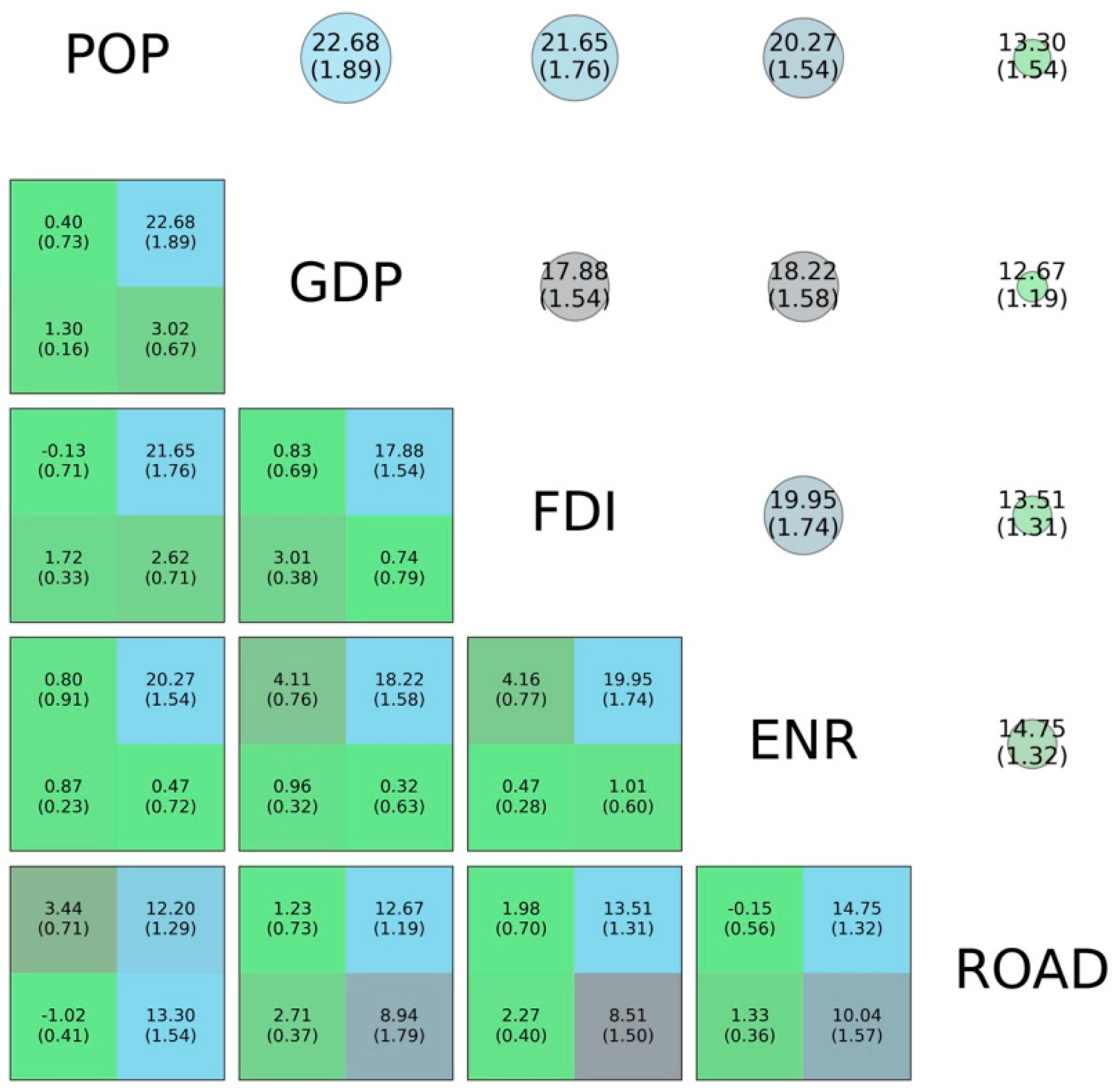
Building on the analysis of individual feature importance, Figure 4 further examines how different combinations of city characteristics shape the impact of the pilot policy on green innovation. The largest estimated effect among the combinations shown is observed for cities with high population size and high economic development, under which cities experience an average increase of 23 green patents. Such cities typically possess well-established innovation ecosystems, where policy implementation may not only improve land-use efficiency, but also strengthen interactions among innovation factors through spatial restructuring and industrial upgrading.
Figure 4.
Joint heterogeneity in estimated policy effects across city characteristics. Note: In each 2 × 2 subgroup panel, Low and High are ordered from left to right and from bottom to top. Continuous city characteristics are divided into “Low” and “High” groups using quantile-based classification at the sample median, while binary characteristics retain their original 0/1 classification and are relabeled as Low/High. For each pair of characteristics, the four cells correspond to the Low–Low, Low–High, High–Low, and High–High joint subgroups. The value in each cell is the mean estimated individual treatment effect for that subgroup.
Similarly, combinations of high population size with strong FDI inflows and high population size with stringent environmental regulation are associated with substantial estimated policy gains, with average increases of 22 and 20 green patents, respectively. Interestingly, although FDI and environmental regulation are not individually important predictors, their combination produces a sizable policy effect, with an average increase of 20 green patents. This may be because, under stringent environmental regulation, foreign investment is more likely to be technology-intensive and environmentally oriented. In such contexts, land redevelopment further enhances the technological advantages and innovation potential of foreign-invested firms through spatial and resource reallocation, ultimately leading to greater green innovation outputs.
4.4. Mechanism Analysis: Development of Nationally Certified High-Tech Enterprises
The theoretical analysis suggests that the pilot policy may promote urban green innovation by facilitating the development of high-tech enterprises. To examine this potential channel, this study replaces the dependent variable in the baseline DID model with the annual number of nationally certified high-tech enterprises in each city. The same control variables, year fixed effects, and city fixed effects as in the baseline specification are retained.
Table 3 reports the estimation results. Column (1) shows that cities exposed to the pilot policy experienced a significant increase in the number of nationally certified high-tech enterprises. The event study results in Column (2) support the parallel trends assumption and indicate that the policy effect emerges and strengthens following policy implementation. Column (3) further shows that the coefficient remains positive and statistically significant when the logarithmically transformed measure is used, indicating that the result is robust to the logarithmic transformation of the dependent variable. Taken together, these findings are consistent with H2 and are consistent with the proposed mechanism in which the pilot policy may create more favorable spatial conditions for technology-intensive activities and promote the development of nationally certified high-tech enterprises, providing a potential channel through which the policy supports urban green innovation.
Table 3.
Mechanism analysis results.
4.5. Discussion
This study exploits the 2013 pilot policy on the redevelopment of inefficient land as a quasi-natural experiment to systematically evaluate its impact on urban green innovation. The DID results indicate that exposure to the pilot policy significantly increases the number of green invention patents at the city level, and this finding remains robust across alternative model specifications. The parallel trends test further supports the validity of the causal identification. From a dynamic perspective, the policy effect exhibits a lagged response and strengthens over time. By further incorporating the CRF approach to estimate conditional treatment effects, we document substantial heterogeneity in policy impacts across cities. Negative effects are largely concentrated around zero, whereas positive effects display a pronounced right-skewed distribution, indicating considerable variation in the estimated effects across cities. The feature importance analysis reveals that population size and economic development play dominant roles in explaining the variation in policy effects, while foreign direct investment, environmental regulation, and infrastructure exhibit relatively low standalone importance. However, under certain combinations, strong FDI and stringent environmental regulation are associated with relatively large estimated policy effects. The mechanism analysis further shows that the pilot policy promotes the development of nationally certified high-tech enterprises, providing evidence consistent with the proposed channel. Overall, the pilot policy has a positive average effect on urban green innovation, but the realization of policy gains critically depends on city-specific development conditions and institutional environments.
This study first enriches the literature on the determinants of urban green innovation by introducing a land policy perspective. Existing research on green innovation has primarily focused on factors such as environmental regulation [37], financial support [38], and industrial restructuring [39], paying limited attention to stock-based land governance as a fundamental policy instrument. As a key instrument of urban renewal in China, the pilot policy may improve the spatial allocation of land resources and support the development of high-tech enterprises. Our findings demonstrate that exposure to the policy significantly promotes urban green innovation. By incorporating land use into the analytical framework of green innovation, this study addresses a gap in the policy dimension of the existing literature and provides new empirical evidence on high-tech enterprise development as a potential channel supporting green innovation in the context of high-quality development.
Second, this study uncovers substantial heterogeneity in the effects of the redevelopment policy for inefficient land at the city level. In contrast to studies that focus solely on average treatment effects, our analysis leverages the CRF approach and shows that the policy effects vary substantially across cities. Negative effects are largely concentrated around zero, whereas positive effects are widely dispersed, with some cities experiencing substantial policy gains. Because these are point estimates, their signs do not establish whether city-specific effects are statistically distinguishable from zero. This distributional pattern suggests that the magnitude of policy gains varies across cities, with larger estimated gains observed in cities with stronger development foundations. This finding not only deepens our understanding of the effects of land redevelopment policies, but also provides a representative empirical case for the study of policy heterogeneity.
Third, this study systematically investigates the sources of heterogeneity in the effects of the redevelopment policy for inefficient land from the perspective of city characteristics and their combinations. The results show that population size and economic development play dominant roles in explaining variation in policy effects, whereas factors such as foreign direct investment, environmental regulation, and infrastructure exhibit limited explanatory power when considered individually. However, when these characteristics interact in specific combinations, the policy effects are significantly amplified. These findings suggest that the effectiveness of land redevelopment depends on the overall configuration of city attributes, including scale, development fundamentals, and factor endowments. More broadly, this study highlights the importance of moving beyond single-dimension analyses toward a multi-dimensional perspective that accounts for interactions among urban characteristics in understanding policy heterogeneity [40,41]. It also provides useful guidance for future research to adopt more flexible approaches in capturing complex cross-city differences.
Despite providing a systematic evaluation of how exposure to the pilot policy affects urban green innovation, this study leaves room for further extension. Due to data availability constraints, we use city-level green patent counts as a proxy for innovation output. The treatment variable measures exposure to the provincial pilot policy and does not capture the actual extent or intensity of inefficient land redevelopment in each city. In addition, while this study focuses on the overall effects and heterogeneity of the policy, it does not distinguish between different modes of inefficient land redevelopment. Future studies could adopt a more disaggregated approach by comparing the impacts of alternative governance or implementation models.
5. Conclusions and Policy Implication
This study exploits the pilot policy on the redevelopment of inefficient land as a quasi-natural experiment to systematically evaluate its impact on urban green innovation. The results show that the policy significantly increases the number of green invention patents at the city level. The event study results indicate that the policy effect emerges with a lag and strengthens over subsequent periods. The CRF estimates further reveal substantial heterogeneity across cities, with variation in the estimated policy effects closely associated with population size, economic development, and the configuration of related city characteristics. The mechanism analysis indicates that the pilot policy promotes the development of high-tech enterprises, providing evidence consistent with the proposed high-tech enterprise development channel.
This study yields several policy implications. First, the potential to stimulate green innovation should be incorporated into the planning and evaluation of policies promoting the redevelopment of inefficient land. Local governments may coordinate the identification and redevelopment of inefficient land with the spatial needs of technology-intensive activities and evaluate policy performance in terms of land-use efficiency, high-tech enterprise development, and green innovation. At the project level, land-use arrangements and redevelopment plans can be aligned with the spatial requirements of technology-intensive enterprises to improve the allocation of existing urban land resources. Second, policymakers should explicitly account for heterogeneity in urban development stages and resource endowments when implementing redevelopment policies. For cities with large populations and strong economic foundations, the redevelopment of inefficient land can support green innovation by improving the spatial allocation of land resources toward high-tech activities. For cities with weaker development foundations, redevelopment policies should be implemented in stages and coordinated with measures that strengthen local innovation capacity. Policy design should therefore allow differentiated implementation schedules and supporting measures across cities. Third, in attracting foreign direct investment, policymakers may coordinate land-use conditions and environmental standards to guide foreign capital toward technology-intensive and environmentally oriented activities. This can help avoid extensive expansion patterns and foster more sustainable urban growth. Several limitations should be acknowledged. The treatment variable measures exposure to the provincial pilot policy and does not capture the actual extent or intensity of inefficient land redevelopment in each city. Moreover, the city-level data do not directly trace the reallocation of individual land parcels to high-tech enterprises or identify the complete mediation process. Future research could combine parcel-level redevelopment information with firm-level innovation data and compare the effects of different redevelopment and governance models.
Author Contributions
Conceptualization, Y.S., D.W., J.Z. and W.Z.; methodology, Z.L.; validation, J.Z.; formal analysis, Y.S., D.W. and Z.L.; resources, Y.S., D.W. and J.Z.; writing—original draft preparation, Y.S., D.W. and J.Z.; writing—review and editing, Z.L. and W.Z.; supervision, Y.S. and D.W.; funding acquisition, Y.S. and D.W. All authors have read and agreed to the published version of the manuscript.
Funding
This work was supported by the project of Power China Huadong Engineering Co., Ltd. (NO. KY2024-JZ-04-01).
Data Availability Statement
The data sources used in this study are described in the manuscript. Further information and data are available from the corresponding author upon reasonable request.
Conflicts of Interest
The authors declare that this study received funding from Powerchina Huadong Engineering. The funder was not involved in the study design, collection, analysis, interpretation of data, the writing of this article or the decision to submit it for publication.
Abbreviations
The following abbreviations are used in this manuscript:
| DID | Difference-in-Differences |
| CRF | Causal Random Forests |
References
- Liu, L.; Wu, Y.; Shi, K. Urban ascent with sustainable human development: Extensive cultivated land conservation and urban population capacity growth supported by hillside urban expansion. Appl. Geogr. 2025, 185, 103775. [Google Scholar] [CrossRef] [Scilit]
- Sgambati, S.; Gargiulo, C. The evolution of urban competitiveness studies over the past 30 years. A bibliometric analysis. Cities 2022, 128, 103811. [Google Scholar] [CrossRef] [Scilit]
- Xu, S.; Ren, Y.; Ke, Q.; Zong, S. Effect and driving mechanisms of urban renewal on urban heat island mitigation in Beijing. J. Environ. Manag. 2025, 393, 126911. [Google Scholar] [CrossRef] [Scilit]
- Hou, Y.; Chen, X.; Liu, Y.; Xu, D. Association between UGS patterns and residents’ health status: A report on residents’ health in China’s old industrial areas. Environ. Res. 2023, 239, 117199. [Google Scholar] [CrossRef] [Scilit]
- Lin, C.; Huang, Y.; Liu, Y.; Li, G.; Zhou, Z.; Zhong, Y.; Wang, H.; Li, J. Identifying underutilized land by eXplainable artificial intelligence and geographic similarity ensemble model with limited samples. Habitat Int. 2025, 163, 103503. [Google Scholar] [CrossRef] [Scilit]
- Franco, S.F.; Waxman, A.R. Surface parking lots in downtown areas and the role of regulatory delay in optimal dynamic land use. Reg. Sci. Urban Econ. 2026, 118, 104203. [Google Scholar] [CrossRef] [Scilit]
- Cao, K.; Deng, Y.; Wang, W.; Liu, S. The spatial heterogeneity and dynamics of land redevelopment: Evidence from 287 Chinese cities. Land Use Policy 2023, 132, 106760. [Google Scholar] [CrossRef] [Scilit]
- Li, C.; Wan, J.; Xu, Z.; Lin, T. Impacts of green innovation, institutional constraints and their interactions on high-quality economic development across china. Sustainability 2021, 13, 5277. [Google Scholar] [CrossRef] [Scilit]
- He, D.; Zainol, R.; Shahida Azali, N. Navigating challenges in the sustainable development of urban brownfields: A PLS path modeling perspective. Ain Shams Eng. J. 2024, 15, 103002. [Google Scholar] [CrossRef] [Scilit]
- Su, B.; Shen, X.; Wang, Q.; Zhang, Q.; Niu, J.; Yin, Q.; Chen, Y.; Zhou, S. The Evolution and Performance Response of Industrial Land Use Development in China’s Development Zone: The Case of Suzhou Industrial Park. Land 2024, 13, 2182. [Google Scholar] [CrossRef] [Scilit]
- Wang, Y.Z.; Duan, X.J.; Wang, L.; Zou, H.; Yang, Q.K. Spatial and Temporal Differentiation and Driving Mechanism of Economic Development in the Yangtze River Economic Belt. Resour. Environ. Yangtze Basin 2020, 29, 1–12. [Google Scholar] [CrossRef]
- Langen, H.; Huber, M. How causal machine learning can leverage marketing strategies: Assessing and improving the performance of a coupon campaign. PLoS ONE 2023, 18, e0278937. [Google Scholar] [CrossRef] [Scilit]
- Lin, S.H.; Huang, X.; Fu, G.; Chen, J.T.; Zhao, X.; Li, J.H.; Tzeng, G.H. Evaluating the sustainability of urban renewal projects based on a model of hybrid multiple-attribute decision-making. Land Use Policy 2021, 108, 105570. [Google Scholar] [CrossRef] [Scilit]
- Dong, L.; Zhang, X. The practice issues of shantytowns redevelopment from the perspective of urban regeneration. Adv. Mater. Res. 2012, 1568–1571. [Google Scholar] [CrossRef] [Scilit]
- Xia, J.; Zhao, Z.; Chen, L.; Sun, Y. How urban renewal affects the sustainable development of public spaces: Trends, challenges, and opportunities. Front. Environ. Sci. 2024, 12, 1482169. [Google Scholar] [CrossRef] [Scilit]
- Pan, C.; Chen, J. The impact of land redevelopment on industrial structure upgrading in the context of urban regeneration. Land Use Policy 2026, 166, 108005. [Google Scholar] [CrossRef] [Scilit]
- Cao, K.; Deng, Y.; Song, C. Exploring the drivers of urban renewal through comparative modeling of multiple types in Shenzhen, China. Cities 2023, 137, 104294. [Google Scholar] [CrossRef] [Scilit]
- Kuchiki, A. Accelerator for Agglomeration in Sequencing Economics: “Leased” Industrial Zones. Economies 2023, 11, 295. [Google Scholar] [CrossRef] [Scilit]
- Zhang, Y.; Wang, S.; Zhou, R. Spatial sorting and selection within urban agglomerations: A tripartite evolutionary game model approach. Humanit. Soc. Sci. Commun. 2025, 12, 57. [Google Scholar] [CrossRef] [Scilit]
- Mai, M.; Zhang, D.; Ai, B.; Tang, R.; Wu, L.; Jian, Z. How can future urban renewal achieve the goals of SDG 11? A scenario analysis considering the reconnection of fragmented ecological spaces. Ecol. Indic. 2025, 179, 114202. [Google Scholar] [CrossRef] [Scilit]
- Sun, C.; Xu, Z. Does the regional environmental supervision policy halt pollution? Evidence from the exit of high-pollution enterprises in China. Environ. Impact Assess. Rev. 2025, 112, 107836. [Google Scholar] [CrossRef] [Scilit]
- Chen, C.; Luo, Y.; Zou, H.; Huang, J. Understanding the driving factors and finding the pathway to mitigating carbon emissions in China’s Yangtze River Delta region. Energy 2023, 278, 127897. [Google Scholar] [CrossRef] [Scilit]
- Fan, Y.; Shi, L. The role of government fiscal incentives in green technological innovation: A nonlinear analytical framework. Int. Rev. Econ. Financ. 2025, 103, 104529. [Google Scholar] [CrossRef] [Scilit]
- Wen, J.; Zhou, Y. Trade openness and urban green innovation: A dual perspective based on financial agglomeration and human capital accumulation. Sustain. Futures 2025, 9, 100478. [Google Scholar] [CrossRef] [Scilit]
- Li, L.; Li, M.; Ma, S.; Zheng, Y.; Pan, C. Does the construction of innovative cities promote urban green innovation? J. Environ. Manag. 2022, 318, 115605. [Google Scholar] [CrossRef] [Scilit]
- Fan, X.; Wang, Z.; Wu, S.; Li, K. Environmental investment and green innovation in polluting enterprises: Evidence from heavily polluting listed firms in China. J. Environ. Manag. 2025, 393, 127177. [Google Scholar] [CrossRef] [Scilit]
- Lei, H.; Gao, R.; Ning, C.; Sun, G. Green finance and corporate green innovation. Financ. Res. Lett. 2025, 72, 106577. [Google Scholar] [CrossRef] [Scilit]
- Liu, L.; Meng, Y.; Razzaq, A.; Yang, X.; Ge, W.; Xu, Y.; Ran, Q. Can new energy demonstration city policy reduce carbon emissions? A quasi-natural experiment from China. Environ. Sci. Pollut. Res. 2023, 30, 51861–51874. [Google Scholar] [CrossRef] [Scilit]
- Tang, L.; Yu, H.; Huang, Y.; Ruan, J.; Qin, Z.; Wang, S. The synergistic impacts of green finance and the digital economy on urban low-carbon transition: Insights from 293 Chinese cities. Energy Policy 2026, 208, 114928. [Google Scholar] [CrossRef] [Scilit]
- Yan, W.; Chen, Y.; Wang, Y. Efficiency improvement effect of clean energy transformation—A quasi-natural experiment based on China’s clean heating policy. Energy 2025, 334, 137798. [Google Scholar] [CrossRef] [Scilit]
- Steijn, M.P.A.; Koster, H.R.A.; Van Oort, F.G. The dynamics of industry agglomeration: Evidence from 44 years of coagglomeration patterns. J. Urban Econ. 2022, 130, 103456. [Google Scholar] [CrossRef] [Scilit]
- Keller, W. Geographic Localization of International Technology Diffusion. Am. Econ. Rev. 2002, 92, 120–142. [Google Scholar] [CrossRef] [Scilit]
- Li, Y.; Liu, T.; Wang, Z. Do ESG-conscious fund managers drive green innovation? An LLM-based textual analysis of fund manager narratives. Res. Int. Bus. Financ. 2025, 77, 102983. [Google Scholar] [CrossRef] [Scilit]
- Chen, J.; Huang, J. The impacts of community grants on green innovation. Innov. Green Dev. 2025, 4, 100253. [Google Scholar] [CrossRef] [Scilit]
- Huang, Y.; Wang, Y. How does high-speed railway affect green innovation efficiency? A perspective of innovation factor mobility. J. Clean. Prod. 2020, 265, 121623. [Google Scholar] [CrossRef] [Scilit]
- Wager, S.; Athey, S. Estimation and Inference of Heterogeneous Treatment Effects using Random Forests. J. Am. Stat. Assoc. 2018, 113, 1228–1242. [Google Scholar] [CrossRef] [Scilit]
- Yang, C.; Hu, Z. Data element resource supply and enterprise green innovation quality. Int. Rev. Financ. Anal. 2025, 109, 104839. [Google Scholar] [CrossRef] [Scilit]
- Liu, M.; Yaacob, M.H.; Ma, Q.; Ding, S. Green Finance and Corporate Green Innovation: A Systematic Literature Review. Sage Open 2025, 15. [Google Scholar] [CrossRef] [Scilit]
- Zhou, X.; Yu, Y.; Yang, F.; Shi, Q. Spatial-temporal heterogeneity of green innovation in China. J. Clean. Prod. 2021, 282, 124464. [Google Scholar] [CrossRef] [Scilit]
- Weng, S.; Benkraiem, R.; Nghiem, X.H.; Zhao, X.; Xu, J. Market tools for achieving carbon unlocking: Is China’s energy-consumption trading policy effective? J. Environ. Manag. 2025, 389, 126162. [Google Scholar] [CrossRef] [Scilit]
- Shao, J. How does local context matter? Assessing the heterogeneous impact of electric vehicle incentive policies in China. J. Clean. Prod. 2024, 464, 142770. [Google Scholar] [CrossRef] [Scilit]

Disclaimer/Publisher’s Note: The statements, opinions and data contained in all publications are solely those of the individual author(s) and contributor(s) and not of MDPI and/or the editor(s). MDPI and/or the editor(s) disclaim responsibility for any injury to people or property resulting from any ideas, methods, instructions or products referred to in the content. |
© 2026 by the authors. Licensee MDPI, Basel, Switzerland. This article is an open access article distributed under the terms and conditions of the Creative Commons Attribution (CC BY) license.