


Abstract
Uniform legal requirements for written farmland-rental contracts do not necessarily produce uniform contracting practices. This study examines how policy-tool design, transaction heterogeneity, and institutional access jointly structure written-contract adoption in rural China. We coded 101 provincial policy documents across 27 provincial-level regions, of which 69 documents contributed to the baseline policy stock as of 31 December 2021, and analyzed 7237 farmland-transfer transactions using fixed-effects models, common-support restrictions, overlap weighting, and entropy balancing. General contract norms were more extensively operationalized than differentiated risk-governance tools (mean scores, 1.673 vs. 1.309), a pattern observed in 19 of 27 regions. Written-contract adoption was higher among professional agricultural operators and in larger transactions, whereas the positive unadjusted difference for non-local operators reversed after covariate adjustment. Transactions reporting a village-level organization or intermediary channel had an adjusted adoption rate 16.05 percentage points higher than other transactions; estimates remained positive under more local fixed effects and weighting, although magnitude and precision varied across channel configurations and target populations. These findings indicate that contractual formalization is associated with both transaction-specific demand for safeguards and practical access to formal institutions. Effective governance should therefore combine accessible general contracting procedures with tiered risk safeguards and organizational services, while avoiding causal claims from the observational estimates.
1. Introduction
Farmland rental markets have become an important mechanism for reallocating land in smallholder-based economies undergoing population growth, rural labor migration, and structural transformation. By separating land use from land ownership, rental transactions allow labor-constrained households to release land while enabling more capable producers to expand cultivation. Their effects extend beyond allocative efficiency: the terms under which land is transferred shape investment incentives, the security of contracting parties, and the distribution of transaction risks [1,2,3]. Written contracts are commonly expected to support these functions by identifying the land and the parties, specifying duration and payment, and recording obligations and remedies. In practice, however, written leases coexist with oral, seasonal, kin-based, and other relational arrangements. The central puzzle is therefore not whether formal contracting rules exist, but why written-contract adoption remains uneven under a broadly uniform legal framework.
The literature offers two partly competing views of this puzzle. A formalization perspective emphasizes that documented and registrable rights can reduce ambiguity, support enforcement, and strengthen incentives to invest or transact [4,5]. A more critical perspective argues that legal documentation is neither costless nor self-enforcing. Formal rules may coexist with customary authority, local norms, and relational enforcement, and their practical value depends on the cost of using institutions and on the credibility of implementation [6,7]. Evidence from Ghana, West Africa, and Rwanda likewise shows that the consequences of land-rights formalization vary with local political authority, the security already supplied by existing institutions, and the design of the intervention [8,9,10]. These findings caution against treating a written-contract requirement as a sufficient explanation for actual contract use. They instead direct attention to the content of policy instruments, the characteristics of particular transactions, and the institutional channels through which parties obtain contracting services.
China provides a useful setting in which to examine these three dimensions. Rural land is collectively owned and allocated through household contracts, while farm households may transfer land management rights without transferring collective ownership. Successive reforms have strengthened documentary rights and expanded land-rental markets, but their effects on market participation, transaction composition, and efficiency have not been uniform [11,12,13,14,15]. At the national level, the Measures for the Administration of the Transfer of Rural Land Management Rights establish a common framework for written contracts, filing, model contract content, service provision, and risk governance. Article 17 generally requires a written contract and filing with the collective party, while exempting cultivation-on-behalf arrangements lasting no more than one year [16]. Yet this common legal architecture governs transactions involving highly heterogeneous actors, scales, social relations, and organizational arrangements. Uniform national rules can therefore coexist with substantial variation in whether parties actually adopt written contracts.
Existing research has not fully explained this coexistence because three relevant literatures remain only weakly integrated. Research on formalization usually focuses on titling, registration, or aggregate policy activity rather than on the composition of policy tools used to operationalize general contracting procedures and transaction-specific safeguards. Studies of contract choice examine transaction attributes, social relations, or organizational intervention, but often treat them as separate explanations. Policy-text studies and transaction-level studies also tend to operate at different analytical levels without being brought to bear on the same problem. This study consequently asks how provincial policy-tool architecture, transaction-specific demand for formal safeguards, and access to organized contracting channels jointly illuminate variation in written-contract adoption in China’s farmland rental market.
To answer this question, we combine a coded corpus of 101 provincial policy documents covering 27 provincial-level regions with 7237 farmland-transfer transactions from the China Farmland Rent Survey [17]. The study makes three contributions. First, it distinguishes general contract norms from differentiated risk-governance tools, shifting attention from the volume of policy activity to the substantive policy mix. Second, it examines operator type, transaction scale, operator origin, and organized channels within a common transaction-level framework. Third, it connects policy supply, transaction-specific demand, and institutional access while preserving the distinction between provincial and transaction-level evidence. The results show that general contract norms are more extensively operationalized than differentiated risk governance, that written contracts are more common among professional agricultural operators and in larger transactions, and that transactions reporting village-level organization or intermediary channels have higher adjusted adoption rates. Because the policy and transaction evidence operate at different levels and the transaction data are observational, these findings are interpreted as complementary institutional patterns and adjusted associations, not as direct causal effects of provincial policy scores on individual contracting decisions.
2. Literature Review
2.1. Formalization, Land Rights, and Contractual Governance
Formalization is commonly justified as a response to uncertainty in land relations. Clear and documented rights can identify legitimate claimants, define the object and duration of a transfer, support third-party verification, and provide evidence for enforcement. In this view, formal rights can lower the expected cost of exchange and increase the returns to investment by making future claims more predictable [4,5]. International evidence nevertheless shows that the relationship is conditional. In Ghana, the security of land rights and the returns to investment were linked to local political power rather than to documentation alone [8]. Evidence from West Africa indicates that tenure arrangements can affect investment differently across institutional settings [9], while land tenure regularization in Rwanda produced effects that depended on intervention design and household position [10]. Formalization should therefore be understood as an institutional process whose consequences depend on implementation and context, rather than as an automatic conversion of legal form into secure and productive land relations.
This conditional view is consistent with transaction-cost and social-embeddedness theories. Transaction-cost economics treats contractual form as a governance response to uncertainty, asset specificity, monitoring problems, and the hazards of adaptation or breach [18]. A written contract may reduce some of these hazards, but preparing, verifying, filing, and enforcing it also incurs costs. Social-embeddedness theory adds that exchange is situated within networks of trust, reputation, and repeated interaction [19]. Relational mechanisms can be a substitute for formal documentation in some settings, complement it in others, or reproduce asymmetries that documentation alone cannot correct. Accordingly, the coexistence of written and oral arrangements need not reflect a simple transition from an inferior informal system to a superior formal one. It may instead reflect heterogeneous trade-offs between the anticipated value of explicit safeguards and the cost of accessing them.
A further implication is that contractual governance should not be represented by a single indicator of legal formality. Policy-instrument research emphasizes that instruments structure relations among public authorities, implementing organizations, and target groups, and that their design affects both what governments seek to accomplish and how policy is experienced in practice [20,21]. Applied to farmland rental, a written-contract mandate forms only one element of a broader policy mix that may also include model contracts, filing registers, transaction platforms, eligibility reviews, price services, payment safeguards, risk monitoring, exit procedures, and dispute resolution. Recent international reviews similarly conclude that land-governance interventions depend on implementation quality, institutional fit, and complementary governance arrangements rather than on legal recognition alone [22,23]. This study therefore distinguishes general contract norms, which create widely applicable procedures and services, from differentiated risk governance, which targets risks associated with particular actors, scales, durations, or performance conditions. The distinction captures policy composition without assuming that either family of tools is uniformly implemented or equally effective.
2.2. Transaction Heterogeneity and Contract Choice
If written contracting has both benefits and costs, its adoption should vary with the expected value of formal safeguards. Transactions involving higher rents, larger investments, longer commitments, or greater uncertainty create more exposure to loss and more issues that may require explicit allocation. The benefits of specifying boundaries, duration, payment, permitted uses, breach, and exit should rise with this exposure. Conversely, parties to low-value, short-duration, or recurrent transactions may regard standardized documentation as costly relative to the protection it supplies. This logic treats written-contract adoption as a differentiated governance choice rather than a mechanical consequence of commercialization [18,19].
Operator type and transaction scale are therefore central sources of heterogeneity. Professional agricultural operators, defined here as family farms, agricultural enterprises, farmers’ cooperatives, and village collective organizations, often make larger and more specialized investments than smallholder farmers. They may also face financing, accounting, and internal-governance requirements that increase the value of verifiable documentation. Larger transfers expose parties to greater aggregate rent and investment risk, although the marginal effect of additional area may diminish once the main fixed costs of formal contracting have been incurred. Chinese evidence supports the broader importance of tenure-security perceptions and trust for land-rental participation [24], and shows that contract duration, rental payments, bargaining costs, location specificity, and uncertainty over future breach are jointly implicated in contract design [25,26]. These findings suggest that transaction attributes should be evaluated together rather than read from unadjusted group differences.
Operator origin provides a further source of contractual heterogeneity. Non-local operators generally have weaker access to reputation-based enforcement, repeated interaction, and locally embedded dispute-resolution mechanisms. Written terms may therefore be more valuable when relational safeguards are less readily available. Chinese research shows that social relations and public intervention affect observed rental arrangements [27], while transactions within acquaintance networks can shape land consolidation and market outcomes [28]. Non-local entry is nevertheless selective because such operators may be concentrated in larger, commercially mediated, or organizationally supported transactions. Operator type, transaction scale, and channel involvement must therefore be controlled when evaluating this relationship. Subject to these adjustments, weaker access to relational enforcement generates the ex ante expectation that transactions involving non-local operators will exhibit higher written-contract adoption than transactions involving local operators.
2.3. Organizational Channels and Institutional Access
Formal rights are useful only when actors can mobilize the institutions that give those rights practical effect. The theory of access distinguishes legal rights from the broader ability to derive benefits through information, knowledge, authority, social identity, and organizational relations [29]. In farmland rental markets, this distinction directs attention to the fixed procedural costs between a legal rule and an executed contract. Parties may need help locating partners, verifying rights, valuing land, negotiating terms, preparing documents, obtaining signatures, filing records, or responding to disputes. When these functions are difficult to perform privately, village-level organizations, land transfer service centers, property-rights exchanges, and other intermediaries can serve as channels of institutional access.
Chinese studies provide evidence that such channels matter, but also show that organizational involvement is not homogeneous. Local public action is associated with greater marketization and formalization of agricultural rentals [30]. Village committees may operate as intermediaries that facilitate matching and contracting, or as regulators exercising stronger control over circulation, with different implications for transaction outcomes [31]. Land Transfer Service Centers can move transactions toward fixed terms, monetary rents, and more market-oriented forms, but their effects vary across village conditions and operator groups [32]. These studies shift the analytical focus from the existence of rules to the organizational arrangements through which parties encounter and use them.
The same evidence also cautions against treating any public or intermediary involvement as a uniform treatment. An organized channel may only provide information while private negotiation remains decisive; it may assist with documentation after the parties agree; or it may structure partner matching, price formation, contract terms, and filing from the outset. These configurations differ in intensity and may serve different populations. Moreover, organizational assistance can reduce procedural costs while also introducing brokerage power, administrative priorities, or unequal access. Existing studies usually identify whether public or intermediary actors were involved, but less often separate their coexistence with private negotiation from transactions organized primarily through village-level or intermediary channels. Distinguishing channel configurations is therefore necessary to determine where the aggregate association between organized access and written-contract adoption is concentrated.
2.4. Research Gaps and Analytical Contribution
Despite these advances, three gaps remain. First, existing research usually represents formalization through legal status, titling, registration, written-contract use, or aggregate policy activity. It pays less attention to the composition of the instruments through which general contracting procedures and transaction-specific risks are operationalized. Second, studies of farmland contracting commonly examine transaction attributes, social relations, or organizational intervention separately. They consequently provide limited insight into how policy supply, transaction-specific demand for safeguards, and institutional access jointly structure written-contract adoption. Third, policy-text studies and transaction-level studies generally operate in separate empirical literatures. Few studies combine systematic provincial policy coding with large-sample transaction evidence while explicitly distinguishing the analytical levels represented by the two data sources.
This study addresses these gaps in three corresponding ways. It disaggregates provincial policy content into general contract norms and differentiated risk-governance tools; it examines transaction heterogeneity and organized-channel access within a common empirical framework; and it brings provincial policy texts together with 7237 observed farmland-transfer transactions. This integration is analytical rather than a claim that the two datasets identify a single causal pathway. The provincial corpus describes how formal rules are operationalized, whereas the transaction data reveal which observed transactions use written contracts and how adoption covaries with actors, scale, origin, and channels. Their joint use permits a more complete account of contractual formalization while maintaining a clear boundary between policy-level description and transaction-level association. On this basis, the study develops five testable hypotheses concerning policy-tool architecture, transaction heterogeneity, and institutional access. To maintain a clear distinction between literature synthesis and empirical specification, these hypotheses are formally stated in Section 3.2.
3. Materials and Methods
3.1. Research Design and Analytical Strategy
This study combined a structured inventory of provincial policy texts with transaction-level analysis. The policy-text component measured how provincial documents supplemented and operationalized national rules through general contract norms and differentiated risk-governance tools. The transaction-level component examined how operator type, transferred area, operator origin, and reported transfer channels were associated with written-contract adoption. The two components therefore described the supply of formal rules and their use in observed transactions from complementary analytical perspectives.
The empirical framework distinguished three dimensions. Policy-tool architecture referred to the relative operationalization of general contract norms and differentiated risk governance. Demand for formal contracting was represented by operator type, transaction scale, and operator origin. Institutional access was represented by whether a transaction was reported as being organized by a village committee or conducted through an intermediary. Because the policy and transaction data differed in analytical level and timing, provincial policy indices were not entered directly into the transaction-level regressions.
The transaction data were generated through non-probability sampling, and organized channels were not randomly assigned. All regression and weighting estimates were consequently interpreted as sample-based, adjusted associations. Overlap-population and treated-population labels identify the statistical target populations of the weighting procedures; they do not, by themselves, establish causal effects. Weighting was adjusted only for observed covariates and could not eliminate bias from unmeasured or jointly determined transaction characteristics.
3.2. Analytical Framework and Hypotheses
The analytical framework conceptualizes contractual formalization through three distinct but connected dimensions: policy supply, transaction-specific demand, and institutional access. Policy supply refers to the instruments through which provincial authorities operationalize the national framework for farmland contracting. Transaction-specific demand captures variation in the expected value of written safeguards across operator types, transaction scales, and operator origins. Institutional access concerns the organizational channels through which transacting parties obtain information, verify rights, negotiate terms, prepare documentation, and complete filing procedures. These dimensions are examined at their corresponding analytical levels. The policy-tool hypothesis is evaluated using the provincial policy corpus, whereas the transaction and channel hypotheses are evaluated using transaction-level data. Provincial policy indices are therefore not interpreted as direct causal determinants of individual transactions.
General contract norms—including written-contract requirements, model contracts, filing procedures, transaction platforms, and basic information services—can be standardized and applied across a broad range of transactions. Differentiated risk-governance instruments require more transaction-specific information concerning operator eligibility, scale, duration, payment capacity, performance risk, and exit conditions. Because differentiated instruments impose greater informational and administrative demands, provincial authorities are expected to operationalize general contract norms more extensively.
H1.
Within the coded provincial policy corpus, general contract norms are operationalized more extensively than differentiated risk-governance instruments.
Transaction-cost reasoning suggests that the expected value of written safeguards varies with the characteristics of the transaction. Professional agricultural operators typically make larger asset-specific investments and face more extensive financing, accounting, and internal-governance requirements than smallholder farmers. Larger transfers also involve greater aggregate rent, investment exposure, and contractual complexity. Non-local operators may have weaker access to reputation-based enforcement and repeated interaction, increasing the expected value of explicit written terms. These expectations yield three transaction-level hypotheses:
H2a.
Transactions involving professional agricultural operators are more likely to adopt written contracts than transactions involving smallholder farmers.
H2b.
Transferred area is positively associated with written-contract adoption.
H2c.
Transactions involving non-local operators are more likely to adopt written contracts than transactions involving local operators.
Finally, formal rules can be costly to use when parties must independently locate transaction partners, verify land rights, negotiate terms, prepare documents, and complete filing procedures. Village-level organizations and intermediaries may reduce these informational, procedural, and coordination costs and thereby facilitate access to formal contracting institutions. This reasoning leads to the institutional-access hypothesis:
H3.
Transactions reported as involving a village-level organization or intermediary channel are more likely to adopt written contracts than transactions without such an organized channel.
The hypotheses specify directional empirical expectations rather than causal effects. The transaction-level analyses evaluate adjusted associations because organized-channel participation, operator type, transaction scale, and operator origin were not randomly assigned.
3.3. Data Sources and Sample Construction
3.3.1. Transaction-Level Data
Transaction-level data were obtained from the publicly released China Farmland Rent Survey database [17], archived on Zenodo as the Spatiotemporal Dataset of Farmland Rent 2021–2025 (https://doi.org/10.5281/zenodo.17161815). The public release contains seven survey waves from summer 2022 to summer 2025. The analytical file includes 7237 valid transactions from 27 provincial-level regions and 191 cities; the accompanying data article reports coverage of 422 county-level areas. Each record represents a separate transaction for a specific land-use type.
The survey recruited university students to collect information in their home regions during summer and winter vacations. Village officials, cooperative representatives, community contacts, and other local informants assisted in identifying eligible transferred parcels. Inclusion probabilities cannot be reconstructed from this recruitment process, so the data do not support design-based national estimates. Multiple records may correspond to the same operator when different land-use types were transferred, but the public release does not contain a stable operator identifier. The transaction, rather than the operator or household, was therefore the unit of analysis, and the data were not treated as an operator-level panel.
3.3.2. Provincial Policy Corpus
Policy collection initially produced a list of 203 national and provincial documents, of which 165 were provincial documents. Documents were eligible when they were issued by a provincial-level authority, directly addressed contracts for transfers of rural land management rights, filing or record keeping, transaction services, or risk governance, and had verifiable full text, issuing authority, date, and version or validity status. National documents, exact duplicates, general agricultural-management documents without relevant provisions, and materials whose source or version could not be verified were excluded from provincial scoring.
After duplicate, scope, and version review, the corpus contained 101 provincial documents and 678 nonzero clause-level evidence records. The baseline policy stock was defined as the documents contributing to the provincial policy structure as of 31 December 2021, before the transaction survey waves analyzed here. This baseline contained 69 documents and 460 nonzero evidence records. Documents issued from 2022 to 2025 were retained for corpus auditing and temporal-sensitivity records but were not used to explain the baseline policy architecture.
The official existence of the 2006 Guizhou notice and the titles of its four contract templates were confirmed. Because the full text was unavailable, no substantive clause was reconstructed and no additional policy-tool score was inferred from inaccessible content. Following an independent re-coding audit and source-based adjudication, the original 27-province coding matrix was retained as the final scoring matrix because no province-by-tool score required revision. All policy scores reported in the analysis were therefore taken from this verified coding workbook.
3.3.3. Temporal Alignment and Analytical Levels
The policy baseline preceded the seven transaction survey waves. This temporal ordering avoided using policies issued after a transaction to characterize the policy stock preceding that transaction period. The policy-text analysis used the province as its unit of analysis, whereas the microeconometric models used the individual transaction. Because there were only 27 provincial observations and the two data sources measured different levels of the institutional process, the study did not estimate a direct province-score-to-transaction-outcome model. The two evidence streams were integrated interpretively rather than through an ecological regression.
3.4. Policy-Text Coding and Index Construction
3.4.1. Policy-Tool Framework
The coding framework comprised 12 policy tools grouped into three functional families: rule constraints, service support, and risk governance. Under the baseline classification, R1–R3 and S1–S3 formed the general contract-norm index, whereas R4–R5, S4, and G1–G3 formed the differentiated risk-governance index. Table 1 presents the operational definition and index allocation of each tool.
Table 1.
Policy tools, operational definitions, and index classification.
Each tool was scored as 0 when no qualifying provincial supplementary provision was identified, 1 when a document stated a general or aspirational requirement without specifying an implementing actor, procedure, threshold, time limit, or institutional vehicle, and 2 when at least one such operational element was specified. Let be index provinces, policy tools, and documents. The document-level score was defined as follows:
When more than one eligible document existed for a province, the province-level score for a tool was the maximum document-level score:
Document counts were not accumulated into higher scores. A score of zero therefore means only that no qualifying provincial supplementary provision was identified in the included corpus; it does not imply that national rules or relevant local practices were absent. The scores measure the degree of textual operationalization, not policy intensity, implementation quality, enforcement, or governance performance.
3.4.2. Provincial Policy Indices
Let denote the six general contract-norm tools and the six differentiated risk-governance tools. Equal-weight provincial indices were calculated as follows:
The within-province policy-structure difference was then defined as follows:
Positive values indicate that general contract norms were more strongly operationalized than differentiated risk governance in the coded texts; zero denotes equal index values; and negative values indicate a higher differentiated-governance index. Equal weighting and the equal spacing of the 0–1–2 categories are analytical choices. Alternative classifications therefore reassigned boundary tools and excluded platform or information-service tools to assess whether the comparison depended on one coding boundary. Every nonzero assignment retained a traceable link to an identifiable document and source clause.
3.4.3. Independent Re-Coding and Inter-Coder Reliability
To assess the reliability of the provincial policy coding, a second coder independently re-coded all 324 province-by-tool units, comprising 27 provincial-level regions and 12 policy tools, without access to the initial scores. The audited units included 135 rule-constraint units, 108 service-support units, and 81 risk-governance units. Agreement was evaluated before adjudication using the exact agreement rate and linearly weighted Cohen’s kappa, reflecting the ordinal nature of the 0–1–2 scoring scale. Confidence intervals for the weighted kappa statistics were estimated using a province-clustered bootstrap with 10,000 replications. After the pre-adjudication reliability statistics had been calculated, all disagreements were reviewed against the original official policy documents, verifiable source clauses, and the predefined coding manual. The evidence-supported adjudicated score corresponded to the original score in every disputed unit; consequently, no original policy-tool score was revised. The original coding workbook was preserved unchanged, while the second coder’s pre-adjudication scores and the adjudication log were retained separately for auditability. Category-specific reliability statistics are reported in Table S8.
3.5. Measures
3.5.1. Written-Contract Adoption
The outcome was a binary indicator of written-contract adoption:
Of the 7237 transactions, 2532 used a written contract, corresponding to an un-weighted sample rate of 34.99%. The measure captures contractual form only; it does not evaluate clause completeness, contractual quality, enforcement, or subsequent performance. For a group g, the raw adoption rate was calculated as follows:
3.5.2. Transaction Characteristics
Operator type was coded into five mutually exclusive categories: smallholder farmer (code 1), family farm (code 2), agricultural enterprise (code 3), farmers’ cooperative (code 4), and village collective organization (code 5). Smallholder farmer served as the reference category. In the prespecified heterogeneity analyses, professional agricultural operators comprised codes 2–5. Transferred area was measured in mu, where 1 mu is approximately 0.0667 ha. To allow a nonlinear association without imposing arbitrary area bands in the main models, area entered as its natural logarithm and squared logarithm:
Here, A_i is the transferred area of transaction i. Operator origin was coded one for a non-local operator and zero for a local operator. Land-use type distinguished paddy fields, irrigated farmland, and rainfed farmland. The models also controlled for the seven survey waves.
3.5.3. Organized Channel and Channel Combinations
Throughout the manuscript, “village collective organization” denotes an operator-type category, whereas “village-level organization” denotes a transaction channel or service provider. The latter includes transactions reported as being organized by a village committee. The focal channel indicator equaled one when the respondent reported that the transaction was organized by a village committee or conducted through an intermediary:
This definition identified 1958 organized-channel transactions. Because the survey allowed multiple transfer modes, a separate exploratory classification distinguished four mutually exclusive configurations: private negotiation only (n = 5262); private negotiation combined with a village or intermediary channel (n = 696); village-level organization without reported private negotiation (n = 1082); and an intermediary without reported private negotiation (n = 180). Sixteen sublease-only transactions and one other-mode transaction could not be assigned to these four configurations. These 17 observations were excluded only from the four-category analysis, giving N = 7220, and remained in the main N = 7237 models.
3.5.4. Missing Duration Information
Transfer duration was observed for 5538 transactions and missing for 1699; all 1699 missing values occurred among transactions without a written contract. Written-contract adoption itself was fully observed for all 7237 transactions. A conventional outcome-selection model would therefore not match the missing-data structure. Moreover, duration may be documented as part of contractual formalization or jointly determined with channel use, so conditioning on it in the main model could constitute overadjustment. Duration was consequently excluded from the main adjustment set and examined through complete-duration, longer-than-one-year, and extreme-assignment analyses.
3.6. Statistical Analysis
3.6.1. Provincial Policy-Structure Comparison
For each province, d_p = G_p − D_p. The paired-sample t statistic was as follows:
where is the mean within-province difference and s_d its sample standard deviation. Because the indices are bounded and the number of provinces is limited, the paired t-test was accompanied by a Wilcoxon signed-rank test. The analysis also reported the numbers of provinces with positive, zero, and negative differences. Sensitivity tests changed the assignment of boundary tools and removed platform or information-service tools.
3.6.2. Transaction-Level Linear Probability Models
The primary transaction models were linear probability models (LPMs). The binary outcome was multiplied by 100 so that coefficients were directly interpretable as percentage-point differences. The full specification was as follows:
where denotes the vector of operator-type indicators, indicates a non-local operator, is the organized-channel indicator, and , , and denote province, survey-wave, and land-use-type fixed effects, respectively. The transaction-heterogeneity specification excludes , whereas the full channel specification includes it. Alternative specifications replace the province fixed effect with county fixed effects , county-by-wave fixed effects , or simultaneous county and survey-cluster fixed effects and , respectively.
A survey cluster was defined by survey wave × province × anonymous enumerator identifier, yielding 532 clusters. Unless otherwise stated, LPM standard errors were clustered simultaneously by county and survey cluster following the multiway-clustering approach [33,34]:
3.6.3. Logit Functional-Form Check
A logit model with the same substantive covariates and province, wave, and land-use-type fixed effects was estimated as a functional-form check:
Because logit coefficients are not directly comparable with LPM percentage-point coefficients, the organized-channel association was reported as a discrete average marginal effect:
The logit covariance matrix was clustered by county.
3.6.4. Adjusted Predictions by Transaction Scale
Adjusted probabilities by operator type and transaction scale were obtained through regression standardization. For operator category k and area, a, operator type and area were set to k and a for every observation, while the observed distributions of all other covariates were retained:
Pointwise standard errors were calculated from the two-way clustered covariance matrix:
The prediction grid covered 0.5 to 500 mu on a logarithmic scale. Pointwise 95% confidence intervals were calculated as the estimate plus or minus 1.96 standard errors.
3.6.5. Channel-Combination Model
The four-category channel analysis used private negotiation only as the reference configuration:
The model included operator type, nonlinear area terms, operator origin, land-use type, and survey-wave fixed effects, together with either province or county fixed effects. Pairwise coefficient comparisons were evaluated with Wald tests:
Because the questionnaire did not record channel timing or the specific services provided by organizations, the four-category results were interpreted as exploratory comparisons of reported transaction pathways.
3.7. Selection Adjustment, Common Support, and Sensitivity Analyses
3.7.1. Propensity-Score and Doubly Robust Estimation
Organized-channel participation was not randomly assigned. A binomial logit model estimated the probability of reporting an organized channel:
The propensity model included operator-type indicators, log area and its square, non-local status, and province, survey-wave, and land-use-type indicators. Thirty-three transactions with estimated propensity scores below 0.001 were excluded from the weighting analyses, leaving 7204 transactions. No observation in the retained sample had a propensity score above the corresponding upper boundary.
As a doubly robust complement, augmented inverse-probability weighting (AIPW) combined the same propensity-score specification with separate linear outcome regressions for organized- and non-organized-channel transactions [35]. On the retained common-support sample, the estimator targeted the average treatment effect associated with the two reported channel conditions:
Here, denotes organized-channel participation, denotes written-contract adoption, is the estimated propensity score, and is the exposure-specific outcome regression. The AIPW estimate targets the common-support ATE, which differs from the ATO targeted by overlap weighting and the organized-channel ATT targeted by entropy balancing. None of these estimates was interpreted as a fully identified causal effect.
3.7.2. Overlap Weighting
Overlap weights emphasized transactions with substantial probability of being observed under either channel condition [36,37]. Their bounded 0–1 form continuously downweights transactions with extreme propensity scores and targets the average treatment effect for the overlap population. The weights were as follows:
Organized-channel transactions were weighted by and comparison transactions by . The resulting estimand describes the population with the greatest covariate overlap between the two reported channel conditions.
3.7.3. Entropy Balancing
Entropy balancing provided a second adjustment targeted to the covariate distribution of organized-channel transactions [38,39]. Organized-channel transactions received unit weight. Weights for comparison transactions were obtained by solving the following:
subject to the normalization constraint:
and first-moment balance for each encoded covariate j:
Exact linear dependencies among encoded covariates were removed before solving the dual optimization problem. The control weights were normalized to sum to the number of organized-channel transactions. Overlap- and entropy-weighted outcome models retained the main covariates and fixed effects and used county and survey-cluster multiway-clustered standard errors. Because propensity and balancing weights are estimated rather than known, supplementary inference used 999 county-cluster bootstrap resamples. The propensity model, exposure-specific outcome models, overlap weights, and entropy-balancing weights were re-estimated in every replicate [40].
3.7.4. Balance Diagnostics
Covariate balance was assessed with standardized mean differences (SMDs) for every continuous term and encoded category:
Weighted means were used in the numerator after weighting, while the pooled unweighted within-group standard deviation was retained as the denominator. Effective sample size was calculated as follows:
Balance diagnostics were reported for all encoded covariates rather than only the continuous area terms. Propensity-score distributions were also examined to assess empirical overlap.
3.7.5. Sensitivity and Heterogeneity Analyses
Sensitivity analyses excluded transactions involving subleases, restricted the sample to transactions reporting private negotiation, compared organized pathways without private negotiation with private negotiation only, restricted the sample to contracts lasting more than one year, and excluded observations above 500 mu, corresponding approximately to the largest 1% of transferred areas. Alternative scale models replaced the continuous nonlinear area terms with area groups.
Common-support analyses were additionally restricted to the 157 counties in which both organized and non-organized channel observations occurred (6069 transactions) and to the 194 survey clusters contained within-cluster channel variation (5037 transactions). Prespecified heterogeneity models jointly created an interaction between the two organized-channel pathways, coexisting with private negotiation and occurring without private negotiation, with professional agricultural-operator status or an indicator for areas of at least 50 mu. All interaction estimates were accompanied by 95% confidence intervals. Because overlap weighting and entropy balancing target different populations, their point estimates were not mechanically ranked.
Sensitivity to unmeasured confounding was evaluated for the core linear probability model using the partial- omitted-variable-bias framework. We reported the partial of the organized-channel coefficient, the robustness value required to reduce the point estimate to zero, and the robustness value required to move its two-sided -value above 0.05. For a statistic and residual degrees of freedom , the partial was calculated as . Robustness values were benchmarked against the joint operator-type indicators, the two transferred-area terms, and non-local operator status, while retaining the fixed effects and cluster-robust inference structure of the core model [41].
Duration sensitivity analyses first cross-tabulated duration-observation status against written-contract adoption. The organized-channel model was then estimated in the complete-duration sample, with and without adjustment for duration longer than one year, and in the observed longer-than-one-year subsample. Extreme-assignment analyses classified all missing durations, in turn, as no longer than one year and as longer than one year. Duration remained excluded from the core adjustment set.
3.7.6. Alternative Inference and Exploratory Multilevel Models
The public dataset contains county, prefecture-level city, and province identifiers but no village or township identifiers. County clustering is coarser than village- or township-level clustering and permits arbitrary dependence among transactions within the same county. In addition to the primary county-by-survey-cluster multiway covariance, we estimated city-clustered and province-clustered standard errors. Because only 27 provincial clusters were available, province-level inference was supplemented by a restricted wild-cluster bootstrap using 9999 null-imposed Rademacher draws [42].
Exploratory random-intercept logistic models nested transactions within provinces:
The analysis first estimated an empty model and a model containing transaction-level covariates. The standardized general contract-norm index, differentiated risk-governance index, and their difference were then introduced in separate specifications. Separate entry was used because the two policy indices were strongly correlated ( = 0.825), the general index was concentrated near its upper bound, and only 27 provincial-level units were available. These models were interpreted as exploratory cross-level associations rather than policy effects.
3.8. Ethics, Reproducibility, and Use of Generative AI
3.8.1. Ethics
This study used a publicly available, de-identified secondary dataset and involved no new recruitment of, or direct contact with, human participants. The original survey protocol and associated data-sharing plan were approved by the Ethics Committee of the Center for Land Policy and Law, China Agricultural University (approval No. 20250701) [17]. Explicit electronic informed consent for participation and the public release of de-identified data was obtained from all respondents. The present study did not attempt to re-identify participants or link the released geographic information to external individual-level records.
3.8.2. Software and Reproducibility
All statistical analyses were conducted using Stata/MP 17.0 and Python 3.8.19. The Python analyses used pandas 2.0.3, NumPy 1.24.4, SciPy 1.10.1, statsmodels 0.14.1, and patsy 1.0.1. The transaction-level data are publicly archived on Zenodo at https://doi.org/10.5281/zenodo.17161815 (accessed on 21 August 2026). The original data were retained unchanged, and all analytical variables were generated in separate processed datasets. The provincial policy-coding workbook, processed analytical datasets, figure source data, and replication files are publicly available on Zenodo at https://doi.org/10.5281/zenodo.22030058 (accessed on 21 August 2026).
3.8.3. Use of Generative Artificial Intelligence
No generative artificial intelligence was used in this study.
4. Results
4.1. Sample Characteristics and Provincial Policy Architecture
4.1.1. Sample Characteristics
The analytical sample comprised 7237 farmland-transfer transactions. Written contracts were reported for 2532 transactions, corresponding to an overall adoption rate of 34.99%. Non-local operators accounted for 15.6% of transactions; 27.1% reported a village or intermediary organized channel, and 13.1% involved at least 50 mu. Among the 5538 transactions with observed duration, 91.5% lasted longer than one year. Transaction-level characteristics and the two province-level policy indices are summarized in Table 2.
Table 2.
Descriptive statistics.
4.1.2. Provincial Policy Architecture
The baseline policy stock contained 69 documents and 460 nonzero, traceable clause-level items dated no later than 31 December 2021. Across the 27 sampled provincial-level regions, the mean general contract-norm index was 1.673, compared with 1.309 for differentiated risk governance. The paired mean difference was 0.364. General norms scored higher in 19 provinces, the two indices were equal in seven, and differentiated governance scored higher in one province (Figure 1). Province-specific scores are reported in Table S3. A zero score indicates that no qualifying supplementary provision was identified in the included corpus; it does not establish the absence of all regulation in that province.
Figure 1.
Provincial policy architecture: general contract norms and differentiated risk governance.
The within-province difference was statistically distinguishable from zero in both the paired t-test (t = 5.469, p < 0.001) and the Wilcoxon signed-rank test (p < 0.001). The result did not depend on a single classification rule. Reassigning price and rent governance, using the more restrictive core classification, or excluding platform and information-service tools produced mean differences of 0.321–0.326; the paired tests remained significant in every case (Table S2). Information, authentication, and transaction services were among the most extensively operationalized tools, whereas performance and rent guarantees, enhanced oversight of long-duration or large-area transfers, and risk-monitoring and exit arrangements were less fully specified. Thus, H1 was supported within the scope of the coded policy corpus.
Before adjudication, the two coders reached exact agreement on 87.037% of the 324 province-by-tool scores, with a linearly weighted Cohen’s kappa of 0.835 (95% CI: 0.789–0.881), indicating a high degree of agreement beyond chance. Among the 42 disagreements, 33 involved adjacent scores of 1 and 2, while nine involved scores of 0 and 1; no disagreements between scores of 0 and 2 were recorded. Each disagreement was subsequently reviewed against the original official policy document, the identifiable source clause, and the predefined coding rule. The evidence-supported adjudicated score matched the original score in all 42 cases. Accordingly, no policy-tool score was revised, and the policy indices and province rankings reported above remained unchanged. Category-specific reliability results are presented in Table S8.
4.2. Transaction Heterogeneity and Written-Contract Adoption
4.2.1. Unadjusted Adoption Gradients
Written-contract adoption differed sharply across the five operator categories. The adoption rate was 26.83% for transactions classified as smallholder farmer, compared with 73.19% for family farm, 80.77% for agricultural enterprise, 91.97% for farmers’ cooperative, and 83.33% for village collective organization. Adoption increased from 21.86% for transactions below 10 mu to 48.37% for 10–49.9 mu, 72.04% for 50–99.9 mu, and 85.98% for at least 100 mu. The difference between the smallest and largest area groups was 64.12 percentage points (Figure 2b,c). Complete counts and unadjusted rates by operator type, area, operator origin, land type, and survey wave are reported in Table S1.
Figure 2.
Written-contract adoption by transaction scale. (a) Adjusted probability of written-contract adoption by transferred area and operator type; (b) number of transactions across transferred-area groups; (c) raw written-contract adoption rates across transferred-area groups. Note: Shaded bands and error bars indicate 95% confidence intervals.
The model-adjusted curves retained both dimensions of this gradient (Figure 2a). In any displayed area, predicted adoption was lowest for smallholder farmers and higher for the four categories comprising professional agricultural operators. Within every operator category, predicted adoption rose as transferred area increased, although the curves flattened in larger areas. These curves summarize conditional associations from the specified model and should not be interpreted as the causal effect of expanding transaction size.
4.2.2. Adjusted Transaction-Level Differences
The full linear-probability models confirmed that the unadjusted operator gradient persisted after adjustment (Table 3). Relative to the smallholder farmer category, the specification including the organized-channel indicator estimated differences of 20.56 percentage points for family farms, 31.38 for agricultural enterprises, 29.67 for farmers’ cooperatives, and 25.67 for village collective organizations. The corresponding coefficients were 5–8 percentage points larger when the organized-channel indicator was omitted, showing that channel composition accounted for part, but not all, of the operator-type differences.
Table 3.
Full linear-probability models.
The coefficient in the log transferred area was 10.29 percentage points (SE = 2.77, p < 0.01) in the full model. Its squared term was negative (−0.53) but not statistically significant, consistent with a strong overall positive scale gradient and only limited evidence of additional curvature after all controls were included. Non-local operators had a higher unadjusted adoption rate than local operators (47.35% vs. 32.69%; Table S1), but the adjusted coefficient was negative (−10.28 percentage points, SE = 4.55, p < 0.05). The raw non-local advantage therefore did not persist after adjustment for operator type, scale, channel, and fixed effects. Taken together, the results supported H2a and H2b but did not support H2c.
4.3. Organized Channels and Channel Configurations
4.3.1. Core Organized-Channel Association
Among the 1958 transactions reporting a village or intermediary organized channel, 56.44% used a written contract, compared with 27.03% among the remaining transactions. The unadjusted difference was 29.40 percentage points. After operator type, nonlinear area terms, operator origin, and province, survey-wave, and land-type fixed effects were included, the estimated difference declined to 16.05 percentage points (SE = 5.23, p < 0.01; Table 3). The reduction from the unadjusted estimate indicates that observed transaction composition explained a substantial share of the raw channel gap, while a positive conditional association remained.
The estimate was also positive under progressively more restrictive spatial and fieldwork controls (Table 4). It was 11.43 percentage points with county fixed effects, 12.95 with county-by-wave fixed effects, and 12.44 when county and survey-cluster fixed effects were included jointly. The point estimates therefore remained within an 11–13 percentage-point range after comparisons were narrowed to transactions sharing increasingly local institutional and survey contexts. These results were consistent with H3, while retaining an associational interpretation.
Table 4.
Fixed-effect sensitivity.
4.3.2. Channel Configurations
The four mutually exclusive channel configurations displayed a clear unadjusted ordering (Figure 3a). Written-contract adoption was 26.93% for private negotiation only (n = 5262), 39.66% when private negotiation coexisted with a village or intermediary channel (n = 696), 61.37% for village-organized transactions without reported private negotiation (n = 1082), and 91.67% for intermediary transactions without reported private negotiation (n = 180). Seventeen transactions that could not be assigned to these four configurations were excluded only from this analysis, yielding N = 7220.
Figure 3.
Written-contract adoption across transfer-channel configurations. (a) Raw adoption rates for four channel configurations; (b) province- and county-fixed-effect-adjusted differences relative to private negotiation only. Note: Points represent estimates, and horizontal bars indicate 95% confidence intervals.
Adjustment changed the contrast between mere channel coexistence and transactions formed without reported private negotiation (Figure 3b; Table 5). Relative to private negotiation only, the coexisting-channel coefficient was 5.46 percentage points in the province-fixed-effect model and 5.81 in the county-fixed-effect model; both confidence intervals included zero. By contrast, village organization without reported private negotiation was associated with differences of 20.64 and 13.06 percentage points, and intermediary use without private negotiation with differences of 25.72 and 22.52 percentage points. The data did not establish a stable ranking between the village and intermediary configurations, but they showed that the positive organized-channel association was concentrated in transactions without reported private negotiation. Because the survey did not record the timing or content of channel involvement, these configurations identify observed pathways rather than intervention sequences.
Table 5.
Channel combinations.
4.4. Robustness, Common Support, and Covariate Balance
4.4.1. Alternative Models and Samples
The positive organized-channel coefficient was reproduced across the main functional-form, sample, fixed-effect, and weighting checks (Figure 4; Table 6). The core estimate was 16.05 percentage points (95% CI: 5.76, 26.33), and the logit discrete average marginal effect was 16.09 points (95% CI: 6.71, 25.47). Excluding subleases produced an estimate of 16.30 points; restricting the sample to transactions lasting longer than one year produced 13.38 points; and excluding the largest 1% of transferred areas produced 16.08 points. Estimates based on within-county and within-survey-cluster variation were 10.94 and 12.30 points, respectively, with both confidence intervals remaining above zero.
Figure 4.
Robustness of the organized-channel association. (a) Estimated organized-channel coefficients across alternative specifications; (b) corresponding estimates, 95% confidence intervals, sample sizes, and R2 values. Note: AIPW denotes augmented inverse-probability weighting. ATE, ATO, and ATT denote the average treatment effect, the average treatment effect for the overlap population, and the average treatment effect on organized-channel transactions, respectively. Confidence intervals for AIPW, overlap weighting, and entropy balancing were obtained from county-cluster bootstrap resamples with the corresponding first-stage models and weights re-estimated in each replicate.
Table 6.
Robustness and common-support estimates.
The pathway-specific restrictions were more informative about where precision was lost. Within the private-negotiation sample, the coexisting organized-channel coefficient declined to 4.96 percentage points and its confidence interval crossed zero. Comparing organized pathways without private negotiation against private negotiation only produced a larger estimate of 21.63 points (95% CI: 11.41, 31.86). Overlap weighting yielded an ATO of 15.78 percentage points (95% county-cluster-bootstrap CI: 7.37, 28.06; 999 valid replicates). Entropy balancing yielded an ATT of 11.21 points (0.53, 26.79; 979 valid replicates). Twenty entropy-balancing bootstrap samples did not converge because of numerical rank or balance constraints and were retained in the audit record rather than silently replaced. The weighted estimates pointed in the same direction, but their different target populations and precision preclude a mechanical ranking.
On the common-support sample, AIPW yielded an ATE of 20.46 percentage points (95% county-cluster-bootstrap CI: 12.35, 33.75). The positive estimate was directionally consistent with the overlap-weighted and entropy-balanced estimates. Because the three procedures target different populations, their magnitudes should not be ranked mechanically (Figure 4; Table 6 and Table S6).
4.4.2. Common Support and Balance Diagnostics
The propensity-score restriction excluded 33 transactions from provinces without usable channel overlap and retained 7204 of 7237 transactions (99.5%). In the retained sample, propensity scores ranged from 0.0015 to 0.9780, with overlapping distributions for the private and organized-channel groups across a substantial portion of the support (Figure 5b). The overlap-weighted effective sample size was 3894, while the effective sample size among entropy-balanced controls was 608, accounting for the lower precision of the entropy-balanced estimate.
Figure 5.
Covariate balance and common support. (a) Standardized mean differences before and after overlap weighting and entropy balancing; (b) propensity-score distributions for private- and organized-channel transactions. Note: Dashed lines indicate the ±0.10 balance threshold.
Before weighting, the maximum absolute standardized mean difference across all encoded balancing covariates was 0.880. Both overlap weighting and entropy balancing reduced the maximum absolute imbalance to below 0.001 (Figure 5a). The balance diagnostics therefore showed that the two procedures removed observed mean differences in the specified covariates. They did not, however, test balance on unobserved characteristics or convert the organized-channel coefficient into a fully identified causal effect.
4.4.3. Missing Duration, Unmeasured Confounding, and Alternative Inference
The organized-channel coefficient had a partial of 2.19% with written-contract adoption after the included covariates and fixed effects were partialled out. An unobserved confounder explaining 13.89% of the residual variation in both organized-channel participation and written-contract adoption would be required to reduce the point estimate to zero. The corresponding robustness value for loss of statistical significance at the 5% level was 5.22% (Table S4). The joint operator-type block explained 20.47% of residual channel variation and 6.54% of residual outcome variation. It therefore exceeded the statistical-significance benchmark on both dimensions but did not reach the point-null benchmark on the outcome dimension. These results indicate that the estimate is not immune to a strong omitted confounder and support retaining an associational interpretation.
The missingness analysis confirmed that duration, rather than written-contract adoption, was incomplete. All 1699 missing duration values occurred among the 4705 transactions without written contracts, whereas duration was observed for all 2532 written-contract transactions (Table S5). Across the complete-duration sample, the observed longer-than-one-year sample, and the two extreme assignments, the organized-channel estimates ranged from 13.38 to 16.05 percentage points. All corresponding 95% confidence intervals remained above zero, although the lower estimates in the duration-restricted samples indicate modest sensitivity to sample composition.
Alternative geographic inference produced the same point estimate of 16.05 percentage points. With city clustering, the 95% confidence interval was 5.93 to 26.16 points (192 clusters; p = 0.0020); with province clustering, it was 3.81 to 28.28 points (27 clusters; asymptotic p = 0.0121). The province-level restricted wild-cluster bootstrap yielded p = 0.0005 based on 9999 draws (Table S6). In the exploratory multilevel analysis, the empty-model provincial ICC was 0.263. After transaction-level adjustment, none of the separately entered standardized policy measures was estimated precisely. The log-odds coefficient was −0.180 (95% CI: −0.938, 0.577) for the general contract-norm index, −0.130 (−0.847, 0.586) for the differentiated risk-governance index, and −0.091 (−0.506, 0.325) for their difference (Table S7), given the bounded policy indices and the sample of only 27 provinces.
4.5. Prespecified Interaction Analyses
4.5.1. Operator Status and Transaction Scale
The prespecified interaction tests did not provide clear evidence that the organized-channel association varied systematically by professional agricultural-operator status or transaction scale (Table 7). For organized pathways without private negotiation, the interaction was −2.62 percentage points for professional operators (95% CI: −17.42, 12.18) and −0.97 points for transactions of at least 50 mu (95% CI: −16.26, 14.32). For channels coexisting with private negotiation, the corresponding interactions were −0.38 points (95% CI: −27.81, 27.05) and 17.87 points (95% CI: −11.66, 47.39). All four confidence intervals included zero. The results therefore indicate limited precision for differential associations rather than equivalence across subgroups.
Table 7.
Prespecified heterogeneity tests.
4.5.2. Summary of Empirical Patterns
Across the three analytical levels, the evidence showed a consistent pattern of differentiated written-contract adoption. Provincial policy texts more extensively operationalized general contract norms than differentiated risk-governance tools. At the transaction level, professional agricultural-operator status and larger transferred areas were associated with substantially higher adoption, while the unadjusted advantage of non-local operators reversed after adjustment. Finally, organized channels retained a positive association under alternative fixed effects, common-support restrictions, and weighting procedures, but the magnitude and precision depended on the observed channel configuration and target population. These empirical regularities form the basis for the institutional interpretation developed in the Discussion.
5. Discussion
5.1. Principal Findings and Policy-Tool Architecture
The findings show that contractual formalization is neither an automatic consequence of uniform legal rules nor a simple function of market development. Instead, it reflects the interaction between the policy instruments supplied, the safeguards demanded by heterogeneous transactions, and the organizational channels through which contracting parties access formal institutions. Three results support this interpretation. First, provincial documents operationalized general contract norms more extensively than differentiated risk-governance tools, supporting H1. Second, professional agricultural operators and larger transactions had higher adjusted rates of written-contract adoption, supporting H2a and H2b, whereas the unadjusted advantage for non-local operators reversed after adjustment and did not support H2c. Third, village-level organization or intermediary involvement remained positively associated with written-contract adoption across the main fixed-effect and weighting specifications, consistent with H3. The variation across channel configurations nevertheless indicates that organizational involvement cannot be treated as a uniform intervention.
The policy-text results identify an important asymmetry within the formal governance architecture. General contract norms can be translated into standardized instruments such as model contracts, filing procedures, identity verification, and basic information services. These instruments impose relatively limited information and coordination demands on implementing authorities. Differentiated governance is more demanding because it requires authorities or service providers to identify transaction-specific risks associated with operator type, area, duration, performance capacity, land-use obligations, and exit conditions. The predominance of general norms is therefore consistent with the lower informational and administrative demands of standardized policy instruments [20,21]. This interpretation does not imply that provinces with lower differentiated-governance scores lack all relevant regulation or implementation capacity. The indices measure the extent to which qualifying tools were operationalized in the coded policy corpus, not the total stock of local law, administrative effort, or enforcement.
This distinction also qualifies document-centered accounts of formalization. Registration, certification, and written documentation may clarify rights and facilitate market participation, but their consequences depend on the substantive rights recognized, the costs of using formal procedures, and the surrounding enforcement arrangements [4,6,7]. Evidence from China’s land-titling reforms similarly indicates that clearer documentation can increase rental participation, monetary rents, and the use of written contracts, while the magnitude and type of response vary across regions and transactions [13,14,15]. The present results extend this literature by showing that variation also exists within the policy instruments intended to translate national rules into operational governance. A province may provide a basic contractual entry point without equally detailed safeguards for long-duration, large-area, or otherwise complex transfers. Formalization should consequently be understood as a multidimensional institutional process rather than as the presence of documentation alone.
The broader comparative literature reinforces this caution. Studies from Ghana and West Africa show that tenure security and investment incentives are mediated by local authority, political power, and existing tenure arrangements [8,9]. Evidence from Rwanda demonstrates that regularization can affect investment and gendered rights, but that its outcomes remain linked to program design and baseline institutions [10]. A systematic review likewise finds heterogeneous effects of property-rights interventions across settings and outcome domains [5]. These studies do not provide direct comparisons with rural China, but they clarify why formal rules should not be expected to produce invariant behavioral responses. The Chinese evidence reported here is consistent with a conditional view of formalization in which documentation, implementation capacity, and institutional access must be considered together.
The exploratory multilevel models did not identify a precise association between any single province-level policy index and transaction-level adoption after adjustment. This result is consistent with the analytical distinction between policy architecture and transaction practice: textual provision at the provincial level is not equivalent to county-level implementation or individual institutional access. Given the limited number of provinces and the bounded distributions of the indices, the estimates should not be treated as evidence that policy-tool design is irrelevant.
5.2. Transaction Heterogeneity and the Demand for Formal Contracting
The operator and scale gradients suggest that demand for written contracts increases with the value of formal safeguards. Relative to smallholder farmers, family farms, agricultural enterprises, farmers’ cooperatives, and village collective organizations are more likely to have longer planning horizons, larger asset-specific investments, external financing or accounting requirements, and internal procedures for authorizing transactions. These characteristics can increase both exposure to contractual non-performance and the organizational capacity to process written documentation. The observed differences should therefore not be reduced to variation in legal awareness. Operator categories also capture differences in investment structure, market integration, bargaining position, and administrative capacity. In transaction-cost terms, written documentation becomes more attractive when its evidentiary and coordinating benefits outweigh the costs of negotiating, drafting, and enforcing it [18].
The positive area gradient is consistent with the same logic. Larger transfers generally place more rent, production planning, and asset-specific investment at risk. They may also require more detailed specification of boundaries, duration, rent adjustment, permitted uses, improvements, and liabilities for breach. Written contracts can therefore have greater expected value as transaction exposure increases. The flattening of the adjusted curves at larger areas suggests that this relationship is not indefinitely linear. One interpretation is that the incremental benefit of documentation diminishes once transactions have crossed a threshold at which formal contracting is already highly prevalent. This pattern accords with research that places land rental markets within a wider process of resource reallocation, farm differentiation, and structural transformation [2,3]. It remains an adjusted association, however. The analysis does not show that enlarging a transaction would itself cause the parties to adopt a written contract.
The non-local result provides an additional check on a simple substitution account of formalization. If relational distance independently generated demand for legal safeguards, the positive raw difference for non-local operators would be expected to persist after adjustment. Instead, it became negative after operator type, area, organized channel, and fixed effects were included. Much of the unadjusted difference therefore appears to reflect the concentration of non-local operators in larger, professionalized, or organizationally mediated transactions. This result does not establish that local ties discourage written contracts. Social relations can substitute for some formal safeguards, but they may also help parties identify partners, verify information, and coordinate the formation of a written agreement [19,24,27]. Research on acquaintance-based land rentals likewise suggests that relationally embedded transactions can become increasingly market-oriented rather than remaining categorically informal [28]. Because the survey does not directly measure trust, network strength, or bargaining processes, the adjusted negative coefficient should be treated as a compositional finding rather than evidence of a specific relational mechanism.
5.3. Organized Channels and Institutional Access
The organized-channel findings shift attention from the existence of formal rules to the practical conditions under which those rules can be used. A written-contract requirement has limited operational force if parties cannot readily identify a transaction partner, verify rights, interpret contract terms, prepare documentation, or complete filing procedures. Village-level organizations and intermediaries may lower these costs by matching parties, confirming land and identity information, coordinating terms, providing model texts, assisting with filing, and directing disputes toward recognized resolution channels. The positive adjusted association is therefore consistent with an institutional-access interpretation. Formal rules are more likely to be used when organizations reduce the informational, procedural, and coordination costs of entering the formal contracting system. This interpretation builds on evidence concerning local public action, village-committee intervention, land-transfer service centers, and the distinction between formal rights and effective access to institutions [29,30,31,32].
The channel-configuration results refine this interpretation. When an organized channel merely coexisted with private negotiation, the adjusted difference relative to private negotiation alone was modest and imprecisely estimated. Larger differences appeared when transactions were reported as proceeding through village organization or an intermediary without private negotiation. A binary indicator of organizational contact therefore conceals whether the organization occupied an auxiliary or more structurally important position in transaction formation. This finding is compatible with studies showing that public or intermediary involvement can alter several features of land rental, including partner matching, fixed terms, and monetary rents [30,31,32]. It also indicates that organization and relational exchange need not be mutually exclusive. Private bargaining, acquaintance networks, and formal procedures may be combined in different ways [27,28].
The results do not establish that intermediaries are inherently more effective than village organizations. The intermediary-only category was small, and its participants may differ in unobserved ways from those using other channels. The survey also does not record whether an organization entered before partner selection, during negotiation, at contract drafting, or only at filing. It cannot distinguish information provision from verification, drafting, guarantee, or dispute-resolution services. The robustness checks narrow some alternative explanations but do not remove these uncertainties. More local fixed effects restrict comparisons to similar institutional and fieldwork contexts, while overlap weighting and entropy balancing improve balance on observed covariates. Neither approach addresses unobserved expectations of dispute, local administrative quality, contract literacy, or service quality. The organized-channel estimates should accordingly remain framed as robust adjusted associations.
5.4. Theoretical and Policy Implications
The study contributes to theories of contractual formalization in three connected ways. First, it explains differentiated institutional use within a common legal framework. Variation in contracting practice is not simply a divide between compliance and non-compliance. It is structured by the tools that policies operationalize, the value that heterogeneous transactions place on formal safeguards, and the costs of accessing those safeguards. Second, the study links transaction attributes to institutional access. Previous research has established the importance of tenure security, trust, bargaining costs, and social relations [11,12,24,25,26,27]. The present framework adds the organizational pathway connecting formal rules to transaction practice. This extends the access theory by distinguishing the legal availability of a formal institution from the practical ability to use it [29]. Third, the comparison of general and differentiated tools moves policy analysis beyond counts of documents or isolated contract requirements. Policy design should be evaluated as a combination of baseline contracting tools, risk-sensitive safeguards, and service mechanisms.
The findings imply a layered rather than uniformly intensive approach to farmland-rental governance. The first layer should provide a low-cost contractual floor. Short, comprehensible model contracts and accessible assistance can make written documentation usable for ordinary household transactions without imposing excessive procedural burdens. The second layer should add safeguards when observable features indicate greater exposure. Long duration, large area, high rent, substantial investment, or organizational complexity may justify enhanced verification, performance security, land-use monitoring, risk warning, and exit arrangements. This approach would align the intensity of governance with transaction risk instead of requiring every transfer to follow the same complex procedure.
A third policy priority is to strengthen organizational access while maintaining accountability. Village organizations and intermediaries can potentially reduce the fixed costs of formal contracting, particularly for parties with limited legal or administrative capacity. Their services should nevertheless operate under clear rules concerning eligibility, fees, information disclosure, record keeping, conflicts of interest, and responsibility for verification. Otherwise, an access mechanism could become a new source of exclusion or rent seeking. The weak and imprecise difference for channels coexisting with private negotiation also cautions against evaluating services by the number of organizational contacts alone. Monitoring should focus on which functions were actually provided and whether smallholders can use them on reasonable terms.
5.5. Limitations and Future Research
Three limitations define the boundary of the findings. First, the transaction data were generated through non-probability sampling, so the reported rates and coefficients are sample-based rather than design-based national estimates. The absence of a stable operator identifier also prevents direct adjustment for repeated transactions reported by the same operator. Second, organized-channel selection was observational. Fixed effects, common-support restrictions, and weighting address observed composition but cannot eliminate bias from unmeasured transaction or institutional characteristics. The data also lack the timing and content needed to identify how organizations entered the contracting process. Third, written-contract adoption is a binary outcome. It does not measure clause completeness, distributive fairness, performance, renewal, or dispute outcomes. Similarly, the policy indices capture provisions in accessible documents rather than implementation quality, and the province-level scores were not estimated as direct determinants of transaction-level behavior.
Future research should proceed in three directions. First, longitudinal data and phased expansions of transaction platforms or service centers could support stronger designs for estimating how particular organizational services change contract formation. Second, collection and coding of contract texts should distinguish documentation from contract quality and connect specific clauses to investment, performance, renewal, exit, and dispute resolution. Third, multilevel data linking provincial policy tools, county implementation capacity, provider-level services, and individual transactions could test the proposed policy-supply, transaction-demand, and institutional-access framework directly. Such work should also examine whether service-based formalization reduces or reproduces barriers faced by smallholders. These extensions would move beyond the present study’s evidence on adoption and clarify when formal contracting improves substantive transaction governance.
6. Conclusions
This study explains why relatively uniform legal rules governing farmland rental coexist with highly differentiated written-contract practices. Evidence from provincial policy documents shows that general contract norms are more extensively operationalized than differentiated risk-governance instruments. Transaction-level results further show that written contracts are more common among professional agricultural operators and in larger transactions, whereas the unadjusted advantage of non-local operators does not persist after adjustment. Transactions involving village-level organizations or intermediary channels exhibit consistently higher adoption rates, although the magnitude and precision of this association vary across channel configurations, model specifications, and statistical target populations. Taken together, the findings indicate that contractual formalization depends on three interrelated conditions: the substantive policy tools supplied, the transaction-specific demand for formal safeguards, and the practical accessibility of contracting institutions. A written-contract requirement alone is therefore unlikely to produce uniform practices. A more appropriate policy architecture would combine simple and accessible baseline contracts with enhanced safeguards for long-term, large-scale, or otherwise complex transactions, supported by accountable village-level and intermediary services. Future research should examine the timing and content of organizational involvement, the quality and performance of written contracts, and the effects of specific policy and service interventions using longitudinal or quasi-experimental designs.
Supplementary Materials
The following supporting information can be downloaded at https://www.mdpi.com/article/10.3390/land15091602/s1, Table S1: Adoption rates by observed group; Table S2: Policy-structure sensitivity tests; Table S3: Policy scores by province; Table S4: Unmeasured-confounding sensitivity and observed-covariate benchmarks; Table S5: Duration observation and extreme-assignment analyses; Table S6: Doubly robust, weighting-bootstrap, and alternative-inference estimates; Table S7: Exploratory province-random-intercept logistic models; Table S8: Independent re-coding audit of provincial policy-tool scores.
Author Contributions
Conceptualization, Y.F. and Z.C.; methodology, Z.C.; software, Z.C.; validation, Y.F. and Z.C.; formal analysis, Y.F.; investigation, Z.C.; resources, Y.F.; data curation, Z.C.; writing—original draft preparation, Z.C.; writing—review and editing, Y.F.; visualization, Y.F.; supervision, Y.F.; project administration, Y.F.; funding acquisition, Y.F. All authors have read and agreed to the published version of the manuscript.
Funding
This research was funded by Sichuan Agricultural University through the Special Project on Marxist Theory and Ideological-Political Education (grant number 2025YBM10) and 2024 National Social Science Fund Youth Project, “Research on the Private Law Construction of Income Distribution in New Rural Collective Economy” (grant number 24CFX037).
Data Availability Statement
The transaction-level data analyzed in this study are publicly available in the Zenodo repository Spatiotemporal Dataset of Farmland Rent 2021–2025 at https://doi.org/10.5281/zenodo.17161815 (accessed on 21 August 2026). The provincial policy-coding workbook, processed analytical datasets, figure source data, and replication files supporting the findings of this study are publicly available in a separate Zenodo repository at https://doi.org/10.5281/zenodo.22030058 (accessed on 21 August 2026).
Acknowledgments
The authors gratefully acknowledge the China Farmland Rent Survey team for making the transaction-level data publicly available and the individuals who assisted with policy-document verification and coding.
Conflicts of Interest
The authors declare no conflicts of interest.
Abbreviations
The following abbreviations are used in this manuscript:
| LPM | Linear probability model |
| AME | Average marginal effect |
| FE | Fixed effects |
| ATO | Average treatment effect for the overlap population |
| AIPW | Augmented inverse-probability weighting |
| ATE | Average treatment effect |
| ICC | Intraclass correlation coefficient |
| ATT | Average treatment effect on the treated |
| ESS | Effective sample size |
| SMD | Standardized mean difference |
| CI | Confidence interval |
References
- Holden, S.T.; Otsuka, K. The roles of land tenure reforms and land markets in the context of population growth and land use intensification in Africa. Food Policy 2014, 48, 88–97. [Google Scholar] [CrossRef] [Scilit]
- Jin, S.; Deininger, K. Land rental markets in the process of rural structural transformation: Productivity and equity impacts from China. J. Comp. Econ. 2009, 37, 629–646. [Google Scholar] [CrossRef] [Scilit]
- Deininger, K.; Jin, S.; Xia, F.; Huang, J. Moving off the farm: Land institutions to facilitate structural transformation and agricultural productivity growth in China. World Dev. 2014, 59, 505–520. [Google Scholar] [CrossRef] [Scilit]
- Deininger, K.; Feder, G. Land registration, governance, and development: Evidence and implications for policy. World Bank Res. Obs. 2009, 24, 233–266. [Google Scholar] [CrossRef] [Scilit]
- Lawry, S.; Samii, C.; Hall, R.; Leopold, A.; Hornby, D.; Mtero, F. The impact of land property rights interventions on investment and agricultural productivity in developing countries: A systematic review. J. Dev. Eff. 2017, 9, 61–81. [Google Scholar] [CrossRef] [Scilit]
- Sjaastad, E.; Cousins, B. Formalisation of land rights in the South: An overview. Land Use Policy 2009, 26, 1–9. [Google Scholar] [CrossRef] [Scilit]
- Bromley, D.W. Formalising property relations in the developing world: The wrong prescription for the wrong malady. Land Use Policy 2009, 26, 20–27. [Google Scholar] [CrossRef] [Scilit]
- Goldstein, M.; Udry, C. The profits of power: Land rights and agricultural investment in Ghana. J. Political Econ. 2008, 116, 981–1022. [Google Scholar] [CrossRef] [Scilit]
- Fenske, J. Land tenure and investment incentives: Evidence from West Africa. J. Dev. Econ. 2011, 95, 137–156. [Google Scholar] [CrossRef] [Scilit]
- Ali, D.A.; Deininger, K.; Goldstein, M. Environmental and gender impacts of land tenure regularization in Africa: Pilot evidence from Rwanda. J. Dev. Econ. 2014, 110, 262–275. [Google Scholar] [CrossRef] [Scilit]
- Deininger, K.; Jin, S. Securing property rights in transition: Lessons from implementation of China’s rural land contracting law. J. Econ. Behav. Organ. 2009, 70, 22–38. [Google Scholar] [CrossRef] [Scilit]
- Wang, H.; Riedinger, J.; Jin, S. Land documents, tenure security and land rental development: Panel evidence from China. China Econ. Rev. 2015, 36, 220–235. [Google Scholar] [CrossRef] [Scilit]
- Wang, Y.; Li, X.; Li, W.; Tan, M. Land titling program and farmland rental market participation in China: Evidence from pilot provinces. Land Use Policy 2018, 74, 281–290. [Google Scholar] [CrossRef] [Scilit]
- Cheng, W.; Xu, Y.; Zhou, N.; He, Z.; Zhang, L. How did land titling affect China’s rural land rental market? Size, composition and efficiency. Land Use Policy 2019, 82, 609–619. [Google Scholar] [CrossRef] [Scilit]
- Xie, L.; Zhang, J.; Huang, W.; Ke, D.; Li, L. Relationship between rural land titling and land transfer in China: A systematic literature review and meta-analysis. Front. Sustain. Food Syst. 2023, 7, 1143595. [Google Scholar] [CrossRef] [Scilit]
- Ministry of Agriculture and Rural Affairs of the People’s Republic of China. Measures for the Administration of the Transfer of Rural Land Management Rights, Order No. 1 of 2021. Available online: https://www.gov.cn/zhengce/zhengceku/2021-02/04/content_5584785.htm (accessed on 21 August 2026).
- Xing, Q.; Zhu, S.; Zhu, D.; Wang, J. A spatiotemporal dataset of farmland rent aligned with farming seasons across China 2021–2025. Sci. Data 2026, 13, 654. [Google Scholar] [CrossRef] [Scilit] [PubMed]
- Williamson, O.E. The Economic Institutions of Capitalism. Firms, Markets, Relational Contracting/Das Summa Summarum des Management: Die 25 Wichtigsten Werke für Strategie, Führung und Veränderung; Gabler: Wiesbaden, Germany, 1985; pp. 61–75. [Google Scholar]
- Granovetter, M. Economic action and social structure: The problem of embeddedness. Am. J. Sociol. 1985, 91, 481–510. [Google Scholar] [CrossRef] [Scilit]
- Lascoumes, P.; Le Galès, P. Introduction: Understanding public policy through its instruments—From the nature of instruments to the sociology of public policy instrumentation. Governance 2007, 20, 1–21. [Google Scholar] [CrossRef] [Scilit]
- Howlett, M. Governance modes, policy regimes and operational plans: A multi-level nested model of policy instrument choice and policy design. Policy Sci. 2009, 42, 73–89. [Google Scholar] [CrossRef] [Scilit]
- Fernandes, V.B.; Reydon, B.P. An exploration of the relationship between land governance and development through a systematic review of interventions. Land Use Policy 2024, 138, 107032. [Google Scholar] [CrossRef] [Scilit]
- Huntington, H.; Lisher, J. Reviewing the evidence on land tenure and governance: An overview of the impact evaluation literature and lessons learned. Land Use Policy 2025, 159, 107774. [Google Scholar] [CrossRef] [Scilit]
- Ma, X.; Heerink, N.; van Ierland, E.; Lang, H.; Shi, X. Decisions by Chinese households regarding renting in arable land—The impact of tenure security perceptions and trust. China Econ. Rev. 2020, 60, 101328. [Google Scholar] [CrossRef] [Scilit]
- Yang, Z. Contract design in China’s rural land rental market: Contractual flexibility and rental payments. J. Econ. Behav. Organ. 2020, 178, 15–43. [Google Scholar] [CrossRef] [Scilit]
- Yang, Z. Measuring transaction costs in China’s rural land rental market: Ex-ante bargaining associated with ex-post contract-violation uncertainty and location specificity. J. Econ. Behav. Organ. 2024, 224, 688–716. [Google Scholar] [CrossRef] [Scilit]
- Tang, L.; Ma, X.; Zhou, Y.; Shi, X.; Ma, J. Social relations, public interventions and land rent deviation: Evidence from Jiangsu Province in China. Land Use Policy 2019, 86, 406–420. [Google Scholar] [CrossRef] [Scilit]
- Qiu, T.; Ma, X.; Luo, B.; Choy, S.B.; He, Q. Land defragmentation in China: Does rental transaction inside acquaintance networks matter? J. Appl. Econ. 2022, 25, 260–279. [Google Scholar] [CrossRef] [Scilit]
- Ribot, J.C.; Peluso, N.L. A theory of access. Rural Sociol. 2003, 68, 153–181. [Google Scholar] [CrossRef] [Scilit]
- Qiu, T.; Shi, X.; Luo, B. Formalizing agricultural rentals in China: Does local public action help? Dev. Policy Rev. 2022, 40, e12592. [Google Scholar] [CrossRef] [Scilit]
- Shi, X.; Chen, S.; Ma, X.; Lan, J. Heterogeneity in interventions in village committee and farmland circulation: Intermediary versus regulatory effects. Land Use Policy 2018, 74, 291–300. [Google Scholar] [CrossRef] [Scilit]
- Fan, P.; Mishra, A.K.; Feng, S.; Su, M. From informal farmland rental to market-oriented transactions: Do China’s Land Transfer Service Centers help? J. Agric. Econ. 2025, 76, 74–97. [Google Scholar] [CrossRef] [Scilit]
- Cameron, A.C.; Gelbach, J.B.; Miller, D.L. Robust inference with multiway clustering. J. Bus. Econ. Stat. 2011, 29, 238–249. [Google Scholar] [CrossRef] [Scilit]
- Colin Cameron, A.; Miller, D.L. A practitioner’s guide to cluster-robust inference. J. Hum. Resour. 2015, 50, 317–372. [Google Scholar] [CrossRef] [Scilit]
- Bang, H.; Robins, J.M. Doubly robust estimation in missing data and causal inference models. Biometrics 2005, 61, 962–973. [Google Scholar] [CrossRef] [Scilit] [PubMed]
- Li, F.; Morgan, K.L.; Zaslavsky, A.M. Balancing covariates via propensity score weighting. J. Am. Stat. Assoc. 2018, 113, 390–400. [Google Scholar] [CrossRef] [Scilit]
- Li, F.; Thomas, L.E.; Li, F. Addressing extreme propensity scores via the overlap weights. Am. J. Epidemiol. 2019, 188, 250–257. [Google Scholar] [CrossRef] [Scilit] [PubMed]
- Hainmueller, J. Entropy balancing for causal effects: A multivariate reweighting method to produce balanced samples in observational studies. Political Anal. 2012, 20, 25–46. [Google Scholar] [CrossRef] [Scilit]
- Zhao, Q.; Percival, D. Entropy balancing is doubly robust. J. Causal Inference 2017, 5, 20160010. [Google Scholar] [CrossRef] [Scilit]
- Kostouraki, A.; Hajage, D.; Rachet, B.; Williamson, E.J.; Chauvet, G.; Belot, A.; Leyrat, C. On variance estimation of the inverse probability-of-treatment weighting estimator: A tutorial for different types of propensity score weights. Stat. Med. 2024, 43, 2672–2694. [Google Scholar] [CrossRef] [Scilit] [PubMed]
- Cinelli, C.; Hazlett, C. Making sense of sensitivity: Extending omitted variable bias. J. R. Stat. Soc. Ser. B Stat. Methodol. 2020, 82, 39–67. [Google Scholar] [CrossRef] [Scilit]
- Roodman, D.; Nielsen, M.Ø.; MacKinnon, J.G.; Webb, M.D. Fast and wild: Bootstrap inference in Stata using boottest. Stata J. 2019, 19, 4–60. [Google Scholar] [CrossRef] [Scilit]
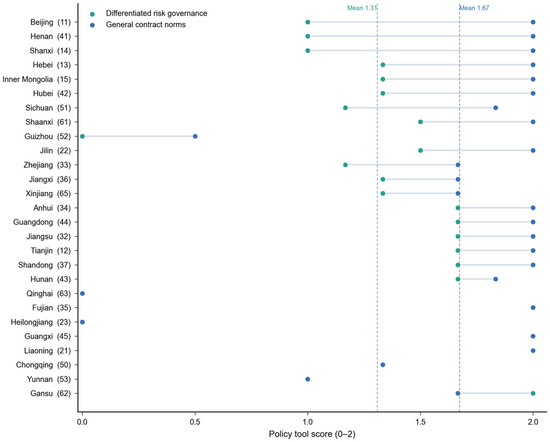
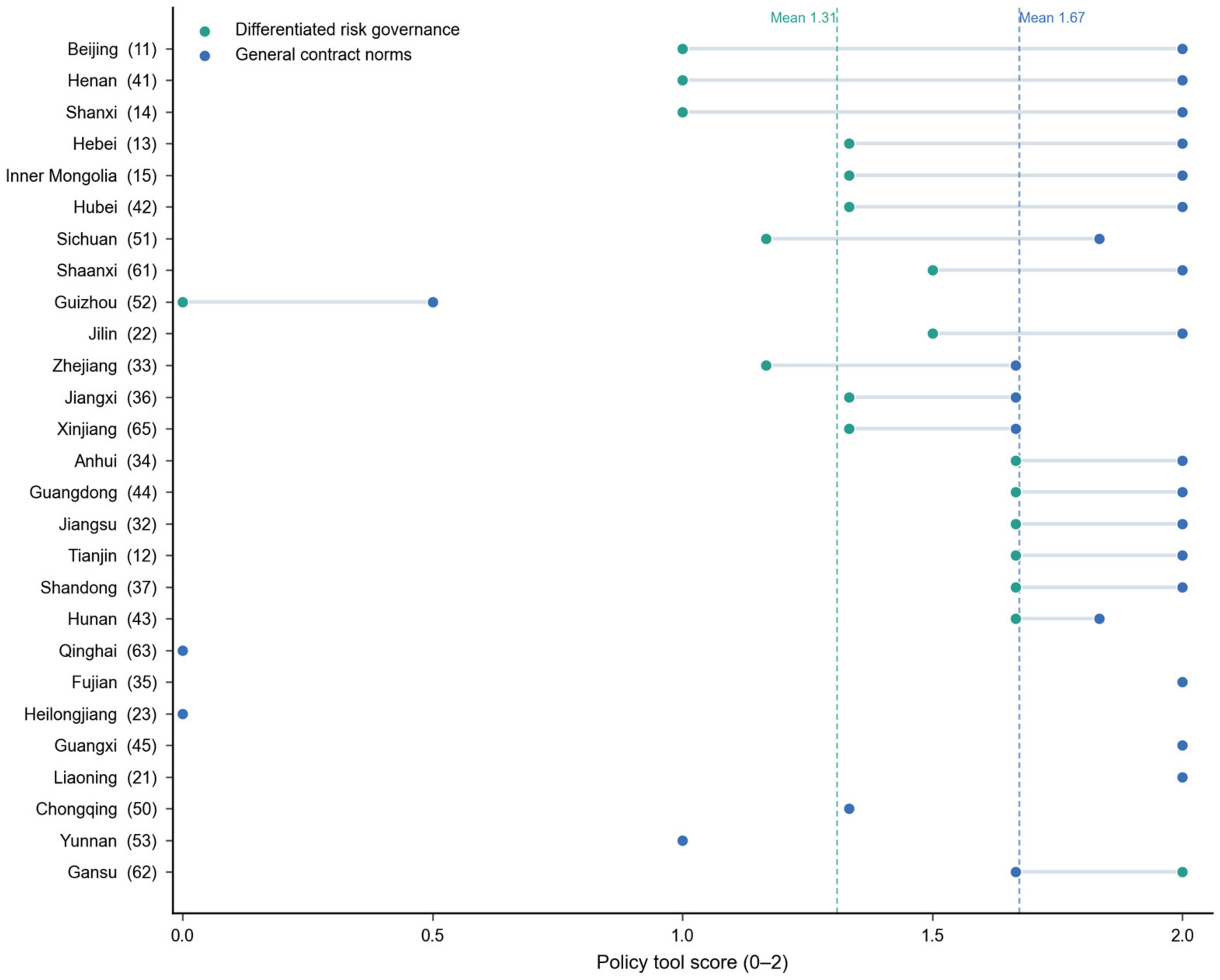
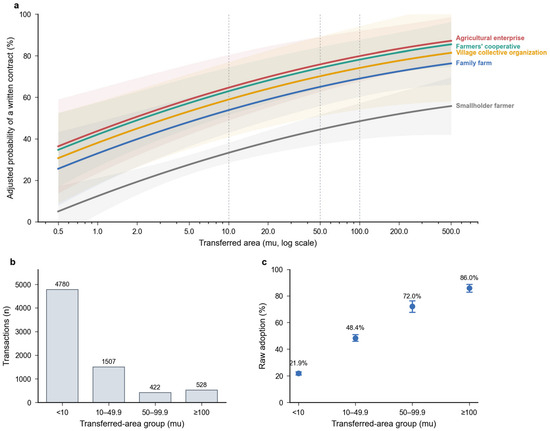
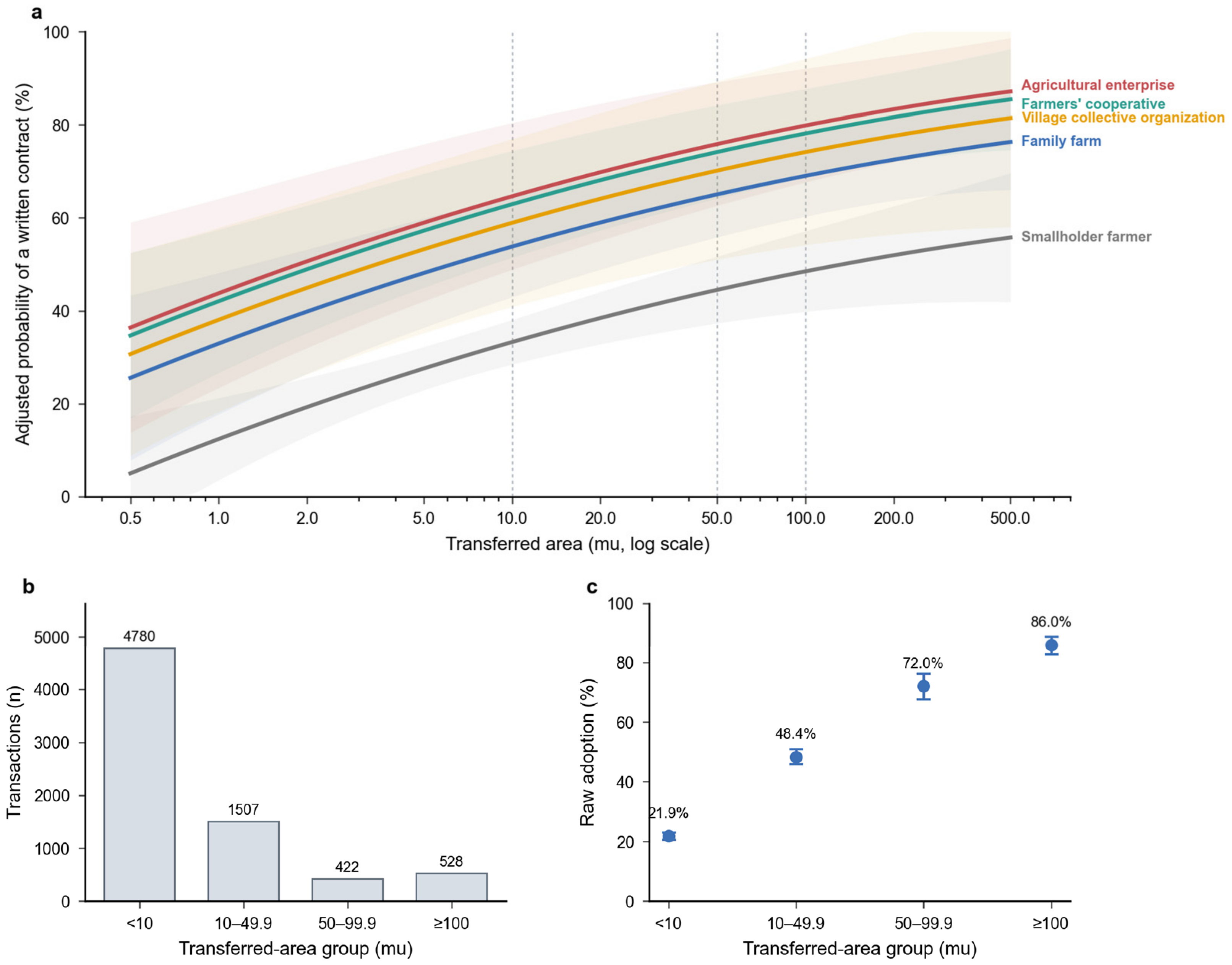
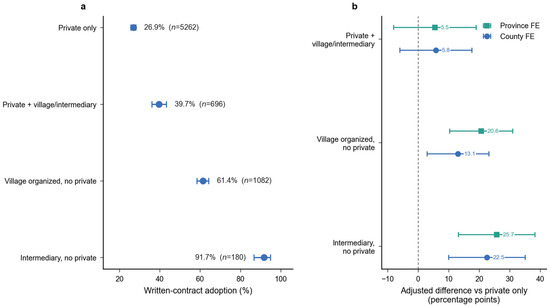
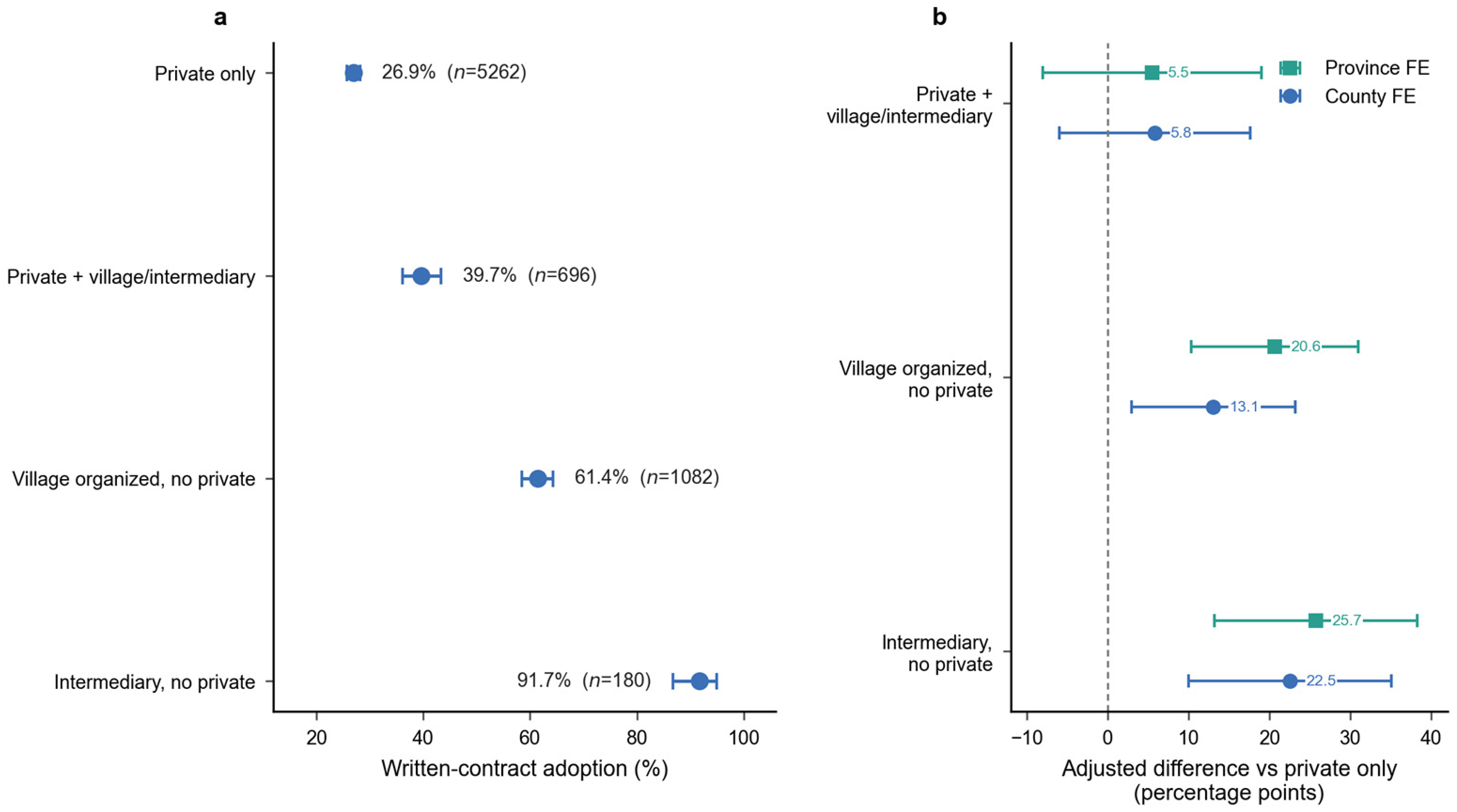
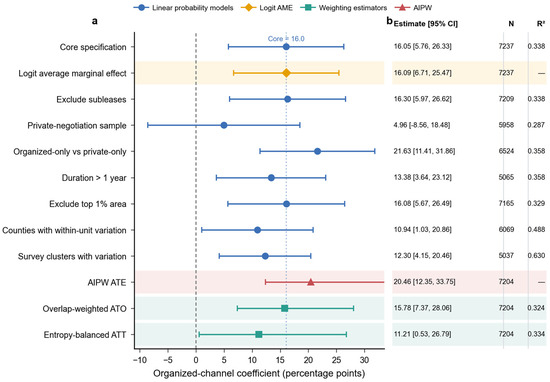
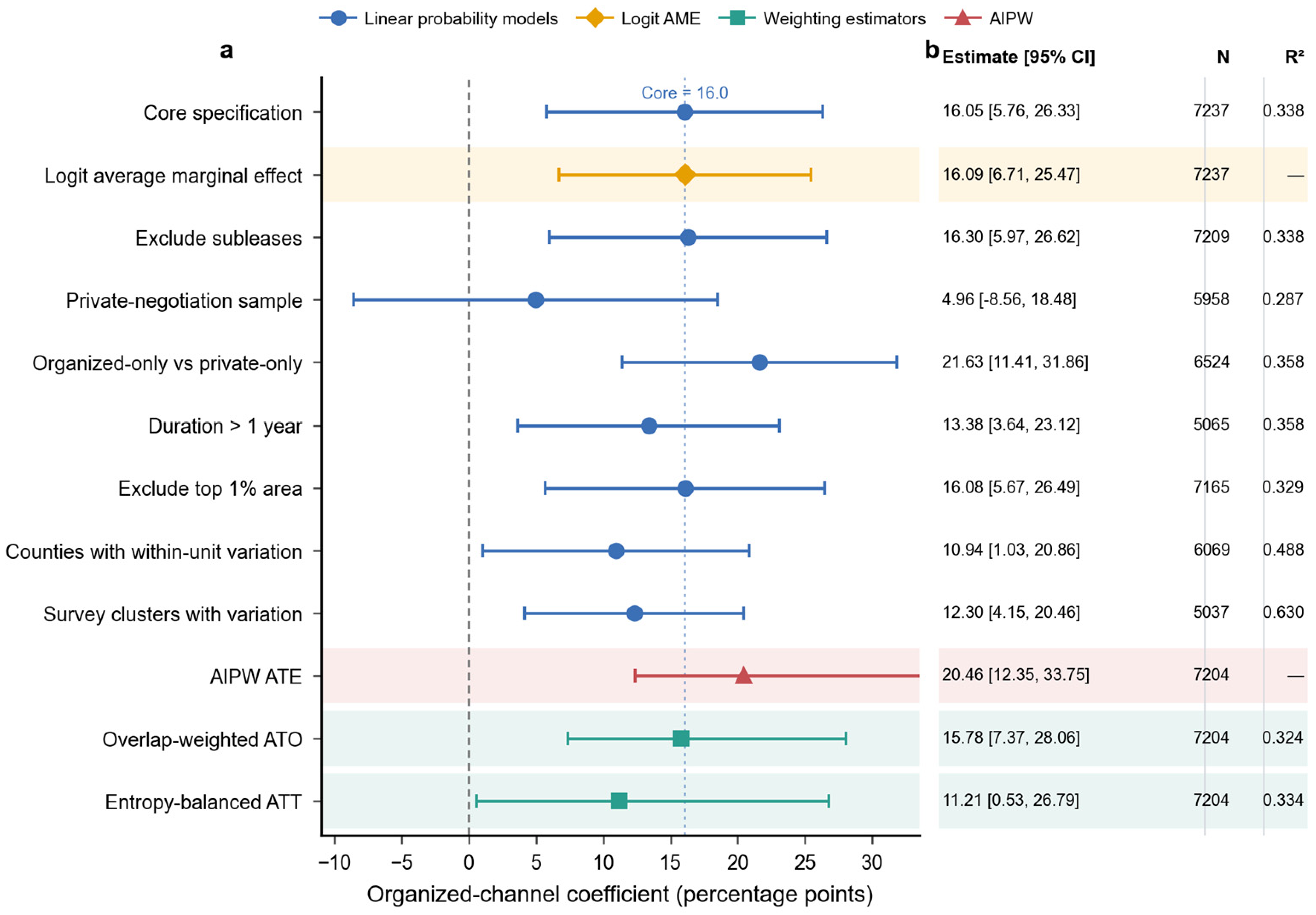
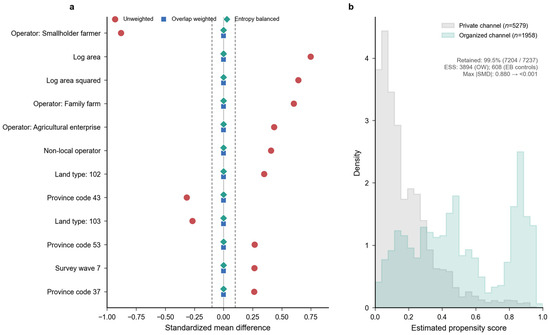
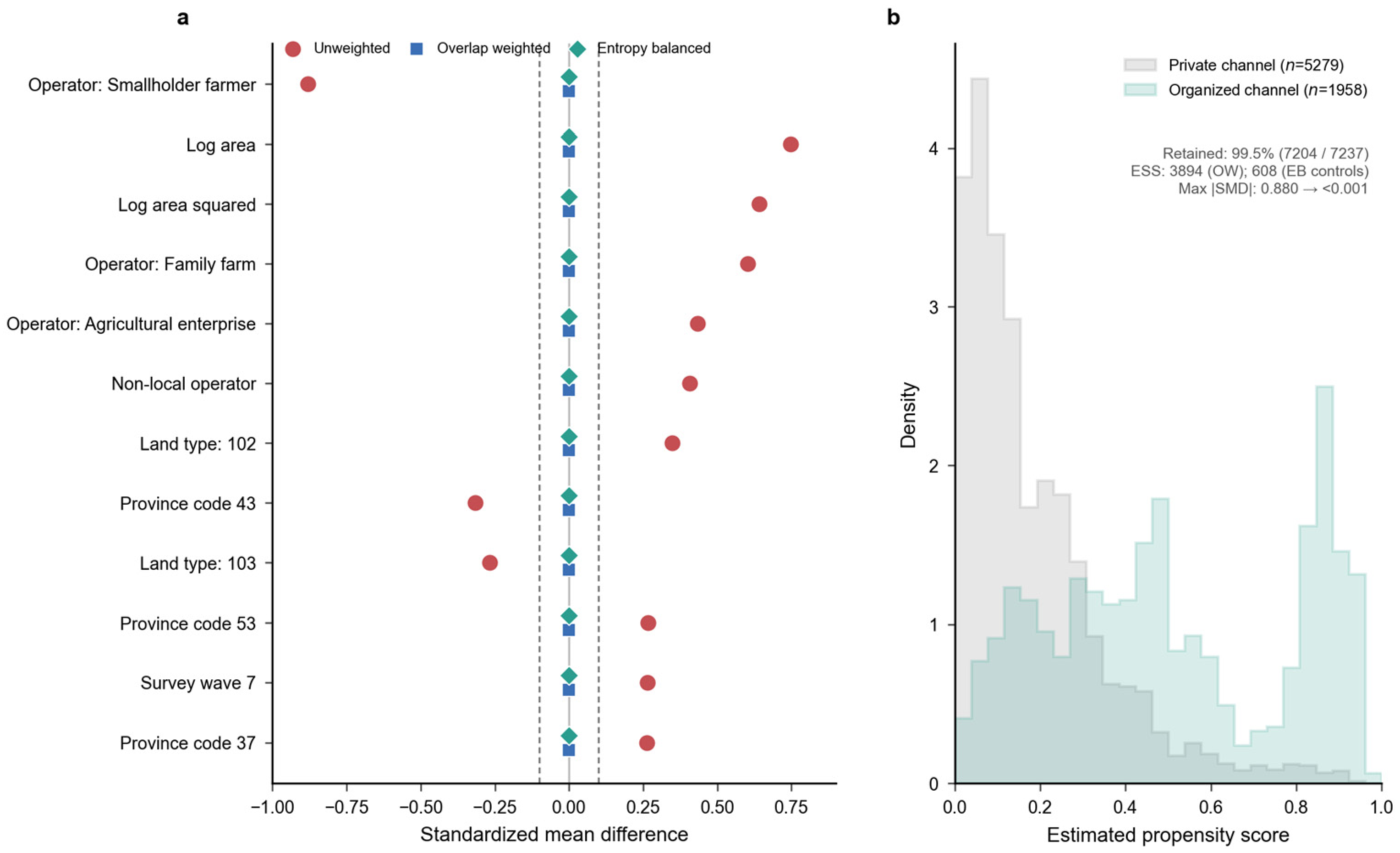

Disclaimer/Publisher’s Note: The statements, opinions and data contained in all publications are solely those of the individual author(s) and contributor(s) and not of MDPI and/or the editor(s). MDPI and/or the editor(s) disclaim responsibility for any injury to people or property resulting from any ideas, methods, instructions or products referred to in the content. |
© 2026 by the authors. Licensee MDPI, Basel, Switzerland. This article is an open access article distributed under the terms and conditions of the Creative Commons Attribution (CC BY) license.