


Abstract
Urban village renewal in China increasingly requires decision tools that can identify where incremental design intervention should be prioritized. However, existing renewal practices often rely on experience-based judgment and lack a reproducible quantitative framework for comparing renewal demand with implementation difficulty. This study proposes an urban village design sensitivity evaluation system based on two operational dimensions: renewal demand and implementation difficulty. The framework combines a multi-scale indicator system, AHP–entropy weighting, normalized scoring, and a linear difference model to evaluate design sensitivity at the building, street and alleyway, and public-space levels. Taking Weicun Village in Wuligang, Nanchang, China, as a case study, the method identifies 407 building units, 26 core street and alleyway units, and 30 public-space plot units, with 20 road nodes used to support traffic network interpretation. After correcting the indicator-code correspondence and recalculating the supplementary dataset, the results classify spatial units into five sensitivity levels; 10 building units, 5 street and alleyway units, and 5 public-space units are identified as high-sensitivity units. These high-sensitivity areas are mainly concentrated around historically protected buildings and public-space areas with strong renewal demand but relatively lower implementation difficulty. The proposed system provides quantitative support for renewal sequencing, differentiated intervention, and low-disruption micro-renewal decision-making.
1. Introduction
The global urbanization process has shifted from incremental expansion to the quality-oriented regeneration of existing urban stock. Urban renewal has therefore become a core pathway for cities to improve living environments, optimize land use, and promote sustainable development [1]. In the Chinese context, an urban village usually refers to a collectively owned village settlement that has been absorbed by rapid urban expansion while retaining complex land ownership, dense self-built housing, informal economies, and mixed resident groups. This meaning differs from the term urban village in some Western planning literature, where it often denotes a compact mixed-use neighborhood model, and it should also be distinguished from the more general concept of an urban slum. Chinese urban villages face multiple challenges, including building safety risks, inadequate infrastructure, insufficient public space, fragmented property rights, and complex social governance issues; consequently, their renewal has become a central issue in urban governance [2].
In China, urban village renewal has been elevated to a major policy task within national urban regeneration. The policy support scope for urban village redevelopment has expanded from the initial 35 megacities and large cities to nearly 300 prefecture-level and above cities, indicating the growing national significance of this issue [3,4]. In Nanchang, the case-study city of this research, official statistics show that there are 166 urban villages, comprising 563 natural villages. In 2024, the city launched 26 urban village renewal projects, with an estimated total investment of CNY 30.388 billion, and planned to complete the renewal of 19,066 households and start construction of 14,145 resettlement housing units [5]. These figures indicate that urban village renewal is not only a national strategic task but also an urgent local governance and spatial-planning issue in Nanchang.
The theory of organic renewal proposed by Wu Liangyong provides an important theoretical basis for small-scale, phased, and incremental renewal, avoiding the social disruption and cultural loss often caused by large-scale demolition and reconstruction. This idea is consistent with international discussions on incremental urbanism and adaptive upgrading in informal urban contexts [6,7]. Nevertheless, current incremental urban village renewal practices in China remain constrained by blueprint-style planning and subjective design judgment. Existing tools often fail to identify intervention priorities at the level of buildings, alleys, and public spaces, making it difficult to coordinate government agencies, village collectives, original residents, tenants, and market actors.
Accordingly, this study addresses three research questions: (1) how can renewal demand and implementation difficulty be translated into measurable indicators for urban village renewal design; (2) how can spatial units with different combinations of renewal demand and implementation difficulty be compared in a reproducible way; and (3) how can quantitative evaluation results support phased renewal sequencing and design decision-making? The objectives are to define the concept of urban village design sensitivity, construct a multi-scale evaluation framework, apply the framework to Weicun Village in Nanchang, and discuss its value and limitations for incremental urban village renewal in China.
2. Conceptual Framework: Defining the Concept of Design Sensitivity in Urban Village Renewal
2.1. Research Progress on Urban Village Renewal Evaluation Systems
Existing research has developed various evaluation models centered on the feasibility, sustainability, and renewal potential of urban village renewal, forming evaluation frameworks that encompass dimensions such as the physical environment, socio-economics, and cultural ecology [8]. Internationally, evaluation research on the renewal of informal settlements has largely focused on poverty alleviation, improvement of living environments, and enhancement of social inclusion, resulting in relatively mature multi-criteria evaluation systems [9,10]. Domestic research, meanwhile, has prioritized the economic feasibility of urban village renovation, cultural preservation, and improvements in people’s livelihoods, establishing evaluation systems tailored to China’s institutional context [11].
However, existing research has significant limitations: most existing evaluation systems focus on assessing the feasibility of comprehensive urban village renovation at the macro level, primarily serving large-scale demolition and reconstruction models, and lack specialized evaluation frameworks for micro-level, incremental renewal that support decision-making throughout the entire design process. Additionally, most models do not fully account for the core characteristics of urban villages—such as complex property rights, diverse social structures, and strong spatial heterogeneity—resulting in evaluation systems that are poorly adapted to the actual scenarios of urban village renewal.
2.2. Progress in the Application of Sensitivity Analysis in Urban Planning
Sensitivity-oriented evaluation has been introduced into urban planning, land management, and spatial renewal studies to assess renewal potential, intervention priority, and spatial response under different development constraints. Related studies have examined land-use renewal sensitivity, traditional village regeneration sensitivity, urban land regeneration sensitivity, and three-dimensional urban regeneration sensitivity, using multi-criteria indicators to support renewal prioritization and phased intervention [12,13,14,15]. Among these studies, research on traditional village regeneration sensitivity and urban land/urban renewal sensitivity provides a direct methodological reference for translating renewal potential and implementation constraints into spatial decision-making indicators [12,13,14].
However, existing research has significant limitations: while sensitivity analysis has been widely adopted in the field of urban land renewal, no specialized design sensitivity evaluation system has yet been developed to address the unique characteristics of urban villages. Furthermore, existing sensitivity models tend to focus on renewal potential from a single dimension, lacking a systematic analysis of the interplay between renewal drivers and barriers, and thus struggle to support complex decision-making amid the diverse stakeholder interests inherent in urban villages.
2.3. The Concept of Design Sensitivity in Urban Villages
Grounded in incremental renewal and micro-renewal practice, this study defines urban village design sensitivity as the degree to which a spatial unit responds to design intervention and should be prioritized in renewal decision-making under the combined influence of renewal demand and implementation difficulty. The concept does not simply refer to the severity of existing spatial problems, nor is it equivalent to conventional renewal potential. Instead, it emphasizes an integrated judgment of the relationship between “whether renewal is needed” and “whether renewal can be feasibly implemented” under conditions of limited resources and multi-stakeholder negotiation.
Specifically, design sensitivity contains two operational dimensions. The first is renewal demand, which measures the urgency, public value, and functional necessity of spatial intervention, including building deterioration, infrastructure deficiencies, public-space shortages, street and alleyway traffic problems, declining environmental quality, and cultural or historical conservation needs. The second is implementation difficulty, which measures the resistance, cost, and uncertainty that may arise during renewal implementation, including property-right complexity, resident coordination difficulty, construction accessibility, economic pressure, social impacts, and subsequent management and maintenance difficulty. By comparing renewal demand with implementation difficulty, design sensitivity can identify high-demand and relatively feasible units for priority intervention, while also indicating areas where high renewal demand but high implementation difficulty requires negotiated, phased, and low-disruption renewal strategies.
The introduction of this concept reflects a shift in research perspective from macro-level policy orientation to micro-level design-driven approaches. As a proactive evaluation method, it effectively addresses the limitations of urban village design, which often lacks systematic process planning and dynamic control mechanisms. By precisely identifying the response characteristics of spatial units to renewal interventions, the evaluation results not only provide quantitative evidence for scientifically sequencing renewal timelines and selecting differentiated renewal approaches but also establish an objective platform for decision-making and coordination in urban village governance amid multi-stakeholder interest negotiations.
3. Technical Approach: Constructing a Sensitivity Evaluation Framework for Urban Village Spatial Renewal
3.1. Evaluation Mechanism and Logic
The essence of urban village renewal lies in the reallocation and optimization of existing spatial resources under negotiations among diverse stakeholders, including government agencies, village collectives, original residents, tenants, and merchants [16]. The design sensitivity model developed in this study compares two standardized dimensions for each spatial unit: renewal demand and implementation difficulty. Renewal demand represents positive driving forces, such as infrastructure deficiencies, insufficient public spaces, building safety risks, and heritage-protection needs. Implementation difficulty represents potential barriers, such as complex property rights, informal construction, relocation costs, funding constraints, and post-renewal management responsibilities. The subtraction of standardized implementation difficulty from standardized renewal demand is used as a comparative decision index rather than an absolute physical threshold. This operation reflects the planning assumption that priority should be given to units where renewal urgency is high, and implementation difficulty is relatively manageable.
To ensure the accuracy of the evaluation results, this study adheres to the principles of comprehensive coverage and intra-unit comparison at the logical level. First, the evaluation system encompasses all types of spatial entities within urban villages. By deconstructing the micro-level attributes of land parcels, it precisely captures the sensitivity variations caused by differences in renewal demands and implementation bottlenecks, thereby achieving scale adaptation. Second, due to differences in macro-level contexts such as location, type, and policy, the weights of various factors exhibit significant endogenous variation. Therefore, this study adheres to the principle of internal comparability, emphasizing that sensitivity values are statistically significant when comparing units within the same urban village but are not directly comparable across different types of urban villages [15].
3.2. Construction of the Evaluation System and Model Algorithms
3.2.1. Construction of the Evaluation Indicator System
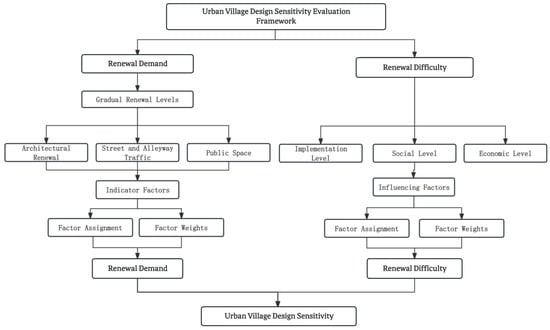
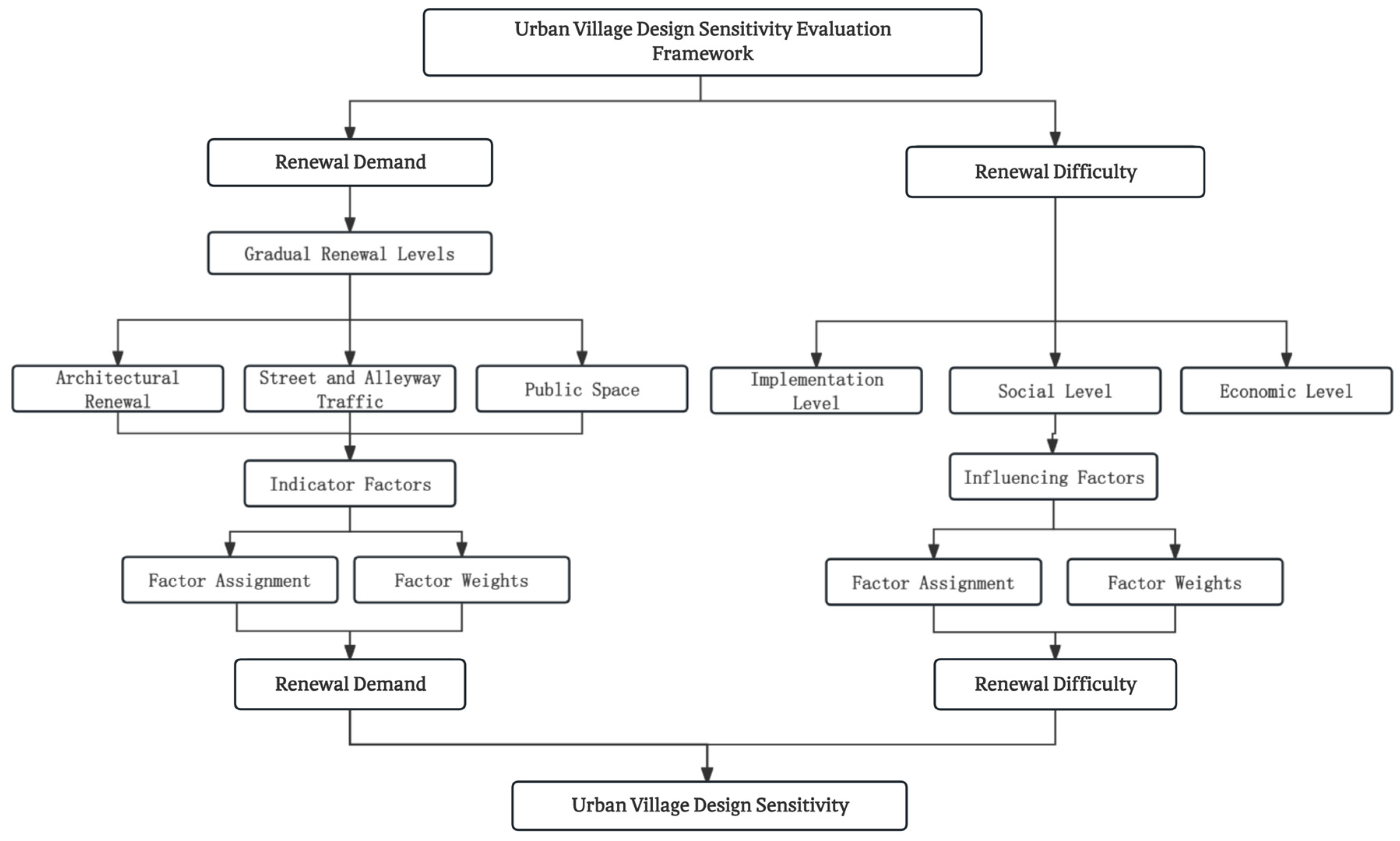
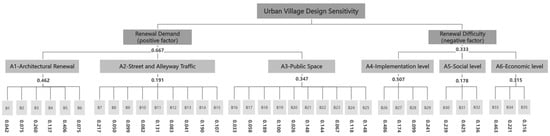
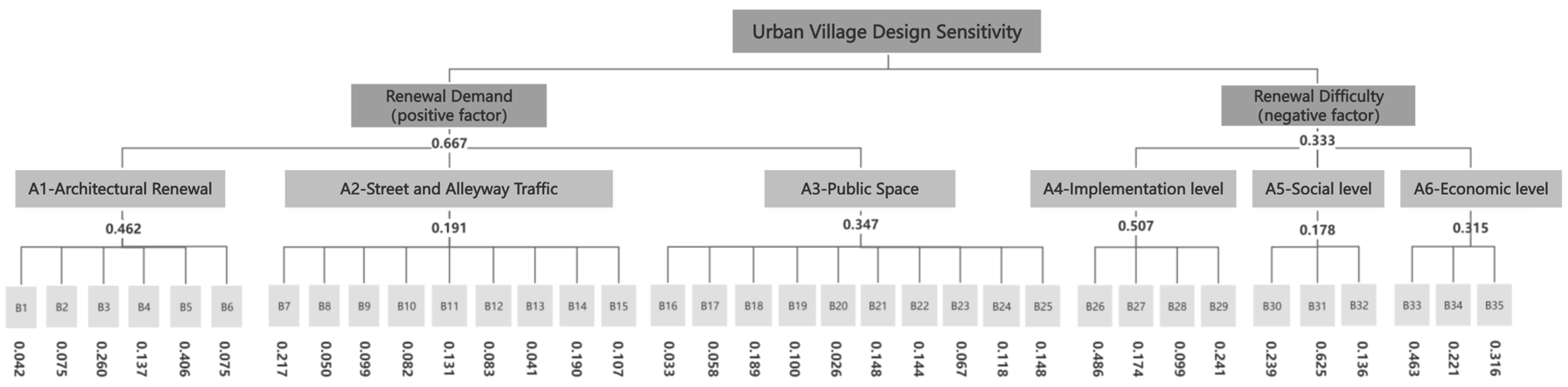
Establishing a scientific indicator system is the foundation for quantifying the design sensitivity of urban villages [14,17]. This study decomposes urban village renewal into two target layers: renewal demand and implementation difficulty. Renewal demand captures the value and urgency of intervention, while implementation difficulty captures the expected resistance and cost of implementation. Design sensitivity is therefore calculated as the standardized difference between these two dimensions (Figure 1).
Figure 1.
Framework for Constructing the Urban Village Design Sensitivity Evaluation Index System.
Renewal demand, or positive momentum, primarily reflects the urgency of improving the physical environment and upgrading functions within urban villages. Unlike the traditional model of large-scale demolition and reconstruction, micro-renewal emphasizes the incremental improvement of the living environment and public facilities [18,19]. Based on the principle of incremental renewal and adopting a “point–line–surface” perspective, this paper categorizes demand factors into three criteria levels: building renewal, street and alleyway traffic, and public space. By referencing case studies and reviewing relevant literature, the paper classifies and summarizes the key focuses of each level in micro-renewal, then further evaluates and quantifies them to measure the feasibility of different units in urban village renewal design, thereby providing a more scientific approach to renewal practice [20] (Table 1).
Table 1.
Evaluation Indicator System for Urban Village Renewal Demand.
Implementation difficulty primarily represents the potential obstacles to achieving expected outcomes during the design process. This paper categorizes it into implementation, social, and economic levels, reflecting the operational difficulty, social impact, and transaction costs associated with renewal implementation (Table 2).
Table 2.
Evaluation Indicator System for Urban Village Implementation Difficulty.
3.2.2. Indicator Weighting: AHP–Entropy Weighting Combination Method
To balance expert judgment with the objectivity of observed data, this study adopted a combined weighting method integrating the Delphi method [21], the Analytic Hierarchy Process (AHP), and the entropy weighting method. The Delphi method was first used to refine the evaluation indicator system and improve expert consensus on the relevance, clarity, and operability of the indicators. A panel of ten experts from related fields, including urban renewal planning, architectural design, historic conservation, community governance, and landscape design, was invited to review the preliminary indicator system derived from the literature review, field investigation, and the renewal characteristics of Weicun Village.
The Delphi consultation was conducted in two rounds. In the first round, the experts reviewed the initial indicator list and suggested revisions for indicators with ambiguous meanings, overlapping content, or weak relevance to renewal decision-making. In the second round, the revised indicator system was returned to the experts for confirmation. After the two rounds of consultation, the final evaluation framework was established, consisting of two target dimensions, six factor layers, and 35 indicators.
On this basis, AHP was used to determine the subjective weights of the criteria and indicators. The same expert panel conducted pairwise comparisons for the target layer, the factor layers, and the indicator layers under A1–A6. The individual judgments were aggregated using the geometric mean method to form group judgment matrices. The local AHP weights were then calculated using the normalized geometric mean method, and the consistency of each judgment matrix was tested using the consistency ratio (CR). A matrix was considered acceptable when CR was lower than 0.10 [22].
The entropy weighting method was then applied [23] to the standardized observed data to obtain objective weights according to the dispersion of indicator values across evaluation units. Let denote the pairwise-comparison value between indicator and indicator in the AHP judgment matrix, denote the subjective AHP weight of indicator , denote the entropy weight of indicator , and denote the final composite weight. The composite weight was calculated as follows:
where is the contribution coefficient of the AHP weight, and is the contribution coefficient of the entropy weight. Considering that expert judgment is essential for interpreting policy constraints, property-right complexity, and implementation barriers in urban-village renewal, this study adopted an AHP-dominant combination coefficient ( = 0.85). Thus, the AHP weight contributed 85%, and the entropy weight contributed 15% to the final composite weight. This combined weighting procedure was used to retain expert knowledge while introducing an objective correction based on the dispersion of observed data.
It should be noted that for building units, street and alleyway units, and public-space units in urban villages, the primary actors involved in their renewal processes differ in focus, meaning the drivers of renewal vary. Therefore, when calculating the weights of criteria-level indicators for the target-level evaluation of renewal demand and implementation difficulty, calculations must be performed by distinguishing spatial types, rather than directly applying a unified weight result calculated based on the evaluation indicator system.
3.2.3. Design Sensitivity Calculation Model
The core logic of the model is to evaluate the relative balance between positive renewal drivers and implementation difficulty. For each spatial unit , renewal demand and implementation difficulty are first calculated by multiplying standardized indicator scores by their corresponding composite weights and summing them within the same target layer. Design sensitivity is then calculated after normalizing the two dimensions to the same 0–1 scale:
Here, denotes the design sensitivity score of spatial unit ; and denote the weighted renewal-demand and implementation difficulty scores; and are the standardized scores of demand indicator and difficulty indicator ; and are the corresponding composite weights; and and are the min–max-normalized renewal-demand and implementation difficulty scores. The two dimensions are normalized to the same 0–1 scale before subtraction.
This value quantitatively characterizes the relative priority of a spatial unit for renewal intervention. A positive value indicates that renewal demand exceeds implementation difficulty, while a negative value indicates that implementation difficulty is higher than the current renewal demand. Units with different combinations of renewal demand and implementation difficulty should therefore be interpreted separately: high renewal demand–low implementation difficulty units are suitable for near-term intervention; high renewal demand–high implementation difficulty units require negotiated and phased strategies; low renewal demand–low implementation difficulty units may be maintained or monitored; and low renewal demand–high implementation difficulty units should generally be reserved for long-term control.
3.3. Evaluation Pathway and Implementation
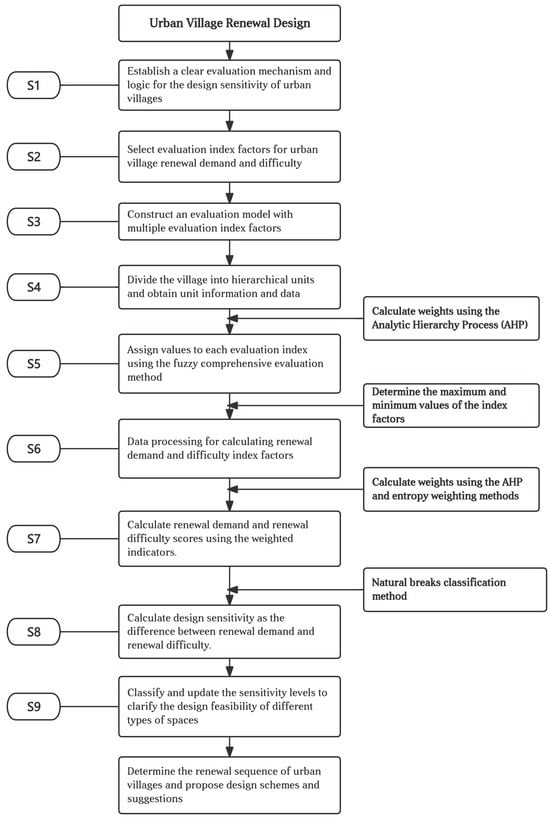
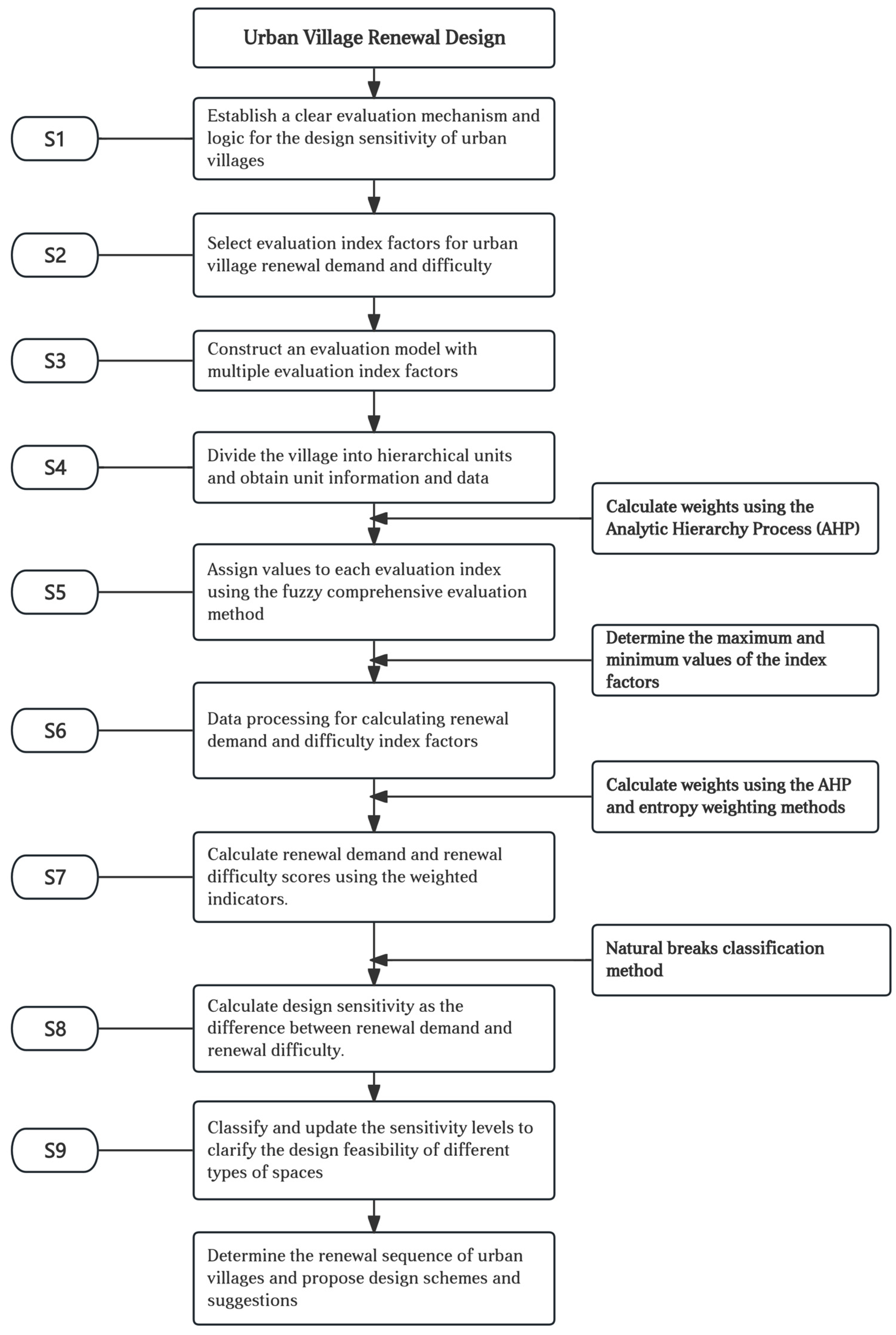
In summary, the evaluation pathway includes five steps: (1) constructing the indicator system; (2) delineating multi-scale evaluation units; (3) collecting and standardizing indicator data; (4) calculating AHP, entropy, and composite weights; and (5) calculating renewal demand, implementation difficulty, and design sensitivity scores for each spatial unit (Figure 2). All indicators are normalized before weighted calculation to ensure comparability across different measurement units. The fuzzy comprehensive evaluation shown in Figure 2 refers to the conversion of field-survey observations into indicator scores according to the assignment criteria in Table 3; it was used for indicator scoring rather than as an additional weighting or classification method.
Figure 2.
Step-by-Step Process for the Design Sensitivity Assessment Method for Urban Villages.
Table 3.
Information Characteristics of Evaluation Indicator Layers for Urban Village Renewal Demand and Implementation Difficulty.
To eliminate the influence of different units and value ranges among indicators, all raw indicator values were normalized before weighted calculation. For positive indicators, where a larger value indicates a higher renewal demand or greater implementation difficulty, the min–max normalization method was used:
For negative indicators, where a smaller value indicates a higher renewal demand or greater implementation difficulty, the normalization formula was reversed:
where denotes the original value of indicator for spatial unit , denotes the normalized value, and and denote the maximum and minimum values of indicator among all comparable spatial units, respectively. After normalization, all indicator values were transformed into the range [0, 1]. For both renewal demand and implementation difficulty, a higher normalized value indicates a stronger contribution to the corresponding target layer.
4. Practical Application: A Case Study of Design Sensitivity Assessment in Weicun Village, Wuligang, Nanchang
4.1. Case Selection and Unit Delineation
4.1.1. Case Selection
This study selected Weicun in Wuligang, Qingshanhu District, Nanchang, as the empirical case. As a typical example where historical value and informality are highly intertwined, it provides a representative case of urban villages in central Jiangxi within East China, rather than representing all urban villages in China. Weicun currently has 10 existing historically protected buildings and a high concentration of low-skilled migrant residents. This overlap between historical context and high-density informal residential spaces necessitates that renewal decisions strike a dynamic balance among cultural preservation, safety assurance, and livelihood improvement—a requirement that aligns closely with the renewal demand index system developed in this study.
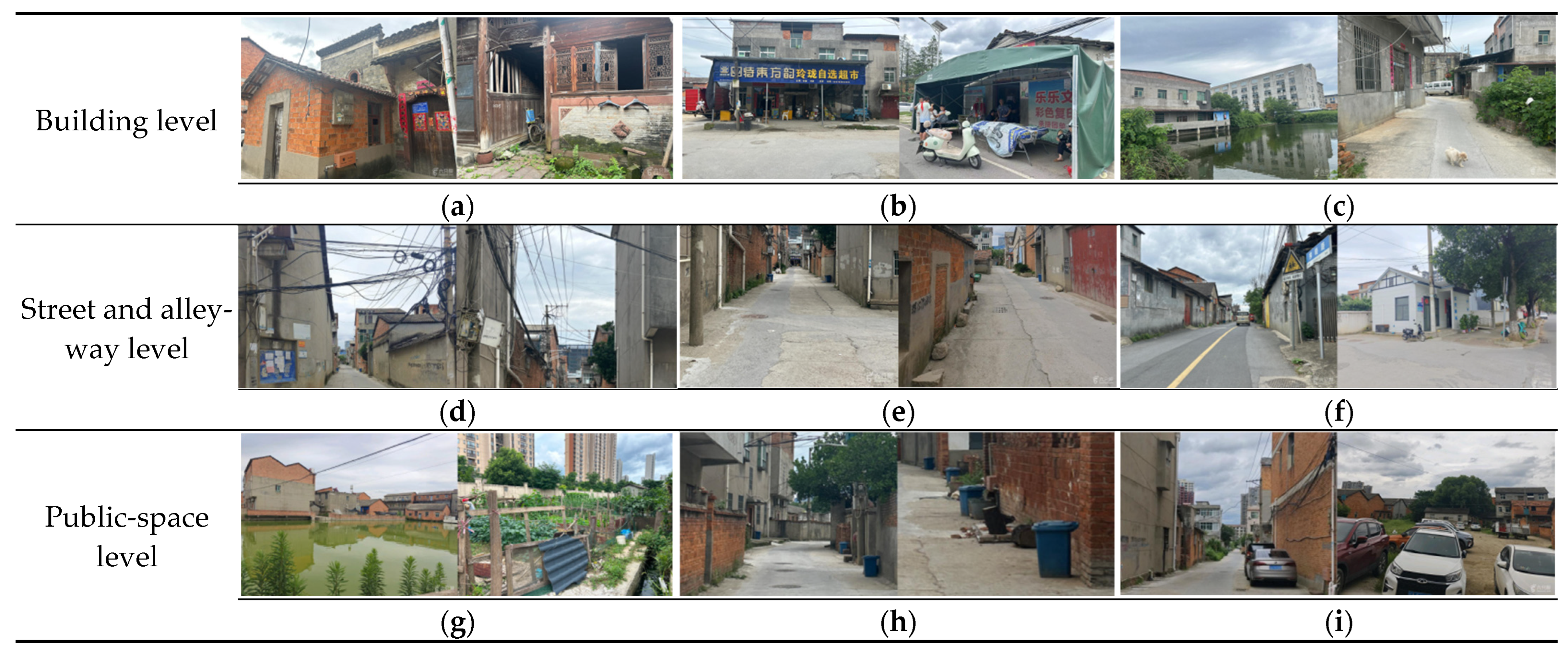
Field research identified several typical renewal challenges in Weicun Village. At the building level, insufficient heritage protection, building deterioration, disordered shopfronts, and weak facade control have led to the loss of traditional character and visible safety risks. At the street and alleyway level, disorganized overhead and underground pipelines, damaged road surfaces, weak entrance signage, and poor traffic conditions constrain everyday mobility and emergency access. At the public-space level, insufficient public facilities, poorly managed waste-collection points, weak landscape quality, and disorderly parking reduce the quality of daily life (Figure 3a–i).
Figure 3.
Representative field photographs of renewal problems in Weicun Village. (a) Insufficient historic building protection. (b) Disordered shopfronts and weak facade control. (c) Insufficient supporting public facilities. (d) Disorganized overhead and underground pipelines. (e) Uneven and damaged road surfaces. (f) Weak entrance image and signage. (g) Poor landscape quality. (h) Poorly managed waste-collection points. (i) Disordered parking.
(a) Insufficient protection of historic buildings, corresponding to indicators related to historical value and building conservation demand;
(b) disordered shopfronts and weak facade control, corresponding to building facade and environmental quality indicators;
(c) lack of supporting public facilities, corresponding to public service and facility completeness indicators;
(d) disorganized overhead and underground pipeline layout, corresponding to infrastructure and implementation difficulty indicators;
(e) uneven and damaged road surfaces, corresponding to road condition and emergency access indicators;
(f) weak entrance image and signage, corresponding to entrance identification and traffic accessibility indicators;
(g) poor landscape quality, corresponding to environmental landscape and public space quality indicators;
(h) poorly managed garbage collection points, corresponding to sanitation facility and environmental quality indicators;
(i) disordered parking, corresponding to parking space supply and public -space management indicators.
These problems correspond to the renewal demand indicators, while property-rights coordination, relocation costs, funding constraints, and technical remediation barriers correspond to the implementation difficulty indicators. The availability of cadastral maps, drone survey models, planning documents, and field-survey data provides the empirical basis for applying the AHP–entropy weighting method in this case.
4.1.2. Unit Delineation
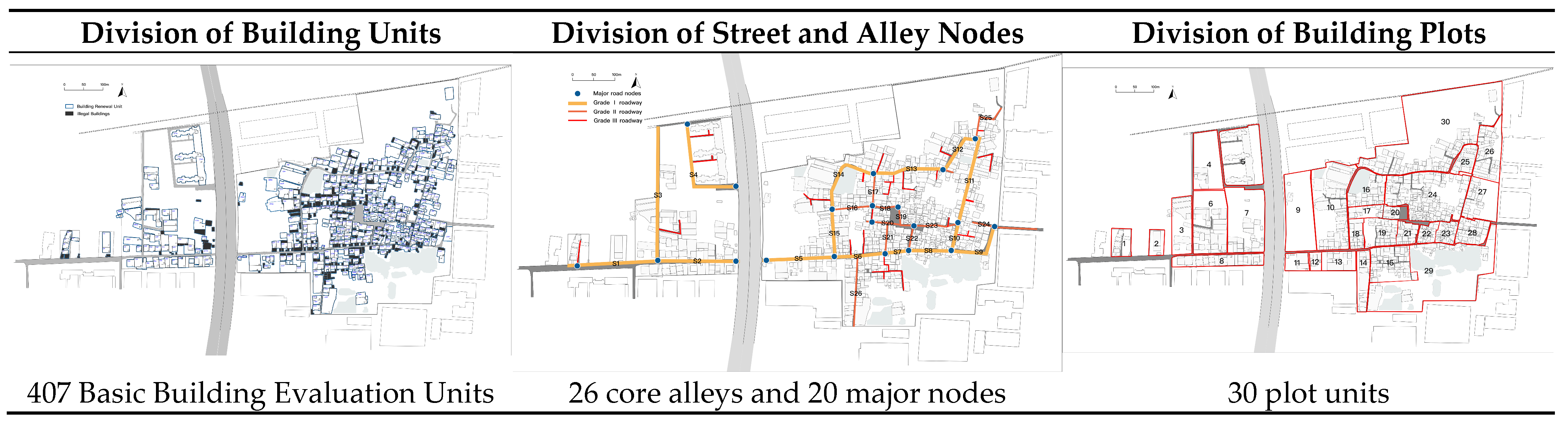
To ensure the precise collection of evaluation data and provide differentiated guidance for renewal strategies, a three-tiered unit evaluation system—comprising “Building Renewal—Street and Alleyway Traffic—Public Space”—was established. This hierarchical classification model follows a progressive structure from point to line and then from line to area, while in terms of scale, it facilitates a natural transition from small-scale pilot projects to large-scale implementation (Figure 4). This ensures that evaluation indicators can accurately capture the condition of individual buildings at the micro level while effectively reflecting neighborhood vitality and public space needs at the meso level.
Figure 4.
Delineation of Evaluation Units in Weicun Village, Wuligang.
At the building level, based on the theory of the minimum renewal unit, a detailed analysis of existing buildings on-site was conducted through field surveys and by utilizing data from cadastral maps, drone aerial survey models, and relevant planning documents. Illegal structures requiring demolition were removed, and logically connected, functionally consistent rows of self-built houses were grouped together, ultimately identifying 407 basic building evaluation units.
At the street and alleyway level, the alleyway traffic network is the basic spatial framework connecting buildings and plots. Using spatial syntax analysis, field surveys, and Stephen Marshall’s street-network classification method [24,25,26], this study identified 26 core alley units as the evaluation units for street and alleyway traffic. In addition, 20 major road nodes were recorded to support the interpretation of the road network structure, including accessibility, connectivity, and the relationship between alley segments. These nodes were used only as auxiliary reference points for distinguishing and interpreting the road network, rather than as independent evaluation units.
At the spatial level, a strategy of “block-by-block advancement and sequential refinement” was adopted. Based on existing urban roads and the primary and secondary alleys within the urban village, the area was divided into 30 independent yet interconnected zones.
4.2. Data Organization
4.2.1. Indicator Derivation
The evaluation of renewal demand and implementation difficulty should clarify the correlation between each factor and design sensitivity, renewal demand, and implementation difficulty (Table 3); some indicators must be comprehensively determined based on actual data results.
4.2.2. Determination of Factor Weights
As described above, the factor weights for this case study were determined by comprehensively applying the Delphi method, the Analytic Hierarchy Process (AHP), and the entropy weighting method. The Delphi consultation and AHP pairwise-comparison process were used to derive subjective weights, while the entropy weighting method was applied to the standardized observed data to derive objective weights. The two weighting sources were then combined using an AHP-dominant contribution coefficient ( = 0.85), meaning that the subjective AHP weight contributed 85% and the objective entropy weight contributed 15% to the final composite weight. The target-layer weights were 0.667 for renewal demand and 0.333 for implementation difficulty. Under renewal demand, the factor-layer weights of architectural renewal, street and alleyway traffic, and public space were 0.462, 0.191, and 0.347, respectively. Under implementation difficulty, the weights of implementation level, social level, and economic level were 0.507, 0.178, and 0.315, respectively. The final indicator weights for the design sensitivity evaluation of Weicun Village, Wuligang are shown in Figure 5. The definitive indicator-code correspondence is provided in Supplementary Table S1; expert composition and Delphi consultation records are provided in Supplementary Table S6; AHP matrices and CR values are provided in Supplementary Tables S7 and S8; AHP, entropy, and composite weights are provided in Supplementary Table S9; and the complete unit-level results are provided in Supplementary Table S10.
Figure 5.
Distribution of Factor Weights for Design Sensitivity Evaluation.
4.3. Numerical Calculations and Statistics
As described earlier, the AHP–entropy weighting combination method was used to assign weights to the factor layers and indicators of Weicun Village, Wuligang. The final evaluation system contains 35 indicators from B1 to B35, covering renewal demand and implementation difficulty across building, street and alleyway, and public-space units. The supplementary workbook was corrected to follow the same B1–B35 indicator sequence as the main manuscript. For public-space units, the number of households was retained only as background information and was not assigned a B-code or indicator weight. After indicator normalization, renewal demand and implementation difficulty were calculated separately using the composite weights. The design sensitivity value was then obtained by subtracting the standardized implementation difficulty score from the standardized renewal demand score [12,14,15]. To maintain readability, Table 4 reports only a concise summary of the unit-level results, while the complete dataset is provided in Supplementary Table S10.
Table 4.
Summary of Sensitivity Evaluation Results for the Weicun Village, Wuligang Renewal Project.
4.4. Analysis of Results and Recommendations
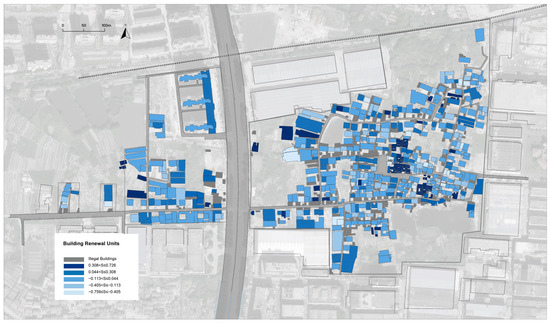
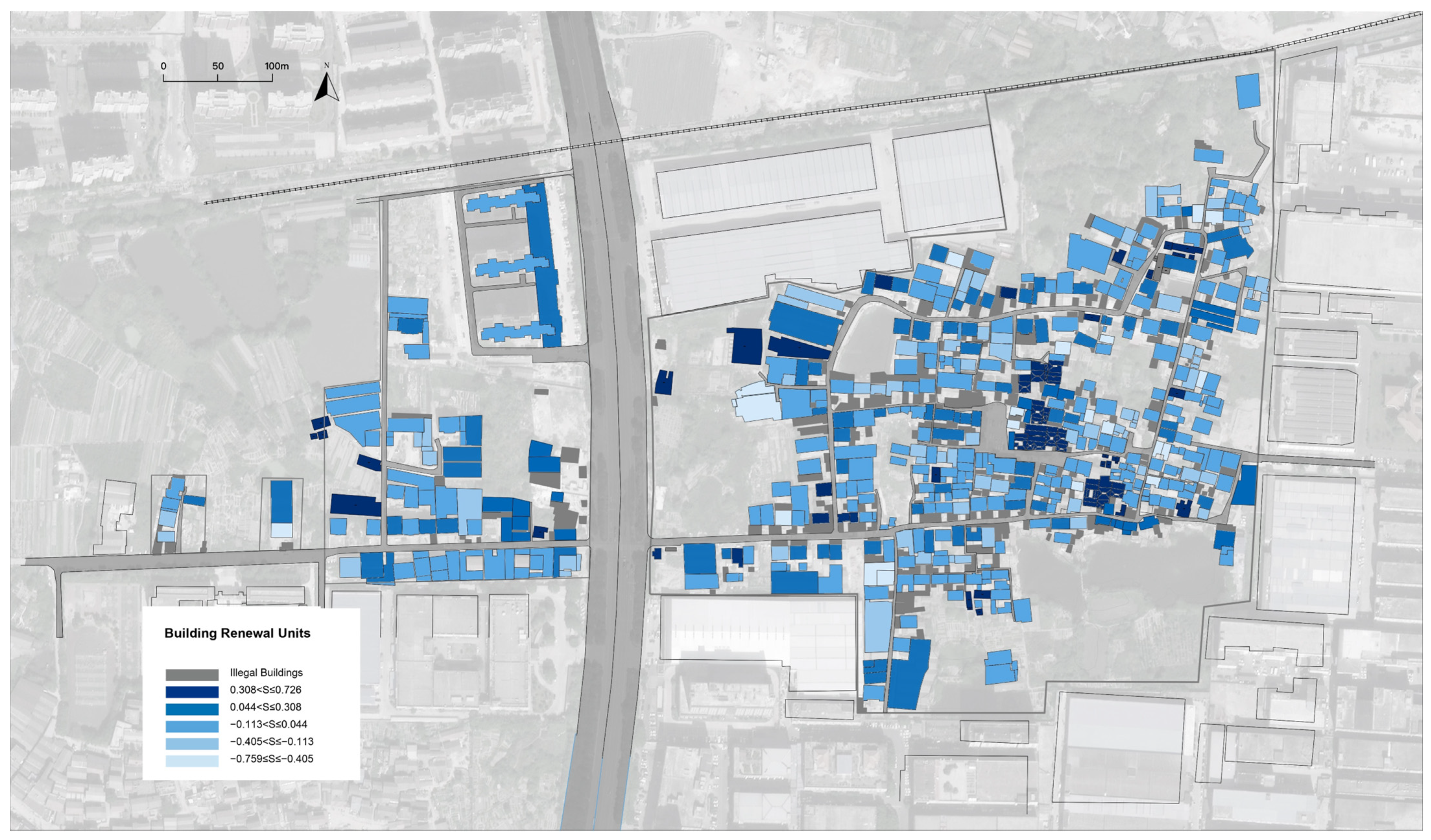
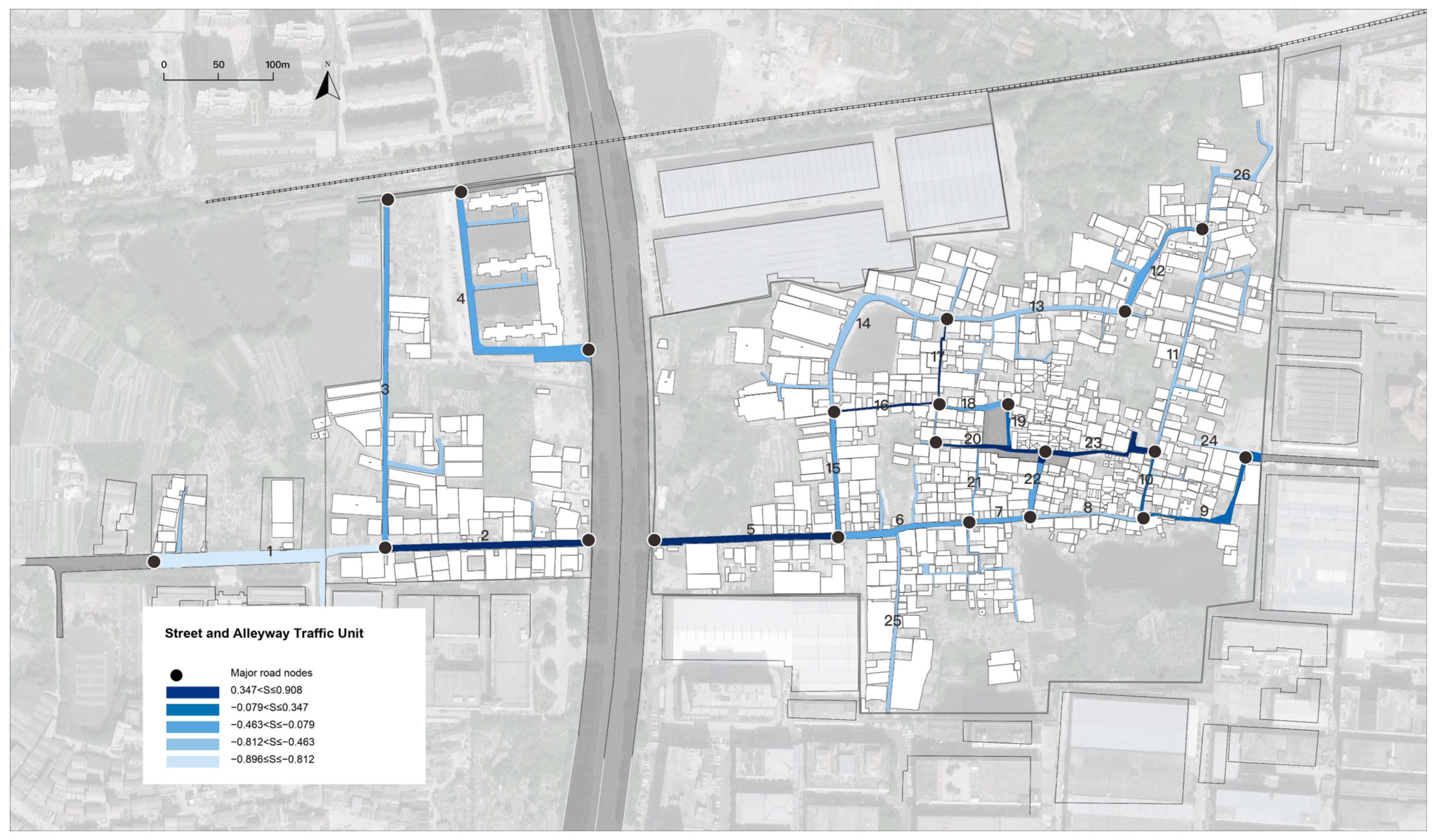
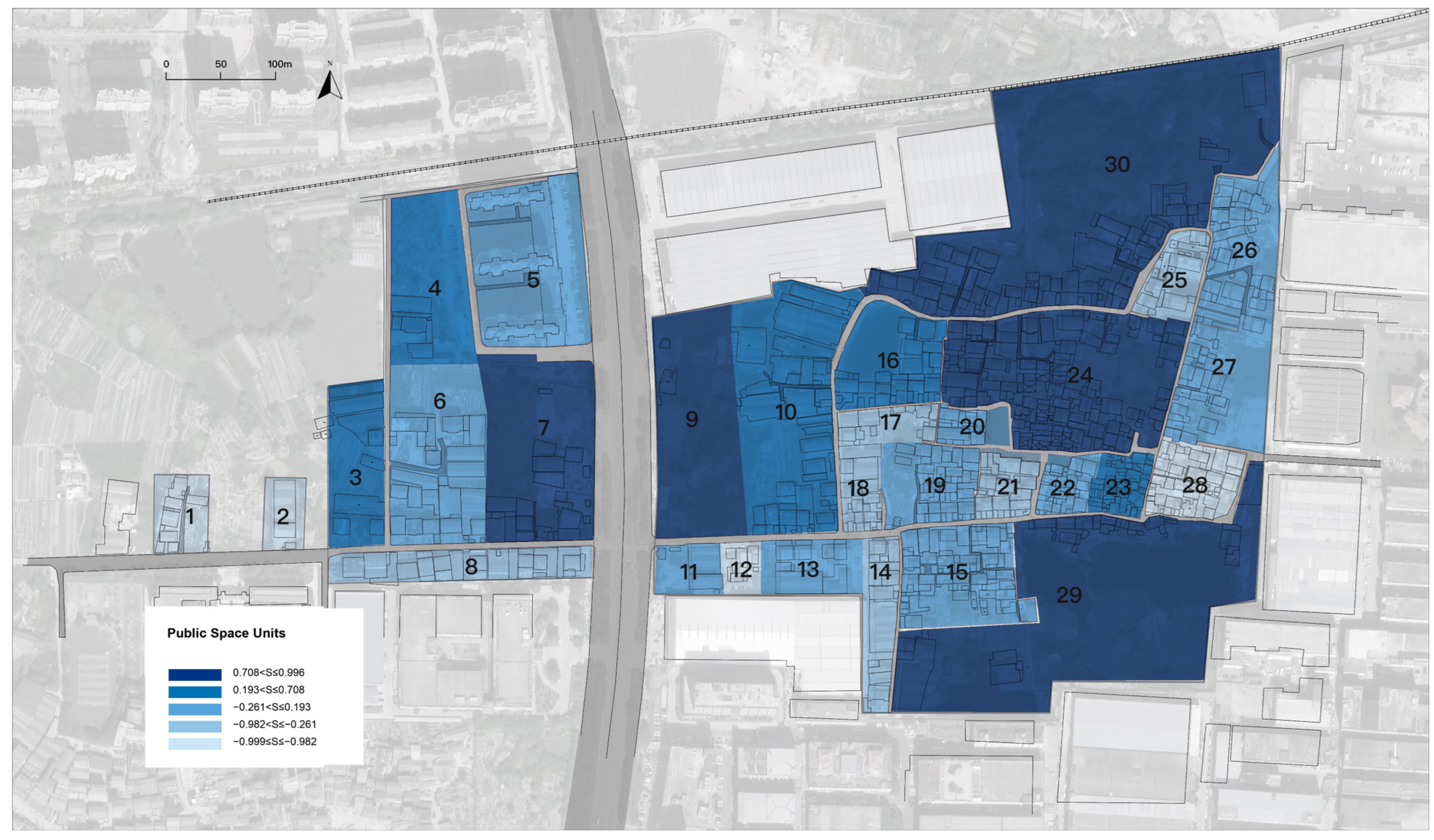
To make the evaluation results more intuitive, this study used the natural breaks classification method to divide design sensitivity values into five levels and present their spatial distribution on plan maps [27] (Figure 6, Figure 7 and Figure 8). The five classes were calculated separately for building units, street and alleyway units, and public-space units because the three types of spatial units differ in scale, indicator composition, and value distribution. For building units, the thresholds were classified as follows: low sensitivity, [−0.759, −0.405]; relatively low sensitivity, (−0.405, −0.113]; moderate sensitivity, (−0.113, 0.044]; relatively high sensitivity, (0.044, 0.308]; and high sensitivity, (0.308, 0.726]. For street and alleyway units, the thresholds were: low sensitivity, [−0.896, −0.812]; relatively low sensitivity, (−0.812, −0.463]; moderate sensitivity, (−0.463, −0.079]; relatively high sensitivity, (−0.079, 0.347]; and high sensitivity, (0.347, 0.908]. For public-space units, the thresholds were: low sensitivity, [−0.999, −0.982]; relatively low sensitivity, (−0.982, −0.261]; moderate sensitivity, (−0.261, 0.193]; relatively high sensitivity, (0.193, 0.708]; and high sensitivity, (0.708, 0.996]. The complete corrected unit-level dataset, including unit ID, renewal-demand score, implementation-difficulty score, design-sensitivity value, and classification result, is provided in Supplementary Table S10.
Figure 6.
Distribution of Design Sensitivity for Architectural Renewal in Weicun Village, Wuligang.
Figure 7.
Distribution of Design Sensitivity for Street and Alleyway Traffic in Weicun Village, Wuligang (The numbers indicate the IDs of street and alleyway traffic units).
Figure 8.
Distribution of Design Sensitivity for Public Spaces in Weicun Village, Wuligang (The numbers indicate the IDs of public-space units).
Based on the analysis of these results, high-sensitivity and moderately high-sensitivity zones, serving as core trigger areas, are primarily concentrated around the periphery of historically protected buildings and in areas with a high proportion of existing stock. These zones exhibit distinct characteristics of “high renewal demand and low implementation difficulty.” Given the significant renewal demand and abundant existing space available for renewal in these areas, they should be designated as core catalysts for the renewal of this urban village. Rapid improvements in spatial quality can be achieved through the restoration of historic buildings and the optimization of public spaces.
Moderately sensitive zones, serving as areas for collaborative optimization, are widely distributed in the central parts of the urban village at and along densely populated streets, often existing in a complex state of “high renewal demand, high implementation difficulty.” The sensitivity of this area is influenced by property ownership relationships and residents’ willingness to participate in renovation; given the high cost–benefit ratio of renovation, a gradual, incremental approach to micro-renewal should be adopted in the design response. The government should guide small-scale consolidation of property rights or functional reallocation. At the same time, corresponding policy incentives or renovation subsidies must be introduced to offset the implementation costs associated with high-implementation-difficulty renewal and resolve the conflict between preservation constraints and renewal demands.
Low-sensitivity and lower-sensitivity zones, designated as character control areas, are typically located on the peripheries of urban villages, in areas with extremely complex property rights or relatively stable spatial conditions. They exhibit low sensitivity because the costs of renewal far exceed the expected benefits. For such units, the short-term approach should prioritize low-impact maintenance, focusing on comprehensive environmental improvements to avoid high-intensity design interventions that could destabilize social order. By incorporating these areas into a long-term dynamic monitoring database as strategic reserve spaces, the “rigid” impact of one-time renovations can be effectively mitigated, thereby establishing a phased and comprehensive framework for urban village renewal.
4.5. Renewal Decision-Making and Guidance Based on Design Sensitivity Evaluation
Firstly, identify renewal targets. By integrating the design sensitivity evaluation maps, high-sensitivity units are identified as the core targets for near-term renewal. These spaces typically represent areas with the most urgent public needs and the strongest demand for renewal. Using these as entry points for renewal can effectively improve the efficiency of resource allocation and avoid the waste of resources caused by blind intervention.
Secondly, establish a phased renewal schedule. By leveraging differences in sensitivity scores, create a dynamic renewal database. Prioritize the launch of projects in high-sensitivity areas while postponing those in low-sensitivity or high-implementation-difficulty areas, thereby transitioning from a rigid approach of large-scale demolition and reconstruction to a flexible, incremental approach of micro-renewal. This orderly approach not only alleviates financial pressure but also helps integrate the diverse interests of original residents and tenants within a long-term governance framework [28,29].
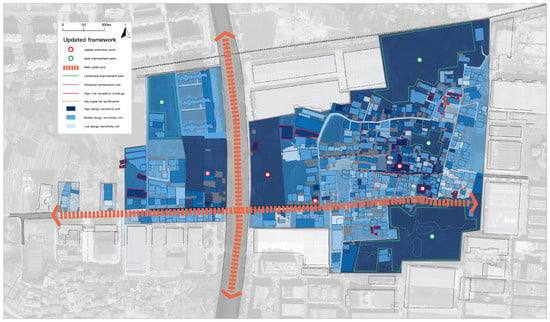
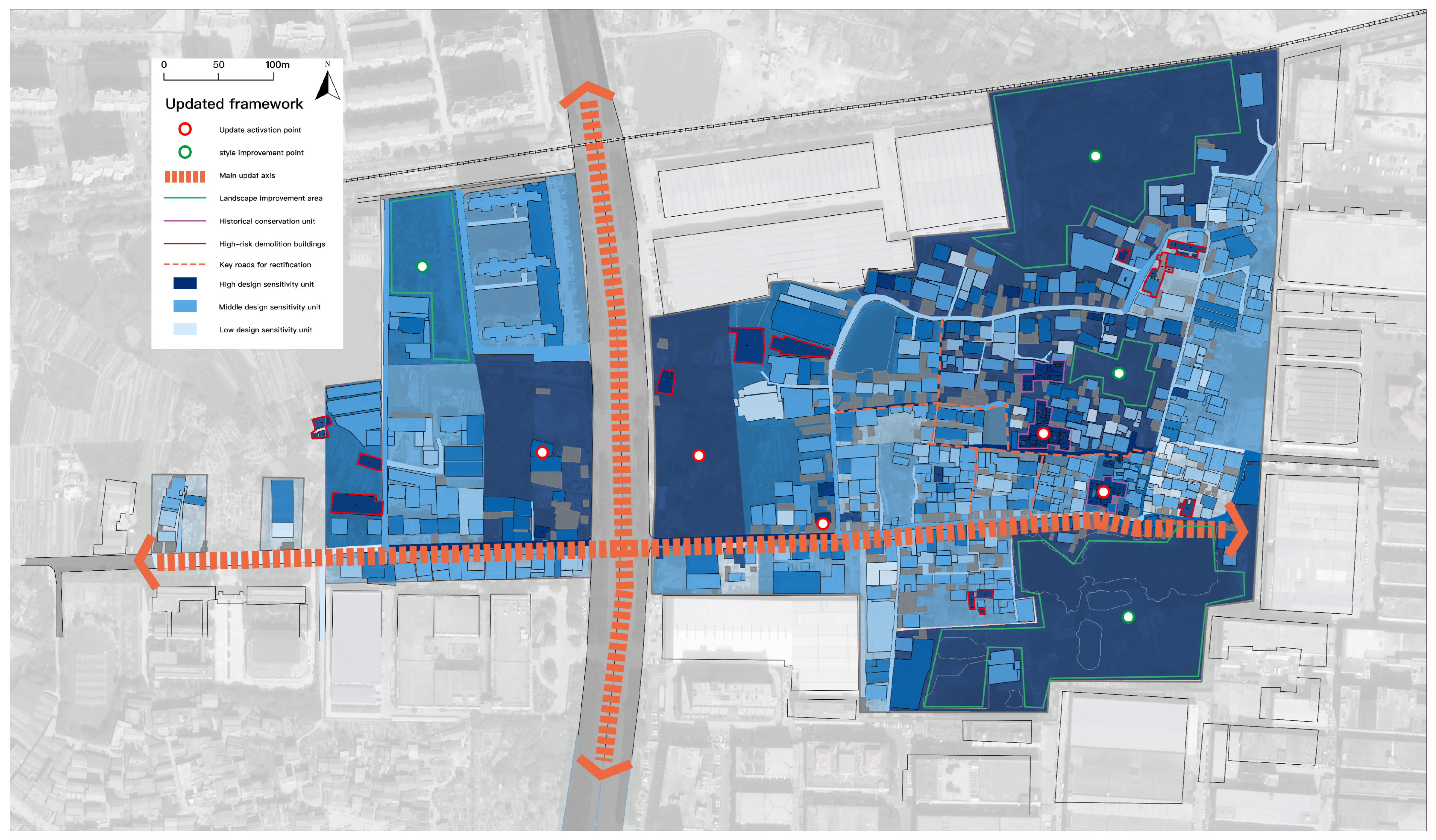
Thirdly, optimize the spatial structure. Using sensitivity zoning at various levels as a base map, consolidate high-sensitivity clusters into primary renewal zones; identify cultural landmarks such as ancestral halls and protected buildings as catalysts for renewal; and designate streets and alleys that connect multiple renewal units and possess high renewal potential as main renewal corridors to strengthen the integration of elements. Through the synergy of points, lines, and surfaces, achieve a leap from the improvement of individual plots to the enhancement of overall environmental quality (Figure 9).
Figure 9.
Design and Renewal Framework for Weicun Village, Wuligang.
5. Discussion
5.1. Methodological and Practical Implications
Based on the above research findings, the significance of the design sensitivity evaluation method for urban village renewal design is as follows:
(1) The framework establishes a quantitative basis for design decision-making, helping urban village renewal move from experience-based judgment toward evidence-based sequencing. Traditional renewal design often relies on the subjective experience of designers or managers, making it difficult to determine where to intervene first and how to allocate limited resources. By translating renewal demand and implementation difficulty into measurable spatial attributes, the proposed design sensitivity evaluation helps identify the feasibility and priority of renewal for buildings, alleys, and public spaces, thereby supporting differentiated strategies and phased implementation.
(2) Precisely identifying entry points for renewal and resolving complex spatial conflicts. Relying solely on on-site surveys and simple analysis makes it difficult to comprehensively grasp the priorities of the complex issues in urban villages. Renewal strategies guided by design sensitivity can provide a holistic, panoramic view of key areas and challenges, clearly identifying entry points for implementation and avoiding the misallocation of resources that results from the approach of “renewing wherever there is a demand.” Taking the Weicun Village in Wuligang as an example, this method effectively supported the design in precisely identifying and prioritizing responses to spatial conflicts between historical character and disorderly illegal structures; conflicts between informal economic activities and residential functions; conflicts over public resources between original residents and tenants; as well as persistent safety issues such as narrow fire lanes and aging utility lines. It balanced spatial vitality and social stability while ensuring safety standards were met.
(3) The framework provides a design tool that can be connected with the whole renewal process. It can be used in the early stage to diagnose renewal drivers and barriers, in the planning stage to compare intervention priorities, and in the implementation stage to update the renewal database as local conditions change. The evaluation process of unit delineation, multidimensional measurement, sensitivity calculation, and tiered decision-making can also be incorporated into lightweight digital management platforms for grassroots planning and community governance.
5.2. Discussion: Rural Transition and Village Governance
The Weicun case shows that urban village renewal is not simply an urban design problem, but a governance process embedded in rural-urban transition. The village retains collective land legacies, historical buildings, kinship-based memory, and informal livelihood spaces, while also being increasingly incorporated into municipal infrastructure, land-value expectations, and formal planning control. Design sensitivity therefore helps reveal where these transition pressures become spatially concentrated. High-sensitivity areas are not only places with poor physical conditions; they are also points where livelihood improvement, heritage protection, public safety, and collective negotiation can produce visible governance gains.
The governance value of the framework lies in making the sources of renewal demand and implementation difficulty visible before intervention decisions are fixed. In many urban village renewal projects, villagers, tenants, small businesses, and local collectives enter the process only after spatial plans have already been drafted, which can turn everyday livelihood needs and property rights concerns into implementation conflicts. By identifying where renewal pressure, social negotiation costs, and management constraints overlap, the sensitivity evaluation provides a shared evidence base for village committees, local government departments, residents, tenants, and market actors. This does not replace negotiation, but it can make negotiation more grounded: priorities can be discussed around specific spatial units, the expected public benefits of renewal, and the likely barriers to implementation. In this sense, the model helps explain how rural social relations are reorganized within an urbanized village community under metropolitan expansion, while also offering a practical basis for phased and less disruptive renewal.
Compared with previous studies on renewal potential and sensitivity evaluation [12,14,15], the main contribution of this study is to distinguish renewal demand from implementation difficulty and compare them within the same spatial unit. While existing studies provide useful references for traditional village regeneration, urban land renewal, and three-dimensional urban regeneration, they mainly focus on heritage conservation, land-use transformation, or integrated redevelopment at broader spatial scales. In contrast, this study applies sensitivity evaluation to the micro-scale design process of urban villages, including buildings, alleys, and public spaces. By jointly considering the urgency of renewal and the difficulty of implementation, the proposed framework supports phased, low-disruption, and negotiable design intervention in high-density Chinese urban villages.
5.3. Limitations and Future Research
(1) The robustness of the evaluation system was preliminarily assessed using alternative weighting assumptions. In addition to the baseline AHP–entropy setting ( = 0.85), three alternative scenarios were examined in Supplementary Table S11: an AHP-dominant scenario ( = 0.90), a balanced scenario ( = 0.50), and an entropy-enhanced scenario ( = 0.70). The comparison reports class-shift counts, high-sensitivity-unit overlap, and rank-correlation measures for building, street and alleyway, and public-space units.
The preliminary robustness check indicates that the main priority pattern remains broadly consistent under alternative weighting assumptions, although some class shifts occur because the evaluation is sensitive to indicator weighting and natural-break thresholds. Therefore, this study reports the robustness check as a preliminary field-consistency and scenario-sensitivity assessment rather than as complete model validation. Additional empirical cases from different regions are still needed to verify the cross-regional applicability of the framework [30].
(2) The multi-stakeholder dynamics and mechanisms of urban village renewal require further elaboration. Urban village renewal involves multiple factors—including funding, technology, and property rights—as well as complex interactions among various stakeholders. Although this study has established a quantitative evaluation framework, the analysis of dynamic processes—such as the temporal evolution of renewal and the feedback loops of stakeholder behavior—remains insufficient. Future research could incorporate game theory and system dynamics to simulate the interactions and checks and balances among diverse stakeholders during renewal. This would facilitate the development of a micro-renewal toolkit tailored to the implementation level, providing strategic support for mitigating spatial rights conflicts and balancing diverse renewal demands.
(3) The pathway for translating research findings into practical tools needs to be expanded. Current research focuses on the construction of evaluation systems, but the connection between sensitivity grading results and specific micro-renewal plans and engineering construction standards still needs to be refined. It is recommended that future work develop lightweight decision-support platforms for grassroots managers and designers, while deepening institutional research on the balance between preservation and development: clarifying the boundaries of government renewal actions, establishing mechanisms for multi-stakeholder consultation and sustainable investment, and fostering a shared sense of agency among original residents and tenants, thereby facilitating the transformation of these methods from academic research into routine governance tools.
6. Conclusions
This study proposed a design sensitivity evaluation framework for incremental urban village renewal and applied it to Weicun Village in Nanchang, China. By distinguishing renewal demand from implementation difficulty, the framework provides a quantitative basis for comparing buildings, street and alleyway units, and public-space plots. The case study shows that design sensitivity can help identify near-term renewal targets, collaborative optimization areas, and long-term control areas, thereby supporting phased renewal sequencing and multi-stakeholder coordination. The method is most suitable for intra-case comparison within the same urban village; future work should strengthen cross-case validation, improve weight robustness testing, and connect sensitivity classification more directly with detailed engineering and governance implementation.
Supplementary Materials
The following supporting information can be downloaded at: https://www.mdpi.com/article/10.3390/land15081467/s1, Table S1: Master Indicator-Weight Correspondence Table. Table S2: Design Sensitivity Classification Summary. Table S3: Building Unit Indicator Scores and Design Sensitivity Calculation. Table S4: Street and Alleyway Unit Indicator Scores and Design Sensitivity Calculation. Table S5: Public Space Unit Indicator Scores and Design Sensitivity Calculation. Table S6: Expert Composition and Delphi Consultation Records. Table S7: AHP Pairwise-Comparison Matrices and Consistency Ratios. Table S8: AHP Consistency Ratio Summary. Table S9: AHP, Entropy, and Composite Weighting Results. Table S10: Complete Unit-Level Design Sensitivity Results. Table S11: Preliminary Robustness Check under Alternative Weighting Scenarios.
Author Contributions
Conceptualization, L.F. and X.W.; methodology, L.F., Z.H. and X.W.; software, Z.H., Y.Z. and X.L.; validation, L.F., Z.H. and X.W.; formal analysis, Z.H., Y.Z. and X.L.; investigation, Z.H., Y.Z. and X.L.; resources, L.F. and X.W.; data curation, Z.H., Y.Z. and X.L.; writing—original draft preparation, L.F. and Z.H.; writing—review and editing, L.F., Z.H. and X.W.; visualization, Z.H., Y.Z. and X.L.; supervision, L.F. and X.W.; project administration, L.F. and X.W. All authors have read and agreed to the published version of the manuscript.
Funding
This research received no external funding.
Data Availability Statement
The data supporting the findings of this study are available in Supplementary Tables S1–S11, including the master indicator-code correspondence table, classification thresholds, raw indicator-score tables, expert consultation and weighting results, robustness check, and the complete unit-level evaluation dataset.
Conflicts of Interest
The authors declare no conflicts of interest.
References
- Qu, Y. Research Hotspots and Trends in Urban Village Renovation under the Context of New Urbanization: Based on CiteSpace Visualization Analysis. Archit. Cult. 2025, 8, 86–88. [Google Scholar] [CrossRef]
- Hao, J.; Li, Y.; Yao, S.; Yuan, J. A Review of Research and Development Trends in Urban Village Renovation in China. Future Urban Des. Oper. 2025, 7, 50–57. [Google Scholar]
- General Office of the State Council. Guidelines of the General Office of the State Council on Actively and Steadily Advancing the Renovation of Urban Villages in Megacities and Super-Large Cities. 2023. Available online: https://www.gov.cn/zhengce/content/202307/content_6890962.htm (accessed on 10 May 2026).
- Ding, Y. Urban-Village Redevelopment Policy Support Scope Expanded to Nearly 300 Prefecture-Level and Above Cities. People’s Daily, 19 November 2024; p. 3. Available online: https://cpc.people.com.cn/n1/2024/1119/c64387-40364425.html (accessed on 9 August 2026).
- Nanchang Municipal People’s Government. Twenty-Six Urban Village Renewal Projects in Nanchang Are Being Accelerated. 2024. Available online: https://www.nc.gov.cn/ncszf/jrnc/202407/2b23cfa1cea84d0080a0db60225713ce.shtml (accessed on 9 August 2026).
- Wu, L. Approaches to the Renovation of Old Residential Areas in Beijing: Organic Renewal of Urban Cells and the Exploration of the “New Siheyuan”. Archit. J. 1989, 7, 11–18. [Google Scholar]
- Mitchell, M.; Tang, B. The Architecture of Incremental Change: Design Strategies for Informal Cities; London Metropolitan University: London, UK, 2019. [Google Scholar]
- Wan, C.; Long, X. A Review and Outlook on the Research on Urban Village Renewal in China: A Literature Analysis Based on Major Urban Planning Journals. J. Hum. Settl. West. China 2022, 37, 78–86. [Google Scholar] [CrossRef]
- Acevedo-De-los-Ríos, A.; Jones-Pérez, J.; Rondinel-Oviedo, D.R. Methodology for Prioritizing Sustainable Urban Regeneration Interventions in Informal Settlements: Case Study in Lima. Cities 2025, 157, 105550. [Google Scholar] [CrossRef] [Scilit]
- Satterthwaite, D. A New Urban Agenda? Environ. Urban. 2016, 28, 3–12. [Google Scholar] [CrossRef] [Scilit]
- Zhang, L.; Ye, Y. Forty Years of Governance in Urban Village Renewal: Evolution and Prospects of Academic Thought. Urban Plan. 2022, 46, 103–114. [Google Scholar]
- Ji, W.; Duan, D. Spatial Renewal Sensitivity Evaluation Method and Application Practice in Traditional Villages: A Case Study of Taixiangsi Village in Yanchuan County. J. Nat. Resour. 2024, 39, 1835–1851. [Google Scholar] [CrossRef] [Scilit]
- Wang, T. A Sensitivity Study on Land Use Renewal in the Old Urban Area of Qingshui, Gansu Province. Master’s Thesis, Xi’an University of Architecture and Technology, Xi’an, China, 2019. [Google Scholar]
- Duan, D.; Wang, T.; Ji, W. Research on the Sensitivity of Urban Land Regeneration. City Plan. Rev. 2023, 47, 49–57, 110. [Google Scholar]
- Li, K.; Shao, J.; Lin, R.; Liu, G.; Zhang, Y.; Yang, M. The Research on the Evaluation Framework and Application of Urban Three-Dimensional (Aboveground and Underground) Regeneration Sensitivity: Taking Kunshan Old City in China as an Example. Tunn. Undergr. Space Technol. 2025, 159, 106428. [Google Scholar] [CrossRef] [Scilit]
- Yang, J.; Yun, S. Public-Oriented Resource Integration: Theoretical and Empirical Approaches to the Transformation of Urban Villages in Megacities and Super-Large Cities. Planner 2024, 40, 18–24. [Google Scholar]
- Zhou, M. A Study on the Construction of an Evaluation Index System and Renewal Strategies for Urban Villages in Beijing. Master’s Thesis, Beijing University of Technology, Beijing, China, 2024. [Google Scholar] [CrossRef]
- Zhou, Y.; Li, Z. A Study on the Reconstruction and Micro-Renovation Concepts of Public Spaces in Urban Villages. Planner 2021, 37, 67–73. [Google Scholar]
- Cai, Y.; Yang, X.; Li, D. A Study on the Content and Countermeasures of “Micro-Renovation” in Old Urban Residential Areas. Urban Dev. Res. 2017, 24, 29–34. [Google Scholar]
- Hemphill, L.; Berry, J.; McGreal, S. An Indicator-Based Approach to Measuring Sustainable Urban Regeneration Performance. Urban Stud. 2004, 41, 725–755. [Google Scholar] [CrossRef] [Scilit]
- Dalkey, N.; Helmer, O. An Experimental Application of the Delphi Method to the Use of Experts. Manag. Sci. 1963, 9, 458–467. [Google Scholar] [CrossRef] [Scilit]
- Saaty, T.L. The Analytic Hierarchy Process; McGraw-Hill: New York, NY, USA, 1980. [Google Scholar]
- Shannon, C.E. A Mathematical Theory of Communication. Bell Syst. Tech. J. 1948, 27, 379–423, 623–656. [Google Scholar] [CrossRef] [Scilit]
- Guo, X.; Liu, C. A Spatial Syntax-Based Model for the Renewal of Urban Villages: A Case Study of Pingshan Village, Shenzhen. Archit. J. 2013, 3, 1–7. [Google Scholar]
- Marshall, S. Streets and Patterns: The Structure of Urban Geometry; Routledge: London, UK, 2004. [Google Scholar]
- Zhou, J.; Zhang, J. A Study on the Spatial Morphology of Historic Districts Based on Spatial Syntax: A Case Study of the Qianmen Area in Beijing. J. Beijing Union Univ. 2018, 32, 22–27. [Google Scholar] [CrossRef]
- Li, N.; Xu, G. Grid-Based Analysis of Land Use Data Using a Natural Breakpoint Hierarchical Method. Bull. Surv. Mapp. 2020, 4, 106–110, 156. [Google Scholar] [CrossRef]
- Zeng, L.; Yi, S.; Deng, Z. Construction of an Evaluation Index System and Assessment Model for Special Inspections of Urban Villages in Guangzhou. Planner 2025, 41, 122–130. [Google Scholar]
- Ye, J.; Zhao, L. A Study on Urban Village Renovation Models Based on Urban Service Boundaries. Zhejiang Archit. 2020, 37, 12–15. [Google Scholar] [CrossRef]
- Liu, J.; Huang, Z.; Wu, X.; Hou, Q. Optimization of Urban Village Public Space Vitality Based on Complex Network. Sci. Rep. 2025, 15, 15392. [Google Scholar] [CrossRef] [Scilit] [PubMed]

Disclaimer/Publisher’s Note: The statements, opinions and data contained in all publications are solely those of the individual author(s) and contributor(s) and not of MDPI and/or the editor(s). MDPI and/or the editor(s) disclaim responsibility for any injury to people or property resulting from any ideas, methods, instructions or products referred to in the content. |
© 2026 by the authors. Licensee MDPI, Basel, Switzerland. This article is an open access article distributed under the terms and conditions of the Creative Commons Attribution (CC BY) license.