


Abstract
Current post-fire recovery strategies in Mediterranean Chile primarily emphasize discernible outcomes, such as residential reconstruction and expedited reforestation. In this context, neglecting soil degradation remains a critical geographical oversight. This perspective proposes the integration of a soil security framework as an “invisible reconstruction” to mitigate the unacknowledged deterioration of the five soil dimensions (capacity, condition, capital, connectivity, and codification) within fire-affected territories. Also, this study advocates for nature-based solutions as instruments for territorial management, asserting that soil should be classified as an essential infrastructure within national disaster risk policies during the recovery phase. A strategic roadmap and an organizational map are presented for public planners and researchers, facilitating a transition from immediate recovery to an integrated reconstruction paradigm centered on soil security. The proposed approach aims to reconcile the disparities between soil, vegetation, and anthropogenic reconstruction in fire-prone regions characterized by extractive economic models.
1. Contextualizing the Chilean Wildfire Crisis in Corporate Landscapes
Wildfire disturbances have had a profound impact in vast areas of Mediterranean and temperate landscapes, thereby posing critical challenges for biodiversity conservation, soil health, the water cycle and ecosystem services [1,2,3,4,5]. Francos et al. [6] attributed the increased and sustained severity of wildfire disturbances in Mediterranean ecosystems to rural abandonment, land-use changes and climate change.
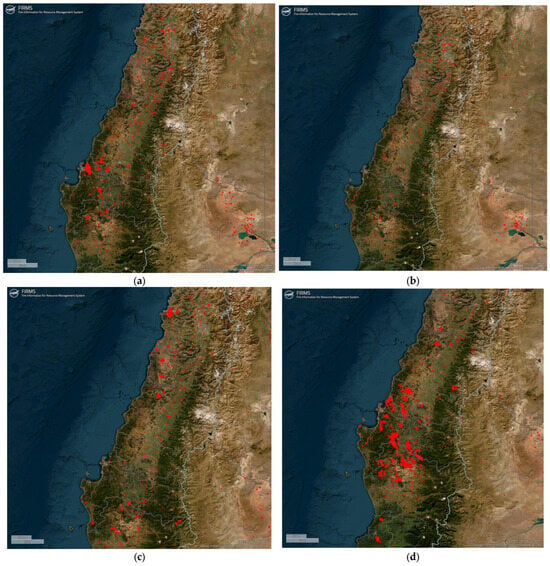
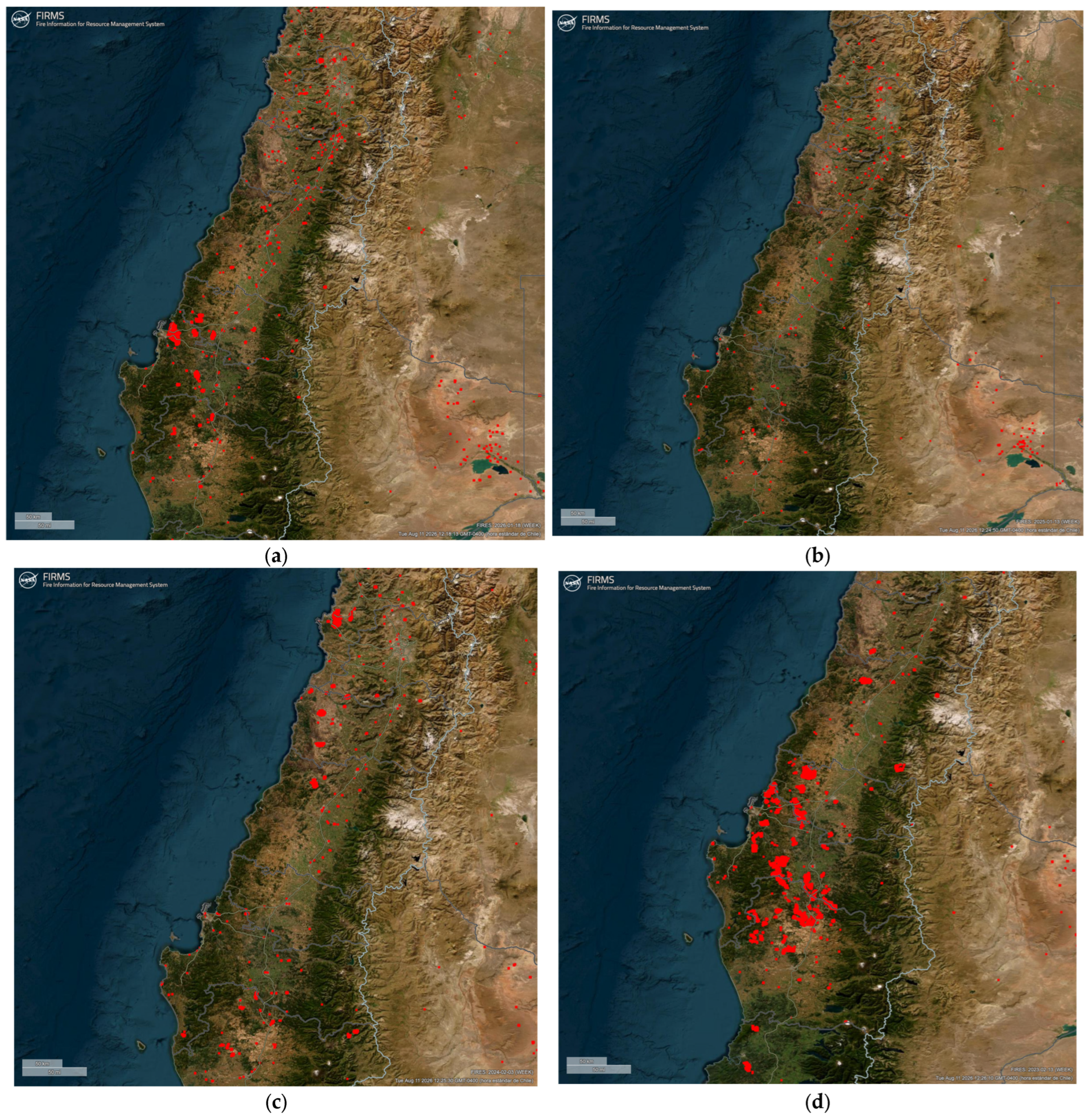
In recent decades, Mediterranean Chilean landscapes have undergone a substantial shift in their wildfire regime, marked by mega-fires of unparalleled intensity and frequency [7,8,9,10]. This shift in the wildfire regime is concerning in a country that has been affected by extreme weather conditions of high temperatures, low humidity, dryness, and strong winds [11]. Since the firestorm of 2017, which consumed between 467,000 and 600,000 hectares alone, this country has faced multiple critical seasons of wildfires, with approximately 2 million hectares burned in the last decade [11,12] (Figure 1). Even with the previously described fire disturbances, the Chilean case raises concern, as its forests, wetlands, and other ecosystems have served as sinks that have absorbed roughly two-thirds of the country’s total carbon emissions [13,14] over the past 20 years.
Figure 1.
Central Chile and its burned lands shown in bright red from 2023 to 2026. Source: NASA FIRMS Satellite (considering weeks), 2026. (a) 18 January 2026: Trinitarias fire. (b) 13 January 2025: Metropolitan region fires. (c) 3 February 2024: Valparaíso fire. (d) 13 February 2023: Las Máquinas fire.
Additionally, in this country, the recovery after wildfires presents difficulties associated with its landscape matrix. The mainland country has a total area of more than 75 million hectares, and it is estimated that approximately 54% corresponds to land with some productive potential (agricultural, forestry, or livestock), and the rest has severe physical limitations, as the soils are degraded [15]. In 2025, native forests reached 15,482,121 hectares, comprising 3.1 million hectares of forestry plantations, 507,166 hectares of annual crops (cereals, legumes, tubers, industrial crops), and approximately 400,000 hectares of fruit trees (highlighting citrus fruits, table grapes, cherry trees, and walnuts) [16,17].
The Chilean agroforestry model has promoted those abovementioned land uses focused on extensive patches of monocultures as they have been heavily subsidized by the government, and within that process facilitated the replacement of native forests with exotic monocultures [18,19] as “eucalyptus plantations have climbed since the early 1990s, and now they account for about 40% of the forestry planted area in Chile” [11]. The model has been described as corporate landscapes [20], which have emerged through extensive crop rotation and operations that function as “political technology” [21], often supported by state subsidies to measure and control territory based on extractive economies. These operations often cause significant biodiversity loss, soil depletion, and landscape homogenization [22,23,24].
2. Gap and Objectives
Beyond the damage caused by wildfires, corporate landscapes continue to put pressure on territories, creating dangerous wildland-urban interfaces that may increase the frequency of socio-natural disasters. This transition ultimately entangles corporate production of extractive economies within a cycle of fire risk and environmental catastrophe, constraining the overall recovery of soils, urban settlements, and vegetation.
Extensive literature on soil recovery and soil rehabilitation has traditionally been rooted in soil science, while interdisciplinary approaches integrating disasters are emerging and remain scattered [25]. This theoretical shortcoming leads to fragmented perspectives that may be inadequate for landscapes dominated by extractive economies such as agroforestry, mining, and chemical industries. In contrast to previous studies that have largely treated soil recovery as a purely ecological or technical problem [26,27], this work bridges the gap between soil security and critical territorial analysis. While current literature highlights soil resilience and health indicators [26,27], it frequently neglects the structural impacts of extractive economic models on land degradation.
Additionally, it diverges by explicitly connecting the political economy of these corporate landscapes with disaster risk management, proposing the “invisible reconstruction” framework to reposition soil as essential infrastructure rather than a mere secondary outcome of reconstruction efforts.
The general objective of this article is to propose a territorial and socio-ecological framework to upgrade the soil security approach for landscapes that are subjected to intensive extractive economies. It also advocates for incorporating this framework as an invisible reconstruction that may address the silent loss of its five dimensions in the burned lands. The specific objectives are:
- To critically evaluate current institutional and regulatory gaps in the Chilean disaster risk management framework, addressing the systemic absence of soil recovery protocols in post-disaster reconstruction policies within the context of an extractive economy.
- To develop a strategic roadmap for “invisible reconstruction” that leverages nature-based solutions that may help to restore soil structural integrity and biological networks, explicitly addressing the constraints imposed by extreme climate events and corporate landscapes, for a diverse audience, including scientists, non-scientists, and policymakers.
3. Soil Security Framework
This article advocates for the concept of “invisible reconstruction” as a paradigm shift within the soil security framework. It argues that comprehensive recovery following major disturbances, such as wildfires, must proceed in tandem with the restoration of the edaphic health that sustains life. This perspective diverges from contemporary strategies that prioritize canopy restoration—often to fulfill international afforestation quotas—or residential housing solutions, at the expense of soil integrity.
The soil security framework, initially conceptualized by McBratney et al. [28] and further developed to address global policy challenges [29,30,31], provides a robust mechanism for quantifying soil dynamics across spatial and temporal scales. Furthermore, it may be considered a matter of national security [32,33,34,35]. This framework organizes soil security into five distinct dimensions: capacity, condition, capital, connectivity, and codification.
Current literature often approaches soil security through static assessment frameworks [28,29,30], frequently failing to account for the acute, structural disruptions to pedological processes that characterize fire-affected, extractive landscapes [36]. Within these territories, socioeconomic and political pressures often prioritize immediate, surface-level reconstruction, neglecting the restoration of the soil’s essential functional capacity [37,38].
Although the soil security framework was not originally designed for post-disaster scenarios and this idea has not yet been empirically tested, it offers a promising conceptual lens for analyzing the extractive ecosystems emerging in fire-affected Chilean landscapes; it will be discussed in the following section.
4. Analysis of Current Disaster Risk Management Frameworks in Chile and the Absence of Soil-Specific Recovery Protocols in Reconstruction
This article proposes that soil could be recognized as an essential infrastructure in national disaster risk policies in the recovery phase and recommends shifting the scope to an integrated reconstruction focused on soil security in fire-prone territories with extractive economies. Furthermore, as Chile currently lacks a domestic legislative framework specifically designed to protect its soils, the present regulations are largely derived from international sources and treaties that the country has signed related to climate change [39].
Both anthropic and ecological restoration initiatives have been centered on the visible recovery of aboveground biomass and the reconstruction of houses and infrastructure [9,40]. This vegetation-and-human-centric approach frequently fails to acknowledge the silent degradation that has persisted beneath the surface and has been exacerbated by frequent wildfires, which is a phenomenon observed in the coastal range and explained by Jaque Castillo et al. [41].
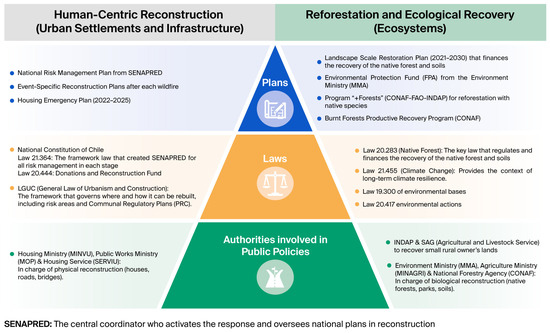
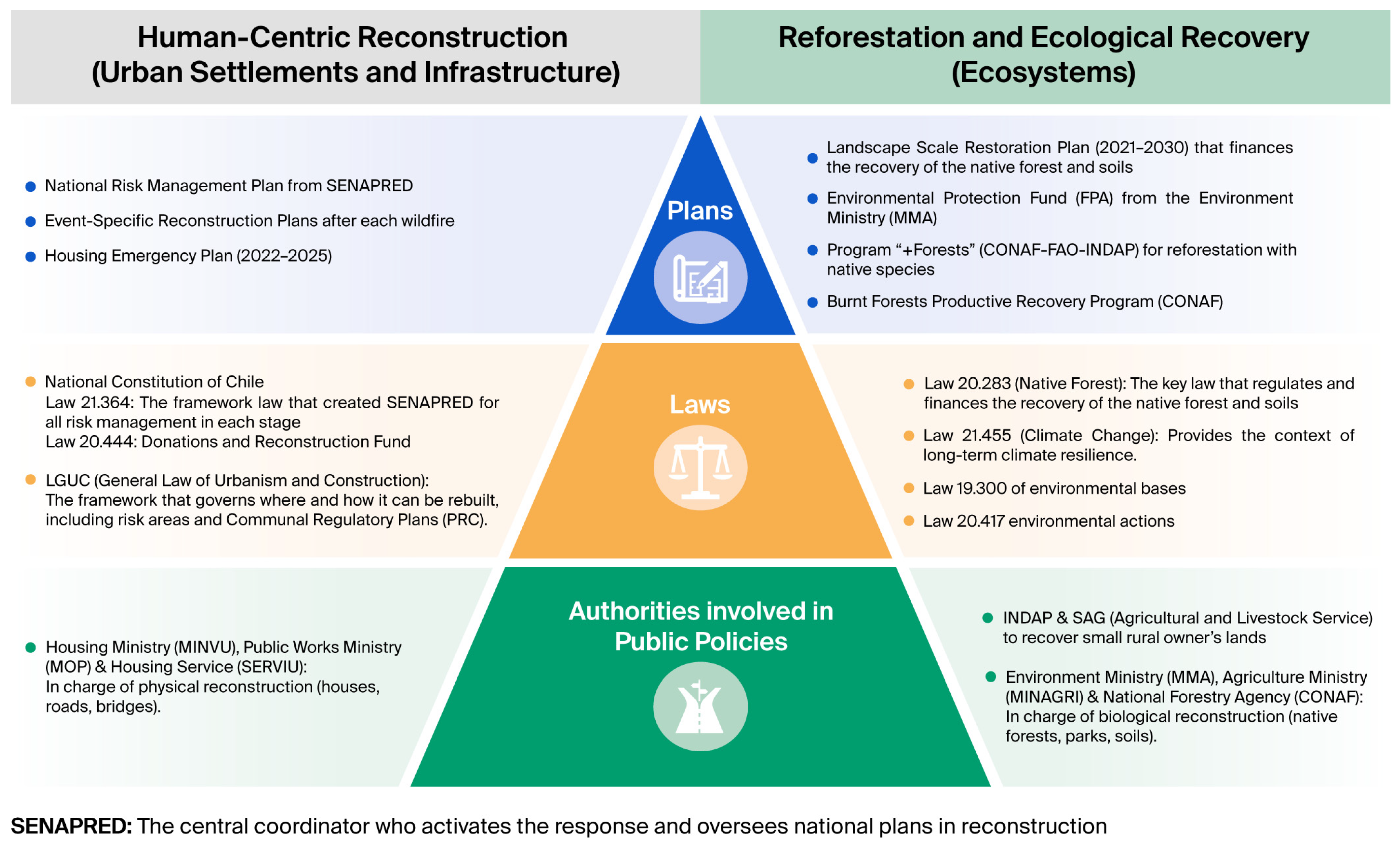
Chilean reconstruction starts immediately after wildfires, and it is coordinated through different authorities, plans, initiatives, and public policies led by the national emergency agency (SENAPRED in Spanish) (Figure 2). It follows a common pattern observed in recovery processes around the world that uses four key approaches based on policy, planning, project implementation, and social organization, while being shaped by three primary constraints: urgency, public visibility, and political priorities [42]. Additionally, reconstruction and restoration ignore other forms of knowledge and ontologies related to indigenous people, rural communities, and more-than-human relationships, as well as repairing the direct damage from wildfires and achieving environmental justice [43].
Figure 2.
Organizational framework for Chilean post-wildfire reconstruction, delineated into two primary sectors: human-centric reconstruction (comprising urban settlements and infrastructure) on the left, and reforestation and ecological recovery (focused on ecosystem restoration) on the right. Source: The authors.
The reconstruction of human settlements and vegetation reforestation is a non-homogeneous process and usually requires many years to be considered finished [44]; however, in the case of Chilean soils, the recovery is even longer, taking approximately 13 to 14 years, as some empirical studies have shown [13,45]. Moreover, both anthropogenic and green recoveries post-wildfires have not considered the significance of multiscale monitoring in their legislation and plans, treating wildfires as unique events each time they occur, despite the suggestions from the study of De la Barrera et al. [7] after the 2017 mega-fires in Southern Central Chile. Consequently, this approach may have created landscapes and communities prone to being severely affected by wildfires.
The green recovery in non-urban areas is overseen by the Ministry of Agriculture (MINAGRI in Spanish), the National Forestry Agency (CONAF in Spanish), and the Ministry of the Environment (MMA in Spanish) (Figure 2). Those agencies have a coordinated roadmap of actions to enhance soil recovery without an interdisciplinary and multi-stakeholder approach. Those agencies have physical indicators for post-disaster reforestation—such as erosion rates, soil moisture retention, and hydrological shifts—which are critical for assessing immediate landscape stability and landslide risk [44,46,47]. Also, those frameworks often incorporate social indicators coming from the feedback from farmers and transnational funding agencies [48,49,50,51,52,53,54].
Furthermore, in the literature reviewed, the chemical and biological post-disaster metrics have been increasingly recognized for their potential relevance in assessing ecosystem functionality; for instance, those metrics help to monitoring soil nutrient availability (e.g., nitrogen, phosphorus, and calcium) and microbial community profiles (e.g., fungal and prokaryotic activity), and they provide deeper insights into nutrient cycling and long-term recovery trajectories [55,56,57,58,59].
The post-wildfire recommendations for Chilean soils in non-urban areas have been predominantly concentrated on the physical aspects of soils, exhibiting a paucity of interdisciplinary perspectives (Table 1). According to Smith-Ramírez et al. [60], Bannister et al. [61], Acevedo et al. [62] and Souza-Alonso et al. [63], the ecological restoration and reforestation experiences in the country have been scarce and have been constrained by environmental, social and economic issues to be considered as fully developed. In consequence, more efforts will be required to assess vulnerability and damage post-fire restoration in those ecosystems vulnerable to constant fire disturbance [13].
Currently, the ecological restoration and reforestation initiatives are registered in a National Registry of Ecological Restoration and Recovery Actions overseen by the Ministry of the Environment [53]. The current strategy to do ecological restoration is the National Landscape Restoration Plan 2021–2030 [40] and has been complemented with some initiatives by the transnational funds from the Global Environmental Facility (GEF) and the Food and Agriculture Organization of the United Nations (FAO), with technical support of CONAF [48,49,50,51,52,53,54]. Also, those efforts of ecological restoration have been emphasized in national legislations such as Native Forest and Forestry Development Law Nº. 20.283 of 2008 (formerly known as DL Nº701 from 1974) [64] and Framework Law on Climate Change (Nº. 21,455).
Table 1.
Until now, the literature on post-wildfire treatments for non-urban Chilean soils has primarily focused on the physical aspects of the soil, often neglecting an interdisciplinary approach.
Currently, the recovery of human settlements is overseen by the Ministry of Housing (MINVU in Spanish), SENAPRED, the Public Works Ministry (MOP in Spanish), and the Housing Service (SERVIU in Spanish), accompanied by the Ministry of Social Development (MIDESO in Spanish) [71] (Figure 2). After each wildfire that ravaged the cities and their peri-urban spaces, these ministries implemented reconstruction plans based on the National Strategic Plan for Disaster Risk Management (2020–2030) and Law Nº. 21.364 with funds from the central government, approved by the Chilean Congress, and tax-free funds donated by private entities or persons under Law Nº. 20.444 [72]. Until this date, a debate is being held in the National Congress about a proposal for a wildfire law—which is different from Law Nº. 20.653, which increases the penalties for individuals responsible for wildfire ignition—that may intervene in the recovery phase by establishing a moratorium on land use after the disturbances and enhancing prevention strategies in private owned lands.
In the human settlement recovery processes, the soil security framework has not been considered because the post-wildfire reconstruction plans have been focused on the population’s access to new/temporary housing and rebuilding anthropocentric infrastructure, such as bridges, highways, water, and basic services (sanitation and electricity) [9,73]. This approach in reconstruction leaves the non-urban areas in an uncertain limbo as they are not prioritized by these ministries even if rural populations living in them have different priorities for their recovery after the disaster [74].
5. Soil Security Implementation in the Chilean Mediterranean Context Is Subject to Extractive Economies: Ideas, Nature-Based Solutions and a Roadmap
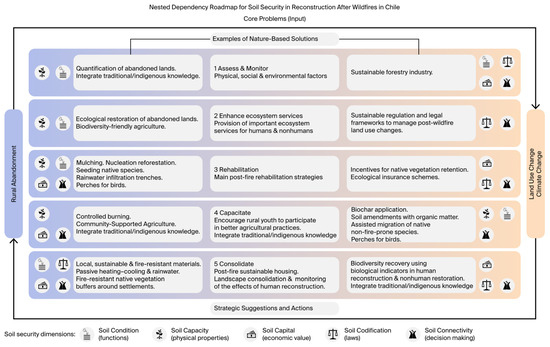
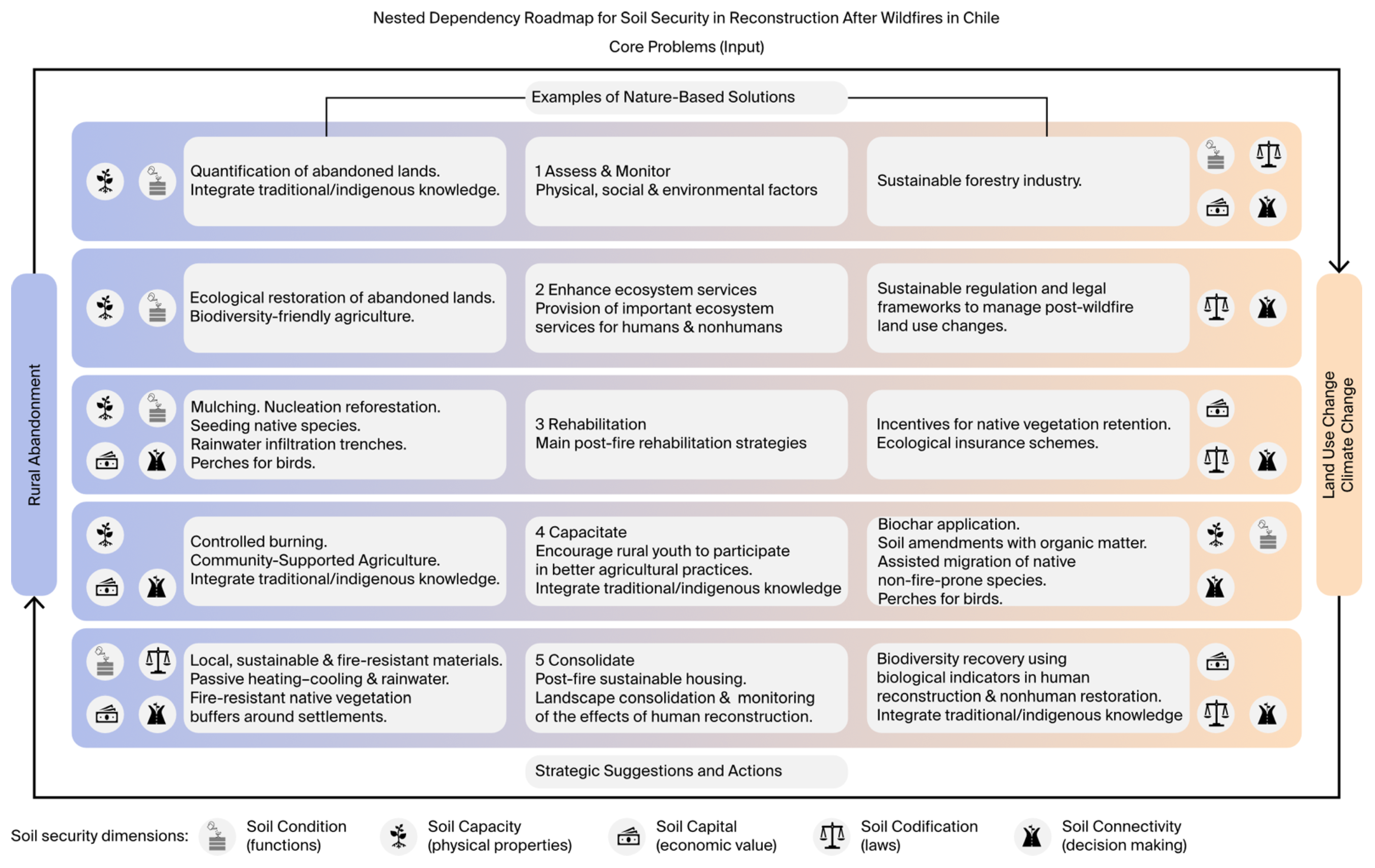
Drawing upon a reflexive literature review, this study proposes three core concepts, a suite of nature-based solutions, and a strategic roadmap designed to integrate the soil security framework as an “invisible reconstruction” within Mediterranean terrestrial ecosystems situated within extractive landscapes, with a specific focus on the Chilean context. The development of these core concepts was based on an examination of the challenges identified by Francos et al. [6]—rural abandonment, land-use changes and climate change—, aligned with the anthropogenic and environmental drivers of wildfires documented by Bowman et al. [2]. Such challenges demand the implementation of long-term strategies, as empirical evidence suggests that the period of significant ecological and edaphic impairment may be extended for a minimum of 14 years [75] (Figure 3).
Figure 3.
A roadmap for a diverse audience, including scientists, non-scientists, and policymakers, to enhance human and non-human reconstruction after the wildfires in Mediterranean ecosystems—including Chile—. Source: The authors.
A first core concept is the rural abandonment, which it is not a single problem but rather a compounding problem: the decline in rural populations results in the lack of management of the wooded areas and impoverishment of soil conditions, which manifests as an increase in the accumulation of fire fuel materials—such as the loss of traditional land management practices, terrace maintenance, or active vegetation management—, which leads to multiple potential ignition points in highly eroded soils ready to be burned under appropriate weather conditions [76]. Although several studies have addressed this globally significant topic, those most relevant to the present article include:
- (1)
- Monitoring of land abandonment evolution over time with available GIS tools and quantitative assessments of physical, environmental, and social parameters, such as the use of metrics such as the Universal Revised Soil Loss Equation (RUSLE) or the Sediment Connectivity Index, which are standard to quantify the measures effectiveness [76]. In this sense, it will be necessary to secure considerable funding because the monitoring time will take more than 30 years, as the study of Crawford et al. [77] observed, where over half of abandoned croplands were recultivated within 30 years, with a median recultivation period of only 14 years.
- (2)
- Enhancing the provision of prioritized ecosystem services [76] for human and non-human populations [78].
- (3)
- Implementing post-fire rehabilitation strategies for Mediterranean land ecosystems mentioned in Table 1 is a key investment that should not overlooked. As Girona et al. found in its review about four Mediterranean countries in the Northern Hemisphere that post-wildfire soil recovery is less costly than the loss of values-at-risk [74]. Furthermore, it will be recommended to create long-term funding for post-fire rehabilitation strategies that promotes a respectful approach to traditional and indigenous practices regarding soil recovery, the selection of the species to be reforested, and preferred housing materials for rebuilding. Moreover, policymakers may need to implement measures to manage recultivation or offer incentives for natural regeneration in abandoned lands as well as in terrain vague [77].
- (4)
- Working together with rural communities to incentivize young people to be more involved in doing agricultural practices without threatening soil security by changing ecosystems’ feedback loops [79] or biodiversity loss [23].
- (5)
- Developing strategies for non-urban and wildland urban-interfaces post-fire emergency housing that considers the physical, environmental, and social parameters at landscape scale, moving away from individual solutions at plot level. As new studies about physical changes in post-fire reconstruction of the built environment arise, strategies based in that evidence may be more resource-efficient [9,10,72]. Moreover, it may be necessary to incorporate all experiences obtained from prior ecological restoration and reforestation initiatives into the National Reconstruction Plans.
The two remaining core concepts are land-use changes and climate changes which problems stem from the repeated, large-scale introduction of non-native, fire-susceptible plant species. This practice has been facilitating ecosystem combustion, a process accelerated by fire-prone weather conditions and arsonism. Particularly fragile are those landscapes located in extractive economies which often suffer from bio-perversities [80] by disrupting their natural Mediterranean water–soil–fire regimes and systematically replacing native vegetation with highly-flammable monocultures of rapid-growth taxa. This topic is not new, and several studies have been studying them around the world; however, we suggest observing these five more contingent aspects of this article’s proposal:
- (1)
- In landscapes dominated by highly extractive monocultures, it is necessary to have a sustainable forestry industry [19,81]. In that sense, more funding should be provided to implement native forest patches, community work to protect eroded soil with post-fire rehabilitation strategies, prevent wood theft—arsonism, and enhance community networks for prevention and environmental education to avoid dangerous fire-related practices, such as agricultural burning. This strategy also points to the resolution of socio-demographic, environmental justice, and aging rural population problems identified by Thomas et al. [43], Martínez-Alier [82], and Ojeda Leal et al. [74].
- (2)
- Improve the regulation and legal frameworks to manage, in a sustainable way, the rapid land-use changes affecting the landscapes after wildfires. In particular, the biodiversity hotspots observed by Braun et al. [3] and Smith-Ramírez, C. [83], terrain vague and abandoned non-urban lands [77] need to be managed to avoid landscape homogenization [18,22], loss of soil fertility [4], and loss of national agricultural productivity.
- (3)
- Reinforce the financing of strategies to avoid the bio-perversities [80] associated with intensive replacement of non-fire-prone vegetation, as extreme fire weather may drive rapid changes (>20 years). As more extreme disturbances are being driven by climate change [11,67], the lands will be reconverted from one monoculture to another, leading to massive extractive operations of capital [84,85]. This recommendation may demand a strong compromise of the policymakers and funding agencies, as they need to maintain the non-fire-prone species and post-fire rehabilitation strategies in the long term (<10 years) by providing financial incentives to forestry industries, conservationist associations, farmers, and young rural inhabitants.
- (4)
- Improve microbial-fungi activity [57] and native plant production and seed distribution for non-fire-prone species for burned urban and non-urban lands [62].
- (5)
- Closely monitor the effects produced in non-urban populations by the ecological and human reconstruction. In some Chilean experiences, it was observed that after disasters, the sentiment of not being supported to keep the afforested vegetation in a sustainable manner for rural inhabitants was significant [54,74] and the inhabitants created more risk by modifying the disaster-risk reconstructed housing [86]. It is suggested to reinforce and monitor efforts within the National Reconstruction Plans and ecological restoration-reforestation initiatives.
It is recommended to select specific nature-based solutions to mitigate the challenges identified in the preceding core concepts—rural abandonment, land-use changes and climate change—, particularly regarding the extreme climatic phenomena and corporate landscapes production. The proposals of specific nature-based solutions included in Table 2 were specifically structured for a multidisciplinary audience comprising researchers, practitioners, and policymakers. Furthermore, to advance conventional anthropogenic and ecological reconstruction within the established soil security paradigm, a strategic roadmap is provided for a diverse stakeholder group (Figure 3).
Table 2.
Nature-based solutions to tackle the increased and sustained severity of wildfires in Mediterranean ecosystems—including Chile—mixing the framework of soil security and three cores concepts: rural abandonment, land-use changes and climate change.
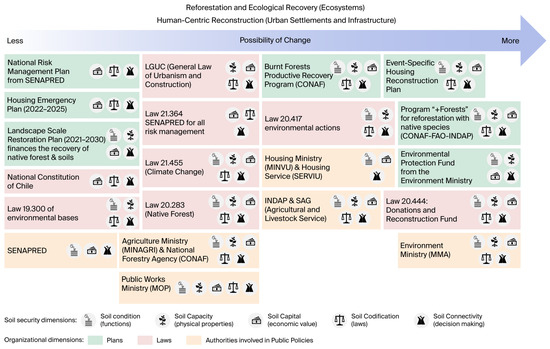
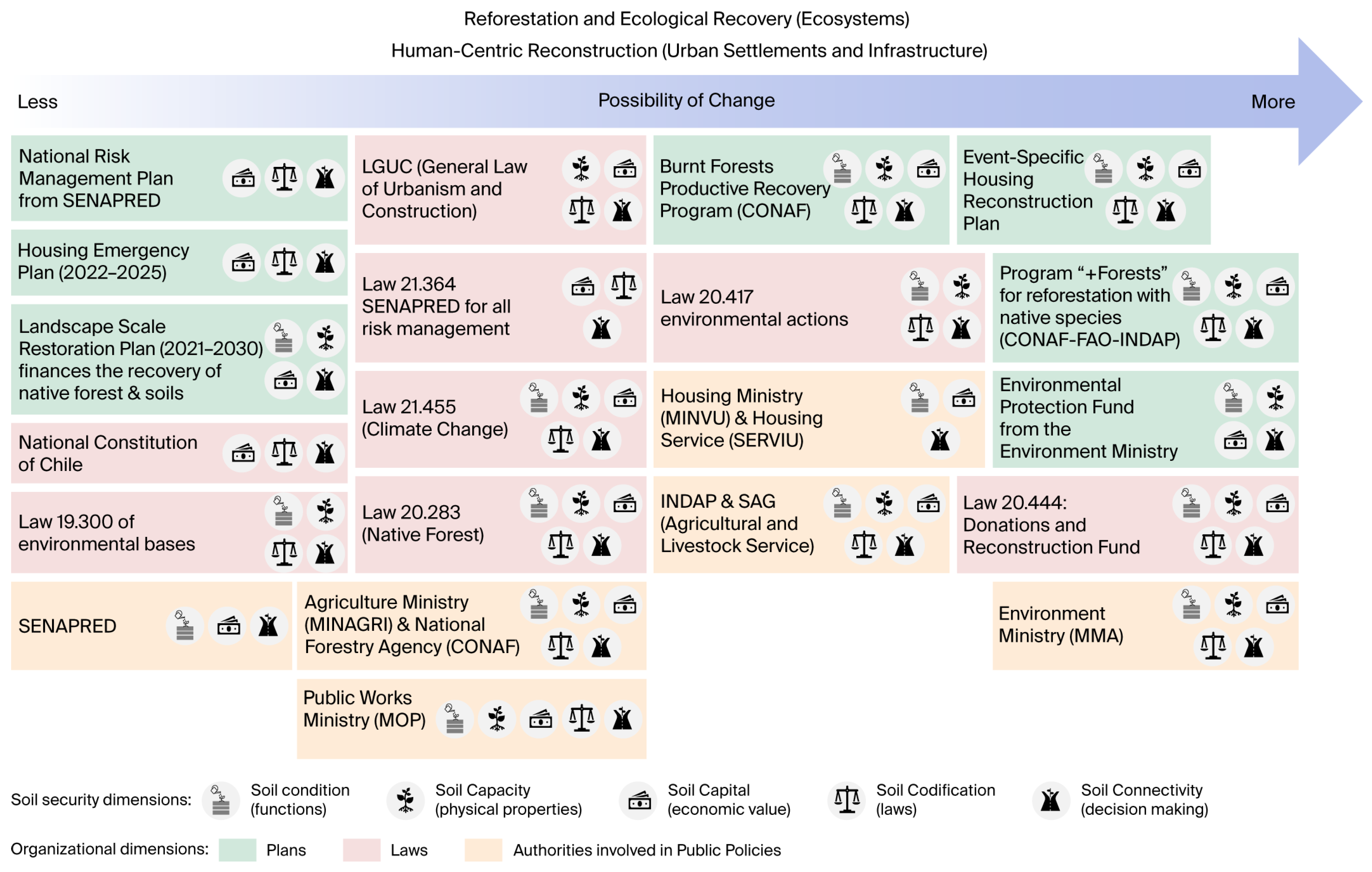
This article advocates for a strategic shift aimed at using soil security dimensions as foundational guides for both anthropogenic reconstruction and ecological restoration. Furthermore, it is suggested that current regulatory frameworks, legislative instruments, and the governing entities overseeing reconstruction policy could evolve to facilitate a more comprehensive range of transformative interventions. Also, for the Chilean context, it is recommended that inter-actor interconnections be enhanced as a potential alternative to further saturating the existing legal framework with additional legislation and obligations needing to open the possibility of change for current plans, laws and authorities involved in both reconstruction processes (Figure 4).
Figure 4.
The Chilean reconstruction organizational map after wildfires, linking human-centric reconstruction with non-human reforestation and ecological recovery, considering soil security. Also, this roadmap includes the possibility of change of each plan, law and authorities involved in both reconstruction processes. Source: The authors.
Lastly, the internal coupling of rural abandonment, land-use change, and climate change may generate a synergistic risk profile that standard policy instruments will struggle to address. This systemic nexus suggests a move beyond reactionary measures; it implies the need to better understand how the degradation of soil connectivity amplifies wildfire impacts, pointing to the potential of nature-based solutions that address the root causes of these problems rather than just their symptoms [87,88]. Nevertheless, it is noteworthy to mention that recent research points out that cost and public acceptance are critical barriers for the implementation of nature-based solutions [85]. For Chilean contexts, the systemic nexus of abandonment of rural sectors, frequently exacerbated by the expansion of extractive monocultures, may significantly compromise soil capacity and leave landscapes vulnerable to extreme climate phenomena [87,89].
6. Limitations and Future Research Directions
Notwithstanding the theoretical and policy contributions of this perspective, several inherent limitations must be acknowledged. First, the proposed integration of the five dimensions of soil security into post-wildfire recovery remains a conceptual and qualitative framework that has not yet been systematically validated through long-term empirical field data in Chilean landscapes. While this approach synthesizes existing literature on soil degradation and disaster risk management, it lacks localized, quantitative metrics—such as empirical thresholds for biological recovery or site-specific cost–benefit analyses of nature-based solutions—across diverse edaphic typologies, particularly within vulnerable Andisols and Inceptisols of the coastal range. Consequently, the operational scalability of the “invisible reconstruction” roadmap across varying fire severities and microclimatic conditions requires further empirical testing and field calibration.
Second, the scope of this study is inherently constrained by the structural and institutional inertia of Chile’s political economy. Framing soil security within territories dominated by corporate forestry plantations and extractive land-use models introduces socio-political complexities that a purely academic exercise cannot resolve. The analysis reviewed in this article relied primarily on the critique of current legislative instruments (e.g., Law Nº 21.364 and SENAPRED protocols) and public policy gaps; however, it does not fully capture the micro-level governance dynamics, land tenure conflicts, or property rights constraints that private forestry companies and smallholder farmers face during immediate post-fire emergency phases. This institutional fragmentation may limit the immediate real-world applicability of centralized soil protection mandates without prior regulatory reforms or economic incentives.
Lastly, while the geographical focus on Mediterranean Chile offers valuable insights into a global biodiversity hotspot facing a severe megadrought, the generalizability of these findings to other fire-prone regions may be restricted. Differences in national disaster governance architectures, local ecological community structures, and varying degrees of reliance on extractive forestry mean that the proposed roadmap may not be applied as a universal blueprint. Future research may address these constraints by conducting longitudinal, interdisciplinary studies that combine empirical pedological monitoring with socio-spatial network analysis, thereby refining the “invisible reconstruction” framework into a quantifiable and adaptable tool for Mediterranean ecosystems stressed by wildfires.
7. Conclusions
The present study addresses an interdisciplinary perspective in response to the severe wildfires that have afflicted Chile over recent decades. In this sense, the five dimensions of soil security may serve as a theoretical framework for both anthropogenic and non-anthropogenic reconstruction efforts after such catastrophic events.
This study shifts the scope from viewing soil degradation as a purely technical consequence of wildfires to framing it as a critical intersection between disaster risk management and the political economy of corporate landscapes. By integrating the five dimensions of soil security within the socio-environmental realities of extractive models, this research moves beyond conventional ecological metrics to offer a holistic framework that accounts for the historical and structural pressures shaping post-fire trajectories.
The dominance of extractive economic paradigms, combined with a fragmented policy environment, poses a significant hurdle for the large-scale integration of the proposed nature-based solutions shown in the roadmap (Figure 3). Addressing these challenges will require not only technical ingenuity but also a pragmatic alignment with local political economies to overcome the systemic inertia inherent in post-disaster reconstruction frameworks, consistent with the critical approach to post-disaster response advocated by Lizarralde et al. [42].
A critical examination of three core concepts or challenges observed in Mediterranean ecosystems—land abandonment, land-use change, and climate change—and the implementation of nature-based solutions might be necessary to mitigate these issues within the context of Chile’s existing extractive economic paradigm. Additionally, an organizational map (Figure 4) has been delineated to facilitate a transition from a predominantly anthropocentric reconstruction model to one that integrates the recovery of housing, reforestation and soil.
Lastly, policymakers and financing entities may could be benefited from an interdisciplinary approach like this as it considers soil security after wildfires as well as emergency housing, urban development, and reforestation plans.
Funding
This research was partially supported by Vicerrectoría de Investigación of Pontificia Universidad Católica de Chile within the Forum Academic Collaboration Chile-Sweden (ACCESS) 2026.
Data Availability Statement
No new data were created or analyzed in this study. Data sharing is not applicable to this article.
Acknowledgments
The author acknowledges to Erick Zagal (UDEC), María de los Angeles Sepúlveda (UDEC), and Jonathan Suazo (UDLA) for the initial discussions about soil security in Chile. The author acknowledges the use of imagery for Figure 1 from NASA’s Fire Information for Resource Management System (FIRMS) (https://firms.modaps.eosdis.nasa.gov), part of NASA’s Earth Science Data and Information System (ESDIS). During the preparation of this manuscript, the author used Gemini Pro 3 for the purposes of general English-language editing, image generation, and synthesizing information in Table 2. Additionally, Jenni.ai (version 2026) was used for reference accuracy and for English grammar revision and coherence. The author has reviewed and edited the output and takes full responsibility for the content of this publication.
Conflicts of Interest
The author declares no conflicts of interest. The funders had no role in the design of the study; in the collection, analyses, or interpretation of data; in the writing of the manuscript; or in the decision to publish the results.
References
- Borgogni, F.; Lavecchia, A.; Mastrolonardo, G.; Certini, G.; Ceccherini, M.T.; Pietramellara, G. Immediate- and Short-Term Wildfire Impact on Soil Microbial Diversity and Activity in a Mediterranean Forest Soil. Soil Sci. 2019, 184, 35–42. [Google Scholar] [CrossRef] [Scilit]
- Bowman, D.M.J.S.; Moreira-Muñoz, A.; Kolden, C.A.; Chávez, R.O.; Muñoz, A.A.; Salinas, F.; González-Reyes, Á.; Rocco, R.; de la Barrera, F.; Williamson, G.J.; et al. Human–Environmental Drivers and Impacts of the Globally Extreme 2017 Chilean Fires. AMBIO 2018, 48, 350–362. [Google Scholar] [CrossRef] [Scilit] [PubMed]
- Braun, A.; Fassnacht, F.E.; Valencia, D.; Sepúlveda, M.A. Consequences of Land-Use Change and the Wildfire Disaster of 2017 for the Central Chilean Biodiversity Hotspot. Reg. Environ. Change 2021, 21, 37. [Google Scholar] [CrossRef] [Scilit]
- Paula, S.; Ramírez, D.P.; Estay, S.A.; Pausas, J.G. Soil Fertility Shapes Fire Activity across Mediterranean-type Climate Regions. Glob. Ecol. Biogeogr. 2023, 33, 400–411. [Google Scholar] [CrossRef] [Scilit]
- Stehr, A.; Vyhmeister, N.; Saenger, V.; Bolaños-Villegas, P.; Duarte, E. Effects of Wildfires on Water Quantity and Quality in Southern Chile, 2024. In Proceedings of the European Geosciences Union General Assembly 2024 (EGU24), Vienna, Austria, 14–19 April 2024; Available online: https://ui.adsabs.harvard.edu/link_gateway/2024EGUGA.26.8559S/doi:10.5194/egusphere-egu24-8559 (accessed on 9 August 2026).
- Francos, M.; Colino-Prieto, F.; Sánchez-García, C. How Mediterranean Ecosystem Deals with Wildfire Impact on Soil Ecosystem Services and Functions: A Review. Land 2024, 13, 407. [Google Scholar] [CrossRef] [Scilit]
- de la Barrera, F.; Barraza, F.; Favier, P.; Ruiz, V.; Qüense, J. Megafires in Chile 2017: Monitoring Multiscale Environmental Impacts of Burned Ecosystems. Sci. Total Environ. 2018, 637, 1526–1536. [Google Scholar] [CrossRef] [Scilit] [PubMed]
- Úbeda, X.; Sarricolea, P. Wildfires in Chile: A Review. Glob. Planet. Change 2016, 146, 152–161. [Google Scholar] [CrossRef] [Scilit]
- León, J.; Vicuña, M.; Gil, M.; González-Mathiesen, C. Después de la Emergencia: Claves Para una Recuperación Sostenible en Zonas Afectadas por Incendios en la Interfaz Urbano-Forestal. Policy Papers CIGIDEN. 2023. Available online: https://www.cigiden.cl/despues-de-la-emergencia-claves-para-una-recuperacion-sostenible-en-zonas-afectadas-por-incendios-en-la-interfaz-urbano-forestal/ (accessed on 9 August 2026).
- Aguirre, P.; León, J.; González-Mathiesen, C.; Román, R.; Penas, M.; Ogueda, A. Modelling the Vulnerability of Urban Settings to Wildland–Urban Interface Fires in Chile. Nat. Hazards Earth Syst. Sci. 2024, 24, 1521–1537. [Google Scholar] [CrossRef] [Scilit]
- Cordero, R.R.; Féron, S.; Damiani, A.; Carrasco, J.; Karas, C.; Wang, C.; Kraamwinkel, C.T.; Beaulieu, A. Extreme Fire Weather in Chile Driven by Climate Change and El Niño–Southern Oscillation (ENSO). Sci. Rep. 2024, 14, 1974. [Google Scholar] [CrossRef] [Scilit] [PubMed]
- CONAF Resumen Nacional Ocurrencia (Número) y Daño (Superficie Afectada) por Incendios Forestales 1964–2024. Estadísticas Históricas. Available online: https://www.conaf.cl/incendios/#descripcionprograma (accessed on 9 August 2026).
- Núñez-Hidalgo, I.; Pfeiffer, M.; Lira, E.; Alaniz, A.J.; Gaxiola, A. Assessing the Impact of Landcover Change on Soil Organic Carbon Stocks in Chile: Implications for Terrestrial Ecosystems and Conservation Policies. J. Appl. Ecol. 2025, 62, 2636–2656. [Google Scholar] [CrossRef] [Scilit]
- Climate Tracker. Chile Country Summary. 2025. Available online: https://climateactiontracker.org/countries/chile/ (accessed on 9 August 2026).
- Duarte, E.; Rubilar, R.; Matus, F.; Garrido-Ruiz, C.; Merino, C.; Smith-Ramírez, C.; Aburto, F.; Rojas, C.; Stehr, A.; Dörner, J.; et al. Drought and Wildfire Trends in Native Forests of South-Central Chile in the 21st Century. Fire 2024, 7, 230. [Google Scholar] [CrossRef] [Scilit]
- INE Estadísticas por Tema. Agricultura y Medio Ambiente. Siembra y Cosecha. 2025. Available online: https://www.ine.gob.cl/estadisticas-por-tema/agricultura-y-medio-ambiente/siembra-y-cosecha (accessed on 9 August 2026).
- CONAF Catalogue of Native Vegetation Resources of Chile. Forestry Plantations. 2024. Available online: https://www.conaf.cl/manejo-de-ecosistemas/gestion-forestal-suelos-y-agua/plantaciones-forestales/?cp=2 (accessed on 9 August 2026).
- Nahuelhual, L.; Carmona, A.; Lara, A.; Echeverría, C.; González, M.E. Land-Cover Change to Forest Plantations: Proximate Causes and Implications for the Landscape in South-Central Chile. Landsc. Urban Plan. 2012, 107, 12–20. [Google Scholar] [CrossRef] [Scilit]
- Gómez-González, S.; Ojeda, F.; Fernandes, P.M. Portugal and Chile: Longing for Sustainable Forestry While Rising from the Ashes. Environ. Sci. Policy 2017, 81, 104–107. [Google Scholar] [CrossRef] [Scilit]
- Ojeda, C. Los paisajes posibles: En animación suspendida, corporativos y del desastre. Chile y Argentina como ejemplos de estudio. J. Lat. Am. Geogr. 2021, 20, 39–66. [Google Scholar] [CrossRef] [Scilit]
- Elden, S. Land, Terrain, Territory. Prog. Hum. Geogr. 2010, 34, 799–817. [Google Scholar] [CrossRef] [Scilit]
- Ianiszewski, F. Agroindustria, Usos Del Suelo y La Homogeneización Del Paisaje. Rev. Electrón. Ambiente Total 2009, 2, 1–33. [Google Scholar]
- Pacha, M.J.; Luque, S.; Galetto, L.; Iverson, L.R. Understanding Biodiversity Loss: An Overview of Forest Fragmentation in South America; HAL (Le Centre pour la Communication Scientifique Directe): Villeurbanne, France, 2007. [Google Scholar]
- Cifuentes-Croquevielle, C.; Stanton, D.E.; Armestó, J.J. Soil Invertebrate Diversity Loss and Functional Changes in Temperate Forest Soils Replaced by Exotic Pine Plantations. Sci. Rep. 2020, 10, 7762. [Google Scholar] [CrossRef] [Scilit] [PubMed]
- Mason, E.; Bispo, A.; Matt, M.; Helming, K.; Rodríguez, E.; Lansac, R.; Carrasco, V.; Hashar, M.R.; Verdonk, L.; Prokop, G.; et al. Sustainable Soil and Land Management: A Systems-Oriented Overview of Scientific Literature. Front. Soil Sci. 2023, 3, 1268037. [Google Scholar] [CrossRef] [Scilit]
- Seybold, C.A.; Herrick, J.E.; Brejda, J.J. Soil resilience: A fundamental component of soil quality. Soil Sci. 1999, 164, 224–234. [Google Scholar] [CrossRef] [Scilit]
- Huang, F.; Tu, J.; Zhang, F.; Ran, J.; Wang, Y.; Liu, W.; Chen, W.; Wang, X.; Wang, Q.; Wang, X.; et al. Soil Health Assessment of Urban Forests in Nanchang, China: Establishing a Minimum Data Set Model. Soil Biol. Biochem. 2025, 206, 109795. [Google Scholar] [CrossRef] [Scilit]
- McBratney, A.B.; Field, D.J.; Koch, A. The Dimensions of Soil Security. Geoderma 2013, 213, 203–213. [Google Scholar] [CrossRef] [Scilit]
- Swan, T.; McBratney, A.B.; Field, D.J. Linkages between Soil Security and One Health: Implications for the 2030 Sustainable Development Goals. Front. Public Health 2024, 12, 1447663. [Google Scholar] [CrossRef] [Scilit] [PubMed]
- Sharififar, A.; Borrelli, P.; Evangelista, S.J.; Field, D.; Flyn, T.; Francos, N.; Heuser, I.L.; Hunakunti, A.; McBratney, A.B.; Minasny, B.; et al. Soil Policy Principles and a Policymaking Framework Using the Soil Security Concept. Environ. Sci. Policy 2025, 168, 104057. [Google Scholar] [CrossRef] [Scilit]
- Koch, A.; McBratney, A.B.; Adams, M.A.; Field, D.J.; Hill, R.W.; Crawford, J.W.; Minasny, B.; Lal, R.; Abbott, L.K.; O’Donnell, A.G.; et al. Soil Security: Solving the Global Soil Crisis. Glob. Policy 2013, 4, 434–441. [Google Scholar] [CrossRef] [Scilit]
- Yawson, D.O.; Adu, M.O.; Ason, B.; Armah, F.A.; Yengoh, G.T. Putting Soil Security on the Policy Agenda: Need for a Familiar Framework. Challenges 2016, 7, 15. [Google Scholar] [CrossRef] [Scilit]
- McBratney, A.B.; Field, D.J. Securing Our Soil. Soil Sci. Plant Nutr. 2015, 61, 587–591. [Google Scholar] [CrossRef] [Scilit]
- Basset, C. Soil Security: The Cornerstone of National Security in an Era of Global Disruptions. SPIRE—Sci. Po Institutional Repos. 2024, 16, 100154. [Google Scholar] [CrossRef] [Scilit]
- Fatima, H.; Park, M.; Ameen, M.; Aslam, I.; Athar, T.; Shah, S.S.H.; Abbasi, G.H.; Ali, M.Q.; Waris, A.A.; Arshad, M.N.; et al. Soil Security to Address Potential Global Issues. In Environmental Nexus for Resource Management; CRC Press: Boca Raton, FL, USA, 2024; pp. 81–113. Available online: https://www.taylorfrancis.com/chapters/edit/10.1201/9781003358169-5/soil-security-address-potential-global-issues-hina-fatima-man-park-muhammad-ameen-iqra-aslam-tabinda-athar-syed-shabbar-hussain-shah-ghulam-hassan-abbasi-muhammad-ali-aisha-abdul-waris-muhammad-naveed-arshad-muhammad-ashar-ayub (accessed on 9 August 2026).
- Santín, C.; Doerr, S.H. Fire Effects on Soils: The Human Dimension. Philos. Trans. R. Soc. B Biol. Sci. 2016, 371, 20150171. [Google Scholar] [CrossRef] [Scilit] [PubMed]
- Zhou, G.; Eisenhauer, N.; Du, Z.; Lucas-Borja, M.E.; Zhai, K.; Berdugo, M.; Duan, H.; Wu, H.; Liu, S.; Revillini, D.; et al. Fire-Driven Disruptions of Global Soil Biochemical Relationships. Nat. Commun. 2025, 16, 1190. [Google Scholar] [CrossRef] [Scilit] [PubMed]
- Cahyana, D.; Karolinoerita, V.; Widyatmanti, W.; Fiantis, D.; Setiawati, A.R.; Widyastuti, M.T.; Sukarman, S.; Gani, R.A.; Muslim, R.Q.; Manurung, E.D.; et al. Advancing Soil Security through International Scientific Collaboration in Indonesia. Soil Adv. 2025, 4, 100076. [Google Scholar] [CrossRef] [Scilit]
- Rojas, C.; Merino, C.; Aponte, H.; Yáñez, C. Soil biodiversity in Chile: Current scenario and future challenges. In Sustainable Soil Management as a Key to Preserve Soil Biodiversity and Stop Its Degradation; International Union of Soil Sciences (IUSS): Vienna, Austria, 2022; pp. 65–75. [Google Scholar]
- Ministerio De Agricultura (MINAGRI)—Corporación Nacional Forestal (CONAF)—Ministerio Del Medio Ambiente (MMA). Plan Nacional de Restauración de Paisajes 2021–2030. Santiago de Chile. 2021. Available online: https://mma.gob.cl/wp-content/uploads/2021/11/Plan-Nacional-de-Restauracion-de-Paisajes-2021-2030.pdf (accessed on 9 August 2026).
- Jaque Castillo, E.; Galilea Salvador, I.; Ojeda Leal, C.G.; Huaico-Malhue, A. Clasificación de suelos para la cordillera costera chilena. Implicaciones para el manejo de suelos degradados en cuencas mediterráneas. Rev. De Geogr. Norte Gd. 2024, 88, 1–17. [Google Scholar] [CrossRef] [Scilit]
- Lizarralde, G.; Wachsmuth, D.; Özdoğan, F.; Cossu, M. Critical Reconstruction Theory and the Invention of Post-Disaster Response. Build. Cities 2026, 7, 683–703. [Google Scholar] [CrossRef] [Scilit]
- Thomas, A.S.; Escobedo, F.J.; Sloggy, M.R.; Sánchez, J.J. A Burning Issue: Reviewing the Socio-Demographic and Environmental Justice Aspects of the Wildfire Literature. PLoS ONE 2022, 17, e0271019. [Google Scholar] [CrossRef] [Scilit] [PubMed]
- Garrido-Ruiz, C.; Sandoval, M.; Stolpe, N.; Sánchez-Hernández, J.C. Fire Impacts on Soil and Post Fire Emergency Stabilization Treatments in Mediterranean-Climate Regions. Chil. J. Agric. Res. 2022, 82, 335–347. [Google Scholar] [CrossRef] [Scilit]
- Mallikarjun, J.; Gorbushina, A.A.; Kuzyakov, Y.; Koester, M.; Castro, R.A.; Yudina, A.; Abdallah, K.; Matus, F.; Dippold, M.A. Post-Fire Recovery of Temperate and Mediterranean Ecosystems: An Interplay between Fire Severity, Soil Nutrients, and Vegetation from Early-Stage to Decadal-Scale Dynamics. CATENA 2025, 260, 109431. [Google Scholar] [CrossRef] [Scilit]
- Sánchez, K.; Thiers, Ó.; Iroumé, A.; Aguayo, M.; Pincheira, M.; Zúñiga, F. Characterization of Soil Changes and Vegetation Indicators after Wildfires. J. Soil Sci. Plant Nutr. 2026, 26, 2310–2324. [Google Scholar] [CrossRef] [Scilit]
- Giraldo, C.V.; Acevedo, S.E.; Contreras, C.; Santibáñez, F.; Sáez, E.; Calderón, F.J.; Bonilla, C.A. Effects of Soil Heating Changes on Soil Hydraulic Properties in Central Chile. Geoderma 2024, 449, 117013. [Google Scholar] [CrossRef] [Scilit]
- Global Environmental Fund (GEF). Plan de Gestión Territorial Ránquil, Quillón y Florida Región del Biobío Comunidades Mediterráneas Sostenibles. Promoviendo el Manejo Sostenible de los Recursos Naturales y la Generación de Beneficios Socio-Ambientales, 2020. Available online: www.gefcomunidades.mma.gob.cl/ (accessed on 9 August 2026).
- Seremi del Medio Ambiente Región del Biobío (SEREMI MMA), Gobierno Regional de Biobío (GOREBIOBIO) e Instituto de Ecología y Biodiversidad (IEB). Biodiversidad del Ecosistema Cayumanque, Sitio Prioritario para la Conservación de la Biodiversidad de la Región de Ñuble, Chile, 2018. Available online: https://bibliotecadigital.ciren.cl/items/e313bb24-c9eb-40a8-b041-d937f3e2784d (accessed on 9 August 2026).
- Food and Agriculture Organization (FAO). Marco de Gestión Ambiental y Social para el Proyecto REDD+ de Pago Basado en Resultados propuesto por el gobierno de Chile al Fondo Verde del Clima, 2019. Available online: https://openknowledge.fao.org/server/api/core/bitstreams/018304f3-c9f7-4224-b1aa-af1e1c2c8dff/content (accessed on 9 August 2026).
- FAO. Integrated Fire Management Voluntary Guidelines. In Principles and Strategic Actions, 2nd ed.; Forestry Working Paper; No. 41; FAO: Rome, Italy, 2024. [Google Scholar] [CrossRef] [Scilit]
- Ministerio del Medio Ambiente (MMA). Proyectos GEF Liderados por el MMA Chile. 2024. Available online: https://mma.gob.cl/gef/ (accessed on 9 August 2026).
- Ministerio del Medio Ambiente (MMA). Registro Nacional de Restauración Ecológica y Acciones de Recuperación. Available online: https://restauracionecologica.mma.gob.cl/ (accessed on 9 August 2026).
- Ojeda Leal, C.; Quijada, P.; Schroeder, S.; Gutiérrez, P.; Bergamini, K. Proyectos de Restauración Predial En Florida, Chile: Limitaciones y Oportunidades de Acción de Prevención de Incendios Promovidas Desde Instituciones Públicas y Organismos Internacionales. Rev. Geogr. Norte Gd. 2026, 93, 1–21. [Google Scholar] [CrossRef] [Scilit]
- Aponte, H.; Galindo-Castañeda, T.; Yáñez, C.; Hartmann, M.; Rojas, C. Microbial Community-Level Physiological Profiles and Genetic Prokaryotic Structure of Burned Soils Under Mediterranean Sclerophyll Forests in Central Chile. Front. Microbiol. 2022, 13, 824813. [Google Scholar] [CrossRef] [Scilit] [PubMed]
- Fuentes-Ramírez, A.; Almonacid, L.; Muñoz-Gómez, N.; Moloney, K.A. Spatio-Temporal Variation in Soil Nutrients and Plant Recovery across a Fire-Severity Gradient in Old-Growth Araucaria-Nothofagus Forests of South-Central Chile. Forests 2022, 13, 448. [Google Scholar] [CrossRef] [Scilit]
- Almonacid, L.; Herrera, H.; Fuentes-Ramírez, A.; Vargas-Gaete, R.; Toy-Opazo, O.; de Oliveira Costa, P.H.; da Silva Valadares, R.B. What Fire Didn’t Take Away: Plant Growth-Promoting Microorganisms in Burned Soils of Old-Growth Nothofagus Forests in Los Andes Cordillera. Plant Soil 2025, 507, 655–669. [Google Scholar] [CrossRef] [Scilit]
- Chávez, D.; Machuca, Á.; Deramond, C.; Santander, C.; Aguilera, P.; Cornejo, P. Diversity of Arbuscular Mycorrhizal Fungi in Araucaria Araucana Is Affected for Fire Events in the Andes and Coastal Mountains of Chile. J. Soil Sci. Plant Nutr. 2025, 25, 1149–1158. [Google Scholar] [CrossRef] [Scilit]
- Gatica-Saavedra, P.; Aburto, F.; Rojas, P.; Echeverría, C. Soil Health Indicators for Monitoring Forest Ecological Restoration: A Critical Review. Restor. Ecol. 2022, 31, e13836. [Google Scholar] [CrossRef] [Scilit]
- Bannister, J.R.; Vargas-Gaete, R.; Ovalle, J.F.; Acevedo, M.; Fuentes-Ramírez, A.; Donoso, P.J.; Promis, Á.; Smith-Ramírez, C. Major Bottlenecks for the Restoration of Natural Forests in Chile. Restor. Ecol. 2018, 26, 1039–1044. [Google Scholar] [CrossRef] [Scilit]
- Smith-Ramírez, C.; González, M.E.; Echeverría, C.; Lara, A. Estado actual de la restauración ecológica en Chile, perspectivas y desafíos. An. Inst. Patagon. 2015, 43, 11–21. [Google Scholar] [CrossRef] [Scilit]
- Acevedo, M.; Álvarez-Maldini, C.; Dumroese, R.K.; Bannister, J.R.; Cartes, E.; González, M. Native Plant Production in Chile. Is It Possible to Achieve Restoration Goals by 2035? Land 2021, 10, 71. [Google Scholar] [CrossRef] [Scilit]
- Souza-Alonso, P.; Saiz, G.; García, R.A.; Pauchard, A.; Ferreira, A.; Merino, A. Post-Fire Ecological Restoration in Latin American Forest Ecosystems: Insights and Lessons from the Last Two Decades. For. Ecol. Manag. 2022, 509, 120083. [Google Scholar] [CrossRef] [Scilit]
- Biblioteca del Congreso Nacional de Chile (BCN). Ley 20.283 Sobre Recuperación del Bosque Nativo y Fomento Forestal. Ministerio de Agricultura. 2008. Available online: https://bcn.cl/2f284 (accessed on 9 August 2026).
- Smith-Ramírez, C.; Castillo, J.; Becerra, P.; Sandoval, N.; Fuentes, R.; Allende, R.; Acuña, M.P. Combining Remote Sensing and Field Data to Assess Recovery of the Chilean Mediterranean Vegetation after Fire: Effect of Time Elapsed and Burn Severity. For. Ecol. Manag. 2022, 503, 119800. [Google Scholar] [CrossRef] [Scilit]
- Albornoz, F.E.; Gaxiola, A.; Seaman, B.J.; Pugnaire, F.I.; Armestó, J.J. Nucleation-Driven Regeneration Promotes Post-Fire Recovery in a Chilean Temperate Forest. Plant Ecol. 2013, 214, 765–776. [Google Scholar] [CrossRef] [Scilit]
- Hernández-Duarte, A.; Saavedra, F.; González, E.G.; Miranda, A.; Francois, J.P.; Somos-Valenzuela, M.; Sibold, J.S. Effects of Drought and Fire Severity Interaction on Short-Term Post-Fire Recovery of the Mediterranean Forest of South America. Fire 2024, 7, 428. [Google Scholar] [CrossRef] [Scilit]
- Marín, C.A.P.; Rojas, C. Respuestas estacionales de condiciones del suelo relacionadas al C y N en un bosque Mediterráneo Chileno afectado por un incendio tras aplicación de enmiendas orgánicas y establecimiento de plantas. Agro Sur 2022, 50, 31–45. [Google Scholar] [CrossRef] [Scilit]
- Garrido-Ruiz, C.; Sandoval, M.; Stolpe, N.; Sánchez-Hernández, J.C.; Campos, C. Effect of Wildfires on Soil Properties of Agricultural Lands of Mediterranean-Climate Region in Chile. Chil. J. Agric. Res. 2023, 83, 643–655. [Google Scholar] [CrossRef] [Scilit]
- Jhenkhar, M.; Gorbuchina, A.A.; Kuzyakov, Y.; Koester, M.; Castro, R.; Yudina, A.; Matus, F.; Dippold, M.A. Post-Fire Soil Physical and Chemical Properties, Temperate and Mediterranean Ecosystem of Chile [dataset]; PANGAEA—Data Publisher for Earth & Environmental Science: Bremerhaven, Germany, 2025. [Google Scholar] [CrossRef]
- Sandoval, V.; Vos, M. Disaster Governance and Vulnerability: The Case of Chile. Politics Gov. 2016, 4, 107–116. [Google Scholar] [CrossRef] [Scilit]
- González-Mathiesen, C.; Aravena-Solís, N.; Rosales, C. Reconstruction as an Opportunity to Reduce Risk? Physical Changes Post-Wildfire in Chilean Case Studies. Sustainability 2025, 17, 9162. [Google Scholar] [CrossRef] [Scilit]
- León, J.; Rojas, M.I.; Gutiérrez, S.; Román, R. Assessing the Reconstruction Process Following a Wildland Urban Interface (WUI) Fire in Viña Del Mar, Chile. Disaster Prev. Manag. Int. J. 2024, 33, 502–514. [Google Scholar] [CrossRef] [Scilit]
- Ojeda, C.; Castillo, E.J.; Castillo, S.F. Postwildfire Landscape Identity in Mediterranean Ecosystems: Three Study Cases from the Coastal Range of Central Chile. Ann. Am. Assoc. Geogr. 2021, 111, 1692–1704. [Google Scholar] [CrossRef] [Scilit]
- Marfella, L.; Mairota, P.; Marzaioli, R.; Glanville, H.; Pazienza, G.; Rutigliano, F.A. Long-Term Impact of Wildfire on Soil Physical, Chemical and Biological Properties within a Pine Forest. Eur. J. For. Res. 2024, 143, 1379–1399. [Google Scholar] [CrossRef] [Scilit]
- Mantero, G.; Morresi, D.; Marzano, R.; Motta, R.; Mladenoff, D.J.; Garbarino, M. The Influence of Land Abandonment on Forest Disturbance Regimes: A Global Review. Landsc. Ecol. 2020, 35, 2723–2744. [Google Scholar] [CrossRef] [Scilit]
- Crawford, C.L.; Yin, H.; Radeloff, V.C.; Wilcove, D.S. Rural Land Abandonment Is Too Ephemeral to Provide Major Benefits for Biodiversity and Climate. Sci. Adv. 2022, 8, eabm8999. [Google Scholar] [CrossRef] [Scilit] [PubMed]
- Rauchecker, M.; Kuhn, D.R.; Hummel, D.; Fickel, T.; Friedrich, T.; Brinkmann, K.; Burkhart, S.; Frick-Trzebitzky, F.; Nitschke, L. Social-Ecological Conflicts: An Emancipatory Conceptual Approach by Bringing Other-than-Humans into Environmental Conflict Analysis. Environ. Plan. E Nat. Space 2025, 9, 266–292. [Google Scholar] [CrossRef] [Scilit]
- Carswell, A.; Willcock, S.; Blackwell, M.S.A.; Upadhayay, H.R.; Harris, P.G.; McAuliffe, G.A.; Neal, A.L.; Rivero, M.J.; Cárdenas, L.M.; Haefele, S.M.; et al. Agricultural Practices Can Threaten Soil Resilience through Changing Feedback Loops. npj Sustain. Agric. 2025, 3, 56. [Google Scholar] [CrossRef] [Scilit] [PubMed]
- Lindenmayer, D.B.; Hulvey, K.B.; Hobbs, R.J.; Colyvan, M.; Felton, A.; Possingham, H.P.; Steffen, W.; Wilson, K.A.; Youngentob, K.N.; Gibbons, P. Avoiding Bio-perversity from Carbon Sequestration Solutions. UWA Profiles Res. Repos. (Univ. West. Aust.) 2011, 5, 28–36. [Google Scholar] [CrossRef] [Scilit]
- Andersson, K.; Lawrence, D.; Zavaleta, J.; Guariguata, M.R. More Trees, More Poverty? The Socioeconomic Effects of Tree Plantations in Chile, 2001–2011. Environ. Manag. 2015, 57, 123–136. [Google Scholar] [CrossRef] [Scilit] [PubMed]
- Alier, J.M. Land, Water, Air and Freedom; Edward Elgar Publishing: Cheltenham, UK, 2023. [Google Scholar]
- Smith-Ramírez, C. The Chilean Coastal Range: A Vanishing Center of Biodiversity and Endemism in South American Temperate Rainforests. Biodivers. Conserv. 2003, 13, 373–393. [Google Scholar] [CrossRef] [Scilit]
- Gago, V.; Mezzadra, S. A Critique of the Extractive Operations of Capital: Toward an Expanded Concept of Extractivism. Rethink. Marx. 2017, 29, 574–591. [Google Scholar] [CrossRef] [Scilit]
- Omeje, K. Extractive Economies and Conflicts in the Global South: Multi-Regional Perspectives on Rentier Politics; Routledge: London, UK, 2013. [Google Scholar]
- Jaque Castillo, E.; Astudillo, L.; Espinoza, S.; Braun, C. Evaluación de la vulnerabilidad social post-tsunami 2010 en caleta tumbes (Chile). A través del modelo “presión y descompresión”. Urbano 2020, 23, 130–151. [Google Scholar] [CrossRef] [Scilit]
- Matus, F.; Duarte, E.; Rojas, C.; Smith-Ramírez, C.; Rubilar, R.; Merino, C.; Aburto, F.; Jofré, I.; Stehr, A.; Nájera, F.; et al. Forest Wildfires in Chile: Effects on Soil Degradation and Damage Mitigation. Available online: https://www.preprints.org/manuscript/202306.1802 (accessed on 9 August 2026).
- Martini, L.; Faes, L.; Picco, L.; Iroumé, A.; Lingua, E.; Garbarino, M.; Cavalli, M. Assessing the Effect of Fire Severity on Sediment Connectivity in Central Chile. Sci. Total Environ. 2020, 728, 139006. [Google Scholar] [CrossRef] [Scilit] [PubMed]
- McWethy, D.B.; Pauchard, A.; García, R.A.; Holz, A.; González, M.E.; Veblen, T.T.; Stahl, J.; Currey, B. Landscape Drivers of Recent Fire Activity (2001–2017) in South-Central Chile. PLoS ONE 2018, 13, e0201195, Correction in PLoS ONE 2018, 13, e0205287. https://doi.org/10.1371/journal.pone.0205287. [Google Scholar] [CrossRef] [Scilit] [PubMed]

Disclaimer/Publisher’s Note: The statements, opinions and data contained in all publications are solely those of the individual author(s) and contributor(s) and not of MDPI and/or the editor(s). MDPI and/or the editor(s) disclaim responsibility for any injury to people or property resulting from any ideas, methods, instructions or products referred to in the content. |
© 2026 by the author. Licensee MDPI, Basel, Switzerland. This article is an open access article distributed under the terms and conditions of the Creative Commons Attribution (CC BY) license.