


Abstract
Competition among local governments has long been recognized as a source of distortions in industrial land allocation, but whether enlarging an intergovernmental cooperation body can correct these distortions remains insufficiently understood. This study takes the enlargement of the Yangtze River Delta Cities’ Economic Coordination Conference as its empirical case, drawing on a panel of 40 prefecture-level cities in the region over 2007–2016. Industrial land misallocation is measured as the distance between the price of industrial land and its marginal product. Applying a difference-in-differences design that compares accession cities with the region’s never-treated cities, we find no evidence that the accessions alleviated industrial land misallocation, and the results are robust to alternative outcomes and specifications. The hypothesized channels do not operate as predicted: market segmentation is essentially unchanged, while local industrial agglomeration declines and city industrial structures diverge from the proportional benchmark. Two descriptive facts help interpret these null results: the cities admitted in 2010 were already close to the efficient price configuration before accession, and the Conference lacks binding instruments over land conveyance. These findings suggest that intergovernmental coordination by itself may not be sufficient to correct land misallocation; doing so would require instruments that bind land conveyance directly and membership criteria that target the misallocation that remains.
1. Introduction
The allocation of land among manufacturing firms has important implications for productive land use and regional economic development [1,2]. In China, industrial land has traditionally been allocated by local governments through the primary land market and accounted for more than 20% of total state-owned construction-land supply, making the land-allocation regime a central lever of local economic growth. Under fiscal decentralization and interjurisdictional tax-base competition, local governments have routinely supplied industrial land at deliberate discounts in order to attract investment and expand their revenue base [3,4,5]. The aggregate consequence is well documented: extensive use of industrial land at the city level [6,7]. Less attention has been paid to what happens inside the manufacturing sector. Between 2007 and 2016, the share of manufacturing land devoted to high-technology industries averaged only 7.26% nationwide and 7.45% even in the developed eastern coastal region [8]. These allocation patterns motivate closer examination of how land is distributed within manufacturing [9,10].
China provides a relevant setting for examining this question because local governments play a central role in supplying urban land and shaping industrial development [11,12]. Under fiscal and political incentives to attract investment and expand local tax bases, they can use industrial land concessions as an instrument of competition [3,4]. Evidence shows that low industrial land prices, combined with higher prices for commercial and residential land, can distort the allocation of land across sectors [13,14,15]. Such incentives also create a potential mismatch between the objectives of local investment promotion and the productive use of manufacturing land [16,17,18,19]. Understanding this problem requires attention to both the incentives governing land supply and the allocation of land among the firms that use it.
Existing research offers two complementary perspectives on land misallocation. One examines aggregate allocation patterns through differences in land supply, prices, or estimated distortions across sectors and locations [13,20,21,22]. These approaches reveal important structural imbalances, but do not directly establish whether more productive manufacturing firms obtain larger land shares within a city. Another perspective uses firm-level information to examine the relationship between productivity and the distribution of land holdings [17,23,24,25,26]. Building on the productivity decomposition developed by Olley and Pakes, this approach provides a basis for assessing allocation within manufacturing industries and aggregating it to the city level [27,28,29]. The distinction matters for evaluating land governance: changes in the amount or composition of land supplied need not imply an improvement in the alignment between firms’ land holdings and productivity [16,30].
Interlocal government cooperation provides a possible means of addressing allocation problems associated with fragmented decision-making [31]. Coordination over industrial development, information exchange, and joint projects may reduce incentives for competing jurisdictions to pursue investment independently of regional production conditions [32,33,34,35]. Existing studies have linked regional integration and interlocal cooperation to economic growth and firm productivity [36,37]. Research in the Guangdong–Hong Kong–Macao Greater Bay Area has also connected economic and social cooperation with reduced urban sprawl, while finding that institutional fragmentation can limit the effectiveness of cooperation [38]. Moreover, research on the Yangtze River Delta has already identified improvements in resource allocation as a channel connecting government cooperation with firm productivity [36,37,39]. This literature, however, largely treats cooperation bodies as fixed in membership. In practice, such institutions expand: new members join an established network, and incumbent members must coordinate with a larger and more diverse set of partners. An enlargement therefore changes cooperation on both margins at once—it starts cooperation for the newly admitted and deepens it for the incumbents—yet its consequences for resource allocation have received far less attention than the consequences of cooperation itself. These findings therefore motivate a more specific question: whether the enlargement of an intergovernmental cooperation body improves the allocation of manufacturing land, for whom, how quickly, and through which processes this improvement occurs [40,41].
We examine whether the enlargement of intergovernmental cooperation alleviates industrial land misallocation through two main paths: an administrative-coordination path, which removes administrative barriers so that land-related factors can flow and be reallocated across jurisdictions, and an industrial-agglomeration path, in which cooperation deepens regional industrial specialization and thereby strengthens agglomeration, aligning land use more closely with industrial demand [21,42]. Using a panel of 40 prefecture-level cities in the YRD over 2007–2016, we measure industrial land misallocation as the distance between the price of industrial land and its marginal product, constructed from public land-market records, and we stack the 2010 and 2013 accessions to the Conference into a difference-in-differences design with never-treated cities as controls [43]. The evidence indicates that the accessions did not detectably reduce industrial land misallocation: the estimated effects are statistically indistinguishable from zero across outcomes, estimators, and inference procedures, and the hypothesized channels—market segmentation and local agglomeration—did not move in the predicted directions. We interpret this null result with caution: rather than a judgment on the institution itself, the absence of a detectable effect may reflect other concurrent factors—such as the pre-accession allocation conditions of the entrant cities and local land-supply incen-tives—that our design cannot fully separate from the effect of accession.
This paper contributes to the literature in three respects. First, it extends research on intergovernmental relations and resource misallocation from the widely studied competition side to the cooperation side, asking whether the enlargement of a cooperation body corrects land misallocation—and reports a transparent null result with exact randomization inference, thereby suggesting that enlarging intergovernmental cooperation may not, by itself, produce a detectable reallocation of land. Second, it measures industrial land misallocation as a reproducible price–marginal-product wedge constructed from public land-market records—an index that other researchers can verify and extend, and that separates the direction of misallocation (under- versus over-pricing) from its severity. Third, by testing the administrative-coordination and industrial-structure channels directly as outcomes of the accessions, it clarifies why regional cooperation may leave land allocation unchanged—an issue of growing relevance as China allocates land factors at the scale of urban agglomerations and metropolitan areas. The remainder of this paper is organized as follows. Section 2 develops the theoretical framework and research hypotheses. Section 3 describes the variables, data, and empirical strategy. Section 4 presents the main results, robustness checks, and channel tests. Section 5 discusses the findings and limitations, and Section 6 presents the conclusions and policy implications.
2. Theoretical Analysis and Research Hypotheses
2.1. The Direct Effect of the 2010 Enlargement on Industrial Land Misallocation
The sources of industrial land misallocation lie in the incentives embedded in China’s intergovernmental system. Under fiscal decentralization and a GDP-centered promotion tournament, land supply is not a neutral act of resource allocation but a strategic instrument of interjurisdictional competition. On the one hand, local governments pursue a dual land-supply strategy: industrial land is deliberately underpriced to attract investment and broaden the tax base, while commercial and residential land is priced higher to close fiscal gaps, a combination that deepens their dependence on land finance. On the other hand, the promotion tournament, in which career advancement hinges primarily on observable GDP performance, reinforces short-termism: officials competitively sell industrial land at low prices to attract investment with land and to deliver visible achievements, while neglecting the long-run allocative efficiency of land. The resultant race to the bottom generates over-supply and structural imbalance in industrial land use and thereby aggravates industrial land misallocation [44,45,46].
Intergovernmental cooperation works against these competitive distortions. By shifting intercity relations from fragmented, self-interested rivalry toward integrated development and collective action, cooperation curbs local protectionism and weakens the incentive for unilateral competition, inducing local governments to make more rational decisions about the scale and pricing of land supply [47,48]. Industrial land misallocation can thus be expected to ease as cooperation deepens. Two channels underlie this direct effect.
First, the collective action and information sharing entailed by cooperation restrain the race to the bottom in land supply. Joint planning, for example, allows land resources to be coordinated and consolidated over a larger spatial scope, across both provinces and cities, reducing duplicative investment and inefficient use and raising the intensity of land utilization [49]. Arrangements of precisely this kind—unified land administration, cross-regional pooling of land-use quotas, and joint management of construction-land indicators across jurisdictions—are what a standing cooperation body is institutionally positioned to provide. Likewise, regular joint meetings and information-sharing platforms recast intergovernmental relations from competitors into partners: the information symmetry created by joint investment promotion helps local governments internalize the negative externalities of underpriced land transfers when making land-allocation decisions, thereby alleviating the misallocation that stems from land-price distortions [50].
Second, the benefit sharing embodied by cooperation reduces local governments’ fiscal dependence on individual land parcels and improves their land-use structure choices. Under the conventional development-through-land model, local governments seeking to maximize their own tax bases tend to ignore their factor endowments and to supply land without regard to local factor endowments in pursuit of the same favored industries, producing a homogeneous industrial structure across regions. Deep forms of cooperation, of which co-built industrial parks are the most typical, are usually accompanied by institutional innovations in output apportionment and tax revenue sharing [51]. Within the framework of the Conference, cities can also guide manufacturing firms to locate according to their own industrial strengths and market conditions, which facilitates the rational allocation of land resources. Under cooperation, therefore, a rational local government tends to guide industrial location in accordance with the regional division of labor rather than to supply land without regard to local factor endowments, so that the scale of manufacturing land gradually matches local factor endowments. Therefore, we propose the following hypothesis:
Hypothesis 1 (H1).
The 2010 enlargement of the Conference reduces industrial land misallocation in newly admitted cities.
2.2. The Mechanisms Through Which Intergovernmental Cooperation Affects Industrial Land Misallocation
2.2.1. The Administrative-Coordination Mechanism: Breaking Administrative Barriers to Promote Factor Mobility and Efficient Allocation
In the transition from an administrative-region economy to regional integration, administrative barriers constitute the most direct institutional obstacle to economic linkages and to the formation of a unified market [51,52,53]. As early as 2003, the fourth plenary meeting of the Conference recognized that administrative divisions must be transcended to promote orderly regional competition and coordinated development. The Conference’s regular high-level dialogues and its signing of cooperation agreements have since promoted the interconnection of infrastructure, the joint provision and sharing of public services, and the alignment of market-access standards, effectively weakening boundary effects among cities. This institutional wall-breaking removes the barriers that impede the cross-regional mobility of production factors, allowing industrial capital, skilled labor, and land-use quotas to seek optimal combinations over a larger spatial scope and thereby providing the basic conditions for urban industrial restructuring and land-use optimization. Breaking administrative barriers also facilitates the cross-regional integration of land resources, the most typical manifestation of which is the co-construction of cross-regional industrial parks, for example, the Shanghai–Jiangsu (Dafeng) Industrial Linkage and Agglomeration Zone and the Haining sub-zone of the Shanghai Caohejing Hi-Tech Development Zone. These co-built parks typically operate under explicit output- and tax-sharing rules between the partner cities—negotiated shares of value-added and tax revenue generated by park firms—providing direct institutional evidence that cooperation reorganizes land-related benefits across jurisdictions [51]. Therefore, this study proposes the following:
Hypothesis 2a (H2a).
The enlargement of the Conference reduces industrial land misallocation by breaking down administrative barriers that hinder the cross-regional mobility of production factors.
2.2.2. The Industrial-Agglomeration Mechanism: Raising the Level of Manufacturing Agglomeration and Deepening the Alignment Between Land Use and Output
Intergovernmental cooperation also enables cities to coordinate their industrial layouts through the division of labor, which promotes the rational agglomeration of manufacturing within the region and improves the fit between land factors and industrial output [54,55,56]. Within the manufacturing sector, the division of labor is typically characterized by the concentration of high-technology production in core cities and the diffusion of lower-technology production to peripheral cities, with each city forming its own pattern of specialized production. From the perspectives of the new economic geography and the theory of comparative advantage, industrial division depends on the free flow and efficient allocation of production factors [57]. By advancing regional integration, cooperation relaxes restrictions on interregional factor mobility and lowers transaction costs, directing factor resources toward areas with higher allocative efficiency. The tenth plenary meeting of the Conference in 2010, for instance, established a dedicated agenda on co-construction of parks in the Yangtze River Delta to jointly plan industrial division and transfer within the region. Through cooperation and policy consultation, industries move from regions lacking comparative advantage to regions possessing it, so that mobile factors such as capital and labor, and the relatively fixed factor of land, are deployed to higher-return locations, deepening the regional pattern of industrial specialization.
Industrial division, in turn, strengthens manufacturing agglomeration. Empirical studies show that agglomeration effects within an industry can shape the investment strategies of firms in that industry across an urban agglomeration, while co-location effects across industries can generate a wave of investment by firms in the same region [58]. Regional planning has made explicit provision for such agglomeration within our study window: the 2010 regional plan proposed agglomerated development with Shanghai as the leading city, along the Shanghai–Nanjing and Shanghai–Hangzhou–Ningbo corridors and along the Yangtze River, the coastal belt, and the rim of Hangzhou Bay. Beyond the scale economies, technology spillovers, and resource-sharing effects that raise manufacturing output, agglomeration also induces local governments to allocate land resources in line with the demands of industrial clusters, ensuring that land use matches the needs of firms and thereby alleviating land misallocation [59].
Taken together, industrial division of labor and manufacturing agglomeration constitute a serial chain through which intergovernmental cooperation affects the degree of industrial land misallocation: cooperation promotes regional industrial division of labor; a deeper division of labor raises the level of manufacturing agglomeration; and agglomeration, in turn, improves the alignment between land supply and industrial demand. Accordingly, the following hypothesis is proposed:
Hypothesis 2b (H2b).
The enlargement of the Conference reduces industrial land misallocation by promoting regional industrial division of labor and, through it, a higher level of industrial agglomeration.
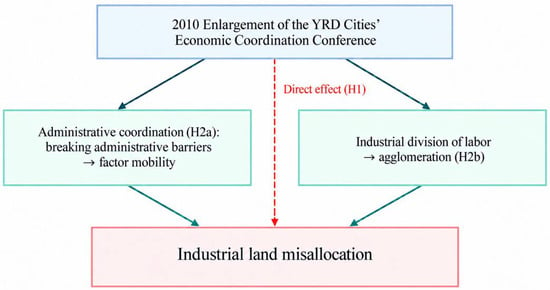
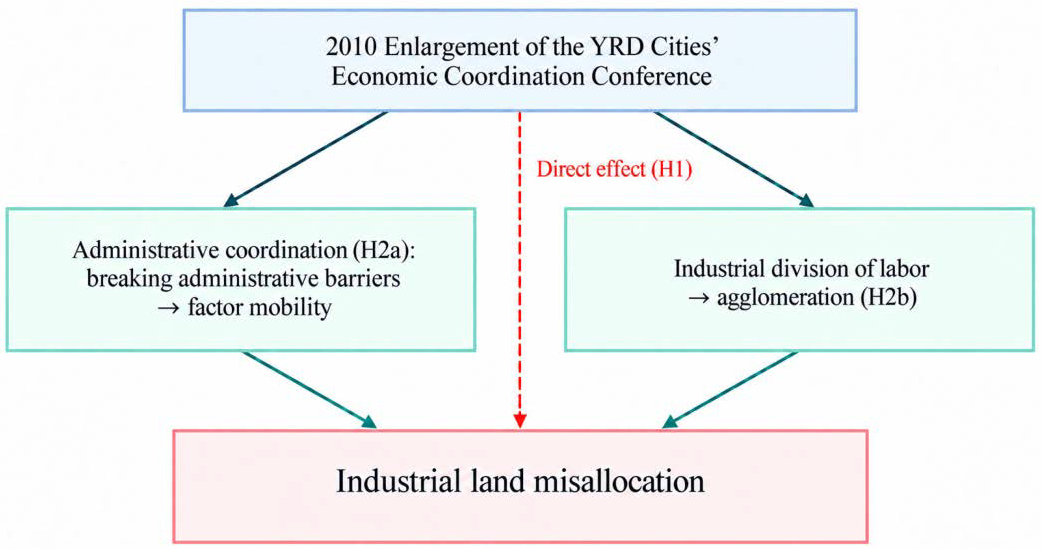
Figure 1 summarizes the hypothesized direct effect of the 2010 enlargement and two potential channels involving administrative coordination and industrial agglomeration.
Figure 1.
Conceptual framework of the effects of the 2010 enlargement of intergovernmental cooperation on industrial land misallocation.
3. Research Design
3.1. Study Area and Data Sources
3.1.1. Study Area
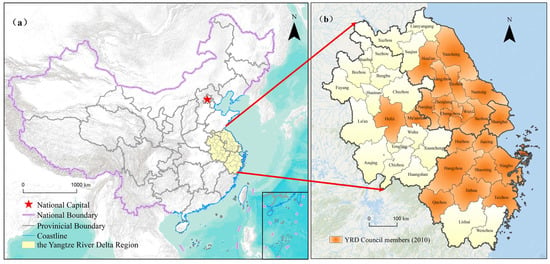
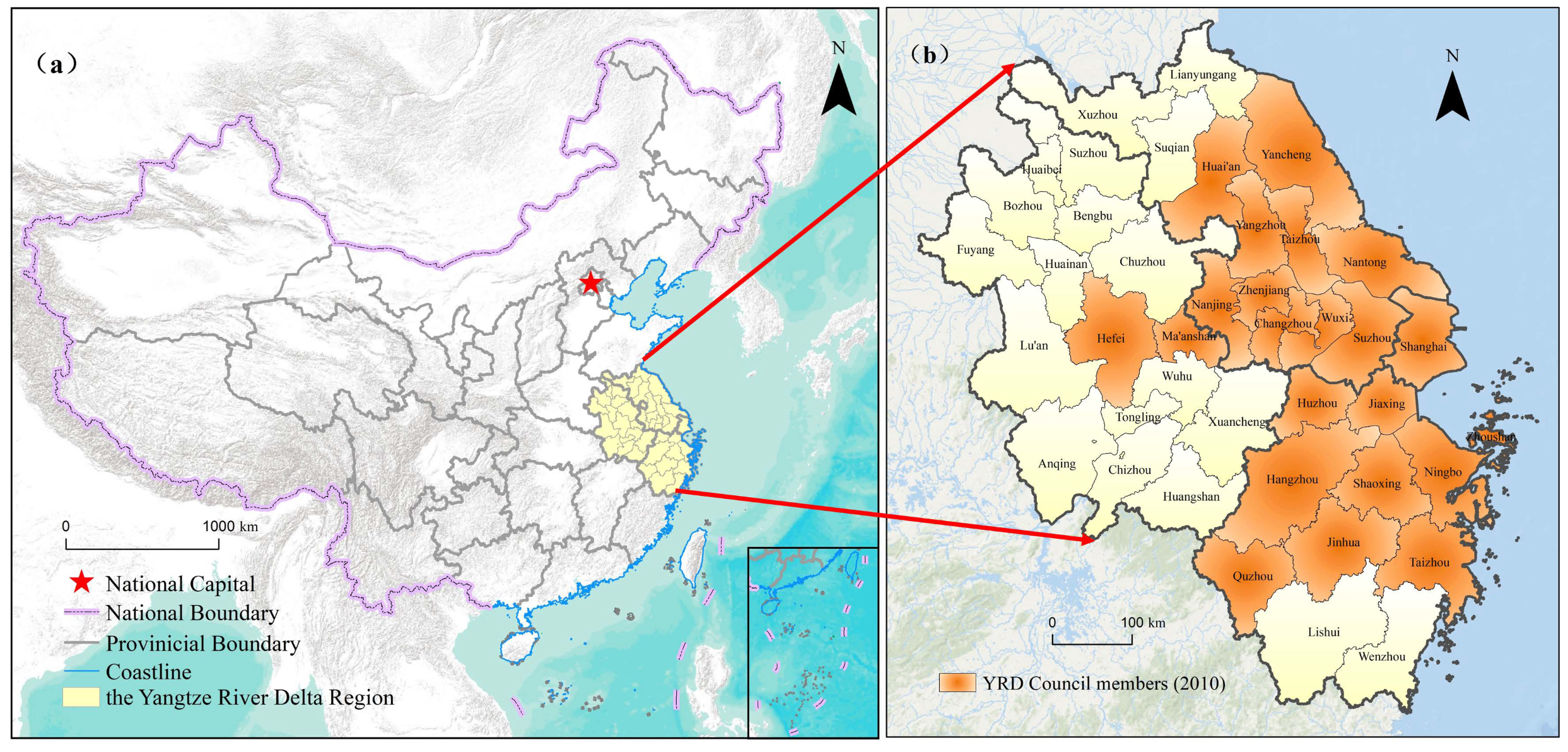
This study examines the cities covered by the Yangtze River Delta Economic Coordination Conference (hereafter, the Conference) to assess the effect of intergovernmental cooperation on industrial land misallocation. The Yangtze River Delta is a major concentration of economic activity and manufacturing in China, where industrial linkages across cities provide a relevant setting for examining regional cooperation and land allocation. The Conference originated in a joint conference of coordination office directors from 14 cities in 1992 and was elevated to a standing mayoral coordination body in 1997, establishing an institutional platform for cooperation across administrative boundaries through consultation among local governments. Its membership subsequently expanded, with the accession of Hefei, Yancheng, Ma’anshan, Jinhua, Huai’an, and Quzhou in 2010 constituting the key expansion examined in this study (Figure 2).
Figure 2.
Study area (a) location of the YRD in China; (b) administrative divisions of the YRD.
This case was selected for three reasons. First, the Conference organizes intercity cooperation through regular meetings, thematic consultations, and cooperation agreements, providing a concrete institutional setting for examining how local governments influence land allocation through administrative coordination and industrial linkages. Second, the clearly defined timing and membership of the 2010 expansion—six cities admitted simultaneously—provide the basis for a difference-in-differences comparison with the region’s cities that had not yet joined, and the 2013 accession of eight further cities allows an independent replication on a second cohort. Third, the available data cover three pre-treatment and seven post-treatment years for the 2010 cohort, allowing pre-trend diagnostics and event-study estimation.
We emphasize that our treatments are the 2010 and 2013 accessions themselves, not Conference membership in general. The fifteen incumbent members joined before our sample window and are therefore excluded from both the treatment groups and the comparison group. The eleven region cities that joined only in 2018 or 2019 were never treated throughout the sample window and serve as the comparison group. That membership eventually became universal by 2019 underscores the importance of evaluating the rounds that set the expansion in motion: after 2019, no within-region comparison group exists.
3.1.2. Data Sources
The data used to construct the outcome variables come from public sources. Land-market outcomes—industrial land conveyance prices and areas, and commercial–residential conveyance prices—are constructed from parcel-level land-supply records published by the China Land Market website over 2007–2016. The output, capital, and labour inputs used to estimate the marginal product of industrial land are drawn from the CEInet statistical database, the Wind Economic Database, and individual city statistical yearbooks and bulletins. All indices are constructed at the city-year level for the 40 prefecture-level cities in the region (Shanghai, a province-level municipality, is excluded).
The 2007–2016 window is dictated by two considerations. First, the misallocation indices require land-market records together with the complete set of city-level inputs, which are jointly available over 2007–2016; the window yields three pre-treatment years for the 2010 cohort, which we use for pre-trend diagnostics. Second, the window deliberately ends before the 2018 and 2019 accessions and before the elevation of Yangtze River Delta integration to a national strategy in 2019, ensuring that the comparison cities are untreated throughout and that the post-treatment period is not confounded by the region-wide policy shifts that followed.
The control variables are constructed from the CEInet statistical database, the Wind Economic Database, and city statistical yearbooks and bulletins. Continuous control variables are winsorized at the 1st and 99th percentiles.
3.2. Variables and Measurement
3.2.1. Dependent Variable
A central result of the misallocation literature is that resources are allocated efficiently when the price of a factor equals its marginal product, and that systematic deviations between the two indicate misallocation [1,2]. This is also the essence of intensive misallocation: because the marginal product of a factor is the price that would prevail if the factor were allocated efficiently, the gap between the observed price and the marginal product measures how far the actual allocation departs from the efficient one. Extending the Hsieh–Klenow framework to land, we measure the misallocation of a specific type of urban construction land—industrial land, in relation to commercial–residential land—as the ratio of the actual price of that land to its marginal product [13,20,21]. Following Xie et al. [60], the index is constructed in three steps.
First, suppose that the urban industrial sector produces output with a Cobb–Douglas technology in capital, effective labour, and industrial land:
where Y is real output of the urban industrial sector (nominal output deflated to 1998 constant prices), K is the annual fixed capital stock of the industrial sector constructed by the perpetual inventory method, L is effective labour input (employment adjusted for average educational attainment), Q is the area of industrial land, A is total factor productivity, and α, β and γ are the output elasticities of capital, labour and industrial land, respectively.
Second, differentiating (1) with respect to industrial land gives the marginal product of industrial land:
so the marginal product equals the output elasticity of land multiplied by the average product of land. Because the elasticity γ is allowed to vary across cities and over time, the marginal product reflects how strongly local production depends on land in a given city and year rather than imposing a single technology on all cities.
Third, let PQ denote the actual transaction price of industrial land, measured as the average conveyance price of industrial land parcels transacted in city c in year t. The industrial land misallocation index is the ratio of the actual price to the marginal product:
ILM equals one when the actual price equals the marginal product, that is, when no misallocation exists. ILM greater than one means that the actual price exceeds the value implied by productivity—the land is overpriced, a positive misallocation. ILM less than one means that the actual price falls short of the marginal product—the land is underpriced, a negative misallocation. The second case is the configuration typically produced when local governments supply industrial land at subsidized prices to attract investment and tax base [3,33].
Accession to the Conference could in principle correct misallocation in either direction—by raising underpriced industrial land toward its marginal product, or by lowering overpriced land toward it. Rather than impose a direction, we take as our primary outcome the distance from efficient allocation:
Larger values of MIS denote more severe misallocation regardless of its direction, and MIS = 0 denotes efficient allocation. This is the dependent variable used in the baseline estimates. Because the distance measure discards sign, we report the ILM level itself alongside it, so that the direction of any change remains visible.
3.2.2. Mechanism Variables
Drawing on the theoretical analysis in the preceding section, we select channel variables that capture administrative barriers and the industrial-structure outcomes through which cooperation is hypothesized to operate. Because the channel variables may themselves respond to membership, we estimate the effect of the accessions on each channel variable directly (Section 3.3.3), and present the results as channel evidence rather than as identified mediation.
Administrative-coordination channel (Seg, Integ). The severity of administrative barriers is proxied by the city-level market segmentation index (Seg) constructed with the relative-price method from city-level retail price data [61], in which higher values denote more severe segmentation; the regional integration index (Integ) aggregates the segmentation information across city pairs, with higher values denoting tighter integration [52].
Industrial-structure channel (Agg, Tl). The level of industrial agglomeration is measured by a city-level industrial agglomeration index (Agg) [42], and the structure of city industry is measured by a Theil-type rationalization index (Tl), constructed as the deviation of the sectoral structure from a proportional benchmark, with higher values indicating a structure that deviates further from that benchmark.
3.2.3. Control Variables
Following the literature, we control for the intensity of local government competition—tax competition intensity (Taxc), investment-attraction competition intensity (Invc), and expenditure competition intensity (Expc)—together with the level of economic development (Edl, the log of per-capita GDP), industrial structure (Ind), urbanization (Urb), and the share of industrial land in total conveyance. Because the competition intensities may respond to membership, Section 4.2.1 shows that the estimates are similar with and without these controls. Summary statistics for all variables are reported in Table 1.
Table 1.
Descriptive statistics.
3.3. Identification and Empirical Strategy
3.3.1. Stacked Difference-in-Differences with Never-Treated Controls
The principal identification challenge is that accession to the Conference is not random: cities select into membership, and the Yangtze River Delta as a whole experiences region-wide price and land-market trends that can be mistaken for policy effects [62,63,64]. Our design addresses both concerns. We stack the two accessions—six cities in 2010 and eight in 2013—into a difference-in-differences framework whose comparison group consists of the eleven region cities that had not yet joined during the sample window (never-treated controls). Because treated and comparison cities all lie within the YRD, region-wide shocks are differenced out; comparisons with the rest of the country, which would conflate YRD-wide trends with the policy, are deliberately avoided (see Section 4.2.2).
where g indexes the two stacks (cohorts), Treatc,g × Postg,t switches on when cohort g’s accession occurs, X is the control vector, and μc, λt, and τg are city, year, and cohort fixed effects. The estimand is the average effect of accession on the outcome for treated cities relative to never-treated cities. The 2013 cohort serves as an independent replication of the 2010 result, and cohort-specific coefficients are reported alongside the pooled estimate. Standard errors are clustered by city [65].
First, event-study coefficients for the three pre-treatment years are reported and tested jointly for the parallel-trends assumption. Second, because the number of treated cities is small, we compute exact randomization-inference p-values: the six-city and eight-city treatment groups are randomly reassigned among the 25 in-region cities 1000 times, and the share of placebo estimates at least as large as the observed one gives the empirical p-value. Third, all figures and tables are generated from a single dataset by a single script.
3.3.2. Synthetic Control as Descriptive Evidence
As a descriptive complement, we construct a synthetic control for the composite of the six 2010 entrant cities from a donor pool of 219 prefecture-level cities outside the YRD [66,67,68,69]. Because YRD-versus-national comparisons may embed regional price trends, we use the synthetic control only to describe the trajectory of the treated cities relative to the national counterfactual, and we do not rest inference on it; its diagnostics are reported in Appendix B.
3.3.3. Regression Models for the Mechanism Tests
To test H2a and H2b, we estimate Equation (6) with each channel variable as the outcome:
where M is the channel variable (Seg, Integ, Agg, or Tl). This design asks whether the accessions moved the hypothesized channels: a coefficient distinguishable from zero indicates that accession shifted the channel variable relative to never-treated cities. We do not estimate a mediation system. The channel variables may themselves be outcomes of membership, sequential ignorability is not credible in this setting, and any mediation share would be uninterpretable when the total effect is itself indistinguishable from zero. All channel estimates therefore carry the same randomization-inference procedure as the baseline [70,71].
4. Results
4.1. Baseline Results: Stacked Difference-in-Differences Estimates
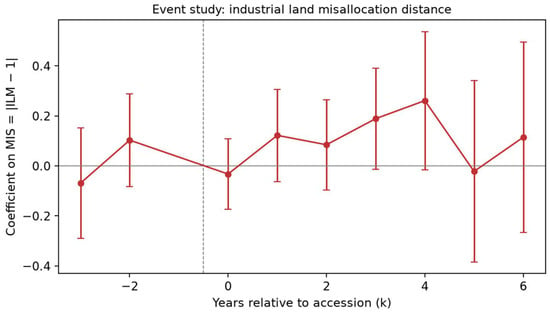
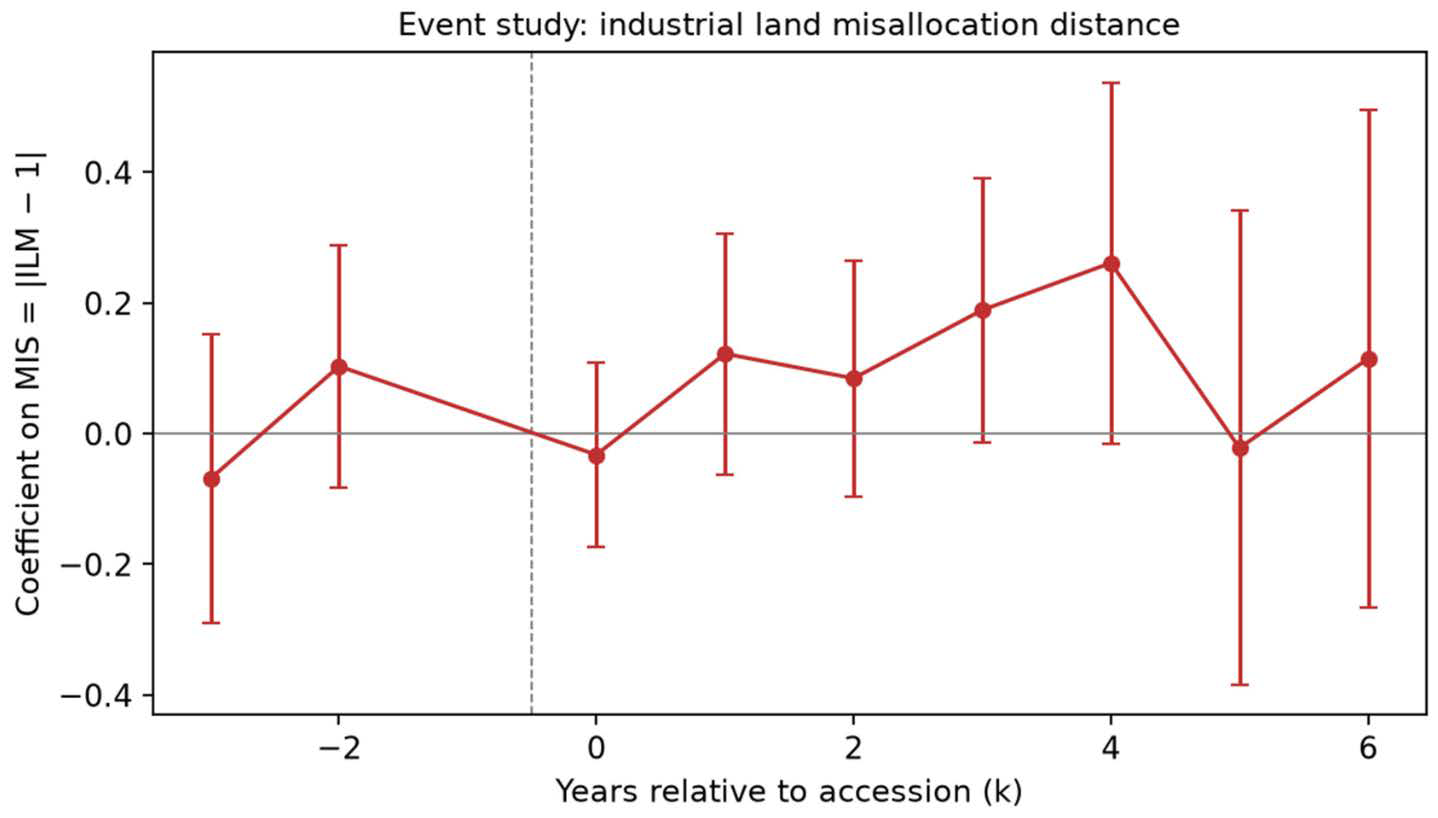
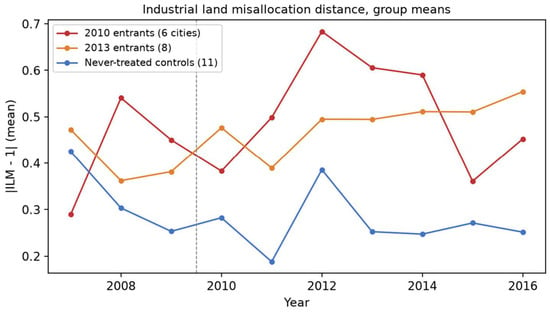
The stacked design compares the 2010 and 2013 accession cohorts with the eleven never-treated region cities. Table 2 reports the baseline estimates for the five outcomes, and Figure 3 shows the event study for the primary outcome. Across all outcomes the pooled effects are statistically indistinguishable from zero: the effect on the misallocation distance MIS is +0.061 (clustered s.e. 0.067; randomization p = 0.072), on the ILM wedge −0.093 (s.e. 0.092; randomization p = 0.135), on the log price ratio −0.042 (s.e. 0.162; randomization p = 0.544), and on the industrial land share +0.006 (s.e. 0.037; randomization p = 0.717). The cohort-specific coefficients are likewise insignificant for both cohorts (MIS: +0.103, s.e. 0.090 for the 2010 cohort; +0.038, s.e. 0.082 for the 2013 cohort). Hypothesis 1 is therefore not supported: the accessions did not detectably reduce the distance between the price and the marginal product of industrial land in newly admitted cities.
Table 2.
Stacked difference-in-differences estimates of the effect of the 2010 and 2013 accessions on industrial land misallocation and land-market outcomes.
Figure 3.
Event-study estimates for the misallocation distance MIS = |ILM − 1| (pooled cohorts; reference year k = −1; city-clustered 95% confidence intervals; pre-treatment coefficients jointly insignificant, Wald p = 0.31).
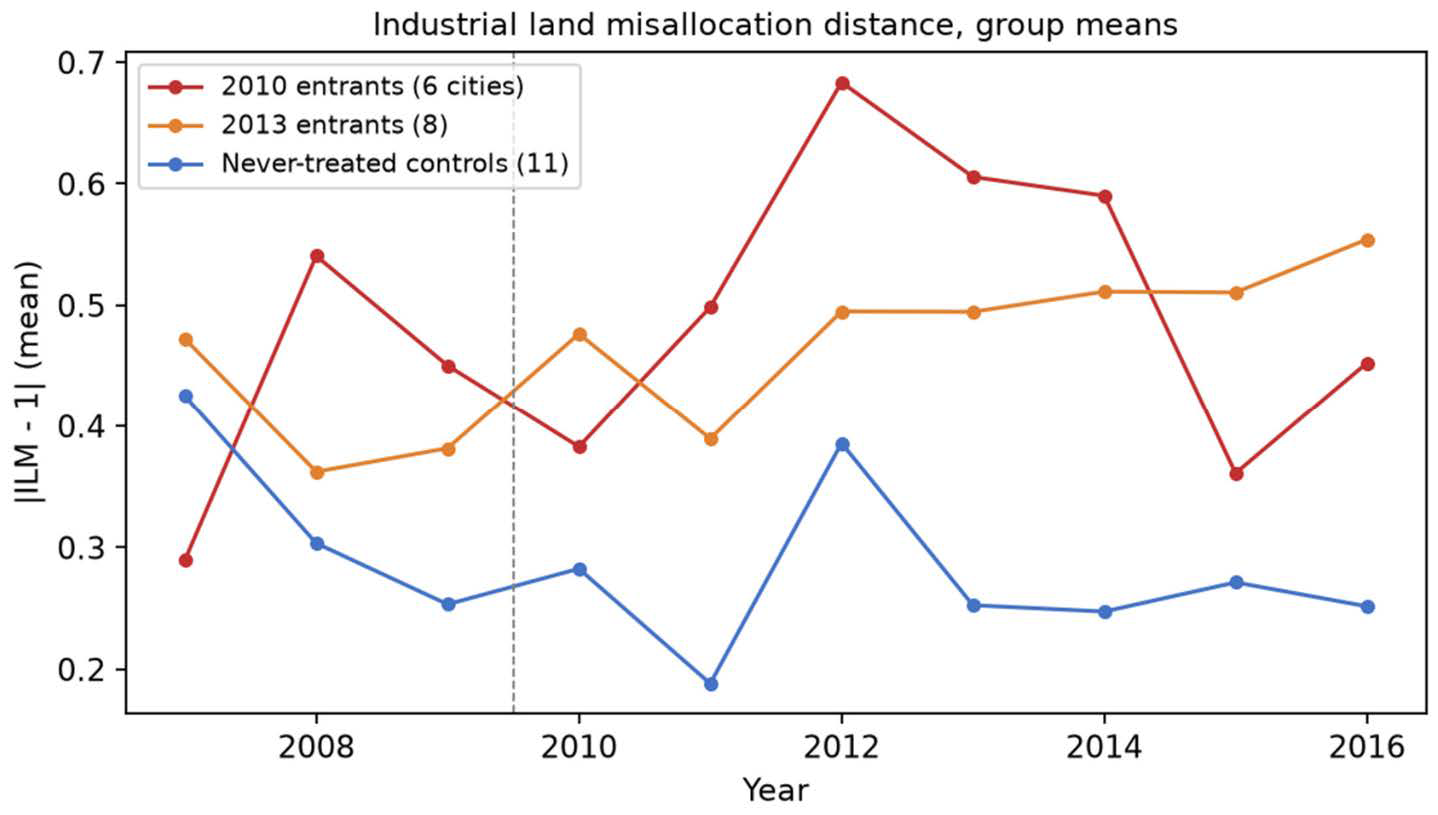
The event study corroborates this. The pre-treatment coefficients are small and jointly insignificant (Wald p = 0.31), so the parallel-trends assumption is not rejected; if anything, the post-treatment coefficients are positive—between +0.08 and +0.26 in years one to four after accession (p = 0.06–0.36)—indicating that the distance from efficient allocation widened slightly in the treated cities before returning toward zero in years five and six. The price-ratio event study is directionally consistent with a narrowing of industrial-land underpricing (all post-accession coefficients negative, none significant), while the quantity margin shows no movement. Descriptively, the mean misallocation distance of the 2010 entrants rose from 0.427 in 2007–2009 to 0.510 in 2010–2016, while the never-treated cities improved from 0.327 to 0.268 (Figure 4). We return to the interpretation of this pattern in Section 5.
Figure 4.
Group-mean misallocation distance (MIS = |ILM − 1|): 2010 entrants, 2013 entrants, and never-treated control cities, 2007–2016.
4.2. Robustness Checks
4.2.1. Randomization Inference and Further Robustness
Because the treated groups contain only six and eight cities, asymptotic standard errors may understate the uncertainty in the design. We therefore compute exact randomization-inference p-values by reassigning placebo groups of six and eight cities among the 25 in-region cities 1000 times. The pooled empirical p-values are 0.072 for MIS, 0.094 for the winsorized MIS, 0.135 for the ILM wedge, 0.544 for the log price ratio, and 0.717 for the industrial land share; for the 2010 cohort alone they are 0.074, 0.139, 0.369, 0.167, and 0.133, and for the 2013 cohort 0.503, 0.498, 0.061, 0.186, and 0.557. None of the outcomes shows an effect distinguishable from chance at conventional levels.
The null result is robust to three further checks. First, winsorizing MIS at the 1st and 99th percentiles changes the estimate only slightly (+0.057, randomization p = 0.094), and dropping the controls altogether gives +0.116 (s.e. 0.071), similar to the baseline, so the null does not depend on treating potentially post-treatment variables as controls. Second, a dynamic panel GMM estimator using lags two and three of the outcome level as instruments—valid under no serial correlation, which the AR(2) tests support—yields equally insignificant coefficients for all outcomes (Appendix C). Third, the event-study pre-trends pass joint diagnostics for every outcome (Appendix A).
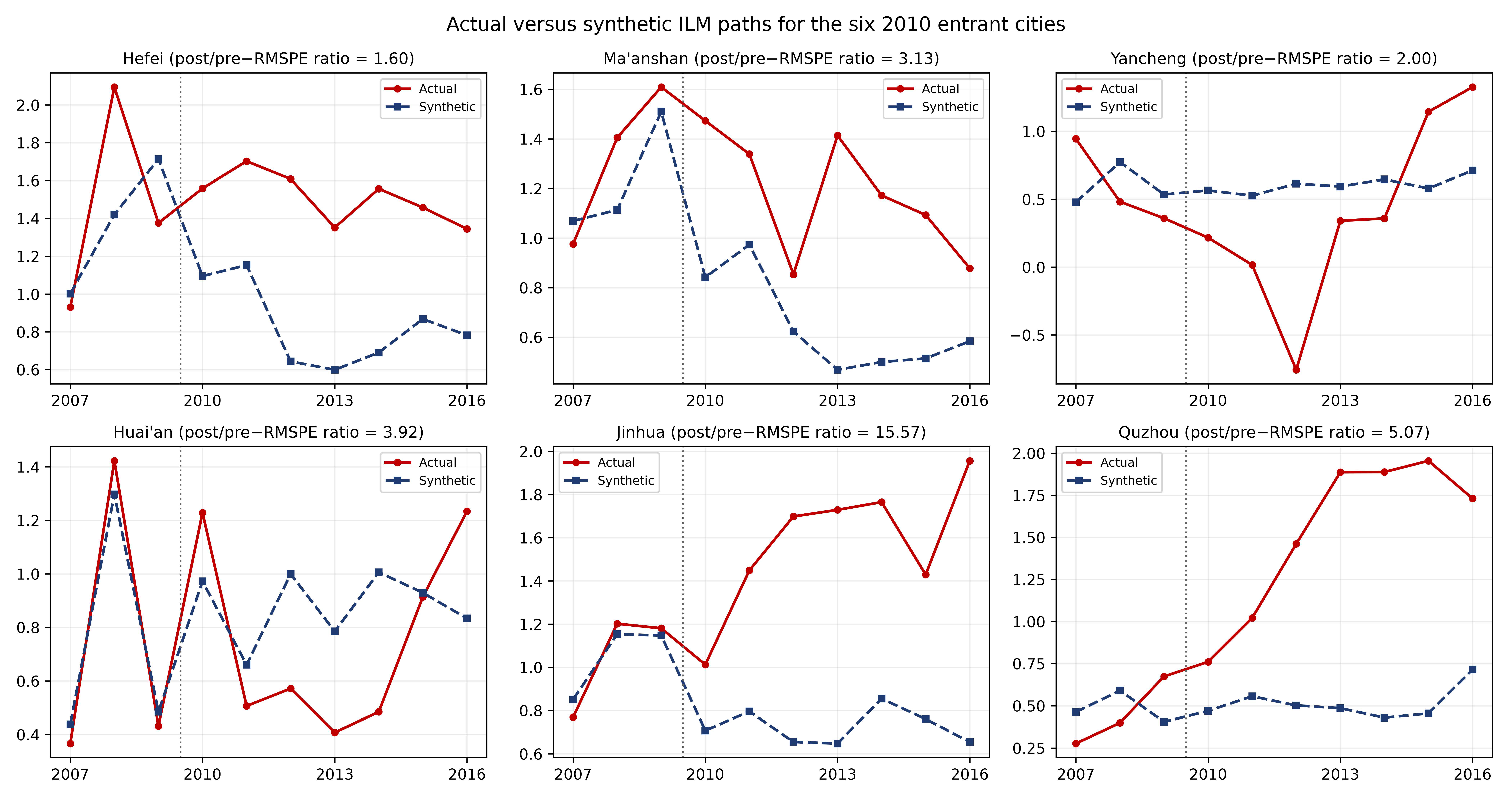
For the descriptive synthetic control, inference is limited by construction. With 219 donors, the placebo distribution of post-/pre-RMSPE ratios assigns the 2010 composite a permutation p-value of 0.037; however, excluding donors whose pre-treatment fit is poor raises the p-value to 0.171, and using cross-validated pre-RMSPE raises it to 0.128. Among the six cities individually, only Jinhua is distinctive (p = 0.009). We read the synthetic-control evidence as a description of the treated cities’ divergence from the national counterfactual, not as a significance claim (Appendix B).
Concurrent policies are largely absorbed by the design. The 2010 Yangtze River Delta Regional Plan applies to the region as a whole, and the Wanjiang demonstration zone covers cities on both sides of the comparison: treated cities (Hefei, Ma’anshan) and never-treated cities (Chizhou, Xuancheng, Tongling, Anqing) were all exposed, so its average effect is differenced out by the two-way design. Any differential exposure would have to appear in the pre-treatment coefficients, which are jointly insignificant.
4.2.2. Synthetic Control Estimates as Descriptive Evidence
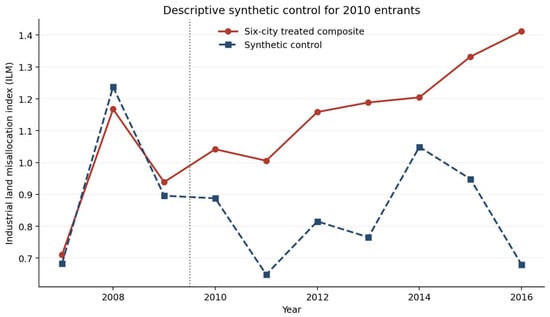
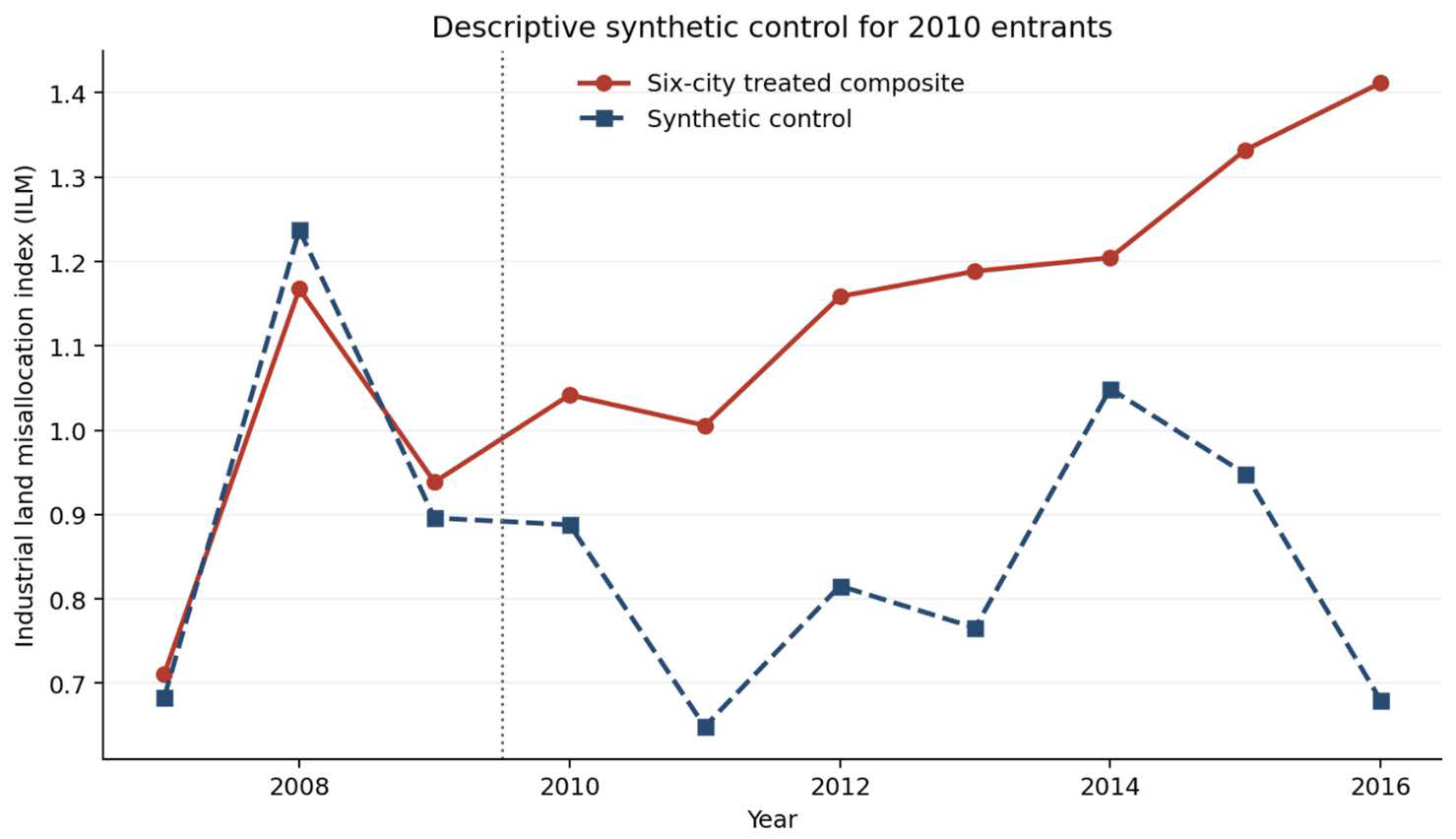
Figure 5 plots the actual and synthetic paths of the ILM wedge for the composite of the six 2010 entrants, using 219 prefecture-level cities outside the YRD as donors. The synthetic counterpart tracks the composite closely before 2010 (pre-RMSPE 0.050); afterwards the actual path rises above the synthetic path, with an average post-treatment gap of +0.328. The gap is consistent with the event-study pattern in Figure 3: the treated cities’ wedge moved away from—rather than toward—the efficient level during the first post-treatment years.
Figure 5.
Actual versus synthetic industrial land misallocation (ILM) for the composite of the six 2010 entrant cities; donor pool = 219 prefecture-level cities outside the YRD (descriptive evidence; see Section 4.2.2).
We stress the limits of this exercise. The donor pool includes cities whose pre-treatment fit is an order of magnitude worse than the treated composite’s, so the placebo distribution is not directly comparable across units [67]. More fundamentally, a rising wedge relative to a national synthetic can reflect YRD-wide land-price trends rather than the accession itself: regressions that assign the 2010 treatment to the region’s non-member cities produce apparent effects of similar magnitude. For both reasons the synthetic control is presented as descriptive evidence only, and no significance claim rests on it.
As a final check on estimator dependence, Appendix C re-estimates the effects with a difference-GMM dynamic panel specification. The GMM estimates are insignificant for all outcomes (ILM +0.134, p = 0.431; industrial land share −0.008, p = 0.841; log price ratio −0.073, p = 0.626), the first-stage F-statistics range from 65 to 550, and the AR(2) tests do not reject the absence of serial correlation.
Taken together, the robustness checks support a single conclusion: across a stacked difference-in-differences design with clean in-region controls, exact randomization inference, winsorized outcomes, and a dynamic panel estimator, the 2010 and 2013 accessions show no detectable effect on industrial land misallocation. The divergence that appears in descriptive comparisons with the national donor pool is consistent with a YRD-wide trend in relative land prices, not with an accession effect.
4.3. Mechanism Tests
We present the channel analyses as evidence on whether the accessions moved the hypothesized channels. They are not mediation estimates, and they make no claim about the share of any total effect.
4.3.1. The Administrative-Coordination Mechanism (H2a)
Table 3 reports the estimates of Equation (6) for the two administrative-coordination variables. The accessions have no detectable effect on market segmentation (+0.0001, randomization p = 0.211) or on the integration index (−0.466, randomization p = 0.108). Hypothesis 2a is therefore not supported: accession did not detectably reduce the administrative barriers that the relative-price indices capture.
Table 3.
Stacked difference-in-differences estimates of the effect of the accessions on the channel variables.
The null on segmentation is consistent with the character of the Conference: it convenes mayors and signs framework agreements, but it has no enforcement power over local product markets or land transactions. The relative-price indices capture consumer-goods market integration, a necessary though not sufficient condition for land-factor integration; the absence of movement at the consumer-goods level suggests that the institutional wall-breaking had not reached factor markets within our window.
4.3.2. The Industrial-Agglomeration Mechanism (H2b)
For the industrial-structure channel, the estimates are significant but run opposite to the hypothesis. The accessions are associated with a decline in local industrial agglomeration (Agg −0.108, randomization p < 0.001) and a rise in the Theil-type deviation of city industrial structure from the proportional benchmark (Tl + 0.063, randomization p = 0.001). Hypothesis 2b is therefore not supported in its local-agglomeration form.
Two readings of this pattern are consistent with the theory rather than contradictory to it. If accession deepened the regional division of labor, industrial activity would be redistributed across cities—toward core cities and away from peripheral entrants—so local agglomeration in newly admitted cities could fall and local structures could diverge from the benchmark even as region-wide specialization rose. The indices are constructed at the city level and cannot distinguish this redistribution from a genuine loss of agglomeration economies; either reading, however, implies that the hypothesized local pathway—from accession to agglomeration to better land allocation—did not operate within the window.
Combined with the null result on misallocation itself, the channel evidence tells a coherent story: the accessions did not remove administrative barriers (no movement in Seg or Integ), and the structural changes they are associated with—lower local agglomeration and greater structural deviation in entrant cities—did not translate into any improvement in the alignment between land prices and marginal products.
5. Discussion
On the contribution to the literature, this paper advances the study of intergovernmental relations and resource misallocation in two ways. First, while the existing literature has built a rich account of how competition among local governments distorts land allocation [45,46], the cooperative side of intergovernmental relations has remained largely underexplored. By using the 2010 and 2013 accessions as quasi-natural experiments, this paper provides transparent evidence—which here is evidence of no detectable effect—on whether joining a cooperation body corrects land misallocation, thereby helping to temper expectations about what enlargement of a regional cooperation body can achieve on its own.. Second, by measuring industrial land misallocation as a reproducible price–marginal-product wedge from public land-market records, the paper offers an outcome that other researchers can verify and extend, which is a precondition for cumulative research on land misallocation.
Beyond the Chinese context, the research question also speaks to the existing literature in two respects. First, resource misallocation is an important explanation for productivity differences across countries [2]. Covariance-based measures build on the Olley–Pakes decomposition and have been used to examine cross-country differences in resource allocation [27,28]. Related research documents the misallocation of land and buildings among manufacturing establishments across Indian districts [23]. These studies motivate examining how institutions governing land allocation influence the distribution of land across firms. Second, the Conference can be discussed alongside European cross-border cooperation institutions [72,73], task-specific governance arrangements in Europe and North America [74], and interlocal collective-action mechanisms studied in the United States [31]. These arrangements provide comparative perspectives on coordination across jurisdictional boundaries, although their authority, membership rules, and policy responsibilities differ. Institutional differences also limit the transferability of conclusions across settings. In China, local governments directly influence land supply and leasing prices, and these interventions can contribute to land misallocation [13]. This institutional role motivates examining whether intergovernmental coordination changes land-allocation incentives. The relevant channels may differ where governments primarily influence land allocation through regulation rather than direct supply. Collaborative-governance research also emphasizes that building trust, commitment, and shared understanding can take time [74]. This provides a theoretical reason to examine whether cooperation effects develop gradually.
The channel evidence gives the null result a substantive interpretation. Accession left market segmentation unchanged and was associated with lower local agglomeration and greater structural deviation in entrant cities.One possible reading is that the distortions behind land misallocation—fiscal dependence on land conveyance and subsidized industrial pricing—are rooted in the fiscal system and may therefore lie largely beyond what enlargement of a cooperation body can change on its own; other concurrent factors, such as local land-supply incentives and the pre-accession allocation conditions of the entrant cities, may also have played a role.
On selection, a descriptive fact deserves emphasis: the six 2010 entrant cities had an average ILM of 0.94 in 2007–2009, already close to the efficient price configuration, while the never-treated region cities averaged roughly 0.71–0.73. Cities closer to efficient allocation were admitted first, and the misallocation that remained was concentrated in cities outside the Conference. To the extent that accession selects well-allocated cities, even an effective institution would show little margin for improvement in this group—an interpretation that also cautions against reading the null as proof that cooperation could never correct misallocation where misallocation is severe.
On limitations, three caveats should be noted. First, the window provides only three pre-treatment years, limiting the scope of pre-trend diagnostics. Second, with six and eight treated cities, the design is powered to detect moderate-to-large effects only. Third, the window ends in 2016, before the 2018 and 2019 accessions and the 2019 national strategy; the effects of later rounds remain open questions.
Future research could extend this paper in three directions. First, re-estimating the effects with stock-based measures of industrial land over a horizon that includes the 2019 national strategy would test whether harder-edged integration—planning mandates and central backing—moves land allocation where the voluntary Conference did not. Second, multi-cluster comparisons across the Beijing–Tianjin–Hebei, Guangdong–Hong Kong–Macao, and Chengdu–Chongqing agglomerations would establish whether the null is specific to mature regions [75,76]. Third, parcel-level data matching land recipients across city boundaries would allow sharper tests of the administrative-coordination channel than aggregate indices permit.
6. Conclusions and Implications
Using a panel of 40 prefecture-level cities in the YRD over 2007–2016 and exploiting the 2010 and 2013 accessions to the Conference as quasi-natural experiments, this paper employed a stacked difference-in-differences design with never-treated in-region controls—verified by event studies, exact randomization inference, a dynamic panel estimator, and descriptive synthetic controls—to test whether the enlargement of intergovernmental cooperation corrects industrial land misallocation, and regressions on channel variables to test the hypothesized mechanisms. Three conclusions follow.
First, we find no evidence that the accessions reduced industrial land misallocation. The pooled effect on the distance between the price of industrial land and its marginal product is +0.061 and statistically indistinguishable from zero (randomization p = 0.072); the pre-treatment trends pass joint diagnostics; and the null survives winsorization, alternative outcomes, and alternative estimators. If anything, the point estimates indicate a slight widening of the price wedge in the first post-accession years. The enlargement did not correct land misallocation within the window we can observe.
Second, the hypothesized channels did not operate. Market segmentation and the integration index show no response to accession, and the structural estimates run opposite to the local-agglomeration hypothesis: local industrial agglomeration declined and city industrial structures diverged from the proportional benchmark in entrant cities. The pattern is consistent with a redistribution of industrial activity across the region, but it did not translate into any measurable improvement in land allocation.
Third, the null is informative about selection as well as about the institution. The cities admitted in 2010 were already close to the efficient price configuration before accession, while the region’s remaining misallocation was concentrated in cities outside the Conference. Membership selection favored better-allocated cities—so even an effective institution would have had little margin to improve this group, and the severe misallocation that regional cooperation might in principle correct lay outside the treated sample.
These findings carry three policy implications for land governance in China. First, enlarging intergovernmental cooperation may not be sufficient on its own to correct land misallocation. Standing bodies, joint committees, and comprehensive plans organize dialogue, but correcting misallocation may require instruments that bind land conveyance more directly—quotas tied to functional positioning, pricing rules that discipline subsidized industrial land, and centrally backed enforcement.
Second, the integration of land markets should proceed through transaction rules rather than through declarations. Cross-regional land trading within the city cluster requires ownership confirmation, transaction procedures, and entry conditions specified in regional regulation, with approval procedures simplified in parallel—measures that operate on the land market directly, whereas general product-market integration, which our channel estimates show did not move, does not reach the land factor.
Third, membership criteria and evaluation should target the misallocation that remains. If accession selects cities that are already well-allocated, expansion rounds will mechanically show small effects; pairing accession with land-allocation diagnostics—requiring price-wedge assessments in application reviews and tracking them in post-accession evaluations—would direct the institution toward the cities and margins where misallocation is actually concentrated.
Author Contributions
Conceptualization, W.D.; Methodology, W.D.; Software, W.D.; Data Curation, W.D.; Writing—Original Draft, W.D.; Writing—Review & Editing, B.Q.; Supervision, B.Q.; Project Administration, B.Q. All authors have read and agreed to the published version of the manuscript.
Funding
This research was supported by the National Natural Science Foundation of China (Grant. No. 42271211).
Data Availability Statement
The land-market records and city-level statistics used in this study were obtained from public data platforms. Other data are available from the corresponding author upon reasonable request.
Conflicts of Interest
The authors declare no conflicts of interest.
Appendix A. Event-Study Estimates
Table A1 reports the full set of event-study coefficients for the three main outcomes. The coefficients come from Equation (5) with the treatment interaction replaced by event-time dummies interacted with the treatment indicator (reference year k = −1); standard errors are clustered by city. The pre-treatment coefficients are jointly insignificant for all outcomes (Wald p = 0.31 for MIS, 0.39 for the ILM wedge, and 0.62 for the log price ratio).
Table A1.
Event-study coefficients (pooled cohorts).
Appendix B. Synthetic Control Diagnostics (Descriptive)
The synthetic control for the composite of the six 2010 entrant cities uses the 219 prefecture-level cities outside the YRD as donors, matching the pre-2010 ILM level and pre-treatment covariate means (pre-RMSPE 0.050). Table A2 reports the diagnostics for the composite and for each entrant city separately; Figure A1 shows the placebo distribution of post-/pre-RMSPE ratios, and Figure A2 the individual city paths. As discussed in Section 4.2.2, these estimates are descriptive: permutation p-values for the composite range from 0.037 to 0.128 depending on how poorly fitting donors are treated, and YRD-wide trends cannot be separated from accession effects in national comparisons.
Table A2.
Pre- and post-treatment RMSPE, post-treatment mean gaps, and permutation p-values.
Figure A1.
Placebo distribution of post-/pre-RMSPE ratios for the treated composite and the 219 donors (red = treated composite).
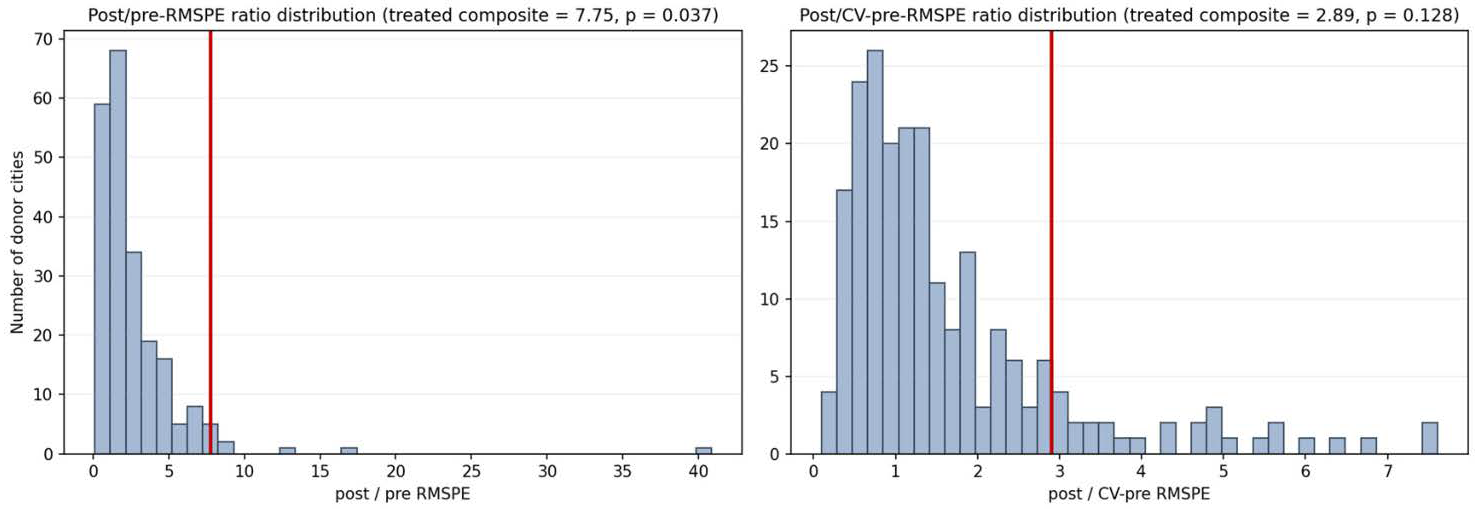
Figure A2.
Actual versus synthetic ILM paths for the six 2010 entrant cities.
Appendix C. Dynamic Panel GMM Estimates
To check that the null does not depend on the choice of estimator, we estimate first-difference (Arellano–Bond) GMM specifications for the three outcomes, instrumenting the lagged first difference of the outcome with the second and third lags of the outcome level and treating the treatment indicator and controls as exogenous. Because the first difference of the treatment indicator is nonzero only in the accession year, the coefficient measures the accession-year change. Standard errors are clustered by city. The AR(2) tests do not reject the absence of serial correlation, and first-stage F-statistics range from 65 to 550, so the instruments are strong; all coefficients remain statistically insignificant.
Table A3.
Difference-GMM estimates for treated cities (2010 and 2013 accessions).
Appendix D. Randomization Inference
The exact randomization-inference procedure reassigns placebo treatment groups of six cities (2010 cohort) and eight cities (2013 cohort) among the 25 in-region cities in the stacked panel 1000 times, holding the comparison structure fixed, and recomputes the difference-in-differences coefficient for each draw. The empirical p-value is the share of placebo estimates at least as large in absolute value as the observed coefficient. For the pooled estimates the p-values are 0.072 (MIS), 0.094 (winsorized MIS), 0.135 (ILM wedge), 0.544 (log price ratio), and 0.717 (industrial land share); for the 2010 cohort they are 0.074, 0.139, 0.369, 0.167, and 0.133; and for the 2013 cohort 0.503, 0.498, 0.061, 0.186, and 0.557. For the channel variables (Table 3) the p-values are 0.211 (Seg), 0.108 (Integ), below 0.001 (Agg), and 0.001 (Tl).
References
- Hsieh, C.-T.; Klenow, P.J. Misallocation and Manufacturing TFP in China and India. Q. J. Econ. 2009, 124, 1403–1448. [Google Scholar] [CrossRef] [Scilit]
- Restuccia, D.; Rogerson, R. The Causes and Costs of Misallocation. J. Econ. Perspect. 2017, 31, 151–174. [Google Scholar] [CrossRef] [Scilit]
- Tao, R.; Su, F.; Liu, M.; Cao, G. Land Leasing and Local Public Finance in China’s Regional Development: Evidence from Prefecture-Level Cities. Urban Stud. 2010, 47, 2217–2236. [Google Scholar] [CrossRef] [Scilit]
- Huang, Z.; Du, X. Strategic Interaction in Local Governments’ Industrial Land Supply: Evidence from China. Urban Stud. 2017, 54, 1328–1346. [Google Scholar] [CrossRef] [Scilit]
- Lu, S.; Wang, H. Local Economic Structure, Regional Competition and the Formation of Industrial Land Price in China: Combining Evidence from Process Tracing with Quantitative Results. Land Use Policy 2020, 97, 104704. [Google Scholar] [CrossRef] [Scilit]
- Zhang, C.; Yao, D.; Zhen, Y.; Li, W.; Li, K. Mismatched Relationship between Urban Industrial Land Consumption and Growth of Manufacturing: Evidence from the Yangtze River Delta. Land 2022, 11, 1390. [Google Scholar] [CrossRef] [Scilit]
- Lin, Y.; Qin, Y.; Yang, Y.; Zhu, H. Can Price Regulation Increase Land-Use Intensity? Evidence from China’s Industrial Land Market. Reg. Sci. Urban Econ. 2020, 81, 103501. [Google Scholar] [CrossRef] [Scilit]
- Zhou, L. Optimization of Industrial Land Allocationfrom the Perspective of High-quality Development During the 14th Five-Year Plan. China Soft Sci. 2020, 10, 156–164. [Google Scholar]
- Han, L.; Zhou, L.; Bao, H.; Zeng, X.; Taghizadeh-Hesary, F. What Affects China’s High-Tech Industry Land Misallocation: Government Behavior or Enterprise Behavior? Front. Environ. Sci. 2022, 10, 959926. [Google Scholar] [CrossRef] [Scilit]
- Zhou, L.; Tian, L.; Cao, Y.; Yang, L. Industrial Land Supply at Different Technological Intensities and Its Contribution to Economic Growth in China: A Case Study of the Beijing-Tianjin-Hebei Region. Land Use Policy 2021, 101, 105087. [Google Scholar] [CrossRef] [Scilit]
- Zhou, L.; Tian, L.; Gao, Y.; Ling, Y.; Fan, C.; Hou, D.; Shen, T.; Zhou, W. How Did Industrial Land Supply Respond to Transitions in State Strategy? An Analysis of Prefecture-Level Cities in China from 2007 to 2016. Land Use Policy 2019, 87, 104009. [Google Scholar] [CrossRef] [Scilit]
- Zhu, L.; Zhang, B.; Wu, Z. How Does Land Misallocation Weaken Economic Resilience? Evidence from China. Land 2026, 15, 219. [Google Scholar] [CrossRef] [Scilit]
- Huang, Z.; Du, X. Government Intervention and Land Misallocation: Evidence from China. Cities 2017, 60, 323–332. [Google Scholar] [CrossRef] [Scilit]
- Zhang, S.; Cao, X. The Impact of Industrial Land Misallocation on Sustainable Urban Development: Mechanisms and Spatial Spillover Effects. Land 2025, 14, 1976. [Google Scholar] [CrossRef] [Scilit]
- Zhang, J.; Xu, R.; Chen, J. Does Industrial Land Marketization Reform Faciliate Urban Land Use Efficiency? Int. Rev. Econ. Financ. 2024, 96, 103609. [Google Scholar] [CrossRef] [Scilit]
- Xi, Q.; Mei, L. How Did Development Zones Affect China’s Land Transfers? The Scale, Marketization, and Resource Allocation Effect. Land Use Policy 2022, 119, 106181. [Google Scholar] [CrossRef] [Scilit]
- Zhao, A.; Ploegmakers, H.; Rouwendal, J.; Ma, X. Land Investment Regulation and Allocative Efficiency: Evidence from the Chinese Manufacturing Sector. J. Econ. Geogr. 2025, 25, 151–174. [Google Scholar] [CrossRef] [Scilit]
- Li, J.; Sun, R. How Tax Incentives Impact Corporate Green Transformation: Evidence from China’s Tax Survey Data. J. Clean. Prod. 2025, 521, 146279. [Google Scholar] [CrossRef] [Scilit]
- Ji, Y.; Wang, L. Firms’ Innovation Choices Under Tax Tasks: The Trade-Off Between Substantive and Strategic Innovation. Econ. Politics 2026, 38, 923–942. [Google Scholar] [CrossRef] [Scilit]
- Lu, Y.; Ding, Z. Deciphering Urban Land Misallocation: The State-Market Dynamics in the Yangtze River Delta, China. Cities 2026, 170, 106640. [Google Scholar] [CrossRef] [Scilit]
- Zhong, X.; Zhou, S.; Yu, X. Land Market Misallocation, Regional Integration, and Economic Growth: Evidence from the Yangtze River Delta Region, China. Public Adm. Dev. 2024, 44, 17–31. [Google Scholar] [CrossRef] [Scilit]
- Huang, Z.; Du, X. Land Misallocation and Economic Performance: Evidence from China. Appl. Econ. 2023, 55, 7048–7064. [Google Scholar] [CrossRef] [Scilit]
- Duranton, G.; Ghani, E.; Goswami, A.G.; Kerr, W. The Misallocation of Land and Other Factors of Production in India; World Bank Policy Research Working Paper; World Bank: Washington, DC, USA, 2015. [Google Scholar]
- Cheng, K.; Zhao, J.; Zhang, Z. Industrial Land Efficiency, Institutional Friction and Misallocation: Evidence from China. Appl. Econ. 2026, 58, 5857–5873. [Google Scholar] [CrossRef] [Scilit]
- Zhang, L.; Cheng, K.; Fan, Z. Industrial Land Allocation Reform and Urban Land Misallocation—Evidences from Micro Enterprises Land Stock Data. China Econ. Q. 2024, 24, 465–480. [Google Scholar] [CrossRef]
- Brandt, L.; Van Biesebroeck, J.; Wang, L.; Zhang, Y. Where Has All the Dynamism Gone? Productivity Growth in China’s Manufacturing Sector, 1998–2013. J. Dev. Econ. 2026, 181, 103720. [Google Scholar] [CrossRef] [Scilit]
- Olley, G.S.; Pakes, A. The Dynamics of Productivity in the Telecommunications Equipment Industry. Econometrica 1996, 64, 1263–1297. [Google Scholar] [CrossRef] [Scilit]
- Bartelsman, E.; Haltiwanger, J.; Scarpetta, S. Cross-Country Differences in Productivity: The Role of Allocation and Selection. Am. Econ. Rev. 2013, 103, 305–334. [Google Scholar] [CrossRef] [Scilit]
- Melitz, M.J.; Polanec, S. Dynamic Olley-Pakes Productivity Decomposition with Entry and Exit. RAND J. Econ. 2015, 46, 362–375. [Google Scholar] [CrossRef] [Scilit]
- Xin, L.; Liu, Y.; Wang, Y.; Liu, C. From Mismatch to Smart Match: Artificial Intelligence and Land Resource Misallocation. Land 2026, 15, 1415. [Google Scholar] [CrossRef] [Scilit]
- Feiock, R.C. The Institutional Collective Action Framework. Policy Stud. J. 2013, 41, 397–425. [Google Scholar] [CrossRef] [Scilit]
- Luo, X.; Shen, J. A Study on Inter-City Cooperation in the Yangtze River Delta Region, China. Habitat Int. 2009, 33, 52–62. [Google Scholar] [CrossRef] [Scilit]
- Yu, S.; You, Y. Hand in Hand, Selling the Land: Intergovernmental Cooperation and Land Allocation in China. J. Financ. Econ. 2017, 43, 58–73. [Google Scholar] [CrossRef]
- Shi, R.; Sun, C.; Zhang, C.; Peng, Z. The Spatio-Temporal Evolution and Influence Mechanisms of Intercity Cooperation Networks from the Perspective of Sustainable Regional Development: A Case Study of the Pearl River–Xijiang Economic Belt, China. Sustainability 2025, 17, 4709. [Google Scholar] [CrossRef] [Scilit]
- Tang, C.; Zhang, X.; Cheung, D.M. Nuancing Regional Geography: An Analysis of the Evolution and Mechanism of Intercity Cooperation Network in the Guangdong-Hong Kong-Macao Greater Bay Area. Tijdschr. Econ. Soc. Geogr. 2024, 115, 674–690. [Google Scholar] [CrossRef] [Scilit]
- Yang, J.; Zeng, L.; Chen, S. Is Intermunicipal Cooperation Conducive to Improving Total Factor Productivity of Firms—Empirical Evidence from the Yangtze River Delta Urban Agglomeration. China J. Econ. 2023, 10, 252–283. [Google Scholar] [CrossRef] [Scilit]
- Huang, D.; Chen, G.; Han, Y. Regional Integration Policy, Industrial Chain and Corporate Total Factor Productivity: An Econometric Empirical Analysis from China. Front. Environ. Sci. 2022, 10, 976203. [Google Scholar] [CrossRef] [Scilit]
- Zhang, X.; Chen, Y.; Xu, Y.; Yue, W.; Tang, C. Does Regional Cooperation Constrain Urban Sprawl? Evidence from the Guangdong-Hong Kong-Macao Greater Bay Area. Landsc. Urban Plan. 2023, 235, 104742. [Google Scholar] [CrossRef] [Scilit]
- Liu, X.; Yang, Y.; Derudder, B.; Witlox, F. Emerging Synergies in Polycentric Cities? Exploring the Impact of Intercity Cooperation on Labour Market Integration in the Yangtze River Delta, 2014–2021. Reg. Stud. Reg. Sci. 2025, 12, 162–184. [Google Scholar] [CrossRef] [Scilit]
- Pan, L.; Hu, H.; Jing, X.; Chen, Y.; Li, G.; Xu, Z.; Zhuo, Y.; Wang, X. The Impacts of Regional Cooperation on Urban Land-Use Efficiency: Evidence from the Yangtze River Delta, China. Land 2022, 11, 915. [Google Scholar] [CrossRef] [Scilit]
- Sun, Y.; Wu, L.; Jin, X.; Fu, H.; Fan, Y.; Ma, G. Spatial Synergistic Effect of Regional Integration on Urban Land Use Efficiency in Yangtze River Delta Urban Agglomeration. Geogr. Res. 2024, 43, 2104–2120. [Google Scholar] [CrossRef]
- Zhang, W.; Wang, B.; Wang, J.; Wu, Q.; Wei, Y.D. How Does Industrial Agglomeration Affect Urban Land Use Efficiency? A Spatial Analysis of Chinese Cities. Land Use Policy 2022, 119, 106178. [Google Scholar] [CrossRef] [Scilit]
- Abadie, A.; Diamond, A.; Hainmueller, J. Synthetic Control Methods for Comparative Case Studies: Estimating the Effect of California’s Tobacco Control Program. J. Am. Stat. Assoc. 2010, 105, 493–505. [Google Scholar] [CrossRef] [Scilit]
- Sun, F.; Xu, H. Competing for Promotion: Effects of Three-Dimensional Government Competition on Land Misallocation in China. J. Urban Plan. Dev. 2026, 152, 04026033. [Google Scholar] [CrossRef] [Scilit]
- Li, Q.; Hu, X. Local Government Competition and Land Resource Misallocation: Insights on Constructing a Unified National Market. Environ. Dev. Sustain. 2026. [Google Scholar] [CrossRef] [Scilit]
- Wei, Q.; Yang, W. Addressing Uneven Development through State-Steered Intercity Cooperation? Insights from Shenzhen–Ganzhou Cooperation Plan-Making. Reg. Stud. 2025, 59, 2377669. [Google Scholar] [CrossRef] [Scilit]
- Mao, L.; Xu, R.; Hu, J.; Song, Y.; Zhu, Y. Research on the Impact Mechanism of Intergovernmental Collaboration on Cross-Regional Corporate Cooperative Behavior Based on an Evolutionary Game Analysis Framework. Sci. Rep. 2026, 16, 20724. [Google Scholar] [CrossRef] [Scilit] [PubMed]
- Li, G.; Wu, S.; You, H.; Wang, C. Governments’ Behavioral Strategies in Cross-Regional Reduction of Inefficient Industrial Land: Learned from a Tripartite Evolutionary Game Model. Humanit. Soc. Sci. Commun. 2025, 12, 697. [Google Scholar] [CrossRef] [Scilit]
- Wu, Y.; Liu, Y.; Liu, L. Can Government Informatization Construction Curb Land Resource Misallocation? Evidence from China. J. Clean. Prod. 2025, 515, 145793. [Google Scholar] [CrossRef] [Scilit]
- Tang, Y.; Zhang, H. Paired Assistance with Chinese Characteristics: Evidence from the “Enclave Economy” in the PRD Region. China Econ. 2024, 19, 89–106. [Google Scholar] [CrossRef]
- Guo, Q.; Liu, J.; Zhu, S.; He, C.; Han, Y. Reducing Administrative Barriers: Evidence from China’s County-to-District Reform on Export Product Quality. Cities 2025, 166, 106233. [Google Scholar] [CrossRef] [Scilit]
- Cui, X.; Wang, R.; Duan, K. Research on the Impact of County-to-District Reform on Industrial Land Factor Misallocation. Land 2026, 15, 1623. [Google Scholar] [CrossRef] [Scilit]
- Xiao, J.; Dong, F. The Impact of Metropolitan Integration on Land Use Efficiency and Its Mechanism. Land 2026, 15, 52. [Google Scholar] [CrossRef] [Scilit]
- Guo, L.; Tang, M.; Wu, Y.; Bao, S.; Wu, Q. Government-Led Regional Integration and Economic Growth: Evidence from a Quasi-Natural Experiment of Urban Agglomeration Development Planning Policies in China. Cities 2025, 156, 105482. [Google Scholar] [CrossRef] [Scilit]
- Krugman, P. Geography and Trade; The MIT Press: Cambridge, MA, USA, 1991. [Google Scholar]
- Pengyang, Z.; Tian, Y.; Xiaoyong, Q.; Heliang, Z. Service-Manufacturing Integration and the “Baumol’s Disease” Trap: Experience from China and Global Patterns. China Financ. Econ. Rev. 2025, 14, 24–44. [Google Scholar] [CrossRef] [Scilit]
- Zhao, N.; Wang, B.; Liu, Y. Urban Cluster, Agglomeration Effect and “Investment Wave Phenomenon” -Empirical Analysis Based on 20 Urban Clusters in China. China Ind. Econ. 2017, 11, 81–99. [Google Scholar] [CrossRef]
- Tian, W.; Wang, Z.; Zhang, Q. Land Allocation and Industrial Agglomeration: Evidence from the 2007 Reform in China. J. Dev. Econ. 2024, 171, 103351. [Google Scholar] [CrossRef] [Scilit]
- Pu, W.; Liu, M.; Zhang, A. Does Industrial Green Transformation Really Lead to High Land Use Efficiency? Evidence from China. Land 2025, 14, 1110. [Google Scholar] [CrossRef] [Scilit]
- Xie, R.; Yao, S.; Han, F.; Zhang, Q. Does misallocation of land resources reduce urban green total factor productivity? An analysis of city-level panel data in China. Land Use Policy 2022, 122, 106353. [Google Scholar] [CrossRef] [Scilit]
- Parsley, D.C.; Wei, S.-J. Explaining the Border Effect: The Role of Exchange Rate Variability, Shipping Costs, and Geography. Am. Econ. Rev. 2001, 91, 87–92. [Google Scholar] [CrossRef] [Scilit]
- Arkhangelsky, D.; Imbens, G. Causal Models for Longitudinal and Panel Data: A Survey. Econom. J. 2024, 27, C1–C61. [Google Scholar] [CrossRef] [Scilit]
- Roth, J.; Sant’Anna, P.H.C.; Bilinski, A.; Poe, J. What’s Trending in Difference-in-Differences? A Synthesis of the Recent Econometrics Literature. J. Econom. 2023, 235, 2218–2244. [Google Scholar] [CrossRef] [Scilit]
- Liu, N.; Wu, Y. Can the Enlargement in Yangtze River Delta Boost Regional Economic Common Growth. China Ind. Econ. 2017, 6, 79–97. [Google Scholar] [CrossRef]
- Sant’Anna, P.H.C.; Zhao, J. Doubly Robust Difference-in-Differences Estimators. J. Econom. 2020, 219, 101–122. [Google Scholar] [CrossRef] [Scilit]
- Abadie, A. Using Synthetic Controls: Feasibility, Data Requirements, and Methodological Aspects. J. Econ. Lit. 2021, 59, 391–425. [Google Scholar] [CrossRef] [Scilit]
- Ferman, B.; Pinto, C. Synthetic Controls with Imperfect Pretreatment Fit. Quant. Econ. 2021, 12, 1197–1221. [Google Scholar] [CrossRef] [Scilit]
- Ben-Michael, E.; Feller, A.; Rothstein, J. Synthetic Controls with Staggered Adoption. J. R. Stat. Soc. Ser. B Stat. Methodol. 2022, 84, 351–381. [Google Scholar] [CrossRef] [Scilit]
- Cattaneo, M.D.; Feng, Y.; Palomba, F.; Titiunik, R. Scpi: Uncertainty Quantification for Synthetic Control Methods. J. Stat. Softw. 2025, 113, 1–38. [Google Scholar] [CrossRef] [Scilit]
- VanderWeele, T.; Vansteelandt, S. Mediation Analysis with Multiple Mediators. Epidemiol. Methods 2014, 2, 95–115. [Google Scholar] [CrossRef] [Scilit] [PubMed]
- Tai, A.; Lin, S. Multiply Robust Estimation of Natural Indirect Effects with Multiple Ordered Mediators. Stat. Med. 2024, 43, 656–673. [Google Scholar] [CrossRef] [Scilit] [PubMed]
- Perkmann, M. Cross-Border Regions in Europe: Significance and Drivers of Regional Cross-Border Co-Operation. Eur. Urban Reg. Stud. 2003, 10, 153–171. [Google Scholar] [CrossRef] [Scilit]
- Hooghe, L.; Marks, G. Unraveling the Central State, but How? Types of Multi-Level Governance. Am. Political Sci. Rev. 2003, 97, 233–243. [Google Scholar] [CrossRef] [Scilit]
- Ansell, C.; Gash, A. Collaborative Governance in Theory and Practice. J. Public Adm. Res. Theory 2008, 18, 543–571. [Google Scholar] [CrossRef] [Scilit]
- Duranton, G.; Overman, H.G. Testing for Localization Using Micro-Geographic Data. Rev. Econ. Stud. 2005, 72, 1077–1106. [Google Scholar] [CrossRef] [Scilit]
- Yan, S.; Hu, M.; Ma, X.; Li, X. Exploring the Nexus between Spatial Configuration of Urban Agglomerations and Land Use Efficiency: A Bidimensional Analysis Considering Transport Network Connectivity. Cities 2025, 167, 106353. [Google Scholar] [CrossRef] [Scilit]

Disclaimer/Publisher’s Note: The statements, opinions and data contained in all publications are solely those of the individual author(s) and contributor(s) and not of MDPI and/or the editor(s). MDPI and/or the editor(s) disclaim responsibility for any injury to people or property resulting from any ideas, methods, instructions or products referred to in the content. |
© 2026 by the authors. Licensee MDPI, Basel, Switzerland. This article is an open access article distributed under the terms and conditions of the Creative Commons Attribution (CC BY) license.