


Abstract
The Purple Swamphen Porphyrio porphyrio (Linnaeus 1758) is a waterbird species that has recently declined as a result of habitat loss, primarily due to agricultural expansion and reedbed cutting. We censused the Purple Swamphen population in the Sardinian wetlands, built a Bayesian model to explain population size in light of several wetland traits, and simulated the effects of cost-effective management scenarios. Our model achieved 73.5% accuracy. We found that (a) the overall extent of reedbeds in Sardinia is very limited (i.e., <600 ha of which 94.32% is contained within Natura 2000 sites); (b) the Purple Swamphen population in such reedbeds is very small and highly fragmented; (c) six wetland traits significantly influence the Purple Swamphen population size; and (d) the ideal habitat conditions entail lentic freshwater ecosystems, shallow water depth (10–50 cm), very large reedbed extent (>100 hectares) dominated by Phragmites australis, and reedbed height between 100 and 200 cm. Our results evidence that it is possible to increase the Purple Swamphen population size by acting selectively upon specific traits of specific wetlands. The proposed conservation strategies are beneficial for many other species inhabiting Sardinian wetlands.
1. Introduction
Wetland-dependent species are declining significantly faster than those of terrestrial ecosystems, and such evidence is mounting for waterfowls too [1]. About 20% of waterbird species nowadays are classified as globally threatened, and about 55% of these species are decreasing [2]. Estimated trends indicate that 52 species of Scolopacidae are in decline, along with 80 species of Anatidae [3]. The family Rallidae (rails, gallinules, and coots) is the most extinction-prone bird family globally, with approximately one-third of extant species currently considered threatened or near-threatened and an estimated 68% of species decreasing [3]. The reasons for such a rapid decline range from anthropization processes acting upon wetlands (recreational and tourism activities, contamination from urban and agricultural systems, hunting and poaching, artificial water regulation for fishing, and habitat loss due to urban development and agricultural expansion) to the ongoing climate change that will lead to freshwater shortage due to warmer and dryer summer periods and permanent saltwater intrusions caused by climate-induced sea level rise [4,5].
The surface area of natural Mediterranean wetlands has decreased by about 48% from 1970 to 2013 [6]. The Sardinian wetlands (Italy) are no exception; in fact, about 90% of these areas (particularly along the coast) have been destroyed, or heavily reduced, during the last century to eradicate malaria and for agricultural and industrial uses [7,8]. Recently, tourism activities have become another major threat [9]. In addition, the increased evaporation in summer due to climate warming is furthering the frequency of complete wetland drainage, and accelerated sea level rise (i.e., expected increase of 7.4 to 8.5 cm in the sea level by 2040 under moderate and extreme climate scenarios [9]) is already causing frequent saltwater intrusions [10].
The Sardinian wetlands host a rich avian metacommunity (60 waterbird species, of which 21 belong to Annex I of the Birds Directive, three belong to the SPEC category 1, 11 belong to the SPEC category 2, and 38 belong to the SPEC category 3) with considerable dependence on wetland attributes [11]. The Purple Swamphen Porphyrio porphyrio (order Gruiformes, family Rallidae, genus Porphyrio) is particularly at risk in Sardinia as it is rare (20 wetlands) and dependent unremittingly on the very same wetlands [12].
Purple Swamphens are chicken-sized birds dwelling in freshwater and brackish wetlands (primarily marshes and swamps but also lagoons and rivers) containing plenty of emergent vegetation, including reedmace (Typha), sedges (Carex), and common reed (Phragmites) [13]. In Italy, this species is located in Sardinia and was recently reintroduced in Sicily, where it was extinct since the 1950s [14]. Purple Swamphens eat vegetable matter and small animal prey (usually arthropods and other invertebrates) but occasionally feed on vertebrate prey (fish, birds and lizards) as well [15]. In Sardinia, the Purple Swamphen breeds during two main peaks, the first between March and April and the second in November [16]. This species is evaluated as Least Concern in the IUCN Red List [17] and belongs to Annex I of the Birds Directive and Appendix II of the Bern Convention. It has full legal protection in France, Greece, Portugal, Spain and Italy and is listed as near threatened in the national Red Lists of Italy [18], Portugal and Spain. The European Species Action Plan for the Purple Swamphen [19] suggests that (a) this species should be fully protected and have a National Recovery Plan for countries within its range; (b) key sites should be adequately protected through appropriate restoration, conservation and enhancement measures; (c) reintroduction programs should be implemented in areas with fragmented populations or where natural population recovery is unlikely; (d) restrictions on hunting at important sites are needed; and (e) public awareness of the species and its status should be raised.
Accordingly, in this study, we aimed to find out the degree to which the Purple Swamphen population size is contingent on wetland traits in Sardinia and provide insights into how different minimum-change management and restoration strategies applied to such traits could help preserve this species. To this aim, we inventoried the Purple Swamphen population in the Sardinian wetlands, built a Bayesian probabilistic model to explain population size in light of twenty-six (spatial, hydrological, biological and anthropic) wetland attributes, and used the model to predict the effects on Purple Swamphens of plausible and viable (i.e., minimal intervention) management scenarios. Because most wetlands examined in this study belong to the Natura 2000 network, these strategies could be readily included in their management plans.
2. Materials and Methods
2.1. Study Area, Field Surveys and Data Collection
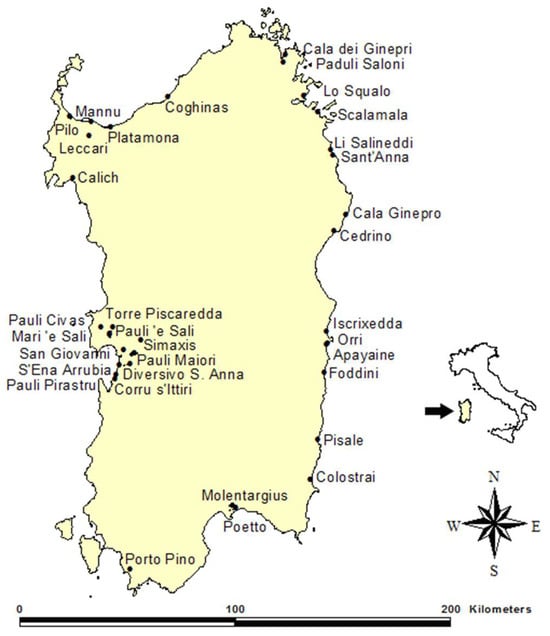
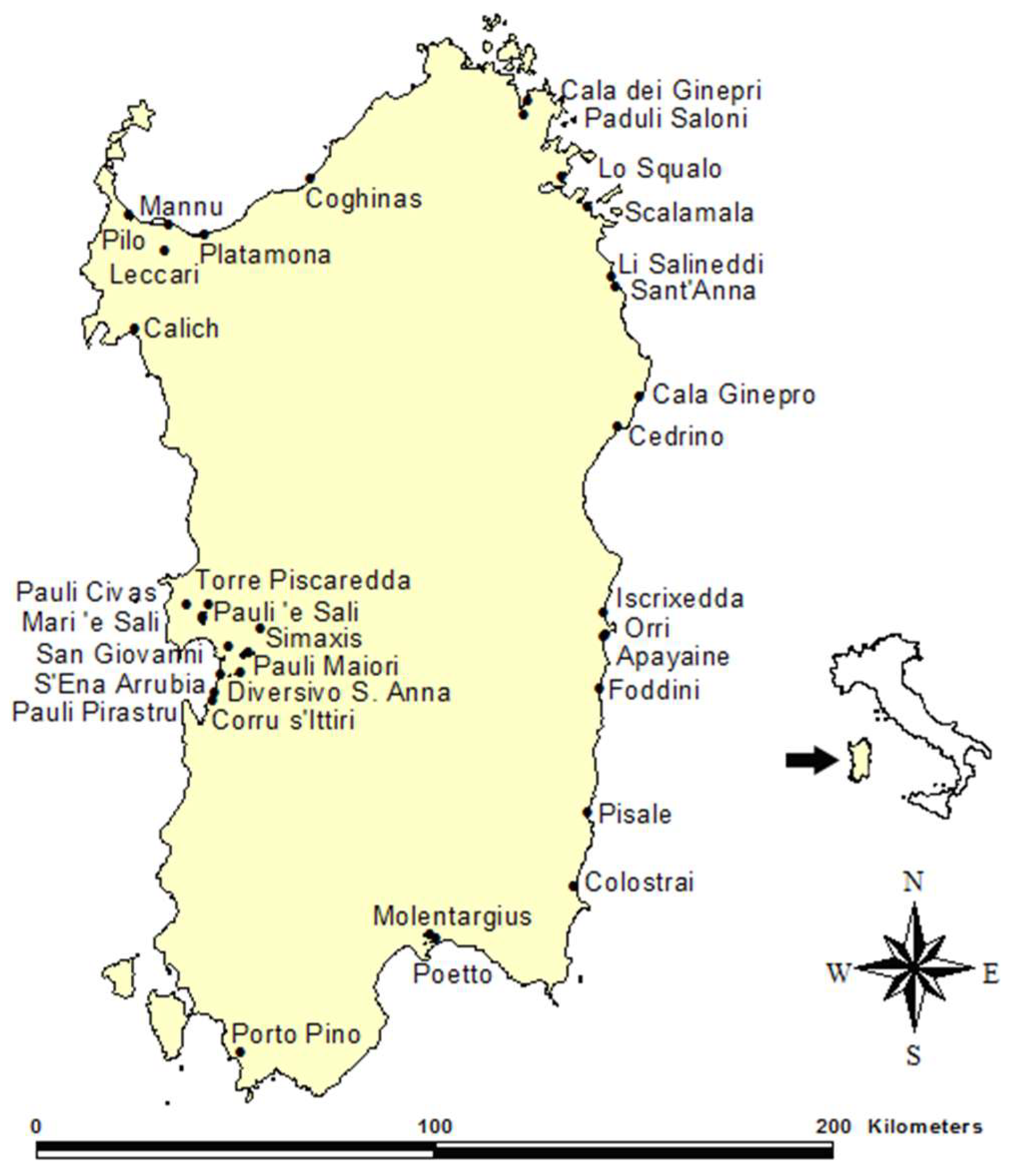
The study area encompassed most of the freshwater and brackish wetlands with emergent vegetation in Sardinia, detected by using the most recent GoogleEarth™ (version 7.2) images available. As a result of this selection procedure, we chose 34 wetlands (Figure 1).
Figure 1.
The names and locations of the 34 wetlands with emergent vegetation under study in Sardinia (Italy). Geographic coordinate system: UTM WGS 84 32 North. The overall extent of the associated reedbeds is 589.56 ha, of which 556.08 ha (94.32%) is contained within Natura 2000 sites. A detailed map of the study area is available via the ResearchGate Digital Repository, https://doi.org/10.13140/RG.2.2.35245.65763.
For each wetland, we used the GoogleEarth™ images to draw the boundaries of the reedbeds and evaluate surface area. During spring 2024, corresponding to the breeding season of Purple Swamphens, we sampled the wetlands selected and recorded all visual and vocal (shrieking warning, attack calls and hummed courtship calls) contacts. Samplings were carried out in the early morning and late evening when this species forages [15] by walking along the perimeter of each wetland and using rowboats in the larger sites. Double counting of Purple Swamphens was avoided by spacing sampling points at least 200 m apart to prevent receiving two vocal or visual signals from the same individual. Playback was also used every 200 m along perimeters. Data on population size for the wetland Molentargius were provided by the regional natural park. Observers recorded twenty-three wetland traits that could potentially influence the Purple Swamphen population size [13,14,15], and three further attributes were computed using GIS analyses (Table 1). Our study required neither ethical approval nor permission for fieldwork because it was purely observational. Playback was exempt under the relevant institutional/national regulations.
Table 1.
Description of the variables used in this study.
2.2. Bayesian Network Modeling
In order to feed a Bayesian probabilistic network (BPN [20]), the continuous variables were converted into discrete counterparts according to the following rules [21]: (a) commonsense discretization and (b) no more than five classes. A BPN is a multivariate model for a set of variables x = {x1, …, xn}, which is defined by two components: (a) a directed acyclic graph where each vertex represents one of the variables and links represent conditional relationships from one node to another; and (b) a conditional distribution p(xi/P(xi)) for each variable xi (i = 1, …, n) given its parents P(xi) in the graph. The joint distribution over all the variables is equal to the product of the conditional distributions attached to each node:
where represents the set of all possible values of variable xi.
We used a semi-supervised approach to structure learning [22]. Based on expert opinions and data exploratory analyses, firstly, we imposed several constraints to the BPN by disallowing some links (e.g., poachers → water salinity) and imposing others (e.g., reedbed extent → Purple Swamphen). We then used the PC algorithm [23] for structure learning within the imposed constraints. The PC algorithm starts with all pairwise unconditional associations and then removes associations that are not statistically significant. We set the following parameters: (1) max adjacency size (i.e., number of neighbors of a node) = 10; (2) statistical significance (i.e., the α value used in classical independence tests) = 0.05; (3) no time limit on the search phase.
We used sensitivity analysis to rank the predictors in order of influence on the Purple Swamphen population size. We applied two measures of sensitivity [21]: (1) mutual information and (2) variance of node belief. The former measures for each predictor quantify how much uncertainty in the target variable (Purple Swamphen population size) drops if we observe evidence (e.g., reedbed type = “Phragmites australis”). The latter quantifies uncertainty left in the target variable after seeing specific evidence (e.g., water type = “lentic”). Stronger predictors have higher values on both indices.
Model accuracy was evaluated using leave-one-out cross-validation (LOO; estimate of out-of-sample predictive performance by training on n − 1 cases and testing on the left one, repeated n times), and the LOO confusion matrix was used to assess class-specific performance and recall. We used results from sensitivity analysis to reduce overfitting by pruning variables and links that increased BIC (Bayesian Information Criterion; estimate of model fit penalized by complexity, used to select a parsimonious model) and AIC (Akaike Information Criterion; similar to BIC but with a weaker penalty for parameters, thus favoring more complex models than BIC) without yielding any improvement in LOO accuracy, thus retaining only predictors that contributed to out-of-sample predictive performance. In fact, lower BIC and AIC values indicate better trade-off between fit and model complexity.
After the model was positively evaluated, plausible environmental and management scenarios were simulated as inputs to the BPN in order to predict the effects on the Purple Swamphen population size. Inference in a BPN is the process of computing the change in terms of probability of some variables after simulating some observations of other variables as
where xT is the vector of states of the target variable and e represents the vector of evidence of parent variables. We used Bayesian inference to detect minimum-change management solutions through least-cost parameter tuning [24,25], i.e., the smallest possible changes to the wetland traits that could lead to the desired states (xTD) of the target variable. In mathematical terms:
We were interested in four distinct minimum-change management targets, i.e., forcing the proportion of wetlands where Purple Swamphens are absent to be <30% (target A) and 20% (target B) and the proportion of wetlands with medium-large (i.e., 10 or more individuals) populations to be >30% (target C) and 40% (target D).
Bayesian network modeling and simulations were carried out using Netica 7.01 [26].
3. Results
3.1. Exploratory Data Analysis
The selected wetlands were prevalently lentic (70.4%), freshwater (82.1%), medium-sized (between 1 and 10 hectares; 40.9%) ecosystems, with water depth between 10 and 50 cm (43.9%) and mixed reedbed (55.8%) with height above water surface between 100 and 200 cm (59.7%). The 75th percentiles of variables “distance from coast” and “isolation” were 1.96 km and 9.28 km, respectively (Figure S1).
The overall extent of reedbeds was 589.56 ha (n = 34, mean ± SD: 17.34 ha ± 39.75), of which 556.08 ha (94.32%) was contained within Natura 2000 sites. The most frequent source of human disturbance was birdwatchers (16 wetlands out of 34) (Figure S2). The most common predators of Purple Swamphens (eggs and chicks) were corvids (22 wetlands) and herring gulls (20 wetlands) (Figure S3).
We recorded 181 individuals, of which 68 were in the wetland Molentargius. Purple Swamphens were absent in 14 wetlands out of 34, while population size was small (between one and nine individuals) and medium-large (≥10 individuals) in 14 and six wetlands, respectively.
3.2. Bayesian Modeling
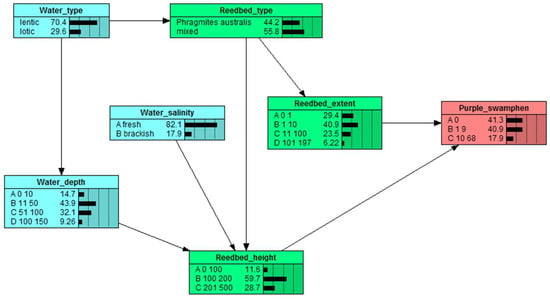
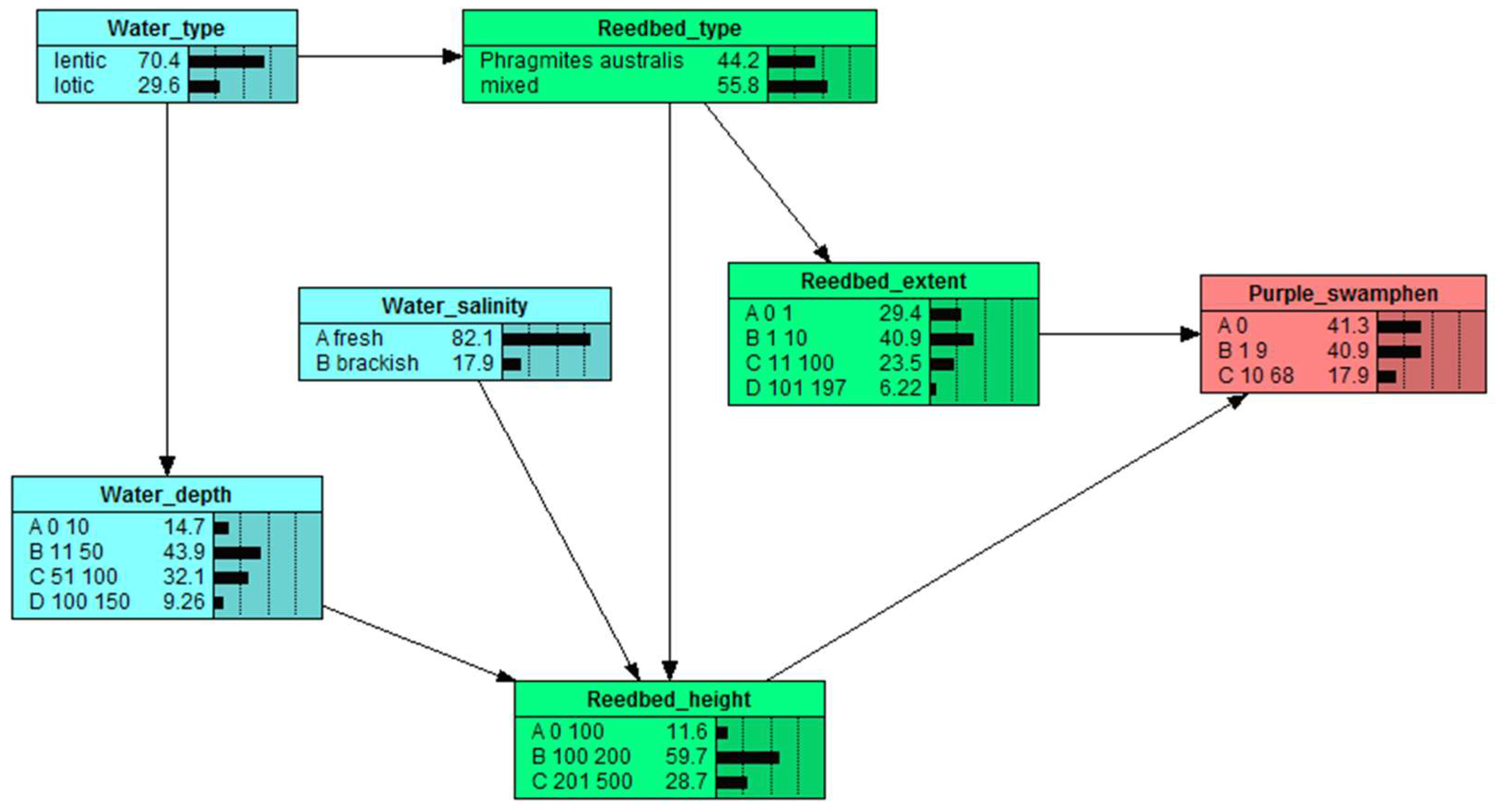
The Bayesian model results (seven nodes, eight links, BIC = 130.8, AIC = 94.2) are presented in Figure 2. Only six predictors (Table S1) of Purple Swamphen population size out of 26 were retained in the model. The overall accuracy of this model was 73.5% (i.e., 25/34; Table 2). Group summary is presented in Table S2.
Figure 2.
The Bayesian network used to model the Purple Swamphen population size in the Sardinian wetlands under study. Nodes show variable priors, and arrows indicate direct influences of the source nodes upon the destination nodes.
Table 2.
Explanatory power (i.e., leave-one-out cross-validation confusion matrix) of the Bayesian network used to model the Purple Swamphen population size in the Sardinian wetlands under study. The numbers on the diagonal measure the accuracy of the model.
Results of sensitivity analysis showed that the variable “reedbed extent” is by far the most influencing factor in controlling Purple Swamphen population size, followed by “reedbed height” and “reedbed type” (Table 3). The two measures of sensitivity were perfectly concordant (Spearman’s rank correlation coefficient = 1).
Table 3.
Results of the sensitivity analysis for the six predictors of the Purple Swamphen population size included in the model. Predictors are arranged in descending order of importance.
By combining the effects of the significant wetland traits, the ideal habitat for Purple Swamphens is: water type = “lentic”, water salinity = “fresh”, water depth between 10 and 50 cm, reedbed type = “Phragmites australis”, reedbed extent > 100 ha, reedbed height between 100 and 200 cm. Under these optimal conditions, probabilities are 6.1% (absent), 48.9% (small population), and 45.0% (medium-large population). On the contrary, the worst habitat conditions are: water type = “lotic”, water salinity = “brackish”, water depth < 10 cm, reedbed type = “mixed”, reedbed extent < 1 ha, reedbed height < 100 cm. Under these worst conditions, probabilities are 98.0% (absent), 1.6% (small population), and 0.4% (medium-large population).
3.3. Minimum-Change Management Solutions
The minimal intervention scenarios are detailed in Table 4. Results are exhaustive, i.e., there were no further solutions that met the desired targets. Target A can be accomplished by increasing the number of wetlands with large (10–100 hectares) mixed reedbeds from two (10.52% of the 19 wetlands with mixed reedbed) to at least nine (47.36%). Target B can be attained by increasing the number of wetlands with large mixed reedbeds from two to at least 16 (84.21%). Target C had two possible solutions, of which the most viable seems the increase in the number of large mixed reedbeds from two to at least 12 (63.15%). Target D had no solutions.
Table 4.
Minimum-change management solutions found (i.e., the smallest possible changes to the wetland traits that could lead to the desired conservation target). We considered four distinct minimum-change targets, i.e., forcing the proportion of wetlands where Purple Swamphens are absent to be <30% (target A) and 20% (target B) and the proportion of wetlands with medium-large (i.e., 10 or more individuals) populations to be >30% (target C) and 40% (target D). Target D had no solutions. Key to reading: target A requires an increase in the number of wetlands with large (10–100 hectares) mixed reedbeds from 2 (10.52% of wetlands with mixed reedbed) to at least 9 (47.36%).
4. Discussion
There is compelling evidence of the adverse effects of human and climate threats on wetlands [27,28]. Waterbirds in turn are largely influenced by the climate conditions, human disturbance and habitat changes in wetlands, which in fact affect their mating, breeding and foraging behavior and success [10,11,12].
Because of the rapid decline in the integrity of wetlands worldwide [29], which puts at risk their role as a habitat for waterbirds, it is important to act promptly to put in place conservation measures that, due to the usual budget constraints, should be cost-effective and whose effects should be clear prior to field interventions. Accordingly, in this study, we have combined Bayesian modeling with least-cost parameter tuning to find out viable, minimal intervention conservation strategies for the Purple Swamphen in the Sardinian wetlands. We found that (a) six wetland traits influence significantly the Purple Swamphen population size, (b) reedbed extent is by far the most influencing factor, (c) Purple Swamphens have precise ecological requirements with regard to habitat conditions, and (d) by acting selectively upon specific wetlands and wetland attributes, it is possible to increase the carrying capacity of the colonized reedbeds and decrease the number of reedbeds that have been abandoned or not yet colonized.
4.1. Ecological Interpretation of Results
We hypothesize that Purple Swamphens prefer P. australis beds because mixed reedbeds are structurally heterogeneous, with plots of different heights above water surface, as well as empty spaces between plots of different species. On the contrary, P. australis beds are structurally homogeneous and tall enough (up to 5 m in the study area), with few empty spaces, and thus allow Purple Swamphens to hide better within the vegetation. Tall, dense vegetation may confer protection by creating visual barriers and hindering the movement of predators. In addition, P. australis can tolerate the salinity up to 20 ppt [30], and therefore, it is also useful to decrease water salinity in wetlands with high evapotranspiration or saltwater intrusions, which favors the Purple Swamphen population size, as emerged in this study. However, reedbed heights > 2 m above water level shield Purple Swamphens from the sunlight and could thus restrain their foraging behavior. On the other hand, when reedbed height is <1 m, predators like corvids and herring gulls can easily spot nests of Purple Swamphens and jeopardize eggs and chicks. We also suppose that Purple Swamphens prefer lentic shallow waters as they favor its dietary habits, which consist predominantly of plant matter (including shoots, leaves, roots, stems, flowers and seeds) floating in the water [15]. The preference of Purple Swamphens for fresh waters could be explained in light of the well-known negative effects of salinity on waterbirds, i.e., dehydration, reduction in the waterproofing of feathers, and increase in the energy costs of thermoregulation [31]. In addition, our simulations showed that salinity (category “brackish”) forces reedbed height to be <100 cm, with 44% probability in the study area, which in turn disfavors the Purple Swamphen population size.
4.2. Implications for Conservation
4.2.1. Enlargement of Existing Reedbeds
Our model provided quantitative indications on how to reduce the risk of local extinctions and increase the carrying capacity of colonized reedbeds and attractiveness of sites to be colonized by Purple Swamphens.
The conservation target A can be accomplished by increasing the number of wetlands with large (i.e., at least 10 ha) mixed reedbeds from two to at least nine. The mixed reedbeds of sixteen Sardinian wetlands (Apayaine, Cala dei Ginepri, Cala Ginepro, Cedrino, Foddini, Iscrixedda, Li Salineddi, Orri, Paduli Saloni, Pauli Civas, Pisale, Porto Pino, San Giovanni, Sant’Anna, Scalamala, Simaxis; Table S1) are ≤10 hectares and thus could host reed plantations in order to meet this target. Priority should be assigned to the subset of these wetlands where habitat conditions are as similar as possible to the ideal habitat conditions for Purple Swamphens individuated in this study (i.e., fresh lentic water, water depth between 10 and 50 cm, reedbed height between 100 and 200 cm).
The conservation target B would require an increase in the number of wetlands with large mixed reedbeds from two to at least 16, which could involve 14 out of 16 wetlands mentioned above.
The conservation target C has two possible solutions. The former solution would require the enlargement of at least 14 reedbeds dominated by P. australis up to at least 100 ha. Currently, only one P. australis bed is larger than 100 ha (wetland Pauli Majori; Table S1), and the reedbeds of fourteen wetlands (Calich, Coghinas, Colostrai, Corru s’Ittiri, Leccari, Lo Squalo, Mannu, Mari ‘e Sali, Molentargius, Pauli ‘e Sali, Pauli Pirastru, Poetto, S’Ena Arrubia, and Torre Piscaredda; Table S1) are eligible for this solution. The latter solution would imply the expansion of at least ten mixed reedbeds ≤10 hectares up to at least 10 ha, by acting upon the sixteen wetlands mentioned above.
The conservation target D had no solutions. The solution found closest to target D was 35% of reedbeds hosting a Purple Swamphens population greater than 10 individuals. This sub-optimal solution can be achieved by expanding all sixteen reedbeds currently ≤10 hectares to at least ten hectares.
4.2.2. Conservation of Existing Reedbeds
Although P. australis beds are an important habitat for marsh birds [32], they degraded and declined in size throughout Europe [33]. This decline was due to many different factors [34] like direct destruction (agricultural expansion, recreational activities, etc.), grazing by wild animals (e.g., cattle), and adverse abiotic conditions (e.g., salinization). In addition, common reeds can be harvested, legally or illegally, for use as an industrial material (paper production, manufacture of insulation materials), construction and gardening (garden fences and indoor furnishings), energy source by combustion, biogas production and biofuel production [35]. Therefore, it is also of utmost importance that the existing reedbeds, particularly the P. australis beds, are being strictly protected in Sardinia and deteriorated reedbeds restored to the benefit of Purple Swamphens and marsh birds more in general. In Europe, the Natura 2000 ecological network of protected areas supports the conservation of biodiversity [36]. Within the Natura 2000 sites, the management plan and conservation measures (art. 6 of EU Habitat Directive) are the basis for the preservation of species and habitats [37]. Because the Sardinian reedbeds almost completely belong to the Natura 2000 network, their role as a habitat for Purple Swamphens urges that local administrations assign a priority to the preservation, restoration and enlargement of the existing reedbeds. In addition, a protective ring around reedbeds where drainage for agricultural purposes, conversion to agricultural land, and nutrient runoff of fertilizers and pesticides from the surroundings are prohibited, would substantially help to increase the Purple Swamphen population size in Sardinia. Our proposals are in good agreement with previous studies on the Sardinian wetlands and waterbirds [38,39].
4.2.3. Benefits for Other Waterbird Species
The proposed conservation actions are likely to favor many other waterbird species breeding in the Sardinian reedbeds, in particular the Common Moorhen, the Eurasian Coot, the Marsh Harrier, the Eurasian Teal, the River Nightingale, the Gadwall, the Bittern, the Little Bittern, the Reed Warbler, the Marsh Millet, the Great Reed Warbler, the Garganey, the Mallard, the Northern Shoveler, and the Water Rail [9,10]. On the contrary, three waterbird species could be disfavored as they do not breed among the reeds, i.e., the Pied Avocet, the Black-winged Stilt, and the Black-headed Gull. However, in Sardinia, the number of water bodies devoid of reedbeds is large; thus, these three species could easily find suitable breeding areas elsewhere.
4.2.4. Reinforcement and Reintroduction Programs
Although Purple Swamphens are less able than other more generalist species to colonize new wetlands in case of human and climate change impacts upon the sites where they dwell, a reinforcement and reintroduction program does not seem necessary in the study area. In fact, previous studies [40,41] showed that an increment in the availability of suitable habitat for this species is enough to increase local sub-populations, and the successive habitat saturation encourages long-distance dispersal towards sites abandoned or still uncolonized.
4.2.5. Creation of New Reedbeds
We determined the ideal habitat conditions for Purple Swamphens. This outcome could be useful to create new reedbeds in Sardinia to support the objectives of the Birds Directive and the EU 2030 Biodiversity Strategy. Site selection is an essential step for the creation of new wetlands [42]. A project reedbed for Purple Swamphens could be thus placed where site-specific wetland traits (i.e., water type, water depth, water salinity) are as similar as possible to the ideal habitat conditions individuated in this study.
4.3. Methodological Issues and Limitations
Bayesian modeling allowed the identification of a network of interacting variables that are the relevant drivers of the Purple Swamphen population size and the influences among such variables to be split into (direct and indirect) hierarchical influences. This in turn made it possible to (a) formulate a clear hypothesis on the network of relevant variables that actually determine the Purple Swamphen population size, (b) build a network-like model to represent this hypothesis, (c) validate or reject the hypothesis using leave-one-out cross-validation, and (d) dynamically simulate changes to any variable and predict the direct and indirect effects expected for the target variable. Further, the combination of Bayesian modeling and least-cost parameter tuning allowed us to find out viable, minimal intervention conservation strategies for the Purple Swamphen in the Sardinian wetlands. To the best of our knowledge, so far in ecology, least-cost parameter tuning applied to Bayesian networks has been reported only in [43,44].
While multi-year sampling would have provided an even more robust foundation for our model, our dataset encompassing 34 Sardinian wetlands captured substantial spatial heterogeneity across highly diverse environmental conditions, which was assessed via class frequency and normalized Shannon entropy H (Table S3). In accordance with space-for-time substitution theory [45], this spatial variability served as a proxy for temporal dynamics as well, thereby compensating for the single-year sampling design. In addition, five out of six influencing factors in controlling Purple Swamphen population size (Table 3) are slow structural variables (with the only exception of water depth); therefore, these main drivers are expected to have minimum inter-annual variability.
While strictly correlative, our Bayesian model was elicited from expert knowledge and ecological literature, allowing a causal interpretation under the assumption of causal sufficiency, which was satisfied as we considered twenty-six variables deemed potentially relevant, thus minimizing the risk of unmeasured confounding variables. Our model was therefore used as a predictive and management-support tool.
The target variable was not collapsed into a binary presence/absence variable because such aggregation would result in a substantial loss of ecological information. In fact, from a conservation viewpoint, abundance matters because populations with few individuals are highly vulnerable to demographic and environmental stochasticity, which could drive small, isolated groups to local extinction even if habitat remains suitable. Thus, the choice of the discrete categories for the target variable (i.e., absent, <10, 10–68) followed an ecological sense, with small populations (<10 individuals) more prone to stochastic events than medium-large ones (≥10 individuals).
Spatial aggregation and spatial autocorrelation did not influence the model results; in fact, Moran’s I correlogram on the residuals of the equivalent continuous log-linear model (i.e., mirroring the Bayesian network structure prior to discretization) indicated the absence of a residual spatial structure at any scale (Table S4). Therefore, the predictive accuracy of our model was not inflated by spatial data leakage.
The conclusions obtained from the present study should not be overgeneralized or overextended to other study areas.
5. Conclusions
Our study indicates that the Purple Swamphen population in the Sardinian reedbeds is very small and highly fragmented, with about 75% of the sites hosting no more than five individuals, and therefore highly susceptible to stochastic and disturbance factors. It is therefore urgent to implement habitat management actions to reduce the risk of local extinctions and favor an increase in the carrying capacity of the colonized sites and attractiveness to the species at sites that are still uncolonized. These targets require preservation, restoration and enlargement of the existing reedbeds and creation of new ones to increase the availability of suitable habitats. To this aim, our model identified candidate habitat attributes and management scenarios that could be tested and validated in the field.
Accordingly, our study can serve as information for planners to assist with preserving and increasing the Purple Swamphen population in the Sardinian wetlands, most of which belong to the Natura 2000 network, and provide local managers with a methodology to allow for regional-scale planning of cost-effective conservation actions in order to meet the requirements of the EU’s Nature Restoration Law, which mandates member states to restore at least 20% of their degraded land and sea areas by 2030, including specific targets for wetlands. Our study also suggests that updating field data about the Purple Swamphen population in the Sardinian wetlands on a regular basis is worthy of being recommended to local researchers and administrations.
The combination of Bayesian networks and least-cost parameter tuning proved to be a valuable tool to find out viable, minimal intervention strategies for species conservation.
Supplementary Materials
The following supporting information can be downloaded at: https://www.mdpi.com/article/10.3390/land15101858/s1, Figure S1: (Top) Distance from coast (in km; Y-axis), and (bottom) isolation (in km; Y-axis) of the 34
wetlands under study in Sardinia; Figure S2: Radar chart showing the number of wetlands (out of 34) with specific human threats; Figure S3: Radar chart showing the number of wetlands (out of 34) with specific predators of Purple
Swamphens; Table S1: Attributes of the selected wetlands. Only traits that entered the Bayesian model are reported; Table S2: Group summary (cross-tabulation matrices). Each cell shows the number of Purple Swamphen
sampled; Table S3: Spatial gradient adequacy assessed via class frequency and normalized Shannon entropy H; Table S4: Moran’s I correlogram on the residuals of the equivalent continuous log-linear model.
Author Contributions
Conceptualization, A.F. and M.G.; methodology, A.F.; software, A.F.; validation, M.G.; formal analysis, A.F.; investigation, A.F. and M.G.; resources, M.G.; data curation, F.G., S.N. and G.P.; writing—original draft preparation, A.F.; writing—review and editing, A.F. and M.G.; visualization, A.F.; supervision, M.G. and S.N.; project administration, M.G.; funding acquisition, M.G. All authors have read and agreed to the published version of the manuscript.
Funding
Field surveys, analyses and modeling were supported by LIPU-UK (grant number: Purple Swamphen 2024–2025).
Data Availability Statement
Data available via the ResearchGate Digital Repository https://doi.org/10.13140/RG.2.2.16157.78560. A detailed map of the study areas is available via the ResearchGate Digital Repository https://doi.org/10.13140/RG.2.2.35245.65763.
Acknowledgments
We thank Claudio Celada (Lipu Italy) for useful remarks prior to submission. We acknowledge the helpful comments and suggestions provided by five anonymous reviewers.
Conflicts of Interest
The authors declare no conflicts of interest.
References
- Rosenberg, K.V.; Dokter, A.M.; Blancher, P.J.; Sauer, J.R.; Smith, A.C.; Smith, P.A.; Stanton, J.C.; Panjabi, A.; Helft, L.; Parr, M.; et al. Decline of the North American avifauna. Science 2019, 366, 120–124. [Google Scholar] [CrossRef] [Scilit]
- Wetlands International. Waterbird Population Estimates, 5th ed.; Wetlands International: Ede, The Netherlands, 2012. [Google Scholar]
- BirdLife International. Waterbirds Are Showing Widespread Declines, Particularly in Asia; BirdLife Data Zone: Cambridge, UK, 2017; Available online: http://www.birdlife.org (accessed on 8 December 2025).
- Fraser, L.H.; Keddy, P.A. The World’s Largest Wetlands: Ecology and Conservation; Cambridge University Press: Cambridge, UK, 2005. [Google Scholar]
- Mitsch, W.J.; Gosselink, J.G. Wetlands; John Wiley & Sons: New York, NY, USA, 2015. [Google Scholar]
- Geijzendorffer, I.R.; Beltrame, C.; Chazee, L.; Gaget, E.; Galewski, T.; Guelmami, A.; Perennou, C.; Popoff, N.; Guerra, C.A.; Leberger, R.; et al. A more effective Ramsar Convention for the conservation of Mediterranean wetlands. Front. Ecol. Evol. 2019, 7, 21. [Google Scholar] [CrossRef] [Scilit]
- Lai, S.; Leone, F.; Zoppi, C. Land cover changes and environmental protection: A study based on transition matrices concerning Sardinia (Italy). Land Use Policy 2017, 67, 126–150. [Google Scholar] [CrossRef] [Scilit]
- Ferrarini, A.; Gustin, M.; Celada, C. Twenty-three years of land-use changes induced considerable threats to the main wetlands of Sardinia and Sicily (Italy) along the Mediterranean bird flyways. Diversity 2021, 13, 240. [Google Scholar] [CrossRef] [Scilit]
- Ferrarini, A.; Celada, C.; Gustin, M. Preserving the Mediterranean bird flyways: Assessment and prioritization of 38 main wetlands under human and climate threats in Sardinia and Sicily (Italy). Sci. Total Environ. 2020, 751, 141556. [Google Scholar] [CrossRef] [Scilit]
- Ferrarini, A.; Gustin, M.; Celada, C. Wetland attributes significantly affect patterns of bird species distribution in the Sardinian wetlands (Italy): An uncertain future for waterbird conservation. J. Appl. Ecol. 2023, 60, 650–660. [Google Scholar] [CrossRef] [Scilit]
- Ferrarini, A.; Gustin, M.; Celada, C. Simulation modeling unveils the unalike effects of alternative strategies for waterbird conservation in the coastal wetlands of Sardinia (Italy). Biology 2023, 12, 1440. [Google Scholar] [CrossRef] [Scilit]
- Ferrarini, A.; Gustin, M.; Celada, C. Waterbirds of Sardinia (Italy): How Space and Time Shape a Threatened Metacommunity During the Critical Summer Period. Land 2024, 13, 2193. [Google Scholar] [CrossRef] [Scilit]
- Brichetti, P.; Fracasso, G. The Birds of Italy, Volume 1: Anatidae-Alcidae; Edizioni Belvedere: Latina, Italy, 2018. [Google Scholar]
- Andreotti, A. Piano D’azione Nazionale per Il Pollo Sultano (Porphyrio porphyrio); Ministero Ambiente—Istituto Nazionale Fauna Selvatica: Rome, Italy, 2001. [Google Scholar]
- Taylor, B.; van Perlo, B. Rails: A Guide to the Rails, Crakes, Gallinules and Coots of the World; Pica Press: East Sussex, UK, 1998. [Google Scholar]
- Lardelli, R.; Bogliani, G.; Brichetti, P.; Caprio, E.; Celada, C.; Conca, G.; Fraticelli, F.; Gustin, M.; Janni, O.; Pedrini, P.; et al. Atlante Degli Uccelli Nidificanti in Italia; Edizioni Belvedere: Rome, Italy, 2022. [Google Scholar]
- BirdLife International. European Red List of Birds; BirdLife International: Cambridge, UK, 2021. [Google Scholar]
- Gustin, M.; Nardelli, R.; Brichetti, P.; Battistoni, A.; Rondinini, C.; Teofili, C. Lista Rossa IUCN Degli Uccelli Nidificanti in Italia 2021; Comitato Italiano IUCN e Ministero dell’Ambiente e della Tutela del Territorio e del Mare: Rome, Italy, 2021. [Google Scholar]
- Gil de Vergara, C.V.; Ripoll, M.G. Species Action Plan for the Purple Gallinule Porphyrio Porphyrio in Europe; BirdLife International: Cambridge, UK, 2001. [Google Scholar]
- Pearl, J. Probabilistic Reasoning in Intelligent Systems: Networks of Plausible Reasoning; Morgan Kaufmann Publishers: Burlington, MA, USA, 1988. [Google Scholar]
- Muhlenbach, F.; Rakotomalala, R. Discretization of continuous attributes. In Encyclopedia of Data Warehousing and Mining; Wang, J., Ed.; IGI Global: Hershey, PA, USA, 2005; pp. 397–402. [Google Scholar]
- Ferrarini, A.; Calevi, E.; Brozzetti, D.; Colle, A.; De Santis, R.; Laurenti, S.; Savo, E.; Gustin, M. Optimized Monitoring and Conservation of Farmland Bird Species through Bayesian Modelling: The Montagu’s Harrier Circus pygargus Population in Central Italy. Sustainability 2023, 15, 4426. [Google Scholar] [CrossRef] [Scilit]
- Spirtes, P.; Glymour, C.; Scheines, R. Causation, Prediction, and Search; MIT Press: Cambridge, MA, USA, 2000. [Google Scholar]
- Blackmond Laskey, K. Sensitivity analysis for probability assessments in Bayesian networks. IEEE Trans. Syst. Man. Cybern. Part A 1995, 25, 901–909. [Google Scholar] [CrossRef] [Scilit]
- Castillo, E.; Gutierrez, J.M.; Hadi, A.S. Sensitivity analysis in discrete Bayesian networks. IEEE Trans. Syst. Man. Cybern. Part A 1997, 27, 412–423. [Google Scholar] [CrossRef] [Scilit]
- Norsys. Netica Bayesian Belief Network Software; Norsys Software Corporation: Vancouver, BC, Canada, 2013. [Google Scholar]
- Maltby, E. The Wetlands Paradigm Shift in Response to Changing Societal Priorities: A Reflective Review. Land 2022, 11, 1526. [Google Scholar] [CrossRef] [Scilit]
- Osland, M.J.; Enwright, N.M.; Day, R.H.; Gabler, C.A.; Stagg, C.L.; Grace, J.B. Beyond just sea-level rise: Considering macroclimatic drivers within coastal wetland vulnerability assessments to climate change. Glob. Change Biol. 2016, 22, 1–11. [Google Scholar] [CrossRef] [Scilit]
- Gardner, R.C.; Finlayson, C.M. Global Wetland Outlook: State of the World’s Wetlands and Their Services to People; Ramsar Convention: Gland, Switzerland, 2018. [Google Scholar]
- Wallace, S.D.; Knight, R.L. Small-Scale Constructed Wetland Treatment Systems: Feasibility, Design Criteria, and O&M Requirements; Water Environment Research Foundation: Alexandria, VA, USA, 2006. [Google Scholar]
- Rubega, M.A.; Robinson, J.A. Water salinization and shore-birds: Emerging issues. Int. Wader Stud. 1997, 9, 45–54. [Google Scholar]
- Valkama, E.; Lyytinen, S.; Koricheva, J. The Impact of Reed Management on Wildlife, a Meta-Analytical Review of European Studies. Biol. Conserv. 2008, 141, 364–374. [Google Scholar] [CrossRef] [Scilit]
- Vermaat, J.E.; Bos, B.; Van der Burg, P. Why do reed beds decline and fail to re-establish? A case study of Dutch peat lakes. Freshw. Biol. 2016, 61, 1580–1589. [Google Scholar] [CrossRef] [Scilit]
- Gaganis, C.M.; Troumbis, A.Y.; Kontos, T. Leveraging Reed Bed Burnings as Indicators of Wetland Conversion in Modern Greece. Land 2024, 13, 538. [Google Scholar] [CrossRef] [Scilit]
- Köbbing, J.F.; Thevs, N.; Zerbe, S. The utilisation of reed (Phragmites australis): A review. Mires Peat 2013, 13, 1–14. [Google Scholar] [CrossRef] [Scilit]
- European Environment Agency. Protected Areas in Europe—An Overview; EEA: Copenhagen, Denmark, 2012. [Google Scholar]
- Evans, D. Building the European Union’s Natura 2000 network. Nat. Conserv. 2012, 1, 11–26. [Google Scholar] [CrossRef] [Scilit]
- Cuena-Lombraña, A.; Fois, M.; Fenu, G.; Cogoni, D.; Bacchetta, G. Activities and impacts in wetlands: Challenges for Sardinia. Reg. Environ. Change 2025, 45, 132. [Google Scholar]
- Fois, M.; Cuena-Lombraña, A.; Zucca, C.; Nissardi, S.; Bacchetta, G. Investigating plant-bird co-occurrence patterns in Mediterranean wetlands; can they reveal signals of ecosystem connectivity? Diversity 2022, 14, 253. [Google Scholar] [CrossRef] [Scilit]
- Pacheco, C.; McGregor, P.K. Conservation of the purple gallinule (Porphyrio porphyrio L.) in Portugal: Causes of decline, recovery and expansion. Biol. Cons. 2004, 119, 115–120. [Google Scholar] [CrossRef] [Scilit]
- Sanchez-Lafuente, A.M.; Valera, F.; Godino, A.; Muela, F. Natural and human-mediated factors in the recovery and subsequent expansion of the purple swamphen Porphyrio porphyrio L. (Rallidae) in the Iberian Peninsula. Biodiv. Conserv. 2001, 10, 851–867. [Google Scholar] [CrossRef] [Scilit]
- Kirby, J.; Davidson, N.; Giles, N.; Owen, M.; Spray, C. Waterbirds and Wetland Recreation Handbook. A Review of Issues and Management Practice; The Wildfowl and Wetlands Trust Publisher: Gloucester, UK, 2004. [Google Scholar]
- Pollino, C.A.; Woodberry, O.; Nicholson, A.; Korb, K.B.; Hart, B.T. Parameterisation and evaluation of a Bayesian network for use in an ecological risk assessment. Environ. Model. Softw. 2008, 22, 1140–1152. [Google Scholar] [CrossRef] [Scilit]
- Marcot, B.G.; Stevenson, J.D.; Sutherland, G.D.; McCann, R.K. Guidelines for developing and updating Bayesian belief networks applied to ecological modeling and conservation. Can. J. For. Res. 2006, 36, 3063–3074. [Google Scholar] [CrossRef] [Scilit]
- Blois, J.L.; Williams, J.W.; Fitzpatrick, M.C.; Jackson, S.T.; Ferrier, S. Space can substitute for time in predicting climate-change effects on biodiversity. Proc. Natl. Acad. Sci. USA 2013, 110, 9374–9379. [Google Scholar] [CrossRef] [Scilit]

Disclaimer/Publisher’s Note: The statements, opinions and data contained in all publications are solely those of the individual author(s) and contributor(s) and not of MDPI and/or the editor(s). MDPI and/or the editor(s) disclaim responsibility for any injury to people or property resulting from any ideas, methods, instructions or products referred to in the content. |
© 2026 by the authors. Licensee MDPI, Basel, Switzerland. This article is an open access article distributed under the terms and conditions of the Creative Commons Attribution (CC BY) license.