Article

Spatial Optimization of Park Green Spaces by an Improved Two-Step Optimization Model from the Perspective of Maximizing Accessibility Equity


1
Faculty of Resources and Environmental Science, Hubei University, 368 Youyi Road, Wuhan 430062, China
2
Key Laboratory of Regional Development and Environmental Response, Hubei University, 368 Youyi Road, Wuhan 430062, China
3
Business School, NingboTech University, Qianhunan Road 1, Ningbo 315100, China
*
Author to whom correspondence should be addressed.
Land 2023, 12(5), 948; https://doi.org/10.3390/land12050948
Submission received: 15 March 2023 / Revised: 12 April 2023 / Accepted: 21 April 2023 / Published: 24 April 2023
(This article belongs to the Special Issue Celebrating the 130th Anniversary of Wuhan University on Land Science)

Abstract

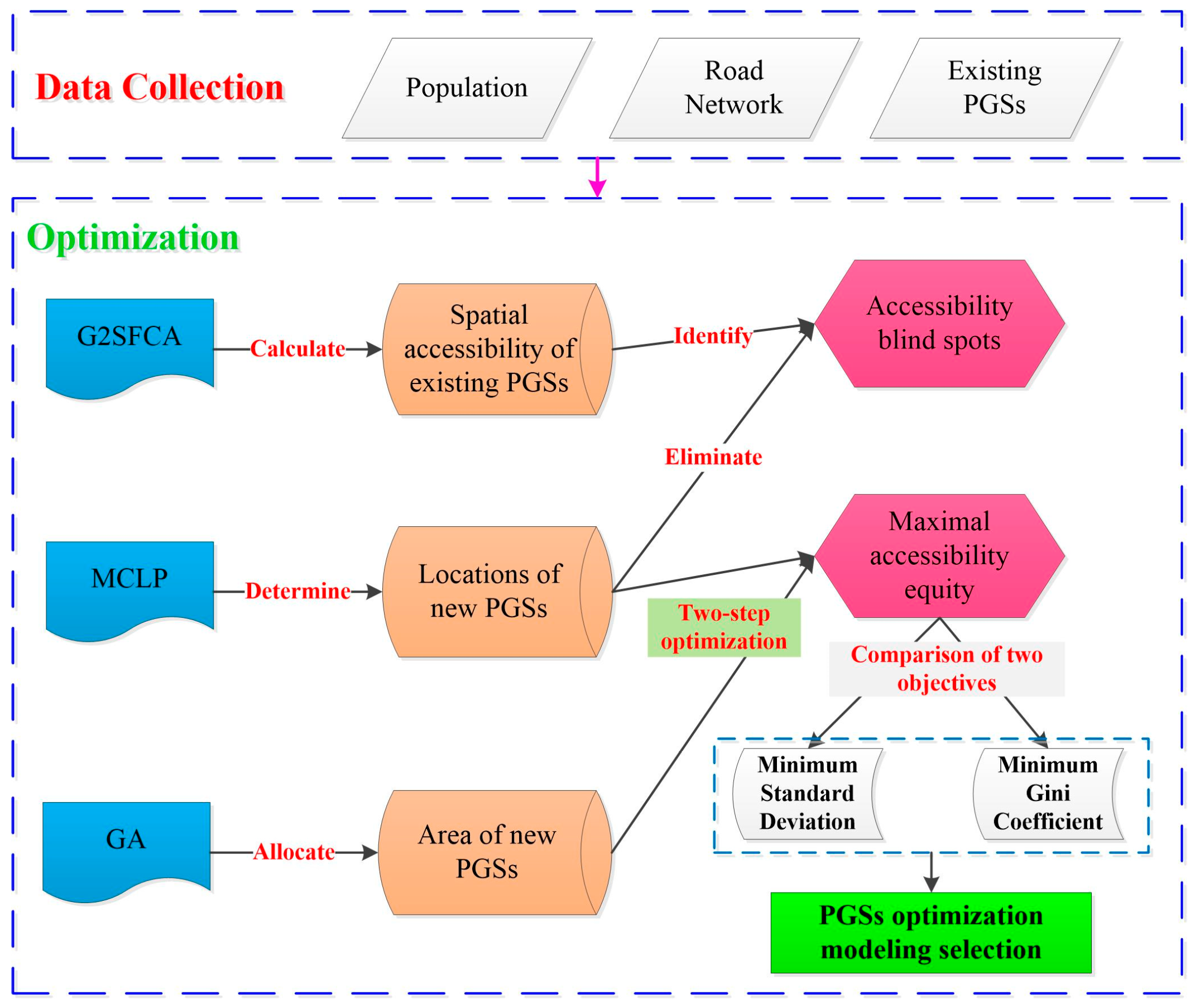
As a type of public land, park green spaces (PGSs) carry the daily recreation and social communication of urban residents, and the inequity of their space accessibility has been widely confirmed. However, the optimized suggestions based on evaluations of accessibility and equity in previous studies cannot guide actual planning effectively because the reasonable locations and scales of construction of PGSs were difficult to accurately identify. This study first constructed two equity objective functions: the minimum standard deviation (SD) and the minimum Gini coefficient (GC) in accessibility; then an improved two-step optimization method considering location-allocation was adopted to maximal accessibility equity (MAE) for optimizing the spatial layout of PGSs and doing comparisons of these two objectives for further analysis. The results showed that the improved method based on covering the accessibility blind area and preserving the existing PGSs could optimize the location selection and rationally determine the area. The two objective functions were both effective for optimization, but the GC minimization is more advantageous than the SD for achieving the MAE. The accessibility value increased significantly in a higher proportion of regions, and the overall accessibility median increased by 0.0445. It is worth mentioning that the MAE optimization would lead to a new imbalance between supply and demand in some regions. This indicated that the strictly restricted area standard may lead to the oversupply of PGSs in some areas, while the improvement of equity might not mean the improvement of accessibility. The proposed optimization framework could achieve the optimal layout of PGSs on the goal of MAE. Our findings also could provide inspiration for the equity allocation of other types of public facility lands and support decision-making for government departments regarding management and planning.
Keywords: park green spaces; spatial accessibility; maximal equity; two-step optimization model; Gini coefficient park green spaces; spatial accessibility; maximal equity; two-step optimization model; Gini coefficient