


Abstract
Deposit-feeding aquatic oligochaete worms are abundant and widely distributed benthic animals in lakes that affect the nutrient cycling between sediments and the water and thus the water quality. This effect can be density-dependent and affected by the presence of filter-feeding bivalves, which can modulate the worms’ impact. We conducted a mesocosm experiment with high, medium, and low densities of the tubificid worms Limnodrilus hoffmeisteri (Oligocheata, Tubificida, and Naididae) in the presence of the filter-feeding bivalve Hyriopsis cumingii. In the low-density treatment, the concentrations of nitrate nitrogen (NO3−-N), ammonium nitrogen (NH4+-N), and organic suspended solids (OSSs) increased moderately compared with the control. In the medium- and high-density treatments, there were also increases in total nitrogen (TN), total phosphorus (TP), soluble reactive phosphorus (SRP), total suspended solid (TSS) and inorganic suspended solid (ISS) concentrations. Moreover, the biomass of phytoplankton (Chl a), the light attenuation coefficients, and the abundance of both cladoceran and rotifer zooplankton rose with increasing worm densities. Water quality deteriorated in both the medium and high worm density treatments, likely due to increased nutrient leading to an increase in the biomass of phytoplankton in our mesocosms, even though plankton-consuming bivalves were present. Thus, during the restoration of eutrophic shallow lakes with a high density of worms, more bivalves are needed to compensate for the negative impact of worms on water quality.
1. Introduction
Benthic animals, especially deposit-feeding worms and filter-feeding bivalves, contribute significantly to ecosystem dynamics in shallow lakes, affecting nutrient cycling and trophic status. As ecosystem engineers, filter-feeding bivalves are common in freshwater systems and play an important role in decreasing the phytoplankton biomass, increasing water transparency and improving water quality in aquatic ecosystems [1,2,3]. Their ecological roles in freshwater ecosystems have been extensively studied and they are considered the key benthic animal for use as a biomanipulation tool to help control eutrophication [1,3,4].
Deposit-feeding benthic worms are also widely distributed in freshwater ecosystems, especially in eutrophic lakes, where they can dominate and reach high densities, sometimes exceeding 10,000 ind. m−2 [5,6,7]. These worms serve as indicators of trophic status [6,8,9,10]; densities between 100 and 999 ind. m−2 indicate oligotrophic systems, between 1000 and 5000 ind. m−2 indicate mesotrophic systems, 5000–10,000 ind. m−2 indicate eutrophic systems, and densities > 10,000 ind. m−2 indicate hypereutrophic systems [8,11].
Bioturbation by worms can affect nutrient cycling and water quality, and can alter the dynamics of phytoplankton and zooplankton communities in aquatic ecosystems [12]. Bioturbation is defined as the combined effects of the burrowing, feeding, and defecating activities of animals living at the surface and/or within the superficial layers of the sediment [13,14]. These activities can mix the sediment and transport water and accompanying solutes across the sediment–water interface [15,16].
Some studies have shown that this bioturbation promotes nutrient release from the sediment to overlying water [17,18,19,20]. In addition, bioturbation can enhance sediment resuspension [21,22,23], deteriorating water quality. However, other studies have reported the opposite effect, i.e., improved water quality [18,24,25,26]. Because worms may increase oxygen levels at the sediment surface, which may lead to oxidation of Fe (II) to Fe (III), which is better at adsorbing phosphorus, resulting in decreased soluble phosphate release to the overlying water [18,27,28]. These ambiguous results may reflect differences in worm density, i.e., high densities not only cause stronger bioturbation and sediment nutrient release, but also higher oxygen consumption through respiration, potentially decreasing oxygen levels and promoting the release of ironbound phosphorus to the overlying water. Thus, bioturbation by worms influences nutrient dynamics and water quality [5,29,30,31], particularly in shallow systems and the effect is likely density-dependent.
The effects of worms on water quality in shallow systems may depend on their densities. Puigagut et al. (2014) found that worm densities of 550 ind. m−2 had no significant influence on nutrient concentrations [32], while Saaltink et al. (2019) reported that densities of 5000 ind. m−2 and 15,000 ind. m−2 enhanced sediment nutrient release to the overlying water, particularly ammonium (NH4+) [33]. Geta et al. (2004) found that worm densities of about 22,000 ind. m−2 significantly increased nitrate (NO3−) release from sediments [34]. Furthermore, Mermillod-Blondin et al. (2005) showed that worm densities of 20,000 ind. m−2 increased the release of NH4+ and phosphate (PO43−) from sediments by factors of 2 and 4, respectively [29]. Nutrient increases may result in higher biomasses of phytoplankton and zooplankton [35,36,37]. In addition, the impact of worms on plankton and nutrients may also depend on the presence or absence of filter feeders like bivalves [38,39,40], which may modulate the negative effects of the worms; bivalves can decrease the phytoplankton biomass, increase water transparency, and improve water quality [1,2,3]. However, the effect of different densities of deposit-feeding worms on water quality in a shallow system with filter-feeding bivalves has not been evaluated.
We conducted a mesocosm experiment with varying densities of the worm Limnodrilus hoffmeisteri in the presence of the bivalve Hyriopsis cumingii under eutrophic conditions. L. hoffmeisteri is a deposit feeder, primarily feeding on organic detritus in sediments, while H. cumingii is filter feeder that efficiently filters phytoplankton, detritus and suspended particles from water using their gill structures. We hypothesized high worm densities would deteriorate water quality, while low densities would not due to the modulating effect of bivalves. Nutrient, total suspended solid (TSS), inorganic suspended solid (ISS), and organic suspended solid (OSS) concentrations, phytoplankton biomass (Chl a), the light attenuation coefficient, and zooplankton were measured. The results of our study provide insights into the negative impacts of aquatic oligochaetes on the water quality in shallow systems, especially at high densities, even in the presence of plankton-consuming bivalves.
2. Materials and Methods
2.1. Experimental Mesocosm Set-Up
The experiment was conducted in 16 mesocosms (upper diameter of 52 cm, bottom diameter of 38 cm, and height of 56 cm) containing sediment and lake water. The sediment was collected from Ming Lake (a shallow lake) in Guangzhou (23°14′10″–23°14′15″ N, 113°36′02″–113°36′14″ E), air dried and sieved to remove coarse particles, debris, and large-bodied macroinvertebrates (mesh size = 0.5 mm). Then, the sediment was homogenized and a 6 cm layer was added to each mesocosm. This sediment contained 4.13 mg g−1 total nitrogen (TN) and 2.96 mg g−1 total phosphorus (TP). Subsequently, a plastic tank (upper diameter—31 cm; bottom diameter—24 cm; height—28 cm) with a 6 cm layer of the same homogenized sediment was placed in each mesocosm for worms and worm collection at the end of the experiment. The worms were only added in this tank. Thereafter, 85 L of filtered (64 μm) lake water (TN = 0.81 mg L−1, TP = 0.06 mg L−1) was added to all mesocosms to remove large zooplankton. The mesocosms were equilibrated under natural sunlight conditions for two weeks. At the start of the experiment, the nutrient concentrations of the water were 1.2 ± 0.096 mg L−1 for TN and 0.062 ± 0.019 mg L−1 for TP.
After equilibration, three densities of Limnodrilus hoffmeisteri were added to each of the four tanks at densities representing oligotrophic (low-density treatment—57 (0.053 ± 0.001 g) individuals or 500 ind. m−2), mesotrophic (medium-density treatment—113 (0.105 ± 0.002 g) individuals or 1000 ind. m−2), and eutrophic (high-density treatment—571 (0.525 ± 0.003 g) individuals or 5050 ind. m−2) [8,11]. The last four mesocosms without worms acted as controls. Each tank with worms was placed into a mesocosm. Simultaneously, one individual of Hyriopsis cumingii (average fresh weight 102.3 ± 6.5 g) was added to each mesocosm, including the controls, and placed outside the tanks. The H. cumingii were purchased from a local market and acclimated in tanks with lake water for two weeks prior to introduction to the mesocosms. Both the worm and bivalve densities used in the experiment are within the range found in natural lakes.
Solutions of KNO3 and NaH2PO4 were added to each mesocosm immediately after water sampling at rates of 1.5 mg N L−1 and 0.1 mg P L−1 per 10 days, respectively, to mimic external nutrient loading [20] because ecosystems are always suffering from large variations in external loading, including precipitation, and point and non-point source pollution. Lake water filtered through a plankton net (64 μm) was added as needed to the mesocosms to maintain water levels. The mesocosm experiment was conducted under natural outdoor conditions from 26 October to 15 December 2023. The 16 mesocosms were arranged randomly. During the experiment, the average water temperature was 24.5 ± 3.0 °C in the control, and 24.0 ± 2.9 °C in the low-density treatment, 23.8 ± 2.8 °C in the medium-density treatment, and 23.8 ± 2.8 °C in the high-density treatment. The average dissolved oxygen (DO) concentrations were 8.18 ± 1.65 mg L−1 in the control, 8.38 ± 1.63 mg L−1 in the low-density treatment, 8.60 ± 1.44 mg L−1 in the medium-density treatment, and 8.81 ± 1.60 mg L−1 in the high-density treatment.
2.2. Sampling and Analysis
Every 10 days, 1.5 L of water from each mesocosm was collected from 25 to 30 cm below the water surface to measure nutrients, TSSs, OSSs, and Chl a. TN, NO3−-N, NH4+-N, TP, and SRP were determined using APHA (1998) [41]. Water samples (500 mL) were filtered through a Whatman GF/C fiber membrane (Whatman, Maidstone, UK), dried at 108 °C for 2 h, and weighed to obtain the TSS amount. This material was then ashed at 550 °C for 2 h to obtain the ISS and OSS amounts [42]. Chl a was quantified by filtering a 200 mL water sample through a 0.45 μm filter, and subjecting it to acetone extraction and measurement using UV–vis spectrophotometry (Shanghai Youke Instrument & Meter Co., Ltd., Shanghai, China) [43]. Light intensities at the water surface and at a depth of 30 cm underwater were measured between 10:00 am and noon using an underwater irradiance meter (ZDS-10W) (Shanghai Jiading Xuelian Instrument Factory, Shanghai, China) [44] to calculate the light attenuation coefficient [45].
Zooplankton that hatched from the sediments and developed populations were sampled through a plankton net (64 μm mesh) by filtering 10 L of water from each mesocosm on day 0 (at the start), day 20 (during), and day 50 (at the end of the experiment). The samples were fixed and stored in 5% formaldehyde. Cladocerans and copepods were counted and identified at 4× magnification, and rotifers at 10×. At the end of the experiment, the worms were gently collected from each plastic tank with a sieve.
2.3. Statistical Analyses
Statistical analyses were conducted using SPSS Statistics 25.0. Repeated measures analysis of variance (RM-ANOVA) was applied to test the effects of the worm treatments on nutrient concentrations; plankton biomass; TSS, OSS, and ISS concentrations; and the light attenuation coefficient, with time as the repeated factor. One-way analysis of variance (ANOVA) was used to compare the zooplankton abundance and the abundance of dominant species of the treatment groups at days 0, 20, and 50. When significant effects were detected, differences among treatments were further examined using Tukey’s Honestly Significant Difference (HSD) test. Prior to analysis, the assumptions of normality and homogeneity of variance were assessed using the Shapiro–Wilk test and Levene’s test, respectively. Model diagnostics were conducted by examining residual distributions and variance homogeneity to ensure the validity of the statistical analyses. All data are presented as the mean ± 1 standard deviation (SD).
3. Results
3.1. Nitrogen
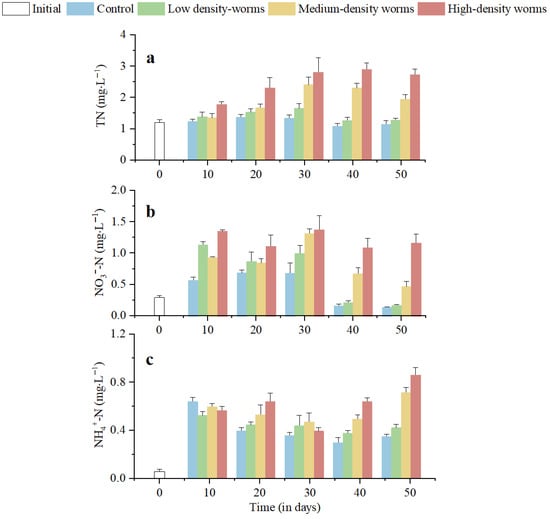
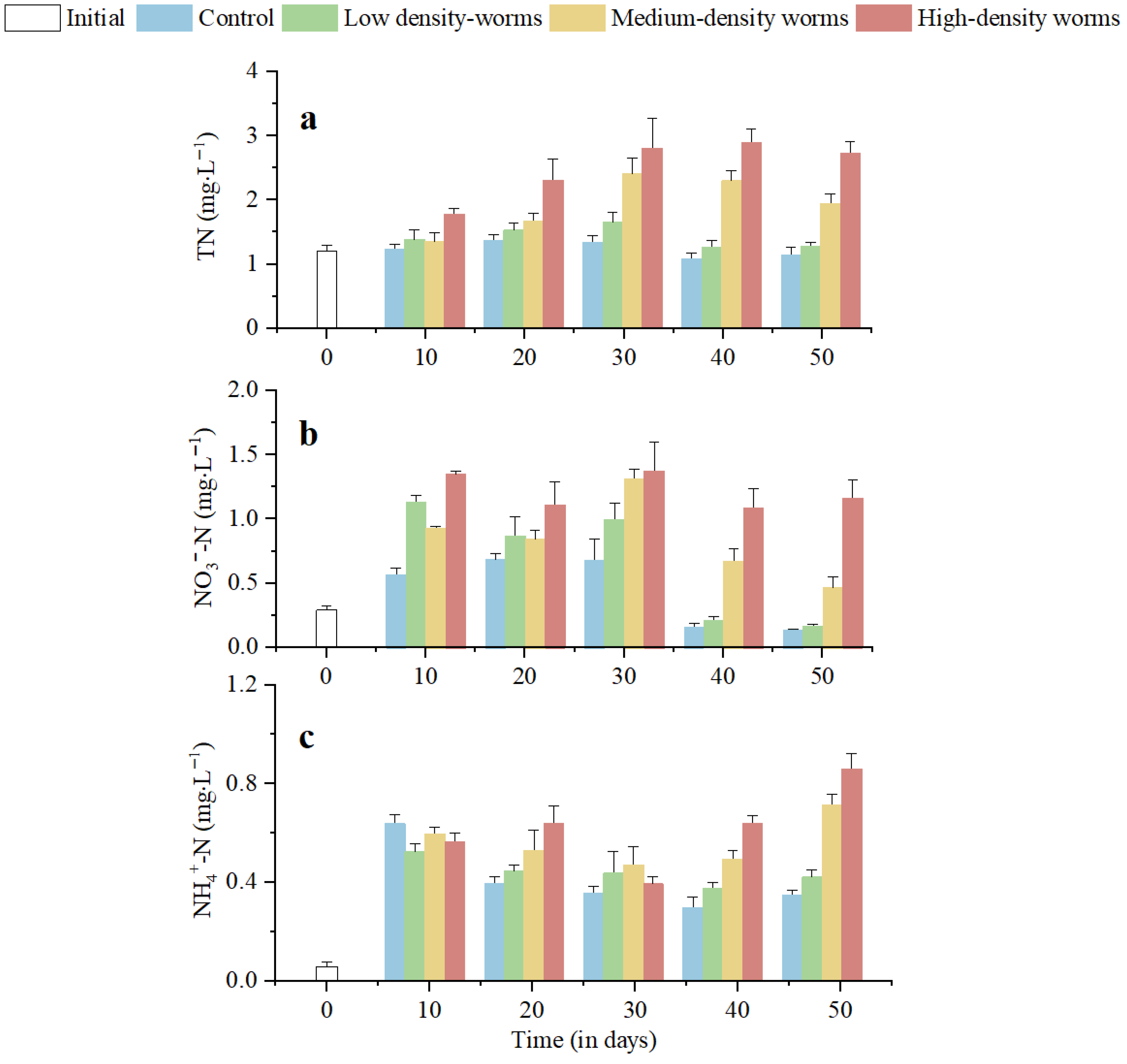
TN, NO3−-N, and NH4+-N increased monotonically with increasing tubificid worm density (Tukey HSD, each p < 0.05; Figure 1a–c), except for TN in the low-density treatment group, compared to the control (Tukey HSD, p > 0.05).
Figure 1.
Concentrations of TN (a), NO3−-N (b) and NH4+-N (c) (mean ± 1 SD) in the control and worm treatment groups over time.
All nutrient indices varied significantly over time (RM-ANOVA, time effect, each p < 0.001). The interaction effects of time and treatment for these indices were also significant (RM-ANOVA, interaction effect, p = 0.003 for TN and p < 0.001 for NO3−-N and p < 0.001 for NH4+-N).
3.2. Phosphorus
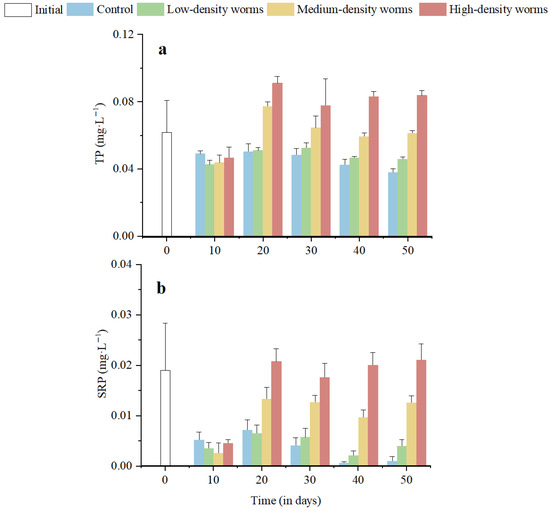
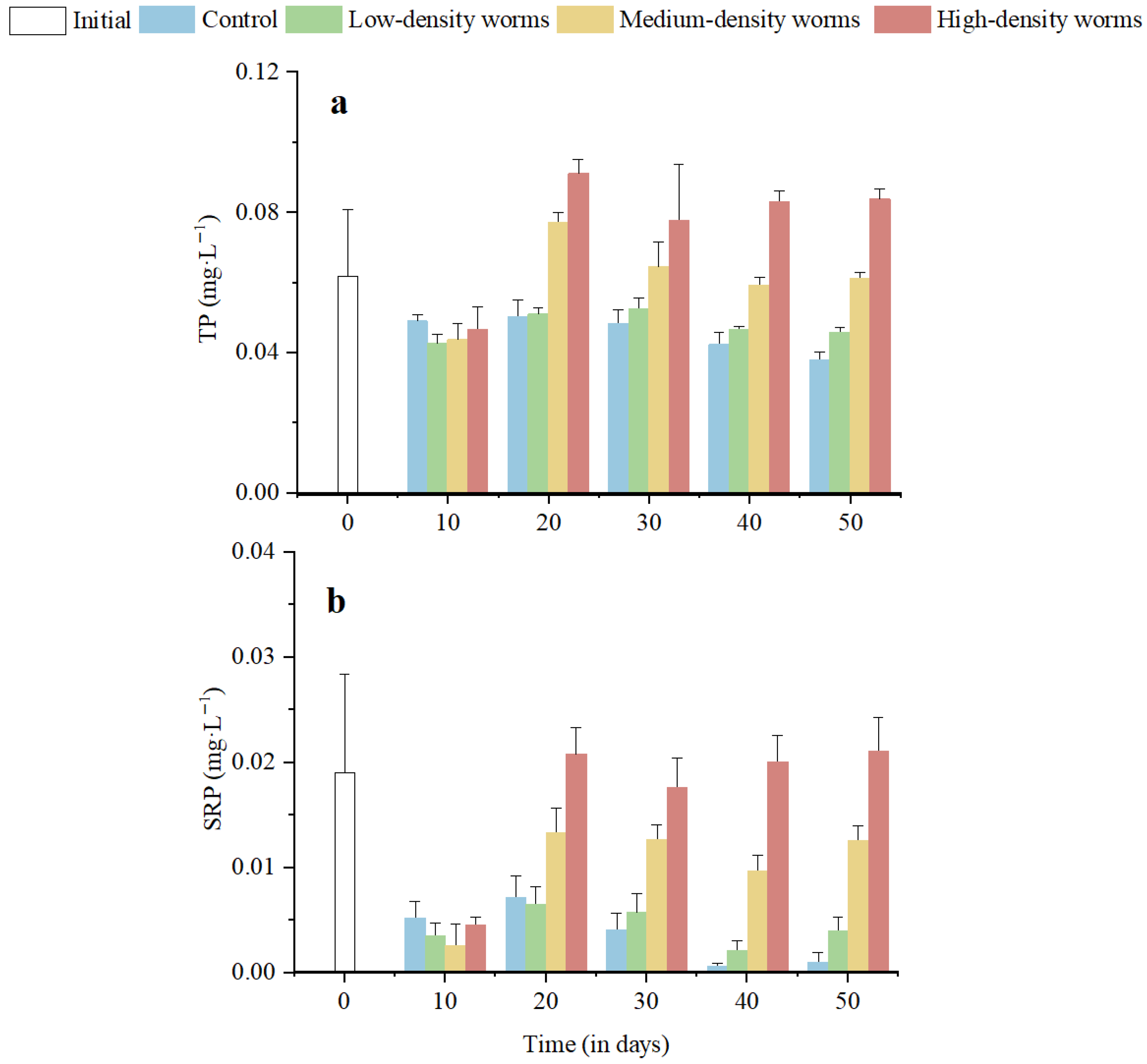
TP and SRP also increased monotonically with increasing tubificid worm density (Tukey HSD, p < 0.001 and p < 0.001, respectively; Figure 2a, b), except between the low-density treatment group and the control (Tukey HSD, p = 0.355 for TP and p = 0.447 for SRP).
Figure 2.
Concentrations of TP (a) and SRP (b) (mean ± 1 SD) in the control and worm treatment groups over time.
TP and SRP varied significantly over time (RM-ANOVA, time effect, p < 0.001 and p < 0.001, respectively), and the time x treatment interaction effects were significant (RM-ANOVA, interaction effect p < 0.001 and p < 0.001 for TP and SRP, respectively).
3.3. Suspended Solids
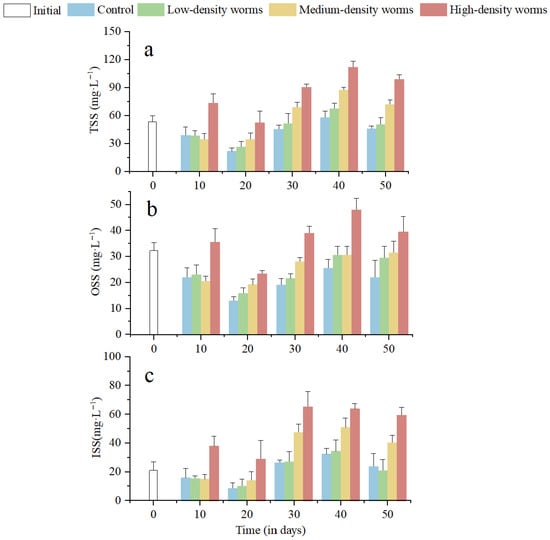
TSS, OSS, and ISS concentrations increased with increasing worm density (Tukey HSD, each p < 0.05; Figure 3a–c), except for TSSs and ISSs in the medium- and in the low-density treatment groups (Tukey HSD, p = 0.076 for TSSs and p = 0.954 for ISSs).
Figure 3.
Concentrations of TSSs (a), OSSs (b) and ISSs (c) (mean ± 1 SD) in the control and worm treatment groups over time.
TSS, OSS, and ISS concentrations varied significantly over time (RM-ANOVA, time effect, each p < 0.001), and the interaction effects of time and treatment were significant (RM-ANOVA, interaction effect, p < 0.001 for TSSs and p = 0.008 for OSSs and p = 0.013 for ISSs).
3.4. Light Attenuation Coefficient
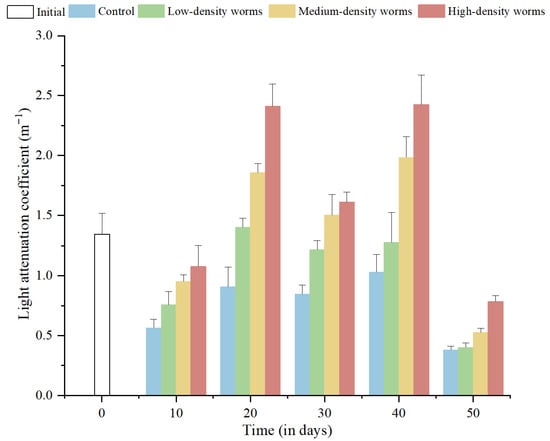
The light attenuation coefficient increased with increasing worm density (Tukey HSD, p ≤ 0.001; Figure 4). It varied significantly over time (RM-ANOVA, time effect, p < 0.001), and the interaction effects of time and treatments were significant (RM-ANOVA, interaction effect, p < 0.001).
Figure 4.
Light attenuation coefficient (mean ± 1 SD) in the control and worm treatment groups over time.
3.5. Phytoplankton Biomass
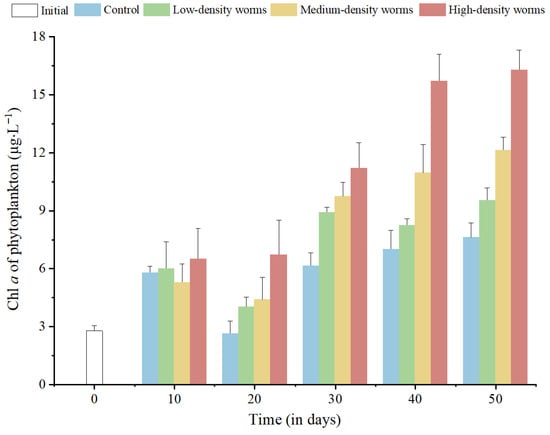
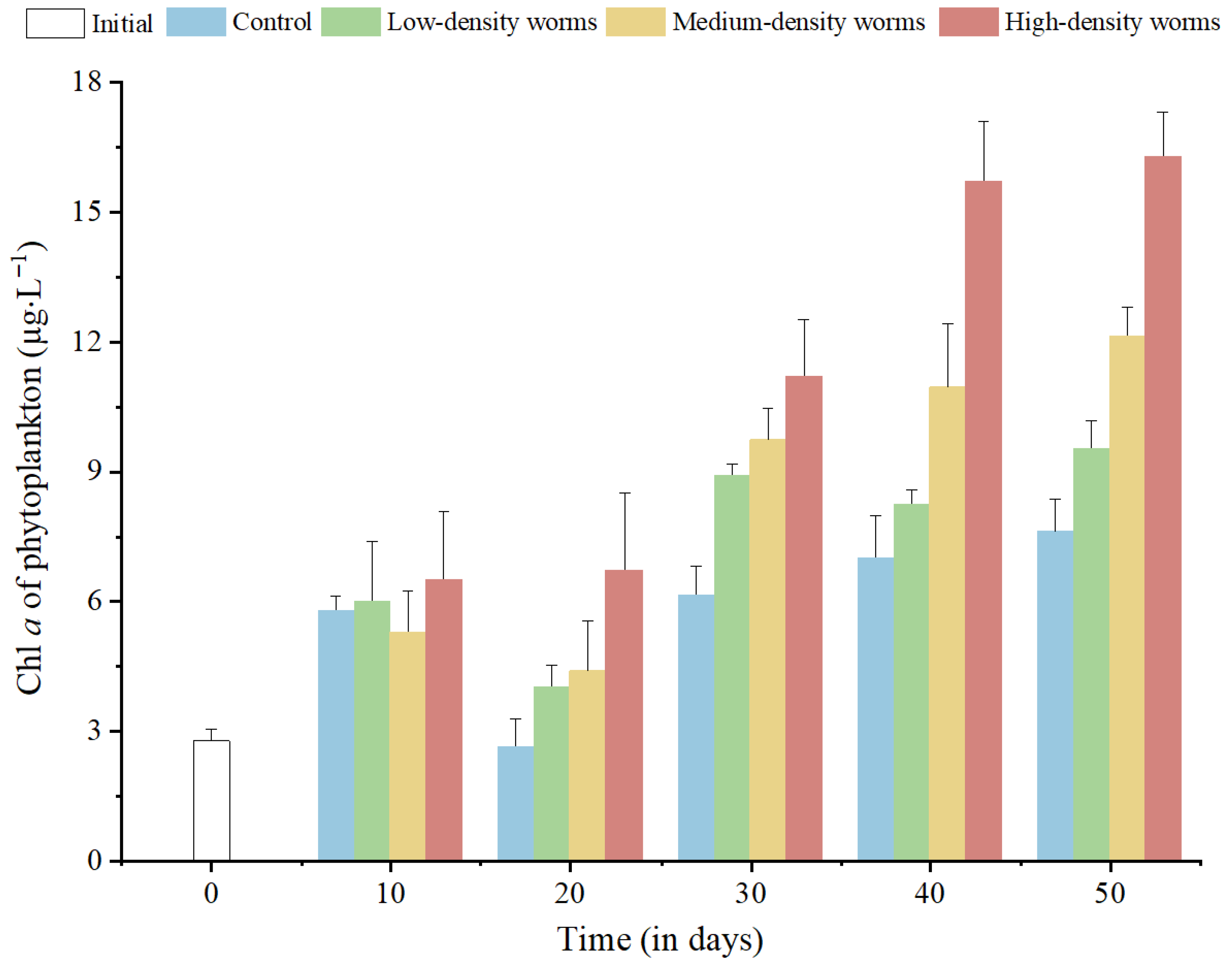
Chl a increased with increasing worm density (Tukey HSD, p < 0.001; Figure 5). Chl a varied significantly over time (RM-ANOVA, time effect, p < 0.001), and the interaction effects of time and treatment were significant (RM-ANOVA, interaction effect, p < 0.001).
Figure 5.
Phytoplankton biomass (Chl a, mean ± 1 SD) in the control and worm treatment groups over time.
3.6. Zooplankton
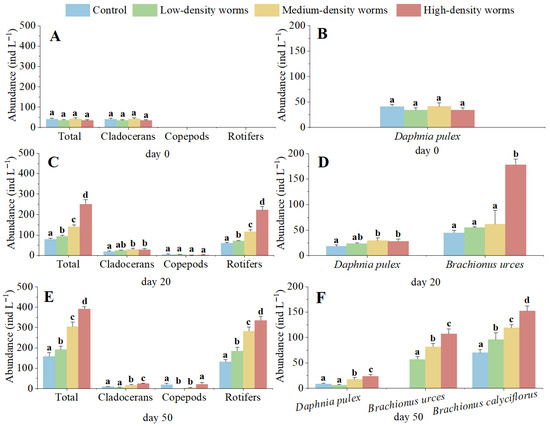
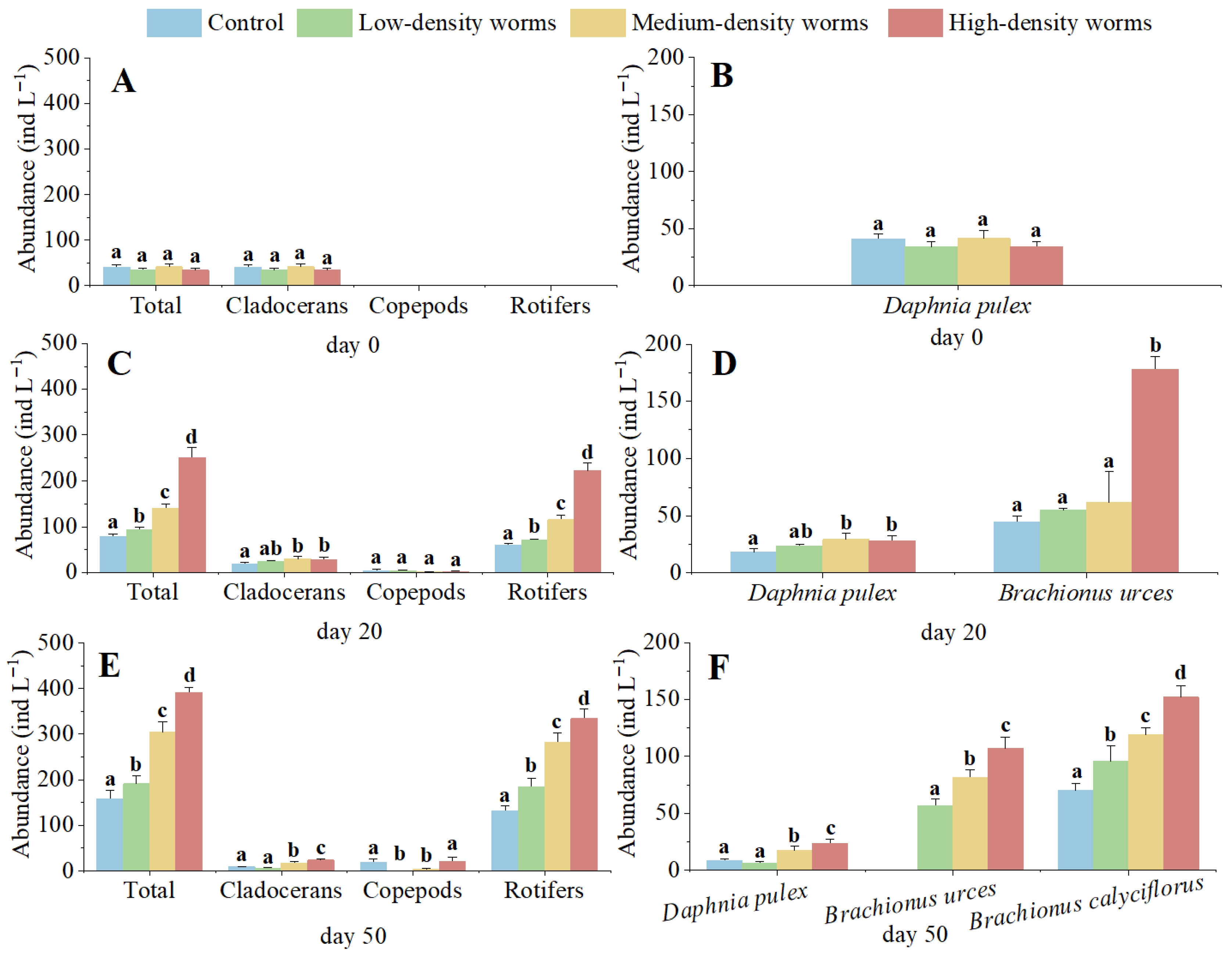
On day 0 of the experiment, only cladocerans were recorded in all mesocosms, with Daphnia pulex as the dominant species. Cladoceran abundances did not differ between the worm treatment groups and the control (one-way ANOVA, treatment effect, p = 0.146; Figure 6A,B).
Figure 6.
Abundance of zooplankton groups and dominant species (mean ± 1 SD) on days 0 (A,B), 20 (C,D), and 50 (E,F) in the control and worm treatment groups. Different lowercase letters represent significant differences at p < 0.05 between groups.
On day 20 and at the end of the experiment (day 50), the abundances of zooplankton, especially rotifers, increased with increasing worm density (Tukey HSD, p < 0.05; Figure 6C,E). On day 20, both the high- and medium-density treatment groups exhibited significantly higher cladoceran abundances than the control (Tukey HSD, p = 0.004 and p = 0.002, respectively; Figure 6C), whereas no significant differences were observed among the other groups.
On day 50, cladoceran abundance was higher in the high-density treatment group than in the medium-density treatment group and higher in the medium-density treatment group than in the low-density treatment group (Tukey HSD, p = 0.005 and p < 0.001, respectively; Figure 6E). No significant difference was detected between the low-density treatment group and the control (Tukey HSD, p = 0.199; Figure 6E).
Copepod abundance remained very low throughout the experiment.
In all worm treatment groups and the control, the dominant zooplankton species were Daphnia pulex and Brachionus urceus throughout the experiment (Figure 6B,D,F). At the end of the experiment, the dominant species were D. pulex and B. urceus in the control, and D. pulex, B. urceus, and B. calyciflorus in the worm treatment groups (Figure 6F). A list of the zooplankton species in the different treatment groups at the end of the experiment is given in Table 1.
Table 1.
List of zooplankton species identified in the experiment.
4. Discussion
As hypothesized, we found that the concentrations of TN, NO3−-N, NH4+-N, TP and SRP, as well as TSSs, OSSs and ISSs were significantly higher in the medium- and high-density treatment groups (Table 2). Contrary to our hypothesis, the concentrations of NO3−-N, NH4+-N, and OSSs also increased in the low-density worm treatment group compared to the control. Phytoplankton biomass (Chl a), the light attenuation coefficient, and the abundance of zooplankton increased with increasing worm density. The high- and medium-density treatments, but not the low-density treatment, also resulted in a higher abundance of cladocerans than in the control. The worms also affected the species dominance of zooplankton. The results of our study shed light on the negative impact worms have on water quality in shallow systems, especially at high densities, even in the presence of plankton-consuming bivalves.
Table 2.
Effects of worm density on water quality parameters. Values are mean ± SD. Different lowercase letters indicate significant differences among treatments (Tukey HSD, p < 0.05).
Worms promote nutrient release from sediments to the overlying water, enhance sediment resuspension and deteriorate water quality [24,25,26]. However, bivalves can filter phytoplankton and other particles in overlying water, thereby improving water quality. The increase in dissolved nutrients (NO3−-N and NH4+-N) concentrations in the low-density treatment group indicated enhanced nutrient release from the sediment to the overlying water due to bioturbation, and possibly excretion by worms [46,47]. No increase in TP and TN in the low-density treatment group was observed, supporting our hypothesis that a low density of worms would not deteriorate water quality due to the counteracting effect of bivalve particle filtration. However, at higher worm densities (1000 ind. m−2 and 5050 ind. m−2), TP and TN increased, suggesting that bivalves’ modulating effects were insufficient and bioturbation effects stronger. Higher worm densities intensify sediment reworking and porewater movement, likely accelerating the diffusion of soluble nutrients across the sediment–water interface [14]. Additionally, burrowing reduces sediment cohesion, facilitating the resuspension of fine inorganic particles, amplifying nutrient efflux [48,49,50].
The increased nutrients can enhance phytoplankton growth [51,52,53]. We found that all worm densities increased the biomass of phytoplankton (Chl a). Phytoplankton accumulation was clearly observed in the high-density worm treatment group, especially late in the experiment. Increased phytoplankton biomass led to higher OSS levels, even in the low-density treatment group. In addition, higher worm densities resulted in increased ISS concentrations, indicating more bioturbation. The higher OSS and ISS concentrations at higher worm densities led to higher TSS concentrations.
Suspended solids, including OSSs, ISSs, and TSSs, significantly affect light attenuation. Increases in these solids reduce light penetration, leading to higher light attenuation in the water column. In this study, the light attenuation coefficient increased with increasing worm density. It is worth noting that OSSs increased even in the low-density worm treatment group, negatively impacting the light intensity at the sediment surface. Light is crucial for submerged macrophytes in lakes [54,55]; thus, worms can negatively affect the growth of submerged macrophytes by decreasing light penetration to the sediment.
Bivalves can directly filter phytoplankton, decreasing their biomass. In this study, however, the biomass of phytoplankton (Chl a) increased with increasing worm density even in the presence of plankton-consuming bivalves, leading us to conclude that increased nutrients were likely responsible for the increased phytoplankton Chl a. We observed that total zooplankton abundances, especially rotifers, increased with higher phytoplankton levels associated with greater worm densities. In addition, cladocerans increased in the medium- and high-density worm treatment groups. The increased density of both rotifers and cladocerans is likely due to the higher phytoplankton biomass although we cannot exclude increased hatching of zooplankton eggs in the higher worm density groups due to sediment disturbance. Cladocerans are effective grazers of phytoplankton and can avoid bivalve predation more effectively than smaller rotifers [56,57]. However, we observe an increase in rotifer abundance with the increase in worm densities in this study, likely because a higher phytoplankton biomass (Chl a) in the worm treatments compensated for the consumption loss by bivalves due to the better growth conditions for rotifers [39,58].
We attempted to mimic worm and bivalve densities present in different trophic level lakes. The bivalve density/biomass (9 ind. m−2 or 900 g m−2) used in this study is within the range found in natural lakes. For instance, the density of Sinanodonta woodiana in Konin Lakes is 7–20 ind. m−2 or 550–1100 g m−2 biomass [59], with the biomass reaching up to 2353 g m−2 in some regions [60]. Similarly, the tubificid worm densities used in our experiment (500, 1000, and 5050 ind. m−2) are also within their natural range. For example, worm densities in Lake Taihu vary spatially from 0 to 30,865 ind. m−2. Both the bivalves and worms survived to the end of the experiment and the wet mass of all worms at that time was 0.142 ± 0.009 g in the low-density worm treatment, 0.262 ± 0.014 g in the medium-density treatment, and 1.039 ± 0.021 g in the high-density worm treatment. The biomass of the bivalves from the control to the high-density treatment were 104.7 ± 4.8 g, 105.6 ± 4.4 g, 105.0 ± 7.0 g and 103.0 ± 3.2 g. However, by necessity, the conditions in our mesocosms are different from natural lakes as fish and macrophytes were absent and the mesocosms were small. Hence, our results must be interpreted with caution. Even so, we believe our findings that deposit-feeding worms deteriorated the water quality, especially at high densities, and that the increased nutrient levels due to the worms was likely the key reason for the increased biomass of phytoplankton even in the presence of plankton-consuming bivalves have relevance for the restoration of eutrophic shallow lakes using bivalves as a biomanipulation tool.
5. Conclusions
In summary, increasing the worm density led to higher concentrations of nutrients and suspended solids, biomass of phytoplankton, light attenuation coefficient, and zooplankton abundance, especially rotifer abundance. Unlike low densities, high and medium worm densities also increased the abundance of cladocerans. The increased nutrient levels associated with worm activity was likely the reason for the increased biomass of phytoplankton and abundance of zooplankton. Therefore, even in the presence of plankton-consuming bivalves, deposit-feeding worms negatively impacted water quality. Thus, when restoring eutrophic shallow lakes using bivalves as a biomanipulation tool, the density of bivalves should be increased if the worm density is high to compensate for the negative effect of worms.
Author Contributions
Conceptualization, X.Z., methodology, X.Z. and H.S.; software, H.S., L.X. and Z.Z.; validation, H.S., L.X. and Z.Z.; formal analysis, H.S., L.X. and H.J.; investigation, H.S. and L.X.; data curation, H.S., L.X., H.J., T.D., Z.T. and C.Z.; writing—review and editing, X.Z., E.J., L.G.R., V.R., L.X. and H.J.; visualization, H.S. and Z.Z.; supervision, X.Z.; project administration, X.Z. All authors have read and agreed to the published version of the manuscript.
Funding
This work was supported by the Belorussian RFBR (20260551).
Data Availability Statement
The original contributions presented in this study are included in the article. Further inquiries can be directed to the corresponding author.
Acknowledgments
We thank Anne Mette Poulsen for language editing.
Conflicts of Interest
The authors declare no conflicts of interest.
References
- Sun, Y.; Yu, Y.B.; Wu, Z.L. Research progress in relationships between freshwater bivalves and algae. Ecotoxicol. Environ. Saf. 2022, 239, 113665. [Google Scholar] [CrossRef] [Scilit] [PubMed]
- Jin, Z.A.; Jin, H.; Gao, B.Y.; Tong, C.F.; Jeppesen, E.; Rudstam, L.G.; Zhang, X.F. Effects of filter-feeding bivalves in benthic and pelagic habitats on plankton community and water quality in shallow systems: Implications for lake rehabilitation. Aquat. Ecol. 2025, 59, 53–66. [Google Scholar] [CrossRef] [Scilit]
- Xie, L.C.; Mei, X.Y.; Jeppesen, E.; Rudstam, L.G.; Naselli-Flores, L.; Dumont, H.J.; Zhang, X.F. Freshwater mussels can enhance zooplankton size and their grazing potential on phytoplankton with implications for water clarity in tropical eutrophic shallow lakes. Hydrobiologia 2025, 852, 4373–4386. [Google Scholar] [CrossRef] [Scilit]
- Zhu, Z.Q.; Jin, H.; Zhu, M.M.; Razlutskij, V.; Adamovich, B.V.; Karpowicz, M.; Feniova, I.; Petrosyan, V.; Liu, Z.W.; Rudstam, L.G.; et al. Effects of large bivalve Cristaria plicata on phytoplankton size composition and water quality: A mesocosm case study. Aquat. Conserv. Mar. Freshw. Ecosyst. 2025, 35, 70172. [Google Scholar] [CrossRef] [Scilit]
- Matisoff, G.; Fisher, J.; Matis, S. Effects of benthic macroinvertebrates on the exchange of solutes between sediments and freshwater. Hydrobiologia 1985, 122, 19–33. [Google Scholar] [CrossRef] [Scilit]
- Cai, Y.J.; Gong, Z.J.; Qin, B.Q. Community structure and diversity of macrozoobenthos in Lake Taihu, a large shallow eutrophic lake in China. Biodivers. Sci. 2010, 18, 50–59. [Google Scholar] [CrossRef] [Scilit]
- Zhang, Y.; Cheng, L.; Li, K.Y.; Zhang, L.; Cai, Y.J.; Wang, X.L.; Heino, J. Nutrient enrichment homogenizes taxonomic and functional diversity of benthic macroinvertebrate assemblages in shallow lakes. Limnol. Oceanogr. 2019, 64, 1047–1058. [Google Scholar] [CrossRef] [Scilit]
- Wright, S.; Tiffany, L.H.; Tidd, W.M. Limnological Survey of Western Lake Erie; United States Department of the Interior: Washington, DC, USA, 1955; Volume 139. [Google Scholar]
- Yaqoob, K.U.; Wani, S.A.; Pandit, A.K. A comparative study of macrobenthic community in Dal and Nilnag lakes of Kashmir Himalaya. J. Himal. Ecol. Sustain. Dev. 2007, 2, 55–60. [Google Scholar]
- Siraj, S.; Yousuf, A.R.; Bhat, F.A.; Parveen, M. The ecology of macrozoobenthos in Shallabugh wetland of Kashmir Himalaya, India. J. Ecol. Nat. Environ. 2010, 2, 84–91. [Google Scholar] [CrossRef]
- Rodriguez, P.; Reynoldson, T.B. The Pollution Biology of Aquatic Oligochaetes; Springer Science & Business Media: New York, NY, USA, 2011. [Google Scholar]
- Fisher, J.B.; Lick, W.J.; McCall, P.L.; Robbins, J.A. Vertical mixing of lake sediments by tubificid oligochaetes. J. Geophys. Res. 1980, 85, 3997–4006. [Google Scholar] [CrossRef] [Scilit]
- Rhoads, D.C. Organism-sediment relations on the muddy sea floor. Oceanogr. Mar. Biol. 1974, 12, 263–300. [Google Scholar]
- Kristensen, E.; Penha-Lopes, G.; Delefosse, M.; Valdemarsen, T.; Quintana, C.O.; Banta, G.T. What is bioturbation? The need for a precise definition for fauna in aquatic sciences. Mar. Ecol. Prog. Ser. 2012, 446, 285–302. [Google Scholar] [CrossRef] [Scilit]
- Boudreau, B.P. Diagenetic Models and Their Implementation; Springer: Berlin/Heidelberg, Germany, 1997. [Google Scholar]
- Boudreau, B.P. Metals and models: Diagenetic modelling in freshwater lacustrine sediments. J. Paleolimnol. 1999, 22, 227–251. [Google Scholar] [CrossRef] [Scilit]
- Fukuhara, H.; Sakamoto, M. Enhancement of inorganic nitrogen and phosphate release from lake sediment by tubificid worms and chironomid larvae. Oikos 1987, 48, 312–320. [Google Scholar] [CrossRef] [Scilit]
- Devine, J.A.; Vanni, M.J. Spatial and seasonal variation in nutrient excretion by benthic invertebrates in a eutrophic reservoir. Freshw. Biol. 2002, 47, 1107–1121. [Google Scholar] [CrossRef] [Scilit]
- Zhang, L.; Gu, X.Z.; Wang, Z.D.; Shen, Q.S.; Fan, C.X.; Zhong, H.B.; Yin, J.C. The influence of tubificid worms bioturbation on the exchange of phosphorus across sediment-water interface in lakes. J. Lake Sci. 2010, 22, 666–674. [Google Scholar] [CrossRef]
- Zhang, X.F.; Liu, Z.W.; Jeppesen, E.; Taylor, W.D. Effects of deposit-feeding tubificid worms and filter-feeding bivalves on benthic-pelagic coupling: Implications for the restoration of eutrophic shallow lakes. Water Res. 2014, 50, 135–146. [Google Scholar] [CrossRef] [Scilit]
- Luettich, R.A.; Harleman, D.R.F.; Somlyody, L. Dynamic behavior of suspended sediment concentrations in a shallow lake perturbed by episodic wind events. Limnol. Oceanogr. 1990, 35, 1050–1067. [Google Scholar] [CrossRef] [Scilit]
- Zhang, L.; Shen, Q.S.; Hu, H.Y.; Shao, S.G.; Fan, C.X. Impacts of Corbicula fluminea on oxygen uptake and nutrient fluxes across the sediment-water interface. Water Air Soil Pollut. 2011, 220, 399–411. [Google Scholar] [CrossRef] [Scilit]
- Zhang, L.; Shang, J.G.; He, W.; You, B.S.; Fan, C.X. The role of tubificid worms (Limnodrilus hoffmeisteri) in sediment resuspension: A microcosm study. Ann. Limnol. Int. J. Limnol. 2014, 50, 253–260. [Google Scholar] [CrossRef] [Scilit]
- Mortimer, R.; Davey, J.; Krom, M.; Watson, P.; Frickers, P.; Clifton, R. The effect of macrofauna on porewater profiles and nutrient fluxes in the intertidal zone of the Humber Estuary. Estuar. Coast. Shelf Sci. 1999, 48, 683–699. [Google Scholar] [CrossRef] [Scilit]
- Heilskov, A.C.; Holmer, M. Effects of benthic fauna on organic matter mineralization in fish-farm sediments: Importance of size and abundance. ICES J. Mar. Sci. 2001, 58, 427–434. [Google Scholar] [CrossRef] [Scilit]
- Lewandowski, J.; Hupfer, M. Effect of macrozoobenthos on two-dimensional small-scale heterogeneity of pore water phosphorus concentrations in lake sediments: A laboratory study. Limnol. Oceanogr. 2005, 50, 1106–1118. [Google Scholar] [CrossRef] [Scilit]
- Davis, B.D.; David, L.T.; Frank, E.B. Effects of burrowing tubificid worms on the exchange of phosphorus between lake sediment and overlying water. Verhandlungen Int. Ver. Theor. Angew. Limnol. 1975, 19, 382–394. [Google Scholar] [CrossRef] [Scilit]
- Chen, M.S.; Ding, S.M.; Liu, L.; Wang, Y.; Xing, X.G.; Wang, D.; Gong, M.D.; Zhang, C.S. Fine-scale bioturbation effects of tubificid worm (Limnodrilus hoffmeisteri) on the lability of phosphorus in sediments. Environ. Pollut. 2016, 219, 604–611. [Google Scholar] [CrossRef] [Scilit]
- Mermillod-Blondin, F.; Nogaro, G.; Datry, T.; Malard, F.; Gibert, J. Do tubificid worms influence the fate of organic matter and pollutants in stormwater sediments? Environ. Pollut. 2005, 134, 57–69. [Google Scholar] [CrossRef] [Scilit]
- Zhang, L.; Gu, X.Z.; Fan, C.X.; Shang, J.G.; Shen, Q.S.; Wang, Z.D.; Shen, J. Impact of different benthic animals on phosphorus dynamics across the sediment-water interface. J. Environ. Sci. 2010, 22, 1674–1682. [Google Scholar] [CrossRef] [Scilit]
- Ji, L.; Song, C.L.; Cao, X.Y.; Zhou, Y.Y.; Deng, D.G. Spatial variation in nutrient excretion by macrozoobenthos in a Chinese large shallow lake (Lake Taihu). J. Freshw. Ecol. 2015, 30, 169–180. [Google Scholar] [CrossRef] [Scilit]
- Puigagut, J.; Chazarenc, F.; Comeau, Y. Influence of tubificid worms on nutrient fluxes across water-sediment interface in fish farm settling ponds. Knowl. Manag. Aquat. Ecosyst. 2014, 413, 12. [Google Scholar] [CrossRef] [Scilit]
- Saaltink, R.M.; Honingh, E.; Dekker, S.C.; Griffioen, J.; van Riel, M.C.; Verdonschot, P.F.; Wassen, M.J. Respiration and aeration by bioturbating Tubificidae alter biogeochemical processes in aquatic sediment. Aquat. Sci. 2019, 81, 13. [Google Scholar] [CrossRef] [Scilit]
- Geta, R.; Postolache, C.; Vădineanu, A. Ecological significance of nitrogen cycling by tubificid communities in shallow eutrophic lakes of the Danube Delta. Hydrobiologia 2004, 524, 193–202. [Google Scholar] [CrossRef] [Scilit]
- Minkoff, G.; Lubzens, E.; Kahan, D. Environmental factors affecting hatching of rotifer (Brachionus plicatilis) resting eggs. Hydrobiologia 1983, 104, 61–69. [Google Scholar] [CrossRef] [Scilit]
- Seebens, H.; Einsle, U.; Straile, D. Copepod life cycle adaptations and success in response to phytoplankton spring bloom phenology. Glob. Change Biol. 2009, 15, 1394–1404. [Google Scholar] [CrossRef] [Scilit]
- Jiang, M.Q.; Nakano, S.I. The crucial influence of trophic status on the relative requirement of nitrogen to phosphorus for phytoplankton growth. Water Res. 2022, 222, 118868. [Google Scholar] [CrossRef] [Scilit] [PubMed]
- Tang, H.; Vanderploeg, H.A.; Johengen, T.H.; Liebig, J.R. Quagga mussel (Dreissena rostriformis bugensis) selective feeding of phytoplankton in Saginaw Bay. J. Great Lakes Res. 2014, 40, 83–94. [Google Scholar] [CrossRef] [Scilit]
- Marroni, S.; Mazzeo, N.; Pacheco, J.P.; Clemente, J.; Iglesias, C. Interactions between bivalves and zooplankton: Competition or intraguild predation? Implications for biomanipulation in subtropical shallow lakes. Mar. Freshw. Res. 2016, 68, 1036–1043. [Google Scholar] [CrossRef] [Scilit]
- Strayer, D.L.; Solomon, C.T.; Findlay, S.E.; Rosi, E.J. Long-term research reveals multiple relationships between the abundance and impacts of a non-native species. Limnol. Oceanogr. 2019, 64, 105–117. [Google Scholar] [CrossRef] [Scilit]
- American Public Health Association (APHA). Standard Methods for the Examination of Water and Wastewater; American Public Health Association: Washington, DC, USA, 1998. [Google Scholar]
- Huang, X.F.; Chen, W.M.; Cai, Q.M. Survey, Observation and Analysis of Lake Ecology; Standards Press of China: Beijing, China, 1999. [Google Scholar]
- MEP of PRC (Ministry of Environmental Protection of the People’s Republic of China). Water Quality-Determination of Chlorophyll A—Spectrophotometric Method; China Environmental Science Press: Beijing, China, 2017; pp. 3–4. [Google Scholar]
- Yu, J.L.; Xia, M.L.; He, H.; Jeppesen, E.; Guan, B.H.; Ren, Z.; Elser, J.J.; Li, Z.W. The host mussel Sinanodonta woodiana alleviates negative effects of a small omnivorous fish (Acheilognathus macropterus) on water quality: A mesocosm experiment. Freshw. Sci. 2020, 39, 752–761. [Google Scholar] [CrossRef] [Scilit]
- Zhang, Y.L.; Qin, B.Q.; Chen, W.M.; Yang, D.T. Regression analysis of beam attenuation coefficient under water in Lake Taihu. Oceanol. Limnol. Sin. 2004, 35, 209–213. [Google Scholar]
- Postolache, C.; Rîşnoveanu, G.; Vădineanu, A. Nitrogen and phosphorous excretion rates by tubificids from the Prahova River (Romania). Hydrobiologia 2006, 553, 121–127. [Google Scholar] [CrossRef] [Scilit]
- Wojtal-Frankiewicz, A.; Frankiewicz, P. The impact of pelagic (Daphnia longispina) and benthic (Dreissena polymorpha) filter feeders on chlorophyll and nutrient concentration. Limnologica 2011, 41, 191–200. [Google Scholar] [CrossRef] [Scilit]
- Boström, B.; Persson, G.; Broberg, B. Bioavailability of different phosphorus forms in freshwater systems. Hydrobiologia 1988, 170, 133–155. [Google Scholar] [CrossRef] [Scilit]
- Evans, R.D. Empirical evidence of the importance of sediment resuspension in lakes. Hydrobiologia 1994, 284, 5–12. [Google Scholar] [CrossRef] [Scilit]
- Nogaro, G.; Mermillod-Blondin, F.; Montuelle, B.; Boisson, J.C.; Lafont, M.; Volat, B.; Gibert, J. Do tubificid worms influence organic matter processing and fate of pollutants in stormwater sediments deposited at the surface of infiltration systems? Chemosphere 2007, 70, 315–328. [Google Scholar] [CrossRef] [Scilit] [PubMed]
- Schindler, D. Evolution of phosphorus limitation in lakes. Science 1974, 195, 260–262. [Google Scholar] [CrossRef] [Scilit] [PubMed]
- Morell, J.M.; Corredor, J.E. Photomineralization of fluorescent dissolved organic matter in the Orinoco River plume: Estimation of ammonium release. J. Geophys. Res. Ocean. 2001, 106, 16807–16813. [Google Scholar] [CrossRef] [Scilit]
- Mermillod-Blondin, F.; Bouvarot, M.; Déjollat, Y.; Adrien, J.; Maire, E.; Lemoine, D.; Marmonier, P.; Volatier, L. Influence of tubificid worms on sediment structure, benthic biofilm and fauna in wetlands: A field enclosure experiment. Freshw. Biol. 2018, 63, 1420–1432. [Google Scholar] [CrossRef] [Scilit]
- James, W.F.; Best, E.P.; Barko, J.W. Sediment resuspension and light attenuation in Peoria Lake: Can macrophytes improve water quality in this shallow system? Hydrobiologia 2004, 515, 193–201. [Google Scholar] [CrossRef] [Scilit]
- Sorokina, V.V.; Kulygin, V.V. Long-term variability of the water transparency (Secchi Depth) in the Sea of Azov. Oceanology 2013, 53, 287–293. [Google Scholar] [CrossRef] [Scilit]
- Duggan, I.C.; Pearson, A.A.; Kusabs, I.A. Effects of a native New Zealand freshwater mussel on zooplankton assemblages, including non-native Daphnia: A mesocosm experiment. Mar. Freshw. Res. 2020, 72, 709–717. [Google Scholar] [CrossRef] [Scilit]
- Whitten, A.L.; Jarrin, J.R.M.; McNaught, A.S. A mesocosm investigation of the effects of quagga mussels (Dreissena rostriformis bugensis) on Lake Michigan zooplankton assemblages. J. Great Lakes Res. 2018, 44, 105–113. [Google Scholar] [CrossRef] [Scilit]
- Hansson, L.A.; Annadotter, H.; Bergman, E.; Hamrin, S.F.; Jeppesen, E.; Kairesalo, T.; Luokkanen, E.; Nilsson, P.A.; Søndergaard, M.; Strand, T. Biomanipulation as an application of food-chain theory: Constraints, synthesis, and recommendations for temperate lakes. Ecosystems 1998, 1, 558–574. [Google Scholar] [CrossRef] [Scilit]
- Kraszewski, A.; Zdanowski, B. The distribution and abundance of the Chinese mussel Anodonta woodiana (Lea, 1834) in the heated Konin lakes. Fish. Aquat. Life 2001, 9, 253–265. [Google Scholar]
- Dobler, A.H.; Hoos, P.; Geist, J. Distribution and potential impacts of non-native Chinese pond mussels Sinanodonta woodiana (Lea, 1834) in Bavaria, Germany. Biol. Invasions 2022, 24, 1689–1706. [Google Scholar] [CrossRef] [Scilit]

Disclaimer/Publisher’s Note: The statements, opinions and data contained in all publications are solely those of the individual author(s) and contributor(s) and not of MDPI and/or the editor(s). MDPI and/or the editor(s) disclaim responsibility for any injury to people or property resulting from any ideas, methods, instructions or products referred to in the content. |
© 2026 by the authors. Licensee MDPI, Basel, Switzerland. This article is an open access article distributed under the terms and conditions of the Creative Commons Attribution (CC BY) license.