


Abstract
Natural mineral waters hosted in volcanic terrains are globally significant, but the co-enrichment mechanisms of metasilicate and strontium remain poorly understood. Here we investigate a Jurassic volcanic-hosted mineral water source in eastern China using hydrochemical analysis, 14C dating, stable isotopes, and structural analysis. The groundwater is of Ca–Mg–HCO3 type with slightly alkaline pH (7.44–7.63). Metasilicate (26.4–32.9 mg/L) and strontium (0.40–0.83 mg/L) co-enrichment is governed by plagioclase weathering in a bicarbonate-dominated, weakly alkaline environment where ion pairs enhance strontium mobility. Pearson-corrected 14C ages of 3900–4900 years reveal that millennial-scale residence time is critical for sufficient water-rock interaction and attainment of regulatory thresholds. A conduit-barrier system formed by NW-trending extensional-shear and NNE-trending compressional-shear faults controls groundwater flow paths and residence times, leading to systematic inter-well hydrochemical differentiation. These findings provide a theoretical basis for the genetic identification, potential evaluation, and sustainable management of high-quality mineral water resources in volcanic terrains.
1. Introduction
Natural mineral water is a valuable groundwater resource containing specific chemical components beneficial to human health, and its formation results from the long-term coupling of particular geological and hydrological conditions [1,2,3]. Volcanic terrains, especially areas underlain by intermediate-acid volcanic and pyroclastic rocks, commonly host high-quality mineral waters enriched in trace elements such as metasilicate, strontium, and lithium [4,5,6,7]. Metasilicate and strontium are both regulated as threshold indicators for natural mineral water [8,9,10]. Although their simultaneous occurrence above required thresholds is not uncommon, the mechanisms underlying their co-enrichment, the necessary timescale of water-rock interaction, and the spatial differentiation patterns controlled by geological structures remain poorly understood [11,12].
Recent studies have investigated the formation mechanisms of metasilicate-rich mineral waters. In Tunisia, 14C ages of mineral waters range from 5000 to 20,000 years, indicating mixing between deep ancient water and modern water [13,14]. In the Cameroon Volcanic Line, soda springs exhibit highly depleted δ18O values and high total dissolved solids (TDS), suggesting paleo-recharge and intense water-rock interaction. In China, the Taoping water source has metasilicate concentrations of 22.0–67.0 mg/L and a groundwater age of ~60 years, with enrichment attributed to silicate weathering and leaching. The Zhaojue area shows metasilicate contents of 25.74–46.04 mg/L and a Ca–Mg–HCO3 hydrochemical type, where formation is jointly controlled by silicate mineral distribution and fracture development. In the Antu area of Changbai Mountain, average metasilicate content is 50.78 mg/L, with an average groundwater residence time of 35.5 years [15,16]. Strontium isotopes (87Sr/86Sr) have also been successfully applied to trace water-rock interaction in volcanic terrains [17,18].
These studies have provided an important foundation for understanding the genesis of volcanic-rock hosted mineral waters. However, most have focused either on the source apportionment of single components or on the characterization of regional hydrochemical features [19,20]. Consequently, key scientific questions, such as the factors controlling the co-enrichment of multiple components within the same hydrogeochemical setting, the role of groundwater age in constraining water quality, and the influence of geological structures on hydrochemical differentiation patterns-remain underexplored [21,22,23]. In eastern China, widespread Jurassic-Cretaceous volcanic sequences host several well-known mineral water sources, yet genetic studies on these resources have largely remained at a qualitative descriptive stage, lacking high-precision dating data and quantitative hydrochemical modeling to elucidate the dynamic processes and key controlling factors involved in their formation.
To address these knowledge gaps, this study focuses on the Wawushan area in Liyang, Jiangsu Province, a representative volcanic-hosted mineral water source in eastern China. By integrating high-precision hydrochemical analysis, radiocarbon (14C) dating, and stable carbon isotope (δ13C) measurements, this study aims to elucidate the co-enrichment mechanisms of metasilicate and strontium in the volcanic aquifer, determine the groundwater residence time required for the formation of such compliant mineral water, and clarify the spatial differentiation of groundwater flow paths and chemical compositions controlled by fault structures. The findings will advance the understanding of the formation mechanisms of mineral water in fractured volcanic aquifers and provide a theoretical basis for the exploration, evaluation, and sustainable development of high-quality mineral water resources in similar geological settings.
2. Background
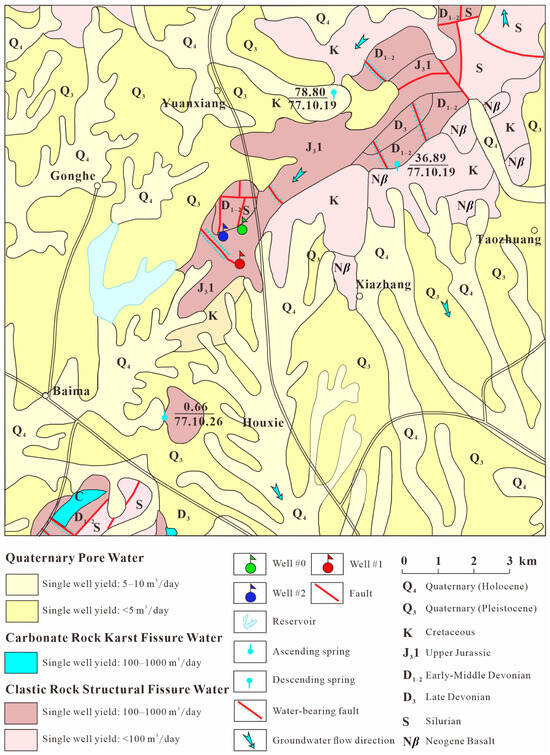
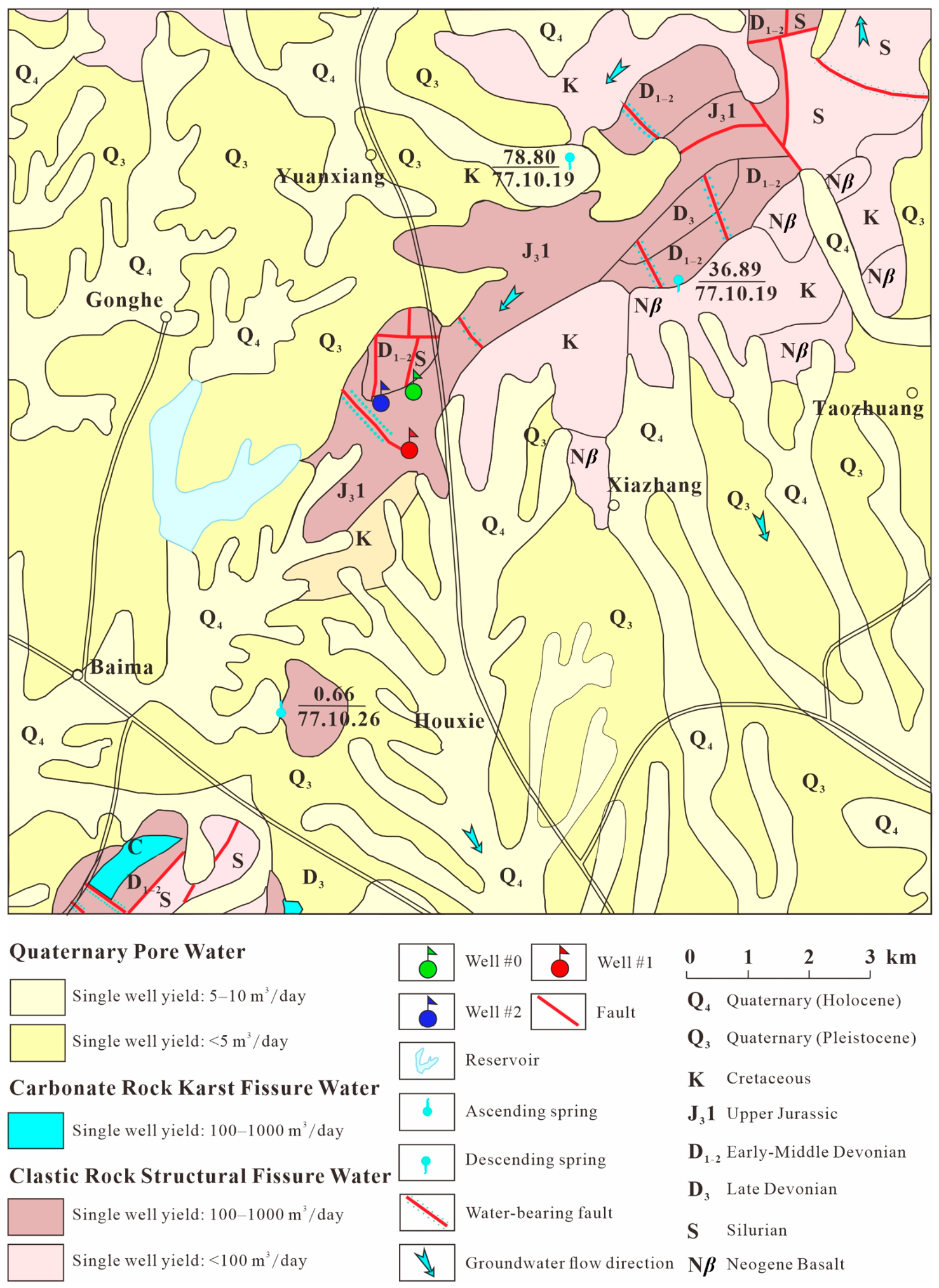
The study area is located in Shangxing Town, Liyang City, Jiangsu Province, China, at the intersection of the Maoshan Mountains and the remnant ranges of the Tianmu Mountains (Figure 1). The regional stratigraphy is dominated by volcanic rocks of the Upper Jurassic Longwangshan Formation (J31), which consist mainly of andesite, tuff, and volcanic breccia. This succession serves as the direct host horizon for the mineral water. The rocks are rich in silicate minerals such as plagioclase and K-feldspar, with strontium occurring as an isomorphic substitute in calcium-bearing minerals, providing the material basis for the enrichment of metasilicate and strontium.
Figure 1.
Regional Hydrogeological Map.
Tectonically, the study area is situated within the Lower Yangtze Depression of the Yangtze Paraplatform and has experienced multiple phases of tectonic deformation since the end of the Triassic, resulting in well-developed fault systems. At the scale of the water source site, two main sets of faults are present: NW-trending extensional-shear faults and NNE-trending compressional-shear faults. Together, they form a “conduit-barrier” system, wherein the NW-trending faults serve as the dominant pathways for groundwater flow, while the NNE-trending faults act as local barriers. This structural configuration controls groundwater flow paths and residence times, providing the structural conditions for long-term water-rock interaction and spatial hydrochemical differentiation.
The study area has a subtropical monsoon climate, with an average annual precipitation of 1133.6 mm, providing a stable recharge source for groundwater. Groundwater in the area is classified into unconsolidated porous water and bedrock fissure water. The water relevant to the formation of mineral water is mainly hosted in the Jurassic volcanic fissure aquifer, which belongs to the hard rock category of clastic rock fissure water. This aquifer is characterized by hard and brittle lithology with well-developed structural fractures, exhibiting moderate water yield with a single-well yield of 300–500 m3/d. Low-permeability Quaternary fine-grained deposits surrounding the water source area act as a relatively impermeable boundary, facilitating deep circulation and enrichment of groundwater within the volcanic aquifer.
Three production wells (Well #0, Well #1, and Well #2) are present in the water source area, with depths ranging from 235 to 333 m, all extracting from the Jurassic volcanic fissure aquifer. Abundant precipitation combined with well-developed structural fractures collectively forms a complete hydrogeological cycle of “recharge-runoff-enrichment.”
3. Methodology
3.1. Hydrochemical Parameter Testing
Groundwater samples were collected from each of the three wells. The samples were immediately sealed, stored at low temperature, and transported to the laboratory. A total of 54 parameters were analyzed for the hydrochemical characterization.
Metal and metalloid elements (including potassium, sodium, strontium, etc.) were determined using inductively coupled plasma mass spectrometry (ICP-MS). In this method, argon serves as the working gas. A radio-frequency generator creates a high-frequency electromagnetic field that ionizes the argon to form an inductively coupled plasma torch at high temperature. The sample is converted into an aerosol by a nebulizer and then introduced into the plasma torch, where it is fully ionized to form positively charged ions under the high-temperature conditions. The ions pass through a sampling cone and a skimmer cone into the high-vacuum system, are focused by an ion lens, and then enter the mass analyzer. Separation and detection are achieved based on the mass-to-charge ratio (m/z) of different ions, with the signal intensity being proportional to the ion concentration. ICP-MS offers advantages such as high sensitivity, low detection limits, and a wide linear range, enabling simultaneous multi-element analysis, and is currently one of the most effective techniques for trace element determination.
Anions (including bicarbonate, fluoride, sulfate, etc.) were determined using ion chromatography (IC). This method is based on the principle of ion-exchange chromatographic separation, with the column packed with a quaternary ammonium-type strongly basic anion-exchange resin. A carbonate-bicarbonate mixed solution serves as the eluent, flowing through the column at a constant rate to establish a stable ion-exchange environment. After sample injection, target anions undergo competitive adsorption with the resin functional groups and are separated due to differences in their affinities for the stationary phase: ions with weaker affinity are eluted first, while those with stronger affinity are eluted later. The separated anions sequentially enter a conductivity detector, where the signal intensity is positively correlated with ion concentration, and quantification is achieved using a standard calibration curve. This method is characterized by good selectivity, high sensitivity, and the ability to detect multiple ions simultaneously.
It should be noted that the term “metasilicate” is used here in accordance with the Chinese national standard GB 8537-2018 and the official testing method GB 8538-2022 [24,25], where the concentration is expressed as mg/L H2SiO3. In the natural water environment at the measured pH of 7.44–7.63, the dominant dissolved silicon species is actually orthosilicic acid (H4SiO4). However, the reported values have been converted to H2SiO3 equivalents using the standard conversion factor (H2SiO3/SiO2 = 1.30) as required by the regulatory framework.
3.2. Carbon-14 Isotopic Dating
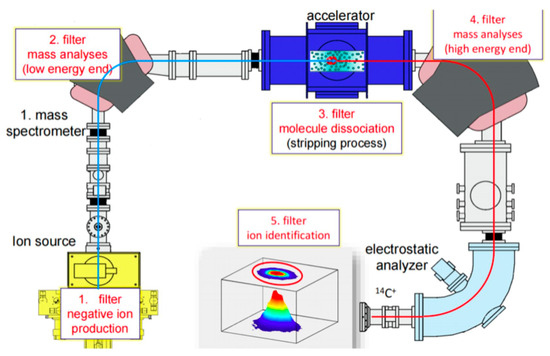
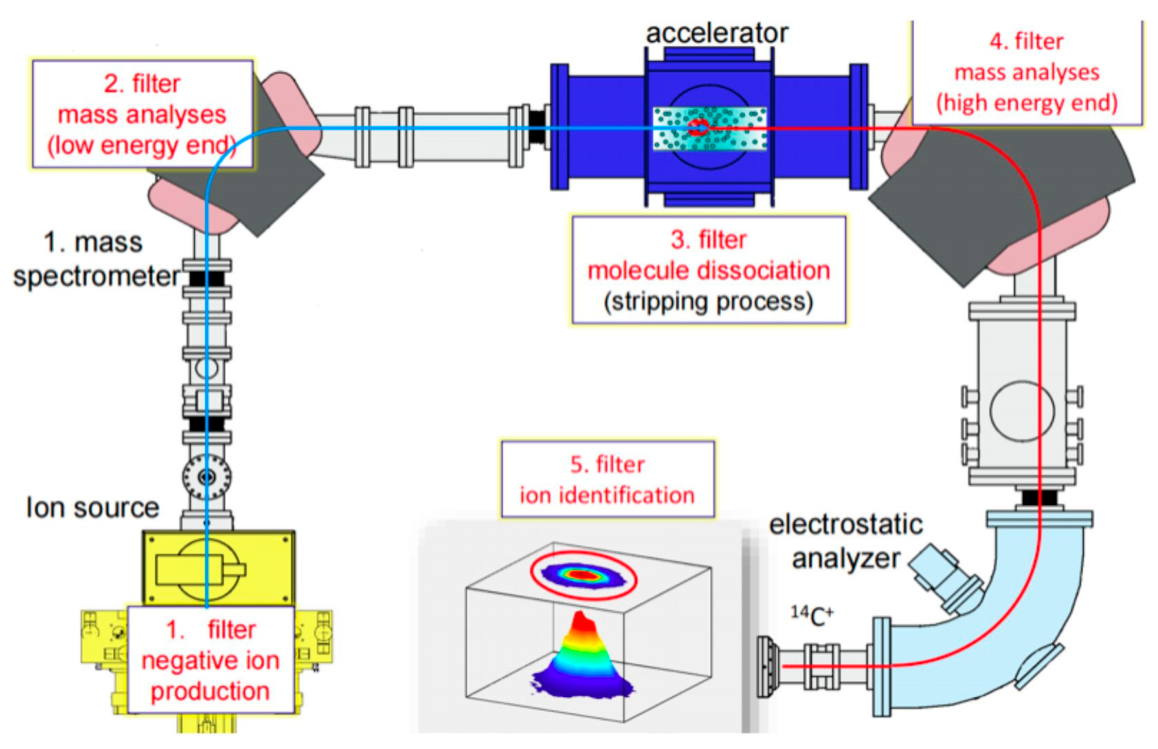
To determine the groundwater residence time, dissolved inorganic carbon (DIC) in water samples was analyzed for accelerator mass spectrometry (AMS) 14C dating and stable carbon isotope (δ13C) analysis. The analyses were conducted by Beta Analytic Inc. in the United States. Sample pretreatment employed a vacuum extraction method: water samples were injected into an acid chamber in a vacuum extractor, and phosphoric acid was added to lower the pH to below 1, thereby converting DIC completely to CO2 gas. The released CO2 was cryogenically trapped to remove water vapor and then purified. The purified CO2 was reduced with hydrogen at 550 °C using a cobalt catalyst, converting it to elemental carbon, which was deposited as graphite on an iron powder carrier to prepare graphite targets for AMS measurement, as shown in Figure 2.
Figure 2.
Schematic diagram of the AMS.
14C measurements were performed using an accelerator mass spectrometer. The basic principle involves ionizing the graphite target in a cesium sputter ion source to produce a beam of negative carbon ions. After sequential stages of low-energy mass analysis, acceleration with gas stripping, and high-energy mass analysis, 14C ions were counted with a gas ionization detector, while the beam intensities of stable carbon isotopes (12C and 13C) were measured using Faraday cups. The 14C content of the sample was then calculated based on isotopic ratios. δ13C was measured using a Delta-Plus isotope ratio mass spectrometer (IRMS) manufactured by Thermo Fisher Scientific, with analyses performed independently on the same sample batch as the 14C determinations.
4. Results
4.1. Hydrochemical Characteristics
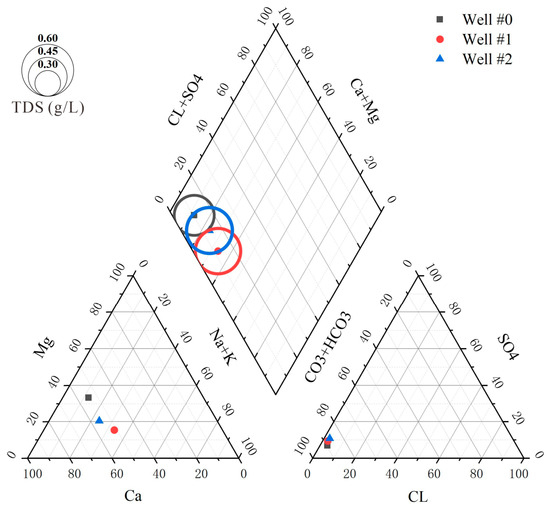
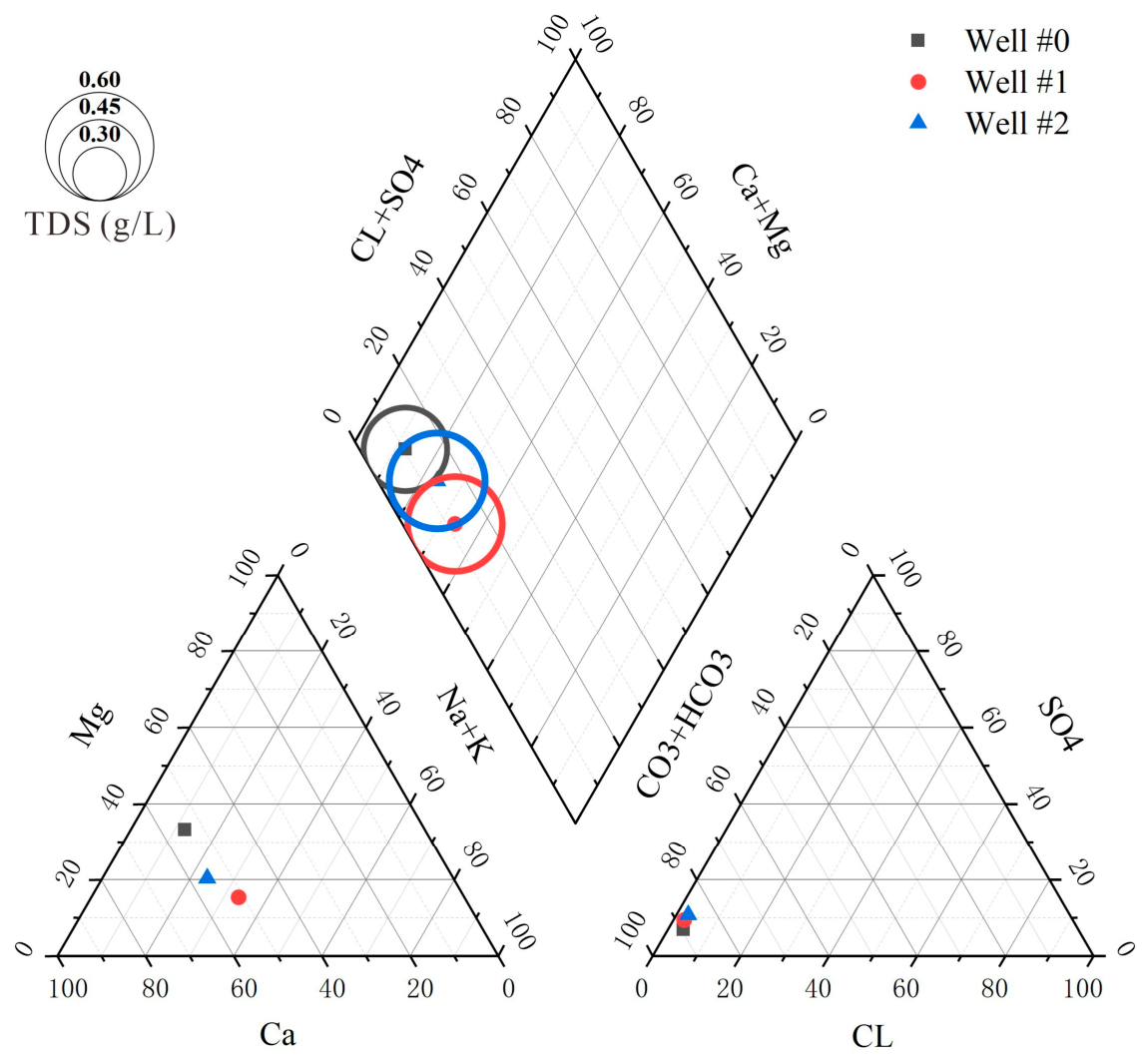
The hydrochemical parameters of groundwater from the three production wells in the study area are summarized in Table 1 and the piper three-line graph is shown in Figure 3. Overall, the groundwater is slightly alkaline, with pH values ranging from 7.44 to 7.63. This slightly alkaline environment is favorable for the stability of silicic acid and promotes the hydrolysis of silicate minerals. Total dissolved solids (TDS) range from 487 to 561 mg/L, indicating freshwater of moderate mineralization, which reflects the intensity of water–rock interaction. Inter-well TDS shows an increasing trend from Well #0 (487 mg/L) to Well #1 (554 mg/L) to Well #2 (561 mg/L).
Table 1.
Hydrochemical analysis results (selected parameters).
Figure 3.
Piper trilinear diagram of the water samples.
Anions are dominated by bicarbonate (, with concentrations ranging from 322 to 361 mg/L, accounting for over 89% of the total anion milliequivalents, indicating a typical type water. The high concentration has dual genetic significance: it is a direct product of the weathering and leaching of silicate minerals in the presence of CO2, and it acts as a ligand that can form soluble ion pairs () with Sr2+, significantly enhancing strontium solubility [26]. Inter-well variations in content (Well #0 < Well #1 < Well #2) are consistent with the trend observed for TDS. Sulfate (19.2–35.5 mg/L) and chloride (6.51–7.72 mg/L) concentrations are extremely low, confirming that the groundwater resides in a relatively confined, deep-circulation environment and has not been affected by modern surface contamination.
Cations are dominated by calcium (70.6–79.6 mg/L) and magnesium (18.6–26.1 mg/L), accounting for over 80% of the total cation milliequivalents, while sodium (16.4–42.2 mg/L) and potassium (3.47–5.30 mg/L) are present in relatively low concentrations. This cation composition is consistent with hydrochemical characteristics dominated by the weathering of silicate rocks. The Ca/Mg ratio (2.71–3.95) exceeds 1, indicating a significant contribution from plagioclase weathering. Inter-well variations in the Na/K ratio (4.73–7.96) may reflect differences in the relative proportions of plagioclase and K-feldspar within the aquifer at the different well locations. Based on the overall ionic composition, the hydrochemical type of the groundwater can be classified as HCO3-Ca·Mg.
For the characteristic components, metasilicate (H2SiO3) concentrations range from 26.4 to 32.9 mg/L, and strontium (Sr) concentrations range from 0.40 to 0.83 mg/L. All three wells consistently exceed the threshold values specified in the Chinese national standard for drinking natural mineral water (GB8537-2018: H2SiO3 ≥ 25 mg/L, Sr ≥ 0.2 mg/L). Metasilicate originates from the hydrolysis of silicate minerals, whereas strontium occurs as an isomorphic substitute in the crystal lattice of calcium-bearing minerals and is released into groundwater upon mineral weathering.
Strictly speaking, at the slightly alkaline pH of the groundwater (7.44–7.63), the dissolved silicon exists predominantly as orthosilicic acid (H4SiO4), with negligible concentrations of deprotonated species given the pKa1 of H4SiO4 is approximately 9.8. However, following the Chinese national standard GB 8537-2018, the concentrations are reported as H2SiO3 equivalents.
Notably, the concentrations of metasilicate and strontium exhibit a co-variation trend: Well #1 has the highest values for both components (32.9 mg/L and 0.83 mg/L), Well #0 has moderate metasilicate but the lowest strontium (28.1 mg/L and 0.40 mg/L), and Well #2 has the lowest metasilicate but intermediate strontium (26.4 mg/L and 0.62 mg/L). This trend suggests that the two components may originate from the weathering and release of the same suite of mineral assemblages (notably plagioclase), with their enrichment likely facilitated by the high environment that promotes strontium mobility.
Trace elements lithium (0.013–0.056 mg/L) and barium (0.08–0.19 mg/L) exhibit stable concentrations far below the relevant regulatory limits, further supporting the consistency of the water source and the closed nature of the system. Systematic chemical differentiation is observed among the three wells. When considered in conjunction with the regional fault framework, this differentiation suggests that variations in groundwater flow paths and the intensity of water–rock interaction are likely the primary factors controlling the inter-well hydrochemical characteristics.
4.2. Carbon Isotope Composition and Groundwater Age
Carbon-14 is widely present in both organic and inorganic carbon in groundwater and serves as an ideal tracer for estimating groundwater ages up to 40,000 years. The measured 14C activities of water samples from the study area range from 25.15 to 35.31 pMC, with δ13CDIC values ranging from −5.85‰ to −8.61‰ (Table 2).
Table 2.
14C and 13C contents and 14C ages of the water samples.
The basis of 14C dating is the measurement of the reduction in radioactive nuclides in a given sample. The method assumes two main characteristics of the system: (1) the initial content of 14C in the parent material is known and has remained constant over time; and (2) aside from radioactive decay, the system is closed, with no loss or gain of the parent nuclide. Based on its half-life, the parent nuclide decreases exponentially, allowing for precise age determination. The decay equation is expressed as:
where is the initial radioactivity of the parent nuclide, and is the radioactivity after time. The decay constant λ is equal to , is the half-life of the nuclide. For 14C, the half-life is 5730 years. The above equation is thus simplified to:
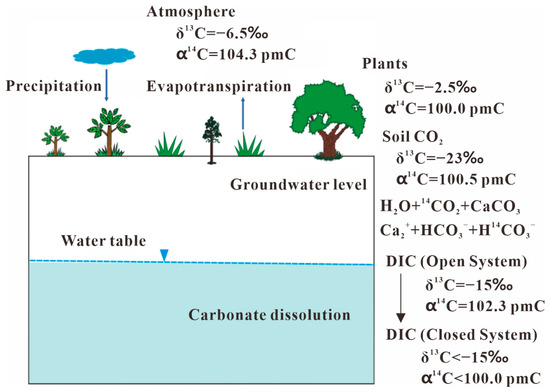
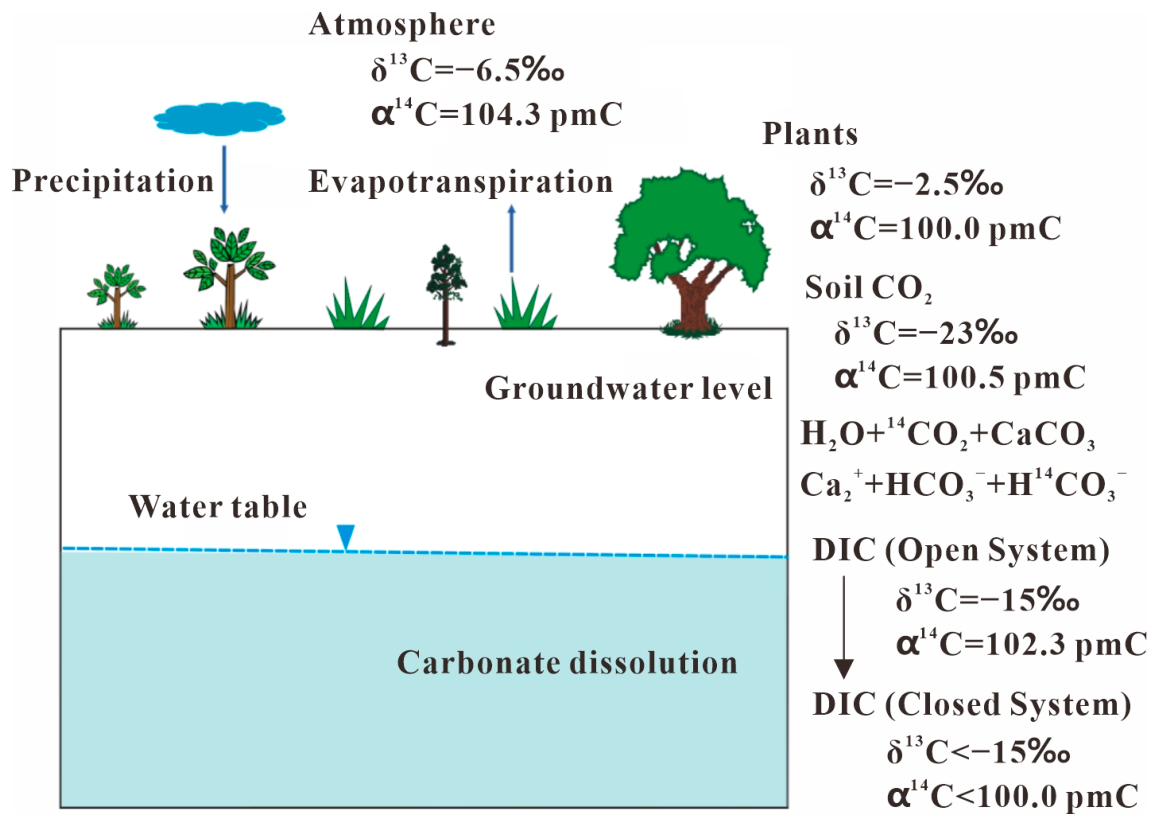
Although rainwater contains 14CO2 derived from the atmosphere, it is the soil zone that supplies the radiocarbon signal to recharging groundwater. Carbon released from soil respiration accumulates in the soil zone, creating a large reservoir of 14C. Figure 4 illustrates the pathway by which atmospheric 14C enters groundwater through the soil zone. If the 14C originating from the soil were preserved in the groundwater during flow without being diluted, its decay could be used directly for dating. In reality, however, geochemical reactions both within the soil and along the flow path cause dilution and reduction in the 14C signal. The most typical reactions include: dissolution of carbonates; exchange with the aquifer matrix; oxidation of “old” organic matter and other biogeochemical reactions within the aquifer; and diffusion of 14C into the aquifer matrix, among others.
Figure 4.
Evolution of 14C in groundwater.
Through these reactions, 14C becomes diluted. In the recharge environment, the 14C activity of DIC in groundwater undergoing carbonate dissolution changes, resulting in an adjusted initial 14C activity. The decay equation, after correction for this dilution, is thus expressed as:
Therefore, to obtain accurate ages for the measured water samples, data correction is required. The Pearson isotopic mixing model, which considers the balance of carbon in an open system in the recharge area and the dissolution and exchange of carbonates in a closed system, is a reasonable and relatively simple 14C correction model [27]. 13C is an excellent tracer for the evolution of DIC in groundwater in both open and closed systems. The significant difference in 13C between soil-derived DIC and carbonate minerals in the aquifer provides a reliable means of determining 14C dilution through carbonate dissolution. The 13C mixing model accounts for the addition of 14C-bearing DIC during carbonate dissolution under open-system conditions, as well as the subsequent dilution of 14C that occurs under closed-system conditions.
Any addition, removal, or exchange of carbon in the source of DIC will alter the 14C concentration, and similarly affect the 13C concentration. The corrected initial 14C activity, , obtained from carbon isotope mass balance, is given by:
where is the 13C content of DIC in the water, is the 13C content of the carbonate, is the 13C content of inorganic carbon in the recharge zone under equilibrium conditions, and is the activity of soil CO2, which is taken as 100 pMC. The value of can be obtained from the following equation:
where is the 13C content of soil CO2, with a value of −23‰, and is the enrichment factor between soil CO2 and DIC in water. Given that the groundwater in the study area is slightly alkaline and DIC is predominantly in the form of , is 8.5‰ at an average water temperature of 20.3 °C. Consequently, is calculated as −14.5‰.
Based on the above calculations, the groundwater ages in the study area are determined to range from 3900 to 4900 years, as summarized in Table 2. The term ‘groundwater age’ used throughout this paper refers to the corrected radiocarbon age of the dissolved inorganic carbon in the water sample, calculated using the Pearson isotopic mixing model, and represents the time elapsed since recharge.
4.3. Mineral Saturation Indices
To quantitatively assess the state of water-rock interaction in the Jurassic volcanic aquifer, speciation and saturation index (SI) calculations were performed using PHREEQC (version 3.7) with the LLNL thermodynamic database. The saturation index is defined as SI = log(IAP/Kt), where IAP is the ion activity product and Kt is the equilibrium constant at the given temperature. Values of SI < 0 indicate undersaturation (mineral dissolution thermodynamically favored), SI > 0 indicate supersaturation, and SI ≈ 0 indicate equilibrium [27,28]. Input data included the full hydrochemical parameters from Table 1 and the measured in situ water temperature (17.5–18.3 °C).
The calculated saturation indices for selected minerals are summarized in Table 3. The results show that all three groundwater samples are undersaturated with respect to primary aluminosilicate minerals such as plagioclase and K-feldspar (SI values ranging from −0.9 to −2.1), indicating that the dissolution of these minerals is thermodynamically favorable and ongoing. This is consistent with the continued release of metasilicate, Ca2+, Na+, and Sr2+ into the groundwater. The waters are near equilibrium with respect to quartz and chalcedony (SI values from −0.3 to +0.2), suggesting that silica concentrations are primarily controlled by the solubility of these SiO2 phases. Notably, the samples are slightly supersaturated with respect to calcite (SI +0.1 to +0.4) and dolomite (SI +0.2 to +0.6), which may indicate that calcite and dolomite are not primary source minerals but could be precipitating as secondary phases due to CO2 degassing or common-ion effects—a phenomenon commonly observed in bicarbonate-rich groundwaters. Strontianite (SrCO3) shows near-equilibrium to slightly undersaturated values (SI from −0.3 to −0.1), indicating that strontium concentrations are approaching saturation with respect to this mineral but have not yet reached the precipitation threshold. These calculations provide direct thermodynamic evidence supporting the interpretations of active plagioclase dissolution and the ongoing evolution of the groundwater chemistry toward mineral equilibrium.
Table 3.
Calculated saturation indices (SI) for selected minerals.
5. Discussion
5.1. Co-Enrichment Mechanism of Metasilicate and Strontium
The co-enrichment of metasilicate and strontium in this subtropical volcanic terrain follows a specific geochemical pathway. The key mechanism can be summarized as the synergistic interplay of three factors: material source, hydrochemical environment, and reaction timescale.
The andesite and tuff of the Jurassic Longwangshan Formation are rich in silicate minerals such as plagioclase and K-feldspar, along with minor strontium-bearing minerals (e.g., strontianite), providing a stable and abundant material source for the enrichment of metasilicate and strontium. Among these, plagioclase acts as a common reservoir for both silicon and strontium: silicon is present in the silicate network structure, while strontium occurs as an isomorphic substitute for calcium in the mineral lattice. During infiltration of CO2-rich meteoric water, which creates a weakly acidic to weakly alkaline transitional environment, plagioclase undergoes weathering and hydrolysis, simultaneously releasing silicic acid (H4SiO4), calcium, sodium, and other cations, with strontium entering the solution as a result [29]. The weakly alkaline environment further promotes the release and migration of SiO2, maintaining metasilicate concentrations at a stable level of 26.4–32.9 mg/L.
It should be noted that, while plagioclase is the primary source of calcium, sodium, and metasilicate, it contains negligible magnesium. The measured magnesium concentrations (18.6–26.1 mg/L) in the groundwater are instead derived from the incongruent dissolution of ferromagnesian silicate minerals, such as pyroxene, amphibole, and biotite, which are abundant in the andesite and tuff of the Longwangshan Formation [30,31]. Upon weathering under CO2-charged meteoric water, these minerals release Mg2+, Fe2+, and additional silica, contributing to the overall cation budget [32]. This distinction is critical because the combined weathering of plagioclase and ferromagnesian minerals accounts for the full suite of major cations observed (Ca2+, Mg2+, Na+, and K+), consistent with the Ca–Mg–HCO3 water type.
The hydrochemical environment of the study area is characterized by as the dominant anion (322–361 mg/L, accounting for over 89% of total anion milliequivalents). This bicarbonate-rich water plays a dual facilitating role: on one hand, it supplies H+ to promote silicate mineral dissolution; on the other hand, the high concentration enables the formation of soluble ion pairs with Sr2+, significantly reducing strontium adsorption onto mineral surfaces and thereby greatly enhancing its mobility and final concentration in the water [33]. Additionally, regional fault structures facilitate the infiltration of CO2 into the aquifer, helping to sustain this favorable hydrochemical environment.
Over the course of water-plagioclase interaction, the concentrations of SiO2 and Sr in solution increase synchronously until approaching dynamic equilibrium. The co-variation trend between metasilicate and strontium concentrations further supports their common origin from the weathering of the same mineral assemblage. Thus, in volcanic aquifers, the concurrent attainment of both components above regulatory thresholds is likely not an independent event but rather a product of the same set of geochemical processes.
5.2. Implications of Groundwater Age for Genesis
The obtained groundwater ages of 3900–4900 years provide a critical temporal constraint for understanding the formation of this type of volcanic-hosted mineral water. Compared to younger groundwater (<1000 years), this millennial-scale residence time carries threefold genetic implications.
First, it represents a sufficient duration for water–rock interaction. Relatively slow geochemical reactions—such as the hydrolysis of silicate minerals and the leaching of strontium-bearing phases—can proceed to completion. If the groundwater circulation period were only a few decades, these reactions would be insufficient to accumulate characteristic components to regulatory levels. The fact that all three wells yield ages exceeding 3000 years directly supports the genetic logic of long-term water-rock interaction.
Second, it serves as an indicator of hydrogeochemical maturity. On this timescale, the hydrochemical type stabilizes, the saturation indices of major minerals approach equilibrium, and water quality parameters exhibit minimal temporal variation.
Third, it acts as a natural barrier against modern anthropogenic contamination. The groundwater was recharged long before the industrial era and has no hydraulic connection with modern surface water. These ages are comparable to those reported for high-quality mineral waters in other typical volcanic terrains worldwide, for example, 2000–5000 years in the Mount Etna region of Italy and 2500–4500 years in the Lake Chapala basin of Mexico [34]. This consistency suggests that the formation of mineral water with stable chemical compositions and sensory properties requires a hydrological cycle spanning several millennia.
5.3. Hydrogeochemical Differentiation Controlled by Fault Structures
The well-developed fault systems provide critical geological conditions for hydrogeochemical differentiation. In the study area, the NW-trending extensional-shear faults serve as high-permeability preferential flow pathways, governing rapid groundwater flow and regional recharge direction, whereas the NNE-trending compressional-shear faults act as hydraulic barriers that force groundwater to decelerate and stagnate, locally forming enrichment zones for hydrochemical evolution.
All three production wells are located near the intersection of these two fault sets; however, their specific positions relative to the fault zones result in systematic differences in flow paths, residence times, and the lithological assemblages encountered, leading to distinct patterns of hydrochemical differentiation. Well #2 is situated at the core of the intersection between the NW-trending and NNE-trending faults, where the influence of the barrier fault is greatest. It exhibits the longest flow path and residence time (4900 years), has undergone the most extensive water-rock interaction, and shows the highest total dissolved solids (561 mg/L) and bicarbonate (361 mg/L). Well #1 has the youngest age (3900 years), but its strontium (0.83 mg/L), sodium (42.2 mg/L), and metasilicate (32.9 mg/L) concentrations are markedly higher than those of the other two wells, suggesting that its flow path may have passed through lithological units enriched in easily weathered minerals such as albite, resulting in more efficient water-rock interaction and allowing characteristic components to reach elevated concentrations over a relatively shorter timescale. Well #0 has an intermediate age (4300 years) but the lowest TDS (487 mg/L) and strontium (0.40 mg/L) among the three wells, possibly because it lies on a relatively direct flow path where water-rock contact area or mineral reaction rates are comparatively limited.
This spatial differentiation pattern reveals the combined control of fault architecture on water-rock interaction intensity, flow paths, and geochemical evolution. The relationship between groundwater age and solute enrichment is not simply linear; the lithological composition along flow paths and the spatial configuration relative to faults also exert important influences on hydrochemical evolution.
From an engineering perspective, the “lithology-time-structure” model provides actionable guidance for wellfield design and risk mitigation. The systematic relationship between fault architecture and groundwater age suggests that new production wells should be sited at the intersection of NW- and NNE-trending faults to access the oldest, most mineralized water, while avoiding locations where younger, more variable water may intrude. The observed millennial-scale residence time also implies a very low recharge rate; thus, sustainable pumping rates must be carefully constrained to prevent drawdown that could induce vertical mixing with shallower, younger groundwater. From a risk assessment standpoint, the pristine nature of the water and its age indicate high vulnerability to surface contamination if the confining barrier is breached.
6. Conclusions
Through a systematic investigation of the volcanic-hosted mineral water in Wawushan, Liyang, the following main conclusions are drawn:
- The co-enrichment of metasilicate and strontium in the study area is governed by the synergistic interplay of three factors: material source, hydrochemical environment, and reaction timescale. Silicate minerals such as plagioclase in the Jurassic volcanic rocks provide a common material source for both components. The bicarbonate-dominated and weakly alkaline environment not only facilitates the hydrolysis of silicate minerals but also significantly enhances strontium solubility through the formation of soluble ion pairs. Millennial-scale water-rock interaction allows the two components to accumulate synchronously until reaching dynamic equilibrium.
- Carbon-14 dating, corrected by the Pearson model, yields groundwater ages of 3900 years (Well #1), 4900 years (Well #2), and 4300 years (Well #0), indicating that the millennial-scale residence time of 3900–4900 years provides a critical temporal constraint for sufficient water-rock interaction and the attainment of regulatory thresholds for the characteristic components. This timescale ensures that relatively slow reactions—such as the hydrolysis of silicate minerals and the leaching of strontium-bearing phases—proceed to completion, allowing the hydrochemical type to stabilize and the saturation indices of major minerals to approach equilibrium, while also serving as a natural barrier against modern anthropogenic contamination, thereby forming a high-quality mineral water with mature hydrogeochemical characteristics.
- The conduit-barrier system formed by NW-trending extensional-shear faults and NNE-trending compressional-shear faults controls the inter-well hydrochemical differentiation. Well #2, located at the core of the fault intersection, exhibits the oldest corrected 14C groundwater age (4900 years) and the highest total dissolved solids and bicarbonate. Well #1 has the youngest groundwater age (3900 years) but the highest concentrations of strontium, sodium, and metasilicate. Well #0 shows an intermediate groundwater age (4300 years) but the lowest TDS and strontium. This differentiation pattern demonstrates that the relationship between groundwater age and solute enrichment is not simply linear; rather, residence time, the lithological composition along flow paths, and the spatial configuration relative to faults collectively determine the final hydrochemical composition.
Limitations in this study and the work in the future: the study is based on only three sampling wells located within a single water source area. This limited spatial coverage may not adequately represent the full hydrochemical heterogeneity of the Jurassic volcanic aquifer. And, only one set of samples was collected from each well. Consequently, the analytical reproducibility and potential temporal variability of the hydrochemical parameters and 14C ages have not been statistically assessed. While the systematic inter-well consistency in major ions, TDS, and 14C ages provides confidence in the overall dataset, future investigations should include replicate sampling to evaluate analytical precision and to capture possible temporal fluctuations in water chemistry. Such long-term monitoring would also help to confirm the stability of the groundwater ages and the sustainability of the mineral water resource under exploitation.
Author Contributions
Data curation, G.L.; formal analysis, G.L. and J.G.; methodology, J.G. and G.L.; software, Y.S. and J.G.; writing—original draft, G.L.; writing—review and editing, F.M. All authors have read and agreed to the published version of the manuscript.
Funding
This research was supported by the National Science Foundation of China (Grant Nos. 42072305) and the Second Tibetan Plateau Scientific Expedition and Research Program (Grant no. 2019QZKK0904).
Data Availability Statement
The original contributions presented in this study are included in the article. Further inquiries can be directed to the corresponding author.
Acknowledgments
The authors are grateful to the assigned editors and anonymous reviewers for their enthusiastic help and valuable comments which have greatly improved this paper.
Conflicts of Interest
The authors declare no conflicts of interest.
References
- Goldscheider, N.; Hunkeler, D.; Rossi, P. Review: Microbial biocenoses in pristine aquifers and an assessment of investigative methods. Hydrogeol. J. 2006, 14, 926–941. [Google Scholar] [CrossRef] [Scilit]
- Chen, J.; Malhi, K.K.; Li, X.; Xu, X.; Kang, J.; Zhao, B.; Xu, Y.; Li, X.; Li, J. Metasilicate-based alkaline mineral water improves the growth performance of weaned piglets by maintaining gut-liver axis homeostasis through microbiota-mediated secondary bile acid pathway. Anim. Nutr. 2025, 20, 95–109. [Google Scholar] [CrossRef] [Scilit]
- Yang, X.; Jia, C.; Zhu, H.; Liu, Z.; Liu, Z. Characteristics and genesis of high-quality metasilicate mineral water in Liaocheng City, Shandong Province. Environ. Monit. Assess. 2024, 196, 1155. [Google Scholar] [CrossRef] [Scilit]
- Aiuppa, A.; Bellomo, S.; Brusca, L.; D’Alessandro, W.; Federico, C. Natural and anthropogenic factors affecting groundwater quality of an active volcano (Mt. Etna, Italy). Appl. Geochem. 2003, 18, 863–882. [Google Scholar] [CrossRef] [Scilit]
- Xu, M.; Hu, C.; Zhu, L.; Song, G.; Peng, W.; Yang, S.; Song, J. Spatial Distribution Characteristics and Genetic Mechanism of the Metasilicate-Rich Groundwater in Ji’nan Rock Mass Area, Shandong Province, China. Water 2023, 15, 713. [Google Scholar] [CrossRef] [Scilit]
- Medici, G.; Bajak, P.; West, L.J.; Chapman, P.J.; Banwart, S.A. DOC and nitrate fluxes from farmland; impact on a dolostone aquifer KCZ. J. Hydrol. 2021, 595, 125658. [Google Scholar] [CrossRef] [Scilit]
- Fuoco, I.; de Rosa, R.; Barca, D.; Figoli, A.; Gabriele, B.; Apollaro, C. Arsenic polluted waters: Application of geochemical modelling as a tool to understand the release and fate of the pollutant in crystalline aquifers. J. Environ. Manag. 2022, 301, 113796. [Google Scholar] [CrossRef] [Scilit]
- Wang, X.; Wang, Y.; Gao, G.; Li, M.; An, H.; Mao, K.; Wang, Y.; You, Y.; Gong, L. Hydrochemical Characteristics and Genesis of Groundwater in Taoshan Granite Body, Yushan Uplift Area, South Jiangxi, China. Water 2025, 17, 974. [Google Scholar] [CrossRef] [Scilit]
- Yan, M.; Wang, L.; Wang, Q.; Liu, Z. Hydrochemical Characteristics and Origin Analysis of Groundwater in Nanling County, Anhui Province. Water 2024, 16, 1579. [Google Scholar] [CrossRef] [Scilit]
- Sun, X.Q.; Bian, J.M.; Zhang, C.P.; Wang, Y.; Wan, H.L.; Jia, Z. Hydrochemistry Characteristics and Water Quality Assessment for Irrigation along the Second Songhua River in the South of the Songnen Plain, Northeast China. Pol. J. Environ. Stud. 2020, 29, 371–395. [Google Scholar]
- Wu, C.; Wu, X.; Mu, W.; Zhu, G. Using isotopes (H, O, and Sr) and major ions to identify hydrogeochemical characteristics of groundwater in the Hongjiannao Lake Basin, Northwest China. Water 2020, 12, 1467. [Google Scholar] [CrossRef] [Scilit]
- Liu, D.; Bai, X.; Wang, X.; Yu, S.; Li, T.; Deng, F. Hydrogeochemical Characteristics and Formation Mechanism of metasilicate Mineral Water at Taoping Water Source Area. Water 2026, 18, 249. [Google Scholar] [CrossRef] [Scilit]
- Barbieri, M.; Morotti, M. Hydrogeochemistry and strontium isotopes of spring and mineral waters from Monte Vulture volcano, Italy. Appl. Geochem. 2003, 18, 117–125. [Google Scholar] [CrossRef] [Scilit]
- Ferreira, L.; Cruz, J.V.; Viveiros, F.; Durães, N.; Coutinho, R.; Andrade, C.; Santos, J.F.; Acciaioli, M.H. Hydrogeochemistry and Strontium Isotopic Signatures of Mineral Waters from Furnas and Fogo Volcanoes (Sao Miguel, Azores). Water 2023, 15, 245. [Google Scholar] [CrossRef] [Scilit]
- Bian, J.; Li, Y.; Ma, Y.; Li, J.; Yu, Y.; Sun, W. Study on Hydrochemical Characteristics and Formation Process of Antu Mineral Water in Changbai Mountain, China. Water 2022, 14, 2770. [Google Scholar] [CrossRef] [Scilit]
- Amiri, V.; Kamrani, S.; Ahmad, A.; Bhattacharya, P.; Mansoori, J. Groundwater quality evaluation using Shannon information theory and human health risk assessment in Yazd province, central plateau of Iran. Environ. Sci. Pollut. Res. 2021, 28, 1108–1130. [Google Scholar] [CrossRef] [Scilit] [PubMed]
- Shand, P.; Darbyshire, D.P.F.; Love, A.J.; Edmunds, W.M. Sr isotopes in natural waters: Applications to source characterisation and water-rock interaction in contrasting landscapes. Appl. Geochem. 2009, 24, 574–586. [Google Scholar] [CrossRef] [Scilit]
- Amiri, V.; Nakhaei, M.; Lak, R.; Kholghi, M. Geophysical, isotopic, and hydrogeochemical tools to identify potential impacts on coastal groundwater resources from Urmia hypersaline Lake, NW Iran. Environ. Sci. Pollut. Res. 2016, 23, 16738–16760. [Google Scholar] [CrossRef] [Scilit]
- Freire, P.; Andrade, C.; Coutinho, R.; Cruz, J.V. Fluvial geochemistry in São Miguel Island (Azores, Portugal): Source and fluxes of inorganic solutes in an active volcanic environment. Sci. Total Environ. 2013, 454, 154–169. [Google Scholar] [CrossRef] [Scilit] [PubMed]
- Bestland, E.; George, A.; Green, G.; Olifent, V.; Mackay, D.; Whallen, M. Groundwater dependent pools in seasonal and permanent streams in the Clare Valley of South Australia. J. Hydrol. Reg. Stud. 2017, 9, 216–235. [Google Scholar] [CrossRef] [Scilit]
- Han, D.; Cao, G.; McCallum, J.; Song, X. Residence times of groundwater and nitrate transport in coastal aquifer systems: Daweijia area, northeastern China. Sci. Total Environ. 2020, 732, 139180. [Google Scholar] [CrossRef] [Scilit]
- Zuecco, G.; Marchina, C.; Censini, M.; Todini-Zicavo, D.; Cassiani, G.; Borga, M. A simple experiment to trace stemflow infiltration: Advantages and challenges of using stable isotopes of hydrogen and oxygen and electrical resistivity tomography. Vadose Zone J. 2025, 24, e20397. [Google Scholar] [CrossRef] [Scilit]
- Ge, Q.; Shao, Z.; Liang, X.; Li, X.; Wang, J.; Wu, P.; Chen, Y.; Li, J.; Zhang, Q. Study on the Hydrochemical Characteristics and Formation Mechanism of Shallow Groundwater in Karst Area, Meijiao Town, Ganzhou. Environ. Chem. 2024, 43, 1608–1620. [Google Scholar]
- GB 8537-2018; National Food Safety Standard Drinking Natural Mineral Water. National Health Commission of the People’s Republic of China: Beijing, China, 2018.
- GB 8538-2022; National Food Safety Standard Examination Methods for Drinking Natural Mineral Water. National Health Commission of the People’s Republic of China: Beijing, China, 2022.
- Pearson, F.J.; Hanshaw, B.B. Sources of dissolved carbonate species in groundwater and their effects on carbon-14 dating. In Isotope Hydrology 1970; International Atomic Energy Agency (IAEA): Vienna, Austria, 1970; pp. 271–286. [Google Scholar]
- Bethke, C.M.; Johnson, T.M. Groundwater age and groundwater age dating. Annu. Rev. Earth Planet. Sci. 2008, 36, 121–152. [Google Scholar] [CrossRef] [Scilit]
- Hosono, T.; Nakano, T.; Igeta, A.; Tayasu, I.; Tanaka, T.; Yachi, S. Hydrobiogeochemical evolution along the regional groundwater flow systems in volcanic aquifers in Kumamoto, Japan. Procedia Earth Planet. Sci. 2013, 7, 359–362. [Google Scholar] [CrossRef] [Scilit]
- Jean-Baptiste, P.; Fourré, E.; Gaubi, E.; Minster, B.; Aquilina, L.; Labasque, T.; Michelot, J.L.; Massault, M.; Mammou, A.B. Underground renewal time and mixing of the main mineral waters of Tunisia: A multi-tracer study. Appl. Geochem. 2017, 85, 10–18. [Google Scholar] [CrossRef] [Scilit]
- Poznanović Spahić, M.; Marinković, G.; Spahić, D.; Sakan, S.; Jovanić, I.; Magazinović, M.; Obradović, N. Water-Rock Interactions across Volcanic Aquifers of the Lece Andesite Complex (Southern Serbia): Geochemistry and Environmental Impact. Water 2023, 15, 3653. [Google Scholar] [CrossRef] [Scilit]
- Rman, N.; Szőcs, T.; Palcsu, L.; Lapanje, A. Chemical and isotopic composition of CO2-rich magnesium–sodium–bicarbonate–sulphate-type mineral waters from volcanoclastic aquifer in Rogaška Slatina, Slovenia. Environ. Geochem. Health 2022, 44, 2187–2214. [Google Scholar] [CrossRef] [Scilit] [PubMed]
- Lara, M.C.; Buss, H.L.; von Strandmann, P.A.E.; Schuessler, J.A.; Moore, O.W. The influence of critical zone processes on the Mg isotope budget in a tropical, highly weathered andesitic catchment. Geochim. Cosmochim. Acta 2017, 202, 77–100. [Google Scholar] [CrossRef] [Scilit]
- Banner, J.L.; Wasserburg, G.J.; Chen, J.H.; Moore, C.H. Isotopic and trace element constraints on the origin and evolution of saline groundwaters from central Missouri. Geochim. Cosmochim. Acta 1994, 58, 39–52. [Google Scholar] [CrossRef] [Scilit]
- Kamtchueng, B.T.; Fantong, W.Y.; Wirmvem, M.J.; Tiodjio, R.E.; Takounjou, A.F.; Asai, K.; Bopda Djomou, S.L.; Kusakabe, M.; Ohba, T.; Tanyileke, G. A multi-tracer approach for assessing the origin, apparent age and recharge mechanism of shallow groundwater in the Lakes Nyos catchment, Northwest, Cameroon. J. Hydrol. 2015, 523, 790–803. [Google Scholar] [CrossRef] [Scilit]

Disclaimer/Publisher’s Note: The statements, opinions and data contained in all publications are solely those of the individual author(s) and contributor(s) and not of MDPI and/or the editor(s). MDPI and/or the editor(s) disclaim responsibility for any injury to people or property resulting from any ideas, methods, instructions or products referred to in the content. |
© 2026 by the authors. Licensee MDPI, Basel, Switzerland. This article is an open access article distributed under the terms and conditions of the Creative Commons Attribution (CC BY) license.