


Abstract
Water scarcity, climate variability, and increasing water demands are placing growing pressure on water supply and distribution systems, particularly in water-scarce environments. Optimization-based approaches have become central to improving system design, planning, and operation. This study presents a structured review of optimization techniques applied to water distribution systems under conditions of scarcity, intermittency, or aridity, and introduces a context-aware classification framework incorporating system scale, population, and scarcity severity. PRISMA (“Preferred Reporting Items for Systematic Reviews and Meta-Analyses”) principles are adopted. Relevant studies are identified through Scopus and Google Scholar, screened using criteria focused on system type, optimization relevance, and explicit consideration of scarcity, intermittency, or aridity, and classified by optimization stage, methodological approach, geographical context, and main findings. The review is dominated by benchmark network studies under water scarcity, while real-world applications in arid regions, such as Sub-Saharan Africa and parts of the Middle East, remain underrepresented. Deterministic least-cost designs are inadequate under water scarcity, whereas multi-objective approaches deliver more reliable systems. The review shows a mismatch between the optimization focus of the benchmark studies, which is mainly in the design phase, and the real-world applications, which mainly focus on optimization of the operations of the existing systems.
1. Introduction
Water scarcity is widely recognized as one of the most pressing global challenges of the twenty-first century, driven by increasing water demand from an increasing human population and the water needed for agricultural and industrial processes [1,2]. The pressure is particularly severe in water-scarce environments such as arid and semi-arid regions, which are characterized by highly variable climates with either prolonged droughts or episodic floods, which, together with limited water sources, constrain the reliability of water supply systems. In such contexts, water demand persistently exceeds available supply, and an efficient management of water supply systems is essential to ensure reliable and equitable access among the different water use sectors [3].
Water distribution networks (WDNs) constitute a critical component of water supply systems, responsible for conveying treated water from sources and storage facilities to consumers through interconnected elements such as reservoirs, pumps, pipes, tanks, and valves. Their operation involves complex decisions related to pump scheduling, storage management, leakage control, and pressure regulation to maintain service reliability while minimizing energy consumption [4]. Globally, services provided by WDNs are increasingly challenged by ageing network infrastructure, high levels of non-revenue water, nodal pressure fluctuations, and energy-intensive pumping operations [5,6]. These challenges are more prominent in arid and semi-arid regions, where persistent water scarcity, limited institutional capacity, scarce resources, and strong interdependencies between water and energy systems further intensify the need for improved system performance and efficiency [7]. Similar conditions are increasingly observed in non-arid regions due to operational and system-induced factors such as infrastructure limitations, demand–supply imbalances, and intermittent supply [8]. In this study, water scarcity is considered in a broader sense, encompassing both physical scarcity (arid environments) and operational scarcity arising from system constraints and variability in water availability.
Within this broader framework, arid regions remain a critical and representative subset of water-scarce environments, as they exhibit persistent and structurally constrained water availability. As a result, many foundational studies on water supply optimization have been developed and tested in such contexts [9,10]. However, similar challenges are increasingly observed in non-arid regions experiencing intermittent supply and resource constraints [11,12]. Optimization-based approaches have long been employed to support planning and operational decision-making in water distribution systems, balancing competing objectives such as cost minimization due to energy efficiency and service reliability. Applications of optimization in WDNs have addressed a wide range of problems, including network design and expansion, pump and valve scheduling, pressure management, leakage reduction, and energy efficiency improvement [4,5,13,14,15]. Optimization in WDNs has similarly improved with the advancements made in technologies such as the introduction of sensors and computational technologies, which have been utilized in applications toward adaptive and data-driven operational strategies in water distribution networks, enabling more responsive system management under dynamically changing demand and operating conditions [16,17].
Despite this extensive body of work, existing review studies on water distribution system optimization largely adopt context-neutral perspectives, often emphasizing algorithmic performance, benchmark networks, or generalized design and operational problems [18,19,20]. Many of these reviews do not explicitly distinguish between applications in humid, temperate, and water-scarce regions, even though optimization problem formulations, decision priorities, and performance criteria differ substantially across these contexts [18]. In water-scarce regions, optimization problems are expected to address challenges imposed on the WDNs arising from limited water availability due to chronic drought and limited natural water sources, fragile energy–water trade-offs in pumped systems, and constrained infrastructure flexibility factors that remain underrepresented in generic reviews [21].
The objective of this review is to address this gap by providing a systematic and critical synthesis of optimization-based studies applied to water distribution systems in water-scarce environments, specifically arid and semi-arid regions worldwide. Specifically, the review aims to (i) classify optimization approaches according to their purposes, system context, global distribution, and optimization techniques applied; (ii) examine how these approaches have been applied to key decision problems in water distribution systems, including design and planning, operation, monitoring, and predictive control; (iii) assess their strengths and limitations in addressing the distinctive challenges of water-scarce environments; and (iv) identify research gaps and future directions for advancing optimization-based water distribution system management in water-scarce environments.
The paper is structured as follows: Section 2 presents the global and regional context of water scarcity and aridity; Section 3 discusses the importance of optimization in water supply systems; Section 4 outlines the defining characteristics of water supply systems in arid and water-scarce regions. Section 5 defines the methodology and structure of the review, followed by the result synthesis and a discussion of future research directions (Section 6 and Section 7).
2. Water Scarcity and Aridity: Global and Regional Context
Water scarcity is increasingly recognized as a structural and persistent challenge for water supply systems, particularly in arid and semi-arid regions where natural water availability is constrained by low and highly variable precipitation. Global assessments indicate that increasing human population and cross-sector water demand competition, combined with prolonged droughts due to climate change, are driving many regions toward conditions in which water demand regularly exceeds renewable supply [1,2]. Climate change projections further suggest that dryland regions will experience more frequent and severe droughts, increased inter-annual rainfall variability, and higher evaporative losses, aggravating existing water deficits and reducing the reliability of traditional water sources [2]. Aridity fundamentally alters the hydrological context in which water supply systems operate. In arid and semi-arid regions, surface water availability is often seasonal and unreliable, while groundwater resources, which are the predominant supply source, are susceptible to low recharge rates, decline in dynamic water tables, and water quality degradation due to low precipitation and over-abstraction [3,22]. Limited natural water sources and high climatic variability increase exposure to supply shocks, forcing water utilities to operate under chronic scarcity rather than temporary shortages. These conditions significantly constrain system flexibility and elevate the consequences of operational inefficiencies. Schimel [23] posits that arid and semi-arid regions cover about 45% of the Earth’s land surface and support a rapidly growing share of the world’s population, where water scarcity is a major concern. However, at the regional level, the impacts of physical water scarcity are particularly acute in Sub-Saharan Africa, the Middle East and North Africa, South Asia, and parts of southern Europe and western North America. Empirical studies of utilities in water-scarce and arid regions highlight recurring challenges such as ageing infrastructure, insufficient storage capacity, high levels of non-revenue water, and constrained institutional and financial resources for systems expansion or rehabilitation. These conditions lead to inefficiencies in the system’s operations [5,6], even though WDNs are expected to provide sufficient service under these constraints.
A defining operational response to chronic scarcity in these regions is intermittent water supply, in which water is delivered for limited hours or days rather than continuously [24]. Intermittency introduces a range of technical, operational, and social challenges, including pressure fluctuations, increased leakage and pipe deterioration, inequitable spatial distribution of supply, and heightened risks to water quality. These impacts often disproportionately affect peripheral and low-income communities, reinforcing social inequities and complicating service management [5,6,25]. Intermittent operation also increases the sensitivity of system performance to operational decisions required for WDNs, such as pump scheduling, storage management, and valve control.
Water scarcity in arid regions is further intensified by competing demands among different use sectors of agriculture, domestic, industrial, and ecological requirements. Agriculture typically accounts for the largest share of withdrawals, particularly in dryland regions, while domestic and industrial water supply is often prioritized for socio-economic and public health reasons. Droughts further complicate the balancing act of allocation of available water to these competing demands, with direct implications for domestic and industrial water availability and reliability [3,26]. Ecological requirements introduce additional constraints, limiting the volume of water that can be abstracted during low-availability conditions.
Energy considerations play a critical role in shaping water scarcity dynamics in arid and semi-arid regions. Water sources in these contexts often rely on conventional and non-conventional sources that require a considerable amount of energy, such as pumping from deep aquifers, long-distance conveyance, desalination plants, and advanced wastewater reuse. As a result, energy costs often dominate operational expenditures, and water utilities are increasingly exposed to fluctuating electricity tariffs and energy supply uncertainties [7,27]. This tight coupling between water availability and energy consumption reinforces the water–energy nexus as a central challenge in arid-region water supply management.
In summary, the highlights of these global and regional dynamics demonstrate that water scarcity in arid and semi-arid regions is not a temporary phenomenon but a defining constraint shaping both the design and operation of water supply systems. Chronic scarcity in arid and semi-arid regions as a result of climate variability, high demands by different water use sectors, and the need for more energy by water supply utilities in these regions creates a complex decision environment characterized by delicate balancing of interests requiring compromises and trade-offs. This context provides the foundation for the subsequent discussion on the importance of optimization as a systematic approach for supporting decisions on the planning, designing, operating, and monitoring of water supply systems in arid and water-scarce environments.
3. Importance of Optimization in Water Supply Systems
The growing complexity and stress faced by water supply systems, particularly in water-scarce arid and semi-arid regions, have exposed the limitations of conventional planning and operational practices. Traditional approaches based on deterministic assumptions and rule-based operations are often inadequate under conditions of water scarcity, where constrained resources must be allocated to balance reliability, cost, and equity of water supply [18,28].
Optimization provides a quantitative framework for identifying operating strategies that yield the best performance under defined constraints. In water distribution systems, optimization is applied to balance competing objectives such as cost efficiency, energy use, service reliability, and water quality, specifically under limited water availability conditions [29,30]. Optimization techniques have been applied to water distribution systems for several decades, addressing a wide range of decision problems across both planning and operational horizons. Early applications focused primarily on network design and expansion, including pipe sizing and layout optimization to minimize construction costs while meeting hydraulic performance requirements [21,31,32]. Subsequent studies expanded the scope to operational problems such as pump scheduling, storage management, and pressure control to improve energy efficiency and system reliability [4,5]. Optimization has also been used to tackle operational challenges resulting from leakages within the water supply network and pressure management, which are common phenomena in ageing and energy-intensive networks [14,33].
Methodologically, optimization approaches applied to water distribution systems range from deterministic formulations to metaheuristic and hybrid techniques [19]. While deterministic methods such as Linear Programming (LP), Nonlinear Programming (NLP), and dynamic programming are well-suited for well-defined problems, the nonlinear hydraulics and discrete decision variables in water distribution systems have led to widespread adoption of metaheuristic and multi-objective approaches such as Genetic Algorithm (GA), Particle Swarm Optimization (PSO), and Non-Dominated Sorting Genetic Algorithm II (NSGA-II) [18,30,34].
Recent advances have enabled real-time and predictive optimization strategies, including model predictive control (MPC) frameworks and data-driven approaches, which enable systems to respond dynamically to changing water demands and operational conditions [16,17]. However, their application remains constrained by data availability and institutional capacity, particularly in water-scarce regions [18,28].
More recently, emerging data-driven and hybrid optimization approaches have further expanded the capabilities of water distribution system management. Machine-learning-based demand forecasting, Data-Enabled Predictive Control (DeePC), simulation modelling, hybrid MPC–metaheuristic frameworks, and reinforcement learning have been explored to improve computational efficiency, scalability, and adaptability in large and complex networks [18,28,35]. While these methods show considerable promise, their practical deployment is constrained by data availability and institutional capacity, particularly in resource-constrained, water-scarce regions. Overall, optimization plays a central role in improving the efficiency, reliability, and sustainability of water distribution systems under conditions of scarcity. The following sections build on this foundation by analyzing how optimization techniques are applied across different decision stages, system contexts, and scarcity conditions.
4. Water Supply Systems Under Water Scarcity
A water supply system (WSS) is a system that consists of several subsystems, which comprise water sources, treatment facilities, pumping stations, distribution networks, and storage systems, which are employed to pump, store, divert, treat, and deliver potable water at a consistent pressure to the designated location. It is made up of several components, including tanks, valves, pipes, pumps, and reservoirs. The water distribution network (WDN) is the final subsystem component of the WSS that delivers treated water to the end user. Operating water distribution networks (WDNs) involves performing numerous activities, such as deciding on pump operating time, tank water level balancing, and valve control to reduce energy consumption in pumping stations and to control nodal pressures within the network for reliability of supply [4]. Water supply systems operating in arid and semi-arid regions exhibit distinct characteristics that differentiate them from systems in humid and temperate climates. These characteristics arise from chronic water scarcity due to climate variability, dilapidated water supply infrastructure, and increasing reliance on non-conventional water sources [3,22]. Together, these characteristics strongly influence the nature of decisions on system design and their operational priorities.
4.1. Hydrological Constraints and Variability in Arid Areas
Arid and semi-arid regions are characterized by low annual precipitation, high potential evapotranspiration, and pronounced inter-annual and seasonal variability in rainfall. These conditions severely limit surface water availability and reduce the natural replenishment of groundwater resources, which often serve as the primary supply source for urban water systems [3,36]. Prolonged abstraction under such conditions frequently leads to declining groundwater levels, reduced well yields, increased pumping depths, and degradation of water quality due to salinization or contamination.
Hydrological variability further amplifies operational uncertainty. Droughts can significantly reduce source yields for extended periods, while short wet seasons provide limited opportunities for recharge or storage. As a result, water supply systems in arid regions often operate close to their physical and operational limits, with limited buffering capacity against supply shocks [26]. This increases system sensitivity to operational decisions related to pumping, storage management, and pressure control, which elevates the risks associated with suboptimal operation.
4.2. Competing Water Demands in Arid Areas
In arid and semi-arid regions, water supply systems operate in a context where available water for use is limited and must be shared among competing uses, which commonly include agricultural, domestic, industrial, and environmental uses. Among the uses, agriculture generally dominates withdrawals in dryland regions where there is reliance on irrigation for food production, while domestic and industrial water supply is prioritized for public health and economic stability [26,37]. Environmental flow requirements add a further layer of constraint, particularly during drought periods, when abstraction limits are tightened, and available supplies are most restricted.
From a governance perspective, this competition is commonly addressed through Integrated Water Resource Management (IWRM) frameworks. The Global Water Partnership (GWP) Annual Progress Review [38] emphasizes that water scarcity in arid regions is shaped as much by coordination among sectors as by physical water availability, noting that weak cross-sectoral alignment during droughts often amplifies urban water supply shortfalls. In practice, this means that urban utilities frequently operate under allocation decisions made at the basin or national level, with limited control over upstream withdrawals.
Quantitative allocation studies reinforce these observations. According to Zhang and Oki [37], using a multi-sector optimization framework that explicitly enforces environmental flow constraints shows that prioritizing agricultural withdrawals under scarcity conditions can significantly reduce water availability for domestic and industrial uses unless trade-offs are actively managed. Their results illustrate a recurring tension in water-scarce basins where measures to protect food production can unintentionally undermine domestic supply reliability if allocation decisions are not explicitly optimized.
For urban water utilities, these competing demands translate into externally imposed supply constraints, particularly during drought periods. Evidence from water-scarce regions suggests that such constraints frequently expose spatial inequalities in service provision, with hydraulically disadvantaged areas experiencing the greatest service reductions [7]. These dynamics underscore why competing sectoral demands are a defining feature of water supply systems in arid regions and why decision-support frameworks capable of balancing reliability, equity, and efficiency are essential under conditions of chronic scarcity.
4.3. Intermittent Water Supply and Operational Complexity Under Water Scarcity
A widespread response to chronic water scarcity is intermittent water supply, where water is delivered for limited hours or days rather than continuously. Intermittent operation is common in many cities across Sub-Saharan Africa, South Asia, and the Middle East and has become a defining feature of water supply systems under persistent scarcity, which is the common feature in cities situated in arid and semi-arid regions [38]. However, urban water supply intermittency is increasingly recognized as an emergent property of socio-technical system stress rather than a condition confined to arid environments [39,40]. Climate change contributes to this shift by altering water availability and its temporal variability, pushing urban systems beyond their operational limits and leading to intermittent supply regimes. Indeed, increasing economic damage from drought events has been observed in Europe under climate change [41], while studies based on historical records indicate that drought frequency and magnitude are already increasing in many regions not commonly considered arid. Analyses of station data in Europe show increasing drought severity (e.g., [42]), particularly during summer [43], while long-term observational datasets further indicate that the spatial extent of extreme droughts has increased globally since the late 20th century [44], with similar trends observed in the expansion of extreme drought coverage in the United States [45].
In this context, while intermittency can extend limited resources in the short term, it introduces significant technical and operational challenges. Frequent pressurization and depressurization cycles increase pipe fatigue, leakage rates, and the risk of contaminant intrusion, while variable pressures complicate demand estimation and hydraulic control [5,46]. In addition, households often adopt coping mechanisms to intermittent supply by installing private storage tanks and booster pumps, altering demand patterns, and further increasing system nonlinearity and uncertainty [39,47]. These factors substantially increase operational complexity and reduce the effectiveness of conventional rule-based management approaches.
4.4. Role of Non-Conventional Water Sources
To supplement limited conventional resources, water supply systems increasingly rely on non-conventional water sources, including desalination and wastewater reuse. Desalination provides a climate-independent supply but is highly energy-intensive and costly, often dominating operational expenditures in utilities [7]. Wastewater reuse offers a more locally reliable resource but introduces additional treatment, regulatory, and public acceptance constraints [38].
The integration of non-conventional sources adds further complexity to system operation, as utilities must coordinate multiple supply options with different costs and energy intensities. Rising energy prices and increasing exposure to time-varying electricity tariffs strengthen the coupling between water and energy systems, reinforcing the water–energy nexus as a central challenge in arid-region water supply management [8,27]. These interdependencies have direct implications for operational decision-making and system performance under scarcity.
Collectively, the characteristics described above create a decision environment marked by chronic scarcity, uncertain variables, and competing objectives. Water supply systems in water-scarce environments, especially in arid and semi-arid regions, must balance water supply reliability, equity, energy efficiency, and overall cost under conditions of limited flexibility and elevated risk. Empirical evidence consistently indicates that static, deterministic planning approaches and rule-based operations have not effectively addressed these challenges [19,21,48]. Understanding these distinctive system characteristics is essential for interpreting and evaluating optimization-based approaches applied in arid and water-scarce contexts. The following sections build on this foundation by reviewing and synthesizing optimization studies that explicitly address these constraints across design, operation, control, and decision-support domains.
5. Materials and Methods
This review focuses on optimization-based approaches for water supply and water distribution systems operating under arid and water-scarce conditions. The scope is restricted to studies in which optimization constitutes the core analytical framework, with clearly defined objective functions and decision variables related to water distribution network design, planning, operation, control, or monitoring and rehabilitation. Emphasis is placed on water supply systems experiencing chronic water scarcity, high hydrological variability, and intermittent supply, which are characteristic of water-scarce environments.
The review covers a broad spectrum of optimization applications, including design, planning and rehabilitation optimization (e.g., pipe sizing and network reinforcement), operational optimization (e.g., pump scheduling, storage management, and pressure regulation), predictive and adaptive control (e.g., model predictive control and robust control formulations), and decision-support optimization (e.g., sensor placement and state estimation). Particular attention is given to multi-objective, reliability-oriented, equity-focused, and uncertainty-aware formulations, reflecting the complex trade-offs inherent in water-scarce environments.
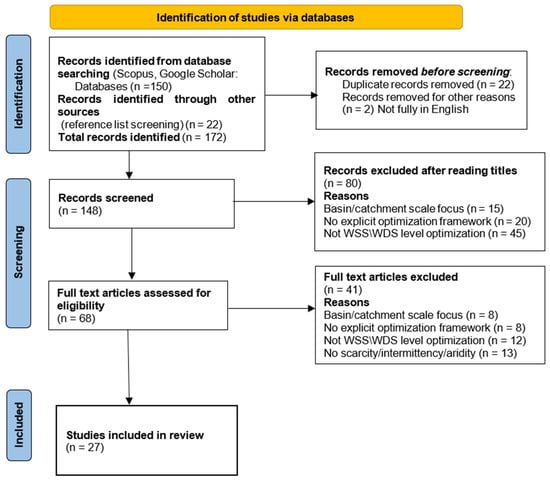
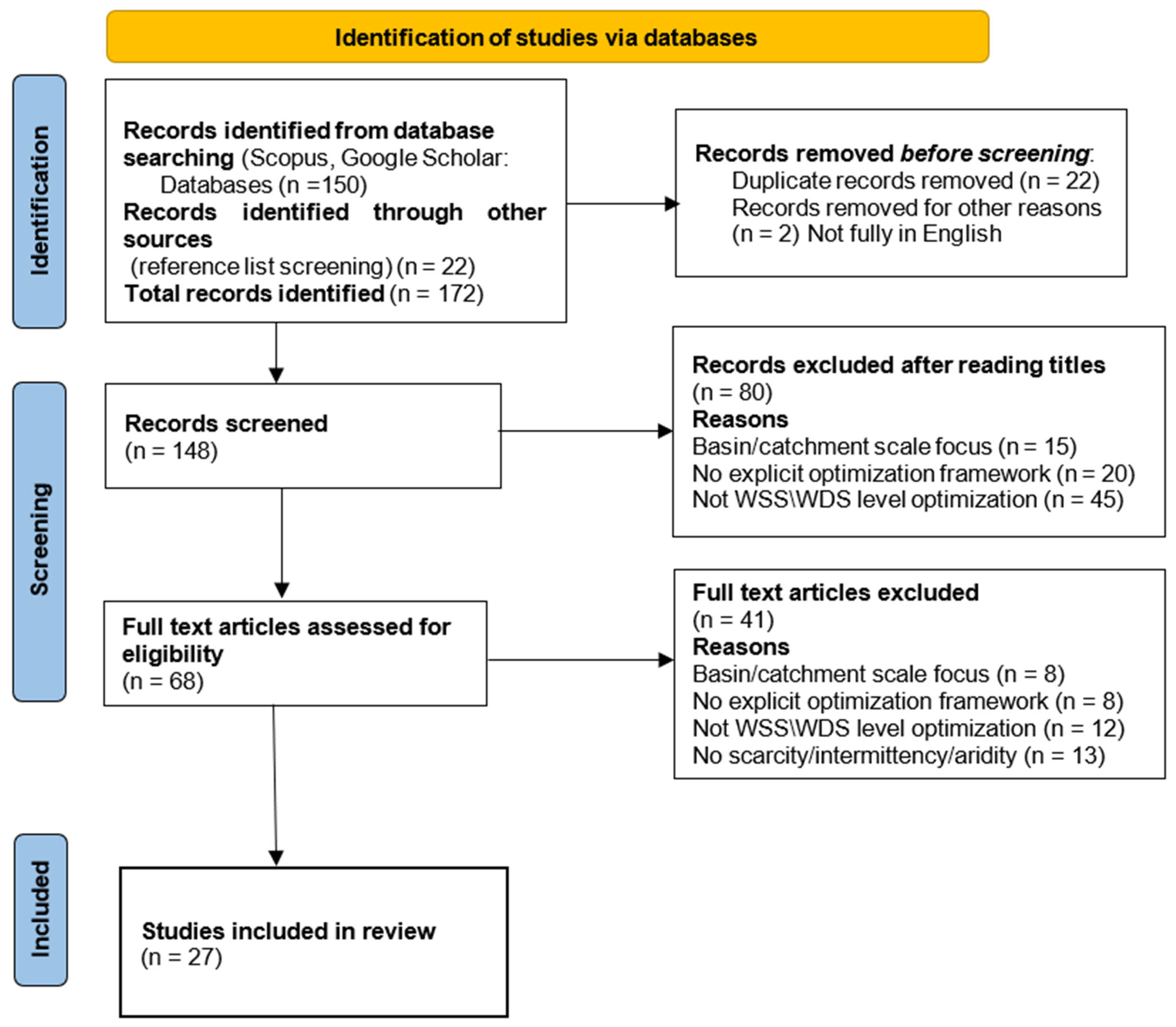
This review follows the Preferred Reporting Items for Systematic Reviews and Meta-Analyses (PRISMA) 2020 guidelines (Figure 1) for transparent reporting of literature identification, screening, and study inclusion [49].
Figure 1.
PRISMA 2020 flow diagram illustrating the identification, screening, eligibility assessment, and final inclusion of studies on optimization of water supply and water distribution systems under arid and water-scarce conditions.
Scopus was selected as the primary database for its comprehensive coverage of peer-reviewed literature and structured indexing of engineering and water resources research. Google Scholar was used as a supplementary database to ensure broader coverage, particularly for recent studies that may not yet be indexed in Scopus. All records retrieved from both databases were subjected to the same inclusion and exclusion criteria to ensure consistency and quality. In total, 172 articles were retrieved from the automatic search in Scopus® and Google Scholar using the keyword string “water supply distribution system” AND “optimization” AND “scarcity/arid/intermittent” and from the reference list for further screening. However, 22 of them were duplicates, as they appeared in both systems, and were excluded before the screening phase (see Figure 1).
The first level of screening was done by reading the title and abstract. Studies were included if they (i) address domestic water supply or water distribution systems in water-scarce environments explicitly, (ii) employ formal optimization techniques, and (iii) are published in peer-reviewed journals indexed in major scientific databases. Works that rely solely on hydraulic simulation, descriptive analysis, or machine-learning-based prediction without an explicit optimization framework are excluded. Similarly, basin-scale water allocation studies and policy-oriented analyses are considered outside the scope unless they are directly linked to the optimization of water distribution system infrastructure or operation. At the second level of screening, because the titles and abstracts of the remaining 68 articles did not provide all the necessary information, the full texts were read to verify their suitability for the scope of the review. At this second level, another 41 papers were removed for the aforementioned reason, and, finally, 27 articles were selected for review after the screening process, as depicted in Figure 1. The screening process was conducted by the first author and verified by one other co-author to ensure consistency in eligibility assessment.
The selected studies were systematically classified based on predefined criteria to enable comparative analysis across methodological and contextual dimensions.
First, the studies are divided into two macro-categories based on the water supply systems that are considered: benchmark WDS or real case studies. The studies conducted in benchmark networks refer to those that rely on standardized synthetic test water distribution networks used internationally for developing and evaluating optimization algorithms under controlled hydraulic and demand scenarios rather than real-world case studies. They were included in this review only if they met the inclusion criteria. This allows us to discuss the methodologies that are developed for arid and water-scarce areas and could be transferable to real case applications. The benchmark studies reviewed were on intermittent conditions (Battle of Intermittent Water Supply) and are classified based on the optimization stage, technique, the objectives and the findings. This allows us to discuss the methodologies developed in the literature that can be useful for arid and water-scarce areas, and could be transferable to real case applications. For real case studies, the scale of application, population served, and severity of water scarcity are also incorporated to provide more insight regarding what is done in the different contexts. In cases where information regarding population or the severity of the water scarcity was not included in the paper, they were retrieved online based on the location described in the study. The severity levels of water scarcity are classified as low, moderate, severe, and extreme based on the mean annual precipitation (MAP) and the population served. Indeed, MAP and population can be considered simple proxies for water availability and demand, and they influence the severity of water scarcity, as inferred from the classification in Table 1.
Table 1.
Severity of the water scarcity condition based on the mean annual precipitation (MAP) and the water demand (population served lower or greater than 500,000 inhabitants).
If the MAP is below 200 mm, the severity of the scarcity is classified as extreme. If MAP exceeds 600 mm, the severity condition is classified as low. Between 200 mm and 600 mm, the severity of the water scarcity also depends on the population served by the water supply system. The water scarcity level presented here is very similar to the FAO classification (FAO [50] and FAO [51] of hyper-arid (MAP lower than 100 mm), arid (MAP up to 300 mm), and semi-arid (MAP up to 600 mm) areas). However, the FAO classification relies strictly on precipitation data, whereas water scarcity in distribution systems also depends on the anthropogenic demand. To bridge this gap, a population threshold of 500,000 inhabitants was selected, as settlements above this size are classified as medium-to-large urban agglomerations [52] and usually require large-scale, centralized supply schemes. Crossing into these larger demographic scales severely concentrates water demand and creates complex distribution vulnerabilities that can become critical [53,54].
The decision stage within the water distribution system life-cycle, where optimization is applied, is one of the classification criteria for the reviewed literature. Four main optimization stages were identified in the reviewed articles: (i) design, (ii) operational, (iii) planning, (iv) rehabilitation. When reinterpreted as functional responses to water scarcity, these stages can be considered as proactive (design/planning), reactive (operation), or corrective (rehabilitation).
To ensure consistency in comparing optimization objectives across studies, a unified classification framework was developed. Reported objectives were grouped into five standardized categories: (i) cost efficiency (e.g., capital and operational cost minimization), (ii) energy efficiency (e.g., pump energy reduction), (iii) service reliability (e.g., pressure adequacy and supply continuity), (iv) water loss reduction (e.g., leakage minimization), and (v) equity (e.g., fair distribution of water under intermittent supply). Where studies reported multiple objectives, they were classified based on their primary or dominant objective(s), while preserving multi-objective formulations where applicable.
Some of the optimization methods used in the reviewed articles are represented by the following acronyms (Table 2). Following the PRISMA-based selection process, the reviewed studies are summarized in Table 3 for benchmark studies and Table 4 and Table 5 for real-world application, and then discussed in the Section 6.
Table 2.
Optimization methods used in the reviewed paper.
Table 3.
Summaries of the 12 peer-reviewed benchmark studies that developed methodologies for water supply system optimization in the context of intermittency or water scarcity. The studies are classified based on the optimization stage, technique, the objective and the main findings.
Table 4.
Summaries of the 15 peer-reviewed studies that developed methodologies for water supply system optimization in the context of intermittency or water scarcity in real case studies. The table contains the study area, the system context and scale, the population served (NA means population served could not be obtained or extrapolated), the mean annual precipitation, and the scarcity severity.
Table 5.
Summaries of the 15 peer-reviewed studies that developed methodologies for real case studies of water supply system optimization in the context of intermittency or water scarcity. The articles are classified based on the scarcity severity, optimization stage and technique, the objective and the main findings.
6. Results
The results are organized in three subsections: first, the global distribution of the reviewed papers is discussed to determine where the water distribution system optimization methods have been carried out in real-world case studies (Section 6.1); second, the studies are grouped based on the different optimization methods (Section 6.2); last, the main findings from the reviewed papers are summarized (Section 6.3).
6.1. Global Distribution and Context of the Real-World Applications
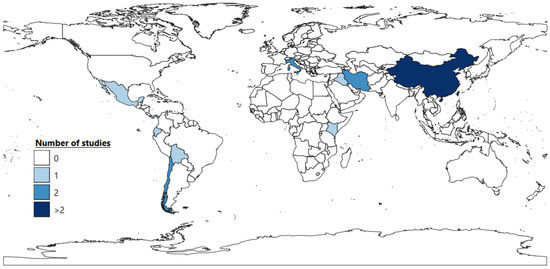
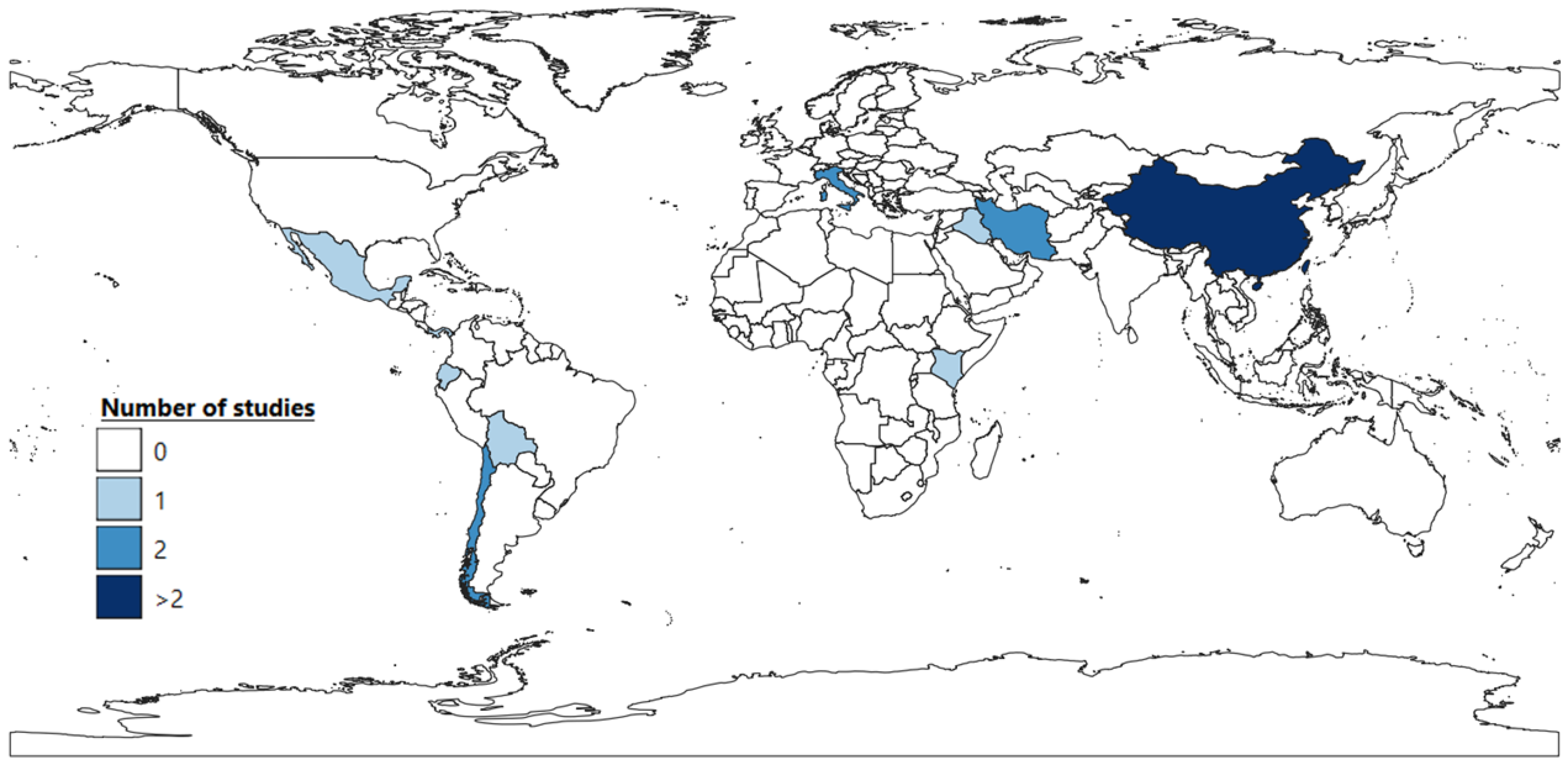
The global distribution of the selected articles which optimize networks in real-world applications is presented in Figure 2.
Figure 2.
Distribution of studies that focused on real water supply systems optimization in arid areas per country.
Out of the 27 selected articles, twelve papers rely on global benchmark networks, underscoring their central role in the methodical development and comparative evaluation of optimization frameworks that are directly transferable to systems in water-scarce environments. However, since they are not applied in real-world case studies, they are not in the map in Figure 2. The remaining studies are localized as follows: 22.2% (six papers) address Latin American systems; 11.1% (three papers) are from Asian case studies; 11.1% (three studies) are from the Middle East and North Africa; 7.4% (two papers) focus on European case studies; and just a single study is from Sub-Saharan Africa (3.7%). These results show that, on average, the areas facing the greatest water scarcity issues are also underrepresented in the literature. Though water scarcity and intermittent supply conditions are more prevalent in Sub-Saharan Africa and the Middle East, relatively few studies explicitly apply optimization techniques to water distribution systems in these regions [10,27,66,72]. In contrast, a significant proportion of optimization-based studies rely on benchmark or well-instrumented systems, often developed in data-rich environments [9,55]. Furthermore, advanced optimization approaches incorporating pressure-deficit modelling, reduced supply scenarios, and robust control are predominantly developed and tested outside these regions [4,68]. This disparity suggests that the gap is not only numerical but also structural, reflecting differences in data availability, institutional capacity, and the ability to implement and validate optimization approaches developed in benchmark studies to real-world systems.
Under the system context classification, eight studies applied to real case studies are in arid contexts, while the rest have been identified in the literature as water-scarce or facing intermittency. The studies are predominantly at the urban scale, with fewer at the regional scale. On the water scarcity scale, all arid regions are classified as under extreme or severe scarcity, while the intermittent and water-scarce studies are ranked as low scarcity, indicating that water availability may not be the main driver of intermittent supplies.
6.2. Classification According to Optimization Stage and Optimization Techniques
Out of the 27 reviewed articles, combining the information of Table 3 and Table 5, the optimization of the water supply systems at the operational stage accounts for the largest share of the literature [10,12,27,56,57,63,64,67,69,72,73,75], followed by the planning stage [9,66,68,70,71,74], the rehabilitation stage [24,58,59,60,62], and design stage optimization [11,55,61,65]. This distribution, where the operational stage dominates at 44.4%, indicates a strong emphasis on short-term system management over long-term system configuration, which ought to be achieved at design and planning stages, where each accounts for only 14.8% and 22.2%, respectively. It is noted that in benchmark studies, all the optimization stages are analyzed, with the rehabilitation stage forming the majority of cases. The main optimization objectives in this category are equity and service reliability, while the dominant technique applied across the stages is NSG–II. The key finding from these studies is the ability to improve service reliability through optimization by between 66% and 97% [55,61]. In contrast, real-world applications with severe or extreme water scarcity predominantly optimize the water distribution with a reactive approach, i.e., at the operational stage, indicating a gap in long-term infrastructure strategies for highly water-stressed contexts. Therefore, the review shows that there is a mismatch between the focus of the benchmark studies and real-world applications. In benchmark studies, the optimization focus is on design and rehabilitation, whereas in real-world case studies, the optimization focus is on operations and planning. This divergence limits the transferability of optimization approaches, as methods developed in benchmark environments often do not reflect the data constraints, operational uncertainties, and infrastructure conditions of real-world, water-scarce systems.
Methodologically, the choice of optimization technique is strongly aligned with the nature of the decision problem and the stage of application. Multi-objective evolutionary algorithms, particularly NSGA-II, are most frequently applied in design and operational contexts due to their ability to handle discrete, nonlinear, and multi-objective formulations inherent in pipe sizing, network configuration, and trade-offs between cost, reliability, and equity [4,55]. In contrast, deterministic and hybrid approaches, such as Mixed-Integer Linear Programming (MILP) and model predictive control (MPC), are more commonly employed in planning and control-oriented studies, where system dynamics, constraints, and temporal decision-making can be explicitly represented [49].
This pattern indicates a clear methodological segmentation across optimization stages, reflecting the differing computational and modelling requirements of strategic versus operational decision problems. However, the limited integration of these approaches across stages suggests an important gap in the literature, as few studies develop unified frameworks that simultaneously address design, planning, and real-time operation under water scarcity conditions.
6.3. Main Findings from the Literature
The geographical distribution of studies is highly uneven, with more concentration of real-world application in Latin America, while regions experiencing the most severe water scarcity conditions, such as Sub-Saharan Africa and the Middle East, are significantly underrepresented [10,27,66]. We also identified the fact that a substantial proportion of studies rely on benchmark or well-instrumented systems. While these studies provide valuable insights into algorithm performance and methodological development, their direct application to data-sparse and severely water-stressed systems remains challenging, mainly because of differences in data availability, system monitoring capacity, infrastructure reliability, and institutional constraints, which fundamentally influence model formulation and implementation. Significant adaptation may be required, hence limiting their direct applicability to real-world water-scarce environments. This reliance highlights challenges in data availability and model validation, particularly in developing regions [9,55].
Operational optimization represents the largest share of studies, especially in real-world applications, highlighting a strong emphasis on reactive management of water utilities in water-scarce environments, such as pump scheduling, leakage control, and storage management. In contrast, fewer studies, especially benchmark studies, address design stage optimization, indicating a gap in proactive system development for long-term resilience in water-scarce environments.
The adoption of a unified objective classification enables clearer comparison across studies. The results indicate that service reliability and equity are the most frequently addressed objectives in operation and planning studies. This underscores the critical importance of equitable water distribution within intermittent supply systems, under severe scarcity conditions.
There is an emergence of a distinct methodological pattern in which evolutionary algorithms (e.g., NSGA-II, GA) dominate design and operational problems, while deterministic and control-based approaches (e.g., MILP, MPC) are more prevalent in planning and real-time control contexts. This segmentation reflects the differing computational and modelling requirements across decision stages [24,61,71,73]. It is also worth noting that despite the advances in individual optimization approaches, there is limited integration between design, planning, and operational optimization, with most studies addressing these stages independently, as has been evidenced in the review. This highlights a gap in the development of holistic, multi-stage optimization frameworks capable of addressing water scarcity comprehensively. However, emerging approaches such as model predictive control, robust optimization, and data-driven methods are increasingly used to address system dynamics and uncertainty [9,33,64]. These approaches enable adaptive and proactive system management, although their application remains limited compared to traditional methods.
Another notable revelation from the review was that most studies do not explicitly report population served, scale of application, or quantified scarcity severity, leaving them for extrapolation and assumptions, which limit the ability to assess real-world applicability. This highlights the need for context-aware optimization frameworks that explicitly incorporate system scale and water stress conditions.
Overall, the findings demonstrate that while optimization techniques for water distribution systems have advanced significantly, their application remains largely reactive, geographically uneven, and insufficiently integrated across decision stages. Addressing these gaps requires the development of context-aware, multi-stage optimization frameworks that explicitly account for water scarcity severity, system scale, and real-world implementation constraints.
7. Discussion and Conclusions
A review of studies on water distribution systems optimization under water scarcity has been done with the PRISMA principles. The results reveal clear structural and methodological patterns in the optimization literature on water supply and distribution systems under water scarcity. Approximately 44.4% of the reviewed studies rely on global benchmark networks, indicating a strong emphasis on methodological development and comparative algorithm testing rather than context-specific validation [55,76]. While such studies are valuable for advancing optimization techniques, their limited application to real-world systems constrains their transferability to water-scarce environments. Specifically, real-world applications tend to use a reactive approach optimizing existing networks at the operational stage, rather than focusing on the design and rehabilitation stage, as the majority of the benchmark studies do.
The review further demonstrates a highly uneven geographical distribution of real-world applications, with Latin America accounting for 22.2% of all the reviewed case studies, while the Middle East and North Africa account for 11.1% and Sub-Saharan Africa for 3.7%. This finding clearly indicates a mismatch between the regions most affected by water scarcity and the research done in these countries. However, there is a huge correlation between water scarcity and unfavourable economic conditions that can partially explain why these places are underrepresented in the literature. The research dominance in Latin America can be attributed to well-established regulatory frameworks, high levels of utility digitalization, and sustained investment in applied water research, which together facilitate access to high-quality operational data and close collaboration between researchers and utilities [5,77,78]. At the same time, the underrepresentation of Sub-Saharan Africa despite severe and persistent water scarcity can be attributed to limited monitoring infrastructure, data scarcity, and weaker integration between utilities and research institutions, which constrain the application and validation of advanced optimization frameworks [27,64,71].
Intermittency is a common phenomenon in systems operating in water-scarce environments, such as in arid and semi-arid regions. This fundamentally alters the functioning of water distribution networks due to transient flow between free surface and pressurized flow [12]. Reduced and variable water availability leads to pressure deficits, inequitable distribution, increased leakage, and deterioration of service reliability [58,59]. These conditions introduce significant operational complexity, requiring utilities to balance limited supply with fluctuating demand while maintaining acceptable service levels. In this context, optimization becomes a critical tool for managing trade-offs between competing objectives, including cost minimization, energy efficiency, and service reliability. Rather than focusing solely on least-cost design, optimization approaches in water-scarce systems must account for constrained supply conditions, system resilience, and equitable water distribution [9]. This reinforces the importance of context-aware optimization frameworks that explicitly incorporate scarcity conditions into both design and operational decision-making.
In contrast to conventional expectations, the results show that operational optimization constitutes the largest share of the literature, indicating a strong emphasis on short-term system management. These approaches—such as pump scheduling, leakage control, and storage optimization—demonstrate significant improvements in energy efficiency and operational cost reduction, often in the range of 15–50%, without requiring infrastructure expansion [4,10,70,73].
Studies that investigate optimisation in the design and planning stage, although substantial, are comparatively fewer and in benchmark studies. They focus on long-term infrastructure decisions such as network layout, pipe sizing, and system expansion and incorporate multi-objective formulations, reflecting a transition from deterministic least-cost design toward resilience-oriented system planning [9,55].
A clear association emerges between optimization techniques and decision stages. Multi-objective evolutionary algorithms, such as NSGA-II and Genetic Algorithms, dominate design and operational problems [55,68]. In contrast, deterministic and control-based approaches, including MILP and model predictive control (MPC), are more prevalent in planning and real-time control applications, where system dynamics and temporal constraints can be explicitly modelled [33,64].
Predictive and data-driven optimization approaches are gaining traction, enabling adaptive system management through forecast-based decision-making. However, their adoption remains limited due to data availability and computational requirements.
The study identifies that optimization techniques applied to systems characterized by extreme scarcity (arid systems) are predominantly addressed through operational stage (reactive) optimization, reflecting the need to manage immediate supply constraints. This reveals a critical gap as long-term infrastructure strategies are not sufficiently developed at design stages for the most water-stressed environments. It is also noted that although robust, stochastic, and scarcity-aware decision-support approaches are increasingly recognized as essential for managing uncertainty, intermittency, and equity, they remain underrepresented in the literature.
This review is subject to some limitations. First, the search was limited to Scopus and Google Scholar, potentially excluding relevant studies indexed in other databases. Second, only English-language peer-reviewed journal articles were included, which may introduce publication bias. Third, the classification framework relies on reported methodological descriptions and may not fully capture minor implementation differences.
The final key messages of this review article are:
- The literature is geographically imbalanced, with optimization studies heavily concentrated in benchmark and Latin America contexts, while regions facing the most acute water stress remain underrepresented despite the high practical relevance of optimization in these settings. Unfavourable economic conditions in arid regions can also explain this gap.
- Optimization approaches in real-world applications are predominantly reactive, with operational optimization dominating the literature, indicating a focus on managing scarcity impacts rather than proactively designing resilient systems.
- A clear methodological segmentation exists, with evolutionary algorithms dominating design and operational problems, and deterministic and control-based methods applied in planning and control contexts.
- A persistent gap exists between methodological development and real-world application, driven by data limitations, institutional constraints, and a lack of context-specific frameworks.
- Robust, stochastic, and scarcity-aware decision-support approaches remain underrepresented despite their critical role in managing uncertainty, intermittency, and equity.
Overall, the review demonstrates that while optimization techniques for water distribution systems have advanced significantly, especially in benchmark studies, their application in a real-world context remains fragmented and predominantly reactive. Addressing these challenges requires the development of integrated, context-aware optimization frameworks that explicitly incorporate system scale, population dynamics, and scarcity severity, particularly in underrepresented and water-stressed regions.
Author Contributions
Conceptualization, C.O.M., Z.I.O., P.A.O., E.C. and M.L.; methodology, C.O.M., Z.I.O., E.C. and M.L.; resources, C.O.M., E.C. and M.L.; writing—original draft preparation, C.O.M. and M.L.; writing—review and editing, E.C., M.L. and C.O.M.; supervision, Z.I.O., P.A.O., G.O.O. and E.C. All authors have read and agreed to the published version of the manuscript.
Funding
This research received no external funding.
Data Availability Statement
No new data were created or analyzed in this study.
Acknowledgments
The authors acknowledge the Erasmus+ KA171 International Credit Mobility (ICM) Programme, under which the collaboration between the University of Nairobi and the University of Florence has started.
Conflicts of Interest
The authors declare no conflicts of interest. The funders had no role in the design of the study; in the collection, analyses, or interpretation of data; in the writing of the manuscript; or in the decision to publish the results.
References
- Mekonnen, M.M.; Hoekstra, A.Y. Four billion people facing severe water scarcity. Sci. Adv. 2016, 2, e1500323. [Google Scholar] [CrossRef] [Scilit]
- Pandit, J.; Sharma, A.K. Impact of Climate Change on Drought: A Comprehensive Review. Int. J. Agric. Environ. Biotechnol. 2024, 17, 749–763. [Google Scholar] [CrossRef] [Scilit]
- Al-Bakri, J.T.; Shawash, S.; Ghanim, A.; Abdelkhaleq, R. Geospatial Techniques for Improved Water Management in Jordan. Water 2016, 8, 132. [Google Scholar] [CrossRef] [Scilit]
- Carpitella, S.; Brentan, B.; Montalvo, I.; Izquierdo, J.; Certa, A. Multi-criteria analysis applied to multi-objective optimal pump scheduling in water systems. Water Supply 2019, 19, 2338–2346. [Google Scholar] [CrossRef] [Scilit]
- Puust, R.; Kapelan, Z.; Savic, D.A.; Koppel, T. A review of methods for leakage management in pipe networks. Urban Water J. 2010, 7, 25–45. [Google Scholar] [CrossRef] [Scilit]
- Bello, O.; Abu-Mahfouz, A.M.; Hamam, Y.; Page, P.R.; Adedeji, K.B.; Piller, O. Solving Management Problems in Water Distribution Networks: A Survey of Approaches and Mathematical Models. Water 2019, 11, 562. [Google Scholar] [CrossRef] [Scilit]
- Morante-Carballo, F.; Montalván-Burbano, N.; Quiñonez-Barzola, X.; Jaya-Montalvo, M.; Carrión-Mero, P. What Do We Know about Water Scarcity in Semi-Arid Zones? A Global Analysis and Research Trends. Water 2022, 14, 2685. [Google Scholar] [CrossRef] [Scilit]
- Simukonda, K.; Farmani, R.; Butler, D. Intermittent water supply systems: Causal factors, problems and solution options. Urban Water J. 2018, 15, 488–500. [Google Scholar] [CrossRef] [Scilit]
- Andrade, S.; Sauma, E. Co-optimization of water and power systems’ long-term expansion planning in arid regions with desalination plants providing water to high-altitude demand points. J. Clean. Prod. 2025, 520, 146008. [Google Scholar] [CrossRef] [Scilit]
- Dadar, S.; Đurin, B.; Alamatian, E.; Plantak, L. Impact of the Pumping Regime on Electricity Cost Savings in Urban Water Supply System. Water 2021, 13, 1141. [Google Scholar] [CrossRef] [Scilit]
- Nyahora, P.P.; Babel, M.S.; Ferras, D.; Emen, A. Multi-objective optimization for improving equity and reliability in intermittent water supply systems. Water Supply 2020, 20, 1592–1603. [Google Scholar] [CrossRef] [Scilit]
- Lieb, A.M.; Rycroft, C.H.; Wilkening, J. Optimizing intermittent water supply in urban pipe distribution networks. SIAM J. Appl. Math. 2016, 76, 1492–1514. [Google Scholar] [CrossRef] [Scilit]
- Aghdam, K.M.; Mirzaee, I.; Pourmahmood, N.; Aghababa, M.P. Design of water distribution networks using accelerated momentum particle swarm optimisation technique. J. Exp. Theor. Artif. Intell. 2014, 26, 459–475. [Google Scholar] [CrossRef] [Scilit]
- Behandish, M.; Wu, Z. Concurrent pump scheduling and storage level optimization using meta-models and evolutionary algorithms. Procedia Eng. 2014, 70, 103–112. [Google Scholar] [CrossRef] [Scilit]
- Pagayona, E.N.; Honra, J. Developing an Optimal Model for Water Distribution System Design. Power Syst. Technol. 2024, 48, 1233–1257. [Google Scholar] [CrossRef] [Scilit]
- Creaco, E.; Campisano, A.; Fontana, N.; Marini, G.; Page, P.R.; Walski, T. Real time control of water distribution networks: A state-of-the-art review. Water Res. 2019, 161, 517–530. [Google Scholar] [CrossRef] [Scilit]
- Castelletti, A.; Ficchì, A.; Cominola, A.; Segovia, P.; Giuliani, M.; Wu, W.; Lucia, S.; Ocampo-Martinez, C.; De Schutter, B.; Maestre, J.M. Model predictive control of water resources systems: A review and research agenda. Annu. Rev. Control 2023, 55, 442–465. [Google Scholar] [CrossRef] [Scilit]
- Mala-Jetmarova, H.; Sultanova, N.; Savic, D. Lost in optimisation of water distribution systems? A literature review of system operation. Environ. Model. Softw. 2017, 93, 209–254. [Google Scholar] [CrossRef] [Scilit]
- Awe, O.M.; Okolie, S.T.A.; Fayomi, O.S.I. Optimization of water distribution systems: A review. J. Phys. Conf. Ser. 2019, 1378, 022068. [Google Scholar] [CrossRef] [Scilit]
- Ferrarese, G.; Medoukali, D.; Mirauda, D.; Malavasi, S. Review of Metaheuristic Methodologies for Leakage Reduction and Energy Saving in Water Distribution Networks. Water Resour. Manag. 2024, 38, 3973–4001. [Google Scholar] [CrossRef] [Scilit]
- Savić, D.; Mala-Jetmarova, H.; Sultanova, N. History of Optimization in Water Distribution System Analysis. In Proceedings of the 1st International WDSA/CCWI 2018 Joint Conference, Kingston, ON, Canada, 23–25 July 2018. [Google Scholar]
- Olago, D.O. Constraints and solutions for groundwater development, supply and governance in urban areas in Kenya. Hydrogeol. J. 2018, 27, 1031–1050. [Google Scholar] [CrossRef] [Scilit]
- Schimel, D.S. Drylands in the Earth System. Science 2010, 327, 418–419. [Google Scholar] [CrossRef] [Scilit]
- Brentan, B.; Zanfei, A.; Souza, R.G.; Menapace, A.; Meirelles, G.; Izquierdo, J. Optimal rehabilitation procedure for intermittent water supply systems. J. Water Resour. Plan. Manag. 2024, 150, 04024019. [Google Scholar] [CrossRef] [Scilit]
- Sarisen, D.; Koukoravas, V.; Farmani, R.; Kapelan, Z.; Memon, F.A. Review of hydraulic modelling approaches for intermittent water supply systems. AQUA-Water Infrastruct. Ecosyst. Soc. 2022, 71, 1291–1310. [Google Scholar] [CrossRef] [Scilit]
- Hirpa, F.A.; Dyer, E.; Hope, R.; Olago, D.O.; Dadson, S.J. Finding sustainable water futures in data-sparse regions under climate change: Insights from the Turkwel River basin, Kenya. J. Hydrol. Reg. Stud. 2018, 19, 124–135. [Google Scholar] [CrossRef] [Scilit]
- Maxwell, C.O.; Oonge, Z.I.; Odira, P.M.A.; Ouma, G.O.; Lompi, M.; Pacetti, T.; Di Bacco, M.; Caporali, E. Water–Energy Nexus-Based Optimization of the Water Supply Infrastructure in a Dryland Urban Setting. Water 2024, 16, 3073. [Google Scholar] [CrossRef] [Scilit]
- Reis, A.L.; Andrade-Campos, A.; Matos, P.; Antunes, C.H.; Lopes, M.A. An energy and cost efficiency Model Predictive Control framework to optimize Water Supply Systems operation. Appl. Energy 2025, 384, 125478. [Google Scholar] [CrossRef] [Scilit]
- Rao, S.S. Engineering Optimization Theory and Practice, 4th ed.; John Wiley & Sons Inc.: Hoboken, NJ, USA, 2009. [Google Scholar]
- Letting, L.K.; Hamam, Y.; Abu-Mahfouz, A.M. Estimation of Water Demand in Water Distribution Systems Using Particle Swarm Optimization. Water 2017, 9, 593. [Google Scholar] [CrossRef] [Scilit]
- Tolson, B.A.; Maier, H.R.; Simpson, A.R.; Lence, B.J. Genetic algorithms for reliability-based optimization of water distribution systems. J. Water Resour. Plan. Manag. 2004, 130, 63–72. [Google Scholar] [CrossRef] [Scilit]
- Aklog, D.; Hosoi, Y. Reliability-based optimal design of water distribution networks. Water Sci. Technol. Water Supply 2003, 3, 11–18. [Google Scholar] [CrossRef] [Scilit]
- Brás, M.; Moura, A.; Andrade-Campos, A. A novel hybrid optimization approach for cost-efficient pump scheduling in water supply systems. Omega 2025, 138, 103378. [Google Scholar] [CrossRef] [Scilit]
- Parvaze, S.; Kumar, R.; Khan, J.N.; Al-Ansari, N.; Parvaze, S.; Vishwakarma, D.K.; Elbeltagi, A.; Kuriqi, A. Optimization of Water Distribution Systems Using Genetic Algorithms: A Review. Arch. Comput. Methods Eng. 2023, 30, 4209–4244. [Google Scholar] [CrossRef] [Scilit]
- Shahhosseini, A.; Najarchi, M.; Najafizadeh, M.M.; Hezaveh, M.M. Performance optimization of water distribution network using meta-heuristic algorithms from the perspective of leakage control and resiliency factor (case study: Tehran water distribution network, Iran). Results Eng. 2023, 20, 101603. [Google Scholar] [CrossRef] [Scilit]
- Middleton, N.; Sternberg, T. Climate hazards in drylands: A review. Earth-Sci. Rev. 2013, 126, 48–57. [Google Scholar] [CrossRef] [Scilit]
- Zhang, C.-Y.; Oki, T. Optimal Multi-Sectoral Water Resources Allocation Based on Economic Evaluation Considering the Environmental Flow Requirements: A Case Study of Yellow River Basin. Water 2021, 13, 2253. [Google Scholar] [CrossRef] [Scilit]
- Global Water Partnership. GWP Annual Progress Review 2020; Global Water Partnership: Stockholm, Sweden, 2021; Available online: https://www.gwp.org/contentassets/423b566e6334478595159bf0274b2cbd/gwp-progress-review-2020.pdf.
- Galaitsi, S.E.; Russell, R.; Bishara, A.; Durant, J.L.; Bogle, J.; Huber-Lee, A. Intermittent domestic water supply: A critical review and analysis of causal-consequential pathways. Water 2016, 8, 274. [Google Scholar] [CrossRef] [Scilit]
- Kaminsky, J.; Kumpel, E. Dry pipes: Associations between utility performance and intermittent piped water supply in low and middle income countries. Water 2018, 10, 1032. [Google Scholar] [CrossRef] [Scilit]
- Naumann, G.; Cammalleri, C.; Mentaschi, L.; Feyen, L. Increased economic drought impacts in Europe with anthropogenic warming. Nat. Clim. Chang. 2021, 11, 485–491. [Google Scholar] [CrossRef] [Scilit]
- Mombrini, E.; Tamea, S.; Viglione, A.; Revelli, R. A 60-year drought analysis of meteorological data in the western Po River basin. Hydrol. Earth Syst. Sci. 2025, 29, 2255–2273. [Google Scholar] [CrossRef] [Scilit]
- Dukat, P.; Bednorz, E.; Ziemblińska, K.; Urbaniak, M. Trends in drought occurrence and severity at mid-latitude European stations (1951–2015) estimated using standardized precipitation (SPI) and precipitation and evapotranspiration (SPEI) indices. Meteorol. Atmos. Phys. 2022, 134, 58. [Google Scholar] [CrossRef] [Scilit]
- Najafi, M.R.; Khanbilvardi, R. Clustering and trend analysis of global extreme droughts from 1900 to 2014. arXiv 2019, arXiv:1901.00052. [Google Scholar] [CrossRef] [Scilit]
- Ganguli, P.; Ganguly, A.R. Space-time trends in U.S. meteorological droughts. arXiv 2015, arXiv:1512.08526. [Google Scholar] [CrossRef] [Scilit]
- Christodoulou, S.; Agathokleous, A. A study on the effects of intermittent water supply on the vulnerability of urban water distribution networks. Water Sci. Technol. Water Supply 2012, 12, 523–530. [Google Scholar] [CrossRef] [Scilit]
- Ghorpade, A.; Sinha, A.K.; Kalbar, P.P. Drivers for intermittent water supply in India: Critical review and perspectives. Front. Water 2021, 3, 696630. [Google Scholar] [CrossRef] [Scilit]
- Mala-Jetmarova, H.; Sultanova, N.; Savic, D. Lost in Optimisation of Water Distribution Systems? A Literature Review of System Design. Water 2018, 10, 307. [Google Scholar] [CrossRef] [Scilit]
- Page, M.J.; McKenzie, J.E.; Bossuyt, P.M.; Boutron, I.; Hoffmann, T.C.; Mulrow, C.D.; Shamseer, L.; Tetzlaff, J.M.; Akl, E.A.; Brennan, S.E.; et al. The PRISMA 2020 statement: An updated guideline for reporting systematic reviews. BMJ 2021, 372, 71. [Google Scholar] [CrossRef] [Scilit]
- Food and Agriculture Organization (FAO). Land Evaluation for Rainfed Agriculture; FAO Soils Bulletin 52; FAO: Rome, Italy, 1987. [Google Scholar]
- Food and Agriculture Organization (FAO). Agro-Ecological Assessments for National Planning: The Example of Kenya; FAO: Rome, Italy, 1993. [Google Scholar]
- United Nations, Department of Economic and Social Affairs, Population Division. The World’s Cities in 2018—Data Booklet (ST/ESA/SER.A/417); United Nations: New York, NY, USA, 2018. [Google Scholar]
- UNESCO; UN-Water. Water for Sustainable Urban Human Settlements; United Nations World Water Assessment Programme: Paris, France, 2010. [Google Scholar]
- Chung, E.-S.; Kim, Y.; Won, K.; Lee, H.-S. Water Resource Vulnerability Characteristics by District’s Population Size in a Changing Climate Using Subjective and Objective Weights. Sustainability 2014, 6, 6141–6161. [Google Scholar] [CrossRef] [Scilit]
- Ameyaw, E.E.; Memon, F.A.; Bicik, J. Improving equity in intermittent water supply systems. J. Water Supply Res. Technol.-AQUA 2013, 62, 552–562. [Google Scholar] [CrossRef] [Scilit]
- Ayyash, F.; Zhang, C.; Javadi, A.A.; Farmani, R. Optimal operation of intermittent water supply systems under water scarcity. J. Water Resour. Plan. Manag. 2024, 150, 04024001. [Google Scholar] [CrossRef] [Scilit]
- Hendrickson, G.; Sela, L. Optimizing equity in intermittent water supply systems: A volume-driven demand and flow control approach. Sustain. Cities Soc. 2024, 112, 105615. [Google Scholar] [CrossRef] [Scilit]
- Marsili, V.; Mazzoni, F.; Marzola, I.; Alvisi, S.; Franchini, M. Intermittent water supply system rehabilitation through a multiphase methodology based on network analysis and hydraulic modeling. J. Water Resour. Plan. Manag. 2023, 149, 04023048. [Google Scholar] [CrossRef] [Scilit]
- Mottahedin, A.; Minaei, A.; Sitzenfrei, R.; Creaco, E. Multistep approach for the rehabilitation of a deteriorated water distribution network operating intermittently. J. Water Resour. Plan. Manag. 2023, 149, 04023067. [Google Scholar] [CrossRef] [Scilit]
- Perelman, G.; Xing, L.; Housh, M.; Kandiah, V.; Fishbain, B.; Shafiee, E. Greedy Budget Allocation for Optimizing the Performance of Water Distribution Systems under Intermittent Supply Conditions. J. Water Resour. Plan. Manag. 2025, 151, 04025018. [Google Scholar] [CrossRef] [Scilit]
- Ramani, K.; Rudraswamy, G.K.; Umamahesh, N.V. Optimal design of intermittent water distribution network considering network resilience and equity in water supply. Water 2023, 15, 3265. [Google Scholar] [CrossRef] [Scilit]
- Saldarriaga, J.; Bohorquez, J.; Salcedo, C.; Garzón, A.; Celeita, D.; Enriquez, L.; Herrán, J.; Ariza, A.; González, M.A.; Gómez, S.; et al. Phased methodology for the optimal rehabilitation of a network with an intermittent water supply based on hydraulic criteria. J. Water Resour. Plan. Manag. 2025, 151, 04025013. [Google Scholar] [CrossRef] [Scilit]
- Souza, R.G.; Meirelles, G.; Brentan, B.; Izquierdo, J. Rehabilitation in intermittent water distribution networks for optimal operation. Water 2022, 14, 88. [Google Scholar] [CrossRef] [Scilit]
- Zhang, Y.; Zheng, Y.; Li, S.; Zou, Y. Economic model predictive control for the operation optimization of water distribution networks with risks. Asian J. Control 2019, 23, 128–142. [Google Scholar] [CrossRef] [Scilit]
- Zhang, C.; Li, Z.; Zhang, X.; Luo, Z.; Liu, H.; Zhao, M. Multistage Many-Objective Optimization Solution Method for Battle of Intermittent Water Supply. J. Water Resour. Plan. Manag. 2025, 151, 04025029. [Google Scholar] [CrossRef] [Scilit]
- Eryiğit, M.; Sulaiman, S.O.; Najm, A.B.A.; Mhedi, N.M. Optimal management of multiple water resources by a heuristic optimization for a water supply in the desert cities of Western Iraq. Desalination Water Treat. 2023, 281, 7–14. [Google Scholar] [CrossRef] [Scilit]
- Gullotta, A.; Campisano, A.; Creaco, E.; Modica, C. A Simplified methodology for optimal location and setting of valves to improve equity in intermittent water distribution systems. Water Resour. Manag. 2021, 35, 4477–4494. [Google Scholar] [CrossRef] [Scilit]
- Herrera-León, S.; Lucay, F.; Kraslawski, A.; Cisternas, L.A.; Gálvez, E.D. Optimization Approach to Designing Water Supply Systems in Non-Coastal Areas Suffering from Water Scarcity. Water Resour. Manag. 2018, 32, 2457–2473. [Google Scholar] [CrossRef] [Scilit]
- Ilaya-Ayza, A.E.; Benítez, J.; Izquierdo, J.; Pérez-García, R. Multi-criteria optimization of supply schedules in intermittent water supply systems. J. Comput. Appl. Math. 2017, 309, 695–703. [Google Scholar] [CrossRef] [Scilit]
- Li, Q.; Wang, W.; Jiang, X.; Lu, D.; Zhang, Y.; Li, J. Optimizing the reuse of reclaimed water in arid urban regions: A case study in Urumqi, Northwest China. Sustain. Cities Soc. 2019, 51, 101702. [Google Scholar] [CrossRef] [Scilit]
- Ochoa-Barragán, R.; Nápoles-Rivera, F.; Ponce-Ortega, J.M. Optimal and fair distribution of water under water scarcity scenarios at a macroscopic level. Int. J. Environ. Res. 2020, 15, 57–77. [Google Scholar] [CrossRef] [Scilit]
- Solgi, M.; Bozorg-Haddad, O.; Loáiciga, H.A. A multi-objective optimization model for operation of intermittent water distribution networks. Water Supply 2020, 20, 2630–2647. [Google Scholar] [CrossRef] [Scilit]
- Souza, R.G.; Anchieta, T.; Meirelles, G.; Barros, D.; Brentan, B. Optimal partitioning and operation of water distribution networks under intermittent conditions: A case study of Modena network. Water Sci. Eng. 2025, 19, 120–131. [Google Scholar] [CrossRef] [Scilit]
- Wang, Y.; Zhang, S.; Huang, H.; Wang, L.; Han, X.; Zhao, N.; Zhao, X.; Zhao, Y.; Gao, X. A new water allocation scheme considering the optimization of industrial structures in arid areas of the Chinese Loess Plateau. J. Hydrol. Reg. Stud. 2023, 49, 101503. [Google Scholar] [CrossRef] [Scilit]
- Zhang, Y.; Hu, T.; Xue, H.; Liu, X. Simulation and optimal scheduling of water quality in urban and rural water supply systems: A case study in the northwest arid region of china. Water 2024, 16, 2181. [Google Scholar] [CrossRef] [Scilit]
- Sangroula, U.; Han, K.-H.; Koo, K.-M.; Gnawali, K.; Yum, K.-T. Optimization of water distribution networks using genetic algorithm based SOP–WDN program. Water 2022, 14, 851. [Google Scholar] [CrossRef] [Scilit]
- Danilenko, A.; van den Berg, C.; Macheve, B.; Moffitt, L.J. The IBNET Water Supply and Sanitation Performance Blue Book 2014: The International Benchmarking Network for Water and Sanitation Utilities Databook; World Bank: Washington, DC, USA, 2014. [Google Scholar]
- Verheijen, P.C.N.; de Groot, W.; Goswami, D.; Lazar, M. Multi-resolution model predictive control with real-time demand forecasting for water distribution networks. Urban Water J. 2025, 22, 789–804. [Google Scholar] [CrossRef] [Scilit]

Disclaimer/Publisher’s Note: The statements, opinions and data contained in all publications are solely those of the individual author(s) and contributor(s) and not of MDPI and/or the editor(s). MDPI and/or the editor(s) disclaim responsibility for any injury to people or property resulting from any ideas, methods, instructions or products referred to in the content. |
© 2026 by the authors. Licensee MDPI, Basel, Switzerland. This article is an open access article distributed under the terms and conditions of the Creative Commons Attribution (CC BY) license.