


Highlights
- Pathways related to metabolism and information processing in plastisphere were enhanced.
- Disinfection significantly removed wastewater ARGs, plastisphere excluded.
- Microbial communities in plastisphere exhibited uniform species distribution.
- Microbial diversity was positively correlated with ARGs and MGEs.
- Attention should be paid to microplastics in wastewater treatment.
Abstract
Wastewater treatment plants (WWTPs), which serve as a bridge between wastewater and aquatic environment, may inadvertently introduce microplastics and antibiotic resistance genes (ARGs) into receiving water. Microplastics in wastewater can accumulate microorganisms to form plastispheres, potentially increasing the risk of ARGs in WWTP effluent. To better understand this phenomenon, this study utilized metagenomics and qPCR to investigate the characteristics of microorganisms and ARGs in plastisphere and wastewater throughout the wastewater treatment process. The results showed that there were significant differences in the microbial community structure and functional expression in plastisphere and wastewater. The microbial communities in plastisphere also exhibited superior diffusion rates and greater stability. Consequently, the disinfection unit significantly reduced microbial abundance, diversity, and Human Diseases-related metabolic pathways in wastewater, yet having minimal impact on plastisphere. Additionally, the increased microbial diversity and enhanced function associated with ARG proliferation in the plastisphere elevated the relative abundance of ARGs. The presence of microplastics in WWTP protected ARGs from elimination, thereby increasing the risk of ARG being carried in effluent, and this may pose serious threats to aquatic ecosystems. These findings provide insights into the ecological risks associated with microplastics in WWTPs and emphasize the importance of comprehensively controlling microplastics entry into wastewater and enhancing microplastic removal from WWTPs.
1. Introduction
Plastic products can generate microplastics (particles < 5 mm) across their life cycle, including manufacturing and processing, transportation, use, and end-of-life disposal [1]. Primary microplastics are intentionally produced for industrial or commercial applications, whereas secondary microplastics originate from the fragmentation and degradation of larger plastic items in the environment. Microplastics generally exhibit resistance to degradation, environmental persistence, and the capacity for long-range transport, and these properties contribute to their widespread occurrence across environmental media, including aquatic systems, soils, and the atmosphere. In addition, microplastics can adsorb a range of contaminants, including heavy metals [2], antibiotics [3], and persistent organic pollutants [4], thereby acting as mobile carriers of co-occurring chemical stressors. Contaminant-laden microplastics can enter organisms primarily via ingestion and inhalation, accumulate within biota, and be transferred through food webs to humans [5], raising concerns for human health.
A key concern is that environmental microplastics provide persistent surfaces for microbial colonization and biofilm development. Microbial colonization of microplastic surfaces creates a distinct biofilm habitat termed the plastisphere [6]. Studies have shown that plastisphere communities differ from surrounding matrices in taxonomic composition and functional potential [7], and such divergence can shift nutrient-cycling processes in the surrounding environment and alter local biogeochemical functioning [8]. Plastisphere biofilms have been reported to harbor pathogenic bacteria, positioning microplastics as candidate hotspots for pathogen accumulation [6,9]. For example, agricultural plastisphere biofilms contained higher abundances of pathogenic bacteria and nitrogen- and sulfur-cycling microorganisms than surrounding soils, consistent with an increased potential for nitrogen and sulfur losses from soil systems [10]. In estuaries, plastisphere-associated denitrifiers exhibited broader niche breadth and greater niche overlap and included distinct core taxa, supporting the view that estuarine plastisphere can contribute to N2O production [11]. Alongside these biogeochemical implications, recent studies identify the plastisphere as a relevant reservoir and potential dissemination interface for antibiotic-resistant bacteria (ARB) and antibiotic resistance genes (ARGs) [12,13,14], and plastisphere samples from urban aquatic ecosystems contained a higher number of detected ARGs than surrounding water samples [15]. The extent of antibiotic-resistance dissemination via the plastisphere depends on polymer type and environmental conditions [14]. A recent study differentiated plastisphere communities on biodegradable versus non-biodegradable plastics when assessing antibiotic-resistance risks [16]; nevertheless, evidence for plastisphere dynamics across environmental gradients, particularly within wastewater treatment processes, remains limited.
Long-term incubation of microplastics in wastewater has been reported to increase ARG abundance through two main mechanisms: enrichment of ARGs and ARG-harboring microbes on microplastic-associated biofilms and enhanced horizontal gene transfer among plastisphere microorganisms that facilitates ARG dissemination [17]. In parallel, WWTP effluents can transport microplastics that carry pathogens and antibiotic-resistance determinants to rivers and lakes [18,19]. Conventional treatment trains, including anaerobic digestion, membrane bioreactors (MBRs), and anaerobic–anoxic–oxic (A2/O) processes, together with disinfection (e.g., UV, sodium hypochlorite, and ozone), are widely implemented for the removal of nutrients, antibiotics, and microplastics from wastewater [18], yet ARG removal by these processes is often incomplete and varies across treatment configurations and operational conditions [19]. Although WWTPs can remove substantial fractions of microplastics, residual microplastics can still reach aquatic environments via effluents or sludge pathways, particularly given the large volumes of wastewater treated, and urban WWTP effluents have been identified as important sources of microplastics in natural water bodies [20,21]. Consistent with this, plastisphere bacterial communities have been reported to differ from those in paired wastewater samples [22]. Previous studies have examined microbial enrichment and ecological functions of the plastisphere in aquatic and soil environments [10,11], and other work has compared colonization dynamics on microplastic surfaces with those on natural substrates (e.g., wood, glass, and gravel) and evaluated the associated risk of ARG carriage [6,23]. Because WWTPs represent major conduits for microplastic transport, most studies have focused on microplastics in effluents and receiving waters, whereas relatively few studies have systematically characterized plastisphere community succession, assembly processes, within-community interactions, functional potential, and ARG dissemination across the full wastewater treatment train.
To address the gaps identified above, we selected two commonly detected microplastic polymers, polylactic acid (PLA) and polyethylene terephthalate (PET), for microbial colonization experiments. The colonized microplastics were then introduced into a wastewater treatment train and processed according to unit-specific retention times, followed by metagenomic sequencing and high-throughput quantitative PCR (qPCR) analyses. The objectives were to (a) characterize differences in microbial community structure between the plastisphere and the aqueous phase across the wastewater treatment process, (b) infer microbial interaction patterns and community assembly processes in the plastisphere versus the aqueous phase across treatment stages, and (c) compare functional potential between the plastisphere and the aqueous phase and quantify stage-resolved dynamics of ARGs and mobile genetic elements (MGEs) to evaluate the potential for microplastic-mediated dissemination of antibiotic resistance. This work provides stage-resolved evidence for the distribution of microorganisms and ARGs in WWTP plastisphere and clarifies how residual microplastics can act as reservoirs for antibiotic-resistance determinants, informing source-control and microplastic management strategies.
2. Materials and Methods
2.1. Experimental Materials and Pretreatment
To investigate the microbial community characteristics and the potential risks associated with ARGs in the plastisphere during wastewater treatment, microbial colonization experiments were conducted using a biodegradable microplastic, namely polylactic acid (PLA), and a non-biodegradable microplastic, namely polyethylene terephthalate (PET). Both types of microplastics are commonly found in everyday items, such as plastic shopping bags and bottles [24]. The PLA and PET microplastics (particle size ~ 1 mm) were purchased from Yuanfang Industrial Co., Ltd. (Shanghai, China). To prevent biological contamination prior to colonization, the microplastics were ultrasonically rinsed three times with 75% anhydrous ethanol and sterile water to remove potential contaminants and microorganisms on the surface.
2.2. Experimental Setup and Sample Collection
Cylindrical stainless steel cages (2.3 cm diameter, 4 cm height) were filled with a uniform amount of sterilized PLA or PET microplastics (six of each type). As per a previous study showing that 30 days is adequate for microbial colonization of microplastics and biofilm formation [6], 12 stainless steel cages were placed in a sewage collection pipeline in Shanghai for 30 days. Following the cultivation period, the stainless steel cages were transported to the designated WWTP utilizing dry ice for treatment. The WWTP used in this study primarily employs an A2/O + coagulation sedimentation + UV disinfection process. The stainless steel cages were placed in the order of WWTP process, including primary sedimentation tank, anaerobic tank, anoxic tank, oxic tank, secondary sedimentation tank and disinfection tank (see Figure S1). The units concerned in this study, along with their sample numbers and retention times, are presented in Table 1. Concurrently, PLA (A1–A6) and PET (T1–T6) samples along with corresponding wastewater (W1–W6), were collected and stored at −80 °C for subsequent microbial analysis and ARG detection.
Table 1.
Detailed information on the units concerned in this study, along with their sample numbers and retention times.
2.3. DNA Extraction
Microorganisms colonizing the PLA and PET surfaces were ultrasonically separated in the presence of a 0.5% (v/v) Tween 20 cleaner (Aladdin, Shanghai, China). This involved three rounds of treatment, each lasting five minutes with a two-minute interval between rounds. Cell pellets obtained by centrifugation (10,000 rpm, 15 min) were then used for DNA extraction. Microorganisms were obtained from the wastewater samples by filtering through 0.22 µm polycarbonate membranes (Merck Millipore Ltd., Darmstadt, Germany) [23]. DNA extraction from both sample types was performed using the Mag-Bind® Soil DNA Kit (Omega Bio-Tek, Norcross, GA, USA). DNA integrity was assessed using a NanoDrop ND-2000 spectrophotometer and by 1% agarose gel electrophoresis. The DNA was fragmented using a Covaris M220 ultrasonicator (Covaris, Woburn, MA, USA) and fragments of approximately 400 bp were selected for library preparation using a NEXTFLEX Rapid DNA-Seq kit (Bioo Scientific, Austin, TX, USA).
2.4. Metagenomic Analysis and High-Throughput qPCR
Metagenomic shotgun sequencing was conducted on total DNA extracted from microorganisms associated with microplastic surfaces and wastewater samples. DNA quality and concentration were evaluated before library preparation. Sequencing libraries were prepared using the manufacturer’s standard protocols and underwent paired-end sequencing on an Illumina platform by Meiji Biotechnology Co., Ltd. (Shanghai, China). Raw reads underwent quality filtering to eliminate adapter sequences, low-quality reads, and ambiguous bases. The resulting high-quality clean reads were assembled into contigs using MEGAHIT. Open reading frames (ORFs) were predicted from the assembled contigs with Prodigal in metagenomic mode. Non-redundant gene catalogs were created using CD-HIT with a sequence identity threshold of 95%. Detailed sequencing procedures are included in the Supplementary Materials (see Text S1).
For antibiotic resistance gene (ARG) identification, predicted protein sequences were aligned with the Comprehensive Antibiotic Resistance Database (CARD) using the Resistance Gene Identifier (RGI) tool. Only hits meeting the recommended cutoff criteria were retained. ARG abundance was normalized as reads per kilobase per million mapped reads (RPKM) to account for gene length and sequencing depth. Functional annotation of genes was conducted using the KEGG database for metabolic pathway analysis. Detailed bioinformatics workflows were provided in the Supplementary Materials (see Text S2).
We identified several of the most common antibiotic resistance genes and pathogenic bacteria in human living environments and measured their absolute abundance changes throughout the process using quantitative PCR (qPCR). The qPCR system comprised: 5 μL 2× ChamQ SYBR Color qPCR Master Mix (Nanjing Novazeen Biotechnology Co., Ltd., Nanjing, China), 0.4 μL forward primer (5 μM), 0.4 μL reverse primer (5 μM), 0.2 μL 50× ROX Reference Dye 1, 1 μL template DNA and sterile deionized water to a total volume of 10 μL. All samples were assayed in triplicate in an ABI 7300 Fluorescent Quantitative PCR Instrument (Applied Biosystems, Foster City, CA, USA). qPCR amplification conditions were as follows: 95 °C pre-denaturation for 3 min; 40 cycles of 95 °C denaturation for 5 s, 58 °C annealing for 30 s, and 72 °C extension for 1 min. A melt curve was prepared by ramping up the melting temperature from 60 °C to 95 °C at a ramp rate of 0.5 °C per step, with a hold for 1 min at the initial pre-melt temperature (60 °C) for the first step, and then a hold for 5 s at each subsequent gradient temperature step. Fluorescence signals were collected continuously during the entire temperature ramping process to generate the melt curve. The reaction mixture without template DNA was used as blank control. And all no-template control reactions showed no non-specific amplification or primer-dimer formation, which confirmed that the qPCR amplification products detected in the study were derived from the target template DNA and not from experimental contamination. A standard dilution series was prepared for each detection, and unknown samples were simultaneously assayed. After the reaction, the amplification specificity was verified by automatically analyzing the melting curves, with the amplification products displaying a single specific melting peak. Data were analyzed using the built-in instrument software, and the standard curve was automatically generated from the standard series for absolute quantification. The methods for annotating ARGs and characterizing their abundance were detailed in the Supplementary Materials.
2.5. Statistical Analysis
All statistical analyses and data visualization were conducted in R (v4.4.3). Microbial diversity indices, taxonomic abundance, and functional annotations were analyzed and visualized using the Majorbio Cloud Platform (tools portal; see Supplementary Materials). Beta-diversity was ordinated by principal coordinates analysis (PCoA) based on Bray–Curtis dissimilarities, and statistical significance was defined as p < 0.05. Microbial co-occurrence networks were inferred using Spearman’s rank correlation coefficients, and network visualization and topological metrics were generated in Gephi (v1.0). Neutral community model (NCM) fitting and correlation analyses were performed in R. (version 4.4.3).
3. Results and Discussion
3.1. Succession of Microbial Communities in Plastisphere and Wastewater Samples Across the WWTP
Microbial community succession and diversity changes reflect microbial responses to environmental conditions and external disturbances [25,26]. Accordingly, we compared bacterial and fungal communities between plastisphere (PLA and PET) and the aqueous phase across individual treatment units. Across the full treatment process, 3098 bacterial OTUs and 32 fungal OTUs were shared among wastewater, PLA plastisphere, and PET plastisphere samples (Figure S2). Before entry into the WWTP process, PLA and PET surfaces already hosted bacterial and fungal communities that differed from those in wastewater. As treatment progressed, plastisphere community structures became increasingly similar to those in wastewater; however, the number of wastewater-unique OTUs, particularly fungal OTUs, remained higher than that on microplastics. This pattern is consistent with stage-wise removal of microplastics across treatment units, which alters opportunities for exchange between wastewater and microplastic-associated communities.
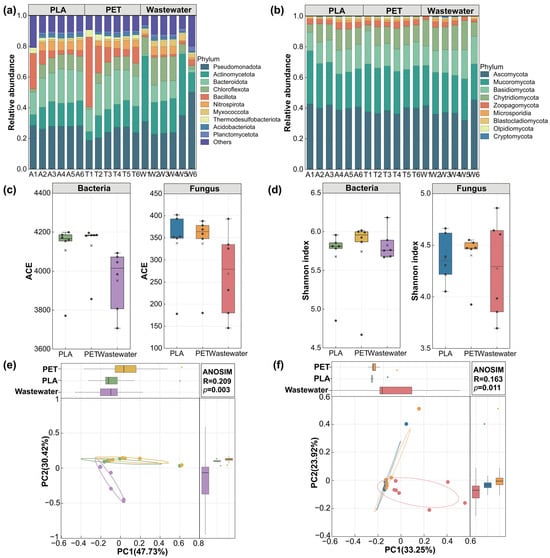
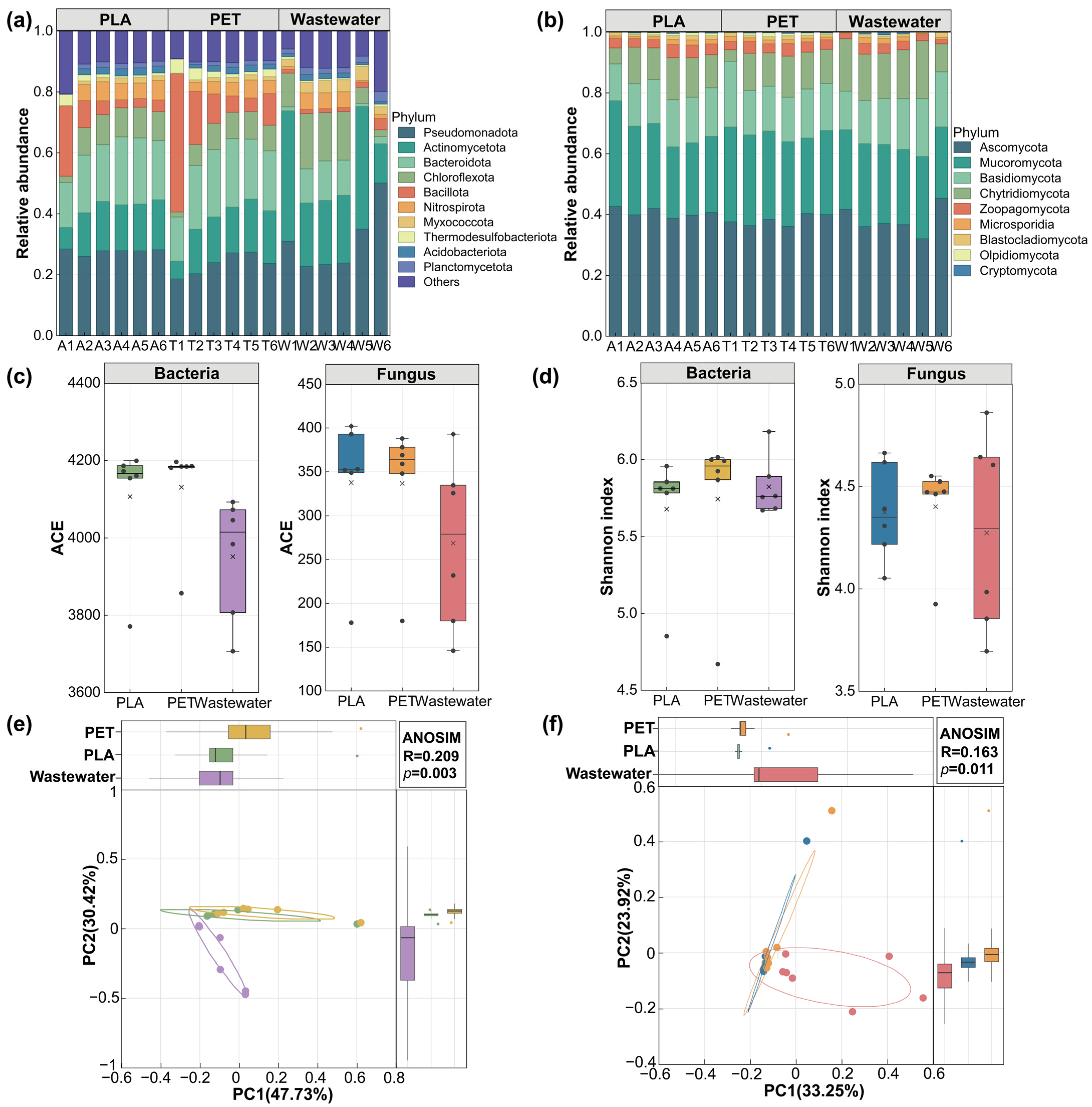
Across the wastewater treatment process, bacterial communities in all three sample types were enriched in Pseudomonadota, Actinomycetota, Bacteroidota, Chloroflexota, Bacillota, and Myxococcota, and the most abundant genera included Nitrospira, Ferruginibacter, Trichococcus, Candidatus_promineifilum, Anaerolinea, and Aliarcobacter (Figure 1a and Figure S3). Despite shared higher-level taxa, relative-abundance profiles differed significantly between the plastisphere and wastewater communities. On PLA and PET surfaces, Pseudomonadota, Bacteroidota, and Actinomycetota were the dominant phyla, whereas in wastewater, Pseudomonadota, Actinomycetota, and Chloroflexota were predominant, consistent with phylum-level profiles commonly reported for WWTP communities [27]. Pseudomonadota and Actinomycetota include major plastic-degrading lineages reported in environmental settings, and members of these groups can use plastic-derived carbon as an energy source [28,29]. Community succession differed between the plastisphere and wastewater across treatment units. After incubation in urban wastewater, early plastisphere communities on PLA and PET were compositionally similar, yet PLA-associated communities showed higher relative abundances of Pseudomonadota (28.48%), Bacillota (23.06%), and Aliarcobacter (10.17%), whereas PET-associated communities had higher Bacillota (45.46%) and Trichococcus (16.42%). During wastewater treatment, Bacteroidota, Chloroflexota, and Nitrospirota increased in relative abundance in both matrices, and these groups are central to nitrogen transformation and organic pollutant degradation in engineered and aquatic systems [30,31,32]. Notably, Bacteroidota, which has been linked to reduced degradation of high-molecular-weight pollutants in wastewater [30], was significantly more abundant in the plastisphere. Across treatment stages, PLA and PET surfaces accumulated an expanded set of bacterial genera, and genus-level relative abundances differed from those in the paired wastewater samples.
Figure 1.
Variation in bacterial (a) and fungal (b) community composition, alpha diversity (c,d) and beta diversity (e,f) in plastisphere and wastewater throughout the wastewater treatment process. A: PLA; T: PET; W: wastewater.
Compared with bacterial communities, fungal communities showed lower taxonomic complexity and were dominated by fewer major taxa. The dominant fungal phyla across the three sample types were Ascomycota, Mucoromycota, Basidiomycota, and Chytridiomycota (Figure 1b), and these four phyla remained the most abundant groups throughout the wastewater treatment process. The relative abundance of Ascomycota remained at approximately 40% across treatment stages, and this phylum has been reported to be widely distributed in soil and plastisphere and to include key taxa involved in nitrogen reduction [10,33]. In addition, the relative abundance of Chytridiomycota on PLA and PET surfaces increased during wastewater treatment, and Chytridiomycota is associated with energy and nutrient cycling in aquatic ecosystems and includes pathogenic lineages [34]. At the genus level (Figure S3), both plastisphere and wastewater communities were dominated by Rhizopus and Aspergillus, whereas Hyaloraphidium was additionally abundant in wastewater.
Alpha-diversity analyses (Figure 1c,d, and Figure S4) showed that ACE, Chao1, and Shannon indices increased across the three sample types, whereas the Simpson index decreased relative to the initial value in each unit. Together, these indices indicate increasing richness and diversity in both plastisphere and wastewater communities across the treatment process, with the largest shifts observed in biological tanks and sedimentation. The UV + NaClO disinfection unit significantly reduced bacterial and fungal abundance in wastewater, while microplastic-associated communities on PLA and PET were not reduced to the same extent, and this pattern supports a transmission route in which microplastic-associated communities, including potential pathogens, persist through disinfection and remain available for downstream release. Moreover, because alpha diversity is linked to resilience against environmental disturbance [35], plastisphere samples exhibited higher alpha diversity than paired wastewater samples, indicating greater community stability on microplastic surfaces. Beta-diversity analyses further supported separation of bacterial (Figure 1e) and fungal (Figure 1f) communities between plastisphere and wastewater (p < 0.05). Relative to the initial state, wastewater treatment significantly altered bacterial and fungal communities on PLA and PET surfaces, in agreement with the taxonomic composition and abundance patterns described above. In parallel, communities on PLA and PET surfaces converged during treatment, and the highest similarity across the three sample types occurred in the anaerobic, anoxic, and oxic tanks, a pattern aligned with sludge recirculation that facilitates microbial exchange among wastewater and microplastic-associated communities. By contrast, sedimentation and disinfection substantially modified wastewater community structure, and overall, plastisphere and wastewater followed distinct succession and diversity trajectories across the wastewater treatment process.
3.2. Differences in Microbial Function Between Plastisphere and Wastewater Across the WWTP
Functional annotation and pathway mapping for plastisphere and wastewater microbial communities were conducted using the KEGG database. At KEGG level 1 (Figure S5), the dominant categories were Metabolism (38.0%), Human Diseases (20.9%), and Organismal Systems (19.4%), which together comprised 48 level-2 pathways. We then examined stage-resolved changes in KEGG level-3 pathway abfigundances in plastisphere and wastewater across the WWTP process (Figure S6). KEGG level-3 pathways detected in both matrices included Metabolic pathways, Biosynthesis of secondary metabolites, and Microbial metabolism in diverse environments, and these three pathways showed higher relative abundances than other level-3 pathways, consistent with previous reports [12]. The number of detected KEGG pathways increased in PLA and PET plastisphere across treatment stages, whereas it decreased in wastewater, with the largest reductions observed in the sedimentation and disinfection units (Figure S5), a pattern aligned with concurrent shifts in microbial abundance and diversity (Figure 1). Notably, more than 40% of the pathways that decreased were assigned to the Human Diseases category, indicating reduced representation of genes annotated to this category during treatment. Microplastic degradation can generate intermediate products that inhibit microbial growth and metabolism, including taxa that contribute to treatment functions [36]. Consequently, microplastics may reduce the effectiveness of treatment in decreasing Human Diseases–annotated functions in the aqueous phase by sustaining microplastic-associated communities through the process.
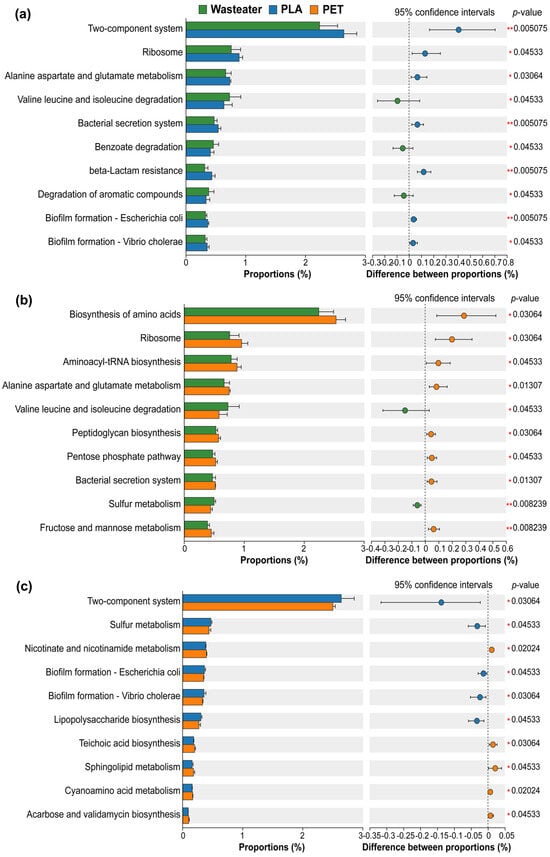
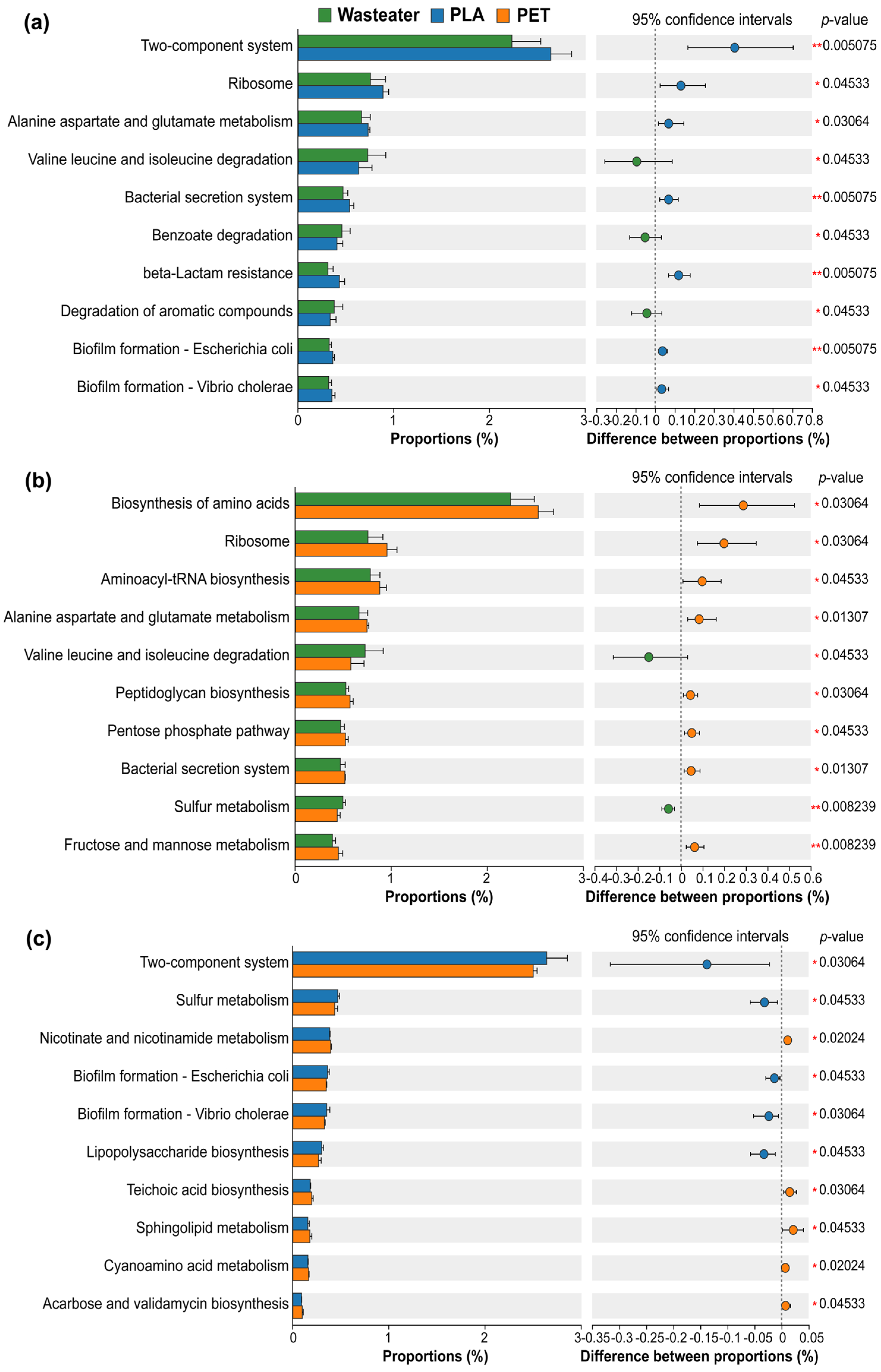
Pathways related to the two-component system, ribosome, alanine/aspartate/glutamate metabolism, bacterial secretion system, beta-lactam resistance, and biofilm formation (Escherichia coli and Vibrio cholerae) were significantly enriched in the PLA plastisphere (p < 0.05; Figure 2a,b). In the PET plastisphere, biosynthesis of amino acids, ribosome, aminoacyl-tRNA biosynthesis, alanine/aspartate/glutamate metabolism, peptidoglycan biosynthesis, pentose phosphate pathway, bacterial secretion system, and fructose and mannose metabolism were significantly enriched (p < 0.05). This enrichment is consistent with residual microplastics serving as substrates that support the growth of specific microbial populations in wastewater [37]. Although overall functional profiles of PLA and PET plastisphere were similar during treatment (Figure 2c), significant differences (p < 0.05) were observed for the two-component system, cellular processes, and selected metabolism-related pathways. Ordination based on KEGG pathways (Figure S7a) and carbohydrate-active enzymes (CAZymes; Figure S8a) supported functional separation between plastisphere and wastewater (p < 0.05). Contribution analyses showed that bacterial genera accounted for the major share of functional contributions (Figures S7b and S8b), and genera contributing to carbon metabolism and cofactor biosynthesis, including Ferruginibacter, Flavobacterium, Nitrospira, Terrimonas, and Trichococcus, showed higher relative abundances in plastisphere than in paired wastewater samples. These dominant genera also contributed to CAZyme functions, including glycosyltransferases and carbohydrate esterases, which are linked to polymer-associated carbon turnover and are consistent with microplastic degradation processes in wastewater [10]. Overall, microbial functional profiles differed between plastisphere and wastewater across the treatment process, with specific pathways consistently enriched on microplastic-associated communities.
Figure 2.
Analysis of microbial functional differences between plastisphere and wastewater throughout the wastewater treatment process. (a) Wastewater compared with PLA, (b) wastewater compared with PET, and (c) PLA compared with PET.
3.3. Variations of ARGs and MGEs in Plastisphere and Wastewater Across the WWTP
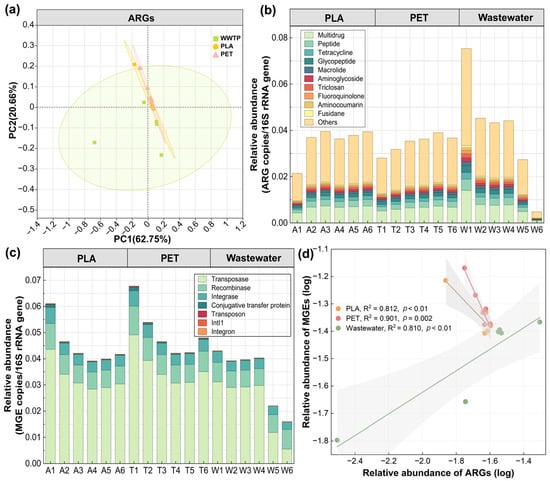
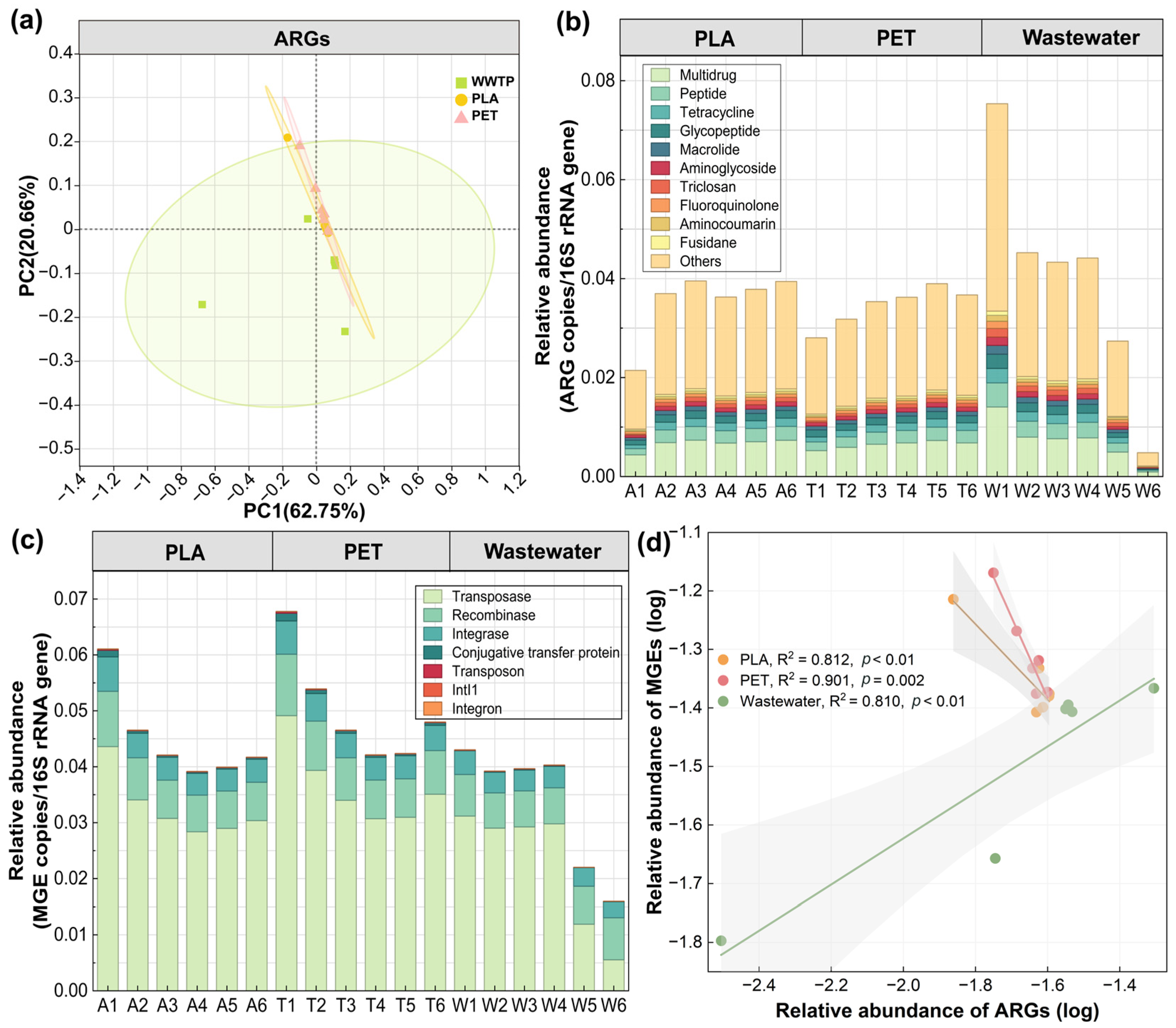
A total of 1145 ARGs and 1044 MGEs were detected in plastisphere and wastewater at the WWTP, representing 35 ARG hosts and 7 MGE types, respectively. As illustrated in Figure 3a, the antibiotic resistance genomic characteristics of PLA and PET plastisphere exhibited a strong similarity throughout the wastewater treatment process, whereas significant differences (p < 0.05) were observed in comparison to the corresponding wastewater. The initial amount of ARG and MGE types (Table S2) in PLA plastisphere totaled 721 and 531, respectively, while the PET plastisphere carried 733 and 572 types, respectively. The wastewater initially contained more ARG and MGE types (1145 and 596, respectively). Notably, the WWTP significantly reduced the types of ARGs and MGEs, while the microplastics showed a completely different phenomenon. The types of ARGs and MGEs in PLA and PET plastisphere increased by 1.39 to 1.46 times compared to the initial value.
Figure 3.
The presence of ARGs and MGEs in plastisphere and wastewater throughout the entire wastewater treatment process. (a) PCoA analysis of ARGs based on Bray–Curtis distances in plastisphere and wastewater. Relative abundance of ARGs (b) and MGEs (c) in plastisphere and wastewater. (d) Ordinary least-squares regression showing the relationship between relative abundance of ARGs and MGEs. The gray part in (d) represented a 95% confidence band.
A clustered heatmap of detected ARGs showed that high-abundance ARGs were mainly assigned to resistance categories including multidrug, peptide, tetracycline, glycopeptide, macrolide, aminoglycoside, triclosan, fluoroquinolone, aminocoumarin, and fusidic acid (Figure S9). ARG abundances in wastewater were significantly higher than those in plastisphere, consistent with the limited mass and surface area of microplastics deployed within the WWTP, while under wastewater treatment conditions ARG abundance was higher in the PLA plastisphere than in the PET plastisphere. Detected MGE markers were mainly annotated as transposases, recombinases, integrases, conjugative transfer proteins, transposons, intI1, and integrons. Across the three sample types, temporal changes in ARG relative abundance mirrored the trends in ARG type counts (Figure 3b), and the disinfection unit significantly reduced ARG relative abundance in wastewater, whereas its effect on plastisphere-associated ARGs was limited. By contrast, MGE relative abundance followed a different pattern and declined across all samples (Figure 3c); although final MGE relative abundance in the PLA and PET plastisphere decreased by 31.68% and 29.18%, respectively, relative to initial values, it remained significantly higher than that in the effluent. qPCR quantification of representative resistance targets showed a consistent pattern (Figure S10): the absolute abundances of tetA, tetC, tetG, sul1, sul2, blaNDM-1, and intI1 increased during treatment and then decreased significantly in the secondary sedimentation and disinfection units, and these targets showed greater reductions in wastewater than on microplastics, with tetA, tetC, tetG, and blaNDM-1 remaining comparatively persistent in the plastisphere. Correlation analysis between ARG and MGE relative abundances further supported these patterns (Figure 3d), with a significant positive correlation in wastewater (R2 = 0.81, p < 0.01) and a significant negative correlation in the plastisphere (p < 0.01).
3.4. Microbial Co-Occurrence Networks and Neutral Community Model of Microbial Communities Across the WWTP
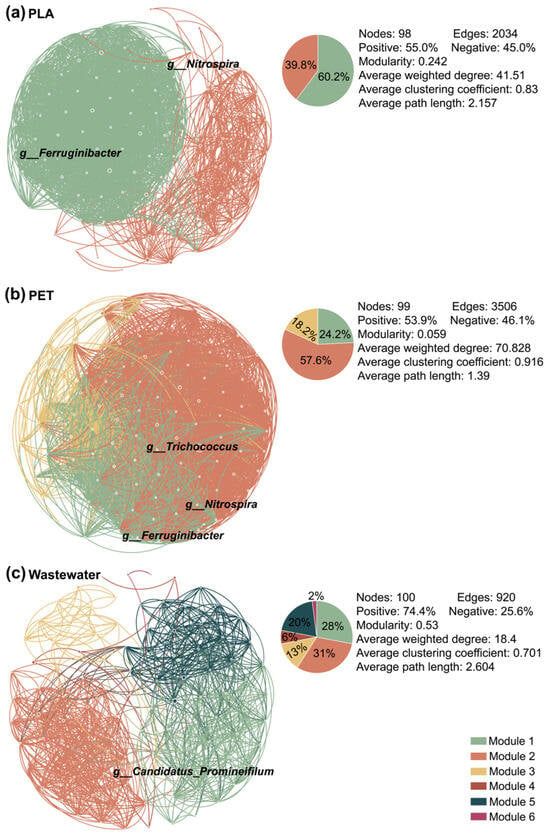
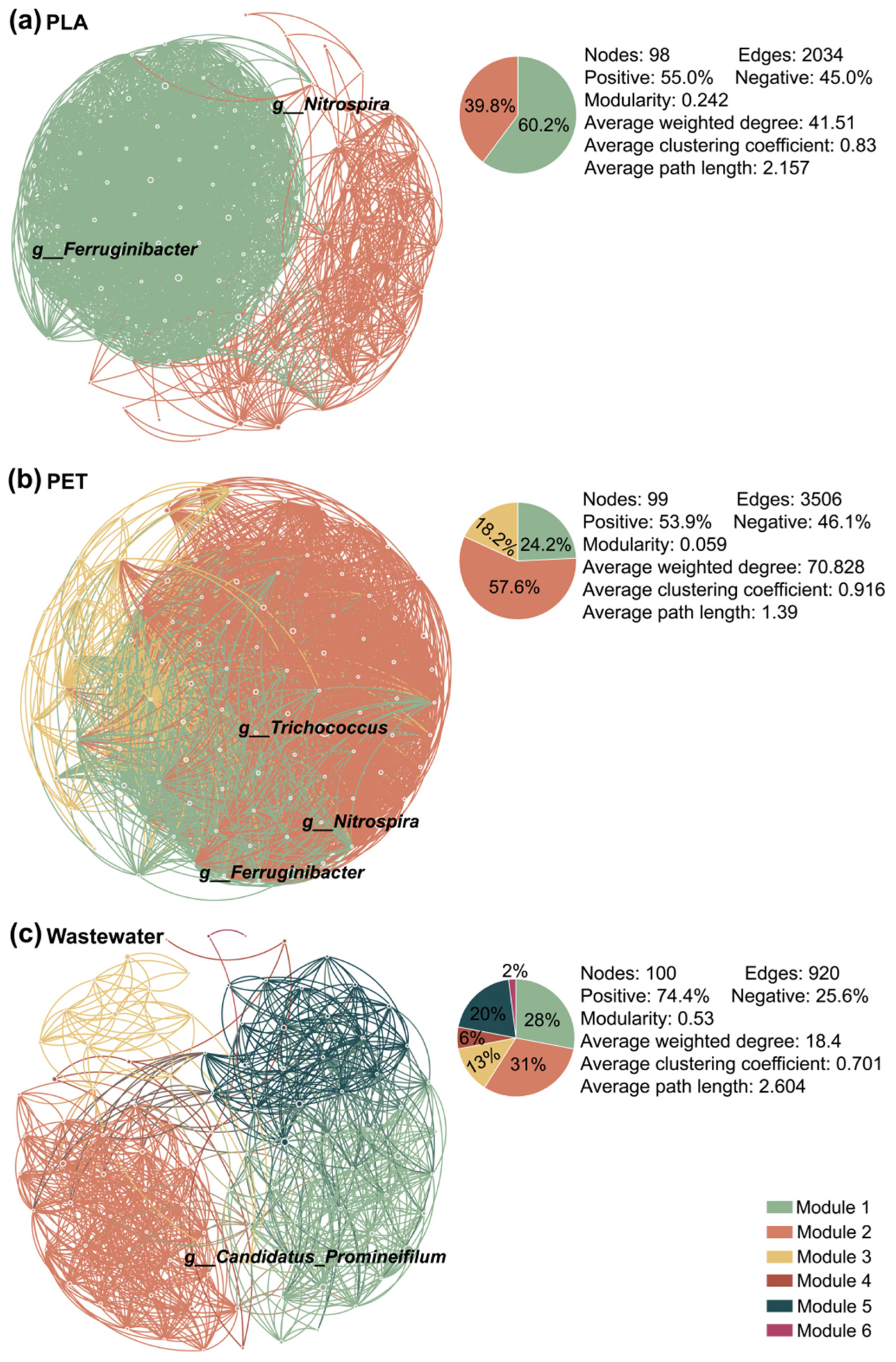
Co-occurrence networks and neutral community models (NCMs) are widely used to infer potential microbial associations and to characterize community assembly patterns [10,12]. Correlation-based network analysis was used to construct co-occurrence networks for PLA plastisphere, PET plastisphere, and paired wastewater based on significant correlations (r > 0.8, p < 0.05; Figure 4). Relative to wastewater (100 nodes, 920 edges), PLA and PET networks contained slightly fewer nodes (98 and 99) but substantially more edges (2034 and 3506), indicating denser co-occurrence structure within the plastisphere during wastewater treatment. This pattern contrasts with reports from soil systems in which plastisphere networks exhibit higher node and edge counts than surrounding soils [10], and this contrast is consistent with the continuous and operationally fluctuating conditions in wastewater treatment systems, whereas soil environments are comparatively stable. Wastewater networks were dominated by positive edges (74.35%), whereas PLA and PET plastisphere networks showed higher proportions of negative edges (45.0% and 46.1%) and contained more central taxa that bridged major modules, resulting in tighter network integration. Network connectivity reflects accessibility and interconnectivity among nodes [38], and higher connectivity has been linked to stronger species interactions, environmental synchrony, and enhanced energy flow [39]. Nitrospira and Ferruginibacter were identified as core genera in the PLA network, whereas Nitrospira, Ferruginibacter, and Trichococcus were core genera in the PET network, and these genera also corresponded to taxa contributing strongly to enriched functional profiles in the plastisphere. Candidatus_Promineifilum was identified as a core genus in the wastewater network, and these genera also showed high relative abundances across WWTP units (Figure S3).
Figure 4.
Co-occurrence network diagram of microbial communities in PLA (a), PET (b) and Wastewater (c) throughout the wastewater treatment process.
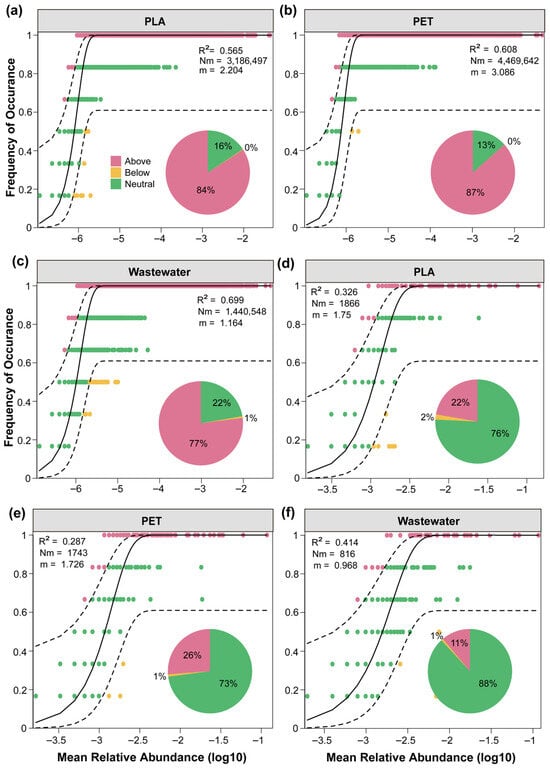
Microbial community assembly is primarily influenced by two mechanisms: (1) deterministic processes based on ecological niches; and (2) stochastic processes based on neutrality [40,41]. By employing this theory, NCM was constructed to evaluate the effect of randomness and determinism on the formation of bacterial and fungal communities in the plastisphere and wastewater within wastewater treatment. As presented in Figure 5, the overall goodness-of-fit (R2, 0.565–0.699) and migration rate (m, 1.164–3.086) for bacterial communities in three samples were higher than the fungal communities (R2: 0.287–0.414, m: 0.968–1.75). This demonstrated that the bacterial communities were more significantly influenced by randomness during wastewater treatment than fungal communities, whereas determinism played a crucial role in shaping fungal community assembly. Furthermore, migration and dispersion occurred much easier for bacteria than fungi, consistent with findings in the soil and aquatic ecosystems [10,42]. Furthermore, the R2 values for bacterial and fungal wastewater communities were higher than those in PLA and PET plastisphere communities, suggesting that microbial community assembly processes in plastisphere were more strongly impacted by environmental filtration. This is because, as biological habitats, microplastics exhibit high heterogeneity, allowing determinism to play a more prominent role [43]. Generally, the fragmentation and discontinuity of microplastics can limit the diffusion rate of microorganisms colonized on their surface [10,42]. However, different from the previously results, the Nm and m values of the plastisphere were higher than those of the wastewater, indicating that the microbial diffusion in plastisphere was less restricted than the corresponding wastewater across the WWTP. Notably, higher Nm values represent a more uniform distribution of species across communities [40]. The above phenomena might be attributed to the removal of available organic pollutants (Figure S11) from the wastewater via wastewater treatment, resulting in continuous consumption of energy and available substances required by the microorganisms. In contrast, nutrients in the soil and aquatic ecosystems are more sufficient and consistently available.
Figure 5.
Neutral community model diagram of bacterial and fungal communities in PLA ((a) and (d), respectively), PET ((b) and (e), respectively), and wastewater ((c) and (f), respectively) throughout the wastewater treatment process. R2: overall goodness of fit. m: migration rate. Nm is the product of the metacommunity size (N) and migration rate (m).
3.5. Correlations Between Microbial Diversity, Environmental Variables, and ARGs/MGEs Abundance
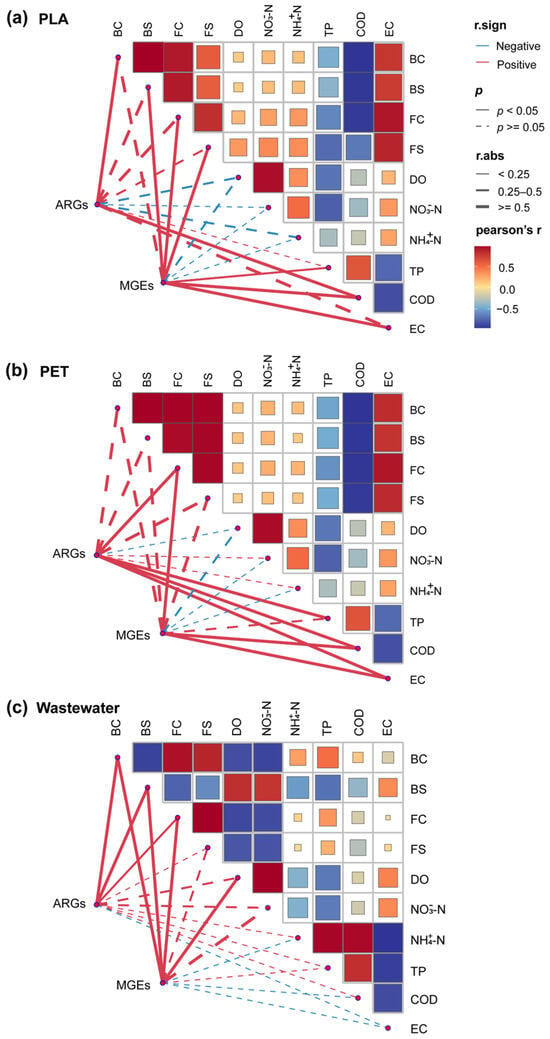
Although wastewater treatment significantly reduced ARG and MGE abundances in the effluent, plastisphere associated with wastewater retained elevated ARG burdens and therefore remained a potential carrier of antibiotic resistance. The evolution and spread of ARGs has been reported to be influenced by multiple factors, including environmental indicators, antibiotics, heavy metals, MGEs, and microbial communities [44,45]. However, it remains unclear whether microplastics modify the association patterns between environmental variables, community dynamics, and ARG/MGE abundances during wastewater treatment. We therefore conducted correlation analyses to link microbial community succession and environmental factors with ARG and MGE abundances across treatment stages, and key taxa contributing to ARG abundance were identified based on their contribution scores. As shown in Figure 6, the three sample types exhibited distinct association patterns with diversity indices and environmental factors across the treatment process. In PLA plastisphere, ARG abundance was positively correlated with bacterial Chao1 and chemical oxygen demand (COD) (p < 0.05), whereas MGE abundance was positively correlated with bacterial Shannon, fungal diversity indices, total phosphorus (TP), COD, and electrical conductivity (EC) (p < 0.05). In PET plastisphere, ARG abundance was positively correlated with fungal Chao1, TP, COD, and EC (p < 0.05), whereas MGE abundance was positively correlated with fungal Chao1, COD, and EC (p < 0.05). In wastewater, ARG and MGE abundances were positively associated with bacterial diversity indices and fungal Chao1 (p < 0.05). These differences are consistent with substrate preferences, in which bacteria preferentially utilize readily degradable organic matter, whereas fungi more efficiently decompose recalcitrant substrates [37]. Together, these associations indicate that community dynamics and microenvironmental conditions within the plastisphere are closely linked to ARG and MGE abundances during wastewater treatment. Adsorption of organic and inorganic constituents from wastewater onto microplastic surfaces (Figure S12) provides substrates for microbial growth and is consistent with enhanced potential for resistance dissemination within plastisphere communities [6,46].
Figure 6.
Correlation analysis between microbial community diversity, environmental factors and the abundance of ARGs with MGEs in PLA (a), PET (b) and wastewater (c) throughout the wastewater treatment process. The area of the rectangle represented the absolute value of the correlation coefficient. The larger the area, the greater the absolute value.
3.6. Taxonomic Contributors and Genus-Level Associations with ARGs/MGEs
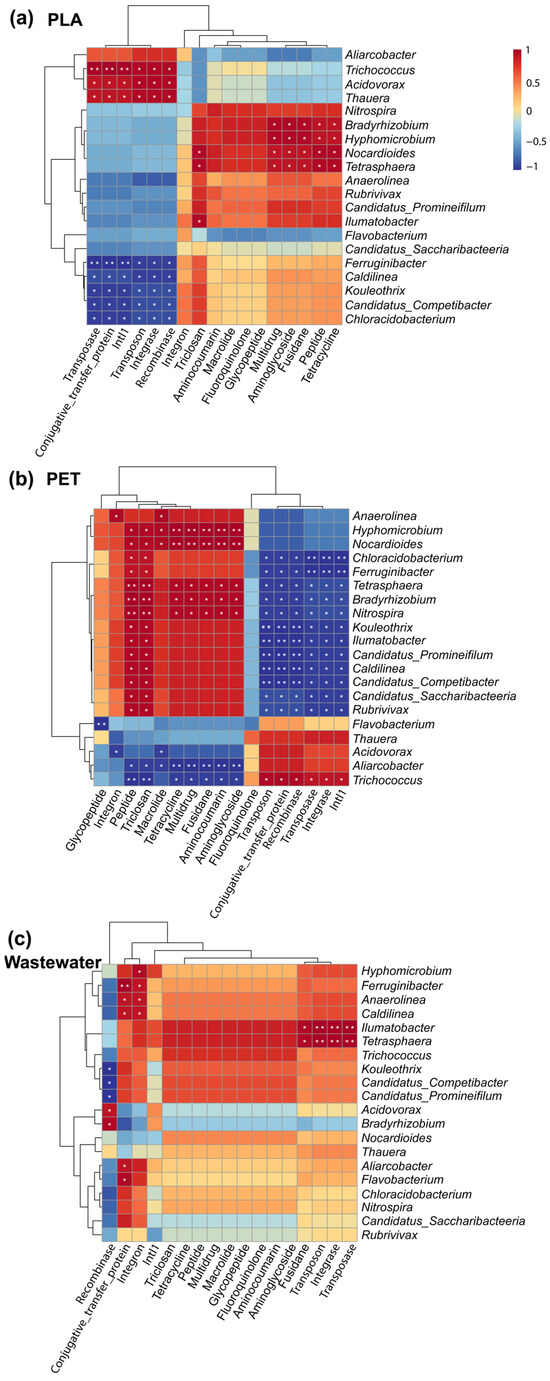
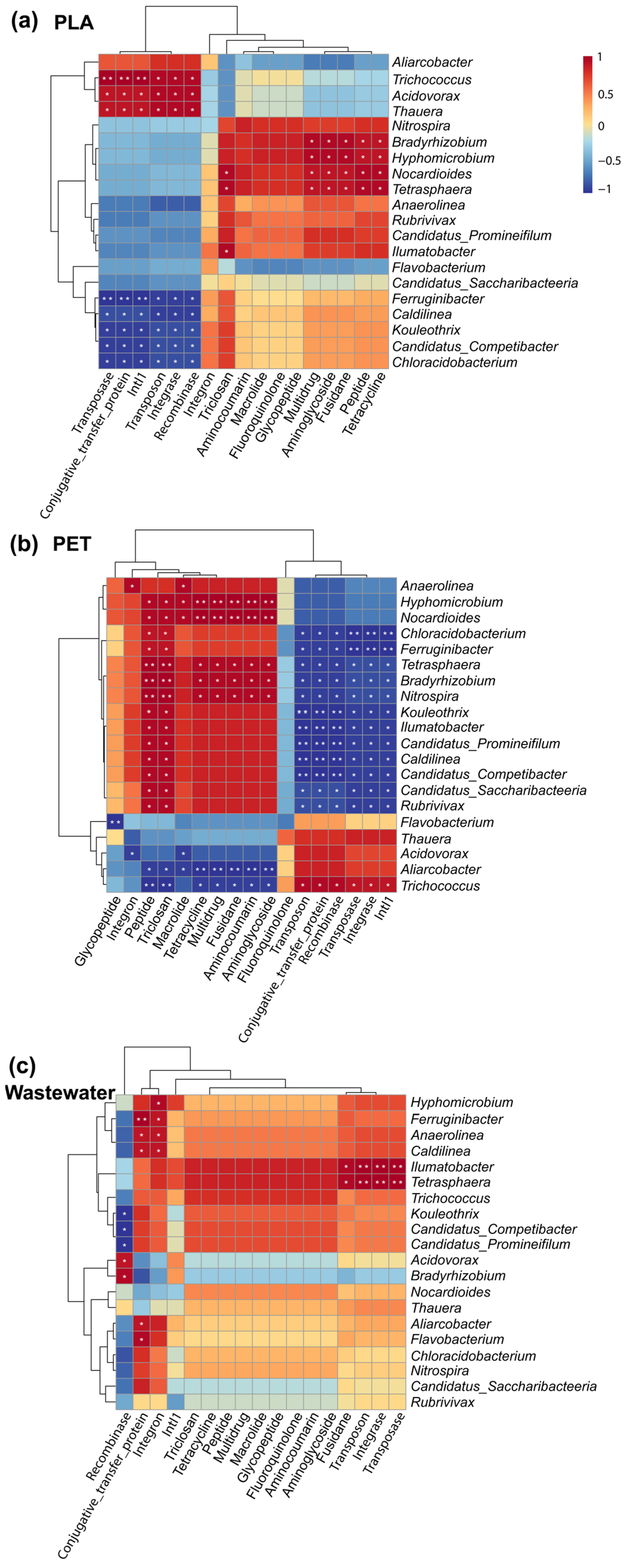
Bacterial taxa, primarily from Pseudomonadota, Actinomycetota, Bacteroidota, Chloroflexota, Bacillota, and Nitrospirota, accounted for the major contributions to predominant ARG categories (Figure S13). These phyla were also the dominant bacterial groups in plastisphere and wastewater across the WWTP. Bacteroidota and Bacillota showed higher relative contributions in plastisphere than in wastewater and also exhibited higher relative abundances on microplastics during wastewater treatment. Correlation analysis of major bacterial genera with ARGs and MGEs showed stronger association patterns in PLA and PET plastisphere than in wastewater (Figure 7). In PLA plastisphere, Trichococcus, Acidovorax, and Thauera were positively correlated with MGEs (p < 0.05), whereas Bradyrhizobium, Hyphomicrobium, Nocardioides, and Tetrasphaera were positively correlated with ARGs (p < 0.05). In PET plastisphere, Nitrospira also showed a positive correlation with ARGs in addition to the genera listed above. Most bacterial genera showed significant positive correlations with peptide resistance and triclosan resistance categories, whereas most genera were negatively correlated with MGEs, with Trichococcus showing a significant positive correlation with MGEs. In wastewater, only a limited set of genera showed detectable associations with ARGs and MGEs. Together, these associations indicate that microplastic-associated communities exhibit stronger ARG/MGE linkages than wastewater communities, consistent with elevated potential for antibiotic-resistance dissemination, and this pattern is consistent with reports that wastewater discharge increases the abundance of ARG–microplastic complexes in receiving waters [47].
Figure 7.
Association analysis between major bacterial genera and major ARG types with MGE types in PLA (a), PET (b) and wastewater (c) throughout the wastewater treatment process. *: p < 0.05; **: p < 0.01.
3.7. Plastisphere Microbial Communities Exhibited Excellent Diffusion Rates and Species Distribution Across the WWTP
In combination with the results of the co-occurrence network analysis, environmental filtration showed a strong influence on plastisphere, thereby promoting ecological niche overlap and reducing network complexity (low modularity). Moreover, the increasing proportion of similar ecological species (microorganisms that are more inclined to utilize microplastics as carbon sources) further intensifies competition among species [42]. In the resource-scarce WWTP environment, the ability of microorganisms to perceive the inherent spatial differences in their environment is enhanced, enabling them to effectively allocate resources and undergo ecological niche differentiation, thereby increasing the number and modularization degree of their ecological modules [48]. This is fully aligned with the resource proportion hypothesis. Those results indicated that the microorganisms gradually became resource-limited during wastewater treatment, which weakened interactions between species. However, the increased quantity of positive relationships between species were conducive to enhancing the synergistic effect of microbial communities in treating pollutants [42]. Microbial communities in the WWTP plastisphere exhibited excellent dispersion rates and species distribution, with wastewater treatment further increasing the diversity of microorganisms present in this microenvironment. Therefore, it is necessary to assess the impact on the receiving water ecosystem by combining the analyses of functional microorganisms and the ARG presence in WWTP plastisphere.
3.8. Microplastics Protected Surface ARGs from Being Eliminated by Disinfection
By combining microbial community structure and functional analyses, this study showed that the wastewater treatment process promoted the enrichment of various microbial populations in plastisphere. Moreover, the functional pathways associated with ARG proliferation in plastisphere [6,23], such as the two-component system, bacterial secretion system, beta-lactam resistance and biofilm formation (in E. coli and V. cholerae), all showed an upregulation trend (p < 0.05). One study has revealed that the enhanced relative abundance of microbial functions in plastisphere of wastewater can promote the mutual conversion and transmission of ARGs [47]. This was especially evident during the disinfection stage, when significant differentiation occurred between plastisphere and wastewater. Notably, UV + NaClO disinfection significantly reduced the abundance, diversity and functional pathways of the wastewater microbial communities. Conversely, disinfection treatment could rupture the surface of microplastics and increase the specific surface area, thereby enabling the accumulation of more microorganisms and ARGs within the plastisphere [49]. In general, microplastics act as protective barriers during wastewater treatment, safeguarding the ARGs adsorbed on their surface from elimination by treatment processes, and also serving as key vectors for transmitting ARGs. Crucially, ARG-carrying microplastics released into water bodies can survive over the long-term in aquatic ecosystems due to the protection they provide against environmental factors, such as ultraviolet radiation, enzymatic activity and microbial predation [50]. Previous studies have demonstrated that aquatic organisms, such as fish and mammals, might ingest ARG-carrying plastic fragments into their intestines through foraging in the aquatic environment [6,51]. The ARGs can then enter the food chain through trophic transfer, ultimately posing a serious threat to aquatic ecosystems and human health [52]. Therefore, the presence of microplastics in WWTPs needs to be addressed.
Given that microplastics can act as protective carriers for ARGs and reduce the effectiveness of conventional disinfection, source control and enhanced microplastic removal should be prioritized. First, policy interventions can restrict disposable plastic products associated with high microplastic release, and mandatory pre-treatment requirements for wastewater from plastic production, processing, and packaging industries can reduce inputs of primary microplastics into WWTPs. Second, given the high diversity of plastisphere communities and their capacity to retain and enrich ARGs, development of functional materials or processes that simultaneously remove microplastics and ARGs should be accelerated, together with pilot-scale validation and full-scale implementation in WWTPs. In addition, incorporating microplastic concentrations and ARG indicators into effluent quality assessment as supplementary monitoring metrics, together with setting discharge limits for ecologically sensitive receiving waters, can drive upgrades in microplastic and ARG removal performance.
4. Conclusions
This study investigated the dynamic changes in microbial community structure, functional expression, interspecies interactions, community assembly processes and ARG abundance in plastisphere and wastewater throughout the treatment process. Significant differences between the succession of the plastisphere and wastewater microbial communities were observed across different treatment units, whereas those of the PLA and PET plastisphere tended to be consistent. Wastewater treatment significantly increased the bacterial and fungal diversity, as well as the genus-level richness of plastisphere, indicating that plastisphere microbial communities were more stable. The disinfection tank significantly reduced the relative abundance of ARGs, MGEs and pathways related to human diseases in wastewater, but barely affected those in plastisphere. Conversely, some pathways related to ARG proliferation, such as the two-component system and biofilm formation, were enhanced in plastisphere. And the types of ARGs and MGEs in plastispheres increased by 1.39–1.46 times compared with the initial value, opposite to the reduction in wastewater. Key ARGs including tetA, tetC, tetG, and blaNDM-1 were highly persistent in plastisphere. Additionally, the bacterial community assembly in plastisphere and wastewater was mainly influenced by randomness, while determinism played a crucial role in fungal community assembly, with the migration and diffusion of bacteria being higher than fungi throughout the wastewater treatment process. Microorganisms in plastisphere exhibited greater connectivity and more negative relationships, suggesting stronger species-level biological interactions and energy flow during treatments. In contrast, microorganisms in wastewater gradually became resource-limited, which weakened species-level interactions; however, more positive relationships between species enhanced the synergistic treatment of pollutants among microorganisms. Finally, microbial diversity can significantly affect the abundance of ARGs and MGEs, and the microbial diversity in plastisphere was superior to that of the wastewater during wastewater treatment. Trichococcus and Nitrospira, which exhibited significant positive correlations with ARGs and MGEs, were enriched in functional pathways within plastisphere. The COD, TP and EC on the surface of microplastics had a significant correlation, thereby facilitating the proliferation of ARG and MGE on microplastics. These results indicated that microplastics in WWTP not only served as important carriers of ARGs and MGEs but also protected the ARGs adsorbed on their surfaces from elimination by the wastewater treatment processes, thereby increasing the risk of drug resistance within the WWTP effluent. Therefore, attention must be paid to the presence of microplastics in wastewater, especially in wastewater rich in ARGs, where strict control of microplastics entering water bodies is necessary.
Supplementary Materials
The following supporting information can be downloaded at: https://www.mdpi.com/article/10.3390/w18050593/s1, Figure S1: Schematic diagram of the wastewater treatment plant process flow; Figure S2: The petal diagram showed the common and unique elements between PLA, PET, and wastewater throughout the wastewater treatment process; Figure S3: The variations of bacterial genus composition (a) and fungal genus composition (b) in PLA, PET, and wastewater throughout the wastewater treatment process; Figure S4: The alpha diversity of bacterial community and fungal community in PLA, PET, and wastewater throughout the wastewater treatment process; Figure S5: The counts and proportions of KEGG pathway in level 1 (a) and the counts of KEGG pathway (level 3) (b) in PLA, PET, and wastewater throughout the wastewater treatment process; Figure S6: Bubble plot revealed profiles of the 30 most abundant KEGG pathways (level 3) in PLA, PET, and wastewater; Figure S7: PCoA (based on Bray–Curtis distance) analysis in KEGG pathway (a), and heatmap of the contribution analysis regarding the top 20 microbes at the genus level and KEGG pathway (pathway level 3: top 6) functional (b) between PLA, PET and wastewater; Figure S8: PCoA (based on Bray–Curtis distance) analysis in CAZymes (a), and heatmap of the contribution analysis regarding the top 20 microbes at the genus level and CAZymes (family level: top 6) functional (b) between PLA, PET and wastewater; Figure S9: The heat map of the ARG patterns between PLA, PET and wastewater throughout the wastewater treatment process; Figure S10: Quantity of ARGs in PLA (a), PET (b) and wastewater (c) throughout the wastewater treatment process; Figure S11: Variations of basic physical and chemical indicators in wastewater throughout the wastewater treatment process; Figure S12: Variations of basic physical and chemical indicators in plastisphere throughout the wastewater treatment process; Figure S13: Contributions of microorganisms (phylum level) to the relative abundance of predominant ARGs types; Table S1: qPCR primer information; Table S2: Quantities in the types and of ARGs and MGEs in PLA, PET, and wastewater throughout the wastewater treatment process; Text S1: Metagenomic sequencing and analysis; Text S2: Methods for annotating resistance genes and analyzing their abundance; Text S3: Methods for microbial functional annotation and abundance calculation. References [53,54,55,56,57,58,59,60] are cited in the Supplementary Materials.
Author Contributions
J.Z.: Writing—original draft, Visualization, Methodology, Formal analysis, Data curation. H.L.: Visualization, Formal analysis, Writing—review and editing. J.Y.: Writing—review and editing, Supervision, Project administration, Methodology. Q.J.: Data curation, Writing—review and editing. Y.Z.: Writing—review and editing, Supervision. Y.Y.: Writing—review and editing. Z.L.: Writing—review and editing. Y.C.: Writing—review and editing. All authors have read and agreed to the published version of the manuscript.
Funding
This research was funded by the Science and Technology Talent and Platform Program of Yunnan Province [grant number 202505AT350002-4].
Data Availability Statement
The original contributions presented in this study are included in the article/Supplementary Material. Further inquiries can be directed to the corresponding author.
Conflicts of Interest
The authors declare no conflicts of interest.
References
- Thompson, R.C.; Olsen, Y.; Mitchell, R.P.; Davis, A.; Rowland, S.J.; John, A.; McGonigle, D.; Russell, A.E. Lost at sea: Where is all the plastic? Science 2004, 304, 838. [Google Scholar] [CrossRef] [Scilit]
- Gao, F.; Li, J.; Sun, C.; Zhang, L.; Jiang, F.; Cao, W.; Zheng, L. Study on the capability and characteristics of heavy metals enriched on microplastics in marine environment. Mar. Pollut. Bull. 2019, 144, 61–67. [Google Scholar] [CrossRef] [Scilit]
- Zhang, H.; Wang, J.; Zhou, B.; Zhou, Y.; Dai, Z.; Zhou, Q.; Christie, P.; Luo, Y. Enhanced adsorption of oxytetracycline to weathered microplastic polystyrene: Kinetics, isotherms and influencing factors. Environ. Pollut. 2018, 243, 1550–1557. [Google Scholar] [CrossRef] [Scilit]
- Samaei, S.H.; Mojahednia, P.; Chen, J.; Li, Z.; Jaszczyszyn, K.; Kiedrzynska, E.; Xue, J. What does the “trojan horse” carry? The pollutants associated with microplastics/nanoplastics in water environments. ACS Es&T Water 2025, 5, 1530–1545. [Google Scholar]
- Jeong, E.; Lee, J.; Redwan, M. Animal exposure to microplastics and health effects: A review. Emerg. Contam. 2024, 10, 11. [Google Scholar] [CrossRef] [Scilit]
- Yang, K.; Chen, Q.; Chen, M.; Li, H.; Liao, H.; Pu, Q.; Zhu, Y.; Cui, L. Temporal dynamics of antibiotic resistome in the plastisphere during microbial colonization. Environ. Sci. Technol. 2020, 54, 11322–11332. [Google Scholar] [CrossRef] [Scilit]
- Zhang, S.; Zeng, Y.; Zhu, J.; Cai, Z.; Zhou, J. The structure and assembly mechanisms of plastisphere microbial community in natural marine environment. J. Hazard. Mater. 2022, 421, 13. [Google Scholar] [CrossRef] [Scilit] [PubMed]
- Wang, P.; Song, T.; Bu, J.; Zhang, Y.; Liu, J.; Zhao, J.; Zhang, T.; Xi, J.; Xu, J.; Li, L.; et al. Does bacterial community succession within the polyethylene mulching film plastisphere drive biodegradation ? Sci. Total Environ. 2022, 824, 12. [Google Scholar] [CrossRef] [Scilit] [PubMed]
- Zettler, E.R.; Mincer, T.J.; Amaral-Zettler, L.A. Life in the “plastisphere”: Microbial communities on plastic marine debris. Environ. Sci. Technol. 2013, 47, 7137–7146. [Google Scholar] [CrossRef] [Scilit]
- Li, Z.; Feng, C.; Lei, J.; He, X.; Wang, Q.; Zhao, Y.; Qian, Y.; Zhan, X.; Shen, Z. Farmland microhabitat mediated by a residual microplastic film: Microbial communities and function. Environ. Sci. Technol. 2024, 58, 3654–3664. [Google Scholar] [CrossRef] [Scilit] [PubMed]
- Su, X.; Yang, L.; Yang, K.; Tang, Y.; Wen, T.; Wang, Y.; Rillig, M.C.; Rohe, L.; Pan, J.; Li, H.; et al. Estuarine plastisphere as an overlooked source of n 2 o production. Nat. Commun. 2022, 13, 12. [Google Scholar] [CrossRef] [Scilit]
- Zhu, D.; Ma, J.; Li, G.; Rillig, M.C.; Zhu, Y. Soil plastispheres as hotpots of antibiotic resistance genes and potential pathogens. Isme J. 2022, 16, 521–532. [Google Scholar] [CrossRef] [Scilit]
- Li, C.; Gillings, M.R.; Zhang, C.; Chen, Q.; Zhu, D.; Wang, J.; Zhao, K.; Xu, Q.; Leung, P.H.; Li, X.; et al. Ecology and risks of the global plastisphere as a newly expanding microbial habitat. Innovation 2024, 5, 10. [Google Scholar] [CrossRef] [Scilit]
- Luo, G.; Liang, B.; Cui, H.; Kang, Y.; Zhou, X.; Tao, Y.; Lu, L.; Fan, L.; Guo, J.; Wang, A.; et al. Determining the contribution of micro/nanoplastics to antimicrobial resistance: Challenges and perspectives. Environ. Sci. Technol. 2023, 57, 12137–12152. [Google Scholar] [CrossRef] [Scilit]
- Li, R.; Zhu, L.; Wang, Y.; Zhu, Y. Metagenomic insights into environmental risk of field microplastics in an urban river. Water Res. 2022, 223, 10. [Google Scholar] [CrossRef] [Scilit] [PubMed]
- Luo, G.; Fan, L.; Liang, B.; Guo, J.; Gao, S. Determining antimicrobial resistance in the plastisphere: Lower risks of nonbiodegradable vs higher risks of biodegradable microplastics. Environ. Sci. Technol. 2025, 59, 7722–7735. [Google Scholar] [CrossRef] [Scilit]
- Zhou, Q.; Zhang, J.; Zhang, M.; Wang, X.; Zhang, D.; Pan, X. Persistent versus transient, and conventional plastic versus biodegradable plastic ?—Two key questions about microplastic-water exchange of antibiotic resistance genes. Water Res. 2022, 222, 11. [Google Scholar] [CrossRef] [Scilit] [PubMed]
- Yang, J.; Xiang, J.; Xie, Y.; Yu, K.; Li, J.; Wang, H.; Li, P.; Gin, K.Y.; He, Y. Removal behavior and key drivers of antibiotic resistance genes in two full-scale leachate treatment plants. Water Res. 2022, 226, 14. [Google Scholar] [CrossRef] [Scilit]
- Zhu, T.; Su, Z.; Lai, W.; Zhang, Y.; Liu, Y. Insights into the fate and removal of antibiotics and antibiotic resistance genes using biological wastewater treatment technology. Sci. Total Environ. 2021, 776, 16. [Google Scholar] [CrossRef] [Scilit]
- Murphy, F.; Ewins, C.; Carbonnier, F.; Quinn, B. Wastewater treatment works (wwtw) as a source of microplastics in the aquatic environment. Environ. Sci. Technol. 2016, 50, 5800–5808. [Google Scholar] [CrossRef] [Scilit] [PubMed]
- Ziajahromi, S.; Neale, P.A.; Rintoul, L.; Leusch, F.D.L. Wastewater treatment plants as a pathway for microplastics: Development of a new approach to sample wastewater-based microplastics. Water Res. 2017, 112, 93–99. [Google Scholar] [CrossRef] [Scilit] [PubMed]
- Galafassi, S.; Sabatino, R.; Sathicq, M.B.; Eckert, E.M.; Fontaneto, D.; Fontana, G.D.; Mossotti, R.; Corno, G.; Volta, P.; Di Cesare, A. Contribution of microplastic particles to the spread of resistances and pathogenic bacteria in treated wastewaters. Water Res. 2021, 201, 12. [Google Scholar] [CrossRef] [Scilit]
- Yang, K.; Xu, F.; Xing, X.; Wei, J.; Chen, Q.; Su, J.; Cui, L. Microplastics pose an elevated antimicrobial resistance risk than natural surfaces via a systematic comparative study of surface biofilms in rivers. Environ. Sci. Technol. 2025, 59, 11216–11228. [Google Scholar] [CrossRef] [Scilit] [PubMed]
- Wang, Y.; Liu, X.; Huang, C.; Han, W.; Gu, P.; Jing, R.; Yang, Q. Antibiotic resistance genes and virulence factors in the plastisphere in wastewater treatment plant effluent: Health risk quantification and driving mechanism interpretation. Water Res. 2025, 271, 11. [Google Scholar] [CrossRef] [Scilit]
- Ning, D.; Yuan, M.; Wu, L.; Zhang, Y.; Guo, X.; Zhou, X.; Yang, Y.; Arkin, A.P.; Firestone, M.K.; Zhou, J. A quantitative framework reveals ecological drivers of grassland microbial community assembly in response to warming. Nat. Commun. 2020, 11, 12. [Google Scholar] [CrossRef] [Scilit]
- Deng, M.; Dai, Z.; Song, K.; Wang, Y.; He, X. Integrating microbial protein production and harvest systems into pilot-scale recirculating aquaculture systems for sustainable resource recovery: Linking nitrogen recovery to microbial communities. Environ. Sci. Technol. 2021, 55, 16735–16746. [Google Scholar] [CrossRef] [Scilit]
- Wang, L.; Lin, Y.; Ye, L.; Qian, Y.; Shi, Y.; Xu, K.; Ren, H.; Geng, J. Microbial roles in dissolved organic matter transformation in full-scale wastewater treatment processes revealed by reactomics and comparative genomics. Environ. Sci. Technol. 2021, 55, 11294–11307. [Google Scholar] [CrossRef] [Scilit]
- Peixoto, J.; Silva, L.P.; Kruger, R.H. Brazilian cerrado soil reveals an untapped microbial potential for unpretreated polyethylene biodegradation. J. Hazard. Mater. 2017, 324, 634–644. [Google Scholar] [CrossRef] [Scilit]
- Wu, X.; Liu, P.; Zhao, X.; Wang, J.; Teng, M.; Gao, S. Critical effect of biodegradation on long-term microplastic weathering in sediment environments: A systematic review. J. Hazard. Mater. 2022, 437, 13. [Google Scholar] [CrossRef] [Scilit]
- Yang, Z.; Zhou, Q.; Sun, H.; Jia, L.; Zhao, L.; Wu, W. Metagenomic analyses of microbial structure and metabolic pathway in solid-phase denitrification systems for advanced nitrogen removal of wastewater treatment plant effluent: A pilot-scale study. Water Res. 2021, 196, 9. [Google Scholar] [CrossRef] [Scilit] [PubMed]
- Raymond, P.A.; Hartmann, J.; Lauerwald, R.; Sobek, S.; McDonald, C.; Hoover, M.; Butman, D.; Striegl, R.; Mayorga, E.; Humborg, C.; et al. Global carbon dioxide emissions from inland waters. Nature 2013, 503, 355–359. [Google Scholar] [CrossRef] [Scilit]
- Latocheski, E.C.; Rocha, M.C.V.D.; Braga, M.C.B. Nitrospira in wastewater treatment: Applications, opportunities and research gaps. Rev. Environ. Sci. Bio-Technol. 2022, 21, 905–930. [Google Scholar] [CrossRef] [Scilit]
- Wang, L.; Tong, J.; Li, Y.; Zhu, J.; Zhang, W.; Niu, L.; Zhang, H. Bacterial and fungal assemblages and functions associated with biofilms differ between diverse types of plastic debris in a freshwater system. Environ. Res. 2021, 196, 10. [Google Scholar] [CrossRef] [Scilit]
- Blaalid, R.; Khomich, M. Current knowledge of chytridiomycota diversity in northern europe and future research needs. Fungal Biol. Rev. 2021, 36, 42–51. [Google Scholar] [CrossRef] [Scilit]
- Wu, X.; Pan, J.; Li, M.; Li, Y.; Bartlam, M.; Wang, Y. Selective enrichment of bacterial pathogens by microplastic biofilm. Water Res. 2019, 165, 12. [Google Scholar] [CrossRef] [Scilit]
- Ratzke, C.; Barrere, J.; Gore, J. Strength of species interactions determines biodiversity and stability in microbial communities. Nat. Ecol. Evol. 2020, 4, 376–383. [Google Scholar] [CrossRef] [Scilit] [PubMed]
- Wang, J.; Guo, X.; Xue, J. Biofilm-developed microplastics as vectors of pollutants in aquatic environments. Environ. Sci. Technol. 2021, 55, 12780–12790. [Google Scholar] [CrossRef] [Scilit] [PubMed]
- Gao, S.; Fu, Y.; Peng, X.; Ma, S.; Liu, Y.; Chen, W.; Huang, Q.; Hao, X. Microplastics trigger soil dissolved organic carbon and nutrient turnover by strengthening microbial network connectivity and cross-trophic interactions. Environ. Sci. Technol. 2025, 59, 5596–5606. [Google Scholar] [CrossRef] [Scilit]
- Morrien, E.; Hannula, S.E.; Snoek, L.B.; Helmsing, N.R.; Zweers, H.; de Hollander, M.; Soto, R.L.; Bouffaud, M.; Buee, M.; Dimmers, W.; et al. Soil networks become more connected and take up more carbon as nature restoration progresses. Nat. Commun. 2017, 8, 10. [Google Scholar] [CrossRef] [Scilit]
- Sloan, W.T.; Lunn, M.; Woodcock, S.; Head, I.M.; Nee, S.; Curtis, T.P. Quantifying the roles of immigration and chance in shaping prokaryote community structure. Environ. Microbiol. 2006, 8, 732–740x. [Google Scholar] [CrossRef] [Scilit]
- Zhang, L.; Yin, W.; Wang, C.; Zhang, A.; Zhang, H.; Zhang, T.; Ju, F. Untangling microbiota diversity and assembly patterns in the world’s largest water diversion canal. Water Res. 2021, 204, 11. [Google Scholar] [CrossRef] [Scilit]
- Li, C.; Wang, L.; Ji, S.; Chang, M.; Wang, L.; Gan, Y.; Liu, J. The ecology of the plastisphere: Microbial composition, function, assembly, and network in the freshwater and seawater ecosystems. Water Res. 2021, 202, 14. [Google Scholar] [CrossRef] [Scilit]
- Jiao, S.; Yang, Y.; Xu, Y.; Zhang, J.; Lu, Y. Balance between community assembly processes mediates species coexistence in agricultural soil microbiomes across eastern china. Isme J. 2020, 14, 202–216. [Google Scholar] [CrossRef] [Scilit]
- Chen, Y.; Li, P.; Huang, Y.; Yu, K.; Chen, H.; Cui, K.; Huang, Q.; Zhang, J.; Gin, K.Y.; He, Y. Environmental media exert a bottleneck in driving the dynamics of antibiotic resistance genes in modern aquatic environment. Water Res. 2019, 162, 127–138. [Google Scholar] [CrossRef] [Scilit]
- Yu, K.; Li, P.; Chen, Y.; Zhang, B.; Huang, Y.; Huang, F.; He, Y. Antibiotic resistome associated with microbial communities in an integrated wastewater reclamation system. Water Res. 2020, 173, 11. [Google Scholar] [CrossRef] [Scilit] [PubMed]
- Ren, Z.; Guo, H.; Jin, H.; Wang, Y.; Zhang, G.; Zhou, J.; Qu, G.; Sun, Q.; Wang, T. P, n, and c- related functional genes in sbr system promoted antibiotics resistance gene transmission under polystyrene microplastics stress. Water Res. 2023, 235, 12. [Google Scholar] [CrossRef] [Scilit] [PubMed]
- Ni, N.; Qiu, J.; Ge, W.; Guo, X.; Zhu, D.; Wang, N.; Luo, Y. Fibrous and fragmented microplastics discharged from sewage amplify health risks associated with antibiotic resistance genes in aquatic environments. Environ. Sci. Technol. 2025, 59, 15919–15930. [Google Scholar] [CrossRef] [Scilit]
- TILMAN, D. The resource-ratio hypothesis of plant succession. Am. Nat. 1985, 125, 827–852. [Google Scholar] [CrossRef] [Scilit]
- Liu, X.; Deng, Q.; Zheng, Y.; Wang, D.; Ni, B. Microplastics aging in wastewater treatment plants: Focusing on physicochemical characteristics changes and corresponding environmental risks. Water Res. 2022, 221, 12. [Google Scholar] [CrossRef] [Scilit]
- Mueller, N.D.; Kirtane, A.; Schefer, R.B.; Mitrano, D.M. Edna adsorption onto microplastics: Impacts of water chemistry and polymer physiochemical properties. Environ. Sci. Technol. 2024, 58, 7588–7599. [Google Scholar] [CrossRef] [Scilit] [PubMed]
- Seltenrich, N. New link in the food chain? Marine plastic pollution and seafood safety. Environ. Health. Perspect. 2015, 123, A34–A41. [Google Scholar] [CrossRef] [Scilit]
- Zhu, D.; Xinag, Q.; Yang, X.; Ke, X.; O’Connor, P.; Zhu, Y. Trophic transfer of antibiotic resistance genes in a soil detritus food chain. Environ. Sci. Technol. 2019, 53, 7770–7781. [Google Scholar] [CrossRef] [Scilit]
- Chen, S.; Zhou, Y.; Chen, Y.; Gu, J. fastp: An ultra-fast all-in-one FASTQ preprocessor. Bioinformatics 2018, 34, 884–890. [Google Scholar] [CrossRef] [Scilit] [PubMed]
- Li, D.; Liu, C.; Luo, R.; Sadakane, K.; Lam, T. MEGAHIT: An ultra-fast single-node solution for large and complex metagenomics assembly via succinct de Bruijn graph. Bioinformatics 2015, 31, 1674–1676. [Google Scholar] [CrossRef] [Scilit]
- Hyatt, D.; Chen, G.; LoCascio, P.F.; Land, M.L.; Larimer, F.W.; Hauser, L.J. Prodigal: Prokaryotic gene recognition and translation initiation site identification. Bmc Bioinformatics 2010, 11, 11. [Google Scholar] [CrossRef] [Scilit]
- Noguchi, H.; Park, J.; Takagi, T. MetaGene: Prokaryotic gene finding from environmental genome shotgun sequences. Nucleic Acids Res. 2006, 34, 5623–5630. [Google Scholar] [CrossRef] [Scilit]
- Fu, L.; Niu, B.; Zhu, Z.; Wu, S.; Li, W. CD-HIT: Accelerated for clustering the next-generation sequencing data. Bioinformatics 2012, 28, 3150–3152. [Google Scholar] [CrossRef] [Scilit] [PubMed]
- Li, R.; Li, Y.; Kristiansen, K.; Wang, J. SOAP: Short oligonucleotide alignment program. Bioinformatics 2008, 24, 713–714. [Google Scholar] [CrossRef] [Scilit] [PubMed]
- Buchfink, B.; Xie, C.; Huson, D.H. Fast and sensitive protein alignment using DIAMOND. Nat. Methods 2015, 12, 59–60. [Google Scholar] [CrossRef] [Scilit]
- Lombard, V.; Ramulu, H.G.; Drula, E.; Coutinho, P.M.; Henrissat, B. The carbohydrate-active enzymes database (CAZy) in 2013. Nucleic Acids Res. 2014, 42, D490–D495. [Google Scholar] [CrossRef] [Scilit]

Disclaimer/Publisher’s Note: The statements, opinions and data contained in all publications are solely those of the individual author(s) and contributor(s) and not of MDPI and/or the editor(s). MDPI and/or the editor(s) disclaim responsibility for any injury to people or property resulting from any ideas, methods, instructions or products referred to in the content. |
© 2026 by the authors. Licensee MDPI, Basel, Switzerland. This article is an open access article distributed under the terms and conditions of the Creative Commons Attribution (CC BY) license.