


Abstract
Adsorption on activated carbon (AC) can be used in the wastewater sector to improve treated effluent quality. This study evaluates the performance of a biobased AC relative to that of a coal-based AC, which is more widely used industrially despite its higher environmental impact. These adsorption performances are influenced by both the complexity of the water matrix and the physicochemical characteristics of AC. For these reasons, the adsorption of two representative pharmaceuticals (carbamazepine and sulfamethoxazole) in three different matrices, deionized water (DW), synthetic water with ions (SW), and wastewater secondary effluents (SEs), by two ACs (from wood and from coal), was investigated. The effects of the matrix and competition adsorption between both pharmaceuticals were studied. Adsorption kinetics and isotherms in the three matrices and breakthrough curves in a fixed-bed study were performed. Complexification of the matrix leads to a decrease in adsorption, especially in SE, where dissolved organic matter inhibits the adsorption rate and diffusion of the pharmaceuticals. Competition between pharmaceuticals was observed in SW in batch and fixed-bed studies, and showed that CBZ adsorption is favored over SMX because of the higher affinity of CBZ. Performances of biobased AC are slightly lower, but remain promising for a sustainable treatment process.
1. Introduction
This study was carried out within the framework of the NINFA European project [1], which aims to prevent groundwater contamination, safeguard water quality, and enhance groundwater system resilience. The specific objective of this research is to contribute to these goals by mitigating pharmaceutical pollution originating from urban secondary wastewater effluents, a known source of emerging contaminants impacting groundwater. Effluents from wastewater treatment plants (WWTPs) represent a significant pathway for the transfer of pharmaceutical compounds into various environmental compartments. To limit this form of pollution, advanced treatment processes must be integrated into conventional WWTPs. Among these, adsorption has emerged as a promising and effective technique for the removal of pharmaceutical residues.
Pharmaceuticals are widely used in both human and veterinary medicine, and their presence in surface and groundwater has become increasingly common. Due to high consumption rates and the fact that many pharmaceuticals are not metabolized or are only partially metabolized, significant quantities are excreted in urine and subsequently found in (urban) wastewater streams. Conventional urban WWTPs are not specifically designed to remove these micropollutants, resulting in their discharge and persistence in the environment. The presence of these pollutants poses potential environmental and health hazards due to the risk of toxicity to aquatic life, and their accumulation in the environment can have harmful effects on flora and fauna [2]. Moreover, pharmaceuticals can infiltrate soils and eventually reach groundwater bodies, which are often sources of potable water.
The broad spectrum of pharmaceutical pollutants includes hundreds of compounds; among them, sulfamethoxazole (SMX), a sulfonamide antibiotic, and carbamazepine (CBZ), an antiepileptic drug, are of particular concern due to their recalcitrance and low biodegradability. In fact, the revised Urban Wastewater Directive (UWWTD), Directive (EU) 2024/3019 [3], lists carbamazepine as a performance indicator for advanced wastewater (quaternary) treatment processes. In addition, both compounds have been proposed for inclusion in Annex I of the potential revised Groundwater Directive (GWD) [4], which sets groundwater quality standards, underscoring their significance as priority contaminants. These two molecules, which have different physicochemical properties and are present in these directives, were selected as indicators to assess the performance of the chosen activated carbons (AC).
Sulfamethoxazole is among the most frequently detected antibiotics in various aquatic environments [5]. Its removal efficiency in WWTPs ranges between 50% and 74%, depending on the treatment technologies employed [6]. Miège et al. [7] reported a detection frequency of 73% in WWTP effluents with a mean concentration of 0.342 µg L−1, while Wilkinson et al. [8] observed SMX in 30% of surface water samples worldwide, with a mean concentration of 0.051 µg L−1. The continuous release of antibiotics like SMX into the environment is a contributing factor to the development of antibiotic-resistant bacteria [9], which the World Health Organization (WHO) has identified as one of the most critical threats to global health. Carbamazepine, widely prescribed for the treatment of epilepsy, had an estimated global consumption of 1214 tons in 2015 [10]. It is one of the most frequently detected pharmaceutical compounds in WWTP effluents and surface waters worldwide. According to Miège et al. [7], CBZ was detected in 100% of WWTP effluent samples at a mean concentration of 0.968 µg L−1, and in 79% of surface water samples with a mean concentration of 0.113 µg L−1 [8]. Due to its persistence and resistance to conventional treatment processes (including biodegradation), CBZ is often used as a tracer or contamination marker for anthropogenic pollution in aquatic environments [11].
AC adsorption and membrane filtration are among the most established non-destructive methods for micropollutant removal. AC is widely recognized as an efficient adsorbent, primarily due to its high surface area and affinity for a broad range of organic micropollutants, including pharmaceuticals. Studies have demonstrated the high removal efficiency of AC for compounds such as CBZ and SMX across various matrices [12,13,14,15,16,17]. Although AC adsorption is traditionally applied in drinking water production, its application has expanded to wastewater treatment. A large part of ACs used at an industrial scale are of fossil origin, which are potentially associated with significant environmental impact. Substituting these conventional fossil-based ACs (new or regenerated) with biobased alternatives can enhance the sustainability of the process, as shown by the global warming potential (GWP): the production of new coal-based AC has a GWP 10 times higher and regenerated coal-based AC 2 times higher than that of wood-based AC [18]. This highlights the need to evaluate the performance of biobased ACs to improve the sustainability of micropollutant removal.
However, adsorption performance is strongly influenced by both the complexity of the water matrix and the physicochemical characteristics of the activated carbon used. These factors can significantly affect adsorption capacities, underscoring the need for further optimization and mechanistic studies. For instance, the presence of dissolved organic matter (DOM) can hinder the adsorption of target pharmaceuticals by competing for active adsorption sites on the carbon surface [16,19,20].
This study evaluates the adsorption performance of wood-based commercial AC, relative to that of regenerated AC from coal, in three (3) different water matrices: deionized water (DW), synthetic water (SW) simulating hard surface water without dissolved organic matter (DOM), and finally, secondary effluent (SE) from a WWTP. This comparative approach aims to assess the efficiency of biobased AC to remove representative pharmaceuticals and the impact of matrix composition on adsorption efficiency. In addition, the influence of mono and bi-component systems is evaluated to better understand the competitive adsorption phenomena relevant to real contaminant mixtures. This study provides new insights into wastewater treatment by evaluating the performance of a bio-based activated carbon in comparison with a conventional fossil-derived activated carbon. It assesses the potential of a renewable precursor to replace the currently predominant fossil-based carbons and thereby proposes an alternative to enhance sustainability and reduce the fossil resource dependence of advanced treatment processes.
2. Materials and Methods
2.1. Reagents
CBZ (CAS 298-46-4) and SMX (CAS 723-46-6) with a purity of 98.00% obtained from Sigma Aldrich (Saint-Quentin-Fallavier, France), were used as adsorbates in this study. Properties of the molecules are presented in Table A1. All matrix solutions had a concentration of 15 mg L−1 for CBZ and 200 mg L−1 for SMX. The solubilization of CBZ can be challenging; however, effective dissolution can be achieved after 24 h of agitation at temperatures exceeding 20 °C.
2.2. Analysis
Samples from mono-component adsorption experiments conducted in DW and SW, including both kinetic and isotherm studies, were analyzed using a UV-Vis spectrophotometer (Shimadzu UV-1800, Noisiel, France) at 285 nm for CBZ and 263 nm for SMX, using a 10 cm cuvette. The limit of detection (LOD) was 0.2 mg L−1, and the limit of quantification (LOQ) was 0.5 mg L−1 for both compounds.
For SE samples and bi-component adsorption experiments, analysis was performed using High-Performance Liquid Chromatography (HPLC) (Agilent Technologies 1260 Infinity, Les Ulis, France), following a method adapted from Álvarez-Torrellas et al. [21]. The system was equipped with an Eclipse Plus C18 column Agilent Technologies (Les Ulis, France) (4.6 × 100 mm, 3.5 µm). The mobile phase consisted of a mixture of acetonitrile and phosphate buffer (0.01 M, pH 3) in a 40:60 ratio, with a flow rate of 1.0 mL min−1. The injection volume was 10 µL, and the column temperature was maintained at 25 °C. Retention times were 2.4 min for CBZ and 1.8 min for SMX, with a LOQ of 0.01 mg L−1 for both molecules. Prior to HPLC analysis, SE samples were filtered through a 0.45 µm cellulose acetate membrane filter (Cytiva Whatman, Versailles, France).
2.3. Matrix
Adsorption experiments were performed in three (3) different matrices: deionized water (DW), synthetic water (SW) simulating natural hard water, and secondary effluent (SE) obtained from a conventional activated sludge WWTP in France, specifically sampled at the clarifier outlet. The SW was prepared following the method of Smith et al. [22] with a total ionic content of 4035 µeq L−1 and a pH of 8.5.
Each SE sample was characterized prior to use. Total organic carbon (TOC) was measured using a Shimadzu TOC-L analyzer (Noisiel, France) after filtration through a 0.45 cellulose acetate membrane filter. Total suspended solids (TSS) were quantified via filtration using 1.2 µm glass fiber filters (Whatman GF/C 1822-047, Cytiva Whatman, Versailles, France). Additional parameters such as pH and conductivity were also measured. TSS concentrations ranged from 5 to 30 mg L−1.
Before being used in batch adsorption experiments, the SE was subjected to sand filtration (particle size: 1.00–2.24 mm), which removed approximately 42–95% of TSS. After filtration, residual TSS concentrations were below 2 mg L−1. TOC levels in the filtered effluent ranged from 5 to 20 mg L−1, pH values were between 7.7 and 8.1, and conductivity ranged from 540 to 820 µS cm−1.
2.4. Activated Carbon Characterization
The adsorption experiments were carried out with two commercial granular AC: DCBO, from Dacarb manufacturer (Asnières-sur-Seine, France) (Dacarb 10x20-BOIS BTW-FS6541), and CHHB, from Chemviron (Seneffe, Belgium) (CYCLECARB 401 (regenerated)).
DCBO is a steam-activated carbon of renewable origin, while CHHB is a regenerated activated carbon based on bituminous coal. Prior to use, both ACs were sieved using sieves with mesh sizes of 0.8, 1.0, 1.4, and 1.8 mm, and the particle size fraction between 1.0 and 1.8 mm in diameter was retained for further experiments. The materials were subsequently washed with deionized water and dried at 105 °C for 72 h.
Characterization of specific surface area and pore distribution was done by BET analysis using a Micromeritics 3Flex analyzer (Merignac, France). Micropore volume was estimated using the Horvath–Kawazoe (HK) method, while mesopore volume was determined by the Barrett–Joyner–Halenda (BJH) method.
Elemental composition (CHNS and O) was assessed using a ThermoFinnigan Flash EA 112 elemental analyzer (Villebon-sur-Yvette, France). For CHNS analysis, samples weighing 0.5 to 1.2 mg were weighed in tin capsules, while oxygen (O) content was determined using silver capsules. Ash content was measured by burning 3 g of AC in an oven at 350 °C for 12 h. All analyses were conducted in triplicate to ensure reproducibility.
The point of zero charge (pHpzc) was determined using the pH drift method. Six (6) 50 mL Erlenmeyer flasks containing 0.01 M NaCl solution were prepared, and the pH was adjusted between 2 and 12 using 0.1 M NaOH or HCl. A mass of 150 mg of AC was added to each flask, and the suspensions were agitated for 5 days to reach equilibrium. The final pH was measured and plotted against the initial pH. The pHpzc was identified as the point of intersection between this curve and the curve “pHfinal = pHinitial”.
2.5. Batch Experiments
2.5.1. Adsorption Kinetics
The kinetic studies were performed in 2 L batch reactors containing 100 mg of AC and SMX or CBZ in solution at an initial concentration of 9.5 mg L−1. The reactors were maintained at 20 °C and agitated on a magnetic stirrer at 200 rpm to ensure homogeneous mixing. Samples were collected every 30 min during the first 3 h, then hourly up to 8 h, and once daily thereafter until adsorption equilibrium was reached. Adsorption capacity was calculated by using the following mass balance, , where C0 and Ce (mg L−1) are the initial concentration and the concentration at time t, V (L) is the volume, m (g) is the adsorbent mass, and qt (mg g−1) is the adsorption capacity.
2.5.2. Adsorption Isotherms
Adsorption isotherms were determined under pseudo-equilibrium conditions after 72 h using 1 L batch reactors containing CBZ or SMX solutions. For mono-component isotherm experiments, CBZ concentrations ranged from 4 to 15 mg L−1, and SMX concentrations from 7 to 60 mg L−1, with 80 mg of AC used for CBZ and 100 mg for SMX. Experiments were carried out in the three matrices.
For bi-component isotherm experiments, equimolar solutions of CBZ and SMX were prepared at concentrations ranging from 0.015 to 0.060 mmol L−1 (4–16 mg L−1). The choice of an equimolar mixture was made because, according to the literature, there are no consistent trends in the relative concentrations of CBZ and SMX; in some cases, one compound is present at higher levels, while in others the opposite is observed. The equimolar concentration was chosen to highlight the phenomenon of competition. Bi-component experiments were conducted only in SW and SE with 80 mg of AC in SW and 100 mg in SE.
For each isotherm, 2 reactors were duplicated, and the experimental error was calculated from these duplicates.
2.6. Fixed-Bed Experiments
Fixed-bed experiments were conducted in a 2.6 cm diameter glass column and a 3.2 cm bed height of AC (corresponding to 9.8 g of CHHB or 6.1 g of DCBO and a bed volume of 17 mL). A solution of equimolar concentrations of 0.040 mmol L−1 for each molecule (10.5 mg L−1 of SMX and 9.5 mg L−1 of CBZ) was pumped through the columns using a peristaltic pump (Masterflex 7519-80, Béligneux, France) at a flow rate of 1 mL min−1. The column effluent was collected at the column outlet, and samples were taken daily for analysis. The D/dp ratio (where D is column diameter and dp the particle diameter) is greater than 8 to 10 as recommended to neglect edge effects [23,24].
2.7. Data Analysis: Models’ Application
2.7.1. Batch Experiments
The kinetics data were fitted to and analyzed with several models.
The pseudo-first order (PFO) model, proposed by Lagergren [25], assumes nonreversible reactions where the adsorption rate over time is directly proportional to the number of unoccupied sites by the adsorbate. This model’s equation is as follows:
where qe is the adsorption capacity at equilibrium (mg g−1) and k1 is the pseudo-first order adsorption rate constant (min−1).
The pseudo-second order (PSO) model proposed by Ho and McKay [26] assumes that the limiting step is the chemical adsorption, and the adsorption rate is considered proportional to the square of the number of unoccupied sites [12]. This model is described by the following equation:
where k2 is the pseudo-second order adsorption rate constant (g mg−1 min−1).
Concerning external transport and intraparticle diffusion models: the adsorption kinetics is described by four limiting steps, which are: solution diffusion towards the boundary layer, film diffusion, intraparticle diffusion, and adsorbate fixation on adsorption sites [27]. In batch reactors perfectly agitated, the steps controlling the adsorption rate are steps 2 and 3. It is possible to study both diffusion phenomena separately, with two different models: external diffusion can be described by the Spahn and Schlünder model [28], and the intraparticle diffusion by Allen et al. [29].
The Spahn and Schlünder model (1975) gives the external diffusion coefficient ks (m h−1):
where C0 and Ct are the initial concentration and concentration (mg L−1) at time t (h), V is the volume (m3), and A is the exchange area (m2) corresponding to the area of AC. The global external transport coefficient (kSA) is considered in this study. Indeed, it is possible to standardize the liquid-film mass transfer coefficient by the total surface area of the adsorbent using (kSA) rather than kS.
Intraparticle diffusion model [29] gives the intraparticle diffusion coefficient (kip) with the following equation:
The curve qt = f(t0.5) is plotted for the first experimental points, giving a linear curve to obtain kip (mg g−1 h−0.5) with the curve slope.
The error bars applied to the diffusion coefficients values and for the experimental initial velocity were calculated by applying the “linear models” function on the R software (version 4.4.1) and using the values of the standard error on the slope.
Concerning the isotherm data, the Freundlich model was used to fit the experimental data, which assumes a heterogeneous surface and multilayer adsorption [30]. This model can be described by the following equation:
where Kf (L g−1) and n are the Freundlich constants. Kf is related to the adsorption affinity, and n is related to the adsorption intensity: if 1/n is inferior to 1, the adsorption is favorable [31]. In addition, histograms were generated to compare adsorption capacities (qe, mg g−1) or removal efficiencies (%) at equivalent C0/mAC ratios. Maintaining a consistent C0/mAC ratio is essential for valid comparison, particularly given the differing adsorbent masses used in the CBZ and SMX experiments. The values used for this comparison were derived from the application of the Freundlich isotherm model.
2.7.2. Fixed Bed Experiments
Data obtained from these experiments were fitted using the Thomas model. This model assumes a kinetic model of pseudo-second order and a Langmuir-type adsorption [32]. The adsorption model expression corresponds to the following equation:
where C0 is the initial concentration (mg L−1), q0 is the adsorption capacity (mg g−1), Kt is the Thomas rate constant (L h−1 mg−1), m is the mass of adsorbent (g), and Q is the flow rate (L h−1). It is one of the most widely used models to simulate adsorption in a fixed-bed column and estimate adsorption capacity.
3. Results and Discussion
3.1. Characterization of AC
The morphological properties of the Acs are crucial for understanding their performance and adsorption mechanisms. Table 1 presents the results of the BET analysis, elemental composition, ash content, and pHpzc values. Elemental analysis reveals high carbon content in both samples, with DCBO exhibiting a higher oxygen content than CHHB. The oxygen content of an AC is linked to its hydrophilic nature [33], also meaning that CHHB is more hydrophobic than DCBO. CHHB also exhibits a greater sulfur content, likely attributed to its coal origin, as well as a higher ash content, indicating an increased mineral content consistent with its origin. Although the BET surface areas are similar, mesoporous volumes are significantly higher for CHHB, which could lead to better access to microporous adsorption sites. Furthermore, pHpzc values indicate a deprotonated surface at pH values above 9.0, and DCBO is more basic than CHHB.
Table 1.
Characteristics of activated carbons.
3.2. Batch Experiments
3.2.1. Adsorption Kinetics: Influence of the Matrix in Mono-Component Experiments
The comparison of adsorption kinetics for a CBZ or SMX-AC couple in the three (3) matrices (DW, SW, and SE) is presented in Figure A1.
The equilibrium time for adsorption is approximately 12 to 13 days in all three matrices (Figure A1). This duration is consistent with previous studies using the same particle size of AC [17]. Several adsorption models were applied to the experimental data, with their corresponding coefficients provided in Table 2. The adsorption kinetics predominantly follow the pseudo-second-order model, associated with the following assumptions: chemical adsorption is the rate-limiting step, and the adsorption rate is proportional to the square of the number of unoccupied sites [12].
Table 2.
Pseudo-second order and pseudo-first order model coefficients for the adsorption of the studied contaminants onto the activated carbons in deionized water (DW), in synthetic water (SW), and in secondary effluents (SEs).
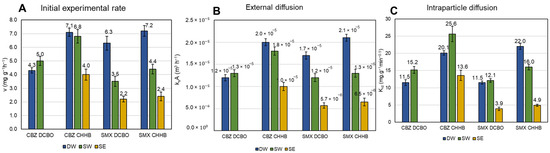
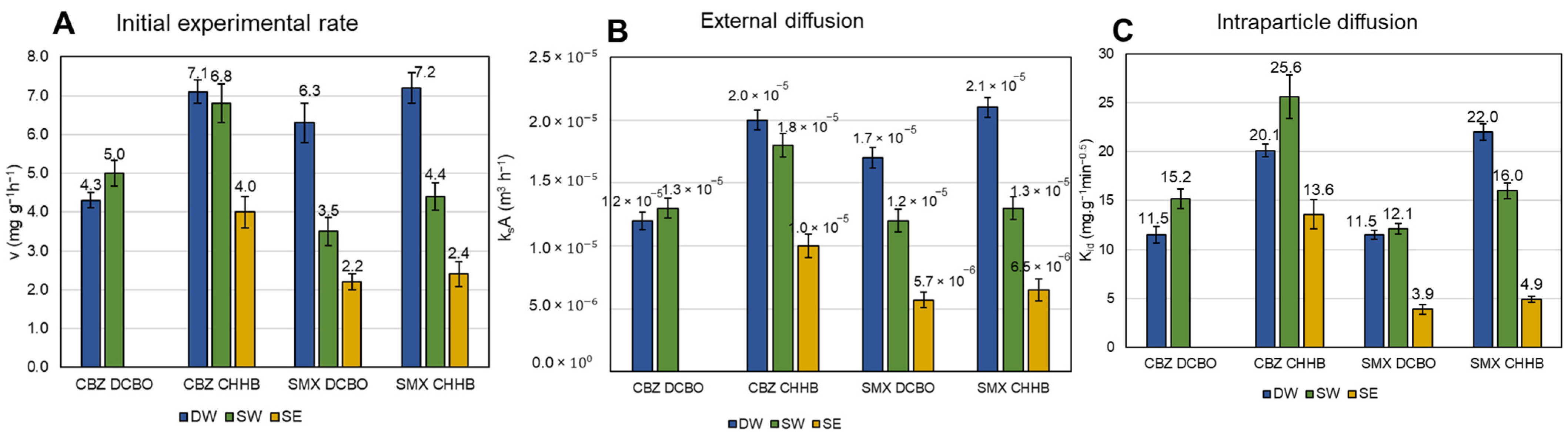
Figure 1A presents the comparison of initial adsorption rates in the three matrices, with the exception of CBZ adsorption onto DCBO in SEs, where the first experimental data points exhibited excessive variability, preventing the determination of an initial rate or the application of a diffusion model. The fastest adsorption is observed for CHHB (Figure 1A) and can be attributed to its larger mesoporous volumes, which induce better access to the micropores and accelerate the adsorption process. Diffusion into micropores can be slow, which may limit the adsorption rate, whereas mesopores facilitate the transport of molecules to micropores and can enhance the adsorption rate [34]. Another parameter that influences adsorption kinetics is particle size: the smaller the particle size, the faster the kinetics [35]. In total, 82% of the CHHB particles have diameters smaller than 1.4 mm, whilst particles between 1.0 and 1.4 mm represent only 53% of DCBO particles based on the particle size distribution obtained during initial sieving. Regarding the initial experimental adsorption rates, a decrease was observed for SMX in SW of more than 40%, while in SEs, the adsorption of both CBZ and SMX was negatively affected, leading to slower kinetics. This suggests that access to adsorption sites is restricted due to competition with dissolved organic matter present in SE.
Figure 1.
Kinetic parameters: initial experimental adsorption rate (A), external diffusion coefficients (B) and intraparticle diffusion coeffiecients (C) for the adsorption of the studied contaminants onto the activated carbons in deionized water (DW), in synthetic water (SW), and in secondary effluents (SE). Initial experimental rates and diffusion coefficients are calculated for the first 8 h of adsorption.
The diffusion coefficients of CBZ and SMX adsorption on CHHB and DCBO in the three matrices are studied through external diffusion (Figure 1B) and intraparticle diffusion (Figure 1C). Regarding external diffusion, no significant differences in ksA (Figure 1B) values were observed between the molecules in DW, except for a value a bit lower for CBZ adsorption on DCBO. However, in SW, a negative effect of ions in solution was evident for SMX adsorption, as indicated by a decrease in the ksA coefficient by 29% (DCBO) and 38% (CHHB). This leads to a better external diffusion for CBZ, which crosses the boundary layer more easily than SMX in SW, particularly on CHHB. The stronger interaction of SMX with ions in solution, compared to CBZ, likely leads to competition for adsorption sites, thus reducing the external diffusion rate of SMX. Furthermore, the presence of ions can modify the surface charge of the adsorbent, altering electrostatic interactions with the adsorbate and ultimately decreasing both diffusion and adsorption rates. In SE, both CBZ and SMX exhibited reduced external diffusion coefficients due to the presence of dissolved organic matter (DOM), although CBZ maintained the highest diffusion coefficient among the two. The reduction in diffusion can be attributed to interactions between DOM and both the target molecules and the adsorbent surface. Additionally, DOM may form a fouling layer on the AC surface, leading to pore blockage and further limiting external diffusion [36].
For intraparticle diffusion, CHHB consistently exhibits higher diffusion coefficients (Figure 1C) than DCBO for all matrices, which can certainly be explained by its porous structure containing more mesopores, leading to better intraparticle diffusion. In synthetic water (SW), CBZ demonstrates better intraparticle diffusion than SMX, as indicated by higher diffusion coefficients. In secondary effluent (SE), a substantial decrease in intraparticle diffusion coefficients was observed for both molecules. This reduction is likely due to the formation of an organic layer that constricts pore access, making it more difficult for the molecules to penetrate the adsorbent structure [36,37].
In conclusion, the comparison between CBZ and SMX adsorption reveals that CBZ consistently exhibits a faster adsorption rate and a higher equilibrium adsorption capacity for both ACs. Additionally, diffusion coefficients for CBZ were higher than those for SMX when analyzed for each AC separately, indicating more efficient external and intraparticle diffusion. Adsorption rates, as well as external and intra-particle diffusion, are higher for the coal-based activated carbon (CHHB). However, by complexifying the matrix, these differences are reduced, resulting in comparable diffusion coefficient and initial rate values between the two activated carbons, which is positive when considering the use of bio-based activated carbon in real effluents from a kinetic point of view.
3.2.2. Adsorption Isotherms: Influence of the Matrix in Mono-Component Experiments
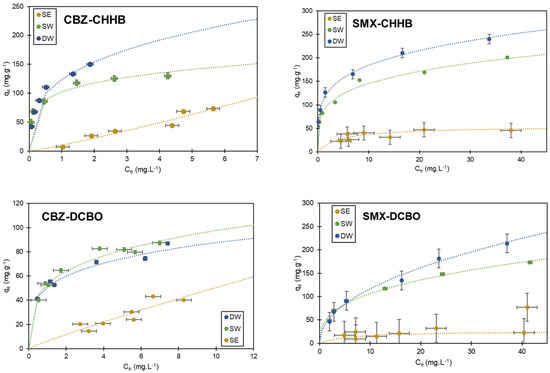
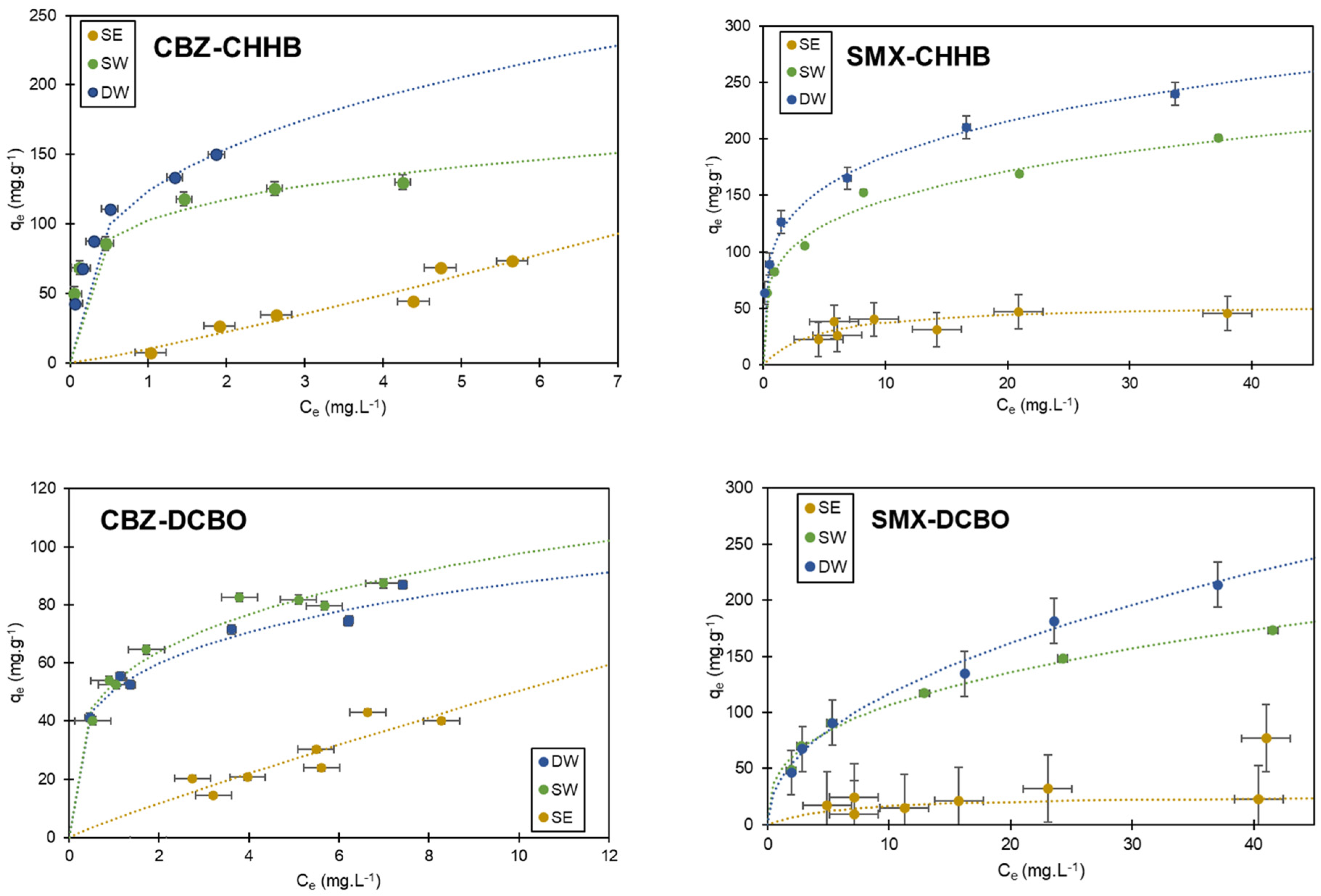
Adsorption isotherm experiments were performed at a pseudo-equilibrium time of 72 h. The results are presented in Figure 2.
Figure 2.
Adsorption isotherms of CBZ and SMX on CHHB or DCBO in DW, SW, and SE; Freundlich model; 72 h contact-time; mAC = 100 mg (SMX adsorption); 80 mg (CBZ adsorption); V = 0.95 L; and T = 20 °C.
The Freundlich model is the one that most closely describes the experimental points, suggesting heterogeneous adsorption sites and multilayer adsorption. When the 1/n value is less than 1, it suggests that the adsorption capacity increases less importantly than the concentration. This indicates a heterogeneous surface with varying affinities for the adsorbate. The Freundlich model parameters are presented in Table A2. The low 1/n values obtained in DW and SW (ranging from 0.20 to 0.47) highlight the pronounced nonlinearity, which can be attributed to the occurrence of multiple interactions in the adsorption process [19]. The Kf value, related to adsorption affinity, decreases as the matrix becomes more complex, particularly in SE. Although the values are higher for CHHB, the difference between the two ACs diminishes with increasing matrix complexity, resulting in comparable Freundlich coefficients in SE and indicating a similar behavior between the biobased and fossil-based AC. Nevertheless, the classical Freundlich model was used to describe adsorption in secondary effluent and in binary systems; its limitations under such complex conditions must be acknowledged. In the presence of DOM or a competing adsorbate, the apparent Freundlich constants no longer reflect intrinsic physicochemical properties of the adsorbent–adsorbate system but should instead be regarded as matrix-dependent parameters that incorporate competitive adsorption, site heterogeneity, and additional effects, such as interactions between solutes.
- Adsorption capacity in the SW matrix
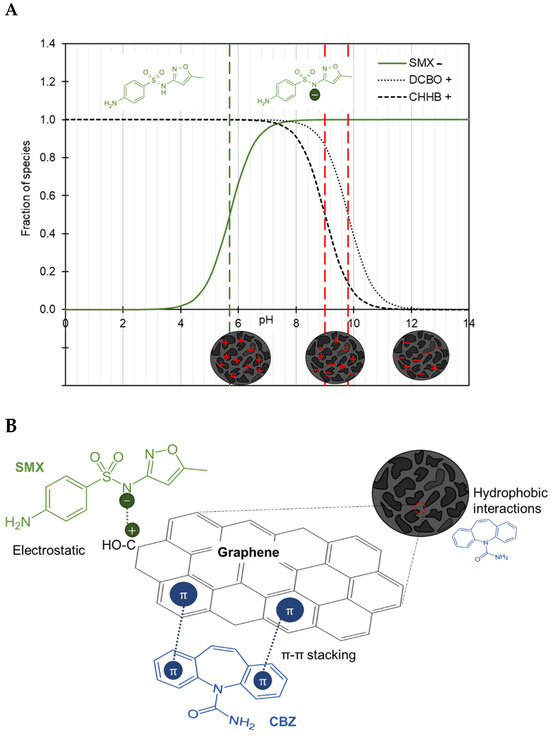
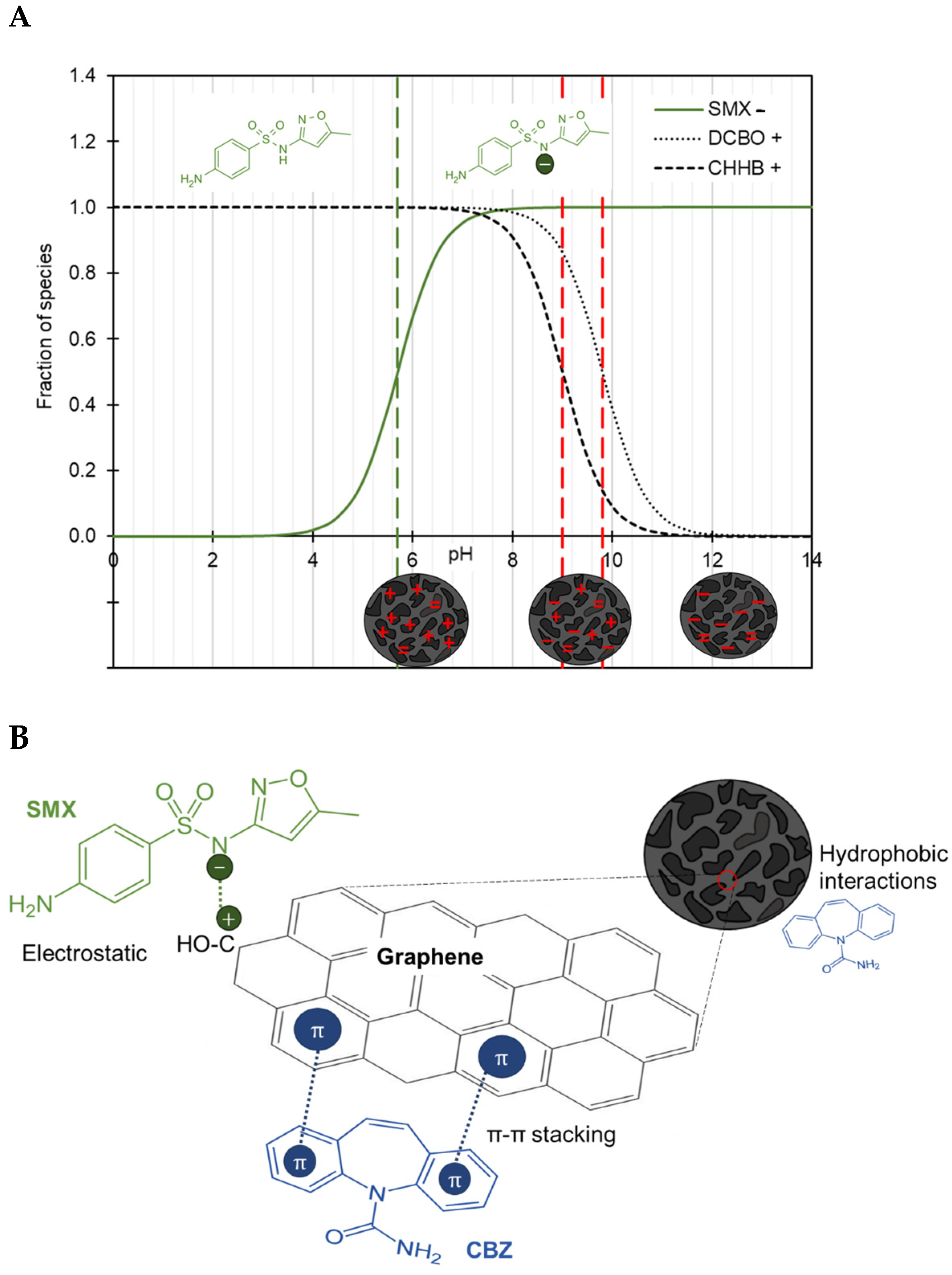
The results indicate that SMX adsorption is significantly influenced by the presence of ions in the solution, with a reduction of 20% for DCBO and 16% for CHHB at the highest initial concentration (50 mg L−1). In DW, the pH ranged from 6.3 to 7.0 for CBZ solutions and from 4.9 to 5.6 for SMX solutions, while in SW, the pH increased to between 8.0 and 8.5. Variations in pH impact adsorption, particularly for ionizable molecules like SMX. At a pH above 5.6, SMX predominantly exists in its anionic form (Figure 3A). Under these conditions, adsorption is largely governed by electrostatic interactions, and SMX competes with other anions in solution for adsorption sites. Additionally, pH influences the charge of both the adsorbates and the surface functions of the ACs. At pH values below the point of zero charge (pHpzc), both ACs are neutral to positively charged, favoring the electrostatic attraction of anionic species like SMX. However, as the pH increases from DW to SW, approaching the pHpzc, the positive surface charges of the AC diminish, leading to a decrease in the number of protonated sites (Figure 3). Consequently, the strength of electrostatic interactions with deprotonated adsorbates is reduced compared to conditions in DW, contributing to the observed decrease in adsorption capacity. Furthermore, multivalent cations such as Ca2+ or Mg2+ that may be present in synthetic water could form ion pairs or complexes by interacting with negatively charged sulfamethoxazole [38]. This could affect the ability of these complexes to be adsorbed by altering molecular size or hydrophobicity, thereby modifying their affinity for CA. Likewise, the amine group is able to form hydrogen bonds with oxygen functional groups. These interactions can also be interfered with by the presence of ions in solution.
Figure 3.
Predominant SMX species and overall CA charge as a function of pH (A), green and red lines correspond to pKa value of SMX and pHpzc of CHHB and DCBO respectively. Examples of adsorption mechanisms of CBZ and SMX adsorption on AC (B).
On the other hand, CBZ adsorption was less influenced by the presence of ions. No significant changes were observed for adsorption onto DCBO, while a slight decrease (13%) was recorded for adsorption onto CHHB at an initial concentration of 15 mg L−1. CBZ remains neutral over the studied pH range and is not adsorbed via electrostatic interactions; rather, adsorption is primarily driven by hydrophobic interactions. CBZ’s hydrophobic nature, evidenced by a log Kow value of 2.45, favors its affinity for the hydrophobic pore surfaces of the activated carbon (AC). CBZ could be better adsorbed on CHHB, which should be more hydrophobic than DCBO because of its lower oxygen content. Moreover, π-π interactions probably contribute to CBZ adsorption. The molecule’s tricyclic aromatic structure, comprising three fused aromatic rings, facilitates strong π-π stacking interactions with the carbon surface. These interactions are particularly efficient due to the planar nature of the aromatic rings, allowing for effective face-to-face stacking on the graphene-like layers of AC [39] (Figure 3B). Such π-π interactions further enhance CBZ adsorption efficiency.
- Adsorption capacity in SE matrix
Adsorption isotherms were also conducted in secondary effluent (SE) and revealed a significant decrease in CBZ and SMX adsorption capacity, consistent with previous studies [16,40,41]. This reduction is primarily attributed to competition with DOM. Comparison of total organic carbon (TOC) measurements before and after 72 h of adsorption showed a TOC reduction of approximately 30–40%, corresponding to the adsorption of 30–40 mg of TOC per gram of AC, without considering natural biodegradation. The latter was found to be negligible based on control measurements without AC. These results confirm that competition between target pollutants and DOM for adsorption sites occurs.
For SMX adsorption in SE, adsorption models poorly fit the experimental data, as the adsorption plateau is nearly reached from the initial points. SMX adsorption is substantially reduced and highly heterogeneous, showing considerable variability. This behavior can be attributed to competition for adsorption sites, particularly with hydrophobic molecules, which are preferentially adsorbed onto AC. Additionally, indirect effects such as pore access restrictions caused by large DOM molecules adsorbed within AC pores can further limit SMX adsorption [42] as well as the modification of surface charge from positive to negative by the DOM adsorption [43], and this could have a repulsive effect on SMX (negatively charged). Competition with negatively charged DOM species also occurs. Moreover, small-sized DOM molecules, which are rapidly adsorbed, can contribute to pore blockage. Another mechanism proposed by Guillossou et al. [42] is the formation of large DOM-pollutant complexes, which are more difficult to adsorb due to their high molecular weight.
For CBZ adsorption, a linear isotherm was obtained, with a 1/n value greater than 1, indicating unfavorable adsorption. This suggests competition primarily with hydrophobic DOM.
Overall, the strong reduction in adsorption capacity highlights the inhibitory effects of organic compounds present in SE. These components include natural organic matter like humic and fulvic acids, proteins, carbohydrates, soluble microbial products, and traces of organic micropollutants such as pharmaceuticals and disinfection by-products [44].
Guillossou et al. [42] suggested that prolonged contact times could potentially achieve adsorption capacities similar to those in DW. However, adsorption kinetics conducted in this study indicate that diffusion is not merely slowed down but partially inhibited by the presence of DOM.
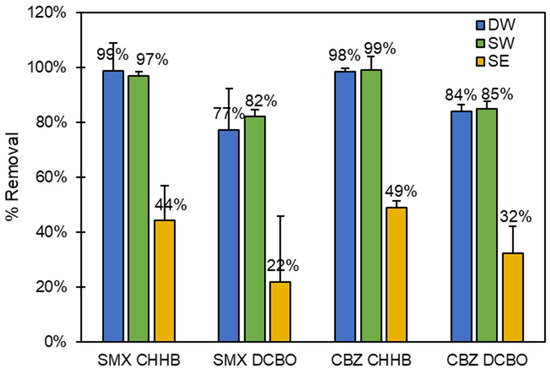
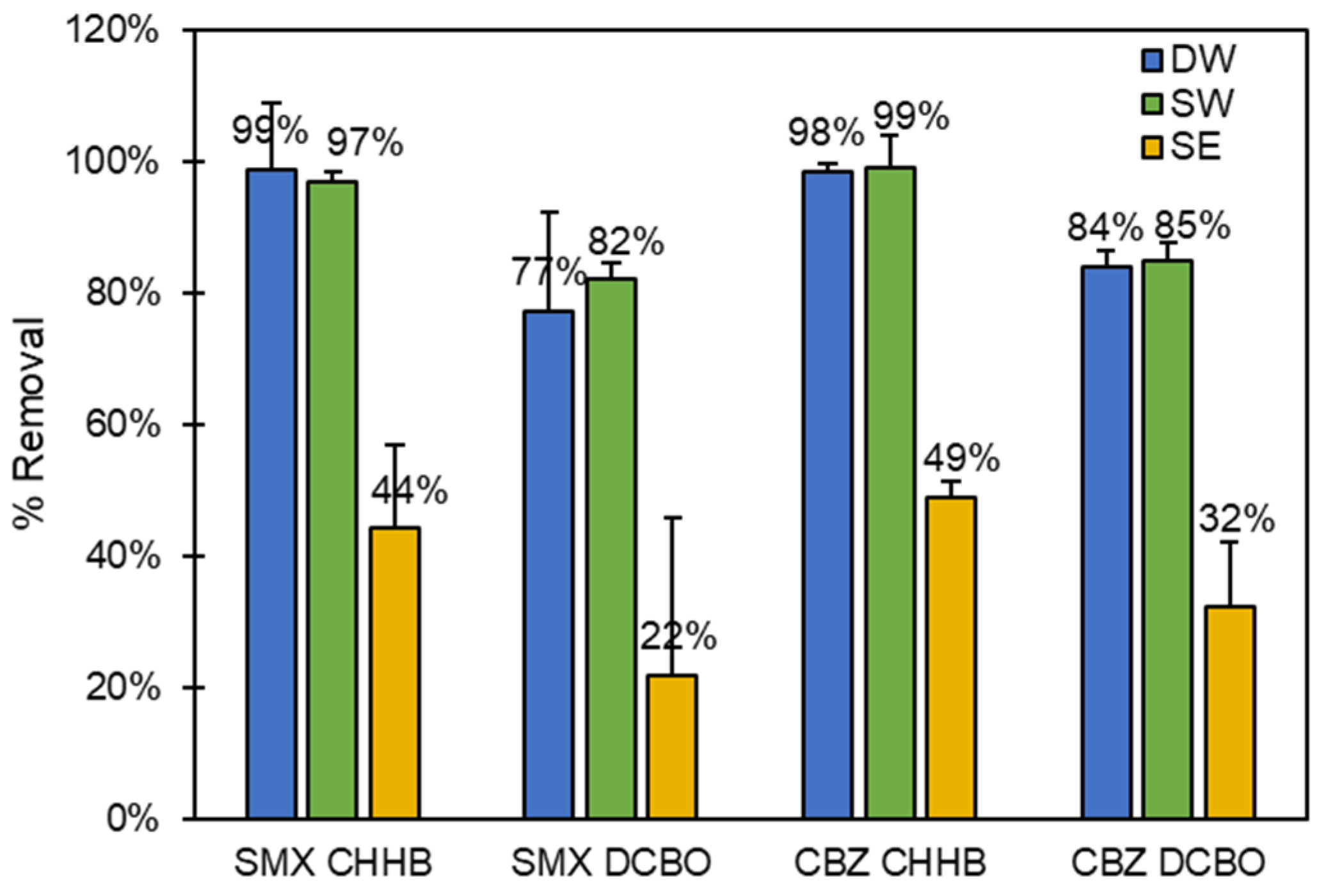
Figure 4 presents the removal rate for the same C0/m ratio of 0.25 mmol g−1 L−1 after 72 h of contact time with the ACs across the three (3) matrices. Under these conditions, high removal efficiencies of the target compounds were observed in DW and SW, particularly with CHHB, where nearly complete elimination was achieved. In contrast, a decrease in removal efficiency was observed in SE, as expected, due to the presence of DOM, which inhibits adsorption. This decrease is even more noticeable for DCBO, where pore blocking is likely more significant due to its high micropore content [43]. While the overall removal rate with DCBO is slightly lower than for CHHB, there is considerable variability in adsorption capacity, probably due to the composition of dissolved organic matter.
Figure 4.
Comparison of removal rate at 72 h in the three matrices, values obtained with the Freundlich model for the same initial conditions of C0/m = 0.25 mmol L−1 g−1, V = 0.95 L, mAC = 80 mg (CBZ), and 100 mg (SMX).
Despite this reduction, good removal efficiencies were maintained, comparable to values reported in previous studies performed with biobased AC from coconut shell (Table 3). Gutiérrez et al. [45] and Diniz et al. [41] obtained similar removal values with comparable initial conditions, but when the C0/m ratio was changed, different removal rates were obtained, consistent with the fact that if a higher quantity of carbon is used, better removal will be obtained. Even higher removal rates, including complete elimination, could be expected at lower pharmaceutical concentrations.
Table 3.
Removal rate of CBZ and SMX in SE by adsorption on AC from the literature.
Given the influence of DOM on adsorption capacity, the results suggest that removal efficiency may vary with TOC concentration. Additional experiments confirmed that CHHB adsorbed greater amounts of DOM, resulting in a more pronounced TOC decrease compared to DCBO. This greater DOM uptake may, however, lead to faster saturation of CHHB.
3.2.3. Adsorption Isotherms: Influence of the Matrix in Bi-Component Experiments
- Adsorption in the SW matrix
To investigate potential competition between the two target molecules for adsorption sites, bi-component adsorption experiments were conducted using equimolar concentrations of SMX and CBZ in SW. Adsorption isotherms for the equimolar mixture were established for both CHHB and DCBO, and the results of the Freundlich modeling are presented in Figure A2. A decrease in SMX adsorption capacity was observed in the bicomponent system, indicating competition between CBZ and SMX for available adsorption sites.
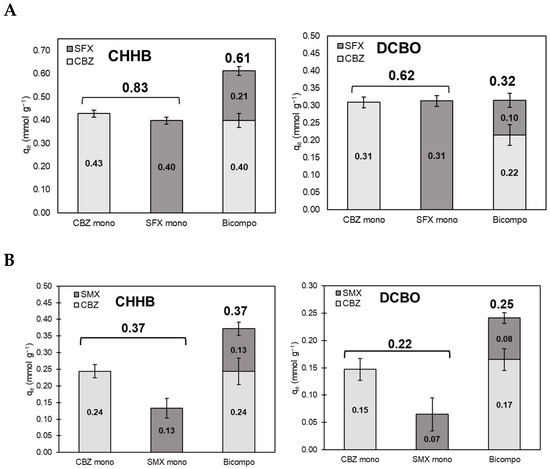
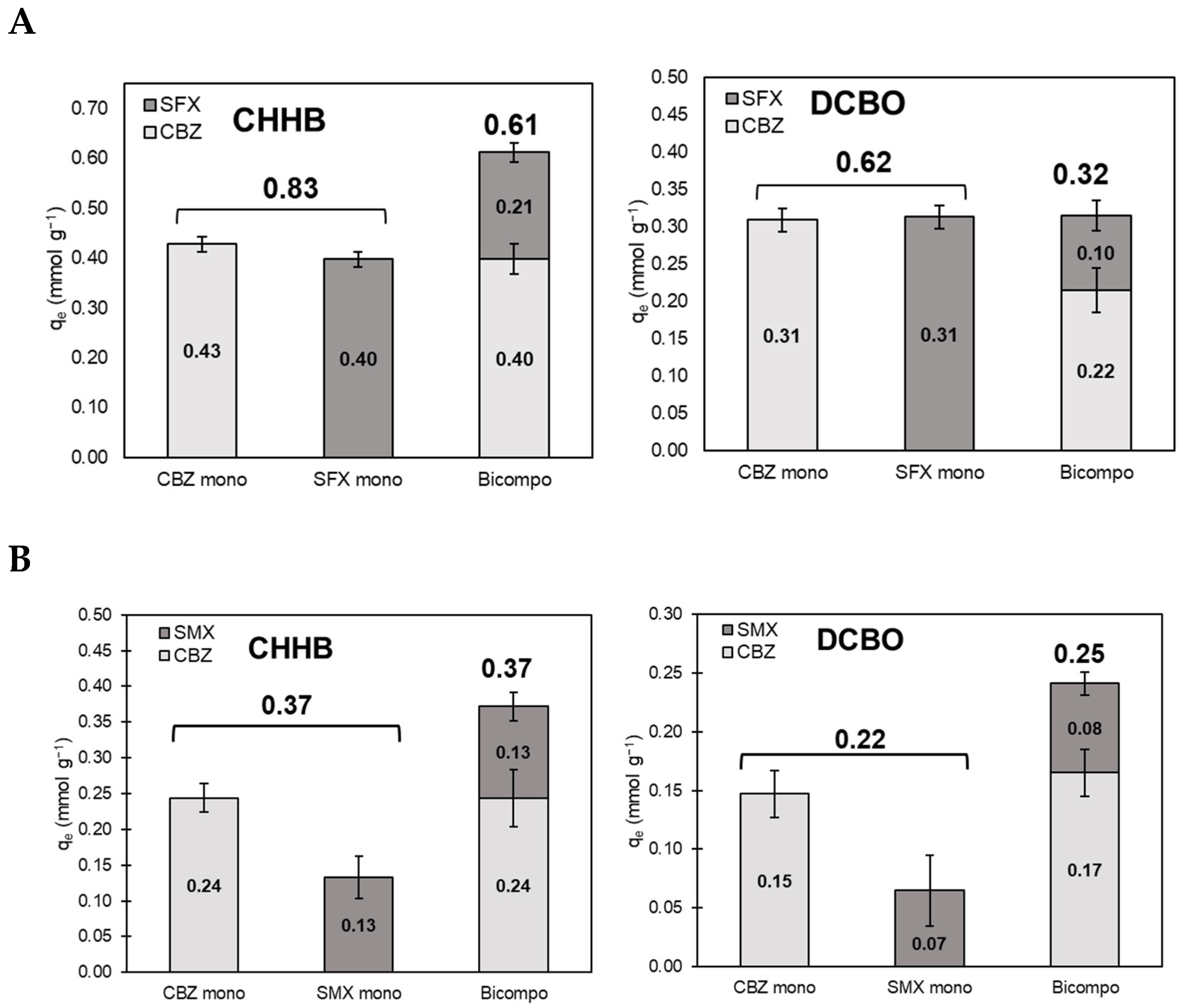
Figure 5A shows the adsorption capacities at 72 h under initial conditions with a same ratio of initial concentration to AC mass, equal to 0.50 mmol L−1 g−1, for both mono-component (CBZ or SMX alone) and bi-component (sum of CBZ and SMX) systems. This approach allows for direct comparison of the total number of molecules adsorbed onto the carbon in both mono-component and bi-component systems for the same initial concentration of each compound.
Figure 5.
Comparison of the adsorption capacity of CHHB and on DCBO in mono-component or bicomponent systems of SMX and CBZ in SW (A) and in SEs (B) for a same C0/m ratio of 0.50 mmol g−1 of each pharmaceutical (in a bicomponent system, global concentration is the sum of the 2 pharmaceuticals and C0global/m = 1.0 mmol g−1).
The results demonstrate that the adsorption capacity of each pharmaceutical in the bi-component system is lower than in the corresponding mono-component system, despite identical initial concentrations. This trend is observed for all AC/molecule pairs, except for CBZ adsorption on CHHB, where no significant difference between mono-component and bi-component adsorption is observed (0.428 and 0.398). Additionally, the total number of molecules adsorbed in the bi-component system is lower than the sum of the molecules adsorbed in the mono-component systems, suggesting that competition for adsorption sites is occurring. For DCBO, the number of molecules adsorbed is roughly the same in both the mono-component (0.31 ± 0.02 mmol g−1) and bi-component systems (0.32 ± 0.03 mmol g−1 for CBZ + SMX), which may indicate that both molecules are adsorbed onto the same set of sites. In contrast, CHHB adsorption shows that not all sites are involved in competition with a higher amount of molecules adsorbed in a bi-component with a higher initial concentration of molecules (0.61 ± 0.03 mmol g−1) compared to adsorption in a mono-component (0.40 and 0.43 ± 0.02 mmol g−1). Some sites preferentially adsorb a single pharmaceutical, while others allow both molecules to adsorb, but only one can bind at a time, with the presence of one molecule inhibiting adsorption of the other. This suggests that competition occurs at certain sites, while other sites may allow for the adsorption of both molecules, although with limited accessibility.
Adsorption capacity of CBZ is less impacted by the presence of SMX in the mixture compared to SMX, with no reduction observed on CHHB (0.43 to 0.40 mmol g−1) and a 30% decrease on DCBO (0.31 to 0.22 mmol g−1). Conversely, SMX adsorption is significantly reduced in the presence of CBZ, with a 46% and 68% decrease in adsorption capacity for CHHB (0.40 to 0.21 mmol g−1) and DCBO (0.31 to 0.10 mmol g−1), respectively. This suggests that CBZ has a higher affinity for the AC surface, resulting in preferential adsorption, while SMX is more strongly affected by the competition. These findings support the notion that activated carbon generally adsorbs hydrophobic molecules more effectively than hydrophilic ones. AC has a predominantly hydrophobic surface, which interacts more favorably with nonpolar, hydrophobic molecules. In contrast, hydrophilic molecules, like SMX, are more soluble in water and interact less strongly with the AC surface [47]. Moreover, CBZ’s adsorption may involve hydrophobic interactions or π-π stacking between its aromatic rings and the aromatic cycles of the AC graphene surface, potentially hindering access to adsorption sites via steric effects [48].
- Adsorption in SE matrix
The same experiments were conducted using SE, and the results are presented in Figure 5B. No significant decrease in adsorption capacity was observed concerning the number of molecules adsorbed in the bi-component system and the sum in the mono-component system (0.37 ± 0.04 mmol g−1 for CHHB and 0.22 or 0.25 ± 0.03 mmol g−1 for DCBO). The adsorption capacities of DCBO and CHHB, whether under mono-component or bi-component conditions, were identical, with the adsorption isotherms for both systems almost overlapping. These results suggest that the addition of another pharmaceutical molecule in the bi-component system does not significantly impact the adsorption process, which is consistent with the presence of DOM in SE. Since competition for adsorption sites already occurs with DOM, the introduction of an additional target pharmaceutical molecule does not further influence the adsorption dynamics. This implies the existence of different types of adsorption sites, some of which are more specific to pharmaceuticals and exhibit higher affinity than those available for DOM. SMX and CBZ molecules could also interact with adsorbed organic matter and thus create different adsorption sites [42].
3.3. Fixed Bed Experiments: Comparison of Breakthrough Curves in Bi-Component Systems in SW for Both AC
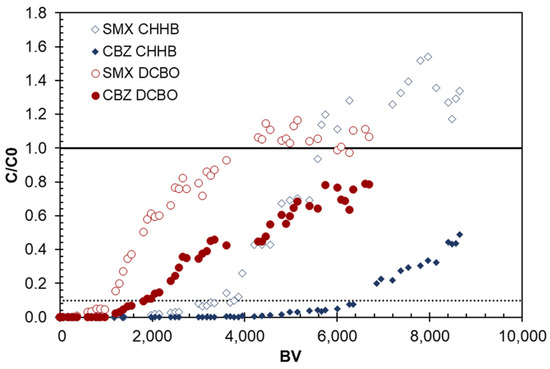
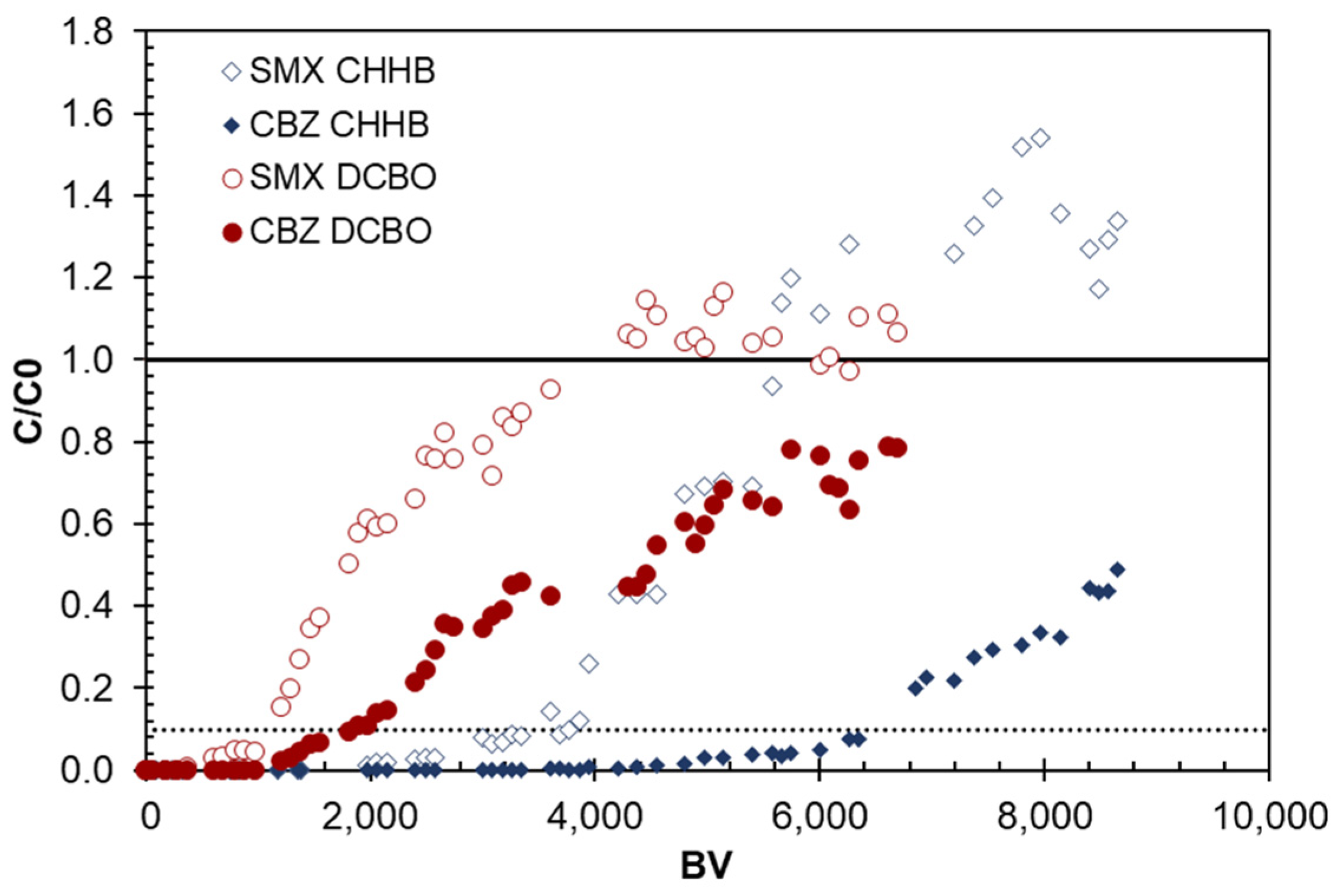
Fixed-bed experiments were conducted only in the SW matrix with the aim of comparing the behavior of each molecule in a bicomponent system with respect to each activated carbon. The breakthrough curve results are presented in Figure 6.
Figure 6.
Breakthrough curves of CBZ and SMX, for CHHB and DCBO adsorption in equimolar mix.
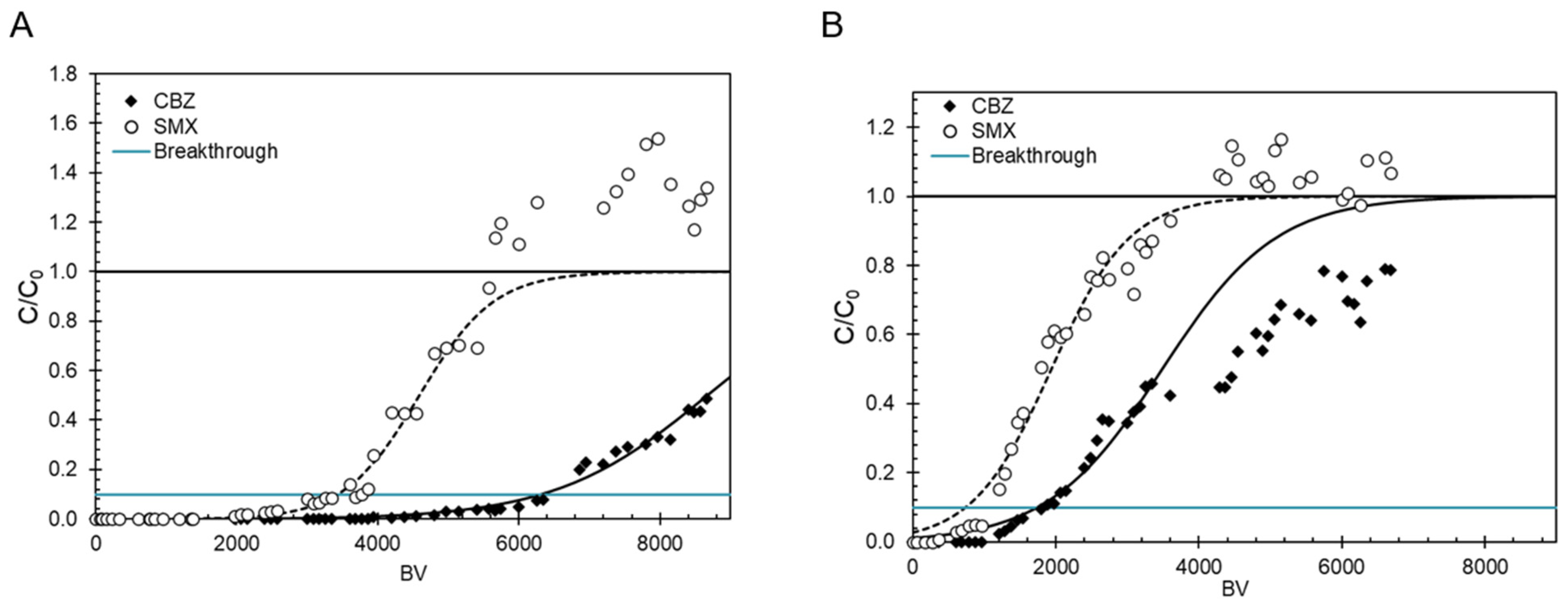
Breakthrough occurs much earlier with DCBO, at 1000 BV for SMX and 1880 BV for CBZ (corresponding to 13 and 22 days), whereas breakthrough is reached after 3780 BV for SMX and 6500 BV for CBZ with CHHB (42 and 75 days), 3.5 times later. This corresponds to breakthrough adsorption capacities of 19.1 and 48.7 mg g−1 for SMX and CBZ, respectively, with DCBO and 60.7 and 114.0 mg g−1 with CHHB (Table 4). This is consistent with the results obtained in the closed system, where CHHB exhibited higher adsorption capacities. Thomas model was applied to the data points preceding SMX saturation and its subsequent release, which could distort the model (Figure A3). This allowed estimating the saturation adsorption capacity qTh (Table 4). For SMX adsorption, this value is higher than that obtained in the closed bicomponent batch system, where the maximum adsorption capacity was around 0.2 mmol g−1 (53 mg g−1) on CHHB and around 0.1 mmol g−1 (26 mg g−1) on DCBO after 72 h (Figure A2). This may be due to the fact that competition for adsorption sites between the two molecules is more indirect in the column: as CBZ is adsorbed first by the first grains in the column, SMX can be adsorbed without competition on the following grains until no more sites are available; or perhaps because the maximum adsorption capacity had not been fully reached in the closed system at the time of analysis after 72 h of contact. For CBZ, the maximum adsorption capacity measured in batch experiments was not reached, and the higher values obtained considerably underestimate the real maximum capacity, making direct comparisons with the values predicted by the Thomas model inconclusive.
Table 4.
Adsorption capacities at breakthrough for adsorption in SW in equimolar mix on CHHB and DCBO, and Thomas model parameters for SMX and CBZ. qb = adsorption capacity at breakthrough, qTh = adsorption capacity at saturation according to Thomas model.
SMX breakthrough is always much earlier than CBZ, and the breakthrough adsorption capacity is 47% lower for SMX with CHHB and 61% lower with DCBO, which is consistent with the results obtained in the closed system (46% lower for SMX than for CBZ with CHHB and 53% with DCBO). This can be explained by the higher adsorption rate and better diffusion of CBZ compared to SMX, as observed in the closed system (Figure 1), with CBZ showing an adsorption rate 35% higher than that of SMX. The desorption of SMX (C/C0 > 1) during CBZ adsorption indicates that SMX has a lower affinity for the adsorbent compared to CBZ. This suggests that both compounds compete for the same adsorption sites, with CBZ displaying stronger interactions with the adsorbent and displacing SMX from previously occupied sites. This phenomenon is even more pronounced on CHHB, indicating that the two molecules share more adsorption sites than on DCBO, where SMX is less released during CBZ breakthrough. The release of SMX with CHHB occurs when CBZ begins to break through, showing that CBZ effectively replaces SMX, whereas the same phenomenon is not observed with CA DCBO, for which the two molecules break through almost simultaneously, suggesting that the molecules are adsorbed on different sites or that CBZ does not specifically have a substantially higher affinity than SMX. The dominance of hydrophobic and π–π interactions in CBZ adsorption, compared to the weaker interactions involved in SMX adsorption, likely explains this displacement phenomenon. These results corroborate those obtained in the closed reactor for bicomponent studies, showing competition between the two molecules for adsorption sites where CBZ adsorption is favored (Figure A2).
For CHHB AC, mass balance analysis for SMX showed that after 100 days, around 800 mg of SMX had been adsorbed, of which 100 to 140 mg was subsequently released, resulting in a final retained amount of 660 to 700 mg, corresponding to 65 mg g−1 of CHHB after 9000 BV. The same calculation has been done for DCBO and showed that after 80 days, a total of 380 mg of SMX had been adsorbed, of which around 30 mg was subsequently released, resulting in a final retained amount of 350 mg, corresponding to 57 mg g−1 of DCBO after 6700 BV.
The release observed with CHHB for SMX can be problematic in real-world applications due to the release of high concentrations of molecules. If this phenomenon occurs at an industrial scale, it can lead to significant operational and safety issues. An outlet concentration exceeding the inlet indicates displacement effects that may cause pollutant concentration peaks, regulatory non-compliance, and risks to downstream units. Strong competitive adsorption also reduces process predictability and controllability under variable feed conditions. DCBO breakthrough is faster, but the risk of a high-level release is lower and would limit concentration overshoots at the outlet, leading to safer and more predictable operation.
4. Conclusions
In this study, we evaluated and investigated the main factors influencing the removal of two representative pharmaceuticals, namely carbamazepine (CBZ) and sulfamethoxazole (SMX), by a biobased AC and an AC from coal in three matrices: deionized water (DW), synthetic water with ions (SW), and urban wastewater secondary effluents (SEs).
Different competition mechanisms were demonstrated:
- -
- Competition with ions affecting electrostatic interactions involved in SMX adsorption.
- -
- Competition with DOM and pore blockage leads to a decrease in CBZ and SMX adsorption capacity. Decreases in adsorption rate and diffusion are also observed because of interactions of pharmaceuticals with DOM.
- -
- Competition between the two pharmaceuticals: CBZ adsorption is favored over SMX adsorption, which is less adsorbed, showing better affinity of CBZ than SMX for the adsorbent both in batch and column studies, due to better diffusion of CBZ or stronger interactions with the ACs.
This study highlights the influence of physicochemical characteristics of the ACs and the adsorbates on adsorption reactions:
- -
- Better diffusion is observed into an AC with a higher mesoporous volume;
- -
- The ionization capacity of the adsorbates can allow different interactions with the AC surface functions;
- -
- Hydrophobic molecules could be adsorbed more easily on AC, which also have hydrophobic surface.
Adsorption on activated carbon remains an excellent process for the elimination of SMX and CBZ. Although DOM has an inhibitory effect on adsorption, the results show that the adsorption remains effective even in real WWTP effluent. These performances could be further enhanced through the addition of pretreatment systems before the adsorption process, thereby improving the overall efficiency of the process for the removal of pharmaceuticals. Although fossil-based activated carbon still offers better removal performance, bio-based activated carbon has demonstrated promising results in removing the pollutants studied.
In the context of developing more sustainable advanced treatment solutions for wastewater reuse, biobased activated carbon represents a promising alternative to conventional petroleum-derived adsorbents. Its performance can even be further enhanced by optimizing the preparation of activated carbons to enhance mesoporosity and hydrophobicity, thereby promoting the efficient removal of pharmaceutical compounds while reducing pore blockage caused by DOM.
Author Contributions
Conceptualization, M.D., C.G., V.H. and Y.A.; Formal analysis, M.D.; Investigation, M.D.; Methodology, M.D., C.G., V.H. and Y.A.; Supervision, H.W., C.G., V.H. and Y.A.; Validation, H.W., C.G., V.H., N.Z.-F. and Y.A.; Visualization, M.D.; Writing—original draft, M.D.; Writing—review and editing, H.W., C.G., V.H., N.Z.-F. and Y.A. All authors have read and agreed to the published version of the manuscript.
Funding
This project was supported by Ninfa “TakiNg actIoN to prevent and mitigate pollution oF groundwAter bodies”, funded by the European Research Executive Agency as part of Horizon Europe—the framework for Research and Innovation (2021–2027) “Project: 101081865—NINFA—HORIZON-CL6-2022-ZEROPOLLUTION-01” and Région Pays de la Loire (France) for PhD scholarships.
Data Availability Statement
The raw data supporting the conclusions of this article will be made available by the authors on request.
Conflicts of Interest
The authors declare no conflicts of interest. The funders had no role in the design of the study; in the collection, analyses, or interpretation of data; in the writing of the manuscript; or in the decision to publish the results.
Appendix A
Table A1.
Carbamazepine and sulfamethoxazole properties [16,49].

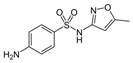
Figure A1.
Adsorption kinetics in different matrices, modeled by the PSO model. C0 = 10 mg L−1, mCA = 100 mg, V = 2 L, 200 rpm, 20 °C, DW: deionized water, SW: synthetic water, SE: secondary effluents.
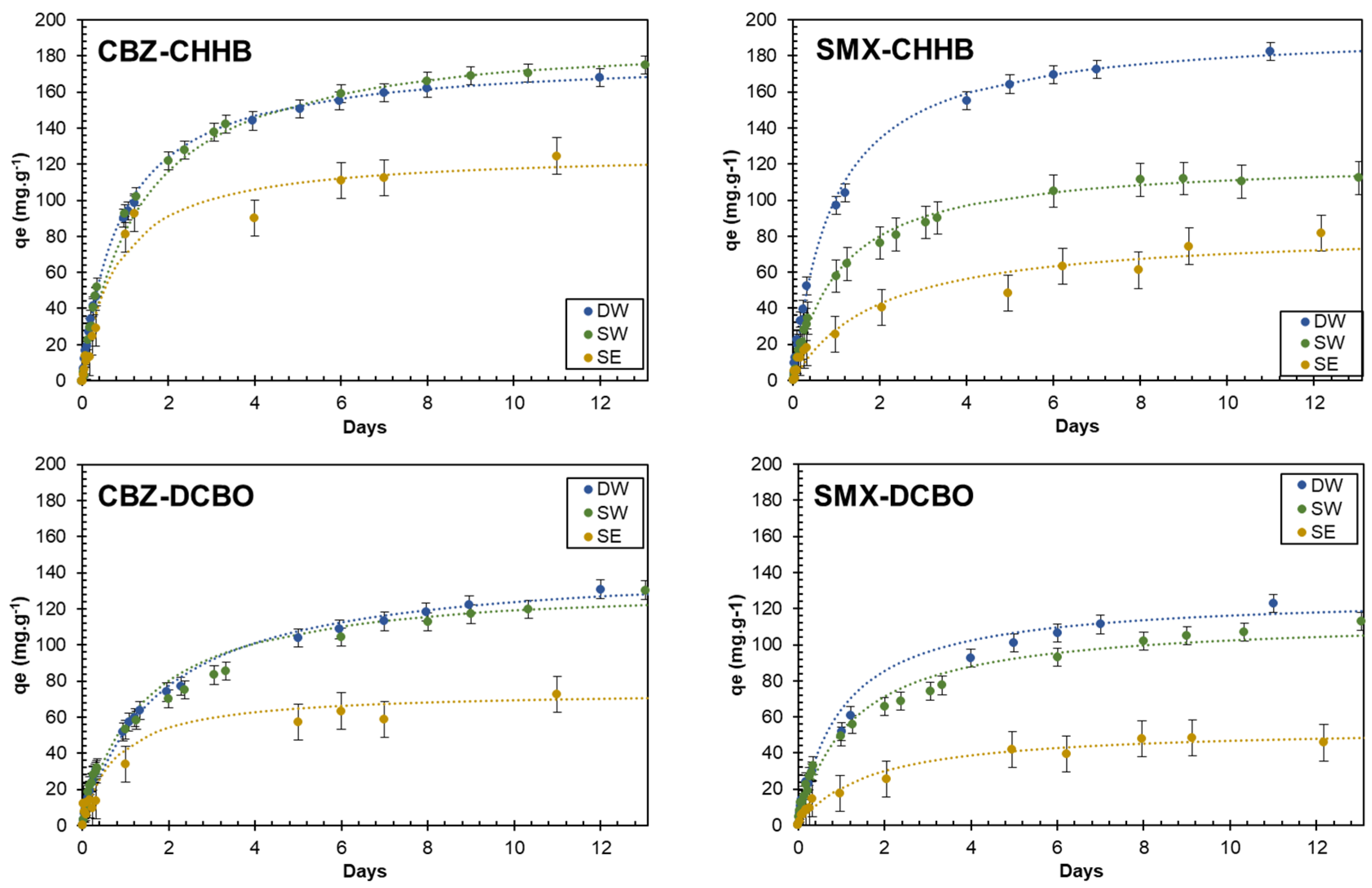
Table A2.
Summary of the Freundlich isotherm parameters for the adsorption of the studied contaminants onto the activated carbons after 72 h of contact time in the three (3) matrices.
Figure A2.
Comparison of adsorption isotherms for mono-component and bi-component experiments using the Freundlich model in SW. V = 0.95 L, mAC = 80 mg (bicomponent and CBZ studies) or 100 mg (SMX).
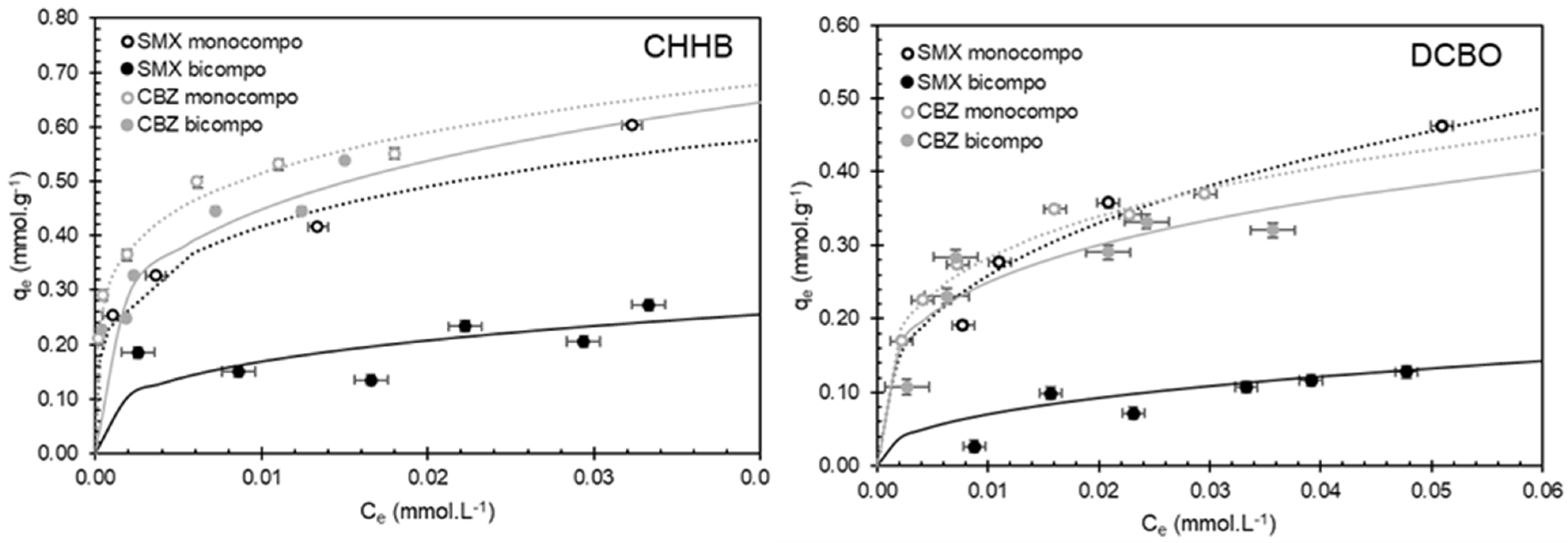
Figure A3.
Thomas model applied to CBZ and SMX breakthrough curves with CHHB (A) and DCBO (B).
References
- European Union. TakiNg actIoN to prevent and mitigate pollution oF groundwAter bodies|NINFA Project|Fact Sheet|HORIZON. Available online: https://cordis.europa.eu/project/id/101081865 (accessed on 16 January 2024).
- Moghaddam, A.; Khayatan, D.; Esmaeili Fard Barzegar, P.; Ranjbar, R.; Yazdanian, M.; Tahmasebi, E.; Alam, M.; Abbasi, K.; Esmaeili Gouvarchin Ghaleh, H.; Tebyaniyan, H. Biodegradation of Pharmaceutical Compounds in Industrial Wastewater Using Biological Treatment: A Comprehensive Overview. Int. J. Environ. Sci. Technol. 2023, 20, 5659–5696. [Google Scholar] [CrossRef] [Scilit]
- European Commission. Directive (EU) 2024/3019 of the European Parliament and of the Council of 27 November 2024 Concerning Urban Wastewater Treatment (Recast); European Commission: Brussels, Belgium, 2024. [Google Scholar]
- European Commission. Proposal Amending Water Directives 2022; European Commission: Brussels, Belgium, 2022. [Google Scholar]
- Bizi, M. Sulfamethoxazole Removal from Drinking Water by Activated Carbon: Kinetics and Diffusion Process. Molecules 2020, 25, 4656. [Google Scholar] [CrossRef] [Scilit] [PubMed]
- Benotti, M.J.; Brownawell, B.J. Distributions of Pharmaceuticals in an Urban Estuary during Both Dry- and Wet-Weather Conditions. Environ. Sci. Technol. 2007, 41, 5795–5802. [Google Scholar] [CrossRef] [Scilit]
- Miège, C.; Choubert, J.M.; Ribeiro, L.; Eusèbe, M.; Coquery, M. Fate of Pharmaceuticals and Personal Care Products in Wastewater Treatment Plants—Conception of a Database and First Results. Environ. Pollut. 2009, 157, 1721–1726. [Google Scholar] [CrossRef] [Scilit] [PubMed]
- Wilkinson, J.L.; Boxall, A.B.A.; Kolpin, D.W.; Leung, K.M.Y.; Lai, R.W.S.; Galbán-Malagón, C.; Adell, A.D.; Mondon, J.; Metian, M.; Marchant, R.A.; et al. Pharmaceutical Pollution of the World’s Rivers. Proc. Natl. Acad. Sci. USA 2022, 119, e2113947119. [Google Scholar] [CrossRef] [Scilit]
- Haenni, M.; Dagot, C.; Chesneau, O.; Bibbal, D.; Labanowski, J.; Vialette, M.; Bouchard, D.; Martin-Laurent, F.; Calsat, L.; Nazaret, S.; et al. Environmental Contamination in a High-Income Country (France) by Antibiotics, Antibiotic-Resistant Bacteria, and Antibiotic Resistance Genes: Status and Possible Causes. Environ. Int. 2022, 159, 107047. [Google Scholar] [CrossRef] [Scilit]
- Oldenkamp, R.; Beusen, A.H.W.; Huijbregts, M.A.J. Aquatic Risks from Human Pharmaceuticals—Modelling Temporal Trends of Carbamazepine and Ciprofloxacin at the Global Scale. Environ. Res. Lett. 2019, 14, 034003. [Google Scholar] [CrossRef] [Scilit]
- Clara, M.; Strenn, B.; Kreuzinger, N. Carbamazepine as a Possible Anthropogenic Marker in the Aquatic Environment: Investigations on the Behaviour of Carbamazepine in Wastewater Treatment and during Groundwater Infiltration. Water Res. 2004, 38, 947–954. [Google Scholar] [CrossRef] [Scilit] [PubMed]
- Décima, M.A.; Marzeddu, S.; Barchiesi, M.; Di Marcantonio, C.; Chiavola, A.; Boni, M.R. A Review on the Removal of Carbamazepine from Aqueous Solution by Using Activated Carbon and Biochar. Sustainability 2021, 13, 11760. [Google Scholar] [CrossRef] [Scilit]
- Ncibi, M.C.; Sillanpää, M. Optimizing the Removal of Pharmaceutical Drugs Carbamazepine and Dorzolamide from Aqueous Solutions Using Mesoporous Activated Carbons and Multi-Walled Carbon Nanotubes. J. Mol. Liq. 2017, 238, 379–388. [Google Scholar] [CrossRef] [Scilit]
- Viegas, R.M.C.; Mestre, A.S.; Mesquita, E.; Campinas, M.; Andrade, M.A.; Carvalho, A.P.; Rosa, M.J. Assessing the Applicability of a New Carob Waste-Derived Powdered Activated Carbon to Control Pharmaceutical Compounds in Wastewater Treatment. Sci. Total Environ. 2020, 743, 140791. [Google Scholar] [CrossRef] [Scilit]
- Teixeira, S.; Delerue-Matos, C.; Santos, L. Application of Experimental Design Methodology to Optimize Antibiotics Removal by Walnut Shell Based Activated Carbon. Sci. Total Environ. 2019, 646, 168–176. [Google Scholar] [CrossRef] [Scilit] [PubMed]
- Mestre, A.S.; Viegas, R.M.C.; Mesquita, E.; Rosa, M.J.; Carvalho, A.P. Engineered Pine Nut Shell Derived Activated Carbons for Improved Removal of Recalcitrant Pharmaceuticals in Urban Wastewater Treatment. J. Hazard. Mater. 2022, 437, 129319. [Google Scholar] [CrossRef] [Scilit] [PubMed]
- Moral-Rodríguez, A.I.; Leyva-Ramos, R.; Ocampo-Pérez, R.; Mendoza-Barron, J.; Serratos-Alvarez, I.N.; Salazar-Rabago, J.J. Removal of Ronidazole and Sulfamethoxazole from Water Solutions by Adsorption on Granular Activated Carbon: Equilibrium and Intraparticle Diffusion Mechanisms. Adsorption 2016, 22, 89–103. [Google Scholar] [CrossRef] [Scilit]
- Vilén, A.; Laurell, P.; Vahala, R. Comparative Life Cycle Assessment of Activated Carbon Production from Various Raw Materials. J. Environ. Manag. 2022, 324, 116356. [Google Scholar] [CrossRef] [Scilit]
- Álvarez-Torrellas, S.; Segura, Y.; De Mora, A.; Gutiérrez-Sánchez, P.; Sanz-Santos, E.; Corrochano, N.; Larriba, M.; Pariente, M.I.; Martínez, F.; García, J. Evaluation of the Adsorptive and Catalytic Properties of Sludge-Based Carbon Materials for the Efficient Removal of Antibiotics Listed in the European Decision 2020/1161/EU. J. Environ. Chem. Eng. 2023, 11, 110743. [Google Scholar] [CrossRef] [Scilit]
- Nam, S.-W.; Choi, D.-J.; Kim, S.-K.; Her, N.; Zoh, K.-D. Adsorption Characteristics of Selected Hydrophilic and Hydrophobic Micropollutants in Water Using Activated Carbon. J. Hazard. Mater. 2014, 270, 144–152. [Google Scholar] [CrossRef] [Scilit]
- Álvarez-Torrellas, S.; Peres, J.A.; Gil-Álvarez, V.; Ovejero, G.; García, J. Effective Adsorption of Non-Biodegradable Pharmaceuticals from Hospital Wastewater with Different Carbon Materials. Chem. Eng. J. 2017, 320, 319–329. [Google Scholar] [CrossRef] [Scilit]
- Smith, E.J.; Davison, W.; Hamilton-Taylor, J. Methods for Preparing Synthetic Freshwaters. Water Res. 2002, 36, 1286–1296. [Google Scholar] [CrossRef] [Scilit]
- Knappe, D.R.U.; Snoeyink, V.L.; Roche, P.; Prados, M.J.; Bourbigot, M.-M. Atrazine Removal by Preloaded GAC. J. Am. Water Work. Assoc. 1999, 91, 97–109. [Google Scholar] [CrossRef] [Scilit]
- Chu, C.F.; Ng, K.M. Flow in Packed Tubes with a Small Tube to Particle Diameter Ratio. AIChE J. 1989, 35, 148–158. [Google Scholar] [CrossRef] [Scilit]
- Lagergren, S. About the Theory of So-Called Adsorption of Soluble Substances. K. Sven. Vetenskapsakademiens Handl. 1898, 24, 1–39. [Google Scholar]
- Ho, Y.S.; McKay, G. Pseudo-Second Order Model for Sorption Processes. Process Biochem. 1999, 34, 451–465. [Google Scholar] [CrossRef] [Scilit]
- Weber, W.J. Evolution of a Technology. J. Environ. Eng. 1984, 110, 899–917. [Google Scholar] [CrossRef] [Scilit]
- Spahn, H.; Schlünder, E.U. The Scale-up of Activated Carbon Columns for Water Purification, Based on Results from Batch Tests—I: Theoretical and Experimental Determination of Adsorption Rates of Single Organic Solutes in Batch Tests. Chem. Eng. Sci. 1975, 30, 529–537. [Google Scholar] [CrossRef] [Scilit]
- Allen, S.J.; McKay, G.; Khader, K.Y.H. Intraparticle Diffusion of a Basic Dye during Adsorption onto Sphagnum Peat. Environ. Pollut. 1989, 56, 39–50. [Google Scholar] [CrossRef] [Scilit]
- Freundlich, H. Oberflächeneinflüsse beim Bler und bei der Bierbereitung. Z. Chem. Ind. Kolloide 1906, 1, 152. [Google Scholar] [CrossRef] [Scilit]
- Al-Ghouti, M.A.; Da’ana, D.A. Guidelines for the Use and Interpretation of Adsorption Isotherm Models: A Review. J. Hazard. Mater. 2020, 393, 122383. [Google Scholar] [CrossRef] [Scilit]
- Thomas, H.C. Heterogeneous Ion Exchange in a Flowing System. J. Am. Chem. Soc. 1944, 66, 1664–1666. [Google Scholar] [CrossRef] [Scilit]
- Ania, C.O.; Cabal, B.; Parra, J.B.; Pis, J.J. Importance of the Hydrophobic Character of Activated Carbons on the Removal of Naphthalene from the Aqueous Phase. Adsorpt. Sci. Technol. 2007, 25, 155–167. [Google Scholar] [CrossRef] [Scilit]
- Branton, P.; Bradley, R.H. Effects of Active Carbon Pore Size Distributions on Adsorption of Toxic Organic Compounds. Adsorption 2011, 17, 293–301. [Google Scholar] [CrossRef] [Scilit]
- Aktaş, Ö.; Çeçen, F. Effect of Type of Carbon Activation on Adsorption and Its Reversibility. J. Chem. Technol. Biotechnol. 2006, 81, 94–101. [Google Scholar] [CrossRef] [Scilit]
- Li, Q.; Snoeyink, V.L.; Mariñas, B.J.; Campos, C. Pore Blockage Effect of NOM on Atrazine Adsorption Kinetics of PAC: The Roles of PAC Pore Size Distribution and NOM Molecular Weight. Water Res. 2003, 37, 4863–4872. [Google Scholar] [CrossRef] [Scilit]
- Matsui, Y.; Fukuda, Y.; Inoue, T.; Matsushita, T. Effect of Natural Organic Matter on Powdered Activated Carbon Adsorption of Trace Contaminants: Characteristics and Mechanism of Competitive Adsorption. Water Res. 2003, 37, 4413–4424. [Google Scholar] [CrossRef] [Scilit]
- Zhang, D.; Pan, B.; Wu, M.; Wang, B.; Zhang, H.; Peng, H.; Wu, D.; Ning, P. Adsorption of Sulfamethoxazole on Functionalized Carbon Nanotubes as Affected by Cations and Anions. Environ. Pollut. 2011, 159, 2616–2621. [Google Scholar] [CrossRef] [Scilit] [PubMed]
- Aghababaei, A.; Borugadda, V.B.; Dalai, A.; Niu, C.H. Investigation on Kinetics and Mechanisms of Carbamazepine Adsorption by Oat Hull-Derived Adsorbents. Ind. Crops Prod. 2024, 216, 118735. [Google Scholar] [CrossRef] [Scilit]
- Bo, L.; Gao, N.; Liu, J.; Gao, B. The Competitive Adsorption of Pharmaceuticals on Granular Activated Carbon in Secondary Effluent. Desalin. Water Treat. 2016, 57, 17023–17029. [Google Scholar] [CrossRef] [Scilit]
- Diniz, V.; Gasparini Fernandes Cunha, D.; Rath, S. Adsorption of Recalcitrant Contaminants of Emerging Concern onto Activated Carbon: A Laboratory and Pilot-Scale Study. J. Environ. Manag. 2023, 325, 116489. [Google Scholar] [CrossRef] [Scilit]
- Guillossou, R.; Le Roux, J.; Mailler, R.; Pereira-Derome, C.S.; Varrault, G.; Bressy, A.; Vulliet, E.; Morlay, C.; Nauleau, F.; Rocher, V.; et al. Influence of Dissolved Organic Matter on the Removal of 12 Organic Micropollutants from Wastewater Effluent by Powdered Activated Carbon Adsorption. Water Res. 2020, 172, 115487. [Google Scholar] [CrossRef] [Scilit] [PubMed]
- Guillossou, R.; Le Roux, J.; Mailler, R.; Morlay, C.; Vulliet, E.; Nauleau, F.; Rocher, V.; Gasperi, J. Influence of the Properties of 7 Micro-Grain Activated Carbons on Organic Micropollutants Removal from Wastewater Effluent. Chemosphere 2020, 243, 125306. [Google Scholar] [CrossRef] [Scilit]
- Michael-Kordatou, I.; Michael, C.; Duan, X.; He, X.; Dionysiou, D.D.; Mills, M.A.; Fatta-Kassinos, D. Dissolved Effluent Organic Matter: Characteristics and Potential Implications in Wastewater Treatment and Reuse Applications. Water Res. 2015, 77, 213–248. [Google Scholar] [CrossRef] [Scilit]
- Gutiérrez, M.; Verlicchi, P.; Mutavdžić Pavlović, D. Study of the Influence of the Wastewater Matrix in the Adsorption of Three Pharmaceuticals by Powdered Activated Carbon. Molecules 2023, 28, 2098. [Google Scholar] [CrossRef] [Scilit] [PubMed]
- Hu, J.; Shang, R.; Frolova, M.; Heijman, B.; Rietveld, L. Pharmaceutical Adsorption from the Primary and Secondary Effluents of a Wastewater Treatment Plant by Powdered Activated Carbon. Desalin. Water Treat. 2016, 57, 21304–21313. [Google Scholar] [CrossRef] [Scilit]
- Wasilewska, M.; Derylo-Marczewska, A.; Marczewski, A.W. Comprehensive Studies of Adsorption Equilibrium and Kinetics for Selected Aromatic Organic Compounds on Activated Carbon. Molecules 2024, 29, 2038. [Google Scholar] [CrossRef] [Scilit] [PubMed]
- Cai, N.; Larese-Casanova, P. Sorption of Carbamazepine by Commercial Graphene Oxides: A Comparative Study with Granular Activated Carbon and Multiwalled Carbon Nanotubes. J. Colloid Interface Sci. 2014, 426, 152–161. [Google Scholar] [CrossRef] [Scilit]
- Aumeier, B.M.; Augustin, A.; Thönes, M.; Sablotny, J.; Wintgens, T.; Wessling, M. Linking the Effect of Temperature on Adsorption from Aqueous Solution with Solute Dissociation. J. Hazard. Mater. 2022, 429, 128291. [Google Scholar] [CrossRef] [Scilit]

Disclaimer/Publisher’s Note: The statements, opinions and data contained in all publications are solely those of the individual author(s) and contributor(s) and not of MDPI and/or the editor(s). MDPI and/or the editor(s) disclaim responsibility for any injury to people or property resulting from any ideas, methods, instructions or products referred to in the content. |
© 2026 by the authors. Licensee MDPI, Basel, Switzerland. This article is an open access article distributed under the terms and conditions of the Creative Commons Attribution (CC BY) license.