


Abstract
Water conservation contributes to Sustainable Development Goal 6 (SDG 6), explicitly connecting communication, behavior, infrastructure, governance and measurable water systems, while examining science communication as an implementation mechanism rather than treating awareness as an endpoint. The review applies a critical integrative approach using structured evidence identification and thematic synthesis but does not claim systematicity, as historical search, duplicate-removal records and screening archives were unavailable. Evidence identification and updating draw on PubMed, Crossref metadata, Google Scholar, publisher platforms, backward citation checking and official repositories of the United Nations, UN-Water, FAO, WHO/UNICEF, UNEP and the World Resources Institute along. This is complemented by strong evidence from household metering feedback, social-comparison interventions and field-linked agricultural extension studies, showing measurable but heterogeneous effects, concentrated among high users and attenuating over time. Other communication approaches, including drought messaging, visual communication, reuse communication, citizen science and digital monitoring, demonstrate changes in knowledge, risk interpretation, support, participation and monitoring capabilities, verifying water savings, while communication effects are separated into exposure, comprehension, psychosocial mechanisms, intention, observed behavior, operational or hydrological outcomes and official SDG-indicator contributions. The review also examines how infrastructure, affordability, service reliability, literacy, connectivity, institutional trust, regulation, maintenance and access to feasible alternatives interrupt pathways from information to action, indicating that 2.1 billion people lack safely managed drinking water, 3.4 billion lack safely managed sanitation and 1.7 billion lack basic hygiene services, while FAO reporting identifies agriculture as the dominant freshwater-withdrawal sector globally. The review proposes an intervention–mechanism–outcome framework, maps communication pathways to SDG 6 targets 6.1–6.6 and 6.b and provides evidence-linked recommendations for evaluation in water-stressed developing-country settings, with limitations including a non-exhaustive English-language evidence search, heterogeneous interventions and outcomes, geographic imbalance and the absence of a recoverable original screening log. Causal claims are confined to designs and outcomes supporting causal inferences, while engagement and intention are not treated as direct evidence of conservation or official SDG progress.
1. Introduction
SDGs provide a global policy framework for poverty reduction, health, food security, ecosystem protection and resource governance, while SDG 6 requires the availability and sustainable management of water and sanitation [1,2]. In parallel, the science communication agenda connects and validates scientific evidence with audiences, decision-makers, and practice, increasing the visibility of scientific information supporting water management, communication including utility feedback, drought and contamination warnings, agricultural extension, water-quality risk communication, WASH behavior-change programs, citizen-science feedback, reuse communication, community consultation, policy briefs and digital decision-making. These approaches overlap with education, environmental communication, participation and extension, but are not treated as interchangeable [3,4]. Effects occurring at different levels include message exposure, correct comprehension, changes in trust or perceived risks, stated intentions, observed behavior, operational performance, hydrological responses and progress in official SDG indicators. Rather than describing communication as ‘important’, the review defines a communication intervention in terms of its ability to produce measurable changes in water-related decisions or system outcomes [5,6,7].
Water stress in developing countries, associated with demographic growth, climate variability, irrigation demand, groundwater abstraction, rapid urbanization, pollution, intermittent services and constrained public finances, is defined in the indicator-specific sense of SDG 6.4.2, relating freshwater withdrawals to renewable freshwater resources after accounting for environmental flow requirements [8,9], while ‘water scarcity’ uses physical or service-access conditions with available water, infrastructure, quality, affordability or institutions insufficient to meet needs [10,11]. National stress values conceal basin, aquifer, seasonal and distributional heterogeneity, particularly when using regional labels such as South Asia, Sub-Saharan Africa and MENA. These regional categories are treated as overlays, with communication design remaining specific to local water balances, dominant water-use sectors, service reliability, data availability, language, affordability and institutional responsibility [12,13].
The review addresses gaps between broad advocacy for science communication and evidence showing how communication mechanisms change water-related outcomes in the existing literature [14]. This includes household demand feedback, social norms, drought communication, water-conservation education, irrigation extension, WASH behavior, reuse acceptance, citizen science and digital monitoring. However, the evidence is evaluated according to different outcomes and levels of causal credibility [7,15,16] (Table 1). The synthesis asks four linked questions: which communication interventions produce documented changes; which outcomes are measured; which behavioral, institutional and structural mechanisms condition these effects; and how demonstrated outcomes relate cautiously to SDG 6 targets without equating message reach with progress in official indicators? While proposing an intervention–mechanism–outcome framework for water-stressed and resource-constrained settings, the review presents a testable synthesis framework rather than validating a causal model [17,18,19].
Table 1.
Detailed comparison of significance, methodology and targeting challenges.
2. Review Scope and Water-Security Context in Developing Countries
Water conservation intersects with food security, public health, poverty, gendered access, climate adaptation, ecosystem condition, urban services, industrial production and institutional stability, with interconnections retaining the contextual background needed to explain why communication effects differ across water-use sectors and populations [3,20]. However, the revised analysis distinguishes SDG linkages from evidence of communication interventions changing water outcomes by giving priority to water-stressed developing-country settings, while retaining global studies that provide transferable mechanisms, stronger causal designs or objective measures [21,22]. The interpretation is stratified by water-use sector, development context, communication channel, audience access, structural constraints and outcome level rather than by geography alone [23,24]. The review is presented as a critically integrated review with a structured evidence-identification and verification procedure were conducted during April to August 2026 using Scopus, Web of Science, ScienceDirect, PubMed, Crossref metadata, Google Scholar, original publisher platforms, backward citation checking and official United Nations, UN-Water, FAO, WHO/UNICEF, UNEP and World Resources Institute repositories, along with paired communication terms, water-related terms and outcome-related terms [14,25,26,27,28,29] (Table 2). The study follows a critical integrative review approach using structured evidence identification and thematic synthesis. The literature consists of heterogeneous evidence types, including experimental studies, behavioral interventions, communication studies, citizen science approaches and policy-oriented reports.
Table 2.
Evidence identification strategy and integrative review framework used during the study.
In recent reports, identification involved searches of scientific databases, publisher platforms, citation tracking and authoritative institutional repositories, focusing on connecting communication, behavior, governance, participation and decision-making with water conservation and SDG 6 outcomes, while historical search exports, duplicate-removal logs and screening records were not available for reconstruction.
3. Global Population by Water Security Levels
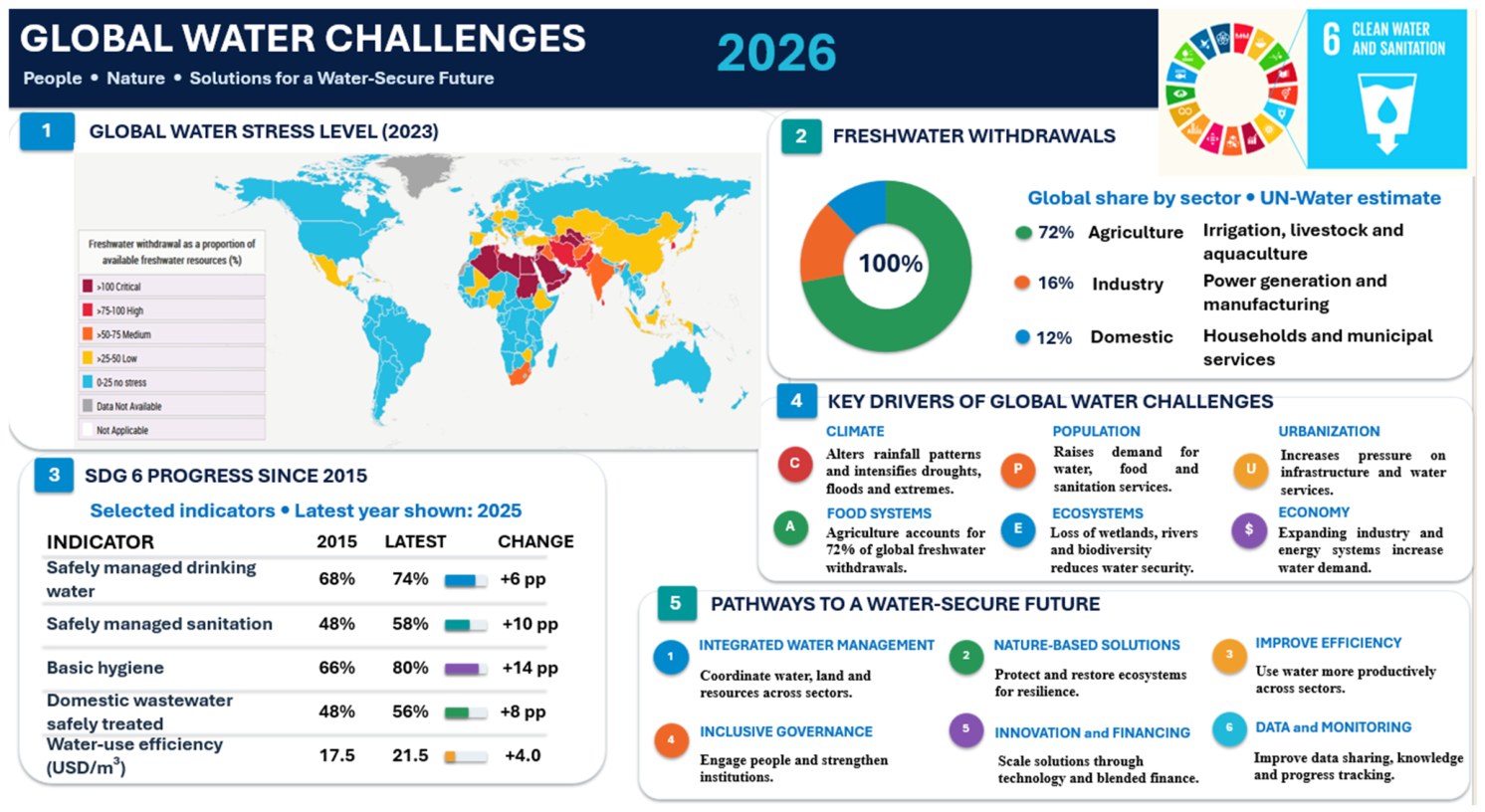
Water resource conservation contributes to several SDGs; however, its relevance across goals should be distinguished from evidence of communication producing measurable outcomes, while retaining contextual relationships [3,8,30], as water services, food production, energy systems, public health, education, gendered labor, ecosystems and institutions alter the feasibility and distribution of conservation actions (Figure 1). Further, the review separates three issues frequently conflated: household WASH service gaps, sectoral freshwater withdrawals and the formal definition of SDG indicator 6.4.2 [28,31]. These distinctions are important: a communication campaign may change awareness without changing infrastructure [32]; household behavior may change without materially affecting basin withdrawals and local intervention may produce measurable savings without being large enough to alter the national SDG indicator [33,34].
- No Poverty: Water conservation helps alleviate poverty by ensuring clean and reliable water sources for communities, promoting agricultural productivity, reducing waterborne diseases and creating income-generating opportunities through water-related activities [3,20].
- Zero Hunger: Sustainable water in agriculture improves food production and security along with better irrigation techniques, rainwater harvesting systems and moisture storage in land, decreasing the incidence of food scarcity and hunger by increasing yield of crops [13].
- Good Health and Well-being: Public health demands reliable, safe water supplies, as waterborne diseases lead to public health problems in much of the developing world [5,6]. Conservation initiatives minimize the risk of contamination and offer safe drinking water and sanitation facilities [32,35].
- Gender Equality: In many regions, women and girls bear a disproportionate burden of household water collection, particularly water not available on premises [3,10]. Improved access to services and reliable water supplies reduces time burdens and supports education [20,21], safety and economic participation. However, these benefits depend more on service provision and social conditions than on communication or access to information alone [27], requiring consideration of who controls household water decisions and whether recommended actions create additional unpaid labor or unequal costs [31,36].
- Clean Water and Sanitation: SDG 6 addresses drinking water, sanitation, hygiene, water quality, wastewater, water-use efficiency, water stress, integrated water-resources management, water-related ecosystems, cooperation and community participation. While conserving water is relevant across these areas [27], each target and indicator is specified, rather than treating SDG 6 as a single undifferentiated outcome [31,33,37].
- Sustainable Cities and Communities: Efficient water use in urban areas reduces strain on water resources and helps create sustainable, resilient and inclusive cities and communities.
- Responsible Consumption and Production: Water conservation is integral to responsible resource management, reducing water waste and pollution in production processes, contributing to sustainable consumption and production patterns [38].
- Climate Action: Helping to mitigate the impacts of climate change on water by preserving ecosystems, maintaining water availability in times of drought and reducing greenhouse gas emissions associated with water treatment and transportation [25].
- Life Below Water: Sustainable water management protects aquatic ecosystems and biodiversity, and is essential for the health of oceans, seas and other water bodies.
- Life on Land: Healthy terrestrial ecosystems rely on sustainable water management, with conservation efforts helping to maintain the integrity of ecosystems and biodiversity.
- Partnerships for Goals: Collaboration among governments, organizations and communities is essential for successful water conservation efforts, with partnerships facilitating the sharing of knowledge, resources and best practices in water management.
Figure 1.
State of global water security adapted and redrawn with modification from [39,40,41,42,43,44,45].
4. Science Communication
Science communication connects water conservation and scientific information by informing decisions and evaluating appropriate outcome levels, with immediate effects including exposure, comprehension, risk interpretation, trust or perceived efficacy. Effects on water conservation require feasible behavior, enabling infrastructure and measurement, as increased knowledge and understanding are not equivalent to conservation [21,22]. Household field experiments demonstrating feedback and social-comparison messages reduce metered demand under some conditions, but effects vary according to baseline use, delivery method, tariff context and time, requiring qualified, intervention-specific claims rather than the proposition that communication is uniformly effective [23,24]. Conservation communication requires translation of hydrological, water-quality, ecological and engineering information into forms that intended audiences can interpret correctly, using language explanations, visualizations, risk scales, local units, demonstrations and interactive tools to reduce cognitive barriers. However, simplification should preserve distinctions among observations, projections, uncertainty, hazards, exposure and recommended actions [26,30]. Visual appeal or engagement is considered an intermediate outcome, and is assessed through comprehension, decision quality or linked behavioral or operational measures, rather than attractiveness, impressions or shares alone [31,34,35].
Further, communication supports practical decisions linked to feasible water-conservation measures, including irrigation scheduling, leakage reporting, household demand feedback, water-quality warnings, reuse information, sanitation behavior and community monitoring, with stakeholder engagement supported by clearly defined roles [36], evidence sources, responsibilities and response pathways [16,17]. Communication helps users understand recommended actions and how to perform them, but adoption depends on cost, authority, technology, service conditions, social norms and expected benefits, while evaluation documents message performance and the enabling or constraining conditions that determine whether information can be translated into action [18,19,46].
Communication contributes to innovation and adaptive management by making monitored performance, user experience, implementation failure and emerging evidence visible to decision makers, with scientific traceability requiring communication activities to identify the data on which they are based, the audiences and decisions they target, the institutional actors responsible for the response and the outcomes used to judge success [27,28]. Feedback from communities and users improves program design, but feedback does not provide evidence of water savings, as long-term conservation requires repeated measurement, with initial effects decaying, rebounding or differing substantially among users [29,30]. In water-stressed developing countries, communication performance is conditioned by local language, literacy, connectivity, gendered access to information, trust in institutions, affordability and the availability of technically feasible alternatives, parallel to co-design with intended users and linked observable decisions such as irrigation scheduling, groundwater abstraction, leakage reporting, safe reuse, household storage and participation in water governance [7,10,31]. These variables affect modifiers, not peripheral implementation details, determining whether exposure produces comprehension; whether comprehension produces feasible action; and whether action produces measurable water-system responses [47].
5. Sustainable Development Goal 6
SDG 6 establishes the 2030 Agenda, ensuring the availability and sustainable management of water and sanitation with official targets distinguishing drinking-water services (6.1), sanitation and hygiene (6.2), water quality, wastewater and safe reuse (6.3), water-use efficiency and sustainable withdrawals (6.4), integrated water-resources management including transboundary cooperation (6.5), protection and restoration of water-related ecosystems (6.6), international cooperation and capacity-building (6.a) and local-community participation (6.b). This precision is necessary, as different communication interventions relate to different outcomes and indicators [4,9]. Further, this requires monitoring with indicator-specific evidence rather than general statements about awareness, as drinking-water and sanitation indicators describe service levels; water-quality and wastewater indicators concern treatment and ambient quality, with indicators 6.4.1 and 6.4.2 concerning water-use efficiency and water stress; 6.5 indicators concern IWRM and transboundary cooperation; 6.6.1 concerns the extent of water-related ecosystems [3,5]; and 6.b.1 concerns participation procedures in policy and practice. In developing countries, national indicators conceal intermittent supply, informal settlements, affordability barriers, groundwater dependence, limited laboratory or metering capacity and large subnational inequalities, while communication translating indicator trends into relevant decision-making and clear communication metrics are not substitutes for official indicators [6,27,31].
6. Water Stress in Developing Countries
Water stress arises from the relationship between freshwater withdrawals, renewable freshwater availability, environmental flow requirements, sectoral demand, infrastructure and governance, as under SDG indicator 6.4.2, the level of water stress is calculated as freshwater withdrawals expressed as a proportion of available renewable freshwater resources, after environmental flow requirements are taken into account [8,9,11]. Territories withdrawing 25% or more of available renewable freshwater resources are classified as water-stressed under the UN-Water reporting framework, with results reported nationally. However, basin-level disaggregation is important, as national annual values mask strong seasonal, basin, aquifer and local service differences [12,27]. Aqueduct 4.0 provides complementary decision-relevant water-risk indicators but uses a different analytical framework and should not be treated as identical to SDG 6.4.2 [31,48].
- Demand concentration and urbanization: Increasing urbanization and rapid population growth, spread of irrigated agriculture, industrialization and informal urban expansion increase withdrawals, while service expansion and demand management often lag, with supply disruptions [11,12] leading to household storage, private pumping and reliance on informal water markets, altering exposure and conservation behavior [13,22,26].
- Hydro-climatic variability and limited adaptive capacity: Variable precipitation, drought, heat, flooding, flood damage and shifting snow or glacier contributions raise supply uncertainty, with capacity for storage, forecasting, covering insurance, institutional coordination and household coping power restricted or insufficient, with magnified consequences [23,24,25].
- Agriculture-dominated withdrawals: Largest freshwater-withdrawal sector globally, accounting for approximately 72% of freshwater withdrawals in FAO reporting for 2023 [11,12], predominantly because of irrigation, although this varies across countries, basins and reporting years, and freshwater withdrawal is not equated with consumptive use. Regional claims state the source, year, geographic unit and denominator, as irrigation-dependent settings require communication to be integrated with agronomic extension, incentives, pump control, water measurement and field-level evaluation rather than directed towards domestic users [49,50].
- Pollution and treatment deficits: Inadequate treatment of municipal wastewater, industrial discharge, runoff from agriculture, solid-waste leachate and insufficient sanitation compromise the amount of water available for safe reuse, as poor surveillance and delayed risk communication increase exposure to microbial and chemical hazards [11,12,33].
- Groundwater depletion: Unrestrained wells, electricity and pumping subsidies, drought protection and inefficient aquifer monitoring result in withdrawals exceeding recharge, with good practice requiring the reporting of groundwater trends at different aquifer-relevant scales and linking with pumping decisions, crop water demands, recharge protection and shared-use regulations [4,5,6].
- Infrastructure and service inequality: Leakage, non-revenue water, intermittent distribution, ineffective wastewater treatment, insufficient metering and weak operation and maintenance diminish the efficacy of conservation messages, as communication alone is not enough to offset infrastructure limitations. Instead, communication identifies service constraints, clarifies feasible user actions and enables transparent reporting of utility performance [11,12,31].
- Livelihood, mobility and conflict risk: Water deficits increase pre-existing insecurity of livelihood, migration pressure and rivalry between sectors and competition. However, scarcity is not considered a deterministic driver of conflict. Governance quality, inequality, market access and coping capacity are also considered in the analysis [51,52].
Responses in developing countries combine demand management [4,7], efficient irrigation, leakage control, rainwater harvesting, managed recharge, pollution prevention, decentralized wastewater treatment, safe reuse, ecosystem protection and climate-resilient infrastructure with credible communication explaining local water balance, intervention costs and limitations, responsible institutions and measurable outcomes, selecting strategies at regional level according to dominant water-stress mechanisms, transferred uncritically from high-income regions [53,54]. Implementation requires coordinated hydrological monitoring, institutional reform, community participation, financing and adaptive communication with priority outcomes including reduced abstraction, improved crop water productivity, lower leakage, increased safe reuse, earlier contamination reporting, stronger participation and more equitable service access, evaluated using feasible objective operational or hydrological data [31,55].
Regional Water-Stress and Communication Priorities
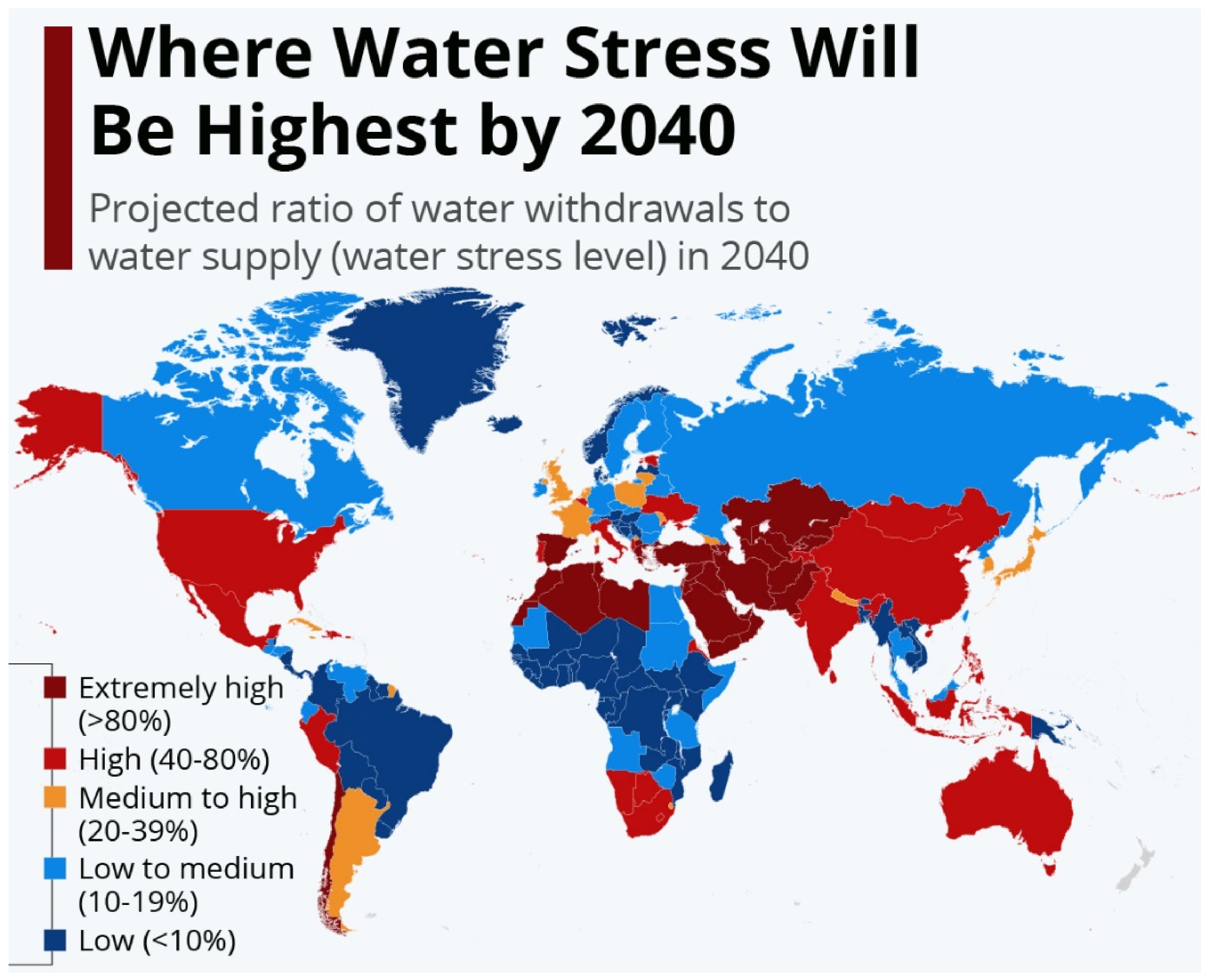
Regional differentiation is essential, as physical scarcity, service deficits, dominant water-use sectors, communication access and institutional capacity vary substantially. This improves interpretation by identifying dominant constrained water systems with plausible communication mechanisms and directly measurable outcomes, while treating regional categories as non-exclusive and recognizing non-regional categories rather than treating geography as the sole organizing principle (Table 3; Figure 2).
Table 3.
Context-specific water-system constraints, communication barriers, priority mechanisms and measurable outcomes.
Figure 2.
Global projection of water stress by 2040 [56].
7. Water Conservation and Key SDGs
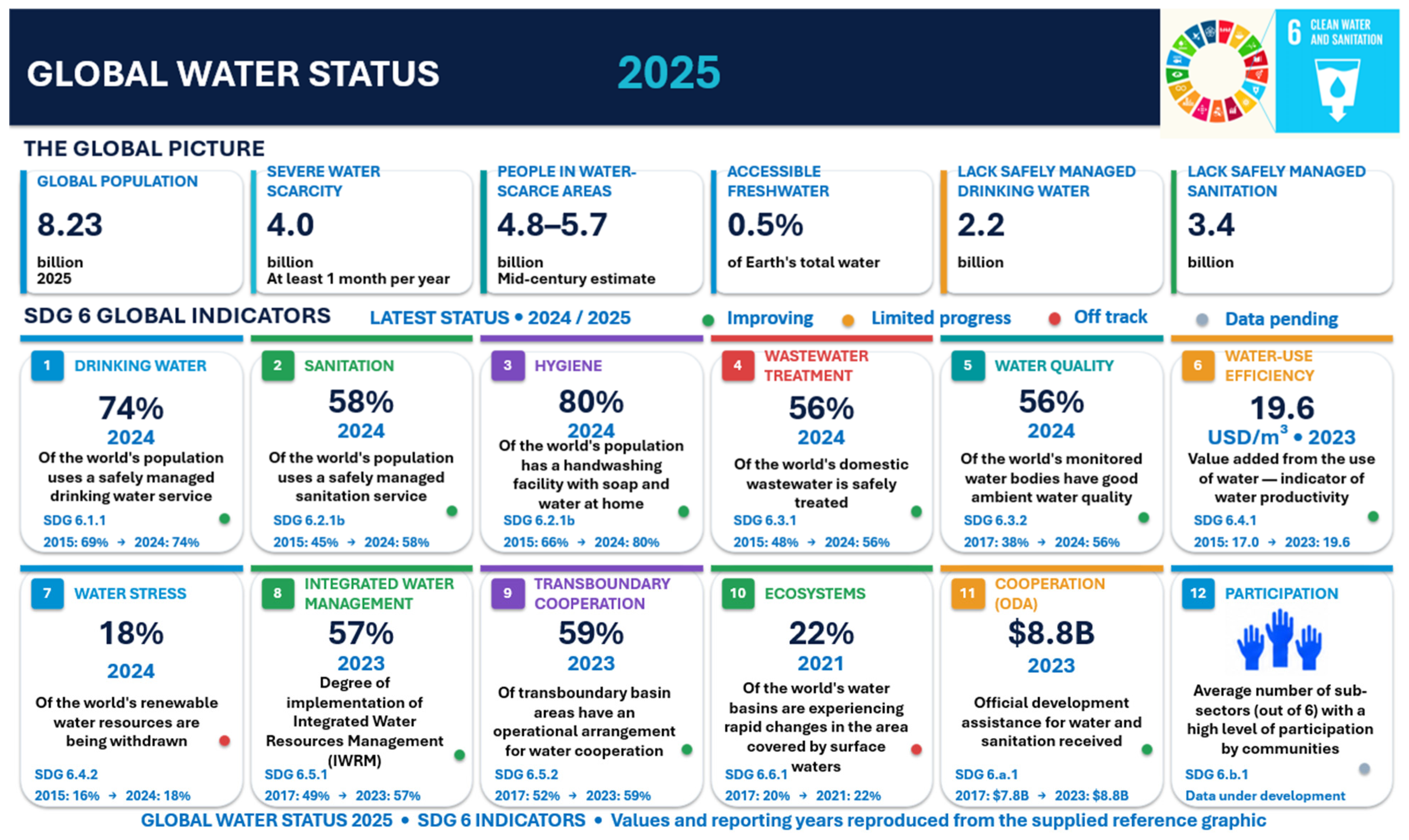
Water conservation is relevant to several SDGs, as water links health, food systems, production, ecosystems, cities and climate adaptation. However, cross-SDG associations are not taken as evidence that communication exposure produces development outcomes (Figure 3).
- SDG 6: Clean Water and Sanitation is centered on water and sanitation, but targets address different components of the water system [8,9] with Target 6.1 focusing on safe and affordable drinking water; Target 6.2 on sanitation and hygiene; Target 6.3 on water quality, wastewater treatment, recycling and safe reuse; Target 6.4 on water-use efficiency and sustainable withdrawals; Target 6.5 on integrated water-resource management; Target 6.6 on water-related ecosystems; and Target 6.b on local participation [27,31], requiring communication interventions mapped to target-relevant measured outcomes in SDG 6 [34,35,36].
- SDG 12: Responsible Consumption and Production is relevant to industrial and supply-chain water use, but the target assignment requires precision. Target 12.2 concerns sustainable management and efficient use of natural resources and is the more direct reference for resource efficiency. Target 12.4 concerns environmentally sound management of chemicals and wastes throughout their life cycle and the reduction of their release into air, water and soil, and should not be described as a general water-efficiency target. Water-related communication can support these objectives only where it is linked to measured production, resource use, pollution or management outcomes [52,53,54].
- SDG 15: Life on Land: While not directly related to water, this goal emphasizes terrestrial ecosystems’ conservation and sustainable use, which significantly regulate water cycles and maintain water quality. Protecting land ecosystems indirectly contributes to water conservation by safeguarding natural water sources [11,12].
- SDG 14: Life Below Water: Although this goal primarily conserves marine ecosystems, it indirectly influences freshwater resources. Healthy aquatic ecosystems contribute to sustainable water supplies and can be impacted by actions aimed at preserving and protecting marine environments [8,9].
Within the SDG framework, water use is relevant to several goals, as water connects health, food production, ecosystems, cities, energy systems and industrial activity. These relationships are interpreted as contextual linkages rather than evidence that communication interventions produce progress across different SDGs. Therefore, conservation programs need to specify the water-system process, target population, implementing institution, measurable outcome and relevant SDG target when making contribution claims. Examples of intervention classes retained in this review include:
- Encouraging Water-Efficient Practices while promoting efficient use of water in agriculture, industry and households to reduce water waste [21,22].
- Wastewater Treatment and Recycling using wastewater treatment and recycling systems to reuse water for non-potable uses such as irrigation and industrial processes [7,13].
- Preserving Natural Ecosystems while restoring wetlands, forests and other natural habitats impacting water regulation and purification [24,26].
- Raising Awareness of the significance of water conservation and sustainable water management among individuals, communities and businesses.
- Policy Development: creating and executing policies and regulations on sustainable water use and protecting water resources [31,42].
- Investing in Infrastructure to reduce losses caused by leaks and evaporation while maximizing efficient use of water resources.
Figure 3.
Global Picture—Global Water Status 2025 (Note: percentages represent global population or global parameters unless stated otherwise) adapted and redrawn with modification from [57,58,59,60,61,62,63].
7.1. Water Conservation and SDG 6
Water conservation is integrated across several SDG 6 targets, but its contribution differs by target and indicator, separating service access, efficiency, withdrawals, water quality, wastewater, IWRM, ecosystems and participation, rather than treating all water-related outcomes as one category [27,31,64].
- Universal Access to Safe Drinking Water (Target 6.1) and Sanitation and Hygiene (Target 6.2), with Target 6.1 concerning universal and equitable access to safe and affordable drinking water, and Target 6.2 aimed at adequate and equitable sanitation and hygiene and end of open defecation [3,5,6]. For both, communication supports risk interpretation, service use, hygiene behavior, reporting and accountability, but access and safely managed status depend on infrastructure, affordability, operation, maintenance and service quality. These distinctions correct previous wording that combined sanitation with Target 6.1 [32,33].
- Sustainable Withdrawals and Water-Use Efficiency (Target 6.4) explicitly addresses water-use efficiency across sectors, sustainable withdrawals and freshwater supply to address water scarcity. Communication mechanisms [8,9] relevant to this target include metered feedback, social comparison, drought-stage communication, irrigation extension and operational dashboards. Effectiveness is evaluated by metered demand, pumping, withdrawal, water-use-efficiency or persistence measures rather than awareness alone [35,36].
- Wastewater Treatment, Water Quality, Recycling and Safe Reuse (Target 6.3) addresses pollution reduction, untreated wastewater, recycling, safe reuse and ambient water quality with risk and reuse communication [4,7,8] affecting understanding, trust, acceptance, reporting and using decisions. However, treatment performance and safety require validation, monitoring, regulatory oversight and direct water-quality or treatment measures, including acceptance of recycled water, which is not considered equivalent to safe reuse [9,42].
Integrated Water Resources Management (Target 6.5) and Water-Related Ecosystems (Target 6.6) address distinct aspects of water management, with Target 6.5 concerning the implementation of integrated water-resources management at all levels, including transboundary cooperation, and Target 6.6 aiming at the protection and restoration of water-related ecosystems [8,9,65]. Stakeholder communication, basin data, participatory monitoring and policy dialogue support targets [31,42], but ecosystem protection is not assigned to Target 6.5 and consultation is not interpreted as implementation unless institutional or ecological outcomes are documented [53,66].
7.2. Why Water Conservation Matters in the Context of SDG 6
SDG 6 recognizes water conservation within a broader system of safe services, water quality, efficiency, sustainable withdrawals, integrated management, ecosystem protection, cooperation and participation, but contributions are described in target-specific terms and supported by measured outcomes [4,6]. Household communication intervention reduces metered demand without changing national water stress; sanitation behavior intervention improves observed hygiene without reducing water use; and reuse communication intervention changes support without establishing treatment safety, distinctions preventing local communication outcomes from being overstated as evidence of achievement [7,8]. Water conservation under SDG 6 coordinates technical, behavioral, institutional and monitoring measures, rather than relying on a single communication activity, with the combination depending on the water-use sector, hydrological constraint, service condition, affordability, regulatory authority and capacity. Outcomes are measured by assessing whether communication changes defined decisions or supports implementation, rather than treating it as a substitute for physical intervention [31].
- Efficient Water Use: Promote efficient water use in agriculture, industry and households. Implement water-efficient technologies and irrigation practices to minimize waste [9].
- Wastewater Treatment and Reuse: Develop and expand wastewater treatment infrastructure to recycle and reuse treated water for non-potable purposes, reducing the demand for freshwater [27].
- Rainwater Harvesting: Encourage rainwater harvesting systems in urban and rural settings to collect and store rainwater for various uses, including irrigation and toilet flushing.
- Education and Awareness: Raise public awareness about water conservation and sustainable water use through educational campaigns and community engagement.
- Policy and Regulation: Develop and enforce policies that promote water conservation practices, including water-use restrictions during droughts and incentives for efficient water technologies.
- Research and Innovation: Invest in research and innovation to develop and disseminate advanced water conservation technologies and strategies [27].
For water-stressed developing countries, conservation portfolios prioritize interventions that are affordable, maintainable, decentralized, appropriate and compatible with local hydrogeology and institutional capacity, alongside communication coupled with enabling measures such as extension support, tariffs or incentives, maintenance services, monitoring and enforceable abstraction or pollution controls [8,9,10]. Priority options include irrigation scheduling, drip or deficit irrigation where suitable, leakage management, rainwater harvesting, managed aquifer recharge, decentralized treatment, safe wastewater reuse and community-based ecosystem protection, while contributions are assessed by water-use efficiency, withdrawal, quality, reuse, participation and service-equity indicators rather than awareness alone [37].
8. Power of “Science Communication”
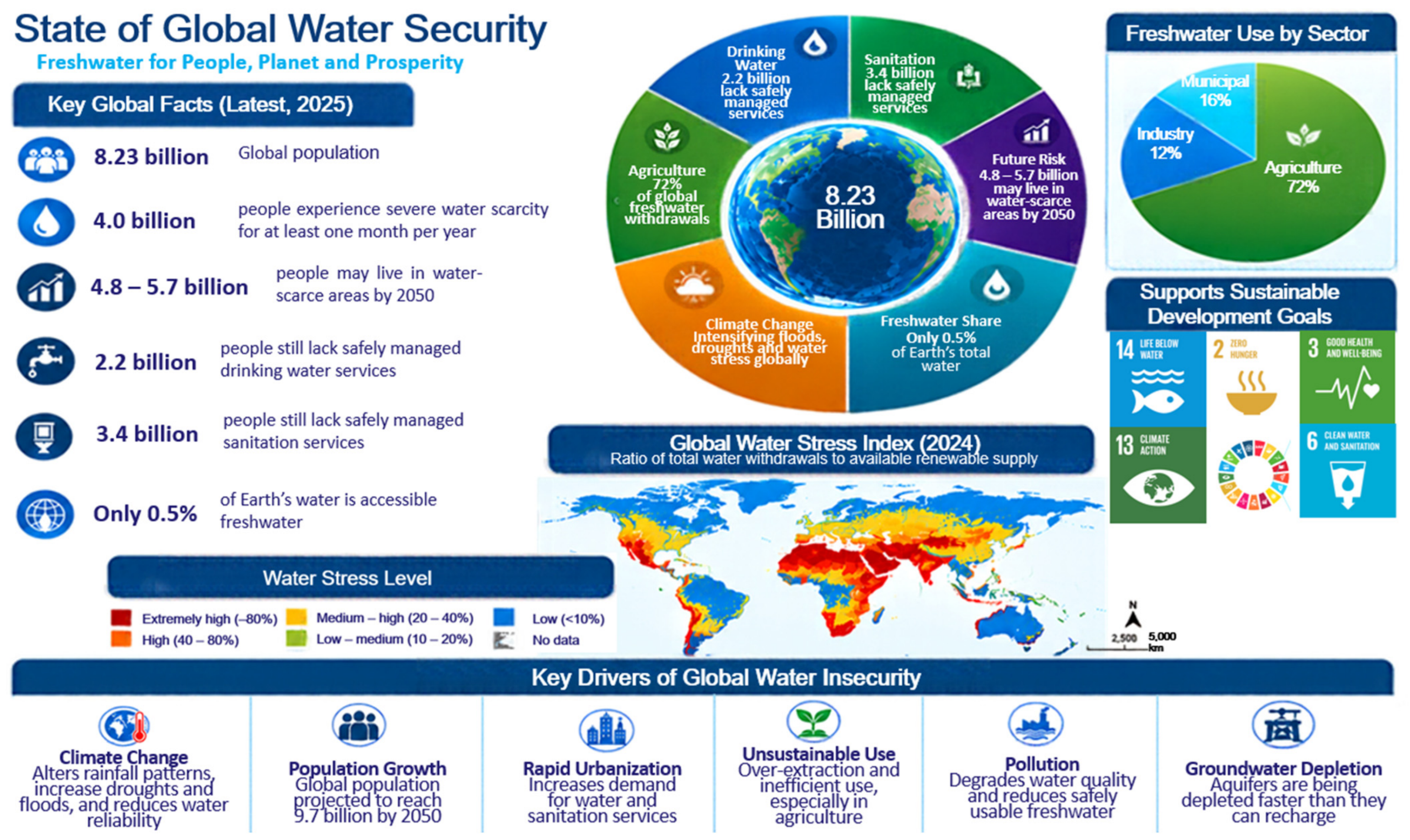
Science communication concerns the exchange, interpretation, contest and use of scientific evidence among different audiences rather than generic promotional activity for water conservation. Its analytical value lies in specifying the communication of evidence, including channels, audiences, decisions, constraints to be minimized and measurable outcomes [30,35], while training scientists to work with locals in creating visual materials that support these functions [31,36] and evaluating communication against actual communication problems (Figure 4).
Figure 4.
Global water challenges, resource use and pathways toward SDG 6 achievement adapted and redrawn with modification from [67,68,69,70,71,72,73].
9. Effectiveness in “Science Communication”
Effectiveness of science communication cannot be inferred from message production or audience size alone, as persuasive evidence requires studies connecting defined interventions to objectively measured outcomes [1,2], using water, pumping, service or behavioral measures and credible comparators. Randomized household studies have shown that social-comparison and feedback interventions reduce demand in some utilities, often with larger effects among high users [22,26], while quasi-experimental evidence has shown that frequent billing can increase consumption under particular conditions. This indicates that information is not uniformly beneficial as a treatment and requires knowledge, trust, risk perception, intention, behavior, operational performance and hydrological outcomes to be reported separately [23,24] (Figure 5).
Figure 5.
Significance, methodology and challenges in “Science Communication”.
- Public Understanding: Clear and audience-appropriate communication improves comprehension of scientific information, especially when jargon, uncertainty and decision relevance are addressed explicitly. Knowledge or recall is treated as a proximal outcome in water conservation, making it necessary for action but neither sufficient nor equivalent to conservation [1,2]. Evaluation tests whether participants correctly interpret water source, risk, scarcity condition, uncertainty and recommended actions, while avoiding claims of water savings based solely on the measurement of knowledge [45,46,49].
- Enabling Informed Decision-Making: Communication improves information available to households, farmers, communities, utilities and policymakers, but decisions depend on incentives, authority, technical options, costs and institutional capacity [27,28]. Evidence-based decision-making supports decisions with statistics, alternatives, data sources, uncertainty and responsible actors, with outcomes reflected in policy or institutional responses [23,24]. This requires distinguishing information from documented uptake such as changes in rules, budgets, operating procedures, enforcement actions, or management plans [13,49].
- Encouraging Public Engagement: Public engagement improves dialog, local knowledge, legitimacy and identification of implementation constraints, but participation metrics are not used as direct evidence of water-quality improvement or conservation [1,2,10]. Relevant evaluation measures include who participates, whose evidence is accepted, whether participation changes decisions, whether feedback receives institutional response and whether resulting practice or operational change is sustained, making distinction important, with engagement programs reaching motivated participants but excluding low-connectivity, low-literacy, remote or marginalized groups [30,31,50].
- Promoting Science and Innovation: Communication supports diffusion and scrutiny of scientific and technical options by connecting researchers, implementers, users and decision makers; clamming communication does not create innovation, secure funding or guarantee uptake [19,37]. For water systems, the relevant question is whether communication improves understanding of a validated technology, supports appropriate adoption, reveals implementation problems, or links monitored performance to corrective action [30]. Technologies such as smart meters, IoT sensors and machine-learning tools require local validation, maintenance, uncertainty reporting and human oversight before communication based on their outputs can be considered reliable [31,38].
In developing countries, communication effectiveness is evaluated through an outcome hierarchy, including exposure; comprehension and knowledge; psychosocial mechanisms such as trust, risk perception, self-efficacy and perceived norms; intention; observed behavior or participation [4,5]; operational or hydrological outcomes; and compatibility of scale and aggregation when assessing contributions to official SDG indicators [6,7]. Reach, social-media engagement, message recall and stated intention are not final water outcomes, but are instead retained as process or intermediate measures and linked to objective evidence such as meter data, pumping records, leakage resolution, water-quality observations, sanitation practice, reuse performance, institutional response, or policy implementation [49].
10. Role of Science Communicators in Water Conservation
Water conservation requires communication roles to be more specific than the broad label ‘science communicator’, depending on the intervention and relevant actors, including utility staff, agricultural extension officers, hydrologists, public-health workers, teachers, journalists, community facilitators, water-user associations, regulators and researchers. Their scientific function involves translating evidence without distortion, disclosing uncertainty and data limitations, identifying feasible actions and connecting feedback to institutions capable of responding [1,2]. The appropriate communicator depends on decision context and trust, authority, technical competence and access, with scientific input to policy being most useful when evidence is decision-relevant, transparent about uncertainty and accompanied by information on trade-offs, implementation requirements and distributional effects [28,29]. Science communication supports policy formulation and accountability, but does not determine policy outcomes independently of legal authority, finance, institutional incentives, competing interests and political priorities, while influencing policies documented through traceable outputs such as citations in guidance, budget allocation, regulatory change, operating procedures, monitoring requirements or implementation decisions [30,31].
Water-stressed developing countries’ communication workforce extends beyond professional communicators to agricultural extension officers, community health workers, schoolteachers, local-language journalists, water-user associations, women-led groups, municipal utilities, civil-society organizations and other locally legitimate intermediaries [1,2,3]. Selection is based on technical competence, legitimacy, reach, accountability and the ability to connect evidence with action, including translating basin and service data, correcting misinformation, demonstrating feasible practices, documenting community observations and transmitting feedback to utilities, health services, basin agencies or policymakers [13,31,49].
11. Impact of “Science Communicators” on Water Conservation
Impact of science communication on water conservation is heterogeneous and cannot be described as uniformly ‘profound’ or as producing ‘noticeable change’ without study-level evidence, as water-specific studies reported a range of outcomes, from knowledge and stated support to objectively measuring household consumption and agricultural pumping, with randomized or quasi-experimental interventions producing measurable reductions and others showing small, short-lived, null or unintended effects [1,2]. The interpretation is conditional, as communication influences conservation-related decisions when messages are credible and understandable, recommended actions are feasible and constraints do not overwhelm the intervention. Awareness, support or intention are therefore measured as outcomes at their respective levels rather than as evidence of actual conservation [22,26].
Communication contributes to policy and institutional processes by making scientific evidence accessible and improving transparency of decisions, but policy influence is difficult to attribute to communication, as it operates alongside regulation, finance, infrastructure, politics and stakeholder interests. Evidence of institutional impact includes documented changes in procedures, budgets, rules, enforcement, service response, monitoring, or management decisions rather than mere production of reports or meetings [13]. Impact assessment in resource-constrained settings requires distinguishing communication effects from simultaneous changes in rainfall, tariffs, supply continuity, infrastructure, regulation, or agricultural production. Baseline and follow-up measurement, comparison groups where feasible and triangulation of surveys with meter data, pumping records, irrigation duration, leakage reports, water-quality observations or policy documents are required to support causal interpretation [23,24].
12. Communicating Science for Water Conservation Under SDG 6
Science communication under SDG 6 is a decision-support and implementation process rather than a general exercise in public awareness, with scientific tasks translating and validating information about water quantity, quality, risk, service performance or conservation options into forms that intended users can interpret correctly while preserving uncertainty, limitations and distinctions between observation and projection [3]. Different audiences require different decisions, as households need metered feedback or contamination instructions; farmers need irrigation timing and pump information; communities need accessible monitoring data and grievance routes; utilities need anomaly alerts and maintenance priorities; and policymakers need evidence on trade-offs, equity, costs and implementation [34]. Communication is designed around specific decisions and measured outcomes, with multi-channel delivery increasing access. However, digital reach is not assumed where connectivity, literacy, language, disability access, device ownership or gendered control of technology are unequal [35]. Visual products are evaluated for comprehension rather than attractiveness; citizen-science data are quality-assured before being used in management, while AI-assisted alerts are independently validated and linked to responsible human oversight. This requires communication to be analytically testable and prevents engagement metrics from being overstated as conservation outcomes [36,67].
Science communication for SDG 6 in developing countries involves translating hydrological and public-health evidence into decisions that are feasible under local infrastructure, income, literacy, language and connectivity conditions. Communication portfolios therefore combine local-language radio, schools, agricultural extension, community meetings, SMS or low-bandwidth mobile services, visual materials, utility notifications and policy briefs rather than assuming universal digital access [10]. Messages identify relevant water sources or services, quantify risk or scarcity where data permit, support responsible actions, communicate uncertainty and provide feedback routes [3,34]. Participation by local governments, utilities, researchers, health services, water-user groups and marginalized communities is essential for aligning scientific evidence with groundwater stewardship, irrigation efficiency, contamination prevention, safe reuse, drought response and equitable service delivery [35,36].
Science Communication–Water Outcome Translations
Studied evidence defines science communication as operating through a sequential pathway rather than as a direct conservation mechanism; the proposed framework consists of six linked stages: (i) scientific evidence generation, (ii) communication translation, (iii) audience comprehension, (iv) behavioral or institutional response, (v) operational water-system change, and (vi) measurable contribution to SDG 6 indicators.
13. Strategies for Effective Science Communication in Water Conservation Under SDG 6
13.1. Simplifying Scientific Jargon
Effective communication for scientific outcomes requires clarity without loss of scientific meaning, as transpiration, percolation, desalination, groundwater recharge, environmental flow requirements, water stress and safely managed services describe different processes and should not be collapsed into simpler but inaccurate substitutes [11,12]. Plain-language definitions, local units, examples, diagrams, demonstrations and translated materials improve accessibility, but the intended audience should be tested for correct interpretation [52]; also, for low-literacy and multilingual audiences, message testing assesses whether people identify the relevant water source, hazard or scarcity condition, uncertainty, recommended action and responsible institution. Simplification is therefore treated as a design step requiring validation, rather than a license to remove technical distinctions affecting safety or management decisions [13,53].
Visual aids and interactive sessions are useful for improving the correct interpretation of a defined water problem, with diagrams, demonstrations, maps, workshops and facilitated discussions exposing misunderstandings, allowing questions and showing how recommended actions relate to underlying evidence. Performance is evaluated through comprehension, decision accuracy, or linked behavioral or operational measures rather than by visual appeal or attendance alone [34,35]. For low-literacy and multilingual audiences, locally recognized terms, pictorial risk scales, familiar units and demonstrations improve accessibility while preserving distinctions among hazard, exposure, uncertainty and recommended action. Message testing verifies whether intended users identify the relevant source or service, interpret the risk or scarcity condition, understand uncertainty and select a safe or feasible action. This is particularly important for groundwater decline, chemical contamination, drought probability, treatment instructions and wastewater-reuse safety, where oversimplification produces incorrect decisions [7,36].
13.2. Utilizing Diverse Communication Platforms
Communication platforms are selected according to audience, decision time scale, access, trust, literacy, feedback requirements and cost rather than technological novelty, such as traditional media, community radio, print, schools, extension services, public meetings, SMS, voice messaging, social media, apps, dashboards and policy briefs serving different functions, supporting rapid updates and interaction. However, digital-only strategies exclude people with limited connectivity, shared devices, low literacy, disability-related access needs or limited control over household technology [1,34]. Platform evaluation distinguishes delivery from exposure, exposure from comprehension and comprehension from behavior and where possible, channel comparisons link communication records to objective outcomes, such as metered demand, pumping, response time, leakage resolution or service use [13]. Webinars and virtual conferences support professional knowledge exchange, while community radio, local newsletters, extension visiting and face-to-face meetings are appropriate for remote or low-connectivity populations, along with hybrid portfolios reducing exclusion with the same scientifically validated message adapted for different channels [35]. Relevant evaluation dimensions include reach among the intended population, comprehension, credibility, feedback capacity, cost, inclusion and measurable action, with repeated delivery monitored for fatigue, contradictory messages, spillover and differential exposure. However, no platform is described as effective solely because it produces impressions, clicks, attendance or online engagement [36,50].
13.3. Engaging Visuals
Visual communication makes complex water information easier to inspect, compare and discuss, but evidence of attention or engagement is not equated with evidence of conservation, as water-related visuals include maps of service interruptions, groundwater trends, water-quality alerts, irrigation demand, drought stages, leakage locations, or reuse performance [25,28]. Every visual should identify its data source, geographic and temporal unit, update date, uncertainty where relevant, and value observations, model outputs or projections, requiring intended users to be tested for correct interpretation, particularly with colors or categories implying risk thresholds, as scientific value lies in improving understanding or decision quality, not in decorative complexity [34]. Infographics, animations, maps and interactive tools support learning when designed around defined information problems, but comparative evidence in water conservation remains limited, despite the volume of promotional guidance suggesting otherwise [13]. Accordingly, visual claims improving retention, decisions, behavior or conservation are restricted to outcomes actually measured with animations demonstrating processes, such as reuse treatment or irrigation scheduling, while interactive maps expose spatial variation, but neither format establishes environmental benefit unless the resulting interpretation or action is directly evaluated [35,36].
13.4. Collaboration
Collaboration in water-conservation communication is reflected in changes in the quality, legitimacy or implementation of water decisions, rather than merely in the participation of several organizations in the same activity. Such collaboration requires arrangements identifying the scientific authority responsible for data, the organization responsible for delivery, the users expected to act, the institution responsible for responding and mechanisms for resolving contested evidence. This is particularly important in water-stressed settings with basin agencies, utilities, health services, agricultural extension systems, local governments, universities, civil-society organizations and community groups controlling different parts of causal pathways [74]. Evaluation documents representation, decision influence, data sharing, response time, implementation resources and resulting operational or policy changes rather than counting meetings or participants as outcomes [13,27].
Collaborative water programs are assigned distinct technical and institutional responsibilities rather than assuming participation itself improves outcomes, with researchers defining measurement methods and uncertainty; utilities and basin agencies providing operational data and implementing service or allocation decisions; public-health and agricultural-extension systems translating evidence into sector-specific action; and local governments connecting recommendations to regulatory and budget authority and community organizations identifying feasibility constraints, distributional effects and locally observed failures [75]. Meetings, workshops, professional networks and digital forums are useful when they produce traceable outputs, such as shared datasets, validated protocols, implementation decisions, grievance responses, revised operating rules or monitored action, while evaluation records representation, decision influence, data ownership, response time, resource commitments and implementation follow-through. Cross-sector collaboration is relevant because no single actor controls the entire pathway from evidence to action, but it can diffuse accountability if roles are not specified. Appropriate arrangements therefore need to be adapted to local governance structures and water-system problems rather than presented as a universal collaborative model [31,50].
13.5. Iteration
In water conservation under SDG 6, iteration is crucial to ensure that communication strategies and conservation initiatives are effective, adaptable and relevant, with an iterative approach focusing on consistently assessing and improving communication methods and messages to make them more precise, more accessible and more impactful for a wide range of audiences [76]. While acknowledging the ever-changing nature of the scientific landscape, societal dynamics and the environment, the need for communication strategies that can adapt and be flexible to navigate these changes effectively is emphasized [33].
The science communication process for water conservation involves a series of iterative steps, starting with creating and distributing messages using various platforms and formats specifically designed for the intended audience [53,54], along with a system methodically collecting feedback from audience and stakeholders to evaluate effectiveness of communication strategies in terms of reach, comprehension and resonance. A feedback loop, which includes observations, surveys and interactive engagements, provides valuable insights into the strengths and limitations of the communication methods used, with analysis identifying potential misunderstandings, overlooked messages, or communication barriers while using the information to adjust communication strategies and improve their effectiveness and reach [8,9,16]. The communication framework is designed for feedback-driven, adaptive and responsive communication aligned with the ever-changing scientific, environmental and societal landscape, along with effectively advancing water conservation goals as outlined in SDG 6 [61,62]. Iteration following a predefined adaptive-management cycle establishes baseline conditions; delivers intervention; measures reach, comprehension, behavior and objective water outcomes; identifies differential effects and implementation failures; and revises message, platform or supporting measures with evaluation schedules reflecting seasonal water variability, including low-cost indicators where metering is unavailable, such as pumping duration, irrigation frequency, structured household audits, leakage resolution or validated community observations.
13.6. WASH, Reuse, Risk Communication and Citizen Science
WASH studies demonstrate the importance of distinguishing communication effects from those of accompanying interventions. Fr example, the SuperAmma cluster-randomized trial in rural India used emotional and social drivers promoting behavior change, increasing handwashing with soap [33]. In rural Bangladesh, Guiteras et al. [5] observed targeted subsidies combined with community processes increasing investment in hygienic latrines, but community motivation and information alone are insufficient to produce the same effect, requiring increased sanitation investment as a combined intervention rather than only communication strategies and applications. In rural Mali, community-led total sanitation increased latrine coverage and reduced open defecation, although not every downstream health outcome improved, making interventions relevant to Target 6.2, but not direct evidence of water conservation as measured outcomes concerning hygiene and sanitation behavior or infrastructure [17,18,19]. Water-reuse communication presents a different outcome problem, as information provision increased public support for potable recycled water, but stated support is not treatment performance, actual uptake or exposure safety; communication on water reuse reports intended use, treatment validation, monitoring, residual risk, incident response and institutional responsibility, while risk communication is credible when audiences have access to feasible protective actions or safe alternatives [7,10,27]. Citizen science increases spatial and temporal density of observations and strengthens participation, but data quality and institutional use determine whether monitoring contributes to management [18,19]. Field kits, for example, support ambient water-quality monitoring when validating against accredited laboratory methods along with participant attributes, institutional capacity, support structures, communication and feedback, showing success factors for water-quality citizen-science programs and making relevant outcomes, including measurement accuracy, participant retention, spatial coverage, data acceptance, feedback, institutional response and documented management action, but participation alone is not equivalent to improved water quality [31,32,42].
13.7. AI-Assisted and IoT-Enabled Water Communication
Digital monitoring shortens the interval between observation and response, but sensor platforms are not automatically considered communication interventions, as the communication function begins with monitored data translated into validated alerts, explanations, maintenance priorities, public reports or decision recommendations. Reviews of IoT and machine-learning approaches identify recurring concerns involving calibration, sensor fouling, missing data, localized training datasets, connectivity, model transferability and operational maintenance. Limitations are important in resource-constrained settings, as model accuracy may fail when sensors drift, networks disconnect, training data do not represent local water conditions, or the institution responsible for response lacks staff and equipment [19,37,38]. AI-assisted communication therefore discloses the data source, model or rule used, geographic and temporal validity, alert threshold, uncertainty or confidence, update time and responsible human authority [10,20]. High-consequence alerts concerning contamination or service safety depend on opaque automated outputs without verification, as evaluation connects model performance to false-alarm burden, missed events, response time, corrective action, service restoration, contamination exposure, leakage reduction or another water-system outcome [19,21]. Privacy and equity require additional attention with systems using household meter data, geolocation, mobile applications or individualized recommendations [37,38,72].
13.8. Study-Level Evidence Map and Credibility
Table 4 summarizes focal evidence using calibration claims in review, with credibility not a numerical score but ‘Higher’ indicates randomized or strong quasi-experimental design with objective or directly observed outcomes; ‘moderate’ indicates controlled, longitudinal or validation design with important residual limitations; ‘limited’ indicates self-report, uncontrolled comparison, short exposure or outcomes confined to knowledge or intention [14,28]; and ‘contextual’ indicates review or technical synthesis used to inform mechanisms, implementation or monitoring rather than proving intervention effectiveness, with judgments determining strength of language used in discussion and recommendations [34,35,36]. Evidence credibility classification was conducted through examination and discussion of study design, outcome measurement approach, methodological transparency and relevance to water conservation using science communication.
Table 4.
Focal evidence map used to calibrate causal language, outcome interpretation and transferability [28,34,35,36].
14. Recommendations for Water Conservation
Science communication is implemented as a theory-informed and measurable intervention rather than a stand-alone awareness activity, with each program specifying the target population, conservation objective, behavioral mechanism, communication channel, exposure intensity, implementation period, responsible institution and anticipated outcome [1,2]. Predefined logic models connect communication inputs and audience exposure with proximal outcomes, including comprehension and credibility; intermediate outcomes, including behavioral adoption and stakeholder participation; and distal outcomes, including measurable water savings, institutional change and policy uptake [7,55]. Communication performance is not equated directly with official SDG 6 indicators; instead, programs demonstrate how communication-mediated behavioral or institutional changes contribute to water-quality improvement, wastewater treatment and reuse, water-use efficiency, integrated water-resources management and community participation [55,58].
14.1. Audience Characterization and Co-Design
Communication strategies are based on systematic audience characterization by age, education, occupation, language, socioeconomic status, geographic setting, digital access, water-use pattern and exposure to water insecurity [1,2,3]. Urban households, agricultural users, industries, students, policymakers and marginalized communities require distinct messages, delivery mechanisms and conservation actions. Formative surveys, interviews, focus groups and stakeholder mapping identify baseline knowledge, misconceptions, perceived barriers, trusted information sources and locally feasible practices [10]. Messages are co-designed with intended users and pre-tested for scientific accuracy, readability, comprehension, cultural acceptability, credibility and action capability, while technical concepts concerning hydrology, groundwater depletion, water quality, wastewater reuse and ecosystem protection are simplified without altering their scientific meaning [35,36,50].
14.2. Platform Selection, Exposure and Implementation Fidelity
Communication platforms including community meetings, schools, radio, television, newspapers, social media, mobile applications, webinars and public exhibitions are selected according to audience access, media-use patterns, digital literacy, cost, geographic reach, interactivity and institutional capacity [1,2]. Hybrid approaches are required where digital inequality limits access, with evaluation quantifying audience reach, exposure frequency, intervention dose, engagement, message recall and retention [27,28]. Implementation fidelity is assessed by determining whether the intended message, frequency, target population and delivery protocol are maintained. Program monitoring documents message contamination, cross-platform spillover, attrition and differential exposure, as these factors influence outcome interpretation [29,30,31].
14.3. Technically Actionable Conservation Measures
Messages promote specific, technically valid and locally appropriate practices rather than generalized appeals for water conservation. Priority actions include leakage detection, low-flow fixtures, household and industrial water audits, rainwater harvesting, greywater reuse, wastewater recycling, soil-moisture-based irrigation, drip irrigation, drought-resilient cropping, industrial process optimization and protection of water-related ecosystems [1,2,24]. Recommendations report the intended user, implementation requirements, expected water-saving potential, financial cost, maintenance demand, safety considerations and environmental limitations, while communication materials explicitly connect interventions with relevant SDG 6 domains [25,34], including water-quality protection and wastewater management, water-use efficiency and sustainable withdrawals, integrated water-resources management and local community participation. Further, the magnitude of conservation outcomes is verified using hydrological or operational measurements rather than inferred from audience engagement. Vasilaky et al. [13] demonstrated reduced irrigation pumping following an AWD training intervention, supporting the effectiveness of agricultural training intervention but not establishing the independent effect of scientific communication.
14.4. Community Participation and Citizen Science
Community participation involves communication priorities, designing interventions, collecting evidence, interpreting results and refining conservation measures with participatory workshops, water-user associations, school monitoring programs, community water audits and citizen-science platforms, improving relevance, legitimacy and local ownership [70,72]. Citizen-science activities include monitoring rainfall, groundwater levels, household consumption, leakage, water quality and ecological condition of local water bodies with standard operating procedures, instrument calibration, participant training, duplicate measurements, expert verification and data-quality checks ensuring reliability [66,68,70]. Program outcomes include participation and retention rates, data completeness, measurement validity, adoption of conservation practices and documented use of community-generated evidence in planning or management [31,42].
14.5. Behavioral Mechanisms and Scientific Integrity
Communication interventions target defined behavioral mechanisms, including knowledge deficits, perceived risk, self-efficacy, social norms, perceived behavioral control, trust and expected costs and benefits, with risk messages promoting evidence-calibrated understanding rather than unnecessarily amplifying fear [56,58]. Behavioral intention is treated as an intermediate outcome and not a substitute for observed conservation behavior, with narratives, testimonials, infographics, animations, interactive maps, dashboards and simulations improving attention and comprehension; however, effectiveness is compared with conventional fact-based communication [59,60]. Messages identify evidence sources, distinguish observations from projections, communicate uncertainty and disclose important limitations, while misinformation-correction strategies combine factual correction with credible sources, clear explanations and practical alternatives without repeatedly reinforcing false claims [31,36].
14.6. Institutional Integration, Equity and Governance
Data-sharing systems connect communication exposure with water-consumption records, wastewater-reuse data, infrastructure performance, participation measures and policy outcomes [26,38]. Data governance includes informed consent where applicable, privacy protection, secure storage, transparent ownership and controlled access, particularly when smart meters, mobile applications, geolocation or artificial intelligence are used [33,63]. Equity assessment determines whether interventions reach women, low-income populations, remote communities, persons with disabilities, linguistically diverse groups and populations experiencing water insecurity. Cost-effectiveness is reported as program cost relative to verified behavioral, hydrological, or institutional outcomes, with potential unintended effects, including unequal access, message fatigue, reduced trust, inappropriate reuse practices or shifting water demand between sectors to be monitored [37,38,42].
14.7. Outcome Evaluation and Adaptive Management
Evaluation distinguishes three outcome levels, with proximal outcomes including reach, comprehension, recall, credibility and knowledge retention; intermediate outcomes include behavioral adoption, stakeholder participation, technology uptake and institutional response while distal outcomes include actual water-use reduction, leakage control, wastewater reuse, improved management practices and policy implementation [1,2,25]. Baseline and follow-up assessments are conducted over periods sufficient to determine whether effects are sustained where feasible; cluster-randomized, stepped-wedge, quasi-experimental, controlled before-and-after, interrupted time-series, or difference-in-differences designs are used to strengthen causal inference. Seasonal variation, rainfall, water tariffs, drought restrictions, infrastructure changes and socioeconomic conditions are measured as potential confounders, with self-reported outcomes triangulated with objective evidence, including smart-meter records, household bills, irrigation volumes, industrial audits, leakage data, groundwater measurements and wastewater-reuse volumes [4,10]. Process evaluation assessing intervention reach, fidelity, dose, acceptability, contextual influences and mechanisms of effect, with quantitative findings complemented by qualitative evidence explaining why intervention succeeded, failed, or produced unequal outcomes. Results are disaggregated by demographic group, income, gender, geographic area and water-use sector, along with predefined performance thresholds that guide whether intervention is continued, modified, scaled, or discontinued, allowing an adaptive approach to communicate strategies to respond to new scientific evidence, environmental conditions, technological developments and stakeholder feedback [7,31,50].
14.8. Future Research Scope
Beyond descriptive communication, future research must move toward mechanism-based, context-sensitive and causally interpretable interventions. Priority questions include how message characteristics, delivery channels, exposure levels and psychosocial mechanisms produce sustained changes in water use; how effects vary by baseline consumption, gender, income, literacy, connectivity, sector and institutional setting; and when communication produces unintended effects such as rebound, fatigue, distrust or unequal access [10]. Longitudinal and experimental studies should connect communication exposure with metered consumption, pumping, wastewater-reuse data, water-quality records, service response, geospatial variables and socioeconomic aspects, along with mediation analysis testing whether comprehension, trust, self-efficacy, risk perception, or social norms explain observed effects, while effect-modification analysis identifies populations and settings in which intervention is most or least effective. Cost-effectiveness and maintenance requirements are reported alongside effects, estimating that promising communication approaches are judged against alternative conservation investments.
14.9. Evidence Linkage for Major Recommendations and Limitations
Recommendations are linked to the strongest relevant evidence, with principal feasibility limitations or potential adverse effects stated considered. Where supporting literature is observational, review-based, or technical, recommendations are presented as good practice rather than as evidence of demonstrated causal effects (Table 5). Also, the review has limitations with the absence of archived search exports, duplicate-removal records and screening logs preventing reconstruction of a formal PRISMA flow diagram; heterogeneity of communication interventions, target populations and outcome measures prevents quantitative meta-analysis. Overall, the outcome recommends future research establishing prospective protocols, transparent screening procedures and longitudinal evaluation linking communication exposure with objective water-system outcomes.
Table 5.
Expected evidence linkage values and feasibility limitations for the principal recommendations.
15. Conclusions
In water-stressed environments, the complexity of achieving SDG 6 through generalized awareness campaigns is high, as hydrological scarcity is compounded by irrigation dependence, groundwater depletion, pollution, intermittent supply, inadequate treatment, weak monitoring, limited financing and unequal access to information and services. Science communication is embedded in technically feasible conservation programs, accountable institutions and measurable implementation pathways, with the reviewed evidence supporting a hierarchy of claims: communication producing exposure and knowledge; interventions influencing trust, risk perception, intention, behavior or participation; and a smaller group of studies documenting objectives for household water use, pumping, sanitation behavior or monitoring outcomes. Audience characterization, local-language and low-bandwidth delivery, trusted intermediaries, participatory monitoring, explicit linking to feasible actions and objective-based outcome measurement ensure the effectiveness of applications with irrigation efficiency, groundwater stewardship, leakage reporting, contamination prevention, safe wastewater reuse, drought response, WASH behavior, citizen monitoring and equitable service delivery, organizing pathways while retaining uncertainty and context-specific limitations in the proposed framework.
Effective implementation requires coordinated roles for scientists, utilities, public-health agencies, agricultural extension services, educators, community organizations, regulators and policymakers. Regional differentiation remains useful as a reference, with South Asia requiring strong attention to irrigation and groundwater and Sub-Saharan Africa requiring sensitive WASH communication and monitoring support. Arid and MENA settings require drought-demand and reuse communication, while rapidly urbanizing developing-country cities require service, leakage and accountability communication, all tested against local data. Science communication is treated as a testable implementation component, with impact depending on exposure, comprehension, behavioral mechanisms, feasible action, infrastructure and institutional responses, demonstrating pathways producing reproducible changes in decisions, practices, participation, operational performance or policy and measured at scale with appropriate claims including communication metrics with insufficient evidence of official SDG 6 progress.
Author Contributions
G.M.: conceptualization; data curation; formal analysis; investigation; methodology; validation; visualization; writing—original draft.; L.G.: conceptualization; methodology; validation; visualization; writing—review and editing; R.P.: validation; visualization; writing—review and editing; H.S.S.: validation; visualization; writing—review and editing; G.P.: validation; visualization; writing—review and editing; N.R.M.: validation; visualization; writing—review and editing; Y.-C.L.: funding acquisition; validation; visualization; writing—review and editing. All authors have read and agreed to the published version of the manuscript.
Funding
This research was supported by the Korea Basic Science Institute (National Research Facilities and Equipment Center) grant funded by the Korean government (MOE) (IRIS RS-2026-25536099).
Data Availability Statement
No new data were created or analyzed in this study. Data sharing is not applicable to this article.
Conflicts of Interest
The authors declare no conflicts of interest.
References
- Burns, T.W.; O’Connor, D.J.; Stocklmayer, S.M. Science communication: A contemporary definition. Public Underst. Sci. 2003, 12, 183–202. [Google Scholar] [CrossRef] [Scilit]
- Fischhoff, B. The sciences of science communication. Proc. Natl. Acad. Sci. USA 2013, 110, 14033–14039. [Google Scholar] [CrossRef] [Scilit] [PubMed]
- Sultana, F. Water justice: Why it matters and how to achieve it. Water Int. 2018, 43, 483–493. [Google Scholar] [CrossRef] [Scilit]
- Fielding, K.S.; Roiko, A.H. Providing information promotes greater public support for potable recycled water. Water Res. 2014, 61, 86–96. [Google Scholar] [CrossRef] [Scilit] [PubMed]
- Guiteras, R.; Levinsohn, J.; Mobarak, A.M. Encouraging sanitation investment in the developing world: A cluster-randomized trial. Science 2015, 348, 903–906. [Google Scholar] [CrossRef] [Scilit] [PubMed]
- Pickering, A.J.; Djebbari, H.; Lopez, C.; Coulibaly, M.; Alzua, M.L. Effect of a community-led sanitation intervention on child diarrhoea and child growth in rural Mali: A cluster-randomised controlled trial. Lancet Glob. Health 2015, 3, e701–e711. [Google Scholar] [CrossRef] [Scilit] [PubMed]
- de Koster, W.; Achterberg, P. Comment on ‘Providing information promotes greater public support for potable recycled water’ by Fielding and Roiko. Water Res. 2015, 84, 372–374. [Google Scholar] [CrossRef] [Scilit] [PubMed]
- United Nations. Transforming Our World: The 2030 Agenda for Sustainable Development; United Nations: New York, NY, USA, 2015; Available online: https://sdgs.un.org/2030agenda (accessed on 31 August 2026).
- United Nations Department of Economic and Social Affairs. Goal 6: Ensure Availability and Sustainable Management of Water and Sanitation for All. Available online: https://sdgs.un.org/goals/goal6 (accessed on 31 August 2026).
- World Health Organization; United Nations Children’s Fund. Progress on Household Drinking Water, Sanitation and Hygiene 2000–2024: Special Focus on Inequalities; WHO: Geneva, Switzerland; UNICEF Joint Monitoring Programme: New York, NY, USA, 2025; Available online: https://washdata.org/reports/jmp-2025-wash-households (accessed on 31 August 2026).
- FAO; UN-Water. Progress on the level of water stress: 2024 update. In Mid-Term Status of SDG Indicator 6.4.2 and Acceleration Needs, with Special Focus on Food Security; Food and Agriculture Organization of the United Nations: Rome, Italy, 2024; Available online: https://www.unwater.org/publications/progress-level-water-stress-2024-update (accessed on 31 August 2026).
- Kuzma, S.; Bierkens, M.F.P.; Lakshman, S.; Luo, T.; Saccoccia, L.; Sutanudjaja, E.H.; Van Beek, R. Aqueduct 4.0: Updated Decision-Relevant Global Water Risk Indicators; World Resources Institute: Washington, DC, USA, 2023. [Google Scholar] [CrossRef] [Scilit]
- Vasilaky, K.N.; Harou, A.P.; Alfredo, K.; Kapur, I.S. What works for water conservation? Evidence from a field experiment in India. J. Environ. Econ. Manag. 2023, 119, 102802. [Google Scholar] [CrossRef] [Scilit]
- Whittemore, R.; Knafl, K. The integrative review: Updated methodology. J. Adv. Nurs. 2005, 52, 546–553. [Google Scholar] [CrossRef] [Scilit] [PubMed]
- Hong, Q.N.; Pluye, P.; Fàbregues, S.; Bartlett, G.; Boardman, F.; Cargo, M.; Dagenais, P.; Gagnon, M.-P.; Griffiths, F.; Nicolau, B.; et al. Mixed Methods Appraisal Tool (MMAT), Version 2018; McGill University: Montréal, QC, Canada, 2018; Available online: http://mixedmethodsappraisaltoolpublic.pbworks.com/ (accessed on 31 August 2026).
- Quinlivan, L.; Chapman, D.V.; Sullivan, T. Validating citizen science monitoring of ambient water quality for the United Nations Sustainable Development Goals. Sci. Total Environ. 2020, 699, 134255. [Google Scholar] [CrossRef] [Scilit] [PubMed]
- San Llorente Capdevila, A.; Kokimova, A.; Sinha Ray, S.; Avellán, T.; Kim, J.; Kirschke, S. Success factors for citizen science projects in water quality monitoring. Sci. Total Environ. 2020, 728, 137843. [Google Scholar] [CrossRef] [Scilit] [PubMed]
- Warner, S.; Blanco Ramírez, S.; de Vries, S.; Marangu, N.; Ateba Bessa, H.; Toranzo, C.; Imaralieva, M.; Abrate, T.; Kiminta, E.; Castro, J.; et al. Empowering citizen scientists to improve water quality: From monitoring to action. Front. Water 2024, 6, 1367198. [Google Scholar] [CrossRef] [Scilit]
- Amador-Castro, F.; González-López, M.E.; Lopez-Gonzalez, G.; Garcia-Gonzalez, A.; Díaz-Torres, O.; Carbajal-Espinosa, O.; Gradilla-Hernández, M.S. Internet of Things and citizen science as alternative water quality monitoring approaches and the importance of effective water quality communication. J. Environ. Manag. 2024, 352, 119959. [Google Scholar] [CrossRef] [Scilit] [PubMed]
- Ehret, P.J.; Hodges, H.E.; Kuehl, C.; Brick, C.; Mueller, S.; Anderson, S.E. Systematic review of household water conservation interventions using the information-motivation-behavioral skills model. Environ. Behav. 2021, 53, 485–519. [Google Scholar] [CrossRef] [Scilit]
- Ferraro, P.J.; Price, M.K. Using nonpecuniary strategies to influence behavior: Evidence from a large-scale field experiment. Rev. Econ. Stat. 2013, 95, 64–73. [Google Scholar] [CrossRef] [Scilit]
- Wichman, C.J. Information provision and consumer behavior: A natural experiment in billing frequency. J. Public Econ. 2017, 152, 13–33. [Google Scholar] [CrossRef] [Scilit]
- Goette, L.; Leong, C.; Qian, N. Motivating household water conservation: A field experiment in Singapore. PLoS ONE 2019, 14, e0211891. [Google Scholar] [CrossRef] [Scilit] [PubMed]
- Hodges, H.; Kuehl, C.; Anderson, S.E.; Ehret, P.J.; Brick, C. How managers can reduce household water use through communication: A field experiment. J. Policy Anal. Manag. 2020, 39, 1076–1099. [Google Scholar] [CrossRef] [Scilit]
- Antwi, S.H.; Rolston, A.; Linnane, S.; Getty, D. Communicating water availability to improve awareness and implementation of water conservation: A study of the 2018 and 2020 drought events in the Republic of Ireland. Sci. Total Environ. 2022, 807, 150865. [Google Scholar] [CrossRef] [Scilit] [PubMed]
- Brent, D.A.; Cook, J.H.; Olsen, S. Social comparisons, household water use and participation in utility conservation programs: Evidence from three randomized trials. J. Assoc. Environ. Resour. Econ. 2015, 2, 597–627. [Google Scholar] [CrossRef] [Scilit]
- Bruine de Bruin, W.; Bostrom, A. Assessing what to address in science communication. Proc. Natl. Acad. Sci. USA 2013, 110, 14062–14068. [Google Scholar] [CrossRef] [Scilit] [PubMed]
- Bullock, O.M.; Colón Amill, D.; Shulman, H.C.; Dixon, G.N. Jargon as a barrier to effective science communication: Evidence from metacognition. Public Underst. Sci. 2019, 28, 845–853. [Google Scholar] [CrossRef] [Scilit] [PubMed]
- Hundemer, S.; Monroe, M.C.; Kaplan, D. The water science communication problem: Water knowledge and the acceptance or rejection of water science. J. Hydrol. 2022, 604, 127230. [Google Scholar] [CrossRef] [Scilit]
- Liang, Y.; Kee, K.F.; Henderson, L.K. Towards an integrated model of strategic environmental communication: Advancing theories of reactance and planned behavior in a water conservation context. J. Appl. Commun. Res. 2018, 46, 135–154. [Google Scholar] [CrossRef] [Scilit]
- Suldovsky, B.; McGreavy, B.; Lindenfeld, L. Science communication and stakeholder expertise: Insights from sustainability science. Environ. Commun. 2017, 11, 587–592. [Google Scholar] [CrossRef] [Scilit]
- Matta, G.; Kumar, P.; Uniyal, D.P.; Joshi, D.U. Communicating water, sanitation and hygiene under Sustainable Development Goals 3, 4 and 6 as the panacea for epidemics and pandemics referencing the succession of COVID-19 surges. ACS ES&T Water 2022, 2, 667–689. [Google Scholar] [CrossRef] [Scilit] [PubMed]
- Biran, A.; Schmidt, W.P.; Varadharajan, K.S.; Rajaraman, D.; Kumar, R.; Greenland, K.; Gopalan, B.; Aunger, R.; Curtis, V. Effect of a behaviour-change intervention on handwashing with soap in India (SuperAmma): A cluster-randomised trial. Lancet Glob. Health 2014, 2, e145–e154. [Google Scholar] [CrossRef] [Scilit] [PubMed]
- Holt, J.; Lamm, A.J.; Qu, S.; Gibson, K.E. The power of movement: Testing animated infographics on water conservation knowledge. J. Agric. Educ. 2025, 66, 34. [Google Scholar] [CrossRef] [Scilit]
- Lazard, A.; Atkinson, L. Putting environmental infographics center stage: The role of visuals at the elaboration likelihood model’s critical point of persuasion. Sci. Commun. 2015, 37, 6–33. [Google Scholar] [CrossRef] [Scilit]
- Dahlstrom, M.F. Using narratives and storytelling to communicate science with nonexpert audiences. Proc. Natl. Acad. Sci. USA 2014, 111, 13614–13620. [Google Scholar] [CrossRef] [Scilit] [PubMed]
- Jayaraman, P.; Nagarajan, K.K.; Partheeban, P.; Krishnamurthy, V. Critical review on water quality analysis using IoT and machine learning models. Int. J. Inf. Manag. Data Insights 2024, 4, 100210. [Google Scholar] [CrossRef] [Scilit]
- Ooko, S.O.; Cheptegei, L.; Karume, S.M. Application of machine learning for real-time water quality monitoring in developing countries: A review. Sustain. Futures 2025, 10, 100984. [Google Scholar] [CrossRef] [Scilit]
- Food Agriculture Organization of the United Nations. AQUASTAT: FAO’s Global Information System on Water Agriculture; F.A.O.: Rome, Italy, 2023; Available online: https://www.fao.org/aquastat/ (accessed on 15 September 2026).
- UN-Water. Progress on Level of Water Stress: Freshwater Withdrawal as a Proportion of Available Freshwater Resources (SDG Indicator 6.4.2); United Nations: New York, NY, USA, 2024; Available online: https://www.unwater.org/ (accessed on 22 October 2026).
- United Nations Statistics Division. The Sustainable Development Goals Report 2026; United Nations: New York, NY, USA, 2026; Available online: https://unstats.un.org/sdgs/ (accessed on 22 October 2026).
- UN-Water. United Nations Sustainable Development Goal 6 Synthesis Report on Water and Sanitation 2026; United Nations: New York, NY, USA, 2026; Available online: https://www.unwater.org/ (accessed on 30 September 2026).
- UNESCO World Water Assessment Programme (WWAP). The United Nations World Water Development Report 2026: Water for All People: Equal Rights and Opportunities; United Nations Educational, Scientific and Cultural Organization (UNESCO): Paris, France, 2026; Available online: https://www.unesco.org/en (accessed on 22 October 2026).
- United Nations Environment Programme. Freshwater and Water-Related Environmental Assessments; United Nations Environment Programme: Nairobi, Kenya, 2024; Available online: https://www.unep.org/ (accessed on 22 October 2026).
- Organisation for Economic Co-operation and Development. OECD Environmental Data and Water-Related Indicators; OECD Publishing: Paris, France, 2024; Available online: https://www.oecd.org/environment/ (accessed on 22 October 2026).
- Shea, B.J.; Reeves, B.C.; Wells, G.; Thuku, M.; Hamel, C.; Moran, J.; Moher, D.; Tugwell, P.; Welch, V.; Kristjansson, E.; et al. AMSTAR 2: A critical appraisal tool for systematic reviews that include randomised or non-randomised studies of healthcare interventions, or both. BMJ 2017, 358, j4008. [Google Scholar] [CrossRef] [Scilit] [PubMed]
- Higgins, J.P.T.; Thomas, J.; Chandler, J.; Cumpston, M.; Li, T.; Page, M.J.; Welch, V.A. (Eds.) Cochrane Handbook for Systematic Reviews of Interventions, Version 6.5; Cochrane: London, UK, 2024; Available online: https://training.cochrane.org/handbook (accessed on 31 August 2026).
- Hong, Q.N.; Pluye, P.; Fàbregues, S.; Bartlett, G.; Boardman, F.; Cargo, M.; Dagenais, P.; Gagnon, M.-P.; Griffiths, F.; Nicolau, B.; et al. Improving the content validity of the Mixed Methods Appraisal Tool (MMAT): A modified e-Delphi study. J. Clin. Epidemiol. 2019, 111, 49–59.e1. [Google Scholar] [CrossRef] [Scilit] [PubMed]
- Bertule, M.; Glennie, P.; Koefoed Bjørnsen, P.; Lloyd, G.J.; Kjellen, M.; Dalton, J.; Rieu-Clarke, A.; Romano, O.; Tropp, H.; Newton, J.; et al. Monitoring water resources governance progress globally: Experiences from monitoring SDG indicator 6.5.1 on integrated water resources management implementation. Water 2018, 10, 1744. [Google Scholar] [CrossRef] [Scilit]
- Sterne, J.A.C.; Hernán, M.A.; Reeves, B.C.; Savović, J.; Berkman, N.D.; Viswanathan, M.; Henry, D.; Altman, D.G.; Ansari, M.T.; Boutron, I.; et al. ROBINS-I: A tool for assessing risk of bias in non-randomised studies of interventions. BMJ 2016, 355, i4919. [Google Scholar] [CrossRef] [Scilit] [PubMed]
- Guppy, L.; Mehta, P.; Qadir, M. Sustainable Development Goal 6: Two gaps in the race for indicators. Sustain. Sci. 2019, 14, 501–513. [Google Scholar] [CrossRef] [Scilit]
- Vanham, D.; Hoekstra, A.Y.; Wada, Y.; Bouraoui, F.; de Roo, A.; Mekonnen, M.M.; van de Bund, W.J.; Batelaan, O.; Pavelic, P.; Bastiaanssen, W.G.M.; et al. Physical water scarcity metrics for monitoring progress towards SDG target 6.4: An evaluation of indicator 6.4.2 ‘Level of water stress’. Sci. Total Environ. 2018, 613–614, 218–232. [Google Scholar] [CrossRef] [Scilit] [PubMed]
- Hellegers, P.; van Halsema, G. SDG indicator 6.4.1 ‘change in water use efficiency over time’: Methodological flaws and suggestions for improvement. Sci. Total Environ. 2021, 801, 149431. [Google Scholar] [CrossRef] [Scilit] [PubMed]
- Hering, J.G. Managing the ‘monitoring imperative’ in the context of SDG target 6.3 on water quality and wastewater. Sustainability 2017, 9, 1572. [Google Scholar] [CrossRef] [Scilit]
- Schultz, P.W.; Messina, A.; Tronu, G.; Limas, E.F.; Gupta, R.; Estrada, M. Personalized normative feedback and the moderating role of personal norms: A field experiment to reduce residential water consumption. Environ. Behav. 2016, 48, 686–710. [Google Scholar] [CrossRef] [Scilit]
- Jaime Torres, M.M.; Carlsson, F. Direct and spillover effects of a social information campaign on residential water-savings. J. Environ. Econ. Manag. 2018, 92, 222–243. [Google Scholar] [CrossRef] [Scilit]
- United Nations Department of Economic and Social Affairs; Population Division. World Population Prospects 2024: Summary of Results; United Nations: New York, NY, USA, 2024; Available online: https://population.un.org/wpp/ (accessed on 22 October 2026).
- UN-Water. Water Scarcity: Facts and Figures; United Nations: New York, NY, USA, 2024; Available online: https://www.unwater.org/ (accessed on 22 October 2026).
- UNESCO World Water Assessment Programme (WWAP). The United Nations World Water Development Report 2025: Mountains and Glaciers: Water Towers; United Nations Educational, Scientific and Cultural Organization (UNESCO): Paris, France, 2025; Available online: https://www.unesco.org/en (accessed on 22 October 2026).
- World Health Organization; United Nations Children’s Fund. Joint Monitoring Programme for Water Supply, Sanitation and Hygiene (JMP): Progress on Household Drinking Water, Sanitation and Hygiene; World Health Organization: Geneva, Switzerland, 2024; Available online: https://washdata.org/ (accessed on 22 October 2026).
- Food Agriculture Organization of the United Nations. AQUASTAT: FAO’s Global Information System on Water Agriculture; F.A.O.: Rome, Italy, 2024; Available online: https://www.fao.org/aquastat/ (accessed on 22 October 2026).
- Organisation for Economic Co-operation and Development (OECD). Environment at a Glance Indicators; OECD Publishing: Paris, France, 2026. [Google Scholar] [CrossRef] [Scilit]
- United Nations Environment Programme. Global Freshwater Ecosystem Assessments; U.N.E.P.: Nairobi, Kenya, 2024; Available online: https://www.unep.org/ (accessed on 22 October 2026).
- United Nations Economic Commission for Europe. Progress on Transboundary Water Cooperation Under SDG Indicator 6.5.2; United Nations: New York, NY, USA, 2023; Available online: https://unece.org/ (accessed on 22 October 2026).
- United Nations Convention to Combat Desertification. Global Land Outlook 2: Land Restoration for Recovery Resilience; U.N.C.C.D.: Bonn, Germany, 2023; Available online: https://www.unccd.int/ (accessed on 22 October 2026).
- World Bank. World Development Indicators: Water and Sanitation Indicators; World Bank: Washington, DC, USA, 2024; Available online: https://databank.worldbank.org/source/world-development-indicators (accessed on 22 October 2026).
- World Resources Institute. Aqueduct Water Risk Atlas; World Resources Institute: Washington, DC, USA, 2024; Available online: https://www.wri.org/aqueduct (accessed on 22 October 2026).
- United Nations. Ten Years of SDG 6 and the Path to 2030+: United Nations Sustainable Development Goal 6 Synthesis Report on Water and Sanitation 2026; United Nations: New York, NY, USA, 2026; Available online: https://www.unwater.org/ (accessed on 22 October 2026).
- UN-Water. Water Scarcity and Water Stress Indicators; United Nations: New York, NY, USA, 2024; Available online: https://www.unwater.org/ (accessed on 22 October 2026).
- Cárdenas Belleza, G.A.; van Beek, L.P.H.R.; Bierkens, M.F.P.; Jones, E.R.; van Vliet, M.T.H. Sector-specific clean water scarcity and competition under global change. npj Clean Water 2026, 9, 58. [Google Scholar] [CrossRef] [Scilit] [PubMed]
- World Health Organization; United Nations Children’s Fund. Joint Monitoring Programme (JMP): Drinking Water Sanitation Hygiene Estimates; W.H.O.: Geneva, Switzerland; U.N.I.C.E.F.: New York, NY, USA, 2024; Available online: https://washdata.org/ (accessed on 22 October 2026).
- United Nations Department of Economic and Social Affairs; Population Division. World Urbanization Prospects 2025: Summary of Results; United Nations: New York, NY, USA, 2025; Available online: https://desapublications.un.org/publications/world-urbanization-prospects-2025-summary-results (accessed on 15 October 2026).
- Intergovernmental Panel on Climate Change. Climate Change 2023: Synthesis Report; I.P.C.C.: Geneva, Switzerland, 2023; Available online: https://www.ipcc.ch/report/ar6/syr/ (accessed on 22 October 2026).
- Bernedo, M.; Ferraro, P.J.; Price, M.K. The persistent impacts of norm-based messaging and their implications for water conservation. J. Consum. Policy 2014, 37, 437–452. [Google Scholar] [CrossRef] [Scilit]
- Fielding, K.S.; Spinks, A.; Russell, S.; McCrea, R.; Stewart, R.; Gardner, J. An experimental test of voluntary strategies to promote urban water demand management. J. Environ. Manag. 2013, 114, 343–351. [Google Scholar] [CrossRef] [Scilit] [PubMed]
- Michie, S.; van Stralen, M.M.; West, R. The behaviour change wheel: A new method for characterising and designing behaviour change interventions. Implement. Sci. 2011, 6, 42. [Google Scholar] [CrossRef] [Scilit] [PubMed]
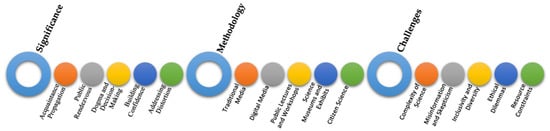
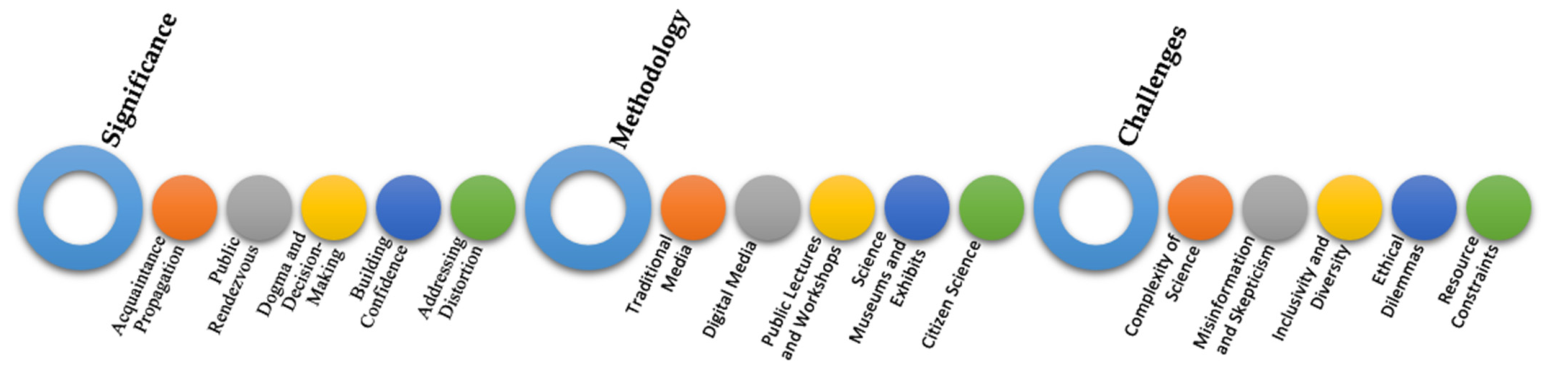

Disclaimer/Publisher’s Note: The statements, opinions and data contained in all publications are solely those of the individual author(s) and contributor(s) and not of MDPI and/or the editor(s). MDPI and/or the editor(s) disclaim responsibility for any injury to people or property resulting from any ideas, methods, instructions or products referred to in the content. |
© 2026 by the authors. Licensee MDPI, Basel, Switzerland. This article is an open access article distributed under the terms and conditions of the Creative Commons Attribution (CC BY) license.