


Abstract
Artificial canals enhance regional navigation capacity and promote economic development, but they can also alter connectivity between previously isolated aquatic systems, facilitating the movement of non-native species across drainage basins and increasing invasion pressure. The Pinglu Canal, a river-to-sea corridor connecting the Xijiang River with the Beibu Gulf in China, may create new opportunities for the dispersal and establishment of non-native fishes, yet the relative invasion risk of non-native fishes in this region remains poorly understood. This study integrated species distribution models with functional trait analysis to screen 25 non-native fish species for environmental suitability and biotic compatibility. An integrated index was subsequently developed to quantify relative invasion risk by combining these two dimensions. The models showed good to excellent discrimination under random-split evaluation, with temperature emerging as the dominant environmental factor shaping predicted suitability. Predicted suitability was shifted toward higher values for 12 species, with peaks between 0.50 and 1.00. Their predicted distributions were grouped into four spatial patterns, including a southward increase in suitability for six species that reflected regional temperature gradients. Trait-based analysis grouped the 25 species into four functional configurations based on the mean distance to the native assemblage and the minimum distance to the nearest native species; these configurations were used only to compare species positions in functional space. The integrated assessment classified eight species as high-risk, eight as medium-risk, and nine as low-risk; these categories represent relative rankings among the 25 candidate species within the Pinglu Canal region. Representative high-risk species included Cirrhinus mrigala and Coptodon zillii. These findings identify candidate species requiring priority surveillance and provide a basis for targeted prevention and management of non-native fish invasions in the Pinglu Canal.
1. Introduction
Canals play a vital role in facilitating regional transportation and economic development by improving connectivity among regions. The Suez Canal, for example, connects the Mediterranean Sea and the Red Sea, greatly shortening maritime routes between Asia and Europe and facilitating global trade [1]. The same waterway also enabled the Lessepsian migration, in which Red Sea fishes entered the Mediterranean and established self-sustaining populations, providing the best-known example of canal-mediated invasion [2]. Such enhanced connectivity can break natural geographic barriers between previously isolated aquatic systems and create pathways for the cross-basin dispersal of non-native species. Evidence of these ecological consequences has also been documented in the Beijing–Hangzhou Grand Canal, which facilitated the expansion of estuarine gobies, including Taenioides cirratus and Tridentiger bifasciatus, into inland regulating lakes along the canal [3]. Similarly, the enlargement of the Panama Canal altered aquatic connectivity and increased marine influence in connected river–sea systems [4]. These cases demonstrate that artificial waterways can act as important corridors for biological dispersal, enabling some non-native fish species to bypass geographic barriers and establish populations in newly connected habitats.
The invasion process generally comprises four sequential stages: transport, introduction, establishment, and spread [5]. Among these stages, establishment represents a critical bottleneck at which introduced species must pass through both environmental and biotic filters to form self-sustaining populations. Environmental filtering determines whether introduced species encounter suitable abiotic environments for survival and reproduction, with temperature and precipitation representing important constraints on establishment [6]. Beyond these abiotic constraints, introduced species must also overcome biotic resistance from recipient communities, particularly predation and competition, to establish successfully [7]. For instance, mesocosm experiments showed that native bluegill Lepomis macrochirus negatively affected non-native western mosquitofish Gambusia affinis through competition and intraguild predation, potentially limiting its establishment and population persistence in recipient communities [8]. Establishment success therefore depends not only on whether the recipient environment is suitable, but also on whether introduced species can overcome resistance from the resident community.
Despite the joint importance of these filters, their roles are often evaluated separately in assessments of invasion potential. Screening tools such as AS-ISK are widely used for freshwater fishes, including in China [9], while spatial modelling and community functional analysis provide complementary information on environmental suitability and potential biotic filtering. Species distribution models (SDMs) have been widely used to assess the environmental suitability of non-native species and predict their potential distributions [10]. Among these, the maximum entropy (MaxEnt) model can accommodate presence-only data, perform reasonably well with limited occurrence records, and capture nonlinear relationships between species occurrence and environmental conditions [11,12]. It has been extensively applied in invasion ecology to identify potential invasion hotspots, evaluate invasion risks, and support management strategies [11]. To quantify biotic filtering, functional trait-based approaches have increasingly been applied by comparing the traits of non-native species with the functional structure of recipient communities. Such comparisons reveal potential niche overlap and competitive pressure, thereby providing an indirect measure of the biotic resistance that introduced species may encounter. Previous studies showed that non-native fishes were more likely to establish when they were functionally compatible with the overall structure of recipient communities but sufficiently distinct from their nearest native analogues to occupy unfilled functional space [13]. More recent evidence further indicated that ecological similarity promotes the establishment of non-native fishes, whereas greater niche differentiation among native species strengthens community resistance to invasion [14,15]. Therefore, integrating SDMs with functional trait analysis can provide a more comprehensive screening of relative invasion risk by jointly considering environmental suitability and biotic resistance.
The Pinglu Canal is a river-to-sea corridor connecting the Xijiang River with the Beibu Gulf in China. Its construction involved extensive channel regulation, including bend cutoffs and channel straightening, together with the construction of navigation structures. These interventions may alter flow and sediment regimes, reduce habitat heterogeneity, and modify longitudinal connectivity, thereby affecting the availability and quality of fish habitats [16,17,18]. The enhanced connectivity created by artificial waterways may also create opportunities for future spread of non-native fishes beyond their current ranges, increasing potential invasion pressure. Guangxi already faces severe invasion pressure, with 23 non-native fish species recorded across all 12 major river systems [19]. This regional pool includes Coptodon zillii and Oreochromis niloticus, which are widely distributed and numerically dominant, indicating established populations in parts of the region [20]. Against this background, the canal may further increase invasion pressure, highlighting the need for targeted relative risk screening to support aquatic biodiversity conservation and basin-scale biosecurity management. Systematic assessments of non-native fish invasion risk in newly connected large artificial river-to-sea canals remain limited. The Pinglu Canal therefore provides an important case for identifying species requiring priority surveillance and establishing a baseline for biosecurity management in artificial waterways.
This study therefore focused on the Pinglu Canal region and aimed to assess the relative potential for establishment and persistence of non-native fishes recorded or introduced in Guangxi. Based on species occurrence data, environmental variables, and functional traits, we sought (1) to quantify environmental suitability and identify key environmental factors shaping the potential distributions of non-native fish species; (2) to infer potential biotic filtering by comparing functional trait similarity and dissimilarity between candidate non-native fishes and native fish assemblages; and (3) to integrate environmental suitability and potential biotic filtering into a relative risk screening framework for the Pinglu Canal region.
2. Materials and Methods
2.1. Study Area
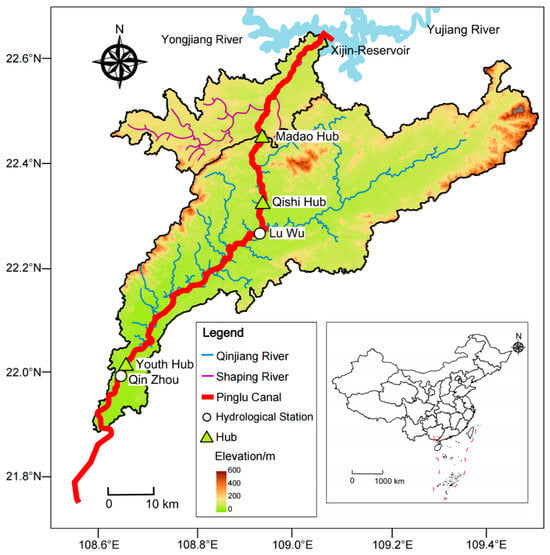
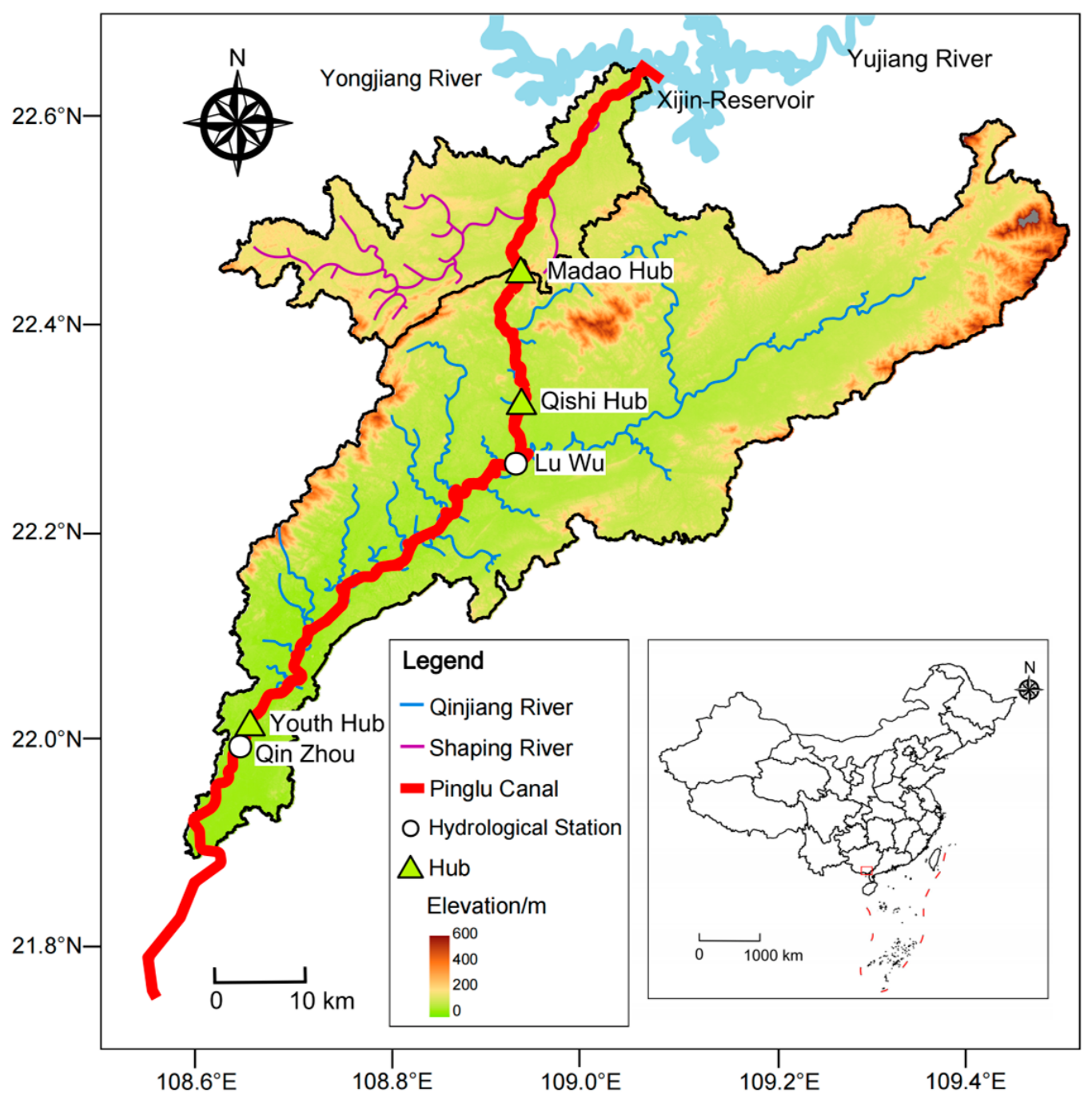
The Pinglu Canal (108°35′ E–109°04′ E, 21°44′ N–22°38′ N) is located in Guangxi, China, connecting the Xijiang River system with the Beibu Gulf through the Qinjiang River (Figure 1). The canal was opened to navigation on 16 September 2026 and has an official length of 134.2 km. The region is characterized by a subtropical monsoon climate, with a mean annual temperature of approximately 22 °C and annual precipitation exceeding 1800 mm. The landscape consists predominantly of hills and river valleys and contains a dense river network with 26 major tributaries [21,22]. These diverse aquatic habitats support rich fish resources and diverse native fish assemblages, including several protected and endemic species such as Bangana decora (CR), Xenocyprioides parvulus (EN), Cyprinus acutidorsalis (EN), and Luciocyprinus langsoni (VU), according to the Red List of China’s Vertebrates [23].
Figure 1.
Location of the Pinglu Canal study domain in Guangxi, China. The map shows the geographical context of the canal, including the Qinjiang River and Shaping River, three navigation hubs, and two hydrological stations. The boundary is used to calculate mean E and IR.
2.2. Data Sources
We defined non-native status relative to the Pinglu Canal region rather than to national borders [24]. Fish species native to China but historically confined to other river basins were therefore treated as non-native to the region, but not as canal-mediated first arrivals. Species native to the Xijiang–Qinjiang region were assigned to the native reference pool, whereas species with no non-native record in Guangxi were excluded. Twenty-five candidate non-native fishes were selected from published literature and official surveys of alien aquatic animals in Guangxi, covering the Xijiang, Yujiang, and Qinjiang river systems and the Pinglu Canal region. The initial screening list contained 26 taxa. Cyprinus carpio var. specularis, was excluded because it is a domesticated form of native common carp, Cyprinus carpio, and the available occurrence records did not support a separate environmental suitability assessment. The native reference pool comprised 78 species recorded in the Xijiang, Yujiang, and Qinjiang river systems. Although artificial waterways can facilitate canal-mediated cross-basin dispersal, this assessment estimates risk within the Pinglu Canal region and does not estimate the probability of first arrival via the canal or subsequent spread. The species checklist, native ranges, occurrence locations, invasion status, and supporting references for the candidate non-native fishes are provided in Table S1. Fish occurrence records were obtained from the Global Biodiversity Information Facility (GBIF; https://www.gbif.org/, accessed on 20 October 2025). The cleaned occurrence records were spatially thinned using the spThin package (version 0.2.0) in R version 4.5.1 to reduce spatial clustering [25]. Species-specific thinning distances were 5–80 km; the three sparsest species (Megalobrama amblycephala, Myxocyprinus asiaticus and Luciobarbus capito) were not thinned. Records per species ranged from 12 to 100,000 before thinning and from 12 to 1901 after thinning.
Twenty environmental variables were obtained from the WorldClim database (https://www.worldclim.org/, accessed on 23 October 2025) and used as predictors in the MaxEnt model, including 19 current (1970–2000) bioclimatic variables (Bio1–Bio19) and one topographic variable (elevation, Ele), at a spatial resolution of 2.5 arc-min. To mitigate model overfitting caused by multicollinearity among environmental predictors, the occurrence records and environmental variables were first imported into MaxEnt 3.4.4 for a preliminary run to estimate the percent contribution of each variable. Spearman correlation analysis was then performed on the 20 variables using ENMTools (version 1.1.5). A variable was removed if either of the following conditions was met: (i) it was correlated at |r| ≥ 0.8 with a variable having a higher percent contribution, or (ii) its own percent contribution was <0.1% [26,27,28], yielding the final variable set for model calibration. Correlations among environmental variables were calculated once across the full environmental domain, whereas percent contributions were obtained separately for each species from its initial MaxEnt model.
To characterize biotic filtering of non-native fish, we adopted the functional trait framework of Su et al. [13], using 11 traits: maximum length, maximum body weight, body shape, length at maturity, age at maturity, minimum fecundity, maximum fecundity, habitat position, feeding guild, flow dependency, and pollution tolerance (seven life-history, two ecological, and two tolerance traits). These were compiled from FishBase (https://www.fishbase.org/, accessed on 10 May 2026), monographs on Chinese freshwater fishes, regional fishery resource surveys of the Pearl River, and other relevant literature [29,30,31]. Numeric traits were log10-transformed, and habitat position, flow dependency, and pollution tolerance were coded as ordered variables. Of the 1133 trait entries, 219 were imputed using congeneric or family means or modes. Another 205 were derived from reported ranges. For both native and non-native fishes, Table S2 presents the 11 functional traits and their data sources, with orange shading indicating imputed values and blue shading indicating values derived from reported ranges.
2.3. Model Calibration and Evaluation
During model calibration, 25% of the occurrence records were randomly partitioned for model validation, while the remaining records were used for model training. The calibration extent was the global terrestrial area in which both the WorldClim and elevation rasters had valid values, and 10,000 background points were sampled randomly from this extent. Model complexity was optimized by testing combinations of linear (L), quadratic (Q), hinge (H), product (P), and threshold (T) features with regularization multipliers from 1 to 4 in increments of 0.5. The optimal parameterization was selected using the corrected Akaike information criterion (AICc) in ENMeval (version 2.0.6), with the model yielding the minimum AICc and thus ΔAICc = 0 considered the most parsimonious [32,33]. AICc calculation and parameter optimization were performed solely on the 75% training dataset; the 25% validation subset was reserved exclusively for final model evaluation and was not used to compute AICc. For each of 10 bootstrap replicate runs, occurrence records were randomly split following the same partitioning scheme. Models were fitted in MaxEnt 3.4.4 and projected with the cloglog output, which represents relative environmental suitability. Response curves were generated to characterize the relationships between predicted environmental suitability and individual environmental variables. Variable importance was evaluated using percent contribution and jackknife tests, with the latter assessing the information provided by each variable when used alone and the information lost when it was omitted [34,35]. Predictive performance was evaluated using the area under the receiver operating characteristic curve (AUC). Based on the mean AUC values derived from 10 repeated runs, model performance was categorized as failure (0.5 ≤ AUC < 0.6), poor (0.6 ≤ AUC < 0.7), fair (0.7 ≤ AUC < 0.8), good (0.8 ≤ AUC < 0.9), and excellent (0.9 ≤ AUC ≤ 1) [36,37]. To complement AUC, we calculated the true skill statistic (TSS). Following common practice, TSS > 0.6 was considered acceptable [38]. Because the 75/25 split was random, AUC and TSS were not independent spatial validation. Species with very small samples, particularly M. asiaticus (12 records) and M. amblycephala (21 records), were retained but interpreted cautiously. Complete details of distribution data preprocessing (Table S3), model parameterization (Table S4), performance evaluation (Table S5), and environmental variable importance (Table S6) are provided in the Supplementary Materials.
2.4. Functional Distance and Functional Space
To estimate potential biotic filtering, functional distances between candidate non-native fishes and the native assemblage were calculated from the 11-trait functional matrix using the gawdis (version 0.1.5) [39], which computes trait-weighted Gower dissimilarity with balanced contributions from individual traits. Continuous traits were log10-transformed to reduce the influence of extreme values, ordinal traits were retained in their natural order, and nominal traits (body shape and feeding guild) were treated as unordered factors. The gawdis algorithm optimized the weight of each trait (maximum 200 iterations; minimum weight 0.01) to reduce the influence of any single trait. Mean distance to the native assemblage (cd) and minimum distance to the nearest native species (md) were used to characterize functional similarity and potential niche overlap, respectively, following the principle of limiting similarity [40]. For each candidate non-native species i, cd and md were defined relative to the native reference pool N (n = 78) as:
where d is the gawdis dissimilarity between the candidate species and native species j. For native reference species, self-comparisons were excluded, and each species was compared with the remaining 77 native species. Both metrics were computed directly from the complete gawdis dissimilarity matrix. Native species cd and md values are provided in Table S7. cd measures overall functional similarity to the recipient community, with lower values indicating greater compatibility with the community’s functional structure. md quantifies the shortest functional distance between a species and any native species; lower values indicate greater functional similarity, stronger potential niche overlap, and potentially greater competitive pressure [41,42]. Principal coordinate analysis (PCoA) of the same gawdis dissimilarity matrix was used solely to visualize the functional space occupied by native and candidate non-native fishes.
2.5. Integrated Relative Invasion Risk Index
Because a smaller cd indicates greater functional similarity to the native assemblage, cd was direction-reversed so that larger values indicate greater similarity. By contrast, md was retained unchanged because a larger md already indicates a greater distance from the nearest native species:
The same calculations were applied to the 78 native species, with each species compared only with the other 77, to generate native reference distributions for the reversed cd and for md. The 95th percentiles of these distributions were Scd,95 = 0.810 and Smd,95 = 0.112 and were used as fixed denominators. Standardized values were capped at 1 to maintain both components on a common scale from 0 to 1 and prevent distances exceeding the reference values from disproportionately influencing the integrated score.
The two standardized distances were used as C (Functional Compatibility) and R (Potential Competitive Release); C was set equal to the standardized cd, and R to the standardized md. A higher C value indicates that the functional traits of a non-native fish are more aligned with the overall functional structure of the native community. A higher R value indicates greater functional difference from the nearest native species, suggesting weaker potential biotic constraints during establishment.
To integrate functional compatibility and potential competitive release into a single biotic compatibility index, B was calculated as:
where α is the weighting coefficient for C and 1 − α is the weighting coefficient for R. For a given species, C, R and B are constant across grid cells because the same regional native reference pool was used throughout the study domain.
Environmental suitability and biotic compatibility were then combined to calculate the relative invasion risk index:
where β is the weighting coefficient for E and 1 − β is the weighting coefficient for B. E is the MaxEnt cloglog relative environmental suitability at site x (0–1), not a probability of occurrence. Because C, R and B are constant across grid cells, the subscript x is retained only for E and IR.
To examine whether the species ranking based on mean IR depended on these weighting choices, we compared the ranking obtained under each alternative weighting with that of the main model (α = β = 0.5) using Spearman’s rank correlation coefficient (ρ). Two sets of alternative weightings were evaluated. In the first set, α was varied over seven values from 0 to 1 (0, 0.2, 0.4, 0.5, 0.6, 0.8 and 1) with β fixed at 0.5. In the second, β was varied over five values from 0 to 1 (0, 1/3, 0.5, 2/3 and 1) with α = 0.5. We also reversed md to represent the opposite ecological hypothesis. All results of the sensitivity analysis are reported in Table S8.
For each species, the arithmetic mean and standard deviation of E and IR were calculated across the 111 grid cells covering the study basin at a resolution of 2.5 arc minutes. These statistics summarize environmental suitability and integrated risk at the basin scale, with the standard deviation describing spatial variation among grid cells. Because no ecologically validated thresholds combining environmental and biological traits were available, species were classified into low, medium and high invasion risk using tertiles of mean IR.
3. Results
3.1. Variable Importance and Model Performance
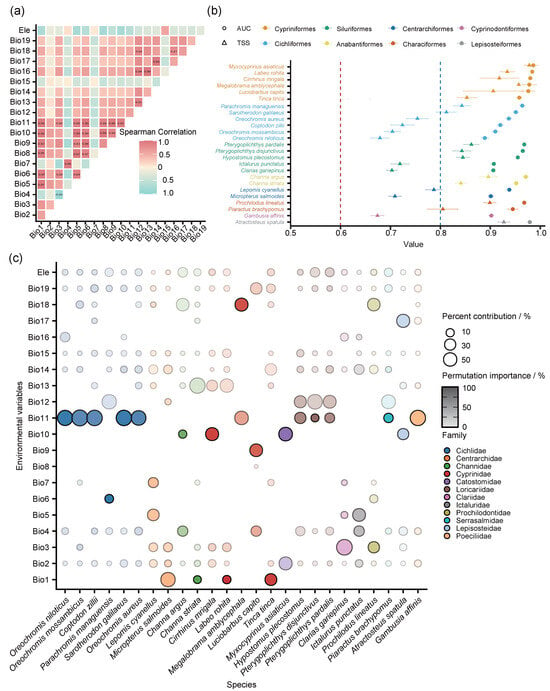
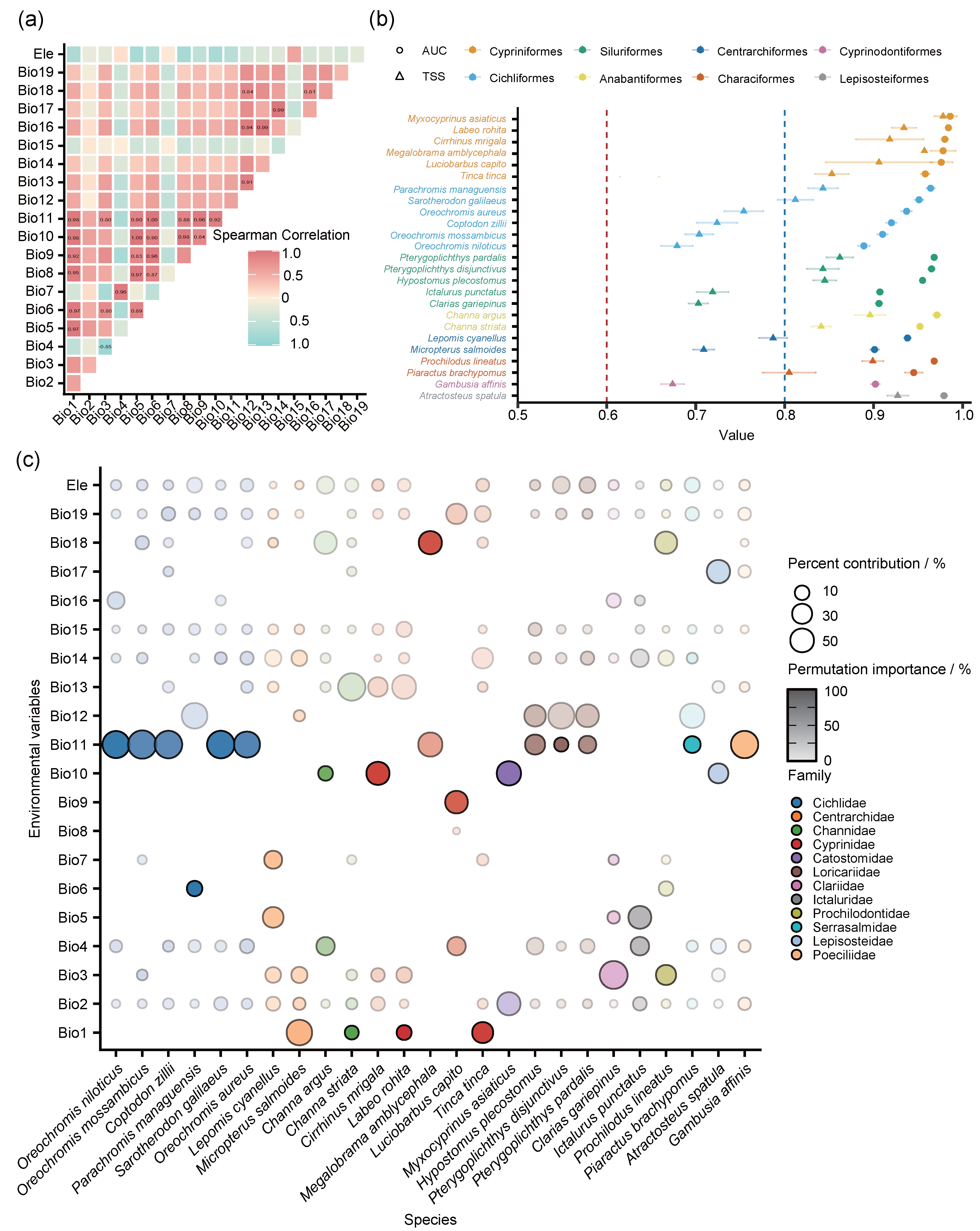
Strong correlations were concentrated among five temperature-related variables, including mean temperature of the warmest quarter (MTWaQ, Bio10) and mean temperature of the coldest quarter (MTCQ, Bio11), whereas precipitation variables generally showed weaker correlations with one another and with other environmental variables (Figure 2a). After multicollinearity screening and preliminary model evaluation, the final models retained 2 to 10 of the 20 environmental variables, depending on the species. Most species retained 7–10 variables; however, reflecting the limited number of available sample points, M. asiaticus and M. amblycephala retained two variables each, and L. capito retained three. MTCQ was retained for 11 species, making it the most frequently selected variable.
Figure 2.
Screening and importance of environmental variables, and evaluation of MaxEnt model prediction performance. (a) Spearman’s correlation heatmap of the 20 environmental variables; (b) AUC and TSS values of the 25 retained non-native fish species grouped by order, with the blue dashed line indicating the AUC threshold (0.8) and the red dashed line indicating the TSS threshold (0.6); (c) bubble chart showing the percent contribution and permutation importance of the 20 environmental variables for the 25 fish species, grouped by family.
Temperature variables dominated the predicted environmental suitability of most fish families (Figure 2c). For Cichlidae, MTCQ had substantially higher percent contribution and permutation importance than the other variables. The distributions of Cyprinidae were primarily associated with MTCQ, MTWaQ, and annual mean temperature (AMT, Bio1), while precipitation of the wettest month (PWM, Bio13) made a secondary contribution. MTCQ and annual precipitation (AP, Bio12) were the principal predictors for Loricariidae. Among the remaining families, which contained relatively few species, variable importance was less consistent and mainly involved temperature-related variables such as isothermality (Iso, Bio3), temperature seasonality (TS, Bio4), and max temperature of the warmest month (MTWM, Bio5).
Across the 25 candidate species, mean AUC values ranged from 0.889 ± 0.007 (O. niloticus) to 0.986 ± 0.008 (M. asiaticus), and mean TSS values ranged from 0.674 ± 0.013 (G. affinis) to 0.978 ± 0.010 (M. asiaticus) (Figure 2b). These values indicated good to excellent discrimination under the evaluation procedure used. M. asiaticus and M. amblycephala showed extensive predicted suitability, although their models were based on only 12 and 21 occurrence records, respectively, leaving greater uncertainty in the predicted spatial patterns.
3.2. Environmental Suitability
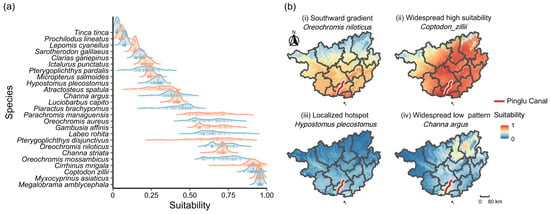
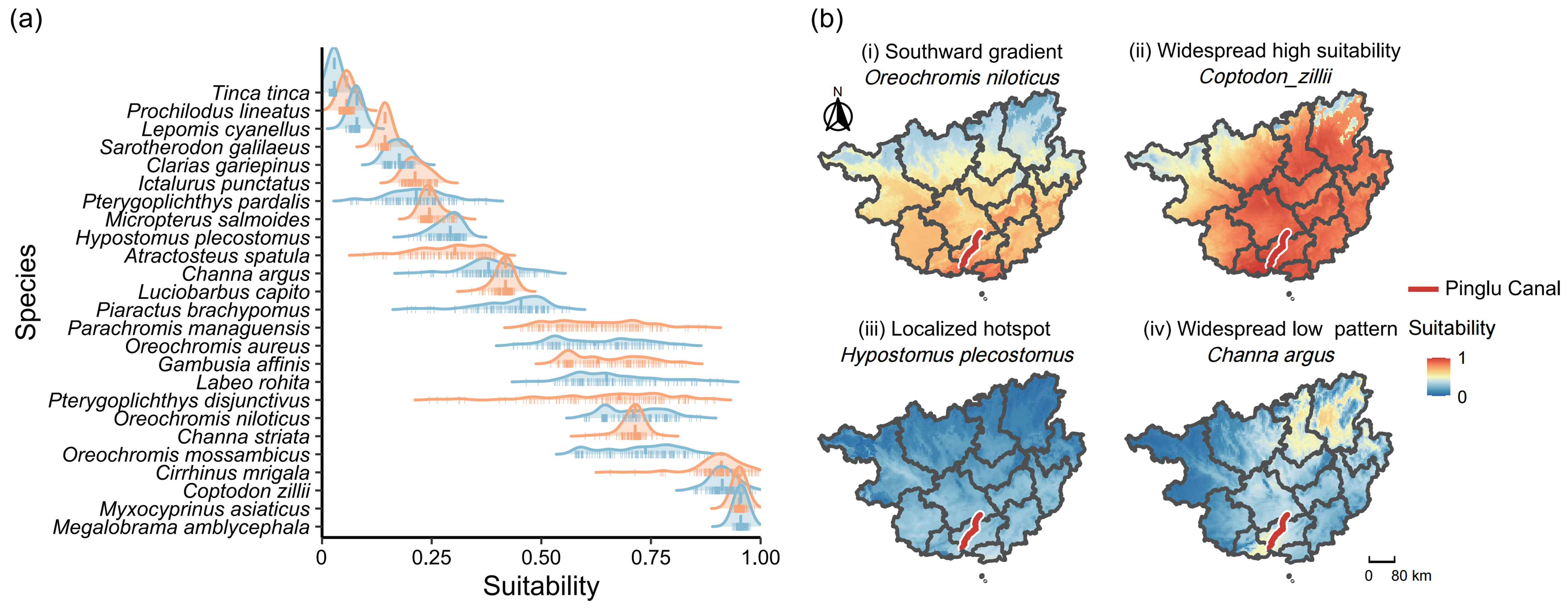
The ridge plot for the Pinglu Canal study basin revealed distinct patterns in predicted environmental suitability among the 25 candidate non-native fish species (Figure 3a). Seven species, including Tinca tinca, Prochilodus lineatus, and Pterygoplichthys pardalis, had distributions skewed toward lower values, with density peaks concentrated between 0 and 0.22 and generally narrow suitability ranges, although P. pardalis showed a wider range. This pattern indicated that most areas within the study domain were environmentally unsuitable for these species and that areas of moderate or high suitability were limited. Six species, including Hypostomus plecostomus, Channa argus and L. capito, had broader distributions with peaks predominantly between 0.22 and 0.50, indicating intermediate suitability and with variation across grid cells. In contrast, the distributions of the remaining 12 species, including the tilapias, Cirrhinus mrigala, and M. asiaticus, were shifted toward higher values, with peaks between 0.50 and 1.00, indicating greater compatibility with environmental conditions in the study domain.
Figure 3.
Environmental suitability distributions and spatial patterns of non-native fish species predicted by the MaxEnt model. (a) ridge plot of environmental suitability for the 25 candidate non-native fish species within the Pinglu Canal study domain, with colors used only to distinguish species; (b) four spatial patterns of environmental suitability in Guangxi.
Predicted environmental suitability also varied among major taxonomic groups. Cichlidae, particularly tilapia species including O. niloticus, Oreochromis mossambicus, and C. zillii, showed consistently high suitability, with their distributions concentrated in the upper range of the suitability gradient. Loricariidae were heterogeneous: Pterygoplichthys disjunctivus was among the most suitable species, H. plecostomus fell in the intermediate group, and P. pardalis had low median suitability. Cyprinidae spanned the widest range of all, from T. tinca, which had the lowest median suitability of all candidates, through L. capito in the intermediate group, to Labeo rohita and C. mrigala, which were among the most suitable species. These differences indicate that environmental filtering varies among taxonomic groups, although the pronounced variation within Cyprinidae indicates that responses are also strongly species-specific.
The Guangxi-wide maps were summarized into four spatial patterns (Figure 3b, Supplementary Materials, Section S7): (i) the southward gradient pattern, observed for six species; (ii) the widespread high suitability pattern, observed for five species; (iii) the widespread low suitability pattern, observed for nine species; and (iv) the localized hotspot pattern, observed for five species. Taking O. niloticus as an example, its predicted environmental suitability showed a pronounced north–south gradient across Guangxi, with higher suitability mainly in the southern coastal zone and along the mainstem of the Pearl River. Moderate suitability extended across central Guangxi, whereas low suitability was largely confined to the mountainous border regions. This pattern was associated with regional climatic and topographic gradients, particularly lower temperatures at high elevations that may constrain warm-water fishes. Along the Pinglu Canal region, predicted suitability was generally moderate to high, indicating favorable conditions for the potential persistence of O. niloticus.
3.3. Community Functional Traits
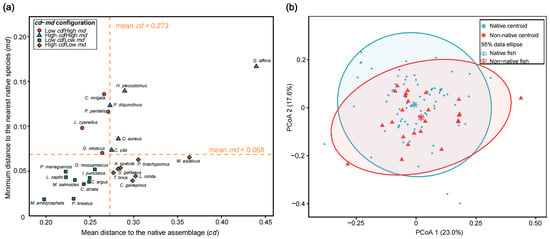
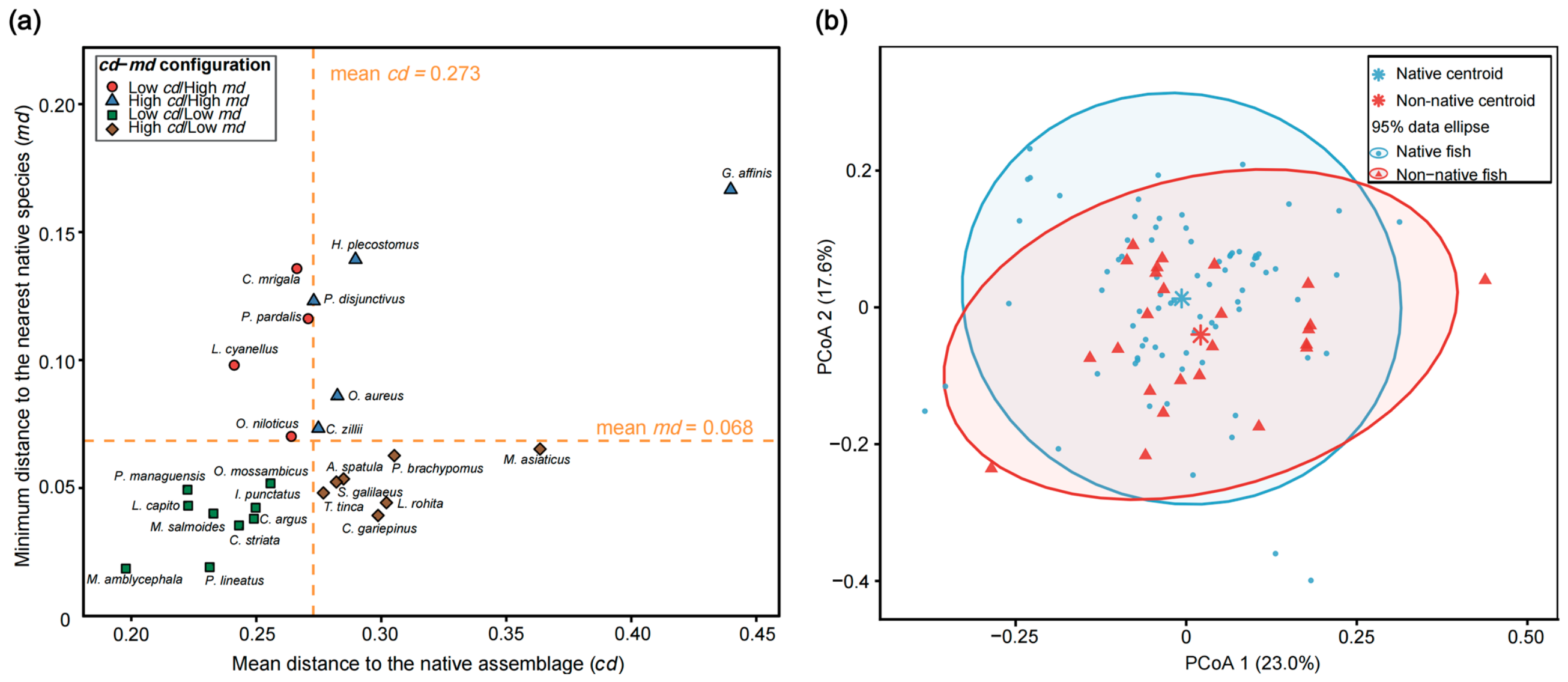
The scatter plot of cd and md was used to visualize the positions of the 25 candidate non-native fishes in trait space (Figure 4a). The means of the 25 species-specific cd (0.273) and md (0.068) values were used only as descriptive reference lines; they do not represent validated ecological thresholds. The low-cd/high-md quadrant contained four species: C. mrigala, Lepomis cyanellus, O. niloticus, and P. pardalis, which had smaller mean functional distances to the native reference pool but greater distances to their nearest native species. The high-cd/low-md quadrant contained seven species, including L. rohita, M. asiaticus, and Clarias gariepinus, which were functionally distant from the overall native assemblage, but similar to at least one native species. The high-cd/high-md quadrant contained five species, including G. affinis and Oreochromis aureus, which were separated from both the overall native assemblage and their nearest native neighbors. The low-cd/low-md quadrant contained the remaining nine species, including C. argus and O. mossambicus, which were compatible with the overall native structure and also close to at least one native species. These positions are relative to the 25 candidates and should not be interpreted as absolute biotic resistance.
Figure 4.
Functional trait-based analysis of potential biotic filtering of non-native fishes. (a) Scatter plot of cd versus md for the 25 candidate non-native fishes; point color denotes the cd–md quadrant relative to the candidate means. (b) PCoA of the gawdis dissimilarity matrix for the 78 native and 25 candidate non-native fishes. The first two axes explain 40.6% of the total variation.
PCoA of the full gawdis dissimilarity matrix, including the 78 native and 25 candidate non-native species (Figure 4b), revealed partial overlap between their functional spaces. The first two axes explained 40.6% of the total variation. Native fishes occupied a broader region, whereas candidate non-native fishes were concentrated in a comparatively restricted area. Several candidates fell in sparsely occupied parts of the native space, indicating relatively low functional redundancy with resident species and potentially weaker competitive constraints; this interpretation remains indirect.
3.4. Relative Invasion Risk Levels
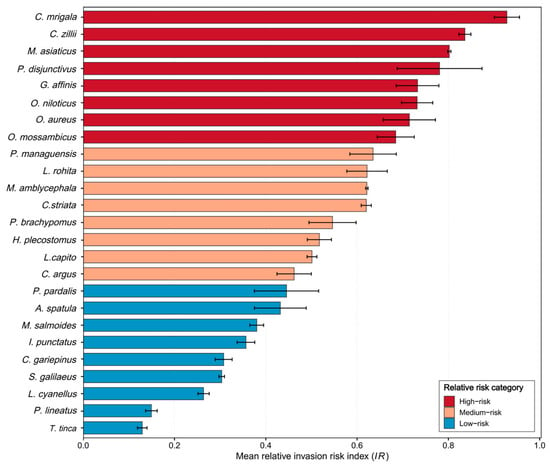
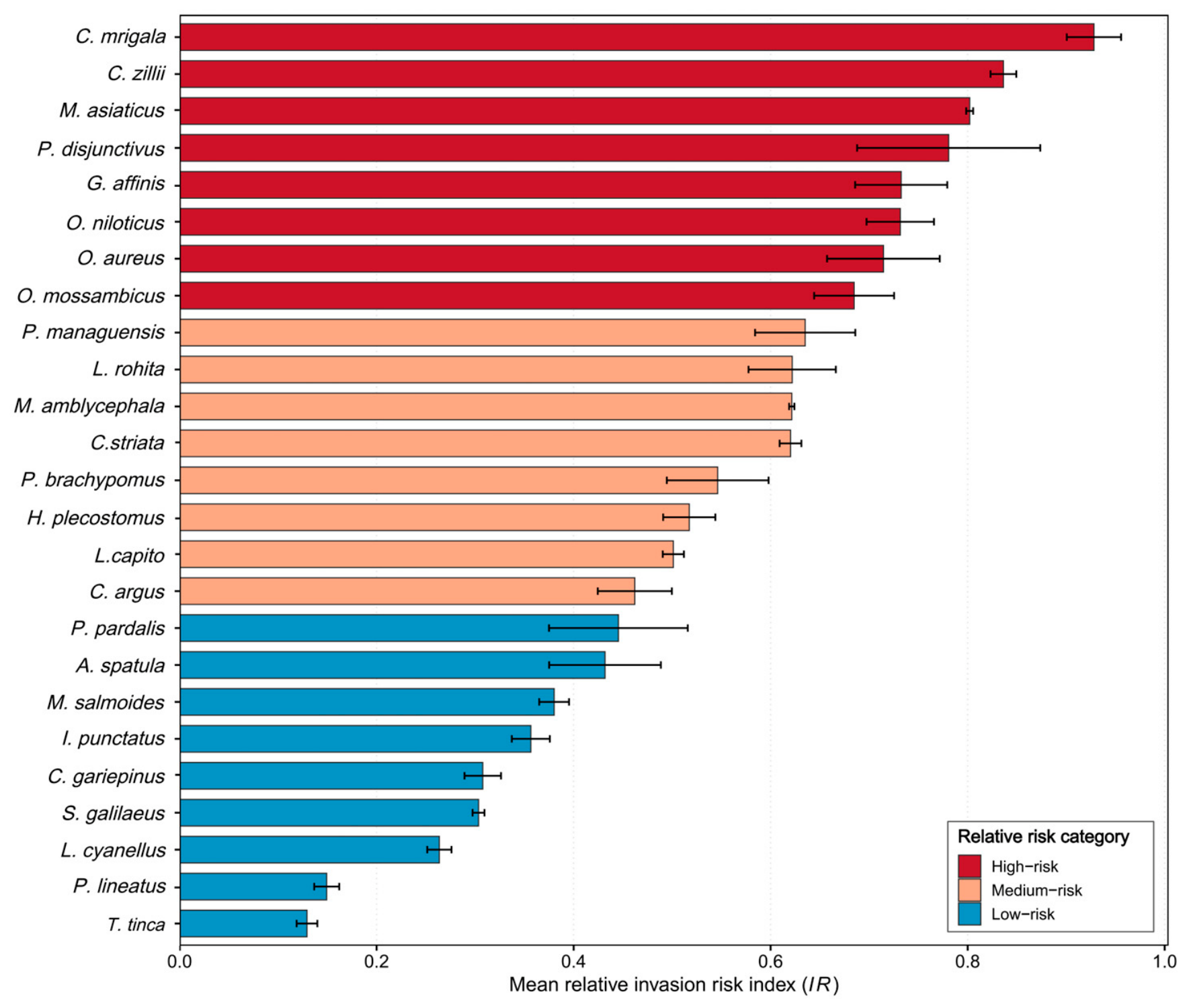
The invasion risk of the 25 candidate non-native fishes was assessed by integrating environmental suitability with trait-based biotic compatibility (Figure 5). IR is reported as the mean ± standard deviation (SD); the SD describes spatial variation among cells and is not an estimate of uncertainty in the mean. The tertiles were calculated from the 25 species-level mean IR values, with lower and upper boundaries of 0.445 and 0.635. These categories are relative and do not represent absolute biological risk thresholds. Eight species were assigned to the high-risk category: C. mrigala, C. zillii, M. asiaticus, P. disjunctivus, G. affinis, O. niloticus, O. aureus, and O. mossambicus. These species exhibited relatively high environmental suitability and favorable biotic compatibility, indicating greater potential to overcome both environmental and biotic constraints. Eight species were assigned to the medium-risk category: Parachromis managuensis, L. rohita, M. amblycephala, Channa striata, Piaractus brachypomus, H. plecostomus, L. capito, and C. argus, reflecting intermediate integrated scores or contrasting results between the two dimensions. Nine species were assigned to the low-risk category: P. pardalis, Atractosteus spatula, Micropterus salmoides, Ictalurus punctatus, C. gariepinus, Sarotherodon galilaeus, L. cyanellus, P. lineatus, and T. tinca. Across the main model, six moderate weighting scenarios, and the scenario with reversed md, 15 of the 25 species remained within the same rank band (1–8, 9–16, or 17–25), whereas 10 crossed a band boundary. These rank ranges describe sensitivity to the analytical scenarios. Overall, the integrated assessment revealed substantial interspecific variation in invasion potential and demonstrated the complementary contributions of environmental suitability and functional relationships with the native fish assemblage. Calculation results for all indicators are provided in Table S9; species-level mean IR, ranks, risk categories, and rank ranges are provided in Table S10.
Figure 5.
Mean relative invasion risk (IR) for the 25 candidate non-native fishes, ordered by mean IR and colored according to the tertile-based risk category. Error bars represent spatial variation among grid cells.
Differences in IR were also observed among families. Cichlidae included four high-risk species as well as one medium-risk (P. managuensis) and one low-risk species (S. galilaeus). Loricariidae spanned the full risk gradient: P. disjunctivus was high risk, H. plecostomus medium risk and P. pardalis low risk, with mean environmental suitability of 0.65, 0.29 and 0.21, respectively. Cyprinidae also varied widely, from C. mrigala in the high-risk group to M. amblycephala in the medium group and T. tinca in the low group. Thus, high environmental suitability did not necessarily translate into high IR, and low environmental suitability strongly constrained the IR of several species. Across species, mean IR was strongly correlated with mean E (Spearman’s ρ = 0.902) but only moderately correlated with B (ρ = 0.479), indicating that the integrated ranking followed environmental suitability more closely.
Alternative weightings changed species placements. With α = 1 (R omitted from B), rankings remained broadly similar to the main model (ρ = 0.893), although individual species shifted by up to 10 positions. With β = 0 (E omitted from IR), the correlation fell to ρ = 0.479 and ranks shifted by up to 18 positions, confirming the dominant influence of environmental suitability. Reversing the direction of md produced ρ = 0.885 and changed the risk category of seven species: P. managuensis, L. rohita, M. amblycephala, and C. striata moved from medium to high, whereas A. spatula, M. salmoides, and I. punctatus moved from low to medium. Under md reversal, only four of the seven highest-ranked species were shared with the main model. Sensitivity analyses showed that the stability of species rankings depended on the weighting coefficients and the assumed direction of md, with changes under alternative environmental weights and reversal of the md effect.
The IR scores reported in Table S9 were compared with documented invasion status in Guangxi. Five species recorded as Established or Invasive (C. zillii, O. niloticus, O. mossambicus, G. affinis, and H. plecostomus) were compared with 20 species recorded only as Introduced. Mean IR was higher in the Established/Invasive group (0.701) than in the Introduced group (0.500). An exact two-sided Mann–Whitney U test yielded U = 80, p = 0.042, and AUC = 0.800 (Table S10). Four of the five established or invasive species were in the high-risk category and the fifth was in the medium-risk category. This result indicates an association between IR and documented regional status. Given the inclusion of Guangxi occurrence records in MaxEnt training, this comparison assesses the consistency between the IR rankings and documented regional invasion status.
4. Discussion
4.1. Environmental Filtering Shapes the Invasion Potential of Non-Native Fishes
Environmental filtering represents a major barrier determining whether non-native fishes can survive and establish in recipient ecosystems. In this study, temperature emerged as the dominant environmental factor shaping relative suitability for non-native fishes in Guangxi, indicating that thermal conditions play a critical role in constraining their potential establishment. The importance of MTCQ, particularly for cichlids, together with MTWaQ and AMT for cyprinids, highlights the role of winter and broader thermal conditions in shaping environmental suitability. Fish are ectotherms whose physiological processes, including metabolism, growth, reproduction, and recruitment, are strongly constrained by ambient temperature. Therefore, regions with suitable thermal regimes can provide favorable conditions for introduced fishes to survive, reproduce, and maintain viable populations [43,44].
The subtropical climate of Guangxi, characterized by high annual temperatures and mild winters, provides suitable thermal conditions for many warm-water non-native fish species. This climatic setting may facilitate the establishment of tropical and subtropical taxa, particularly species with broad thermal tolerance or high physiological plasticity [45]. Tilapias, including species of Oreochromis and Coptodon, and other warm-water fishes have successfully established populations in many subtropical regions because of their rapid growth, early maturity, flexible reproductive strategies, and tolerance to environmental fluctuations [46,47,48]. Their high predicted suitability in southern Guangxi is consistent with their ecological characteristics and with the invasive or established status of C. zillii, O. niloticus, and O. mossambicus in the region. In contrast, species with narrower thermal niches may encounter stronger environmental constraints, reducing their probability of successful establishment even when other ecological requirements are partially met.
Beyond temperature, precipitation may influence invasion potential by affecting regional water availability, runoff regimes, and environmental heterogeneity. However, the models incorporated only broad-scale climate–topographic predictors and did not account for local factors such as flow velocity, water depth, substrate composition, water quality, or hydraulic regulation. Along the Pinglu Canal, water-level management, lock operation, and navigation may modify local hydrodynamic conditions, potentially favoring fishes adapted to stable or slow-flowing habitats while constraining species with specific flow, substrate, or spawning requirements [49,50]. Incorporating local hydrodynamic and habitat variables could improve future risk assessments along the canal [51,52].
4.2. Biotic Filtering Regulates the Invasion Potential of Non-Native Fishes
Directly measuring competition between multiple candidate invaders and resident species is difficult at a regional scale. Functional distances provide an indirect proxy because traits related to life history, resource use, and environmental tolerance reflect major dimensions of species’ ecological strategies [53,54]. The cd and md metrics capture complementary aspects of potential biotic filtering. The cd quantifies overall functional similarity to the native assemblage, whereas md quantifies functional redundancy and potential niche overlap with the nearest native species. Considering these metrics together distinguishes species that are broadly compatible with the recipient community from those that closely duplicate the functional roles of individual residents.
Under the limiting-similarity assumption, our results identified a low cd combined with a high md as the functional configuration associated with the most favorable trait-based establishment potential. Across North American watersheds, greater fish community invasibility was associated with smaller distances between native and non-native assemblage centroids and greater average distances between non-native species and their nearest native neighbors [13]. This pattern supports considering overall functional compatibility and nearest-neighbors separation together. Other studies have similarly reported that ecological similarity to native assemblages can increase the likelihood of non-native fish establishment, while greater functional separation from resident species could allow invaders to exploit weakly occupied ecological positions [41,55]; however, these lines of evidence are not fully consistent, and the direction of md therefore remains unresolved. In our assessment, C. mrigala, L. cyanellus, O. niloticus, and P. pardalis occupied the configuration with low cd and high md. These species appear sufficiently similar to the native assemblage to match the prevailing ecological setting, while retaining functional differences that may reduce direct niche overlap with individual native species. Nevertheless, functional distances describe trait similarity and separation rather than directly measured competition or biotic resistance. The resulting biotic scores should therefore be interpreted as indirect indicators of potential biotic filtering and relative establishment potential. Their ecological interpretation requires further evaluation using observed species interactions and establishment outcomes.
4.3. Environmental and Biotic Filtering in Relative Invasion Risk
Many invasion assessments rely primarily on climatic matching or species distribution models to identify areas where introduced species may persist. Such approaches capture environmental filtering but often assume that environmentally suitable habitats are equally available for establishment. Evidence from freshwater fishes suggests that this assumption may overestimate establishment potential when resistance from recipient communities is strong. Across North American fish communities, establishment probability varied with both environmental suitability and the functional composition of resident assemblages [6]. At the global scale, greater niche differentiation among native fishes was associated with lower occurrence and richness of non-native fishes, indicating that more complete niche occupation can strengthen community resistance [15]. Mesocosm experiments have shown that competition and predation by native species can directly constrain the establishment and population persistence of non-native fishes [8]. Long-term stream monitoring further suggests that these effects can interact, as non-native fishes can alter native stability by expanding functional trait space and narrowing phylogenetic distances [56]. These findings indicate that suitable environmental conditions do not necessarily lead to establishment when competition or predation imposes strong biotic resistance.
A mismatch between environmental suitability and IR was evident in our assessment, indicating that environmental suitability alone may produce an incomplete ranking of candidate invaders. The biotic constraints identified here should not be regarded as static. Canal construction and operation may alternative assemblages through habitat modification, hydrological regulation, and increased disturbance, potentially weakening the functional structure that contributes to biotic resistance. Such community changes have been observed in modified canals and regulated rivers, where declines in native fish abundance have coincided with the expansion of non-native fishes [57,58]. These observations suggest that loss of native species could release functional space and resources for environmentally suitable non-native fishes, so species with low current biotic scores may warrant increased surveillance if native assemblages decline. Maintaining functionally diverse and well-structured native assemblages may therefore help limit establishment after canal construction.
4.4. Implications for Invasion Prevention and Management in the Pinglu Canal
The priority rankings derived from environmental suitability and trait-based biotic compatibility provide a basis for identifying priority species for surveillance. Management recommendations combine these rankings with general invasion ecology and the characteristics of the Pinglu Canal. These recommendations are specific to the canal. Because the canal connects previously separated aquatic systems, prevention and early detection should remain central, since controlling non-native species becomes difficult once self-sustaining populations have formed. This is consistent with lessons from the Dongting Lake basin, where extensive established non-native populations and their accumulated ecological impacts demonstrate the importance of regulating introduction pathways before species become widespread [59]. Within the model-derived ranking, species with high environmental suitability and high trait-based biotic compatibility should receive particular attention. Surveillance should concentrate on navigation hubs, reservoir reaches, tributary junctions, and connections with aquaculture areas. Combining conventional fish surveys with environmental DNA monitoring could increase detection sensitivity at low abundance, although positive environmental DNA signals should be verified through repeated sampling or the collection of live individuals [60]. And for the nationally protected M. asiaticus, surveillance should focus on its occurrence and potential establishment outside its native range, with management measures consistent with its conservation needs.
Aquaculture warrants particular attention as a source of propagule pressure for candidate species such as M. amblycephala, L. rohita, C. mrigala, and tilapias, which are cultured in Guangxi. Several highly ranked species are among these cultured taxa, although their rankings were calculated from environmental suitability and functional compatibility. Propagule pressure and dispersal through the canal were not incorporated into IR. Escapes from ponds and aquaculture facilities, together with intentional stocking, may repeatedly introduce individuals into connected waters. Frequent introductions and large numbers of released individuals can increase establishment opportunities, potentially contributing to differences between ecological risk scores and observed invasion outcomes. Improving containment at aquaculture facilities and assessing species before stocking could therefore complement surveillance based on the risk rankings. Management strategies should also consider the multiple pathways associated with canal operation. The Pinglu Canal opened to navigation on 16 September 2026 as a Class I inland waterway. Traffic is dominated by inland barges of 5000 tonnes, with river-to-sea and coastal vessels also permitted. Ballast water may transport non-native fishes, eggs, or larvae, particularly through uptake and discharge by vessels operating between rivers and coastal waters [61,62]. Its relevance to inland barges depends on their ballast water practices. Management should therefore include ballast water measures for vessels undertaking such transfers, inspection of transported water and live aquatic organisms, and rapid reporting and response procedures [62,63,64]. Meanwhile, habitat management should be incorporated into long-term invasion prevention. Reservoir reaches and slow-flowing sections created by canal operation may favor some non-native fishes, whereas the loss of native species could weaken community resistance and create ecological opportunities for establishment. Maintaining habitat heterogeneity, protecting native fish assemblages, and monitoring changes in community functional structure may therefore reduce the susceptibility of the canal to invasion. Overall, the integrated framework developed in this study can support the prioritization of candidate species and surveillance areas, but management decisions should also consider propagule pressure, introduction pathways, and local habitat conditions.
4.5. Limitations and Future Directions
The main limitations concern environmental modeling, trait-based assessment, and interpretation of the integrated index. Environmental variables at 2.5 arc-min characterize regional suitability but cannot resolve local aquatic conditions or the effects of canal operation. The environmental assessment characterizes regional conditions across the study basin. At a resolution of 2.5 arc minutes, rivers and tributaries may occupy only a small fraction of individual grid cells, limiting the representation of local aquatic conditions. Finer resolution aquatic environmental data would improve assessments within the river network and canal. GBIF and other occurrence records may contain coordinate uncertainty, sampling bias, and records associated with stocking or aquaculture. Spatial thinning reduced clustering among occurrence records, while residual spatial dependence may influence AUC and TSS under random partitioning. Predictions for species with few records, particularly M. asiaticus and M. amblycephala, would benefit from additional verified observations. Spatially blocked cross validation would further strengthen model evaluation.
The biotic assessment uses a single regional pool of 78 native species, so compatibility scores remain constant across grid cells despite possible differences in local assemblages along the freshwater–estuarine gradient. Compiled traits and imputed values may overlook variation within species and environmental plasticity, while the greater representation of life-history traits may influence functional distances. These distances provide indirect indicators of potential biotic filtering, and the positive direction assigned to md remains a hypothesis; reversing that direction changed seven risk categories. Species with similar IR scores near the tertile boundaries of 0.445 and 0.635 warrant comparable attention in surveillance and management. Propagule pressure from aquaculture escapes and stocking, local habitat conditions, and canal dispersal dynamics were not included in IR. The integrated scores and tertile groups therefore represent relative priorities among the 25 candidate species; the comparison with documented invasion status was consistent but was not independent validation.
5. Conclusions
This study assessed the invasion risks of 25 non-native fish species in the Pinglu Canal region by integrating predicted environmental suitability with trait-based indicators of potential biotic resistance. The MaxEnt models showed good to excellent discrimination, with temperature emerging as the principal environmental factor shaping predicted suitability. MTCQ was the most frequently retained variable, while MTWaQ and AMT were also important for several cyprinids. Predicted suitability exhibited marked variation among species, including southward increases for six species and widespread high suitability for several others. The Pinglu Canal region contained environmentally suitable habitats for several candidate species; increased connectivity may create future opportunities for spread. Trait-based analysis showed that potential biotic resistance varied among candidate species and modified the risk rankings derived from environmental suitability alone. Species with lower mean distance to the native assemblage but greater distance from their nearest native counterpart generally received higher trait-based compatibility scores. However, these distances represent potential functional relationships rather than direct evidence of competition, predation, or establishment success. The integrated assessment assigned the 25 species to three groups: eight high, eight medium, and nine low. These categories are conditional rankings among non-native fishes already recorded or introduced in Guangxi, not probabilities of canal-mediated first arrival. The framework provides a basis for identifying species requiring priority surveillance and prevention according to their relative potential establishment risk. Monitoring should focus on high-risk species and likely introduction or dispersal points, including navigation hubs, reservoir reaches, tributary junctions, and connections with aquaculture areas. Future assessments incorporating propagule pressure, local habitat conditions, and observed species interactions would improve predictions of establishment and post-establishment spread.
Supplementary Materials
The following supporting information can be downloaded at: https://www.mdpi.com/article/10.3390/w18212785/s1, Figure S1: Relationship between mean environmental suitability (E) and mean biotic compatibility (B) for the 25 candidate non-native fish species; Table S1: Candidate non-native fish species, native ranges, occurrence locations, introduction pathways, invasion status in Guangxi, and data sources; Table S2: Functional trait data for 78 native and 25 non-native fishes, including occurrence locations, missing values and range values, and data sources; Table S3: Statistics of distribution data preprocessing for the 25 non-native fish species; Table S4: Optimal MaxEnt model parameter settings for the 25 non-native fish species; Table S5: MaxEnt model performance (AUC and TSS) for the 25 non-native fish species; Table S6: List of environmental variables ultimately included in the model for each species; Table S7: Mean distance to the native assemblage (cd) and minimum distance (md) for the 78 native fish species used to construct the reference distributions; Table S8: Sensitivity analysis of the relative invasion risk ranking under alternative weightings and reversal of the md direction; Table S9: Environmental suitability (E), biotic compatibility (B), and relative invasion risk (IR) for each candidate non-native species and grid cell; Table S10: Species-level relative invasion risk, tertile categories, rank ranges across sensitivity scenarios, and consistency test against documented invasion status in Guangxi.
Author Contributions
Conceptualization, J.Z. and X.Z.; methodology, Q.Q.; formal analysis, Q.Q.; investigation, Q.Q.; resources, J.Z.; data curation, Q.Q.; writing—original draft preparation, Q.Q.; writing—review and editing, J.Z., X.Z. and Y.X.; visualization, Q.Q. and J.Z.; supervision, J.Z. and X.Z.; project administration, Y.X.; funding acquisition, Y.X. All authors have read and agreed to the published version of the manuscript.
Funding
This research was funded by the National Key Research and Development Program of China (2023YFC3208805 and 2024YFC3212500) and the National Natural Science Foundation of China (U25A20360).
Data Availability Statement
All data used in this study could be found in Zenodo (https://doi.org/10.5281/zenodo.22795485) [65].
Conflicts of Interest
The authors declare no conflicts of interest.
Abbreviations
The following abbreviations are used in this manuscript:
| SDMs | Species distribution model(s) |
| MaxEnt | Maximum entropy |
| GBIF | Global Biodiversity Information Facility |
| AICc | Corrected Akaike information criterion |
| AUC | Area under the receiver operating characteristic curve |
| cd | Mean distance to the native assemblage |
| md | Minimum distance to the nearest native species |
| PCoA | Principal coordinate analysis |
| C | Standardized functional compatibility |
| R | Standardized potential competitive release |
| B | Biotic compatibility index |
| IR | Invasion risk index |
References
- Hamdan, S.; Feillet, D.; Cheaitou, A.; Cariou, P.; Brahimi, N. Optimizing Asia–Europe container network: The Suez Canal and Cape of Good Hope routes in a changing world. Eur. J. Oper. Res. 2025, 325, 167–188. [Google Scholar] [CrossRef] [Scilit]
- Por, F.D. Lessepsian Migration: The Influx of Red Sea Biota into the Mediterranean by Way of the Suez Canal; Springer: Berlin/Heidelberg, Germany, 1978. [Google Scholar] [CrossRef] [Scilit]
- Qin, J.; Cheng, F.; Zhang, L.; Schmidt, B.V.; Liu, J.; Xie, S.G. Invasions of two estuarine gobiid species interactively induced from water diversion and saltwater intrusion. Manag. Biol. Invasions 2019, 10, 139–150. [Google Scholar] [CrossRef] [Scilit]
- Castellanos-Galindo, G.A.; Sharpe, D.M.T.; Robertson, D.R.; Bravo, V.; Jeschke, J.M.; Torchin, M.E. New fish migrations into the Panama Canal increase likelihood of interoceanic invasions in the Americas. Curr. Biol. 2025, 35, 1364–1372.e2. [Google Scholar] [CrossRef] [Scilit] [PubMed]
- Blackburn, T.M.; Pyšek, P.; Bacher, S.; Carlton, J.T.; Duncan, R.P.; Jarošík, V.; Wilson, J.R.U.; Richardson, D.M. A proposed unified framework for biological invasions. Trends Ecol. Evol. 2011, 26, 333–339. [Google Scholar] [CrossRef] [Scilit] [PubMed]
- Campbell, S.E.; Hubbard, J.A.G.; Mandrak, N.E. Changing community dynamics and climate alter invasion risk of freshwater fishes historically found in invasion pathways of the Laurentian Great Lakes. Divers. Distrib. 2022, 28, 1620–1634. [Google Scholar] [CrossRef] [Scilit]
- Britton, J.R. Contemporary perspectives on the ecological impacts of invasive freshwater fishes. J. Fish Biol. 2023, 103, 752–764. [Google Scholar] [CrossRef] [Scilit] [PubMed]
- Rettig, J.E.; Tristano, E.P.; Burger, A.C.; Smith, G.R. Interactions between non-native western mosquitofish and native bluegill sunfish: Mesocosm experiments. Ecol. Evol. 2024, 14, e70508. [Google Scholar] [CrossRef] [Scilit] [PubMed]
- Copp, G.H.; Vilizzi, L.; Tidbury, H.; Stebbing, P.D.; Tarkan, A.S.; Miossec, L.; Goulletquer, P. Development of a generic decision-support tool for identifying potentially invasive aquatic taxa: AS-ISK. Manag. Biol. Invasions 2016, 7, 343–350. [Google Scholar] [CrossRef] [Scilit]
- Jarnevich, C.S.; Sofaer, H.R.; Engelstad, P. Modelling presence versus abundance for invasive species risk assessment. Divers. Distrib. 2021, 27, 2454–2464. [Google Scholar] [CrossRef] [Scilit]
- Merow, C.; Smith, M.J.; Silander, J.A. A practical guide to MaxEnt for modeling species’ distributions: What it does, and why inputs and settings matter. Ecography 2013, 36, 1058–1069. [Google Scholar] [CrossRef] [Scilit]
- Phillips, S.J.; Anderson, R.P.; Schapire, R.E. Maximum entropy modeling of species geographic distributions. Ecol. Model. 2006, 190, 231–259. [Google Scholar] [CrossRef] [Scilit]
- Su, G.; Mertel, A.; Brosse, S.; Calabrese, J.M. Species invasiveness and community invasibility of North American freshwater fish fauna revealed via trait-based analysis. Nat. Commun. 2023, 14, 2332. [Google Scholar] [CrossRef] [Scilit] [PubMed]
- Xu, M.; Fang, M.; Usoof, A.M.; Mandrak, N.E.; Chu, C.; Qian, H.; Cao, Y.; Liu, C.; Cuthbert, R.N.; Li, S.-P.; et al. Ecological similarity governs non-native fish establishment while human pressure and native diversity shape invasion richness. Sci. Adv. 2025, 11, eadw4347. [Google Scholar] [CrossRef] [Scilit] [PubMed]
- Tian, C.; Yang, B.; García-Girón, J.; Li, Z.; Kua, Z.X.; Du, X.; Xin, W.; Zhou, X.; Duan, M.; Chen, Y. Niche differentiation of native species promotes biotic resistance to invasion in freshwater fishes worldwide. Glob. Change Biol. 2026, 32, e70905. [Google Scholar] [CrossRef] [Scilit] [PubMed]
- Qiu, J.; Yuan, S.; Tang, H.; Deng, Y.; Gualtieri, C. Hydrodynamic responses of fish community dynamics in large-scale morphologically complex river systems. Water Resour. Res. 2025, 61, e2025WR040690. [Google Scholar] [CrossRef] [Scilit]
- Chen, Q.; Li, Q.; Lin, Y.; Zhang, J.; Xia, J.; Ni, J.; Cooke, S.J.; Best, J.; He, S.; Feng, T.; et al. River damming impacts on fish habitat and associated conservation measures. Rev. Geophys. 2023, 61, e2023RG000819. [Google Scholar] [CrossRef] [Scilit]
- van Keeken, O.A.; Griffioen, A.B.; Tien, N.S.H.; Winter, H.V. Assessing migratory bottlenecks and escapement of silver eel (Anguilla anguilla) in the highly urbanized North Sea Canal basin, the Netherlands. River Res. Appl. 2023, 39, 1972–1993. [Google Scholar] [CrossRef] [Scilit]
- Liu, H.; Wu, Z.; Qiao, L.; Huang, L.; He, J.; Sun, Y.; Li, Y. Seasonal and spatial distribution patterns of non-native fishes in inland waters of Guangxi. Water 2024, 16, 3062. [Google Scholar] [CrossRef] [Scilit]
- Liu, H.; Bi, X.; Wu, Z.; Qiao, L.; Huang, L.; He, J.; Sun, Y.; Li, Y. Distribution and driving environmental factors of three tilapia species in the inland waters of Guangxi, China. Diversity 2025, 17, 775. [Google Scholar] [CrossRef] [Scilit]
- Han, L.; Deng, K.; Yu, T.; He, J. The influence of combined energy dissipators on navigable flow characteristics at main channel–tributary confluences in trans-basin canals: A case study of the Jiuzhou River section, Pinglu Canal. Water 2025, 17, 2214. [Google Scholar] [CrossRef] [Scilit]
- Li, J.; Feng, J.; Wang, Q.; Zhang, Y. Construction-induced waterlogging simulation in Pinglu Canal using a coupled SWMM-HEC-RAS model: Implications for inland waterway engineering. Water 2025, 17, 2415. [Google Scholar] [CrossRef] [Scilit]
- Jiang, Z.; Jiang, J.; Wang, Y.; Zhang, E.; Zhang, Y.; Li, L.; Xie, F.; Cai, B.; Cao, L.; Zheng, G.; et al. Red List of China’s Vertebrates. Biodivers. Sci. 2016, 24, 500–551. [Google Scholar] [CrossRef] [Scilit]
- Sun, J.R.; Haubrock, P.J.; Tarkan, A.S.; Olden, J.D.; Jeppesen, E.; Galib, S.M.; Yang, H.; Xu, Y.; Lucas, M.C.; MacIsaac, H. Basin-based science and management of freshwater invasive species. Nat. Rev. Biodivers. 2026, 2, 143–145. [Google Scholar] [CrossRef] [Scilit]
- Aiello-Lammens, M.E.; Boria, R.A.; Radosavljevic, A.; Vilela, B.; Anderson, R.P. spThin: An R package for spatial thinning of species occurrence records for use in ecological niche models. Ecography 2015, 38, 541–545. [Google Scholar] [CrossRef] [Scilit]
- Ye, Y.; Jing, A.; Han, Y. Prediction of the potential distribution of Piptanthus nepalensis in China under future climate scenarios. Front. For. Glob. Change 2025, 8, 1601085. [Google Scholar] [CrossRef] [Scilit]
- Guimarães, K.L.A.; do Nascimento Andrade, S.J.; Rodrigues, L.R.R. Ecological niche modeling of Hoplias malabaricus (Characiformes, Erythrinidae) under climate change scenarios. Ecol. Evol. 2025, 15, e72361. [Google Scholar] [CrossRef] [Scilit] [PubMed]
- Nyirenda, K.; Yan, Z.; Tang, S.; Zhao, J. MaxEnt-based prediction of suitable habitats for the invasive redbelly tilapia in China. J. Shanghai Ocean Univ. 2025, 34, 1058–1068. [Google Scholar] [CrossRef]
- Wu, X.W.; Yang, G.R.; Yue, P.Q.; Huang, H.J. Economic Fauna of China: Freshwater Fishes; Science Press: Beijing, China, 1963. [Google Scholar]
- Li, X.H. Distribution of Major Fishery Resource Species in the Pearl River; Science Press: Beijing, China, 2021. [Google Scholar]
- Li, F. Illustrated Guide to Freshwater Fishes of China (2 Volumes); Haixia Shuju: Fuzhou, China, 2024. [Google Scholar]
- Warren, D.L.; Seifert, S.N. Ecological niche modeling in Maxent: The importance of model complexity and the performance of model selection criteria. Ecol. Appl. 2011, 21, 335–342. [Google Scholar] [CrossRef] [Scilit] [PubMed]
- Muscarella, R.; Galante, P.J.; Soley-Guardia, M.; Boria, R.A.; Kass, J.M.; Uriarte, M.; Anderson, R.P. ENMeval: An R package for conducting spatially independent evaluations and estimating optimal model complexity for Maxent ecological niche models. Methods Ecol. Evol. 2014, 5, 1198–1205. [Google Scholar] [CrossRef] [Scilit]
- Elith, J.; Graham, C.; Anderson, R.; Dudík, M.; Ferrier, S.; Guisan, A.; Hijmans, R.; Huettmann, F.; Leathwick, J.; Lehmann, A.; et al. Novel methods improve prediction of species’ distributions from occurrence data. Ecography 2006, 29, 129–151. [Google Scholar] [CrossRef] [Scilit]
- Elith, J.; Phillips, S.J.; Hastie, T.; Dudík, M.; Chee, Y.E.; Yates, C.J. A statistical explanation of MaxEnt for ecologists. Divers. Distrib. 2011, 17, 43–57. [Google Scholar] [CrossRef] [Scilit]
- Wang, J.; Tabeta, S. MaxEnt modeling to show patterns of coastal habitats of reef-associated fish in the South and East China Seas. Front. Ecol. Evol. 2023, 11, 1027614. [Google Scholar] [CrossRef] [Scilit]
- Swets, J.A. Measuring the accuracy of diagnostic systems. Science 1988, 240, 1285–1293. [Google Scholar] [CrossRef] [Scilit] [PubMed]
- Allouche, O.; Tsoar, A.; Kadmon, R. Assessing the accuracy of species distribution models: Prevalence, kappa and the true skill statistic (TSS). J. Appl. Ecol. 2006, 43, 1223–1232. [Google Scholar] [CrossRef] [Scilit]
- de Bello, F.; Botta-Dukát, Z.; Lepš, J.; Fibich, P. Towards a more balanced combination of multiple traits when computing functional differences between species. Methods Ecol. Evol. 2021, 12, 443–448. [Google Scholar] [CrossRef] [Scilit]
- MacArthur, R.; Levins, R. The limiting similarity, convergence, and divergence of coexisting species. Am. Nat. 1967, 101, 377–385. [Google Scholar] [CrossRef] [Scilit]
- Xu, M.; Li, S.-P.; Dick, J.T.A.; Gu, D.; Fang, M.; Yang, Y.; Hu, Y.; Mu, X. Exotic fishes that are phylogenetically close but functionally distant to native fishes are more likely to establish. Glob. Change Biol. 2022, 28, 5683–5694. [Google Scholar] [CrossRef] [Scilit] [PubMed]
- Miranda, L.E.; Angulo-Valencia, M.A. Invasive carps vs. native fish: A first-pass trait-based index for assessing competition threats. Front. Freshw. Sci. 2026, 4, 1764296. [Google Scholar] [CrossRef] [Scilit]
- Sunday, J.M.; Bates, A.E.; Dulvy, N.K. Thermal tolerance and the global redistribution of animals. Nat. Clim. Change 2012, 2, 686–690. [Google Scholar] [CrossRef] [Scilit]
- Martínez-González, C.; Mateus, L.; Sobral-Souza, T.; Súarez, Y.R.; Penha, J. Climate change may increase the suitable habitats for invasive freshwater cichlids in a Neotropical basin. Sci. Rep. 2025, 15, 45541. [Google Scholar] [CrossRef] [Scilit] [PubMed]
- Tang, S.; Xing, Y.; Geletu, T.T.; Zhao, J. Trophic plasticity of the invasive redbelly tilapia (Coptodon zillii) in China inferred from DNA metabarcoding analysis. Ecol. Evol. 2025, 15, e71118. [Google Scholar] [CrossRef] [Scilit] [PubMed]
- Canonico, G.C.; Arthington, A.; McCrary, J.K.; Thieme, M.L. The effects of introduced tilapias on native biodiversity. Aquat. Conserv. Mar. Freshw. Ecosyst. 2005, 15, 463–483. [Google Scholar] [CrossRef] [Scilit]
- Cucherousset, J.; Olden, J.D. Ecological impacts of non-native freshwater fishes. Fisheries 2011, 36, 215–230. [Google Scholar] [CrossRef] [Scilit]
- O’Mara, K.; Venarsky, M.; Marshall, J.; Stewart-Koster, B. Diet-habitat ecology of invasive tilapia and native fish in a tropical river catchment following a tilapia invasion. Biol. Invasions 2024, 26, 489–504. [Google Scholar] [CrossRef] [Scilit]
- Cheng, Z.; Wang, A.; Cui, Y.; Gao, L.; Cheng, F.; Shu, F.; Xie, S. The impact mechanism of inter-basin water transfer on fish assemblages was revealed using a model of terminal reservoirs. Ecol. Evol. 2025, 15, e72459. [Google Scholar] [CrossRef] [Scilit] [PubMed]
- Spence, M.A.; Skelton, J. Dammed coastal waterways are less diverse, more homogenous, and dominated by non-native species: Comprehensive insights from quantitative analysis of environmental DNA. Sci. Total Environ. 2024, 954, 176541. [Google Scholar] [CrossRef] [Scilit] [PubMed]
- Strayer, D.L.; Eviner, V.T.; Jeschke, J.M.; Pace, M.L. Understanding the long-term effects of species invasions. Trends Ecol. Evol. 2006, 21, 645–651. [Google Scholar] [CrossRef] [Scilit] [PubMed]
- Havel, J.E.; Kovalenko, K.E.; Thomaz, S.M.; Amalfitano, S.; Kats, L.B. Aquatic invasive species: Challenges for the future. Hydrobiologia 2015, 750, 147–170. [Google Scholar] [CrossRef] [Scilit] [PubMed]
- McGill, B.; Enquist, B.; Weiher, E.; Westoby, M. Rebuilding community ecology from functional traits. Trends Ecol. Evol. 2006, 21, 178–185. [Google Scholar] [CrossRef] [Scilit] [PubMed]
- Violle, C.; Navas, M.L.; Vile, D.; Kazakou, E.; Fortunel, C.; Hummel, I.; Garnier, E. Let the concept of trait be functional! Oikos 2007, 116, 882–892. [Google Scholar] [CrossRef]
- Hou, M.; Wang, J. Functional traits of both specific alien species and receptive community but not community diversity determined the invasion success under biotic and abiotic conditions. Funct. Ecol. 2023, 37, 2598–2610. [Google Scholar] [CrossRef] [Scilit]
- Tian, C.; Xu, M.; Wang, C.; Xin, W.; Zhou, X.; García-Girón, J. Synergistic mechanisms foster declines in native fish community stability following the introduction of non-native species. Ecography 2026, 2026, e08708. [Google Scholar] [CrossRef] [Scilit]
- Gandy, D.A.; Rehage, J.S. Examining gradients in ecosystem novelty: Fish assemblage structure in an invaded Everglades canal system. Ecosphere 2017, 8, e01634. [Google Scholar] [CrossRef] [Scilit]
- Haworth, M.R.; Bestgen, K.R. Low-head dam fragmentation, habitat alteration, and invasive predators degrade a Western United States stream fish assemblage. Ecol. Freshw. Fish 2024, 33, e12773. [Google Scholar] [CrossRef] [Scilit]
- Xiong, W.; Zhang, W.; Cai, L.; Bowler, P.A.; Chao, C.; Wang, B. Non-native aquatic species in the Dongting Lake basin, China. Water Biol. Secur. 2025, 4, 100378. [Google Scholar] [CrossRef] [Scilit]
- Flitcroft, R.L.; Penaluna, B.E.; Hauck, L.L.; Munyon, J.W.; Capurso, J.M. Multi-species eDNA as a screening tool to facilitate early detection and eradication of aquatic invasive species in large water bodies. Sci. Rep. 2025, 15, 33615. [Google Scholar] [CrossRef] [Scilit] [PubMed]
- Gruszka, P.; Więcaszek, B.; Dąbrowski, J.; Gollasch, S. Fish transport in ships’ ballast tanks seen from a NW European perspective. ICES J. Mar. Sci. 2025, 82, fsaf222. [Google Scholar] [CrossRef] [Scilit]
- Brito, E.; Fernandes, F.C.; Nunes, Z. Risk assessment of biological invasion via ballast water in an Amazonian river port. Manag. Biol. Invasions 2025, 16, 355–373. [Google Scholar] [CrossRef] [Scilit]
- Li, H.; Jia, H.; Peng, J.; Peng, X.; Ren, Z.; Zhang, H. Monitoring alien species diversity in ballast water based on environmental DNA metabarcoding. Ecol. Evol. 2025, 15, e72320. [Google Scholar] [CrossRef] [Scilit] [PubMed]
- Rolla, M.; Hernandez, M.R.; Bradie, J.; Bailey, S.A.; MacIsaac, H.J. Ballast water management systems protect the Great Lakes from secondary spread of non-indigenous species. Biol. Invasions 2024, 26, 437–449. [Google Scholar] [CrossRef] [Scilit]
- Qin, Q.; Zhou, X.; Zhang, J.; Xu, Y. Integrating Environmental Suitability and Functional Trait Analysis to Assess Relative Invasion Risk of Non-native Fishes in the Pinglu Canal Region [Dataset]. Zenodo 2026. [Google Scholar] [CrossRef]
Disclaimer/Publisher’s Note: The statements, opinions and data contained in all publications are solely those of the individual author(s) and contributor(s) and not of MDPI and/or the editor(s). MDPI and/or the editor(s) disclaim responsibility for any injury to people or property resulting from any ideas, methods, instructions or products referred to in the content. |
© 2026 by the authors. Licensee MDPI, Basel, Switzerland. This article is an open access article distributed under the terms and conditions of the Creative Commons Attribution (CC BY) license.