


Abstract
The stress–seepage coupling characteristics of the coal pillar dams in underground reservoirs of coal mines are critical to evaluating their service safety. To this end, triaxial compression–seepage coupling experiments on dry and saturated coal samples were conducted under different confining pressures, the effects of water content and confining pressure on the mechanical response and seepage characteristics of coal were analyzed, and a theoretical model characterizing the full-process permeability evolution was established. The results show the following: (1) The crack compaction stage of the stress–strain curve for the coal under triaxial loading gradually shortens, while the elastic deformation stage tends to be the dominant deformation stage. The lateral confinement effect of confining pressure leads to an exponential increase in peak axial stress, peak deviatoric stress, and elastic modulus of the coal sample. (2) Water–coal interaction deteriorates the mechanical properties of coal samples. Compared with dry coal samples, the peak axial stress, peak deviatoric stress, cohesion, and internal friction angle of saturated coal samples decreased by 20.12%, 21.39%, 26.9%, and 2.76%, respectively. However, the ductile effect of water on the failure characteristics of coal samples is weakened by the presence of confining pressure. (3) The permeability of coal samples first decreases and then increases with increasing axial strain. Based on the experimental data, the response surface of “permeability—axial pressure—confining pressure” and the empirical formula of “fracture permeability–maximum normal stress on cross-section” of coal samples were established. These functions enable numerical representation of permeability evolution during both the elastic and damage stages; nonetheless, they lack a foundation rooted in physical principles. (4) Considering the relationship between permeability and effective stress as well as the stress-induced fracture damage effect, a piecewise damage-based permeability model was constructed by introducing a damage variable defined based on elastic modulus degradation and the theory of porous media. Fitting results of experimental data demonstrate that the model can well reproduce the full-process permeability evolution of coal samples (i.e., the trend of first decreasing and then increasing). This research provides theoretical and experimental support for the stability evaluation and fluid structure coupling analysis of coal pillar dams in underground reservoirs of coal mines.
1. Introduction
Coal reserves and raw coal output in the mining areas of western China account for more than 80% of the national total [1], while water resources are less than 9.6% of the national total [2], resulting in a prominent conflict between coal extraction and water resource protection. Underground coal mining induces damage in overburden strata [3], enabling substantial water seepage from overlying aquifers into the goaf [4]. Adopting conventional direct discharge approaches not only depletes large amounts of groundwater but also triggers ecological and environmental issues such as soil salinization. Underground coal mine reservoirs create sealed compartments within the goaf by combining artificial dams with coal pillar dams, enabling the storage, purification, and reuse of mine water [5]. This is a key technical measure in water-conserving mining. Currently, this technology has been widely implemented in western mining regions such as the Shendong mining area, demonstrating significant advantages in alleviating the coal–water co-mining contradiction [6]. However, it also faces significant engineering safety challenges. As a key load-bearing structure of underground reservoirs in coal mines, the coal pillar dam is not only affected by dynamic and static loads caused by overburden stress and nearby mining activities, but also subject to repeated erosion and water seepage by mine water, making it highly susceptible to engineering disasters such as water leakage and dam failure. Therefore, the stability evolution of coal pillar dams is essentially controlled by the development of coal–rock strength and seepage characteristics. Conducting research on the stability evolution of coal pillar dams is of vital importance for ensuring the safe operation and maintenance of coal pillar dams, as well as for the protection and utilization of mining-induced water resources.
Water–rock (water–coal) interaction is the fundamental issue constraining the stability of coal–rock in underground coal mine reservoirs. Structural damage to coal–rock induced by continuous infiltration, seepage, and erosion of mine water is the primary cause of strength degradation, intensified deformation, and overall failure [7,8,9]. Existing studies have shown that variations in water environment parameters such as moisture content [10], immersion time [11], immersion pressure [12], immersion depth [13], and immersion cycles [14] can reduce mechanical parameters such as the strength and stiffness of coal–rock mass [15], enhance its plastic deformation characteristics [16], and accelerate the initiation and propagation of internal pre-existing microcracks [17]. Researchers have revealed the varying effects of water content on the mechanical behaviors of coal–rock mass through various mechanical tests, including compressive strength [18], shear strength [19], tensile strength [20], creep deformation [21], and impact behavior [22]. Through self-developed intelligent non-destructive immersion equipment for coal-measure sedimentary rock samples [14] and cyclic pressurization multifunctional immersion equipment [12], the refined control capability of coal–rock water content states has been effectively improved. On this basis, numerous studies have constructed various damage evolution equations and mechanical constitutive models for water-bearing coal–rock by integrating modified strength criteria [23,24], damage mechanics theory [25,26], energy dissipation mechanisms [27,28], and multi-scale structural evolution characteristics [29]. Moreover, the multiple mechanisms of water-induced coal–rock damage have been systematically elucidated from perspectives such as mineral dissolution, clay hydration, and micro-/meso-structural deterioration [30,31,32], laying a foundation for investigating the strength-weakening mechanisms of water-bearing coal–rock.
Coal–rock can be regarded as a typical porous fractured medium, and its internal fluid seepage characteristics are important indicators for evaluating the leakage risk of water storage structures. The classical Darcy’s law [33] established the theoretical foundation for linear seepage in porous media. However, affected by the distribution of defect structures in coal–rock, changes in stress environments, fluid properties, and other factors [34], seepage in engineering coal–rock masses usually exhibits nonlinear characteristics, mainly including high Reynolds number turbulent nonlinear seepage and low-speed nonlinear seepage with a threshold pressure gradient [35]. The two forms correspond to high-speed seepage in broken coal and low-permeability seepage in intact coal–rock, respectively. Research on these two types of nonlinear seepage laws has been widely conducted, and various seepage characterization equations have been established [36]. These models exhibit distinct strengths and limitations concerning computational complexity, parameter dependence, and continuity characterization. Permeability is an important parameter characterizing the seepage properties of coal–rock, and existing research mainly focuses on establishing theoretical models for permeability prediction [37]. Most traditional models are constructed based on the principle of effective stress [38,39], with a focus on the effects of fracture compaction and pore compression during the loading process. These models can effectively characterize the stress sensitivity of coal–rock permeability in the elastic stage and are suitable for seepage calculations of intact coal–rock under small deformation without damage. However, under the coupling conditions of mining disturbance and water immersion, coal–rock undergoes continuous fracture initiation, propagation, and coalescence damage, resulting in abrupt permeability evolution [40,41]. Conventional stress-dependent permeability models alone are insufficient to describe the seepage mutation during the damage and failure stages. To this end, researchers have introduced damage mechanics theory and constructed stress-damage–seepage coupled models through different damage definitions, mainly including piecewise [42,43,44] and continuous forms [45,46,47], preliminarily achieving quantitative characterization of permeability evolution under damaged conditions. Furthermore, the seepage properties within coal–rock were simplified, and the above-mentioned theoretical model was used to study the seepage evolution within coal–rock bodies [48,49,50,51].
Previous research results have provided a solid theoretical and experimental foundation for the development of this study. However, underground coal mine reservoirs are designed for extended service, and the surrounding conditions affecting coal pillar dams are both time-varying and highly intricate. Research on the strength degradation laws and seepage evolution characterization of coal–rock under the coupled effects of overburden stress and mine water remains limited and requires further systematic investigation. In this study, the coal pillar dam of the underground reservoir in the Chahasu Coal Mine was selected as the engineering background, and triaxial compression–seepage tests on dry and saturated coal samples were conducted under different confining pressures. The coupled mechanical–seepage evolution mechanisms of coal under complex conditions were obtained, empirical formulas for fitting permeability at different stages were derived, and a theoretical model characterizing the full-process permeability variation of coal was constructed. This research provides theoretical and experimental references for the fluid–solid coupling seepage prediction and stability analysis of coal pillar dams in underground reservoirs of coal mines.
2. Materials and Methods
2.1. Coal Sample Preparation
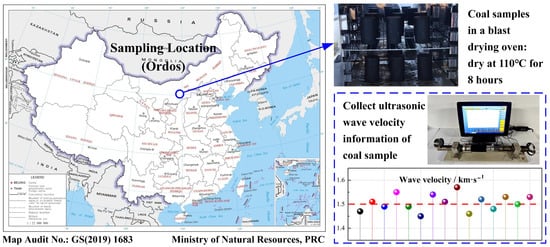
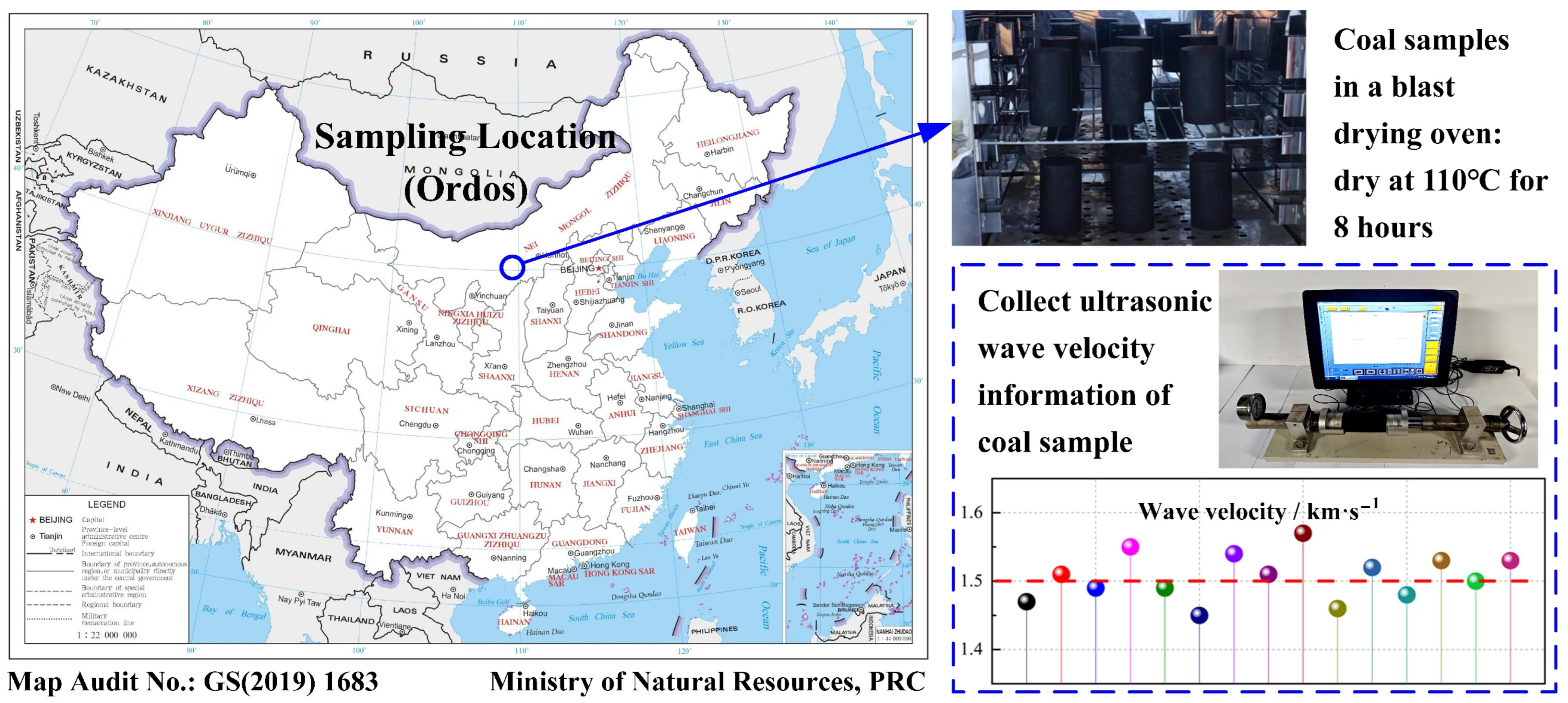
The coal samples used in this study were obtained from the Chahasu Coal Mine in the Xinjie Mining Area of the Dongsheng Coalfield, China. These samples were taken from the coal seam in which the coal pillar dam of the underground reservoir is located, as shown in Figure 1. Following the requirements of the International Society for Rock Mechanics (ISRM) [52], the raw coal was processed into standard cylindrical samples with good integrity (50 mm in diameter × 100 mm in height). The parallelism of the two end faces was within ±0.05 mm, the end faces were perpendicular to the specimen axis, and the axial deviation was less than ±0.25°. The ultrasonic velocity testing on coal samples was conducted by an ultrasonic velocimeter (RSM-SY6, Wuhan Zhongyan Technology Co., Ltd., Wuhan, China). The results showed that the wave velocity of the coal samples was distributed within the range of 1.45–1.57 km/s, with an average wave velocity of 1.51 km/s. The standard deviation and variance were 0.034 and 0.001, respectively. This indicated that the homogeneity of the coal samples was ensured and the influence of other irrelevant variables on the test results was removed to a certain extent.
Figure 1.
Coal sample location and preparation.
2.2. Experimental Equipment and Methods
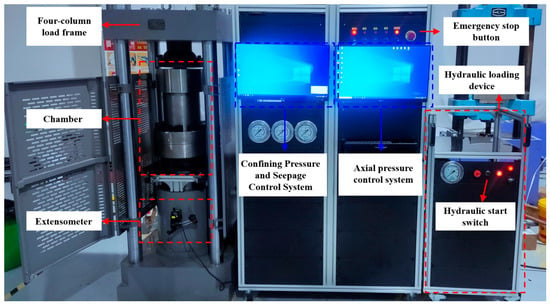
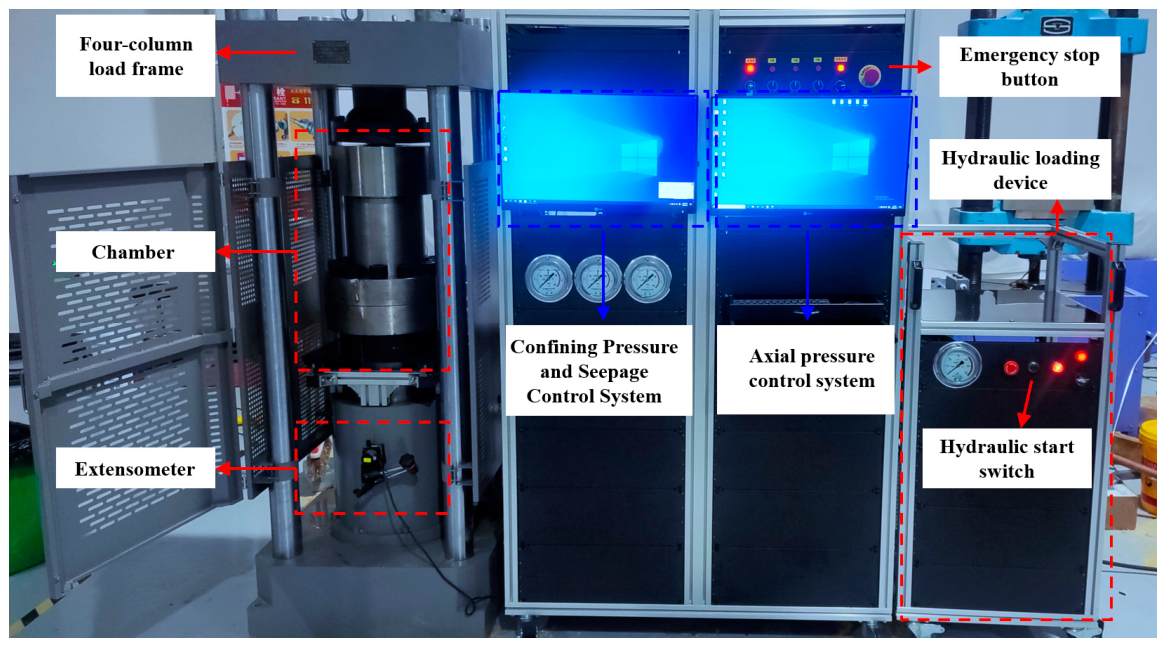
The coal samples were dried at 110 °C for 8 h by an electro-thermal constant-temperature blast drying oven (XMA-2000). The free water of coal samples was removed and no damage was caused to the coal matrix and fracture structure [14]. A self-developed intelligent non-destructive water immersion system (HL-8-1WS, CUMT & Dongying Cortes Company, Dongying, China) was employed for water saturation. In this system, coal samples were fully exposed to water vapor generated by the equipment under a constant-temperature and constant-humidity environment [17]. The samples remained in contact with water vapor until a saturated state was achieved. During saturation, the samples were taken out and weighed every one hour. Saturation was considered to have been reached if the relative difference in mass between two successive measurements fell below 0.1%. This saturation approach can prevent disintegration and swelling of coal induced by direct immersion in liquid water. Loading tests were performed using a standard triaxial fluid–solid coupling mechanics and seepage experimental system (CTS24, CUMT & Dongying Cortes Company, China). The system had a maximum axial load capacity of 1000 kN, a maximum confining pressure of 40 MPa, and a maximum seepage pressure of 40 MPa. Conventional triaxial compression tests and conventional triaxial compression–seepage tests were conducted on dry and saturated coal samples using this system. The confining pressures were set to 3.0, 4.5, 6.0, 7.5, and 9.0 MPa, respectively. Purified water was used as the seepage fluid, with a seepage pressure difference of 1.5 MPa. Figure 2 shows the main test equipment.
Figure 2.
Main test equipment.
The coal samples were designated according to the test type and confining pressure level. Specifically, DC denoted conventional triaxial compression tests conducted on dry coal samples, and SC denoted conventional triaxial compression–seepage tests conducted on saturated coal samples. The numbers 1–5 represented confining pressures of 3.0, 4.5, 6.0, 7.5, and 9.0 MPa, respectively. Each specimen in each group was used once in a single test. Taking the coal samples tested at a target confining pressure of 4.5 MPa in each group as an example, the specific test procedures were as follows: (1) For conventional triaxial compression tests, axial stress and confining pressure were applied simultaneously. After the confining pressure reached 4.5 MPa, it was maintained constant, and axial loading continued until specimen failure. The stress and strain data were automatically recorded throughout the process. (2) For conventional triaxial compression–seepage tests, axial stress and confining pressure were also applied simultaneously. Once the confining pressure reached 4.5 MPa, the loading process was paused, and fluid was then introduced to establish a 1.5-MPa seepage pressure difference between the inlet and outlet of the specimen. After the outlet flow rate became stable, axial loading was resumed and continued until sample failure. Stress, strain, and seepage data were recorded in the test.
3. Results and Discussion
3.1. Mechanical Properties of Coal Samples
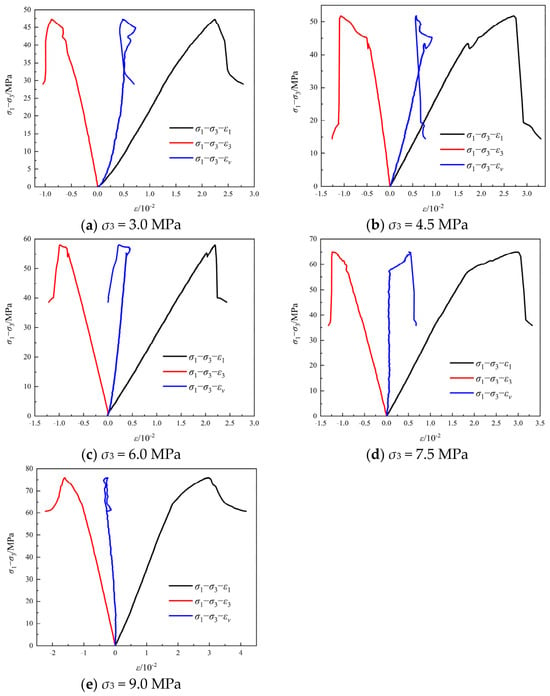
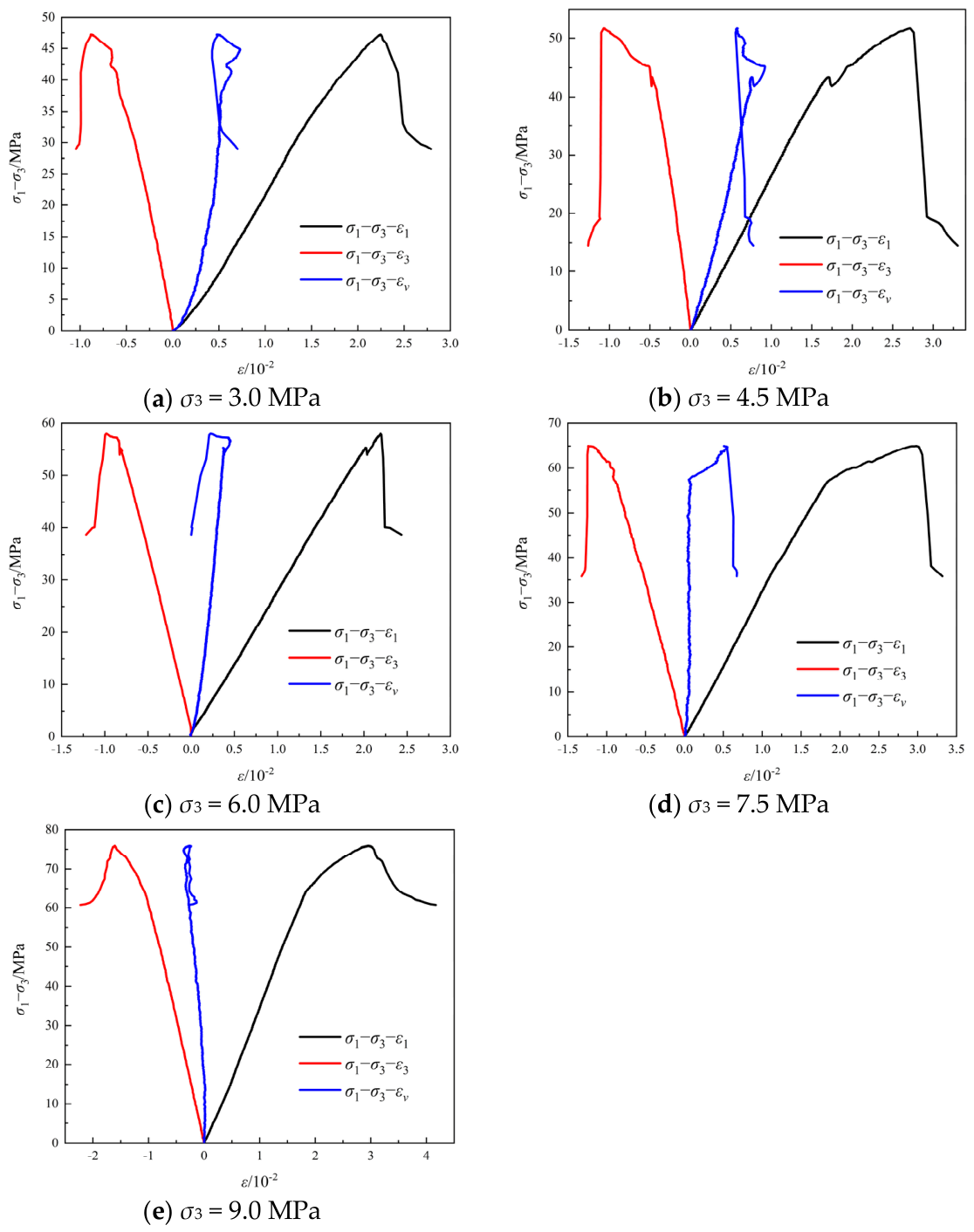
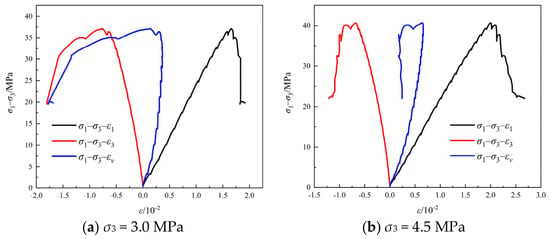
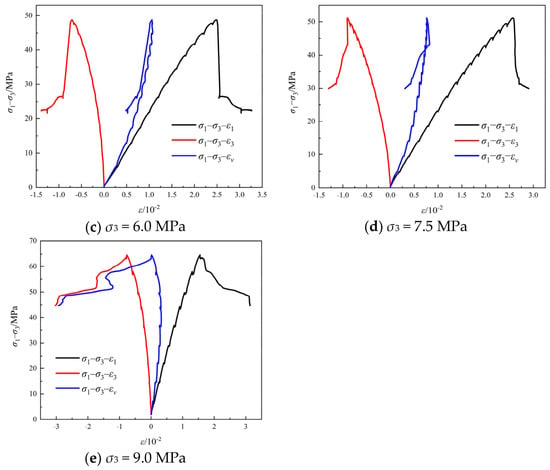
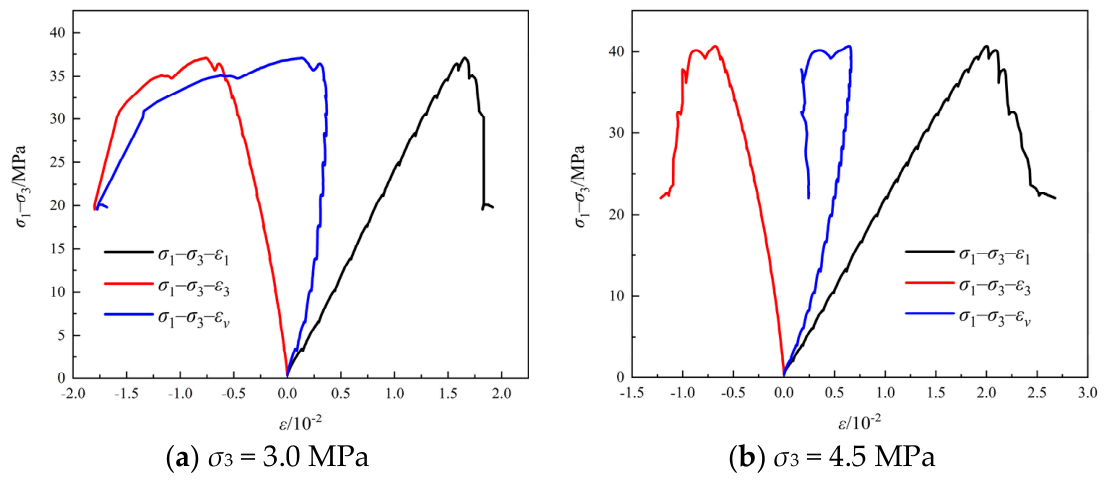
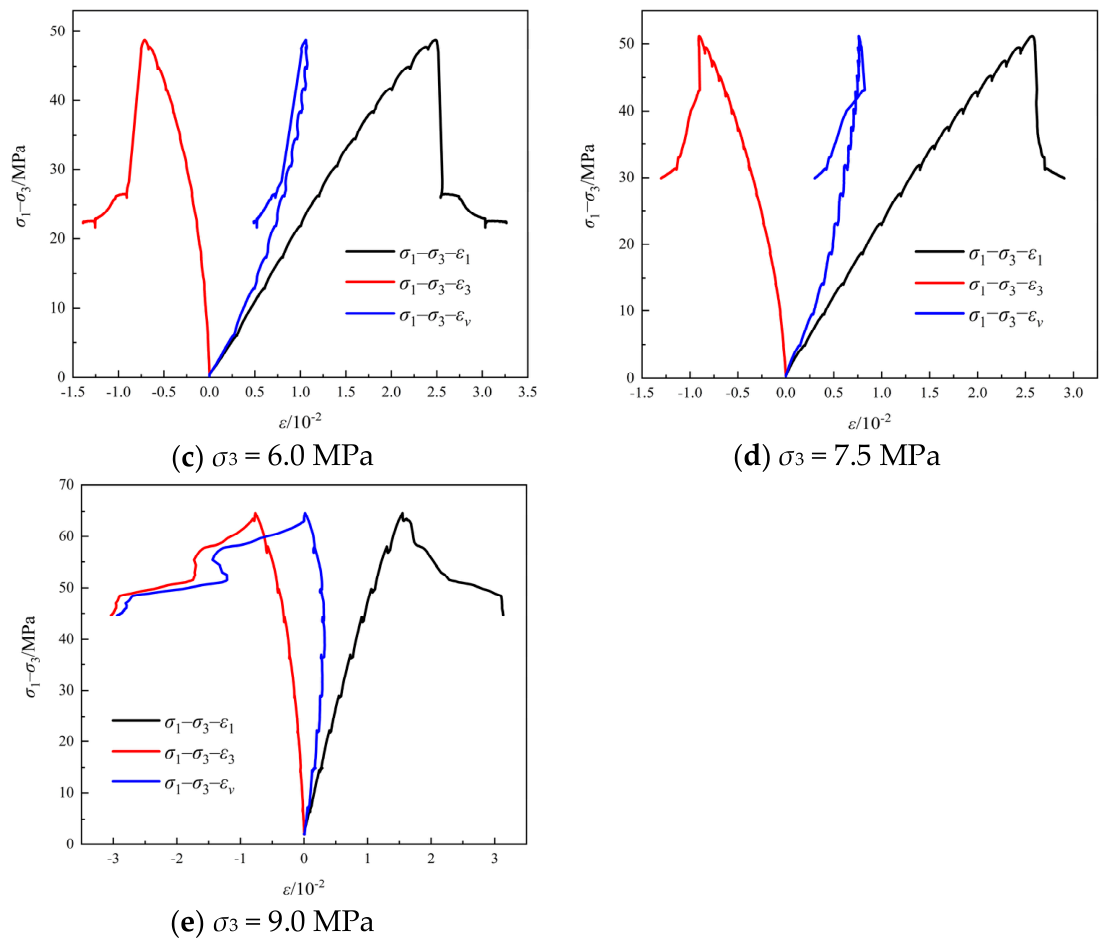
Figure 3 and Figure 4 show the deviatoric stress–strain curves of dry and saturated coal samples. As shown in these figures, the overall evolution trends of the stress–strain curves for both dry and saturated coal samples under different confining pressures are similar. Specifically, with increasing deviatoric stress, the axial strain increases while the circumferential strain decreases, corresponding to axial compression and circumferential expansion deformation, respectively. Under uniaxial compression conditions, the stress–strain curve of coal samples can generally be divided into five distinct stages: pre-existing void and crack compaction, elastic deformation, stable crack development, unstable crack development, and post-peak residual strength. However, under triaxial compression conditions, the duration of the crack compaction stage is shortened, and the upward-concave trend of the curve appears only in dry coal samples at relatively low confining pressures (e.g., DC-1). With increasing confining pressure and moisture content, this trend is further weakened. Under triaxial compression conditions, the duration of the elastic deformation stage increases and becomes the dominant stage during the compression failure process of coal samples. Moreover, the stress–strain relationship is approximately linear during this process. Previous research has shown that an increase in water content reduces brittleness and enhances plasticity of coal samples [17]. As evident by Figure 3 and Figure 4, under the triaxial conditions, the existence of confining pressure, the evolution trend of the stress–strain curve does not substantially change the overall stress–strain response, and the influence of water content on the brittle characteristics of coal samples is significantly weakened.
Figure 3.
Deviatoric stress–strain curves of dry coal samples under different confining pressures.
Figure 4.
Deviatoric stress–strain curves of saturated coal samples under different confining pressures.
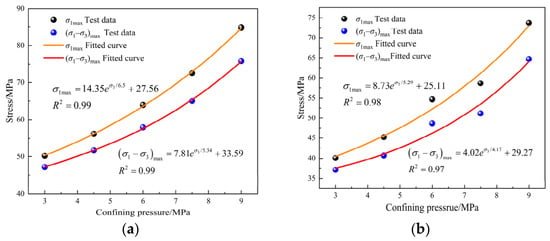
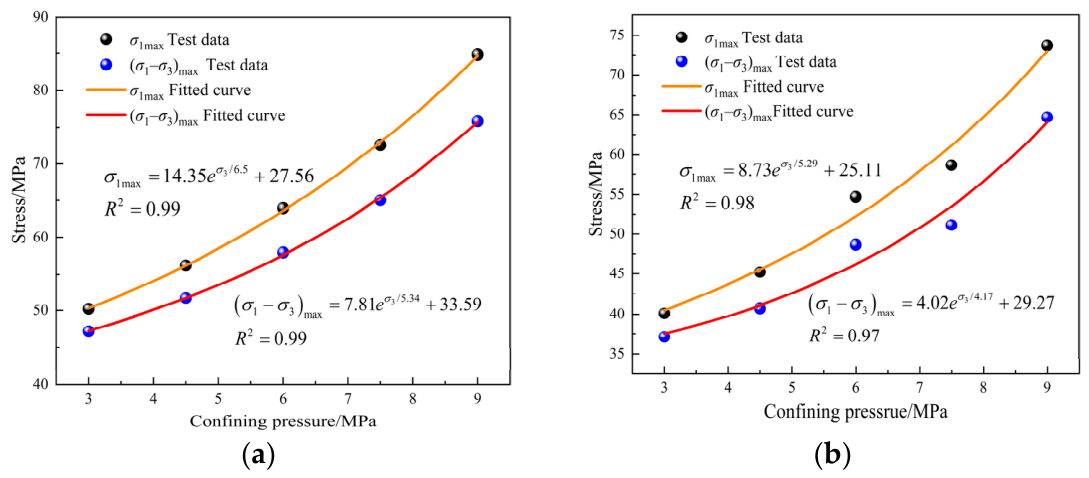
Figure 5 presents the variation curves of typical strength parameters of dry and saturated coal samples. Table 1 lists the basic mechanical parameters obtained from the tests. It can be observed that both the peak axial stress σ1max and the peak deviatoric stress (σ1 − σ3)max of dry and saturated coal samples increase with increasing confining pressure σ3. When σ3 of dry coal samples ranges from 3.0 to 9.0 MPa, σ1max and (σ1 − σ3)max are 47.21/50.21 MPa, 51.72/56.22 MPa, 57.95/63.95 MPa, 65.03/72.53 MPa, and 75.83/84.83 MPa, with increases of 11.97%/9.55%, 27.37%/22.75%, 44.45%/37.75%, and 68.95%/60.62% relative to the values at σ3 = 3.0 MPa, respectively. The increasing trend approximately follows an exponential function, and the fitting equations are given in Equation (1). Evidently, the lateral confinement effect of confining pressure is the primary reason for the increase in coal sample strength with rising confining pressure. Specifically, confining pressure suppresses the internal pre-existing microcracks in coal samples and inhibits the initiation and propagation of tensile cracks. Meanwhile, it increases the normal stress on shear failure surfaces and enhances interfacial frictional resistance. Consequently, higher axial loads are required for the occurrence of macroscopic failure in coal samples. To quantify the degree of mechanical deterioration induced by water, the percentage reduction can be expressed as (Vdry − Vsat)/Vdry × 100%, in which Vdry denotes the parameter value of dry coal samples and Vsat denotes that of saturated coal samples. Compared with dry coal samples, the σ1max and (σ1 − σ3)max of saturated coal samples under different confining pressures decrease by 13.12–20.12% and 14.68–21.39%, respectively. This is mainly because water–coal interaction promotes physical and chemical reactions within coal samples, such as mineral erosion and structural deterioration, reducing the bonding force between particles. In addition, water entering the pores and fractures of coal samples generates pore water pressure, which induces dilation of pores under external compression; consequently, the strength of the coal sample is reduced.
Figure 5.
Variation characteristics of strength parameters of coal samples: (a) dry coal samples; (b) saturated coal samples.
Table 1.
Basic mechanical parameters from mechanical tests.
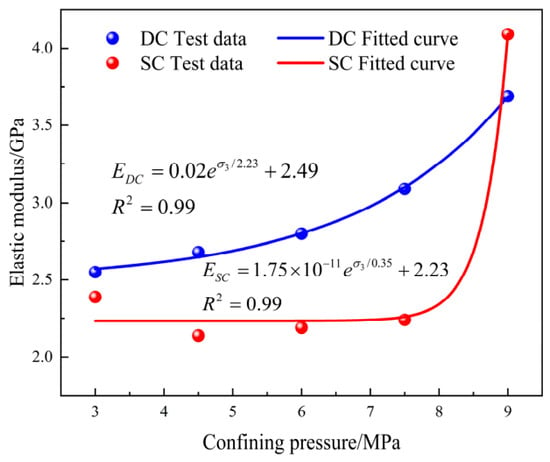
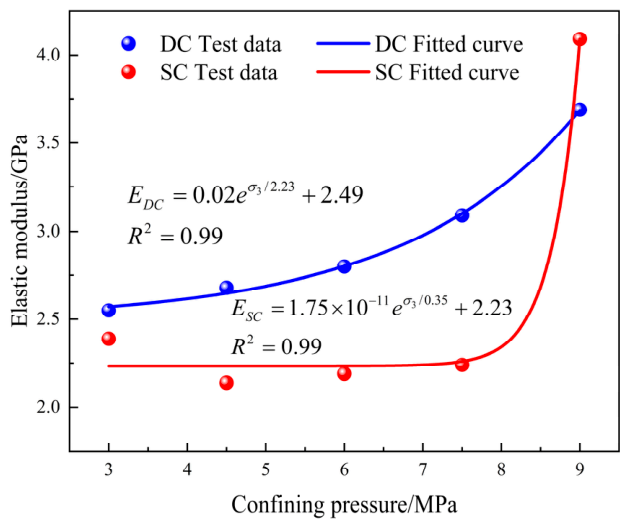
The elastic modulus is an important parameter describing the deformation properties of coal, and its evolution pattern is similar to that of σ1max and (σ1 − σ3)max, as shown in Figure 6. With the increase in confining pressure, the elastic modulus of both dry and saturated coal samples increases exponentially, and the fitting function is shown in Equation (2). Notably, affected by the water content state, the elastic modulus of saturated coal samples exhibits a relatively scattered distribution. This is caused by numerous influencing factors such as the integrity and homogeneity of coal samples, the random distribution of internal defect structures, and the degree of water retention. The cohesion and internal friction angle of the coal samples were obtained by linear least-squares regression. Based on the calculation results, compared with dry coal samples, the cohesion of saturated coal samples decreases from 6.561 MPa to 4.796 MPa, a decrease of 26.9%, while the internal friction angle declines from 44.55° to 43.32°, a reduction of 2.76%.
Figure 6.
Variations in elastic modulus of coal samples.
3.2. Seepage Characteristics of Coal Samples
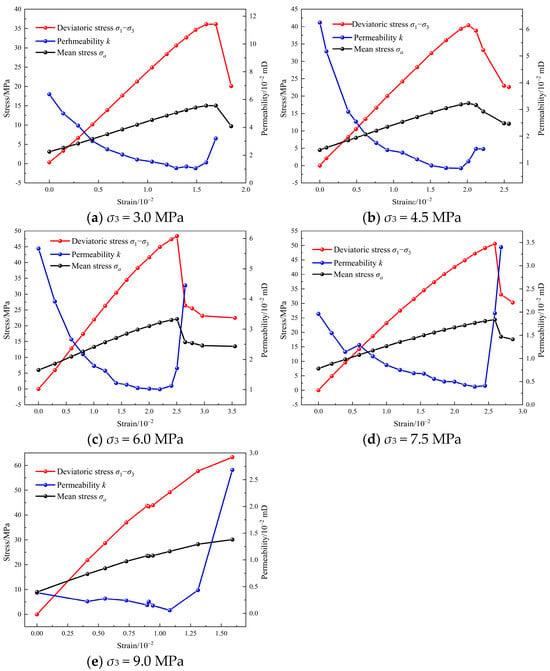
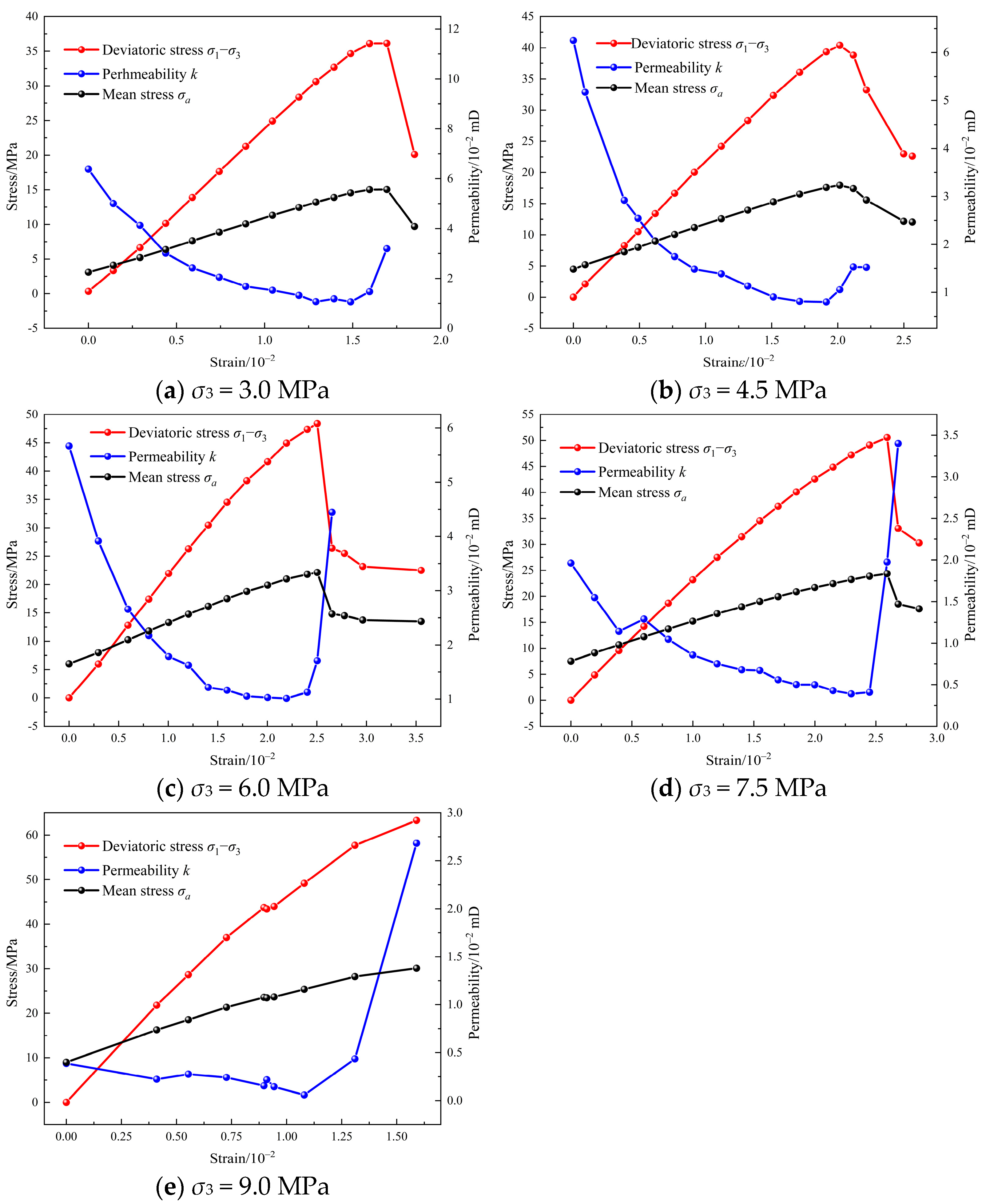
Figure 7 displays the relationship between the permeability k of the coal sample and the average stress σa, the deviatoric stress σd, and strain ε. Here, the deviatoric stress is defined as the difference between the maximum and minimum principal stresses, and the average stress is the arithmetic average of the three principal stresses. As shown in Figure 7, the permeability changes significantly as the loading progresses. At the initial loading stage, the applied stress is relatively low, and the permeability is generally at a high level. With the increase in σd, the coal sample enters the crack compaction stage, during which most of the internal seepage channels are compacted. In this case, the fracture aperture is reduced, resulting in a substantial decrease in permeability. During the elastic deformation stage, the permeability continues to decrease, but the rate of decrease generally slows. In some coal samples, an inflection point appears in the permeability–strain curve (e.g., at σ3 = 7.5 MPa), which is related to the evolution of internal structural damage. As loading continues, the coal sample enters the stable crack propagation stage, during which pre-existing cracks extend and new cracks are gradually generated. However, due to the relatively small degree of damage, the newly formed cracks are short and do not yet form a connected seepage network. The compaction of the overall coal sample and its original fracture channels still play a dominant role in permeability variation. Therefore, during this stage, the permeability continues to decrease at an extremely low rate or remains essentially stable (e.g., at σ3 = 6.0 MPa). When the coal sample enters the unstable crack propagation stage, with the continuous increase in σd, the development of internal cracks and the degree of damage increase sharply and begin to dominate the permeability evolution. At this point, the permeability begins to increase. By the time σd reaches its peak value, the permeability has increased to a relatively high level. In addition, the variation trends of the deviatoric stress σd and the average stress σa of the coal sample with axial strain ε1 are basically consistent. The permeability k first decreases and then increases with the increase in σd and σa. Except for the differences in stress magnitudes caused by the different calculation methods of σd and σa, there are no obvious differences in the permeability variation trends.
Figure 7.
Permeability–deviatoric stress–mean stress–axial strain relationship curves of coal samples under different confining pressures.
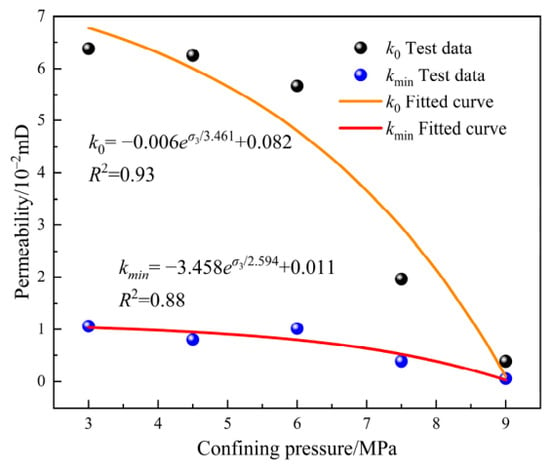
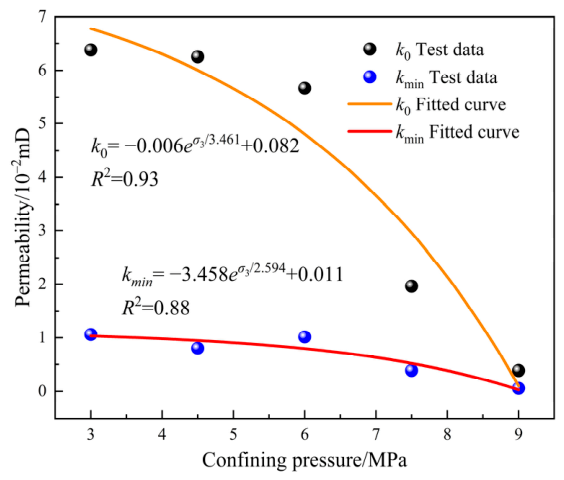
The initial permeability k0 and the minimum permeability kmin can be used to reflect the original permeability characteristics of the coal sample and the compaction effect of the loading process on its fractures. These are important parameters for analyzing the stress–seepage coupling law, and the variation trends of k0 and kmin are obtained, as shown in Figure 8. An increase in confining pressure induces a strong lateral confinement effect, the pre-existing microcracks and pores are gradually compacted within the coal sample, and the openness and connectivity of internal seepage channels are reduced. Consequently, both k0 and kmin decrease, exhibiting a negative exponential correlation with confining pressure, as expressed by Equation (3). Since kmin corresponds to a higher stress level, the influence of coal sample heterogeneity on permeability is weakened at this point; therefore, kmin can be used to accurately reflect the effect of confining pressure on permeability.
Figure 8.
Effects of confining pressure on initial permeability and minimum permeability.
3.3. Relationship Between Mechanical Properties and Permeability Evolution of Coal Samples
Previous studies have investigated the permeability evolution of coal during loading [48,51] and highlighted its dependence on axial stress, confining pressure, strain, porosity, microstructure, and fracture development. In this section, based on the above stress sensitivity of coal permeability, the permeability of the coal sample is quantitatively characterized. Parameters such as axial stress σ1, confining pressure σ3, and permeability k of the coal samples before damage were extracted for function fitting of the response surface, as shown in Table 2.
Table 2.
Typical data from triaxial compression–seepage tests of coal samples.
By fitting the test data, an empirical formula for the permeability k- axial pressure σ1- confining pressure σ3 was obtained, as shown in Equation (4):
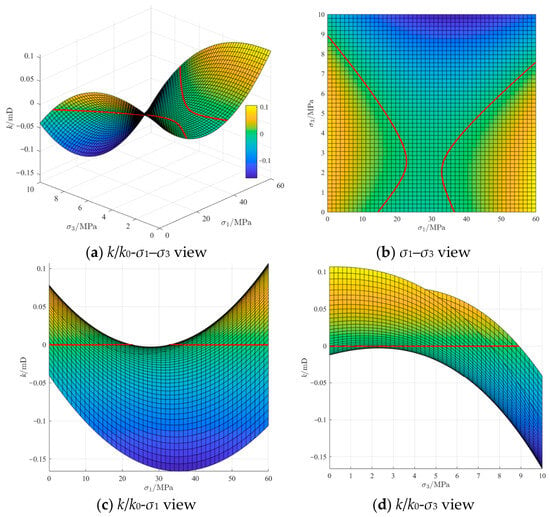
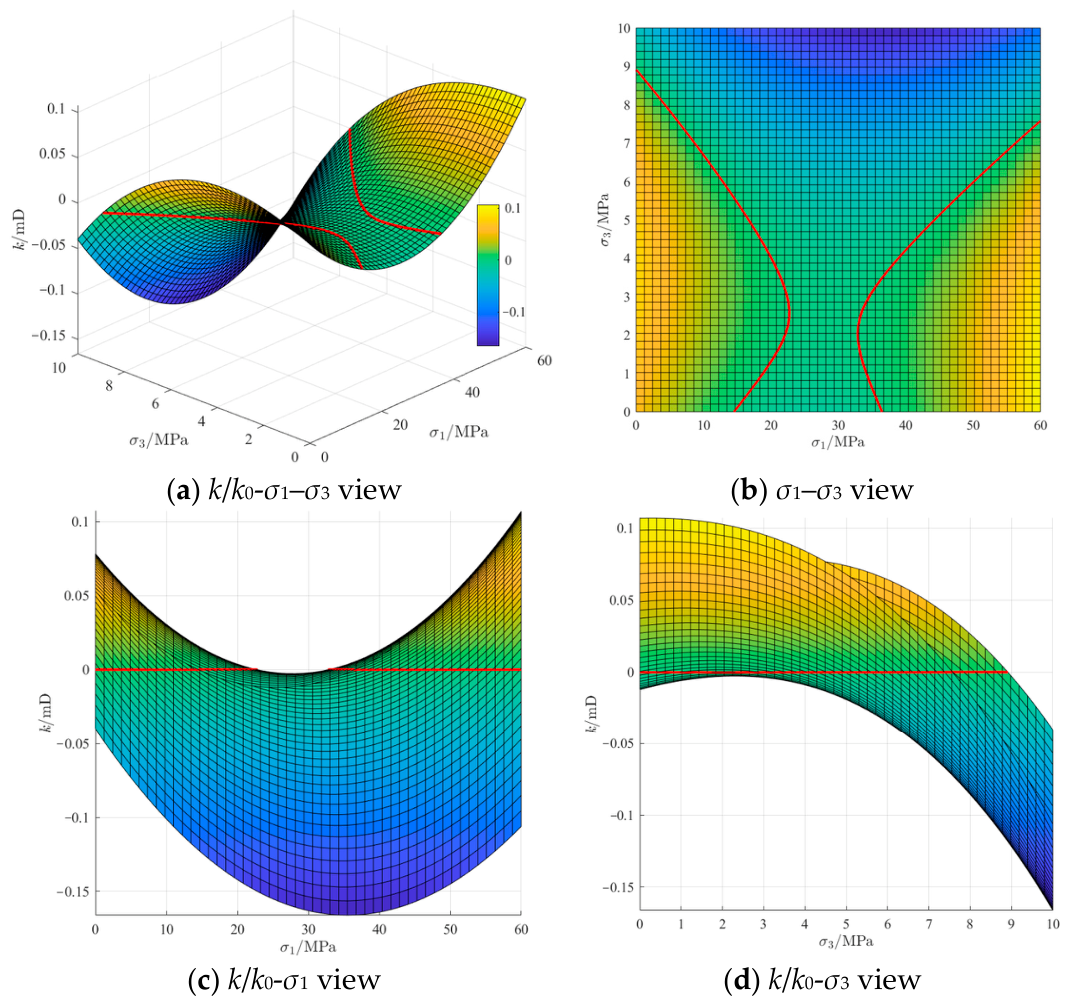
This surface-fitting method is widely used in seepage studies of coal–rock samples and engineering coal–rock masses due to its simplicity. However, this approach also has obvious limitations. Figure 9 presents the response surface of k as a function of σ1 and σ3. The surface color represents the magnitude of permeability and the red curve denotes the position and boundary where permeability k = 0. As can be seen from the figure, in most cases, the surface can accurately capture the nonlinear correlation of k with σ1 and σ3. However, with increasing stress level (especially σ1), the deviation between the predicted and the measured k values gradually increases, and the fitted surface may even yield negative values (the region below the red curve in Figure 9). In practice, when the stress range to be predicted falls within the valid fitting domain of the response surface, the response surface can be directly employed; otherwise, interpolation or piecewise fitting is required to compensate for this limitation. Therefore, when using this method for prediction, the applicable range is confined to the region bounded by the red curve in Figure 9 (i.e., the region where permeability remains positive).
Figure 9.
Relationship surface among permeability, axial pressure, and confining pressure of coal samples.
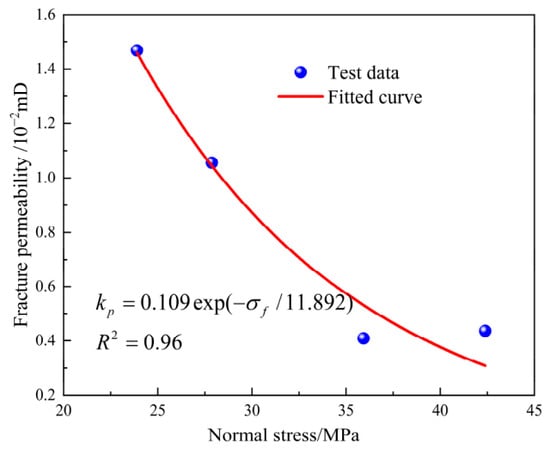
When a coal sample enters a plastic deformation stage, its permeability changes significantly due to newly formed fracture surfaces. At this point, the coal sample cannot be simply regarded as isotropic [53]. Among the three principal permeability directions (k1, k2, and k3) of the anisotropic seepage model, the normal permeability k3 at the fracture surface still follows the behavior described above and can be calculated through Equation (4). However, the permeability k1 and k2 along the dip direction and strike direction of the fracture surface need to be determined based on the permeability values at the onset of damage and failure. Based on experimental evidence, Louis found that the permeability kp of fractured rock follows an exponential relationship with the normal stress σf acting on the fracture surface [54]. Therefore, according to the seepage test results, the stress data at the initiation of substantial damage and the corresponding permeability values were extracted, and anomalous data points were discarded. The normal stress on the fracture surface was calculated using Equation (5), and the results are presented in Table 3.
where σf is the maximum normal stress value of the cross-section, MPa; σ1 is the maximum principal stress, MPa; σ3 is the minimum principal stress, MPa; φ is the internal friction angle, °; π is the circumference-to-diameter ratio.
Table 3.
Typical fracture data from conventional triaxial compression–seepage tests of coal samples.
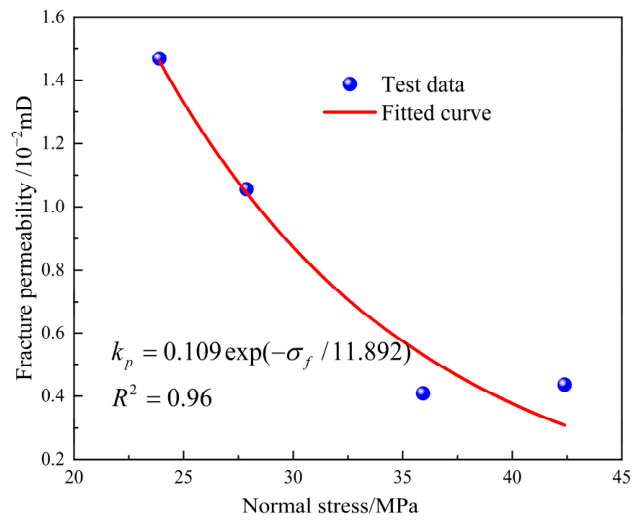
By fitting the calculation results in Table 3, an empirical equation relating the fracture permeability kp and normal stress σf on the fracture surface was obtained, as expressed by Equation (6). The fitting process was performed at a 95% confidence level. The fitted parameters are a = 0.10884 ± 0.04524 and b = 11.8922 ± 2.18756. For concise presentation in Equation (6), a and b are rounded, with a taken as 0.109 and b taken as 11.892. Figure 10 shows the obtained fitting curves. It can be observed that the proposed exponential function accurately describes the relationship between the fracture permeability kp and the normal stress σf. Therefore, based on the damage stress data, the permeability of coal in the plastic zone can be quantitatively evaluated.
kp = 0.109exp(−σf/11.892) R2 = 0.96
Figure 10.
Relationship curves between fracture permeability and maximum normal stress of coal samples.
Through the above analysis, empirical formulas for “permeability k–axial stress σ1–confining pressure σ3” and “fracture permeability kp–maximum normal stress σf” on the fracture surface of coal samples are established based on the stress sensitivity of permeability properties. These equations link the permeability evolution and stress levels at different deformation stages of coal samples, laying a theoretical and experimental basis for predicting the seepage behavior of coal pillar dams. However, the above methods essentially constitute a simple macroscopic fitting of the stress sensitivity of coal sample permeability. These methods ignore the internal seepage mechanisms of coal–rock and therefore lack physical support and continuity in characterizing permeability evolution. Therefore, in the following section, a damage-based permeability model that incorporates the pore structure of coal–rock will be established for subsequent research.
3.4. Construction of a Damage-Based Permeability Model
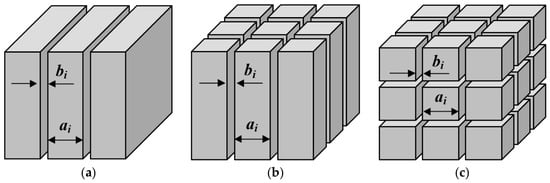
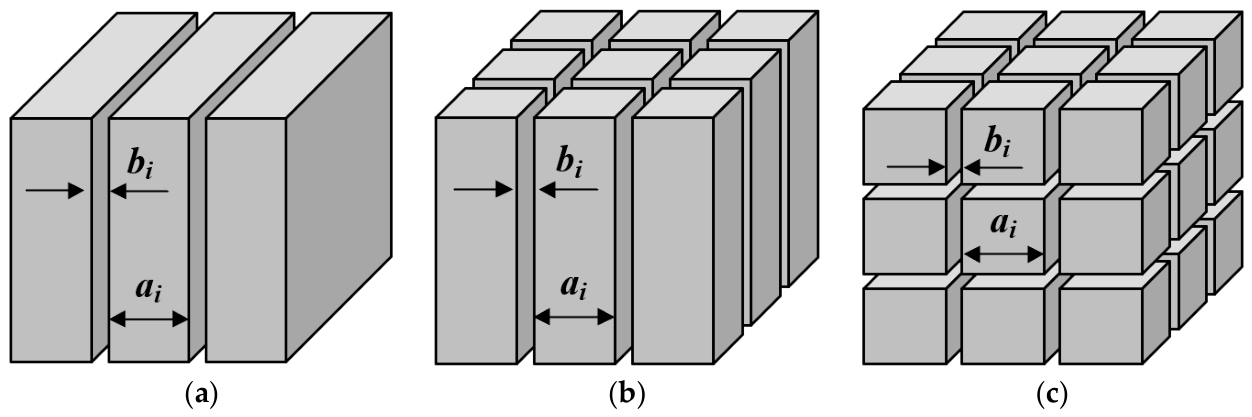
As shown in Figure 11, researchers have proposed the parallel plate model, the matchstick model, and the cubic model to describe the dual-porosity structural characteristics of coal. These models have been used for permeability derivation. Among them, bi represents the cleat aperture, and ai represents the matrix width, i.e., the fracture spacing. When the cleat aperture is much smaller than the matrix width, the porosity φ can be approximated as the ratio of the cleat aperture and matrix width. Accordingly, by combining the cubic law and Darcy’s law, the relationship between k and φ can be obtained:
where m is a non-zero constant related to the selection of the equivalent model for the fracture system in porous media, a is the matrix width, and φ is the porosity.
Figure 11.
Classical structurally-simplified model of coal–rock fracture system: (a) plate model; (b) matchstick model; (c) cube model.
Permeability variation arises from both matrix deformation and cleat deformation. Since the effect of cleat deformation on permeability is two to three orders of magnitude greater than that of matrix deformation, the latter can be neglected. Differentiating Equation (7) and combining it with the Biot effective stress principle gives:
where σe represents the effective stress and αc is the Biot coefficient.
By defining (∂φ/∂pc)/φ as the fracture compressibility coefficient (i.e., cc), the above equation can be integrated as follows:
k = k0exp[−3αccc(σe − σe0)]
As analyzed in Section 3.2, σe can also be replaced by the effective deviatoric stress σde, as shown in Equation (10). Equation (10) is mathematically similar to the current mainstream elastic-deformation-based models for coal and can be used to characterize permeability evolution during the elastic deformation stage.
k = k0exp[−3αccc(σde − σde0)]
However, when the mining-induced stress exceeds the elastic limit, the coal mass undergoes plastic deformation with the generation of new cracks, causing substantial damage and an increase in permeability by orders of magnitude. At this point, Equation (10) can no longer accurately characterize the permeability variation. To effectively describe the influence of crack development on permeability, damage variables can be introduced. Based on the strain equivalent hypothesis, the following expression can be obtained:
where E0 represents the initial elastic modulus, Es is the damaged elastic modulus, and D is the damage variable of the coal sample.
Es = E0[1 − D]
After rearrangement, we can obtain:
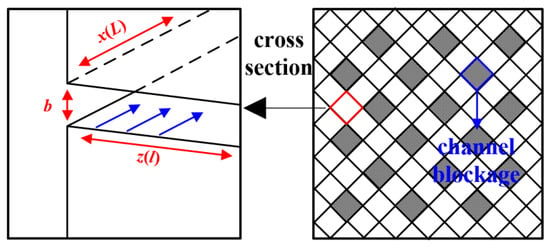
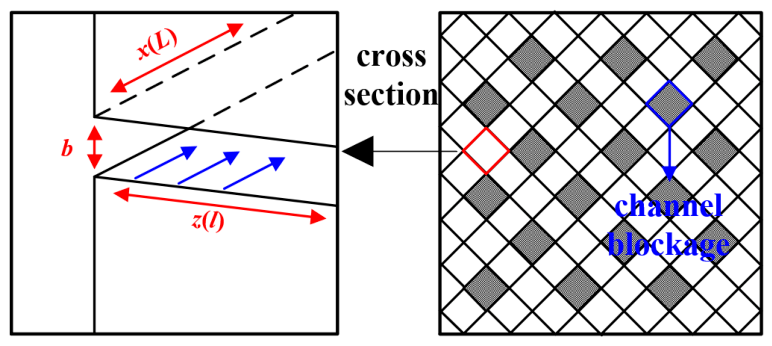
Figure 12 shows the fluid seepage behavior within the fracture structure of coal, where b represents the cleat aperture, x(L) is the cleat length, and z(l) is the longitudinal width of the cleat. Under ideal conditions, the flow rate expression is given by Equation (13). If partial blockage of some cracks caused by mining-induced stress is considered, Equation (13) can be modified to Equation (14):
where q is the fluid flow rate, μ is the fluid viscosity, p is the fluid pressure, n is the number of fractures, and δ is the fracture influence coefficient ranging from 0 to 1.
Figure 12.
Schematic of seepage in fracture structures.
Combining Darcy’s seepage equation and Equation (7), the following is obtained:
where m″ is a non-zero constant.
Taking the partial derivative of Equation (15) with respect to the effective stress yields:
Substituting Equation (15) into Equation (16), we obtain:
The term (1/φ)(∂φ/∂σe) represents the relationship between the porosity of the porous medium (fractures) and stress, which is generally difficult to determine experimentally. Therefore, the damage variable D introduced above is used:
where ζ represents the damage coefficient.
By combining Equations (17) and (18), we can obtain:
After integration, we obtain
For computational convenience, Equation (20) is simplified to the ideal elastic-deformation-based model, and ζ = −ηcc. Subsequently, Equation (20) can be rewritten as:
Equation (21) is the permeability model considering fracture damage caused by mining-induced stress, with its expanded form given in Equation (22). For subsequent analysis, the model can also be expressed in terms of the mean effective stress σme, as shown in Equations (23) and (24):
k = k0 exp[−3ηccD(σ1-σ1,0-δσ3 + δσ3,0-pc + pc,0)]
k = k0 exp[−3ηccD(σme − σme,0)]
k = k0 exp[−3ηccD((σ1-σ1,0 + 2σ3-2σ3,0)/3-pc + pc,0)]
3.5. Verification of the Damage-Based Permeability Model
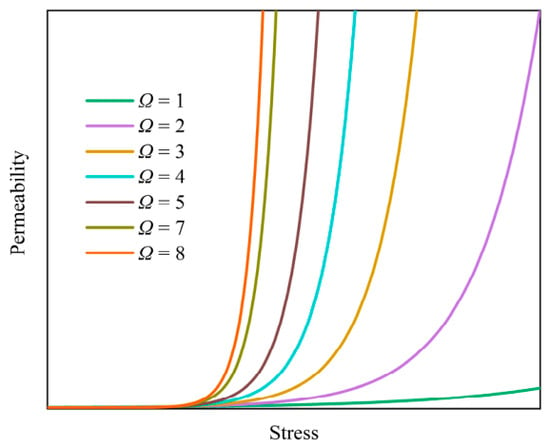
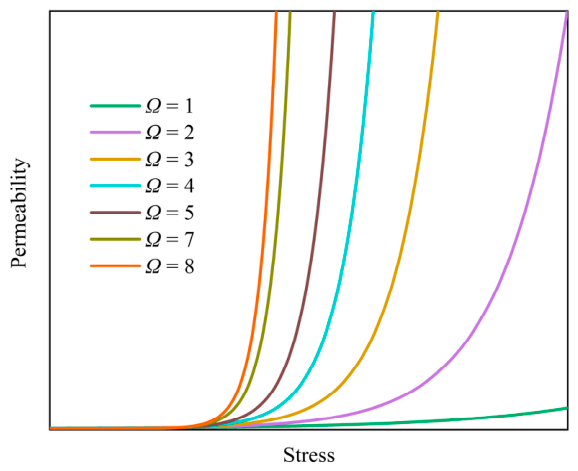
To optimize the damage-based permeability model in Equation (21), a sensitivity analysis was conducted on parameters η, cc, and D to evaluate the importance of each coefficient. As shown in Equation (21), there is a clear correlation among η, cc, and D, appearing in product form. That is, the curve trend is jointly governed by a combined parameter Ω (=−3ηccD), as illustrated in Figure 13. As Ω increases, the slope of the permeability curve increases and the growth rate of permeability rises. Once the optimal combined coefficient Ω is determined, multiple combinations of the three parameters η, cc, and D are possible. Therefore, Ω was directly adopted as the fitting parameter, and the individual values of η, cc, and D do not need to be determined separately.
Figure 13.
Parameter sensitivity analysis.
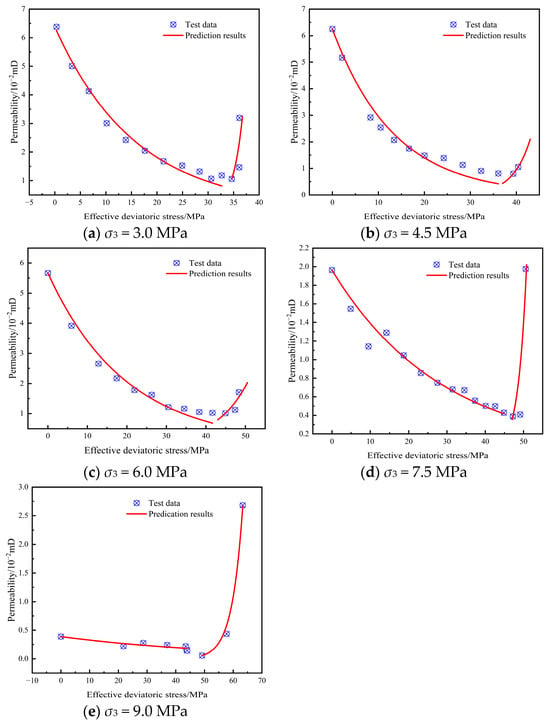
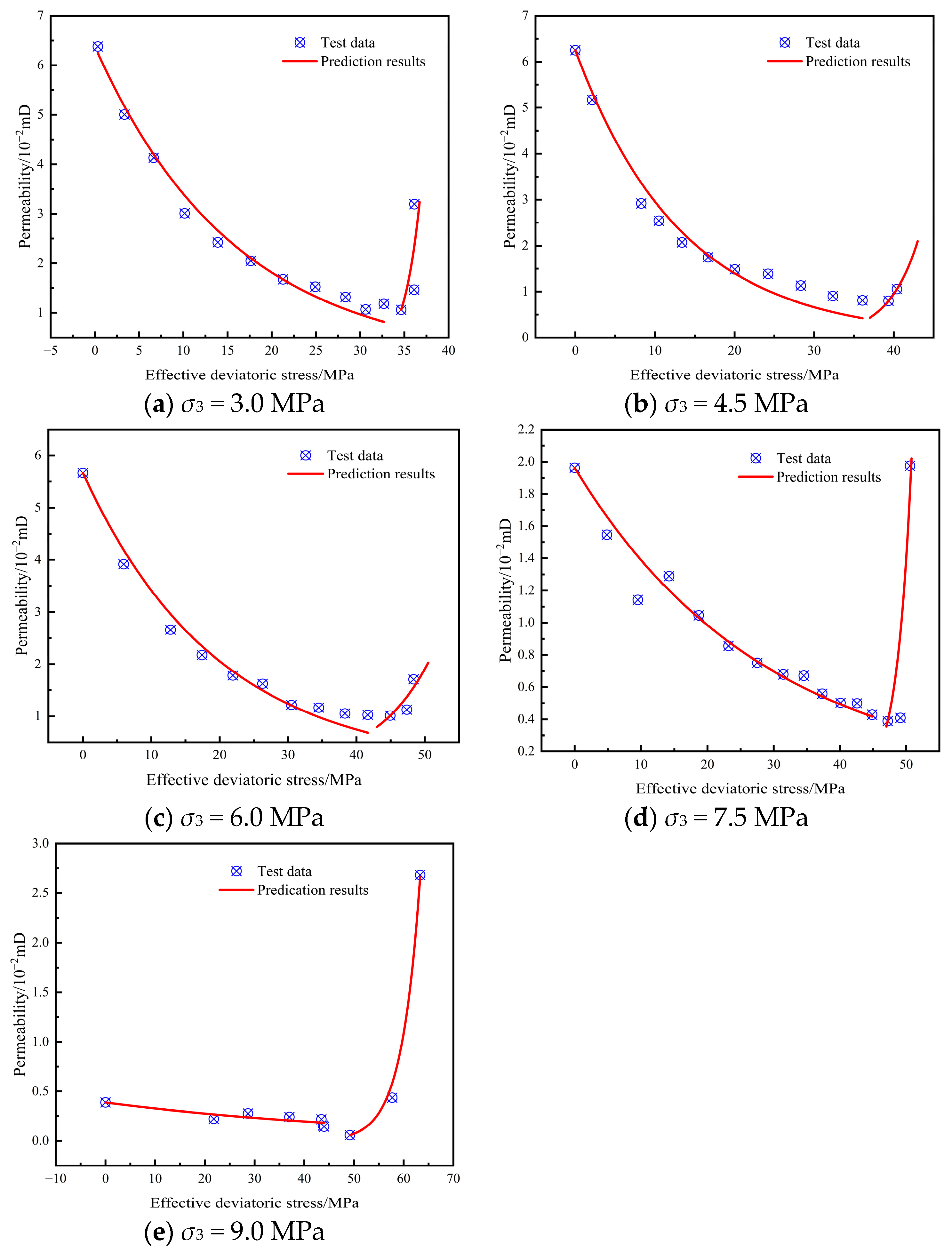
To verify the accuracy of the damage-based permeability model established in Section 3.4, the nonlinear least-squares method was used to perform nonlinear fitting on the triaxial compression–seepage test data. Figure 14 shows the fitting results. Table 4 lists the model parameter identification results.
Figure 14.
Fitting results of the model and test data.
Table 4.
Fitting parameters of the damage-based permeability model.
As shown in Figure 14, the model predictions are in good agreement with the experimental data and can effectively describe the permeability evolution characteristics of coal samples at various stages. It should be noted that the model adopts a piecewise functional form: the ideal elastic model [Equation (10)] is used to characterize the crack compaction and elastic deformation stages, while the damage-based permeability model [Equation (21)] is employed to predict the permeability evolution after continuous stress increases and stress-induced structural damage to the coal. It can be observed from the parameter identification results in Table 4 that the coefficients of determination for the elastic-stage model are generally high, indicating that the elastic model can stably characterize the permeability attenuation during elastic compaction of fractures. Affected by the mesoscopic heterogeneity of coal rock and the number of valid experimental data points in the damage stage, the goodness-of-fit for the damage-stage model shows some scatter among different samples. This phenomenon is mainly attributed to the complex nature of random initiation and propagation of microcracks under stress.
4. Conclusions
The main conclusions from this study are as follows:
(1) Under triaxial loading conditions, the crack compaction stage shortens, and the elastic deformation stage becomes the primary deformation stage during the loading process. The lateral constraint effect of confining pressure significantly increases the peak axial stress, the peak deviatoric stress, and the elastic modulus, all of which grow exponentially with the confining pressure. The water–coal interaction deteriorates the mechanical properties of the coal samples. Compared with dry samples, the peak axial stress, peak deviatoric stress, cohesion, and internal friction angle of saturated samples decrease by 20.12%, 21.39%, 26.9%, and 2.76%, respectively. However, the weakening effect of the water–coal interaction on brittleness characteristics is weakened by the presence of the confining pressure.
(2) The permeability of coal shows a trend of first decreasing and then increasing with the increase of axial strain. That is, the closure of fractures during the compaction and elastic stages continuously reduces the permeability, while the permeability significantly increases after the onset of unstable fracture propagation. An increase in confining pressure compacts the internal seepage pathways of the coal samples, leading to an exponential decrease in the initial and minimum permeability. By extracting characteristic values from the experimental data, empirical formulas for the response surface of “permeability–axial pressure–confining pressure” and the “fracture permeability–maximum normal stress on the fracture surface” are obtained, which are applicable to the elastic deformation stage and the plastic deformation stage, respectively.
(3) Based on the traditional elastic-deformation-based permeability model, and considering the effect of stress-induced crack damage, a damage-stage permeability model is constructed by introducing a damage variable defined based on the degradation of the elastic modulus. By coupling the above two models, a piecewise permeability model is obtained, which can reproduce the overall permeability evolution trend (i.e., first decreasing and then increasing). Fitting results from multiple groups of experimental data verify the accuracy and rationality of the proposed permeability model. This model can provide theoretical guidance for predicting the seepage evolution inside coal pillar dams of underground coal mine reservoirs.
Based on experimental results, a piecewise damage-permeability model was constructed to characterize the permeability evolution. However, this study also has certain limitations. For example, the number of samples was limited, and this work only investigated the influence of confining pressure on the permeability of saturated coal samples. Meanwhile, the model is applicable only within a limited range, and extrapolation beyond the calibrated range may yield unreasonable values. In future research, more specimens will be prepared, and additional influencing factors, including the piecewise threshold criterion, will be considered to further refine the model.
Author Contributions
Conceptualization, L.Y. and Z.C.; methodology, J.C. and L.Y.; validation, H.H.; formal analysis, P.C. and H.H.; investigation, Z.C. and J.C.; data curation, L.Y. and H.H.; writing—original draft preparation, L.Y.; writing—review and editing, X.L.; supervision, L.Y. and X.L. All authors have read and agreed to the published version of the manuscript.
Funding
This research was funded by the Fundamental Research Funds for the Central Universities, Grant No. 2025QN1017; the Jiangsu Funding Program for Excellent Postdoctoral Talent, grant number 2025ZB1; the Postdoctoral Fellowship Program of CPSF, grant number GZC20251248.
Data Availability Statement
The original contributions presented in this study are included in the article. Further inquiries can be directed to the corresponding author.
Conflicts of Interest
The authors declare no conflicts of interest.
References
- National Bureau of Statistics of the People’s Republic of China. China Statistical Yearbook 2025; China Statistics Press: Beijing, China, 2025.
- Ministry of Water Resources of the People’s Republic of China. China Water Resources Bulletin 2025; Ministry of Water Resources: Beijing, China, 2026.
- Li, Q.; Yang, S.L.; Yue, H.; Kong, D.Z. Study on caving characteristics of roof and floor and law of ground pressure behavior in near-vertical coal seams mining: A three-dimensional similarity simulation experiment. Rock Mech. Rock Eng. 2026, 59, 2155–2188. [Google Scholar] [CrossRef] [Scilit]
- Yao, Q.L.; Yu, L.Q.; Chen, S.Y.; Li, Y.H.; Li, X.H. Mining-affected water resources and ecological effects in ecologically fragile mining areas of western China. J. China Coal Soc. 2025, 50, 748–767. [Google Scholar]
- Gu, D.Z. Theory framework and technological system of coal mine underground reservoir. J. China Coal Soc. 2015, 40, 239–246. [Google Scholar]
- Gu, D.Z.; Li, T.; Li, J.F.; Guo, Q.; Jiang, B.B.; Bian, W.; Bao, Y.X. Current status and prospects of coal mine water treatment technology in China. Coal Sci. Technol. 2021, 49, 11–18. [Google Scholar]
- Yao, Q.L.; Wang, W.N.; Yang, S.Y.; Fang, J.; Zhou, B.J. Direct shear and acoustic emission characteristics of sandy mudstone under the effect of moisture content. J. China Coal Soc. 2021, 46, 2910–2922. [Google Scholar]
- Fang, S.X.; Zhang, C.; Zhao, R.H.; Han, K.W.; Zhang, L. Unified damage constitutive model for coal-rock mass under quasi-static loading influenced by water-rock interaction: Modeling, verification and prediction. Int. J. Rock Mech. Min. Sci. 2026, 207, 106694. [Google Scholar] [CrossRef] [Scilit]
- Fang, S.X.; Zhang, C.; Han, K.W.; Zhao, R.H.; Han, P.H. Progressive failure mechanism of fault-zone sandstone induced by water saturation: From micro-deterioration to roadway instability and early warning. Eng. Fail. Anal. 2026, 197, 111295. [Google Scholar] [CrossRef] [Scilit]
- Tang, C.J.; Yao, Q.L.; Chen, T.; Shan, C.H.; Li, J. Effects of water content on mechanical failure behaviors of coal samples. Geomech. Geophys. Geo-Energy Geo-Resour. 2022, 8, 87. [Google Scholar] [CrossRef] [Scilit]
- Xia, H.J.; Zhang, H.M.; Zhang, J.F. Research on damage mechanism and mechanical characteristics of coal rock under water immersion. Sustainability 2023, 15, 13095. [Google Scholar] [CrossRef] [Scilit]
- Yu, L.Q.; Yao, Q.L.; Chong, Z.H.; Li, Y.H.; Xu, Q.; Liu, Z.C. Experimental study on the moisture migration and triaxial mechanical damage mechanisms of water-bearing coal samples. Int. J. Rock Mech. Min. Sci. 2022, 160, 105263. [Google Scholar] [CrossRef] [Scilit]
- Chen, P.Z.; Tang, S.B.; Liang, X.; Zhang, Y.J.; Tang, C. The influence of immersed water level on the short- and long-term mechanical behavior of sandstone. Int. J. Rock Mech. Min. Sci. 2021, 138, 104631. [Google Scholar] [CrossRef] [Scilit]
- Yu, L.Q.; Yao, Q.L.; Chong, Z.H.; Li, Y.H.; Xu, Q.; Xie, H.X.; Ye, P.Y. Mechanical and micro-structural damage mechanisms of coal samples treated with dry–wet cycles. Eng. Geol. 2022, 304, 106637. [Google Scholar] [CrossRef] [Scilit]
- Zhang, M.C.; Nie, R.S. Experimental investigation on the influence of water content on the mechanical properties of coal under conventional triaxial compression. Shock Vib. 2020, 2020, 8872438. [Google Scholar] [CrossRef] [Scilit]
- Fan, Y.K.; Xu, Q.; Xia, Z.; Zheng, C.K. Influence of moisture on mechanical properties and energy dissipation characteristics of coal-rock combined body. Appl. Sci. 2025, 15, 12672. [Google Scholar] [CrossRef] [Scilit]
- Yu, L.Q.; Yao, Q.L.; Li, X.H.; Wang, W.N.; Han, H.; Zhang, M.T. Experimental study of failure characteristics and fissure propagation in hydrous siltstone. Arab. J. Geosci. 2020, 13, 871. [Google Scholar] [CrossRef] [Scilit]
- Ali, M.; Wang, E.Y.; Li, Z.H.; Khan, N.M.; Sabri, M.M.S.; Ullah, B. Investigation of the acoustic emission and fractal characteristics of coal with varying water contents during uniaxial compression failure. Sci. Rep. 2023, 13, 2238. [Google Scholar] [CrossRef] [Scilit] [PubMed]
- Li, G.C.; Qi, C.C.; Sun, Y.T.; Tang, X.L.; Hou, B.Q. Experimental study on the softening characteristics of sandstone and mudstone in relation to moisture content. Shock Vib. 2017, 2017, 4010376. [Google Scholar] [CrossRef] [Scilit]
- Zhang, C.; Bai, Q.S.; Han, P.H.; Wang, L.; Wang, X.J.; Wang, F.T. Strength weakening and its micromechanism in water–rock interaction, a short review in laboratory tests. Int. J. Coal Sci. Technol. 2023, 10, 18–32. [Google Scholar] [CrossRef] [Scilit]
- Zhu, J.; Deng, J.; Huang, Y.; He, Z. Influence of water on the fracture process of marble with acoustic emission monitoring. KSCE J. Civ. Eng. 2019, 23, 3239–3249. [Google Scholar] [CrossRef] [Scilit]
- Gu, H.L.; Tao, M.; Li, X.B.; Momeni, A.; Cao, W.Z. The effects of water content and external incident energy on coal dynamic behaviour. Int. J. Rock Mech. Min. Sci. 2019, 123, 104088. [Google Scholar] [CrossRef] [Scilit]
- Zhao, Y.; Wang, Y.; Tang, L. The compressive-shear fracture strength of rock containing water based on druker-prager failure criterion. Arab. J. Geosci. 2019, 12, 1–8. [Google Scholar] [CrossRef] [Scilit]
- Zhao, Y.L.; Zhang, L.Y.; Wang, W.; Pu, C.; Wan, W.; Tang, J. Cracking and stress–strain behavior of rock-like material containing two flaws under uniaxial compression. Rock Mech. Rock Eng. 2016, 49, 2665–2687. [Google Scholar] [CrossRef] [Scilit]
- Li, P.; Rao, Q.; Li, Z.; Ma, W.B.; Ma, B. Thermal-hydro-mechanical coupling damage model of brittle rock. J. Cent. South Univ. 2014, 21, 1136–1141. [Google Scholar] [CrossRef] [Scilit]
- Zhou, Z.; Cai, X.; Chen, L.; Cao, W.Z.; Zhao, Y.; Cheng, X. Nfluence of cyclic wetting and drying on physical and dynamic compressive properties of sandstone. Eng. Geol. 2017, 220, 1–12. [Google Scholar] [CrossRef] [Scilit]
- Xie, H.P.; Ju, Y.; Li, L.Y. Criteria for strength and structural failure of rocksbased on energy dissipation and energy release principles. Chin. J. Rock Mech. Eng. 2005, 24, 3003–3010. [Google Scholar]
- Xie, H.P.; Ju, Y.; Li, L.Y.; Peng, R.D. Energy mechanism of deformation and failure of rock masses. Chin. J. Rock Mech. Eng. 2008, 27, 1729–1740. [Google Scholar]
- Li, Q.; Li, J.; Zhu, B.L. Experimental investigation of the influence of sequential water-rock reactions on the mineral alterations and porosity evolution of shale. Constr. Build. Mater. 2022, 317, 125859. [Google Scholar] [CrossRef] [Scilit]
- Cai, Y.; Yan, J.L.; Xu, L.J.; Yu, H.J.; Dong, X.L. Study on compaction deformation characteristics of collapsed rock mass of goaf under different water content conditions. Coal Sci. Technol. 2014, 42, 17–20. [Google Scholar]
- Chen, T.; Yao, Q.L.; Du, M.; Zhu, C.G.; Zhang, B. Experimental research of effect of water intrusion times on crack propagation in coal. Chin. J. Rock Mech. Eng. 2016, 35, 3756–3762. [Google Scholar]
- Li, B.Y.; Liu, J.; Bian, K.; Ai, F.; Hu, X.J.; Chen, M.; Liu, Z.P. Experimental study on the mechanical properties weakening mechanism of siltstone with different water content. Arab. J. Geosci. 2019, 12, 656. [Google Scholar] [CrossRef] [Scilit]
- Nordbotten, J.M.; Celia, M.; Dahle, H.K.; Hassanizadeh, S.M. Interpretation of macroscale variables in Darcy’s law. Water Resour. Res. 2007, 43, W08430. [Google Scholar] [CrossRef] [Scilit]
- Cai, J. A fractal approach to low velocity non-darcy flow in a low permeability porous medium. Chin. Phys. B 2014, 23, 044701. [Google Scholar] [CrossRef] [Scilit]
- Wang, W.N. Creep-Seepage Characteristics of Waterstorage Medium and Evolution Mechanism Ofstorage Coefficient in Mining Space. Ph.D. Thesis, China University of Mining and Technology, Xuzhou, China, 2023. [Google Scholar]
- Yang, T.H.; Shi, W.H.; Li, S.C.; Yang, X.; Yang, B. State of the art and trends of water-inrush mechanism of nonlinear flow in fractured rock mass. J. China Coal Soc. 2016, 41, 1598–1609. [Google Scholar]
- Zhou, H.W.; Rong, T.L.; Mu, R.Y.; Wang, L.J.; Ren, W.G. Development in modeling approaches to mining-induced permeability of coals. J. China Coal Soc. 2019, 44, 221–235. [Google Scholar]
- Gray, I. Reservoir engineering in coal seams: Part 1-the physical process of gas storage and movement in coal seams. SPE Reserv. Eng. 1987, 2, 28–34. [Google Scholar] [CrossRef] [Scilit]
- Seidle, J.P.; Jeansonne, M.W.; Erickson, D.J. Application of matchstick geometry to stress dependent permeability in coals. In Proceedings of the SPE Rocky Mountain Regional Meeting, Casper, WY, USA, 18–21 May 1992; Society of Petroleum Engineers: Houston, TX, USA, 1992; pp. 433–444. [Google Scholar]
- Zhang, H.; Cheng, Y.P.; Liu, Q.Q.; Yuan, L.; Dong, J.; Wang, L.; Qi, Y.X.; Wang, W. A novel in seam bore-hole hydraulic flushing gas extraction technology in the headingace:Enhanced permeability mechanism, gas flow characteristics, and application. J. Nat. Gas Sci. Eng. 2017, 46, 498–514. [Google Scholar] [CrossRef] [Scilit]
- Huang, Q.M.; Wu, B.; Cheng, W.M.; Lei, B.W.; Shi, H.H.; Chen, L. Investigation of permeability evolution in the lower slice during thick seam slicing mining and gas drainage: A case study from the Dahuangshan coalmine in China. J. Nat. Gas Sci. Eng. 2018, 52, 141–154. [Google Scholar] [CrossRef] [Scilit]
- Yang, T.H.; Xu, T.; Liu, H.Y.; Tang, C.A.; Shi, B.M.; Yu, Q.X. Stress-damage-flow coupling model and its application to pressure relief coal bed methane in deep coal seam. Int. J. Coal Geol. 2011, 86, 357–366. [Google Scholar] [CrossRef] [Scilit]
- Meng, L. Research on Coal Damage Characteristics and Gas Migration Law of Coal Containing Gas. Master’s Thesis, China University of Mining and Technology (Beijing), Beijing, China, 2013. [Google Scholar]
- Zhu, W.C.; Tang, C.A. Micromechanical model for simulating the fracture process of rock. Rock Mech. Rock Eng. 2004, 37, 25–56. [Google Scholar] [CrossRef] [Scilit]
- Xue, Y.; Gao, F.; Liu, X. Effect of damage evolution of coal on permeability variation and analysis of gas outburst hazard with coal mining. Nat. Hazards 2015, 79, 999–1013. [Google Scholar] [CrossRef] [Scilit]
- Xue, Y.; Gao, F.; Gao, Y.N.; Cheng, H.M.; Liu, Y.K.; Hou, P.; Teng, T. Quantitative evaluation of stress relief and permeability-increasing effects of overlying coal seams for coal mine methane drainage in Wulan coal mine. J. Nat. Gas Sci. Eng. 2016, 32, 122–137. [Google Scholar] [CrossRef] [Scilit]
- Zhang, N.; Li, X.R.; Cheng, H.M.; Teng, T. A coupled damage hydro-mechanical model for gas drainage in low-permeability coalbeds. J. Nat. Gas Sci. Eng. 2016, 35, 1032–1043. [Google Scholar] [CrossRef] [Scilit]
- Liu, Z.C. Study on Permeability Evolution Law of Coal Pillar Dam Under Creep Water Action. Master’s Thesis, China University of Mining and Technology, Xuzhou, China, 2021. [Google Scholar]
- Liang, Y.W. Permeability Evolution of Damaged Coal and Spatio-Temporal Migration Characteristics of Leaked Methane from Abandoned Wells in Co-Mining of Coal, Oil and Gas. Master’s Thesis, China University of Mining and Technology, Xuzhou, China, 2022. [Google Scholar]
- Shen, W.B. Study on the Importance of Influence Factors on Permeability of Gas Containing in Coal. Master’s Thesis, Taiyuan University of Technology, Taiyuan, China, 2018. [Google Scholar]
- Kang, J.Q.; Fu, X.H.; Gao, L.; Liang, S. Production profile characteristics of large dip angle coal reservoir and its impact on coalbed methane production: A case study on the Fukang west block, southern Junggar Basin, China. J. Pet. Sci. Eng. 2018, 171, 99–114. [Google Scholar] [CrossRef] [Scilit]
- Ulusay, R. (Ed.) The ISRM Suggested Methods for Rock Characterization, Testing and Monitoring: 2007–2014; Springer: Cham, Switzerland, 2014. [Google Scholar]
- Yan, H.Y. Characteristics of “Load-Bearing and per Meable” Area of Coal Pillar Dam in Underground Reservoir of Coal Mine. Master’s Thesis, China University of Mining and Technology, Xuzhou, China, 2021. [Google Scholar]
- Wu, Y.Q. Geohydraulics; Science Press: Beijing, China, 2009. [Google Scholar]

Disclaimer/Publisher’s Note: The statements, opinions and data contained in all publications are solely those of the individual author(s) and contributor(s) and not of MDPI and/or the editor(s). MDPI and/or the editor(s) disclaim responsibility for any injury to people or property resulting from any ideas, methods, instructions or products referred to in the content. |
© 2026 by the authors. Licensee MDPI, Basel, Switzerland. This article is an open access article distributed under the terms and conditions of the Creative Commons Attribution (CC BY) license.