


Abstract
Climate change is altering hydrological processes in alpine regions, and changes in streamflow seasonality and its relationship with precipitation inputs have important implications for regional water resource management. Based on monthly streamflow records from three hydrological stations (Zhamashike, Qilian, and Yingluoxia) in the upper Heihe River Basin during 1970–2025, together with corresponding precipitation data, this study investigated long-term variations in seasonal precipitation and streamflow distributions and their relationships using seasonal contribution analysis, Mann–Kendall tests, Sen’s slope estimation, and regression analysis. The results showed that: (1) precipitation remained strongly concentrated in summer, with a broadly stable seasonal pattern despite a significant increase in the spring precipitation fraction (0.946 percentage points per decade); (2) streamflow exhibited significant seasonal redistribution, with decreases in the summer streamflow fractions at Qilian and Yingluoxia and an increase in the spring fraction at Yingluoxia; (3) precipitation–streamflow relationships varied among seasons, with stronger contemporaneous relationships generally occurring in summer and weaker relationships in winter; and (4) the observed differences between precipitation and streamflow seasonality suggest that precipitation timing alone cannot fully explain seasonal runoff variability. Catchment storage and delayed water-release processes may contribute to these differences, although their individual contributions were not quantitatively assessed. These findings highlight the importance of considering seasonal runoff redistribution in water-resource assessments of alpine river basins.
1. Introduction
Climate change is altering the terrestrial hydrological cycle by modifying precipitation regimes, air temperature, evapotranspiration, snow and glacier dynamics, and terrestrial water storage [1]. These changes affect not only the magnitude of streamflow but also its timing and seasonal distribution, thereby altering when water is available to ecosystems and human activities. The assumption of a stationary hydrological regime has consequently become increasingly difficult to maintain, particularly in mountain regions where climatic variability interacts with snow, frozen ground, and subsurface water storage [2,3]. Importantly, changes in annual water yield do not necessarily capture changes in the timing of water availability. A catchment may experience relatively modest changes in annual runoff while undergoing substantial redistribution of runoff among seasons [4]. Quantifying such seasonal redistribution is therefore essential for understanding hydrological responses to climate change and their implications for water-resource management.
The seasonal regime of streamflow is particularly sensitive to climate variability in snow- and glacier-influenced mountain catchments. In these systems, precipitation is not necessarily transferred directly to streams during the season in which it occurs. Changes in temperature can alter the phase of precipitation, snow accumulation and melt, and the timing of runoff generation [5,6,7]. Earlier snowmelt-related runoff has been observed in many snow-dominated regions, although the magnitude and direction of change vary with elevation, precipitation regime, and catchment characteristics [6,7]. In the upper Heihe River Basin, changes in snowmelt-related runoff and its timing have also been reported under a warming climate [8]. A shift from snowfall toward rainfall may reduce temporary snow storage and modify the subsequent timing of water release [9], while changes in glacier mass balance can further influence the persistence and seasonal distribution of meltwater contributions in glacierized catchments [10]. These processes indicate that streamflow seasonality cannot be inferred simply from the amount of precipitation received during the same season. Instead, the seasonal streamflow regime represents the combined response of atmospheric forcing and catchment storage and release processes.
Catchment storage provides an important hydrological link between precipitation input and streamflow response. Water from precipitation can be temporarily retained in snowpack, frozen ground, soil moisture, groundwater, and other subsurface stores before being released to the river network. Such storage can filter, delay, and redistribute climatic signals, resulting in differences between the seasonal distributions of precipitation and streamflow even when their long-term variations are correlated [11]. In snow-dominated catchments, seasonal water balance is additionally controlled by the interaction among precipitation timing, snow storage, evapotranspiration, and catchment characteristics [12,13]. Frozen-ground conditions may further modify infiltration, groundwater recharge, and subsurface flow pathways, thereby affecting the transmission of precipitation into streamflow [14,15]. Consequently, the seasonal relationship between precipitation and streamflow provides information that cannot be obtained from annual water-balance changes alone. Examining this relationship is particularly relevant in high-elevation basins, where strong climatic gradients and cold-region hydrological processes can produce substantial spatial and seasonal differences in runoff generation and water storage.
The upper Heihe River Basin, located in the Qilian Mountains of northwestern China, provides a suitable setting for investigating these processes. As the major runoff-producing region of the Heihe River Basin, its mountainous headwaters provide water that supports downstream ecosystems, agriculture, and socioeconomic activities. The region is characterized by strong elevation gradients, pronounced precipitation seasonality, and the presence of snow, glacier, and frozen-ground processes. Previous studies have documented changes in snow cover, runoff, water availability, and hydrological processes in the Heihe River Basin under a changing climate [8,16,17,18]. Hydrological simulations have further indicated that frozen-ground conditions can influence groundwater recharge, baseflow, and the timing and shape of hydrographs in the upper Heihe region [15]. Other studies have shown that climate variability and land-use change contribute to long-term hydrological changes across the basin [19]. These studies have substantially improved understanding of changes in total runoff and their climatic and anthropogenic controls. However, most have focused on annual runoff trends, snowmelt processes, future water availability, or attribution of annual hydrological changes. Comparatively less attention has been given to how precipitation and streamflow are redistributed within the year and whether their seasonal changes occur synchronously across different hydrological units.
This gap is important because precipitation seasonality describes when water enters a catchment, whereas streamflow seasonality reflects the integrated effects of precipitation, evapotranspiration, temporary water storage, and runoff transmission. Thus, a change in precipitation seasonality does not necessarily produce a proportional change in streamflow seasonality. Previous studies have demonstrated that catchment storage and snow-related processes can substantially modify the temporal correspondence between precipitation and runoff [11,12], while changes in hydrological timing may occur even when changes in annual water input are relatively limited [4,11,12]. For the upper Heihe River Basin, however, the long-term correspondence between precipitation and streamflow seasonality has not been systematically quantified across multiple hydrological stations. In particular, it remains unclear whether the seasonal contribution of precipitation is directly reflected in the seasonal contribution of streamflow, whether the magnitude and direction of seasonal redistribution differ among hydrological units, and during which seasons precipitation provides the strongest contemporaneous constraint on streamflow. Addressing these questions can provide a more process-oriented perspective on long-term hydrological change than annual trend analysis alone.
Therefore, this study investigates long-term changes in precipitation and streamflow seasonality and their relationships in the upper Heihe River Basin using monthly observations from 1970 to 2025. Streamflow records from the Zhamashike, Qilian, and Yingluoxia hydrological stations and precipitation observations from the Qilian and Yeniugou meteorological stations were used to examine seasonal hydrological variability across different hydrological units. The specific objectives were to: (1) assess long-term changes in annual precipitation and streamflow and quantify trends in their seasonal contributions; (2) examine differences between precipitation and streamflow seasonality and determine whether their long-term changes are synchronized across different hydrological units; and (3) evaluate seasonal precipitation–streamflow relationships and compare their strength among seasons and hydrological stations. By integrating seasonal contribution analysis with precipitation–streamflow relationships, this study provides observational evidence of long-term seasonal hydrological redistribution and highlights changes in the timing of water availability that may not be fully reflected in annual-scale hydrological assessments.
2. Materials and Methods
2.1. Study Area
The Heihe River is the second-largest inland river in China and originates in the Qilian Mountains of northwestern China. The upper Heihe River Basin is the primary runoff-generating region of the basin and provides an important water supply for ecological conservation, agricultural production, and socioeconomic development in the middle and lower reaches.
The upper basin is characterized by complex topography, large elevation gradients, and an alpine semi-arid climate. Precipitation exhibits pronounced seasonality, with most precipitation occurring during the warm season. In addition to precipitation, seasonal snow accumulation and melt, glacier melt, frozen-ground processes, and subsurface water storage can influence the timing of runoff generation and release. Therefore, seasonal streamflow in the upper Heihe River Basin reflects the combined effects of atmospheric precipitation inputs and internal catchment storage and release processes.
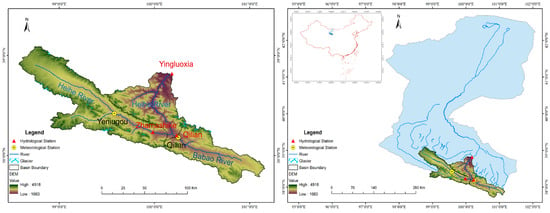
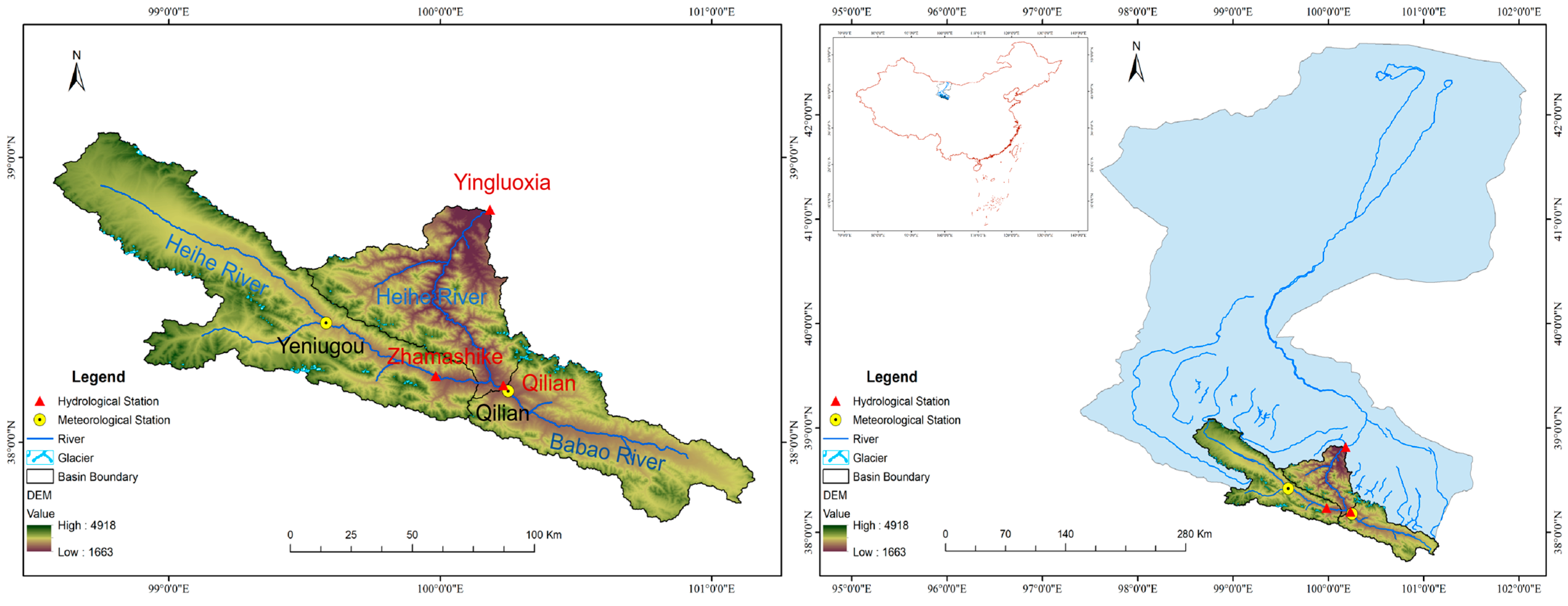
Three hydrological stations were selected to represent different hydrological units of the upper basin (Figure 1): Zhamashike Station on the upper main stem of the Heihe River, Qilian Station on the Babao River tributary, and Yingluoxia Station at the outlet of the mountainous basin. These stations cover different drainage areas and hydrological settings and provide a basis for examining spatial differences in streamflow seasonality and precipitation–streamflow relationships.
Figure 1.
Location of the upper Heihe River Basin and hydrological and meteorological stations.
2.2. Data Sources
Monthly streamflow data from Zhamashike, Qilian, and Yingluoxia hydrological stations for 1970–2025 were used in this study. The common period of 1970–2025 was selected because continuous observations were available for all three hydrological stations, allowing direct comparison of long-term and seasonal streamflow characteristics among the three hydrological units. The streamflow data were obtained from the China Hydrological Yearbook. The basic information of the selected stations is summarized in Table 1.
Table 1.
Basic information of hydrological and meteorological stations in the upper Heihe River Basin.
Because the study focuses on seasonal water allocation, monthly mean discharge was converted to monthly runoff volume before seasonal aggregation:
where is the monthly runoff volume (m3), is the monthly mean discharge (m3 s−1), and represents the number of days in month m. Monthly runoff volumes were summed to obtain seasonal and annual runoff volumes. This conversion ensures that seasonal and annual streamflow contributions are calculated on the basis of water volume rather than the arithmetic average of monthly discharge.
Monthly precipitation data for 1970–2025 were obtained from the Qilian and Yeniugou meteorological stations. The upper Heihe River Basin is located in the high-altitude mountainous region of the Qilian Mountains, where the observation network is relatively sparse. Within the study area, there are three conventional hydrological stations (Zhamashike, Qilian, and Yingluoxia) and two national meteorological stations (Qilian and Yeniugou). All five stations were included in this study. The arithmetic mean of monthly precipitation from the two meteorological stations was used as a regional precipitation indicator rather than a spatially distributed basin-average precipitation field. Air temperature was retained as supplementary climatic information but was not included as an independent explanatory variable because the present study did not quantitatively attribute runoff changes to temperature or cryospheric processes.
All monthly variables were aggregated into annual and seasonal series. Four seasons were defined as spring (March–May), summer (June–August), autumn (September–November), and winter (December–February). Winter was defined as January, February, and December of the same calendar year to ensure that the four seasonal fractions summed to the corresponding annual total.
2.3. Methods
2.3.1. Quantification of Seasonal Precipitation and Streamflow Contributions
To distinguish changes in the intra-annual distribution of water from changes in total annual water availability, the seasonal contributions of precipitation and streamflow were quantified using seasonal fractions.
The seasonal streamflow fraction (SSF) was calculated as:
where represents the proportion of annual streamflow occurring in season s, and and denote seasonal and annual streamflow, respectively.
Similarly, the seasonal precipitation fraction (PSF) was calculated as:
where represents the proportion of annual precipitation occurring in season s.
To further characterize the difference between the seasonal distributions of precipitation and streamflow, a seasonal precipitation–streamflow mismatch index was calculated as:
where represents the difference between the relative contributions of streamflow and precipitation in season s. Positive values indicate that the proportion of annual streamflow occurring in a given season exceeds the corresponding proportion of annual precipitation, whereas negative values indicate the opposite.
The mismatch index was used as a descriptive indicator of seasonal redistribution, rather than as a direct measure of runoff-generation mechanisms. Thus, a positive or negative does not by itself identify the contribution of snowmelt, glacier melt, groundwater, or other hydrological processes.
2.3.2. Trend Detection
Trends in annual and seasonal precipitation and runoff were assessed separately using the non-parametric Mann–Kendall (MK) test, and trend magnitudes were estimated using Sen’s slope estimator [20,21,22]. Previous studies have highlighted the potential effects of serial dependence on hydrological trend detection [23,24]. General statistical procedures for trend analysis in water-resources studies were also followed [25].
Sen’s slope estimator is a robust non-parametric method for estimating the magnitude of monotonic trends and has been widely applied in hydro-climatic studies [20]:
where and represent the values at years i and j, respectively. Positive and negative values of indicate increasing and decreasing trends.
The statistical significance of trends was assessed using the Mann–Kendall test [21,22].
The MK statistic is expressed as:
where and are observations at times i and j. The sign function is defined as:
For (n > 10), the standardized test statistic (Z) was calculated based on the mean and variance of (S), with correction for tied observations where necessary. A positive (Z) indicates an increasing trend, whereas a negative (Z) indicates a decreasing trend. Trends were considered statistically significant at the 95% confidence level when (p < 0.05). For seasonal series, the seasonal Mann–Kendall approach was used to account for the potential influence of serial dependence among observations from different seasons [23,24,25].
2.3.3. Seasonal Precipitation–Streamflow Relationships Analysis
To evaluate the seasonal relationship between precipitation input and streamflow response, Pearson correlation analysis was conducted between seasonal precipitation amount and corresponding seasonal streamflow during 1970–2025.
The correlation coefficient was calculated as follows:
where r is the Pearson correlation coefficient between seasonal precipitation and streamflow; and represent the seasonal precipitation amount and seasonal runoff volume in year i, respectively; and are their corresponding multi-year mean values; and n represents the number of years.
Correlation analyses were performed separately for spring, summer, autumn, and winter at each hydrological station to identify seasonal differences in precipitation–streamflow coupling. The significance of the correlation coefficients was tested using a two-tailed Student’s t-test, with considered statistically significant.
The correlation analysis was used to characterize the seasonal strength of precipitation–streamflow coupling. A strong contemporaneous correlation indicates that interannual variability in precipitation and runoff is closely associated during the same season, whereas a weak correlation indicates a weaker contemporaneous correspondence. However, correlation alone does not establish a causal relationship or distinguish between rainfall runoff, snowmelt, glacier melt, groundwater, and other runoff components.
The analyses were based on same-season precipitation–streamflow pairs and therefore characterized contemporaneous relationships without explicitly accounting for cross-season lag effects associated with snowpack storage, groundwater storage, or delayed water release.
2.3.4. Linear Regression Analysis
To visualize and quantify the linear relationship between seasonal precipitation and streamflow, ordinary least-squares (OLS) linear regression was additionally applied:
where is seasonal runoff volume, is seasonal precipitation, a is the regression slope, and b is the intercept.
The coefficient of determination (R2) was used to describe the proportion of variance in seasonal runoff associated with the linear relationship with precipitation. The regression significance was evaluated using the corresponding p-value. R2 and p-values were presented.
Importantly, Pearson correlation and OLS regression serve different purposes in this study: Pearson’s r quantifies the strength and direction of the linear association, whereas OLS regression provides a fitted relationship for visualization and comparison among seasons and stations.
3. Results
3.1. Long-Term Changes in Annual Streamflow and Precipitation
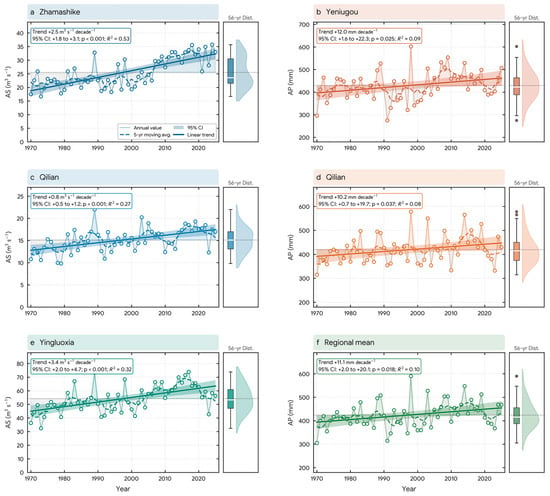
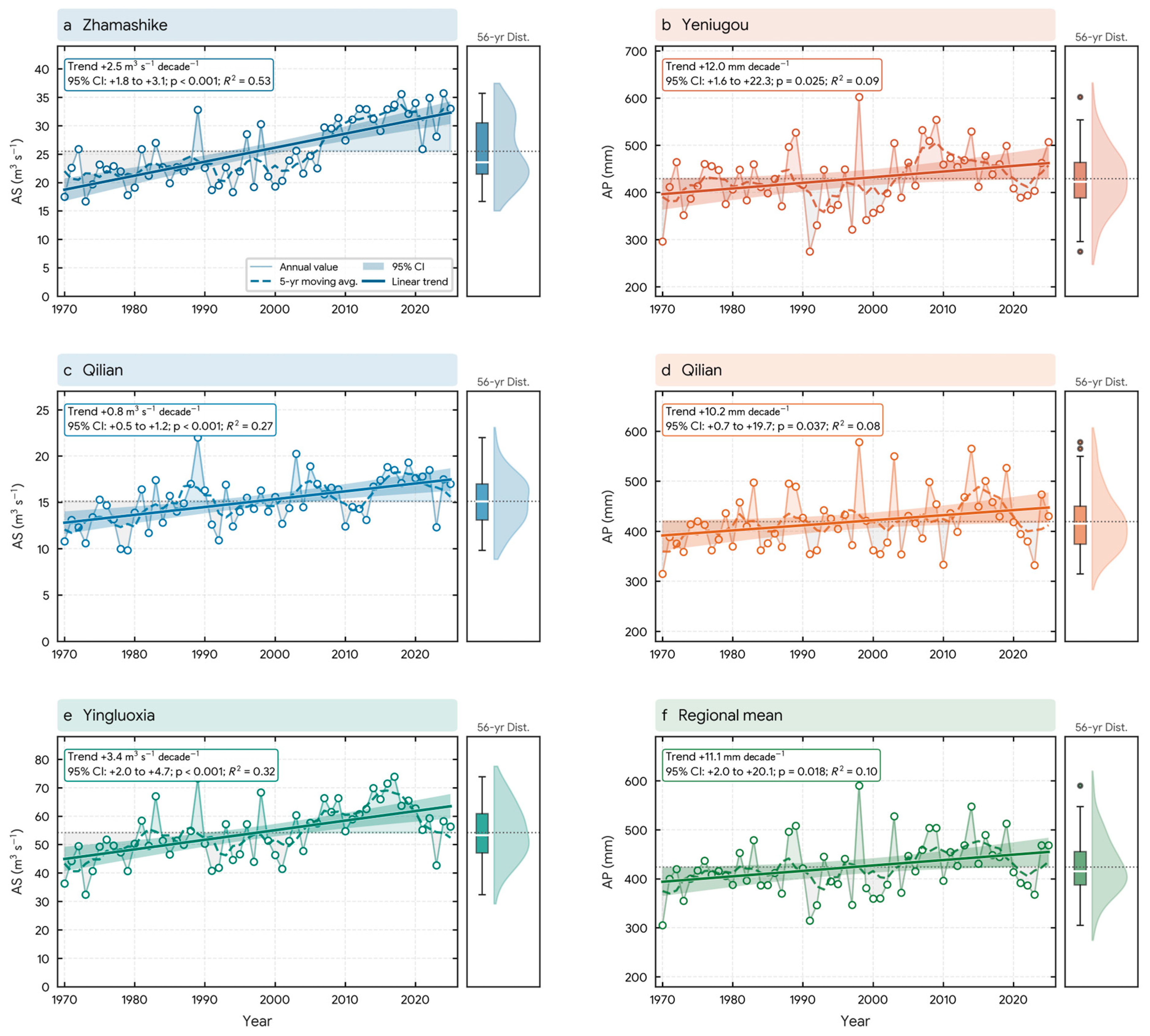
Annual runoff volume showed increasing trends at all three hydrological stations during 1970–2025 (Figure 2). The estimated Sen’s slopes were 0.048 × 10⁸ m3 decade−1 at Zhamashike, 0.029 × 10⁸ m3 decade−1 at Qilian, and 0.094 × 10⁸ m3 decade−1 at Yingluoxia. All three trends were statistically significant at the 95% confidence level (p < 0.05).
Figure 2.
Long-term variations in annual runoff volume and annual precipitation in the upper Heihe River Basin during 1970–2025. (a,c,e) Annual runoff volume at Zhamashike, Qilian, and Yingluoxia stations, respectively; (b,d) annual precipitation at Yeniugou and Qilian meteorological stations, respectively; and (f) regional mean annual precipitation calculated from the two meteorological stations. Solid lines indicate fitted linear trends, and shaded areas represent the 95% confidence intervals of the fitted trends. AS and AP denote annual streamflow and annual precipitation, respectively.
Annual precipitation showed weak increasing trends at Qilian and Yeniugou, but the trends were not statistically significant (p > 0.05). However, the magnitude of the long-term changes was relatively small compared with the pronounced interannual variability. The regional mean precipitation series showed a similar pattern, indicating that the long-term increase in annual precipitation was weaker and less consistent than the increase in annual runoff volume.
The contrasting magnitudes of change between annual precipitation and runoff indicate that changes in annual runoff were not accompanied by a proportionally similar change in annual precipitation. More importantly, annual totals do not describe how water was distributed within the year. Therefore, the seasonal characteristics of precipitation and runoff were examined in the following sections.
3.2. Seasonal Distribution Characteristics of Precipitation and Streamflow
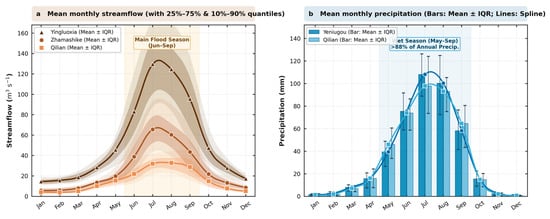
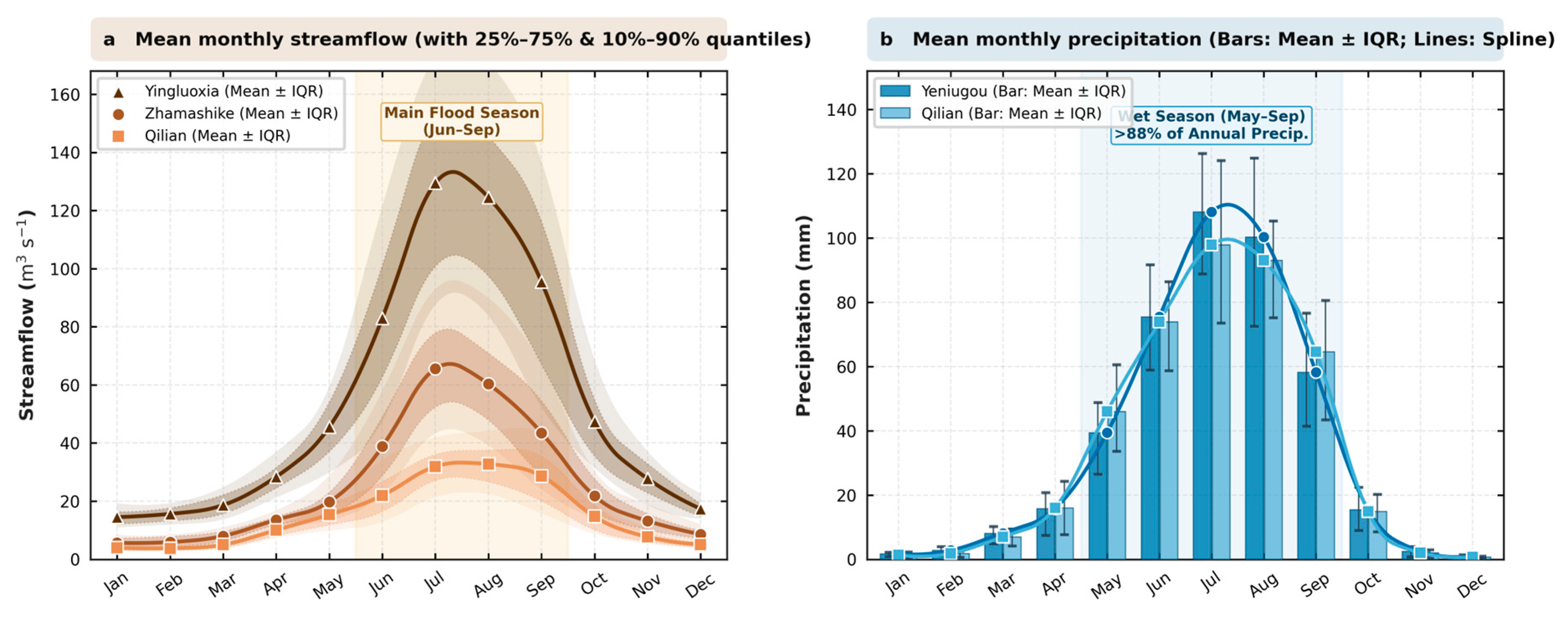
Precipitation and streamflow exhibited pronounced seasonal variability during 1970–2025 (Figure 3). Precipitation was strongly concentrated during the warm season, with most precipitation occurring from June to September. July generally recorded the highest monthly precipitation, followed by August, indicating a pronounced summer concentration of precipitation across the upper Heihe River Basin.
Figure 3.
Monthly distributions of precipitation and streamflow in the upper Heihe River Basin during 1970–2025. Points and connecting lines represent monthly means calculated from the 56-year observation period.
Streamflow also exhibited a clear unimodal seasonal pattern, but its seasonal distribution differed from that of precipitation. Monthly runoff generally increased from spring to summer and reached its maximum during July or August, followed by a gradual decline during autumn. Compared with precipitation, streamflow maintained a relatively larger proportion during autumn and winter, particularly at Zhamashike and Yingluoxia.
The seasonal distributions therefore differed in both magnitude and timing. Although the periods of maximum precipitation and maximum streamflow broadly overlapped during summer, the seasonal contribution of streamflow was not directly proportional to the seasonal contribution of precipitation. This difference provides evidence of a mismatch between the seasonal distribution of precipitation input and streamflow output.
3.3. Long-Term Changes in Seasonal Contributions of Precipitation and Streamflow
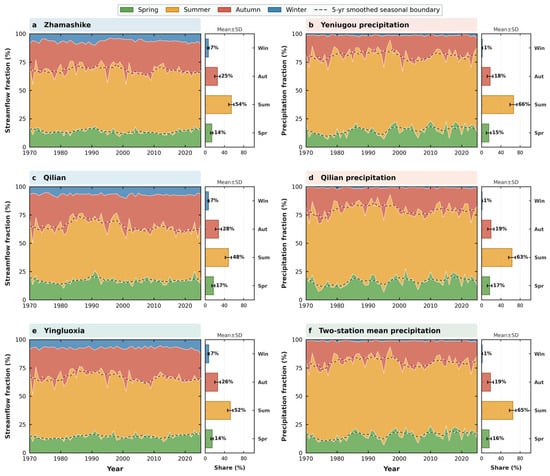
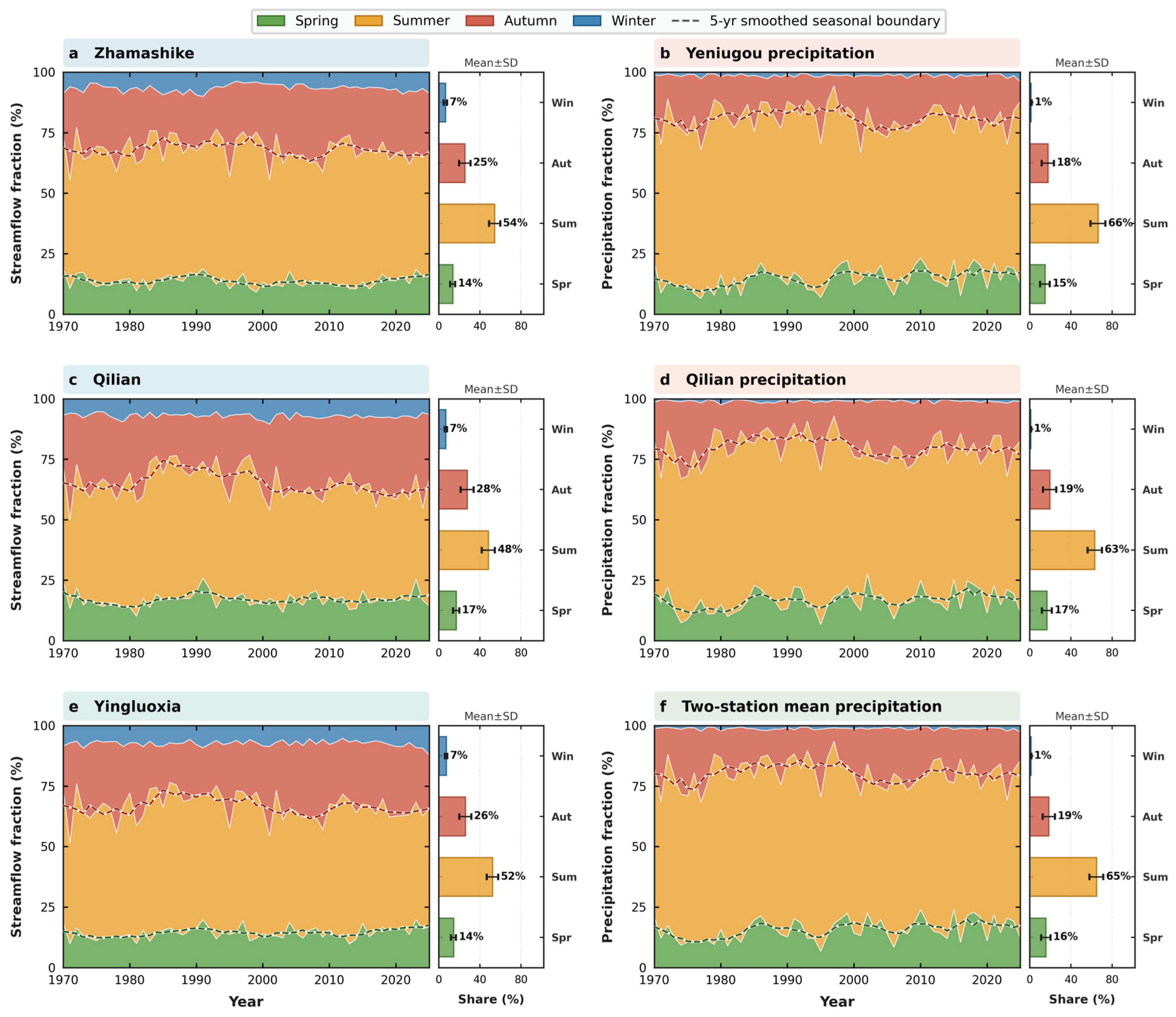
To distinguish changes in intra-annual water redistribution from changes in annual water volume, seasonal precipitation fractions (PSF) and seasonal streamflow fractions (SSF) were calculated for 1970–2025 (Figure 4; Table 2).
Figure 4.
Long-term changes in seasonal fractions of streamflow and precipitation in the upper Heihe River Basin during 1970–2025. SSF and PSF represent seasonal streamflow fraction and seasonal precipitation fraction, respectively.
Table 2.
Multi-year mean seasonal fractions and their trends during 1970–2025.
Precipitation remained strongly concentrated in summer throughout the study period, with a multi-year mean summer precipitation fraction of 64.69%, followed by autumn (18.50%), spring (15.66%), and winter (1.14%) (Table 2). Although the summer-dominated precipitation pattern remained broadly stable, the spring precipitation fraction increased significantly, with a Sen’s slope of 0.946% decade−1 (p < 0.05). No statistically significant trends were detected in the other seasonal precipitation fractions.
Streamflow also exhibited a summer-dominated seasonal distribution, with multi-year mean summer fractions of 54.34%, 48.22%, and 52.30% at Zhamashike, Qilian, and Yingluoxia, respectively. However, significant decreases in the summer streamflow fraction were detected at Qilian (−1.226% decade−1) and Yingluoxia (−1.095% decade−1), while the spring fraction increased significantly at Yingluoxia (0.472% decade−1). No significant trends were detected in winter streamflow fractions at any of the three stations. These findings indicate that the long-term changes in streamflow seasonality were not fully synchronized with changes in precipitation seasonality.
In contrast, streamflow exhibited stronger changes in seasonal allocation. Summer remained the dominant runoff season at all three hydrological stations, but its contribution to annual runoff decreased significantly at Qilian and Yingluoxia, with Sen’s slopes of −1.226% decade−1 and −1.095% decade−1, respectively (p < 0.05). At Yingluoxia, the spring contribution of runoff increased significantly, with a Sen’s slope of 0.472% decade−1 (p < 0.05). No statistically significant trends were detected for the winter streamflow fraction at any of the three stations.
The seasonal precipitation–streamflow mismatch further demonstrated differences between the intra-annual distributions of precipitation and runoff. Positive D values indicate seasons in which the relative contribution of runoff exceeded that of precipitation, whereas negative values indicate the opposite. The mismatch was particularly evident during seasons with relatively low precipitation contributions but comparatively larger runoff contributions. Overall, the results show that streamflow seasonality changed more strongly than precipitation seasonality during 1970–2025. The multi-year mean seasonal fractions provide reference values for interpreting the magnitude of the observed trends. Summer remained the dominant season for both precipitation and streamflow, although the relative seasonal contributions differed among the three hydrological stations. The mean seasonal fractions and their corresponding trends are summarized in Table 2.
Thus, the dominant feature was not a major shift in precipitation seasonality, but a redistribution of streamflow among seasons, particularly from summer toward spring at the larger Yingluoxia catchment.
3.4. Seasonal Precipitation–Streamflow Relationships
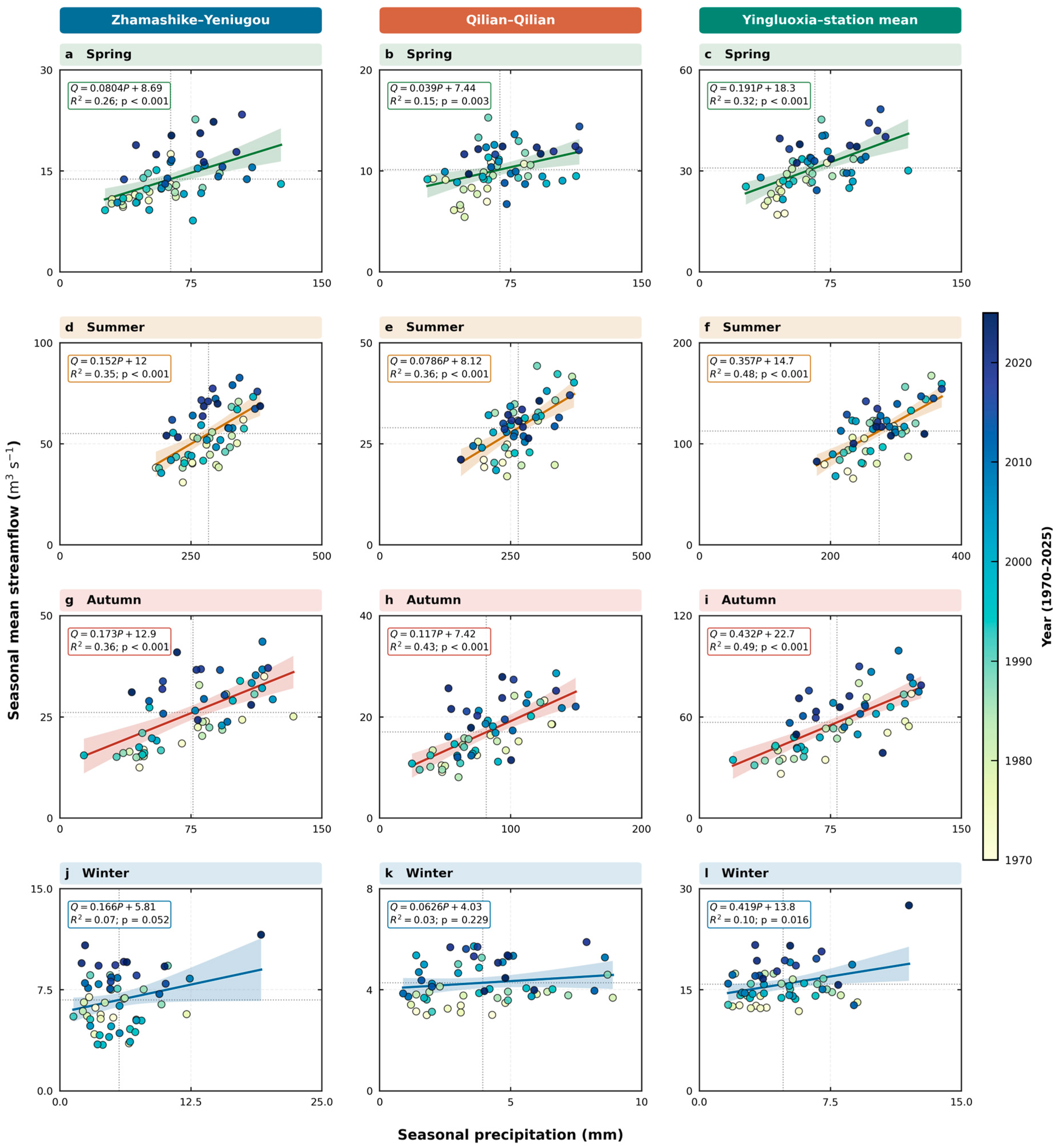
The seasonal relationships between precipitation and streamflow were examined to assess the degree of correspondence between precipitation input and runoff response across seasons (Figure 5).
Positive relationships between seasonal precipitation and runoff were observed across the three hydrological stations, but their strength varied substantially among seasons. Summer exhibited the strongest precipitation–streamflow relationships, with relatively high coefficients of determination (R2) across the three stations. The positive summer relationships indicate that interannual variations in summer precipitation were closely associated with corresponding variations in seasonal runoff.
The relationships were weaker in spring and autumn than in summer, indicating a lower degree of contemporaneous correspondence between precipitation and runoff during these seasons. Winter showed the weakest precipitation–streamflow relationships at most stations, with relatively low (R2) values. Winter generally exhibited the weakest precipitation–streamflow relationships, with (R2) values of 0.07, 0.03, and 0.10 at Zhamashike, Qilian, and Yingluoxia, respectively. The corresponding p-values were 0.052, 0.229, and 0.016. Thus, the winter relationship was statistically significant at Yingluoxia but explained only a small proportion of runoff variability, whereas the relationships at Zhamashike and Qilian did not reach the 0.05 significance level.
The seasonal contrast in precipitation–streamflow relationships was consistent across the three hydrological stations, although the magnitude of the relationships differed among stations. Taken together with the relatively stable seasonal distribution of precipitation and the significant changes in seasonal streamflow contributions, these results indicate that the seasonal distribution of runoff could not be fully explained by the timing of precipitation input.
Figure 5.
Seasonal relationships between precipitation and streamflow in the upper Heihe River Basin during 1970–2025. Each point represents one year, and linear regression equations, coefficients of determination (R2), and p-values are shown for each panel.
4. Discussion
4.1. Seasonal Mismatch Between Precipitation and Streamflow
The seasonal distributions of precipitation and streamflow in the upper Heihe River Basin were generally consistent, with both concentrated during the warm season. However, their seasonal contributions did not change synchronously. The summer streamflow fraction decreased significantly at the Qilian and Yingluoxia stations, whereas the spring fraction increased significantly at Yingluoxia. In contrast, the regional precipitation fraction increased significantly in spring. These results indicate that changes in streamflow seasonality cannot be explained solely by the seasonal distribution of precipitation. Catchment storage and the seasonal water balance can modify the timing and magnitude of streamflow responses to precipitation, resulting in differences between precipitation input and streamflow output [11,12].
The seasonal precipitation–streamflow relationships provide further evidence for this difference. The strongest relationships generally occurred in summer, while winter relationships were relatively weak. In snow-influenced catchments, precipitation during cold periods can be temporarily stored as snow and subsequently released during warmer periods, causing streamflow seasonality to differ from precipitation seasonality [26,27]. Therefore, the observed redistribution of streamflow likely reflects the combined influence of precipitation variability and catchment water-storage processes. This suggests that seasonal changes in water availability should be considered together with changes in annual streamflow when assessing hydrological responses to climate change.
4.2. Potential Roles of Cryospheric and Storage Processes
The upper Heihe River Basin is a high-elevation mountainous region where snow, frozen ground, and other cryospheric processes can influence the seasonal partitioning of precipitation into runoff. Previous studies have documented changes in snowmelt runoff and hydrological processes in the upper Heihe under climate change [8,14]. In particular, warming can alter snow accumulation and melt timing, potentially affecting the timing of runoff generation. The significant increase in spring streamflow contribution at Yingluoxia is therefore consistent with a possible change in the timing of snow-related water release. However, this study did not directly quantify snow water equivalent or snowmelt contribution, and thus the observed seasonal changes cannot be attributed exclusively to snowmelt processes.
Frozen ground and subsurface storage may also affect the transformation of precipitation into streamflow. Modeling studies in the upper Heihe have shown that frozen ground influences infiltration, groundwater recharge, baseflow, and the shape of the seasonal hydrograph [15], while changes in permafrost conditions can modify water and energy exchanges in high-elevation environments [14]. These processes may partly explain the differences in seasonal streamflow changes among the three stations. Nevertheless, because this study did not include direct observations of groundwater, snow storage, or frozen-ground dynamics, these mechanisms should be regarded as potential explanations rather than quantitatively separated drivers. The observed seasonal redistribution is consistent with the potential influence of catchment storage and delayed water-release processes. Snow accumulation and melt, glacier melt, frozen-ground conditions, and subsurface storage could modify the timing of runoff generation and release in the upper Heihe River Basin. However, these processes were not directly quantified in the present study. Therefore, the observed changes cannot be uniquely attributed to any individual runoff component, and the proposed mechanisms should be interpreted as plausible explanations rather than demonstrated causal relationships.
4.3. Spatial Differences and Implications for Seasonal Water Availability
The seasonal changes differed among the three hydrological stations. Significant decreases in the summer streamflow fraction occurred at Qilian and Yingluoxia, while no significant seasonal change was detected at Zhamashike. The increase in spring streamflow contribution was also more evident at Yingluoxia. Such differences may be associated with variations in drainage area, elevation, precipitation regime, and the degree to which snow, subsurface storage, and surface runoff processes are integrated across each catchment. The Qilian station represents a relatively small headwater catchment, whereas Yingluoxia integrates runoff from a larger mountainous area, which may contribute to differences in seasonal hydrological responses [17].
From a water-resources perspective, changes in seasonal contributions are important even when annual streamflow increases. A decline in the summer streamflow fraction does not necessarily mean that the absolute summer runoff volume has decreased; rather, it indicates a change in the relative contribution of summer runoff to annual water availability. The Heihe River is an important inland river system in an arid region, and changes in the timing of water availability can affect downstream water-resource management and ecosystem processes [18]. Therefore, future assessments should consider both the magnitude and seasonal redistribution of runoff, particularly under continued changes in precipitation and cryospheric conditions. Seasonal streamflow redistribution may also influence water availability for downstream oasis irrigation in the middle reaches of the Heihe River Basin. Agricultural water demand is concentrated during the growing season, and changes in the seasonal timing of upstream runoff could affect the correspondence between water supply and irrigation demand. Although a decreasing summer streamflow fraction does not necessarily indicate a reduction in absolute summer runoff volume, changes in seasonal runoff allocation may have implications for irrigation scheduling, reservoir operation, and ecological water allocation. These potential effects require further assessment using seasonal water-demand and water-management data.
Several limitations should be acknowledged. First, precipitation was represented by observations from only two meteorological stations because of the sparse observation network and complex topography of the upper Heihe River Basin. Second, the precipitation–streamflow correlations were calculated using the original annual seasonal series, and therefore may partly reflect shared low-frequency variability or long-term trends. Third, the present analysis does not explicitly separate rainfall runoff, snowmelt, glacier melt, groundwater, and frozen-ground contributions. Future studies should combine denser meteorological observations, remote-sensing products, snow and glacier information, groundwater observations, and distributed hydrological modeling to further resolve these processes.
5. Conclusions
Based on monthly streamflow, precipitation observations during 1970–2025, this study investigated seasonal variations in streamflow and precipitation and their relationships in the upper Heihe River Basin, China. The main conclusions are summarized as follows:
(1) Annual streamflow showed significant increasing trends at all three hydrological stations, whereas annual precipitation exhibited weaker and statistically non-significant positive tendencies. These results indicate that annual runoff changes and intra-annual water redistribution represent different dimensions of hydrological change.
(2) Precipitation and streamflow were both concentrated in the warm season but showed distinct seasonal distributions, indicating a mismatch between precipitation input and streamflow output that may reflect catchment storage and delayed water release.
(3) Precipitation seasonality remained relatively stable during 1970–2025, whereas streamflow seasonality changed significantly at Qilian and Yingluoxia. The summer streamflow fraction decreased significantly at both stations, while the spring fraction increased significantly at Yingluoxia, indicating that changes in streamflow seasonality cannot be fully explained by precipitation seasonality alone.
Author Contributions
Funding acquisition, methodology, writing—original draft, writing—review & editing, X.N.; formal analysis, validation, project administration, J.W.; resources, software, data curation, investigation, supervision, X.W. All authors have read and agreed to the published version of the manuscript.
Funding
This research was funded by the Water Resources Science Experimental Research and Technology Promotion Program of Gansu Province, China, grant number 26GSLK073, the Project of Gansu Provincial Longyuan Young Talents Program, China, grant number 202311, and the National Natural Science Foundation of China, grant number 42571184.
Data Availability Statement
Meteorological data were collected by the National Climate Center of the China Meteorological Administration and are available on http://data.cma.cn/ upon request (accessed on 31 December 2025). The streamflow data were obtained from the Hydrology and Water Resources Center of Gansu Province, China, and were compiled from the China Hydrological Yearbook, and are available under request.
Acknowledgments
We are very grateful for the support of the National Meteorological Center of the China Meteorological Administration with respect to the acquisition of meteorological data and for the support of the Hydrology and Water Resources Center of Gansu Province with respect to the acquisition of experimental runoff data.
Conflicts of Interest
The authors declare no conflicts of interest.
References
- IPCC. Climate Change 2021: The Physical Science Basis; Contribution of Working Group I to the Sixth Assessment Report of the Intergovernmental Panel on Climate Change; Cambridge University Press: Cambridge, UK, 2021. [Google Scholar] [CrossRef] [Scilit]
- Milly, P.C.D.; Betancourt, J.; Falkenmark, M.; Hirsch, R.M.; Kundzewicz, Z.W.; Lettenmaier, D.P.; Stouffer, R.J. Stationarity is dead: Whither water management? Science 2008, 319, 573–574. [Google Scholar] [CrossRef] [Scilit] [PubMed]
- Blöschl, G.; Montanari, A. Climate change impacts—Throwing the dice? Hydrol. Process. 2010, 24, 374–381. [Google Scholar] [CrossRef] [Scilit]
- Blöschl, G.; Hall, J.; Parajka, J.; Perdigão, R.A.P.; Merz, B.; Arheimer, B.; Aronica, G.T.; Bilibashi, A.; Bonacci, O.; Borga, M.; et al. Changing climate shifts timing of European floods. Science 2017, 357, 588–590. [Google Scholar] [CrossRef] [Scilit] [PubMed]
- Barnett, T.P.; Adam, J.C.; Lettenmaier, D.P. Potential impacts of a warming climate on water availability in snow-dominated regions. Nature 2005, 438, 303–309. [Google Scholar] [CrossRef] [Scilit] [PubMed]
- Stewart, I.T.; Cayan, D.R.; Dettinger, M.D. Changes in snowmelt runoff timing in western North America under a “business as usual” climate change scenario. Clim. Change 2004, 62, 217–232. [Google Scholar] [CrossRef] [Scilit]
- Dudley, R.W.; Hodgkins, G.A.; McHale, M.R.; Kolian, M.J.; Renard, B. Trends in snowmelt-related streamflow timing in the conterminous United States. J. Hydrol. 2017, 547, 208–221. [Google Scholar] [CrossRef] [Scilit]
- Wang, J.; Li, H.; Hao, X. Responses of snowmelt runoff to climatic change in an inland river basin, Northwestern China, over the past 50 years. Hydrol. Earth Syst. Sci. 2010, 14, 1979–1987. [Google Scholar] [CrossRef] [Scilit]
- Berghuijs, W.R.; Woods, R.A.; Hrachowitz, M. A precipitation shift from snow towards rain leads to a decrease in streamflow. Nat. Clim. Change 2014, 4, 583–586. [Google Scholar] [CrossRef] [Scilit]
- Huss, M.; Hock, R. Global-scale hydrological response to future glacier mass loss. Nat. Clim. Change 2018, 8, 135–140. [Google Scholar] [CrossRef] [Scilit]
- Berghuijs, W.R.; Hartmann, A.; Woods, R.A. Streamflow sensitivity to water storage changes across Europe. Geophys. Res. Lett. 2016, 43, 1980–1987. [Google Scholar] [CrossRef] [Scilit]
- Berghuijs, W.R.; Sivapalan, M.; Woods, R.A.; Savenije, H.H.G. Patterns of similarity of seasonal water balances: A window into streamflow variability over a range of time scales. Water Resour. Res. 2014, 50, 5638–5661. [Google Scholar] [CrossRef] [Scilit]
- de Lavenne, A.; Andréassian, V. Impact of climate seasonality on catchment yield: A parameterization for commonly-used water balance formulas. J. Hydrol. 2018, 558, 266–274. [Google Scholar] [CrossRef] [Scilit]
- Cheng, G.D.; Zhao, L.; Li, R.; Wu, X.D.; Sheng, Y.; Hu, G.J.; Zou, D.F.; Jin, H.J.; Li, X.; Wu, Q.B. Characteristic, changes and impacts of permafrost on Qinghai-Tibet Plateau. Chin. Sci. Bull. 2019, 64, 2783–2795. [Google Scholar] [CrossRef] [Scilit]
- Zhang, Y.; Cheng, G.; Li, X.; Jin, H.; Yang, D.; Flerchinger, G.N.; Chang, X.; Bense, V.F.; Han, X.; Liang, J. Influences of frozen ground and climate change on hydrological processes in an alpine watershed: A case study in the upstream area of the Hei’he River, Northwest China. Permafr. Periglac. Process. 2017, 28, 420–432. [Google Scholar] [CrossRef] [Scilit]
- Bi, Y.; Xie, H.; Huang, C.; Ke, C. Snow cover variations and controlling factors at Upper Heihe River Basin, Northwestern China. Remote Sens. 2015, 7, 6741–6762. [Google Scholar] [CrossRef] [Scilit]
- Li, X.; Cheng, G.; Ge, Y.; Li, H.; Han, F.; Hu, X.; Tian, W.; Tian, Y.; Pan, X.; Nian, Y.; et al. Hydrological cycle in the Heihe River Basin and its implication for water resource management in endorheic basins. J. Geophys. Res. Atmos. 2018, 123, 890–914. [Google Scholar] [CrossRef] [Scilit]
- Zhang, A.; Liu, W.; Yin, Z.; Fu, G.; Zheng, C. How will climate change affect the water availability in the Heihe River Basin, Northwest China? J. Hydrometeorol. 2016, 17, 1517–1542. [Google Scholar] [CrossRef] [Scilit]
- Luo, K.; Tao, F.; Moiwo, J.P.; Xiao, D. Attribution of hydrological change in Heihe River Basin to climate and land use change in the past three decades. Sci. Rep. 2016, 6, 33704. [Google Scholar] [CrossRef] [Scilit] [PubMed]
- Sen, P.K. Estimates of the regression coefficient based on Kendall’s tau. J. Am. Stat. Assoc. 1968, 63, 1379–1389. [Google Scholar] [CrossRef]
- Mann, H.B. Nonparametric tests against trend. Econometrica 1945, 13, 245–259. [Google Scholar] [CrossRef] [Scilit]
- Kendall, M.G. Rank Correlation Methods; Griffin: London, UK, 1975. [Google Scholar]
- Hirsch, R.M.; Slack, J.R.; Smith, R.A. Techniques of trend analysis for monthly water quality data. Water Resour. Res. 1982, 18, 107–121. [Google Scholar] [CrossRef] [Scilit]
- Hirsch, R.M.; Slack, J.R. A nonparametric trend test for seasonal data with serial dependence. Water Resour. Res. 1984, 20, 727–732. [Google Scholar] [CrossRef] [Scilit]
- Helsel, D.R.; Hirsch, R.M.; Ryberg, K.R.; Archfield, S.A.; Gilroy, E.J. Statistical Methods in Water Resources; U.S. Geological Survey Techniques and Methods, Book 4, Chapter A3; U.S. Geological Survey: Reston, VA, USA, 2020. [Google Scholar] [CrossRef] [Scilit]
- Han, J.; Liu, Z.; Woods, R.; McVicar, T.R.; Yang, D.; Wang, T.; Hou, Y.; Guo, Y.; Li, C.; Yang, Y.; et al. Streamflow seasonality in a snow-dwindling world. Nature 2024, 629, 1075–1081. [Google Scholar] [CrossRef] [Scilit] [PubMed]
- Wang, Z.; Berghuijs, W.R.; Howden, N.J.K.; Woods, R. Diverging impacts of snow fraction and soil drainage on seasonal and annual water balances across snow-influenced catchments. Water Resour. Res. 2025, 61, e2025WR040032. [Google Scholar] [CrossRef] [Scilit]

Disclaimer/Publisher’s Note: The statements, opinions and data contained in all publications are solely those of the individual author(s) and contributor(s) and not of MDPI and/or the editor(s). MDPI and/or the editor(s) disclaim responsibility for any injury to people or property resulting from any ideas, methods, instructions or products referred to in the content. |
© 2026 by the authors. Licensee MDPI, Basel, Switzerland. This article is an open access article distributed under the terms and conditions of the Creative Commons Attribution (CC BY) license.