


Abstract
Microplastics (MPs) are ubiquitous across environmental compartments and biological systems, yet particle occurrence, ingestion, tissue detection, and trophic transfer are often interpreted as evidence of exposure, bioaccumulation, biomagnification, or ecological risk. We argue that these observations represent distinct stages of the exposure–fate–effect continuum and should not be treated as equivalent. The operational <5-mm definition is useful for monitoring but does not provide a toxicological identity for a heterogeneous particle assemblage. Biologically relevant dose should therefore consider particle-size distribution, morphology, surface properties, and associated chemicals rather than mass or particle number alone. Likewise, organism-associated particles do not necessarily represent internal accumulation, and trophic transfer does not necessarily demonstrate biomagnification. We further argue that BCF, BAF, and BMF are outcome metrics rather than mechanisms and require evidence of particle uptake, distribution, retention, and elimination before they can be meaningfully interpreted. We propose an EGP–BCF–BAF–BMF framework in which the environment-conditioned state of MPs, particularly their mobility and reactivity, provides the upstream context for biological exposure, internal fate, trophic processes, and ecological consequences.
1. Introduction
The rapid growth of plastic production and use has led to widespread accumulation of plastic waste across environmental compartments [1,2]. Weathering, abrasion, and fragmentation generate plastic particles that enter aquatic systems, sediments, soils, the atmosphere, and organisms [3,4,5]. Microplastics (MPs) have consequently become a major environmental concern because their environmental transport, biological exposure, and ecological effects are closely interconnected.
MPs, however, are not a single, compositionally uniform pollutant. They comprise heterogeneous particles differing in size, shape, polymer composition, surface condition, and associated chemicals [6,7]. These properties influence suspension, sedimentation, aggregation, transport, biological contact, ingestion, tissue interaction, and chemical release [8,9,10,11,12]. Thus, detection establishes particle occurrence but not necessarily bioaccessible exposure or internal exposure. Likewise, an observed biological effect cannot be translated directly into environmental risk without considering particle state, dose, exposure pathway, and mechanism of action.
Several concepts used to interpret microplastic exposure and fate, particularly BCF, BAF, and BMF, originate from frameworks developed for conventional chemical pollutants [13]. Their direct transfer to particulate MPs is problematic because particle fate includes processes not captured by conventional dissolved-contaminant models, including aggregation, surface adhesion, gastrointestinal retention, egestion, barrier interaction, and particle elimination. Similar uncertainty applies to dose–effect relationships because the selected dose metric can alter apparent toxicity patterns and inferred relationships between particle properties and biological responses [14].
To support the four propositions developed in this Opinion, we draw primarily on foundational definitions, methodological and analytical reviews, systematic reviews and meta-analyses, representative mechanistic studies, and recent environmental fate and risk-assessment frameworks. The cited literature is intended to provide representative support for the arguments rather than an exhaustive systematic synthesis of the field. Here, we advance four propositions. First, we propose that MPs are better characterized by a toxicological identity based on particle size spectrum, composition, surface properties, and biologically relevant dose rather than the operational <5-mm boundary alone. Second, BCF and BAF should not be directly transferred without qualification from dissolved chemicals to MPs because organism-associated particles do not necessarily constitute an internal burden. Third, trophic transfer should not automatically be equated with biomagnification because increasing particle abundance across trophic levels does not necessarily indicate an increasing internal burden. Fourth, these processes should be interpreted in the context of the environmental geochemical properties (EGP) of particles, which govern their mobility, reactivity, accessibility, and biological fate. On this basis, we propose an EGP–BCF–BAF–BMF framework linking environmental particle state with biological and ecological outcomes.
2. Proposition I: Microplastics Require a Mechanistic Identity Beyond the <5 mm Definition
MPs should be treated as heterogeneous particulate pollutants rather than as a toxicologically uniform class defined by size alone. Their toxicological behavior depends on particle identity, environmental conditioning, and exposure context rather than on size alone.
2.1. Operational Size Boundaries and Particle–Chemical Identity
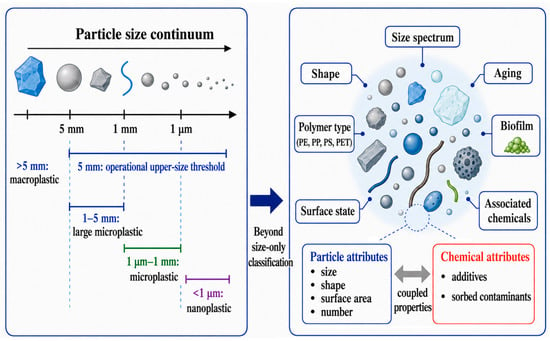
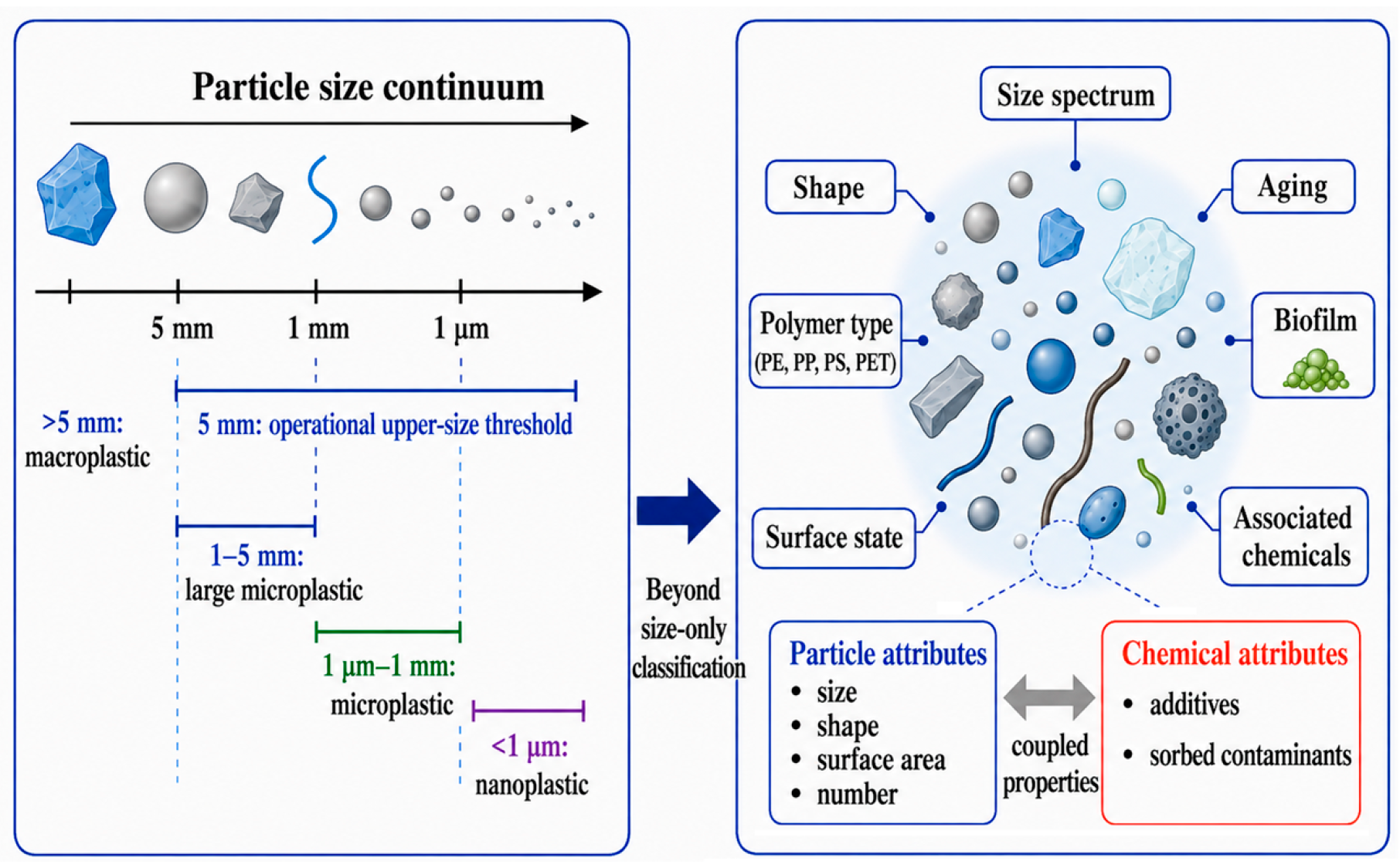
The <5-mm definition is a practical operational boundary for monitoring and reporting [15,16,17], but it does not define a toxicologically uniform particle class. Particle size nevertheless strongly influences microplastic behavior and toxicity [11], affecting surface area, transport, ingestibility, and biological interaction. MPs and nanoplastics (NPs) may lie along a fragmentation continuum, but they are not necessarily biologically equivalent. Zebrafish studies, for example, show size-dependent tissue localization of micrometre-scale PS particles [18], whereas nanoscale PS particles can cross the embryonic chorion and distribute among multiple tissues [19]. Size distributions should therefore be reported explicitly, particularly when barrier crossing or tissue translocation is relevant.
Toxicological identity, however, extends beyond size. Plastic particles contain numerous associated chemicals; the PlastChem database identified 16,325 plastic-associated chemicals, including additives, processing aids, starting substances, and non-intentionally added substances [20]. MPs may therefore exert both particle-mediated and chemically mediated effects, while environmental ageing further modifies surface properties, biofilm formation, and chemical exchange [12]. MPs are thus better viewed as coupled particle–chemical assemblages whose behavior reflects particle dimensions, polymer composition, surface state, associated chemicals, and environmental history. Importantly, the toxicological relevance of associated chemicals depends on their release and bioavailability rather than on particle association alone [21] (Figure 1).
Figure 1.
From operational definition to mechanistic characterization: reconceptualizing microplastics as a heterogeneous particle assemblage.
2.2. Dose Should Be Defined by the Mechanism Being Tested
Microplastic heterogeneity also complicates the definition of biologically effective dose. Effective dose depends on both exposure amount and particle properties, and the selected dose unit can alter inferred dose–response relationships [14]. Mass- and particle-number concentrations capture complementary rather than interchangeable dimensions of exposure [10], and neither is universally sufficient.
For comparability, studies should report particle-number concentration, mass concentration where technically appropriate, particle-size distribution or size-class-specific abundance, and exposure duration. Mechanism-specific descriptors can then be added, such as estimated particle surface area for interface-driven effects or released/bioavailable chemical concentration for chemically mediated effects [14]. Particle morphology and surface condition should remain complementary descriptors rather than being treated as dose units.
Because MPs interact with biological interfaces, dose–response assessment should also include relevant sublethal responses, such as barrier disturbance and inflammation, rather than acute lethality alone [11,22]. Pairing size-resolved particle characterization with dose metrics matched to the hypothesized mode of action provides a more direct link between external exposure, biologically relevant exposure, and subsequent effects.
3. Proposition II: Ingestion Is Not Bioaccumulation—BCF and BAF Require Evidence of Internal Fate
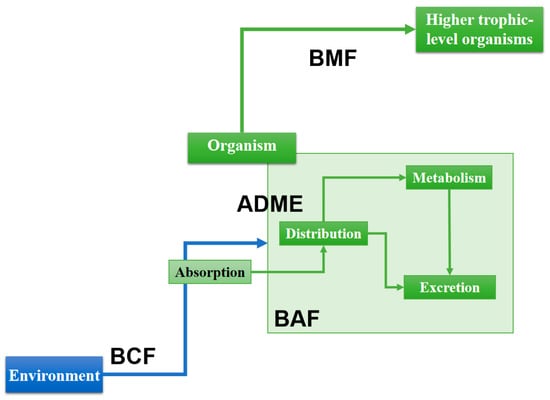
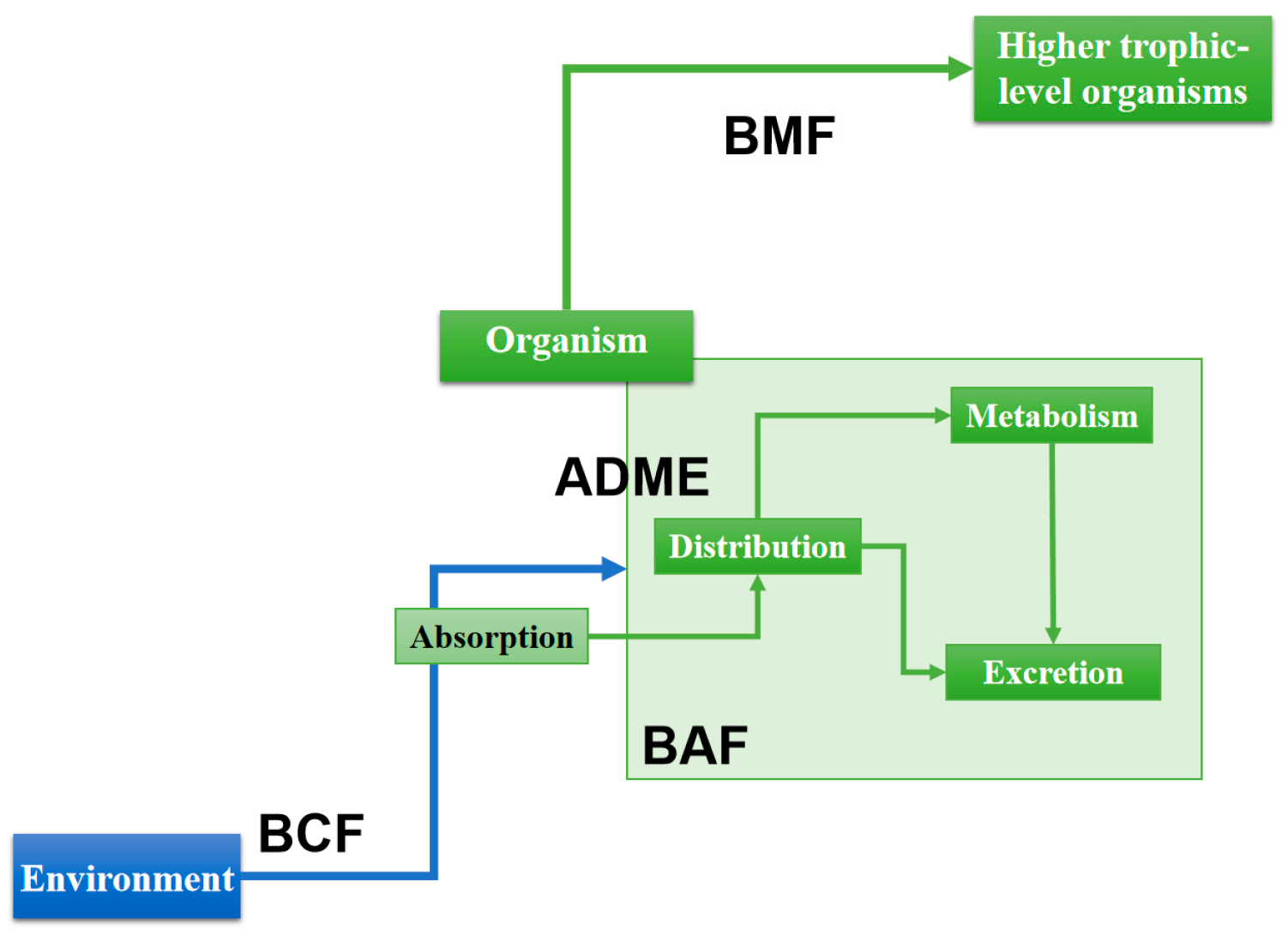
BCF and BAF are outcome metrics, not mechanisms. For conventional dissolved contaminants, BCF relates organism concentration to water under waterborne exposure, whereas BAF also incorporates dietary and other pathways [13]. Both assume an internal burden governed by uptake and elimination, an assumption that is not readily transferable to particulate MPs. In the ADME framework, absorption therefore requires particular scrutiny: a particle detected in an organism may reflect adsorption or adhesion at a biological interface rather than passage across it. After ingestion or contact, particles may remain in gastrointestinal contents, adhere to gut or gill surfaces, become trapped in mucus, or be eliminated without entering internal tissues. Organism-associated particles therefore do not necessarily establish internal exposure or accumulation (Figure 2).
Figure 2.
From particle exposure to internal burden and trophic transfer: distinguishing adsorption, absorption, accumulation, and biomagnification.
3.1. Adsorption Is Not Absorption and Organism-Associated Particles Are Not Necessarily Internal Burden
For MPs, evidence should distinguish surface association and ingestion from tissue translocation and intracellular localization, because particles may remain in gastrointestinal contents or on biological surfaces and be excreted without crossing a biological barrier.
Organism-specific studies illustrate this evidence hierarchy. In the mussel Mytilus edulis, ingested MPs were reported to translocate from the gut to the hemolymph/circulatory system [23]. In zebrafish, Lu et al. observed size-dependent localization of polystyrene MPs, with 5-μm particles detected in the gill, liver, and gut, whereas 20-μm particles were detected mainly in the gill and gut after 7 days [18]. Such tissue localization provides stronger evidence of translocation than gastrointestinal or surface-associated detection, but does not by itself demonstrate persistent bioaccumulation. Likewise, intracellular localization may reflect transient processing or clearance; Ramsperger et al. showed that macrophage internalization can also represent immune recognition and elimination of foreign particles [24].
Apparent increases in organism-associated MPs may therefore reflect repeated ingestion and temporary retention rather than a persistent internal pool. This distinction is especially important under chronic exposure, where continuous replenishment can maintain a stable whole-organism burden despite ongoing elimination. We therefore propose that evidence for bioaccumulation should combine verified barrier crossing and internal localization with persistence relative to elimination, preferably supported by time-series measurements during both exposure and depuration.
3.2. Why Direct BCF and BAF Calculations Are Problematic
For MPs, simple BCF or BAF ratios may compare non-equivalent compartments. Environmental measurements can include suspended or sediment-associated particles across different size and surface classes, whereas organismal measurements may include gut contents, surface-associated particles, and verified internal particles. An organism/environment ratio may therefore overestimate internal accumulation, and current evidence for MP bioaccumulation should be interpreted cautiously [25].
Analytical uncertainty further complicates interpretation. Recovery of MPs from biological matrices remains challenging [26]. Microscopic and spectroscopic methods provide particle-level information but may miss very small particles, whereas thermal methods quantify polymer mass with limited information on particle number, size, or localization [27]. Py-GC-MS measurements may also be affected by matrix effects and background contamination [28]. Thus, rigorous blanks and contamination control are essential, and polymer-mass detection alone does not demonstrate internalization or persistence.
Environmental relevance should also be considered because many experiments use concentrations above those measured in nature [29]. At least one treatment should reproduce or bracket environmentally relevant concentrations, while higher mechanistic doses should be identified separately. Exposure duration and measured concentrations should also account for particle clearance and changes in actual exposure during chronic tests.
BCF and BAF are therefore meaningful for MPs only when the measured burden represents a demonstrable and persistent internal pool and when exposure and biological compartments are comparable. This is best assessed using depurated, compartment-specific burdens measured over time. Uptake and depuration are particle- and species-dependent, and substantial measured burdens may remain confined to the gastrointestinal tract [30,31,32].
For waterborne exposure, where a first-order uptake–elimination model adequately describes the verified internal burden, kinetics may be explored as:
where Bint is the verified internal burden expressed on a matched concentration basis, Cw is the matched waterborne particle concentration, and ku and ke are uptake and elimination rate constants, respectively. The ratio ku/ke underlies conventional kinetic BCF estimation [13,33], but its applicability to particulate MPs should be evaluated rather than assumed. Where justified, ku/ke may serve as a conditional BCF-like descriptor. Multi-pathway exposure should instead consider pathway-specific uptake, and whole-organism/environment ratios should remain descriptive until internalization is demonstrated.
4. Proposition III: Trophic Transfer Is Not Biomagnification—BMF Requires Comparable Internal Burdens
Biomagnification refers to increasing contaminant concentration with trophic position, whereas BMF quantifies this trophic amplification. For MPs, however, trophic transfer does not by itself demonstrate biomagnification because transferred particles may remain in gastrointestinal contents, adhere to biological surfaces, or be eliminated. Higher whole-organism concentrations in predators may therefore reflect ingestion or retention rather than progressive internal accumulation.
4.1. Trophic Transfer Does Not Necessarily Demonstrate Biomagnification
Organism-associated MP measurements may include gut contents, surface-associated particles, and particles that have crossed biological barriers into internal tissues. These pools differ in biological significance, so increasing particle concentrations across trophic levels may indicate trophic transfer or apparent enrichment rather than true biomagnification.
Unlike dissolved contaminants, for which persistent internal concentrations provide a clearer basis for trophic comparison, whole-organism MP measurements may include substantial non-internal particle burdens. Current evidence therefore does not support a general conclusion that MPs biomagnify across species and food webs in the same mechanistic sense as persistent dissolved contaminants [25]. Trophic outcomes instead depend on organism traits, feeding strategy, particle properties, exposure duration, and food-web structure.
4.2. BMF Requires Comparable Internal Contaminant Pools
Applying BMF to MPs requires predator and prey burdens to represent comparable biological compartments. Particles in gastrointestinal contents, mucus, or on external surfaces are not equivalent to internal tissue burdens; thus, higher predator concentrations may reflect greater ingestion or retention rather than persistent internal accumulation.
True biomagnification requires transferred particles to contribute to comparable internal burdens that increase with trophic position after uptake and elimination are considered. Evidence should therefore address barrier crossing, tissue distribution, retention, persistence, and elimination. A BMF greater than one alone cannot distinguish biomagnification from enhanced ingestion or retention (Figure 2).
We therefore propose that claims of MP biomagnification should demonstrate: (i) a verified prey–predator relationship; (ii) comparable particle identities, including polymer type and size class; (iii) adequate contamination control; (iv) removal or separate quantification of external and gastrointestinal particles; (v) verified internal burdens in both prey and predator; (vi) matched analytical units and comparable biological compartments; and (vii) an increase in matched internal burden from prey to predator after accounting for uptake and elimination.
Trophic transfer may still be ecologically relevant without biomagnification because MPs can affect feeding, digestion, biological surfaces, microbial communities, and elemental cycling [34,35]. Trophic transfer and biomagnification should therefore remain conceptually distinct.
4.3. Ecological Effects Do Not Require Biomagnification
Trophic transfer may still be ecologically relevant without biomagnification. Increasing particle abundance with trophic position should first be interpreted as trophic distribution or transfer; biomagnification should be inferred only when a persistent, biologically comparable internal burden demonstrably increases across trophic levels. MPs may nevertheless affect organismal processes and ecosystem functions without such biomagnification [22,34,35].
5. Proposition IV: Environmental Particle State Is the Upstream Driver—The EGP–BCF–BAF–BMF Framework
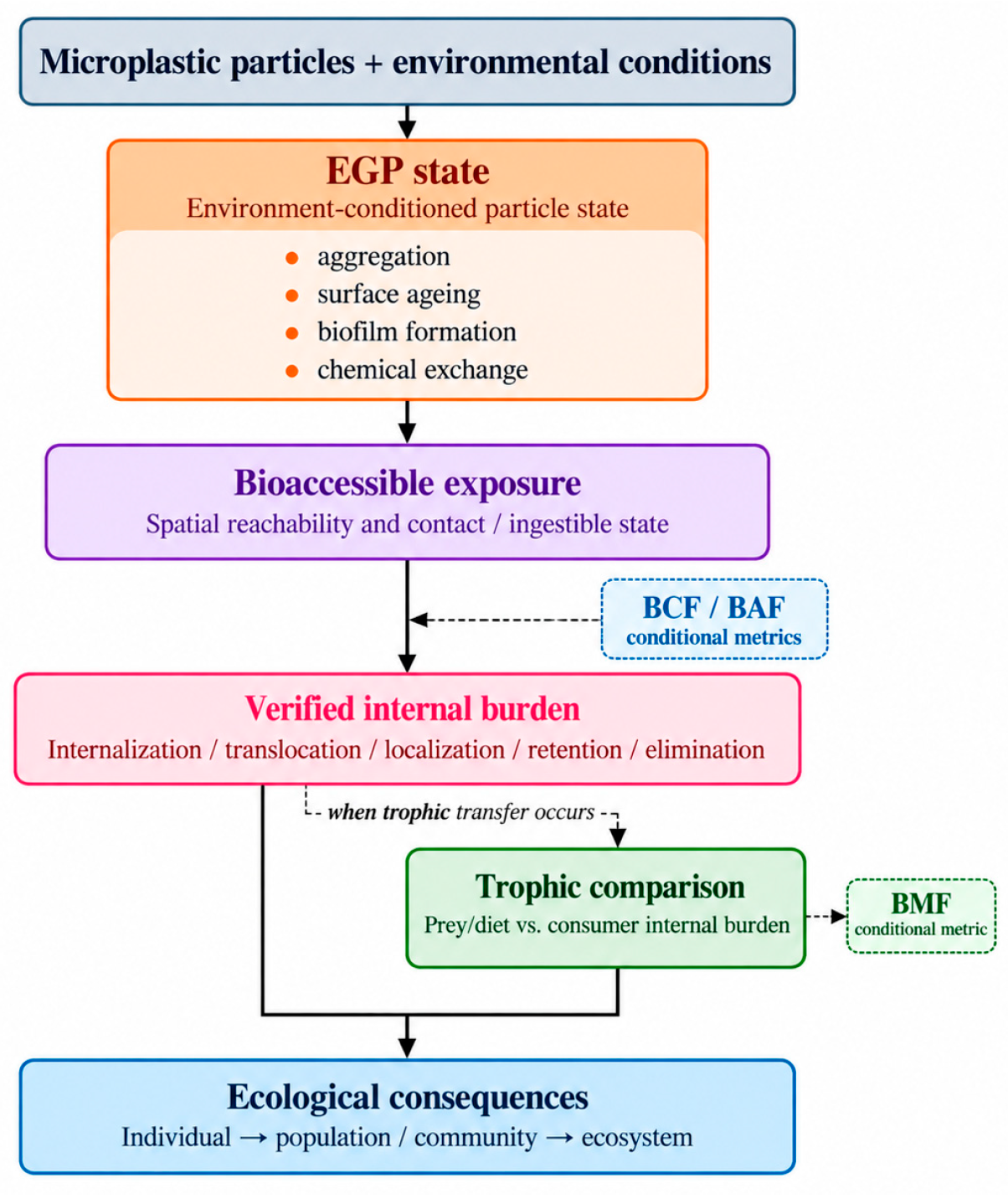
The preceding propositions point to a common upstream issue: biological and trophic outcomes cannot be interpreted without considering the environmental state of MPs. We therefore propose the EGP–BCF–BAF–BMF framework as a process-oriented scaffold linking environmental particle state with bioaccessible exposure, internal fate, trophic transfer, and ecological consequences. Within this framework, BCF, BAF, and BMF are conditional descriptors rather than automatic measures of microplastic risk.
For conventional chemicals, frameworks such as PMT, vPvB, vPvM, and PMOC describe persistence, mobility, bioaccumulation, and receptor accessibility [36]. Because these concepts were developed mainly for molecular pollutants governed by dissolution and partitioning, MPs require a particle-based perspective. Here, we emphasize mobility–reactivity coupling: mobility determines particle transport and biological encounter, whereas reactivity governs interactions with environmental media and biological interfaces. Aggregation, biofilm formation, surface ageing, adsorption/desorption, and chemical exchange therefore connect environmental transport with bioaccessible exposure [12,37].
Within this perspective, EGP (Environmental Geochemical Properties) refers to the environment-conditioned physicochemical and biogeochemical state of MPs arising from interactions between intrinsic particle properties and environmental conditions. Properties such as size, morphology, polymer composition, density, and surface state may be modified during environmental transport and ageing [12,37]. EGP can therefore be characterized using context-dependent descriptors of aggregation, settling behavior, surface properties, biofilm coverage, and associated-chemical exchange. These characteristics influence suspension, sedimentation, remobilization, and biological accessibility, meaning that similar bulk concentrations may result in different bioaccessible exposures.
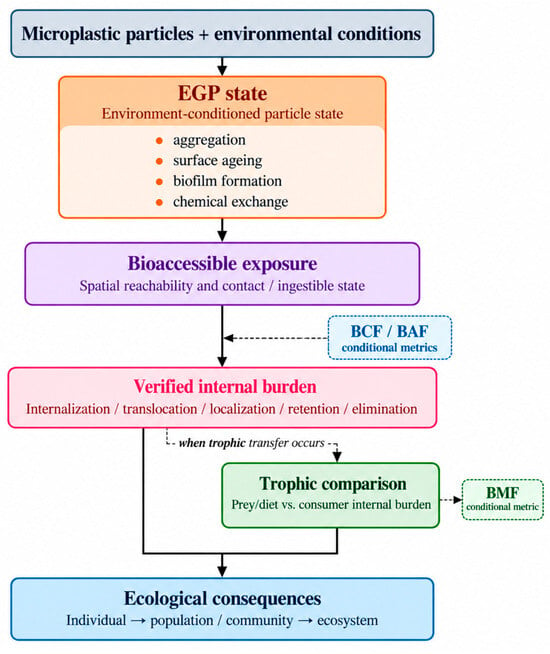
The framework consequently follows an evidence chain: EGP → bioaccessible exposure → verified internal burden → trophic comparison → ecological consequences (Figure 3). BCF and BAF are interpreted only when uptake, retention, elimination, and an internal burden have been established, whereas BMF additionally requires biologically comparable internal burdens across trophic links. Operationally, this sequence can be examined by characterizing environmentally conditioned particles in the exposure medium, distinguishing surface-associated or gastrointestinal particles from persistent internal burdens after exposure and depuration, and subsequently comparing matched internal burdens between prey and predators.
Figure 3.
EGP–BCF–BAF–BMF framework linking environment-conditioned particle state, bioaccessible exposure, verified internal burden, trophic comparison, and ecological consequences. BCF/BAF and BMF are conditional metrics within the evidence chain.
Importantly, ecological consequences do not require elevated BCF, BAF, or BMF. MPs may affect organisms and ecosystem functions through particle–organism interactions, biofilms, microbial communities, and elemental cycling [34,35]. These metrics should therefore not be treated as independent evidence of ecological risk. Rather than replacing formal risk-assessment approaches [38], the EGP–BCF–BAF–BMF framework clarifies the evidentiary conditions under which accumulation and biomagnification metrics can be assigned biological meaning for particulate MPs, thereby reducing their unqualified transfer from dissolved contaminants.
6. Conclusions
Microplastic risk assessment requires a shift from particle detection and numerical burden metrics toward mechanistically interpretable evidence. MPs should be treated as heterogeneous particulate pollutants whose biologically relevant dose and fate depend on particle size spectrum, composition, surface properties, and environmental conditioning. The central distinction is that particle occurrence is not necessarily bioaccessible exposure, organism-associated particles are not necessarily internal accumulation, and trophic transfer is not necessarily biomagnification. The EGP–BCF–BAF–BMF framework provides a basis for connecting environmental particle state with these biological processes while treating conventional enrichment metrics as conditional rather than universal descriptors. Future studies should prioritize integrated particle and dose characterization, rigorous localization and contamination control, environmentally realistic exposures, and stronger links between particle–surface interactions, internal fate, trophic processes, and ecosystem functions. Ultimately, a defensible assessment of microplastic risk should follow a continuous and verifiable chain from environmental particle state to biological fate and ecologically meaningful outcomes.
Author Contributions
Writing—original draft preparation, formal analysis, investigation, M.Y.; data curation, X.Y.; resources, A.G.; project administration, X.L. (Xiaoling Liu) and G.L.; Conceptualization, writing—review and editing, supervision, X.L. (Xueqiang Lu). All authors have read and agreed to the published version of the manuscript.
Funding
This research was funded by National Key Research & Development Program of China (2025YFE0199800) and the General Special Scientific Research Program of the Education Department of Shaanxi Province (25JK0590).
Data Availability Statement
No new data were created or analyzed in this study. Data sharing is not applicable to this article.
Acknowledgments
During the preparation of this paper, the authors used ChatGPT-5.6 Luna to check the grammar. The authors have reviewed and edited the output and take full responsibility for the content of this paper.
Conflicts of Interest
The authors declare no conflicts of interest.
Abbreviations
| ADME | Absorption, Distribution, Metabolism, and Excretion |
| BAF | Bioaccumulation Factor |
| BCF | Bioconcentration Factor |
| BMF | Biomagnification Factor |
| EGP | Environmental Geochemical Properties |
| ISO | International Organization for Standardization |
| MPs | Microplastics |
| NPs | Nanoplastics |
| PS | Polystyrene |
| PMOC | Persistent, Mobile, and Organic Chemicals |
| PMT | Persistent, Mobile, and Toxic |
| PBT | Persistent, Bioaccumulative, and Toxic |
| Py-GC-MS | Pyrolysis–Gas Chromatography–Mass Spectrometry |
| vPvB | very Persistent and very Bioaccumulative |
| vPvM | very Persistent and very Mobile |
References
- Geyer, R.; Jambeck, J.R.; Law, K.L. Production, use, and fate of all plastics ever made. Sci. Adv. 2017, 3, e1700782. [Google Scholar] [CrossRef] [Scilit] [PubMed]
- Borrelle, S.B.; Ringma, J.; Law, K.L.; Monnahan, C.C.; Lebreton, L.; McGivern, A.; Murphy, E.; Jambeck, J.; Leonard, G.H.; Hilleary, M.A.; et al. Predicted growth in plastic waste exceeds efforts to mitigate plastic pollution. Science 2020, 369, 1515–1518. [Google Scholar] [CrossRef] [Scilit] [PubMed]
- Andrady, A.L. Microplastics in the marine environment. Mar. Pollut. Bull. 2011, 62, 1596–1605. [Google Scholar] [CrossRef] [Scilit] [PubMed]
- Browne, M.A.; Galloway, T.S.; Thompson, R.C. Microplastic—An emerging contaminant of potential concern? Integr. Environ. Assess. Manag. 2007, 3, 559–561. [Google Scholar] [CrossRef] [Scilit] [PubMed]
- Allen, S.; Allen, D.; Phoenix, V.R.; Le Roux, G.; Jiménez, P.D.; Simonneau, A.; Binet, S.; Galop, D. Atmospheric transport and deposition of microplastics in a remote mountain catchment. Nat. Geosci. 2019, 12, 339–344. [Google Scholar] [CrossRef] [Scilit]
- Hartmann, N.B.; Hüffer, T.; Thompson, R.C.; Hassellöv, M.; Verschoor, A.; Daugaard, A.E.; Rist, S.; Karlsson, T.; Brennholt, N.; Cole, M.; et al. Are we speaking the same language? Recommendations for a definition and categorization framework for plastic debris. Environ. Sci. Technol. 2019, 53, 1039–1047. [Google Scholar] [CrossRef] [Scilit] [PubMed]
- Rochman, C.M.; Hoellein, T. The global odyssey of plastic pollution. Science 2020, 368, 1184–1185. [Google Scholar] [CrossRef] [Scilit] [PubMed]
- Koelmans, A.A.; Redondo-Hasselerharm, P.E.; Mohamed Nor, N.H.; Kooi, M. Solving the nonalignment of methods and approaches used in microplastic research to consistently characterize risk. Environ. Sci. Technol. 2020, 54, 12307–12308. [Google Scholar] [CrossRef] [Scilit] [PubMed]
- Chamas, A.; Moon, H.; Zheng, J.; Qiu, Y.; Tabassum, T.; Jang, J.H.; Abu-Omar, , M.; Scott, S.L.; Suh, S. Degradation rates of plastics in the environment. ACS Sustain. Chem. Eng. 2020, 8, 3494–3511. [Google Scholar] [CrossRef] [Scilit]
- Rochman, C.M.; Brookson, C.; Bikker, J.; Djuric, N.; Earn, A.; Bucci, K.; Athey, S.; Huntington, A.; McIlwraith, H.; Munno, K.; et al. Rethinking microplastics as a diverse contaminant suite. Nat. Rev. Earth Environ. 2021, 2, 303–306. [Google Scholar] [CrossRef] [Scilit]
- Wright, S.L.; Thompson, R.C.; Galloway, T.S. The physical impacts of microplastics on marine organisms: A review. Environ. Pollut. 2013, 178, 483–492. [Google Scholar] [CrossRef] [Scilit] [PubMed]
- Michels, J.; Stippkugel, A.; Lenz, M.; Wirtz, K.; Engel, A. Rapid aggregation of biofilm-covered microplastics with marine biogenic particles. Proc. R. Soc. B Biol. Sci. 2018, 285, 20181203. [Google Scholar] [CrossRef] [Scilit] [PubMed]
- Arnot, J.A.; Gobas, F.A.P.C. A review of bioconcentration factor (BCF) and bioaccumulation factor (BAF) assessments for organic chemicals in aquatic organisms. Environ. Rev. 2006, 14, 257–297. [Google Scholar] [CrossRef] [Scilit]
- Thornton, H.L.M.; Brander, S.M.; Coffin, S.; Cole, M.; Hermabessiere, L.; Koelmans, A.A.; Rochman, C.M. Characterizing microplastic hazards: Which concentration metrics and particle characteristics are most informative for understanding toxicity in aquatic organisms? Microplastics Nanoplastics 2022, 2, 20. [Google Scholar] [CrossRef] [Scilit]
- Thompson, R.C.; Olsen, Y.; Mitchell, R.P.; Davis, A.; Rowland, S.J.; John, A.W.G.; McGonigle, D.; Russell, A.E. Lost at sea: Where is all the plastic? Science 2004, 304, 838. [Google Scholar] [CrossRef] [Scilit] [PubMed]
- Arthur, C.; Baker, J.; Bamford, H. (Eds.) Proceedings of the International Research Workshop on the Occurrence, Effects, and Fate of Microplastic Marine Debris NOAA Technical Memorandum NOS-OR&R-30; NOAA: Washington, DC, USA, 2009. [Google Scholar]
- ISO 24187:2023; Principles for the Analysis of Microplastics Present in the Environment. International Organization for Standardization: Geneva, Switzerland, 2023.
- Lu, Y.; Zhang, Y.; Deng, Y.; Jiang, W.; Zhao, Y.; Geng, J.; Ding, L.; Ren, H. Uptake and Accumulation of Polystyrene Microplastics in Zebrafish (Danio rerio) and Toxic Effects in Liver. Environ. Sci. Technol. 2016, 50, 4054–4060. [Google Scholar] [CrossRef] [Scilit] [PubMed]
- Pitt, J.A.; Kozal, J.S.; Jayasundara, N.; Massarsky, A.; Trevisan, R.; Geitner, N.; Wiesner, M.; Levin, E.D.; Di Giulio, R.T. Uptake, tissue distribution, and toxicity of polystyrene nanoparticles in developing zebrafish (Danio rerio). Aquat. Toxicol. 2018, 194, 185–194. [Google Scholar] [CrossRef] [Scilit] [PubMed]
- Monclús, L.; Arp, H.P.H.; Groh, K.J.; Faltynkova, A.; Løseth, M.E.; Muncke, J.; Wang, Z.; Wolf, R.; Zimmermann, L.; Wagner, M. Mapping the chemical complexity of plastics. Nature 2025, 643, 349–355. [Google Scholar] [CrossRef] [Scilit] [PubMed]
- Koelmans, A.A.; Bakir, A.; Burton, G.A.; Janssen, C.R. Microplastic as a Vector for Chemicals in the Aquatic Environment: Critical Review and Model-Supported Reinterpretation of Empirical Studies. Environ. Sci. Technol. 2016, 50, 3315–3326. [Google Scholar] [CrossRef] [Scilit] [PubMed]
- Bucci, K.; Tulio, M.; Rochman, C.M. What is known and unknown about the effects of plastic pollution: A meta-analysis and systematic review. Ecol. Appl. 2020, 30, e02044. [Google Scholar] [CrossRef] [Scilit] [PubMed]
- Browne, M.A.; Dissanayake, A.; Galloway, T.S.; Lowe, D.M.; Thompson, R.C. Ingested microscopic plastic translocates to the circulatory system of the mussel, Mytilus edulis (L.). Environ. Sci. Technol. 2008, 42, 5026–5031. [Google Scholar] [CrossRef] [Scilit] [PubMed]
- Ramsperger, A.F.R.M.; Narayana, V.K.B.; Gross, W.; Mohanraj, J.; Thelakkat, M.; Greiner, A.; Schmalz, H.; Kress, H.; Laforsch, C. Environmental exposure enhances the internalization of microplastic particles into cells. Sci. Adv. 2020, 6, eabd1211. [Google Scholar] [CrossRef] [Scilit] [PubMed]
- Miller, M.E.; Hamann, M.; Kroon, F.J. Bioaccumulation and biomagnification of microplastics in marine organisms: A review and meta-analysis of current data. PLoS ONE 2020, 15, e0240792. [Google Scholar] [CrossRef] [Scilit] [PubMed]
- Miller, M.E.; Kroon, F.J.; Motti, C.A. Recovering microplastics from marine organisms: A review. Mar. Pollut. Bull. 2017, 123, 6–18. [Google Scholar] [CrossRef] [Scilit] [PubMed]
- Primpke, S.; Christiansen, S.H.; Cowger, W.; Cowger, W.; De Frond, H.; Deshpande, A.; Fischer, M.; Holland, E.B.; Meyns, M.; O’Donnell, B.A.; et al. Critical assessment of analytical methods for the harmonized and cost-efficient analysis of microplastics. Appl. Spectrosc. 2020, 74, 1012–1046. [Google Scholar] [CrossRef] [Scilit] [PubMed]
- Duemichen, E.; Eisentraut, P.; Celina, M.; Braun, U. Automated thermal extraction-desorption gas chromatography mass spectrometry: A multifunctional tool for comprehensive characterization of polymers and their degradation products. J. Chromatogr. A 2019, 1592, 133–142. [Google Scholar] [CrossRef] [Scilit]
- Lenz, R.; Enders, K.; Nielsen, T.G. Microplastic exposure studies should be environmentally realistic. Proc. Natl. Acad. Sci. USA 2016, 113, E4121–E4122. [Google Scholar] [CrossRef] [Scilit] [PubMed]
- Elizalde-Velázquez, A.; Carcano, A.M.; Crago, J.; Green, M.J.; Shah, S.A.; Cañas-Carrell, J.E. Translocation, trophic transfer, accumulation and depuration of polystyrene microplastics in Daphnia magna and Pimephales promelas. Environ. Pollut. 2020, 259, 113937. [Google Scholar] [CrossRef] [Scilit] [PubMed]
- Liu, Y.; Qiu, X.; Xu, X.; Takai, Y.; Ogawa, H.; Shimasaki, Y.; Oshima, Y. Uptake and depuration kinetics of microplastics with different polymer types and particle sizes in Japanese medaka (Oryzias latipes). Ecotoxicol. Environ. Saf. 2021, 212, 112007. [Google Scholar] [CrossRef] [Scilit] [PubMed]
- Sun, T.; Ji, C.; Li, F.; Shan, X.; Wu, H. The legacy effect of microplastics on aquatic animals in the depuration phase: Kinetic characteristics and recovery potential. Environ. Int. 2022, 168, 107467. [Google Scholar] [CrossRef] [Scilit] [PubMed]
- OECD. Test No. 305: Bioaccumulation in Fish: Aqueous and Dietary Exposure; OECD Guidelines for the Testing of Chemicals, Section 3; OECD Publishing: Paris, France, 2012. [Google Scholar] [CrossRef] [Scilit]
- Seeley, M.E.; Song, B.; Passie, R.; Hale, R.C. Microplastics affect sedimentary microbial communities and nitrogen cycling. Nat. Commun. 2020, 11, 2372. [Google Scholar] [CrossRef] [Scilit] [PubMed]
- Rillig, M.C.; Lehmann, A. Microplastic in terrestrial ecosystems. Science 2020, 368, 1430–1431. [Google Scholar] [CrossRef] [Scilit] [PubMed]
- Hale, S.E.; Arp, H.P.H.; Schliebner, I.; Neumann, M. Persistent, mobile and toxic (PMT) and very persistent and very mobile (vPvM) substances pose an equivalent level of concern to persistent, bioaccumulative and toxic (PBT) and very persistent and very bioaccumulative (vPvB) substances under REACH. Environ. Sci. Eur. 2020, 32, 155. [Google Scholar] [CrossRef] [Scilit]
- Brunner, H.; Sallach, J.B.; Zanchi, V.; Price, O.; Boxall, A.B.A. Toward a Framework for Environmental Fate and Exposure Assessment of Polymers. Environ. Toxicol. Chem. 2022, 41, 515–540. [Google Scholar] [CrossRef] [Scilit] [PubMed]
- Gouin, T.; Becker, R.A.; Collot, A.G.; Davis, J.W.; Howard, B.; Inawaka, K.; Lampi, M.; Ramon, B.S.; Shi, J.; Hopp, P.W. Toward the Development and Application of an Environmental Risk Assessment Framework for Microplastic. Environ. Toxicol. Chem. 2019, 38, 2087–2100. [Google Scholar] [CrossRef] [Scilit] [PubMed]
Disclaimer/Publisher’s Note: The statements, opinions and data contained in all publications are solely those of the individual author(s) and contributor(s) and not of MDPI and/or the editor(s). MDPI and/or the editor(s) disclaim responsibility for any injury to people or property resulting from any ideas, methods, instructions or products referred to in the content. |
© 2026 by the authors. Licensee MDPI, Basel, Switzerland. This article is an open access article distributed under the terms and conditions of the Creative Commons Attribution (CC BY) license.