


Abstract
Urban combined sewer systems are increasingly challenged by climate-intensified rainfall, combined sewer overflows, and receiving-water degradation. This study presents a retrospective evaluation of a hybrid green-gray retrofit program implemented in the Zhenjiang Sponge City pilot watershed, China, where green stormwater infrastructure, drainage network upgrades, and a centralized deep tunnel system were integrated within a densely developed watershed constrained by limited space, low native-soil permeability, shallow groundwater, and aging infrastructure. System performance was evaluated using long-term operational observations, representative hydraulic and water-quality monitoring, municipal operational records, and supporting engineering analyses at both facility and watershed scales. The results demonstrated sustained hydraulic functionality after 7–10 years of operation, with approximately 90% of the monitored bioretention systems maintaining effective infiltration rates greater than 80 mm h−1. Event-based monitoring indicated substantial reductions in runoff volume and pollutant loads, including TSS, COD, NH3–N, and TP. Following implementation, annual combined sewer overflow occurrence at major outfalls decreased from 318 to 24 events, representing a 92.5% reduction. Supporting engineering analyses indicated that green stormwater infrastructure retrofits alone reduced overflow frequency by approximately 41.8% and overflow volume by approximately 61.1%, while integration with deep tunnels increased reductions to approximately 58.8% and 85.3%, respectively. Official receiving-water monitoring records further indicated that Class III or better water-quality conditions were maintained during approximately 74.7% of the monitored days between 2021 and 2026. These findings provide long-term watershed-scale evidence that hybrid green-gray retrofit strategies can integrate green stormwater infrastructure with centralized overflow regulation to achieve sustained overflow reduction and receiving-water improvement in highly constrained urban watersheds.
1. Introduction
Urban combined sewer systems worldwide are increasingly challenged by rapid urbanization, aging drainage infrastructure, and intensifying rainfall associated with climate change [1,2,3,4,5,6]. During heavy storm events, runoff generation can exceed the hydraulic and treatment capacities of combined sewer systems, resulting in combined sewer overflows (CSOs), urban flooding, and the degradation of receiving-water quality [7,8,9]. Climate projections further suggest that many cities will experience more frequent and intense short-duration rainfall events, increasing pressure on existing drainage infrastructure and highlighting the need for more resilient stormwater-management strategies [1,4,5,6].
Beyond hydraulic impacts, urban receiving-water degradation is closely linked to diffuse urban pollutant sources, particularly in densely developed catchments characterized by extensive impervious cover and aging drainage infrastructure [10,11]. During storm events, pollutants accumulated on urban surfaces can be rapidly transported to receiving waters through stormwater runoff, while CSOs may discharge untreated mixtures of wastewater and stormwater directly into rivers, lakes, and coastal waters [7,8,9,10]. These pathways can contribute substantial loads of suspended solids, nutrients, organic matter, pathogens, emerging contaminants, and other pollutants, resulting in episodic but significant water-quality degradation [10,11]. The challenge is particularly acute in older urban districts served by combined sewer systems, where high pollutant accumulation, strong first-flush effects, and limited opportunities for large-scale infrastructure replacement increase the risk of receiving-water impairment [9,10,11,12,13]. Although sewer separation is often regarded as a long-term solution, its implementation in densely developed districts is frequently constrained by high costs, construction complexity, utility conflicts, traffic disruption, and long-term maintenance challenges [9,14,15]. Consequently, retrofit strategies capable of simultaneously reducing runoff volumes, pollutant transport, and CSO occurrence have become increasingly important for protecting urban receiving waters.
Conventional gray infrastructure approaches, including sewer separation, conveyance expansion, storage facilities, and deep tunnel systems, have been widely implemented to mitigate CSOs and improve drainage performance [7,8,9]. While these approaches can effectively increase hydraulic capacity [8,9], they often require substantial capital investment and can be difficult to implement in densely developed urban areas. Consequently, many cities have sought complementary approaches that address runoff generation and pollutant transport at the source rather than relying solely on downstream conveyance and storage [14]. Unlike conventional sewer-separation projects that require the installation of extensive parallel pipe networks, green stormwater infrastructure (GSI) can reduce the volume of stormwater entering combined sewer systems before it reaches the drainage network, thereby providing a form of functional source separation of stormwater from wastewater while avoiding many of the costs, construction disruptions, and implementation challenges associated with large-scale sewer replacement projects [14,15].
GSI, typically implemented through stormwater control measures (SCMs) within low-impact development (LID), sustainable drainage systems (SuDS), and nature-based solutions (NbS), has become an important component of urban stormwater management [16]. As a source-control approach, GSI seeks to mimic natural hydrologic processes by promoting infiltration, detention, evapotranspiration, and pollutant removal near the point of runoff generation [17]. Common GSI practices include bioretention systems, rain gardens, bioswales, infiltration facilities, permeable pavements, and distributed detention systems [18,19,20,21,22,23,24]. Extensive research has demonstrated that these practices can reduce runoff volumes, delay peak flows, and improve stormwater quality [18,19,20,21,22,23,24,25], while also providing broader environmental and social co-benefits [26,27,28]. Large-scale GSI programs have been implemented in cities such as Philadelphia and New York City, where source-control measures have been used to reduce stormwater inflows entering combined sewer systems while improving receiving-water conditions [29,30].
Despite these advantages, the performance of GSI systems is strongly influenced by local hydrogeological conditions and urban constraints. Infiltration-based facilities typically require adequate native-soil permeability, sufficient unsaturated soil depth, and appropriate groundwater separation distances to maintain long-term functionality [20,21,22]. However, implementation within highly urbanized watersheds is often constrained by low-permeability soils, shallow groundwater conditions, dense underground utilities, limited available land, and aging infrastructure [31,32,33,34,35]. Under such conditions, GSI systems may experience reduced infiltration capacity, increased maintenance requirements, and limited effectiveness in controlling watershed-scale CSOs during larger storm events [31,32,33,34,35]. Consequently, an increasing number of cities have adopted hybrid green-gray approaches that combine source-control measures with centralized storage, conveyance, and overflow-regulation infrastructure [15,36].
Although numerous studies have evaluated the hydrologic and water-quality performance of individual GSI facilities [18,19,20,21,22,23,24,25], relatively few studies have assessed the long-term watershed-scale performance of integrated green-gray systems under real urban operating conditions. In particular, evidence remains limited regarding how sustained facility-scale functionality contributes to CSO reduction and receiving-water improvement at the watershed scale. Consequently, the long-term effectiveness of hybrid green-gray retrofit strategies in highly constrained urban watersheds remains insufficiently documented.
To address these gaps, this study evaluates the Zhenjiang Sponge City pilot watershed in Jiangsu Province, China. The watershed represents a particularly challenging retrofit environment characterized by low native-soil permeability, shallow groundwater conditions, dense underground utilities, limited available green space, and extensive combined sewer infrastructure. To overcome these constraints, the Sponge City program implemented a hybrid green-gray retrofit strategy integrating GSI measures, drainage network upgrades, and a centralized deep tunnel system designed to reduce CSOs, stormwater runoff, and receiving-water pollution. Using long-term operational observations, hydraulic and water-quality monitoring, municipal records, and supporting engineering analyses, this study investigates whether a hybrid green-gray retrofit strategy can provide sustained long-term CSO reduction and receiving-water protection within a dense urban watershed. The specific objectives were to (1) evaluate the long-term hydraulic functionality of GSI systems under real urban operating conditions, (2) assess watershed-scale CSO reduction achieved through the integrated hybrid system, and (3) examine receiving-water and broader urban adaptation outcomes associated with long-term operation of the retrofit strategy.
2. Materials and Methods
2.1. Study Area
The study was conducted within the Zhenjiang Sponge City pilot watershed located in the central urban district of Zhenjiang City, Jiangsu Province, China, adjacent to the Yangtze River and Jinshan Lake. Zhenjiang was selected in 2015 as one of China’s first national Sponge City pilot cities. The pilot watershed covers approximately 29 km2 and is characterized by densely developed residential, commercial, institutional, and transportation land uses representative of highly urbanized districts in eastern China.
The watershed drains to several environmentally sensitive receiving waters, including Jinshan Lake, Yunliang River, Guyun River, and Hongqiaogang River. Jinshan Lake is hydraulically connected to the Yangtze River through gates and locks, while the three rivers function as major urban drainage corridors. Prior to retrofit implementation, receiving-water quality was impaired, with eutrophication, elevated nutrient concentrations, hypoxic conditions, and seasonal algal blooms observed in multiple locations.
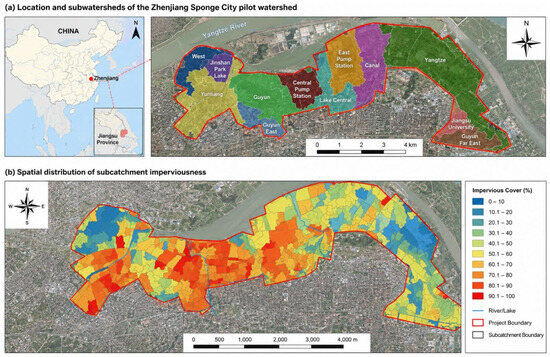
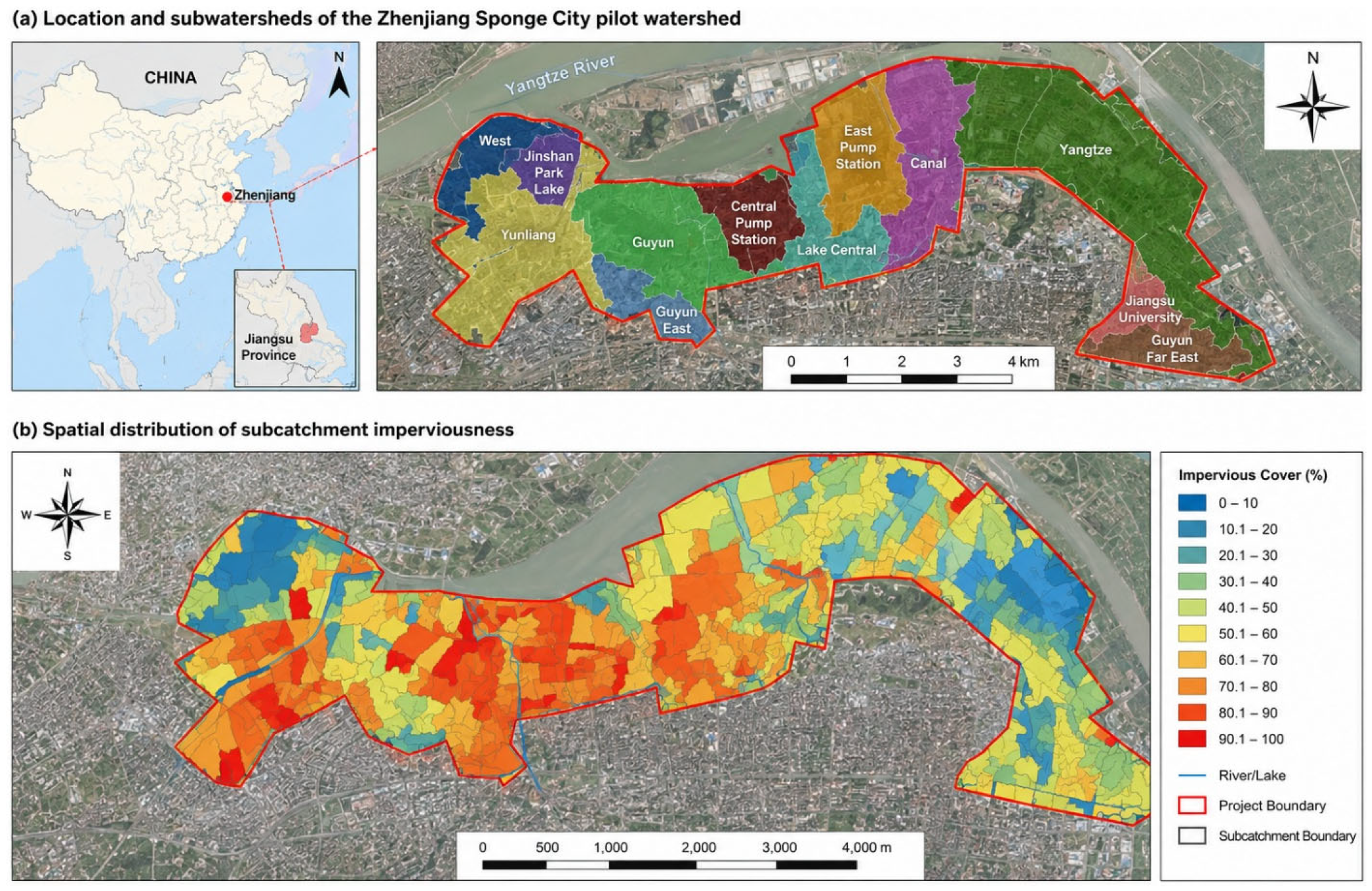
The watershed is highly urbanized, with approximately 63.3% impervious cover, consisting primarily of buildings (33.0%) and streets and sidewalks (30.3%). Imperviousness within individual subcatchments ranged from less than 10% to greater than 90%, with the highest values concentrated in the central and western portions of the watershed (Figure 1). Native-soil infiltration rates within representative retrofit areas were generally low, ranging from approximately 3.6 to 3.8 mm h−1, limiting natural infiltration and increasing runoff generation under wet-weather conditions.
Figure 1.
Study area and watershed characteristics of the Zhenjiang Sponge City pilot watershed. (a) Geographic location and subcatchmen delineation of the 29 km2 pilot watershed within Zhenjiang City, Jiangsu Province, China. (b) Spatial distribution of subcatchment imperviousness derived from GIS analysis. Watershed-average impervious cover is approximately 63.3%, and imperviousness varies substantially among individual subcatchments. The red boundary indicates the pilot watershed and colored polygons represent individual subcatchments. Geographic coordinates, north arrow, scale bar, and legend are provided for spatial reference.
Prior to retrofit implementation, many drainage facilities within the watershed were designed for approximately 1–3-year return-period storms, contributing to frequent localized flooding and drainage surcharging during intense rainfall events. In older combined sewer districts, excess wet-weather flow frequently exceeded interception and treatment capacity, resulting in CSOs that discharged untreated wastewater directly into Jinshan Lake and connected urban rivers, contributing to persistent receiving-water quality impairment. Retrofit implementation was further constrained by limited available green space, dense urban development, shallow groundwater conditions, aging underground utilities, and historical urban districts where conventional sewer separation and large-scale drainage expansion were difficult to implement.
2.2. Study Framework and Evidence Sources
This study adopted a retrospective engineering evaluation framework to assess the long-term performance of a watershed-scale hybrid green-gray retrofit system implemented within the Zhenjiang Sponge City pilot watershed. The evaluation focused on three performance dimensions: (1) the long-term hydraulic functionality of GSI facilities, (2) watershed-scale CSO reduction, and (3) receiving-water quality response following retrofit implementation.
Multiple lines of evidence were integrated to evaluate system performance at both facility and watershed scales. Facility-scale monitoring data, including hydraulic monitoring, infiltration testing, and water-quality measurements, were used to evaluate the long-term functionality of representative GSI facilities. Municipal operational records, including flooding reports, drainage system performance records, and CSO occurrence data, were used to assess watershed-scale operational outcomes before and after retrofit implementation. Long-term receiving-water monitoring data obtained from municipal environmental agencies were used to evaluate changes in water quality within Jinshan Lake and connected urban rivers.
To support the engineering interpretation of observed watershed responses, several modeling tools developed during the planning and implementation phases were also reviewed. The Storm Water Management Model (SWMM) was used to evaluate rainfall–runoff generation, drainage-system response, and the hydraulic performance of GSI practices. The Hydrologic Engineering Center River Analysis System (HEC-RAS) was used to assess hydraulic conditions within major drainage corridors and receiving waters. The Hydrological Simulation Program–FORTRAN (HSPF) was applied to estimate watershed-scale runoff and pollutant loading characteristics, while the Environmental Fluid Dynamics Code (EFDC) was used to evaluate hydrodynamic and water-quality responses within receiving-water bodies. These modeling results were not used as primary evidence but served as supporting analyses for the interpretation of observed field observations and operational records.
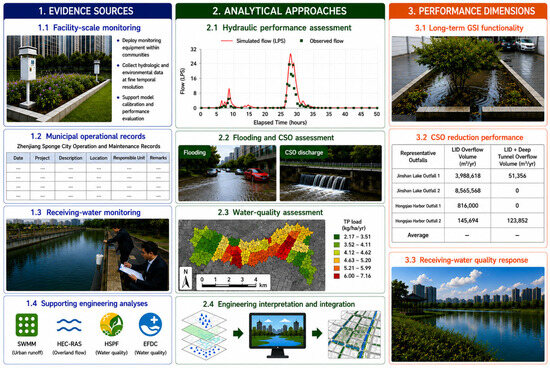
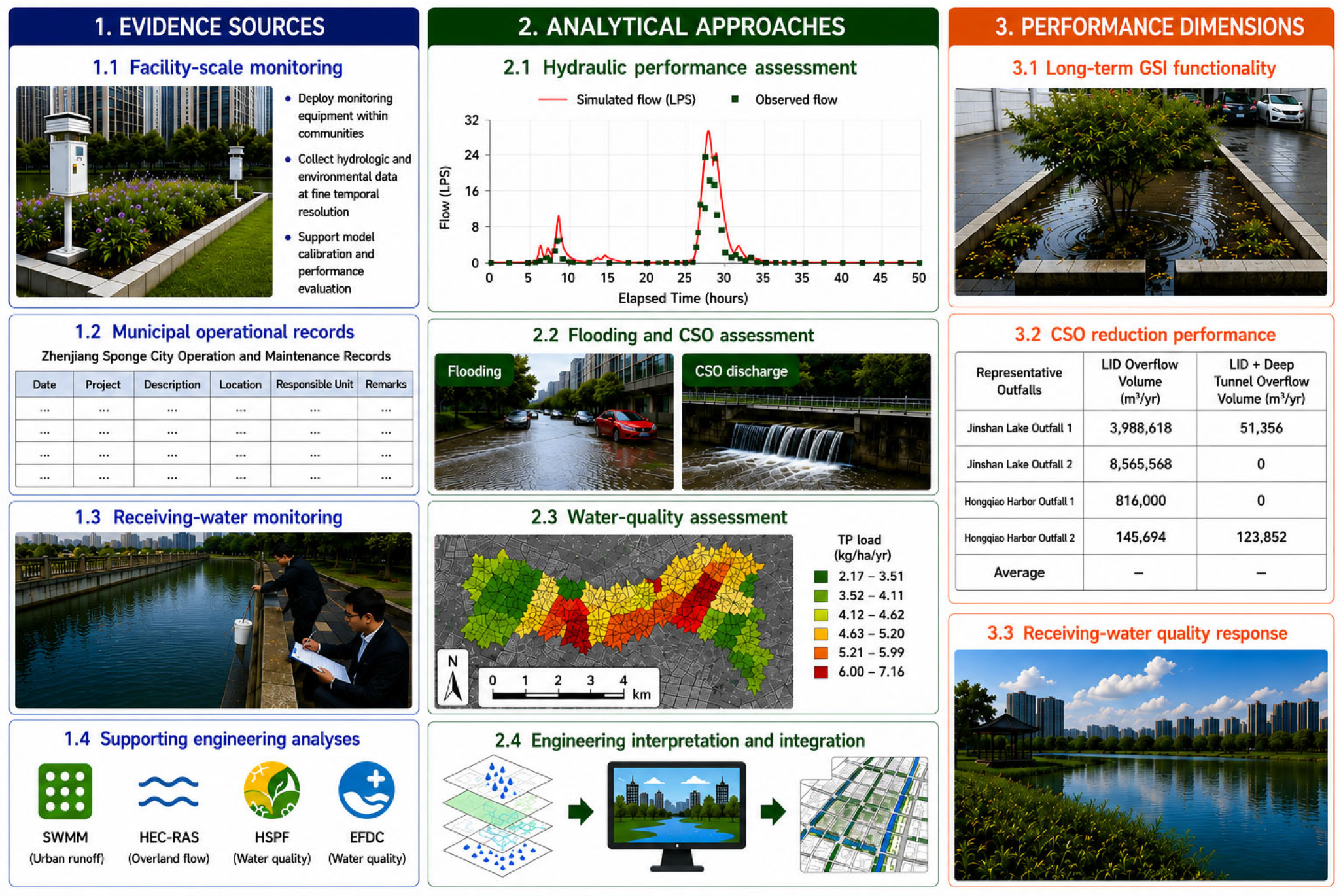
Figure 2 summarizes the relationships among monitoring programs, operational records, receiving-water monitoring, supporting engineering analyses, and performance indicators used in the retrospective evaluation framework.
Figure 2.
Integrated monitoring and evaluation framework for the Zhenjiang Sponge City Program. Multiple evidence sources were combined with hydraulic, flooding/combined sewer overflow (CSO), and water-quality assessments to evaluate long-term GSI functionality, CSO reduction performance, and receiving-water quality response.
2.3. Hybrid Green-Gray Retrofit Strategy
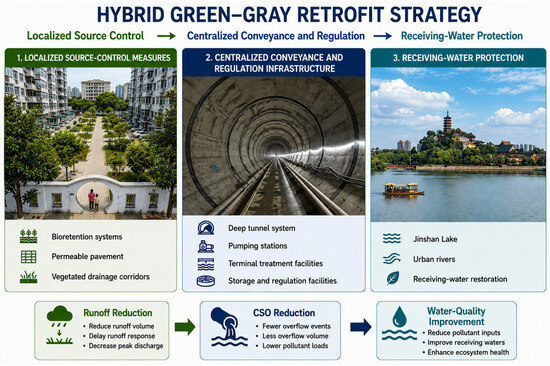
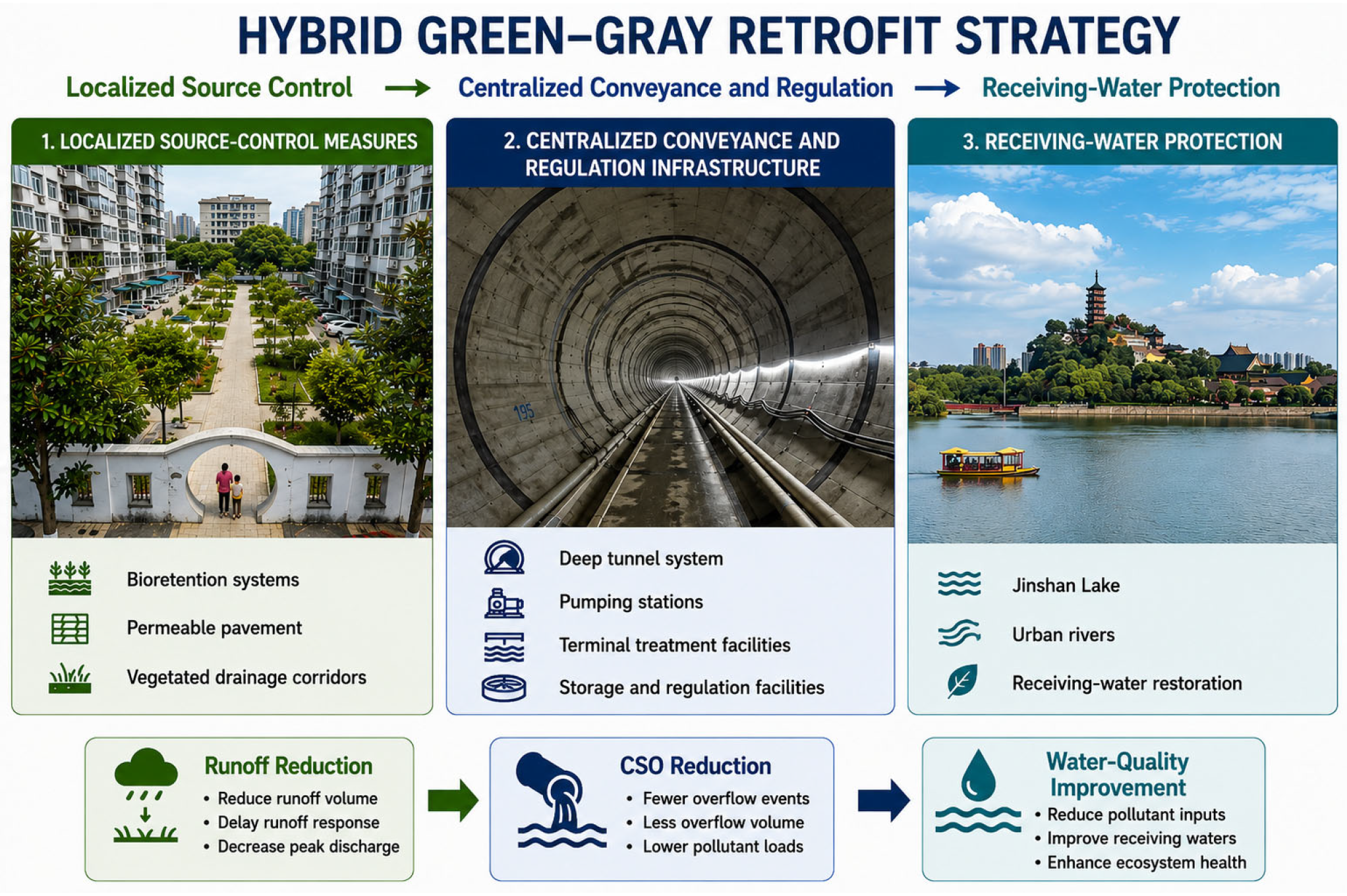
The hybrid green-gray retrofit strategy consisted of two complementary categories of interventions: (1) localized source-control measures and (2) centralized conveyance and regulation infrastructure (Figure 3). The primary objectives were to reduce stormwater inflow entering the combined sewer system, mitigate combined sewer overflows (CSOs), improve receiving-water quality, enhance drainage resilience under intense rainfall, and adapt stormwater management to highly constrained urban retrofit conditions.
Figure 3.
Hybrid green-gray retrofit strategy implemented in the Zhenjiang Sponge City pilot watershed. Localized source-control measures, including bioretention systems, permeable pavement, and vegetated drainage corridors, were used to reduce runoff generation and pollutant transport near runoff sources. Residual wet-weather flows were managed through centralized conveyance and regulation infrastructure, including the deep tunnel system, pumping stations, and terminal treatment facilities. Together, these complementary measures contributed to runoff reduction, CSO mitigation, and receiving-water protection within the watershed.
Localized source-control measures were represented by GSI systems, including bioretention systems, permeable interlocking concrete pavement (PICP), vegetated drainage corridors, underdrain systems, and subsurface storage facilities. These measures were implemented close to runoff sources and were designed to reduce runoff generation, delay peak discharge, and reduce pollutant transport before runoff entered the combined sewer network. Because native-soil infiltration capacity was often limited within the retrofit area, underdrain systems and interconnected gravel storage layers were widely incorporated to facilitate controlled drainage, prevent prolonged ponding, and provide additional temporary storage. PICP systems were implemented primarily within pedestrian walkways, parking areas, and low-speed transportation corridors, where permeable surface layers and subsurface aggregate storage provided temporary runoff detention, infiltration, and controlled release.
Centralized conveyance and regulation infrastructure consisted of the deep tunnel system, pumping stations, terminal treatment facilities, and drainage network upgrades. These facilities were designed to convey, regulate, store, and manage residual wet-weather flows that could not be controlled through localized source-control measures alone. The tunnel system serves approximately 8.75 km2 of dense historical urban districts where extensive surface-based retrofits and conventional sewer separation were difficult to implement because of limited available space, historical-preservation requirements, underground utility conflicts, and dense urban development. The system includes an approximately 6.2 km-long, 4 m in diameter deep tunnel that functions as an online conveyance and dynamic regulation system integrating conveyance, storage, pumping, treatment, and controlled discharge under different rainfall conditions.
For clarity, the term “engineering design process” refers to the planning and optimization stage during which retrofit alternatives were developed and evaluated using field investigations, community outreach, stakeholder consultation, and supporting modeling analyses. The term “retrofit implementation” refers to the subsequent construction and deployment of the selected measures within the watershed.
2.4. Engineering Design and Retrofit Implementation
The engineering design process combined field investigations, community outreach, stakeholder consultation, and iterative hydrologic modeling to evaluate alternative retrofit configurations and optimize system performance. Site investigations were conducted to identify flooding hotspots, drainage deficiencies, utility conflicts, and retrofit opportunities throughout the watershed.
Because many retrofit measures were implemented within existing residential communities and highly constrained urban districts, extensive community communication and stakeholder engagement formed an integral part of the design process. Community meetings, public consultations, and engineering reviews were undertaken to address concerns related to parking demand, public-space allocation, underground utilities, traffic circulation, commercial activities, and the preservation of existing neighborhood functions. Feedback obtained during the consultation process was incorporated into subsequent design revisions.
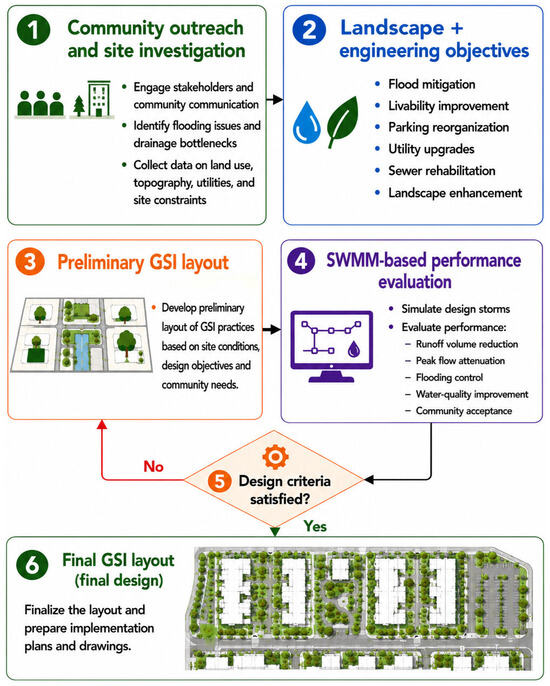
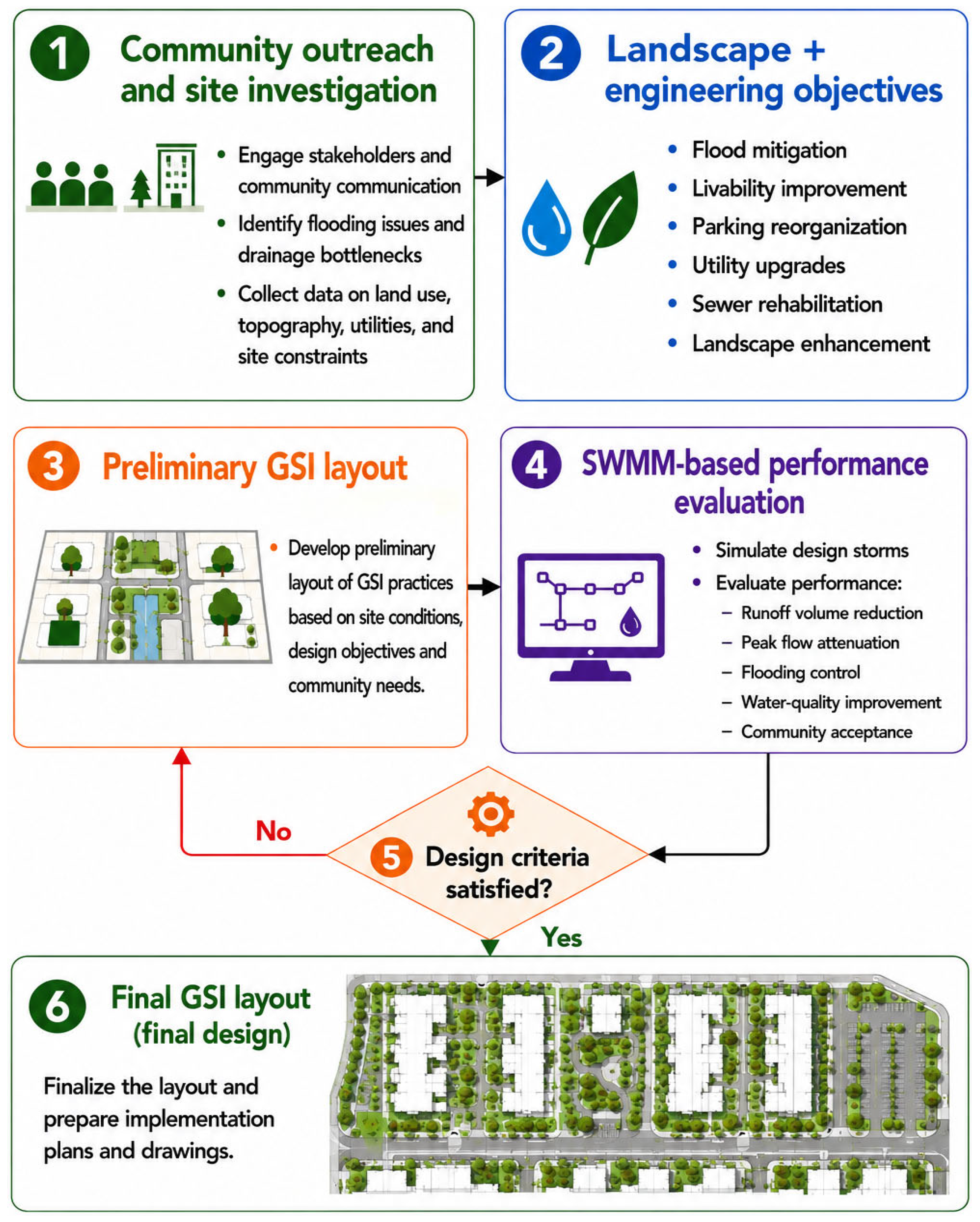
At the community scale, preliminary GSI layouts were developed based on site conditions, drainage characteristics, available space, and community requirements. SWMM-based hydrologic simulations were then used to evaluate runoff reduction, peak-flow attenuation, drainage performance, and compliance with project design criteria. Where hydraulic or community objectives were not achieved, retrofit layouts were modified and re-evaluated through additional consultation and simulation cycles. This iterative process continued until stormwater-management objectives, engineering feasibility requirements, and community needs were simultaneously satisfied. The final retrofit configuration therefore represented a balance among hydraulic performance, constructability, urban functionality, and stakeholder acceptance (Figure 4).
Figure 4.
Iterative GSI design workflow used for retrofit implementation in residential communities. The process integrates community outreach, site investigation, engineering objectives, preliminary GSI layout development, and SWMM-based performance evaluation. Design alternatives were iteratively refined until predefined performance criteria were satisfied, after which the final GSI layout was prepared for implementation.
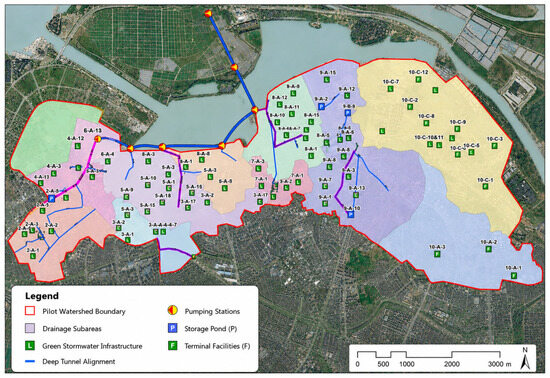
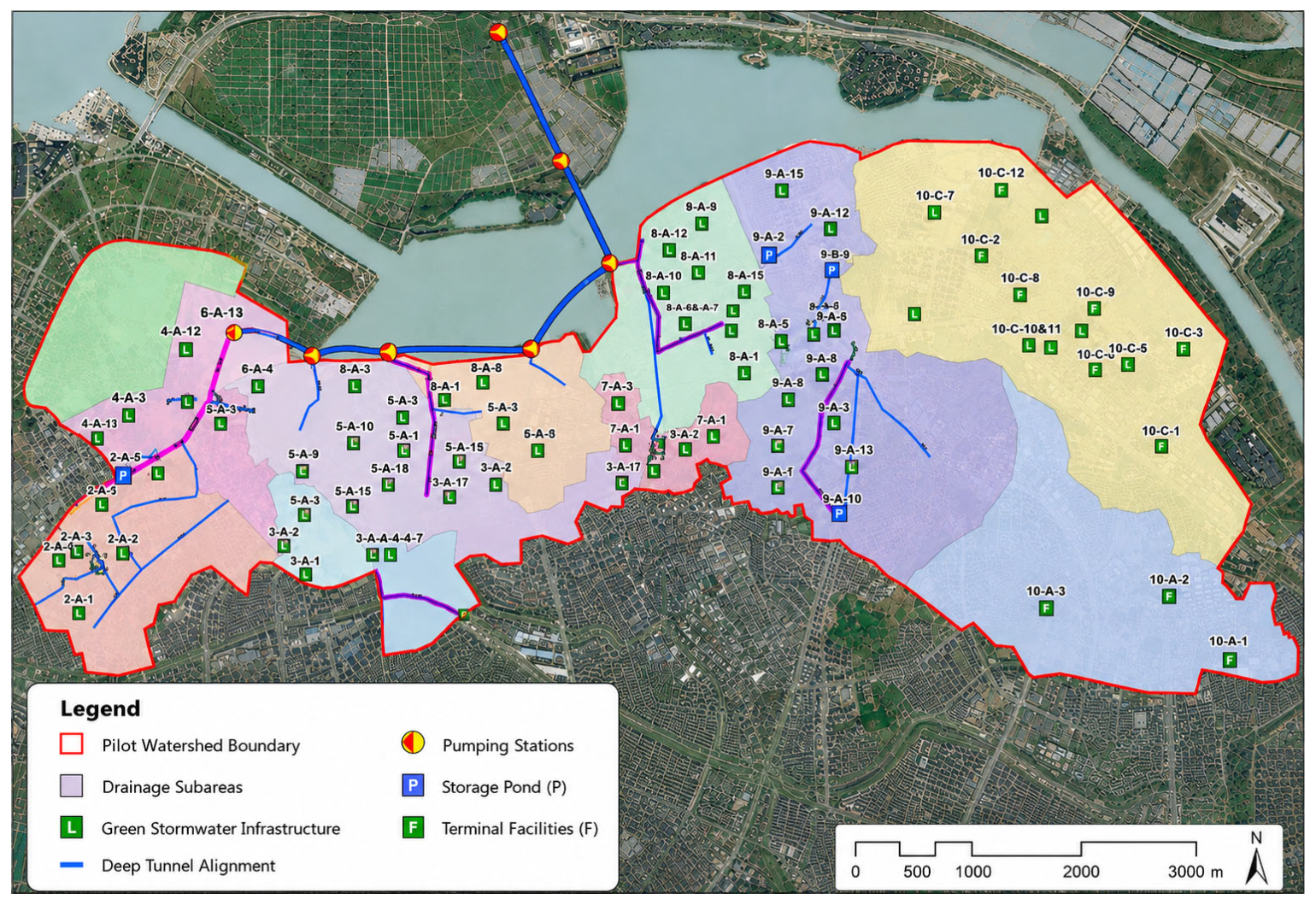
The centralized tunnel system primarily serves approximately 8.75 km2 of dense historical urban districts where extensive surface-based retrofits and conventional sewer separation were difficult to implement because of limited available space, historical preservation requirements, underground utility conflicts, and dense urban development (Figure 5). The final retrofit configuration was developed through the iterative evaluation of engineering feasibility, hydraulic performance, environmental benefits, and implementation constraints.
Figure 5.
Spatial distribution of retrofit interventions within the Zhenjiang Sponge City pilot watershed, including drainage subareas, localized green stormwater infrastructure (GSI), deep tunnel alignment, pumping stations, storage ponds, and terminal treatment facilities. The terminal treatment facilities are centralized stormwater detention–filtration systems located at the final discharge point of a subcatchment, providing regional-scale treatment of stormwater runoff before discharge into the receiving water.
2.5. Monitoring, Performance Assessment, and Supporting Analyses
The retrospective evaluation integrated multiple lines of evidence, including facility-scale hydraulic monitoring, water-quality monitoring, long-term infiltration testing, municipal operational records, receiving-water monitoring data, and supporting engineering analyses. These datasets were used to evaluate hydraulic functionality, pollutant removal performance, long-term durability, CSO reduction, and receiving-water quality response following the implementation of the hybrid green-gray retrofit strategy.
2.5.1. Hydraulic Monitoring
Continuous hydraulic monitoring was conducted from July 2016 to September 2017 within representative retrofit communities containing bioretention systems and permeable pavement facilities. Rainfall data were obtained from on-site tipping-bucket rain gauges and supplemented by municipal meteorological records when necessary. Rainfall and flow data were recorded at 5 min intervals. Runoff inflow was estimated using monitored rainfall data and contributing drainage areas, while underdrain discharge and overflow discharge were measured at facility outlets using flow-monitoring devices installed at representative monitoring locations.
Routine operational inspections were conducted throughout the monitoring period to verify sensor performance, identify potential equipment malfunctions, and confirm facility operating conditions. Hydraulic performance indicators included runoff retention, underdrain discharge volume, overflow occurrence, and runoff response timing.
2.5.2. Water-Quality Monitoring
Water-quality monitoring was conducted during seven rainfall events that generated measurable facility outflow between 2016 and 2017. Inflow runoff consisted of combined contributions from different land-use types, including road runoff, roof runoff, and direct rainfall. Outflow samples were collected from monitored discharge pathways, including underdrain discharge and overflow where applicable.
The measured parameters included total suspended solids (TSS), chemical oxygen demand (COD), ammonia nitrogen (NH3–N), and total phosphorus (TP). Flow-weighted mean concentrations were calculated across all monitored events. Pollutant loads were calculated according to:
where L is the pollutant load, C is pollutant concentration, and Q is runoff volume.
Pollutant removal efficiency was calculated based on mass reduction between inflow and outflow conditions:
where and represent inflow and outflow pollutant loads, respectively.
2.5.3. Long-Term Infiltration Assessment
Field infiltration testing was conducted in 2024 on representative GSI facilities located within three residential communities (Jianger, Chaoyang, and Huarun) that historically experienced frequent stormwater ponding prior to Sponge City implementation. A total of seven representative facilities were evaluated, including three bioretention systems, three permeable interlocking concrete pavement (PICP) systems, and one permeable asphalt pavement section.
Bioretention infiltration performance was evaluated using a standard double-ring infiltrometer. Permeable pavement systems were tested using a single-ring infiltrometer sealed to the pavement surface to prevent lateral leakage during testing. The permeable asphalt pavement section was included as a comparison because it represented an early retrofit practice within the pilot watershed.
The objective of the assessment was to evaluate the long-term hydraulic durability of different GSI systems after approximately 7–10 years of field operation under real urban conditions. Particular attention was given to the effects of long-term sediment accumulation and surface clogging on infiltration performance. Measured infiltration rates ranged from 85 to 200 mm h−1 for bioretention systems and 625 to 800 mm h−1 for permeable interlocking concrete pavement systems. In contrast, the permeable asphalt pavement exhibited infiltration rates below 20 mm h−1, indicating severe long-term clogging. These results were used to assess the long-term hydraulic functionality and operational durability of different retrofit technologies.
2.5.4. Watershed-Scale Assessment
Watershed-scale performance was evaluated using municipal operational records, historical flooding records, CSO statistics, and official receiving-water monitoring data collected by the Zhenjiang Ecological Environment Bureau. Receiving-water datasets included Sponge City acceptance monitoring conducted in 2018 and routine monitoring data from national surface-water monitoring sections between 2021 and 2026. Monitoring locations included Jinshan Lake and the associated Yunliang River, Guyun River, and Hongqiaogang River systems. These datasets were used to assess changes in flooding occurrence, CSO frequency, and receiving-water quality following implementation of the hybrid retrofit strategy.
2.5.5. Supporting Engineering Analyses
Supporting engineering analyses were conducted during planning, design optimization, and performance assessment. The U.S. Environmental Protection Agency Storm Water Management Model (SWMM) was used to simulate rainfall–runoff generation, drainage network hydraulics, peak-flow attenuation, runoff delay, and the performance of GSI retrofits at community and watershed scales. The Hydrologic Engineering Center River Analysis System (HEC-RAS) was used to evaluate hydraulic conveyance and flood-routing performance within major drainage corridors and receiving-water systems. The Hydrological Simulation Program–FORTRAN (HSPF) was applied to assess watershed-scale runoff generation and pollutant loading, while the Environmental Fluid Dynamics Code (EFDC) was used to evaluate hydrodynamic processes and receiving-water quality responses within Jinshan Lake and connected river systems.
Because this study focuses on the retrospective evaluation of full-scale implementation outcomes rather than model development, detailed model configurations and calibration procedures are not presented herein. Model outputs were used primarily to support engineering design, alternative evaluation, and interpretation of watershed-scale responses, while observed monitoring data and operational records remain the primary evidence used to evaluate long-term retrofit performance.
3. Results
3.1. Long-Term Hydraulic Functionality of GSI Facilities
Long-term monitoring and field observations demonstrated the sustained hydraulic functionality of GSI facilities following full-scale implementation within highly constrained urban communities. Continuous hydraulic monitoring conducted between July 2016 and September 2017 indicated high runoff retention performance, with monitored facilities retaining approximately 95–99% of estimated inflow runoff through combined infiltration, storage, evapotranspiration, and delayed underdrain discharge processes. Overflow occurrence remained limited during monitored rainfall events despite frequent intense storms.
Field investigations conducted in 2024 further demonstrated sustained hydraulic durability after approximately 7–10 years of operation. Approximately 90% of the monitored bioretention facilities maintained effective infiltration rates greater than 80 mm h−1. Permeable interlocking concrete pavement (PICP) systems maintained infiltration capacities approaching 600 mm h−1 despite partial surface clogging and long-term exposure to urban runoff. The observed long-term functionality was supported by engineered media, underdrain systems, and interconnected gravel storage layers that maintained effective drainage and temporary runoff detention under low native-soil permeability conditions.
Overall, the results indicate that GSI facilities remained hydraulically functional after long-term operation and continued to provide effective runoff retention and flow regulation within highly urbanized retrofit environments.
3.2. Pollutant Removal Performance
Water-quality monitoring conducted during seven rainfall events demonstrated substantial pollutant reduction performance under representative urban runoff conditions. Flow-weighted mean inflow and outflow concentrations were calculated across the seven monitored rainfall events (n = 7), and pollutant-load reductions remained consistently high for suspended solids, organic matter, nutrients, and ammonia (Table 1).
Table 1.
Representative pollutant concentration and load reduction performance of monitored GSI facilities.
The monitored GSI facilities achieved pollutant-load reductions of 97.95% for TSS, 98.39% for COD, 98.72% for NH3–N, and 99.35% for TP. These results indicate that source-control measures effectively reduced pollutant transport before runoff entered the combined sewer system and receiving waters.
The combination of high runoff retention and substantial pollutant reduction demonstrates that GSI facilities provided both hydraulic and water-quality benefits within the retrofit watershed.
3.3. Watershed-Scale CSO Reduction
Implementation of the hybrid green-gray retrofit strategy substantially reduced CSO occurrence throughout the pilot watershed. Municipal operational records indicated that annual overflow occurrence at major outfall locations decreased from a combined average of 318 overflow events before retrofit implementation to 24 events after implementation, representing an overall reduction of approximately 92.5% (Table 2).
Table 2.
Changes in annual combined sewer overflow occurrence at major outfall locations before and after implementation of the hybrid green-gray retrofit strategy.
The largest reduction was observed at Jinshan Lake, where annual overflow occurrence decreased from eighty-six events to four events. Similar reductions were observed at the Ancient Canal, Yunliang River, and Hongqiaogang River outfalls, with individual reductions ranging from 90.6% to 95.3%. These findings indicate a substantial decrease in direct wet-weather discharge to receiving waters throughout the watershed.
Field observations further indicated reduced sewer surcharge occurrence and improved operational stability within several historically flood-prone combined sewer districts following retrofit implementation. The observed reductions demonstrate the long-term effectiveness of the integrated retrofit strategy in mitigating CSO occurrence within highly constrained urban environments.
3.4. Receiving-Water Quality Response
Official receiving-water monitoring records indicated generally stable post-retrofit water-quality conditions within the watershed. Monitoring data from Sponge City acceptance assessments conducted in 2018 and national surface-water monitoring sections between 2021 and 2026 demonstrated sustained improvement in receiving-water conditions following implementation of the hybrid retrofit strategy.
At the Yunliang River provincial monitoring section, Class I–II conditions accounted for 59.1% of the monitored days, while Class III conditions accounted for an additional 15.6% (Table 3). Collectively, Class III or better water-quality conditions were maintained during approximately 74.7% of the monitored days throughout the monitoring period. More degraded conditions occurred less frequently, with Class IV, Class V, and Inferior Class V conditions accounting for 9.2%, 2.4%, and 7.7% of the monitored days, respectively.
Table 3.
Water-quality category distribution for the Yunliang River provincial monitoring section during 2021–2026.
Receiving-water assessments conducted during Sponge City acceptance further indicated that Jinshan Lake, Yunliang River, Guyun River, and Hongqiaogang River achieved Surface Water Class III standards following retrofit implementation. The long-term monitoring records therefore indicate sustained receiving-water improvement following the large-scale implementation of the hybrid green-gray retrofit strategy.
3.5. Broader Urban Adaptation Benefits
In addition to hydraulic and water-quality improvements, the retrofit program generated broader urban adaptation and community benefits. Prior to implementation, many residential communities were characterized by aging infrastructure, deteriorated public spaces, poor drainage conditions, and frequent surface ponding during rainfall events.
The retrofit strategy combined stormwater-management measures with upgrades to roads, drainage systems, pedestrian facilities, landscaping, and public spaces. Independent social-performance assessments conducted by Peking University during Sponge City implementation reported improved resident satisfaction regarding drainage performance, neighborhood environmental quality, pedestrian accessibility, public-space quality, and overall livability within retrofit communities [37,38]. Field observations and post-retrofit evaluations further indicated increased utilization of public open spaces and improved neighborhood environmental conditions following implementation [37,38].
The social assessments also highlighted implementation challenges relevant to large-scale urban retrofits, including conflicts between parking demand and public-space allocation, the need for long-term maintenance, and the importance of community participation during planning and implementation [37,38]. These findings suggest that hybrid Sponge City retrofits can provide broader urban-regeneration and climate-adaptation benefits beyond stormwater management alone.
4. Discussion
4.1. GSI Performance Under Low-Permeability and Shallow Groundwater Conditions
A common challenge associated with GSI implementation is the presence of low-permeability soils, shallow groundwater conditions, and dense underground utilities, all of which can limit the effectiveness of conventional infiltration-based designs. As a result, many cities either avoid large-scale GSI implementation or experience difficulties achieving expected hydraulic performance under constrained urban conditions.
The results from Zhenjiang suggest that effective GSI implementation does not necessarily depend on high native-soil infiltration capacity. Instead, the retrofit strategy relied on highly porous engineered bioretention media, underdrain systems, and interconnected gravel storage layers to provide temporary runoff storage, controlled drainage, and pollutant treatment. Rather than requiring captured runoff to infiltrate completely into native soils within 24–48 h, as commonly assumed in conventional bioretention designs, the system functioned as an engineered detention–filtration system in which runoff was temporarily stored within the media and gradually released through underdrains.
This design philosophy differs fundamentally from conventional infiltration-dominated approaches. By decoupling hydraulic performance from native-soil infiltration capacity, the system was able to maintain effective runoff retention, peak-flow attenuation, and pollutant removal even under low-permeability conditions. During small and moderate rainfall events, a substantial proportion of runoff was temporarily retained within the engineered media, thereby reducing downstream runoff volumes and increasing contact time between stormwater and treatment media. This extended retention period likely contributed to the high pollutant-removal efficiencies observed for TSS, COD, NH3–N, and TP.
However, the pollutant-removal performance observed in the monitored facilities cannot be attributed solely to hydraulic residence time. Conventional bioretention systems often rely on prolonged infiltration through native soils to enhance pollutant attenuation. In contrast, the Zhenjiang retrofit strategy utilized highly porous engineered treatment media designed to provide filtration, adsorption, and biogeochemical treatment functions while maintaining high hydraulic conductivity. Previous studies have demonstrated that engineered sorptive media, including water-treatment residual amendments and other phosphorus-sorbing materials, can substantially enhance pollutant removal without compromising hydraulic performance [39,40]. Consequently, pollutant removal in this present study was achieved through a combination of temporary storage, physical filtration, media adsorption, and biological processes rather than relying exclusively on prolonged infiltration through native soils.
The long-term monitoring results further support the robustness of this approach. After approximately 7–10 years of operation, most monitored facilities continued to maintain effective infiltration and drainage performance, while permeable pavement systems retained high hydraulic conductivity despite partial surface clogging. These findings suggest that engineered-media systems with controlled drainage may provide a practical alternative for implementing GSI in cities where conventional infiltration-based approaches are constrained by hydrogeological conditions. These findings are consistent with previous studies reporting the benefits of engineered-media bioretention systems and controlled-drainage designs, while extending existing knowledge by demonstrating sustained hydraulic performance under full-scale operation for approximately 7–10 years.
4.2. Linking Facility-Scale Performance to Watershed-Scale Outcomes
One of the challenges in evaluating large-scale stormwater retrofits is linking facility-scale performance to watershed-scale environmental outcomes. Most published GSI studies focus primarily on individual facilities or small experimental catchments and typically evaluate runoff reduction, infiltration, or pollutant removal at the facility scale. In contrast, this present study combined facility-scale monitoring, long-term infiltration assessments, municipal operational records, CSO statistics, and official receiving-water monitoring data to evaluate watershed-scale outcomes following the full-scale implementation of a hybrid green-gray retrofit strategy.
The monitored GSI facilities were located within representative residential communities, which occupy a substantial proportion of the pilot watershed and constitute important sources of both runoff and pollutant loading. In addition to roof runoff, road runoff, and community-generated stormwater, field investigations identified various forms of illicit connections and gray water discharges from residential areas, including laundry wastewater and kitchen wastewater entering stormwater drainage systems. Consequently, residential communities represented both a major source of wet-weather flow entering the combined sewer system and an important source of pollutant loading to the receiving water.
The observed runoff retention rates of 95–99% therefore have implications beyond facility-scale hydraulic performance. By capturing and temporarily storing stormwater close to its source, GSI facilities reduced both runoff volumes and pollutant transport entering the drainage network. Delayed underdrain discharge and temporary storage within engineered media further reduced peak-flow loading on downstream sewer infrastructure. Collectively, these processes reduced sewer surcharge conditions, overflow occurrence, and the transport of untreated pollutants to receiving waters.
At the same time, this present study did not attempt strict quantitative attribution of watershed-scale improvements to individual retrofit components. GSI facilities, drainage upgrades, and centralized tunnel infrastructure were implemented as an integrated hybrid retrofit strategy, making complete separation of their individual contributions difficult. This limitation is common in retrospective evaluations of full-scale urban retrofits where multiple interventions are implemented simultaneously. Nevertheless, multiple independent lines of evidence—including facility-scale monitoring, long-term infiltration assessments, municipal operational records, CSO statistics, and official receiving-water monitoring data—showed consistent post-retrofit improvements. The convergence of these independent datasets increases confidence that the observed reductions in CSO occurrence and improvements in receiving-water conditions were associated with the implementation of the integrated hybrid green-gray retrofit strategy.
Supporting engineering analyses further suggest that the observed watershed-scale improvements were not attributable to a single intervention. Simulated retrofit scenarios indicated that source-control GSI measures alone reduced CSO frequency and overflow volume substantially, while integration with the centralized tunnel system produced additional reductions in both overflow occurrence and discharge volume (Table 4). These findings support the interpretation that watershed-scale performance improvements resulted from complementary interactions between runoff reduction at the source and downstream conveyance, storage, and regulation capacity. Rather than functioning as independent measures, the green and gray components operated as an integrated system in which source-control measures reduced inflow to the sewer network while centralized infrastructure managed residual wet-weather flows that could not be controlled at the source.
Table 4.
Model-supported comparison of combined sewer overflow reductions under alternative retrofit scenarios.
4.3. Transferability, Limitations, and Engineering Implications
The findings of this study have implications for other cities seeking to reduce CSOs and improve receiving-water quality under highly constrained urban conditions. The study area is characterized by low native-soil permeability, shallow groundwater conditions, dense development, aging combined sewer infrastructure, and limited opportunities for conventional sewer separation. Similar constraints are common in many older urban districts worldwide, particularly in cities where extensive reconstruction of underground infrastructure is economically prohibitive or operationally disruptive.
A key implication of the Zhenjiang experience is that successful GSI implementation does not necessarily require favorable infiltration conditions. The use of highly porous engineered media, controlled underdrain systems, and distributed storage layers enabled effective runoff retention, peak-flow attenuation, and pollutant removal despite unfavorable hydrogeological conditions. Consequently, the hybrid approach may be particularly applicable to older combined sewer districts where conventional sewer separation is constrained by space limitations, utility conflicts, historical preservation requirements, or high implementation costs.
Several limitations should also be acknowledged. Facility-scale hydraulic monitoring was conducted between 2016 and 2017, and water-quality monitoring was based on seven monitored rainfall events. Watershed-scale evaluations relied partly on municipal operational records and official monitoring datasets rather than continuous watershed-wide instrumentation. In addition, multiple retrofit measures were implemented concurrently, preventing the strict attribution of observed improvements to individual components. Although these limitations introduce uncertainty, the consistency among facility-scale monitoring results, long-term infiltration assessments, operational records, CSO statistics, and receiving-water monitoring data provides multiple independent lines of evidence supporting the reported outcomes.
Future research should focus on establishing standardized long-term monitoring frameworks capable of linking facility-scale GSI performance, sewer-system operation, CSO occurrence, and receiving-water responses under real-world operating conditions. Such datasets would improve the understanding of long-term system behavior and strengthen the quantitative attribution of watershed-scale outcomes to individual retrofit interventions.
5. Conclusions
This study presented a retrospective evaluation of a hybrid green-gray retrofit strategy implemented within the 29 km2 Zhenjiang Sponge City pilot watershed, China. The study addressed the question of whether integrated source-control GSI measures and centralized tunnel infrastructure can effectively reduce CSOs and improve receiving-water quality within dense urban combined sewer watersheds characterized by limited available space, shallow groundwater conditions, low native-soil permeability, and aging drainage infrastructure.
The results demonstrated that the long-term hydraulic functionality of GSI facilities can be maintained under highly constrained urban conditions. Approximately 90% of the monitored bioretention facilities maintained an effective infiltration rate exceeding 80 mm h−1 after 7–10 years of operation, while permeable pavement systems maintained infiltration capacities approaching 600 mm h−1 despite partial surface clogging. These findings indicate that engineered-media systems with controlled drainage can provide effective stormwater management even where conventional infiltration-based approaches are constrained by unfavorable hydrogeological conditions.
Facility-scale monitoring further demonstrated high runoff retention and pollutant-removal performance, which translated into measurable watershed-scale benefits. The annual CSO occurrence at major outfalls decreased from 318 events before retrofit implementation to 24 events after implementation, representing an overall reduction of approximately 92.5%. Official monitoring records further indicated sustained improvement in receiving-water conditions, with Class III or better water quality achieved during approximately 74.7% of monitored days at the provincial monitoring section.
The findings highlight the complementary roles of source-control GSI measures and centralized tunnel infrastructure within highly urbanized combined sewer watersheds. Rather than relying exclusively on conventional sewer separation or individual stormwater-control measures, the hybrid strategy combined runoff reduction at the source with downstream conveyance, storage, and regulation capacity to achieve substantial reductions in CSO occurrence and pollutant discharge.
Overall, this study provides rare long-term engineering evidence demonstrating that hybrid green-gray retrofit strategies can simultaneously improve stormwater management, reduce CSOs, and enhance receiving-water quality within highly constrained existing urban districts. The findings contribute practical engineering evidence supporting the use of hybrid green-gray retrofit strategies for CSO mitigation, receiving-water protection, and climate adaptation in highly constrained urban watersheds worldwide.
Author Contributions
Z.X.: Writing—original draft, Conceptualization, Methodology, Experimental investigation, Data curation, Visualization. D.L.: Supervision, Project administration, Resources, Funding acquisition, Writing—review and editing. N.S.: Methodology, Validation, Formal analysis, Writing—review and editing. K.Z.: Software, Methodology, Validation, Writing—review and editing. Y.C.: Conceptualization, Resources, Investigation, Writing—review and editing. W.Z.: Software, Data analysis, Theoretical modeling, Visualization. All authors have read and agreed to the published version of the manuscript.
Funding
National Natural Science Foundation of China (No. 52078418), Key R&D Plan of Shaanxi Province (2024SF-YBXM-537), Joint Research Center for Future Urban Construction and Management Innovation (20211177-ZKT14), four main Shaanxi bodies and one united Soil Engineering Technology Research Center (2022ZY2-CXJD-09), basic research business fee of Xi’an Jiaotong University (xzd012022071), Science and Technology Project of Yulin (CityCXY-2020-046), Zhuhai Science and Technology Plan in the Social Development Field (2220004000273 and 2420004000113).
Data Availability Statement
The data presented in this study are available on request from the corresponding author. The data are not publicly available due to privacy and confidentiality re-strictions, as some datasets include non-public municipal operational records, project monitoring information, and community investigation data that cannot be openly disclosed.
Acknowledgments
The authors acknowledge the technical support from editors.
Conflicts of Interest
Authors Kang Zhou and Weimin Zhou are employed by the company Zhuhai Qingchuang Smart Sponge City Technology Research Institute, Zhuhai, China. The remaining authors declare that the research was conducted in the absence of any commercial or financial relationships that could be construed as a potential conflict of interest.
Abbreviations
The following abbreviations are used in this manuscript:
| CSOs | Combined sewer overflows |
| GSI | Green stormwater infrastructure |
| LID | Low Impact Development |
| NbS | Nature-based solutions |
| SCM | Stormwater Control Measures |
| SuDS | Sustainable Drainage Systems |
References
- IPCC. Climate Change 2021: The Physical Science Basis; Cambridge University Press: Cambridge, UK, 2021. [Google Scholar] [CrossRef] [Scilit]
- UN-Habitat. World Cities Report 2022: Envisaging the Future of Cities; United Nations Human Settlements Programme: Nairobi, Kenya, 2022. [Google Scholar]
- Semadeni-Davies, A.; Hernebring, C.; Svensson, G.; Gustafsson, L.-G. The impacts of climate change and urbanisation on drainage in Helsingborg, Sweden: Combined sewer system. J. Hydrol. 2008, 350, 100–113. [Google Scholar] [CrossRef] [Scilit]
- Hemmati, M.; Kornhuber, K.; Kruczkiewicz, A. Enhanced urban adaptation efforts needed to counter rising extreme rainfall risks. npj Urban Sustain. 2022, 2, 16. [Google Scholar] [CrossRef] [Scilit]
- Miller, J.D.; Hutchins, M. The impacts of urbanisation and climate change on urban flooding and urban water quality: A review of the evidence concerning the United Kingdom. J. Hydrol. Reg. Stud. 2017, 12, 345–362. [Google Scholar] [CrossRef] [Scilit]
- Zhou, Q.; Leng, G.; Su, J.; Ren, Y. Comparison of urbanization and climate change impacts on urban flood volumes: Importance of urban planning and drainage adaptation. Sci. Total Environ. 2019, 658, 24–33. [Google Scholar] [CrossRef] [Scilit] [PubMed]
- U.S. Environmental Protection Agency. Combined Sewer Overflows Guidance for Long-Term Control Plan; EPA 832-B-95-002; U.S. EPA: Washington, DC, USA, 1995.
- Field, R.; Sullivan, D.; Tafuri, A.N. Management of Combined Sewer Overflows; CRC Press: Boca Raton, FL, USA, 2003. [Google Scholar] [CrossRef] [Scilit]
- Butler, D.; Davies, J.W. Urban Drainage, 3rd ed.; CRC Press: Boca Raton, FL, USA, 2011. [Google Scholar]
- Walsh, C.J.; Roy, A.H.; Feminella, J.W.; Cottingham, P.D.; Groffman, P.M.; Morgan, R.P. The urban stream syndrome: Current knowledge and the search for a cure. J. N. Am. Benthol. Soc. 2005, 24, 706–723. [Google Scholar] [CrossRef]
- Petrie, B. A review of combined sewer overflows as a source of wastewater-derived emerging contaminants in the environment and their management. Environ. Sci. Pollut. Res. 2021, 28, 32095–32110. [Google Scholar] [CrossRef] [Scilit] [PubMed]
- Deletic, A. The first flush load of urban surface runoff. Water Res. 1998, 32, 2462–2470. [Google Scholar] [CrossRef] [Scilit]
- Lee, J.H.; Bang, K.W.; Ketchum, L.H.; Choe, J.S.; Yu, M.J. First flush analysis of urban storm runoff. Sci. Total Environ. 2002, 293, 163–175. [Google Scholar] [CrossRef] [Scilit] [PubMed]
- Copeland, C. Green Infrastructure and Issues in Managing Urban Stormwater; Congressional Research Service Report R43131; Congressional Research Service: Washington, DC, USA, 2014.
- New Jersey Department of Environmental Protection. Evaluating Green Infrastructure: A Combined Sewer Overflow Control Alternative for Long-Term Control Plans; NJDEP: Trenton, NJ, USA, 2018.
- Fletcher, T.D.; Shuster, W.; Hunt, W.F.; Ashley, R.; Butler, D.; Arthur, S.; Trowsdale, S.; Barraud, S.; Semadeni-Davies, A.; Bertrand-Krajewski, J.-L.; et al. SUDS, LID, BMPs, WSUD and more: The evolution and application of terminology surrounding urban drainage. Urban Water J. 2015, 12, 525–542. [Google Scholar] [CrossRef] [Scilit]
- Burns, M.J.; Fletcher, T.D.; Walsh, C.J.; Ladson, A.R.; Hatt, B.E. Hydrologic shortcomings of conventional urban stormwater management and opportunities for reform. Landsc. Urban Plan. 2012, 105, 230–240. [Google Scholar] [CrossRef] [Scilit]
- Ahiablame, L.M.; Engel, B.A.; Chaubey, I. Effectiveness of low impact development practices: Literature review and suggestions for future research. Water Air Soil Pollut. 2012, 223, 4253–4273. [Google Scholar] [CrossRef] [Scilit]
- Eckart, K.; McPhee, Z.; Bolisetti, T. Performance and implementation of low impact development: A review. Sci. Total Environ. 2017, 607–608, 413–432. [Google Scholar] [CrossRef] [Scilit] [PubMed]
- Davis, A.P.; Hunt, W.F.; Traver, R.G.; Clar, M. Bioretention technology: Overview of current practice and future needs. J. Environ. Eng. 2009, 135, 109–117. [Google Scholar] [CrossRef] [Scilit]
- Hunt, W.F.; Davis, A.P.; Traver, R.G. Meeting hydrologic and water quality goals through targeted bioretention design. J. Environ. Eng. 2012, 138, 698–707. [Google Scholar] [CrossRef] [Scilit]
- LeFevre, G.H.; Paus, K.H.; Natarajan, P.; Gulliver, J.S.; Novak, P.J.; Hozalski, R.M. Review of dissolved pollutants in urban storm water and their removal and fate in bioretention cells. J. Environ. Eng. 2015, 141, 04014050. [Google Scholar] [CrossRef] [Scilit]
- Bean, E.Z.; Hunt, W.F.; Bidelspach, D.A. Field survey of permeable pavement surface infiltration rates. J. Irrig. Drain. Eng. 2007, 133, 249–255. [Google Scholar] [CrossRef] [Scilit]
- Dietz, M.E. Low impact development practices: A review of current research and recommendations for future directions. Water Air Soil Pollut. 2007, 186, 351–363. [Google Scholar] [CrossRef] [Scilit]
- Winston, R.J.; Hunt, W.F.; Kennedy, S.G.; Wright, J.D.; Lauffer, M.S. Field evaluation of stormwater control measures for highway runoff treatment. J. Environ. Eng. 2012, 138, 101–111. [Google Scholar] [CrossRef] [Scilit]
- Meerow, S.; Newell, J.P. Urban resilience for whom, what, when, where, and why? Urban Geogr. 2019, 40, 309–329. [Google Scholar] [CrossRef] [Scilit]
- Raymond, C.M.; Frantzeskaki, N.; Kabisch, N.; Berry, P.; Breil, M.; Nita, M.R.; Geneletti, D.; Calfapietra, C. A framework for assessing and implementing the co-benefits of nature-based solutions in urban areas. Environ. Sci. Policy 2017, 77, 15–24. [Google Scholar] [CrossRef] [Scilit]
- Kabisch, N.; Korn, H.; Stadler, J.; Bonn, A. (Eds.) Nature-Based Solutions to Climate Change Adaptation in Urban Areas; Springer: Cham, Switzerland, 2017. [Google Scholar] [CrossRef] [Scilit]
- Philadelphia Water Department. Green City, Clean Waters: The City of Philadelphia’s Program for Combined Sewer Overflow Control; Philadelphia Water Department: Philadelphia, PA, USA, 2011.
- New York City Department of Environmental Protection. NYC Green Infrastructure Plan: A Sustainable Strategy for Clean Waterways; NYCDEP: New York, NY, USA, 2010.
- Roy, A.H.; Wenger, S.J.; Fletcher, T.D.; Walsh, C.J.; Ladson, A.R.; Shuster, W.D.; Thurston, H.W.; Brown, R.R. Impediments and solutions to sustainable, watershed-scale urban stormwater management: Lessons from Australia and the United States. Environ. Manag. 2008, 42, 344–359. [Google Scholar] [CrossRef] [Scilit] [PubMed]
- Eckart, K.; McPhee, Z.; Bolisetti, T. Multiobjective optimization of low impact development stormwater controls. J. Hydrol. 2018, 562, 564–576. [Google Scholar] [CrossRef] [Scilit]
- Winston, R.J.; Dorsey, J.D.; Smolek, A.P.; Hunt, W.F. Hydrologic performance of four permeable pavement systems constructed over low-permeability soils in Northeast Ohio. J. Hydrol. Eng. 2018, 23, 04018007. [Google Scholar] [CrossRef] [Scilit]
- Lucke, T.; Jaeger, R.; Dierkes, C.; Boogaard, F. Investigation into the long-term stormwater pollution removal efficiency of bioretention systems. Water Sci. Technol. 2017, 76, 2133–2139. [Google Scholar] [CrossRef] [Scilit] [PubMed]
- Winston, R.J.; Dorsey, J.D.; Hunt, W.F. Quantifying volume reduction and peak flow mitigation for three bioretention cells in clay soils in northeast Ohio. Sci. Total Environ. 2016, 553, 83–95. [Google Scholar] [CrossRef] [Scilit] [PubMed]
- U.S. Environmental Protection Agency. Integrated Municipal Stormwater and Wastewater Planning Approach Framework; U.S. EPA: Washington, DC, USA, 2012.
- Li, F. Social Performance Assessment of Residential Projects in Sponge City in Perspective of Urban Regeneration. Master’s Thesis, Peking University, Beijing, China, 2017. [Google Scholar]
- Shen, Y. Social Performance Assessment of Residential Projects in Sponge City Pilot City: Case Studies of Jianger Community and Huawu Community in Zhenjiang. Master’s Thesis, Peking University, Beijing, China, 2016. [Google Scholar]
- Marvin, J.T.; Passeport, E.; Hunt, W.F. State-of-the-Art Review of Phosphorus Sorption Amendments in Bioretention Media. J. Sustain. Water Built Environ. 2020, 6, 03119001. [Google Scholar] [CrossRef] [Scilit]
- Ament, M.R.; Erickson, A.J.; Gulliver, J.S. Balancing Hydraulic Control and Phosphorus Removal in Bioretention Media Amended with Drinking Water Treatment Residuals. J. Sustain. Water Built Environ. 2022, 8, 04022001. [Google Scholar] [CrossRef] [Scilit]

Disclaimer/Publisher’s Note: The statements, opinions and data contained in all publications are solely those of the individual author(s) and contributor(s) and not of MDPI and/or the editor(s). MDPI and/or the editor(s) disclaim responsibility for any injury to people or property resulting from any ideas, methods, instructions or products referred to in the content. |
© 2026 by the authors. Licensee MDPI, Basel, Switzerland. This article is an open access article distributed under the terms and conditions of the Creative Commons Attribution (CC BY) license.