


Abstract
This study analyzed the policies and summarized the current status of the national water-saving management contract (WSMC) development as well as its implementation between 2016 and 2020. Several main problems affecting and restricting the implementation of WSMC projects were identified including the lack of awareness of the importance of water conservation among water users, the limited number and scale of water conservation service enterprises, and the inadequacy of relevant policies and systems. Subsequently, 11 countermeasure suggestions were proposed, including stimulating the endogenous power of the WSMC, strengthening policy support for the WSMC, improving the supporting systems and the service systems, increasing investment and innovation of water conservation technologies, improving technical standards, exploring innovative WSMC models, promoting pilot demonstrations, deepening water price system reforms, increasing the publicity and training of the WSMC, strengthening coordination, and linkage between multiple departments. These suggestions can provide a reference for the relevant departments to develop and promote WSMC policies.
1. Introduction
China is one of the most water-scarce countries in the world. Although the total quantity of water resources seems sufficient, per capita water resources in China only amount to one-quarter of the world’s per capita level. In addition, China is facing outstanding problems that aggravate water scarcity, such as a waste of water resources and pollution of the water environment. There is a need for a clear understanding of the current situation of water resources in our country to formulate a development strategy to address these issues and achieve the sustainable use of water resources.
Water conservation should be given priority in concepts, awareness, measures, and other aspects. The focus on saving water should be equivalent to the focus on energy conservation and emission reduction. Simultaneously, the role of the government and the market should be brought into play so that the market mechanism can release greater vitality in the optimal allocation of water resources. Under China’s unique water and national conditions, the water-saving management contract (WSMC) is an innovative model that promotes water-saving work using market-oriented means to implement the water management concept of “water saving priority, spatial balance, systematic governance, and two-handed efforts” [1].
The WSMC is particularly appropriate for a situation where the water-using units are willing to save water, but the water-saving retrofitting measures cannot be implemented because of a shortage of funds and insufficient technical capacity. In this paper, the current status of introduced policies, technical standards, and publicity and promotion of the WSMC in China was analyzed. The implementation of WSMC projects in a variety of fields in various provinces between 2016 and 2020 was analyzed. Several main problems currently affecting and restricting the implementation of WSMC projects were identified. Also, countermeasures to these problems were proposed.
2. Materials and Methods
Our methodology was based on a stepwise approach and a problem-oriented approach.
Step 1: Data investigation. The Ministry of Water Resources officially issued the Notice on the Investigation and Statistics of the WSMC in the 13th Five-Year Plan Period and sent it to all the provincial water resources departments.
Step 2: Data summarization. The provinces (municipalities and autonomous regions) submitted their local policies and projects to us, and we summarized the data after receiving their lists of WSMC projects.
Step 3: Data verification. We checked the data through field research and data analysis, sorted out the inaccuracies, and checked them with local authorities one-on-one.
Step 4: Analysis, reflections, conclusions, and future directions. The data were analyzed by the following comparative analysis: a comparison of different provinces (municipalities and autonomous regions) in the same year; a comparison of the quantity and investment amount of WSMC projects in different years; and a comparison of the quantity, investment amount, and water-saving situation of WSMC projects in different fields. We found that some problems negatively affected and restricted the implementation of WSMC projects. By taking a problem-and-result-oriented approach, we proposed 11 countermeasures for improving the current status.
Limitations: The data statistics were obtained from the provincial water resources departments; however, the development of the WSMC projects was related to not only the promotion of the government but also the market behavior. Therefore, there may have been omissions when collecting the data. In the future, we will open an online data transmission system to facilitate a comprehensive collection of data.
3. Current Status of the WSMC
3.1. Relevant Policies
Under the support and guidance of the Department of Resource Conservation and Environmental Protection of the National Development and Reform Commission (NDRC) of the People’s Republic of China and the National Office of Water Conservation, since 2015, the Bureau of Comprehensive Development of the Ministry of Water Resources has explored WSMC service models by referencing the energy management contracting (EMC) models and has cooperated with the National Development and Reform Commission to draft policies to promote the WSMC [2]. In July 2016, the National Development and Reform Commission, the Ministry of Water Resources, and the State Taxation Administration formally issued an important foundational document for the WSMC—Opinions on the promotion of water-saving management contracts to promote the development of water-saving service industries (hereafter referred to as Opinions)—which is of great significance to the promotion of the WSMC [3,4]. Since then, the implementation of the WSMC has been incorporated into a series of policies. The current national policies that include the WSMC are shown in Table A1, such as China’s important planning and water conservancy reform and development, which could provide directions for the local promotion of the WSMC.
Many provinces (municipalities and autonomous regions) have provided the overall requirements for the implementation of the WSMC in local water conservation regulations and water conservation management measures [5], as shown in Table A2.
These water conservation regulations or measures provide a legal and regulatory basis for local governments to promote the WSMC. In addition, Jiangxi, Jilin, Shaanxi, Tibet, Anhui, Hunan, Hainan, Ningxia, and other provinces (cities and autonomous regions) have issued local implementation opinions on the implementation of the WSMC or proposed specific WSMC requirements in relevant policies. Jiangsu and Fujian Provinces have launched a “water-saving loan” service, and water-saving enterprises or enterprises implementing water-saving renovation projects can enjoy low-interest bank loans, with an interest rate lower than 3.85%. Jiangsu Province has issued a total of CNY 4.5 billion in loans and Fujian Province has issued CNY 7.7 million in loans. Zhejiang and Anhui Provinces have clarified the payment channels for the WSMC projects of public institutions in the provincial water-saving action plan and related policies and have removed the payment barriers for the WSMC accounting. By strengthening water use supervision, Beijing and Hebei have forced over-planned and over-quota water users to adopt the WSMC model and implement a water-saving transformation. Seven provinces and municipalities, including Shanghai, Jiangsu, Jiangxi, Hubei, Guangdong, Guizhou, and Shaanxi, have used financial funds to reward and subsidize WSMC projects.
3.2. Supporting Technical Standards
To standardize market behavior and strengthen technical support, the Ministry of Water Resources has actively established and improved the technical standard system for the WSMC. Since 2017, three national standards, including the General technical rules for water conservation contracting, the Guide for the calculation of water saved by projects, and the Technical guides for water savings assessment [6], and two group standards, which are the Guideline for implementation of water conservation contracting project for public institutions and the Guideline for implementation of contracted water-saving projects of colleges and universities [7], have been developed and promulgated to provide technical support for WSMC implementation.
To strengthen the promotion and application of water-saving technologies, the Ministry of Water Resources, together with the Ministry of Industry and Information Technology and the National Government Offices Administration, have issued the Promotional Catalog of Mature and Applicable Water-saving Technologies and the Catalog of Industrial Water-saving Processes, Technologies and Equipment Encouraged by the State. Additionally, they solicited and promoted more than 300 water-saving technologies. The Water-Saving Management Contract Professional Committee of the China Water Conservancy Enterprise Association has developed the Water conservation and water treatment enterprise credit evaluation standards and Water saving management contract service enterprise recommendation methods to perform credit ratings of 23 water conservation enterprises and to actively recommend the highly rated enterprises to society.
3.3. Publicity and Training
The NDRC and the Ministry of Water Resources have conducted the clarification and publicity of WSMC policies through mainstream media such as People’s Daily, China Economic News, China Water Resources News, People’s Daily Online, Xinhua News, and China Government Online. The Ministry of Water Resources has organized several activities such as on-site observations, technical exchanges and seminars, water-saving summit forums, workshops, training courses, and on-site surveys; edited typical cases; and extensively publicized and actively promoted the WSMC model. Successful cases include the WSMC project of the Hebei University of Engineering, which is exhibited at a large-scale achievement exhibition titled “Five Years of Hard Work”. Furthermore, the experience is presented in the special seminars of the “National Water-saving Action” of local party and government leaders organized by the Organization Department of the Central Committee of the Chinese Communist Party, arousing a strong response in society. The Bureau of Comprehensive Development Ministry of Water Resource has established a collaboration mechanism with the China Association for Campus Management to actively construct an information exchange platform with water-saving service enterprises to provide management and technical support for key projects. The Water-Saving Management Contract Service Platform, which was established on the Water Conservation China website, was officially launched at the end of 2021. It is capable of providing water users, water conservation service enterprises, water administration departments, and the public with dynamic information about the WSMC. in addition, it will play an important role in further expanding the publicity of the WSMC through a variety of measures including popularizing WSMC policies and promoting WSMC technologies, WSMC projects, and showcasing water conservation service enterprises.
4. Project Implementation
4.1. Analysis of Overall Project Status
According to our statistics, between 2016 and 2020, 181 WSMC projects were implemented in six fields, namely, public institutions, public buildings, agricultural water-saving irrigation, high water-consuming industries, water environmental management, and water supply pipeline leakage management (investment amount of more than CNY 500,000), with a social capital investment of more than CNY 2 billion, a water-saving amount of 178 million cubic meters per year, and a water-saving rate of approximately 33.6%. The number of WSMC projects, investment amounts, and water-saving rates in the different fields between 2016 and 2020 are shown in Table 1. In this period, the number of WSMC projects implemented in the public institutions field was the largest in China, with a total of 130 projects and a total investment of approximately CNY 556 million. The total investment in WSMC projects in the agricultural water-saving irrigation field was the highest, reaching CNY 1.029 billion, most of which were public–private partnership (PPP) projects. The total number of WSMC projects implemented in the fields of public institutions and agricultural water-saving irrigation accounted for more than 92%. The number of WSMC projects in the fields of high water-consuming industries, urban water supply network leakage management, water environment management, and public buildings was relatively small. The average water-saving rate of WSMC projects in the agricultural water-saving irrigation field was the highest, at 45.4%. The average water-saving rate of WSMC projects in the field of public institutions was the second highest, with a ratio of 34.6%, which is close to the overall average. The average water-saving rate of WSMC projects in the field of urban water supply pipe network leakage control was the lowest, at 7.8%. In 2021, a total of 93 WSMC projects (with an investment of more than CNY 100,000) were implemented, and nine provinces, including Shaanxi, Hunan, and Fujian, attracted social capital of more than CNY 10 million through the implementation of WSMC projects.
Table 1.
The implementation of WSMC projects between 2016 and 2020.
4.2. Analysis of Project Distribution
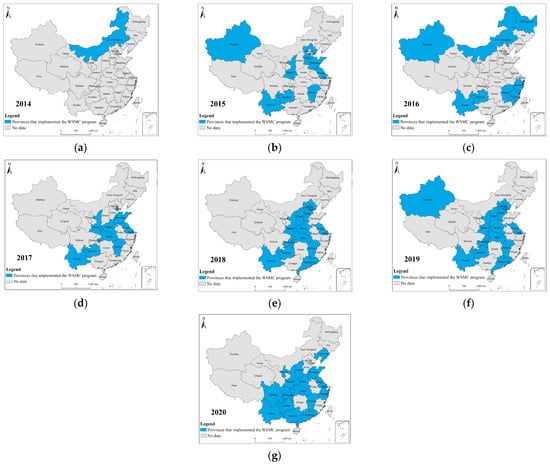
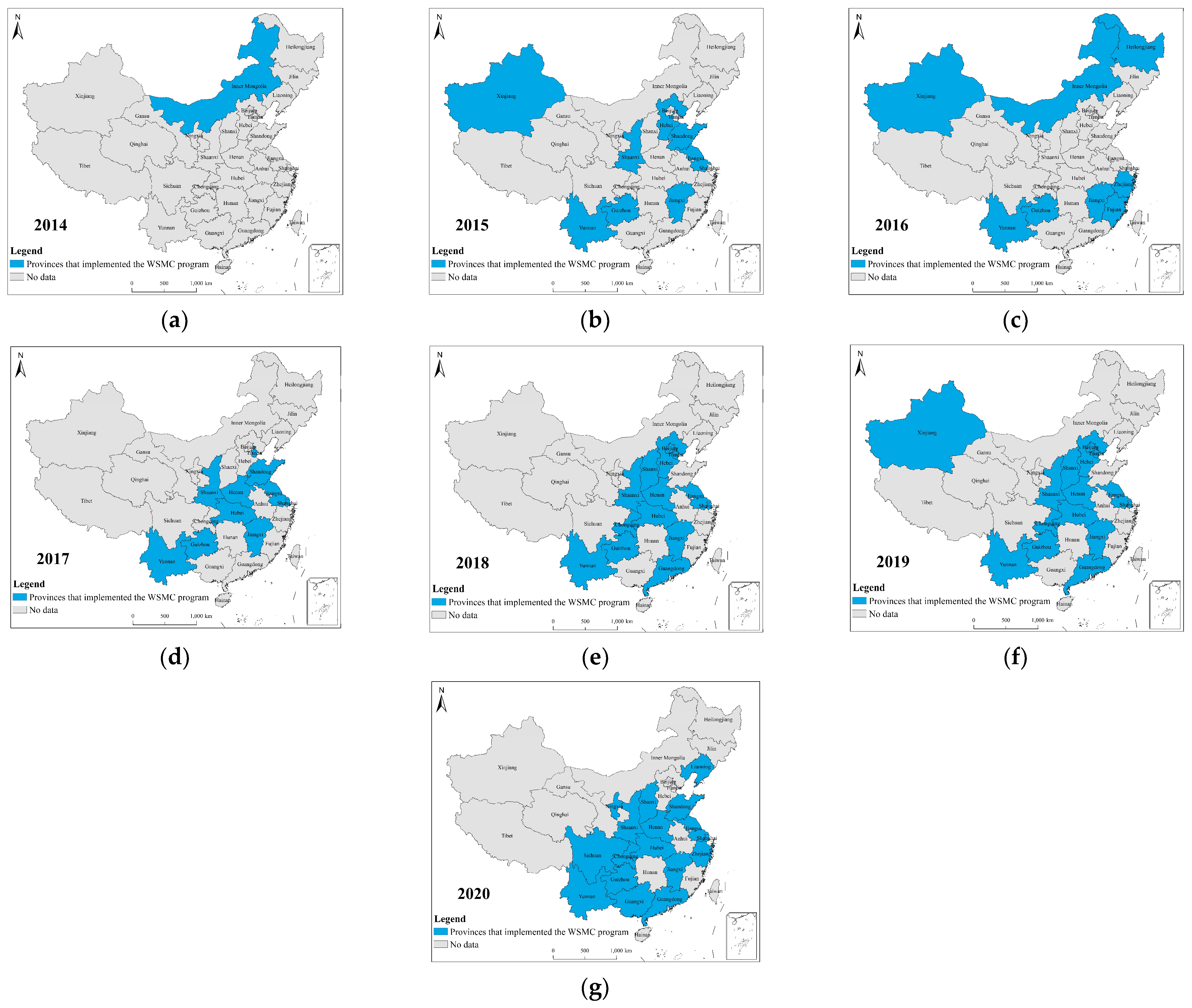
After the release of the Opinions, various provinces have started relevant work. Figure 1 shows the annual status of the implementation of WSMC projects nationwide.
Figure 1.
Provinces that implemented the WSMC program by year (a–g).
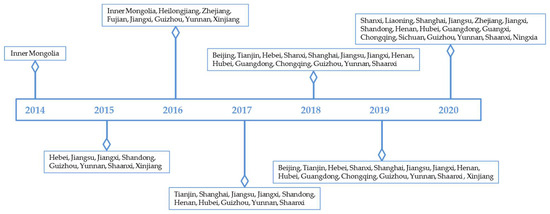
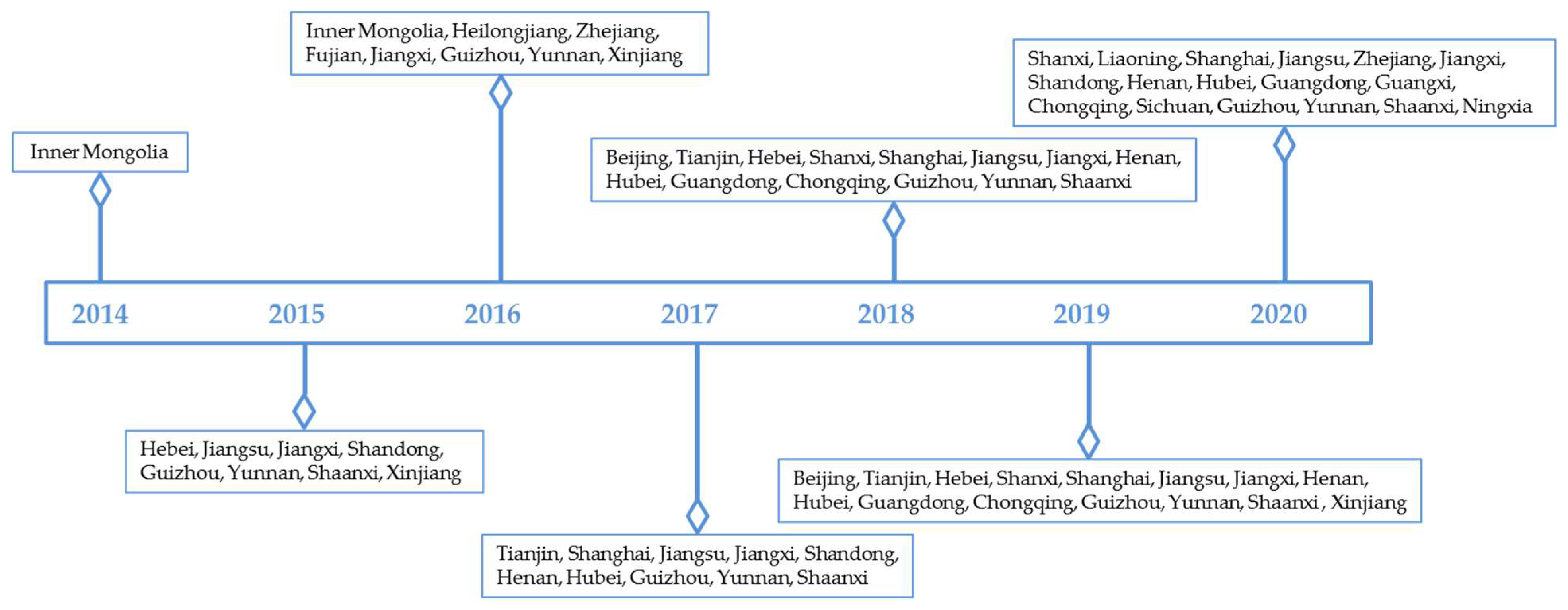
As shown in Figure 1, the regions that first implemented WSMC projects were Inner Mongolia, Hebei, Jiangsu, Jiangxi, Shandong, Guizhou, Yunnan, Shaanxi, and Xinjiang. Since then, the number of provinces and regions involved in water conservation has gradually increased, and 29 provinces (municipalities, autonomous regions, and Xinjiang Production and Construction Corps) have now implemented WSMC projects. Among them, Jiangxi, Guizhou, and Yunnan have implemented WSMC projects for five consecutive years between 2015 and 2020 (Figure 2).
Figure 2.
Timeline of Provinces to implement WSMC programs.
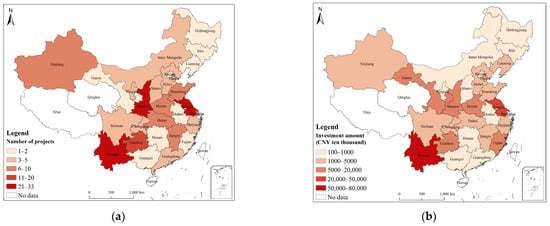
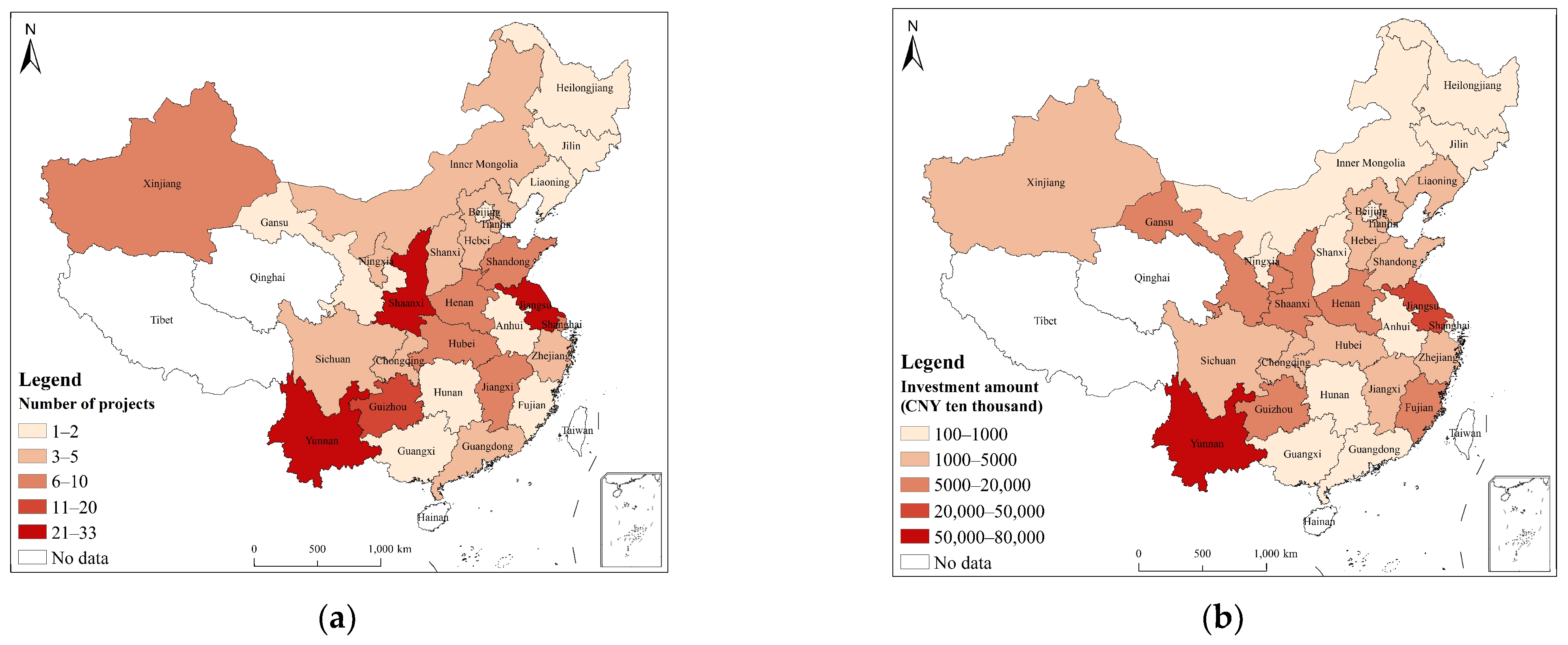
Between 2016 and 2020, the number, as well as the investment amount, of WSMC projects with an investment of CNY 500,000 or more implemented in the 31 provinces (municipalities and autonomous regions) and Xinjiang Production and Construction Corps, are shown in Figure 3.
Figure 3.
The implementation of WSMC projects between 2016 and 2020 by province, where (a) is the number of WSMC projects; (b) is the investment amount of WSMC projects.
Figure 3 shows that among the 181 implemented WSMC projects, Yunnan Province has implemented the most WSMC projects, with a total quantity of 33. Jiangsu Province has implemented the second most WSMC projects, with a total of 26. Shaanxi Province has implemented a total of 21 WSMC projects, ranking third. Yunnan Province is the province with the highest investment amount over the years (approximately CNY 884 million), accounting for 42.70% of the total investment in China. Most WSMC projects are PPP projects for efficient agricultural irrigation. Jiangsu Province ranks second in terms of investment, with a total investment of CNY 422 million, and the projects cover the five fields, with the majority of the projects in public institutions (accounting for 84.62%). The total investment amount of WSMC projects in Yunnan and Jiangsu Provinces accounted for 63.1% of total investment in China, and the total investment amount of WSMC projects in each of Ningxia, Heilongjiang, Beijing, Jilin, Anhui, and Hunan was below CNY 4 million.
4.3. Recommendations for Project Mode Selection
The Opinions proposes three typical mode for WSMC promotion, i.e., the water-saving benefit-sharing type, water-saving effect-guaranteed type, and water-cost trusteeship type.
In the water-saving benefit-sharing mode, water-saving service enterprises and water users share the water-saving benefits according to the amount of water-saving and the proportion in the contract agreement.
In the water-saving effect-guaranteed mode, water-saving service enterprises and water users sign the water-saving effect-guaranteed contracts, and the water user pays when the water-saving service enterprise reaches the amount of water-saving.
In the water-cost trusteeship mode, water users commission the water-saving service enterprises of water system operation management and water-saving reconstruction of water supply and consumption. A water hosting fee is charged according to the contract agreement.
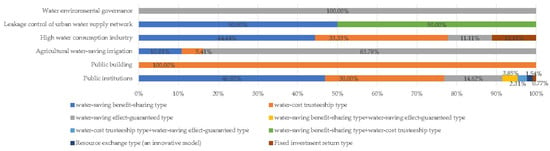
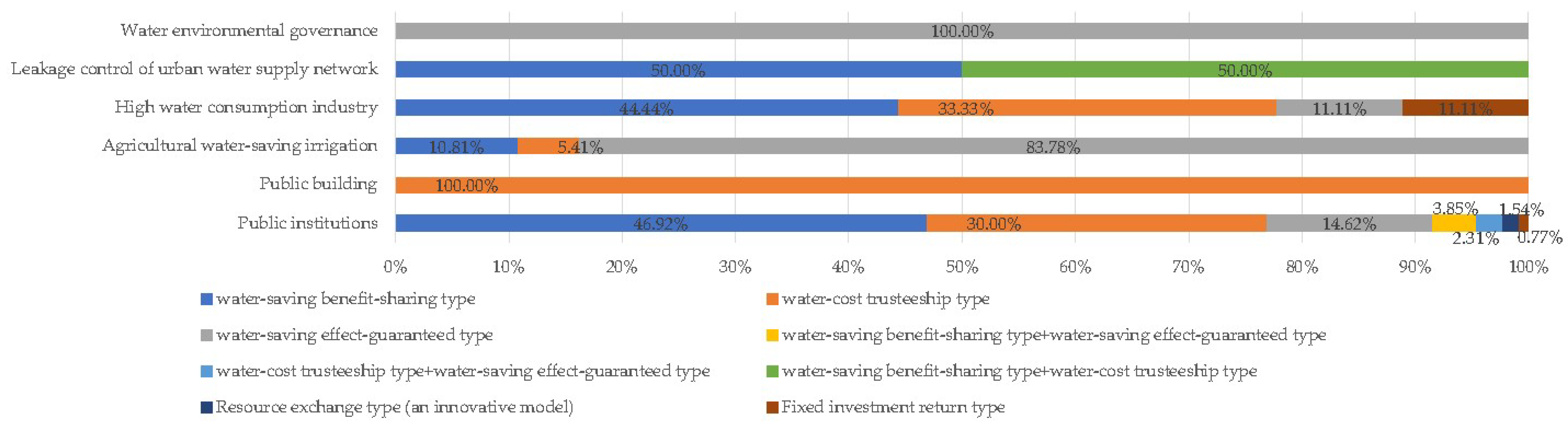
Figure 4 shows the statistics of WSMC projects implemented in different fields between 2016 and 2020 in terms of WSMC models.
Figure 4.
The patterns and proportions of WSMC projects in the various fields.
As shown in Figure 4, between 2016 and 2020, the water-saving benefit-sharing type (accounting for 47%) and the water-cost trusteeship type (accounting for 30%) were the dominant WSMC models adopted in the field of public institutions; the water-saving effect-guaranteed type (accounting for 84%) was the dominant WSMC model adopted in the field of agricultural water-saving irrigation. There was only one WSMC project in the field of public buildings, and the water-cost trusteeship type was the adopted WSMC model. The water-saving benefit-sharing type (accounting for 44%) and water-cost trusteeship type (accounting for 33%) were more commonly used in high water-consuming industries. There were only two WSMC projects in the field of leakage control in the urban water supply pipeline network, and the selected model was the water-saving benefit-sharing type or a combination of the water-saving benefit-sharing type and the water-use cost trusteeship type. The two WSMC projects in the field of water environmental management used the water-saving effect-guaranteed type.
When selecting the WSMC model in the field of public institutions, water users and water-saving service enterprises can make a reasonable selection based on the following conditions and the actual project situation. For water-saving renovation projects, when the investment payback period is not more than 3 or 4 years and the annual water-saving rate is not less than 30%, the water-saving benefit-sharing type can be selected; when the investment payback period is more than 4 years and the annual water-saving rate is less than 30%, the water-saving effect-guaranteed type or water-cost trusteeship type can be selected. Based on the actual situation, mixed models or other models can also be selected.
5. Existing Problems
Since 2016, China has actively promoted the WSMC and has achieved staged progress and certain results in the system construction and pilot project exploration. However, in addition to the 181 projects with an investment of more than CNY 500,000, there were 100 projects (accounting for 35%) with an investment of less than CNY 500,000 among all the projects carried out from 2016 to 2020, which shows that the scale of current WSMC projects is very limited. Moreover, 130 of the 181 projects were carried out in the area of public institutions (accounting for 71%), indicating that the areas currently promoting WSMC projects are very limited.
Through extensive investigation and research on the current status of WSMC promotion and WSMC project implementation, this paper has presented the main issues and reasons that currently affect and restrict the implementation of WSMC projects from two perspectives, the market and the government [8].
5.1. From the Perspective of the Market
- i.
- Existing problems
Water users: It is common in many cities that as a result of the unawareness of the importance of water-saving, water consumption far exceeds the actual need. People do not fully understand the importance of water conservation, and the demand and endogenous motivation for implementing the WSMC are insufficient.
Water-saving service enterprises: Currently, the overall quantity of enterprises in the field of water-saving services is small. For small and medium-sized enterprises, the scale is limited, mortgageable assets are few, investment and financing capabilities are poor, and anti-risk capabilities are weak.
- ii.
- Causal analysis
Water users: First, the planned water use and quota management system is not mature. The water-saving work of most water-using units is not included in the assessment. Second, the water resource fee (tax) and water price standards are low, resulting in low water costs and low water-saving benefits. Third, due to the imperfect measurement facilities and monitoring system, the lack of basic data, and the inaccurate assessment of the amount of water saving, the distribution of water-saving benefits is difficult to determine.
Water-saving service enterprises: First, the low water price, limited water-saving potential, low water-saving benefits, and low project return rate are the main reasons for the low enthusiasm of water-saving service enterprises. Second, water-saving transformation involves multiple links, such as water use diagnosis, scheme design, project financing, technology integration, project implementation, and operation and maintenance services; thus, the investment risk is relatively high. Third, water-saving service enterprises often use commercial credit for financing, and it is difficult for small- and medium-sized water-saving service enterprises to obtain loans.
5.2. From the Perspective of the Government
- i.
- Existing problems
Inadequate technical support and policies related to the WSMC affect its orderly progress.
- ii.
- Causal analysis
First, the relevant laws and regulations are not complete, i.e., the relevant accounting systems required for WSMC implementation, the credit rating, the evaluation systems of water-saving service enterprises, and the supporting systems. Second, there is a lack of fiscal and taxation support. For example, the existing water-saving special funds do not explicitly support WSMC projects; there is a lack of preferential tax policies for WSMC projects. Third, with the progress of water-saving technology and the improvement of management levels, the water quota in some areas has not been adjusted and revised in time, the water quota is significantly large, and the water use plan is too lax. Fourth, in recent years, the WSMC has been mainly promoted by the water administrative department, and the synergies of multiple departments have been limited.
6. Countermeasure Suggestions
To further accelerate the promotion of the water-saving service model of the WSMC, the WSMC should truly be an important way for water users to implement water-saving transformations, and comprehensively promote the construction of water-saving carriers in China. This paper proposes the following countermeasure suggestions based on the problem-oriented approach.
6.1. From the Perspective of the Market
- i.
- Stimulate the endogenous power of suggestions
Water users should change their attitudes and mindsets toward wasting water and be willing to implement the WSMC to perform water conservation consulting, design, evaluation, testing, certification, and other water-saving projects. There are two main tactics for achieving these goals. First, strengthen water-saving supervision and assessment. Water usage quotas should be strictly managed; the guidance, coordination, supervision, and inspection of planned water use should be strengthened; the monitoring, assessment, and evaluation systems of key water-use units should be established; and the entire process of water use should be strictly managed. Second, improving water-use measurement and monitoring facilities, establishing a water-use information management platform, realizing the online collection and supervision of water-use measurement data, strengthening the refined management of water conservation, and providing data support for the implementation of WSMC projects and evaluation of water conservation project effectiveness is recommended [9,10,11].
- ii.
- Improve the WSMC service system
Cultivating and developing third-party water-saving service organizations and strategies, such as water-saving product certification, water balance testing, and water-saving benefit evaluation [12,13]; improving the WSMC service industry chain; gradually establishing a unified WSMC service platform; giving full play to the advantages of “Internet and WSMC”; promoting information sharing, resource sharing, and supply-demand matching between water users and water-saving service enterprises; and promoting the integration of upstream and downstream linkages and intensive and the efficient development of the water conservation service industry chain are recommended.
- iii.
- Increase investment and innovation in water-saving technologies
It is recommended to support enterprises, research institutes, and universities in developing universal and key advanced water-saving technologies/equipment with independent intellectual property rights; promote the transformation and application of water-saving technologies; encourage key enterprises to lead the establishment of water-saving service industry technology innovation alliances to integrate and promote advanced water-saving technologies/products; and encourage the establishment of specialized water-saving service enterprises to provide systematic and professional water-saving services to the market.
- iv.
- Explore the innovative WSMC models
Based on the typical benefit-sharing, effect-guaranteed, and cost-trusteeship models, research on innovative WSMC models should be carried out. Mixed models, such as “benefit-sharing and effect-guaranteed” and “cost trusteeship and effect-guaranteed”, the resource exchange model, and other models should be actively applied. The exploration and implementation of other innovative models, such as PPP, WSMC and water rights trading, and resource exchange or comprehensive development should be encouraged.
- v.
- Promote the pilot demonstration of the WSMC
Combined with the promotion of the water-saving unit construction in public institutions, the leading action of water efficiency leaders, creation of green buildings, construction of clean production and water-saving industrial parks, leakage control of public water supply pipelines, construction of high-standard farmland, and continuous construction/modernization of large- or medium-sized irrigation districts, the in-depth promotion of the WSMC in the various fields (e.g., public institutions, public buildings, high water-consuming industries, high water-consuming service industries, agricultural irrigation, and water supply pipe network leakage control) should be carried out.
6.2. From the Perspective of the Government
The WSMC in China was developed based on contract energy management (EMC), but there are several differences between them in terms of policy, promotion, and the number of projects. As an innovative measure to promote energy conservation mainly by market-oriented means, EMC is quite different from the traditional energy conservation measures mainly supported by financial funds so states and countries around the world have introduced a series of supporting policies for the implementation of EMC projects [14,15,16,17,18,19,20,21,22].
- i.
- Strengthen WSMC policy support
Increase financial support: The qualified water resource conservation, wastewater treatment, wastewater resource utilization, and other water-saving and emission-reduction projects implemented using the WSMC service model can be included in the central government’s budget for energy-saving and carbon-reducing special investment, as well as energy-saving and emission-reduction subsidies. In accordance with the relevant provisions, financial subsidies for WSMC projects can be provided, and the establishment of a government subsidy system for high-efficiency water-saving household appliances can be explored [23,24].
Implement preferential tax policies: Those who meet the conditions of the corporate income tax preferential catalog for environmental protection, energy-saving, and water-saving projects; the corporate income tax preferential catalog for energy-saving and water-saving equipment; the preferential tax catalog for the comprehensive utilization of resources; and the preferential value-added tax (VAT) catalog for the comprehensive utilization of resources and labor services are entitled to the corresponding enterprise income tax and VAT preferential policies [25,26,27].
Develop green finance credit: Exploring the establishment of water-saving service industry funds, focusing on supporting qualified water-saving service enterprises and WSMC projects, supporting qualified water-saving service enterprises to issue green bonds and green asset securitization products, expanding direct financing channels, encouraging local policy-based loans to support WSMC projects, and innovatively launching green financial products such as water-saving loans are recommended [28,29].
- ii.
- Improve the WSMC support system
It is recommended that national water conservation regulations stipulate WSMC and establish a long-term legal mechanism for WSMC projects. When government agencies, institutions, and organizations act as Party A of a WSMC project, the payment to water-saving service enterprises in accordance with the contractual agreement can be included in the financial budget as the water bill [30]. The implementation of WSMC projects in the fields of agricultural irrigation, high water-consuming industries, and water environment management should be actively promoted, and the methods of water rights transfer, purchase, and buy-back should be adopted to perform the market-oriented trading of the saved water [31,32,33].
- iii.
- Improve technical standards for the WSMC
Basic general standards (e.g., the general rules for WSMC technology, water-saving amount calculation guidelines for WSMC projects, operational procedures), standards (e.g., water-saving evaluation guidelines for WSMC projects, implementation guidelines for WSMC projects, and WSMC project acceptance specifications), and measurement/calculation standards, such as water saving calculation methods in different industries, should be formulated and revised.
- iv.
- Deepen the reform of the water pricing system
A multi-level water supply pricing system that reflects the scarcity of water resources, the difference in water supply and demand, and water costs should be established to appropriately widen the price difference between high water-consuming industries and other industries. It is recommended to comprehensively promote water resource tax reform and establish a reasonable water resource tax-sharing mechanism between the central and local governments. Exploring tax-exempt or low water resource taxes (fee) for water users who implement the WSMC service model and reach an advanced value of the water consumption quota [34] is also recommended.
- v.
- Increase WSMC publicity and training
It is recommended to strengthen the follow-up analysis and publicity report on the implementation of the WSMC, summarize and extract good experiences and typical cases in a timely manner, and effectively increase the promotion of the WSMC. It is recommended to strengthen WSMC training and conduct publicity and training on WSMC policies, business knowledge, technical standards, and typical practices.
- vi.
- Strengthen coordination among multiple departments
It is recommended to give full play to the role of interministerial and interprovincial coordination mechanisms for water conservation to coordinate and promote the various tasks of the WSMC. The Ministry of Water Resources and the local water conservancy departments should effectively perform a centralized coordination function to promote the implementation of the WSMC as soon as possible. According to the division of responsibilities, the relevant departments should closely cooperate and actively manage the promotion of the WSMC in each industry and field to effectively achieve a good result.
7. Discussion
- i.
- Principal findings and comparison with other studies
The WSMC came into being under China’s national and water conditions but at present, the WSMC is still in its infancy due to the constraints of various factors such as low water prices in China. It is urgent to conduct an in-depth analysis of the various problems and propose reasonable solutions. We collected data from 32 provinces in China for 5 years and conducted research based on this data, which has not been seen in previous studies in international journals.
- ii.
- Strengths and limitations
The data and analysis of the provinces across the country from 2016 to 2020 was the first time a public study was conducted. We proposed the effectiveness of China’s promotion of WSMC projects in the past 5 years, analyzed the problems existing in promoting WSMC, and provided 11 specific countermeasures. We believe that this article could play an important reference role for international scholars to study and put into practice the WSMC in other areas of the world.
The statistics came from the provincial water conservancy departments, but the development of the WSMC projects is not only related to the promotion of the government but also market behavior.
- iii.
- Future research directions
Judging from the results of the implemented projects, the WSMC is a market-oriented water-saving model that is beneficial to water users, water-saving service enterprises, and the country, and has produced obvious economic, social and ecological benefits. In particular, from the perspective of water-saving service enterprises, the WSMC can effectively connect its funds, technologies, and water users’ needs, and produce stable and long-term expected returns on investment.
In the future, the WSMC could be comprehensively developed with the joint efforts of the government and the market. On the one hand, the government must accelerate the formulation and improvement of laws and regulations related to the WSMC; formulate a strict evaluation system, reasonable incentive mechanism, and scientific risk evaluation model; and advocate for water users in various fields to actively carry out the WSMC, especially in industries and agricultural irrigation areas with large water consumption. On the other hand, from a market perspective, water-saving service enterprises need to continuously develop and innovate water-saving products, equipment, and technologies to maximize the economic benefits of water-saving.
8. Conclusions
After the release of the Opinions, China has achieved staged progress in the implementation of the WSMC. A total of 181 WSMC projects have been implemented in six fields, namely, public institutions, public buildings, agricultural water-saving irrigation, high water-consuming industries, water environmental management, and water supply pipeline leakage management (investment amount of more than CNY 500,000), with a social capital investment of more than CNY 2 billion, a water-saving amount of 178 million cubic meters per year, and a water-saving rate of approximately 33.6%. However, there are some problems that currently affect and restrict the implementation of WSMC projects, such as lacking awareness of the importance of water conservation among water users, a limited number and scale of water conservation service enterprises, and the inadequacy of relevant policies and systems. By taking a problem- and result-oriented approach, this paper proposes 11 countermeasures from the five aspects of incentive policies, supporting systems, technical support, market vitality, and security measures. These countermeasures are conducive to improving WSMC policies, vigorously promoting the development of water-saving industries, and realizing the intensive and efficient use of water resources.
Author Contributions
W.W. contributed substantially to conceptualization, investigation, resources, data curation, data interpretation, and writing. J.Y. and L.R. prepared the conceptualization and data curation. C.D. and Q.W. prepared the methodology. All authors have participated in the review and given final approval of the version to be submitted. All authors have read and agreed to the published version of the manuscript.
Funding
This research was funded by the National Key Research and Development Programme of China, grant number 2016YFC0401308; Water Policy Research Program, grant number 126216001000200006.
Data Availability Statement
Not applicable.
Acknowledgments
The authors thank the provincial water resources departments of China for providing the data. The authors are very grateful to the editors and anonymous reviewers for their constructive comments and corrections that substantially improved the quality of the study.
Conflicts of Interest
The authors declare no conflict of interest.
Appendix A
Table A1.
Summary of policies that include the WSMC in China.
Table A2.
Summary of provincial regulations that include the WSMC.
References
- Liu, Y. Difficulties and counter measures of promotion of water saving management contract. J. Econ. Water Resour. 2017, 35, 32–35. [Google Scholar] [CrossRef]
- Cao, S. Build the support system of water saving management contract driven by innovation. J. Econ. Water Resour. 2017, 35, 36–38. [Google Scholar] [CrossRef]
- Li, P.; Shao, Z. Interpretation of the opinions on the promotion of water saving management contract to promote the development of watersaving service industry. China Water Resources News, 22 December 2016.
- Chen, Z.; Wang, H. Water-Saving Service Supply Chain Cooperation under Social Welfare Maximization. J. Water Clim. Chang. 2019, 11, 703–721. [Google Scholar] [CrossRef] [Scilit]
- Deng, Y. Preliminary study on the laws for water-saving management contract. J. Yangtze Univ. (Soc. Sci. Ed.) 2017, 40, 77–81. [Google Scholar] [CrossRef]
- Bai, Y.; Bai, X.; Cai, R.; Zhang, L. Standardization of water-saving management contract and case analysis. Stand. Sci. 2020, 4, 14–17. [Google Scholar] [CrossRef]
- Zhang, J.; Luo, L.; Xu, F.; Liu, J. Parsed the Relevant Standards of Water Conservation Contracting. J. Econ. Water Resour. 2017, 35, 57–59. [Google Scholar] [CrossRef]
- Shunglu, R.; Köpke, S.; Kanoi, L.; Nissanka, T.S.; Withanachchi, C.R.; Gamage, D.U.; Dissanayake, H.R.; Kibaroglu, A.; Ünver, O.; Withanachchi, S.S.; et al. Barriers in Participative Water Governance: A Critical Analysis of Community Development Approaches. Water 2022, 14, 762. [Google Scholar] [CrossRef] [Scilit]
- Cheng, T.; Cui, Y.; Yu, J.; Sun, W.; Yang, Z. Processing system for economic and water consumption data in the national water resources regions. J. Beijing Norm. Univ. Nat. Sci. 2014, 50, 515–522. [Google Scholar]
- Cui, Y.; Tan, F.; Zheng, C. Analysis of irrigation efficiency and water saving potential at different scales. Adv. Water Sci. 2010, 21, 788–794. [Google Scholar] [CrossRef]
- National Development and Reform Commission; Ministry of Water Resources. National Water Conservation Action Plan. China Water Resour. 2019, 8, 4. [Google Scholar]
- Ma, W.; Li, X.; Wang, X. Water Saving Management Contract, Identification and Ranking of Risks Based on Life Cycle and Best-Worst Method. J. Clean. Prod. 2021, 306, 127153. [Google Scholar] [CrossRef] [Scilit]
- Hu, H.; Wang, X.; Gao, Z.; Guo, H. A Real Option-Based Valuation Model for Shared Water Saving Management Contract. J. Clean. Prod. 2021, 289, 125442. [Google Scholar] [CrossRef] [Scilit]
- Carbonara, N.; Pellegrino, R. Public-Private Partnerships for Energy Efficiency Projects: A Win-Win Model to Choose the Energy Performance Contracting Structure. J. Clean. Prod. 2018, 170, 1064–1075. [Google Scholar] [CrossRef] [Scilit]
- Hufen, H.; de Bruijn, H. Getting the Incentives Right. Energy Performance Contracts as a Tool for Property Management by Local Government. J. Clean. Prod. 2016, 112, 2717–2729. [Google Scholar] [CrossRef] [Scilit]
- Polzin, F.; von Flotow, P.; Nolden, C. What Encourages Local Authorities to Engage with Energy Performance Contracting for Retrofitting? Evidence from German Municipalities. Energy Policy 2016, 94, 317–330. [Google Scholar] [CrossRef] [Scilit]
- Principi, P.; Roberto, F.; Carbonari, A.; Lemma, M. Evaluation of Energy Conservation Opportunities through Energy Performance Contracting: A Case Study in Italy. Energy Build. 2016, 128, 886–899. [Google Scholar] [CrossRef] [Scilit]
- Pätäri, S.; Sinkkonen, K. Energy Service Companies and Energy Performance Contracting: Is There a Need to Renew the Business Model? Insights from a Delphi Study. J. Clean. Prod. 2014, 66, 264–271. [Google Scholar] [CrossRef] [Scilit]
- Vine, E. An International Survey of the Energy Service Company (ESCO) Industry. Energy Policy 2005, 33, 691–704. [Google Scholar] [CrossRef] [Scilit]
- Aasen, M.; Westskog, H.; Korneliussen, K. Energy Performance Contracts in the Municipal Sector in Norway: Overcoming Barriers to Energy Savings? Energy Effic. 2016, 9, 171–185. [Google Scholar] [CrossRef] [Scilit]
- Marino, A.; Bertoldi, P.; Rezessy, S.; Boza-Kiss, B. A Snapshot of the European Energy Service Market in 2010 and Policy Recommendations to Foster a Further Market Development. Energy Policy 2011, 39, 6190–6198. [Google Scholar] [CrossRef] [Scilit]
- Boza-Kiss, B.; Bertoldi, P.; Economidou, M. Energy Service Companies in the EU: Status Review and Recommendations for Further Market Development with a Focus on Energy Performance Contracting; Publications Office of the European Union: Luxembourg, 2017. [Google Scholar]
- Fu, J.; Bian, L. Thoughts on increasing financial subsidies for the purchase and use of water-saving irrigation equipment. Water Sav. Irrig. 2018, 3, 67–69. [Google Scholar] [CrossRef]
- Chen, M.; Zhang, W.; Chen, B. Water conservation priority—water conservation should be placed on a priority position from the aspects of concept, awareness, and measures. Water Resour. Dev. Res. 2018, 18, 8–16. [Google Scholar] [CrossRef]
- Song, X. Fiscal and tax policies of developed countries to promote energy conservation and emission reduction and the inspiration for China. Res. Financ. Account. 2012, 22, 9–11. [Google Scholar]
- Zhang, X. Research on Tax Preference Institutions of Public-Private-Partnership Projects; Beijing Jiaotong University: Beijing, China, 2019. [Google Scholar]
- Xin, L.; Zhao, Y.; Lu, Y.; Ye, Z.; Xu, Z.; Lu, J. Status, problems and countermeasures of tax preferential policies for environmental protection industry in China. China Environ. Prot. Ind. 2019, 6, 5–10. [Google Scholar] [CrossRef]
- Huang, S.; Wang, H.; Tang, M. Research on financial support for water conservation development from the perspective of green finance. Mark. Forum 2018, 4, 24–27. [Google Scholar] [CrossRef]
- Tang, Z.; Luo, L. Green finance policy analysis for the implementation of water-saving management contract. Water Resour. Dev. Res. 2018, 18, 8–11. [Google Scholar] [CrossRef]
- Guo, X.; Yang, Y. Thoughts on Water-saving Management Contracting project in universities. China Water Resour. 2019, 3, 8–10. [Google Scholar] [CrossRef]
- Cao, S. Problems and countermeasures for inclusion of water-saving quantity in water right transaction under contract water saving mode. J. Econ. Water Resour. 2019, 37, 36–88. [Google Scholar] [CrossRef]
- Wang, Y.; Ren, L.; Wang, W.; Zhang, B. Feasibility of water right transaction based on contract water-saving management mode. J. Econ. Water Resour. 2019, 37, 39–41, 74. [Google Scholar] [CrossRef]
- Guo, H.; Chen, X.; Dong, Z.; Zhang, H. Construction method of water right trading based on water-saving management contract. Water Resour. Prot. 2019, 35, 33–38, 62. [Google Scholar] [CrossRef]
- Xu, X.; Wang, L. Discussion on differentiated water charge collection modes for construction of water-saving society. Water Resour. Prot. 2013, 29, 87–90. [Google Scholar]

Publisher’s Note: MDPI stays neutral with regard to jurisdictional claims in published maps and institutional affiliations. |
© 2022 by the authors. Licensee MDPI, Basel, Switzerland. This article is an open access article distributed under the terms and conditions of the Creative Commons Attribution (CC BY) license (https://creativecommons.org/licenses/by/4.0/).